EP4249465A1 - Method for preparing acrylic acid - Google Patents
Method for preparing acrylic acid Download PDFInfo
- Publication number
- EP4249465A1 EP4249465A1 EP22881180.8A EP22881180A EP4249465A1 EP 4249465 A1 EP4249465 A1 EP 4249465A1 EP 22881180 A EP22881180 A EP 22881180A EP 4249465 A1 EP4249465 A1 EP 4249465A1
- Authority
- EP
- European Patent Office
- Prior art keywords
- acrylic acid
- column
- discharge stream
- preparing
- hydroxyacetone
- Prior art date
- Legal status (The legal status is an assumption and is not a legal conclusion. Google has not performed a legal analysis and makes no representation as to the accuracy of the status listed.)
- Pending
Links
Images

Classifications
-
- C—CHEMISTRY; METALLURGY
- C07—ORGANIC CHEMISTRY
- C07C—ACYCLIC OR CARBOCYCLIC COMPOUNDS
- C07C51/00—Preparation of carboxylic acids or their salts, halides or anhydrides
- C07C51/347—Preparation of carboxylic acids or their salts, halides or anhydrides by reactions not involving formation of carboxyl groups
- C07C51/377—Preparation of carboxylic acids or their salts, halides or anhydrides by reactions not involving formation of carboxyl groups by splitting-off hydrogen or functional groups; by hydrogenolysis of functional groups
-
- C—CHEMISTRY; METALLURGY
- C07—ORGANIC CHEMISTRY
- C07C—ACYCLIC OR CARBOCYCLIC COMPOUNDS
- C07C45/00—Preparation of compounds having >C = O groups bound only to carbon or hydrogen atoms; Preparation of chelates of such compounds
- C07C45/78—Separation; Purification; Stabilisation; Use of additives
- C07C45/81—Separation; Purification; Stabilisation; Use of additives by change in the physical state, e.g. crystallisation
- C07C45/82—Separation; Purification; Stabilisation; Use of additives by change in the physical state, e.g. crystallisation by distillation
-
- C—CHEMISTRY; METALLURGY
- C07—ORGANIC CHEMISTRY
- C07C—ACYCLIC OR CARBOCYCLIC COMPOUNDS
- C07C51/00—Preparation of carboxylic acids or their salts, halides or anhydrides
- C07C51/42—Separation; Purification; Stabilisation; Use of additives
-
- C—CHEMISTRY; METALLURGY
- C07—ORGANIC CHEMISTRY
- C07C—ACYCLIC OR CARBOCYCLIC COMPOUNDS
- C07C51/00—Preparation of carboxylic acids or their salts, halides or anhydrides
- C07C51/42—Separation; Purification; Stabilisation; Use of additives
- C07C51/43—Separation; Purification; Stabilisation; Use of additives by change of the physical state, e.g. crystallisation
- C07C51/44—Separation; Purification; Stabilisation; Use of additives by change of the physical state, e.g. crystallisation by distillation
-
- C—CHEMISTRY; METALLURGY
- C07—ORGANIC CHEMISTRY
- C07C—ACYCLIC OR CARBOCYCLIC COMPOUNDS
- C07C51/00—Preparation of carboxylic acids or their salts, halides or anhydrides
- C07C51/42—Separation; Purification; Stabilisation; Use of additives
- C07C51/48—Separation; Purification; Stabilisation; Use of additives by liquid-liquid treatment
Definitions
- the present invention relates to a method for preparing an acrylic acid, and more particularly, to a method for preparing an acrylic acid by a dehydration reaction of a lactic acid, which effectively removes by-products while reducing an acrylic acid loss.
- acrylic acid is used as a polymer raw material used in fiber, adhesives, paint, fiber processing, leather, building materials, and the like, and its demand is growing.
- the acrylic acid is also used as a raw material of an absorbent resin and is industrially used a lot in absorbent articles such as paper diapers and sanitary napkins, agricultural and horticultural water retaining agents, industrial water stop materials, and the like.
- a conventional method for preparing an acrylic acid is generally a method of oxidizing propylene in the air, but the method is a method of converting propylene into acrolein by a gaseous contact oxidation reaction and subjecting the acrolein to a gaseous contact oxidation reaction to prepare an acrylic acid, and the method produces an acetic acid as a by-product, which is difficult to separate from the acrylic acid.
- the method for preparing an acrylic acid using propylene uses propylene obtained by refining crude oil which is a fossil resource, as a raw material, and considering problems such as a recent rise in crude oil prices or global warming, the method has a problem in terms of raw material costs or environmental pollution.
- a study on a method for preparing an acrylic acid from a carbon-neutral biomass raw material was conducted.
- This method is generally a method for preparing an acrylic acid by an intramolecular dehydration reaction of a lactic acid in the presence of a catalyst at a high temperature of 300°C or higher.
- a side reaction occurs in addition to the dehydration reaction, and thus, by-products including hydroxyacetone (HA) are produced in addition to the acrylic acid as a reaction product.
- HA hydroxyacetone
- An object of the present invention is to provide a method of minimizing an acrylic acid loss while effectively removing by-products, in preparing an acrylic acid by a dehydration reaction of a lactic acid, in order to solve the problems mentioned in the Background Art.
- a method for preparing an acrylic acid includes: supplying a reaction product stream prepared by a dehydration reaction of a lactic acid aqueous solution to an extraction column, and in the extraction column, separating an upper discharge stream including an acrylic acid using an extractant and supplying the upper discharge stream to an extractant recovery column; in the extractant recovery column, separating a lower discharge stream including the acrylic acid and supplying the lower discharge stream to a first separation column; in the first separation column, separating a low-boiling point by-product to an upper portion, and separating a lower discharge stream including the acrylic acid and supplying the lower discharge stream to a second separation column; in the second separation column, separating a high-boiling point by-product to a lower portion, and supplying an upper discharge stream including the acrylic acid to a refining column; and in the refining column, separating an upper discharge stream including the acrylic acid, and refluxing a lower discharge stream including hydroxyacetone to the extraction column.
- hydroxyacetone having a boiling point similar to the acrylic acid is completely removed from a reaction product including the acrylic acid, thereby solving a problem of the lowered purity of an acrylic acid product due to the residual hydroxyacetone, and minimizing an acrylic acid loss in the process of separating and removing the hydroxyacetone.
- the term "stream" in the present invention may refer to a fluid flow in a process, or may refer to a fluid itself flowing in a pipe. Specifically, the stream may refer to both a fluid itself flowing in a pipe connecting each device and a fluid flow.
- the fluid may include any one or more components of gas, liquid, and solid.
- a method for preparing an acrylic acid may include: supplying a reaction product stream prepared by a dehydration reaction of a lactic acid aqueous solution to an extraction column 100, and in the extraction column 100, separating an upper discharge stream including an acrylic acid using an extractant and supplying the upper discharge stream to an extractant recovery column 200; in the extractant recovery column 200, separating a lower discharge stream including the acrylic acid and supplying the lower discharge stream to a first separation column 300; in the first separation column 300, separating a low-boiling point by-product to an upper portion, and separating a lower discharge stream including the acrylic acid and supplying the lower discharge stream to a second separation column 310; in the second separation column 310, separating a high-boiling point by-product to a lower portion, and supplying an upper discharge stream including the acrylic acid to a refining column 400; and in the refining column 400, separating an upper discharge stream including the acrylic acid, and refluxing a
- a conventional method for preparing an acrylic acid is generally a method of oxidizing propylene in the air, but the method, which is a method of converting propylene into acrolein by a gaseous contact oxidation reaction and subjecting the acrolein to a gaseous contact oxidation reaction to prepare an acrylic acid, produces an acetic acid as a by-product, which is difficult to separate from the acrylic acid.
- the method for preparing an acrylic acid using propylene uses propylene obtained by refining crude oil which is a fossil resource, as a raw material, and considering problems such as a recent rise in crude oil prices or global warming, the method has a problem in terms of raw material costs or environmental pollution.
- a study on a method for preparing an acrylic acid from a carbon-neutral biomass raw material was conducted.
- This method is generally a method for preparing an acrylic acid by an intramolecular dehydration reaction of a lactic acid in the presence of a catalyst at a high temperature.
- an acrylic acid is prepared by the dehydration reaction of a lactic acid, in which an extraction method is used for completely removing by-products produced therefrom, in particular, hydroxyacetone (boiling point: 145°C) which has a boiling point similar to the acrylic acid (boiling point: 141°C) and thus, is difficult to separate, and it is intended to provide a method of completely removing the hydroxyacetone while also minimizing an acrylic acid loss.
- a reaction product stream prepared by a dehydration reaction of a lactic acid aqueous solution may be supplied to an extraction column 100.
- the reaction product may be a condensate condensed through a cooling tower.
- a lactic acid aqueous solution may be supplied to a reactor and dehydrated to prepare a reaction product including an acrylic acid.
- the dehydration reaction may be performed as a gas phase reaction in the presence of a catalyst.
- the concentration of the lactic acid in the lactic acid aqueous solution may be 10 wt% or more, 20 wt% or more, or 30 wt% or more and 40 wt% or less, 50 wt% or less, 60 wt% or less, or 70 wt% or less.
- the reactor may be a reactor capable of a common dehydration reaction of a lactic acid
- the reactor may include a reaction tube filled with a catalyst, and while a reaction gas including volatile components of a lactic acid aqueous solution as a raw material is passed through the reaction tube, a lactic acid may be dehydrated by a gaseous contact reaction to produce an acrylic acid.
- the reaction gas may further include any one or more dilution gases of water vapor, nitrogen gas, and air for adjusting a concentration, in addition to the lactic acid.
- Operation conditions of the reactor may be common dehydration reaction conditions of a lactic acid.
- the operation temperature of the reactor may refer to a set temperature of a heating medium or the like used for controlling the temperature of the reactor.
- a catalyst used in the dehydration reaction of the lactic acid may include, for example, one or more selected from the group consisting of sulfate-based catalysts, phosphate-based catalysts, and nitrate-based catalysts.
- the sulfate may include Na 2 SO 4 , K 2 SO 4 , CaSO 4 , and Al 2 (SO 4 ) 3
- the phosphate may include Na 3 PO 4 , Na 2 HPO 4 , NaH 2 PO 4 , K 3 PO 4 , K 2 HPO 4 , KH 2 PO 4 , CaHPO 4 , Ca 3 (PO 4 ) 2 , AlPO 4 , CaH 2 P 2 O 7 , and Ca 2 P 2 O 7
- the nitrate may include NaNO 3 , KNO 3 , and Ca(NO 3 ) 2 .
- the catalyst may be supported on a support.
- the support may include one or more selected from the group consisting of, for example, diatomaceous earth, alumina, si
- the reaction product prepared by the dehydration reaction of the lactic acid may further include water (H 2 O) and by-products such as hydroxyacetone, in addition to the acrylic acid which is a desired product.
- the reaction product may be supplied to a cooling tower and cooled therein.
- the reaction product prepared by the dehydration reaction of the lactic acid is a gas phase and may be condensed through the cooling tower. Gaseous by-products may be separated from the upper portion of the cooling tower and a liquid condensate may be discharged to the lower portion, and here, the condensate may be a reaction product stream supplied to the extraction column 100 in the present invention.
- a separate extractant is used to separate the acrylic acid included in the reaction product stream as an upper discharge stream.
- the extractant may include, for example, one or more selected from the group consisting of benzene, toluene, xylene, n-heptane, cycloheptane, cycloheptene, 1-heptene, ethylbenzene, methylcyclohexane, n-butylacetate, isobutylacetate, isobutylacrylate, n-propylacetate, isopropylacetate, methylisobutylketone, 2-methyl-1-heptene, 6-methyl-1-heptene, 4-methyl-1-heptene, 2-ethyl-1-hexene, ethylcyclopentane, 2-methyl-1-hexene, 2,3-dimethylpentane, 5-methyl-1-hexene, and isopropylbutylether.
- the extractant may be toluene.
- a method of supplying the extractant and performing extraction in the extraction column 100 may be any known method, and for example, any method such as cross current, counter current, and co-current may be used without particular limitation.
- the reaction product stream and the extractant may be brought into contact to separate an extract and an extraction residue solution.
- the extract may be an acrylic acid dissolved in the extractant, and the extract may be discharged as an upper discharge stream from the extraction column 100.
- the upper discharge stream from the extraction column 100 may be supplied to an extractant recovery column 200.
- the extraction residue solution is wastewater including water and may be separated to the lower portion of the extraction column 100.
- hydroxyacetone among the by-products may be separated together with water and discharged, but is not all discharged, and partially flows out as an extract and transferred to the rear end with the acrylic acid.
- the amount of extractant used may be adjusted for removing hydroxyacetone in the extraction column 100, but it is difficult to remove the total amount of hydroxyacetone even with the increased amount of the extractant used, and in this case, the content of the acrylic acid discharged with water to the lower portion of the extraction column 100 is increased, which may cause a problem of increasing an acrylic acid loss.
- the operating conditions of the refining column 400 at the rear end are adjusted to effectively separate hydroxyacetone and reflux it to the extraction column 100, thereby separating and removing a total amount of hydroxyacetone as the lower discharge stream of the extraction column 100, and minimizing an acrylic acid loss at this time.
- a ratio of the content of hydroxyacetone separated to the lower portion of the extraction column 100 to the content of hydroxyacetone included in the reaction product stream may be 0.95 to 1, 0.97 to 1, or 0.99 to 1, and specifically, the total amount of hydroxyacetone included in the reaction product stream supplied to the extraction column 100 may be removed in the extraction column 100.
- a high-purity acrylic acid may be separated in the refining column 400.
- the upper discharge stream from the extraction column 100 may include the acrylic acid, and also, it may include an extractant and hydroxyacetone.
- the content of hydroxyacetone in the upper discharge stream of the extraction column 100 may be 0.2 wt% to 15 wt%, 3 wt% to 13 wt%, or 5 wt% to 10 wt% of the hydroxyacetone included in the reaction product stream.
- the content of hydroxyacetone in the upper discharge stream of the extraction column 100 is controlled as described above, thereby minimizing the content of the acrylic acid which is lost with water to the lower portion of the extraction column 100, and reducing the amount of energy used for separation in the refining column 400.
- the upper discharge stream from the extraction column 100 is supplied to the extractant recovery column 200, and in the extractant recovery column 200, a lower discharge stream including the acrylic acid may be separated and supplied to a first separation column 300.
- the extractant in the extractant recovery column 200, the extractant may be separated as an upper discharge stream, and a part of the upper discharge stream from the extractant recovery column 200 may be refluxed to the extraction column 100 to reuse the extractant.
- a lower discharge stream from the extractant recovery column 200 may include a low-boiling point by-product, a high-boiling point by-product, and hydroxyacetone as by-products, with the acrylic acid.
- the operating conditions of the extractant recovery column 200 vary with the component contents, the kind of extractant, and the like supplied to the extractant recovery column 200.
- the operating temperature of the extractant recovery column 200 may be, for example, 40°C to 150°C, 45°C to 130°C, or 50°C to 110°C.
- the operating pressure of the extractant recovery column 200 may be 35 torr to 300 torr, 70 torr to 250 torr, or 100 torr to 200 torr.
- the first separation column 300 may be for separating a low-boiling point by-product among the by-products included in the reaction product.
- a lower discharge stream from the extractant recovery column 200 may be supplied to a first separation column 300, a low-boiling point by-product may be separated to the upper portion in the first separation column 300, and a lower discharge stream including the acrylic acid may be separated and supplied to a second separation column 310.
- the second separation column 310 may be for separating a high-boiling point by-product among the by-products included in the reaction product. Specifically, a lower discharge stream from the first separation column 300 may be supplied to the second separation column 310, a high-boiling point by-product may be separated to the lower portion in the second separation column 310, and an upper discharge stream including the acrylic acid may be separated and supplied to a second separation column 310.
- the first separation column 300 and the second separation column 310 may be devices for separation using a boiling point difference between components by distillation, respectively.
- the low-boiling point by-product and the high-boiling point by-product included in the lower discharge stream from the extractant recovery column 200 are removed as they go through the first separation column 300 and the second separation column 310, or hydroxyacetone having a boiling point similar to the acrylic acid is not separated and discharged together when the acrylic acid is separated as the upper discharge stream from the second separation column 310. Therefore, when the acrylic acid is commercialized with the upper discharge stream from the second separation column 310, the purity of the product is lowered.
- the upper discharge stream from the second separation column 310 is supplied to the refining column 400, the upper discharge stream including a high-purity acrylic acid and the lower discharge stream including hydroxyacetone and an acrylic acid are separated in the refining column 400, and the lower discharge stream from the refining column 400 is refluxed to the extraction column 100, thereby removing the total amount of hydroxyacetone in the extraction column 100 and separating the acrylic acid in a high purity as the upper discharge stream from the refining column 400.
- hydroxyacetone in the by-products may be separated together with water to the lower portion of the extraction column 100, but when the total amount of hydroxyacetone is not discharged, not-discharged hydroxyacetone flows out as an extract and is transferred to the rear end with the acrylic acid. In this case, since hydroxyacetone should be separated in the refining column 400, the yield of a high-purity acrylic acid may be lowered.
- the amount of extractant used may be adjusted for removing hydroxyacetone in the extraction column 100, but in this case, it is difficult to remove the total amount of hydroxyacetone even with the increased amount of the extractant used, and in particular, the content of the acrylic acid discharged with water to the lower portion of the extraction column 100 is increased, which may cause a problem of increasing an acrylic acid loss.
- the operating temperature of the refining column 400 may be, for example, 60°C to 200°C, 80°C to 150°C, or 90°C to 110°C.
- the operating pressure of the refining column 400 may be 35 torr to 500 torr, 70 torr to 350 torr, or 100 torr to 200 torr.
- the upper discharge stream from the second separation column 310 may be supplied to a stage at 50% to 90%, 55% to 85%, or 60% to 80% of the entire number of stages of the refining column 400.
- the separation efficiency of the refining column 400 may be increased, and thus, the composition of the lower discharge stream from the refining column 400 refluxed to the extraction column 100 may be controlled.
- the total number of stages of the refining column 400 may be 15 to 70, 18 to 55, or 20 to 35.
- the lower discharge stream from the refining column 400 may form a mixed stream with the reaction product stream and be supplied to the extraction column 100. Since the reaction product stream forms a mixed stream with the lower discharge stream from the refining column 400 refluxed in the refining column 400 and supplies to the extraction column 100, the total amount of hydroxyacetone may be removed to the lower portion of the extraction column 100 while minimizing an acrylic acid loss.
- devices such as a distillation column, a condenser, a reboiler, a valve, a pump, a separator, and a mixer may be further installed.
- a lactic acid aqueous solution having a concentration of 50 wt% and nitrogen (N 2 ) as dilution gas were supplied to a reactor to produce a reaction product including an acrylic acid (AA) by a dehydration reaction, a reactor discharge stream including the reaction product was supplied to a cooling tower, and in the cooling tower, a gaseous by-product was separated to the upper portion, and a liquid reaction product as a condensate was supplied to an extraction column 100.
- toluene was used as an extractant to separate an acrylic acid as an upper discharge stream, which was supplied to an extractant recovery column 200, and water was separated to the lower portion.
- the operating temperature of the extraction column 100 was controlled to 40°C, and the operating pressure was controlled to 750 torr.
- the extractant was separated as the upper discharge stream, and a part of the upper discharge stream from the extractant recovery column 200 was refluxed to the extraction column 100.
- the lower discharge stream from the extractant recovery column 200 including the acrylic acid was supplied to the first separation column 300.
- the operating temperature of the extractant recovery column 200 was controlled to 54.1°C in the upper portion and 96.9°C in the lower portion, and the operating pressure thereof was controlled to 110 torr.
- first separation column 300 a low-boiling point by-product was separated to the upper portion, and the lower discharge stream including the acrylic acid was supplied to a second separation column 310.
- second separation column 310 a high-boiling point by-product was separated to the lower portion, and the upper discharge stream including the acrylic acid was supplied to the 15th stage of a refining column 400.
- the refining column 400 a high-purity acrylic acid was separated to the upper portion, and the lower discharge stream including hydroxyacetone as a by-product and an acrylic acid was refluxed to the extraction column 100.
- the operating temperature of the refining column 400 was controlled to 62.5°C in the upper portion and 65.6°C in the lower portion, the operating pressure was controlled to 110 torr, and the total number of stages of the refining column 400 was 20.
- the process was performed in the same manner as in Example 1, except that the concentration of the lactic acid aqueous solution was 20 wt%.
- a lactic acid aqueous solution having a concentration of 50 wt% and nitrogen (N 2 ) as dilution gas were supplied to a reactor to produce a reaction product including an acrylic acid (AA) by a dehydration reaction, a reactor discharge stream including the reaction product was supplied to a cooling tower, and in the cooling tower, a gaseous by-product was separated to the upper portion, and a liquid reaction product as a condensate was supplied to an extraction column 100.
- toluene was used as an extractant to separate an acrylic acid as an upper discharge stream, which was supplied to an extractant recovery column 200, and water was separated to the lower portion.
- the operating temperature of the extraction column 100 was controlled to 40°C, and the operating pressure was controlled to 750 torr.
- the extractant was separated as the upper discharge stream, and a part of the upper discharge stream from the extractant recovery column 200 was refluxed to the extraction column 100.
- the lower discharge stream from the extractant recovery column 200 including the acrylic acid was supplied to the first separation column 300.
- the operating temperature of the extractant recovery column 200 was controlled to 54.1°C in the upper portion and 96.9°C in the lower portion, and the operating pressure thereof was controlled to 110 torr.
- first separation column 300 a low-boiling point by-product was separated to the upper portion, and the lower discharge stream including the acrylic acid was supplied to a second separation column 310.
- second separation column 310 a high-boiling point by-product was separated to the lower portion, and acrylic acid was separated as the upper discharge stream.
- the process was performed in the same manner as in Comparative Example 1, except that the flow rate of the extractant supplied to the extraction column 100 was controlled.
- Comparative Example 2 in which the amount of the extractant supplied to the extraction column 100 was decreased for removing the total amount of hydroxyacetone from the extraction column 100 in Comparative Example 1, it was confirmed that the amount of the acrylic acid which was discharged with water in the extraction column 100 and lost was increased.
- the process was performed in the same manner as in Example 1, except that the lower discharge stream from the refining column 400 was discharged without being refluxed to the extraction column 100.
- the process was performed in the same manner as in Comparative Example 3, except that the flow rate of the extractant supplied to the extraction column 100 was controlled.
- Comparative Example 4 in which the amount of the extractant supplied to the extraction column 100 was doubled for removing the total amount of hydroxyacetone from the extraction column 100 in Comparative Example 3, it was confirmed that in this case, the total amount of hydroxyacetone was not discharged from the extraction column 100 even with the increased amount of toluene as the extractant, and the amount of the acrylic acid which was discharged with water and lost was increased.
- the mass of the acrylic acid lost from the lower portion of the extraction column 100 in Comparative Example 4 to the mass flow rate of the acrylic acid lost from the lower portion of the extraction column 100 in Example 1 was increased by 35%.
Landscapes
- Chemical & Material Sciences (AREA)
- Organic Chemistry (AREA)
- Engineering & Computer Science (AREA)
- Oil, Petroleum & Natural Gas (AREA)
- Chemical Kinetics & Catalysis (AREA)
- Crystallography & Structural Chemistry (AREA)
- Organic Low-Molecular-Weight Compounds And Preparation Thereof (AREA)
Abstract
Description
- The present application claims the benefit of priorities to
Korean Patent Application No. 10-2021-0137931, filed on October 15, 2021 Korean Patent Application No. 10-2022-0091840, filed on July 25, 2022 - The present invention relates to a method for preparing an acrylic acid, and more particularly, to a method for preparing an acrylic acid by a dehydration reaction of a lactic acid, which effectively removes by-products while reducing an acrylic acid loss.
- An acrylic acid is used as a polymer raw material used in fiber, adhesives, paint, fiber processing, leather, building materials, and the like, and its demand is growing. In addition, the acrylic acid is also used as a raw material of an absorbent resin and is industrially used a lot in absorbent articles such as paper diapers and sanitary napkins, agricultural and horticultural water retaining agents, industrial water stop materials, and the like.
- A conventional method for preparing an acrylic acid is generally a method of oxidizing propylene in the air, but the method is a method of converting propylene into acrolein by a gaseous contact oxidation reaction and subjecting the acrolein to a gaseous contact oxidation reaction to prepare an acrylic acid, and the method produces an acetic acid as a by-product, which is difficult to separate from the acrylic acid. In addition, the method for preparing an acrylic acid using propylene uses propylene obtained by refining crude oil which is a fossil resource, as a raw material, and considering problems such as a recent rise in crude oil prices or global warming, the method has a problem in terms of raw material costs or environmental pollution.
- In this regard, a study on a method for preparing an acrylic acid from a carbon-neutral biomass raw material was conducted. For example, there is a method for preparing an acrylic acid (AA) by a gaseous dehydration reaction of a lactic acid (LA). This method is generally a method for preparing an acrylic acid by an intramolecular dehydration reaction of a lactic acid in the presence of a catalyst at a high temperature of 300°C or higher. However, in the dehydration reaction of the lactic acid, a side reaction occurs in addition to the dehydration reaction, and thus, by-products including hydroxyacetone (HA) are produced in addition to the acrylic acid as a reaction product. In this case, there was a difficult problem in completely removing the hydroxyacetone which is a by-product produced by the dehydration reaction of the lactic acid.
- An object of the present invention is to provide a method of minimizing an acrylic acid loss while effectively removing by-products, in preparing an acrylic acid by a dehydration reaction of a lactic acid, in order to solve the problems mentioned in the Background Art.
- In one general aspect, a method for preparing an acrylic acid includes: supplying a reaction product stream prepared by a dehydration reaction of a lactic acid aqueous solution to an extraction column, and in the extraction column, separating an upper discharge stream including an acrylic acid using an extractant and supplying the upper discharge stream to an extractant recovery column; in the extractant recovery column, separating a lower discharge stream including the acrylic acid and supplying the lower discharge stream to a first separation column; in the first separation column, separating a low-boiling point by-product to an upper portion, and separating a lower discharge stream including the acrylic acid and supplying the lower discharge stream to a second separation column; in the second separation column, separating a high-boiling point by-product to a lower portion, and supplying an upper discharge stream including the acrylic acid to a refining column; and in the refining column, separating an upper discharge stream including the acrylic acid, and refluxing a lower discharge stream including hydroxyacetone to the extraction column.
- According to the method for preparing an acrylic acid of the present invention, hydroxyacetone having a boiling point similar to the acrylic acid is completely removed from a reaction product including the acrylic acid, thereby solving a problem of the lowered purity of an acrylic acid product due to the residual hydroxyacetone, and minimizing an acrylic acid loss in the process of separating and removing the hydroxyacetone.
-
-
FIG. 1 is a process flow diagram of a method for preparing an acrylic acid according to an exemplary embodiment of the present invention. -
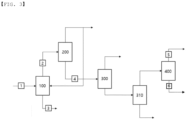
FIGS. 2 and3 are process flow diagrams of the methods of preparing an acrylic acid according to the comparative examples. - The terms and words used in the description and claims of the present invention are not to be construed limitedly as having general or dictionary meanings but are to be construed as having meanings and concepts meeting the technical ideas of the present invention, based on a principle that the inventors are able to appropriately define the concepts of terms in order to describe their own inventions in the best mode.
- The term "stream" in the present invention may refer to a fluid flow in a process, or may refer to a fluid itself flowing in a pipe. Specifically, the stream may refer to both a fluid itself flowing in a pipe connecting each device and a fluid flow. In addition, the fluid may include any one or more components of gas, liquid, and solid.
- Hereinafter, the present invention will be described in more detail for better understanding of the present invention, with reference to
FIG. 1 . - According to the present invention, a method for preparing an acrylic acid is provided. More specifically, the method may include: supplying a reaction product stream prepared by a dehydration reaction of a lactic acid aqueous solution to an
extraction column 100, and in theextraction column 100, separating an upper discharge stream including an acrylic acid using an extractant and supplying the upper discharge stream to anextractant recovery column 200; in theextractant recovery column 200, separating a lower discharge stream including the acrylic acid and supplying the lower discharge stream to afirst separation column 300; in thefirst separation column 300, separating a low-boiling point by-product to an upper portion, and separating a lower discharge stream including the acrylic acid and supplying the lower discharge stream to asecond separation column 310; in thesecond separation column 310, separating a high-boiling point by-product to a lower portion, and supplying an upper discharge stream including the acrylic acid to arefining column 400; and in therefining column 400, separating an upper discharge stream including the acrylic acid, and refluxing a lower discharge stream including hydroxyacetone to theextraction column 100. - Specifically, a conventional method for preparing an acrylic acid is generally a method of oxidizing propylene in the air, but the method, which is a method of converting propylene into acrolein by a gaseous contact oxidation reaction and subjecting the acrolein to a gaseous contact oxidation reaction to prepare an acrylic acid, produces an acetic acid as a by-product, which is difficult to separate from the acrylic acid. In addition, the method for preparing an acrylic acid using propylene uses propylene obtained by refining crude oil which is a fossil resource, as a raw material, and considering problems such as a recent rise in crude oil prices or global warming, the method has a problem in terms of raw material costs or environmental pollution.
- In order to solve the problems of the conventional method for preparing an acrylic acid, a study on a method for preparing an acrylic acid from a carbon-neutral biomass raw material was conducted. For example, there is a method for preparing an acrylic acid (AA) by a gaseous dehydration reaction of a lactic acid (LA). This method is generally a method for preparing an acrylic acid by an intramolecular dehydration reaction of a lactic acid in the presence of a catalyst at a high temperature. However, in the dehydration reaction of the lactic acid, a side reaction occurs in addition to the dehydration reaction, resulting in production of a by-product as a reaction product in addition to the acrylic acid, in particular, production of hydroxyacetone (HA) having a boiling point similar to the acrylic acid. In this case, it was difficult to completely remove the hydroxyacetone by a distillation method.
- In this regard, in the present invention, in order to solve the conventional problem, an acrylic acid is prepared by the dehydration reaction of a lactic acid, in which an extraction method is used for completely removing by-products produced therefrom, in particular, hydroxyacetone (boiling point: 145°C) which has a boiling point similar to the acrylic acid (boiling point: 141°C) and thus, is difficult to separate, and it is intended to provide a method of completely removing the hydroxyacetone while also minimizing an acrylic acid loss.
- According to an exemplary embodiment of the present invention, a reaction product stream prepared by a dehydration reaction of a lactic acid aqueous solution may be supplied to an
extraction column 100. Here, the reaction product may be a condensate condensed through a cooling tower. - Specifically, a lactic acid aqueous solution may be supplied to a reactor and dehydrated to prepare a reaction product including an acrylic acid. Here, the dehydration reaction may be performed as a gas phase reaction in the presence of a catalyst. For example, the concentration of the lactic acid in the lactic acid aqueous solution may be 10 wt% or more, 20 wt% or more, or 30 wt% or more and 40 wt% or less, 50 wt% or less, 60 wt% or less, or 70 wt% or less.
- The reactor may be a reactor capable of a common dehydration reaction of a lactic acid, the reactor may include a reaction tube filled with a catalyst, and while a reaction gas including volatile components of a lactic acid aqueous solution as a raw material is passed through the reaction tube, a lactic acid may be dehydrated by a gaseous contact reaction to produce an acrylic acid. The reaction gas may further include any one or more dilution gases of water vapor, nitrogen gas, and air for adjusting a concentration, in addition to the lactic acid.
- Operation conditions of the reactor may be common dehydration reaction conditions of a lactic acid. Here, the operation temperature of the reactor may refer to a set temperature of a heating medium or the like used for controlling the temperature of the reactor.
- A catalyst used in the dehydration reaction of the lactic acid may include, for example, one or more selected from the group consisting of sulfate-based catalysts, phosphate-based catalysts, and nitrate-based catalysts. As a specific example, the sulfate may include Na2SO4, K2SO4, CaSO4, and Al2(SO4)3, the phosphate may include Na3PO4, Na2HPO4, NaH2PO4, K3PO4, K2HPO4, KH2PO4, CaHPO4, Ca3(PO4)2, AlPO4, CaH2P2O7, and Ca2P2O7, and the nitrate may include NaNO3, KNO3, and Ca(NO3)2. In addition, the catalyst may be supported on a support. The support may include one or more selected from the group consisting of, for example, diatomaceous earth, alumina, silica, titanium dioxide, carbides, and zeolite.
- The reaction product prepared by the dehydration reaction of the lactic acid may further include water (H2O) and by-products such as hydroxyacetone, in addition to the acrylic acid which is a desired product.
- The reaction product may be supplied to a cooling tower and cooled therein. Specifically, the reaction product prepared by the dehydration reaction of the lactic acid is a gas phase and may be condensed through the cooling tower. Gaseous by-products may be separated from the upper portion of the cooling tower and a liquid condensate may be discharged to the lower portion, and here, the condensate may be a reaction product stream supplied to the
extraction column 100 in the present invention. - According to an exemplary embodiment of the present invention, in the
extraction column 100, a separate extractant is used to separate the acrylic acid included in the reaction product stream as an upper discharge stream. - The extractant may include, for example, one or more selected from the group consisting of benzene, toluene, xylene, n-heptane, cycloheptane, cycloheptene, 1-heptene, ethylbenzene, methylcyclohexane, n-butylacetate, isobutylacetate, isobutylacrylate, n-propylacetate, isopropylacetate, methylisobutylketone, 2-methyl-1-heptene, 6-methyl-1-heptene, 4-methyl-1-heptene, 2-ethyl-1-hexene, ethylcyclopentane, 2-methyl-1-hexene, 2,3-dimethylpentane, 5-methyl-1-hexene, and isopropylbutylether. As a specific example, the extractant may be toluene.
- A method of supplying the extractant and performing extraction in the
extraction column 100 may be any known method, and for example, any method such as cross current, counter current, and co-current may be used without particular limitation. - In the
extraction column 100, the reaction product stream and the extractant may be brought into contact to separate an extract and an extraction residue solution. For example, the extract may be an acrylic acid dissolved in the extractant, and the extract may be discharged as an upper discharge stream from theextraction column 100. Here, the upper discharge stream from theextraction column 100 may be supplied to anextractant recovery column 200. - In addition, the extraction residue solution is wastewater including water and may be separated to the lower portion of the
extraction column 100. Here, to the lower portion of theextraction column 100, hydroxyacetone among the by-products may be separated together with water and discharged, but is not all discharged, and partially flows out as an extract and transferred to the rear end with the acrylic acid. Specifically, the amount of extractant used may be adjusted for removing hydroxyacetone in theextraction column 100, but it is difficult to remove the total amount of hydroxyacetone even with the increased amount of the extractant used, and in this case, the content of the acrylic acid discharged with water to the lower portion of theextraction column 100 is increased, which may cause a problem of increasing an acrylic acid loss. - In this regard, in the present invention, the operating conditions of the
refining column 400 at the rear end are adjusted to effectively separate hydroxyacetone and reflux it to theextraction column 100, thereby separating and removing a total amount of hydroxyacetone as the lower discharge stream of theextraction column 100, and minimizing an acrylic acid loss at this time. - For example, a ratio of the content of hydroxyacetone separated to the lower portion of the
extraction column 100 to the content of hydroxyacetone included in the reaction product stream may be 0.95 to 1, 0.97 to 1, or 0.99 to 1, and specifically, the total amount of hydroxyacetone included in the reaction product stream supplied to theextraction column 100 may be removed in theextraction column 100. Thus, a high-purity acrylic acid may be separated in therefining column 400. - The upper discharge stream from the
extraction column 100 may include the acrylic acid, and also, it may include an extractant and hydroxyacetone. The content of hydroxyacetone in the upper discharge stream of theextraction column 100 may be 0.2 wt% to 15 wt%, 3 wt% to 13 wt%, or 5 wt% to 10 wt% of the hydroxyacetone included in the reaction product stream. Specifically, the content of hydroxyacetone in the upper discharge stream of theextraction column 100 is controlled as described above, thereby minimizing the content of the acrylic acid which is lost with water to the lower portion of theextraction column 100, and reducing the amount of energy used for separation in therefining column 400. - According to an exemplary embodiment of the present invention, the upper discharge stream from the
extraction column 100 is supplied to theextractant recovery column 200, and in theextractant recovery column 200, a lower discharge stream including the acrylic acid may be separated and supplied to afirst separation column 300. In addition, in theextractant recovery column 200, the extractant may be separated as an upper discharge stream, and a part of the upper discharge stream from theextractant recovery column 200 may be refluxed to theextraction column 100 to reuse the extractant. Here, a lower discharge stream from theextractant recovery column 200 may include a low-boiling point by-product, a high-boiling point by-product, and hydroxyacetone as by-products, with the acrylic acid. - The operating conditions of the
extractant recovery column 200 vary with the component contents, the kind of extractant, and the like supplied to theextractant recovery column 200. The operating temperature of theextractant recovery column 200 may be, for example, 40°C to 150°C, 45°C to 130°C, or 50°C to 110°C. In addition, the operating pressure of theextractant recovery column 200 may be 35 torr to 300 torr, 70 torr to 250 torr, or 100 torr to 200 torr. When theextractant recovery column 200 is operated as described above, a by-product occurring at a high temperature may be suppressed to increase the recovery rate of the acrylic acid. - According to an exemplary embodiment of the present invention, the
first separation column 300 may be for separating a low-boiling point by-product among the by-products included in the reaction product. Specifically, a lower discharge stream from theextractant recovery column 200 may be supplied to afirst separation column 300, a low-boiling point by-product may be separated to the upper portion in thefirst separation column 300, and a lower discharge stream including the acrylic acid may be separated and supplied to asecond separation column 310. - According to an exemplary embodiment of the present invention, the
second separation column 310 may be for separating a high-boiling point by-product among the by-products included in the reaction product. Specifically, a lower discharge stream from thefirst separation column 300 may be supplied to thesecond separation column 310, a high-boiling point by-product may be separated to the lower portion in thesecond separation column 310, and an upper discharge stream including the acrylic acid may be separated and supplied to asecond separation column 310. - According to an exemplary embodiment of the present invention, the
first separation column 300 and thesecond separation column 310 may be devices for separation using a boiling point difference between components by distillation, respectively. Here, the low-boiling point by-product and the high-boiling point by-product included in the lower discharge stream from theextractant recovery column 200 are removed as they go through thefirst separation column 300 and thesecond separation column 310, or hydroxyacetone having a boiling point similar to the acrylic acid is not separated and discharged together when the acrylic acid is separated as the upper discharge stream from thesecond separation column 310. Therefore, when the acrylic acid is commercialized with the upper discharge stream from thesecond separation column 310, the purity of the product is lowered. - In this regard, in the present invention, the upper discharge stream from the
second separation column 310 is supplied to therefining column 400, the upper discharge stream including a high-purity acrylic acid and the lower discharge stream including hydroxyacetone and an acrylic acid are separated in therefining column 400, and the lower discharge stream from therefining column 400 is refluxed to theextraction column 100, thereby removing the total amount of hydroxyacetone in theextraction column 100 and separating the acrylic acid in a high purity as the upper discharge stream from therefining column 400. - Specifically, hydroxyacetone in the by-products may be separated together with water to the lower portion of the
extraction column 100, but when the total amount of hydroxyacetone is not discharged, not-discharged hydroxyacetone flows out as an extract and is transferred to the rear end with the acrylic acid. In this case, since hydroxyacetone should be separated in therefining column 400, the yield of a high-purity acrylic acid may be lowered. - Meanwhile, the amount of extractant used may be adjusted for removing hydroxyacetone in the
extraction column 100, but in this case, it is difficult to remove the total amount of hydroxyacetone even with the increased amount of the extractant used, and in particular, the content of the acrylic acid discharged with water to the lower portion of theextraction column 100 is increased, which may cause a problem of increasing an acrylic acid loss. - Therefore, when the lower discharge stream from the
refining column 400 including hydroxyacetone is refluxed to theextraction column 100, thereby separating hydroxyacetone as an extraction residue solution by extraction in theextraction column 100, a total amount of hydroxyacetone introduced into the acrylic acid refinement system may be removed, and also, a high-purity acrylic acid may be obtained in a high yield from the upper portion of therefining column 400. - According to an exemplary embodiment of the present invention, the operating temperature of the
refining column 400 may be, for example, 60°C to 200°C, 80°C to 150°C, or 90°C to 110°C. In addition, the operating pressure of therefining column 400 may be 35 torr to 500 torr, 70 torr to 350 torr, or 100 torr to 200 torr. When therefining column 400 is operated as described above, a high-purity acrylic acid is separated as the upper discharge stream without a problem of an acrylic acid loss due to a side reaction, and hydroxyacetone may be separated together as a part of the acrylic acid is discharged as the lower discharge stream. - The upper discharge stream from the
second separation column 310 may be supplied to a stage at 50% to 90%, 55% to 85%, or 60% to 80% of the entire number of stages of therefining column 400. By adjusting the supply stage of therefining column 400 to the above range, the separation efficiency of therefining column 400 may be increased, and thus, the composition of the lower discharge stream from therefining column 400 refluxed to theextraction column 100 may be controlled. At this time, the total number of stages of therefining column 400 may be 15 to 70, 18 to 55, or 20 to 35. - The lower discharge stream from the
refining column 400 may form a mixed stream with the reaction product stream and be supplied to theextraction column 100. Since the reaction product stream forms a mixed stream with the lower discharge stream from therefining column 400 refluxed in therefining column 400 and supplies to theextraction column 100, the total amount of hydroxyacetone may be removed to the lower portion of theextraction column 100 while minimizing an acrylic acid loss. - According to an exemplary embodiment of the present invention, in the method for preparing an acrylic acid, if necessary, devices such as a distillation column, a condenser, a reboiler, a valve, a pump, a separator, and a mixer may be further installed.
- Hereinabove, the method for preparing an acrylic acid according to the present invention has been described and illustrated in the drawings, but the description and the illustration in the drawings are the description and the illustration of only core constitutions for understanding of the present invention, and in addition to the process and devices described above and illustrated in the drawings, the process and the devices which are not described and illustrated separately may be appropriately applied and used for carrying out the method for preparing an acrylic acid according to the present invention.
- Hereinafter, the present invention will be described in more detail by the examples. However, the following examples are provided for illustrating the present invention, and it is apparent to a person skilled in the art that various modifications and alterations may be made without departing from the scope and spirit of the present invention and the scope of the present invention is not limited thereto.
- According to the process flow diagram illustrated in
FIG. 1 , a process of preparing an acrylic acid was simulated, using an Aspen Plus simulator from Aspen Technology, Inc. - Specifically, a lactic acid aqueous solution having a concentration of 50 wt% and nitrogen (N2) as dilution gas were supplied to a reactor to produce a reaction product including an acrylic acid (AA) by a dehydration reaction, a reactor discharge stream including the reaction product was supplied to a cooling tower, and in the cooling tower, a gaseous by-product was separated to the upper portion, and a liquid reaction product as a condensate was supplied to an
extraction column 100. - In the
extraction column 100, toluene was used as an extractant to separate an acrylic acid as an upper discharge stream, which was supplied to anextractant recovery column 200, and water was separated to the lower portion. At this time, the operating temperature of theextraction column 100 was controlled to 40°C, and the operating pressure was controlled to 750 torr. - In the
extractant recovery column 200, the extractant was separated as the upper discharge stream, and a part of the upper discharge stream from theextractant recovery column 200 was refluxed to theextraction column 100. In addition, the lower discharge stream from theextractant recovery column 200 including the acrylic acid was supplied to thefirst separation column 300. At this time, the operating temperature of theextractant recovery column 200 was controlled to 54.1°C in the upper portion and 96.9°C in the lower portion, and the operating pressure thereof was controlled to 110 torr. - In the
first separation column 300, a low-boiling point by-product was separated to the upper portion, and the lower discharge stream including the acrylic acid was supplied to asecond separation column 310. In addition, in thesecond separation column 310, a high-boiling point by-product was separated to the lower portion, and the upper discharge stream including the acrylic acid was supplied to the 15th stage of arefining column 400. - In the
refining column 400, a high-purity acrylic acid was separated to the upper portion, and the lower discharge stream including hydroxyacetone as a by-product and an acrylic acid was refluxed to theextraction column 100. At this time, the operating temperature of therefining column 400 was controlled to 62.5°C in the upper portion and 65.6°C in the lower portion, the operating pressure was controlled to 110 torr, and the total number of stages of therefining column 400 was 20. - At this time, the temperature, the pressure, and the flow rate (kg/hr) for each component in each stream are shown in the following Table 1:
[Table 1] 1 2 3 4 5 6 Temperature (°C) 40.0 40.0 40.0 96.9 62.5 65.6 Pressure (torr) 750 750 750 110 110 110 Mass flow rate (kg/hr) 923.4 3325.3 612.0 305.5 300.0 5.6 Water 600.0 13.9 588.1 0.0 0.0 0.0 Toluene 0.0 2999.0 0.5 0.0 0.0 0.0 Acrylic acid 303.4 310.9 3.4 304.0 300.0 4.1 Hydroxyacetone 20.0 1.5 20.0 1.5 0.0 1.5 Mass fraction Water 0.650 0.004 0.961 0.000 0.000 0.000 Toluene 0.000 0.902 0.001 0.000 0.000 0.000 Acrylic acid 0.329 0.093 0.006 0.995 1.000 0.732 Hydroxya cetone 0.022 0.000 0.033 0.005 0.000 0.268 Total 1 1 1 1 1 1 - The process was performed in the same manner as in Example 1, except that the concentration of the lactic acid aqueous solution was 20 wt%.
- At this time, the temperature, the pressure, and the flow rate (kg/hr) for each component in each stream are shown in the following Table 2:
[Table 2] 1 2 3 4 5 6 Temperature (°C) 40.0 40.0 40.0 97.0 62.5 65.6 Pressure (torr) 750 750 750 110 150 150 Mass flow rate (kg/hr) 627.2 2108.8 524.3 101.5 100 1.5 Water 500.0 4.6 496.7 0.0 0.0 0.0 Toluene 0.0 1999.5 0.5 0.0 0.0 0.0 Acrylic acid 102.3 103.8 2.3 100.7 100.0 0.7 Hydroxyacetone 25.0 0.8 25.0 0.8 0.0 0.8 Mass fraction Water 0.797 0.002 0.947 0.000 0.000 0.000 Toluene 0.000 0.948 0.001 0.000 0.000 0.000 Acrylic acid 0.163 0.049 0.004 0.992 1.000 0.467 Hydroxya cetone 0.040 0.000 0.048 0.008 0.000 0.533 Total 1 1 1 1 1 1 - According to the process flow diagram illustrated in
FIG. 2 , a process of preparing an acrylic acid was simulated, using an Aspen Plus simulator from Aspen Technology, Inc. - Specifically, a lactic acid aqueous solution having a concentration of 50 wt% and nitrogen (N2) as dilution gas were supplied to a reactor to produce a reaction product including an acrylic acid (AA) by a dehydration reaction, a reactor discharge stream including the reaction product was supplied to a cooling tower, and in the cooling tower, a gaseous by-product was separated to the upper portion, and a liquid reaction product as a condensate was supplied to an
extraction column 100. - In the
extraction column 100, toluene was used as an extractant to separate an acrylic acid as an upper discharge stream, which was supplied to anextractant recovery column 200, and water was separated to the lower portion. At this time, the operating temperature of theextraction column 100 was controlled to 40°C, and the operating pressure was controlled to 750 torr. - In the
extractant recovery column 200, the extractant was separated as the upper discharge stream, and a part of the upper discharge stream from theextractant recovery column 200 was refluxed to theextraction column 100. The lower discharge stream from theextractant recovery column 200 including the acrylic acid was supplied to thefirst separation column 300. At this time, the operating temperature of theextractant recovery column 200 was controlled to 54.1°C in the upper portion and 96.9°C in the lower portion, and the operating pressure thereof was controlled to 110 torr. - In the
first separation column 300, a low-boiling point by-product was separated to the upper portion, and the lower discharge stream including the acrylic acid was supplied to asecond separation column 310. In addition, in thesecond separation column 310, a high-boiling point by-product was separated to the lower portion, and acrylic acid was separated as the upper discharge stream. - At this time, the temperature, the pressure, and the flow rate (kg/hr) for each component in each stream are shown in the following Table 3:
[Table 3] 1 2 3 4 Temperature (°C) 40.0 40.0 40.0 96.9 Pressure (torr) 750 750 750 110 Mass flow rate (kg/hr) 923.2 3325.3 610.7 301.3 Water 600.0 13.6 588.3 0.0 Toluene 0.0 2999.0 0.5 0.0 Acrylic acid 303.1 310.9 3.3 299.9 Hydroxyacetone 20.0 1.4 18.6 1.4 Mass fraction Water 0.650 0.004 0.963 0.000 Toluene 0.000 0.902 0.001 0.000 Acrylic acid 0.328 0.093 0.005 0.995 Hydroxyacet one 0.022 0.000 0.030 0.005 Total 1 1 1 1 - The process was performed in the same manner as in Comparative Example 1, except that the flow rate of the extractant supplied to the
extraction column 100 was controlled. - At this time, the temperature, the pressure, and the flow rate (kg/hr) for each component in each stream are shown in the following Table 4:
[Table 4] 1 2 3 4 Temperature (°C) 40.0 40.0 40.0 40.0 Pressure (torr) 750 750 750 110 Mass flow rate (kg/hr) 923.2 596.3 854.3 67.7 Water 600.0 4.7 596.5 0.0 Toluene 0.0 497.1 2.9 0.0 Acrylic acid 303.1 94.0 235.4 67.2 Hydroxyacetone 20.0 0.5 19.5 0.5 Mass fraction Water 0.650 0.008 0.698 0.000 Toluene 0.000 0.834 0.003 0.000 Acrylic acid 0.328 0.158 0.276 0.993 Hydroxyacet one 0.022 0.001 0.023 0.007 Total 1 1 1 1 - Referring to Tables 1 to 4, in Examples 1 and 2 in which by-products were separated and an acrylic acid is recovered by the method for preparing an acrylic acid according to the present invention, it was confirmed that the purity of the acrylic acid was 99% or more, and the amount of the acrylic acid lost in the
extraction column 100 was very small. In addition, it was confirmed that the total amount of hydroxyacetone included in the reaction product was discharged with water in theextraction column 100. - In comparison, in Comparative Example 1 in which the
refining column 400 was not provided as compared with Example 1, it was confirmed that the amount of hydroxyacetone remaining in the upper discharge stream from thesecond separation column 310 was so large that the purity of the acrylic acid was low, and the amount of the acrylic acid lost in theextraction column 100 was increased. - In addition, in Comparative Example 2 in which the amount of the extractant supplied to the
extraction column 100 was decreased for removing the total amount of hydroxyacetone from theextraction column 100 in Comparative Example 1, it was confirmed that the amount of the acrylic acid which was discharged with water in theextraction column 100 and lost was increased. - According to the process flow diagram illustrated in
FIG. 3 , a process of preparing an acrylic acid was simulated, using an Aspen Plus simulator from Aspen Technology, Inc. - The process was performed in the same manner as in Example 1, except that the lower discharge stream from the
refining column 400 was discharged without being refluxed to theextraction column 100. - At this time, the temperature, the pressure, and the flow rate (kg/hr) for each component in each stream are shown in the following Table 5:
[Table 5] 1 2 3 4 5 6 Temperature (°C) 40.0 40.0 40.0 96.9 62.5 65.6 Pressure (torr) 750 750 750 110 110 110 Mass flow rate (kg/hr) 923.4 3325.3 612.0 305.5 300.0 5.6 Water 600.0 13.7 588.3 0.0 0.0 0.0 Toluene 0.0 2999.0 0.5 0.0 0.0 0.0 Acrylic acid 303.4 308 4.4 299 294.8 4.2 Hydroxyacetone 20.0 1.4 18.6 1.4 0.0 1.4 Mass fraction Water 0.650 0.004 0.962 0.000 0.000 0.000 Toluene 0.000 0.903 0.001 0.000 0.000 0.000 Acrylic acid 0.329 0.093 0.007 0.995 1.000 0.750 Hydroxyace tone 0.022 0.000 0.030 0.005 0.000 0.250 Total 1 1 1 1 1 1 - The process was performed in the same manner as in Comparative Example 3, except that the flow rate of the extractant supplied to the
extraction column 100 was controlled. - At this time, the temperature, the pressure, and the flow rate (kg/hr) for each component in each stream are shown in the following Table 6:
[Table 6] 1 2 3 4 5 6 Temperature (°C) 40.0 40.0 40.0 96.9 62.5 65.6 Pressure (torr) 750 750 750 110 110 110 Mass flow rate 923.4 3325.3 612.0 305.5 300.0 5.6 (kg/hr) Water 600.0 14.1 589.9 0.0 0.0 0.0 Toluene 0.0 5999.5 0.5 0.0 0.0 0.0 Acrylic acid 303.4 318 4.6 298.7 294.8 3.9 Hydroxyacetone 20.0 1.7 18.3 1.7 0.0 1.7 Mass fraction Water 0.650 0.002 0.962 0.000 0.000 0.000 Toluene 0.000 0.947 0.001 0.000 0.000 0.000 Acrylic acid 0.329 0.050 0.008 0.994 1.000 0.696 Hydroxyace tone 0.022 0.000 0.030 0.006 0.000 0.304 Total 1 1 1 1 1 1 - Referring to Tables 1, 2, 5, and 6, in Examples 1 and 2 in which by-products were separated and an acrylic acid is recovered by the method for preparing an acrylic acid according to the present invention, it was confirmed that the purity of the acrylic acid was 99% or more, and the amount of the acrylic acid lost in the
extraction column 100 was very small. In addition, it was confirmed that the total amount of hydroxyacetone included in the reaction product was discharged with water in theextraction column 100. - In comparison, in Comparative Examples 3 and 4 in which the lower discharge stream from the
refining column 400 was not refluxed to theextraction column 100 as compared with Example 1, it was confirmed that hydroxyacetone which was the by-product included in the stream introduced to theextraction column 100 was not all discharged as the lower discharge stream from theextraction column 100. When hydroxyacetone was discharged from the lower portion of therefining column 400, in order to prevent accumulation of hydroxyacetone which was not discharged as the lower discharge stream from theextraction column 100 in the system, it was confirmed that the acrylic acid was partially lost from the lower portion of therefining column 400. - In addition, in Comparative Example 4 in which the amount of the extractant supplied to the
extraction column 100 was doubled for removing the total amount of hydroxyacetone from theextraction column 100 in Comparative Example 3, it was confirmed that in this case, the total amount of hydroxyacetone was not discharged from theextraction column 100 even with the increased amount of toluene as the extractant, and the amount of the acrylic acid which was discharged with water and lost was increased. In particular, the mass of the acrylic acid lost from the lower portion of theextraction column 100 in Comparative Example 4 to the mass flow rate of the acrylic acid lost from the lower portion of theextraction column 100 in Example 1 was increased by 35%. - Furthermore, in Comparative Examples 3 and 4 in which the lower discharge stream from the
refining column 400 was not refluxed to theextraction column 100, it was confirmed that the acrylic acid having a high purity was able to be recovered from the upper portion of therefining column 400, but the yields of the high-purity acrylic acid was lower than those of Examples 1 and 2.
Claims (11)
- A method for preparing an acrylic acid, the method comprising:supplying a reaction product stream prepared by a dehydration reaction of a lactic acid aqueous solution to an extraction column, and in the extraction column, separating an upper discharge stream including an acrylic acid using an extractant and supplying the upper discharge stream to an extractant recovery column;in the extractant recovery column, separating a lower discharge stream including the acrylic acid and supplying the lower discharge stream to a first separation column;in the first separation column, separating a low-boiling point by-product to an upper portion, and separating a lower discharge stream including the acrylic acid and supplying the lower discharge stream to a second separation column;in the second separation column, separating a high-boiling point by-product to a lower portion, and supplying an upper discharge stream including the acrylic acid to a refining column; andin the refining column, separating an upper discharge stream including the acrylic acid, and refluxing a lower discharge stream including hydroxyacetone to the extraction column.
- The method for preparing an acrylic acid of claim 1, wherein the reaction product stream includes the acrylic acid, water, a low-boiling point by-product, a high-boiling point by-product, and hydroxyacetone.
- The method for preparing an acrylic acid of claim 1, wherein water and hydroxyacetone are separated to a lower portion of the extraction column.
- The method for preparing an acrylic acid of claim 3, wherein a ratio of a content of hydroxyacetone separated to the lower portion of the extraction column to a content of hydroxyacetone included in the reaction product stream is 0.95 to 1.
- The method for preparing an acrylic acid of claim 1, wherein a part of the upper discharge stream including the extractant in the extractant recovery column is refluxed to the extraction column.
- The method for preparing an acrylic acid of claim 1, wherein the extractant is one or more selected from the group consisting of benzene, toluene, xylene, n-heptane, cycloheptane, cycloheptene, 1-heptene, ethylbenzene, methylcyclohexane, n-butylacetate, isobutylacetate, isobutylacrylate, n-propylacetate, isopropylacetate, methylisobutylketone, 2-methyl-1-heptene, 6-methyl-1-heptene, 4-methyl-1-heptene, 2-ethyl-1-hexene, ethylcyclopentane, 2-methyl-1-hexene, 2,3-dimethylpentane, 5-methyl-1-hexene, and isopropylbutylether.
- The method for preparing an acrylic acid of claim 1, wherein the reaction product stream is a condensate condensed through a cooling tower.
- The method for preparing an acrylic acid of claim 1, wherein a content of hydroxyacetone in the upper discharge stream from the extraction column is 0.2% to 150 of a content of hydroxyacetone included in the reaction product stream.
- The method for preparing an acrylic acid of claim 1, wherein the lower discharge stream from the extractant recovery column is supplied to a stage at 50% to 90% of the total number of stages of the refining column.
- The method for preparing an acrylic acid of claim 1, wherein an operating temperature of the extractant recovery column is 40°C to 150°C, and an operating pressure thereof is 35 torr to 300 torr.
- The method for preparing an acrylic acid of claim 1, wherein an operating temperature of the refining column is 60°C to 200°C, and an operating pressure thereof is 35 torr to 500 torr.
Applications Claiming Priority (3)
| Application Number | Priority Date | Filing Date | Title |
|---|---|---|---|
| KR20210137931 | 2021-10-15 | ||
| KR1020220091840A KR102855132B1 (en) | 2021-10-15 | 2022-07-25 | Method for preparing acrylic acid |
| PCT/KR2022/011331 WO2023063549A1 (en) | 2021-10-15 | 2022-08-01 | Method for preparing acrylic acid |
Publications (2)
| Publication Number | Publication Date |
|---|---|
| EP4249465A1 true EP4249465A1 (en) | 2023-09-27 |
| EP4249465A4 EP4249465A4 (en) | 2024-07-17 |
Family
ID=85987506
Family Applications (1)
| Application Number | Title | Priority Date | Filing Date |
|---|---|---|---|
| EP22881180.8A Pending EP4249465A4 (en) | 2021-10-15 | 2022-08-01 | PROCESS FOR PREPARING ACRYLIC ACID |
Country Status (5)
| Country | Link |
|---|---|
| US (1) | US20240025834A1 (en) |
| EP (1) | EP4249465A4 (en) |
| JP (1) | JP7607883B2 (en) |
| BR (1) | BR112023012756A2 (en) |
| WO (1) | WO2023063549A1 (en) |
Families Citing this family (1)
| Publication number | Priority date | Publication date | Assignee | Title |
|---|---|---|---|---|
| WO2025006131A1 (en) * | 2023-06-26 | 2025-01-02 | Cargill, Incorporated | Process for extracting acrylic acid from an aqueous product |
Family Cites Families (7)
| Publication number | Priority date | Publication date | Assignee | Title |
|---|---|---|---|---|
| JP5504668B2 (en) * | 2008-03-31 | 2014-05-28 | 三菱化学株式会社 | Method for producing (meth) acrylic acid |
| JP5386847B2 (en) * | 2008-03-31 | 2014-01-15 | 三菱化学株式会社 | Acrylic acid production method |
| JP2014189510A (en) | 2013-03-26 | 2014-10-06 | Nippon Shokubai Co Ltd | Method of producing acrylic acid |
| JP2016169162A (en) | 2013-07-25 | 2016-09-23 | 株式会社日本触媒 | Method for producing acrylic acid and/or acrylic ester |
| FR3041958B1 (en) * | 2015-10-06 | 2019-06-14 | Arkema France | IMPROVED PROCESS FOR THE PRODUCTION OF POLYMERIC (METH) ACRYLIC ACID |
| FR3049601B1 (en) * | 2016-03-29 | 2018-03-09 | Arkema France | IMPROVED PROCESS FOR THE PRODUCTION OF (METH) ACRYLIC ACID |
| KR102079774B1 (en) * | 2016-11-25 | 2020-02-20 | 주식회사 엘지화학 | Process for continuous recovering (meth)acrylic acid and apparatus for the process |
-
2022
- 2022-08-01 WO PCT/KR2022/011331 patent/WO2023063549A1/en not_active Ceased
- 2022-08-01 JP JP2023539047A patent/JP7607883B2/en active Active
- 2022-08-01 BR BR112023012756A patent/BR112023012756A2/en unknown
- 2022-08-01 EP EP22881180.8A patent/EP4249465A4/en active Pending
- 2022-08-01 US US18/265,554 patent/US20240025834A1/en active Pending
Also Published As
| Publication number | Publication date |
|---|---|
| EP4249465A4 (en) | 2024-07-17 |
| JP2024500508A (en) | 2024-01-09 |
| US20240025834A1 (en) | 2024-01-25 |
| JP7607883B2 (en) | 2025-01-06 |
| WO2023063549A1 (en) | 2023-04-20 |
| BR112023012756A2 (en) | 2023-12-05 |
Similar Documents
| Publication | Publication Date | Title |
|---|---|---|
| EP4361124A1 (en) | Method for preparing acrylic acid | |
| EP4122913B1 (en) | Method for producing acrylic acid | |
| US20240025834A1 (en) | Method for preparing acrylic acid | |
| EP4249463B1 (en) | Method for preparing acrylic acid | |
| KR102855132B1 (en) | Method for preparing acrylic acid | |
| EP4249464B1 (en) | Method for preparing acrylic acid | |
| EP4365160B1 (en) | Method for preparing acrylic acid | |
| CN116568664A (en) | Method for preparing acrylic acid | |
| EP4368608A1 (en) | Method for preparing acrylic acid | |
| KR20240037088A (en) | Method for preparing acrylic acid | |
| KR20240037085A (en) | Method for preparing acrylic acid | |
| CN112125957B (en) | Preparation method of caspofungin acetate |
Legal Events
| Date | Code | Title | Description |
|---|---|---|---|
| STAA | Information on the status of an ep patent application or granted ep patent |
Free format text: STATUS: THE INTERNATIONAL PUBLICATION HAS BEEN MADE |
|
| PUAI | Public reference made under article 153(3) epc to a published international application that has entered the european phase |
Free format text: ORIGINAL CODE: 0009012 |
|
| STAA | Information on the status of an ep patent application or granted ep patent |
Free format text: STATUS: REQUEST FOR EXAMINATION WAS MADE |
|
| 17P | Request for examination filed |
Effective date: 20230620 |
|
| AK | Designated contracting states |
Kind code of ref document: A1 Designated state(s): AL AT BE BG CH CY CZ DE DK EE ES FI FR GB GR HR HU IE IS IT LI LT LU LV MC MK MT NL NO PL PT RO RS SE SI SK SM TR |
|
| REG | Reference to a national code |
Ref country code: DE Ref legal event code: R079 Free format text: PREVIOUS MAIN CLASS: C07C0051377000 Ipc: C07C0057065000 |
|
| A4 | Supplementary search report drawn up and despatched |
Effective date: 20240617 |
|
| RIC1 | Information provided on ipc code assigned before grant |
Ipc: C07C 57/07 20060101ALI20240611BHEP Ipc: C07C 57/065 20060101AFI20240611BHEP |
|
| STAA | Information on the status of an ep patent application or granted ep patent |
Free format text: STATUS: EXAMINATION IS IN PROGRESS |
|
| 17Q | First examination report despatched |
Effective date: 20241112 |
|
| DAV | Request for validation of the european patent (deleted) | ||
| DAX | Request for extension of the european patent (deleted) |