EP4249112A1 - Regenerable organic contaminant controller in space application - Google Patents
Regenerable organic contaminant controller in space application Download PDFInfo
- Publication number
- EP4249112A1 EP4249112A1 EP23156472.5A EP23156472A EP4249112A1 EP 4249112 A1 EP4249112 A1 EP 4249112A1 EP 23156472 A EP23156472 A EP 23156472A EP 4249112 A1 EP4249112 A1 EP 4249112A1
- Authority
- EP
- European Patent Office
- Prior art keywords
- hollow fiber
- carbon hollow
- fiber module
- wires
- inlet
- Prior art date
- Legal status (The legal status is an assumption and is not a legal conclusion. Google has not performed a legal analysis and makes no representation as to the accuracy of the status listed.)
- Pending
Links
- 239000000356 contaminant Substances 0.000 title claims abstract description 50
- OKTJSMMVPCPJKN-UHFFFAOYSA-N Carbon Chemical compound [C] OKTJSMMVPCPJKN-UHFFFAOYSA-N 0.000 claims abstract description 101
- 229910052799 carbon Inorganic materials 0.000 claims abstract description 98
- 239000012510 hollow fiber Substances 0.000 claims abstract description 97
- 239000011148 porous material Substances 0.000 claims abstract description 20
- 230000005611 electricity Effects 0.000 claims abstract description 5
- 238000000034 method Methods 0.000 claims description 24
- IJGRMHOSHXDMSA-UHFFFAOYSA-N Atomic nitrogen Chemical compound N#N IJGRMHOSHXDMSA-UHFFFAOYSA-N 0.000 claims description 22
- 230000008878 coupling Effects 0.000 claims description 12
- 238000010168 coupling process Methods 0.000 claims description 12
- 238000005859 coupling reaction Methods 0.000 claims description 12
- 229910052757 nitrogen Inorganic materials 0.000 claims description 11
- 150000002894 organic compounds Chemical class 0.000 description 5
- 230000008929 regeneration Effects 0.000 description 4
- 238000011069 regeneration method Methods 0.000 description 4
- 238000005056 compaction Methods 0.000 description 3
- 239000002594 sorbent Substances 0.000 description 3
- CURLTUGMZLYLDI-UHFFFAOYSA-N Carbon dioxide Chemical compound O=C=O CURLTUGMZLYLDI-UHFFFAOYSA-N 0.000 description 2
- 238000010438 heat treatment Methods 0.000 description 2
- 239000010813 municipal solid waste Substances 0.000 description 2
- 239000002245 particle Substances 0.000 description 2
- XLYOFNOQVPJJNP-UHFFFAOYSA-N water Substances O XLYOFNOQVPJJNP-UHFFFAOYSA-N 0.000 description 2
- 229920000049 Carbon (fiber) Polymers 0.000 description 1
- 150000001412 amines Chemical class 0.000 description 1
- 238000013459 approach Methods 0.000 description 1
- 230000015572 biosynthetic process Effects 0.000 description 1
- 235000012206 bottled water Nutrition 0.000 description 1
- 229910002092 carbon dioxide Inorganic materials 0.000 description 1
- 239000001569 carbon dioxide Substances 0.000 description 1
- 239000004917 carbon fiber Substances 0.000 description 1
- 238000003763 carbonization Methods 0.000 description 1
- 239000003651 drinking water Substances 0.000 description 1
- 238000001914 filtration Methods 0.000 description 1
- 239000000463 material Substances 0.000 description 1
- 239000012528 membrane Substances 0.000 description 1
- VNWKTOKETHGBQD-UHFFFAOYSA-N methane Chemical compound C VNWKTOKETHGBQD-UHFFFAOYSA-N 0.000 description 1
- 238000012986 modification Methods 0.000 description 1
- 230000004048 modification Effects 0.000 description 1
- 229920000642 polymer Polymers 0.000 description 1
- 238000001179 sorption measurement Methods 0.000 description 1
Images


Classifications
-
- B—PERFORMING OPERATIONS; TRANSPORTING
- B01—PHYSICAL OR CHEMICAL PROCESSES OR APPARATUS IN GENERAL
- B01J—CHEMICAL OR PHYSICAL PROCESSES, e.g. CATALYSIS OR COLLOID CHEMISTRY; THEIR RELEVANT APPARATUS
- B01J20/00—Solid sorbent compositions or filter aid compositions; Sorbents for chromatography; Processes for preparing, regenerating or reactivating thereof
- B01J20/02—Solid sorbent compositions or filter aid compositions; Sorbents for chromatography; Processes for preparing, regenerating or reactivating thereof comprising inorganic material
- B01J20/20—Solid sorbent compositions or filter aid compositions; Sorbents for chromatography; Processes for preparing, regenerating or reactivating thereof comprising inorganic material comprising free carbon; comprising carbon obtained by carbonising processes
-
- B—PERFORMING OPERATIONS; TRANSPORTING
- B01—PHYSICAL OR CHEMICAL PROCESSES OR APPARATUS IN GENERAL
- B01D—SEPARATION
- B01D69/00—Semi-permeable membranes for separation processes or apparatus characterised by their form, structure or properties; Manufacturing processes specially adapted therefor
- B01D69/08—Hollow fibre membranes
-
- B—PERFORMING OPERATIONS; TRANSPORTING
- B01—PHYSICAL OR CHEMICAL PROCESSES OR APPARATUS IN GENERAL
- B01D—SEPARATION
- B01D63/00—Apparatus in general for separation processes using semi-permeable membranes
- B01D63/02—Hollow fibre modules
-
- B—PERFORMING OPERATIONS; TRANSPORTING
- B01—PHYSICAL OR CHEMICAL PROCESSES OR APPARATUS IN GENERAL
- B01D—SEPARATION
- B01D46/00—Filters or filtering processes specially modified for separating dispersed particles from gases or vapours
- B01D46/0002—Casings; Housings; Frame constructions
- B01D46/0005—Mounting of filtering elements within casings, housings or frames
-
- B—PERFORMING OPERATIONS; TRANSPORTING
- B01—PHYSICAL OR CHEMICAL PROCESSES OR APPARATUS IN GENERAL
- B01D—SEPARATION
- B01D46/00—Filters or filtering processes specially modified for separating dispersed particles from gases or vapours
- B01D46/0039—Filters or filtering processes specially modified for separating dispersed particles from gases or vapours with flow guiding by feed or discharge devices
- B01D46/0041—Filters or filtering processes specially modified for separating dispersed particles from gases or vapours with flow guiding by feed or discharge devices for feeding
-
- B—PERFORMING OPERATIONS; TRANSPORTING
- B01—PHYSICAL OR CHEMICAL PROCESSES OR APPARATUS IN GENERAL
- B01D—SEPARATION
- B01D53/00—Separation of gases or vapours; Recovering vapours of volatile solvents from gases; Chemical or biological purification of waste gases, e.g. engine exhaust gases, smoke, fumes, flue gases, aerosols
- B01D53/02—Separation of gases or vapours; Recovering vapours of volatile solvents from gases; Chemical or biological purification of waste gases, e.g. engine exhaust gases, smoke, fumes, flue gases, aerosols by adsorption, e.g. preparative gas chromatography
- B01D53/04—Separation of gases or vapours; Recovering vapours of volatile solvents from gases; Chemical or biological purification of waste gases, e.g. engine exhaust gases, smoke, fumes, flue gases, aerosols by adsorption, e.g. preparative gas chromatography with stationary adsorbents
- B01D53/0407—Constructional details of adsorbing systems
-
- B—PERFORMING OPERATIONS; TRANSPORTING
- B01—PHYSICAL OR CHEMICAL PROCESSES OR APPARATUS IN GENERAL
- B01D—SEPARATION
- B01D53/00—Separation of gases or vapours; Recovering vapours of volatile solvents from gases; Chemical or biological purification of waste gases, e.g. engine exhaust gases, smoke, fumes, flue gases, aerosols
- B01D53/22—Separation of gases or vapours; Recovering vapours of volatile solvents from gases; Chemical or biological purification of waste gases, e.g. engine exhaust gases, smoke, fumes, flue gases, aerosols by diffusion
- B01D53/225—Multiple stage diffusion
- B01D53/227—Multiple stage diffusion in parallel connexion
-
- B—PERFORMING OPERATIONS; TRANSPORTING
- B01—PHYSICAL OR CHEMICAL PROCESSES OR APPARATUS IN GENERAL
- B01D—SEPARATION
- B01D53/00—Separation of gases or vapours; Recovering vapours of volatile solvents from gases; Chemical or biological purification of waste gases, e.g. engine exhaust gases, smoke, fumes, flue gases, aerosols
- B01D53/22—Separation of gases or vapours; Recovering vapours of volatile solvents from gases; Chemical or biological purification of waste gases, e.g. engine exhaust gases, smoke, fumes, flue gases, aerosols by diffusion
- B01D53/228—Separation of gases or vapours; Recovering vapours of volatile solvents from gases; Chemical or biological purification of waste gases, e.g. engine exhaust gases, smoke, fumes, flue gases, aerosols by diffusion characterised by specific membranes
-
- B—PERFORMING OPERATIONS; TRANSPORTING
- B01—PHYSICAL OR CHEMICAL PROCESSES OR APPARATUS IN GENERAL
- B01D—SEPARATION
- B01D53/00—Separation of gases or vapours; Recovering vapours of volatile solvents from gases; Chemical or biological purification of waste gases, e.g. engine exhaust gases, smoke, fumes, flue gases, aerosols
- B01D53/34—Chemical or biological purification of waste gases
- B01D53/38—Removing components of undefined structure
- B01D53/44—Organic components
-
- B—PERFORMING OPERATIONS; TRANSPORTING
- B01—PHYSICAL OR CHEMICAL PROCESSES OR APPARATUS IN GENERAL
- B01D—SEPARATION
- B01D63/00—Apparatus in general for separation processes using semi-permeable membranes
- B01D63/02—Hollow fibre modules
- B01D63/021—Manufacturing thereof
- B01D63/022—Encapsulating hollow fibres
-
- B—PERFORMING OPERATIONS; TRANSPORTING
- B01—PHYSICAL OR CHEMICAL PROCESSES OR APPARATUS IN GENERAL
- B01D—SEPARATION
- B01D63/00—Apparatus in general for separation processes using semi-permeable membranes
- B01D63/02—Hollow fibre modules
- B01D63/04—Hollow fibre modules comprising multiple hollow fibre assemblies
- B01D63/043—Hollow fibre modules comprising multiple hollow fibre assemblies with separate tube sheets
-
- B—PERFORMING OPERATIONS; TRANSPORTING
- B01—PHYSICAL OR CHEMICAL PROCESSES OR APPARATUS IN GENERAL
- B01D—SEPARATION
- B01D65/00—Accessories or auxiliary operations, in general, for separation processes or apparatus using semi-permeable membranes
- B01D65/02—Membrane cleaning or sterilisation ; Membrane regeneration
-
- B—PERFORMING OPERATIONS; TRANSPORTING
- B01—PHYSICAL OR CHEMICAL PROCESSES OR APPARATUS IN GENERAL
- B01D—SEPARATION
- B01D71/00—Semi-permeable membranes for separation processes or apparatus characterised by the material; Manufacturing processes specially adapted therefor
- B01D71/02—Inorganic material
- B01D71/021—Carbon
-
- B—PERFORMING OPERATIONS; TRANSPORTING
- B01—PHYSICAL OR CHEMICAL PROCESSES OR APPARATUS IN GENERAL
- B01J—CHEMICAL OR PHYSICAL PROCESSES, e.g. CATALYSIS OR COLLOID CHEMISTRY; THEIR RELEVANT APPARATUS
- B01J20/00—Solid sorbent compositions or filter aid compositions; Sorbents for chromatography; Processes for preparing, regenerating or reactivating thereof
- B01J20/28—Solid sorbent compositions or filter aid compositions; Sorbents for chromatography; Processes for preparing, regenerating or reactivating thereof characterised by their form or physical properties
- B01J20/28014—Solid sorbent compositions or filter aid compositions; Sorbents for chromatography; Processes for preparing, regenerating or reactivating thereof characterised by their form or physical properties characterised by their form
- B01J20/28033—Membrane, sheet, cloth, pad, lamellar or mat
- B01J20/28038—Membranes or mats made from fibers or filaments
-
- B—PERFORMING OPERATIONS; TRANSPORTING
- B01—PHYSICAL OR CHEMICAL PROCESSES OR APPARATUS IN GENERAL
- B01J—CHEMICAL OR PHYSICAL PROCESSES, e.g. CATALYSIS OR COLLOID CHEMISTRY; THEIR RELEVANT APPARATUS
- B01J20/00—Solid sorbent compositions or filter aid compositions; Sorbents for chromatography; Processes for preparing, regenerating or reactivating thereof
- B01J20/28—Solid sorbent compositions or filter aid compositions; Sorbents for chromatography; Processes for preparing, regenerating or reactivating thereof characterised by their form or physical properties
- B01J20/28014—Solid sorbent compositions or filter aid compositions; Sorbents for chromatography; Processes for preparing, regenerating or reactivating thereof characterised by their form or physical properties characterised by their form
- B01J20/28052—Several layers of identical or different sorbents stacked in a housing, e.g. in a column
-
- B—PERFORMING OPERATIONS; TRANSPORTING
- B01—PHYSICAL OR CHEMICAL PROCESSES OR APPARATUS IN GENERAL
- B01J—CHEMICAL OR PHYSICAL PROCESSES, e.g. CATALYSIS OR COLLOID CHEMISTRY; THEIR RELEVANT APPARATUS
- B01J20/00—Solid sorbent compositions or filter aid compositions; Sorbents for chromatography; Processes for preparing, regenerating or reactivating thereof
- B01J20/30—Processes for preparing, regenerating, or reactivating
- B01J20/34—Regenerating or reactivating
- B01J20/3416—Regenerating or reactivating of sorbents or filter aids comprising free carbon, e.g. activated carbon
-
- B—PERFORMING OPERATIONS; TRANSPORTING
- B01—PHYSICAL OR CHEMICAL PROCESSES OR APPARATUS IN GENERAL
- B01J—CHEMICAL OR PHYSICAL PROCESSES, e.g. CATALYSIS OR COLLOID CHEMISTRY; THEIR RELEVANT APPARATUS
- B01J20/00—Solid sorbent compositions or filter aid compositions; Sorbents for chromatography; Processes for preparing, regenerating or reactivating thereof
- B01J20/30—Processes for preparing, regenerating, or reactivating
- B01J20/34—Regenerating or reactivating
- B01J20/3441—Regeneration or reactivation by electric current, ultrasound or irradiation, e.g. electromagnetic radiation such as X-rays, UV, light, microwaves
-
- B—PERFORMING OPERATIONS; TRANSPORTING
- B01—PHYSICAL OR CHEMICAL PROCESSES OR APPARATUS IN GENERAL
- B01D—SEPARATION
- B01D53/00—Separation of gases or vapours; Recovering vapours of volatile solvents from gases; Chemical or biological purification of waste gases, e.g. engine exhaust gases, smoke, fumes, flue gases, aerosols
- B01D53/22—Separation of gases or vapours; Recovering vapours of volatile solvents from gases; Chemical or biological purification of waste gases, e.g. engine exhaust gases, smoke, fumes, flue gases, aerosols by diffusion
- B01D2053/221—Devices
- B01D2053/223—Devices with hollow tubes
- B01D2053/224—Devices with hollow tubes with hollow fibres
-
- B—PERFORMING OPERATIONS; TRANSPORTING
- B01—PHYSICAL OR CHEMICAL PROCESSES OR APPARATUS IN GENERAL
- B01D—SEPARATION
- B01D2253/00—Adsorbents used in seperation treatment of gases and vapours
- B01D2253/10—Inorganic adsorbents
- B01D2253/102—Carbon
-
- B—PERFORMING OPERATIONS; TRANSPORTING
- B01—PHYSICAL OR CHEMICAL PROCESSES OR APPARATUS IN GENERAL
- B01D—SEPARATION
- B01D2257/00—Components to be removed
- B01D2257/70—Organic compounds not provided for in groups B01D2257/00 - B01D2257/602
-
- B—PERFORMING OPERATIONS; TRANSPORTING
- B01—PHYSICAL OR CHEMICAL PROCESSES OR APPARATUS IN GENERAL
- B01D—SEPARATION
- B01D2257/00—Components to be removed
- B01D2257/70—Organic compounds not provided for in groups B01D2257/00 - B01D2257/602
- B01D2257/708—Volatile organic compounds V.O.C.'s
-
- B—PERFORMING OPERATIONS; TRANSPORTING
- B01—PHYSICAL OR CHEMICAL PROCESSES OR APPARATUS IN GENERAL
- B01D—SEPARATION
- B01D2258/00—Sources of waste gases
- B01D2258/06—Polluted air
-
- B—PERFORMING OPERATIONS; TRANSPORTING
- B01—PHYSICAL OR CHEMICAL PROCESSES OR APPARATUS IN GENERAL
- B01D—SEPARATION
- B01D2259/00—Type of treatment
- B01D2259/45—Gas separation or purification devices adapted for specific applications
- B01D2259/4508—Gas separation or purification devices adapted for specific applications for cleaning air in buildings
-
- B—PERFORMING OPERATIONS; TRANSPORTING
- B01—PHYSICAL OR CHEMICAL PROCESSES OR APPARATUS IN GENERAL
- B01D—SEPARATION
- B01D2259/00—Type of treatment
- B01D2259/45—Gas separation or purification devices adapted for specific applications
- B01D2259/4566—Gas separation or purification devices adapted for specific applications for use in transportation means
- B01D2259/4575—Gas separation or purification devices adapted for specific applications for use in transportation means in aeroplanes or space ships
-
- B—PERFORMING OPERATIONS; TRANSPORTING
- B01—PHYSICAL OR CHEMICAL PROCESSES OR APPARATUS IN GENERAL
- B01D—SEPARATION
- B01D2313/00—Details relating to membrane modules or apparatus
- B01D2313/21—Specific headers, end caps
-
- B—PERFORMING OPERATIONS; TRANSPORTING
- B01—PHYSICAL OR CHEMICAL PROCESSES OR APPARATUS IN GENERAL
- B01D—SEPARATION
- B01D2313/00—Details relating to membrane modules or apparatus
- B01D2313/22—Cooling or heating elements
-
- B—PERFORMING OPERATIONS; TRANSPORTING
- B01—PHYSICAL OR CHEMICAL PROCESSES OR APPARATUS IN GENERAL
- B01D—SEPARATION
- B01D2319/00—Membrane assemblies within one housing
- B01D2319/04—Elements in parallel
-
- B—PERFORMING OPERATIONS; TRANSPORTING
- B01—PHYSICAL OR CHEMICAL PROCESSES OR APPARATUS IN GENERAL
- B01D—SEPARATION
- B01D2321/00—Details relating to membrane cleaning, regeneration, sterilization or to the prevention of fouling
- B01D2321/18—Use of gases
-
- B—PERFORMING OPERATIONS; TRANSPORTING
- B01—PHYSICAL OR CHEMICAL PROCESSES OR APPARATUS IN GENERAL
- B01D—SEPARATION
- B01D2321/00—Details relating to membrane cleaning, regeneration, sterilization or to the prevention of fouling
- B01D2321/26—By suction
-
- B—PERFORMING OPERATIONS; TRANSPORTING
- B01—PHYSICAL OR CHEMICAL PROCESSES OR APPARATUS IN GENERAL
- B01D—SEPARATION
- B01D2321/00—Details relating to membrane cleaning, regeneration, sterilization or to the prevention of fouling
- B01D2321/32—By heating or pyrolysis
Definitions
- Exemplary embodiments pertain to the art of contaminant control and, in particular, to a regenerable organic contaminant controller in a space application.
- Potable water and breathable air are central elements to habitable conditions in any environment. These elements are more challenging to maintain in certain environment such as, for example, in a space vehicle or in a planetary habitat. Filtering of air and water for reuse are necessary processes for sustaining life without transporting impractical amounts of supplies. For example, a phase separator may be used to separate water particles from air for the reuse of both. Amine beds are another example of a purifying system and are used to capture carbon dioxide from air and allow the recirculation of the air. Trash compaction and control is another important aspect to maintaining habitation.
- a regenerable organic contaminant controller in one embodiment, includes a carbon hollow fiber module that includes a passage between an inlet and an outlet, on an opposite end of the carbon hollow fiber module from the inlet, such that organic contaminants in contaminated air flowing through the passage are desorbed into pores of the carbon hollow fiber module.
- the regenerable organic contaminant controller also includes wires coupled to the inlet of the carbon hollow fiber module and to the outlet of the carbon hollow fiber module, the wires heat the carbon hollow fiber module based on a flow of electricity through the wires. The heat releases the organic contaminants from the pores of the carbon hollow fiber module.
- the regenerable organic contaminant controller also includes a housing to house a plurality of the carbon hollow fiber modules.
- the regenerable organic contaminant controller also includes a first header capping the inlets of the plurality of the carbon hollow fiber modules in the housing.
- the regenerable organic contaminant controller also includes a second header capping the outlets of the plurality of the carbon hollow fiber modules in the housing.
- one of the wires is coupled to the inlets of the carbon hollow fiber modules through the first header and another of the wires is coupled to the outlets of the carbon hollow fiber modules through the second header.
- the wires are coupled to a current source.
- the regenerable organic contaminant controller also includes a nitrogen source coupled to the inlet of the carbon hollow fiber module to flow the nitrogen through the passage of the carbon hollow fiber module to sweep out the organic contaminants released from the pores of the carbon hollow fiber module.
- the regenerable organic contaminant controller also includes a vacuum coupled to the outlet of the carbon hollow fiber module to draw the organic contaminants released from the pores of the carbon hollow fiber module out of the passage.
- a method of assembling a regenerable organic contaminant controller includes obtaining a carbon hollow fiber module that includes a passage between an inlet and an outlet, on an opposite end of the carbon hollow fiber module from the inlet, such that organic contaminants in contaminated air flowing through the passage are desorbed into pores of the carbon hollow fiber module.
- the method also includes coupling wires to the inlet of the carbon hollow fiber module and to the outlet of the carbon hollow fiber module to heat the carbon hollow fiber module based on a flow of electricity through the wires. The heat releases the organic contaminants from the pores of the carbon hollow fiber module.
- the method also includes arranging a housing to house a plurality of the carbon hollow fiber modules.
- the method also includes capping the inlets of the plurality of the carbon hollow fiber modules in the housing with a first header.
- the method also includes capping the outlets of the plurality of the carbon hollow fiber modules in the housing with a second header.
- the method also includes coupling one of the wires to the inlets of the carbon hollow fiber modules through the first header and coupling another of the wires to the outlets of the carbon hollow fiber modules through the second header.
- the method also includes coupling the wires to a current source.
- the method also includes coupling a nitrogen source to the inlet of the carbon hollow fiber module to flow the nitrogen through the passage of the carbon hollow fiber module to sweep out the organic contaminants released from the pores of the carbon hollow fiber module.
- the method also includes coupling a vacuum to the outlet of the carbon hollow fiber module to draw the organic contaminants released from the pores of the carbon hollow fiber module out of the passage.
- Embodiments of the systems and methods detailed herein relate to a regenerable organic contaminant controller in a space application.
- trash compaction is an important aspect of maintaining a habitable environment.
- a large volume of organic compounds is typically generated and must be removed after heating and compaction.
- Granular activated carbon is an effective sorbent for organic compounds.
- prior approaches to using carbon powder have replaced the sorbent after full adsorption. For a long-duration mission, carrying a significant volume and corresponding mass of expendable carbon sorbent is infeasible.
- one or more embodiments relate to a hollow carbon fiber module that is regenerable at high temperature.
- FIG. 1 shows an exemplary carbon hollow fiber module 110 that is part of the regenerable organic contaminant controller 100 according to one or more embodiments.
- the exemplary carbon hollow fiber module 110 is shown as a pipe with a circular cross-sectional shape. In alternate embodiments, the cross-sectional shape of the carbon hollow fiber module 110 is not limited and may be, for example, square, oval, octagonal, or the like. Formation of a carbon hollow fiber membrane (CHFM) that constitutes the carbon hollow fiber module 110 is known and may be implemented via different specific processes. The details of the various processes are not included herein.
- CHFM carbon hollow fiber membrane
- a molten polymer is pulled through a specialized apparatus (i.e., extruder) to form a hollow cylindrical body followed by subsequent carbonization of the cylindrical body to form the carbon hollow fiber module 110.
- the carbon hollow fiber module 110 includes a hollow flow path or passage 120, as shown.
- the passage 120 is between an inlet 130 of the carbon hollow fiber module 110 and an outlet 140, on an opposite end of the carbon hollow fiber module 110 as the inlet 130.
- air with organic contaminants may flow into the passage 120 via the inlet 130.
- the organic compounds that make up the contaminant are desorbed from the air particles and absorbed into the pores of the carbon hollow fiber module 110. As such, uncontaminated air, without the organic contaminants, flows out of the passage 120 via the outlet 140.
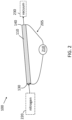
- FIG. 2 illustrates aspects of the regenerable organic contaminant controller 100, according to one or more embodiments, during regeneration.
- wires 205 from a current source 210 are connected to both sides (i.e., inlet 130, outlet 140) of the carbon hollow fiber module 110.
- the carbon hollow fiber module 110 heats up (e.g., over 200 degrees Celsius), causing a release of the organic contaminants from the pores of the structure.
- FIG. 2 show optional additional elements that may be used in the regeneration of the carbon hollow fiber module 110.
- a nitrogen source 220 may be coupled to the carbon hollow fiber module 110 to flow nitrogen from the inlet 130 to the outlet 140.
- the nitrogen flow through the passage 120 may sweep the released organic compounds out of the outlet 140, which may be exposed to space, for example.
- An alternate option involves a vacuum 230 that may pull the released organic compounds out via the outlet 140 for release into space, for example.
- FIG. 3 shows a regenerable organic contaminant controller 100 according to one or more embodiments.
- Any number of carbon hollow fiber modules 110 may be grouped together in a housing 310.
- a header 320 may optionally be added at each end (i.e., inlet 130, outlet 140) of the set of carbon hollow fiber modules 110, as shown in FIG. 3 .
- Each header 320 may cap one end of the carbon hollow fiber modules 110 in the housing 310 (i.e., one header 320 at the end of the housing 310 with the inlets 130 of the carbon hollow fiber modules 110 and one header 320 at the end of the housing with the outlets 140 of the carbon hollow fiber modules 110) and hold together the carbon hollow fiber modules 110.
- a current source 210 is connected, via wires 205, to the header 320 at each end.
- Application of current to the headers 320 results in heating of the carbon hollow fiber modules held together by the headers 320 and initiates the regeneration process discussed with reference to FIG. 2 .
Landscapes
- Chemical & Material Sciences (AREA)
- Chemical Kinetics & Catalysis (AREA)
- Analytical Chemistry (AREA)
- Engineering & Computer Science (AREA)
- Organic Chemistry (AREA)
- General Chemical & Material Sciences (AREA)
- Oil, Petroleum & Natural Gas (AREA)
- Inorganic Chemistry (AREA)
- Health & Medical Sciences (AREA)
- Manufacturing & Machinery (AREA)
- Physics & Mathematics (AREA)
- Materials Engineering (AREA)
- Electromagnetism (AREA)
- General Health & Medical Sciences (AREA)
- Toxicology (AREA)
- Biomedical Technology (AREA)
- Environmental & Geological Engineering (AREA)
- Separation Of Gases By Adsorption (AREA)
- Separation Using Semi-Permeable Membranes (AREA)
- Solid-Sorbent Or Filter-Aiding Compositions (AREA)
Abstract
Description
- Exemplary embodiments pertain to the art of contaminant control and, in particular, to a regenerable organic contaminant controller in a space application.
- Potable water and breathable air are central elements to habitable conditions in any environment. These elements are more challenging to maintain in certain environment such as, for example, in a space vehicle or in a planetary habitat. Filtering of air and water for reuse are necessary processes for sustaining life without transporting impractical amounts of supplies. For example, a phase separator may be used to separate water particles from air for the reuse of both. Amine beds are another example of a purifying system and are used to capture carbon dioxide from air and allow the recirculation of the air. Trash compaction and control is another important aspect to maintaining habitation.
- In one embodiment, a regenerable organic contaminant controller includes a carbon hollow fiber module that includes a passage between an inlet and an outlet, on an opposite end of the carbon hollow fiber module from the inlet, such that organic contaminants in contaminated air flowing through the passage are desorbed into pores of the carbon hollow fiber module. The regenerable organic contaminant controller also includes wires coupled to the inlet of the carbon hollow fiber module and to the outlet of the carbon hollow fiber module, the wires heat the carbon hollow fiber module based on a flow of electricity through the wires. The heat releases the organic contaminants from the pores of the carbon hollow fiber module.
- Additionally or alternatively, the regenerable organic contaminant controller also includes a housing to house a plurality of the carbon hollow fiber modules.
- Additionally or alternatively, the regenerable organic contaminant controller also includes a first header capping the inlets of the plurality of the carbon hollow fiber modules in the housing.
- Additionally or alternatively, the regenerable organic contaminant controller also includes a second header capping the outlets of the plurality of the carbon hollow fiber modules in the housing.
- Additionally or alternatively, one of the wires is coupled to the inlets of the carbon hollow fiber modules through the first header and another of the wires is coupled to the outlets of the carbon hollow fiber modules through the second header.
- Additionally or alternatively, the wires are coupled to a current source.
- Additionally or alternatively, the regenerable organic contaminant controller also includes a nitrogen source coupled to the inlet of the carbon hollow fiber module to flow the nitrogen through the passage of the carbon hollow fiber module to sweep out the organic contaminants released from the pores of the carbon hollow fiber module.
- Additionally or alternatively, the regenerable organic contaminant controller also includes a vacuum coupled to the outlet of the carbon hollow fiber module to draw the organic contaminants released from the pores of the carbon hollow fiber module out of the passage.
- In another embodiment, a method of assembling a regenerable organic contaminant controller includes obtaining a carbon hollow fiber module that includes a passage between an inlet and an outlet, on an opposite end of the carbon hollow fiber module from the inlet, such that organic contaminants in contaminated air flowing through the passage are desorbed into pores of the carbon hollow fiber module. The method also includes coupling wires to the inlet of the carbon hollow fiber module and to the outlet of the carbon hollow fiber module to heat the carbon hollow fiber module based on a flow of electricity through the wires. The heat releases the organic contaminants from the pores of the carbon hollow fiber module.
- Additionally or alternatively, the method also includes arranging a housing to house a plurality of the carbon hollow fiber modules.
- Additionally or alternatively, the method also includes capping the inlets of the plurality of the carbon hollow fiber modules in the housing with a first header.
- Additionally or alternatively, the method also includes capping the outlets of the plurality of the carbon hollow fiber modules in the housing with a second header.
- Additionally or alternatively, the method also includes coupling one of the wires to the inlets of the carbon hollow fiber modules through the first header and coupling another of the wires to the outlets of the carbon hollow fiber modules through the second header.
- Additionally or alternatively, the method also includes coupling the wires to a current source.
- Additionally or alternatively, the method also includes coupling a nitrogen source to the inlet of the carbon hollow fiber module to flow the nitrogen through the passage of the carbon hollow fiber module to sweep out the organic contaminants released from the pores of the carbon hollow fiber module.
- Additionally or alternatively, the method also includes coupling a vacuum to the outlet of the carbon hollow fiber module to draw the organic contaminants released from the pores of the carbon hollow fiber module out of the passage.
- The following descriptions should not be considered limiting in any way. With reference to the accompanying drawings, like elements are numbered alike:
-
FIG. 1 shows an exemplary carbon hollow fiber module that is part of the regenerable organic contaminant controller according to one or more embodiments; -
FIG. 2 illustrates aspects of the regenerable organic contaminant controller, according to one or more embodiments, during regeneration; and -
FIG. 3 shows a regenerable organic contaminant controller according to one or more embodiments. - A detailed description of one or more embodiments of the disclosed apparatus and method are presented herein by way of exemplification and not limitation with reference to the Figures.
- Embodiments of the systems and methods detailed herein relate to a regenerable organic contaminant controller in a space application. As previously noted, trash compaction is an important aspect of maintaining a habitable environment. A large volume of organic compounds is typically generated and must be removed after heating and compaction. Granular activated carbon is an effective sorbent for organic compounds. However, prior approaches to using carbon powder have replaced the sorbent after full adsorption. For a long-duration mission, carrying a significant volume and corresponding mass of expendable carbon sorbent is infeasible. As detailed, one or more embodiments relate to a hollow carbon fiber module that is regenerable at high temperature.
-
FIG. 1 shows an exemplary carbonhollow fiber module 110 that is part of the regenerable organiccontaminant controller 100 according to one or more embodiments. The exemplary carbonhollow fiber module 110 is shown as a pipe with a circular cross-sectional shape. In alternate embodiments, the cross-sectional shape of the carbonhollow fiber module 110 is not limited and may be, for example, square, oval, octagonal, or the like. Formation of a carbon hollow fiber membrane (CHFM) that constitutes the carbonhollow fiber module 110 is known and may be implemented via different specific processes. The details of the various processes are not included herein. As an example, a molten polymer is pulled through a specialized apparatus (i.e., extruder) to form a hollow cylindrical body followed by subsequent carbonization of the cylindrical body to form the carbonhollow fiber module 110. Thus, the carbonhollow fiber module 110 includes a hollow flow path orpassage 120, as shown. - The
passage 120 is between aninlet 130 of the carbonhollow fiber module 110 and anoutlet 140, on an opposite end of the carbonhollow fiber module 110 as theinlet 130. As indicated, air with organic contaminants may flow into thepassage 120 via theinlet 130. The organic compounds that make up the contaminant are desorbed from the air particles and absorbed into the pores of the carbonhollow fiber module 110. As such, uncontaminated air, without the organic contaminants, flows out of thepassage 120 via theoutlet 140. -
FIG. 2 illustrates aspects of the regenerable organiccontaminant controller 100, according to one or more embodiments, during regeneration. As shown,wires 205 from acurrent source 210 are connected to both sides (i.e.,inlet 130, outlet 140) of the carbonhollow fiber module 110. When current flows through thewires 205, the carbonhollow fiber module 110 heats up (e.g., over 200 degrees Celsius), causing a release of the organic contaminants from the pores of the structure.FIG. 2 show optional additional elements that may be used in the regeneration of the carbonhollow fiber module 110. - A
nitrogen source 220 may be coupled to the carbonhollow fiber module 110 to flow nitrogen from theinlet 130 to theoutlet 140. The nitrogen flow through thepassage 120 may sweep the released organic compounds out of theoutlet 140, which may be exposed to space, for example. An alternate option involves avacuum 230 that may pull the released organic compounds out via theoutlet 140 for release into space, for example. -
FIG. 3 shows a regenerable organiccontaminant controller 100 according to one or more embodiments. Any number of carbonhollow fiber modules 110 may be grouped together in ahousing 310. Aheader 320 may optionally be added at each end (i.e.,inlet 130, outlet 140) of the set of carbonhollow fiber modules 110, as shown inFIG. 3 . Eachheader 320 may cap one end of the carbonhollow fiber modules 110 in the housing 310 (i.e., oneheader 320 at the end of thehousing 310 with theinlets 130 of the carbonhollow fiber modules 110 and oneheader 320 at the end of the housing with theoutlets 140 of the carbon hollow fiber modules 110) and hold together the carbonhollow fiber modules 110. As shown, acurrent source 210 is connected, viawires 205, to theheader 320 at each end. Application of current to theheaders 320 results in heating of the carbon hollow fiber modules held together by theheaders 320 and initiates the regeneration process discussed with reference toFIG. 2 . - The terminology used herein is for the purpose of describing particular embodiments only and is not intended to be limiting of the present disclosure. As used herein, the singular forms "a", "an" and "the" are intended to include the plural forms as well, unless the context clearly indicates otherwise. It will be further understood that the terms "comprises" and/or "comprising," when used in this specification, specify the presence of stated features, integers, steps, operations, elements, and/or components, but do not preclude the presence or addition of one or more other features, integers, steps, operations, element components, and/or groups thereof.
- While the present disclosure has been described with reference to an exemplary embodiment or embodiments, it will be understood by those skilled in the art that various changes may be made and equivalents may be substituted for elements thereof without departing from the scope of the present disclosure. In addition, many modifications may be made to adapt a particular situation or material to the teachings of the present disclosure without departing from the essential scope thereof. Therefore, it is intended that the present disclosure not be limited to the particular embodiment disclosed as the best mode contemplated for carrying out this present disclosure, but that the present disclosure will include all embodiments falling within the scope of the claims.
Claims (15)
- A regenerable organic contaminant controller, comprising:a carbon hollow fiber module (110) that includes a passage (120) between an inlet (130) and an outlet, on an opposite end of the carbon hollow fiber module (110) from the inlet (130), such that organic contaminants in contaminated air flowing through the passage (120) are desorbed into pores of the carbon hollow fiber module (110); andwires coupled to the inlet (130) of the carbon hollow fiber module (110) and to the outlet of the carbon hollow fiber module (110), the wires configured to heat the carbon hollow fiber module (110) based on a flow of electricity through the wires, wherein the heat is configured to release the organic contaminants from the pores of the carbon hollow fiber module (110).
- The regenerable organic contaminant controller according to claim 1, further comprising a housing configured to house a plurality of the carbon hollow fiber modules.
- The regenerable organic contaminant controller according to claim 2, further comprising a first header capping the inlets (130) of the plurality of the carbon hollow fiber modules in the housing.
- The regenerable organic contaminant controller according to claim 3, further comprising a second header capping the outlets of the plurality of the carbon hollow fiber modules in the housing, and optionally wherein one of the wires is coupled to the inlets (130) of the carbon hollow fiber modules through the first header and another of the wires is coupled to the outlets of the carbon hollow fiber modules through the second header.
- The regenerable organic contaminant controller according to claim 1, wherein the wires are configured to couple to a current source.
- The regenerable organic contaminant controller according to any preceding claim, further comprising a nitrogen source coupled to the inlet (130) of the carbon hollow fiber module (110) to flow the nitrogen through the passage (120) of the carbon hollow fiber module (110) to sweep out the organic contaminants released from the pores of the carbon hollow fiber module (110).
- The regenerable organic contaminant controller according to any preceding claim, further comprising a vacuum coupled to the outlet of the carbon hollow fiber module (110) to draw the organic contaminants released from the pores of the carbon hollow fiber module (110) out of the passage (120).
- A method of assembling a regenerable organic contaminant controller, the method comprising:obtaining a carbon hollow fiber module (110) that includes a passage (120) between an inlet (130) and an outlet, on an opposite end of the carbon hollow fiber module (110) from the inlet (130), such that organic contaminants in contaminated air flowing through the passage (120) are desorbed into pores of the carbon hollow fiber module (110); andcoupling wires to the inlet (130) of the carbon hollow fiber module (110) and to the outlet of the carbon hollow fiber module (110) to heat the carbon hollow fiber module (110) based on a flow of electricity through the wires, wherein the heat is configured to release the organic contaminants from the pores of the carbon hollow fiber module (110).
- The method according to claim 8, further comprising arranging a housing to house a plurality of the carbon hollow fiber modules.
- The method according to claim 8 or 9, further comprising capping the inlet (130)s of the plurality of the carbon hollow fiber modules in the housing with a first header.
- The method according to claim 10, further comprising capping the outlets of the plurality of the carbon hollow fiber modules in the housing with a second header.
- The method according to claim 11, further comprising coupling one of the wires to the inlets of the carbon hollow fiber modules through the first header and coupling another of the wires to the outlets of the carbon hollow fiber modules through the second header.
- The method according to any of claims 8 to 12, further comprising coupling the wires to a current source.
- The method according to any of claims 8 to 13, further comprising coupling a nitrogen source to the inlet (130) of the carbon hollow fiber module (110) to flow the nitrogen through the passage (120) of the carbon hollow fiber module (110) to sweep out the organic contaminants released from the pores of the carbon hollow fiber module (110).
- The method according to any of claims 8 to 14, further comprising coupling a vacuum to the outlet of the carbon hollow fiber module (110) to draw the organic contaminants released from the pores of the carbon hollow fiber module (110) out of the passage (120).
Applications Claiming Priority (1)
| Application Number | Priority Date | Filing Date | Title |
|---|---|---|---|
| US17/678,641 US11826711B2 (en) | 2022-02-23 | 2022-02-23 | Regenerable organic contaminant controller in space application |
Publications (1)
| Publication Number | Publication Date |
|---|---|
| EP4249112A1 true EP4249112A1 (en) | 2023-09-27 |
Family
ID=85239063
Family Applications (1)
| Application Number | Title | Priority Date | Filing Date |
|---|---|---|---|
| EP23156472.5A Pending EP4249112A1 (en) | 2022-02-23 | 2023-02-14 | Regenerable organic contaminant controller in space application |
Country Status (5)
| Country | Link |
|---|---|
| US (1) | US11826711B2 (en) |
| EP (1) | EP4249112A1 (en) |
| JP (1) | JP2023122632A (en) |
| KR (1) | KR20230126645A (en) |
| CN (1) | CN116637472A (en) |
Citations (4)
| Publication number | Priority date | Publication date | Assignee | Title |
|---|---|---|---|---|
| DE4104513A1 (en) * | 1990-02-14 | 1991-08-29 | Chmiel Horst | Regeneration method for adsorbent carbon - by electrical heating of carbon material which has been removed from its locating unit and pressed into shapes or fibres |
| WO2001087461A1 (en) * | 2000-05-15 | 2001-11-22 | Board Of Trustees Of The University Of Illinois | Selective sorption and desorption of gases with electrically heated activated carbon fiber cloth element |
| WO2008110820A1 (en) * | 2007-03-14 | 2008-09-18 | Nano-Porous Solutions Limited | Regenerable adsorption unit |
| US20140174295A1 (en) * | 2012-12-20 | 2014-06-26 | Industrial Technology Research Institute | Dehumidification system |
Family Cites Families (17)
| Publication number | Priority date | Publication date | Assignee | Title |
|---|---|---|---|---|
| US6022742A (en) * | 1986-11-26 | 2000-02-08 | Kopf; Henry B. | Culture device and method |
| US5281254A (en) | 1992-05-22 | 1994-01-25 | United Technologies Corporation | Continuous carbon dioxide and water removal system |
| US7144505B2 (en) * | 1997-09-18 | 2006-12-05 | Baxter International Inc. | Melt-spun polysulfone semipermeable membranes and methods for making the same |
| US6702875B2 (en) | 2001-09-21 | 2004-03-09 | University Of Kentucky Research Foundation | Carbon fiber filters for air filtration |
| US7025803B2 (en) * | 2002-12-02 | 2006-04-11 | L'Air Liquide Societe Anonyme A Directoire et Counsel de Surveillance Pour L'Etude et L'Exploration des Procedes Georges Claude | Methane recovery process |
| US20090314708A1 (en) * | 2008-06-18 | 2009-12-24 | Sepratek Inc. | Hollow fiber membrane for feeding mixture into hollow space thereof |
| DE102009060489A1 (en) * | 2009-12-29 | 2011-06-30 | Uhde GmbH, 44141 | Apparatus and method for controlling the oxygen permeation through non-porous oxygen anions conductive ceramic membranes and their use |
| WO2012167280A1 (en) * | 2011-06-03 | 2012-12-06 | The Regents Of The University Of California | Manganese oxide and activated carbon fibers for removing particle, voc or ozone from a gas |
| DE102011078345A1 (en) * | 2011-06-29 | 2013-01-03 | Krones Aktiengesellschaft | Sterilization of membrane filters |
| WO2016189291A1 (en) * | 2015-05-22 | 2016-12-01 | Alsitek Limited | Pollutant-reducing mineral polymers |
| EP3153229A1 (en) * | 2015-10-06 | 2017-04-12 | Gambro Lundia AB | Contact-free thermoforming of fiber bundles |
| JP6461348B2 (en) * | 2015-11-24 | 2019-01-30 | キム イムソンKIM, Im Sun | Heat treatment apparatus for inner surface of blade for reinforcing hollow fiber membrane for water treatment and blade manufactured using the heat treatment apparatus |
| CA3008242C (en) * | 2015-12-17 | 2024-01-02 | Dow Global Technologies Llc | Method of making carbon molecular sieve membranes |
| RU2718981C1 (en) * | 2016-03-31 | 2020-04-15 | Асахи Касеи Медикал Ко., Лтд. | Membrane for virus removal and method for production of membrane for virus removal |
| KR101759030B1 (en) * | 2016-08-11 | 2017-07-18 | 김임선 | The heat treatment device having a temperature control system for the inside of the braid for reinforcing the hollow fiber membranes |
| US20220161233A1 (en) * | 2019-04-05 | 2022-05-26 | Qidni Labs Inc. | Sorbent for use in renal therapy |
| US11666852B1 (en) * | 2019-09-24 | 2023-06-06 | Precision Combustion, Inc. | Regenerable adsorbent system |
-
2022
- 2022-02-23 US US17/678,641 patent/US11826711B2/en active Active
-
2023
- 2023-02-03 KR KR1020230014628A patent/KR20230126645A/en active Pending
- 2023-02-10 CN CN202310107809.3A patent/CN116637472A/en active Pending
- 2023-02-14 EP EP23156472.5A patent/EP4249112A1/en active Pending
- 2023-02-21 JP JP2023024788A patent/JP2023122632A/en active Pending
Patent Citations (4)
| Publication number | Priority date | Publication date | Assignee | Title |
|---|---|---|---|---|
| DE4104513A1 (en) * | 1990-02-14 | 1991-08-29 | Chmiel Horst | Regeneration method for adsorbent carbon - by electrical heating of carbon material which has been removed from its locating unit and pressed into shapes or fibres |
| WO2001087461A1 (en) * | 2000-05-15 | 2001-11-22 | Board Of Trustees Of The University Of Illinois | Selective sorption and desorption of gases with electrically heated activated carbon fiber cloth element |
| WO2008110820A1 (en) * | 2007-03-14 | 2008-09-18 | Nano-Porous Solutions Limited | Regenerable adsorption unit |
| US20140174295A1 (en) * | 2012-12-20 | 2014-06-26 | Industrial Technology Research Institute | Dehumidification system |
Also Published As
| Publication number | Publication date |
|---|---|
| US20230264151A1 (en) | 2023-08-24 |
| JP2023122632A (en) | 2023-09-04 |
| KR20230126645A (en) | 2023-08-30 |
| US11826711B2 (en) | 2023-11-28 |
| CN116637472A (en) | 2023-08-25 |
Similar Documents
| Publication | Publication Date | Title |
|---|---|---|
| KR101568112B1 (en) | Method for depressurizing a nuclear power plant, depressurization system for a nuclear power plant, and associated nuclear power plant | |
| KR101749159B1 (en) | Forward osmosis separation processes | |
| CA2298393C (en) | Shell-less hollow fiber membrane fluid contactor | |
| CN113490538A (en) | Contaminant trap and purifier | |
| US20170120199A1 (en) | Filtering apparatus | |
| US11826711B2 (en) | Regenerable organic contaminant controller in space application | |
| JP6311342B2 (en) | Wastewater treatment system | |
| EP4001222A2 (en) | Space rated environmental control and life support systems | |
| KR20250121593A (en) | Modular multi-cartridge structure frame with water management and integrated heating functions for the sorption agent material of the direct air capture system. | |
| EP2576003B1 (en) | Method and device for removing volatile organic substances from the contained air of closed habitats | |
| US12491469B2 (en) | Screw conveyor adsorption moving bed with heat integration | |
| KR20140107758A (en) | Byproducts treator and method of treating byproducts in a process and an equipment for manufacturing semiconductor devices having the byproducts treator | |
| US9675924B2 (en) | Apparatus for the recovery of halogenated hydrocarbons | |
| CN111135665B (en) | Adsorbent demercuration process and equipment | |
| JP2013063414A (en) | Boron adsorbing apparatus, boron removing system and boron removing method | |
| JP2018094528A (en) | Water recovery device, water reusing system and water recovery method | |
| JP2009273975A (en) | System for treatment of gas containing organic solvent | |
| JP2005262146A (en) | Methane concentration device | |
| CN220677295U (en) | Adsorbent membrane carbon dioxide capture system | |
| CN112368529A (en) | Separator | |
| JP4911139B2 (en) | Removal and recovery of volatile organic compounds | |
| JP4520372B2 (en) | Refining cylinder and air or inert gas circulation purification device | |
| CN119869173B (en) | Carbon capture device | |
| JP2021195585A (en) | Lithium recovery system and how to build a lithium recovery system | |
| KR100543719B1 (en) | Apparatus for removing gaseous contaminants in gas |
Legal Events
| Date | Code | Title | Description |
|---|---|---|---|
| PUAI | Public reference made under article 153(3) epc to a published international application that has entered the european phase |
Free format text: ORIGINAL CODE: 0009012 |
|
| STAA | Information on the status of an ep patent application or granted ep patent |
Free format text: STATUS: THE APPLICATION HAS BEEN PUBLISHED |
|
| AK | Designated contracting states |
Kind code of ref document: A1 Designated state(s): AL AT BE BG CH CY CZ DE DK EE ES FI FR GB GR HR HU IE IS IT LI LT LU LV MC ME MK MT NL NO PL PT RO RS SE SI SK SM TR |
|
| STAA | Information on the status of an ep patent application or granted ep patent |
Free format text: STATUS: REQUEST FOR EXAMINATION WAS MADE |
|
| 17P | Request for examination filed |
Effective date: 20240326 |
|
| RBV | Designated contracting states (corrected) |
Designated state(s): AL AT BE BG CH CY CZ DE DK EE ES FI FR GB GR HR HU IE IS IT LI LT LU LV MC ME MK MT NL NO PL PT RO RS SE SI SK SM TR |