EP4248072B1 - An internal combustion engine - Google Patents
An internal combustion engine Download PDFInfo
- Publication number
- EP4248072B1 EP4248072B1 EP21819176.5A EP21819176A EP4248072B1 EP 4248072 B1 EP4248072 B1 EP 4248072B1 EP 21819176 A EP21819176 A EP 21819176A EP 4248072 B1 EP4248072 B1 EP 4248072B1
- Authority
- EP
- European Patent Office
- Prior art keywords
- port
- cylinder
- piston
- inlet
- valve
- Prior art date
- Legal status (The legal status is an assumption and is not a legal conclusion. Google has not performed a legal analysis and makes no representation as to the accuracy of the status listed.)
- Active
Links
Images




Classifications
-
- F—MECHANICAL ENGINEERING; LIGHTING; HEATING; WEAPONS; BLASTING
- F02—COMBUSTION ENGINES; HOT-GAS OR COMBUSTION-PRODUCT ENGINE PLANTS
- F02B—INTERNAL-COMBUSTION PISTON ENGINES; COMBUSTION ENGINES IN GENERAL
- F02B25/00—Engines characterised by using fresh charge for scavenging cylinders
- F02B25/02—Engines characterised by using fresh charge for scavenging cylinders using unidirectional scavenging
- F02B25/04—Engines having ports both in cylinder head and in cylinder wall near bottom of piston stroke
-
- F—MECHANICAL ENGINEERING; LIGHTING; HEATING; WEAPONS; BLASTING
- F02—COMBUSTION ENGINES; HOT-GAS OR COMBUSTION-PRODUCT ENGINE PLANTS
- F02D—CONTROLLING COMBUSTION ENGINES
- F02D13/00—Controlling the engine output power by varying inlet or exhaust valve operating characteristics, e.g. timing
- F02D13/02—Controlling the engine output power by varying inlet or exhaust valve operating characteristics, e.g. timing during engine operation
- F02D13/0276—Actuation of an additional valve for a special application, e.g. for decompression, exhaust gas recirculation or cylinder scavenging
-
- F—MECHANICAL ENGINEERING; LIGHTING; HEATING; WEAPONS; BLASTING
- F02—COMBUSTION ENGINES; HOT-GAS OR COMBUSTION-PRODUCT ENGINE PLANTS
- F02M—SUPPLYING COMBUSTION ENGINES IN GENERAL WITH COMBUSTIBLE MIXTURES OR CONSTITUENTS THEREOF
- F02M26/00—Engine-pertinent apparatus for adding exhaust gases to combustion-air, main fuel or fuel-air mixture, e.g. by exhaust gas recirculation [EGR] systems
- F02M26/13—Arrangement or layout of EGR passages, e.g. in relation to specific engine parts or for incorporation of accessories
-
- F—MECHANICAL ENGINEERING; LIGHTING; HEATING; WEAPONS; BLASTING
- F02—COMBUSTION ENGINES; HOT-GAS OR COMBUSTION-PRODUCT ENGINE PLANTS
- F02M—SUPPLYING COMBUSTION ENGINES IN GENERAL WITH COMBUSTIBLE MIXTURES OR CONSTITUENTS THEREOF
- F02M26/00—Engine-pertinent apparatus for adding exhaust gases to combustion-air, main fuel or fuel-air mixture, e.g. by exhaust gas recirculation [EGR] systems
- F02M26/13—Arrangement or layout of EGR passages, e.g. in relation to specific engine parts or for incorporation of accessories
- F02M26/14—Arrangement or layout of EGR passages, e.g. in relation to specific engine parts or for incorporation of accessories in relation to the exhaust system
- F02M26/16—Arrangement or layout of EGR passages, e.g. in relation to specific engine parts or for incorporation of accessories in relation to the exhaust system with EGR valves located at or near the connection to the exhaust system
-
- F—MECHANICAL ENGINEERING; LIGHTING; HEATING; WEAPONS; BLASTING
- F02—COMBUSTION ENGINES; HOT-GAS OR COMBUSTION-PRODUCT ENGINE PLANTS
- F02M—SUPPLYING COMBUSTION ENGINES IN GENERAL WITH COMBUSTIBLE MIXTURES OR CONSTITUENTS THEREOF
- F02M26/00—Engine-pertinent apparatus for adding exhaust gases to combustion-air, main fuel or fuel-air mixture, e.g. by exhaust gas recirculation [EGR] systems
- F02M26/13—Arrangement or layout of EGR passages, e.g. in relation to specific engine parts or for incorporation of accessories
- F02M26/17—Arrangement or layout of EGR passages, e.g. in relation to specific engine parts or for incorporation of accessories in relation to the intake system
- F02M26/19—Means for improving the mixing of air and recirculated exhaust gases, e.g. venturis or multiple openings to the intake system
-
- F—MECHANICAL ENGINEERING; LIGHTING; HEATING; WEAPONS; BLASTING
- F02—COMBUSTION ENGINES; HOT-GAS OR COMBUSTION-PRODUCT ENGINE PLANTS
- F02M—SUPPLYING COMBUSTION ENGINES IN GENERAL WITH COMBUSTIBLE MIXTURES OR CONSTITUENTS THEREOF
- F02M26/00—Engine-pertinent apparatus for adding exhaust gases to combustion-air, main fuel or fuel-air mixture, e.g. by exhaust gas recirculation [EGR] systems
- F02M26/13—Arrangement or layout of EGR passages, e.g. in relation to specific engine parts or for incorporation of accessories
- F02M26/17—Arrangement or layout of EGR passages, e.g. in relation to specific engine parts or for incorporation of accessories in relation to the intake system
- F02M26/20—Feeding recirculated exhaust gases directly into the combustion chambers or into the intake runners
-
- F—MECHANICAL ENGINEERING; LIGHTING; HEATING; WEAPONS; BLASTING
- F02—COMBUSTION ENGINES; HOT-GAS OR COMBUSTION-PRODUCT ENGINE PLANTS
- F02M—SUPPLYING COMBUSTION ENGINES IN GENERAL WITH COMBUSTIBLE MIXTURES OR CONSTITUENTS THEREOF
- F02M26/00—Engine-pertinent apparatus for adding exhaust gases to combustion-air, main fuel or fuel-air mixture, e.g. by exhaust gas recirculation [EGR] systems
- F02M26/13—Arrangement or layout of EGR passages, e.g. in relation to specific engine parts or for incorporation of accessories
- F02M26/22—Arrangement or layout of EGR passages, e.g. in relation to specific engine parts or for incorporation of accessories with coolers in the recirculation passage
-
- F—MECHANICAL ENGINEERING; LIGHTING; HEATING; WEAPONS; BLASTING
- F02—COMBUSTION ENGINES; HOT-GAS OR COMBUSTION-PRODUCT ENGINE PLANTS
- F02M—SUPPLYING COMBUSTION ENGINES IN GENERAL WITH COMBUSTIBLE MIXTURES OR CONSTITUENTS THEREOF
- F02M26/00—Engine-pertinent apparatus for adding exhaust gases to combustion-air, main fuel or fuel-air mixture, e.g. by exhaust gas recirculation [EGR] systems
- F02M26/13—Arrangement or layout of EGR passages, e.g. in relation to specific engine parts or for incorporation of accessories
- F02M26/22—Arrangement or layout of EGR passages, e.g. in relation to specific engine parts or for incorporation of accessories with coolers in the recirculation passage
- F02M26/23—Layout, e.g. schematics
-
- F—MECHANICAL ENGINEERING; LIGHTING; HEATING; WEAPONS; BLASTING
- F02—COMBUSTION ENGINES; HOT-GAS OR COMBUSTION-PRODUCT ENGINE PLANTS
- F02M—SUPPLYING COMBUSTION ENGINES IN GENERAL WITH COMBUSTIBLE MIXTURES OR CONSTITUENTS THEREOF
- F02M26/00—Engine-pertinent apparatus for adding exhaust gases to combustion-air, main fuel or fuel-air mixture, e.g. by exhaust gas recirculation [EGR] systems
- F02M26/13—Arrangement or layout of EGR passages, e.g. in relation to specific engine parts or for incorporation of accessories
- F02M26/22—Arrangement or layout of EGR passages, e.g. in relation to specific engine parts or for incorporation of accessories with coolers in the recirculation passage
- F02M26/29—Constructional details of the coolers, e.g. pipes, plates, ribs, insulation or materials
- F02M26/30—Connections of coolers to other devices, e.g. to valves, heaters, compressors or filters; Coolers characterised by their location on the engine
-
- F—MECHANICAL ENGINEERING; LIGHTING; HEATING; WEAPONS; BLASTING
- F02—COMBUSTION ENGINES; HOT-GAS OR COMBUSTION-PRODUCT ENGINE PLANTS
- F02M—SUPPLYING COMBUSTION ENGINES IN GENERAL WITH COMBUSTIBLE MIXTURES OR CONSTITUENTS THEREOF
- F02M26/00—Engine-pertinent apparatus for adding exhaust gases to combustion-air, main fuel or fuel-air mixture, e.g. by exhaust gas recirculation [EGR] systems
- F02M26/13—Arrangement or layout of EGR passages, e.g. in relation to specific engine parts or for incorporation of accessories
- F02M26/41—Arrangement or layout of EGR passages, e.g. in relation to specific engine parts or for incorporation of accessories characterised by the arrangement of the recirculation passage in relation to the engine, e.g. to cylinder heads, liners, spark plugs or manifolds; characterised by the arrangement of the recirculation passage in relation to specially adapted combustion chambers
-
- F—MECHANICAL ENGINEERING; LIGHTING; HEATING; WEAPONS; BLASTING
- F02—COMBUSTION ENGINES; HOT-GAS OR COMBUSTION-PRODUCT ENGINE PLANTS
- F02M—SUPPLYING COMBUSTION ENGINES IN GENERAL WITH COMBUSTIBLE MIXTURES OR CONSTITUENTS THEREOF
- F02M26/00—Engine-pertinent apparatus for adding exhaust gases to combustion-air, main fuel or fuel-air mixture, e.g. by exhaust gas recirculation [EGR] systems
- F02M26/52—Systems for actuating EGR valves
- F02M26/59—Systems for actuating EGR valves using positive pressure actuators; Check valves therefor
-
- F—MECHANICAL ENGINEERING; LIGHTING; HEATING; WEAPONS; BLASTING
- F02—COMBUSTION ENGINES; HOT-GAS OR COMBUSTION-PRODUCT ENGINE PLANTS
- F02B—INTERNAL-COMBUSTION PISTON ENGINES; COMBUSTION ENGINES IN GENERAL
- F02B75/00—Other engines
- F02B75/02—Engines characterised by their cycles, e.g. six-stroke
- F02B2075/022—Engines characterised by their cycles, e.g. six-stroke having less than six strokes per cycle
- F02B2075/025—Engines characterised by their cycles, e.g. six-stroke having less than six strokes per cycle two
Definitions
- the present invention relates to an internal combustion engine, and in particular a uniflow 2-stroke engine configured to provide an over-expanded combustion cycle.
- electric vehicles may be provided with an auxiliary power unit, known as a 'range extender'.
- the range extender may consist of an internal combustion engine that is used to drive an electric generator, which charges the vehicle's battery as it is driven.
- the internal combustion engine is only used to supplement the 'plug in' charge of the battery, and as such the fuel usage of such vehicles is significantly lower than vehicles with an internal combustion engine powertrain.
- range extender is important that automotive range extenders are as efficient as possible and provide low emissions. It is also preferable for the size of range extender to be kept to a minimum in order to maximise the available space within the vehicle.
- Over-expanded engine cycles are used to improve the efficiency of internal combustion engines.
- the expansion ratio is larger than the compression ratio, which allows more energy to be extracted from a given charge and peak pressure and temperature.
- this can result in a lower power density, which is to say a lower peak power for a given swept volume.
- a common way to apply an over-expanded cycle in a poppet valve 4-stroke engine is either late inlet valve closing (LIVC) or early inlet valve closing (EIVC), which results in a lower mass of intake charge being trapped in the cylinder.
- LIVC late inlet valve closing
- EIVC early inlet valve closing
- the inlet valve closes before the piston has reached the bottom of its' travel (bottom dead centre / BDC), which limits the mass of air that is drawn into the cylinder. From the point the inlet valve closes, the pressure in the cylinder drops below inlet pressure as the piston continues to travel downwards, and then rises again as it travels back up. Compression of the charge is consequently delayed until the piston returns to the valve closure point and the pressure begins to rise above inlet pressure.
- LIVC holds the inlet valve open past bottom dead centre.
- the inlet valve remains open as the piston begins the compression stroke, allowing charge air to exit the cylinder via the inlet before the valve eventually closes.
- a reduced mass of air is trapped in the cylinder and the commencement of effective compression is again delayed.
- EIVC and LIVC require the ability to selectively vary the timing of the inlet valve closure, which is not possible in most 2-stroke engines.
- the inlet, or scavenge port is controlled by the position of the piston, which opens and closes the inlet port.
- the timing of the inlet opening is therefore fixed by the timing of the piston cycle and cannot be varied relative to the piston position.
- the inability to vary the expansion ratio or compression ratio using inlet valve timing means there has conventionally been limited opportunity for the application of an over-expanded cycle with a uniflow 2-stroke engine.
- exhaust (or burnt) gas is used to modify the engine operation in order to achieve a range of outcomes. It can be used to reduce NOx formation by absorbing heat and slowing combustion, reduce throttling loss by displacing fresh charge (which requires an increase in throttle opening to compensate), reduce knock, provide improved combustion stability and even initiate combustion ('controlled auto ignition'). Its use is complex and can be optimised for any engine operating point and for a given outcome. However, it is clear that as an additional tuning parameter to the engine operation it can be very advantageous, although often leads to additional cost and complexity. Depending on the optimisation, a different amount and temperature of the exhaust gas may be desired, therefore coolers and control valves are typically employed.
- DE 102010054206 A1 , DE 102005063377 A1 and DK 177398 B1 disclose such kinds of uniflow 2-stroke engines with backflow of exhaust gas into the inlet.
- an internal combustion engine comprising a cylinder having a side wall, an upper end and a lower end.
- a piston is arranged to reciprocate within the cylinder, the piston having a piston body and an upper surface facing the upper end of the cylinder.
- a combustion chamber is defined by the section of the cylinder between the upper surface of the piston and the upper end of the cylinder.
- the upper end of the cylinder may comprise a closed end to the cylinder or may be the inner face of an opposing piston in the case of an opposed piston engine.
- a fuel supply inlet is also provided.
- An air inlet port comprising a plurality of apertures is arranged around the side wall of the cylinder, the air inlet port being arranged to supply air to the combustion chamber and the piston, and the inlet port being arranged such that the reciprocating movement of the piston within the cylinder opens and closes the inlet port.
- An air supply channel is arranged to supply air to the inlet port.
- An exhaust port and exhaust port closure means are arranged for opening and closing the exhaust port.
- a secondary outlet port and a secondary outlet valve are provided for opening and closing the secondary outlet port, the combustion chamber having a trapped volume defined as the volume of the combustion chamber when the exhaust port, secondary port and inlet port are closed; and a recirculation channel having an inlet end connected to the secondary outlet port and an outlet end fluidly connected to the air supply channel.
- the recirculation channel fluidly connects the secondary outlet port to the inlet port downstream to recirculate gas from the combustion chamber to the inlet port when the secondary outlet valve is open.
- the engine further comprises flow control means arranged to prevent the reverse flow of gas from the recirculation channel into the cylinder via the secondary outlet port when the inlet pressure is greater than the cylinder pressure. This may be when the inlet port, exhaust port and recirculation ports are all open.
- the flow control means include means of pressure regulation to ensure the outlet of the recirculation channel is at a lower pressure that the inlet, and may further include a flow barrier such as a valve.
- the flow control means comprise a pressure regulator arranged to reduce pressure at the outlet end of the recirculation channel to cause gas to flow from the recirculation channel to the inlet port and prevent the reverse flow of gas from the recirculation channel into the cylinder via the secondary outlet port.
- the recirculation channel is arranged to recirculate gas flowing into the secondary outlet port from the combustion chamber to the inlet port. Fluidly connecting the secondary outlet port to the inlet port in this way ensures that the pressure at the secondary outlet port is substantially equal to the inlet pressure, and that the cylinder pressure remains at inlet pressure when the secondary outlet port is the only port open.
- the recirculation channel also enables burnt gases to be recirculated to the inlet port for the purpose of combustion control and NOx reduction.
- the pressure regulator comprises a flow restriction in the air supply channel arranged proximate the outlet end of the recirculation channel.
- the flow restriction may be in the form of a venturi.
- the term air supply channel may refer to a supply conduit, an airbox or channel surrounding the inlet ports, or a combination of both.
- the recirculation channel is fluidly connected to the air supply channel, meaning that gas from the recirculation channel is able to flow into to the air supply channel either directly or via an intermediate conduit, connection or junction.
- the air supply channel fluidly connects the recirculation channel to the inlet port.
- the term 'air' is used anywhere downstream of the recirculation port connection to the inlet, it may contain a proportion of burnt gases and may otherwise be referred to a 'fresh charge' or just 'charge'.
- the flow restriction is configured to generate a region of reduced pressure and the recirculation channel is connected to the air supply channel at the region of reduced pressure.
- the air supply channel may narrow at the inlet port, and forms a plurality of nozzles each respectively associated with one of the plurality of apertures of the inlet port, wherein each nozzle creates a flow restriction.
- An air inlet chamber surrounds the plurality of apertures of the inlet port, the air inlet chamber forms part of the air supply channel and the plurality of nozzles are formed within the air supply chamber that are each associated with the plurality of apertures of the inlet port respectively.
- the flow control means may comprise a check valve arranged anywhere along the recirculation channel to allow uni-directional flow from the recirculation channel into the air supply channel.
- inlet port refers to the plurality or apertures defining the charge inlet to the cylinder.
- the engine includes control means operative to control the timing of the secondary outlet valve and exhaust valve.
- the control means may comprise an arrangement of cams operating poppets of the secondary outlet valve and exhaust valve.
- the cam operation may be fixed cam or may comprise a variable valve timing arrangement.
- the exhaust port may be controlled to open to terminate the expansion stroke prior to opening of the inlet port to relieve pressure within the combustion chamber in a process known as blow down.
- the secondary outlet valve is preferably controlled to open prior to closure of the inlet port and to remain open after closure of the inlet port. Opening the secondary outlet valve prior to closure of the inlet port ensures that the no compression occurs when the inlet port closes and the cylinder pressure remains equal to the inlet pressure.
- the secondary outlet valve is preferably controlled to open prior to closure of the exhaust port and to remain open after closure of the exhaust port.
- a heat exchanger may be provided to cool at least a portion of the gas flowing from the secondary outlet port prior to the gas flowing to the inlet port, which is preferably located along the recirculation channel.
- a pressurised air source may be connected to the air supply channel for supplying pressurised air to the inlet port, and wherein the recirculation channel is connected to the air supply channel downstream of the pressurised air supply.
- the pressurised air source may be any suitable pressure charge device such as a turbocharger or supercharger, or may be partially or wholly provided by using the area under the piston as a pump. In uniflow 2-stroke engines, the device providing the pressurised air is sometimes called a 'blower'.
- the exhaust port is preferably arranged connected to the exhaust system or the pressure charger, with the result that the exhaust pressure is lower than the pressure at the inlet port.
- the supply channel may narrow immediately proximate the inlet port to create each nozzle, and wherein each nozzle creates the flow restriction.
- the timing of the secondary outlet valve may be variable.
- the secondary valve may be closed at a lower position during warm-up conditions such that the compression stroke is increased.
- the inlet port comprises the plurality of apertures arranged about the cylinder wall, an air inlet chamber surrounds the plurality of apertures of the inlet port, the air inlet chamber forms part of the air supply channel and the plurality of nozzles are formed within the air supply chamber that are associated with the plurality of apertures of the inlet port.
- the engine is preferably a uniflow scavenged two-stroke engine.
- the engine may be an opposed-piston engine, where the second (exhaust side) piston forms the upper end of the cylinder and also provides the means of opening and closing the exhaust port.
- a method of operating an internal combustion engine comprising a cylinder having a side wall, an upper end and a lower end; a piston arranged to reciprocate within the cylinder, the piston having a piston body and a piston head; a combustion chamber defined by the section of the cylinder between the piston head and the upper end of the cylinder; a fuel supply; an inlet port located in the side wall of the cylinder, the inlet port being arranged such that reciprocating movement of the piston opens and closes the inlet port; an exhaust port and a means for opening and closing the exhaust port; and a secondary outlet port and a secondary outlet valve for opening and closing the secondary outlet port.
- the combustion chamber has a trapped volume defined as the volume of the combustion chamber when the exhaust port, secondary port and inlet port are closed, and the piston is arranged to open the at least one inlet port as it moves downwards and to close the at least one inlet port prior to the compression stroke as it moves upwards the method comprising closing the secondary outlet valve during upward movement of the piston to initiate a compression stroke in which the trapped volume decreases between the position of the piston at which the secondary outlet valve closes to top dead centre, and opening the exhaust port during downward movement of the piston to terminate an expansion stroke in which the trapped volume increases between top dead centre and the position of the piston at which the exhaust port opens; and wherein the secondary outlet valve is closed to initiate the compression stroke when the piston is at a higher position in the cylinder than the position at which the exhaust port opens such that the change in the trapped volume during the expansion stroke is greater than the change in the trapped volume during the compression stroke.
- the method may further include the step of opening the exhaust port prior to opening of the inlet port to relieve pressure within the combustion chamber.
- the method may further include the steps of opening the secondary outlet valve prior to closure of the inlet port and holding the secondary outlet valve open after closure of the inlet port.
- the method may further include the steps of opening the secondary outlet valve prior to closure of the exhaust port and holding the secondary outlet valve open after closure of the exhaust port.
- the method may further include the step of closing the secondary outlet valve before the piston reaches the upper end of the cylinder, that is to say before it reaches top dead centre.
- the method may further include the step of closing the exhaust port prior to closure of the inlet port.
- the engine comprises a recirculation channel connected to the secondary outlet port that is arranged to fluidly connect the secondary outlet port to the inlet port, and the method may further include the step of channelling gas from the combustion chamber to the inlet port via the recirculation channel.
- the engine may further comprise a heat exchanger arranged along the recirculation channel to vary the temperature of the recirculated gas and the method comprising recirculating gas from the combustion chamber to the inlet port via the recirculation channel when the secondary outlet valve is open, and using the heat exchanger to cool at least a proportion of the gas during recirculation.
- a heat exchanger arranged along the recirculation channel to vary the temperature of the recirculated gas and the method comprising recirculating gas from the combustion chamber to the inlet port via the recirculation channel when the secondary outlet valve is open, and using the heat exchanger to cool at least a proportion of the gas during recirculation.
- the method may further include the step of operating the engine with an over-expansion ratio bounded by functions of temperature ratio RT and inlet burnt gas volume fraction BGF as below [see Description of Embodiments].
- the engine of the present invention may be a spark ignition or compression ignition engine. It may also be applied to a hydrogen fuelled engine.
- the invention may also be applied to large uniflow 2-stroke engines, such as those used in marine propulsion. It may also suit other applications where efficiency and power density are critical. i.e. where 2-stroke engines are desirable for their power density but may otherwise lead to excessive fuel load requirement, for example in aviation and UAVs (Unmanned Aerial Vehicles).
- the engine may comprise a means for slowing or retarding the motion of the piston at top dead centre to provide increased dwell time.
- a means for slowing or retarding the motion of the piston at top dead centre may include a CAM mechanism or a Scotch-Yoke, which improves combustion when the engine is run with a lean mixture and significant burnt gas fraction.
- a uniflow scavenged 2-stroke engine 1 comprising a cylinder housing 2 within which is located a cylinder 4.
- a piston 6 is provided within the cylinder 4.
- the piston 6 is arranged to reciprocate within the cylinder 4 and includes an upper surface defining a piston crown 8.
- the volume of the cylinder 4 between the piston crown 8 and the top of the cylinder 4 defines a combustion chamber 12.
- the cylinder housing includes a side wall 14 and cap 16.
- An inlet port 18 comprises a plurality of openings located in the side wall 14 that are arranged to allow the flow of air into the cylinder 4 transversely to the longitudinal axis of the cylinder 4 and the direction of travel of the piston 6.
- the plurality of openings of the inlet port 18 are arranged in an annular array, aligned at a common position along the length of the cylinder 4.
- An air box 20 comprising a nominally annular chamber surrounds the inlet port 18.
- Pressurised fresh charge air is supplied to the airbox 20 by a supercharger 22.
- the pressurised air supply may alternatively be provided by other pressure chargers such as a turbocharger, a hybrid device such as an electrified turbocharger, or any other suitable means.
- the supercharger 22 includes an ambient air inlet 23.
- the supercharger 22 supplies external air from the ambient air inlet 23 to the airbox 20 via an air supply channel 24.
- a flow restriction 26 is created along the air supply channel 24 by a tapered region of reduced diameter which creates a venturi effect along the air supply channel as will be described in further detail.
- a recirculation inlet 28 is connected to the supply channel 24 at the flow restriction 26.
- An exhaust port 30 and a recirculation port 32 are located at the upper end of the cylinder 4, in the cylinder cap 16, which supply an exhaust duct 33 and recirculation duct 35 respectively.
- An exhaust valve 34 is provided to control flow from the cylinder 4 into the exhaust duct 33.
- a recirculation valve 36 is provided to control flow from the cylinder 4 into the recirculation duct 35.
- the exhaust valve 34 and recirculation valve 36 are preferably poppet valves, although other suitable valves may be utilised.
- a single exhaust valve 34 and single recirculation valve 36 are provided.
- multiple valves may be used, for example to improve flow area, without changing the basic operation.
- the exhaust valve 34 and recirculation valve 36 may be replaced by a rotary valve having an exhaust outlet and a recirculation outlet. The basic opening timing and functionality of the valves would nonetheless be the same as described below.
- a spark plug 37 and fuel injector 39 are located between the exhaust valve 34 and recirculation valve 36 in open contact with the combustion chamber, although such is not essential to the invention.
- the recirculation duct 35 connects to a recirculated gas system 38.
- An outlet channel 40 from the recirculated gas system 38 connects to the recirculation inlet 28 of the air supply channel 24.
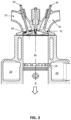
- the piston 6 is descending at the commencement of a new cycle.
- the exhaust valve 34 is beginning to open and the recirculation valve 36 is closed.
- the inlet valve port 18 is fully covered by the piston 6 preventing the flow of fresh charge into the cylinder 4.
- the elevated cylinder pressure following combustion begins to reduce as the exhaust valve 34 opens.
- Exhaust valve opening is coordinated to occur just prior to the inlet port 18 opening. This process is known as 'blow-down' and allows the cylinder pressure to drop rapidly in order to prevent excessive pressurised burnt gases pulsing into the inlet port 18 as it opens.
- the recirculation valve 36 remains closed at this stage.
- the area of the inlet port 18 defined by the array of openings is significantly larger that the area of the exhaust valve 34 opening annulus that defines exhaust port 30 and as such the cylinder pressure approximates to the inlet pressure rather than exhaust pressure.
- the inlet port 18 may be designed to generate a swirl motion in the cylinder, which is sufficiently turbulent for combustion but does not generate excessive mixing along the cylinder axis.
- the scavenging air flow rate of the engine 1, for a given inlet port 18 area, is substantially governed by the differential pressure between the airbox 20 and exhaust port 30 and degree and duration of exhaust valve 34 opening.
- the exhaust valve 34 lift may be selectively varied by variable valve actuation and the inlet pressure may be selectively varied for example by variable speed supercharging or inlet pressure limiting / relief valve. These variables may be controlled to optimise scavenge performance, turbulence and charge density.
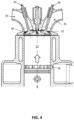
- the inlet port 18 continues to open as the piston 6 descends with maximum opening occurring when the piston 6 is at around bottom dead centre. As the inlet port 18 reaches maximum opening the exhaust valve 34 begins to close. In Figure 4 the piston 6 has begun to move upwards, the inlet port 18 is almost fully open and the exhaust valve 34 and recirculation valve 36 are partially open.
- the exhaust valve 34 is fully closed before the inlet port 18 closes to ensures that the cylinder pressure increases to close to inlet pressure in order to maximise the mass of charge gas.
- the recirculation valve 36 is opening.
- the timing of the exhaust valve 34 closure is also controlled to prevent excessive fresh air from the inlet port 18 from passing into the exhaust duct 33, which would reduce efficiency by wasting the energy consumed to pump the air into the cylinder 4 at pressure (sometimes known as short-circuiting).
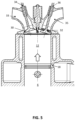
- the inlet port 18 is fully closed by the piston 6.
- the gas within the cylinder will at this stage be a mixture of fresh charge gas and some residuals from the previous combustion cycle, with the residual concentration and mixed temperature of the gas being greatest at the top of the cylinder.
- the pressure in the cylinder will be very close to the inlet pressure at this stage as there have been two connections to the inlet system as the cylinder 4 is open to the recirculation duct, the pressure of which approximates the inlet pressure.
- the piston 6 continues to ascend, with the exhaust valve 34 closed, the cylinder pressure would begin to rise due to compression in a typical 2 stroke engine.
- the gas within the cylinder 4 flows through the recirculation port 32 into the recirculation duct 35. While this happens the pressure in the cylinder 4 remains substantially constant at a pressure close to inlet pressure.
- the location of the recirculation valve 36 at the top of the combustion chamber 12 means that it is the hotter gases within the combustion chamber 12 having higher residual concentration that are initially expelled from the cylinder 4 into the recirculation port 32. This is in contrast to Late Inlet Valve Closing in a 4-stroke engine, where the fresh inlet air that has recently entered the cylinder is ejected.
- the present arrangement thereby allows the total burnt gas concentration in the cylinder, the trapped volume and the temperature of the trapped charge to be controlled by controlling fresh air flow rate and the variables of the recirculation system.
- the delivery ratio the overall lower burnt gas concentrations and initial charge temperatures may be lowered, however peak cycle temperatures may be high due to the lack of burnt gas.
- reducing the delivery ratio leads to an overall increase in burnt gas concentration.
- Increasing the amount of cooling applied to the recirculated gas will reduce the initial charge temperature, the tendency for knock, the peak cycle temperature and also therefore NOx emissions. Reducing the cooling applied or even the amount of gas allowed to recirculate (see later), can also be used to improve mixture preparation and reactivity when required.
- the piston continues to ascend and at some stage, which may for example by a third of the distance from inlet port closure to top dead centre, the recirculation valve 36 is closed.
- the pressure in the cylinder 4 will begin to rise slightly as the recirculation valve 36 is closing due to the restriction and piston 6 motion.
- the exhaust valve 34 and recirculation valve 36 closed, the combustion chamber 12 is sealed and the remaining gas is trapped, as shown in Figure 6 .
- the term 'compression stroke' as used herein means the effective compression stroke, that is to the say the length of travel of the piston 4 during which the piston 4 is doing work to compress the gas within the combustion chamber 12.
- the trapped charge is compressed by the piston 6 as the trapped volume decreases until piston 6 reaches top dead centre, that is to say the uppermost point of the piston's travel at which it changes from an upward to a downward stroke.
- the temperature and pressure of the gas has increased substantially by thus point.
- the effective compression ratio may for example be 13:1, and the greater the effective compression ratio, the higher the temperature and pressure at this point. With a compression ratio of 13:1, the change in volume during compression is 12 times the clearance volume.
- Fuel inlet may occur at any stage between near bottom dead centre to top dead centre depending on the fuel type and the type and location of the fuel injector. At or near top dead centre the fuel is ignited, which adds heat to the charge and increases the temperature and pressure of the gas. The increase is determined largely by the amount of fuel added to the charge. This is the maximum temperature and pressure of the cycle and is critical for engine design and for the level of engine-out NOx emissions. The peak temperature and pressure, along with the expansion ratio also determines the amount of work that can later be extracted from the gas. If compression ratio is increased, the amount of fuel added relative to the amount of gas may need to be reduced to prevent excessive temperature and pressure. Therefore, allowing a larger expansion ratio than compression ratio is beneficial.
- the expanding gas transfers work to the piston and the piston 6 once again begins to move downward in the cylinder 4, commencing the expansion stroke, which is defined as the length of stroke between top dead centre and the position at which the exhaust valve opens.
- the gas continues to expand, and the trapped volume of the combustion chamber increases until the exhaust valve is opened at a piston position past, that is to say below, the position where the recirculation valve 36 closed on the upward stroke.
- the cycle is therefore 'over-expanded' as the change in trapped volume during the expansion stroke is greater than the change in trapped volume during the compression stroke.
- the change in volume during expansion may approach a value 50% higher than during compression, which for the example compression ratio would result in an expansion ratio of 19:1. Since useful expansion of the gas, that is to say the period during which expansion of the gas imparts work to the piston, is terminated when the exhaust valve 34 is opened for blow down, the later the exhaust valve is opened, the closer the expansion ratio will be to 19:1.
- the gas forced into the recirculation port 32 flows through the recirculated gas system 38 and is subsequently mixed with the fresh air in the inlet supply channel 24 at the recirculation inlet 28.
- the temperature of the recirculated gas at the recirculation inlet 28 may be controlled by the recirculated gas system 38.
- the recirculation inlet 28 is formed as a plurality of recirculation inlets 28'.
- the geometry around the inlet ports 18 is extended in order to generate a plurality of nozzles in order to generate flow restriction 26', into which the recirculation inlets 28' are connected. Since the flow velocity is high at the inlet ports 18, this is an efficient location for the connection and the nozzle shape can help to improve the inlet flow conditions.
- Reverse flow into the cylinder 4 through the recirculation valve 36 can be further minimised by timing the opening of the recirculation valve to coincide with the slight increase in pressure in the top of the combustion chamber caused by the closing of the exhaust valve and the momentum of the airflow.
- a reed-valve, or other type, of check valve may be located along the supply channel 24.
- the cooling of the recirculated gas in the recirculated gas system 38 causes a cyclic drop in pressure in the recirculation duct 35 which will help draw gas from the cylinder into the recirculation duct 35. That is to say, when the recirculation valve 36 closes, flow into and out of the recirculation port 32 stops and cooling of the trapped mass of gas in the recirculation duct 35 causes a pressure drop. Consequently, when the recirculation valve 36 is opened the reduced pressure acts to create an initial surge in flow out of the cylinder 4 into the recirculation duct 35, which may improve overall performance.
- check valve may also allow the exhaust valve to remain open longer and the recirculation valve to open earlier without reverse flow occurring, which would allow more time for scavenging and valve motion events.
- the engine is a multi-cylinder arrangement, there is naturally the choice to combine the recirculation passages / systems together or operate them independently, which together with the number of cylinders may affect the chosen connection method due to pulsing affects etc.
- the chart of Figure 7 plots the pressure and volume of the combustion chamber for the stages of the above described combustion cycle, which closely follows an idealised Miller cycle.
- the cycle only includes the stages of the cycle that represent the thermodynamic processes and does not include the full range of piston motion, such as the motion of the piston 6 beyond the closure point of the inlet port 18.
- the exhaust valve 34 opens at the maximum chamber volume.
- points A and B correspond to the 'blow down' process in which pressure is relieved prior to inlet port opening.
- the piston 6 has returned from bottom dead centre, the exhaust valve 34 and inlet port 18 are closed and the pressure in the combustion chamber 12 is substantially equal to the inlet pressure.
- the temperature (not shown) of the gas in the cylinder has also reduced substantially due to the scavenging process.
- the recirculation valve 36 is open.
- the piston 6 moves between points B and C the volume is reduced but the pressure remains constant as gas flows out of the recirculation port 32 rather than being trapped and compressed.
- the piston 6 has passed the point of inlet port closure, the volume has further reduced and the recirculation valve 36 is closed.
- the volume at this point is less than the volume at point B, but the pressure in the combustion chamber 12 still approximates inlet pressure.
- the remaining gas within the combustion chamber 12 is trapped and begins to compress as the piston 6 ascends.
- the expansion ratio is the change in volume during the expansion stroke E-A.
- the compression ratio is the change in volume during the compression stage C-D. Opening of the recirculation valve 36 delays the start of the compression by keeping the pressure constant between points B-C. As a result, the change in volume during the expansion stroke between points E-A is greater than the change in volume during the compression stage between points C-D.
- the recirculation valve 36 therefore enables an over expanded cycle in a uniflow 2-stroke engine where the excess piston stroke is used to efficiently recirculate cooled gas to the inlet system: which has not been previously achieved.
- Figure 8 plots the typical opening profile of the inlet port 18, the exhaust valve 34 and the recirculation valve 36 against the crank angle from top dead centre (ATDC).
- the exhaust valve opening occurs first at an ATDC of approximately 120 degrees from top dead centre (TDC).
- Inlet port 18 opening then occurs at an ATDC of approximately 140 degrees while the exhaust valve 34 is still opening.
- At an ATDC of approximately 160 degrees the exhaust valve 34 begins to close while the inlet port 18 is still opening.
- the recirculation valve 36 begins to open at an ATDC of approximately 180 degrees i.e. bottom dead centre (BDC), which coincides with full opening of the inlet port 18 and the continued closing of the exhaust valve 34.
- BDC bottom dead centre
- the inlet port 18 is fully open, the exhaust valve 34 is closing and the recirculation valve 36 is opening. Exhaust valve 34 closing occurs at an ATDC of approximately 200 degrees, at which point the recirculation valve 36 is substantially open. The inlet port 18 is still closing at this stage and there is an overlap period during which the exhaust valve 34 is closed and the inlet port 18 and recirculation port 32 remain open. The inlet port 18 closes at an ATDC of approximately 220 degrees. The recirculation port 32 remains open after inlet port closure until at an ATDC of approximately 260 degrees, and at which point the compression stroke begins. It should be highlighted that the timing of the valve in a 2 stroke engine may be limited by the time available for opening and closing of the valve.
- valve accelerations it may be necessary to start opening a valve slightly earlier than the 'ideal case'.
- the ideal case would have an instant opening of the exhaust valve to maximum opening just before the inlet port opens to allow maximum expansion ratio and fast blow-down.
- the recirculated gas system 38 connects the cylinder 4 to the air supply channel 24 via the recirculation duct 35.
- the pressure in the recirculation duct 35 is therefore substantially equal to the inlet supply pressure, assuming no restriction valves are operated within the recirculated gas system.
- the cylinder pressure is also substantially equal to the inlet pressure when the recirculation valve 36 is opened, there is no notable drop in cylinder pressure at that time.
- 2-stroke engines rely on the inlet pressure being greater than the exhaust pressure, where a valve connected to the exhaust system is used to provide an over-expanded (Miller) cycle, there may be a significant drop in cylinder pressure when the exhaust valve 30 is open.
- the recirculated gas system 38 may be any arrangement that fluidly connects the recirculation port 32 to the supply channel 24.
- the recirculated gas system 38 may have varying complexity depending on the preferred mode of operation and the requirements of the recirculated gas system 38. It will be appreciated that components from existing exhaust gas recirculation systems may be utilised.
- the volume 'V' is defined as the enclosed combustion chamber volume at the point the inlet port opens / closes i.e. as shown in Figure 5 .
- the Burnt Gas Fraction (BGF) is the proportion of the inlet charge volume that is recirculated burnt gas.
- the temperature ratio RT is defined as the residual gas temperature divided by the fresh charge inlet temperature, which also is the volume change of the burnt gas fraction from the end of blow down to returning to the cylinder through the inlet port.
- Figure 12 shows these boundaries plotted for the temperature ratio of 1.86. It should be noted, that for the temperature ratio given, the invention achieves its intended operation with a BGF > around 0.14, and preferred operation with BGF > 0.18. Therefore, the invention is specifically arrived at when researching a spark ignition engine for highefficiency and low emissions operation with modern ignition and combustion design - which uses higher BGFs at high load. The larger the BGF, the larger the window of highly efficient operation.
- Figures 9A-9C show various recirculated gas system 38 arrangements which have additional features compared to a simple channel.
- Figure 9A shows a recirculated gas system 38 in which a heat exchanger 44, configured to function as a cooler, and associated passages, connects the recirculation port 32 to the recirculation inlet 28.
- the heat exchanger 44 may be an independent component or may comprise part of the engine block and/or cylinder head configured to include heat transfer features, with the heat being transferred to the water or oil cooling circuits or even external air.
- the recirculated gas from the cylinder 4 is passed through the heat exchanger 44, which cools the gas before it flows to the supply channel 24. This has the effect of reducing the temperature of the charge gas in the cylinder at the start of compression.
- the lower gas temperature also means a higher mass of recirculated gas enters the cylinder for the same volume.
- the higher mass of gas absorbs the heat of combustion in the cylinder 4, which in turn reduces the peak temperature of the cycle. This improves emissions or allows more fuel or compression ratio before emissions occur.
- Cooled EGR is also known to help reduce the occurrence of knock, which allows more optimal spark timing and improved efficiency, which also applies to the recirculated gas having significant burnt gas content.
- Figure 9B shows an arrangement including variable restriction control valve 46, which is provided in addition to the heat exchanger 44.
- the variable restriction control valve 46 is used to vary the flow through the recirculation duct 35 in order to control parameters such as effective compression ratio and gas recirculation rate.
- effective compression ratio When the engine is cold at startup, it may tolerate a higher compression ratio before having issues with knock. It may also be beneficial to retain some hot burnt gas in the cylinder to aid complete combustion.
- Closing the variable restriction control valve 46 increases the effective compression ratio by reducing the size of the recirculation duct 35. Doing so restricts flow out of the recirculation port 32 as piston is moves up due to a pressure build up within the recirculation duct 35 upstream of the control valve, which in turn raises the cylinder pressure.
- variable restriction control valve 46 may provide an alternative means of controlling compression ratio that is more cost effective than reliance on control of recirculation valve 36 actuation.
- the elevated pressure in the recirculation duct 35, upstream of the variable restriction control valve 46, may also be used to restrict the gas recirculation rate as a result of the residual pressure elevation in the recirculation duct 35 causing gas from within the recirculation duct 35 to re-enter the cylinder 4 when the recirculation valve 36 is opened. Reduced recirculation rate may for example be beneficial during warmup.
- a bypass control valve 48 provides a means of selectively controlling the temperature of the recirculated gas by passing the gas through the heat exchanger 44 or diverting the gas flow away from the heat exchanger via a bypass channel 50.
- the bypass control valve 48 may be a simple flap or damper valve as used in current EGR cooler systems such that the flap varies the flow rate between bypass and cooled passages, which enables flow diversion without adding any restrictions that may affect the over-expansion cycle operation.
- a further type of 'uniflow 2-stroke engine' is the opposed piston engine, which instead of having a cylinder head and exhaust valves, uses an additional piston and an exhaust port. It has benefits in terms of scavenge efficiency due to the overall stroke / bore ratio and lower heat rejection; however, it cannot use an over-expanded cycle.
- the benefits of the invention can also be applied to the opposed piston engine. In this case, the additional port would be connected into the cylinder wall of the exhaust side piston, for example 2/3 of the way from Inner Dead Centre to Outer Dead Centre.
- the port would be opened during the compression stroke to allow a portion of the gas to recirculate, preferably through a heat exchanger, and a significant portion of that gas may be hot 'residual' gases due to the location of the port on the exhaust side and method of operation.
- the ability of the present invention to provide an over-expanded cycle in a uniflow 2-stroke engine significantly improves the efficiency potential of the engine and makes highly suitable for range extender applications.
- the present invention further provides efficient scavenging and cooled exhaust gas recirculation at high load with no significant cost or efficiency penalty.
- the motion of the piston acts to pump the burnt into the gas recirculation system 38.
- the piston motion is essentially being wasted in returning gas to the inlet, resulting in zero net gas motion.
- the piston motion is used to pump the hottest combustion gasses out of the recirculation port 32 and direct the gases back into the supply channel 24.
- the present invention provides the benefits of cooled EGR, which has been shown to work well in combination with lean-burn and over-expanded cycle to give very high brake thermal efficiency and low emissions in 4-stroke engines, even with relatively low grade fuel and conventional spark plugs, with the added benefit of power-density, smooth running and lower friction of a 2-stroke engine.
- the intended engine design is suitable for spark ignition operation under lean conditions with a standard high-energy ignition system.
- the engine may be configured and controlled to operate under enhanced lean burn conditions.
- the present invention may include means to enhance ignition such as 'prechamber' ignition and alternative 'ignitors'.
- the cylinder 4 may include direct fuel injection arranged to avoid any significant fuel from entering the exhaust system, that is to say that the fuel may be injected sufficiently late in the cycle that it does not flow into the closing exhaust port.
- the timing and location of the direct injector is also configured to avoid fuel flow through the recirculation port 32.
- Direct injector may include high-pressure, low-pressure, and airassisted injectors.
- the injector is located in the cylinder cap, but may also be located further down the cylinder proximate or even within the inlet ports 18. Location of the injector lower down in the cylinder mitigates the risk of fuel exiting the exhaust port 30 and may allow earlier injection compared to cylinder head locations. The lower location may also suit lower cost injectors with low pressure supply, thereby avoiding the cost and losses of a high-pressure system.
- variable exhaust valve actuation may be used to optimise the air flow through the engine for a given speed, load and inlet pressure.
- variable control of the recirculation valve 36 may be also applied.
- the recirculation valve 36 may be controlled to delay closure in order to reduce the compression ratio. This may be advantageous for example if knock is detected with lower fuel grades or during highboost conditions. As the expansion ratio remains high, any effect on efficiency will be minimal.
- the recirculation valve 36 may also be controlled to close earlier using a variable or switchable profile to increase the effective compression ratio. This may allow the engine to change combustion modes from standard spark ignition to controlled auto-ignition or spark controlled compression ignition for example. An increase in compression may also be beneficial during cold start.
- the engine may comprise a water injection system for limiting peak temperature in the cylinder 4.
- the water injection system may supply water to the supply channel 24 or directly into the cylinder 4.
- the use of water injection provides additional cycle efficiency due to the expansion of water into steam during the cycle.
- the engine may further include means for cooling the exhaust gas to remove water, thereby providing a permanent supply of water for use during continuous operation and/or in a temporary 'boost-mode'.
- the exhaust valve 34 and recirculation valve 36 comprise poppet valves.
- the valves may comprise a rotary valve or valves which allow rapid changes in valve opening area.
- a 2-stroke cycle like this has significantly shorter amount of time to open and close the valves whist still maintaining enough time for scavenging.
- Rotary valves allow a fast opening area profile, which in terms the exhaust valve 34 means the opening of the valve for blow down can be delayed, thereby allowing greater expansion of the gas and improved efficiency.
- the recirculation valve 36 the increased speed allows the area to be closed more quickly which enables the ideal over-expanded cycle to be more closely followed.
- increasing the speed of closing of the recirculation valve 36 reduces any restriction to the out-flowing gas and therefore reduces pumping loss.
- Some rotary valve designs may have a single port connection to the cylinder with 2 outlet connections. The function however is unchanged.
- the present invention is primarily concerned with range extender applications, high efficiency and low emissions at relatively high load are the primary targets, as opposed to changing the operation with varying load conditions.
- the low complexity of the basic layout is a significant advantage over many other engines for this application.
- load control of spark ignition embodiments there remains a range of options for the invention, and therefore the flexibility becomes apparent.
- reducing the delivery ratio leaves more burnt gas in the cylinder and therefore less air and fuel for a fixed air/fuel fixed ratio.
- Delaying the recirculation valve closure further reduces the trapped volume of charge in the cylinder and therefore engine load in the case of a relatively fixed air/fuel ratio.
- inlet pressure can remain relatively high to ensure sufficient scavenging of burnt gasses. Since excess volume is returned to the inlet, the overall pumping work is minimal.
- the controller may reduce the delivery ratio and advance the closure of the recirculation valve (or disable its operation) in order to trap large quantities of hot residual gas and increase the trapped compression ratio.
- the hot gas retained can help to evaporate the fuel, aid spark ignition combustion stability or even initiate combustion when combined with the compression ratio increase.
- the early closure of the recirculation valve also allows an earlier fuel injection allowing more time for mixing and evaporation.
- the controller may in this circumstance, decide to not inject fuel on that cycle and wait for another (or multiple) scavenging processes before injecting and igniting fuel again. Because of the direct injection, fuel is not lost and there are no hydrocarbon emissions from this operation.
- the exhaust system of the engine is fitted with a restrictor valve.
- a restrictor valve This may be employed at low rpm or at cold start conditions to help increase the inlet charge temperature.
- Increasing the inlet pressure can be used increase in charge density and also temperature at inlet, which may be desirable during warm-up. However, normally this would lead to an increase in air flow through the engine and short-circuiting that would lead to a reduction in exhaust temperature.
- a restrictor valve in the exhaust (preferably down-stream of any catalyst), the overall flow rate can be controlled back to a similar level, whilst providing increased temperature and pressure in the cylinder and importantly also the catalyst. This operation is less efficient than 'normal operation' due to the additional compressor work, however it may be important for controlling emissions during cold start and warm-up.
- the specific layout and method of operation of the present invention advantageously provides an over-expanded engine cycle at relatively high load in both spark ignition and diesel engines, by allowing recirculation of some of the cylinder charge volume.
- Recirculated flow does not exit the exhaust valve and therefore the pressure in the gas is not 'lost'. Furthermore, recirculated flow is returned into the inlet system down-stream of the charging device and therefore requires minimal pumping effort.
- the arrangement of the present invention also allows hot residual gas from the previous cycle to be preferentially removed from the cylinder (as opposed to fresh intake gas), and provides opportunity to cool the hot recirculating gas and return it to the intake without additional pumping devices or passing through the charging device again (as would be required for 'exhaust gas recirculation' EGR). Where some residual (or burnt gas) is used, the present invention allows for improved scavenging performance over a uniflow 2-stroke with external EGR. i.e.
- the charging device as described herein is the device providing the majority of the pressure increase at high-load on the intake side.
- the charging device is preferably connected upstream of the recirculation connection.
- an additional charging device may be located along the inlet passage downstream of the recirculation connection. For example, where an upstream turbocharger is used to deliver the high-load pressure a positive displacement supercharger may be provided downstream for starting and low speed operation.
Landscapes
- Engineering & Computer Science (AREA)
- Chemical & Material Sciences (AREA)
- Combustion & Propulsion (AREA)
- Mechanical Engineering (AREA)
- General Engineering & Computer Science (AREA)
- Output Control And Ontrol Of Special Type Engine (AREA)
Description
- The present invention relates to an internal combustion engine, and in particular a uniflow 2-stroke engine configured to provide an over-expanded combustion cycle.
- The development and adoption of battery powered electric vehicles is restricted by the high cost of batteries and the ability of current battery technology to store enough energy to enable long journeys on a single charge. This is exacerbated by current infrastructure deficiencies such as the lack of a robust charging network and the inability of the grid to support charging of large batteries. To provide a commercially acceptable 'single charge' range of operation, electric vehicles may be provided with an auxiliary power unit, known as a 'range extender'. The range extender may consist of an internal combustion engine that is used to drive an electric generator, which charges the vehicle's battery as it is driven. The internal combustion engine is only used to supplement the 'plug in' charge of the battery, and as such the fuel usage of such vehicles is significantly lower than vehicles with an internal combustion engine powertrain. Indeed, in circumstances where grid generated electricity is derived from fossil fuels, it is possible that a highly efficient hybrid vehicle could produce lower CO2 than a corresponding electric vehicle. Nonetheless, there is a conflict between the sustainable, green energy model of electric vehicles and the use of an internal combustion engine range extender. It is therefore important that automotive range extenders are as efficient as possible and provide low emissions. It is also preferable for the size of range extender to be kept to a minimum in order to maximise the available space within the vehicle.
- Developments in 4-Stroke engine technology have led to significant improvements in efficiency and emissions. However, 4 stroke engines are large and complex machines and there is often a trade-off between improving emissions and maintaining performance. In order to maintain power density in a 4-stroke engine, boosting is applied, which can result in compromises in terms of cycle peak temperature, leading to higher NOx emissions and efficiency penalties in terms of compression ratio, ignition retard and intercooling requirements. For the same power output, a 2-stroke engine may fire at twice the frequency of a 4-stroke engine with half the mean effective pressure. This enables an improved efficiency without the same compromises on performance. 2-stroke engines can also be smaller and less complex, requiring as they do fewer cylinders and other moving parts. Nonetheless, there remain challenges in achieving 2 stroke engines that has the efficiency and emissions performance suitable for range extender applications.
- Over-expanded engine cycles, commonly referred to as Miller or Atkinson cycles, are used to improve the efficiency of internal combustion engines. In an over-expanded engine cycle the expansion ratio is larger than the compression ratio, which allows more energy to be extracted from a given charge and peak pressure and temperature. However, this can result in a lower power density, which is to say a lower peak power for a given swept volume. A common way to apply an over-expanded cycle in a poppet valve 4-stroke engine is either late inlet valve closing (LIVC) or early inlet valve closing (EIVC), which results in a lower mass of intake charge being trapped in the cylinder. With EIVC, the inlet valve closes before the piston has reached the bottom of its' travel (bottom dead centre / BDC), which limits the mass of air that is drawn into the cylinder. From the point the inlet valve closes, the pressure in the cylinder drops below inlet pressure as the piston continues to travel downwards, and then rises again as it travels back up. Compression of the charge is consequently delayed until the piston returns to the valve closure point and the pressure begins to rise above inlet pressure.
- Conversely, LIVC holds the inlet valve open past bottom dead centre. The inlet valve remains open as the piston begins the compression stroke, allowing charge air to exit the cylinder via the inlet before the valve eventually closes. As a result, a reduced mass of air is trapped in the cylinder and the commencement of effective compression is again delayed.
- EIVC and LIVC require the ability to selectively vary the timing of the inlet valve closure, which is not possible in most 2-stroke engines. In a uniflow 2-stroke engine for example, the inlet, or scavenge port is controlled by the position of the piston, which opens and closes the inlet port. The timing of the inlet opening is therefore fixed by the timing of the piston cycle and cannot be varied relative to the piston position. The inability to vary the expansion ratio or compression ratio using inlet valve timing means there has conventionally been limited opportunity for the application of an over-expanded cycle with a uniflow 2-stroke engine. In contrast to an over-expanded cycle, the exhaust valve of a 2-stroke engine is typically opened before the inlet port in order to prevent pressurised exhaust gasses flowing into the inlet system. Therefore, in practice the expansion ratio of a uniflow 2-stroke engine is actually slightly lower than the compression ratio, resulting in reduced efficiency.
- In current and other future engines, exhaust (or burnt) gas is used to modify the engine operation in order to achieve a range of outcomes. It can be used to reduce NOx formation by absorbing heat and slowing combustion, reduce throttling loss by displacing fresh charge (which requires an increase in throttle opening to compensate), reduce knock, provide improved combustion stability and even initiate combustion ('controlled auto ignition'). Its use is complex and can be optimised for any engine operating point and for a given outcome. However, it is clear that as an additional tuning parameter to the engine operation it can be very advantageous, although often leads to additional cost and complexity. Depending on the optimisation, a different amount and temperature of the exhaust gas may be desired, therefore coolers and control valves are typically employed. When burnt gases are left in the cylinder from a previous cycle, these are called 'residuals'. Deliberately leaving these gases within the cylinder is sometimes called 'Internal Exhaust Gas Recirculation (iEGR)'. In a typical uniflow 2-stroke engine, in order to move the exhaust gas from the exhaust system back into the inlet volume, it must be pumped, due to the inlet pressure being above the exhaust pressure. This pumping work can either be provided by a separate pump, or by passing the flow back through the charging device. Either way, there is an efficiency penalty and an increase in cost and size of the system.
- For example,
DE 102010054206 A1 ,DE 102005063377 A1 andDK 177398 B1 - It should also be considered that for 'lean burn' engines, where more air is supplied to the cylinder than required to burn the fuel, there may be significant amounts of oxygen in the cylinder after expansion and lower concentration of combustion products. Therefore, in a lean-burn engine, the recirculation volume flow rates may be expected to be higher than 'typical' EGR, and the advantages of efficient recirculation increased.
- It is therefore desirable to provide an improved internal combustion engine such as a 2-stroke engine which addresses the above described problems, enables an over-expanded cycle and/or which offers improvements generally.
- According to the present invention there is provided an internal combustion and method of operating the same, as described in the accompanying claims.
- In an aspect of the invention there is provided an internal combustion engine comprising a cylinder having a side wall, an upper end and a lower end. A piston is arranged to reciprocate within the cylinder, the piston having a piston body and an upper surface facing the upper end of the cylinder. A combustion chamber is defined by the section of the cylinder between the upper surface of the piston and the upper end of the cylinder. The upper end of the cylinder may comprise a closed end to the cylinder or may be the inner face of an opposing piston in the case of an opposed piston engine. A fuel supply inlet is also provided. An air inlet port comprising a plurality of apertures is arranged around the side wall of the cylinder, the air inlet port being arranged to supply air to the combustion chamber and the piston, and the inlet port being arranged such that the reciprocating movement of the piston within the cylinder opens and closes the inlet port. An air supply channel is arranged to supply air to the inlet port. An exhaust port and exhaust port closure means are arranged for opening and closing the exhaust port. A secondary outlet port and a secondary outlet valve are provided for opening and closing the secondary outlet port, the combustion chamber having a trapped volume defined as the volume of the combustion chamber when the exhaust port, secondary port and inlet port are closed; and a recirculation channel having an inlet end connected to the secondary outlet port and an outlet end fluidly connected to the air supply channel. The recirculation channel fluidly connects the secondary outlet port to the inlet port downstream to recirculate gas from the combustion chamber to the inlet port when the secondary outlet valve is open.
- Closing of the secondary outlet during upward movement of the piston initiates a compression stroke in which the trapped volume decreases between the position of the piston at which the secondary outlet valve closes and top dead centre and opening of the exhaust port during downward movement of the piston terminates an expansion stroke in which the trapped volume increases between top dead centre and the position of the piston at which the exhaust port opens. The engine further comprises flow control means arranged to prevent the reverse flow of gas from the recirculation channel into the cylinder via the secondary outlet port when the inlet pressure is greater than the cylinder pressure. This may be when the inlet port, exhaust port and recirculation ports are all open. The flow control means include means of pressure regulation to ensure the outlet of the recirculation channel is at a lower pressure that the inlet, and may further include a flow barrier such as a valve.
- The flow control means comprise a pressure regulator arranged to reduce pressure at the outlet end of the recirculation channel to cause gas to flow from the recirculation channel to the inlet port and prevent the reverse flow of gas from the recirculation channel into the cylinder via the secondary outlet port. The recirculation channel is arranged to recirculate gas flowing into the secondary outlet port from the combustion chamber to the inlet port. Fluidly connecting the secondary outlet port to the inlet port in this way ensures that the pressure at the secondary outlet port is substantially equal to the inlet pressure, and that the cylinder pressure remains at inlet pressure when the secondary outlet port is the only port open. The recirculation channel also enables burnt gases to be recirculated to the inlet port for the purpose of combustion control and NOx reduction.
- The pressure regulator comprises a flow restriction in the air supply channel arranged proximate the outlet end of the recirculation channel. The flow restriction may be in the form of a venturi. The term air supply channel may refer to a supply conduit, an airbox or channel surrounding the inlet ports, or a combination of both. The recirculation channel is fluidly connected to the air supply channel, meaning that gas from the recirculation channel is able to flow into to the air supply channel either directly or via an intermediate conduit, connection or junction. The air supply channel fluidly connects the recirculation channel to the inlet port. For clarification, where the term 'air' is used anywhere downstream of the recirculation port connection to the inlet, it may contain a proportion of burnt gases and may otherwise be referred to a 'fresh charge' or just 'charge'.
- The flow restriction is configured to generate a region of reduced pressure and the recirculation channel is connected to the air supply channel at the region of reduced pressure. The air supply channel may narrow at the inlet port, and forms a plurality of nozzles each respectively associated with one of the plurality of apertures of the inlet port, wherein each nozzle creates a flow restriction. An air inlet chamber surrounds the plurality of apertures of the inlet port, the air inlet chamber forms part of the air supply channel and the plurality of nozzles are formed within the air supply chamber that are each associated with the plurality of apertures of the inlet port respectively. The flow control means may comprise a check valve arranged anywhere along the recirculation channel to allow uni-directional flow from the recirculation channel into the air supply channel.
- The term inlet port refers to the plurality or apertures defining the charge inlet to the cylinder. Preferably the engine includes control means operative to control the timing of the secondary outlet valve and exhaust valve. The control means may comprise an arrangement of cams operating poppets of the secondary outlet valve and exhaust valve. The cam operation may be fixed cam or may comprise a variable valve timing arrangement.
- The exhaust port may be controlled to open to terminate the expansion stroke prior to opening of the inlet port to relieve pressure within the combustion chamber in a process known as blow down.
- The secondary outlet valve is preferably controlled to open prior to closure of the inlet port and to remain open after closure of the inlet port. Opening the secondary outlet valve prior to closure of the inlet port ensures that the no compression occurs when the inlet port closes and the cylinder pressure remains equal to the inlet pressure. The secondary outlet valve is preferably controlled to open prior to closure of the exhaust port and to remain open after closure of the exhaust port. A heat exchanger may be provided to cool at least a portion of the gas flowing from the secondary outlet port prior to the gas flowing to the inlet port, which is preferably located along the recirculation channel.
- A pressurised air source may be connected to the air supply channel for supplying pressurised air to the inlet port, and wherein the recirculation channel is connected to the air supply channel downstream of the pressurised air supply. The pressurised air source may be any suitable pressure charge device such as a turbocharger or supercharger, or may be partially or wholly provided by using the area under the piston as a pump. In uniflow 2-stroke engines, the device providing the pressurised air is sometimes called a 'blower'. The exhaust port is preferably arranged connected to the exhaust system or the pressure charger, with the result that the exhaust pressure is lower than the pressure at the inlet port. The supply channel may narrow immediately proximate the inlet port to create each nozzle, and wherein each nozzle creates the flow restriction. This reduces the overall pressure drop through the inlet system and improves flow into the inlet port compared to an additional flow restriction upstream of the inlet port. The timing of the secondary outlet valve may be variable. The secondary valve may be closed at a lower position during warm-up conditions such that the compression stroke is increased.
- The inlet port comprises the plurality of apertures arranged about the cylinder wall, an air inlet chamber surrounds the plurality of apertures of the inlet port, the air inlet chamber forms part of the air supply channel and the plurality of nozzles are formed within the air supply chamber that are associated with the plurality of apertures of the inlet port. The engine is preferably a uniflow scavenged two-stroke engine.
- The engine may be an opposed-piston engine, where the second (exhaust side) piston forms the upper end of the cylinder and also provides the means of opening and closing the exhaust port.
- In another aspect of the invention there is provided a method of operating an internal combustion engine comprising a cylinder having a side wall, an upper end and a lower end; a piston arranged to reciprocate within the cylinder, the piston having a piston body and a piston head; a combustion chamber defined by the section of the cylinder between the piston head and the upper end of the cylinder; a fuel supply; an inlet port located in the side wall of the cylinder, the inlet port being arranged such that reciprocating movement of the piston opens and closes the inlet port; an exhaust port and a means for opening and closing the exhaust port; and a secondary outlet port and a secondary outlet valve for opening and closing the secondary outlet port. The combustion chamber has a trapped volume defined as the volume of the combustion chamber when the exhaust port, secondary port and inlet port are closed, and the piston is arranged to open the at least one inlet port as it moves downwards and to close the at least one inlet port prior to the compression stroke as it moves upwards the method comprising closing the secondary outlet valve during upward movement of the piston to initiate a compression stroke in which the trapped volume decreases between the position of the piston at which the secondary outlet valve closes to top dead centre, and opening the exhaust port during downward movement of the piston to terminate an expansion stroke in which the trapped volume increases between top dead centre and the position of the piston at which the exhaust port opens; and wherein the secondary outlet valve is closed to initiate the compression stroke when the piston is at a higher position in the cylinder than the position at which the exhaust port opens such that the change in the trapped volume during the expansion stroke is greater than the change in the trapped volume during the compression stroke.
- The method may further include the step of opening the exhaust port prior to opening of the inlet port to relieve pressure within the combustion chamber. The method may further include the steps of opening the secondary outlet valve prior to closure of the inlet port and holding the secondary outlet valve open after closure of the inlet port.
- The method may further include the steps of opening the secondary outlet valve prior to closure of the exhaust port and holding the secondary outlet valve open after closure of the exhaust port. The method may further include the step of closing the secondary outlet valve before the piston reaches the upper end of the cylinder, that is to say before it reaches top dead centre.
- The method may further include the step of closing the exhaust port prior to closure of the inlet port. The engine comprises a recirculation channel connected to the secondary outlet port that is arranged to fluidly connect the secondary outlet port to the inlet port, and the method may further include the step of channelling gas from the combustion chamber to the inlet port via the recirculation channel.
- The engine may further comprise a heat exchanger arranged along the recirculation channel to vary the temperature of the recirculated gas and the method comprising recirculating gas from the combustion chamber to the inlet port via the recirculation channel when the secondary outlet valve is open, and using the heat exchanger to cool at least a proportion of the gas during recirculation.
- The method may further include the step of operating the engine with an over-expansion ratio bounded by functions of temperature ratio RT and inlet burnt gas volume fraction BGF as below [see Description of Embodiments].

- The engine of the present invention may be a spark ignition or compression ignition engine. It may also be applied to a hydrogen fuelled engine. The invention may also be applied to large uniflow 2-stroke engines, such as those used in marine propulsion. It may also suit other applications where efficiency and power density are critical. i.e. where 2-stroke engines are desirable for their power density but may otherwise lead to excessive fuel load requirement, for example in aviation and UAVs (Unmanned Aerial Vehicles).
- The engine may comprise a means for slowing or retarding the motion of the piston at top dead centre to provide increased dwell time. These may include a CAM mechanism or a Scotch-Yoke, which improves combustion when the engine is run with a lean mixture and significant burnt gas fraction.
- The present invention will now be described by way of example only with reference to the following illustrative figures in which:
-
Figure 1 is a cross section of a 2-stroke engine illustrating some aspects of the present invention; -
Figure 2 shows the engine offigure 1 at the start of blow-down with the recirculation valve and inlet port in the closed position and the exhaust valve starting to open as the piston descends; -
Figure 3 shows the engine offigure 1 during scavenging with the exhaust valve open, the recirculation valve closed and inlet port open as the piston descends; -
Figure 4 shows the engine offigure 1 with the exhaust valve, recirculation valve and inlet port open as the piston ascends; -
Figure 5 shows the engine offigure 1 with the exhaust valve closed, the recirculation valve open and inlet port closed as the piston ascends; -
Figure 6 shows the engine offigure 1 at the start of compression with the exhaust valve, the recirculation valve and inlet port closed as the piston ascends; -
Figure 7 is a plot of a combustion cycle for an engine according to an embodiment of the invention; -
Figure 8 is a plot of the inlet port, exhaust valve and recirculation valve opening as a function of crank angle; -
Figures 9A-C show various schematics of gas recirculation systems for use with the engine of the claimed invention; -
Figure 10 shows how the junction(s) between the recirculation channel and the air supply channel is provided adjacent to the inlet port; -
Figure 11 shows a section throughFigure 10 , which includes a plurality of nozzles around the inlet ports, within which the recirculation inlets are placed; and -
Figure 12 shows the expected 'over-expansion ratio' plotted against inlet burnt gas fraction for a typical operation. - Referring to
Figure 1 , there is provided a uniflow scavenged 2-stroke engine 1. Theengine 1 comprises acylinder housing 2 within which is located a cylinder 4. Apiston 6 is provided within the cylinder 4. Thepiston 6 is arranged to reciprocate within the cylinder 4 and includes an upper surface defining a piston crown 8. The volume of the cylinder 4 between the piston crown 8 and the top of the cylinder 4 defines acombustion chamber 12. The cylinder housing includes aside wall 14 andcap 16. Aninlet port 18 comprises a plurality of openings located in theside wall 14 that are arranged to allow the flow of air into the cylinder 4 transversely to the longitudinal axis of the cylinder 4 and the direction of travel of thepiston 6. The plurality of openings of theinlet port 18 are arranged in an annular array, aligned at a common position along the length of the cylinder 4. Anair box 20 comprising a nominally annular chamber surrounds theinlet port 18. Pressurised fresh charge air is supplied to theairbox 20 by asupercharger 22. However, it will be appreciated that the pressurised air supply may alternatively be provided by other pressure chargers such as a turbocharger, a hybrid device such as an electrified turbocharger, or any other suitable means. - The
supercharger 22 includes anambient air inlet 23. Thesupercharger 22 supplies external air from theambient air inlet 23 to theairbox 20 via anair supply channel 24. In the illustrated example, aflow restriction 26 is created along theair supply channel 24 by a tapered region of reduced diameter which creates a venturi effect along the air supply channel as will be described in further detail. Arecirculation inlet 28 is connected to thesupply channel 24 at theflow restriction 26. Anexhaust port 30 and arecirculation port 32 are located at the upper end of the cylinder 4, in thecylinder cap 16, which supply anexhaust duct 33 andrecirculation duct 35 respectively. Anexhaust valve 34 is provided to control flow from the cylinder 4 into theexhaust duct 33. Arecirculation valve 36 is provided to control flow from the cylinder 4 into therecirculation duct 35. Theexhaust valve 34 andrecirculation valve 36 are preferably poppet valves, although other suitable valves may be utilised. In the arrangement ofFigure 1 asingle exhaust valve 34 andsingle recirculation valve 36 are provided. However, it will be appreciated by those skilled in the art that multiple valves may be used, for example to improve flow area, without changing the basic operation. Additionally, those skilled in the art would recognise that theexhaust valve 34 andrecirculation valve 36 may be replaced by a rotary valve having an exhaust outlet and a recirculation outlet. The basic opening timing and functionality of the valves would nonetheless be the same as described below. Aspark plug 37 andfuel injector 39 are located between theexhaust valve 34 andrecirculation valve 36 in open contact with the combustion chamber, although such is not essential to the invention. Therecirculation duct 35 connects to a recirculatedgas system 38. Anoutlet channel 40 from the recirculatedgas system 38 connects to therecirculation inlet 28 of theair supply channel 24. - In the arrangement of
Figure 2 , thepiston 6 is descending at the commencement of a new cycle. Theexhaust valve 34 is beginning to open and therecirculation valve 36 is closed. Theinlet valve port 18 is fully covered by thepiston 6 preventing the flow of fresh charge into the cylinder 4. The elevated cylinder pressure following combustion begins to reduce as theexhaust valve 34 opens. As the piston 4 continues to descend theexhaust valve 34 opens further. Exhaust valve opening is coordinated to occur just prior to theinlet port 18 opening. This process is known as 'blow-down' and allows the cylinder pressure to drop rapidly in order to prevent excessive pressurised burnt gases pulsing into theinlet port 18 as it opens. Therecirculation valve 36 remains closed at this stage. - As shown in
Figure 3 , as thepiston 6 descends further theexhaust valve 34 continues to open and theinlet port 18 begins to be uncovered by thepiston 6. The timing of the opening of theexhaust valve 34 is controlled such that the cylinder pressure as theinlet port 18 begins to open is substantially equal to the inlet pressure. Pressurised fresh charge from theairbox 20 enters the cylinder at what at this stage is the bottom of thecombustion chamber 12. The incoming pressurised air forces hot burnt gas out of the top of the cylinder through theexhaust valve 34. This process is referred to as uniflow scavenging. Scavenging performance is optimised by minimising the mixing of incoming charge and outgoing exhaust gas. The area of theinlet port 18 defined by the array of openings is significantly larger that the area of theexhaust valve 34 opening annulus that definesexhaust port 30 and as such the cylinder pressure approximates to the inlet pressure rather than exhaust pressure. As a result, there is minimal pressure drop between theairbox 20 and the internal volume of the cylinder 4, which minimises inlet air velocity and reduces turbulence and mixing. In one embodiment theinlet port 18 may be designed to generate a swirl motion in the cylinder, which is sufficiently turbulent for combustion but does not generate excessive mixing along the cylinder axis. The scavenging air flow rate of theengine 1, for a giveninlet port 18 area, is substantially governed by the differential pressure between theairbox 20 andexhaust port 30 and degree and duration ofexhaust valve 34 opening. Theexhaust valve 34 lift may be selectively varied by variable valve actuation and the inlet pressure may be selectively varied for example by variable speed supercharging or inlet pressure limiting / relief valve. These variables may be controlled to optimise scavenge performance, turbulence and charge density. - The
inlet port 18 continues to open as thepiston 6 descends with maximum opening occurring when thepiston 6 is at around bottom dead centre. As theinlet port 18 reaches maximum opening theexhaust valve 34 begins to close. InFigure 4 thepiston 6 has begun to move upwards, theinlet port 18 is almost fully open and theexhaust valve 34 andrecirculation valve 36 are partially open. - As in a typical uniflow 2-stroke engine, the
exhaust valve 34 is fully closed before theinlet port 18 closes to ensures that the cylinder pressure increases to close to inlet pressure in order to maximise the mass of charge gas. As thepiston 6 ascends, and while theinlet port 18 is still open therecirculation valve 36 is opening. The timing of theexhaust valve 34 closure is also controlled to prevent excessive fresh air from theinlet port 18 from passing into theexhaust duct 33, which would reduce efficiency by wasting the energy consumed to pump the air into the cylinder 4 at pressure (sometimes known as short-circuiting). - In the arrangement shown in
Figure 5 theinlet port 18 is fully closed by thepiston 6. The gas within the cylinder will at this stage be a mixture of fresh charge gas and some residuals from the previous combustion cycle, with the residual concentration and mixed temperature of the gas being greatest at the top of the cylinder. The pressure in the cylinder will be very close to the inlet pressure at this stage as there have been two connections to the inlet system as the cylinder 4 is open to the recirculation duct, the pressure of which approximates the inlet pressure. As thepiston 6 continues to ascend, with theexhaust valve 34 closed, the cylinder pressure would begin to rise due to compression in a typical 2 stroke engine. However, in the present arrangement the gas within the cylinder 4 flows through therecirculation port 32 into therecirculation duct 35. While this happens the pressure in the cylinder 4 remains substantially constant at a pressure close to inlet pressure. - The location of the
recirculation valve 36 at the top of thecombustion chamber 12 means that it is the hotter gases within thecombustion chamber 12 having higher residual concentration that are initially expelled from the cylinder 4 into therecirculation port 32. This is in contrast to Late Inlet Valve Closing in a 4-stroke engine, where the fresh inlet air that has recently entered the cylinder is ejected. The present arrangement thereby allows the total burnt gas concentration in the cylinder, the trapped volume and the temperature of the trapped charge to be controlled by controlling fresh air flow rate and the variables of the recirculation system. For example, by increasing the fresh air flow rate though the engine (known as the delivery ratio) the overall lower burnt gas concentrations and initial charge temperatures may be lowered, however peak cycle temperatures may be high due to the lack of burnt gas. For a given recirculation valve timing, reducing the delivery ratio leads to an overall increase in burnt gas concentration. Increasing the amount of cooling applied to the recirculated gas will reduce the initial charge temperature, the tendency for knock, the peak cycle temperature and also therefore NOx emissions. Reducing the cooling applied or even the amount of gas allowed to recirculate (see later), can also be used to improve mixture preparation and reactivity when required. - The piston continues to ascend and at some stage, which may for example by a third of the distance from inlet port closure to top dead centre, the
recirculation valve 36 is closed. Naturally the pressure in the cylinder 4 will begin to rise slightly as therecirculation valve 36 is closing due to the restriction andpiston 6 motion. With both theexhaust valve 34 andrecirculation valve 36 closed, thecombustion chamber 12 is sealed and the remaining gas is trapped, as shown inFigure 6 . This commences the compression stroke. The term 'compression stroke' as used herein means the effective compression stroke, that is to the say the length of travel of the piston 4 during which the piston 4 is doing work to compress the gas within thecombustion chamber 12. This occurs when therecirculation valve 36,inlet port 18 andexhaust valve 34 are effectively closed defining a trapped volume of thecombustion chamber 12, that is to say the valves are closed to the extent that flow is restricted and compression begins - as stated above, in practice compression begins before complete valve closure. In the case that most of the residuals from the previous cycle have passed into either the exhaust or recirculation passages, the pressure and temperature in the combustion chamber at the start of the compression stroke are approximately at inlet conditions. However the volume of thecombustion chamber 12 is less than it was at the point theinlet port 18 was closed. As a result, the mass of charge within thecombustion chamber 12 has reduced. From this point onwards, the trapped charge is compressed by thepiston 6 as the trapped volume decreases untilpiston 6 reaches top dead centre, that is to say the uppermost point of the piston's travel at which it changes from an upward to a downward stroke. The temperature and pressure of the gas has increased substantially by thus point. The effective compression ratio may for example be 13:1, and the greater the effective compression ratio, the higher the temperature and pressure at this point. With a compression ratio of 13:1, the change in volume during compression is 12 times the clearance volume. - Fuel inlet may occur at any stage between near bottom dead centre to top dead centre depending on the fuel type and the type and location of the fuel injector. At or near top dead centre the fuel is ignited, which adds heat to the charge and increases the temperature and pressure of the gas. The increase is determined largely by the amount of fuel added to the charge. This is the maximum temperature and pressure of the cycle and is critical for engine design and for the level of engine-out NOx emissions. The peak temperature and pressure, along with the expansion ratio also determines the amount of work that can later be extracted from the gas. If compression ratio is increased, the amount of fuel added relative to the amount of gas may need to be reduced to prevent excessive temperature and pressure. Therefore, allowing a larger expansion ratio than compression ratio is beneficial.
- After top dead centre the expanding gas transfers work to the piston and the
piston 6 once again begins to move downward in the cylinder 4, commencing the expansion stroke, which is defined as the length of stroke between top dead centre and the position at which the exhaust valve opens. The gas continues to expand, and the trapped volume of the combustion chamber increases until the exhaust valve is opened at a piston position past, that is to say below, the position where therecirculation valve 36 closed on the upward stroke. The cycle is therefore 'over-expanded' as the change in trapped volume during the expansion stroke is greater than the change in trapped volume during the compression stroke. For the given example location of therecirculation valve 36 closure, the change in volume during expansion may approach avalue 50% higher than during compression, which for the example compression ratio would result in an expansion ratio of 19:1. Since useful expansion of the gas, that is to say the period during which expansion of the gas imparts work to the piston, is terminated when theexhaust valve 34 is opened for blow down, the later the exhaust valve is opened, the closer the expansion ratio will be to 19:1. - The gas forced into the
recirculation port 32 flows through the recirculatedgas system 38 and is subsequently mixed with the fresh air in theinlet supply channel 24 at therecirculation inlet 28. The temperature of the recirculated gas at therecirculation inlet 28 may be controlled by the recirculatedgas system 38. - According to the invention, as shown in
Figures 10 and 11 , therecirculation inlet 28 is formed as a plurality of recirculation inlets 28'. The geometry around theinlet ports 18 is extended in order to generate a plurality of nozzles in order to generate flow restriction 26', into which the recirculation inlets 28' are connected. Since the flow velocity is high at theinlet ports 18, this is an efficient location for the connection and the nozzle shape can help to improve the inlet flow conditions. - Reverse flow into the cylinder 4 through the
recirculation valve 36 can be further minimised by timing the opening of the recirculation valve to coincide with the slight increase in pressure in the top of the combustion chamber caused by the closing of the exhaust valve and the momentum of the airflow. - A reed-valve, or other type, of check valve may be located along the
supply channel 24. In this arrangement the cooling of the recirculated gas in the recirculatedgas system 38 causes a cyclic drop in pressure in therecirculation duct 35 which will help draw gas from the cylinder into therecirculation duct 35. That is to say, when therecirculation valve 36 closes, flow into and out of therecirculation port 32 stops and cooling of the trapped mass of gas in therecirculation duct 35 causes a pressure drop. Consequently, when therecirculation valve 36 is opened the reduced pressure acts to create an initial surge in flow out of the cylinder 4 into therecirculation duct 35, which may improve overall performance. The use of the check valve may also allow the exhaust valve to remain open longer and the recirculation valve to open earlier without reverse flow occurring, which would allow more time for scavenging and valve motion events. In the case that the engine is a multi-cylinder arrangement, there is naturally the choice to combine the recirculation passages / systems together or operate them independently, which together with the number of cylinders may affect the chosen connection method due to pulsing affects etc. - The chart of
Figure 7 plots the pressure and volume of the combustion chamber for the stages of the above described combustion cycle, which closely follows an idealised Miller cycle. The cycle only includes the stages of the cycle that represent the thermodynamic processes and does not include the full range of piston motion, such as the motion of thepiston 6 beyond the closure point of theinlet port 18. At point A on the cycle, theexhaust valve 34 opens at the maximum chamber volume. As a result there is a drop in pressure between points A and B which correspond to the 'blow down' process in which pressure is relieved prior to inlet port opening. At point B thepiston 6 has returned from bottom dead centre, theexhaust valve 34 andinlet port 18 are closed and the pressure in thecombustion chamber 12 is substantially equal to the inlet pressure. Between point A and point B, the temperature (not shown) of the gas in the cylinder has also reduced substantially due to the scavenging process. At this point therecirculation valve 36 is open. As a result, as thepiston 6 moves between points B and C the volume is reduced but the pressure remains constant as gas flows out of therecirculation port 32 rather than being trapped and compressed. At point C thepiston 6 has passed the point of inlet port closure, the volume has further reduced and therecirculation valve 36 is closed. The volume at this point is less than the volume at point B, but the pressure in thecombustion chamber 12 still approximates inlet pressure. At this point, with therecirculation valve 36 closed, the remaining gas within thecombustion chamber 12 is trapped and begins to compress as thepiston 6 ascends. It is only at this stage that the pressure begins to rise, as represented by the curve between points C and D. As thepiston 6 continues to travel towards top dead centre the pressure rises and the volume of thecombustion chamber 12 continues to reduce. This is the compression stage. At point D thepiston 6 has reached top dead centre and the volume is at a minimum. The air and fuel charge is then ignited, resulting in a sharp increase in pressure between points D and E as the gas heats up. Thepiston 6 then begins to descend between points E and A, causing a drop in pressure as the volume in thecombustion chamber 12 increases. During this period work is imparted to thepiston 6 by the expanding gas. This is the expansion stroke. Immediately prior to the point of inlet port opening, theexhaust valve 34 is opened and the expansion stroke is terminated. - The expansion ratio is the change in volume during the expansion stroke E-A. The compression ratio is the change in volume during the compression stage C-D. Opening of the
recirculation valve 36 delays the start of the compression by keeping the pressure constant between points B-C. As a result, the change in volume during the expansion stroke between points E-A is greater than the change in volume during the compression stage between points C-D. Therecirculation valve 36 therefore enables an over expanded cycle in a uniflow 2-stroke engine where the excess piston stroke is used to efficiently recirculate cooled gas to the inlet system: which has not been previously achieved. -
Figure 8 plots the typical opening profile of theinlet port 18, theexhaust valve 34 and therecirculation valve 36 against the crank angle from top dead centre (ATDC). In the arrangement ofFigure 8 the exhaust valve opening occurs first at an ATDC of approximately 120 degrees from top dead centre (TDC).Inlet port 18 opening then occurs at an ATDC of approximately 140 degrees while theexhaust valve 34 is still opening. At an ATDC of approximately 160 degrees theexhaust valve 34 begins to close while theinlet port 18 is still opening. Therecirculation valve 36 begins to open at an ATDC of approximately 180 degrees i.e. bottom dead centre (BDC), which coincides with full opening of theinlet port 18 and the continued closing of theexhaust valve 34. At BDC, theinlet port 18 is fully open, theexhaust valve 34 is closing and therecirculation valve 36 is opening.Exhaust valve 34 closing occurs at an ATDC of approximately 200 degrees, at which point therecirculation valve 36 is substantially open. Theinlet port 18 is still closing at this stage and there is an overlap period during which theexhaust valve 34 is closed and theinlet port 18 andrecirculation port 32 remain open. Theinlet port 18 closes at an ATDC of approximately 220 degrees. Therecirculation port 32 remains open after inlet port closure until at an ATDC of approximately 260 degrees, and at which point the compression stroke begins. It should be highlighted that the timing of the valve in a 2 stroke engine may be limited by the time available for opening and closing of the valve. For example, due to the limitation of valve accelerations, it may be necessary to start opening a valve slightly earlier than the 'ideal case'. The ideal case would have an instant opening of the exhaust valve to maximum opening just before the inlet port opens to allow maximum expansion ratio and fast blow-down. - The recirculated
gas system 38 connects the cylinder 4 to theair supply channel 24 via therecirculation duct 35. The pressure in therecirculation duct 35 is therefore substantially equal to the inlet supply pressure, assuming no restriction valves are operated within the recirculated gas system. As a result, because the cylinder pressure is also substantially equal to the inlet pressure when therecirculation valve 36 is opened, there is no notable drop in cylinder pressure at that time. In contrast, because 2-stroke engines rely on the inlet pressure being greater than the exhaust pressure, where a valve connected to the exhaust system is used to provide an over-expanded (Miller) cycle, there may be a significant drop in cylinder pressure when theexhaust valve 30 is open. Use of therecirculation port 32 as an outlet port enables the volume of gas in the cylinder to be easily controlled without requiring complex control of valve lift and valve timing to maintain the cylinder 4 at inlet pressure. The recirculatedgas system 38 may be any arrangement that fluidly connects therecirculation port 32 to thesupply channel 24. The recirculatedgas system 38 may have varying complexity depending on the preferred mode of operation and the requirements of the recirculatedgas system 38. It will be appreciated that components from existing exhaust gas recirculation systems may be utilised. - The benefits of fluidly connecting the
recirculation port 32 to theinlet port 18, to ensure therecirculation port 32 is kept at the inlet pressure, are realised even if minimal burnt gases are returned to the cylinder 4. The term 'recirculation' as used herein does not therefore require any substantial flow of burnt gases to be returned to the cylinder 4 from therecirculation port 32. Under conditions where theengine 1 is operating with relatively large fresh air flow rates, most of the burnt gases are flushed from the cylinder 4 through theexhaust valve 34 during scavenging, leaving very little burnt gas within the cylinder 4. In these conditions, the gas that enters therecirculation port 32 will be predominantly fresh air. In these conditions, the benefit of the system is largely the added efficiency of the over-expansion cycle. However, some cooling of the recirculated gas may still be beneficial due to the unavoidable mixing and heat transfers that occur within the cylinder 4. - Under conditions where the
engine 1 is operating with relatively lower fresh air flow rates, there may be a substantial volume of residual hot burnt gas remaining at the top of thecombustion chamber 12 after scavenging. In this case, the gas entering therecirculation port 32 may be predominantly burnt gas from the previous cycle. In this situation the invention is also providing the opportunity to tune the combustion parameters as well as providing the over-expanded cycle, by controlling the amount and/or temperature of burnt gases returned to the cylinder 4. As described above, the air flow rate (delivery ratio) is easily adjusted with inlet pressure or variable exhaust valve opening, and as such there is significant opportunity to optimise the engine operation at any given speed and load. The scavenging benefits of the described operation should also be highlighted. In a normal uniflow 2-stoke requiring cooled external EGR (not 'internal EGR'), the cylinder needs to be near completely filled with fresh charge and there is likelihood of significant fresh charge loss to the exhaust system. When this 'short circuiting' occurs, there are typically 'pockets' of hot burnt gas in the corners of the combustion chamber. By leaving a significant amount of burnt gas in the combustion chamber at the end of scavenging, very little fresh charge is lost. By closing one valve (i.e. the exhaust valve 34) and opening a different set (i.e. recirculation valve 36), any remaining pockets of hot burnt gases can be removed. - By applying some boundaries to the operation, it is possible to numerically define the method of operation where the mechanical invention is specifically beneficial. The volume 'V' is defined as the enclosed combustion chamber volume at the point the inlet port opens / closes i.e. as shown in
Figure 5 . The over-expansion ratio 'x' is the expansion ratio divided by the compression ratio. It can therefore be realised that the trapped volume when the recirculation port is closed is =V/x. As x increases, the trapped volume reduces and the recirculated volume increases. The Burnt Gas Fraction (BGF) is the proportion of the inlet charge volume that is recirculated burnt gas. Finally, the temperature ratio RT is defined as the residual gas temperature divided by the fresh charge inlet temperature, which also is the volume change of the burnt gas fraction from the end of blow down to returning to the cylinder through the inlet port. - In the ideal case, where mixing in the cylinder is not considered, the recirculated volume is at least as large as the burnt gas volume in the incoming trapped charge multiplied by the volume change ratio. Therefore;


- Additionally, because it is desirable to not lose excessive fresh charge to the exhaust, a limit to the required cylinder filling can be applied. Those skilled in the art would appreciate that up to around 80% fresh charge of the enclosed volume can be delivered during scavenging before significant loss in trapping efficiency, and preferably <75%. If the over-expansion ratio is too high, the trapped volume becomes low, therefore the required amount of burnt gas after scavenging is low and there is more fresh charge lost to exhaust. So the required volume of recirculated burnt gas should be larger than 20% of the cylinder volume V. Therefore;


- For a given burnt gas fraction, this allows a range of over-expansion ratios to be defined that would allow optimal operation -. For example, for a temperature ratio of 1.86 (670 K residual gas and 360 K inlet charge) and a burnt gas fraction of 0.2 gives: 1.37 ≤ x ≤ 1.86 and preferably 1.37 ≤ x ≤ 1.50
- A value of x larger than the minimum recirculates more gas and will provide more cooling considering the inevitable amount of mixing, however, power output will reduce. A value of x less than the maximum will help ensure very low loss of fresh charge to exhaust. Finally, it should be highlighted that RT is dependent on x, since over-expansion reduces the residual temperature, so an iterative approach is needed in engine design - though the final operation is expected to be defined by these boundaries.
-
Figure 12 shows these boundaries plotted for the temperature ratio of 1.86. It should be noted, that for the temperature ratio given, the invention achieves its intended operation with a BGF > around 0.14, and preferred operation with BGF > 0.18. Therefore, the invention is specifically arrived at when researching a spark ignition engine for highefficiency and low emissions operation with modern ignition and combustion design - which uses higher BGFs at high load. The larger the BGF, the larger the window of highly efficient operation. -
Figures 9A-9C show various recirculatedgas system 38 arrangements which have additional features compared to a simple channel.Figure 9A shows a recirculatedgas system 38 in which aheat exchanger 44, configured to function as a cooler, and associated passages, connects therecirculation port 32 to therecirculation inlet 28. Theheat exchanger 44 may be an independent component or may comprise part of the engine block and/or cylinder head configured to include heat transfer features, with the heat being transferred to the water or oil cooling circuits or even external air. The recirculated gas from the cylinder 4 is passed through theheat exchanger 44, which cools the gas before it flows to thesupply channel 24. This has the effect of reducing the temperature of the charge gas in the cylinder at the start of compression. This also reduces the temperature at the end of compression, thereby allowing either more heat energy to be added or a higher compression ratio to be used before a critical temperature is reached. The lower gas temperature also means a higher mass of recirculated gas enters the cylinder for the same volume. The higher mass of gas absorbs the heat of combustion in the cylinder 4, which in turn reduces the peak temperature of the cycle. This improves emissions or allows more fuel or compression ratio before emissions occur. Cooled EGR is also known to help reduce the occurrence of knock, which allows more optimal spark timing and improved efficiency, which also applies to the recirculated gas having significant burnt gas content. -
Figure 9B shows an arrangement including variablerestriction control valve 46, which is provided in addition to theheat exchanger 44. The variablerestriction control valve 46 is used to vary the flow through therecirculation duct 35 in order to control parameters such as effective compression ratio and gas recirculation rate. When the engine is cold at startup, it may tolerate a higher compression ratio before having issues with knock. It may also be beneficial to retain some hot burnt gas in the cylinder to aid complete combustion. Closing the variablerestriction control valve 46 increases the effective compression ratio by reducing the size of therecirculation duct 35. Doing so restricts flow out of therecirculation port 32 as piston is moves up due to a pressure build up within therecirculation duct 35 upstream of the control valve, which in turn raises the cylinder pressure. A greater mass of gas is trapped within the combustion chamber at a partially elevated pressure, having an effect equivalent to early closure of therecirculation valve 36, which changes the effective compression ratio. The use of the variablerestriction control valve 46 may provide an alternative means of controlling compression ratio that is more cost effective than reliance on control ofrecirculation valve 36 actuation. The elevated pressure in therecirculation duct 35, upstream of the variablerestriction control valve 46, may also be used to restrict the gas recirculation rate as a result of the residual pressure elevation in therecirculation duct 35 causing gas from within therecirculation duct 35 to re-enter the cylinder 4 when therecirculation valve 36 is opened. Reduced recirculation rate may for example be beneficial during warmup. - In the alternative arrangement of
Figure 9C abypass control valve 48 provides a means of selectively controlling the temperature of the recirculated gas by passing the gas through theheat exchanger 44 or diverting the gas flow away from the heat exchanger via abypass channel 50. Such as system may be beneficial when compensating for external variability such as during cold start, variable ambient conditions or with varying fuel grades. Thebypass control valve 48 may be a simple flap or damper valve as used in current EGR cooler systems such that the flap varies the flow rate between bypass and cooled passages, which enables flow diversion without adding any restrictions that may affect the over-expansion cycle operation. - A further type of 'uniflow 2-stroke engine' is the opposed piston engine, which instead of having a cylinder head and exhaust valves, uses an additional piston and an exhaust port. It has benefits in terms of scavenge efficiency due to the overall stroke / bore ratio and lower heat rejection; however, it cannot use an over-expanded cycle. The benefits of the invention can also be applied to the opposed piston engine. In this case, the additional port would be connected into the cylinder wall of the exhaust side piston, for example 2/3 of the way from Inner Dead Centre to Outer Dead Centre. The port would be opened during the compression stroke to allow a portion of the gas to recirculate, preferably through a heat exchanger, and a significant portion of that gas may be hot 'residual' gases due to the location of the port on the exhaust side and method of operation. The ability of the present invention to provide an over-expanded cycle in a uniflow 2-stroke engine significantly improves the efficiency potential of the engine and makes highly suitable for range extender applications.
- The present invention further provides efficient scavenging and cooled exhaust gas recirculation at high load with no significant cost or efficiency penalty. By opening the recirculation valve as the piston is on the upward stroke, prior to compression, the motion of the piston acts to pump the burnt into the
gas recirculation system 38. Typically, in a normal 4-stroke engine using late or early inlet valve closing to provide over-expansion, the piston motion is essentially being wasted in returning gas to the inlet, resulting in zero net gas motion. In the arrangement of the present invention, the piston motion is used to pump the hottest combustion gasses out of therecirculation port 32 and direct the gases back into thesupply channel 24. Using the piston motion in this way obviates the requirement to operate a separate pump to transfer exhaust gases from the lower pressure exhaust system to the higher pressure inlet, thereby lowering cost and improving efficiency. The present invention provides the benefits of cooled EGR, which has been shown to work well in combination with lean-burn and over-expanded cycle to give very high brake thermal efficiency and low emissions in 4-stroke engines, even with relatively low grade fuel and conventional spark plugs, with the added benefit of power-density, smooth running and lower friction of a 2-stroke engine. The intended engine design is suitable for spark ignition operation under lean conditions with a standard high-energy ignition system. In a further embodiment, the engine may be configured and controlled to operate under enhanced lean burn conditions. It is well known that increasing the Air/Fuel ratio provides improvements in efficiency providing reasonable mechanical and compressor efficiencies are achieved. The efficiency benefit comes primarily from reduction in peak temperatures around top dead centre which reduces heat transfer out of the gas and means the gas behaves more like an ideal gas, that is to say there is less dissociation. To increase lean burn performance the present invention may include means to enhance ignition such as 'prechamber' ignition and alternative 'ignitors'. - In a further embodiment, the cylinder 4 may include direct fuel injection arranged to avoid any significant fuel from entering the exhaust system, that is to say that the fuel may be injected sufficiently late in the cycle that it does not flow into the closing exhaust port. The timing and location of the direct injector is also configured to avoid fuel flow through the
recirculation port 32. Direct injector may include high-pressure, low-pressure, and airassisted injectors. Preferably the injector is located in the cylinder cap, but may also be located further down the cylinder proximate or even within theinlet ports 18. Location of the injector lower down in the cylinder mitigates the risk of fuel exiting theexhaust port 30 and may allow earlier injection compared to cylinder head locations. The lower location may also suit lower cost injectors with low pressure supply, thereby avoiding the cost and losses of a high-pressure system. - In one embodiment, variable exhaust valve actuation may be used to optimise the air flow through the engine for a given speed, load and inlet pressure. In another embodiment, variable control of the
recirculation valve 36 may be also applied. Therecirculation valve 36 may be controlled to delay closure in order to reduce the compression ratio. This may be advantageous for example if knock is detected with lower fuel grades or during highboost conditions. As the expansion ratio remains high, any effect on efficiency will be minimal. Therecirculation valve 36 may also be controlled to close earlier using a variable or switchable profile to increase the effective compression ratio. This may allow the engine to change combustion modes from standard spark ignition to controlled auto-ignition or spark controlled compression ignition for example. An increase in compression may also be beneficial during cold start. - In a yet further embodiment, the engine may comprise a water injection system for limiting peak temperature in the cylinder 4. The water injection system may supply water to the
supply channel 24 or directly into the cylinder 4. The use of water injection provides additional cycle efficiency due to the expansion of water into steam during the cycle. The engine may further include means for cooling the exhaust gas to remove water, thereby providing a permanent supply of water for use during continuous operation and/or in a temporary 'boost-mode'. - In the above described arrangements, the
exhaust valve 34 andrecirculation valve 36 comprise poppet valves. Alternatively, the valves may comprise a rotary valve or valves which allow rapid changes in valve opening area. A 2-stroke cycle like this has significantly shorter amount of time to open and close the valves whist still maintaining enough time for scavenging. Rotary valves allow a fast opening area profile, which in terms theexhaust valve 34 means the opening of the valve for blow down can be delayed, thereby allowing greater expansion of the gas and improved efficiency. Regarding therecirculation valve 36, the increased speed allows the area to be closed more quickly which enables the ideal over-expanded cycle to be more closely followed. In addition, increasing the speed of closing of therecirculation valve 36 reduces any restriction to the out-flowing gas and therefore reduces pumping loss. Some rotary valve designs may have a single port connection to the cylinder with 2 outlet connections. The function however is unchanged. - The present invention is primarily concerned with range extender applications, high efficiency and low emissions at relatively high load are the primary targets, as opposed to changing the operation with varying load conditions. The low complexity of the basic layout is a significant advantage over many other engines for this application. With regards to load control of spark ignition embodiments, there remains a range of options for the invention, and therefore the flexibility becomes apparent. In one method, reducing the delivery ratio leaves more burnt gas in the cylinder and therefore less air and fuel for a fixed air/fuel fixed ratio. Delaying the recirculation valve closure further reduces the trapped volume of charge in the cylinder and therefore engine load in the case of a relatively fixed air/fuel ratio. At the same time, inlet pressure can remain relatively high to ensure sufficient scavenging of burnt gasses. Since excess volume is returned to the inlet, the overall pumping work is minimal.
- In an alternative method of load control, under certain conditions such as low load or during warm up, the controller may reduce the delivery ratio and advance the closure of the recirculation valve (or disable its operation) in order to trap large quantities of hot residual gas and increase the trapped compression ratio. The hot gas retained can help to evaporate the fuel, aid spark ignition combustion stability or even initiate combustion when combined with the compression ratio increase. The early closure of the recirculation valve also allows an earlier fuel injection allowing more time for mixing and evaporation. Further alternatively, when low charge pressure is applied, only a small amount of burnt gas is displaced by fresh charge after the scavenge process. The controller may in this circumstance, decide to not inject fuel on that cycle and wait for another (or multiple) scavenging processes before injecting and igniting fuel again. Because of the direct injection, fuel is not lost and there are no hydrocarbon emissions from this operation.
- In a further embodiment, the exhaust system of the engine is fitted with a restrictor valve. This may be employed at low rpm or at cold start conditions to help increase the inlet charge temperature. Increasing the inlet pressure can be used increase in charge density and also temperature at inlet, which may be desirable during warm-up. However, normally this would lead to an increase in air flow through the engine and short-circuiting that would lead to a reduction in exhaust temperature. By placing a restrictor valve in the exhaust (preferably down-stream of any catalyst), the overall flow rate can be controlled back to a similar level, whilst providing increased temperature and pressure in the cylinder and importantly also the catalyst. This operation is less efficient than 'normal operation' due to the additional compressor work, however it may be important for controlling emissions during cold start and warm-up.
- The specific layout and method of operation of the present invention advantageously provides an over-expanded engine cycle at relatively high load in both spark ignition and diesel engines, by allowing recirculation of some of the cylinder charge volume.
- Recirculated flow does not exit the exhaust valve and therefore the pressure in the gas is not 'lost'. Furthermore, recirculated flow is returned into the inlet system down-stream of the charging device and therefore requires minimal pumping effort. The arrangement of the present invention also allows hot residual gas from the previous cycle to be preferentially removed from the cylinder (as opposed to fresh intake gas), and provides opportunity to cool the hot recirculating gas and return it to the intake without additional pumping devices or passing through the charging device again (as would be required for 'exhaust gas recirculation' EGR). Where some residual (or burnt gas) is used, the present invention allows for improved scavenging performance over a uniflow 2-stroke with external EGR. i.e. less fresh charge air will be lost to the exhaust during scavenging. In addition, the use of variable CAM timing is not required to provide the above advantages. In a further advantage, high 'trapped' compression ratio and fuel grade are not as critical to achieving efficiency in an engine with the above features and benefits. The charging device as described herein is the device providing the majority of the pressure increase at high-load on the intake side. The charging device is preferably connected upstream of the recirculation connection. In certain applications, an additional charging device may be located along the inlet passage downstream of the recirculation connection. For example, where an upstream turbocharger is used to deliver the high-load pressure a positive displacement supercharger may be provided downstream for starting and low speed operation.
Claims (11)
- An internal combustion engine (1) comprising:a cylinder (4) having a side wall (14),an upper end and a lower end;a piston (6) arranged to reciprocate within the cylinder, the piston having a piston body and an upper surface facing the upper end of the cylinder;a combustion chamber (12) defined by the section of the cylinder between the upper surface of the piston and the upper end of the cylinder;a fuel supply inlet (39);an air inlet port (18) comprising a plurality of apertures arranged around the side wall (14) of the cylinder, the air inlet port I (18) being arranged to supply air to the combustion chamber (12) and the piston (6) and the inlet port (18) being arranged such that the reciprocating movement of the piston within the cylinder opens and closes the inlet port;an air supply channel (24) arranged to supply air to the inlet port (18),an exhaust port (30) and exhaust port closure means (34) arranged for opening and closing the exhaust port; anda secondary outlet port (32) and a secondary outlet valve (36) for opening and closing the secondary outlet port, the combustion chamber (12) having a trapped volume defined as the volume of the combustion chamber when the exhaust port (30), secondary port (32) and inlet port (18) are closed; anda recirculation channel I (35, 40) having an inlet end connected to the secondary outlet port (32) and an outlet end (28) fluidly connected to the air supply channel (24);wherein:the recirculation channel fluidly connects the secondary outlet port (32) to the air supply channel (24) downstream to recirculate gas from the combustion chamber (12) to the inlet port (18) via the air supply channel (24) when the secondary outlet valve (36) is open;closing of the secondary outlet port (32) during upward movement of the piston (6) initiates a compression stroke in which the trapped volume decreases between the position of the piston at which the secondary outlet valve (36) closes and top dead centre and opening of the exhaust port (30) during downward movement of the piston (6) terminates an expansion stroke in which the trapped volume increases between top dead centre and the position of the piston at which the exhaust port closure means (34) opens; andcharacterized in thatthe engine further comprises flow control means formed of a plurality of nozzles each respectively associated with one of the plurality of apertures of the inlet port (18), each nozzle creating a flow restriction (26') to generate a region of reduced pressure in the air supply channel (24) and the outlet end (28, 28') of the recirculation channel is fluidly connected to each nozzle such that the regions of reduced pressure cause gas to flow from the recirculation channel (35, 40) to the inlet port (18) and prevent the reverse flow of gas from the recirculation channel (35, 40) into the cylinder (12) via the secondary outlet port (32).
- An internal combustion engine according to claim 1 comprising an air inlet chamber (20) surrounding the inlet apertures, the plurality of nozzles being arranged within the air inlet chamber, and the air inlet chamber forming part of the air supply channel (24).
- An internal combustion engine according to claim 1 or 2 wherein the secondary outlet valve (36) and exhaust port closure means (34) are configured such that the secondary outlet valve closes to initiate the compression stroke when the piston is at a higher position in the cylinder than the position at which the exhaust port (30) opens such that the change in the trapped volume during the expansion stroke is greater than the change in the trapped volume during the compression stroke.
- An internal combustion engine according to any preceding claim wherein the exhaust port closure means (34) is an exhaust valve.
- An internal combustion engine according to claim 4 wherein the secondary outlet valve (36) is controlled to open prior to closure of the exhaust valve (34) and to remain open after closure of the exhaust valve.
- An internal combustion engine according to claim 5 wherein the exhaust valve (34) is controlled to close before closure of the inlet port (18).
- An internal combustion engine according to any preceding claim wherein the secondary outlet valve (36) is configured to open prior to closure of the inlet port (18) and to remain open after closure of the inlet port as the piston moves upwards.
- An internal combustion engine according to any preceding claim further comprising a pressurised air source (22) connected to the air supply channel (24) for supplying pressurised air to the inlet port (18), and wherein the recirculation channel (35, 40) is connected to the air supply channel (24) downstream of the pressurised air source (22).
- An internal combustion engine according to any preceding claim further comprising a heat exchanger arranged along the recirculation channel (35, 40) to vary the temperature of the recirculated gas.
- An internal combustion engine according to claim 9 wherein the engine includes a cylinder block and a cylinder head and at least part of the heat exchanger comprises heat exchange elements integrally formed within the cylinder block or the cylinder head.
- An internal combustion engine according to claim 9 or 10 wherein the heat exchanger is configured to cool the recirculated gas.
Applications Claiming Priority (2)
| Application Number | Priority Date | Filing Date | Title |
|---|---|---|---|
| GB2018202.8A GB2601145A (en) | 2020-11-19 | 2020-11-19 | An internal combustion engine |
| PCT/GB2021/053007 WO2022106840A1 (en) | 2020-11-19 | 2021-11-19 | An internal combustion engine |
Publications (3)
| Publication Number | Publication Date |
|---|---|
| EP4248072A1 EP4248072A1 (en) | 2023-09-27 |
| EP4248072C0 EP4248072C0 (en) | 2025-06-25 |
| EP4248072B1 true EP4248072B1 (en) | 2025-06-25 |
Family
ID=74046976
Family Applications (1)
| Application Number | Title | Priority Date | Filing Date |
|---|---|---|---|
| EP21819176.5A Active EP4248072B1 (en) | 2020-11-19 | 2021-11-19 | An internal combustion engine |
Country Status (3)
| Country | Link |
|---|---|
| EP (1) | EP4248072B1 (en) |
| GB (1) | GB2601145A (en) |
| WO (1) | WO2022106840A1 (en) |
Family Cites Families (11)
| Publication number | Priority date | Publication date | Assignee | Title |
|---|---|---|---|---|
| US3680534A (en) * | 1970-03-30 | 1972-08-01 | Chrysler France | Device for the injection of gases into the feed system of an internal combustion engine |
| JPH03213616A (en) * | 1990-01-18 | 1991-09-19 | Mitsubishi Heavy Ind Ltd | Scavenging air recirculating mechanism |
| DE19809618C2 (en) * | 1998-03-06 | 2000-07-06 | Man B & W Diesel As | Two-stroke engine |
| JP2007092592A (en) * | 2005-09-28 | 2007-04-12 | Hino Motors Ltd | EGR gas mixing device |
| DE102005057207B4 (en) * | 2005-12-01 | 2011-07-21 | Man Diesel & Turbo, Filial Af Man Diesel & Turbo Se, Tyskland | Internal combustion engine and method for reducing the NOx emission in such a motor |
| DE102010054206B4 (en) * | 2010-12-11 | 2018-09-06 | Man Diesel & Turbo, Filial Af Man Diesel & Turbo Se, Tyskland | Two-stroke large diesel engine, exhaust valve and cylinder head for it, as well as production, operation and use of an internal combustion engine |
| US20130220287A1 (en) * | 2012-02-28 | 2013-08-29 | Teoman Uzkan | Exhaust system having dedicated egr cylinder connection |
| DK177398B1 (en) * | 2012-05-24 | 2013-03-18 | Man Diesel & Turbo Deutschland | Method for operating a large, crosshead reciprocating piston internal combustion engine and suitable such engine |
| EP2677141A1 (en) * | 2012-06-21 | 2013-12-25 | Wärtsilä Schweiz AG | Method for operating a two stroke diesel engine and two-stroke diesel motor |
| KR101846660B1 (en) * | 2016-04-20 | 2018-04-09 | 현대자동차주식회사 | Egr cooler for vehicle |
| DE102019002998A1 (en) * | 2019-04-25 | 2020-10-29 | Deutz Aktiengesellschaft | Internal combustion engine with exhaust gas recirculation |
-
2020
- 2020-11-19 GB GB2018202.8A patent/GB2601145A/en not_active Withdrawn
-
2021
- 2021-11-19 EP EP21819176.5A patent/EP4248072B1/en active Active
- 2021-11-19 WO PCT/GB2021/053007 patent/WO2022106840A1/en not_active Ceased
Also Published As
| Publication number | Publication date |
|---|---|
| EP4248072C0 (en) | 2025-06-25 |
| GB202018202D0 (en) | 2021-01-06 |
| GB2601145A (en) | 2022-05-25 |
| EP4248072A1 (en) | 2023-09-27 |
| WO2022106840A1 (en) | 2022-05-27 |
Similar Documents
| Publication | Publication Date | Title |
|---|---|---|
| US6279550B1 (en) | Internal combustion engine | |
| US20210254541A1 (en) | Internally cooled internal combustion engine and method thereof | |
| US7281527B1 (en) | Internal combustion engine and working cycle | |
| US8215292B2 (en) | Internal combustion engine and working cycle | |
| US7222614B2 (en) | Internal combustion engine and working cycle | |
| US7942117B2 (en) | Engine | |
| US6543411B2 (en) | Method for generating a homogeneous mixture for auto-ignition internal combustion engines and for controlling the combustion process | |
| EP2948667B1 (en) | Method for operating piston engine and piston engine | |
| CN106762098B (en) | Low reactivity compression ignition opposed-piston engine | |
| EP0938625B1 (en) | Improved internal combustion engine and working cycle | |
| US8550042B2 (en) | Full expansion internal combustion engine | |
| WO1998002653A1 (en) | Improved internal combustion engine and working cycle | |
| WO2014080266A1 (en) | Internally cooled exhaust gas recirculation system for internal combustion engine and method thereof | |
| CN105971776A (en) | Engine with exhaust gas recirculation | |
| EP4248072B1 (en) | An internal combustion engine | |
| US20170292436A1 (en) | Diesel engine | |
| EP1632658A1 (en) | Improved internal combustion engine and working cycle | |
| EP1522690A2 (en) | Improved internal combustion engine and working cycle | |
| EP4513014A1 (en) | Internal combustion engine system | |
| EP4513025A1 (en) | Internal combustion engine system | |
| EP4663935A1 (en) | Internal combustion engine system | |
| CA2276245A1 (en) | Improved internal combustion engine and working cycle | |
| EP1365126A2 (en) | Improved internal combustion engine and working cycle | |
| HK1077094A (en) | Improved internal combustion engine and working cycle |
Legal Events
| Date | Code | Title | Description |
|---|---|---|---|
| STAA | Information on the status of an ep patent application or granted ep patent |
Free format text: STATUS: UNKNOWN |
|
| STAA | Information on the status of an ep patent application or granted ep patent |
Free format text: STATUS: THE INTERNATIONAL PUBLICATION HAS BEEN MADE |
|
| PUAI | Public reference made under article 153(3) epc to a published international application that has entered the european phase |
Free format text: ORIGINAL CODE: 0009012 |
|
| STAA | Information on the status of an ep patent application or granted ep patent |
Free format text: STATUS: REQUEST FOR EXAMINATION WAS MADE |
|
| 17P | Request for examination filed |
Effective date: 20230525 |
|
| AK | Designated contracting states |
Kind code of ref document: A1 Designated state(s): AL AT BE BG CH CY CZ DE DK EE ES FI FR GB GR HR HU IE IS IT LI LT LU LV MC MK MT NL NO PL PT RO RS SE SI SK SM TR |
|
| DAV | Request for validation of the european patent (deleted) | ||
| DAX | Request for extension of the european patent (deleted) | ||
| GRAP | Despatch of communication of intention to grant a patent |
Free format text: ORIGINAL CODE: EPIDOSNIGR1 |
|
| STAA | Information on the status of an ep patent application or granted ep patent |
Free format text: STATUS: GRANT OF PATENT IS INTENDED |
|
| INTG | Intention to grant announced |
Effective date: 20241119 |
|
| GRAS | Grant fee paid |
Free format text: ORIGINAL CODE: EPIDOSNIGR3 |
|
| RAP3 | Party data changed (applicant data changed or rights of an application transferred) |
Owner name: WARBURTON, ADAM |
|
| RIN1 | Information on inventor provided before grant (corrected) |
Inventor name: WARBURTON, ADAM |
|
| GRAJ | Information related to disapproval of communication of intention to grant by the applicant or resumption of examination proceedings by the epo deleted |
Free format text: ORIGINAL CODE: EPIDOSDIGR1 |
|
| GRAL | Information related to payment of fee for publishing/printing deleted |
Free format text: ORIGINAL CODE: EPIDOSDIGR3 |
|
| STAA | Information on the status of an ep patent application or granted ep patent |
Free format text: STATUS: REQUEST FOR EXAMINATION WAS MADE |
|
| INTC | Intention to grant announced (deleted) | ||
| GRAP | Despatch of communication of intention to grant a patent |
Free format text: ORIGINAL CODE: EPIDOSNIGR1 |
|
| STAA | Information on the status of an ep patent application or granted ep patent |
Free format text: STATUS: GRANT OF PATENT IS INTENDED |
|
| GRAA | (expected) grant |
Free format text: ORIGINAL CODE: 0009210 |
|
| STAA | Information on the status of an ep patent application or granted ep patent |
Free format text: STATUS: THE PATENT HAS BEEN GRANTED |
|
| INTG | Intention to grant announced |
Effective date: 20250508 |
|
| AK | Designated contracting states |
Kind code of ref document: B1 Designated state(s): AL AT BE BG CH CY CZ DE DK EE ES FI FR GB GR HR HU IE IS IT LI LT LU LV MC MK MT NL NO PL PT RO RS SE SI SK SM TR |
|
| REG | Reference to a national code |
Ref country code: GB Ref legal event code: FG4D |
|
| REG | Reference to a national code |
Ref country code: CH Ref legal event code: EP |
|
| REG | Reference to a national code |
Ref country code: DE Ref legal event code: R096 Ref document number: 602021033011 Country of ref document: DE |
|
| REG | Reference to a national code |
Ref country code: CH Ref legal event code: EP |
|
| REG | Reference to a national code |
Ref country code: IE Ref legal event code: FG4D |
|
| U01 | Request for unitary effect filed |
Effective date: 20250721 |
|
| U07 | Unitary effect registered |
Designated state(s): AT BE BG DE DK EE FI FR IT LT LU LV MT NL PT RO SE SI Effective date: 20250728 |
|
| PG25 | Lapsed in a contracting state [announced via postgrant information from national office to epo] |
Ref country code: NO Free format text: LAPSE BECAUSE OF FAILURE TO SUBMIT A TRANSLATION OF THE DESCRIPTION OR TO PAY THE FEE WITHIN THE PRESCRIBED TIME-LIMIT Effective date: 20250925 Ref country code: GR Free format text: LAPSE BECAUSE OF FAILURE TO SUBMIT A TRANSLATION OF THE DESCRIPTION OR TO PAY THE FEE WITHIN THE PRESCRIBED TIME-LIMIT Effective date: 20250926 |
|
| PG25 | Lapsed in a contracting state [announced via postgrant information from national office to epo] |
Ref country code: HR Free format text: LAPSE BECAUSE OF FAILURE TO SUBMIT A TRANSLATION OF THE DESCRIPTION OR TO PAY THE FEE WITHIN THE PRESCRIBED TIME-LIMIT Effective date: 20250625 |
|
| PG25 | Lapsed in a contracting state [announced via postgrant information from national office to epo] |
Ref country code: RS Free format text: LAPSE BECAUSE OF FAILURE TO SUBMIT A TRANSLATION OF THE DESCRIPTION OR TO PAY THE FEE WITHIN THE PRESCRIBED TIME-LIMIT Effective date: 20250925 |
|
| REG | Reference to a national code |
Ref country code: CH Ref legal event code: U11 Free format text: ST27 STATUS EVENT CODE: U-0-0-U10-U11 (AS PROVIDED BY THE NATIONAL OFFICE) Effective date: 20251201 |
|
| U20 | Renewal fee for the european patent with unitary effect paid |
Year of fee payment: 5 Effective date: 20251126 |
|
| PG25 | Lapsed in a contracting state [announced via postgrant information from national office to epo] |
Ref country code: IS Free format text: LAPSE BECAUSE OF FAILURE TO SUBMIT A TRANSLATION OF THE DESCRIPTION OR TO PAY THE FEE WITHIN THE PRESCRIBED TIME-LIMIT Effective date: 20251025 |
|
| PGFP | Annual fee paid to national office [announced via postgrant information from national office to epo] |
Ref country code: GB Payment date: 20251128 Year of fee payment: 5 |
|
| PG25 | Lapsed in a contracting state [announced via postgrant information from national office to epo] |
Ref country code: SM Free format text: LAPSE BECAUSE OF FAILURE TO SUBMIT A TRANSLATION OF THE DESCRIPTION OR TO PAY THE FEE WITHIN THE PRESCRIBED TIME-LIMIT Effective date: 20250625 |
|
| PGFP | Annual fee paid to national office [announced via postgrant information from national office to epo] |
Ref country code: CH Payment date: 20251201 Year of fee payment: 5 |
|
| PG25 | Lapsed in a contracting state [announced via postgrant information from national office to epo] |
Ref country code: CZ Free format text: LAPSE BECAUSE OF FAILURE TO SUBMIT A TRANSLATION OF THE DESCRIPTION OR TO PAY THE FEE WITHIN THE PRESCRIBED TIME-LIMIT Effective date: 20250625 |
|
| PG25 | Lapsed in a contracting state [announced via postgrant information from national office to epo] |
Ref country code: PL Free format text: LAPSE BECAUSE OF FAILURE TO SUBMIT A TRANSLATION OF THE DESCRIPTION OR TO PAY THE FEE WITHIN THE PRESCRIBED TIME-LIMIT Effective date: 20250625 |
|
| PG25 | Lapsed in a contracting state [announced via postgrant information from national office to epo] |
Ref country code: SK Free format text: LAPSE BECAUSE OF FAILURE TO SUBMIT A TRANSLATION OF THE DESCRIPTION OR TO PAY THE FEE WITHIN THE PRESCRIBED TIME-LIMIT Effective date: 20250625 |
|
| PG25 | Lapsed in a contracting state [announced via postgrant information from national office to epo] |
Ref country code: ES Free format text: LAPSE BECAUSE OF FAILURE TO SUBMIT A TRANSLATION OF THE DESCRIPTION OR TO PAY THE FEE WITHIN THE PRESCRIBED TIME-LIMIT Effective date: 20250625 |
|
| PLBE | No opposition filed within time limit |
Free format text: ORIGINAL CODE: 0009261 |
|
| STAA | Information on the status of an ep patent application or granted ep patent |
Free format text: STATUS: NO OPPOSITION FILED WITHIN TIME LIMIT |