EP4247884B1 - Ppo based film with high surface area and procedures for the obtainment thereof - Google Patents
Ppo based film with high surface area and procedures for the obtainment thereof Download PDFInfo
- Publication number
- EP4247884B1 EP4247884B1 EP21811149.0A EP21811149A EP4247884B1 EP 4247884 B1 EP4247884 B1 EP 4247884B1 EP 21811149 A EP21811149 A EP 21811149A EP 4247884 B1 EP4247884 B1 EP 4247884B1
- Authority
- EP
- European Patent Office
- Prior art keywords
- film
- ppo
- host molecules
- equal
- crystalline
- Prior art date
- Legal status (The legal status is an assumption and is not a legal conclusion. Google has not performed a legal analysis and makes no representation as to the accuracy of the status listed.)
- Active
Links
Images


Classifications
-
- C—CHEMISTRY; METALLURGY
- C08—ORGANIC MACROMOLECULAR COMPOUNDS; THEIR PREPARATION OR CHEMICAL WORKING-UP; COMPOSITIONS BASED THEREON
- C08J—WORKING-UP; GENERAL PROCESSES OF COMPOUNDING; AFTER-TREATMENT NOT COVERED BY SUBCLASSES C08B, C08C, C08F, C08G or C08H
- C08J9/00—Working-up of macromolecular substances to porous or cellular articles or materials; After-treatment thereof
- C08J9/28—Working-up of macromolecular substances to porous or cellular articles or materials; After-treatment thereof by elimination of a liquid phase from a macromolecular composition or article, e.g. drying of coagulum
-
- B—PERFORMING OPERATIONS; TRANSPORTING
- B01—PHYSICAL OR CHEMICAL PROCESSES OR APPARATUS IN GENERAL
- B01D—SEPARATION
- B01D53/00—Separation of gases or vapours; Recovering vapours of volatile solvents from gases; Chemical or biological purification of waste gases, e.g. engine exhaust gases, smoke, fumes, flue gases, aerosols
- B01D53/22—Separation of gases or vapours; Recovering vapours of volatile solvents from gases; Chemical or biological purification of waste gases, e.g. engine exhaust gases, smoke, fumes, flue gases, aerosols by diffusion
- B01D53/228—Separation of gases or vapours; Recovering vapours of volatile solvents from gases; Chemical or biological purification of waste gases, e.g. engine exhaust gases, smoke, fumes, flue gases, aerosols by diffusion characterised by specific membranes
-
- B—PERFORMING OPERATIONS; TRANSPORTING
- B01—PHYSICAL OR CHEMICAL PROCESSES OR APPARATUS IN GENERAL
- B01D—SEPARATION
- B01D67/00—Processes specially adapted for manufacturing semi-permeable membranes for separation processes or apparatus
- B01D67/0002—Organic membrane manufacture
- B01D67/0009—Organic membrane manufacture by phase separation, sol-gel transition, evaporation or solvent quenching
- B01D67/00091—Organic membrane manufacture by phase separation, sol-gel transition, evaporation or solvent quenching by evaporation
-
- B—PERFORMING OPERATIONS; TRANSPORTING
- B01—PHYSICAL OR CHEMICAL PROCESSES OR APPARATUS IN GENERAL
- B01D—SEPARATION
- B01D67/00—Processes specially adapted for manufacturing semi-permeable membranes for separation processes or apparatus
- B01D67/0002—Organic membrane manufacture
- B01D67/0009—Organic membrane manufacture by phase separation, sol-gel transition, evaporation or solvent quenching
- B01D67/0013—Casting processes
-
- B—PERFORMING OPERATIONS; TRANSPORTING
- B01—PHYSICAL OR CHEMICAL PROCESSES OR APPARATUS IN GENERAL
- B01D—SEPARATION
- B01D67/00—Processes specially adapted for manufacturing semi-permeable membranes for separation processes or apparatus
- B01D67/0002—Organic membrane manufacture
- B01D67/002—Organic membrane manufacture from melts
-
- B—PERFORMING OPERATIONS; TRANSPORTING
- B01—PHYSICAL OR CHEMICAL PROCESSES OR APPARATUS IN GENERAL
- B01D—SEPARATION
- B01D69/00—Semi-permeable membranes for separation processes or apparatus characterised by their form, structure or properties; Manufacturing processes specially adapted therefor
- B01D69/02—Semi-permeable membranes for separation processes or apparatus characterised by their form, structure or properties; Manufacturing processes specially adapted therefor characterised by their properties
-
- B—PERFORMING OPERATIONS; TRANSPORTING
- B01—PHYSICAL OR CHEMICAL PROCESSES OR APPARATUS IN GENERAL
- B01D—SEPARATION
- B01D69/00—Semi-permeable membranes for separation processes or apparatus characterised by their form, structure or properties; Manufacturing processes specially adapted therefor
- B01D69/10—Supported membranes; Membrane supports
- B01D69/107—Organic support material
-
- B—PERFORMING OPERATIONS; TRANSPORTING
- B01—PHYSICAL OR CHEMICAL PROCESSES OR APPARATUS IN GENERAL
- B01D—SEPARATION
- B01D69/00—Semi-permeable membranes for separation processes or apparatus characterised by their form, structure or properties; Manufacturing processes specially adapted therefor
- B01D69/10—Supported membranes; Membrane supports
- B01D69/108—Inorganic support material
-
- B—PERFORMING OPERATIONS; TRANSPORTING
- B01—PHYSICAL OR CHEMICAL PROCESSES OR APPARATUS IN GENERAL
- B01D—SEPARATION
- B01D71/00—Semi-permeable membranes for separation processes or apparatus characterised by the material; Manufacturing processes specially adapted therefor
- B01D71/06—Organic material
- B01D71/52—Polyethers
- B01D71/522—Aromatic polyethers
- B01D71/5223—Polyphenylene oxide, phenyl ether polymers or polyphenylethers
-
- B—PERFORMING OPERATIONS; TRANSPORTING
- B01—PHYSICAL OR CHEMICAL PROCESSES OR APPARATUS IN GENERAL
- B01J—CHEMICAL OR PHYSICAL PROCESSES, e.g. CATALYSIS OR COLLOID CHEMISTRY; THEIR RELEVANT APPARATUS
- B01J20/00—Solid sorbent compositions or filter aid compositions; Sorbents for chromatography; Processes for preparing, regenerating or reactivating thereof
- B01J20/22—Solid sorbent compositions or filter aid compositions; Sorbents for chromatography; Processes for preparing, regenerating or reactivating thereof comprising organic material
- B01J20/26—Synthetic macromolecular compounds
- B01J20/262—Synthetic macromolecular compounds obtained otherwise than by reactions only involving carbon to carbon unsaturated bonds, e.g. obtained by polycondensation
-
- B—PERFORMING OPERATIONS; TRANSPORTING
- B01—PHYSICAL OR CHEMICAL PROCESSES OR APPARATUS IN GENERAL
- B01J—CHEMICAL OR PHYSICAL PROCESSES, e.g. CATALYSIS OR COLLOID CHEMISTRY; THEIR RELEVANT APPARATUS
- B01J20/00—Solid sorbent compositions or filter aid compositions; Sorbents for chromatography; Processes for preparing, regenerating or reactivating thereof
- B01J20/22—Solid sorbent compositions or filter aid compositions; Sorbents for chromatography; Processes for preparing, regenerating or reactivating thereof comprising organic material
- B01J20/26—Synthetic macromolecular compounds
- B01J20/265—Synthetic macromolecular compounds modified or post-treated polymers
-
- B—PERFORMING OPERATIONS; TRANSPORTING
- B01—PHYSICAL OR CHEMICAL PROCESSES OR APPARATUS IN GENERAL
- B01J—CHEMICAL OR PHYSICAL PROCESSES, e.g. CATALYSIS OR COLLOID CHEMISTRY; THEIR RELEVANT APPARATUS
- B01J20/00—Solid sorbent compositions or filter aid compositions; Sorbents for chromatography; Processes for preparing, regenerating or reactivating thereof
- B01J20/28—Solid sorbent compositions or filter aid compositions; Sorbents for chromatography; Processes for preparing, regenerating or reactivating thereof characterised by their form or physical properties
- B01J20/28014—Solid sorbent compositions or filter aid compositions; Sorbents for chromatography; Processes for preparing, regenerating or reactivating thereof characterised by their form or physical properties characterised by their form
- B01J20/28033—Membrane, sheet, cloth, pad, lamellar or mat
-
- B—PERFORMING OPERATIONS; TRANSPORTING
- B01—PHYSICAL OR CHEMICAL PROCESSES OR APPARATUS IN GENERAL
- B01J—CHEMICAL OR PHYSICAL PROCESSES, e.g. CATALYSIS OR COLLOID CHEMISTRY; THEIR RELEVANT APPARATUS
- B01J20/00—Solid sorbent compositions or filter aid compositions; Sorbents for chromatography; Processes for preparing, regenerating or reactivating thereof
- B01J20/28—Solid sorbent compositions or filter aid compositions; Sorbents for chromatography; Processes for preparing, regenerating or reactivating thereof characterised by their form or physical properties
- B01J20/28054—Solid sorbent compositions or filter aid compositions; Sorbents for chromatography; Processes for preparing, regenerating or reactivating thereof characterised by their form or physical properties characterised by their surface properties or porosity
- B01J20/28057—Surface area, e.g. B.E.T specific surface area
-
- B—PERFORMING OPERATIONS; TRANSPORTING
- B01—PHYSICAL OR CHEMICAL PROCESSES OR APPARATUS IN GENERAL
- B01J—CHEMICAL OR PHYSICAL PROCESSES, e.g. CATALYSIS OR COLLOID CHEMISTRY; THEIR RELEVANT APPARATUS
- B01J20/00—Solid sorbent compositions or filter aid compositions; Sorbents for chromatography; Processes for preparing, regenerating or reactivating thereof
- B01J20/28—Solid sorbent compositions or filter aid compositions; Sorbents for chromatography; Processes for preparing, regenerating or reactivating thereof characterised by their form or physical properties
- B01J20/28054—Solid sorbent compositions or filter aid compositions; Sorbents for chromatography; Processes for preparing, regenerating or reactivating thereof characterised by their form or physical properties characterised by their surface properties or porosity
- B01J20/28057—Surface area, e.g. B.E.T specific surface area
- B01J20/28061—Surface area, e.g. B.E.T specific surface area being in the range 100-500 m2/g
-
- B—PERFORMING OPERATIONS; TRANSPORTING
- B01—PHYSICAL OR CHEMICAL PROCESSES OR APPARATUS IN GENERAL
- B01J—CHEMICAL OR PHYSICAL PROCESSES, e.g. CATALYSIS OR COLLOID CHEMISTRY; THEIR RELEVANT APPARATUS
- B01J20/00—Solid sorbent compositions or filter aid compositions; Sorbents for chromatography; Processes for preparing, regenerating or reactivating thereof
- B01J20/30—Processes for preparing, regenerating, or reactivating
- B01J20/3007—Moulding, shaping or extruding
-
- B—PERFORMING OPERATIONS; TRANSPORTING
- B01—PHYSICAL OR CHEMICAL PROCESSES OR APPARATUS IN GENERAL
- B01J—CHEMICAL OR PHYSICAL PROCESSES, e.g. CATALYSIS OR COLLOID CHEMISTRY; THEIR RELEVANT APPARATUS
- B01J20/00—Solid sorbent compositions or filter aid compositions; Sorbents for chromatography; Processes for preparing, regenerating or reactivating thereof
- B01J20/30—Processes for preparing, regenerating, or reactivating
- B01J20/305—Addition of material, later completely removed, e.g. as result of heat treatment, leaching or washing, e.g. for forming pores
-
- B—PERFORMING OPERATIONS; TRANSPORTING
- B01—PHYSICAL OR CHEMICAL PROCESSES OR APPARATUS IN GENERAL
- B01J—CHEMICAL OR PHYSICAL PROCESSES, e.g. CATALYSIS OR COLLOID CHEMISTRY; THEIR RELEVANT APPARATUS
- B01J20/00—Solid sorbent compositions or filter aid compositions; Sorbents for chromatography; Processes for preparing, regenerating or reactivating thereof
- B01J20/30—Processes for preparing, regenerating, or reactivating
- B01J20/32—Impregnating or coating ; Solid sorbent compositions obtained from processes involving impregnating or coating
- B01J20/3202—Impregnating or coating ; Solid sorbent compositions obtained from processes involving impregnating or coating characterised by the carrier, support or substrate used for impregnation or coating
- B01J20/3204—Inorganic carriers, supports or substrates
-
- B—PERFORMING OPERATIONS; TRANSPORTING
- B01—PHYSICAL OR CHEMICAL PROCESSES OR APPARATUS IN GENERAL
- B01J—CHEMICAL OR PHYSICAL PROCESSES, e.g. CATALYSIS OR COLLOID CHEMISTRY; THEIR RELEVANT APPARATUS
- B01J20/00—Solid sorbent compositions or filter aid compositions; Sorbents for chromatography; Processes for preparing, regenerating or reactivating thereof
- B01J20/30—Processes for preparing, regenerating, or reactivating
- B01J20/32—Impregnating or coating ; Solid sorbent compositions obtained from processes involving impregnating or coating
- B01J20/3202—Impregnating or coating ; Solid sorbent compositions obtained from processes involving impregnating or coating characterised by the carrier, support or substrate used for impregnation or coating
- B01J20/3206—Organic carriers, supports or substrates
- B01J20/3208—Polymeric carriers, supports or substrates
-
- B—PERFORMING OPERATIONS; TRANSPORTING
- B01—PHYSICAL OR CHEMICAL PROCESSES OR APPARATUS IN GENERAL
- B01J—CHEMICAL OR PHYSICAL PROCESSES, e.g. CATALYSIS OR COLLOID CHEMISTRY; THEIR RELEVANT APPARATUS
- B01J20/00—Solid sorbent compositions or filter aid compositions; Sorbents for chromatography; Processes for preparing, regenerating or reactivating thereof
- B01J20/30—Processes for preparing, regenerating, or reactivating
- B01J20/32—Impregnating or coating ; Solid sorbent compositions obtained from processes involving impregnating or coating
- B01J20/3231—Impregnating or coating ; Solid sorbent compositions obtained from processes involving impregnating or coating characterised by the coating or impregnating layer
- B01J20/3242—Layers with a functional group, e.g. an affinity material, a ligand, a reactant or a complexing group
- B01J20/3268—Macromolecular compounds
- B01J20/3272—Polymers obtained by reactions otherwise than involving only carbon to carbon unsaturated bonds
-
- B—PERFORMING OPERATIONS; TRANSPORTING
- B01—PHYSICAL OR CHEMICAL PROCESSES OR APPARATUS IN GENERAL
- B01J—CHEMICAL OR PHYSICAL PROCESSES, e.g. CATALYSIS OR COLLOID CHEMISTRY; THEIR RELEVANT APPARATUS
- B01J20/00—Solid sorbent compositions or filter aid compositions; Sorbents for chromatography; Processes for preparing, regenerating or reactivating thereof
- B01J20/30—Processes for preparing, regenerating, or reactivating
- B01J20/34—Regenerating or reactivating
- B01J20/3425—Regenerating or reactivating of sorbents or filter aids comprising organic materials
-
- B—PERFORMING OPERATIONS; TRANSPORTING
- B01—PHYSICAL OR CHEMICAL PROCESSES OR APPARATUS IN GENERAL
- B01J—CHEMICAL OR PHYSICAL PROCESSES, e.g. CATALYSIS OR COLLOID CHEMISTRY; THEIR RELEVANT APPARATUS
- B01J20/00—Solid sorbent compositions or filter aid compositions; Sorbents for chromatography; Processes for preparing, regenerating or reactivating thereof
- B01J20/30—Processes for preparing, regenerating, or reactivating
- B01J20/34—Regenerating or reactivating
- B01J20/345—Regenerating or reactivating using a particular desorbing compound or mixture
- B01J20/3475—Regenerating or reactivating using a particular desorbing compound or mixture in the liquid phase
-
- C—CHEMISTRY; METALLURGY
- C08—ORGANIC MACROMOLECULAR COMPOUNDS; THEIR PREPARATION OR CHEMICAL WORKING-UP; COMPOSITIONS BASED THEREON
- C08G—MACROMOLECULAR COMPOUNDS OBTAINED OTHERWISE THAN BY REACTIONS ONLY INVOLVING UNSATURATED CARBON-TO-CARBON BONDS
- C08G65/00—Macromolecular compounds obtained by reactions forming an ether link in the main chain of the macromolecule
- C08G65/34—Macromolecular compounds obtained by reactions forming an ether link in the main chain of the macromolecule from hydroxy compounds or their metallic derivatives
- C08G65/38—Macromolecular compounds obtained by reactions forming an ether link in the main chain of the macromolecule from hydroxy compounds or their metallic derivatives derived from phenols
- C08G65/44—Macromolecular compounds obtained by reactions forming an ether link in the main chain of the macromolecule from hydroxy compounds or their metallic derivatives derived from phenols by oxidation of phenols
-
- C—CHEMISTRY; METALLURGY
- C08—ORGANIC MACROMOLECULAR COMPOUNDS; THEIR PREPARATION OR CHEMICAL WORKING-UP; COMPOSITIONS BASED THEREON
- C08G—MACROMOLECULAR COMPOUNDS OBTAINED OTHERWISE THAN BY REACTIONS ONLY INVOLVING UNSATURATED CARBON-TO-CARBON BONDS
- C08G65/00—Macromolecular compounds obtained by reactions forming an ether link in the main chain of the macromolecule
- C08G65/34—Macromolecular compounds obtained by reactions forming an ether link in the main chain of the macromolecule from hydroxy compounds or their metallic derivatives
- C08G65/48—Polymers modified by chemical after-treatment
- C08G65/485—Polyphenylene oxides
-
- C—CHEMISTRY; METALLURGY
- C08—ORGANIC MACROMOLECULAR COMPOUNDS; THEIR PREPARATION OR CHEMICAL WORKING-UP; COMPOSITIONS BASED THEREON
- C08J—WORKING-UP; GENERAL PROCESSES OF COMPOUNDING; AFTER-TREATMENT NOT COVERED BY SUBCLASSES C08B, C08C, C08F, C08G or C08H
- C08J5/00—Manufacture of articles or shaped materials containing macromolecular substances
- C08J5/18—Manufacture of films or sheets
-
- B—PERFORMING OPERATIONS; TRANSPORTING
- B01—PHYSICAL OR CHEMICAL PROCESSES OR APPARATUS IN GENERAL
- B01D—SEPARATION
- B01D2325/00—Details relating to properties of membranes
- B01D2325/04—Characteristic thickness
-
- B—PERFORMING OPERATIONS; TRANSPORTING
- B01—PHYSICAL OR CHEMICAL PROCESSES OR APPARATUS IN GENERAL
- B01D—SEPARATION
- B01D2325/00—Details relating to properties of membranes
- B01D2325/52—Crystallinity
-
- C—CHEMISTRY; METALLURGY
- C08—ORGANIC MACROMOLECULAR COMPOUNDS; THEIR PREPARATION OR CHEMICAL WORKING-UP; COMPOSITIONS BASED THEREON
- C08J—WORKING-UP; GENERAL PROCESSES OF COMPOUNDING; AFTER-TREATMENT NOT COVERED BY SUBCLASSES C08B, C08C, C08F, C08G or C08H
- C08J2201/00—Foams characterised by the foaming process
- C08J2201/04—Foams characterised by the foaming process characterised by the elimination of a liquid or solid component, e.g. precipitation, leaching out, evaporation
- C08J2201/05—Elimination by evaporation or heat degradation of a liquid phase
- C08J2201/0502—Elimination by evaporation or heat degradation of a liquid phase the liquid phase being organic
-
- C—CHEMISTRY; METALLURGY
- C08—ORGANIC MACROMOLECULAR COMPOUNDS; THEIR PREPARATION OR CHEMICAL WORKING-UP; COMPOSITIONS BASED THEREON
- C08J—WORKING-UP; GENERAL PROCESSES OF COMPOUNDING; AFTER-TREATMENT NOT COVERED BY SUBCLASSES C08B, C08C, C08F, C08G or C08H
- C08J2201/00—Foams characterised by the foaming process
- C08J2201/04—Foams characterised by the foaming process characterised by the elimination of a liquid or solid component, e.g. precipitation, leaching out, evaporation
- C08J2201/054—Precipitating the polymer by adding a non-solvent or a different solvent
- C08J2201/0542—Precipitating the polymer by adding a non-solvent or a different solvent from an organic solvent-based polymer composition
- C08J2201/0543—Precipitating the polymer by adding a non-solvent or a different solvent from an organic solvent-based polymer composition the non-solvent being organic
-
- C—CHEMISTRY; METALLURGY
- C08—ORGANIC MACROMOLECULAR COMPOUNDS; THEIR PREPARATION OR CHEMICAL WORKING-UP; COMPOSITIONS BASED THEREON
- C08J—WORKING-UP; GENERAL PROCESSES OF COMPOUNDING; AFTER-TREATMENT NOT COVERED BY SUBCLASSES C08B, C08C, C08F, C08G or C08H
- C08J2371/00—Characterised by the use of polyethers obtained by reactions forming an ether link in the main chain; Derivatives of such polymers
- C08J2371/08—Polyethers derived from hydroxy compounds or from their metallic derivatives
- C08J2371/10—Polyethers derived from hydroxy compounds or from their metallic derivatives from phenols
- C08J2371/12—Polyphenylene oxides
-
- C—CHEMISTRY; METALLURGY
- C09—DYES; PAINTS; POLISHES; NATURAL RESINS; ADHESIVES; COMPOSITIONS NOT OTHERWISE PROVIDED FOR; APPLICATIONS OF MATERIALS NOT OTHERWISE PROVIDED FOR
- C09D—COATING COMPOSITIONS, e.g. PAINTS, VARNISHES OR LACQUERS; FILLING PASTES; CHEMICAL PAINT OR INK REMOVERS; INKS; CORRECTING FLUIDS; WOODSTAINS; PASTES OR SOLIDS FOR COLOURING OR PRINTING; USE OF MATERIALS THEREFOR
- C09D171/00—Coating compositions based on polyethers obtained by reactions forming an ether link in the main chain; Coating compositions based on derivatives of such polymers
- C09D171/08—Polyethers derived from hydroxy compounds or from their metallic derivatives
- C09D171/10—Polyethers derived from hydroxy compounds or from their metallic derivatives from phenols
- C09D171/12—Polyphenylene oxides
Definitions
- the present invention regards PPO based films with high surface area and a procedure for the attainment thereof.
- the PPO film has a surface area equal to or greater than 30 m 2 /g. More particularly, the procedure comprises the absorption/desorption of host molecules (guests) by an amorphous PPO film with particular conditions of crystallization kinetics induced by the guest.
- guests host molecules
- Crystalline nanoporous phases are characterized by the presence of molecular-size cavities, which can be used for hosting and possibly releasing host molecules with low molecular mass.
- Crystalline nanoporous phases are well-known for two commercial polymers, syndiotactic polystyrene and poly(2,6-dimethyl-1,4-phenylene)oxide (commonly known as polyphenylene oxide or by means of the acronym PPO).
- Such crystalline nanoporous phases are obtained starting from co-crystalline phases, i.e. from crystalline phases which contain host polymer chains and guest molecules with low molecular mass.
- the obtainment of crystalline nanoporous phases occurs following the removal of the host molecules from co-crystalline phases, with suitable techniques, such as for example shown in the patent US2013280534 or in the scientific literature article Guerra, G.; Daniel, C.; Rizzo, P.; Tarallo, O., "Advanced materials based on polymer cocrystalline forms", J. Polym. Sci., Part B: Polym. Phys. 2012, 50, 305-322 .
- Such crystalline phases are characterized by the presence of molecular-size cavities, which can be used for hosting and possibly releasing guest molecules with low molecular mass.
- the PPO amorphous phase is nanoporous, since it is also capable of absorbing great quantities of guest molecules even if, generally, in lower quantities than the crystalline nanoporous phases, as shown for example in the scientific literature article Daniel, C.; Longo, S.; Fasano, G.; Vitillo, J. G.; Guerra, G., "Nanoporous Crystalline Phases of Poly(2,6-Dimethyl-1,4-phenylene)oxide", Chem. Mater. 2011, 23, 3195-3200 .
- Specimens of PPO with crystalline nanoporous phases if produced in the form of powders and aerogel, can have surface areas even greater than 500 m 2 /g (evaluated by means of the BET method) and consequently have high kinetics of absorption of guest molecules, as shown in the scientific literature article Daniel, C.; Pellegrino, M.; Venditto, V.; Aurucci, S.; Guerra, G., "Nanoporous-crystalline poly(2,6-dimethyl-1,4-phenylene)oxide (PPO) aerogels", Polymer 2016, 105, 96-103 .
- the powders are easy to handle for many applications while the aerogels have a very low density, typically lower than 0.1 g/cm 3 , and therefore they have low absorption of guest molecules per volume unit.
- Nanoprous PPO films have been prepared in the work of Rizzo P.; Gallo C.; Vitale V.; Tarallo O.; Guerra G. "Nanoporous-crystalline films of PPO with parallel and perpendicular polymer chain orientations", Polymer, Vol. 167 (2019) 193-201 .
- the surface area is generally negligible, i.e. below the sensitivity of the BET method (generally 4 m 2 /g). It is also well-known that for syndiotactic polystyrene, i.e. the other polymer which has crystalline nanoporous forms, the surface areas of the films are always smaller than 4 m 2 /g.
- the Applicant has surprisingly observed that by carrying out the operations of absorption and desorption of host molecules on amorphous PPO film in particular conditions, it was possible to obtain PPO films with high surface area.
- the Applicant has observed that the surface area of the resulting PPO film was considerably increased when the step of absorption of the host molecule with formation of co-crystalline phases is conducted with a crystallization rate equal to or greater than 0.5 percentage points per minute up to reaching a percentage of crystallinity higher than 10%, preferably higher than 20%, by absorption of a quantity of host molecules equal to or higher than 20% w/w, preferably higher than 30% w/w.
- the Applicant has observed that the surface area of the resulting PPO film was considerably increased when the total removal of the host molecules absorbed during the step of absorption was carried out before the verification of a partial desorption, in particular before the content of said host molecules had fallen below 20% w/w.
- a first aspect of the present invention is represented by a procedure for preparing a polyphenylene oxide (PPO) film with crystalline nanoporous phases, comprising the following steps:
- said host molecules have a molecular volume greater than 0.25 nm 3 .
- said host molecules are molecules of organic compounds, preferably selected from the group that comprises or consists of carvone, limonene, dibenzyl ether, eugenol, carvacrol, methyl benzoate and mixtures thereof.
- said step of formation of co-crystalline phases takes place at a temperature equal to or greater than 20°C.
- said preparation of an amorphous PPO film is carried out by melt casting and subsequent cooling or by solution casting and subsequent evaporation of the solvent.
- said amorphous PPO film is a self-supporting film or a coating of a substrate.
- said total removal of said host molecules occurs by absorption followed by desorption of host molecules of a volatile liquid compound.
- said total removal of said host molecules takes place by supercritical CO 2 extraction.
- said total removal of said host molecules occurs before the content of said host molecules has dropped below 30% w/w, preferably below 40% w/w, more preferably below 50% w/w, and still more preferably below 60% w/w.
- a second aspect of the present invention is represented by a polyphenylene oxide (PPO) film with surface area equal to or greater than 30 m 2 /g.
- PPO polyphenylene oxide
- said crystalline nanoporous phases have a percentage of crystallinity higher than 20%, preferably higher than 30%, more preferably higher than 50%.
- said polyphenylene oxide film is a self-supporting film or a coating of a substrate.
- said substrate is made with a material selected from the group that comprises polymers, ceramics, glass, graphite, quartz, silicon and mixtures thereof.
- said crystalline nanoporous phases comprised in the PPO film are in alpha form.
- said polyphenylene oxide (PPO) film has a surface area equal to or greater than 100 m 2 /g.
- said polyphenylene oxide (PPO) film has a thickness equal to or greater than 1 ⁇ m, thickness equal to or greater than 5 ⁇ m, preferably equal to or greater than 10 ⁇ m.
- the present invention relates to a procedure for preparing a polyphenylene oxide (PPO) film with crystalline nanoporous phases, comprising the following steps:
- the first step of the procedure of the present invention provides for the preparation of an amorphous PPO film.
- the preparation of an amorphous PPO film is carried out by means of melt casting and subsequent cooling or by solution casting and subsequent evaporation of the solvent.
- the casting can be attained as coating deposited on a suitable substrate, such as for example a substrate made with a material selected from the group that comprises ceramics, glass, graphite, quartz, silicon, polymers, such as for example ethylene polymers and copolymers, propylene polymers and copolymers, lactic acid polymers, polyamides, and mixtures thereof.
- a suitable substrate such as for example a substrate made with a material selected from the group that comprises ceramics, glass, graphite, quartz, silicon, polymers, such as for example ethylene polymers and copolymers, propylene polymers and copolymers, lactic acid polymers, polyamides, and mixtures thereof.
- the solvent is preferably selected from the group that comprises or consists of organic solvents, such as for example chloroform, dichloromethane, tetrachloromethane, dichloroethane, trichloroethane, trichloroethylene, benzene, o-dichlorobenzene, trichlorobenzene, toluene and methyl benzoate.
- the concentration of the PPO in the solvent are preferably selected in the interval from 1% to 10%, preferably from 1% to 5% by weight with respect to the weight of the resulting solution.
- the temperature of evaporation of the solvent is preferably higher than the room temperature, preferably higher than 60°C.
- the second step of the procedure of the present invention provides for the formation of co-crystalline phases by absorption of host molecules, preferably molecules of an organic compound.
- the host molecules preferably have a molecular volume greater than 0.20 nm 3 , more preferably greater than 0.25 nm 3 .
- the absorption of the host molecules can be carried out via immersion in a liquid or via vapor exposure, preferably via immersion in a liquid.
- the liquid can be constituted by the pure organic compound or by a solution thereof in inert solvent, i.e. unable to be absorbed.
- the absorption of the host molecules can be carried out up to a host molecule content equal to or higher than 20% w/w, preferably equal to or higher than 30% w/w, more preferably equal to or higher than 40% w/w, and still more preferably equal to or higher than 50% w/w.
- the absorption of the host molecules can be carried out up to a host molecule content comprised between 50% and 90% w/w, in particular between 65% and 80% w/w, ends included.
- the formation of co-crystalline phases preferably occurs with a crystallization rate equal to or greater than 1 percentage point per minute, more preferably equal to or greater than 2 percentage points per minute, and still more preferably equal to or greater than 3 percentage points per minute.
- the crystallization rate can be controlled by varying the temperature and/or by using suitable organic compounds or mixtures thereof, and/or by varying the physical state of the guest (liquid, vapor, gas).
- the step of absorption takes place at a temperature equal to or greater than 20°C, preferably equal to or greater than 30°C, more preferably equal to or greater than 50°C.
- the organic compounds used are carvone, limonene, dibenzyl ether, eugenol, carvacrol, methyl benzoate, mixtures thereof and their solutions in inert solvents.
- the third step of the procedure of the present invention provides for the transformation of the co-crystalline phases in crystalline nanoporous phases, by total removal of the host molecules.
- total removal of the host molecules it is intended the reduction of the concentration of the host molecules to a percentage at least equal to or lower than 0.1% w/w, preferably equal to or lower than 0.05% w/w.
- the total removal of the host molecules can be carried out
- the absorption/desorption procedure which uses a volatile liquid compound is preferably conducted at temperatures comprised between 0°C and 80°C, more preferably between 10°C and 50°C.
- the volatile liquid useful in the present invention is selected from the group that comprises or consists of acetonitrile, acetone, methyl ethyl ketone and methanol.
- the extraction procedure which uses supercritical CO 2 is conducted under pressure, preferably at values comprised between 50 and 350 bar, more preferably between 150 and 250 bar, at a temperature equal to or higher than the room temperature, preferably at values comprised between 20°C and 70°C, more preferably between 25° and 60°C, in a time period comprised between 30 and 500 minutes, preferably between 60 and 300 minutes.
- the Applicant has observed that the removal of the host molecules also occurs spontaneously, i.e. via separation and detachment of the host molecules from the co-crystalline structure caused by the simple exposure to environmental conditions.
- the Applicant has also observed that the resulting surface area depends on the quantity of residual host molecules present in the co-crystalline phases before the total removal of the host molecules.
- the Applicant has observed that the total removal of the host molecules must be carried out before the content of the same host molecules has dropped below 20% w/w.
- the total removal of the host molecules must be carried out before the content of the same host molecules has dropped below 30% w/w, preferably below 40% w/w, more preferably below 50% w/w, and still more preferably below 60% w/w.
- the total removal of the host molecules must be carried out before the content of the same host molecules has dropped below a value comprised between 60% and 80% w/w.
- the total removal of the host molecules can be carried out in one or more steps.
- the total removal can be conducted in multiple steps, as long as the last step starts from a host molecule content higher than 20% w/w, preferably higher than 30% w/w, more preferably higher than 40% w/w.
- the total removal of the host molecules is carried out in a single step.
- the Applicant has in fact observed that the total removal of the host molecules in a single step allows obtaining, the other conditions being the same, a higher surface area.
- the polyphenylene oxide (PPO) film with surface area equal to or greater than 30 m 2 /g of the present invention can be in the form of self-supporting film or coating of a substrate.
- the crystalline nanoporous phases comprised in the PPO film can be the alpha form ( ⁇ ) and/or the beta form ( ⁇ ) identified and described in the scientific literature article Nagendra, B.; Cozzolino, A.; Daniel, C.; Rizzo, P.; Guerra, G.; Auriemma, F.; De Rosa, C.; D'Alterio, M. C.; Tarallo, O.; Nuzzo, A. "Two Nanoporous Crystalline Forms of Poly(2,6-dimethyl-1,4-phenylene)oxide and Related Co-Crystalline Forms", Macromolecules 2019, 52, 9646-9656 .
- the crystalline nanoporous phases comprised in the PPO film are in alpha form.
- the polyphenylene oxide (PPO) film of the present invention can have a surface area equal to or greater than 100 m 2 /g, preferably equal to or greater than 200 m 2 /g, more preferably equal to or greater than 300 m 2 /g, and still more preferably equal to or greater than 400 m 2 /g.
- the polyphenylene oxide (PPO) film of the present invention has a surface area comprised between 450 m 2 /g and 800 m 2 /g, in particular between 500 m 2 /g and 650 m 2 /g.
- the percentage of crystallinity of the crystalline nanoporous phases of the PPO film of the present invention is preferably equal to or higher than 20%, more preferably higher than 30%, and still more preferably higher than 50%.
- the percentage of crystallinity per PPO film is measured by means of differential scanning calorimeter measurements (DSC), by evaluating the enthalpy of fusion of the specimen and assuming that the enthalpy of fusion of a completely crystalline specimen is equal to 43 J/g.
- DSC differential scanning calorimeter measurements
- the thickness of the polyphenylene oxide (PPO) film with surface area equal to or greater than 30 m 2 /g of the present invention is not particularly limited.
- the polyphenylene oxide (PPO) film of the present invention has a thickness equal to or greater than 1 ⁇ m, preferably equal to or greater than 5 ⁇ m, more preferably equal to or greater than 10 ⁇ m, and still more preferably equal to or greater than 20 ⁇ m.
- the polyphenylene oxide (PPO) film of the present invention has a thickness comprised between 10 and 200 ⁇ m, in particular from 20 to 100 ⁇ m, ends included.
- the polyphenylene oxide (PPO) film with surface area equal to or greater than 30 m 2 /g of the present invention is adapted to be used for various applications, for example in membrane for molecular separation, preferably with gas, molecular sensors, preferably of optical nature, and in filters, and more generally in systems, multiple for the removal of organic pollutants from the air and from the water.
- PPO polyphenylene oxide
- a first PPO film (Film a) with thickness of 20 ⁇ m and alpha crystalline nanoporous phase was obtained by means of a three-step procedure:
- a second PPO film (Film b) with thickness of 20 ⁇ m with alpha crystalline nanoporous phase was obtained with the same procedure, except for step 3, substituted with the following step 3'.
- Step 3'. Total extraction of the carvone by absorption/desorption of acetonitrile at room temperature.
- Differential calorimeter scans have shown an enthalpy of fusion for the two films close to 20 J/g, corresponding to a crystallinity of about 46%.
- the measurement of the crystallization rate detected a rate higher than 5 percentage points of crystallization per minute.
- Figure 4 reports the progression of the absorption of PCE at room temperature by aqueous solutions with PCE concentration equal to 50ppm for specimens of the aforesaid Films a and d and of the Aerogel c.
- the crystalline nanoporous PPO film with high surface area has an absorption that is much higher and faster than that observed for the amorphous PPO film (Film d), but also with respect to the PPO aerogel (Aerogel c).
- a PPO film with thickness of 20 ⁇ m with alpha crystalline nanoporous phase was obtained with the same procedure described in steps 1 and 2 of example 1.
- the step of extraction of the carvone is conducted before the procedure 3', but after a partial desorption of the carvone at room temperature, i.e. after the carvone content has spontaneously reduced from 80% w/w to 14% w/w.
- a PPO film with thickness of 20 ⁇ m with alpha crystalline nanoporous phase was obtained with the same procedure described in the steps 1 and 3' of example 1, while step 2 was conducted with liquid carvacrol at room temperature per 30 minutes, reaching a carvacrol content equal to about 80% w/w.
- the percentage of crystallinity reached did not exceed 10%, with a crystallization rate equal to about 0.3 percentage points of crystallization per minute, and the BET surface area was smaller than 4 m 2 /g.
- a first PPO film (Film 1) with thickness of 20 ⁇ m and alpha crystalline nanoporous phase was obtained by means of a three-step procedure:
- a second PPO film (Film 2) with thickness of 20 ⁇ m with alpha crystalline nanoporous phase was obtained with the same procedure, except for step 3, substituted with the following step 3'.
- Step 3' Total extraction of the limonene by absorption/desorption of acetonitrile at room temperature.
- a comparison film attained with the same procedure of the film 1, but by conducting step 2 at room temperature, allowed reaching a content of limonene of about 50% w/w and a percentage of crystallinity of 33% with a crystallization rate lower than 0.1 percentage points of crystallization per minute.
- the BET surface area value obtained for this comparison film was smaller than 4 m 2 /g.
- a PPO film with thickness of 100 ⁇ m and alpha crystalline nanoporous phase was obtained by means of a three-step procedure:
- the X-ray diffraction figure of such film has shown the presence of the typical diffraction peaks of the alpha crystalline nanoporous form.
- the differential calorimeter scanning has demonstrated a crystallinity of about 53%.
- the measurement of the crystallization rate has detected a rate higher than 5 percentage points of crystallization per minute.
- the BET surface area value of the resulting film obtained from the data of nitrogen absorption at 77°K as described in example 1, was equal to 495 m 2 /g.
- a comparison film attained with the same procedure, but by conducting step 2 at room temperature, allowed reaching a carvone content of about 70% w/w and a percentage of crystallinity of 43% with a crystallization rate lower than 0.2 percentage points of crystallization per minute.
- the BET surface area value made for this comparison film was smaller than 4 m 2 /g.
- the absorption capacity of the film (a) obtained in example 1 was evaluated by carrying out five cycles of PCE absorption/desorption conducted at a temperature of 35°C and values of W/W 0 activity equal to 0.01.
- a PPO film with thickness of 20 ⁇ m with alpha crystalline nanoporous phase was obtained with the same procedure described in the steps 1 and 3' of example 1, while step 2 of co-crystallization was carried out by absorption of carvone from vapor phase 90°C for 1 hour, reaching a carvone content equal to about 65% w/w.
- the X-ray diffraction figure of such film has shown the presence of the diffraction peaks typical of the alpha crystalline nanoporous form.
- the differential scanning calorimeter has demonstrated a crystallinity of about 36%.
- the measurement of the crystallization rate detected a rate higher than 0.5 percentage points of crystallization per minute.
- the BET surface area value of the resulting film obtained from the data of nitrogen absorption at 77°K as described in example 1, was equal to about 160 m 2 /g.
- a PPO film with thickness of 100 ⁇ m and alpha crystalline nanoporous phase was obtained by means of a three-step procedure similar to that of example 1, with the following conditions:
- the X-ray diffraction figure of such film has shown the presence of the diffraction peaks typical of the alpha crystalline nanoporous form.
- the differential scanning calorimeter has demonstrated a crystallinity of about 46%.
- the measurement of the crystallization rate detected a rate higher than 9 percentage points of crystallization per minute.
- the BET surface area value of the resulting film obtained from the data of nitrogen absorption at 77°K as described in example 1, was equal to about 520 m 2 /g.
- a film of a mixture of PPO and atactic polystyrene (PS) in a weight ratio equal to 70/30 with thickness of 20 ⁇ m and alpha crystalline nanoporous phase was obtained by means of a three-step procedure similar to that of example 1, with the following conditions:
- the X-ray diffraction figure of such film has shown the presence of the typical diffraction peaks of the alpha crystalline nanoporous form.
- the differential scanning calorimeter has demonstrated a crystallinity of about 30%.
- the measurement of the crystallization rate detected a rate higher than 1 percentage point of crystallization per minute.
- the BET surface area value of the resulting film obtained from the data of nitrogen absorption at 77°K as described in example 1, was equal to about 325 m 2 /g.
- a PPO film with thickness of 100 ⁇ m and alpha crystalline nanoporous phase was obtained by means of the same procedure of example 7.
- the BET surface area value of the resulting film, obtained for the nitrogen absorption data at 77°K as described in example 1, was equal to about 500 m 2 /g.
Landscapes
- Chemical & Material Sciences (AREA)
- Chemical Kinetics & Catalysis (AREA)
- Organic Chemistry (AREA)
- Analytical Chemistry (AREA)
- Engineering & Computer Science (AREA)
- Manufacturing & Machinery (AREA)
- Health & Medical Sciences (AREA)
- Medicinal Chemistry (AREA)
- Polymers & Plastics (AREA)
- Dispersion Chemistry (AREA)
- Materials Engineering (AREA)
- General Chemical & Material Sciences (AREA)
- Inorganic Chemistry (AREA)
- Oil, Petroleum & Natural Gas (AREA)
- Physics & Mathematics (AREA)
- Thermal Sciences (AREA)
- Manufacture Of Macromolecular Shaped Articles (AREA)
- Laminated Bodies (AREA)
- Treatments Of Macromolecular Shaped Articles (AREA)
- Casting Or Compression Moulding Of Plastics Or The Like (AREA)
Description
- The present invention regards PPO based films with high surface area and a procedure for the attainment thereof.
- In particular, the PPO film has a surface area equal to or greater than 30 m2/g. More particularly, the procedure comprises the absorption/desorption of host molecules (guests) by an amorphous PPO film with particular conditions of crystallization kinetics induced by the guest.
- Crystalline nanoporous phases are characterized by the presence of molecular-size cavities, which can be used for hosting and possibly releasing host molecules with low molecular mass.
- Crystalline nanoporous phases are well-known for two commercial polymers, syndiotactic polystyrene and poly(2,6-dimethyl-1,4-phenylene)oxide (commonly known as polyphenylene oxide or by means of the acronym PPO).
- In the scientific literature article Nagendra, B.; Cozzolino, A.; Daniel, C.; Rizzo, P.; Guerra, G.; Auriemma, F.; De Rosa, C.; D'Alterio, M. C.; Tarallo, O.; Nuzzo, A. "Two Nanoporous Crystalline Forms of Poly(2,6-dimethyl-1,4-phenylene)oxide and Related Co-Crystalline Forms", Macromolecules 2019, 52, 9646-9656 it is described that the PPO comprises two crystalline nanoporous forms, respectively termed form α and form β, easily recognizable by applying the WAXD (wide-angle X-ray diffraction) and FTIR (Fourier transform infrared) techniques).
- Such crystalline nanoporous phases are obtained starting from co-crystalline phases, i.e. from crystalline phases which contain host polymer chains and guest molecules with low molecular mass. The obtainment of crystalline nanoporous phases occurs following the removal of the host molecules from co-crystalline phases, with suitable techniques, such as for example shown in the patent
US2013280534 or in the scientific literature article Guerra, G.; Daniel, C.; Rizzo, P.; Tarallo, O., "Advanced materials based on polymer cocrystalline forms", J. Polym. Sci., Part B: Polym. Phys. 2012, 50, 305-322. - Such crystalline phases are characterized by the presence of molecular-size cavities, which can be used for hosting and possibly releasing guest molecules with low molecular mass.
- It is also well-known that also the PPO amorphous phase is nanoporous, since it is also capable of absorbing great quantities of guest molecules even if, generally, in lower quantities than the crystalline nanoporous phases, as shown for example in the scientific literature article Daniel, C.; Longo, S.; Fasano, G.; Vitillo, J. G.; Guerra, G., "Nanoporous Crystalline Phases of Poly(2,6-Dimethyl-1,4-phenylene)oxide", Chem. Mater. 2011, 23, 3195-3200.
- Specimens of PPO with crystalline nanoporous phases, if produced in the form of powders and aerogel, can have surface areas even greater than 500 m2/g (evaluated by means of the BET method) and consequently have high kinetics of absorption of guest molecules, as shown in the scientific literature article Daniel, C.; Pellegrino, M.; Venditto, V.; Aurucci, S.; Guerra, G., "Nanoporous-crystalline poly(2,6-dimethyl-1,4-phenylene)oxide (PPO) aerogels", Polymer 2016, 105, 96-103.
- Nevertheless, the powders are easy to handle for many applications while the aerogels have a very low density, typically lower than 0.1 g/cm3, and therefore they have low absorption of guest molecules per volume unit.
- For many devices for molecular separation, nanofiltration as well as for molecular sensors it is often suitable to use films which can be easily handled and have density close to 1 g/cm3.
- Nevertheless, it is well-known that in the case of films, diffusiveness of the guest molecules is generally observed that is reduced by various orders of magnitudes, with respect to those of aerogels (as described for example in the work Daniel, C.; Sannino, D.; Guerra, G. Syndiotactic Polystyrene Aerogels: Adsorption in Amorphous Pores and Absorption in Crystalline Nanocavities. Chemistry of Materials 2008, 20, 577-582). Nanoprous PPO films have been prepared in the work of Rizzo P.; Gallo C.; Vitale V.; Tarallo O.; Guerra G. "Nanoporous-crystalline films of PPO with parallel and perpendicular polymer chain orientations", Polymer, Vol. 167 (2019) 193-201.
- In the case of PPO film, the surface area is generally negligible, i.e. below the sensitivity of the BET method (generally 4 m2/g). It is also well-known that for syndiotactic polystyrene, i.e. the other polymer which has crystalline nanoporous forms, the surface areas of the films are always smaller than 4 m2/g.
- The Applicant has surprisingly observed that by carrying out the operations of absorption and desorption of host molecules on amorphous PPO film in particular conditions, it was possible to obtain PPO films with high surface area.
- In particular, the Applicant has observed that the surface area of the resulting PPO film was considerably increased when the step of absorption of the host molecule with formation of co-crystalline phases is conducted with a crystallization rate equal to or greater than 0.5 percentage points per minute up to reaching a percentage of crystallinity higher than 10%, preferably higher than 20%, by absorption of a quantity of host molecules equal to or higher than 20% w/w, preferably higher than 30% w/w. At the same time, the Applicant has observed that the surface area of the resulting PPO film was considerably increased when the total removal of the host molecules absorbed during the step of absorption was carried out before the verification of a partial desorption, in particular before the content of said host molecules had fallen below 20% w/w.
- Therefore, a first aspect of the present invention is represented by a procedure for preparing a polyphenylene oxide (PPO) film with crystalline nanoporous phases, comprising the following steps:
- preparation of an amorphous PPO film,
- formation of co-crystalline phases with a percentage of crystallinity higher than 10% by absorption of host molecules,
- formation of crystalline nanoporous phases by total removal of said host molecules,
characterized in that - said absorption of host molecules is conducted up to a host molecule content equal to or higher than 20% w/w,
- said formation of co-crystalline phases occurs with a crystallization rate equal to or greater than 0.5 percentage points per minute, and
- said total removal of said host molecules occurs before the content of said host molecules has dropped below 20% w/w.
- In a first embodiment of the first aspect of the present invention said host molecules have a molecular volume greater than 0.25 nm3.
- In a second embodiment of the first aspect of the present invention said host molecules are molecules of organic compounds, preferably selected from the group that comprises or consists of carvone, limonene, dibenzyl ether, eugenol, carvacrol, methyl benzoate and mixtures thereof.
- In a third embodiment of the first aspect of the present invention, said step of formation of co-crystalline phases takes place at a temperature equal to or greater than 20°C.
- In a fourth embodiment of the first aspect of the present invention, said preparation of an amorphous PPO film is carried out by melt casting and subsequent cooling or by solution casting and subsequent evaporation of the solvent.
- In a fifth embodiment of the first aspect of the present invention, said amorphous PPO film is a self-supporting film or a coating of a substrate.
- In a sixth embodiment of the first aspect of the present invention, said total removal of said host molecules occurs by absorption followed by desorption of host molecules of a volatile liquid compound.
- In a seventh embodiment of the first aspect of the present invention, said total removal of said host molecules takes place by supercritical CO2 extraction.
- In an eighth embodiment of the first aspect of the present invention, said total removal of said host molecules occurs before the content of said host molecules has dropped below 30% w/w, preferably below 40% w/w, more preferably below 50% w/w, and still more preferably below 60% w/w.
- In addition, a second aspect of the present invention is represented by a polyphenylene oxide (PPO) film with surface area equal to or greater than 30 m2/g.
- In a first embodiment of the second aspect of the present invention, said crystalline nanoporous phases have a percentage of crystallinity higher than 20%, preferably higher than 30%, more preferably higher than 50%.
- In a second embodiment of the second aspect of the present invention, said polyphenylene oxide film is a self-supporting film or a coating of a substrate.
- In a third embodiment of the second aspect of the present invention, said substrate is made with a material selected from the group that comprises polymers, ceramics, glass, graphite, quartz, silicon and mixtures thereof.
- In a fourth embodiment of the second aspect of the present invention, said crystalline nanoporous phases comprised in the PPO film are in alpha form.
- In a fifth embodiment of the second aspect of the present invention, said polyphenylene oxide (PPO) film has a surface area equal to or greater than 100 m2/g.
- In a sixth embodiment of the second aspect of the present invention, said polyphenylene oxide (PPO) film has a thickness equal to or greater than 1 µm, thickness equal to or greater than 5 µm, preferably equal to or greater than 10 µm.
-
-
Figure 1 shows a Cartesian diagram with the isotherms of nitrogen absorption at 77K by PPO films with thickness of about 20 µm (a, b, d) and by a PPO aerogel with porosity equal to about 90% (c) as described in example 1. -
Figure 2 shows a Cartesian diagram with the kinetics of absorption of perchloroethylene (PCE) at 35°C and W/W° = 0.01 by PPO films with thickness of about 20 µm (a, b, d) and by a PPO aerogel with porosity equal to about 90% (c) as described in example 1. -
Figure 3 shows a Cartesian diagram with the isotherms of perchloroethylene (PCE) absorption at 35°C and W/W° ≤ 0.05 by PPO films with thickness of about 20 µm (a, b, d) and by a PPO aerogel with porosity equal to about 90% (c) as described in example 1. -
Figure 4 shows a Cartesian diagram with the isotherms of PCE absorption by aqueous solutions with PCE concentration equal to 50 ppm at room temperature by PPO films with thickness of about 20 µm (a, d) and by a PPO aerogel with porosity equal to about 90% (c) as described in example 1. -
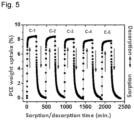
Figure 5 shows a Cartesian diagram with five cycles of PCE absorption/desorption at 35°C and W/W° = 0.01 by PPO films with thickness of about 20 µm (a) as described in example 4. - The present invention relates to a procedure for preparing a polyphenylene oxide (PPO) film with crystalline nanoporous phases, comprising the following steps:
- preparation of an amorphous PPO film,
- formation of co-crystalline phases with a percentage of crystallinity higher than 10% by absorption of host molecules,
- formation of crystalline nanoporous phases by total removal of said host molecules,
- said absorption of host molecules is conducted up to a host molecule content equal to or higher than 20% w/w,
- said formation of co-crystalline phases occurs with a crystallization rate equal to or greater than 0.5 percentage points per minute, and
- said total removal of said host molecules occurs before the content of said host molecules has dropped below 20% w/w.
- The first step of the procedure of the present invention provides for the preparation of an amorphous PPO film.
- The preparation of an amorphous PPO film is carried out by means of melt casting and subsequent cooling or by solution casting and subsequent evaporation of the solvent.
- The casting can be attained as coating deposited on a suitable substrate, such as for example a substrate made with a material selected from the group that comprises ceramics, glass, graphite, quartz, silicon, polymers, such as for example ethylene polymers and copolymers, propylene polymers and copolymers, lactic acid polymers, polyamides, and mixtures thereof.
- Any melt casting procedure leads to the formation of an amorphous PPO film, while the obtainment of amorphous PPO films by solution casting requires a suitable selection of the solvent, of the concentration and of the procedure temperature. The solvent is preferably selected from the group that comprises or consists of organic solvents, such as for example chloroform, dichloromethane, tetrachloromethane, dichloroethane, trichloroethane, trichloroethylene, benzene, o-dichlorobenzene, trichlorobenzene, toluene and methyl benzoate. The concentration of the PPO in the solvent are preferably selected in the interval from 1% to 10%, preferably from 1% to 5% by weight with respect to the weight of the resulting solution. The temperature of evaporation of the solvent is preferably higher than the room temperature, preferably higher than 60°C.
- The second step of the procedure of the present invention provides for the formation of co-crystalline phases by absorption of host molecules, preferably molecules of an organic compound.
- The host molecules preferably have a molecular volume greater than 0.20 nm3, more preferably greater than 0.25 nm3.
- The molecular volume of the host molecule can be calculated by means of the following equation:

- The absorption of the host molecules can be carried out via immersion in a liquid or via vapor exposure, preferably via immersion in a liquid. The liquid can be constituted by the pure organic compound or by a solution thereof in inert solvent, i.e. unable to be absorbed.
- The absorption of the host molecules can be carried out up to a host molecule content equal to or higher than 20% w/w, preferably equal to or higher than 30% w/w, more preferably equal to or higher than 40% w/w, and still more preferably equal to or higher than 50% w/w.
- Advantageously, the absorption of the host molecules can be carried out up to a host molecule content comprised between 50% and 90% w/w, in particular between 65% and 80% w/w, ends included.
- The formation of co-crystalline phases preferably occurs with a crystallization rate equal to or greater than 1 percentage point per minute, more preferably equal to or greater than 2 percentage points per minute, and still more preferably equal to or greater than 3 percentage points per minute.
- The crystallization rate can be controlled by varying the temperature and/or by using suitable organic compounds or mixtures thereof, and/or by varying the physical state of the guest (liquid, vapor, gas).
- Advantageously, the step of absorption takes place at a temperature equal to or greater than 20°C, preferably equal to or greater than 30°C, more preferably equal to or greater than 50°C.
- Preferably, the organic compounds used are carvone, limonene, dibenzyl ether, eugenol, carvacrol, methyl benzoate, mixtures thereof and their solutions in inert solvents.
- The third step of the procedure of the present invention provides for the transformation of the co-crystalline phases in crystalline nanoporous phases, by total removal of the host molecules.
- With the expression "total removal of the host molecules" it is intended the reduction of the concentration of the host molecules to a percentage at least equal to or lower than 0.1% w/w, preferably equal to or lower than 0.05% w/w.
- The total removal of the host molecules can be carried out
- by means of absorption followed by desorption of host molecules of a volatile liquid compound, or
- by means of supercritical CO2 extraction.
- The absorption/desorption procedure which uses a volatile liquid compound is preferably conducted at temperatures comprised between 0°C and 80°C, more preferably between 10°C and 50°C. Preferably, the volatile liquid useful in the present invention is selected from the group that comprises or consists of acetonitrile, acetone, methyl ethyl ketone and methanol.
- Advantageously, the extraction procedure which uses supercritical CO2 is conducted under pressure, preferably at values comprised between 50 and 350 bar, more preferably between 150 and 250 bar, at a temperature equal to or higher than the room temperature, preferably at values comprised between 20°C and 70°C, more preferably between 25° and 60°C, in a time period comprised between 30 and 500 minutes, preferably between 60 and 300 minutes.
- The Applicant has observed that the removal of the host molecules also occurs spontaneously, i.e. via separation and detachment of the host molecules from the co-crystalline structure caused by the simple exposure to environmental conditions. The Applicant has also observed that the resulting surface area depends on the quantity of residual host molecules present in the co-crystalline phases before the total removal of the host molecules.
- In particular, the Applicant has observed that the total removal of the host molecules must be carried out before the content of the same host molecules has dropped below 20% w/w.
- Preferably, the total removal of the host molecules must be carried out before the content of the same host molecules has dropped below 30% w/w, preferably below 40% w/w, more preferably below 50% w/w, and still more preferably below 60% w/w. Advantageously, the total removal of the host molecules must be carried out before the content of the same host molecules has dropped below a value comprised between 60% and 80% w/w.
- The total removal of the host molecules can be carried out in one or more steps. The total removal can be conducted in multiple steps, as long as the last step starts from a host molecule content higher than 20% w/w, preferably higher than 30% w/w, more preferably higher than 40% w/w. Preferably, the total removal of the host molecules is carried out in a single step. The Applicant has in fact observed that the total removal of the host molecules in a single step allows obtaining, the other conditions being the same, a higher surface area.
- The polyphenylene oxide (PPO) film with surface area equal to or greater than 30 m2/g of the present invention can be in the form of self-supporting film or coating of a substrate.
- The crystalline nanoporous phases comprised in the PPO film can be the alpha form (α) and/or the beta form (β) identified and described in the scientific literature article Nagendra, B.; Cozzolino, A.; Daniel, C.; Rizzo, P.; Guerra, G.; Auriemma, F.; De Rosa, C.; D'Alterio, M. C.; Tarallo, O.; Nuzzo, A. "Two Nanoporous Crystalline Forms of Poly(2,6-dimethyl-1,4-phenylene)oxide and Related Co-Crystalline Forms", Macromolecules 2019, 52, 9646-9656.
- Preferably, the crystalline nanoporous phases comprised in the PPO film are in alpha form.
- The polyphenylene oxide (PPO) film of the present invention can have a surface area equal to or greater than 100 m2/g, preferably equal to or greater than 200 m2/g, more preferably equal to or greater than 300 m2/g, and still more preferably equal to or greater than 400 m2/g.
- Advantageously, the polyphenylene oxide (PPO) film of the present invention has a surface area comprised between 450 m2/g and 800 m2/g, in particular between 500 m2/g and 650 m2/g.
- The percentage of crystallinity of the crystalline nanoporous phases of the PPO film of the present invention is preferably equal to or higher than 20%, more preferably higher than 30%, and still more preferably higher than 50%.
- The percentage of crystallinity per PPO film is measured by means of differential scanning calorimeter measurements (DSC), by evaluating the enthalpy of fusion of the specimen and assuming that the enthalpy of fusion of a completely crystalline specimen is equal to 43 J/g.
- The thickness of the polyphenylene oxide (PPO) film with surface area equal to or greater than 30 m2/g of the present invention is not particularly limited. Preferably, the polyphenylene oxide (PPO) film of the present invention has a thickness equal to or greater than 1 µm, preferably equal to or greater than 5 µm, more preferably equal to or greater than 10 µm, and still more preferably equal to or greater than 20 µm. Advantageously, the polyphenylene oxide (PPO) film of the present invention has a thickness comprised between 10 and 200 µm, in particular from 20 to 100 µm, ends included.
- The polyphenylene oxide (PPO) film with surface area equal to or greater than 30 m2/g of the present invention is adapted to be used for various applications, for example in membrane for molecular separation, preferably with gas, molecular sensors, preferably of optical nature, and in filters, and more generally in systems, multiple for the removal of organic pollutants from the air and from the water.
- The present invention will now be illustrated with reference to materials and methods described as a non-limiting example in the following experimental part.
- A first PPO film (Film a) with thickness of 20 µm and alpha crystalline nanoporous phase was obtained by means of a three-step procedure:
- Step 1. Deposition of an amorphous PPO film (Film d) on a glass substrate by means of casting process at 60°C, from a chloroform solution with a concentration of PPO equal to 1% by weight.
- Step 2. Crystallization in co-crystalline phase by means of immersion in liquid carvone at room temperature per 8 minutes, reaching a carvone content of about 80% by weight.
-
Step 3. Total extraction of the carvone by means of carbon dioxide in supercritical conditions (T=40°C, P=250 bar). - A second PPO film (Film b) with thickness of 20 µm with alpha crystalline nanoporous phase was obtained with the same procedure, except for
step 3, substituted with the following step 3'.
Step 3'. Total extraction of the carvone by absorption/desorption of acetonitrile at room temperature. - The X-ray diffraction figures of such films have shown the presence of the diffraction peaks at 2θ = 4.5°, 7.1°, 9.0°, 11.3°, 15.1°, indicating the presence of the alpha crystalline nanoporous form. Differential calorimeter scans have shown an enthalpy of fusion for the two films close to 20 J/g, corresponding to a crystallinity of about 46%. The measurement of the crystallization rate detected a rate higher than 5 percentage points of crystallization per minute.
- The isotherms of nitrogen absorption at 77°K of such PPO films, of the amorphous PPO film (Film d), and of a PPO aerogel (Aerogel c) with density equal to about 0.1 g/cm3 and porosity equal to about 90% are illustrated in
figure 1 . The BET surface area values obtained from the data reported inFigure 1 are summarized in the following Table 1.TABLE 1 Specimen BET Surface area (m2/g) Film a 620 Film b 510 Aerogel c 560 Film d < 4 - The results of table 1 demonstrate the surprising result obtained with the procedure of the present invention, i.e. the obtainment of a film with surface area equal to or greater (for films a and b) than that of an aerogel (Aerogel c) starting from a surface area smaller than 4 m2/g of the amorphous PPO (Film d).
- For the same specimens, the kinetics of absorption of perchloroethylene (PCE) at 35°C for W/Wo = 0.01 and the sum of PCE absorbed after 12 hours with various activities (W/Wo ≤ 0.05) are respectively shown in
Figures 2 and3 . - The quantity of PCE absorbed by the crystalline nanoporous films (Films a and b) has proven to be much higher than that of the amorphous PPO film having the same thickness (Film d).
- Surprisingly, the absorption of PCE in the crystalline nanoporous PPO film obtained with the procedure 1-3 (Film a), with a greater surface area, was higher and faster than the absorption of PCE in the PPO aerogel (Aerogel c).
-
Figure 4 reports the progression of the absorption of PCE at room temperature by aqueous solutions with PCE concentration equal to 50ppm for specimens of the aforesaid Films a and d and of the Aerogel c. - Also in this case, the crystalline nanoporous PPO film with high surface area (Film a) has an absorption that is much higher and faster than that observed for the amorphous PPO film (Film d), but also with respect to the PPO aerogel (Aerogel c).
- A PPO film with thickness of 20 µm with alpha crystalline nanoporous phase was obtained with the same procedure described in steps 1 and 2 of example 1.
- The step of extraction of the carvone is conducted before the procedure 3', but after a partial desorption of the carvone at room temperature, i.e. after the carvone content has spontaneously reduced from 80% w/w to 14% w/w.
- The analysis of the X-ray diffraction conducted on the resulting PPO film has shown the presence of the diffraction peaks typical of the alpha crystalline nanoporous form, and the differential calorimeter scans detected a crystallinity of about 45%, with a rate higher than 5 percentage points of crystallization per minute, but the measurement of the BET surface area obtained from the values of nitrogen absorption at 77°K detected values lower than 4 m2/g, much lower than the values obtained in the example 1 with the film (b), and comparable to the values obtained with the amorphous PPO (Film d).
- A PPO film with thickness of 20 µm with alpha crystalline nanoporous phase was obtained with the same procedure described in the steps 1 and 3' of example 1, while step 2 was conducted with liquid carvacrol at room temperature per 30 minutes, reaching a carvacrol content equal to about 80% w/w.
- The percentage of crystallinity reached did not exceed 10%, with a crystallization rate equal to about 0.3 percentage points of crystallization per minute, and the BET surface area was smaller than 4 m2/g.
- A first PPO film (Film 1) with thickness of 20 µm and alpha crystalline nanoporous phase was obtained by means of a three-step procedure:
- Step 1. Deposition of an amorphous PPO film (Film d) on a glass substrate by means of casting process at 60°C, from a chloroform solution with a concentration of PPO equal to 1% by weight.
- Step 2. Crystallization in co-crystalline phase by means of immersion in limonene liquid at the temperature of 85°C for 5 minutes, reaching a content of limonene of about 70% by weight.
-
Step 3. Total extraction of the limonene by means of carbon dioxide in supercritical conditions (T=40°C, P=250 bar). - A second PPO film (Film 2) with thickness of 20 µm with alpha crystalline nanoporous phase was obtained with the same procedure, except for
step 3, substituted with the following step 3'.
Step 3'. Total extraction of the limonene by absorption/desorption of acetonitrile at room temperature. - As for example 1, the X-ray diffraction figures of such films have shown the presence of the diffraction peaks typical of the alpha crystalline nanoporous form. The differential calorimeter scans have demonstrated a crystallinity of about 44%. The measurement of the crystallization rate detected a rate higher than 8 percentage points of crystallization per minute. The BET surface area values of Films 1 and 2, obtained from the data of nitrogen absorption at 77°K as described in example 1, are summarized in the following Table 2.
TABLE 2 Film BET Surface area (m2/g) Film 1 505 Film 2 295 - A comparison film attained with the same procedure of the film 1, but by conducting step 2 at room temperature, allowed reaching a content of limonene of about 50% w/w and a percentage of crystallinity of 33% with a crystallization rate lower than 0.1 percentage points of crystallization per minute. The BET surface area value obtained for this comparison film was smaller than 4 m2/g.
- On the contrary, a film of the invention, attained by using carvacrol with the same procedure of the film 1, has demonstrated results that are substantially equal to those of the film 1.
- A PPO film with thickness of 100 µm and alpha crystalline nanoporous phase was obtained by means of a three-step procedure:
- Step 1. Deposition of an amorphous PPO film (Film d) on a glass substrate by means of casting process at 60°C, from a chloroform solution with a concentration of PPO equal to 1% by weight.
- Step 2. Crystallization in co-crystalline phase by means of immersion in liquid carvone at the temperature of 85°C per 10 minutes, reaching a content of carvone of about 80% by weight.
-
Step 3. Total extraction of the carvone by absorption/desorption of acetonitrile at room temperature. - As for example 1, the X-ray diffraction figure of such film has shown the presence of the typical diffraction peaks of the alpha crystalline nanoporous form. The differential calorimeter scanning has demonstrated a crystallinity of about 53%. The measurement of the crystallization rate has detected a rate higher than 5 percentage points of crystallization per minute.
- The BET surface area value of the resulting film, obtained from the data of nitrogen absorption at 77°K as described in example 1, was equal to 495 m2/g.
- A comparison film attained with the same procedure, but by conducting step 2 at room temperature, allowed reaching a carvone content of about 70% w/w and a percentage of crystallinity of 43% with a crystallization rate lower than 0.2 percentage points of crystallization per minute. The BET surface area value made for this comparison film was smaller than 4 m2/g.
- The absorption capacity of the film (a) obtained in example 1 was evaluated by carrying out five cycles of PCE absorption/desorption conducted at a temperature of 35°C and values of W/W0 activity equal to 0.01.
- The results illustrated in
figure 5 demonstrated that the Film (a) maintains its absorption capacity even after repeated cycles. - A PPO film with thickness of 20 µm with alpha crystalline nanoporous phase was obtained with the same procedure described in the steps 1 and 3' of example 1, while step 2 of co-crystallization was carried out by absorption of carvone from vapor phase 90°C for 1 hour, reaching a carvone content equal to about 65% w/w.
- As for example 1, the X-ray diffraction figure of such film has shown the presence of the diffraction peaks typical of the alpha crystalline nanoporous form. The differential scanning calorimeter has demonstrated a crystallinity of about 36%. The measurement of the crystallization rate detected a rate higher than 0.5 percentage points of crystallization per minute.
- The BET surface area value of the resulting film, obtained from the data of nitrogen absorption at 77°K as described in example 1, was equal to about 160 m2/g.
- A PPO film with thickness of 100 µm and alpha crystalline nanoporous phase was obtained by means of a three-step procedure similar to that of example 1, with the following conditions:
- Step 1. Formation of an amorphous PPO film (Film d) on a glass substrate by means of a process of forming from melted PPO via compression at the temperature of 280°C.
- Step 2. Crystallization in co-crystalline phase by means of immersion in carvone liquid at a temperature of 100°C for 5 minutes, reaching a carvone content of about 80% by weight.
-
Step 3. Total extraction of the carvone by absorption/desorption of acetonitrile at room temperature. - As for example 1, the X-ray diffraction figure of such film has shown the presence of the diffraction peaks typical of the alpha crystalline nanoporous form. The differential scanning calorimeter has demonstrated a crystallinity of about 46%. The measurement of the crystallization rate detected a rate higher than 9 percentage points of crystallization per minute.
- The BET surface area value of the resulting film, obtained from the data of nitrogen absorption at 77°K as described in example 1, was equal to about 520 m2/g.
- A film of a mixture of PPO and atactic polystyrene (PS) in a weight ratio equal to 70/30 with thickness of 20 µm and alpha crystalline nanoporous phase was obtained by means of a three-step procedure similar to that of example 1, with the following conditions:
- Step 1. Formation of a PPO/PS amorphous film on a glass substrate by means of a casting process at 60°C, from a chloroform solution with a concentration of the PPO/PS mixture equal to 1% by weight.
- Step 2. Crystallization in co-crystalline phase by means of immersion in carvone liquid at room temperature for 16 minutes, reaching a content of carvone of about 80% by weight.
-
Step 3. Total extraction of the carvone by absorption/desorption of acetonitrile at room temperature. - As for example 1, the X-ray diffraction figure of such film has shown the presence of the typical diffraction peaks of the alpha crystalline nanoporous form. The differential scanning calorimeter has demonstrated a crystallinity of about 30%. The measurement of the crystallization rate detected a rate higher than 1 percentage point of crystallization per minute.
- The BET surface area value of the resulting film, obtained from the data of nitrogen absorption at 77°K as described in example 1, was equal to about 325 m2/g.
- A PPO film with thickness of 100 µm and alpha crystalline nanoporous phase was obtained by means of the same procedure of example 7. The BET surface area value of the resulting film, obtained for the nitrogen absorption data at 77°K as described in example 1, was equal to about 500 m2/g.
Claims (15)
- A procedure for preparing a polyphenylene oxide (PPO) film with crystalline nanoporous phases, including the following steps:• preparation of an amorphous PPO film,• formation of co-crystalline phases with a percentage of crystallinity higher than 10% by absorption of host molecules,• formation of crystalline nanoporous phases by total removal of said host molecules,characterized in thatsaid absorption of host molecules is conducted up to a host molecule content equal to or greater than 20% w/w,said formation of co-crystalline phases occurs with a crystallization rate equal to or greater than 0.5 percentage points per minute, andsaid total removal of said host molecules occurs before the content of said host molecules has dropped below 20% w/w, the percentage of crystallinity being measured as disclosed in the description.
- The procedure according to claim 1, wherein said host molecules have a molecular volume greater than 0.25 nm3.
- The procedure according to claim 1, wherein said host molecules are molecules of an organic compound selected from the group that comprises, or consists of, carvone, limonene, dibenzyl ether, eugenol, carvacrol, methyl benzoate and mixtures thereof.
- The procedure according to claim 1, wherein said step of co-crystalline phase formation takes place at a temperature equal to or higher than 20°C.
- The procedure according to claim 1, wherein said preparation of an amorphous film of PPO is carried out by melt casting and subsequent cooling or by solution casting and subsequent evaporation of the solvent.
- The procedure according to claim 1, wherein said PPO amorphous film is a self-supporting film or a coating of a substrate.
- The procedure according to claim 1, wherein said total removal of said host molecules takes place by absorption followed by desorption of host molecules of a volatile liquid compound, preferably selected from the group that comprises, or consists of, acetonitrile, acetone, methyl ethyl ketone and methanol.
- The procedure according to claim 1, wherein said total removal of said host molecules takes place by supercritical CO2 extraction.
- The procedure according to claim 1, wherein said total removal of said host molecules takes place before the content of said host molecules has dropped below 30% w/w, preferably below 40% w/w, more preferably below 50% w/w, and even more preferably below 60% w/w.
- A polyphenylene oxide (PPO) film with BET surface area equal to or greater than 30 m2/g.
- The film according to claim 10, wherein said BET surface area is equal to or greater than 100 m2/g, preferably equal to or greater than 200 m2/g, more preferably equal to or greater than 300 m2/g, and even more preferably equal to or greater than 400 m2/g.
- The film according to claim 10, wherein said crystalline nanoporous phases have a percentage of crystallinity higher than 20%, preferably higher than 30%, more preferably higher than 50%.
- The film according to claim 10, wherein said polyphenylene oxide film is a self-supporting film or is a coating of a substrate.
- The film according to claim 13, wherein said substrate is made with a material selected from the group that comprises polymers, ceramics, glass, graphite, quartz, silicon and mixtures thereof.
- A device for molecular separation, molecular sensing and removal of organic pollutants comprising a polyphenylene oxide (PPO) film according to any of claims 10 to 14.
Applications Claiming Priority (2)
| Application Number | Priority Date | Filing Date | Title |
|---|---|---|---|
| IT102020000027660A IT202000027660A1 (en) | 2020-11-18 | 2020-11-18 | PPO-BASED FILMS WITH HIGH SURFACE AREA AND PROCEDURES FOR THEIR OBTAINMENT |
| PCT/IB2021/060662 WO2022107022A1 (en) | 2020-11-18 | 2021-11-17 | Ppo based film with high surface area and procedures for the obtainment thereof |
Publications (2)
| Publication Number | Publication Date |
|---|---|
| EP4247884A1 EP4247884A1 (en) | 2023-09-27 |
| EP4247884B1 true EP4247884B1 (en) | 2025-06-11 |
Family
ID=74347630
Family Applications (1)
| Application Number | Title | Priority Date | Filing Date |
|---|---|---|---|
| EP21811149.0A Active EP4247884B1 (en) | 2020-11-18 | 2021-11-17 | Ppo based film with high surface area and procedures for the obtainment thereof |
Country Status (6)
| Country | Link |
|---|---|
| US (1) | US12576366B2 (en) |
| EP (1) | EP4247884B1 (en) |
| CN (1) | CN116670204A (en) |
| CA (1) | CA3201501A1 (en) |
| IT (1) | IT202000027660A1 (en) |
| WO (1) | WO2022107022A1 (en) |
Family Cites Families (6)
| Publication number | Priority date | Publication date | Assignee | Title |
|---|---|---|---|---|
| US4944775A (en) * | 1989-07-11 | 1990-07-31 | E. I. Du Pont De Nemours And Company | Preparation of poly(phenylene oxide) asymmetric gas separation membranes |
| KR101123436B1 (en) * | 2004-06-10 | 2012-03-28 | 다우 글로벌 테크놀로지스 엘엘씨 | Method of Forming a Nanoporous Dielectric Film |
| SG183328A1 (en) * | 2010-02-24 | 2012-09-27 | Asahi Kasei Chemicals Corp | Polyphenylene ether and method for producing the same |
| IT1404157B1 (en) | 2010-12-30 | 2013-11-15 | Nano Active Film S R L | NANOPOROSAL CRYSTALLINE FORM DISORDERED WITH SINDIOTACTIC POLYSTYRENE, ITS PREPARATION PROCESS AND ITEMS INCLUDING THE SAME. |
| CN102553531A (en) * | 2012-01-13 | 2012-07-11 | 同济大学 | Preparation method of multiporous carbonaceous adsorbing material with micro-nano composite structure |
| CN107469644A (en) * | 2017-09-08 | 2017-12-15 | 中国科学技术大学 | A kind of nanofiltration membrane and preparation method thereof |
-
2020
- 2020-11-18 IT IT102020000027660A patent/IT202000027660A1/en unknown
-
2021
- 2021-11-17 US US18/253,304 patent/US12576366B2/en active Active
- 2021-11-17 EP EP21811149.0A patent/EP4247884B1/en active Active
- 2021-11-17 WO PCT/IB2021/060662 patent/WO2022107022A1/en not_active Ceased
- 2021-11-17 CN CN202180084507.8A patent/CN116670204A/en active Pending
- 2021-11-17 CA CA3201501A patent/CA3201501A1/en active Pending
Non-Patent Citations (1)
| Title |
|---|
| DANIEL CHRISTOPHE ET AL: "Nanoporous-crystalline poly(2,6-dimethyl-1,4-phenylene)oxide (PPO) aerogels", POLYMER, vol. 105, 1 November 2016 (2016-11-01), AMSTERDAM, NL, pages 96 - 103, XP055889830, ISSN: 0032-3861, DOI: 10.1016/j.polymer.2016.10.017 * |
Also Published As
| Publication number | Publication date |
|---|---|
| IT202000027660A1 (en) | 2022-05-18 |
| US12576366B2 (en) | 2026-03-17 |
| US20240017241A1 (en) | 2024-01-18 |
| EP4247884A1 (en) | 2023-09-27 |
| CN116670204A (en) | 2023-08-29 |
| CA3201501A1 (en) | 2022-05-27 |
| WO2022107022A1 (en) | 2022-05-27 |
Similar Documents
| Publication | Publication Date | Title |
|---|---|---|
| Rogan et al. | Synthesis and gas permeation properties of novel spirobisindane-based polyimides of intrinsic microporosity | |
| Cook et al. | Roll-to-roll dip coating of three different PIMs for Organic Solvent Nanofiltration | |
| Du et al. | Polymers of intrinsic microporosity (PIMs) substituted with methyl tetrazole | |
| Hamilton et al. | Glycine polymorphism in nanoscale crystallization chambers | |
| Ma et al. | Evidence for entropic diffusion selection of xylene isomers in carbon molecular sieve membranes | |
| US7690514B2 (en) | Microporous polymer material | |
| Lai et al. | Highly-selective MOF-303 membrane for alcohol dehydration | |
| Ogieglo et al. | Gas separation performance and physical aging of tubular thin-film composite carbon molecular sieve membranes based on a polyimide of intrinsic microporosity precursor | |
| Charlet et al. | Solid cholesteric films cast from aqueous (hydroxypropyl) cellulose | |
| Okumura et al. | Polymorphic transformation of indomethacin under high pressures | |
| CN107406591A (en) | Intrinsically Microporous Polymers | |
| US20040154980A1 (en) | Method for producing silver salt-containing facilitated transport membrane for olefin separation having improved stability | |
| Pan et al. | Solid state characterization of azelnidipine–oxalic acid co-crystal and co-amorphous complexes: The effect of different azelnidipine polymorphs | |
| O'brien et al. | Influence of casting and curing conditions on gas sorption and transport in polyimide films | |
| US11135556B2 (en) | Crosslinked polyethylene glycol polymer membranes for gas separation | |
| Okabe et al. | The Flory-Huggins interaction parameter and thermoreversible gelation of poly (vinylidene fluoride) in organic solvents | |
| Hsieh et al. | Pillared-bilayer metal-organic framework membranes for dehydration of isopropanol | |
| Lee et al. | Influence of substrate temperature on the optical properties of evaporated films of pentacene | |
| KR20010020423A (en) | Crystalline Macrolides and Process for Their Preparation | |
| Schleiffelder et al. | Crosslinkable copolyimides for the membrane-based separation of p-/o-xylene mixtures | |
| US12576366B2 (en) | PPO based film with high surface area and procedures for the obtainment thereof | |
| Guadagno et al. | Processing, thermal stability and morphology of chiral sensing syndiotactic polystyrene films | |
| Tarallo et al. | A chiral co-crystalline form of poly (2, 6-dimethyl-1, 4-phenylene) oxide (PPO) | |
| Braban et al. | Deliquescence of ammonium sulfate particles at sub‐eutectic temperatures | |
| Nagendra et al. | Guest induced transition from β to α nanoporous crystalline forms of PPO |
Legal Events
| Date | Code | Title | Description |
|---|---|---|---|
| STAA | Information on the status of an ep patent application or granted ep patent |
Free format text: STATUS: UNKNOWN |
|
| STAA | Information on the status of an ep patent application or granted ep patent |
Free format text: STATUS: THE INTERNATIONAL PUBLICATION HAS BEEN MADE |
|
| PUAI | Public reference made under article 153(3) epc to a published international application that has entered the european phase |
Free format text: ORIGINAL CODE: 0009012 |
|
| STAA | Information on the status of an ep patent application or granted ep patent |
Free format text: STATUS: REQUEST FOR EXAMINATION WAS MADE |
|
| 17P | Request for examination filed |
Effective date: 20230608 |
|
| AK | Designated contracting states |
Kind code of ref document: A1 Designated state(s): AL AT BE BG CH CY CZ DE DK EE ES FI FR GB GR HR HU IE IS IT LI LT LU LV MC MK MT NL NO PL PT RO RS SE SI SK SM TR |
|
| DAV | Request for validation of the european patent (deleted) | ||
| DAX | Request for extension of the european patent (deleted) | ||
| GRAP | Despatch of communication of intention to grant a patent |
Free format text: ORIGINAL CODE: EPIDOSNIGR1 |
|
| STAA | Information on the status of an ep patent application or granted ep patent |
Free format text: STATUS: GRANT OF PATENT IS INTENDED |
|
| INTG | Intention to grant announced |
Effective date: 20240416 |
|
| GRAJ | Information related to disapproval of communication of intention to grant by the applicant or resumption of examination proceedings by the epo deleted |
Free format text: ORIGINAL CODE: EPIDOSDIGR1 |
|
| STAA | Information on the status of an ep patent application or granted ep patent |
Free format text: STATUS: REQUEST FOR EXAMINATION WAS MADE |
|
| INTC | Intention to grant announced (deleted) | ||
| GRAP | Despatch of communication of intention to grant a patent |
Free format text: ORIGINAL CODE: EPIDOSNIGR1 |
|
| STAA | Information on the status of an ep patent application or granted ep patent |
Free format text: STATUS: GRANT OF PATENT IS INTENDED |
|
| INTG | Intention to grant announced |
Effective date: 20240909 |
|
| GRAJ | Information related to disapproval of communication of intention to grant by the applicant or resumption of examination proceedings by the epo deleted |
Free format text: ORIGINAL CODE: EPIDOSDIGR1 |
|
| STAA | Information on the status of an ep patent application or granted ep patent |
Free format text: STATUS: REQUEST FOR EXAMINATION WAS MADE |
|
| RAP3 | Party data changed (applicant data changed or rights of an application transferred) |
Owner name: MATERIAS S.R.L. |
|
| INTC | Intention to grant announced (deleted) | ||
| GRAP | Despatch of communication of intention to grant a patent |
Free format text: ORIGINAL CODE: EPIDOSNIGR1 |
|
| STAA | Information on the status of an ep patent application or granted ep patent |
Free format text: STATUS: GRANT OF PATENT IS INTENDED |
|
| INTG | Intention to grant announced |
Effective date: 20250113 |
|
| GRAS | Grant fee paid |
Free format text: ORIGINAL CODE: EPIDOSNIGR3 |
|
| GRAA | (expected) grant |
Free format text: ORIGINAL CODE: 0009210 |
|
| STAA | Information on the status of an ep patent application or granted ep patent |
Free format text: STATUS: THE PATENT HAS BEEN GRANTED |
|
| AK | Designated contracting states |
Kind code of ref document: B1 Designated state(s): AL AT BE BG CH CY CZ DE DK EE ES FI FR GB GR HR HU IE IS IT LI LT LU LV MC MK MT NL NO PL PT RO RS SE SI SK SM TR |
|
| REG | Reference to a national code |
Ref country code: GB Ref legal event code: FG4D |
|
| REG | Reference to a national code |
Ref country code: CH Ref legal event code: EP |
|
| REG | Reference to a national code |
Ref country code: IE Ref legal event code: FG4D |
|
| REG | Reference to a national code |
Ref country code: DE Ref legal event code: R096 Ref document number: 602021032221 Country of ref document: DE |
|
| REG | Reference to a national code |
Ref country code: NL Ref legal event code: FP |
|
| PG25 | Lapsed in a contracting state [announced via postgrant information from national office to epo] |
Ref country code: ES Free format text: LAPSE BECAUSE OF FAILURE TO SUBMIT A TRANSLATION OF THE DESCRIPTION OR TO PAY THE FEE WITHIN THE PRESCRIBED TIME-LIMIT Effective date: 20250611 Ref country code: FI Free format text: LAPSE BECAUSE OF FAILURE TO SUBMIT A TRANSLATION OF THE DESCRIPTION OR TO PAY THE FEE WITHIN THE PRESCRIBED TIME-LIMIT Effective date: 20250611 |
|
| REG | Reference to a national code |
Ref country code: LT Ref legal event code: MG9D |
|
| PG25 | Lapsed in a contracting state [announced via postgrant information from national office to epo] |
Ref country code: NO Free format text: LAPSE BECAUSE OF FAILURE TO SUBMIT A TRANSLATION OF THE DESCRIPTION OR TO PAY THE FEE WITHIN THE PRESCRIBED TIME-LIMIT Effective date: 20250911 Ref country code: GR Free format text: LAPSE BECAUSE OF FAILURE TO SUBMIT A TRANSLATION OF THE DESCRIPTION OR TO PAY THE FEE WITHIN THE PRESCRIBED TIME-LIMIT Effective date: 20250912 |
|
| PG25 | Lapsed in a contracting state [announced via postgrant information from national office to epo] |
Ref country code: BG Free format text: LAPSE BECAUSE OF FAILURE TO SUBMIT A TRANSLATION OF THE DESCRIPTION OR TO PAY THE FEE WITHIN THE PRESCRIBED TIME-LIMIT Effective date: 20250611 |
|
| PG25 | Lapsed in a contracting state [announced via postgrant information from national office to epo] |
Ref country code: HR Free format text: LAPSE BECAUSE OF FAILURE TO SUBMIT A TRANSLATION OF THE DESCRIPTION OR TO PAY THE FEE WITHIN THE PRESCRIBED TIME-LIMIT Effective date: 20250611 |
|
| PG25 | Lapsed in a contracting state [announced via postgrant information from national office to epo] |
Ref country code: RS Free format text: LAPSE BECAUSE OF FAILURE TO SUBMIT A TRANSLATION OF THE DESCRIPTION OR TO PAY THE FEE WITHIN THE PRESCRIBED TIME-LIMIT Effective date: 20250911 |
|
| PG25 | Lapsed in a contracting state [announced via postgrant information from national office to epo] |
Ref country code: LV Free format text: LAPSE BECAUSE OF FAILURE TO SUBMIT A TRANSLATION OF THE DESCRIPTION OR TO PAY THE FEE WITHIN THE PRESCRIBED TIME-LIMIT Effective date: 20250611 |
|
| PG25 | Lapsed in a contracting state [announced via postgrant information from national office to epo] |
Ref country code: PT Free format text: LAPSE BECAUSE OF FAILURE TO SUBMIT A TRANSLATION OF THE DESCRIPTION OR TO PAY THE FEE WITHIN THE PRESCRIBED TIME-LIMIT Effective date: 20251013 |
|
| PGFP | Annual fee paid to national office [announced via postgrant information from national office to epo] |
Ref country code: NL Payment date: 20251124 Year of fee payment: 5 |
|
| REG | Reference to a national code |
Ref country code: AT Ref legal event code: MK05 Ref document number: 1802284 Country of ref document: AT Kind code of ref document: T Effective date: 20250611 |
|
| PG25 | Lapsed in a contracting state [announced via postgrant information from national office to epo] |
Ref country code: IS Free format text: LAPSE BECAUSE OF FAILURE TO SUBMIT A TRANSLATION OF THE DESCRIPTION OR TO PAY THE FEE WITHIN THE PRESCRIBED TIME-LIMIT Effective date: 20251011 |
|
| PGFP | Annual fee paid to national office [announced via postgrant information from national office to epo] |
Ref country code: DE Payment date: 20251126 Year of fee payment: 5 |
|
| PGFP | Annual fee paid to national office [announced via postgrant information from national office to epo] |
Ref country code: GB Payment date: 20251125 Year of fee payment: 5 |
|
| PG25 | Lapsed in a contracting state [announced via postgrant information from national office to epo] |
Ref country code: AT Free format text: LAPSE BECAUSE OF FAILURE TO SUBMIT A TRANSLATION OF THE DESCRIPTION OR TO PAY THE FEE WITHIN THE PRESCRIBED TIME-LIMIT Effective date: 20250611 Ref country code: SM Free format text: LAPSE BECAUSE OF FAILURE TO SUBMIT A TRANSLATION OF THE DESCRIPTION OR TO PAY THE FEE WITHIN THE PRESCRIBED TIME-LIMIT Effective date: 20250611 |
|
| PG25 | Lapsed in a contracting state [announced via postgrant information from national office to epo] |
Ref country code: CZ Free format text: LAPSE BECAUSE OF FAILURE TO SUBMIT A TRANSLATION OF THE DESCRIPTION OR TO PAY THE FEE WITHIN THE PRESCRIBED TIME-LIMIT Effective date: 20250611 |
|
| PG25 | Lapsed in a contracting state [announced via postgrant information from national office to epo] |
Ref country code: PL Free format text: LAPSE BECAUSE OF FAILURE TO SUBMIT A TRANSLATION OF THE DESCRIPTION OR TO PAY THE FEE WITHIN THE PRESCRIBED TIME-LIMIT Effective date: 20250611 |
|
| PG25 | Lapsed in a contracting state [announced via postgrant information from national office to epo] |
Ref country code: EE Free format text: LAPSE BECAUSE OF FAILURE TO SUBMIT A TRANSLATION OF THE DESCRIPTION OR TO PAY THE FEE WITHIN THE PRESCRIBED TIME-LIMIT Effective date: 20250611 |
|
| PG25 | Lapsed in a contracting state [announced via postgrant information from national office to epo] |
Ref country code: SK Free format text: LAPSE BECAUSE OF FAILURE TO SUBMIT A TRANSLATION OF THE DESCRIPTION OR TO PAY THE FEE WITHIN THE PRESCRIBED TIME-LIMIT Effective date: 20250611 |
|
| PG25 | Lapsed in a contracting state [announced via postgrant information from national office to epo] |
Ref country code: RO Free format text: LAPSE BECAUSE OF FAILURE TO SUBMIT A TRANSLATION OF THE DESCRIPTION OR TO PAY THE FEE WITHIN THE PRESCRIBED TIME-LIMIT Effective date: 20250611 |
|
| REG | Reference to a national code |
Ref country code: DE Ref legal event code: R097 Ref document number: 602021032221 Country of ref document: DE |
|
| PG25 | Lapsed in a contracting state [announced via postgrant information from national office to epo] |
Ref country code: DK Free format text: LAPSE BECAUSE OF FAILURE TO SUBMIT A TRANSLATION OF THE DESCRIPTION OR TO PAY THE FEE WITHIN THE PRESCRIBED TIME-LIMIT Effective date: 20250611 |
|
| PG25 | Lapsed in a contracting state [announced via postgrant information from national office to epo] |
Ref country code: IT Free format text: LAPSE BECAUSE OF FAILURE TO SUBMIT A TRANSLATION OF THE DESCRIPTION OR TO PAY THE FEE WITHIN THE PRESCRIBED TIME-LIMIT Effective date: 20250611 |
|
| PLBE | No opposition filed within time limit |
Free format text: ORIGINAL CODE: 0009261 |
|
| STAA | Information on the status of an ep patent application or granted ep patent |
Free format text: STATUS: NO OPPOSITION FILED WITHIN TIME LIMIT |
|
| REG | Reference to a national code |
Ref country code: CH Ref legal event code: L10 Free format text: ST27 STATUS EVENT CODE: U-0-0-L10-L00 (AS PROVIDED BY THE NATIONAL OFFICE) Effective date: 20260423 |