EP4246929A1 - Local preference in anycast cdn routing - Google Patents
Local preference in anycast cdn routing Download PDFInfo
- Publication number
- EP4246929A1 EP4246929A1 EP23020130.3A EP23020130A EP4246929A1 EP 4246929 A1 EP4246929 A1 EP 4246929A1 EP 23020130 A EP23020130 A EP 23020130A EP 4246929 A1 EP4246929 A1 EP 4246929A1
- Authority
- EP
- European Patent Office
- Prior art keywords
- user device
- anycast
- cache
- connection
- cdn
- Prior art date
- Legal status (The legal status is an assumption and is not a legal conclusion. Google has not performed a legal analysis and makes no representation as to the accuracy of the status listed.)
- Pending
Links
Images


Classifications
-
- H—ELECTRICITY
- H04—ELECTRIC COMMUNICATION TECHNIQUE
- H04L—TRANSMISSION OF DIGITAL INFORMATION, e.g. TELEGRAPHIC COMMUNICATION
- H04L65/00—Network arrangements, protocols or services for supporting real-time applications in data packet communication
- H04L65/60—Network streaming of media packets
- H04L65/61—Network streaming of media packets for supporting one-way streaming services, e.g. Internet radio
- H04L65/612—Network streaming of media packets for supporting one-way streaming services, e.g. Internet radio for unicast
-
- H—ELECTRICITY
- H04—ELECTRIC COMMUNICATION TECHNIQUE
- H04L—TRANSMISSION OF DIGITAL INFORMATION, e.g. TELEGRAPHIC COMMUNICATION
- H04L67/00—Network arrangements or protocols for supporting network services or applications
- H04L67/01—Protocols
- H04L67/10—Protocols in which an application is distributed across nodes in the network
- H04L67/1001—Protocols in which an application is distributed across nodes in the network for accessing one among a plurality of replicated servers
- H04L67/1036—Load balancing of requests to servers for services different from user content provisioning, e.g. load balancing across domain name servers
-
- H—ELECTRICITY
- H04—ELECTRIC COMMUNICATION TECHNIQUE
- H04L—TRANSMISSION OF DIGITAL INFORMATION, e.g. TELEGRAPHIC COMMUNICATION
- H04L61/00—Network arrangements, protocols or services for addressing or naming
- H04L61/45—Network directories; Name-to-address mapping
- H04L61/4505—Network directories; Name-to-address mapping using standardised directories; using standardised directory access protocols
- H04L61/4511—Network directories; Name-to-address mapping using standardised directories; using standardised directory access protocols using domain name system [DNS]
-
- H—ELECTRICITY
- H04—ELECTRIC COMMUNICATION TECHNIQUE
- H04L—TRANSMISSION OF DIGITAL INFORMATION, e.g. TELEGRAPHIC COMMUNICATION
- H04L67/00—Network arrangements or protocols for supporting network services or applications
- H04L67/01—Protocols
- H04L67/02—Protocols based on web technology, e.g. hypertext transfer protocol [HTTP]
-
- H—ELECTRICITY
- H04—ELECTRIC COMMUNICATION TECHNIQUE
- H04L—TRANSMISSION OF DIGITAL INFORMATION, e.g. TELEGRAPHIC COMMUNICATION
- H04L67/00—Network arrangements or protocols for supporting network services or applications
- H04L67/01—Protocols
- H04L67/10—Protocols in which an application is distributed across nodes in the network
-
- H—ELECTRICITY
- H04—ELECTRIC COMMUNICATION TECHNIQUE
- H04L—TRANSMISSION OF DIGITAL INFORMATION, e.g. TELEGRAPHIC COMMUNICATION
- H04L67/00—Network arrangements or protocols for supporting network services or applications
- H04L67/01—Protocols
- H04L67/10—Protocols in which an application is distributed across nodes in the network
- H04L67/1001—Protocols in which an application is distributed across nodes in the network for accessing one among a plurality of replicated servers
- H04L67/1004—Server selection for load balancing
-
- H—ELECTRICITY
- H04—ELECTRIC COMMUNICATION TECHNIQUE
- H04L—TRANSMISSION OF DIGITAL INFORMATION, e.g. TELEGRAPHIC COMMUNICATION
- H04L67/00—Network arrangements or protocols for supporting network services or applications
- H04L67/01—Protocols
- H04L67/10—Protocols in which an application is distributed across nodes in the network
- H04L67/1001—Protocols in which an application is distributed across nodes in the network for accessing one among a plurality of replicated servers
- H04L67/1004—Server selection for load balancing
- H04L67/101—Server selection for load balancing based on network conditions
-
- H—ELECTRICITY
- H04—ELECTRIC COMMUNICATION TECHNIQUE
- H04L—TRANSMISSION OF DIGITAL INFORMATION, e.g. TELEGRAPHIC COMMUNICATION
- H04L67/00—Network arrangements or protocols for supporting network services or applications
- H04L67/01—Protocols
- H04L67/10—Protocols in which an application is distributed across nodes in the network
- H04L67/1001—Protocols in which an application is distributed across nodes in the network for accessing one among a plurality of replicated servers
- H04L67/1004—Server selection for load balancing
- H04L67/1014—Server selection for load balancing based on the content of a request
-
- H—ELECTRICITY
- H04—ELECTRIC COMMUNICATION TECHNIQUE
- H04L—TRANSMISSION OF DIGITAL INFORMATION, e.g. TELEGRAPHIC COMMUNICATION
- H04L67/00—Network arrangements or protocols for supporting network services or applications
- H04L67/01—Protocols
- H04L67/10—Protocols in which an application is distributed across nodes in the network
- H04L67/1001—Protocols in which an application is distributed across nodes in the network for accessing one among a plurality of replicated servers
- H04L67/1004—Server selection for load balancing
- H04L67/1021—Server selection for load balancing based on client or server locations
-
- H—ELECTRICITY
- H04—ELECTRIC COMMUNICATION TECHNIQUE
- H04L—TRANSMISSION OF DIGITAL INFORMATION, e.g. TELEGRAPHIC COMMUNICATION
- H04L67/00—Network arrangements or protocols for supporting network services or applications
- H04L67/50—Network services
- H04L67/56—Provisioning of proxy services
-
- H—ELECTRICITY
- H04—ELECTRIC COMMUNICATION TECHNIQUE
- H04L—TRANSMISSION OF DIGITAL INFORMATION, e.g. TELEGRAPHIC COMMUNICATION
- H04L67/00—Network arrangements or protocols for supporting network services or applications
- H04L67/50—Network services
- H04L67/56—Provisioning of proxy services
- H04L67/563—Data redirection of data network streams
-
- H—ELECTRICITY
- H04—ELECTRIC COMMUNICATION TECHNIQUE
- H04L—TRANSMISSION OF DIGITAL INFORMATION, e.g. TELEGRAPHIC COMMUNICATION
- H04L67/00—Network arrangements or protocols for supporting network services or applications
- H04L67/50—Network services
- H04L67/56—Provisioning of proxy services
- H04L67/568—Storing data temporarily at an intermediate stage, e.g. caching
-
- H—ELECTRICITY
- H04—ELECTRIC COMMUNICATION TECHNIQUE
- H04L—TRANSMISSION OF DIGITAL INFORMATION, e.g. TELEGRAPHIC COMMUNICATION
- H04L67/00—Network arrangements or protocols for supporting network services or applications
- H04L67/50—Network services
- H04L67/60—Scheduling or organising the servicing of application requests, e.g. requests for application data transmissions using the analysis and optimisation of the required network resources
- H04L67/63—Routing a service request depending on the request content or context
Definitions
- CDNs Content Distribution/Delivery Networks
- objects video and other web content
- Selecting the best cache to use to deliver the object to the user is a difficult task.
- Most CDNs generally use two techniques to identify the optimal cache to use to deliver the object.
- DNS domain name system
- DNS load balancing has several challenges. First, the true client IP address (used for geolocation/mapping) is often not visible to the CDN's DNS servers.
- the DNS server sees the IP address of the resolver of the internet service provider (ISP) used by the user (or worse a cloud-based public DNS resolver). Without an accurate client IP address, cache localization is more difficult. Additionally, DNS lookups do not contain information about the content being requested. CDNs are therefore unable to use asset level load balancing policies during cache localization. For example, asset level policies may allow for targeting specific caches or clusters that are known to have the content already in cache. Finally, even with a very low time to live (TTL), there is some amount of caching of the load balancer responses. This can be good, in times of high load, but ultimately reduces the ability of the DNS server to identify the location of the user.
- TTL time to live
- a second strategy used to select the cache closest to the user is anycast routing. Anycast allows the same IP address to be advertised by many hosts. At every hop, the layer 3 switch or router determines the lowest cost path for the packet. This localizes clients to the closest logical CDN cache. However, routing changes may cause connections to be interrupted if packets are delivered to different hosts due to the risk of connection resets. Anycast has traditionally been used for User Datagram Protocol (UDP) or extremely short-lived transmission control protocol (TCP) connections.
- UDP User Datagram Protocol
- TCP transmission control protocol
- Embodiments include a method.
- the method includes establishing an anycast connection between a load balancer associated with a content delivery network (CDN) and a user device requesting an object from the CDN.
- the method further includes selecting, at the load balancer, a first cache from a plurality of caches in the CDN to fulfill the request for the object based on one or more load balancing criteria.
- the method further includes transmitting an HTTP redirect from the load balancer to the user device to close the anycast connection, wherein the HTTP redirect comprises information for establishing a unicast connection between the user device and the first cache to retrieve the object from the first cache.
- Embodiments further include a non-transitory computer-readable medium containing computer program code that, when executed by operation of one or more computer processors, performs an operation comprising: establishing an anycast connection between a load balancer associated with a CDN and a user device requesting an object from the CDN; selecting, at the load balancer, a first cache from a plurality of caches in the CDN to fulfill the request for the object based on one or more load balancing criteria; and transmitting an HTTP redirect from the load balancer to the user device to close the anycast connection, wherein the HTTP redirect comprises information for establishing a unicast connection between the user device and the first cache to retrieve the object from the first cache.
- Embodiments further include a system, including a processor and memory storing computer program code that, when executed by operation of the processor, performs an operation comprising: establishing an anycast connection between the server and a user device requesting an object from a CDN; selecting a first cache from a plurality of caches in the CDN to fulfill the request for the object based on one or more load balancing criteria; and transmitting an HTTP redirect to the user device to close the anycast connection, wherein the HTTP redirect comprises information for establishing a unicast connection between the user device and the first cache to retrieve the object from the first cache.
- Embodiments herein describe a CDN where anycast routing is used to identify a load balancer (also referred to as a traffic router) for selecting a cache in the CDN to use to deliver an object to a user.
- a load balancer also referred to as a traffic router
- the user performs a DNS lookup to identify an anycast IP address for a plurality of load balancers in the CDN.
- the user can then initiate anycast routing using the anycast IP address to automatically identify the closest logical load balancer of the plurality of load balancers that share that anycast IP address.
- the load balancer will see the IP address of the user device as well as the full path of the object (e.g., a movie, television show, live performance, etc.).
- the load balancer can determine an accurate location of the user device and use one or more load balancing criteria to select an optimal CDN cache.
- the load balancer can close the anycast connection with the user device and use an HTTP redirect (e.g., a HTTP response status code 302) to provide the user device with a unicast path to the selected cache.
- the user device can then establish a unicast connection with the cache to retrieve the object.
- the anycast connection to the load balancer is often very short (e.g., 100-300 milliseconds), which mitigates the likelihood that a network disturbance (e.g., a cut line, a disconnected router, and the like) will change the anycast route to a different load balancer.
- the user device uses the unicast path provided by the HTTP redirect to retrieve the cache, which is typically a much longer connection (e.g., 5-8 seconds to transfer a segment) and is not susceptible to potential network disturbances introduced by anycast routing.
- the embodiments herein can reap the benefits of anycast routing to automatically identify the closest load balancer which provides more accurate information than a DNS lookup, while using a unicast connection to retrieve the object from the CDN cache which avoids the susceptibility of using an anycast connection to network disturbances.
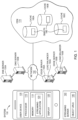
- FIG. 1 is a block diagram of a communication system 100, according to one embodiment.
- the system 100 includes a user device 105, DNS servers 130, a network 150 (e.g., a public network such as the Internet), edge servers 155, a CDN 170, and a streaming server 190.
- the user device 105 can be any device which can retrieve objects 185 from caches 180 in the CDN 170.
- the user device 105 includes a display 125 so it can display (e.g., output) a media presentation from the CDN 170, such as a smartphone, tablet, laptop, smart television etc.
- the user device 105 may not include a display and can instead be a streaming player or media player which is coupled to an output device, such as a television.
- the user device 105 includes a processor 110 and memory 115.
- the processor 110 represents any number of processing elements that can include any number of processing cores. In general, the processor 110 retrieves and executes programming instructions stored in the memory 115.
- the memory 115 can include volatile memory elements, non-volatile memory elements, and combinations thereof.
- the memory 115 includes a streaming application 120 (e.g., a software application) that can select an object 185 to retrieve from the CDN 170.
- the streaming application 120 may output a graphical user interface (either using the display 125 or a separate electronic device such as a television) that lists multiple different media presentations such as movies, live events, television episodes, and the like. The user can then use the interface to select a particular media presentation to watch either on the user device 105 or a connected output device.
- the user device 105 can transmit a request to a streaming server 190 for a uniform resource location (URL) that corresponds to the media presentation.
- the streaming server 190 can store a different object URL 195 for each object (e.g., media presentation) stored in the CDN 170.
- the object URLs 195 may include the name of the media presentation such as http://...AdventureShowEpisode1 Season2.... In this manner, the URLs 195 in the streaming server 190 provide a URL for accessing the media presentation (or other object) requested by the user.
- the user device 105 can then use the object URL 195 to perform a DNS lookup.
- the DNS lookup converts the object URL 195 to an IP address that can be used in the network 150 to identify a location for retrieving (or streaming) the requested media presentation.
- the system 100 includes multiple DNS servers 130, but in other embodiments, may include only one DNS server 130.
- the user device 105 can use either unicast routing or anycast routing to identify a DNS server 130 to perform the DNS lookup.
- the advantage of using anycast routing is it can automatically identify the DNS server 130 with the shortest route to the user device 105 through the network 150, thus potentially reducing the time used to perform the DNS lookup.
- the embodiments herein can also use unicast routing to perform the DNS lookup.
- the DNS server 130 provides an IP address to the user device 105 in response to the DNS lookup. However, rather than providing the user device with an IP address to a cache 180 for retrieving the object, in some embodiments, the DNS server 130 provides an anycast IP address to the edge servers 155. Or more specifically, the DNS server 130 provides an anycast IP address to reach load balancers 160 (e.g., software applications) hosted in the edge servers 155. In one embodiment, each of the edge servers 155 has the same anycast IP address. Thus, when the DNS server 130 provides the anycast IP address to the user device 105, performing anycast routing with that address automatically identifies the edge server 155 and load balancer 160 with the shortest path to the user device 105. That is, anycast routing uses an underlying routing protocol (such as Border Gateway Protocol (BGP)) to identify the shortest path to one of a plurality of network devices (e.g., the edge servers 155) with the same anycast IP address.
- Border Gateway Protocol BGP
- the load balancer 160 in the edge server 155 identified from anycast routing can then use one or more load balancing criteria to determine which cache 180 is optimal to deliver the requested media presentation (e.g., the object 185).
- the embodiments herein are not limited to any particular load balancing criteria. Non-limiting examples include using the cache 180 that is co-located with (or closest to) the identified edge server 155, ensuring the load on any particular cache 180 does not exceed a threshold, ensuring a minimum amount of requests are sent to each cache 180, routing requests away from a cache 180 that will soon be taken down for maintenance, and the like.
- the TCP communication between the user device 105 and the load balancer 160 has more information than the DNS lookup between the user device 105 and the load balancer 160.
- the communication to the load balancer 160 can include the full path to the requested object 185 while a DNS lookup does not have this information.
- the load balancer 160 knows what object 185 the user is requesting and can select the cache 180 accordingly while this information is hidden from the DNS server. For example, some caches 180 in the CDN 170 may have the requested object while others do not.
- the HTTP communications from the user device 105 to the load balancer 160 can contain the true IP address of the user device 105 while the DNS lookup can include the IP address of a resolver (which might not be at, or close to, the geographic location of the user device 105).
- the load balancer 160 when selecting a cache 180 can be more accurate than geolocation functions performed by the DNS server 130.
- the communication between the user device 105 and the load balancer 160 can be an anycast connection which automatically identifies the load balancer 160 that is closest to the user device 105.
- an anycast connection is susceptible to network disturbances that can change the connection. For example, due to a wire being cut or a router being taken down from maintenance, the shortest path may change from, e.g., the load balancer 160A to the load balancer 160B. The process will then have to repeat or reset since the load balancer 160B will not have any of the information that was already provided by the user device 105 to the load balancer 160A.
- the communication between the load balancers 160 and the user device 105 are typically very short (e.g., 200-300 millisecond) with the devices exchanging a single HTTP request/response pair, which can include a TCP handshake, TLK handshake (optional), and the HTTP request/response itself.
- the load balancer 160 and the user device may exchange between 5-10 TCP segments.
- the risk of a network disturbance occurring during the anycast connection between the user device 105 and the load balancer 160 is small.
- the load balancer 160 can send an HTTP redirect to the user device 105 (e.g., an HTTP response with a status code of 302) that redirects the user device 105 to the selected cache 180. Stated differently, the load balancer 160 closes the anycast connection and redirects the user device 105 to a cache 180.
- the HTTP redirect can include a unicast path to the selected cache 180 so that the user device 105 can establish a unicast connection to the cache 180 in response to the HTTP redirect. While an HTTP redirect using the 302 status code is described, the embodiments are not limited to such but can use any present or future redirect HTTP mechanism such as the 301 status code or Alt-Svc.
- connection between the user device 105 and the cache 180 is typically much longer in order to retrieve the object 185 than the connection between the user device 105 and the load balancer 160
- using a unicast connection between the user device 105 and the cache 180 avoids the susceptibility of an anycast connection. That is, if a network disturbance occurs along the unicast path between the user device 105 and the cache 180, the user device 105 will still connect to the same cache 180, albeit using a different route or path through the network 150.
- using an anycast connection between the user device 105 and the load balancer 160 enables the system 100 to automatically identify the load balancer 160 closest to the user device 105 more accurately than relying on the DNS server 130 to perform geolocation.
- using an HTTP redirect to close or terminate the anycast connection with the load balancer 160 and establish a unicast connection to the selected cache 180 can avoid the risk of using a long anycast connection to retrieve or stream the object 185.
- Figure 1 illustrates that only the caches 180 are in the CDN 170, in other embodiments, the DNS servers 130 and the edge servers 155 along with the load balancers 160 can be considered as part of the CDN 170.
- streaming server 190 can include one or more processors, memory, software applications, input/output interfaces, and the like to perform the functions recited herein.
- FIG. 2 is timing chart 200 for retrieving an object from a CDN, according to one embodiment.
- the timing chart 200 illustrates various communications between the user device 105 and the streaming server 190, DNS server 130, load balancer 160, and cache 180 in the CDN.
- Arrow 205 indicates the user device 105 making a selection of an object to retrieve or stream from the CDN. This selection is communicated to the streaming server 190. The user selection can be referred to as a service call to the streaming server 190.
- arrow 210 illustrates the streaming server 190 providing a URL to the requested object (e.g., the object URL 195 in Figure 1 ).
- the URL can include a name, description, or ID of the requested object.
- arrow 215 illustrates the user device 105 performing a DNS lookup using the DNS server 130.
- the user device 105 can use either a unicast connection or an anycast connection to select one of a plurality of DNS servers 130 associated with the CDN.
- the user device 105 may already know which DNS server to use to perform the DNS lookup, in which case, can use a unicast connection.
- the user device 105 can use an anycast connection so that the underlying network protocol automatically identifies the DNS server 130 with the shortest path to the user device 105.
- the embodiments herein are not limited to either situation.
- the DNS server 130 provides an anycast address for reaching one of the load balancers 160 used by the CDN as shown by the arrow 220 to the user device 105.
- each of the load balancers 160 in the CDN corresponds to the same anycast IP address.
- the DNS servers 130 can be configured to respond to any DNS lookup for content in the CDN by providing the anycast IP address for the load balancers 160 to the user device 105.
- Arrow 225 illustrates the user device 105 using the anycast IP address to perform anycast routing to automatically identify the load balancer 160 (and edge server) with the shortest path to the user device 105. That is, anycast routing uses the underlying routing protocol (e.g., BGP) in the network to identify the load balancer 160 of a plurality of load balancers with the shortest path in the network to the user device 105.
- underlying routing protocol e.g., BGP
- the load balancer 160 can then use one or more load balancing criteria to select the cache 180 from a plurality of caches in the CDN. Unlike a DNS lookup, when establishing the anycast connection the load balancer can receive the full path to the requested object as well as the true IP of the user. Thus, this information enables the load balancer 160 to perform a wider variety of load balancing strategies and perform a more accurate geolocation of the user device 105 than if the DNS server was tasked with selecting the cache.
- Arrow 230 illustrates the load balancer 160 sending an HTTP redirect to the user device 105 to redirect the user device 105 to the selected cache 180.
- the HTTP redirect closes or terminates the anycast connection between the user device 105 and the load balancer 160. Further, the HTTP redirect provides information so that the user device 105 can establish a unicast connection with the cache 180 as shown by arrow 235.
- Arrow 240 illustrates the cache 180 using the unicast connection to transmit the requested object to the device 105. Because the connection between the user device 105 and the cache 180 is typically much longer in order to retrieve the object than the connection between the user device 105 and the load balancer 160, using a unicast connection between the user device 105 and the cache 180 avoids the susceptibility of an anycast connection to network disturbances. That is, if a network disturbance occurs along the unicast path between the user device 105 and the cache 180, the user device 105 will still connect to the same cache 180. Using an HTTP redirect to close or terminate the anycast connection with the load balancer 160 and establish a unicast connection to a selected cache 180 can avoid the risk of using a long anycast connection to retrieve or stream the requested object.
- the timing chart 200 can be used to initialize a connection between the user device 105 and the cache 180 to retrieve or stream an object. While the timing chart 200 illustrates initializing an initial request to stream the object, the chart 200 can also be used to initialize an already started stream that, for whatever reason, was interrupted. For example, assume the user device 105 has already performed all the tasks shown in the timing chart 200 to begin streaming the object from the cache 180. However, the user device 105 may be a smart phone that has switched from using a cellular network to using a Wi-Fi network to stream. This switch may result in the user device 105 needing to reinitialize the stream. The user device 105 can then repeat the tasks represented by arrows 225-240 to reinitiate the stream.
- the tasks represented by arrows 205 and 220 do not need to be repeated since the user device 105 already knows the IP address for the object (i.e., the anycast IP address for the load balancer 160). Nonetheless, load balancing can be repeated to determine whether another cache 180 may be more suitable to stream the object given the user device is now using a different network. Or the previous cache 180 may be failed or went down for maintenance which caused the re-initialization. In any case, the user device 105 can again establish an anycast connection with the load balancer 160 (or a different load balancer 160) to identify the optimal cache 180 to use to restart the stream of the object.
- the embodiments herein can be used both when initializing a stream when first requesting the object as well as initializing a stream when a previous stream has been disrupted.
- FIG. 3 is a flowchart of a method 300 for using anycast routing to identify a load balancer, according to one embodiment.
- the method 300 can begin in response to a user selecting an object to retrieve or stream from a CDN.
- the user device performs a DNS lookup to receive an anycast IP address for a plurality of load balancers. That is, the load balancers share the same anycast IP address.
- Block 305 can correspond to arrow 215 in Figure 2 where the user device can use either a unicast connection or an anycast connection to select one of a plurality of DNS servers 130 associated with the CDN.
- the user device may use a pre-selected DNS server to use to perform the DNS lookup using a unicast connection.
- the user device can use an anycast connection to identify the DNS server with the shortest path to the user device.
- the user device performs anycast routing to establish an anycast connection to one of the plurality of load balancers corresponding to the CDN. That is, the user device can use the anycast IP address provided by the DNS server to perform anycast routing to identify the load balancer with the shortest path to the user device. The user device can use the anycast connection to provide the full path name of the object to the load balancer. Also, the load balancer can receive the true IP address of the user device so the balancer can perform geolocation services, if desired.
- the load balancer determines or selects a cache from a plurality of caches to retrieve the object from the CDN based on load balancing criteria.
- load balancing criteria include using the cache to fulfill the request that is co-located with (or closest to) the load balancer, ensuring the load on any particular cache does not exceed a threshold, ensuring a minimum amount of requests are sent to each cache, routing requests away from a cache that will soon be taken down for maintenance, and the like.
- the load balancer can use the path name of the object to determine which CDN caches already have the object stored in their memory.
- the embodiments herein are not limited to any particular load balancing technique.
- load balancer can use non-standard signaling to indicate multiple caches for the user device to attempt to connect to retrieve the object. These caches may be ordered, weighted, or specify other specific retry policies. Thus, the load balancer may determine or select multiple caches from the plurality of caches.
- the load balancer initiates an HTTP redirect to close the anycast connection and provide the user device with a unicast path to the cache.
- the load balancer can send the HTTP redirect to the user device to redirect the user device to the cache identified at block 315.
- the HTTP redirect closes or terminates the anycast connection between the user device and the load balancer.
- the HTTP redirect provides information (e.g., the unicast path) so that the user device can establish the unicast connection with the cache.
- the user device establishes a unicast connection with the cache to retrieve the object.
- the unicast connection between the user device and the CDN cache is established much longer than the anycast connection between the user device and the load balancer at block 310.
- the anycast connection may last between 100-300 milliseconds while the unicast connection can last for several seconds, if not longer, as the user device streams the content.
- using a unicast connection to stream the object from the cache avoids the susceptibly of an anycast connection to network disturbances which can cause the shortest path to switch to a different cache which forces the connection to reinitialize.
- FIG. 4 illustrates a CDN with geographically distributed load balancers and caches, according to one embodiment.
- the CDN is distributed in a geographic area 400 that includes Regions A, B, and C.
- Each geographic region includes on more load balancers (LBs) 160 and caches 180.
- LBs load balancers
- each region can have a different data center operated by the CDN in a different city, state, country, continent, etc.
- the LBs 160 and the caches 180 can be executed in those data centers.
- Regions with high population density or high demand can have multiple data centers and multiple LBs 160 and caches 180.
- the LBs 160 are co-located with the caches 180 in a particular region (e.g., hosted by the same data center).
- Figure 4 also illustrates the user device 105 which has used anycast routing to establish an anycast connection 405 with the LB 160B in Region B. That is, Figure 4 illustrates a point in time where the user device 105 has already selected an object to retrieve from the CDN and received an anycast IP address from performing a DNS lookup (e.g., arrows 205-220 of Figure 2 and block 305 of Figure 3 ). As shown, all of the LBs 160 in Figure 4 have the same anycast IP address - i.e., Anycast Address A. Thus, when performing anycast routing using Anycast Address A, the network automatically identified LB 160B as having the shortest path through the network to reach the user device 105. For example, the user device 105 may also be located in Region B. As such, the user device 105 establishes the anycast connection 405 with the LB 160B.
- a DNS lookup e.g., arrows 205-220 of Figure 2 and block 305 of Figure 3 .
- the network automatically identified LB 160B as
- the LB 160B selects the cache 180B as the optimal cache for the user device 105 to retrieve or stream the requested object. For example, the LB 160B may default to selecting the cache 180B that is co-located with it as the optimal cache for the user device 105 since this cache 180B is also in the same region as the user device 105.
- the LB 160B can send an HTTP redirect (not shown) to the user device 105 which terminates the anycast connection 405 and establishes a unicast connection 410A with the cache 180B. The user device 105 can retrieve the object from the cache 180B using the unicast connection 410A.
- Figure 4 also illustrates an alternative embodiment where the LB 160B can instead select the cache 180C in Region C as the optimal cache for the user device 105. Even though the user device is in Region B, the cache 180C may be the best cache to use for several reasons such as the cache 180B is about to go down for maintenance, is currently overloaded, or does not have the requested object. Thus, the LB 160B can instead send a HTTP redirect that establishes a unicast connection 410B with the cache 180C.
- the LB 160B may initially select the cache 180B as the optimal cache to stream the object but may then change and select the cache 180C as the better choice. For example, in the middle of streaming the object from the cache 180B, the cache 180B may experience an error or malfunction that disrupts the unicast connection 41 0A. This may cause the user device 105 to repeat the initialization process by establishing the anycast connection 405 with the LB 160B. The LB 160B may have been notified of or detected the error in the cache 180B and instead selects the cache 180C as the new cache.
- the LB 160B can provide an HTTP redirect that causes the user device 105 to establish the unicast connection 410B with the cache 180C and resume the stream.
- the user device 105 can resume the stream using the cache 180C at the place the stream was interrupted using the cache 180B (assuming the caches 180B and 180C both have a copy of the requested object).
- FIG. 5 illustrates a load balancer 160 using a HTTP redirect to provide a user device with a unicast path to a CDN cache, according to one embodiment.
- the user device 105 can transmit an HTTP GET request 505 to perform anycast routing using an anycast IP address corresponding to the load balancer 160.
- the load balancer 160 can reply to the GET request 505 with an HTTP redirect 510.
- the HTTP redirect 510 can close the anycast connection and provide information for the user device 105 to establish a unicast connection with the cache 180.
- the HTTP redirect 510 includes a URL that includes a unicast path to the cache 180 - i.e., http:// ⁇ cache unicast>/path.
- the user device 105 transmits an HTTP GET request 515 to the cache to establish the unicast connection.
- the user device 105 can then use this connection to retrieve the requested object from the cache 180.
- embodiments described herein may be embodied as a system, method or computer program product. Accordingly, embodiments may take the form of an entirely hardware embodiment, an entirely software embodiment (including firmware, resident software, micro-code, etc.) or an embodiment combining software and hardware aspects that may all generally be referred to herein as a "circuit,” “module” or “system.” Furthermore, embodiments described herein may take the form of a computer program product embodied in one or more computer readable medium(s) having computer readable program code embodied thereon.
- Program code embodied on a computer readable medium may be transmitted using any appropriate medium, including but not limited to wireless, wireline, optical fiber cable, RF, etc., or any suitable combination of the foregoing.
- Computer program code for carrying out operations for embodiments of the present disclosure may be written in any combination of one or more programming languages, including an object oriented programming language such as Java, Smalltalk, C++ or the like and conventional procedural programming languages, such as the "C" programming language or similar programming languages.
- the program code may execute entirely on the user's computer, partly on the user's computer, as a stand-alone software package, partly on the user's computer and partly on a remote computer or entirely on the remote computer or server.
- the remote computer may be connected to the user's computer through any type of network, including a local area network (LAN) or a wide area network (WAN), or the connection may be made to an external computer (for example, through the Internet using an Internet Service Provider).
- LAN local area network
- WAN wide area network
- Internet Service Provider for example, AT&T, MCI, Sprint, EarthLink, MSN, GTE, etc.
- These computer program instructions may also be stored in a computer readable medium that can direct a computer, other programmable data processing apparatus, or other device to function in a particular manner, such that the instructions stored in the computer readable medium produce an article of manufacture including instructions which implement the function/act specified in the block(s) of the flowchart illustrations or block diagrams.
- the computer program instructions may also be loaded onto a computer, other programmable data processing apparatus, or other device to cause a series of operational steps to be performed on the computer, other programmable apparatus or other device to produce a computer implemented process such that the instructions which execute on the computer, other programmable data processing apparatus, or other device provide processes for implementing the functions/acts specified in the block(s) of the flowchart illustrations or block diagrams.
- each block in the flowchart illustrations or block diagrams may represent a module, segment, or portion of code, which comprises one or more executable instructions for implementing the specified logical function(s).
- the functions noted in the block may occur out of the order noted in the Figures.
- two blocks shown in succession may, in fact, be executed substantially concurrently, or the blocks may sometimes be executed in the reverse order or out of order, depending upon the functionality involved.
- each block of the block diagrams or flowchart illustrations, and combinations of blocks in the block diagrams or flowchart illustrations can be implemented by special purpose hardware-based systems that perform the specified functions or acts, or combinations of special purpose hardware and computer instructions.
- Example 1 is a method, comprising: establishing an anycast connection between a load balancer associated with a content delivery network (CDN) and a user device requesting an object from the CDN; selecting, at the load balancer, a first cache from a plurality of caches in the CDN to fulfill the request for the object based on one or more load balancing criteria; and transmitting an HTTP redirect from the load balancer to the user device to close the anycast connection, wherein the HTTP redirect comprises information for establishing a unicast connection between the user device and the first cache to retrieve the object from the first cache.
- CDN content delivery network
- Example 2 the load balancer of Example 1 is one of a plurality of load balancers associated with the CDN, each of the plurality of load balancers having the same anycast IP address.
- Example 3 the plurality of load balancers of Example 2 and the plurality of caches are distributed in different geographic regions, wherein at least one of the plurality of load balancers and at least one of the plurality of caches are co-located in each of the geographic regions.
- Example 4 establishing the anycast connection of Example 2 is performed after the user device has performed a domain name system (DNS) lookup to identify the anycast IP address used to establish the anycast connection with the load balancer.
- DNS domain name system
- Example 5 the load balancer of Example 2 has the shortest path of all the plurality of load balancers through a network to the user device.
- Example 6 the anycast connection of Example 5 relies on an underlying routing protocol in the network to identify the shortest path.
- Example 7 the HTTP redirect of Example 1 comprises an HTTP response status code 302.
- Example 8 the method of Example 1 further comprises: receiving, during the anycast connection at the load balancer, a full path to the object and an IP address of the user device.
- Example 9 is a non-transitory computer-readable medium containing computer program code that, when executed by operation of one or more computer processors, performs an operation comprising: establishing an anycast connection between a load balancer associated with a CDN and a user device requesting an object from the CDN; selecting, at the load balancer, a first cache from a plurality of caches in the CDN to fulfill the request for the object based on one or more load balancing criteria; and transmitting an HTTP redirect from the load balancer to the user device to close the anycast connection, wherein the HTTP redirect comprises information for establishing a unicast connection between the user device and the first cache to retrieve the object from the first cache.
- the load balancer of Example 9 is one of a plurality of load balancers associated with the CDN, each of the plurality of load balancers having the same anycast IP address.
- Example 11 the plurality of load balancers of Example 10 and the plurality of caches are distributed in different geographic regions, wherein at least one of the plurality of load balancers and at least one of the plurality of caches are co-located in each of the geographic regions.
- Example 12 establishing the anycast connection of Example 10 is performed after the user device has performed a domain name system (DNS) lookup to identify the anycast IP address used to establish the anycast connection with the load balancer.
- DNS domain name system
- Example 13 the load balancer of Example 10 has the shortest path of all the plurality of load balancers through a network to the user device.
- Example 14 the HTTP redirect of Example 9 comprises an HTTP response status code 302.
- Example 15 is a server, comprising: a processor; memory storing computer program code that, when executed by operation of the processor, performs an operation comprising: establishing an anycast connection between the server and a user device requesting an object from a CDN; selecting a first cache from a plurality of caches in the CDN to fulfill the request for the object based on one or more load balancing criteria; and transmitting an HTTP redirect to the user device to close the anycast connection, wherein the HTTP redirect comprises information for establishing a unicast connection between the user device and the first cache to retrieve the object from the first cache.
- Example 16 the server of Example 15 is one of a plurality of servers associated with the CDN, each of the plurality of servers having the same anycast IP address.
- Example 17 the plurality of servers of Example 16 and the plurality of caches are distributed in different geographic regions, wherein at least one of the plurality of server and at least one of the plurality of caches are co-located in each of the geographic regions.
- Example 18 establishing the anycast connection of Example 16 is performed after the user device has performed a domain name system (DNS) lookup to identify the anycast IP address used to establish the anycast connection with the server.
- DNS domain name system
- Example 19 the server of Example 16 has the shortest path of all the plurality of servers through a network to the user device.
- Example 20 the HTTP redirect of Example 15 comprises an HTTP response status code 302.
Landscapes
- Engineering & Computer Science (AREA)
- Computer Networks & Wireless Communication (AREA)
- Signal Processing (AREA)
- Multimedia (AREA)
- Data Exchanges In Wide-Area Networks (AREA)
Abstract
Description
- This application claims benefit of and priority to
United States patent application serial number 17/695,581, entitled "Local Preference in Anycast CDN Routing", filed March 15, 2022 - Content Distribution/Delivery Networks (CDNs) are large, geographically spread networks of caches. These caches deliver video and other web content (referred to generally as "objects") to viewers. Selecting the best cache to use to deliver the object to the user is a difficult task. Most CDNs generally use two techniques to identify the optimal cache to use to deliver the object. First, domain name system (DNS) load balancing can be used to select the optimal cache. Once a DNS server chooses the best cache, the CDN responds to a DNS lookup from the user with the IP address of the cache (or cache cluster). However, DNS load balancing has several challenges. First, the true client IP address (used for geolocation/mapping) is often not visible to the CDN's DNS servers. Instead, the DNS server sees the IP address of the resolver of the internet service provider (ISP) used by the user (or worse a cloud-based public DNS resolver). Without an accurate client IP address, cache localization is more difficult. Additionally, DNS lookups do not contain information about the content being requested. CDNs are therefore unable to use asset level load balancing policies during cache localization. For example, asset level policies may allow for targeting specific caches or clusters that are known to have the content already in cache. Finally, even with a very low time to live (TTL), there is some amount of caching of the load balancer responses. This can be good, in times of high load, but ultimately reduces the ability of the DNS server to identify the location of the user.
- A second strategy used to select the cache closest to the user is anycast routing. Anycast allows the same IP address to be advertised by many hosts. At every hop, the layer 3 switch or router determines the lowest cost path for the packet. This localizes clients to the closest logical CDN cache. However, routing changes may cause connections to be interrupted if packets are delivered to different hosts due to the risk of connection resets. Anycast has traditionally been used for User Datagram Protocol (UDP) or extremely short-lived transmission control protocol (TCP) connections.
- Embodiments include a method. The method includes establishing an anycast connection between a load balancer associated with a content delivery network (CDN) and a user device requesting an object from the CDN. The method further includes selecting, at the load balancer, a first cache from a plurality of caches in the CDN to fulfill the request for the object based on one or more load balancing criteria. The method further includes transmitting an HTTP redirect from the load balancer to the user device to close the anycast connection, wherein the HTTP redirect comprises information for establishing a unicast connection between the user device and the first cache to retrieve the object from the first cache.
- Embodiments further include a non-transitory computer-readable medium containing computer program code that, when executed by operation of one or more computer processors, performs an operation comprising: establishing an anycast connection between a load balancer associated with a CDN and a user device requesting an object from the CDN; selecting, at the load balancer, a first cache from a plurality of caches in the CDN to fulfill the request for the object based on one or more load balancing criteria; and transmitting an HTTP redirect from the load balancer to the user device to close the anycast connection, wherein the HTTP redirect comprises information for establishing a unicast connection between the user device and the first cache to retrieve the object from the first cache.
- Embodiments further include a system, including a processor and memory storing computer program code that, when executed by operation of the processor, performs an operation comprising: establishing an anycast connection between the server and a user device requesting an object from a CDN; selecting a first cache from a plurality of caches in the CDN to fulfill the request for the object based on one or more load balancing criteria; and transmitting an HTTP redirect to the user device to close the anycast connection, wherein the HTTP redirect comprises information for establishing a unicast connection between the user device and the first cache to retrieve the object from the first cache.
- So that the manner in which the above recited aspects are attained and can be understood in detail, a more particular description of embodiments described herein, briefly summarized above, may be had by reference to the appended drawings.
- It is to be noted, however, that the appended drawings illustrate typical embodiments and are therefore not to be considered limiting; other equally effective embodiments are contemplated.
-
Figure 1 is a block diagram of a communication system, according to one embodiment. -
Figure 2 is timing chart for retrieving an object from a CDN, according to one embodiment. -
Figure 3 is a flowchart for using anycast routing to identify a load balancer, according to one embodiment. -
Figure 4 illustrates a CDN with geographically distributed load balancers and caches, according to one embodiment. -
Figure 5 illustrates a load balancer using a HTTP redirect to provide a user device with a unicast path to a CDN cache, according to one embodiment. - Embodiments herein describe a CDN where anycast routing is used to identify a load balancer (also referred to as a traffic router) for selecting a cache in the CDN to use to deliver an object to a user. In one embodiment, the user performs a DNS lookup to identify an anycast IP address for a plurality of load balancers in the CDN. The user can then initiate anycast routing using the anycast IP address to automatically identify the closest logical load balancer of the plurality of load balancers that share that anycast IP address. Advantageously, the load balancer will see the IP address of the user device as well as the full path of the object (e.g., a movie, television show, live performance, etc.). This is unlike many types of DNS lookups where the true user IP is hidden behind a resolver making the DNS request and the DNS lookup does not indicate the object being requested. With this information, the load balancer can determine an accurate location of the user device and use one or more load balancing criteria to select an optimal CDN cache.
- Once the cache is selected, the load balancer can close the anycast connection with the user device and use an HTTP redirect (e.g., a HTTP response status code 302) to provide the user device with a unicast path to the selected cache. The user device can then establish a unicast connection with the cache to retrieve the object. Advantageously, the anycast connection to the load balancer is often very short (e.g., 100-300 milliseconds), which mitigates the likelihood that a network disturbance (e.g., a cut line, a disconnected router, and the like) will change the anycast route to a different load balancer. Once the load balancing is complete, the user device uses the unicast path provided by the HTTP redirect to retrieve the cache, which is typically a much longer connection (e.g., 5-8 seconds to transfer a segment) and is not susceptible to potential network disturbances introduced by anycast routing. In this manner, the embodiments herein can reap the benefits of anycast routing to automatically identify the closest load balancer which provides more accurate information than a DNS lookup, while using a unicast connection to retrieve the object from the CDN cache which avoids the susceptibility of using an anycast connection to network disturbances.
-
Figure 1 is a block diagram of acommunication system 100, according to one embodiment. Thesystem 100 includes auser device 105,DNS servers 130, a network 150 (e.g., a public network such as the Internet), edge servers 155, aCDN 170, and astreaming server 190. Theuser device 105 can be any device which can retrieveobjects 185 fromcaches 180 in theCDN 170. In this embodiment, theuser device 105 includes adisplay 125 so it can display (e.g., output) a media presentation from the CDN 170, such as a smartphone, tablet, laptop, smart television etc. However, in other embodiments, theuser device 105 may not include a display and can instead be a streaming player or media player which is coupled to an output device, such as a television. - In any case, the
user device 105 includes aprocessor 110 andmemory 115. Theprocessor 110 represents any number of processing elements that can include any number of processing cores. In general, theprocessor 110 retrieves and executes programming instructions stored in thememory 115. Thememory 115 can include volatile memory elements, non-volatile memory elements, and combinations thereof. Specifically, thememory 115 includes a streaming application 120 (e.g., a software application) that can select anobject 185 to retrieve from theCDN 170. For example, thestreaming application 120 may output a graphical user interface (either using thedisplay 125 or a separate electronic device such as a television) that lists multiple different media presentations such as movies, live events, television episodes, and the like. The user can then use the interface to select a particular media presentation to watch either on theuser device 105 or a connected output device. - In response to the user selecting a media presentation, the
user device 105 can transmit a request to astreaming server 190 for a uniform resource location (URL) that corresponds to the media presentation. The streamingserver 190 can store a different object URL 195 for each object (e.g., media presentation) stored in theCDN 170. The object URLs 195 may include the name of the media presentation such as http://...AdventureShowEpisode1 Season2.... In this manner, the URLs 195 in thestreaming server 190 provide a URL for accessing the media presentation (or other object) requested by the user. - The
user device 105 can then use the object URL 195 to perform a DNS lookup. The DNS lookup converts the object URL 195 to an IP address that can be used in thenetwork 150 to identify a location for retrieving (or streaming) the requested media presentation. In this case, thesystem 100 includesmultiple DNS servers 130, but in other embodiments, may include only oneDNS server 130. Theuser device 105 can use either unicast routing or anycast routing to identify aDNS server 130 to perform the DNS lookup. The advantage of using anycast routing is it can automatically identify theDNS server 130 with the shortest route to theuser device 105 through thenetwork 150, thus potentially reducing the time used to perform the DNS lookup. However, the embodiments herein can also use unicast routing to perform the DNS lookup. - The
DNS server 130 provides an IP address to theuser device 105 in response to the DNS lookup. However, rather than providing the user device with an IP address to acache 180 for retrieving the object, in some embodiments, theDNS server 130 provides an anycast IP address to the edge servers 155. Or more specifically, theDNS server 130 provides an anycast IP address to reach load balancers 160 (e.g., software applications) hosted in the edge servers 155. In one embodiment, each of the edge servers 155 has the same anycast IP address. Thus, when theDNS server 130 provides the anycast IP address to theuser device 105, performing anycast routing with that address automatically identifies the edge server 155 andload balancer 160 with the shortest path to theuser device 105. That is, anycast routing uses an underlying routing protocol (such as Border Gateway Protocol (BGP)) to identify the shortest path to one of a plurality of network devices (e.g., the edge servers 155) with the same anycast IP address. - The
load balancer 160 in the edge server 155 identified from anycast routing can then use one or more load balancing criteria to determine whichcache 180 is optimal to deliver the requested media presentation (e.g., the object 185). The embodiments herein are not limited to any particular load balancing criteria. Non-limiting examples include using thecache 180 that is co-located with (or closest to) the identified edge server 155, ensuring the load on anyparticular cache 180 does not exceed a threshold, ensuring a minimum amount of requests are sent to eachcache 180, routing requests away from acache 180 that will soon be taken down for maintenance, and the like. - There are several advantages to using a
load balancer 160, rather than theDNS server 130, in an edge server 155 to select thecache 180. One advantage is that the TCP communication between theuser device 105 and theload balancer 160 has more information than the DNS lookup between theuser device 105 and theload balancer 160. For example, the communication to theload balancer 160 can include the full path to the requestedobject 185 while a DNS lookup does not have this information. Thus, theload balancer 160 knows whatobject 185 the user is requesting and can select thecache 180 accordingly while this information is hidden from the DNS server. For example, somecaches 180 in theCDN 170 may have the requested object while others do not. - Further, the HTTP communications from the
user device 105 to theload balancer 160 can contain the true IP address of theuser device 105 while the DNS lookup can include the IP address of a resolver (which might not be at, or close to, the geographic location of the user device 105). Thus, any geolocation functions performed by theload balancer 160 when selecting acache 180 can be more accurate than geolocation functions performed by theDNS server 130. - As mentioned above, the communication between the
user device 105 and theload balancer 160 can be an anycast connection which automatically identifies theload balancer 160 that is closest to theuser device 105. Also mentioned above, an anycast connection is susceptible to network disturbances that can change the connection. For example, due to a wire being cut or a router being taken down from maintenance, the shortest path may change from, e.g., theload balancer 160A to theload balancer 160B. The process will then have to repeat or reset since theload balancer 160B will not have any of the information that was already provided by theuser device 105 to theload balancer 160A. However, the communication between theload balancers 160 and theuser device 105 are typically very short (e.g., 200-300 millisecond) with the devices exchanging a single HTTP request/response pair, which can include a TCP handshake, TLK handshake (optional), and the HTTP request/response itself. Theload balancer 160 and the user device may exchange between 5-10 TCP segments. Thus, the risk of a network disturbance occurring during the anycast connection between theuser device 105 and theload balancer 160 is small. - Once the
load balancer 160 selects acache 180 for theuser device 105 to use to retrieve or stream the requested object 185 (e.g., requested media presentation), theload balancer 160 can send an HTTP redirect to the user device 105 (e.g., an HTTP response with a status code of 302) that redirects theuser device 105 to the selectedcache 180. Stated differently, theload balancer 160 closes the anycast connection and redirects theuser device 105 to acache 180. The HTTP redirect can include a unicast path to the selectedcache 180 so that theuser device 105 can establish a unicast connection to thecache 180 in response to the HTTP redirect. While an HTTP redirect using the 302 status code is described, the embodiments are not limited to such but can use any present or future redirect HTTP mechanism such as the 301 status code or Alt-Svc. - Because the connection between the
user device 105 and thecache 180 is typically much longer in order to retrieve theobject 185 than the connection between theuser device 105 and theload balancer 160, using a unicast connection between theuser device 105 and thecache 180 avoids the susceptibility of an anycast connection. That is, if a network disturbance occurs along the unicast path between theuser device 105 and thecache 180, theuser device 105 will still connect to thesame cache 180, albeit using a different route or path through thenetwork 150. Thus, using an anycast connection between theuser device 105 and theload balancer 160 enables thesystem 100 to automatically identify theload balancer 160 closest to theuser device 105 more accurately than relying on theDNS server 130 to perform geolocation. Further, using an HTTP redirect to close or terminate the anycast connection with theload balancer 160 and establish a unicast connection to the selectedcache 180 can avoid the risk of using a long anycast connection to retrieve or stream theobject 185. - While
Figure 1 illustrates that only thecaches 180 are in theCDN 170, in other embodiments, theDNS servers 130 and the edge servers 155 along with theload balancers 160 can be considered as part of theCDN 170. - Further, the streaming
server 190, theDNS servers 130, the edge servers 155, and thecaches 180 can include one or more processors, memory, software applications, input/output interfaces, and the like to perform the functions recited herein. -
Figure 2 is timingchart 200 for retrieving an object from a CDN, according to one embodiment. Thetiming chart 200 illustrates various communications between theuser device 105 and thestreaming server 190,DNS server 130,load balancer 160, andcache 180 in the CDN.Arrow 205 indicates theuser device 105 making a selection of an object to retrieve or stream from the CDN. This selection is communicated to thestreaming server 190. The user selection can be referred to as a service call to thestreaming server 190. In response,arrow 210 illustrates thestreaming server 190 providing a URL to the requested object (e.g., the object URL 195 inFigure 1 ). The URL can include a name, description, or ID of the requested object. - To identify the IP address corresponding to the object URL,
arrow 215 illustrates theuser device 105 performing a DNS lookup using theDNS server 130. Theuser device 105 can use either a unicast connection or an anycast connection to select one of a plurality ofDNS servers 130 associated with the CDN. For example, theuser device 105 may already know which DNS server to use to perform the DNS lookup, in which case, can use a unicast connection. In contrast, theuser device 105 can use an anycast connection so that the underlying network protocol automatically identifies theDNS server 130 with the shortest path to theuser device 105. The embodiments herein are not limited to either situation. - Instead of the
DNS server 130 providing the user device with an IP address to thecache 180 for retrieving the object, in this example, theDNS server 130 provides an anycast address for reaching one of theload balancers 160 used by the CDN as shown by thearrow 220 to theuser device 105. In one embodiment, each of theload balancers 160 in the CDN corresponds to the same anycast IP address. TheDNS servers 130 can be configured to respond to any DNS lookup for content in the CDN by providing the anycast IP address for theload balancers 160 to theuser device 105. -
Arrow 225 illustrates theuser device 105 using the anycast IP address to perform anycast routing to automatically identify the load balancer 160 (and edge server) with the shortest path to theuser device 105. That is, anycast routing uses the underlying routing protocol (e.g., BGP) in the network to identify theload balancer 160 of a plurality of load balancers with the shortest path in the network to theuser device 105. - The
load balancer 160 can then use one or more load balancing criteria to select thecache 180 from a plurality of caches in the CDN. Unlike a DNS lookup, when establishing the anycast connection the load balancer can receive the full path to the requested object as well as the true IP of the user. Thus, this information enables theload balancer 160 to perform a wider variety of load balancing strategies and perform a more accurate geolocation of theuser device 105 than if the DNS server was tasked with selecting the cache. -
Arrow 230 illustrates theload balancer 160 sending an HTTP redirect to theuser device 105 to redirect theuser device 105 to the selectedcache 180. In one embodiment, the HTTP redirect closes or terminates the anycast connection between theuser device 105 and theload balancer 160. Further, the HTTP redirect provides information so that theuser device 105 can establish a unicast connection with thecache 180 as shown byarrow 235. -
Arrow 240 illustrates thecache 180 using the unicast connection to transmit the requested object to thedevice 105. Because the connection between theuser device 105 and thecache 180 is typically much longer in order to retrieve the object than the connection between theuser device 105 and theload balancer 160, using a unicast connection between theuser device 105 and thecache 180 avoids the susceptibility of an anycast connection to network disturbances. That is, if a network disturbance occurs along the unicast path between theuser device 105 and thecache 180, theuser device 105 will still connect to thesame cache 180. Using an HTTP redirect to close or terminate the anycast connection with theload balancer 160 and establish a unicast connection to a selectedcache 180 can avoid the risk of using a long anycast connection to retrieve or stream the requested object. - The
timing chart 200 can be used to initialize a connection between theuser device 105 and thecache 180 to retrieve or stream an object. While thetiming chart 200 illustrates initializing an initial request to stream the object, thechart 200 can also be used to initialize an already started stream that, for whatever reason, was interrupted. For example, assume theuser device 105 has already performed all the tasks shown in thetiming chart 200 to begin streaming the object from thecache 180. However, theuser device 105 may be a smart phone that has switched from using a cellular network to using a Wi-Fi network to stream. This switch may result in theuser device 105 needing to reinitialize the stream. Theuser device 105 can then repeat the tasks represented by arrows 225-240 to reinitiate the stream. The tasks represented byarrows user device 105 already knows the IP address for the object (i.e., the anycast IP address for the load balancer 160). Nonetheless, load balancing can be repeated to determine whether anothercache 180 may be more suitable to stream the object given the user device is now using a different network. Or theprevious cache 180 may be failed or went down for maintenance which caused the re-initialization. In any case, theuser device 105 can again establish an anycast connection with the load balancer 160 (or a different load balancer 160) to identify theoptimal cache 180 to use to restart the stream of the object. Thus, the embodiments herein can be used both when initializing a stream when first requesting the object as well as initializing a stream when a previous stream has been disrupted. -
Figure 3 is a flowchart of amethod 300 for using anycast routing to identify a load balancer, according to one embodiment. Themethod 300 can begin in response to a user selecting an object to retrieve or stream from a CDN. Atblock 305, the user device performs a DNS lookup to receive an anycast IP address for a plurality of load balancers. That is, the load balancers share the same anycast IP address. - Block 305 can correspond to
arrow 215 inFigure 2 where the user device can use either a unicast connection or an anycast connection to select one of a plurality ofDNS servers 130 associated with the CDN. For example, the user device may use a pre-selected DNS server to use to perform the DNS lookup using a unicast connection. In contrast, the user device can use an anycast connection to identify the DNS server with the shortest path to the user device. - At
block 310, the user device performs anycast routing to establish an anycast connection to one of the plurality of load balancers corresponding to the CDN. That is, the user device can use the anycast IP address provided by the DNS server to perform anycast routing to identify the load balancer with the shortest path to the user device. The user device can use the anycast connection to provide the full path name of the object to the load balancer. Also, the load balancer can receive the true IP address of the user device so the balancer can perform geolocation services, if desired. - At
block 315, the load balancer determines or selects a cache from a plurality of caches to retrieve the object from the CDN based on load balancing criteria. Non-limiting examples of load balancing criteria include using the cache to fulfill the request that is co-located with (or closest to) the load balancer, ensuring the load on any particular cache does not exceed a threshold, ensuring a minimum amount of requests are sent to each cache, routing requests away from a cache that will soon be taken down for maintenance, and the like. In another example, the load balancer can use the path name of the object to determine which CDN caches already have the object stored in their memory. However, the embodiments herein are not limited to any particular load balancing technique. - In one embodiment, load balancer can use non-standard signaling to indicate multiple caches for the user device to attempt to connect to retrieve the object. These caches may be ordered, weighted, or specify other specific retry policies. Thus, the load balancer may determine or select multiple caches from the plurality of caches.
- At
block 320, the load balancer initiates an HTTP redirect to close the anycast connection and provide the user device with a unicast path to the cache. As shown by thearrow 230 inFigure 2 , the load balancer can send the HTTP redirect to the user device to redirect the user device to the cache identified atblock 315. In one embodiment, the HTTP redirect closes or terminates the anycast connection between the user device and the load balancer. Further, the HTTP redirect provides information (e.g., the unicast path) so that the user device can establish the unicast connection with the cache. - At
block 325, the user device establishes a unicast connection with the cache to retrieve the object. In some embodiments, the unicast connection between the user device and the CDN cache is established much longer than the anycast connection between the user device and the load balancer atblock 310. For example, the anycast connection may last between 100-300 milliseconds while the unicast connection can last for several seconds, if not longer, as the user device streams the content. Thus, using a unicast connection to stream the object from the cache avoids the susceptibly of an anycast connection to network disturbances which can cause the shortest path to switch to a different cache which forces the connection to reinitialize. -
Figure 4 illustrates a CDN with geographically distributed load balancers and caches, according to one embodiment. In this example, the CDN is distributed in ageographic area 400 that includes Regions A, B, and C. Each geographic region includes on more load balancers (LBs) 160 andcaches 180. For example, each region can have a different data center operated by the CDN in a different city, state, country, continent, etc. TheLBs 160 and thecaches 180 can be executed in those data centers. Regions with high population density or high demand can have multiple data centers andmultiple LBs 160 andcaches 180. In this example, theLBs 160 are co-located with thecaches 180 in a particular region (e.g., hosted by the same data center). -
Figure 4 also illustrates theuser device 105 which has used anycast routing to establish ananycast connection 405 with theLB 160B in Region B. That is,Figure 4 illustrates a point in time where theuser device 105 has already selected an object to retrieve from the CDN and received an anycast IP address from performing a DNS lookup (e.g., arrows 205-220 ofFigure 2 and block 305 ofFigure 3 ). As shown, all of theLBs 160 inFigure 4 have the same anycast IP address - i.e., Anycast Address A. Thus, when performing anycast routing using Anycast Address A, the network automatically identifiedLB 160B as having the shortest path through the network to reach theuser device 105. For example, theuser device 105 may also be located in Region B. As such, theuser device 105 establishes theanycast connection 405 with theLB 160B. - In this example, the
LB 160B selects thecache 180B as the optimal cache for theuser device 105 to retrieve or stream the requested object. For example, theLB 160B may default to selecting thecache 180B that is co-located with it as the optimal cache for theuser device 105 since thiscache 180B is also in the same region as theuser device 105. In response, theLB 160B can send an HTTP redirect (not shown) to theuser device 105 which terminates theanycast connection 405 and establishes aunicast connection 410A with thecache 180B. Theuser device 105 can retrieve the object from thecache 180B using theunicast connection 410A. -
Figure 4 also illustrates an alternative embodiment where theLB 160B can instead select thecache 180C in Region C as the optimal cache for theuser device 105. Even though the user device is in Region B, thecache 180C may be the best cache to use for several reasons such as thecache 180B is about to go down for maintenance, is currently overloaded, or does not have the requested object. Thus, theLB 160B can instead send a HTTP redirect that establishes aunicast connection 410B with thecache 180C. - In another example, the
LB 160B may initially select thecache 180B as the optimal cache to stream the object but may then change and select thecache 180C as the better choice. For example, in the middle of streaming the object from thecache 180B, thecache 180B may experience an error or malfunction that disrupts the unicast connection 41 0A. This may cause theuser device 105 to repeat the initialization process by establishing theanycast connection 405 with theLB 160B. TheLB 160B may have been notified of or detected the error in thecache 180B and instead selects thecache 180C as the new cache. TheLB 160B can provide an HTTP redirect that causes theuser device 105 to establish theunicast connection 410B with thecache 180C and resume the stream. Advantageously, theuser device 105 can resume the stream using thecache 180C at the place the stream was interrupted using thecache 180B (assuming thecaches -
Figure 5 illustrates aload balancer 160 using a HTTP redirect to provide a user device with a unicast path to a CDN cache, according to one embodiment. As shown, theuser device 105 can transmit anHTTP GET request 505 to perform anycast routing using an anycast IP address corresponding to theload balancer 160. After selecting the optimal cache for the user device to retrieve the object (e.g., the cache 180), theload balancer 160 can reply to theGET request 505 with anHTTP redirect 510. As discussed above, the HTTP redirect 510 can close the anycast connection and provide information for theuser device 105 to establish a unicast connection with thecache 180. As shown, the HTTP redirect 510 includes a URL that includes a unicast path to the cache 180 - i.e., http://<cache unicast>/path. - In response to the HTTP redirect 510, the
user device 105 transmits anHTTP GET request 515 to the cache to establish the unicast connection. Theuser device 105 can then use this connection to retrieve the requested object from thecache 180. - In the current disclosure, reference is made to various embodiments. However, it should be understood that the present disclosure is not limited to specific described embodiments. Instead, any combination of the following features and elements, whether related to different embodiments or not, is contemplated to implement and practice the teachings provided herein. Additionally, when elements of the embodiments are described in the form of "at least one of A and B," it will be understood that embodiments including element A exclusively, including element B exclusively, and including element A and B are each contemplated. Furthermore, although some embodiments may achieve advantages over other possible solutions or over the prior art, whether or not a particular advantage is achieved by a given embodiment is not limiting of the present disclosure. Thus, the aspects, features, embodiments and advantages disclosed herein are merely illustrative and are not considered elements or limitations of the appended claims except where explicitly recited in a claim(s). Likewise, reference to "the invention" shall not be construed as a generalization of any inventive subject matter disclosed herein and shall not be considered to be an element or limitation of the appended claims except where explicitly recited in a claim(s).
- As will be appreciated by one skilled in the art, embodiments described herein may be embodied as a system, method or computer program product. Accordingly, embodiments may take the form of an entirely hardware embodiment, an entirely software embodiment (including firmware, resident software, micro-code, etc.) or an embodiment combining software and hardware aspects that may all generally be referred to herein as a "circuit," "module" or "system." Furthermore, embodiments described herein may take the form of a computer program product embodied in one or more computer readable medium(s) having computer readable program code embodied thereon.
- Program code embodied on a computer readable medium may be transmitted using any appropriate medium, including but not limited to wireless, wireline, optical fiber cable, RF, etc., or any suitable combination of the foregoing.
- Computer program code for carrying out operations for embodiments of the present disclosure may be written in any combination of one or more programming languages, including an object oriented programming language such as Java, Smalltalk, C++ or the like and conventional procedural programming languages, such as the "C" programming language or similar programming languages. The program code may execute entirely on the user's computer, partly on the user's computer, as a stand-alone software package, partly on the user's computer and partly on a remote computer or entirely on the remote computer or server. In the latter scenario, the remote computer may be connected to the user's computer through any type of network, including a local area network (LAN) or a wide area network (WAN), or the connection may be made to an external computer (for example, through the Internet using an Internet Service Provider).
- Aspects of the present disclosure are described herein with reference to flowchart illustrations or block diagrams of methods, apparatuses (systems), and computer program products according to embodiments of the present disclosure. It will be understood that each block of the flowchart illustrations or block diagrams, and combinations of blocks in the flowchart illustrations or block diagrams, can be implemented by computer program instructions. These computer program instructions may be provided to a processor of a general purpose computer, special purpose computer, or other programmable data processing apparatus to produce a machine, such that the instructions, which execute via the processor of the computer or other programmable data processing apparatus, create means for implementing the functions/acts specified in the block(s) of the flowchart illustrations or block diagrams.
- These computer program instructions may also be stored in a computer readable medium that can direct a computer, other programmable data processing apparatus, or other device to function in a particular manner, such that the instructions stored in the computer readable medium produce an article of manufacture including instructions which implement the function/act specified in the block(s) of the flowchart illustrations or block diagrams.
- The computer program instructions may also be loaded onto a computer, other programmable data processing apparatus, or other device to cause a series of operational steps to be performed on the computer, other programmable apparatus or other device to produce a computer implemented process such that the instructions which execute on the computer, other programmable data processing apparatus, or other device provide processes for implementing the functions/acts specified in the block(s) of the flowchart illustrations or block diagrams.
- The flowchart illustrations and block diagrams in the Figures illustrate the architecture, functionality, and operation of possible implementations of systems, methods, and computer program products according to various embodiments of the present disclosure. In this regard, each block in the flowchart illustrations or block diagrams may represent a module, segment, or portion of code, which comprises one or more executable instructions for implementing the specified logical function(s). It should also be noted that, in some alternative implementations, the functions noted in the block may occur out of the order noted in the Figures. For example, two blocks shown in succession may, in fact, be executed substantially concurrently, or the blocks may sometimes be executed in the reverse order or out of order, depending upon the functionality involved. It will also be noted that each block of the block diagrams or flowchart illustrations, and combinations of blocks in the block diagrams or flowchart illustrations, can be implemented by special purpose hardware-based systems that perform the specified functions or acts, or combinations of special purpose hardware and computer instructions.
- While the foregoing is directed to embodiments of the present disclosure, other and further embodiments of the disclosure may be devised without departing from the basic scope thereof, and the scope thereof is determined by the claims in the claim section.
- Example 1 is a method, comprising: establishing an anycast connection between a load balancer associated with a content delivery network (CDN) and a user device requesting an object from the CDN; selecting, at the load balancer, a first cache from a plurality of caches in the CDN to fulfill the request for the object based on one or more load balancing criteria; and transmitting an HTTP redirect from the load balancer to the user device to close the anycast connection, wherein the HTTP redirect comprises information for establishing a unicast connection between the user device and the first cache to retrieve the object from the first cache.
- In Example 2, the load balancer of Example 1 is one of a plurality of load balancers associated with the CDN, each of the plurality of load balancers having the same anycast IP address.
- In Example 3, the plurality of load balancers of Example 2 and the plurality of caches are distributed in different geographic regions, wherein at least one of the plurality of load balancers and at least one of the plurality of caches are co-located in each of the geographic regions.
- In Example 4, establishing the anycast connection of Example 2 is performed after the user device has performed a domain name system (DNS) lookup to identify the anycast IP address used to establish the anycast connection with the load balancer.
- In Example 5, the load balancer of Example 2 has the shortest path of all the plurality of load balancers through a network to the user device.
- In Example 6, the anycast connection of Example 5 relies on an underlying routing protocol in the network to identify the shortest path.
- In Example 7, the HTTP redirect of Example 1 comprises an HTTP response status code 302.
- In Example 8, the method of Example 1 further comprises: receiving, during the anycast connection at the load balancer, a full path to the object and an IP address of the user device.
- Example 9 is a non-transitory computer-readable medium containing computer program code that, when executed by operation of one or more computer processors, performs an operation comprising: establishing an anycast connection between a load balancer associated with a CDN and a user device requesting an object from the CDN; selecting, at the load balancer, a first cache from a plurality of caches in the CDN to fulfill the request for the object based on one or more load balancing criteria; and transmitting an HTTP redirect from the load balancer to the user device to close the anycast connection, wherein the HTTP redirect comprises information for establishing a unicast connection between the user device and the first cache to retrieve the object from the first cache.
- In Example 10, the load balancer of Example 9 is one of a plurality of load balancers associated with the CDN, each of the plurality of load balancers having the same anycast IP address.
- In Example 11, the plurality of load balancers of Example 10 and the plurality of caches are distributed in different geographic regions, wherein at least one of the plurality of load balancers and at least one of the plurality of caches are co-located in each of the geographic regions.
- In Example 12, establishing the anycast connection of Example 10 is performed after the user device has performed a domain name system (DNS) lookup to identify the anycast IP address used to establish the anycast connection with the load balancer.
- In Example 13, the load balancer of Example 10 has the shortest path of all the plurality of load balancers through a network to the user device.
- In Example 14, the HTTP redirect of Example 9 comprises an HTTP response status code 302.
- Example 15 is a server, comprising: a processor; memory storing computer program code that, when executed by operation of the processor, performs an operation comprising: establishing an anycast connection between the server and a user device requesting an object from a CDN; selecting a first cache from a plurality of caches in the CDN to fulfill the request for the object based on one or more load balancing criteria; and transmitting an HTTP redirect to the user device to close the anycast connection, wherein the HTTP redirect comprises information for establishing a unicast connection between the user device and the first cache to retrieve the object from the first cache.
- In Example 16, the server of Example 15 is one of a plurality of servers associated with the CDN, each of the plurality of servers having the same anycast IP address.
- In Example 17, the plurality of servers of Example 16 and the plurality of caches are distributed in different geographic regions, wherein at least one of the plurality of server and at least one of the plurality of caches are co-located in each of the geographic regions.
- In Example 18, establishing the anycast connection of Example 16 is performed after the user device has performed a domain name system (DNS) lookup to identify the anycast IP address used to establish the anycast connection with the server.
- In Example 19, the server of Example 16 has the shortest path of all the plurality of servers through a network to the user device.
- In Example 20, the HTTP redirect of Example 15 comprises an HTTP response status code 302.
Claims (15)
- A method, comprising:establishing an anycast connection between a load balancer associated with a content delivery network (CDN) and a user device requesting an object from the CDN;selecting, at the load balancer, a first cache from a plurality of caches in the CDN to fulfill the request for the object based on one or more load balancing criteria; andtransmitting an HTTP redirect from the load balancer to the user device to close the anycast connection, wherein the HTTP redirect comprises information for establishing a unicast connection between the user device and the first cache to retrieve the object from the first cache.
- The method of claim 1, wherein the load balancer is one of a plurality of load balancers associated with the CDN, each of the plurality of load balancers having the same anycast IP address.
- The method of claim 2, wherein the plurality of load balancers and the plurality of caches are distributed in different geographic regions, wherein at least one of the plurality of load balancers and at least one of the plurality of caches are co-located in each of the geographic regions.
- The method of any one of claims 2 or 3, wherein establishing the anycast connection is performed after the user device has performed a domain name system (DNS) lookup to identify the anycast IP address used to establish the anycast connection with the load balancer.
- The method of any one of claims 2 to 4, wherein the load balancer has the shortest path of all the plurality of load balancers through a network to the user device.
- The method of claim 5, wherein the anycast connection relies on an underlying routing protocol in the network to identify the shortest path.
- The method of any one of the preceding claims, wherein the HTTP redirect comprises an HTTP response status code 302.
- The method of any one of the preceding claims, further comprising:
receiving, during the anycast connection at the load balancer, a full path to the object and an IP address of the user device. - A non-transitory computer-readable medium containing computer program code that, when executed by operation of one or more computer processors, performs an operation comprising:establishing an anycast connection between a load balancer associated with a CDN and a user device requesting an object from the CDN;selecting, at the load balancer, a first cache from a plurality of caches in the CDN to fulfill the request for the object based on one or more load balancing criteria; andtransmitting an HTTP redirect from the load balancer to the user device to close the anycast connection, wherein the HTTP redirect comprises information for establishing a unicast connection between the user device and the first cache to retrieve the object from the first cache.
- A server, comprising:a processor;memory storing computer program code that, when executed by operation of the processor, performs an operation comprising:establishing an anycast connection between the server and a user device requesting an object from a CDN;selecting a first cache from a plurality of caches in the CDN to fulfill the request for the object based on one or more load balancing criteria; andtransmitting an HTTP redirect to the user device to close the anycast connection, wherein the HTTP redirect comprises information for establishing a unicast connection between the user device and the first cache to retrieve the object from the first cache.
- The server of claim 10, wherein the server is one of a plurality of servers associated with the CDN, each of the plurality of servers having the same anycast IP address.
- The server of claim 11, wherein the plurality of servers and the plurality of caches are distributed in different geographic regions, wherein at least one of the plurality of server and at least one of the plurality of caches are co-located in each of the geographic regions.
- The server of any one of claims 11 or 12, wherein establishing the anycast connection is performed after the user device has performed a domain name system (DNS) lookup to identify the anycast IP address used to establish the anycast connection with the server.
- The server of any one of claims 11 to 13, wherein the server has the shortest path of all the plurality of servers through a network to the user device.
- The server of any one of claims 10 to 14, wherein the HTTP redirect comprises an HTTP response status code 302.
Applications Claiming Priority (1)
| Application Number | Priority Date | Filing Date | Title |
|---|---|---|---|
| US17/695,581 US11706292B1 (en) | 2022-03-15 | 2022-03-15 | Local preference in anycast CDN routing |
Publications (1)
| Publication Number | Publication Date |
|---|---|
| EP4246929A1 true EP4246929A1 (en) | 2023-09-20 |
Family
ID=85703883
Family Applications (1)
| Application Number | Title | Priority Date | Filing Date |
|---|---|---|---|
| EP23020130.3A Pending EP4246929A1 (en) | 2022-03-15 | 2023-03-15 | Local preference in anycast cdn routing |
Country Status (4)
| Country | Link |
|---|---|
| US (2) | US11706292B1 (en) |
| EP (1) | EP4246929A1 (en) |
| JP (2) | JP2023135657A (en) |
| CN (1) | CN116781613A (en) |
Families Citing this family (2)
| Publication number | Priority date | Publication date | Assignee | Title |
|---|---|---|---|---|
| US12040978B2 (en) * | 2021-04-02 | 2024-07-16 | Microsoft Technology Licensing, Llc | Anycast routing technique for a content delivery network |
| US12568038B2 (en) * | 2023-03-04 | 2026-03-03 | Charter Communications Operating, Llc | Dynamic anycast client routing and health management |
Citations (3)
| Publication number | Priority date | Publication date | Assignee | Title |
|---|---|---|---|---|
| WO2001018641A1 (en) * | 1999-09-03 | 2001-03-15 | Fastforward Networks, Inc. | A proximity-based redirection system for robust and scalable service-node location in an internetwork |
| US20060112170A1 (en) * | 2004-05-03 | 2006-05-25 | Craig Sirkin | Geo-locating load balancing |
| EP1865684A1 (en) * | 1999-12-20 | 2007-12-12 | Yahoo! Inc. | A content distribution system for operation over an internetwork including content peering arrangement |
Family Cites Families (36)
| Publication number | Priority date | Publication date | Assignee | Title |
|---|---|---|---|---|
| US6754699B2 (en) * | 2000-07-19 | 2004-06-22 | Speedera Networks, Inc. | Content delivery and global traffic management network system |
| US7725596B2 (en) * | 2000-04-28 | 2010-05-25 | Adara Networks, Inc. | System and method for resolving network layer anycast addresses to network layer unicast addresses |
| US7574499B1 (en) * | 2000-07-19 | 2009-08-11 | Akamai Technologies, Inc. | Global traffic management system using IP anycast routing and dynamic load-balancing |
| US20030079027A1 (en) * | 2001-10-18 | 2003-04-24 | Michael Slocombe | Content request routing and load balancing for content distribution networks |
| US20060064478A1 (en) * | 2004-05-03 | 2006-03-23 | Level 3 Communications, Inc. | Geo-locating load balancing |
| US8180896B2 (en) * | 2008-08-06 | 2012-05-15 | Edgecast Networks, Inc. | Global load balancing on a content delivery network |
| EP2159983A1 (en) * | 2008-08-26 | 2010-03-03 | BRITISH TELECOMMUNICATIONS public limited company | Content distribution network |
| US9426213B2 (en) * | 2008-11-11 | 2016-08-23 | At&T Intellectual Property Ii, L.P. | Hybrid unicast/anycast content distribution network system |
| US8966033B2 (en) * | 2009-08-17 | 2015-02-24 | At&T Intellectual Property I, L.P. | Integrated proximity routing for content distribution |
| US9450804B2 (en) * | 2009-09-03 | 2016-09-20 | At&T Intellectual Property I, L.P. | Anycast aware transport for content distribution networks |
| US8560598B2 (en) * | 2009-12-22 | 2013-10-15 | At&T Intellectual Property I, L.P. | Integrated adaptive anycast for content distribution |
| US9495338B1 (en) * | 2010-01-28 | 2016-11-15 | Amazon Technologies, Inc. | Content distribution network |
| US8621042B2 (en) * | 2010-12-27 | 2013-12-31 | Limelight Networks, Inc. | Anycast redirect to unicast content download |
| WO2012091694A1 (en) * | 2010-12-27 | 2012-07-05 | Limelight Networks, Inc. | Anycast redirect to unicast content download |
| US8745177B1 (en) * | 2011-11-01 | 2014-06-03 | Edgecast Networks, Inc. | End-to-end monitoring and optimization of a content delivery network using anycast routing |
| US9141669B2 (en) * | 2013-01-22 | 2015-09-22 | Go Daddy Operating Company, LLC | Configuring an origin server content delivery using a pulled data list |
| US9419845B2 (en) * | 2013-06-27 | 2016-08-16 | Cisco Technology, Inc. | Dynamic content distribution network selection based on context from transient criteria |
| US10560509B2 (en) * | 2013-07-05 | 2020-02-11 | Qualcomm Incorporated | Method and apparatus for using HTTP redirection to mediate content access via policy execution |
| CN104639432A (en) * | 2013-11-12 | 2015-05-20 | 中国科学院声学研究所 | Content and network fused anycast routing system and method |
| US20150172354A1 (en) * | 2013-12-17 | 2015-06-18 | Limelight Networks, Inc. | Content-delivery transfer for cooperative delivery systems |
| US9467506B2 (en) * | 2014-01-27 | 2016-10-11 | Google Inc. | Anycast based, wide area distributed mapping and load balancing system |
| US9560124B2 (en) * | 2014-05-13 | 2017-01-31 | Google Inc. | Method and system for load balancing anycast data traffic |
| EP3213222B1 (en) * | 2014-10-27 | 2021-03-24 | Level 3 Communications, LLC | Content delivery systems and methods |
| US10805110B2 (en) * | 2015-03-27 | 2020-10-13 | Akamai Technologies, Inc. | Traffic delivery using anycast and end user-based mapping in an overlay network |
| US10735528B1 (en) * | 2015-12-14 | 2020-08-04 | Amazon Technologies, Inc. | Geographic relocation of content source in a content delivery network |
| CN105847448B (en) * | 2016-06-02 | 2019-04-26 | 南京师范大学 | Anycast method and system based on routing and redirection in NDN |
| US10341849B2 (en) * | 2016-08-31 | 2019-07-02 | Level 3 Communications, Llc | Anycast manifest retrieval, unicast content retrieval |
| WO2018188073A1 (en) * | 2017-04-14 | 2018-10-18 | 华为技术有限公司 | Content deployment method and distribution controller |
| US11075987B1 (en) * | 2017-06-12 | 2021-07-27 | Amazon Technologies, Inc. | Load estimating content delivery network |
| US10104039B1 (en) * | 2017-09-28 | 2018-10-16 | Cloudflare, Inc. | Establishing and using a tunnel from an origin server in a distributed edge compute and routing service |
| EP3729785B8 (en) * | 2017-12-22 | 2022-08-10 | Nokia Technologies OY | Designs of an mptcp-aware load balancer and load balancer using the designs |
| US10531130B2 (en) * | 2018-01-23 | 2020-01-07 | Charter Communications Operating, Llc | Protocol and architecture for the decentralization of content delivery |
| US11803628B2 (en) * | 2019-06-21 | 2023-10-31 | Magic Leap, Inc. | Secure authorization via modal window |
| US11178433B2 (en) * | 2019-11-21 | 2021-11-16 | Pluto Inc. | Methods and systems for dynamic routing of content using a static playlist manifest |
| WO2021111523A1 (en) * | 2019-12-03 | 2021-06-10 | 日本電信電話株式会社 | Control device, control method, and program |
| US11831707B2 (en) * | 2022-03-08 | 2023-11-28 | Charter Communications Operating, Llc | Redirect processing for content delivery networks |
-
2022
- 2022-03-15 US US17/695,581 patent/US11706292B1/en active Active
-
2023
- 2023-03-15 JP JP2023040473A patent/JP2023135657A/en active Pending
- 2023-03-15 CN CN202310269715.6A patent/CN116781613A/en active Pending
- 2023-03-15 EP EP23020130.3A patent/EP4246929A1/en active Pending
- 2023-07-17 US US18/353,503 patent/US12143443B2/en active Active
-
2026
- 2026-02-16 JP JP2026022697A patent/JP2026076323A/en active Pending
Patent Citations (3)
| Publication number | Priority date | Publication date | Assignee | Title |
|---|---|---|---|---|
| WO2001018641A1 (en) * | 1999-09-03 | 2001-03-15 | Fastforward Networks, Inc. | A proximity-based redirection system for robust and scalable service-node location in an internetwork |
| EP1865684A1 (en) * | 1999-12-20 | 2007-12-12 | Yahoo! Inc. | A content distribution system for operation over an internetwork including content peering arrangement |
| US20060112170A1 (en) * | 2004-05-03 | 2006-05-25 | Craig Sirkin | Geo-locating load balancing |
Also Published As
| Publication number | Publication date |
|---|---|
| US11706292B1 (en) | 2023-07-18 |
| JP2026076323A (en) | 2026-05-11 |
| JP2023135657A (en) | 2023-09-28 |
| US20230362240A1 (en) | 2023-11-09 |
| US12143443B2 (en) | 2024-11-12 |
| CN116781613A (en) | 2023-09-19 |
Similar Documents
| Publication | Publication Date | Title |
|---|---|---|
| US9094464B1 (en) | Connection digest for accelerating web traffic | |
| US7797426B1 (en) | Managing TCP anycast requests | |
| US20150264009A1 (en) | Client-selectable routing using dns requests | |
| US9363313B2 (en) | Reducing virtual IP-address (VIP) failure detection time | |
| US8621042B2 (en) | Anycast redirect to unicast content download | |
| EP2974150B1 (en) | Placeshifting of adaptive media streams | |
| US11895009B2 (en) | Intelligently routing internet traffic | |
| EP3763139A1 (en) | System and apparatus for intelligently caching data based on predictable schedules of mobile transportation environments | |
| US10505846B2 (en) | Resilient segment routing service hunting with TCP session stickiness | |
| US12143443B2 (en) | Local preference in anycast CDN routing | |
| KR20100043190A (en) | Assisted peer-to-peer media streaming | |
| US11877350B2 (en) | Special local area network with secure data transfer | |
| JP5726302B2 (en) | Secret or protected access to a network of nodes distributed across a communication architecture using a topology server | |
| US10848586B2 (en) | Content delivery network (CDN) for uploading, caching and delivering user content | |
| US11863655B2 (en) | Method and system for reliable application layer data transmission through unreliable transport layer connections in a network | |
| US20150373139A1 (en) | Method, system and devices for content caching and delivering in ip networks | |
| US20160285961A1 (en) | Delivering managed and unmanaged content across a network | |
| US12047659B2 (en) | Special network device | |
| US12200314B2 (en) | Network arrangement using SNDS and SLANS | |
| CN103370905A (en) | Anycast redirect to unicast content download |
Legal Events
| Date | Code | Title | Description |
|---|---|---|---|
| PUAI | Public reference made under article 153(3) epc to a published international application that has entered the european phase |
Free format text: ORIGINAL CODE: 0009012 |
|
| STAA | Information on the status of an ep patent application or granted ep patent |
Free format text: STATUS: THE APPLICATION HAS BEEN PUBLISHED |
|
| AK | Designated contracting states |
Kind code of ref document: A1 Designated state(s): AL AT BE BG CH CY CZ DE DK EE ES FI FR GB GR HR HU IE IS IT LI LT LU LV MC ME MK MT NL NO PL PT RO RS SE SI SK SM TR |
|
| STAA | Information on the status of an ep patent application or granted ep patent |
Free format text: STATUS: REQUEST FOR EXAMINATION WAS MADE |
|
| 17P | Request for examination filed |
Effective date: 20240319 |
|
| RBV | Designated contracting states (corrected) |
Designated state(s): AL AT BE BG CH CY CZ DE DK EE ES FI FR GB GR HR HU IE IS IT LI LT LU LV MC ME MK MT NL NO PL PT RO RS SE SI SK SM TR |
|
| STAA | Information on the status of an ep patent application or granted ep patent |
Free format text: STATUS: EXAMINATION IS IN PROGRESS |
|
| 17Q | First examination report despatched |
Effective date: 20250314 |