EP4246461A1 - Image classifying device and method - Google Patents
Image classifying device and method Download PDFInfo
- Publication number
- EP4246461A1 EP4246461A1 EP22186669.2A EP22186669A EP4246461A1 EP 4246461 A1 EP4246461 A1 EP 4246461A1 EP 22186669 A EP22186669 A EP 22186669A EP 4246461 A1 EP4246461 A1 EP 4246461A1
- Authority
- EP
- European Patent Office
- Prior art keywords
- image
- classifying
- estimation result
- target image
- circuit
- Prior art date
- Legal status (The legal status is an assumption and is not a legal conclusion. Google has not performed a legal analysis and makes no representation as to the accuracy of the status listed.)
- Pending
Links
Images

Classifications
-
- G—PHYSICS
- G06—COMPUTING OR CALCULATING; COUNTING
- G06V—IMAGE OR VIDEO RECOGNITION OR UNDERSTANDING
- G06V10/00—Arrangements for image or video recognition or understanding
- G06V10/70—Arrangements for image or video recognition or understanding using pattern recognition or machine learning
- G06V10/764—Arrangements for image or video recognition or understanding using pattern recognition or machine learning using classification, e.g. of video objects
-
- G—PHYSICS
- G06—COMPUTING OR CALCULATING; COUNTING
- G06V—IMAGE OR VIDEO RECOGNITION OR UNDERSTANDING
- G06V10/00—Arrangements for image or video recognition or understanding
- G06V10/70—Arrangements for image or video recognition or understanding using pattern recognition or machine learning
- G06V10/84—Arrangements for image or video recognition or understanding using pattern recognition or machine learning using probabilistic graphical models from image or video features, e.g. Markov models or Bayesian networks
- G06V10/85—Markov-related models; Markov random fields
-
- G—PHYSICS
- G06—COMPUTING OR CALCULATING; COUNTING
- G06V—IMAGE OR VIDEO RECOGNITION OR UNDERSTANDING
- G06V10/00—Arrangements for image or video recognition or understanding
- G06V10/40—Extraction of image or video features
-
- G—PHYSICS
- G06—COMPUTING OR CALCULATING; COUNTING
- G06V—IMAGE OR VIDEO RECOGNITION OR UNDERSTANDING
- G06V10/00—Arrangements for image or video recognition or understanding
- G06V10/70—Arrangements for image or video recognition or understanding using pattern recognition or machine learning
- G06V10/74—Image or video pattern matching; Proximity measures in feature spaces
- G06V10/761—Proximity, similarity or dissimilarity measures
-
- G—PHYSICS
- G06—COMPUTING OR CALCULATING; COUNTING
- G06V—IMAGE OR VIDEO RECOGNITION OR UNDERSTANDING
- G06V10/00—Arrangements for image or video recognition or understanding
- G06V10/70—Arrangements for image or video recognition or understanding using pattern recognition or machine learning
- G06V10/762—Arrangements for image or video recognition or understanding using pattern recognition or machine learning using clustering, e.g. of similar faces in social networks
-
- G—PHYSICS
- G06—COMPUTING OR CALCULATING; COUNTING
- G06V—IMAGE OR VIDEO RECOGNITION OR UNDERSTANDING
- G06V10/00—Arrangements for image or video recognition or understanding
- G06V10/70—Arrangements for image or video recognition or understanding using pattern recognition or machine learning
- G06V10/762—Arrangements for image or video recognition or understanding using pattern recognition or machine learning using clustering, e.g. of similar faces in social networks
- G06V10/763—Non-hierarchical techniques, e.g. based on statistics of modelling distributions
-
- G—PHYSICS
- G06—COMPUTING OR CALCULATING; COUNTING
- G06V—IMAGE OR VIDEO RECOGNITION OR UNDERSTANDING
- G06V10/00—Arrangements for image or video recognition or understanding
- G06V10/70—Arrangements for image or video recognition or understanding using pattern recognition or machine learning
- G06V10/77—Processing image or video features in feature spaces; using data integration or data reduction, e.g. principal component analysis [PCA] or independent component analysis [ICA] or self-organising maps [SOM]; Blind source separation
- G06V10/80—Fusion, i.e. combining data from various sources at the sensor level, preprocessing level, feature extraction level or classification level
- G06V10/809—Fusion, i.e. combining data from various sources at the sensor level, preprocessing level, feature extraction level or classification level of classification results, e.g. where the classifiers operate on the same input data
Definitions
- the invention generally relates to image classifying technology, and more particularly, to an image classifying technology in which image classification is performed based on the result of comparing the target image to a plurality of classified images and the other result for the target image generated based on the the Hidden Markov Model (HMM) algorithm.
- HMM Hidden Markov Model
- An image classifying device and method are provided to overcome the problems mentioned above.
- An embodiment of the invention provides an image classifying device.
- the image classifying device includes a storage device, a calculation circuit, and a classifying circuit.
- the storage device stores information corresponding to a plurality of image classes.
- the calculation circuit is coupled to the storage device.
- the calculation circuit obtains a target image from an image extracting device and obtains the feature vector of the target image.
- the calculation circuit obtains a first estimation result corresponding to the target image based on the information corresponding to the plurality of image classes and the feature vector and obtains a second estimation result corresponding to the target image based on a reference image, wherein the reference image corresponds to one of the image classes.
- the classifying circuit is coupled to the calculation circuit.
- the classifying circuit adds the target image into one of the image classes based on the first estimation result and the second estimation result.
- each image class comprises a plurality of groups of images.
- the calculation circuit calculates the shortest distances between the feature vector and each image class based on the feature vector and each cluster centroid of each group of each image class. When the minimum value of the shortest distances between the feature vector and each image class is above the threshold, the calculation circuit abandons the target image. When the minimum value of the shortest distances between the feature vector and each image class is not above the threshold, the calculation circuit calculates the first estimation result based on the shortest distances between the feature vector and each image class and a probability distribution algorithm.
- the classifying circuit multiplies the first estimation result by the second estimation result to obtain a third estimation result, and adds the target image into one of the image classes based on the third estimation result.
- the classifying circuit multiplies the first estimation result by a first weighted value to generate a first result and multiplies the second estimation result by a second weighted value to generate a second result, and the classifying circuit adds the first result to the second result to generate a third estimation result and adds the target image into one of the image classes based on the third estimation result.
- the classifying circuit after the classifying circuit adds the target image into one of the image classes, the classifying circuit updates the information of the image class which the target image is added into.
- An embodiment of the invention provides an image classifying method.
- the image classifying method is applied to an image classifying device.
- the image classifying method includes the following steps.
- the image classifying device obtains a target image from an image extracting device.
- the calculation circuit of the image classifying device obtains the feature vector of the target image.
- the calculation circuit obtains a first estimation result corresponding to the target image based on the information corresponding to the image classes and the feature vector.
- the calculation circuit obtains a second estimation result corresponding to the target image based on a reference image.
- the reference image corresponds to one of the image classes.
- the classifying circuit of the image classifying device adds the target image into one of the image classes based on the first estimation result and the second estimation result.
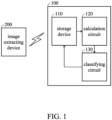
- FIG. 1 is a block diagram of an image classifying device 100 according to an embodiment of the invention.
- the image classifying device 100 may comprise a storage device 110, a calculation circuit 120 and a classifying circuit 130.
- FIG. 1 presents a simplified block diagram in which only the elements relevant to the invention are shown. However, the invention should not be limited to what is shown in FIG. 1 .
- the image classifying device 100 may also comprise other elements and the connections between the elements may be different from the image classifying device 100.
- the calculation circuit 120 and the classifying circuit 130 may be integrated in a single chip or module.
- the storage device 110, the calculation circuit 120 and the classifying circuit 130 may also be integrated in a single chip or module.
- the storage device 110 may be a volatile memory (e.g. Random Access Memory (RAM)), or a non-volatile memory (e.g. flash memory, Read Only Memory (ROM)), a hard disk, or a combination of the above memory devices.
- RAM Random Access Memory
- ROM Read Only Memory
- the storage device 110 may store the required files and data for the image classification.
- the storage device 110 may store a plurality of image classes of images in advance.
- each image class may correspond to a corresponding area, e.g. different areas of oral cavity, but the invention should not be limited thereto.
- the images in each image class may be divided into different groups based on a clustering algorithm in advance.
- the clustering algorithm may be a k-means algorithm, but the invention should not be limited thereto.
- the user may pre-decide to how many groups the images in each image class need to be divided into (i.e. pre-decide a number of the groups in each image class).
- each group may correspond to a cluster centroid. That is to say, the number of the cluster centroids may be the same as the number of the groups.
- the image classifying device 100 may obtain a target image from an image extracting device 200 (i.e. the target image may be an image captured by the image extracting device 200 at the current time point) and add the target image into a suitable image class.
- the image extracting device 200 may be moved to different positions to capture the images corresponding to different image class (or different areas). Details for how to add the target image into a suitable image class are discussed below.
- the calculation circuit 120 may extract a feature vector of the target image first.
- the calculation circuit may input the target image into a deep learning algorithm model to obtain the feature vector corresponding to the target image.
- the deep learning algorithm may be a Convolutional Neural Network (CNN) algorithm (e.g. MobileNet, EfficiebtNet, TetNet and so on), but the invention should not be limited thereto.
- CNN Convolutional Neural Network
- the calculation circuit 120 may calculate the distances between the feature vector and each cluster centroid of each group of each image class, and select the shortest distances between the feature vector and each image class (i.e. the feature vector and one image class correspond to a corresponding shortest distance).
- the calculation circuit 120 may determine whether the minimum value of the shortest distances between the feature vector of the target image and each image class is above the threshold.
- the calculation circuit 120 may use a probability distribution algorithm to perform a probability distribution calculation for the feature vector of the target image and the reciprocals of all the shortest distances corresponding to the image classes to obtain the probabilities (i.e. the first estimation result) of the target image for each image class.
- the probability distribution algorithm may be the softmax algorithm, but the invention should not be limited thereto.
- the softmax algorithm may transforms the values (i.e. shortest distance) of different classes to the values in the interval [0,1], and sum of the transformed values will be 1. Taking the above equation as an example, after the softmax algorithm, the probabilities (i.e.
- the calculation circuit 120 may also use the Hidden Markov Model (HMM) algorithm and a reference image to calculate the probabilities (i.e. the second estimation result) between the target image and the image classes.
- HMM Hidden Markov Model
- the reference image can be regarded as a target image at a previous time point, and the image class corresponding to the reference image may be one of the image classes stored in the storage device 110.
- the reference image may be the target image at time point t-1 and its corresponding image class (or area) is known (i.e. image class of the reference has been estimated).
- the reference image and the image class corresponding to the reference image can be used to estimate the probabilities between the target image and the image classes at the current time point.
- the calculation circuit 120 may estimate the probabilities of the image extracting device 200 moving from the image class (or area) corresponding to the reference image to each image class (or area) during the time point t-1 (corresponding to the reference image) to the current time point t (corresponding to the target image)).
- the storage device 110 may further store the moving probabilities between each image class (or area) and other image classes (or areas).
- a moving probability between one image class and another image class means the probability of the image extracting device 200 moving from one area to another area when the image extracting device 200 captures images at continuous time points.
- the calculation circuit 120 may use the HMM algorithm to obtain the probabilities (i.e. the second estimation result) between the target image and the image classes based on the moving probabilities between each image class (or area) and other image classes (or areas) and the image class (or area) corresponding to the reference image.
- the storage devices 110 may further store the distance information between each image class (or area) and other image classes (or areas). Specifically, the distance Z i,j between each image class (or area) and other image classes (or areas) may be measured in advance, wherein the distance Z i,j means the distance of moving from the area i to the area j.
- the calculation circuit 120 may obtain shift information between the target image and the reference image according to a first algorithm.
- the first algorithm may be an image comparison algorithm (e.g. the feature comparison algorithm).
- the calculation circuit 120 may compare the features of the target image with the features of the reference image to calculate the shift pixels of the features. After the calculation circuit 120 obtains the shift pixels, the positioning circuit 120 may estimate the distance variance d (i.e. the shift information) between the target image and the reference image based on the proportional relation between the pixel and the distance.
- the first algorithm may be an IMU algorithm.
- the calculation circuit 120 may obtain the acceleration variance and the time variance between the target image and the reference image according to the IMU information of the target image and the IMU information of the reference image. Then, the calculation circuit 120 may estimate the distance variance d (i.e. the shift information) between the target image and the reference image according to the acceleration variance and the time variance.
- the calculation circuit 120 may use the HMM algorithm to obtain the probabilities (i.e. the second estimation result) between the target image and the image classes according to the distance information (i.e. Z i,j ) between each image class (or area) and other image classes (or areas), the image class (or area) (e.g. the area i) of the reference image and the shift information (i.e. the distance variance d) between the target image and the reference image.
- the positioning circuit 120 may substitute the difference of the distance variance d and the distance information Z i,j (i.e.
- the positioning circuit 120 may substitute the difference of the distance variance d and the distance information Z i,j (i.e.
- ) into an exponential distribution function: f x ⁇ ⁇ ⁇ e ⁇ ⁇ x , x ⁇ 0 0 , x ⁇ 0 , wherein the calculation circuit 120 may regard the difference of the distance variance d and the distance information Z i,j (i.e.
- the difference of the distance variance d and the distance information Z i,j i.e.
- the calculation circuit 120 may estimate the probabilities (i.e. the second estimation result) between the target image and the image classes based on the method of the embodiment.
- the storage device 110 may further store the angle information between each image class (or area) and other image classes (or areas). Specifically, the angle r i,j between each image class (or area) and other image classes (or areas) may be measured in advance, and stored in the storage device 110, wherein the angle r i,j means the angle of moving from the area i to the area j.
- the calculation circuit 120 may obtain angle variation information between the target image and the reference image according to a second algorithm.
- the second algorithm may be an IMU algorithm.
- the calculation circuit 120 may obtain the acceleration variance and the time variance between the target image and the reference image according to the IMU information of the target image and the IMU information of the reference image. Then, the calculation circuit 120 may estimate the rotation angle variance c (i.e. the angle variation information) between the target image and the reference image according to the acceleration variance and the time variance.
- the calculation circuit 120 may use the HMM algorithm to obtain probabilities (i.e. the second estimation result) between the target image and the image classes according to the angle information (i.e. r i,j ) between each image class (or area) and other image classes (or areas), the image class of the reference image (e.g. the area i) and the angle variance information (i.e. the rotation angle variance c) between the target image and the reference image.
- the calculation circuit 120 may substitute the difference of the rotation angle variance c and the angle information r i,j (i.e.
- the calculation circuit 120 may substitute the difference of the rotation angle variance c and the angle information r i,j (i.e.
- ) into an exponential distribution function: f x ⁇ ⁇ ⁇ e ⁇ ⁇ x , x ⁇ 0 0 , x ⁇ 0 , wherein the calculation circuit 120 may regard the difference of the rotation angle variance c and the angle information r i,j (i.e.
- ) as the input x of the exponential distribution function.
- the difference of the rotation angle variance c and the angle information r i,j i.e.
- the calculation circuit 120 may estimate the probabilities (i.e. the second estimation result) between the target image and the image classes based on the method of the embodiment.
- the classifying circuit 130 may multiply the first estimation result by the second estimation result to obtain a third estimation result. Then, based on the maximum of the third estimation result, the classifying circuit 130 may add the target image into the image class corresponding to the maximum of the third estimation result (i.e. the most possible image class corresponding to the target image).
- the classifying circuit 130 may multiply the first estimation result by a first weighted value to generate a first result and multiply the second estimation result by a second weighted value to generate a second result. Then, the classifying circuit 130 may add the first result to the second result to obtain a third estimation result. Finally, based on the maximum of the third estimation result, the classifying circuit 130 may add the target image into the image class corresponding to the maximum of the third estimation result (i.e. the most possible image class corresponding to the target image).
- the third estimation result and the maximum of the third estimation result can be indicated as follow:
- the classifying circuit 130 may use a clustering algorithm (e.g. k-means algorithm) to update the information corresponding to the image class which the target image is added into. For example, when the target image is added to an image class, the cluster centroid of each group in the image class may be changed to increase the accuracy of determine the image class of the next target image.
- a clustering algorithm e.g. k-means algorithm
- FIG. 2 is a flow chart illustrating an image classifying method according to an embodiment of the invention.
- the image classifying method can be applied to the image classifying device 100.
- the image classifying device 100 obtains a target image from an image extracting device.
- step S220 the calculation circuit of the image classifying device 100 obtains a feature vector corresponding to the target image.
- step S230 the calculation circuit of the image classifying device 100 obtains a first estimation result corresponding to the target image based on the information of a plurality of image classes and the feature vector corresponding to the target image.
- step S240 the calculation circuit of the image classifying device 100 obtains a second estimation result corresponding to the target image based on the Hidden Markov Model (HMM) algorithm and a reference image, wherein the reference image corresponds one of the image classes.
- HMM Hidden Markov Model
- step S250 the classifying circuit of the image classifying device 100 adds the target image into one of the image classes based on the first estimation result and the second estimation result.
- each image class may comprise a plurality of groups of images.
- the calculation circuit of the image classifying device 100 may calculate the shortest distances between the feature vector and each image class based on the feature vector corresponding to the target image and each cluster centroid of each group of each image class.
- the calculation circuit of the image classifying device 100 may abandon the target image.
- the calculation circuit of the image classifying device 100 may calculate the first estimation result based on the shortest distances between the feature vector of the target image and each image class and a probability distribution algorithm.
- the classifying circuit of the image classifying device 100 may multiply the first estimation result by the second estimation result to obtain a third estimation result, and it may add the target image into one of the image classes based on the third estimation result.
- the classifying circuit of the image classifying device 100 may multiply the first estimation result by a first weighted value to generate a first result and multiply the second estimation result by a second weighted value to generate a second result. Then, the classifying circuit of the image classifying device 100 may add the first result to the second result to generate a third estimation result, and it may add the target image into one of the image classes based on the third estimation result.
- the classifying circuit of the image classifying device 100 may update the information of the image class which the target image is added into.
- the image classifying device can obtain the image class corresponding to the target image accurately.
- the image classifying device can update the information corresponding to each image class to increase the accuracy of later image classification.
- a software module e.g., including executable instructions and related data
- other data may reside in a data memory such as RAM memory, flash memory, ROM memory, EPROM memory, EEPROM memory, registers, a hard disk, a removable disk, a CD-ROM, or any other form of computer-readable storage medium known in the art.
- a sample storage medium may be coupled to a machine such as, for example, a computer/processor (which may be referred to herein, for convenience, as a "processor”) such that the processor can read information (e.g., code) from and write information to the storage medium.
- a sample storage medium may be integral to the processor.
- the processor and the storage medium may reside in an ASIC.
- the ASIC may reside in user equipment.
- the processor and the storage medium may reside as discrete components in user equipment.
- any suitable computer-program product may comprise a computer-readable medium comprising codes relating to one or more of the aspects of the disclosure.
- a computer program product may comprise packaging materials.
Landscapes
- Engineering & Computer Science (AREA)
- Theoretical Computer Science (AREA)
- Physics & Mathematics (AREA)
- Computer Vision & Pattern Recognition (AREA)
- Software Systems (AREA)
- General Physics & Mathematics (AREA)
- Multimedia (AREA)
- Computing Systems (AREA)
- Artificial Intelligence (AREA)
- Databases & Information Systems (AREA)
- Evolutionary Computation (AREA)
- General Health & Medical Sciences (AREA)
- Medical Informatics (AREA)
- Health & Medical Sciences (AREA)
- Probability & Statistics with Applications (AREA)
- Image Analysis (AREA)
- Holo Graphy (AREA)
- Image Processing (AREA)
- Sorting Of Articles (AREA)
Abstract
Description
- This Application claims priority of
TW Patent Application No. 111110045 filed on March 18, 2022 - The invention generally relates to image classifying technology, and more particularly, to an image classifying technology in which image classification is performed based on the result of comparing the target image to a plurality of classified images and the other result for the target image generated based on the the Hidden Markov Model (HMM) algorithm.
- As technology has progressed, image classification is being applied more widely. Therefore, how to classify images more accurately is a subject that is worthy of discussion.
- An image classifying device and method are provided to overcome the problems mentioned above.
- An embodiment of the invention provides an image classifying device. The image classifying device includes a storage device, a calculation circuit, and a classifying circuit. The storage device stores information corresponding to a plurality of image classes. The calculation circuit is coupled to the storage device. The calculation circuit obtains a target image from an image extracting device and obtains the feature vector of the target image. In addition, the calculation circuit obtains a first estimation result corresponding to the target image based on the information corresponding to the plurality of image classes and the feature vector and obtains a second estimation result corresponding to the target image based on a reference image, wherein the reference image corresponds to one of the image classes. The classifying circuit is coupled to the calculation circuit. The classifying circuit adds the target image into one of the image classes based on the first estimation result and the second estimation result.
- In some embodiments of the invention, each image class comprises a plurality of groups of images. In some embodiments of the invention, the calculation circuit calculates the shortest distances between the feature vector and each image class based on the feature vector and each cluster centroid of each group of each image class. When the minimum value of the shortest distances between the feature vector and each image class is above the threshold, the calculation circuit abandons the target image. When the minimum value of the shortest distances between the feature vector and each image class is not above the threshold, the calculation circuit calculates the first estimation result based on the shortest distances between the feature vector and each image class and a probability distribution algorithm.
- In some embodiments of the invention, the classifying circuit multiplies the first estimation result by the second estimation result to obtain a third estimation result, and adds the target image into one of the image classes based on the third estimation result.
- In some embodiments of the invention, the classifying circuit multiplies the first estimation result by a first weighted value to generate a first result and multiplies the second estimation result by a second weighted value to generate a second result, and the classifying circuit adds the first result to the second result to generate a third estimation result and adds the target image into one of the image classes based on the third estimation result.
- In some embodiments of the invention, after the classifying circuit adds the target image into one of the image classes, the classifying circuit updates the information of the image class which the target image is added into.
- An embodiment of the invention provides an image classifying method. The image classifying method is applied to an image classifying device. The image classifying method includes the following steps. The image classifying device obtains a target image from an image extracting device. The calculation circuit of the image classifying device obtains the feature vector of the target image. The calculation circuit obtains a first estimation result corresponding to the target image based on the information corresponding to the image classes and the feature vector. The calculation circuit obtains a second estimation result corresponding to the target image based on a reference image. The reference image corresponds to one of the image classes. The classifying circuit of the image classifying device adds the target image into one of the image classes based on the first estimation result and the second estimation result.
- Other aspects and features of the invention will become apparent to those with ordinary skill in the art upon review of the following descriptions of specific embodiments of an image classifying device and method.
- The invention will become more fully understood by referring to the following detailed description with reference to the accompanying drawings, wherein:
-
FIG. 1 is a block diagram of animage classifying device 100 according to an embodiment of the invention; and -
FIG. 2 is a flow chart illustrating an image classifying method according to an embodiment of the invention. - The following description is of the best-contemplated mode of carrying out the invention. This description is made for the purpose of illustrating the general principles of the invention and should not be taken in a limiting sense. The scope of the invention is best determined by reference to the appended claims.
-
FIG. 1 is a block diagram of animage classifying device 100 according to an embodiment of the invention. As shown inFIG. 1 , theimage classifying device 100 may comprise astorage device 110, acalculation circuit 120 and a classifyingcircuit 130. It should be noted thatFIG. 1 presents a simplified block diagram in which only the elements relevant to the invention are shown. However, the invention should not be limited to what is shown inFIG. 1 . Theimage classifying device 100 may also comprise other elements and the connections between the elements may be different from theimage classifying device 100. According to an embodiment of the invention, thecalculation circuit 120 and the classifyingcircuit 130 may be integrated in a single chip or module. In another embodiment, thestorage device 110, thecalculation circuit 120 and the classifyingcircuit 130 may also be integrated in a single chip or module. - According to the embodiments of the invention, the
storage device 110 may be a volatile memory (e.g. Random Access Memory (RAM)), or a non-volatile memory (e.g. flash memory, Read Only Memory (ROM)), a hard disk, or a combination of the above memory devices. Thestorage device 110 may store the required files and data for the image classification. - According to the embodiments of the invention, the
storage device 110 may store a plurality of image classes of images in advance. According to an embodiment of the invention, each image class may correspond to a corresponding area, e.g. different areas of oral cavity, but the invention should not be limited thereto. In addition, according to the embodiments of the invention, the images in each image class may be divided into different groups based on a clustering algorithm in advance. - According to an embodiment, the clustering algorithm may be a k-means algorithm, but the invention should not be limited thereto. In the k-means algorithm, the user may pre-decide to how many groups the images in each image class need to be divided into (i.e. pre-decide a number of the groups in each image class). In addition, in the k-means algorithm, each group may correspond to a cluster centroid. That is to say, the number of the cluster centroids may be the same as the number of the groups.
- According to an embodiment of the invention, the
image classifying device 100 may obtain a target image from an image extracting device 200 (i.e. the target image may be an image captured by theimage extracting device 200 at the current time point) and add the target image into a suitable image class. In the embodiments of the invention, at different time points, theimage extracting device 200 may be moved to different positions to capture the images corresponding to different image class (or different areas). Details for how to add the target image into a suitable image class are discussed below. - According to an embodiment of the invention, when the target image is added into the suitable image class, the
calculation circuit 120 may extract a feature vector of the target image first. In an embodiment, the calculation circuit may input the target image into a deep learning algorithm model to obtain the feature vector corresponding to the target image. In the embodiment, the deep learning algorithm may be a Convolutional Neural Network (CNN) algorithm (e.g. MobileNet, EfficiebtNet, TetNet and so on), but the invention should not be limited thereto. - After the
calculation circuit 120 obtains the feature vector corresponding to the target image, thecalculation circuit 120 may calculate the distances between the feature vector and each cluster centroid of each group of each image class, and select the shortest distances between the feature vector and each image class (i.e. the feature vector and one image class correspond to a corresponding shortest distance). For example, if thestorage device 110 stores N image classes and each image class comprise M groups, and the feature vector of the target image is indicated as v, the shortest distance between the feature vector and each image class can be indicated as:
- According to an embodiment of the invention, the
calculation circuit 120 may determine whether the minimum value of the shortest distances between the feature vector of the target image and each image class is above the threshold. - According to an embodiment, the threshold may be calculated based on the interquartile range (IQR) algorithm, but the invention should not be limited thereto. Specifically, the distances between each image stored in the
storage device 110 and its corresponding cluster centroid can be calculated in advance. Then, based on the IQR algorithm, a statistic is performed for the distances between each image and its corresponding cluster centroid to obtain a first quartile Q1, a second quartile Q2, a third quartile Q3 and interquartile range (IQR) (i.e. IQR= Q3-Q1) in the IQR algorithm. In one preferred embodiment, the threshold may be defined as (Q3+1.5∗IQR). - If the minimum value of the shortest distances between the feature vector of the target image and each image class is above the threshold (i.e. the target image is not similar to any image class), the
calculation circuit 120 may determine that the target image is a defective image and abandon the target image. Taking the above equation as an example, if the Dv,n = min(d v,1, d v,2, ... dv,m )>threshold, thecalculation circuit 120 may abandon the target image. - If the minimum value of the shortest distances between the feature vector of the target image and each image class is not above the threshold, the
calculation circuit 120 may use a probability distribution algorithm to perform a probability distribution calculation for the feature vector of the target image and the reciprocals of all the shortest distances corresponding to the image classes to obtain the probabilities (i.e. the first estimation result) of the target image for each image class. - According to an embodiment of the invention, the probability distribution algorithm may be the softmax algorithm, but the invention should not be limited thereto. The softmax algorithm may transforms the values (i.e. shortest distance) of different classes to the values in the interval [0,1], and sum of the transformed values will be 1. Taking the above equation as an example, after the softmax algorithm, the probabilities (i.e. the first estimation result) of the target image for each image class can be indicated as follow:

- According to an embodiment of the invention, the
calculation circuit 120 may also use the Hidden Markov Model (HMM) algorithm and a reference image to calculate the probabilities (i.e. the second estimation result) between the target image and the image classes. According to an embodiment of the invention, comparing with the target image at the current time point, the reference image can be regarded as a target image at a previous time point, and the image class corresponding to the reference image may be one of the image classes stored in thestorage device 110. For example, the reference image may be the target image at time point t-1 and its corresponding image class (or area) is known (i.e. image class of the reference has been estimated). Therefore, the reference image and the image class corresponding to the reference image can be used to estimate the probabilities between the target image and the image classes at the current time point. (i.e. thecalculation circuit 120 may estimate the probabilities of theimage extracting device 200 moving from the image class (or area) corresponding to the reference image to each image class (or area) during the time point t-1 (corresponding to the reference image) to the current time point t (corresponding to the target image)). - According to an embodiment of the invention, the
storage device 110 may further store the moving probabilities between each image class (or area) and other image classes (or areas). Specifically, a moving probability between one image class and another image class means the probability of theimage extracting device 200 moving from one area to another area when theimage extracting device 200 captures images at continuous time points. Thecalculation circuit 120 may use the HMM algorithm to obtain the probabilities (i.e. the second estimation result) between the target image and the image classes based on the moving probabilities between each image class (or area) and other image classes (or areas) and the image class (or area) corresponding to the reference image. - According to another embodiment of the invention, the
storage devices 110 may further store the distance information between each image class (or area) and other image classes (or areas). Specifically, the distance Zi,j between each image class (or area) and other image classes (or areas) may be measured in advance, wherein the distance Zi,j means the distance of moving from the area i to the area j. In addition, in the embodiment, thecalculation circuit 120 may obtain shift information between the target image and the reference image according to a first algorithm. - In an embodiment, the first algorithm may be an image comparison algorithm (e.g. the feature comparison algorithm). In the embodiment, the
calculation circuit 120 may compare the features of the target image with the features of the reference image to calculate the shift pixels of the features. After thecalculation circuit 120 obtains the shift pixels, thepositioning circuit 120 may estimate the distance variance d (i.e. the shift information) between the target image and the reference image based on the proportional relation between the pixel and the distance. - In another embodiment, the first algorithm may be an IMU algorithm. In the embodiment, the
calculation circuit 120 may obtain the acceleration variance and the time variance between the target image and the reference image according to the IMU information of the target image and the IMU information of the reference image. Then, thecalculation circuit 120 may estimate the distance variance d (i.e. the shift information) between the target image and the reference image according to the acceleration variance and the time variance. - After the
calculation circuit 120 obtains the shift information, thecalculation circuit 120 may use the HMM algorithm to obtain the probabilities (i.e. the second estimation result) between the target image and the image classes according to the distance information (i.e. Zi,j) between each image class (or area) and other image classes (or areas), the image class (or area) (e.g. the area i) of the reference image and the shift information (i.e. the distance variance d) between the target image and the reference image. Specifically, thepositioning circuit 120 may substitute the difference of the distance variance d and the distance information Zi,j (i.e. | d - Zi,j |) into a probability density function to generate a distribution diagram (i.e. the second estimation result). For example, thepositioning circuit 120 may substitute the difference of the distance variance d and the distance information Zi,j (i.e. |d - Zi,j |) into an exponential distribution function:
calculation circuit 120 may regard the difference of the distance variance d and the distance information Zi,j (i.e. |d - Zi,j |) as the input x of the exponential distribution function. In the embodiment, when the difference of the distance variance d and the distance information Zi,j (i.e. |d - Zi,j |) is smaller, it means that the probability of moving from the area i (i.e. the area corresponding to the reference image) to the area j (i.e. the possible area corresponding to the target image) is higher. Therefore, thecalculation circuit 120 may estimate the probabilities (i.e. the second estimation result) between the target image and the image classes based on the method of the embodiment. - According to another embodiment of the invention, the
storage device 110 may further store the angle information between each image class (or area) and other image classes (or areas). Specifically, the angle ri,j between each image class (or area) and other image classes (or areas) may be measured in advance, and stored in thestorage device 110, wherein the angle ri,j means the angle of moving from the area i to the area j. In addition, in the embodiment, thecalculation circuit 120 may obtain angle variation information between the target image and the reference image according to a second algorithm. - In an embodiment, the second algorithm may be an IMU algorithm. In the embodiment, the
calculation circuit 120 may obtain the acceleration variance and the time variance between the target image and the reference image according to the IMU information of the target image and the IMU information of the reference image. Then, thecalculation circuit 120 may estimate the rotation angle variance c (i.e. the angle variation information) between the target image and the reference image according to the acceleration variance and the time variance. - After the
calculation circuit 120 obtains the angle variation information, thecalculation circuit 120 may use the HMM algorithm to obtain probabilities (i.e. the second estimation result) between the target image and the image classes according to the angle information (i.e. ri,j) between each image class (or area) and other image classes (or areas), the image class of the reference image (e.g. the area i) and the angle variance information (i.e. the rotation angle variance c) between the target image and the reference image. Specifically, thecalculation circuit 120 may substitute the difference of the rotation angle variance c and the angle information ri,j (i.e. |c - ri,j |) into a probability density function to generate a distribution diagram (i.e. the second estimation result). For example, thecalculation circuit 120 may substitute the difference of the rotation angle variance c and the angle information ri,j (i.e. |c - ri,j |) into an exponential distribution function:
calculation circuit 120 may regard the difference of the rotation angle variance c and the angle information ri,j (i.e. |c - ri,j |) as the input x of the exponential distribution function. In the embodiment, when the difference of the rotation angle variance c and the angle information ri,j (i.e. |c - ri,j |) is smaller, it means that the probability of moving from the area i (i.e. the area corresponding to the reference image) to the area j (i.e. the possible area corresponding to the target image) is higher. Therefore, thecalculation circuit 120 may estimate the probabilities (i.e. the second estimation result) between the target image and the image classes based on the method of the embodiment. - According to an embodiment of the invention, after the
calculation circuit 120 obtains the first estimation result and the second estimation result, the classifyingcircuit 130 may multiply the first estimation result by the second estimation result to obtain a third estimation result. Then, based on the maximum of the third estimation result, the classifyingcircuit 130 may add the target image into the image class corresponding to the maximum of the third estimation result (i.e. the most possible image class corresponding to the target image). For example, if the first estimation result is {p i,1, p i,2, ..., pi,N } and the second estimation result is {h i,1, h i,2, ..., hi,N }, the third estimation result and the maximum of the third estimation result can be indicated as follow:

- According to another embodiment of the invention, after the
calculation circuit 120 obtains the first estimation result and the second estimation result, the classifyingcircuit 130 may multiply the first estimation result by a first weighted value to generate a first result and multiply the second estimation result by a second weighted value to generate a second result. Then, the classifyingcircuit 130 may add the first result to the second result to obtain a third estimation result. Finally, based on the maximum of the third estimation result, the classifyingcircuit 130 may add the target image into the image class corresponding to the maximum of the third estimation result (i.e. the most possible image class corresponding to the target image). For example, if the first estimation result is {p i,1, p i,2, ..., pi,N } and the second estimation result is {h i,1, h i,2, ..., hi,N }, the third estimation result and the maximum of the third estimation result can be indicated as follow:

- According to an embodiment of the invention, after the
classifying circuit 130 adds the target image into the image class corresponding to the maximum of the third estimation result, the classifyingcircuit 130 may use a clustering algorithm (e.g. k-means algorithm) to update the information corresponding to the image class which the target image is added into. For example, when the target image is added to an image class, the cluster centroid of each group in the image class may be changed to increase the accuracy of determine the image class of the next target image. -
FIG. 2 is a flow chart illustrating an image classifying method according to an embodiment of the invention. The image classifying method can be applied to theimage classifying device 100. As shown inFIG. 2 , in step S210, theimage classifying device 100 obtains a target image from an image extracting device. - In step S220, the calculation circuit of the
image classifying device 100 obtains a feature vector corresponding to the target image. - In step S230, the calculation circuit of the
image classifying device 100 obtains a first estimation result corresponding to the target image based on the information of a plurality of image classes and the feature vector corresponding to the target image. - In step S240, the calculation circuit of the
image classifying device 100 obtains a second estimation result corresponding to the target image based on the Hidden Markov Model (HMM) algorithm and a reference image, wherein the reference image corresponds one of the image classes. - In step S250, the classifying circuit of the
image classifying device 100 adds the target image into one of the image classes based on the first estimation result and the second estimation result. - According to an embodiment of the invention, in the image classifying method, each image class may comprise a plurality of groups of images.
- According to an embodiment of the invention, in step S230, the calculation circuit of the
image classifying device 100 may calculate the shortest distances between the feature vector and each image class based on the feature vector corresponding to the target image and each cluster centroid of each group of each image class. - According to an embodiment of the invention, in the image classifying method, when the minimum value of the shortest distances between the feature vector of the target image and each image class is above the threshold, the calculation circuit of the
image classifying device 100 may abandon the target image. When the minimum value of the shortest distances between the feature vector of the target image and each image class is not above the threshold, the calculation circuit of theimage classifying device 100 may calculate the first estimation result based on the shortest distances between the feature vector of the target image and each image class and a probability distribution algorithm. - According to an embodiment of the invention, in step S450 of the image classifying method, the classifying circuit of the
image classifying device 100 may multiply the first estimation result by the second estimation result to obtain a third estimation result, and it may add the target image into one of the image classes based on the third estimation result. - According to an embodiment of the invention, in step S450 of the image classifying method, the classifying circuit of the
image classifying device 100 may multiply the first estimation result by a first weighted value to generate a first result and multiply the second estimation result by a second weighted value to generate a second result. Then, the classifying circuit of theimage classifying device 100 may add the first result to the second result to generate a third estimation result, and it may add the target image into one of the image classes based on the third estimation result. - According to an embodiment of the invention, in the image classifying method, after the target image is added to one of the image classes, the classifying circuit of the
image classifying device 100 may update the information of the image class which the target image is added into. - According to the image classifying method provided in the invention, the image classifying device can obtain the image class corresponding to the target image accurately. In addition, according to the image classifying method provided in the invention, the image classifying device can update the information corresponding to each image class to increase the accuracy of later image classification.
- Use of ordinal terms such as "first", "second", "third", etc., in the disclosure and claims is for description. It does not by itself connote any order or relationship.
- The steps of the method described in connection with the aspects disclosed herein may be embodied directly in hardware, in a software module executed by a processor, or in a combination of the two. A software module (e.g., including executable instructions and related data) and other data may reside in a data memory such as RAM memory, flash memory, ROM memory, EPROM memory, EEPROM memory, registers, a hard disk, a removable disk, a CD-ROM, or any other form of computer-readable storage medium known in the art. A sample storage medium may be coupled to a machine such as, for example, a computer/processor (which may be referred to herein, for convenience, as a "processor") such that the processor can read information (e.g., code) from and write information to the storage medium. A sample storage medium may be integral to the processor. The processor and the storage medium may reside in an ASIC. The ASIC may reside in user equipment. Alternatively, the processor and the storage medium may reside as discrete components in user equipment. Moreover, in some aspects any suitable computer-program product may comprise a computer-readable medium comprising codes relating to one or more of the aspects of the disclosure. In some aspects a computer program product may comprise packaging materials.
- The above paragraphs describe many aspects. Obviously, the teaching of the invention can be accomplished by many methods, and any specific configurations or functions in the disclosed embodiments only present a representative condition. Those who are skilled in this technology will understand that all of the disclosed aspects in the invention can be applied independently or be incorporated.
- While the invention has been described by way of example and in terms of preferred embodiment, it should be understood that the invention is not limited thereto. Those who are skilled in this technology can still make various alterations and modifications without departing from the scope and spirit of this invention. Therefore, the scope of the present invention shall be defined and protected by the following claims and their equivalents.
Claims (15)
- An image classifying device, comprising:a storage device, storing information corresponding to a plurality of image classes;a calculation circuit, coupled to the storage device, obtaining a target image from an image extracting device and obtaining a feature vector of the target image, wherein the calculation circuit obtains a first estimation result corresponding to the target image based on the information corresponding to the plurality of image classes and the feature vector and wherein the calculation circuit obtains a second estimation result corresponding to the target image based on a reference image, wherein the reference image corresponds to one of the plurality of image classes; anda classifying circuit, coupled to the calculation circuit, wherein the classifying circuit adds the target image into one of the plurality of image classes based on the first estimation result and the second estimation result.
- The image classifying device of claim 1, wherein each image class comprises a plurality of groups of images.
- The image classifying device of claim 2, wherein the calculation circuit calculates shortest distances between the feature vector and each image class based on the feature vector and each cluster centroid of each group of each image class.
- The image classifying device of claim 3, wherein when a minimum value of the shortest distances between the feature vector and each image class is above a threshold, the calculation circuit abandons the target image.
- The image classifying device of claim 3, wherein when a minimum value of the shortest distances between the feature vector and each image class is not above a threshold, the calculation circuit calculates the first estimation result based on the shortest distances between the feature vector and each image class and a probability distribution algorithm.
- The image classifying device of any of claims 1 to 5, wherein the classifying circuit multiplies the first estimation result by the second estimation result to obtain a third estimation result, and adds the target image into one of the plurality of image classes based on the third estimation result.
- The image classifying device of any of claims 1 to 6, wherein the classifying circuit multiplies the first estimation result by a first weighted value to generate a first result and multiplies the second estimation result by a second weighted value to generate a second result, and the classifying circuit adds the first result to the second result to generate a third estimation result and adds the target image into one of the plurality of image classes based on the third estimation result.
- The image classifying device of any of claims 1 to 7, wherein after the classifying circuit adds the target image into one of the plurality of image classes, the classifying circuit updates the information of the image class which the target image is added into.
- An image classifying method, applied to an image classifying device, comprising:obtaining a target image from an image extracting device;obtaining, by a calculation circuit of the image classifying device, a feature vector of the target image;obtaining, by the calculation circuit, a first estimation result corresponding to the target image based on the information corresponding to the plurality of image classes and the feature vector;obtaining, by the calculation circuit, a second estimation result corresponding to the target image based on a reference image, wherein the reference image corresponds to one of the plurality of image classes; andadding, by a classifying circuit of the image classifying device, the target image into one of the plurality of image classes based on the first estimation result and the second estimation result.
- The image classifying method of claim 9, wherein each image class comprises a plurality of groups of images.
- The image classifying method of claim 10, further comprising:
calculating, by the calculation circuit, shortest distances between the feature vector and each image class based on the feature vector and each cluster centroid of each group of each image class. - The image classifying method of claim 11, further comprising:when a minimum value of the shortest distances between the feature vector and each image class is above a threshold, abandoning, by the calculation circuit, the target image, orwhen a minimum value of the shortest distances between the feature vector and each image class is not above a threshold, by the calculation circuit calculates the first estimation result based on the shortest distances between the feature vector and each image class and a probability distribution algorithm.
- The image classifying method of any of claims 9 to 12, further comprising:multiplying, by the classifying circuit, the first estimation result by the second estimation result to obtain a third estimation result; andadding by the classifying circuit, the target image into one of the plurality of image classes based on the third estimation result.
- The image classifying method of any of claims 9 to 13, further comprising:multiplying, by the classifying circuit, the first estimation result by a first weighted value to generate a first result;multiplying, by the classifying circuit, the second estimation result by a second weighted value to generate a second result; andadding, by the classifying circuit, the first result to the second result to generate a third estimation result; andadding, by the classifying circuit, the target image into one of the plurality of image classes based on the third estimation result.
- The image classifying method of any of claims 9 to 14, further comprising:
after the classifying circuit adds the target image into one of the plurality of image classes, updating, by the classifying circuit, the information of the image class which the target image was added into.
Applications Claiming Priority (1)
| Application Number | Priority Date | Filing Date | Title |
|---|---|---|---|
| TW111110045A TWI806500B (en) | 2022-03-18 | 2022-03-18 | Image classifying device and method |
Publications (1)
| Publication Number | Publication Date |
|---|---|
| EP4246461A1 true EP4246461A1 (en) | 2023-09-20 |
Family
ID=82703037
Family Applications (1)
| Application Number | Title | Priority Date | Filing Date |
|---|---|---|---|
| EP22186669.2A Pending EP4246461A1 (en) | 2022-03-18 | 2022-07-25 | Image classifying device and method |
Country Status (4)
| Country | Link |
|---|---|
| US (1) | US20230298316A1 (en) |
| EP (1) | EP4246461A1 (en) |
| CN (1) | CN116824199B (en) |
| TW (1) | TWI806500B (en) |
Citations (2)
| Publication number | Priority date | Publication date | Assignee | Title |
|---|---|---|---|---|
| US20210074011A1 (en) * | 2019-09-06 | 2021-03-11 | Quanta Computer Inc. | Tooth-position recognition system |
| TWI744083B (en) * | 2020-11-10 | 2021-10-21 | 廣達電腦股份有限公司 | Oral-area positioning device and method |
Family Cites Families (8)
| Publication number | Priority date | Publication date | Assignee | Title |
|---|---|---|---|---|
| US6798834B1 (en) * | 1996-08-15 | 2004-09-28 | Mitsubishi Denki Kabushiki Kaisha | Image coding apparatus with segment classification and segmentation-type motion prediction circuit |
| TWI528197B (en) * | 2013-09-26 | 2016-04-01 | 財團法人資訊工業策進會 | Photo grouping system and photo grouping method and computer readable recording medium |
| TWI622020B (en) * | 2016-09-26 | 2018-04-21 | 財團法人成大研究發展基金會 | Clustering method with a two-stage local binary pattern and an iterative image testing system thereof |
| US20200193552A1 (en) * | 2018-12-18 | 2020-06-18 | Slyce Acquisition Inc. | Sparse learning for computer vision |
| CN110837869A (en) * | 2019-11-11 | 2020-02-25 | 深圳市商汤科技有限公司 | Image classification model training method, image processing method and device |
| CN112819019B (en) * | 2019-11-15 | 2023-06-20 | 财团法人资讯工业策进会 | Classification model generation device and classification model generation method thereof |
| CN115668286A (en) * | 2020-05-22 | 2023-01-31 | 日本电产理德股份有限公司 | Method and system for training automatic defect classification detection instrument |
| TWI744000B (en) * | 2020-09-21 | 2021-10-21 | 財團法人資訊工業策進會 | Image labeling apparatus, method, and computer program product thereof |
-
2022
- 2022-03-18 TW TW111110045A patent/TWI806500B/en active
- 2022-04-02 CN CN202210350403.3A patent/CN116824199B/en active Active
- 2022-06-23 US US17/847,739 patent/US20230298316A1/en active Pending
- 2022-07-25 EP EP22186669.2A patent/EP4246461A1/en active Pending
Patent Citations (3)
| Publication number | Priority date | Publication date | Assignee | Title |
|---|---|---|---|---|
| US20210074011A1 (en) * | 2019-09-06 | 2021-03-11 | Quanta Computer Inc. | Tooth-position recognition system |
| TWI744083B (en) * | 2020-11-10 | 2021-10-21 | 廣達電腦股份有限公司 | Oral-area positioning device and method |
| US20220142739A1 (en) * | 2020-11-10 | 2022-05-12 | Quanta Computer Inc. | Oral-area positioning device and method |
Non-Patent Citations (1)
| Title |
|---|
| T. SONI MADHULATHA: "AN OVERVIEW ON CLUSTERING METHODS", IOSR JOURNAL OF ENGINEERING, vol. 02, no. 04, 1 April 2012 (2012-04-01), pages 719 - 725, XP055119478, ISSN: 2278-8719, DOI: 10.9790/3021-0204719725 * |
Also Published As
| Publication number | Publication date |
|---|---|
| CN116824199B (en) | 2026-02-27 |
| TWI806500B (en) | 2023-06-21 |
| CN116824199A (en) | 2023-09-29 |
| US20230298316A1 (en) | 2023-09-21 |
| TW202338728A (en) | 2023-10-01 |
Similar Documents
| Publication | Publication Date | Title |
|---|---|---|
| US20190354857A1 (en) | Machine learning using informed pseudolabels | |
| Sznitman et al. | Active testing for face detection and localization | |
| US12039443B2 (en) | Distance-based learning confidence model | |
| US7450766B2 (en) | Classifier performance | |
| CN108460427B (en) | Classification model training method and device and classification method and device | |
| CN110363165B (en) | Multi-target tracking method, device and storage medium based on TSK fuzzy system | |
| CN115937703A (en) | An Enhanced Feature Extraction Method for Object Detection in Remote Sensing Images | |
| CN112634294A (en) | Method for measuring boundary performance of semantic segmentation network | |
| CN114422450B (en) | Network traffic analysis method and device based on multi-source network traffic data | |
| CN110827327B (en) | Fusion-based long-term target tracking method | |
| US20230054706A1 (en) | Learning apparatus and learning method | |
| US20230401427A1 (en) | Training neural network with budding ensemble architecture based on diversity loss | |
| US20230298316A1 (en) | Image classifying device and method | |
| CN105447435A (en) | Object tracking method, object tracking device and selection method of tracking features for object tracking | |
| US20230206589A1 (en) | Apparatus and method for detecting object using object boundary localization uncertainty aware network and attention module | |
| US20190065912A1 (en) | MCMC framework-based sub-hypergraph matching method and device | |
| CN117037111B (en) | Small traffic sign detection method, device, equipment and storage medium | |
| EP3657401B1 (en) | Identification/classification device and identification/classification method | |
| US12029622B2 (en) | Oral-area positioning device and method | |
| CN105447887A (en) | Historical-route-based target tracking method and electronic equipment | |
| JP4003712B2 (en) | Image processing apparatus and image processing method | |
| CN116721256A (en) | Image cropping and model training methods, systems, equipment, and computer storage media | |
| US20260120308A1 (en) | Automatic measurement of racing vehicle details | |
| CN111984812A (en) | Feature extraction model generation method, image retrieval method, device and equipment | |
| CN115171064B (en) | Method, device, equipment and storage medium for determining key frame |
Legal Events
| Date | Code | Title | Description |
|---|---|---|---|
| PUAI | Public reference made under article 153(3) epc to a published international application that has entered the european phase |
Free format text: ORIGINAL CODE: 0009012 |
|
| STAA | Information on the status of an ep patent application or granted ep patent |
Free format text: STATUS: THE APPLICATION HAS BEEN PUBLISHED |
|
| AK | Designated contracting states |
Kind code of ref document: A1 Designated state(s): AL AT BE BG CH CY CZ DE DK EE ES FI FR GB GR HR HU IE IS IT LI LT LU LV MC MK MT NL NO PL PT RO RS SE SI SK SM TR |
|
| STAA | Information on the status of an ep patent application or granted ep patent |
Free format text: STATUS: REQUEST FOR EXAMINATION WAS MADE |
|
| 17P | Request for examination filed |
Effective date: 20231013 |
|
| RBV | Designated contracting states (corrected) |
Designated state(s): AL AT BE BG CH CY CZ DE DK EE ES FI FR GB GR HR HU IE IS IT LI LT LU LV MC MK MT NL NO PL PT RO RS SE SI SK SM TR |
|
| R17P | Request for examination filed (corrected) |
Effective date: 20231013 |
|
| STAA | Information on the status of an ep patent application or granted ep patent |
Free format text: STATUS: EXAMINATION IS IN PROGRESS |
|
| 17Q | First examination report despatched |
Effective date: 20251031 |