EP4246387A1 - Machine learning device, inference device, and trained model - Google Patents
Machine learning device, inference device, and trained model Download PDFInfo
- Publication number
- EP4246387A1 EP4246387A1 EP22872471.2A EP22872471A EP4246387A1 EP 4246387 A1 EP4246387 A1 EP 4246387A1 EP 22872471 A EP22872471 A EP 22872471A EP 4246387 A1 EP4246387 A1 EP 4246387A1
- Authority
- EP
- European Patent Office
- Prior art keywords
- principal component
- image data
- data
- learning
- principal
- Prior art date
- Legal status (The legal status is an assumption and is not a legal conclusion. Google has not performed a legal analysis and makes no representation as to the accuracy of the status listed.)
- Granted
Links
Images





Classifications
-
- G—PHYSICS
- G06—COMPUTING OR CALCULATING; COUNTING
- G06V—IMAGE OR VIDEO RECOGNITION OR UNDERSTANDING
- G06V10/00—Arrangements for image or video recognition or understanding
- G06V10/70—Arrangements for image or video recognition or understanding using pattern recognition or machine learning
- G06V10/77—Processing image or video features in feature spaces; using data integration or data reduction, e.g. principal component analysis [PCA] or independent component analysis [ICA] or self-organising maps [SOM]; Blind source separation
-
- G—PHYSICS
- G06—COMPUTING OR CALCULATING; COUNTING
- G06N—COMPUTING ARRANGEMENTS BASED ON SPECIFIC COMPUTATIONAL MODELS
- G06N3/00—Computing arrangements based on biological models
- G06N3/02—Neural networks
- G06N3/08—Learning methods
-
- G—PHYSICS
- G06—COMPUTING OR CALCULATING; COUNTING
- G06F—ELECTRIC DIGITAL DATA PROCESSING
- G06F18/00—Pattern recognition
- G06F18/20—Analysing
- G06F18/21—Design or setup of recognition systems or techniques; Extraction of features in feature space; Blind source separation
- G06F18/213—Feature extraction, e.g. by transforming the feature space; Summarisation; Mappings, e.g. subspace methods
- G06F18/2135—Feature extraction, e.g. by transforming the feature space; Summarisation; Mappings, e.g. subspace methods based on approximation criteria, e.g. principal component analysis
-
- G—PHYSICS
- G06—COMPUTING OR CALCULATING; COUNTING
- G06F—ELECTRIC DIGITAL DATA PROCESSING
- G06F18/00—Pattern recognition
- G06F18/20—Analysing
- G06F18/21—Design or setup of recognition systems or techniques; Extraction of features in feature space; Blind source separation
- G06F18/214—Generating training patterns; Bootstrap methods, e.g. bagging or boosting
-
- G—PHYSICS
- G06—COMPUTING OR CALCULATING; COUNTING
- G06V—IMAGE OR VIDEO RECOGNITION OR UNDERSTANDING
- G06V10/00—Arrangements for image or video recognition or understanding
- G06V10/70—Arrangements for image or video recognition or understanding using pattern recognition or machine learning
- G06V10/82—Arrangements for image or video recognition or understanding using pattern recognition or machine learning using neural networks
Definitions
- the present invention relates to a machine learning device, an inference device, and a trained model.
- GoogLeNet As neural networks for image recognition, GoogLeNet, ResNet, Yolo, etc., have been proposed. These technologies allow for the recognition of a specific object in an image and infer what kind of object it is, using a model learned by deep learning.
- Principal Component Analysis is known as a method for discovering components with large variance in the data that greatly express the characteristics of an analysis target (hereinafter referred to as "principal components”) from data in a large number of dimensions that are correlated. Using this method allows for a reduction in the number of data dimensions in machine learning.
- a stochastic resonance phenomenon is known as a technique for extracting a hidden signal by applying noise to a weak signal buried in noise (e.g., Patent Literature 1).
- Patent Literature 1 Japanese Patent Application Publication No. H6-174689
- a purpose of the present invention is to provide a technique for generating a trained model for inferring the state of a system.
- a machine learning device includes: a first principal component analysis unit that performs principal component analysis on learning data so as to thereby generate two or more principal components of the learning data; a first image data generation unit that generates virtual image data by assigning, from among the two or more generated principal components, the first principal component to the X coordinate of an XY plane and the second principal component to the Y coordinate of the XY plane; and a learning unit that generates a trained model by performing learning using a neural network using the image data as input data.
- This device includes: a second principal component analysis unit that performs principal component analysis on observation data so as to thereby generate two or more principal components of the observation data; a second image data generation unit that generates virtual image data by assigning, from among the two or more principal components, the first principal component to the X coordinate of an XY plane and the second principal component to the Y coordinate of the XY plane; and an inference unit that performs inference using a trained model using the image data as input data.
- Still another embodiment of the present invention relates to a trained model.
- This trained model is generated by: performing principal component analysis on learning data so as to thereby generate two or more principal components of the learning data; generating virtual image data by assigning, from among the two or more generated principal components, the first principal component to the X coordinate of an XY plane and the second principal component to the Y coordinate of the XY plane; and performing machine learning using the image data as input data.
- FIG. 1 is a functional block diagram of a machine learning device 100 according to the first embodiment.
- the machine learning device 100 includes a first principal component analysis unit 10, a first image data generation unit 20, and a learning unit 30.
- Data from outside is input to the first principal component analysis unit 10 as learning data.
- the first principal component analysis unit 10 By performing principal component analysis on this data, the first principal component analysis unit 10 generates two or more principal components of the learning data.
- the first image data generation unit 20 assigns, from among two or more principal components generated by the first principal component analysis unit 10, the first principal component to the X coordinate on the XY plane and the second principal component to the Y coordinate on the XY plane and thereby generates virtual image data.
- the learning unit 30 generates a trained model by performing learning using a neural network while using the image data generated by the first image data generation unit 20 as input data.
- the operation of the machine learning device 100 for generating a trained model for inferring the state of a system will be specifically explained below, using odor data as an example of learning data to determine what the odor source is that exists in the space.
- Odor data from eight odor sensors (sensor 1 to sensor 8) arranged outside the machine learning device 100 is input to the first principal component analysis unit 10.
- the odor sensors are assumed to have high sensitivity to the following odor components, respectively.
- the first principal component analysis unit 10 performs principal component analysis on these and generates the first principal component and the second principal component of the odor data according to the source of the odor (flower A, perfume B, fabric softener C, mouthwash D, etc.).
- the first principal component is generated as a linear combination of odor components such that the variance of the data is maximized for each odor source.
- the second principal component is generated as a linear combination of odor components such that the variance of the data projected on axes orthogonal to the first principal component axis is maximized.
- FIG. 2 shows a set of odor data input to the first principal component analysis unit 10 from the sensors 1-8. This figure shows a case where the odor source is flower A.
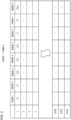
- Each row in FIG. 2 shows a set of data acquired by each sensor in one observation. This example shows that each sensor has acquired learning data for a total of 2000 observations, from the first observation to the 2000th observation.
- Each row in FIG. 2 shows a set of data acquired by each sensor through a total of 2000 observations. In FIG. 2 , only the learning data for the first observation is shown, and data values for the second and subsequent observations are omitted.
- the first principal component analysis unit 10 extracts appropriate subsets of data from the set of data in FIG. 2 and generates first and second principal components for each subset.
- the subsets may be extracted, for example, as follows.
- the method of extracting the subsets is arbitrary and may be determined based on computational complexity and accuracy.
- the first image data generation unit 20 assigns, from among two or more principal components generated by the first principal component analysis unit 10, the first principal component to the X coordinate on the XY plane and the second principal component to the Y coordinate on the XY plane.
- the first image data generation unit 20 renders a point on the XY plane with the first principal component as the X coordinate and the second principal component as the Y coordinate for each of the extracted subsets.
- the pixel value of each point shall be an arbitrary value indicating the presence or absence of a point, such as binary.
- the first image data generation unit 20 renders the first and second principal components of multiple subsets on the XY plane and thereby generates data for a single image. This allows a "virtual image" corresponding to the odor source to be rendered on the XY plane. In other words, the first image data generation unit 20 generates virtual image data corresponding to the odor source.
- FIGS. 3 show virtual images rendered from image data generated by the first image data generation unit 20.
- FIG. 3A is a virtual image when the odor source is flower A
- FIG. 3B is a virtual image when the odor source is perfume B
- FIG. 3C is a virtual image when the odor source is fabric softener C.
- odor data is image data according to the source of the odor
- the odor data is in a suitable form as input data for a neural network for image recognition.
- the learning unit 30 performs learning using a neural network using the image data generated by the first image data generation unit 20 as input data.
- the learning may be supervised learning where training data in which the input data is labeled with the odor source is used or may be unsupervised learning. Thereby, given odor data, the first image data generation unit 20 generates a trained model for inferring what the odor source is and the state of the system.
- the neural network used by the learning unit 30 may be any suitable neural network for image recognition, such as GoogLeNet, ResNet, or Yolo.
- the learning unit 30 performs learning using a neural network.
- the learning unit 30 may generate trained models using machine learning techniques other than neural networks.
- the data is suitable for a neural network for image recognition. That is, according to the present embodiment, a neural network suitable for image processing can be used to generate a trained model for inferring the state of a system from arbitrary learning data.
- the first principal component analysis unit 10 of the machine learning device 100 of FIG. 1 by performing principal component analysis on learning data, the first principal component analysis unit 10 of the machine learning device 100 of FIG. 1 generates three or more principal components of the learning data. Of the three or more principal components that have been generated, the third principal component is generated as a linear combination of odor components such that the variance of the data projected on axes orthogonal to the first principal component axis and the second principal component axis is maximized.
- the first image data generation unit 20 assigns, from among the three or more principal components generated by the first principal component analysis unit 10, the third principal component to a pixel value at each point on the XY plane in addition to assigning the first principal component to the X coordinate on the XY plane and the second principal component to the Y coordinate on the XY plane. This allows for the rendering of a virtual image on the XY plane that includes information on shading corresponding to the odor source (i.e., in grayscale). In other words, the first image data generation unit 20 generates virtual image data including information on the shading corresponding to the odor source.
- the first image data generation unit 20 may normalize the third principal component according to the resolution of the image. For example, the first image data generation unit 20 may normalize the data range of the third principal component to 0-255, 0-511, or 0-1023.
- the learning unit 30 performs learning using a neural network using shading image data generated by the first image data generation unit 20 as input data.
- image data input to a neural network for image recognition includes information on shading, it is possible to generate a trained model for inferring the state of a system with higher accuracy.
- the first principal component analysis unit 10 of the machine learning device 100 of FIG. 1 by performing principal component analysis on learning data, the first principal component analysis unit 10 of the machine learning device 100 of FIG. 1 generates four or more principal components of the learning data.
- the fourth principal component is generated as a linear combination of odor components such that the variance of the data projected on axes orthogonal to the first principal component axis, the second principal component axis, and the third principal component axis is maximized.
- the fifth principal component is generated as a linear combination of odor components such that the variance of the data projected on axes orthogonal to the first principal component axis, the second principal component axis, the third principal component axis, and the fourth principal component axis is maximized.
- the first image data generation unit 20 assigns, from among the four or more principal components generated by the first principal component analysis unit 10, each of the third principal component and the subsequent principal components to a pixel value in each point on the XY plane and a color component value of a color space at each point on the XY plane in addition to assigning the first principal component to the X coordinate on the XY plane and the second principal component to the Y coordinate on the XY plane.
- the first image data generation unit 20 may assign the third principal component to the R value of the RGB color space at each point on the XY plane, the fourth principal component to the G value of the RGB color space at each point on the XY plane, and the fifth principal component to the B value of the RGB color space at each point on the XY plane.
- This allows for the rendering of a virtual image on the XY plane that includes information on a color corresponding to the odor source (i.e., full color).
- the first image data generation unit 20 generates virtual image data including information on the color corresponding to the odor source.
- an RGB color space is used as an example for a color space in which the third and subsequent principal components are assigned.
- the color space in which the third and subsequent principal components are assigned is not limited to this and may be any color space such as CMYK or HSL.
- the (N-2)th and subsequent principal components may be assigned to respective color components in the color space.
- the first image data generation unit 20 may normalize each of the third and subsequent principal components according to the color resolution of the image. For example, the first image data generation unit 20 may normalize the data range of the third, fourth, and fifth principal components to 0-255, 0-511, or 0-1023.
- FIG. 4 schematically shows the first principal component, the second principal component, the third principal component, the fourth principal component, and the fifth principal component assigned to the XY plane by the first image data generation unit 20.
- the learning unit 30 performs learning using a neural network using a color image data generated by the first image data generation unit 20 as input data.
- image data input to a neural network for image recognition includes information on color, it is possible to generate a trained model for inferring the state of a system with even higher accuracy.
- FIG. 5 is a functional block diagram of a machine learning device 110 according to the fourth embodiment.
- the machine learning device 110 includes a first principal component analysis unit 10, a first image data generation unit 20, a learning unit 30, and a noise application unit 40.
- the machine learning device 110 includes a noise application unit 40 in addition to the configuration of the machine learning device 100 shown in FIG. 1 .
- the noise application unit 40 applies noise to points around a point on the XY plane where virtual image data has been generated by the first image data generation unit 20.
- a virtual image rendered by the method described above and corresponding to the odor source may be regarded as noise if, for example, the number of points corresponding to the pixels is not sufficiently large.
- noise by applying noise around the points corresponding to the pixels, a stochastic resonance phenomenon occurs, and the signal-to-noise ratio is improved.
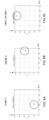
- FIGS. 6 show portions of virtual images rendered from image data generated by the first image data generation unit 20 of the machine learning device 110.
- FIG. 3A is a virtual image when the odor source is flower A
- FIG. 3B is a virtual image when the odor source is perfume B
- FIG. 3C is a virtual image when the odor source is fabric softener C.
- the noise application unit 40 adds noise to points (the area surrounded by a circle) around a point rendered on the XY plane by the first image data generation unit 20.
- the accuracy of a trained model can be further improved by applying noise to points around each point constituting a virtual image rendered on the XY plane, using the stochastic resonance phenomenon.
- a trained model for inferring the state of a system based on odor data so as to determine what the odor source is.
- a trained model may be generated from data other than this.
- a trained model may be generated that is for inferring or predicting weather conditions or air pollution based on meteorological data such as temperature, humidity, atmospheric pressure, atmospheric carbon dioxide concentration, and concentration of fine particulate matter in the air.
- the various processes of a machine learning device explained above can be realized as a device using hardware such as a CPU and memory.
- the processes can be implemented by firmware stored in a read-only memory (ROM), a flash memory, etc., or by software on a computer, etc.
- the firmware program or the software program may be made available on, for example, a computer readable recording medium.
- the programs may be transmitted to and/or received from a server via a wired or wireless network.
- the programs may be transmitted and/or received in the form of data transmission over terrestrial or satellite digital broadcast systems.
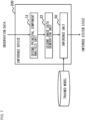
- FIG. 7 is a functional block diagram of an inference device 200 according to the fifth embodiment.
- the inference device 200 includes a second principal component analysis unit 12, a second image data generation unit 22, and an inference unit 50.
- Observation data from outside is input to the second principal component analysis unit 12.
- the second principal component analysis unit 12 By performing principal component analysis on this data, the second principal component analysis unit 12 generates two or more principal components of the observation data.
- the second image data generation unit 22 assigns, from among two or more principal components generated by the second principal component analysis unit 12, the first principal component to the X coordinate on the XY plane and the second principal component to the Y coordinate on the XY plane and thereby generates virtual image data for inference.
- the inference unit 50 estimates the state of the system by applying the trained model to the image data generated by the second image data generation unit 22.
- the trained model may be, for example, a trained model generated by the machine learning device 100 or the machine learning device 110 described above.
- the trained model may be stored in a memory unit provided inside the inference device 200 or may be downloaded from a database or the like outside the inference device 200.
- the state of a system can be estimated from observation data, using trained model.
- FIG. 8 is a functional block diagram of an inference system 300 according to the sixth embodiment.
- the inference system 300 includes a machine learning device 100 and an inference device 200.
- the machine learning device 100 is explained in the first embodiment and includes a first principal component analysis unit 10, a first image data generation unit 20, and a learning unit 30.
- the operation of the machine learning device 100 is as explained in the first embodiment.
- the inference device 200 is explained in the fifth embodiment and includes a second principal component analysis unit 12, a second image data generation unit 22, and an inference unit 50.
- the operation of the inference device 200 is as explained in the fifth embodiment.
- the first and second principal component analysis units and the first and second image data generation units may be realized by the same or separate hardware or may be implemented as the same or separate software.
- the inference system 300 may be formed using common principal component analysis units and common image data generation units.
- the state of a system can be estimated from observation data, using trained model generated by a neural network suitable for image processing.
- FIG. 9 is a flowchart explaining the procedure for generating a trained model according to the seventh embodiment.
- the first principal component is assigned to the X coordinate on the XY plane
- the second principal component is assigned to the Y coordinate on the XY plane so as to thereby generate virtual image data, using the first image data generation unit (S2).
- a trained model is generated by performing learning using a neural network using the image data generated in S2 as input data (S3).
- a neural network suitable for image processing can be used to generate a trained model for inferring the state of a system.
- the eighth embodiment relates to a computer program.
- This program includes computer-implemented modules including: performing principal component analysis on learning data so as to thereby generate two or more principal components of the learning data; generating virtual image data by assigning, from among the two or more generated principal components, the first principal component to the X coordinate of an XY plane and the second principal component to the Y coordinate of the XY plane; and generating a trained model by performing learning using a neural network using the generated image data as input data.
- a program for generating a trained model for inferring the state of a system using a neural network suitable for image processing can be implemented as software.
- the present invention is applicable to a machine learning device, an inference device, and a trained model.
- first principal component analysis unit 10 first principal component analysis unit, 12 second principal component analysis unit, 20 first image data generation unit, 22 second image data generation unit, 30 learning unit, 40 noise application unit, 50 inference unit, S1 performing principal component analysis on learning data, S2 generating virtual image data, S3 generating trained model by performing learning, 100 machine learning device, 200 inference device, 300 inference system
Landscapes
- Engineering & Computer Science (AREA)
- Theoretical Computer Science (AREA)
- Evolutionary Computation (AREA)
- Physics & Mathematics (AREA)
- Artificial Intelligence (AREA)
- Computer Vision & Pattern Recognition (AREA)
- General Physics & Mathematics (AREA)
- Data Mining & Analysis (AREA)
- Computing Systems (AREA)
- General Health & Medical Sciences (AREA)
- Software Systems (AREA)
- Health & Medical Sciences (AREA)
- General Engineering & Computer Science (AREA)
- Life Sciences & Earth Sciences (AREA)
- Databases & Information Systems (AREA)
- Multimedia (AREA)
- Medical Informatics (AREA)
- Bioinformatics & Cheminformatics (AREA)
- Bioinformatics & Computational Biology (AREA)
- Evolutionary Biology (AREA)
- Biomedical Technology (AREA)
- Biophysics (AREA)
- Computational Linguistics (AREA)
- Molecular Biology (AREA)
- Mathematical Physics (AREA)
- Image Analysis (AREA)
Abstract
Description
- The present invention relates to a machine learning device, an inference device, and a trained model.
- As neural networks for image recognition, GoogLeNet, ResNet, Yolo, etc., have been proposed. These technologies allow for the recognition of a specific object in an image and infer what kind of object it is, using a model learned by deep learning.
- Principal Component Analysis (PCA) is known as a method for discovering components with large variance in the data that greatly express the characteristics of an analysis target (hereinafter referred to as "principal components") from data in a large number of dimensions that are correlated. Using this method allows for a reduction in the number of data dimensions in machine learning.
- Further, a stochastic resonance phenomenon is known as a technique for extracting a hidden signal by applying noise to a weak signal buried in noise (e.g., Patent Literature 1).
- [Patent Literature 1]
Japanese Patent Application Publication No. H6-174689 - In general, a lot of man-hours, time, and high skills are required to construct and verify neural networks for the purpose of inferring the state of a system. Here, attention is paid to the fact that a neural network technology for image recognition has been established as mentioned above. If such neural networks for image recognition can be handled for data other than images, it is expected that the construction and verification of the neural networks will become easier. In order to achieve this, the problem is to convert data other than images into a format suitable for input to a neural network for image recognition.
- In this background, a purpose of the present invention is to provide a technique for generating a trained model for inferring the state of a system.
- A machine learning device according to one embodiment of the present invention includes: a first principal component analysis unit that performs principal component analysis on learning data so as to thereby generate two or more principal components of the learning data; a first image data generation unit that generates virtual image data by assigning, from among the two or more generated principal components, the first principal component to the X coordinate of an XY plane and the second principal component to the Y coordinate of the XY plane; and a learning unit that generates a trained model by performing learning using a neural network using the image data as input data.
- Another embodiment of the present invention relates to an inference device. This device includes: a second principal component analysis unit that performs principal component analysis on observation data so as to thereby generate two or more principal components of the observation data; a second image data generation unit that generates virtual image data by assigning, from among the two or more principal components, the first principal component to the X coordinate of an XY plane and the second principal component to the Y coordinate of the XY plane; and an inference unit that performs inference using a trained model using the image data as input data.
- Still another embodiment of the present invention relates to a trained model. This trained model is generated by: performing principal component analysis on learning data so as to thereby generate two or more principal components of the learning data; generating virtual image data by assigning, from among the two or more generated principal components, the first principal component to the X coordinate of an XY plane and the second principal component to the Y coordinate of the XY plane; and performing machine learning using the image data as input data.
- Optional combinations of the aforementioned constituting elements and implementations of the invention in the form of methods, apparatuses, systems, recording mediums, and computer programs may also be practiced as additional modes of the present invention.
- According to the present invention, it is possible to generate a trained model for inferring the state of a system.
-
-
FIG. 1 is a functional block diagram of a machine learning device according to the first embodiment; -
FIG. 2 is a diagram illustrating a set of data input to a first principal component analysis unit of the machine learning device ofFIG. 1 ; -
FIGS. 3 are virtual images rendered from image data generated by a first image data generation unit of the machine learning device ofFIG 1 , where -
FIG. 3A is a virtual image when the odor source is flower A,FIG. 3B is a virtual image when the odor source is perfume B, andFIG. 3C is a virtual image when the odor source is fabric softener C; -
FIG. 4 is a schematic diagram of a first principal component, a second principal component, a third principal component, a fourth principal component, and a fifth principal component assigned to the XY plane by the first image data generation unit of the machine learning device ofFIG. 1 ; -
FIG. 5 is a functional block diagram of a machine learning device according to the fourth embodiment; -
FIGS. 6 are portions of the virtual images rendered from the image data generated by the first image data generation unit of the machine learning device ofFIG 5 , where -
FIG. 6A is a virtual image when the odor source is flower A,FIG. 6B is a virtual image when the odor source is perfume B, andFIG. 6C is a virtual image when the odor source is fabric softener C; -
FIG. 7 is a functional block diagram of an inference device according to the fifth embodiment; -
FIG. 8 is a functional block diagram of an inference system according to the sixth embodiment; and -
FIG. 9 is a flowchart explaining the procedure for generating a trained model according to the seventh embodiment. - Hereinafter, the present invention will be described based on preferred embodiments with reference to each drawing. In the embodiments and variations, identical or like constituting elements and components are represented by identical symbols, and a duplicate description will be omitted. The dimensions of components in the drawings are enlarged or reduced as appropriate to facilitate understanding. Some of the elements in each figure may be omitted if they are not important for explanation. Terms including ordinal numbers (first, second, etc.) are used to explain various constituting elements, but the terms are used merely for the purpose of distinguishing one constituting element from the other constituting elements and shall not limit the constituting elements.
-
FIG. 1 is a functional block diagram of amachine learning device 100 according to the first embodiment. Themachine learning device 100 includes a first principalcomponent analysis unit 10, a first imagedata generation unit 20, and alearning unit 30. - Data from outside is input to the first principal
component analysis unit 10 as learning data. By performing principal component analysis on this data, the first principalcomponent analysis unit 10 generates two or more principal components of the learning data. The first imagedata generation unit 20 assigns, from among two or more principal components generated by the first principalcomponent analysis unit 10, the first principal component to the X coordinate on the XY plane and the second principal component to the Y coordinate on the XY plane and thereby generates virtual image data. Thelearning unit 30 generates a trained model by performing learning using a neural network while using the image data generated by the first imagedata generation unit 20 as input data. - The operation of the
machine learning device 100 for generating a trained model for inferring the state of a system will be specifically explained below, using odor data as an example of learning data to determine what the odor source is that exists in the space. - Odor data from eight odor sensors (
sensor 1 to sensor 8) arranged outside themachine learning device 100 is input to the first principalcomponent analysis unit 10. The odor sensors are assumed to have high sensitivity to the following odor components, respectively. - Sensor 1: methane
- Sensor 2: ethane
- Sensor 3: propane
- Sensor 4: acetic acid
- Sensor 5: ethanol
- Sensor 6: toluene
- Sensor 7: hydrogen sulfide
- Sensor 8: acetaldehyde
- In other words, it can be considered that the strength of each of the above eight odor components is input to the first principal
component analysis unit 10. The first principalcomponent analysis unit 10 performs principal component analysis on these and generates the first principal component and the second principal component of the odor data according to the source of the odor (flower A, perfume B, fabric softener C, mouthwash D, etc.). As is known, the first principal component is generated as a linear combination of odor components such that the variance of the data is maximized for each odor source. The second principal component is generated as a linear combination of odor components such that the variance of the data projected on axes orthogonal to the first principal component axis is maximized. -
FIG. 2 shows a set of odor data input to the first principalcomponent analysis unit 10 from the sensors 1-8. This figure shows a case where the odor source is flower A. Each row inFIG. 2 shows a set of data acquired by each sensor in one observation. This example shows that each sensor has acquired learning data for a total of 2000 observations, from the first observation to the 2000th observation. Each row inFIG. 2 shows a set of data acquired by each sensor through a total of 2000 observations. InFIG. 2 , only the learning data for the first observation is shown, and data values for the second and subsequent observations are omitted. - The first principal
component analysis unit 10 extracts appropriate subsets of data from the set of data inFIG. 2 and generates first and second principal components for each subset. The subsets may be extracted, for example, as follows. - (Example 1) When the subsets are extracted as follows, 200 types of first and second principal component sets generated from learning data for ten observations are generated.
- Subset 1: first learning data - tenth learning data
- Subset 2: eleventh learning data - twentieth learning data
- Subset 200: 1991st learning data - 2000th learning data
- (Example 2) When the subsets are extracted as follows, 40 types of first and second principal component sets generated from learning data for 50 observations are generated.
- Subset 1: first learning data - fiftieth learning data
- Subset 2: 51st learning data - 100th learning data
- Subset 40: 1951st learning data - 2000th learning data
- The method of extracting the subsets is arbitrary and may be determined based on computational complexity and accuracy.
- The first image
data generation unit 20 assigns, from among two or more principal components generated by the first principalcomponent analysis unit 10, the first principal component to the X coordinate on the XY plane and the second principal component to the Y coordinate on the XY plane. Next, the first imagedata generation unit 20 renders a point on the XY plane with the first principal component as the X coordinate and the second principal component as the Y coordinate for each of the extracted subsets. Here, the pixel value of each point shall be an arbitrary value indicating the presence or absence of a point, such as binary. The first imagedata generation unit 20 renders the first and second principal components of multiple subsets on the XY plane and thereby generates data for a single image. This allows a "virtual image" corresponding to the odor source to be rendered on the XY plane. In other words, the first imagedata generation unit 20 generates virtual image data corresponding to the odor source. -
FIGS. 3 show virtual images rendered from image data generated by the first imagedata generation unit 20.FIG. 3A is a virtual image when the odor source is flower A,FIG. 3B is a virtual image when the odor source is perfume B, andFIG. 3C is a virtual image when the odor source is fabric softener C. These images have been generated by plotting multiple points on the XY plane by performing a principal component analysis of the multiple subsets. - Since odor data is image data according to the source of the odor, the odor data is in a suitable form as input data for a neural network for image recognition.
- The
learning unit 30 performs learning using a neural network using the image data generated by the first imagedata generation unit 20 as input data. The learning may be supervised learning where training data in which the input data is labeled with the odor source is used or may be unsupervised learning. Thereby, given odor data, the first imagedata generation unit 20 generates a trained model for inferring what the odor source is and the state of the system. The neural network used by thelearning unit 30 may be any suitable neural network for image recognition, such as GoogLeNet, ResNet, or Yolo. - The above explains an example in which the
learning unit 30 performs learning using a neural network. However, this is non-limiting, and thelearning unit 30 may generate trained models using machine learning techniques other than neural networks. - As described, since the original odor data is converted into image data, the data is suitable for a neural network for image recognition. That is, according to the present embodiment, a neural network suitable for image processing can be used to generate a trained model for inferring the state of a system from arbitrary learning data.
- In one embodiment, by performing principal component analysis on learning data, the first principal
component analysis unit 10 of themachine learning device 100 ofFIG. 1 generates three or more principal components of the learning data. Of the three or more principal components that have been generated, the third principal component is generated as a linear combination of odor components such that the variance of the data projected on axes orthogonal to the first principal component axis and the second principal component axis is maximized. - The first image
data generation unit 20 assigns, from among the three or more principal components generated by the first principalcomponent analysis unit 10, the third principal component to a pixel value at each point on the XY plane in addition to assigning the first principal component to the X coordinate on the XY plane and the second principal component to the Y coordinate on the XY plane. This allows for the rendering of a virtual image on the XY plane that includes information on shading corresponding to the odor source (i.e., in grayscale). In other words, the first imagedata generation unit 20 generates virtual image data including information on the shading corresponding to the odor source. - Before generating the virtual image data, the first image
data generation unit 20 may normalize the third principal component according to the resolution of the image. For example, the first imagedata generation unit 20 may normalize the data range of the third principal component to 0-255, 0-511, or 0-1023. - The
learning unit 30 performs learning using a neural network using shading image data generated by the first imagedata generation unit 20 as input data. - According to the present embodiment, since image data input to a neural network for image recognition includes information on shading, it is possible to generate a trained model for inferring the state of a system with higher accuracy.
- In one embodiment, by performing principal component analysis on learning data, the first principal
component analysis unit 10 of themachine learning device 100 ofFIG. 1 generates four or more principal components of the learning data. Of the four or more principal components that have been generated, the fourth principal component is generated as a linear combination of odor components such that the variance of the data projected on axes orthogonal to the first principal component axis, the second principal component axis, and the third principal component axis is maximized. In the same manner, the fifth principal component is generated as a linear combination of odor components such that the variance of the data projected on axes orthogonal to the first principal component axis, the second principal component axis, the third principal component axis, and the fourth principal component axis is maximized. - The first image
data generation unit 20 assigns, from among the four or more principal components generated by the first principalcomponent analysis unit 10, each of the third principal component and the subsequent principal components to a pixel value in each point on the XY plane and a color component value of a color space at each point on the XY plane in addition to assigning the first principal component to the X coordinate on the XY plane and the second principal component to the Y coordinate on the XY plane. - For example, the first image
data generation unit 20 may assign the third principal component to the R value of the RGB color space at each point on the XY plane, the fourth principal component to the G value of the RGB color space at each point on the XY plane, and the fifth principal component to the B value of the RGB color space at each point on the XY plane. This allows for the rendering of a virtual image on the XY plane that includes information on a color corresponding to the odor source (i.e., full color). In other words, the first imagedata generation unit 20 generates virtual image data including information on the color corresponding to the odor source. - In the above, an RGB color space is used as an example for a color space in which the third and subsequent principal components are assigned. The color space in which the third and subsequent principal components are assigned is not limited to this and may be any color space such as CMYK or HSL. Further, when the first principal
component analysis unit 10 generates principal components up to the Nth principal component, the (N-2)th and subsequent principal components may be assigned to respective color components in the color space. - Before generating the virtual image data, the first image
data generation unit 20 may normalize each of the third and subsequent principal components according to the color resolution of the image. For example, the first imagedata generation unit 20 may normalize the data range of the third, fourth, and fifth principal components to 0-255, 0-511, or 0-1023. -
FIG. 4 schematically shows the first principal component, the second principal component, the third principal component, the fourth principal component, and the fifth principal component assigned to the XY plane by the first imagedata generation unit 20. - The
learning unit 30 performs learning using a neural network using a color image data generated by the first imagedata generation unit 20 as input data. - According to the present embodiment, since image data input to a neural network for image recognition includes information on color, it is possible to generate a trained model for inferring the state of a system with even higher accuracy.
-
FIG. 5 is a functional block diagram of amachine learning device 110 according to the fourth embodiment. Themachine learning device 110 includes a first principalcomponent analysis unit 10, a first imagedata generation unit 20, alearning unit 30, and anoise application unit 40. In other words, themachine learning device 110 includes anoise application unit 40 in addition to the configuration of themachine learning device 100 shown inFIG. 1 . - The
noise application unit 40 applies noise to points around a point on the XY plane where virtual image data has been generated by the first imagedata generation unit 20. - A virtual image rendered by the method described above and corresponding to the odor source may be regarded as noise if, for example, the number of points corresponding to the pixels is not sufficiently large. In this case, by applying noise around the points corresponding to the pixels, a stochastic resonance phenomenon occurs, and the signal-to-noise ratio is improved.
-
FIGS. 6 show portions of virtual images rendered from image data generated by the first imagedata generation unit 20 of themachine learning device 110.FIG. 3A is a virtual image when the odor source is flower A,FIG. 3B is a virtual image when the odor source is perfume B, andFIG. 3C is a virtual image when the odor source is fabric softener C. Thenoise application unit 40 adds noise to points (the area surrounded by a circle) around a point rendered on the XY plane by the first imagedata generation unit 20. - According to the present embodiment, the accuracy of a trained model can be further improved by applying noise to points around each point constituting a virtual image rendered on the XY plane, using the stochastic resonance phenomenon.
- The above explains an example of a trained model for inferring the state of a system based on odor data so as to determine what the odor source is. However, in an embodiment, a trained model may be generated from data other than this. For example, in an embodiment, a trained model may be generated that is for inferring or predicting weather conditions or air pollution based on meteorological data such as temperature, humidity, atmospheric pressure, atmospheric carbon dioxide concentration, and concentration of fine particulate matter in the air.
- The various processes of a machine learning device explained above can be realized as a device using hardware such as a CPU and memory. Alternatively, the processes can be implemented by firmware stored in a read-only memory (ROM), a flash memory, etc., or by software on a computer, etc. The firmware program or the software program may be made available on, for example, a computer readable recording medium. Alternatively, the programs may be transmitted to and/or received from a server via a wired or wireless network. Still alternatively, the programs may be transmitted and/or received in the form of data transmission over terrestrial or satellite digital broadcast systems.
-
FIG. 7 is a functional block diagram of aninference device 200 according to the fifth embodiment. Theinference device 200 includes a second principalcomponent analysis unit 12, a second imagedata generation unit 22, and aninference unit 50. - Observation data from outside is input to the second principal
component analysis unit 12. By performing principal component analysis on this data, the second principalcomponent analysis unit 12 generates two or more principal components of the observation data. The second imagedata generation unit 22 assigns, from among two or more principal components generated by the second principalcomponent analysis unit 12, the first principal component to the X coordinate on the XY plane and the second principal component to the Y coordinate on the XY plane and thereby generates virtual image data for inference. Theinference unit 50 estimates the state of the system by applying the trained model to the image data generated by the second imagedata generation unit 22. - The trained model may be, for example, a trained model generated by the
machine learning device 100 or themachine learning device 110 described above. The trained model may be stored in a memory unit provided inside theinference device 200 or may be downloaded from a database or the like outside theinference device 200. - According to the present embodiment, the state of a system can be estimated from observation data, using trained model.
-
FIG. 8 is a functional block diagram of aninference system 300 according to the sixth embodiment. Theinference system 300 includes amachine learning device 100 and aninference device 200. Themachine learning device 100 is explained in the first embodiment and includes a first principalcomponent analysis unit 10, a first imagedata generation unit 20, and alearning unit 30. The operation of themachine learning device 100 is as explained in the first embodiment. Theinference device 200 is explained in the fifth embodiment and includes a second principalcomponent analysis unit 12, a second imagedata generation unit 22, and aninference unit 50. The operation of theinference device 200 is as explained in the fifth embodiment. - The first and second principal component analysis units and the first and second image data generation units may be realized by the same or separate hardware or may be implemented as the same or separate software. In other words, the
inference system 300 may be formed using common principal component analysis units and common image data generation units. - According to the present embodiment, the state of a system can be estimated from observation data, using trained model generated by a neural network suitable for image processing.
-
FIG. 9 is a flowchart explaining the procedure for generating a trained model according to the seventh embodiment. - First, in the present method, by performing principal component analysis on learning data using the first principal component analysis unit, two or more principal components of the learning data are generated (S1).
- Next, in the present method, from among two or more principal components generated in S1, the first principal component is assigned to the X coordinate on the XY plane, and the second principal component is assigned to the Y coordinate on the XY plane so as to thereby generate virtual image data, using the first image data generation unit (S2).
- Next in the present method, using a learning unit, a trained model is generated by performing learning using a neural network using the image data generated in S2 as input data (S3).
- According to the present embodiment, a neural network suitable for image processing can be used to generate a trained model for inferring the state of a system.
- The eighth embodiment relates to a computer program. This program includes computer-implemented modules including: performing principal component analysis on learning data so as to thereby generate two or more principal components of the learning data; generating virtual image data by assigning, from among the two or more generated principal components, the first principal component to the X coordinate of an XY plane and the second principal component to the Y coordinate of the XY plane; and generating a trained model by performing learning using a neural network using the generated image data as input data.
- According to the present embodiment, a program for generating a trained model for inferring the state of a system using a neural network suitable for image processing can be implemented as software.
- Described above is an explanation of the present invention based on the embodiments. The embodiments are intended to be illustrative only, and it will be obvious to those skilled in the art that various modifications to constituting elements and processes could be developed and that such modifications are also within the scope of the present invention.
- The present invention is applicable to a machine learning device, an inference device, and a trained model.
- 10 first principal component analysis unit, 12 second principal component analysis unit, 20 first image data generation unit, 22 second image data generation unit, 30 learning unit, 40 noise application unit, 50 inference unit, S1 performing principal component analysis on learning data, S2 generating virtual image data, S3 generating trained model by performing learning, 100 machine learning device, 200 inference device, 300 inference system
Claims (6)
- A machine learning device comprising:a first principal component analysis unit that performs principal component analysis on learning data so as to thereby generate two or more principal components of the learning data;a first image data generation unit that generates virtual image data by assigning, from among the two or more principal components, the first principal component to the X coordinate of an XY plane and the second principal component to the Y coordinate of the XY plane; anda learning unit that generates a trained model by performing machine learning using the image data as input data.
- The machine learning device according to claim 1, whereinby performing principal component analysis on the learning data, the first principal component analysis unit generates three or more principal components of the learning data,the first image data generation unit assigns each of the third and subsequent principal components from among the three or more principal components to a pixel value at each point on the XY plane, andthe learning unit generates a trained model by performing machine learning using the image data as input data.
- The machine learning device according to claim 1, whereinby performing principal component analysis on the learning data, the first principal component analysis unit generates four or more principal components of the learning data,the first image data generation unit assigns each of the third and subsequent principal components from among the four or more principal components to pixel value at each point on the XY plane and a color component value of a color space at each point on the XY plane, andthe learning unit generates a trained model by performing machine learning using the image data as input data.
- The machine learning device according to any one of claims 1 through 3, comprising: a noise application unit that applies noise to points around a point on the XY plane on which the virtual image data is generated.
- An inference device comprising:a second principal component analysis unit that performs principal component analysis on observation data so as to thereby generate two or more principal components of the observation data;a second image data generation unit that generates virtual image data by assigning, from among the two or more principal components, the first principal component to the X coordinate of an XY plane and the second principal component to the Y coordinate of the XY plane; andan inference unit that performs inference using a trained model using the image data as input data.
- A trained model generated by:performing principal component analysis on learning data so as to thereby generate two or more principal components of the learning data;generating virtual image data by assigning, from among the two or more principal components, the first principal component to the X coordinate of an XY plane and the second principal component to the Y coordinate of the XY plane; andperforming machine learning using the image data as input data.
Applications Claiming Priority (2)
| Application Number | Priority Date | Filing Date | Title |
|---|---|---|---|
| JP2021155938A JP7793918B2 (en) | 2021-09-24 | 2021-09-24 | Machine learning device, inference device and program |
| PCT/JP2022/022868 WO2023047713A1 (en) | 2021-09-24 | 2022-06-07 | Machine learning device, inference device, and trained model |
Publications (3)
| Publication Number | Publication Date |
|---|---|
| EP4246387A1 true EP4246387A1 (en) | 2023-09-20 |
| EP4246387A4 EP4246387A4 (en) | 2024-09-25 |
| EP4246387B1 EP4246387B1 (en) | 2025-10-01 |
Family
ID=85720416
Family Applications (1)
| Application Number | Title | Priority Date | Filing Date |
|---|---|---|---|
| EP22872471.2A Active EP4246387B1 (en) | 2021-09-24 | 2022-06-07 | Machine learning device, inference device, and trained model |
Country Status (5)
| Country | Link |
|---|---|
| US (1) | US20230360369A1 (en) |
| EP (1) | EP4246387B1 (en) |
| JP (1) | JP7793918B2 (en) |
| CN (1) | CN116171458A (en) |
| WO (1) | WO2023047713A1 (en) |
Family Cites Families (7)
| Publication number | Priority date | Publication date | Assignee | Title |
|---|---|---|---|---|
| JP6870346B2 (en) * | 2017-01-30 | 2021-05-12 | 日本電気株式会社 | Data analysis systems, data analysis methods and programs |
| EP3627139B1 (en) * | 2017-05-17 | 2024-11-27 | Aroma Bit, Inc. | Method for preparing original data of odour image |
| KR101960869B1 (en) * | 2017-06-30 | 2019-03-21 | 주식회사 씨티아이랩 | Malware Detecting System and Method Based on Artificial Intelligence |
| JP6971112B2 (en) * | 2017-09-29 | 2021-11-24 | 株式会社Screenホールディングス | Teacher data creation support device, classification device and teacher data creation support method |
| CN112822982B (en) * | 2018-10-10 | 2023-09-15 | 株式会社岛津制作所 | Image production device, image production method, and learning completed model production method |
| JP7075056B2 (en) * | 2018-12-27 | 2022-05-25 | オムロン株式会社 | Image judgment device, image judgment method and image judgment program |
| JP7298825B2 (en) * | 2019-12-24 | 2023-06-27 | 株式会社 東京ウエルズ | Learning support device, learning device, learning support method, and learning support program |
-
2021
- 2021-09-24 JP JP2021155938A patent/JP7793918B2/en active Active
-
2022
- 2022-06-07 CN CN202280004000.1A patent/CN116171458A/en active Pending
- 2022-06-07 EP EP22872471.2A patent/EP4246387B1/en active Active
- 2022-06-07 WO PCT/JP2022/022868 patent/WO2023047713A1/en not_active Ceased
-
2023
- 2023-06-16 US US18/336,080 patent/US20230360369A1/en active Pending
Also Published As
| Publication number | Publication date |
|---|---|
| WO2023047713A1 (en) | 2023-03-30 |
| EP4246387B1 (en) | 2025-10-01 |
| JP7793918B2 (en) | 2026-01-06 |
| CN116171458A (en) | 2023-05-26 |
| EP4246387A4 (en) | 2024-09-25 |
| JP2023047041A (en) | 2023-04-05 |
| US20230360369A1 (en) | 2023-11-09 |
Similar Documents
| Publication | Publication Date | Title |
|---|---|---|
| CN108985361B (en) | Malicious traffic detection implementation method and device based on deep learning | |
| US10650236B2 (en) | Road detecting method and apparatus | |
| CN111615702B (en) | A method, device and equipment for extracting structured data from images | |
| CN107330731B (en) | Method and device for identifying click abnormity of advertisement space | |
| CN112953924A (en) | Network abnormal flow detection method, system, storage medium, terminal and application | |
| Cortés et al. | Accounting for multiple testing in the analysis of spatio-temporal environmental data | |
| CN111932544A (en) | Tampered image detection method and device and computer readable storage medium | |
| CN111126420B (en) | Method and device for establishing identification model | |
| JP2021189625A (en) | On-road obstacle detection device, on-road obstacle detection method, and on-road obstacle detection program | |
| CN109740553B (en) | Image semantic segmentation data screening method and system based on recognition | |
| JP7056345B2 (en) | Data analysis systems, methods, and programs | |
| CN108229274A (en) | Multilayer neural network model training, the method and apparatus of roadway characteristic identification | |
| US20230101250A1 (en) | Method for generating a graph structure for training a graph neural network | |
| CN110414523A (en) | A kind of identity card recognition method, device, equipment and storage medium | |
| Hashemi et al. | Runtime monitoring for out-of-distribution detection in object detection neural networks | |
| CN110633718B (en) | Method and device for determining a driving area in an environment image | |
| EP4246387B1 (en) | Machine learning device, inference device, and trained model | |
| CN114896594B (en) | Malicious code detection device and method based on image feature multi-attention learning | |
| CN114863240B (en) | Automated testing method, device, computer equipment and storage medium | |
| CN110581856A (en) | malicious code detection method and system | |
| CN113139590A (en) | Dimension reduction method and device for time series data, computer equipment and storage medium | |
| US20240193435A1 (en) | Federated training for a neural network with reduced communication requirement | |
| CN112232380A (en) | Neural network robustness detection method and device | |
| CN116597455B (en) | Method, device, equipment and medium for augmenting magnetic code data in bills | |
| CN110633598B (en) | Method and device for determining a driving area in an environment image |
Legal Events
| Date | Code | Title | Description |
|---|---|---|---|
| STAA | Information on the status of an ep patent application or granted ep patent |
Free format text: STATUS: THE INTERNATIONAL PUBLICATION HAS BEEN MADE |
|
| PUAI | Public reference made under article 153(3) epc to a published international application that has entered the european phase |
Free format text: ORIGINAL CODE: 0009012 |
|
| STAA | Information on the status of an ep patent application or granted ep patent |
Free format text: STATUS: REQUEST FOR EXAMINATION WAS MADE |
|
| 17P | Request for examination filed |
Effective date: 20230616 |
|
| AK | Designated contracting states |
Kind code of ref document: A1 Designated state(s): AL AT BE BG CH CY CZ DE DK EE ES FI FR GB GR HR HU IE IS IT LI LT LU LV MC MK MT NL NO PL PT RO RS SE SI SK SM TR |
|
| RIC1 | Information provided on ipc code assigned before grant |
Ipc: G06V 10/82 20220101ALI20240603BHEP Ipc: G06N 3/08 20230101ALI20240603BHEP Ipc: G06F 18/214 20230101ALI20240603BHEP Ipc: G06F 18/2135 20230101ALI20240603BHEP Ipc: G06T 7/00 20170101ALI20240603BHEP Ipc: G06N 20/00 20190101AFI20240603BHEP |
|
| A4 | Supplementary search report drawn up and despatched |
Effective date: 20240828 |
|
| RIC1 | Information provided on ipc code assigned before grant |
Ipc: G06V 10/82 20220101ALI20240822BHEP Ipc: G06N 3/08 20230101ALI20240822BHEP Ipc: G06F 18/214 20230101ALI20240822BHEP Ipc: G06F 18/2135 20230101ALI20240822BHEP Ipc: G06T 7/00 20170101ALI20240822BHEP Ipc: G06N 20/00 20190101AFI20240822BHEP |
|
| DAV | Request for validation of the european patent (deleted) | ||
| DAX | Request for extension of the european patent (deleted) | ||
| GRAP | Despatch of communication of intention to grant a patent |
Free format text: ORIGINAL CODE: EPIDOSNIGR1 |
|
| STAA | Information on the status of an ep patent application or granted ep patent |
Free format text: STATUS: GRANT OF PATENT IS INTENDED |
|
| RIC1 | Information provided on ipc code assigned before grant |
Ipc: G06V 10/82 20220101ALI20250415BHEP Ipc: G06N 3/08 20230101ALI20250415BHEP Ipc: G06F 18/214 20230101ALI20250415BHEP Ipc: G06F 18/2135 20230101ALI20250415BHEP Ipc: G06T 7/00 20170101ALI20250415BHEP Ipc: G06N 20/00 20190101AFI20250415BHEP |
|
| INTG | Intention to grant announced |
Effective date: 20250507 |
|
| RIN1 | Information on inventor provided before grant (corrected) |
Inventor name: OKUSHIRO, HIDETAKA |
|
| GRAS | Grant fee paid |
Free format text: ORIGINAL CODE: EPIDOSNIGR3 |
|
| GRAA | (expected) grant |
Free format text: ORIGINAL CODE: 0009210 |
|
| STAA | Information on the status of an ep patent application or granted ep patent |
Free format text: STATUS: THE PATENT HAS BEEN GRANTED |
|
| AK | Designated contracting states |
Kind code of ref document: B1 Designated state(s): AL AT BE BG CH CY CZ DE DK EE ES FI FR GB GR HR HU IE IS IT LI LT LU LV MC MK MT NL NO PL PT RO RS SE SI SK SM TR |
|
| RAP3 | Party data changed (applicant data changed or rights of an application transferred) |
Owner name: JVCKENWOOD CORPORATION |
|
| REG | Reference to a national code |
Ref country code: GB Ref legal event code: FG4D Ref country code: CH Ref legal event code: F10 Free format text: ST27 STATUS EVENT CODE: U-0-0-F10-F00 (AS PROVIDED BY THE NATIONAL OFFICE) Effective date: 20251001 |
|
| REG | Reference to a national code |
Ref country code: DE Ref legal event code: R096 Ref document number: 602022022500 Country of ref document: DE |
|
| REG | Reference to a national code |
Ref country code: IE Ref legal event code: FG4D |
|
| REG | Reference to a national code |
Ref country code: NL Ref legal event code: MP Effective date: 20251001 |
|
| REG | Reference to a national code |
Ref country code: AT Ref legal event code: MK05 Ref document number: 1843257 Country of ref document: AT Kind code of ref document: T Effective date: 20251001 |
|
| PG25 | Lapsed in a contracting state [announced via postgrant information from national office to epo] |
Ref country code: NL Free format text: LAPSE BECAUSE OF FAILURE TO SUBMIT A TRANSLATION OF THE DESCRIPTION OR TO PAY THE FEE WITHIN THE PRESCRIBED TIME-LIMIT Effective date: 20251001 |
|
| PG25 | Lapsed in a contracting state [announced via postgrant information from national office to epo] |
Ref country code: ES Free format text: LAPSE BECAUSE OF FAILURE TO SUBMIT A TRANSLATION OF THE DESCRIPTION OR TO PAY THE FEE WITHIN THE PRESCRIBED TIME-LIMIT Effective date: 20251001 |
|
| REG | Reference to a national code |
Ref country code: LT Ref legal event code: MG9D |
|
| PG25 | Lapsed in a contracting state [announced via postgrant information from national office to epo] |
Ref country code: NO Free format text: LAPSE BECAUSE OF FAILURE TO SUBMIT A TRANSLATION OF THE DESCRIPTION OR TO PAY THE FEE WITHIN THE PRESCRIBED TIME-LIMIT Effective date: 20260101 |
|
| PG25 | Lapsed in a contracting state [announced via postgrant information from national office to epo] |
Ref country code: AT Free format text: LAPSE BECAUSE OF FAILURE TO SUBMIT A TRANSLATION OF THE DESCRIPTION OR TO PAY THE FEE WITHIN THE PRESCRIBED TIME-LIMIT Effective date: 20251001 Ref country code: FI Free format text: LAPSE BECAUSE OF FAILURE TO SUBMIT A TRANSLATION OF THE DESCRIPTION OR TO PAY THE FEE WITHIN THE PRESCRIBED TIME-LIMIT Effective date: 20251001 Ref country code: HR Free format text: LAPSE BECAUSE OF FAILURE TO SUBMIT A TRANSLATION OF THE DESCRIPTION OR TO PAY THE FEE WITHIN THE PRESCRIBED TIME-LIMIT Effective date: 20251001 |
|
| PG25 | Lapsed in a contracting state [announced via postgrant information from national office to epo] |
Ref country code: RS Free format text: LAPSE BECAUSE OF FAILURE TO SUBMIT A TRANSLATION OF THE DESCRIPTION OR TO PAY THE FEE WITHIN THE PRESCRIBED TIME-LIMIT Effective date: 20260101 |
|
| PG25 | Lapsed in a contracting state [announced via postgrant information from national office to epo] |
Ref country code: IS Free format text: LAPSE BECAUSE OF FAILURE TO SUBMIT A TRANSLATION OF THE DESCRIPTION OR TO PAY THE FEE WITHIN THE PRESCRIBED TIME-LIMIT Effective date: 20260201 |
|
| PG25 | Lapsed in a contracting state [announced via postgrant information from national office to epo] |
Ref country code: CZ Free format text: LAPSE BECAUSE OF FAILURE TO SUBMIT A TRANSLATION OF THE DESCRIPTION OR TO PAY THE FEE WITHIN THE PRESCRIBED TIME-LIMIT Effective date: 20251001 Ref country code: PT Free format text: LAPSE BECAUSE OF FAILURE TO SUBMIT A TRANSLATION OF THE DESCRIPTION OR TO PAY THE FEE WITHIN THE PRESCRIBED TIME-LIMIT Effective date: 20260202 |
|
| PG25 | Lapsed in a contracting state [announced via postgrant information from national office to epo] |
Ref country code: PL Free format text: LAPSE BECAUSE OF FAILURE TO SUBMIT A TRANSLATION OF THE DESCRIPTION OR TO PAY THE FEE WITHIN THE PRESCRIBED TIME-LIMIT Effective date: 20251001 |
|
| PG25 | Lapsed in a contracting state [announced via postgrant information from national office to epo] |
Ref country code: LV Free format text: LAPSE BECAUSE OF FAILURE TO SUBMIT A TRANSLATION OF THE DESCRIPTION OR TO PAY THE FEE WITHIN THE PRESCRIBED TIME-LIMIT Effective date: 20251001 |
|
| PG25 | Lapsed in a contracting state [announced via postgrant information from national office to epo] |
Ref country code: BG Free format text: LAPSE BECAUSE OF FAILURE TO SUBMIT A TRANSLATION OF THE DESCRIPTION OR TO PAY THE FEE WITHIN THE PRESCRIBED TIME-LIMIT Effective date: 20251001 |