EP4246383A1 - Compilation technique for surface code architecture - Google Patents
Compilation technique for surface code architecture Download PDFInfo
- Publication number
- EP4246383A1 EP4246383A1 EP22305306.7A EP22305306A EP4246383A1 EP 4246383 A1 EP4246383 A1 EP 4246383A1 EP 22305306 A EP22305306 A EP 22305306A EP 4246383 A1 EP4246383 A1 EP 4246383A1
- Authority
- EP
- European Patent Office
- Prior art keywords
- tree
- vertices
- graph
- subsets
- dag
- Prior art date
- Legal status (The legal status is an assumption and is not a legal conclusion. Google has not performed a legal analysis and makes no representation as to the accuracy of the status listed.)
- Withdrawn
Links
Images

Classifications
-
- G—PHYSICS
- G06—COMPUTING OR CALCULATING; COUNTING
- G06N—COMPUTING ARRANGEMENTS BASED ON SPECIFIC COMPUTATIONAL MODELS
- G06N10/00—Quantum computing, i.e. information processing based on quantum-mechanical phenomena
- G06N10/20—Models of quantum computing, e.g. quantum circuits or universal quantum computers
-
- G—PHYSICS
- G06—COMPUTING OR CALCULATING; COUNTING
- G06N—COMPUTING ARRANGEMENTS BASED ON SPECIFIC COMPUTATIONAL MODELS
- G06N10/00—Quantum computing, i.e. information processing based on quantum-mechanical phenomena
- G06N10/70—Quantum error correction, detection or prevention, e.g. surface codes or magic state distillation
Definitions
- This disclosure ensures an optimization of implementing of the quantum circuit for said surface code architecture. More generally, the present disclosure aims at reducing calculation time when implementing an algorithm.
- a method for implementing a graph (G) comprising a plurality of vertices (V) and links (E) between the vertices, a set (R) being a collection of subsets (Ri) of said a given number of vertices (Rik), the method comprising: in said set (R), selecting subsets (Ri, Rj), called pre-selected subsets, such that a tree (Ti, Tj) is associated respectively to said subset (Ri, Rj), said associated trees (Ti, Tj) being pairwise disjoint and constructing (301) each tree (Ti); associating a weight to each said tree (Ti); choosing the subset for which the tree (Ti) has the highest weight.
- the claimed method ensures reducing calculation time.
- the graph is a tree.
- the method comprises constructing a graph, whose vertices are said trees, two vertices of said graph being connected only if they intersect.
- the method comprises finding a disconnected set of vertices with the largest possible weight.
- finding a disconnected set of vertices with the largest possible weight consists in finding a solution to maximal weighted independent set.
- the invention is also about a method for implementing a quantum circuit comprising a plurality of qubits as well as operators executed on said qubits, said operators comprising a sequence of ⁇ 4 Pauli rotation gates, a surface code layout comprising an arrangement of said quantum circuit on a quantum chip, the arrangement comprising at least a tree with a plurality of subtrees, at each rotation gate corresponding a subtree of the tree, the method comprising:
- the method comprises stopping generating the DAG when the front layer is empty.
- the method comprises removing the selected subset of rotations from the DAG.
- the present method referenced 300, as will be detailed later, is shown here applied to implement a quantum circuit Qci with as few time steps as possible, i.e., with a high speed process, the number of steps that are required to implement the circuit QCi giving the measure of the process speed.
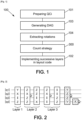
- the method 100 comprises a step 101 that prepares the quantum circuit QCi as a sequence of Clifford and T gates (or Pauli ⁇ /4 rotation).
- a resulting circuit is of the form of a sequence of a plurality of T gates followed by some Pauli measurements of the qubits.
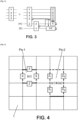
- the rotations 2 are indicated by layers 1, 2 and 3 while the Pauli joint measurements are indicated by the hatched area.
- the method also comprises a step 102 of implementing the T gates, this step being the costliest step of the method.
- the step 102 consists in performing a series of joint measurements JM, consuming one magic state, or ancilla, as seen from on figure 3 , wherein the arrows show that the result of the measurement is used to process a result of the next measurement and the dotted area is a regular Pauli gate.
- the method can also comprise a step of distillation to produce said magic state.
- a magic state reads:
- m ⁇
- the method 100 further comprises encoding the surface code thanks to a plurality of patches Pa.
- a board 1 is partitioned into a grid of tiles.
- the tiles are used to host said patches, each of which tiles being a representation of a qubit.
- the patches can be either one-qubit or two-qubit patches.
- a one-qubit patch Pa-1 represents one qubit and is delimited by four edges, each edge being coupled to a Pauli operator.
- the two dashed edges stand for X operators and the two solid edges stand for Z operators.
- a two-qubit patch Pa-2 represents two qubits.
- the two-qubit patch comprises six edges.
- the three dashed lines stand for X operators and the three solid edges stand for Z operators.
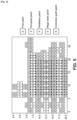
- a resulting layout comprises occupied patches 2, free patches 3, distillation patches 4, magic state patches 5 and correction qubit patches 6.
- Such layout is known from document " A game of surface codes” (2019) by D. Litinsky .
- the joint measurement is implemented by initializing an ancilla patch 5 on free tiles 3 that hits every operator involved in the measurement.
- the Pauli operators that are involved are referenced to as IO (for involved operators) and the ancilla patch is referenced to as AP.
- the joint measurement costs one time step.
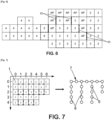
- the method 100 comprises of converting the free tiles layout into a tree 7.
- the tree 7 comprises rods 8 corresponding to the free tiles 3 and nodes 9 corresponding to the information of which gate can be reached.
- the tree 7 is composed of a plurality of subtrees, some intersecting and some not intersecting. Two subtrees of the graph that do not intersect correspond to two ancillas not intersecting.
- ⁇ j ⁇ k, ⁇ ( R ij ) ⁇ ⁇ ( R ik ) 0 ⁇ .
- the method 100 comprises a process referred to as count strategy 300.
- the count strategy consists in selecting the decomposition D that maximizes the number of qubits involved to increase parallelizing of the computation.
- the method 100 comprises a preprocess 103 of generating iteratively a directed acyclic graph (DAG) of the quantum circuit Qci.
- DAG directed acyclic graph
- Figure 8 shows an example of a quantum circuit QCi with the rotations to implement as a DAG.
- layer 1 comprises T gates 1, 2 and 3 while layer 2 comprises T gates 4 and 5.
- a link (arrow) symbolizes that rotations 1 and 5 cannot commute, as well as rotations 2 and 3 with 4.
- a front layer FL of a given iteration of the DAG can be expressed as the set of rotations that can be effectively implemented in said given step. And, at each iteration, the effectively implemented rotations are removed from the DAG.
- the front layer FL comprises rotations 1, 2, and 3.
- rotations among 1, 2 and 3 are to be selected by a heuristic, as will be detailed later in relation with processes 200 and 300. If, firstly, rotations 2 and 3 are implemented in one time step, then the front layer comprises only rotations, or nodes, 1 and 4. Then, rotations 1 and 4 can be implemented in one time step, resulting in the remaining front layer FL of figure that comprises node 5 only.
- the method 100 also comprises selecting (step 104) in the front layer FL of the DAG a subset of the set of rotations in which the subtrees are arranged not to intersect.
- selecting can iteratively call the processes 200, 300 on the front layer of the DAG.
- the rotations chosen by the processes 200, 300 are then removed from the DAG, and the method stops when the DAG is empty.
- the method 100 ensures minimizing the number of time steps that are needed to implement one layer or commuting rotations, by selecting the largest possible group of commuting rotations to implement or the largest possible group of qubits involved.
- the step 101 of preparing the quantum circuit QCi precedes generating the DAG (step 103) and extracting (step 104) the rotations that can be implemented, layer by layer, from the DAG as long as the DAG is not empty, as explained above. Then, the T gates are implemented (step 102).
- the count strategy method applies advantageously to the rotations of the front layer FL of the DAG, though the method 300 is not limited to this application.
- This collection is called count strategy solution.
- G is a tree.
- the count strategy method 300 comprises a first step 301 of constructing a unique minimal tree Ti of the graph G that contains the rotations Ri.
- a new graph H is constructed, whose vertices are the trees Ti.
- V(H) ⁇ T1,..., Tk ⁇ .
- a weight is associated to each of the vertices of the new graph H.
- is associated to the tree Ti.
- two trees Ti, Tj of the new graph H are connected only if Ti ⁇ Tj ⁇ ⁇ .
- H being an intersection graph of subtrees of a tree, it is a chordal graph.
- the method 300 comprises finding a disconnected set of vertices of H, i.e., a set of non intersecting subtrees, with the largest possible weight, that is, finding a solution to a maximal weighted independent set (MWIS).
- MWIS maximal weighted independent set
- the method 300 comprises a step 304 of applying Frank's algorithm as known from document " Some polynomial algorithms for certain graphs and hypergraphs", by A. Frank et al., to said MWIS problem.
- step 304 the result of step 304 is the count strategy solution.
- the method 300 is not limited to selecting the rotations from the front layer FL of the DAG. Indeed, the method 300 can apply to maximizing a number of nodes used in parallel in a calculating cluster, which ensures minimizing the calculation time.
Landscapes
- Engineering & Computer Science (AREA)
- General Physics & Mathematics (AREA)
- Theoretical Computer Science (AREA)
- Physics & Mathematics (AREA)
- Mathematical Analysis (AREA)
- Data Mining & Analysis (AREA)
- Evolutionary Computation (AREA)
- Condensed Matter Physics & Semiconductors (AREA)
- Computational Mathematics (AREA)
- Mathematical Optimization (AREA)
- Pure & Applied Mathematics (AREA)
- Computing Systems (AREA)
- General Engineering & Computer Science (AREA)
- Mathematical Physics (AREA)
- Software Systems (AREA)
- Artificial Intelligence (AREA)
- Design And Manufacture Of Integrated Circuits (AREA)
Abstract
-in said set (R), selecting subsets (Ri, Rj), called pre-selected subsets, such that a tree (Ti, Tj) is associated respectively to said subset (Ri, Rj), said associated trees (Ti, Tj) being pairwise disjoint and constructing (301) each tree (Ti);
- associating a weight to each said tree (Ti);
- choosing the subset for which the tree (Ti) has the highest weight.
Description
- Quantum computing has been developing recently as it gives promising hopes to solve problems that are classically intractable.
- One of the challenges that faces quantum computing is that it needs manipulating a large amount of qubits beyond their coherence time, thus requiring error corrections. In particular, to store and manipulate quantum information on large time scales, it is known to actively correct errors by combining physical qubits into logical qubits using a quantum error correcting code such as surface code architecture.
- This disclosure ensures an optimization of implementing of the quantum circuit for said surface code architecture. More generally, the present disclosure aims at reducing calculation time when implementing an algorithm.
- It is proposed a method for implementing a graph (G) comprising a plurality of vertices (V) and links (E) between the vertices, a set (R) being a collection of subsets (Ri) of said a given number of vertices (Rik), the method comprising: in said set (R), selecting subsets (Ri, Rj), called pre-selected subsets, such that a tree (Ti, Tj) is associated respectively to said subset (Ri, Rj), said associated trees (Ti, Tj) being pairwise disjoint and constructing (301) each tree (Ti); associating a weight to each said tree (Ti); choosing the subset for which the tree (Ti) has the highest weight.
- The claimed method ensures reducing calculation time.
- According to another aspect, the graph is a tree.
- According to another aspect, the method comprises constructing a graph, whose vertices are said trees, two vertices of said graph being connected only if they intersect.
- According to another aspect, the method comprises finding a disconnected set of vertices with the largest possible weight.
- According to another aspect, finding a disconnected set of vertices with the largest possible weight consists in finding a solution to maximal weighted independent set.
- The invention is also about a method for implementing a quantum circuit comprising a plurality of qubits as well as operators executed on said qubits, said operators comprising a sequence of

- generating iteratively a directed acyclic graph of said quantum circuit, a front layer of the DAG being a set of rotations that can be effectively implemented at each iteration,
- selecting in said front layer of the DAG a subset, called selected subset, of said set of rotations among subsets, called non intersecting subsets, in which the subtrees are arranged not to intersect by applying the method of implementing a graph as already described.
- According to another aspect, the method comprises stopping generating the DAG when the front layer is empty.
- According to another aspect, the method comprises removing the selected subset of rotations from the DAG.
- Other features, details and advantages will be shown in the following detailed description and on the figures, on which:
-
Fig. 1
[Fig. 1 ] is a view of a flowchart of a method according to an embodiment. -
Fig. 2
[Fig. 2 ] is a view of an example of a quantum circuit. -
Fig. 3
[Fig. 3 ] is a view of an example of a T gate implementation. -
Fig. 4
[Fig. 4 ] is a view of a representation of a one-qubit patch and a two-qubit patch. -
Fig. 5
[Fig. 5 ] is a view of a resulting layout. -
Fig. 6
[Fig. 6 ] is a view of an implementation of a joint measurement. -
Fig. 7
[Fig. 7 ] is a view of a conversion of free tiles layout offigure 5 into a tree. -
Fig. 8
[Fig. 8 ] is view of an example of a directed acyclic graph generated by the method offigure 1 . -
Fig. 9
[Fig. 9 ] is a flowchart of a count strategy method offigure 1 . - The present method, referenced 300, as will be detailed later, is shown here applied to implement a quantum circuit Qci with as few time steps as possible, i.e., with a high speed process, the number of steps that are required to implement the circuit QCi giving the measure of the process speed.
- As can be seen from
figure 1 , themethod 100 comprises astep 101 that prepares the quantum circuit QCi as a sequence of Clifford and T gates (or Pauli π/4 rotation). Preferably, given that the Clifford gates can commute to the end of the circuit, a resulting circuit is of the form of a sequence of a plurality of T gates followed by some Pauli measurements of the qubits. Infigure 2 , therotations 2 are indicated bylayers - The method also comprises a
step 102 of implementing the T gates, this step being the costliest step of the method. Thestep 102 consists in performing a series of joint measurements JM, consuming one magic state, or ancilla, as seen from onfigure 3 , wherein the arrows show that the result of the measurement is used to process a result of the next measurement and the dotted area is a regular Pauli gate. The method can also comprise a step of distillation to produce said magic state. As known, a magic state reads: |m〉 = |0〉 + e iπ/4 |1〉. - Details now are given about how to perform the joint measurements.
- To do so, the
method 100 further comprises encoding the surface code thanks to a plurality of patches Pa. As seen fromfigures 4 and5 , aboard 1 is partitioned into a grid of tiles. The tiles are used to host said patches, each of which tiles being a representation of a qubit. The patches can be either one-qubit or two-qubit patches. - A one-qubit patch Pa-1 represents one qubit and is delimited by four edges, each edge being coupled to a Pauli operator. On
figure 4 , the two dashed edges stand for X operators and the two solid edges stand for Z operators. A two-qubit patch Pa-2 represents two qubits. The two-qubit patch comprises six edges. Onfigure 4 , the three dashed lines stand for X operators and the three solid edges stand for Z operators. - As shown in
figure 5 , a resulting layout comprises occupiedpatches 2,free patches 3,distillation patches 4,magic state patches 5 andcorrection qubit patches 6. Such layout is known from document "A game of surface codes" (2019) by D. Litinsky. - As can be seen from
figure 6 , the joint measurement is implemented by initializing anancilla patch 5 onfree tiles 3 that hits every operator involved in the measurement. On this figure, the Pauli operators that are involved are referenced to as IO (for involved operators) and the ancilla patch is referenced to as AP. Regarding the process speed measure, the joint measurement costs one time step. - The
method 100 comprises of converting the free tiles layout into a tree 7. As can be seen fromfigure 7 , the tree 7 comprises rods 8 corresponding to thefree tiles 3 and nodes 9 corresponding to the information of which gate can be reached. The tree 7 is composed of a plurality of subtrees, some intersecting and some not intersecting. Two subtrees of the graph that do not intersect correspond to two ancillas not intersecting. - The
method 100 aims at finding the not intersecting subtrees. Said differently, a subtree spanning all vertices of rotation Ri being noted τ(Rj ), a valid decomposition D reads: D = {τ(R i1),...,τ(Rim )|∀j ≠ k,τ(Rij ) ∩ τ(Rik ) = 0̸}. - To construct the valid decomposition D, the
method 100 comprises a process referred to ascount strategy 300. - The count strategy consists in selecting the decomposition D that maximizes the number of qubits involved to increase parallelizing of the computation.
- The
method 100 comprises apreprocess 103 of generating iteratively a directed acyclic graph (DAG) of the quantum circuit Qci. -
Figure 8 shows an example of a quantum circuit QCi with the rotations to implement as a DAG. As can be seen,layer 1 comprisesT gates layer 2 comprisesT gates rotations rotations - A front layer FL of a given iteration of the DAG can be expressed as the set of rotations that can be effectively implemented in said given step. And, at each iteration, the effectively implemented rotations are removed from the DAG.
- As can be seen from
figure 8 , the front layer FL, comprisesrotations - From the front layer FL, rotations among 1, 2 and 3 are to be selected by a heuristic, as will be detailed later in relation with
processes 200 and 300. If, firstly,rotations rotations node 5 only. - The
method 100 also comprises selecting (step 104) in the front layer FL of the DAG a subset of the set of rotations in which the subtrees are arranged not to intersect. In other words, one can iteratively call theprocesses 200, 300 on the front layer of the DAG. The rotations chosen by theprocesses 200, 300 are then removed from the DAG, and the method stops when the DAG is empty. - Thus, the
method 100 ensures minimizing the number of time steps that are needed to implement one layer or commuting rotations, by selecting the largest possible group of commuting rotations to implement or the largest possible group of qubits involved. - Chronologically speaking, the
step 101 of preparing the quantum circuit QCi precedes generating the DAG (step 103) and extracting (step 104) the rotations that can be implemented, layer by layer, from the DAG as long as the DAG is not empty, as explained above. Then, the T gates are implemented (step 102). - We now detail the
count strategy method 300. - The graph, noted G, is a set of points V called vertices or nodes, linked by a set E of edges, such that G=(V, E).
- A set R comprises a collection of subsets Ri of vertices of the graph G, R = {R1, ..., Rk}, Ri ⊆ V. The count strategy method applies advantageously to the rotations of the front layer FL of the DAG, though the
method 300 is not limited to this application. - The count strategy method comprises visiting the graph G so as to obtain a collection of m subsets Ri1 , ..., Rim ∈ R such that for all rotations Ri in this collection, there exists an associated tree Ti connecting the vertices of Ri such that these trees are pairwise disjoints vi,j, Ti ∩ Tj = ∅ and such that the quantity | Ri1| + | Ri2| +...+ | Rim| is maximal. This collection is called count strategy solution.
- Preferably, G is a tree.
- The
count strategy method 300 comprises afirst step 301 of constructing a unique minimal tree Ti of the graph G that contains the rotations Ri. - Then, in a
second step 302, a new graph H is constructed, whose vertices are the trees Ti. In other words, V(H)={T1,..., Tk}. A weight is associated to each of the vertices of the new graph H. In other words, a weight |Ri| is associated to the tree Ti. - In another
step 303, two trees Ti, Tj of the new graph H are connected only if Ti ∩ Tj ≠ ∅. H being an intersection graph of subtrees of a tree, it is a chordal graph. - Then, the
method 300 comprises finding a disconnected set of vertices of H, i.e., a set of non intersecting subtrees, with the largest possible weight, that is, finding a solution to a maximal weighted independent set (MWIS). - To do so, since H is chordal, the
method 300 comprises astep 304 of applying Frank's algorithm as known from document "Some polynomial algorithms for certain graphs and hypergraphs", by A. Frank et al., to said MWIS problem. Hence, the result ofstep 304 is the count strategy solution. - The
method 300 is not limited to selecting the rotations from the front layer FL of the DAG. Indeed, themethod 300 can apply to maximizing a number of nodes used in parallel in a calculating cluster, which ensures minimizing the calculation time.
Claims (8)
- Method for implementing a graph (G) comprising a plurality of vertices (V) and links (E) between the vertices, a set (R) being a collection of subsets (Ri) of said a given number of vertices (Rik)comprising:- in said set (R), selecting subsets (Ri, Rj), called pre-selected subsets, such that a tree (Ti, Tj) is associated respectively to said subset (Ri, Rj), said associated trees (Ti, Tj) being pairwise disjoint and constructing (301) each tree (Ti);- associating a weight to each said tree (Ti);- choosing the subset for which the tree (Ti) has the highest weight.
- Method according to claim 1, wherein the graph is a tree.
- Method according to claim 1 or 2, comprising constructing a graph (H), whose vertices are said trees (Ti), two vertices (Ti, Tj) of said graph (H) being connected only if they intersect.
- Method according to the preceding claim, comprising finding a disconnected set of vertices with the largest possible weight.
- Method according to the preceding claim, wherein finding a disconnected set of vertices with the largest possible weight consists in finding a solution to maximal weighted independent set (MWIS).
- Method for implementing a quantum circuit comprising a plurality of qubits as well as operators executed on said qubits, said operators comprising a sequence of
 - generating iteratively a directed acyclic graph of said quantum circuit, a front layer of the DAG being a set of rotations that can be effectively implemented at each iteration,- selecting in said front layer of the DAG a subset, called selected subset, of said set of rotations among subsets, called non intersecting subsets, in which the subtrees are arranged not to intersect by applying the method of implementing a graph according to claims 1 to 5.
 - Method according to claim 6, comprising: removing the selected subset of rotations from the DAG.
- Method according to claim 6 or 7, comprising: stopping generating the DAG when the front layer is empty.
Priority Applications (2)
| Application Number | Priority Date | Filing Date | Title |
|---|---|---|---|
| EP22305306.7A EP4246383A1 (en) | 2022-03-16 | 2022-03-16 | Compilation technique for surface code architecture |
| US18/121,844 US20230297868A1 (en) | 2022-03-16 | 2023-03-15 | Compilation technique for surface code architecture |
Applications Claiming Priority (1)
| Application Number | Priority Date | Filing Date | Title |
|---|---|---|---|
| EP22305306.7A EP4246383A1 (en) | 2022-03-16 | 2022-03-16 | Compilation technique for surface code architecture |
Publications (1)
| Publication Number | Publication Date |
|---|---|
| EP4246383A1 true EP4246383A1 (en) | 2023-09-20 |
Family
ID=81579776
Family Applications (1)
| Application Number | Title | Priority Date | Filing Date |
|---|---|---|---|
| EP22305306.7A Withdrawn EP4246383A1 (en) | 2022-03-16 | 2022-03-16 | Compilation technique for surface code architecture |
Country Status (2)
| Country | Link |
|---|---|
| US (1) | US20230297868A1 (en) |
| EP (1) | EP4246383A1 (en) |
-
2022
- 2022-03-16 EP EP22305306.7A patent/EP4246383A1/en not_active Withdrawn
-
2023
- 2023-03-15 US US18/121,844 patent/US20230297868A1/en active Pending
Non-Patent Citations (7)
| Title |
|---|
| A. FRANK, SOME POLYNOMIAL ALGORITHMS FOR CERTAIN GRAPHS AND HYPERGRAPHS |
| AUSTIN G. FOWLER ET AL: "Surface codes: Towards practical large-scale quantum computation", PHYSICAL REVIEW A (ATOMIC, MOLECULAR, AND OPTICAL PHYSICS), vol. 86, no. 3, 26 October 2012 (2012-10-26), USA, XP055332246, ISSN: 1050-2947, DOI: 10.1103/PhysRevA.86.032324 * |
| BRUGIERE TIMOTHEE GOUBAULT DE ET AL: "Reducing the Depth of Linear Reversible Quantum Circuits", IEEE TRANSACTIONS ON QUANTUM ENGINEERING, IEEE, vol. 2, 7 July 2021 (2021-07-07), pages 1 - 22, XP011874279, [retrieved on 20210825], DOI: 10.1109/TQE.2021.3091648 * |
| DANIEL LITINSKI: "A Game of Surface Codes: Large-Scale Quantum Computing with Lattice Surgery", ARXIV.ORG, CORNELL UNIVERSITY LIBRARY, 201 OLIN LIBRARY CORNELL UNIVERSITY ITHACA, NY 14853, 8 August 2018 (2018-08-08), XP081255132 * |
| FANG ZHANG ET AL: "Optimizing T gates in Clifford+T circuit as pi/4 rotations around Paulis", ARXIV.ORG, CORNELL UNIVERSITY LIBRARY, 201 OLIN LIBRARY CORNELL UNIVERSITY ITHACA, NY 14853, 29 March 2019 (2019-03-29), XP081159697 * |
| VLAD GHEORGHIU ET AL: "A quasi-polynomial time heuristic algorithm for synthesizing T-depth optimal circuits", ARXIV.ORG, CORNELL UNIVERSITY LIBRARY, 201 OLIN LIBRARY CORNELL UNIVERSITY ITHACA, NY 14853, 8 January 2021 (2021-01-08), XP081855267 * |
| YUNSEONG NAM ET AL: "Automated optimization of large quantum circuits with continuous parameters", NPJ QUANTUM INFORMATION, 1 June 2018 (2018-06-01), London, pages 1 - 12, XP055544356, Retrieved from the Internet <URL:https://arxiv.org/pdf/1710.07345.pdf> [retrieved on 20190118], DOI: 10.1038/s41534-018-0072-4 * |
Also Published As
| Publication number | Publication date |
|---|---|
| US20230297868A1 (en) | 2023-09-21 |
Similar Documents
| Publication | Publication Date | Title |
|---|---|---|
| Bravyi et al. | Clifford circuit optimization with templates and symbolic Pauli gates | |
| Gawrychowski et al. | Minimum Cut in $ O (m\log^ 2 n) $ Time | |
| Cortese et al. | Loading classical data into a quantum computer | |
| Lin et al. | Good quantum LDPC codes with linear time decoder from lossless expanders | |
| US20210383189A1 (en) | Quantum convolutional neural networks | |
| US12242927B2 (en) | Magic state factory constructions for producing CCZ and T states | |
| EP3138052B1 (en) | Quantum-assisted training of neural networks | |
| US10877841B1 (en) | Topological quantum error correction using a data bus | |
| US12001925B2 (en) | Preparation of qubits | |
| EP4242936A1 (en) | Reducing resources in quantum circuits | |
| US12165006B1 (en) | Lattice surgery techniques without using twists | |
| US12039412B2 (en) | Method for transmitting information through topological quantum error correction based on multi-space-time transformation | |
| US20230297868A1 (en) | Compilation technique for surface code architecture | |
| Pesah et al. | Fault-tolerant transformations of spacetime codes | |
| EP4246382A1 (en) | Compilation technique for surface code architecture | |
| US12307329B2 (en) | Compilation technique for surface code architecture | |
| EP4646670A1 (en) | Quantum algorithms of logical qubits in a quantum system with physical qubits allowing error correction and increased interqubit-connectivity | |
| Lee et al. | Classical simulation of noisy random circuits from exponential decay of correlation | |
| AU2023473207A1 (en) | Quantum computational method and apparatus for physically implementing a quantum algorithm | |
| US20250200134A1 (en) | Method for determining a control sequence for qubit interactions and related quantum circuit, quantum device, and method for solving a problem | |
| US12008438B1 (en) | Lattice surgery techniques using twists | |
| Alpay | The ϕ∞ Fixed-Point Framework as a Categorical Inverse to Quantum Mechanics: From Born-Jordan Matrix Mechanics to Topos-Theoretic Determinacy | |
| JP7863919B2 (en) | Methods for determining control sequences for qubit interactions, and related quantum circuits, quantum devices, and methods for solving problems. | |
| Kuyanov et al. | Efficient Classical Simulation of Low-Rank-Width Quantum Circuits Using ZX-Calculus | |
| US20260134327A1 (en) | Method for performing single-shot error correction on a measurement-based quantum computer |
Legal Events
| Date | Code | Title | Description |
|---|---|---|---|
| PUAI | Public reference made under article 153(3) epc to a published international application that has entered the european phase |
Free format text: ORIGINAL CODE: 0009012 |
|
| STAA | Information on the status of an ep patent application or granted ep patent |
Free format text: STATUS: THE APPLICATION HAS BEEN PUBLISHED |
|
| AK | Designated contracting states |
Kind code of ref document: A1 Designated state(s): AL AT BE BG CH CY CZ DE DK EE ES FI FR GB GR HR HU IE IS IT LI LT LU LV MC MK MT NL NO PL PT RO RS SE SI SK SM TR |
|
| STAA | Information on the status of an ep patent application or granted ep patent |
Free format text: STATUS: REQUEST FOR EXAMINATION WAS MADE |
|
| P01 | Opt-out of the competence of the unified patent court (upc) registered |
Effective date: 20240227 |
|
| 17P | Request for examination filed |
Effective date: 20240312 |
|
| RBV | Designated contracting states (corrected) |
Designated state(s): AL AT BE BG CH CY CZ DE DK EE ES FI FR GB GR HR HU IE IS IT LI LT LU LV MC MK MT NL NO PL PT RO RS SE SI SK SM TR |
|
| STAA | Information on the status of an ep patent application or granted ep patent |
Free format text: STATUS: EXAMINATION IS IN PROGRESS |
|
| 17Q | First examination report despatched |
Effective date: 20260210 |
|
| STAA | Information on the status of an ep patent application or granted ep patent |
Free format text: STATUS: THE APPLICATION HAS BEEN WITHDRAWN |
|
| 18W | Application withdrawn |
Effective date: 20260401 |