EP4246377A1 - Method and apparatus for training fake image discriminative model - Google Patents
Method and apparatus for training fake image discriminative model Download PDFInfo
- Publication number
- EP4246377A1 EP4246377A1 EP22188541.1A EP22188541A EP4246377A1 EP 4246377 A1 EP4246377 A1 EP 4246377A1 EP 22188541 A EP22188541 A EP 22188541A EP 4246377 A1 EP4246377 A1 EP 4246377A1
- Authority
- EP
- European Patent Office
- Prior art keywords
- fake
- image
- images
- training
- layers
- Prior art date
- Legal status (The legal status is an assumption and is not a legal conclusion. Google has not performed a legal analysis and makes no representation as to the accuracy of the status listed.)
- Withdrawn
Links
Images




Classifications
-
- G—PHYSICS
- G06—COMPUTING OR CALCULATING; COUNTING
- G06N—COMPUTING ARRANGEMENTS BASED ON SPECIFIC COMPUTATIONAL MODELS
- G06N3/00—Computing arrangements based on biological models
- G06N3/02—Neural networks
- G06N3/04—Architecture, e.g. interconnection topology
- G06N3/045—Combinations of networks
- G06N3/0455—Auto-encoder networks; Encoder-decoder networks
-
- G—PHYSICS
- G06—COMPUTING OR CALCULATING; COUNTING
- G06N—COMPUTING ARRANGEMENTS BASED ON SPECIFIC COMPUTATIONAL MODELS
- G06N3/00—Computing arrangements based on biological models
- G06N3/02—Neural networks
- G06N3/08—Learning methods
- G06N3/088—Non-supervised learning, e.g. competitive learning
-
- G—PHYSICS
- G06—COMPUTING OR CALCULATING; COUNTING
- G06N—COMPUTING ARRANGEMENTS BASED ON SPECIFIC COMPUTATIONAL MODELS
- G06N3/00—Computing arrangements based on biological models
- G06N3/02—Neural networks
- G06N3/04—Architecture, e.g. interconnection topology
- G06N3/0464—Convolutional networks [CNN, ConvNet]
-
- G—PHYSICS
- G06—COMPUTING OR CALCULATING; COUNTING
- G06N—COMPUTING ARRANGEMENTS BASED ON SPECIFIC COMPUTATIONAL MODELS
- G06N3/00—Computing arrangements based on biological models
- G06N3/02—Neural networks
- G06N3/04—Architecture, e.g. interconnection topology
- G06N3/0475—Generative networks
-
- G—PHYSICS
- G06—COMPUTING OR CALCULATING; COUNTING
- G06N—COMPUTING ARRANGEMENTS BASED ON SPECIFIC COMPUTATIONAL MODELS
- G06N5/00—Computing arrangements using knowledge-based models
- G06N5/04—Inference or reasoning models
- G06N5/046—Forward inferencing; Production systems
-
- G—PHYSICS
- G06—COMPUTING OR CALCULATING; COUNTING
- G06T—IMAGE DATA PROCESSING OR GENERATION, IN GENERAL
- G06T11/00—Two-dimensional [2D] image generation
-
- G—PHYSICS
- G06—COMPUTING OR CALCULATING; COUNTING
- G06V—IMAGE OR VIDEO RECOGNITION OR UNDERSTANDING
- G06V10/00—Arrangements for image or video recognition or understanding
- G06V10/70—Arrangements for image or video recognition or understanding using pattern recognition or machine learning
- G06V10/764—Arrangements for image or video recognition or understanding using pattern recognition or machine learning using classification, e.g. of video objects
-
- G—PHYSICS
- G06—COMPUTING OR CALCULATING; COUNTING
- G06V—IMAGE OR VIDEO RECOGNITION OR UNDERSTANDING
- G06V10/00—Arrangements for image or video recognition or understanding
- G06V10/70—Arrangements for image or video recognition or understanding using pattern recognition or machine learning
- G06V10/77—Processing image or video features in feature spaces; using data integration or data reduction, e.g. principal component analysis [PCA] or independent component analysis [ICA] or self-organising maps [SOM]; Blind source separation
- G06V10/774—Generating sets of training patterns; Bootstrap methods, e.g. bagging or boosting
-
- G—PHYSICS
- G06—COMPUTING OR CALCULATING; COUNTING
- G06V—IMAGE OR VIDEO RECOGNITION OR UNDERSTANDING
- G06V10/00—Arrangements for image or video recognition or understanding
- G06V10/70—Arrangements for image or video recognition or understanding using pattern recognition or machine learning
- G06V10/77—Processing image or video features in feature spaces; using data integration or data reduction, e.g. principal component analysis [PCA] or independent component analysis [ICA] or self-organising maps [SOM]; Blind source separation
- G06V10/774—Generating sets of training patterns; Bootstrap methods, e.g. bagging or boosting
- G06V10/7747—Organisation of the process, e.g. bagging or boosting
-
- G—PHYSICS
- G06—COMPUTING OR CALCULATING; COUNTING
- G06V—IMAGE OR VIDEO RECOGNITION OR UNDERSTANDING
- G06V10/00—Arrangements for image or video recognition or understanding
- G06V10/70—Arrangements for image or video recognition or understanding using pattern recognition or machine learning
- G06V10/77—Processing image or video features in feature spaces; using data integration or data reduction, e.g. principal component analysis [PCA] or independent component analysis [ICA] or self-organising maps [SOM]; Blind source separation
- G06V10/778—Active pattern-learning, e.g. online learning of image or video features
-
- G—PHYSICS
- G06—COMPUTING OR CALCULATING; COUNTING
- G06V—IMAGE OR VIDEO RECOGNITION OR UNDERSTANDING
- G06V10/00—Arrangements for image or video recognition or understanding
- G06V10/70—Arrangements for image or video recognition or understanding using pattern recognition or machine learning
- G06V10/82—Arrangements for image or video recognition or understanding using pattern recognition or machine learning using neural networks
-
- G—PHYSICS
- G06—COMPUTING OR CALCULATING; COUNTING
- G06V—IMAGE OR VIDEO RECOGNITION OR UNDERSTANDING
- G06V10/00—Arrangements for image or video recognition or understanding
- G06V10/94—Hardware or software architectures specially adapted for image or video understanding
-
- G—PHYSICS
- G06—COMPUTING OR CALCULATING; COUNTING
- G06V—IMAGE OR VIDEO RECOGNITION OR UNDERSTANDING
- G06V20/00—Scenes; Scene-specific elements
- G06V20/95—Pattern authentication; Markers therefor; Forgery detection
Definitions
- the following description relates to a fake image discriminative technology.
- Deep fake detection models in the related art are highly dependent on the learning environment, and as a consequence, have a 'generalization problem' in which the detection rate is greatly reduced when a test is performed with data that has not been learned.
- a fake image e.g., a generative adversarial network (GAN)
- GAN generative adversarial network
- the object category included in the training image e.g., the type of image manipulation, and the like
- GAN generative adversarial network
- additional training has to be performed whenever a new fake image generation model and object category appear, which also takes a lot of time and cost.
- Examples of the related art include Korean Patent Laid-Open Publication No. 10-2021-0048187 (published May 3, 2021 ).
- the disclosed embodiments are intended to provide a method and apparatus for training a fake image discriminative model.
- a method for training a fake image discriminative model including: generating one or more fake images for a real image by selecting one or more encoding layers and one or more decoding layers from a generator network of an autoencoder structure; generating a training image set based on the one or more fake images; and training a classifier for discriminating a fake image by using the training image set.
- the training image set may include the one or more fake images.
- the generating of the one or more fake images may include generating the one or more fake images by arbitrarily selecting the one or more encoding layers and the one or more decoding layers whenever each of the one or more fake images is generated.
- the generating of the one or more fake images may include generating the one or more fake images by sequentially selecting one or more encoding layers from an input layer from among a plurality of encoding layers included in the autoencoder, and selecting one or more decoding layers symmetric to the one or more selected encoding layers from among a plurality of decoding layers included in the autoencoder.
- the generating of the one or more fake images may include generating the one or more fake images by performing anti-aliasing on an output of at least one of the one or more decoding layers.
- the generating of the training image set may include generating one or more synthetic images by using the one or more fake images, and the training image set may include the one or more synthetic images.
- the generating of the one or more fake images may include generating a plurality of fake images for the real image, and the one or more synthetic images may include an image generated by combining two or more fake images among the plurality of fake images.
- the one or more synthetic images may include an image generated by combining at least one of the one or more fake images with another real image.
- the training image set may further include a real image generated by combining the real image and another real image.
- the training may include training the classifier to classify the one or more synthetic images as fake and classify the real image generated by the combining as real.
- an apparatus for training a fake image discriminative model including: a fake image generator configured to generate one or more fake images for a real image by selecting one or more encoding layers and one or more decoding layers from a generator network of an autoencoder structure; a training image set generator configured to generate a training image set based on the one or more fake images; and a trainer configured to train a classifier for discriminating a fake image by using the training image set.
- the training image set may include the one or more fake images.
- the fake image generator may be configured to generate the one or more fake images by arbitrarily selecting the one or more encoding layers and the one or more decoding layers whenever each of the one or more fake images is generated.
- the fake image generator may be configured to generate the one or more fake images by sequentially selecting one or more encoding layers from an input layer from among a plurality of encoding layers included in the auto encoder, and selecting one or more decoding layers symmetric to the one or more selected encoding layers from among a plurality of decoding layers included in the autoencoder.
- the fake image generator may be configured to generate the one or more fake images by performing anti-aliasing on an output of at least one of the one or more decoding layers.
- the fake image generator may be configured to generate one or more synthetic images by using the one or more fake images, and the training image set may include the one or more synthetic images.
- the fake image generator may be configured to generate a plurality of fake images for the real image, and the one or more synthetic images may include an image generated by combining two or more fake images among the plurality of fake images.
- the one or more synthetic images may include an image generated by combining at least one of the one or more fake images with another real image.
- the training image set may further include a real image generated by combining the real image and another real image.
- the trainer may be configured to train the classifier to classify the one or more synthetic images as fake and classify the real image generated by the combining as real.
- FIG. 1 is a block diagram of an apparatus for training a language model according to an embodiment.
- an apparatus for training a fake image discriminative model (hereinafter, referred to as a learning apparatus) 100 according to an embodiment includes a fake image generator 110, a training image set generator 120, and a trainer 130.
- the fake image generator 110, the training image set generator 120, and the trainer 130 may be implemented by one or more hardware processors or a combination of one or more hardware processors and software, and may not be clearly distinguished in specific operations, unlike the illustrated example.
- the fake image generator 110 generates one or more fake images for a real image by selecting one or more encoding layers and one or more decoding layers from a generator network of an autoencoder structure.
- the autoencoder may be an artificial neural network based on a convolutional neural network (CNN) including an encoder composed of a plurality of encoding layers and compressing an input image into a low-dimensional representation vector and a decoder composed of a plurality of decoding layers and decompressing the representation vector generated by the encoder and generating a fake image for the input image.
- CNN convolutional neural network
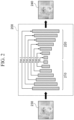
- FIG. 2 is a diagram illustrating a configuration of a generator network according to an embodiment.
- the generator network 200 may include an encoder 210 consisting of seven encoding layers and a decoder 220 consisting of seven decoding layers, each symmetric to one of the seven encoding layers. Meanwhile, in the example shown in FIG. 2 , the number of encoding layers and decoding layers is exemplary and may be changed depending on the embodiment.
- the encoder 210 may generate an expression vector by compressing an input image 230 to a lower dimension stepwise.
- the decoder 220 may generate the fake image 240 by reconstructing the input image 230 by decompressing the expression vector generated by the encoder 210 to a higher dimension stepwise.
- the first encoding layer of the seven encoding layers may perform a convolution operation and then perform down-sampling through, for example, a pooling operation such as max pooling, on the input image 230, and output the resulting image.
- the second and each subsequent encoding layer may perform a convolution operation on the output of the previous encoding layer and then perform down-sampling through the pooling operation, and output the resulting image.
- the first decoding layer may perform the convolution operation on the expression vector generated by the encoder 210 and then perform up-sampling, and output the resulting image.
- the second and each subsequent decoding layer may perform a convolution operation on the output of the previous decoding layer and then perform up-sampling, and output the resulting image.
- the fake image 240 generated by the decoder 220 includes lattice-shaped artifacts caused by up-sampling performed in the decoding layer.
- a decoding layer that is symmetric to a specific encoding layer in the plurality of encoding layers may mean a decoding layer that receives a vector having the same dimension as an output vector output by the corresponding specific encoding layer.
- the first encoding layer may form a symmetric pair with the last decoding layer (that is, pair 1)
- the second encoding layer may form a symmetric pair with the sixth decoding layer (that is, pair 2).
- the generator network 200 may be made up of seven symmetric pairs (that is, pair 1 to pair 7) each including an encoding layer and a decoding layer.
- the fake image generator 110 may generate one or more fake images from a real image input to the generator network by using the generator network, and may arbitrarily select one or more encoding layers and one or more decoding layers whenever a fake image is generated.
- the fake image generator 110 may select one or more encoding layers sequentially from a first encoding layer from among a plurality of encoding layers included in the encoder, and may select one or more decoding layers that are symmetric to the one or more selected encoding layers from among a plurality of decoding layers included in the decoder. Further, the fake image generator 110 may generate a fake image from the real image by using one or more selected encoding layers and one or more decoding layers.
- FIGS. 3 to 5 are diagrams for exemplarily describing selection of an encoding layer and a decoding layer and generation of a fake image according to an embodiment.
- the fake image generator 110 may select the first encoding layer 211 of the encoder 210 and the last decoding layer 221 of the decoder 220 (that is, pair 1) as in the example shown in FIG. 3 , and may generate a fake image 320 for a real image 310 by using the selected encoding layer 211 and decoding layer 221.
- the fake image generator 110 may select the first to third encoding layers 211, 212, and 213 of the encoder 210 and the fifth to last decoding layers 221, 222, and 223 of the decoder 220 (that is, pair 1, pair 2, and pair 3) as in the example shown in FIG. 4 , and may generate a fake image 330 for the real image 310 by using the selected encoding layers 211, 212, and 213 and the decoding layers 221, 222, and 223.
- the fake image generator 110 may use the entire encoding layer of the encoder 210 and the entire decoding layer of the decoder 220 to generate a fake image 340 for the real image 310.
- the number of times of up-sampling performed to generate the fake images 320, 330, and 340 is different depending on the number of the selected decoding layers, and accordingly, the fake images 320, 330, and 340 each may include different types of artifacts. That is, the fake image generator 110 may arbitrarily select an encoding layer and a decoding layer for generating a fake image, thereby generating various fake images 320, 330, and 340, each including a different type of artifact, from the same real image 310.
- the fake image generator 110 may generate a fake image by performing anti-aliasing on the output of at least one of the one or more decoding layers selected for generating the fake image.
- anti-aliasing may be performed using, for example, a blur filter, interpolation, or the like; however, in addition to the above-described examples, anti-aliasing may be performed through various methods that may reduce artifacts included in the image, and is not necessarily limited in a particular way.
- FIG. 6 is a diagram for exemplarily describing generation of a fake image using anti-aliasing according to an embodiment.
- the fake image generator 110 may generate a fake image 350 for the real image 310 by performing anti-aliasing on outputs of the second decoding layer and the sixth decoding layer of the decoder 220.
- the generated fake image 350 includes a relatively low density of artifacts as compared to the fake image 340 illustrated in FIG. 5 , by anti-aliasing.
- a decoding layer on which anti-aliasing is to be performed among a plurality of decoding layers included in the decoder 220 may be arbitrarily determined whenever a fake image is generated; this makes it possible for the fake image generator 110 to generate, from the same real image 310, various fake images 340 and 350, each including artifacts of the same shape, but including a different density of artifacts.
- selection of the encoding layer and the decoding layer and performing anti-aliasing may be simultaneously applied; this makes it possible for the fake image generator 110 to generate, from the same real image, a plurality of fake images that are different in at least one of the shape and the density of artifacts.
- the training image set generator 120 generates a training image set based on one or more fake images generated by the fake image generator 110.
- the training image set means a set of images to be used for training a classifier, which will be described later.
- the training image set may include a plurality of real images and a plurality of fake images.
- the plurality of fake images included in the training image set may include at least one of a fake image generated by the fake image generator 110 and a synthetic image to be described later.
- the training image set generator 120 may generate one or more synthetic images by using at least one of a plurality of fake images generated by the fake image generator 110.
- the fake image generator 110 may generate, from the real image, a plurality of fake images that are different in at least one of the shape and density of artifacts. Accordingly, the training image set generator 120 may combine two or more fake images among the plurality of fake images generated from the same real image to generate a synthetic image, and may include the generated synthetic image in the training image set as a fake image.
- the training image set generator 120 may generate a synthetic image F' based on Equation 1 below, for example.
- ⁇ F 1 + 1 ⁇ ⁇ F 2 F ′
- Fi and F 2 each represent a fake image generated from the same real image.
- ⁇ represents a weight having a value between 0 and 1, and may be preset or arbitrarily determined when a synthetic image is generated.
- the training image set generator 120 may generate a synthetic image by combining at least one of the one or more fake images generated from the real image by the fake image generator 110 with another real image, and may include the generated synthetic image in the training image set as a fake image.
- Fi represents a fake image
- R represents a real image different from the real image used to generate Fi
- ⁇ represents a weight having a value between 0 and 1, and may be preset or arbitrarily determined when a synthetic image is generated.
- the training image set generator 120 may generate one or more synthetic images by combining two or more real images, and may include the generated synthetic images in the training image set as real images.
- the training image set generator 120 may generate a synthetic image R' based on Equation 3 below, for example.
- ⁇ R 1 + 1 ⁇ ⁇ R 2 R ′
- Ri and R 2 each represent a real image.
- ⁇ represents a weight having a value between 0 and 1, and may be preset or arbitrarily determined when a synthetic image is generated.
- the trainer 130 trains a classifier for discriminating a fake image by using the training image set generated by the training image set generator 120.
- the training image set may include a plurality of real images and a plurality of fake images.
- the plurality of fake images may include at least one of a fake image generated by the fake image generator 110 and a fake image synthesized by the training image set generator 120.
- the plurality of real images may include real images synthesized by the training image set generator 120.
- the classifier may be, for example, an artificial neural network-based binary classifier such as CNN, but if the classifier may be trained to output a discriminant value for whether the image input to the classifier is a real image or a fake image, it is not necessarily limited to a specific type of classifier.
- the trainer 130 may train the classifier to, when a real image is input among the images included in the training image set, output a discriminant value (e.g., 0) indicating that the input image is the real image, and when a fake image is input among the images included in the training image set, output a discriminant value (e.g., 1) indicating that the input image is the fake image.
- a discriminant value e.g., 0
- a fake image e.g., 1
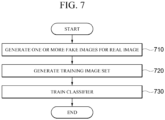
- FIG. 7 is a flowchart of a method for training a fake image discriminative model according to an embodiment.
- the method illustrated in FIG. 7 may be performed by, for example, the learning apparatus 100 illustrated in FIG. 1 .
- the learning apparatus 100 selects one or more encoding layers and one or more decoding layers from a generator network of an autoencoder structure to generate one or more fake images for a real image (710).
- the learning apparatus 100 may generate one or more fake images by arbitrarily selecting one or more encoding layers sequentially from a first layer from among a plurality of encoding layers included in the autoencoder, and selecting one or more decoding layers that are symmetric to the one or more selected encoding layers from among a plurality of decoding layers included in the auto-decoder.
- the learning apparatus 100 may generate one or more fake images by performing anti-aliasing on the output of at least one of the one or more decoding layers.
- the learning apparatus 100 generates a training image set based on the one or more generated fake images (720).
- the learning apparatus 100 may generate one or more synthetic images by using at least one of the one or more fake images generated in step 710, and the synthetic images generated through this may be included in the training image set as fake images.
- the synthetic image may include an image generated by combining two or more fake images among the fake images generated in step 710 and an image generated by combining at least one of the fake images generated in step 710 with the real image.
- the learning apparatus 100 may generate a synthetic image by combining two different real images, and the resulting synthetic image may be included in the training image set as a real image.
- the learning apparatus 100 trains a classifier for discriminating a fake image by using the generated training image set (730).
- the learning apparatus 100 may train the classifier to classify a fake image among images included in the training image set as fake and classify a real image among images included in the training image set as real.
- At least some of the steps may be performed in a different order, performed together in combination with other steps, omitted, performed in subdivided steps, or performed by adding one or more steps not illustrated.
- FIG. 8 is a block diagram for exemplarily describing a computing environment including a computing device according to an embodiment.
- each component may have different functions and capabilities in addition to those described below, and additional components may be included in addition to those described below.
- the illustrated computing environment 10 includes a computing device 12.
- the computing device 12 may be one or more components included in the learning apparatus 100 according to an embodiment.
- the computing device 12 includes at least one processor 14, a computer-readable storage medium 16, and a communication bus 18.
- the processor 14 may cause the computing device 12 to operate according to the above-described exemplary embodiments.
- the processor 14 may execute one or more programs stored in the computer-readable storage medium 16.
- the one or more programs may include one or more computer-executable instructions, which may be configured to cause, when executed by the processor 14, the computing device 12 to perform operations according to the exemplary embodiments.
- the computer-readable storage medium 16 is configured to store computer-executable instructions or program codes, program data, and/or other suitable forms of information.
- a program 20 stored in the computer-readable storage medium 16 includes a set of instructions executable by the processor 14.
- the computer-readable storage medium 16 may be a memory (a volatile memory such as a random-access memory, a non-volatile memory, or any suitable combination thereof), one or more magnetic disk storage devices, optical disc storage devices, flash memory devices, other types of storage media that are accessible by the computing device 12 and may store desired information, or any suitable combination thereof.
- the communication bus 18 interconnects various other components of the computing device 12, including the processor 14 and the computer-readable storage medium 16.
- the computing device 12 may also include one or more input/output interfaces 22 that provide an interface for one or more input/output devices 24, and one or more network communication interfaces 26.
- the input/output interface 22 and the network communication interface 26 are connected to the communication bus 18.
- the input/output device 24 may be connected to other components of the computing device 12 via the input/output interface 22.
- the exemplary input/output device 24 may include a pointing device (a mouse, a trackpad, or the like), a keyboard, a touch input device (a touch pad, a touch screen, or the like), a voice or sound input device, input devices such as various types of sensor devices and/or imaging devices, and/or output devices such as a display device, a printer, an interlocutor, and/or a network card.
- the exemplary input/output device 24 may be included inside the computing device 12 as a component constituting the computing device 12, or may be connected to the computing device 12 as a separate device distinct from the computing device 12.
Landscapes
- Engineering & Computer Science (AREA)
- Theoretical Computer Science (AREA)
- Physics & Mathematics (AREA)
- General Physics & Mathematics (AREA)
- Evolutionary Computation (AREA)
- Software Systems (AREA)
- Artificial Intelligence (AREA)
- Computing Systems (AREA)
- General Health & Medical Sciences (AREA)
- Health & Medical Sciences (AREA)
- Multimedia (AREA)
- Databases & Information Systems (AREA)
- Medical Informatics (AREA)
- Computer Vision & Pattern Recognition (AREA)
- Mathematical Physics (AREA)
- General Engineering & Computer Science (AREA)
- Data Mining & Analysis (AREA)
- Computational Linguistics (AREA)
- Molecular Biology (AREA)
- Biophysics (AREA)
- Biomedical Technology (AREA)
- Life Sciences & Earth Sciences (AREA)
- Image Analysis (AREA)
Abstract
Description
- The following description relates to a fake image discriminative technology.
- Deep fake detection models in the related art are highly dependent on the learning environment, and as a consequence, have a 'generalization problem' in which the detection rate is greatly reduced when a test is performed with data that has not been learned. In order to solve the above-mentioned problem, it is necessary to learn by diversifying the model used to generate a fake image (e.g., a generative adversarial network (GAN)), the object category included in the training image, the type of image manipulation, and the like, so as to reduce data dependence and prevent the detection rate of the model from being decreased. However, it is likely that it takes a lot of time and cost. In addition, additional training has to be performed whenever a new fake image generation model and object category appear, which also takes a lot of time and cost.
- Therefore, in order to reduce the resources, solving the generalization problem of the model by reducing the dependence on the training data and increasing the general detection performance is considered to be an important thing, but the problem has not been easily solved so far.
- Examples of the related art include
Korean Patent Laid-Open Publication No. 10-2021-0048187 (published May 3, 2021 - The disclosed embodiments are intended to provide a method and apparatus for training a fake image discriminative model.
- In one general aspect, there is provided a method for training a fake image discriminative model, the method including: generating one or more fake images for a real image by selecting one or more encoding layers and one or more decoding layers from a generator network of an autoencoder structure; generating a training image set based on the one or more fake images; and training a classifier for discriminating a fake image by using the training image set.
- The training image set may include the one or more fake images.
- The generating of the one or more fake images may include generating the one or more fake images by arbitrarily selecting the one or more encoding layers and the one or more decoding layers whenever each of the one or more fake images is generated.
- The generating of the one or more fake images may include generating the one or more fake images by sequentially selecting one or more encoding layers from an input layer from among a plurality of encoding layers included in the autoencoder, and selecting one or more decoding layers symmetric to the one or more selected encoding layers from among a plurality of decoding layers included in the autoencoder.
- The generating of the one or more fake images may include generating the one or more fake images by performing anti-aliasing on an output of at least one of the one or more decoding layers.
- The generating of the training image set may include generating one or more synthetic images by using the one or more fake images, and the training image set may include the one or more synthetic images.
- The generating of the one or more fake images may include generating a plurality of fake images for the real image, and the one or more synthetic images may include an image generated by combining two or more fake images among the plurality of fake images.
- The one or more synthetic images may include an image generated by combining at least one of the one or more fake images with another real image.
- The training image set may further include a real image generated by combining the real image and another real image.
- The training may include training the classifier to classify the one or more synthetic images as fake and classify the real image generated by the combining as real.
- In another general aspect, there is provided an apparatus for training a fake image discriminative model, the apparatus including: a fake image generator configured to generate one or more fake images for a real image by selecting one or more encoding layers and one or more decoding layers from a generator network of an autoencoder structure; a training image set generator configured to generate a training image set based on the one or more fake images; and a trainer configured to train a classifier for discriminating a fake image by using the training image set.
- The training image set may include the one or more fake images.
- The fake image generator may be configured to generate the one or more fake images by arbitrarily selecting the one or more encoding layers and the one or more decoding layers whenever each of the one or more fake images is generated.
- The fake image generator may be configured to generate the one or more fake images by sequentially selecting one or more encoding layers from an input layer from among a plurality of encoding layers included in the auto encoder, and selecting one or more decoding layers symmetric to the one or more selected encoding layers from among a plurality of decoding layers included in the autoencoder.
- The fake image generator may be configured to generate the one or more fake images by performing anti-aliasing on an output of at least one of the one or more decoding layers.
- The fake image generator may be configured to generate one or more synthetic images by using the one or more fake images, and the training image set may include the one or more synthetic images.
- The fake image generator may be configured to generate a plurality of fake images for the real image, and the one or more synthetic images may include an image generated by combining two or more fake images among the plurality of fake images.
- The one or more synthetic images may include an image generated by combining at least one of the one or more fake images with another real image.
- The training image set may further include a real image generated by combining the real image and another real image.
- The trainer may be configured to train the classifier to classify the one or more synthetic images as fake and classify the real image generated by the combining as real.
-
-
FIG. 1 is a block diagram of an apparatus for training a language model according to an embodiment. -
FIG. 2 is a diagram illustrating a configuration of a generator network according to an embodiment. -
FIGS. 3 to 5 are diagrams for exemplarily describing selection of an encoding layer and a decoding layer and generation of a fake image according to an embodiment. -
FIG. 6 is a diagram for exemplarily describing generation of a fake image using anti-aliasing according to an embodiment. -
FIG. 7 is a flowchart of a method for training a fake image discriminative model according to an embodiment. -
FIG. 8 is a block diagram for exemplarily describing a computing environment including a computing device according to an embodiment. - Hereinafter, specific embodiments of the present disclosure will be described with reference to the accompanying drawings. The following detailed description is provided to assist in a comprehensive understanding of the methods, devices and/or systems described herein. However, the detailed description is only for illustrative purposes and the present disclosure is not limited thereto.
- In describing the embodiments of the present disclosure, when it is determined that detailed descriptions of known technology related to the present disclosure may unnecessarily obscure the gist of the present disclosure, the detailed descriptions thereof will be omitted. The terms used below are defined in consideration of functions in the present disclosure, but may be changed depending on the customary practice or the intention of a user or operator. Thus, the definitions should be determined based on the overall content of the present specification. The terms used herein are only for describing the embodiments of the present disclosure, and should not be construed as limitative. Unless expressly used otherwise, a singular form includes a plural form. In the present description, the terms "including", "comprising", "having", and the like are used to indicate certain characteristics, numbers, steps, operations, elements, and a portion or combination thereof, but should not be interpreted to preclude one or more other characteristics, numbers, steps, operations, elements, and a portion or combination thereof.
-
FIG. 1 is a block diagram of an apparatus for training a language model according to an embodiment. - Referring to
FIG. 1 , an apparatus for training a fake image discriminative model (hereinafter, referred to as a learning apparatus) 100 according to an embodiment includes afake image generator 110, a trainingimage set generator 120, and atrainer 130. - According to an embodiment, the
fake image generator 110, the training image setgenerator 120, and thetrainer 130 may be implemented by one or more hardware processors or a combination of one or more hardware processors and software, and may not be clearly distinguished in specific operations, unlike the illustrated example. - The
fake image generator 110 generates one or more fake images for a real image by selecting one or more encoding layers and one or more decoding layers from a generator network of an autoencoder structure. - According to an embodiment, the autoencoder may be an artificial neural network based on a convolutional neural network (CNN) including an encoder composed of a plurality of encoding layers and compressing an input image into a low-dimensional representation vector and a decoder composed of a plurality of decoding layers and decompressing the representation vector generated by the encoder and generating a fake image for the input image.
- Specifically,
FIG. 2 is a diagram illustrating a configuration of a generator network according to an embodiment. - Referring to
FIG. 2 , thegenerator network 200 may include anencoder 210 consisting of seven encoding layers and adecoder 220 consisting of seven decoding layers, each symmetric to one of the seven encoding layers. Meanwhile, in the example shown inFIG. 2 , the number of encoding layers and decoding layers is exemplary and may be changed depending on the embodiment. - The
encoder 210 may generate an expression vector by compressing aninput image 230 to a lower dimension stepwise. In addition, thedecoder 220 may generate thefake image 240 by reconstructing theinput image 230 by decompressing the expression vector generated by theencoder 210 to a higher dimension stepwise. - Specifically, the first encoding layer of the seven encoding layers may perform a convolution operation and then perform down-sampling through, for example, a pooling operation such as max pooling, on the
input image 230, and output the resulting image. In addition, the second and each subsequent encoding layer may perform a convolution operation on the output of the previous encoding layer and then perform down-sampling through the pooling operation, and output the resulting image. - Further, in the seven decoding layers, the first decoding layer may perform the convolution operation on the expression vector generated by the
encoder 210 and then perform up-sampling, and output the resulting image. In addition, the second and each subsequent decoding layer may perform a convolution operation on the output of the previous decoding layer and then perform up-sampling, and output the resulting image. Accordingly, thefake image 240 generated by thedecoder 220 includes lattice-shaped artifacts caused by up-sampling performed in the decoding layer. - Meanwhile, a decoding layer that is symmetric to a specific encoding layer in the plurality of encoding layers may mean a decoding layer that receives a vector having the same dimension as an output vector output by the corresponding specific encoding layer. Specifically, as in the illustrated example, the first encoding layer may form a symmetric pair with the last decoding layer (that is, pair 1), and the second encoding layer may form a symmetric pair with the sixth decoding layer (that is, pair 2). In this way, the
generator network 200 may be made up of seven symmetric pairs (that is,pair 1 to pair 7) each including an encoding layer and a decoding layer. - Referring back to
FIG. 1 , thefake image generator 110 may generate one or more fake images from a real image input to the generator network by using the generator network, and may arbitrarily select one or more encoding layers and one or more decoding layers whenever a fake image is generated. - Specifically, according to an embodiment, the
fake image generator 110 may select one or more encoding layers sequentially from a first encoding layer from among a plurality of encoding layers included in the encoder, and may select one or more decoding layers that are symmetric to the one or more selected encoding layers from among a plurality of decoding layers included in the decoder. Further, thefake image generator 110 may generate a fake image from the real image by using one or more selected encoding layers and one or more decoding layers. -
FIGS. 3 to 5 are diagrams for exemplarily describing selection of an encoding layer and a decoding layer and generation of a fake image according to an embodiment. - Referring to
FIGS. 2 to 5 , thefake image generator 110 may select thefirst encoding layer 211 of theencoder 210 and thelast decoding layer 221 of the decoder 220 (that is, pair 1) as in the example shown inFIG. 3 , and may generate afake image 320 for areal image 310 by using the selectedencoding layer 211 anddecoding layer 221. - Furthermore, the
fake image generator 110 may select the first to third encoding layers 211, 212, and 213 of theencoder 210 and the fifth to last decoding layers 221, 222, and 223 of the decoder 220 (that is,pair 1,pair 2, and pair 3) as in the example shown inFIG. 4 , and may generate afake image 330 for thereal image 310 by using the selectedencoding layers - Further, as in the example shown in
FIG. 5 , thefake image generator 110 may use the entire encoding layer of theencoder 210 and the entire decoding layer of thedecoder 220 to generate afake image 340 for thereal image 310. - Meanwhile, in the examples shown in
FIGS. 3 to 5 , the number of times of up-sampling performed to generate thefake images fake images fake image generator 110 may arbitrarily select an encoding layer and a decoding layer for generating a fake image, thereby generating variousfake images real image 310. - Referring back to
FIG. 1 , according to an embodiment, thefake image generator 110 may generate a fake image by performing anti-aliasing on the output of at least one of the one or more decoding layers selected for generating the fake image. - In this case, anti-aliasing may be performed using, for example, a blur filter, interpolation, or the like; however, in addition to the above-described examples, anti-aliasing may be performed through various methods that may reduce artifacts included in the image, and is not necessarily limited in a particular way.
- Specifically,
FIG. 6 is a diagram for exemplarily describing generation of a fake image using anti-aliasing according to an embodiment. - As in the example shown in
FIG. 6 , thefake image generator 110 may generate afake image 350 for thereal image 310 by performing anti-aliasing on outputs of the second decoding layer and the sixth decoding layer of thedecoder 220. In this case, the generatedfake image 350 includes a relatively low density of artifacts as compared to thefake image 340 illustrated inFIG. 5 , by anti-aliasing. - Meanwhile, a decoding layer on which anti-aliasing is to be performed among a plurality of decoding layers included in the
decoder 220 may be arbitrarily determined whenever a fake image is generated; this makes it possible for thefake image generator 110 to generate, from the samereal image 310, variousfake images - In addition, depending on the embodiment, selection of the encoding layer and the decoding layer and performing anti-aliasing may be simultaneously applied; this makes it possible for the
fake image generator 110 to generate, from the same real image, a plurality of fake images that are different in at least one of the shape and the density of artifacts. - Referring back to
FIG. 1 , the training image setgenerator 120 generates a training image set based on one or more fake images generated by thefake image generator 110. In this case, the training image set means a set of images to be used for training a classifier, which will be described later. - According to an embodiment, the training image set may include a plurality of real images and a plurality of fake images. In this case, the plurality of fake images included in the training image set may include at least one of a fake image generated by the
fake image generator 110 and a synthetic image to be described later. - Specifically, according to an embodiment, the training image set
generator 120 may generate one or more synthetic images by using at least one of a plurality of fake images generated by thefake image generator 110. - As described above, the
fake image generator 110 may generate, from the real image, a plurality of fake images that are different in at least one of the shape and density of artifacts. Accordingly, the training image setgenerator 120 may combine two or more fake images among the plurality of fake images generated from the same real image to generate a synthetic image, and may include the generated synthetic image in the training image set as a fake image. - In this case, the training image set
generator 120 may generate a synthetic image F' based onEquation 1 below, for example.
- In
Equation 1, Fi and F2 each represent a fake image generated from the same real image. In addition, α represents a weight having a value between 0 and 1, and may be preset or arbitrarily determined when a synthetic image is generated. - According to an embodiment, the training image set
generator 120 may generate a synthetic image by combining at least one of the one or more fake images generated from the real image by thefake image generator 110 with another real image, and may include the generated synthetic image in the training image set as a fake image. - In this case, the training image set
generator 120 may generate a synthetic image F" based onEquation 2 below, for example.
- In
Equation 2, Fi represents a fake image, and R represents a real image different from the real image used to generate Fi. In addition, β represents a weight having a value between 0 and 1, and may be preset or arbitrarily determined when a synthetic image is generated. - Meanwhile, according to an embodiment, the training image set
generator 120 may generate one or more synthetic images by combining two or more real images, and may include the generated synthetic images in the training image set as real images. - In this case, the training image set
generator 120 may generate a synthetic image R' based onEquation 3 below, for example.
- In
Equation 3, Ri and R2 each represent a real image. In addition, γ represents a weight having a value between 0 and 1, and may be preset or arbitrarily determined when a synthetic image is generated. - Meanwhile, the
trainer 130 trains a classifier for discriminating a fake image by using the training image set generated by the training image setgenerator 120. - According to an embodiment, the training image set may include a plurality of real images and a plurality of fake images. In this case, the plurality of fake images may include at least one of a fake image generated by the
fake image generator 110 and a fake image synthesized by the training image setgenerator 120. Further, the plurality of real images may include real images synthesized by the training image setgenerator 120. - The classifier may be, for example, an artificial neural network-based binary classifier such as CNN, but if the classifier may be trained to output a discriminant value for whether the image input to the classifier is a real image or a fake image, it is not necessarily limited to a specific type of classifier.
- Meanwhile, the
trainer 130 may train the classifier to, when a real image is input among the images included in the training image set, output a discriminant value (e.g., 0) indicating that the input image is the real image, and when a fake image is input among the images included in the training image set, output a discriminant value (e.g., 1) indicating that the input image is the fake image. -
FIG. 7 is a flowchart of a method for training a fake image discriminative model according to an embodiment. - The method illustrated in
FIG. 7 may be performed by, for example, thelearning apparatus 100 illustrated inFIG. 1 . - Referring to
FIG. 7 , thelearning apparatus 100 selects one or more encoding layers and one or more decoding layers from a generator network of an autoencoder structure to generate one or more fake images for a real image (710). - In this case, according to an embodiment, the
learning apparatus 100 may generate one or more fake images by arbitrarily selecting one or more encoding layers sequentially from a first layer from among a plurality of encoding layers included in the autoencoder, and selecting one or more decoding layers that are symmetric to the one or more selected encoding layers from among a plurality of decoding layers included in the auto-decoder. - Further, according to an embodiment, the
learning apparatus 100 may generate one or more fake images by performing anti-aliasing on the output of at least one of the one or more decoding layers. - Then, the
learning apparatus 100 generates a training image set based on the one or more generated fake images (720). - According to an embodiment, the
learning apparatus 100 may generate one or more synthetic images by using at least one of the one or more fake images generated instep 710, and the synthetic images generated through this may be included in the training image set as fake images. In this case, the synthetic image may include an image generated by combining two or more fake images among the fake images generated instep 710 and an image generated by combining at least one of the fake images generated instep 710 with the real image. - Further, according to an embodiment, the
learning apparatus 100 may generate a synthetic image by combining two different real images, and the resulting synthetic image may be included in the training image set as a real image. - Then, the
learning apparatus 100 trains a classifier for discriminating a fake image by using the generated training image set (730). - According to an embodiment, the
learning apparatus 100 may train the classifier to classify a fake image among images included in the training image set as fake and classify a real image among images included in the training image set as real. - Meanwhile, in the flowchart illustrated in
FIG. 7 , at least some of the steps may be performed in a different order, performed together in combination with other steps, omitted, performed in subdivided steps, or performed by adding one or more steps not illustrated. -
FIG. 8 is a block diagram for exemplarily describing a computing environment including a computing device according to an embodiment. In the illustrated embodiment, each component may have different functions and capabilities in addition to those described below, and additional components may be included in addition to those described below. - The illustrated
computing environment 10 includes acomputing device 12. Thecomputing device 12 may be one or more components included in thelearning apparatus 100 according to an embodiment. - The
computing device 12 includes at least oneprocessor 14, a computer-readable storage medium 16, and acommunication bus 18. Theprocessor 14 may cause thecomputing device 12 to operate according to the above-described exemplary embodiments. For example, theprocessor 14 may execute one or more programs stored in the computer-readable storage medium 16. The one or more programs may include one or more computer-executable instructions, which may be configured to cause, when executed by theprocessor 14, thecomputing device 12 to perform operations according to the exemplary embodiments. - The computer-
readable storage medium 16 is configured to store computer-executable instructions or program codes, program data, and/or other suitable forms of information. Aprogram 20 stored in the computer-readable storage medium 16 includes a set of instructions executable by theprocessor 14. In an embodiment, the computer-readable storage medium 16 may be a memory (a volatile memory such as a random-access memory, a non-volatile memory, or any suitable combination thereof), one or more magnetic disk storage devices, optical disc storage devices, flash memory devices, other types of storage media that are accessible by thecomputing device 12 and may store desired information, or any suitable combination thereof. - The
communication bus 18 interconnects various other components of thecomputing device 12, including theprocessor 14 and the computer-readable storage medium 16. - The
computing device 12 may also include one or more input/output interfaces 22 that provide an interface for one or more input/output devices 24, and one or more network communication interfaces 26. The input/output interface 22 and thenetwork communication interface 26 are connected to thecommunication bus 18. The input/output device 24 may be connected to other components of thecomputing device 12 via the input/output interface 22. The exemplary input/output device 24 may include a pointing device (a mouse, a trackpad, or the like), a keyboard, a touch input device (a touch pad, a touch screen, or the like), a voice or sound input device, input devices such as various types of sensor devices and/or imaging devices, and/or output devices such as a display device, a printer, an interlocutor, and/or a network card. The exemplary input/output device 24 may be included inside thecomputing device 12 as a component constituting thecomputing device 12, or may be connected to thecomputing device 12 as a separate device distinct from thecomputing device 12. - According to the embodiments disclosed herein, it is possible to reduce dependence on the learning environment and training data by generating various types of fake images and using the generated fake images for training the detection model, thereby making it possible to solve the generalization problem in the related art.
- Although the present disclosure has been described in detail through the representative embodiments as above, those skilled in the art will understand that various modifications can be made thereto without departing from the scope of the present disclosure. Therefore, the scope of rights of the present disclosure should not be limited to the described embodiments, but should be defined not only by the claims set forth below but also by equivalents of the claims.
Claims (15)
- A method for training a fake image discriminative model, the method comprising:generating one or more fake images for a real image by selecting one or more encoding layers and one or more decoding layers from a generator network of an autoencoder structure;generating a training image set based on the one or more fake images; andtraining a classifier for discriminating a fake image by using the training image set.
- The method of claim 1, wherein the training image set includes the one or more fake images.
- The method of claim 1 or 2, wherein the generating of the one or more fake images includes generating the one or more fake images by arbitrarily selecting the one or more encoding layers and the one or more decoding layers whenever each of the one or more fake images is generated.
- The method of one of claims 1 to 3, wherein the generating of the one or more fake images includes generating the one or more fake images by sequentially selecting one or more encoding layers from an input layer from among a plurality of encoding layers included in the autoencoder, and selecting one or more decoding layers symmetric to the one or more selected encoding layers from among a plurality of decoding layers included in the autoencoder.
- The method of one of claims 1 to 4, wherein the generating of the one or more fake images includes generating the one or more fake images by performing anti-aliasing on an output of at least one of the one or more decoding layers.
- The method of one of claims 1 to 5, wherein the generating of the training image set includes generating one or more synthetic images by using the one or more fake images, and
the training image set includes the one or more synthetic images. - The method of claim 6, wherein the generating of the one or more fake images includes generating a plurality of fake images for the real image, and
the one or more synthetic images include an image generated by combining two or more fake images among the plurality of fake images. - The method of claim 6, wherein the one or more synthetic images include an image generated by combining at least one of the one or more fake images with another real image.
- The method of claim 6, wherein the training image set further includes a real image generated by combining the real image and another real image.
- The method of claim 9, wherein the training includes training the classifier to classify the one or more synthetic images as fake and classify the real image generated by the combining as real.
- An apparatus for training a fake image discriminative model, the apparatus comprising:a fake image generator configured to generate one or more fake images for a real image by selecting one or more encoding layers and one or more decoding layers from a generator network of an autoencoder structure;a training image set generator configured to generate a training image set based on the one or more fake images; anda trainer configured to train a classifier for discriminating a fake image by using the training image set.
- The apparatus of claim 11, wherein the fake image generator is configured to generate the one or more fake images by arbitrarily selecting the one or more encoding layers and the one or more decoding layers whenever each of the one or more fake images is generated.
- The apparatus of claim 11 or 12, wherein the fake image generator is configured to generate the one or more fake images by sequentially selecting one or more encoding layers from an input layer from among a plurality of encoding layers included in the autoencoder, and selecting one or more decoding layers symmetric to the one or more selected encoding layers from among a plurality of decoding layers included in the autoencoder.
- The apparatus of one of claims 11 to 13, wherein the fake image generator is configured to generate the one or more fake images by performing anti-aliasing on an output of at least one of the one or more decoding layers.
- The apparatus of one of claims 11 to 14, wherein the fake image generator is configured to generate one or more synthetic images by using the one or more fake images, and the training image set includes the one or more synthetic images.
Applications Claiming Priority (1)
| Application Number | Priority Date | Filing Date | Title |
|---|---|---|---|
| KR1020220032768A KR20230135383A (en) | 2022-03-16 | 2022-03-16 | Method and apparatus for training fake image discriminatve model |
Publications (1)
| Publication Number | Publication Date |
|---|---|
| EP4246377A1 true EP4246377A1 (en) | 2023-09-20 |
Family
ID=82786734
Family Applications (1)
| Application Number | Title | Priority Date | Filing Date |
|---|---|---|---|
| EP22188541.1A Withdrawn EP4246377A1 (en) | 2022-03-16 | 2022-08-03 | Method and apparatus for training fake image discriminative model |
Country Status (3)
| Country | Link |
|---|---|
| US (1) | US20230298332A1 (en) |
| EP (1) | EP4246377A1 (en) |
| KR (1) | KR20230135383A (en) |
Families Citing this family (3)
| Publication number | Priority date | Publication date | Assignee | Title |
|---|---|---|---|---|
| US12561427B2 (en) * | 2023-12-15 | 2026-02-24 | Daon Technology | Methods and systems for enhancing detection of multimedia data generated using artificial intelligence |
| CN117746482B (en) * | 2023-12-20 | 2024-12-13 | 北京百度网讯科技有限公司 | Training method, detection method, device and equipment for face detection model |
| CN118898760A (en) * | 2024-08-06 | 2024-11-05 | 国家计算机网络与信息安全管理中心 | Image recognition method and device for network security |
Citations (1)
| Publication number | Priority date | Publication date | Assignee | Title |
|---|---|---|---|---|
| KR20210048187A (en) | 2019-10-23 | 2021-05-03 | 삼성에스디에스 주식회사 | Method and apparatus for training model for object classification and detection |
Family Cites Families (5)
| Publication number | Priority date | Publication date | Assignee | Title |
|---|---|---|---|---|
| US10825219B2 (en) * | 2018-03-22 | 2020-11-03 | Northeastern University | Segmentation guided image generation with adversarial networks |
| EP3973459B1 (en) * | 2019-05-23 | 2025-07-02 | DeepMind Technologies Limited | Generative adversarial networks with temporal and spatial discriminators for efficient video generation |
| JP7392836B2 (en) * | 2020-04-27 | 2023-12-06 | 日本電気株式会社 | Data generation device, data generation method, learning device and recording medium |
| US20210374947A1 (en) * | 2020-05-26 | 2021-12-02 | Nvidia Corporation | Contextual image translation using neural networks |
| US12602751B2 (en) * | 2021-08-19 | 2026-04-14 | Intel Corporation | Sample distribution-informed denoising and rendering |
-
2022
- 2022-03-16 KR KR1020220032768A patent/KR20230135383A/en active Pending
- 2022-07-27 US US17/874,940 patent/US20230298332A1/en not_active Abandoned
- 2022-08-03 EP EP22188541.1A patent/EP4246377A1/en not_active Withdrawn
Patent Citations (1)
| Publication number | Priority date | Publication date | Assignee | Title |
|---|---|---|---|---|
| KR20210048187A (en) | 2019-10-23 | 2021-05-03 | 삼성에스디에스 주식회사 | Method and apparatus for training model for object classification and detection |
Non-Patent Citations (2)
| Title |
|---|
| JEONG YONGHYUN ET AL: "FingerprintNet: Synthesized Fingerprints for Generated Image Detection", 12 November 2021, SPRINGER INTERNATIONAL PUBLISHING, PAGE(S) 76 - 94, XP047637443 * |
| YONGHYUN JEONG ET AL: "Self-supervised GAN Detector", ARXIV.ORG, CORNELL UNIVERSITY LIBRARY, 201 OLIN LIBRARY CORNELL UNIVERSITY ITHACA, NY 14853, 12 November 2021 (2021-11-12), XP091098381 * |
Also Published As
| Publication number | Publication date |
|---|---|
| KR20230135383A (en) | 2023-09-25 |
| US20230298332A1 (en) | 2023-09-21 |
Similar Documents
| Publication | Publication Date | Title |
|---|---|---|
| EP4246377A1 (en) | Method and apparatus for training fake image discriminative model | |
| CN112862681B (en) | A super-resolution method, device, terminal equipment and storage medium | |
| CN114332150B (en) | Handwriting erasing method, device, equipment and readable storage medium | |
| US20190251707A1 (en) | Saliency prediction for a mobile user interface | |
| CN112991171B (en) | Image processing method, device, electronic equipment and storage medium | |
| US20210089845A1 (en) | Teaching gan (generative adversarial networks) to generate per-pixel annotation | |
| CN113240580A (en) | Lightweight image super-resolution reconstruction method based on multi-dimensional knowledge distillation | |
| KR102537207B1 (en) | Method for processing image based on machine learning and apparatus therefof | |
| AU2023285707A1 (en) | Super-resolution on text-to-image synthesis with gans | |
| CN111524207B (en) | Image generation method and device based on artificial intelligence and electronic equipment | |
| CN119206236B (en) | Image semantic segmentation method and device integrating Fourier transform | |
| CN114694074A (en) | Method, device and storage medium for generating video by using image | |
| CN116342393B (en) | Image super-resolution method and system based on image noise prediction mechanism | |
| US20230125839A1 (en) | Method and apparatus for generating synthetic data | |
| US20250077842A1 (en) | Selectively conditioning layers of a neural network with stylization prompts for digital image generation | |
| KR20230082227A (en) | Super-Resolution Using Deep Learning Algorithm Based on Deep Residual Dense Networks | |
| CN119516566B (en) | Quality evaluation method, system, medium and terminal for text-generated three-dimensional content | |
| GB2700291A (en) | Proxy-guided image editing | |
| CN118586445A (en) | A lightweight visual basic model construction method that can be used for various tasks | |
| Teng et al. | Blind face restoration via multi-prior collaboration and adaptive feature fusion | |
| CN112419216A (en) | Image interference removing method and device, electronic equipment and computer readable storage medium | |
| CN111815631B (en) | Model generation method, device, equipment and readable storage medium | |
| CN116071478B (en) | Training method of image reconstruction model and virtual scene rendering method | |
| US20250390713A1 (en) | Three-dimensional shape generation | |
| KR20210021866A (en) | Data classifying apparatus, method for classifying data and method for training data classifying apparatus |
Legal Events
| Date | Code | Title | Description |
|---|---|---|---|
| STAA | Information on the status of an ep patent application or granted ep patent |
Free format text: STATUS: EXAMINATION IS IN PROGRESS |
|
| PUAI | Public reference made under article 153(3) epc to a published international application that has entered the european phase |
Free format text: ORIGINAL CODE: 0009012 |
|
| 17P | Request for examination filed |
Effective date: 20220803 |
|
| AK | Designated contracting states |
Kind code of ref document: A1 Designated state(s): AL AT BE BG CH CY CZ DE DK EE ES FI FR GB GR HR HU IE IS IT LI LT LU LV MC MK MT NL NO PL PT RO RS SE SI SK SM TR |
|
| RBV | Designated contracting states (corrected) |
Designated state(s): AL AT BE BG CH CY CZ DE DK EE ES FI FR GB GR HR HU IE IS IT LI LT LU LV MC MK MT NL NO PL PT RO RS SE SI SK SM TR |
|
| GRAP | Despatch of communication of intention to grant a patent |
Free format text: ORIGINAL CODE: EPIDOSNIGR1 |
|
| STAA | Information on the status of an ep patent application or granted ep patent |
Free format text: STATUS: GRANT OF PATENT IS INTENDED |
|
| INTG | Intention to grant announced |
Effective date: 20250611 |
|
| STAA | Information on the status of an ep patent application or granted ep patent |
Free format text: STATUS: THE APPLICATION IS DEEMED TO BE WITHDRAWN |
|
| 18D | Application deemed to be withdrawn |
Effective date: 20251014 |