EP4246159B1 - Method for selecting low-voltage defective batteries - Google Patents
Method for selecting low-voltage defective batteries Download PDFInfo
- Publication number
- EP4246159B1 EP4246159B1 EP22902494.8A EP22902494A EP4246159B1 EP 4246159 B1 EP4246159 B1 EP 4246159B1 EP 22902494 A EP22902494 A EP 22902494A EP 4246159 B1 EP4246159 B1 EP 4246159B1
- Authority
- EP
- European Patent Office
- Prior art keywords
- screening
- voltage
- low
- amount
- voltage drop
- Prior art date
- Legal status (The legal status is an assumption and is not a legal conclusion. Google has not performed a legal analysis and makes no representation as to the accuracy of the status listed.)
- Active
Links
Images



Classifications
-
- G—PHYSICS
- G01—MEASURING; TESTING
- G01R—MEASURING ELECTRIC VARIABLES; MEASURING MAGNETIC VARIABLES
- G01R31/00—Arrangements for testing electric properties; Arrangements for locating electric faults; Arrangements for electrical testing characterised by what is being tested not provided for elsewhere
- G01R31/36—Arrangements for testing, measuring or monitoring the electrical condition of accumulators or electric batteries, e.g. capacity or state of charge [SoC]
- G01R31/385—Arrangements for measuring battery or accumulator variables
- G01R31/3865—Arrangements for measuring battery or accumulator variables related to manufacture, e.g. testing after manufacture
-
- G—PHYSICS
- G01—MEASURING; TESTING
- G01R—MEASURING ELECTRIC VARIABLES; MEASURING MAGNETIC VARIABLES
- G01R19/00—Arrangements for measuring currents or voltages or for indicating presence or sign thereof
- G01R19/165—Indicating that current or voltage is either above or below a predetermined value or within or outside a predetermined range of values
- G01R19/16528—Indicating that current or voltage is either above or below a predetermined value or within or outside a predetermined range of values using digital techniques or performing arithmetic operations
-
- G—PHYSICS
- G01—MEASURING; TESTING
- G01R—MEASURING ELECTRIC VARIABLES; MEASURING MAGNETIC VARIABLES
- G01R31/00—Arrangements for testing electric properties; Arrangements for locating electric faults; Arrangements for electrical testing characterised by what is being tested not provided for elsewhere
- G01R31/36—Arrangements for testing, measuring or monitoring the electrical condition of accumulators or electric batteries, e.g. capacity or state of charge [SoC]
- G01R31/3644—Constructional arrangements
- G01R31/3648—Constructional arrangements comprising digital calculation means, e.g. for performing an algorithm
-
- G—PHYSICS
- G01—MEASURING; TESTING
- G01R—MEASURING ELECTRIC VARIABLES; MEASURING MAGNETIC VARIABLES
- G01R31/00—Arrangements for testing electric properties; Arrangements for locating electric faults; Arrangements for electrical testing characterised by what is being tested not provided for elsewhere
- G01R31/36—Arrangements for testing, measuring or monitoring the electrical condition of accumulators or electric batteries, e.g. capacity or state of charge [SoC]
- G01R31/367—Software therefor, e.g. for battery testing using modelling or look-up tables
-
- G—PHYSICS
- G01—MEASURING; TESTING
- G01R—MEASURING ELECTRIC VARIABLES; MEASURING MAGNETIC VARIABLES
- G01R31/00—Arrangements for testing electric properties; Arrangements for locating electric faults; Arrangements for electrical testing characterised by what is being tested not provided for elsewhere
- G01R31/36—Arrangements for testing, measuring or monitoring the electrical condition of accumulators or electric batteries, e.g. capacity or state of charge [SoC]
- G01R31/374—Arrangements for testing, measuring or monitoring the electrical condition of accumulators or electric batteries, e.g. capacity or state of charge [SoC] with means for correcting the measurement for temperature or ageing
-
- G—PHYSICS
- G01—MEASURING; TESTING
- G01R—MEASURING ELECTRIC VARIABLES; MEASURING MAGNETIC VARIABLES
- G01R31/00—Arrangements for testing electric properties; Arrangements for locating electric faults; Arrangements for electrical testing characterised by what is being tested not provided for elsewhere
- G01R31/36—Arrangements for testing, measuring or monitoring the electrical condition of accumulators or electric batteries, e.g. capacity or state of charge [SoC]
- G01R31/382—Arrangements for monitoring battery or accumulator variables, e.g. SoC
- G01R31/3835—Arrangements for monitoring battery or accumulator variables, e.g. SoC involving only voltage measurements
-
- G—PHYSICS
- G01—MEASURING; TESTING
- G01R—MEASURING ELECTRIC VARIABLES; MEASURING MAGNETIC VARIABLES
- G01R31/00—Arrangements for testing electric properties; Arrangements for locating electric faults; Arrangements for electrical testing characterised by what is being tested not provided for elsewhere
- G01R31/36—Arrangements for testing, measuring or monitoring the electrical condition of accumulators or electric batteries, e.g. capacity or state of charge [SoC]
- G01R31/392—Determining battery ageing or deterioration, e.g. state of health
-
- G—PHYSICS
- G01—MEASURING; TESTING
- G01R—MEASURING ELECTRIC VARIABLES; MEASURING MAGNETIC VARIABLES
- G01R31/00—Arrangements for testing electric properties; Arrangements for locating electric faults; Arrangements for electrical testing characterised by what is being tested not provided for elsewhere
- G01R31/36—Arrangements for testing, measuring or monitoring the electrical condition of accumulators or electric batteries, e.g. capacity or state of charge [SoC]
- G01R31/396—Acquisition or processing of data for testing or for monitoring individual cells or groups of cells within a battery
-
- G—PHYSICS
- G06—COMPUTING OR CALCULATING; COUNTING
- G06N—COMPUTING ARRANGEMENTS BASED ON SPECIFIC COMPUTATIONAL MODELS
- G06N20/00—Machine learning
-
- G—PHYSICS
- G06—COMPUTING OR CALCULATING; COUNTING
- G06N—COMPUTING ARRANGEMENTS BASED ON SPECIFIC COMPUTATIONAL MODELS
- G06N3/00—Computing arrangements based on biological models
- G06N3/02—Neural networks
- G06N3/04—Architecture, e.g. interconnection topology
- G06N3/045—Combinations of networks
-
- G—PHYSICS
- G06—COMPUTING OR CALCULATING; COUNTING
- G06N—COMPUTING ARRANGEMENTS BASED ON SPECIFIC COMPUTATIONAL MODELS
- G06N3/00—Computing arrangements based on biological models
- G06N3/02—Neural networks
- G06N3/08—Learning methods
-
- H—ELECTRICITY
- H01—ELECTRIC ELEMENTS
- H01M—PROCESSES OR MEANS, e.g. BATTERIES, FOR THE DIRECT CONVERSION OF CHEMICAL ENERGY INTO ELECTRICAL ENERGY
- H01M10/00—Secondary cells; Manufacture thereof
- H01M10/04—Construction or manufacture in general
- H01M10/049—Processes for forming or storing electrodes in the battery container
-
- H—ELECTRICITY
- H01—ELECTRIC ELEMENTS
- H01M—PROCESSES OR MEANS, e.g. BATTERIES, FOR THE DIRECT CONVERSION OF CHEMICAL ENERGY INTO ELECTRICAL ENERGY
- H01M10/00—Secondary cells; Manufacture thereof
- H01M10/42—Methods or arrangements for servicing or maintenance of secondary cells or secondary half-cells
- H01M10/4285—Testing apparatus
-
- H—ELECTRICITY
- H01—ELECTRIC ELEMENTS
- H01M—PROCESSES OR MEANS, e.g. BATTERIES, FOR THE DIRECT CONVERSION OF CHEMICAL ENERGY INTO ELECTRICAL ENERGY
- H01M10/00—Secondary cells; Manufacture thereof
- H01M10/42—Methods or arrangements for servicing or maintenance of secondary cells or secondary half-cells
- H01M10/44—Methods for charging or discharging
- H01M10/446—Initial charging measures
-
- H—ELECTRICITY
- H01—ELECTRIC ELEMENTS
- H01M—PROCESSES OR MEANS, e.g. BATTERIES, FOR THE DIRECT CONVERSION OF CHEMICAL ENERGY INTO ELECTRICAL ENERGY
- H01M10/00—Secondary cells; Manufacture thereof
- H01M10/42—Methods or arrangements for servicing or maintenance of secondary cells or secondary half-cells
- H01M10/48—Accumulators combined with arrangements for measuring, testing or indicating the condition of cells, e.g. the level or density of the electrolyte
- H01M10/482—Accumulators combined with arrangements for measuring, testing or indicating the condition of cells, e.g. the level or density of the electrolyte for several batteries or cells simultaneously or sequentially
-
- G—PHYSICS
- G01—MEASURING; TESTING
- G01R—MEASURING ELECTRIC VARIABLES; MEASURING MAGNETIC VARIABLES
- G01R19/00—Arrangements for measuring currents or voltages or for indicating presence or sign thereof
- G01R19/165—Indicating that current or voltage is either above or below a predetermined value or within or outside a predetermined range of values
- G01R19/16533—Indicating that current or voltage is either above or below a predetermined value or within or outside a predetermined range of values characterised by the application
- G01R19/16538—Indicating that current or voltage is either above or below a predetermined value or within or outside a predetermined range of values characterised by the application in AC or DC supplies
- G01R19/16542—Indicating that current or voltage is either above or below a predetermined value or within or outside a predetermined range of values characterised by the application in AC or DC supplies for batteries
-
- G—PHYSICS
- G06—COMPUTING OR CALCULATING; COUNTING
- G06N—COMPUTING ARRANGEMENTS BASED ON SPECIFIC COMPUTATIONAL MODELS
- G06N20/00—Machine learning
- G06N20/10—Machine learning using kernel methods, e.g. support vector machines [SVM]
-
- G—PHYSICS
- G06—COMPUTING OR CALCULATING; COUNTING
- G06N—COMPUTING ARRANGEMENTS BASED ON SPECIFIC COMPUTATIONAL MODELS
- G06N20/00—Machine learning
- G06N20/20—Ensemble learning
-
- G—PHYSICS
- G06—COMPUTING OR CALCULATING; COUNTING
- G06N—COMPUTING ARRANGEMENTS BASED ON SPECIFIC COMPUTATIONAL MODELS
- G06N3/00—Computing arrangements based on biological models
- G06N3/02—Neural networks
- G06N3/04—Architecture, e.g. interconnection topology
- G06N3/044—Recurrent networks, e.g. Hopfield networks
- G06N3/0442—Recurrent networks, e.g. Hopfield networks characterised by memory or gating, e.g. long short-term memory [LSTM] or gated recurrent units [GRU]
-
- G—PHYSICS
- G06—COMPUTING OR CALCULATING; COUNTING
- G06N—COMPUTING ARRANGEMENTS BASED ON SPECIFIC COMPUTATIONAL MODELS
- G06N5/00—Computing arrangements using knowledge-based models
- G06N5/01—Dynamic search techniques; Heuristics; Dynamic trees; Branch-and-bound
-
- Y—GENERAL TAGGING OF NEW TECHNOLOGICAL DEVELOPMENTS; GENERAL TAGGING OF CROSS-SECTIONAL TECHNOLOGIES SPANNING OVER SEVERAL SECTIONS OF THE IPC; TECHNICAL SUBJECTS COVERED BY FORMER USPC CROSS-REFERENCE ART COLLECTIONS [XRACs] AND DIGESTS
- Y02—TECHNOLOGIES OR APPLICATIONS FOR MITIGATION OR ADAPTATION AGAINST CLIMATE CHANGE
- Y02E—REDUCTION OF GREENHOUSE GAS [GHG] EMISSIONS, RELATED TO ENERGY GENERATION, TRANSMISSION OR DISTRIBUTION
- Y02E60/00—Enabling technologies; Technologies with a potential or indirect contribution to GHG emissions mitigation
- Y02E60/10—Energy storage using batteries
Definitions
- the present invention relates to a method for screening a low-voltage defective battery with improved detection reliability.
- a secondary battery means a battery that can be charged and discharged, and is widely used in electronic devices such as mobile phones, laptops, camcorders, etc., or electric vehicles, etc.
- a lithium secondary battery has a higher capacity than a nickel-cadmium battery or a nickel-cistern battery and has a high energy density per unit weight, the degree of utilization thereof is rapidly increasing.
- lithium secondary batteries mainly use lithium-based oxides and carbon materials as a positive electrode active material and a negative electrode active material, respectively.
- Lithium secondary batteries are provided with an electrode assembly in which a positive electrode plate and a negative electrode plate coated with such a positive electrode active material and a negative electrode active material, respectively, are disposed with a separator interposed therebetween, and an exterior material for sealing and accommodating the electrode assembly together with an electrolyte.
- Such a low-voltage defect phenomenon of a secondary battery is typically caused by a metal foreign material located on the inside.
- a metal foreign material such as iron or copper
- the metal foreign material may grow into a dendrite in the negative electrode.
- dendrites cause an internal short circuit of the secondary battery, which may cause a failure or a damage of the secondary battery, and in severe cases, may be a cause of ignition.
- the above low-voltage defect appears as a relative increase in the amount of voltage drop, and the low-voltage defect is detected through an aging process during an activation process of the secondary battery.
- the low-voltage defective battery may be screened by comparing the drop of the measured open circuit voltage with a reference value while monitoring the open circuit voltage (OCV) of the battery.
- a threshold is selected from the dispersion of the amount of the voltage drop ( ⁇ OCV) of data accumulated during the battery production process, and a tray-scale standard scaling is performed to the remaining data after screening through the above threshold, so that a specific sigma (e.g., 3 ⁇ or 4 ⁇ ) was taken as a reference value. And batteries exceeding the specific sigma were detected as low-voltage defective batteries.
- the present invention is directed to provide a method for screening a low-voltage defective battery with an increased detectability of good and defective batteries by improving the dispersion of the amount of voltage drop ( ⁇ OCV) at the time of screening the low-voltage defective batteries.
- the invention provides a method for screening a low-voltage defective battery including:
- the pre-filtering step (a) removes outliers using a time-series anomaly detection algorithm.
- the time-series anomaly detection algorithm is one selected from the group consisting of Control chart, Random Cut Forest, Dynamic Time Warping, TAnoGAN(Time Series Anomaly Detection with Generative Adversarial Networks), MAD-GAN(Multivariate Anomaly Detection for Time Series Data with Generative Adversarial Networks), USAD(UnSupervised Anomaly Detection on Multivariate Time Series), LSTM(Long Short-Term Memory)+AE, and LSTM(Long Short-Term Memory) + CNN (Convolutional Neural Network).
- the clustering step (b) clusters secondary batteries having an identical criterion selected from the group consisting of a LOT unit, a tray unit, an aging temperature, a charge/discharge temperature, and an aging period.
- the correction step (c) includes a step of correcting the dispersion of the amount of voltage drop by a linear regression or a machine learning method.
- the pre-filtering step (a), for each individual unit process includes a process of collecting an open circuit voltage (OCV) or an amount of voltage drop of the secondary battery as a data.
- OCV open circuit voltage
- the individual unit process includes at least one of an initial charging process, a room temperature aging process, and a high temperature aging process.
- the screening step (d) screens low-voltage defective batteries in the corrected dispersion using an anomaly detection algorithm.
- the anomaly detection algorithm is one selected from the group consisting of Local Outlier Factor (LOF), Isolation forest, and OC Support Vector Machine (SVM).
- the screening step (d) is performed after completing aging for shipment.
- the screening step (d) screens low-voltage defective batteries for each cluster.
- the screening step (d) screens low-voltage defective batteries after collecting the dispersion data of the amount of voltage drop for each cluster corrected by the step (c).
- the method for detecting and sorting low voltage according to the present invention has an excellent detectability and can reduce the time required to screen low-voltage defective batteries.
- the dispersion of the amount of voltage drop means a graph in which the amount of voltage drop of each of the large amount of secondary batteries are listed or plotted.
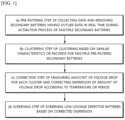
- FIG. 1 is a flowchart of a method for screening low-voltage defective batteries according to an exemplary embodiment of the present invention.
- a method for screening low-voltage defective batteries according to the present invention with reference to FIG. 1 includes: (a) a pre-filtering step of collecting data and removing secondary batteries having an outlier data in real time during an activation process of multiple secondary batteries; (b) a clustering step of clustering based on similar characteristics or records for multiple pre-filtered secondary batteries; (c) a correction step of measuring the amount of voltage drop ( ⁇ OCV) for each cluster, and correcting a dispersion of the amount of voltage drop ( ⁇ OCV) according to a temperature or a period; (d) a screening step of screening low-voltage defective batteries based on a corrected dispersion of the amount of voltage drop.
- the method for screening low-voltage defective batteries removes potential defective batteries exhibiting outlier data in individual unit processes constituting an activation process, clusters batteries removed with such potential defective batteries and having a common factor, measures the amount of voltage drop for each cluster, and corrects the dispersion of the measured amount of voltage drop, it can enhance the detectability of the low-voltage defective batteries and reduce the risk of over-detection or non-detection due to manufacturing deviation at the time of screening low-voltage defective batteries by having an improved dispersion of the total amount of voltage drop.
- the pre-filtering step (a) is a process of removing potentially defective batteries in advance, collecting data during the secondary battery activation process, and removing secondary batteries exhibiting outliers from the collected data in real time. Through this, it is possible to improve the dispersion of the amount of voltage drop at the time of screening defective batteries.
- the secondary battery activation process is a step of activating the battery so that the assembled lithium secondary battery can be used.
- the assembly process of the secondary battery is a process of accommodating an electrode assembly including a positive electrode/a separator/a negative electrode inside a battery case and sealing it after injecting an electrolyte. The completion of this assembly process does not mean that the battery can be used immediately.
- it is necessary to conduct processes such as causing an electrochemical reaction between the electrode and the electrolyte through charging, discharging the gas generated at this time to the outside of the battery, stabilizing the battery, etc., and such a series of processes are called an activation process.
- the activation process of such a secondary battery includes individual unit processes such as a pre-aging process of aging the battery so that an electrolyte is impregnated into an electrode assembly immediately after assembly of the secondary battery, an initial charging process of charging the battery until it reaches a set SOC, an aging process for aging an initially charged battery, a degassing process for discharging gas generated during the initial charging and the aging process to the outside of the battery, etc.
- the aging process may include a high temperature aging process or a room temperature aging process, or may include both of them.
- pre-filtering step (a) of the present invention in order to remove potentially defective batteries in advance while performing such individual unit processes, it includes processes of collecting an open circuit voltage (OCV) of the secondary battery or an amount of voltage drop of the battery as data and removing the secondary battery indicating an outlier data in real time.
- OCV open circuit voltage
- the individual unit process for collecting data and removing outlier data may include at least one of an initial charging process and an aging process.
- an initial charging process or an aging process is performed on a plurality of secondary batteries
- the open circuit voltage of the secondary batteries is measured and collected as data
- secondary batteries exhibiting an outlier in the collected data are removed in real time, and subsequent processes are performed on the secondary batteries remaining after the removal.
- a method for removing outliers utilizes a time-series anomaly detection algorithm.
- Time-series anomaly detection is a technique for finding rare patterns or target objects that deviate from or show signs of deviating from the general patterns of other data in the past or at a similar point in time series data.
- Such anomaly detection algorithms may use known algorithms, and in the embodiment of the present invention, may be one selected from the group consisting of Control chart, Random Cut Forest, Dynamic Time Warping, TAnoGAN(Time Series Anomaly Detection with Generative Adversarial Networks), MAD-GAN(Multivariate Anomaly Detection for Time Series Data with Generative Adversarial Networks), USAD(UnSupervised Anomaly Detection on Multivariate Time Series), LSTM(Long Short-Term Memory)+AE, and LSTM(Long Short-Term Memory) + CNN (Convolutional Neural Network).
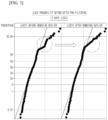
- FIG. 2 and FIG. 3 show cumulative probability distribution diagrams of an amount of voltage drop ( ⁇ OCV) according to time before and after removing secondary batteries exhibiting outlier data through a pre-filtering step according to an exemplary embodiment of the present invention.
- the method for detecting and screening low voltage according to the present invention not only has an excellent detectability, but also reduces the time required to screen low-voltage defective batteries.
- the clustering step (b) is a step of clustering secondary batteries having similar characteristics or similar records in a secondary battery manufacturing process. Clustering multiple secondary batteries based on similar characteristics or records does not have manufacturing deviation within the same cluster, so it can improve the problem of increase in the degree of dispersion due to manufacturing deviation and blurring the boundary between good and bad products.
- the clustering step (b) may cluster secondary batteries having an identical criterion selected from the group consisting of a LOT unit, a tray unit, an aging temperature, a charge/discharge temperature, and an aging period. Since these factors are manufacturing deviations that affect the dispersion of the amount of voltage drop, it is preferable to cluster secondary batteries based on these factors.
- the correction step (c) measures the amount of voltage drop for each cluster and corrects the dispersion of the amount of voltage drop according to a temperature or a period.
- the correction step (c) includes a process of deriving a dispersion of the amount of voltage drop by monitoring an open circuit voltage (OCV) while aging a plurality of batteries under a constant temperature condition, and a process of correcting the dispersion of the amount of voltage drop.
- OCV open circuit voltage
- the amount of voltage drop of a battery is affected by the aging temperature and measurement period (time interval for measuring OCV1 and OCV2) for measuring the amount of voltage drop. That is, even in the case of the same battery, when the time interval T of measuring the amount of voltage drop becomes longer, or when the amount of voltage drop is measured under the condition of a high aging temperature, the amount of voltage drop appears smaller than the actual value.
- the present invention includes a process of correcting the difference in the amount of voltage drop according to the difference in the aging temperature and the measurement period (time interval for measuring OCV1 and OCV2).
- the aging process may be one or more selected from aging processes included in the entire battery manufacturing process. Specifically, it may be one or more selected from an aging process before a degassing process, an aging process after full charge and full discharge, and an aging process after charging for shipment.
- a linear regression or a machine learning method may be used as a specific method for correcting the dispersion of the amount of voltage drop.
- Linear regression is an analytical method that calculates and measures a model between observed variables from a large amount of back data, and is one of the representative statistical analysis methods used when deriving appropriate predicted values according to changes in variables.
- Machine learning is one of the specific methods of artificial intelligence in which computers learn from large amounts of back data and find patterns and correlations in a large-scale data through experience.
- Technical configurations of linear regression and machine learning are generally known in the art, so detailed descriptions are omitted.
- FIG. 4 is a graph showing the dispersion of the amount of voltage drop that has not undergone the correction step according to the present invention
- FIG. 5 is a graph showing the dispersion of the amount of voltage drop that has undergone the correction step according to the present invention. Referring to these diagrams, it can be seen that the deviation of the amount of voltage drop ( ⁇ OCV) is greatly reduced after going through the correction step according to the present invention.
- the amount of voltage drop is affected by temperature or period.
- Linear regression or machine learning is used to investigate the correlation between temperature or period and amount of voltage drop, and by correcting accordingly, the degree of dispersion in the amount of voltage drop can be reduced.
- the outliers in the amount of voltage drop are better revealed, which can facilitate the detection of a low-voltage battery.
- the screening step (d) is a step of screening low-voltage defective batteries based on the corrected dispersion of the amount of voltage drop.
- the screening step (d) is to screen low-voltage defective batteries for each cluster.
- defective batteries can be screened from the amount of voltage drop dispersion data corrected in the step (c) using the anomaly detection algorithm.
- the screening step (d) screens low-voltage defective batteries after collecting the dispersion data of the amount of voltage drop for each cluster corrected by the step (c).
- the dispersion data of each amount of voltage drop for each cluster corrected in step (c) is collected into one, and defective batteries are screened from the collected dispersion data using the anomaly detection algorithm.
- defective batteries are screened at once from the collected dispersion data through the anomaly detection algorithm, there is an effect of screening defective batteries more quickly than screening defective batteries by cluster.
- the screening step (d) of the present invention can be performed after completing aging for shipment, which is a latter process of the activation process, and through the steps (a) to (c), and since the degree of dispersion in the amount of voltage drop of the battery is improved, and defective batteries are screened through the anomaly detection algorithm based on an improved degree of dispersion, the reliability of detection is improved.
Landscapes
- Physics & Mathematics (AREA)
- Engineering & Computer Science (AREA)
- General Physics & Mathematics (AREA)
- Manufacturing & Machinery (AREA)
- Theoretical Computer Science (AREA)
- Chemical & Material Sciences (AREA)
- Chemical Kinetics & Catalysis (AREA)
- Electrochemistry (AREA)
- General Chemical & Material Sciences (AREA)
- Software Systems (AREA)
- Computing Systems (AREA)
- General Engineering & Computer Science (AREA)
- Mathematical Physics (AREA)
- Artificial Intelligence (AREA)
- Data Mining & Analysis (AREA)
- Evolutionary Computation (AREA)
- General Health & Medical Sciences (AREA)
- Molecular Biology (AREA)
- Computational Linguistics (AREA)
- Biomedical Technology (AREA)
- Biophysics (AREA)
- Life Sciences & Earth Sciences (AREA)
- Health & Medical Sciences (AREA)
- Computer Vision & Pattern Recognition (AREA)
- Medical Informatics (AREA)
- Secondary Cells (AREA)
- Tests Of Electric Status Of Batteries (AREA)
Description
- This application claims the benefit of priority based on
Korean Patent Application No. 10-2021-0175819 filed on December 09, 2021 - The present invention relates to a method for screening a low-voltage defective battery with improved detection reliability.
- In general, unlike a primary battery that cannot be charged, a secondary battery means a battery that can be charged and discharged, and is widely used in electronic devices such as mobile phones, laptops, camcorders, etc., or electric vehicles, etc. In particular, since a lithium secondary battery has a higher capacity than a nickel-cadmium battery or a nickel-cistern battery and has a high energy density per unit weight, the degree of utilization thereof is rapidly increasing.
- These lithium secondary batteries mainly use lithium-based oxides and carbon materials as a positive electrode active material and a negative electrode active material, respectively. Lithium secondary batteries are provided with an electrode assembly in which a positive electrode plate and a negative electrode plate coated with such a positive electrode active material and a negative electrode active material, respectively, are disposed with a separator interposed therebetween, and an exterior material for sealing and accommodating the electrode assembly together with an electrolyte.
- Various types of defects may occur in the lithium secondary battery due to various causes during the manufacturing process or during use. Particularly, some of the secondary batteries that have been already manufactured exhibit a phenomenon showing a voltage drop greater than their self-discharge rate, and this phenomenon is referred to as a low-voltage.
- Such a low-voltage defect phenomenon of a secondary battery is typically caused by a metal foreign material located on the inside. In particular, when a metal foreign material such as iron or copper is present in a positive electrode plate of the secondary battery, the metal foreign material may grow into a dendrite in the negative electrode. In addition, such dendrites cause an internal short circuit of the secondary battery, which may cause a failure or a damage of the secondary battery, and in severe cases, may be a cause of ignition.
- Meanwhile, the above low-voltage defect appears as a relative increase in the amount of voltage drop, and the low-voltage defect is detected through an aging process during an activation process of the secondary battery. Specifically, during the (shipment) aging period, the low-voltage defective battery may be screened by comparing the drop of the measured open circuit voltage with a reference value while monitoring the open circuit voltage (OCV) of the battery.
- Conventionally, when deriving such a reference value, a threshold is selected from the dispersion of the amount of the voltage drop (ΔOCV) of data accumulated during the battery production process, and a tray-scale standard scaling is performed to the remaining data after screening through the above threshold, so that a specific sigma (e.g., 3σ or 4σ) was taken as a reference value. And batteries exceeding the specific sigma were detected as low-voltage defective batteries.
- However, in such a conventional method, since a specific threshold does not reflect a manufacturing deviation, there is a risk of not being able to screen a defective product or over-detecting a non-defective product as defective when manufacturing deviation occurs, and when manufacturing deviations accumulate for each unit process, the dispersion of open circuit voltage or amount of voltage drop (ΔOCV) increases or an abnormal dispersion occurs at the time of low-voltage defect inspection, which can blur the boundary between a good product and a defective product.
- Prior art documents
KR20200117594 US10794960 US2021/135304 ,US10241155 CN106021738 , andCN107219468 all teach battery screening at manufacture, involving measuring the OCV drop over time, i.e., to indicate batteries with abnormally high self-discharge rates, but none teaching pre-filtering outliers, clustering the remaining batteries according to similar characteristics, correcting delta OCV (i.e., self-discharge) measurements based on temperature or period of time for discharge, or screening the batteries based on the corrected OCV data, - Accordingly, in screening low-voltage defective batteries, it is necessary to develop a technology for a method for screening low-voltage defective batteries that can reliably distinguish between a good product and a defective product even when there is a manufacturing deviation.
- The present invention is directed to provide a method for screening a low-voltage defective battery with an increased detectability of good and defective batteries by improving the dispersion of the amount of voltage drop (ΔOCV) at the time of screening the low-voltage defective batteries.
- According to
claim 1, the invention provides a method for screening a low-voltage defective battery including: - (a) a pre-filtering step of collecting data and removing secondary batteries having an outlier data in real time during an activation process of multiple secondary batteries;
- (b) a clustering step of clustering based on similar characteristics or records for multiple pre-filtered secondary batteries;
- (c) a correction step of measuring the amount of voltage drop (ΔOCV) for each cluster, and correcting a dispersion of the amount of voltage drop (ΔOCV) according to a temperature or a period; and
- (d) a screening step of screening low-voltage defective batteries based on a corrected dispersion of the amount of voltage drop.
- In an exemplary embodiment of the present invention, the pre-filtering step (a) removes outliers using a time-series anomaly detection algorithm. Here, the time-series anomaly detection algorithm is one selected from the group consisting of Control chart, Random Cut Forest, Dynamic Time Warping, TAnoGAN(Time Series Anomaly Detection with Generative Adversarial Networks), MAD-GAN(Multivariate Anomaly Detection for Time Series Data with Generative Adversarial Networks), USAD(UnSupervised Anomaly Detection on Multivariate Time Series), LSTM(Long Short-Term Memory)+AE, and LSTM(Long Short-Term Memory) + CNN (Convolutional Neural Network).
- In an exemplary embodiment of the present invention, the clustering step (b) clusters secondary batteries having an identical criterion selected from the group consisting of a LOT unit, a tray unit, an aging temperature, a charge/discharge temperature, and an aging period.
- In an exemplary embodiment of the present invention, the correction step (c) includes a step of correcting the dispersion of the amount of voltage drop by a linear regression or a machine learning method.
- In an exemplary embodiment of the present invention, the pre-filtering step (a), for each individual unit process, includes a process of collecting an open circuit voltage (OCV) or an amount of voltage drop of the secondary battery as a data.
- In an exemplary embodiment of the present invention, the individual unit process includes at least one of an initial charging process, a room temperature aging process, and a high temperature aging process.
- In an exemplary embodiment of the present invention, the screening step (d) screens low-voltage defective batteries in the corrected dispersion using an anomaly detection algorithm. Here, the anomaly detection algorithm is one selected from the group consisting of Local Outlier Factor (LOF), Isolation forest, and OC Support Vector Machine (SVM).
- In an exemplary embodiment of the present invention, the screening step (d) is performed after completing aging for shipment.
- In an exemplary embodiment of the present invention, the screening step (d) screens low-voltage defective batteries for each cluster.
- In an exemplary embodiment of the present invention, the screening step (d) screens low-voltage defective batteries after collecting the dispersion data of the amount of voltage drop for each cluster corrected by the step (c).
- The method for detecting and sorting low voltage according to the present invention has an excellent detectability and can reduce the time required to screen low-voltage defective batteries.
-
-
FIG. 1 is a flowchart of a method for screening defective low-voltage batteries according to an exemplary embodiment of the present invention. -
FIG. 2 andFIG. 3 are cumulative probability distribution diagrams of an amount of voltage drop before and after a pre-filtering step of the present invention. -
FIG. 4 is a graph showing a dispersion of an amount of voltage drop that has not gone through a correction step according to the present invention. -
FIG. 5 is a graph showing a dispersion of an amount of voltage drop after a correction step according to the present invention. - The present invention may have various modifications and various examples, and thus specific examples are illustrated in the drawings and described in detail in the description. However, it should be understood that the present invention is not limited to specific embodiments, and includes all modifications, equivalents or alternatives within the spirit and technical scope of the present invention.
- The terms used in the present invention are only used to describe specific embodiments, and are not intended to limit the present invention. Singular expressions include plural expressions unless the context clearly dictates otherwise. The terms "comprise" or "have", etc. are used herein to designate the presence of characteristics, numbers, steps, actions, components or members described in the specification or a combination thereof, and it should be understood that the possibility of the presence or addition of one or more other characteristics, numbers, steps, actions, components, members or a combination thereof is not excluded in advance.
- In the present specification, the dispersion of the amount of voltage drop means a graph in which the amount of voltage drop of each of the large amount of secondary batteries are listed or plotted.
-
FIG. 1 is a flowchart of a method for screening low-voltage defective batteries according to an exemplary embodiment of the present invention. A method for screening low-voltage defective batteries according to the present invention with reference toFIG. 1 includes: (a) a pre-filtering step of collecting data and removing secondary batteries having an outlier data in real time during an activation process of multiple secondary batteries; (b) a clustering step of clustering based on similar characteristics or records for multiple pre-filtered secondary batteries; (c) a correction step of measuring the amount of voltage drop (ΔOCV) for each cluster, and correcting a dispersion of the amount of voltage drop (ΔOCV) according to a temperature or a period; (d) a screening step of screening low-voltage defective batteries based on a corrected dispersion of the amount of voltage drop. - Since the method for screening low-voltage defective batteries according to the present invention removes potential defective batteries exhibiting outlier data in individual unit processes constituting an activation process, clusters batteries removed with such potential defective batteries and having a common factor, measures the amount of voltage drop for each cluster, and corrects the dispersion of the measured amount of voltage drop, it can enhance the detectability of the low-voltage defective batteries and reduce the risk of over-detection or non-detection due to manufacturing deviation at the time of screening low-voltage defective batteries by having an improved dispersion of the total amount of voltage drop.
- The pre-filtering step (a) is a process of removing potentially defective batteries in advance, collecting data during the secondary battery activation process, and removing secondary batteries exhibiting outliers from the collected data in real time. Through this, it is possible to improve the dispersion of the amount of voltage drop at the time of screening defective batteries.
- The secondary battery activation process is a step of activating the battery so that the assembled lithium secondary battery can be used. The assembly process of the secondary battery is a process of accommodating an electrode assembly including a positive electrode/a separator/a negative electrode inside a battery case and sealing it after injecting an electrolyte. The completion of this assembly process does not mean that the battery can be used immediately. In order to make the battery usable, it is necessary to conduct processes such as causing an electrochemical reaction between the electrode and the electrolyte through charging, discharging the gas generated at this time to the outside of the battery, stabilizing the battery, etc., and such a series of processes are called an activation process.
- The activation process of such a secondary battery includes individual unit processes such as a pre-aging process of aging the battery so that an electrolyte is impregnated into an electrode assembly immediately after assembly of the secondary battery, an initial charging process of charging the battery until it reaches a set SOC, an aging process for aging an initially charged battery, a degassing process for discharging gas generated during the initial charging and the aging process to the outside of the battery, etc. The aging process may include a high temperature aging process or a room temperature aging process, or may include both of them.
- In the pre-filtering step (a) of the present invention, in order to remove potentially defective batteries in advance while performing such individual unit processes, it includes processes of collecting an open circuit voltage (OCV) of the secondary battery or an amount of voltage drop of the battery as data and removing the secondary battery indicating an outlier data in real time.
- In one specific example, the individual unit process for collecting data and removing outlier data may include at least one of an initial charging process and an aging process. To explain this using a specific example, when an initial charging process or an aging process is performed on a plurality of secondary batteries, the open circuit voltage of the secondary batteries is measured and collected as data, secondary batteries exhibiting an outlier in the collected data are removed in real time, and subsequent processes are performed on the secondary batteries remaining after the removal.
- In the pre-filtering step (a), a method for removing outliers utilizes a time-series anomaly detection algorithm. Time-series anomaly detection is a technique for finding rare patterns or target objects that deviate from or show signs of deviating from the general patterns of other data in the past or at a similar point in time series data. Such anomaly detection algorithms may use known algorithms, and in the embodiment of the present invention, may be one selected from the group consisting of Control chart, Random Cut Forest, Dynamic Time Warping, TAnoGAN(Time Series Anomaly Detection with Generative Adversarial Networks), MAD-GAN(Multivariate Anomaly Detection for Time Series Data with Generative Adversarial Networks), USAD(UnSupervised Anomaly Detection on Multivariate Time Series), LSTM(Long Short-Term Memory)+AE, and LSTM(Long Short-Term Memory) + CNN (Convolutional Neural Network).
-
FIG. 2 andFIG. 3 show cumulative probability distribution diagrams of an amount of voltage drop (ΔOCV) according to time before and after removing secondary batteries exhibiting outlier data through a pre-filtering step according to an exemplary embodiment of the present invention. - Referring to
FIG. 2 andFIG. 3 , in the case of going through a pre-filtering step, it can be confirmed that the dispersion of the amount of the voltage drop is improved as it clearly shows at the point where the slope of the cumulative probability distribution changes. - In addition, in the case of going through the pre-filtering step, dispersions are improved in both the amount of voltage drop at the time of 5 days have passed (ΔOCV on 5 days) and the amount of voltage drop at the time of 3 days have passed (ΔOCV on 3 days), so that low-voltage screening is possible even after 3 days have elapsed. However, in the case where pre-filtering is not performed, as shown in
FIG. 3 , when 3 days have elapsed, the point at which the slope of the cumulative probability distribution changes are shown at two points, so the boundary between good and bad products is ambiguous. Accordingly, the method for detecting and screening low voltage according to the present invention not only has an excellent detectability, but also reduces the time required to screen low-voltage defective batteries. - The clustering step (b) is a step of clustering secondary batteries having similar characteristics or similar records in a secondary battery manufacturing process. Clustering multiple secondary batteries based on similar characteristics or records does not have manufacturing deviation within the same cluster, so it can improve the problem of increase in the degree of dispersion due to manufacturing deviation and blurring the boundary between good and bad products.
- In one specific example, the clustering step (b) may cluster secondary batteries having an identical criterion selected from the group consisting of a LOT unit, a tray unit, an aging temperature, a charge/discharge temperature, and an aging period. Since these factors are manufacturing deviations that affect the dispersion of the amount of voltage drop, it is preferable to cluster secondary batteries based on these factors.
- The correction step (c) measures the amount of voltage drop for each cluster and corrects the dispersion of the amount of voltage drop according to a temperature or a period.
- For each cluster, the correction step (c) includes a process of deriving a dispersion of the amount of voltage drop by monitoring an open circuit voltage (OCV) while aging a plurality of batteries under a constant temperature condition, and a process of correcting the dispersion of the amount of voltage drop.
- Specifically, the process of deriving the dispersion of the amount of the voltage drop may be a process of measuring the open circuit voltage (OCV1) of the battery at the beginning of aging, and after a certain period T has elapsed, measuring the open circuit voltage (OCV2) of the battery to calculate the amount of voltage drop (ΔOCV=OCV1-OCV2) of the certain period of time, thereby plotting the amount of voltage drop of each of the plurality of batteries.
- However, it is known that the amount of voltage drop of a battery is affected by the aging temperature and measurement period (time interval for measuring OCV1 and OCV2) for measuring the amount of voltage drop. That is, even in the case of the same battery, when the time interval T of measuring the amount of voltage drop becomes longer, or when the amount of voltage drop is measured under the condition of a high aging temperature, the amount of voltage drop appears smaller than the actual value.
- Accordingly, in order to exclude the effect of the amount of voltage drop measurement conditions (temperature, period) on the amount of voltage drop, the present invention includes a process of correcting the difference in the amount of voltage drop according to the difference in the aging temperature and the measurement period (time interval for measuring OCV1 and OCV2).
- The aging process may be one or more selected from aging processes included in the entire battery manufacturing process. Specifically, it may be one or more selected from an aging process before a degassing process, an aging process after full charge and full discharge, and an aging process after charging for shipment.
- In one embodiment of the present invention, as a specific method for correcting the dispersion of the amount of voltage drop, a linear regression or a machine learning method may be used. Linear regression is an analytical method that calculates and measures a model between observed variables from a large amount of back data, and is one of the representative statistical analysis methods used when deriving appropriate predicted values according to changes in variables. Machine learning is one of the specific methods of artificial intelligence in which computers learn from large amounts of back data and find patterns and correlations in a large-scale data through experience. Technical configurations of linear regression and machine learning are generally known in the art, so detailed descriptions are omitted.
-
FIG. 4 is a graph showing the dispersion of the amount of voltage drop that has not undergone the correction step according to the present invention, andFIG. 5 is a graph showing the dispersion of the amount of voltage drop that has undergone the correction step according to the present invention. Referring to these diagrams, it can be seen that the deviation of the amount of voltage drop (ΔOCV) is greatly reduced after going through the correction step according to the present invention. - Even for batteries of the same model, the amount of voltage drop is affected by temperature or period. Linear regression or machine learning is used to investigate the correlation between temperature or period and amount of voltage drop, and by correcting accordingly, the degree of dispersion in the amount of voltage drop can be reduced. In addition, as a result of the amount of voltage drop dispersion being reduced in this way, the outliers in the amount of voltage drop are better revealed, which can facilitate the detection of a low-voltage battery.
- The screening step (d) is a step of screening low-voltage defective batteries based on the corrected dispersion of the amount of voltage drop.
- In one specific example, the screening step (d) is a statistical method such as cumulative probability distribution, and it derives a threshold within the dispersion of the amount of voltage drop, which is a data listing the amount of voltage drop of each of the large number of secondary batteries obtained through the steps (a) to (c), and screens a secondary battery having an amount of voltage drop exceeding the threshold as a low-voltage defective battery.
- In another specific example, the screening step (d) may be screening low-voltage defective batteries from the corrected dispersion by using an anomaly detection algorithm, and the anomaly detection algorithm may be one selected from the group consisting of Local Outlier Factor (LOF), Isolation forest, and OC Support Vector Machine (SVM).
- In one embodiment of the present invention, the screening step (d) is to screen low-voltage defective batteries for each cluster. In this case, defective batteries can be screened from the amount of voltage drop dispersion data corrected in the step (c) using the anomaly detection algorithm.
- In another exemplary embodiment of the present invention, the screening step (d) screens low-voltage defective batteries after collecting the dispersion data of the amount of voltage drop for each cluster corrected by the step (c). In this case, the dispersion data of each amount of voltage drop for each cluster corrected in step (c) is collected into one, and defective batteries are screened from the collected dispersion data using the anomaly detection algorithm. In this embodiment, since defective batteries are screened at once from the collected dispersion data through the anomaly detection algorithm, there is an effect of screening defective batteries more quickly than screening defective batteries by cluster.
- The screening step (d) of the present invention can be performed after completing aging for shipment, which is a latter process of the activation process, and through the steps (a) to (c), and since the degree of dispersion in the amount of voltage drop of the battery is improved, and defective batteries are screened through the anomaly detection algorithm based on an improved degree of dispersion, the reliability of detection is improved.
- As above, the present disclosure and diagrams disclose preferred embodiments of the present invention, and although specific terms are used, they are only used in a general sense to easily explain the technical content of the present invention and help understanding of the present invention, and are not intended to limit the scope of the present invention. In addition to the embodiments disclosed herein, it is obvious to those skilled in the art that other modified examples based on the technical idea of the present invention can be implemented within the scope of the invention as defined by the claims.
Claims (12)
- A method for screening a low-voltage defective battery, comprising:(a) a pre-filtering step of collecting data and removing secondary batteries having an outlier data in real time during an activation process of multiple secondary batteries;(b) a clustering step of clustering based on similar characteristics or records for multiple pre-filtered secondary batteries;(c) a correction step of measuring the amount of voltage drop (ΔOCV) for each cluster and correcting a dispersion of the amount of voltage drop (ΔOCV) according to a temperature or a period;(d) a screening step of screening low-voltage defective batteries based on a corrected dispersion of the amount of voltage drop.
- The method for screening a low-voltage defective battery of claim 1, wherein
the pre-filtering step (a) removes outliers using a time-series anomaly detection algorithm. - The method for screening a low-voltage defective battery of claim 1, wherein
the clustering step (b) clusters secondary batteries having an identical criterion selected from the group consisting of a LOT unit, a tray unit, an aging temperature, a charge/discharge temperature, and an aging period. - The method for screening a low-voltage defective battery of claim 1, wherein
the correction step (c) comprises a step of correcting the dispersion of the amount of voltage drop by a linear regression or a machine learning method. - The method for screening a low-voltage defective battery of claim 1, wherein
the pre-filtering step (a), for each individual unit process, comprises a process of collecting an open circuit voltage (OCV) or an amount of voltage drop of the secondary battery as a data. - The method for screening a low-voltage defective battery of claim 5, wherein
the individual unit process comprises at least one of an initial charging process, a room temperature aging process, and a high temperature aging process. - The method for screening a low-voltage defective battery of claim 2, wherein
the time-series anomaly detection algorithm is one selected from the group consisting of Control chart, Random Cut Forest, Dynamic Time Warping, TAnoGAN(Time Series Anomaly Detection with Generative Adversarial Networks), MAD-GAN(Multivariate Anomaly Detection for Time Series Data with Generative Adversarial Networks), USAD(UnSupervised Anomaly Detection on Multivariate Time Series), LSTM(Long Short-Term Memory)+AE, and LSTM(Long Short-Term Memory) + CNN (Convolutional Neural Network). - The method for screening a low-voltage defective battery of claim 1, wherein
the screening step (d) screens low-voltage defective batteries in the corrected dispersion using an anomaly detection algorithm. - The method for screening a low-voltage defective battery of claim 8, wherein
the anomaly detection algorithm is one selected from the group consisting of Local Outlier Factor (LOF), Isolation forest, and OC Support Vector Machine (SVM). - The method for screening a low-voltage defective battery of claim 1, wherein
the screening step (d) is performed after completing an aging for shipment. - The method for screening a low-voltage defective battery of claim 1, wherein
the screening step (d) screens low-voltage defective batteries for each cluster. - The method for screening a low-voltage defective battery of claim 1, wherein
the screening step (d) screens low-voltage defective batteries after collecting the dispersion data of the amount of voltage drop for each cluster corrected by the step (c).
Applications Claiming Priority (2)
| Application Number | Priority Date | Filing Date | Title |
|---|---|---|---|
| KR1020210175819A KR102872651B1 (en) | 2021-12-09 | 2021-12-09 | Method for detecting low-voltage defective batteries |
| PCT/KR2022/019344 WO2023106729A1 (en) | 2021-12-09 | 2022-12-01 | Method for selecting low-voltage defective batteries |
Publications (3)
| Publication Number | Publication Date |
|---|---|
| EP4246159A1 EP4246159A1 (en) | 2023-09-20 |
| EP4246159A4 EP4246159A4 (en) | 2024-06-19 |
| EP4246159B1 true EP4246159B1 (en) | 2025-01-29 |
Family
ID=86730811
Family Applications (1)
| Application Number | Title | Priority Date | Filing Date |
|---|---|---|---|
| EP22902494.8A Active EP4246159B1 (en) | 2021-12-09 | 2022-12-01 | Method for selecting low-voltage defective batteries |
Country Status (8)
| Country | Link |
|---|---|
| US (1) | US20240044987A1 (en) |
| EP (1) | EP4246159B1 (en) |
| JP (1) | JP7532723B2 (en) |
| KR (1) | KR102872651B1 (en) |
| CN (1) | CN116829967A (en) |
| ES (1) | ES3025708T3 (en) |
| HU (1) | HUE070970T2 (en) |
| WO (1) | WO2023106729A1 (en) |
Families Citing this family (13)
| Publication number | Priority date | Publication date | Assignee | Title |
|---|---|---|---|---|
| KR102064459B1 (en) * | 2017-01-05 | 2020-01-09 | 주식회사 엘지화학 | Method and apparatus for inspecting low voltage defect of secondary battery |
| KR20240072649A (en) * | 2022-11-17 | 2024-05-24 | 에스케이온 주식회사 | Apparatus and method for evaluating battery performance and equipment for transporting battery |
| KR102917277B1 (en) * | 2023-06-22 | 2026-01-23 | 주식회사 엘지에너지솔루션 | Apparatus for diagnosing battery and operating method thereof |
| CN116626505B (en) * | 2023-07-21 | 2023-10-13 | 江苏海平面数据科技有限公司 | Battery pack consistency anomaly detection method based on Internet of vehicles big data |
| KR102899570B1 (en) * | 2023-10-16 | 2025-12-12 | 주식회사 엘지에너지솔루션 | Battery daignostic apparatus and operating method of the same |
| KR20250152865A (en) * | 2024-04-17 | 2025-10-24 | 주식회사 엘지에너지솔루션 | Battery diagnosing apparatus and operating method thereof |
| CN118294817B (en) * | 2024-06-04 | 2024-09-06 | 太湖能谷(杭州)科技有限公司 | Battery charging and discharging abnormality detection method, system, electronic device and storage medium |
| KR102826865B1 (en) * | 2024-07-18 | 2025-06-30 | 주식회사 민테크 | Apparatus and method for diagnosing battery defects in battery manufacturing process using artificial intelligence model |
| WO2026079714A1 (en) * | 2024-10-08 | 2026-04-16 | 주식회사 엘지에너지솔루션 | Apparatus and method for managing battery |
| WO2026084552A1 (en) * | 2024-10-14 | 2026-04-23 | 한국전자기술연구원 | Artificial intelligence-based method for detecting anomalies in time-series data using global and local features |
| CN119961873B (en) * | 2025-04-09 | 2025-09-02 | 中汽研新能源汽车检验中心(天津)有限公司 | A fault diagnosis method, device, medium and equipment based on charging data |
| CN121299503B (en) * | 2025-12-11 | 2026-03-13 | 广西宁福新能源科技有限公司 | Method for screening battery at low voltage |
| CN121656863A (en) * | 2026-02-09 | 2026-03-13 | 华电电力科学研究院有限公司 | Methods for detecting abnormalities in lithium iron phosphate batteries, electronic devices and storage media |
Family Cites Families (27)
| Publication number | Priority date | Publication date | Assignee | Title |
|---|---|---|---|---|
| JP3437823B2 (en) * | 1999-08-10 | 2003-08-18 | 松下電器産業株式会社 | Micro-short cell detection method, cell short detection method, micro-short cell detection apparatus and cell short detection apparatus |
| KR100438744B1 (en) * | 2001-02-20 | 2004-07-05 | 주식회사 맥사이언스 | How to Select Battery Characteristics and Assemble Battery by Partial Discharge |
| JP4707309B2 (en) * | 2003-06-05 | 2011-06-22 | 東洋システム株式会社 | Secondary battery inspection method and inspection apparatus |
| JP5746856B2 (en) * | 2010-12-24 | 2015-07-08 | 日立オートモティブシステムズ株式会社 | Battery module manufacturing method |
| JP6032485B2 (en) * | 2013-02-12 | 2016-11-30 | トヨタ自動車株式会社 | Non-aqueous electrolyte secondary battery inspection method |
| CN104190639A (en) * | 2014-07-29 | 2014-12-10 | 江西世纪长河新电源有限公司 | Self-discharge screening method of lithium ion batteries |
| JP6245228B2 (en) * | 2015-07-22 | 2017-12-13 | トヨタ自動車株式会社 | Inspection method for all-solid-state secondary battery and method for manufacturing all-solid-state secondary battery using the inspection method |
| US20170115355A1 (en) * | 2015-10-23 | 2017-04-27 | Oxfordian, Llc | Maximum capacity estimator for battery state of health and state of charge determinations |
| CN106021738B (en) * | 2016-05-23 | 2019-03-19 | 山东大学 | The battery pack distributed model of non-uniform multiple body mixed connections establishes system and method |
| KR102064459B1 (en) * | 2017-01-05 | 2020-01-09 | 주식회사 엘지화학 | Method and apparatus for inspecting low voltage defect of secondary battery |
| CN107219468A (en) * | 2017-06-28 | 2017-09-29 | 湖北金泉新材料有限责任公司 | A kind of lithium ion battery self discharge screening technique and Li-ion batteries piles |
| CN107290678B (en) * | 2017-07-03 | 2019-12-10 | 北京理工大学 | power battery health state online monitoring method |
| JP7056113B2 (en) * | 2017-12-08 | 2022-04-19 | 株式会社デンソー | Battery control device |
| KR102106775B1 (en) * | 2018-08-14 | 2020-05-06 | 오토시맨틱스 주식회사 | Diagnosis method of battery using Deep Learning |
| KR102508117B1 (en) * | 2019-01-03 | 2023-03-09 | 주식회사 엘지에너지솔루션 | Method of improving detection of low voltage in secondary battery activation process |
| KR102688391B1 (en) * | 2019-04-05 | 2024-07-26 | 주식회사 엘지에너지솔루션 | Apparatus for inspecting tray for charging and discharging battery cell |
| KR20210066096A (en) | 2019-11-27 | 2021-06-07 | 현대자동차주식회사 | Method of checking defect of lithium ion secondary battery and lithium ion secondary battery manufactured by the same method |
| CN111239631A (en) * | 2020-03-09 | 2020-06-05 | 天津市捷威动力工业有限公司 | Lithium ion battery self-discharge identification screening method, storage medium and equipment |
| US12571851B2 (en) * | 2020-03-25 | 2026-03-10 | Cadex Electronics Inc. | Apparatus and methods for testing electrochemical systems |
| CN111744827A (en) * | 2020-06-24 | 2020-10-09 | 上海理工大学 | A kind of method of sorting lithium battery |
| CN112246691B (en) * | 2020-09-24 | 2022-05-31 | 天津普兰能源科技有限公司 | Method for selecting Li (M1-xFex) PO4/Li4Ti5O12 high-capacity battery |
| CN112349977B (en) * | 2020-09-30 | 2022-03-29 | 天能电池集团股份有限公司 | Method for improving charging qualification rate of returned battery |
| CN113049976B (en) * | 2021-04-27 | 2022-07-29 | 武汉理工大学 | Vehicle battery health state evaluation method and system |
| US11897362B2 (en) * | 2021-05-04 | 2024-02-13 | Exro Technologies Inc. | Systems and methods for individual control of a plurality of controllable units of battery cells |
| CN113484778B (en) * | 2021-07-28 | 2024-06-04 | 合肥国轩高科动力能源有限公司 | Method for rapidly screening self-discharge of battery |
| US11733309B2 (en) * | 2021-08-18 | 2023-08-22 | GM Global Technology Operations LLC | Method and system for self-discharge prognostics for vehicle battery cells with an internal short circuit |
| US20230280411A1 (en) * | 2021-09-13 | 2023-09-07 | Astrolabe Analytics, Inc. | Methods and systems for determining a weak cell of a battery |
-
2021
- 2021-12-09 KR KR1020210175819A patent/KR102872651B1/en active Active
-
2022
- 2022-12-01 JP JP2023537477A patent/JP7532723B2/en active Active
- 2022-12-01 US US18/268,911 patent/US20240044987A1/en active Pending
- 2022-12-01 HU HUE22902494A patent/HUE070970T2/en unknown
- 2022-12-01 WO PCT/KR2022/019344 patent/WO2023106729A1/en not_active Ceased
- 2022-12-01 CN CN202280008723.9A patent/CN116829967A/en active Pending
- 2022-12-01 ES ES22902494T patent/ES3025708T3/en active Active
- 2022-12-01 EP EP22902494.8A patent/EP4246159B1/en active Active
Also Published As
| Publication number | Publication date |
|---|---|
| KR102872651B1 (en) | 2025-10-16 |
| EP4246159A4 (en) | 2024-06-19 |
| EP4246159A1 (en) | 2023-09-20 |
| ES3025708T3 (en) | 2025-06-09 |
| CN116829967A (en) | 2023-09-29 |
| KR20230087137A (en) | 2023-06-16 |
| JP2024502248A (en) | 2024-01-18 |
| HUE070970T2 (en) | 2025-07-28 |
| WO2023106729A1 (en) | 2023-06-15 |
| JP7532723B2 (en) | 2024-08-14 |
| US20240044987A1 (en) | 2024-02-08 |
Similar Documents
| Publication | Publication Date | Title |
|---|---|---|
| EP4246159B1 (en) | Method for selecting low-voltage defective batteries | |
| CN102590623B (en) | Secondary battery tester, secondary battery testing method, and manufacturing method of secondary battery | |
| CN115494394B (en) | Electrochemical methods for battery quality assessment | |
| US20220166075A1 (en) | Method for Enhancing a Battery Module Model of a Battery Module Type | |
| KR20230114348A (en) | Low-voltate defect inspection method of lithium secondary battery and manufacturing method of lithium secondary battery | |
| CN115494412A (en) | Method for analyzing the mass of a battery cell | |
| CN117538778A (en) | Method, device, equipment and storage medium for detecting abnormal state of battery pack | |
| CN114879074A (en) | Lithium ion battery self-discharge screening method and device | |
| CN118259161A (en) | Method for screening self-discharge abnormality of lithium battery | |
| CN118938047A (en) | Battery Pack Fault Diagnosis Method | |
| US11480627B2 (en) | Method for determining micro short circuit of lithium ion secondary battery | |
| JP6123637B2 (en) | Manufacturing method of secondary battery | |
| Chen et al. | Detection of Copper Foreign Matter Defects in Lithium-ion Batteries through Abnormal Characteristic during Formation and Cycling Processes | |
| CN113655388A (en) | Self-discharge monitoring and production control method of lithium ion battery | |
| KR102952053B1 (en) | Dynamic control and performance assessment/optimization of secondary battery cell finishing (formation/aging/sorting/grading) utilizing simultanteous inline electrochemical methods and closed-loop process control | |
| Zheng et al. | Wrinkle-induced local lithium plating in lithium-ion batteries: Mechanisms and data-driven detection approaches | |
| Shao et al. | Solid Electrolyte Interface Growth Fault Modeling for Battery State of Health Simulation | |
| JP2024169162A (en) | Lithium-ion battery inspection method and inspection device | |
| CN119535258A (en) | A method, device and electronic device for screening outlier voltage of lithium-ion battery | |
| Chen et al. | Thermal Risk Assessment and Safety Prediction for Lithium-Ion Batteries under Abuse Conditions | |
| CN121955778A (en) | Battery screening method, electronic device, and storage medium | |
| Huang et al. | Early Warning of Multiple Battery Faults Based on Hybrid Deep Neural Networks and Transfer Learning | |
| JP2025023747A (en) | Inspection method and inspection device | |
| CN117691222A (en) | Battery lithium evolution detection method, device, battery management system and storage medium | |
| CN120468697A (en) | A lithium battery stability testing method and system |
Legal Events
| Date | Code | Title | Description |
|---|---|---|---|
| STAA | Information on the status of an ep patent application or granted ep patent |
Free format text: STATUS: THE INTERNATIONAL PUBLICATION HAS BEEN MADE |
|
| PUAI | Public reference made under article 153(3) epc to a published international application that has entered the european phase |
Free format text: ORIGINAL CODE: 0009012 |
|
| STAA | Information on the status of an ep patent application or granted ep patent |
Free format text: STATUS: REQUEST FOR EXAMINATION WAS MADE |
|
| 17P | Request for examination filed |
Effective date: 20230616 |
|
| AK | Designated contracting states |
Kind code of ref document: A1 Designated state(s): AL AT BE BG CH CY CZ DE DK EE ES FI FR GB GR HR HU IE IS IT LI LT LU LV MC ME MK MT NL NO PL PT RO RS SE SI SK SM TR |
|
| A4 | Supplementary search report drawn up and despatched |
Effective date: 20240523 |
|
| RIC1 | Information provided on ipc code assigned before grant |
Ipc: H01M 10/44 20060101ALI20240516BHEP Ipc: H01M 10/42 20060101ALI20240516BHEP Ipc: G06N 3/04 20230101ALI20240516BHEP Ipc: G06N 3/08 20230101ALI20240516BHEP Ipc: G06N 20/00 20190101ALI20240516BHEP Ipc: G01R 19/165 20060101ALI20240516BHEP Ipc: G01R 31/3835 20190101ALI20240516BHEP Ipc: G01R 31/392 20190101ALI20240516BHEP Ipc: G01R 31/36 20200101ALI20240516BHEP Ipc: G01R 31/367 20190101AFI20240516BHEP |
|
| GRAP | Despatch of communication of intention to grant a patent |
Free format text: ORIGINAL CODE: EPIDOSNIGR1 |
|
| STAA | Information on the status of an ep patent application or granted ep patent |
Free format text: STATUS: GRANT OF PATENT IS INTENDED |
|
| DAV | Request for validation of the european patent (deleted) | ||
| DAX | Request for extension of the european patent (deleted) | ||
| INTG | Intention to grant announced |
Effective date: 20240822 |
|
| GRAS | Grant fee paid |
Free format text: ORIGINAL CODE: EPIDOSNIGR3 |
|
| P01 | Opt-out of the competence of the unified patent court (upc) registered |
Free format text: CASE NUMBER: APP_56788/2024 Effective date: 20241017 |
|
| GRAA | (expected) grant |
Free format text: ORIGINAL CODE: 0009210 |
|
| STAA | Information on the status of an ep patent application or granted ep patent |
Free format text: STATUS: THE PATENT HAS BEEN GRANTED |
|
| AK | Designated contracting states |
Kind code of ref document: B1 Designated state(s): AL AT BE BG CH CY CZ DE DK EE ES FI FR GB GR HR HU IE IS IT LI LT LU LV MC ME MK MT NL NO PL PT RO RS SE SI SK SM TR |
|
| REG | Reference to a national code |
Ref country code: GB Ref legal event code: FG4D |
|
| REG | Reference to a national code |
Ref country code: CH Ref legal event code: EP |
|
| REG | Reference to a national code |
Ref country code: DE Ref legal event code: R096 Ref document number: 602022010308 Country of ref document: DE |
|
| REG | Reference to a national code |
Ref country code: IE Ref legal event code: FG4D |
|
| REG | Reference to a national code |
Ref country code: NL Ref legal event code: MP Effective date: 20250129 |
|
| REG | Reference to a national code |
Ref country code: ES Ref legal event code: FG2A Ref document number: 3025708 Country of ref document: ES Kind code of ref document: T3 Effective date: 20250609 |
|
| PG25 | Lapsed in a contracting state [announced via postgrant information from national office to epo] |
Ref country code: NL Free format text: LAPSE BECAUSE OF FAILURE TO SUBMIT A TRANSLATION OF THE DESCRIPTION OR TO PAY THE FEE WITHIN THE PRESCRIBED TIME-LIMIT Effective date: 20250129 |
|
| PG25 | Lapsed in a contracting state [announced via postgrant information from national office to epo] |
Ref country code: RS Free format text: LAPSE BECAUSE OF FAILURE TO SUBMIT A TRANSLATION OF THE DESCRIPTION OR TO PAY THE FEE WITHIN THE PRESCRIBED TIME-LIMIT Effective date: 20250429 |
|
| PG25 | Lapsed in a contracting state [announced via postgrant information from national office to epo] |
Ref country code: FI Free format text: LAPSE BECAUSE OF FAILURE TO SUBMIT A TRANSLATION OF THE DESCRIPTION OR TO PAY THE FEE WITHIN THE PRESCRIBED TIME-LIMIT Effective date: 20250129 |
|
| PG25 | Lapsed in a contracting state [announced via postgrant information from national office to epo] |
Ref country code: PL Free format text: LAPSE BECAUSE OF FAILURE TO SUBMIT A TRANSLATION OF THE DESCRIPTION OR TO PAY THE FEE WITHIN THE PRESCRIBED TIME-LIMIT Effective date: 20250129 |
|
| REG | Reference to a national code |
Ref country code: LT Ref legal event code: MG9D |
|
| PG25 | Lapsed in a contracting state [announced via postgrant information from national office to epo] |
Ref country code: IS Free format text: LAPSE BECAUSE OF FAILURE TO SUBMIT A TRANSLATION OF THE DESCRIPTION OR TO PAY THE FEE WITHIN THE PRESCRIBED TIME-LIMIT Effective date: 20250529 Ref country code: NO Free format text: LAPSE BECAUSE OF FAILURE TO SUBMIT A TRANSLATION OF THE DESCRIPTION OR TO PAY THE FEE WITHIN THE PRESCRIBED TIME-LIMIT Effective date: 20250429 |
|
| REG | Reference to a national code |
Ref country code: AT Ref legal event code: MK05 Ref document number: 1763961 Country of ref document: AT Kind code of ref document: T Effective date: 20250129 |
|
| PG25 | Lapsed in a contracting state [announced via postgrant information from national office to epo] |
Ref country code: HR Free format text: LAPSE BECAUSE OF FAILURE TO SUBMIT A TRANSLATION OF THE DESCRIPTION OR TO PAY THE FEE WITHIN THE PRESCRIBED TIME-LIMIT Effective date: 20250129 |
|
| PG25 | Lapsed in a contracting state [announced via postgrant information from national office to epo] |
Ref country code: LV Free format text: LAPSE BECAUSE OF FAILURE TO SUBMIT A TRANSLATION OF THE DESCRIPTION OR TO PAY THE FEE WITHIN THE PRESCRIBED TIME-LIMIT Effective date: 20250129 Ref country code: PT Free format text: LAPSE BECAUSE OF FAILURE TO SUBMIT A TRANSLATION OF THE DESCRIPTION OR TO PAY THE FEE WITHIN THE PRESCRIBED TIME-LIMIT Effective date: 20250529 |
|
| PG25 | Lapsed in a contracting state [announced via postgrant information from national office to epo] |
Ref country code: BG Free format text: LAPSE BECAUSE OF FAILURE TO SUBMIT A TRANSLATION OF THE DESCRIPTION OR TO PAY THE FEE WITHIN THE PRESCRIBED TIME-LIMIT Effective date: 20250129 Ref country code: GR Free format text: LAPSE BECAUSE OF FAILURE TO SUBMIT A TRANSLATION OF THE DESCRIPTION OR TO PAY THE FEE WITHIN THE PRESCRIBED TIME-LIMIT Effective date: 20250430 |
|
| PG25 | Lapsed in a contracting state [announced via postgrant information from national office to epo] |
Ref country code: AT Free format text: LAPSE BECAUSE OF FAILURE TO SUBMIT A TRANSLATION OF THE DESCRIPTION OR TO PAY THE FEE WITHIN THE PRESCRIBED TIME-LIMIT Effective date: 20250129 |
|
| REG | Reference to a national code |
Ref country code: HU Ref legal event code: AG4A Ref document number: E070970 Country of ref document: HU |
|
| PG25 | Lapsed in a contracting state [announced via postgrant information from national office to epo] |
Ref country code: SE Free format text: LAPSE BECAUSE OF FAILURE TO SUBMIT A TRANSLATION OF THE DESCRIPTION OR TO PAY THE FEE WITHIN THE PRESCRIBED TIME-LIMIT Effective date: 20250129 |
|
| PG25 | Lapsed in a contracting state [announced via postgrant information from national office to epo] |
Ref country code: SM Free format text: LAPSE BECAUSE OF FAILURE TO SUBMIT A TRANSLATION OF THE DESCRIPTION OR TO PAY THE FEE WITHIN THE PRESCRIBED TIME-LIMIT Effective date: 20250129 |
|
| PG25 | Lapsed in a contracting state [announced via postgrant information from national office to epo] |
Ref country code: DK Free format text: LAPSE BECAUSE OF FAILURE TO SUBMIT A TRANSLATION OF THE DESCRIPTION OR TO PAY THE FEE WITHIN THE PRESCRIBED TIME-LIMIT Effective date: 20250129 |
|
| PG25 | Lapsed in a contracting state [announced via postgrant information from national office to epo] |
Ref country code: IT Free format text: LAPSE BECAUSE OF FAILURE TO SUBMIT A TRANSLATION OF THE DESCRIPTION OR TO PAY THE FEE WITHIN THE PRESCRIBED TIME-LIMIT Effective date: 20250129 |
|
| PG25 | Lapsed in a contracting state [announced via postgrant information from national office to epo] |
Ref country code: EE Free format text: LAPSE BECAUSE OF FAILURE TO SUBMIT A TRANSLATION OF THE DESCRIPTION OR TO PAY THE FEE WITHIN THE PRESCRIBED TIME-LIMIT Effective date: 20250129 Ref country code: CZ Free format text: LAPSE BECAUSE OF FAILURE TO SUBMIT A TRANSLATION OF THE DESCRIPTION OR TO PAY THE FEE WITHIN THE PRESCRIBED TIME-LIMIT Effective date: 20250129 |
|
| PG25 | Lapsed in a contracting state [announced via postgrant information from national office to epo] |
Ref country code: RO Free format text: LAPSE BECAUSE OF FAILURE TO SUBMIT A TRANSLATION OF THE DESCRIPTION OR TO PAY THE FEE WITHIN THE PRESCRIBED TIME-LIMIT Effective date: 20250129 |
|
| PG25 | Lapsed in a contracting state [announced via postgrant information from national office to epo] |
Ref country code: SK Free format text: LAPSE BECAUSE OF FAILURE TO SUBMIT A TRANSLATION OF THE DESCRIPTION OR TO PAY THE FEE WITHIN THE PRESCRIBED TIME-LIMIT Effective date: 20250129 |
|
| REG | Reference to a national code |
Ref country code: DE Ref legal event code: R097 Ref document number: 602022010308 Country of ref document: DE |
|
| PLBE | No opposition filed within time limit |
Free format text: ORIGINAL CODE: 0009261 |
|
| STAA | Information on the status of an ep patent application or granted ep patent |
Free format text: STATUS: NO OPPOSITION FILED WITHIN TIME LIMIT |
|
| 26N | No opposition filed |
Effective date: 20251030 |
|
| PGFP | Annual fee paid to national office [announced via postgrant information from national office to epo] |
Ref country code: DE Payment date: 20251120 Year of fee payment: 4 |
|
| PGFP | Annual fee paid to national office [announced via postgrant information from national office to epo] |
Ref country code: HU Payment date: 20251216 Year of fee payment: 4 Ref country code: FR Payment date: 20251125 Year of fee payment: 4 |
|
| PGFP | Annual fee paid to national office [announced via postgrant information from national office to epo] |
Ref country code: BE Payment date: 20251120 Year of fee payment: 4 |
|
| PGFP | Annual fee paid to national office [announced via postgrant information from national office to epo] |
Ref country code: ES Payment date: 20260122 Year of fee payment: 4 |