EP4246006A2 - Furniture lubricant comprising a c10 to c28 alkane and a tri-glyceride - Google Patents
Furniture lubricant comprising a c10 to c28 alkane and a tri-glyceride Download PDFInfo
- Publication number
- EP4246006A2 EP4246006A2 EP23184719.5A EP23184719A EP4246006A2 EP 4246006 A2 EP4246006 A2 EP 4246006A2 EP 23184719 A EP23184719 A EP 23184719A EP 4246006 A2 EP4246006 A2 EP 4246006A2
- Authority
- EP
- European Patent Office
- Prior art keywords
- furniture
- lubricant
- slide bar
- tri
- mixture
- Prior art date
- Legal status (The legal status is an assumption and is not a legal conclusion. Google has not performed a legal analysis and makes no representation as to the accuracy of the status listed.)
- Pending
Links
Images
Classifications
-
- C—CHEMISTRY; METALLURGY
- C09—DYES; PAINTS; POLISHES; NATURAL RESINS; ADHESIVES; COMPOSITIONS NOT OTHERWISE PROVIDED FOR; APPLICATIONS OF MATERIALS NOT OTHERWISE PROVIDED FOR
- C09D—COATING COMPOSITIONS, e.g. PAINTS, VARNISHES OR LACQUERS; FILLING PASTES; CHEMICAL PAINT OR INK REMOVERS; INKS; CORRECTING FLUIDS; WOODSTAINS; PASTES OR SOLIDS FOR COLOURING OR PRINTING; USE OF MATERIALS THEREFOR
- C09D191/00—Coating compositions based on oils, fats or waxes; Coating compositions based on derivatives thereof
-
- C—CHEMISTRY; METALLURGY
- C10—PETROLEUM, GAS OR COKE INDUSTRIES; TECHNICAL GASES CONTAINING CARBON MONOXIDE; FUELS; LUBRICANTS; PEAT
- C10M—LUBRICATING COMPOSITIONS; USE OF CHEMICAL SUBSTANCES EITHER ALONE OR AS LUBRICATING INGREDIENTS IN A LUBRICATING COMPOSITION
- C10M101/00—Lubricating compositions characterised by the base-material being a mineral or fatty oil
- C10M101/04—Fatty oil fractions
-
- B—PERFORMING OPERATIONS; TRANSPORTING
- B05—SPRAYING OR ATOMISING IN GENERAL; APPLYING FLUENT MATERIALS TO SURFACES, IN GENERAL
- B05D—PROCESSES FOR APPLYING FLUENT MATERIALS TO SURFACES, IN GENERAL
- B05D5/00—Processes for applying liquids or other fluent materials to surfaces to obtain special surface effects, finishes or structures
- B05D5/08—Processes for applying liquids or other fluent materials to surfaces to obtain special surface effects, finishes or structures to obtain an anti-friction or anti-adhesive surface
-
- B—PERFORMING OPERATIONS; TRANSPORTING
- B05—SPRAYING OR ATOMISING IN GENERAL; APPLYING FLUENT MATERIALS TO SURFACES, IN GENERAL
- B05D—PROCESSES FOR APPLYING FLUENT MATERIALS TO SURFACES, IN GENERAL
- B05D7/00—Processes, other than flocking, specially adapted for applying liquids or other fluent materials to particular surfaces or for applying particular liquids or other fluent materials
- B05D7/14—Processes, other than flocking, specially adapted for applying liquids or other fluent materials to particular surfaces or for applying particular liquids or other fluent materials to metal, e.g. car bodies
- B05D7/16—Processes, other than flocking, specially adapted for applying liquids or other fluent materials to particular surfaces or for applying particular liquids or other fluent materials to metal, e.g. car bodies using synthetic lacquers or varnishes
-
- B—PERFORMING OPERATIONS; TRANSPORTING
- B23—MACHINE TOOLS; METAL-WORKING NOT OTHERWISE PROVIDED FOR
- B23Q—DETAILS, COMPONENTS, OR ACCESSORIES FOR MACHINE TOOLS, e.g. ARRANGEMENTS FOR COPYING OR CONTROLLING; MACHINE TOOLS IN GENERAL CHARACTERISED BY THE CONSTRUCTION OF PARTICULAR DETAILS OR COMPONENTS; COMBINATIONS OR ASSOCIATIONS OF METAL-WORKING MACHINES, NOT DIRECTED TO A PARTICULAR RESULT
- B23Q1/00—Members which are comprised in the general build-up of a form of machine, particularly relatively large fixed members
-
- B—PERFORMING OPERATIONS; TRANSPORTING
- B32—LAYERED PRODUCTS
- B32B—LAYERED PRODUCTS, i.e. PRODUCTS BUILT-UP OF STRATA OF FLAT OR NON-FLAT, e.g. CELLULAR OR HONEYCOMB, FORM
- B32B15/00—Layered products comprising a layer of metal
- B32B15/04—Layered products comprising a layer of metal comprising metal as the main or only constituent of a layer, which is next to another layer of the same or of a different material
- B32B15/08—Layered products comprising a layer of metal comprising metal as the main or only constituent of a layer, which is next to another layer of the same or of a different material of synthetic resin
-
- C—CHEMISTRY; METALLURGY
- C07—ORGANIC CHEMISTRY
- C07C—ACYCLIC OR CARBOCYCLIC COMPOUNDS
- C07C9/00—Aliphatic saturated hydrocarbons
- C07C9/14—Aliphatic saturated hydrocarbons with five to fifteen carbon atoms
-
- C—CHEMISTRY; METALLURGY
- C07—ORGANIC CHEMISTRY
- C07C—ACYCLIC OR CARBOCYCLIC COMPOUNDS
- C07C9/00—Aliphatic saturated hydrocarbons
- C07C9/22—Aliphatic saturated hydrocarbons with more than fifteen carbon atoms
-
- C—CHEMISTRY; METALLURGY
- C10—PETROLEUM, GAS OR COKE INDUSTRIES; TECHNICAL GASES CONTAINING CARBON MONOXIDE; FUELS; LUBRICANTS; PEAT
- C10M—LUBRICATING COMPOSITIONS; USE OF CHEMICAL SUBSTANCES EITHER ALONE OR AS LUBRICATING INGREDIENTS IN A LUBRICATING COMPOSITION
- C10M101/00—Lubricating compositions characterised by the base-material being a mineral or fatty oil
- C10M101/02—Petroleum fractions
-
- C—CHEMISTRY; METALLURGY
- C10—PETROLEUM, GAS OR COKE INDUSTRIES; TECHNICAL GASES CONTAINING CARBON MONOXIDE; FUELS; LUBRICANTS; PEAT
- C10M—LUBRICATING COMPOSITIONS; USE OF CHEMICAL SUBSTANCES EITHER ALONE OR AS LUBRICATING INGREDIENTS IN A LUBRICATING COMPOSITION
- C10M129/00—Lubricating compositions characterised by the additive being an organic non-macromolecular compound containing oxygen
- C10M129/02—Lubricating compositions characterised by the additive being an organic non-macromolecular compound containing oxygen having a carbon chain of less than 30 atoms
- C10M129/16—Ethers
- C10M129/20—Cyclic ethers having 4 or more ring atoms, e.g. furans, dioxolanes
-
- C—CHEMISTRY; METALLURGY
- C10—PETROLEUM, GAS OR COKE INDUSTRIES; TECHNICAL GASES CONTAINING CARBON MONOXIDE; FUELS; LUBRICANTS; PEAT
- C10M—LUBRICATING COMPOSITIONS; USE OF CHEMICAL SUBSTANCES EITHER ALONE OR AS LUBRICATING INGREDIENTS IN A LUBRICATING COMPOSITION
- C10M169/00—Lubricating compositions characterised by containing as components a mixture of at least two types of ingredient selected from base-materials, thickeners or additives, covered by the preceding groups, each of these compounds being essential
- C10M169/04—Mixtures of base-materials and additives
-
- A—HUMAN NECESSITIES
- A47—FURNITURE; DOMESTIC ARTICLES OR APPLIANCES; COFFEE MILLS; SPICE MILLS; SUCTION CLEANERS IN GENERAL
- A47B—TABLES; DESKS; OFFICE FURNITURE; CABINETS; DRAWERS; GENERAL DETAILS OF FURNITURE
- A47B1/00—Extensible tables
- A47B1/10—Slide mechanisms
-
- A—HUMAN NECESSITIES
- A47—FURNITURE; DOMESTIC ARTICLES OR APPLIANCES; COFFEE MILLS; SPICE MILLS; SUCTION CLEANERS IN GENERAL
- A47B—TABLES; DESKS; OFFICE FURNITURE; CABINETS; DRAWERS; GENERAL DETAILS OF FURNITURE
- A47B88/00—Drawers for tables, cabinets or like furniture; Guides for drawers
-
- A—HUMAN NECESSITIES
- A47—FURNITURE; DOMESTIC ARTICLES OR APPLIANCES; COFFEE MILLS; SPICE MILLS; SUCTION CLEANERS IN GENERAL
- A47B—TABLES; DESKS; OFFICE FURNITURE; CABINETS; DRAWERS; GENERAL DETAILS OF FURNITURE
- A47B88/00—Drawers for tables, cabinets or like furniture; Guides for drawers
- A47B88/40—Sliding drawers; Slides or guides therefor
-
- B—PERFORMING OPERATIONS; TRANSPORTING
- B32—LAYERED PRODUCTS
- B32B—LAYERED PRODUCTS, i.e. PRODUCTS BUILT-UP OF STRATA OF FLAT OR NON-FLAT, e.g. CELLULAR OR HONEYCOMB, FORM
- B32B2307/00—Properties of the layers or laminate
- B32B2307/70—Other properties
- B32B2307/746—Slipping, anti-blocking, low friction
-
- C—CHEMISTRY; METALLURGY
- C09—DYES; PAINTS; POLISHES; NATURAL RESINS; ADHESIVES; COMPOSITIONS NOT OTHERWISE PROVIDED FOR; APPLICATIONS OF MATERIALS NOT OTHERWISE PROVIDED FOR
- C09D—COATING COMPOSITIONS, e.g. PAINTS, VARNISHES OR LACQUERS; FILLING PASTES; CHEMICAL PAINT OR INK REMOVERS; INKS; CORRECTING FLUIDS; WOODSTAINS; PASTES OR SOLIDS FOR COLOURING OR PRINTING; USE OF MATERIALS THEREFOR
- C09D133/00—Coating compositions based on homopolymers or copolymers of compounds having one or more unsaturated aliphatic radicals, each having only one carbon-to-carbon double bond, and at least one being terminated by only one carboxyl radical, or of salts, anhydrides, esters, amides, imides, or nitriles thereof; Coating compositions based on derivatives of such polymers
- C09D133/04—Homopolymers or copolymers of esters
- C09D133/06—Homopolymers or copolymers of esters of esters containing only carbon, hydrogen and oxygen, the oxygen atom being present only as part of the carboxyl radical
- C09D133/08—Homopolymers or copolymers of acrylic acid esters
-
- C—CHEMISTRY; METALLURGY
- C09—DYES; PAINTS; POLISHES; NATURAL RESINS; ADHESIVES; COMPOSITIONS NOT OTHERWISE PROVIDED FOR; APPLICATIONS OF MATERIALS NOT OTHERWISE PROVIDED FOR
- C09D—COATING COMPOSITIONS, e.g. PAINTS, VARNISHES OR LACQUERS; FILLING PASTES; CHEMICAL PAINT OR INK REMOVERS; INKS; CORRECTING FLUIDS; WOODSTAINS; PASTES OR SOLIDS FOR COLOURING OR PRINTING; USE OF MATERIALS THEREFOR
- C09D7/00—Features of coating compositions, not provided for in group C09D5/00; Processes for incorporating ingredients in coating compositions
- C09D7/40—Additives
-
- C—CHEMISTRY; METALLURGY
- C10—PETROLEUM, GAS OR COKE INDUSTRIES; TECHNICAL GASES CONTAINING CARBON MONOXIDE; FUELS; LUBRICANTS; PEAT
- C10M—LUBRICATING COMPOSITIONS; USE OF CHEMICAL SUBSTANCES EITHER ALONE OR AS LUBRICATING INGREDIENTS IN A LUBRICATING COMPOSITION
- C10M2203/00—Organic non-macromolecular hydrocarbon compounds and hydrocarbon fractions as ingredients in lubricant compositions
- C10M2203/02—Well-defined aliphatic compounds
-
- C—CHEMISTRY; METALLURGY
- C10—PETROLEUM, GAS OR COKE INDUSTRIES; TECHNICAL GASES CONTAINING CARBON MONOXIDE; FUELS; LUBRICANTS; PEAT
- C10M—LUBRICATING COMPOSITIONS; USE OF CHEMICAL SUBSTANCES EITHER ALONE OR AS LUBRICATING INGREDIENTS IN A LUBRICATING COMPOSITION
- C10M2203/00—Organic non-macromolecular hydrocarbon compounds and hydrocarbon fractions as ingredients in lubricant compositions
- C10M2203/02—Well-defined aliphatic compounds
- C10M2203/022—Well-defined aliphatic compounds saturated
-
- C—CHEMISTRY; METALLURGY
- C10—PETROLEUM, GAS OR COKE INDUSTRIES; TECHNICAL GASES CONTAINING CARBON MONOXIDE; FUELS; LUBRICANTS; PEAT
- C10M—LUBRICATING COMPOSITIONS; USE OF CHEMICAL SUBSTANCES EITHER ALONE OR AS LUBRICATING INGREDIENTS IN A LUBRICATING COMPOSITION
- C10M2203/00—Organic non-macromolecular hydrocarbon compounds and hydrocarbon fractions as ingredients in lubricant compositions
- C10M2203/02—Well-defined aliphatic compounds
- C10M2203/024—Well-defined aliphatic compounds unsaturated
-
- C—CHEMISTRY; METALLURGY
- C10—PETROLEUM, GAS OR COKE INDUSTRIES; TECHNICAL GASES CONTAINING CARBON MONOXIDE; FUELS; LUBRICANTS; PEAT
- C10M—LUBRICATING COMPOSITIONS; USE OF CHEMICAL SUBSTANCES EITHER ALONE OR AS LUBRICATING INGREDIENTS IN A LUBRICATING COMPOSITION
- C10M2203/00—Organic non-macromolecular hydrocarbon compounds and hydrocarbon fractions as ingredients in lubricant compositions
- C10M2203/10—Petroleum or coal fractions, e.g. tars, solvents, bitumen
- C10M2203/102—Aliphatic fractions
- C10M2203/1025—Aliphatic fractions used as base material
-
- C—CHEMISTRY; METALLURGY
- C10—PETROLEUM, GAS OR COKE INDUSTRIES; TECHNICAL GASES CONTAINING CARBON MONOXIDE; FUELS; LUBRICANTS; PEAT
- C10M—LUBRICATING COMPOSITIONS; USE OF CHEMICAL SUBSTANCES EITHER ALONE OR AS LUBRICATING INGREDIENTS IN A LUBRICATING COMPOSITION
- C10M2207/00—Organic non-macromolecular hydrocarbon compounds containing hydrogen, carbon and oxygen as ingredients in lubricant compositions
- C10M2207/02—Hydroxy compounds
- C10M2207/023—Hydroxy compounds having hydroxy groups bound to carbon atoms of six-membered aromatic rings
- C10M2207/026—Hydroxy compounds having hydroxy groups bound to carbon atoms of six-membered aromatic rings with tertiary alkyl groups
-
- C—CHEMISTRY; METALLURGY
- C10—PETROLEUM, GAS OR COKE INDUSTRIES; TECHNICAL GASES CONTAINING CARBON MONOXIDE; FUELS; LUBRICANTS; PEAT
- C10M—LUBRICATING COMPOSITIONS; USE OF CHEMICAL SUBSTANCES EITHER ALONE OR AS LUBRICATING INGREDIENTS IN A LUBRICATING COMPOSITION
- C10M2207/00—Organic non-macromolecular hydrocarbon compounds containing hydrogen, carbon and oxygen as ingredients in lubricant compositions
- C10M2207/04—Ethers; Acetals; Ortho-esters; Ortho-carbonates
- C10M2207/046—Hydroxy ethers
-
- C—CHEMISTRY; METALLURGY
- C10—PETROLEUM, GAS OR COKE INDUSTRIES; TECHNICAL GASES CONTAINING CARBON MONOXIDE; FUELS; LUBRICANTS; PEAT
- C10M—LUBRICATING COMPOSITIONS; USE OF CHEMICAL SUBSTANCES EITHER ALONE OR AS LUBRICATING INGREDIENTS IN A LUBRICATING COMPOSITION
- C10M2207/00—Organic non-macromolecular hydrocarbon compounds containing hydrogen, carbon and oxygen as ingredients in lubricant compositions
- C10M2207/10—Carboxylix acids; Neutral salts thereof
- C10M2207/12—Carboxylix acids; Neutral salts thereof having carboxyl groups bound to acyclic or cycloaliphatic carbon atoms
- C10M2207/125—Carboxylix acids; Neutral salts thereof having carboxyl groups bound to acyclic or cycloaliphatic carbon atoms having hydrocarbon chains of eight up to twenty-nine carbon atoms, i.e. fatty acids
- C10M2207/126—Carboxylix acids; Neutral salts thereof having carboxyl groups bound to acyclic or cycloaliphatic carbon atoms having hydrocarbon chains of eight up to twenty-nine carbon atoms, i.e. fatty acids monocarboxylic
-
- C—CHEMISTRY; METALLURGY
- C10—PETROLEUM, GAS OR COKE INDUSTRIES; TECHNICAL GASES CONTAINING CARBON MONOXIDE; FUELS; LUBRICANTS; PEAT
- C10M—LUBRICATING COMPOSITIONS; USE OF CHEMICAL SUBSTANCES EITHER ALONE OR AS LUBRICATING INGREDIENTS IN A LUBRICATING COMPOSITION
- C10M2207/00—Organic non-macromolecular hydrocarbon compounds containing hydrogen, carbon and oxygen as ingredients in lubricant compositions
- C10M2207/28—Esters
- C10M2207/283—Esters of polyhydroxy compounds
-
- C—CHEMISTRY; METALLURGY
- C10—PETROLEUM, GAS OR COKE INDUSTRIES; TECHNICAL GASES CONTAINING CARBON MONOXIDE; FUELS; LUBRICANTS; PEAT
- C10M—LUBRICATING COMPOSITIONS; USE OF CHEMICAL SUBSTANCES EITHER ALONE OR AS LUBRICATING INGREDIENTS IN A LUBRICATING COMPOSITION
- C10M2207/00—Organic non-macromolecular hydrocarbon compounds containing hydrogen, carbon and oxygen as ingredients in lubricant compositions
- C10M2207/40—Fatty vegetable or animal oils
-
- C—CHEMISTRY; METALLURGY
- C10—PETROLEUM, GAS OR COKE INDUSTRIES; TECHNICAL GASES CONTAINING CARBON MONOXIDE; FUELS; LUBRICANTS; PEAT
- C10N—INDEXING SCHEME ASSOCIATED WITH SUBCLASS C10M RELATING TO LUBRICATING COMPOSITIONS
- C10N2020/00—Specified physical or chemical properties or characteristics, i.e. function, of component of lubricating compositions
- C10N2020/01—Physico-chemical properties
- C10N2020/013—Iodine value
-
- C—CHEMISTRY; METALLURGY
- C10—PETROLEUM, GAS OR COKE INDUSTRIES; TECHNICAL GASES CONTAINING CARBON MONOXIDE; FUELS; LUBRICANTS; PEAT
- C10N—INDEXING SCHEME ASSOCIATED WITH SUBCLASS C10M RELATING TO LUBRICATING COMPOSITIONS
- C10N2030/00—Specified physical or chemical properties which is improved by the additive characterising the lubricating composition, e.g. multifunctional additives
- C10N2030/02—Pour-point; Viscosity index
-
- C—CHEMISTRY; METALLURGY
- C10—PETROLEUM, GAS OR COKE INDUSTRIES; TECHNICAL GASES CONTAINING CARBON MONOXIDE; FUELS; LUBRICANTS; PEAT
- C10N—INDEXING SCHEME ASSOCIATED WITH SUBCLASS C10M RELATING TO LUBRICATING COMPOSITIONS
- C10N2030/00—Specified physical or chemical properties which is improved by the additive characterising the lubricating composition, e.g. multifunctional additives
- C10N2030/06—Oiliness; Film-strength; Anti-wear; Resistance to extreme pressure
-
- C—CHEMISTRY; METALLURGY
- C10—PETROLEUM, GAS OR COKE INDUSTRIES; TECHNICAL GASES CONTAINING CARBON MONOXIDE; FUELS; LUBRICANTS; PEAT
- C10N—INDEXING SCHEME ASSOCIATED WITH SUBCLASS C10M RELATING TO LUBRICATING COMPOSITIONS
- C10N2030/00—Specified physical or chemical properties which is improved by the additive characterising the lubricating composition, e.g. multifunctional additives
- C10N2030/10—Inhibition of oxidation, e.g. anti-oxidants
-
- C—CHEMISTRY; METALLURGY
- C10—PETROLEUM, GAS OR COKE INDUSTRIES; TECHNICAL GASES CONTAINING CARBON MONOXIDE; FUELS; LUBRICANTS; PEAT
- C10N—INDEXING SCHEME ASSOCIATED WITH SUBCLASS C10M RELATING TO LUBRICATING COMPOSITIONS
- C10N2030/00—Specified physical or chemical properties which is improved by the additive characterising the lubricating composition, e.g. multifunctional additives
- C10N2030/62—Food grade properties
-
- C—CHEMISTRY; METALLURGY
- C10—PETROLEUM, GAS OR COKE INDUSTRIES; TECHNICAL GASES CONTAINING CARBON MONOXIDE; FUELS; LUBRICANTS; PEAT
- C10N—INDEXING SCHEME ASSOCIATED WITH SUBCLASS C10M RELATING TO LUBRICATING COMPOSITIONS
- C10N2040/00—Specified use or application for which the lubricating composition is intended
- C10N2040/06—Instruments or other precision apparatus, e.g. damping fluids
-
- C—CHEMISTRY; METALLURGY
- C25—ELECTROLYTIC OR ELECTROPHORETIC PROCESSES; APPARATUS THEREFOR
- C25D—PROCESSES FOR THE ELECTROLYTIC OR ELECTROPHORETIC PRODUCTION OF COATINGS; ELECTROFORMING; APPARATUS THEREFOR
- C25D11/00—Electrolytic coating by surface reaction, i.e. forming conversion layers
- C25D11/02—Anodisation
- C25D11/04—Anodisation of aluminium or alloys based thereon
- C25D11/18—After-treatment, e.g. pore-sealing
- C25D11/20—Electrolytic after-treatment
-
- C—CHEMISTRY; METALLURGY
- C25—ELECTROLYTIC OR ELECTROPHORETIC PROCESSES; APPARATUS THEREFOR
- C25D—PROCESSES FOR THE ELECTROLYTIC OR ELECTROPHORETIC PRODUCTION OF COATINGS; ELECTROFORMING; APPARATUS THEREFOR
- C25D13/00—Electrophoretic coating characterised by the process
- C25D13/12—Electrophoretic coating characterised by the process characterised by the article coated
-
- E—FIXED CONSTRUCTIONS
- E05—LOCKS; KEYS; WINDOW OR DOOR FITTINGS; SAFES
- E05D—HINGES OR SUSPENSION DEVICES FOR DOORS, WINDOWS OR WINGS
- E05D15/00—Suspension arrangements for wings
- E05D15/06—Suspension arrangements for wings for wings sliding horizontally more or less in their own plane
-
- E—FIXED CONSTRUCTIONS
- E05—LOCKS; KEYS; WINDOW OR DOOR FITTINGS; SAFES
- E05D—HINGES OR SUSPENSION DEVICES FOR DOORS, WINDOWS OR WINGS
- E05D15/00—Suspension arrangements for wings
- E05D15/06—Suspension arrangements for wings for wings sliding horizontally more or less in their own plane
- E05D15/0621—Details, e.g. suspension or supporting guides
-
- E—FIXED CONSTRUCTIONS
- E05—LOCKS; KEYS; WINDOW OR DOOR FITTINGS; SAFES
- E05Y—INDEXING SCHEME ASSOCIATED WITH SUBCLASSES E05D AND E05F, RELATING TO CONSTRUCTION ELEMENTS, ELECTRIC CONTROL, POWER SUPPLY, POWER SIGNAL OR TRANSMISSION, USER INTERFACES, MOUNTING OR COUPLING, DETAILS, ACCESSORIES, AUXILIARY OPERATIONS NOT OTHERWISE PROVIDED FOR, APPLICATION THEREOF
- E05Y2201/00—Constructional elements; Accessories therefor
- E05Y2201/60—Suspension or transmission members; Accessories therefor
- E05Y2201/622—Suspension or transmission members elements
- E05Y2201/684—Rails; Tracks
-
- E—FIXED CONSTRUCTIONS
- E05—LOCKS; KEYS; WINDOW OR DOOR FITTINGS; SAFES
- E05Y—INDEXING SCHEME ASSOCIATED WITH SUBCLASSES E05D AND E05F, RELATING TO CONSTRUCTION ELEMENTS, ELECTRIC CONTROL, POWER SUPPLY, POWER SIGNAL OR TRANSMISSION, USER INTERFACES, MOUNTING OR COUPLING, DETAILS, ACCESSORIES, AUXILIARY OPERATIONS NOT OTHERWISE PROVIDED FOR, APPLICATION THEREOF
- E05Y2800/00—Details, accessories and auxiliary operations not otherwise provided for
- E05Y2800/10—Additional functions
- E05Y2800/108—Lubrication
-
- E—FIXED CONSTRUCTIONS
- E05—LOCKS; KEYS; WINDOW OR DOOR FITTINGS; SAFES
- E05Y—INDEXING SCHEME ASSOCIATED WITH SUBCLASSES E05D AND E05F, RELATING TO CONSTRUCTION ELEMENTS, ELECTRIC CONTROL, POWER SUPPLY, POWER SIGNAL OR TRANSMISSION, USER INTERFACES, MOUNTING OR COUPLING, DETAILS, ACCESSORIES, AUXILIARY OPERATIONS NOT OTHERWISE PROVIDED FOR, APPLICATION THEREOF
- E05Y2800/00—Details, accessories and auxiliary operations not otherwise provided for
- E05Y2800/40—Physical or chemical protection
- E05Y2800/43—Physical or chemical protection against wear
-
- E—FIXED CONSTRUCTIONS
- E05—LOCKS; KEYS; WINDOW OR DOOR FITTINGS; SAFES
- E05Y—INDEXING SCHEME ASSOCIATED WITH SUBCLASSES E05D AND E05F, RELATING TO CONSTRUCTION ELEMENTS, ELECTRIC CONTROL, POWER SUPPLY, POWER SIGNAL OR TRANSMISSION, USER INTERFACES, MOUNTING OR COUPLING, DETAILS, ACCESSORIES, AUXILIARY OPERATIONS NOT OTHERWISE PROVIDED FOR, APPLICATION THEREOF
- E05Y2900/00—Application of doors, windows, wings or fittings thereof
- E05Y2900/20—Application of doors, windows, wings or fittings thereof for furniture, e.g. cabinets
-
- F—MECHANICAL ENGINEERING; LIGHTING; HEATING; WEAPONS; BLASTING
- F16—ENGINEERING ELEMENTS AND UNITS; GENERAL MEASURES FOR PRODUCING AND MAINTAINING EFFECTIVE FUNCTIONING OF MACHINES OR INSTALLATIONS; THERMAL INSULATION IN GENERAL
- F16C—SHAFTS; FLEXIBLE SHAFTS; ELEMENTS OR CRANKSHAFT MECHANISMS; ROTARY BODIES OTHER THAN GEARING ELEMENTS; BEARINGS
- F16C2322/00—Apparatus used in shaping articles
- F16C2322/39—General buildup of machine tools, e.g. spindles, slides, actuators
-
- F—MECHANICAL ENGINEERING; LIGHTING; HEATING; WEAPONS; BLASTING
- F16—ENGINEERING ELEMENTS AND UNITS; GENERAL MEASURES FOR PRODUCING AND MAINTAINING EFFECTIVE FUNCTIONING OF MACHINES OR INSTALLATIONS; THERMAL INSULATION IN GENERAL
- F16C—SHAFTS; FLEXIBLE SHAFTS; ELEMENTS OR CRANKSHAFT MECHANISMS; ROTARY BODIES OTHER THAN GEARING ELEMENTS; BEARINGS
- F16C29/00—Bearings for parts moving only linearly
- F16C29/005—Guide rails or tracks for a linear bearing, i.e. adapted for movement of a carriage or bearing body there along
-
- F—MECHANICAL ENGINEERING; LIGHTING; HEATING; WEAPONS; BLASTING
- F16—ENGINEERING ELEMENTS AND UNITS; GENERAL MEASURES FOR PRODUCING AND MAINTAINING EFFECTIVE FUNCTIONING OF MACHINES OR INSTALLATIONS; THERMAL INSULATION IN GENERAL
- F16C—SHAFTS; FLEXIBLE SHAFTS; ELEMENTS OR CRANKSHAFT MECHANISMS; ROTARY BODIES OTHER THAN GEARING ELEMENTS; BEARINGS
- F16C29/00—Bearings for parts moving only linearly
- F16C29/02—Sliding-contact bearings
-
- F—MECHANICAL ENGINEERING; LIGHTING; HEATING; WEAPONS; BLASTING
- F16—ENGINEERING ELEMENTS AND UNITS; GENERAL MEASURES FOR PRODUCING AND MAINTAINING EFFECTIVE FUNCTIONING OF MACHINES OR INSTALLATIONS; THERMAL INSULATION IN GENERAL
- F16C—SHAFTS; FLEXIBLE SHAFTS; ELEMENTS OR CRANKSHAFT MECHANISMS; ROTARY BODIES OTHER THAN GEARING ELEMENTS; BEARINGS
- F16C33/00—Parts of bearings; Special methods for making bearings or parts thereof
- F16C33/02—Parts of sliding-contact bearings
- F16C33/04—Brasses; Bushes; Linings
- F16C33/06—Sliding surface mainly made of metal
- F16C33/10—Construction relative to lubrication
- F16C33/1025—Construction relative to lubrication with liquid, e.g. oil, as lubricant
- F16C33/109—Lubricant compositions or properties, e.g. viscosity
Definitions
- the present invention relates to a polymer compatible, ageing resistant lipophilic furniture lubricant for coating a lacquered furniture slide bar to provide a slide layer with lowered friction for a plastic furniture sliding member.
- Linear plain furniture bearings are known in the art and have been used in simple constructions within the home, including sliding doors, e.g. wardrobe doors and kitchen doors, extendable tables, chests of drawers, extendable soda beds etc. They are relatively simple, reliable constructions, though the dynamic friction typically is fairly high, but still often acceptable. Still it is of interest to provide simple, inexpensive, safe means form for providing plain bearings with lowered friction.
- the lowered friction should preferably be in principle permanent.
- the plain bearing should preferably be essentially maintenance-free. Permanent low friction would in addition open up for replacing ball bearings in applications today requiring such for obtaining sufficiently low friction.
- the coefficient of friction should preferably be really low, i.e. ⁇ 0.1, preferably less than 0.075, or even less than 0.06, to find use in simple constructions within the home to replace ball bearings.
- the present invention seeks to mitigate, alleviate, eliminate or circumvent one or more of the above identified deficiencies and disadvantages in the art singly or in any combination by providing a furniture lubricant comprising a C10 to C28 alkane and a tri-glyceride.
- the viscosity, according to ISO 3104:1994/COR 1:1997, of the lubricant at 40°C should be 20 to 80 mm 2 /s.
- the viscosity should be less than 70 mm 2 /s, at 40°C, for even lower friction.
- the furniture lubricant tends to lose its low friction properties faster, and thereby result in a short life of the furniture to which it is applied.
- the viscosity should be at least 30 mm 2 /s, at 40°C, for even better durability.
- a plain bearing comprising lacquered furniture slide bar being coated with such a furniture lubricant to provide a slide layer with lowered friction and least one plastic furniture sliding member sliding over the slide layer.
- the interface between the slide layer of the furniture slide bar and the plastic furniture sliding member forms a linear plain bearing and allows for linear movement of the furniture sliding member along the furniture slide bar.
- the furniture slide bar has a slide surface coated with a lacquer comprising a resin.
- the slide surface of the furniture slide bar may be an aluminum surface. This provides for an efficient support for the lacquer coated on the slide surface.
- the aluminum surface may have an anodized oxide surface layer onto which the lacquer is applied. Anodized surfaces are hard and provide for good adhesion of the lacquer applied thereto.
- the furniture slide bar may be an aluminum bar, e.g. aluminum profile, preferably having an anodized oxide surface layer, onto which the lacquer is applied.
- the slide member may be an aluminum profile having been electrophoretically, preferably anaphoretically, coated with an acrylic resin and subsequently heat cured to form the lacquer coated on the slide surface.
- the aluminum profile has an anodized oxide surface layer onto which the lacquer is applied.
- the Honny process or one of its derivatives may be used to obtain such anodized, lacquered surfaces.
- the thickness of the anodized oxide surface layer preferably is at least 5 micrometers
- the thickness of the lacquer coated on the furniture slide bar may preferably be 100 micrometers or less.
- the slide surface of the slide member is made from steel, onto which the lacquer is applied. Steel is a generally strong, hard and comparably cheap material that can be used as a starting material for the slide member. Steel surfaces may be lacquered by electrocoating or autodeposition to provide a lacquer layer with uniform thickness.
- the part of the plastic furniture sliding member to slide over the slide layer may be configured as a blade extending in the sliding direction. Further, the slide layer may be present at a track, such as in a groove or on a ridge, extending along the longitudinal axis of the furniture slide bar.
- the sliding member comprises at least one individual contact point in contact with the furniture slide bar at the interface between the furniture slide bar and the sliding member.
- the contact area of each individual contact point may be less than 3 mm 2 . Further, the contact pressure in the at least one contact point may be at least 4 N/mm 2 .
- a surface lacquered with a resin for example an acrylic resin
- a lipophilic composition such as for example sebum (natural or artificial), coconut oil, or liquid paraffin
- Various lipophilic compositions may be used to lower the friction of plain bearings comprising lacquered furniture slide bar and a plastic furniture sliding member.
- a furniture lubricant comprising a C10 to C28 alkane, such as C10 to C18 alkane, and a tri-glyceride and having a viscosity, according to ISO 3104:1994/COR 1:1997, of the lubricant at 40°C being 20 to 80 mm 2 /s is advantageous.
- Such a furniture lubricant provides a combination of preferred properties including low friction, ageing resistance, food safety, manageability (i.e. the lubricant is suitable for application in an industrial production line for producing furniture) and resistance to wear.
- An example of a suitable furniture lubricant is a composition comprising a mixture of liquid paraffin and a biologically derived triglyceride composition, e.g. coconut oil, in which the liquid paraffin is preferably the major component (> 50 wt.%).
- coconut oil provides very low friction initially and has high resistance to wear, the friction increases over time. Further, coconut oil is solid (or semi-solid) at ambient temperature. From a food safety perspective, coconut oil is a very good triglyceride composition, as it is a foodstuff with essentially no food safety concerns.
- the present lubricant comprises as least one tri-glyceride.
- the furniture lubricant may comprise a mixture of different tri-glycerides, i.e. at least two tri-glycerides, such as at least 3, 4, or 5 different tri-glycerides.
- the composition may comprise 1 to 50 wt.% of a tri-glyceride, such as 5 to 40 wt.% or 10 to 30 wt.% of a tri-glyceride.
- the furniture lubricant may comprise a mixture of different tri-glycerides, i.e. at least two triglycerides.
- the furniture lubricant may comprise at least 5 wt.% of a mixture of different tri-glycerides, such as at least 10 wt.% of a mixture of different tri-glycerides, such as 5 to 40 wt.%, or even 10 to 30 wt.% of a mixture of different tri-glycerides.
- the furniture lubricant comprises a biologically derived triglyceride composition, e.g. coconut oil. In terms of ageing resistance, coconut oil is preferred over alternative biologically derived triglyceride compositions having higher content of unsaturated fatty acids.
- Biologically derived triglyceride compositions having a Total Iodine Value according to ASTM D1541-97 of less than 50, such as less than 20, represent preferred biologically derived triglyceride compositions for being included in the present furniture lubricant.
- the furniture lubricant has a viscosity, according to ISO 3104:1994/COR 1:1997, at 40°C of 20 to 80 mm 2 /s, such as of 30 to 70 mm 2 /s.
- the viscosity of a lubricant comprising a tri-glyceride is affected by including a C10 to C28 alkane in the composition. Further, in contrast to tri-glycerides, alkanes are more ageing resistant. They do provide low friction, but not as low as tri-glycerides. Further, mixtures of alkanes do seemingly provide lower friction than an individual alkane.
- the furniture lubricant may comprise a mixture of at least two different C10 to C28 to alkanes. Liquid paraffin is an example of a preferred mixture of alkanes having suitable properties.
- the furniture lubricant comprises n-alkanes, branched alkanes, and optionally also cycloalkanes.
- the furniture lubricant may comprise at least 50 wt.% of a C10 to C28 alkane, such as at least 60 wt.% of a C10 to C28 alkane, or a at least 70 wt.% of a C10 to C28 alkane.
- the furniture lubricant may comprise a mixture of different C10 to C28 alkanes, i.e. at least two C10 to C28 alkanes.
- the furniture lubricant may comprise at least 50 wt.% of a mixture of different C10 to C28 alkanes, such as at least 60 wt.% of a mixture of different C10 to C28 alkanes, or at least 70 wt.% of a mixture of different C10 to C28 alkanes.
- the mixture of different C10 to C28 alkanes may comprise more than 2 different C10 to C28 alkanes, such as at least 3, at least 4, or at least 5 different C10 to C28 alkanes.
- the C10 to C28 alkane is an n-alkane. If the major C10 to C28 alkane is an n-alkane, the furniture lubricant may further comprise minor amounts of branched alkanes and/or cycloalkanes. Seemingly, not only the friction but also the resistance to wear is improved by a tri-glyceride being present in the furniture lubricant.
- alkanes include n-alkanes and branched alkanes. If an integer, e.g. C10, used as prefix, the integer represent the carbon number of the alkanes.
- C16 alkane corresponds to hexadecane, whether straight, branched or cyclic.
- C10-16 alkane represents an alkane having a carbon number in the range of 10 (e.g. decane) to 16 (e.g. hexadecane)
- the content of aromatics, i.e. compounds comprising benzene rings or fused benzene rings, in the furniture lubricant is low.
- the furniture lubricant comprises less than 5 wt.% aromatics, such as less than 2.5 wt.% aromatics, less than 1.0 wt.% aromatics or less than 0.1 wt.% aromatics.
- the content of carbon-carbon double bonds in an organic sample may be determined by determining the Total Iodine Value.
- the Total Iodine Value (also known as "iodine adsorption value", “iodine number” or “iodine index”) is the mass of iodine in grams that is consumed by 100 grams of a chemical substance.
- the Total Iodine Value is used to determine the amount of unsaturation in e.g. fatty acids and tri-glycerides. The higher the iodine number, the more carbon-carbon double bonds are present.
- the furniture lubricant has a Total Iodine Value according to ASTM D1541-97 of less than 10, such as less than 5.
- the viscosity of the furniture lubricant at 40°C according to ISO 3104:1994/COR 1:1997 should be 20 to 80 mm 2 /s.
- the viscosity is relevant for the manageability of the furniture lubricant, but also other related parameters, such as the melting point and pour point.
- the furniture lubricant is present in liquid form at least at temperatures of 15°C and above.
- the pour point of the furniture lubricant according to ISO 3016:1994 may be 20°C or less, such as 15°C or less.
- the pour point of a liquid is the temperature at which the liquid becomes semi solid and loses its flow characteristics. The pour point is thus relevant for the manageability of the present furniture lubricant.
- GRAS GRAS
- G enerally R ecognized A s S afe G enerally R ecognized A s S afe.
- any substance that is intentionally added to food is a food additive, that is subject to premarket review and approval by FDA (American F ood and D rug A dministration), unless the substance is generally recognized, among qualified experts, as having been adequately shown to be safe under the conditions of its intended use, or unless the use of the substance is otherwise excepted from the definition of a food additive.
- FDA American F ood and D rug A dministration
- the use of a food substance may be GRAS either through scientific procedures or, for a substance used in food before 1958.
- At least the tri-glyceride is generally recognized as safe (GRAS) in the US 31.12.2016.
- GRAS safe
- an inventory of GRAS notices is provided by the FDA.
- the inventory of GRAS notices provides information about GRAS notices filed.
- NSF International (cf. http://www.nsf.org/) is an independent, well reputed third part organization founded in 1944 as the National Sanitation Foundation. NSF runs a nonfood compounds program to evaluate the risk of contamination of chemical compounds used in and around food processing facilities. Products eligible for registration include lubricants, cleaners, and water treatment products. Nonfood compounds and proprietary substances found compliant to food safety regulations after a thorough registration process are listed in the NSF White Book TM . The NSF White Book TM comprises products listed under various categories and is recognized internationally and used by product manufacturers, food processors and regulators. According to an embodiment, the C10-C28 alkane, or a mixture comprising such an alkane, was classified as a H1 lubricant by NSF on 31.12.2016.
- H1 classified lubricants are lubricants that could have incidental food contact and are sometimes referred to as "above the line" lubricants. These may be used on food-processing equipment as a protective antirust film, as a release agent on gaskets or seals of tank closures, and as a lubricant for machine parts and equipment in locations where the lubricated part is potentially exposed to food.
- the C10-C28 alkane, or a mixture comprising such an alkane was approved for contact with food according to the EU Regulation (EC) No 1935/2004 on 31.12.2016.
- each of the components in the furniture lubricant (18) at least fulfill one of the following criteria:
- the ageing resistance of tri-glycerides was found to be fairly low, i.e. use of only tri-glycerides as the furniture lubricant in the present plain bearings results in increased friction over time, although the initial friction is very low.
- the ageing resistance is improved.
- an anti-oxidant may be present in the furniture lubricant.
- the furniture lubricant may comprise an anti-oxidant.
- the furniture lubricant may according to such an embodiment comprise up to 5 wt.% of the anti-oxidant, such as up to 2.5 wt.% of the anti-oxidant, e.g. 0.1 to 1 wt.% of the anti-oxidant.
- the anti-oxidant was permitted to be used as food additives within the European Union on 31.12.2016, i.e. an anti-oxidant having an E number.
- the anti-oxidant may be selected from the group consisting of E300 Ascorbic acid (Vitamin C), E301 Sodium ascorbate, E302 Calcium ascorbate, E303 Potassium ascorbate, E304 Fatty acid esters of ascorbic acid (Ascorbyl palmitate), E305 Ascorbyl stearate, E306 Tocopherols (Vitamin E, natural), E307 Alpha-Tocopherol (synthetic) antioxidant, E308 Gamma-Tocopherol (synthetic), E309 Delta-Tocopherol (synthetic), E310 Propyl gallate, E311 Octyl gallate, E312 Dodecyl gallate, E313 Ethyl gallate, E314 Guaiac resin, E315 Erythorbic acid, E316 Sodium erythorbate, E317 Erythorbin acid.
- E300 Ascorbic acid Vitamin C
- the anti-oxidant preferably is lipophilic.
- the partition-coefficient between n-octanol and water is a common measure of lipophilicity.
- the anti-oxidant may have log P (n-octanol/water) of at least 1 at 25°C.
- the anti-oxidant may be a tocopherol, e.g. ( ⁇ )- ⁇ -tocopherol. Apart from alfa-tocopherol (E307), also gamma-tocopherol (E308), and delta-tocopherol (E308) may be used as anti-oxidant. Further, the anti-oxidant may be natural Vitamin E (E306). Given the safety concerns, tocopherol, e.g. alfa-tocopherol (E307), is a preferred anti-oxidant in the present furniture lubricant. Further, the anti-oxidant may be selected from the group not only consisting of tocopherols, e.g.
- ( ⁇ )- ⁇ -tocopherol but also of sterically hindered phenols, e.g. dibutylhydroxytoluene (BHT) or butylated hydroxyanisole (BHA) (i.e. 2-tert-butyl-4-hydroxyanisole and/or 3-tert-butyl-4-hydroxyanisole).
- BHT dibutylhydroxytoluene
- BHA butylated hydroxyanisole
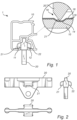
- the present furniture lubricant 18 is useful for coating a furniture slide bar 10, having a slide surface 14 coated with a lacquer comprising a resin 16 (cf. Fig. 1 ).
- the lacquer is in turn at least partly coated with the furniture lubricant 18 to provide a slide layer 19 with lowered friction.
- the lubricating coating may be permanent, dispensing with the need to replenish the lubricating coating. Further, very low amounts of the furniture lubricant 18 are needed to provide lowered friction.
- contamination of the lubricating coating does not pose any pronounced problem, as the lubricating coating, due to the very low amount present, does not have substantial adhesive properties. This is in contrast to the normal use of lubricants in plain bearings. Further, exposure to contaminations, e.g. dust etc., has been shown not to affect the lowered friction. Neither is the lubricating coating sensitive to washing. Wiping the furniture slide bar 10, with a dry and/or wet cloth, does not affect the lowered friction.
- the present furniture lubricant 18 provides an advantageous lubricant for use on lacquered furniture slide bars 10.
- Lacquered furniture slide bars 10 are useful in systems for sliding wardrobe doors, extendable tables, drawers of chests of drawers, hanging curtains, and similar applications as has been described in the co-pending applications PCT/SE2016/050835 , PCT/EP2016/071065 , PCT/EP2016/071104 , PCT/EP2016/071059 , and PCT/SE2016/050837 .
- the therein described sliding systems may be further improved by the present furniture lubricant 18.
- a plastic furniture sliding member 20 is arranged in sliding contact with the furniture slide bar 10.
- the plastic furniture sliding member 20 is arranged to allow for linear movement of the sliding member in sliding over the slide layer 19 along the longitudinal axis of the linear slide bar 10.
- the furniture slide bar 10 may be provided with a track, which in this embodiment has the form of a groove 11 extending along the longitudinal axis of the furniture slide bar 10 and defining a slide direction along the longitudinal axis of the furniture slide bar 10.
- the slide layer 19 is present at least in the groove 11.
- the track which may for example have the form of a groove, an example of such a groove 11 is illustrated in Fig. 1 , or the form of a ridge, improves the control of the lateral position of the sliding member 20 in relation to the furniture slide bar 10 when the sliding member 20 slides along the furniture slide bar 10.
- FIG. 1 An enlarged detail in Fig. 1 illustrates how the furniture slide bar 10, which is made from, in this embodiment, aluminum, has a slide surface 14.
- the slide surface 14 is coated with the lacquer comprising a resin 16.
- the lacquer comprising a resin 16 is in turn coated with the furniture lubricant 18. Thereby a slide layer 19 is formed.
- the plastic furniture sliding member 20 may slide over this slide layer 19 at a very low friction.
- the part of the plastic furniture sliding member 20 arranged in contact with the slide layer 19 may be configured as a blade 21 extending in the sliding direction. It was surprisingly found that decreasing the contact area at the interface between the furniture slide bar 10 and the plastic furniture sliding member 20 reduced the friction. Normally the risk for the bearing seizing typically increases with reduced contact area. Unless the furniture lubricant 18 is provided, the sliding system 1 will indeed seize within a few sliding cycles.
- the furniture lubricant 18 may be applied to the plastic furniture sliding member 20 rather than to the furniture slide bar 10.
- the furniture lubricant 18 will be transferred to the furniture slide bar 10 to provide a lipophilic composition coating thereon.
- the furniture lubricant 18 could be applied to the furniture slide bar 10, to the plastic furniture sliding member 20, or both.
- the furniture slide bar 10 preferably is a metal member
- the furniture slide bar 10 is an aluminum member, e.g. a linear aluminum profile, with an aluminum oxide layer, also other materials coated with a lacquer comprising a resin may be considered, such as steel.
- the slide member is typically made from a hard material, such as metal or glass.
- a hard material such as metal or glass.
- the Vickers hardness of the material from which the slide member is made may be at least 50 MPa, preferably at least 100 MPa, more preferably at least 150 MPa, and most preferably at least 300 MPa.
- the furniture slide bar 10 is a metal bar, such as an aluminum bar or a steel bar.
- the bar is made of a metal. While it is preferred if an aluminum bar has an oxide layer, also a raw, i.e. not oxidized, lacquered aluminum bar may be used. It is however preferred if the surface of the aluminum bar is oxidized to provide the aluminum bar with a hard oxide surface layer.
- the furniture slide bar 10 may be an aluminum member.
- the surface of the aluminum member coated with the lacquer may be an aluminum oxide layer.
- the thickness of such oxide layer may be at least 5 micrometers, more preferably at least 10 micrometers. Further, the thickness of the oxide layer may be less than 250 micrometers, such as less than 100 micrometers or less than 50 micrometers.
- the durability and hardness of the surface of aluminum profiles may be improved by oxidation due to the properties of aluminum oxide.
- the oxide layer initially provided by anodically oxidation is porous.
- a hard, stiff bar such as aluminum or steel bar, may accept far more heavy loads and still provide low friction.
- the present slide bar 10 may thus also be used for sliding drawers.
- thermosetting resins may be used to lacquer aluminum bars and other bars, i.e. to form a lacquer on aluminum bars and other bars.
- thermosetting resins may also be used to lacquer other metal members, e.g. a metal member made of steel.
- the lacquer comprises a resin.
- a lacquer is a hard, thin coating.
- the resin of the lacquer may for this application preferably comprise polar groups, such as hydroxyl groups, carboxylic acid groups, amide groups, cyano groups (nitrile groups), halide groups, sulfide groups, carbamate group, aldehyde groups, and/or ketone groups. Further may the resin of the lacquer be a thermosetting resin.
- resins for lacquering metal comprise acrylic resins and polyurethane resins.
- the resin is an acrylic resin, such as an acrylate resin, an acrylamide resin, a methacrylate resin, or a methyl methacrylate resin, and mixtures thereof.
- the resin is a polyurethane resin.
- the acrylic resin may be a thermosetting resin.
- the resin of the lacquer may be selected from the group consisting of cationic epoxy electrocoat, epoxy and polyester resins, and polyester resins.
- lacquers adapted for autodeposition coating such as Autophoretic TM coatings (e.g. AquenceTM Autophoretic ® 866 TM and BONDERITE ® M-PP 930 TM , the latter being an epoxy-acrylic urethane) available from Henkel AG, DE, may also be used in lacquering surfaces comprising iron.
- Autophoretic TM coatings e.g. AquenceTM Autophoretic ® 866 TM and BONDERITE ® M-PP 930 TM , the latter being an epoxy-acrylic urethane
- the slide surface 14 may be lacquered by electrocoating involving dipping the furniture slide bar 10 into a bath containing the lacquer and applying an electric field to deposit lacquer onto the slide member acting as one of the electrodes.
- the lacquer may be provided in powder form or in liquid form. Both powder and liquid lacquers may be sprayed onto the slide surface 14 to coat it.
- electro static coating may be used for powder lacquers.
- liquid lacquers a wet spray application or application in a bath may be used. Further, liquid lacquers in a bath may apart from electrocoating be applied by autodeposition.
- the thickness of the lacquer should be as even as possible.
- an electrocoating process e.g. anaphoretic coating (cf. the Honny method) or cataphoretic coating, providing very even coatings.
- electrocoating e.g. anaphoretic coating (cf. the Honny method) or cataphoretic coating, providing very even coatings.
- anodic and cathodic electrocoating There are two types of electrocoating, i.e. anodic and cathodic electrocoating. Whereas the anodic process was the first to be developed commercially, the cathodic process is nowadays more widely used. In the anodic process, a negatively charged material is deposited on the positively charged component constituting the anode. In the cathodic process, positively charged material is deposited on the negatively charged component constituting the cathode.
- cathodic electrocoating is also known as cathodic dip painting (CDP), cathodic dip coating, cataphoretic coating, cataphoresis and cathodic electrodeposition.
- CDP cathodic dip painting
- the electrocoating process may also be referred to by the trade names of the bath material used. Examples include Cathoguard (BASF), CorMax (Du Pont), Powercron (PPG) and Freiotherm (PPG).
- electrostatically coating by powder lacquers or autodepostion in a bath provide even coatings and may thus be used.
- autodeposition In lacquering steel surfaces, autodeposition may be used. As recognized by the skilled person, one of the important steps in autodeposition is the coating bath itself, where water-based paint emulsion at low solids (usually around 4-8% by weight) is combined with two other products.
- a "starter" solution of acidified ferric (Fe 3+ ) fluoride initiates the coating reaction and an oxidizing product stabilizes the metal ions in the solution.
- the coating emulsion is stable in the presence of ferric ions, but unstable in the presence of ferrous ions (Fe 2+ ). Therefore, if ferrous ions are liberated from the metal substrate, localized paint deposition will occur on the surface.
- Immersion of a component made from ferrous metal e.g.
- the thickness of the lacquer preferably is to be kept thin to reduce compression of it. Compressing the lacquer may negatively affect the sliding resistance; especially at the start of the sliding sequence, i.e. when the sliding member starts to move along the furniture slide bar 10 from a previous state of being at rest.
- the thickness of the lacquer coated on the slide slide bar 10 is thus 100 ⁇ m or less, preferably 75 ⁇ m or less, more preferably 50 ⁇ m or less. Further, the thickness of the lacquer coated on the slide member, e.g. the furniture slide bar 10, may be 5 to 75 ⁇ m, such as 10 to 50 ⁇ m, or 15 to 40 ⁇ m. Layers of these thicknesses have been found to provide for efficient sliding behavior, also at the instance when the sliding member starts to move along the furniture slide bar 10.
- At least the part of the plastic furniture sliding member 20 in contact with the slide layer 19 is made of a plastic comprising a polymer, such as a polymer comprising polar groups.
- polar groups include hydroxyl groups, carboxylic acid groups, amide groups, halide groups, sulfide groups, cyano groups (nitrile groups), carbamate groups, aldehyde groups, and/or ketone groups.
- the polymer may be selected from the group consisting of polyoxymethylenes (POM), polyesters (e.g. thermoplastic polyesters, such as polyethylene terephthalate (PET), polytrimethylene terephthalate (PTT), polybutylene terephthalate (PBT), and polylactic acid (PLA), as well as bio-based thermoplastic polyesters, such as polyhydroxyalkanoates (PHA), polyhydroxybutyrate (PHB), and polyethylene furanoate (PEF)), polyamides (PA), polyvinyl chloride (PVC), polyphenylene sulfide (PPS), polyaryletherketone (PAEK; e.g. Polyether ether ketone (PEEK)), and Polytetrafluoroethylene (PTFE).
- POM polyoxymethylenes
- PET polyethylene terephthalate
- PTT polytrimethylene terephthalate
- PBT polybutylene terephthalate
- PLA polylactic acid
- the plastic furniture sliding member 20 may be made from a plastic comprising a polymer.
- the plastic may further comprise other additives, such as fillers, colorants, and/or plasticizers.
- the plastic furniture sliding member 20 may be made from a composite comprising a polymer, such as one of the above listed polymers, filled with particles and/or fibers. The particles and/or fibers will increase the hardness, the stiffness, the creep resistance and elongation (compression) at yield of the plastic furniture sliding member 20. While not affecting the friction, presence of particles and/or fibers may affect the wear.
- the furniture lubricant 18 should be compatible with the plastic furniture sliding member 20 as well as with the lacquer 16.
- the constituents in the furniture lubricant 18 should preferably be substances that are substantially non-deteriorating to the mechanical properties of the plastic furniture sliding member 20 as well as to the lacquer 16.
- the sliding member 20 may be provided with two parallel, displaced blades 21, 22 in order to prevent rotation along the sliding axis.
- the furniture slide bar 10 may be provided with two parallel grooves 11, 12 arranged along each side of its longitudinal sliding axis. Parallel grooves 11, 12 will support and guide such two parallel blades 21, 22 of the sliding member (cf. Fig. 1 ).
- the furniture slide bar 10 is, at least partly, coated with the present furniture lubricant 18 to provide a slide layer 19.
- the present furniture lubricant 18 comprises a C10 to C28 alkane and a tri-glyceride.
- the tri-glyceride may be a triglyceride comprising C6 to C40, such as C8 to C28, non-aromatic hydrocarbyl groups.
- Triglycerides to be present in the furniture lubricant 18 may include triglycerides which are to at least 90 %.wt. composed of a glycerol residue and 3 residues of caproic acid, caprylic acid, capric acid, lauric acid, myristic acid, palmitic acid, stearic acid, and/or arachidic acid, such as 3 residues of lauric acid, myristic acid, palmitic acid, and/or stearic acid.
- the furniture lubricant comprises a biologically derived triglyceride composition such as coconut oil.
- coconut oil comprises triglycerides composed of fatty acids that are to a high degree saturated fatty acids. The coconut oil may be hydrogenated to various degrees to further reduce the amount of unsaturated fatty acids residues.
- the furniture lubricant 18 comprises C10 to C28 alkanes, such as C10 to C18 alkanes.
- the furniture lubricant may thus comprise mineral oil, such as at least 50 wt.%, such as at least 60 wt.%, or at least 70 wt.% mineral oil.
- Mineral oil is a colorless, odorless, light mixture of higher alkanes from a non-vegetable (mineral) source.
- the furniture lubricant 18 may comprise mineral oil of the type referred to as liquid paraffin, such as at least 50 wt.%, such as at least 60 wt.%, or at least 90 wt.% liquid paraffin.
- Liquid paraffin also known as paraffinum liquidum, is a very highly refined mineral oil used in cosmetics and for medical purposes. A preferred form is the liquid paraffin having CAS number 8012-95-1 .
- Exemplary embodiment 1 A furniture lubricant (18) for coating a lacquered furniture slide bar (10) to provide a slide layer (19) with lowered friction for a least one plastic furniture sliding member (20), the interface between the slide layer (19) of the furniture slide bar (10) and the sliding member (20) forming a linear plain bearing to allow for movement of the sliding member (20) along the furniture slide bar (10), wherein the furniture lubricant (18) comprises a C10 to C28 alkane and a tri-glyceride, the viscosity, according to ISO 3104:1994/Cor 1:1997, of the furniture lubricant at 40°C being 20 to 80 mm 2 /s.
- Exemplary embodiment 2 The furniture lubricant (18) according to exemplary embodiment 1, wherein the furniture lubricant (18) further comprises an anti-oxidant, preferably the furniture lubricant (18) comprises up to 5 wt.% of the anti-oxidant, such as up to 2.5 wt.% of the anti-oxidant, such as 0.1 to 1 wt.% of the anti-oxidant, preferably the anti-oxidant has an E-number (accepted as food-ingredient), preferably the anti-oxidant has a log P (n-octanol/water) value of at least 1 at 25°C.
- the furniture lubricant (18) comprises up to 5 wt.% of the anti-oxidant, such as up to 2.5 wt.% of the anti-oxidant, such as 0.1 to 1 wt.% of the anti-oxidant, preferably the anti-oxidant has an E-number (accepted as food-ingredient), preferably the anti-oxidant has a log P (n
- Exemplary embodiment 3 The furniture lubricant (18) according to exemplary embodiment 2, wherein the anti-oxidant is selected from the group consisting of tocopherols, e.g. ( ⁇ )- ⁇ -tocopherol, and sterically hindered phenols, e.g. dibutylhydroxytoluene or butylated hydroxyanisole.
- tocopherols e.g. ( ⁇ )- ⁇ -tocopherol
- sterically hindered phenols e.g. dibutylhydroxytoluene or butylated hydroxyanisole.
- Exemplary embodiment 4 The furniture lubricant (18) according to any one of the preceding exemplary embodiments, wherein the furniture lubricant (18) comprises a mixture of at least two different tri-glycerides, and/or a mixture of at least two different C10 to C28 alkanes; preferably the furniture lubricant (18) comprises a mixture of at least two different tri-glycerides and at least two different C10 to C28 alkanes.
- Exemplary embodiment 5 The furniture lubricant (18) according to any one of the preceding exemplary embodiments, wherein the furniture lubricant (18) comprises at least 50 wt.% of a C10 to C28 alkane or a mixture of C10 to C28 alkanes, and 1 to 50 wt.% of a tri-glyceride, or a mixture of tri-glycerides.
- Exemplary embodiment 6 The furniture lubricant (18) according to exemplary embodiment 5, wherein the furniture lubricant (18) comprises at least 60 wt.% of a C10 to C28 alkane, or a mixture of C10 to C28 alkanes, and 5 to 40 wt.% of a tri-glyceride, or a mixture of tri-glycerides.
- Exemplary embodiment 7 The furniture lubricant (18) according to exemplary embodiment 6, wherein the furniture lubricant (18) comprises at least 70 wt.% of a C10 to C28 alkane, or a mixture of C10 to C28 alkanes, and 10 to 30 wt.% of a tri-glyceride, or a mixture of tri-glycerides.
- Exemplary embodiment 8 The furniture lubricant (18) according to any one of the preceding exemplary embodiments, wherein the furniture lubricant (18) comprises less than 5 wt.% aromatics; preferably less than 2.5 wt.% aromatics, even more preferably less than 1.0 wt.% aromatics.
- Exemplary embodiment 9 The furniture lubricant (18) according to any one of the preceding exemplary embodiments, wherein the furniture lubricant (18) has Total Iodine Value according to ASTM D1541-97 of less than 10; preferably less than 5.
- Exemplary embodiment 10 The furniture lubricant (18) according to any one of the preceding exemplary embodiments, wherein the furniture lubricant (18) is present in liquid form at least at temperatures of 15°C and above.
- Exemplary embodiment 11 The furniture lubricant (18) according to any one of the preceding exemplary embodiments, wherein each of the components in the furniture lubricant (18) at least fulfill one of the following criteria:
- Exemplary embodiment 12 The furniture lubricant (18) according to any one of the preceding exemplary embodiments, wherein at least the tri-glyceride, but preferably all components in the furniture lubricant (18), were generally recognized as safe (GRAS) in the US on December 31, 2016.
- GRAS safe
- Exemplary embodiment 13 The furniture lubricant (18) according to any one of the preceding exemplary embodiments, wherein the pour point of the furniture lubricant (18) according to ISO 3016:1994 is 20°C or less, preferably 15°C or less.
- Exemplary embodiment 14 The furniture lubricant (18) according to any one of the preceding exemplary embodiments, wherein the furniture lubricant (18) comprises liquid paraffin, preferably having a viscosity, according to ISO 3104:1994/COR 1:1997, at 40°C, of 20 to 80 mm 2 /s, more preferably a viscosity of 30 to 70 mm 2 /s, and a biologically derived triglyceride composition, preferably coconut oil; preferably the furniture lubricant (18) comprising at least 50 wt.%, such as at least 60 wt.% or at least 70 wt.%, liquid paraffin, and 1 to 50 wt.%, such as 5 to 40 wt.%, or 10 to 30 wt.%, coconut oil.
- liquid paraffin preferably having a viscosity, according to ISO 3104:1994/COR 1:1997, at 40°C, of 20 to 80 mm 2 /s, more preferably a viscos
- Exemplary embodiment 15 The furniture lubricant (18) according to any one of the preceding exemplary embodiments, wherein the viscosity, according to ISO 3104:1994/COR 1:1997, of the furniture lubricant at 40°C is 30 to 70 mm 2 /s.
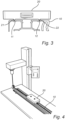
- the sled was pulled over the slide bar at a constant speed of 500 mm/min and the force necessary to pull the sled was registered using an Instron 5966 tension testing system (cf. Fig. 4 ). The total weight of the sled corresponds to 10 N. Fresh profiles were used for each lipophilic composition, as the lipophilic compositions cannot be completely removed once applied.
- Ageing of the profiles was performed by putting the fresh profile, with lipophilic composition applied thereon, in an oven at 85°C for 6 weeks. This corresponds to about 10 years of ageing at room temperature (20°C). The profiles for ageing were put in the oven without any prior cleaning.
- the resulting dynamic friction was reduced by about 75% by applying a lipophilic composition to the anodized aluminum profiles, though the initial dynamic friction of the un-coated anodized aluminum profiles was not that high.
- tri-glycerides either on their own or when as additives provide the lowest dynamic friction.
- lubricants comprising fatty acids or fatty acids residues (i.e. tri-glycerides) were less ageing resistant compared to, e.g. liquid paraffin.. While addition of an anti-oxidant significantly improved the ageing resistance of tri-glycerides, fatty acids remained ageing sensitive.
- Tests were also performed in a test rig to simulate a full scale wardrobe door with a weight of 5 kg.
- a weight of 5 kg was put on a sled 20 of the type illustrated in Fig. 3 and the sled was made to move back and forth in a reciprocating movement on a slide bar 10 of the type described hereinabove with reference to Fig. 3 .
- the slide bar 10 was provided with a furniture lubricant, also tested for friction, see table 1, and comprising: liquid paraffin 83.1%, coconut oil 16.7%, and vitamin E 0.2%.
- the furniture lubricant had a viscosity, according to ISO 3104:1994/COR 1:1997, at 40°C, being 45 mm 2 /s.
Landscapes
- Chemical & Material Sciences (AREA)
- Organic Chemistry (AREA)
- Engineering & Computer Science (AREA)
- Oil, Petroleum & Natural Gas (AREA)
- General Engineering & Computer Science (AREA)
- Chemical Kinetics & Catalysis (AREA)
- General Chemical & Material Sciences (AREA)
- Mechanical Engineering (AREA)
- Life Sciences & Earth Sciences (AREA)
- Wood Science & Technology (AREA)
- Materials Engineering (AREA)
- Lubricants (AREA)
Abstract
Description
- The present invention relates to a polymer compatible, ageing resistant lipophilic furniture lubricant for coating a lacquered furniture slide bar to provide a slide layer with lowered friction for a plastic furniture sliding member.
- Linear plain furniture bearings are known in the art and have been used in simple constructions within the home, including sliding doors, e.g. wardrobe doors and kitchen doors, extendable tables, chests of drawers, extendable soda beds etc. They are relatively simple, reliable constructions, though the dynamic friction typically is fairly high, but still often acceptable. Still it is of interest to provide simple, inexpensive, safe means form for providing plain bearings with lowered friction. The lowered friction should preferably be in principle permanent. Further, the plain bearing should preferably be essentially maintenance-free. Permanent low friction would in addition open up for replacing ball bearings in applications today requiring such for obtaining sufficiently low friction.
- In the art, some means for lowering the friction of plain bearings for simple constructions within the home are known. These include the provision of various kinds of inserts and coatings (cf. e.g.
CH 334 983 US 4,138,176 ). Though lubricants commonly are used in industrial applications, especially for metal-metal interfaces, they have found in principle no use in simple constructions within the home, as they typically require maintenance and repeated application of the lubricant among other reasons. Further, the safety requirements are significantly different between industrial applications on the one hand, and home applications of the other. - It should further be noted that the coefficient of friction should preferably be really low, i.e. < 0.1, preferably less than 0.075, or even less than 0.06, to find use in simple constructions within the home to replace ball bearings.
- Thus, there is a need in the art for furniture lubricant for plain bearings for simple constructions within the home providing maintenance-free, long term low dynamic friction, and dispensing with the need for repeated application of the lubricant. The furniture lubricant should be inexpensive and safe, to allow for repeated direct contact by man including children.
- Consequently, the present invention seeks to mitigate, alleviate, eliminate or circumvent one or more of the above identified deficiencies and disadvantages in the art singly or in any combination by providing a furniture lubricant comprising a C10 to C28 alkane and a tri-glyceride. The viscosity, according to ISO 3104:1994/COR 1:1997, of the lubricant at 40°C should be 20 to 80 mm2/s.
- A viscosity of above 80 mm2/s, at 40°C pursuant to ISO 3104:1994/COR 1:1997, tends to increase the friction, and in addition makes it more difficult to apply the furniture lubricant to a piece of furniture. Preferably, the viscosity should be less than 70 mm2/s, at 40°C, for even lower friction.
- A viscosity of less than 20 mm2/s, at 40°C pursuant to ISO 3104:1994/COR 1:1997, tends to give an increased friction in furniture applications. In addition, the furniture lubricant tends to lose its low friction properties faster, and thereby result in a short life of the furniture to which it is applied. Preferably, the viscosity should be at least 30 mm2/s, at 40°C, for even better durability.
- It has been found that really low dynamic friction may be provided by providing a plain bearing comprising lacquered furniture slide bar being coated with such a furniture lubricant to provide a slide layer with lowered friction and least one plastic furniture sliding member sliding over the slide layer. The interface between the slide layer of the furniture slide bar and the plastic furniture sliding member forms a linear plain bearing and allows for linear movement of the furniture sliding member along the furniture slide bar. The furniture slide bar has a slide surface coated with a lacquer comprising a resin.
- According to one embodiment, at least the slide surface of the furniture slide bar may be an aluminum surface. This provides for an efficient support for the lacquer coated on the slide surface. The aluminum surface may have an anodized oxide surface layer onto which the lacquer is applied. Anodized surfaces are hard and provide for good adhesion of the lacquer applied thereto. The furniture slide bar may be an aluminum bar, e.g. aluminum profile, preferably having an anodized oxide surface layer, onto which the lacquer is applied. As an example, the slide member may be an aluminum profile having been electrophoretically, preferably anaphoretically, coated with an acrylic resin and subsequently heat cured to form the lacquer coated on the slide surface. Preferably, the aluminum profile has an anodized oxide surface layer onto which the lacquer is applied. The Honny process or one of its derivatives may be used to obtain such anodized, lacquered surfaces. Whereas the thickness of the anodized oxide surface layer preferably is at least 5 micrometers, the thickness of the lacquer coated on the furniture slide bar may preferably be 100 micrometers or less. Further, according to another embodiment the slide surface of the slide member is made from steel, onto which the lacquer is applied. Steel is a generally strong, hard and comparably cheap material that can be used as a starting material for the slide member. Steel surfaces may be lacquered by electrocoating or autodeposition to provide a lacquer layer with uniform thickness. The part of the plastic furniture sliding member to slide over the slide layer may be configured as a blade extending in the sliding direction. Further, the slide layer may be present at a track, such as in a groove or on a ridge, extending along the longitudinal axis of the furniture slide bar. The sliding member comprises at least one individual contact point in contact with the furniture slide bar at the interface between the furniture slide bar and the sliding member. The contact area of each individual contact point may be less than 3 mm2. Further, the contact pressure in the at least one contact point may be at least 4 N/mm2.
- It has surprisingly been found that coating a surface lacquered with a resin, for example an acrylic resin, with a lipophilic composition, such as for example sebum (natural or artificial), coconut oil, or liquid paraffin, provides a slide layer with extremely low friction (sliding resistance). While the initial sliding resistance is low for the combination of a lacquered furniture slide bar and a plastic furniture sliding member also without application of a lubricant, such a bearing was found to seize only after a limited number of sliding cycles. Application of the lipophilic composition reduced the dynamic friction (up to 75%). Surprisingly, the effect was not only temporarily, but seemingly permanent or at least long-lasting. The need to replenish the lubricant may hence be dispensed with.
- In experiments employing aluminum profiles having been anaphoretically coated with an acrylic resin subsequently heat cured to form a lacquer (cf. the Honny process, initially disclosed in
GB 1,126,855 - Various lipophilic compositions may be used to lower the friction of plain bearings comprising lacquered furniture slide bar and a plastic furniture sliding member. However, for long term use in simple constructions within the home, a furniture lubricant comprising a C10 to C28 alkane, such as C10 to C18 alkane, and a tri-glyceride and having a viscosity, according to ISO 3104:1994/COR 1:1997, of the lubricant at 40°C being 20 to 80 mm2/s is advantageous.
- Such a furniture lubricant provides a combination of preferred properties including low friction, ageing resistance, food safety, manageability (i.e. the lubricant is suitable for application in an industrial production line for producing furniture) and resistance to wear. An example of a suitable furniture lubricant, is a composition comprising a mixture of liquid paraffin and a biologically derived triglyceride composition, e.g. coconut oil, in which the liquid paraffin is preferably the major component (> 50 wt.%). Though coconut oil provides very low friction initially and has high resistance to wear, the friction increases over time. Further, coconut oil is solid (or semi-solid) at ambient temperature. From a food safety perspective, coconut oil is a very good triglyceride composition, as it is a foodstuff with essentially no food safety concerns.
- Given the low friction of triglycerides and their other beneficial properties in the present application including food safety, the present lubricant comprises as least one tri-glyceride. The furniture lubricant may comprise a mixture of different tri-glycerides, i.e. at least two tri-glycerides, such as at least 3, 4, or 5 different tri-glycerides. Further, the composition may comprise 1 to 50 wt.% of a tri-glyceride, such as 5 to 40 wt.% or 10 to 30 wt.% of a tri-glyceride. As already mentioned, the furniture lubricant may comprise a mixture of different tri-glycerides, i.e. at least two triglycerides. Thus, the furniture lubricant may comprise at least 5 wt.% of a mixture of different tri-glycerides, such as at least 10 wt.% of a mixture of different tri-glycerides, such as 5 to 40 wt.%, or even 10 to 30 wt.% of a mixture of different tri-glycerides. According to an embodiment, the furniture lubricant comprises a biologically derived triglyceride composition, e.g. coconut oil. In terms of ageing resistance, coconut oil is preferred over alternative biologically derived triglyceride compositions having higher content of unsaturated fatty acids. Biologically derived triglyceride compositions having a Total Iodine Value according to ASTM D1541-97 of less than 50, such as less than 20, represent preferred biologically derived triglyceride compositions for being included in the present furniture lubricant.
- In order to be suitable for application in an industrial production line but still sufficiently resistant to wear and give the desired low friction properties over time, the furniture lubricant has a viscosity, according to ISO 3104:1994/COR 1:1997, at 40°C of 20 to 80 mm2/s, such as of 30 to 70 mm2/s.
- The viscosity of a lubricant comprising a tri-glyceride is affected by including a C10 to C28 alkane in the composition. Further, in contrast to tri-glycerides, alkanes are more ageing resistant. They do provide low friction, but not as low as tri-glycerides. Further, mixtures of alkanes do seemingly provide lower friction than an individual alkane. Thus, the furniture lubricant may comprise a mixture of at least two different C10 to C28 to alkanes. Liquid paraffin is an example of a preferred mixture of alkanes having suitable properties. According to an embodiment, the furniture lubricant comprises n-alkanes, branched alkanes, and optionally also cycloalkanes.
- By providing a mixture of a
C 10 to C28 alkane, such as a C10 to C18 alkane, and tri-glyceride, a more ageing resistant furniture lubricant still providing low friction and having good manageability and resistance to wear is provided. - The furniture lubricant may comprise at least 50 wt.% of a C10 to C28 alkane, such as at least 60 wt.% of a C10 to C28 alkane, or a at least 70 wt.% of a C10 to C28 alkane. As already mentioned, the furniture lubricant may comprise a mixture of different C10 to C28 alkanes, i.e. at least two C10 to C28 alkanes. Thus, the furniture lubricant may comprise at least 50 wt.% of a mixture of different C10 to C28 alkanes, such as at least 60 wt.% of a mixture of different C10 to C28 alkanes, or at least 70 wt.% of a mixture of different C10 to C28 alkanes. The mixture of different C10 to C28 alkanes may comprise more than 2 different C10 to C28 alkanes, such as at least 3, at least 4, or at least 5 different C10 to C28 alkanes.
- According to an embodiment, the C10 to C28 alkane is an n-alkane. If the major C10 to C28 alkane is an n-alkane, the furniture lubricant may further comprise minor amounts of branched alkanes and/or cycloalkanes. Seemingly, not only the friction but also the resistance to wear is improved by a tri-glyceride being present in the furniture lubricant.
- As used herein, alkanes include n-alkanes and branched alkanes. If an integer, e.g. C10, used as prefix, the integer represent the carbon number of the alkanes. As an example, C16 alkane corresponds to hexadecane, whether straight, branched or cyclic. Further, "C10-16 alkane" represents an alkane having a carbon number in the range of 10 (e.g. decane) to 16 (e.g. hexadecane)
- According to an embodiment the furniture lubricant:
- has a viscosity according to ISO 3104: 1994/COR 1: 1997, at 40°C, of 20 to 80 mm2/s, such as 30-70 mm2/s;
- comprises at least 50 wt.%, such as at least 60 wt.% or at least 70 wt.%, of one or more C10 to C28 alkanes, such as a n-alkane; and
- comprises 1 to 50 wt.%, such as 5 to 40 wt.%, or 10 to 30 wt.%, of one or more triglycerides.
- According to a specific embodiment the furniture lubricant:
- has a viscosity according to ISO 3104: 1994/COR 1: 1997, at 40°C, of 20 to 80 mm2/s, such as 30 to 70 mm2/s;
- comprises at least 50 wt.%, such as at least 60 wt.% or at least 70 wt.%, of a mixture of alkanes, such as liquid paraffin; and
- comprises 1 to 50 wt.%, such as 5 to 40 wt.%, or 10 to 30 wt.%, of a biologically derived triglyceride composition, e.g. coconut oil. In such an embodiment, the liquid paraffin may have a viscosity, according to ISO 3104:1994/COR 1:1997, at 40°C, of 20 to 80 mm2/s, such as 30 to 70 mm2/s.
- Further, in order to not be potentially harmful, the content of aromatics, i.e. compounds comprising benzene rings or fused benzene rings, in the furniture lubricant is low. According to an embodiment, the furniture lubricant comprises less than 5 wt.% aromatics, such as less than 2.5 wt.% aromatics, less than 1.0 wt.% aromatics or less than 0.1 wt.% aromatics.
- Furthermore, it was found that unsaturated components may affect the ageing resistance of the furniture lubricant negatively though typically lowering the viscosity. As recognized by the skilled person, the content of carbon-carbon double bonds in an organic sample may be determined by determining the Total Iodine Value. The Total Iodine Value (also known as "iodine adsorption value", "iodine number" or "iodine index") is the mass of iodine in grams that is consumed by 100 grams of a chemical substance. The Total Iodine Value is used to determine the amount of unsaturation in e.g. fatty acids and tri-glycerides. The higher the iodine number, the more carbon-carbon double bonds are present. According to an embodiment, the furniture lubricant has a Total Iodine Value according to ASTM D1541-97 of less than 10, such as less than 5.
- As already discussed, the viscosity of the furniture lubricant at 40°C according to ISO 3104:1994/COR 1:1997 should be 20 to 80 mm2/s. However, not only the viscosity is relevant for the manageability of the furniture lubricant, but also other related parameters, such as the melting point and pour point. According to an embodiment, the furniture lubricant is present in liquid form at least at temperatures of 15°C and above. Further, the pour point of the furniture lubricant according to ISO 3016:1994 may be 20°C or less, such as 15°C or less. As recognized by the skilled person, the pour point of a liquid is the temperature at which the liquid becomes semi solid and loses its flow characteristics. The pour point is thus relevant for the manageability of the present furniture lubricant.
- Further, given that the furniture lubricant is to be used in constructions within the home to which also children and infants may have access, all components in the furniture lubricant are, according to an embodiment, generally recognized as safe (GRAS) in the US 31.12.2016. As recognized by the skilled person, "GRAS" is an acronym for the phrase Generally Recognized As Safe. Under sections 201(s) and 409 of the Federal Food, Drug, and Cosmetic Act (the Act), any substance that is intentionally added to food is a food additive, that is subject to premarket review and approval by FDA (American Food and Drug Administration), unless the substance is generally recognized, among qualified experts, as having been adequately shown to be safe under the conditions of its intended use, or unless the use of the substance is otherwise excepted from the definition of a food additive. Under sections 201(s) and 409 of the Act, and FDA's implementing regulations in 21 CFR 170.3 and 21 CFR 170.30, the use of a food substance may be GRAS either through scientific procedures or, for a substance used in food before 1958. Especially, it is preferred if at least the tri-glyceride is generally recognized as safe (GRAS) in the US 31.12.2016. As recognized by the skilled person, an inventory of GRAS notices is provided by the FDA. The inventory of GRAS notices provides information about GRAS notices filed.
- Apart from GRAS also other classification standards may serve as guidance in selecting components for the furniture lubricant.
- NSF International (cf. http://www.nsf.org/) is an independent, well reputed third part organization founded in 1944 as the National Sanitation Foundation. NSF runs a nonfood compounds program to evaluate the risk of contamination of chemical compounds used in and around food processing facilities. Products eligible for registration include lubricants, cleaners, and water treatment products. Nonfood compounds and proprietary substances found compliant to food safety regulations after a thorough registration process are listed in the NSF White Book™. The NSF White Book™ comprises products listed under various categories and is recognized internationally and used by product manufacturers, food processors and regulators. According to an embodiment, the C10-C28 alkane, or a mixture comprising such an alkane, was classified as a H1 lubricant by NSF on 31.12.2016. H1 classified lubricants are lubricants that could have incidental food contact and are sometimes referred to as "above the line" lubricants. These may be used on food-processing equipment as a protective antirust film, as a release agent on gaskets or seals of tank closures, and as a lubricant for machine parts and equipment in locations where the lubricated part is potentially exposed to food.
- According to another embodiment, the C10-C28 alkane, or a mixture comprising such an alkane, was approved for contact with food according to the EU Regulation (EC) No 1935/2004 on 31.12.2016.
- Thus, according to an embodiment, each of the components in the furniture lubricant (18) at least fulfill one of the following criteria:
- was generally recognized as safe (GRAS) in the US on December 31, 2016;
- was classified as a H1 lubricant by NSF on 31.12.2016; and
- was approved for contact with food according to the EU Regulation (EC) No 1935/2004 on 31.12.2016.
- As already discussed, the ageing resistance of tri-glycerides was found to be fairly low, i.e. use of only tri-glycerides as the furniture lubricant in the present plain bearings results in increased friction over time, although the initial friction is very low. By combining tri-glycerides and C10 to C18 alkane, the ageing resistance is improved.
- In order to further improve the ageing resistance, an anti-oxidant may be present in the furniture lubricant. Thus, the furniture lubricant may comprise an anti-oxidant. The furniture lubricant may according to such an embodiment comprise up to 5 wt.% of the anti-oxidant, such as up to 2.5 wt.% of the anti-oxidant, e.g. 0.1 to 1 wt.% of the anti-oxidant. Preferably, the anti-oxidant was permitted to be used as food additives within the European Union on 31.12.2016, i.e. an anti-oxidant having an E number. Thus, the anti-oxidant may be selected from the group consisting of E300 Ascorbic acid (Vitamin C), E301 Sodium ascorbate, E302 Calcium ascorbate, E303 Potassium ascorbate, E304 Fatty acid esters of ascorbic acid (Ascorbyl palmitate), E305 Ascorbyl stearate, E306 Tocopherols (Vitamin E, natural), E307 Alpha-Tocopherol (synthetic) antioxidant, E308 Gamma-Tocopherol (synthetic), E309 Delta-Tocopherol (synthetic), E310 Propyl gallate, E311 Octyl gallate, E312 Dodecyl gallate, E313 Ethyl gallate, E314 Guaiac resin, E315 Erythorbic acid, E316 Sodium erythorbate, E317 Erythorbin acid. E318Sodium erythorbin, E319 tert-Butylhydroquinone (TBHQ), E320 Butylated hydroxyanisole (BHA), E321 Butylated hydroxytoluene (BHT), E323 Anoxomer, and E324 Ethoxyquin. As the anti-oxidant is to be used in a lipophilic lubricant, the anti-oxidant preferably is lipophilic. The partition-coefficient between n-octanol and water is a common measure of lipophilicity. Thus, the anti-oxidant may have log P (n-octanol/water) of at least 1 at 25°C.
- As an example, the anti-oxidant may be a tocopherol, e.g. (±)-α-tocopherol. Apart from alfa-tocopherol (E307), also gamma-tocopherol (E308), and delta-tocopherol (E308) may be used as anti-oxidant. Further, the anti-oxidant may be natural Vitamin E (E306). Given the safety concerns, tocopherol, e.g. alfa-tocopherol (E307), is a preferred anti-oxidant in the present furniture lubricant. Further, the anti-oxidant may be selected from the group not only consisting of tocopherols, e.g. (±)-α-tocopherol, but also of sterically hindered phenols, e.g. dibutylhydroxytoluene (BHT) or butylated hydroxyanisole (BHA) (i.e. 2-tert-butyl-4-hydroxyanisole and/or 3-tert-butyl-4-hydroxyanisole).
- The above and other aspects, features and advantages of which the invention is capable of will be apparent and elucidated from the following description of the present invention, reference being made to the accompanying drawings, in which
-
Fig. 1 depicts a cross section of a sliding system in which the present lubricant may be used; -
Fig. 2 depicts cross sections of the sliding member inFig. 1 ; -
Fig. 3 depicts a cross section of a sliding system used for friction tests; -
Fig. 4 illustrates an arrangement for performing friction tests with the sliding system ofFig. 3 ; - As described herein above, the
present furniture lubricant 18 is useful for coating afurniture slide bar 10, having aslide surface 14 coated with a lacquer comprising a resin 16 (cf.Fig. 1 ). The lacquer is in turn at least partly coated with thefurniture lubricant 18 to provide aslide layer 19 with lowered friction. By coating the lacquer with thefurniture lubricant 18, the sliding friction is not just temporarily lowered, but long term, wear resistant low sliding friction is obtained. The lubricating coating may be permanent, dispensing with the need to replenish the lubricating coating. Further, very low amounts of thefurniture lubricant 18 are needed to provide lowered friction. Thus, contamination of the lubricating coating does not pose any pronounced problem, as the lubricating coating, due to the very low amount present, does not have substantial adhesive properties. This is in contrast to the normal use of lubricants in plain bearings. Further, exposure to contaminations, e.g. dust etc., has been shown not to affect the lowered friction. Neither is the lubricating coating sensitive to washing. Wiping thefurniture slide bar 10, with a dry and/or wet cloth, does not affect the lowered friction. - The
present furniture lubricant 18 provides an advantageous lubricant for use on lacquered furniture slide bars 10. Lacquered furniture slide bars 10 are useful in systems for sliding wardrobe doors, extendable tables, drawers of chests of drawers, hanging curtains, and similar applications as has been described in the co-pending applicationsPCT/SE2016/050835 PCT/EP2016/071065 PCT/EP2016/071104 PCT/EP2016/071059 PCT/SE2016/050837 present furniture lubricant 18. - In order to provide a sliding
system 1, at a least one plasticfurniture sliding member 20 is arranged in sliding contact with thefurniture slide bar 10. By arranging the interface betweenslide layer 19 of thefurniture slide bar 10 and the slidingmember 20 in sliding contact a linear plain bearing is provided.The plasticfurniture sliding member 20 is arranged to allow for linear movement of the sliding member in sliding over theslide layer 19 along the longitudinal axis of thelinear slide bar 10. Further, thefurniture slide bar 10 may be provided with a track, which in this embodiment has the form of agroove 11 extending along the longitudinal axis of thefurniture slide bar 10 and defining a slide direction along the longitudinal axis of thefurniture slide bar 10. When thefurniture slide bar 10 is provided with agroove 11, theslide layer 19 is present at least in thegroove 11. - The track, which may for example have the form of a groove, an example of such a
groove 11 is illustrated inFig. 1 , or the form of a ridge, improves the control of the lateral position of the slidingmember 20 in relation to thefurniture slide bar 10 when the slidingmember 20 slides along thefurniture slide bar 10. - An enlarged detail in
Fig. 1 illustrates how thefurniture slide bar 10, which is made from, in this embodiment, aluminum, has aslide surface 14. Theslide surface 14 is coated with the lacquer comprising aresin 16. The lacquer comprising aresin 16 is in turn coated with thefurniture lubricant 18. Thereby aslide layer 19 is formed. The plasticfurniture sliding member 20 may slide over thisslide layer 19 at a very low friction. - Further, as shown in
Fig. 2 , the part of the plasticfurniture sliding member 20 arranged in contact with theslide layer 19 may be configured as ablade 21 extending in the sliding direction. It was surprisingly found that decreasing the contact area at the interface between thefurniture slide bar 10 and the plasticfurniture sliding member 20 reduced the friction. Normally the risk for the bearing seizing typically increases with reduced contact area. Unless thefurniture lubricant 18 is provided, the slidingsystem 1 will indeed seize within a few sliding cycles. - Such a low amount of the
furniture lubricant 18 is needed, that thefurniture lubricant 18 may be applied to the plasticfurniture sliding member 20 rather than to thefurniture slide bar 10. In sliding over thefurniture slide bar 10, thefurniture lubricant 18 will be transferred to thefurniture slide bar 10 to provide a lipophilic composition coating thereon. Hence, thefurniture lubricant 18 could be applied to thefurniture slide bar 10, to the plasticfurniture sliding member 20, or both. - While the
furniture slide bar 10 preferably is a metal member, according to one preferred embodiment thefurniture slide bar 10 is an aluminum member, e.g. a linear aluminum profile, with an aluminum oxide layer, also other materials coated with a lacquer comprising a resin may be considered, such as steel. In order to allow for long term use and to carry loads, the slide member is typically made from a hard material, such as metal or glass. Especially the surface of the slide member should preferably be hard. The Vickers hardness of the material from which the slide member is made, may be at least 50 MPa, preferably at least 100 MPa, more preferably at least 150 MPa, and most preferably at least 300 MPa. According to an embodiment, thefurniture slide bar 10 is a metal bar, such as an aluminum bar or a steel bar. In such embodiment, the bar is made of a metal. While it is preferred if an aluminum bar has an oxide layer, also a raw, i.e. not oxidized, lacquered aluminum bar may be used. It is however preferred if the surface of the aluminum bar is oxidized to provide the aluminum bar with a hard oxide surface layer. - The
furniture slide bar 10 may be an aluminum member. Further, the surface of the aluminum member coated with the lacquer may be an aluminum oxide layer. The thickness of such oxide layer may be at least 5 micrometers, more preferably at least 10 micrometers. Further, the thickness of the oxide layer may be less than 250 micrometers, such as less than 100 micrometers or less than 50 micrometers. As known in the art, the durability and hardness of the surface of aluminum profiles may be improved by oxidation due to the properties of aluminum oxide. The oxide layer initially provided by anodically oxidation is porous. While the pores may be closed by steam treatment, sealing via anaphoretically coating with an acrylic resin subsequently heat cured to form the lacquer, is even more effective in sealing the porous aluminum oxide layer: This method, firstly disclosed by Honny Chemicals Co. Ltd. (cf.GB 1,126,855 - Further, compared to plastic slide bars, a hard, stiff bar, such as aluminum or steel bar, may accept far more heavy loads and still provide low friction. The
present slide bar 10 may thus also be used for sliding drawers. - In addition, it has been found that a relatively high contact pressure in the contact between the
furniture slide bar 10 and the plasticfurniture sliding member 20 reduces the friction. For this reason as well it is beneficial to make thefurniture slide bar 10 from a hard material, such as aluminum or steel, since such materials can accept higher contact pressures, thereby reducing friction. In order to just not initially provide low friction, but provide long term low friction, the presence of thepresent furniture lubricant 18 on theslide layer 19 is important. - As known in the art, various resins, e.g. thermosetting resins, may be used to lacquer aluminum bars and other bars, i.e. to form a lacquer on aluminum bars and other bars. Further, thermosetting resins may also be used to lacquer other metal members, e.g. a metal member made of steel. The lacquer comprises a resin. As known to the skilled person, a lacquer is a hard, thin coating. The resin of the lacquer may for this application preferably comprise polar groups, such as hydroxyl groups, carboxylic acid groups, amide groups, cyano groups (nitrile groups), halide groups, sulfide groups, carbamate group, aldehyde groups, and/or ketone groups. Further may the resin of the lacquer be a thermosetting resin.
- Examples of resins for lacquering metal comprise acrylic resins and polyurethane resins. According to an embodiment, the resin is an acrylic resin, such as an acrylate resin, an acrylamide resin, a methacrylate resin, or a methyl methacrylate resin, and mixtures thereof. According to another embodiment, the resin is a polyurethane resin. The acrylic resin may be a thermosetting resin.
- As known to the skilled person further resins for use in lacquering metal surfaces are known in the art. As an example, the resin of the lacquer may be selected from the group consisting of cationic epoxy electrocoat, epoxy and polyester resins, and polyester resins. Still further, lacquers adapted for autodeposition coating, such as Autophoretic™ coatings (e.g. AquenceTM Autophoretic® 866™ and BONDERITE® M-PP 930™, the latter being an epoxy-acrylic urethane) available from Henkel AG, DE, may also be used in lacquering surfaces comprising iron.
- The
slide surface 14 may be lacquered by electrocoating involving dipping thefurniture slide bar 10 into a bath containing the lacquer and applying an electric field to deposit lacquer onto the slide member acting as one of the electrodes. Further, the lacquer may be provided in powder form or in liquid form. Both powder and liquid lacquers may be sprayed onto theslide surface 14 to coat it. For powder lacquers, electro static coating may be used. For liquid lacquers a wet spray application or application in a bath may be used. Further, liquid lacquers in a bath may apart from electrocoating be applied by autodeposition. - In order to provide low friction, the thickness of the lacquer should be as even as possible. Thus it may be preferred to apply the lacquer by an electrocoating process, e.g. anaphoretic coating (cf. the Honny method) or cataphoretic coating, providing very even coatings. There are two types of electrocoating, i.e. anodic and cathodic electrocoating. Whereas the anodic process was the first to be developed commercially, the cathodic process is nowadays more widely used. In the anodic process, a negatively charged material is deposited on the positively charged component constituting the anode. In the cathodic process, positively charged material is deposited on the negatively charged component constituting the cathode. In the art, cathodic electrocoating is also known as cathodic dip painting (CDP), cathodic dip coating, cataphoretic coating, cataphoresis and cathodic electrodeposition. Further, the electrocoating process may also be referred to by the trade names of the bath material used. Examples include Cathoguard (BASF), CorMax (Du Pont), Powercron (PPG) and Freiotherm (PPG). Further, also electrostatically coating by powder lacquers or autodepostion in a bath provide even coatings and may thus be used.
- In lacquering steel surfaces, autodeposition may be used. As recognized by the skilled person, one of the important steps in autodeposition is the coating bath itself, where water-based paint emulsion at low solids (usually around 4-8% by weight) is combined with two other products. A "starter" solution of acidified ferric (Fe3+) fluoride initiates the coating reaction and an oxidizing product stabilizes the metal ions in the solution. The coating emulsion is stable in the presence of ferric ions, but unstable in the presence of ferrous ions (Fe2+). Therefore, if ferrous ions are liberated from the metal substrate, localized paint deposition will occur on the surface. Immersion of a component made from ferrous metal (e.g. steel) into an autodeposition bath causes the acidic environment to liberate ferrous ions, thereby causing the coating emulsion to be deposited, forming a mono-layer of paint particles. Henkel Adhesive Technologies (US)// Henkel AG & Co. KGaA (Germany) provides coatings under the trademark BONDERITE® for use in autodeposition.
- As the lacquer coated on the
furniture slide bar 10 typically is more compressible than the material of thefurniture slide bar 10 itself, and as load carrying sliding members will apply pressure on the lacquer in sliding over thefurniture slide bar 10, the thickness of the lacquer preferably is to be kept thin to reduce compression of it. Compressing the lacquer may negatively affect the sliding resistance; especially at the start of the sliding sequence, i.e. when the sliding member starts to move along thefurniture slide bar 10 from a previous state of being at rest. - According to an embodiment, the thickness of the lacquer coated on the
slide slide bar 10 is thus 100 µm or less, preferably 75 µm or less, more preferably 50 µm or less. Further, the thickness of the lacquer coated on the slide member, e.g. thefurniture slide bar 10, may be 5 to 75 µm, such as 10 to 50 µm, or 15 to 40 µm. Layers of these thicknesses have been found to provide for efficient sliding behavior, also at the instance when the sliding member starts to move along thefurniture slide bar 10. - Not only the low dynamic friction provided by the present slide member, but also the low difference between the static and dynamic friction provided by the present slide member is beneficial in terms of the sliding behavior.
- In order to provide low friction, at least the part of the plastic
furniture sliding member 20 in contact with theslide layer 19 is made of a plastic comprising a polymer, such as a polymer comprising polar groups. Examples of such polar groups include hydroxyl groups, carboxylic acid groups, amide groups, halide groups, sulfide groups, cyano groups (nitrile groups), carbamate groups, aldehyde groups, and/or ketone groups. - The polymer may be selected from the group consisting of polyoxymethylenes (POM), polyesters (e.g. thermoplastic polyesters, such as polyethylene terephthalate (PET), polytrimethylene terephthalate (PTT), polybutylene terephthalate (PBT), and polylactic acid (PLA), as well as bio-based thermoplastic polyesters, such as polyhydroxyalkanoates (PHA), polyhydroxybutyrate (PHB), and polyethylene furanoate (PEF)), polyamides (PA), polyvinyl chloride (PVC), polyphenylene sulfide (PPS), polyaryletherketone (PAEK; e.g. Polyether ether ketone (PEEK)), and Polytetrafluoroethylene (PTFE).
- Further, not only the part of the plastic
furniture sliding member 20 in contact with theslide layer 19 may be made of a polymer, but the entire plasticfurniture sliding member 20. Thus, the plasticfurniture sliding member 20 may be made from a plastic comprising a polymer. As recognized by the skilled person, the plastic may further comprise other additives, such as fillers, colorants, and/or plasticizers. Further, the plasticfurniture sliding member 20 may be made from a composite comprising a polymer, such as one of the above listed polymers, filled with particles and/or fibers. The particles and/or fibers will increase the hardness, the stiffness, the creep resistance and elongation (compression) at yield of the plasticfurniture sliding member 20. While not affecting the friction, presence of particles and/or fibers may affect the wear. Thus, use of particles and/or fibers in the plastic is less preferred. Thefurniture lubricant 18 should be compatible with the plasticfurniture sliding member 20 as well as with thelacquer 16. Hence, the constituents in thefurniture lubricant 18 should preferably be substances that are substantially non-deteriorating to the mechanical properties of the plasticfurniture sliding member 20 as well as to thelacquer 16. - According to an embodiment (cf.
Fig. 2 ) the slidingmember 20 may be provided with two parallel, displacedblades furniture slide bar 10 may be provided with twoparallel grooves Parallel grooves parallel blades Fig. 1 ). - As already elaborated, the
furniture slide bar 10, is, at least partly, coated with thepresent furniture lubricant 18 to provide aslide layer 19. - The
present furniture lubricant 18 comprises a C10 to C28 alkane and a tri-glyceride. The tri-glyceride may be a triglyceride comprising C6 to C40, such as C8 to C28, non-aromatic hydrocarbyl groups. - As known to the skilled person and as recognized in IUPAC's gold book (International Union of Pure and Applied Chemistry, Compendium of Chemical Terminology - Gold Book, Version 2.3.3 of 2014-02-24):
- hydrocarbon denotes compounds consisting of carbon and hydrogen only;
- hydrocarbyl denotes univalent groups formed by removing a hydrogen atom from a hydrocarbon;
- alkane denotes acyclic branched or unbranched hydrocarbons having the general formula CnH2n+2;
- cyclo-alkane denotes saturated monocyclic hydrocarbons (with or without side chains, i.e. alkyl groups), e.g. cyclobutane
- alkene denotes acyclic branched or unbranched hydrocarbons having one or more carbon-carbon double bond(s);
- alkyl denotes a univalent group derived from alkanes by removal of a hydrogen atom from any carbon atom -CnH2n+1;
- fatty acid denotes an aliphatic monocarboxylic acid;
- triglyceride denotes an ester of glycerol (propane-1,2,3-triol) with three fatty acids (tri-O-acylglycerol); and
- non-aromatic denotes a compound not comprising any cyclically conjugated molecular entity with increased stability due to delocalization.
- Triglycerides to be present in the
furniture lubricant 18 may include triglycerides which are to at least 90 %.wt. composed of a glycerol residue and 3 residues of caproic acid, caprylic acid, capric acid, lauric acid, myristic acid, palmitic acid, stearic acid, and/or arachidic acid, such as 3 residues of lauric acid, myristic acid, palmitic acid, and/or stearic acid. According to an embodiment, the furniture lubricant comprises a biologically derived triglyceride composition such as coconut oil. Coconut oil comprises triglycerides composed of fatty acids that are to a high degree saturated fatty acids. The coconut oil may be hydrogenated to various degrees to further reduce the amount of unsaturated fatty acids residues. - As already mentioned, the
furniture lubricant 18 comprises C10 to C28 alkanes, such as C10 to C18 alkanes. As an example, the furniture lubricant may thus comprise mineral oil, such as at least 50 wt.%, such as at least 60 wt.%, or at least 70 wt.% mineral oil. Mineral oil is a colorless, odorless, light mixture of higher alkanes from a non-vegetable (mineral) source. Further, thefurniture lubricant 18 may comprise mineral oil of the type referred to as liquid paraffin, such as at least 50 wt.%, such as at least 60 wt.%, or at least 90 wt.% liquid paraffin. Liquid paraffin, also known as paraffinum liquidum, is a very highly refined mineral oil used in cosmetics and for medical purposes. A preferred form is the liquid paraffin having CAS number 8012-95-1. -
Exemplary embodiment 1. A furniture lubricant (18) for coating a lacquered furniture slide bar (10) to provide a slide layer (19) with lowered friction for a least one plastic furniture sliding member (20), the interface between the slide layer (19) of the furniture slide bar (10) and the sliding member (20) forming a linear plain bearing to allow for movement of the sliding member (20) along the furniture slide bar (10), wherein the furniture lubricant (18) comprises a C10 to C28 alkane and a tri-glyceride, the viscosity, according to ISO 3104:1994/Cor 1:1997, of the furniture lubricant at 40°C being 20 to 80 mm2/s. - Exemplary embodiment 2. The furniture lubricant (18) according to
exemplary embodiment 1, wherein the furniture lubricant (18) further comprises an anti-oxidant, preferably the furniture lubricant (18) comprises up to 5 wt.% of the anti-oxidant, such as up to 2.5 wt.% of the anti-oxidant, such as 0.1 to 1 wt.% of the anti-oxidant, preferably the anti-oxidant has an E-number (accepted as food-ingredient), preferably the anti-oxidant has a log P (n-octanol/water) value of at least 1 at 25°C. - Exemplary embodiment 3. The furniture lubricant (18) according to exemplary embodiment 2, wherein the anti-oxidant is selected from the group consisting of tocopherols, e.g. (±)-α-tocopherol, and sterically hindered phenols, e.g. dibutylhydroxytoluene or butylated hydroxyanisole.
- Exemplary embodiment 4. The furniture lubricant (18) according to any one of the preceding exemplary embodiments, wherein the furniture lubricant (18) comprises a mixture of at least two different tri-glycerides, and/or a mixture of at least two different C10 to C28 alkanes; preferably the furniture lubricant (18) comprises a mixture of at least two different tri-glycerides and at least two different C10 to C28 alkanes.
- Exemplary embodiment 5. The furniture lubricant (18) according to any one of the preceding exemplary embodiments, wherein the furniture lubricant (18) comprises at least 50 wt.% of a C10 to C28 alkane or a mixture of C10 to C28 alkanes, and 1 to 50 wt.% of a tri-glyceride, or a mixture of tri-glycerides.
- Exemplary embodiment 6. The furniture lubricant (18) according to exemplary embodiment 5, wherein the furniture lubricant (18) comprises at least 60 wt.% of a C10 to C28 alkane, or a mixture of C10 to C28 alkanes, and 5 to 40 wt.% of a tri-glyceride, or a mixture of tri-glycerides.
-
Exemplary embodiment 7. The furniture lubricant (18) according to exemplary embodiment 6, wherein the furniture lubricant (18) comprises at least 70 wt.% of a C10 to C28 alkane, or a mixture of C10 to C28 alkanes, and 10 to 30 wt.% of a tri-glyceride, or a mixture of tri-glycerides. - Exemplary embodiment 8. The furniture lubricant (18) according to any one of the preceding exemplary embodiments, wherein the furniture lubricant (18) comprises less than 5 wt.% aromatics; preferably less than 2.5 wt.% aromatics, even more preferably less than 1.0 wt.% aromatics.
- Exemplary embodiment 9. The furniture lubricant (18) according to any one of the preceding exemplary embodiments, wherein the furniture lubricant (18) has Total Iodine Value according to ASTM D1541-97 of less than 10; preferably less than 5.
-
Exemplary embodiment 10. The furniture lubricant (18) according to any one of the preceding exemplary embodiments, wherein the furniture lubricant (18) is present in liquid form at least at temperatures of 15°C and above. -
Exemplary embodiment 11. The furniture lubricant (18) according to any one of the preceding exemplary embodiments, wherein each of the components in the furniture lubricant (18) at least fulfill one of the following criteria: - was generally recognized as safe (GRAS) in the US on December 31, 2016;
- was classified as a H1 lubricant by NSF on 31.12.2016; and
- was approved for contact with food according to the EU Regulation (EC) No 1935/2004 on 31.12.2016.
-
Exemplary embodiment 12. The furniture lubricant (18) according to any one of the preceding exemplary embodiments, wherein at least the tri-glyceride, but preferably all components in the furniture lubricant (18), were generally recognized as safe (GRAS) in the US on December 31, 2016. - Exemplary embodiment 13. The furniture lubricant (18) according to any one of the preceding exemplary embodiments, wherein the pour point of the furniture lubricant (18) according to ISO 3016:1994 is 20°C or less, preferably 15°C or less.
-
Exemplary embodiment 14. The furniture lubricant (18) according to any one of the preceding exemplary embodiments, wherein the furniture lubricant (18) comprises liquid paraffin, preferably having a viscosity, according to ISO 3104:1994/COR 1:1997, at 40°C, of 20 to 80 mm2/s, more preferably a viscosity of 30 to 70 mm2/s, and a biologically derived triglyceride composition, preferably coconut oil; preferably the furniture lubricant (18) comprising at least 50 wt.%, such as at least 60 wt.% or at least 70 wt.%, liquid paraffin, and 1 to 50 wt.%, such as 5 to 40 wt.%, or 10 to 30 wt.%, coconut oil. - Exemplary embodiment 15. The furniture lubricant (18) according to any one of the preceding exemplary embodiments, wherein the viscosity, according to ISO 3104:1994/COR 1:1997, of the furniture lubricant at 40°C is 30 to 70 mm2/s.
- Without further elaboration, it is believed that one skilled in the art may, using the preceding description, utilize the present invention to its fullest extent. The preceding preferred specific embodiments are, therefore, to be construed as merely illustrative and not limitative of the disclosure in any way whatsoever.
- Although the present invention has been described above with reference to specific embodiments, it is not intended to be limited to the specific form set forth herein. Rather, the invention is limited only by the accompanying claims and other embodiments than those specifically described above are equally possible within the scope of these appended claims, e.g. different embodiments than those described above.
- In the claims, the term "comprises/comprising" does not exclude the presence of other elements or steps. Additionally, although individual features may be included in different claims, these may possibly advantageously be combined, and the inclusion of two features in different claims does not imply that a combination of those features is not feasible and/or advantageous.
- In addition, singular references do not exclude a plurality. The terms "a", "an", "first", "second" etc. do not preclude a plurality.
- The following examples are mere examples and should by no means be interpreted to limit the scope of the invention, as the invention is limited only by the accompanying claims.
- All chemicals were obtained from Sigma-Aldrich Sweden AB, Stockholm, Sweden. The test procedure used was based on SS-EN 14882:205. In short, a sled with parallel plastic blades (four in total; two along each longitudinal slide axis) of POM was positioned on an anodized aluminum profile (cf.
Fig. 3 ) having been anaphoretically coated with an acrylic resin and subsequently heat cured to provide a lacquered slide surface. Aluminum profiles lacquered in this way are for example provided by Sapa Profiler AB, 574 38 Vetlanda, Sweden, and are marketed under the trade name SAPA HM-white, the materials being produced using the Sapa HM-white method which is based on the above referenced Honny method. In the friction measurements, the sled was pulled over the slide bar at a constant speed of 500 mm/min and the force necessary to pull the sled was registered using an Instron 5966 tension testing system (cf.Fig. 4 ). The total weight of the sled corresponds to 10 N. Fresh profiles were used for each lipophilic composition, as the lipophilic compositions cannot be completely removed once applied. - Cleaning of the profiles was conducted by wiping the profile coated with the lipophilic composition 6 times with a wet cloth, and then 4 times with a dry cloth.
- Ageing of the profiles was performed by putting the fresh profile, with lipophilic composition applied thereon, in an oven at 85°C for 6 weeks. This corresponds to about 10 years of ageing at room temperature (20°C). The profiles for ageing were put in the oven without any prior cleaning.
- By using the test procedure described above, the resulting friction from application of various lipophilic compositions to anodized, lacquered aluminum profiles was determined - before and after ageing corresponding to 10 year of use at room temperature. The resulting dynamic friction (mean value from three test sequences) was registered and compared to the dynamic friction for anodized aluminum profiles provided with a lacquer but not coated with any lipophilic composition (= control). The results are provided in Table 1 below.
Table 1 Mixture/Chemicals (wt%) Fresh guide Cleaned guide Aged guide Ctrl (no lubricant 0.21 Liquid paraffin 100% 0.053 0.046 0.068 Liquid paraffin 99.8%, and Vitamin E 0.2% 0.052 0.044 0.054 Liquid paraffin 83.1%, Coconut oil 16.7%, and Vitamin E 0.2% 0.043 0.046 Hexadecane 83.1%, Lauric acid 16.7%, and Vitamin E 0.2% 0.080 Hexadecane 100% 0.085 Coconut oil 100% 0.033 0.034 0.15 Tripalmitate 10%, and Liquid paraffin 90% 0.046 0.079 Lauric acid 100% 0.086 0.18 - As can be seen from Table 1, the resulting dynamic friction was reduced by about 75% by applying a lipophilic composition to the anodized aluminum profiles, though the initial dynamic friction of the un-coated anodized aluminum profiles was not that high. Seemingly, tri-glycerides, either on their own or when as additives provide the lowest dynamic friction. Further, lubricants comprising fatty acids or fatty acids residues (i.e. tri-glycerides) were less ageing resistant compared to, e.g. liquid paraffin.. While addition of an anti-oxidant significantly improved the ageing resistance of tri-glycerides, fatty acids remained ageing sensitive.
- Furthermore, whereas the dynamic friction remained low and nearly the same for the coated profiles over repeated cycles, the dynamic friction for un-coated anodized aluminum profiles was significantly increased (seizing) already after less than 20 test cycles.
- Tests were also performed in a test rig to simulate a full scale wardrobe door with a weight of 5 kg. A weight of 5 kg was put on a
sled 20 of the type illustrated inFig. 3 and the sled was made to move back and forth in a reciprocating movement on aslide bar 10 of the type described hereinabove with reference toFig. 3 . Theslide bar 10 was provided with a furniture lubricant, also tested for friction, see table 1, and comprising: liquid paraffin 83.1%, coconut oil 16.7%, and vitamin E 0.2%. The furniture lubricant had a viscosity, according to ISO 3104:1994/COR 1:1997, at 40°C, being 45 mm2/s. After having been reciprocated 30 000 times the sled did not show any sign of wear, and neither did the slide bar. The force required to reciprocate the sled did, after a run-in period during the first 500 cycles, not change substantially during the following 29 500 cycles and the force was, during all of the 30 000 cycles, well within the requirements for a wardrobe door. In a comparative test under similar conditions, no lipophilic composition coating was applied on the lacquer of the slide bar. In the latter case the tests had to be stopped already after less than 30 cycles due to rapidly increasing friction between the sliding member and the slide bar (seizing).
Claims (15)
- A furniture slide bar (10) coated with a furniture lubricant (18) to provide a slide layer (19) with lowered friction for a least one plastic furniture sliding member (20), the interface between the slide layer (19) of the furniture slide bar (10) and the sliding member (20) forming a linear plain bearing to allow for movement of the sliding member (20) along the furniture slide bar (10), wherein the furniture lubricant (18) comprises a C10 to C28 alkane and a tri-glyceride, and wherein the pour point of the furniture lubricant (18) according to ISO 3016: 1994 is 20°C or less.
- The furniture slide bar (10) according to claim 1, wherein the slide layer (19) is present at a track, such as in a groove or on a ridge, extending along the longitudinal axis of the furniture slide bar and defining a slide direction along the longitudinal axis of the furniture slide bar (10).
- The furniture slide bar (10) according to any one of the preceding claims, wherein the furniture lubricant (18) comprises less than 5 wt.% aromatics; preferably less than 2.5 wt.% aromatics, even more preferably less than 1.0 wt.% aromatics; and/or wherein the furniture lubricant (18) has Total Iodine Value according to ASTM D1541-97 of less than 10; preferably less than 5.
- The furniture slide bar (10) according to any one of the preceding claims, wherein the furniture lubricant (18) further comprises an anti-oxidant, preferably the furniture lubricant (18) comprises up to 5 wt.% of the anti-oxidant, such as up to 2.5 wt.% of the anti-oxidant, such as 0.1 to 1 wt.% of the anti-oxidant, preferably the anti-oxidant has an E-number (accepted as food-ingredient), preferably the anti-oxidant has a log P (n-octanol/water) value of at least 1 at 25°C; more preferably the anti-oxidant being selected from the group consisting of tocopherols, e.g. (±)-α-tocopherol, and sterically hindered phenols, e.g. dibutylhydroxytoluene or butylated hydroxyanisole.
- The furniture slide bar (10) according to any one of the preceding claims, wherein the furniture lubricant (18) comprises a mixture of at least two different tri-glycerides, and/or a mixture of at least two different C10 to C28 alkanes; preferably the furniture lubricant (18) comprises a mixture of at least two different tri-glycerides and at least two different C10 to C28 alkanes.
- The furniture slide bar (10) according to any one of the preceding claims, wherein the furniture lubricant (18) comprises at least 50 wt.% of a C10 to C28 alkane or a mixture of C10 to C28 alkanes, and 1 to 50 wt.% of a tri-glyceride, or a mixture of tri-glycerides; preferably the furniture lubricant (18) comprising at least 60 wt.% of a C10 to C28 alkane, or a mixture of C10 to C28 alkanes, and 5 to 40 wt.% of a tri-glyceride, or a mixture of tri-glycerides; more preferably the furniture lubricant (18) comprising at least 70 wt.% of a C10 to C28 alkane, or a mixture of C10 to C28 alkanes, and 10 to 30 wt.% of a tri-glyceride, or a mixture of tri-glycerides.
- The furniture slide bar (10) according to any one of the preceding claims, wherein the furniture lubricant (18) is present in liquid form at least at temperatures of 15°C and above; and/or wherein the pour point of the furniture lubricant (18) according to ISO 3016:1994 is 15°C or less.
- The furniture slide bar (10) according to any one of the preceding claims, wherein each of the components in the furniture lubricant (18) at least fulfill one of the following criteria:- was generally recognized as safe (GRAS) in the US on December 31, 2016;- was classified as a H1 lubricant by NSF on 31.12.2016; and- was approved for contact with food according to the EU Regulation (EC) No 1935/2004 on 31.12.2016; preferably at least the tri-glyceride, but more preferably all components in the furniture lubricant (18), were generally recognized as safe (GRAS) in the US on December 31, 2016.
- The furniture slide bar (10) according to any one of the preceding claims, wherein the viscosity, according to ISO 3104:1994/Cor 1:1997, of the furniture lubricant at 40°C is 20 to 80 mm2/s, such as 30 to 70 mm2/s.
- The furniture slide bar (10) according to any one of the preceding claims, wherein the furniture lubricant (18) comprises liquid paraffin, preferably having a viscosity, according to ISO 3104:1994/COR 1:1997, at 40°C, of 20 to 80 mm2/s, more preferably a viscosity of 30 to 70 mm2/s, and a biologically derived triglyceride composition, preferably coconut oil; preferably the furniture lubricant (18) comprising at least 50 wt.%, such as at least 60 wt.% or at least 70 wt.%, liquid paraffin, and 1 to 50 wt.%, such as 5 to 40 wt.%, or 10 to 30 wt.%, coconut oil.
- The furniture slide bar (10) according to any one of the preceding claims, wherein furniture slide bar (10) is lacquered; preferably the thickness of the lacquer on the furniture slide bar (10), being 5 to 75 µm, such as 10 to 50 µm, or 15 to 40 µm .
- The furniture slide bar (10) according to claim 11, wherein the furniture slide bar (10) is a metal member, such as a linear aluminum profile, preferably with an aluminum oxide layer.
- A sliding system (1), wherein at least one plastic furniture sliding member (20) is arranged in sliding contact with the furniture slide bar (10) according to any one of the preceding claims.
- The sliding system (1) according to claim 13, wherein the part of the plastic furniture sliding member (20) arranged in contact with the slide layer (19) is configured as a blade (21) extending in the sliding direction.
- The sliding system (1) according to claim 14, wherein the sliding member (20) is provided with two parallel, displaced blades (21, 22).
Applications Claiming Priority (3)
| Application Number | Priority Date | Filing Date | Title |
|---|---|---|---|
| SE1750237A SE540465C2 (en) | 2017-03-03 | 2017-03-03 | Furniture lubricant comprising a C10 to C28 alkane and a triglyceride |
| EP18761158.7A EP3589426B1 (en) | 2017-03-03 | 2018-03-02 | Furniture lubricant comprising a c10 to c28 alkane and a tri-glyceride |
| PCT/SE2018/050200 WO2018160127A1 (en) | 2017-03-03 | 2018-03-02 | Furniture lubricant comprising a c10 to c28 alkane and a tri-glyceride |
Related Parent Applications (1)
| Application Number | Title | Priority Date | Filing Date |
|---|---|---|---|
| EP18761158.7A Division EP3589426B1 (en) | 2017-03-03 | 2018-03-02 | Furniture lubricant comprising a c10 to c28 alkane and a tri-glyceride |
Publications (2)
| Publication Number | Publication Date |
|---|---|
| EP4246006A2 true EP4246006A2 (en) | 2023-09-20 |
| EP4246006A3 EP4246006A3 (en) | 2023-12-27 |
Family
ID=63370176
Family Applications (2)
| Application Number | Title | Priority Date | Filing Date |
|---|---|---|---|
| EP18761158.7A Active EP3589426B1 (en) | 2017-03-03 | 2018-03-02 | Furniture lubricant comprising a c10 to c28 alkane and a tri-glyceride |
| EP23184719.5A Pending EP4246006A3 (en) | 2017-03-03 | 2018-03-02 | Furniture lubricant comprising a c10 to c28 alkane and a tri-glyceride |
Family Applications Before (1)
| Application Number | Title | Priority Date | Filing Date |
|---|---|---|---|
| EP18761158.7A Active EP3589426B1 (en) | 2017-03-03 | 2018-03-02 | Furniture lubricant comprising a c10 to c28 alkane and a tri-glyceride |
Country Status (6)
| Country | Link |
|---|---|
| US (1) | US11332685B2 (en) |
| EP (2) | EP3589426B1 (en) |
| CN (1) | CN110475620A (en) |
| PL (1) | PL3589426T3 (en) |
| SE (1) | SE540465C2 (en) |
| WO (1) | WO2018160127A1 (en) |
Families Citing this family (6)
| Publication number | Priority date | Publication date | Assignee | Title |
|---|---|---|---|---|
| AU2016319063B2 (en) | 2015-09-07 | 2021-03-04 | Inter Ikea Systems B.V. | A drawer, and a drawer sliding system for such drawer |
| EP3346885B1 (en) * | 2015-09-07 | 2020-11-18 | IKEA Supply AG | A sliding screen sliding system |
| CN118383619A (en) * | 2015-09-07 | 2024-07-26 | 宜家供应有限公司 | Sofa bed and sofa bed sliding system for the same |
| DE202020105924U1 (en) * | 2020-10-16 | 2022-01-18 | Gebr. Bode Gmbh & Co. Kg | Linear guide without guide rail |
| EP4515068A1 (en) * | 2022-04-28 | 2025-03-05 | Inter Ikea Systems B.V. | Slide rail with an open channel |
| WO2025073701A1 (en) | 2023-10-03 | 2025-04-10 | Inter Ikea Systems B.V | Coupling device for a sliding and folding screen |
Citations (3)
| Publication number | Priority date | Publication date | Assignee | Title |
|---|---|---|---|---|
| CH334983A (en) | 1957-07-30 | 1958-12-31 | Frau Mettler Mefra Produkte Fa | Slide rail device |
| GB1126855A (en) | 1966-03-01 | 1968-09-11 | Honny Kasei Kabushiki Kaisha H | Improvements in or relating to aluminium articles having an electro-deposited resin surface coating of high durability |
| US4138176A (en) | 1976-05-07 | 1979-02-06 | Clive Investments Pty Limited | Drawer mounting arrangement |
Family Cites Families (101)
| Publication number | Priority date | Publication date | Assignee | Title |
|---|---|---|---|---|
| US1071006A (en) | 1912-03-12 | 1913-08-19 | Bert A Little | Drawer-slide. |
| US2441721A (en) | 1946-08-27 | 1948-05-18 | Henry L Schroeder | Bracket support for metal shelves |
| US2720316A (en) | 1949-09-09 | 1955-10-11 | Grace G Glascott | Adjustable shelf and clothes rod |
| DE1112266B (en) | 1953-06-03 | 1961-08-03 | Wolfgang Dichmann | Guide for drawers or the like in furniture |
| US3139313A (en) | 1961-03-14 | 1964-06-30 | I Xl Furniture Company Inc | Self-closing drawer |
| US3622473A (en) | 1964-10-15 | 1971-11-23 | Honny Chemicals Co Ltd | Method of providing aluminum surfaces with coatings |
| US3221677A (en) | 1964-11-13 | 1965-12-07 | Clarence E Kerr | Expansible shelf assembly |
| FR1467583A (en) | 1966-02-08 | 1967-01-27 | Device for supporting and guiding panels, in particular glass, sliding on a fixed span | |
| DE1954506A1 (en) | 1969-10-29 | 1971-05-06 | Siemens Ag | Memory memory with gate circuit for the read signal |
| JPS5116462B1 (en) | 1971-03-31 | 1976-05-24 | ||
| US3760744A (en) | 1971-04-19 | 1973-09-25 | I Cruckshank | Expansible shelf addition |
| GB1383645A (en) | 1971-04-19 | 1974-02-12 | Oiles Industry Co Ltd | Composite material for use as a low friction element |
| DE2206400C3 (en) | 1972-02-11 | 1981-11-26 | Glyco-Metall-Werke Daelen & Loos Gmbh, 6200 Wiesbaden | Composite material, in particular for the production of friction and sliding elements, and methods for producing such composite materials |
| US3916802A (en) | 1974-08-05 | 1975-11-04 | Pride Trimble Corp | Infants dressing table |
| US4036369A (en) | 1975-09-02 | 1977-07-19 | Nash Metalware Co. Inc. | Expandable rack |
| US4088589A (en) * | 1976-05-20 | 1978-05-09 | Exxon Research & Engineering Co. | Dual pour depressant combination for viscosity index improved waxy multigrade lubricants |
| JPS5499200A (en) | 1978-01-20 | 1979-08-04 | Mitsubishi Gas Chem Co Inc | Curable resin composition |
| US4297952A (en) | 1979-11-19 | 1981-11-03 | Zagaroli & Company | Expandable table |
| US4286525A (en) | 1980-02-19 | 1981-09-01 | Willmore Kathryn A | Over-the-bed-table |
| JPS57173666A (en) | 1981-04-20 | 1982-10-26 | Dainichi Nippon Cables Ltd | Sealing device |
| US4500146A (en) | 1983-08-01 | 1985-02-19 | Sioux Technology, Inc. | Locker shelf assembly |
| US4637081A (en) | 1985-07-22 | 1987-01-20 | Tecla Company, Inc. | Fold-down seat construction |
| US4713949A (en) | 1985-10-03 | 1987-12-22 | Top Shelf Company, Inc. | Shelf system for appliance |
| DE3613313A1 (en) | 1986-04-19 | 1987-10-22 | Walter Dipl Ing Feilhauer | Running arrangement |
| US5085524A (en) | 1988-11-22 | 1992-02-04 | Watertown Tableside Company, A Division Of Consolidated Industries, Inc. | Tableslide assembly |
| SU1690664A1 (en) | 1989-09-07 | 1991-11-15 | В.И.Борушнов | Cornice |
| DE3939704C2 (en) | 1989-12-01 | 1994-06-09 | Glyco Metall Werke | Layer material for sliding elements and method for its production |
| US5325732A (en) | 1989-12-15 | 1994-07-05 | Vogel Ferdinand L | Motion-transmitting combination comprising a castable, self-lubricating composite and methods of manufacture thereof |
| US5064547A (en) | 1990-09-12 | 1991-11-12 | Century Laboratories, Incoporated | Lubricant compositions for metals containing dicarboxylic acids as a major constituent |
| JP2559730Y2 (en) | 1991-02-20 | 1998-01-19 | オリンパス光学工業株式会社 | Moving stage |
| US5101524A (en) | 1991-06-10 | 1992-04-07 | Brandschain Daniel B | Sofa-platform bed |
| JPH06136304A (en) | 1992-10-29 | 1994-05-17 | Koyo Kagaku Kk | Slip agent for water-based coating material and its production |
| CN1090593A (en) | 1992-12-07 | 1994-08-10 | 日本马库塞鲁株式会社 | Lubricant coatings, magnetic coatings and magnetic recording media |
| US5290058A (en) | 1993-03-10 | 1994-03-01 | Adams Lorna D | Mobile pediatrics cart |
| AU4062193A (en) | 1993-04-26 | 1994-11-21 | Karl Zinner | Curtain hanger with sliding body |
| KR100342150B1 (en) | 1995-03-20 | 2002-10-25 | 도토기키 가부시키가이샤 | A method of making the surface of a base material become superhydrophilic by photocatalyst, a base material having a superhydrophilic photocatalytic surface and a method of manufacturing the same |
| US7767631B2 (en) | 1995-06-07 | 2010-08-03 | Lee County Mosquito Control District | Lubricant compositions and methods |
| SE509240C2 (en) | 1996-05-28 | 1998-12-21 | Perstorp Ab | Thermoplastic compound consisting of a thermoplastic polymer bonded to a dendritic or hyper-branched macromolecule and composition and product thereof |
| US5735610A (en) | 1996-06-19 | 1998-04-07 | Machine Systems, Ltd. | Linear guide |
| DE29611949U1 (en) | 1996-07-10 | 1996-09-19 | Rüegg, Peter, Ganterschwil | Extending table and extendable support structure |
| DE19743041B4 (en) | 1996-10-01 | 2009-04-16 | Akira Matsui | Use of a lubricating oil for rolling bearings in a rotating at high speed arrangement |
| US6004909A (en) * | 1997-07-18 | 1999-12-21 | American Eagle Technologies, Inc. | Non-toxic antimicrobial lubricant |
| KR20010041986A (en) | 1998-03-18 | 2001-05-25 | 머신 시스템즈 리미티드 | Polymer linear guide |
| DE29813478U1 (en) * | 1998-07-29 | 1998-11-05 | Weko Büromöbelfabrik Wessel GmbH, 50825 Köln | Sliding door arrangement for furniture |
| KR100363036B1 (en) | 1998-09-09 | 2002-12-11 | (주)단건축사사무소 | Sliding door |
| DE19924642C2 (en) | 1999-05-28 | 2002-08-01 | Nierolen Service Und Vertriebs | sliding door |
| DE50108355D1 (en) | 2000-04-14 | 2006-01-19 | Nodeko Gmbh | Device for storing the loops of a loop curtain on a curtain rail |
| DE10052750B4 (en) | 2000-04-14 | 2017-12-28 | Nodeko Gmbh | Device for storing the loops of a loop on a curtain rod |
| US6520092B2 (en) | 2000-11-17 | 2003-02-18 | Darrin A. Marshall | Mechanics portable adjustable tool tray adapted to be supported on opposed edge configurations of a vehicle engine compartment |
| DE20102661U1 (en) | 2001-02-15 | 2001-04-05 | FMS Förder- und Montage-Systeme Schmalzhofer GmbH, 75031 Eppingen | Carriage system for a profile bar |
| JP2002322391A (en) | 2001-04-26 | 2002-11-08 | Jsr Corp | Aqueous coating composition and floor polish composition |
| CN2481814Y (en) | 2001-06-29 | 2002-03-13 | 陈大川 | Combined slide block type sliding brace hinge for window |
| DE20111930U1 (en) | 2001-07-14 | 2001-10-25 | Pro Seda GmbH & Co Möbelproduktion KG, 96515 Sonneberg | Sofa bed with telescopic middle and front frames |
| US6855676B2 (en) | 2002-02-11 | 2005-02-15 | Ecolab., Inc. | Lubricant for conveyor system |
| JP2003268194A (en) | 2002-03-15 | 2003-09-25 | Asahi Kasei Corp | Resin material and its door wheel |
| JP2003278757A (en) | 2002-03-26 | 2003-10-02 | Daido Metal Co Ltd | Sliding bearing and its manufacturing method |
| US6854402B2 (en) | 2002-04-19 | 2005-02-15 | Dubarry Suzanne | Adjustable shelf |
| US6877826B2 (en) | 2002-04-23 | 2005-04-12 | George W. Wood | Locker shelf assembly with slideable drawer |
| JP2003328155A (en) * | 2002-05-09 | 2003-11-19 | Nippon Parkerizing Co Ltd | Method of lubricating aluminum or aluminum alloy sliding member |
| CN2542785Y (en) | 2002-05-13 | 2003-04-02 | 爱福赛股份有限公司 | Slider rod combined device for opening and closing window |
| JP2004092509A (en) * | 2002-08-30 | 2004-03-25 | Toshiba Kyaria Kk | Reciprocating hermetic compressor |
| WO2004076718A1 (en) | 2003-02-25 | 2004-09-10 | Chemetall Gmbh | Method for coating metallic surfaces with a mixture containing at least two silanes |
| JP2005042304A (en) | 2003-07-22 | 2005-02-17 | Ibiken Kk | Sliding door and its installation structure |
| CA2437147A1 (en) | 2003-08-08 | 2005-02-08 | Bls Product Design, Inc. | Drawer slide |
| WO2006022669A1 (en) | 2004-08-02 | 2006-03-02 | Brooks Ralph J | A seat that converts into a bed |
| JP4565934B2 (en) * | 2004-08-30 | 2010-10-20 | オイレス工業株式会社 | Multi-layer sliding member |
| DE102004050596B4 (en) | 2004-10-15 | 2016-01-28 | Dorma Deutschland Gmbh | Clamping connection between the clamping shoe of a roller carriage and a sliding sash |
| US7653966B2 (en) | 2005-04-19 | 2010-02-02 | Quanex Corporation | Sliding rail assembly for a sliding panel movable along a track |
| GB0510182D0 (en) * | 2005-05-19 | 2005-06-22 | Bloxwich Eng | Hinge |
| US7398737B1 (en) | 2005-06-23 | 2008-07-15 | Rosanna Martellaro | Two-legged table for vehicles |
| AT503986B1 (en) | 2006-08-02 | 2008-05-15 | Miba Gleitlager Gmbh | LAYER LAYER FOR A BEARING ELEMENT |
| US20080125338A1 (en) * | 2006-11-29 | 2008-05-29 | Corbett Patricia M | Food grade lubricant compositions |
| US7987799B2 (en) | 2007-06-12 | 2011-08-02 | Hoffman Enclosures, Inc. | Adjustable shelf |
| EP2031124A1 (en) | 2007-08-27 | 2009-03-04 | Nederlandse Organisatie voor Toegepast-Natuuurwetenschappelijk Onderzoek TNO | Coating having low friction characteristics |
| CN201079158Y (en) | 2007-09-21 | 2008-07-02 | 卢进家 | Drawer slide rail set |
| CN201190490Y (en) | 2008-04-30 | 2009-02-04 | 深圳市红门科技股份有限公司 | Slide rail structure for translational door |
| CN201230725Y (en) | 2008-07-09 | 2009-05-06 | 谢瑞珠 | Ball sliding-rail |
| CN101719005B (en) | 2008-10-09 | 2012-05-16 | 英业达股份有限公司 | Rail structure |
| JP5634056B2 (en) * | 2008-12-25 | 2014-12-03 | 花王株式会社 | Lubricating oil for hot rolling oil and method for producing hot rolling plate |
| FR2941857B1 (en) | 2009-02-09 | 2013-12-20 | Somfy Sas | TRAINING TROLLEY FOR SLIDING CURTAIN |
| CN201491997U (en) | 2009-08-25 | 2010-06-02 | 李绍汉 | Enhanced drawer guiding rail |
| KR101514228B1 (en) | 2011-03-22 | 2015-04-22 | 생-고뱅 퍼포먼스 플라스틱스 코포레이션 | Bushing with transfigurable electrical conduction state |
| CN202128137U (en) | 2011-05-30 | 2012-02-01 | 徐灯铨 | Improved Structure of Chair Back Lifting Device |
| DE102011053946A1 (en) | 2011-09-26 | 2013-03-28 | Paul Hettich Gmbh & Co. Kg | Pullout guide for drawer of e.g. refrigerator, has molded body displaceably mounted at metallic rail and made of plastic, where metallic rail is designed in U-shape and includes inwardly curved bars at both legs of U-shape |
| DE112012004199B4 (en) | 2011-10-05 | 2024-02-01 | Suzuki Motor Corporation | Sliding member, method for producing the same, and method for producing a resin film |
| CN202436824U (en) | 2012-01-12 | 2012-09-19 | 杨国华 | Nanometer medium square curtain track |
| CN103573075A (en) | 2012-07-19 | 2014-02-12 | 南京九竹科技实业有限公司 | Low-friction sliding correcting device |
| US8943665B2 (en) | 2012-12-07 | 2015-02-03 | Ford Global Technologies, Llc | Motor vehicle window regulator with low friction guide rails |
| JP6012843B2 (en) | 2013-02-15 | 2016-10-25 | 大豊工業株式会社 | Sliding member |
| DE202013104589U1 (en) | 2013-10-10 | 2015-01-13 | Rehau Ag + Co | closure assembly |
| CN103555177B (en) | 2013-11-06 | 2015-11-18 | 展辰涂料集团股份有限公司 | A kind of waterproof acidproof paint and preparation method thereof and application |
| GB201322453D0 (en) | 2013-12-18 | 2014-02-05 | Dow Corning | Antifriction coating |
| CN104154118B (en) | 2014-08-01 | 2017-01-11 | 上海汽车集团股份有限公司 | Interior sliding rail structure capable of preventing abnormal noise |
| US9414688B2 (en) | 2014-10-20 | 2016-08-16 | R-N-R International, Inc. | Convertible sofa-bed |
| CN104498138A (en) * | 2014-12-19 | 2015-04-08 | 无锡市飞天油脂有限公司 | Special lubricating grease for burglary-resisting window |
| CN108136435A (en) | 2015-09-07 | 2018-06-08 | 宜家供应有限公司 | Low friction sliding component |
| CN118383619A (en) | 2015-09-07 | 2024-07-26 | 宜家供应有限公司 | Sofa bed and sofa bed sliding system for the same |
| AU2016319063B2 (en) * | 2015-09-07 | 2021-03-04 | Inter Ikea Systems B.V. | A drawer, and a drawer sliding system for such drawer |
| EP3346885B1 (en) | 2015-09-07 | 2020-11-18 | IKEA Supply AG | A sliding screen sliding system |
| PL3346872T3 (en) * | 2015-09-07 | 2020-04-30 | Ikea Supply Ag | An extendable table |
| US10077934B1 (en) | 2017-11-09 | 2018-09-18 | Jordon Dizon | Ice chest insert and table |
-
2017
- 2017-03-03 SE SE1750237A patent/SE540465C2/en unknown
-
2018
- 2018-03-02 CN CN201880015300.3A patent/CN110475620A/en active Pending
- 2018-03-02 WO PCT/SE2018/050200 patent/WO2018160127A1/en not_active Ceased
- 2018-03-02 EP EP18761158.7A patent/EP3589426B1/en active Active
- 2018-03-02 US US16/489,812 patent/US11332685B2/en active Active
- 2018-03-02 EP EP23184719.5A patent/EP4246006A3/en active Pending
- 2018-03-02 PL PL18761158.7T patent/PL3589426T3/en unknown
Patent Citations (3)
| Publication number | Priority date | Publication date | Assignee | Title |
|---|---|---|---|---|
| CH334983A (en) | 1957-07-30 | 1958-12-31 | Frau Mettler Mefra Produkte Fa | Slide rail device |
| GB1126855A (en) | 1966-03-01 | 1968-09-11 | Honny Kasei Kabushiki Kaisha H | Improvements in or relating to aluminium articles having an electro-deposited resin surface coating of high durability |
| US4138176A (en) | 1976-05-07 | 1979-02-06 | Clive Investments Pty Limited | Drawer mounting arrangement |
Non-Patent Citations (2)
| Title |
|---|
| CAS, no. 8012-95-1 |
| INTERNATIONAL UNION OF PURE AND APPLIED CHEMISTRY: "Compendium of Chemical Terminology - Gold Book", 24 February 2014 |
Also Published As
| Publication number | Publication date |
|---|---|
| SE540465C2 (en) | 2018-09-18 |
| PL3589426T3 (en) | 2023-10-09 |
| SE1750237A1 (en) | 2018-09-04 |
| CN110475620A (en) | 2019-11-19 |
| WO2018160127A1 (en) | 2018-09-07 |
| EP3589426A1 (en) | 2020-01-08 |
| US20200071631A1 (en) | 2020-03-05 |
| EP3589426B1 (en) | 2023-07-12 |
| EP3589426A4 (en) | 2020-12-23 |
| EP4246006A3 (en) | 2023-12-27 |
| US11332685B2 (en) | 2022-05-17 |
| EP3589426C0 (en) | 2023-07-12 |
Similar Documents
| Publication | Publication Date | Title |
|---|---|---|
| EP3589426B1 (en) | Furniture lubricant comprising a c10 to c28 alkane and a tri-glyceride | |
| US12098747B2 (en) | Low friction slide member | |
| US12428889B2 (en) | Sliding screen sliding system | |
| EP3346874B1 (en) | A drawer, and a drawer sliding system for such drawer | |
| RU2705802C2 (en) | Sofa bed and sliding system for such sofa bed | |
| US10441069B2 (en) | Extendable table | |
| US12546363B2 (en) | Furniture rotary system having reduced friction, and a piece of furniture comprising such system | |
| JP2016204556A (en) | Lubrication composition and lubrication composition-coated metallic sheet |
Legal Events
| Date | Code | Title | Description |
|---|---|---|---|
| PUAI | Public reference made under article 153(3) epc to a published international application that has entered the european phase |
Free format text: ORIGINAL CODE: 0009012 |
|
| STAA | Information on the status of an ep patent application or granted ep patent |
Free format text: STATUS: THE APPLICATION HAS BEEN PUBLISHED |
|
| AC | Divisional application: reference to earlier application |
Ref document number: 3589426 Country of ref document: EP Kind code of ref document: P |
|
| AK | Designated contracting states |
Kind code of ref document: A2 Designated state(s): AL AT BE BG CH CY CZ DE DK EE ES FI FR GB GR HR HU IE IS IT LI LT LU LV MC MK MT NL NO PL PT RO RS SE SI SK SM TR |
|
| REG | Reference to a national code |
Ref country code: DE Ref legal event code: R079 Free format text: PREVIOUS MAIN CLASS: F16C0033100000 Ipc: C09D0191000000 |
|
| PUAL | Search report despatched |
Free format text: ORIGINAL CODE: 0009013 |
|
| AK | Designated contracting states |
Kind code of ref document: A3 Designated state(s): AL AT BE BG CH CY CZ DE DK EE ES FI FR GB GR HR HU IE IS IT LI LT LU LV MC MK MT NL NO PL PT RO RS SE SI SK SM TR |
|
| RIC1 | Information provided on ipc code assigned before grant |
Ipc: F16C 33/10 20060101ALI20231121BHEP Ipc: F16C 29/02 20060101ALI20231121BHEP Ipc: F16C 29/00 20060101ALI20231121BHEP Ipc: E05D 15/06 20060101ALI20231121BHEP Ipc: C25D 13/12 20060101ALI20231121BHEP Ipc: C25D 11/20 20060101ALI20231121BHEP Ipc: C07C 9/22 20060101ALI20231121BHEP Ipc: C07C 9/14 20060101ALI20231121BHEP Ipc: B23Q 1/00 20060101ALI20231121BHEP Ipc: B32B 15/08 20060101ALI20231121BHEP Ipc: B05D 7/16 20060101ALI20231121BHEP Ipc: B05D 5/08 20060101ALI20231121BHEP Ipc: A47B 88/00 20170101ALI20231121BHEP Ipc: A47B 1/10 20060101ALI20231121BHEP Ipc: C08K 5/01 20060101ALI20231121BHEP Ipc: C09D 133/08 20060101ALI20231121BHEP Ipc: C09D 191/00 20060101AFI20231121BHEP |
|
| RAP1 | Party data changed (applicant data changed or rights of an application transferred) |
Owner name: INTER IKEA SYSTEMS B.V. |
|
| STAA | Information on the status of an ep patent application or granted ep patent |
Free format text: STATUS: REQUEST FOR EXAMINATION WAS MADE |
|
| 17P | Request for examination filed |
Effective date: 20240618 |
|
| RBV | Designated contracting states (corrected) |
Designated state(s): AL AT BE BG CH CY CZ DE DK EE ES FI FR GB GR HR HU IE IS IT LI LT LU LV MC MK MT NL NO PL PT RO RS SE SI SK SM TR |