EP4245830A1 - Lubricant base oil - Google Patents
Lubricant base oil Download PDFInfo
- Publication number
- EP4245830A1 EP4245830A1 EP21891897.7A EP21891897A EP4245830A1 EP 4245830 A1 EP4245830 A1 EP 4245830A1 EP 21891897 A EP21891897 A EP 21891897A EP 4245830 A1 EP4245830 A1 EP 4245830A1
- Authority
- EP
- European Patent Office
- Prior art keywords
- acid
- ester compound
- structural moiety
- base oil
- mass
- Prior art date
- Legal status (The legal status is an assumption and is not a legal conclusion. Google has not performed a legal analysis and makes no representation as to the accuracy of the status listed.)
- Granted
Links
Classifications
-
- C—CHEMISTRY; METALLURGY
- C10—PETROLEUM, GAS OR COKE INDUSTRIES; TECHNICAL GASES CONTAINING CARBON MONOXIDE; FUELS; LUBRICANTS; PEAT
- C10M—LUBRICATING COMPOSITIONS; USE OF CHEMICAL SUBSTANCES EITHER ALONE OR AS LUBRICATING INGREDIENTS IN A LUBRICATING COMPOSITION
- C10M105/00—Lubricating compositions characterised by the base-material being a non-macromolecular organic compound
- C10M105/08—Lubricating compositions characterised by the base-material being a non-macromolecular organic compound containing oxygen
- C10M105/32—Esters
- C10M105/38—Esters of polyhydroxy compounds
-
- C—CHEMISTRY; METALLURGY
- C10—PETROLEUM, GAS OR COKE INDUSTRIES; TECHNICAL GASES CONTAINING CARBON MONOXIDE; FUELS; LUBRICANTS; PEAT
- C10M—LUBRICATING COMPOSITIONS; USE OF CHEMICAL SUBSTANCES EITHER ALONE OR AS LUBRICATING INGREDIENTS IN A LUBRICATING COMPOSITION
- C10M2207/00—Organic non-macromolecular hydrocarbon compounds containing hydrogen, carbon and oxygen as ingredients in lubricant compositions
- C10M2207/28—Esters
- C10M2207/283—Esters of polyhydroxy compounds
-
- C—CHEMISTRY; METALLURGY
- C10—PETROLEUM, GAS OR COKE INDUSTRIES; TECHNICAL GASES CONTAINING CARBON MONOXIDE; FUELS; LUBRICANTS; PEAT
- C10M—LUBRICATING COMPOSITIONS; USE OF CHEMICAL SUBSTANCES EITHER ALONE OR AS LUBRICATING INGREDIENTS IN A LUBRICATING COMPOSITION
- C10M2207/00—Organic non-macromolecular hydrocarbon compounds containing hydrogen, carbon and oxygen as ingredients in lubricant compositions
- C10M2207/28—Esters
- C10M2207/283—Esters of polyhydroxy compounds
- C10M2207/2835—Esters of polyhydroxy compounds used as base material
-
- C—CHEMISTRY; METALLURGY
- C10—PETROLEUM, GAS OR COKE INDUSTRIES; TECHNICAL GASES CONTAINING CARBON MONOXIDE; FUELS; LUBRICANTS; PEAT
- C10M—LUBRICATING COMPOSITIONS; USE OF CHEMICAL SUBSTANCES EITHER ALONE OR AS LUBRICATING INGREDIENTS IN A LUBRICATING COMPOSITION
- C10M2207/00—Organic non-macromolecular hydrocarbon compounds containing hydrogen, carbon and oxygen as ingredients in lubricant compositions
- C10M2207/28—Esters
- C10M2207/284—Esters of aromatic monocarboxylic acids
- C10M2207/2845—Esters of aromatic monocarboxylic acids used as base material
-
- C—CHEMISTRY; METALLURGY
- C10—PETROLEUM, GAS OR COKE INDUSTRIES; TECHNICAL GASES CONTAINING CARBON MONOXIDE; FUELS; LUBRICANTS; PEAT
- C10N—INDEXING SCHEME ASSOCIATED WITH SUBCLASS C10M RELATING TO LUBRICATING COMPOSITIONS
- C10N2020/00—Specified physical or chemical properties or characteristics, i.e. function, of component of lubricating compositions
- C10N2020/01—Physico-chemical properties
- C10N2020/011—Cloud point
-
- C—CHEMISTRY; METALLURGY
- C10—PETROLEUM, GAS OR COKE INDUSTRIES; TECHNICAL GASES CONTAINING CARBON MONOXIDE; FUELS; LUBRICANTS; PEAT
- C10N—INDEXING SCHEME ASSOCIATED WITH SUBCLASS C10M RELATING TO LUBRICATING COMPOSITIONS
- C10N2020/00—Specified physical or chemical properties or characteristics, i.e. function, of component of lubricating compositions
- C10N2020/01—Physico-chemical properties
- C10N2020/02—Viscosity; Viscosity index
-
- C—CHEMISTRY; METALLURGY
- C10—PETROLEUM, GAS OR COKE INDUSTRIES; TECHNICAL GASES CONTAINING CARBON MONOXIDE; FUELS; LUBRICANTS; PEAT
- C10N—INDEXING SCHEME ASSOCIATED WITH SUBCLASS C10M RELATING TO LUBRICATING COMPOSITIONS
- C10N2030/00—Specified physical or chemical properties which is improved by the additive characterising the lubricating composition, e.g. multifunctional additives
- C10N2030/02—Pour-point; Viscosity index
-
- C—CHEMISTRY; METALLURGY
- C10—PETROLEUM, GAS OR COKE INDUSTRIES; TECHNICAL GASES CONTAINING CARBON MONOXIDE; FUELS; LUBRICANTS; PEAT
- C10N—INDEXING SCHEME ASSOCIATED WITH SUBCLASS C10M RELATING TO LUBRICATING COMPOSITIONS
- C10N2030/00—Specified physical or chemical properties which is improved by the additive characterising the lubricating composition, e.g. multifunctional additives
- C10N2030/08—Resistance to extreme temperature
-
- C—CHEMISTRY; METALLURGY
- C10—PETROLEUM, GAS OR COKE INDUSTRIES; TECHNICAL GASES CONTAINING CARBON MONOXIDE; FUELS; LUBRICANTS; PEAT
- C10N—INDEXING SCHEME ASSOCIATED WITH SUBCLASS C10M RELATING TO LUBRICATING COMPOSITIONS
- C10N2070/00—Specific manufacturing methods for lubricant compositions
Definitions
- the present invention relates to a lubricant base oil, a lubricant oil, and a method for producing a lubricant base oil.
- Lubricant oils are required to have torque-lowering properties, low-temperature stability, and high heat resistance.
- JP-A-2018-100369 describes a lubricant base oil that contains an ester compound of pentaerythritol, the ester compound including in the structure thereof a benzoyloxy group or a naphthoyloxy group, and that thereby has high heat resistance and is less likely to be thermally degraded even at high temperatures.
- JP-A-2017-174221 describes a lubricant oil composition that is obtained by adding a combination of a specific phenolic antioxidant and an aminic antioxidant to an ester synthetic oil having a specific viscosity and that can thereby reduce volatilization under high temperature conditions.
- the present invention is a lubricant base oil including an ester compound including: a structural moiety (A) that is derived from an alcohol compound (A) represented by a general formula (1) below; and a structural moiety (B) that is derived from a carboxylic acid, the structural moiety B including: a structural moiety (B1) that is derived from a monocarboxylic acid (B1) represented by a general formula (2) below; and a structural moiety (B2) that is derived from an aliphatic monocarboxylic acid (B2) having 4 or more and 18 or less carbon atoms,
- the present invention provides a lubricant base oil having excellent low-temperature stability and high heat resistance while maintaining torque-lowering properties.
- the present invention is a lubricant base oil including an ester compound including: a structural moiety (A) that is derived from an alcohol compound (A) represented by a general formula (1) below; and a structural moiety (B) that is derived from a carboxylic acid, the structural moiety B including: a structural moiety (B1) that is derived from a monocarboxylic acid (B1) represented by a general formula (2) below; and a structural moiety (B2) that is derived from an aliphatic monocarboxylic acid (B2) having 4 or more and 18 or less carbon atoms,
- a lubricant base oil having excellent low-temperature stability and high heat resistance while maintaining torque-lowering properties.
- a lubricant base oil of the present embodiment includes an ester compound including: a structural moiety (A) that is derived from an alcohol compound (A) represented by a general formula (1) below; and a structural moiety (B) that is derived from a carboxylic acid, the structural moiety B including: a structural moiety (B1) that is derived from a monocarboxylic acid (B1) represented by a general formula (2) below; and a structural moiety (B2) that is derived from an aliphatic monocarboxylic acid (B2) having 4 or more and 18 or less carbon atoms,
- the lubricant base oil according to the present embodiment has excellent low-temperature stability and high heat resistance while maintaining torque-lowering properties.
- the reason why the lubricant base oil exhibits such an effect is not clear, but the lubricant base oil is considered to have achieved low-temperature stability and high heat resistance while maintaining torque-lowering properties, because the lubricant base oil includes, in the ester molecular backbone, the structure described above, and thereby lowers crystallizability and suppresses thermal decomposition.
- the structural moiety (A) is a structural moiety derived from the alcohol compound (A) represented by the general formula (1).
- R 1 is a hydroxy group
- R 2 to R 4 are independently a hydroxy group, a hydrogen atom, or a saturated hydrocarbon group having 1 or more and 3 or less carbon atoms.
- at least one of R 2 to R 4 is a hydroxy group, more preferably at least two are hydroxy groups, further preferably all are hydroxy groups, from the viewpoint of achieving both torque-lowering properties and high heat resistance.
- Examples of the alcohol compound (A) include pentaerythritol, trimethylolpropane, trimethylolethane, and neopentyl glycol.
- the alcohol compound (A) is preferably one or more selected from pentaerythritol, trimethylolpropane, or neopentyl glycol, more preferably one or more selected from pentaerythritol or trimethylolpropane, further preferably pentaerythritol, from the viewpoint of achieving both torque-lowering properties and high heat resistance.
- the structural moiety (B) is a structural moiety derived from a carboxylic acid.
- the structural moiety (B) includes the structural moiety (B1) and the structural moiety (B2).
- the structural moiety (B1) is a structural moiety derived from the monocarboxylic acid (B1) represented by the general formula (2).
- any one of R 5 to R 9 is a carboxyl group, -CH 2 -COOH, or -CH 2 -CH 2 -COOH, and the others are each independently a hydrogen atom, a hydroxy group, or a saturated hydrocarbon group having 1 or more and 10 or less carbon atoms.
- Any one of R 5 to R 9 is preferably a carboxyl group or -CH 2 -COOH, more preferably a carboxyl group, from the viewpoint of reducing torque.
- R 5 to R 9 other than corresponding to a carboxyl group, -CH 2 -COOH, or -CH 2 -CH 2 -COOH are each independently preferably a hydroxy group or a saturated hydrocarbon group having 1 or more and 10 or less carbon atoms, more preferably a saturated hydrocarbon group having 1 or more and 10 or less carbon atoms, from the viewpoint of achieving both torque-lowering properties and high heat resistance.
- the saturated hydrocarbon group has preferably 2 or more carbon atoms, more preferably 4 or more carbon atoms from the viewpoint of achieving both torque-lowering properties and high heat resistance, and has preferably 6 or less carbon atoms, more preferably 4 or less carbon atoms from the viewpoint of achieving both torque-lowering properties and high heat resistance.
- R 7 is a carboxyl group, -CH 2 -COOH, or -CH 2 -CH 2 -COOH and the others are each independently a hydrogen atom, a hydroxy group, or a saturated hydrocarbon group having 1 or more and 10 or less carbon atoms.
- R 7 is preferably a carboxyl group or -CH 2 -COOH, more preferably a carboxyl group.
- R 5 , R 6 , R 8 , and R 9 are each independently preferably a hydroxy group or a saturated hydrocarbon group having 1 or more and 10 or less carbon atoms, more preferably a saturated hydrocarbon group having 1 or more and 10 or less carbon atoms, from the viewpoint of achieving both torque-lowering properties and high heat resistance.
- the saturated hydrocarbon group has preferably 2 or more carbon atoms, more preferably 4 or more carbon atoms from the viewpoint of achieving both torque-lowering properties and high heat resistance, and has preferably 6 or less carbon atoms, more preferably 4 or less carbon atoms from the viewpoint of achieving both torque-lowering properties and high heat resistance.
- Examples of the monocarboxylic acid (B1) include: hydroxybenzoic acids such as 3-hydroxybenzoic acid, 5-methyl-3-hydroxybenzoic acid, 5-ethyl-3-hydroxybenzoic acid, 4-ethyl-3-hydroxybenzoic acid, 5-isopropyl-3-hydroxybenzoic acid, 6-isopropyl-3-hydroxybenzoic acid, 5-n-butyl-3-hydroxybenzoic acid, 5-tert-butyl-3-hydroxybenzoic acid, 5-sec-butyl-3-hydroxybenzoic acid, 5-isoheptyl-3-hydroxybenzoic acid, 5-isohexyl-3-hydroxybenzoic acid, 5-isooctyl-3-hydroxybenzoic acid, 4-methoxy-3-hydroxybenzoic acid, 4-ethoxy-3-hydroxybenzoic acid, 6-butoxy-3-hydroxybenzoic acid, 4-hydroxybenzoic acid, 6-methyl-4-hydroxybenzoic acid, 6-ethyl-4-hydroxybenzoic acid, 6-isopropyl-4
- the monocarboxylic acid (B1) is preferably one or two or more selected from the group consisting of 4-hydroxybenzoic acid, 3,5-di-tert-butyl-4-hydroxybenzoic acid, 3,4-dihydroxybenzoic acid, and 3,4,5-trihydroxybenzoic acid, more preferably one or two or more selected from the group consisting of 3,5-di-tert-butyl-4-hydroxybenzoic acid and 3,4-dihydroxybenzoic acid, from the viewpoint of achieving both torque-lowering properties and high heat resistance.
- the proportion of the structural moiety (B1) in the structural moiety (B) of the ester compound is preferably 0.1 mol% or more, more preferably 1 mol% or more from the viewpoint of achieving both torque-lowering properties and high heat resistance, and is preferably 5 mol% or less, more preferably 3 mol% or less from the viewpoint of achieving both torque-lowering properties and high heat resistance.
- the structural moiety (B2) is a structural moiety derived from the aliphatic monocarboxylic acid (B2) having 4 or more and 18 or less carbon atoms.
- the structural moiety (B2) has 4 or more carbon atoms, preferably 7 or more carbon atoms from the viewpoint of achieving both torque-lowering properties and high heat resistance, and has 18 or less carbon atoms, preferably 9 or less carbon atoms from the viewpoint of achieving both torque-lowering properties and high heat resistance.
- Examples of the aliphatic monocarboxylic acid (B2) include: linear fatty acids such as butanoic acid, pentanoic acid, hexanoic acid, heptanoic acid, octanoic acid, nonanoic acid, decanoic acid, dodecanoic acid, tetradecanoic acid, pentadecanoic acid, hexadecanoic acid, heptadecanoic acid, and octadecanoic acid; and branched fatty acids such as 2-methylpropanoic acid, 2-methylbutanoic acid, 3-methylbutanoic acid, 2,2-dimethylpropanoic acid, 2-methylpentanoic acid, 3-methylpentanoic acid, 4-methylpentanoic acid, 2,2-dimethylbutanoic acid, 2,3-dimethylbutanoic acid, 3,3-dimethylbutanoic acid, 2-methylhexanoic acid, 3-methylhexanoic acid
- the aliphatic monocarboxylic acid (B2) is preferably one or two or more selected from the group consisting of heptanoic acid and nonanoic acid, from the viewpoint of achieving both torque-lowering properties and high heat resistance.
- the proportion of the structural moiety (B2) in the structural moiety (B) of the ester compound is preferably 80 mol% or more, more preferably 90 mol% or more, further preferably 95 mol% or more, still further preferably 97 mol% or more from the viewpoint of achieving both torque-lowering properties and high heat resistance, and is preferably 99.9 mol% or less, more preferably 99 mol% or less from the viewpoint of achieving both torque-lowering properties and high heat resistance.
- the ratio (the amount of substance (mol) of the structural moiety (B1)/the amount of substance (mol) of the structural moiety (B2)) of the amount of substance (mol) of the structural moiety (B1) to the amount of substance (mol) of the structural moiety (B2) in the structural moiety (B) is preferably 0.001 or more, more preferably 0.01 or more from the viewpoint of achieving both torque-lowering properties and high heat resistance, and is preferably 0.05 or less, more preferably 0.03 or less from the viewpoint of achieving both torque-lowering properties and high heat resistance.
- the structural moiety (B) may include a structural moiety other than the structural moieties (B1) and (B2) as long as the effects of the present invention are not impaired.
- the proportion of the structural moiety other than the structural moieties (B1) and (B2) in the structural moiety (B) of the ester compound is preferably 10 mol% or less, more preferably 5 mol% or less, further preferably 1 mol% or less.
- the ester compound preferably includes an ester compound (A) and an ester compound (B) below from the viewpoint of achieving all torque-lowering properties, low-temperature stability, and high heat resistance.
- Ester compound (A) a compound obtained by bonding an alcohol compound (A1) represented by the general formula (1), in which R 1 to R 4 are all hydroxy groups, to the aliphatic monocarboxylic acids (B2) at all the hydroxy groups through ester bonds
- Ester compound (B) a compound obtained by bonding the alcohol compound (A1) to the monocarboxylic acid (B1) at one of the hydroxy groups through an ester bond and to the aliphatic monocarboxylic acids (B2) at the other three hydroxy groups through ester bonds
- the content of the ester compound (A) in the ester compound is preferably 25 mass% or more, more preferably 40 mass% or more, further preferably 45 mass% or more, still further preferably 50 mass% or more, still further preferably 60 mass% or more, still further preferably 80 mass% or more, from the viewpoint of torque-lowering properties.
- the content of the ester compound (A) in the ester compound is preferably 99 mass% or less, more preferably 98 mass% or less, further preferably 95 mass% or less, still further preferably 92 mass% or less, still further preferably 90 mass% or less, from the viewpoint of high heat resistance.
- the content of the ester compound (B) in the ester compound is preferably 1 mass% or more, more preferably 2 mass% or more, further preferably 5 mass% or more, still further preferably 8 mass% or more, still further preferably 10 mass% or more, from the viewpoint of high heat resistance.
- the content of the ester compound (B) in the ester compound is preferably 75 mass% or less, more preferably 60 mass% or less, further preferably 55 mass% or less, still further preferably 50 mass% or less, still further preferably 40 mass% or less, still further preferably 20 mass% or less, from the viewpoint of torque-lowering properties.
- the total content of the ester compounds (A) and (B) in the ester compound is preferably 80 mass% or more, more preferably 90 mass% or more, further preferably 95 mass% or more, still further preferably substantially 100 mass%, still further preferably 100 mass%, from the viewpoint of achieving all torque-lowering properties, low-temperature stability, and high heat resistance.
- the meaning of substantially 100 mass% in the present description includes the case in which a substance other than the ester compounds (A) and (B) is inevitably mixed in.
- the mass ratio (the mass of the ester compound (A) in the ester compound/the ester compound (B) in the ester compound) of the ester compound (A) to the ester compound (B) in the ester compound is preferably 1 or more, more preferably 1.5 or more, further preferably 2 or more from the viewpoint of torque-lowering properties, and is preferably 70 or less, more preferably 60 or less, further preferably 50 or less from the viewpoint of high heat resistance.
- the content of the ester compound in the lubricant base oil is preferably 90 mass% or more, more preferably 95 mass% or more, further preferably substantially 100 mass%, still further preferably 100 mass%, from the viewpoint of achieving both torque-lowering properties and high heat resistance.
- a method, according to the present embodiment, for producing a lubricant base oil is a method for producing the above-mentioned lubricant base oil, the method including a reaction step of performing an esterification reaction and/or a transesterification reaction of the alcohol compound (A) with a carboxylic acid component for deriving the structural moiety (B).
- the carboxylic acid component for deriving the structural moiety (B) contains the monocarboxylic acid (B1) and/or an ester-forming derivative of the monocarboxylic acid (B1), and the aliphatic monocarboxylic acid (B2) and/or an ester-forming derivative of the aliphatic monocarboxylic acid (B2).
- Examples of the ester-forming derivative of the monocarboxylic acid (B1) include a C1-6 alkyl ester.
- Examples of the ester-forming derivative of the aliphatic monocarboxylic acid (B2) include a C1-6 alkyl ester of the aliphatic monocarboxylic acid (B2).
- the esterification reaction and the transesterification reaction in the reaction step can be performed by a known method.
- a lubricant oil composition according to the present embodiment contains the lubricant base oil.
- the lubricant oil composition may contain other additives as long as the effects of the present invention are not impaired.
- the other additives include a cleanser, a dispersant, an antioxidant, an oiliness improver, a wear inhibitor, an extreme pressure agent, a rust inhibitor, a corrosion inhibitor, a metal deactivator, a viscosity index improver, a pour-point depressant, a defoamer, an emulsifier, a demulsifier, an antifungal agent, and a solid lubricant.
- the content of the lubricant base oil in the lubricant oil composition is preferably 50 mass% or more, more preferably 80 mass% or more, further preferably 90 mass% or more, still further preferably 95 mass% or more.
- the total content of the other additives in the lubricant oil composition is preferably 10 parts by mass or less, more preferably 8 parts by mass or less, further preferably 5 parts by mass or less.
- the content of the ester compound (A) in the lubricant oil composition is preferably 12.5 mass% or more, more preferably 25 mass% or more, further preferably 40 mass% or more, still further preferably 60 mass% or more, from the viewpoint of torque-lowering properties.
- the content of the ester compound (A) in the lubricant oil composition is preferably 99 mass% or less, more preferably 98 mass% or less, further preferably 95 mass% or less, still further preferably 92 mass% or less, still further preferably 90 mass% or less, from the viewpoint of high heat resistance.
- the content of the ester compound (B) in the lubricant oil composition is preferably 0.5 mass% or more, more preferably 2 mass% or more, further preferably 5 mass% or more, still further preferably 8 mass% or more, still further preferably 10 mass% or more, from the viewpoint of high heat resistance.
- the content of the ester compound (B) in the lubricant oil composition is preferably 75 mass% or less, more preferably 60 mass% or less, further preferably 55 mass% or less, still further preferably 50 mass% or less, still further preferably 40 mass% or less, still further preferably 20% or less, from the viewpoint of torque-lowering properties.
- the lubricant oil composition is usable for combustion lubricant oils such as a gasoline engine oil, a diesel engine oil, and a marine engine oil; and non-combustion lubricant oils such as a gear oil, an automatic transmission oil, a hydraulic oil, a fire-resistant hydraulic fluid, a refrigerant oil, a compressor oil, a vacuum pump oil, a bearing oil, an insulating oil, a turbine oil, a sliding surface oil, a rock drill oil, a metal working oil, a plastic working oil, a heat treatment oil, and grease.
- combustion lubricant oils such as a gasoline engine oil, a diesel engine oil, and a marine engine oil
- non-combustion lubricant oils such as a gear oil, an automatic transmission oil, a hydraulic oil, a fire-resistant hydraulic fluid, a refrigerant oil, a compressor oil, a vacuum pump oil, a bearing oil, an insulating oil, a turbine oil, a sliding surface oil, a rock drill oil,
- the lubricant oil composition is also usable for sliding parts such as a sliding bearing (rotational sliding), a thrust bearing (planar sliding), and a spline (sliding), and is usable for a method for lubricating a spline section of a clutch disc, a shaft and a gear-inside-diameter bearing section of a transmission, a spline section of a hub-sleeve, metal-supported parts in sections, and a spline section of a change operating system.
- the present description further discloses below a lubricant base oil, a lubricant oil composition, and a method for producing a lubricant base oil.
- a monocarboxylic acid 453.30 g of heptanoic acid and 11.0 g of 3,5-di-tert-butyl-4-hydroxybenzoic acid were added into a 1-L four-neck flask equipped with a stirrer, a thermometer, a nitrogen inlet tube, and a cooling tube, followed by addition of 150.1 g of pentaerythritol as an alcohol compound.
- the blending amount of the monocarboxylic acid was set so that the equivalent of all the carboxy groups in the monocarboxylic acid was 0.8 relative to 1 equivalent of the hydroxy groups of the alcohol compound.
- a nitrogen gas was blown into the flask, and the mixture was heated to 250°C under stirring.
- the temperature in the flask was kept at 250°C for 4 hours and distillate water is removed from the flask using the cooling tube. After the completion of the reaction, 230.04 g of heptanoic acid was further added. The mixture was heated to 250°C again. The temperature in the flask was kept at 250°C for 10 hours and distillate water was removed from the flask using the cooling tube. After the completion of the reaction, an excessive carboxylic acid component was distilled away under a reduced pressure of 0.13 kPa, and the mixture was steamed under a reduced pressure of 0.13 kPa for 1 hour.
- a residual carboxylic acid component was adsorbed to an adsorbent (trade name: KYOWAAD 500SH, manufactured by Kyowa Chemical Industry Co., Ltd.) and the reaction product in the flask was then filtered to give a lubricant base oil 1 according to
- a lubricant base oil was obtained by the same method as in Example 1 except that the type of the raw materials and the blending amount thereof were changed as shown in Table 1.
- a monocarboxylic acid 305.10 g of heptanoic acid and 160.0 g of 3,5-di-tert-butyl-4-hydroxybenzoic acid were added into a 1-L four-neck flask equipped with a stirrer, a thermometer, a nitrogen inlet tube, and a cooling tube, followed by addition of 145.1 g of pentaerythritol as an alcohol compound, and 0.26 g of titanium tetraisopropoxide were added as a catalyst.
- the blending amount of the monocarboxylic acid was set so that the equivalent of all the carboxy groups in the monocarboxylic acid was 0.8 relative to 1 equivalent of the hydroxy groups of the alcohol compound.
- a lubricant base oil according to Example 7 was obtained by the same method as in Example 4 except that the type of the raw materials and the blending amount thereof were changed as shown in Table 1.
- An ester compound according to Comparative Example 3 was obtained by the same method as in Example 1 except that the type of the raw materials and the blending amount thereof were changed as shown in Table 1.
- an additive IRGANOX1076 (manufactured by BASF SE) was added so that the content of the additive in the lubricant base oil was 1.6 mass%, and a lubricant base oil according to Comparative Example 3 was thus obtained.
- Table 1 shows the used amount of the raw materials for synthesis in the examples and the comparative examples.
- the raw materials shown in Tables 1 and 2(shown later) are as follows.
- composition of the ester compound contained in the lubricant base oil according to each of Examples 1 to 8 and Comparative Examples 1 to 3 was measured by the following method.
- the ester compound was dissolved in deuterated acetone and measured by 1 H-NMR using a nuclear magnetic resonator (trade name: Agilent 400-MR DD2 system, manufactured by Agilent Technologies, Inc.).
- the intensity of protons is proportional to the number of moles thereof. Therefore, from the proton-intensity ratio between peaks obtained in the measurement, the molar ratio in number between the ester groups having an alkyl chain and the ester groups having a phenol structure was calculated.
- Table 2 shows the composition of the ester compound obtained in the measurement, the ester compound being contained in the lubricant base oil according to each of Examples 1 to 8 and Comparative Examples 1 to 3.
- the kinematic viscosity of the lubricant base oil according to each of the examples and the comparative examples was evaluated by measuring 40°C kinematic viscosity and 100°C kinematic viscosity (mm 2 /s) with a Stabinger kinematic viscometer (trade name: SVM3000, manufactured by Anton Paar GmbH) satisfying the accuracy required by ASTM D7042.
- SVM3000 Stabinger kinematic viscometer
- the high heat resistance of the lubricant base oil according to each of the examples and the comparative examples was evaluated by measuring thermal response of the lubricant base oil using a simultaneous thermogravimetric analyzer (trade name: TG/DTA 6200 manufactured by Seiko Instruments Inc.), in an atmosphere of nitrogen and air at 200 mL/min, under the conditions of heating from 30°C to 500°C at 10°C/min and then retaining at 500°C for 3 minutes, and comparing the lubricant base oils in terms of temperature at which the weight reduction rate (mass%) reaches 10%. The higher the temperature is, the more excellent the heat resistance is.
- TG/DTA 6200 manufactured by Seiko Instruments Inc.
- the pour point of the lubricant base oil according to each of the examples and the comparative examples was evaluated by measuring pour point (°C) according to a measuring method in conformity with JIS K2269. The lower the pour point is, the more excellent the low-temperature stability is.
- the low-temperature stability of the lubricant base oil according to each of the examples and the comparative examples was evaluated by appearance thereof (liquid or solid) after a test in which a 10mL sample was put into a screw tube (No. 5) and stored in low-temperature chamber PU-1KP (manufactured by ESPEC CORP.) at -20°C for 1 day.
- Table 3 shows the evaluation results.
Landscapes
- Chemical & Material Sciences (AREA)
- Chemical Kinetics & Catalysis (AREA)
- General Chemical & Material Sciences (AREA)
- Oil, Petroleum & Natural Gas (AREA)
- Organic Chemistry (AREA)
- Health & Medical Sciences (AREA)
- Emergency Medicine (AREA)
- Lubricants (AREA)
Abstract
Description
- The present invention relates to a lubricant base oil, a lubricant oil, and a method for producing a lubricant base oil.
- Lubricant oils are required to have torque-lowering properties, low-temperature stability, and high heat resistance.
-
JP-A-2018-100369 -
JP-A-2017-174221 - The present invention is a lubricant base oil including an ester compound including: a structural moiety (A) that is derived from an alcohol compound (A) represented by a general formula (1) below; and a structural moiety (B) that is derived from a carboxylic acid, the structural moiety B including: a structural moiety (B1) that is derived from a monocarboxylic acid (B1) represented by a general formula (2) below; and a structural moiety (B2) that is derived from an aliphatic monocarboxylic acid (B2) having 4 or more and 18 or less carbon atoms,
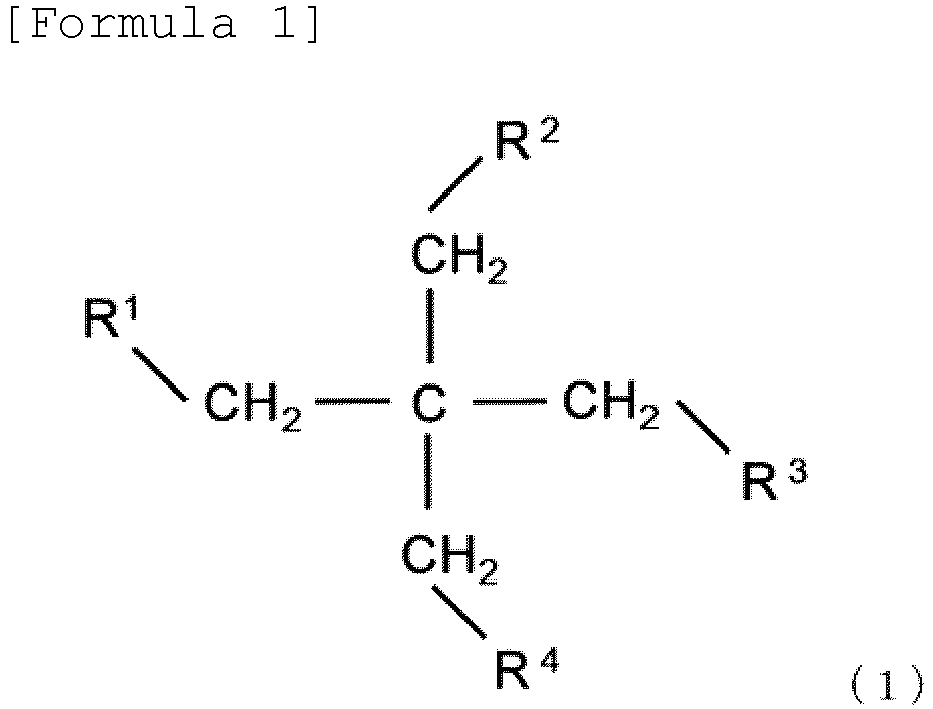
- wherein R1 is a hydroxy group, and R2 to R4 are independently a hydroxy group, a hydrogen atom, or a saturated hydrocarbon group having 1 or more and 3 or less carbon atoms,

- wherein any one of R5 to R9 is a carboxyl group, -CH2-COOH, or -CH2-CH2-COOH, and others are each independently a hydrogen atom, a hydroxy group, or a saturated hydrocarbon group having 1 or more and 10 or less carbon atoms.
- It has been difficult for conventional lubricant base oil and the like to achieve both low-temperature stability and high heat resistance.
- The present invention provides a lubricant base oil having excellent low-temperature stability and high heat resistance while maintaining torque-lowering properties.
- The present invention is a lubricant base oil including an ester compound including: a structural moiety (A) that is derived from an alcohol compound (A) represented by a general formula (1) below; and a structural moiety (B) that is derived from a carboxylic acid, the structural moiety B including: a structural moiety (B1) that is derived from a monocarboxylic acid (B1) represented by a general formula (2) below; and a structural moiety (B2) that is derived from an aliphatic monocarboxylic acid (B2) having 4 or more and 18 or less carbon atoms,

- wherein R1 is a hydroxy group, and R2 to R4 are independently a hydroxy group, a hydrogen atom, or a saturated hydrocarbon group having 1 or more and 3 or less carbon atoms,


- wherein any one of R5 to R9 is a carboxyl group, -CH2-COOH, or -CH2-CH2-COOH, and others are each independently a hydrogen atom, a hydroxy group, or a saturated hydrocarbon group having 1 or more and 10 or less carbon atoms.
- According to the present invention, it is possible to provide a lubricant base oil having excellent low-temperature stability and high heat resistance while maintaining torque-lowering properties.
- One embodiment according to the present invention is explained below.
- A lubricant base oil of the present embodiment includes an ester compound including: a structural moiety (A) that is derived from an alcohol compound (A) represented by a general formula (1) below; and a structural moiety (B) that is derived from a carboxylic acid, the structural moiety B including: a structural moiety (B1) that is derived from a monocarboxylic acid (B1) represented by a general formula (2) below; and a structural moiety (B2) that is derived from an aliphatic monocarboxylic acid (B2) having 4 or more and 18 or less carbon atoms,

- wherein R1 is a hydroxy group, and R2 to R4 are independently a hydroxy group, a hydrogen atom, or a saturated hydrocarbon group having 1 or more and 3 or less carbon atoms,

- wherein any one of R5 to R9 is a carboxyl group, -CH2-COOH, or -CH2-CH2-COOH, and others are each independently a hydrogen atom, a hydroxy group, or a saturated hydrocarbon group having 1 or more and 10 or less carbon atoms.
- The lubricant base oil according to the present embodiment has excellent low-temperature stability and high heat resistance while maintaining torque-lowering properties. The reason why the lubricant base oil exhibits such an effect is not clear, but the lubricant base oil is considered to have achieved low-temperature stability and high heat resistance while maintaining torque-lowering properties, because the lubricant base oil includes, in the ester molecular backbone, the structure described above, and thereby lowers crystallizability and suppresses thermal decomposition.
- The structural moiety (A) is a structural moiety derived from the alcohol compound (A) represented by the general formula (1).
- In the general formula (1), R1 is a hydroxy group, and R2 to R4 are independently a hydroxy group, a hydrogen atom, or a saturated hydrocarbon group having 1 or more and 3 or less carbon atoms. Preferably at least one of R2 to R4 is a hydroxy group, more preferably at least two are hydroxy groups, further preferably all are hydroxy groups, from the viewpoint of achieving both torque-lowering properties and high heat resistance.
- Examples of the alcohol compound (A) include pentaerythritol, trimethylolpropane, trimethylolethane, and neopentyl glycol. The alcohol compound (A) is preferably one or more selected from pentaerythritol, trimethylolpropane, or neopentyl glycol, more preferably one or more selected from pentaerythritol or trimethylolpropane, further preferably pentaerythritol, from the viewpoint of achieving both torque-lowering properties and high heat resistance.
- The structural moiety (B) is a structural moiety derived from a carboxylic acid. The structural moiety (B) includes the structural moiety (B1) and the structural moiety (B2).
- The structural moiety (B1) is a structural moiety derived from the monocarboxylic acid (B1) represented by the general formula (2). In the general formula (2), any one of R5 to R9 is a carboxyl group, -CH2-COOH, or -CH2-CH2-COOH, and the others are each independently a hydrogen atom, a hydroxy group, or a saturated hydrocarbon group having 1 or more and 10 or less carbon atoms. Any one of R5 to R9 is preferably a carboxyl group or -CH2-COOH, more preferably a carboxyl group, from the viewpoint of reducing torque. R5 to R9 other than corresponding to a carboxyl group, -CH2-COOH, or -CH2-CH2-COOH are each independently preferably a hydroxy group or a saturated hydrocarbon group having 1 or more and 10 or less carbon atoms, more preferably a saturated hydrocarbon group having 1 or more and 10 or less carbon atoms, from the viewpoint of achieving both torque-lowering properties and high heat resistance. The saturated hydrocarbon group has preferably 2 or more carbon atoms, more preferably 4 or more carbon atoms from the viewpoint of achieving both torque-lowering properties and high heat resistance, and has preferably 6 or less carbon atoms, more preferably 4 or less carbon atoms from the viewpoint of achieving both torque-lowering properties and high heat resistance.
- In the general formula (2), it is preferred that R7 is a carboxyl group, -CH2-COOH, or -CH2-CH2-COOH and the others are each independently a hydrogen atom, a hydroxy group, or a saturated hydrocarbon group having 1 or more and 10 or less carbon atoms. R7 is preferably a carboxyl group or -CH2-COOH, more preferably a carboxyl group. R5, R6, R8, and R9 are each independently preferably a hydroxy group or a saturated hydrocarbon group having 1 or more and 10 or less carbon atoms, more preferably a saturated hydrocarbon group having 1 or more and 10 or less carbon atoms, from the viewpoint of achieving both torque-lowering properties and high heat resistance. The saturated hydrocarbon group has preferably 2 or more carbon atoms, more preferably 4 or more carbon atoms from the viewpoint of achieving both torque-lowering properties and high heat resistance, and has preferably 6 or less carbon atoms, more preferably 4 or less carbon atoms from the viewpoint of achieving both torque-lowering properties and high heat resistance.
- Examples of the monocarboxylic acid (B1) include: hydroxybenzoic acids such as 3-hydroxybenzoic acid, 5-methyl-3-hydroxybenzoic acid, 5-ethyl-3-hydroxybenzoic acid, 4-ethyl-3-hydroxybenzoic acid, 5-isopropyl-3-hydroxybenzoic acid, 6-isopropyl-3-hydroxybenzoic acid, 5-n-butyl-3-hydroxybenzoic acid, 5-tert-butyl-3-hydroxybenzoic acid, 5-sec-butyl-3-hydroxybenzoic acid, 5-isoheptyl-3-hydroxybenzoic acid, 5-isohexyl-3-hydroxybenzoic acid, 5-isooctyl-3-hydroxybenzoic acid, 4-methoxy-3-hydroxybenzoic acid, 4-ethoxy-3-hydroxybenzoic acid, 6-butoxy-3-hydroxybenzoic acid, 4-hydroxybenzoic acid, 6-methyl-4-hydroxybenzoic acid, 6-ethyl-4-hydroxybenzoic acid, 6-isopropyl-4-hydroxybenzoic acid, 6-tert-butyl-4-hydroxybenzoic acid, 6-sec-butyl-4-hydroxybenzoic acid, 6-isohexyl-4-hydroxybenzoic acid, 6-isoheptyl-4-hydroxybenzoic acid, 6-isooctyl-4-hydroxybenzoic acid, 5-n-propyl-4-hydroxybenzoic acid, 5-methoxy-4-hydroxybenzoic acid, 6-butoxy-4-hydroxybenzoic acid, 5-ethoxy-4-hydroxybenzoic acid, 3-tert-butyl-4-hydroxybenzoic acid, 3-isooctyl-4-hydroxybenzoic acid, 3,5-dimethyl-4-hydroxybenzoic acid, 3,5-di-tert-butyl-4-hydroxybenzoic acid, 5,6-di-tert-butyl-4-hydroxybenzoic acid, 2-hydroxybenzoic acid, 3-methyl-2-hydroxybenzoic acid, 3-isopropyl-2-hydroxybenzoic acid, 3-tert-butyl-2-hydroxybenzoic acid, 6-methoxy-2-hydroxybenzoic acid, and 6-ethoxy-2-hydroxybenzoic acid; dihydroxy aromatic carboxylic acids such as 2,3-dihydroxybenzoic acid, 2,4-dihydroxybenzoic acid, 2,5-dihydroxybenzoic acid, 2,6-dihydroxybenzoic acid, 3,4-dihydroxybenzoic acid, 3,5-dihydroxybenzoic acid, 2,6-dihydroxy-4-methylbenzoic acid, 2,4-dihydroxy-6-methylbenzoic acid, 3,5-dihydroxy-4-methylbenzoic acid, 2,3-dihydroxy-4-methoxybenzoic acid, 3,4-dihydroxy-5-methoxybenzoic acid, 2,4-di(hydroxymethyl)benzoic acid, and 3,4-di(hydroxymethyl)benzoic acid; trihydroxybenzoic acids such as 3,4,5-trihydroxybenzoic acid and 2,4,6-trihydroxybenzoic acid; and 2-hydroxyphenylacetic acid, 3-hydroxyphenylacetic acid, 4-hydroxyphenylacetic acid, 3-(2-hydroxyphenyl)propionic acid, 3-(3-hydroxyphenyl)propionic acid, 3-(4-hydroxyphenyl)propionic acid, 2-(2-hydroxyphenyl)propionic acid, 2-(3-hydroxyphenyl)propionic acid, and 2-(4-hydroxyphenyl)propionic acid. Among these examples, the monocarboxylic acid (B1) is preferably one or two or more selected from the group consisting of 4-hydroxybenzoic acid, 3,5-di-tert-butyl-4-hydroxybenzoic acid, 3,4-dihydroxybenzoic acid, and 3,4,5-trihydroxybenzoic acid, more preferably one or two or more selected from the group consisting of 3,5-di-tert-butyl-4-hydroxybenzoic acid and 3,4-dihydroxybenzoic acid, from the viewpoint of achieving both torque-lowering properties and high heat resistance.
- The proportion of the structural moiety (B1) in the structural moiety (B) of the ester compound is preferably 0.1 mol% or more, more preferably 1 mol% or more from the viewpoint of achieving both torque-lowering properties and high heat resistance, and is preferably 5 mol% or less, more preferably 3 mol% or less from the viewpoint of achieving both torque-lowering properties and high heat resistance.
- The structural moiety (B2) is a structural moiety derived from the aliphatic monocarboxylic acid (B2) having 4 or more and 18 or less carbon atoms. The structural moiety (B2) has 4 or more carbon atoms, preferably 7 or more carbon atoms from the viewpoint of achieving both torque-lowering properties and high heat resistance, and has 18 or less carbon atoms, preferably 9 or less carbon atoms from the viewpoint of achieving both torque-lowering properties and high heat resistance.
- Examples of the aliphatic monocarboxylic acid (B2) include: linear fatty acids such as butanoic acid, pentanoic acid, hexanoic acid, heptanoic acid, octanoic acid, nonanoic acid, decanoic acid, dodecanoic acid, tetradecanoic acid, pentadecanoic acid, hexadecanoic acid, heptadecanoic acid, and octadecanoic acid; and branched fatty acids such as 2-methylpropanoic acid, 2-methylbutanoic acid, 3-methylbutanoic acid, 2,2-dimethylpropanoic acid, 2-methylpentanoic acid, 3-methylpentanoic acid, 4-methylpentanoic acid, 2,2-dimethylbutanoic acid, 2,3-dimethylbutanoic acid, 3,3-dimethylbutanoic acid, 2-methylhexanoic acid, 3-methylhexanoic acid, 4-methylhexanoic acid, 5-methylhexanoic acid, 2,2-dimethylpentanoic acid, 2,3-dimethylpentanoic acid, 2,4-dimethylpentanoic acid, 3,3-dimethylpentanoic acid, 3,4-dimethylpentanoic acid, 4,4-dimethylpentanoic acid, 2-ethylpentanoic acid, 3-ethylpentanoic acid, 2,2,3-trimethylbutanoic acid, 2,3,3-trimethylbutanoic acid, 2-ethyl-2-methylbutanoic acid, 2-ethyl-3-methylbutanoic acid, 2-methylheptanoic acid, 3-methylheptanoic acid, 4-methylheptanoic acid, 5-methylheptanoic acid, 6-methylheptanoic acid, 2-ethylhexanoic acid, 3-ethylhexanoic acid, 4-ethylhexanoic acid, 2,2-dimethylhexanoic acid, 2,3-dimethylhexanoic acid, 2,4-dimethylhexanoic acid, 2,5-dimethylhexanoic acid, 3,3-dimethylhexanoic acid, 3,4-dimethylhexanoic acid, 3,5-dimethylhexanoic acid, 4,4-dimethylhexanoic acid, 4,5-dimethylhexanoic acid, 5,5-dimethylhexanoic acid, 2-propylpentanoic acid, 2-methyloctanoic acid, 3-methyloctanoic acid, 4-methyloctanoic acid, 5-methyloctanoic acid, 6-methyloctanoic acid, 7-methyloctanoic acid, 2,2-dimethylheptanoic acid, 2,3-dimethylheptanoic acid, 2,4-dimethylheptanoic acid, 2,5-dimethylheptanoic acid, 2,6-dimethylheptanoic acid, 3,3-dimethylheptanoic acid, 3,4-dimethylheptanoic acid, 3,5-dimethylheptanoic acid, 3,6-dimethylheptanoic acid, 4,4-dimethylheptanoic acid, 4,5-dimethylheptanoic acid, 4,6-dimethylheptanoic acid, 5,5-dimethylheptanoic acid, 5,6-dimethylheptanoic acid, 6,6-dimethylheptanoic acid, 2-methyl-2-ethylhexanoic acid, 2-methyl-3-ethylhexanoic acid, 2-methyl-4-ethylhexanoic acid, 3-methyl-2-ethylhexanoic acid, 3-methyl-3-ethylhexanoic acid, 3-methyl-4-ethylhexanoic acid, 4-methyl-2-ethylhexanoic acid, 4-methyl-3-ethylhexanoic acid, 4-methyl-4-ethylhexanoic acid, 5-methyl-2-ethylhexanoic acid, 5-methyl-3-ethylhexanoic acid, 5-methyl-4-ethylhexanoic acid, 2-ethylheptanoic acid, 3-methyloctanoic acid, 3,5,5-trimethylhexanoic acid, 2-ethyl-2,3,3-trimethylbutyric acid, 2,2,4,4-tetramethylpentanoic acid, 2,2,3,3-tetramethylpentanoic acid, and 2,2,3,4-tetramethylpentanoic acid. Among these examples, the aliphatic monocarboxylic acid (B2) is preferably one or two or more selected from the group consisting of heptanoic acid and nonanoic acid, from the viewpoint of achieving both torque-lowering properties and high heat resistance.
- The proportion of the structural moiety (B2) in the structural moiety (B) of the ester compound is preferably 80 mol% or more, more preferably 90 mol% or more, further preferably 95 mol% or more, still further preferably 97 mol% or more from the viewpoint of achieving both torque-lowering properties and high heat resistance, and is preferably 99.9 mol% or less, more preferably 99 mol% or less from the viewpoint of achieving both torque-lowering properties and high heat resistance.
- The ratio (the amount of substance (mol) of the structural moiety (B1)/the amount of substance (mol) of the structural moiety (B2)) of the amount of substance (mol) of the structural moiety (B1) to the amount of substance (mol) of the structural moiety (B2) in the structural moiety (B) is preferably 0.001 or more, more preferably 0.01 or more from the viewpoint of achieving both torque-lowering properties and high heat resistance, and is preferably 0.05 or less, more preferably 0.03 or less from the viewpoint of achieving both torque-lowering properties and high heat resistance.
- The structural moiety (B) may include a structural moiety other than the structural moieties (B1) and (B2) as long as the effects of the present invention are not impaired. The proportion of the structural moiety other than the structural moieties (B1) and (B2) in the structural moiety (B) of the ester compound is preferably 10 mol% or less, more preferably 5 mol% or less, further preferably 1 mol% or less.
- The ester compound preferably includes an ester compound (A) and an ester compound (B) below from the viewpoint of achieving all torque-lowering properties, low-temperature stability, and high heat resistance.
- Ester compound (A): a compound obtained by bonding an alcohol compound (A1) represented by the general formula (1), in which R1 to R4 are all hydroxy groups, to the aliphatic monocarboxylic acids (B2) at all the hydroxy groups through ester bonds
- Ester compound (B): a compound obtained by bonding the alcohol compound (A1) to the monocarboxylic acid (B1) at one of the hydroxy groups through an ester bond and to the aliphatic monocarboxylic acids (B2) at the other three hydroxy groups through ester bonds
- The content of the ester compound (A) in the ester compound is preferably 25 mass% or more, more preferably 40 mass% or more, further preferably 45 mass% or more, still further preferably 50 mass% or more, still further preferably 60 mass% or more, still further preferably 80 mass% or more, from the viewpoint of torque-lowering properties. The content of the ester compound (A) in the ester compound is preferably 99 mass% or less, more preferably 98 mass% or less, further preferably 95 mass% or less, still further preferably 92 mass% or less, still further preferably 90 mass% or less, from the viewpoint of high heat resistance.
- The content of the ester compound (B) in the ester compound is preferably 1 mass% or more, more preferably 2 mass% or more, further preferably 5 mass% or more, still further preferably 8 mass% or more, still further preferably 10 mass% or more, from the viewpoint of high heat resistance. The content of the ester compound (B) in the ester compound is preferably 75 mass% or less, more preferably 60 mass% or less, further preferably 55 mass% or less, still further preferably 50 mass% or less, still further preferably 40 mass% or less, still further preferably 20 mass% or less, from the viewpoint of torque-lowering properties.
- The total content of the ester compounds (A) and (B) in the ester compound is preferably 80 mass% or more, more preferably 90 mass% or more, further preferably 95 mass% or more, still further preferably substantially 100 mass%, still further preferably 100 mass%, from the viewpoint of achieving all torque-lowering properties, low-temperature stability, and high heat resistance. The meaning of substantially 100 mass% in the present description includes the case in which a substance other than the ester compounds (A) and (B) is inevitably mixed in.
- The mass ratio (the mass of the ester compound (A) in the ester compound/the ester compound (B) in the ester compound) of the ester compound (A) to the ester compound (B) in the ester compound is preferably 1 or more, more preferably 1.5 or more, further preferably 2 or more from the viewpoint of torque-lowering properties, and is preferably 70 or less, more preferably 60 or less, further preferably 50 or less from the viewpoint of high heat resistance.
- The content of the ester compound in the lubricant base oil is preferably 90 mass% or more, more preferably 95 mass% or more, further preferably substantially 100 mass%, still further preferably 100 mass%, from the viewpoint of achieving both torque-lowering properties and high heat resistance.
- A method, according to the present embodiment, for producing a lubricant base oil is a method for producing the above-mentioned lubricant base oil, the method including a reaction step of performing an esterification reaction and/or a transesterification reaction of the alcohol compound (A) with a carboxylic acid component for deriving the structural moiety (B). The carboxylic acid component for deriving the structural moiety (B) contains the monocarboxylic acid (B1) and/or an ester-forming derivative of the monocarboxylic acid (B1), and the aliphatic monocarboxylic acid (B2) and/or an ester-forming derivative of the aliphatic monocarboxylic acid (B2).
- Examples of the ester-forming derivative of the monocarboxylic acid (B1) include a C1-6 alkyl ester. Examples of the ester-forming derivative of the aliphatic monocarboxylic acid (B2) include a C1-6 alkyl ester of the aliphatic monocarboxylic acid (B2).
- The esterification reaction and the transesterification reaction in the reaction step can be performed by a known method.
- A lubricant oil composition according to the present embodiment contains the lubricant base oil. The lubricant oil composition may contain other additives as long as the effects of the present invention are not impaired.
Examples of the other additives include a cleanser, a dispersant, an antioxidant, an oiliness improver, a wear inhibitor, an extreme pressure agent, a rust inhibitor, a corrosion inhibitor, a metal deactivator, a viscosity index improver, a pour-point depressant, a defoamer, an emulsifier, a demulsifier, an antifungal agent, and a solid lubricant. - The content of the lubricant base oil in the lubricant oil composition is preferably 50 mass% or more, more preferably 80 mass% or more, further preferably 90 mass% or more, still further preferably 95 mass% or more.
- The total content of the other additives in the lubricant oil composition is preferably 10 parts by mass or less, more preferably 8 parts by mass or less, further preferably 5 parts by mass or less.
- The content of the ester compound (A) in the lubricant oil composition is preferably 12.5 mass% or more, more preferably 25 mass% or more, further preferably 40 mass% or more, still further preferably 60 mass% or more, from the viewpoint of torque-lowering properties. The content of the ester compound (A) in the lubricant oil composition is preferably 99 mass% or less, more preferably 98 mass% or less, further preferably 95 mass% or less, still further preferably 92 mass% or less, still further preferably 90 mass% or less, from the viewpoint of high heat resistance.
- The content of the ester compound (B) in the lubricant oil composition is preferably 0.5 mass% or more, more preferably 2 mass% or more, further preferably 5 mass% or more, still further preferably 8 mass% or more, still further preferably 10 mass% or more, from the viewpoint of high heat resistance. The content of the ester compound (B) in the lubricant oil composition is preferably 75 mass% or less, more preferably 60 mass% or less, further preferably 55 mass% or less, still further preferably 50 mass% or less, still further preferably 40 mass% or less, still further preferably 20% or less, from the viewpoint of torque-lowering properties.
- The lubricant oil composition is usable for combustion lubricant oils such as a gasoline engine oil, a diesel engine oil, and a marine engine oil; and non-combustion lubricant oils such as a gear oil, an automatic transmission oil, a hydraulic oil, a fire-resistant hydraulic fluid, a refrigerant oil, a compressor oil, a vacuum pump oil, a bearing oil, an insulating oil, a turbine oil, a sliding surface oil, a rock drill oil, a metal working oil, a plastic working oil, a heat treatment oil, and grease. Particularly, the lubricant oil composition is preferably used for the non-combustion lubricant oils. The lubricant oil composition is also usable for sliding parts such as a sliding bearing (rotational sliding), a thrust bearing (planar sliding), and a spline (sliding), and is usable for a method for lubricating a spline section of a clutch disc, a shaft and a gear-inside-diameter bearing section of a transmission, a spline section of a hub-sleeve, metal-supported parts in sections, and a spline section of a change operating system.
- With respect to the above-mentioned embodiments, the present description further discloses below a lubricant base oil, a lubricant oil composition, and a method for producing a lubricant base oil.
- <1> A lubricant base oil including an ester compound including: a structural moiety (A) that is derived from an alcohol compound (A) represented by a general formula (1) below; and a structural moiety (B) that is derived from a carboxylic acid, the structural moiety B including: a structural moiety (B1) that is derived from a monocarboxylic acid (B1) represented by a general formula (2) below; and a structural moiety (B2) that is derived from an aliphatic monocarboxylic acid (B2) having 4 or more and 18 or less carbon atoms,

- wherein R1 is a hydroxy group, and R2 to R4 are independently a hydroxy group, a hydrogen atom, or a saturated hydrocarbon group having 1 or more and 3 or less carbon atoms,

- wherein any one of R5 to R9 is a carboxyl group, -CH2-COOH, or -CH2-CH2-COOH, and others are each independently a hydrogen atom, a hydroxy group, or a saturated hydrocarbon group having 1 or more and 10 or less carbon atoms.
- wherein R1 is a hydroxy group, and R2 to R4 are independently a hydroxy group, a hydrogen atom, or a saturated hydrocarbon group having 1 or more and 3 or less carbon atoms,
- <2> The lubricant base oil according to <1>, wherein a proportion of the structural moiety (B1) in the structural moiety (B) is 0.1 mol% or more and 5 mol% or less.
- <3> The lubricant base oil according to <1> or <2>, wherein a ratio (an amount of substance (mol) of the structural moiety (B1)/an amount of substance (mol) of the structural moiety (B2)) of an amount of substance (mol) of the structural moiety (B1) to an amount of substance (mol) of the structural moiety (B2) in the structural moiety (B) is 0.001 or more and 0.05 or less.
- <4> The lubricant base oil according to any one of <1> to <3>, wherein R7 in the general formula (2) is a carboxyl group.
- <5> The lubricant base oil according to any one of <1> to <4>, wherein the alcohol compound (A) is one or more selected from the group consisting of pentaerythritol and trimethylolpropane.
- <6> The lubricant base oil according to any one of <1> to <5>, wherein the proportion of the structural moiety (B1) in the structural moiety (B) is 0.1 mol% or more and 5 mol%, wherein R7 in the general formula (2) is the carboxyl group, wherein the alcohol compound (A) is pentaerythritol.
- <7> The lubricant base oil according to any one of <1> to <6>, wherein the proportion of the structural moiety (B1) in the structural moiety (B) is 1 mol% or more and 3 mol%, wherein R7 in the general formula (2) is the carboxyl group, wherein the alcohol compound (A) is pentaerythritol.
- <8> The lubricant base oil according to any one of <1> to <7>, wherein the ratio of the amount of substance (mol) of the structural moiety (B1) to the amount of substance (mol) of the structural moiety (B2) in the structural moiety (B) is 0.001 or more and 0.05 or less, wherein R7 in the general formula (2) is the carboxyl group, wherein the alcohol compound (A) is pentaerythritol.
- <9> The lubricant base oil according to any one of <1> to <8>, wherein the ratio of the amount of substance (mol) of the structural moiety (B1) to the amount of substance (mol) of the structural moiety (B2) in the structural moiety (B) is 0.01 or more and 0.03 or less, wherein R7 in the general formula (2) is the carboxyl group, wherein the alcohol compound (A) is pentaerythritol.
- <10> The lubricant base oil according to any one of <1> to <9>, wherein the proportion of the structural moiety (B1) in the structural moiety (B) is 1 mol% or more and 3 mol%, wherein the ratio of the amount of substance (mol) of the structural moiety (B1) to the amount of substance (mol) of the structural moiety (B2) in the structural moiety (B) is 0.01 or more and 0.03 or less, wherein R7 in the general formula (2) is the carboxyl group, wherein the alcohol compound (A) is pentaerythritol.
- <11> The lubricant base oil according to any one of <1> to <10>, wherein the ester compound includes an ester compound (A) and an ester compound (B) below:
- ester compound (A): a compound obtained by bonding an alcohol compound (A1) represented by the general formula (1), in which R1 to R4 are all hydroxy groups, to the aliphatic monocarboxylic acids (B2) at all the hydroxy groups through ester bonds;
- ester compound (B): a compound obtained by bonding the alcohol compound (A1) to the monocarboxylic acid (B1) at one of the hydroxy groups through an ester bond and to the aliphatic monocarboxylic acids (B2) at other three hydroxy groups through ester bonds.
- <12> The lubricant base oil according to any one of <1> to <11>, wherein a content of the ester compound (A) in the ester compound is 25 mass% or more and 99 mass% or less.
- <13> The lubricant base oil according to any one of <1> to <14>, wherein a content of the ester compound (B) in the ester compound is 1 mass% or more and 75 mass% or less.
- <14> The lubricant base oil according to any one of <1> to <13>, wherein the content of the ester compound (A) in the ester compound is 80 mass% or more and 99 mass% or less, wherein the content of the ester compound (B) in the ester compound is 1 mass% or more and 20 mass% or less.
- <15> The lubricant base oil according to any one of <1> to <14>, wherein the content of the ester compound (A) in the ester compound is 80 mass% or more and 90 mass% or less, wherein the content of the ester compound (B) in the ester compound is 1 mass% or more and 10 mass% or less.
- <16> The lubricant base oil according to any one of <1> to <15>, wherein a total content of the ester compounds (A) and (B) in the ester compound is 80 mass% or more.
- <17> The lubricant base oil according to any one of <1> to <16>, wherein a mass ratio (a mass of the ester compound (A) in the ester compound/the ester compound (B) in the ester compound) of the ester compound (A) to the ester compound (B) in the ester compound is 1 or more and 70 or less.
- <18> The lubricant base oil according to any one of <1> to <17>, wherein the content of the ester compound (A) in the ester compound is 80 mass% or more and 99 mass% or less, wherein the content of the ester compound (B) in the ester compound is 1 mass% or more and 20 mass% or less, wherein the mass ratio of the ester compound (A) to the ester compound (B) in the ester compound is 1.5 or more and 60 or less.
- <19> The lubricant base oil according to <>, wherein the content of the ester compound (A) in the ester compound is 80 mass% or more and 90 mass% or less, wherein the content of the ester compound (B) in the ester compound is 10 mass% or more and 20 mass% or less, wherein the mass ratio of the ester compound (A) to the ester compound (B) in the ester compound is 2 or more and 50 or less.
- <20> A lubricant oil composition including the lubricant base oil according to any one of <1> to <19>.
- <21> The lubricant oil composition according to <20>, wherein a content of the lubricant base oil in the lubricant oil composition is 50 mass% or more.
- <22> The lubricant oil composition according to <20> or <21>, wherein a content of the ester compound (A) in the lubricant oil composition is 12.5 mass% or more and 99 mass% or less.
- <23> The lubricant base oil according to any one of <20> to <22>, wherein a content of the ester compound (B) in the lubricant oil composition is 0.5 mass% or more and 75 mass% or less.
- <24> The lubricant base oil according to any one of <20> to <23>, wherein the content of the ester compound (A) in the lubricant oil composition is 40 mass% or more and 98 mass% or less, wherein the content of the ester compound (B) in the lubricant oil composition is 2 mass% or more and 60 mass% or less.
- <25> The lubricant base oil according to any one of <20> to <24>, wherein the content of the ester compound (A) in the lubricant oil composition is 60 mass% or more and 95 mass% or less, wherein the content of the ester compound (B) in the lubricant oil composition is 5 mass% or more and 40 mass% or less.
- <26> A method for using an ester compound as a lubricant base oil, the ester compound containing an ester compound that includes: a structural moiety (A) that is derived from an alcohol compound (A) represented by a general formula (1) below; and a structural moiety (B) that is derived from a carboxylic acid,
- the structural moiety B including: a structural moiety (B1) that is derived from a monocarboxylic acid (B1) represented by a general formula (2) below; and a structural moiety (B2) that is derived from an aliphatic monocarboxylic acid (B2) having 4 or more and 18 or less carbon atoms,
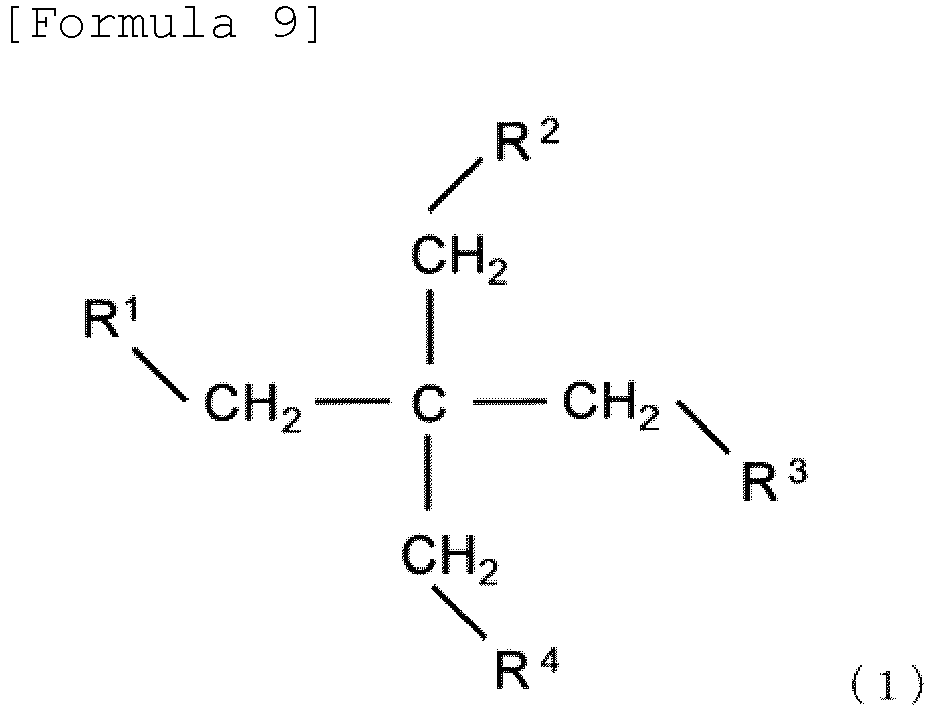
- wherein R1 is a hydroxy group, and R2 to R4 are independently a hydroxy group, a hydrogen atom, or a saturated hydrocarbon group having 1 or more and 3 or less carbon atoms,

- wherein any one of R5 to R9 is a carboxyl group, -CH2-COOH, or -CH2-CH2-COOH, and others are each independently a hydrogen atom, a hydroxy group, or a saturated hydrocarbon group having 1 or more and 10 or less carbon atoms.
- the structural moiety B including: a structural moiety (B1) that is derived from a monocarboxylic acid (B1) represented by a general formula (2) below; and a structural moiety (B2) that is derived from an aliphatic monocarboxylic acid (B2) having 4 or more and 18 or less carbon atoms,
- Hereinafter, the present invention will be described in more detail by way of working examples thereof.
- However, the invention is not limited only to these working examples.
- As a monocarboxylic acid, 453.30 g of heptanoic acid and 11.0 g of 3,5-di-tert-butyl-4-hydroxybenzoic acid were added into a 1-L four-neck flask equipped with a stirrer, a thermometer, a nitrogen inlet tube, and a cooling tube, followed by addition of 150.1 g of pentaerythritol as an alcohol compound. The blending amount of the monocarboxylic acid was set so that the equivalent of all the carboxy groups in the monocarboxylic acid was 0.8 relative to 1 equivalent of the hydroxy groups of the alcohol compound. Next, a nitrogen gas was blown into the flask, and the mixture was heated to 250°C under stirring. The temperature in the flask was kept at 250°C for 4 hours and distillate water is removed from the flask using the cooling tube. After the completion of the reaction, 230.04 g of heptanoic acid was further added. The mixture was heated to 250°C again. The temperature in the flask was kept at 250°C for 10 hours and distillate water was removed from the flask using the cooling tube. After the completion of the reaction, an excessive carboxylic acid component was distilled away under a reduced pressure of 0.13 kPa, and the mixture was steamed under a reduced pressure of 0.13 kPa for 1 hour. A residual carboxylic acid component was adsorbed to an adsorbent (trade name: KYOWAAD 500SH, manufactured by Kyowa Chemical Industry Co., Ltd.) and the reaction product in the flask was then filtered to give a lubricant base oil 1 according to
- A lubricant base oil was obtained by the same method as in Example 1 except that the type of the raw materials and the blending amount thereof were changed as shown in Table 1.
- As a monocarboxylic acid, 305.10 g of heptanoic acid and 160.0 g of 3,5-di-tert-butyl-4-hydroxybenzoic acid were added into a 1-L four-neck flask equipped with a stirrer, a thermometer, a nitrogen inlet tube, and a cooling tube, followed by addition of 145.1 g of pentaerythritol as an alcohol compound, and 0.26 g of titanium tetraisopropoxide were added as a catalyst. The blending amount of the monocarboxylic acid was set so that the equivalent of all the carboxy groups in the monocarboxylic acid was 0.8 relative to 1 equivalent of the hydroxy groups of the alcohol compound. Next, a nitrogen gas was blown into the flask, and the mixture was heated to 250°C under stirring. The temperature in the flask was kept at 250°C for 4 hours and distillate water is removed from the flask using the cooling tube. After the completion of the reaction, 247.0 g of heptanoic acid was further added. The mixture was heated to 250°C again. The temperature in the flask was kept at 250°C for 10 hours and distillate water was removed from the flask using the cooling tube. After the completion of the reaction, 17.3 g of ion-exchanged water was added, the mixture was stirred at 80°C for 1 hour to deactivate the catalyst, then water and an excessive carboxylic acid component were distilled away at a reduced pressure of 0.13 kPa, and the mixture was steamed at a reduced pressure of 0.13 kPa for 1 hour. A residual carboxylic acid component was adsorbed to an adsorbent (trade name: KYOWAAD 500SH, manufactured by Kyowa Chemical Industry Co., Ltd.) and the reaction product in the flask was then filtered to give a lubricant base oil 4 according to Example 4.
- A lubricant base oil according to Example 7 was obtained by the same method as in Example 4 except that the type of the raw materials and the blending amount thereof were changed as shown in Table 1.
- An ester compound according to Comparative Example 3 was obtained by the same method as in Example 1 except that the type of the raw materials and the blending amount thereof were changed as shown in Table 1. To the ester compound, an additive (IRGANOX1076 (manufactured by BASF SE)) was added so that the content of the additive in the lubricant base oil was 1.6 mass%, and a lubricant base oil according to Comparative Example 3 was thus obtained.
- Table 1 shows the used amount of the raw materials for synthesis in the examples and the comparative examples. The raw materials shown in Tables 1 and 2(shown later) are as follows.
- Trimethylolpropane (manufactured by Tokyo Chemical Industry Co., Ltd.)
- Pentaerythritol (manufactured by Tokyo Chemical Industry Co., Ltd.)
- Heptanoic acid (n-heptanoic acid, manufactured by Tokyo Chemical Industry Co., Ltd.)
- Nonanoic acid (manufactured by Tokyo Chemical Industry Co., Ltd.)
- 3,5-Di-tert-butyl-4-hydroxybenzoic acid (manufactured by Tokyo Chemical Industry Co., Ltd.)
- 4-Hydroxybenzoic acid (manufactured by FUJIFILM Wako Pure Chemical Corporation)
- 3,4-Dihdroxybenzoic acid (manufactured by FUJIFILM Wako Pure Chemical Corporation)
- Titanium tetraisopropoxide (manufactured by FUJIFILM Wako Pure Chemical Corporation)
- Methyl gallate (manufactured by Tokyo Chemical Industry Co., Ltd.)
- Benzoic acid (manufactured by FUJIFILM Wako Pure Chemical Corporation)
- IRGANOX1076 (manufactured by BASF SE)
-
[Table 1] Unit Example 1 Example 2 Example 3 Example 4 Example 5 Example 6 Example 7 Example 8 Comparative Example 1 Comparative Example 2 Comparative Example 3 Prepared composition Carboxylic acid and ester-forming derivative Heptanoic acid mol% 99 92 75 85 95 95 95 100 95 100 Nonanoic acid mol% 92 3,5-Di-tert-butyl-4-hydroxybenzoic acid mol% 1 8 25 15 8 4-Hydroxybenzoic acid mol% 5 3,4-Dihydroxybenzoic acid mol% 5 Methyl gallate mol% 5 Benzoic acid mol% 5 Alcohol Pentaerythritol mol% 100 100 100 100 100 100 100 100 100 100 Trimethylolpropane mol% 100 - The composition of the ester compound contained in the lubricant base oil according to each of Examples 1 to 8 and Comparative Examples 1 to 3 was measured by the following method.
- The ester compound was dissolved in deuterated acetone and measured by 1H-NMR using a nuclear magnetic resonator (trade name: Agilent 400-MR DD2 system, manufactured by Agilent Technologies, Inc.). The intensity of protons is proportional to the number of moles thereof. Therefore, from the proton-intensity ratio between peaks obtained in the measurement, the molar ratio in number between the ester groups having an alkyl chain and the ester groups having a phenol structure was calculated.
- Alkyl chain: calculated on the basis of a peak that appeared around 2.3 ppm and was derived from a methylene group at the α-position of the alkyl chain
- Phenol structure: calculated on the basis of a peak that appeared around 8.0 ppm and was derived from methine hydrogen atoms at the 2-position and the 6-position of the aromatic ring
- Table 2 shows the composition of the ester compound obtained in the measurement, the ester compound being contained in the lubricant base oil according to each of Examples 1 to 8 and Comparative Examples 1 to 3.
-
[Table 2] Unit Example 1 Example 2 Example 3 Example 4 Example 5 Example 6 Example 7 Example 8 Comparative Example 1 Comparative Example 2 Comparative Example 3 Composition of ester compound Carboxylic acid component Heptanoic acid mol % 99.5 97.8 95.2 92.2 95.8 96.8 95.8 100 96.5 100 Nonanoic acid mol % 96.3 3,5-Di-tert-butyl-4-hydroxybenzoic acid mol % 0.5 2.2 4.8 7.8 3.7 4-Hydroxybenzoic acid mol % 4.2 3,4-Dihydroxybenzoic acid mol % 3.2 Gallic acid mol % 4.2 Benzoic acid mol % 3.5 Alcohol Pentaerythritol mol % 100 100 100 100 100 100 100 100 100 100 Trimethylolpropane mol % 100 Molar ratio (B1/B2) of structural moiety (B1) to structural moiety (B2) 0.005 0.022 0.05 0.08 0.04 0.03 0.04 0.038 - - - Content of ester compound (A) mass% 98.0 91.2 80.8 68.8 83.2 87.2 83.2 88.9 100.0 86.0 100.0 Content of ester compound (B) mass% 2.0 8.8 19.2 31.2 16.8 12.8 16.8 11.1 0.0 14.0 0.0 Content ratio (A/B) of ester compound (A) to ester compound (B) 49.00 10.36 4.21 2.21 4.95 6.81 4.95 8.01 - 6.14 - - The kinematic viscosity of the lubricant base oil according to each of the examples and the comparative examples was evaluated by measuring 40°C kinematic viscosity and 100°C kinematic viscosity (mm2/s) with a Stabinger kinematic viscometer (trade name: SVM3000, manufactured by Anton Paar GmbH) satisfying the accuracy required by ASTM D7042. The lower the viscosity is, the more excellent the torque-lowering properties are.
- The high heat resistance of the lubricant base oil according to each of the examples and the comparative examples was evaluated by measuring thermal response of the lubricant base oil using a simultaneous thermogravimetric analyzer (trade name: TG/DTA 6200 manufactured by Seiko Instruments Inc.), in an atmosphere of nitrogen and air at 200 mL/min, under the conditions of heating from 30°C to 500°C at 10°C/min and then retaining at 500°C for 3 minutes, and comparing the lubricant base oils in terms of temperature at which the weight reduction rate (mass%) reaches 10%. The higher the temperature is, the more excellent the heat resistance is.
- The pour point of the lubricant base oil according to each of the examples and the comparative examples was evaluated by measuring pour point (°C) according to a measuring method in conformity with JIS K2269. The lower the pour point is, the more excellent the low-temperature stability is.
- The low-temperature stability of the lubricant base oil according to each of the examples and the comparative examples was evaluated by appearance thereof (liquid or solid) after a test in which a 10mL sample was put into a screw tube (No. 5) and stored in low-temperature chamber PU-1KP (manufactured by ESPEC CORP.) at -20°C for 1 day.
- Table 3 shows the evaluation results.
-
[Table 3] Example 1 Example 2 Example 3 Example 4 Example 5 Example 6 Example 7 Example 8 Comparative Example 1 Comparative Example 2 Comparative Example 3 Torque-lowering properties 40°C Kinematic viscosity (mm2/s) 22.7 28.3 44.5 59.3 31.8 32.3 48.1 28.7 21.3 23.5 21.8 100°C Kinematic viscosity (mm2/s ) 4.8 5.4 6.9 8.0 5.9 5.9 7.5 5.4 4.6 4.8 4.7 High heat resistance 10% Vaporization temperature (TG)(°C) 302 313 319 313 300 316 317 318.0 286 291 303 Low-temperature stability Pour point (°C) -37.5 -46.5 -48 -42 < -50 -48 < -50 < -50 -28 -43 -21 Appearance after storage test (-20 ° C, 1day) Liquid Liquid Liquid Liquid Liquid Liquid Liquid Liquid Liquid Liquid Solid - From the results shown in Table 3, it is understood that the lubricant base oils according to Examples 1 to 8 have excellent torque-lowering properties, low-temperature stability, and high heat resistance.
Claims (14)
- A lubricant base oil comprising an ester compound including: a structural moiety (A) that is derived from an alcohol compound (A) represented by a general formula (1) below; and a structural moiety (B) that is derived from a carboxylic acid, the structural moiety B including: a structural moiety (B1) that is derived from a monocarboxylic acid (B1) represented by a general formula (2) below; and a structural moiety (B2) that is derived from an aliphatic monocarboxylic acid (B2) having 4 or more and 18 or less carbon atoms,
 wherein R1 is a hydroxy group, and R2 to R4 are independently a hydroxy group, a hydrogen atom, or a saturated hydrocarbon group having 1 or more and 3 or less carbon atoms,
 wherein any one of R5 to R9 is a carboxyl group, -CH2-COOH, or -CH2-CH2-COOH, and others are each independently a hydrogen atom, a hydroxy group, or a saturated hydrocarbon group having 1 or more and 10 or less carbon atoms.
 - The lubricant base oil according to claim 1, wherein a proportion of the structural moiety (B1) in the structural moiety (B) is 0.1 mol% or more and 5 mol% or less.
- The lubricant base oil according to claim 1 or 2, wherein a ratio (an amount of substance (mol) of the structural moiety (B1)/an amount of substance (mol) of the structural moiety (B2)) of an amount of substance (mol) of the structural moiety (B1) to an amount of substance (mol) of the structural moiety (B2) in the structural moiety (B) is 0.001 or more and 0.05 or less.
- The lubricant base oil according to any one of claims 1 to 3, wherein R7 in the general formula (2) is a carboxyl group.
- The lubricant base oil according to any one of claims 1 to 4, wherein the alcohol compound (A) is one or more selected from the group consisting of pentaerythritol and trimethylolpropane.
- The lubricant base oil according to any one of claims 1 to 5, wherein the ester compound includes an ester compound (A) and an ester compound (B) below:ester compound (A): a compound obtained by bonding an alcohol compound (A1) represented by the general formula (1), in which R1 to R4 are all hydroxy groups, to the aliphatic monocarboxylic acids (B2) at all the hydroxy groups through ester bonds;ester compound (B): a compound obtained by bonding the alcohol compound (A1) to the monocarboxylic acid (B1) at one of the hydroxy groups through an ester bond and to the aliphatic monocarboxylic acids (B2) at other three hydroxy groups through ester bonds.
- The lubricant base oil according to claim 6, wherein a content of the ester compound (A) in the ester compound is 25 mass% or more and 99 mass% or less.
- The lubricant base oil according to claim 6 or 7, wherein a content of the ester compound (B) in the ester compound is 1 mass% or more and 75 mass% or less.
- The lubricant base oil according to any one of claims 6 to 8, wherein a total content of the ester compounds (A) and (B) in the ester compound is 80 mass% or more.
- The lubricant base oil according to any one of claims 6 to 9, wherein a mass ratio (a mass of the ester compound (A) in the ester compound/the ester compound (B) in the ester compound) of the ester compound (A) to the ester compound (B) in the ester compound is 1 or more and 70 or less.
- A lubricant oil composition comprising the lubricant base oil according to any one of claims 1 to 10.
- The lubricant oil composition according to claim 11, wherein a content of the lubricant base oil in the lubricant oil composition is 50 mass% or more.
- A method for producing the lubricant base oil according to any one of claims 1 to 10, the method comprising a reaction step of performing an esterification reaction and/or a transesterification reaction of the alcohol compound (A) with a carboxylic acid component for deriving the structural moiety (B),
wherein the carboxylic acid component for deriving the structural moiety (B) contains the monocarboxylic acid (B1) and/or an ester-forming derivative of the monocarboxylic acid (B1), and the aliphatic monocarboxylic acid (B2) and/or an ester-forming derivative of the aliphatic monocarboxylic acid (B2). - A method for using an ester compound as a lubricant base oil, the ester compound containing an ester compound that includes: a structural moiety (A) that is derived from an alcohol compound (A) represented by a general formula (1) below; and a structural moiety (B) that is derived from a carboxylic acid,the structural moiety B including: a structural moiety (B1) that is derived from a monocarboxylic acid (B1) represented by a general formula (2) below; and a structural moiety (B2) that is derived from an aliphatic monocarboxylic acid (B2) having 4 or more and 18 or less carbon atoms,

 wherein R1 is a hydroxy group, and R2 to R4 are independently a hydroxy group, a hydrogen atom, or a saturated hydrocarbon group having 1 or more and 3 or less carbon atoms,
 wherein any one of R5 to R9 is a carboxyl group, -CH2-COOH, or -CH2-CH2-COOH, and others are each independently a hydrogen atom, a hydroxy group, or a saturated hydrocarbon group having 1 or more and 10 or less carbon atoms.
Applications Claiming Priority (2)
| Application Number | Priority Date | Filing Date | Title |
|---|---|---|---|
| JP2020188749 | 2020-11-12 | ||
| PCT/JP2021/041322 WO2022102651A1 (en) | 2020-11-12 | 2021-11-10 | Lubricant base oil |
Publications (3)
| Publication Number | Publication Date |
|---|---|
| EP4245830A1 true EP4245830A1 (en) | 2023-09-20 |
| EP4245830A4 EP4245830A4 (en) | 2024-04-17 |
| EP4245830B1 EP4245830B1 (en) | 2025-09-10 |
Family
ID=81602266
Family Applications (1)
| Application Number | Title | Priority Date | Filing Date |
|---|---|---|---|
| EP21891897.7A Active EP4245830B1 (en) | 2020-11-12 | 2021-11-10 | Lubricant base oil |
Country Status (5)
| Country | Link |
|---|---|
| US (1) | US12098341B2 (en) |
| EP (1) | EP4245830B1 (en) |
| JP (1) | JP7771079B2 (en) |
| CN (1) | CN115667470B (en) |
| WO (1) | WO2022102651A1 (en) |
Family Cites Families (19)
| Publication number | Priority date | Publication date | Assignee | Title |
|---|---|---|---|---|
| US5374366A (en) * | 1992-04-15 | 1994-12-20 | Sanken Chemical Co., Ltd. | Synthetic lubricating oil |
| WO1993024597A1 (en) | 1992-06-03 | 1993-12-09 | Henkel Corporation | Polyol ester lubricants for hermetically sealed refrigerating compressors |
| US5593957A (en) | 1993-06-30 | 1997-01-14 | Nof Corporation | Synthetic lubricating oil containing an ester and working fluid composition for refrigerating machine containing same |
| JPH07145396A (en) | 1993-11-24 | 1995-06-06 | Sanken Kako Kk | Lubricant composition |
| JPH08302373A (en) | 1995-05-12 | 1996-11-19 | Nippon Oil & Fats Co Ltd | Metal processing oil |
| JP4936656B2 (en) | 2003-11-21 | 2012-05-23 | 日油株式会社 | Lubricating oil composition for refrigerator |
| CA2487587C (en) | 2003-11-21 | 2012-04-24 | Nof Corporation | A polyol ester for use within a refrigeration lubricant composition compatible with chlorine-free hydrofluorocarbon refrigerants |
| JP5168446B2 (en) * | 2007-01-26 | 2013-03-21 | 日産自動車株式会社 | Lubricating oil composition |
| EP2382288B1 (en) | 2009-01-26 | 2017-03-01 | Chemtura Corporation | Production of polyol ester lubricants for refrigeration systems |
| JP5848002B2 (en) | 2010-01-18 | 2016-01-27 | Jx日鉱日石エネルギー株式会社 | Lubricating oil composition |
| CN101892112B (en) | 2010-07-15 | 2012-12-12 | 中国科学院新疆理化技术研究所 | Method for preparing phenolic ester type basic lubricating grease with oxygen resistance |
| CN105985822B (en) | 2015-02-27 | 2018-01-05 | 中国石油天然气股份有限公司 | A kind of preparation method of diesel lubricity improver |
| JP6701863B2 (en) | 2016-03-24 | 2020-05-27 | 日本電気株式会社 | Firmware distribution system, distribution device, firmware distribution method, and firmware distribution program |
| JP6928445B2 (en) | 2016-12-21 | 2021-09-01 | 花王株式会社 | Lubricating oil base oil, lubricating oil composition containing the lubricating oil base oil, and a method for producing the same. |
| WO2019087351A1 (en) * | 2017-11-02 | 2019-05-09 | 花王株式会社 | Lubricant base oil and lubricant composition containing said lubricant base oil |
| CN108456589A (en) * | 2018-06-28 | 2018-08-28 | 中国石油化工股份有限公司 | A kind of synthesis plant type insulating oil and preparation method thereof |
| JP7235952B2 (en) * | 2018-10-22 | 2023-03-09 | 新日本理化株式会社 | lubricant base oil |
| JP7216563B2 (en) | 2019-02-12 | 2023-02-01 | 花王株式会社 | Grease base oil and grease composition containing the grease base oil |
| CN110746294A (en) * | 2019-11-11 | 2020-02-04 | 山东瑞捷新材料有限公司 | Preparation method of pentaerythritol stearate with high oxygen resistance |
-
2021
- 2021-11-10 US US18/034,636 patent/US12098341B2/en active Active
- 2021-11-10 CN CN202180035777.XA patent/CN115667470B/en active Active
- 2021-11-10 JP JP2022561957A patent/JP7771079B2/en active Active
- 2021-11-10 EP EP21891897.7A patent/EP4245830B1/en active Active
- 2021-11-10 WO PCT/JP2021/041322 patent/WO2022102651A1/en not_active Ceased
Also Published As
| Publication number | Publication date |
|---|---|
| US12098341B2 (en) | 2024-09-24 |
| EP4245830A4 (en) | 2024-04-17 |
| CN115667470A (en) | 2023-01-31 |
| US20230383208A1 (en) | 2023-11-30 |
| JPWO2022102651A1 (en) | 2022-05-19 |
| JP7771079B2 (en) | 2025-11-17 |
| EP4245830B1 (en) | 2025-09-10 |
| CN115667470B (en) | 2023-10-20 |
| WO2022102651A1 (en) | 2022-05-19 |
Similar Documents
| Publication | Publication Date | Title |
|---|---|---|
| US9234155B2 (en) | Refrigerator oil composition, method for producing same, and working fluid composition for refrigerators | |
| JPH0617073A (en) | Refrigerator working fluid composition | |
| WO1994021759A1 (en) | Refrigerator lubricant and refrigerant composition containing the same | |
| CN101544925A (en) | Refrigerating machine oil for refrigerant | |
| CN104119998B (en) | refrigerating machine oil for refrigerant | |
| EP3556829B1 (en) | Lubricant base oil and lubricant composition including said lubricant base oil | |
| EP4245830B1 (en) | Lubricant base oil | |
| KR102761796B1 (en) | Greek oil, and a grease composition containing the Greek oil | |
| US11104858B2 (en) | Lubricating base oil, lubricating oil composition containing lubricating base oil, and method for producing lubricating oil composition | |
| US8889608B2 (en) | Lubricating oil composition | |
| TW202344674A (en) | Lubricant | |
| CN117186967B (en) | A high miscibility refrigeration oil | |
| JPH08157853A (en) | Ester lubricating oil composition |
Legal Events
| Date | Code | Title | Description |
|---|---|---|---|
| STAA | Information on the status of an ep patent application or granted ep patent |
Free format text: STATUS: THE INTERNATIONAL PUBLICATION HAS BEEN MADE |
|
| PUAI | Public reference made under article 153(3) epc to a published international application that has entered the european phase |
Free format text: ORIGINAL CODE: 0009012 |
|
| STAA | Information on the status of an ep patent application or granted ep patent |
Free format text: STATUS: REQUEST FOR EXAMINATION WAS MADE |
|
| 17P | Request for examination filed |
Effective date: 20230427 |
|
| AK | Designated contracting states |
Kind code of ref document: A1 Designated state(s): AL AT BE BG CH CY CZ DE DK EE ES FI FR GB GR HR HU IE IS IT LI LT LU LV MC MK MT NL NO PL PT RO RS SE SI SK SM TR |
|
| DAV | Request for validation of the european patent (deleted) | ||
| DAX | Request for extension of the european patent (deleted) | ||
| A4 | Supplementary search report drawn up and despatched |
Effective date: 20240318 |
|
| RIC1 | Information provided on ipc code assigned before grant |
Ipc: C10N 20/02 20060101ALN20240312BHEP Ipc: C10N 20/00 20060101ALN20240312BHEP Ipc: C10N 30/02 20060101ALN20240312BHEP Ipc: C10M 105/38 20060101ALI20240312BHEP Ipc: C10M 105/32 20060101ALI20240312BHEP Ipc: C10N 30/08 20060101AFI20240312BHEP |
|
| GRAP | Despatch of communication of intention to grant a patent |
Free format text: ORIGINAL CODE: EPIDOSNIGR1 |
|
| RIC1 | Information provided on ipc code assigned before grant |
Ipc: C10N 20/02 20060101ALN20250520BHEP Ipc: C10N 20/00 20060101ALN20250520BHEP Ipc: C10N 30/02 20060101ALN20250520BHEP Ipc: C10M 105/38 20060101ALI20250520BHEP Ipc: C10M 105/32 20060101ALI20250520BHEP Ipc: C10N 30/08 20060101AFI20250520BHEP |
|
| STAA | Information on the status of an ep patent application or granted ep patent |
Free format text: STATUS: GRANT OF PATENT IS INTENDED |
|
| RIC1 | Information provided on ipc code assigned before grant |
Ipc: C10N 20/02 20060101ALN20250602BHEP Ipc: C10N 20/00 20060101ALN20250602BHEP Ipc: C10N 30/02 20060101ALN20250602BHEP Ipc: C10M 105/38 20060101ALI20250602BHEP Ipc: C10M 105/32 20060101ALI20250602BHEP Ipc: C10N 30/08 20060101AFI20250602BHEP |
|
| INTG | Intention to grant announced |
Effective date: 20250626 |
|
| GRAS | Grant fee paid |
Free format text: ORIGINAL CODE: EPIDOSNIGR3 |
|
| GRAA | (expected) grant |
Free format text: ORIGINAL CODE: 0009210 |
|
| STAA | Information on the status of an ep patent application or granted ep patent |
Free format text: STATUS: THE PATENT HAS BEEN GRANTED |
|
| AK | Designated contracting states |
Kind code of ref document: B1 Designated state(s): AL AT BE BG CH CY CZ DE DK EE ES FI FR GB GR HR HU IE IS IT LI LT LU LV MC MK MT NL NO PL PT RO RS SE SI SK SM TR |
|
| REG | Reference to a national code |
Ref country code: GB Ref legal event code: FG4D |
|
| REG | Reference to a national code |
Ref country code: CH Ref legal event code: EP |
|
| REG | Reference to a national code |
Ref country code: DE Ref legal event code: R096 Ref document number: 602021038527 Country of ref document: DE |
|
| REG | Reference to a national code |
Ref country code: IE Ref legal event code: FG4D |
|
| PGFP | Annual fee paid to national office [announced via postgrant information from national office to epo] |
Ref country code: DE Payment date: 20251128 Year of fee payment: 5 |
|
| PG25 | Lapsed in a contracting state [announced via postgrant information from national office to epo] |
Ref country code: NO Free format text: LAPSE BECAUSE OF FAILURE TO SUBMIT A TRANSLATION OF THE DESCRIPTION OR TO PAY THE FEE WITHIN THE PRESCRIBED TIME-LIMIT Effective date: 20251210 |
|
| REG | Reference to a national code |
Ref country code: LT Ref legal event code: MG9D |
|
| PGFP | Annual fee paid to national office [announced via postgrant information from national office to epo] |
Ref country code: AT Payment date: 20260113 Year of fee payment: 5 |
|
| PG25 | Lapsed in a contracting state [announced via postgrant information from national office to epo] |
Ref country code: FI Free format text: LAPSE BECAUSE OF FAILURE TO SUBMIT A TRANSLATION OF THE DESCRIPTION OR TO PAY THE FEE WITHIN THE PRESCRIBED TIME-LIMIT Effective date: 20250910 |
|
| REG | Reference to a national code |
Ref country code: NL Ref legal event code: MP Effective date: 20250910 |
|
| PG25 | Lapsed in a contracting state [announced via postgrant information from national office to epo] |
Ref country code: HR Free format text: LAPSE BECAUSE OF FAILURE TO SUBMIT A TRANSLATION OF THE DESCRIPTION OR TO PAY THE FEE WITHIN THE PRESCRIBED TIME-LIMIT Effective date: 20250910 |
|
| PG25 | Lapsed in a contracting state [announced via postgrant information from national office to epo] |
Ref country code: GR Free format text: LAPSE BECAUSE OF FAILURE TO SUBMIT A TRANSLATION OF THE DESCRIPTION OR TO PAY THE FEE WITHIN THE PRESCRIBED TIME-LIMIT Effective date: 20251211 |
|
| PG25 | Lapsed in a contracting state [announced via postgrant information from national office to epo] |
Ref country code: SE Free format text: LAPSE BECAUSE OF FAILURE TO SUBMIT A TRANSLATION OF THE DESCRIPTION OR TO PAY THE FEE WITHIN THE PRESCRIBED TIME-LIMIT Effective date: 20250910 |
|
| PG25 | Lapsed in a contracting state [announced via postgrant information from national office to epo] |
Ref country code: LV Free format text: LAPSE BECAUSE OF FAILURE TO SUBMIT A TRANSLATION OF THE DESCRIPTION OR TO PAY THE FEE WITHIN THE PRESCRIBED TIME-LIMIT Effective date: 20250910 |
|
| PG25 | Lapsed in a contracting state [announced via postgrant information from national office to epo] |
Ref country code: BG Free format text: LAPSE BECAUSE OF FAILURE TO SUBMIT A TRANSLATION OF THE DESCRIPTION OR TO PAY THE FEE WITHIN THE PRESCRIBED TIME-LIMIT Effective date: 20250910 Ref country code: PL Free format text: LAPSE BECAUSE OF FAILURE TO SUBMIT A TRANSLATION OF THE DESCRIPTION OR TO PAY THE FEE WITHIN THE PRESCRIBED TIME-LIMIT Effective date: 20250910 |
|
| PG25 | Lapsed in a contracting state [announced via postgrant information from national office to epo] |
Ref country code: RS Free format text: LAPSE BECAUSE OF FAILURE TO SUBMIT A TRANSLATION OF THE DESCRIPTION OR TO PAY THE FEE WITHIN THE PRESCRIBED TIME-LIMIT Effective date: 20251210 |
|
| PG25 | Lapsed in a contracting state [announced via postgrant information from national office to epo] |
Ref country code: ES Free format text: LAPSE BECAUSE OF FAILURE TO SUBMIT A TRANSLATION OF THE DESCRIPTION OR TO PAY THE FEE WITHIN THE PRESCRIBED TIME-LIMIT Effective date: 20250910 |
|
| REG | Reference to a national code |
Ref country code: AT Ref legal event code: MK05 Ref document number: 1835909 Country of ref document: AT Kind code of ref document: T Effective date: 20250910 |
|
| PG25 | Lapsed in a contracting state [announced via postgrant information from national office to epo] |
Ref country code: NL Free format text: LAPSE BECAUSE OF FAILURE TO SUBMIT A TRANSLATION OF THE DESCRIPTION OR TO PAY THE FEE WITHIN THE PRESCRIBED TIME-LIMIT Effective date: 20250910 |
|
| PG25 | Lapsed in a contracting state [announced via postgrant information from national office to epo] |
Ref country code: SM Free format text: LAPSE BECAUSE OF FAILURE TO SUBMIT A TRANSLATION OF THE DESCRIPTION OR TO PAY THE FEE WITHIN THE PRESCRIBED TIME-LIMIT Effective date: 20250910 |
|
| PG25 | Lapsed in a contracting state [announced via postgrant information from national office to epo] |
Ref country code: AT Free format text: LAPSE BECAUSE OF FAILURE TO SUBMIT A TRANSLATION OF THE DESCRIPTION OR TO PAY THE FEE WITHIN THE PRESCRIBED TIME-LIMIT Effective date: 20250910 |
|
| PG25 | Lapsed in a contracting state [announced via postgrant information from national office to epo] |
Ref country code: IT Free format text: LAPSE BECAUSE OF FAILURE TO SUBMIT A TRANSLATION OF THE DESCRIPTION OR TO PAY THE FEE WITHIN THE PRESCRIBED TIME-LIMIT Effective date: 20250910 Ref country code: RO Free format text: LAPSE BECAUSE OF FAILURE TO SUBMIT A TRANSLATION OF THE DESCRIPTION OR TO PAY THE FEE WITHIN THE PRESCRIBED TIME-LIMIT Effective date: 20250910 |
|
| PG25 | Lapsed in a contracting state [announced via postgrant information from national office to epo] |
Ref country code: IS Free format text: LAPSE BECAUSE OF FAILURE TO SUBMIT A TRANSLATION OF THE DESCRIPTION OR TO PAY THE FEE WITHIN THE PRESCRIBED TIME-LIMIT Effective date: 20260110 |
|
| PG25 | Lapsed in a contracting state [announced via postgrant information from national office to epo] |
Ref country code: CZ Free format text: LAPSE BECAUSE OF FAILURE TO SUBMIT A TRANSLATION OF THE DESCRIPTION OR TO PAY THE FEE WITHIN THE PRESCRIBED TIME-LIMIT Effective date: 20250910 Ref country code: PT Free format text: LAPSE BECAUSE OF FAILURE TO SUBMIT A TRANSLATION OF THE DESCRIPTION OR TO PAY THE FEE WITHIN THE PRESCRIBED TIME-LIMIT Effective date: 20260112 |
|
| PG25 | Lapsed in a contracting state [announced via postgrant information from national office to epo] |
Ref country code: EE Free format text: LAPSE BECAUSE OF FAILURE TO SUBMIT A TRANSLATION OF THE DESCRIPTION OR TO PAY THE FEE WITHIN THE PRESCRIBED TIME-LIMIT Effective date: 20250910 Ref country code: SK Free format text: LAPSE BECAUSE OF FAILURE TO SUBMIT A TRANSLATION OF THE DESCRIPTION OR TO PAY THE FEE WITHIN THE PRESCRIBED TIME-LIMIT Effective date: 20250910 |