EP4245723A1 - Heteroelement-containing vanadium sulfide - Google Patents
Heteroelement-containing vanadium sulfide Download PDFInfo
- Publication number
- EP4245723A1 EP4245723A1 EP21891925.6A EP21891925A EP4245723A1 EP 4245723 A1 EP4245723 A1 EP 4245723A1 EP 21891925 A EP21891925 A EP 21891925A EP 4245723 A1 EP4245723 A1 EP 4245723A1
- Authority
- EP
- European Patent Office
- Prior art keywords
- vanadium
- foreign element
- sulfur
- sulfide
- foreign
- Prior art date
- Legal status (The legal status is an assumption and is not a legal conclusion. Google has not performed a legal analysis and makes no representation as to the accuracy of the status listed.)
- Pending
Links
- KSECJOPEZIAKMU-UHFFFAOYSA-N [S--].[S--].[S--].[S--].[S--].[V+5].[V+5] Chemical compound [S--].[S--].[S--].[S--].[S--].[V+5].[V+5] KSECJOPEZIAKMU-UHFFFAOYSA-N 0.000 title claims abstract description 98
- LEONUFNNVUYDNQ-UHFFFAOYSA-N vanadium atom Chemical compound [V] LEONUFNNVUYDNQ-UHFFFAOYSA-N 0.000 claims abstract description 90
- 229910052720 vanadium Inorganic materials 0.000 claims abstract description 68
- 229910052717 sulfur Inorganic materials 0.000 claims abstract description 63
- NINIDFKCEFEMDL-UHFFFAOYSA-N Sulfur Chemical compound [S] NINIDFKCEFEMDL-UHFFFAOYSA-N 0.000 claims abstract description 55
- HBBGRARXTFLTSG-UHFFFAOYSA-N Lithium ion Chemical compound [Li+] HBBGRARXTFLTSG-UHFFFAOYSA-N 0.000 claims abstract description 53
- 229910001416 lithium ion Inorganic materials 0.000 claims abstract description 53
- 239000011593 sulfur Substances 0.000 claims abstract description 49
- 239000007772 electrode material Substances 0.000 claims abstract description 29
- 229910052744 lithium Inorganic materials 0.000 claims abstract description 27
- 229910052727 yttrium Inorganic materials 0.000 claims abstract description 22
- 229910052758 niobium Inorganic materials 0.000 claims abstract description 16
- 229910052719 titanium Inorganic materials 0.000 claims abstract description 16
- 229910052725 zinc Inorganic materials 0.000 claims abstract description 16
- 239000000470 constituent Substances 0.000 claims abstract description 14
- 229910052750 molybdenum Inorganic materials 0.000 claims abstract description 14
- 229910052796 boron Inorganic materials 0.000 claims abstract description 13
- 229910052742 iron Inorganic materials 0.000 claims abstract description 13
- 229910052759 nickel Inorganic materials 0.000 claims abstract description 13
- 229910052760 oxygen Inorganic materials 0.000 claims abstract description 13
- 229910052713 technetium Inorganic materials 0.000 claims abstract description 13
- 229910052726 zirconium Inorganic materials 0.000 claims abstract description 13
- 229910052793 cadmium Inorganic materials 0.000 claims abstract description 12
- 229910052801 chlorine Inorganic materials 0.000 claims abstract description 12
- 229910052712 strontium Inorganic materials 0.000 claims abstract description 12
- 229910052731 fluorine Inorganic materials 0.000 claims abstract description 11
- 229910052749 magnesium Inorganic materials 0.000 claims abstract description 11
- 229910052757 nitrogen Inorganic materials 0.000 claims abstract description 11
- 238000004364 calculation method Methods 0.000 claims description 36
- 238000000034 method Methods 0.000 claims description 30
- 239000000203 mixture Substances 0.000 claims description 6
- 239000013078 crystal Substances 0.000 claims description 5
- 125000004429 atom Chemical group 0.000 description 18
- 239000006182 cathode active material Substances 0.000 description 18
- 239000010955 niobium Substances 0.000 description 16
- 239000010936 titanium Substances 0.000 description 14
- WHXSMMKQMYFTQS-UHFFFAOYSA-N Lithium Chemical compound [Li] WHXSMMKQMYFTQS-UHFFFAOYSA-N 0.000 description 13
- 230000014759 maintenance of location Effects 0.000 description 13
- 239000011701 zinc Substances 0.000 description 13
- 230000000052 comparative effect Effects 0.000 description 12
- KWGKDLIKAYFUFQ-UHFFFAOYSA-M lithium chloride Chemical compound [Li+].[Cl-] KWGKDLIKAYFUFQ-UHFFFAOYSA-M 0.000 description 12
- PXHVJJICTQNCMI-UHFFFAOYSA-N nickel Substances [Ni] PXHVJJICTQNCMI-UHFFFAOYSA-N 0.000 description 12
- OKTJSMMVPCPJKN-UHFFFAOYSA-N Carbon Chemical compound [C] OKTJSMMVPCPJKN-UHFFFAOYSA-N 0.000 description 11
- 125000001424 substituent group Chemical group 0.000 description 11
- -1 V2S3 and VS4) Chemical class 0.000 description 10
- 229940021013 electrolyte solution Drugs 0.000 description 10
- XEEYBQQBJWHFJM-UHFFFAOYSA-N iron Substances [Fe] XEEYBQQBJWHFJM-UHFFFAOYSA-N 0.000 description 10
- 239000000463 material Substances 0.000 description 10
- 229910052782 aluminium Inorganic materials 0.000 description 8
- 229910052799 carbon Inorganic materials 0.000 description 8
- 239000002904 solvent Substances 0.000 description 8
- 238000006467 substitution reaction Methods 0.000 description 8
- 125000004434 sulfur atom Chemical group 0.000 description 8
- 238000012360 testing method Methods 0.000 description 8
- 239000011255 nonaqueous electrolyte Substances 0.000 description 7
- 230000000737 periodic effect Effects 0.000 description 7
- 239000006183 anode active material Substances 0.000 description 6
- 238000007599 discharging Methods 0.000 description 6
- 238000004519 manufacturing process Methods 0.000 description 6
- 229920001343 polytetrafluoroethylene Polymers 0.000 description 6
- 239000004810 polytetrafluoroethylene Substances 0.000 description 6
- 239000007858 starting material Substances 0.000 description 6
- VLOPEOIIELCUML-UHFFFAOYSA-L vanadium(2+);sulfate Chemical compound [V+2].[O-]S([O-])(=O)=O VLOPEOIIELCUML-UHFFFAOYSA-L 0.000 description 6
- 239000011230 binding agent Substances 0.000 description 5
- 239000003575 carbonaceous material Substances 0.000 description 5
- 239000012535 impurity Substances 0.000 description 5
- 229910052976 metal sulfide Inorganic materials 0.000 description 5
- 238000000329 molecular dynamics simulation Methods 0.000 description 5
- 229910052710 silicon Inorganic materials 0.000 description 5
- NYPFJVOIAWPAAV-UHFFFAOYSA-N sulfanylideneniobium Chemical compound [Nb]=S NYPFJVOIAWPAAV-UHFFFAOYSA-N 0.000 description 5
- XKRFYHLGVUSROY-UHFFFAOYSA-N Argon Chemical compound [Ar] XKRFYHLGVUSROY-UHFFFAOYSA-N 0.000 description 4
- 239000002033 PVDF binder Substances 0.000 description 4
- 239000004642 Polyimide Substances 0.000 description 4
- XAGFODPZIPBFFR-UHFFFAOYSA-N aluminium Chemical compound [Al] XAGFODPZIPBFFR-UHFFFAOYSA-N 0.000 description 4
- NGTSQWJVGHUNSS-UHFFFAOYSA-N bis(sulfanylidene)vanadium Chemical compound S=[V]=S NGTSQWJVGHUNSS-UHFFFAOYSA-N 0.000 description 4
- 150000001875 compounds Chemical class 0.000 description 4
- 239000006258 conductive agent Substances 0.000 description 4
- 230000007423 decrease Effects 0.000 description 4
- 238000011161 development Methods 0.000 description 4
- 238000004090 dissolution Methods 0.000 description 4
- 239000008151 electrolyte solution Substances 0.000 description 4
- 230000001965 increasing effect Effects 0.000 description 4
- 238000003780 insertion Methods 0.000 description 4
- 230000037431 insertion Effects 0.000 description 4
- 238000005259 measurement Methods 0.000 description 4
- 229910052698 phosphorus Inorganic materials 0.000 description 4
- 229920001721 polyimide Polymers 0.000 description 4
- 229920002981 polyvinylidene fluoride Polymers 0.000 description 4
- 229910052706 scandium Inorganic materials 0.000 description 4
- 229910052718 tin Inorganic materials 0.000 description 4
- 239000011149 active material Substances 0.000 description 3
- DSAJWYNOEDNPEQ-UHFFFAOYSA-N barium atom Chemical group [Ba] DSAJWYNOEDNPEQ-UHFFFAOYSA-N 0.000 description 3
- 239000002131 composite material Substances 0.000 description 3
- 230000000694 effects Effects 0.000 description 3
- 238000000605 extraction Methods 0.000 description 3
- 229910002804 graphite Inorganic materials 0.000 description 3
- 239000010439 graphite Substances 0.000 description 3
- 125000004435 hydrogen atom Chemical group [H]* 0.000 description 3
- 238000003701 mechanical milling Methods 0.000 description 3
- 229910052756 noble gas Inorganic materials 0.000 description 3
- 150000002835 noble gases Chemical class 0.000 description 3
- 239000005486 organic electrolyte Substances 0.000 description 3
- 229920000642 polymer Polymers 0.000 description 3
- 229910052709 silver Inorganic materials 0.000 description 3
- 239000007784 solid electrolyte Substances 0.000 description 3
- 230000006641 stabilisation Effects 0.000 description 3
- 238000011105 stabilization Methods 0.000 description 3
- 229920002134 Carboxymethyl cellulose Polymers 0.000 description 2
- RTZKZFJDLAIYFH-UHFFFAOYSA-N Diethyl ether Chemical compound CCOCC RTZKZFJDLAIYFH-UHFFFAOYSA-N 0.000 description 2
- 239000004952 Polyamide Substances 0.000 description 2
- 239000004962 Polyamide-imide Substances 0.000 description 2
- 239000004743 Polypropylene Substances 0.000 description 2
- UCKMPCXJQFINFW-UHFFFAOYSA-N Sulphide Chemical compound [S-2] UCKMPCXJQFINFW-UHFFFAOYSA-N 0.000 description 2
- 102100021164 Vasodilator-stimulated phosphoprotein Human genes 0.000 description 2
- UDKXBPLHYDCWIG-UHFFFAOYSA-M [S-2].[S-2].[SH-].S.[V+5] Chemical compound [S-2].[S-2].[SH-].S.[V+5] UDKXBPLHYDCWIG-UHFFFAOYSA-M 0.000 description 2
- 229910052786 argon Inorganic materials 0.000 description 2
- 239000012298 atmosphere Substances 0.000 description 2
- 230000015572 biosynthetic process Effects 0.000 description 2
- 239000006227 byproduct Substances 0.000 description 2
- 239000006229 carbon black Substances 0.000 description 2
- 150000004649 carbonic acid derivatives Chemical class 0.000 description 2
- 229910052804 chromium Inorganic materials 0.000 description 2
- 239000000571 coke Substances 0.000 description 2
- 229920001577 copolymer Polymers 0.000 description 2
- 230000001351 cycling effect Effects 0.000 description 2
- 239000003792 electrolyte Substances 0.000 description 2
- 230000002708 enhancing effect Effects 0.000 description 2
- 150000002170 ethers Chemical class 0.000 description 2
- 239000004744 fabric Substances 0.000 description 2
- 239000007789 gas Substances 0.000 description 2
- 239000011521 glass Substances 0.000 description 2
- 239000003273 ketjen black Substances 0.000 description 2
- 229910000625 lithium cobalt oxide Inorganic materials 0.000 description 2
- BFZPBUKRYWOWDV-UHFFFAOYSA-N lithium;oxido(oxo)cobalt Chemical compound [Li+].[O-][Co]=O BFZPBUKRYWOWDV-UHFFFAOYSA-N 0.000 description 2
- 229910052748 manganese Inorganic materials 0.000 description 2
- 239000011572 manganese Substances 0.000 description 2
- 229910052751 metal Inorganic materials 0.000 description 2
- 229920002647 polyamide Polymers 0.000 description 2
- 229920002312 polyamide-imide Polymers 0.000 description 2
- 229920001155 polypropylene Polymers 0.000 description 2
- 229920001021 polysulfide Polymers 0.000 description 2
- 239000005077 polysulfide Substances 0.000 description 2
- 150000008117 polysulfides Polymers 0.000 description 2
- 238000011160 research Methods 0.000 description 2
- 239000010703 silicon Substances 0.000 description 2
- 229910001220 stainless steel Inorganic materials 0.000 description 2
- 239000010935 stainless steel Substances 0.000 description 2
- 229920003048 styrene butadiene rubber Polymers 0.000 description 2
- 239000000126 substance Substances 0.000 description 2
- 108010054220 vasodilator-stimulated phosphoprotein Proteins 0.000 description 2
- 239000004925 Acrylic resin Substances 0.000 description 1
- ZOXJGFHDIHLPTG-UHFFFAOYSA-N Boron Chemical compound [B] ZOXJGFHDIHLPTG-UHFFFAOYSA-N 0.000 description 1
- BVKZGUZCCUSVTD-UHFFFAOYSA-L Carbonate Chemical compound [O-]C([O-])=O BVKZGUZCCUSVTD-UHFFFAOYSA-L 0.000 description 1
- 206010010947 Coordination abnormal Diseases 0.000 description 1
- 229910052493 LiFePO4 Inorganic materials 0.000 description 1
- 239000004677 Nylon Substances 0.000 description 1
- OAICVXFJPJFONN-UHFFFAOYSA-N Phosphorus Chemical compound [P] OAICVXFJPJFONN-UHFFFAOYSA-N 0.000 description 1
- 229920003171 Poly (ethylene oxide) Polymers 0.000 description 1
- 239000004698 Polyethylene Substances 0.000 description 1
- 229910008065 Si-SiO Inorganic materials 0.000 description 1
- VYPSYNLAJGMNEJ-UHFFFAOYSA-N Silicium dioxide Chemical compound O=[Si]=O VYPSYNLAJGMNEJ-UHFFFAOYSA-N 0.000 description 1
- 229910006405 Si—SiO Inorganic materials 0.000 description 1
- ATJFFYVFTNAWJD-UHFFFAOYSA-N Tin Chemical compound [Sn] ATJFFYVFTNAWJD-UHFFFAOYSA-N 0.000 description 1
- RTAQQCXQSZGOHL-UHFFFAOYSA-N Titanium Chemical compound [Ti] RTAQQCXQSZGOHL-UHFFFAOYSA-N 0.000 description 1
- HCHKCACWOHOZIP-UHFFFAOYSA-N Zinc Chemical compound [Zn] HCHKCACWOHOZIP-UHFFFAOYSA-N 0.000 description 1
- XHCLAFWTIXFWPH-UHFFFAOYSA-N [O-2].[O-2].[O-2].[O-2].[O-2].[V+5].[V+5] Chemical compound [O-2].[O-2].[O-2].[O-2].[O-2].[V+5].[V+5] XHCLAFWTIXFWPH-UHFFFAOYSA-N 0.000 description 1
- FDLZQPXZHIFURF-UHFFFAOYSA-N [O-2].[Ti+4].[Li+] Chemical compound [O-2].[Ti+4].[Li+] FDLZQPXZHIFURF-UHFFFAOYSA-N 0.000 description 1
- IARUYLAWANRWEY-UHFFFAOYSA-N [S-2].[S-2].[S-2].[V+3].[V+3] Chemical compound [S-2].[S-2].[S-2].[V+3].[V+3] IARUYLAWANRWEY-UHFFFAOYSA-N 0.000 description 1
- ZMFKXOMVFFKPEC-UHFFFAOYSA-D [V+5].[V+5].[O-]S([O-])(=O)=O.[O-]S([O-])(=O)=O.[O-]S([O-])(=O)=O.[O-]S([O-])(=O)=O.[O-]S([O-])(=O)=O Chemical group [V+5].[V+5].[O-]S([O-])(=O)=O.[O-]S([O-])(=O)=O.[O-]S([O-])(=O)=O.[O-]S([O-])(=O)=O.[O-]S([O-])(=O)=O ZMFKXOMVFFKPEC-UHFFFAOYSA-D 0.000 description 1
- 229910052783 alkali metal Inorganic materials 0.000 description 1
- 150000001340 alkali metals Chemical class 0.000 description 1
- 229910052787 antimony Inorganic materials 0.000 description 1
- 239000004760 aramid Substances 0.000 description 1
- 229920003235 aromatic polyamide Polymers 0.000 description 1
- 229910052785 arsenic Inorganic materials 0.000 description 1
- 125000003118 aryl group Chemical group 0.000 description 1
- 230000001174 ascending effect Effects 0.000 description 1
- QVGXLLKOCUKJST-UHFFFAOYSA-N atomic oxygen Chemical compound [O] QVGXLLKOCUKJST-UHFFFAOYSA-N 0.000 description 1
- 229910052790 beryllium Inorganic materials 0.000 description 1
- 229910052794 bromium Inorganic materials 0.000 description 1
- BDOSMKKIYDKNTQ-UHFFFAOYSA-N cadmium atom Chemical compound [Cd] BDOSMKKIYDKNTQ-UHFFFAOYSA-N 0.000 description 1
- 238000001354 calcination Methods 0.000 description 1
- 229910052791 calcium Inorganic materials 0.000 description 1
- 239000000969 carrier Substances 0.000 description 1
- 230000015556 catabolic process Effects 0.000 description 1
- 230000001413 cellular effect Effects 0.000 description 1
- 238000006243 chemical reaction Methods 0.000 description 1
- 239000003153 chemical reaction reagent Substances 0.000 description 1
- 238000012790 confirmation Methods 0.000 description 1
- 229910052802 copper Inorganic materials 0.000 description 1
- 238000006731 degradation reaction Methods 0.000 description 1
- 238000003795 desorption Methods 0.000 description 1
- 229910052733 gallium Inorganic materials 0.000 description 1
- 229910052732 germanium Inorganic materials 0.000 description 1
- GNPVGFCGXDBREM-UHFFFAOYSA-N germanium atom Chemical compound [Ge] GNPVGFCGXDBREM-UHFFFAOYSA-N 0.000 description 1
- 229910021389 graphene Inorganic materials 0.000 description 1
- 238000013038 hand mixing Methods 0.000 description 1
- 238000001027 hydrothermal synthesis Methods 0.000 description 1
- GELKBWJHTRAYNV-UHFFFAOYSA-K lithium iron phosphate Chemical compound [Li+].[Fe+2].[O-]P([O-])([O-])=O GELKBWJHTRAYNV-UHFFFAOYSA-K 0.000 description 1
- CJYZTOPVWURGAI-UHFFFAOYSA-N lithium;manganese;manganese(3+);oxygen(2-) Chemical compound [Li+].[O-2].[O-2].[O-2].[O-2].[Mn].[Mn+3] CJYZTOPVWURGAI-UHFFFAOYSA-N 0.000 description 1
- VROAXDSNYPAOBJ-UHFFFAOYSA-N lithium;oxido(oxo)nickel Chemical compound [Li+].[O-][Ni]=O VROAXDSNYPAOBJ-UHFFFAOYSA-N 0.000 description 1
- URIIGZKXFBNRAU-UHFFFAOYSA-N lithium;oxonickel Chemical compound [Li].[Ni]=O URIIGZKXFBNRAU-UHFFFAOYSA-N 0.000 description 1
- 239000012528 membrane Substances 0.000 description 1
- 239000002184 metal Substances 0.000 description 1
- 238000002156 mixing Methods 0.000 description 1
- 239000004570 mortar (masonry) Substances 0.000 description 1
- 239000002114 nanocomposite Substances 0.000 description 1
- GUCVJGMIXFAOAE-UHFFFAOYSA-N niobium atom Chemical compound [Nb] GUCVJGMIXFAOAE-UHFFFAOYSA-N 0.000 description 1
- 150000002825 nitriles Chemical class 0.000 description 1
- 239000004745 nonwoven fabric Substances 0.000 description 1
- 229920001778 nylon Polymers 0.000 description 1
- 239000001301 oxygen Substances 0.000 description 1
- 229910052763 palladium Inorganic materials 0.000 description 1
- NRNCYVBFPDDJNE-UHFFFAOYSA-N pemoline Chemical compound O1C(N)=NC(=O)C1C1=CC=CC=C1 NRNCYVBFPDDJNE-UHFFFAOYSA-N 0.000 description 1
- 230000002093 peripheral effect Effects 0.000 description 1
- 239000011574 phosphorus Substances 0.000 description 1
- 230000000704 physical effect Effects 0.000 description 1
- 229920000573 polyethylene Polymers 0.000 description 1
- 229920005672 polyolefin resin Polymers 0.000 description 1
- 229910052700 potassium Inorganic materials 0.000 description 1
- 238000002360 preparation method Methods 0.000 description 1
- 239000000047 product Substances 0.000 description 1
- 229910052707 ruthenium Inorganic materials 0.000 description 1
- SIXSYDAISGFNSX-UHFFFAOYSA-N scandium atom Chemical compound [Sc] SIXSYDAISGFNSX-UHFFFAOYSA-N 0.000 description 1
- 229910052814 silicon oxide Inorganic materials 0.000 description 1
- 238000004088 simulation Methods 0.000 description 1
- 229910052708 sodium Inorganic materials 0.000 description 1
- 239000000243 solution Substances 0.000 description 1
- 239000002203 sulfidic glass Substances 0.000 description 1
- 238000001308 synthesis method Methods 0.000 description 1
- 230000009897 systematic effect Effects 0.000 description 1
- 229910001935 vanadium oxide Inorganic materials 0.000 description 1
- 239000002759 woven fabric Substances 0.000 description 1
Images






Classifications
-
- H—ELECTRICITY
- H01—ELECTRIC ELEMENTS
- H01M—PROCESSES OR MEANS, e.g. BATTERIES, FOR THE DIRECT CONVERSION OF CHEMICAL ENERGY INTO ELECTRICAL ENERGY
- H01M4/00—Electrodes
- H01M4/02—Electrodes composed of, or comprising, active material
- H01M4/36—Selection of substances as active materials, active masses, active liquids
- H01M4/58—Selection of substances as active materials, active masses, active liquids of inorganic compounds other than oxides or hydroxides, e.g. sulfides, selenides, tellurides, halogenides or LiCoFy; of polyanionic structures, e.g. phosphates, silicates or borates
- H01M4/581—Chalcogenides or intercalation compounds thereof
- H01M4/5815—Sulfides
-
- C—CHEMISTRY; METALLURGY
- C01—INORGANIC CHEMISTRY
- C01G—COMPOUNDS CONTAINING METALS NOT COVERED BY SUBCLASSES C01D OR C01F
- C01G31/00—Compounds of vanadium
-
- C—CHEMISTRY; METALLURGY
- C01—INORGANIC CHEMISTRY
- C01G—COMPOUNDS CONTAINING METALS NOT COVERED BY SUBCLASSES C01D OR C01F
- C01G31/00—Compounds of vanadium
- C01G31/006—Compounds containing vanadium, with or without oxygen or hydrogen, and containing two or more other elements
-
- C—CHEMISTRY; METALLURGY
- C01—INORGANIC CHEMISTRY
- C01G—COMPOUNDS CONTAINING METALS NOT COVERED BY SUBCLASSES C01D OR C01F
- C01G33/00—Compounds of niobium
- C01G33/006—Compounds containing niobium, with or without oxygen or hydrogen, and containing two or more other elements
-
- G—PHYSICS
- G16—INFORMATION AND COMMUNICATION TECHNOLOGY [ICT] SPECIALLY ADAPTED FOR SPECIFIC APPLICATION FIELDS
- G16C—COMPUTATIONAL CHEMISTRY; CHEMOINFORMATICS; COMPUTATIONAL MATERIALS SCIENCE
- G16C20/00—Chemoinformatics, i.e. ICT specially adapted for the handling of physicochemical or structural data of chemical particles, elements, compounds or mixtures
- G16C20/30—Prediction of properties of chemical compounds, compositions or mixtures
-
- H—ELECTRICITY
- H01—ELECTRIC ELEMENTS
- H01M—PROCESSES OR MEANS, e.g. BATTERIES, FOR THE DIRECT CONVERSION OF CHEMICAL ENERGY INTO ELECTRICAL ENERGY
- H01M10/00—Secondary cells; Manufacture thereof
- H01M10/05—Accumulators with non-aqueous electrolyte
- H01M10/052—Li-accumulators
- H01M10/0525—Rocking-chair batteries, i.e. batteries with lithium insertion or intercalation in both electrodes; Lithium-ion batteries
-
- H—ELECTRICITY
- H01—ELECTRIC ELEMENTS
- H01M—PROCESSES OR MEANS, e.g. BATTERIES, FOR THE DIRECT CONVERSION OF CHEMICAL ENERGY INTO ELECTRICAL ENERGY
- H01M10/00—Secondary cells; Manufacture thereof
- H01M10/42—Methods or arrangements for servicing or maintenance of secondary cells or secondary half-cells
-
- H—ELECTRICITY
- H01—ELECTRIC ELEMENTS
- H01M—PROCESSES OR MEANS, e.g. BATTERIES, FOR THE DIRECT CONVERSION OF CHEMICAL ENERGY INTO ELECTRICAL ENERGY
- H01M4/00—Electrodes
- H01M4/02—Electrodes composed of, or comprising, active material
- H01M4/13—Electrodes for accumulators with non-aqueous electrolyte, e.g. for lithium-accumulators; Processes of manufacture thereof
- H01M4/136—Electrodes based on inorganic compounds other than oxides or hydroxides, e.g. sulfides, selenides, tellurides, halogenides or LiCoFy
-
- C—CHEMISTRY; METALLURGY
- C01—INORGANIC CHEMISTRY
- C01P—INDEXING SCHEME RELATING TO STRUCTURAL AND PHYSICAL ASPECTS OF SOLID INORGANIC COMPOUNDS
- C01P2002/00—Crystal-structural characteristics
- C01P2002/50—Solid solutions
- C01P2002/52—Solid solutions containing elements as dopants
- C01P2002/54—Solid solutions containing elements as dopants one element only
-
- C—CHEMISTRY; METALLURGY
- C01—INORGANIC CHEMISTRY
- C01P—INDEXING SCHEME RELATING TO STRUCTURAL AND PHYSICAL ASPECTS OF SOLID INORGANIC COMPOUNDS
- C01P2002/00—Crystal-structural characteristics
- C01P2002/70—Crystal-structural characteristics defined by measured X-ray, neutron or electron diffraction data
- C01P2002/77—Crystal-structural characteristics defined by measured X-ray, neutron or electron diffraction data by unit-cell parameters, atom positions or structure diagrams
-
- C—CHEMISTRY; METALLURGY
- C01—INORGANIC CHEMISTRY
- C01P—INDEXING SCHEME RELATING TO STRUCTURAL AND PHYSICAL ASPECTS OF SOLID INORGANIC COMPOUNDS
- C01P2006/00—Physical properties of inorganic compounds
- C01P2006/40—Electric properties
-
- C—CHEMISTRY; METALLURGY
- C01—INORGANIC CHEMISTRY
- C01P—INDEXING SCHEME RELATING TO STRUCTURAL AND PHYSICAL ASPECTS OF SOLID INORGANIC COMPOUNDS
- C01P2006/00—Physical properties of inorganic compounds
- C01P2006/80—Compositional purity
-
- Y—GENERAL TAGGING OF NEW TECHNOLOGICAL DEVELOPMENTS; GENERAL TAGGING OF CROSS-SECTIONAL TECHNOLOGIES SPANNING OVER SEVERAL SECTIONS OF THE IPC; TECHNICAL SUBJECTS COVERED BY FORMER USPC CROSS-REFERENCE ART COLLECTIONS [XRACs] AND DIGESTS
- Y02—TECHNOLOGIES OR APPLICATIONS FOR MITIGATION OR ADAPTATION AGAINST CLIMATE CHANGE
- Y02E—REDUCTION OF GREENHOUSE GAS [GHG] EMISSIONS, RELATED TO ENERGY GENERATION, TRANSMISSION OR DISTRIBUTION
- Y02E60/00—Enabling technologies; Technologies with a potential or indirect contribution to GHG emissions mitigation
- Y02E60/10—Energy storage using batteries
-
- Y—GENERAL TAGGING OF NEW TECHNOLOGICAL DEVELOPMENTS; GENERAL TAGGING OF CROSS-SECTIONAL TECHNOLOGIES SPANNING OVER SEVERAL SECTIONS OF THE IPC; TECHNICAL SUBJECTS COVERED BY FORMER USPC CROSS-REFERENCE ART COLLECTIONS [XRACs] AND DIGESTS
- Y02—TECHNOLOGIES OR APPLICATIONS FOR MITIGATION OR ADAPTATION AGAINST CLIMATE CHANGE
- Y02P—CLIMATE CHANGE MITIGATION TECHNOLOGIES IN THE PRODUCTION OR PROCESSING OF GOODS
- Y02P20/00—Technologies relating to chemical industry
- Y02P20/10—Process efficiency
- Y02P20/133—Renewable energy sources, e.g. sunlight
Definitions
- the present invention relates to a foreign element-containing vanadium sulfide.
- lithium ion secondary batteries for use in these applications are increasingly required to have higher capacity.
- higher-capacity cathodes for lithium ion secondary batteries lags behind the development of higher-capacity anodes.
- sulfur has a theoretical capacity as high as about 1670 mAh/g and is a promising candidate for a cathode active material.
- sulfur has low electronic conductivity and also has the problem of dissolution as lithium polysulfide into an organic electrolyte solution during charging and discharging. Therefore, a technique for suppressing dissolution into organic electrolyte solutions is essentially required.
- Metal sulfides which are electronically conductive and also dissolve little in organic electrolyte solutions, are one of the promising cathode active materials as a high-capacity material that can replace current oxide-based active materials.
- metal sulfides have a lower theoretical capacity than elemental sulfur, increasing sulfur content is necessary for metal sulfides to achieve a high capacity. This is because the sites of crystalline metal sulfides into which lithium can be inserted during discharging are defined according to crystal space groups, and this determines the maximum capacity.
- vanadium sulfide among metal sulfides for example, when vanadium disulfide (V 2 S 3 ) being commercially available as a reagent is used as a cathode active material, the theoretical capacity is 811 mAh/g. When vanadium tetrasulfide (VS 4 ) having a high sulfur content is used, the theoretical capacity is 1196 mAh/g, which is even higher. However, in general, as the sulfur content increases, the electronic conductivity decreases. Therefore, a countermeasure against electronic conductivity reduction is necessary.
- Non-patent Literature (NPL) 1 reports that when a nanocomposite of vanadium sulfide with graphene oxide prepared by a hydrothermal synthesis method, VS 4-r GO, was produced, a capacity of more than 1000 mAh/g was exhibited and excellent electrochemical performances were achieved as an anode.
- NPL non-patent literature 1
- the electrode density tends to decrease due to the effect of bulky carbon material, which is disadvantageous for achieving high energy density of the battery. Therefore, there is room for improvement, for example, in enhancing electronic conductivity by, for example, adding a foreign element to the active material itself. Improvement of electronic conductivity is also advantageous, for example, in battery performance.
- Patent Literature (PTL) 1 discloses a method of producing phosphorus-containing VS 4 by a mechanical milling method to stabilize the structure, thus improving reversibility and cycle performance.
- NPL 1 X. Xu et al., J. Mater. Chem. A, 2. (2014) 10847-10853 .
- an object of the present invention is to provide an electrode active material for a lithium ion secondary battery that has sufficiently high initial capacity and improved electrochemical performance or cycle performance.
- the present inventors repeatedly conducted extensive research to achieve the above object. As a result, it was expected from physical property simulation using first-principles calculation that addition of at least one element other than V and S (foreign element), in particular, at least one specific foreign element (Nb, Ti, Zr, Mo, Sc, or Y) stabilizes the structure and improves structural reversibility when lithium insertion and extraction are repeated.
- at least one element other than V and S foreign element
- at least one specific foreign element Nb, Ti, Zr, Mo, Sc, or Y
- the foreign element-containing vanadium sulfide of the present invention can provide an electrode active material for a lithium ion secondary battery with sufficiently high initial capacity and improved electrochemical performance or cycle performance.
- lithium ion secondary battery also includes lithium secondary batteries containing lithium metal as an anode active material.
- the foreign element-containing vanadium sulfide of the present invention comprises, as constituent elements, vanadium, sulfur, and at least one element other than vanadium and sulfur (foreign element), wherein the compositional ratio of the foreign element to the vanadium (M1/V or M2/V) is in the range of 0.05 to 1.5 in terms of molar ratio, and the compositional ratio (S/V) of the sulfur to the vanadium is in the range of 3.0 to 10.0 in terms of molar ratio.
- the low-crystalline vanadium sulfide containing a foreign element comprises at least one element selected from the group consisting of Nb, Ti, Zr, Mo, Sc, and Y as the foreign element. Based on this structural feature, the present invention can provide an electrode active material for a lithium ion secondary battery with sufficiently high initial capacity and improved cycle performance.
- cycle performance structural stabilization in the foreign element-containing vanadium sulfide of the present invention is important. If the structure is stable in lithium insertion and extraction during charge-discharge cycling, the capacity can be maintained. Although the details will be described later, the structural stability can be evaluated by first-principles calculation of relative energy based on to what degree the relative energy of vanadium sulfide containing a foreign element increases or decreases as compared to that of vanadium sulfide not containing the foreign element. As a result, whether the electrode active material for a lithium ion secondary battery has excellent cycle performance can be evaluated. From this result, it can be concluded that cycle performance can be improved by incorporating at least one member selected from the group consisting of Nb, Ti, Zr, Mo, Sc, and Y as a foreign element.
- the low-crystalline vanadium sulfide containing a foreign element contains at least one member selected from the group consisting of Li, B, N, O, F, Mg, S, Cl, Ca, Br, Sr, Sc, I, Fe, Co, Ni, Zn, Y, Mo, Tc, and Cd as the foreign element. Containing such a foreign element can provide an electrode active material for a lithium ion secondary battery with sufficiently high initial capacity and improved electrochemical performance.
- electrochemical performance can be evaluated from first-principles calculation of relative energies based on to what degree the electronic conductivity of vanadium sulfide containing a foreign element increases or decreases as compared to that of vanadium sulfide not containing the foreign element. It can be concluded from this result that electrochemical performance can be improved by incorporating at least one element selected from the group consisting of Li, B, N, O, F, Mg, S, Cl, Ca, Br, Sr, Sc, I, Fe, Co, Ni, Zn, Y, Mo, Tc, and Cd as a foreign element.
- the foreign element-containing vanadium sulfide of the present invention preferably has a composition represented by formula (1): V(M1 x M2 (1-x) ) y S z (1)
- the foreign element-containing vanadium sulfide of the present invention has a high ratio of sulfur to vanadium in terms of elemental ratio. Therefore, the foreign element-containing vanadium sulfide of the present invention has a high initial charge-discharge capacity.
- the foreign element-containing vanadium sulfide of the present invention contains a specific foreign element and can thereby improve electrochemical performance or cycle performance.
- the vanadium sulfide of the present invention can contain both a foreign element described above in the first embodiment and a foreign element described above in the second embodiment in combination.
- the obtained vanadium sulfide of the present invention can achieve both the effects of the first and second embodiments and can also improve both electrochemical performance and cycle performance, while having a high initial charge-discharge capacity.
- the ratio of the foreign element M2 in the second embodiment to the foreign element M1 in the first embodiment is not particularly limited. From the standpoint of electrochemical performance and cycle performance, x in formula (1) is preferably 0 to 1, more preferably 0.1 to 0.9, and even more preferably 0.2 to 0.8.
- electrochemical performance and cycle performance can be particularly improved by adjusting the foreign element content (y value; the total foreign element content when multiple foreign elements are present). Therefore, y is preferably in the range of 0.05 to 1.5, more preferably 0.08 to 1.4, and even more preferably 0.1 to 1.3.
- z is preferably 3.0 to 10.0, more preferably 3.5 to 9.0, and particularly preferably 4.0 to 8.0.
- z 4(y+1) is preferable in terms of, for example, charge-discharge capacity, electrochemical performance, electronic conductivity, and cycle performance.
- the foreign element-containing vanadium sulfide of the present invention has a crystalline vanadium tetrasulfide VS 4 (patronite) crystal structure (also referred to below as "VS 4 crystal structure").
- VS 4 crystal structure also referred to below as "VS 4 crystal structure”.
- the foreign element-containing vanadium sulfide is a sulfide having a high sulfur ratio in the average composition, little sulfur is present in the form of elemental sulfur and sulfur is bound to vanadium and a foreign element (M1 or M2) and forms a sulfide. Therefore, formation of by-products is suppressed, and charging and discharging proceed reversibly even as compared with vanadium sulfide not containing a foreign element.
- the foreign element-containing vanadium sulfide of the present invention has a V-S bond and a M1-S bond.
- This increase in the number of bonds to sulfur atoms is considered to further suppress dissolution of sulfur atoms during charging and discharging and formation of by-products derived from sulfur atoms and improve the reversibility of the structure, thus achieving improved cycle performance.
- due to the presence of the M2-S bond a density of states not previously present in the band gap appears and contributes to improved electronic conductivity, thus increasing the active material utilization (%) during charging and discharging and providing an electrode material with excellent electrochemical performance.
- impurities can also be contained as long as they do not interfere with the performance of the foreign element-containing vanadium sulfide of the present invention.
- impurities include a foreign element-containing compound, vanadium sulfide (e.g., V 2 S 3 and VS 4 ), and the like that are used as starting materials; foreign element carriers, vanadium, and the like that may be mixed into starting materials; and oxygen and the like that may be mixed into starting materials or mixed during production.
- the amount of these impurities contained is preferably within the range that does not interfere with the performance of the foreign element-containing vanadium sulfide of the present invention.
- the amount of impurities is preferably not more than 2 mass% (0 to 2 mass%), and more preferably not more than 1.5 mass% (0 to 1.5 mass%), based on the total amount of the foreign element-containing vanadium sulfide of the present invention taken as 100 mass%.
- the impurities the elemental sulfur content is preferably as low as possible, as described above.
- the foreign element-containing vanadium sulfide of the present invention is useful as an electrode active material for a lithium ion secondary battery (in particular, a cathode active material for a lithium ion secondary battery).
- the foreign element-containing vanadium sulfide of the present invention can be produced in the same manner as with usual methods except that appropriate starting materials are used. Examples of usual methods include hand mixing and mechanical milling processes. The production conditions can also be performed according to usual methods except for using appropriate starting materials.
- the method currently used for confirming whether the electrochemical performance and cycle performance described above are improved is a method comprising adding each of various foreign elements by trial and error based on, for example, the researcher's intuition and measuring the actual performance of the thus synthesized products for the confirmation.
- the composition that can be synthesized and the route are limited by the available starting materials and optimizing the amount to be added has not been achieved, there is much room for improvement as a synthesis method. Accordingly, for efficient and systematic development, it is necessary to advance material development while simultaneously using, for example, performance predictions based on theoretical backgrounds.
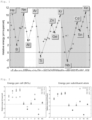
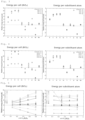
- Figs. 1 and 2 show relative energies of cluster molecules each having a structure in which one or more vanadium atoms in a cluster composed of 8 units of VS 4 unit cells are replaced by one or more specific foreign elements. It can be concluded from Figs. 1 and 2 that relative energies are relatively low in the systems to which Nb, Ti, Zr, Mo, Sc, or Y was added, and that the addition of such a foreign element can stabilize the structure and improve the cycle performance.
- Fig. 3 shows the electronic density of states of cluster molecules each having a structure in which vanadium atoms in a cluster composed of 8 units of VS4 unit cells are replaced by specific foreign elements.
- Fig. 4 shows the band gaps.
- Fig. 5 shows the relationship between the valence band maximum (VBM) and the conduction band minimum (CBM). It can be understood from Figs.
- the electronic conductivity of the foreign element-containing vanadium sulfide of the present invention and the electrochemical performance of a lithium ion secondary battery comprising the foreign element-containing vanadium sulfide of the present invention as an electrode active material for lithium ion secondary batteries can be estimated by calculating, for example, the electronic density of states, band gaps, and/or the relationship between the valence band maximum (VBM) and the conduction band minimum (CBM) of a cluster molecule having a structure in which a vanadium atom in a cluster composed of a predetermined number of units (e.g., 8 units) of vanadium sulfate unit cells is replaced by a specific foreign element.
- VBM valence band maximum
- CBM conduction band minimum
- the foreign element can be selected as providing a foreign element-containing vanadium sulfate that can improve electrochemical performance.
- the foreign element-containing vanadium sulfide of the present invention described above achieves sufficiently high initial capacity and improved cycle performance or electrochemical performance as described above. Therefore, the foreign element-containing vanadium sulfide of the present invention is particularly useful as an electrode active material for a lithium ion secondary battery.
- Lithium ion secondary batteries in which the foreign element-containing vanadium sulfide of the present invention can be effectively used as an electrode active material may be non-aqueous electrolyte solution lithium ion secondary batteries comprising a non-aqueous electrolyte solution as an electrolyte, or all-solid-state lithium ion secondary batteries comprising a lithium ion-conductive solid electrolyte.
- the non-aqueous electrolyte lithium ion secondary batteries and all-solid-state lithium ion secondary batteries may have the same structures as known lithium ion secondary batteries except that the foreign element-containing vanadium sulfide of the present invention is used as an electrode active material (in particular, a cathode active material).
- the non-aqueous electrolyte lithium ion secondary batteries may have the same basic structures as known non-aqueous electrolyte lithium ion secondary batteries except that the foreign element-containing vanadium sulfide of the present invention is used as an electrode active material (in particular, a cathode active material).
- an electrode active material in particular, a cathode active material
- the cathode may have the same structure as a known cathode except that the foreign element-containing vanadium sulfide of the present invention is used as a cathode active material.
- a cathode composite containing the foreign element-containing vanadium sulfide of the present invention and optionally further containing a conductive agent and a binder may be supported on a cathode current collector, such as aluminum, nickel, stainless steel, or carbon cloth.
- conductive agents include carbon materials, such as graphite, coke, carbon black (e.g., Ketjenblack), and acicular carbon.
- binders examples include polyvinylidene fluoride (PVDF), polytetrafluoroethylene (PTFE), polyimide (PI), polyamide, polyamideimide, polyacrylic resin, styrene-butadiene rubber (SBR), styrene-ethylene-butylene-styrene copolymers (SEBS), carboxymethyl cellulose (CMC), and the like. These materials may be used singly or in a combination of two or more.
- PVDF polyvinylidene fluoride
- PTFE polytetrafluoroethylene
- PI polyimide
- SBR styrene-butadiene rubber
- SEBS styrene-ethylene-butylene-styrene copolymers
- CMC carboxymethyl cellulose
- cathode active materials such as lithium cobalt oxide (LiCoO 2 ), lithium nickel oxide (LiNiO 2 ), lithium manganese oxide (LiMn 2 O 4 ), lithium iron phosphate (LiFePO 4 ), vanadium oxide-based materials, and sulfur-based materials can be used as cathode active materials.
- the anode may have the same structure as a known anode except that the foreign element-containing vanadium sulfide of the present invention is used as an anode active material.
- an anode composite containing the foreign element-containing vanadium sulfide of the present invention and optionally further containing a conductive agent and a binder may be supported on an anode current collector, such as aluminum, nickel, stainless steel, or carbon cloth.
- conductive agents include carbon materials such as graphite, coke, carbon black, and acicular carbon.
- binders examples include polyvinylidene fluoride (PVDF), polytetrafluoroethylene (PTFE), polyimide (PI), polyamide, polyamideimide, polyacryl, styrene-butadiene rubber (SBR), styrene-ethylene-butylene-styrene copolymers (SEBS), carboxymethyl cellulose (CMC), and the like. These materials may be used singly or in a combination of two or more.
- PVDF polyvinylidene fluoride
- PTFE polytetrafluoroethylene
- PI polyimide
- SBR styrene-butadiene rubber
- SEBS styrene-ethylene-butylene-styrene copolymers
- CMC carboxymethyl cellulose
- anode active materials such as metallic lithium, carbon-based materials (e.g., activated carbon and graphite), silicon, silicon oxide, Si-SiO-based materials, and lithium titanium oxide can be used as anode active materials.
- solvents for non-aqueous electrolytes include solvents known as solvents for non-aqueous lithium ion secondary batteries, such as carbonates, ethers, nitriles, and sulfur-containing compounds.
- solvents for non-aqueous lithium ion secondary batteries such as carbonates, ethers, nitriles, and sulfur-containing compounds.
- elemental sulfur is used as a cathode active material
- neither carbonates nor ethers can be used as a solvent. This is because a carbonate, if used as a solvent, reacts with elemental sulfur
- an ether if used as a solvent, causes dissolution of a large amount of a sulfur component in an electrolyte solution, thus incurring performance degradation.
- the foreign element-containing vanadium sulfide of the present invention when used as an electrode active material (in particular, a cathode active material), can solve these problems and make any of the solvents applicable, thus enhancing the selectivity of solvent used in the electrolyte solution.
- a separator for example, a material that is made of a polyolefin resin, such as polyethylene or polypropylene, fluororesin, nylon, aromatic aramid, inorganic glass, or like materials and that is in the form of a porous membrane, a nonwoven fabric, a woven fabric, or the like can be used.
- a polyolefin resin such as polyethylene or polypropylene, fluororesin, nylon, aromatic aramid, inorganic glass, or like materials and that is in the form of a porous membrane, a nonwoven fabric, a woven fabric, or the like
- the all-solid-state lithium ion secondary batteries can also have the same structures as known all-solid-state lithium ion secondary batteries except that the foreign element-containing vanadium sulfide of the present invention is used as an electrode active material (in particular, a cathode active material).
- an electrode active material in particular, a cathode active material.
- an anode, and a separator those mentioned above can be used.
- examples of usable electrolytes include polymer solid electrolytes, such as polyethylene oxide polymer compounds, and polymer compounds comprising at least one member selected from the group consisting of polyorganosiloxane chains and polyoxyalkylene chains; sulfide solid electrolytes; oxide solid electrolytes; and the like.
- the nonaqueous electrolyte solution lithium ion secondary batteries and all-solid-state lithium ion secondary batteries may also be of any suitable shape, and can be, for example, cylindrical or square.
- Cluster molecules each having a structure in which a vanadium atom in a cluster composed of eight units of VS 4 unit cells was replaced by a specific foreign element were prepared.
- the relative energy of each cluster molecule was calculated by first principles calculation using the VASP code.
- one vanadium atom per eight vanadium atoms in a cluster composed of 8 units of VS 4 unit cell units was replaced by a foreign element that is each element from a hydrogen atom to a barium atom in the periodic table.
- the relative energy was then calculated to evaluate whether the structures containing each foreign element as a substituent were stable.
- Fig. 1 shows the results.
- Figs. 2 to 5 show the results of relative energies calculated in the same manner as above by assuming the cases in which 1 to 4 vanadium atoms per 8 vanadium atoms were replaced by foreign elements selected from B, C, Al, Si, Sc, Ti, Y, Zr, Nb, and Mn, which were assumed to have low relative energy from the results shown in Fig. 1 .
- Cluster molecules each having a structure in which a vanadium atom in a cluster composed of eight units of VS 4 unit cells was replaced by a specific foreign element were prepared.
- the electronic state and bond length of each cluster molecule were calculated by first-principles calculation using the VASP code.
- one vanadium atom per eight vanadium atoms in a cluster composed of 8 units of VS 4 unit cell units was replaced by a foreign element that is an element selected from a hydrogen atom to a barium atom in the periodic table.
- the electronic conductivity of the substituted structures was then calculated and estimated from the density of states (DOS), and the influence of the substituent elements on the atomic structure was calculated from M-S bond length and V-S bond length and by first-principles molecular dynamics (MD).
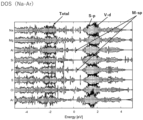
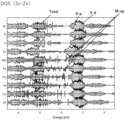
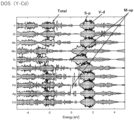
- Fig. 6 shows the electronic density of states of cluster molecules each having a structure in which a vanadium atom is replaced by a specific foreign element.
- Fig. 7 shows the band gaps.
- Fig. 8 shows the relationship between the valence band maximum (VBM) and the conduction band minimum (CBM).
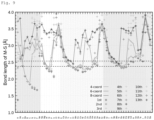
- Fig. 9 shows the M (added elements)-S bond length.
- Fig. 10 shows V-S bond length.
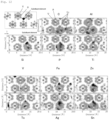
- Figs. 11 and 12 show the results of MD (1000 K, 50 ps).
- V and Nb have a gap of slightly less than 1 eV, and the valence band maximum (VBM) and the conduction band minimum (CBM) are mainly contributed by the d-orbital of V.
- VBM valence band maximum
- CBM conduction band minimum
- Elements in which a state of crossing the Fermi level is present are B, O, Ne, Mg, S, Cl, Ca, Sc, Zn, Sr, Y, Mo, Tc, and Cd, whereas elements having a very small band gap (0 to 0.2 eV) are Li, Be, Na, Al, P, K, Ga, As, Br, Fe, Co, Cu, Pd, Ag, Sn, and Sb.
- Fig. 7 including the state of crossing the Fermi level or having a band gap of 0.01 eV or less is indicated as a band gap of 0 eV.
- the descending order of the band gap is V > Nb > Si > C > Te, and the rest of the elements all had a band gap that is half or less than half of the band gap of VS 4 (0.83 eV).
- Fig. 8 shows numerical data on the valence band maximum (VBM) and the conduction band minimum (CBM) of the entire cell and those of each substituent element.
- VBM valence band maximum
- CBM conduction band minimum
- the energy difference between the x marks corresponds to the band gap of the entire cell.
- the energy difference between the + marks corresponds to the band gap of the substituent element itself.
- the entire cell tends to have a smaller band gap, whereas the substituent element itself tends to have a larger band gap. In this case, the substituent element itself is considered to make little or no contribution to electronic conduction or inhibit electronic conduction. Further, 3d elements and 4d elements were generally similar, and it seems that the substituent element itself may act as a conduction path.
- Fig. 9 and Fig. 10 show that the distance between nearest-neighbor atoms changed to a parabolic shape according to the order of atoms in the periodic table.
- Noble gases and their peripheral elements move in an outward direction from the substitution site to an interstitial site.
- Elements around vanadium in the periodic table maintain their octahedral coordination.
- the 3d elements and 4d elements decrease in coordination number from Mn and Ru, and elements around Zn and Cd, which have d10 electronic configurations, are tetra-coordinated.
- the distance between nearest-neighbor atoms becomes minimal when the number of d-electrons is around 7 to 8. Further, the influence of the substituent element was limited almost exclusively to adjacent sites. Even when there was an influence, the influence was only to the extent that one sulfur atom deviates from the coordination plane.
- Figs. 11 and 12 show that in the case of V substitution, the presence of Li atoms (points shown) is delocalized in the space, and the Li atoms were actively moving around. It was also found that Li atoms are present with high density and more stably between two VS 4 rather than three VS 4 . Further, in the case of substitution with C, Al, and Ti, the presence of Li atoms in the space was found to be more localized than in the case of V substitution, and Li atoms were slow but relatively moving. In the case of substitution with Si, P, Fe, Zn, Tc, Ag, and Sn, the results show that Li atoms were strongly constrained near substitution sites. In the case of Si, P, Zn, Ag, and Sn substitution, the results show that the substituent elements moved in the interstitial direction and Li moved into the original V site.
- V 2 S 3 vanadium (III) sulfide
- sulfur produced by Fujifilm Wako Pure Chemical Corporation
- VS 4 was then weighed with commercially available niobium sulfide (NbS 2 ) at a molar ratio of 7:1 in a glove box with an argon gas atmosphere (dew point: -80°C). These were placed in a pot and subjected to a mechanical milling process (ball diameter: 4 mm; number of revolutions: 270 rpm) for 40 hours by using a ball mill apparatus (PL-7, produced by Fritsch) . A niobium-containing vanadium sulfide VNb 0.14 S 4.29 was thereby synthesized and used as a cathode active material.
- NbS 2 niobium sulfide
- a working electrode (cathode) was produced by adding 5 mg of Ketjenblack and 1 mg of polytetrafluoroethylene (PTFE) as a binder to 10 mg of the VNb 0.14 S 4.29 produced above and mixing these components in a mortar for 8 minutes and then attaching the resulting mixture to an aluminum mesh.
- Lithium metal was used as a counter-electrode (anode).
- Polypropylene was used as a separator.
- Example 3 shows the results of charge-and-discharge cycle performance of Example 3 (discharge capacity retention (%) after 40 cycles, with the discharge capacity at the initial) cycle being defined as 100). As is clear from Table 1, Example 3 (54% capacity retention after 40 cycles) exhibited a higher charge-discharge efficiency than Comparative Example 1, in which VS 4 not containing the foreign element was used (51% capacity retention after 40 cycles, as described in detail below).
- LiCl-containing VS 4 (VLi 0.14 Cl 0.14 S 4 ) was prepared in the same manner as in Example 3 except that LiCl was added in place of NbS 2 .
- Example 4 exhibited a higher discharge capacity at each rate than Comparative Example 1, in which VS 4 not containing a foreign element was used, and Example 4 was found to be an electrode material with excellent rate performance (electrochemical performance).
- Example 5 Production and charge-and-discharge performance of Nb-, Li-, and Cl-containing VS 4
- NbS 2 - and LiCl-containing VS 4 (VNb 0.17 Li 0.17 Cl 0.17 S 4.33 ) was prepared in the same manner as in Example 3 except that NbS 2 and LiCl were added to achieve a VS 4 :NbS 2 :LiCl ratio of 6:1:1 in terms of molar ratio.
- test electrochemical cells lithium secondary batteries
- Example 5 exhibited a higher capacity retention (56% capacity retention after 40 cycles) than Comparative Example 1, in which VS 4 not containing a foreign element was used (51% capacity retention after 40 cycles).
- Example 5 exhibited a higher discharge capacity at each rate than Comparative Example 1, in which VS 4 not containing a foreign element was used, and Example 5 was found to be an electrode material with excellent rate performance.
- Comparative Example 1 Production and charge-and discharge performance of VS 4 not containing a foreign element
- VS 4 cells were produced in the same manner as in Example 5 except that VS 4 not containing a foreign element was used in place of NbS 2 -and LiCl-containing VS 4 .
- test electrochemical cells lithium secondary batteries
- Table 1 lists the results of charge-and-discharge cycle performance of Comparative Example 1. As can be understood from Table 1, Comparative Example 1 (51% capacity retention after 40 cycles) exhibited lower capacity retention (%) than Example 3 (54% capacity retention after 40 cycles) and Example 5 (56% capacity retention after 40 cycles), in which VS 4 containing a foreign element was used.
- Table 2 lists the discharge capacity (%) of Comparative Example 1 at each rate, relative to the discharge capacity at 0.05 C defined as 100%. As can be understood from Table 2, Comparative Example 1 exhibited a lower discharge capacity at each rate than Examples 4 and 5, in which a foreign element-containing VS 4 was used, and Comparative Example 1 was found to be an electrode material having inferior rate characteristics.
- Table 1 Retention (%) of discharge capacity after 40 cycles with a discharge capacity at the first cycle being defined as 100 Capacity retention (%)
- Example 3 54
- Example 5 56 Comparative Example 1 51
- Table 2 Discharge capacity (%) at each rate relative to the discharge capacity at 0.05 C Discharge capacity at 0.1 C relative to the discharge capacity at 0.05 C Discharge capacity at 0.3 C relative to the discharge capacity at 0.05 C Discharge capacity at 0.5 C relative to the discharge capacity at 0.05 C Discharge capacity at 1 C relative to the discharge capacity at 0.05 C (%) (%) (%) (%) (%) (%) (%)
- Example 4 90 77 60 10
- Example 5 90 74 53
- Nonaqueous secondary battery electrolyte solutions comprising the foreign element-containing vanadium sulfide of the present invention and nonaqueous secondary batteries comprising the nonaqueous secondary battery electrolyte solutions can be used for various known applications. Specific examples include laptop computers, cellular phones, electric vehicles, power sources for load leveling, and power sources for storing natural energy.
Landscapes
- Chemical & Material Sciences (AREA)
- Organic Chemistry (AREA)
- Inorganic Chemistry (AREA)
- Engineering & Computer Science (AREA)
- General Chemical & Material Sciences (AREA)
- Chemical Kinetics & Catalysis (AREA)
- Electrochemistry (AREA)
- Materials Engineering (AREA)
- Manufacturing & Machinery (AREA)
- Bioinformatics & Computational Biology (AREA)
- Computing Systems (AREA)
- Theoretical Computer Science (AREA)
- Bioinformatics & Cheminformatics (AREA)
- Life Sciences & Earth Sciences (AREA)
- Crystallography & Structural Chemistry (AREA)
- Battery Electrode And Active Subsutance (AREA)
Abstract
Description
- The present invention relates to a foreign element-containing vanadium sulfide.
- With recent high performance of portable electronic devices, hybrid vehicles, and other similar equipment, lithium ion secondary batteries for use in these applications are increasingly required to have higher capacity. However, the development of higher-capacity cathodes for lithium ion secondary batteries lags behind the development of higher-capacity anodes. Even lithium nickel oxide-based materials, which are thought to have a relatively high capacity, have a capacity of only about 190 to 220 mAh/g.
- In contrast, sulfur has a theoretical capacity as high as about 1670 mAh/g and is a promising candidate for a cathode active material. However, sulfur has low electronic conductivity and also has the problem of dissolution as lithium polysulfide into an organic electrolyte solution during charging and discharging. Therefore, a technique for suppressing dissolution into organic electrolyte solutions is essentially required.
- Metal sulfides, which are electronically conductive and also dissolve little in organic electrolyte solutions, are one of the promising cathode active materials as a high-capacity material that can replace current oxide-based active materials. However, since metal sulfides have a lower theoretical capacity than elemental sulfur, increasing sulfur content is necessary for metal sulfides to achieve a high capacity. This is because the sites of crystalline metal sulfides into which lithium can be inserted during discharging are defined according to crystal space groups, and this determines the maximum capacity.
- As a vanadium sulfide among metal sulfides, for example, when vanadium disulfide (V2S3) being commercially available as a reagent is used as a cathode active material, the theoretical capacity is 811 mAh/g. When vanadium tetrasulfide (VS4) having a high sulfur content is used, the theoretical capacity is 1196 mAh/g, which is even higher. However, in general, as the sulfur content increases, the electronic conductivity decreases. Therefore, a countermeasure against electronic conductivity reduction is necessary. In fact, Non-patent Literature (NPL) 1 reports that when a nanocomposite of vanadium sulfide with graphene oxide prepared by a hydrothermal synthesis method, VS4-rGO, was produced, a capacity of more than 1000 mAh/g was exhibited and excellent electrochemical performances were achieved as an anode.
- Although forming a composite with a carbon-based material is effective in improving electronic conductivity as described in non-patent literature (NPL) 1, the electrode density tends to decrease due to the effect of bulky carbon material, which is disadvantageous for achieving high energy density of the battery. Therefore, there is room for improvement, for example, in enhancing electronic conductivity by, for example, adding a foreign element to the active material itself. Improvement of electronic conductivity is also advantageous, for example, in battery performance.
- On the other hand, metal polysulfides with high capacity have the problem of low reversibility due to a great structural change resulting from lithium insertion and extraction during charging and discharging. Since reversibility affects battery life, improvement in reversibility is required for practical use as a high-capacity cathode active material. For example, Patent Literature (PTL) 1 discloses a method of producing phosphorus-containing VS4 by a mechanical milling method to stabilize the structure, thus improving reversibility and cycle performance.
- PTL 1:
WO2018/181698 - NPL 1: X. Xu et al., J. Mater. Chem. A, 2. (2014) 10847-10853.
- Thus, an object of the present invention is to provide an electrode active material for a lithium ion secondary battery that has sufficiently high initial capacity and improved electrochemical performance or cycle performance.
- The present inventors repeatedly conducted extensive research to achieve the above object. As a result, it was expected from physical property simulation using first-principles calculation that addition of at least one element other than V and S (foreign element), in particular, at least one specific foreign element (Nb, Ti, Zr, Mo, Sc, or Y) stabilizes the structure and improves structural reversibility when lithium insertion and extraction are repeated. The present inventors found that when such a foreign element is incorporated into an electrode active material for a lithium ion secondary battery, a sufficiently high initial capacity and excellent electrochemical performance can be demonstrated. It was also expected that the addition of another specific foreign element (Li, B, N, O, F, Mg, S, Cl, Ca, Br, Sr, Sc, I, Fe, Co, Ni, Zn, Y, Mo, Tc, and Cd) can enhance electrochemical performance. The present inventors found that when such a foreign element is incorporated into an electrode active material for a lithium ion secondary battery, sufficiently high initial capacity and an enhanced utilization (%) can be achieved, and excellent electrochemical performance can be exhibited. The present invention has been accomplished through further research based on the above findings. Specifically, the present invention includes the following.
-
Item 1. A foreign element-containing vanadium sulfide comprising, as constituent elements, vanadium, sulfur, and an element other than vanadium and sulfur (foreign element), wherein- the compositional ratio of the foreign element to the vanadium (M1/V) is in the range of 0.05 to 1.5 in terms of molar ratio;
- the compositional ratio of the sulfur to the vanadium (S/V) is in the range of 3.0 to 10.0 in terms of molar ratio; and
- the foreign element includes at least one member selected from the group consisting of Nb, Ti, Zr, Mo, Sc, and Y.
-
Item 2. A foreign element-containing vanadium sulfide comprising, as constituent elements, vanadium, sulfur, and an element other than vanadium and sulfur (foreign element), wherein- the compositional ratio of the foreign element to the vanadium (M2/V) is in the range of 0.05 to 1.5 in terms of molar ratio;
- the compositional ratio of the sulfur to the vanadium (S/V) is in the range of 3.0 to 10.0 in terms of molar ratio; and
- the foreign element includes at least one member selected from the group consisting of Li, B, N, O, F, Mg, S, Cl, Ca, Br, Sr, Sc, I, Fe, Co, Ni, Zn, Y, Mo, Tc, and Cd.
-
Item 3. The foreign element-containing vanadium sulfide according toItem
V(M1xM2(1-x))ySz (1)
- wherein x represents 0 to 1,
- y represents 0.05 to 1.5,
- z represents 3.0 to 10.0,
- M1 represents at least one member selected from the group consisting of Nb, Ti, Zr, Mo, Sc, and Y, and
- M2 represents at least one member selected from the group consisting of Li, B, N, O, F, Mg, S, Cl, Ca, Br, Sr, Sc, I, Fe, Co, Ni, Zn, Y, Mo, Tc, and Cd.
-
Item 4. The foreign element-containing vanadium sulfide according to any one ofItems 1 to 3, which has a VS4 crystal structure. -
Item 5. An active electrode material for a lithium ion secondary battery comprising the foreign element-containing vanadium sulfide of any one ofItems 1 to 4. -
Item 6. An electrode for a lithium ion secondary battery comprising the active electrode material for a lithium ion secondary battery ofItem 5. - Item 7. A lithium ion secondary battery comprising the electrode for a lithium ion secondary battery of
Item 6. -
Item 8. A method for predicting performance of a lithium ion secondary battery comprising, as an electrode active material for the lithium ion secondary battery, a foreign element-containing vanadium sulfide that comprises vanadium, sulfur, and an element other than vanadium and sulfur (foreign element) as constituent elements, the method comprising- calculating the relative energy of a cluster molecule by first-principles calculation, the cluster molecule having a structure in which one or more vanadium atoms in a cluster composed of vanadium sulfide unit cells are replaced by a specific foreign element; and
- evaluating the lithium ion secondary battery as having excellent cycle performance when the calculated relative energy is equal to or lower than that of vanadium sulfide not containing the foreign element.
- Item 9. A method for predicting performance of a lithium ion secondary battery comprising, as an electrode active material for the lithium ion secondary battery, a foreign element-containing vanadium sulfide that comprises vanadium, sulfur, and an element other than vanadium and sulfur (foreign element) as constituent elements, the method comprising
- calculating at least one parameter of a cluster molecule by first-principles calculation, the cluster molecule having a structure in which one or more vanadium atoms in a cluster composed of vanadium sulfide unit cells are replaced by a specific foreign element, the parameter being at least one member selected from the group consisting of electronic density of states, band gap, and relationship between the valence band maximum (VBM) and the conduction band minimum (CBM) of the cluster molecule; and
- evaluating the lithium ion secondary battery as having excellent electrochemical performance when the electronic conductivity of the foreign element-containing vanadium sulfide obtained from the calculation result is equal to or higher than that of vanadium sulfide not containing the foreign element.
-
Item 10. A performance prediction method that is a method for selecting a foreign element to be present in a foreign element-containing vanadium sulfide that comprises, as constituent elements, vanadium, sulfur, and an element other than vanadium and sulfur (foreign element),
the method comprising- calculating the relative energy of a cluster molecule by first-principles calculation, the cluster molecule having a structure in which one or more vanadium atoms in a cluster composed of vanadium sulfide unit cells are replaced by a specific foreign element; and
- selecting the foreign element when the calculated relative energy is equal to or lower than that of vanadium sulfide not containing the foreign element.
- Item 11. A performance prediction method that is a method for selecting a foreign element to be present in a foreign element-containing vanadium sulfide that comprises, as constituent elements, vanadium, sulfur, and an element other than vanadium and sulfur (foreign element),
the method comprising- calculating at least one parameter of a cluster molecule by first-principles calculation, the cluster molecule having a structure in which one or more vanadium atoms in a cluster composed of vanadium sulfide unit cells are replaced by a specific foreign element, the parameter being at least one member selected from the group consisting of electronic density of states, band gap, and relationship between the valence band maximum (VBM) and the conduction band minimum (CBM) of the cluster molecule; and
- selecting the foreign element when the electronic conductivity of the foreign element-containing vanadium sulfide obtained from the calculation result is equal to or higher than that of vanadium sulfide not containing the foreign element.
- The foreign element-containing vanadium sulfide of the present invention can provide an electrode active material for a lithium ion secondary battery with sufficiently high initial capacity and improved electrochemical performance or cycle performance.
-
-
Fig. 1 shows relative energies of cluster molecules calculated by first-principles calculation, each cluster molecule having a structure in which one vanadium atom per eight vanadium atoms in a cluster composed of 8 units of VS4 unit cells is replaced by a specific foreign element. -
Fig. 2 shows relative energies of cluster molecules calculated by first-principles calculation, each cluster molecule having a structure in which two vanadium atoms per eight vanadium atoms in a cluster composed of 8 units of VS4 unit cells are replaced by specific foreign elements. -
Fig. 3 shows relative energies of cluster molecules calculated by first-principles calculation, each cluster molecule having a structure in which three vanadium atoms per eight vanadium atoms in a cluster composed of 8 units of VS4 unit cells are replaced by specific foreign elements. -
Fig. 4 shows relative energies of cluster molecules calculated by first-principles calculation, each cluster molecule having a structure in which four vanadium atoms per eight vanadium atoms in a cluster composed of 8 units of VS4 unit cells are replaced by specific foreign elements. -
Fig. 5 shows relative energies of cluster molecules calculated by first-principles calculation, each cluster molecule having a structure in which one to four vanadium atoms per eight vanadium atoms in a cluster composed of 8 units of VS4 unit cells are replaced by specific foreign elements. -
Fig. 6 shows the electronic density of states of cluster molecules calculated by first-principles calculation, each cluster molecule having a structure in which a vanadium atom in a cluster composed of 8 units of VS4 unit cells is replaced by a specific foreign element. -
Fig. 7 shows the band gaps of cluster molecules calculated by first-principles calculation, each cluster molecule having a structure in which a vanadium atom in a cluster composed of 8 units of VS4 unit cells is replaced by a specific foreign element. -
Fig. 8 shows the relationship between the valence band maximum (VBM) and the conduction band minimum (CBM) of cluster molecules calculated by first-principles calculation, each cluster molecule having a structure in which a vanadium atom in a cluster composed of 8 units of VS4 unit cells is replaced by a specific foreign element. -
Fig. 9 shows the M-S bond length of cluster molecules (wherein M represents an added element) calculated by first-principles calculation, each cluster molecule having a structure in which a vanadium atom in a cluster composed of 8 units of VS4 unit cells is replaced by a specific foreign element. -
Fig. 10 shows the V-S bond length of cluster molecules calculated by first-principles calculation, each cluster molecule having a structure in which a vanadium atom in a cluster composed of 8 units of VS4 unit cells is replaced by a specific foreign element. -
Fig. 11 shows the results of MD (1000 K, 50 ps) (Part 1) of cluster molecules calculated by first-principles calculation, each cluster molecule having a structure in which a vanadium atom in a cluster composed of 8 units of VS4 unit cells is replaced by a specific foreign element. -
Fig. 12 shows the results of MD (1000 K, 50 ps) (Part 2) of cluster molecules calculated by first-principles calculation, each cluster molecule having a structure in which a vanadium atom in a cluster composed of 8 units of VS4 unit cells is replaced by a specific foreign element. - In the present specification, the terms "comprise," "contain," and "include" encompass the concepts of comprising, consisting essentially of, and consisting of.
- In the present specification, a numerical range indicated by "A to B" means A or more and B or less.
- Further, in the present specification, the concept of "lithium ion secondary battery" also includes lithium secondary batteries containing lithium metal as an anode active material.
- The foreign element-containing vanadium sulfide of the present invention comprises, as constituent elements, vanadium, sulfur, and at least one element other than vanadium and sulfur (foreign element), wherein the compositional ratio of the foreign element to the vanadium (M1/V or M2/V) is in the range of 0.05 to 1.5 in terms of molar ratio, and the compositional ratio (S/V) of the sulfur to the vanadium is in the range of 3.0 to 10.0 in terms of molar ratio.
- The low-crystalline vanadium sulfide containing a foreign element according to a first embodiment of the present invention comprises at least one element selected from the group consisting of Nb, Ti, Zr, Mo, Sc, and Y as the foreign element. Based on this structural feature, the present invention can provide an electrode active material for a lithium ion secondary battery with sufficiently high initial capacity and improved cycle performance.
- To improve cycle performance, structural stabilization in the foreign element-containing vanadium sulfide of the present invention is important. If the structure is stable in lithium insertion and extraction during charge-discharge cycling, the capacity can be maintained. Although the details will be described later, the structural stability can be evaluated by first-principles calculation of relative energy based on to what degree the relative energy of vanadium sulfide containing a foreign element increases or decreases as compared to that of vanadium sulfide not containing the foreign element. As a result, whether the electrode active material for a lithium ion secondary battery has excellent cycle performance can be evaluated. From this result, it can be concluded that cycle performance can be improved by incorporating at least one member selected from the group consisting of Nb, Ti, Zr, Mo, Sc, and Y as a foreign element.
- The low-crystalline vanadium sulfide containing a foreign element according to a second embodiment of the present invention contains at least one member selected from the group consisting of Li, B, N, O, F, Mg, S, Cl, Ca, Br, Sr, Sc, I, Fe, Co, Ni, Zn, Y, Mo, Tc, and Cd as the foreign element. Containing such a foreign element can provide an electrode active material for a lithium ion secondary battery with sufficiently high initial capacity and improved electrochemical performance.
- To improve electrochemical performance, the improvement of electronic conductivity of the foreign element-containing vanadium sulfide of the present invention is important. Although the details will be described later, electrochemical performance can be evaluated from first-principles calculation of relative energies based on to what degree the electronic conductivity of vanadium sulfide containing a foreign element increases or decreases as compared to that of vanadium sulfide not containing the foreign element. It can be concluded from this result that electrochemical performance can be improved by incorporating at least one element selected from the group consisting of Li, B, N, O, F, Mg, S, Cl, Ca, Br, Sr, Sc, I, Fe, Co, Ni, Zn, Y, Mo, Tc, and Cd as a foreign element.
- More specifically, the foreign element-containing vanadium sulfide of the present invention preferably has a composition represented by formula (1):
V(M1xM2(1-x))ySz (1)
- (wherein x represents 0 to 1,
- y represents 0.05 to 1.5,
- z represents 3.0 to 10.0,
- M1 represents at least one member selected from the group consisting of Nb, Ti, Zr, Mo, Sc, and Y, and
- M2 represents at least one member selected from the group consisting of Li, B, N, O, F, Mg, S, Cl, Ca, Br, Sr, Sc, I, Fe, Co, Ni, Zn, Y, Mo, Tc, and Cd).
- Thus, the foreign element-containing vanadium sulfide of the present invention has a high ratio of sulfur to vanadium in terms of elemental ratio. Therefore, the foreign element-containing vanadium sulfide of the present invention has a high initial charge-discharge capacity. The foreign element-containing vanadium sulfide of the present invention contains a specific foreign element and can thereby improve electrochemical performance or cycle performance.
- As can be understood from formula (1) above, it is also possible for the vanadium sulfide of the present invention to contain both a foreign element described above in the first embodiment and a foreign element described above in the second embodiment in combination. In this case, the obtained vanadium sulfide of the present invention can achieve both the effects of the first and second embodiments and can also improve both electrochemical performance and cycle performance, while having a high initial charge-discharge capacity. The ratio of the foreign element M2 in the second embodiment to the foreign element M1 in the first embodiment is not particularly limited. From the standpoint of electrochemical performance and cycle performance, x in formula (1) is preferably 0 to 1, more preferably 0.1 to 0.9, and even more preferably 0.2 to 0.8.
- In the present invention, electrochemical performance and cycle performance can be particularly improved by adjusting the foreign element content (y value; the total foreign element content when multiple foreign elements are present). Therefore, y is preferably in the range of 0.05 to 1.5, more preferably 0.08 to 1.4, and even more preferably 0.1 to 1.3.
- In the present invention, the higher the sulfur content (the larger z is), the higher the specific capacity tends to be. The lower the sulfur content (the smaller z is), the higher electrochemical performance tend to be. Higher cycle performances tend to be achieved by lowering the amount of elemental sulfur that may possibly be contained. From the viewpoint of balancing these factors, z is preferably 3.0 to 10.0, more preferably 3.5 to 9.0, and particularly preferably 4.0 to 8.0.
- Although the relationship between the y value and z value is not particularly limited, z = 4(y+1) is preferable in terms of, for example, charge-discharge capacity, electrochemical performance, electronic conductivity, and cycle performance.
- The foreign element-containing vanadium sulfide of the present invention has a crystalline vanadium tetrasulfide VS4 (patronite) crystal structure (also referred to below as "VS4 crystal structure"). Although the foreign element-containing vanadium sulfide is a sulfide having a high sulfur ratio in the average composition, little sulfur is present in the form of elemental sulfur and sulfur is bound to vanadium and a foreign element (M1 or M2) and forms a sulfide. Therefore, formation of by-products is suppressed, and charging and discharging proceed reversibly even as compared with vanadium sulfide not containing a foreign element. Thus, as compared with conventional vanadium sulfides, which have only a V-S bond, the foreign element-containing vanadium sulfide of the present invention has a V-S bond and a M1-S bond. This increase in the number of bonds to sulfur atoms is considered to further suppress dissolution of sulfur atoms during charging and discharging and formation of by-products derived from sulfur atoms and improve the reversibility of the structure, thus achieving improved cycle performance. Further, it is thought that due to the presence of the M2-S bond, a density of states not previously present in the band gap appears and contributes to improved electronic conductivity, thus increasing the active material utilization (%) during charging and discharging and providing an electrode material with excellent electrochemical performance.
- In the present invention, other impurities can also be contained as long as they do not interfere with the performance of the foreign element-containing vanadium sulfide of the present invention. Examples of such impurities include a foreign element-containing compound, vanadium sulfide (e.g., V2S3 and VS4), and the like that are used as starting materials; foreign element carriers, vanadium, and the like that may be mixed into starting materials; and oxygen and the like that may be mixed into starting materials or mixed during production.
- The amount of these impurities contained is preferably within the range that does not interfere with the performance of the foreign element-containing vanadium sulfide of the present invention. Generally, the amount of impurities is preferably not more than 2 mass% (0 to 2 mass%), and more preferably not more than 1.5 mass% (0 to 1.5 mass%), based on the total amount of the foreign element-containing vanadium sulfide of the present invention taken as 100 mass%. Among the impurities, the elemental sulfur content is preferably as low as possible, as described above.
- Thus, in view of sufficiently high initial capacity and improved electrochemical performance or cycle performance, the foreign element-containing vanadium sulfide of the present invention is useful as an electrode active material for a lithium ion secondary battery (in particular, a cathode active material for a lithium ion secondary battery).
- The foreign element-containing vanadium sulfide of the present invention can be produced in the same manner as with usual methods except that appropriate starting materials are used. Examples of usual methods include hand mixing and mechanical milling processes. The production conditions can also be performed according to usual methods except for using appropriate starting materials.
- The method currently used for confirming whether the electrochemical performance and cycle performance described above are improved is a method comprising adding each of various foreign elements by trial and error based on, for example, the researcher's intuition and measuring the actual performance of the thus synthesized products for the confirmation. However, for example, since the composition that can be synthesized and the route are limited by the available starting materials and optimizing the amount to be added has not been achieved, there is much room for improvement as a synthesis method. Accordingly, for efficient and systematic development, it is necessary to advance material development while simultaneously using, for example, performance predictions based on theoretical backgrounds.
- To improve cycle performance, structural stabilization in the foreign element-containing vanadium sulfide of the present invention is important. If the structure is stable even in lithium insertion and desorption during charge-discharge cycling, the capacity can be maintained. For example,
Figs. 1 and 2 show relative energies of cluster molecules each having a structure in which one or more vanadium atoms in a cluster composed of 8 units of VS4 unit cells are replaced by one or more specific foreign elements. It can be concluded fromFigs. 1 and 2 that relative energies are relatively low in the systems to which Nb, Ti, Zr, Mo, Sc, or Y was added, and that the addition of such a foreign element can stabilize the structure and improve the cycle performance. That is, by calculating the relative energy of a cluster molecule having a structure in which a vanadium atom in a cluster composed of a predetermined number of vanadium sulfide unit cells (e.g., 8 units) is replaced by a specific foreign element, cycle performance of a lithium ion battery comprising the foreign element-containing vanadium sulfide of the present invention as an electrode active material for a lithium ion secondary battery can be presumed. When the calculated relative energy of vanadium sulfate containing a foreign element is equal to or lower than vanadium sulfate not containing the foreign element, the foreign element is selected as providing a foreign element-containing vanadium sulfate that can improve cycle performance. - To improve electrochemical performance, it is important for the foreign element-containing vanadium sulfide of the present invention to have improved electronic conductivity. For example,
Fig. 3 shows the electronic density of states of cluster molecules each having a structure in which vanadium atoms in a cluster composed of 8 units of VS4 unit cells are replaced by specific foreign elements.Fig. 4 shows the band gaps.Fig. 5 shows the relationship between the valence band maximum (VBM) and the conduction band minimum (CBM). It can be understood fromFigs. 3 to 5 that the density of states in the band gap appears in the systems to which Li, B, N, O, F, Mg, S, Cl, Ca, Br, Sr, Sc, I, Fe, Co, Ni, Zn, Y, Mo, Tc, or Cd was added, and electronic conductivity can be improved by adding these foreign elements. That is, the electronic conductivity of the foreign element-containing vanadium sulfide of the present invention and the electrochemical performance of a lithium ion secondary battery comprising the foreign element-containing vanadium sulfide of the present invention as an electrode active material for lithium ion secondary batteries can be estimated by calculating, for example, the electronic density of states, band gaps, and/or the relationship between the valence band maximum (VBM) and the conduction band minimum (CBM) of a cluster molecule having a structure in which a vanadium atom in a cluster composed of a predetermined number of units (e.g., 8 units) of vanadium sulfate unit cells is replaced by a specific foreign element. When vanadium sulfate containing a foreign element has an electronic conductivity equal to or lower than that of vanadium sulfate not containing the foreign element, the foreign element can be selected as providing a foreign element-containing vanadium sulfate that can improve electrochemical performance. - The foreign element-containing vanadium sulfide of the present invention described above achieves sufficiently high initial capacity and improved cycle performance or electrochemical performance as described above. Therefore, the foreign element-containing vanadium sulfide of the present invention is particularly useful as an electrode active material for a lithium ion secondary battery. Lithium ion secondary batteries in which the foreign element-containing vanadium sulfide of the present invention can be effectively used as an electrode active material (in particular, a cathode active material) may be non-aqueous electrolyte solution lithium ion secondary batteries comprising a non-aqueous electrolyte solution as an electrolyte, or all-solid-state lithium ion secondary batteries comprising a lithium ion-conductive solid electrolyte.
- The non-aqueous electrolyte lithium ion secondary batteries and all-solid-state lithium ion secondary batteries may have the same structures as known lithium ion secondary batteries except that the foreign element-containing vanadium sulfide of the present invention is used as an electrode active material (in particular, a cathode active material).
- For example, the non-aqueous electrolyte lithium ion secondary batteries may have the same basic structures as known non-aqueous electrolyte lithium ion secondary batteries except that the foreign element-containing vanadium sulfide of the present invention is used as an electrode active material (in particular, a cathode active material).
- When the foreign element-containing vanadium sulfide of the present invention is used as a cathode active material, the cathode may have the same structure as a known cathode except that the foreign element-containing vanadium sulfide of the present invention is used as a cathode active material. For example, a cathode composite containing the foreign element-containing vanadium sulfide of the present invention and optionally further containing a conductive agent and a binder may be supported on a cathode current collector, such as aluminum, nickel, stainless steel, or carbon cloth. Examples of conductive agents include carbon materials, such as graphite, coke, carbon black (e.g., Ketjenblack), and acicular carbon. Examples of binders include polyvinylidene fluoride (PVDF), polytetrafluoroethylene (PTFE), polyimide (PI), polyamide, polyamideimide, polyacrylic resin, styrene-butadiene rubber (SBR), styrene-ethylene-butylene-styrene copolymers (SEBS), carboxymethyl cellulose (CMC), and the like. These materials may be used singly or in a combination of two or more. When the foreign element-containing vanadium sulfide of the present invention is not used as a cathode active material, known cathode active materials, such as lithium cobalt oxide (LiCoO2), lithium nickel oxide (LiNiO2), lithium manganese oxide (LiMn2O4), lithium iron phosphate (LiFePO4), vanadium oxide-based materials, and sulfur-based materials can be used as cathode active materials.
- When the foreign element-containing vanadium sulfide of the present invention is used as an anode active material, the anode may have the same structure as a known anode except that the foreign element-containing vanadium sulfide of the present invention is used as an anode active material. For example, an anode composite containing the foreign element-containing vanadium sulfide of the present invention and optionally further containing a conductive agent and a binder may be supported on an anode current collector, such as aluminum, nickel, stainless steel, or carbon cloth. Examples of conductive agents include carbon materials such as graphite, coke, carbon black, and acicular carbon. Examples of binders include polyvinylidene fluoride (PVDF), polytetrafluoroethylene (PTFE), polyimide (PI), polyamide, polyamideimide, polyacryl, styrene-butadiene rubber (SBR), styrene-ethylene-butylene-styrene copolymers (SEBS), carboxymethyl cellulose (CMC), and the like. These materials may be used singly or in a combination of two or more. When the foreign element-containing vanadium sulfide of the present invention is not used as an anode active material, known anode active materials, such as metallic lithium, carbon-based materials (e.g., activated carbon and graphite), silicon, silicon oxide, Si-SiO-based materials, and lithium titanium oxide can be used as anode active materials.
- Examples of solvents for non-aqueous electrolytes include solvents known as solvents for non-aqueous lithium ion secondary batteries, such as carbonates, ethers, nitriles, and sulfur-containing compounds. In particular, when elemental sulfur is used as a cathode active material, neither carbonates nor ethers can be used as a solvent. This is because a carbonate, if used as a solvent, reacts with elemental sulfur, whereas an ether, if used as a solvent, causes dissolution of a large amount of a sulfur component in an electrolyte solution, thus incurring performance degradation. In contrast, the foreign element-containing vanadium sulfide of the present invention, when used as an electrode active material (in particular, a cathode active material), can solve these problems and make any of the solvents applicable, thus enhancing the selectivity of solvent used in the electrolyte solution.
- As a separator, for example, a material that is made of a polyolefin resin, such as polyethylene or polypropylene, fluororesin, nylon, aromatic aramid, inorganic glass, or like materials and that is in the form of a porous membrane, a nonwoven fabric, a woven fabric, or the like can be used.
- The all-solid-state lithium ion secondary batteries can also have the same structures as known all-solid-state lithium ion secondary batteries except that the foreign element-containing vanadium sulfide of the present invention is used as an electrode active material (in particular, a cathode active material). In this case, as a cathode, an anode, and a separator, those mentioned above can be used.
- In this case, examples of usable electrolytes include polymer solid electrolytes, such as polyethylene oxide polymer compounds, and polymer compounds comprising at least one member selected from the group consisting of polyorganosiloxane chains and polyoxyalkylene chains; sulfide solid electrolytes; oxide solid electrolytes; and the like.
- The nonaqueous electrolyte solution lithium ion secondary batteries and all-solid-state lithium ion secondary batteries may also be of any suitable shape, and can be, for example, cylindrical or square.
- The present invention is described below in more detail with reference to Examples, but is not limited to the Examples below.
- Cluster molecules each having a structure in which a vanadium atom in a cluster composed of eight units of VS4 unit cells was replaced by a specific foreign element were prepared. The relative energy of each cluster molecule was calculated by first principles calculation using the VASP code.
- Specifically, one vanadium atom per eight vanadium atoms in a cluster composed of 8 units of VS4 unit cell units was replaced by a foreign element that is each element from a hydrogen atom to a barium atom in the periodic table. The relative energy was then calculated to evaluate whether the structures containing each foreign element as a substituent were stable.
- For relative energy calculation, a cluster composed of 8 units of VS4 unit cells was represented by V8S32, and the following reaction formula was assumed:

- (wherein M represents a foreign element from a hydrogen atom to a barium atom in the periodic table, and
- (atom) represents an atom in an atomic state).
- The relative energy was then calculated according to the following calculation formula:

- (wherein dE represents relative energy;
- E (MV7S32) represents the total energy of MV7S32;
- E (V8S32) represents the total energy of V8S32;
- E(V(atom)) represents the total energy of one vanadium atom in the vacuum cell (14.00Å × 14.01Å × 14.02Å); and
- E(M(atom)) represents the total energy of one foreign element in the vacuum cell (14.00Å × 14.01Å × 14.02Å)).
- In this calculation, the lattice was fixed and only the internal coordinates were relaxed. The energy at the time of ejecting one vanadium atom per eight vanadium atoms and inserting one foreign element M can be thereby calculated.
-
Fig. 1 shows the results. Further,Figs. 2 to 5 show the results of relative energies calculated in the same manner as above by assuming the cases in which 1 to 4 vanadium atoms per 8 vanadium atoms were replaced by foreign elements selected from B, C, Al, Si, Sc, Ti, Y, Zr, Nb, and Mn, which were assumed to have low relative energy from the results shown inFig. 1 . - It can be understood from the results in
Fig. 1 that the relative energy changes in a V-shape (parabolically) according to the periodic table. It can also be understood that noble gases are unstable. In VS4, the formal valence of the vanadium atom is +4 (8 sulfur atoms are coordinated). The results show that when 4 sulfur atoms are coordinated, boron has a lower relative energy than carbon; that when 6 sulfur atoms are coordinated, aluminum has a lower relative energy than silicon; and when 8 sulfur atoms are coordinated, scandium has a lower relative energy than titanium. It can thus be understood that having a small ionic radius, a small coordination number, and a low valence leads to structural stabilization. The results further show that when zinc and cadmium, which have d10 electron configuration, were used as a foreign element, the resulting structures were unstable, whereas when germanium and tin, which have four electrons in s and p orbitals, were used, the resulting structures were relatively stable. Considering a combination of the results ofFig. 1 and those ofFigs. 2 to 5 , it was found that the ascending order of the calculated relative energies was Nb < Ti < Sc, Y < Mo < Tc < Ru < B < Rh < Cr < C, Al < Si. That is, the relative energy is relatively low in the systems to which Nb, Ti, Zr, Mo, Sc, or Y were added. It can thus be concluded that the addition of these elements as a foreign element can stabilize the structure and improve cycle performance. In particular, when Nb or Ti is added, the relative energy can be reduced as compared to that of the original VS4 and the structure can be stabilized, regardless of whether the amount of substitution is large or small; therefore, it can be understood that the addition of Nb and Ti contributes to the improvement of cycle performance. Further, when at least 4 vanadium atoms per 8 vanadium atoms are replaced by Zr atoms, the relative energy can be reduced as compared to that of the original VS4 and the structure can be stabilized; therefore, it can be understood that adding an increased amount of Zr contributes to improvement of cycle performance. - Cluster molecules each having a structure in which a vanadium atom in a cluster composed of eight units of VS4 unit cells was replaced by a specific foreign element were prepared. The electronic state and bond length of each cluster molecule were calculated by first-principles calculation using the VASP code.
- Specifically, one vanadium atom per eight vanadium atoms in a cluster composed of 8 units of VS4 unit cell units was replaced by a foreign element that is an element selected from a hydrogen atom to a barium atom in the periodic table. The electronic conductivity of the substituted structures was then calculated and estimated from the density of states (DOS), and the influence of the substituent elements on the atomic structure was calculated from M-S bond length and V-S bond length and by first-principles molecular dynamics (MD).
-
Fig. 6 shows the electronic density of states of cluster molecules each having a structure in which a vanadium atom is replaced by a specific foreign element.Fig. 7 shows the band gaps.Fig. 8 shows the relationship between the valence band maximum (VBM) and the conduction band minimum (CBM).Fig. 9 shows the M (added elements)-S bond length.Fig. 10 shows V-S bond length.Figs. 11 and12 show the results of MD (1000 K, 50 ps). - It can be understood from
Fig. 6 that homologous elements in the periodic table have generally similar electronic states. Among these, V and Nb have a gap of slightly less than 1 eV, and the valence band maximum (VBM) and the conduction band minimum (CBM) are mainly contributed by the d-orbital of V. When an element is substituted, a new energy level is created in the gap. Elements in which a state of crossing the Fermi level is present (i.e., metallic elements) are B, O, Ne, Mg, S, Cl, Ca, Sc, Zn, Sr, Y, Mo, Tc, and Cd, whereas elements having a very small band gap (0 to 0.2 eV) are Li, Be, Na, Al, P, K, Ga, As, Br, Fe, Co, Cu, Pd, Ag, Sn, and Sb. - In
Fig. 7 , including the state of crossing the Fermi level or having a band gap of 0.01 eV or less is indicated as a band gap of 0 eV. As a result, the descending order of the band gap is V > Nb > Si > C > Te, and the rest of the elements all had a band gap that is half or less than half of the band gap of VS4 (0.83 eV). -
Fig. 8 shows numerical data on the valence band maximum (VBM) and the conduction band minimum (CBM) of the entire cell and those of each substituent element. Here, the upper valence band maximum (VBM) of the vanadium atom that is farthest from the substituent element is used as a reference in each cell. It is assumed that the vanadium atom that is farthest from the substituent element is in approximately the same environment as the vanadium atom in VS4. In the calculation of the valence band maximum (VBM) and the conduction band minimum (CBM), DOS values that were equal to or less than 0.05 (states/eV/cell) were ignored. - In
Fig. 8 , the energy difference between the x marks corresponds to the band gap of the entire cell. Further, inFig. 8 , the energy difference between the + marks corresponds to the band gap of the substituent element itself. In some typical elements, noble gases, and alkali metals, the entire cell tends to have a smaller band gap, whereas the substituent element itself tends to have a larger band gap. In this case, the substituent element itself is considered to make little or no contribution to electronic conduction or inhibit electronic conduction. Further, 3d elements and 4d elements were generally similar, and it seems that the substituent element itself may act as a conduction path. On the other hand, since the d orbital of Cr or Mo as an added element is present right above the d orbital of original V, the relative Fermi level is increased by that degree. Since Cr and Mo both have one more electron in the outermost shell than V, the electron is considered to be localized in the added element. -
Fig. 9 andFig. 10 show that the distance between nearest-neighbor atoms changed to a parabolic shape according to the order of atoms in the periodic table. Noble gases and their peripheral elements move in an outward direction from the substitution site to an interstitial site. Elements around vanadium in the periodic table maintain their octahedral coordination. The 3d elements and 4d elements decrease in coordination number from Mn and Ru, and elements around Zn and Cd, which have d10 electronic configurations, are tetra-coordinated. The distance between nearest-neighbor atoms becomes minimal when the number of d-electrons is around 7 to 8. Further, the influence of the substituent element was limited almost exclusively to adjacent sites. Even when there was an influence, the influence was only to the extent that one sulfur atom deviates from the coordination plane. - The results in
Figs. 11 and12 show that in the case of V substitution, the presence of Li atoms (points shown) is delocalized in the space, and the Li atoms were actively moving around. It was also found that Li atoms are present with high density and more stably between two VS4 rather than three VS4. Further, in the case of substitution with C, Al, and Ti, the presence of Li atoms in the space was found to be more localized than in the case of V substitution, and Li atoms were slow but relatively moving. In the case of substitution with Si, P, Fe, Zn, Tc, Ag, and Sn, the results show that Li atoms were strongly constrained near substitution sites. In the case of Si, P, Zn, Ag, and Sn substitution, the results show that the substituent elements moved in the interstitial direction and Li moved into the original V site. - The above results show that in the systems to which Li, B, N, O, F, Mg, S, Cl, Ca, Br, Sr, Sc, I, Fe, Co, Ni, Zn, Y, Mo, Tc, or Cd was added, the density of states appeared in the band gap. It was thus found that the addition of these foreign elements can enhance electronic conductivity and improve electrochemical performance.
- Commercially available vanadium (III) sulfide (V2S3; produced by Kojundo Chemical Lab. Co., Ltd.) and sulfur (produced by Fujifilm Wako Pure Chemical Corporation) were weighed to achieve a molar ratio of 1:6 in a glove box (dew point:
-80°C) in an argon gas atmosphere and sealed in a glass tube in a vacuum. The vacuum-sealed sample was calcined in a tubular furnace at 400°C for 5 hours. Excess sulfur was desulfurized by calcining the calcined sample in a vacuum at 200°C for 8 hours to synthesize vanadium sulfide VS4 (c-VS4). - The resulting VS4 was then weighed with commercially available niobium sulfide (NbS2) at a molar ratio of 7:1 in a glove box with an argon gas atmosphere (dew point: -80°C). These were placed in a pot and subjected to a mechanical milling process (ball diameter: 4 mm; number of revolutions: 270 rpm) for 40 hours by using a ball mill apparatus (PL-7, produced by Fritsch) . A niobium-containing vanadium sulfide VNb0.14S4.29 was thereby synthesized and used as a cathode active material.
- Test electrochemical cells (lithium secondary batteries) were produced using the obtained VNb0.14S4.29 as a cathode active material. Constant-current charge-discharge measurements were performed at 25°C for 40 cycles at a charge-discharge rate of 0.1 C (1 C = 1196 mAh/g) at a voltage within the range of 2.6 to 1.5 V with a pause time between cycles of 10 minutes.
- With respect to the method for producing the test electrochemical cells, first, a working electrode (cathode) was produced by adding 5 mg of Ketjenblack and 1 mg of polytetrafluoroethylene (PTFE) as a binder to 10 mg of the VNb0.14S4.29 produced above and mixing these components in a mortar for 8 minutes and then attaching the resulting mixture to an aluminum mesh. Lithium metal was used as a counter-electrode (anode). Polypropylene was used as a separator.
- Table 1 shows the results of charge-and-discharge cycle performance of Example 3 (discharge capacity retention (%) after 40 cycles, with the discharge capacity at the initial) cycle being defined as 100). As is clear from Table 1, Example 3 (54% capacity retention after 40 cycles) exhibited a higher charge-discharge efficiency than Comparative Example 1, in which VS4 not containing the foreign element was used (51% capacity retention after 40 cycles, as described in detail below).
- LiCl-containing VS4 (VLi0.14Cl0.14S4) was prepared in the same manner as in Example 3 except that LiCl was added in place of NbS2. Test electrochemical cells (lithium secondary batteries) were prepared in the same manner as described in Example 3 and subjected to a charge-discharge test. Constant-current charge-discharge measurements were performed at 25°C at a charge-discharge rate of 0.05 C, 0.1 C, 0.3 C, 0.5 C, and 1 C (1 C = 1196 mA/g) at a voltage within the range of 2.6 to 1.5 V.
- Table 2 lists the discharge capacity (%) of Example 4 at each rate, relative to the discharge capacity at 0.05 C defined as 100%. As can be seen from Table 2, Example 4 exhibited a higher discharge capacity at each rate than Comparative Example 1, in which VS4 not containing a foreign element was used, and Example 4 was found to be an electrode material with excellent rate performance (electrochemical performance).
- NbS2- and LiCl-containing VS4 (VNb0.17Li0.17Cl0.17S4.33) was prepared in the same manner as in Example 3 except that NbS2 and LiCl were added to achieve a VS4:NbS2:LiCl ratio of 6:1:1 in terms of molar ratio. For a charge-discharge test, test electrochemical cells (lithium secondary batteries) were prepared in the same manner as in Example 3 and subjected to constant-current charge-discharge measurement at 25°C in the same manner as in Examples 3 and 4.
- Table 1 lists the results of charge-and-discharge cycle characteristics of Example 5 (discharge capacity retention (%) after 40 cycles, with the discharge capacity at the first cycle being defined as 100). As can be seen from Table 1, Example 5 exhibited a higher capacity retention (56% capacity retention after 40 cycles) than Comparative Example 1, in which VS4 not containing a foreign element was used (51% capacity retention after 40 cycles).
- Table 2 lists the discharge capacity (%) of Example 5 at each rate, relative to the discharge capacity at 0.05 C defined as 100%. As can be understood from Table 2, Example 5 exhibited a higher discharge capacity at each rate than Comparative Example 1, in which VS4 not containing a foreign element was used, and Example 5 was found to be an electrode material with excellent rate performance.
- VS4 cells were produced in the same manner as in Example 5 except that VS4 not containing a foreign element was used in place of NbS2-and LiCl-containing VS4. For a charge-discharge test, test electrochemical cells (lithium secondary batteries) were prepared in the same manner as in Example 5 and subjected to constant-current charge-discharge measurement at 25°C in the same manner as in Examples 3 and 4.
- Table 1 lists the results of charge-and-discharge cycle performance of Comparative Example 1. As can be understood from Table 1, Comparative Example 1 (51% capacity retention after 40 cycles) exhibited lower capacity retention (%) than Example 3 (54% capacity retention after 40 cycles) and Example 5 (56% capacity retention after 40 cycles), in which VS4 containing a foreign element was used.
- Table 2 lists the discharge capacity (%) of Comparative Example 1 at each rate, relative to the discharge capacity at 0.05 C defined as 100%. As can be understood from Table 2, Comparative Example 1 exhibited a lower discharge capacity at each rate than Examples 4 and 5, in which a foreign element-containing VS4 was used, and Comparative Example 1 was found to be an electrode material having inferior rate characteristics.
Table 1: Retention (%) of discharge capacity after 40 cycles with a discharge capacity at the first cycle being defined as 100 Capacity retention (%) Example 3 54 Example 5 56 Comparative Example 1 51 Table 2: Discharge capacity (%) at each rate relative to the discharge capacity at 0.05 C Discharge capacity at 0.1 C relative to the discharge capacity at 0.05 C Discharge capacity at 0.3 C relative to the discharge capacity at 0.05 C Discharge capacity at 0.5 C relative to the discharge capacity at 0.05 C Discharge capacity at 1 C relative to the discharge capacity at 0.05 C (%) (%) (%) (%) Example 4 90 77 60 10 Example 5 90 74 53 8 Comparative Example 1 86 64 39 4 - Nonaqueous secondary battery electrolyte solutions comprising the foreign element-containing vanadium sulfide of the present invention and nonaqueous secondary batteries comprising the nonaqueous secondary battery electrolyte solutions can be used for various known applications. Specific examples include laptop computers, cellular phones, electric vehicles, power sources for load leveling, and power sources for storing natural energy.
Claims (11)
- A foreign element-containing vanadium sulfide comprising, as constituent elements, vanadium, sulfur, and an element other than vanadium and sulfur (foreign element), whereinthe compositional ratio of the foreign element to the vanadium (M1/V) is in the range of 0.05 to 1.5 in terms of molar ratio;the compositional ratio of the sulfur to the vanadium (S/V) is in the range of 3.0 to 10.0 in terms of molar ratio; andthe foreign element includes at least one member selected from the group consisting of Nb, Ti, Zr, Mo, Sc, and Y.
- A foreign element-containing vanadium sulfide comprising, as constituent elements, vanadium, sulfur, and an element other than vanadium and sulfur (foreign element), whereinthe compositional ratio of the foreign element to the vanadium (M2/V) is in the range of 0.05 to 1.5 in terms of molar ratio;the compositional ratio of the sulfur to the vanadium (S/V) is in the range of 3.0 to 10.0 in terms of molar ratio; andthe foreign element includes at least one member selected from the group consisting of Li, B, N, O, F, Mg, S, Cl, Ca, Br, Sr, Sc, I, Fe, Co, Ni, Zn, Y, Mo, Tc, and Cd.
- The foreign element-containing vanadium sulfide according to claim 1 or 2, which has a composition represented by formula (1):
V(M1xM2(1-x))ySz (1)
wherein x represents 0 to 1,y represents 0.05 to 1.5,z represents 3.0 to 10.0,M1 represents at least one member selected from the group consisting of Nb, Ti, Zr, Mo, Sc, and Y, andM2 represents at least one member selected from the group consisting of Li, B, N, O, F, Mg, S, Cl, Ca, Br, Sr, Sc, I, Fe, Co, Ni, Zn, Y, Mo, Tc, and Cd. - The foreign element-containing vanadium sulfide according to any one of claims 1 to 3, which has a VS4 crystal structure.
- An active electrode material for a lithium ion secondary battery comprising the foreign element-containing vanadium sulfide of any one of claims 1 to 4.
- An electrode for a lithium ion secondary battery comprising the active electrode material for a lithium ion secondary battery of claim 5.
- A lithium ion secondary battery comprising the electrode for a lithium ion secondary battery of claim 6.
- A method for predicting performance of a lithium ion secondary battery comprising, as an electrode active material for the lithium ion secondary battery, a foreign element-containing vanadium sulfide that comprises vanadium, sulfur, and an element other than vanadium and sulfur (foreign element) as constituent elements, the method comprisingcalculating the relative energy of a cluster molecule by first-principles calculation, the cluster molecule having a structure in which one or more vanadium atoms in a cluster composed of vanadium sulfide unit cells are replaced by a specific foreign element; andevaluating the lithium ion secondary battery as having excellent cycle characteristics when the calculated relative energy is equal to or lower than that of vanadium sulfide not containing the foreign element.
- A method for predicting performance of a lithium ion secondary battery comprising, as an electrode active material for the lithium ion secondary battery, a foreign element-containing vanadium sulfide that comprises vanadium, sulfur, and an element other than vanadium and sulfur (foreign element) as constituent elements, the method comprisingcalculating at least one parameter of a cluster molecule by first-principles calculation, the cluster molecule having a structure in which one or more vanadium atoms in a cluster composed of vanadium sulfide unit cells are replaced by a specific foreign element, the parameter being at least one member selected from the group consisting of electron density of states, band gap, and relationship between the valence band maximum (VBM) and the conduction band minimum (CBM) of the cluster molecule; andevaluating the lithium ion secondary battery as having excellent electrochemical performance when the electronic conductivity of the foreign element-containing vanadium sulfide obtained from the calculation result is equal to or higher than that of vanadium sulfide not containing the foreign element.
- A performance prediction method that is a method for selecting a foreign element to be present in a foreign element-containing vanadium sulfide that comprises, as constituent elements, vanadium, sulfur, and an element other than vanadium and sulfur (foreign element),
the method comprisingcalculating the relative energy of a cluster molecule by first-principles calculation, the cluster molecule having a structure in which one or more vanadium atoms in a cluster composed of vanadium sulfide unit cells are replaced by a specific foreign element; andselecting the foreign element when the calculated relative energy is equal to or lower than that of vanadium sulfide not containing the foreign element. - A performance prediction method that is a method for selecting a foreign element to be present in a foreign element-containing vanadium sulfide that comprises, as constituent elements, vanadium, sulfur, and an element other than vanadium and sulfur (foreign element),
the method comprisingcalculating at least one parameter of a cluster molecule by first-principles calculation, the cluster molecule having a structure in which one or more vanadium atoms in a cluster composed of vanadium sulfide unit cells are replaced by a specific foreign element, the parameter being at least one member selected from the group consisting of electron density of states, band gap, and relationship between the valence band maximum (VBM) and the conduction band minimum (CBM) of the cluster molecule; andselecting the foreign element when the electronic conductivity of the foreign element-containing vanadium sulfide obtained from the calculation result is equal to or higher than that of vanadium sulfide not containing the foreign element.
Applications Claiming Priority (2)
| Application Number | Priority Date | Filing Date | Title |
|---|---|---|---|
| JP2020187516 | 2020-11-10 | ||
| PCT/JP2021/041425 WO2022102680A1 (en) | 2020-11-10 | 2021-11-10 | Heteroelement-containing vanadium sulfide |
Publications (2)
| Publication Number | Publication Date |
|---|---|
| EP4245723A1 true EP4245723A1 (en) | 2023-09-20 |
| EP4245723A4 EP4245723A4 (en) | 2024-11-27 |
Family
ID=81601253
Family Applications (1)
| Application Number | Title | Priority Date | Filing Date |
|---|---|---|---|
| EP21891925.6A Pending EP4245723A4 (en) | 2020-11-10 | 2021-11-10 | VANADIUM SULFIDE CONTAINING A HETEROELEMENT |
Country Status (5)
| Country | Link |
|---|---|
| US (1) | US20230420672A1 (en) |
| EP (1) | EP4245723A4 (en) |
| JP (1) | JP7684715B2 (en) |
| CN (1) | CN116438143A (en) |
| WO (1) | WO2022102680A1 (en) |
Families Citing this family (1)
| Publication number | Priority date | Publication date | Assignee | Title |
|---|---|---|---|---|
| CN118040022B (en) * | 2024-01-31 | 2025-03-11 | 国联汽车动力电池研究院有限责任公司 | A highly stable inorganic sulfide electrolyte and its preparation method and application |
Family Cites Families (3)
| Publication number | Priority date | Publication date | Assignee | Title |
|---|---|---|---|---|
| JPH1050347A (en) * | 1996-07-30 | 1998-02-20 | Japan Storage Battery Co Ltd | Non-aqueous electrolyte secondary battery |
| CN109939699B (en) * | 2019-04-16 | 2022-04-05 | 湘潭大学 | Molybdenum-doped vanadium disulfide micrometer flower material and preparation method and application thereof |
| JP7394336B2 (en) * | 2019-08-28 | 2023-12-08 | 時空化学株式会社 | Negative electrode active material for secondary batteries |
-
2021
- 2021-11-10 EP EP21891925.6A patent/EP4245723A4/en active Pending
- 2021-11-10 WO PCT/JP2021/041425 patent/WO2022102680A1/en not_active Ceased
- 2021-11-10 JP JP2022561977A patent/JP7684715B2/en active Active
- 2021-11-10 CN CN202180075663.8A patent/CN116438143A/en active Pending
- 2021-11-10 US US18/035,971 patent/US20230420672A1/en active Pending
Also Published As
| Publication number | Publication date |
|---|---|
| JPWO2022102680A1 (en) | 2022-05-19 |
| CN116438143A (en) | 2023-07-14 |
| EP4245723A4 (en) | 2024-11-27 |
| WO2022102680A1 (en) | 2022-05-19 |
| US20230420672A1 (en) | 2023-12-28 |
| JP7684715B2 (en) | 2025-05-28 |
Similar Documents
| Publication | Publication Date | Title |
|---|---|---|
| US20200328455A1 (en) | Solid electrolyte material and battery | |
| US11075381B2 (en) | Boron-doped graphene sheet as sodium-ion battery anode | |
| KR101192355B1 (en) | Sodium battery and the method manufacturing thereof | |
| US10347910B2 (en) | Nano silicon material, method for producing same, and negative electrode of secondary battery | |
| JP7164939B2 (en) | All-solid secondary battery | |
| JP7294313B2 (en) | Positive electrode active material, positive electrode, non-aqueous electrolyte storage element, method for manufacturing positive electrode active material, method for manufacturing positive electrode, and method for manufacturing non-aqueous electrolyte storage element | |
| KR20200083825A (en) | Cathode active material having zinc in sodium atomic layer, preparation method thereof and the sodium secondary battery comprising the same | |
| KR102120071B1 (en) | Method for producing positive electrode active material having coating layer, positive electrode prepared therefrom, and sodium ion secondary battery containing the same | |
| JP7742307B2 (en) | Electrode materials comprising layered potassium metal oxides, electrodes comprising the electrode materials, and uses of the electrode materials in electrochemistry | |
| US20260018666A1 (en) | Inorganic compounds having an argyrodite-type structure, their preparation processes and their uses in electrochemical applications | |
| KR20180018884A (en) | Surface-modified cathode active materials for aqueous lithium secondary battery | |
| KR20200120646A (en) | Positive electrode active material, positive electrode, non-aqueous electrolyte storage device, method of manufacturing positive electrode active material, and method of manufacturing non-aqueous electrolyte storage device | |
| EP4245723A1 (en) | Heteroelement-containing vanadium sulfide | |
| EP4246629A1 (en) | Electrolyte solution for nonaqueous secondary batteries, nonaqueous secondary battery using same, and method for discharging nonaqueous secondary battery | |
| US12545595B2 (en) | Low-crystalline phosphorouscontaining vanadium sulfide, method for producing, active material, electrode, and lithium ion secondary battery including the same | |
| CN117121125A (en) | Solid electrolyte material and battery using the solid electrolyte material | |
| JP2014216249A (en) | Sodium ion secondary battery | |
| EP3629401A1 (en) | Positive active material for potassium secondary battery and potassium secondary battery including the same | |
| CN118140017A (en) | Inorganic compounds having an argyrodite-type structure, methods for their preparation and their use in electrochemical applications | |
| WO2021059726A1 (en) | Secondary battery | |
| WO2021059725A1 (en) | Secondary battery | |
| JP2021096929A (en) | Positive electrode active material for power storage element, positive electrode for power storage element, power storage element and method for manufacturing power storage element | |
| JP7475753B2 (en) | Electrolyte for non-aqueous secondary battery and non-aqueous secondary battery using the same | |
| EP3944273B1 (en) | Aqueous electrolyte solution for electricity storage devices and electricity storage device comprising this aqueous electrolyte solution | |
| Arszelewska | Electrochemical Stability of the Next Generation Lithium Batteries |
Legal Events
| Date | Code | Title | Description |
|---|---|---|---|
| STAA | Information on the status of an ep patent application or granted ep patent |
Free format text: STATUS: THE INTERNATIONAL PUBLICATION HAS BEEN MADE |
|
| PUAI | Public reference made under article 153(3) epc to a published international application that has entered the european phase |
Free format text: ORIGINAL CODE: 0009012 |
|
| STAA | Information on the status of an ep patent application or granted ep patent |
Free format text: STATUS: REQUEST FOR EXAMINATION WAS MADE |
|
| 17P | Request for examination filed |
Effective date: 20230601 |
|
| AK | Designated contracting states |
Kind code of ref document: A1 Designated state(s): AL AT BE BG CH CY CZ DE DK EE ES FI FR GB GR HR HU IE IS IT LI LT LU LV MC MK MT NL NO PL PT RO RS SE SI SK SM TR |
|
| DAV | Request for validation of the european patent (deleted) | ||
| DAX | Request for extension of the european patent (deleted) | ||
| A4 | Supplementary search report drawn up and despatched |
Effective date: 20241029 |
|
| RIC1 | Information provided on ipc code assigned before grant |
Ipc: G16C 20/30 20190101ALI20241023BHEP Ipc: H01M 4/58 20100101ALI20241023BHEP Ipc: C01G 31/00 20060101AFI20241023BHEP |