EP4245562B1 - Jam resistant chalk reel - Google Patents
Jam resistant chalk reel Download PDFInfo
- Publication number
- EP4245562B1 EP4245562B1 EP23161196.3A EP23161196A EP4245562B1 EP 4245562 B1 EP4245562 B1 EP 4245562B1 EP 23161196 A EP23161196 A EP 23161196A EP 4245562 B1 EP4245562 B1 EP 4245562B1
- Authority
- EP
- European Patent Office
- Prior art keywords
- chalk
- line
- spool
- apertures
- dimension
- Prior art date
- Legal status (The legal status is an assumption and is not a legal conclusion. Google has not performed a legal analysis and makes no representation as to the accuracy of the status listed.)
- Active
Links
Images




Classifications
-
- B—PERFORMING OPERATIONS; TRANSPORTING
- B44—DECORATIVE ARTS
- B44D—PAINTING OR ARTISTIC DRAWING, NOT OTHERWISE PROVIDED FOR; PRESERVING PAINTINGS; SURFACE TREATMENT TO OBTAIN SPECIAL ARTISTIC SURFACE EFFECTS OR FINISHES
- B44D3/00—Accessories or implements for use in connection with painting or artistic drawing, not otherwise provided for; Methods or devices for colour determination, selection, or synthesis, e.g. use of colour tables
- B44D3/38—Cord line chalkers
-
- B—PERFORMING OPERATIONS; TRANSPORTING
- B65—CONVEYING; PACKING; STORING; HANDLING THIN OR FILAMENTARY MATERIAL
- B65H—HANDLING THIN OR FILAMENTARY MATERIAL, e.g. SHEETS, WEBS, CABLES
- B65H75/00—Storing webs, tapes, or filamentary material, e.g. on reels
- B65H75/02—Cores, formers, supports, or holders for coiled, wound, or folded material, e.g. reels, spindles, bobbins, cop tubes, cans, mandrels or chucks
- B65H75/34—Cores, formers, supports, or holders for coiled, wound, or folded material, e.g. reels, spindles, bobbins, cop tubes, cans, mandrels or chucks specially adapted or mounted for storing and repeatedly paying-out and re-storing lengths of material provided for particular purposes, e.g. anchored hoses, power cables
- B65H75/38—Cores, formers, supports, or holders for coiled, wound, or folded material, e.g. reels, spindles, bobbins, cop tubes, cans, mandrels or chucks specially adapted or mounted for storing and repeatedly paying-out and re-storing lengths of material provided for particular purposes, e.g. anchored hoses, power cables involving the use of a core or former internal to, and supporting, a stored package of material
- B65H75/40—Cores, formers, supports, or holders for coiled, wound, or folded material, e.g. reels, spindles, bobbins, cop tubes, cans, mandrels or chucks specially adapted or mounted for storing and repeatedly paying-out and re-storing lengths of material provided for particular purposes, e.g. anchored hoses, power cables involving the use of a core or former internal to, and supporting, a stored package of material mobile or transportable
- B65H75/406—Cores, formers, supports, or holders for coiled, wound, or folded material, e.g. reels, spindles, bobbins, cop tubes, cans, mandrels or chucks specially adapted or mounted for storing and repeatedly paying-out and re-storing lengths of material provided for particular purposes, e.g. anchored hoses, power cables involving the use of a core or former internal to, and supporting, a stored package of material mobile or transportable hand-held during use
-
- B—PERFORMING OPERATIONS; TRANSPORTING
- B65—CONVEYING; PACKING; STORING; HANDLING THIN OR FILAMENTARY MATERIAL
- B65H—HANDLING THIN OR FILAMENTARY MATERIAL, e.g. SHEETS, WEBS, CABLES
- B65H75/00—Storing webs, tapes, or filamentary material, e.g. on reels
- B65H75/02—Cores, formers, supports, or holders for coiled, wound, or folded material, e.g. reels, spindles, bobbins, cop tubes, cans, mandrels or chucks
- B65H75/34—Cores, formers, supports, or holders for coiled, wound, or folded material, e.g. reels, spindles, bobbins, cop tubes, cans, mandrels or chucks specially adapted or mounted for storing and repeatedly paying-out and re-storing lengths of material provided for particular purposes, e.g. anchored hoses, power cables
- B65H75/38—Cores, formers, supports, or holders for coiled, wound, or folded material, e.g. reels, spindles, bobbins, cop tubes, cans, mandrels or chucks specially adapted or mounted for storing and repeatedly paying-out and re-storing lengths of material provided for particular purposes, e.g. anchored hoses, power cables involving the use of a core or former internal to, and supporting, a stored package of material
- B65H75/44—Constructional details
- B65H75/4418—Arrangements for stopping winding or unwinding; Arrangements for releasing the stop means
- B65H75/4428—Arrangements for stopping winding or unwinding; Arrangements for releasing the stop means acting on the reel or on a reel blocking mechanism
- B65H75/4431—Manual stop or release button
Definitions
- the present invention relates generally to layout tools, and more particularly to chalk line marking devices commonly referred to as chalk reels, chalk spools, chalk boxes or chalk lines (hereinafter referred to as "chalk reels").
- Chalk reels consist of a spool on which a line or string is wound.
- the spool, line and the drive transmission for the spool are supported in a housing.
- the drive transmission may comprise gears, springs and other components that connect the spool to an external handle for rewinding the line on the spool after use.
- a chalk chamber is filled or partially filled with a colored chalk such that as the line that is wound on the spool it is coated in chalk.
- the line can be unwound from the housing through an aperture in the housing such that it can be "snapped" on a surface to form a line of chalk on the surface.
- the resulting line of chalk can be used as a reference line in construction or other applications.
- a chalk reel includes a housing defining a chalk chamber and an opening from the chalk chamber; a spool positioned within the chalk chamber; and a line wound on the spool and extending through the opening, the line having a width of dimension X.
- the spool comprises an axial hub and a sidewall.
- the sidewall comprises a plurality of apertures extending through the sidewall from a first face distal from the axial hub to a second face proximal to the axial hub.
- Each of the plurality of apertures having a maximum width of dimension Y.
- the dimension Y is less than or equal to twice the dimension X.
- a chalk reel 100 includes a housing 110 that forms a chalk chamber.
- the housing 110 includes a front housing section 110a and a rear housing section 110b, which may be connected together by fasteners (not shown) such as threaded screws or other releasable connection mechanisms such that the housing sections may be separated or formed separately and assembled together.
- a hook 120 that is coupled to a line (e.g., in the illustrated embodiment, line 130 in FIG. 2 ).
- the line 130 is wound around a spool (e.g., in the illustrated embodiment, spool 140 in FIG. 2 ) within the chalk chamber, such that chalk in the chalk chamber may contact and adhere to the line 130.
- the line 130 may be formed of any appropriate material, including but not limited to nylon, polyester, or cotton, which in some embodiments may be twisted or braided. It may be appreciated that when a user pulls on the hook 120 may cause the spool 140 to rotate and release the line 130 with the chalk adhered thereto. Accordingly, once the line 130 is extended from the housing 110, and the hook 120 has engaged or bit into a distant surface, snapping the line relative to the hook 120 and the housing 110 will displace chalk to form a reference chalk mark on a substrate between the hook 120 and the housing 110.
- the chalk reel 100 has a winding handle 150 that facilitates rotating the spool 140 to retract the line 130 and hook 120 into the housing 110.
- the winding handle 150 may be pivotable, and as such may move from a compactified storage position to an extended winding position.
- the chalk reel 100 may have a gearing system that provides a mechanical advantage for more rapidly retracting the line 130 and hook 120 into the housing 110.
- the chalk reel 100 may include a clutch that may disengage the winding handle 150 from the spool 140, so that the winding handle 150 does not rotate when the hook 120 or line 130 is being pulled directly.
- a line release actuator 160 may be included in the chalk reel 100 to actuate such a clutch, and in the illustrated embodiment may be operatively positioned between the winding handle 150 and the spool 140 (or more specifically between the winding handle 150 and the gearing system, not shown) to disengage the spool 140 from the gearing system and/or the winding handle 150.
- the chalk reel 100 may include one or more doors to open the chalk chamber to permit filling the chalk chamber with chalk.
- the chalk reel 100 may include a nose door 170, which may selectively receive the hook 120, and through which the line 130 may extend.
- the nose door 170 may be separated from the housing 110, and an opening to the chalk chamber may be exposed for insertion of the nose of a chalk refill bottle.
- a hinged door 180 is also included, and configured such that once the nose door 170 is separated from the housing 110, the hinged door 180 may be further opened to provide a wider opening into the chalk chamber to facilitate easier refilling of chalk into the chalk chamber.
- the line 130 and spool 140 may be more fully appreciated, as well as their interaction with the inside of the housing 110 defining the chalk chamber. It may be appreciated that the spool 140 may have a spool axis feature 190 configured to engage with a winder axis feature (not shown) that would be fixed to the gearing system and/or the winding handle 150 and contact therebetween would be through an opening 110c in the housing 110. In the illustrated embodiment, the spool axis feature 190 is a receiver that would receive the winder axis feature extending through the opening 110c.
- the spool 140 includes a first sidewall 140a and a second sidewall 140b, connected therebetween by an axial hub 140c.
- the axial hub 140c defines the spool axis feature 190 configured to engage with the winder axis feature.
- a plurality of apertures 200 are formed in one or more of the first sidewall 140a and the second sidewall 140b, so as to extend from an exterior of the spool 140 to the interior of the spool 140 between the sidewalls 140a and 140b.
- the apertures extend from an exterior face of each sidewall 140a and 140b distal from the axial hub 140c, to an interior face proximal to the axial hub 140c.
- one or more of the front housing section 110a and a rear housing section 110b, at interiors thereof defining the chalk chamber and adjacent to the sidewalls 140a and/or 140b that contain the apertures 200, may include chalk aeration features 210, such as protruding grooves extending inwardly into the chalk chamber. It may be appreciated that such chalk aeration features 210 may scrape and push chalk in the chalk chamber as the spool 140 rotates, such that the chalk may be pushed into the apertures 200.
- the apertures 200 formed in the spool 140 are dimensionally sized with a desired relationship relative to a width or thickness of the line 130.
- the apertures 200 formed in the illustrated sidewall 140a are sized such that a maximum dimension thereof in the plane of the sidewall 140a or 140b is a dimension Y, where Y is less than 2 times the dimension X.
- This dimension Y may be the diameter of the aperture 200 where the aperture 200 has a circular opening (e.g., a generally cylindrical shape), or may be the longest diagonal where the aperture 200 has a rectangular opening (e.g., a generally rectangular prism shape), or may be the longest internally bounded line segment that can be drawn in any other appropriately shaped opening for aperture 200. It may be appreciated that the apertures 200 may therefore have any appropriate shape, including but not limited to squares, slots, diamonds, rectangles, ovals, star shapes, or may have any other regular or irregular shape.
- the dimension Y of the aperture is less than or equal to twice dimension X of the line 130
- no loop of the line 130 which would typically be at least 2 times X in dimension (unless the line 130 is compressed)
- certain sizes of chalk reel 100 may be configured with larger or smaller chalk capacities and/or line lengths.
- the dimension X of the line 130 for a large capacity chalk reel 100 may be larger than the dimension X of the line 130 for a small capacity chalk reel 100, as a longer intended snap length and thus length of line 130 may make desirable a thicker line 130 for increased line strength.
- a corresponding larger dimension Y of the aperture 200 may also be utilized, allowing more chalk to pass through the aperture 200 into the inner windings of the line 130 on the spool 140, provided that the aperture is not so large that loops of the line 130 may pass therethrough.
- the outer diameter of the spool 140 may range between approximately 45 mm and 130 mm in various embodiments, which may facilitate lengths of line 130 between approximately 8 meters feet long to approximately 46 meters long.
- a diameter of the spool 140 may be approximately 60 mm in diameter, while in other embodiments the diameter of the spool 140 may be approximately 65 mm in diameter, and in still other embodiments, the diameter of the spool 140 may be approximately 127 mm in diameter.
- the dimension Y in the sidewall 140a may be appropriately sized so as to be less than twice dimension X when the dimension X is of the line 130 as uncompressed.
- the dimension Y may be approximately 1.5 times the size of dimension X.
- the dimension Y may be approximately the same as the dimension X.
- the dimension Y may be smaller than the dimension X.
- the dimension X of the line 130 as uncompressed may be approximately between 0.5 mm and 1.5 mm, and in some embodiments may be approximately 1 mm, for a smaller capacity/length line 130.
- the dimension X of the line 130 as uncompressed may be approximately between 1.5 mm and 2.5 mm, and in some embodiments may be approximately 2 mm, e.g., for a larger capacity/length line.
- the dimension Y of the sidewall 140a may be appropriately sized based on a possible compression of the line 130.
- the dimension Y may be approximately 1.5 times the size of dimension X as compressed.
- the dimension Y may be approximately the same as the dimension X as compressed.
- the dimension Y may be smaller than the dimension X as compressed.
- compression of the line 130 may reduce the dimension X of the line 130 to approximately between 0.25 mm and 0.75 mm, and in some embodiments may be approximately 0.5 mm, for a smaller capacity/length line 130.
- the dimension X of the line 130 as compressed may be approximately between 0.75 mm and 1.25 mm, and in some embodiments may be approximately 1 mm, e.g., for a larger capacity/length line.
- the dimension Y of the sidewalls 140a or 140b would remain sufficiently large to permit permeation of chalk particles through the apertures 200, and would not be so small as to be functionally the same as having a solid sidewall 140a without apertures 200. Accordingly, in some embodiments the dimension Y of the apertures 200 may be as small as 1 mm, in particular where the apertures 200 are formed as molded into a plastic spool 140, as smaller sizes may increase molding difficulties.
- the dimension Y of the apertures 200 may be significantly smaller, and may be closer in size to (although larger than) the typical size of grains of chalk (e.g., 0.015 mm).
- the dimension Y of the apertures 200 may be approximately between 0.5 and 5 mm, and in some embodiments may be approximately 4 mm where the dimension X of the line 130 is approximately 2 mm, and may be approximately 2 mm where the dimension X of the line 130 is approximately 1 mm.
- the sidewalls 140a may accommodate a large number of such apertures 200.
- the sidewall 140a may include at least ten apertures 200.
- the sidewall 140a may include at least twenty apertures 200.
- the sidewall 140a may include at least thirty apertures 200.
- the sidewall 140a may include at least forty apertures 200. As shown in the illustrated embodiment, with reference to the view of FIGs.
- the spool 140 as a whole may contain generally the same number apertures 200 on the sidewall 140a and the sidewall 140b. As such, in the illustrated embodiment, the spool 140 includes approximately eighty apertures 200.
- the number of apertures 200 on each sidewall 140a and 140b may differ. While in the illustrated embodiments the apertures 200 are generally symmetrically arranged on the sidewalls 140a and 140b, in other embodiments the apertures 200 may be asymmetrically positioned, and in some embodiments may be randomly positioned. In some embodiments, the apertures 200 may be appropriately placed on the spool 140 so as to align with appropriately placed chalk aeration features 210 in the chalk chamber, so as to create a desired movement of chalk from the chalk aeration features 210 into the apertures 200.
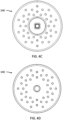
- FIG. 4A-4F show various views of the spool according to an embodiment of the present disclosure. It may be appreciated that the views therein may be sufficiently appreciated for the ornamental appearance of the spools 140 as a whole, or for the arrangement of the apertures 200 on a sidewall 140a or 140b.
- the extension of the axial hub 140c between the sidewall 140a and the sidewall 140b may be appreciated.
- the axial hub 140c may include bars 140d with notches 140e, which may facilitate holding an initial loop of the line 130 in the notches 140e.
- Other arrangements to secure the line 130 to the spool 140 may be utilized in other embodiments, including but not limited to a through hole extending in the axial hub 140c.
- the apertures 200 may be so plentiful on the sidewalls 140a or 140b that the sidewalls 140a or 140b approximate a mesh or perforated screen.
- the sidewalls 140a or 140b may comprise a mesh material, including but not limited to metal mesh or plastic mesh, or a perforated material, including but not limited to perforated stainless steel or perforated aluminum. In some embodiments, these materials may define the bulk of the sidewalls 140a and/or 140b.
- a spool 220 which may be similar to spool 140 as described above in various regards except as discussed herein, may have sidewalls 220a and/or 220b that are joined by a hub 220c.
- the hub 220c may be similar to the hub 140c as described above.
- the sidewalls 220a and/or 220b may comprise or be formed from a mesh or perforated material 220d as described in greater detail below, forming a multitude of apertures 200 therein.
- the sidewalls 220a or 220b may include reinforcements 230, such as rims 230a or spokes 230b, to support the mesh or perforated material 220d.
- the reinforcements 230 may be formed from any appropriate material, including but not limited to metal or plastic, and in some embodiments may be formed from the same material as the hub 220c.
- the mesh or perforated material 220d may be sufficiently rigid as to avoid the need for such reinforcements 230, as shown in the embodiment of the spool 240 illustrated in Figure 6 , where mesh or perforated material 220d defines the sidewalls 240a and 240b thereof extending from a hub 220c which may be similar to that described as to the spool 220.
- the mesh or perforated material 220d may be of any appropriate construction or configuration, including but not limited to metal or plastic mesh.
- a metal mesh configuration may comprise stainless steel.
- chalk grain particles are typically approximately 15 microns, or 0.015 mm in size.
- the aperture size of the mesh may be larger than such size so as to permit movement of chalk particles therethrough.
- 635x635 mesh with a wire diameter of 0.0203 mm may define an aperture of 0.0203 mm
- 400x400 mesh with a wire diameter of 0.0254 mm may define an aperture of 0.37 mm.
- a mesh material 220d may be similar to 200x200 mesh, which generally has apertures of 0.0737mm.
- larger meshes may be utilized to accommodate larger dimensions X of lines 130.
- a 5x5 mesh having a wire diameter of 1.04 mm has a larger aperture of approximately 4.04 mm, which may be utilized with a line 130 having a dimension X of approximately 2 mm.
- the weave method of the mesh material 220d may vary across embodiments, and may be configured as a plain weave, twill weave, Dutch weave, Dutch twill, or any other appropriate method of construction. Further, the mesh construction may be woven wire, welded wire, crimped wire, or so on. In still other embodiments, where the material 220d is a perforated material, the material be formed as perforated aluminum, perforated stainless steel, or perforated carbon steel.
- the chalk reels and components thereof described herein may be formed of metal, plastic, ceramic, or any other appropriate material. It may be appreciated that the components described herein may be of different constructions or configurations, including but not limited to one or more being comprised of different material choices. For example, the components described herein may each be constructed from a variety of materials, including but not limited to one or more of fabrics, plastics, metals, rubbers, elastomers, or any other appropriate material choice. For example, in an embodiment one or more of the components (e.g., the housing 110, the spool 140) may be formed of aluminum (e.g., machined aluminum), iron (e.g., steel), or any other appropriate material.
- aluminum e.g., machined aluminum
- iron e.g., steel
- portions of the chalk reels may be formed from molded plastic, metal, or combinations thereof (e.g., plastic with metal supports or fasteners coupling portions tougher).
- structural and functional components may be formed from metal or hard plastic, while gripped components positioned to engage the palm of a gripping hand to provide the palm with a comfortable gripping surface may be made of a suitable molded plastic material or elastomeric material, and may be generally formed as a bi-material suitable molded plastic material coated with a layer of an elastomeric material, such as a rubber based material.
- the material choices may differ from component to component (e.g., a metal housing 110 and a plastic spool 140).
- some components may be integrally formed together, while other components may be assembled by any appropriate mechanism, including but not limited to fastened, welded, snap-fit, friction fit, adhesive bonding, or other appropriate securements.
Landscapes
- Storage Of Web-Like Or Filamentary Materials (AREA)
Description
- The present invention relates generally to layout tools, and more particularly to chalk line marking devices commonly referred to as chalk reels, chalk spools, chalk boxes or chalk lines (hereinafter referred to as "chalk reels").
- Chalk reels are known that consist of a spool on which a line or string is wound. The spool, line and the drive transmission for the spool are supported in a housing. The drive transmission may comprise gears, springs and other components that connect the spool to an external handle for rewinding the line on the spool after use. A chalk chamber is filled or partially filled with a colored chalk such that as the line that is wound on the spool it is coated in chalk. The line can be unwound from the housing through an aperture in the housing such that it can be "snapped" on a surface to form a line of chalk on the surface. The resulting line of chalk can be used as a reference line in construction or other applications. Features of conventional chalk reels include those found in
U.S. Patent 9,701,154 US Patent Application Publication 2016/0096396A1 , which discloses a chalk reel having a housing, spool and chalk line wrapped onto the spool. A chalk material is also positioned in the housing to coat the chalk line. - According to an embodiment, a chalk reel includes a housing defining a chalk chamber and an opening from the chalk chamber; a spool positioned within the chalk chamber; and a line wound on the spool and extending through the opening, the line having a width of dimension X. The spool comprises an axial hub and a sidewall. The sidewall comprises a plurality of apertures extending through the sidewall from a first face distal from the axial hub to a second face proximal to the axial hub. Each of the plurality of apertures having a maximum width of dimension Y. The dimension Y is less than or equal to twice the dimension X.
- These and other objects, features, and characteristics of the present invention, as well as the methods of operation and functions of the related elements of structure and the combination of parts and economies of manufacture, will become more apparent upon consideration of the following description and the appended claims with reference to the accompanying drawings, all of which form a part of this specification, wherein like reference numerals designate corresponding parts in the various figures. In one embodiment of the invention, the structural components illustrated herein are drawn to scale. It is to be expressly understood, however, that the drawings are for the purpose of illustration and description only and are not intended as a definition of the limits of the invention. In addition, it should be appreciated that structural features shown or described in any one embodiment herein can be used in other embodiments as well. As used in the specification and in the claims, the singular form of "a", "an", and "the" include plural referents unless the context clearly dictates otherwise.
- Features of chalk reels in accordance with one or more embodiments are shown in the drawings, in which like reference numerals designate like elements. The drawings form part of this original disclosure in which:
-
FIG. 1 illustrates a perspective view of an embodiment of a chalk reel of the present invention; -
FIG. 2 illustrates an exploded view of selected portions of the chalk reel ofFIG. 1 , including a line and a spool thereof; -
FIG. 3 illustrates an enlarged view of the line and spool ofFIG 2 ; -
FIGs. 4A-4F illustrate front perspective, rear perspective, front, rear, side, and top views of the spool of the illustrated embodiment respectively, where an opposing side view would be mirrored symmetrical to the illustrated side view, and a bottom view would be mirrored symmetrical to the top view; -
FIG. 5 illustrates a perspective view of another embodiment of a spool according to the present disclosure; and -
FIG.6 illustrates a perspective view of another embodiment of a spool according to the present disclosure. - It will be understood that, although the terms first, second, etc. may be used herein to describe various elements, these elements should not be limited by these terms. These terms are only used to distinguish one element from another. For example, a first element could be termed a second element, and, similarly, a second element could be termed a first element, without departing from the scope of the present invention. As used herein, the term "and/or" includes any and all combinations of one or more of the associated listed items.
- Relative terms such as "below" or "above" or "upper" or "lower" or "horizontal" or "vertical" or "top" or "bottom" may be used herein to describe a relationship of one element, component or region to another element, component or region as illustrated in the figures. It will be understood that these terms are intended to encompass different orientations of the device in addition to the orientation depicted in the figures.
- As shown in
FIG.1 , achalk reel 100 includes ahousing 110 that forms a chalk chamber. In an embodiment, thehousing 110 includes afront housing section 110a and arear housing section 110b, which may be connected together by fasteners (not shown) such as threaded screws or other releasable connection mechanisms such that the housing sections may be separated or formed separately and assembled together. Selectively extendable from thehousing 110 is ahook 120 that is coupled to a line (e.g., in the illustrated embodiment,line 130 inFIG. 2 ). As discussed in greater detail below, theline 130 is wound around a spool (e.g., in the illustrated embodiment,spool 140 inFIG. 2 ) within the chalk chamber, such that chalk in the chalk chamber may contact and adhere to theline 130. Theline 130 may be formed of any appropriate material, including but not limited to nylon, polyester, or cotton, which in some embodiments may be twisted or braided. It may be appreciated that when a user pulls on thehook 120 may cause thespool 140 to rotate and release theline 130 with the chalk adhered thereto. Accordingly, once theline 130 is extended from thehousing 110, and thehook 120 has engaged or bit into a distant surface, snapping the line relative to thehook 120 and thehousing 110 will displace chalk to form a reference chalk mark on a substrate between thehook 120 and thehousing 110. - In the illustrated embodiment, the
chalk reel 100 has awinding handle 150 that facilitates rotating thespool 140 to retract theline 130 and hook 120 into thehousing 110. As shown, thewinding handle 150 may be pivotable, and as such may move from a compactified storage position to an extended winding position. In some embodiments, thechalk reel 100 may have a gearing system that provides a mechanical advantage for more rapidly retracting theline 130 and hook 120 into thehousing 110. In some such embodiments, thechalk reel 100 may include a clutch that may disengage thewinding handle 150 from thespool 140, so that thewinding handle 150 does not rotate when thehook 120 orline 130 is being pulled directly. As shown, aline release actuator 160 may be included in thechalk reel 100 to actuate such a clutch, and in the illustrated embodiment may be operatively positioned between thewinding handle 150 and the spool 140 (or more specifically between thewinding handle 150 and the gearing system, not shown) to disengage thespool 140 from the gearing system and/or thewinding handle 150. - Before turning to the salient internal features of the
chalk reel 100, it may further be appreciated fromFIG. 1 that thechalk reel 100 may include one or more doors to open the chalk chamber to permit filling the chalk chamber with chalk. As shown, in an embodiment thechalk reel 100 may include anose door 170, which may selectively receive thehook 120, and through which theline 130 may extend. In an embodiment, by rotating the nose door 170 (e.g., by unscrewing it where it includes a threaded fastener, or through known quarter turn or half turn unlatching with a seal member), thenose door 170 may be separated from thehousing 110, and an opening to the chalk chamber may be exposed for insertion of the nose of a chalk refill bottle. In the illustrated embodiment a hingeddoor 180 is also included, and configured such that once thenose door 170 is separated from thehousing 110, the hingeddoor 180 may be further opened to provide a wider opening into the chalk chamber to facilitate easier refilling of chalk into the chalk chamber. - Turning to
FIG.2 , theline 130 andspool 140 may be more fully appreciated, as well as their interaction with the inside of thehousing 110 defining the chalk chamber. It may be appreciated that thespool 140 may have a spool axis feature 190 configured to engage with a winder axis feature (not shown) that would be fixed to the gearing system and/or thewinding handle 150 and contact therebetween would be through an opening 110c in thehousing 110. In the illustrated embodiment, thespool axis feature 190 is a receiver that would receive the winder axis feature extending through the opening 110c. As theline 130 is wrapped around thespool 140 when theline 130 andhook 120 are retracted into the chalk chamber, pulling thehook 120 from thehousing 110 would pull theline 130 and rotate thespool 140. Thus, it may be appreciated that unless the clutch is disengaged through actuation of theline release actuator 160, rotation of thespool 140 may result in rotation of thewinding handle 150 and/or the gearing system, which may slow or prevent free rotation of thespool 140 to release theline 130 for extension. - It is known in the art of chalk reels to include apertures in the spools, which permit permeation of chalk to interior windings of the line. For such reasons, these apertures, where included, are commonly large openings configured to maximize movement of chalk into the windings of the line carried by the spool, and move and aerate through the apertures into the spool as the spool is rotated. It is an aspect of the present disclosure to improve upon such spools.
- In the illustrated embodiment, the
spool 140 includes afirst sidewall 140a and asecond sidewall 140b, connected therebetween by anaxial hub 140c. As shown, in thespool 140, theaxial hub 140c defines thespool axis feature 190 configured to engage with the winder axis feature. A plurality ofapertures 200 are formed in one or more of thefirst sidewall 140a and thesecond sidewall 140b, so as to extend from an exterior of thespool 140 to the interior of thespool 140 between the sidewalls 140a and 140b. The apertures extend from an exterior face of each sidewall 140a and 140b distal from theaxial hub 140c, to an interior face proximal to theaxial hub 140c. Accordingly, as theline 130 is wound around theaxial hub 140c, chalk that is at the exterior of thespool 140 may enter theapertures 200 to contact windings of theline 130 closer to theaxial hub 140c, and not be blocked by windings of theline 130 radially outward from theaxial hub 140c. As further shown inFIG. 2 , one or more of thefront housing section 110a and arear housing section 110b, at interiors thereof defining the chalk chamber and adjacent to thesidewalls 140a and/or 140b that contain theapertures 200, may include chalk aeration features 210, such as protruding grooves extending inwardly into the chalk chamber. It may be appreciated that such chalk aeration features 210 may scrape and push chalk in the chalk chamber as thespool 140 rotates, such that the chalk may be pushed into theapertures 200. - It may be appreciated that in conventional chalk reels, having large sized apertures, or even a generally skeletal or widely webbed configuration of spool, retracting the line and hook into the housing by winding the spool may result in the line getting tangled by the chalk in the chalk chamber thereof, such that the line protrudes through the apertures and becomes tangled in the spool, the gearing mechanism, or other movable portions of the chalk reel. Some such conventional chalk reels have incorporated features such as easy-open configurations so that the spool may be removed, and the line may be easily rewound around the spool. With reference to
FIG. 3 , it may be appreciated how the present disclosure innovates over such alternative solutions. - As shown in
FIG 3 , it is a feature of the present invention that theapertures 200 formed in thespool 140 are dimensionally sized with a desired relationship relative to a width or thickness of theline 130. In particular, where theline 130 is cylindrical with a diameter of X, theapertures 200 formed in the illustrated sidewall 140a (and in such embodiments, in the obscuredsidewall 140b) are sized such that a maximum dimension thereof in the plane of thesidewall aperture 200 where theaperture 200 has a circular opening (e.g., a generally cylindrical shape), or may be the longest diagonal where theaperture 200 has a rectangular opening (e.g., a generally rectangular prism shape), or may be the longest internally bounded line segment that can be drawn in any other appropriately shaped opening foraperture 200. It may be appreciated that theapertures 200 may therefore have any appropriate shape, including but not limited to squares, slots, diamonds, rectangles, ovals, star shapes, or may have any other regular or irregular shape. - Accordingly, with this configuration where the dimension Y of the aperture is less than or equal to twice dimension X of the
line 130, no loop of theline 130, which would typically be at least 2 times X in dimension (unless theline 130 is compressed), may form that may fit through the dimension Y of theaperture 200. It may be appreciated that certain sizes ofchalk reel 100 may be configured with larger or smaller chalk capacities and/or line lengths. As such, in some embodiments, the dimension X of theline 130 for a largecapacity chalk reel 100 may be larger than the dimension X of theline 130 for a smallcapacity chalk reel 100, as a longer intended snap length and thus length ofline 130 may make desirable athicker line 130 for increased line strength. Accordingly, where a larger dimension X ofline 130 is utilized (e.g., for a thicker line), a corresponding larger dimension Y of theaperture 200 may also be utilized, allowing more chalk to pass through theaperture 200 into the inner windings of theline 130 on thespool 140, provided that the aperture is not so large that loops of theline 130 may pass therethrough. - With regard to a distinction between a large capacity chalk reel and a small capacity chalk reel, it may be appreciated that in some embodiments the outer diameter of the spool 140 (e.g., a diameter of the
sidewall 140a and/or thesidewall 140b) may range between approximately 45 mm and 130 mm in various embodiments, which may facilitate lengths ofline 130 between approximately 8 meters feet long to approximately 46 meters long. In some embodiments, a diameter of thespool 140 may be approximately 60 mm in diameter, while in other embodiments the diameter of thespool 140 may be approximately 65 mm in diameter, and in still other embodiments, the diameter of thespool 140 may be approximately 127 mm in diameter. - Although it may be appreciated that the
line 130 may be resilient and compressible, in some embodiments the dimension Y in thesidewall 140a may be appropriately sized so as to be less than twice dimension X when the dimension X is of theline 130 as uncompressed. In an embodiment, the dimension Y may be approximately 1.5 times the size of dimension X. In an embodiment, the dimension Y may be approximately the same as the dimension X. In some embodiments, the dimension Y may be smaller than the dimension X. In various embodiments, the dimension X of theline 130 as uncompressed may be approximately between 0.5 mm and 1.5 mm, and in some embodiments may be approximately 1 mm, for a smaller capacity/length line 130. In various embodiments, the dimension X of theline 130 as uncompressed may be approximately between 1.5 mm and 2.5 mm, and in some embodiments may be approximately 2 mm, e.g., for a larger capacity/length line. - In some embodiments, the dimension Y of the
sidewall 140a may be appropriately sized based on a possible compression of theline 130. In an embodiment, the dimension Y may be approximately 1.5 times the size of dimension X as compressed. In an embodiment, the dimension Y may be approximately the same as the dimension X as compressed. In some embodiments, the dimension Y may be smaller than the dimension X as compressed. In an embodiment, compression of theline 130 may reduce the dimension X of theline 130 to approximately between 0.25 mm and 0.75 mm, and in some embodiments may be approximately 0.5 mm, for a smaller capacity/length line 130. In various embodiments, the dimension X of theline 130 as compressed may be approximately between 0.75 mm and 1.25 mm, and in some embodiments may be approximately 1 mm, e.g., for a larger capacity/length line. - It may be appreciated in such embodiments though, the dimension Y of the sidewalls 140a or 140b would remain sufficiently large to permit permeation of chalk particles through the
apertures 200, and would not be so small as to be functionally the same as having asolid sidewall 140a withoutapertures 200. Accordingly, in some embodiments the dimension Y of theapertures 200 may be as small as 1 mm, in particular where theapertures 200 are formed as molded into aplastic spool 140, as smaller sizes may increase molding difficulties. As discussed in greater detail below, however, by using a mesh material or a perforated material to define theapertures 200, the dimension Y of theapertures 200 may be significantly smaller, and may be closer in size to (although larger than) the typical size of grains of chalk (e.g., 0.015 mm). In various embodiments, the dimension Y of theapertures 200 may be approximately between 0.5 and 5 mm, and in some embodiments may be approximately 4 mm where the dimension X of theline 130 is approximately 2 mm, and may be approximately 2 mm where the dimension X of theline 130 is approximately 1 mm. - As shown in
Figure 3 , by having relativelysmaller apertures 200, the sidewalls 140a (and in such embodiments, the sidewalls 140b) may accommodate a large number ofsuch apertures 200. In an embodiment, thesidewall 140a may include at least tenapertures 200. In embodiment, thesidewall 140a may include at least twentyapertures 200. In an embodiment, thesidewall 140a may include at least thirtyapertures 200. In an embodiment, thesidewall 140a may include at least fortyapertures 200. As shown in the illustrated embodiment, with reference to the view ofFIGs. 4A-4F , where a generally planar surface of thesidewall 140a is symmetrical to a generally planar surface of thesidewall 140b (e.g., excluding theaxial hub 140c), thespool 140 as a whole may contain generally thesame number apertures 200 on thesidewall 140a and thesidewall 140b. As such, in the illustrated embodiment, thespool 140 includes approximately eightyapertures 200. - In some embodiments, the number of
apertures 200 on eachsidewall apertures 200 are generally symmetrically arranged on thesidewalls apertures 200 may be asymmetrically positioned, and in some embodiments may be randomly positioned. In some embodiments, theapertures 200 may be appropriately placed on thespool 140 so as to align with appropriately placed chalk aeration features 210 in the chalk chamber, so as to create a desired movement of chalk from the chalk aeration features 210 into theapertures 200. -
FIG. 4A-4F show various views of the spool according to an embodiment of the present disclosure. It may be appreciated that the views therein may be sufficiently appreciated for the ornamental appearance of thespools 140 as a whole, or for the arrangement of theapertures 200 on asidewall FIG 4B , the extension of theaxial hub 140c between thesidewall 140a and thesidewall 140b may be appreciated. As shown in the views ofFIG 4E and FIG. 4F , theaxial hub 140c may includebars 140d withnotches 140e, which may facilitate holding an initial loop of theline 130 in thenotches 140e. Other arrangements to secure theline 130 to thespool 140 may be utilized in other embodiments, including but not limited to a through hole extending in theaxial hub 140c. - In some embodiments, the
apertures 200 may be so plentiful on thesidewalls sidewalls FIG. 5 , aspool 220, which may be similar tospool 140 as described above in various regards except as discussed herein, may have sidewalls 220a and/or 220b that are joined by ahub 220c. Thehub 220c may be similar to thehub 140c as described above. Thesidewalls 220a and/or 220b may comprise or be formed from a mesh orperforated material 220d as described in greater detail below, forming a multitude ofapertures 200 therein. As shown in the illustrated embodiment, thesidewalls rims 230a orspokes 230b, to support the mesh orperforated material 220d. The reinforcements 230 may be formed from any appropriate material, including but not limited to metal or plastic, and in some embodiments may be formed from the same material as thehub 220c. In some embodiments, the mesh orperforated material 220d may be sufficiently rigid as to avoid the need for such reinforcements 230, as shown in the embodiment of thespool 240 illustrated inFigure 6 , where mesh orperforated material 220d defines the sidewalls 240a and 240b thereof extending from ahub 220c which may be similar to that described as to thespool 220. - The mesh or
perforated material 220d may be of any appropriate construction or configuration, including but not limited to metal or plastic mesh. As a non-limiting embodiment, a metal mesh configuration may comprise stainless steel. It may be appreciated that chalk grain particles are typically approximately 15 microns, or 0.015 mm in size. In some embodiments, the aperture size of the mesh may be larger than such size so as to permit movement of chalk particles therethrough. For example, 635x635 mesh with a wire diameter of 0.0203 mm may define an aperture of 0.0203 mm, while 400x400 mesh with a wire diameter of 0.0254 mm may define an aperture of 0.37 mm. In an embodiment, amesh material 220d may be similar to 200x200 mesh, which generally has apertures of 0.0737mm. It may be appreciated that larger meshes may be utilized to accommodate larger dimensions X oflines 130. For example, a 5x5 mesh having a wire diameter of 1.04 mm has a larger aperture of approximately 4.04 mm, which may be utilized with aline 130 having a dimension X of approximately 2 mm. The weave method of themesh material 220d may vary across embodiments, and may be configured as a plain weave, twill weave, Dutch weave, Dutch twill, or any other appropriate method of construction. Further, the mesh construction may be woven wire, welded wire, crimped wire, or so on. In still other embodiments, where thematerial 220d is a perforated material, the material be formed as perforated aluminum, perforated stainless steel, or perforated carbon steel. - In various embodiments, the chalk reels and components thereof described herein may be formed of metal, plastic, ceramic, or any other appropriate material. It may be appreciated that the components described herein may be of different constructions or configurations, including but not limited to one or more being comprised of different material choices. For example, the components described herein may each be constructed from a variety of materials, including but not limited to one or more of fabrics, plastics, metals, rubbers, elastomers, or any other appropriate material choice. For example, in an embodiment one or more of the components (e.g., the
housing 110, the spool 140) may be formed of aluminum (e.g., machined aluminum), iron (e.g., steel), or any other appropriate material. Similarly, portions of the chalk reels may be formed from molded plastic, metal, or combinations thereof (e.g., plastic with metal supports or fasteners coupling portions tougher). In some embodiments, structural and functional components may be formed from metal or hard plastic, while gripped components positioned to engage the palm of a gripping hand to provide the palm with a comfortable gripping surface may be made of a suitable molded plastic material or elastomeric material, and may be generally formed as a bi-material suitable molded plastic material coated with a layer of an elastomeric material, such as a rubber based material. In some embodiments, the material choices may differ from component to component (e.g., ametal housing 110 and a plastic spool 140). In various embodiments, some components may be integrally formed together, while other components may be assembled by any appropriate mechanism, including but not limited to fastened, welded, snap-fit, friction fit, adhesive bonding, or other appropriate securements. - Although the invention has been described in detail for the purpose of illustration based on what is currently considered to be the most practical and preferred embodiments, it is to be understood that such detail is solely for that purpose and that the invention is not limited to the disclosed embodiments, but, on the contrary, is intended to cover modifications that are within the scope of the appended claims. For example, it is to be understood that the present invention contemplates that, to the extent possible, one or more features of any embodiment can be combined with one or more features of any other embodiment.
Claims (13)
- A chalk reel (100) comprising:a housing (110) defining a chalk chamber and an opening from the chalk chamber;a spool (140) positioned within the chalk chamber; anda line (130) wound on the spool (140) and extending through the opening, the line (130) having a width of dimension X;wherein the spool (140) comprises an axial hub (140c) and a sidewall (140a);wherein the sidewall (140a) comprises a plurality of apertures (200) extending through the sidewall (140a) from a first face distal from the axial hub (140c) to a second face proximal to the axial hub (140c); andcharacterized in that each of the plurality of apertures (200) has a maximum width of dimension Y, and wherein the dimension Y is less than or equal to twice dimension X.
- The chalk reel (100) of claim 1, wherein the dimension X is a width of the compressed (130).
- The chalk reel (100) of claim 2, wherein the dimension X is approximately between 0.25 mm and 1.25 mm.
- The chalk reel (100) of claim 1, wherein the dimension X is approximately between 0.5 and 2.5 mm.
- The chalk reel (100) of claim 1, wherein the dimension Y of each of the plurality of apertures (200) is greater than 0.015 mm.
- The chalk reel (100) of claim 1, wherein the plurality of apertures (200) comprises greater than twenty apertures (200).
- The chalk reel (100) of claim 1, wherein the spool (140) comprises a second sidewall (140b) opposite the axial hub (140c) from the first sidewall (140a).
- The chalk reel (100) of claim 7, wherein the plurality of apertures (200) is formed on both the first sidewall (140a) and the second sidewall (140b).
- The chalk reel (100) of claim 8 wherein the plurality of apertures (200) comprises greater than forty apertures (200).
- The chalk reel (100) of claim 1 wherein the line (130) is formed from one or more of nylon, polyester, and cotton.
- The chalk reel (100) of claim 1, wherein the spool (140) is formed from one or more of metal and plastic.
- The chalk reel (100) of claim 1, wherein the sidewall (140a) comprises a mesh or perforated material defining the apertures (200).
- The chalk reel (100) of claim 12, further comprising reinforcements (230) to support the mesh or perforated material.
Applications Claiming Priority (1)
| Application Number | Priority Date | Filing Date | Title |
|---|---|---|---|
| US17/698,243 US11872838B2 (en) | 2022-03-18 | 2022-03-18 | Jam resistant chalk reel |
Publications (2)
| Publication Number | Publication Date |
|---|---|
| EP4245562A1 EP4245562A1 (en) | 2023-09-20 |
| EP4245562B1 true EP4245562B1 (en) | 2024-11-13 |
Family
ID=85571336
Family Applications (1)
| Application Number | Title | Priority Date | Filing Date |
|---|---|---|---|
| EP23161196.3A Active EP4245562B1 (en) | 2022-03-18 | 2023-03-10 | Jam resistant chalk reel |
Country Status (3)
| Country | Link |
|---|---|
| US (2) | US11872838B2 (en) |
| EP (1) | EP4245562B1 (en) |
| CN (1) | CN219906578U (en) |
Families Citing this family (6)
| Publication number | Priority date | Publication date | Assignee | Title |
|---|---|---|---|---|
| US11872838B2 (en) * | 2022-03-18 | 2024-01-16 | Stanley Black & Decker, Inc. | Jam resistant chalk reel |
| USD1064871S1 (en) * | 2023-06-03 | 2025-03-04 | The Davidson Works Co. Ltd | Chalk reel |
| USD1064870S1 (en) * | 2023-06-03 | 2025-03-04 | The Davidson Works Co. Ltd | Chalk reel |
| USD1064869S1 (en) * | 2023-06-03 | 2025-03-04 | The Davidson Works Co. Ltd | Chalk reel |
| USD1064872S1 (en) * | 2023-06-09 | 2025-03-04 | The Davidson Works Co. Ltd | Chalk reel |
| GB2642293A (en) * | 2024-06-28 | 2026-01-07 | Ox Products Group Uk Ltd | Spool assembly |
Family Cites Families (35)
| Publication number | Priority date | Publication date | Assignee | Title |
|---|---|---|---|---|
| US648044A (en) | 1900-02-08 | 1900-04-24 | Thomas B Miller | Chalk-line holder. |
| US665119A (en) | 1900-09-08 | 1901-01-01 | Lawrence Leonard Latter | Chalk-line holder. |
| US842858A (en) | 1906-11-12 | 1907-02-05 | William N Cavileer | Paint-line and awl holder. |
| US999641A (en) * | 1910-07-11 | 1911-08-01 | William H Fuerst | Chalk-line reel. |
| US1802104A (en) | 1929-06-04 | 1931-04-21 | American Pulley Co | Reel |
| US2150392A (en) | 1935-01-25 | 1939-03-14 | Mossberg Pressed Steel Corp | Reel or spool |
| GB653446A (en) | 1941-10-18 | 1951-05-16 | Julius Fussenegger | Improvements in or relating to figured textiles |
| GB553446A (en) * | 1941-12-23 | 1943-05-21 | Leonard Wedgwood | Improvements in and relating to chalk-lines, line holders and line reels |
| US2992789A (en) | 1958-01-20 | 1961-07-18 | Pako Corp | Reels |
| US3481557A (en) | 1967-12-22 | 1969-12-02 | Eli A Miller | Mason's line reel |
| US3672594A (en) | 1969-12-15 | 1972-06-27 | Cycle Equipment Co | Reel |
| US4197656A (en) | 1978-09-27 | 1980-04-15 | by said Derek Lane said Thomas Farr | Chalk line dispenser |
| US4629140A (en) | 1984-11-06 | 1986-12-16 | Lacasse Steven B | Film reel assembly |
| US4726538A (en) | 1986-08-11 | 1988-02-23 | Alert Stamping & Mfg. Co., Inc. | Pulley for extension cord reel |
| WO1999015454A1 (en) | 1997-09-25 | 1999-04-01 | Enviroreel Plastics, L.L.C. | Unitary, high-load capacity plastic reel |
| US6289597B1 (en) | 1999-11-05 | 2001-09-18 | Gregory L. Beyers | Chalk box |
| JP2006230207A (en) | 2005-02-22 | 2006-09-07 | Fujita Kimura | Spool for fishline |
| US7876992B2 (en) | 2007-11-27 | 2011-01-25 | Corning Cable Systems Llc | Drumless cable reel |
| US7770300B2 (en) * | 2008-07-17 | 2010-08-10 | Irwin Industrial Tool Company | Chalk line |
| US7850115B2 (en) | 2009-02-23 | 2010-12-14 | Mccall Richard E | Fishing line dispensing arrangement and method |
| US9637346B2 (en) * | 2014-05-15 | 2017-05-02 | Carris Reels, Inc. | Reels with slitted flanges |
| US9757977B2 (en) * | 2014-08-22 | 2017-09-12 | Irwin Industrial Tool Company | Chalk line |
| US9815320B2 (en) | 2014-10-02 | 2017-11-14 | Milwaukee Electric Tool Corporation | Chalk line device |
| AU2015268689A1 (en) | 2014-12-16 | 2016-06-30 | Stanley Black & Decker Inc. | Chalk line device |
| US9701154B2 (en) | 2015-05-28 | 2017-07-11 | Irwin Industrial Tool Company | Chalk reel |
| WO2017026404A1 (en) | 2015-08-10 | 2017-02-16 | デクセリアルズ株式会社 | Reel member, film container, and reel member manufacturing method |
| CN205652922U (en) | 2016-05-25 | 2016-10-19 | 新昌县华雄机械有限公司 | Dedicated intelligent line section of thick bamboo of weaving |
| JP6916005B2 (en) | 2017-02-27 | 2021-08-11 | 株式会社Tjmデザイン | Drawer |
| EP3511276A1 (en) | 2018-01-10 | 2019-07-17 | Hebmüller KG | Coil for winding elongated winding material measuring more than two mm in its transverse dimension |
| CN111936319B (en) | 2018-02-12 | 2023-06-27 | 米沃奇电动工具公司 | chalk roll |
| CN209536693U (en) | 2019-03-06 | 2019-10-25 | 文涛杰 | An enameled wire spool anti-jamming structure |
| CN113993717A (en) | 2019-06-17 | 2022-01-28 | 艾沛克斯品牌公司 | Powder box with powder winding drum spool groove |
| WO2021118615A1 (en) * | 2019-12-09 | 2021-06-17 | Essentium, Inc. | Split spool assembly for a three-dimensional printer |
| KR102958456B1 (en) | 2020-03-11 | 2026-04-29 | 유한책임회사 도요엔지니어링 | Spool for fishing reel |
| US11872838B2 (en) * | 2022-03-18 | 2024-01-16 | Stanley Black & Decker, Inc. | Jam resistant chalk reel |
-
2022
- 2022-03-18 US US17/698,243 patent/US11872838B2/en active Active
-
2023
- 2023-03-10 EP EP23161196.3A patent/EP4245562B1/en active Active
- 2023-03-17 CN CN202320546028.XU patent/CN219906578U/en active Active
-
2024
- 2024-01-12 US US18/411,749 patent/US12304235B2/en active Active
Also Published As
| Publication number | Publication date |
|---|---|
| US20230294451A1 (en) | 2023-09-21 |
| US11872838B2 (en) | 2024-01-16 |
| US20240140136A1 (en) | 2024-05-02 |
| US12304235B2 (en) | 2025-05-20 |
| CN219906578U (en) | 2023-10-27 |
| EP4245562A1 (en) | 2023-09-20 |
Similar Documents
| Publication | Publication Date | Title |
|---|---|---|
| EP4245562A1 (en) | Jam resistant chalk reel | |
| US5938140A (en) | Multi-purpose dive reel | |
| US20030062135A1 (en) | Coating film transfer tool and method for replacing coating film transfer tapes | |
| US11203223B2 (en) | Reel-to-reel chalk line | |
| US11311152B2 (en) | Spindle assembly for sheet product dispensers | |
| US9890012B1 (en) | Cord storage and deployment apparatus | |
| WO2012173923A1 (en) | Filament dispenser | |
| US7523777B2 (en) | Roman shade | |
| US5791580A (en) | Cord retraction device | |
| US8615919B2 (en) | Deep water fishing rod and electric reel | |
| US6536697B2 (en) | Structure of automatic suspender reeling device | |
| US3937419A (en) | Spool for fishline | |
| US5354012A (en) | Bobbin for rotatable, releasable attachment to identical bobbins | |
| CN222042266U (en) | A wire-reeling device and an article having the same | |
| CN221090331U (en) | Correction tape | |
| JPH0840630A (en) | Coating film transfer tool | |
| KR20240039113A (en) | Luggage having locking system | |
| JPS60236982A (en) | Wire winding and storing unit | |
| CN117325581B (en) | Correction tape | |
| EP0707127A1 (en) | Accordion sun shielding device | |
| KR102513785B1 (en) | Tension knob separation prevention reel | |
| KR102809005B1 (en) | Fishing Reel | |
| CN218772676U (en) | Electronic equipment shell | |
| KR200496536Y1 (en) | Side cover detachment structure for fishing rod reel | |
| JP2002029663A (en) | Cord winder |
Legal Events
| Date | Code | Title | Description |
|---|---|---|---|
| PUAI | Public reference made under article 153(3) epc to a published international application that has entered the european phase |
Free format text: ORIGINAL CODE: 0009012 |
|
| STAA | Information on the status of an ep patent application or granted ep patent |
Free format text: STATUS: THE APPLICATION HAS BEEN PUBLISHED |
|
| AK | Designated contracting states |
Kind code of ref document: A1 Designated state(s): AL AT BE BG CH CY CZ DE DK EE ES FI FR GB GR HR HU IE IS IT LI LT LU LV MC ME MK MT NL NO PL PT RO RS SE SI SK SM TR |
|
| STAA | Information on the status of an ep patent application or granted ep patent |
Free format text: STATUS: REQUEST FOR EXAMINATION WAS MADE |
|
| 17P | Request for examination filed |
Effective date: 20240314 |
|
| RBV | Designated contracting states (corrected) |
Designated state(s): AL AT BE BG CH CY CZ DE DK EE ES FI FR GB GR HR HU IE IS IT LI LT LU LV MC ME MK MT NL NO PL PT RO RS SE SI SK SM TR |
|
| GRAP | Despatch of communication of intention to grant a patent |
Free format text: ORIGINAL CODE: EPIDOSNIGR1 |
|
| STAA | Information on the status of an ep patent application or granted ep patent |
Free format text: STATUS: GRANT OF PATENT IS INTENDED |
|
| RIC1 | Information provided on ipc code assigned before grant |
Ipc: B44D 3/38 20060101AFI20240710BHEP |
|
| INTG | Intention to grant announced |
Effective date: 20240725 |
|
| GRAS | Grant fee paid |
Free format text: ORIGINAL CODE: EPIDOSNIGR3 |
|
| GRAA | (expected) grant |
Free format text: ORIGINAL CODE: 0009210 |
|
| STAA | Information on the status of an ep patent application or granted ep patent |
Free format text: STATUS: THE PATENT HAS BEEN GRANTED |
|
| AK | Designated contracting states |
Kind code of ref document: B1 Designated state(s): AL AT BE BG CH CY CZ DE DK EE ES FI FR GB GR HR HU IE IS IT LI LT LU LV MC ME MK MT NL NO PL PT RO RS SE SI SK SM TR |
|
| P01 | Opt-out of the competence of the unified patent court (upc) registered |
Free format text: CASE NUMBER: APP_52674/2024 Effective date: 20240919 |
|
| REG | Reference to a national code |
Ref country code: GB Ref legal event code: FG4D |
|
| REG | Reference to a national code |
Ref country code: CH Ref legal event code: EP |
|
| REG | Reference to a national code |
Ref country code: IE Ref legal event code: FG4D |
|
| REG | Reference to a national code |
Ref country code: DE Ref legal event code: R096 Ref document number: 602023000978 Country of ref document: DE |
|
| REG | Reference to a national code |
Ref country code: LT Ref legal event code: MG9D |
|
| REG | Reference to a national code |
Ref country code: NL Ref legal event code: MP Effective date: 20241113 |
|
| PG25 | Lapsed in a contracting state [announced via postgrant information from national office to epo] |
Ref country code: HR Free format text: LAPSE BECAUSE OF FAILURE TO SUBMIT A TRANSLATION OF THE DESCRIPTION OR TO PAY THE FEE WITHIN THE PRESCRIBED TIME-LIMIT Effective date: 20241113 Ref country code: IS Free format text: LAPSE BECAUSE OF FAILURE TO SUBMIT A TRANSLATION OF THE DESCRIPTION OR TO PAY THE FEE WITHIN THE PRESCRIBED TIME-LIMIT Effective date: 20250313 Ref country code: PT Free format text: LAPSE BECAUSE OF FAILURE TO SUBMIT A TRANSLATION OF THE DESCRIPTION OR TO PAY THE FEE WITHIN THE PRESCRIBED TIME-LIMIT Effective date: 20250313 |
|
| PG25 | Lapsed in a contracting state [announced via postgrant information from national office to epo] |
Ref country code: FI Free format text: LAPSE BECAUSE OF FAILURE TO SUBMIT A TRANSLATION OF THE DESCRIPTION OR TO PAY THE FEE WITHIN THE PRESCRIBED TIME-LIMIT Effective date: 20241113 Ref country code: NL Free format text: LAPSE BECAUSE OF FAILURE TO SUBMIT A TRANSLATION OF THE DESCRIPTION OR TO PAY THE FEE WITHIN THE PRESCRIBED TIME-LIMIT Effective date: 20241113 |
|
| REG | Reference to a national code |
Ref country code: AT Ref legal event code: MK05 Ref document number: 1741418 Country of ref document: AT Kind code of ref document: T Effective date: 20241113 |
|
| PG25 | Lapsed in a contracting state [announced via postgrant information from national office to epo] |
Ref country code: BG Free format text: LAPSE BECAUSE OF FAILURE TO SUBMIT A TRANSLATION OF THE DESCRIPTION OR TO PAY THE FEE WITHIN THE PRESCRIBED TIME-LIMIT Effective date: 20241113 |
|
| PG25 | Lapsed in a contracting state [announced via postgrant information from national office to epo] |
Ref country code: ES Free format text: LAPSE BECAUSE OF FAILURE TO SUBMIT A TRANSLATION OF THE DESCRIPTION OR TO PAY THE FEE WITHIN THE PRESCRIBED TIME-LIMIT Effective date: 20241113 |
|
| PG25 | Lapsed in a contracting state [announced via postgrant information from national office to epo] |
Ref country code: NO Free format text: LAPSE BECAUSE OF FAILURE TO SUBMIT A TRANSLATION OF THE DESCRIPTION OR TO PAY THE FEE WITHIN THE PRESCRIBED TIME-LIMIT Effective date: 20250213 |
|
| PG25 | Lapsed in a contracting state [announced via postgrant information from national office to epo] |
Ref country code: GR Free format text: LAPSE BECAUSE OF FAILURE TO SUBMIT A TRANSLATION OF THE DESCRIPTION OR TO PAY THE FEE WITHIN THE PRESCRIBED TIME-LIMIT Effective date: 20250214 Ref country code: LV Free format text: LAPSE BECAUSE OF FAILURE TO SUBMIT A TRANSLATION OF THE DESCRIPTION OR TO PAY THE FEE WITHIN THE PRESCRIBED TIME-LIMIT Effective date: 20241113 Ref country code: AT Free format text: LAPSE BECAUSE OF FAILURE TO SUBMIT A TRANSLATION OF THE DESCRIPTION OR TO PAY THE FEE WITHIN THE PRESCRIBED TIME-LIMIT Effective date: 20241113 |
|
| PG25 | Lapsed in a contracting state [announced via postgrant information from national office to epo] |
Ref country code: PL Free format text: LAPSE BECAUSE OF FAILURE TO SUBMIT A TRANSLATION OF THE DESCRIPTION OR TO PAY THE FEE WITHIN THE PRESCRIBED TIME-LIMIT Effective date: 20241113 |
|
| PG25 | Lapsed in a contracting state [announced via postgrant information from national office to epo] |
Ref country code: RS Free format text: LAPSE BECAUSE OF FAILURE TO SUBMIT A TRANSLATION OF THE DESCRIPTION OR TO PAY THE FEE WITHIN THE PRESCRIBED TIME-LIMIT Effective date: 20250213 |
|
| PG25 | Lapsed in a contracting state [announced via postgrant information from national office to epo] |
Ref country code: SM Free format text: LAPSE BECAUSE OF FAILURE TO SUBMIT A TRANSLATION OF THE DESCRIPTION OR TO PAY THE FEE WITHIN THE PRESCRIBED TIME-LIMIT Effective date: 20241113 |
|
| PG25 | Lapsed in a contracting state [announced via postgrant information from national office to epo] |
Ref country code: DK Free format text: LAPSE BECAUSE OF FAILURE TO SUBMIT A TRANSLATION OF THE DESCRIPTION OR TO PAY THE FEE WITHIN THE PRESCRIBED TIME-LIMIT Effective date: 20241113 |
|
| PG25 | Lapsed in a contracting state [announced via postgrant information from national office to epo] |
Ref country code: EE Free format text: LAPSE BECAUSE OF FAILURE TO SUBMIT A TRANSLATION OF THE DESCRIPTION OR TO PAY THE FEE WITHIN THE PRESCRIBED TIME-LIMIT Effective date: 20241113 |
|
| PG25 | Lapsed in a contracting state [announced via postgrant information from national office to epo] |
Ref country code: RO Free format text: LAPSE BECAUSE OF FAILURE TO SUBMIT A TRANSLATION OF THE DESCRIPTION OR TO PAY THE FEE WITHIN THE PRESCRIBED TIME-LIMIT Effective date: 20241113 |
|
| PG25 | Lapsed in a contracting state [announced via postgrant information from national office to epo] |
Ref country code: SK Free format text: LAPSE BECAUSE OF FAILURE TO SUBMIT A TRANSLATION OF THE DESCRIPTION OR TO PAY THE FEE WITHIN THE PRESCRIBED TIME-LIMIT Effective date: 20241113 |
|
| PG25 | Lapsed in a contracting state [announced via postgrant information from national office to epo] |
Ref country code: CZ Free format text: LAPSE BECAUSE OF FAILURE TO SUBMIT A TRANSLATION OF THE DESCRIPTION OR TO PAY THE FEE WITHIN THE PRESCRIBED TIME-LIMIT Effective date: 20241113 |
|
| PG25 | Lapsed in a contracting state [announced via postgrant information from national office to epo] |
Ref country code: IT Free format text: LAPSE BECAUSE OF FAILURE TO SUBMIT A TRANSLATION OF THE DESCRIPTION OR TO PAY THE FEE WITHIN THE PRESCRIBED TIME-LIMIT Effective date: 20241113 |
|
| REG | Reference to a national code |
Ref country code: DE Ref legal event code: R097 Ref document number: 602023000978 Country of ref document: DE |
|
| PG25 | Lapsed in a contracting state [announced via postgrant information from national office to epo] |
Ref country code: SE Free format text: LAPSE BECAUSE OF FAILURE TO SUBMIT A TRANSLATION OF THE DESCRIPTION OR TO PAY THE FEE WITHIN THE PRESCRIBED TIME-LIMIT Effective date: 20241113 |
|
| PLBE | No opposition filed within time limit |
Free format text: ORIGINAL CODE: 0009261 |
|
| STAA | Information on the status of an ep patent application or granted ep patent |
Free format text: STATUS: NO OPPOSITION FILED WITHIN TIME LIMIT |
|
| PG25 | Lapsed in a contracting state [announced via postgrant information from national office to epo] |
Ref country code: MC Free format text: LAPSE BECAUSE OF FAILURE TO SUBMIT A TRANSLATION OF THE DESCRIPTION OR TO PAY THE FEE WITHIN THE PRESCRIBED TIME-LIMIT Effective date: 20241113 |
|
| 26N | No opposition filed |
Effective date: 20250814 |
|
| PG25 | Lapsed in a contracting state [announced via postgrant information from national office to epo] |
Ref country code: LU Free format text: LAPSE BECAUSE OF NON-PAYMENT OF DUE FEES Effective date: 20250310 |
|
| REG | Reference to a national code |
Ref country code: BE Ref legal event code: MM Effective date: 20250331 |
|
| PG25 | Lapsed in a contracting state [announced via postgrant information from national office to epo] |
Ref country code: FR Free format text: LAPSE BECAUSE OF NON-PAYMENT OF DUE FEES Effective date: 20250331 |
|
| PG25 | Lapsed in a contracting state [announced via postgrant information from national office to epo] |
Ref country code: BE Free format text: LAPSE BECAUSE OF NON-PAYMENT OF DUE FEES Effective date: 20250331 |
|
| PG25 | Lapsed in a contracting state [announced via postgrant information from national office to epo] |
Ref country code: IE Free format text: LAPSE BECAUSE OF NON-PAYMENT OF DUE FEES Effective date: 20250310 |
|
| PGFP | Annual fee paid to national office [announced via postgrant information from national office to epo] |
Ref country code: DE Payment date: 20260320 Year of fee payment: 4 |