EP4242651A1 - Analysis of an elastomer composition - Google Patents
Analysis of an elastomer composition Download PDFInfo
- Publication number
- EP4242651A1 EP4242651A1 EP22211858.0A EP22211858A EP4242651A1 EP 4242651 A1 EP4242651 A1 EP 4242651A1 EP 22211858 A EP22211858 A EP 22211858A EP 4242651 A1 EP4242651 A1 EP 4242651A1
- Authority
- EP
- European Patent Office
- Prior art keywords
- particle size
- filler
- size distribution
- sample
- carbon black
- Prior art date
- Legal status (The legal status is an assumption and is not a legal conclusion. Google has not performed a legal analysis and makes no representation as to the accuracy of the status listed.)
- Granted
Links
Images



Classifications
-
- G—PHYSICS
- G01—MEASURING; TESTING
- G01N—INVESTIGATING OR ANALYSING MATERIALS BY DETERMINING THEIR CHEMICAL OR PHYSICAL PROPERTIES
- G01N15/00—Investigating characteristics of particles; Investigating permeability, pore-volume or surface-area of porous materials
- G01N15/06—Investigating concentration of particle suspensions
-
- G—PHYSICS
- G01—MEASURING; TESTING
- G01N—INVESTIGATING OR ANALYSING MATERIALS BY DETERMINING THEIR CHEMICAL OR PHYSICAL PROPERTIES
- G01N33/00—Investigating or analysing materials by specific methods not covered by groups G01N1/00 - G01N31/00
- G01N33/44—Resins; Plastics; Rubber; Leather
- G01N33/445—Rubber
-
- C—CHEMISTRY; METALLURGY
- C08—ORGANIC MACROMOLECULAR COMPOUNDS; THEIR PREPARATION OR CHEMICAL WORKING-UP; COMPOSITIONS BASED THEREON
- C08K—Use of inorganic or non-macromolecular organic substances as compounding ingredients
- C08K3/00—Use of inorganic substances as compounding ingredients
- C08K3/02—Elements
- C08K3/04—Carbon
-
- C—CHEMISTRY; METALLURGY
- C08—ORGANIC MACROMOLECULAR COMPOUNDS; THEIR PREPARATION OR CHEMICAL WORKING-UP; COMPOSITIONS BASED THEREON
- C08K—Use of inorganic or non-macromolecular organic substances as compounding ingredients
- C08K3/00—Use of inorganic substances as compounding ingredients
- C08K3/34—Silicon-containing compounds
- C08K3/36—Silica
-
- G—PHYSICS
- G01—MEASURING; TESTING
- G01N—INVESTIGATING OR ANALYSING MATERIALS BY DETERMINING THEIR CHEMICAL OR PHYSICAL PROPERTIES
- G01N15/00—Investigating characteristics of particles; Investigating permeability, pore-volume or surface-area of porous materials
- G01N15/02—Investigating particle size or size distribution
- G01N15/0205—Investigating particle size or size distribution by optical means
- G01N15/0227—Investigating particle size or size distribution by optical means using imaging; using holography
-
- G—PHYSICS
- G01—MEASURING; TESTING
- G01N—INVESTIGATING OR ANALYSING MATERIALS BY DETERMINING THEIR CHEMICAL OR PHYSICAL PROPERTIES
- G01N15/00—Investigating characteristics of particles; Investigating permeability, pore-volume or surface-area of porous materials
- G01N15/10—Investigating individual particles
- G01N15/14—Optical investigation techniques, e.g. flow cytometry
- G01N15/1429—Signal processing
- G01N15/1433—Signal processing using image recognition
-
- G—PHYSICS
- G16—INFORMATION AND COMMUNICATION TECHNOLOGY [ICT] SPECIALLY ADAPTED FOR SPECIFIC APPLICATION FIELDS
- G16C—COMPUTATIONAL CHEMISTRY; CHEMOINFORMATICS; COMPUTATIONAL MATERIALS SCIENCE
- G16C20/00—Chemoinformatics, i.e. ICT specially adapted for the handling of physicochemical or structural data of chemical particles, elements, compounds or mixtures
- G16C20/20—Identification of molecular entities, parts thereof or of chemical compositions
-
- C—CHEMISTRY; METALLURGY
- C08—ORGANIC MACROMOLECULAR COMPOUNDS; THEIR PREPARATION OR CHEMICAL WORKING-UP; COMPOSITIONS BASED THEREON
- C08K—Use of inorganic or non-macromolecular organic substances as compounding ingredients
- C08K2201/00—Specific properties of additives
- C08K2201/002—Physical properties
- C08K2201/003—Additives being defined by their diameter
-
- C—CHEMISTRY; METALLURGY
- C08—ORGANIC MACROMOLECULAR COMPOUNDS; THEIR PREPARATION OR CHEMICAL WORKING-UP; COMPOSITIONS BASED THEREON
- C08K—Use of inorganic or non-macromolecular organic substances as compounding ingredients
- C08K2201/00—Specific properties of additives
- C08K2201/002—Physical properties
- C08K2201/005—Additives being defined by their particle size in general
-
- C—CHEMISTRY; METALLURGY
- C08—ORGANIC MACROMOLECULAR COMPOUNDS; THEIR PREPARATION OR CHEMICAL WORKING-UP; COMPOSITIONS BASED THEREON
- C08K—Use of inorganic or non-macromolecular organic substances as compounding ingredients
- C08K2201/00—Specific properties of additives
- C08K2201/014—Additives containing two or more different additives of the same subgroup in C08K
-
- G—PHYSICS
- G01—MEASURING; TESTING
- G01N—INVESTIGATING OR ANALYSING MATERIALS BY DETERMINING THEIR CHEMICAL OR PHYSICAL PROPERTIES
- G01N15/00—Investigating characteristics of particles; Investigating permeability, pore-volume or surface-area of porous materials
- G01N15/10—Investigating individual particles
- G01N15/14—Optical investigation techniques, e.g. flow cytometry
- G01N2015/1493—Particle size
Definitions
- the present invention relates to an analysis method.
- the present invention aims to solve the above problem and provide an analysis method enabling accurate estimation of the types, amounts, and mixing ratios of fillers present in an elastomer composition, including whether the sample contains two or more fillers.
- the present invention relates to an analysis method, including estimating the type, amount, and mixing ratio of at least one filler in an elastomer composition containing an elastomer component and the filler, the method including estimation based on the property, particle size, and particle size distribution of the filler.
- an analysis method which includes estimating the type, amount, and mixing ratio of at least one filler in an elastomer composition containing an elastomer component and the filler, and which includes estimation based on the property, particle size, and particle size distribution of the filler.
- the present invention relates to an analysis method which includes estimating the type, amount, and mixing ratio of at least one filler in an elastomer composition containing the filler and an elastomer, and which includes estimation based on the property, particle size, and particle size distribution of the filler.
- the method of the present invention makes analysis based on the results of measurements of the property, particle size, and particle size distribution of a filler dispersed in an elastomer composition, and thus can determine which commercial product (standard product) the filler in the composition has a primary particle size equivalent to.
- the measured particle size and particle size distribution may be compared with the particle size and particle size distribution of a commercial product (standard product) to determine whether two or more fillers are present, the amount of each filler, and the mixing ratio thereof not only in a sample containing a single filler but also in a sample containing two or more fillers (e.g., two or more types of carbon black, two or more types of silica, or one or more types of carbon black and one or more types of silica).
- a commercial product standard product
- the present invention enables estimation of the type (e.g., grade) of filler in an elastomer composition, the presence or absence of two or more fillers, the amount of each filler, and the mixing ratio thereof.
- an elastomer composition (sample) containing an elastomer component and a filler is analyzed.
- Any elastomer component may be used including diene rubbers.
- diene rubbers include isoprene-based rubbers, polybutadiene rubbers (BR), styrene-butadiene rubbers (SBR), styreneisoprene-butadiene rubbers (SIBR), ethylene-propylene-diene rubbers (EPDM), chloroprene rubbers (CR), and acrylonitrile butadiene rubbers (NBR).
- Butyl-based rubbers and fluororubbers are also usable. These may be used alone or in combinations of two or more.
- any filler that is known in the rubber field can be used.
- examples include inorganic fillers such as carbon black, silica, calcium carbonate, talc, alumina, clay, aluminum hydroxide, aluminum oxide, and mica, and hardly dispersible fillers. Carbon black or silica is suitable among these.
- any carbon black may be used, and examples include SAF, ISAF, HAF, FF, FEF, FEF, and GPF.
- Usable commercial products are available from Asahi Carbon Co., Ltd., Cabot Japan K.K., Tokai Carbon Co., Ltd., Mitsubishi Chemical Corporation, Lion Corporation, NIPPON STEEL Carbon Co., Ltd., Columbia Carbon, etc. These may be used alone or in combinations of two or more.
- the analysis method of the present invention enables estimation of the type (grade), amount, and ratio of each carbon black not only in a sample containing only one carbon black but also in a sample containing two or more types of carbon black.
- the amount of carbon black is not limited and may be, for example, 1 to 150 parts by mass, preferably 3 to 100 parts by mass, more preferably 5 to 80 parts by mass, per 100 parts by mass of the elastomer component content.
- the amount of carbon black is within the range indicated above, the type (grade), amount, and ratio of each carbon black in the sample tend to be accurately estimated.
- silica examples include dry silica (anhydrous silica) and wet silica (hydrous silica). Wet silica is preferred because it has a large number of silanol groups.
- the material of the silica may be water glass (sodium silicate) or a biomass material such as rice husks. Usable commercial products are available from Evonik Degussa, Tosoh Silica Corporation, Solvay Japan, Tokuyama Corporation, etc. Each of these may be used alone, or two or more of these may be used in combination.
- the analysis method of the present invention enables estimation of the type (grade), amount, and ratio of each silica not only in a sample containing only one silica but also in a sample containing two or more types of silica.
- the amount of silica is not limited and may be, for example, 1 to 150 parts by mass, preferably 3 to 100 parts by mass, more preferably 5 to 80 parts by mass, per 100 parts by mass of the elastomer component content.
- the amount of silica is within the range indicated above, the type, amount, and ratio of each silica in the sample tend to be accurately estimated.
- the analysis method of the present invention estimates the type, amount, and mixing ratio of at least one filler present in an elastomer composition (sample) based on the property, particle size, and particle size distribution of the filler present in the sample.
- the property of the filler may be, for example, the shape, surface activity, structure size, or aggregate distribution of the filler.
- the shape of the filler is desirable in order to accurately estimate the type, amount, and ratio of each filler.
- the filler may have any shape such as a spherical, acicular, rod, or amorphous shape.
- the present invention relates to an analysis method including estimating the type, amount, and mixing ratio of at least one filler (carbon black, silica, etc.) in an elastomer composition (sample) based on the property, particle size, and particle size distribution of the filler.
- the method desirably includes treating the sample at a high temperature under a nitrogen atmosphere or air atmosphere, and analyzing the filler (filler in the sample) collected after the treatment.
- such high temperature treatment and filler collection can be performed by applying the following technique to the sample (elastomer composition).
- the sample is heated up to 650°C under a nitrogen atmosphere by thermogravimetric analysis (TGA), and the remaining component (e.g., carbon black, silica) is extracted.
- TGA thermogravimetric analysis
- the remaining component (filler to be analyzed) is sufficiently ultrasonically dispersed in a solvent (ethanol) and then dropped onto a mesh for transmission electron microscopic (TEM) observation.
- the treatment temperature for the high temperature treatment in the above technique is 650°C
- the temperature may be selected as appropriate to ensure that no elastomer component remains in the sample and that the filler to be analyzed (e.g., carbon black, silica) remains in the sample.
- the treatment may be carried out at 500 to 800°C.
- Such a high temperature treatment of the sample (elastomer composition) allows the filler to be analyzed to remain and be collected.
- the remaining component e.g., carbon black, silica
- a solvent any method that can disperse the filler to be analyzed (e.g., carbon black, silica) can be selected as appropriate.
- the solvent include, in addition to ethanol, organic solvents such as methanol, tetrahydrofuran, and acetone, and water.
- the filler can also be dispersed in the solvent by a means other than the ultrasonic treatment, such as using a highspeed homogenizer, colloid mill, or blender mill.
- the filler to be analyzed e.g., carbon black, silica
- TEM transmission electron microscopic
- TEM observation is performed on the dropped filler to be analyzed (e.g., carbon black, silica), and images are acquired at a magnification sufficient to determine the primary particle size.
- analyzed e.g., carbon black, silica
- the images are acquired until the number of particles reaches about 300.
- the particle sizes are calculated from the acquired images to determine the particle size distribution.
- the filler to be analyzed e.g., carbon black, silica
- a scanning electron microscope (SEM) is also usable.
- the magnification and the number of particles may be selected as appropriate in the electron microscopic observation.
- the particle size of the filler to be analyzed can be determined by observing the filler using an electron microscope, measuring the particle sizes of at least a predetermined number of fillers observed in the field of view, and averaging the measured particle sizes.
- the number of particles is about 300 in the present case, the number of particles is not limited thereto and may be selected as appropriate in consideration of the accuracy of measurement or other factors.
- the particle sizes can be determined from the acquired images, and the particle size distribution can be calculated from the particle sizes.
- the particle size can be, for example, the spherical diameter when the filler has a spherical shape, the minor axis when the filler has an acicular or rod shape, or the average diameter from the center when the filler has an amorphous shape.
- the analysis method of the present invention estimates the type, amount, and mixing ratio of the filler to be analyzed, based on the property, particle size, and particle size distribution of the filler determined by the above technique or other techniques. From the standpoint of accurate estimation, the method desirably includes estimation based on a comparison between the shape, particle size, and particle size distribution of the filler present in the sample (elastomer composition) and the shape, particle size, and particle size distribution of a standard filler obtained separately.
- a sample of Formulation 2 (sample prepared by kneading 66 parts by mass of ISAF, 33 parts by mass of GPF, and 100 parts by mass of a diene rubber) and a sample of Formulation 3 (sample prepared by kneading 50 parts by mass of ISAF, 50 parts by mass of GPF, and 100 parts by mass of a diene rubber), which are described later in EXAMPLES, are prepared and then subjected to high temperature treatment of the samples, collection of the fillers (carbon black) to be analyzed, electron microscopic observation, acquisition of images, and calculation of the particle size and particle size distribution according to the above techniques.
- FIG. 1 shows the particle size distribution of the carbon black (fillers to be analyzed) present in the sample of Formulation 2
- FIG. 2 shows the particle size distribution of the carbon black (fillers to be analyzed) present in the sample of Formulation 3.
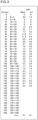
- FIG. 3 shows the mean particle size distributions and 3 ⁇ values of a standard filler (GPF), among standard fillers (SAF, ISAF, HAF, FEF, GPF), and the lower control limits (LCL) and upper control limits (UCL) obtained from the means and 3 ⁇ values.
- FIGs. 1 and 2 also show graphs of these standard fillers illustrating the mean particle size distributions, LCLs, and UCLs of these standard fillers.
- the average particle sizes and particle size distributions of the standard fillers can be measured by conventionally known methods. Although five types of carbon black are exemplified here as the standard fillers, the standard fillers are not limited and may be any commercial filler (e.g., other types of carbon black or silica).
- the particle size distribution of each standard filler may be determined from about 300 particles per image (or per field of view). Further, such processing may be performed on multiple images (or multiple fields of view) to determine the mean particle size distribution, which may then be divided into sections to determine the probability of existence of the particle in each section.
- the 3 ⁇ value may be determined from the variations between the multiple images (or multiple fields of view).
- comparative analysis between the particle size distribution of the sample of Formulation 2 in FIG. 1 or the particle size distribution of the sample of Formulation 3 in FIG. 2 and the particle size distributions of the standard fillers (SAF, ISAF, HAF, FEF, GPF) may be performed to determine the type of carbon black contained in the sample of Formulation 2 or the sample of Formulation 3 (which of SAF, ISAF, HAF, FEF, and GPF is present), the amount of the carbon black, and the ratio between two or more types of carbon black, if present.
- a comparison between the shape, particle size, and particle size distribution of the filler present in the sample and the shape, particle size, and particle size distribution of a standard filler obtained separately is desirably performed based on, for example, the percentage of agreement between the particle size distribution of the filler and the particle size distribution of the standard filler.
- FIG. 4 shows the results of comparative analysis between the particle size distribution of the fillers (carbon black) in the sample of Formulation 2 and the particle size distribution of GPF as an example, among the standard fillers (SAF, ISAF, HAF, FEF, GPF).
- FIG. 5 shows the results of comparative analysis between the particle size distribution of the fillers (carbon black) in the sample of Formulation 3 and the particle size distribution of GPF as an example, among the standard fillers (SAF, ISAF, HAF, FEF, GPF).
- the ratio of carbon black having a particle size of more than 35 nm but not more than 40 nm (section 40) in the sample is 9.5%, which is within the range of LCL (6.8%) to UCL (16.9%) of GPF having a particle size of more than 35 nm but not more than 40 nm (section 40) in FIG. 3 and therefore is marked "o".
- the ratio of carbon black having a particle size of more than 40 nm but not more than 45 nm (section 45) in the sample of Formulation 2 in FIG. 4 is 2.9%, which is outside the range of LCL (5.9%) to UCL (16.7%) of GPF having a particle size of more than 40 nm but not more than 45 nm (section 45) in FIG. 3 and therefore is marked " ⁇ ".
- the particle size ranges that GPF is considered to have may be selected as appropriate to calculate the percentage (%) of "o" within these ranges, which may be used as an example of the percentage of agreement with GPF (the percentage of agreement between the particle size distribution of the filler and the particle size distribution of GPF (standard filler)).
- the percentages of agreement with other standard fillers can be calculated in the same manner. The calculation shows that the percentage of agreement with ISAF is high.
- the number of peaks in the particle size distribution curve of the sample of Formulation 2 can be estimated as the number of types of fillers contained in the sample.
- the sample can be estimated to contain fillers each having a high percentage of agreement with a standard filler.
- the number of peaks in the particle size distribution curve is two and, as mentioned above, the percentage of agreement with GPF and the percentage of agreement with ISAF are high.
- the sample of Formulation 2 is likely to contain two types of carbon black, including GPF and ISAF.
- the ratio of carbon black having a particle size of more than 35 nm but not more than 40 nm (section 40) is 8.9%, which is within the range of LCL (6.8%) to UCL (16.9%) of GPF having a particle size of more than 35 nm but not more than 40 nm (section 40) in FIG. 3 and therefore is marked "o".
- the ratio of carbon black having a particle size of more than 40 nm but not more than 45 nm (section 45) in the sample of Formulation 3 in FIG. 5 is 4.1%, which is outside the range of LCL (5.9%) to UCL (16.7%) of GPF having a particle size of more than 40 nm but not more than 45 nm (section 45) in FIG. 3 and therefore is marked " ⁇ ".
- the particle size ranges that the GPF is considered to have may be selected as appropriate to calculate the percentage (%) of "o" within these ranges, which may be used as an example of the percentage of agreement with GPF (the percentage of agreement between the particle size distribution of the filler and the particle size distribution of GPF (standard filler)).
- the percentages of agreement with other standard fillers can be calculated in the same manner. The calculation shows that the percentage of agreement with ISAF is high.
- the number of peaks in the particle size distribution curve of the sample of Formulation 3 can be estimated as the number of types of fillers contained in the sample.
- the sample can be estimated to contain fillers each having a high percentage of agreement with a standard filler.
- the number of peaks in the particle size distribution curve is two and, as mentioned above, the percentage of agreement with GPF and the percentage of agreement with ISAF are high.
- the sample of Formulation 3 is likely to contain two types of carbon black, including GPF and ISAF.
- the particle size distributions of the two or more standard fillers estimated to be contained in the sample may be scaled up or down as appropriate and combined to match the particle size distribution of the sample, whereby the ratio between the two or more fillers contained in the sample can be calculated.
- the particle size distribution of GPF and the particle size distribution of ISAF may be scaled up or down and combined to match the particle size distribution of the sample, whereby the ratio between GPF and ISAF can be calculated.
- the amount of each of the two or more fillers estimated to be contained in the sample may be calculated by comparing the peak height and peak area of the particle size distribution of each filler with those of the particle size distribution of the corresponding standard filler.
- the amounts of GPF and ISAF contained in the sample may be calculated by comparing the peak height and peak area of the particle size distribution of GPF contained in the sample with those of the particle size distribution of GPF as a standard filler, and comparing the peak height and peak area of the particle size distribution of ISAF contained in the sample with those of the particle size distribution of ISAF as a standard filler.
- the types, amounts, and mixing ratios of the two or more fillers contained in the sample (elastomer composition) can be estimated by such a technique, for example.
- FIGs. 1 and 2 each show a particle size distribution curve with particle size (nm) on the X-axis and ratio (%) on the Y-axis, distribution curves constructed using other properties, such as area, can also be used.
- FIGs. 1 to 4 illustrate a technique for determining the percentage of agreement between the particle size distribution of the filler contained in the sample and the particle size distribution of a standard filler
- any method that can determine proximity between the particle size distribution of the filler contained in the sample and the particle size distribution of a standard filler can be used, and the thus determined proximity can also be used as the percentage of agreement.
- the percentage of agreement between the particle size distribution of the filler contained in the sample and the particle size distribution of a standard filler can be determined by known methods. Moreover, the determination of the percentage of agreement can be automated by a means such as robotic process automation (RPA), Excel macros, or python.
- RPA robotic process automation
- Clean particle size distribution curves of the samples of Formulations 2 and 3 can also be similarly obtained by increasing the number of images (or fields of view) to reduce variations.
- each particle size distribution curve may be fitted, and the fitted curve of each sample as is or after being subjected to waveform separation may be compared with the fitted curve of a standard filler to determine the type and ratio of the filler contained in the sample. This enables more accurate analysis.
- AI or machine learning may be employed for acquisition or comparison of data.
- the method described above enables estimation of the type, amount, and mixing ratio of each filler not only in a sample containing a single filler but also in a sample containing two or more fillers, based on the property (e.g., shape), particle size, and particle size distribution of the filler.
- Each sample was subjected to high temperature treatment of the sample, collection of the carbon black to be analyzed, electron microscopic observation, acquisition of images, and calculation of the particle size and particle size distribution according to the above-described techniques.
- the particle size distributions of carbon black present in the samples of Formulation 1 in FIG. 6 , Formulation 2 in FIG. 1 , Formulation 3 in FIG. 2 , Formulation 4 in FIG. 7 , Formulation 5 in FIG. 8 , Formulation 6 in FIG. 9 , and Formulation 7 in FIG. 10 were obtained.
- FIGs. 1, 2 , and 6 to 10 also show the measurements.
- the average particle size of carbon black in Formulation 4 was close to that of FEF, which failed to provide an estimation that the sample contained ISAF and GPF.
Landscapes
- Chemical & Material Sciences (AREA)
- Health & Medical Sciences (AREA)
- Life Sciences & Earth Sciences (AREA)
- Physics & Mathematics (AREA)
- Pathology (AREA)
- Analytical Chemistry (AREA)
- Biochemistry (AREA)
- General Health & Medical Sciences (AREA)
- General Physics & Mathematics (AREA)
- Immunology (AREA)
- Dispersion Chemistry (AREA)
- Engineering & Computer Science (AREA)
- Medicinal Chemistry (AREA)
- Polymers & Plastics (AREA)
- Chemical Kinetics & Catalysis (AREA)
- Organic Chemistry (AREA)
- Spectroscopy & Molecular Physics (AREA)
- Crystallography & Structural Chemistry (AREA)
- Bioinformatics & Cheminformatics (AREA)
- Bioinformatics & Computational Biology (AREA)
- Computing Systems (AREA)
- Theoretical Computer Science (AREA)
- Food Science & Technology (AREA)
- Signal Processing (AREA)
- Compositions Of Macromolecular Compounds (AREA)
Abstract
Description
- The present invention relates to an analysis method.
- Methods have been used for measuring the average particle size and particle size distribution of the filler dispersed in an elastomer composition containing an elastomer, a filler, and other components. However, it is desirable to accurately analyze the types, amounts, and mixing ratios of fillers, as well as whether multiple types of fillers are present or not.
- The present invention aims to solve the above problem and provide an analysis method enabling accurate estimation of the types, amounts, and mixing ratios of fillers present in an elastomer composition, including whether the sample contains two or more fillers.
- The present invention relates to an analysis method, including estimating the type, amount, and mixing ratio of at least one filler in an elastomer composition containing an elastomer component and the filler, the method including estimation based on the property, particle size, and particle size distribution of the filler.
- According to the present invention, an analysis method is provided which includes estimating the type, amount, and mixing ratio of at least one filler in an elastomer composition containing an elastomer component and the filler, and which includes estimation based on the property, particle size, and particle size distribution of the filler. Such a method enables accurate estimation of the types, amounts, and mixing ratios of fillers present in an elastomer composition, including whether the sample contains two or more fillers.
-
-
FIG. 1 shows an exemplary particle size distribution of carbon black (filler to be analyzed) present in a sample ofFormulation 2. -
FIG. 2 shows an exemplary particle size distribution of carbon black (filler to be analyzed) present in a sample ofFormulation 3. -
FIG. 3 shows exemplary data of mean particle size distributions and 3σ values of a standard filler (carbon black SAF, ISAF, HAF, FEF, GPF), and the lower control limits (LCL) and upper control limits (UCL) obtained from the means and 3σ values. -
FIG. 4 shows exemplary results of comparative analysis between the particle size distribution of the filler (carbon black) in the sample ofFormulation 2 and the particle size distribution of a standard filler (SAF, ISAF, HAF, FEF, GPF). -
FIG. 5 shows exemplary results of comparative analysis between the particle size distribution of the filler (carbon black) in the sample ofFormulation 3 and the particle size distribution of a standard filler (SAF, ISAF, HAF, FEF, GPF). -
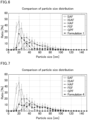
FIG. 6 shows an exemplary particle size distribution of carbon black (filler to be analyzed) present in a sample of Formulation 1. -
FIG. 7 shows an exemplary particle size distribution of carbon black (filler to be analyzed) present in a sample of Formulation 4. -
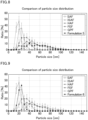
FIG. 8 shows an exemplary particle size distribution of carbon black (filler to be analyzed) present in a sample ofFormulation 5. -
FIG. 9 shows an exemplary particle size distribution of carbon black (filler to be analyzed) present in a sample of Formulation 6. -
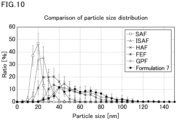
FIG. 10 shows an exemplary particle size distribution of carbon black (filler to be analyzed) present in a sample of Formulation 7. - The present invention relates to an analysis method which includes estimating the type, amount, and mixing ratio of at least one filler in an elastomer composition containing the filler and an elastomer, and which includes estimation based on the property, particle size, and particle size distribution of the filler.
- The method of the present invention makes analysis based on the results of measurements of the property, particle size, and particle size distribution of a filler dispersed in an elastomer composition, and thus can determine which commercial product (standard product) the filler in the composition has a primary particle size equivalent to.
- Moreover, since the method measures the particle size and particle size distribution of the filler in the composition, for example, the measured particle size and particle size distribution may be compared with the particle size and particle size distribution of a commercial product (standard product) to determine whether two or more fillers are present, the amount of each filler, and the mixing ratio thereof not only in a sample containing a single filler but also in a sample containing two or more fillers (e.g., two or more types of carbon black, two or more types of silica, or one or more types of carbon black and one or more types of silica).
- Accordingly, the present invention enables estimation of the type (e.g., grade) of filler in an elastomer composition, the presence or absence of two or more fillers, the amount of each filler, and the mixing ratio thereof.
- In the analysis method of the present invention, an elastomer composition (sample) containing an elastomer component and a filler is analyzed. Any elastomer component may be used including diene rubbers. Examples of diene rubbers include isoprene-based rubbers, polybutadiene rubbers (BR), styrene-butadiene rubbers (SBR), styreneisoprene-butadiene rubbers (SIBR), ethylene-propylene-diene rubbers (EPDM), chloroprene rubbers (CR), and acrylonitrile butadiene rubbers (NBR). Butyl-based rubbers and fluororubbers are also usable. These may be used alone or in combinations of two or more.
- Any filler that is known in the rubber field can be used. Examples include inorganic fillers such as carbon black, silica, calcium carbonate, talc, alumina, clay, aluminum hydroxide, aluminum oxide, and mica, and hardly dispersible fillers. Carbon black or silica is suitable among these.
- Any carbon black may be used, and examples include SAF, ISAF, HAF, FF, FEF, FEF, and GPF. Usable commercial products are available from Asahi Carbon Co., Ltd., Cabot Japan K.K., Tokai Carbon Co., Ltd., Mitsubishi Chemical Corporation, Lion Corporation, NIPPON STEEL Carbon Co., Ltd., Columbia Carbon, etc. These may be used alone or in combinations of two or more. In particular, the analysis method of the present invention enables estimation of the type (grade), amount, and ratio of each carbon black not only in a sample containing only one carbon black but also in a sample containing two or more types of carbon black.
- In the elastomer composition (sample), the amount of carbon black is not limited and may be, for example, 1 to 150 parts by mass, preferably 3 to 100 parts by mass, more preferably 5 to 80 parts by mass, per 100 parts by mass of the elastomer component content. When the amount of carbon black is within the range indicated above, the type (grade), amount, and ratio of each carbon black in the sample tend to be accurately estimated.
- Examples of silica include dry silica (anhydrous silica) and wet silica (hydrous silica). Wet silica is preferred because it has a large number of silanol groups. The material of the silica may be water glass (sodium silicate) or a biomass material such as rice husks. Usable commercial products are available from Evonik Degussa, Tosoh Silica Corporation, Solvay Japan, Tokuyama Corporation, etc. Each of these may be used alone, or two or more of these may be used in combination. In particular, the analysis method of the present invention enables estimation of the type (grade), amount, and ratio of each silica not only in a sample containing only one silica but also in a sample containing two or more types of silica.
- In the elastomer composition (sample), the amount of silica is not limited and may be, for example, 1 to 150 parts by mass, preferably 3 to 100 parts by mass, more preferably 5 to 80 parts by mass, per 100 parts by mass of the elastomer component content. When the amount of silica is within the range indicated above, the type, amount, and ratio of each silica in the sample tend to be accurately estimated.
- The analysis method of the present invention estimates the type, amount, and mixing ratio of at least one filler present in an elastomer composition (sample) based on the property, particle size, and particle size distribution of the filler present in the sample. The property of the filler may be, for example, the shape, surface activity, structure size, or aggregate distribution of the filler.
- Among these properties of the filler, the shape of the filler is desirable in order to accurately estimate the type, amount, and ratio of each filler. The filler may have any shape such as a spherical, acicular, rod, or amorphous shape.
- The present invention relates to an analysis method including estimating the type, amount, and mixing ratio of at least one filler (carbon black, silica, etc.) in an elastomer composition (sample) based on the property, particle size, and particle size distribution of the filler. From the standpoint of accurate estimation, the method desirably includes treating the sample at a high temperature under a nitrogen atmosphere or air atmosphere, and analyzing the filler (filler in the sample) collected after the treatment.
- For example, such high temperature treatment and filler collection can be performed by applying the following technique to the sample (elastomer composition).
- The sample is heated up to 650°C under a nitrogen atmosphere by thermogravimetric analysis (TGA), and the remaining component (e.g., carbon black, silica) is extracted.
- The remaining component (filler to be analyzed) is sufficiently ultrasonically dispersed in a solvent (ethanol) and then dropped onto a mesh for transmission electron microscopic (TEM) observation.
- Although the treatment temperature for the high temperature treatment in the above technique is 650°C, the temperature may be selected as appropriate to ensure that no elastomer component remains in the sample and that the filler to be analyzed (e.g., carbon black, silica) remains in the sample. For example, the treatment may be carried out at 500 to 800°C. Such a high temperature treatment of the sample (elastomer composition) allows the filler to be analyzed to remain and be collected.
- Although in the above technique, the remaining component (e.g., carbon black, silica) is ultrasonically dispersed in a solvent, any method that can disperse the filler to be analyzed (e.g., carbon black, silica) can be selected as appropriate. Examples of the solvent include, in addition to ethanol, organic solvents such as methanol, tetrahydrofuran, and acetone, and water. Moreover, the filler can also be dispersed in the solvent by a means other than the ultrasonic treatment, such as using a highspeed homogenizer, colloid mill, or blender mill.
- After the filler to be analyzed (e.g., carbon black, silica) is dropped onto a mesh for transmission electron microscopic (TEM) observation by the above technique or other techniques, for example, the following technique may be applied to the filler to analyze the property, particle size, and particle size distribution of the filler present in the sample.
- TEM observation is performed on the dropped filler to be analyzed (e.g., carbon black, silica), and images are acquired at a magnification sufficient to determine the primary particle size.
- The images are acquired until the number of particles reaches about 300.
- The particle sizes are calculated from the acquired images to determine the particle size distribution.
- As mentioned in the above technique including TEM observation of the filler to be analyzed (e.g., carbon black, silica) as an example, it is desirable to use electron microscopic observation in order to accurately estimate the property, particle size, and particle size distribution of the filler present in the sample (elastomer composition). Also usable is a scanning electron microscope (SEM).
- Although in the above technique as an example, TEM observation is performed and images are acquired at a magnification sufficient to determine the primary particle size and until the number of particles reaches about 300, the magnification and the number of particles may be selected as appropriate in the electron microscopic observation. Moreover, the particle size of the filler to be analyzed can be determined by observing the filler using an electron microscope, measuring the particle sizes of at least a predetermined number of fillers observed in the field of view, and averaging the measured particle sizes. Although the number of particles is about 300 in the present case, the number of particles is not limited thereto and may be selected as appropriate in consideration of the accuracy of measurement or other factors.
- Thus, the particle sizes can be determined from the acquired images, and the particle size distribution can be calculated from the particle sizes.
- Here, the particle size can be, for example, the spherical diameter when the filler has a spherical shape, the minor axis when the filler has an acicular or rod shape, or the average diameter from the center when the filler has an amorphous shape.
- The analysis method of the present invention estimates the type, amount, and mixing ratio of the filler to be analyzed, based on the property, particle size, and particle size distribution of the filler determined by the above technique or other techniques. From the standpoint of accurate estimation, the method desirably includes estimation based on a comparison between the shape, particle size, and particle size distribution of the filler present in the sample (elastomer composition) and the shape, particle size, and particle size distribution of a standard filler obtained separately.
- An exemplary method of such estimation is described below, but the analysis method of the present invention is not limited to the following method.
- A sample of Formulation 2 (sample prepared by kneading 66 parts by mass of ISAF, 33 parts by mass of GPF, and 100 parts by mass of a diene rubber) and a sample of Formulation 3 (sample prepared by kneading 50 parts by mass of ISAF, 50 parts by mass of GPF, and 100 parts by mass of a diene rubber), which are described later in EXAMPLES, are prepared and then subjected to high temperature treatment of the samples, collection of the fillers (carbon black) to be analyzed, electron microscopic observation, acquisition of images, and calculation of the particle size and particle size distribution according to the above techniques.
- With respect to the determined particle sizes and particle size distributions,
FIG. 1 shows the particle size distribution of the carbon black (fillers to be analyzed) present in the sample ofFormulation 2, andFIG. 2 shows the particle size distribution of the carbon black (fillers to be analyzed) present in the sample ofFormulation 3. -
FIG. 3 shows the mean particle size distributions and 3σ values of a standard filler (GPF), among standard fillers (SAF, ISAF, HAF, FEF, GPF), and the lower control limits (LCL) and upper control limits (UCL) obtained from the means and 3σ values.FIGs. 1 and 2 also show graphs of these standard fillers illustrating the mean particle size distributions, LCLs, and UCLs of these standard fillers. The average particle sizes and particle size distributions of the standard fillers can be measured by conventionally known methods. Although five types of carbon black are exemplified here as the standard fillers, the standard fillers are not limited and may be any commercial filler (e.g., other types of carbon black or silica). - Here, the particle size distribution of each standard filler may be determined from about 300 particles per image (or per field of view). Further, such processing may be performed on multiple images (or multiple fields of view) to determine the mean particle size distribution, which may then be divided into sections to determine the probability of existence of the particle in each section. The 3σ value may be determined from the variations between the multiple images (or multiple fields of view).
- Then, comparative analysis between the particle size distribution of the sample of
Formulation 2 inFIG. 1 or the particle size distribution of the sample ofFormulation 3 inFIG. 2 and the particle size distributions of the standard fillers (SAF, ISAF, HAF, FEF, GPF) may be performed to determine the type of carbon black contained in the sample ofFormulation 2 or the sample of Formulation 3 (which of SAF, ISAF, HAF, FEF, and GPF is present), the amount of the carbon black, and the ratio between two or more types of carbon black, if present. - In particular, from the standpoint of accurate estimation, a comparison between the shape, particle size, and particle size distribution of the filler present in the sample and the shape, particle size, and particle size distribution of a standard filler obtained separately is desirably performed based on, for example, the percentage of agreement between the particle size distribution of the filler and the particle size distribution of the standard filler.
-
FIG. 4 shows the results of comparative analysis between the particle size distribution of the fillers (carbon black) in the sample ofFormulation 2 and the particle size distribution of GPF as an example, among the standard fillers (SAF, ISAF, HAF, FEF, GPF). - Similarly,
FIG. 5 shows the results of comparative analysis between the particle size distribution of the fillers (carbon black) in the sample ofFormulation 3 and the particle size distribution of GPF as an example, among the standard fillers (SAF, ISAF, HAF, FEF, GPF). - Here, if the ratio (%) of carbon black having a particle size within a predetermined range (5-nm increment in
FIGs. 4 and5 ) in the sample falls within the range of LCL to UCL of the standard filler within that range, "o (agree)" is displayed, while if the ratio is outside the range, "× (disagree)" is displayed. - First, with respect to the sample of
Formulation 2 inFIG. 4 , the ratio of carbon black having a particle size of more than 35 nm but not more than 40 nm (section 40) in the sample is 9.5%, which is within the range of LCL (6.8%) to UCL (16.9%) of GPF having a particle size of more than 35 nm but not more than 40 nm (section 40) inFIG. 3 and therefore is marked "o". - Moreover, the ratio of carbon black having a particle size of more than 40 nm but not more than 45 nm (section 45) in the sample of
Formulation 2 inFIG. 4 is 2.9%, which is outside the range of LCL (5.9%) to UCL (16.7%) of GPF having a particle size of more than 40 nm but not more than 45 nm (section 45) inFIG. 3 and therefore is marked "×". - Then, the particle size ranges that GPF is considered to have may be selected as appropriate to calculate the percentage (%) of "o" within these ranges, which may be used as an example of the percentage of agreement with GPF (the percentage of agreement between the particle size distribution of the filler and the particle size distribution of GPF (standard filler)).
- For example, for the sample of
Formulation 2, the percentage of "o (agree)" with respect to GPF within a particle size range of more than 0 nm but not more than 170 nm (sections 5 to 170) is 73.5% (= 25 (the number of "∘" marks)/34 × 100), and thus the percentage of agreement can be determined as 73.5%. - The percentages of agreement with other standard fillers (SAF, ISAF, HAF, FEF) can be calculated in the same manner. The calculation shows that the percentage of agreement with ISAF is high.
- Here, for example, the number of peaks in the particle size distribution curve of the sample of
Formulation 2 can be estimated as the number of types of fillers contained in the sample. Moreover, the sample can be estimated to contain fillers each having a high percentage of agreement with a standard filler. - For the sample of
Formulation 2 inFIG. 1 , the number of peaks in the particle size distribution curve is two and, as mentioned above, the percentage of agreement with GPF and the percentage of agreement with ISAF are high. - Accordingly, it can be estimated that the sample of
Formulation 2 is likely to contain two types of carbon black, including GPF and ISAF. - Next, with respect to the sample of
Formulation 3 inFig. 5 , the ratio of carbon black having a particle size of more than 35 nm but not more than 40 nm (section 40) is 8.9%, which is within the range of LCL (6.8%) to UCL (16.9%) of GPF having a particle size of more than 35 nm but not more than 40 nm (section 40) inFIG. 3 and therefore is marked "o". - Moreover, the ratio of carbon black having a particle size of more than 40 nm but not more than 45 nm (section 45) in the sample of
Formulation 3 inFIG. 5 is 4.1%, which is outside the range of LCL (5.9%) to UCL (16.7%) of GPF having a particle size of more than 40 nm but not more than 45 nm (section 45) inFIG. 3 and therefore is marked "×". - Then, the particle size ranges that the GPF is considered to have may be selected as appropriate to calculate the percentage (%) of "o" within these ranges, which may be used as an example of the percentage of agreement with GPF (the percentage of agreement between the particle size distribution of the filler and the particle size distribution of GPF (standard filler)).
- For example, for the sample of
Formulation 3, the percentage of "o (agree)" with respect to GPF within a particle size range of more than 0 nm but not more than 170 nm (sections 5 to 170) is 82.3% (= 28 (the number of "∘" marks)/34 × 100), and thus the percentage of agreement can be determined as 82.3%. - The percentages of agreement with other standard fillers (SAF, ISAF, HAF, FEF) can be calculated in the same manner. The calculation shows that the percentage of agreement with ISAF is high.
- Here, for example, the number of peaks in the particle size distribution curve of the sample of
Formulation 3 can be estimated as the number of types of fillers contained in the sample. Moreover, the sample can be estimated to contain fillers each having a high percentage of agreement with a standard filler. - For the sample of
Formulation 3 inFIG. 2 , the number of peaks in the particle size distribution curve is two and, as mentioned above, the percentage of agreement with GPF and the percentage of agreement with ISAF are high. - Accordingly, it can be estimated that the sample of
Formulation 3 is likely to contain two types of carbon black, including GPF and ISAF. - Moreover, the particle size distributions of the two or more standard fillers estimated to be contained in the sample may be scaled up or down as appropriate and combined to match the particle size distribution of the sample, whereby the ratio between the two or more fillers contained in the sample can be calculated. For the sample in
FIG. 1 , the particle size distribution of GPF and the particle size distribution of ISAF may be scaled up or down and combined to match the particle size distribution of the sample, whereby the ratio between GPF and ISAF can be calculated. - Furthermore, the amount of each of the two or more fillers estimated to be contained in the sample may be calculated by comparing the peak height and peak area of the particle size distribution of each filler with those of the particle size distribution of the corresponding standard filler. In
FIG. 1 , the amounts of GPF and ISAF contained in the sample may be calculated by comparing the peak height and peak area of the particle size distribution of GPF contained in the sample with those of the particle size distribution of GPF as a standard filler, and comparing the peak height and peak area of the particle size distribution of ISAF contained in the sample with those of the particle size distribution of ISAF as a standard filler. - Thus, the types, amounts, and mixing ratios of the two or more fillers contained in the sample (elastomer composition) can be estimated by such a technique, for example.
- Although the examples of
FIGs. 1 and 2 each show a particle size distribution curve with particle size (nm) on the X-axis and ratio (%) on the Y-axis, distribution curves constructed using other properties, such as area, can also be used. - Moreover, although, as described above,
FIGs. 1 to 4 illustrate a technique for determining the percentage of agreement between the particle size distribution of the filler contained in the sample and the particle size distribution of a standard filler, any method that can determine proximity between the particle size distribution of the filler contained in the sample and the particle size distribution of a standard filler can be used, and the thus determined proximity can also be used as the percentage of agreement. - Here, the percentage of agreement between the particle size distribution of the filler contained in the sample and the particle size distribution of a standard filler can be determined by known methods. Moreover, the determination of the percentage of agreement can be automated by a means such as robotic process automation (RPA), Excel macros, or python.
- Moreover, in the above-described technique, as the number of multiple images (or multiple fields of view) is small, what type of filler is present is estimated by determining the percentage of agreement. However, a clean particle size distribution curve can be obtained by increasing the number of data for each standard filler to reduce variations within each section, while changing the width of each section from 5 nm to, for example, 2.5 nm or 1 nm.
- Clean particle size distribution curves of the samples of
Formulations - Then, each particle size distribution curve may be fitted, and the fitted curve of each sample as is or after being subjected to waveform separation may be compared with the fitted curve of a standard filler to determine the type and ratio of the filler contained in the sample. This enables more accurate analysis.
- Furthermore, AI or machine learning may be employed for acquisition or comparison of data.
- The method described above enables estimation of the type, amount, and mixing ratio of each filler not only in a sample containing a single filler but also in a sample containing two or more fillers, based on the property (e.g., shape), particle size, and particle size distribution of the filler.
- The present invention will be specifically described based on examples, but the invention is not limited only to these examples.
- First, a diene rubber and two types of carbon black according to the mixing ratio between the two types of carbon black shown in Table 1 below were introduced into a 1.7 L Banbury mixer and kneaded for three minutes at 150°C. Thus, samples (elastomer compositions) of Formulations 1 to 7 were prepared.
- Each sample (elastomer composition) was subjected to high temperature treatment of the sample, collection of the carbon black to be analyzed, electron microscopic observation, acquisition of images, and calculation of the particle size and particle size distribution according to the above-described techniques. Thus, the particle size distributions of carbon black present in the samples of Formulation 1 in
FIG. 6 ,Formulation 2 inFIG. 1 ,Formulation 3 inFIG. 2 , Formulation 4 inFIG. 7 ,Formulation 5 inFIG. 8 , Formulation 6 inFIG. 9 , and Formulation 7 inFIG. 10 were obtained. - Here, the average particle sizes and particle size distributions (mean, LCL, UCL) of standard fillers (SAF, ISAF, HAF, FEF, GPF) were determined using a "Particle Analyzer LUZEX" (Nireco Corporation).
FIGs. 1, 2 , and6 to 10 also show the measurements. - Moreover, the means (average particle sizes) and standard deviations were determined from the obtained particle size distributions. Table 2 shows the values.
- The average particle sizes and particle size distribution widths of the samples (elastomer compositions) of Formulations 1 to 7 were determined using a "Particle Analyzer LUZEX" (Nireco Corporation). Table 1 shows the values.
[Table 1] Formulation table Formulation 1 Formulation 2Formulation 3Formulation 4 Formulation 5Formulation 6 Formulation 7 Mixing ratio ISAF 80 66 50 33 20 100 - GPF 20 33 50 66 80 - 100 Comparative Example Average particle size (nm) 31.7 33.7 40.0 46.0 50.8 20.7 58.0 Particle size distribution width (nm) 19.4 19.3 22.3 22..8 22.2 4.4 19.0 Example Particle size distribution Fig. 6 Fig. 1 Fig. 2 Fig. 7 Fig. 8 Fig. 9 Fig. 10 [Table 2] Average particle size and standard deviation of commercial products Type of carbon black (name) Average particle size (nm) Standard deviation (nm) SAF 16.2 3.4 ISAF 22.0 6.0 HAF 30.0 8.3 FEF 46.2 16.6 GPF 57.5 21.7 Population (N1000) - Then, the same technique as described for
FIGs. 1 to 5 was applied to the samples prepared in the example to estimate the types, amounts, and ratios of carbon black in Formulations 1 to 7. An estimation was made that the types, amounts, and ratios of carbon black in the samples were likely to be the types (ISAF, GPF), amounts, and ratios shown in Table 1. - In contrast, with respect to the comparative example, for example, the average particle size of carbon black in Formulation 4 was close to that of FEF, which failed to provide an estimation that the sample contained ISAF and GPF.
- Exemplary embodiments of the present invention include:
- Embodiment 1. An analysis method, including estimating a type, amount, and mixing ratio of at least one filler in an elastomer composition containing an elastomer component and the filler, the method including estimation based on a property, particle size, and particle size distribution of the filler.
-
Embodiment 2. The analysis method according to Embodiment 1, wherein the property of the filler is a shape of the filler. -
Embodiment 3. The analysis method according toEmbodiment 2, wherein the method includes estimating the type, amount, and mixing ratio of the filler in the elastomer composition based on a comparison between the shape, particle size, and particle size distribution of the filler and a shape, particle size, and particle size distribution of at least one standard filler obtained separately. - Embodiment 4. The analysis method according to any one of Embodiments 1 to 3, wherein the method includes treating the elastomer composition at a high temperature under a nitrogen atmosphere or air atmosphere, and analyzing the filler collected from the elastomer composition.
-
Embodiment 5. The analysis method according to Embodiment 4, wherein the treatment at a high temperature is carried out at 500 to 800°C. - Embodiment 6. The analysis method according to any one of Embodiments 1 to 5, wherein the property, particle size, and particle size distribution of the filler are obtained by electron microscopic observation.
- Embodiment 7. The analysis method according to Embodiment 6, wherein the electron microscopic observation is transmission electron microscopic observation.
-
Embodiment 8. The analysis method according to Embodiment 6 or 7, wherein the shape, particle size, and particle size distribution of the filler are obtained based on electron microscopic images acquired by the electron microscopic observation. -
Embodiment 9. The analysis method according to any one of Embodiments 1 to 8, wherein the filler is at least one of carbon black or silica.
Claims (6)
- An analysis method, comprising estimating a type, amount, and mixing ratio of at least one filler in an elastomer composition containing an elastomer component and the filler,
the method comprising estimation based on a property, particle size, and particle size distribution of the filler. - The analysis method according to claim 1,
wherein the property of the filler is a shape of the filler. - The analysis method according to claim 2,
wherein the method comprises estimating the type, amount, and mixing ratio of the filler in the elastomer composition based on a comparison between the shape, particle size, and particle size distribution of the filler and a shape, particle size, and particle size distribution of at least one standard filler obtained separately. - The analysis method according to any one of claims 1 to 3,
wherein the method comprises treating the elastomer composition at a high temperature under a nitrogen atmosphere or air atmosphere, and analyzing the filler collected from the elastomer composition. - The analysis method according to any one of claims 1 to 4,
wherein the property, particle size, and particle size distribution of the filler are obtained by electron microscopic observation. - The analysis method according to claim 5,
wherein a shape, particle size, and particle size distribution of the filler are obtained based on electron microscopic images acquired by the electron microscopic observation.
Applications Claiming Priority (1)
| Application Number | Priority Date | Filing Date | Title |
|---|---|---|---|
| JP2022034453A JP7831017B2 (en) | 2022-03-07 | 2022-03-07 | Analysis method |
Publications (2)
| Publication Number | Publication Date |
|---|---|
| EP4242651A1 true EP4242651A1 (en) | 2023-09-13 |
| EP4242651B1 EP4242651B1 (en) | 2024-10-23 |
Family
ID=84439740
Family Applications (1)
| Application Number | Title | Priority Date | Filing Date |
|---|---|---|---|
| EP22211858.0A Active EP4242651B1 (en) | 2022-03-07 | 2022-12-07 | Analysis of an elastomer composition |
Country Status (3)
| Country | Link |
|---|---|
| US (1) | US20230280256A1 (en) |
| EP (1) | EP4242651B1 (en) |
| JP (1) | JP7831017B2 (en) |
Families Citing this family (1)
| Publication number | Priority date | Publication date | Assignee | Title |
|---|---|---|---|---|
| CN119290684B (en) * | 2024-11-01 | 2025-07-29 | 湖北鼎汇微电子材料有限公司 | Analysis method of formula of heat conducting powder in heat conducting material |
Citations (2)
| Publication number | Priority date | Publication date | Assignee | Title |
|---|---|---|---|---|
| JPS61162734A (en) * | 1985-01-11 | 1986-07-23 | Toyoda Gosei Co Ltd | Grade decision for carbon black |
| JP2020029491A (en) * | 2018-08-21 | 2020-02-27 | 日立化成株式会社 | Sealing resin material |
Family Cites Families (2)
| Publication number | Priority date | Publication date | Assignee | Title |
|---|---|---|---|---|
| US4220042A (en) * | 1979-03-26 | 1980-09-02 | Columbian Chemicals Company | Measurement of carbon black dispersion |
| KR20110025244A (en) * | 2009-08-28 | 2011-03-10 | 현대자동차주식회사 | Grading Method of Carbon Black in Vulcanized Rubber |
-
2022
- 2022-03-07 JP JP2022034453A patent/JP7831017B2/en active Active
- 2022-12-07 EP EP22211858.0A patent/EP4242651B1/en active Active
-
2023
- 2023-02-14 US US18/109,509 patent/US20230280256A1/en active Pending
Patent Citations (2)
| Publication number | Priority date | Publication date | Assignee | Title |
|---|---|---|---|---|
| JPS61162734A (en) * | 1985-01-11 | 1986-07-23 | Toyoda Gosei Co Ltd | Grade decision for carbon black |
| JP2020029491A (en) * | 2018-08-21 | 2020-02-27 | 日立化成株式会社 | Sealing resin material |
Also Published As
| Publication number | Publication date |
|---|---|
| JP2023130022A (en) | 2023-09-20 |
| EP4242651B1 (en) | 2024-10-23 |
| JP7831017B2 (en) | 2026-03-17 |
| US20230280256A1 (en) | 2023-09-07 |
Similar Documents
| Publication | Publication Date | Title |
|---|---|---|
| EP4242651B1 (en) | Analysis of an elastomer composition | |
| DE102012220425A1 (en) | Under-surface rubber composition and pneumatic tire | |
| EP4455651A1 (en) | Method of analyzing crystal structure, crystal morphology, or crystal distribution of rubber material in stretching | |
| Wang et al. | Investigation and improvement of the scorch behavior of silica‐filled solution styrene‐butadiene rubber compound | |
| US10794893B2 (en) | Method for estimating abrasion resistance and fracture resistance | |
| JPH09118780A (en) | Rubber composition for tire | |
| JP2013231694A (en) | Method for obtaining reaction active group amount of silica, rubber composition whose reaction amount of silica is specified by using the same, and pneumatic tire using rubber composition | |
| JP6798134B2 (en) | > Method for quantifying the reaction amount of a silane coupling agent having a CH-CH2-O- bond | |
| JP2006337342A (en) | Method of measuring reaction amount of silica, and rubber composition with reaction amount defined using the method | |
| JP5940431B2 (en) | Reaction evaluation method of silane coupling agent in silica compounding | |
| KR100775886B1 (en) | Rubber composition and process for preparing the same | |
| JP7101589B2 (en) | Bound rubber measurement method | |
| JP2021066823A (en) | Rubber composition and method for producing the same | |
| US20240280512A1 (en) | Method for discriminating carbon black | |
| JP2001294711A (en) | Rubber composition | |
| DE112018004948B4 (en) | Unvulcanized rubber composition and use of a modified diene polymer for a rubber composition | |
| JP2018066680A (en) | Method for measuring reaction amount of silane coupling agent | |
| JPWO2003031511A1 (en) | Rubber composition | |
| US20220281748A1 (en) | Electrically Conductive Carbon Black | |
| JP6822160B2 (en) | Evaluation method for sheet scraping of polymer composite materials | |
| JP7258292B2 (en) | Analysis method for polymer composites | |
| JP6473031B2 (en) | Evaluation method of silica | |
| JP5082206B2 (en) | Rubber composition for tire | |
| US20230077190A1 (en) | Chemical bond evaluation method | |
| JP6786931B2 (en) | Method for quantifying vulcanization accelerator and method for calculating diffusion coefficient |
Legal Events
| Date | Code | Title | Description |
|---|---|---|---|
| PUAI | Public reference made under article 153(3) epc to a published international application that has entered the european phase |
Free format text: ORIGINAL CODE: 0009012 |
|
| STAA | Information on the status of an ep patent application or granted ep patent |
Free format text: STATUS: THE APPLICATION HAS BEEN PUBLISHED |
|
| AK | Designated contracting states |
Kind code of ref document: A1 Designated state(s): AL AT BE BG CH CY CZ DE DK EE ES FI FR GB GR HR HU IE IS IT LI LT LU LV MC ME MK MT NL NO PL PT RO RS SE SI SK SM TR |
|
| STAA | Information on the status of an ep patent application or granted ep patent |
Free format text: STATUS: REQUEST FOR EXAMINATION WAS MADE |
|
| STAA | Information on the status of an ep patent application or granted ep patent |
Free format text: STATUS: EXAMINATION IS IN PROGRESS |
|
| 17P | Request for examination filed |
Effective date: 20231130 |
|
| RBV | Designated contracting states (corrected) |
Designated state(s): AL AT BE BG CH CY CZ DE DK EE ES FI FR GB GR HR HU IE IS IT LI LT LU LV MC ME MK MT NL NO PL PT RO RS SE SI SK SM TR |
|
| 17Q | First examination report despatched |
Effective date: 20231222 |
|
| P01 | Opt-out of the competence of the unified patent court (upc) registered |
Effective date: 20240327 |
|
| GRAP | Despatch of communication of intention to grant a patent |
Free format text: ORIGINAL CODE: EPIDOSNIGR1 |
|
| STAA | Information on the status of an ep patent application or granted ep patent |
Free format text: STATUS: GRANT OF PATENT IS INTENDED |
|
| INTG | Intention to grant announced |
Effective date: 20240611 |
|
| GRAS | Grant fee paid |
Free format text: ORIGINAL CODE: EPIDOSNIGR3 |
|
| GRAA | (expected) grant |
Free format text: ORIGINAL CODE: 0009210 |
|
| STAA | Information on the status of an ep patent application or granted ep patent |
Free format text: STATUS: THE PATENT HAS BEEN GRANTED |
|
| AK | Designated contracting states |
Kind code of ref document: B1 Designated state(s): AL AT BE BG CH CY CZ DE DK EE ES FI FR GB GR HR HU IE IS IT LI LT LU LV MC ME MK MT NL NO PL PT RO RS SE SI SK SM TR |
|
| REG | Reference to a national code |
Ref country code: GB Ref legal event code: FG4D |
|
| REG | Reference to a national code |
Ref country code: CH Ref legal event code: EP |
|
| REG | Reference to a national code |
Ref country code: DE Ref legal event code: R096 Ref document number: 602022007043 Country of ref document: DE |
|
| REG | Reference to a national code |
Ref country code: IE Ref legal event code: FG4D |
|
| REG | Reference to a national code |
Ref country code: LT Ref legal event code: MG9D |
|
| REG | Reference to a national code |
Ref country code: NL Ref legal event code: MP Effective date: 20241023 |
|
| REG | Reference to a national code |
Ref country code: AT Ref legal event code: MK05 Ref document number: 1735237 Country of ref document: AT Kind code of ref document: T Effective date: 20241023 |
|
| PG25 | Lapsed in a contracting state [announced via postgrant information from national office to epo] |
Ref country code: NL Free format text: LAPSE BECAUSE OF FAILURE TO SUBMIT A TRANSLATION OF THE DESCRIPTION OR TO PAY THE FEE WITHIN THE PRESCRIBED TIME-LIMIT Effective date: 20241023 |
|
| PG25 | Lapsed in a contracting state [announced via postgrant information from national office to epo] |
Ref country code: NL Free format text: LAPSE BECAUSE OF FAILURE TO SUBMIT A TRANSLATION OF THE DESCRIPTION OR TO PAY THE FEE WITHIN THE PRESCRIBED TIME-LIMIT Effective date: 20241023 |
|
| PG25 | Lapsed in a contracting state [announced via postgrant information from national office to epo] |
Ref country code: HR Free format text: LAPSE BECAUSE OF FAILURE TO SUBMIT A TRANSLATION OF THE DESCRIPTION OR TO PAY THE FEE WITHIN THE PRESCRIBED TIME-LIMIT Effective date: 20241023 Ref country code: IS Free format text: LAPSE BECAUSE OF FAILURE TO SUBMIT A TRANSLATION OF THE DESCRIPTION OR TO PAY THE FEE WITHIN THE PRESCRIBED TIME-LIMIT Effective date: 20250223 Ref country code: PT Free format text: LAPSE BECAUSE OF FAILURE TO SUBMIT A TRANSLATION OF THE DESCRIPTION OR TO PAY THE FEE WITHIN THE PRESCRIBED TIME-LIMIT Effective date: 20250224 |
|
| PG25 | Lapsed in a contracting state [announced via postgrant information from national office to epo] |
Ref country code: FI Free format text: LAPSE BECAUSE OF FAILURE TO SUBMIT A TRANSLATION OF THE DESCRIPTION OR TO PAY THE FEE WITHIN THE PRESCRIBED TIME-LIMIT Effective date: 20241023 |
|
| PG25 | Lapsed in a contracting state [announced via postgrant information from national office to epo] |
Ref country code: BG Free format text: LAPSE BECAUSE OF FAILURE TO SUBMIT A TRANSLATION OF THE DESCRIPTION OR TO PAY THE FEE WITHIN THE PRESCRIBED TIME-LIMIT Effective date: 20241023 |
|
| PG25 | Lapsed in a contracting state [announced via postgrant information from national office to epo] |
Ref country code: ES Free format text: LAPSE BECAUSE OF FAILURE TO SUBMIT A TRANSLATION OF THE DESCRIPTION OR TO PAY THE FEE WITHIN THE PRESCRIBED TIME-LIMIT Effective date: 20241023 |
|
| PG25 | Lapsed in a contracting state [announced via postgrant information from national office to epo] |
Ref country code: NO Free format text: LAPSE BECAUSE OF FAILURE TO SUBMIT A TRANSLATION OF THE DESCRIPTION OR TO PAY THE FEE WITHIN THE PRESCRIBED TIME-LIMIT Effective date: 20250123 |
|
| PG25 | Lapsed in a contracting state [announced via postgrant information from national office to epo] |
Ref country code: LV Free format text: LAPSE BECAUSE OF FAILURE TO SUBMIT A TRANSLATION OF THE DESCRIPTION OR TO PAY THE FEE WITHIN THE PRESCRIBED TIME-LIMIT Effective date: 20241023 Ref country code: AT Free format text: LAPSE BECAUSE OF FAILURE TO SUBMIT A TRANSLATION OF THE DESCRIPTION OR TO PAY THE FEE WITHIN THE PRESCRIBED TIME-LIMIT Effective date: 20241023 Ref country code: GR Free format text: LAPSE BECAUSE OF FAILURE TO SUBMIT A TRANSLATION OF THE DESCRIPTION OR TO PAY THE FEE WITHIN THE PRESCRIBED TIME-LIMIT Effective date: 20250124 |
|
| PG25 | Lapsed in a contracting state [announced via postgrant information from national office to epo] |
Ref country code: PL Free format text: LAPSE BECAUSE OF FAILURE TO SUBMIT A TRANSLATION OF THE DESCRIPTION OR TO PAY THE FEE WITHIN THE PRESCRIBED TIME-LIMIT Effective date: 20241023 |
|
| PG25 | Lapsed in a contracting state [announced via postgrant information from national office to epo] |
Ref country code: RS Free format text: LAPSE BECAUSE OF FAILURE TO SUBMIT A TRANSLATION OF THE DESCRIPTION OR TO PAY THE FEE WITHIN THE PRESCRIBED TIME-LIMIT Effective date: 20250123 |
|
| PG25 | Lapsed in a contracting state [announced via postgrant information from national office to epo] |
Ref country code: SM Free format text: LAPSE BECAUSE OF FAILURE TO SUBMIT A TRANSLATION OF THE DESCRIPTION OR TO PAY THE FEE WITHIN THE PRESCRIBED TIME-LIMIT Effective date: 20241023 |
|
| PG25 | Lapsed in a contracting state [announced via postgrant information from national office to epo] |
Ref country code: MC Free format text: LAPSE BECAUSE OF FAILURE TO SUBMIT A TRANSLATION OF THE DESCRIPTION OR TO PAY THE FEE WITHIN THE PRESCRIBED TIME-LIMIT Effective date: 20241023 |
|
| PG25 | Lapsed in a contracting state [announced via postgrant information from national office to epo] |
Ref country code: DK Free format text: LAPSE BECAUSE OF FAILURE TO SUBMIT A TRANSLATION OF THE DESCRIPTION OR TO PAY THE FEE WITHIN THE PRESCRIBED TIME-LIMIT Effective date: 20241023 |
|
| PG25 | Lapsed in a contracting state [announced via postgrant information from national office to epo] |
Ref country code: EE Free format text: LAPSE BECAUSE OF FAILURE TO SUBMIT A TRANSLATION OF THE DESCRIPTION OR TO PAY THE FEE WITHIN THE PRESCRIBED TIME-LIMIT Effective date: 20241023 |
|
| PG25 | Lapsed in a contracting state [announced via postgrant information from national office to epo] |
Ref country code: RO Free format text: LAPSE BECAUSE OF FAILURE TO SUBMIT A TRANSLATION OF THE DESCRIPTION OR TO PAY THE FEE WITHIN THE PRESCRIBED TIME-LIMIT Effective date: 20241023 |
|
| REG | Reference to a national code |
Ref country code: DE Ref legal event code: R097 Ref document number: 602022007043 Country of ref document: DE |
|
| PG25 | Lapsed in a contracting state [announced via postgrant information from national office to epo] |
Ref country code: SK Free format text: LAPSE BECAUSE OF FAILURE TO SUBMIT A TRANSLATION OF THE DESCRIPTION OR TO PAY THE FEE WITHIN THE PRESCRIBED TIME-LIMIT Effective date: 20241023 |
|
| PG25 | Lapsed in a contracting state [announced via postgrant information from national office to epo] |
Ref country code: CZ Free format text: LAPSE BECAUSE OF FAILURE TO SUBMIT A TRANSLATION OF THE DESCRIPTION OR TO PAY THE FEE WITHIN THE PRESCRIBED TIME-LIMIT Effective date: 20241023 |
|
| PG25 | Lapsed in a contracting state [announced via postgrant information from national office to epo] |
Ref country code: IT Free format text: LAPSE BECAUSE OF FAILURE TO SUBMIT A TRANSLATION OF THE DESCRIPTION OR TO PAY THE FEE WITHIN THE PRESCRIBED TIME-LIMIT Effective date: 20241023 |
|
| PG25 | Lapsed in a contracting state [announced via postgrant information from national office to epo] |
Ref country code: LU Free format text: LAPSE BECAUSE OF NON-PAYMENT OF DUE FEES Effective date: 20241207 |
|
| PLBE | No opposition filed within time limit |
Free format text: ORIGINAL CODE: 0009261 |
|
| STAA | Information on the status of an ep patent application or granted ep patent |
Free format text: STATUS: NO OPPOSITION FILED WITHIN TIME LIMIT |
|
| PG25 | Lapsed in a contracting state [announced via postgrant information from national office to epo] |
Ref country code: SE Free format text: LAPSE BECAUSE OF FAILURE TO SUBMIT A TRANSLATION OF THE DESCRIPTION OR TO PAY THE FEE WITHIN THE PRESCRIBED TIME-LIMIT Effective date: 20241023 |
|
| 26N | No opposition filed |
Effective date: 20250724 |
|
| REG | Reference to a national code |
Ref country code: BE Ref legal event code: MM Effective date: 20241231 |
|
| PG25 | Lapsed in a contracting state [announced via postgrant information from national office to epo] |
Ref country code: BE Free format text: LAPSE BECAUSE OF NON-PAYMENT OF DUE FEES Effective date: 20241231 |
|
| PG25 | Lapsed in a contracting state [announced via postgrant information from national office to epo] |
Ref country code: IE Free format text: LAPSE BECAUSE OF NON-PAYMENT OF DUE FEES Effective date: 20241207 |
|
| PGFP | Annual fee paid to national office [announced via postgrant information from national office to epo] |
Ref country code: DE Payment date: 20251028 Year of fee payment: 4 |
|
| PGFP | Annual fee paid to national office [announced via postgrant information from national office to epo] |
Ref country code: FR Payment date: 20251110 Year of fee payment: 4 |
|
| PG25 | Lapsed in a contracting state [announced via postgrant information from national office to epo] |
Ref country code: CY Free format text: LAPSE BECAUSE OF FAILURE TO SUBMIT A TRANSLATION OF THE DESCRIPTION OR TO PAY THE FEE WITHIN THE PRESCRIBED TIME-LIMIT; INVALID AB INITIO Effective date: 20221207 |