EP4241872A1 - Thermal insulator - Google Patents
Thermal insulator Download PDFInfo
- Publication number
- EP4241872A1 EP4241872A1 EP21889196.8A EP21889196A EP4241872A1 EP 4241872 A1 EP4241872 A1 EP 4241872A1 EP 21889196 A EP21889196 A EP 21889196A EP 4241872 A1 EP4241872 A1 EP 4241872A1
- Authority
- EP
- European Patent Office
- Prior art keywords
- thermal insulator
- thermal
- polymer sorbent
- thermal insulation
- polymer
- Prior art date
- Legal status (The legal status is an assumption and is not a legal conclusion. Google has not performed a legal analysis and makes no representation as to the accuracy of the status listed.)
- Pending
Links
Images


Classifications
-
- B—PERFORMING OPERATIONS; TRANSPORTING
- B01—PHYSICAL OR CHEMICAL PROCESSES OR APPARATUS IN GENERAL
- B01D—SEPARATION
- B01D53/00—Separation of gases or vapours; Recovering vapours of volatile solvents from gases; Chemical or biological purification of waste gases, e.g. engine exhaust gases, smoke, fumes, flue gases, aerosols
- B01D53/26—Drying gases or vapours
- B01D53/261—Drying gases or vapours by adsorption
-
- B—PERFORMING OPERATIONS; TRANSPORTING
- B01—PHYSICAL OR CHEMICAL PROCESSES OR APPARATUS IN GENERAL
- B01D—SEPARATION
- B01D53/00—Separation of gases or vapours; Recovering vapours of volatile solvents from gases; Chemical or biological purification of waste gases, e.g. engine exhaust gases, smoke, fumes, flue gases, aerosols
- B01D53/02—Separation of gases or vapours; Recovering vapours of volatile solvents from gases; Chemical or biological purification of waste gases, e.g. engine exhaust gases, smoke, fumes, flue gases, aerosols by adsorption, e.g. preparative gas chromatography
-
- B—PERFORMING OPERATIONS; TRANSPORTING
- B01—PHYSICAL OR CHEMICAL PROCESSES OR APPARATUS IN GENERAL
- B01D—SEPARATION
- B01D53/00—Separation of gases or vapours; Recovering vapours of volatile solvents from gases; Chemical or biological purification of waste gases, e.g. engine exhaust gases, smoke, fumes, flue gases, aerosols
- B01D53/26—Drying gases or vapours
- B01D53/28—Selection of materials for use as drying agents
-
- B—PERFORMING OPERATIONS; TRANSPORTING
- B01—PHYSICAL OR CHEMICAL PROCESSES OR APPARATUS IN GENERAL
- B01J—CHEMICAL OR PHYSICAL PROCESSES, e.g. CATALYSIS OR COLLOID CHEMISTRY; THEIR RELEVANT APPARATUS
- B01J20/00—Solid sorbent compositions or filter aid compositions; Sorbents for chromatography; Processes for preparing, regenerating or reactivating thereof
- B01J20/22—Solid sorbent compositions or filter aid compositions; Sorbents for chromatography; Processes for preparing, regenerating or reactivating thereof comprising organic material
- B01J20/26—Synthetic macromolecular compounds
- B01J20/265—Synthetic macromolecular compounds modified or post-treated polymers
- B01J20/267—Cross-linked polymers
-
- B—PERFORMING OPERATIONS; TRANSPORTING
- B01—PHYSICAL OR CHEMICAL PROCESSES OR APPARATUS IN GENERAL
- B01J—CHEMICAL OR PHYSICAL PROCESSES, e.g. CATALYSIS OR COLLOID CHEMISTRY; THEIR RELEVANT APPARATUS
- B01J20/00—Solid sorbent compositions or filter aid compositions; Sorbents for chromatography; Processes for preparing, regenerating or reactivating thereof
- B01J20/28—Solid sorbent compositions or filter aid compositions; Sorbents for chromatography; Processes for preparing, regenerating or reactivating thereof characterised by their form or physical properties
- B01J20/28014—Solid sorbent compositions or filter aid compositions; Sorbents for chromatography; Processes for preparing, regenerating or reactivating thereof characterised by their form or physical properties characterised by their form
- B01J20/28016—Particle form
-
- B—PERFORMING OPERATIONS; TRANSPORTING
- B01—PHYSICAL OR CHEMICAL PROCESSES OR APPARATUS IN GENERAL
- B01J—CHEMICAL OR PHYSICAL PROCESSES, e.g. CATALYSIS OR COLLOID CHEMISTRY; THEIR RELEVANT APPARATUS
- B01J20/00—Solid sorbent compositions or filter aid compositions; Sorbents for chromatography; Processes for preparing, regenerating or reactivating thereof
- B01J20/28—Solid sorbent compositions or filter aid compositions; Sorbents for chromatography; Processes for preparing, regenerating or reactivating thereof characterised by their form or physical properties
- B01J20/28014—Solid sorbent compositions or filter aid compositions; Sorbents for chromatography; Processes for preparing, regenerating or reactivating thereof characterised by their form or physical properties characterised by their form
- B01J20/28026—Particles within, immobilised, dispersed, entrapped in or on a matrix, e.g. a resin
-
- B—PERFORMING OPERATIONS; TRANSPORTING
- B01—PHYSICAL OR CHEMICAL PROCESSES OR APPARATUS IN GENERAL
- B01J—CHEMICAL OR PHYSICAL PROCESSES, e.g. CATALYSIS OR COLLOID CHEMISTRY; THEIR RELEVANT APPARATUS
- B01J20/00—Solid sorbent compositions or filter aid compositions; Sorbents for chromatography; Processes for preparing, regenerating or reactivating thereof
- B01J20/28—Solid sorbent compositions or filter aid compositions; Sorbents for chromatography; Processes for preparing, regenerating or reactivating thereof characterised by their form or physical properties
- B01J20/28014—Solid sorbent compositions or filter aid compositions; Sorbents for chromatography; Processes for preparing, regenerating or reactivating thereof characterised by their form or physical properties characterised by their form
- B01J20/28047—Gels
-
- B—PERFORMING OPERATIONS; TRANSPORTING
- B01—PHYSICAL OR CHEMICAL PROCESSES OR APPARATUS IN GENERAL
- B01J—CHEMICAL OR PHYSICAL PROCESSES, e.g. CATALYSIS OR COLLOID CHEMISTRY; THEIR RELEVANT APPARATUS
- B01J20/00—Solid sorbent compositions or filter aid compositions; Sorbents for chromatography; Processes for preparing, regenerating or reactivating thereof
- B01J20/30—Processes for preparing, regenerating, or reactivating
- B01J20/34—Regenerating or reactivating
- B01J20/3425—Regenerating or reactivating of sorbents or filter aids comprising organic materials
-
- B—PERFORMING OPERATIONS; TRANSPORTING
- B01—PHYSICAL OR CHEMICAL PROCESSES OR APPARATUS IN GENERAL
- B01J—CHEMICAL OR PHYSICAL PROCESSES, e.g. CATALYSIS OR COLLOID CHEMISTRY; THEIR RELEVANT APPARATUS
- B01J20/00—Solid sorbent compositions or filter aid compositions; Sorbents for chromatography; Processes for preparing, regenerating or reactivating thereof
- B01J20/30—Processes for preparing, regenerating, or reactivating
- B01J20/34—Regenerating or reactivating
- B01J20/3483—Regenerating or reactivating by thermal treatment not covered by groups B01J20/3441 - B01J20/3475, e.g. by heating or cooling
-
- C—CHEMISTRY; METALLURGY
- C08—ORGANIC MACROMOLECULAR COMPOUNDS; THEIR PREPARATION OR CHEMICAL WORKING-UP; COMPOSITIONS BASED THEREON
- C08L—COMPOSITIONS OF MACROMOLECULAR COMPOUNDS
- C08L83/00—Compositions of macromolecular compounds obtained by reactions forming in the main chain of the macromolecule a linkage containing silicon with or without sulfur, nitrogen, oxygen or carbon only; Compositions of derivatives of such polymers
- C08L83/04—Polysiloxanes
-
- F—MECHANICAL ENGINEERING; LIGHTING; HEATING; WEAPONS; BLASTING
- F16—ENGINEERING ELEMENTS AND UNITS; GENERAL MEASURES FOR PRODUCING AND MAINTAINING EFFECTIVE FUNCTIONING OF MACHINES OR INSTALLATIONS; THERMAL INSULATION IN GENERAL
- F16L—PIPES; JOINTS OR FITTINGS FOR PIPES; SUPPORTS FOR PIPES, CABLES OR PROTECTIVE TUBING; MEANS FOR THERMAL INSULATION IN GENERAL
- F16L59/00—Thermal insulation in general
- F16L59/02—Shape or form of insulating materials, with or without coverings integral with the insulating materials
-
- B—PERFORMING OPERATIONS; TRANSPORTING
- B01—PHYSICAL OR CHEMICAL PROCESSES OR APPARATUS IN GENERAL
- B01D—SEPARATION
- B01D2253/00—Adsorbents used in seperation treatment of gases and vapours
- B01D2253/20—Organic adsorbents
- B01D2253/202—Polymeric adsorbents
-
- B—PERFORMING OPERATIONS; TRANSPORTING
- B01—PHYSICAL OR CHEMICAL PROCESSES OR APPARATUS IN GENERAL
- B01D—SEPARATION
- B01D2257/00—Components to be removed
- B01D2257/80—Water
-
- B—PERFORMING OPERATIONS; TRANSPORTING
- B01—PHYSICAL OR CHEMICAL PROCESSES OR APPARATUS IN GENERAL
- B01D—SEPARATION
- B01D2259/00—Type of treatment
- B01D2259/45—Gas separation or purification devices adapted for specific applications
- B01D2259/4591—Construction elements containing cleaning material, e.g. catalysts
-
- C—CHEMISTRY; METALLURGY
- C08—ORGANIC MACROMOLECULAR COMPOUNDS; THEIR PREPARATION OR CHEMICAL WORKING-UP; COMPOSITIONS BASED THEREON
- C08G—MACROMOLECULAR COMPOUNDS OBTAINED OTHERWISE THAN BY REACTIONS ONLY INVOLVING UNSATURATED CARBON-TO-CARBON BONDS
- C08G77/00—Macromolecular compounds obtained by reactions forming a linkage containing silicon with or without sulfur, nitrogen, oxygen or carbon in the main chain of the macromolecule
- C08G77/04—Polysiloxanes
-
- F—MECHANICAL ENGINEERING; LIGHTING; HEATING; WEAPONS; BLASTING
- F16—ENGINEERING ELEMENTS AND UNITS; GENERAL MEASURES FOR PRODUCING AND MAINTAINING EFFECTIVE FUNCTIONING OF MACHINES OR INSTALLATIONS; THERMAL INSULATION IN GENERAL
- F16L—PIPES; JOINTS OR FITTINGS FOR PIPES; SUPPORTS FOR PIPES, CABLES OR PROTECTIVE TUBING; MEANS FOR THERMAL INSULATION IN GENERAL
- F16L59/00—Thermal insulation in general
- F16L59/06—Arrangements using an air layer or vacuum
-
- F—MECHANICAL ENGINEERING; LIGHTING; HEATING; WEAPONS; BLASTING
- F16—ENGINEERING ELEMENTS AND UNITS; GENERAL MEASURES FOR PRODUCING AND MAINTAINING EFFECTIVE FUNCTIONING OF MACHINES OR INSTALLATIONS; THERMAL INSULATION IN GENERAL
- F16L—PIPES; JOINTS OR FITTINGS FOR PIPES; SUPPORTS FOR PIPES, CABLES OR PROTECTIVE TUBING; MEANS FOR THERMAL INSULATION IN GENERAL
- F16L59/00—Thermal insulation in general
- F16L59/10—Bandages or covers for the protection of the insulation, e.g. against the influence of the environment or against mechanical damage
-
- F—MECHANICAL ENGINEERING; LIGHTING; HEATING; WEAPONS; BLASTING
- F16—ENGINEERING ELEMENTS AND UNITS; GENERAL MEASURES FOR PRODUCING AND MAINTAINING EFFECTIVE FUNCTIONING OF MACHINES OR INSTALLATIONS; THERMAL INSULATION IN GENERAL
- F16L—PIPES; JOINTS OR FITTINGS FOR PIPES; SUPPORTS FOR PIPES, CABLES OR PROTECTIVE TUBING; MEANS FOR THERMAL INSULATION IN GENERAL
- F16L59/00—Thermal insulation in general
- F16L59/14—Arrangements for the insulation of pipes or pipe systems
- F16L59/143—Pre-insulated pipes
Definitions
- the present disclosure relates to a thermal insulator.
- Patent Literature 1 A technique of disposing a thermal insulator on an outer circumference of a pipe is known (for example, Patent Literature 1).
- Patent Literature 1 JP2000-240116A
- the thermal insulator of this aspect allows for improving productivity, compared to a silica aerogel produced by supercritical drying.
- the present disclosure can also be implemented in various forms other than the thermal insulator.
- it can be implemented in the form of a thermally insulating material, a thermal insulation layer, a circulation pipe including a thermal insulator, a method for producing a thermal insulator, and the like.
- FIG. 1 is a diagram illustrating a configuration of a thermal insulator 50 according to the present embodiment.
- FIG. 1 shows a cross section of a circulation pipe 40 to which the thermal insulator 50 is mounted.
- the thermal insulator 50 according to the present embodiment is provided to cover an outer circumference of the circulation pipe 40.
- a protective layer 60 is provided on an outer circumference of the thermal insulator 50.
- the circulation pipe 40 includes a flow path 30 therein.
- the circulation pipe 40 has a cylindrical shape and is made of a metal such as cast iron or stainless steel.
- the circulation pipe 40 is used for industrial purposes and is connected to a device (not shown) having a heat source such as an engine or a boiler.
- a fluid whose temperature has been raised by waste heat generated when the device is in operation flows through the flow path 30.
- the fluid include exhaust gases from an engine or a boiler, and refrigerants such as a coolant.
- the temperature of the circulation pipe 40 rises to 70°C when the device is in operation and drops to 35°C when the device is stopped.
- the protective layer 60 is, for example, an aluminum sheet.
- the protective layer 60 is disposed to cover the thermal insulator 50.
- a space for filling the thermal insulator 50 is defined between the protective layer 60 and the circulation pipe 40.
- the protective layer 60 prevents the thermal insulator 50 from being exposed to outside air and prevents liquid water from entering the thermal insulator 50 from the outside.
- the protective layer 60 may contain glass cloth or the like for reinforcement.
- the protective layer 60 may be formed of a metal such as cast iron or stainless steel, or a synthetic resin, in addition to an aluminum sheet.
- the protective layer 60 may be omitted, for example, when the thermal insulator 50 can be molded to an extent that the shape can be sufficiently maintained and when the thermal insulator 50 can be disposed on the outer circumference of the circulation pipe 40 without the protective layer 60.
- the protective layer 60 may be provided with a through hole that communicates the thermal insulator 50 with the outside in order to release moisture absorbed by the thermal insulator 50.
- the thermal insulator 50 reduces or prevents heat transfer from an outer surface of the circulation pipe 40 to the outside.
- the thermal insulator 50 is disposed on a radially outer side of the circulation pipe 40, that is, disposed to surround the outer circumference of the circulation pipe 40 in a circumferential direction.
- the thermal insulator 50 is formed by filling a space between the circulation pipe 40 and the protective layer 60 with a mixture obtained by mixing a granular thermal insulation material and a granular polymer sorbent in a volume ratio to be described below.
- the filling rate of the thermal insulation material and the polymer sorbent is 80%.
- the thermal insulator 50 may contain a polymer material such as a resin or glass, in addition to the thermal insulation material and the polymer sorbent.
- the thermal insulator 50 may be formed by allowing the thermal insulation material and the polymer sorbent to be contained in fibers such as non-woven fabrics or woven fabrics, or may be formed by molding a polymer material containing the thermal insulation material and the polymer sorbent.
- the thermal insulator 50 in this form can be easily molded while containing the thermal insulation material and the polymer sorbent.
- the thermal insulation material is, for example, an aerogel having water repellency.
- an aerogel containing polymethylsilsesquioxane (PMSQ), which is also called an organic-inorganic hybrid aerogel, is used as the thermal insulation material.
- PMSQ polymethylsilsesquioxane
- Polymethylsilsesquioxane (chemical formula: CH 3 SiO 1.5 ) is a polymer in which methyltrimethoxysilane (chemical formula: CH 3 Si(OCH 3 ) 3 ), which is one of organosilicon alkoxides, is crosslinked in a three-dimensional network, and is spherical fine particles of a silicon resin.
- the polymethylsilsesquioxane aerogel is prepared by wet gel formation by using a liquid phase method such as a sol-gel method, and is further processed into granules in the present embodiment.
- the polymethylsilsesquioxane aerogel has a thermal conductivity of about 15 mW ⁇ m -1 ⁇ K -1 , which is lower than a thermal conductivity (20 mW ⁇ m -1 ⁇ K -1 to 40 mW ⁇ m -1 ⁇ K -1 ) of a general thermally insulating material.
- the polymethylsilsesquioxane aerogel has a methyl group directly bonded to silicon.
- the form of the thermal insulation material is not limited to granules, and may be various forms such as a powder form, a block form, and a plate form.
- the polymer sorbent dehumidifies the thermal insulator 50 by sorption.
- the polymer sorbent is also called a desiccant material.
- the sorption means a phenomenon in which a water molecule bonds to a hydrophilic polymer chain and the water molecule is trapped while a crosslinked polymer swells and deforms with the crosslinking point as a fulcrum. Further, when the temperature increases, the crosslinked polymer shrinks, and the water molecule sorbed to the crosslinked polymer is desorbed as the crosslinked polymer shrinks, and thereby the polymer sorbent is regenerated.
- the temperature required for regeneration of the polymer sorbent is hereinafter also referred to as a "regeneration temperature".
- the polymer sorbent contains a water-absorbing polymer made of a crosslinked polyacrylate (NaPAA).
- the polymer sorbent can be produced by allowing it to be impregnated in a base material, and is further processed into granules in the present embodiment.
- the form of the polymer sorbent is not limited to granules, and may be a powder form, a block form, and a plate form, or may be various forms such as a fibrous form in which the polymer sorbent is supported on fibers or a honeycomb form in which the polymer sorbent is supported on a base material.
- FIG. 2 is a graph showing isothermal adsorption characteristics of the polymer sorbent at 20°C.
- a vertical axis indicates equilibrium moisture absorption rate and a horizontal axis indicates relative humidity.
- the equilibrium moisture absorption rate is a water absorption amount in terms of weight at the relative humidity under static conditions.
- FIG. 2 also shows isothermal adsorption characteristics of silica gel A type and silica gel B type as comparative examples.
- the crosslinked polyacrylate contained in the polymer sorbent has intermolecular crosslinks and a carboxylic acid group in side chains.
- the carboxylic acid group is a hydrophilic group, and when it bonds to water vapor, the crosslinked polymer swells with the crosslinking point as a fulcrum to cause sorption.
- the polymer sorbent has moisture absorption performance higher than that of the silica gel type A and the silica gel type B in a range from low humidity to high humidity.
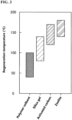
- FIG. 3 is a graph showing a range of a regeneration temperature for the polymer sorbent.
- FIG. 3 also shows ranges of the regeneration temperature for silica gel, activated carbon, and zeolite as comparative examples.
- the polymer sorbent desorbs the adsorbed water vapor at a regeneration temperature of 40°C or higher and 100°C or lower.
- the polymer sorbent has a regeneration temperature lower than that of zeolite, activated carbon, and silica gel, and can be regenerated at a low temperature.
- a content of the polymer sorbent in the thermal insulator 50 will be described.
- the content of the polymer sorbent with respect to the thermal insulator 50 can be set based on thermal insulation performance and moisture absorption performance required for the thermal insulator 50 in consideration of the moisture absorption performance of the polymer sorbent, water resistance and corrosion resistance of an object to be thermally insulated, a temperature range in which the object to be thermally insulated can change, a porosity of the thermal insulator 50, and the like.
- the higher moisture absorption performance of the contained polymer sorbent allows for reducing the content of the polymer sorbent more, and the thermal insulation performance of the thermal insulator 50 can be enhanced more by increasing the content of the thermal insulation material.
- the object to be thermally insulated has low water resistance or corrosion resistance, or when the porosity of the thermal insulator 50 or the porosity between the thermal insulator 50 and the object to be thermally insulated is high, from the viewpoint of avoiding dew condensation and retention of liquid water, the higher content of the polymer sorbent is preferable.
- the polymer sorbent has moisture absorption performance of 45.3% RH at 35°C, which is a lower limit of the temperature of the circulation pipe 40, and the polymer sorbent is in a completely dry state at 70°C, which is an upper limit of the temperature of the circulation pipe 40, that is, 0% RH.
- the moisture absorptivity of the polymer sorbent at other temperatures is 34.5% RH at 40°C, 26.6% RH at 45°C, and 20.6% RH at 50°C.
- the content of the polymer sorbent can be set at a volume ratio of less than 1% with respect to the thermal insulator 50 from the viewpoint of improving the thermal insulation performance and providing sufficient dehumidification performance for the circulation pipe 40 as an object to be thermally insulated. More specifically, the polymer sorbent is set at a volume ratio of 0.05% with respect to the thermal insulator 50. From the viewpoint of improving the thermal insulation performance, the content of the polymer sorbent is preferably small as long as the moisture absorption performance of the thermal insulator 50 is not impaired.
- a method for setting the volume ratio of the polymer sorbent in the thermal insulator 50 according to the present embodiment will be described.
- a theoretical value of a saturated water vapor amount (g/m 3 ) in the atmosphere is 197 g/m 3 at 70°C and 39.6 g/m 3 at 35°C. Therefore, a maximum amount of desorption of moisture generated in a temperature range of 70°C to 35°C in the circulation pipe 40 is 157.4 g/m 3 , which is obtained by subtracting 39.6 g/m 3 from 197 g/m 3 .
- the filling rate of the thermal insulation material and the polymer sorbent in the thermal insulator 50 is 80%, that is, the porosity is 20%, and thus, a maximum amount of water vapor that the polymer sorbent should absorb is 31.5 g/m 3 , which is obtained by multiplying 157.4 g/m 3 by 20%.
- the moisture absorption performance of the polymer sorbent is 45.3% RH at 35°C, and thus, a maximum amount of the polymer sorbent required to absorb liquid water generated in voids of the thermal insulator 50 due to a temperature drop from 70°C to 35°C is 69.5 g/m 3 , which is obtained by dividing 45.3% RH from 31.5 g/m 3 .
- a density of the polymer sorbent in the present embodiment is 1130 kg/m 3 .
- the maximum amount of the polymer sorbent required to absorb the water vapor generated due to the temperature drop from 70°C to 35°C is 6.15 e -5 m 3 in terms of volume. That is, 6.15 e -5 m 3 of the polymer sorbent is required per 1 m 3 of the thermal insulator 50. Therefore, by containing the polymer sorbent such that the volume ratio of the polymer sorbent to the thermal insulator 50 is 0.00615% or more, the thermal insulator 50 can absorb all the water vapor that may be generated due to the temperature drop from 70°C to 35°C.
- the polymer sorbent may be contained more than the theoretical value.
- a volume ratio of the polymer sorbent with respect to the thermal insulator 50 when it is assumed that the porosity of the thermal insulator 50 is 100% (0.03075% in the present embodiment) or a volume ratio calculated using the maximum amount of the polymer sorbent required to absorb water vapor (e.g., 564 g/m 3 ) generated due to a temperature drop from 99°C to 0°C can be used.
- the volume ratio of the polymer sorbent to the thermal insulator is not limited to less than 1%, and may be less than 10%, and may be set to any volume ratio such as 10% to 80% in consideration of the types of the thermal insulation material and the polymer sorbent, and the thermal insulation performance and the moisture absorption performance required for the thermal insulator 50.
- the thermal insulator 50 of the present embodiment includes a polymer sorbent that regenerates by desorbing adsorbed moisture and a thermal insulation material.
- the thermal insulator 50 can adsorb moisture between the circulation pipe 40 and the thermal insulator 50 by the sorption of the polymer sorbent under low temperature conditions where dew condensation may occur. This allows to reduce or prevent retention of water droplets on the outer circumference of the circulation pipe 40 or the thermal insulator 50, and allows to reduce or prevent deterioration of the circulation pipe 40. In addition, it allows reduce or prevent deterioration of the thermal insulation performance due to the presence of liquid water on the outer circumference of the circulation pipe 40.
- the polymer sorbent is regenerated due to the temperature rise of the circulation pipe 40.
- the polymer sorbent when the circulation pipe 40 is in a high temperature state, the polymer sorbent can be regenerated. And this allows for providing the thermal insulator 50 that has the thermal insulation performance due to the thermal insulation material and can repeatedly adsorb liquid water outside the circulation pipe 40. In addition, the heat of vaporization due to the release of moisture during regeneration can be used to cool the thermal insulator 50, and the thermal insulation performance of the thermal insulator 50 can be improved.
- the thermal insulator 50 of the present embodiment is formed of a mixture obtained by mixing a granular polymer sorbent and a granular thermal insulation material. This allows for improving the filling rate of the thermal insulator 50, improving the thermal insulation performance, and reducing the amount of liquid water generated by dew condensation, and deterioration of the circulation pipe 40 can be more reliably prevented.
- the shape of the thermal insulator 50 can be easily changed, and the degree of freedom in disposing the thermal insulator 50 can be improved.
- the polymer sorbent has a regeneration temperature at which the adsorbed moisture is desorbed, of 40°C or higher and 100°C or lower.
- the polymer sorbent can be regenerated at a temperature lower than that of other absorbents such as silica gel and zeolite.
- it allows for providing the thermal insulator 50 suitable for thermally insulating an object whose temperature change is 100°C or less.
- the polymer sorbent contains a crosslinked polyacrylate.
- Known materials can be used to provide the thermal insulator 50 containing a polymer sorbent regenerated at a low temperature.
- a volume ratio of the polymer sorbent to a thermal insulation layer is less than 1%. Setting a low volume ratio with respect to the thermal insulation material allows for providing the thermal insulator 50 capable of having sufficient thermal insulation performance and reducing or preventing deterioration of the circulation pipe 40.
- an aerogel having water repellency is used as the thermal insulation material.
- the thermal insulation material has water repellency, and thus, liquid water can be smoothly guided to the polymer sorbent, and the moisture absorption performance of the thermal insulator 50 can be improved.
- the aerogel contains polymethylsilsesquioxane. This allows for providing the thermal insulator 50 having a thermal conductivity lower than a thermal conductivity of a general thermally insulating material (20 mW ⁇ m -1 ⁇ K -1 to 40 mW ⁇ m -1 ⁇ K -1 ). Productivity can be improved compared to a silica aerogel, which is obtained by using supercritical drying.
- the thermal insulation material is a polymethylsilsesquioxane aerogel.
- the thermal insulation material may be a polymethylsilsesquioxane-cellulose nanofiber (PMSQ-CNF) composite aerogel that further contains cellulose nanofibers (CNF) in the polymethylsilsesquioxane aerogel.
- the thermal insulator 50 of this form the thermal insulator 50 having a thermal conductivity (15 mW ⁇ m -1 ⁇ K -1 ) lower than that of a general thermally insulating material and having reversible elastic deformation and bending flexibility against uniaxial compression, can be obtained.
- the thermal insulator 50 is mounted to the outer circumference of the circulation pipe 40 as an object to be thermally insulated.
- the thermal insulator 50 is not limited to being mounted to the circulation pipe 40, and may be mounted and used to other heat sources such as appliances such as stoves, refrigerators, freezers, and water heaters, and metal appliances that can reach a high temperature.
- the thermal insulator 50 may be used for building uses, for example, for building materials such as glass and walls of houses and buildings.
- the thermal insulator 50 is not limited to being disposed outside of the object, and may be disposed, for example, inside the object, such as an inner circumference of the circulation pipe 40.
- the thermal insulation material is an aerogel.
- thermally insulating materials other than the aerogel such as a ceramic fiber, a cellulose fiber, a urethane foam, a phenol foam, an expanded polystyrene, and glass wool, may be used.
- the thermal insulator 50 may be, for example, a so-called blanket type in which a polymer sorbent is contained in fibrous glass wool as a thermal insulation material.
- the thermal insulation material is a polymethylsilsesquioxane aerogel.
- aerogel for example, inorganic aerogels such as a silica aerogel, a carbon aerogel, and an alumina aerogel may be used, and other aerogels formed using glass, a synthetic resin, or a fiber structure made of a composite material of the above as a base material may also be used.
- the thermal insulation material in each of the above embodiments is prepared by forming a thermal insulation sheet, which is produced by supporting a silica aerogel on fibers made of a carbon fiber or a synthetic resin, into a cylindrical shape corresponding to the shape of the circulation pipe 40.
- the thermal insulation material may be prepared by impregnating a resin sheet such as a cylindrical glass fiber sheet or a non-woven fabric sheet with an aerogel.
- the present disclosure is not limited to the embodiments described above, and can be implemented in various configurations without departing from the scope of the present disclosure.
- the technical features in the embodiments corresponding to the technical features in the forms described in "Summary of Invention" can be appropriately replaced or combined in order to solve a part or all of the problems described above or in order to achieve a part or all of the effects described above. Any of the technical features may be omitted as appropriate unless the technical feature is described as essential herein.
Landscapes
- Chemical & Material Sciences (AREA)
- Chemical Kinetics & Catalysis (AREA)
- Analytical Chemistry (AREA)
- Organic Chemistry (AREA)
- Engineering & Computer Science (AREA)
- Dispersion Chemistry (AREA)
- General Chemical & Material Sciences (AREA)
- Oil, Petroleum & Natural Gas (AREA)
- General Engineering & Computer Science (AREA)
- Physics & Mathematics (AREA)
- Thermal Sciences (AREA)
- Mechanical Engineering (AREA)
- Health & Medical Sciences (AREA)
- Medicinal Chemistry (AREA)
- Polymers & Plastics (AREA)
- Thermal Insulation (AREA)
- Drying Of Gases (AREA)
- Solid-Sorbent Or Filter-Aiding Compositions (AREA)
Abstract
Description
- The present disclosure relates to a thermal insulator.
- A technique of disposing a thermal insulator on an outer circumference of a pipe is known (for example, Patent Literature 1).
- Patent Literature 1:
JP2000-240116A - When retention of water droplets between an object to be thermally insulated and a thermal insulator occurs due to dew condensation, the object may deteriorate due to corrosion, for example.
- The present disclosure can be implemented in the following forms.
- (1) One aspect of the present disclosure provides a thermal insulator. The thermal insulator includes: a polymer sorbent that regenerates by desorbing adsorbed moisture; and a thermal insulation material.
The thermal insulator of this aspect has the thermal insulation performance and allows for preventing deterioration of the object by repeatedly absorbing liquid water between the object to be thermally insulated and the thermal insulator to reduce and prevent retention of water droplets between an object to be thermally insulated and a thermal insulator. - (2) In the thermal insulator of the above aspect, at least one selected from the group consisting of the polymer sorbent and the thermal insulation material may be granular.
The thermal insulator of this aspect allows for improving a filling rate of the thermal insulator, improving the thermal insulation performance and preventing dew condensation to more reliably prevent deterioration of the object. - (3) In the thermal insulator of the above aspect, the polymer sorbent may have a regeneration temperature at which the adsorbed moisture is desorbed of 40°C or higher and 100°C or lower.
The thermal insulator of this aspect allows for providing a thermal insulator suitable for thermally insulating an object whose temperature change is 100°C or less. - (4) In the thermal insulator of the above aspect, the polymer sorbent may contain a crosslinked polyacrylate.
According to the thermal insulator of this aspect, known materials can be used to provide a thermal insulator suitable for thermally insulating an object whose temperature change is 100°C or less. - (5) In the thermal insulator of the above aspect, a volume ratio of the polymer sorbent to the thermal insulator may be less than 1%.
The thermal insulator of this aspect allows for providing a thermal insulator capable of reducing or preventing deterioration of an object while having sufficient thermal insulation performance. - (6) In the thermal insulator of the above aspect, the thermal insulation material may be an aerogel having water repellency. The thermal insulator of this aspect allows for smoothly guiding liquid water to a polymer sorbent and improving moisture absorption performance of the thermal insulator.
- (7) In the thermal insulator of the above aspect, the aerogel may contain polymethylsilsesquioxane.
- The thermal insulator of this aspect allows for improving productivity, compared to a silica aerogel produced by supercritical drying.
- The present disclosure can also be implemented in various forms other than the thermal insulator. For example, it can be implemented in the form of a thermally insulating material, a thermal insulation layer, a circulation pipe including a thermal insulator, a method for producing a thermal insulator, and the like.
-
-
FIG. 1 is a diagram illustrating a configuration of a thermal insulator according to a first embodiment. -
FIG. 2 is a graph showing isothermal adsorption characteristics of a polymer sorbent at 20°C. -
FIG. 3 is a graph showing a regeneration temperature of the polymer sorbent. -
FIG. 1 is a diagram illustrating a configuration of athermal insulator 50 according to the present embodiment.FIG. 1 shows a cross section of acirculation pipe 40 to which thethermal insulator 50 is mounted. As shown inFIG. 1 , thethermal insulator 50 according to the present embodiment is provided to cover an outer circumference of thecirculation pipe 40. Aprotective layer 60 is provided on an outer circumference of thethermal insulator 50. - The
circulation pipe 40 includes aflow path 30 therein. Thecirculation pipe 40 has a cylindrical shape and is made of a metal such as cast iron or stainless steel. Thecirculation pipe 40 is used for industrial purposes and is connected to a device (not shown) having a heat source such as an engine or a boiler. A fluid whose temperature has been raised by waste heat generated when the device is in operation flows through theflow path 30. Examples of the fluid include exhaust gases from an engine or a boiler, and refrigerants such as a coolant. In the present embodiment, the temperature of thecirculation pipe 40 rises to 70°C when the device is in operation and drops to 35°C when the device is stopped. - The
protective layer 60 is, for example, an aluminum sheet. Theprotective layer 60 is disposed to cover thethermal insulator 50. A space for filling thethermal insulator 50 is defined between theprotective layer 60 and thecirculation pipe 40. In addition, theprotective layer 60 prevents thethermal insulator 50 from being exposed to outside air and prevents liquid water from entering thethermal insulator 50 from the outside. Theprotective layer 60 may contain glass cloth or the like for reinforcement. Theprotective layer 60 may be formed of a metal such as cast iron or stainless steel, or a synthetic resin, in addition to an aluminum sheet. Theprotective layer 60 may be omitted, for example, when thethermal insulator 50 can be molded to an extent that the shape can be sufficiently maintained and when thethermal insulator 50 can be disposed on the outer circumference of thecirculation pipe 40 without theprotective layer 60. Theprotective layer 60 may be provided with a through hole that communicates thethermal insulator 50 with the outside in order to release moisture absorbed by thethermal insulator 50. - The
thermal insulator 50 reduces or prevents heat transfer from an outer surface of thecirculation pipe 40 to the outside. Thethermal insulator 50 is disposed on a radially outer side of thecirculation pipe 40, that is, disposed to surround the outer circumference of thecirculation pipe 40 in a circumferential direction. In the present embodiment, thethermal insulator 50 is formed by filling a space between thecirculation pipe 40 and theprotective layer 60 with a mixture obtained by mixing a granular thermal insulation material and a granular polymer sorbent in a volume ratio to be described below. In thethermal insulator 50, the filling rate of the thermal insulation material and the polymer sorbent is 80%. Particle diameters of the polymer sorbent and the thermal insulation material in the present embodiment range from several tens of micrometers to several millimeters. Thethermal insulator 50 may contain a polymer material such as a resin or glass, in addition to the thermal insulation material and the polymer sorbent. Thethermal insulator 50 may be formed by allowing the thermal insulation material and the polymer sorbent to be contained in fibers such as non-woven fabrics or woven fabrics, or may be formed by molding a polymer material containing the thermal insulation material and the polymer sorbent. Thethermal insulator 50 in this form can be easily molded while containing the thermal insulation material and the polymer sorbent. - The thermal insulation material is, for example, an aerogel having water repellency. In the present embodiment, an aerogel containing polymethylsilsesquioxane (PMSQ), which is also called an organic-inorganic hybrid aerogel, is used as the thermal insulation material. Polymethylsilsesquioxane (chemical formula: CH3SiO1.5) is a polymer in which methyltrimethoxysilane (chemical formula: CH3Si(OCH3)3), which is one of organosilicon alkoxides, is crosslinked in a three-dimensional network, and is spherical fine particles of a silicon resin. The polymethylsilsesquioxane aerogel is prepared by wet gel formation by using a liquid phase method such as a sol-gel method, and is further processed into granules in the present embodiment. The polymethylsilsesquioxane aerogel has a thermal conductivity of about 15 mW·m-1·K-1, which is lower than a thermal conductivity (20 mW·m-1·K-1 to 40 mW·m-1·K-1) of a general thermally insulating material. In addition, the polymethylsilsesquioxane aerogel has a methyl group directly bonded to silicon. Thus, it has low surface energy comparable to that of a silicon resin, polydimethylsiloxane (PDMS), and the like, and has high hydrophobicity with a water contact angle of about 150°C. The form of the thermal insulation material is not limited to granules, and may be various forms such as a powder form, a block form, and a plate form.
- The polymer sorbent dehumidifies the
thermal insulator 50 by sorption. The polymer sorbent is also called a desiccant material. The sorption means a phenomenon in which a water molecule bonds to a hydrophilic polymer chain and the water molecule is trapped while a crosslinked polymer swells and deforms with the crosslinking point as a fulcrum. Further, when the temperature increases, the crosslinked polymer shrinks, and the water molecule sorbed to the crosslinked polymer is desorbed as the crosslinked polymer shrinks, and thereby the polymer sorbent is regenerated. The temperature required for regeneration of the polymer sorbent is hereinafter also referred to as a "regeneration temperature". In the present embodiment, the polymer sorbent contains a water-absorbing polymer made of a crosslinked polyacrylate (NaPAA). The polymer sorbent can be produced by allowing it to be impregnated in a base material, and is further processed into granules in the present embodiment. The form of the polymer sorbent is not limited to granules, and may be a powder form, a block form, and a plate form, or may be various forms such as a fibrous form in which the polymer sorbent is supported on fibers or a honeycomb form in which the polymer sorbent is supported on a base material. - Physical properties of the polymer sorbent contained in the
thermal insulator 50 according to the present embodiment will be described with reference toFIG. 2 andFIG. 3 . In the present embodiment, the polymer sorbent absorbs moisture by sorption at room temperature, and releases moisture by regeneration at 40°C or higher and 100°C or lower.FIG. 2 is a graph showing isothermal adsorption characteristics of the polymer sorbent at 20°C. A vertical axis indicates equilibrium moisture absorption rate and a horizontal axis indicates relative humidity. The equilibrium moisture absorption rate is a water absorption amount in terms of weight at the relative humidity under static conditions.FIG. 2 also shows isothermal adsorption characteristics of silica gel A type and silica gel B type as comparative examples. The crosslinked polyacrylate contained in the polymer sorbent has intermolecular crosslinks and a carboxylic acid group in side chains. The carboxylic acid group is a hydrophilic group, and when it bonds to water vapor, the crosslinked polymer swells with the crosslinking point as a fulcrum to cause sorption. As a result, as shown inFIG. 2 , the polymer sorbent has moisture absorption performance higher than that of the silica gel type A and the silica gel type B in a range from low humidity to high humidity. -
FIG. 3 is a graph showing a range of a regeneration temperature for the polymer sorbent.FIG. 3 also shows ranges of the regeneration temperature for silica gel, activated carbon, and zeolite as comparative examples. As shown inFIG. 3 , in the present embodiment, the polymer sorbent desorbs the adsorbed water vapor at a regeneration temperature of 40°C or higher and 100°C or lower. The polymer sorbent has a regeneration temperature lower than that of zeolite, activated carbon, and silica gel, and can be regenerated at a low temperature. - A content of the polymer sorbent in the
thermal insulator 50 will be described. The content of the polymer sorbent with respect to thethermal insulator 50 can be set based on thermal insulation performance and moisture absorption performance required for thethermal insulator 50 in consideration of the moisture absorption performance of the polymer sorbent, water resistance and corrosion resistance of an object to be thermally insulated, a temperature range in which the object to be thermally insulated can change, a porosity of thethermal insulator 50, and the like. For example, the higher moisture absorption performance of the contained polymer sorbent allows for reducing the content of the polymer sorbent more, and the thermal insulation performance of thethermal insulator 50 can be enhanced more by increasing the content of the thermal insulation material. When the object to be thermally insulated has low water resistance or corrosion resistance, or when the porosity of thethermal insulator 50 or the porosity between thethermal insulator 50 and the object to be thermally insulated is high, from the viewpoint of avoiding dew condensation and retention of liquid water, the higher content of the polymer sorbent is preferable. - In the present embodiment, the polymer sorbent has moisture absorption performance of 45.3% RH at 35°C, which is a lower limit of the temperature of the
circulation pipe 40, and the polymer sorbent is in a completely dry state at 70°C, which is an upper limit of the temperature of thecirculation pipe 40, that is, 0% RH. The moisture absorptivity of the polymer sorbent at other temperatures is 34.5% RH at 40°C, 26.6% RH at 45°C, and 20.6% RH at 50°C. In the present embodiment, the content of the polymer sorbent can be set at a volume ratio of less than 1% with respect to thethermal insulator 50 from the viewpoint of improving the thermal insulation performance and providing sufficient dehumidification performance for thecirculation pipe 40 as an object to be thermally insulated. More specifically, the polymer sorbent is set at a volume ratio of 0.05% with respect to thethermal insulator 50. From the viewpoint of improving the thermal insulation performance, the content of the polymer sorbent is preferably small as long as the moisture absorption performance of thethermal insulator 50 is not impaired. - A method for setting the volume ratio of the polymer sorbent in the
thermal insulator 50 according to the present embodiment will be described. A theoretical value of a saturated water vapor amount (g/m3) in the atmosphere is 197 g/m3 at 70°C and 39.6 g/m3 at 35°C. Therefore, a maximum amount of desorption of moisture generated in a temperature range of 70°C to 35°C in thecirculation pipe 40 is 157.4 g/m3, which is obtained by subtracting 39.6 g/m3 from 197 g/m3. In the present embodiment, the filling rate of the thermal insulation material and the polymer sorbent in thethermal insulator 50 is 80%, that is, the porosity is 20%, and thus, a maximum amount of water vapor that the polymer sorbent should absorb is 31.5 g/m3, which is obtained by multiplying 157.4 g/m3 by 20%. The moisture absorption performance of the polymer sorbent is 45.3% RH at 35°C, and thus, a maximum amount of the polymer sorbent required to absorb liquid water generated in voids of thethermal insulator 50 due to a temperature drop from 70°C to 35°C is 69.5 g/m3, which is obtained by dividing 45.3% RH from 31.5 g/m3. Here, a density of the polymer sorbent in the present embodiment is 1130 kg/m3. Thus, the maximum amount of the polymer sorbent required to absorb the water vapor generated due to the temperature drop from 70°C to 35°C is 6.15 e-5m3 in terms of volume. That is, 6.15 e-5m3 of the polymer sorbent is required per 1 m3 of thethermal insulator 50. Therefore, by containing the polymer sorbent such that the volume ratio of the polymer sorbent to thethermal insulator 50 is 0.00615% or more, thethermal insulator 50 can absorb all the water vapor that may be generated due to the temperature drop from 70°C to 35°C. However, in order to improve the moisture absorption performance of thethermal insulator 50 and increase a probability that the polymer sorbent is in contact with the water vapor in the voids of thethermal insulator 50, the polymer sorbent may be contained more than the theoretical value. For example, for the content of the polymer sorbent, a volume ratio of the polymer sorbent with respect to thethermal insulator 50 when it is assumed that the porosity of thethermal insulator 50 is 100% (0.03075% in the present embodiment), or a volume ratio calculated using the maximum amount of the polymer sorbent required to absorb water vapor (e.g., 564 g/m3) generated due to a temperature drop from 99°C to 0°C can be used. In addition, the volume ratio of the polymer sorbent to the thermal insulator is not limited to less than 1%, and may be less than 10%, and may be set to any volume ratio such as 10% to 80% in consideration of the types of the thermal insulation material and the polymer sorbent, and the thermal insulation performance and the moisture absorption performance required for thethermal insulator 50. - As described above, the
thermal insulator 50 of the present embodiment includes a polymer sorbent that regenerates by desorbing adsorbed moisture and a thermal insulation material. Thethermal insulator 50 can adsorb moisture between thecirculation pipe 40 and thethermal insulator 50 by the sorption of the polymer sorbent under low temperature conditions where dew condensation may occur. This allows to reduce or prevent retention of water droplets on the outer circumference of thecirculation pipe 40 or thethermal insulator 50, and allows to reduce or prevent deterioration of thecirculation pipe 40. In addition, it allows reduce or prevent deterioration of the thermal insulation performance due to the presence of liquid water on the outer circumference of thecirculation pipe 40. The polymer sorbent is regenerated due to the temperature rise of thecirculation pipe 40. Thus, when thecirculation pipe 40 is in a high temperature state, the polymer sorbent can be regenerated. And this allows for providing thethermal insulator 50 that has the thermal insulation performance due to the thermal insulation material and can repeatedly adsorb liquid water outside thecirculation pipe 40. In addition, the heat of vaporization due to the release of moisture during regeneration can be used to cool thethermal insulator 50, and the thermal insulation performance of thethermal insulator 50 can be improved. - The
thermal insulator 50 of the present embodiment is formed of a mixture obtained by mixing a granular polymer sorbent and a granular thermal insulation material. This allows for improving the filling rate of thethermal insulator 50, improving the thermal insulation performance, and reducing the amount of liquid water generated by dew condensation, and deterioration of thecirculation pipe 40 can be more reliably prevented. The shape of thethermal insulator 50 can be easily changed, and the degree of freedom in disposing thethermal insulator 50 can be improved. - According to the
thermal insulator 50 of the present embodiment, the polymer sorbent has a regeneration temperature at which the adsorbed moisture is desorbed, of 40°C or higher and 100°C or lower. The polymer sorbent can be regenerated at a temperature lower than that of other absorbents such as silica gel and zeolite. Thus, it allows for providing thethermal insulator 50 suitable for thermally insulating an object whose temperature change is 100°C or less. - According to the
thermal insulator 50 of the present embodiment, the polymer sorbent contains a crosslinked polyacrylate. Known materials can be used to provide thethermal insulator 50 containing a polymer sorbent regenerated at a low temperature. - According to the
thermal insulator 50 of the present embodiment, a volume ratio of the polymer sorbent to a thermal insulation layer is less than 1%. Setting a low volume ratio with respect to the thermal insulation material allows for providing thethermal insulator 50 capable of having sufficient thermal insulation performance and reducing or preventing deterioration of thecirculation pipe 40. - According to the
thermal insulator 50 of the present embodiment, an aerogel having water repellency is used as the thermal insulation material. Using the aerogel allows for high thermal insulation performance with a simple method. The thermal insulation material has water repellency, and thus, liquid water can be smoothly guided to the polymer sorbent, and the moisture absorption performance of thethermal insulator 50 can be improved. - According to the
thermal insulator 50 of the present embodiment, the aerogel contains polymethylsilsesquioxane. This allows for providing thethermal insulator 50 having a thermal conductivity lower than a thermal conductivity of a general thermally insulating material (20 mW·m-1·K-1 to 40 mW·m-1·K-1). Productivity can be improved compared to a silica aerogel, which is obtained by using supercritical drying. - (B 1) In the above embodiment, an example is given in which the thermal insulation material is a polymethylsilsesquioxane aerogel. The thermal insulation material may be a polymethylsilsesquioxane-cellulose nanofiber (PMSQ-CNF) composite aerogel that further contains cellulose nanofibers (CNF) in the polymethylsilsesquioxane aerogel. According to the
thermal insulator 50 of this form, thethermal insulator 50 having a thermal conductivity (15 mW·m-1·K-1 ) lower than that of a general thermally insulating material and having reversible elastic deformation and bending flexibility against uniaxial compression, can be obtained. - (B2) In the above embodiment, an example is given in which the
thermal insulator 50 is mounted to the outer circumference of thecirculation pipe 40 as an object to be thermally insulated. In contrast, thethermal insulator 50 is not limited to being mounted to thecirculation pipe 40, and may be mounted and used to other heat sources such as appliances such as stoves, refrigerators, freezers, and water heaters, and metal appliances that can reach a high temperature. In addition to industrial uses, thethermal insulator 50 may be used for building uses, for example, for building materials such as glass and walls of houses and buildings. In addition, thethermal insulator 50 is not limited to being disposed outside of the object, and may be disposed, for example, inside the object, such as an inner circumference of thecirculation pipe 40. - (B3) In the above embodiment, an example is given in which the thermal insulation material is an aerogel. As the thermal insulation material, thermally insulating materials other than the aerogel, such as a ceramic fiber, a cellulose fiber, a urethane foam, a phenol foam, an expanded polystyrene, and glass wool, may be used. In this case, the
thermal insulator 50 may be, for example, a so-called blanket type in which a polymer sorbent is contained in fibrous glass wool as a thermal insulation material. - (B4) In the above embodiment, an example is given in which the thermal insulation material is a polymethylsilsesquioxane aerogel. As the aerogel, for example, inorganic aerogels such as a silica aerogel, a carbon aerogel, and an alumina aerogel may be used, and other aerogels formed using glass, a synthetic resin, or a fiber structure made of a composite material of the above as a base material may also be used. The thermal insulation material in each of the above embodiments is prepared by forming a thermal insulation sheet, which is produced by supporting a silica aerogel on fibers made of a carbon fiber or a synthetic resin, into a cylindrical shape corresponding to the shape of the
circulation pipe 40. The thermal insulation material may be prepared by impregnating a resin sheet such as a cylindrical glass fiber sheet or a non-woven fabric sheet with an aerogel. - The present disclosure is not limited to the embodiments described above, and can be implemented in various configurations without departing from the scope of the present disclosure. For example, the technical features in the embodiments corresponding to the technical features in the forms described in "Summary of Invention" can be appropriately replaced or combined in order to solve a part or all of the problems described above or in order to achieve a part or all of the effects described above. Any of the technical features may be omitted as appropriate unless the technical feature is described as essential herein.
- The present application is based on a
Japanese Patent Application No. 2020-185507 filed on November 6, 2020 -
- 30
- flow path
- 40
- circulation pipe
- 50
- thermal insulator
- 60
- protective layer
Claims (7)
- A thermal insulator comprising:a polymer sorbent that regenerates by desorbing adsorbed moisture; anda thermal insulation material.
- The thermal insulator according to claim 1, wherein at least one selected from the group consisting of the polymer sorbent and the thermal insulation material is granular.
- The thermal insulator according to claim 1 or 2, wherein the polymer sorbent has a regeneration temperature at which the adsorbed moisture is desorbed of 40°C or higher and 100°C or lower.
- The thermal insulator according to claim 3, wherein the polymer sorbent contains a crosslinked polyacrylate.
- The thermal insulator according to any one of claims 1 to 4, wherein a volume ratio of the polymer sorbent to the thermal insulator is less than 1%.
- The thermal insulator according to any one of claims 1 to 5, wherein the thermal insulation material is an aerogel having water repellency.
- The thermal insulator according to claim 6, wherein the aerogel contains polymethylsilsesquioxane.
Applications Claiming Priority (2)
| Application Number | Priority Date | Filing Date | Title |
|---|---|---|---|
| JP2020185507A JP7561370B2 (en) | 2020-11-06 | 2020-11-06 | Insulation |
| PCT/JP2021/040405 WO2022097643A1 (en) | 2020-11-06 | 2021-11-02 | Thermal insulator |
Publications (2)
| Publication Number | Publication Date |
|---|---|
| EP4241872A1 true EP4241872A1 (en) | 2023-09-13 |
| EP4241872A4 EP4241872A4 (en) | 2025-11-26 |
Family
ID=81457231
Family Applications (1)
| Application Number | Title | Priority Date | Filing Date |
|---|---|---|---|
| EP21889196.8A Pending EP4241872A4 (en) | 2020-11-06 | 2021-11-02 | THERMAL INSULATOR |
Country Status (4)
| Country | Link |
|---|---|
| US (1) | US20240017242A1 (en) |
| EP (1) | EP4241872A4 (en) |
| JP (1) | JP7561370B2 (en) |
| WO (1) | WO2022097643A1 (en) |
Families Citing this family (1)
| Publication number | Priority date | Publication date | Assignee | Title |
|---|---|---|---|---|
| WO2025094327A1 (en) * | 2023-11-01 | 2025-05-08 | 株式会社ジェイテクト | Waste heat recycling device |
Family Cites Families (9)
| Publication number | Priority date | Publication date | Assignee | Title |
|---|---|---|---|---|
| JP2000240116A (en) | 1999-02-23 | 2000-09-05 | Matsushita Electric Works Ltd | Heat insulating cover for piping |
| JP2001064876A (en) * | 1999-06-25 | 2001-03-13 | Komatsu Seiren Co Ltd | Heat insulating fabric and its use |
| JP5140278B2 (en) * | 2007-01-15 | 2013-02-06 | レンゴー株式会社 | Desiccant material and air dehumidification method using the same |
| WO2012050084A1 (en) * | 2010-10-15 | 2012-04-19 | 日本エクスラン工業株式会社 | Recycled photothermal conversion desiccant sheet, and desiccant element and desiccant rotor using sheet, and air-conditioning system using element or rotor |
| CN105473208B (en) * | 2013-12-06 | 2020-06-02 | 夏普株式会社 | dehumidifier |
| JP2016107226A (en) * | 2014-12-09 | 2016-06-20 | 三星電子株式会社Samsung Electronics Co.,Ltd. | Adsorbent and vacuum heat insulation material using the same |
| WO2016171558A1 (en) * | 2015-04-24 | 2016-10-27 | Separex S.A.S. | A process of applying a polymethylsilsesquioxane aerogel coating onto a porous substrate |
| US11547977B2 (en) * | 2018-05-31 | 2023-01-10 | Aspen Aerogels, Inc. | Fire-class reinforced aerogel compositions |
| JP6775061B1 (en) | 2019-05-10 | 2020-10-28 | 株式会社神戸製鋼所 | Fluid flow device |
-
2020
- 2020-11-06 JP JP2020185507A patent/JP7561370B2/en active Active
-
2021
- 2021-11-02 WO PCT/JP2021/040405 patent/WO2022097643A1/en not_active Ceased
- 2021-11-02 EP EP21889196.8A patent/EP4241872A4/en active Pending
- 2021-11-02 US US18/251,826 patent/US20240017242A1/en active Pending
Also Published As
| Publication number | Publication date |
|---|---|
| EP4241872A4 (en) | 2025-11-26 |
| US20240017242A1 (en) | 2024-01-18 |
| JP2022075000A (en) | 2022-05-18 |
| JP7561370B2 (en) | 2024-10-04 |
| WO2022097643A1 (en) | 2022-05-12 |
Similar Documents
| Publication | Publication Date | Title |
|---|---|---|
| US20250207010A1 (en) | Aerogel composites including phase change materials | |
| Ji et al. | New composite adsorbent for solar-driven fresh water production from the atmosphere | |
| US7456131B2 (en) | Increased thermal conductivity monolithic zeolite structures | |
| WO2000066954A1 (en) | Improved heat and mass transfer apparatus and method for solid-vapor sorption systems | |
| Nakabayashi et al. | Improvement of water vapor adsorption ability of natural mesoporous material by impregnating with chloride salts for development of a new desiccant filter | |
| Calabrese et al. | New SAPO-34-SPEEK composite coatings for adsorption heat pumps: Adsorption performance and thermodynamic analysis | |
| US20240017242A1 (en) | Thermal insulator | |
| Yang et al. | Preparation of palygorskite paraffin nanocomposite suitable for thermal energy storage | |
| Dai et al. | Sorption and regeneration performance of novel solid desiccant based on PVA-LiCl electrospun nanofibrous membrane | |
| Jadhav et al. | Synthesis of light weight recron fiber-reinforced sodium silicate based silica aerogel blankets at an ambient pressure for thermal protection | |
| JP2009285225A (en) | Hybrid drying machine | |
| Zheng et al. | K2CO3 on porous supports for moisture‐swing CO2 capture from ambient air | |
| Yang et al. | Investigation on water vapor adsorption performance of carbon based composite adsorption material ACF-silica sol-LiCl | |
| JP5026345B2 (en) | Adsorbent system and method for regenerating the system | |
| JP2011143358A (en) | Moisture absorption filter and humidifier | |
| Zhao et al. | Preparation and characterization of composite adsorbent LiCl/zeolite 13X for adsorption system | |
| CN209952527U (en) | Controller for adjusting dew point by using lever balance valve | |
| JP2002080213A (en) | Carbonaceous porous material | |
| JP2010261501A (en) | Vacuum insulation box | |
| TW201522475A (en) | Thermo-responsive composite material and use thereof, and refrigerating device using same | |
| JP2024072171A (en) | Aerogel Composite | |
| JP6268358B2 (en) | Dehumidifier | |
| Kong et al. | Bifunctionalized hybrid silica aerogels for stable low-concentration CO2 capture and thermal insulation under humid and high-temperature conditions | |
| US20230332033A1 (en) | Composite material for thermochemical energy storage and method of making same | |
| Chen et al. | High‐performance thermal insulator based on polymer foam and silica xerogel |
Legal Events
| Date | Code | Title | Description |
|---|---|---|---|
| STAA | Information on the status of an ep patent application or granted ep patent |
Free format text: STATUS: THE INTERNATIONAL PUBLICATION HAS BEEN MADE |
|
| PUAI | Public reference made under article 153(3) epc to a published international application that has entered the european phase |
Free format text: ORIGINAL CODE: 0009012 |
|
| STAA | Information on the status of an ep patent application or granted ep patent |
Free format text: STATUS: REQUEST FOR EXAMINATION WAS MADE |
|
| 17P | Request for examination filed |
Effective date: 20230505 |
|
| AK | Designated contracting states |
Kind code of ref document: A1 Designated state(s): AL AT BE BG CH CY CZ DE DK EE ES FI FR GB GR HR HU IE IS IT LI LT LU LV MC MK MT NL NO PL PT RO RS SE SI SK SM TR |
|
| DAV | Request for validation of the european patent (deleted) | ||
| DAX | Request for extension of the european patent (deleted) | ||
| A4 | Supplementary search report drawn up and despatched |
Effective date: 20251027 |
|
| RIC1 | Information provided on ipc code assigned before grant |
Ipc: B01D 53/26 20060101AFI20251021BHEP Ipc: B01D 53/28 20060101ALI20251021BHEP Ipc: F16L 59/02 20060101ALI20251021BHEP Ipc: B01J 20/26 20060101ALI20251021BHEP Ipc: B01J 20/34 20060101ALI20251021BHEP Ipc: B01D 53/02 20060101ALI20251021BHEP Ipc: B01J 20/28 20060101ALI20251021BHEP Ipc: C08G 77/04 20060101ALI20251021BHEP Ipc: F16L 59/06 20060101ALI20251021BHEP Ipc: F16L 59/10 20060101ALI20251021BHEP Ipc: F16L 59/14 20060101ALI20251021BHEP Ipc: C08L 83/04 20060101ALI20251021BHEP |