EP4241843A2 - Alcohol derivatives as kv7 potassium channel openers - Google Patents
Alcohol derivatives as kv7 potassium channel openers Download PDFInfo
- Publication number
- EP4241843A2 EP4241843A2 EP23176632.0A EP23176632A EP4241843A2 EP 4241843 A2 EP4241843 A2 EP 4241843A2 EP 23176632 A EP23176632 A EP 23176632A EP 4241843 A2 EP4241843 A2 EP 4241843A2
- Authority
- EP
- European Patent Office
- Prior art keywords
- phenyl
- ethyl
- hydroxy
- trifluoromethoxy
- pentanamide
- Prior art date
- Legal status (The legal status is an assumption and is not a legal conclusion. Google has not performed a legal analysis and makes no representation as to the accuracy of the status listed.)
- Granted
Links
Classifications
-
- C—CHEMISTRY; METALLURGY
- C07—ORGANIC CHEMISTRY
- C07C—ACYCLIC OR CARBOCYCLIC COMPOUNDS
- C07C235/00—Carboxylic acid amides, the carbon skeleton of the acid part being further substituted by oxygen atoms
- C07C235/02—Carboxylic acid amides, the carbon skeleton of the acid part being further substituted by oxygen atoms having carbon atoms of carboxamide groups bound to acyclic carbon atoms and singly-bound oxygen atoms bound to the same carbon skeleton
- C07C235/04—Carboxylic acid amides, the carbon skeleton of the acid part being further substituted by oxygen atoms having carbon atoms of carboxamide groups bound to acyclic carbon atoms and singly-bound oxygen atoms bound to the same carbon skeleton the carbon skeleton being acyclic and saturated
- C07C235/06—Carboxylic acid amides, the carbon skeleton of the acid part being further substituted by oxygen atoms having carbon atoms of carboxamide groups bound to acyclic carbon atoms and singly-bound oxygen atoms bound to the same carbon skeleton the carbon skeleton being acyclic and saturated having the nitrogen atoms of the carboxamide groups bound to hydrogen atoms or to acyclic carbon atoms
-
- A—HUMAN NECESSITIES
- A61—MEDICAL OR VETERINARY SCIENCE; HYGIENE
- A61P—SPECIFIC THERAPEUTIC ACTIVITY OF CHEMICAL COMPOUNDS OR MEDICINAL PREPARATIONS
- A61P25/00—Drugs for disorders of the nervous system
-
- A—HUMAN NECESSITIES
- A61—MEDICAL OR VETERINARY SCIENCE; HYGIENE
- A61P—SPECIFIC THERAPEUTIC ACTIVITY OF CHEMICAL COMPOUNDS OR MEDICINAL PREPARATIONS
- A61P25/00—Drugs for disorders of the nervous system
- A61P25/08—Antiepileptics; Anticonvulsants
-
- A—HUMAN NECESSITIES
- A61—MEDICAL OR VETERINARY SCIENCE; HYGIENE
- A61P—SPECIFIC THERAPEUTIC ACTIVITY OF CHEMICAL COMPOUNDS OR MEDICINAL PREPARATIONS
- A61P25/00—Drugs for disorders of the nervous system
- A61P25/14—Drugs for disorders of the nervous system for treating abnormal movements, e.g. chorea, dyskinesia
-
- A—HUMAN NECESSITIES
- A61—MEDICAL OR VETERINARY SCIENCE; HYGIENE
- A61P—SPECIFIC THERAPEUTIC ACTIVITY OF CHEMICAL COMPOUNDS OR MEDICINAL PREPARATIONS
- A61P25/00—Drugs for disorders of the nervous system
- A61P25/18—Antipsychotics, i.e. neuroleptics; Drugs for mania or schizophrenia
-
- A—HUMAN NECESSITIES
- A61—MEDICAL OR VETERINARY SCIENCE; HYGIENE
- A61P—SPECIFIC THERAPEUTIC ACTIVITY OF CHEMICAL COMPOUNDS OR MEDICINAL PREPARATIONS
- A61P25/00—Drugs for disorders of the nervous system
- A61P25/20—Hypnotics; Sedatives
-
- A—HUMAN NECESSITIES
- A61—MEDICAL OR VETERINARY SCIENCE; HYGIENE
- A61P—SPECIFIC THERAPEUTIC ACTIVITY OF CHEMICAL COMPOUNDS OR MEDICINAL PREPARATIONS
- A61P25/00—Drugs for disorders of the nervous system
- A61P25/22—Anxiolytics
-
- A—HUMAN NECESSITIES
- A61—MEDICAL OR VETERINARY SCIENCE; HYGIENE
- A61P—SPECIFIC THERAPEUTIC ACTIVITY OF CHEMICAL COMPOUNDS OR MEDICINAL PREPARATIONS
- A61P25/00—Drugs for disorders of the nervous system
- A61P25/24—Antidepressants
-
- A—HUMAN NECESSITIES
- A61—MEDICAL OR VETERINARY SCIENCE; HYGIENE
- A61P—SPECIFIC THERAPEUTIC ACTIVITY OF CHEMICAL COMPOUNDS OR MEDICINAL PREPARATIONS
- A61P25/00—Drugs for disorders of the nervous system
- A61P25/28—Drugs for disorders of the nervous system for treating neurodegenerative disorders of the central nervous system, e.g. nootropic agents, cognition enhancers, drugs for treating Alzheimer's disease or other forms of dementia
-
- C—CHEMISTRY; METALLURGY
- C07—ORGANIC CHEMISTRY
- C07C—ACYCLIC OR CARBOCYCLIC COMPOUNDS
- C07C235/00—Carboxylic acid amides, the carbon skeleton of the acid part being further substituted by oxygen atoms
- C07C235/02—Carboxylic acid amides, the carbon skeleton of the acid part being further substituted by oxygen atoms having carbon atoms of carboxamide groups bound to acyclic carbon atoms and singly-bound oxygen atoms bound to the same carbon skeleton
- C07C235/04—Carboxylic acid amides, the carbon skeleton of the acid part being further substituted by oxygen atoms having carbon atoms of carboxamide groups bound to acyclic carbon atoms and singly-bound oxygen atoms bound to the same carbon skeleton the carbon skeleton being acyclic and saturated
- C07C235/08—Carboxylic acid amides, the carbon skeleton of the acid part being further substituted by oxygen atoms having carbon atoms of carboxamide groups bound to acyclic carbon atoms and singly-bound oxygen atoms bound to the same carbon skeleton the carbon skeleton being acyclic and saturated having the nitrogen atom of at least one of the carboxamide groups bound to an acyclic carbon atom of a hydrocarbon radical substituted by singly-bound oxygen atoms
-
- C—CHEMISTRY; METALLURGY
- C07—ORGANIC CHEMISTRY
- C07C—ACYCLIC OR CARBOCYCLIC COMPOUNDS
- C07C235/00—Carboxylic acid amides, the carbon skeleton of the acid part being further substituted by oxygen atoms
- C07C235/02—Carboxylic acid amides, the carbon skeleton of the acid part being further substituted by oxygen atoms having carbon atoms of carboxamide groups bound to acyclic carbon atoms and singly-bound oxygen atoms bound to the same carbon skeleton
- C07C235/26—Carboxylic acid amides, the carbon skeleton of the acid part being further substituted by oxygen atoms having carbon atoms of carboxamide groups bound to acyclic carbon atoms and singly-bound oxygen atoms bound to the same carbon skeleton the carbon skeleton being saturated and containing rings
-
- C—CHEMISTRY; METALLURGY
- C07—ORGANIC CHEMISTRY
- C07C—ACYCLIC OR CARBOCYCLIC COMPOUNDS
- C07C2601/00—Systems containing only non-condensed rings
- C07C2601/02—Systems containing only non-condensed rings with a three-membered ring
-
- C—CHEMISTRY; METALLURGY
- C07—ORGANIC CHEMISTRY
- C07C—ACYCLIC OR CARBOCYCLIC COMPOUNDS
- C07C2601/00—Systems containing only non-condensed rings
- C07C2601/04—Systems containing only non-condensed rings with a four-membered ring
-
- C—CHEMISTRY; METALLURGY
- C07—ORGANIC CHEMISTRY
- C07C—ACYCLIC OR CARBOCYCLIC COMPOUNDS
- C07C2601/00—Systems containing only non-condensed rings
- C07C2601/06—Systems containing only non-condensed rings with a five-membered ring
- C07C2601/08—Systems containing only non-condensed rings with a five-membered ring the ring being saturated
Definitions
- the present invention relates to novel compounds which activate the Kv7 potassium channels.
- Separate aspects of the invention are directed to pharmaceutical compositions comprising said compounds and uses of the compounds to treat disorders responsive to the activation of Kv7 potassium channels
- Voltage-dependent potassium (Kv) channels conduct potassium ions (K + ) across cell membranes in response to changes in the membrane potential and can thereby regulate cellular excitability by modulating (increasing or decreasing) the electrical activity of the cell.
- Functional Kv channels exist as multimeric structures formed by the association of four alpha and four beta subunits.
- the alpha subunits comprise six transmembrane domains, a pore-forming loop and a voltage-sensor and are arranged symmetrically around a central pore.
- the beta or auxiliary subunits interact with the alpha subunits and can modify the properties of the channel complex to include, but not be limited to, alterations in the channel's electrophysiological or biophysical properties, expression levels or expression patterns.
- Kv1-Kv9 Nine Kv channel alpha subunit families have been identified and are termed Kv1-Kv9. As such, there is an enormous diversity in Kv channel function that arises as a consequence of the multiplicity of sub-families, the formation of both homomeric and heteromeric subunits within sub-families and the additional effects of association with beta subunits ( Christie, 25 Clinical and Experimental Pharmacology and Physiology, 1995, 22, 944-951 ).
- the Kv7 channel family consists of at least five members which include one or more of the following mammalian channels: Kv7.1, Kv7.2, Kv7.3, Kv7.4, Kv7.5 and any mammalian or non-mammalian equivalent or variant (including splice variants) thereof.
- the members of this family are termed by the gene name KCNQ1, KCNQ2, KCNQ3, KCNQ4 and KCNQ5 respectively ( Dalby-Brown, et al., Current Topics in Medicinal Chemistry, 2006, 6, 9991023 ) .
- Kv7 channels play roles in controlling neuronal excitation.
- Kv7 channels in particular Kv7.2/Kv7.3 heterodimers, underlie the M-current ( Wang et al Science. 1998 Dec 4;282(5395):1890-3 ).
- the M-current has a characteristic time- and voltage-dependence that results in stabilisation of the membrane potential in response to multiple excitatory stimuli.
- the M-current is involved in controlling neuronal excitability ( Delmas & Brown, Nature, 2005, 6, 850-862 ).
- the M-current is a non-inactivating potassium current found in many neuronal cell types. In each cell type, it is dominant in controlling membrane excitability by being the only sustained current in the range of action potential initiation ( Marrion, Annual Review Physiology 1997, 59, 483-504 ).
- Retigabine N-(2-amino-4-(4-fluorobenzylamino)-phenyl) carbamic acid ethyl ester is a compound which binds to the Kv7 potassium channels ( Wuttke, et al., Molecular Pharmacology, 2005, 67, 1009-1017 ).
- Retigabine activates K + current in neuronal cells and the pharmacology of this induced current displays concordance with the published pharmacology of the M-channel that has been correlated to the Kv7.2/3 K + channel heteromultimer which suggests that activation of Kv7.2/3 channels is responsible for at least some of the anticonvulsant activity of this agent ( Wickenden, et al., Molecular Pharmacology 2000, 58, 591-600 ).
- Retigabine is effective in reducing the incidence of seizures in epileptic patients ( Bialer, et al., Epilepsy Research 2002, 51, 31-71 ).
- Retigabine has a broad spectrum and potent anticonvulsant properties. It is active after oral and intraperitoneal administration in rats and mice in a range of anticonvulsant tests ( Rostock, et al., Epilepsy Research 1996, 23, 211-223 ).
- Kv7.1 The five members of this family differ in their expression patterns.
- the expression of Kv7.1 is restricted to the heart, peripheral epithelial and smooth muscle, whereas the expression of Kv7.2, Kv7.3, Kv7.4 and Kv7.5 appear to be dominant in the nervous system which includes the hippocampus, cortex, ventral tegmental area, and dorsal root ganglion neurons (for a review see Greene & Hoshi, Cellular and Molecular Life Sciences, 2017, 74(3), 495-508 ).
- the KCNQ2 and KCNQ3 genes appear to be mutated in an inherited form of epilepsy known as benign familial neonatal convulsions ( Rogawski, Trends in Neurosciences 2000, 23, 393-398 ).
- the proteins encoded by the KCNQ2 and KCNQ3 genes are localised in the pyramidal neurons of the human cortex and hippocampus, regions of the brain associated with seizure generation and propagation ( Cooper et al., Proceedings National Academy of Science U S A 2000, 97, 4914-4919 ).
- Kv7.2, Kv7.3 and Kv7.5 channels may help modulate synaptic activity in the CNS and contribute to the neuroprotective effects of KCNQ channel openers ( Noda, et al., Society for Neuroscience Abstracts 2003, 53.9 ), which would be relevant for the treatment of neurodegenerative disorders such as but not limited to Alzheimer's disease, Parkinson's disease and Huntington's chorea.
- Kv7 channels are relevant for the treatment of emotional related disorders such as but not limited to bipolar depression, major depression, anxiety, suicide, panic attacks, social phobia.
- Kv7.2/3 channels have also been reported to be upregulated in models of neuropathic pain ( Wickenden, et al., Society for Neuroscience Abstracts 2002, 454.7 ), and potassium channel modulators have been hypothesised to be active in both neuropathic pain and epilepsy ( Schroder, et al., Neuropharmacology 2001, 40, 888-898 ).
- the expression of mRNA for Kv7.2-5 in the trigeminal and dorsal root ganglia and in the trigeminal nucleus caudalis implies that openers of these channels may also affect the sensory processing of migraine pain ( Goldstein, et al. Society for Neuroscience Abstracts 2003, 53.8 ).
- WO 07/90409 relates to the use of Kv7 channel openers for the treatment of schizophrenia.
- Kv7 channel openers modulate the function of the dopaminergic system ( Friedman et al., Nat Commun. 2016 ; Scotty et al J Pharmacol Exp Ther. 2009 Mar;328(3):951-62. doi: 10.1124/jpet.108.146944. Epub 2008 Dec 19 ; Koyama et al., J Neurophysiol. 2006 Aug;96(2):535-43. Epub 2006 Jan 4 ; Li et al Br J Pharmacol. 2017 Dec;174(23):4277-4294. doi: 10.1111/bph.14026.
- WO 01/96540 discloses the use of modulators of the M-current formed by expression of KCNQ2 and KCNQ3 genes for insomnia, while WO 01/092526 discloses that modulators of Kv7.5 can be utilized for the treatment of sleep disorders.
- WO 09/015667 discloses the use of Kv7 openers in the treatment of sexual dysfunction.
- the inventors have identified a series of novel compounds as represented by Formula I which act as Kv7.2, Kv7.3, Kv7.4 and Kv7.5 channel openers. Accordingly, the present invention provides novel compounds as medicaments for the treatment of disorders which are modulated by the KCNQ potassium channels.
- the present invention relates to a compound of Formula I wherein
- the invention also concerns a pharmaceutical composition
- a pharmaceutical composition comprising a compound according to the invention and a pharmaceutically acceptable carrier or excipient.
- the invention concerns a method of treating a patient as described in the claims and embodiments and includes treatments of patients suffering from epilepsy, a bipolar disorder, migraine and schizophrenia comprising administering to the subject a therapeutically effective amount of the compound according to the invention.
- R4 is according to an embodiment of the invention OCF 3 or OCHF 2 and R2 is accorording to another embodiment H or CH 3 .
- R1 is C 3 -C 4 cycloalkyl optionally substituted with 1 or 2 F, CHF 2 or CF 3 .
- R1 is t-butyl and R2 is H and R4 is one of OCF 3 , OCH 2 CF 3 or OCHF 2 .
- R1 and R2 combine to form cyclobutyl optionally substituted with 1 or 2 F and R4 is one of OCF 3 , OCH 2 CF 3 or OCHF 2
- Reference to compounds encompassed by the present invention includes racemic mixtures of the compounds, optical isomer of the compounds for which this is relevant, and polymorphic and amorphic forms of compounds of the present invention, as well as tautomeric forms the compounds for which this is relevant. Furthermore, the compounds of the present invention may potentially exist in unsolvated as well as in solvated forms with pharmaceutically acceptable solvents such as water, ethanol and the like. Both solvated and unsolvated forms of the compounds are encompassed by the present invention.
- the compound according to the invention may be in a pharmaceutical composition comprising the compound and a pharmaceutically acceptable excipient or carrier.
- the invention relates to a compound according to the invention for use in therapy.
- the invention in another embodiment relates to a method of treating a patient in the need thereof suffering from epilepsy, bipolar disorder, migraine or schizophrenia comprising administering to the subject a therapeutically effective amount of a compound according to the invention
- the invention relates to a method of treating a patient in the need thereof suffering from psychosis, mania, stress-related disorders, acute stress reactions, bipolar depression, major depression, anxiety, panic attacks, social phobia, sleep distrubances, ADHD, PTSD, OCD, impulsivity disorders, personality disorders, schizotypical disorder, aggression, chronic pain, neuropathy, autism spectrum disorders, Huntingtons chorea, sclerosis, multiple sclerosis, alzhiemers disease comprising administering to the subject a therapeutically effective amount of a compound according to the invention
- the compounds of the invention is used in therapy.
- a compound according to the invention is for the treatment of epilepsy, bipolar disorder, migraine or schizophrenia or in another embodiment for the treatment of psychosis, mania, stress-related disorders, acute stress reactions, bipolar depression, major depression, anxiety, panic attacks, social phobia, sleep distrubances, ADHD, PTSD, OCD, impulsivity disorders, personality disorders, schizotypical disorder, aggression, chronic pain, neuropathy, autism spectrum disorders, Huntingtons chorea, sclerosis, multiple sclerosis, alzhiemers disease.
- the compound of the invention is for the manufacture of a medicament for treating epilepsy, bipolar disorder, migraine or schizophrenia or in another embodiment for the manufacture of a medicament for treatingpsychosis, mania, stress-related disorders, acute stress reactions, bipolar depression, major depression, anxiety, panic attacks, social phobia, sleep distrubances, ADHD, PTSD, OCD, impulsivity disorders, personality disorders, schizotypical disorder, aggression, chronic pain, neuropathy, autism spectrum disorders, Huntingtons chorea, sclerosis, multiple sclerosis, alzhiemers disease.
- optionally substituted means that the indicated moiety may or may not be substituted, and when substituted is mono- or disubstituted. It is understood that where no substituents are indicated for an "optionally substituted” moiety, then the position is held by a hydrogen atom.
- C 1- C 3 alkyl and “C 1- C 6 alkyl” refer to an unbranched or branched saturated hydrocarbon having from one up to six carbon atoms, inclusive. Examples of such groups include, but are not limited to, methyl, ethyl, 1-propyl, 2-propyl, 1-butyl, 2-butyl and t-butyl.
- C 1- C 3 alkoxy refers to a moiety of the formula -OR, wherein R indicates C 1 -C 3 alkyl as defined above.
- C 3- C 6 cycloalkyl refers to a saturated monocylic ring.
- Examples of such groups includes cyclopropyl, cyclobutyl, cyclopentyl, cyclohexyl, cycloheptyl and cyclooctyl.
- compositions comprising a compound of the present invention defined above, may be specifically formulated for administration by any suitable route such as the oral, rectal, nasal, buccal, sublingual, transdermal and parenteral (e.g. subcutaneous, intramuscular, and intravenous) route; the oral route being preferred.
- suitable route such as the oral, rectal, nasal, buccal, sublingual, transdermal and parenteral (e.g. subcutaneous, intramuscular, and intravenous) route; the oral route being preferred.
- excipient or “pharmaceutically acceptable excipient” refers to pharmaceutical excipients including, but not limited to, fillers, antiadherents, binders, coatings, colours, disintegrants, flavours, glidants, lubricants, preservatives, sorbents, sweeteners, solvents, vehicles and adjuvants.
- the present invention also provides a pharmaceutical composition comprising a compound according to the invention , such as one of the compounds disclosed in the Experimental Section herein.
- the present invention also provides a process for making a pharmaceutical composition comprising a compound according to the invention .
- the pharmaceutical compositions according to the invention may be formulated with pharmaceutically acceptable excipients in accordance with conventional techniques such as those disclosed in Remington, "The Science and Practice of Pharmacy", 22th edition (2012), Edited by Allen, Loyd V., Jr .
- compositions for oral administration include solid oral dosage forms such as tablets, capsules, powders and granules; and liquid oral dosage forms such as solutions, emulsions, suspensions and syrups as well as powders and granules to be dissolved or suspended in an appropriate liquid.
- Solid oral dosage forms may be presented as discrete units (e.g. tablets or hard or soft capsules), each containing a predetermined amount of the active ingredient, and preferably one or more suitable excipients.
- the solid dosage forms may be prepared with coatings such as enteric coatings or they may be formulated so as to provide modified release of the active ingredient such as delayed or extended release according to methods well known in the art.
- the solid dosage form may be a dosage form disintegrating in the saliva, such as for example an orodispersible tablet.
- excipients suitable for solid oral formulation include, but are not limited to, microcrystalline cellulose, corn starch, lactose, mannitol, povidone, croscarmellose sodium, sucrose, cyclodextrin, talcum, gelatin, pectin, magnesium stearate, stearic acid and lower alkyl ethers of cellulose.
- the solid formulation may include excipients for delayed or extended release formulations known in the art, such as glyceryl monostearate or hypromellose.
- the formulation may for example be prepared by mixing the active ingredient with solid excipients and subsequently compressing the mixture in a conventional tableting machine; or the formulation may for example be placed in a hard capsule e.g. in powder, pellet or mini tablet form.
- the amount of solid excipient will vary widely but will typically range from about 25 mg to about 1 g per dosage unit.
- Liquid oral dosage forms may be presented as for example elixirs, syrups, oral drops or a liquid filled capsule. Liquid oral dosage forms may also be presented as powders for a solution or suspension in an aqueous or non-aqueous liquid.
- excipients suitable for liquid oral formulation include, but are not limited to, ethanol, propylene glycol, glycerol, polyethylenglycols, poloxamers, sorbitol, poly-sorbate, mono and di-glycerides, cyclodextrins, coconut oil, palm oil, and water.
- Liquid oral dosage forms may for example be prepared by dissolving or suspending the active ingredient in an aqueous or non-aqueous liquid, or by incorporating the active ingredient into an oil-in-water or water-in-oil liquid emulsion.
- excipients may be used in solid and liquid oral formulations, such as colourings, flavourings and preservatives etc.
- compositions for parenteral administration include sterile aqueous and nonaqueous solutions, dispersions, suspensions or emulsions for injection or infusion, concentrates for injection or infusion as well as sterile powders to be reconstituted in sterile solutions or dispersions for injection or infusion prior to use.
- excipients suitable for parenteral formulation include, but are not limited to water, coconut oil, palm oil and solutions of cyclodextrins.
- Aqueous formulations should be suitably buffered if necessary and rendered isotonic with sufficient saline or glucose.
- compositions include suppositories, inhalants, creams, gels, dermal patches, implants and formulations for buccal or sublingual administration.
- the compound of the present invention is administered in an amount from about 0.001 mg/kg body weight to about 100 mg/kg body weight per day.
- daily dosages may be in the range of 0.01 mg/kg body weight to about 50 mg/kg body weight per day.
- the exact dosages will depend upon the frequency and mode of administration, the gender, the age, the weight, and the general condition of the subject to be treated, the nature and the severity of the condition to be treated, any concomitant diseases to be treated, the desired effect of the treatment and other factors known to those skilled in the art.
- a typical oral dosage for adults will be in the range of 0.1-1000 mg/day of a compound of the present invention, such as 1-500 mg/day, such as 1-100 mg/day or 1-50 mg/day.
- the compounds of the invention are administered in a unit dosage form containing said compounds in an amount of about 0.1 to 500 mg, such as 10 mg, 50 mg 100 mg, 150 mg, 200 mg or 250 mg of a compound of the present invention.
- MDL Enhanced Stereo representation is used to describe unknown stereochemistry of the compounds of the invention.
- the label "or1" on a chiral carbon atom is used to indicate that the absolute stereoconformation at this atom is not known; e.g. the stereoconformation at this carbon atom is either (S) or (R) .
- the term "therapeutically effective amount" of a compound means an amount sufficient to alleviate, arrest, partly arrest, remove or delay the clinical manifestations of a given disease and its complications in a therapeutic intervention comprising the administration of said compound.
- An amount adequate to accomplish this is defined as “therapeutically effective amount”.
- Effective amounts for each purpose will depend on the severity of the disease or injury as well as the weight and general state of the subject. It will be understood that determining an appropriate dosage may be achieved using routine experimentation, by constructing a matrix of values and testing different points in the matrix, which is all within the ordinary skills of a trained physician.
- treatment or “treating” is intended to indicate the management and care of a patient for the purpose of alleviating, arresting, partly arresting, removing or delaying progress of the clinical manifestation of the disease.
- the patient to be treated is preferably a mammal, in particular a human being.
- a synthesized cDNA fragment encoding human Kv7.3 and human Kv7.2 separated by a P2A sequence was inserted into the pcDNA5/FRT/TO vector using the BamHI and XhoI restriction sites.
- the construct was then transfected into HEK Flp-In 293 cells using Lipofectamine2000.
- the transfected cells were grown for 48 hours in DMEM containing 10% (v/v) FBS and 1% PenStrep and subsequently maintained under selection in DMEM containing 10% (v/v) FBS, 1 % PenStrep and 200 ug/mL Hygromycin B at 37°C in a humidified atmosphere of 5% CO 2 .
- the resultant stable hKv7.2/hKv7.3 cell line (HEK-hKv7.2/hKv7.3) was functionally tested with automated whole cell patch-clamp and displayed a typical Kv7-current which was sensitive to XE991 and potentiated by Retigabine.
- HEK-hKv7.2/hKv7.3 cells were plated onto 96-well, black-walled, clear-bottomed culture plates (Corning, Acton, MA, USA) at a density of 80,000 cells/well (100 ⁇ l/well) if the cells were assayed the following day, or 40,000 cells/well (100 ⁇ l/well) if the cells were assayed two days after seeding.
- test compound diluted to 2x final concentration in HBSS containing 20 mM HEPES, and 50 uL/well of 2x dye load buffer were added.
- the cells were then incubated for 60 min at room temperature in the dark.
- the cells were then assayed in a FDSS7000EX Functional Drug Screening System (Hamamamatsu).
- Example EC 50 nM 1a 680 1b 3300 2a 460 2b 1800 3a 11000 3b 1500 4a 11000 4b 1200 5 1800 6 3000 7a 220 7b 1500 8a 430 8b 3000 9 560 10a 650 10b 1300 11a 1500 11b 4500 12a 1600 12b 5900 13a 1900 13b 2900 14a 2000 14b 6600 15a 2100 15b 11000 16a 3000 16b 10000 17 2500 18a 1300 18b 7100 19a 1700 19b 3400 20a 3100 20b 14000 21a 3500 21b 250
- SFC method 12 Apparatus: Agilent 1260
- SFC method 14 Apparatus: Agilent 1260
- Chiral HPLC method 1 Apparatus: SHIMADZU LC-20AB
- Chiral HPLC method 2 Apparatus: SHIMADZU LC-20AB
- the compounds of the invention are prepared as described in Scheme 1.
- Several of the compounds of general Formula I contain two chiral carbon atoms, and are formed as a mixture of diastereomers. When this is the case, the diastereomers may be separated, to yield the single stereoisomers Ia and Ib.
- Scheme I depicts the preparation of the compounds of general Formula I by two general routes.
- the first route is the synthesis of compounds of Formula I by reaction of an enantiomerically pure amine of general Formula II, and an acid of general Formula III, through methodology well known in the art for the conversion of an acid and an amine into an amide.
- This methodology includes the formation of reactive derivatives of the acid of Formula III, including, but not limited to, activated esters and reactive mixed anhydrides, followed by condensation with amines of general Formula II.
- One such methodology is performing the condensation in the presence of HATU ((1-[bis(dimethylamino)methylene]-1H-1,2,3-triazolo[4,5-b]pyridinium 3-oxid hexafluorophosphate) and a suitable base such as DIPEA (diisopropylethylamine), in a solvent such as dichloromethane.
- HATU ((1-[bis(dimethylamino)methylene]-1H-1,2,3-triazolo[4,5-b]pyridinium 3-oxid hexafluorophosphate)
- DIPEA diisopropylethylamine
- the compounds of general Formula I can be prepared via a second general route, in which intermediates of general formula V, are treated with a suitable reducing agent such as NaBH 4 , in a suitable solvent such as methanol.
- a suitable reducing agent such as NaBH 4
- This reaction can be performed by heating the reactants to reflux in a suitable solvent such as toluene, in the presence of a suitable base such as DIPEA, and in the presence of a catalytic amount of a suitable catalyst such as DMAP (4-dimethylamino pyridine).
- optically active amines of general Formula II can be prepared as outlined in Scheme 2:
- Aldehydes of general formula VI can be condensed with (R)-2-methylpropane-2-sulfinamide in a suitable solvent such as dichloroethane, in the presence of a drying agent, such as titanium(IV)isopropoxide, or cupric sulfate.
- a drying agent such as titanium(IV)isopropoxide, or cupric sulfate.
- the formed sulfinyl imine is treated with R 3 MgBr in a suitable inert solvent such as THF, to yield the corresponding substituted (R)-2-methyl-N-((S)-1-aryl-alkyl)propane-2-sulfinamides VII, which are converted to the compounds of general Formula II by treatment with an appropriate acid in an appropriate solvent, such as HCl in MeOH.
- aldehydes of formula VI used to prepare the compounds of the invention, are commercially available, or may be prepared as described in the literature, see fx. Journal of Medicinal Chemistry, 45(18), 3891-3904; 2002 .
- the chiral amines of Formula II can be obtained from an aryl ketone, through hydride reduction of the intermediate sulfinyl imine with a reagent such as L-Selectride; as shown in Scheme 3.
- ketones used to prepare the compounds of the invention are commercially available, or may be prepared by methods known to the person skilled in the art.
- glyoxylate sulfinyl imine formed in a condensation reaction between a glyoxylic ester and ( R )-2-methylpropane-2-sulfinamide
- a suitably substituted boronic acid using a suitable catalyst such as bis(acetonitrile)(1,5-cyclooctadiene)rhodium(I) tetra-fluoroborate, in a suitable solvent such as dioxane, as described in JP 2017/095366A .
- the resulting intermediates VIII can be hydrolysed and re-protected to yield intermediates of general Formula IX, which may be further derivatised to access the desired R 3 substituent.
- the carboxylic ester group of IX can be reduced to hydroxymethylene using LAH (lithium aluminium hydride), and difluoromethylated using a suitable reagent such as 2,2-difluoro-2-(fluorosulfonyl) acetic acid under conditions such as CuI catalysis, in a suitable solvent such as acetonitrile.
- LAH lithium aluminium hydride
- a suitable reagent such as 2,2-difluoro-2-(fluorosulfonyl) acetic acid under conditions such as CuI catalysis, in a suitable solvent such as acetonitrile.
- Ketones of general formula X are reacted with an alkyl ester of bromoacetic acid activated with for example Zn and iodine, to yield the corresponding aldol adduct.
- the bromoacetic acid ester can be activated using Zn and TMSCl (trimethylsilylchloride).
- hydrolysis of the alkyl ester is accomplished by treatment with an appropriate base such as NaOH or LiOH in an appropriate solvent, such as water, or an alcohol in water, and followed by acidification with an appropriate acid to yield the compounds of Formula III.
- Step 1 Preparation of ( R )-2-methyl- N -(3-(trifluoromethoxy) benzylidene)propane-2-sulfinamide
- Step 2 Preparation of ( R )-2-methyl- N -(( S )-1-(3-(trifluoromethoxy)phenyl)ethyl)propane-2-sulfinamide
- Step 3 Preparation of ( S )-1-(3-(trifluoromethoxy)phenyl)ethan amine hydrochloride
- Step 2 Preparation of ( R )-2-methyl- N -[[3-(2,2,2-triflu oro-ethoxy)phenyl]methylene]propane-2-sulfinamide
- Step 3 Preparation of ( R )-2-methyl- N -(( S )-1-(3-(2,2,2-trifluoroethoxy)phenyl)ethyl)propane-2-sulfinamide
- Step 4 Preparation of (1 S )-1-[3-(2,2,2-trifluoroethox y)phenyl]ethanamine hydrochloride
- Step 1 Preparation of ( R )- N -(3-(difluoromethoxy)benzylidene)-2-methylpropane-2-sulfinamide
- Step 2 Preparation of (R)-N- (( S )-1-(3-(difluoromethoxy) phenyl)ethyl)-2-methylpropane-2-sulfinamide
- Step 3 Preparation of ( S )-1-(3-(difluoromethoxy)phenyl)ethan amine hydrochloride
- Step 1 Preparation of ( R )-2-methyl- N -(3-(trifluoromethyl) benzylidene)propane-2-sulfinamide
- Step 2 Preparation of ( R )-2-methyl- N -(( S )-1-(3-trifluoro-methyl)phenyl)ethyl)propane-2-sulfinamide
- Step 3 Preparation of ( S )-1-[3-(trifluoromethyl)phenyl]ethan amine hydrochloride
- Step 1 Preparation of ( R )-2-methyl- N -(3-(trifluoromethoxy) benzylidene)propane-2-sulfinamide:
- Step 2 Preparation of ( R )-2-methyl- N -(( S )-1-(3-(trifluoro-methoxy)phenyl)propyl)propane-2-sulfinamide
- Step 3 Preparation of ( S )-1-[3-(trifluoromethoxy)phenyl] propan-1-amine hydrochloride
- Step 1 Preparation of 2-methoxy-1-(3-(trifluoromethoxy) phenyl)ethanone
- Step 2 Preparation of ( R )- N -(2-methoxy-1-(3-(trifluoro-methoxy)phenyl)ethylidene)-2-methyl propane-2-sulfinamide
- Step 3 Preparation of ( R )- N -(( R )-2-methoxy-1-(3-(trifluoro-methoxy)phenyl)ethyl)-2-methyl propane-2-sulfinamide
- Step 4 Preparation of ( R )-2-methoxy-1-(3-(trifluoromethoxy) phenyl)ethanamine
- Step 1 Preparation of ethyl 2-[( R )-tert-butylsulfinyl]imino acetate
- Step 2 Preparation of ethyl (2 R )-2-[[( R )- tert- butylsulfinyl] amino]-2-[3-(trifluoromethoxy)phenyl] acetate
- Step 3 Preparation of ethyl (2 R )-2-amino-2-[3-(trifluoro-methoxy)phenyl]acetate hydrochloride
- Step 4 Preparation of ethyl (2 R )-2-( tert- butoxycarbonylamino)-2-[3-(trifluoromethoxy)phenyl] acetate
- Step 5 Preparation of tert -butyl N -[(1 R )-2-hydroxy-1-[3-(trifluoromethoxy)phenyl]ethyl]carbamate
- Step 6 Preparation of tert-butyl N -[(1 R )-2-(difluoromethoxy)-1-[3-(trifluoromethoxy)phenyl]ethyl]carbamate
- Step 7 Preparation of (1 R )-2-(difluoromethoxy)-1-[3-(trifluoromethoxy)phenyl]ethanamine
- Step 1 Preparation of ethyl 2-(3,3-difluoro-1-hydroxy-cyclobutyl)acetate
- Step 1 Preparation of ethyl 3-hydroxy-4-methyl-3-(trifluoro- methyl)pentanoate
- Step 1 Preparation of ethyl 4,4,5,5-tetrafluoro-3-hydroxy-3-methylpentanoate
- Step 1 Preparation of ethyl 5,5,5-trifluoro-3-hydroxy-3-methylpentanoate
- Step 1 Preparation of ethyl 3-(1-fluorocyclopropyl)-3-hydroxy butanoate
- Step 1 Preparation of ethyl 3-[1-(difluoromethyl)cyclopropyl] -3-oxo-propanoate
- the reaction mixture was diluted with H 2 O (30 mL) and extracted with ethyl acetate (80 mL ⁇ 2). The combined organic extracts were washed with brine (30 mL), dried over Na 2 SO 4 , filtered and concentrated. The residue was purified by flash chromatography on silica gel (Eluent of 0 ⁇ 10% Ethyl acetate/petroleum ether gradient). The product was obtained in 0.98 g (65%) yield.
- Step 1 Preparation of ethyl 3-oxo-3-[1-(trifluoromethyl) cyclopropyl]propanoate
- Vb 4,4-Dimethyl-3-oxo- N -[(1 S )-1-[3-(2,2,2-trifluoroethoxy) phenyl]ethyl]pentanamide
- Vj N -[(1 R )-2-(Difluoromethoxy)-1-[3-(trifluoromethoxy)phenyl] ethyl]-4,4-dimethyl-3-oxo-pentanamide
- Vk N -[(1 R )-2-Methoxy-1-[3-(trifluoromethoxy)phenyl]ethyl]-4,4-dimethyl-3-oxo-pentanamide
- Vg 3-[1-(Difluoromethyl)cyclopropyl]-3-oxo- N -[(1 S )-1-[3-(trifluoromethoxy)phenyl]ethyl] propanamide
- Vl ( S )-3-(3,3-Difluorocyclobutyl)-3-oxo- N -(1-(3-(trifluoromethoxy)phenyl)ethyl)propan amide
- Step 1 Preparation of 3-hydroxy-4,4-dimethyl- N -[(1 S )-1-[3-(trifluoromethoxy)phenyl]ethyl]pentanamide
- Step 2 Separation of ( S )-3-hydroxy-4,4-dimethyl- N- [(1 S )-1-[3-(trifluoromethoxy)phenyl]ethyl] pentanamide and ( R )-3-hydroxy-4,4-dimethyl- N -[(1 S )-1-[3-(trifluoromethoxy)phenyl]ethyl] pentanamide
- Step 1 Preparation of 3-hydroxy-4,4-dimethyl- N -(( S )-1-(3-(2,2,2-trifluoroethoxy)phenyl)ethyl)pentanamide
- Step 2 Separation of ( S )-3-hydroxy-4,4-dimethyl- N -(( S )-1-(3-(2,2,2-trifluoroethoxy)phenyl)ethyl)pentanamide and ( R )-3-hydroxy-4,4-dimethyl- N -(( S )-1-(3-(2,2,2-trifluoroethoxy) phenyl)ethyl)pentanamide
- Example 3a N -(( S )-1-(3-(Difluoromethoxy)phenyl)ethyl)-3-hydroxy-4,4-dimethylpentanamide
- Example 3b N -(( S )-1-(3-(Difluoromethoxy)phenyl)ethyl)-3-hydroxy-4,4-dimethylpentanamide
- Step1 Preparation of N -(( S )-1-(3-(difluoromethoxy)phenyl) ethyl)-3-hydroxy-4,4-dimethylpentanamide
- Step 2 Separation of ( S )- N -(( S )-1-(3-(difluoromethoxy)phenyl) ethyl)-3-hydroxy-4,4-dimethylpentanamide and ( R )- N -(( S )-1-(3-(difluoromethoxy)phenyl)ethyl)-3-hydroxy-4,4-dimethylpentan-amide
- Example 4a 3-Hydroxy-4,4-dimethyl- N -(( S )-1-(3-(trifluoro-methyl)phenyl)ethyl)pentanamide
- Example 4b 3-Hydroxy-4,4-dimethyl- N -(( S )-1-(3-(trifluoro-methyl)phenyl)ethyl)pentanamide
- Step 1 Preparation of 3-hydroxy-4,4-dimethyl- N -(( S )-1-(3-(trifluoromethyl)phenyl)ethyl)pentanamide
- Step 2 Separation of ( S )-3-hydroxy-4,4-dimethyl-N-(( S )-1-(3-(trifluoromethyl)phenyl)ethyl)pentanamide and ( R )-3-hydroxy-4,4-dimethyl-N-(( S )-1-(3-(trifluoromethyl)phenyl)ethyl) pentanamide
- Example 8a 3-Hydroxy-4,4-dimethyl- N -(( S )-1-(3-(trifluoro-methoxy)phenyl)propyl)pentanamide
- Example 8b 3-Hydroxy-4,4-dimethyl- N -(( S )-1-(3-(trifluoro-methoxy)phenyl)propyl)pentanamide
- Step 1 Preparation of 3-hydroxy-4,4-dimethyl- N -(( S )-1-(3-(trifluoromethoxy)phenyl)propyl)pentanamide
- Step 2 Separation of ( S )-3-hydroxy-4,4-dimethyl-N-(( S )-1-(3-(trifluoromethoxy)phenyl)propyl)pentanamide and ( R )-3-hydroxy-4,4-dimethyl- N -(( S )-1-(3-(trifluoromethoxy)phenyl)propyl) pentanamide 3-Hydroxy-4,4-dimethyl- N -(( S )-1-(3-(trifluoromethoxy)phenyl) propyl)pentanamide was separated by flash chromatography on silica gel (Eluent of 0 ⁇ 30% Ethyl acetate/petroleum ether gradient).
- Example 11a 3-(3,3-Difluorocyclobutyl)-3-hydroxy- N- (( S )-1-(3-(trifluoromethoxy)phenyl)ethyl)propanamide
- Example 11b 3-(3,3-Difluorocyclobutyl)-3-hydroxy- N- (( S )-1-(3-(trifluoromethoxy)phenyl)ethyl)propanamide
- Step 1 Preparation of 3-(3,3-difluorocyclobutyl)-3-hydroxy- N -((S)-1-(3-(trifluoromethoxy)phenyl)ethyl)propanamide
- Step 2 Separation of ( S )-3-(3,3-difluorocyclobutyl)-3-hydroxy- N -(( S )-1-(3-(trifluoromethoxy)phenyl)ethyl)propan-amide and ( R )-3-(3,3-difluorocyclobutyl)-3-hydroxy- N -(( S )-1-(3-(trifluoromethoxy)phenyl)ethyl)propanamide
- Example 12a 3-Hydroxy-4-methyl- N -(( S )-1-(3-(2,2,2-trifluoro-ethoxy)phenyl)ethyl)pentanamide
- Example 12b 3-Hydroxy-4-methyl- N -(( S )-1-(3-(2,2,2-trifluoro-ethoxy)phenyl)ethyl)pentanamide
- Step 1 Preparation of 3-Hydroxy-4-methyl- N -(( S )-1-(3-(2,2,2-trifluoroethoxy)phenyl)ethyl)pentanamide
- Step 2 Separation of ( S )-3-hydroxy-4-methyl- N -(( S )-1-(3-(2,2,2-trifluoroethoxy)phenyl)ethyl)pentanamide and ( R )-3-hydroxy-4-methyl- N -(( S )-1-(3-(2,2,2-trifluoroethoxy)phenyl) ethyl)pentanamide
- Example 12a Yield: 0.362 g
- Example 12b Yield: 0.245 g
- Example 14a 3-(1-(Difluoromethyl)cyclopropyl)-3-hydroxy- N -((S)-1-(3-(trifluoromethoxy)phenyl)ethyl)propanamide
- Example 14b 3-(1-(Difluoromethyl)cyclopropyl)-3-hydroxy- N -(( S )-1-(3-(trifluoromethoxy)phenyl)ethyl)propanamide
- Step 1 Preparation of 3-(1-(difluoromethyl)cyclopropyl)-3-hydroxy- N -(( S )-1-(3-(trifluoromethoxy)phenyl)ethyl)propanamide
- Step 2 Separation of ( S )-3-(1-(difluoromethyl)cyclopropyl)-3-hydroxy- N -(( S )-1-(3-(trifluoromethoxy)phenyl)ethyl)propanamide and ( R )-3-(1-(difluoromethyl)cyclopropyl)-3-hydroxy- N -(( S )-1-(3-(trifluoromethoxy)phenyl)ethyl)propanamide
- Example 14a 0.2 g
- Example 16a 3-Hydroxy- N -(( S )-1-(3-(trifluoromethoxy)phenyl) ethyl)-3-(1-(trifluoro methyl)cyclopropyl)propanamide
- Example 16b 3-Hydroxy- N -(( S )-1-(3-(trifluoromethoxy)phenyl) ethyl)-3-(1-(trifluoro methyl)cyclopropyl)propanamide
- Step 1 Preparation of 3-hydroxy- N -(( S )-1-(3-(trifluoro-methoxy)phenyl)ethyl)-3-(1-(trifluoromethyl)cyclopropyl) propanamide
- Step 2 Separation of ( R )-3-hydroxy- N -(( S )-1-(3-(trifluoro-methoxy)phenyl)ethyl)-3-(1-(trifluoromethyl)cyclopropyl) propanamide and ( S )-3-hydroxy- N -(( S )-1-(3-(trifluoromethoxy) phenyl)ethyl)-3-(1-(trifluoromethyl)cyclopropyl)propanamide
- the crude product from step 1 was separated by chiral SFC to yield the desired products.
- Example 20a 3-Hydroxy-4-methyl- N -(( S )-1-(3-(trifluoromethoxy) phenyl)ethyl)pentanamide
- Example 20b 3-Hydroxy-4-methyl- N -(( S )-1-(3-(trifluoromethoxy) phenyl)ethyl)pentanamide
- Step 1 Preparation of 3-hydroxy-4-methyl- N -(( S )-1-(3-(trifluoromethoxy)phenyl)ethyl)pentanamide
- Step 2 Separation of ( S )- 3-hydroxy-4-methyl- N -(( S )-1-(3-(trifluoromethoxy)phenyl)ethyl)pentanamide and ( R )-3-hydroxy-4-methyl- N -(( S )-1-(3-(trifluoromethoxy)phenyl)ethyl)pentan amide
- Example 21a N -(( R )-2-(difluoromethoxy)-1-(3-(trifluoro-methoxy)phenyl)ethyl)-3-hydroxy-4,4-dimethylpentanamide
- Example 21b N -(( R )-2-(difluoromethoxy)-1-(3-(trifluoro-methoxy)phenyl)ethyl)-3-hydroxy-4,4-dimethylpentanamide
- Step 1 Preparation of N -(( R )-2-(difluoromethoxy)-1-(3-(trifluoromethoxy)phenyl)ethyl)-3-hydroxy-4,4-dimethylpentan amide
- Step 2 Separation of N-((R)-2-(difluoromethoxy)-1-(3-(trifluoromethoxy)phenyl)ethyl)-3-(R)-hydroxy-4,4-dimethyl-pentanamide and N-((R)-2-(difluoromethoxy)-1-(3-(trifluoro-methoxy)phenyl)ethyl)-3-(S)-hydroxy-4,4-dimethylpentanamide
- Example 22a 3-Hydroxy- N -[(1 R )-2-methoxy-1-[3-(trifluoro-methoxy)phenyl]ethyl]-4,4-dimethyl-pentanamide
- Example 22b 3-Hydroxy- N -[(1 R )-2-methoxy-1-[3-(trifluoro-methoxy)phenyl]ethyl]-4,4-dimethyl-pentanamide
- Step 1 Preparation of 3-hydroxy- N -[(1 R )-2-methoxy-1-[3-(trifluoromethoxy)phenyl]ethyl]-4,4- dimethyl-pentanamide
- Step 2 Separation of (S)-3-hydroxy-N-((R)-2-methoxy-1-(3-(trifluoromethoxy)phenyl)ethyl)-4,4-dimethylpentanamide and (R)-3-hydroxy-N-((R)-2-methoxy-1-(3-(trifluoromethoxy) phenyl)ethyl)-4,4-dimethylpentanamide
- Step 1 Preparation of (S)-2-(1-hydroxycyclobutyl)-N-(1-(3-(2,2,2-trifluoroethoxy)phenyl)ethyl)acetamide
- Example 7a 3-Hydroxy-4-methyl- N -(( S )-1-(3-(2,2,2-trifluoro-ethoxy)phenyl)ethyl)-3-(trifluoromethyl)pentanamide
- Example 7b 3-Hydroxy-4-methyl- N -(( S )-1-(3-(2,2,2-trifluoro-ethoxy)phenyl)ethyl)-3-(trifluoromethyl)pentanamide
- Step 1 Preparation of 3-Hydroxy-4-methyl-N-((S)-1-(3-(2,2,2-trifluoroethoxy)phenyl)ethyl)-3-(trifluoromethyl)pentanamide
- Step 2 Separation of (3R)-3-hydroxy-4-methyl- N -[(1 S )-1-[3-(2,2,2-trifluoroethoxy) phenyl] ethyl]-3-(trifluoromethyl) pentanamide and (3S)-3-hydroxy-4-methyl-N-[(1 S )-1-[3-(2,2,2-trifluoroethoxy)phenyl]ethyl]-3-(trifluoromethyl)pentanamide
- Example 10a 4,4,5,5-Tetrafluoro-3-hydroxy-3-methyl- N- (( S )-1-(3-(trifluoromethoxy)phenyl)ethyl)pentanamide
- Example 10b 4,4,5,5-Tetrafluoro-3-hydroxy-3-methyl- N- ((S)-1-(3-(trifluoromethoxy)phenyl)ethyl)pentanamide
- Step1 Preparation of 4,4,5,5-tetrafluoro-3-hydroxy-3-methyl- N -((S)-1-(3-(trifluoromethoxy)phenyl)ethyl)pentanamide
- Step 2 Separation of ( R )-4,4,5,5-tetrafluoro-3-hydroxy-3-methyl- N -(( S )-1-(3-(trifluoromethoxy)phenyl)ethyl)pentanamide and ( S )-4,4,5,5-tetrafluoro-3-hydroxy-3-methyl- N -(( S )-1-(3-(trifluoromethoxy)phenyl)ethyl)pentanamide
- the diastereomers were separated by chiral SFC.
- Example 13a 5,5,5-Trifluoro-3-hydroxy-3-methyl- N -(( S )-1-(3-(trifluoromethoxyphenyl)ethyl)pentanamide
- Example 13b 5,5,5-Trifluoro-3-hydroxy-3-methyl- N -(( S )-1-(3-(trifluoromethoxy)phenyl)ethyl)pentanamide
- Step 1 Preparation of 5,5,5-trifluoro-3-hydroxy-3-methyl- N -(( S )-1-(3-(trifluoromethoxy)phenyl)ethyl)pentanamide
- Step 2 Separation of ( R )-5,5,5-trifluoro-3-hydroxy-3-methyl- N -(( S )-1-(3-(trifluoromethoxy)phenyl)ethyl)pentanamide and (S)-5,5,5-trifluoro-3-hydroxy-3-methyl- N -((S)-1-(3-(trifluoro methoxy)phenyl)ethyl)pentanamide
- Example 13b 0.261 g
- Example 15a 3-(1-Fluorocyclopropyl)-3-hydroxy- N -(( S )-1-(3-(trifluoromethoxy)phenyl)ethyl)butanamide
- Example 15b 3-(1-Fluorocyclopropyl)-3-hydroxy- N -(( S )-1-(3-(trifluoromethoxy)phenyl)ethyl)butanamide
- Step 1 Preparation of 3-(1-fluorocyclopropyl)-3-hydroxy-N-((S)-1-(3-(trifluoromethoxy)phenyl)ethyl)butanamide
- Step 2 Separation of (R)-3-(1-fluorocyclopropyl)-3-hydroxy- N -(( S )-1-(3-(trifluoromethoxy)phenyl)ethyl)butanamide and (S)-3-(1-fluorocyclopropyl)-3-hydroxy- N -(( S )-1-(3-(trifluoro-methoxy)phenyl)ethyl)butanamide
- Example 18a 3-Cyclopropyl-3-hydroxy- N -(( S )-1-(3-(2,2,2-trifluoroethoxy)phenyl)ethyl)butanamide
- Example 18b 3-Cyclopropyl-3-hydroxy- N -(( S )-1-(3-(2,2,2-trifluoroethoxy)phenyl)ethyl)butanamide
- Step 1 Preparation of 3-cyclopropyl-3-hydroxy- N -(( S )-1-(3-(2,2,2-trifluoroethoxy)phenyl)ethyl)butanamide
- Step 2 Separation of ( R )-3-cyclopropyl-3-hydroxy-N-(( S )-1-(3-(2,2,2-trifluoroethoxy)phenyl)ethyl)butanamide and ( S )-3-cyclopropyl-3-hydroxy- N -(( S )-1-(3-(2,2,2-trifluoroethoxy) phenyl)ethyl)butanamide
- Example 19a 4,4,4-Trifluoro-3-hydroxy-3-methyl- N -(( S )-1-(3-(2,2,2-trifluoroethoxy)phenyl)ethyl)butanamide
- Example 19b 4,4,4-Trifluoro-3-hydroxy-3-methyl- N -(( S )-1-(3-(2,2,2-trifluoroethoxy)phenyl)ethyl)butanamide
- Step 1 Preparation of 4,4,4-trifluoro-3-hydroxy-3-methyl- N -(( S )-1-(3-(2,2,2-trifluoroethoxy)phenyl)ethyl)butanamide
- Step 2 Separation of ( R )-4,4,4-trifluoro-3-hydroxy-3-methyl- N -(( S )-1-(3-(2,2,2-trifluoroethoxy))ethyl)butanamide and ( S )-4,4,4-trifluoro-3-hydroxy-3-methyl- N -(( S )-1-(3-(2,2,2-trifluoro ethoxy)phenyl)ethyl)butanamide
Landscapes
- Health & Medical Sciences (AREA)
- Organic Chemistry (AREA)
- Chemical & Material Sciences (AREA)
- Engineering & Computer Science (AREA)
- Bioinformatics & Cheminformatics (AREA)
- Neurosurgery (AREA)
- Biomedical Technology (AREA)
- Neurology (AREA)
- Nuclear Medicine, Radiotherapy & Molecular Imaging (AREA)
- Public Health (AREA)
- General Chemical & Material Sciences (AREA)
- Medicinal Chemistry (AREA)
- Veterinary Medicine (AREA)
- Pharmacology & Pharmacy (AREA)
- Life Sciences & Earth Sciences (AREA)
- Animal Behavior & Ethology (AREA)
- General Health & Medical Sciences (AREA)
- Chemical Kinetics & Catalysis (AREA)
- Psychiatry (AREA)
- Pain & Pain Management (AREA)
- Psychology (AREA)
- Hospice & Palliative Care (AREA)
- Anesthesiology (AREA)
- Organic Low-Molecular-Weight Compounds And Preparation Thereof (AREA)
- Pharmaceuticals Containing Other Organic And Inorganic Compounds (AREA)
- Acyclic And Carbocyclic Compounds In Medicinal Compositions (AREA)
- Pyridine Compounds (AREA)
Abstract
Description
- The present invention relates to novel compounds which activate the Kv7 potassium channels. Separate aspects of the invention are directed to pharmaceutical compositions comprising said compounds and uses of the compounds to treat disorders responsive to the activation of Kv7 potassium channels
- Voltage-dependent potassium (Kv) channels conduct potassium ions (K+) across cell membranes in response to changes in the membrane potential and can thereby regulate cellular excitability by modulating (increasing or decreasing) the electrical activity of the cell. Functional Kv channels exist as multimeric structures formed by the association of four alpha and four beta subunits. The alpha subunits comprise six transmembrane domains, a pore-forming loop and a voltage-sensor and are arranged symmetrically around a central pore. The beta or auxiliary subunits interact with the alpha subunits and can modify the properties of the channel complex to include, but not be limited to, alterations in the channel's electrophysiological or biophysical properties, expression levels or expression patterns.
- Nine Kv channel alpha subunit families have been identified and are termed Kv1-Kv9. As such, there is an enormous diversity in Kv channel function that arises as a consequence of the multiplicity of sub-families, the formation of both homomeric and heteromeric subunits within sub-families and the additional effects of association with beta subunits (Christie, 25 Clinical and Experimental Pharmacology and Physiology, 1995, 22, 944-951).
- The Kv7 channel family consists of at least five members which include one or more of the following mammalian channels: Kv7.1, Kv7.2, Kv7.3, Kv7.4, Kv7.5 and any mammalian or non-mammalian equivalent or variant (including splice variants) thereof. Alternatively, the members of this family are termed by the gene name KCNQ1, KCNQ2, KCNQ3, KCNQ4 and KCNQ5 respectively (Dalby-Brown, et al., Current Topics in Medicinal Chemistry, 2006, 6, 9991023) .
- As mentioned above, the neuronal Kv7 potassium channels play roles in controlling neuronal excitation. Kv7 channels, in particular Kv7.2/Kv7.3 heterodimers, underlie the M-current (Wang et al Science. 1998 Dec 4;282(5395):1890-3). The M-current has a characteristic time- and voltage-dependence that results in stabilisation of the membrane potential in response to multiple excitatory stimuli.
- In this way, the M-current is involved in controlling neuronal excitability (Delmas & Brown, Nature, 2005, 6, 850-862). The M-current is a non-inactivating potassium current found in many neuronal cell types. In each cell type, it is dominant in controlling membrane excitability by being the only sustained current in the range of action potential initiation (Marrion, Annual Review Physiology 1997, 59, 483-504).
- Retigabine (N-(2-amino-4-(4-fluorobenzylamino)-phenyl) carbamic acid ethyl ester) is a compound which binds to the Kv7 potassium channels (Wuttke, et al., Molecular Pharmacology, 2005, 67, 1009-1017). Retigabine activates K+ current in neuronal cells and the pharmacology of this induced current displays concordance with the published pharmacology of the M-channel that has been correlated to the Kv7.2/3 K+ channel heteromultimer which suggests that activation of Kv7.2/3 channels is responsible for at least some of the anticonvulsant activity of this agent (Wickenden, et al., Molecular Pharmacology 2000, 58, 591-600). Retigabine is effective in reducing the incidence of seizures in epileptic patients (Bialer, et al., Epilepsy Research 2002, 51, 31-71). Retigabine has a broad spectrum and potent anticonvulsant properties. It is active after oral and intraperitoneal administration in rats and mice in a range of anticonvulsant tests (Rostock, et al., Epilepsy Research 1996, 23, 211-223).
- The five members of this family differ in their expression patterns. The expression of Kv7.1 is restricted to the heart, peripheral epithelial and smooth muscle, whereas the expression of Kv7.2, Kv7.3, Kv7.4 and Kv7.5 appear to be dominant in the nervous system which includes the hippocampus, cortex, ventral tegmental area, and dorsal root ganglion neurons (for a review see Greene & Hoshi, Cellular and Molecular Life Sciences, 2017, 74(3), 495-508).
- The KCNQ2 and KCNQ3 genes appear to be mutated in an inherited form of epilepsy known as benign familial neonatal convulsions (Rogawski, Trends in Neurosciences 2000, 23, 393-398). The proteins encoded by the KCNQ2 and KCNQ3 genes are localised in the pyramidal neurons of the human cortex and hippocampus, regions of the brain associated with seizure generation and propagation (Cooper et al., Proceedings National Academy of Science U S A 2000, 97, 4914-4919).
- Furthermore, mRNA for Kv7.3 and 5, in addition to that for Kv7.2, are expressed in astrocytes and glial cells. Thus Kv7.2, Kv7.3 and Kv7.5 channels may help modulate synaptic activity in the CNS and contribute to the neuroprotective effects of KCNQ channel openers (Noda, et al., Society for Neuroscience Abstracts 2003, 53.9), which would be relevant for the treatment of neurodegenerative disorders such as but not limited to Alzheimer's disease, Parkinson's disease and Huntington's chorea.
- mRNA for Kv7.2 and Kv7.3 subunits are found in brain regions associated with anxiety and emotional behaviours such as depression and bipolar disorder e.g. hippocampus, ventral tegmental area and amygdala (Saganich, et al. Journal of Neuroscience 2001, 21, 4609-4624; Friedman et al., Nat Commun. 2016; 7: 11671.), and retigabine is reportedly active in animal models of anxiety-like behaviour (Korsgaard et al J Pharmacol Exp Ther. 2005 Jul;314(1):282-92. Epub 2005 Apr 6.). As such Kv7 channels are relevant for the treatment of emotional related disorders such as but not limited to bipolar depression, major depression, anxiety, suicide, panic attacks, social phobia.
- Kv7.2/3 channels have also been reported to be upregulated in models of neuropathic pain (Wickenden, et al., Society for Neuroscience Abstracts 2002, 454.7), and potassium channel modulators have been hypothesised to be active in both neuropathic pain and epilepsy (Schroder, et al., Neuropharmacology 2001, 40, 888-898). In addition to a role in neuropathic pain, the expression of mRNA for Kv7.2-5 in the trigeminal and dorsal root ganglia and in the trigeminal nucleus caudalis implies that openers of these channels may also affect the sensory processing of migraine pain (Goldstein, et al. Society for Neuroscience Abstracts 2003, 53.8). Taken together, this evidence points to the relevance of KCNQ channel openers for the treatment of chronic pain and neuropathy related disorders.
-
WO 07/90409 WO 01/96540 WO 01/092526 WO 09/015667 - Although patients suffering from the above mentioned disorders may have available treatment options, many of these options lack the desired efficacy and are accompanied by undesired side effects. Therefore, an unmet need exists for novel therapies for the treatment of said disorders.
- In an attempt to identify new therapies, the inventors have identified a series of novel compounds as represented by Formula I which act as Kv7.2, Kv7.3, Kv7.4 and Kv7.5 channel openers. Accordingly, the present invention provides novel compounds as medicaments for the treatment of disorders which are modulated by the KCNQ potassium channels.
- The present invention relates to a compound of Formula I

- R1 is selected from the group consisting of C1-C6 alkyl, CF3, CH2CF3, CF2CHF2, C3-C8 cycloalkyl, wherein said C3-C8 cycloalkyl may be substituted with 1 or 2 F, CHF2 or CF3, and R2 is H, C1-C6 alkyl or CF3;
or - R1 and R2 combine to form C3-C5 cycloalkyl optionally substituted with F, CHF2 or CF3;
- R3 is C1-C3 alkyl or CH2O-C1-3 alkyl, optionally substituted with F;
- R4 is selected from the group consisting of OCF3, OCH2CF3 or OCHF2;
- The invention also concerns a pharmaceutical composition comprising a compound according to the invention and a pharmaceutically acceptable carrier or excipient.
- Furthermore, the invention concerns a method of treating a patient as described in the claims and embodiments and includes treatments of patients suffering from epilepsy, a bipolar disorder, migraine and schizophrenia comprising administering to the subject a therapeutically effective amount of the compound according to the invention.
- R4 is according to an embodiment of the invention OCF3 or OCHF2 and R2 is accorording to another embodiment H or CH3.
- In one embodiement R1 is C3-C4 cycloalkyl optionally substituted with 1 or 2 F, CHF2 or CF3.
- According to a specific embodiment R1 is t-butyl and R2 is H and R4 is one of OCF3, OCH2CF3 or OCHF2.
- According to another specific embodiment R1 and R2 combine to form cyclobutyl optionally substituted with 1 or 2 F and R4 is one of OCF3, OCH2CF3 or OCHF2
- According to a specific embodiment of the invention the compound according to the invention is selected from the group consisting of:
- (S)-3-hydroxy-4,4-dimethyl-N-[(1S)-1-[3-(trifluoromethoxy)phenyl]ethyl]pentanamide,
- (R)-3-hydroxy-4,4-dimethyl-N-[(1S)-1-[3-(trifluoromethoxy)phenyl]ethyl]pentanamide,
- (S)-3-hydroxy-4,4-dimethyl-N-((S)-1-(3-(2,2,2-trifluoroethoxy)phenyl)ethyl)pentanamide,
- (R)-3-hydroxy-4,4-dimethyl-N-((S)-1-(3-(2,2,2-trifluoroethoxy)phenyl)ethyl)pentanamide,
- (S)-N-((S)-1-(3-(difluoromethoxy)phenyl)ethyl)-3-hydroxy-4,4-dimethylpentanamide,
- (R)-N-((S)-1-(3-(difluoromethoxy)phenyl)ethyl)-3-hydroxy-4,4-dimethylpentanamide,
- (S)-3-hydroxy-4,4-dimethyl-N-((S)-1-(3-(trifluoromethyl)phenyl)ethyl)pentanamide,
- (R)-3-hydroxy-4,4-dimethyl-N-((S)-1-(3-(trifluoromethyl)phenyl)ethyl)pentanamide,
- (S)-3-hydroxy-4,4-dimethyl-N-((S)-1-(3-(trifluoromethoxy)phenyl)propyl)pentanamide,
- (R)-3-hydroxy-4,4-dimethyl-N-((S)-1-(3-(trifluoromethoxy)phenyl)propyl)pentanamide,
- (S)-3-(3,3-difluorocyclobutyl)-3-hydroxy-N-((S)-1-(3-(trifluoromethoxy)phenyl)ethyl)propanamide,
- (R)-3-(3,3-difluorocyclobutyl)-3-hydroxy-N-((S)-1-(3-(trifluoro methoxy)phenyl)ethyl)propanamide,
- (S)-3-hydroxy-4-methyl-N-((S)-1-(3-(2,2,2-trifluoroethoxy)phenyl)ethyl)pentanamide,
- (R)-3-hydroxy-4-methyl-N-((S)-1-(3-(2,2,2-trifluoroethoxy)phenyl)ethyl)pentanamide,
- (S)-3-(1-(difluoromethyl)cyclopropyl)-3-hydroxy-N-((S)-1-(3-(trifluoro-methoxy)phenyl)ethyl)propanamide,
- (R)-3-(1-(difluoromethyl)cyclopropyl)-3-hydroxy-N-((S)-1-(3-(trifluoromethoxy)phenyl)ethyl)propanamide,
- (R)-3-hydroxy-N-((S)-1-(3-(trifluoromethoxy)phenyl)ethyl)-3-(1-(trifluoromethyl)cyclopropyl)propanamide,
- (S)-3-hydroxy-N-((S)-1-(3-(trifluoromethoxy)phenyl)ethyl)-3-(1-(trifluoromethyl)cyclopropyl)propanamide,
- (S)- 3-hydroxy-4-methyl-N-((S)-1-(3-(trifluoromethoxy)phenyl)ethyl)pentanamide,
- (R)-3-hydroxy-4-methyl-N-((S)-1-(3-(trifluoromethoxy)phenyl)ethyl)pentan amide,
- N-((R)-2-(difluoromethoxy)-1-(3-(trifluoromethoxy)phenyl)ethyl)-3-(R)-hydroxy-4,4-dimethylpentanamide,
- N-((R)-2-(difluoromethoxy)-1-(3-(trifluoromethoxy) phenyl)ethyl)-3-(S)-hydroxy-4,4-dimethylpentanamide,
- (S)-3-hydroxy-N-((R)-2-methoxy-1-(3-(trifluoromethoxy)phenyl)ethyl)-4,4-dimethylpentanamide, (R)-3-hydroxy-N-((R)-2-methoxy-1-(3-(trifluoromethoxy) phenyl)ethyl)-4,4-dimethylpentanamide,
- (S)-2-(3,3-difluoro-1-hydroxycyclobutyl)-N-(1-(3-(trifluoromethoxy)phenyl)ethyl)acetamide,
- (S)-2-(1-hydroxycyclobutyl)-N-(1-(3-(2,2,2-trifluoroethoxy)phenyl)ethyl)acetamide,
- (3R)-3-hydroxy-4-methyl-N-[(1S)-1-[3-(2,2,2-trifluoroethoxy) phenyl]ethyl]-3-(trifluoromethyl)pentanamide,
- (3S)-3-hydroxy-4-methyl-N-[(1S)-1-[3-(2,2,2-trifluoroethoxy)phenyl]ethyl]-3-(trifluoromethyl)pentanamide,
- 4,4,4-Trifluoro-3-hydroxy-N-[(1S)-1-[3-(trifluoromethoxy)phenyl]ethyl]-3-(trifluoromethyl)butanamide,
- (R)-4,4,5,5-tetrafluoro-3-hydroxy-3-methyl-N-((S)-1-(3-(trifluoromethoxy)phenyl)ethyl)pentanamide,
- (S)-4,4,5,5-tetrafluoro-3-hydroxy-3-methyl-N-((S)-1-(3-(trifluoromethoxy)phenyl)ethyl)pentanamide,
- (R)-5,5,5-trifluoro-3-hydroxy-3-methyl-N-((S)-1-(3-(trifluoromethoxy)phenyl)ethyl)pentanamide,
- (S)-5,5,5-trifluoro-3-hydroxy-3-methyl-N-((S)-1-(3-(trifluoro methoxy)phenyl)ethyl)pentanamide,
- (R)-3-(1-fluorocyclopropyl)-3-hydroxy-N-((S)-1-(3-(trifluoromethoxy)phenyl)ethyl)butanamide,
- (S)-3-(1-fluorocyclopropyl)-3-hydroxy-N-((S)-1-(3-(trifluoro-methoxy)phenyl)ethyl)butanamide,
- (R)-2-(1-hydroxycyclopentyl)-N-(2-methoxy-1-(3-(trifluoromethoxy)phenyl)ethyl)acetamide,
- (R)-3-cyclopropyl-3-hydroxy-N-((S)-1-(3-(2,2,2-trifluoroethoxy)phenyl)ethyl)butanamide,
- (S)-3-cyclopropyl-3-hydroxy-N-((S)-1-(3-(2,2,2-trifluoroethoxy)phenyl)ethyl)butanamide,
- (S)-4,4,4-trifluoro-3-hydroxy-3-methyl-N-((S)-1-(3-(2,2,2-trifluoroethoxyphenyl)ethyl)butanamide,
AND - (R)-4,4,4-trifluoro-3-hydroxy-3-methyl-N-((S)-1-(3-(2,2,2-trifluoroethoxy)phenyl)ethyl)butanamide
- Reference to compounds encompassed by the present invention includes racemic mixtures of the compounds, optical isomer of the compounds for which this is relevant, and polymorphic and amorphic forms of compounds of the present invention, as well as tautomeric forms the compounds for which this is relevant. Furthermore, the compounds of the present invention may potentially exist in unsolvated as well as in solvated forms with pharmaceutically acceptable solvents such as water, ethanol and the like. Both solvated and unsolvated forms of the compounds are encompassed by the present invention.
- The compound according to the invention may be in a pharmaceutical composition comprising the compound and a pharmaceutically acceptable excipient or carrier.
- In one embodiment, the invention relates to a compound according to the invention for use in therapy.
- In another embodiment the invention relates to a method of treating a patient in the need thereof suffering from epilepsy, bipolar disorder, migraine or schizophrenia comprising administering to the subject a therapeutically effective amount of a compound according to the invention
- In yet another embodiement the invention relates to a method of treating a patient in the need thereof suffering from psychosis, mania, stress-related disorders, acute stress reactions, bipolar depression, major depression, anxiety, panic attacks, social phobia, sleep distrubances, ADHD, PTSD, OCD, impulsivity disorders, personality disorders, schizotypical disorder, aggression, chronic pain, neuropathy, autism spectrum disorders, Huntingtons chorea, sclerosis, multiple sclerosis, alzhiemers disease comprising administering to the subject a therapeutically effective amount of a compound according to the invention
- According to an embodiment the compounds of the invention is used in therapy.
- The use of a compound according to the invention is for the treatment of epilepsy, bipolar disorder, migraine or schizophrenia or in another embodiment for the treatment of psychosis, mania, stress-related disorders, acute stress reactions, bipolar depression, major depression, anxiety, panic attacks, social phobia, sleep distrubances, ADHD, PTSD, OCD, impulsivity disorders, personality disorders, schizotypical disorder, aggression, chronic pain, neuropathy, autism spectrum disorders, Huntingtons chorea, sclerosis, multiple sclerosis, alzhiemers disease.
- In another embodiment, the compound of the invention is for the manufacture of a medicament for treating epilepsy, bipolar disorder, migraine or schizophrenia or in another embodiment for the manufacture of a medicament for treatingpsychosis, mania, stress-related disorders, acute stress reactions, bipolar depression, major depression, anxiety, panic attacks, social phobia, sleep distrubances, ADHD, PTSD, OCD, impulsivity disorders, personality disorders, schizotypical disorder, aggression, chronic pain, neuropathy, autism spectrum disorders, Huntingtons chorea, sclerosis, multiple sclerosis, alzhiemers disease.
- In the present context, "optionally substituted" means that the indicated moiety may or may not be substituted, and when substituted is mono- or disubstituted. It is understood that where no substituents are indicated for an "optionally substituted" moiety, then the position is held by a hydrogen atom.
- A given range may interchangeably be indicated with "- "(dash) or "to", e.g. the term "C1-3 alkyl" is equivalent to "C1 to C3 alkyl".
- The terms "C1- C3 alkyl" and "C1- C6 alkyl" refer to an unbranched or branched saturated hydrocarbon having from one up to six carbon atoms, inclusive. Examples of such groups include, but are not limited to, methyl, ethyl, 1-propyl, 2-propyl, 1-butyl, 2-butyl and t-butyl.
- The term "C1- C3 alkoxy" refers to a moiety of the formula -OR, wherein R indicates C1-C3 alkyl as defined above.
- The terms "C3-C6 cycloalkyl"," C3- C5 cycloalkyl" or "C3- C8 cycloalkyl" refers to a saturated monocylic ring. Examples of such groups includes cyclopropyl, cyclobutyl, cyclopentyl, cyclohexyl, cycloheptyl and cyclooctyl.
- Pharmaceutical compositions comprising a compound of the present invention defined above, may be specifically formulated for administration by any suitable route such as the oral, rectal, nasal, buccal, sublingual, transdermal and parenteral (e.g. subcutaneous, intramuscular, and intravenous) route; the oral route being preferred.
- It will be appreciated that the route will depend on the general condition and age of the subject to be treated, the nature of the condition to be treated and the active ingredient.
- In the following, the term, "excipient" or "pharmaceutically acceptable excipient" refers to pharmaceutical excipients including, but not limited to, fillers, antiadherents, binders, coatings, colours, disintegrants, flavours, glidants, lubricants, preservatives, sorbents, sweeteners, solvents, vehicles and adjuvants.
- The present invention also provides a pharmaceutical composition comprising a compound according to the invention , such as one of the compounds disclosed in the Experimental Section herein. The present invention also provides a process for making a pharmaceutical composition comprising a compound according to the invention . The pharmaceutical compositions according to the invention may be formulated with pharmaceutically acceptable excipients in accordance with conventional techniques such as those disclosed in Remington, "The Science and Practice of Pharmacy", 22th edition (2012), Edited by Allen, Loyd V., Jr.
- Pharmaceutical compositions for oral administration include solid oral dosage forms such as tablets, capsules, powders and granules; and liquid oral dosage forms such as solutions, emulsions, suspensions and syrups as well as powders and granules to be dissolved or suspended in an appropriate liquid.
- Solid oral dosage forms may be presented as discrete units (e.g. tablets or hard or soft capsules), each containing a predetermined amount of the active ingredient, and preferably one or more suitable excipients. Where appropriate, the solid dosage forms may be prepared with coatings such as enteric coatings or they may be formulated so as to provide modified release of the active ingredient such as delayed or extended release according to methods well known in the art. Where appropriate, the solid dosage form may be a dosage form disintegrating in the saliva, such as for example an orodispersible tablet.
- Examples of excipients suitable for solid oral formulation include, but are not limited to, microcrystalline cellulose, corn starch, lactose, mannitol, povidone, croscarmellose sodium, sucrose, cyclodextrin, talcum, gelatin, pectin, magnesium stearate, stearic acid and lower alkyl ethers of cellulose. Similarly, the solid formulation may include excipients for delayed or extended release formulations known in the art, such as glyceryl monostearate or hypromellose. If solid material is used for oral administration, the formulation may for example be prepared by mixing the active ingredient with solid excipients and subsequently compressing the mixture in a conventional tableting machine; or the formulation may for example be placed in a hard capsule e.g. in powder, pellet or mini tablet form. The amount of solid excipient will vary widely but will typically range from about 25 mg to about 1 g per dosage unit.
- Liquid oral dosage forms may be presented as for example elixirs, syrups, oral drops or a liquid filled capsule. Liquid oral dosage forms may also be presented as powders for a solution or suspension in an aqueous or non-aqueous liquid. Examples of excipients suitable for liquid oral formulation include, but are not limited to, ethanol, propylene glycol, glycerol, polyethylenglycols, poloxamers, sorbitol, poly-sorbate, mono and di-glycerides, cyclodextrins, coconut oil, palm oil, and water. Liquid oral dosage forms may for example be prepared by dissolving or suspending the active ingredient in an aqueous or non-aqueous liquid, or by incorporating the active ingredient into an oil-in-water or water-in-oil liquid emulsion.
- Further excipients may be used in solid and liquid oral formulations, such as colourings, flavourings and preservatives etc.
- Pharmaceutical compositions for parenteral administration include sterile aqueous and nonaqueous solutions, dispersions, suspensions or emulsions for injection or infusion, concentrates for injection or infusion as well as sterile powders to be reconstituted in sterile solutions or dispersions for injection or infusion prior to use. Examples of excipients suitable for parenteral formulation include, but are not limited to water, coconut oil, palm oil and solutions of cyclodextrins. Aqueous formulations should be suitably buffered if necessary and rendered isotonic with sufficient saline or glucose.
- Other types of pharmaceutical compositions include suppositories, inhalants, creams, gels, dermal patches, implants and formulations for buccal or sublingual administration.
- It is requisite that the excipients used for any pharmaceutical formulation comply with the intended route of administration and are compatible with the active ingredients.
- In one embodiment, the compound of the present invention is administered in an amount from about 0.001 mg/kg body weight to about 100 mg/kg body weight per day. In particular, daily dosages may be in the range of 0.01 mg/kg body weight to about 50 mg/kg body weight per day. The exact dosages will depend upon the frequency and mode of administration, the gender, the age, the weight, and the general condition of the subject to be treated, the nature and the severity of the condition to be treated, any concomitant diseases to be treated, the desired effect of the treatment and other factors known to those skilled in the art.
- A typical oral dosage for adults will be in the range of 0.1-1000 mg/day of a compound of the present invention, such as 1-500 mg/day, such as 1-100 mg/day or 1-50 mg/day. Conveniently, the compounds of the invention are administered in a unit dosage form containing said compounds in an amount of about 0.1 to 500 mg, such as 10 mg, 50 mg 100 mg, 150 mg, 200 mg or 250 mg of a compound of the present invention.
- When compounds of the present invention contain one or more chiral centers reference to any of the compounds will, unless otherwise specified, cover the enantiomerically or diastereomerically pure compound as well as mixtures of the enantiomers or diastereomers in any ratio.
- MDL Enhanced Stereo representation is used to describe unknown stereochemistry of the compounds of the invention. Hence, the label "or1" on a chiral carbon atom is used to indicate that the absolute stereoconformation at this atom is not known; e.g. the stereoconformation at this carbon atom is either (S) or (R) .
- Furthermore, the chiral bond from a carbon atom labelled "or1", using upward wedge or downward wedge, are equal representations; e.g. the two drawings have the same meaning, the meaning being that the absolute stereoconformation at the "or1" labelled carbon atom is not known and can be (S) or (R).
- Thus, the use of upward wedge bonds and downward wedge bonds from atoms labelled "or1", are merely intended to provide a visual cue that the drawings represent different stereoisomers, in which the conformation at the "or1" labelled carbon atom is not known.
- Furthermore, some of the compounds of the present invention may exist in different tautomeric forms and it is intended that any tautomeric forms that the compounds are able to form are included within the scope of the present invention.
- In the present context, the term "therapeutically effective amount" of a compound means an amount sufficient to alleviate, arrest, partly arrest, remove or delay the clinical manifestations of a given disease and its complications in a therapeutic intervention comprising the administration of said compound. An amount adequate to accomplish this is defined as "therapeutically effective amount". Effective amounts for each purpose will depend on the severity of the disease or injury as well as the weight and general state of the subject. It will be understood that determining an appropriate dosage may be achieved using routine experimentation, by constructing a matrix of values and testing different points in the matrix, which is all within the ordinary skills of a trained physician.
- In the present context, "treatment" or "treating" is intended to indicate the management and care of a patient for the purpose of alleviating, arresting, partly arresting, removing or delaying progress of the clinical manifestation of the disease. The patient to be treated is preferably a mammal, in particular a human being.
- All references, including publications, patent applications and patents, cited herein are hereby incorporated by reference in their entirety and to the same extent as if each reference were individually and specifically indicated to be incorporated by reference and were set forth in its entirety (to the maximum extent permitted by law).
- Headings and sub-headings are used herein for convenience only, and should not be construed as limiting the invention in any way.
- The use of any and all examples, or exemplary language (including "for instance", "for example", "e.g.", and "as such") in the present specification is intended merely to better illuminate the invention, and does not pose a limitation on the scope of invention unless otherwise indicated.
- The citation and incorporation of patent documents herein is done for convenience only, and does not reflect any view of the validity, patentability and/or enforceability of such patent documents.
- The present invention includes all modifications and equivalents of the subject-matter recited in the claims appended hereto, as permitted by applicable law.
-

- R1 is selected from the group consisting of C1-C6 alkyl, CF3, CH2CF3, CF2CHF2, C3-C8 cycloalkyl, wherein said C3-C8 cycloalkyl may be substituted with 1 or 2 F, CHF2 or CF3, and R2 is H, C1-C6 alkyl or CF3;
or - R1 and R2 combine to form C3-C8 cycloalkyl optionally substituted with 1 or 2 F, CHF2 or CF3;
- R3 is C1-C3 alkyl or CH2O-C1-3 alkyl, said C1-C3 alkyl or CH2O-C1-3 alkyl may optionally be substituted with 1 or 2 F;
- R4 is selected from the group consisting of C1-C6 alkoxy, OCF3, OCH2CF3, OCHF2, CF3.
- 2. The compound according to embodiment 1, wherein R4 is OCF3 or OCHF2.
- 3. The compound according to any of the previous embodiments, wherein R2 is H or CH3.
- 4. The compound according to any of the previous embodiments, wherein R3 is CH2O-C1-3 alkyl.
- 5. The compound according to any of the previous embodiments, wherein R1 is C3-C4 cycloalkyl optionally substituted with 1 or 2 F, CHF2 or CF3.
- 6. The compound according to any of the previous embodiments, wherein R1 is t-butyl and R2 is H and R4 is OCF3, OCH2CF3, OCHF2 or CF3.
- 7. The compound according to any of the previous embodiments, wherein R1 and R2 combine to form a cyclobutyl optionally substituted with 1 or 2 F and R4 is OCF3, OCH2CF3, OCHF2 or CF3.
- 8. The compound according to embodiment 1, wherein the compound is selected from the group consisting of:
- (S)-3-hydroxy-4,4-dimethyl-N-[(1S)-1-[3-(trifluoromethoxy)phenyl]ethyl]pentanamide,
- R)-3-hydroxy-4,4-dimethyl-N-[(1S)-1-[3-(trifluoromethoxy)phenyl]ethyl]pentanamide,
- (S)-3-hydroxy-4,4-dimethyl-N-((S)-1-(3-(2,2,2-trifluoroethoxy)phenyl) ethyl)pentanamide,
- (R)-3-hydroxy-4,4-dimethyl-N-((S)-1-(3-(2,2,2-trifluoroethoxy)phenyl) ethyl)pentanamide,
- (S)-N-((S)-1-(3-(difluoromethoxy)phenyl)ethyl)-3-hydroxy-4,4-dimethylpentanamide,
- (R)-N-((S)-1-(3-(difluoromethoxy)phenyl)ethyl)-3-hydroxy-4,4-dimethylpentanamide,
- (S)-3-hydroxy-4,4-dimethyl-N-((S)-1-(3-(trifluoromethyl)phenyl)ethyl)pentanamide
- (R)-3-hydroxy-4,4-dimethyl-N-((S)-1-(3-(trifluoromethyl)phenyl)ethyl)pentanamide,
- (S)-3-hydroxy-4,4-dimethyl-N-((S)-1-(3-(trifluoromethoxy)phenyl)propyl)pentanamide,
- (R)-3-hydroxy-4,4-dimethyl-N-((S)-1-(3-(trifluoromethoxy)phenyl)propyl)pentanamide,
- (S)-3-(3,3-difluorocyclobutyl)-3-hydroxy-N-((S)-1-(3-(trifluoromethoxy)phenyl)ethyl)propanamide,
- (R)-3-(3,3-difluorocyclobutyl)-3-hydroxy-N-((S)-1-(3-(trifluoromethoxy)phenyl)ethyl)propanamide,
- (S)-3-hydroxy-4-methyl-N-((S)-1-(3-(2,2,2-trifluoroethoxy)phenyl)ethyl)pentanamide,
- (R)-3-hydroxy-4-methyl-N-((S)-1-(3-(2,2,2-trifluoroethoxy)phenyl)ethyl)pentanamide,
- (S)-3-(1-(difluoromethyl)cyclopropyl)-3-hydroxy-N-((S)-1-(3-(trifluoro-methoxy)phenyl)ethyl)propanamide,
- (R)-3-(1-(difluoromethyl)cyclopropyl)-3-hydroxy-N-((S)-1-(3-(trifluoromethoxy)phenyl)ethyl)propanamide,
- (R)-3-hydroxy-N-((S)-1-(3-(trifluoromethoxy)phenyl)ethyl)-3-(1-(trifluoromethyl)cyclopropyl)propanamide,
- (S)-3-hydroxy-N-((S)-1-(3-(trifluoromethoxy)phenyl)ethyl)-3-(1-(trifluoromethyl)cyclopropyl)propanamide,
- (S)- 3-hydroxy-4-methyl-N-((S)-1-(3-(trifluoromethoxy)phenyl)ethyl)pentanamide,
- (R)-3-hydroxy-4-methyl-N-((S)-1-(3-(trifluoromethoxy)phenyl)ethyl)pentanamide,
- N-((R)-2-(difluoromethoxy)-1-(3-(trifluoromethoxy)phenyl)ethyl)-3-(R)-hydroxy-4,4-dimethylpentanamide,
- N-((R)-2-(difluoromethoxy)-1-(3-(trifluoromethoxy) phenyl)ethyl)-3-(S)-hydroxy-4,4-dimethylpentanamide,
- (S)-3-hydroxy-N-((R)-2-methoxy-1-(3-(trifluoromethoxy)phenyl)ethyl)-4,4-dimethylpentanamide, (R)-3-hydroxy-N-((R)-2-methoxy-1-(3-(trifluoromethoxy) phenyl)ethyl)-4,4-dimethylpentanamide,
- (S)-2-(3,3-difluoro-1-hydroxycyclobutyl)-N-(1-(3-(trifluoromethoxy)phenyl)ethyl)acetamide,
- (S)-2-(1-hydroxycyclobutyl)-N-(1-(3-(2,2,2-trifluoroethoxy)phenyl)ethyl)acetamide,
- (3R)-3-hydroxy-4-methyl-N-[(1S)-1-[3-(2,2,2-trifluoroethoxy)phenyl]ethyl]-3-(trifluoromethyl)pentanamide,
- (3S)-3-hydroxy-4-methyl-N-[(1S)-1-[3-(2,2,2-trifluoroethoxy)phenyl]ethyl]-3-(trifluoromethyl)pentanamide,
- 4,4,4-Trifluoro-3-hydroxy-N-[(15)-1-[3-(trifluoromethoxy)phenyl]ethyl]-3-(trifluoromethyl)butanamide,
- (R)-4,4,5,5-tetrafluoro-3-hydroxy-3-methyl-N-((S)-1-(3-(trifluoromethoxy)phenyl)ethyl)pentanamide,
- (S)-4,4,5,5-tetrafluoro-3-hydroxy-3-methyl-N-((S)-1-(3-(trifluoromethoxy)phenyl)ethyl)pentanamide,
- (R)-5,5,5-trifluoro-3-hydroxy-3-methyl-N-((S)-1-(3-(trifluoromethoxy)phenyl)ethyl)pentanamide,
- (S)-5,5,5-trifluoro-3-hydroxy-3-methyl-N-((S)-1-(3-(trifluoro methoxy)phenyl)ethyl)pentanamide,
- (R)-3-(1-fluorocyclopropyl)-3-hydroxy-N-((S)-1-(3-(trifluoromethoxy)phenyl)ethyl)butanamide,
- (S)-3-(1-fluorocyclopropyl)-3-hydroxy-N-((S)-1-(3-(trifluoro-methoxy)phenyl)ethyl)butanamide,
- (R)-2-(1-hydroxycyclopentyl)-N-(2-methoxy-1-(3-(trifluoromethoxy)phenyl)ethyl)acetamide, (R)-3-cyclopropyl-3-hydroxy-N-((S)-1-(3-(2,2,2-trifluoroethoxy)phenyl)ethyl)butanamide,
- (S)-3-cyclopropyl-3-hydroxy-N-((S)-1-(3-(2,2,2-trifluoroethoxy)phenyl)ethyl)butanamide,
- (R)-4,4,4-trifluoro-3-hydroxy-3-methyl-N-((S)-1-(3-(2,2,2-trifluoroethoxy)phenyl)ethyl)butanamide, AND (R)-4,4,4-trifluoro-3-hydroxy-3-methyl-N-((S)-1-(3-(2,2,2-trifluoroethoxy)phenyl)ethyl)butanamide
- 9. A method of treating a subject suffering from a disease or disorder selected from the group consisting of epilepsy, a bipolar disorder, migraine and schizophrenia, psychosis, mania, stress-related disorders, acute stress reactions, bipolar depression, major depression, anxiety, panic attacks, social phobia, sleep distrubances, ADHD, PTSD, OCD, impulsivity disorders, personality disorders, schizotypical disorder, aggression, chronic pain, neuropathy, autism spectrum disorders, Huntingtons chorea, sclerosis, multiple sclerosis, Alzhiemers Disease comprising administering to the subject a therapeutically effective amount of the compound ofembodiments 1-8
- 10. Use of a compound disclosed in embodiments 1 to 8 in therapy.
- 11. Use of a compound disclosed in embodiments 1 to 8 for the treatment of epilepsy, bipolar disorder, migraine or schizophrenia.
- 12. Use of a compound disclosed in embodiments 1 to 8 for the treatment of psychosis, mania, stress-related disorders, acute stress reactions, bipolar depression, major depression, anxiety, panic attacks, social phobia, sleep distrubances, ADHD, PTSD, OCD, impulsivity disorders, personality disorders, schizotypical disorder, aggression, chronic pain, neuropathy, autism spectrum disorders, Huntingtons chorea, sclerosis, multiple sclerosis, alzhiemers disease.
- 13. A compound disclosed in embodiments 1 to 8 for the manufacture of a medicament for treating epilepsy, bipolar disorder, migraine or schizophrenia.
- 14. A compound disclosed in embodiments 1 to 8 for the manufacture of a medicament for treatingpsychosis, mania, stress-related disorders, acute stress reactions, bipolar depression, major depression, anxiety, panic attacks, social phobia, sleep distrubances, ADHD, PTSD, OCD, impulsivity disorders, personality disorders, schizotypical disorder, aggression, chronic pain, neuropathy, autism spectrum disorders, Huntingtons chorea, sclerosis, multiple sclerosis, alzhiemers disease
- A synthesized cDNA fragment encoding human Kv7.3 and human Kv7.2 separated by a P2A sequence was inserted into the pcDNA5/FRT/TO vector using the BamHI and XhoI restriction sites. The construct was then transfected into HEK Flp-In 293 cells using Lipofectamine2000. The transfected cells were grown for 48 hours in DMEM containing 10% (v/v) FBS and 1% PenStrep and subsequently maintained under selection in DMEM containing 10% (v/v) FBS, 1 % PenStrep and 200 ug/mL Hygromycin B at 37°C in a humidified atmosphere of 5% CO2. The resultant stable hKv7.2/hKv7.3 cell line (HEK-hKv7.2/hKv7.3) was functionally tested with automated whole cell patch-clamp and displayed a typical Kv7-current which was sensitive to XE991 and potentiated by Retigabine.
- The thallium influx assay for potassium channel activation was performed analogously to a published procedure (C.D. Weaver, et al., J Biomol Screen 2004, 9, 671-677) using the FLIPR Potassium Assay kit (Molecular Devices). HEK-hKv7.2/hKv7.3 cells were plated onto 96-well, black-walled, clear-bottomed culture plates (Corning, Acton, MA, USA) at a density of 80,000 cells/well (100 µl/well) if the cells were assayed the following day, or 40,000 cells/well (100 µl/well) if the cells were assayed two days after seeding.
- On the assay day, the medium was removed after which 50 uL/well of test compound diluted to 2x final concentration in HBSS containing 20 mM HEPES, and 50 uL/well of 2x dye load buffer were added. The cells were then incubated for 60 min at room temperature in the dark. Chloride-free stimulation buffer containing Tl+ and K+ at 5x final concentration (5x concentration: 5 mM in both cases) and test compound at 1x final concentration, were prepared during the incubation. The cells were then assayed in a FDSS7000EX Functional Drug Screening System (Hamamatsu). Following 60 sec of baseline fluorescence signal reading at 0.1 Hz, and 10 sec at 1 Hz, 25 uL/well of stimulation buffer were added and the fluorescence continuously measured for 50 sec at 1 Hz followed, by 4 min at 0.1 Hz. Compound effect was quantified using AUC as readout and normalized to a reference compound, which was included on each plate.
- In the assay described above, the compounds of the invention had the following biological activity:
Example EC50, nM 1a 680 1b 3300 2a 460 2b 1800 3a 11000 3b 1500 4a 11000 4b 1200 5 1800 6 3000 7a 220 7b 1500 8a 430 8b 3000 9 560 10a 650 10b 1300 11a 1500 11b 4500 12a 1600 12b 5900 13a 1900 13b 2900 14a 2000 14b 6600 15a 2100 15b 11000 16a 3000 16b 10000 17 2500 18a 1300 18b 7100 19a 1700 19b 3400 20a 3100 20b 14000 21a 3500 21b 250 - 1H NMR spectra were recorded at 400.13 MHz on a Bruker Avance III 400 instrument or at 300.13 MHz on a Bruker Avance 300 instrument. Deuterated dimethyl sulfoxide or deuterated chloroform was used as solvent.
- Tetramethylsilane was used as internal reference standard. Chemical shift values are expressed in ppm-values relative to tetramethylsilane. The following abbreviations are used for multiplicity of NMR signals:
s = singlet, d = doublet, t = triplet, q = quartet, qui = quintet, h = heptet, dd = double doublet, ddd = double double doublet, dt = double triplet, dq = double quartet, tt = triplet of triplets, m = multiplet and brs = broad singlet. - Chromatographic systems and methods to evaluate chemical purity (LCMS methods) and chiral purity (SFC and HPLC methods) are described below.
-
Column Waters Xbridge-C18, 50×2mm, 5µm Flow rate 0.8 mL/min Run time 4.5 min. Wavelength 254 nm Column temp 50 °C Ion source ESI Solvent A Water + 0.04% TFA Solvent B MeCN + 0.02% TFA Gradient Time (min) A% B% 0 99 1 3.4 0 100 4 99 1 4.5 99 1 -
Column Phenomenex Luna-C18, 50×2mm, 5um Flow rate 0.8 mL/min Run time 4.5 min. Wavelength 254 nm Column temp 50 °C Ion source ESI Solvent A Water + 0.1% TFA Solvent B MeCN + 0.05% TFA Gradient Time (min) A% B% 0 99 1 3.4 0 100 4 99 1 4.5 99 1 -
Column Waters XBridge ShieldRP18, 50 x 2.1mm, 5µm Flow rate 0.8 mL/min Run time 4.5 min. Wavelength 254 nm Column temp 40 °C Ion source ESI Solvent A Water + 0.05% NH3.H2O Solvent B MeCN Gradient Time (min) A% B% 0 95 5 3.4 0 100 4 0 100 4.5 95 5 -
Column Phenomenex Luna-C18, 50×2mm, 5um Flow rate 0.8 mL/min Run time 4.5 min. Wavelength 254 nm Column temp 50 °C Ion source ESI Solvent A Water + 0.1% TFA Solvent B MeCN + 0.05% TFA Gradient Time A% B% 0 90 10 3.4 0 100 4 0 100 4.01 90 10 4.5 90 10 -
Column Waters Xbridge-C18, 50×2mm, 5um Flow rate 0.8 mL/min Run time 4.5 min. Wavelength 254 nm Column temp 50 °C Ion source ESI Solvent A Water + 0.04% TFA Solvent B MeCN + 0.02% TFA Gradient Time A% B% 0 90 10 3.4 0 100 4 0 100 4.01 90 10 4.5 90 10 -
Column Waters XBridge ShieldRP18,2.1*50mm, 5µm Flow rate 0.8 mL/min Run time 4.5 min. Wavelength 254 nm Column temp 40 °C Ion source ESI Solvent A Water + 0.05% NH3.H2O Solvent B MeCN Gradient Time A% B% 0 85 15 3.4 0 100 4 0 100 4.01 85 15 4.5 85 15 -
Column Chiralpak AS-3 150×4.6mm I.D., 3um Flow rate 2.5 mL/min Run time 10 min. Wavelength 220 nm Column temp 40 °C Solvent A EtOH + 0.05% diethylamine Gradient Time (min) A% 0 5 5.5 40 8.5 40 8.51 5 10 5 -
Column Chiralpak AD-3 150×4.6mm I.D., 3um Flow rate 2.5 mL/min Run time 10 min. Wavelength 210 nm Column temp 35 °C Solvent A EtOH + 0.05% diethylamine Gradient Time (min) A% 0 5 5 40 7.5 40 7.51 5 10 5 -
Column Chiralpak AD-3 150×4.6mm I.D., 3um Flow rate 2.5 mL/min Run time 10 min. Wavelength 220 nm Column temp 35 °C Solvent A EtOH + 0.05% diethylamine Gradient Time (min) A% 0 5 5 5 5.01 40 7.5 40 7.01 5 10 5 -
Column Lux Cellulose-2 150×4.6mm I.D., 3um Flow rate 2.5 mL/min Run time 10 min. Wavelength 220 nm Column temp 40 °C Solvent A MeOH + 0.05% diethylamine Gradient Time (min) A% 0 5 5.5 40 8.5 40 8.51 5 10 5 -
Column (R,R)Whelk-01 100×4.6mm I.D., 3um Flow rate 2.5 mL/min Run time 10 min. Wavelength 254 nm Column temp 40 °C Solvent A EtOH + 0.05% diethylamine Gradient Time (min) A% 0 5 5.5 40 8.5 40 8.51 5 10 5 -
Column Chiralcel OD-3 150×4.6mm I.D., 3um Flow rate 2.5 mL/min Run time 10 min. Wavelength 220 nm Column temp 35 °C Solvent A iPrOH + 0.05% diethylamine Gradient Time A% 0 5 5 40 7.5 40 7.51 5 10 5 -
Column Chiralcel OD-3 150×4.6mm I.D., 3um Flow rate 2.5 mL/min Run time 10 min. Wavelength 270 nm Column temp 35 °C Solvent A iPrOH + 0.05% diethylamine Gradient Time A% 0 5 5 40 7.5 40 7.51 5 10 5 -
Column Chiralpak IC-3 150×4.6mm I.D., 3um Flow rate 2.5 mL/min Run time 10 min. Wavelength 220 nm Column temp 40 °C Solvent A EtOH + 0.05% diethylamine Gradient Time A% 0 5 5.5 40 8.5 40 8.51 5 10 5 -
Column Lux Cellulose-2 150×4.6mm I.D., 3um Flow rate 2.5 mL/min Run time 10 min. Wavelength 20 nm Column temp 40 °C Solvent A iPrOH + 0.05% diethylamine Gradient Time A% 0 5 5.5 40 8.5 40 8.51 5 10 5 -
Column Chiralpak AD-3 150×4.6mm I.D., 3um Flow rate 2.5 mL/min Run time 10 min. Wavelength 220 nm Column temp 40 °C Solvent A EtOH + 0.05% diethylamine Gradient Time A% 0 5 5.5 40 8.5 40 8.51 5 10 5 -
Column Chiralpak AS-3 150×4.6mm I.D., 3um Flow rate 2.5 mL/min Run time 10 min. Wavelength 220 nm Column temp 35 °C Solvent A iPrOH + 0.05% diethylamine Gradient Time A% 0 5 5 40 7.5 40 7.51 5 10 5 -
Column ChiralCel OJ-H 150×4.6mm I.D., 3um Flow rate 2.5 mL/min Run time 10 min. Wavelength 220 nm Column temp 40 °C Solvent A iPrOH + 0.05% diethylamine Gradient Time A% 0 5 5.5 40 8.5 40 8.51 5 10 5 -
Column ChiralPak AY-3 150×4.6mm I.D., 3um Flow rate 2.5 mL/min Run time 10 min. Wavelength 220 nm Column temp 40 °C Solvent A EtOH + 0.05% diethylamine Gradient Time A% 0 5 5.5 40 8.5 40 8.51 5 10 5 -
Column Lux Cellulose-2 150×4.6mm I.D., 3um Flow rate 2.5 mL/min Run time 4 min. Wavelength 220 nm Column temp 40 °C Solvent A EtOH + 0.05% diethylamine Gradient Time A% 0 5 4 5 -
Column Lux Cellulose-2 150×4.6mm I.D., 3um Flow rate 2.5 mL/min Run time 10 min. Wavelength 220 nm Column temp 40 °C Solvent A MeOH + 0.05% diethylamine Gradient Time A% 0 5 10 5 -
Column Lux Cellulose-2 150×4.6mm I.D., 3um Flow rate 2.5 mL/min Run time 10 min. Wavelength 220 nm Column temp 40 °C Solvent A EtOH + 0.05% diethylamine Gradient Time A% 0 5 5.5 40 8.5 40 8.51 5 10 5 -
Column CD-PH 250×4.6mm I.D., 5um Flow rate 0.8 mL/min Run time 30 min. Wavelength 280 nm Column temp 30 °C Solvent A Water + 0.069% TFA Solvent B MeCN Gradient Time (min) A% B% 0 90 10 15 20 80 17 90 10 30 90 10 -
Column OD-RH 150×4.6mm I.D., 5um Flow rate 0.8 mL/min Run time 25 min. Wavelength 220 nm Column temp 30 °C Solvent A Water + 0.07% TFA Solvent B MeCN Gradient Time A% B% 0 90 10 14 20 80 15 90 10 25 90 10 - General procedures for synthesis of intermediates and the compounds of general Formula I are described in reaction Scheme 1, and are specifically illustrated in the preparations and Examples. Within the scope of the present invention are variations of the described procedures, which are known to a person skilled in the art.
- The compounds of the invention are prepared as described in Scheme 1. Several of the compounds of general Formula I contain two chiral carbon atoms, and are formed as a mixture of diastereomers. When this is the case, the diastereomers may be separated, to yield the single stereoisomers Ia and Ib.

- Scheme I depicts the preparation of the compounds of general Formula I by two general routes. The first route is the synthesis of compounds of Formula I by reaction of an enantiomerically pure amine of general Formula II, and an acid of general Formula III, through methodology well known in the art for the conversion of an acid and an amine into an amide. This methodology includes the formation of reactive derivatives of the acid of Formula III, including, but not limited to, activated esters and reactive mixed anhydrides, followed by condensation with amines of general Formula II. One such methodology is performing the condensation in the presence of HATU ((1-[bis(dimethylamino)methylene]-1H-1,2,3-triazolo[4,5-b]pyridinium 3-oxid hexafluorophosphate) and a suitable base such as DIPEA (diisopropylethylamine), in a solvent such as dichloromethane.
- Alternatively, when R2 is H, the compounds of general Formula I can be prepared via a second general route, in which intermediates of general formula V, are treated with a suitable reducing agent such as NaBH4, in a suitable solvent such as methanol. The intermediates of formula V can be obtained from enantiomerically pure amines of general Formula II, and a carboxylic acid of general Formula IV (R = H). This transformation can be effected using similar reaction conditions as described above for the condensation of II and III to form I.
- A variation of this procedure is the direct coupling reaction between a chiral amine of general Formula II and a carboxylic acid ester of general Formula IV (R = Me, Et). This reaction can be performed by heating the reactants to reflux in a suitable solvent such as toluene, in the presence of a suitable base such as DIPEA, and in the presence of a catalytic amount of a suitable catalyst such as DMAP (4-dimethylamino pyridine).
- The optically active amines of general Formula II can be prepared as outlined in Scheme 2:

- Aldehydes of general formula VI can be condensed with (R)-2-methylpropane-2-sulfinamide in a suitable solvent such as dichloroethane, in the presence of a drying agent, such as titanium(IV)isopropoxide, or cupric sulfate. The formed sulfinyl imine is treated with R3MgBr in a suitable inert solvent such as THF, to yield the corresponding substituted (R)-2-methyl-N-((S)-1-aryl-alkyl)propane-2-sulfinamides VII, which are converted to the compounds of general Formula II by treatment with an appropriate acid in an appropriate solvent, such as HCl in MeOH.
- The aldehydes of formula VI, used to prepare the compounds of the invention, are commercially available, or may be prepared as described in the literature, see fx. Journal of Medicinal Chemistry, 45(18), 3891-3904; 2002 .
- In a variation of this procedure, the chiral amines of Formula II can be obtained from an aryl ketone, through hydride reduction of the intermediate sulfinyl imine with a reagent such as L-Selectride; as shown in Scheme 3.

- The ketones used to prepare the compounds of the invention, are commercially available, or may be prepared by methods known to the person skilled in the art.
- Another variation of this procedure, particularly suited for accessing chiral amines of general Formula II, in which R3 is a hydroxymethylene derivative, is outlined in Scheme 4.


- In this procedure, glyoxylate sulfinyl imine, formed in a condensation reaction between a glyoxylic ester and (R)-2-methylpropane-2-sulfinamide, can be reacted with a suitably substituted boronic acid using a suitable catalyst such as bis(acetonitrile)(1,5-cyclooctadiene)rhodium(I) tetra-fluoroborate, in a suitable solvent such as dioxane, as described in
JP 2017/095366A - The skilled artisan will recognise that other transformations are possible from intermediates of general Formula IX; the present invention is intended to include such alternative transformations.
- The carboxylic acids of general Formula III can be prepared as outlined in Scheme 5:

- Ketones of general formula X are reacted with an alkyl ester of bromoacetic acid activated with for example Zn and iodine, to yield the corresponding aldol adduct. In an alternative procedure, the bromoacetic acid ester can be activated using Zn and TMSCl (trimethylsilylchloride). In a final step, hydrolysis of the alkyl ester is accomplished by treatment with an appropriate base such as NaOH or LiOH in an appropriate solvent, such as water, or an alcohol in water, and followed by acidification with an appropriate acid to yield the compounds of Formula III.
-

-

- A mixture of 3-(trifluoromethoxy)benzaldehyde (24.8 g, 130.4 mmol), (R)-2-methylpropane-2-sulfinamide (19 g, 156.5 mmol) and CuSO4 (31.2 g, 195.7 mmol) in DCE (1,2-dichloroethane) (500 mL) was stirred at 55°C for 24 hours. The mixture was filtered and the filter cake was washed with DCM (dichloromethane) (200 mL). The organic phases were combined and concentrated. The residue was purified by flash silica gel chromatography with an eluent of 0~15% ethyl acetate/petroleum ether (gradient) to yield the product (33 g, 86% yield).
- 1H NMR (CDCl3 400 MHz): δ 8.59 (s, 1 H), 7.79-7.71 (m, 2H), 7.53 (t, J = 8.0 Hz, 1H), 7.38 (d, J = 8.0 Hz, 1H), 1.28 (s, 9H).
-

- To a solution of (R)-2-methyl-N-[[3-(trifluoromethoxy)phenyl] methylene]propane-2-sulfinamide (17.6 g, 59.8 mmol) in DCM (250 mL) was added MeMgBr (3M in Et2O, 40 mL) dropwise at 0°C. The resulting mixture was stirred at 0°C for 1 hour and 15°C for 16 hours. The mixture was cooled to 0°C, and sat. NH4Cl solution was added. The resulting mixture was extracted with DCM (100 mL × 2). The organic phases were washed with brine (200 mL), dried over Na2SO4 and concentrated. The residue was purified by flash silica gel chromatography with an eluent of 0~50% ethyl acetate/petroleum ether (gradient) to give the product (10.3 g, 56% yield). 1H NMR (CDCl3 400 MHz) : δ 7.37 (t, J = 8.0 Hz, 1 H), 7.27-7.24 (m, 1 H), 7.21 (s, 1 H), 7.13 (br d, J = 8.0 Hz, 1 H), 4.65-7.59 (m, 1 H), 3.32 (br d, J = 2.4 Hz, 1 H), 1.54 (d, J = 6.4 Hz, 3 H), 1.22 (s, 9 H).
-

-

-
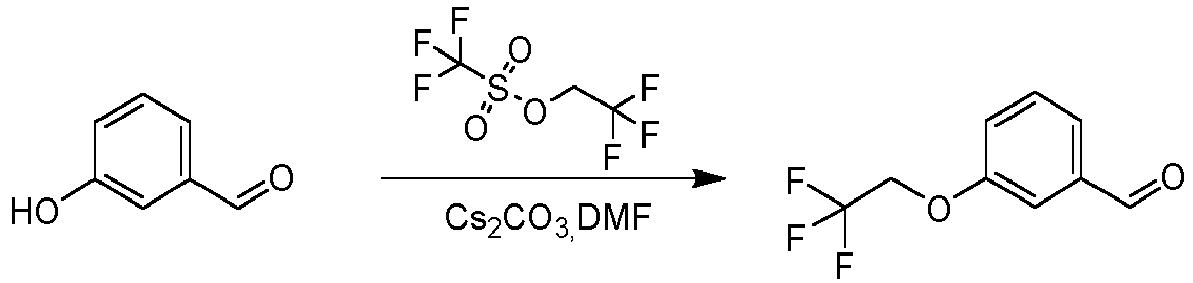
- A mixture of 3-hydroxybenzaldehyde (5 g, 40.9 mmol), 2,2,2-trifluoroethyl trifluoromethanesulfonate (10.5 g, 45 mmol) and Cs2CO3 (26.7 g, 81.9 mmol) in DMF (60 mL) was stirred at 20 °C for 2 hours. The mixture was filtered and the filter cake was washed with ethyl acetate (200 ml). The filtrate was washed with water (100 mL x2) and brine (100 mL x2), dried over Na2SO4 and concentrated. The crude was purified by column chromatograph on silica gel (20% ethyl acetate in petroleum ether) to give the product (8.0 g, 95% yield).
- 1HNMR (CDCl3 400 MHz): δ 7.58-7.51 (m, 2 H), 7.42 (s, 1 H), 7.27-7.25 (m, 1H), 4.42 (q, J =12.0 Hz, J =8.0 Hz, 2 H) .
- Step 2: Preparation of (R)-2-methyl-N-[[3-(2,2,2-triflu oro-ethoxy)phenyl]methylene]propane-2-sulfinamide

- A mixture of 3-(2,2,2-trifluoroethoxy)benzaldehyde (8.0 g, 39.2 mmol), (R)-2-methylpropane-2-sulfinamide (5.2 g, 43.1 mmol) and CuSO4 (9.4 g, 58.8 mmol) in DCE (70 mL) was stirred at 55°C for 20 hours. The mixture was filtered and the filter cake was washed with DCM (100 mL). The organic phases were concentrated and purified by column chromatograph on silica gel (11% ethyl acetate in petroleum ether) to yield the product (10.0 g, 83% yield).
- 1H NMR (CDCl3 400 MHz): δ 8.55 (s, 1 H), 7.50-7.42 (m, 3 H), 7.13 (d, J =5.2 Hz, 1 H), 4.41 (q, J =12.0 Hz, J =8.0 Hz, 2 H), 1.27 (s, 9 H).
-

- To a solution of (R)-2-methyl-N-[[3-(2,2,2-trifluoroethoxy) phenyl] methylene]propane-2-sulfinamide (10 g, 32.5 mmol) in DCM (100 mL) at 0°C was added MeMgBr (3M, 43 mL) dropwise. The resulting mixture was stirred at 0°C for 1 hour and 20°C for 3 hours. The mixture was cooled to 0°C, and sat. NH4Cl solution was added. The resulting mixture was extracted with DCM (100 mL x2). The organic phases were washed with brine (200 mL), dried over Na2SO4 and concentrated. The crude was purified by column chromatograph on silica gel (petroleum ether:ethyl acetate=1:1) to give the product (9 g, 79% yield).
- 1H NMR (CDCl3 400 MHz): δ 7.27 (d, J = 8.4 Hz, 1H), 7.01 (d, J = 8.4 Hz, 1 H), 6.93 (d, J = 2.4 Hz, 1 H), 6.83 (dd, J = 8.4 Hz, J = 2.4 Hz, 1 H), 4.56-4.54 (m, 1 H), 4.34 (dd, J = 16.4 Hz, J = 8.4 Hz, 1 H), 3.30 (br s, 1 H), 1.51 (d, J = 8.4 Hz, 3 H), 1.20 (s, 9 H). NH is not observed.
-

- To a solution of (R)-2-methyl-N-[(1S)-1-[3-(2,2,2-trifluoroethoxy)phenyl]ethyl]propane-2-sulfinamide (9 g, 27.8 mmol) in MeOH (100 mL) was added HCl/MeOH (80 mL, 4M). The resulting mixture was stirred at 20°C for 4 hours, and was concentrated to give the crude product (8 g), which was used directly without further purification.
-

-

- To a mixture of 3-(difluoromethoxy)benzaldehyde (2 g, 11.6 mmol) and 2-methylpropane-2-sulfinamide (1.7 g, 13.9 mmol) in DCE (60 mL) was added CuSO4 (9.3 g, 58.1 mmol) at 55°C under N2. The mixture was stirred at 55°C for 12 hours, filtered and the filtrated was concentrated. The crude product was purified by silica gel column eluted with petroleum ether/Ethyl acetate = 20:1-10:1 to give (R)-N-(3-(difluoromethoxy)benzylidene)-2-methylpropane-2-sulfinamide (2.5 g, 70% yield).
-

- To a solution of (R)-N-(3-(difluoromethoxy)benzylidene)-2-methylpropane-2-sulfinamide (2 g, 7.3 mmol) in DCM (30 mL) was added bromo(methyl)magnesium (3M in Et2O, 4.8 mL) dropwise at 0°C. The resulting mixture was stirred at 0°C for 1 hour and 20°C for 16 hours. The reaction was quenched with NH4Cl (sat. aq, 10 mL), and aqueous phase was extracted with ethyl acetate (30 mL ×3). The combined organic phase was washed with brine (40 mL ×2), dried with anhydrous Na2SO4, filtered, concentrated and purified by silica gel chromatography (petroleum ether/Ethyl acetate = 5:1-1:1) to afford (R)-N-((S)-1-(3-(difluoromethoxy) phenyl))-2-methylpropane-2-sulfinamide (960 mg, 45.4% yield).
-

- To a solution of (R)-N-((S)-1-(3-(difluoromethoxy)phenyl) ethyl)-2-methylpropane-2-sulfinamide (0.8 g, 2.8 mmol) in MeOH (4 mL) was added HCl/MeOH (4M, 2 mL). The resulting mixture was stirred at 25 °C for 3 hours, and the reaction was concentrated to afford (S)-1-(3-(difluoromethoxy)phenyl)ethan amine in 1.6 g crude yield, which was used directly without further purification.
-

-

- A mixture of 3-(trifluoromethyl)benzaldehyde (4.5 g, 25.8 mmol), (R)-2-methylpropane-2-sulfinamide (3.8 g, 31 mmol) and CuSO4 (6.2 g, 38.8 mmol) in DCE (20 mL) was stirred at 55°C for 24 hours. The mixture was filtered and filter was washed with DCM (100 mL). The filtrate was concentrated, and the residue was purified by column chromatography (SiO2, petroleum ether/Ethyl acetate) to afford the product in 4.6 g yield (58%). 1H NMR (CDCl3, 400 MHz): δ 8.60 (s, 1H), 8.09 (s, 1H), 7.98 (d, J = 7.6 Hz, 1H), 7.73 (d, J = 7.6 Hz, 1H), 7.59 (t, J = 7.6Hz, 1H), 1.25 (s, 9H).
-

- To a solution of (R)-2-methyl-N-(3-(trifluoromethyl)benzyli-dene)propane-2-sulfinamide (2 g, 7.2 mmol) in DCM (50 mL) at 0°C MeMgBr (3M in Et2O, 9.6 mL) was added dropwise. The resulting mixture was stirred at 0°C for 1 hour and 25°C for 3 hours. The reaction mixture was cooled to 0°C, and sat. aq. NH4Cl solution was added. The mixture was extracted with DCM (50 mL × 3). The combined organic phases were washed with brine (50 mL × 2), dried over Na2SO4 and concentrated. The residue was purified by column chromatography (SiO2, petroleum ether/Ethyl acetate) to afford the desired product (1.3 g, 61% yield).
- 1H NMR (CDCl3, 400 MHz): δ 7.40-7.65 (4H), 4.11-4.06 (m, 1H), 1.51 (d, J = 6.8 Hz, 3H), 1.17 (s, 9H). NH not observed.
-

- To a solution of (R)-2-methyl-N-((S)-1-(3-(trifluoromethyl) phenyl)ethyl)propane-2-sulfonamide (1.3 g, 4.4 mmol) in MeOH (20 mL) was added HCl/MeOH (4M, 20 mL). The resulting mixture was stirred at 25°C for 20 hours, and then concentrated to afford the product in 850 mg yield. The crude was used directly without further purification.
-

-

- A mixture of 3-(trifluoromethoxy)benzaldehyde (10.0 g, 52.60 mmol),(R)-2-methylpropane-2-sulfinamide (7.7 g, 63.1 mmol) and CuSO4 (12.6 g, 78.9 mmol) in DCE (200 mL) was stirred at 55 °C for 16 hours. The mixture was filtered and the filter cake was washed with DCM (200 mL). The filtrate was concentrated. The residue was purified by flash chromatography on silica gel (Eluent of 0~10% Ethylacetate/petroleum ether gradient) to give (R)-2-methyl-N-[[3-(trifluoromethoxy)phenyl]methylene]propane-2-sulfinamide in a yield of 12.6 g, (81.7%).
-

- To a solution of (R)-2-methyl-N-(3-(trifluoromethoxy) benzylidene)propane-2-sulfinamide (2.0 g, 6.8 mmol) in DCM (40 mL) at 0°C EtMgBr (3M in Et2O, 9.1 mL) was added drop-wise. The resulting mixture was stirred at 0°C for 1 hour and 20°C for 3 hours. The mixture was cooled to 0°C and sat.aq NH4Cl (100 mL) was added. The mixture was extracted with DCM (100 mL × 2), the phases were separated, and the organic layer was washed with brine (200 mL), dried over Na2SO4 and concentrated. The residue was purified by flash silica gel chromatography (Eluent of 0~50% Ethyl acetate/petroleum ether gradient) to yield the product (1.4 g, 62% yield).
-

- To a solution of (R)-2-methyl-N-((S)-1-(3-(trifluoromethoxy) phenyl)propyl)propane-2-sulfin amide (1.4 g, 4.2 mmol) in MeOH (40 mL) was added HCl/MeOH (4M, 20 mL). The resulting mixture was stirred at 30°C for 12 hours and then concentrated to yield the crude (S)-1-[3-(trifluoromethoxy)phenyl]propan-1-amine hydrochloride, which was used without further purification (1 g)
-

-

- To a solution of 2-bromo-1-(3-(trifluoromethoxy)phenyl) ethanone (3.5 g, 12.4 mmol) in MeOH (60 mL) was added Ag2CO3 (3.8 g, 13.6 mmol) and BF3.Et2O (2.1 g, 14.8 mmol). The mixture was stirred at 50°C for 16 hours under N2. The reaction mixture was filtered and concentrated. The residue was purified by column chromatography (SiO2, eluent of 0~5% Ethyl acetate/petroleum ether) to give 2-methoxy-1-(3-(trifluoro-methoxy)phenyl)ethanone (2.1 g, 64% yield). 1H NMR (400 MHz, CDCl3) δ 7.87 (d, J = 8.0 Hz, 1H), 7.80 (s, 1H), 7.52 (t, J = 8.4 Hz, 1H), 7.46-7.42 (m, 1H), 4.68 (s, 2H), 3.51 (s, 3H).
-

- To a solution of 2-methoxy-1-(3-(trifluoromethoxy)phenyl) ethanone (500 mg, 2.1 mmol) in THF (15 mL) was added titanium(IV)isopropoxide (910 mg, 3.2 mmol) and (R)-2-methylpropane-2-sulfinamide (336 mg, 2.8 mmol). The mixture was stirred at 50°C for 1 hour under N2. The reaction mixture was quenched with brine (40 mL) and extracted with ethyl acetate (30 mL × 2). The combined organic phases were dried over MgSO4, filtered and concentrated. The residue was purified by column chromatography (SiO2, eluent of 0~10% Ethyl acetate/petroleum ether) to give (R)-N-(2-methoxy-1-(3-(trifluoromethoxy)phenyl)ethylidene)-2-methylpropane-2-sulfin amide (160 mg, 20% yield).
-

- To a solution of (R)-N-(2-methoxy-1-(3-(trifluoromethoxy) phenyl)ethylidene)-2-methylpropane-2-sulfinamide (160 mg, 0.5 mmol) in THF (5 mL) was added L-selectride (1M in THF, 1.42 mmol, 1.42 mL) at 0°C. The mixture was stirred at 20°C for 16 hours. The reaction mixture was diluted with methanol (20 mL), and then filtered and concentrated. The residue was purified by column chromatography (SiO2, eluent of 0~10% Ethyl acetate/ petroleum ether) to give the desired product (100 mg, 59% yield).
- 1H NMR (400 MHz, DMSO-d6 ) δ 7.46-7.40 (m, 3H), 7.27-7.25 (m, 1H), 5.86 (d, J = 8.8 Hz, 1H), 5.25 (d, J = 5.6 Hz, 2H), 4.84-4.72 (m, 1H), 3.25 (s, 3H), 1.09 (s, 9H) .
-

-

-

- To a solution of ethyl 2-oxoacetate (7.5 g, 36.7 mmol) and (R)-2-methylpropane-2-sulfinamide (4.9 g, 40.4 mmol) in DCM (150 mL) was added CuSO4 (12.9 g, 80.8 mmol), and the reaction mixture was stirred at 25°C for 24 hours. The solid was filtered off, washed with ethyl acetate (50 mL) and the organic phases were combined and concentrated. The resulting residue was purified by column chromatography (silica gel, petroleum ether/ethyl acetate, 5/1) to yield the desired product (5.1 g, 67.6% yield).
-

- To a solution of ethyl-2-[(R)-tert-butylsulfinyl]iminoacetate (7 g, 34.1 mmol) and [3-(trifluoromethoxy)phenyl]boronic acid (8.4 g, 40.9 mmol) in dioxane (100 mL) was added [Rh(COD) (MeCN)2]BF4 (1.3 g, 3.4 mmol) and this mixture was stirred at 80°C for 16 hours. The product was purified by silica gel chromatography (petroleum ether: ethyl acetate=5:1) to yield 9.8 g (78%).
-

- To a solution of ethyl (2R)-2-[[(R)-tert-butylsulfinyl]amino]-2-[3-(trifluoromethoxy)phenyl] acetate (9.8 g, 26.7 mmol) in MeOH (100 mL), was added HCl/MeOH (4 M, 100 mL) and this mixture was stirred at 25°C for 2 hours, and then concentrated to afford ethyl (2R)-2-amino-2-[3-(trifluoromethoxy)phenyl] acetate (7.8 g, crude).
-

- To a mixture of ethyl (2R)-2-amino-2-[3-(trifluoromethoxy) phenyl]acetate hydrochloride (6 g, 20 mmol) in THF (150 mL), was added Boc2O (8.7 g, 40 mmol). Then NaHCO.3 (1.7 g, 20 mmol) was added to this solution and stirred at 25°C for 16 hours. This mixture was concentrated and purified by chromatography on silica (petroleum ether:ethyl acetate=10:1) to afford the product (7.2 g, 99% yield).
-

- To a suspension of LiAlH4 (1.7 g, 44 mmol) in THF (200 mL) was added ethyl (2R)-2-(tert-butoxycarbonylamino)-2-[3-(trifluoro-methoxy)phenyl]acetate (4 g, 11 mmol) in THF (25 mL), with ice-cooling. Following addition, the reaction was allowed to warm to 25°C and was stirred for 2 hours. Anhydrous magnesium sulfate was added and then one drop of water and ethyl acetate were successively added. Insoluble substances were filtered off through a pad of celite. The filtrate was concentrated and purified by chromatography on silica (SiO2; petroleum ether:ethyl acetate=5:1) (2.1 g, 59% yield).
-

- To a solution of tert-butyl N-[(1R)-2-hydroxy-1-[3-(trifluoro-methoxy)phenyl]ethyl] carbamate (1.5 g, 4.7 mmol) in MeCN (20 mL), CuI (360 mg, 1.9 mmol) was added and stirred at 25°C under N2 atmosphere for 30 minutes. Subsequently, a solution of 2,2-difluoro-2-fluorosulfonyl-acetic acid (1.7 g, 9.3 mmol) in MeCN (5 mL) was added at 45°C over 30 minutes, and the reaction was stirred at 45°C for 1 hour. This mixture was concentrated and then diluted by ethyl acetate (100 mL), filtered and concentrated to afford the desired product (1.5 g, crude).
-

- To a solution of tert-butyl N-[(1R)-2-(difluoromethoxy)-1-[3-(trifluoromethoxy)phenyl]ethyl]carbamate (1.5 g, 4 mmol) in MeOH (15 mL), was added HCl/MeOH (4M in MeOH, 30 mL) at 25°C, and the reaction was stirred at 25°C for 30 minuters. Ammonium hydroxide (30%) was added to pH=9, and this solution was concentrated and purified by chromatography on silica (SiO2; petroleum ether: ethyl acetate = 2:1) to afford (1R)-2-(difluoromethoxy)-1-[3-(trifluoromethoxy)phenyl]ethanamine (700 mg , 64% yield).
-

-

- Zn (14.9 g, 228.3 mmol) in THF (20 mL) was added TMSCl (1.9 g, 17.1 mmol) in portions. The resulting mixture was stirred at 20°C for 15 min and then refluxed. The reaction mixture was cooled to room temperature, and ethyl 2-bromoacetate (28.6 g, 171.2 mmol) was added dropwise at such a rate that the reaction boiled gently. The resulting mixture was stirred at 70°C for 1 hour and then at 20°C for 1 hour, then a solution of cyclobutanone (10 g, 142.7 mmol) in THF (5 mL) was added. The mixture was stirred at 20°C for another 2 hours. The mixture was poured into NH3.H2O (150 mL, 25%) on ice and extracted with ethyl acetate (100 mL x2). The organic layer was washed with water (200 mL x2) and brine (100 ml x2), dried over Na2SO4 and concentrated to give the product (12 g, crude).
- 1H NMR (CDCl3 400 MHz): δ 4.20-4.14 (m, 2 H), 3.69 (s, 1 H), 2.65 (s, 2 H), 2.17-2.12 (m, 2 H), 2.03-2.00 (m, 2 H), 1.78 (m, 1 H), 1.58 (m, 1H), 1.27 (t, J =7.6 Hz, 3H) .
-

- NaOH (6.3 g, 158.05 mmol) was dissolved in MeOH (150 mL) and H2O (50 mL), and ethyl 2-(1-hydroxycyclobutyl)acetate (10 g, 63.2 mmol) was added.
- The mixture was stirred at 20°C for 16 hours and then concentrated, and the residue was acidified by 2N HCl solution to pH = 2-3 and extracted with ethyl acetate (200 ml x2). The organic extract was washed with water (100 mL x2) and brine (100 mL x2), dried over Na2SO4 and concentrated to give the crude product (6 g, crude). 1H NMR (CDCl3 400 MHz): δ 2.74 (s, 2 H), 2.23-2.05 (m, 4 H), 1.81 (m, 1 H), 1.63-1.58 (m, 1 H).
-

-

- To a solution of 3,3-difluorocyclobutanone (0.2 g, 1.9 mmol), Zn (198 mg, 3 mmol) and I2 (10 mg, 0.04 mmol) in THF (13 mL) under N2, ethyl 2-bromoacetate (378 mg, 2.3 mmol) was added dropwise. The mixture was stirred at 55°C for 6 hours. H2SO4 (10%, 10 mL) was carefully added to the reaction mixture at 0°C, and the mixture was extracted with ethyl acetate (20 mL ×3). The organic extract was washed with NaHCO3 (sat.aq, 10 mL), dried over Na2SO4 and concentrated. The crude product (0.26 g) was used directly without further purification.
-

- To a solution of ethyl 2-(3,3-difluoro-1-hydroxy-cyclobutyl) acetate (0.26 g, 1.3 mmol) in MeOH (10 mL) and H2O (2 mL), NaOH (107 mg, 2.7 mmol) was added at 0° C. The mixture was stirred at 20°C for 8 hours. The reaction solution was cooled to 0°C and 1N HCl was added to the solution until pH reached 1-2. The residue was diluted with brine (10 mL) and extracted with methyl-tert-butyl ether (30 mL × 5). The combined organic extracts were dried over Na2SO4, filtered and concentrated. The crude product (0.24 g) was used without further purification.
-

-

- To a mixture of Zn (560 mg, 8.6 mmol), I2 (7 mg, 0.03 mmol) in THF (5 mL) was added ethyl 2-bromoacetate (524 mg, 3.1 mmol) and 1,1,1-trifluoro-3-methyl-butan-2-one (0.4 g, 2.9 mmol) at 15°C. The mixture was stirred at 60 °C for 6 hours. H2SO4 (10% aq, 4 mL) was added, and the mixture was extracted with ethyl acetate (10 mL x4). The combined organic phases were washed with brine (30 mL), dried over Na2SO4, filtered and concentrated to give ethyl 3-hydroxy-4-methyl-3-(trifluoromethyl)pentanoate (1 g, crude)
-

- A mixture of ethyl 3-hydroxy-4-methyl-3-(trifluoromethyl)pentanoate (1.5 g, crude) and LiOH.H2O (552 mg, 13.2 mmol) in THF (20 mL) and H2O (10 mL) was stirred at 15°C for 16 hours. The pH was adjusted to ~3 with 2M HCl, and the mixture extracted with ethyl acetate (5 mL x4). The combined organic extract was washed with brine (15 mL), dried over Na2SO4, filtered and concentrated to give 3-hydroxy-4-methyl-3-(trifluoromethyl)pentanoic acid (1.1 g, crude) as a yellow solid, which was used directly in the next step without further purification.
-

-

- To a solution 3,3,4,4-tetrafluorobutan-2-one (2.00 g, 13.88 mmol), Zn (1.0 g, 15.7 mmol) and I2 (35.2 mg, 0.14 mmol) in THF (20 mL), ethyl 2-bromoacetate (2.4 g, 14.3 mmol) was added dropwise under N2 at 20°C. The mixture was stirred at 60°C for 6 hours. The reaction mixture was cooled to 0°C, and H2SO4 (15 ml, 10% aq.) was carefully added. The mixture was extracted with ethyl acetate (80 mL × 3), and the combined organic extract was washed with sat.aq NaHCO2 (30 mL), dried over Na2SO4 and concentrated. The title compound (2.5 g, crude) was obtained and used in the next step without further purification.
-

- To a solution of ethyl 4,4,5,5-tetrafluoro-3-hydroxy-3-methyl-pentanoate (2.5 g, 10.8 mmol) in MeOH (80 mL) and H2O (25 mL), NaOH (1.1 g, 26.9 mmol) was added at 0°C. The mixture was stirred at 20°C for 8 hours and concentrated. The aqueous layer was acidified with 1N HCl aq. to pH = 1 - 2, and extracted with methyl-tert-butyl ether (30 mL × 5). The combined organic extract was dried over Na2SO4, and concentrated. The title compound was obtained (2.10 g, crude) and used without further purification.
-

-

- To a mixture of Zn (6.9 g, 104.7 mmol) and I2 (89 mg, 0.35 mmol) in THF (80 mL) was added 4,4,4-trifluorobutan-2-one (4.4 g, 34.9 mmol) and ethyl 2-bromoacetate (6.4 g, 38.4 mmol) at 15°C. The mixture was stirred at 60°C for 6 hours. The reaction mixture was cooled to 0°C and quenched with H2SO4 (100 mL, 10% aq). The mixture was extracted with ethyl acetate (15 mL × 3). The combined organic extract was washed with brine (15 mL) and dried over Na2SO4, filtered and concentrated. The product was obtained (11.00 g, crude) and was used directly without further purification.
-

- A mixture of ethyl 5,5,5-trifluoro-3-hydroxy-3-methyl-pentanoate (11 g, crude) and NaOH (4.1 g, 102.7 mmol) in H2O (150 mL) was stirred at 15°C for 16 hours. The pH was adjusted to ~2 with sat. KHSO4 at 0°C, and the mixture extracted with ethyl acetate (200 mL × 3). The combined organic extract was washed with brine (300 mL), dried over Na2SO4, filtered and concentrated to afford the product (10 g, crude)
-

-

- To a mixture of 1-(1-fluorocyclopropyl)ethanone (0.8 g, 7.8 mmol), Zn (1.5 g, 23.5 mmol) and I2 (20 mg, 0.8 mmol) in THF (15 mL) was added ethyl 2-bromoacetate (1.4 g, 8.6 mmol) dropwise at 15°C. The mixture was stirred at 65°C for 6 hours. The reaction mixture was cooled to 0°C, and H2SO4 (10% aq, 10 mL) was added dropwise. The mixture was added water (30 mL) and was extracted with ethyl acetate (20 mL × 3). The combined organic extract was washed with brine (30 mL), dried over Na2SO4, filtered and concentrated. The obtained product was used without further purification. Yield: 1.6 g, crude.
-

- A mixture of ethyl 3-(1-fluorocyclopropyl)-3-hydroxybutanoate (1.6 g, crude) and NaOH (670 mg, 16.8 mmol) in H2O (30 mL) was stirred at 15°C for 16 hours. The pH was adjusted with 10% HCl (aq) to ~2. The mixture was extracted with ethyl acetate (20 mL × 4), and the combined organic extract was washed with brine (40 mL), dried over Na2SO4, filtered and concentrated to yield the crude product, which was used directly without further purification. (1.50 g, crude.
-

-
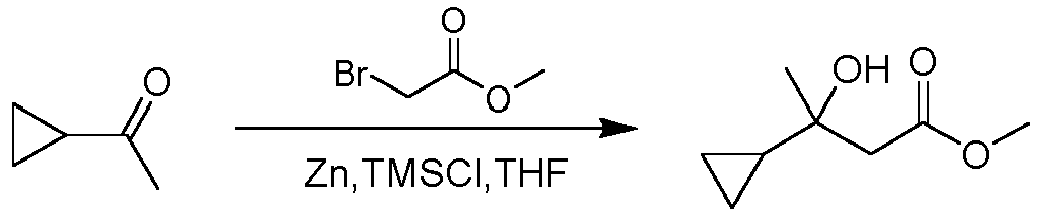
- Zn (12.4 g, 190.2 mmol) in THF (150 mL) was added TMSCl (1.3 g, 11.9 mmol), and the resulting mixture was stirred at 20 °C for 15 minutes and then heated to 70°C. The heating was stopped, and methyl 2-bromoacetate (21.8 g, 142.7 mmol) was added in dropwise at such a rate that the ether boiled gently. The resulting mixture was stirred at 70°C for 1 hour and 20°C for 1 hour, and then a solution of 1-cyclopropylethanone (10 g, 118.9 mmol) in THF (50 mL) was added. The reaction was stirred at 20°C for 16 hours. The mixture was poured onto NH3·H2O on ice (100 mL, 28%), and extracted with ethyl acetate (150 mL x2). The organic extract was washed with water (150 mL) and brine (150 mL), dried over Na2SO4 and concentrated to give the desrired product (8.9 g, crude).
-

- A mixture of crude methyl 3-cyclopropyl-3-hydroxybutanoate (8.9 g, 56.3 mmol) and LiOH·H2O (11.8 g, 281.3 mmol) in THF (100 mL) and H2O (50 mL) was stirred at 20°C for 16 hours. H2O (50 ml) was added and extracted with ethyl acetate (100 mL x2). The organic extracts were discarded. The pH of the aqueous layer was adjusted to ~5 with 2N HCl, extracted with ethyl acetate (100 mL x3) and the combined organic fractions were washed with brine (100 mLx10), dried over Na2SO4, filtered and concentrated to give the desired product in 30% overall yield (5.1 g)
- 1H NMR (400 MHz, CDCl3) δ 2.67-2.51 (m, 2H), 1.25 (s, 3H), 0.90-1.00 (m, 1H), 0.33-0.50 (m, 4H).
-

-

- Et3N (2.34 g, 23.5 mmol) and MgCl2 (1.8 g, 18.4 mmol) was added to a suspension of (3-ethoxy-3-oxo-propanoyl)oxy potassium salt (2.6 g, 15.4 mmol) in MeCN (30 mL) and stirred at 20°C for 2 hours. A pre-stirred mixture of CDI (carbonyl-diimidazole) (1.4 g, 8.8 mmol) and 1-(difluoromethyl) cyclopropane carboxylic acid (1 g, 7.4 mmol) in MeCN (20 mL) was added at 0°C and stirred at 20°C for 14 hours. The reaction mixture was diluted with H2O (30 mL) and extracted with ethyl acetate (80 mL × 2). The combined organic extracts were washed with brine (30 mL), dried over Na2SO4, filtered and concentrated. The residue was purified by flash chromatography on silica gel (Eluent of 0~10% Ethyl acetate/petroleum ether gradient). The product was obtained in 0.98 g (65%) yield.
-
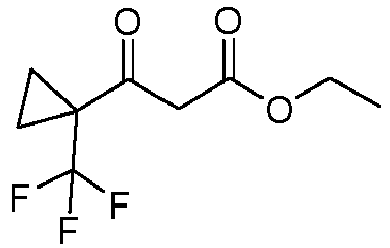
-

- Et3N (6.3 g, 62.3 mmol) and MgCl2 (4.6 g, 48.7 mmol) was added to a suspension of potassium 3-ethoxy-3-oxo-propanoate (6.9 g, 40.5 mmol) in CH3CN (25 mL) and stirred at 20°C for 2 hours. A pre-stirred mixture of carbonyl diimidazole (CDI) (3.8 g, 23.3 mmol) and 1-(trifluoromethyl)cyclopropane carboxylic acid (3 g, 19.5 mmol) in CH3CN (25 mL) was added at 0°C and stirred at 20°C for 14 hours. The mixture was poured into water (20 mL). The aqueous phase was extracted with ethyl acetate (30 mL×3). The combined organic phase was washed with brine (40 mL×2), dried with anhydrous Na2SO4, filtered and concentrated. The residue was purified by column chromatography on silica gel (petroleum ether/Ethyl acetate = 30:1-10:1) to afford the product in 3.5 g (80%) yield.
-

- A solution of (15)-1-[3-(trifluoromethoxy)phenyl]ethan amine hydrochloride (IIa) (5 g, 20.69 mmol), 4,4-dimethyl-3-oxo-pentanoic acid (3.28 g, 22.76 mmol), HATU (9.44 g, 24.83 mmol) and DIPEA (8 g, 62.1 mmol) in DCM (250 mL) was stirred at 25°C for 16 hours. The resulting mixture was washed with water (500 mL) and extracted with DCM (500 mL ×2). The organic layer was washed with brine (350 mL ×2), dried over Na2SO4 and concentrated. The residue was purified by chromatography (SiO2, petroleum ether/Ethyl acetate = 1:0 to 3:1) to afford 4,4-dimethyl-3-oxo-N-[(1S)-1-[3-(trifluoromethoxy)phenyl] ethyl]pentanamide (11.2 g, crude).
- The following intermediates were prepared by simiar methodology as Va, using the relevant intermediates
-

- Prepared from IIb (2.6 g, 10.1 mmol) and 4,4-dimethyl-3-oxo-pentanoic acid (1.6 g, 11.1 mmol).
- Yield: 2.6 g (75%).
-

- Prepared from IIc (0.8 g, 4.3 mmol) and 4,4-dimethyl-3-oxo-pentanoic acid (616 mg, 4.3 mmol)
- Yield: 1.3 g crude
-

- Prepared from IId (850 mg, 3.77 mmol) and 4,4-dimethyl-3-oxo-pentanoic acid (597 mg, 4.14 mmol).
- Yield: 1.12 g (94%)
-

- Prepared from IIe (1.04 g, 4.07 mmol) and 4,4-dimethyl-3-oxo-pentanoic acid (645 mg, 4.47 mmol).
- Yield: 1.28 g (91%).
-

- Prepared from IIb (2.89 g, 11.32 mmol) and 4-methyl-3-oxo-pentanoic acid (1.62 g).
- Yield: 2.6 g (69%).
-
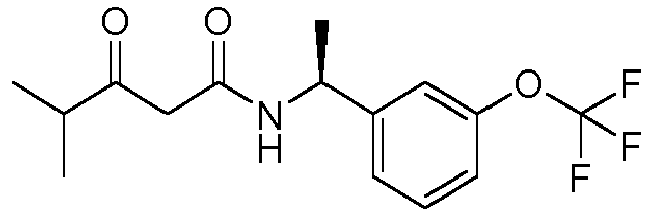
- Prepared from IIa (2.7 g, 13.16 mmol) and 4-methyl-3-oxo-pentanoic acid (1.60 g)
- Yield: 2.00 g (47%).
-

- Prepared from IIg (600 mg, 2.21 mmol) and 4,4-dimethyl-3-oxo-pentanoic acid (382 mg, 2.66 mmol)
- Yield: 520 mg (51%).
-

- Prepared from IIf (40 mg, 0.15 mmol) and 4,4-dimethyl-3-oxo-pentanoic acid (25 mg, 0.17 mmol)
- Yield: 100 mg, (94%).
-

- A mixture of IIa (557 mg, 2.30 mmol), IVa (0.95 g, 4.61 mmol), DMAP (57 mg, 0.46 mmol) and Et3N (2.33 g, 23.04 mmol) in toluene (30 mL) was degassed and purged with N2 for 3 times, then the mixture was stirred at 110 °C for 12 hours under N2. The mixture was concentrated, and the residue was purified by flash chromatography on silica gel (Eluent of 0~35% Ethyl acetate/petroleum ether gradient) to yield the desired product (0.61 g, 72% yield).
- The following were prepared by similar methodology as described for Vg, using the relevant intermediates
-

- Prepared from IVb (2 g, 8.9 mmol) and IIa (915.3 mg, 4.5 mmol)
- Yield: 1.7 g (97%).
-

- Prepared from methyl 3-(3,3-difluorocyclobutyl)-3-oxopropanoate (600 mg, 3.12 mmol) and IIa (377 mg, 1.56 mmol) .
- Yield: 470 mg, (82%).
- 1H NMR (CDCl3, 400 MHz) δ 7.39-7.35 (m, 1H), 7.26-7.23 (m, 1H), 7.15 - 7.11 (m, 2H), 5.16 - 5.08 (m, 1H), 3.44 (d, J = 2.4 Hz, 2H), 2.86 - 2.71 (m, 5H), 1.51 (d, J = 7.2 Hz, 3H).
-

-

-

- To a mixture of 4,4-dimethyl-3-oxo-N-[(1S)-1-[3-(trifluoro methoxy)phenyl]ethyl]pentanamide (Va) (5.6 g, 16.90 mmol) in MeOH (50 mL) was added NaBH4 (1.28 g, 33.8 mmol) in portions at 0°C. The mixture was stirred at 0°C for 1 hour. Water (50 mL) was added portionwise at 0°C. This reaction was repeated on the same scale twice, and the crude products from the three separate reactions were combined and worked up as follows:
- The mixture was concentrated to remove MeOH, and then extracted with ethyl acetate (100 mL ×4). The combined organic extracts were washed with brine (50 mL ×3), dried over Na2SO4, filtered and concentrated to afford 3-hydroxy-4,4-dimethyl-N-[(1S)-1-[3-(trifluoromethoxy) phenyl]ethyl] pentanamide (16.5 g, crude).
-

- 3-Hydroxy-4,4-dimethyl-N-[(1S)-1-[3-(trifluoromethoxy)phenyl] ethyl]pentanamide (27 g, 83 mmol) was separated by chromatography.
- Yield: 10.5 g
- 1H NMR (CDCl3 400 MHz): δ 7.33 (t, J = 8.0 Hz, 1H), 7.22 (d, J = 8.0 Hz, 1H), 7.05-7.20 (2H), 6.40 (br, 1H), 5.15(m, 1H), 3.64 (dd, J = 2.0 Hz, 8.4 Hz, 1H), 3.05 (br, 1H), 2.15-2.40 (m, 2H), 1.45 (d, J = 7.2 Hz, 3H), 0.88 (s, 9H).
- LC-MS: tR = 2.548 min (LCMS Method 1), m/z = 334.0 [M + H]+.
- SFC: tR = 1.89 min (SFC Method 4), de = 95%, [α]D 20 = - 71.7 (c = 0.72 g/100 mL, MeOH).
- Yield: 10.5 g
- 1H NMR (CDCl3 400 MHz): δ 7.32 (t, J = 8.0 Hz, 1H), 7.22 (d, J = 7.6 Hz, 1H), 7.13 (s, 1H), 7.10-7.07(m, 1H), 6.52 (d, J = 7.6 Hz, 1H), 5.13-5.06 (m, 1H), 3.62 (dd, J = 2.0 Hz, 8.4 Hz, 1H), 3.45-3.33 (m, 1H), 2.38-2.33 (m, 1H), 2.23-2.17 (m, 1H), 1.44 (d, J = 7.2 Hz, 3H), 0.88 (s, 9H). LC-MS: tR = 2.553 min (LCMS Method 1), m/z = 334.0 [M + H]+.
- SFC: tR = 1.87 min (SFC Method 5), de = 100%, [α]D 20 = - 42.3 (c = 0.61 g/100 mL, MeOH).
- The following examples were prepared by similar methodology as described for 1a and 1b, using the relevant intermediates:
-

-

-

-

- 3-Hydroxy-4,4-dimethyl-N-[(1S)-1-[3-(2,2,2-trifluoroethoxy)
- phenyl]ethyl]pentanamide (0.84 g, 2.52 mmol) was separated by chiral SFC.
- Yield: 0.25 g
- 1H NMR (CDCl3, 400 MHz) δ 7.30 (t, J = 7.6 Hz, 1H), 7.01 (d, J = 7.6 Hz, 1H), 6.93 (s, 1H), 6.85 (dd, J = 8.4 Hz, 2.8 Hz, 1H), 6.08 (br d, J = 5.2 Hz, 1H), 5.13 (m, 1H), 4.36 (q, J = 16.0 Hz, 8.0 Hz, 2H), 3.68 (dd, J = 10.4 Hz, 3.0 Hz, 1H), 3.24 (d, J = 3.2 Hz, 1H), 2.39 - 2.23 (m, 2H), 1.49 (d, J = 6.8 Hz, 3H), 0.93 (s, 9H) LC-MS: tR = 2.68 min (LCMS Method 2), m/z = 348.0 [M + H]+.
- SFC: tR = 1.78 min (SFC Method 1), de = 98.3%, [α]D 20 = -68.0 (c = 0.25, MeOH).
- Yield: 0.37 g
- 1H NMR (CDCl3, 400 MHz) δ7.29 (t, J = 8.0 Hz, 1H), 7.01 (d, J = 8.0 Hz, 1H), 6.94 (s, 1H), 6.84 (dd, J = 8.0, 2.4 Hz, 1H), 6.04 (m, 1H), 5.13 (m, 1H), 4.36 (q, J = 16.0 Hz, 8.0 Hz, 2H), 3.70-3.67 (m, 1H), 3.15 (d, J = 2.8 Hz, 1H), 2.40-1.96 (m, 2H), 1.50 (d, J = 7.2 Hz, 3H), 0.93 (s, 9H) LC-MS: tR = 2.543 min (LCMS Method 2), m/z = 348.0 [M + H]+.
- SFC: tR = 1.87 min (SFC Method 1), de = 92.0%, [α] D 20 = -53.3 (c = 0.21, MeOH).
-

-

-

- Prepared from Vc, 84% yield.
-

- Yield: 168 mg
- 1H NMR (CDCl3 400 MHz): δ 7.31-7.29 (m, 1H), 7.26-7.24 (m, 1H), 7.16-7.14 (m, 1H), 7.10-6.98 (m, 1H), 6.49 (t, J = 76 Hz, 1H), 6.14 (brs, 1H), 5.14-5.07 (m, 1H), 3.66 (d, J = 10.4 Hz, 1H), 3.17 (s, 1H), 2.38-2.34 (m, 1H), 2.28-2.18 (m, 1H), 1.47-1.40 (m, 3H), 0.98 (s, 9H). LC-MS: tR = 2.161 min (LCMS Method 3), m/z = 316.1 [M + H]+.
- SFC: tR = 2.15 min (SFC Method 2), de = 96.6%, [α]D 20 = -16 (c = 0.25, MeOH).
- Yield: 126 mg
- 1H NMR (CDCl3 400 MHz): δ 7.34-7.30(m, 1H), 7.16-7.12 (m, 1H), 7.04-6.97(m, 2 H), 6.31 (t, J = 76 Hz, 1 H), 6.14 (brs, 1 H), 5.12-5.06 (m, 1 H), 3.67-3.62 (m, 1 H), 3.29 (s, 1 H), 2.37-2.31 (m, 1 H), 2.26-2.19 (m, 1 H), 1.47-1.43 (m, 3H), 0.98(s, 9H).
- LC-MS: tR= 2.16 min (LCMS Method 3), m/z = 316.1 [M + H]+.
- SFC: tR = 2.42 min (SFC Method 2), de = 100%, [α]D 20 = - 57.6 (c = 0.5, MeOH).
-

-

-

- Prepared from Vd (980 mg, 87% yield).
-

- LC-MS: tR = 2.48 min (LCMS Method 1), m/z = 318.0 [M + H]+.
- SFC: tR = 1.56 min (SFC Method 3), de = 100%, [α]D 20 = - 25.5 (c = 0.19 g/100 mL, MeOH).
- 1H NMR (CDCl3 400 MHz): δ 7.54-7.45 (m, 4H), 6.25-6.23 (m, 1H), 5.20-5.13 (m, 1H), 3.69-3.65 (m, 1H), 3.24 (d, J = 3.2 Hz, 1H), 2.39-2.35 (m, 1H), 2.27-2.21 (m, 1H), 1.49 (d, J = 6.8 Hz, 3H), 0.91 (s, 9H).
- LC-MS: tR = 2.48 min (LCMS Method 1), m/z = 318.0 [M + H]+.
- SFC: tR = 1.93 min (SFC Method 3), de = 100%, [α]D 20 = - 61.4 (c = 0.57 g/100 mL, MeOH).
-

-

-

- Prepared from Ve, Yield: 1.22 g
- Step 2: Separation of (S)-3-hydroxy-4,4-dimethyl-N-((S)-1-(3-(trifluoromethoxy)phenyl)propyl)pentanamide and (R)-3-hydroxy-4,4-dimethyl-N-((S)-1-(3-(trifluoromethoxy)phenyl)propyl) pentanamide

- 1H NMR (CDCl3 400 MHz): δ 7.40-7.34 (m, 1H), 7.25-7.21 (m, 1H), 7.14-7.10 (m, 2H), 6.22-6.15 (m, 1H), 4.92 (q, J = 7.6 Hz, 1H), 3.71-3.65 (m, 1H), 3.21 (d, J = 2.8 Hz, 1H), 2.40-2.23 (m, 2H), 1.82 (q, J = 7.2 Hz, 2H), 0.94-0.90 (m, 12H).
- LC-MS: tR= 2.486 min (LCMS Method 5), m/z = 348.0 [M + H]+.
- SFC: tR = 1.775 min. (SFC Method 3), de = 98.7%, [α]D 20 = -80.0 (c = 0.31 g/100mL, MeOH).
- LC-MS: tR= 2.506 min (LCMS Method 5), m/z = 348.0 [M + H]+.
- SFC: tR = 1.609 min. (SFC Method 3) de = 98.7%, [α]D 20 = -40.0 (c = 0.27 g/100mL, MeOH).
-

-

-

- Prepared from Vl. Yield: 300 mg, (60.7%).
-

- Separated by chiral SFC.
- 1H NMR (400 MHz, CDCl3) δ 7.42 - 7.35 (m, 1H), 7.25 (d, J = 7.6 Hz, 1H), 7.17 - 7.11 (m, 2H), 5.93 (d, J = 7.2 Hz, 1H), 5.19 - 5.09 (m, 1H), 4.01 - 3.93 (m, 1H), 3.86 (d, J = 3.6 Hz, 1H), 2.62 - 2.48 (m, 3H), 2.46 - 2.13 (m, 4H), 1.50 (d, J = 6.8 Hz, 3H).
- LC-MS: tR = 2.513 min (LCMS Method 2), m/z = 368.0 [M + H]+.
- SFC: tR = 2.169 min. (SFC method 3), de = 97.4%, [α]D 20 = -42.0 (c = 2.0 mg/mL, MeOH).
- 1H NMR (400 MHz, CDCl3) δ 7.40 - 7.36 (m, 1H), 7.25 (d, J = 7.6Hz, 1H), 7.16 - 7.11 (m, 2H), 5.99 (d, J = 7.2 Hz, 1H), 5.18 - 5.09 (m, 1H), 3.98 (t, J = 7.2 Hz, 1H), 3.83 (br s, 1H), 2.61 - 2.49 (m, 3H), 2.45 - 2.12 (m, 4H), 1.50 (d, J = 6.8 Hz, 3H).
- LC-MS: tR = 2.235 min (LCMS Method 3), m/z = 368.0 [M + H]+.
- SFC: tR = 2.013 min. (SFC Method 3), de = 99.6%, [α] D 20 = -17.0 (c = 2.0 mg/mL, MeOH).
-

-

-

- Prepared from Vf.
- Yield: 0.88 g (87%)
-

- 1H NMR (CDCl3, 400 MHz) δ 7.31 (t, J = 8.0 Hz, 1H), 7.01 (d, J = 7.2 Hz, 1H), 6.92 (t, J = 2.0 Hz, 1H), 6.83 (dd, J = 8.0, 2.4 Hz, 1H), 6.08 (br d, J =7.2 Hz, 1H), 5.12 (m, 1H), 4.36 (q, J = 8.0 Hz, 2H), 3.80 - 3.74 (m, 1H), 3.36 (d, J = 3.2 Hz, 1H), 2.37 - 2.27 (m, 2H), 1.73-1.70 (m, 1H), 1.49 (d, J = 6.8 Hz, 3H), 0.94 (dd, J = 10.4, 6.8 Hz, 6H);
- LC-MS: tR = 2.531 min (LCMS Method 2), m/z = 334.0 [M + H]+.
- SFC: tR = 2.864 min (SFC Method 3), de = 99.2%, [α]D 20 = -74.0 (c = 0.20, MeOH).
- 1H NMR (CDCl3, 400 MHz) δ 7.30 (t, J = 8.0 Hz, 1H), 7.00 (d, J = 8.0 Hz, 1H), 6.92 (t, J = 2.0 Hz, 1H), 6.83 (dd, J = 8.0, 2.4 Hz, 1H), 6.14 (br d, J = 6.8 Hz, 1H), 5.11 (m, 1H), 4.36 (q, J = 16.4, 8.0 Hz, 2H), 3.79 - 3.75 (m, 1H), 3.34 (d, J = 3.2 Hz, 1H), 2.38- 2.25 (m, 2H), 1.73 - 1.62 (m, 1H), 1.49 (d, J = 7.2 Hz, 3H), 0.94 (dd, J = 10.0, 6.8 Hz, 6H);
- LC-MS: tR = 2.543 min (LCMS Method 2), m/z = 334.0 [M + H]+.
- SFC: tR = 3.071 min (SFC Method 3), de = 99.7%, [α]D 20 = -47.0 (c = 0.20, MeOH).
-

-

-

- Prepared from Vg.
- Yield: 0.58 g
-

- 1H NMR (CDCl3 400 MHz): δ 7.40-7.34 (m, 1H), 7.26-7.22 (m, 1H), 7.16-7.11 (m, 2H), 6.11 (br d, J = 7.2 Hz, 1H), 5.88 (t, J = 58.4 Hz, 1H), 5.12 (quin, J = 7.2 Hz, 1H), 3.91 (d, J = 3.2 Hz, 1H), 3.81-3.75 (m, 1H), 2.62-2.48 (m, 2H), 1.49 (d, J = 7.2 Hz, 3H), 0.87-0.76 (m, 2H), 0.76-0.62 (m, 2H).
- LC-MS: tR = 2.448 min (LCMS Method 1), m/z = 368.0 [M + H]+.
- SFC: tR = 2.282 min. (SFC Method 3), de = 97.9%, [α]D 20 = -62.0 (c = 0.27 g/100mL, MeOH).
- 1H NMR (CDCl3 400 MHz): δ 7.40-7.34 (m, 1H), 7.24 (d, J = 7.6 Hz, 1H), 7.17-7.10 (m, 2H), 6.06 (br d, J = 7.6 Hz, 1H), 5.84 (t, J = 58.4 Hz, 1H), 5.12 (quin, J = 7.2 Hz, 1H), 3.86-3.79 (m, 2H), 2.55 (d, J = 5.6 Hz, 2H), 1.50 (d, J = 6.8 Hz, 3H), 0.83-0.75 (m, 2H), 0.74-0.66 (m, 2H). LC-MS: tR = 2.467 min (LCMS Method 1), m/z = 368.0 [M + H]+.
- SFC tR= 1.960 min. (SFC Method 3), de = 96.3%, [α]D 20 = -54.4 (c = 0.25 g/100 mL, MeOH).
-

-

-

- Prepared from Vh and used directly in the next step.
-

- The crude product from step 1 was separated by chiral SFC to yield the desired products.
- 1H NMR (DMSO-d 6 400 MHz): δ 8.37 (d, J = 7.6 Hz, 1H), 7.43-7.39 (m, 1H), 7.31-7.29 (m, 1H), 7.23 (s, 1H), 7.18-7.16 (m, 1H), 5.21 (d, J = 5.2 Hz, 1H), 4.96-4.88 (m, 1H), 3.85-3.75 (m, 1H), 2.35-2.25 (m, 2H), 1.30 (d, J = 7.2 Hz, 3H), 0.85-0.77 (m, 4H).
- LC-MS: tR = 2.626 min (LCMS Method 2), m/z = 386.0 [M + H]+.
- SFC: tR = 2.010 min. (SFC Method 3), de = 99.9%, [α] D 20 = -56.0 (c = 0.01 g/100 mL, MeOH).
- 1H NMR (DMSO-d 6 400 MHz): δ 8.36 (d, J = 8.0 Hz, 1H), 7.42-7.38 (m, 1H), 7.32 (d, J = 8.0 Hz, 1H), 7.25 (s, 1H), 7.17-7.15 (m, 1H), 5.20 (d, J = 5.2 Hz, 1H), 4.95-4.91 (m, 1H), 3.75-3.85 (m, 1H), 2.25-2.35 (m, 2H), 1.30 (d, J = 6.8 Hz, 3H), 0.80-0.79 (m, 4H).
- LC-MS: tR = 2.649 min (LCMS Method 2), m/z = 386.0 [M + H]+.
- SFC: tR = 1.615 min. (SFC Method 3), de = 95.7%, [α]D 20 = -46.0 (c = 0.01 g/100 mL, MeOH).
-

-

-

- Prepared from Vi. Yield: 1.80 g (72%)
-

- 1H NMR (CDCl3, 400 MHz) δ 7.37 (t, J = 8.0 Hz, 1 H), 7.27-7.21 (m, 1 H), 7.16-7.11(m, 2H), 6.15 (d, J = 6.8 Hz, 1 H), 5.16 (quin, J = 6.8 Hz, 1 H), 3.83-3.74 (m, 1 H), 3.26 (d, J = 3.2 Hz, 1 H), 2.37 (dd, J = 15.2, 3.2 Hz, 1 H), 2.31 (dd, J = 15.2, 8.8 Hz, 1 H), 1.74-1.68 (m, 1 H), 1.50 (d, J = 6.8 Hz, 3 H), 0.95 (d, J = 6.8 Hz, 3 H), 0.93 (d, J = 6.8 Hz, 3 H).
- LC-MS: tR= 2.629 min (LCMS Method 2), m/z = 320.0 [M + H]+.
- SFC: tR = 2.404 min (SFC Method 13), de = 98.6%, [α]D 20 = -80.0 (c = 0.475 g/100 mL, MeOH).
- 1H NMR (CDCl3, 400 MHz) δ 7.37 (t, J = 7.6 Hz, 1 H), 7.28-7.23 (m, 1 H), 7.16 (s, 1 H), 7.14-7.11(m, 1H), 6.19 (d, J = 6.8 Hz, 1 H), 5.15 (quin, J = 7.2 Hz, 1 H), 3.80-3.74 (m, 1 H), 3.20 (d, J = 3.6 Hz, 1 H), 2.38 (dd, J = 14.8, 2.4 Hz, 1 H), 2 . 30 (dd, J = 14.8, 9.2 Hz, 1 H), 1.73-1.66 (m, 1 H), 1.49 (d, J = 6.8 Hz, 3 H), 0.95 (d, J = 6.8 Hz, 3 H), 0.93 (d, J = 6.8 Hz, 3 H). LC-MS: tR = 2.654 min (LCMS Method 2), m/z = 320.0 [M + H]+.
- SFC: tR = 1.979 min (SFC Method 13), de = 100%, [α]D 20 = -52.0 (c = 0.53 g/100 mL, MeOH).
-

-

-

- Prepared from Vj. Yield = 350 mg, (96%)
-

- 1H NMR (CDCl3 400 MHz): δ 7.39 (t, J = 8.0 Hz, 1H), 7.29-7.26 (m, 1H), 7.20 (s, 1H), 7.16 (d, J = 8.0 Hz, 1H), 6.65 (d, J = 7.6 Hz, 1H), 6.22 (t, J = 74.0 Hz, 1H), 5.34-5.30 (m, 1H), 4.18-4.09 (m, 2H), 3.69 (d, J = 10.8 Hz, 1H), 2.91 (s, 1H), 2.45-2.43 (m, 1H), 2.34-2.27 (m, 1H), 0.93 (s, 9H).
- LC-MS: tR = 2.471 min (LCMS Method 5), m/z =400.0 [M + H]+.
- SFC: tR = 1.935 min (SFC Method 14), de = 98.2%, [α]D 20 = -2.4 (c = 1.0 g/100 mL, MeCN).
- 1H NMR (DMSO-d6 400 MHz): δ 8.54 (d, J = 8.4 Hz, 1H), 7.49 (d, J = 8.0 Hz, 1H), 7.41 (d, J = 8.0 Hz, 1H), 7.39 (s, 1H), 7.28 (d, J = 8.0 Hz, 1H), 6.67 (t, J = 76.0 Hz, 1H), 5.21-5.18 (m, 1H), 4.67 (s, 1H), 4.04-3.98 (m, 2H), 3.53 (d, J = 10.2 Hz, 1H), 2.31-2.26 (m, 1H), 2.19-2.12 (m, 1H), 0.82 (s, 9H).
- LC-MS: tR = 2.496 min (LCMS Method 5), m/z =400.0 [M + H]+.
- SFC: tR = 2.461 min (SFC Method 14), de = 97.1%, [α]D 20 = -11.2 (c = 1.0 g/100 mL, MeCN).
-

-

-

- Prepared from Vk. Yield: 84 mg, (60%).
-

- 1H NMR (CDCl3 400 MHz): δ 7.35 (t, J = 8.0 Hz, 1H), 7.27-7.26 (m, 1H), 7.20 (s, 1H), 7.12 (d, J = 7.6 Hz, 1H), 6.66 (d, J = 7.2 Hz, 1H), 5.18-5.14 (m, 1H), 3.70-3.60 (m, 3H), 3.36(s, 3H), 2.44 (d, J = 14.8 Hz, 1H), 2.25-2.33 (m, 1H),0.93 (s, 9H).
- LC-MS: tR = 2.410 min (LCMS Method 3), m/z =364.0 [M + H]+.
- SFC: tR = 1.889 min (SFC Method 16), de = 100%, [α]D 20 = -0.4 (c = 1.0 g/100 mL, MeCN).
- 1H NMR (CDCl3 400 MHz): δ 7.36 (t, J = 8.0 Hz, 1H), 7.27-7.25 (m, 1H),7.18 (s, 1H), 7.12 (d, J = 7.6 Hz, 1H), 6.56 (d, J = 7.2 Hz, 1H), 5.20-5.15 (m, 1H), 3.69-3.60 (m, 3H), 3.40 (s, 1 H), 3.36 (s, 3H), 2.44 (d, J = 14.8 Hz, 1H), 2.25-2.33 (m, 1H), 0.93 (s, 9H).
- LC-MS: tR = 2.523 min (LCMS Method 1), m/z =364.0 [M + H]+.
- SFC: tR = 2.106 min (SFC Method 16), de = 98.2%, [α]D 20 = -2.7 (c = 1.0 g/100 mL, MeCN).
-

-

- A mixture of (15)-1-[3-(trifluoromethoxy)phenyl]ethanamine hydrochloride (IIa) (291 mg, 1.20 mmol), 2-(3,3-difluoro-1-hydroxy-cyclobutyl)acetic acid (IIIb) (0.22 g, 1.32 mmol), HATU (549 mg, 1.44 mmol) and DIPEA (467 mg, 3.6 mmol) in DCM (15 mL) was stirred at 20 °C for 16 hours. The mixture was washed with water (40 mL × 2) and extracted with DCM (40 mL). The organic layer was washed with brine (10 mL × 2), dried over Na2SO4 and concentrated. The residue was purified by flash chromatography on silica gel (Eluent of 0~35% Ethyl acetate/petroleum ether gradient) to give the product (0.2 g, 47% yield).
- 1H NMR (CDCl3, 400 MHz): δ 7.41-7.37 (m, 1H), 7.26-7.23 (m, 1H), 7.18-7.13 (m, 2H), 5.93 (br d, J = 6.8 Hz, 1H), 5.15 (quin, J = 7.2 Hz, 1H), 5.01 (br s, 1H), 2.84-2.42 (m, 6H), 1.53 (d, J = 6.8 Hz, 3H).
- LC-MS: tR = 2.53 min (LCMS Method 2), m/z = 354.0 [M + H]+.
- HPLC: tR = 13.3 min. (Chiral HPLC Method 1), de = 100%. [α]20 D = -51.1 (c = 0.23 g/100 mL, MeOH).
- The following examples were prepared by similar methodology to Example 5, using the relevant staring materials:
-

-

- Prepared from IIb (5.0 g, 22.81 mmol), and IIIa (3.3 g, 25.09 mmol).
- Yield: 5.2 g, (45%).
- 1H NMR (CDCl3, 400 MHz): δ 7.29 (t, J =8.0 Hz, 1 H), 6.99 (d, J =7.6 Hz, 1 H), 6.90 (s, 1 H), 6.83 (dd, J =8.4 Hz, J =2.4 Hz, 1 H), 6.25 (d, J =6.8 Hz, 1 H), 5.14-5.07 (m, 1 H), 4.35 (q, J =8.0 Hz, 2 H), 4.14 (s, 2 H), 2.53 (s, 2 H), 2.15-1.99 (m, 4 H), 1.76 (m, 1 H), 1.55 (m, 1 H), 1.48(d, J =6.8 Hz, 3H).
- LC-MS: tR = 2.49 min (LCMS Method 2), m/z = 332.0 [M + H]+.
- SFC: tR = 2.67 min (SFC Method 3), de = 96.9%, [α]D 20 = -69.0 (c = 0.1, MeOH).
-

-

-

- Prepared from IIb and IIIc. Yield: 0.65 g, (crude). The crude was used directly without purification.
-

- Separated by by flash silica gel chromatography (Eluent of 0~15% Ethyl acetate/petroleum ether gradient).
- 1H NMR (CDCl3, 400 MHz): δ 7.32 (t, J = 8.0 Hz, 1H), 7.00 (d, J = 7.6 Hz, 1 H), 6.91 (d, J = 2.0 Hz, 1 H), 6.85 (dd, J = 8.0, 2.4 Hz, 1 H), 6.32 (s, 1 H), 5.99 (d, J = 7.6 Hz, 1 H). 5.15 - 5.07 (m, 1 H), 4.36 (q, J = 8.0 Hz, 2 H), 2.45 (d, J = 15.2 Hz, 1 H), 2.34 (d, J = 15.2 Hz, 1 H), 2.13-2.06 (m, 1 H), 1.50 (d, J = 6.8 Hz, 3 H), 1.03 (d, J = 6.8 Hz, 3 H), 0.97 (d, J = 6.8 Hz, 3 H).
- LC-MS: tR = 2.883 min (LCMS Method 4), m/z = 402.0 [M + H]+.
- SFC: tR = 2.454 min. (SFC Method 6), de = 100%, [α]D 20 = -43.5 (c = 0.0058 g/mL, MeOH).
- 1H NMR (CDCl3, 400 MHz): δ 7.32 (t, J = 8.0 Hz, 1 H), 7.00 (d, J = 7.6 Hz, 1 H), 6.91 - 6.84 (m, 2 H), 6.33 (s, 1 H), 5.90 (d, J = 7.6 Hz, 1 H), 5.19 - 5.10 (m, 1 H), 4.35 (q, J = 8.4Hz, 2 H), 2.51 (d, J = 14.8 Hz, 1 H), 2.35 (d, J = 14.8 Hz, 1 H), 2.15 - 2.06 (m, 1 H), 1.52 (d, J = 7.2 Hz, 3 H), 1.05 (d, J = 6.8 Hz, 3 H), 0.98 (d, J = 6.8 Hz, 3 H).
- LC-MS: tR = 2.834 min (LCMS Method 6), m/z = 402.0 [M + H]+.
- SFC: tR = 2.262 min. (SFC Method 7) de = 99.8%, [α]D 20 = -37.1 (c = 0.0034 g/mL, MeOH).
-

-

- Prepared from IIa and 4,4,4-trifluoro-3-hydroxy-3-(trifluoromethyl)butanoic acid. Yield: 650 mg, (63%) 1H NMR (DMSO-d6 400 MHz) : δ 9.14 (d, J = 7.2 Hz, 1H), 8.45 (s, 1H), 7.44 (t, J = 8.0 Hz, 1H), 7.32 (d, J = 7.6 Hz, 1H), 7.24 (s, 1H),7.21 (d, J = 8.4 Hz, 1H), 5.01-4.93 (m, 1H), 2.89 (s, 2H), 1.34 (d, J = 6.8 Hz, 3H) .
- LC-MS: tR = 2.850 min (LCMS Method 4), m/z = 413.9 [M + H]+.
- Chiral HPLC: tR = 15.61 min, (HPLC Method 2), de = 98.4%, [α]D 20 = -41.1 (c = 0.185 g/100 mL, MeOH).
-

-

-

- Prepared from IIa and IIId. Yield: 1 g (53%)
-

- The diastereomers were separated by chiral SFC.
- 1H NMR (CDCl3 400 MHz): δ 7.42 - 7.36 (m, 1H), 7.24 (d, J = 7.6 Hz, 1H), 7.17 - 7.12 (m, 2H), 6.28 - 5.97 (m, 2H), 5.93 (br d, J = 6.0 Hz, 1H), 5.16 (quin, J = 6.8 Hz, 1H), 2.69 (d, J = 15.2 Hz, 1H), 2.37 (d, J = 15.2 Hz, 1H), 1.53 (d, J = 6.8 Hz, 3H), 1.40 (s, 3H).
- LC-MS: tR = 2.759 min (LCMS Method 2), m/z = 392.0 [M + H]+.
- SFC: tR = 1.550 min. (SFC Method 15), de = 100%, [α]D 20 = -50.5 (c = 0.19 g/100 mL, MeOH).
- 1H NMR (CDCl3 400 MHz): δ 7.44 - 7.36 (m, 1H), 7.26 (d, J = 8.0 Hz, 1H), 7.19 - 7.12 (m, 2H), 6.33 - 6.01 (m, 2H), 5.91 (br d, J = 6.8 Hz, 1H), 5.16 (quin, J = 6.8 Hz, 1H), 2.70 (d, J = 15.2 Hz, 1H), 2.35 (d, J = 15.2 Hz, 1H), 1.52 (d, J = 6.8 Hz, 3H), 1.35 (s, 3H).
- LC-MS: tR = 2.782 min (LCMS Method 2), m/z = 392.0 [M + H]+.
- SFC: tR = 1.329 min. (SFC Method 15), de = 100%, [α]D 20 = -48.6 (c = 0.21 g/100 mL, MeOH).
-

-

- Step 1: Preparation of 5,5,5-trifluoro-3-hydroxy-3-methyl-N-((S)-1-(3-(trifluoromethoxy)phenyl)ethyl)pentanamide

- Prepared from IIa and IIIe. Yield: 1g, (43%)
-

- Separated by by flash chromatography on silica gel (Eluent of 0 ~ 31% Ethyl acetate/petroleum ether gradient).
- 1H NMR (CDCl3 400 MHz): δ 7.42 - 7.36 (m, 1H), 7.24 (d, J = 8.0 Hz, 1H), 7.17 - 7.12 (m, 2H), 5.98 (br d, J = 6.8 Hz, 1H), 5.15 (quin, J = 6.8 Hz, 1H), 5.00 (s, 1H), 2.54 - 2.44 (m, 2H), 2.44 - 2.31 (m, 2H), 1.51 (d, J = 7.2 Hz, 3H), 1.38 (s, 3H).
- LC-MS: tR = 2.666 min (LCMS Method 2), m/z = 374.0 [M + H]+.
- SFC: tR = 1.277 min. (SFC Method 8), de = 100%, [α]D 20 = -51.3 (c = 0.23 g/100mL, MeOH).
- 1H NMR (CDCl3 400 MHz): δ 7.42 - 7.36 (m, 1H), 7.25 (d, J = 8.0 Hz, 1H), 7.17 - 7.12 (m, 2H), 5.96 (br d, J = 7.2 Hz, 1H), 5.16 (quin, J = 6.8 Hz, 1H), 4.98 (s, 1H), 2.57 - 2.36 (m, 4H), 1.52 (d, J = 6.8 Hz, 3H), 1.36 (s, 3H) .
- LC-MS: tR = 2.674 min (LCMS Method 2), m/z = 374.0 [M + H]+.
- SFC: tR = 1.197min. (SFC Method 8), de = 93.4%, [α]D 20 = -43.2 (c = 0.19 g/100mL, MeOH).
-
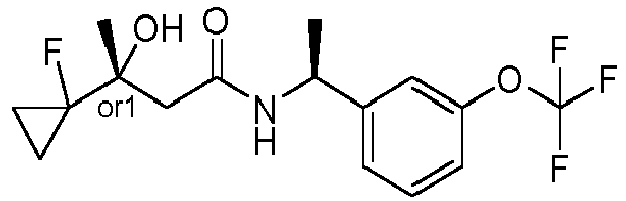
-
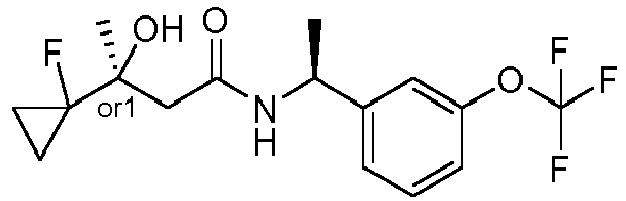
-

- Prepared from IIa and IIIf. The crude was used directly in the next step
-

- Separated by flash chromatography on silica gel (Eluent of 0~30% Ethyl acetate/petroleum ether gradient).
- 1H NMR (CDCl3 400 MHz) : δ 7.37 (t, J = 8.0 Hz, 1 H), 7.27-7.24 (m, 1 H), 7.17-7.12 (m, 2 H), 6.11 (br s, 1 H), 5.18-5.10 (m, 1 H), 5.02 (s, 1 H), 2.61 (dd, J = 14.4, 2.4 Hz, 1 H), 2.46 (dd, J = 14.4, 1.6 Hz, 1 H), 1.51 (d, J = 7.2 Hz, 3 H), 1.33 (s, 3 H), 0.78-0.68 (m, 3 H), 0.52-0.50 (m, 1 H).
- LC-MS: tR = 2.359 min (LCMS Method 3), m/z = 350.0 [M + H]+.
- SFC: tR = 2.027 min. (SFC Method 9), de = 93.9%, [α]D 20 = -48.3 (c = 0.24 g/100mL, MeOH).
- 1H NMR (CDCl3 400 MHz): δ 7.38 (t, J = 8.0 Hz, 1 H), 7.27-7.23 (m, 1 H), 7.15-7.12 (m, 2 H), 6.06 (d, J = 7.2 Hz, 1 H), 5.19-5.11 (m, 1 H), 4.99 (s, 1 H), 2.62 (dd, J = 14.4, 2.0 Hz, 1 H), 2.47 (d, J = 1.6 Hz, 1 H), 2.43 (d, J = 1.6 Hz, 1 H), 1.51 (d, J = 7.2 Hz, 3 H), 1.33 (s, 3 H), 0.97-0.87 (m, 1 H), 0.85-0.81 (m, 3 H). LC-MS: tR = 2.655 min (LCMS Method 2), m/z = 350.0 [M + H]+.
- SFC: tR = 1. 937 min. (SFC Method 9), de = 98.7%, [α]D 20 = -64.4 (c = 0.27 g/100mL, MeOH).
-

- Prepared from IIa and 2-(1-hydroxycyclopentyl)acetic acid. Yield: 30 mg, (12.8%).
- 1H NMR (400 MHz, CDCl3) δ 7.37 (t, J = 8.0 Hz, 1H), 7.26-7.25 (m, 1H), 7.19 (s, 1H), 7.16-7.11 (m, 1H), 6.66 (br d, J = 7.2 Hz, 1H), 5.21-5.15 (m, 1H), 3.82 (s, 1H), 3.70-3.60 (m, 2H), 3.37 (s, 3H), 2.59-2.49 (m, 2H), 1.86-1.81 (m, 4H), 1.59-1.56 (m, 4H).
- LC-MS: tR = 2.481 min (LCMS Method 2), m/z = 362.0 [M + H]+,
- SFC: tR = 2.33 min. (SFC Method 10), de = 100%, [α]D 20 = -44.0, (c = 1 mg/mL, MeOH).
-

-

-

- Prepared from IIb and IIIg. Yield: 3.7 g, (30.9%)
-

- Separated by chiral SFC.
- 1H NMR (400 MHz, DMSO-d6) δ 8.32 (d, J = 8.0 Hz, 1H), 7.28 (t, J = 8.0 Hz, 1H), 7.04-6.98 (m, 2H), 6.93-6.90 (m, 1H), 4.97-4.91 (m, 1H), 4.73 (q, J = 8.8 Hz, 2H), 4.61 (s, 1H), 2.37-2.25 (m, 2H), 1.34 (d, J = 7.2 Hz, 3H), 1.10 (s, 3H), 0.87-0.84 (m, 1H), 0.30-0.09 (m, 4H).
- LC-MS: tR = 2.629 min (LCMS Method 2), m/z = 328.0 [M + H-18]+.
- SFC: tR = 3.154 min (SFC Method 11), de = 99.7%, [α]D 20 = -62.0 (c = 2 mg/mL, MeOH)
- 1H NMR (400 MHz, DMSO-d6) δ 8.19 (br d, J = 8.0 Hz, 1H), 7.12 (t, J = 8.0 Hz, 1H), 6.87-6.79 (m, 2H), 6.77-6.74 (m, 1H), 4.81-4.73 (m, 1H), 4.57 (q, J = 8.8 Hz, 2H), 4.42 (s, 1H), 2.19-2.08 (m, 2H), 1.17 (d, J = 6.8 Hz, 3H), 0.94 (s, 3H), 0.73-0.64 (m, 1H), 0.19-0.00 (m, 4H) .
- LC-MS: tR = 2.643 min (LCMS Method 2), m/z = 328.0 [M + H-18]+.
- SFC: tR = 2.570 min. (SFC Method 11), de = 97.0%, [α]D 20 = -58.0 (c = 2 mg/mL, MeOH)
-

-

-

- Prepared from IIb and 4,4,4-trifluoro-3-hydroxy-3-methyl-butanoic acid. Yield: 6.67 g, (73%)
- Step 2: Separation of (R)-4,4,4-trifluoro-3-hydroxy-3-methyl-N-((S)-1-(3-(2,2,2-trifluoroethoxy))ethyl)butanamide and (S)-4,4,4-trifluoro-3-hydroxy-3-methyl-N-((S)-1-(3-(2,2,2-trifluoro ethoxy)phenyl)ethyl)butanamide

- 1H NMR (CDCl3, 400 MHz) δ 7.32 (t, J = 8.0 Hz, 1H), 6.99 (d, J = 7.8 Hz, 1H), 6.92 - 6.88 (m, 1H), 6.88 - 6.83 (m, 1H), 5.99 (br d, J = 6.8 Hz, 1H), 5.84 (s, 1H), 5.12 (quin, J = 7.2 Hz, 1H), 4.35 (q, J = 8.0 Hz, 2H), 2.51 (dd, J = 53.2, 15.2 Hz, 2H), 1.51 (d, J = 7.2 Hz, 3H), 1.41 (s, 3H); LC-MS: tR = 2.732 min (LCMS Method 2), m/z = 374.0 [M + H]+.
- SFC: tR = 1.721 min (SFC Method 12), de = 99.6%, [α]D20 = -51.0 (c = 0.20, MeOH).
- 1H NMR (CDCl3, 400 MHz) δ7.33 (t, J = 8.0 Hz, 1H), 7.00 (d, J = 7.2 Hz, 1H), 6.93 - 6.90 (m, 1H), 6.88 - 6.83 (m, 1H), 5.98 - 5.91 (m, 1H), 5.91 (s, 1H), 5.12 (quin, J = 7.2 Hz, 1H), 4.36 (q, J = 8.0 Hz, 2H), 2.50 (dd, J = 57.6, 14.8 Hz, 2H), 1.51 (d, J=6.8 Hz, 3H), 1.39 (s, 3H);
- LC-MS: tR = 2.737 min (LCMS Method 2), m/z = 374.0 [M +
- H]+.
- SFC: tR = 1.904 min (SFC Method 12), de = 100%, [α]D 20 = -57.1 (c = 0.21, MeOH).
- The invention is further described by reference to the followed numbered paragraphs:
- 1. A compound of Formula I

- R1 is selected from the group consisting of C1-C6 alkyl, CF3, CH2CF3, CF2CHF2, C3-C8 cycloalkyl, wherein said C3-C8 cycloalkyl may be substituted with 1 or 2 F, CHF2 or CF3, and R2 is H, C1-C6 alkyl or CF3;
or - R1 and R2 combine to form C3-C5 cycloalkyl optionally substituted with 1 or 2 F, CHF2 or CF3;
- R3 is C1-C3 alkyl or CH2O-C1-3 alkyl, said C1-C3 alkyl or CH2O-C1-3 alkyl may optionally substituted with 1 or 2 F;
- R4 is selected from the group consisting of OCF3, OCH2CF3 or OCHF2.
- R1 is selected from the group consisting of C1-C6 alkyl, CF3, CH2CF3, CF2CHF2, C3-C8 cycloalkyl, wherein said C3-C8 cycloalkyl may be substituted with 1 or 2 F, CHF2 or CF3, and R2 is H, C1-C6 alkyl or CF3;
- 2. The compound of according to paragraph 1, wherein R4 is OCF3 or
OCHF2. - 3. The compound according to any of the previous paragraphs, wherein R2 is H or CH3
- 4. The compound according to any of the previous paragraphs, wherein R3 is CH2O-C1-3 alkyl.
- 5. The compound according to any of the previous paragraphs, wherein R1 is C3-C4 cycloalkyl optionally substituted with 1 or 2 F, CHF2 or CF3.
- 6. The compound according to any of the previous paragraphs, wherein R1 is t-butyl and R2 is H and R4 is OCF3, OCH2CF3, OCHF2 or CF3.
- 7. The compound according to any of the previous paragraphs, wherein R1 and R2 combine to form cyclobutyl optionally substituted with 1 or 2 F and R4 is OCF3, OCH2CF3, OCHF2 or CF3.
- 8. The compound of paragraph 1, wherein the compound is selected from the group consisting of:
- (S)-3-hydroxy-4,4-dimethyl-N-[(1S)-1-[3-(trifluoromethoxy)phenyl]ethyl]pentanamide,
- R)-3-hydroxy-4,4-dimethyl-N-[(1S)-1-[3-(trifluoromethoxy)phenyl]ethyl]pentanamide,
- (S)-3-hydroxy-4,4-dimethyl-N-((S)-1-(3-(2,2,2-trifluoroethoxy)phenyl) ethyl)pentanamide,
- (R)-3-hydroxy-4,4-dimethyl-N-((S)-1-(3-(2,2,2-trifluoroethoxy)phenyl) ethyl)pentanamide,
- (S)-N-((S)-1-(3-(difluoromethoxy)phenyl)ethyl)-3-hydroxy-4,4-dimethylpentanamide,
- (R)-N-((S)-1-(3-(difluoromethoxy)phenyl)ethyl)-3-hydroxy-4,4-dimethylpentanamide,
- (S)-3-hydroxy-4,4-dimthyl-N-((S)-1-(3-(trifluoromethyl)phenyl)ethyl)pentanamide
- (R)-3-hydroxy-4,4-dimethyl-N-((S)-1-(3-(trifluoromethyl)phenyl)ethyl)pentanamide,
- (S)-3-hydroxy-4,4-dimethyl-N-((S)-1-(3-(trifluoromethoxy)phenyl)propyl)pentanamide,
- (R)-3-hydroxy-4,4-dimethyl-N-((S)-1-(3-(trifluoromethoxy)phenyl)propyl)pentanamide,
- (S)-3-(3,3-difluorocyclobutyl)-3-hydroxy-N-((S)-1-(3-(trifluoromethoxy)phenyl)ethyl)propanamide,
- (R)-3-(3,3-difluorocyclobutyl)-3-hydroxy-N-((S)-1-(3-(trifluoromethoxy)phenyl)ethyl)propanamide,
- (S)-3-hydroxy-4-methyl-N-((S)-1-(3-(2,2,2-trifluoroethoxy)phenyl)ethyl)pentanamide,
- (R)-3-hydroxy-4-methyl-N-((S)-1-(3-(2,2,2-trifluoroethoxy)phenyl)ethyl)pentanamide,
- (S)-3-(1-(difluoromethyl)cyclopropyl)-3-hydroxy-N-((S)-1-(3-(trifluoro-methoxy)phenyl)ethyl)propanamide,
- (R)-3-(1-(difluoromethyl)cyclopropyl)-3-hydroxy-N-((S)-1-(3-(trifluoromethoxy)phenyl)ethyl)propanamide,
- (R)-3-hydroxy-N-((S)-1-(3-(trifluoromethoxy)phenyl)ethyl)-3-(1-(trifluoromethyl)cyclopropyl)propanamide,
- (S)-3-hydroxy-N-((S)-1-(3-(trifluoromethoxy)phenyl)ethyl)-3-(1-(trifluoromethyl)cyclopropyl)propanamide,
- (S)- 3-hydroxy-4-methyl-N-((S)-1-(3-(trifluoromethoxy)phenyl)ethyl)pentanamide,
- (R)-3-hydroxy-4-methyl-N-((S)-1-(3-(trifluoromethoxy)phenyl)ethyl)pentanamide,
- N-((R)-2-(difluoromethoxy)-1-(3-(trifluoromethoxy)phenyl)ethyl)-3-(R)-hydroxy-4,4-dimethylpentanamide,
- N-((R)-2-(difluoromethoxy)-1-(3-(trifluoromethoxy) phenyl)ethyl)-3-(S)-hydroxy-4,4-dimethylpentanamide,
- (S)-3-hydroxy-N-((R)-2-methoxy-1-(3-(trifluoromethoxy)phenyl)ethyl)-4,4-dimethylpentanamide, (R)-3-hydroxy-N-((R)-2-methoxy-1-(3-(trifluoromethoxy) phenyl)ethyl)-4,4-dimethylpentanamide,
- (S)-2-(3,3-difluoro-1-hydroxycyclobutyl)-N-(1-(3-(trifluoromethoxy)phenyl)ethyl)acetamide,
- (S)-2-(1-hydroxycyclobutyl)-N-(1-(3-(2,2,2-trifluoroethoxy)phenyl)ethyl)acetamide,
- (3R)-3-hydroxy-4-methyl-N-[(1S)-1-[3-(2,2,2-trifluoroethoxy)phenyl]ethyl]-3-(trifluoromethyl)pentanamide,
- (3S)-3-hydroxy-4-methyl-N-[(1S)-1-[3-(2,2,2-trifluoroethoxy)phenyl]ethyl]-3-(trifluoromethyl)pentanamide, 4,4,4-Trifluoro-3-hydroxy-N-[(1S)-1-[3-(trifluoromethoxy)phenyl]ethyl]-3-(trifluoromethyl)butanamide,
- (R)-4,4,5,5-tetrafluoro-3-hydroxy-3-methyl-N-((S)-1-(3-(trifluoromethoxy)phenyl)ethyl)pentanamide,
- (S)-4,4,5,5-tetrafluoro-3-hydroxy-3-methyl-N-((S)-1-(3-(trifluoromethoxy)phenyl)ethyl)pentanamide,
- (R)-5,5,5-trifluoro-3-hydroxy-3-methyl-N-((S)-1-(3-(trifluoromethoxy)phenyl)ethyl)pentanamide,
- (S)-5,5,5-trifluoro-3-hydroxy-3-methyl-N-((S)-1-(3-(trifluoro methoxy)phenyl)ethyl)pentanamide,
- (R)-3-(1-fluorocyclopropyl)-3-hydroxy-N-((S)-1-(3-(trifluoromethoxy)phenyl)ethyl)butanamide,
- (S)-3-(1-fluorocyclopropyl)-3-hydroxy-N-((S)-1-(3-(trifluoro-methoxy)phenyl)ethyl)butanamide,
- (R)-2-(1-hydroxycyclopentyl)-N-(2-methoxy-1-(3-(trifluoromethoxy)phenyl)ethyl)acetamide,
- (R)-3-cyclopropyl-3-hydroxy-N-((S)-1-(3-(2,2,2-trifluoroethoxy)phenyl)ethyl)butanamide,
- (S)-3-cyclopropyl-3-hydroxy-N-((S)-1-(3-(2,2,2-trifluoroethoxy)phenyl)ethyl)butanamide,
- (R)-4,4,4-trifluoro-3-hydroxy-3-methyl-N-((S)-1-(3-(2,2,2-trifluoroethoxy)phenyl)ethyl)butanamide, AND
- (S)-4,4,4-trifluoro-3-hydroxy-3-methyl-N-((S)-1-(3-(2,2,2-trifluoroethoxy)phenyl)ethyl)butanamide.
- 9. A pharmaceutical composition comprising a compound of any one of paragraphs 1 to 8 and pharmaceutically acceptable excipients.
- 10. A method of treating a patient in the need thereof suffering from epilepsy, bipolar disorder, migraine or schizophrenia comprising administering to the subject a therapeutically effective amount of a compound of any of paragraphs 1 to 8.
- 11. A method of treating a patient in the need thereof suffering from psychosis, mania, stress-related disorders, acute stress reactions, bipolar depression, major depression, anxiety, panic attacks, social phobia, sleep distrubances, ADHD, PTSD, OCD, impulsivity disorders, personality disorders, schizotypical disorder, aggression, chronic pain, neuropathy, autism spectrum disorders, Huntingtons chorea, sclerosis, multiple sclerosis, alzhiemers disease comprising administering to the subject a therapeutically effective amount of a compound of any of paragraphs 1 to 8.
- 12. Use of a compound according to paragraphs 1 to 8 in therapy.
- 13. Use of a compound according to paragraphs 1 to 8 for the treatment of epilepsy, bipolar disorder, migraine or schizophrenia.
- 14. Use of a compound according to paragraphs 1 to 8 for the treatment of psychosis, mania, stress-related disorders, acute stress reactions, bipolar depression, major depression, anxiety, panic attacks, social phobia, sleep distrubances, ADHD, PTSD, OCD, impulsivity disorders, personality disorders, schizotypical disorder, aggression, chronic pain, neuropathy, autism spectrum disorders, Huntingtons chorea, sclerosis, multiple sclerosis, alzhiemers disease.
- 15. A compound according to paragraphs 1 to 8 for the manufacture of a medicament for treating epilepsy, bipolar disorder, migraine or schizophrenia.
- 16. A compound according to paragraphs 1 to 8 for the manufacture of a medicament for treatingpsychosis, mania, stress-related disorders, acute stress reactions, bipolar depression, major depression, anxiety, panic attacks, social phobia, sleep distrubances, ADHD, PTSD, OCD, impulsivity disorders, personality disorders, schizotypical disorder, aggression, chronic pain, neuropathy, autism spectrum disorders, Huntingtons chorea, sclerosis, multiple sclerosis, alzhiemers disease
Claims (9)
- A compound of Formula I
 R1 is selected from the group consisting of C1-C6 alkyl, CF3, CH2CF3, CF2CHF2, C3-C8 cycloalkyl, wherein said C3-C8 cycloalkyl may be substituted with 1 or 2 F, CHF2 or CF3, and R2 is H, C1-C6 alkyl or CF3;
orR1 and R2 combine to form C3-C5 cycloalkyl optionally substituted with 1 or 2 F, CHF2 or CF3;R3 is C1-C3 alkyl or CH2O-C1-3 alkyl, said C1-C3 alkyl or CH2O-C1-3 alkyl optionally substituted with 1 or 2 F; andR4 is selected from the group consisting of OCF3, OCH2CF3, OCHF2, and CF3,for use in the treatment of epilepsy, bipolar disorder, migraine or schizophrenia. - A compound of Formula I
 R1 is selected from the group consisting of C1-C6 alkyl, CF3, CH2CF3, CF2CHF2, C3-C8 cycloalkyl, wherein said C3-C8 cycloalkyl may be substituted with 1 or 2 F, CHF2 or CF3, and R2 is H, C1-C6 alkyl or CF3;
orR1 and R2 combine to form C3-C5 cycloalkyl optionally substituted with 1 or 2 F, CHF2 or CF3;R3 is C1-C3 alkyl or CH2O-C1-3 alkyl, said C1-C3 alkyl or CH2O-C1-3 alkyl optionally substituted with 1 or 2 F; andR4 is selected from the group consisting of OCF3, OCH2CF3, OCHF2, and CF3,for use in the treatment of psychosis, mania, stress-related disorders, acute stress reactions, bipolar depression, major depression, anxiety, panic attacks, social phobia, sleep distrubances, ADHD, PTSD, OCD, impulsivity disorders, personality disorders, schizotypical disorder, aggression, chronic pain, neuropathy, autism spectrum disorders, Huntingtons chorea, sclerosis, multiple sclerosis, alzhiemers disease. - The compound for use according to any one of claims 1 or 2, wherein R4 is OCF3 or OCHF2.
- The compound for use according to any one of the proceeding claims, wherein R2 is H or CH3.
- The compound for use according to any one of the previous claims, wherein R3 is CH2O-C1-3 alkyl.
- The compound for use according to any one of the proceeding claims, wherein R1 is C3-C4 cycloalkyl optionally substituted with 1 or 2 F, CHF2 or CF3.
- The compound for use according to any one of the proceeding claims, wherein R1 is t-butyl and R2 is H and R4 is OCF3, OCH2CF3, OCHF2 or CF3.
- The compound for use according to any one of the proceeding claims, wherein R1 and R2 combine to form cyclobutyl optionally substituted with 1 or 2 F and R4 is OCF3, OCH2CF3, OCHF2 or CF3.
- The compound for use according to any one of claims 1 or 2, wherein the compound is selected from the group consisting of:(S)-3-hydroxy-4,4-dimethyl-N-[(1S)-1-[3-(trifluoromethoxy)phenyl]ethyl]pentanamide,(R)-3-hydroxy-4,4-dimethyl-N-[(1S)-1-[3-(trifluoromethoxy)phenyl]ethyl]pentanamide,(S)-3-hydroxy-4,4-dimethyl-N-((S)-1-(3-(2,2,2-trifluoroethoxy)phenyl)ethyl)pentanamide,(R)-3-hydroxy-4,4-dimethyl-N-((S)-1-(3-(2,2,2-trifluoroethoxy)phenyl)ethyl)pentanamide,(S)-N-((S)-1-(3-(difluoromethoxy)phenyl)ethyl)-3-hydroxy-4,4-dimethylpentanamide,(R)-N-((S)-1-(3-(difluoromethoxy)phenyl)ethyl)-3-hydroxy-4,4-dimethylpentanamide,(S)-3-hydroxy-4,4-dimthyl-N-((S)-1-(3-(trifluoromethyl)phenyl)ethyl)pentanamide,(R)-3-hydroxy-4,4-dimethyl-N-((S)-1-(3-(trifluoromethyl)phenyl)ethyl)pentanamide,(S)-3-hydroxy-4,4-dimethyl-N-((S)-1-(3-(trifluoromethoxy)phenyl)propyl)pentanamide,(R) -3-hydroxy-4,4-dimethyl-N-((S)-1-(3-(trifluoromethoxy)phenyl)propyl)pentanamide,(S)-3-(3,3-difluorocyclobutyl)-3-hydroxy-N-((S)-1-(3-(trifluoromethoxy)phenyl)ethyl)propanamide,(R)-3-(3,3-difluorocyclobutyl)-3-hydroxy-N-((S)-1-(3-(trifluoromethoxy)phenyl)ethyl)propanamide,(S)-3-hydroxy-4-methyl-N-((S)-1-(3-(2,2,2-trifluoroethoxy)phenyl)ethyl)pentanamide,(R)-3-hydroxy-4-methyl-N-((S)-1-(3-(2)2,2-trifluoroethoxy)phenyl)ethyl)pentanamide,(S)-3-(1-(difluoromethyl)cyclopropyl)-3-hydroxy-N-((S)-1-(3-(trifluoro-methoxy)phenyl)ethyl)propanamide,(R)-3-(1-(difluoromethyl)cyclopropyl)-3-hydroxy-N-((S)-1-(3-(trifluoromethoxy)phenyl)ethyl)propanamide,(R)-3-hydroxy-N-((S)-1-(3-(trifluoromethoxy)phenyl)ethyl)-3-(1-(trifluoromethyl)cyclopropyl)propanamide,(S)-3-hydroxy-N-((S)-1-(3-(trifluoromethoxy)phenyl)ethyl)-3-(1-(trifluoromethyl)cyclopropyl)propanamide,(S)- 3-hydroxy-4-methyl-N-((S)-1-(3-(trifluoromethoxy)phenyl)ethyl)pentanamide,(R)-3-hydroxy-4-methyl-N-((S)-1-(3-(trifluoromethoxy)phenyl)ethyl)pentanamide,N-((R)-2-(difluoromethoxy)-1-(3-(trifluoromethoxy)phenyl)ethyl)-3-(R)-hydroxy-4,4-dimethylpentanamide,N-((R)-2-(difluoromethoxy)-1-(3-(trifluoromethoxy)phenyl)ethyl)-3-(S)-hydroxy-4,4-dimethylpentanamide,(S)-3-hydroxy-N-((R)-2-methoxy-1-(3-(trifluoromethoxy)phenyl)ethyl)-4,4-dimethylpentanamide,(R)-3-hydroxy-N-((R)-2-methoxy-1-(3-(trifluoromethoxy)phenyl)ethyl)-4,4-dimethylpentanamide,(S)-2-(3,3-difluoro-1-hydroxycyclobutyl)-N-(1-(3-(trifluoromethoxy)phenyl)ethyl)acetamide,(S)-2-(1-hydroxycyclobutyl)-N-(1-(3-(2,2,2-trifluoroethoxy)phenyl)ethyl)acetamide,(3R)-3-hydroxy-4-methyl-N-[(1S)-1-[3-(2,2,2-trifluoroethoxy)phenyl]ethyl]-3-(trifluoromethyl)pentanamide,(3S)-3-hydroxy-4-methyl-N-[(1S)-1-[3-(2,2,2-trifluoroethoxy)phenyl]ethyl]-3-(trifluoromethyl)pentanamide,4,4,4-Trifluoro-3-hydroxy-N-[(1S)-1-[3-(trifluoromethoxy)phenyl]ethyl]-3-(trifluoromethyl)butanamide,(R)-4,4,5,5-tetrafluoro-3-hydroxy-3-methyl-N-((S)-1-(3-(trifluoromethoxy)phenyl)ethyl)pentanamide,(S)-4,4,5,5-tetrafluoro-3-hydroxy-3-methyl-N-((S)-1-(3-(trifluoromethoxy)phenyl)ethyl)pentanamide,(R)-5,5,5-trifluoro-3-hydroxy-3-methyl-N-((S)-1-(3-(trifluoromethoxy)phenyl)ethyl)pentanamide,(S)-5,5,5-trifluoro-3-hydroxy-3-methyl-N-((S)-1-(3-(trifluoro methoxy)phenyl)ethyl)pentanamide,(R)-3-(1-fluorocyclopropyl)-3-hydroxy-N-((S)-1-(3-(trifluoromethoxy)phenyl)ethyl)butanamide,(S)-3-(1-fluorocyclopropyl)-3-hydroxy-N-((S)-1-(3-(trifluoro-methoxy)phenyl)ethyl)butanamide,(R)-2-(1-hydroxycyclopentyl)-N-(2-methoxy-1-(3-(trifluoromethoxy)phenyl)ethyl)acetamide,(R)-3-cyclopropyl-3-hydroxy-N-((S)-1-(3-(2,2,2-trifluoroethoxy)phenyl)ethyl)butanamide,(S)-3-cyclopropyl-3-hydroxy-N-((S)-1-(3-(2,2,2-trifluoroethoxy)phenyl)ethyl)butanamide,(R)-4,4,4-trifluoro-3-hydroxy-3-methyl-N-((S)-1-(3-(2,2,2-trifluoroethoxy)phenyl)ethyl)butanamide, and(S)-4,4,4-trifluoro-3-hydroxy-3-methyl-N-((S)-1-(3-(2,2,2-trifluoroethoxy)phenyl)ethyl)butanamide.
Priority Applications (2)
| Application Number | Priority Date | Filing Date | Title |
|---|---|---|---|
| EP23176632.0A EP4241843B1 (en) | 2018-02-20 | 2018-02-20 | Alcohol derivatives as kv7 potassium channel openers |
| ES23176632T ES3032221T3 (en) | 2018-02-20 | 2018-02-20 | Alcohol derivatives as kv7 potassium channel openers |
Applications Claiming Priority (3)
| Application Number | Priority Date | Filing Date | Title |
|---|---|---|---|
| PCT/EP2018/054057 WO2019161877A1 (en) | 2018-02-20 | 2018-02-20 | Alcohol derivatives as kv7 potassium channel openers |
| EP23176632.0A EP4241843B1 (en) | 2018-02-20 | 2018-02-20 | Alcohol derivatives as kv7 potassium channel openers |
| EP18708346.4A EP3755684B1 (en) | 2018-02-20 | 2018-02-20 | Alcohol derivatives as kv7 potassium channel openers |
Related Parent Applications (2)
| Application Number | Title | Priority Date | Filing Date |
|---|---|---|---|
| EP18708346.4A Division EP3755684B1 (en) | 2018-02-20 | 2018-02-20 | Alcohol derivatives as kv7 potassium channel openers |
| EP18708346.4A Division-Into EP3755684B1 (en) | 2018-02-20 | 2018-02-20 | Alcohol derivatives as kv7 potassium channel openers |
Publications (4)
| Publication Number | Publication Date |
|---|---|
| EP4241843A2 true EP4241843A2 (en) | 2023-09-13 |
| EP4241843A3 EP4241843A3 (en) | 2023-09-27 |
| EP4241843B1 EP4241843B1 (en) | 2025-05-21 |
| EP4241843C0 EP4241843C0 (en) | 2025-05-21 |
Family
ID=61557232
Family Applications (2)
| Application Number | Title | Priority Date | Filing Date |
|---|---|---|---|
| EP18708346.4A Active EP3755684B1 (en) | 2018-02-20 | 2018-02-20 | Alcohol derivatives as kv7 potassium channel openers |
| EP23176632.0A Active EP4241843B1 (en) | 2018-02-20 | 2018-02-20 | Alcohol derivatives as kv7 potassium channel openers |
Family Applications Before (1)
| Application Number | Title | Priority Date | Filing Date |
|---|---|---|---|
| EP18708346.4A Active EP3755684B1 (en) | 2018-02-20 | 2018-02-20 | Alcohol derivatives as kv7 potassium channel openers |
Country Status (12)
| Country | Link |
|---|---|
| EP (2) | EP3755684B1 (en) |
| JP (1) | JP7121144B2 (en) |
| CN (2) | CN116589375A (en) |
| ES (2) | ES3032221T3 (en) |
| HR (1) | HRP20230808T1 (en) |
| HU (1) | HUE063567T2 (en) |
| MA (1) | MA51881B1 (en) |
| MD (1) | MD3755684T2 (en) |
| PL (1) | PL3755684T3 (en) |
| RS (1) | RS64479B1 (en) |
| SM (1) | SMT202300235T1 (en) |
| WO (1) | WO2019161877A1 (en) |
Families Citing this family (10)
| Publication number | Priority date | Publication date | Assignee | Title |
|---|---|---|---|---|
| US10590067B2 (en) | 2018-02-20 | 2020-03-17 | H. Lundbeck A/S | Alcohol derivatives of carboxamides as Kv7 potassium channel openers |
| JP7720829B2 (en) * | 2019-08-02 | 2025-08-08 | ハー・ルンドベック・アクチエゼルスカベット | Alcohol derivatives as KV7 potassium channel openers |
| CN119490430A (en) * | 2019-08-02 | 2025-02-21 | H.隆德贝克有限公司 | Alcohol derivatives as Kv7 potassium channel openers for use in epilepsy or epileptic seizures |
| AR119521A1 (en) | 2019-08-02 | 2021-12-22 | H Lundbeck As | ALCOHOL DERIVATIVES AS Kv7 POTASSIUM CHANNEL OPENERS |
| TWI886158B (en) | 2019-10-10 | 2025-06-11 | 加拿大商再諾製藥公司 | Solid state crystalline forms of a selective potassium channel modulator |
| CN114667146A (en) * | 2019-11-08 | 2022-06-24 | 泽农医药公司 | Methods of treating depression |
| CN115461327A (en) | 2020-04-29 | 2022-12-09 | 爱杜西亚药品有限公司 | Spirourea Derivatives |
| MX2022016263A (en) | 2020-06-25 | 2023-02-09 | Idorsia Pharmaceuticals Ltd | Cyclobutyl-urea derivatives. |
| WO2024121779A1 (en) | 2022-12-09 | 2024-06-13 | Pfizer Inc. | Papain-like protease (plpro) inhibitors |
| WO2025003343A1 (en) * | 2023-06-27 | 2025-01-02 | Saniona A/S | Kv7 modulators |
Citations (5)
| Publication number | Priority date | Publication date | Assignee | Title |
|---|---|---|---|---|
| WO2001092526A1 (en) | 2000-05-26 | 2001-12-06 | Bristol-Myers Squibb Company | Human kcnq5 potassium channel, methods and compositions thereof |
| WO2001096540A2 (en) | 2000-06-11 | 2001-12-20 | Dupont Pharmaceuticals Company | Hepatitis c protease exosite for inhibitor design |
| WO2007090409A1 (en) | 2006-02-07 | 2007-08-16 | H. Lundbeck A/S | Use of kcnq-openers for threating or reducing the symptoms of schizophrenia |
| WO2009015667A1 (en) | 2007-08-01 | 2009-02-05 | H. Lundbeck A/S | Use of kncq potassium channel openers for reducing symptoms of or treating disorders or conditions wherein the dopaminergic system is disrupted |
| JP2017095366A (en) | 2015-11-18 | 2017-06-01 | 持田製薬株式会社 | Novel biaryl amide derivative |
Family Cites Families (9)
| Publication number | Priority date | Publication date | Assignee | Title |
|---|---|---|---|---|
| AU2003295781A1 (en) * | 2002-11-22 | 2004-06-18 | Bristol-Myers Squibb Company | Arylcyclopropylcarboxylic amides as potassium channel openers |
| US7790770B2 (en) * | 2005-11-23 | 2010-09-07 | Bristol-Myers Squibb Company | Heterocyclic CETP inhibitors |
| US20090036473A1 (en) * | 2006-03-15 | 2009-02-05 | William Dalby Brown | Novel quinazolinone derivatives and their medical use |
| TW201024286A (en) * | 2008-11-27 | 2010-07-01 | Neurosearch As | Novel compounds |
| JP5763758B2 (en) * | 2010-07-08 | 2015-08-12 | ファイザー・インク | Piperidinyl pyrimidineamide as a Kv7 potassium channel opener |
| HK1216095A1 (en) * | 2012-12-10 | 2016-10-14 | H. Lundbeck A/S | New positive allosteric modulators of nicotinic acetylcholine receptor |
| ES2885424T3 (en) * | 2013-03-15 | 2021-12-13 | Knopp Biosciences Llc | Imidazo (4,5-B) pyridin-2-yl amides as activators of the Kv7 channel |
| ES2960991T3 (en) * | 2014-09-12 | 2024-03-07 | Biohaven Therapeutics Ltd | Benzoimidazole-1,2-ylamides as activators of the Kv7 channel |
| CN105663136A (en) * | 2016-01-15 | 2016-06-15 | 河北中医学院 | Application of fasudil to preparation of Kv7 ion channel activator medicament with selectivity |
-
2018
- 2018-02-20 JP JP2020566873A patent/JP7121144B2/en active Active
- 2018-02-20 CN CN202310501178.3A patent/CN116589375A/en active Pending
- 2018-02-20 EP EP18708346.4A patent/EP3755684B1/en active Active
- 2018-02-20 ES ES23176632T patent/ES3032221T3/en active Active
- 2018-02-20 HR HRP20230808TT patent/HRP20230808T1/en unknown
- 2018-02-20 MA MA51881A patent/MA51881B1/en unknown
- 2018-02-20 WO PCT/EP2018/054057 patent/WO2019161877A1/en not_active Ceased
- 2018-02-20 RS RS20230574A patent/RS64479B1/en unknown
- 2018-02-20 EP EP23176632.0A patent/EP4241843B1/en active Active
- 2018-02-20 HU HUE18708346A patent/HUE063567T2/en unknown
- 2018-02-20 SM SM20230235T patent/SMT202300235T1/en unknown
- 2018-02-20 CN CN201880089423.1A patent/CN111727182B/en active Active
- 2018-02-20 PL PL18708346.4T patent/PL3755684T3/en unknown
- 2018-02-20 MD MDE20210001T patent/MD3755684T2/en unknown
- 2018-02-20 ES ES18708346T patent/ES2951656T3/en active Active
Patent Citations (5)
| Publication number | Priority date | Publication date | Assignee | Title |
|---|---|---|---|---|
| WO2001092526A1 (en) | 2000-05-26 | 2001-12-06 | Bristol-Myers Squibb Company | Human kcnq5 potassium channel, methods and compositions thereof |
| WO2001096540A2 (en) | 2000-06-11 | 2001-12-20 | Dupont Pharmaceuticals Company | Hepatitis c protease exosite for inhibitor design |
| WO2007090409A1 (en) | 2006-02-07 | 2007-08-16 | H. Lundbeck A/S | Use of kcnq-openers for threating or reducing the symptoms of schizophrenia |
| WO2009015667A1 (en) | 2007-08-01 | 2009-02-05 | H. Lundbeck A/S | Use of kncq potassium channel openers for reducing symptoms of or treating disorders or conditions wherein the dopaminergic system is disrupted |
| JP2017095366A (en) | 2015-11-18 | 2017-06-01 | 持田製薬株式会社 | Novel biaryl amide derivative |
Non-Patent Citations (26)
| Title |
|---|
| "Remington, ''The Science and Practice of Pharmacy", 2012, ALLEN, LOYD V., JR. |
| BIALER ET AL., EPILEPSY RESEARCH, vol. 51, 2002, pages 31 - 71 |
| C.D. WEAVER ET AL., J BIOMOL SCREEN, vol. 9, 2004, pages 671 - 677 |
| CHRISTIE, 25 CLINICAL AND EXPERIMENTAL PHARMACOLOGY AND PHYSIOLOGY, vol. 22, 1995, pages 944 - 951 |
| COOPER ET AL., PROCEEDINGS NATIONAL ACADEMY OF SCIENCE U S A, vol. 97, 2000, pages 4914 - 4919 |
| DALBY-BROWN ET AL., CURRENT TOPICS IN MEDICINAL CHEMISTRY, vol. 6, 2006, pages 9991023 |
| DELMASBROWN, NATURE, vol. 6, 2005, pages 850 - 862 |
| FRIEDMAN ET AL., NAT COMMUN, vol. 7, 2016, pages 11671 |
| GOLDSTEIN ET AL., SOCIETY FOR NEUROSCIENCE ABSTRACTS, vol. 53, no. 8, 2003 |
| GREENEHOSHI, CELLULAR AND MOLECULAR LIFE SCIENCES, vol. 74, no. 3, 2017, pages 495 - 508 |
| HANSEN ET AL., J PHARMACOL EXP THER., vol. 318, no. 3, September 2006 (2006-09-01), pages 1006 - 19 |
| JOURNAL OF MEDICINAL CHEMISTRY, vol. 45, no. 18, 2002, pages 3891 - 3904 |
| KORSGAARD ET AL., J PHARMACOL EXP THER., vol. 314, no. 1, July 2005 (2005-07-01), pages 282 - 92 |
| KOYAMA ET AL., J NEUROPHYSIOL., vol. 96, no. 2, August 2006 (2006-08-01), pages 535 - 43 |
| LI ET AL., BR J PHARMACOL., vol. 174, no. 23, December 2017 (2017-12-01), pages 4277 - 4294 |
| MARRION, ANNUAL REVIEW PHYSIOLOGY, vol. 59, 1997, pages 483 - 504 |
| NODA ET AL., ET AL., SOCIETY FOR NEUROSCIENCE ABSTRACTS, vol. 53, 2003, pages 9 |
| ROGAWSKI, TRENDS IN NEUROSCIENCES, vol. 23, 2000, pages 393 - 398 |
| ROSTOCK ET AL., EPILEPSY RESEARCH, vol. 23, 1996, pages 211 - 223 |
| SAGANICH ET AL., JOURNAL OF NEUROSCIENCE, vol. 21, 2001, pages 4609 - 4624 |
| SCHRODER ET AL., NEUROPHARMACOLOGY, vol. 40, 2001, pages 888 - 898 |
| SCOTTY ET AL., J PHARMACOL EXP THER., vol. 328, no. 3, March 2009 (2009-03-01), pages 951 - 62 |
| WANG ET AL., SCIENCE, vol. 282, no. 5395, 4 December 1998 (1998-12-04), pages 1890 - 3 |
| WICKENDEN ET AL., MOLECULAR PHARMACOLOGY, vol. 58, 2000, pages 591 - 600 |
| WICKENDEN ET AL., SOCIETY FOR NEUROSCIENCE ABSTRACTS, vol. 454, 2002, pages 7 |
| WUTTKE ET AL., MOLECULAR PHARMACOLOGY, vol. 67, 2005, pages 1009 - 1017 |
Also Published As
| Publication number | Publication date |
|---|---|
| JP7121144B2 (en) | 2022-08-17 |
| JP2021519814A (en) | 2021-08-12 |
| HUE063567T2 (en) | 2024-01-28 |
| HRP20230808T1 (en) | 2023-11-10 |
| EP3755684B1 (en) | 2023-07-12 |
| SMT202300235T1 (en) | 2023-11-13 |
| EP4241843B1 (en) | 2025-05-21 |
| EP4241843C0 (en) | 2025-05-21 |
| EP4241843A3 (en) | 2023-09-27 |
| MA51881A (en) | 2020-12-30 |
| CN116589375A (en) | 2023-08-15 |
| RS64479B1 (en) | 2023-09-29 |
| PL3755684T3 (en) | 2023-11-06 |
| MD3755684T2 (en) | 2023-11-30 |
| BR112019021960A2 (en) | 2020-08-25 |
| EP3755684C0 (en) | 2023-07-12 |
| CN111727182A (en) | 2020-09-29 |
| EP3755684A1 (en) | 2020-12-30 |
| MA51881B1 (en) | 2023-08-31 |
| ES2951656T3 (en) | 2023-10-24 |
| WO2019161877A1 (en) | 2019-08-29 |
| ES3032221T3 (en) | 2025-07-16 |
| CN111727182B (en) | 2023-05-26 |
Similar Documents
| Publication | Publication Date | Title |
|---|---|---|
| EP3755684B1 (en) | Alcohol derivatives as kv7 potassium channel openers | |
| US12258305B2 (en) | Alcohol derivatives as Kv7 potassium channel openers | |
| US20240327336A1 (en) | Alcohol derivatives as kv7 potassium channel openers | |
| EP4007571B1 (en) | Alcohol derivatives as kv7 potassium channel openers for use in epilepsy or seizures | |
| EP4007634B1 (en) | Alcohol derivatives as kv7 potassium channel openers | |
| HK40099015A (en) | Alcohol derivatives as kv7 potassium channel openers | |
| HK40042795A (en) | Alcohol derivatives as kv7 potassium channel openers | |
| HK40042795B (en) | Alcohol derivatives as kv7 potassium channel openers | |
| TWI788325B (en) | ALCOHOL DERIVATIVES AS Kv7 POTASSIUM CHANNEL OPENERS | |
| HK40111501A (en) | Alcohol derivatives as kv7 potassium channel openers | |
| HK40093167A (en) | Alcohol derivatives as kv7 potassium channel openers | |
| BR112019021960B1 (en) | COMPOUND THAT ACTIVATES KV7 POTASSIUM CHANNELS, ITS USE AND PHARMACEUTICAL COMPOSITION COMPRISING THE SAME |
Legal Events
| Date | Code | Title | Description |
|---|---|---|---|
| PUAI | Public reference made under article 153(3) epc to a published international application that has entered the european phase |
Free format text: ORIGINAL CODE: 0009012 |
|
| STAA | Information on the status of an ep patent application or granted ep patent |
Free format text: STATUS: THE APPLICATION HAS BEEN PUBLISHED |
|
| REG | Reference to a national code |
Ref legal event code: R079 Free format text: PREVIOUS MAIN CLASS: A61P0025280000 Ref country code: DE Ref legal event code: R079 Ref document number: 602018082241 Country of ref document: DE Free format text: PREVIOUS MAIN CLASS: A61P0025280000 Ipc: C07C0235060000 |
|
| PUAL | Search report despatched |
Free format text: ORIGINAL CODE: 0009013 |
|
| AC | Divisional application: reference to earlier application |
Ref document number: 3755684 Country of ref document: EP Kind code of ref document: P |
|
| AK | Designated contracting states |
Kind code of ref document: A2 Designated state(s): AL AT BE BG CH CY CZ DE DK EE ES FI FR GB GR HR HU IE IS IT LI LT LU LV MC MK MT NL NO PL PT RO RS SE SI SK SM TR |
|
| AK | Designated contracting states |
Kind code of ref document: A3 Designated state(s): AL AT BE BG CH CY CZ DE DK EE ES FI FR GB GR HR HU IE IS IT LI LT LU LV MC MK MT NL NO PL PT RO RS SE SI SK SM TR |
|
| RIC1 | Information provided on ipc code assigned before grant |
Ipc: A61K 31/165 20060101ALI20230821BHEP Ipc: A61P 25/18 20060101ALI20230821BHEP Ipc: A61P 25/28 20060101ALI20230821BHEP Ipc: A61P 25/22 20060101ALI20230821BHEP Ipc: A61P 25/14 20060101ALI20230821BHEP Ipc: C07C 235/40 20060101ALI20230821BHEP Ipc: A61P 25/24 20060101ALI20230821BHEP Ipc: C07C 235/08 20060101ALI20230821BHEP Ipc: C07C 235/06 20060101AFI20230821BHEP |
|
| STAA | Information on the status of an ep patent application or granted ep patent |
Free format text: STATUS: REQUEST FOR EXAMINATION WAS MADE |
|
| 17P | Request for examination filed |
Effective date: 20240215 |
|
| RAV | Requested validation state of the european patent: fee paid |
Extension state: TN Effective date: 20240215 Extension state: MD Effective date: 20240215 Extension state: MA Effective date: 20240215 |
|
| RAX | Requested extension states of the european patent have changed |
Extension state: ME Payment date: 20240215 Extension state: BA Payment date: 20240215 |
|
| RBV | Designated contracting states (corrected) |
Designated state(s): AL AT BE BG CH CY CZ DE DK EE ES FI FR GB GR HR HU IE IS IT LI LT LU LV MC MK MT NL NO PL PT RO RS SE SI SK SM TR |
|
| REG | Reference to a national code |
Ref country code: HK Ref legal event code: DE Ref document number: 40099015 Country of ref document: HK |
|
| GRAP | Despatch of communication of intention to grant a patent |
Free format text: ORIGINAL CODE: EPIDOSNIGR1 |
|
| STAA | Information on the status of an ep patent application or granted ep patent |
Free format text: STATUS: GRANT OF PATENT IS INTENDED |
|
| INTG | Intention to grant announced |
Effective date: 20250310 |
|
| GRAS | Grant fee paid |
Free format text: ORIGINAL CODE: EPIDOSNIGR3 |
|
| GRAA | (expected) grant |
Free format text: ORIGINAL CODE: 0009210 |
|
| STAA | Information on the status of an ep patent application or granted ep patent |
Free format text: STATUS: THE PATENT HAS BEEN GRANTED |
|
| AC | Divisional application: reference to earlier application |
Ref document number: 3755684 Country of ref document: EP Kind code of ref document: P |
|
| AK | Designated contracting states |
Kind code of ref document: B1 Designated state(s): AL AT BE BG CH CY CZ DE DK EE ES FI FR GB GR HR HU IE IS IT LI LT LU LV MC MK MT NL NO PL PT RO RS SE SI SK SM TR |
|
| REG | Reference to a national code |
Ref country code: GB Ref legal event code: FG4D |
|
| REG | Reference to a national code |
Ref country code: CH Ref legal event code: EP |
|
| REG | Reference to a national code |
Ref country code: DE Ref legal event code: R096 Ref document number: 602018082241 Country of ref document: DE |
|
| REG | Reference to a national code |
Ref country code: IE Ref legal event code: FG4D |
|
| REG | Reference to a national code |
Ref country code: ES Ref legal event code: FG2A Ref document number: 3032221 Country of ref document: ES Kind code of ref document: T3 Effective date: 20250716 |
|
| U01 | Request for unitary effect filed |
Effective date: 20250616 |
|
| U07 | Unitary effect registered |
Designated state(s): AT BE BG DE DK EE FI FR IT LT LU LV MT NL PT RO SE SI Effective date: 20250626 |
|
| PG25 | Lapsed in a contracting state [announced via postgrant information from national office to epo] |
Ref country code: GR Free format text: LAPSE BECAUSE OF FAILURE TO SUBMIT A TRANSLATION OF THE DESCRIPTION OR TO PAY THE FEE WITHIN THE PRESCRIBED TIME-LIMIT Effective date: 20250822 Ref country code: NO Free format text: LAPSE BECAUSE OF FAILURE TO SUBMIT A TRANSLATION OF THE DESCRIPTION OR TO PAY THE FEE WITHIN THE PRESCRIBED TIME-LIMIT Effective date: 20250821 |
|
| PG25 | Lapsed in a contracting state [announced via postgrant information from national office to epo] |
Ref country code: PL Free format text: LAPSE BECAUSE OF FAILURE TO SUBMIT A TRANSLATION OF THE DESCRIPTION OR TO PAY THE FEE WITHIN THE PRESCRIBED TIME-LIMIT Effective date: 20250521 |
|
| PG25 | Lapsed in a contracting state [announced via postgrant information from national office to epo] |
Ref country code: HR Free format text: LAPSE BECAUSE OF FAILURE TO SUBMIT A TRANSLATION OF THE DESCRIPTION OR TO PAY THE FEE WITHIN THE PRESCRIBED TIME-LIMIT Effective date: 20250521 |
|
| PG25 | Lapsed in a contracting state [announced via postgrant information from national office to epo] |
Ref country code: RS Free format text: LAPSE BECAUSE OF FAILURE TO SUBMIT A TRANSLATION OF THE DESCRIPTION OR TO PAY THE FEE WITHIN THE PRESCRIBED TIME-LIMIT Effective date: 20250821 |
|
| PG25 | Lapsed in a contracting state [announced via postgrant information from national office to epo] |
Ref country code: IS Free format text: LAPSE BECAUSE OF FAILURE TO SUBMIT A TRANSLATION OF THE DESCRIPTION OR TO PAY THE FEE WITHIN THE PRESCRIBED TIME-LIMIT Effective date: 20250921 |
|
| PG25 | Lapsed in a contracting state [announced via postgrant information from national office to epo] |
Ref country code: SM Free format text: LAPSE BECAUSE OF FAILURE TO SUBMIT A TRANSLATION OF THE DESCRIPTION OR TO PAY THE FEE WITHIN THE PRESCRIBED TIME-LIMIT Effective date: 20250521 |
|
| VS25 | Lapsed in a validation state [announced via postgrant information from nat. office to epo] |
Ref country code: MD Free format text: LAPSE BECAUSE OF FAILURE TO SUBMIT A TRANSLATION OF THE DESCRIPTION OR TO PAY THE FEE WITHIN THE PRESCRIBED TIME-LIMIT Effective date: 20250521 |
|
| PG25 | Lapsed in a contracting state [announced via postgrant information from national office to epo] |
Ref country code: CZ Free format text: LAPSE BECAUSE OF FAILURE TO SUBMIT A TRANSLATION OF THE DESCRIPTION OR TO PAY THE FEE WITHIN THE PRESCRIBED TIME-LIMIT Effective date: 20250521 |
|
| PG25 | Lapsed in a contracting state [announced via postgrant information from national office to epo] |
Ref country code: SK Free format text: LAPSE BECAUSE OF FAILURE TO SUBMIT A TRANSLATION OF THE DESCRIPTION OR TO PAY THE FEE WITHIN THE PRESCRIBED TIME-LIMIT Effective date: 20250521 |
|
| PLBE | No opposition filed within time limit |
Free format text: ORIGINAL CODE: 0009261 |
|
| STAA | Information on the status of an ep patent application or granted ep patent |
Free format text: STATUS: NO OPPOSITION FILED WITHIN TIME LIMIT |
|
| U20 | Renewal fee for the european patent with unitary effect paid |
Year of fee payment: 9 Effective date: 20260225 |
|
| REG | Reference to a national code |
Ref country code: CH Ref legal event code: L10 Free format text: ST27 STATUS EVENT CODE: U-0-0-L10-L00 (AS PROVIDED BY THE NATIONAL OFFICE) Effective date: 20260402 |
|
| PGFP | Annual fee paid to national office [announced via postgrant information from national office to epo] |
Ref country code: GB Payment date: 20260220 Year of fee payment: 9 |
|
| VS25 | Lapsed in a validation state [announced via postgrant information from nat. office to epo] |
Ref country code: MA Free format text: LAPSE BECAUSE OF FAILURE TO SUBMIT A TRANSLATION OF THE DESCRIPTION OR TO PAY THE FEE WITHIN THE PRESCRIBED TIME-LIMIT Effective date: 20250521 |
|
| 26N | No opposition filed |
Effective date: 20260224 |