EP4241437B1 - Systems for providing personalized context - Google Patents
Systems for providing personalized context Download PDFInfo
- Publication number
- EP4241437B1 EP4241437B1 EP21820376.8A EP21820376A EP4241437B1 EP 4241437 B1 EP4241437 B1 EP 4241437B1 EP 21820376 A EP21820376 A EP 21820376A EP 4241437 B1 EP4241437 B1 EP 4241437B1
- Authority
- EP
- European Patent Office
- Prior art keywords
- user
- vendor
- mobile application
- api service
- vendors
- Prior art date
- Legal status (The legal status is an assumption and is not a legal conclusion. Google has not performed a legal analysis and makes no representation as to the accuracy of the status listed.)
- Active
Links
Images

Classifications
-
- H—ELECTRICITY
- H04—ELECTRIC COMMUNICATION TECHNIQUE
- H04M—TELEPHONIC COMMUNICATION
- H04M3/00—Automatic or semi-automatic exchanges
- H04M3/42—Systems providing special services or facilities to subscribers
- H04M3/50—Centralised arrangements for answering calls; Centralised arrangements for recording messages for absent or busy subscribers ; Centralised arrangements for recording messages
- H04M3/51—Centralised call answering arrangements requiring operator intervention, e.g. call or contact centers for telemarketing
- H04M3/5183—Call or contact centers with computer-telephony arrangements
- H04M3/5191—Call or contact centers with computer-telephony arrangements interacting with the Internet
-
- H—ELECTRICITY
- H04—ELECTRIC COMMUNICATION TECHNIQUE
- H04L—TRANSMISSION OF DIGITAL INFORMATION, e.g. TELEGRAPHIC COMMUNICATION
- H04L63/00—Network architectures or network communication protocols for network security
- H04L63/08—Network architectures or network communication protocols for network security for authentication of entities
- H04L63/0807—Network architectures or network communication protocols for network security for authentication of entities using tickets, e.g. Kerberos
-
- H—ELECTRICITY
- H04—ELECTRIC COMMUNICATION TECHNIQUE
- H04L—TRANSMISSION OF DIGITAL INFORMATION, e.g. TELEGRAPHIC COMMUNICATION
- H04L63/00—Network architectures or network communication protocols for network security
- H04L63/10—Network architectures or network communication protocols for network security for controlling access to devices or network resources
- H04L63/102—Entity profiles
-
- H—ELECTRICITY
- H04—ELECTRIC COMMUNICATION TECHNIQUE
- H04L—TRANSMISSION OF DIGITAL INFORMATION, e.g. TELEGRAPHIC COMMUNICATION
- H04L67/00—Network arrangements or protocols for supporting network services or applications
- H04L67/01—Protocols
- H04L67/02—Protocols based on web technology, e.g. hypertext transfer protocol [HTTP]
-
- H—ELECTRICITY
- H04—ELECTRIC COMMUNICATION TECHNIQUE
- H04L—TRANSMISSION OF DIGITAL INFORMATION, e.g. TELEGRAPHIC COMMUNICATION
- H04L67/00—Network arrangements or protocols for supporting network services or applications
- H04L67/01—Protocols
- H04L67/12—Protocols specially adapted for proprietary or special-purpose networking environments, e.g. medical networks, sensor networks, networks in vehicles or remote metering networks
- H04L67/125—Protocols specially adapted for proprietary or special-purpose networking environments, e.g. medical networks, sensor networks, networks in vehicles or remote metering networks involving control of end-device applications over a network
-
- H—ELECTRICITY
- H04—ELECTRIC COMMUNICATION TECHNIQUE
- H04L—TRANSMISSION OF DIGITAL INFORMATION, e.g. TELEGRAPHIC COMMUNICATION
- H04L67/00—Network arrangements or protocols for supporting network services or applications
- H04L67/2866—Architectures; Arrangements
- H04L67/30—Profiles
- H04L67/306—User profiles
-
- H—ELECTRICITY
- H04—ELECTRIC COMMUNICATION TECHNIQUE
- H04L—TRANSMISSION OF DIGITAL INFORMATION, e.g. TELEGRAPHIC COMMUNICATION
- H04L67/00—Network arrangements or protocols for supporting network services or applications
- H04L67/50—Network services
- H04L67/53—Network services using third party service providers
-
- H—ELECTRICITY
- H04—ELECTRIC COMMUNICATION TECHNIQUE
- H04L—TRANSMISSION OF DIGITAL INFORMATION, e.g. TELEGRAPHIC COMMUNICATION
- H04L67/00—Network arrangements or protocols for supporting network services or applications
- H04L67/50—Network services
- H04L67/535—Tracking the activity of the user
-
- H—ELECTRICITY
- H04—ELECTRIC COMMUNICATION TECHNIQUE
- H04L—TRANSMISSION OF DIGITAL INFORMATION, e.g. TELEGRAPHIC COMMUNICATION
- H04L67/00—Network arrangements or protocols for supporting network services or applications
- H04L67/50—Network services
- H04L67/56—Provisioning of proxy services
- H04L67/562—Brokering proxy services
-
- H—ELECTRICITY
- H04—ELECTRIC COMMUNICATION TECHNIQUE
- H04M—TELEPHONIC COMMUNICATION
- H04M1/00—Substation equipment, e.g. for use by subscribers
- H04M1/72—Mobile telephones; Cordless telephones, i.e. devices for establishing wireless links to base stations without route selection
- H04M1/724—User interfaces specially adapted for cordless or mobile telephones
- H04M1/72403—User interfaces specially adapted for cordless or mobile telephones with means for local support of applications that increase the functionality
- H04M1/7243—User interfaces specially adapted for cordless or mobile telephones with means for local support of applications that increase the functionality with interactive means for internal management of messages
- H04M1/72436—User interfaces specially adapted for cordless or mobile telephones with means for local support of applications that increase the functionality with interactive means for internal management of messages for text messaging, e.g. short messaging services [SMS] or e-mails
-
- H—ELECTRICITY
- H04—ELECTRIC COMMUNICATION TECHNIQUE
- H04M—TELEPHONIC COMMUNICATION
- H04M1/00—Substation equipment, e.g. for use by subscribers
- H04M1/72—Mobile telephones; Cordless telephones, i.e. devices for establishing wireless links to base stations without route selection
- H04M1/724—User interfaces specially adapted for cordless or mobile telephones
- H04M1/72448—User interfaces specially adapted for cordless or mobile telephones with means for adapting the functionality of the device according to specific conditions
- H04M1/72454—User interfaces specially adapted for cordless or mobile telephones with means for adapting the functionality of the device according to specific conditions according to context-related or environment-related conditions
-
- H—ELECTRICITY
- H04—ELECTRIC COMMUNICATION TECHNIQUE
- H04M—TELEPHONIC COMMUNICATION
- H04M3/00—Automatic or semi-automatic exchanges
- H04M3/42—Systems providing special services or facilities to subscribers
- H04M3/42221—Conversation recording systems
-
- H—ELECTRICITY
- H04—ELECTRIC COMMUNICATION TECHNIQUE
- H04M—TELEPHONIC COMMUNICATION
- H04M3/00—Automatic or semi-automatic exchanges
- H04M3/42—Systems providing special services or facilities to subscribers
- H04M3/50—Centralised arrangements for answering calls; Centralised arrangements for recording messages for absent or busy subscribers ; Centralised arrangements for recording messages
- H04M3/51—Centralised call answering arrangements requiring operator intervention, e.g. call or contact centers for telemarketing
- H04M3/5183—Call or contact centers with computer-telephony arrangements
-
- H—ELECTRICITY
- H04—ELECTRIC COMMUNICATION TECHNIQUE
- H04M—TELEPHONIC COMMUNICATION
- H04M3/00—Automatic or semi-automatic exchanges
- H04M3/42—Systems providing special services or facilities to subscribers
- H04M3/50—Centralised arrangements for answering calls; Centralised arrangements for recording messages for absent or busy subscribers ; Centralised arrangements for recording messages
- H04M3/51—Centralised call answering arrangements requiring operator intervention, e.g. call or contact centers for telemarketing
- H04M3/523—Centralised call answering arrangements requiring operator intervention, e.g. call or contact centers for telemarketing with call distribution or queueing
- H04M3/5231—Centralised call answering arrangements requiring operator intervention, e.g. call or contact centers for telemarketing with call distribution or queueing with call back arrangements
-
- H—ELECTRICITY
- H04—ELECTRIC COMMUNICATION TECHNIQUE
- H04W—WIRELESS COMMUNICATION NETWORKS
- H04W12/00—Security arrangements; Authentication; Protecting privacy or anonymity
- H04W12/06—Authentication
-
- H—ELECTRICITY
- H04—ELECTRIC COMMUNICATION TECHNIQUE
- H04M—TELEPHONIC COMMUNICATION
- H04M2201/00—Electronic components, circuits, software, systems or apparatus used in telephone systems
- H04M2201/40—Electronic components, circuits, software, systems or apparatus used in telephone systems using speech recognition
-
- H—ELECTRICITY
- H04—ELECTRIC COMMUNICATION TECHNIQUE
- H04M—TELEPHONIC COMMUNICATION
- H04M2203/00—Aspects of automatic or semi-automatic exchanges
- H04M2203/40—Aspects of automatic or semi-automatic exchanges related to call centers
- H04M2203/406—Rerouting calls between call centers
-
- H—ELECTRICITY
- H04—ELECTRIC COMMUNICATION TECHNIQUE
- H04M—TELEPHONIC COMMUNICATION
- H04M7/00—Arrangements for interconnection between switching centres
- H04M7/0012—Details of application programming interfaces [API] for telephone networks; Arrangements which combine a telephonic communication equipment and a computer, i.e. computer telephony integration [CPI] arrangements
Definitions
- the present invention generally relates to telecommunications systems in the field of customer relations management including customer assistance via call or contact centers and internet-based service options. More particularly, but not by way of limitation, the present invention pertains to systems and methods for providing personalized context, including personalized services offered to customers through functionality enabled via an application executed on a mobile computing device and a cloud-based platform.
- EP 2 285 063 A1 discloses a method for dynamically selecting a data management policy from a pool of data management policies and implementing the policy to manage data output in a communication session comprising the steps: (a) providing the pool of data management policies and associating each of the policies to a different default trust value; (b) quantifying an amount of trust expressed by a value that can be afforded to each party to the communication session based on one or more trust metrics and certifying each party according to evaluation results relative to the one or more trust metrics; (c) selecting a party to the communication session and calculating a trust value for that party's communication output based on one or an average of more than one trust value of another party or parties to the communication session; (d) comparing the derived trust value to the default trust values associated to the data management policies; and (e) selecting a trust level according to a closest match result of step (d) and implementing the associated data management policy to manage data output of that party of the communication session for the duration of the session.
- US 2014/270108 A1 discloses a system for a contact center includes: a processor; an interactive voice response (IVR) node configured to engage in an incoming interaction from a customer to the contact center by presenting set scripts to the customer and receiving corresponding responses; an intelligent automated agent including an artificial intelligence engine; a call server node configured to route the interaction and the responses to one of a pool of live agents or to the automated agent; and a non-transitory storage device coupled to the processor and configured to store customer profile data built from previous interactions.
- the automated agent is further configured to retrieve a profile of the customer from the customer profile data during the interaction and to update the retrieved profile on the storage device to reflect the interaction.
- the artificial intelligence engine is configured to learn knowledge from the interaction and to apply the learned knowledge to future interactions.
- US 9,762,733 B1 discloses a system for recommending a communication medium for interacting with a customer of a contact center, the system includes: a processor; and memory, wherein the memory has stored therein instructions that, when executed by the processor, cause the processor to: detect a first interaction via a first medium with the customer; identify a plurality of communication mediums based on constraints for determining one or more candidate communication mediums that are different from the first medium for a second interaction with the customer; for each communication medium of the candidate communication mediums, estimate an expected value to be obtained by utilizing the communication medium for the second interaction; and select a particular communication medium of the candidate communication mediums based on the estimates for establishing the second interaction via the selected communication medium.
- US 2016/171611 A1 discloses methods and systems are described herein for securely analyzing transaction data of a user.
- a server computing device establishes a secure connection with a client device, which transmits transaction data to the server.
- the server establishes a hierarchy of nodes to profile a user's purchase history.
- the hierarchy includes a plurality of article nodes and category nodes.
- the server creates a new article node instance corresponding to the transaction data, the new article node storing descriptive properties of at least one item purchased by the user determined from the transaction data.
- the server links the new article node instance to at least one of the category nodes by classifying the descriptive properties of the item purchased with respect to relationships defined by the hierarchy.
- the server generates and transmits an event trigger to remind the user of a follow-up action and authenticates the client before the trigger is delivered.
- US 2019/037077 A1 discloses a method for automating an interaction between a user and a contact center includes: receiving, by a processor, a natural language inquiry from the user; identifying, by the processor, a user intent from the natural language inquiry using a natural language processing module; loading, by the processor, a script corresponding to the user intent, the script comprising a plurality of fields of information associated with the user intent; filling at least one of the fields of information of the script based on a stored user profile; and supplying the filled fields of information to the contact center in accordance with the script.
- Some embodiments of the present invention relate to systems and methods for augmenting interactions between the user and the contact center.
- the present invention includes a system including a mobile application operating on a mobile device of a user for connecting the mobile device to a plurality of contact centers and providing personalized context to the user from past interactions with the plurality of contact centers.
- the system may include: the mobile application operating on the mobile device; a connection from the mobile application to a central API service, wherein the central API service provides authentication tokens to the mobile application for facilitating further interaction between the mobile application and the central API service; a plurality of vendors which the user has associated with their profile and have been integrated with the central API service, wherein the plurality of vendors is operably connected with the central API service for information sharing; and a plurality of media channels operatively connecting the plurality of vendors with the central API service, allowing the user to: view personalized context from past interactions associated with the plurality of contact centers associated with the plurality of vendors through the mobile application; and connect with the plurality of contact centers.
- Example embodiments may be computer implemented using many different types of data processing equipment, with embodiments being implemented as an apparatus, method, or computer program product.
- Example embodiments thus, may take the form of an entirely hardware embodiment, an entirely software embodiment, or an embodiment combining software and hardware aspects.
- Example embodiments further may take the form of a computer program product embodied by computer-usable program code in any tangible medium of expression. In each case, the example embodiment may be generally referred to as a "module”, "system”, or "method”.
- each block of the flowcharts and/or block diagrams-or combinations of those blocks- may represent a module, segment, or portion of program code having one or more executable instructions for implementing the specified logical functions. It will similarly be understood that each of block of the flowcharts and/or block diagrams-or combinations of those blocks-may be implemented by special purpose hardware-based systems or combinations of special purpose hardware and computer instructions performing the specified acts or functions.
- Such computer program instructions also may be stored in a computer-readable medium that can direct a computer or other programmable data processing apparatus to function in a particular manner, such that the program instructions in the computer-readable medium produces an article of manufacture that includes instructions by which the functions or acts specified in each block of the flowcharts and/or block diagrams-or combinations of those blocks-are implemented.
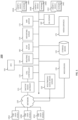
- FIG. 1 is a diagram illustrating an embodiment of a communication infrastructure, indicated generally at 100.
- FIG. 1 illustrates a system for supporting a contact center in providing contact center services.
- the contact center may be an in-house facility to a business or enterprise for serving the enterprise in performing the functions of sales and service relative to the products and services available through the enterprise.
- the contact center may be operated by a third-party service provider.
- the contact center may operate as a hybrid system in which some components of the contact center system are hosted at the contact center premises and other components are hosted remotely (e.g., in a cloud-based environment).
- the contact center may be deployed on equipment dedicated to the enterprise or third-party service provider, and/or deployed in a remote computing environment such as, for example, a private or public cloud environment with infrastructure for supporting multiple contact centers for multiple enterprises.
- a remote computing environment such as, for example, a private or public cloud environment with infrastructure for supporting multiple contact centers for multiple enterprises.
- the various components of the contact center system may also be distributed across various geographic locations and computing environments and not necessarily contained in a single location, computing environment, or even computing device.
- Components of the communication infrastructure indicated generally at 100 include: a plurality of end user devices 105A, 105B, 105C; a communications network 110; a switch/media gateway 115; a call controller 120; an IMR server 125; a routing server 130; a storage device 135; a stat server 140; a plurality of agent devices 145A, 145B, 145C comprising workbins 146A, 146B, 146C; a multimedia/social media server 150; web servers 155; an iXn server 160; a UCS 165; a reporting server 170; and media services 175.
- the contact center system manages resources (e.g., personnel, computers, telecommunication equipment, etc.) to enable delivery of services via telephone or other communication mechanisms.
- resources e.g., personnel, computers, telecommunication equipment, etc.
- Such services may vary depending on the type of contact center and may range from customer service to help desk, emergency response, telemarketing, order taking, etc.
- Each of the end user devices 105 may be a communication device conventional in the art, such as a telephone, wireless phone, smart phone, personal computer, electronic tablet, laptop, etc., to name some non-limiting examples. Users operating the end user devices 105 may initiate, manage, and respond to telephone calls, emails, chats, text messages, web-browsing sessions, and other multi-media transactions. While three end user devices 105 are illustrated at 100 for simplicity, any number may be present.
- the network 110 may comprise a communication network of telephone, cellular, and/or data services and may also comprise a private or public switched telephone network (PSTN), local area network (LAN), private wide area network (WAN), and/or public WAN such as the Internet, to name a non-limiting example.
- PSTN public switched telephone network
- LAN local area network
- WAN private wide area network
- Internet public WAN
- the network 110 may also include a wireless carrier network including a code division multiple access (CDMA) network, global system for mobile communications (GSM) network, or any wireless network/technology conventional in the art, including but not limited to 3G, 4G, LTE, etc.
- CDMA code division multiple access
- GSM global system for mobile communications
- the contact center system includes a switch/media gateway 115 coupled to the network 110 for receiving and transmitting telephony calls between the end users and the contact center.
- the switch/media gateway 115 may include a telephony switch or communication switch configured to function as a central switch for agent level routing within the center.
- the switch may be a hardware switching system or a soft switch implemented via software.
- the switch 115 may include an automatic call distributor, a private branch exchange (PBX), an IP-based software switch, and/or any other switch with specialized hardware and software configured to receive Internet-sourced interactions and/or telephone network-sourced interactions from a customer, and route those interactions to, for example, an agent telephony or communication device.
- PBX private branch exchange
- IP-based software switch IP-based software switch
- the switch/media gateway establishes a voice path/connection (not shown) between the calling customer and the agent telephony device, by establishing, for example, a connection between the customer's telephony device and the agent telephony device.
- the switch is coupled to a call controller 120 which may, for example, serve as an adapter or interface between the switch and the remainder of the routing, monitoring, and other communication-handling components of the contact center.
- the call controller 120 may be configured to process PSTN calls, VoIP calls, etc.
- the call controller 120 may be configured with computer-telephony integration (CTI) software for interfacing with the switch/media gateway and contact center equipment.
- CTI computer-telephony integration
- the call controller 120 may include a session initiation protocol (SIP) server for processing SIP calls.
- SIP session initiation protocol
- the call controller 120 may also extract data about the customer interaction, such as the caller's telephone number (e.g., the automatic number identification (ANI) number), the customer's internet protocol (IP) address, or email address, and communicate with other components of the system 100 in processing the interaction.
- the caller's telephone number e.g., the automatic number identification (ANI) number
- the customer's internet protocol (IP) address e.g., the customer's internet protocol (IP) address
- email address e.g., email address
- the system 100 further includes an interactive media response (IMR) server 125.
- the IMR server 125 may also be referred to as a self-help system, a virtual assistant, etc.
- the IMR server 125 may be similar to an interactive voice response (IVR) server, except that the IMR server 125 is not restricted to voice and additionally may cover a variety of media channels.
- the IMR server 125 may be configured with an IMR script for querying customers on their needs. For example, a contact center for a bank may tell customers via the IMR script to 'press 1' if they wish to retrieve their account balance. Through continued interaction with the IMR server 125, customers may be able to complete service without needing to speak with an agent.
- the IMR server 125 may also ask an open-ended question such as, "How can I help you?" and the customer may speak or otherwise enter a reason for contacting the contact center.
- the customer's response may be used by a routing server 130 to route the call or communication to an appropriate contact center resource.
- the call controller 120 interacts with the routing server (also referred to as an orchestration server) 130 to find an appropriate agent for processing the interaction.
- the selection of an appropriate agent for routing an inbound interaction may be based, for example, on a routing strategy employed by the routing server 130, and further based on information about agent availability, skills, and other routing parameters provided, for example, by a statistics server 140.
- the routing server 130 may query a customer database, which stores information about existing clients, such as contact information, service level agreement (SLA) requirements, nature of previous customer contacts and actions taken by the contact center to resolve any customer issues, etc.
- the database may be, for example, Cassandra or any NoSQL database, and may be stored in a mass storage device 135.
- the database may also be a SQL database and may be managed by any database management system such as, for example, Oracle, IBM DB2, Microsoft SQL server, Microsoft Access, PostgreSQL, etc., to name a few non-limiting examples.
- the routing server 130 may query the customer information from the customer database via an ANI or any other information collected by the IMR server 125.
- each device 145 may include a telephone adapted for regular telephone calls, VoIP calls, etc.
- the device 145 may also include a computer for communicating with one or more servers of the contact center and performing data processing associated with contact center operations, and for interfacing with customers via voice and other multimedia communication mechanisms.
- the contact center system 100 may also include a multimedia/social media server 150 for engaging in media interactions other than voice interactions with the end user devices 105 and/or web servers 155.
- the media interactions may be related, for example, to email, vmail (voice mail through email), chat, video, text-messaging, web, social media, co-browsing, etc.
- the multi-media/social media server 150 may take the form of any IP router conventional in the art with specialized hardware and software for receiving, processing, and forwarding multi-media events.
- the web servers 155 may include, for example, social interaction site hosts for a variety of known social interaction sites to which an end user may subscribe, such as Facebook, Twitter, Instagram, etc., to name a few non-limiting examples.
- web servers 155 may also be provided by third parties and/or maintained outside of the contact center premise.
- the web servers 155 may also provide web pages for the enterprise that is being supported by the contact center system 100. End users may browse the web pages and get information about the enterprise's products and services.
- the web pages may also provide a mechanism for contacting the contact center via, for example, web chat, voice call, email, web real-time communication (WebRTC), etc. Widgets may be deployed on the websites hosted on the web servers 155.
- deferrable interactions/activities may also be routed to the contact center agents in addition to real-time interactions.
- Deferrable interaction/activities may comprise back-office work or work that may be performed off-line such as responding to emails, letters, attending training, or other activities that do not entail real-time communication with a customer.
- An interaction (iXn) server 160 interacts with the routing server 130 for selecting an appropriate agent to handle the activity. Once assigned to an agent, an activity may be pushed to the agent, or may appear in the agent's workbin 146A, 146B, 146C (collectively 146) as a task to be completed by the agent.
- the agent's workbin may be implemented via any data structure conventional in the art, such as, for example, a linked list, array, etc.
- a workbin 146 may be maintained, for example, in buffer memory of each agent device 145.
- the mass storage device(s) 135 may store one or more databases relating to agent data (e.g., agent profiles, schedules, etc.), customer data (e.g., customer profiles), interaction data (e.g., details of each interaction with a customer, including, but not limited to: reason for the interaction, disposition data, wait time, handle time, etc.), and the like.
- agent data e.g., agent profiles, schedules, etc.
- customer data e.g., customer profiles
- interaction data e.g., details of each interaction with a customer, including, but not limited to: reason for the interaction, disposition data, wait time, handle time, etc.
- CCM customer relations management
- the mass storage device 135 may take form of a hard disk or disk array as is conventional in the art.
- the contact center system may include a universal contact server (UCS) 165, configured to retrieve information stored in the CRM database and direct information to be stored in the CRM database.
- the UCS 165 may also be configured to facilitate maintaining a history of customers' preferences and interaction history, and to capture and store data regarding comments from agents, customer communication history, etc.
- the contact center system may also include a reporting server 170 configured to generate reports from data aggregated by the statistics server 140.
- reports may include near real-time reports or historical reports concerning the state of resources, such as, for example, average wait time, abandonment rate, agent occupancy, etc.
- the reports may be generated automatically or in response to specific requests from a requestor (e.g., agent/administrator, contact center application, etc.).
- the various servers of FIG. 1 may each include one or more processors executing computer program instructions and interacting with other system components for performing the various functionalities described herein.
- the computer program instructions are stored in a memory implemented using a standard memory device, such as for example, a random-access memory (RAM).
- the computer program instructions may also be stored in other non-transitory computer readable media such as, for example, a CD-ROM, flash drive, etc.
- interaction and “communication” are used interchangeably, and generally refer to any real-time and non-real-time interaction that uses any communication channel including, without limitation, telephony calls (PSTN or VoIP calls), emails, vmails, video, chat, screen-sharing, text messages, social media messages, WebRTC calls, etc.
- PSTN or VoIP calls telephony calls
- emails vmails
- video chat
- screen-sharing text messages
- social media messages social media messages
- WebRTC calls etc.
- the media services 175 may provide audio and/or video services to support contact center features such as prompts for an IVR or IMR system (e.g., playback of audio files), hold music, voicemails/single party recordings, multi-party recordings (e.g., of audio and/or video calls), speech recognition, dual tone multi frequency (DTMF) recognition, faxes, audio and video transcoding, secure real-time transport protocol (SRTP), audio conferencing, video conferencing, coaching (e.g., support for a coach to listen in on an interaction between a customer and an agent and for the coach to provide comments to the agent without the customer hearing the comments), call analysis, and keyword spotting.
- IVR or IMR system e.g., playback of audio files
- multi-party recordings e.g., of audio and/or video calls
- speech recognition e.g., dual tone multi frequency (DTMF) recognition
- faxes faxes
- audio and video transcoding e.g., secure real-time transport protocol (SR
- the premises-based platform product may provide access to and control of components of the system 100 through user interfaces (UIs) present on the agent devices 145A-C.
- UIs user interfaces
- the graphical application generator program may be integrated which allows a user to write the programs (handlers) that control various interaction processing behaviors within the premises-based platform product.
- the contact center may operate as a hybrid system in which some or all components are hosted remotely, such as in a cloud-based environment. For the sake of convenience, aspects of embodiments of the present invention will be described below with respect to providing modular tools from a cloud-based environment to components housed on-premises.
- FIG. 2 By way of background-and with generally reference now to FIG. 2 -it will be appreciated that customers often waste a significant amount of time trying to connect to an organization's or business's customer support, for example, which may be provided in relation to a contact center such as that shown in FIG. 1 .
- contact information for reaching customer support for various businesses are located in different or difficult to reach places. Customers become frustrated with trying to find contact information for customer support. Agents become frustrated when dealing with these customers.
- an interface was available on the mobile devices of customer for conveniently orchestrating access for users (i.e., customers) to the customer support of many businesses.
- customer service agents or simply “agents”
- a system or application that provides personalized context to the agents would enable an improved customer experience.
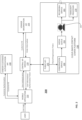
- a system 200 in which a mobile application 210 assists users with customer service in ways that address the above-described issues.
- the mobile application 210 provides interfaces on a display of a user device, such as a smart phone, that orchestrates connection, authentication, and interaction with a backend central API service 220 (or "central API service 220") 220.
- the central API service 220 connects to a cloud-based contact center platform (or simply “contact center platform”) 230 to orchestrate providing several services to the user.
- a vendor information API 235 that communicates with the central API service 220 and, as will be seen, may be used to retrieve customer order information for the user.
- a vendor-customer authentication API 240 is provided for authenticating users as customers in relation to particular vendors.
- the contact center platform 230 is accessible by the central API service 220 via a public API 245.
- the contact center platform 230 may further include a conversation service 250, a media queue 255, agent resources 260, and data collectors, such as a recording service 265 and transcript processor 270, each of which collects data from interactions between the user and agents and made available to the user and agents at subsequent interactions to provide context.
- the user is able to efficiently contact customer support of vendors as provided via the contact center platform 230 from the mobile application 210.
- This may include chat or voice interactions.
- the user can connect with a customer support agent representing a particular business or vendor.
- agents are able to leverage the authentication process to quickly identify a user's profile and other contextual information, such as past orders or transcripts from past interactions.
- Users are able to schedule a callback either directly or within the context of a previous order to create a more personalized customer experience. Users are able to quickly check all of their previous interaction history in one place.
- Such interaction history may include full transcripts of all of a user's chat and voice interactions. Accordingly, as will be seen, aspects of the present disclosure may enhance personalization provided to customers and improve overall engagement therewith.
- the present system 200 may orchestrate registering an account with the mobile application 210 and logging-in to that account. That is, a user may initiate services by registering an account via the mobile application 210.
- the mobile application 210 may be provided and reached through a mobile device of the user, such as a smart phone. Once registered, the user logs-in to use the mobile application 210. For example, on the mobile application 210, the user creates a new account and, once created, the user then enters credentials to log-in with the central API service 220.
- the central API service 220 then sends an authentication token to the mobile application 210.
- the mobile application 210 then may save the authentication token and employ the token to authenticate the user in all subsequent interactions and communications with the central API service 220.
- the present system 200 may orchestrate a user registering for affiliation with vendors that are already integrated into the mobile application 210. Via the mobile application 210, the user may do this via browsing a list of such integrated vendors that is provided to the user via the mobile application 210. Then, using the mobile application 210, the user selects a particular vendor that they are interested in and registers or affiliates that vendor to their profile. This registered affiliation is then maintained via the mobile application 210, with the mobile application 210 recognizing this affiliation until such time that the user decides to end it.
- the present system 200 may orchestrate vendors becoming integrated into the mobile application 210. By doing this, the vendors become available to users (i.e., the user can choose to become affiliated with the vendors).
- This integration process may include the vendor registering with and providing information to the central API service 220.
- the central API service 220 maps the vendor to an organization ID, queue ID, and an API access token, which is used in relation to services provide by the contact center platform.
- the vendor may further provide the central API service 220 with a vendor admin token for authentication.
- the present system 200 may orchestrate the user requesting and receiving an order history in relation to one of the vendors affiliated with their account. In such cases, the user will have already registered with the vendor as described above. Then, via the mobile application 210, the user selects or indicates a desire to see their order history with the particular vendor. The mobile application 210 may then connect to the vendor-customer authentication API 240 and provide authentication information related to the vendor. In return, the mobile application 210 receives a customer ID for the user from the vendor-customer authentication API 240. The mobile application 210 then connects to the central API service 220 and requests the order history in relation to the particular vendor given the customer ID.
- the central API service 220 then connects to the vendor information API 235 for retrieving the order information.
- the central API service 220 may provide the customer ID and a vendor identifier to the vendor information API 235.
- the central API service 220 also may provide the vendor admin token. Given this information, the vendor information API 235 retrieves the order history for the user and communicates it to the central API service 220, which in turn sends it to the mobile application 210 and provided to the user.
- the present system 200 may orchestrate a request by the user to communicate with customer support for a vendor. For example, let's look at a case where the user desires to chat with customer support of a selected vendor. In such an instance, the user can simply initiate the chat by selecting a chat option in relation to the selected vendor that is provided via the mobile application 210.
- the mobile application 210 connects to the central API service 220 and receives chat interaction information related to the selected vendor (as may have been provided and configured as part of the previously discussed integration process associated with the selected vendor).
- the central API service 220 will return information such as queue ID and API access token related to the vendor to the mobile application 210.
- the mobile application 210 uses this received information, the mobile application 210 then initiates the chat interaction with the vendor by connecting to the contact center platform.
- a cloud chat widget may be used to implement the chat interaction.
- the present system 200 may orchestrate the user requesting and receiving transcripts of a past chat with a vendor.
- the user may choose to view previous chat interactions with a particular vendor from the mobile application 210.
- the mobile application 210 connects to the central API service 220 to request the transcripts.
- the central API service 220 then makes a request to the public API 245 for the transcripts of the chats.
- the present system 200 may orchestrate a user calling (i.e., having a voice interaction) with a vendor.
- the user chooses a call option in relation to a selected vendor that is provided by the mobile application 210.
- the mobile application 210 then initiates the call to a phone number corresponding to the vendor (as may be provided in a vendor information card).
- the present system 200 may orchestrate a user scheduling a call back with a particular vendor.
- the user chooses to schedule a callback with a vendor from the mobile application 210.
- the user may provide a time for the requested call back.
- the mobile application 210 then initiates the request to the central API service 220 using information associated with the customer and vendor as well as the preferred callback time.
- the central API service 220 then initiates the request with the Public API 245 of the contact center platform by providing the vendor API access token and other relevant information and create a conversation (i.e., with conversation service 250) with the required information for a callback.
- the call back request will be added to the media queue 255 and an agent 260 will initiate the callback at the scheduled time or immediately if the callback time is not specified.
- the present system 200 may orchestrate the user requesting and receiving a text transcript of a past call with an agent of a vendor.
- the customer chooses to view transcripts of previous call interactions with a particular vendor from the mobile application 210.
- the mobile application 210 then connects to the central API service 220 and request the transcripts.
- the central API service 220 then makes a request to the Public API 245 to get the transcripts of the particular calls, such as may have been previously created via the recording service 265 and transcript processor 270.
- a system includes a mobile application operating on a mobile device of a user for connecting the mobile device to a plurality of contact centers and providing personalized context to the user from past interactions with the plurality of contact centers.
- the system may include: the mobile application operating on the mobile device; a connection from the mobile application to a central API service, wherein the central API service provides authentication tokens to the mobile application for facilitating further interaction between the mobile application and the central API service; a plurality of vendors which the user has associated with their profile and have been integrated with the central API service, wherein the plurality of vendors is operably connected with the central API service for information sharing; and a plurality of media channels operatively connecting the plurality of vendors with the central API service, allowing the user to: view personalized context from past interactions associated with the plurality of contact centers associated with the plurality of vendors through the mobile application; and connect with the plurality of contact centers.
- the integration may include mapping by the central API service to each vendor with a unique organization identifier, a queue identifier, and an API access token through a cloud-based contact center platform.
- the interaction history sharing includes a request for order history by the user from a first vendor of the plurality of vendors by: connecting, by the mobile application, to an authentication API associated with the first vendor; transmitting authentication information provided by the user to the authentication API of the first vendor; receiving, by the central API service, a vendor access token from the first vendor; receiving, by the mobile application from the authentication API of the first vendor, an identifier of the user; transmitting the request for the order history from the mobile application to the central API service for the user, wherein the request comprises the identifier of the user and a vendor identifier of the first vendor; transmitting, by the central API service to a vendor information API associated with the first vendor, the request for the order history, the vendor access token, and the identifier of the user; and receiving, by the central API service, the order history from the vendor information API associated with the first vendor and transmitting, by the central API service, the received order history to the mobile application for display on the mobile device to the user.
- one of the plurality of media channels is operably connected with the queue identifier, which is returned by the central API service to the mobile application for initiation of an interaction with one of the plurality of vendors using a widget associated with the contact center platform.
- the interaction may include at least one of: a chat interaction, a call, and a request for a callback.
- the personalized context may include transcripts of one or more previous voice interactions and/or one or more chat interactions.
- the present invention may include or be embodied in a computer system 400.
- each of the various servers, controls, switches, gateways, engines, and/or modules in the described figures are implemented via hardware or firmware (e.g., ASIC) as will be appreciated by a person of skill in the art.
- Each of the various servers may be a process or thread, running on one or more processors, in one or more computing devices (e.g., Figs 4A, 4B), executing computer program instructions and interacting with other system components for performing the various functionalities described herein.
- the computer program instructions are stored in a memory which may be implemented in a computing device using a standard memory device, such as, for example, a RAM.
- the computer program instructions may also be stored in other non-transitory computer readable media such as, for example, a CD-ROM, a flash drive, etc.
- firmware e.g., an application-specific integrated circuit
- hardware e.g., an application-specific integrated circuit
- firmware e.g., an application-specific integrated circuit
- a person of skill in the art should also recognize that the functionality of various computing devices may be combined or integrated into a single computing device, or the functionality of a particular computing device may be distributed across one or more other computing devices without departing from the scope of the exemplary embodiments of the present invention.
- a server may be a software module, which may also simply be referred to as a module.
- the set of modules in the contact center may include servers, and other modules.
- the various servers may be located on a computing device on-site at the same physical location as the agents of the contact center or may be located off-site (or in the cloud) in a geographically different location, e.g., in a remote data center, connected to the contact center via a network such as the Internet.
- some of the servers may be located in a computing device on-site at the contact center while others may be located in a computing device off-site, or servers providing redundant functionality may be provided both via on-site and off-site computing devices to provide greater fault tolerance.
- functionality provided by servers located on computing devices off-site may be accessed and provided over a virtual private network (VPN) as if such servers were on-site, or the functionality may be provided using a software as a service (SaaS) to provide functionality over the internet using various protocols, such as by exchanging data using encoded in extensible markup language (XML) or JSON.
- VPN virtual private network
- SaaS software as a service
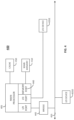
- FIG. 3 and 4 are diagrams illustrating an embodiment of a computing device as may be employed in an embodiment of the invention, indicated generally at 400.
- Each computing device 400 includes a CPU 405 and a main memory unit 410.
- the computing device 400 may also include a storage device 415, a removable media interface 420, a network interface 425, an input/output (I/O) controller 430, one or more display devices 435A, a keyboard 435B and a pointing device 435C (e.g., a mouse).
- the storage device 415 may include, without limitation, storage for an operating system and software. As shown in FIG.
- each computing device 400 may also include additional optional elements, such as a memory port 440, a bridge 445, one or more additional input/output devices 435D, 435E, and a cache memory 450 in communication with the CPU 405.
- the input/output devices 435A, 435B, 435C, 435D, and 435E may collectively be referred to herein as 435.
- the CPU 405 is any logic circuitry that responds to and processes instructions fetched from the main memory unit 410. It may be implemented, for example, in an integrated circuit, in the form of a microprocessor, microcontroller, or graphics processing unit, or in a field-programmable gate array (FPGA) or application-specific integrated circuit (ASIC).
- the main memory unit 410 may be one or more memory chips capable of storing data and allowing any storage location to be directly accessed by the central processing unit 405. As shown in FIG. 3 , the central processing unit 405 communicates with the main memory 410 via a system bus 455. As shown in FIG. 4 , the central processing unit 405 may also communicate directly with the main memory 410 via a memory port 440.
- the CPU 405 may include a plurality of processors and may provide functionality for simultaneous execution of instructions or for simultaneous execution of one instruction on more than one piece of data.
- the computing device 400 may include a parallel processor with one or more cores.
- the computing device 400 comprises a shared memory parallel device, with multiple processors and/or multiple processor cores, accessing all available memory as a single global address space.
- the computing device 400 is a distributed memory parallel device with multiple processors each accessing local memory only. The computing device 400 may have both some memory which is shared and some which may only be accessed by particular processors or subsets of processors.
- the CPU 405 may include a multicore microprocessor, which combines two or more independent processors into a single package, e.g., into a single integrated circuit (IC).
- the computing device 400 may include at least one CPU 405 and at least one graphics processing unit.
- a CPU 405 provides single instruction multiple data (SIMD) functionality, e.g., execution of a single instruction simultaneously on multiple pieces of data.
- SIMD single instruction multiple data
- several processors in the CPU 405 may provide functionality for execution of multiple instructions simultaneously on multiple pieces of data (MIMD).
- MIMD multiple pieces of data
- the CPU 405 may also use any combination of SIMD and MIMD cores in a single device.
- FIG. 4 depicts an embodiment in which the CPU 405 communicates directly with cache memory 450 via a secondary bus, sometimes referred to as a backside bus.
- the CPU 405 communicates with the cache memory 450 using the system bus 455.
- the cache memory 450 typically has a faster response time than main memory 410.
- the CPU 405 communicates with various I/O devices 435 via the local system bus 455.
- Various buses may be used as the local system bus 455, including, but not limited to, a Video Electronics Standards Association (VESA) Local bus (VLB), an Industry Standard Architecture (ISA) bus, an Extended Industry Standard Architecture (EISA) bus, a Micro Channel Architecture (MCA) bus, a Peripheral Component Interconnect (PCI) bus, a PCI Extended (PCI-X) bus, a PCI-Express bus, or a NuBus.
- VESA Video Electronics Standards Association
- VLB Video Electronics Standards Association
- ISA Industry Standard Architecture
- EISA Extended Industry Standard Architecture
- MCA Micro Channel Architecture
- PCI Peripheral Component Interconnect
- PCI-X PCI Extended
- PCI-Express PCI-Express bus
- NuBus NuBus.
- FIG. 4 depicts an embodiment of a computer 400 in which the CPU 405 communicates directly with I/O device 435E.
- FIG. 4 also depicts an embodiment in which local buses and direct communication are mixed: the CPU 405 communicate
- I/O devices 435 may be present in the computing device 400.
- Input devices include one or more keyboards 435B, mice, trackpads, trackballs, microphones, and drawing tables, to name a few non-limiting examples.
- Output devices include video display devices 435A, speakers and printers.
- An I/O controller 430 as shown in FIG. 3 may control the one or more I/O devices, such as a keyboard 435B and a pointing device 435C (e.g., a mouse or optical pen), for example.
- the computing device 400 may support one or more removable media interfaces 420, such as a floppy disk drive, a CD-ROM drive, a DVD-ROM drive, tape drives of various formats, a USB port, a Secure Digital or COMPACT FLASHTM memory card port, or any other device suitable for reading data from read-only media, or for reading data from, or writing data to, read-write media.
- An I/O device 435 may be a bridge between the system bus 455 and a removable media interface 420.
- the removable media interface 420 may, for example, be used for installing software and programs.
- the computing device 400 may further include a storage device 415, such as one or more hard disk drives or hard disk drive arrays, for storing an operating system and other related software, and for storing application software programs.
- a removable media interface 420 may also be used as the storage device.
- the operating system and the software may be run from a bootable medium, for example, a bootable CD.
- the computing device 400 may include or be connected to multiple display devices 435A, which each may be of the same or different type and/or form.
- any of the I/O devices 435 and/or the I/O controller 430 may include any type and/or form of suitable hardware, software, or combination of hardware and software to support, enable or provide for the connection to, and use of, multiple display devices 435A by the computing device 400.
- the computing device 400 may include any type and/or form of video adapter, video card, driver, and/or library to interface, communicate, connect or otherwise use the display devices 435A.
- a video adapter may include multiple connectors to interface to multiple display devices 435A.
- the computing device 400 may include multiple video adapters, with each video adapter connected to one or more of the display devices 435A.
- one or more of the display devices 435A may be provided by one or more other computing devices, connected, for example, to the computing device 400 via a network.
- These embodiments may include any type of software designed and constructed to use the display device of another computing device as a second display device 435A for the computing device 400.
- a computing device 400 may be configured to have multiple display devices 435A.
- An embodiment of a computing device indicated generally in FIGS. 3 and 4 may operate under the control of an operating system, which controls scheduling of tasks and access to system resources.
- the computing device 400 may be running any operating system, any embedded operating system, any real-time operating system, any open source operation system, any proprietary operating system, any operating systems for mobile computing devices, or any other operating system capable of running on the computing device and performing the operations described herein.
- the computing device 400 may be any workstation, desktop computer, laptop or notebook computer, server machine, handled computer, mobile telephone or other portable telecommunication device, media playing device, gaming system, mobile computing device, or any other type and/or form of computing, telecommunications or media device that is capable of communication and that has sufficient processor power and memory capacity to perform the operations described herein.
- the computing device 400 may have different processors, operating systems, and input devices consistent with the device.
- the computing device 400 is a mobile device. Examples might include a Java-enabled cellular telephone or personal digital assistant (PDA), a smart phone, a digital audio player, or a portable media player.
- the computing device 400 includes a combination of devices, such as a mobile phone combined with a digital audio player or portable media player.
- a computing device 400 may be one of a plurality of machines connected by a network, or it may include a plurality of machines so connected.
- a network environment may include one or more local machine(s), client(s), client node(s), client machine(s), client computer(s), client device(s), endpoint(s), or endpoint node(s) in communication with one or more remote machines (which may also be generally referred to as server machines or remote machines) via one or more networks.
- a local machine has the capacity to function as both a client node seeking access to resources provided by a server machine and as a server machine providing access to hosted resources for other clients.
- the network may be LAN or WAN links, broadband connections, wireless connections, or a combination of any or all of the above.
- Connections may be established using a variety of communication protocols.
- the computing device 400 communicates with other computing devices 400 via any type and/or form of gateway or tunneling protocol such as Secure Socket Layer (SSL) or Transport Layer Security (TLS).
- SSL Secure Socket Layer
- TLS Transport Layer Security
- the network interface may include a built-in network adapter, such as a network interface card, suitable for interfacing the computing device to any type of network capable of communication and performing the operations described herein.
- An I/O device may be a bridge between the system bus and an external communication bus.
- a network environment may be a virtual network environment where the various components of the network are virtualized.
- the various machines may be virtual machines implemented as a software-based computer running on a physical machine.
- the virtual machines may share the same operating system. In other embodiments, different operating system may be run on each virtual machine instance.
- a "hypervisor" type of virtualizing is implemented where multiple virtual machines run on the same host physical machine, each acting as if it has its own dedicated box. The virtual machines may also run on different host physical machines.
- NFV Network Functions Virtualization
- the use of LSH to automatically discover carrier audio messages in a large set of pre-connected audio recordings may be applied in the support process of media services for a contact center environment. For example, this can assist with the call analysis process for a contact center and removes the need to have humans listen to a large set of audio recordings to discover new carrier audio messages.
Landscapes
- Engineering & Computer Science (AREA)
- Signal Processing (AREA)
- Computer Networks & Wireless Communication (AREA)
- Business, Economics & Management (AREA)
- Marketing (AREA)
- Computer Security & Cryptography (AREA)
- Computer Hardware Design (AREA)
- Computing Systems (AREA)
- General Engineering & Computer Science (AREA)
- Human Computer Interaction (AREA)
- Environmental & Geological Engineering (AREA)
- General Business, Economics & Management (AREA)
- Medical Informatics (AREA)
- General Health & Medical Sciences (AREA)
- Health & Medical Sciences (AREA)
- Telephonic Communication Services (AREA)
- Information Transfer Between Computers (AREA)
- Mobile Radio Communication Systems (AREA)
Description
- The present invention generally relates to telecommunications systems in the field of customer relations management including customer assistance via call or contact centers and internet-based service options. More particularly, but not by way of limitation, the present invention pertains to systems and methods for providing personalized context, including personalized services offered to customers through functionality enabled via an application executed on a mobile computing device and a cloud-based platform.
-
EP 2 285 063 A1 -
US 2014/270108 A1 discloses a system for a contact center includes: a processor; an interactive voice response (IVR) node configured to engage in an incoming interaction from a customer to the contact center by presenting set scripts to the customer and receiving corresponding responses; an intelligent automated agent including an artificial intelligence engine; a call server node configured to route the interaction and the responses to one of a pool of live agents or to the automated agent; and a non-transitory storage device coupled to the processor and configured to store customer profile data built from previous interactions. The automated agent is further configured to retrieve a profile of the customer from the customer profile data during the interaction and to update the retrieved profile on the storage device to reflect the interaction. The artificial intelligence engine is configured to learn knowledge from the interaction and to apply the learned knowledge to future interactions. -
US 9,762,733 B1 -
US 2016/171611 A1 discloses methods and systems are described herein for securely analyzing transaction data of a user. A server computing device establishes a secure connection with a client device, which transmits transaction data to the server. The server establishes a hierarchy of nodes to profile a user's purchase history. The hierarchy includes a plurality of article nodes and category nodes. The server creates a new article node instance corresponding to the transaction data, the new article node storing descriptive properties of at least one item purchased by the user determined from the transaction data. The server links the new article node instance to at least one of the category nodes by classifying the descriptive properties of the item purchased with respect to relationships defined by the hierarchy. The server generates and transmits an event trigger to remind the user of a follow-up action and authenticates the client before the trigger is delivered. -
US 2019/037077 A1 discloses a method for automating an interaction between a user and a contact center includes: receiving, by a processor, a natural language inquiry from the user; identifying, by the processor, a user intent from the natural language inquiry using a natural language processing module; loading, by the processor, a script corresponding to the user intent, the script comprising a plurality of fields of information associated with the user intent; filling at least one of the fields of information of the script based on a stored user profile; and supplying the filled fields of information to the contact center in accordance with the script. Some embodiments of the present invention relate to systems and methods for augmenting interactions between the user and the contact center. - The present invention is defined by the subject-matter of the independent claims. Further details are provided in the dependent claims.
- The present invention includes a system including a mobile application operating on a mobile device of a user for connecting the mobile device to a plurality of contact centers and providing personalized context to the user from past interactions with the plurality of contact centers. The system may include: the mobile application operating on the mobile device; a connection from the mobile application to a central API service, wherein the central API service provides authentication tokens to the mobile application for facilitating further interaction between the mobile application and the central API service; a plurality of vendors which the user has associated with their profile and have been integrated with the central API service, wherein the plurality of vendors is operably connected with the central API service for information sharing; and a plurality of media channels operatively connecting the plurality of vendors with the central API service, allowing the user to: view personalized context from past interactions associated with the plurality of contact centers associated with the plurality of vendors through the mobile application; and connect with the plurality of contact centers.
- These and other features of the present application will become more apparent upon review of the following detailed description of the example embodiments when taken in conjunction with the drawings and the appended claims.
- A more complete appreciation of the present invention will become more readily apparent as the invention becomes better understood by reference to the following detailed description when considered in conjunction with the accompanying drawings, in which like reference symbols indicate like components, wherein:
-
FIG. 1 depicts a schematic block diagram of a communications infrastructure or contact center in accordance with exemplary embodiments of the present invention and/or with which exemplary embodiments of the present invention may be enabled or practiced; -
FIG. 2 is a system for providing personalized context in accordance with an embodiment of the present invention. -
FIG. 3 depicts a schematic block diagram of a computing device in accordance with exemplary embodiments of the present invention and/or with which exemplary embodiments of the present invention may be enabled or practiced; and -
FIG. 4 depicts a schematic block diagram of a computing device in accordance with exemplary embodiments of the present invention and/or with which exemplary embodiments of the present invention may be enabled or practiced. - For the purposes of promoting an understanding of the principles of the invention, reference will now be made to the exemplary embodiments illustrated in the drawings and specific language will be used to describe the same. It will be apparent, however, to one having ordinary skill in the art that the detailed material provided in the examples may not be needed to practice the present invention. In other instances, well-known materials or methods have not been described in detail in order to avoid obscuring the present invention. Additionally, further modification in the provided examples or application of the principles of the invention, as presented herein, are contemplated as would normally occur to those skilled in the art.
- As used herein, language designating nonlimiting examples and illustrations includes "e.g.", "i.e.", "for example", "for instance" and the like. Further, reference throughout this specification to "an embodiment", "one embodiment", "present embodiments", "exemplary embodiments", "certain embodiments" and the like means that a particular feature, structure or characteristic described in connection with the given example may be included in at least one embodiment of the present invention. Thus, appearances of the phrases "an embodiment", "one embodiment", "present embodiments", "exemplary embodiments", "certain embodiments" and the like are not necessarily referring to the same embodiment or example. Further, particular features, structures or characteristics may be combined in any suitable combinations and/or subcombinations in one or more embodiments or examples.
- Those skilled in the art will recognize from the present disclosure that the various embodiments may be computer implemented using many different types of data processing equipment, with embodiments being implemented as an apparatus, method, or computer program product. Example embodiments, thus, may take the form of an entirely hardware embodiment, an entirely software embodiment, or an embodiment combining software and hardware aspects. Example embodiments further may take the form of a computer program product embodied by computer-usable program code in any tangible medium of expression. In each case, the example embodiment may be generally referred to as a "module", "system", or "method".
- The flowcharts and block diagrams provided in the figures illustrate architecture, functionality, and operation of possible implementations of systems, methods, and computer program products in accordance with example embodiments of the present invention. In this regard, it will be understood that each block of the flowcharts and/or block diagrams-or combinations of those blocks-may represent a module, segment, or portion of program code having one or more executable instructions for implementing the specified logical functions. It will similarly be understood that each of block of the flowcharts and/or block diagrams-or combinations of those blocks-may be implemented by special purpose hardware-based systems or combinations of special purpose hardware and computer instructions performing the specified acts or functions. Such computer program instructions also may be stored in a computer-readable medium that can direct a computer or other programmable data processing apparatus to function in a particular manner, such that the program instructions in the computer-readable medium produces an article of manufacture that includes instructions by which the functions or acts specified in each block of the flowcharts and/or block diagrams-or combinations of those blocks-are implemented.
-
FIG. 1 is a diagram illustrating an embodiment of a communication infrastructure, indicated generally at 100. For example,FIG. 1 illustrates a system for supporting a contact center in providing contact center services. The contact center may be an in-house facility to a business or enterprise for serving the enterprise in performing the functions of sales and service relative to the products and services available through the enterprise. In another aspect, the contact center may be operated by a third-party service provider. In an embodiment, the contact center may operate as a hybrid system in which some components of the contact center system are hosted at the contact center premises and other components are hosted remotely (e.g., in a cloud-based environment). The contact center may be deployed on equipment dedicated to the enterprise or third-party service provider, and/or deployed in a remote computing environment such as, for example, a private or public cloud environment with infrastructure for supporting multiple contact centers for multiple enterprises. The various components of the contact center system may also be distributed across various geographic locations and computing environments and not necessarily contained in a single location, computing environment, or even computing device. - Components of the communication infrastructure indicated generally at 100 include: a plurality of
end user devices communications network 110; a switch/media gateway 115; acall controller 120; anIMR server 125; arouting server 130; astorage device 135; astat server 140; a plurality ofagent devices 145C comprising workbins social media server 150;web servers 155; aniXn server 160; a UCS 165; areporting server 170; andmedia services 175. - In an embodiment, the contact center system manages resources (e.g., personnel, computers, telecommunication equipment, etc.) to enable delivery of services via telephone or other communication mechanisms. Such services may vary depending on the type of contact center and may range from customer service to help desk, emergency response, telemarketing, order taking, etc.
- Customers, potential customers, or other end users (collectively referred to as customers or end users) desiring to receive services from the contact center may initiate inbound communications (e.g., telephony calls, emails, chats, etc.) to the contact center via
end user devices - Inbound and outbound communications from and to the end user devices 105 may traverse a
network 110 depending on the type of device that is being used. Thenetwork 110 may comprise a communication network of telephone, cellular, and/or data services and may also comprise a private or public switched telephone network (PSTN), local area network (LAN), private wide area network (WAN), and/or public WAN such as the Internet, to name a non-limiting example. Thenetwork 110 may also include a wireless carrier network including a code division multiple access (CDMA) network, global system for mobile communications (GSM) network, or any wireless network/technology conventional in the art, including but not limited to 3G, 4G, LTE, etc. - In an embodiment, the contact center system includes a switch/
media gateway 115 coupled to thenetwork 110 for receiving and transmitting telephony calls between the end users and the contact center. The switch/media gateway 115 may include a telephony switch or communication switch configured to function as a central switch for agent level routing within the center. The switch may be a hardware switching system or a soft switch implemented via software. For example, theswitch 115 may include an automatic call distributor, a private branch exchange (PBX), an IP-based software switch, and/or any other switch with specialized hardware and software configured to receive Internet-sourced interactions and/or telephone network-sourced interactions from a customer, and route those interactions to, for example, an agent telephony or communication device. In this example, the switch/media gateway establishes a voice path/connection (not shown) between the calling customer and the agent telephony device, by establishing, for example, a connection between the customer's telephony device and the agent telephony device. - In an embodiment, the switch is coupled to a
call controller 120 which may, for example, serve as an adapter or interface between the switch and the remainder of the routing, monitoring, and other communication-handling components of the contact center. Thecall controller 120 may be configured to process PSTN calls, VoIP calls, etc. For example, thecall controller 120 may be configured with computer-telephony integration (CTI) software for interfacing with the switch/media gateway and contact center equipment. In an embodiment, thecall controller 120 may include a session initiation protocol (SIP) server for processing SIP calls. Thecall controller 120 may also extract data about the customer interaction, such as the caller's telephone number (e.g., the automatic number identification (ANI) number), the customer's internet protocol (IP) address, or email address, and communicate with other components of thesystem 100 in processing the interaction. - In an embodiment, the
system 100 further includes an interactive media response (IMR)server 125. TheIMR server 125 may also be referred to as a self-help system, a virtual assistant, etc. TheIMR server 125 may be similar to an interactive voice response (IVR) server, except that theIMR server 125 is not restricted to voice and additionally may cover a variety of media channels. In an example illustrating voice, theIMR server 125 may be configured with an IMR script for querying customers on their needs. For example, a contact center for a bank may tell customers via the IMR script to 'press 1' if they wish to retrieve their account balance. Through continued interaction with theIMR server 125, customers may be able to complete service without needing to speak with an agent. TheIMR server 125 may also ask an open-ended question such as, "How can I help you?" and the customer may speak or otherwise enter a reason for contacting the contact center. The customer's response may be used by arouting server 130 to route the call or communication to an appropriate contact center resource. - If the communication is to be routed to an agent, the
call controller 120 interacts with the routing server (also referred to as an orchestration server) 130 to find an appropriate agent for processing the interaction. The selection of an appropriate agent for routing an inbound interaction may be based, for example, on a routing strategy employed by therouting server 130, and further based on information about agent availability, skills, and other routing parameters provided, for example, by astatistics server 140. - In an embodiment, the
routing server 130 may query a customer database, which stores information about existing clients, such as contact information, service level agreement (SLA) requirements, nature of previous customer contacts and actions taken by the contact center to resolve any customer issues, etc. The database may be, for example, Cassandra or any NoSQL database, and may be stored in amass storage device 135. The database may also be a SQL database and may be managed by any database management system such as, for example, Oracle, IBM DB2, Microsoft SQL server, Microsoft Access, PostgreSQL, etc., to name a few non-limiting examples. Therouting server 130 may query the customer information from the customer database via an ANI or any other information collected by theIMR server 125. - Once an appropriate agent is identified as being available to handle a communication, a connection may be made between the customer and an
agent device 145A, 145B and/or 145C (collectively referenced as 145) of the identified agent. While three agent devices are illustrated inFIG. 1 for simplicity, any number of devices may be present. Collected information about the customer and/or the customer's historical information may also be provided to the agent device for aiding the agent in better servicing the communication and additionally to the contact center admin/supervisor device for managing the contact center. In this regard, each device 145 may include a telephone adapted for regular telephone calls, VoIP calls, etc. The device 145 may also include a computer for communicating with one or more servers of the contact center and performing data processing associated with contact center operations, and for interfacing with customers via voice and other multimedia communication mechanisms. - The
contact center system 100 may also include a multimedia/social media server 150 for engaging in media interactions other than voice interactions with the end user devices 105 and/orweb servers 155. The media interactions may be related, for example, to email, vmail (voice mail through email), chat, video, text-messaging, web, social media, co-browsing, etc. The multi-media/social media server 150 may take the form of any IP router conventional in the art with specialized hardware and software for receiving, processing, and forwarding multi-media events. - The
web servers 155 may include, for example, social interaction site hosts for a variety of known social interaction sites to which an end user may subscribe, such as Facebook, Twitter, Instagram, etc., to name a few non-limiting examples. In an embodiment, althoughweb servers 155 are depicted as part of thecontact center system 100, the web servers may also be provided by third parties and/or maintained outside of the contact center premise. Theweb servers 155 may also provide web pages for the enterprise that is being supported by thecontact center system 100. End users may browse the web pages and get information about the enterprise's products and services. The web pages may also provide a mechanism for contacting the contact center via, for example, web chat, voice call, email, web real-time communication (WebRTC), etc. Widgets may be deployed on the websites hosted on theweb servers 155. - In an embodiment, deferrable interactions/activities may also be routed to the contact center agents in addition to real-time interactions. Deferrable interaction/activities may comprise back-office work or work that may be performed off-line such as responding to emails, letters, attending training, or other activities that do not entail real-time communication with a customer. An interaction (iXn)
server 160 interacts with therouting server 130 for selecting an appropriate agent to handle the activity. Once assigned to an agent, an activity may be pushed to the agent, or may appear in the agent'sworkbin - In an embodiment, the mass storage device(s) 135 may store one or more databases relating to agent data (e.g., agent profiles, schedules, etc.), customer data (e.g., customer profiles), interaction data (e.g., details of each interaction with a customer, including, but not limited to: reason for the interaction, disposition data, wait time, handle time, etc.), and the like. In another embodiment, some of the data (e.g., customer profile data) may be maintained in a customer relations management (CRM) database hosted in the
mass storage device 135 or elsewhere. Themass storage device 135 may take form of a hard disk or disk array as is conventional in the art. - In an embodiment, the contact center system may include a universal contact server (UCS) 165, configured to retrieve information stored in the CRM database and direct information to be stored in the CRM database. The
UCS 165 may also be configured to facilitate maintaining a history of customers' preferences and interaction history, and to capture and store data regarding comments from agents, customer communication history, etc. - The contact center system may also include a
reporting server 170 configured to generate reports from data aggregated by thestatistics server 140. Such reports may include near real-time reports or historical reports concerning the state of resources, such as, for example, average wait time, abandonment rate, agent occupancy, etc. The reports may be generated automatically or in response to specific requests from a requestor (e.g., agent/administrator, contact center application, etc.). - The various servers of
FIG. 1 may each include one or more processors executing computer program instructions and interacting with other system components for performing the various functionalities described herein. The computer program instructions are stored in a memory implemented using a standard memory device, such as for example, a random-access memory (RAM). The computer program instructions may also be stored in other non-transitory computer readable media such as, for example, a CD-ROM, flash drive, etc. Although the functionality of each of the servers is described as being provided by the particular server, a person of skill in the art should recognize that the functionality of various servers may be combined or integrated into a single server, or the functionality of a particular server may be distributed across one or more other servers without departing from the scope of the embodiments of the present invention. - In an embodiment, the terms "interaction" and "communication" are used interchangeably, and generally refer to any real-time and non-real-time interaction that uses any communication channel including, without limitation, telephony calls (PSTN or VoIP calls), emails, vmails, video, chat, screen-sharing, text messages, social media messages, WebRTC calls, etc.
- The
media services 175 may provide audio and/or video services to support contact center features such as prompts for an IVR or IMR system (e.g., playback of audio files), hold music, voicemails/single party recordings, multi-party recordings (e.g., of audio and/or video calls), speech recognition, dual tone multi frequency (DTMF) recognition, faxes, audio and video transcoding, secure real-time transport protocol (SRTP), audio conferencing, video conferencing, coaching (e.g., support for a coach to listen in on an interaction between a customer and an agent and for the coach to provide comments to the agent without the customer hearing the comments), call analysis, and keyword spotting. - In an embodiment, the premises-based platform product may provide access to and control of components of the
system 100 through user interfaces (UIs) present on theagent devices 145A-C. Within the premises-based platform product, the graphical application generator program may be integrated which allows a user to write the programs (handlers) that control various interaction processing behaviors within the premises-based platform product. As noted above, the contact center may operate as a hybrid system in which some or all components are hosted remotely, such as in a cloud-based environment. For the sake of convenience, aspects of embodiments of the present invention will be described below with respect to providing modular tools from a cloud-based environment to components housed on-premises. - By way of background-and with generally reference now to
FIG. 2 -it will be appreciated that customers often waste a significant amount of time trying to connect to an organization's or business's customer support, for example, which may be provided in relation to a contact center such as that shown inFIG. 1 . First, contact information for reaching customer support for various businesses are located in different or difficult to reach places. Customers become frustrated with trying to find contact information for customer support. Agents become frustrated when dealing with these customers. Currently, there is no convenient way to contact the Customer Support of multiple businesses for things like a refund, order status, or account status. Thus, it would also be beneficial if an interface was available on the mobile devices of customer for conveniently orchestrating access for users (i.e., customers) to the customer support of many businesses. Furthermore, when Customers finally do reach customer support, the customer service agents (or simply "agents") often lack contextual information related to the interaction, which wastes valuable time verifying things that the customer already knows and which the business should know. A system or application that provides personalized context to the agents would enable an improved customer experience. - With specific reference to
FIG. 2 , as part of the present disclosure, asystem 200 is provided in which amobile application 210 assists users with customer service in ways that address the above-described issues. Themobile application 210 provides interfaces on a display of a user device, such as a smart phone, that orchestrates connection, authentication, and interaction with a backend central API service 220 (or "central API service 220") 220. Thecentral API service 220 connects to a cloud-based contact center platform (or simply "contact center platform") 230 to orchestrate providing several services to the user. Also included in thesystem 200 is avendor information API 235 that communicates with thecentral API service 220 and, as will be seen, may be used to retrieve customer order information for the user. Also, a vendor-customer authentication API 240 is provided for authenticating users as customers in relation to particular vendors. Additionally, thecontact center platform 230 is accessible by thecentral API service 220 via apublic API 245. Thecontact center platform 230 may further include aconversation service 250, amedia queue 255, agent resources 260, and data collectors, such as arecording service 265 andtranscript processor 270, each of which collects data from interactions between the user and agents and made available to the user and agents at subsequent interactions to provide context. - As discussed more below, according to embodiments, the user is able to efficiently contact customer support of vendors as provided via the
contact center platform 230 from themobile application 210. This may include chat or voice interactions. In this way, the user can connect with a customer support agent representing a particular business or vendor. Additionally, agents are able to leverage the authentication process to quickly identify a user's profile and other contextual information, such as past orders or transcripts from past interactions. Users are able to schedule a callback either directly or within the context of a previous order to create a more personalized customer experience. Users are able to quickly check all of their previous interaction history in one place. Such interaction history may include full transcripts of all of a user's chat and voice interactions. Accordingly, as will be seen, aspects of the present disclosure may enhance personalization provided to customers and improve overall engagement therewith. - In accordance with exemplary embodiments, the
present system 200 may orchestrate registering an account with themobile application 210 and logging-in to that account. That is, a user may initiate services by registering an account via themobile application 210. Themobile application 210 may be provided and reached through a mobile device of the user, such as a smart phone. Once registered, the user logs-in to use themobile application 210. For example, on themobile application 210, the user creates a new account and, once created, the user then enters credentials to log-in with thecentral API service 220. Thecentral API service 220 then sends an authentication token to themobile application 210. Themobile application 210 then may save the authentication token and employ the token to authenticate the user in all subsequent interactions and communications with thecentral API service 220. - In accordance with exemplary embodiments, the
present system 200 may orchestrate a user registering for affiliation with vendors that are already integrated into themobile application 210. Via themobile application 210, the user may do this via browsing a list of such integrated vendors that is provided to the user via themobile application 210. Then, using themobile application 210, the user selects a particular vendor that they are interested in and registers or affiliates that vendor to their profile. This registered affiliation is then maintained via themobile application 210, with themobile application 210 recognizing this affiliation until such time that the user decides to end it. - In accordance with exemplary embodiments, the
present system 200 may orchestrate vendors becoming integrated into themobile application 210. By doing this, the vendors become available to users (i.e., the user can choose to become affiliated with the vendors). This integration process may include the vendor registering with and providing information to thecentral API service 220. Thecentral API service 220 then maps the vendor to an organization ID, queue ID, and an API access token, which is used in relation to services provide by the contact center platform. For order history, the vendor may further provide thecentral API service 220 with a vendor admin token for authentication. - In accordance with exemplary embodiments, the
present system 200 may orchestrate the user requesting and receiving an order history in relation to one of the vendors affiliated with their account. In such cases, the user will have already registered with the vendor as described above. Then, via themobile application 210, the user selects or indicates a desire to see their order history with the particular vendor. Themobile application 210 may then connect to the vendor-customer authentication API 240 and provide authentication information related to the vendor. In return, themobile application 210 receives a customer ID for the user from the vendor-customer authentication API 240. Themobile application 210 then connects to thecentral API service 220 and requests the order history in relation to the particular vendor given the customer ID. Thecentral API service 220 then connects to thevendor information API 235 for retrieving the order information. Thecentral API service 220 may provide the customer ID and a vendor identifier to thevendor information API 235. For authentication purposes, thecentral API service 220 also may provide the vendor admin token. Given this information, thevendor information API 235 retrieves the order history for the user and communicates it to thecentral API service 220, which in turn sends it to themobile application 210 and provided to the user. - In accordance with exemplary embodiments, the
present system 200 may orchestrate a request by the user to communicate with customer support for a vendor. For example, let's look at a case where the user desires to chat with customer support of a selected vendor. In such an instance, the user can simply initiate the chat by selecting a chat option in relation to the selected vendor that is provided via themobile application 210. In response to this, themobile application 210 connects to thecentral API service 220 and receives chat interaction information related to the selected vendor (as may have been provided and configured as part of the previously discussed integration process associated with the selected vendor). Thecentral API service 220 will return information such as queue ID and API access token related to the vendor to themobile application 210. Using this received information, themobile application 210 then initiates the chat interaction with the vendor by connecting to the contact center platform. In embodiments, a cloud chat widget may be used to implement the chat interaction. - In accordance with exemplary embodiments, the
present system 200 may orchestrate the user requesting and receiving transcripts of a past chat with a vendor. In such a case, for example, the user may choose to view previous chat interactions with a particular vendor from themobile application 210. Themobile application 210 connects to thecentral API service 220 to request the transcripts. Thecentral API service 220 then makes a request to thepublic API 245 for the transcripts of the chats. - In accordance with exemplary embodiments, the
present system 200 may orchestrate a user calling (i.e., having a voice interaction) with a vendor. In such a case, the user chooses a call option in relation to a selected vendor that is provided by themobile application 210. Themobile application 210 then initiates the call to a phone number corresponding to the vendor (as may be provided in a vendor information card). - In accordance with exemplary embodiments, the
present system 200 may orchestrate a user scheduling a call back with a particular vendor. In such a case, the user chooses to schedule a callback with a vendor from themobile application 210. The user may provide a time for the requested call back. Themobile application 210 then initiates the request to thecentral API service 220 using information associated with the customer and vendor as well as the preferred callback time. Thecentral API service 220 then initiates the request with thePublic API 245 of the contact center platform by providing the vendor API access token and other relevant information and create a conversation (i.e., with conversation service 250) with the required information for a callback. The call back request will be added to themedia queue 255 and an agent 260 will initiate the callback at the scheduled time or immediately if the callback time is not specified. - In accordance with exemplary embodiments, the
present system 200 may orchestrate the user requesting and receiving a text transcript of a past call with an agent of a vendor. In such a case, the customer chooses to view transcripts of previous call interactions with a particular vendor from themobile application 210. Themobile application 210 then connects to thecentral API service 220 and request the transcripts. Thecentral API service 220 then makes a request to thePublic API 245 to get the transcripts of the particular calls, such as may have been previously created via therecording service 265 andtranscript processor 270. - In accordance with an exemplary application of the above described concepts, a system is provided that includes a mobile application operating on a mobile device of a user for connecting the mobile device to a plurality of contact centers and providing personalized context to the user from past interactions with the plurality of contact centers. The system may include: the mobile application operating on the mobile device; a connection from the mobile application to a central API service, wherein the central API service provides authentication tokens to the mobile application for facilitating further interaction between the mobile application and the central API service; a plurality of vendors which the user has associated with their profile and have been integrated with the central API service, wherein the plurality of vendors is operably connected with the central API service for information sharing; and a plurality of media channels operatively connecting the plurality of vendors with the central API service, allowing the user to: view personalized context from past interactions associated with the plurality of contact centers associated with the plurality of vendors through the mobile application; and connect with the plurality of contact centers.
- In exemplary embodiments, the integration may include mapping by the central API service to each vendor with a unique organization identifier, a queue identifier, and an API access token through a cloud-based contact center platform.
- In exemplary embodiments, the interaction history sharing includes a request for order history by the user from a first vendor of the plurality of vendors by: connecting, by the mobile application, to an authentication API associated with the first vendor; transmitting authentication information provided by the user to the authentication API of the first vendor; receiving, by the central API service, a vendor access token from the first vendor; receiving, by the mobile application from the authentication API of the first vendor, an identifier of the user; transmitting the request for the order history from the mobile application to the central API service for the user, wherein the request comprises the identifier of the user and a vendor identifier of the first vendor; transmitting, by the central API service to a vendor information API associated with the first vendor, the request for the order history, the vendor access token, and the identifier of the user; and receiving, by the central API service, the order history from the vendor information API associated with the first vendor and transmitting, by the central API service, the received order history to the mobile application for display on the mobile device to the user.
- In exemplary embodiments, one of the plurality of media channels is operably connected with the queue identifier, which is returned by the central API service to the mobile application for initiation of an interaction with one of the plurality of vendors using a widget associated with the contact center platform. The interaction may include at least one of: a chat interaction, a call, and a request for a callback. The personalized context may include transcripts of one or more previous voice interactions and/or one or more chat interactions.
- With reference now to
FIGS. 3 and4 , the present invention may include or be embodied in acomputer system 400. It will be appreciated that each of the various servers, controls, switches, gateways, engines, and/or modules (collectively referred to as servers) in the described figures are implemented via hardware or firmware (e.g., ASIC) as will be appreciated by a person of skill in the art. Each of the various servers may be a process or thread, running on one or more processors, in one or more computing devices (e.g., Figs 4A, 4B), executing computer program instructions and interacting with other system components for performing the various functionalities described herein. The computer program instructions are stored in a memory which may be implemented in a computing device using a standard memory device, such as, for example, a RAM. The computer program instructions may also be stored in other non-transitory computer readable media such as, for example, a CD-ROM, a flash drive, etc. A person of skill in the art should recognize that a computing device may be implemented via firmware (e.g., an application-specific integrated circuit), hardware, or a combination of software, firmware, and hardware. A person of skill in the art should also recognize that the functionality of various computing devices may be combined or integrated into a single computing device, or the functionality of a particular computing device may be distributed across one or more other computing devices without departing from the scope of the exemplary embodiments of the present invention. A server may be a software module, which may also simply be referred to as a module. The set of modules in the contact center may include servers, and other modules. - The various servers may be located on a computing device on-site at the same physical location as the agents of the contact center or may be located off-site (or in the cloud) in a geographically different location, e.g., in a remote data center, connected to the contact center via a network such as the Internet. In addition, some of the servers may be located in a computing device on-site at the contact center while others may be located in a computing device off-site, or servers providing redundant functionality may be provided both via on-site and off-site computing devices to provide greater fault tolerance. In some embodiments, functionality provided by servers located on computing devices off-site may be accessed and provided over a virtual private network (VPN) as if such servers were on-site, or the functionality may be provided using a software as a service (SaaS) to provide functionality over the internet using various protocols, such as by exchanging data using encoded in extensible markup language (XML) or JSON.
-
FIG. 3 and4 are diagrams illustrating an embodiment of a computing device as may be employed in an embodiment of the invention, indicated generally at 400. Eachcomputing device 400 includes aCPU 405 and amain memory unit 410. As illustrated inFIG. 3 , thecomputing device 400 may also include astorage device 415, aremovable media interface 420, anetwork interface 425, an input/output (I/O)controller 430, one ormore display devices 435A, akeyboard 435B and apointing device 435C (e.g., a mouse). Thestorage device 415 may include, without limitation, storage for an operating system and software. As shown inFIG. 4 , eachcomputing device 400 may also include additional optional elements, such as amemory port 440, abridge 445, one or more additional input/output devices cache memory 450 in communication with theCPU 405. The input/output devices - The
CPU 405 is any logic circuitry that responds to and processes instructions fetched from themain memory unit 410. It may be implemented, for example, in an integrated circuit, in the form of a microprocessor, microcontroller, or graphics processing unit, or in a field-programmable gate array (FPGA) or application-specific integrated circuit (ASIC). Themain memory unit 410 may be one or more memory chips capable of storing data and allowing any storage location to be directly accessed by thecentral processing unit 405. As shown inFIG. 3 , thecentral processing unit 405 communicates with themain memory 410 via asystem bus 455. As shown inFIG. 4 , thecentral processing unit 405 may also communicate directly with themain memory 410 via amemory port 440. - In an embodiment, the
CPU 405 may include a plurality of processors and may provide functionality for simultaneous execution of instructions or for simultaneous execution of one instruction on more than one piece of data. In an embodiment, thecomputing device 400 may include a parallel processor with one or more cores. In an embodiment, thecomputing device 400 comprises a shared memory parallel device, with multiple processors and/or multiple processor cores, accessing all available memory as a single global address space. In another embodiment, thecomputing device 400 is a distributed memory parallel device with multiple processors each accessing local memory only. Thecomputing device 400 may have both some memory which is shared and some which may only be accessed by particular processors or subsets of processors. TheCPU 405 may include a multicore microprocessor, which combines two or more independent processors into a single package, e.g., into a single integrated circuit (IC). For example, thecomputing device 400 may include at least oneCPU 405 and at least one graphics processing unit. - In an embodiment, a
CPU 405 provides single instruction multiple data (SIMD) functionality, e.g., execution of a single instruction simultaneously on multiple pieces of data. In another embodiment, several processors in theCPU 405 may provide functionality for execution of multiple instructions simultaneously on multiple pieces of data (MIMD). TheCPU 405 may also use any combination of SIMD and MIMD cores in a single device. -
FIG. 4 depicts an embodiment in which theCPU 405 communicates directly withcache memory 450 via a secondary bus, sometimes referred to as a backside bus. In other embodiments, theCPU 405 communicates with thecache memory 450 using thesystem bus 455. Thecache memory 450 typically has a faster response time thanmain memory 410. As illustrated inFIG. 3 , theCPU 405 communicates with various I/O devices 435 via thelocal system bus 455. Various buses may be used as thelocal system bus 455, including, but not limited to, a Video Electronics Standards Association (VESA) Local bus (VLB), an Industry Standard Architecture (ISA) bus, an Extended Industry Standard Architecture (EISA) bus, a Micro Channel Architecture (MCA) bus, a Peripheral Component Interconnect (PCI) bus, a PCI Extended (PCI-X) bus, a PCI-Express bus, or a NuBus. For embodiments in which an I/O device is adisplay device 435A, theCPU 405 may communicate with thedisplay device 435A through an Advanced Graphics Port (AGP).FIG. 4 depicts an embodiment of acomputer 400 in which theCPU 405 communicates directly with I/O device 435E.FIG. 4 also depicts an embodiment in which local buses and direct communication are mixed: theCPU 405 communicates with I/O device 435D using alocal system bus 455 while communicating with I/O device 435E directly. - A wide variety of I/O devices 435 may be present in the
computing device 400. Input devices include one ormore keyboards 435B, mice, trackpads, trackballs, microphones, and drawing tables, to name a few non-limiting examples. Output devices includevideo display devices 435A, speakers and printers. An I/O controller 430 as shown inFIG. 3 , may control the one or more I/O devices, such as akeyboard 435B and apointing device 435C (e.g., a mouse or optical pen), for example. - Referring again to
FIG. 3 , thecomputing device 400 may support one or moreremovable media interfaces 420, such as a floppy disk drive, a CD-ROM drive, a DVD-ROM drive, tape drives of various formats, a USB port, a Secure Digital or COMPACT FLASHTM memory card port, or any other device suitable for reading data from read-only media, or for reading data from, or writing data to, read-write media. An I/O device 435 may be a bridge between thesystem bus 455 and aremovable media interface 420. - The
removable media interface 420 may, for example, be used for installing software and programs. Thecomputing device 400 may further include astorage device 415, such as one or more hard disk drives or hard disk drive arrays, for storing an operating system and other related software, and for storing application software programs. Optionally, aremovable media interface 420 may also be used as the storage device. For example, the operating system and the software may be run from a bootable medium, for example, a bootable CD. - In an embodiment, the
computing device 400 may include or be connected tomultiple display devices 435A, which each may be of the same or different type and/or form. As such, any of the I/O devices 435 and/or the I/O controller 430 may include any type and/or form of suitable hardware, software, or combination of hardware and software to support, enable or provide for the connection to, and use of,multiple display devices 435A by thecomputing device 400. For example, thecomputing device 400 may include any type and/or form of video adapter, video card, driver, and/or library to interface, communicate, connect or otherwise use thedisplay devices 435A. In an embodiment, a video adapter may include multiple connectors to interface tomultiple display devices 435A. In another embodiment, thecomputing device 400 may include multiple video adapters, with each video adapter connected to one or more of thedisplay devices 435A. In other embodiments, one or more of thedisplay devices 435A may be provided by one or more other computing devices, connected, for example, to thecomputing device 400 via a network. These embodiments may include any type of software designed and constructed to use the display device of another computing device as asecond display device 435A for thecomputing device 400. One of ordinary skill in the art will recognize and appreciate the various ways and embodiments that acomputing device 400 may be configured to havemultiple display devices 435A. - An embodiment of a computing device indicated generally in
FIGS. 3 and4 may operate under the control of an operating system, which controls scheduling of tasks and access to system resources. Thecomputing device 400 may be running any operating system, any embedded operating system, any real-time operating system, any open source operation system, any proprietary operating system, any operating systems for mobile computing devices, or any other operating system capable of running on the computing device and performing the operations described herein. - The
computing device 400 may be any workstation, desktop computer, laptop or notebook computer, server machine, handled computer, mobile telephone or other portable telecommunication device, media playing device, gaming system, mobile computing device, or any other type and/or form of computing, telecommunications or media device that is capable of communication and that has sufficient processor power and memory capacity to perform the operations described herein. In some embodiments, thecomputing device 400 may have different processors, operating systems, and input devices consistent with the device. - In other embodiments, the
computing device 400 is a mobile device. Examples might include a Java-enabled cellular telephone or personal digital assistant (PDA), a smart phone, a digital audio player, or a portable media player. In an embodiment, thecomputing device 400 includes a combination of devices, such as a mobile phone combined with a digital audio player or portable media player. - A
computing device 400 may be one of a plurality of machines connected by a network, or it may include a plurality of machines so connected. A network environment may include one or more local machine(s), client(s), client node(s), client machine(s), client computer(s), client device(s), endpoint(s), or endpoint node(s) in communication with one or more remote machines (which may also be generally referred to as server machines or remote machines) via one or more networks. In an embodiment, a local machine has the capacity to function as both a client node seeking access to resources provided by a server machine and as a server machine providing access to hosted resources for other clients. The network may be LAN or WAN links, broadband connections, wireless connections, or a combination of any or all of the above. Connections may be established using a variety of communication protocols. In one embodiment, thecomputing device 400 communicates withother computing devices 400 via any type and/or form of gateway or tunneling protocol such as Secure Socket Layer (SSL) or Transport Layer Security (TLS). The network interface may include a built-in network adapter, such as a network interface card, suitable for interfacing the computing device to any type of network capable of communication and performing the operations described herein. An I/O device may be a bridge between the system bus and an external communication bus. - In an embodiment, a network environment may be a virtual network environment where the various components of the network are virtualized. For example, the various machines may be virtual machines implemented as a software-based computer running on a physical machine. The virtual machines may share the same operating system. In other embodiments, different operating system may be run on each virtual machine instance. In an embodiment, a "hypervisor" type of virtualizing is implemented where multiple virtual machines run on the same host physical machine, each acting as if it has its own dedicated box. The virtual machines may also run on different host physical machines.
- Other types of virtualization are also contemplated, such as, for example, the network (e.g., via Software Defined Networking (SDN)). Functions, such as functions of session border controller and other types of functions, may also be virtualized, such as, for example, via Network Functions Virtualization (NFV).
- In an embodiment, the use of LSH to automatically discover carrier audio messages in a large set of pre-connected audio recordings may be applied in the support process of media services for a contact center environment. For example, this can assist with the call analysis process for a contact center and removes the need to have humans listen to a large set of audio recordings to discover new carrier audio messages.
Claims (10)
- A system (100) comprising a mobile application (210) operating on a mobile device of a user for connecting the mobile device (400) to a plurality of contact centers associated with a plurality of vendors and providing personalized context, the system comprising:the mobile application (210) operating on the mobile device (400) of the user, wherein the mobile device (400) of the user includes a smart phone;a connection from the mobile application (210) to a central API service (220), wherein the central API service (220) provides authentication tokens to the mobile application (210) for facilitating further interaction between the mobile application (210) and the central API service (220);the plurality of vendors which the user has associated with their profile and have been integrated with the central API service (220), wherein the plurality of vendors is operably connected with the central API service (220) for interaction history sharing wherein the interaction history sharing comprises a request for order history by the user from a first vendor of the plurality of vendors by:connecting, by the mobile application (210), to an authentication API (240) associated with the first vendor;transmitting authentication information provided by the user to the authentication API (240) of the first vendor;receiving, by the central API service (220), a vendor access token from the first vendor;receiving, by the mobile application from the authentication API (240) of the first vendor, an identifier of the user;transmitting the request for the order history from the mobile application (210) to the central API service (220) for the user, wherein the request comprises the identifier of the user and a vendor identifier of the first vendor;transmitting, by the central API service (220), to a vendor information API (235) associated with the first vendor, the request for the order history, the vendor access token, and the identifier of the user, andreceiving, by the central API service (220), the order history from the vendor information API (235) associated with the first vendor and transmitting, by the central API service (220), the received order history to the mobile application (210) for display on the mobile device (400) for viewing by the user;a plurality of media channels operatively connecting the plurality of vendors with the central API service (220), wherein one of the plurality of media channels is operably connected with the queue identifier, which is returned by the central API service (220) to the mobile application (210) for initiation of an interaction with one of the plurality of vendors using a widget associated with the contact center platform, wherein the interaction comprises at least one of: a chat interaction, a call, and a request for a callback, allowing the user to:view personalized context from past interactions occurring between the user and the plurality of contact centers through the mobile application (210); andconnect with the plurality of contact centers.
- The system of claim 1, wherein the integration comprises mapping by the central API service (220) to each vendor with a unique organization identifier, the queue identifier, and an API access token through a cloud-based contact center platform.
- The system of claim 1, wherein the personalized context comprises transcripts of one or more previous voice interactions.
- The system of claim 1, wherein the personalized context comprises transcripts of one or more previous chat interactions;
- The system of claim 1, wherein the user is a customer of one or more of the plurality of vendors.
- A system comprising:a central API service (220);a mobile application (210) operating on a mobile device (400) of a user, wherein the mobile application (210) is configured to connect, via the central API service (220), to a plurality of contact centers associated with a plurality of vendors, which the user has associated with their profile and have been integrated with the central API service (220), and provide personalized context to the user from past interactions occurring between the user and the plurality of contact centers, wherein sharing the past interactions includes a request for order history by the user from a first vendor of the plurality of vendors by;connecting, by the mobile application (210), to an authentication API (240) associated with the first vendor;transmitting authentication information provided by the user to the authentication API (240) of the first vendor;receiving, by the central API service (220), a vendor access token from the first vendor; receiving, by the mobile application (210) from the authentication API (240) of the first vendor, an identifier of the user;transmitting the request for the order history from the mobile application (210) to the central API service (220) for the user, wherein the request comprises the identifier of the user and a vendor identifier of the first vendor;transmitting, by the central API service (220) to a vendor information API (235) associated with the first vendor, the request for the order history, the vendor access token, and the identifier of the user; andreceiving, by the central API service (220), the order history from the vendor information API (235) associated with the first vendor and transmitting, by the central API service (220), the received order history to the mobile application (220) for display on the mobile device (400) to the use;a processor (270); anda memory in communication with the processor (270), the memory storing instructions that, when executed by the processor (270), causes the processor to provide the personalized context by:connecting the mobile application (210) to the central API service (220) by the mobile application (210);communicating with the central API service (220) to integrate the plurality of vendors into the mobile application (210);interacting with the user via interfaces generated by the mobile application (220) on the mobile device (400), wherein the interaction with the user comprises enabling the user to create an account and select the plurality of vendors for association with the created account;sending authentication tokens from the central API service (220) to the mobile application (210) for interaction with the central API service (220), wherein the API service (220) communicates on behalf of the user with the plurality of vendors associated with the account of the user;connecting, via a plurality of media channels, the plurality of vendors with the central API service (220), wherein one of the plurality of media channels is operably connected with a queue identifier, which is returned by the central API service (220) to the mobile application (210) for initiation of an interaction with one of the plurality of vendors using a widget associated with the contact center platform, wherein the interaction includes at least one of: a chat interaction, a call, and a request for a callback;retrieving, in response to a request made by the user, an interaction history associated with one or more of the plurality of contact centers of the plurality of vendors; anddisplaying to the user on the mobile device the retrieved interaction history, wherein the interaction history includes a transcript of at least one previous interaction between the user and one of the one or more of the plurality of contact centers of the plurality of vendors.
- The system of claim 9, wherein the integration comprises mapping by the central API service (220) to each vendor with a unique organization identifier, the queue identifier, and an API access token through a cloud-based contact center platform.
- The system of claim 9, wherein the personalized context comprises transcripts of one or more previous voice interactions.
- The system of claim 9, wherein the personalized context comprises transcripts of one or more previous chat interactions.
- The system of claim 9, wherein the user is a customer of one or more of the plurality of vendors.
Applications Claiming Priority (2)
| Application Number | Priority Date | Filing Date | Title |
|---|---|---|---|
| US202063109413P | 2020-11-04 | 2020-11-04 | |
| PCT/US2021/058128 WO2022098918A1 (en) | 2020-11-04 | 2021-11-04 | System and method for providing personalized context |
Publications (2)
| Publication Number | Publication Date |
|---|---|
| EP4241437A1 EP4241437A1 (en) | 2023-09-13 |
| EP4241437B1 true EP4241437B1 (en) | 2024-12-18 |
Family
ID=78822447
Family Applications (1)
| Application Number | Title | Priority Date | Filing Date |
|---|---|---|---|
| EP21820376.8A Active EP4241437B1 (en) | 2020-11-04 | 2021-11-04 | Systems for providing personalized context |
Country Status (6)
| Country | Link |
|---|---|
| US (1) | US11689662B2 (en) |
| EP (1) | EP4241437B1 (en) |
| CN (1) | CN116671091A (en) |
| AU (1) | AU2021374940A1 (en) |
| CA (1) | CA3197123A1 (en) |
| WO (1) | WO2022098918A1 (en) |
Families Citing this family (2)
| Publication number | Priority date | Publication date | Assignee | Title |
|---|---|---|---|---|
| AU2021374940A1 (en) * | 2020-11-04 | 2023-06-08 | Genesys Cloud Services, Inc. | System and method for providing personalized context |
| US20260057391A1 (en) * | 2024-08-26 | 2026-02-26 | Salesforce, Inc. | Methods for connecting a partner ecosystem |
Family Cites Families (21)
| Publication number | Priority date | Publication date | Assignee | Title |
|---|---|---|---|---|
| US20090172776A1 (en) * | 2007-12-31 | 2009-07-02 | Petr Makagon | Method and System for Establishing and Managing Trust Metrics for Service Providers in a Federated Service Provider Network |
| US9183560B2 (en) * | 2010-05-28 | 2015-11-10 | Daniel H. Abelow | Reality alternate |
| EP2629553B1 (en) * | 2012-02-17 | 2015-07-29 | Alcatel Lucent | Method to retrieve personal data of a customer for delivering online service to said customer |
| US8767948B1 (en) | 2013-03-15 | 2014-07-01 | Genesys Telecommunications Laboratories, Inc. | Back office services of an intelligent automated agent for a contact center |
| US20190037077A1 (en) | 2014-03-07 | 2019-01-31 | Genesys Telecommunications Laboratories, Inc. | System and Method for Customer Experience Automation |
| US10157421B2 (en) * | 2014-12-10 | 2018-12-18 | Fmr Llc | Secure analytical and advisory system for transaction data |
| US10585727B1 (en) * | 2015-06-08 | 2020-03-10 | Google Llc | API manager |
| US9762733B1 (en) * | 2016-09-21 | 2017-09-12 | Genesys Telecommunications Laboratories, Inc. | System and method for recommending communication mediums based on predictive analytics |
| US10044647B1 (en) * | 2018-03-09 | 2018-08-07 | Capital One Services, Llc | Systems and methods for controlling enrollment and secure persistent SMS texting account servicing with an intelligent assistant |
| US11423448B2 (en) * | 2018-05-07 | 2022-08-23 | [24]7.ai, Inc | Method and apparatus for facilitating interaction with customers on enterprise interaction channels |
| US11216292B2 (en) * | 2018-08-27 | 2022-01-04 | Google Llc | Adapting client application of feature phone based on experiment parameters |
| CN109618068B (en) * | 2018-11-08 | 2021-04-16 | 上海航动科技有限公司 | A method, device and system for voice service push based on artificial intelligence |
| US10470025B1 (en) * | 2019-03-19 | 2019-11-05 | Allstate Insurance Company | Generating and sending automated support communications using location detection and keyword identification |
| US11301908B2 (en) * | 2019-05-03 | 2022-04-12 | Genesys Telecommunications Laboratories, Inc. | System and method for providing contextual summaries in interaction transfer |
| US11425059B2 (en) * | 2019-06-18 | 2022-08-23 | Accenture Global Solutions Limited | Chatbot support platform |
| US11367080B2 (en) | 2019-12-30 | 2022-06-21 | Genesys Telecommunications Laboratories, Inc. | Systems and methods relating to customer experience automation |
| CN111343185A (en) | 2020-02-28 | 2020-06-26 | 张善敏 | Teller machine interaction method and interaction system |
| US11430420B2 (en) * | 2020-04-29 | 2022-08-30 | At&T Intellectual Property L, L.P. | System for ledger and parametric marketplace for algorithmic content creations |
| US11410099B2 (en) * | 2020-07-07 | 2022-08-09 | Sinch Germany Gmbh | Flexible routing of outbound contact requests |
| US11451937B2 (en) * | 2020-08-26 | 2022-09-20 | Stereo App Limited | Complex computing network for improving establishment and streaming of audio communication among mobile computing devices |
| AU2021374940A1 (en) * | 2020-11-04 | 2023-06-08 | Genesys Cloud Services, Inc. | System and method for providing personalized context |
-
2021
- 2021-11-04 AU AU2021374940A patent/AU2021374940A1/en active Pending
- 2021-11-04 CA CA3197123A patent/CA3197123A1/en active Pending
- 2021-11-04 WO PCT/US2021/058128 patent/WO2022098918A1/en not_active Ceased
- 2021-11-04 EP EP21820376.8A patent/EP4241437B1/en active Active
- 2021-11-04 US US17/519,328 patent/US11689662B2/en active Active
- 2021-11-04 CN CN202180074053.6A patent/CN116671091A/en active Pending
Also Published As
| Publication number | Publication date |
|---|---|
| WO2022098918A1 (en) | 2022-05-12 |
| US20220141337A1 (en) | 2022-05-05 |
| CN116671091A (en) | 2023-08-29 |
| EP4241437A1 (en) | 2023-09-13 |
| CA3197123A1 (en) | 2022-05-12 |
| AU2021374940A1 (en) | 2023-06-08 |
| US11689662B2 (en) | 2023-06-27 |
Similar Documents
| Publication | Publication Date | Title |
|---|---|---|
| EP4029205B1 (en) | Systems and methods facilitating bot communications | |
| US20180097940A1 (en) | System and method for dynamic generation and optimization of process flows for a customer contact center | |
| US10498896B2 (en) | Customer controlled interaction management | |
| US11763318B2 (en) | Systems and methods relating to providing chat services to customers | |
| US10225407B2 (en) | Pinning in an interactive media/voice response system | |
| US11218594B1 (en) | System and method for creating bots for automating first party touchpoints | |
| US20160065741A1 (en) | Social media integrated agent routing | |
| US12556633B2 (en) | Dynamic content generation for contact center interactions using artificial intelligence | |
| US11689662B2 (en) | System and method for providing personalized context | |
| US11367029B2 (en) | System and method for adaptive skill level assignments | |
| AU2020291413B2 (en) | System and method for adding content to contact center interactions | |
| US11659089B1 (en) | Systems and methods relating to managing cross-channel interactions in contact centers | |
| US20250384305A1 (en) | Artificial intelligence assisted first interaction resolution in contact centers | |
| US20250350682A1 (en) | Systems and methods related to customer authentication of incoming telephone calls from agents | |
| EP3186947A1 (en) | Customer controlled interaction management |
Legal Events
| Date | Code | Title | Description |
|---|---|---|---|
| STAA | Information on the status of an ep patent application or granted ep patent |
Free format text: STATUS: UNKNOWN |
|
| STAA | Information on the status of an ep patent application or granted ep patent |
Free format text: STATUS: THE INTERNATIONAL PUBLICATION HAS BEEN MADE |
|
| PUAI | Public reference made under article 153(3) epc to a published international application that has entered the european phase |
Free format text: ORIGINAL CODE: 0009012 |
|
| STAA | Information on the status of an ep patent application or granted ep patent |
Free format text: STATUS: REQUEST FOR EXAMINATION WAS MADE |
|
| 17P | Request for examination filed |
Effective date: 20230717 |
|
| AK | Designated contracting states |
Kind code of ref document: A1 Designated state(s): AL AT BE BG CH CY CZ DE DK EE ES FI FR GB GR HR HU IE IS IT LI LT LU LV MC MK MT NL NO PL PT RO RS SE SI SK SM TR |
|
| DAV | Request for validation of the european patent (deleted) | ||
| DAX | Request for extension of the european patent (deleted) | ||
| GRAP | Despatch of communication of intention to grant a patent |
Free format text: ORIGINAL CODE: EPIDOSNIGR1 |
|
| STAA | Information on the status of an ep patent application or granted ep patent |
Free format text: STATUS: GRANT OF PATENT IS INTENDED |
|
| INTG | Intention to grant announced |
Effective date: 20240709 |
|
| GRAS | Grant fee paid |
Free format text: ORIGINAL CODE: EPIDOSNIGR3 |
|
| GRAA | (expected) grant |
Free format text: ORIGINAL CODE: 0009210 |
|
| STAA | Information on the status of an ep patent application or granted ep patent |
Free format text: STATUS: THE PATENT HAS BEEN GRANTED |
|
| AK | Designated contracting states |
Kind code of ref document: B1 Designated state(s): AL AT BE BG CH CY CZ DE DK EE ES FI FR GB GR HR HU IE IS IT LI LT LU LV MC MK MT NL NO PL PT RO RS SE SI SK SM TR |
|
| REG | Reference to a national code |
Ref country code: CH Ref legal event code: EP |
|
| REG | Reference to a national code |
Ref country code: DE Ref legal event code: R096 Ref document number: 602021023673 Country of ref document: DE |
|
| REG | Reference to a national code |
Ref country code: IE Ref legal event code: FG4D |
|
| REG | Reference to a national code |
Ref country code: LT Ref legal event code: MG9D |
|
| PG25 | Lapsed in a contracting state [announced via postgrant information from national office to epo] |
Ref country code: HR Free format text: LAPSE BECAUSE OF FAILURE TO SUBMIT A TRANSLATION OF THE DESCRIPTION OR TO PAY THE FEE WITHIN THE PRESCRIBED TIME-LIMIT Effective date: 20241218 |
|
| PG25 | Lapsed in a contracting state [announced via postgrant information from national office to epo] |
Ref country code: FI Free format text: LAPSE BECAUSE OF FAILURE TO SUBMIT A TRANSLATION OF THE DESCRIPTION OR TO PAY THE FEE WITHIN THE PRESCRIBED TIME-LIMIT Effective date: 20241218 |
|
| PG25 | Lapsed in a contracting state [announced via postgrant information from national office to epo] |
Ref country code: BG Free format text: LAPSE BECAUSE OF FAILURE TO SUBMIT A TRANSLATION OF THE DESCRIPTION OR TO PAY THE FEE WITHIN THE PRESCRIBED TIME-LIMIT Effective date: 20241218 |
|
| PG25 | Lapsed in a contracting state [announced via postgrant information from national office to epo] |
Ref country code: NO Free format text: LAPSE BECAUSE OF FAILURE TO SUBMIT A TRANSLATION OF THE DESCRIPTION OR TO PAY THE FEE WITHIN THE PRESCRIBED TIME-LIMIT Effective date: 20250318 |
|
| REG | Reference to a national code |
Ref country code: NL Ref legal event code: MP Effective date: 20241218 |
|
| PG25 | Lapsed in a contracting state [announced via postgrant information from national office to epo] |
Ref country code: LV Free format text: LAPSE BECAUSE OF FAILURE TO SUBMIT A TRANSLATION OF THE DESCRIPTION OR TO PAY THE FEE WITHIN THE PRESCRIBED TIME-LIMIT Effective date: 20241218 Ref country code: GR Free format text: LAPSE BECAUSE OF FAILURE TO SUBMIT A TRANSLATION OF THE DESCRIPTION OR TO PAY THE FEE WITHIN THE PRESCRIBED TIME-LIMIT Effective date: 20250319 |
|
| PG25 | Lapsed in a contracting state [announced via postgrant information from national office to epo] |
Ref country code: RS Free format text: LAPSE BECAUSE OF FAILURE TO SUBMIT A TRANSLATION OF THE DESCRIPTION OR TO PAY THE FEE WITHIN THE PRESCRIBED TIME-LIMIT Effective date: 20250318 |
|
| PG25 | Lapsed in a contracting state [announced via postgrant information from national office to epo] |
Ref country code: NL Free format text: LAPSE BECAUSE OF FAILURE TO SUBMIT A TRANSLATION OF THE DESCRIPTION OR TO PAY THE FEE WITHIN THE PRESCRIBED TIME-LIMIT Effective date: 20241218 |
|
| REG | Reference to a national code |
Ref country code: AT Ref legal event code: MK05 Ref document number: 1753183 Country of ref document: AT Kind code of ref document: T Effective date: 20241218 |
|
| PG25 | Lapsed in a contracting state [announced via postgrant information from national office to epo] |
Ref country code: SM Free format text: LAPSE BECAUSE OF FAILURE TO SUBMIT A TRANSLATION OF THE DESCRIPTION OR TO PAY THE FEE WITHIN THE PRESCRIBED TIME-LIMIT Effective date: 20241218 |
|
| PG25 | Lapsed in a contracting state [announced via postgrant information from national office to epo] |
Ref country code: PL Free format text: LAPSE BECAUSE OF FAILURE TO SUBMIT A TRANSLATION OF THE DESCRIPTION OR TO PAY THE FEE WITHIN THE PRESCRIBED TIME-LIMIT Effective date: 20241218 |
|
| PG25 | Lapsed in a contracting state [announced via postgrant information from national office to epo] |
Ref country code: ES Free format text: LAPSE BECAUSE OF FAILURE TO SUBMIT A TRANSLATION OF THE DESCRIPTION OR TO PAY THE FEE WITHIN THE PRESCRIBED TIME-LIMIT Effective date: 20241218 |
|
| PG25 | Lapsed in a contracting state [announced via postgrant information from national office to epo] |
Ref country code: IS Free format text: LAPSE BECAUSE OF FAILURE TO SUBMIT A TRANSLATION OF THE DESCRIPTION OR TO PAY THE FEE WITHIN THE PRESCRIBED TIME-LIMIT Effective date: 20250418 |
|
| PG25 | Lapsed in a contracting state [announced via postgrant information from national office to epo] |
Ref country code: PT Free format text: LAPSE BECAUSE OF FAILURE TO SUBMIT A TRANSLATION OF THE DESCRIPTION OR TO PAY THE FEE WITHIN THE PRESCRIBED TIME-LIMIT Effective date: 20250421 |
|
| PG25 | Lapsed in a contracting state [announced via postgrant information from national office to epo] |
Ref country code: EE Free format text: LAPSE BECAUSE OF FAILURE TO SUBMIT A TRANSLATION OF THE DESCRIPTION OR TO PAY THE FEE WITHIN THE PRESCRIBED TIME-LIMIT Effective date: 20241218 |
|
| PG25 | Lapsed in a contracting state [announced via postgrant information from national office to epo] |
Ref country code: RO Free format text: LAPSE BECAUSE OF FAILURE TO SUBMIT A TRANSLATION OF THE DESCRIPTION OR TO PAY THE FEE WITHIN THE PRESCRIBED TIME-LIMIT Effective date: 20241218 Ref country code: AT Free format text: LAPSE BECAUSE OF FAILURE TO SUBMIT A TRANSLATION OF THE DESCRIPTION OR TO PAY THE FEE WITHIN THE PRESCRIBED TIME-LIMIT Effective date: 20241218 |
|
| PG25 | Lapsed in a contracting state [announced via postgrant information from national office to epo] |
Ref country code: SK Free format text: LAPSE BECAUSE OF FAILURE TO SUBMIT A TRANSLATION OF THE DESCRIPTION OR TO PAY THE FEE WITHIN THE PRESCRIBED TIME-LIMIT Effective date: 20241218 |
|
| PG25 | Lapsed in a contracting state [announced via postgrant information from national office to epo] |
Ref country code: CZ Free format text: LAPSE BECAUSE OF FAILURE TO SUBMIT A TRANSLATION OF THE DESCRIPTION OR TO PAY THE FEE WITHIN THE PRESCRIBED TIME-LIMIT Effective date: 20241218 |
|
| PG25 | Lapsed in a contracting state [announced via postgrant information from national office to epo] |
Ref country code: IT Free format text: LAPSE BECAUSE OF FAILURE TO SUBMIT A TRANSLATION OF THE DESCRIPTION OR TO PAY THE FEE WITHIN THE PRESCRIBED TIME-LIMIT Effective date: 20241218 |
|
| PG25 | Lapsed in a contracting state [announced via postgrant information from national office to epo] |
Ref country code: SE Free format text: LAPSE BECAUSE OF FAILURE TO SUBMIT A TRANSLATION OF THE DESCRIPTION OR TO PAY THE FEE WITHIN THE PRESCRIBED TIME-LIMIT Effective date: 20241218 |
|
| REG | Reference to a national code |
Ref country code: DE Ref legal event code: R097 Ref document number: 602021023673 Country of ref document: DE |
|
| PG25 | Lapsed in a contracting state [announced via postgrant information from national office to epo] |
Ref country code: DK Free format text: LAPSE BECAUSE OF FAILURE TO SUBMIT A TRANSLATION OF THE DESCRIPTION OR TO PAY THE FEE WITHIN THE PRESCRIBED TIME-LIMIT Effective date: 20241218 |
|
| PLBE | No opposition filed within time limit |
Free format text: ORIGINAL CODE: 0009261 |
|
| STAA | Information on the status of an ep patent application or granted ep patent |
Free format text: STATUS: NO OPPOSITION FILED WITHIN TIME LIMIT |
|
| 26N | No opposition filed |
Effective date: 20250919 |
|
| PGFP | Annual fee paid to national office [announced via postgrant information from national office to epo] |
Ref country code: DE Payment date: 20251118 Year of fee payment: 5 |
|
| PGFP | Annual fee paid to national office [announced via postgrant information from national office to epo] |
Ref country code: GB Payment date: 20251120 Year of fee payment: 5 |
|
| PGFP | Annual fee paid to national office [announced via postgrant information from national office to epo] |
Ref country code: FR Payment date: 20251120 Year of fee payment: 5 |
|
| PGFP | Annual fee paid to national office [announced via postgrant information from national office to epo] |
Ref country code: IE Payment date: 20251124 Year of fee payment: 5 |