EP4239783B1 - Battery connection module - Google Patents
Battery connection module Download PDFInfo
- Publication number
- EP4239783B1 EP4239783B1 EP23156003.8A EP23156003A EP4239783B1 EP 4239783 B1 EP4239783 B1 EP 4239783B1 EP 23156003 A EP23156003 A EP 23156003A EP 4239783 B1 EP4239783 B1 EP 4239783B1
- Authority
- EP
- European Patent Office
- Prior art keywords
- thermal conduction
- conduction pad
- circuit board
- pad
- temperature sensor
- Prior art date
- Legal status (The legal status is an assumption and is not a legal conclusion. Google has not performed a legal analysis and makes no representation as to the accuracy of the status listed.)
- Active
Links
Images





Classifications
-
- H—ELECTRICITY
- H01—ELECTRIC ELEMENTS
- H01M—PROCESSES OR MEANS, e.g. BATTERIES, FOR THE DIRECT CONVERSION OF CHEMICAL ENERGY INTO ELECTRICAL ENERGY
- H01M10/00—Secondary cells; Manufacture thereof
- H01M10/42—Methods or arrangements for servicing or maintenance of secondary cells or secondary half-cells
- H01M10/48—Accumulators combined with arrangements for measuring, testing or indicating the condition of cells, e.g. the level or density of the electrolyte
- H01M10/482—Accumulators combined with arrangements for measuring, testing or indicating the condition of cells, e.g. the level or density of the electrolyte for several batteries or cells simultaneously or sequentially
-
- H—ELECTRICITY
- H01—ELECTRIC ELEMENTS
- H01M—PROCESSES OR MEANS, e.g. BATTERIES, FOR THE DIRECT CONVERSION OF CHEMICAL ENERGY INTO ELECTRICAL ENERGY
- H01M10/00—Secondary cells; Manufacture thereof
- H01M10/42—Methods or arrangements for servicing or maintenance of secondary cells or secondary half-cells
- H01M10/48—Accumulators combined with arrangements for measuring, testing or indicating the condition of cells, e.g. the level or density of the electrolyte
- H01M10/486—Accumulators combined with arrangements for measuring, testing or indicating the condition of cells, e.g. the level or density of the electrolyte for measuring temperature
-
- H—ELECTRICITY
- H01—ELECTRIC ELEMENTS
- H01M—PROCESSES OR MEANS, e.g. BATTERIES, FOR THE DIRECT CONVERSION OF CHEMICAL ENERGY INTO ELECTRICAL ENERGY
- H01M50/00—Constructional details or processes of manufacture of the non-active parts of electrochemical cells other than fuel cells, e.g. hybrid cells
- H01M50/20—Mountings; Secondary casings or frames; Racks, modules or packs; Suspension devices; Shock absorbers; Transport or carrying devices; Holders
- H01M50/204—Racks, modules or packs for multiple batteries or multiple cells
-
- H—ELECTRICITY
- H01—ELECTRIC ELEMENTS
- H01M—PROCESSES OR MEANS, e.g. BATTERIES, FOR THE DIRECT CONVERSION OF CHEMICAL ENERGY INTO ELECTRICAL ENERGY
- H01M50/00—Constructional details or processes of manufacture of the non-active parts of electrochemical cells other than fuel cells, e.g. hybrid cells
- H01M50/50—Current conducting connections for cells or batteries
- H01M50/502—Interconnectors for connecting terminals of adjacent batteries; Interconnectors for connecting cells outside a battery casing
- H01M50/507—Interconnectors for connecting terminals of adjacent batteries; Interconnectors for connecting cells outside a battery casing comprising an arrangement of two or more busbars within a container structure, e.g. busbar modules
-
- H—ELECTRICITY
- H01—ELECTRIC ELEMENTS
- H01M—PROCESSES OR MEANS, e.g. BATTERIES, FOR THE DIRECT CONVERSION OF CHEMICAL ENERGY INTO ELECTRICAL ENERGY
- H01M50/00—Constructional details or processes of manufacture of the non-active parts of electrochemical cells other than fuel cells, e.g. hybrid cells
- H01M50/50—Current conducting connections for cells or batteries
- H01M50/502—Interconnectors for connecting terminals of adjacent batteries; Interconnectors for connecting cells outside a battery casing
- H01M50/519—Interconnectors for connecting terminals of adjacent batteries; Interconnectors for connecting cells outside a battery casing comprising printed circuit boards [PCB]
-
- H—ELECTRICITY
- H01—ELECTRIC ELEMENTS
- H01M—PROCESSES OR MEANS, e.g. BATTERIES, FOR THE DIRECT CONVERSION OF CHEMICAL ENERGY INTO ELECTRICAL ENERGY
- H01M50/00—Constructional details or processes of manufacture of the non-active parts of electrochemical cells other than fuel cells, e.g. hybrid cells
- H01M50/50—Current conducting connections for cells or batteries
- H01M50/569—Constructional details of current conducting connections for detecting conditions inside cells or batteries, e.g. details of voltage sensing terminals
-
- H—ELECTRICITY
- H01—ELECTRIC ELEMENTS
- H01M—PROCESSES OR MEANS, e.g. BATTERIES, FOR THE DIRECT CONVERSION OF CHEMICAL ENERGY INTO ELECTRICAL ENERGY
- H01M50/00—Constructional details or processes of manufacture of the non-active parts of electrochemical cells other than fuel cells, e.g. hybrid cells
- H01M50/20—Mountings; Secondary casings or frames; Racks, modules or packs; Suspension devices; Shock absorbers; Transport or carrying devices; Holders
- H01M50/204—Racks, modules or packs for multiple batteries or multiple cells
- H01M50/207—Racks, modules or packs for multiple batteries or multiple cells characterised by their shape
- H01M50/209—Racks, modules or packs for multiple batteries or multiple cells characterised by their shape adapted for prismatic or rectangular cells
-
- Y—GENERAL TAGGING OF NEW TECHNOLOGICAL DEVELOPMENTS; GENERAL TAGGING OF CROSS-SECTIONAL TECHNOLOGIES SPANNING OVER SEVERAL SECTIONS OF THE IPC; TECHNICAL SUBJECTS COVERED BY FORMER USPC CROSS-REFERENCE ART COLLECTIONS [XRACs] AND DIGESTS
- Y02—TECHNOLOGIES OR APPLICATIONS FOR MITIGATION OR ADAPTATION AGAINST CLIMATE CHANGE
- Y02E—REDUCTION OF GREENHOUSE GAS [GHG] EMISSIONS, RELATED TO ENERGY GENERATION, TRANSMISSION OR DISTRIBUTION
- Y02E60/00—Enabling technologies; Technologies with a potential or indirect contribution to GHG emissions mitigation
- Y02E60/10—Energy storage using batteries
Definitions
- Cida patent application publication No. CN111435723A discloses a battery connection module, in which a first end portion of a temperature collecting piece formed with an opening, a temperature sensing member is positioned in the opening, the other end of the temperature collecting piece is connected on a busbar.
- the temperature measuring assembly may further comprise a packaging cover.
- the first end of the bridging piece may be provided with a second receiving opening.
- the temperature measuring assembly may further comprise a packaging cover
- the packaging cover may be provided to the lower surface of the circuit board and/or may be used to at least partially package the second thermal conduction pad, the temperature sensor and/or the plurality of first thermal conduction through-holes.
- the second thermal conduction pad may be provided with a third receiving opening.
- the temperature sensor may be mounted to the electrical connecting point.
- the temperature measuring assembly may further comprise a second thermal conduction through-hole.
- one of the third thermal conduction pad and the welding pad may be provided to the upper surface of the circuit board.
- FIG. 1 representatively illustrates an exploded schematic view of a battery pack proposed by the present disclosure.
- the battery connection module 100 proposed by the present disclosure is described by taking the battery connection module 100 applied to a battery pack for example.
- a person skilled in the art easily understands that, in order to apply relevant design of the present disclosure to other types of energy storing devices, various modifications, additions, substitutions, deletions or other variations may be made to following specific embodiments, but these modifications, additions, substitutions, deletions or other variations are still fallen within a scope of a principle of the battery connection module 100 proposed by the present disclosure.
- the battery connection module 100 proposed by the present disclosure is provided on a plurality of batteries of a battery pack, the battery connection module 100 is used to connect the plurality of batteries 200.
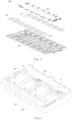
- FIG. 2 representatively illustrates an exploded schematic view of the battery connection module 100
- FIG. 3 representatively illustrates a partially enlarged schematic view when the battery connection module 100 and the plurality of batteries of the battery pack are assembled
- FIG. 4 representatively illustrates an exploded schematic view of FIG. 3
- FIG. 5 representatively illustrates a partially enlarged schematic view of FIG. 3 indicated by a dotted-line frame A
- FIG. 6 representatively illustrates an exploded schematic view of FIG. 5
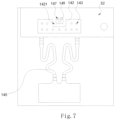
- FIG. 7 representatively illustrates a partial bottom view of FIG. 3 .
- each main constituent part of the battery connection module 100 proposed by the present disclosure will be described in detail in structure, connecting manner and function relationship.
- a first end 145a of the bridging piece 145 is connected to the first thermal conduction pad 141, a second end 145b of the bridging piece 145 is connected to the corresponding busbar 120.
- a material of the packaging cover 146 may be a thermal conduction adhesive, an antioxidative protecting adhesive or a combination thereof, for example, silica gel, epoxy resin and the like.
- the first thermal conduction pad 141 is provided with a first receiving opening 1411
- the first end 145a of the bridging piece 145 is provided with a second receiving opening1451
- the first receiving opening 1411 and the second receiving opening1451 correspond to each other in position.
- the temperature sensor 144 is partially positioned in a range of the first receiving opening 1411 and in a range of the second receiving opening1451.
- the temperature sensor 144 also may be all positioned in the range of the first receiving opening 1411 and in the range of the second receiving opening 1451.
- the first receiving opening 1411 is provided to a side edge of the first thermal conduction pad 141.
- the second receiving opening1451 is provided to a side edge of the first end 145a of the bridging piece 145.
- a material of the first thermal conduction pad 141 may be the same as a material of an electrical conduction trace on the circuit board 130, for example but is not limited to cooper.
- a material of the second thermal conduction pad 142 may be the same as a material of an electrical conduction trace on the circuit board 130, for example but is not limited to cooper.
- FIG. 8 representatively illustrates a partially enlarged schematic view of the battery connection module 100 in another exemplary embodiment
- FIG. 9 representatively illustrates an exploded schematic view of FIG. 8
- FIG. 10 representatively illustrates an exploded schematic view of FIG. 8 viewed from another angle
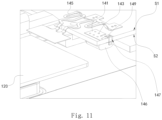
- FIG. 11 representatively illustrates a partial cross sectional view of FIG. 8 .
- the temperature sensor 144 also may be provided to the lower surface S2 of the circuit board 130 and is adjacent to the second thermal conduction pad 142.
- the first end 145a of the bridging piece 145 is connected to the first thermal conduction pad 141
- the second end 145b of the bridging piece 145 is connected to the corresponding busbar 120.
- the temperature sensor 144 may be provided to the upper surface S1 or the lower surface S2 of the circuit board 130, and is adjacent to the first thermal conduction pad 141 or the second thermal conduction pad 142.
- the bridging piece 145 may connect the corresponding busbar 120 and the first thermal conduction pad 141 or the bridging piece 145 may connect the corresponding busbar 120 and the second thermal conduction pad 142.
- the temperature measuring assembly further includes a packaging cover 146.
- the packaging cover 146 is provided to the lower surface S2 of the circuit board 130, is used to partially package the second thermal conduction pad 142, each first thermal conduction through-hole 143 and the temperature sensor 144, and can provide a thermal conduction and a protecting function.
- the packaging cover 146 when the temperature sensor 144 is provided to the lower surface S2 of the circuit board 130 and the temperature measuring assembly includes the packaging cover 146, the packaging cover 146 also may all package the second thermal conduction pad 142 and each first thermal conduction through-hole 143, in other words, in various possible embodiments which conform to the design concept of the present disclosure, when the temperature sensor 144 is provided to the lower surface S2 of the circuit board 130 and the temperature measuring assembly includes the packaging cover 146, the packaging cover 146 may at least partially package the second thermal conduction pad 142 and each first thermal conduction through-hole 143.
- the second thermal conduction pad 142 is provided with a third receiving opening 1421.
- the temperature sensor 144 is all positioned in a range of the third receiving opening 1421.
- the temperature sensor 144 also may be partially positioned in the range of the third receiving opening 1421.
- the temperature sensor 144 is at least partially positioned in the range of the third receiving opening 1421.
- the third receiving opening 1421 is provided to a middle portion of the second thermal conduction pad 142, that is, the third receiving opening 1421 is a closed opening structure, the temperature sensor 144 is all positioned in the range of the third receiving opening 1421.
- the third receiving opening 1421 also may be provided to a side edge of the second thermal conduction pad 142, that is, the third receiving opening 1421 is an opening structure which is opened at a side edge thereof, but the present disclosure is not limited thereto.
- the temperature sensor 144 is at least partially positioned in the range of the third receiving opening 1421.
- the temperature measuring assembly includes a plurality of first thermal conduction through-holes 143.
- the present disclosure can increase thermal conduction amount by the plurality of the first thermal conduction through-holes 143.
- the bridging piece 145 is also penetrated by the first thermal conduction through-hole 143, according to shape difference between the bridging piece 145 and the first thermal conduction pad 141 or the second thermal conduction pad 142, there may be some of the plurality of first thermal conduction through-holes 143 to penetrate the bridging piece 145, the first thermal conduction pad 141, the second thermal conduction pad 142 and the circuit board 130, but the other of the plurality of first thermal conduction through-holes 143 only penetrate the first thermal conduction pad 141, the second thermal conduction pad 142 and the circuit board 130.
- the third thermal conduction pad 149 is provided to the upper surface S1 of the circuit board 130, the welding pad 148 is provided to the lower surface S2 of the circuit board 130. And, the second thermal conduction through-hole 147 further penetrates the welding pad 148 and the third thermal conduction pad 149.
- a hole wall of the second thermal conduction through-hole 147 may be plated with a metal plating, a material of the metal plating may be cooper or cooper alloy.
- a material of the third thermal conduction pad 149 may be the same as a material of the electrical conduction trace on the circuit board 130, for example but is not limited to cooper.
- the temperature sensor 144 may be a NTC thermistor (Negative Temperature Coefficient thermistor).
- a material of the bridging piece 145 may be nickel.
- a material of the busbar 120 may be a metal material, such as aluminum, cooper and the like, also may be a structure of a single type of metal material, a laminated structure of a plurality of types of metal materials or a combination thereof.
Landscapes
- Chemical & Material Sciences (AREA)
- Chemical Kinetics & Catalysis (AREA)
- Electrochemistry (AREA)
- General Chemical & Material Sciences (AREA)
- Engineering & Computer Science (AREA)
- Manufacturing & Machinery (AREA)
- Battery Mounting, Suspending (AREA)
- Connection Of Batteries Or Terminals (AREA)
Description
- The present disclosure relates to the field of battery technology, and particularly relates to a battery connection module.
- Chinese patent application publication No.
CN111435723A discloses a battery connection module, in which a first end portion of a temperature collecting piece formed with an opening, a temperature sensing member is positioned in the opening, the other end of the temperature collecting piece is connected on a busbar. - However, the busbar disclosed by the prior art patent application connects electrodes of batteries, heat generated by the batteries will be directly transferred to the busbar, and the heat on the busbar will be transferred to the temperature sensing member at the first end portion of the temperature collecting piece via the temperature collecting piece, there is only one heat transferring path. If the temperature sensing member is provided between an upper surface of a circuit board and the below batteries and is spaced apart from the batteries by the circuit board and a tray, the heat transferring path is longer, which results in accuracy of temperature information collected by the temperature sensor lower and temperature response time longer, and results in sensitivity of temperature information collection poor.
- One main object of the present disclosure is to provide a battery connection module in which a heat transferring path between a temperature sensor and a surface of a side of a circuit board opposite to temperature sensor is shortened so as to overcome at least one deficiency of the above prior art.
- The object is solved by the features of the independent claims. Preferred embodiments are given in the dependent claims.
- In order to realize the above object, the present disclosure employs the following technical solution: according to one aspect of the present disclosure, a battery connection module is provided, the battery connection module is used to connect a plurality of batteries, the battery connection module comprises a tray, a plurality of busbars, a circuit board and a temperature measuring assembly; the plurality of busbars are mounted on the tray and are used to connect the plurality of batteries; the circuit board is connected to the plurality of busbars; the a temperature measuring assembly comprises a first thermal conduction pad and a second thermal conduction pad, a plurality of first thermal conduction through-holes, a temperature sensor and a bridging piece; the first thermal conduction pad and a second thermal conduction pad are respectively provided to an upper surface and a lower surface of the circuit board; the plurality of first thermal conduction through-holes penetrate the first thermal conduction pad, the second thermal conduction pad and the circuit board; the temperature sensor is provided to the upper surface or the lower surface of the circuit board and is adjacent to the first thermal conduction pad or the second thermal conduction pad; the bridging piece connects the corresponding busbar and the first thermal conduction pad or the second thermal conduction pad.
- According to one or more of the embodiments, the temperature sensor may be provided to the upper surface of the circuit board and/or may be adjacent to the first thermal conduction pad.
- In one or more of the embodiments, a first end of the bridging piece may be connected to the first thermal conduction pad.
- In one or more of the embodiments, a second end of the bridging piece may be connected to the corresponding busbar.
- According to one or more of the embodiments, the temperature measuring assembly may further comprise a packaging cover.
- In one or more of the embodiments, the packaging cover may be provided to the upper surface of the circuit board and/or may be used to at least partially package the first thermal conduction pad, the temperature sensor and/or the first end of the bridging piece.
- According to one or more of the embodiments, the first thermal conduction pad may be provided with a first receiving opening.
- In one or more of the embodiments, the first end of the bridging piece may be provided with a second receiving opening.
- In one or more of the embodiments, the first receiving opening may correspond to the second receiving opening in position.
- In one or more of the embodiments, the temperature sensor may be at least partially positioned in a range of the first receiving opening and in a range of the second receiving opening.
- According to one or more of the embodiments, the temperature sensor may be provided to the lower surface of the circuit board and/or may be adjacent to the second thermal conduction pad.
- In one or more of the embodiments, a first end of the bridging piece may be connected to the first thermal conduction pad.
- In one or more of the embodiments, a second end of the bridging piece may be connected to the corresponding busbar.
- According to one or more of the embodiments, the temperature measuring assembly may further comprise a packaging cover, the packaging cover may be provided to the lower surface of the circuit board and/or may be used to at least partially package the second thermal conduction pad, the temperature sensor and/or the plurality of first thermal conduction through-holes.
- According to one or more of the embodiments, the second thermal conduction pad may be provided with a third receiving opening.
- In one or more of the embodiments, the temperature sensor may be at least partially positioned in a range of the third receiving opening.
- According to one or more of the embodiments, the circuit board may be provided with an electrical connecting point.
- In one or more of the embodiments, the temperature sensor may be mounted to the electrical connecting point.
- In one or more of the embodiments, the temperature measuring assembly may further comprise a second thermal conduction through-hole.
- In one or more of the embodiments, the second thermal conduction through-hole may penetrate the electrical connecting point and the circuit board.
- According to one or more of the embodiments, the electrical connecting point may be a welding pad.
- In one or more of the embodiments, the temperature sensor may be mounted to the welding pad by a weld manner.
- In one or more of the embodiments, the temperature measuring assembly may further comprise a third thermal conduction pad.
- In one or more of the embodiments, one of the third thermal conduction pad and the welding pad may be provided to the upper surface of the circuit board.
- In one or more of the embodiments, the other of the third thermal conduction pad and the welding pad may be provided to the lower surface of the circuit board.
- In one or more of the embodiments, the second thermal conduction through-hole may further penetrate the third thermal conduction pad.
- According to one or more of the embodiments, the tray may be provided with an opening.
- In one or more of the embodiments, the opening may correspond to the second thermal conduction pad and the temperature sensor in position.
- As can be seen from the above technical solutions, advantages and positive effects of the battery connection module proposed by the present disclosure lie in that: the battery connection module proposed by the present disclosure includes a tray, a plurality of busbars, a circuit board and a temperature measuring assembly. The temperature measuring assembly includes a first thermal conduction pad and a second thermal conduction pad, a plurality of first thermal conduction through-holes, a temperature sensor and a bridging piece. The first thermal conduction pad and the second thermal conduction pad are respectively provided to an upper surface and a lower surface of the circuit board. The plurality of first thermal conduction through-holes penetrate the first thermal conduction pad, the second thermal conduction pad and the circuit board. The temperature sensor is provided to an upper surface or a lower surface of the circuit board, and is adjacent to the first thermal conduction pad or the second thermal conduction pad. By the above design, the present disclosure can allow heat at a surface of a side of the circuit board opposite to temperature sensor to be transferred to the temperature sensor via the first thermal conduction pad, the second thermal conduction pad and the first thermal conduction through-hole, heat transferring path is shortened, accuracy of temperature collection of the temperature sensor is promoted, and temperature response time is shortened, sensitivity of temperature information collection is promoted.
- Various purpose, features and advantages of the present disclosure will be apparent from considering the detailed description of preferred embodiments of the present disclosure in combination with the drawings. The drawings are only exemplary illustrations of the present disclosure and are not necessarily drawn to scale. In the drawings, the same reference numeral always indicates the same or similar element. In the drawings:
-
FIG. 1 is an exploded schematic view of a battery pack according to an exemplary embodiment; -
FIG. 2 is an exploded schematic view of a battery connection module ofFIG. 1 ; -
FIG. 3 is a partially enlarged schematic view when the battery connection module and a plurality of batteries of the battery pack ofFIG. 1 are assembled; -
FIG. 4 is an exploded schematic view ofFIG. 3 ; -
FIG. 5 is a partially enlarged schematic view ofFIG. 3 indicated by a dotted-line frame A; -
FIG. 6 is an exploded schematic view ofFIG. 5 ; -
FIG. 7 is a partial bottom view ofFIG. 3 ; -
FIG. 8 is a partially enlarged schematic view of the battery connection module in another exemplary embodiment; -
FIG. 9 is an exploded schematic view ofFIG. 8 ; -
FIG. 10 is an exploded schematic view ofFIG. 8 viewed from another angle; -
FIG. 11 is a partial cross sectional view ofFIG. 8 . -
100 battery connection module 45b second end 110 tray 45c penetrating hole 111 opening 451 second receiving opening 120 busbar 46 packaging cover 130 circuit board 47 second thermal conduction through- hole 141 first thermal conduction pad 48 welding pad 1411 first receiving opening 49 third thermal conduction pad 142 second thermal conduction pad 200 battery 1421 third receiving opening 300 end plate 143 first thermal conduction through-hole S1 upper surface 144 temperature sensor S2 lower surface 145 bridging piece 145a first end - Typical embodiments embodying the features and advantages of the present disclosure will be described in detail in the following description. It should be understood that the present disclosure can have various changes in different embodiments, which are not departed from the scope of the present disclosure, and the descriptions and drawings thereof are for illustrative purposes in essence and are not for limiting the present disclosure.
- In the following description of different exemplary embodiments of the present disclosure, reference is made to the accompanying drawings, which form a part of the present disclosure, and in which different exemplary structures, systems, and steps of aspects that may implement the present disclosure are shown by way of example. It should be understood that other specific solutions of components, structures, exemplary devices, systems, and steps may be used, and structural and functional modifications may be made without departing from the scope of the present disclosure. Moreover, although the terms "above", "between", "within", and the like may be used in this specification to describe different exemplary features and elements of the present disclosure, these terms are used herein for convenience only, for example, according to the direction of the examples illustrated in the accompanying drawings. Any content of the present specification should not be understood the structure falls within the scope of the present disclosure is required to be positioned in a specific three-dimensional direction.
- Referring to
FIG. 1, FIG. 1 representatively illustrates an exploded schematic view of a battery pack proposed by the present disclosure. In the exemplary embodiment, thebattery connection module 100 proposed by the present disclosure is described by taking thebattery connection module 100 applied to a battery pack for example. A person skilled in the art easily understands that, in order to apply relevant design of the present disclosure to other types of energy storing devices, various modifications, additions, substitutions, deletions or other variations may be made to following specific embodiments, but these modifications, additions, substitutions, deletions or other variations are still fallen within a scope of a principle of thebattery connection module 100 proposed by the present disclosure. - As shown in
FIG. 1 , in the present embodiment, thebattery connection module 100 proposed by the present disclosure is provided on a plurality of batteries of a battery pack, thebattery connection module 100 is used to connect the plurality ofbatteries 200. In combination with referring toFIG. 2 to FIG. 7 ,FIG. 2 representatively illustrates an exploded schematic view of thebattery connection module 100,FIG. 3 representatively illustrates a partially enlarged schematic view when thebattery connection module 100 and the plurality of batteries of the battery pack are assembled,FIG. 4 representatively illustrates an exploded schematic view ofFIG. 3 ,FIG. 5 representatively illustrates a partially enlarged schematic view ofFIG. 3 indicated by a dotted-line frame A,FIG. 6 representatively illustrates an exploded schematic view ofFIG. 5 , andFIG. 7 representatively illustrates a partial bottom view ofFIG. 3 . Hereinafter in combination with these figures, each main constituent part of thebattery connection module 100 proposed by the present disclosure will be described in detail in structure, connecting manner and function relationship. - As shown in in
FIG. 1 to FIG. 7 , in an embodiment of the present disclosure, thebattery connection module 100 proposed by the present disclosure includes atray 110, a plurality ofbusbars 120, acircuit board 130 and a temperature measuring assembly. Specifically, the plurality ofbusbars 120 are mounted on thetray 110, the plurality ofbusbars 120 are used to connect the plurality ofbatteries 200. Eachbusbar 120 is connected to a voltage collecting wiring of thecircuit board 130 via onebridging piece 145. The temperature measuring assembly includes a firstthermal conduction pad 141 and a secondthermal conduction pad 142, a plurality of first thermal conduction through-holes 143, atemperature sensor 144 and thebridging piece 145. The firstthermal conduction pad 141 and the secondthermal conduction pad 142 are respectively provided to an upper surface S1 and a lower surface S2 of thecircuit board 130. The first thermal conduction through-hole 143 penetrates the firstthermal conduction pad 141, the secondthermal conduction pad 142 and thecircuit board 130. Thetemperature sensor 144 is provided to the upper surface S1 of thecircuit board 130 and is adjacent to the firstthermal conduction pad 141. Thebridging piece 145 connects thebusbar 120 and the firstthermal conduction pad 141. By the above design, the present disclosure can allow heat at a surface of a side of thecircuit board 130 opposite to thetemperature sensor 144 to be transferred to thetemperature sensor 144 via the secondthermal conduction pad 142, the first thermal conduction through-hole 143 and the firstthermal conduction pad 141, heat transferring path is shortened, accuracy of temperature collection of thetemperature sensor 144 is promoted, and temperature response time is shortened, sensitivity of temperature information collection is promoted. - As shown in
FIG. 3 andFIG. 6 , based on the design that thetemperature sensor 144 is provided to the upper surface S1 of thecircuit board 130 and is adjacent to the firstthermal conduction pad 141, in an embodiment of the present disclosure, afirst end 145a of thebridging piece 145 is connected to the firstthermal conduction pad 141, asecond end 145b of thebridging piece 145 is connected to thecorresponding busbar 120. - As shown in
FIG. 3 to FIG. 6 , in an embodiment of the present disclosure, thefirst end 145a of thebridging piece 145 connects the firstthermal conduction pad 141 and covers each first thermal conduction through-hole 143. The temperature measuring assembly further includes apackaging cover 146. Thepackaging cover 146 is provided to the upper surface S1 of thecircuit board 130, is used to package the firstthermal conduction pad 141, thetemperature sensor 144 and thefirst end 145a of thebridging piece 145, and can provide a thermal conduction function and a protecting function. In some embodiments, in a construction that the plurality of the first thermal conduction through-holes 143 are not all covered by thefirst end 145a of thebridging piece 145, thepackaging cover 146 also may cover the other first thermal conduction through-hole 143 which is exposed to thefirst end 145a of thebridging piece 145. In some embodiments, when thetemperature sensor 144 is provided to the upper surface S1 of thecircuit board 130 and the temperature measuring assembly includes thepackaging cover 146, thepackaging cover 146 also may partially package the firstthermal conduction pad 141, in other words, in various possible embodiments which conform to the design concept of the present disclosure, when thetemperature sensor 144 is provided to the upper surface S1 of thecircuit board 130 and the temperature measuring assembly includes thepackaging cover 146, thepackaging cover 146 may at least partially package the firstthermal conduction pad 141. - Based on the design that the temperature measuring assembly includes the
packaging cover 146, in an embodiment of the present disclosure, a material of thepackaging cover 146 may be a thermal conduction adhesive, an antioxidative protecting adhesive or a combination thereof, for example, silica gel, epoxy resin and the like. - As shown in
FIG. 6 , in an embodiment of the present disclosure, the firstthermal conduction pad 141 is provided with afirst receiving opening 1411, thefirst end 145a of thebridging piece 145 is provided with a second receiving opening1451, thefirst receiving opening 1411 and the second receiving opening1451 correspond to each other in position. On this basis, thetemperature sensor 144 is partially positioned in a range of thefirst receiving opening 1411 and in a range of the second receiving opening1451. In some embodiments, thetemperature sensor 144 also may be all positioned in the range of thefirst receiving opening 1411 and in the range of thesecond receiving opening 1451. In other words, in various possible embodiments which conform to the design concept of the present disclosure, when thetemperature sensor 144 is provided to the upper surface S1 of thecircuit board 130 and the firstthermal conduction pad 141 is provided with thefirst receiving opening 1411, thetemperature sensor 144 is at least partially positioned in the range of thefirst receiving opening 1411 and in the range of the second receiving opening1451. - As shown in
FIG. 6 andFIG. 7 , based on the design that the firstthermal conduction pad 141 is provided with thefirst receiving opening 1411 and thefirst end 145a of thebridging piece 145 is provided with the second receiving opening1451, in an embodiment of the present disclosure, thefirst receiving opening 1411 is provided to a side edge of the firstthermal conduction pad 141. On this basis, the second receiving opening1451 is provided to a side edge of thefirst end 145a of thebridging piece 145. In some embodiments, when thefirst receiving opening 1411 is provided to a side edge of the firstthermal conduction pad 141, the second receiving opening1451 also may be provided to a middle portion of thebridging piece 145, that is, the second receiving opening1451 may be a closed opening structure. Moreover, thefirst receiving opening 1411 also may be provided to a middle portion of the firstthermal conduction pad 141, that is, thefirst receiving opening 1411 may be a closed opening structure, on this basis, the second receiving opening1451 may be provided to a side edge or a middle portion of thefirst end 145a of thebridging piece 145, but the present disclosure is not limited thereto. In addition, when thefirst receiving opening 1411 is a closed opening structure, thetemperature sensor 144 is all positioned in the range of thefirst receiving opening 1411. - In an embodiment of the present disclosure, a hole wall of the first thermal conduction through-
hole 143 may be plated with a metal plating, a material of the metal plating may be cooper or cooper alloy. - In an embodiment of the present disclosure, a material of the first
thermal conduction pad 141 may be the same as a material of an electrical conduction trace on thecircuit board 130, for example but is not limited to cooper. - In an embodiment of the present disclosure, a material of the second
thermal conduction pad 142 may be the same as a material of an electrical conduction trace on thecircuit board 130, for example but is not limited to cooper. - Referring to
FIG. 8 to FIG. 11 ,FIG. 8 representatively illustrates a partially enlarged schematic view of thebattery connection module 100 in another exemplary embodiment,FIG. 9 representatively illustrates an exploded schematic view ofFIG. 8 ,FIG. 10 representatively illustrates an exploded schematic view ofFIG. 8 viewed from another angle, andFIG. 11 representatively illustrates a partial cross sectional view ofFIG. 8 . - As shown in
FIG. 8 to FIG. 11 , in an embodiment of the present disclosure, thetemperature sensor 144 also may be provided to the lower surface S2 of thecircuit board 130 and is adjacent to the secondthermal conduction pad 142. On this basis, thefirst end 145a of thebridging piece 145 is connected to the firstthermal conduction pad 141, thesecond end 145b of the bridging piece 145is connected to thecorresponding busbar 120. In other words, in various possible embodiments which conform to the design concept of the present disclosure, thetemperature sensor 144 may be provided to the upper surface S1 or the lower surface S2 of thecircuit board 130, and is adjacent to the firstthermal conduction pad 141 or the secondthermal conduction pad 142. On this basis, thebridging piece 145 may connect thecorresponding busbar 120 and the firstthermal conduction pad 141 or thebridging piece 145 may connect thecorresponding busbar 120 and the secondthermal conduction pad 142. - As shown in
FIG. 10 andFIG. 11 , in an embodiment of the present disclosure, the temperature measuring assembly further includes apackaging cover 146. Thepackaging cover 146 is provided to the lower surface S2 of thecircuit board 130, is used to partially package the secondthermal conduction pad 142, each first thermal conduction through-hole 143 and thetemperature sensor 144, and can provide a thermal conduction and a protecting function. In some embodiments, when thetemperature sensor 144 is provided to the lower surface S2 of thecircuit board 130 and the temperature measuring assembly includes thepackaging cover 146, thepackaging cover 146 also may all package the secondthermal conduction pad 142 and each first thermal conduction through-hole 143, in other words, in various possible embodiments which conform to the design concept of the present disclosure, when thetemperature sensor 144 is provided to the lower surface S2 of thecircuit board 130 and the temperature measuring assembly includes thepackaging cover 146, thepackaging cover 146 may at least partially package the secondthermal conduction pad 142 and each first thermal conduction through-hole 143. - As shown in
FIG. 10 andFIG. 11 , in an embodiment of the present disclosure, the secondthermal conduction pad 142 is provided with athird receiving opening 1421. On this basis, thetemperature sensor 144 is all positioned in a range of thethird receiving opening 1421. In some embodiments, thetemperature sensor 144 also may be partially positioned in the range of thethird receiving opening 1421. In other words, in various possible embodiments which conform to the design concept of the present disclosure, when thetemperature sensor 144 is provided to the lower surface S2 of thecircuit board 130 and the secondthermal conduction pad 142 is provided with thethird receiving opening 1421, thetemperature sensor 144 is at least partially positioned in the range of thethird receiving opening 1421. - As shown in
FIG. 10 andFIG. 11 , based on the design that the secondthermal conduction pad 142 is provided with thethird receiving opening 1421, in an embodiment of the present disclosure, thethird receiving opening 1421 is provided to a middle portion of the secondthermal conduction pad 142, that is, thethird receiving opening 1421 is a closed opening structure, thetemperature sensor 144 is all positioned in the range of thethird receiving opening 1421. In some embodiments, thethird receiving opening 1421 also may be provided to a side edge of the secondthermal conduction pad 142, that is, thethird receiving opening 1421 is an opening structure which is opened at a side edge thereof, but the present disclosure is not limited thereto. In addition, when thethird receiving opening 1421 is the opening structure which is opened, thetemperature sensor 144 is at least partially positioned in the range of thethird receiving opening 1421. - It is noted that, in each above embodiments, description is performed by taking that the
bridging piece 145 is connected to the firstthermal conduction pad 141 for example. In some embodiments, whether thetemperature sensor 144 is provided to the upper surface S1 or the lower surface S2 of thecircuit board 130, thebridging piece 145 may connect the secondthermal conduction pad 142 and thecorresponding busbar 120, and so the present disclosure is not limited thereto. - As shown in
FIG. 6 andFIG. 9 , in an embodiment of the present disclosure, the firstthermal conduction pad 141 can be connected to the voltage collecting wiring on thecircuit board 130, besides thebridging piece 145 realizes an electrical connection function between thecircuit board 130 and the correspondingbatteries 200, thebridging piece 145 can allow heat to be transferred, by the above design, the present disclosure can allow thebridging piece 145 to transfer heat, and can allow heat transferred via the first thermal conduction through-hole 143 which penetrates thecircuit board 130 to be more rapidly transferred to thetemperature sensor 144. - As shown in
FIG. 6 andFIG. 9 , in an embodiment of the present disclosure, the temperature measuring assembly includes a plurality of first thermal conduction through-holes 143. By the above design, the present disclosure can increase thermal conduction amount by the plurality of the first thermal conduction through-holes 143. In addition, when thebridging piece 145 is also penetrated by the first thermal conduction through-hole 143, according to shape difference between the bridgingpiece 145 and the firstthermal conduction pad 141 or the secondthermal conduction pad 142, there may be some of the plurality of first thermal conduction through-holes 143 to penetrate thebridging piece 145, the firstthermal conduction pad 141, the secondthermal conduction pad 142 and thecircuit board 130, but the other of the plurality of first thermal conduction through-holes 143 only penetrate the firstthermal conduction pad 141, the secondthermal conduction pad 142 and thecircuit board 130. - As shown in
FIG. 6 andFIG. 11 , in an embodiment of the present disclosure, thecircuit board 130 is provided with an electrical connecting point, thetemperature sensor 144 is mounted to the electrical connecting point. On this basis, the temperature measuring assembly further includes a second thermal conduction through-hole 147. The second thermal conduction through-hole 147 penetrates the electrical connecting point and thecircuit board 130. By the above design, besides the electrical connecting point realizes a function that the temperature measuring assembly is mounted and the electrical connecting point is electrically connected with the electrical conduction trace of thecircuit board 130, the electrical connecting point may act as a thermal conduction member, and the second thermal conduction through-hole 147 can shorten the heat transferring path at the position of the second thermal conduction through-hole 147. - As shown in
FIG. 7 andFIG. 8 , based on the design that thecircuit board 130 is provided with the electrical connecting point, in an embodiment of the present disclosure, the electrical connecting point is two electrical connecting points which each are awelding pad 148, thetemperature sensor 144 is mounted to thewelding pads 148 by a welding manner, thewelding pads 148 are connected to a temperature collecting wiring on thecircuit board 130. On this basis, the temperature measuring assembly further includes thirdthermal conduction pads 149. In the embodiment as shown inFIG. 7 , thewelding pad 148 is provided to the upper surface S1 of thecircuit board 130, the thirdthermal conduction pad 149 is provided to the lower surface S2 of thecircuit board 130. In the embodiment as shown inFIG. 8 , the thirdthermal conduction pad 149 is provided to the upper surface S1 of thecircuit board 130, thewelding pad 148 is provided to the lower surface S2 of thecircuit board 130. And, the second thermal conduction through-hole 147 further penetrates thewelding pad 148 and the thirdthermal conduction pad 149. In other words, in various possible embodiments which conform to the design concept of the present disclosure, when the temperature measuring assembly further includes the thirdthermal conduction pad 149, one of thewelding pad 148 and the thirdthermal conduction pad 149 is provided to the upper surface S1 of thecircuit board 130, the other of thewelding pad 148 and the thirdthermal conduction pad 149 is provided to of the lower surface S2 of thecircuit board 130, and the second thermal conduction through-hole 147 further penetrates thewelding pad 148 and the thirdthermal conduction pad 149. - In an embodiment of the present disclosure, a hole wall of the second thermal conduction through-
hole 147 may be plated with a metal plating, a material of the metal plating may be cooper or cooper alloy. - In an embodiment of the present disclosure, a material of the third
thermal conduction pad 149 may be the same as a material of the electrical conduction trace on thecircuit board 130, for example but is not limited to cooper. - As shown in
FIG. 4 , in an embodiment of the present disclosure, atray 110 is provided with anopening 111, theopening 111 is positioned between the lower surface S2 of thecircuit board 130 and an upper surface of thecorresponding battery 200. Accordingly, when thetemperature sensor 144 is provided to the lower surface S2 of thecircuit board 130, theopening 111 corresponds to thetemperature sensor 144 in position, theopening 111 of thetray 110 can allow thetemperature sensor 144 to face thecorresponding battery 200 in a downward direction, so that thetemperature sensor 144 can directly sense heat of thecorresponding battery 200. When thetemperature sensor 144 is provided to the upper surface S1 of thecircuit board 130, theopening 111 corresponds to the secondthermal conduction pad 142 on the lower surface S2 in position, theopening 111 of thetray 110 can allow the secondthermal conduction pad 142, the thirdthermal conduction pad 149 and the first thermal conduction through-hole 143 on the lower surface S2 to directly face thecorresponding battery 200 in the downward direction, so that the secondthermal conduction pad 142, the thirdthermal conduction pad 149 and the first thermal conduction through-hole 143 can be directly subjected to heat so as to reflect heat of thecorresponding battery 200 and transfer heat to the upper surface S1 of thetemperature sensor 144. - It should be noted here that the battery connection module shown in the drawings and described in this specification are just a few examples of many kinds of battery connection modules which can employ the principle of the present disclosure. It should be clearly understood that the principle of the present disclosure is limited to any details or any components of the battery connection module shown in the drawings or described in this specification.
- Examples are as follows.
- In an embodiment of the present disclosure, the
circuit board 130 may be a hard printed circuit board (PCB). - In an embodiment of the present disclosure, the
temperature sensor 144 may be a NTC thermistor (Negative Temperature Coefficient thermistor). - In an embodiment of the present disclosure, a material of the
bridging piece 145 may be nickel. - In an embodiment of the present disclosure, the
first end 145a of thebridging piece 145 may connect the firstthermal conduction pad 141 on thecircuit board 130 by a surface welding manner, a penetratinghole 145c of thebridging piece 145 of thefirst end 145a acts as a welding strengthen function, thesecond end 145b of thebridging piece 145 may connect thecorresponding busbar 120 by a ultrasonic welding manner. - In an embodiment of the present disclosure, a material of the
busbar 120 may be a metal material, such as aluminum, cooper and the like, also may be a structure of a single type of metal material, a laminated structure of a plurality of types of metal materials or a combination thereof. - Based on the above detailed description of several exemplary embodiments of the
battery connection module 100 proposed by the present disclosure, hereinafter an exemplary embodiment of the battery pack proposed by the present disclosure will be described. - As shown in
FIG. 1 , in an embodiment of the present disclosure, the battery pack proposed by the present disclosure includes thebattery connection module 100 which is proposed by the present disclosure and is described in detail in the above embodiments. Here, thebattery connection module 100 is provided on the plurality ofbatteries 200 of the battery pack, two ends of the plurality ofbatteries 200 are provided with frame structures, such asend plates 300 and the like, and other structure. - It should be noted here that the battery pack shown in the drawings and described in this specification are just a few examples of many kinds of battery packs which can employ the principle of the present disclosure. It should be clearly understood that the principle of the present disclosure is limited to any details or any components of the battery pack shown in the drawings or described in this specification
In conclusion, a battery connection module proposed by the present disclosure includes a tray, a plurality of busbars, a circuit board and a temperature measuring assembly. The temperature measuring assembly includes a first thermal conduction pad and a second thermal conduction pad, a plurality of first thermal conduction through-holes, a temperature sensor and a bridging piece. The first thermal conduction pad and the second thermal conduction pad are respectively provided to an upper surface and a lower surface of the circuit board. The plurality of first thermal conduction through-holes penetrate the first thermal conduction pad, the second thermal conduction pad and the circuit board. The temperature sensor is provided to an upper surface or a lower surface of the circuit board, and is adjacent to the first thermal conduction pad or the second thermal conduction pad. By the above design, the present disclosure can allow heat at a surface of a side of the circuit board opposite to temperature sensor to be transferred to the temperature sensor via the first thermal conduction pad, the second thermal conduction pad and the first thermal conduction through-hole, heat transferring path is shortened, accuracy of temperature collection of the temperature sensor is promoted, and temperature response time is shortened, sensitivity of temperature information collection is promoted. - The exemplary embodiments of the battery connection module proposed by the present disclosure are described and/or illustrated in detail above. However, the embodiments of the present disclosure are not limited to the specific embodiments described herein. On the contrary, the components and/or steps of each embodiment can be used independently and separately from other components and/or steps described herein. Each component and/or step of one embodiment may also be used in combination with other components and/or steps of other embodiments. When introducing the elements/components/etc. described and/or illustrated here, the terms "one", "a/an" and "the above" are used to indicate the existence of one or more elements/components/etc. The terms "include/includes/including", "comprise/comprises/comprising" and "has/have/having" are used to mean open inclusion and mean that there may be other elements/components/etc. besides the listed elements/components/etc. In addition, the terms "first" and "second" in the claims and the specification are used only as marks and are not as a numerical limitation on their objects.
- Although the battery connection module proposed by the present disclosure has been described according to different specific embodiments, a person skilled in the art will recognize that the implementation of the present disclosure can be modified within the scope of the claims.
Claims (14)
- A battery connection module (100) used to connect a plurality of batteries (200), the battery connection module (100) comprising:a tray (110);a plurality of busbars (120) mounted on the tray (110) and used to connect the plurality of batteries (200);a circuit board (130) connected to the plurality of busbars (120); characterised bya temperature measuring assembly comprising:a first thermal conduction pad (141) and a second thermal conduction pad (142) respectively provided to an upper surface and a lower surface of the circuit board (130);a plurality of first thermal conduction through-holes (143) penetrating the first thermal conduction pad (141), the second thermal conduction pad (142) and the circuit board (130);a temperature sensor (144) which is provided to the upper surface or the lower surface of the circuit board (130) and is adjacent to the first thermal conduction pad (141) or the second thermal conduction pad (142); anda bridging piece (145) connecting the corresponding busbar (120) and the first thermal conduction pad (141) or the second thermal conduction pad (142).
- The battery connection module (100) according to claim 1, wherein the temperature sensor (144) is provided to the upper surface of the circuit board (130) and is adjacent to the first thermal conduction pad (141).
- The battery connection module (100) according to claim 1 or 2, wherein a first end (145a) of the bridging piece (145) is connected to the first thermal conduction pad (141), a second end (145b) of the bridging piece (145) is connected to the corresponding busbar (120).
- The battery connection module (100) according to any one of the claims 1-3, wherein the temperature measuring assembly further comprises a packaging cover (146) which is provided to the upper surface of the circuit board (130).
- The battery connection module (100) according to claim 4, wherein the packaging cover (146) is used to at least partially package the first thermal conduction pad (141), the temperature sensor (144) and the first end (145a) of the bridging piece (145).
- The battery connection module (100) according to any one of the preceding claims 2-5, whereinthe first thermal conduction pad (141) is provided with a first receiving opening (1411),the first end (145a) of the bridging piece (145) is provided with a second receiving opening (1451),the first receiving opening (1411) corresponds to the second receiving opening (1451) in position;the temperature sensor (144) is at least partially positioned in a range of the first receiving opening (1411) and in a range of the second receiving opening (1451).
- The battery connection module (100) according to any one of the preceding claims, whereinthe temperature sensor (144) provided to the lower surface of the circuit board (130) and is adjacent to the second thermal conduction pad (142),a first end (145a) of the bridging piece (145) is connected to the first thermal conduction pad (141), a second end (145b) of the bridging piece (145) is connected to the corresponding busbar (120).
- The battery connection module (100) according to any one of the preceding claims, wherein the temperature measuring assembly further comprises a packaging cover (146) which is provided to the lower surface of the circuit board (130) and is used to at least partially package the second thermal conduction pad (142), the temperature sensor (144) and the plurality of first thermal conduction through-holes (143).
- The battery connection module (100) according to any one of the preceding claims, wherein the second thermal conduction pad (142) is provided with a third receiving opening (1421); wherein the temperature sensor (144) is at least partially positioned in a range of the third receiving opening (1421).
- The battery connection module (100) according to any one of the preceding claims, wherein the circuit board (130) is provided with an electrical connecting point, the temperature sensor (144) is mounted to the electrical connecting point; the temperature measuring assembly further comprises a second thermal conduction through-hole (147) which penetrates the electrical connecting point and the circuit board (130).
- The battery connection module (100) according to claim 10, wherein the electrical connecting point is a welding pad (148), the temperature sensor (144) is mounted to the welding pad (148) by a weld manner.
- The battery connection module (100) according to claim 11, wherein the temperature measuring assembly further comprises a third thermal conduction pad (149), one of the third thermal conduction pad (149) and the welding pad (148) is provided to the upper surface of the circuit board (130), the other of the third thermal conduction pad (149) and the welding pad (148) is provided to the lower surface of the circuit board (130).
- The battery connection module (100) according to claim 12, wherein the second thermal conduction through-hole (147) further penetrates the third thermal conduction pad (149).
- The battery connection module (100) according to any one of the preceding claims, wherein the tray (110) is provided with an opening (111), the opening (111) corresponds to the second thermal conduction pad (142) and the temperature sensor (144) in position.
Applications Claiming Priority (1)
| Application Number | Priority Date | Filing Date | Title |
|---|---|---|---|
| CN202210134466.5A CN116632390A (en) | 2022-02-14 | 2022-02-14 | Battery connection module |
Publications (2)
| Publication Number | Publication Date |
|---|---|
| EP4239783A1 EP4239783A1 (en) | 2023-09-06 |
| EP4239783B1 true EP4239783B1 (en) | 2025-04-16 |
Family
ID=85225254
Family Applications (1)
| Application Number | Title | Priority Date | Filing Date |
|---|---|---|---|
| EP23156003.8A Active EP4239783B1 (en) | 2022-02-14 | 2023-02-10 | Battery connection module |
Country Status (3)
| Country | Link |
|---|---|
| EP (1) | EP4239783B1 (en) |
| JP (1) | JP7481516B2 (en) |
| CN (1) | CN116632390A (en) |
Families Citing this family (2)
| Publication number | Priority date | Publication date | Assignee | Title |
|---|---|---|---|---|
| CN222507903U (en) * | 2024-02-05 | 2025-02-18 | 武汉亿纬储能有限公司 | Connecting row, connecting row assembly and battery module |
| US20250372734A1 (en) * | 2024-05-31 | 2025-12-04 | Cox Automotive, Inc. | Bus connector for an energy storage system |
Family Cites Families (5)
| Publication number | Priority date | Publication date | Assignee | Title |
|---|---|---|---|---|
| JP5733171B2 (en) | 2011-11-18 | 2015-06-10 | 住友電気工業株式会社 | Battery wiring module, battery wiring module manufacturing method, and power supply device including battery wiring module |
| KR101386167B1 (en) * | 2012-11-27 | 2014-04-18 | 삼성에스디아이 주식회사 | Battery pack |
| CN111435723B (en) | 2019-01-11 | 2022-10-11 | 莫仕连接器(成都)有限公司 | Battery connection module |
| CN112151703B (en) * | 2019-06-28 | 2022-03-11 | 宁德时代新能源科技股份有限公司 | battery module |
| KR20210006771A (en) * | 2019-07-09 | 2021-01-19 | 한국단자공업 주식회사 | Electrical connecting apparatus for battery Module |
-
2022
- 2022-02-14 CN CN202210134466.5A patent/CN116632390A/en active Pending
-
2023
- 2023-02-09 JP JP2023018103A patent/JP7481516B2/en active Active
- 2023-02-10 EP EP23156003.8A patent/EP4239783B1/en active Active
Also Published As
| Publication number | Publication date |
|---|---|
| CN116632390A (en) | 2023-08-22 |
| JP7481516B2 (en) | 2024-05-10 |
| JP2023118093A (en) | 2023-08-24 |
| EP4239783A1 (en) | 2023-09-06 |
Similar Documents
| Publication | Publication Date | Title |
|---|---|---|
| EP4239783B1 (en) | Battery connection module | |
| JP7474745B2 (en) | Overcurrent protection devices and battery systems | |
| US4103318A (en) | Electronic multichip module | |
| EP2804284A2 (en) | Battery pack | |
| EP2131412B1 (en) | Battery pack | |
| EP0197148A1 (en) | Printed-circuit board for mounting electronic element and method of manufacture thereof | |
| CN106575802A (en) | Battery sensor device | |
| EP4239776A1 (en) | Battery connection module | |
| CN210723152U (en) | Battery modules, battery packs and vehicles | |
| JP2002124305A (en) | Battery pack | |
| CN111435723B (en) | Battery connection module | |
| JP2020148590A (en) | Temperature measurement unit, mounting structure of temperature measurement unit, and power storage module | |
| JP5207278B2 (en) | Protection circuit module | |
| CN114902465A (en) | Electronic assembly | |
| US20230238622A1 (en) | Battery pack and electric device | |
| CN212963757U (en) | Temperature sensing element, temperature measurement component and battery pack | |
| CN218677504U (en) | Signal sampling assembly for battery module and battery module | |
| JP7270414B2 (en) | Temperature sensors, battery modules and battery packs | |
| CN116344986A (en) | Temperature and voltage acquisition integrated module and battery module | |
| EP3598089A1 (en) | Infrared sensor | |
| CN222736365U (en) | Circuit board assembly | |
| WO2024207555A1 (en) | Temperature and voltage acquisition integrated module and battery module | |
| WO2025089001A1 (en) | Battery pack | |
| TWI918562B (en) | Battery sensing module and battery module | |
| CN212907844U (en) | Temperature acquisition device, battery module and battery management system |
Legal Events
| Date | Code | Title | Description |
|---|---|---|---|
| PUAI | Public reference made under article 153(3) epc to a published international application that has entered the european phase |
Free format text: ORIGINAL CODE: 0009012 |
|
| STAA | Information on the status of an ep patent application or granted ep patent |
Free format text: STATUS: THE APPLICATION HAS BEEN PUBLISHED |
|
| AK | Designated contracting states |
Kind code of ref document: A1 Designated state(s): AL AT BE BG CH CY CZ DE DK EE ES FI FR GB GR HR HU IE IS IT LI LT LU LV MC ME MK MT NL NO PL PT RO RS SE SI SK SM TR |
|
| STAA | Information on the status of an ep patent application or granted ep patent |
Free format text: STATUS: REQUEST FOR EXAMINATION WAS MADE |
|
| P01 | Opt-out of the competence of the unified patent court (upc) registered |
Effective date: 20230928 |
|
| 17P | Request for examination filed |
Effective date: 20231017 |
|
| RBV | Designated contracting states (corrected) |
Designated state(s): AL AT BE BG CH CY CZ DE DK EE ES FI FR GB GR HR HU IE IS IT LI LT LU LV MC ME MK MT NL NO PL PT RO RS SE SI SK SM TR |
|
| GRAP | Despatch of communication of intention to grant a patent |
Free format text: ORIGINAL CODE: EPIDOSNIGR1 |
|
| STAA | Information on the status of an ep patent application or granted ep patent |
Free format text: STATUS: GRANT OF PATENT IS INTENDED |
|
| INTG | Intention to grant announced |
Effective date: 20250116 |
|
| GRAS | Grant fee paid |
Free format text: ORIGINAL CODE: EPIDOSNIGR3 |
|
| GRAA | (expected) grant |
Free format text: ORIGINAL CODE: 0009210 |
|
| STAA | Information on the status of an ep patent application or granted ep patent |
Free format text: STATUS: THE PATENT HAS BEEN GRANTED |
|
| AK | Designated contracting states |
Kind code of ref document: B1 Designated state(s): AL AT BE BG CH CY CZ DE DK EE ES FI FR GB GR HR HU IE IS IT LI LT LU LV MC ME MK MT NL NO PL PT RO RS SE SI SK SM TR |
|
| REG | Reference to a national code |
Ref country code: GB Ref legal event code: FG4D |
|
| REG | Reference to a national code |
Ref country code: CH Ref legal event code: EP Ref country code: DE Ref legal event code: R096 Ref document number: 602023002872 Country of ref document: DE |
|
| REG | Reference to a national code |
Ref country code: IE Ref legal event code: FG4D |
|
| REG | Reference to a national code |
Ref country code: NL Ref legal event code: MP Effective date: 20250416 |
|
| PG25 | Lapsed in a contracting state [announced via postgrant information from national office to epo] |
Ref country code: NL Free format text: LAPSE BECAUSE OF FAILURE TO SUBMIT A TRANSLATION OF THE DESCRIPTION OR TO PAY THE FEE WITHIN THE PRESCRIBED TIME-LIMIT Effective date: 20250416 |
|
| REG | Reference to a national code |
Ref country code: AT Ref legal event code: MK05 Ref document number: 1786447 Country of ref document: AT Kind code of ref document: T Effective date: 20250416 |
|
| PG25 | Lapsed in a contracting state [announced via postgrant information from national office to epo] |
Ref country code: PT Free format text: LAPSE BECAUSE OF FAILURE TO SUBMIT A TRANSLATION OF THE DESCRIPTION OR TO PAY THE FEE WITHIN THE PRESCRIBED TIME-LIMIT Effective date: 20250818 Ref country code: ES Free format text: LAPSE BECAUSE OF FAILURE TO SUBMIT A TRANSLATION OF THE DESCRIPTION OR TO PAY THE FEE WITHIN THE PRESCRIBED TIME-LIMIT Effective date: 20250416 Ref country code: FI Free format text: LAPSE BECAUSE OF FAILURE TO SUBMIT A TRANSLATION OF THE DESCRIPTION OR TO PAY THE FEE WITHIN THE PRESCRIBED TIME-LIMIT Effective date: 20250416 |
|
| REG | Reference to a national code |
Ref country code: LT Ref legal event code: MG9D |
|
| PG25 | Lapsed in a contracting state [announced via postgrant information from national office to epo] |
Ref country code: GR Free format text: LAPSE BECAUSE OF FAILURE TO SUBMIT A TRANSLATION OF THE DESCRIPTION OR TO PAY THE FEE WITHIN THE PRESCRIBED TIME-LIMIT Effective date: 20250717 Ref country code: NO Free format text: LAPSE BECAUSE OF FAILURE TO SUBMIT A TRANSLATION OF THE DESCRIPTION OR TO PAY THE FEE WITHIN THE PRESCRIBED TIME-LIMIT Effective date: 20250716 |
|
| PG25 | Lapsed in a contracting state [announced via postgrant information from national office to epo] |
Ref country code: PL Free format text: LAPSE BECAUSE OF FAILURE TO SUBMIT A TRANSLATION OF THE DESCRIPTION OR TO PAY THE FEE WITHIN THE PRESCRIBED TIME-LIMIT Effective date: 20250416 |
|
| PG25 | Lapsed in a contracting state [announced via postgrant information from national office to epo] |
Ref country code: BG Free format text: LAPSE BECAUSE OF FAILURE TO SUBMIT A TRANSLATION OF THE DESCRIPTION OR TO PAY THE FEE WITHIN THE PRESCRIBED TIME-LIMIT Effective date: 20250416 |
|
| PG25 | Lapsed in a contracting state [announced via postgrant information from national office to epo] |
Ref country code: HR Free format text: LAPSE BECAUSE OF FAILURE TO SUBMIT A TRANSLATION OF THE DESCRIPTION OR TO PAY THE FEE WITHIN THE PRESCRIBED TIME-LIMIT Effective date: 20250416 |
|
| PG25 | Lapsed in a contracting state [announced via postgrant information from national office to epo] |
Ref country code: AT Free format text: LAPSE BECAUSE OF FAILURE TO SUBMIT A TRANSLATION OF THE DESCRIPTION OR TO PAY THE FEE WITHIN THE PRESCRIBED TIME-LIMIT Effective date: 20250416 |
|
| PG25 | Lapsed in a contracting state [announced via postgrant information from national office to epo] |
Ref country code: RS Free format text: LAPSE BECAUSE OF FAILURE TO SUBMIT A TRANSLATION OF THE DESCRIPTION OR TO PAY THE FEE WITHIN THE PRESCRIBED TIME-LIMIT Effective date: 20250716 |
|
| PG25 | Lapsed in a contracting state [announced via postgrant information from national office to epo] |
Ref country code: IS Free format text: LAPSE BECAUSE OF FAILURE TO SUBMIT A TRANSLATION OF THE DESCRIPTION OR TO PAY THE FEE WITHIN THE PRESCRIBED TIME-LIMIT Effective date: 20250816 |
|
| PG25 | Lapsed in a contracting state [announced via postgrant information from national office to epo] |
Ref country code: LV Free format text: LAPSE BECAUSE OF FAILURE TO SUBMIT A TRANSLATION OF THE DESCRIPTION OR TO PAY THE FEE WITHIN THE PRESCRIBED TIME-LIMIT Effective date: 20250416 |
|
| PG25 | Lapsed in a contracting state [announced via postgrant information from national office to epo] |
Ref country code: DK Free format text: LAPSE BECAUSE OF FAILURE TO SUBMIT A TRANSLATION OF THE DESCRIPTION OR TO PAY THE FEE WITHIN THE PRESCRIBED TIME-LIMIT Effective date: 20250416 Ref country code: SM Free format text: LAPSE BECAUSE OF FAILURE TO SUBMIT A TRANSLATION OF THE DESCRIPTION OR TO PAY THE FEE WITHIN THE PRESCRIBED TIME-LIMIT Effective date: 20250416 |
|
| REG | Reference to a national code |
Ref country code: DE Ref legal event code: R097 Ref document number: 602023002872 Country of ref document: DE |
|
| PG25 | Lapsed in a contracting state [announced via postgrant information from national office to epo] |
Ref country code: CZ Free format text: LAPSE BECAUSE OF FAILURE TO SUBMIT A TRANSLATION OF THE DESCRIPTION OR TO PAY THE FEE WITHIN THE PRESCRIBED TIME-LIMIT Effective date: 20250416 |
|
| PG25 | Lapsed in a contracting state [announced via postgrant information from national office to epo] |
Ref country code: EE Free format text: LAPSE BECAUSE OF FAILURE TO SUBMIT A TRANSLATION OF THE DESCRIPTION OR TO PAY THE FEE WITHIN THE PRESCRIBED TIME-LIMIT Effective date: 20250416 |
|
| PG25 | Lapsed in a contracting state [announced via postgrant information from national office to epo] |
Ref country code: SK Free format text: LAPSE BECAUSE OF FAILURE TO SUBMIT A TRANSLATION OF THE DESCRIPTION OR TO PAY THE FEE WITHIN THE PRESCRIBED TIME-LIMIT Effective date: 20250416 |
|
| PG25 | Lapsed in a contracting state [announced via postgrant information from national office to epo] |
Ref country code: IT Free format text: LAPSE BECAUSE OF FAILURE TO SUBMIT A TRANSLATION OF THE DESCRIPTION OR TO PAY THE FEE WITHIN THE PRESCRIBED TIME-LIMIT Effective date: 20250416 |
|
| PLBE | No opposition filed within time limit |
Free format text: ORIGINAL CODE: 0009261 |
|
| STAA | Information on the status of an ep patent application or granted ep patent |
Free format text: STATUS: NO OPPOSITION FILED WITHIN TIME LIMIT |
|
| REG | Reference to a national code |
Ref country code: CH Ref legal event code: L10 Free format text: ST27 STATUS EVENT CODE: U-0-0-L10-L00 (AS PROVIDED BY THE NATIONAL OFFICE) Effective date: 20260225 |
|
| 26N | No opposition filed |
Effective date: 20260119 |
|
| PGFP | Annual fee paid to national office [announced via postgrant information from national office to epo] |
Ref country code: DE Payment date: 20260121 Year of fee payment: 4 |