EP4239527A1 - Congeniality-preserving generative adversarial networks for imputing low-dimensional multivariate time-series data - Google Patents

Congeniality-preserving generative adversarial networks for imputing low-dimensional multivariate time-series data Download PDF

Info

Publication number
EP4239527A1
EP4239527A1 EP22186912.6A EP22186912A EP4239527A1 EP 4239527 A1 EP4239527 A1 EP 4239527A1 EP 22186912 A EP22186912 A EP 22186912A EP 4239527 A1 EP4239527 A1 EP 4239527A1
Authority
EP
European Patent Office
Prior art keywords
imputed
cluster
feature embeddings
training dataset
cpgan
Prior art date
Legal status (The legal status is an assumption and is not a legal conclusion. Google has not performed a legal analysis and makes no representation as to the accuracy of the status listed.)
Pending
Application number
EP22186912.6A
Other languages
German (de)
French (fr)
Inventor
Sagar Srinivas SAKHINANA
Rajat Kumar SARKAR
Venkataramana Runkana
Current Assignee (The listed assignees may be inaccurate. Google has not performed a legal analysis and makes no representation or warranty as to the accuracy of the list.)
Tata Consultancy Services Ltd
Original Assignee
Tata Consultancy Services Ltd
Priority date (The priority date is an assumption and is not a legal conclusion. Google has not performed a legal analysis and makes no representation as to the accuracy of the date listed.)
Filing date
Publication date
Application filed by Tata Consultancy Services Ltd filed Critical Tata Consultancy Services Ltd
Publication of EP4239527A1 publication Critical patent/EP4239527A1/en
Pending legal-status Critical Current

Links

Images

Classifications

    • GPHYSICS
    • G06COMPUTING OR CALCULATING; COUNTING
    • G06NCOMPUTING ARRANGEMENTS BASED ON SPECIFIC COMPUTATIONAL MODELS
    • G06N3/00Computing arrangements based on biological models
    • G06N3/02Neural networks
    • G06N3/08Learning methods
    • G06N3/088Non-supervised learning, e.g. competitive learning
    • GPHYSICS
    • G06COMPUTING OR CALCULATING; COUNTING
    • G06NCOMPUTING ARRANGEMENTS BASED ON SPECIFIC COMPUTATIONAL MODELS
    • G06N3/00Computing arrangements based on biological models
    • G06N3/02Neural networks
    • G06N3/04Architecture, e.g. interconnection topology
    • G06N3/045Combinations of networks
    • GPHYSICS
    • G06COMPUTING OR CALCULATING; COUNTING
    • G06NCOMPUTING ARRANGEMENTS BASED ON SPECIFIC COMPUTATIONAL MODELS
    • G06N3/00Computing arrangements based on biological models
    • G06N3/02Neural networks
    • G06N3/04Architecture, e.g. interconnection topology
    • G06N3/045Combinations of networks
    • G06N3/0455Auto-encoder networks; Encoder-decoder networks
    • GPHYSICS
    • G06COMPUTING OR CALCULATING; COUNTING
    • G06NCOMPUTING ARRANGEMENTS BASED ON SPECIFIC COMPUTATIONAL MODELS
    • G06N3/00Computing arrangements based on biological models
    • G06N3/02Neural networks
    • G06N3/04Architecture, e.g. interconnection topology
    • G06N3/047Probabilistic or stochastic networks
    • GPHYSICS
    • G06COMPUTING OR CALCULATING; COUNTING
    • G06NCOMPUTING ARRANGEMENTS BASED ON SPECIFIC COMPUTATIONAL MODELS
    • G06N3/00Computing arrangements based on biological models
    • G06N3/02Neural networks
    • G06N3/04Architecture, e.g. interconnection topology
    • G06N3/0475Generative networks
    • GPHYSICS
    • G06COMPUTING OR CALCULATING; COUNTING
    • G06NCOMPUTING ARRANGEMENTS BASED ON SPECIFIC COMPUTATIONAL MODELS
    • G06N3/00Computing arrangements based on biological models
    • G06N3/02Neural networks
    • G06N3/08Learning methods
    • G06N3/09Supervised learning
    • GPHYSICS
    • G06COMPUTING OR CALCULATING; COUNTING
    • G06NCOMPUTING ARRANGEMENTS BASED ON SPECIFIC COMPUTATIONAL MODELS
    • G06N3/00Computing arrangements based on biological models
    • G06N3/02Neural networks
    • G06N3/08Learning methods
    • G06N3/094Adversarial learning

Definitions

  • the disclosure herein generally relates to congeniality-preserving Generative Adversarial Networks (cpGAN), and, more particularly, to congeniality-preserving Generative Adversarial Networks (cpGAN) for imputing low-dimensional multivariate industrial time-series data.
  • cpGAN congeniality-preserving Generative Adversarial Networks
  • Embodiments of the present disclosure present technological improvements as solutions to one or more of the above-mentioned technical problems recognized by the inventors in conventional systems. For example, in one aspect, there is provided a processor implemented method for imputing low-dimensional incomplete multivariate industrial time-series data using a congeniality-preserving Generative Adversarial Networks (cpGAN).
  • cpGAN congeniality-preserving Generative Adversarial Networks
  • the method comprises obtaining, via one or more hardware processors, an input training dataset, a cluster independent random noise and one or more associated cluster labels corresponding to the input training dataset; transforming, via the one or more hardware processors, the cluster independent random noise by using the one or more associated cluster labels corresponding to the input training dataset to obtain a cluster dependent random noise; generating, via the one or more hardware processors, an imputed synthetic noise based on (i) a mask variable, (ii) one or more feature embeddings of the training dataset, (iii) a flipped mask variable, and (iv) the obtained cluster dependent random noise; generating, via the one or more hardware processors, one or more imputed high-dimensional feature embeddings using the generated imputed synthetic noise; predicting, via the one or more hardware processors, one or more imputed high-dimensional target feature embeddings of the training dataset using the one or more imputed high-dimensional feature embeddings; generating, via the one or more hardware processors, one or more single-step ahead
  • the cluster dependent random noise is obtained from the cluster independent random noise that is sampled from a Gaussian distribution and the one or more associated cluster labels corresponding to the input training dataset.
  • the flipped mask variable is obtained based on a difference between a pre-defined value and the mask variable.
  • the method further comprises minimizing a difference between one or more target feature embeddings of the input training dataset and the one or more predicted imputed high-dimensional target feature embeddings.
  • the method further comprises validating the imputed training data based on a comparison of the imputed training data and the input training dataset.
  • the method further comprises classifying the one or more imputed high-dimensional feature embeddings into at least one class type.
  • a processor implemented system for imputing low-dimensional incomplete multivariate industrial time-series data using a congeniality-preserving Generative Adversarial Networks (cpGAN).
  • the system comprises a memory storing instructions; one or more communication interfaces; and one or more hardware processors coupled to the memory via the one or more communication interfaces, wherein the one or more hardware processors are configured by the instructions to: obtain an input training dataset, a cluster independent random noise and one or more associated cluster labels corresponding to the input training dataset; transform the cluster independent random noise by using the one or more associated cluster labels corresponding to the input training dataset to obtain a cluster dependent random noise; generate an imputed synthetic noise based on (i) a mask variable, (ii) one or more feature embeddings of the training dataset, (iii) a flipped mask variable, and (iv) the obtained cluster dependent random noise; generate, by using a generator module comprised in the cpGAN, one or more imputed high-dimensional feature embeddings
  • the cluster dependent random noise is obtained from the cluster independent random noise that is sampled from a Gaussian distribution and the one or more associated cluster labels corresponding to the input training dataset.
  • the flipped mask variable is obtained based on a difference between a pre-defined value and the mask variable.
  • the one or more hardware processors are further configured by the instructions to minimize a difference between one or more target feature embeddings of the input training dataset and the one or more predicted imputed high-dimensional target feature embeddings.
  • the one or more hardware processors are further configured by the instructions to validate, by using a discriminator comprised in the cpGAN, the imputed training data based on a comparison of the imputed training data and the input training dataset.
  • the one or more hardware processors are further configured by the instructions to classify, by using a discriminator comprised in the cpGAN, the one or more imputed high-dimensional feature embeddings into at least one class type.
  • one or more non-transitory machine-readable information storage mediums comprising one or more instructions which when executed by one or more hardware processors cause imputing low-dimensional incomplete multivariate industrial time-series data using a congeniality-preserving Generative Adversarial Networks (cpGAN) by: obtaining an input training dataset, a cluster independent random noise and one or more associated cluster labels corresponding to the input training dataset; transforming the cluster independent random noise by using the one or more associated cluster labels corresponding to the input training dataset to obtain a cluster dependent random noise; generating an imputed synthetic noise based on (i) a mask variable, (ii) one or more feature embeddings of the training dataset, (iii) a flipped mask variable, and (iv) the obtained cluster dependent random noise; generating one or more imputed high-dimensional feature embeddings using the generated imputed synthetic noise; predicting one or more imputed high-dimensional target feature embeddings of the training dataset using the one or more impute
  • cpGAN
  • the cluster dependent random noise is obtained from the cluster independent random noise that is sampled from a Gaussian distribution and the one or more associated cluster labels corresponding to the input training dataset.
  • the flipped mask variable is obtained based on a difference between a pre-defined value and the mask variable.
  • the one or more instructions which when executed by the one or more hardware processors further cause minimizing a difference between one or more target feature embeddings of the input training dataset and the one or more predicted imputed high-dimensional target feature embeddings.
  • the one or more instructions which when executed by the one or more hardware processors further cause validating the imputed training data based on a comparison of the imputed training data and the input training dataset.
  • the one or more instructions which when executed by the one or more hardware processors further cause classifying the one or more imputed high-dimensional feature embeddings into at least one class type.
  • GAN generative adversarial network
  • system and method of the present disclosure implement an implicit probabilistic model-based congeniality-preserving Generative Adversarial Networks (cpGAN) for imputing low-dimensional incomplete multivariate industrial time-series data with an adversarial trained generator neural network.
  • the cpGAN architecture is presented as an alternative paradigm of research for numerical modeling of continuum mechanics and transport phenomena based on imputation techniques.
  • the cpGAN architecture as implemented by the system and method of the present disclosure is established on two-player non-cooperative zero-sum adversarial game, based on game theory, and minimax optimization-approach.
  • the system and method of the present disclosure also leverage artificial intelligence systems to demonstrate the random missing data imputation-utility efficacy tradeoff for downstream tasks on the open-source industrial benchmark datasets.
  • the congeniality-preserving Generative Adversarial Networks is an architecture comprising of embedding, recovery, critic, supervisor, generator and discriminator and is implemented by the present application for imputing low-dimensional incomplete multivariate industrial time-series data.
  • the method described herein minimizes the rubric based on the information theory for Machine Learning (ML) between the empirical probability distributions of the reconcile data and the non-linear original data to preserve the temporal dependencies and retain the input feature-attributes and target-variable relationship and probability distributions of the original data.
  • ML Machine Learning
  • FIGS. 1 through 3 where similar reference characters denote corresponding features consistently throughout the figures, there are shown preferred embodiments and these embodiments are described in the context of the following exemplary system and/or method.
  • FIG. 1 depicts an exemplary system for imputing low-dimensional incomplete multivariate industrial time-series data using a congeniality-preserving Generative Adversarial Networks (cpGAN), in accordance with an embodiment of the present disclosure.
  • the system 100 is also referred as "congeniality-preserving Generative Adversarial Networks (cpGAN) system", or cpGAN and may be interchangeably used herein.
  • the system 100 includes one or more hardware processors 104, communication interface device(s) or input/output (I/O) interface(s) 106 (also referred as interface(s)), and one or more data storage devices or memory 102 operatively coupled to the one or more hardware processors 104.
  • I/O input/output
  • the one or more processors 104 may be one or more software processing components and/or hardware processors.
  • the hardware processors can be implemented as one or more microprocessors, microcomputers, microcontrollers, digital signal processors, central processing units, state machines, logic circuitries, and/or any devices that manipulate signals based on operational instructions.
  • the processor(s) is/are configured to fetch and execute computer-readable instructions stored in the memory.
  • the system 100 can be implemented in a variety of computing systems, such as laptop computers, notebooks, hand-held devices (e.g., smartphones, tablet phones, mobile communication devices, and the like), workstations, mainframe computers, servers, a network cloud, and the like.
  • the I/O interface device(s) 106 can include a variety of software and hardware interfaces, for example, a web interface, a graphical user interface, and the like and can facilitate multiple communications within a wide variety of networks N/W and protocol types, including wired networks, for example, LAN, cable, etc., and wireless networks, such as WLAN, cellular, or satellite.
  • the I/O interface device(s) can include one or more ports for connecting a number of devices to one another or to another server.
  • the memory 102 may include any computer-readable medium known in the art including, for example, volatile memory, such as static random-access memory (SRAM) and dynamic-random access memory (DRAM), and/or non-volatile memory, such as read only memory (ROM), erasable programmable ROM, flash memories, hard disks, optical disks, and magnetic tapes.
  • volatile memory such as static random-access memory (SRAM) and dynamic-random access memory (DRAM)
  • DRAM dynamic-random access memory
  • non-volatile memory such as read only memory (ROM), erasable programmable ROM, flash memories, hard disks, optical disks, and magnetic tapes.
  • a database 108 is comprised in the memory 102, wherein the database 108 comprises information training dataset, associated cluster independent random noise and cluster labels, associated cluster dependent random noise, mask variable, associated flipped mask variable, imputed synthetic noise, one or more imputed high-dimensional feature embeddings, one or more imputed target feature embeddings, one or more single-step ahead imputed feature embeddings, imputed training data, Gaussian distribution of the cluster independent random noise corresponding to the input training dataset, validated imputed training data, and the like.
  • the database 108 further comprises information related to error minimization between imputed training data and the input training data, class type associated with the one or more imputed high-dimensional feature embeddings, and the like.
  • the memory 102 further comprises (or may further comprise) information pertaining to input(s)/output(s) of each step performed by the systems and methods of the present disclosure.
  • input(s) fed at each step and output(s) generated at each step are comprised in the memory 102 and can be utilized in further processing and analysis.
  • FIG. 2 depicts an exemplary high level block diagram of the system 100 illustrating the congeniality-preserving Generative Adversarial Networks (cpGAN) for imputing low-dimensional incomplete multivariate industrial time-series data, in accordance with an embodiment of the present disclosure.
  • the congeniality-preserving Generative Adversarial Networks (cpGAN) system 100 includes a generator module 202, a critic module 204, a supervisor module 206, a recovery module 208, an embedding module 210, and a discriminator module 212. It is to be understood by a person having ordinary skill in the art or person skilled in the art that the communication between various modules as depicted in FIG. 2 shall not be construed as limiting the scope of the present disclosure.
  • any module depicted in FIG. 2 can either directly or via another module may communicate with other modules to generate specific outputs as described herein.
  • the generator module 202 may communicate with recovery module 208 and the embedding module 210 directly, in an embodiment of the present disclosure. It is to be further understood by a person having ordinary skill in the art or person skilled in the art the above modules (modules 202 till 212) as depicted in FIG.
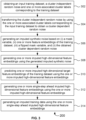
  • FIG. 3 depicts an exemplary flow chart illustrating a method for imputing low-dimensional incomplete multivariate industrial time-series data, using the systems of FIGS. 1 and 2 , in accordance with an embodiment of the present disclosure.
  • the system(s) 100 comprises one or more data storage devices or the memory 102 operatively coupled to the one or more hardware processors 104 and is configured to store instructions for execution of steps of the method by the one or more processors 104.
  • the steps of the method of the present disclosure will now be explained with reference to components of the system 100 of FIG. 1 , the block diagram of the system 100 depicted in FIG. 2 , and the flow diagram as depicted in FIG. 3 .
  • the complex industrial units are big data digital behemoths.
  • the sensory observations are incomplete due to sensor failure and thus are of less utility.
  • the quality of the data is of high priority for deploying data-driven Artificial Intelligence (AI) algorithms for process control, optimization, etc. as inaccurate decision-making impacts product quality, and plant safety.
  • the imputation methods are in general classified as either discriminative or generative. Recent advances in missing data imputation through GAN architectures have suffered from inherent limitations of preserving the relationship among the input feature variables and the target variable and temporal relations between observations spanning across timeframes.
  • embodiments of the present disclosure implement a congeniality-preserving Generative Adversarial Networks (cpGAN) framework to reconcile missing data by preserving the temporal dependencies, probability distributions of the original data and retaining its utility for downstream tasks.
  • congeniality-preserving Generative Adversarial Networks (cpGAN) is implemented for imputing low-dimensional incomplete multivariate industrial time-series data.
  • the algorithmic approach minimizes the rubric based on the Information theory for Machine Learning between the empirical probability distributions of the reconciled data and the non-linear original data to preserve the temporal dependencies, retain the input feature variables and target-variable relationship, and probability distributions of the original data.
  • the cpGAN generative imputation technique which fuses imperceptible noise, which is customized to the input process database can also be leveraged as a data anonymization technique, a privacy-preserving mechanism to prevent de-identification of the process-plants databases by the third-party adversary, and as defenses to adversarial attacks.
  • D D 1 t , ... , D f t , ⁇ t ⁇ 1,2 , ... , T n ⁇ 2 N
  • D ( t ) ⁇ I ( f ) consists of f-continuous feature variables observations at t - th time point.
  • D j t denotes the observed value of the j - th ( ⁇ f ) feature variable at t - th time point.
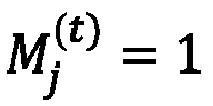
  • M j t denotes the mask value (also referred as mask variable) for the j - th ( ⁇ f ) feature variable at t - th time point.
  • the system and method described herein address the missing data imputation for the multidimensional time series dataset under the setting if the missingness of the feature variables happens altogether at random. It is mathematically described by, P M t ⁇ P M t
  • M j t 0 is absent in the recorded data.
  • D obs D 1 t ⁇ M 1 t , ... , D f t ⁇ M f t , ⁇ t ⁇ 1,2 , ... , T n ⁇ 2 N
  • D mis D 1 t ⁇ 1 ⁇ M 1 t , ... , D f t ⁇ 1 ⁇ M f t , ⁇ t ⁇ 1,2 , ... , T n ⁇ 2 N
  • D ⁇ n , 1 T n ⁇ I T n ⁇ f , ⁇ n ⁇ 1,2 , ... , 2 N
  • n 1 , D ⁇ 1,1 : T 1 ⁇ I T 1 ⁇ f .
  • D ⁇ 1,1: T 1 consists of observation values of D t at time points, t ⁇ ⁇ 1,2, ... , T 1 ⁇ .
  • the finite-length, T n of n - th sequence is a hyper-parameter of the algorithm and is a constant for all the sequences, ⁇ n ⁇ ⁇ 1, ..., 2 N ⁇ .
  • D ⁇ n,1:T n be the observed multivariate time series of length, T n for a particular sequence, n ⁇ ⁇ 1, ... , 2 N ⁇ corresponding to all the feature variables, f .
  • D ⁇ n,t is the n - th sequence observation values of the feature variables, f at the t - th time point.
  • M is also rearranged as, M n , 1 : T n ⁇ Z T n ⁇ f , ⁇ n ⁇ 1,2 , ... , 2 N
  • the traditional Generative Adversarial Missing Data Imputation Networks consisted of generator and discriminator modules which are trained simultaneously in competing minimax game to generate imputed samples of having the same distribution as that of the fully observed data, D .
  • Embodiments of the present disclosure implement a cpGAN algorithmic architecture to overcome the inherent limitations of the generative imputation networks to preserve the characteristics of a multidimensional fully observed time-series data such as joint distributions, temporal dynamics, the relationship between independent variables and the dependent target variable in the imputed data by operating on rearranged data, D ⁇ n, 1: T n .
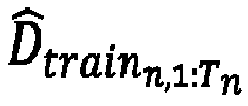
  • the cpGAN architecture is trained to generate and impute the unobserved data of D ⁇ train n , 1 : T n , ⁇ n ⁇ ⁇ 1,2, ... , N ⁇ and the imputed data is denoted by, D ⁇ n,1:T n , ⁇ n ⁇ ⁇ 1,2, ... , N ⁇ .
  • the cpGAN architecture performance is evaluated and reported on D ⁇ test n , 1 : T n , ⁇ n ⁇ ⁇ 1,2, ... , N ⁇ .
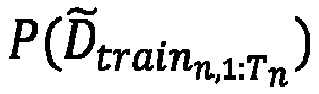
  • D ⁇ train n , 1 : T n the imputation network of the cpGAN framework learns a density P ⁇ ( D ⁇ n,1:T n ) that best approximates the unknown probability density function, P D ⁇ train n , 1 : T n such that it minimizes the weighted sum of the Kullback-Leibler( KL ) divergence and the Wasserstein distance( W ) of order-1 between the original, D ⁇ train n , 1 : T n and imputed data, D ⁇ n,1:T n continuous probability distributions, min P ⁇ KL P D ⁇ train n , 1 : T n ⁇ P ⁇ D ⁇ n , 1 : T n + ⁇ W P D ⁇ train n , 1 : T n , P ⁇ D ⁇ n , 1 : T n , P ⁇ D ⁇ n , 1 : T n
  • the imputed data, D ⁇ n,1:T n should also preserve the temporal dynamics of the observed data, D ⁇ train n , 1 : T n for the imputed data to be of substantial utility in downstream forecasting tasks.
  • the objective of missing data imputation generative neural network is also to preserve the relationship between the independent feature variables, f c ⁇ f , and target variable, f T ⁇ f of the observed data, D ⁇ train n , 1 : T n .
  • the unbiased imputed data, D ⁇ n,1:T n is then beneficial for utilization in the downstream predictive analytics task.
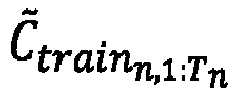
  • the one or more hardware processors 104 obtain an input training dataset D ⁇ train n , 1 : T n , a cluster independent random noise ( Z n,1:T n ) and one or more associated cluster labels C ⁇ train n , 1 : T n corresponding to the input training dataset (e.g., low-dimensional multivariate time-series data as known in the art).
  • the one or more hardware processors 104 transform the cluster independent random noise ( Z n,1:T n ) using the one or more associated cluster labels C ⁇ train n , 1 : T n corresponding to the input training dataset D ⁇ train n , 1 : T n to obtain a cluster dependent random noise Z n , 1 : T n C
  • the cluster dependent random noise is obtained from a Gaussian distribution of the cluster independent random noise corresponding to the input training dataset, in an example embodiment of the present disclosure.
  • the steps 302 and 304 are better understood by way of following illustrative description.
  • Z n,1:T n ⁇ R T n ⁇ f , ⁇ n ⁇ ⁇ 1,2, ... , N ⁇ be an f-dimensional uniformly distributed random variable of length, T n for a sequence, n with values in the half-open interval [0,1) sampled from a uniform distribution, Z .
  • the cluster independent random noise (Z n,1:T n ) is transformed based on the cluster labels, C ⁇ train n , 1 : T n ⁇ R T n , ⁇ n ⁇ ⁇ 1,2, ... , N ⁇ .
  • the cluster labels are determined by an iterative distance-based algorithm to partition the unlabeled dataset, D train n , 1 : T n into k-predetermined distinct non-overlapping, nonhomogeneous clusters.
  • Label embedding vectors, e c ⁇ R f' , ⁇ c ⁇ ⁇ 1, ... , k ⁇ are obtained from the learnable label embedding matrix, W ⁇ R k ⁇ f' based on the labels, C ⁇ train n , 1 : T n .
  • f' is the characteristic dimension (a hyperparameter) of the embedding matrix, W .
  • the label embedding vectors, e c corresponding to the labels, C train n , 1 : T n are concatenated to obtain the label matrix, L n , 1 : T n c .
  • Matrix-matrix product of Z n,1:T n and L n , 1 : T n c is performed to obtain the cluster dependent random noise (also referred as cluster membership aware noise and interchangeably used herein), Z n , 1 : T n C , in an example embodiment of the present disclosure.
  • the labels, C ⁇ train n , 1 : T n corresponding to the fully observed dataset, D ⁇ train n , 1 : T n are obtained by performing vector quantization through the unsupervised learning technique.
  • matrix-matrix product of Z n ,1: Tn and L n , 1 : T n c operation shall not be construed as limiting the scope of the present disclosure.
  • the following is determined by the k -means clustering algorithm:
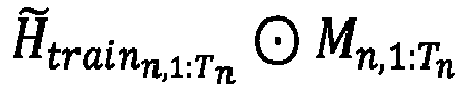
  • the one or more hardware processors 104 generate an imputed synthetic noise W ⁇ ′ D ⁇ train n , 1 : T n ⁇ M n , 1 : T n + 1 ⁇ M n , 1 : T n ⁇ Z n , 1 : T n C based on (i) a mask variable ( M n ,1: Tn ), (ii) one or more feature embeddings of the training dataset D ⁇ train n , 1 : T n , (iii) a flipped mask variable (1 - M n,1:T n ), and (iv) the obtained cluster dependent random noise Z n , 1 : T n C .
  • the system 100 invokes the generator module 202 of the cpGAN for generating the imputed synthetic noise.
  • the one or more hardware processors 104 via the generator module 202 (also referred as a generator and interchangeably used herein) perform a linear transformation on the summation of the product of the mask variable with the feature embeddings of the training dataset and the flipped mask variable with the cluster-dependent random noise to obtain the imputed synthetic noise.
  • the flipped mask variable is obtained based on a difference between a pre-defined value (e.g., in this case value of '1') and the mask variable ( M n,1:T n ) .
  • the one or more hardware processors 104 generate one or more imputed high-dimensional feature embeddings ( ⁇ n,1:T n ) using the generated imputed synthetic noise.
  • the generator module 202 generates one or more imputed high-dimensional feature embeddings ( ⁇ n ,1: Tn ) using the generated imputed synthetic noise, in an embodiment of the present disclosure.
  • the one or more hardware processors 104 further classify the one or more imputed high-dimensional feature embeddings into at least one class type (e.g., real, or fake).
  • the generator module 202 comprised in the cpGAN takes as input the realizations of D ⁇ trai n n , 1 : T n , M n,1:T n , Z n , 1 : T n C Z n ,1: Tn and outputs a high-dimensional latent variable, H n,1:T n , and the same is expressed way of equation below:
  • G cpGAN D ⁇ train n , 1 : T n ⁇ M n , 1 : T n ⁇ Z n , 1 : T n C ⁇ H _ n , 1 : T n
  • the generative imputation neural network function can also be viewed as, G cpGAN : I ( T n , f ) ⁇ ⁇ 0,1 ⁇ ( T n , f ) ⁇ [0,1] ( T n , f ) ⁇ H ( T n , f ) , ⁇ n ⁇ ⁇ 1,2, ... , N ⁇ .
  • the generator (also referred as the generator module) is realized by leveraging a sequential operation on a 3-layer stack of neural-network architectures comprising of unidirectional LSTM and a feed-forward neural network layer, in an example embodiment of the present disclosure.
  • the one or more hardware processors 104 predict one or more imputed high-dimensional target feature embeddings H ⁇ n , 1 : T n T also referred as H ⁇ trai n n , 1 : T n T ) of the training dataset using the one or more imputed high-dimensional feature embeddings ( ⁇ n,1:T n ) .
  • the system 100 of the present disclosure invokes a critic module 204 from the cpGAN 100 for prediction.
  • the critic module (or also referred as a critic neural network or a critic and interchangeably used herein), there comprises a F cpGAN : H n , 1 : T n * ⁇ R , which is a mathematical function used for determining the target variable.
  • refers to H ⁇ train 1 : f ⁇ 1 or ⁇ (1: f -1) .
  • the critic neural network function takes as input the realizations of H ⁇ trai n n , 1 : T n 1 : f ⁇ 1 or H ⁇ n , 1 : T n 1 : f ⁇ 1 and outputs, H ⁇ train n , 1 : T n T or H ⁇ n , 1 : T n T .
  • the variable subset selection includes the features attributes from the set ⁇ 1, ... , f - 1 ⁇ ⁇ f in H n , 1 : T n 1 , ... , f ⁇ 1 * as input variables to the model.
  • the critic module preserves the relationship between independent feature columns and the target variable in the real dataset during the adversarial training of G cpGAN to generate the relationship preserving synthetic data, D ⁇ n,1:T n by minimizing the L F .
  • the one or more hardware processors 104 generate one or more single-step ahead imputed high-dimensional feature embeddings H n , 1 : t * using the one or more predicted imputed high-dimensional target feature embeddings.
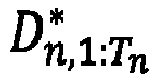
  • the one or more hardware processors 104 generate via a recovery module 208 an imputed training data D n , 1 : T n * using the one or more single-step ahead imputed high-dimensional feature embeddings H n , 1 : T n * / H n , 1 : T n ′ * .
  • the steps 312 and 314 may be better understood by way of following illustrative description.
  • the system 100 of the present disclosure invokes a supervisor module 206 from the cpGAN for generation of the one or more single-step ahead imputed high-dimensional feature embeddings H n , 1 : t * .
  • the supervisor module from the cpGAN leverages a supervisor neural network function, S cpGAN to retain conditional temporal dynamics of the original data in the imputed temporal data, D ⁇ n,1:T n .
  • the G cpGAN neural network of the cpGAN framework generates the synthetic latent variables, ⁇ n,1:T n .
  • the auto-regressive, S cpGAN H n , 1 : t ⁇ 1 * ⁇ H n , t * , ⁇ n ⁇ ⁇ 1,2, ... , N ⁇ , t ⁇ 1: T n takes as input H n , 1 : t ⁇ 1 * and predicts the one-step-ahead temporal latent variable, H n , t * conditioned on the past latent sequences.
  • the G cpGAN by operating in the closed-loop receives the ground-truth, H ⁇ train n , 1 : T n from the embedding module comprising in the cpGAN. It minimizes L S by forcing the ⁇ n,1:T n appraised by the improper adversary ( D cpGAN ) to capture the single-step transitions of the H ⁇ train n , 1 : T n .
  • the embedding module 210 comprised in the cpGAN takes as input the realizations of D ⁇ train n , 1 : T n , and outputs feature embeddings, H ⁇ train n , 1 : T n .
  • the supervisor module 206 takes as input the temporal latent feature embeddings, H n , 1 : T n * and predicts one-step ahead temporal embeddings, H n , 1 : T n ′ * .
  • the recovery module 208 (also referred as recovery function and interchangeably used herein) takes as input the high-dimensional latent embeddings, H n , 1 : T n * in the supervised setting or H n , 1 : T n ′ * in the unsupervised setting and transforms to their corresponding low-dimensional representations, D n , 1 : T n * .
  • denotes for real variables, H ⁇ train n , 1 : T n , H ⁇ train n , 1 : T n ′ , D ⁇ train n , 1 : T n or for synthetic imputed variables, ⁇ n,1:T n , H ⁇ n , 1 : T n ′ and D ⁇ n,1:T n respectively.
  • and second-order moment, ⁇ ⁇ 1 2 ⁇ ⁇ ⁇ 2 2 differences, defined between the original data, D ⁇ train n , 1 : T n and the imputed data, D ⁇ n,1:T n are minimized respectively.
  • a difference between one or more target feature embeddings of the input training dataset and the one or more predicted imputed high-dimensional target feature embeddings is minimized using the critic module 204.
  • L US D _ 1 ⁇ D _ 2 + ⁇ ⁇ 1 2 ⁇ ⁇ ⁇ 2 2
  • the goal of the generator module 202, the supervisor module 206, and recovery module 208 is to minimize the first and the second-order moment's differences between the fully-observed input data, D ⁇ train n , 1 : T n , and the imputed temporal data, D ⁇ n,1:T n obtained from its corresponding high-dimensional latent representations, H ⁇ n , 1 : T n ′ in the unsupervised learning approach.
  • L US , P ⁇ ( D ⁇ n ,1: Tn ) learns the underlying probability distributions of the input temporal data, P D ⁇ train n , 1 : T n .
  • Each of the embedding and recovery modules is realized by leveraging a sequential operation on a 3-layer stack of neural-network architectures comprising of uni-directional Long-Short-Term-Memory (LSTM) and a feed-forward neural network layer.
  • LSTM Long-Short-Term-Memory
  • the one or more hardware processors 104 further validate the imputed training data based on a comparison of the imputed training data and the input training dataset.
  • the validation is described above as performed by the recovery module 208.
  • the validation outcome which is referred as a validation dataset is utilized for the hyper-parameter tuning of the cpGAN/system 100.
  • the one or more hardware processors 104 further classify the one or more imputed high-dimensional feature embeddings into at least one class type.
  • the system and method invoke a discriminator (also referred as a discriminator module 212 or a discriminator network and interchangeably used herein) comprised in the cpGAN for performing the classification.
  • a discriminator also referred as a discriminator module 212 or a discriminator network and interchangeably used herein
  • the above step of classification may be better understood by way of following description.
  • the objective of the discriminator network, D cpGAN in cpGAN architecture is to distinguish the observed and imputed values in ⁇ n,1:T n .
  • the discriminator neural network 212 performs classification of the one or more imputed high-dimensional feature embeddings into at least one class type, and is described by way of expression below, D cpGAN : H ⁇ n , 1 : T n ⁇ H ⁇ train n , 1 : T n ⁇ H n , 1 : T n ⁇ M ⁇ n , 1 : T n , p n , 1 : T n , m * , p n , 1 : T n * , P H n , 1 : T n *
  • D cpGAN takes as input the realizations of ⁇ n,1:T n , H ⁇ train n , 1 : T n and H n ,1: Tn (hint matrix, a random binary-valued mask matrix (also referred as mask variable)) and outputs an estimated mask matrix, M ⁇ n,1:T n , the predicted probability of cluster labels, p n , 1 : T n , m * , the predicted probability of adversarial ground-truth, i.e real/fake, p n , 1 : T n * , the estimated probability distributions, P H n , 1 : T n * , ⁇ n ⁇ ⁇ 1,2, ...
  • M ⁇ n,1:T n can also be viewed as, ⁇ 0,1 ⁇ ( T n , f ) , ⁇ n ⁇ ⁇ 1,2, ... , N ⁇ .
  • H n ,1 T n ⁇ ⁇ 0,1 ⁇ ( T n , f ) , ⁇ n ⁇ ⁇ 1,2, ... , N ⁇ denotes a Hint matrix.
  • the G cpGAN of the cpGAN framework produces synthetic outputs, ⁇ n,1:T n by operating on the random noise space, Z , and the discriminator neural network, D cpGAN by operating on the adversarial learning latent space, H , tries to distinguish latent temporal embeddings, ⁇ n,1:T n and H ⁇ train n , 1 : T n .
  • y n,1:T n ⁇ ⁇ 0,1 ⁇ T n , ⁇ n ⁇ ⁇ 1,2, ... , N ⁇ is the adversarial ground-truth, real or fake data.
  • p train n , 1 : T n , p ⁇ n,1:T n ⁇ [0,1] T n , ⁇ n ⁇ ⁇ 1,2, ... , N ⁇ is the predicted probability of the sequence is real and 1 ⁇ p train n , 1 : T n & 1 - p ⁇ n,1:T n is the predicted probability of the sequence being fake.
  • D cpGAN tries to minimize, L U .
  • the G cpGAN tries to minimize, ⁇ L US which helps to learn P ⁇ ( D ⁇ n ,1: Tn ) that best approximates P D ⁇ train n , 1 : T n .
  • M n , t j 0
  • the D cpGAN attempts to maximize the probability of accurately predicting, M n,1:T n .
  • D cpGAN tries to minimize, L M and G cpGAN tries to minimize, ⁇ L M .
  • the prediction of cluster-label, C n , 1 : T n ⁇ ⁇ 0,1 , ... , k is a multi-class classification task.
  • y n , 1 : T n c (ground-truth) denotes the binary value (0 or 1) if clustering label m is the correct classification for observation at time point t ( t ⁇ 1: T n ) corresponding to data sequence, n.
  • p train n , 1 : T n , m is the predicted probability for real observation at time point t of a data sequence, n belongs to cluster label, m .
  • p ⁇ n,1:T n , m is the predicted probability for imputed synthetic observation at time point t of a data sequence, n belongs to cluster label, m .
  • C train n , 1 : T n p denote the predicted cluster labels by the neural-network architecture in comparison with the ground-truth
  • ⁇ n,1:T n denote the predicted cluster labels for the imputed temporal data, D ⁇ n,1:T n .
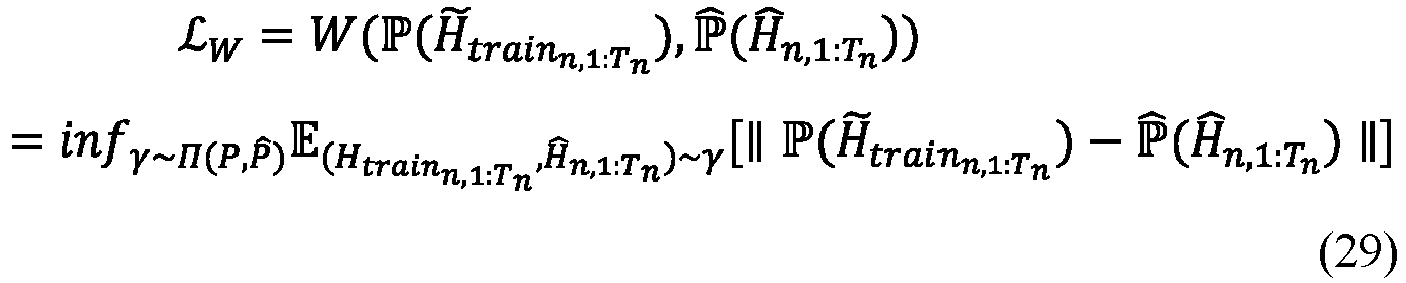
  • Wasserstein distance between the estimates of two probability distributions P H ⁇ train n , 1 : T n and ( ⁇ n,1:T n ) is also minimized.
  • the D cpGAN tries to maximize, L W whereas the G cpGAN tries to minimize, L W .
  • the discriminator module is realized by leveraging a sequential operation on a stack of neural-network architectures comprising of unidirectional LSTM and a feed-forward neural network layer.
  • the embedding module ( E cpGAN ) and the recovery module ( R cpGAN ) were jointly trained on the task of reconstructing the fully observed temporal data, D ⁇ train n , 1 : T n .
  • the supervisor module ( S cpGAN ) was trained in the supervised-learning approach on the single-step ahead prediction task of the fully observed temporal latent variable, H ⁇ train n , 1 : T n , ⁇ n ⁇ ⁇ 1,2, ... , N ⁇ by operating in the latent space, .
  • the critic module ( F cpGAN ) was trained on the original fully observed data to minimize the target variable prediction loss, L F .
  • the objective is to minimize, min ⁇ e , ⁇ r , ⁇ S , ⁇ c L R + L S + L F .
  • ⁇ e , ⁇ r , ⁇ s , ⁇ c denote the trainable parameters of the embedding, the recovery, the supervisor, and the critic neural network functions respectively.
  • Let ⁇ g , ⁇ d describe the learnable parameters of the G cpGAN , D cpGAN neural network functions.
  • the G cpGAN outputs D ⁇ n,1:T n , ⁇ n ⁇ ⁇ 1,2, ...
  • G contains both the unimputed data and imputed data as given by M n,1:T n , and (1 - M n,1:Tn ) respectively.
  • G was trained by eight distinct loss functions classified as unsupervised & supervised losses, L US , L G , L U , L W , L M , L S , L F and L LP .
  • ⁇ ⁇ R + is a hyper-parameter.
  • the cpGAN architecture was trained with both the supervised and unsupervised losses. Performance of the cpGAN was evaluated on D ⁇ test n , 1 : T n and is reported herein accordingly. The unbiased imputed data, D ⁇ n,1:T n is then beneficial for utilization in the downstream predictive analytics task and forecasting tasks. The validation dataset is utilized for the hyper-parameter tuning of the imputation network. Performance of the cpGAN is evaluated on the test dataset.
  • ETT Electricity Transformer Temperature datasets used during experiments contained 2-year data of electricity transformer usage and reported in, Informer: Beyond Efficient Transformer for Long Sequence Time-Series Forecasting. Each dataset (ETTm1, and ETTm2) contained 70,080 (2 year ⁇ 365 days ⁇ 24 hours ⁇ 4 times (observation at 15min interval)) temporal observations. In addition, hour-wise recorded dataset (ETTh1, ETTh2) has been leveraged to evaluate performance of the method of the present disclosure. The train/validation/test splits are 60/20/20%. Table 1 reports the Root Mean Square Error (RMSE) in imputing the ETT test dataset by the cpGAN architecture.
  • RMSE Root Mean Square Error
  • the cumulative imputation error increases with an accretion of the random missing percentage for each column feature attribute on all the datasets.
  • LSTM neural network is utilized as a standard benchmark model trained on original train data on the basis of supervised-learning driven downstream tasks of the target variable ("oil temperature" ( ° C)) and one-step-ahead prediction with distinct learnable parameters respectively.
  • the evaluation of the prediction models is performed on the original test dataset and the imputed test datasets. The performance is reported in terms of the RMSE metric.
  • the first column reports the prediction error on the original test dataset.
  • the subsequent columns report prediction error on the imputed test datasets.
  • Table 2 Results of prediction model on the target variable prediction on ETT test dataset Missing (%) 0 (%) 2.5 (%) 5 (%) 10 (%) 20 (%) 60 (%) 90 (%) Dataset LSTM LSTM LSTM LSTM LSTM ETTh1 11.764 9.737 9.852 10.157 9.370 16.327 26.701 ETTh2 10.786 10.121 10.228 10.885 11.671 28.164 24.760 ETTm1 11.886 8.756 9.231 9.104 9.964 9.124 31.958 EETm2 11.196 11.196 10.498 10.935 12.400 18.240 26.588 Table 3: Results of forecasting model on the single-step ahead prediction on ETT test dataset Dataset Missing (%) HUFL HULL MUFL MULL LUFL LULL OT ETTm1 0 (%) 7.78 4.18 7.79 4.01 2.96 2.13 3.69 ETTm1 2.5 (%) 17.78 8.69 18.62 9.29 5.40 5.45 15.18 ETTm1 5 (%) 17.63 8.58 18.
  • the cpGAN comprises of embedding, critic, supervisor, generator, discriminator, and recovery neural network functions (or also referred as modules and interchangeably used herein) to tackle the temporal nonuniformity of the incomplete observed multidimensional continuous-variable time series data.
  • the input to the cpGAN is the multidimensional continuous-variable time series data, random mask variable, and cluster-independent random noise.
  • the input data preprocessing involves feature scaling by transforming the scale of continuous feature variables by utilizing the min-max normalization technique(s) as known in the art to obtain the preprocessed data.
  • the preprocessed data is split into training, validation, and test dataset respectively. Training of the cpGAN consisted of two phases.
  • the following modules were trained namely, the embedding, recovery, critic, and supervisor modules of the imputation network by utilizing the training dataset. More specifically, the training dataset is fed as an input to the embedding module to obtain high-dimensional feature embeddings. The high-dimensional feature embeddings are fed as input to the recovery module to reconstruct the training dataset. The embedding and recovery modules are trained jointly in a supervised learning approach to reconstruct the input training dataset. The high-dimensional feature embeddings are fed as input to the supervisor module to obtain single-step ahead predictions of the feature embeddings. The supervisor module is trained in a supervised learning approach as a forecasting model to minimize the forecasting error predictions on the training dataset.
  • the high-dimensional feature embeddings are fed as input to the critic module.
  • the high-dimensional feature embeddings consist of independent feature embeddings and dependent target feature embedding.
  • the critic module operates on the independent feature embeddings to predict the target feature embedding.
  • the critic module is trained in a supervised learning approach as a prediction model to minimize the target variable prediction error on the training dataset.
  • the following modules namely, the generator, discriminator, recovery, critic, and supervisor modules of the imputation network/cpGAN are jointly trained by utilizing the training dataset and cluster-independent random noise and the mask variable.
  • cluster-dependent random noise is obtained by transforming the cluster-independent random noise by using the cluster-labels corresponding to the training dataset.
  • a linear transformation is performed on the summation of the product of the mask variable with the feature embeddings of the training dataset and the flipped mask variable with the cluster-dependent random noise to obtain the imputed synthetic noise.
  • the imputed synthetic noise is fed as input to the generator module to output the imputed high-dimensional feature embeddings.
  • the generator is trained to fool the discriminator to classify the imputed high-dimensional feature embeddings as real.
  • the imputed high-dimensional feature embeddings are fed as input to the critic module to predict the imputed target feature embeddings.
  • the critic module is trained to minimize the difference between the target feature embedding of the training dataset and the predicted imputed target feature embeddings in a supervised learning approach.
  • the imputed feature embeddings are fed to the discriminator to assign a label as real or fake, wherein the discriminator tries to classify the imputed high-dimensional feature embeddings as fake.
  • the imputed high-dimensional feature embeddings are fed as input to the supervisor module to generate the single-step ahead predictions of the imputed feature embeddings.
  • the supervisor module is trained to minimize the difference between the single-step ahead predictions of the imputed feature embeddings and the feature embeddings of the training dataset in a supervised learning approach.
  • the single-step ahead imputed feature embeddings are fed to the recovery module to obtain the imputed training data.
  • the recovery module is trained in an unsupervised learning approach to minimize the difference between the imputed training data and the input training data.
  • ETT Electricity Transformer Temperature
  • the cpGAN system 100 used for imputing low-dimensional multivariate industrial time-series data may be used in Digital Twin, simulation of Industry Plants/machines/sensors (or sensor data), production units and/or manufacturing units.
  • Such computer-readable storage means contain program-code means for implementation of one or more steps of the method, when the program runs on a server or mobile device or any suitable programmable device.
  • the hardware device can be any kind of device which can be programmed including e.g., any kind of computer like a server or a personal computer, or the like, or any combination thereof.
  • the device may also include means which could be e.g., hardware means like e.g., an application-specific integrated circuit (ASIC), a field-programmable gate array (FPGA), or a combination of hardware and software means, e.g., an ASIC and an FPGA, or at least one microprocessor and at least one memory with software processing components located therein.
  • the means can include both hardware means and software means.
  • the method embodiments described herein could be implemented in hardware and software.
  • the device may also include software means. Alternatively, the embodiments may be implemented on different hardware devices, e.g., using a plurality of CPUs.
  • the embodiments herein can comprise hardware and software elements.
  • the embodiments that are implemented in software include but are not limited to, firmware, resident software, microcode, etc.
  • the functions performed by various components described herein may be implemented in other components or combinations of other components.
  • a computer-usable or computer readable medium can be any apparatus that can comprise, store, communicate, propagate, or transport the program for use by or in connection with the instruction execution system, apparatus, or device.
  • a computer-readable storage medium refers to any type of physical memory on which information or data readable by a processor may be stored.
  • a computer-readable storage medium may store instructions for execution by one or more processors, including instructions for causing the processor(s) to perform steps or stages consistent with the embodiments described herein.
  • the term "computer-readable medium” should be understood to include tangible items and exclude carrier waves and transient signals, i.e., be non-transitory. Examples include random access memory (RAM), read-only memory (ROM), volatile memory, nonvolatile memory, hard drives, CD ROMs, DVDs, flash drives, disks, and any other known physical storage media.

Landscapes

  • Engineering & Computer Science (AREA)
  • Physics & Mathematics (AREA)
  • Theoretical Computer Science (AREA)
  • General Health & Medical Sciences (AREA)
  • Computing Systems (AREA)
  • Biomedical Technology (AREA)
  • Biophysics (AREA)
  • Computational Linguistics (AREA)
  • Data Mining & Analysis (AREA)
  • Evolutionary Computation (AREA)
  • Life Sciences & Earth Sciences (AREA)
  • Molecular Biology (AREA)
  • Artificial Intelligence (AREA)
  • General Engineering & Computer Science (AREA)
  • General Physics & Mathematics (AREA)
  • Mathematical Physics (AREA)
  • Software Systems (AREA)
  • Health & Medical Sciences (AREA)
  • Probability & Statistics with Applications (AREA)
  • Management, Administration, Business Operations System, And Electronic Commerce (AREA)

Abstract

Recent advances and techniques in missing data imputation suffer from inherent limitations of preserving the relationship among the input feature attributes and the target variable and temporal relations between observations spanning across timeframes because of which it is also challenging to reconcile missing data for any downstream tasks. Present disclosure provides system and method that implement for congeniality-preserving Generative Adversarial Networks (cpGAN) for imputing low-dimensional incomplete multivariate industrial time-series data. The method minimizes the rubric based on the information theory for Machine Learning (ML) between the empirical probability distributions of the reconcile data and the non-linear original data to preserve the temporal dependencies and retain the input feature-attributes and target-variable relationship and probability distributions of the original data.

Description

    CROSS-REFERENCE TO RELATED APPLICATIONS AND PRIORITY
  • The present application claims priority to Indian application no. 202221011587, filed on March 3, 2022 .
  • TECHNICAL FIELD
  • The disclosure herein generally relates to congeniality-preserving Generative Adversarial Networks (cpGAN), and, more particularly, to congeniality-preserving Generative Adversarial Networks (cpGAN) for imputing low-dimensional multivariate industrial time-series data.
  • BACKGROUND
  • Complex industrial units are big data digital behemoths, typically the sensors record in the scale of several Gigabytes of the plant operation data. These sensory observations are incomplete due to sensor failure including other various reasons and are of less utility. The quality of the data is of high priority for deploying data-driven artificial intelligence (AI) algorithms for process control, optimization, etc., as inaccurate decision-making impacts product quality, and plant/industrial units' safety. The imputation methods are in general classified as either discriminative or generative. Recent advances in missing data imputation through generative adversarial network (GAN) architectures suffer from inherent limitations of preserving the relationship among the input feature variables and the target variable and temporal relations between observations spanning across timeframes because of which it is also challenging to reconcile missing data for any downstream tasks.
  • SUMMARY
  • Embodiments of the present disclosure present technological improvements as solutions to one or more of the above-mentioned technical problems recognized by the inventors in conventional systems. For example, in one aspect, there is provided a processor implemented method for imputing low-dimensional incomplete multivariate industrial time-series data using a congeniality-preserving Generative Adversarial Networks (cpGAN). The method comprises obtaining, via one or more hardware processors, an input training dataset, a cluster independent random noise and one or more associated cluster labels corresponding to the input training dataset; transforming, via the one or more hardware processors, the cluster independent random noise by using the one or more associated cluster labels corresponding to the input training dataset to obtain a cluster dependent random noise; generating, via the one or more hardware processors, an imputed synthetic noise based on (i) a mask variable, (ii) one or more feature embeddings of the training dataset, (iii) a flipped mask variable, and (iv) the obtained cluster dependent random noise; generating, via the one or more hardware processors, one or more imputed high-dimensional feature embeddings using the generated imputed synthetic noise; predicting, via the one or more hardware processors, one or more imputed high-dimensional target feature embeddings of the training dataset using the one or more imputed high-dimensional feature embeddings; generating, via the one or more hardware processors, one or more single-step ahead imputed feature embeddings using the one or more imputed high-dimensional feature embeddings; and generating, via the one or more hardware processors, an imputed training data using the one or more single-step ahead imputed high-dimensional feature embeddings.
  • In an embodiment, the cluster dependent random noise is obtained from the cluster independent random noise that is sampled from a Gaussian distribution and the one or more associated cluster labels corresponding to the input training dataset.
  • In an embodiment, the flipped mask variable is obtained based on a difference between a pre-defined value and the mask variable.
  • In an embodiment, the method further comprises minimizing a difference between one or more target feature embeddings of the input training dataset and the one or more predicted imputed high-dimensional target feature embeddings.
  • In an embodiment, the method further comprises validating the imputed training data based on a comparison of the imputed training data and the input training dataset.
  • In an embodiment, the method further comprises classifying the one or more imputed high-dimensional feature embeddings into at least one class type.
  • In another aspect, there is provided a processor implemented system for imputing low-dimensional incomplete multivariate industrial time-series data using a congeniality-preserving Generative Adversarial Networks (cpGAN). The system comprises a memory storing instructions; one or more communication interfaces; and one or more hardware processors coupled to the memory via the one or more communication interfaces, wherein the one or more hardware processors are configured by the instructions to: obtain an input training dataset, a cluster independent random noise and one or more associated cluster labels corresponding to the input training dataset; transform the cluster independent random noise by using the one or more associated cluster labels corresponding to the input training dataset to obtain a cluster dependent random noise; generate an imputed synthetic noise based on (i) a mask variable, (ii) one or more feature embeddings of the training dataset, (iii) a flipped mask variable, and (iv) the obtained cluster dependent random noise; generate, by using a generator module comprised in the cpGAN, one or more imputed high-dimensional feature embeddings using the generated imputed synthetic noise; predict, by using a critic module comprised in the cpGAN, one or more imputed high-dimensional target feature embeddings of the training dataset using the one or more imputed high-dimensional feature embeddings; generate, by using a supervisor module comprised in the cpGAN, one or more single-step ahead imputed high-dimensional feature embeddings using the one or more imputed high-dimensional feature embeddings; and generate, by using a recovery module comprised in the cpGAN, an imputed training data using the one or more single-step ahead imputed high-dimensional feature embeddings.
  • In an embodiment, the cluster dependent random noise is obtained from the cluster independent random noise that is sampled from a Gaussian distribution and the one or more associated cluster labels corresponding to the input training dataset.
  • In an embodiment, the flipped mask variable is obtained based on a difference between a pre-defined value and the mask variable.
  • In an embodiment, the one or more hardware processors are further configured by the instructions to minimize a difference between one or more target feature embeddings of the input training dataset and the one or more predicted imputed high-dimensional target feature embeddings.
  • In an embodiment, the one or more hardware processors are further configured by the instructions to validate, by using a discriminator comprised in the cpGAN, the imputed training data based on a comparison of the imputed training data and the input training dataset.
  • In an embodiment, the one or more hardware processors are further configured by the instructions to classify, by using a discriminator comprised in the cpGAN, the one or more imputed high-dimensional feature embeddings into at least one class type.
  • In yet another aspect, there are provided one or more non-transitory machine-readable information storage mediums comprising one or more instructions which when executed by one or more hardware processors cause imputing low-dimensional incomplete multivariate industrial time-series data using a congeniality-preserving Generative Adversarial Networks (cpGAN) by: obtaining an input training dataset, a cluster independent random noise and one or more associated cluster labels corresponding to the input training dataset; transforming the cluster independent random noise by using the one or more associated cluster labels corresponding to the input training dataset to obtain a cluster dependent random noise; generating an imputed synthetic noise based on (i) a mask variable, (ii) one or more feature embeddings of the training dataset, (iii) a flipped mask variable, and (iv) the obtained cluster dependent random noise; generating one or more imputed high-dimensional feature embeddings using the generated imputed synthetic noise; predicting one or more imputed high-dimensional target feature embeddings of the training dataset using the one or more imputed high-dimensional feature embeddings; generating one or more single-step ahead imputed high-dimensional feature embeddings using the one or more imputed high-dimensional feature embeddings; and generating an imputed training data using the one or more single-step ahead imputed high-dimensional feature embeddings.
  • In an embodiment, the cluster dependent random noise is obtained from the cluster independent random noise that is sampled from a Gaussian distribution and the one or more associated cluster labels corresponding to the input training dataset.
  • In an embodiment, the flipped mask variable is obtained based on a difference between a pre-defined value and the mask variable.
  • In an embodiment, the one or more instructions which when executed by the one or more hardware processors further cause minimizing a difference between one or more target feature embeddings of the input training dataset and the one or more predicted imputed high-dimensional target feature embeddings.
  • In an embodiment, the one or more instructions which when executed by the one or more hardware processors further cause validating the imputed training data based on a comparison of the imputed training data and the input training dataset.
  • In an embodiment, the one or more instructions which when executed by the one or more hardware processors further cause classifying the one or more imputed high-dimensional feature embeddings into at least one class type.
  • It is to be understood that both the foregoing general description and the following detailed description are exemplary and explanatory only and are not restrictive of the invention, as claimed.
  • BRIEF DESCRIPTION OF THE DRAWINGS
  • The accompanying drawings, which are incorporated in and constitute a part of this disclosure, illustrate exemplary embodiments and, together with the description, serve to explain the disclosed principles:
    • FIG. 1 depicts an exemplary system for imputing low-dimensional incomplete multivariate industrial time-series data using a congeniality-preserving Generative Adversarial Networks (cpGAN), in accordance with an embodiment of the present disclosure.
    • FIG. 2 depicts an exemplary high level block diagram of the system 100 illustrating the congeniality-preserving Generative Adversarial Networks (cpGAN) for imputing low-dimensional incomplete multivariate industrial time-series data, in accordance with an embodiment of the present disclosure, in accordance with an embodiment of the present disclosure.
    • FIG. 3 depicts an exemplary flow chart illustrating a method for imputing low-dimensional incomplete multivariate industrial time-series data, using the systems of FIGS. 1 and 2, in accordance with an embodiment of the present disclosure.
    DETAILED DESCRIPTION OF EMBODIMENTS
  • Exemplary embodiments are described with reference to the accompanying drawings. In the figures, the left-most digit(s) of a reference number identifies the figure in which the reference number first appears. Wherever convenient, the same reference numbers are used throughout the drawings to refer to the same or like parts. While examples and features of disclosed principles are described herein, modifications, adaptations, and other implementations are possible without departing from the scope of the disclosed embodiments.
  • As mentioned earlier, conventional imputation methods are in general classified as either discriminative or generative. Recent advances in missing data imputation through generative adversarial network (GAN) architectures suffer from inherent limitations of preserving the relationship among the input feature variables and the target variable and temporal relations between observations spanning across timeframes because of which it is also challenging to reconcile missing data for any downstream tasks. To overcome these drawbacks, embodiments of the present disclosure provide system and method that implement a Congeniality-Preserving Generative Adversarial Networks (cpGAN) that enables reconcile missing data by preserving the temporal dependencies, probability distributions of the original data and retain its utility for any downstream tasks.
  • More specifically, system and method of the present disclosure implement an implicit probabilistic model-based congeniality-preserving Generative Adversarial Networks (cpGAN) for imputing low-dimensional incomplete multivariate industrial time-series data with an adversarial trained generator neural network. The cpGAN architecture is presented as an alternative paradigm of research for numerical modeling of continuum mechanics and transport phenomena based on imputation techniques. The cpGAN architecture as implemented by the system and method of the present disclosure is established on two-player non-cooperative zero-sum adversarial game, based on game theory, and minimax optimization-approach. The system and method of the present disclosure also leverage artificial intelligence systems to demonstrate the random missing data imputation-utility efficacy tradeoff for downstream tasks on the open-source industrial benchmark datasets.
  • In other words, the congeniality-preserving Generative Adversarial Networks (cpGAN) is an architecture comprising of embedding, recovery, critic, supervisor, generator and discriminator and is implemented by the present application for imputing low-dimensional incomplete multivariate industrial time-series data. The method described herein minimizes the rubric based on the information theory for Machine Learning (ML) between the empirical probability distributions of the reconcile data and the non-linear original data to preserve the temporal dependencies and retain the input feature-attributes and target-variable relationship and probability distributions of the original data.
  • Referring now to the drawings, and more particularly to FIGS. 1 through 3, where similar reference characters denote corresponding features consistently throughout the figures, there are shown preferred embodiments and these embodiments are described in the context of the following exemplary system and/or method.
  • FIG. 1 depicts an exemplary system for imputing low-dimensional incomplete multivariate industrial time-series data using a congeniality-preserving Generative Adversarial Networks (cpGAN), in accordance with an embodiment of the present disclosure. In an embodiment, the system 100 is also referred as "congeniality-preserving Generative Adversarial Networks (cpGAN) system", or cpGAN and may be interchangeably used herein. In an embodiment, the system 100 includes one or more hardware processors 104, communication interface device(s) or input/output (I/O) interface(s) 106 (also referred as interface(s)), and one or more data storage devices or memory 102 operatively coupled to the one or more hardware processors 104. The one or more processors 104 may be one or more software processing components and/or hardware processors. In an embodiment, the hardware processors can be implemented as one or more microprocessors, microcomputers, microcontrollers, digital signal processors, central processing units, state machines, logic circuitries, and/or any devices that manipulate signals based on operational instructions. Among other capabilities, the processor(s) is/are configured to fetch and execute computer-readable instructions stored in the memory. In an embodiment, the system 100 can be implemented in a variety of computing systems, such as laptop computers, notebooks, hand-held devices (e.g., smartphones, tablet phones, mobile communication devices, and the like), workstations, mainframe computers, servers, a network cloud, and the like.
  • The I/O interface device(s) 106 can include a variety of software and hardware interfaces, for example, a web interface, a graphical user interface, and the like and can facilitate multiple communications within a wide variety of networks N/W and protocol types, including wired networks, for example, LAN, cable, etc., and wireless networks, such as WLAN, cellular, or satellite. In an embodiment, the I/O interface device(s) can include one or more ports for connecting a number of devices to one another or to another server.
  • The memory 102 may include any computer-readable medium known in the art including, for example, volatile memory, such as static random-access memory (SRAM) and dynamic-random access memory (DRAM), and/or non-volatile memory, such as read only memory (ROM), erasable programmable ROM, flash memories, hard disks, optical disks, and magnetic tapes. In an embodiment, a database 108 is comprised in the memory 102, wherein the database 108 comprises information training dataset, associated cluster independent random noise and cluster labels, associated cluster dependent random noise, mask variable, associated flipped mask variable, imputed synthetic noise, one or more imputed high-dimensional feature embeddings, one or more imputed target feature embeddings, one or more single-step ahead imputed feature embeddings, imputed training data, Gaussian distribution of the cluster independent random noise corresponding to the input training dataset, validated imputed training data, and the like. The database 108 further comprises information related to error minimization between imputed training data and the input training data, class type associated with the one or more imputed high-dimensional feature embeddings, and the like. The memory 102 further comprises (or may further comprise) information pertaining to input(s)/output(s) of each step performed by the systems and methods of the present disclosure. In other words, input(s) fed at each step and output(s) generated at each step are comprised in the memory 102 and can be utilized in further processing and analysis.
  • FIG. 2 depicts an exemplary high level block diagram of the system 100 illustrating the congeniality-preserving Generative Adversarial Networks (cpGAN) for imputing low-dimensional incomplete multivariate industrial time-series data, in accordance with an embodiment of the present disclosure. The congeniality-preserving Generative Adversarial Networks (cpGAN) system 100 includes a generator module 202, a critic module 204, a supervisor module 206, a recovery module 208, an embedding module 210, and a discriminator module 212. It is to be understood by a person having ordinary skill in the art or person skilled in the art that the communication between various modules as depicted in FIG. 2 shall not be construed as limiting the scope of the present disclosure. In other words, at any given point of time, any module depicted in FIG. 2 can either directly or via another module may communicate with other modules to generate specific outputs as described herein. For instance, the generator module 202 may communicate with recovery module 208 and the embedding module 210 directly, in an embodiment of the present disclosure. It is to be further understood by a person having ordinary skill in the art or person skilled in the art the above modules (modules 202 till 212) as depicted in FIG. 2 are implemented as at least one of a logically self-contained part of a software program, a self-contained hardware component, and/or, a self-contained hardware component with a logically self-contained part of a software program embedded into each of the hardware component that when executed perform the method described herein.
  • FIG. 3 depicts an exemplary flow chart illustrating a method for imputing low-dimensional incomplete multivariate industrial time-series data, using the systems of FIGS. 1 and 2, in accordance with an embodiment of the present disclosure. In an embodiment, the system(s) 100 comprises one or more data storage devices or the memory 102 operatively coupled to the one or more hardware processors 104 and is configured to store instructions for execution of steps of the method by the one or more processors 104. The steps of the method of the present disclosure will now be explained with reference to components of the system 100 of FIG. 1, the block diagram of the system 100 depicted in FIG. 2, and the flow diagram as depicted in FIG. 3.
  • The complex industrial units are big data digital behemoths. The sensory observations are incomplete due to sensor failure and thus are of less utility. The quality of the data is of high priority for deploying data-driven Artificial Intelligence (AI) algorithms for process control, optimization, etc. as inaccurate decision-making impacts product quality, and plant safety. The imputation methods are in general classified as either discriminative or generative. Recent advances in missing data imputation through GAN architectures have suffered from inherent limitations of preserving the relationship among the input feature variables and the target variable and temporal relations between observations spanning across timeframes. To overcome these drawbacks, embodiments of the present disclosure implement a congeniality-preserving Generative Adversarial Networks (cpGAN) framework to reconcile missing data by preserving the temporal dependencies, probability distributions of the original data and retaining its utility for downstream tasks. To put it briefly, congeniality-preserving Generative Adversarial Networks(cpGAN) is implemented for imputing low-dimensional incomplete multivariate industrial time-series data. The algorithmic approach minimizes the rubric based on the Information theory for Machine Learning between the empirical probability distributions of the reconciled data and the non-linear original data to preserve the temporal dependencies, retain the input feature variables and target-variable relationship, and probability distributions of the original data. The architecture as depicted in FIG. 2 is presented as an alternative paradigm of approach in comparison to the conventional first principles-based transport phenomena macroscopic mathematical modeling and numerical simulations for missing data imputation. In addition, the cpGAN generative imputation technique which fuses imperceptible noise, which is customized to the input process database can also be leveraged as a data anonymization technique, a privacy-preserving mechanism to prevent de-identification of the process-plants databases by the third-party adversary, and as defenses to adversarial attacks.
  • Problem Formulation
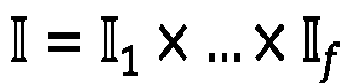
  • Consider representing a f(∈ N)-dimensional euclidean real space (the totality of f-space) as I = i = 1 f I i
    Figure imgb0001
    . I = I 1 × × I f
    Figure imgb0002
    . Assume that I is a continuous stochastic real-valued variable modeled by a finite-dimensional space,
    Figure imgb0003
    . D is termed as the realizations of I and D is referred to as the set of the f-tuples with the alphabet, Tn × 2N sampled from the domain, I f
    Figure imgb0004
    . The euclidean probability distribution of D is described by
    Figure imgb0005
    (D). The dataset, D I T n × 2 N , f
    Figure imgb0006
    observed at timestamps, t = {1,2, ... , (Tn × 2N)} is denoted as a sequence of Tn × 2N observations. D = D 1 t , , D f t , t 1,2 , , T n × 2 N
    Figure imgb0007
    D (t)I (f) consists of f-continuous feature variables observations at t - th time point. D t = D 1 t , , D f t
    Figure imgb0008
    represents the data vector. D j t
    Figure imgb0009
    denotes the observed value of the j - th(∈ f) feature variable at t - th time point. M T n × 2 N , f
    Figure imgb0010
    be a binary stochastic mask variable and it is described by, M = M 1 t , , M f t , t 1,2 , , T n × 2 N
    Figure imgb0011
    M ∈ {0,1}(Tn ×2N,f) , and it describes the missingness of the data. M j t
    Figure imgb0012
    denotes the mask value (also referred as mask variable) for the j - th(∈ f) feature variable at t - th time point. In the present disclosure, the system and method described herein address the missing data imputation for the multidimensional time series dataset under the setting if the missingness of the feature variables happens altogether at random. It is mathematically described by, M t M t | D t
    Figure imgb0013
    D j t | M j t = 1
    Figure imgb0014
    describes observed values of Dj for a j th-feature variable at t - th time point. D j t
    Figure imgb0015
    is observed if M j t = 1
    Figure imgb0016
    otherwise D j t | M j t = 0
    Figure imgb0017
    is absent in the recorded data. The observed data of D is described by, D obs = D 1 t M 1 t , , D f t M f t , t 1,2 , , T n × 2 N
    Figure imgb0018
    The unobserved data of D is described by, D mis = D 1 t 1 M 1 t , , D f t 1 M f t , t 1,2 , , T n × 2 N
    Figure imgb0019
    The incomplete dataset, D is rearranged as, D ˜ n , 1 : T n I T n × f , n 1,2 , , 2 N
    Figure imgb0020
    |2N| denotes the dataset cardinality. It is to be considered for n = 1 , D ˜ 1,1 : T 1 I T 1 × f
    Figure imgb0021
    . T 1 denotes the finite length of the sequence, n = 1. 1,1:T 1 consists of observation values of Dt at time points, t ∈ {1,2, ... , T 1}. In the same way for the sequence, n = 2, D ˜ 2,1 : T 2 I T 2 × f
    Figure imgb0022
    is an array of arrays, which consists of observation values of Dt at time points, t ∈ {(T 1 + 1), ... , (T 1 + T 2)}. The finite-length, Tn of n - th sequence is a hyper-parameter of the algorithm and is a constant for all the sequences, n ∈ {1, ..., 2N}. n,1:Tn be the observed multivariate time series of length, Tn for a particular sequence, n ∈ {1, ... , 2N} corresponding to all the feature variables, f. n,t is the n - th sequence observation values of the feature variables, f at the t - th time point. D ˜ n , 1 : T n n = 1 2 N
    Figure imgb0023
    is split into two disjoint finite sets with N sequences. D ˜ train n , 1 : T n n = 1 N D ˜ test n , 1 : T n n = 1 N = Ø
    Figure imgb0024
    The missingness mask, M is also rearranged as, M n , 1 : T n T n × f , n 1,2 , , 2 N
    Figure imgb0025
    M n , 1 : T n n = 1 2 N
    Figure imgb0026
    is also split into two disjoint finite sets with N sequences. M train n , 1 : T n n = 1 N M test n , 1 : T n n = 1 N = Ø
    Figure imgb0027
  • The traditional Generative Adversarial Missing Data Imputation Networks consisted of generator and discriminator modules which are trained simultaneously in competing minimax game to generate imputed samples of having the same distribution as that of the fully observed data, D. Embodiments of the present disclosure implement a cpGAN algorithmic architecture to overcome the inherent limitations of the generative imputation networks to preserve the characteristics of a multidimensional fully observed time-series data such as joint distributions, temporal dynamics, the relationship between independent variables and the dependent target variable in the imputed data by operating on rearranged data, n,1: Tn . The cpGAN architecture is trained to generate and impute the unobserved data of D ˜ train n , 1 : T n
    Figure imgb0028
    , n ∈ {1,2, ... , N} and the imputed data is denoted by, n,1:Tn , ∀n ∈ {1,2, ... , N} . The cpGAN architecture performance is evaluated and reported on D ˜ test n , 1 : T n
    Figure imgb0029
    , n ∈ {1,2, ... , N}. Given, D ˜ train n , 1 : T n
    Figure imgb0030
    the imputation network of the cpGAN framework learns a density ( n,1:Tn ) that best approximates the unknown probability density function, P D ˜ train n , 1 : T n
    Figure imgb0031
    such that it minimizes the weighted sum of the Kullback-Leibler( KL ) divergence and the Wasserstein distance( W ) of order-1 between the original, D ˜ train n , 1 : T n
    Figure imgb0032
    and imputed data, n,1:Tn continuous probability distributions, min P ^ KL P D ˜ train n , 1 : T n P ^ D ^ n , 1 : T n + γW P D ˜ train n , 1 : T n , P ^ D ^ n , 1 : T n
    Figure imgb0033
  • The imputed data, n,1:Tn should also preserve the temporal dynamics of the observed data, D ˜ train n , 1 : T n
    Figure imgb0034
    for the imputed data to be of substantial utility in downstream forecasting tasks. min P ^ KL P D ˜ train n , t | D ˜ train n , 1 : t 1 P ^ D ^ n , t | D ^ n , 1 : t 1 + γW P D ˜ train n , t | D ˜ train n , 1 : t 1 , P ^ D ^ n , t | D ^ n , 1 : t 1 , t 1 : T n
    Figure imgb0035
  • The objective of missing data imputation generative neural network is also to preserve the relationship between the independent feature variables, fc f , and target variable, fT f of the observed data, D ˜ train n , 1 : T n
    Figure imgb0036
    . The unbiased imputed data, n,1:Tn is then beneficial for utilization in the downstream predictive analytics task. It is described by, minKL P ^ P D ˜ train n , t f T | D ˜ train n , t f c P ^ D ^ n , t f T | D ^ n , t f c + γW P D ˜ train n , t f T | D ˜ train n , t f c , P ^ D ^ n , t f T | D ^ n , t f c , t 1 : T n
    Figure imgb0037
  • Referring to steps of FIG. 3, in an embodiment, at step 202 of the present disclosure, the one or more hardware processors 104 obtain an input training dataset D ˜ train n , 1 : T n
    Figure imgb0038
    , a cluster independent random noise ( Z n,1:Tn ) and one or more associated cluster labels C ˜ train n , 1 : T n
    Figure imgb0039
    corresponding to the input training dataset (e.g., low-dimensional multivariate time-series data as known in the art).
  • In an embodiment, at step 304 of the present disclosure, the one or more hardware processors 104 transform the cluster independent random noise ( Z n,1:Tn ) using the one or more associated cluster labels C ˜ train n , 1 : T n
    Figure imgb0040
    corresponding to the input training dataset D ˜ train n , 1 : T n
    Figure imgb0041
    to obtain a cluster dependent random noise Z n , 1 : T n C
    Figure imgb0042
    The cluster dependent random noise is obtained from a Gaussian distribution of the cluster independent random noise corresponding to the input training dataset, in an example embodiment of the present disclosure. The steps 302 and 304 are better understood by way of following illustrative description.
  • It is assumed by the present disclosure and its system and method that, Z n,1:Tn R Tn ×f , ∀n ∈ {1,2, ... , N} be an f-dimensional uniformly distributed random variable of length, Tn for a sequence, n with values in the half-open interval [0,1) sampled from a uniform distribution, Z . The cluster independent random noise (Zn,1:Tn ) is transformed based on the cluster labels, C ˜ train n , 1 : T n R T n
    Figure imgb0043
    , n ∈ {1,2, ... , N}. The cluster labels are determined by an iterative distance-based algorithm to partition the unlabeled dataset, D train n , 1 : T n
    Figure imgb0044
    into k-predetermined distinct non-overlapping, nonhomogeneous clusters. Label embedding vectors, ec Rf' , ∀c ∈ {1, ... , k} are obtained from the learnable label embedding matrix, WR k×f' based on the labels, C ˜ train n , 1 : T n
    Figure imgb0045
    . f' is the characteristic dimension (a hyperparameter) of the embedding matrix, W. The label embedding vectors, ec corresponding to the labels, C train n , 1 : T n
    Figure imgb0046
    are concatenated to obtain the label matrix, L n , 1 : T n c
    Figure imgb0047
    . Matrix-matrix product of Z n,1:Tn and L n , 1 : T n c
    Figure imgb0048
    is performed to obtain the cluster dependent random noise (also referred as cluster membership aware noise and interchangeably used herein), Z n , 1 : T n C
    Figure imgb0049
    , in an example embodiment of the present disclosure. The labels, C ˜ train n , 1 : T n
    Figure imgb0050
    corresponding to the fully observed dataset, D ˜ train n , 1 : T n
    Figure imgb0051
    are obtained by performing vector quantization through the unsupervised learning technique. It is to be understood by a person having ordinary skill in the art that matrix-matrix product of Z n,1:Tn and L n , 1 : T n c
    Figure imgb0052
    operation shall not be construed as limiting the scope of the present disclosure. The following is determined by the k -means clustering algorithm:
    1. 1. Initialize cluster centroids randomly, µ 1, µ 2, ... , µk I (f) .
    2. 2. Repeat until convergence to minimize the within-cluster sum of pairwise squared deviations:
      Figure imgb0053
  • Referring to steps of FIG. 3, in an embodiment, at step 306 of the present disclosure, the one or more hardware processors 104 generate an imputed synthetic noise W θ D ˜ train n , 1 : T n M n , 1 : T n + 1 M n , 1 : T n Z n , 1 : T n C
    Figure imgb0054
    based on (i) a mask variable ( M n,1:Tn ), (ii) one or more feature embeddings of the training dataset D ˜ train n , 1 : T n
    Figure imgb0055
    , (iii) a flipped mask variable (1 - M n,1:Tn ), and (iv) the obtained cluster dependent random noise Z n , 1 : T n C
    Figure imgb0056
    . The system 100 invokes the generator module 202 of the cpGAN for generating the imputed synthetic noise. In the present disclosure, the one or more hardware processors 104 via the generator module 202 (also referred as a generator and interchangeably used herein) perform a linear transformation on the summation of the product of the mask variable with the feature embeddings of the training dataset and the flipped mask variable with the cluster-dependent random noise to obtain the imputed synthetic noise. In an embodiment, the flipped mask variable is obtained based on a difference between a pre-defined value (e.g., in this case value of '1') and the mask variable (M n,1:Tn ). It is to be understood by a person having ordinary skill in the art or person skilled in the art that the pre-defined value = 1 shall not be construed as limiting the scope of the present disclosure. In an embodiment, at step 308 of the present disclosure, the one or more hardware processors 104 generate one or more imputed high-dimensional feature embeddings ( n,1:Tn ) using the generated imputed synthetic noise. The generator module 202 generates one or more imputed high-dimensional feature embeddings ( n,1:Tn ) using the generated imputed synthetic noise, in an embodiment of the present disclosure. The one or more hardware processors 104 further classify the one or more imputed high-dimensional feature embeddings into at least one class type (e.g., real, or fake).
  • The above steps 306 and 308 that describe generation of the imputed synthetic noise ( W θ D ˜ train n , 1 : T n M n , 1 : T n + 1 M n , 1 : T n Z n , 1 : T n C
    Figure imgb0057
    and the one or more imputed high-dimensional feature embeddings ( n,1:Tn ) may be better understood by way of following illustrative description:
  • The generator module 202 comprised in the cpGAN takes as input the realizations of D ˜ trai n n , 1 : T n
    Figure imgb0058
    , M n,1:Tn , Z n , 1 : T n C
    Figure imgb0059
    Z n,1:Tn and outputs a high-dimensional latent variable, H n,1:Tn , and the same is expressed way of equation below: G cpGAN : D ˜ train n , 1 : T n × M n , 1 : T n × Z n , 1 : T n C H _ n , 1 : T n
    Figure imgb0060
  • The generative imputation neural network function can also be viewed as, GcpGAN : I (Tn ,f) × {0,1}(Tn ,f) × [0,1](Tn ,f)H (Tn ,f), ∀n ∈ {1,2, ... , N} . The temporal latent variables H n,1:Tn , H n,1:Tn H and are computed as, H _ n , 1 : T n = G cpGAN W θ D ˜ train n , 1 : T n M n , 1 : T n + 1 M n , 1 : T n Z n , 1 : T n C
    Figure imgb0061
    H ^ n .1 : T n = M n , 1 : T n H ˜ train n , 1 : T n + 1 M n , 1 : T n H _ n , 1 : T n
    Figure imgb0062
    Wθ' denotes the trainable parameter and it is shared across the sequences, n , n ∈ {1,2, ... , N} . denotes Hadamard product and 1 ∈ R Tn ×f . The generator (also referred as the generator module) is realized by leveraging a sequential operation on a 3-layer stack of neural-network architectures comprising of unidirectional LSTM and a feed-forward neural network layer, in an example embodiment of the present disclosure. The loss function for the incomplete observed data is described below, L G H ˜ train n , 1 : T n H ^ n , 1 : T n = n = 1 N 1 M n , 1 : T n H ˜ train n , 1 : T n H ^ n , 1 : T n 2
    Figure imgb0063
  • It is to be understood by a person having ordinary skill in the art or person skilled in the art that the generator architecture as described above shall not be construed as limiting the scope of the present disclosure.
  • In an embodiment, at step 310 of the present disclosure, the one or more hardware processors 104 predict one or more imputed high-dimensional target feature embeddings H ^ n , 1 : T n T
    Figure imgb0064
    also referred as H ˜ trai n n , 1 : T n T
    Figure imgb0065
    ) of the training dataset using the one or more imputed high-dimensional feature embeddings ( n,1:Tn ). The system 100 of the present disclosure invokes a critic module 204 from the cpGAN 100 for prediction. More specifically, in the critic module (or also referred as a critic neural network or a critic and interchangeably used herein), there comprises a F cpGAN : H n , 1 : T n * R
    Figure imgb0066
    , which is a mathematical function used for determining the target variable. Here, refers to H ˜ train 1 : f 1
    Figure imgb0067
    or (1:f-1) . The critic neural network function takes as input the realizations of H ˜ trai n n , 1 : T n 1 : f 1
    Figure imgb0068
    or H ^ n , 1 : T n 1 : f 1
    Figure imgb0069
    and outputs, H ˜ train n , 1 : T n T
    Figure imgb0070
    or H ^ n , 1 : T n T
    Figure imgb0071
    . The variable subset selection includes the features attributes from the set {1, ... , f - 1} ⊂ f in H n , 1 : T n 1 , , f 1 *
    Figure imgb0072
    as input variables to the model. The last feature variable in H n , 1 : T n T *
    Figure imgb0073
    denoted by the superscript, Tf denotes the target variable to predict. The loss function for the target variable prediction is described below: L F H ˜ train n , 1 : T n H ^ n , 1 : T n = n = 1 N F cpGAN H ˜ train n , 1 : T n 1 : f 1 F cpGAN H ^ n , 1 : T n 1 : f 1 2
    Figure imgb0074
  • The critic module preserves the relationship between independent feature columns and the target variable in the real dataset during the adversarial training of GcpGAN to generate the relationship preserving synthetic data, n,1:Tn by minimizing the L F
    Figure imgb0075
    .
  • In an embodiment, at step 312 of the present disclosure, the one or more hardware processors 104 generate one or more single-step ahead imputed high-dimensional feature embeddings H n , 1 : t *
    Figure imgb0076
    using the one or more predicted imputed high-dimensional target feature embeddings. In an embodiment, at step 314 of the present disclosure, the one or more hardware processors 104 generate via a recovery module 208 an imputed training data D n , 1 : T n *
    Figure imgb0077
    using the one or more single-step ahead imputed high-dimensional feature embeddings H n , 1 : T n * / H n , 1 : T n *
    Figure imgb0078
    . The steps 312 and 314 may be better understood by way of following illustrative description. The system 100 of the present disclosure invokes a supervisor module 206 from the cpGAN for generation of the one or more single-step ahead imputed high-dimensional feature embeddings H n , 1 : t *
    Figure imgb0079
    . In an embodiment, the supervisor module from the cpGAN leverages a supervisor neural network function, ScpGAN to retain conditional temporal dynamics of the original data in the imputed temporal data, n,1:Tn . The GcpGAN neural network of the cpGAN framework generates the synthetic latent variables, n,1:Tn . The auto-regressive, S cpGAN : H n , 1 : t 1 * H n , t *
    Figure imgb0080
    , n ∈ {1,2, ... , N}, t ∈ 1: Tn takes as input H n , 1 : t 1 *
    Figure imgb0081
    and predicts the one-step-ahead temporal latent variable, H n , t *
    Figure imgb0082
    conditioned on the past latent sequences. It can also be expressed as, ScpGAN : H n , 1 : T n * t j = i f j H n , 1 : T n *
    Figure imgb0083
    t j = i f j
    Figure imgb0084
    . The cpGAN framework effectively captures the temporal dynamics of the true data by minimizing the supervised loss, L s = n = 1 N t H n , 1 : t * S cpGAN H n , 1 : t 1 * 2
    Figure imgb0085
  • The GcpGAN by operating in the closed-loop receives the ground-truth, H ˜ train n , 1 : T n
    Figure imgb0086
    from the embedding module comprising in the cpGAN. It minimizes LS by forcing the n,1:Tn appraised by the improper adversary (DcpGAN ) to capture the single-step transitions of the H ˜ train n , 1 : T n
    Figure imgb0087
    .
  • The embedding module 210 comprised in the cpGAN, takes as input the realizations of D ˜ train n , 1 : T n
    Figure imgb0088
    , and outputs feature embeddings, H ˜ train n , 1 : T n
    Figure imgb0089
    . E cpGAN : D ˜ train n , 1 : T n t j i f I j H ˜ train n , 1 : T n t j = i f j , n 1,2 , , N
    Figure imgb0090
    Figure imgb0091
    denotes the latent embedding space, j = i f j
    Figure imgb0092
    . The supervisor module 206 takes as input the temporal latent feature embeddings, H n , 1 : T n *
    Figure imgb0093
    and predicts one-step ahead temporal embeddings, H n , 1 : T n *
    Figure imgb0094
    . S cpGAN : H n , 1 : T n * t j i f j H n , 1 : T n * t j = i f j , n 1,2 , , N
    Figure imgb0095
  • The recovery module 208 (also referred as recovery function and interchangeably used herein) takes as input the high-dimensional latent embeddings, H n , 1 : T n *
    Figure imgb0096
    in the supervised setting or H n , 1 : T n *
    Figure imgb0097
    in the unsupervised setting and transforms to their corresponding low-dimensional representations, D n , 1 : T n *
    Figure imgb0098
    . The superscript, denotes for real variables, H ˜ train n , 1 : T n
    Figure imgb0099
    , H ˜ train n , 1 : T n
    Figure imgb0100
    , D ^ train n , 1 : T n
    Figure imgb0101
    or for synthetic imputed variables, n,1:Tn , H ^ n , 1 : T n
    Figure imgb0102
    and n,1:Tn respectively. R cpGAN : H n , 1 : T n * orH n , 1 : T n * t j i f j D n , 1 : T n * t j = i f I j , n 1,2 , , N
    Figure imgb0103
  • The learnable parameters of the embedding and recovery modules are transformed by the joint training of the modules in the supervised-learning approach of reconstructing the input fully observed temporal data, D ˜ train n , 1 : T n
    Figure imgb0104
    through by minimizing a supervised loss as described below, L R = n = 1 N D ˜ train n , 1 : T n D ^ train n , 1 : T n 2
    Figure imgb0105
  • In joint training of the generator module 202, the supervisor module 206 and the recovery module 208 in unsupervised learning approach, the first moment, | D 1 - D 2| and second-order moment, σ ^ 1 2 σ ^ 2 2
    Figure imgb0106
    differences, defined between the original data, D ˜ train n , 1 : T n
    Figure imgb0107
    and the imputed data, n,1:Tn are minimized respectively. In other words, a difference between one or more target feature embeddings of the input training dataset and the one or more predicted imputed high-dimensional target feature embeddings is minimized using the critic module 204.
  • The sample means for fully-observed data, D ˜ train n , 1 : T n
    Figure imgb0108
    and imputed data, n,1:Tn is computed by, D _ 1 = 1 N j = 1 f n = 1 N D ˜ train n , 1 : T n j I f
    Figure imgb0109
    and D 2 = 1 N j = 1 f n = 1 N D ^ n , 1 : T n j I f
    Figure imgb0110
    . The sample variances, σ ^ 1 2
    Figure imgb0111
    , σ ^ 2 2 I f
    Figure imgb0112
    are evaluated by, σ ^ 1 2 = 1 N j = 1 f n = 1 N D ˜ train n , 1 : T n j D _ 1 j 2 and σ ^ 2 2 = 1 N j = 1 f n = 1 N D ^ n , 1 : T n j D _ 2 j 2 . L US = D _ 1 D _ 2 + σ ^ 1 2 σ ^ 2 2
    Figure imgb0113
  • The goal of the generator module 202, the supervisor module 206, and recovery module 208 is to minimize the first and the second-order moment's differences between the fully-observed input data, D ˜ train n , 1 : T n
    Figure imgb0114
    , and the imputed temporal data, n,1:Tn obtained from its corresponding high-dimensional latent representations, H ^ n , 1 : T n
    Figure imgb0115
    in the unsupervised learning approach. By minimizing, L US
    Figure imgb0116
    , ( n,1:Tn ) learns the underlying probability distributions of the input temporal data, P D ˜ train n , 1 : T n
    Figure imgb0117
    . Each of the embedding and recovery modules is realized by leveraging a sequential operation on a 3-layer stack of neural-network architectures comprising of uni-directional Long-Short-Term-Memory (LSTM) and a feed-forward neural network layer.
  • The one or more hardware processors 104 further validate the imputed training data based on a comparison of the imputed training data and the input training dataset. The validation is described above as performed by the recovery module 208. The validation outcome which is referred as a validation dataset is utilized for the hyper-parameter tuning of the cpGAN/system 100.
  • The one or more hardware processors 104 further classify the one or more imputed high-dimensional feature embeddings into at least one class type. In the present disclosure, the system and method invoke a discriminator (also referred as a discriminator module 212 or a discriminator network and interchangeably used herein) comprised in the cpGAN for performing the classification. The above step of classification may be better understood by way of following description. The objective of the discriminator network, DcpGAN in cpGAN architecture is to distinguish the observed and imputed values in n,1:Tn . The discriminator neural network 212 performs classification of the one or more imputed high-dimensional feature embeddings into at least one class type, and is described by way of expression below, D cpGAN : H ^ n , 1 : T n × H ˜ train n , 1 : T n × H n , 1 : T n M ^ n , 1 : T n , p n , 1 : T n , m * , p n , 1 : T n * , P H n , 1 : T n *
    Figure imgb0118
  • DcpGAN takes as input the realizations of n,1:Tn , H ˜ train n , 1 : T n
    Figure imgb0119
    and H n,1:Tn (hint matrix, a random binary-valued mask matrix (also referred as mask variable)) and outputs an estimated mask matrix, n,1:Tn , the predicted probability of cluster labels, p n , 1 : T n , m *
    Figure imgb0120
    , the predicted probability of adversarial ground-truth, i.e real/fake, p n , 1 : T n *
    Figure imgb0121
    , the estimated probability distributions, P H n , 1 : T n *
    Figure imgb0122
    , n ∈ {1,2, ... , N} as described by, M ^ n , 1 : T n , p n , 1 : T n , m * , p n , 1 : T n * , P H n , 1 : T n * = D cpGAN H ^ n , 1 : T n 1 H n , 1 : T n + H ˜ train n , 1 : T n H n , 1 : T n
    Figure imgb0123
  • The superscript, * corresponds to real, p train n , 1 : T n , m
    Figure imgb0124
    , p train n , 1 : T n
    Figure imgb0125
    , P H ˜ train n , 1 : T n
    Figure imgb0126
    or synthetic, n,1:Tn,m , n,1:Tn , P( n,1:Tn ). n,1:Tn can also be viewed as, {0,1}(Tn ,f), ∀n ∈ {1,2, ... , N}. It gives the probability say, M ^ n , t j
    Figure imgb0127
    of H ^ n , t j
    Figure imgb0128
    for j - th variable corresponding to a sequence, n at t - th timepoint being observed. In the context of the present disclosure, H n,1:Tn ∈ {0,1}(Tn ,f), ∀n ∈ {1,2, ... , N} denotes a Hint matrix. The GcpGAN of the cpGAN framework produces synthetic outputs, n,1:Tn by operating on the random noise space, Z , and the discriminator neural network, DcpGAN by operating on the adversarial learning latent space, H , tries to distinguish latent temporal embeddings, n,1:Tn and H ˜ train n , 1 : T n
    Figure imgb0129
    . The binary adversarial cross-entropy loss for classification of the sequence observation as real or fake is described by, L U = 1 N n = 1 N y n , 1 : T n log p train n , 1 : T n + 1 y n , 1 : T n log 1 p train n , 1 : T n + y n , 1 : T n log p ^ n , 1 : T n + 1 y n , 1 : T n log 1 p ^ n , 1 : T n
    Figure imgb0130
  • y n,1:Tn ∈ {0,1} Tn , ∀n ∈ {1,2, ... , N} is the adversarial ground-truth, real or fake data. p train n , 1 : T n
    Figure imgb0131
    , n,1:Tn ∈ [0,1] Tn , ∀n {1,2, ... , N} is the predicted probability of the sequence is real and 1 p train n , 1 : T n
    Figure imgb0132
    & 1 - n,1:Tn is the predicted probability of the sequence being fake. DcpGAN tries to minimize, L U
    Figure imgb0133
    . The GcpGAN tries to minimize, L US
    Figure imgb0134
    which helps to learn ( n,1:Tn ) that best approximates P D ˜ train n , 1 : T n
    Figure imgb0135
    . The cross-entropy loss in binary classification for predicting the input random mask matrix is described by, L M = 1 N n = 1 N M n , 1 : T n log M ^ n , 1 : T n + 1 M n , 1 : T n log 1 M ^ n , 1 : T n | M n , t j = 0
    Figure imgb0136
  • The DcpGAN attempts to maximize the probability of accurately predicting, M n,1:Tn . DcpGAN tries to minimize, L M
    Figure imgb0137
    and GcpGAN tries to minimize, L M
    Figure imgb0138
    . The loss, L M
    Figure imgb0139
    is evaluated for mask values, M n , t j = 0
    Figure imgb0140
    . This is due to the sole reason that the GcpGAN network ideally should impute the missing data in H ˜ train n , 1 : T n M n , 1 : T n
    Figure imgb0141
    with unbiased estimates as given by, (1 - M n,1:Tn ) ⊙ n,1:Tn . The prediction of cluster-label, C n , 1 : T n 0,1 , , k
    Figure imgb0142
    is a multi-class classification task. For the multiclass classification task of cluster label prediction, a separate loss for each cluster label is evaluated per observation. Summation operation of the output is then performed. L LP = 1 N m = 1 k n = 1 N y n , 1 : T n c log p train n , 1 : T n , m + m = 1 k n = 1 N y n , 1 : T n c log p ^ n , 1 : T n , m
    Figure imgb0143
    k denotes the number of predetermined cluster labels. y n , 1 : T n c
    Figure imgb0144
    (ground-truth) denotes the binary value (0 or 1) if clustering label m is the correct classification for observation at time point t(t ∈ 1: Tn ) corresponding to data sequence, n. p train n , 1 : T n , m
    Figure imgb0145
    is the predicted probability for real observation at time point t of a data sequence, n belongs to cluster label, m . n,1:Tn,m is the predicted probability for imputed synthetic observation at time point t of a data sequence, n belongs to cluster label, m . The cluster labels are determined by, C train n , 1 : T n p : = arg max m Softmax p train n , 1 : T n , m , m 0,1 , , k
    Figure imgb0146
    C ^ n , 1 : T n : = arg max m Softmax p ^ n , 1 : T n , m , m 0,1 , , k
    Figure imgb0147
  • The DcpGAN tries to minimize, L LP
    Figure imgb0148
    whereas GcpGAN tries to minimize, L LP
    Figure imgb0149
    . C train n , 1 : T n p
    Figure imgb0150
    denote the predicted cluster labels by the neural-network architecture in comparison with the ground-truth, C train n , 1 : T n
    Figure imgb0151
    corresponding to real data, D ˜ train n , 1 : T n
    Figure imgb0152
    . n,1:Tn denote the predicted cluster labels for the imputed temporal data, n,1:Tn . Wasserstein distance between the estimates of two probability distributions H ˜ train n , 1 : T n
    Figure imgb0153
    and
    Figure imgb0154
    ( n,1:Tn ) is also minimized. The Wasserstein loss, L W
    Figure imgb0155
    is described by, L W = W H ˜ train n , 1 : T n , H ^ n , 1 : T n = inf γ Π P P ^ E H train n , 1 : T n H ^ n , 1 : T n γ H ˜ train n , 1 : T n ^ H ^ n , 1 : T n
    Figure imgb0156
    γ Π H ˜ train n , 1 : T n , ^ H ^ n , 1 : T n
    Figure imgb0157
    is the set of all possible joint probability distributions between H ˜ train n , 1 : T n
    Figure imgb0158
    and
    Figure imgb0159
    ( n,1:Tn ). The DcpGAN tries to maximize, L W
    Figure imgb0160
    whereas the GcpGAN tries to minimize, L W
    Figure imgb0161
    . The discriminator module is realized by leveraging a sequential operation on a stack of neural-network architectures comprising of unidirectional LSTM and a feed-forward neural network layer.
  • Training of cpGAN/system of FIGS. 1-2:
  • The embedding module (EcpGAN ) and the recovery module (RcpGAN ) were jointly trained on the task of reconstructing the fully observed temporal data, D ˜ train n , 1 : T n
    Figure imgb0162
    . Initially, the supervisor module (ScpGAN ) was trained in the supervised-learning approach on the single-step ahead prediction task of the fully observed temporal latent variable, H ˜ train n , 1 : T n
    Figure imgb0163
    , ∀n ∈ {1,2, ... , N} by operating in the latent space,
    Figure imgb0164
    . In the beginning, the critic module (FcpGAN ) was trained on the original fully observed data to minimize the target variable prediction loss, L F
    Figure imgb0165
    . Here, the objective is to minimize, min Φ e , Φ r , Φ S , Φ c L R + L S + L F
    Figure imgb0166
    . Φe ,Φr , Φs ,Φc denote the trainable parameters of the embedding, the recovery, the supervisor, and the critic neural network functions respectively. Let θg , θd describe the learnable parameters of the GcpGAN , DcpGAN neural network functions. The GcpGAN outputs n,1:Tn , n ∈ {1,2, ... , N}, which contains both the unimputed data and imputed data as given by M n,1:Tn , and (1 - M n,1:Tn) respectively. G was trained by eight distinct loss functions classified as unsupervised & supervised losses, L US
    Figure imgb0167
    , L G
    Figure imgb0168
    , L U
    Figure imgb0169
    , L W
    Figure imgb0170
    , L M
    Figure imgb0171
    , L S
    Figure imgb0172
    , L F
    Figure imgb0173
    and L LP
    Figure imgb0174
    . GcpGAN is trained adversarially to minimize the weighted sum of the above loss functions, L G = min θ g α L U + γ L W + L M + L LP + L US + L G + L S + L F
    Figure imgb0175
  • Here, αR + is a hyper-parameter. In the experiments conducted by the present disclosure, α = 100 and γ = 10. DcpGAN was trained by four distinct loss functions L U
    Figure imgb0176
    , L W
    Figure imgb0177
    , L M
    Figure imgb0178
    and L LP
    Figure imgb0179
    . D was trained to minimize the weighted sum of the loss functions, L D = min θ d α L U + γ L W + L M + L LP
    Figure imgb0180
    GcpGAN , DcpGAN were trained adversarially by deceptive input as follows, minGcpGAN maxDcpGAN
    Figure imgb0181
    (GcpGAN , DcpGAN ). It can be expressed as, min θ g α L U + γ L W + L M + L LP + L US + L G + L S + L F + max θ d α L U + γ L W + L M + L LP
    Figure imgb0182
  • In conclusion, the cpGAN architecture was trained with both the supervised and unsupervised losses. Performance of the cpGAN was evaluated on D ˜ test n , 1 : T n
    Figure imgb0183
    and is reported herein accordingly. The unbiased imputed data, n,1:Tn is then beneficial for utilization in the downstream predictive analytics task and forecasting tasks. The validation dataset is utilized for the hyper-parameter tuning of the imputation network. Performance of the cpGAN is evaluated on the test dataset.
  • Results:
  • Electricity Transformer Temperature (ETT) datasets used during experiments contained 2-year data of electricity transformer usage and reported in, Informer: Beyond Efficient Transformer for Long Sequence Time-Series Forecasting. Each dataset (ETTm1, and ETTm2) contained 70,080 (2 year 365 days 24 hours 4 times (observation at 15min interval)) temporal observations. In addition, hour-wise recorded dataset (ETTh1, ETTh2) has been leveraged to evaluate performance of the method of the present disclosure. The train/validation/test splits are 60/20/20%. Table 1 reports the Root Mean Square Error (RMSE) in imputing the ETT test dataset by the cpGAN architecture. The cumulative imputation error increases with an accretion of the random missing percentage for each column feature attribute on all the datasets. As reported in Table 2, LSTM neural network is utilized as a standard benchmark model trained on original train data on the basis of supervised-learning driven downstream tasks of the target variable ("oil temperature" (°C)) and one-step-ahead prediction with distinct learnable parameters respectively. The evaluation of the prediction models is performed on the original test dataset and the imputed test datasets. The performance is reported in terms of the RMSE metric. As observed in Table 2, the first column reports the prediction error on the original test dataset. The subsequent columns report prediction error on the imputed test datasets. The adversarial training of the generator imputation network (or the generator) for imputing missing data with the random missing (%) of each column attribute in the range, [2.5%, 20%] resulted in an on-par performance of the prediction model on the imputed test dataset in comparison with the original test dataset. For the single-step ahead prediction, as shown in Table 3, the error in forecasting rises as the missing (%) of feature attributes increases. In Table 4, the experimental results demonstrate the cpGAN algorithmic framework (or cpGAN as implemented by the present disclosure) efficacy in the downstream application task of the target variable prognostics and it outperforms several strong baselines in the literature, as reflected in the lower prediction error. The results reported in Tables 1, 2, 3, and 4 on the respective tasks are obtained from the arithmetic mean of five computational experimental runs. The error of deviation is at most 5% from the statistical mean value reported in Table 2, Table 3, and Table 4. The system and method of the present disclosure leveraged NVIDIA® T4 GPU for the training of deep learning models built upon the PyTorch framework.
    Figure imgb0184
    Figure imgb0185
    Table 2: Results of prediction model on the target variable prediction on ETT test dataset
    Missing (%) 0 (%) 2.5 (%) 5 (%) 10 (%) 20 (%) 60 (%) 90 (%)
    Dataset LSTM LSTM LSTM LSTM LSTM LSTM LSTM
    ETTh1 11.764 9.737 9.852 10.157 9.370 16.327 26.701
    ETTh2 10.786 10.121 10.228 10.885 11.671 28.164 24.760
    ETTm1 11.886 8.756 9.231 9.104 9.964 9.124 31.958
    EETm2 11.196 11.196 10.498 10.935 12.400 18.240 26.588
    Table 3: Results of forecasting model on the single-step ahead prediction on ETT test dataset
    Dataset Missing (%) HUFL HULL MUFL MULL LUFL LULL OT
    ETTm1 0 (%) 7.78 4.18 7.79 4.01 2.96 2.13 3.69
    ETTm1 2.5 (%) 17.78 8.69 18.62 9.29 5.40 5.45 15.18
    ETTm1 5 (%) 17.63 8.58 18.65 9.26 5.40 5.40 15.08
    ETTm1 10 (%) 17.49 8.63 18.39 9.23 5.32 5.33 14.98
    ETTm1 20 (%) 17.54 8.57 18.66 10.58 6.00 5.06 15.29
    ETTm1 60 (%) 19.40 8.33 24.03 8.57 5.71 5.29 13.72
    ETTm1 90 (%) 28.74 12.99 31.41 13.11 8.43 8.74 25.80
    ETTm2 0 (%) 8.25 8.70 7.71 6.91 6.57 5.51 8.09
    ETTm2 2.5 (%) 18.28 15.01 16.11 15.20 18.97 27.84 18.20
    ETTm2 5 (%) 18.24 15.21 16.02 15.03 19.15 27.68 18.26
    ETTm2 10 (%) 18.36 15.45 16.10 15.09 19.14 27.27 18.22
    ETTm2 20(%) 21.59 15.24 17.34 14.81 18.92 28.26 17.30
    ETTm2 60 (%) 20.93 21.91 17.35 14.50 18.01 28.37 16.93
    ETTm2 90 (%) 22.82 25.76 23.54 21.18 22.80 33.81 20.84
    Figure imgb0186
    Figure imgb0187
    Figure imgb0188
    Figure imgb0189
  • As described above, the cpGAN comprises of embedding, critic, supervisor, generator, discriminator, and recovery neural network functions (or also referred as modules and interchangeably used herein) to tackle the temporal nonuniformity of the incomplete observed multidimensional continuous-variable time series data. The input to the cpGAN is the multidimensional continuous-variable time series data, random mask variable, and cluster-independent random noise. The input data preprocessing involves feature scaling by transforming the scale of continuous feature variables by utilizing the min-max normalization technique(s) as known in the art to obtain the preprocessed data. The preprocessed data is split into training, validation, and test dataset respectively. Training of the cpGAN consisted of two phases. In the first phase, the following modules were trained namely, the embedding, recovery, critic, and supervisor modules of the imputation network by utilizing the training dataset. More specifically, the training dataset is fed as an input to the embedding module to obtain high-dimensional feature embeddings. The high-dimensional feature embeddings are fed as input to the recovery module to reconstruct the training dataset. The embedding and recovery modules are trained jointly in a supervised learning approach to reconstruct the input training dataset. The high-dimensional feature embeddings are fed as input to the supervisor module to obtain single-step ahead predictions of the feature embeddings. The supervisor module is trained in a supervised learning approach as a forecasting model to minimize the forecasting error predictions on the training dataset. The high-dimensional feature embeddings are fed as input to the critic module. The high-dimensional feature embeddings consist of independent feature embeddings and dependent target feature embedding. The critic module operates on the independent feature embeddings to predict the target feature embedding. The critic module is trained in a supervised learning approach as a prediction model to minimize the target variable prediction error on the training dataset.
  • In the second phase, the following modules namely, the generator, discriminator, recovery, critic, and supervisor modules of the imputation network/cpGAN are jointly trained by utilizing the training dataset and cluster-independent random noise and the mask variable. For instance, cluster-dependent random noise is obtained by transforming the cluster-independent random noise by using the cluster-labels corresponding to the training dataset. A linear transformation is performed on the summation of the product of the mask variable with the feature embeddings of the training dataset and the flipped mask variable with the cluster-dependent random noise to obtain the imputed synthetic noise. The imputed synthetic noise is fed as input to the generator module to output the imputed high-dimensional feature embeddings. The generator is trained to fool the discriminator to classify the imputed high-dimensional feature embeddings as real. The imputed high-dimensional feature embeddings are fed as input to the critic module to predict the imputed target feature embeddings. The critic module is trained to minimize the difference between the target feature embedding of the training dataset and the predicted imputed target feature embeddings in a supervised learning approach. The imputed feature embeddings are fed to the discriminator to assign a label as real or fake, wherein the discriminator tries to classify the imputed high-dimensional feature embeddings as fake. The imputed high-dimensional feature embeddings are fed as input to the supervisor module to generate the single-step ahead predictions of the imputed feature embeddings. The supervisor module is trained to minimize the difference between the single-step ahead predictions of the imputed feature embeddings and the feature embeddings of the training dataset in a supervised learning approach. The single-step ahead imputed feature embeddings are fed to the recovery module to obtain the imputed training data. The recovery module is trained in an unsupervised learning approach to minimize the difference between the imputed training data and the input training data. Though the experimental results depict for a specific use scenario (e.g., Electricity Transformer Temperature (ETT)) or application, such use scenario or application shall not be construed as limiting the scope of the present disclosure. For instance, the cpGAN system 100 used for imputing low-dimensional multivariate industrial time-series data may be used in Digital Twin, simulation of Industry Plants/machines/sensors (or sensor data), production units and/or manufacturing units.
  • The written description describes the subject matter herein to enable any person skilled in the art to make and use the embodiments. The scope of the subject matter embodiments is defined by the claims and may include other modifications that occur to those skilled in the art. Such other modifications are intended to be within the scope of the claims if they have similar elements that do not differ from the literal language of the claims or if they include equivalent elements with insubstantial differences from the literal language of the claims.
  • It is to be understood that the scope of the protection is extended to such a program and in addition to a computer-readable means having a message therein; such computer-readable storage means contain program-code means for implementation of one or more steps of the method, when the program runs on a server or mobile device or any suitable programmable device. The hardware device can be any kind of device which can be programmed including e.g., any kind of computer like a server or a personal computer, or the like, or any combination thereof. The device may also include means which could be e.g., hardware means like e.g., an application-specific integrated circuit (ASIC), a field-programmable gate array (FPGA), or a combination of hardware and software means, e.g., an ASIC and an FPGA, or at least one microprocessor and at least one memory with software processing components located therein. Thus, the means can include both hardware means and software means. The method embodiments described herein could be implemented in hardware and software. The device may also include software means. Alternatively, the embodiments may be implemented on different hardware devices, e.g., using a plurality of CPUs.
  • The embodiments herein can comprise hardware and software elements. The embodiments that are implemented in software include but are not limited to, firmware, resident software, microcode, etc. The functions performed by various components described herein may be implemented in other components or combinations of other components. For the purposes of this description, a computer-usable or computer readable medium can be any apparatus that can comprise, store, communicate, propagate, or transport the program for use by or in connection with the instruction execution system, apparatus, or device.
  • The illustrated steps are set out to explain the exemplary embodiments shown, and it should be anticipated that ongoing technological development will change the manner in which particular functions are performed. These examples are presented herein for purposes of illustration, and not limitation. Further, the boundaries of the functional building blocks have been arbitrarily defined herein for the convenience of the description. Alternative boundaries can be defined so long as the specified functions and relationships thereof are appropriately performed. Alternatives (including equivalents, extensions, variations, deviations, etc., of those described herein) will be apparent to persons skilled in the relevant art(s) based on the teachings contained herein. Such alternatives fall within the scope of the disclosed embodiments. Also, the words "comprising," "having," "containing," and "including," and other similar forms are intended to be equivalent in meaning and be open ended in that an item or items following any one of these words is not meant to be an exhaustive listing of such item or items, or meant to be limited to only the listed item or items. It must also be noted that as used herein and in the appended claims, the singular forms "a," "an," and "the" include plural references unless the context clearly dictates otherwise.
  • Furthermore, one or more computer-readable storage media may be utilized in implementing embodiments consistent with the present disclosure. A computer-readable storage medium refers to any type of physical memory on which information or data readable by a processor may be stored. Thus, a computer-readable storage medium may store instructions for execution by one or more processors, including instructions for causing the processor(s) to perform steps or stages consistent with the embodiments described herein. The term "computer-readable medium" should be understood to include tangible items and exclude carrier waves and transient signals, i.e., be non-transitory. Examples include random access memory (RAM), read-only memory (ROM), volatile memory, nonvolatile memory, hard drives, CD ROMs, DVDs, flash drives, disks, and any other known physical storage media.
  • It is intended that the disclosure and examples be considered as exemplary only, with a true scope of disclosed embodiments being indicated by the following claims.
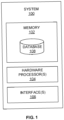
Claims (15)

  1. A processor implemented method, comprising:
    obtaining, via one or more hardware processors, an input training dataset, a cluster independent random noise and one or more associated cluster labels corresponding to the input training dataset (302);
    transforming, via the one or more hardware processors, the cluster independent random noise by using the one or more associated cluster labels corresponding to the input training dataset to obtain a cluster dependent random noise (304);
    generating, via the one or more hardware processors, an imputed synthetic noise based on (i) a mask variable, (ii) one or more feature embeddings of the training dataset, (iii) a flipped mask variable, and (iv) the obtained cluster dependent random noise (306);

    generating, via the one or more hardware processors, one or more imputed high-dimensional feature embeddings using the generated imputed synthetic noise (308);
    predicting, via the one or more hardware processors, one or more imputed high-dimensional target feature embeddings of the training dataset using the one or more imputed high-dimensional feature embeddings (310);
    generating, via the one or more hardware processors, one or more single-step ahead imputed high-dimensional feature embeddings using the one or more imputed high-dimensional feature embeddings (312); and
    generating, via the one or more hardware processors, an imputed training data using the one or more single-step ahead imputed high-dimensional feature embeddings (314).
  2. The processor implemented method as claimed in claim 1, wherein the cluster dependent random noise is obtained from the cluster independent random noise that is sampled from a Gaussian distribution and the one or more associated cluster labels corresponding to the input training dataset.
  3. The processor implemented method as claimed in claim 1, wherein the flipped mask variable is obtained based on a difference between a pre-defined value and the mask variable.
  4. The processor implemented method as claimed in claim 1, further comprising minimizing a difference between one or more target feature embeddings of the input training dataset and the one or more predicted imputed high-dimensional target feature embeddings.
  5. The processor implemented method as claimed in claim 1, further comprising validating the imputed training data based on a comparison of the imputed training data and the input training dataset.
  6. The processor implemented method as claimed in claim 1, further comprising classifying the one or more imputed high-dimensional feature embeddings into at least one class type.
  7. A system (100), comprising:
    a memory (102) storing instructions;
    one or more communication interfaces (106); and
    one or more hardware processors (104) coupled to the memory (102) via the one or more communication interfaces (106), wherein the one or more hardware processors (104) are configured by the instructions to:
    obtain an input training dataset, a cluster independent random noise and one or more associated cluster labels corresponding to the input training dataset;
    transform the cluster independent random noise by using the one or more associated cluster labels corresponding to the input training dataset to obtain a cluster dependent random noise;
    generate an imputed synthetic noise based on (i) a mask variable, (ii) one or more feature embeddings of the training dataset, (iii) a flipped mask variable, and (iv) the obtained cluster dependent random noise;
    generate, by using a generator module comprised in the cpGAN, one or more imputed high-dimensional feature embeddings using the generated imputed synthetic noise;
    predict, by using a critic module comprised in the cpGAN, one or more imputed high-dimensional target feature embeddings of the training dataset using the one or more imputed high-dimensional feature embeddings;
    generate, by using a supervisor module comprised in the cpGAN, one or more single-step ahead imputed feature embeddings using the one or more imputed high-dimensional feature embeddings; and
    generate, by using a recovery module comprised in the cpGAN, an imputed training data using the one or more single-step ahead imputed high-dimensional feature embeddings.
  8. The system as claimed in claim 7, wherein the cluster dependent random noise is obtained from the cluster independent random noise that is sampled from a Gaussian distribution and the one or more associated cluster labels corresponding to the input training dataset.
  9. The system as claimed in claim 7, wherein the flipped mask variable is obtained based on a difference between a pre-defined value and the mask variable.
  10. The system as claimed in claim 7, wherein the one or more hardware processors are further configured by the instructions to minimize a difference between one or more target feature embeddings of the input training dataset and the one or more predicted imputed high-dimensional target feature embeddings.
  11. The system as claimed in claim 7, wherein the one or more hardware processors are further configured by the instructions to validate, by using a discriminator comprised in the cpGAN, the imputed training data based on a comparison of the imputed training data and the input training dataset.
  12. The system as claimed in claim 7, wherein the one or more hardware processors are further configured by the instructions to classify, by using a discriminator comprised in the cpGAN, the one or more imputed high-dimensional feature embeddings into at least one class type.
  13. One or more non-transitory machine-readable information storage mediums comprising one or more instructions which when executed by one or more hardware processors cause:
    obtaining, an input training dataset, a cluster independent random noise and one or more associated cluster labels corresponding to the input training dataset;
    transforming the cluster independent random noise by using the one or more associated cluster labels corresponding to the input training dataset to obtain a cluster dependent random noise;
    generating an imputed synthetic noise based on (i) a mask variable, (ii) one or more feature embeddings of the training dataset, (iii) a flipped mask variable, and (iv) the obtained cluster dependent random noise;
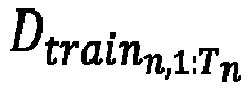
    generating one or more imputed high-dimensional feature embeddings using the generated imputed synthetic noise;
    predicting one or more imputed high-dimensional target feature embeddings of the training dataset using the one or more imputed high-dimensional feature embeddings;
    generating one or more single-step ahead imputed high-dimensional feature embeddings using the one or more imputed high-dimensional feature embeddings; and
    generating an imputed training data using the one or more single-step ahead imputed high-dimensional feature embeddings.
  14. The one or more non-transitory machine-readable information storage mediums as claimed in claim 13, wherein the cluster dependent random noise is obtained from the cluster independent random noise that is sampled from a Gaussian distribution and the one or more associated cluster labels corresponding to the input training dataset.
  15. The one or more non-transitory machine-readable information storage mediums as claimed in claim 13, wherein the one or more instructions which when executed by the one or more hardware processors further cause one or more of:
    minimizing a difference between one or more target feature embeddings of the input training dataset and the one or more predicted imputed high-dimensional target feature embeddings;
    validating the imputed training data based on a comparison of the imputed training data and the input training dataset; and
    classifying the one or more imputed high-dimensional feature embeddings into at least one class type,
    wherein the flipped mask variable is obtained based on a difference between a pre-defined value and the mask variable.
EP22186912.6A 2022-03-03 2022-07-26 Congeniality-preserving generative adversarial networks for imputing low-dimensional multivariate time-series data Pending EP4239527A1 (en)

Applications Claiming Priority (1)

Application Number Priority Date Filing Date Title
IN202221011587 2022-03-03

Publications (1)

Publication Number Publication Date
EP4239527A1 true EP4239527A1 (en) 2023-09-06

Family

ID=82742615

Family Applications (1)

Application Number Title Priority Date Filing Date
EP22186912.6A Pending EP4239527A1 (en) 2022-03-03 2022-07-26 Congeniality-preserving generative adversarial networks for imputing low-dimensional multivariate time-series data

Country Status (2)

Country Link
US (1) US20230281428A1 (en)
EP (1) EP4239527A1 (en)

Cited By (1)

* Cited by examiner, † Cited by third party
Publication number Priority date Publication date Assignee Title
CN117312782A (en) * 2023-10-24 2023-12-29 东南大学 A method for filling missing traffic status data based on generative adversarial networks

Families Citing this family (1)

* Cited by examiner, † Cited by third party
Publication number Priority date Publication date Assignee Title
US12548680B1 (en) * 2022-09-28 2026-02-10 Elevance Health, Inc. System and method for generating high-fidelity privacy-conscious synthetic patient data for causal effect estimation with multiple treatments

Non-Patent Citations (1)

* Cited by examiner, † Cited by third party
Title
WANG YUFENG ET AL: "PC-GAIN: Pseudo-label conditional generative adversarial imputation networks for incomplete data", NEURAL NETWORKS, ELSEVIER SCIENCE PUBLISHERS, BARKING, GB, vol. 141, 2 June 2021 (2021-06-02), pages 395 - 403, XP086710800, ISSN: 0893-6080, [retrieved on 20210602], DOI: 10.1016/J.NEUNET.2021.05.033 *

Cited By (1)

* Cited by examiner, † Cited by third party
Publication number Priority date Publication date Assignee Title
CN117312782A (en) * 2023-10-24 2023-12-29 东南大学 A method for filling missing traffic status data based on generative adversarial networks

Also Published As

Publication number Publication date
US20230281428A1 (en) 2023-09-07

Similar Documents

Publication Publication Date Title
Stephenson et al. On the geometry of generalization and memorization in deep neural networks
US12541705B2 (en) System and method for facilitating a machine learning model rebuild
Ji et al. A sparse-response deep belief network based on rate distortion theory
EP3454260A1 (en) Bilstm-siamese network based classifier for identifying target class of queries and providing responses thereof
US20230351202A1 (en) System and method for generating mixed variable type multivariate temporal synthetic data
Le A tutorial on deep learning part 1: Nonlinear classifiers and the backpropagation algorithm
Ali et al. Predicting the direction movement of financial time series using artificial neural network and support vector machine
Shanthamallu et al. Machine and deep learning algorithms and applications
Śmietanka et al. Algorithms in future insurance markets
Hall et al. An overview of machine learning with SAS® enterprise miner™
US20230281427A1 (en) Privacy preserving generative mechanism for industrial time-series data disclosure
EP4239527A1 (en) Congeniality-preserving generative adversarial networks for imputing low-dimensional multivariate time-series data
Zhu et al. Mixseq: Connecting macroscopic time series forecasting with microscopic time series data
Rostami Transfer learning through embedding spaces
Hain et al. Introduction to Rare-Event Predictive Modeling for Inferential Statisticians—A Hands-On Application in the Prediction of Breakthrough Patents
Zhou Linear models
Giantsidi et al. Deep learning for financial forecasting: A review of recent advancements
US20250390477A1 (en) Detecting data anomalies using artificial intelligence
Dutta et al. Robust predictive models for the Indian IT sector using machine learning and deep learning
Gashler et al. Missing value imputation with unsupervised backpropagation
Vijayalakshmi et al. Smart Police: A Hybrid Deep Learning Model for Crime Proactivity Assessment
Divyashree et al. Algorithms: Supervised machine learning types and their application domains
Zhang et al. An Explainable Gaussian Process Auto-encoder for Tabular Data
Chen et al. Prediction
Wu et al. Applying a Probabilistic Network Method to Solve Business‐Related Few‐Shot Classification Problems

Legal Events

Date Code Title Description
PUAI Public reference made under article 153(3) epc to a published international application that has entered the european phase

Free format text: ORIGINAL CODE: 0009012

STAA Information on the status of an ep patent application or granted ep patent

Free format text: STATUS: REQUEST FOR EXAMINATION WAS MADE

17P Request for examination filed

Effective date: 20230420

AK Designated contracting states

Kind code of ref document: A1

Designated state(s): AL AT BE BG CH CY CZ DE DK EE ES FI FR GB GR HR HU IE IS IT LI LT LU LV MC MK MT NL NO PL PT RO RS SE SI SK SM TR

STAA Information on the status of an ep patent application or granted ep patent

Free format text: STATUS: EXAMINATION IS IN PROGRESS

17Q First examination report despatched

Effective date: 20250325