EP4239526A1 - Privacy preserving generative mechanism for industrial time-series data disclosure - Google Patents

Privacy preserving generative mechanism for industrial time-series data disclosure Download PDF

Info

Publication number
EP4239526A1
EP4239526A1 EP22175731.3A EP22175731A EP4239526A1 EP 4239526 A1 EP4239526 A1 EP 4239526A1 EP 22175731 A EP22175731 A EP 22175731A EP 4239526 A1 EP4239526 A1 EP 4239526A1
Authority
EP
European Patent Office
Prior art keywords
neural network
mixed
feature
synthetic
data
Prior art date
Legal status (The legal status is an assumption and is not a legal conclusion. Google has not performed a legal analysis and makes no representation as to the accuracy of the status listed.)
Pending
Application number
EP22175731.3A
Other languages
German (de)
French (fr)
Inventor
Sagar Srinivas SAKHINANA
Venkataramana Runkana
Rajat Kumar SARKAR
Current Assignee (The listed assignees may be inaccurate. Google has not performed a legal analysis and makes no representation or warranty as to the accuracy of the list.)
Tata Consultancy Services Ltd
Original Assignee
Tata Consultancy Services Ltd
Priority date (The priority date is an assumption and is not a legal conclusion. Google has not performed a legal analysis and makes no representation as to the accuracy of the date listed.)
Filing date
Publication date
Application filed by Tata Consultancy Services Ltd filed Critical Tata Consultancy Services Ltd
Publication of EP4239526A1 publication Critical patent/EP4239526A1/en
Pending legal-status Critical Current

Links

Images

Classifications

    • GPHYSICS
    • G06COMPUTING OR CALCULATING; COUNTING
    • G06NCOMPUTING ARRANGEMENTS BASED ON SPECIFIC COMPUTATIONAL MODELS
    • G06N3/00Computing arrangements based on biological models
    • G06N3/02Neural networks
    • G06N3/04Architecture, e.g. interconnection topology
    • G06N3/045Combinations of networks
    • GPHYSICS
    • G06COMPUTING OR CALCULATING; COUNTING
    • G06NCOMPUTING ARRANGEMENTS BASED ON SPECIFIC COMPUTATIONAL MODELS
    • G06N3/00Computing arrangements based on biological models
    • G06N3/02Neural networks
    • G06N3/04Architecture, e.g. interconnection topology
    • G06N3/0499Feedforward networks
    • GPHYSICS
    • G06COMPUTING OR CALCULATING; COUNTING
    • G06FELECTRIC DIGITAL DATA PROCESSING
    • G06F18/00Pattern recognition
    • G06F18/20Analysing
    • G06F18/21Design or setup of recognition systems or techniques; Extraction of features in feature space; Blind source separation
    • G06F18/214Generating training patterns; Bootstrap methods, e.g. bagging or boosting
    • GPHYSICS
    • G06COMPUTING OR CALCULATING; COUNTING
    • G06FELECTRIC DIGITAL DATA PROCESSING
    • G06F21/00Security arrangements for protecting computers, components thereof, programs or data against unauthorised activity
    • G06F21/60Protecting data
    • G06F21/62Protecting access to data via a platform, e.g. using keys or access control rules
    • G06F21/6218Protecting access to data via a platform, e.g. using keys or access control rules to a system of files or objects, e.g. local or distributed file system or database
    • G06F21/6245Protecting personal data, e.g. for financial or medical purposes
    • GPHYSICS
    • G06COMPUTING OR CALCULATING; COUNTING
    • G06NCOMPUTING ARRANGEMENTS BASED ON SPECIFIC COMPUTATIONAL MODELS
    • G06N3/00Computing arrangements based on biological models
    • G06N3/02Neural networks
    • G06N3/04Architecture, e.g. interconnection topology
    • G06N3/042Knowledge-based neural networks; Logical representations of neural networks
    • GPHYSICS
    • G06COMPUTING OR CALCULATING; COUNTING
    • G06NCOMPUTING ARRANGEMENTS BASED ON SPECIFIC COMPUTATIONAL MODELS
    • G06N3/00Computing arrangements based on biological models
    • G06N3/02Neural networks
    • G06N3/04Architecture, e.g. interconnection topology
    • G06N3/045Combinations of networks
    • G06N3/0455Auto-encoder networks; Encoder-decoder networks
    • GPHYSICS
    • G06COMPUTING OR CALCULATING; COUNTING
    • G06NCOMPUTING ARRANGEMENTS BASED ON SPECIFIC COMPUTATIONAL MODELS
    • G06N3/00Computing arrangements based on biological models
    • G06N3/02Neural networks
    • G06N3/04Architecture, e.g. interconnection topology
    • G06N3/0475Generative networks
    • GPHYSICS
    • G06COMPUTING OR CALCULATING; COUNTING
    • G06NCOMPUTING ARRANGEMENTS BASED ON SPECIFIC COMPUTATIONAL MODELS
    • G06N3/00Computing arrangements based on biological models
    • G06N3/02Neural networks
    • G06N3/08Learning methods
    • GPHYSICS
    • G06COMPUTING OR CALCULATING; COUNTING
    • G06NCOMPUTING ARRANGEMENTS BASED ON SPECIFIC COMPUTATIONAL MODELS
    • G06N3/00Computing arrangements based on biological models
    • G06N3/02Neural networks
    • G06N3/08Learning methods
    • G06N3/094Adversarial learning
    • GPHYSICS
    • G06COMPUTING OR CALCULATING; COUNTING
    • G06NCOMPUTING ARRANGEMENTS BASED ON SPECIFIC COMPUTATIONAL MODELS
    • G06N5/00Computing arrangements using knowledge-based models
    • G06N5/01Dynamic search techniques; Heuristics; Dynamic trees; Branch-and-bound

Definitions

  • the disclosure herein generally relates to the field of data privacy and more specifically, to a method and system for privacy preserving generative mechanism for data-disclosure of industrial multivariate mixed-variable time series data.
  • the gold standards for security techniques in deep learning include cryptography techniques such as Homomorphic Encryption (HE), Secure Multiparty Computation (SMC), Differential Privacy (DP) & Information-Theoretic Privacy for data disclosure, Federated ML, Ethereum blockchain, and Smart contracts.
  • cryptography techniques such as Homomorphic Encryption (HE), Secure Multiparty Computation (SMC), Differential Privacy (DP) & Information-Theoretic Privacy for data disclosure, Federated ML, Ethereum blockchain, and Smart contracts.
  • Embodiments of the disclosure present technological improvements as solutions to one or more of the above-mentioned technical problems recognized by the inventors in conventional systems. For example, in one embodiment, a method and system for privacy preserving generative mechanism for data-disclosure of industrial data is provided.
  • a processor-implemented method for privacy preserving generative mechanism for data-disclosure of industrial data includes one or more steps such as receiving, via an input/output interface, a multivariate mixed-variable time series data of a plurality of sensory observations, the cluster-labels associated with the multivariate mixed-variable time series data and a cluster-independent random noise, pre-processing, via one or more hardware processors, the received multivariate mixed-variable time series data, training, via a one or more hardware processors, a plurality of neural networks of a privacy preserving adversarial neural network architecture in two phases, providing, via the one or more hardware processors, a test data to generate a synthetic private dataset for data disclosure using the trained privacy preserving adversarial neural network architecture, and estimating, via the one or more hardware processors, identifiability of the multivariate mixed-variable time series data from the generated synthetic private dataset.
  • a system for privacy preserving generative mechanism for data-disclosure of industrial data includes an input/output interface configured to receive a multivariate mixed-variable time series data of a plurality of sensory observations, the cluster-labels associated with the multivariate mixed-variable time series data and a cluster-independent random noise, one or more hardware processors and at least one memory storing a plurality of instructions, wherein the one or more hardware processors are configured to execute the plurality of instructions stored in the at least one memory.
  • the system is configured to pre-process the received a multivariate mixed-variable time series data, wherein the pre-process includes normalizing continuous feature variables by bounding heterogeneous measurements between a predefined range through a min-max scaling technique; and transforming discreate feature variables by representing as a sparse binary vector through a one-hot encoding technique.
  • the system is configured to train a plurality of neural networks of a privacy preserving adversarial neural network architecture in two phases, provide a test data to generate a synthetic private dataset for data disclosure using the trained privacy preserving adversarial neural network architecture and estimate an identifiability of the multivariate mixed-variable time series data from the generated synthetic private dataset, wherein the estimation satisfies a predefined process-identifiability criteria.
  • one or more non-transitory machine-readable information storage mediums comprising one or more instructions, which when executed by one or more hardware processors causes a method for privacy preserving generative mechanism for data-disclosure of industrial data.
  • the method includes one or more steps such as receiving, via an input/output interface, a multivariate mixed-variable time series data of a plurality of sensory observations, the cluster-labels associated with the multivariate mixed-variable time series data and a cluster-independent random noise, pre-processing, via one or more hardware processors, the received multivariate mixed-variable time series data, training, via a one or more hardware processors, a plurality of neural networks of a privacy preserving adversarial neural network architecture in two phases, providing, via the one or more hardware processors, a test data to generate a synthetic private dataset for data disclosure using the trained privacy preserving adversarial neural network architecture, and estimating, via the one or more hardware processors, identifiability of the multivariate mixed-
  • the embodiments herein provide a method and system for privacy preserving generative mechanism for data-disclosure of the industrial multivariate mixed-variable time-series data.
  • the proposed invention fuses an industrial multivariate mixed-variable time series data with a random gaussian noise to preserve the privacy of the industrial multivariate mixed-variable time series data and trades-off the privacy with the utility of synthetic-private data.
  • the one or more embodiments herein presents the privacy-preserving synthetic industrial data generative mechanism for data disclosure with minimal risk of AI technique and strong privacy guarantees.
  • Embedding privacy by design into the generative mechanism approaches present an alternate paradigm of learning in contrast to the reduced-order modeling and numerical solutions of the industrial data based on the principles in continuum mechanics for data disclosure with privacy.
  • the deep learning-based generative techniques integrated synergistically with privacy-preserving mechanisms to generate the synthetic-private data almost but not-quite real data.
  • the privacy enabled generative techniques provides trustworthiness on the generated privacy-preserving synthetic data that quench both the ethical and legal needs for securing industrial data confidentiality (minimize the process identifiability) and trade-off to preserve the temporal dynamics, probability distributions of the real data to retain utility in downstream predictive analytics tasks.
  • Privacy preservation by sanitizing the data of the associated industrial client (data owner) is of paramount importance for privacy-first tech companies (trusted party holding the sensitive data) to avoid legal subpoena for privacy-breach and it permits the deep-learning practitioners to build AI techniques by utilizing synthetic-private data to improve the modeling of engineering systems.
  • a privacy-preserving Generative Adversarial Network is a private learning technique that minimizes and regulates the information flow. It is based on a rubric defined on the optimal transport for machine learning in a Kantorovich formulation between the empirical probability distributions of a synthetic-private data and a non-linear original data.
  • the ppGAN comprises a generator neural network that sanitizes the multivariate mixed-variable time series dataset to a certain extent. It occludes threat of inference attacks on the process-plants database, and a discriminator neural network that attempts to maximize the Wasserstein distance between the real data and privacy-preserving synthetic data probability distributions.
  • FIG. 1 through 3 where similar reference characters denote corresponding features consistently throughout the figures, there are shown preferred embodiments and these embodiments are described in the context of the following exemplary system and/or method.
  • FIG. 1 illustrates a block diagram of a system (100) for privacy preserving generative mechanism for data-disclosure of the industrial data, in accordance with an example embodiment.
  • the system (100) may comprise one or more computing devices (102), such as a laptop computer, a desktop computer, a notebook, a workstation, a cloud-based computing environment and the like. It will be understood that the system (100) may be accessed through one or more input/output interfaces 104-1, 104-2... 104-N, collectively referred to as I/O interface (104).
  • Examples of the I/O interface (104) may include, but are not limited to, a user interface, a portable computer, a personal digital assistant, a handheld device, a smartphone, a tablet computer, a workstation, and the like.
  • the I/O interface (104) are communicatively coupled to the system (100) through a network (106).
  • the network (106) may be a wireless or a wired network, or a combination thereof.
  • the network (106) can be implemented as a computer network, as one of the different types of networks, such as virtual private network (VPN), intranet, local area network (LAN), wide area network (WAN), the internet, and such.
  • the network (106) may either be a dedicated network or a shared network, which represents an association of the different types of networks that use a variety of protocols, for example, Hypertext Transfer Protocol (HTTP), Transmission Control Protocol/Internet Protocol (TCP/IP), and Wireless Application Protocol (WAP), to communicate with each other.
  • the network (106) may include a variety of network devices, including routers, bridges, servers, computing devices, storage devices. The network devices within the network (106) may interact with the system (100) through communication links.
  • the system (100) supports various connectivity options such as BLUETOOTH ® , USB, ZigBee, and other cellular services.
  • the network environment enables connection of various components of the system (100) using any communication link including Internet, WAN, MAN, and so on.
  • the system (100) is implemented to operate as a stand-alone device.
  • the system (100) may be implemented to work as a loosely coupled device to a smart computing environment.
  • the system (100) comprises at least one memory with a plurality of instructions, one or more databases (112), and one or more hardware processors (108) which are communicatively coupled with the at least one memory to execute a plurality of modules (114) therein.
  • the components and functionalities of the system (100) are described further in detail.
  • the one or more I/O interfaces (104) are configured to receive a multivariate mixed-variable time series data of a plurality of sensory observations, the cluster-labels associated with the multivariate mixed-variable time series data and a cluster-independent random noise.
  • the received multivariate mixed-variable time series data is pre-processed to normalize continuous feature variables by bounding heterogeneous measurements between a predefined range of a min-max scaling technique.
  • Discreate feature variables are transformed by representing as a sparse binary vector through a one-hot encoding technique.
  • the system (100) comprises a plurality of neural networks (116) of the privacy preserving generative adversarial network architecture.
  • the plurality of neural networks includes an embedding neural network (118), a recovery neural network (120), a generator neural network (122), a critic neural network (124), a discriminator neural network (126), and supervisory neural network (128).
  • the plurality of neural networks (116) are trained in two phases. In the first phase the embedding neural network (118) is trained using a predefined low-dimensional mixed feature training dataset to obtain a high-dimensional mixed feature embeddings.
  • the obtained high-dimensional mixed feature embeddings are used to train a supervisory neural network (128) for a single step ahead predictions of the high-dimensional mixed-feature embeddings.
  • the supervisory neural network (128) is utilized to model a temporal dynamics of the low-dimensional mixed feature training dataset.
  • the critic neural network (124) of the privacy preserving generative adversarial network architecture is trained using the high-dimensional mixed feature embeddings to predict a target high-dimensional feature embedding.
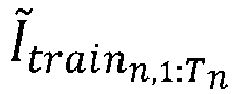
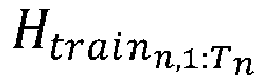
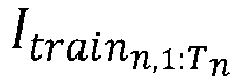
  • E ppGAN learns a high-dimensional representation, H train n , 1 : T n , ⁇ n ⁇ ⁇ (1,2, ... , N ) ⁇ by transforming the corresponding low-dimensional real sequences, I ⁇ train n , 1 : T n , ⁇ n ⁇ ⁇ (1,2, ... , N ) ⁇ .
  • the embedding neural network (118) assists in effective learning by incorporating the semantics of the mixed-feature variables in its feature embeddings, H train n , 1 : T n .
  • D j , H j denotes the j -th feature variable space & latent embedding vector space, respectively.
  • R ppGAN obtains the low-dimensional feature representations, I ⁇ train n , 1 : T n , ⁇ n ⁇ ⁇ (1,2, ... , N ) ⁇ from its corresponding high-dimensional temporal latent variables, H train n , 1 : T n , ⁇ n ⁇ ⁇ (1,2, ...
  • e rnn and r rnn are autoregressive neural-net models. They are realized with a unidirectional recurrent neural network with extended memory. e f , r f c , and r f d are parameterized by feed-forward neural networks. S, S m denote the sigmoid & softmax activation function, respectively.
  • the system (100) is configured to minimize the first moment,
  • L US I _ 1 ⁇ I _ 2 + ⁇ ⁇ 1 2 + ⁇ ⁇ 2 2 .
  • the ppGAN neural architecture in the unsupervised learning approach trains the joint-transformation network of the private-data generator ( G ppGAN ), supervisor network ( S ppGAN ), and the recovery neural network (120) ( R ppGAN ) to transform samples, Z n ,1: T n ⁇ P ( Z ) into R ppGAN S ppGAN G ppGAN Z n , 1 : T n ⁇ P ⁇ I ⁇ n , 1 : T n 1 : c , c + 1 : d such that P ⁇ I ⁇ n , 1 : T n 1 : c , c + 1 : d ⁇ P I n , 1 : T n 1 : c , c + 1 : d .
  • P ( D ⁇ n,1:T n ) learns the underlying probability distributions of the input temporal data, P D ⁇ train n , 1 : T
  • the system (100) is configured for a second phase training of the plurality of neural networks of a privacy preserving adversarial neural network architecture.
  • the received cluster-independent random noise is transformed using one or more cluster-labels associated with a predefined training dataset to obtain a cluster-dependent random noise.
  • a linear transformation on a concatenation of the low-dimensional mixed feature training dataset and the cluster-dependent random noise is performed to obtain a synthetic-private noise to train the generator neural network (122) of the privacy preserving adversarial neural network architecture.
  • the generator neural network (122) provides a high-dimensional synthetic-private mixed feature embeddings to train the discriminator neural network (126). It would be appreciated that the discriminator neural network (126) assigns a label to the high-dimensional synthetic-private mixed feature embeddings such as real or fake.
  • the supervisory neural network (128) is trained using the high-dimensional synthetic-private feature embeddings to generate the single-step ahead predictions of the high-dimensional synthetic-private feature embeddings and the recovery neural network (120) is trained using a single-step ahead high-dimensional synthetic-private feature embeddings to obtain the low-dimensional synthetic-private mixed feature dataset.
  • the supervisor neural network (128), S ppGAN is leveraged to model the non-linear temporal dynamics of the original data, I n,1:T n .
  • S ppGAN neural-network By integrating the S ppGAN neural-network in the workflow to generate the synthetic-private data, ⁇ n,1:T n .
  • the synthetic-private data captures the complex non-linear temporal dependencies of the original data.
  • the G ppGAN neural-network of the ppGAN framework generates the synthetic high-dimensional latent embeddings, ⁇ n ,1: T n .
  • the auto-regressive, S ppGAN : H n , 1 : t ⁇ 1 * ⁇ H n , t * , ⁇ n ⁇ ⁇ 1,2, ... , N ⁇ , t ⁇ 1: T n takes as input H n , 1 : t ⁇ 1 * and predicts the single-step ahead temporal latent embeddings, H n , t * conditioned on the past latent sequences.
  • the G ppGAN by operating in the training-loop perceives the ground-truth high-dimensional latent representations, H ⁇ train n , 1 : T n from the embedding neural network (118).
  • the supervisor neural network (128) S ppGAN minimizes the loss, L S by forcing the ⁇ n ,1: T n unflagged by the inaccurate adversary ( D ppGAN ) to capture the single-step temporal dynamics of the H ⁇ train n , 1 : T n .
  • the critic neural network (124), F ppGAN : H n , 1 : T n * ⁇ R is a neural-network function leveraged for predictive modeling which maps the independent mixed-feature variables to the target variable, trained in the supervised learning approach.
  • ( ⁇ ) refers to H train 1 : f ⁇ 1 or ⁇ (1: f -1) .
  • the critic neural network (124) takes as input the realizations of H train n , 1 : T n 1 : f ⁇ 1 or H ⁇ n , 1 : T n 1 : f ⁇ 1 , ⁇ D T n ⁇ (1: f -1) and outputs, H train n , 1 : T n T or H ⁇ n , 1 : T n T , ⁇ D T n , ⁇ n ⁇ ⁇ (1,2, ... , N ) ⁇ .
  • the variable subset selection includes the features attributes from the set, ⁇ 1, ...
  • H train n , 1 T n 1 : f ⁇ 1 H train n , 1 : T n T
  • the critic neural network (124) learns the original relationship between independent feature variables and the target variable in the real dataset.
  • G ppGAN generates the relationship preserving synthetic-private data, D ⁇ n ,1: T n by minimizing the L F during the adversarial joint training by inducing appropriate inductive learning bias and it generalizes well to the domain.
  • c rnn and s rnn are autoregressive neural-net models and it is implemented with a unidirectional recurrent neural network with extended memory.
  • s f and c f are implemented by a feed-forward neural network.
  • Z n, 1 T n ⁇ R T n ⁇ f , ⁇ n ⁇ ⁇ 1,2, ... , N ⁇ denote the realizations of an f-dimensional Gaussian random variable of finite-length, T n for a sequence, n with values in the range [0,1) sampled from a gaussian distribution, Z ⁇ N (0,1).
  • the ground-truth, cluster-membership is computed by an iterative Euclidean distance-based classification technique in data mining to split the unlabeled dataset, I train n , 1 : T n into K -fixed-apriori disjoint clusters by minimizing the within-cluster sum-of-squares criterion.
  • the system (100) is configured to determine the label embedding vectors, e c ⁇ R d' , ⁇ c ⁇ ⁇ 1, ... , K ⁇ from the trainable semantics-aware cluster membership embedding matrix, W ⁇ R K ⁇ d' based on the cluster labels, C ⁇ train n , 1 : T n .
  • d' is the dimension of the embedding matrix, W.
  • the system (100) is configured to perform the matrix-matrix product of Z n ,1: T n and the transpose of the label matrix, L n , 1 : T n c to obtain the cluster label aware random noise, Z n , 1 : T n K .
  • the discrete-grouping cluster labels, C train n , 1 : T n corresponding to the mixed-feature dataset, I train n , 1 : T n are obtained through the unsupervised learning technique. It is determined by the k-means clustering technique as follows:
  • the generator neural network (122) function takes as input the realizations of the low-dimensional, I train n , 1 : T n , Z n , 1 : T n K and outputs a high-dimensional latent variable, ⁇ n,1:T n G ppGAN : I train n , 1 : T n ⁇ Z n , 1 : T n K ⁇ H ⁇ n , 1 : T n , ⁇ n ⁇ 1,2 , ... , N
  • the synthetic-private data generative can also be viewed as: G ppGAN : D T n f ⁇ 0,1 T n f ⁇ H T n f , ⁇ n ⁇ 1,2 , ... , N
  • the weight matrix is shared across the sequences, n, ⁇ n ⁇ ⁇ 1,2, ... , N ⁇ .
  • denotes the concatenation operator.
  • g rnn is an autoregressive neural-network model and it is implemented with a unidirectional recurrent neural network with extended memory.
  • g f is parameterized by a feed-forward neural network.
  • the discriminator neural network (126), D ppGAN in ppGAN architecture is a classifier to differentiate the real, H train n , 1 : T n and the synthetic-private data, ⁇ n,1:T n and to minimize the Wasserstein distance between joint distributions, P I n , 1 : T n 1 : c , c + 1 : d , P ⁇ I ⁇ n , 1 : T n 1 : c , c + 1 : d on a given metric space, H.
  • D ppGAN H n , 1 : T n * ⁇ p n , 1 : T n , m * , p n , 1 : T n * , P H n , 1 : T n *
  • the G ppGAN of the ppGAN framework produces synthetic-private latent embeddings, ⁇ n ,1: Tn of domain H, by operating on the random noise, Z n , 1 : T n K and the real data, I train n , 1 : T n and the discriminator neural network (126), D ppGAN by operating on the adversarial learning latent space, H, tries to differentiate latent temporal embeddings, H train n , 1 : T n & ⁇ n,1:T n and minimizes the Wasserstein distance between joint distributions.
  • N ⁇ is the adversarial ground-truth, true or fake data.
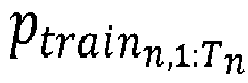
  • p train n , 1 : T n , p ⁇ n ,1: T n ⁇ [0,1] Tn , ⁇ n ⁇ ⁇ 1, ... , N ⁇ is the predicted probability of the true data
  • 1 ⁇ p train n , 1 : T n & 1 - p ⁇ n,1:T n , ⁇ n ⁇ ⁇ 1, ... , N ⁇ is the predicted probability of fake data.
  • D ppGAN tries to minimize, L U .
  • the G ppGAN tries to maximize, L U which helps to learn P ⁇ I n , 1 : T n 1 : c , c + 1 : d that best approximates P I train n , 1 : T n 1 : c , c + 1 : d .
  • the prognostics of finite cluster-membership, C n , 1 : T n * ⁇ K is a multinomial single-output classification task.
  • the ⁇ ⁇ R T n refers to true or fake.
  • the system (100) is configured to compute an individual loss for each cluster-membership, ⁇ 1, ... , K ⁇ per latent sequence, n ⁇ ⁇ 1, ... , N ⁇ and at each time point t ( ⁇ 1: T n ) . Further, the system performs a summation operation of the output over the cluster membership & latent sequences.
  • K denotes the fixed-apriori cluster labels.
  • y n , 1 : T n c is the ground-truth binary value of 1 or 0 if cluster label
  • m is the true label or false label at time point t ( ⁇ 1: T n ) corresponding to latent sequence, n ⁇ ⁇ 1, ...
  • T n , 1 T n , m is the predicted probability for real observation at a time point, t of a data sequence, n ⁇ ⁇ 1, ... , N ⁇ belongs to cluster, m.
  • p ⁇ n ,1: T n ,m is the predicted probability for synthetic latent embedding at time point t of sequence, n ⁇ ⁇ 1, ... , N ⁇ belonging to cluster membership, m.
  • the D ppGAN tries to minimize, L LP whereas G ppGAN tries to maximize, L LP .
  • C train n , 1 : T n p denote the predicted cluster membership for real data, D train n , 1 : T n by D ppGAN in comparison with the ground-truth, C train n , 1 : T n determined by the clustering technique.
  • C ⁇ n,1:T n denote the predicted cluster-membership labels for the synthetic-private data, ⁇ n,1:T n .
  • the D ppGAN aims to maximize, L W whereas G ppGAN attempts to minimize, L W .
  • g rnn and d rnn are autoregressive neural-net models. They are implemented with a unidirectional recurrent neural network with extended memory.
  • g f , d f , d f c are implemented by a feed-forward neural network.
  • the conditional generative neural network architecture, G ppGAN generates synthetic-private data, ⁇ n,1:T n which must be sufficiently anonymized and non-identical enough in order to minimize the reidentification of the observed data, I n,1:T n .
  • the finite series of data, ⁇ n,t ⁇ D ( f ) and ⁇ n,t +1 ⁇ D ( f ) observed at time points, t and t + 1( ⁇ ⁇ 1, ... , T n ⁇ ) of the same sequence, n or belong to distinct sequences, n ⁇ ⁇ 1, ... , N ⁇ are non - identicalenough as they are actually measured at different time orders.
  • the minimum(shortest) weighted euclidean distance computed between the observations in real data is the measure for non - identicalenough between the synthetic-private data and observed data.
  • the system (100) is configured to estimate identifiability of the finite observed data by the finite synthetic-private data.
  • the system defines the ⁇ -process identifiability as, there are lower than ⁇ -fraction observations from the real dataset, I train n , 1 : T n in the synthetic-private dataset, ⁇ n ,1: T n that are mostcertainlynot, non - identicalenough in comparison with the real data, I train n , 1 : T n .
  • equation (22) states that ⁇ -process identifiability for each f-dimension time series data observed at a time point, t, I train n,t ⁇ D ( f ) , of a particular sequence, n ⁇ ⁇ 1, ... , N ⁇ is defined as the probability that the weighted euclidean distance to the nearby synthetic-private f-dimension time series data observed at timepoint, t ( ⁇ 1: T n ), ⁇ n,t ⁇ D ( f ) , ⁇ n ⁇ ⁇ 1, ...
  • N ⁇ is closer (most certainly not, non-identical enough) than the weighted Euclidean distance from the adjacent real observation, at time-point, t ( ⁇ 1: T n ), I train n,t +1 ⁇ D ( f ) , ⁇ n ⁇ ⁇ 1, ... , N ⁇ is less than ⁇ .
  • 1 - ⁇ is the proportion of real dataset observations that are not identifiable by synthetic-private dataset observations due to the sole reason that the synthetic-private dataset observations are non-identical enough from the real dataset observations. Therefore, 0-process identifiability denotes peak privacy, and 1-process identifiability represents least-privacy, I is an identity function.
  • ⁇ 1, ... , c ⁇ ⁇ f each continuous feature attribute is quantized.
  • L PI E I , I ⁇
  • the generator neural network (122) G ppGAN maximizes the weighted euclidean distance between synthetic-private data sample ⁇ n,1:T n and the conditioned real data I train n , 1 : T n given that ⁇ n ,1: Tn satisfies the ⁇ process-identifiability criteria.
  • the embedding neural network (118) ( E ppGAN ) and the recovery neural network (120) ( R ppGAN ) are trained jointly in the supervised-learning approach on the task of restoration of the real temporal data, I train n , 1 : T n with a goal to learn higher-dimensional latent embeddings from the lower-dimensional multivariate mixed-feature dataset, I train n , 1 : T n .
  • the supervisor neural network (128) S ppGAN
  • the forecasting modeler is trained in the supervised-learning approach on the complex task of single-step ahead prediction of the real latent embedding, H train n , 1 : T n by operating in the latent space, H.
  • the critic neural network (124) ( F ppGAN ) is utilized to learn the relationship between the independent feature variables and the target variable.
  • the predictive modeler is trained on the real data to map the independent feature variables to the target variable by minimizing the prediction loss, L F .
  • the goal is to minimize, min ⁇ e , ⁇ r , ⁇ s , ⁇ c ( L R + L S + L F ) in supervised learning approach by operating on the lower-dimensional mixed-feature dataset, I train n , 1 : T n to learn the patterns of the real data.
  • ⁇ e , ⁇ r , ⁇ s , ⁇ c denote the learnable parameters of the embedding, the recovery, the supervisor, and the critic neural network (124), respectively.
  • ⁇ g , ⁇ d denote the learnable parameters of the G ppGAN , D ppGAN neural network functions.
  • G ppGAN is trained by seven distinct loss functions L US , L U , L W , L M , L S , L F & L LP .
  • G ppGAN is trained adversarial to minimize the weighted sum of the above loss functions:
  • L G min ⁇ g ⁇ ⁇ L U + ⁇ L W + ⁇ L LP + L US + ⁇ L M + L S + L F wherein, ⁇ ⁇ R + .
  • D ppGAN is trained by three distinct loss functions L U , L W & L LP .
  • D ppGAN is trained to minimize the weighted sum of the loss functions:
  • L D min ⁇ d ⁇ L U + ⁇ ⁇ L W + L LP
  • G ppGAN , D ppGAN are trained adversarially by deceptive input as follows, min G ppGAN max D ppGAN L ( G ppGAN , D ppGAN ) . It can be expressed as: min ⁇ g ⁇ ⁇ L U + ⁇ L W + ⁇ L LP + L US + ⁇ L M + L S + L F + max ⁇ d ⁇ ⁇ L U + ⁇ L W + ⁇ L LP
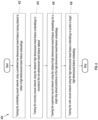
  • FIG. 3 to illustrate a processor-implemented method (300) for privacy preserving generative mechanism for data-disclosure of the industrial data is provided.
  • step (302) receiving, via an input/output interface, a multivariate mixed-variable time series data of a plurality of sensory observations, the cluster-labels associated with the multivariate mixed-variable time series data and a cluster-independent random noise.
  • pre-processing comprising normalizing continuous feature variables by bounding heterogeneous measurements between a predefined range of a min-max scaling technique and transforming discreate feature variables by representing as a sparse binary vector through a one-hot encoding technique.
  • the plurality of neural networks including an embedding neural network, a recovery neural network (120), a generator neural network (122), a critic neural network (124) and a discriminator neural network (126).
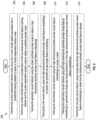
  • a first phase training (400) of the plurality of neural networks of a privacy preserving adversarial neural network architecture in accordance with some embodiments of the present disclosure.
  • step (402) training the embedding neural network using a predefined low-dimensional mixed feature training dataset to obtain a high-dimensional mixed feature embeddings.
  • a second phase training (500) of the plurality of neural networks of a privacy preserving adversarial neural network architecture in accordance with some embodiments of the present disclosure.
  • step (502) transforming cluster-independent random noise using one or more cluster-labels associated with a predefined training dataset to obtain a cluster-dependent random noise.
  • the discriminator neural network (126) uses the high-dimensional synthetic-private mixed feature embeddings to assign a label.
  • the discriminator neural network (126) classifies the high-dimensional synthetic-private mixed feature embeddings as fake.
  • the privacy preserving synthetic dataset is obtained by utilizing the real train dataset.
  • LSTM & LSTM ⁇ are leveraged as a baseline model trained on real train data and on the privacy-preserving synthetic data respectively for both the downstream tasks of target variable prediction/one-step ahead prediction with distinct learnable parameters.
  • the models are evaluated on real test data and performance is reported in terms of RMSE metric.
  • WD & Ss denotes the Wasserstein distance and silhouette score, respectively.
  • is utilized to regulate the privacy-breach acceptable & to determine the ⁇ -process identifiability.
  • a K-means clustering technique determines the preordained cluster manifolds in the multidimensional dataset.
  • the clusters are projected onto the 2-PCA components plots.
  • the ⁇ -process identifiability is zero, the privacy is at peak.
  • the synthetic-private dataset is unidentifiable, but it shifts from the original true data distributions and results in less utility for application. The results reported in our work is obtained by a statistical average of five different experimental runs.
  • the embodiments of present disclosure herein address the need of privacy-enhanced mathematical framework for data-disclosure of the sensitive industrial multivariate mixed-variable time series data which trades-off with utility to preserve the original data characteristics in the synthetic-private dataset.
  • a Privacy-Preserving Generative Adversarial Networks(ppGAN) a private learning technique that minimizes and also regulates the information flow based on the rubric defined on the optimal transport for machine learning in the Kantorovich formulation between the empirical probability distributions of the synthetic-private data and the non-linear original data.
  • the framework comprises a generator neural network (122) that sanitizes the multivariate mixed-variable time series dataset to a certain extent that occludes the threat of inference attacks on the process-plant databases, and a discriminator neural network (126) that attempts to maximize the Wasserstein distance between the real data & privacy-preserving synthetic data probability distributions.
  • the framework discovers the privacy-utility pareto fronts, by taking into account the hyper-parameter tuning, and elevating process-identifiability above the concept of risk to its potential benefit ratio with respect to the data-owner monetary gains (data monetization) versus privacy breach, deemed acceptable.
  • Such computer-readable storage means contain program-code means for implementation of one or more steps of the method, when the program runs on a server or mobile device or any suitable programmable device.
  • the hardware device can be any kind of device which can be programmed including e.g., any kind of computer like a server or a personal computer, or the like, or any combination thereof.
  • the device may also include means which could be e.g., hardware means like e.g., an application-specific integrated circuit (ASIC), a field-programmable gate array (FPGA), or a combination of hardware and software means, e.g., an ASIC and an FPGA, or at least one microprocessor and at least one memory with software modules located therein.
  • ASIC application-specific integrated circuit
  • FPGA field-programmable gate array
  • the means can include both hardware means, and software means.
  • the method embodiments described herein could be implemented in hardware and software.
  • the device may also include software means. Alternatively, the embodiments may be implemented on different hardware devices, e.g., using a plurality of CPUs.
  • the embodiments herein can comprise hardware and software elements.
  • the embodiments that are implemented in software include but are not limited to, firmware, resident software, microcode, etc.
  • the functions performed by various modules described herein may be implemented in other modules or combinations of other modules.
  • a computer-usable or computer readable medium can be any apparatus that can comprise, store, communicate, propagate, or transport the program for use by or in connection with the instruction execution system, apparatus, or device.
  • a computer-readable storage medium refers to any type of physical memory on which information or data readable by a processor may be stored.
  • a computer-readable storage medium may store instructions for execution by one or more processors, including instructions for causing the processor(s) to perform steps or stages consistent with the embodiments described herein.
  • the term "computer-readable medium” should be understood to include tangible items and exclude carrier waves and transient signals, i.e., be non-transitory. Examples include random access memory (RAM), read-only memory (ROM), volatile memory, nonvolatile memory, hard drives, CD ROMs, DVDs, flash drives, disks, and any other known physical storage media.

Landscapes

  • Engineering & Computer Science (AREA)
  • Theoretical Computer Science (AREA)
  • Physics & Mathematics (AREA)
  • Health & Medical Sciences (AREA)
  • General Health & Medical Sciences (AREA)
  • General Engineering & Computer Science (AREA)
  • General Physics & Mathematics (AREA)
  • Data Mining & Analysis (AREA)
  • Software Systems (AREA)
  • Evolutionary Computation (AREA)
  • Artificial Intelligence (AREA)
  • Life Sciences & Earth Sciences (AREA)
  • Computing Systems (AREA)
  • Mathematical Physics (AREA)
  • Molecular Biology (AREA)
  • Biomedical Technology (AREA)
  • Biophysics (AREA)
  • Computational Linguistics (AREA)
  • Bioethics (AREA)
  • Databases & Information Systems (AREA)
  • Medical Informatics (AREA)
  • Computer Hardware Design (AREA)
  • Computer Security & Cryptography (AREA)
  • Bioinformatics & Cheminformatics (AREA)
  • Bioinformatics & Computational Biology (AREA)
  • Computer Vision & Pattern Recognition (AREA)
  • Evolutionary Biology (AREA)
  • Management, Administration, Business Operations System, And Electronic Commerce (AREA)

Abstract

Existing privacy-preserving techniques suffer from inherent drawbacks to retain characteristics of observed, and original industrial time series data for utility in the downstream tasks such as process modelling, control, optimization and etc. The embodiments herein provide a method and system for privacy preserving generative mechanism for data-disclosure of the industrial multivariate mixed-variable time series data. The system fuses an industrial time series data with a random gaussian noise to preserve the privacy of the industrial time series data and trades-off the privacy with the utility of synthetic-private data. Further, the system presents the privacy-preserving synthetic industrial data generative mechanism for data disclosure with minimal risk of AI technique and strong privacy guarantees. Embedding privacy by design into the generative mechanism approaches present an alternate paradigm of learning in contrast to the reduced-order modeling and numerical solutions of the industrial time-series data based on the principles in continuum mechanics for data disclosure with privacy.

Description

    CROSS-REFERENCE TO RELATED APPLICATIONS AND PRIORITY
  • The present application claims priority from Indian patent application number 202221011897, filed on March 04, 2022 .
  • TECHNICAL FIELD
  • The disclosure herein generally relates to the field of data privacy and more specifically, to a method and system for privacy preserving generative mechanism for data-disclosure of industrial multivariate mixed-variable time series data.
  • BACKGROUND OF THE INVENTION
  • In the era of rapid advances in Artificial Intelligence (AI) deployment of deep learning techniques in the cloud for production, it has several complexities and risks involved relating to privacy, security, fairness, and accountability of data. Usually, regulators and policymakers across the globe present governance protocols such as the General Data Protection Regulation (GDPR), US Health Insurance Portability and Accountability Act (HIPAA), California Consumer Privacy Law (CCPA), European Commission AI Act, etc., to protect the ownership, and confidentiality of sensitive individual user information. These regulations present a Catch-22 of privacy and are mandatory for tech companies to comply with to avoid lawsuits and penalties. These regulations protect the privacy of individuals, encourage anonymization of the sensitive personal information for data-disclosure to be shared with third-parties.
  • The gold standards for security techniques in deep learning include cryptography techniques such as Homomorphic Encryption (HE), Secure Multiparty Computation (SMC), Differential Privacy (DP) & Information-Theoretic Privacy for data disclosure, Federated ML, Ethereum blockchain, and Smart contracts. There's a growing awareness and interest across several industrial data behemoths such as FMCG, oil & gas, aviation, power, semiconductor engineering, manufacturing etc. to prevent membership inference, model inversion, attribute inference, hyperparameter and parameter inference, and property inference by a third-party (adversary) to access unauthorized process plant operational data, which embeds the trade secrets, the product formulations & simultaneously adopting privacy embedded-AI techniques for digital twins to leverage the big data for process control, optimization, uncertainty quantification, etc.
  • There is a need and necessity for a mathematical framework to enhance privacy-preserving, trade-off to preserve utility for data monetization of the large-scale industrial and manufacturing plants multivariate mixed-variable time series data. The existing techniques of enabling privacy-preserving mechanisms for data disclosure have lack luster utility and suffer from inherent drawbacks of preserving the original data characteristics in the private dataset generated for data-disclosure.
  • SUMMARY OF THE INVENTION
  • Embodiments of the disclosure present technological improvements as solutions to one or more of the above-mentioned technical problems recognized by the inventors in conventional systems. For example, in one embodiment, a method and system for privacy preserving generative mechanism for data-disclosure of industrial data is provided.
  • In one aspect, a processor-implemented method for privacy preserving generative mechanism for data-disclosure of industrial data is provided. The method includes one or more steps such as receiving, via an input/output interface, a multivariate mixed-variable time series data of a plurality of sensory observations, the cluster-labels associated with the multivariate mixed-variable time series data and a cluster-independent random noise, pre-processing, via one or more hardware processors, the received multivariate mixed-variable time series data, training, via a one or more hardware processors, a plurality of neural networks of a privacy preserving adversarial neural network architecture in two phases, providing, via the one or more hardware processors, a test data to generate a synthetic private dataset for data disclosure using the trained privacy preserving adversarial neural network architecture, and estimating, via the one or more hardware processors, identifiability of the multivariate mixed-variable time series data from the generated synthetic private dataset.
  • In another aspect, a system for privacy preserving generative mechanism for data-disclosure of industrial data is provided. The system includes an input/output interface configured to receive a multivariate mixed-variable time series data of a plurality of sensory observations, the cluster-labels associated with the multivariate mixed-variable time series data and a cluster-independent random noise, one or more hardware processors and at least one memory storing a plurality of instructions, wherein the one or more hardware processors are configured to execute the plurality of instructions stored in the at least one memory.
  • Further, the system is configured to pre-process the received a multivariate mixed-variable time series data, wherein the pre-process includes normalizing continuous feature variables by bounding heterogeneous measurements between a predefined range through a min-max scaling technique; and transforming discreate feature variables by representing as a sparse binary vector through a one-hot encoding technique. Further, the system is configured to train a plurality of neural networks of a privacy preserving adversarial neural network architecture in two phases, provide a test data to generate a synthetic private dataset for data disclosure using the trained privacy preserving adversarial neural network architecture and estimate an identifiability of the multivariate mixed-variable time series data from the generated synthetic private dataset, wherein the estimation satisfies a predefined process-identifiability criteria.
  • In yet another aspect, one or more non-transitory machine-readable information storage mediums are provided comprising one or more instructions, which when executed by one or more hardware processors causes a method for privacy preserving generative mechanism for data-disclosure of industrial data is provided. The method includes one or more steps such as receiving, via an input/output interface, a multivariate mixed-variable time series data of a plurality of sensory observations, the cluster-labels associated with the multivariate mixed-variable time series data and a cluster-independent random noise, pre-processing, via one or more hardware processors, the received multivariate mixed-variable time series data, training, via a one or more hardware processors, a plurality of neural networks of a privacy preserving adversarial neural network architecture in two phases, providing, via the one or more hardware processors, a test data to generate a synthetic private dataset for data disclosure using the trained privacy preserving adversarial neural network architecture, and estimating, via the one or more hardware processors, identifiability of the multivariate mixed-variable time series data from the generated synthetic private dataset.
  • It is to be understood that the foregoing general descriptions and the following detailed description are exemplary and explanatory only and are not restrictive of the invention, as claimed.
  • BRIEF DESCRIPTION OF THE DRAWINGS
  • The accompanying drawings, which are incorporated in and constitute a part of this disclosure, illustrate exemplary embodiments and, together with the description, serve to explain the disclosed principles:
    • FIG. 1 illustrates a block diagram of an exemplary system for privacy preserving generative mechanism for data-disclosure of industrial data, according to an embodiment of the present disclosure.
    • FIG. 2 is a functional block diagram of the system for privacy preserving generative mechanism for data-disclosure of industrial data, according to an embodiment of the present disclosure.
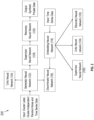
    • FIG. 3 is a flow diagram to illustrate a method for privacy preserving generative mechanism for data-disclosure of industrial data, in accordance with some embodiments of the present disclosure.
    • FIG. 4 is a flow diagram to illustrate a first phase training of a plurality of neural networks of a privacy preserving adversarial neural network architecture, in accordance with some embodiments of the present disclosure.
    • FIG. 5 is a flow diagram to illustrate a second phase training of the plurality of neural networks of the privacy preserving adversarial neural network architecture, in accordance with some embodiments of the present disclosure.
    DETAILED DESCRIPTION OF EMBODIMENTS
  • Exemplary embodiments are described with reference to the accompanying drawings. In the figures, the left-most digit(s) of a reference number identifies the figure in which the reference number first appears. Wherever convenient, the same reference numbers are used throughout the drawings to refer to the same or like parts. While examples and features of disclosed principles are described herein, modifications, adaptations, and other implementations are possible without departing from the scope of the disclosed embodiments.
  • The embodiments herein provide a method and system for privacy preserving generative mechanism for data-disclosure of the industrial multivariate mixed-variable time-series data. The proposed invention fuses an industrial multivariate mixed-variable time series data with a random gaussian noise to preserve the privacy of the industrial multivariate mixed-variable time series data and trades-off the privacy with the utility of synthetic-private data.
  • It is to be noted that in the era of rapid advances in Artificial Intelligence (AI) techniques, deployment of deep learning techniques in the cloud for production has several complexities and risks involved relating to privacy, security, fairness, and accountability. There is a need and necessity to develop privacy embedded physics-informed deep learning-based generative mechanism to solve complex science and engineering industrial problems by leveraging multivariate synthetic-private data and with a mutual gain of avoiding privacy-breach from adversaries to prevent inference attacks based on de-anonymization techniques. Notable works in the multivariate mixed-variable time series, be short of incorporating privacy-preserving mechanisms into generative models to maintain the end-user trust. The key challenges are determining the exact translation between the regulatory documents and implementable data-driven anonymization of AI techniques.
  • Therefore, the one or more embodiments herein presents the privacy-preserving synthetic industrial data generative mechanism for data disclosure with minimal risk of AI technique and strong privacy guarantees. Embedding privacy by design into the generative mechanism approaches present an alternate paradigm of learning in contrast to the reduced-order modeling and numerical solutions of the industrial data based on the principles in continuum mechanics for data disclosure with privacy.
  • The deep learning-based generative techniques integrated synergistically with privacy-preserving mechanisms to generate the synthetic-private data almost but not-quite real data. The privacy enabled generative techniques provides trustworthiness on the generated privacy-preserving synthetic data that quench both the ethical and legal needs for securing industrial data confidentiality (minimize the process identifiability) and trade-off to preserve the temporal dynamics, probability distributions of the real data to retain utility in downstream predictive analytics tasks. Privacy preservation by sanitizing the data of the associated industrial client (data owner) is of paramount importance for privacy-first tech companies (trusted party holding the sensitive data) to avoid legal subpoena for privacy-breach and it permits the deep-learning practitioners to build AI techniques by utilizing synthetic-private data to improve the modeling of engineering systems.
  • A privacy-preserving Generative Adversarial Network (ppGAN) is a private learning technique that minimizes and regulates the information flow. It is based on a rubric defined on the optimal transport for machine learning in a Kantorovich formulation between the empirical probability distributions of a synthetic-private data and a non-linear original data. The ppGAN comprises a generator neural network that sanitizes the multivariate mixed-variable time series dataset to a certain extent. It occludes threat of inference attacks on the process-plants database, and a discriminator neural network that attempts to maximize the Wasserstein distance between the real data and privacy-preserving synthetic data probability distributions.
  • Referring now to the drawings, and more particularly to FIG. 1 through 3, where similar reference characters denote corresponding features consistently throughout the figures, there are shown preferred embodiments and these embodiments are described in the context of the following exemplary system and/or method.
  • FIG. 1 illustrates a block diagram of a system (100) for privacy preserving generative mechanism for data-disclosure of the industrial data, in accordance with an example embodiment. Although the present disclosure is explained considering that the system (100) is implemented on a server, it may be understood that the system (100) may comprise one or more computing devices (102), such as a laptop computer, a desktop computer, a notebook, a workstation, a cloud-based computing environment and the like. It will be understood that the system (100) may be accessed through one or more input/output interfaces 104-1, 104-2... 104-N, collectively referred to as I/O interface (104). Examples of the I/O interface (104) may include, but are not limited to, a user interface, a portable computer, a personal digital assistant, a handheld device, a smartphone, a tablet computer, a workstation, and the like. The I/O interface (104) are communicatively coupled to the system (100) through a network (106).
  • In an embodiment, the network (106) may be a wireless or a wired network, or a combination thereof. In an example, the network (106) can be implemented as a computer network, as one of the different types of networks, such as virtual private network (VPN), intranet, local area network (LAN), wide area network (WAN), the internet, and such. The network (106) may either be a dedicated network or a shared network, which represents an association of the different types of networks that use a variety of protocols, for example, Hypertext Transfer Protocol (HTTP), Transmission Control Protocol/Internet Protocol (TCP/IP), and Wireless Application Protocol (WAP), to communicate with each other. Further, the network (106) may include a variety of network devices, including routers, bridges, servers, computing devices, storage devices. The network devices within the network (106) may interact with the system (100) through communication links.
  • The system (100) supports various connectivity options such as BLUETOOTH®, USB, ZigBee, and other cellular services. The network environment enables connection of various components of the system (100) using any communication link including Internet, WAN, MAN, and so on. In an exemplary embodiment, the system (100) is implemented to operate as a stand-alone device. In another embodiment, the system (100) may be implemented to work as a loosely coupled device to a smart computing environment. Further, the system (100) comprises at least one memory with a plurality of instructions, one or more databases (112), and one or more hardware processors (108) which are communicatively coupled with the at least one memory to execute a plurality of modules (114) therein. The components and functionalities of the system (100) are described further in detail.
  • Referring FIG. 2, illustrates a block diagram (200) of the system (100) for privacy preserving generative mechanism for data-disclosure of the industrial data. Herein, the one or more I/O interfaces (104) are configured to receive a multivariate mixed-variable time series data of a plurality of sensory observations, the cluster-labels associated with the multivariate mixed-variable time series data and a cluster-independent random noise. The received multivariate mixed-variable time series data is pre-processed to normalize continuous feature variables by bounding heterogeneous measurements between a predefined range of a min-max scaling technique. Discreate feature variables are transformed by representing as a sparse binary vector through a one-hot encoding technique.
  • In another embodiment, the system (100) comprises a plurality of neural networks (116) of the privacy preserving generative adversarial network architecture. Herein, the plurality of neural networks includes an embedding neural network (118), a recovery neural network (120), a generator neural network (122), a critic neural network (124), a discriminator neural network (126), and supervisory neural network (128). The plurality of neural networks (116) are trained in two phases. In the first phase the embedding neural network (118) is trained using a predefined low-dimensional mixed feature training dataset to obtain a high-dimensional mixed feature embeddings. Wherein, the obtained high-dimensional mixed feature embeddings are used to train a supervisory neural network (128) for a single step ahead predictions of the high-dimensional mixed-feature embeddings. It is to be noted that the supervisory neural network (128) is utilized to model a temporal dynamics of the low-dimensional mixed feature training dataset. Furthermore, the critic neural network (124) of the privacy preserving generative adversarial network architecture is trained using the high-dimensional mixed feature embeddings to predict a target high-dimensional feature embedding.
  • The embedding neural network (118), EppGAN learns a high-dimensional representation, H train n , 1 : T n
    Figure imgb0001
    , ∀n ∈ {(1,2, ... , N)} by transforming the corresponding low-dimensional real sequences, I ˜ train n , 1 : T n
    Figure imgb0002
    , ∀n ∈ {(1,2, ... , N)}. The embedding neural network (118) assists in effective learning by incorporating the semantics of the mixed-feature variables in its feature embeddings, H train n , 1 : T n
    Figure imgb0003
    . The mathematical description of the embedding module is as follows: E ppGAN : I train n , 1 : T n t j = 1 f D j H train n , 1 : T n t j = 1 f H j , n 1,2 , , N
    Figure imgb0004
    wherein, Dj, Hj denotes the j-th feature variable space & latent embedding vector space, respectively.
  • The recovery neural network (120), RppGAN obtains the low-dimensional feature representations, I ˜ train n , 1 : T n
    Figure imgb0005
    , ∀n ∈ {(1,2, ... , N)} from its corresponding high-dimensional temporal latent variables, H train n , 1 : T n
    Figure imgb0006
    , ∀n ∈ {(1,2, ... , N)}, R ppGAN : H n , 1 : T n t j = 1 f H j I n , 1 : T n t j = 1 f D j , n 1,2 , , N
    Figure imgb0007
    wherein, the superscript, denotes for real variables, H train n , 1 : T n
    Figure imgb0008
    , I ˜ train n , 1 : T n
    Figure imgb0009
    or for synthetic variables, H ^ n , 1 : T n
    Figure imgb0010
    and n,1:Tn respectively. e rnn and r rnn are autoregressive neural-net models. They are realized with a unidirectional recurrent neural network with extended memory. ef , r f c
    Figure imgb0011
    , and r f d
    Figure imgb0012
    are parameterized by feed-forward neural networks. S, Sm denote the sigmoid & softmax activation function, respectively.
  • The trainable parameters of the embedding neural network (EppGAN ) and recovery neural network (120) (RppGAN ) are updated by optimizing a cost function through the joint training of the networks in a supervised-learning approach. It incorporates appropriate inductive bias of reconstruction of the original input, I ˜ train n , 1 : T n
    Figure imgb0013
    through by minimizing a supervised loss as described below, L R = n = 1 N I train n , 1 : T n I ˜ train n , 1 : T n 2
    Figure imgb0014
  • In joint training of the generator, supervisor, and the recovery neural networks in unsupervised learning approach in a zero-sum game, the system (100) is configured to minimize the first moment, | I 1 - I 2| and second-order moment, σ ^ 1 2 σ ^ 2 2
    Figure imgb0015
    differences, defined between the original data, I train n , 1 : T n
    Figure imgb0016
    and the synthetic-private data, n,1:Tn respectively. The lower the difference the synthetic-private data sampled from P ˜ I ˜ n , 1 : T n 1 : c , c + 1 : d
    Figure imgb0017
    are more likely to come from the same original data distribution, P I n , 1 : T n 1 : c , c + 1 : d
    Figure imgb0018
    . The sample means for real data, I train n , 1 : T n
    Figure imgb0019
    and synthetic-private data, n,1:Tn are computed by, I 1 = 1 N j = 1 f n = 1 N I train n , 1 : T n j I f
    Figure imgb0020
    and I _ 2 = 1 N j = 1 f n = 1 N I ˜ n , 1 : T n j I f
    Figure imgb0021
    . The sample variances, σ ^ 1 2 , σ ^ 2 2 I f
    Figure imgb0022
    are evaluated by, σ ^ 1 2 = 1 N j = 1 f n = 1 N I train n , 1 : T n j I _ 1 j 2
    Figure imgb0023
    and σ ^ 2 2 = 1 N j = 1 f n = 1 N I ˜ n , 1 : T n j I _ 2 j 2 .
    Figure imgb0024
    L US = I _ 1 I _ 2 + σ ^ 1 2 + σ ^ 2 2
    Figure imgb0025
  • The ppGAN neural architecture in the unsupervised learning approach trains the joint-transformation network of the private-data generator (GppGAN ), supervisor network (SppGAN ), and the recovery neural network (120) (RppGAN ) to transform samples, Z n,1:Tn ~ P(Z) into R ppGAN S ppGAN G ppGAN Z n , 1 : T n P ^ I ˜ n , 1 : T n 1 : c , c + 1 : d
    Figure imgb0026
    such that P ˜ I ˜ n , 1 : T n 1 : c , c + 1 : d
    Figure imgb0027
    P I n , 1 : T n 1 : c , c + 1 : d
    Figure imgb0028
    . By minimizing, LUS , P( n,1:Tn ) learns the underlying probability distributions of the input temporal data, P D ˜ train n , 1 : T n
    Figure imgb0029
    .
  • In yet another embodiment, the system (100) is configured for a second phase training of the plurality of neural networks of a privacy preserving adversarial neural network architecture. Wherein, the received cluster-independent random noise is transformed using one or more cluster-labels associated with a predefined training dataset to obtain a cluster-dependent random noise. Further, a linear transformation on a concatenation of the low-dimensional mixed feature training dataset and the cluster-dependent random noise is performed to obtain a synthetic-private noise to train the generator neural network (122) of the privacy preserving adversarial neural network architecture. The generator neural network (122) provides a high-dimensional synthetic-private mixed feature embeddings to train the discriminator neural network (126). It would be appreciated that the discriminator neural network (126) assigns a label to the high-dimensional synthetic-private mixed feature embeddings such as real or fake.
  • In yet another embodiment, the supervisory neural network (128) is trained using the high-dimensional synthetic-private feature embeddings to generate the single-step ahead predictions of the high-dimensional synthetic-private feature embeddings and the recovery neural network (120) is trained using a single-step ahead high-dimensional synthetic-private feature embeddings to obtain the low-dimensional synthetic-private mixed feature dataset.
  • In another embodiment, the supervisor neural network (128), SppGAN is leveraged to model the non-linear temporal dynamics of the original data, I n,1:Tn . By integrating the SppGAN neural-network in the workflow to generate the synthetic-private data, n,1:Tn . The synthetic-private data captures the complex non-linear temporal dependencies of the original data. The GppGAN neural-network of the ppGAN framework generates the synthetic high-dimensional latent embeddings, n,1: Tn . The auto-regressive, S ppGAN : H n , 1 : t 1 * H n , t *
    Figure imgb0030
    , ∀n ∈ {1,2, ... , N}, t ∈ 1:Tn takes as input H n , 1 : t 1 *
    Figure imgb0031
    and predicts the single-step ahead temporal latent embeddings, H n , t *
    Figure imgb0032
    conditioned on the past latent sequences. It can be presented as, S ppGAN : H n , 1 : T n t j = i f H j H n , 1 : T n t j = i f H j , n 1,2 , , N
    Figure imgb0033
  • The ppGAN framework effectively captures the temporal dynamics of the real data by minimizing the supervised loss, L S = n = 1 N t H ˜ train n , t S ppGAN H n , 1 : t 1 2
    Figure imgb0034
  • The GppGAN by operating in the training-loop perceives the ground-truth high-dimensional latent representations, H ˜ train n , 1 : T n
    Figure imgb0035
    from the embedding neural network (118). The supervisor neural network (128) SppGAN minimizes the loss, LS by forcing the n,1:Tn unflagged by the inaccurate adversary (DppGAN ) to capture the single-step temporal dynamics of the H ˜ train n , 1 : T n
    Figure imgb0036
    .
  • In yet another embodiment. the critic neural network (124), F ppGAN : H n , 1 : T n * R
    Figure imgb0037
    , is a neural-network function leveraged for predictive modeling which maps the independent mixed-feature variables to the target variable, trained in the supervised learning approach. Here, () refers to H train 1 : f 1
    Figure imgb0038
    or (1:f-1). The critic neural network (124) takes as input the realizations of H train n , 1 : T n 1 : f 1
    Figure imgb0039
    or H ^ n , 1 : T n 1 : f 1
    Figure imgb0040
    , ∈ D Tn ×(1:f-1) and outputs, H train n , 1 : T n T
    Figure imgb0041
    or H ^ n , 1 : T n T
    Figure imgb0042
    , ∈ DTn , ∀n ∈ {(1,2, ... , N)}. The variable subset selection includes the features attributes from the set, {1, ... , f - 1} ⊂ f in H n , 1 : T n 1 , , f 1 *
    Figure imgb0043
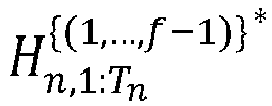
    as input feature variables to the predictive modeler. The last feature variable in H n , 1 : T n T *
    Figure imgb0044
    denoted by the superscript, Tf denotes the target variable to predict. The loss function for the target variable prediction is described below, L F H train n , 1 : T n H ^ n , 1 : T n = n = 1 N F ppGAN H train n , 1 : T n 1 : f 1 F ppGAN H ^ n , 1 : T n 1 : f 1 2
    Figure imgb0045
  • Given the independent and identically distributed pairs, H train n , 1 : T n 1 : f 1 H train n , 1 : T n T
    Figure imgb0046
    , the critic neural network (124) learns the original relationship between independent feature variables and the target variable in the real dataset. GppGAN generates the relationship preserving synthetic-private data, n,1:Tn by minimizing the LF during the adversarial joint training by inducing appropriate inductive learning bias and it generalizes well to the domain. c rnn and s rnn are autoregressive neural-net models and it is implemented with a unidirectional recurrent neural network with extended memory. sf and cf are implemented by a feed-forward neural network.
  • Let us assume, Z n,1:Tn RTn×f , ∀n ∈ {1,2, ... , N} denote the realizations of an f-dimensional Gaussian random variable of finite-length, Tn for a sequence, n with values in the range [0,1) sampled from a gaussian distribution, Z ~ N(0,1). We embed the cluster labels, C train n , 1 : T n R T n
    Figure imgb0047
    , ∀n ∈ {1,2, ... , N} in gaussian noise, Z n,1:Tn to determine the cluster-dependent random noise, Z n , 1 : T n K
    Figure imgb0048
    . The ground-truth, cluster-membership is computed by an iterative Euclidean distance-based classification technique in data mining to split the unlabeled dataset, I train n , 1 : T n
    Figure imgb0049
    into K-fixed-apriori disjoint clusters by minimizing the within-cluster sum-of-squares criterion. The system (100) is configured to determine the label embedding vectors, ec Rd' , ∀c ∈ {1, ... , K} from the trainable semantics-aware cluster membership embedding matrix, WR K×d' based on the cluster labels, C ˜ train n , 1 : T n
    Figure imgb0050
    . d' is the dimension of the embedding matrix, W. We determine the label matrix, L n , 1 : T n c
    Figure imgb0051
    by concatenating the cluster membership embedding vectors, ec corresponding to the cluster labels, C train n , 1 : T n
    Figure imgb0052
    . Further, the system (100) is configured to perform the matrix-matrix product of Z n,1:Tn and the transpose of the label matrix, L n , 1 : T n c
    Figure imgb0053
    to obtain the cluster label aware random noise, Z n , 1 : T n K
    Figure imgb0054
    . The discrete-grouping cluster labels, C train n , 1 : T n
    Figure imgb0055
    corresponding to the mixed-feature dataset, I train n , 1 : T n
    Figure imgb0056
    are obtained through the unsupervised learning technique. It is determined by the k-means clustering technique as follows:
    1. 1. Randomly initialize cluster centroids, µ 1, µ 2, ... , µK D (f) .
    2. 2. C ˜ train n , 1 : T n =
      Figure imgb0057
      ; ∀n ∈ {1,2, ... , N}
    3. 3. Repeat until convergence so as to minimize the within-cluster sum of pairwise squared deviations:
      • {For every n, while n ≤ N, ∀n ∈ {1,2, ... , N},
      • For each n,
      • Assign each observation, Itrainn,t , t ∈ 1: Tn ,, ∀n ∈ {1,2, ... , N} the closest cluster-label, m ∈ {1,2, ... , K} C train n , 1 : T n : = arg min m I train n , 1 : T n μ m 2
        Figure imgb0058
      • For each m ∈ {1,2, ..., K}, refine the cluster-centroids, µm μ m : = t = 1 T n 1 C train n , 1 : T n = m D ˜ train n , t t = 1 T n 1 C ˜ train n , 1 : T n = m
        Figure imgb0059
  • The generator neural network (122) function takes as input the realizations of the low-dimensional, I train n , 1 : T n
    Figure imgb0060
    , Z n , 1 : T n K
    Figure imgb0061
    and outputs a high-dimensional latent variable, n,1:Tn G ppGAN : I train n , 1 : T n × Z n , 1 : T n K H ^ n , 1 : T n , n 1,2 , , N
    Figure imgb0062
  • The synthetic-private data generative can also be viewed as: G ppGAN : D T n f × 0,1 T n f H T n f , n 1,2 , , N
    Figure imgb0063
  • The temporal latent embeddings, n,1:Tn H are computed as: H ^ n , 1 : T n = G ppGAN W θ I train n , 1 : T n Z n , 1 : T n K , n 1,2 , , N
    Figure imgb0064
    wherein, Wθ' denotes the learnable parameter. The weight matrix is shared across the sequences, n, ∀n ∈ {1,2, ... , N}. ∥ denotes the concatenation operator. g rnn is an autoregressive neural-network model and it is implemented with a unidirectional recurrent neural network with extended memory. gf is parameterized by a feed-forward neural network.
  • The discriminator neural network (126), DppGAN in ppGAN architecture is a classifier to differentiate the real, H train n , 1 : T n
    Figure imgb0065
    and the synthetic-private data, n,1:Tn and to minimize the Wasserstein distance between joint distributions, P I n , 1 : T n 1 : c , c + 1 : d
    Figure imgb0066
    , P ˜ I ˜ n , 1 : T n 1 : c , c + 1 : d
    Figure imgb0067
    on a given metric space, H. The DppGAN is defined below, D ppGAN : H n , 1 : T n * p n , 1 : T n , m * , p n , 1 : T n * , P H n , 1 : T n *
    Figure imgb0068
  • The discriminator neural network (126) takes as input the realizations of H n , 1 : T n *
    Figure imgb0069
    and outputs the predicted probability of cluster labels, p n , 1 : T n , m *
    Figure imgb0070
    , the predicted probability of adversarial ground-truth, i.e true/fake, p n , 1 : T n *
    Figure imgb0071
    , the estimated multivariate mixed-feature joint probability distributions, P H n , 1 : T n 1 : c , c + 1 : d *
    Figure imgb0072
    as described below, p n , 1 : T n , m * , p n , 1 : T n * , P H n , 1 : T n 1 : c , c + 1 : d * = D ppGAN H n , 1 : T n * , n 1 , , N
    Figure imgb0073
    Wherein, the superscript, * corresponds to H train n , 1 : T n
    Figure imgb0074
    , real latent embeddings, p train n , 1 : T n , m
    Figure imgb0075
    , p train n , 1 : T n
    Figure imgb0076
    , P H train n , 1 : T n 1 : c , c + 1 : d
    Figure imgb0077
    or n,1:Tn , synthetic latent embeddings n,1:Tn,m, n,1:Tn , P ^ H ^ n , 1 : T n 1 : c , c + 1 : d
    Figure imgb0078
    . The GppGAN of the ppGAN framework produces synthetic-private latent embeddings, n,1:Tn of domain H, by operating on the random noise, Z n , 1 : T n K
    Figure imgb0079
    and the real data, I train n , 1 : T n
    Figure imgb0080
    and the discriminator neural network (126), DppGAN by operating on the adversarial learning latent space, H, tries to differentiate latent temporal embeddings, H train n , 1 : T n
    Figure imgb0081
    & n,1:Tn and minimizes the Wasserstein distance between joint distributions. The binary cross-entropy loss for classification of the latent embeddings as true or fake is described by, L U = 1 N n = 1 N y n , 1 : T n log p train n , 1 : T n + 1 y n , 1 : T n log 1 p train n , 1 : T n + y n , 1 : T n log p ^ n , 1 : T n + 1 y n , 1 : T n log 1 p ^ n , 1 : T n
    Figure imgb0082
    wherein, y n,1:Tn ∈ {0,1} Tn , ∀n ∈ {1, ... , N} is the adversarial ground-truth, true or fake data. p train n , 1 : T n
    Figure imgb0083
    , n,1:Tn ∈ [0,1] Tn , ∀n ∈ {1, ... , N} is the predicted probability of the true data, and 1 p train n , 1 : T n
    Figure imgb0084
    & 1 - n,1:Tn , ∀n ∈ {1, ... , N} is the predicted probability of fake data. DppGAN tries to minimize, LU. The GppGAN tries to maximize, LU which helps to learn P ^ I n , 1 : T n 1 : c , c + 1 : d
    Figure imgb0085
    that best approximates P I train n , 1 : T n 1 : c , c + 1 : d
    Figure imgb0086
    . The prognostics of finite cluster-membership, C n , 1 : T n * K
    Figure imgb0087
    is a multinomial single-output classification task. The RTn refers to true or fake.
  • For the multinomial classification task of cluster-label prediction, the system (100) is configured to compute an individual loss for each cluster-membership, {1, ... ,K} per latent sequence, n ∈ {1, ... , N} and at each time point t(∈ 1: Tn ). Further, the system performs a summation operation of the output over the cluster membership & latent sequences. L LP = 1 N m = 1 K n = 1 N y n , 1 : T n c log p train n , 1 : T n , m + m = 1 K n = 1 N y n , 1 : T n c log p ^ n , 1 : T n , m
    Figure imgb0088
    wherein, K denotes the fixed-apriori cluster labels. y n , 1 : T n c
    Figure imgb0089
    is the ground-truth binary value of 1 or 0 if cluster label, m is the true label or false label at time point t(∈ 1: Tn ) corresponding to latent sequence, n ∈ {1, ... , N}. p train n , 1 : T n , m
    Figure imgb0090
    is the predicted probability for real observation at a time point, t of a data sequence, n ∈ {1, ... , N} belongs to cluster, m. n,1:Tn,m is the predicted probability for synthetic latent embedding at time point t of sequence, n ∈ {1, ... , N} belonging to cluster membership, m. The cluster membership is determined by, C train n , 1 : T n p : = arg max m S m p train n , 1 : T n , m , m 1 , , K
    Figure imgb0091
    C ^ n , 1 : T n : = arg max m S m p ^ n , 1 : T n , m , m 1 , , K
    Figure imgb0092
    wherein, Sm is the softmax activation function. The DppGAN tries to minimize, LLP whereas GppGAN tries to maximize, LLP. C train n , 1 : T n p
    Figure imgb0093
    denote the predicted cluster membership for real data, D train n , 1 : T n
    Figure imgb0094
    by DppGAN in comparison with the ground-truth, C train n , 1 : T n
    Figure imgb0095
    determined by the clustering technique. n,1:Tn denote the predicted cluster-membership labels for the synthetic-private data, n,1:Tn . We also minimize the Wasserstein distance, the cost of the optimal transport plan between the estimates of two probability distributions P H train n , 1 : T n 1 : c , c + 1 : d
    Figure imgb0096
    and P ^ H ^ n , 1 : T n 1 : c , c + 1 : d
    Figure imgb0097
    .
  • The system (100) evaluates the Wasserstein loss, LW and it is described by, L W = W P H train n , 1 : T n 1 : c , c + 1 : d , P ^ H ^ n , 1 : T n 1 : c , c + 1 : d = inf γ P P ^ E H train n , 1 : T n H ^ n , 1 : T n γ P H train n , 1 : T n 1 : c , c + 1 : d P ^ H ^ n , 1 : T n 1 : c , c + 1 : d
    Figure imgb0098
    wherein, γ ( P H train n , 1 : T n 1 : c , c + 1 : d
    Figure imgb0099
    , P ^ H ^ n , 1 : T n 1 : c , c + 1 : d
    Figure imgb0100
    is the set of all possible joint probability distributions between P H train n , 1 : T n 1 : c , c + 1 : d
    Figure imgb0101
    and P ^ H ^ n , 1 : T n 1 : c , c + 1 : d
    Figure imgb0102
    . The DppGAN aims to maximize, LW whereas GppGAN attempts to minimize, LW . g rnn and d rnn are autoregressive neural-net models. They are implemented with a unidirectional recurrent neural network with extended memory. gf , df , d f c
    Figure imgb0103
    are implemented by a feed-forward neural network.
  • The conditional generative neural network architecture, GppGAN generates synthetic-private data, n,1:Tn which must be sufficiently anonymized and non-identical enough in order to minimize the reidentification of the observed data, I n,1:Tn . The finite series of data, n,t D (f) and n,t+1D (f) observed at time points, t and t + 1(∈ {1, ... , Tn }) of the same sequence, n or belong to distinct sequences, n ∈ {1, ... , N} are non - identicalenough as they are actually measured at different time orders. The minimum(shortest) weighted euclidean distance computed between the observations in real data is the measure for non - identicalenough between the synthetic-private data and observed data.
  • In another embodiment, the system (100) is configured to estimate identifiability of the finite observed data by the finite synthetic-private data. Here, the system defines the ε-process identifiability as, there are lower than ε-fraction observations from the real dataset, I train n , 1 : T n
    Figure imgb0104
    in the synthetic-private dataset, n,1:Tn that are mostcertainlynot, non - identicalenough in comparison with the real data, I train n , 1 : T n
    Figure imgb0105
    . A randomized synthetic-private data generator mechanism, GppGAN provides the ε-process identifiability, for some ε R +, for any pair of nearest random variables Itrainn,t , I trainn,t+1D (f), for all subsets S of the function-image of the randomized generative technique, n,t D (f) or n,1:Tn is ε-process identifiable from I train n , 1 : T n
    Figure imgb0106
    , if the following criteria are satisfied, I F I n , t I ˜ n , t = 1 N I r ˜ n , t < r n , t < ε
    Figure imgb0107
    wherein, rn,t R Tn ×N is the mathematical quantification of non-identicalenough and it denotes the minimum weighted Euclidean distance between Itrainn,t and the rest of the observations in I train n , 1 : T n
    Figure imgb0108
    , ∀n ∈ {1, ... , N}. r n , t = min I train n , t + 1 w I train n , t I train n , t + 1 , I train n , t + 1 I train n , 1 : T n / I train n , t
    Figure imgb0109
    wherein, n,t R Tn ×N is the minimum weighted euclidean distance between Itrainn,t and the observations in the synthetic-private dataset, n,1:Tn , ∀n ∈ {1, ... , N}. r ˜ n , t = min I ˜ n , t I ˜ w I train n , t I ˜ n , t
    Figure imgb0110
  • Herein, equation (22) states that ε-process identifiability for each f-dimension time series data observed at a time point, t, Itrainn,t D (f), of a particular sequence, n ∈ {1, ... , N} is defined as the probability that the weighted euclidean distance to the nearby synthetic-private f-dimension time series data observed at timepoint, t(∈ 1: Tn ), n,t D (f), ∀n ∈ {1, ... , N} is closer (most certainly not, non-identical enough) than the weighted Euclidean distance from the adjacent real observation, at time-point, t(∈ 1: Tn ), I trainn,t +1 ∈ D (f), ∀n ∈ {1, ... , N} is less than ε. To put it another way, 1 - ε is the proportion of real dataset observations that are not identifiable by synthetic-private dataset observations due to the sole reason that the synthetic-private dataset observations are non-identical enough from the real dataset observations. Therefore, 0-process identifiability denotes peak privacy, and 1-process identifiability represents least-privacy, I is an identity function. Let us assume, H I n , 1 : T n k
    Figure imgb0111
    , ∀n ∈ {1, ... , N} represents the entropy of the k-th feature variable. For evaluating the entropy of continuous feature variables, {1, ... , c} ⊂ f. Each continuous feature attribute is quantized. w = w 1 , , w c = 1 H I n , 1 : T n 1 , , 1 H I n , 1 : T n c
    Figure imgb0112
    where wi ∈ [0, ∞). The discrete entropy of the continuous feature variables is described as: H I k = I n , 1 : T n k D k P I k = I n , 1 : T n k log P I k = I n , 1 : T n k , n 1 , , N
    Figure imgb0113
  • In the batch training of the technique, computing Equation (22) for each observation involves high-computational complexity. The process-identifiability loss function, LPI is simplified and described by, L PI = E I , I ˜ | I w I train n , 1 : T n I ˜ n , 1 : T n , n 1 , , N
    Figure imgb0114
  • In yet another embodiment, the generator neural network (122) GppGAN maximizes the weighted euclidean distance between synthetic-private data sample n,1:Tn and the conditioned real data I train n , 1 : T n
    Figure imgb0115
    given that n,1:Tn satisfies the ε process-identifiability criteria.
  • To begin with, the embedding neural network (118) (EppGAN ) and the recovery neural network (120) (RppGAN ) are trained jointly in the supervised-learning approach on the task of restoration of the real temporal data, I train n , 1 : T n
    Figure imgb0116
    with a goal to learn higher-dimensional latent embeddings from the lower-dimensional multivariate mixed-feature dataset, I train n , 1 : T n
    Figure imgb0117
    . At first, the supervisor neural network (128) (SppGAN ) is leveraged to model the non-linear temporal dynamics of the real data. The forecasting modeler is trained in the supervised-learning approach on the complex task of single-step ahead prediction of the real latent embedding, H train n , 1 : T n
    Figure imgb0118
    by operating in the latent space, H.
  • Initially, the critic neural network (124) (FppGAN ) is utilized to learn the relationship between the independent feature variables and the target variable. The predictive modeler is trained on the real data to map the independent feature variables to the target variable by minimizing the prediction loss, LF. In the beginning, the goal is to minimize, minΦersc (LR + LS + LF ) in supervised learning approach by operating on the lower-dimensional mixed-feature dataset, I train n , 1 : T n
    Figure imgb0119
    to learn the patterns of the real data. Φe, Φr, Φs, Φc denote the learnable parameters of the embedding, the recovery, the supervisor, and the critic neural network (124), respectively. Let θg , θd denote the learnable parameters of the GppGAN, DppGAN neural network functions. GppGAN is trained by seven distinct loss functions LUS , LU , LW , LM , LS , LF & LLP. GppGAN is trained adversarial to minimize the weighted sum of the above loss functions: L G = min θ g α L U + γ L W + L LP + L US + βL M + L S + L F
    Figure imgb0120
    wherein, αR + . In our experiments, α = 100 & γ = 10. DppGAN is trained by three distinct loss functions LU , LW & LLP. DppGAN is trained to minimize the weighted sum of the loss functions: L D = min θ d α L U + γ L W + L LP
    Figure imgb0121
  • GppGAN , DppGAN are trained adversarially by deceptive input as follows, minGppGAN maxDppGAN L(GppGAN , DppGAN ). It can be expressed as: min θ g α L U + γ L W + L LP + L US + βL M + L S + L F + max θ d α L U + γ L W + L LP
    Figure imgb0122
  • After training Gn of the ppGAN architecture on D train n , 1 : T n
    Figure imgb0123
    . The performance of the technique is evaluated and reported on D test n , 1 : T n
    Figure imgb0124
    . n,1:Tn is determined independently by sampling sequences using Gn.
  • Referring FIG. 3, to illustrate a processor-implemented method (300) for privacy preserving generative mechanism for data-disclosure of the industrial data is provided.
  • Initially, at the step (302), receiving, via an input/output interface, a multivariate mixed-variable time series data of a plurality of sensory observations, the cluster-labels associated with the multivariate mixed-variable time series data and a cluster-independent random noise.
  • At the next step (304), pre-processing the received multivariate mixed-variable time series data. Wherein, the pre-processing comprising normalizing continuous feature variables by bounding heterogeneous measurements between a predefined range of a min-max scaling technique and transforming discreate feature variables by representing as a sparse binary vector through a one-hot encoding technique.
  • At the next step (306), training a plurality of neural networks of a privacy preserving adversarial neural network architecture in two phases, wherein the plurality of neural networks including an embedding neural network, a recovery neural network (120), a generator neural network (122), a critic neural network (124) and a discriminator neural network (126).
  • At the next step (308), providing a test data to generate a synthetic private dataset for data disclosure using the trained privacy preserving adversarial neural network architecture.
  • At the last step (310), estimating identifiability among the multivariate mixed-variable time series data and the generated synthetic private dataset, wherein the estimation must satisfy a predefined process-identifiability criteria.
  • Referring FIG. 4, wherein a first phase training (400) of the plurality of neural networks of a privacy preserving adversarial neural network architecture, in accordance with some embodiments of the present disclosure.
  • Initially, at step (402) training the embedding neural network using a predefined low-dimensional mixed feature training dataset to obtain a high-dimensional mixed feature embeddings.
  • At the next step (404), training the recovery neural network (120) using the obtained high-dimensional mixed feature embeddings to reconstruct the low-dimensional mixed feature dataset.
  • At the next step (406), training a supervisor network using the obtained high-dimensional mixed-feature embeddings for a single step ahead predictions of the high-dimensional mixed-feature embeddings, wherein the supervisor network is utilized to model the temporal dynamics of the low-dimensional mixed feature training dataset.
  • At the last step (408), training the critic neural network (124) using the high-dimensional mixed feature embeddings to predict a target high-dimensional feature embedding , wherein the critic neural network (124) is utilized to model the relationship between independent and dependent variables of the low-dimensional mixed feature training dataset
  • Referring FIG. 5, wherein a second phase training (500) of the plurality of neural networks of a privacy preserving adversarial neural network architecture, in accordance with some embodiments of the present disclosure.
  • Initially, at the step (502) transforming cluster-independent random noise using one or more cluster-labels associated with a predefined training dataset to obtain a cluster-dependent random noise.
  • At the next step (504), performing a linear transformation on a concatenation of the low-dimensional mixed feature training dataset and the cluster-dependent random noise to obtain a synthetic-private noise.
  • At the next step (506), training the generator neural network (122) using the obtain synthetic-private noise to obtain a high-dimensional synthetic-private mixed feature embeddings.
  • At the next step (508), training the critic neural network (124) using the high-dimensional synthetic-private mixed feature embeddings to predict the synthetic-private target feature embedding.
  • At the next step (510), training the discriminator neural network (126) using the high-dimensional synthetic-private mixed feature embeddings to assign a label. The discriminator neural network (126) classifies the high-dimensional synthetic-private mixed feature embeddings as fake.
  • At the next step (512), training the supervisory neural network (128) using the high-dimensional synthetic-private mixed feature embeddings to generate the single-step ahead predictions of the high-dimensional synthetic-private mixed feature embeddings.
  • At the last step (514), training the recovery neural network (120) using a single-step ahead high-dimensional synthetic-private mixed feature embeddings to obtain the low-dimensional synthetic-private mixed feature dataset.
  • Experimental Result
  • In an example, wherein electricity transformer datasets are divided into train and test subsets of the same domain in the ratio 80/20%. The privacy preserving synthetic dataset is obtained by utilizing the real train dataset. LSTM & LSTM are leveraged as a baseline model trained on real train data and on the privacy-preserving synthetic data respectively for both the downstream tasks of target variable prediction/one-step ahead prediction with distinct learnable parameters. The models are evaluated on real test data and performance is reported in terms of RMSE metric. WD & Ss denotes the Wasserstein distance and silhouette score, respectively. In our experiments, λ is utilized to regulate the privacy-breach acceptable & to determine the ε-process identifiability. For λ = 0.1, as shown in Table 1, the low value of Kantorovich-Rubinstein metric (range in [0;+∞]) on all the datasets indicates that the generated synthetic-private datasets probability distributions matches to that of the corresponding real datasets and is close to zero in relative with the synthetic-private datasets generated for λ = 100. In case of λ = 0.1, all the corresponding privacy-preserving synthetic datasets have retained their utility on target-variable prediction relative to the synthetic-private datasets generated from λ = 100 in comparison with the real data. For the synthetic-private dataset, corresponding to λ = 0.1 the ε-process identifiability metric is relatively high(retains data utility) in comparison with the λ = 100, which has lackluster utility. Herein, for ETTm1 dataset, with λ = 0.1, ε = 0.175 indicates that over and above 82.5% of the process sensory observations are not de-identifiable by the adversary. Table 1
    Dataset RMSE WD measure Identifiability Metric
    LSTM LSTM
    A A A
    0.1 100 0.1 100 0.1 100
    ETTh1 11.932 13.298 24.153 1.237 6.092 0.268 0
    EETh2 11.256 11.717 12.284 5.887 11.210 0.091 0
    ETTm1 11.278 13.521 36.386 2.930 8.999 0.175 0
    EETm2 10.930 12.048 28.292 5.368 8.032 0.054 0
  • Furthermore, a K-means clustering technique determines the preordained cluster manifolds in the multidimensional dataset. The clusters are projected onto the 2-PCA components plots. For λ=0.1, on all the synthetic private datasets the Ss score is relatively close to the real dataset in comparison to λ=100. Referring below Table 2, for λ = 0.1, all the synthetic-private datasets conserve the temporal dynamics of the original data in comparison to λ = 100. As reported in Table 1, for λ = 100, the ε-process identifiability is zero, the privacy is at peak. The synthetic-private dataset is unidentifiable, but it shifts from the original true data distributions and results in less utility for application. The results reported in our work is obtained by a statistical average of five different experimental runs. Table 2
    Dataset Method Features
    HUFL HULL MUFL MULL LUFL LULL OT
    ETTh1 LSTM 9.35 5.05 9.14 4.80 3.86 2.63 4.89
    LSTM λ=0.1 14.21 5.12 14.06 4.68 4.28 2.72 7.92
    λ=100 22.75 10.55 22.67 10.59 9.04 5.69 16.81
    ETTh2 LSTM I 9.17 9.90 8.34 8.32 7.59 6.10 9.26
    LSTM λ=0.1 11.58 14.33 9.17 13.08 10.97 6.16 12.92
    λ=100 25.71 20.32 28.56 17.14 13.71 29.52 24.05
    ETTm1 LSTM 7.67 4.21 7.69 4.09 2.74 2.14 3.60
    LSTM λ=0.1 12.11 4.64 11.87 4.06 4.03 2.86 9.01
    λ=100 23.27 11.39 23.23 10.67 9.30 6.24 17.57
    ETTm2 LSTM 8.62 861.00 7.87 7.41 6.50 5.26 7.85
    LSTM λ=0.1 9.93 12.69 8.84 10.89 10.37 7.19 11.43
    λ=100 20.09 22.28 22.12 17.62 17.49 26.49 20.07
  • The written description describes the subject matter herein to enable any person skilled in the art to make and use the embodiments. The scope of the subject matter embodiments is defined by the claims and may include other modifications that occur to those skilled in the art. Such other modifications are intended to be within the scope of the claims if they have similar elements that do not differ from the literal language of the claims or if they include equivalent elements with insubstantial differences from the literal language of the claims.
  • The embodiments of present disclosure herein address the need of privacy-enhanced mathematical framework for data-disclosure of the sensitive industrial multivariate mixed-variable time series data which trades-off with utility to preserve the original data characteristics in the synthetic-private dataset. In a nutshell, a Privacy-Preserving Generative Adversarial Networks(ppGAN), a private learning technique that minimizes and also regulates the information flow based on the rubric defined on the optimal transport for machine learning in the Kantorovich formulation between the empirical probability distributions of the synthetic-private data and the non-linear original data. The framework comprises a generator neural network (122) that sanitizes the multivariate mixed-variable time series dataset to a certain extent that occludes the threat of inference attacks on the process-plant databases, and a discriminator neural network (126) that attempts to maximize the Wasserstein distance between the real data & privacy-preserving synthetic data probability distributions. The framework discovers the privacy-utility pareto fronts, by taking into account the hyper-parameter tuning, and elevating process-identifiability above the concept of risk to its potential benefit ratio with respect to the data-owner monetary gains (data monetization) versus privacy breach, deemed acceptable.
  • It is to be understood that the scope of the protection is extended to such a program and in addition to a computer-readable means having a message therein; such computer-readable storage means contain program-code means for implementation of one or more steps of the method, when the program runs on a server or mobile device or any suitable programmable device. The hardware device can be any kind of device which can be programmed including e.g., any kind of computer like a server or a personal computer, or the like, or any combination thereof. The device may also include means which could be e.g., hardware means like e.g., an application-specific integrated circuit (ASIC), a field-programmable gate array (FPGA), or a combination of hardware and software means, e.g., an ASIC and an FPGA, or at least one microprocessor and at least one memory with software modules located therein. Thus, the means can include both hardware means, and software means. The method embodiments described herein could be implemented in hardware and software. The device may also include software means. Alternatively, the embodiments may be implemented on different hardware devices, e.g., using a plurality of CPUs.
  • The embodiments herein can comprise hardware and software elements. The embodiments that are implemented in software include but are not limited to, firmware, resident software, microcode, etc. The functions performed by various modules described herein may be implemented in other modules or combinations of other modules. For the purposes of this description, a computer-usable or computer readable medium can be any apparatus that can comprise, store, communicate, propagate, or transport the program for use by or in connection with the instruction execution system, apparatus, or device.
  • The illustrated steps are set out to explain the exemplary embodiments shown, and it should be anticipated that ongoing technological development will change the manner in which particular functions are performed. These examples are presented herein for purposes of illustration, and not limitation. Further, the boundaries of the functional building blocks have been arbitrarily defined herein for the convenience of the description. Alternative boundaries can be defined so long as the specified functions and relationships thereof are appropriately performed. Alternatives (including equivalents, extensions, variations, deviations, etc., of those described herein) will be apparent to persons skilled in the relevant art(s) based on the teachings contained herein. Such alternatives fall within the scope of the disclosed embodiments. Also, the words "comprising," "having," "containing," and "including," and other similar forms are intended to be equivalent in meaning and be open ended in that an item or items following any one of these words is not meant to be an exhaustive listing of such item or items, or meant to be limited to only the listed item or items. It must also be noted that as used herein and in the appended claims, the singular forms "a," "an," and "the" include plural references unless the context clearly dictates otherwise.
  • Furthermore, one or more computer-readable storage media may be utilized in implementing embodiments consistent with the present disclosure. A computer-readable storage medium refers to any type of physical memory on which information or data readable by a processor may be stored. Thus, a computer-readable storage medium may store instructions for execution by one or more processors, including instructions for causing the processor(s) to perform steps or stages consistent with the embodiments described herein. The term "computer-readable medium" should be understood to include tangible items and exclude carrier waves and transient signals, i.e., be non-transitory. Examples include random access memory (RAM), read-only memory (ROM), volatile memory, nonvolatile memory, hard drives, CD ROMs, DVDs, flash drives, disks, and any other known physical storage media.

Claims (7)

  1. A processor-implemented method (300) comprising steps of:
    receiving (302), via an input/output interface, a multivariate mixed-variable time series data of a plurality of sensory observations,
    cluster-labels associated with the multivariate mixed-variable time series data, and a cluster-independent random noise, wherein
    multivariate mixed-variable time series data comprises continuous and discrete feature variables;
    pre-processing (304), via one or more hardware processors, the received multivariate mixed-variable time series data, wherein the pre-processing comprising steps of:
    normalizing the continuous feature variables by bounding heterogeneous measurements between a predefined range using a min-max scaling technique; and
    transforming the discreate feature variables by representing as a sparse binary vector using a one-hot encoding technique.
    training (306), via the one or more hardware processors, a plurality of neural networks of a privacy preserving generative adversarial network (ppGAN) in a first phase and a second phase using pre-processed multivariate mixed-variable time series data, wherein the plurality of neural networks including an embedding neural network, a recovery neural network (120), a generator neural network (122), a critic neural network (124) and a discriminator neural network (126);
    providing (308), via the one or more hardware processors, a test data to generate a synthetic private dataset for data disclosure using the trained plurality of neural networks of the ppGAN; and estimating (310), via the one or more hardware processors, an identifiability of the multivariate mixed-variable time series data from the generated synthetic private dataset, wherein the estimation satisfies a predefined process-identifiability criteria.
  2. The processor-implemented method of claim 1, wherein the first phase training of the plurality of neural networks of the ppGAN comprising steps of:
    training (402), via the one or more hardware processors, the embedding neural network using a predefined low-dimensional mixed feature training dataset to obtain a high-dimensional mixed feature embeddings;
    training (404), via the one or more hardware processors, the recovery neural network (120) using the obtained high-dimensional mixed feature embeddings to reconstruct the low-dimensional mixed feature dataset;
    training (406), via the one or more hardware processors, the supervisor neural network using the obtained high-dimensional mixed-feature embeddings for a single step ahead predictions of the high-dimensional mixed-feature embeddings, wherein the supervisor neural network is utilized to model a temporal dynamics of the low-dimensional mixed feature training dataset; and
    training (408), via the one or more hardware processors, the critic neural network (124) using the high-dimensional mixed feature embeddings to predict a target high-dimensional feature embedding, wherein the critic neural network (124) is utilized to model the relationship between independent and dependent variables of the low-dimensional mixed feature training dataset.
  3. The processor-implemented method of claim 1, wherein a second phase training of the plurality of neural networks of a ppGAN comprising steps of:
    transforming (502), via the one or more hardware processors, cluster-independent random noise using one or more cluster-labels associated with a predefined training dataset to obtain a cluster-dependent random noise;
    performing (504), via the one or more hardware processors, a linear transformation on a concatenation of the low-dimensional mixed feature training dataset and the cluster-dependent random noise to obtain a synthetic-private noise;
    training (506), via the one or more hardware processors, the generator neural network (122) using the obtained synthetic-private noise to obtain a high-dimensional synthetic-private mixed feature embeddings;
    training (508), via the one or more hardware processors, the critic neural network (124) using the high-dimensional synthetic-private mixed feature embeddings to predict the synthetic-private target feature embedding;
    training (510), via the one or more hardware processors, the discriminator neural network (126) using the high-dimensional synthetic-private mixed feature embeddings to assign a label, wherein the discriminator neural network (126) classifies the high-dimensional synthetic-private mixed feature embeddings as fake;
    training (512), via the one or more hardware processors, the supervisory neural network (128) using the high-dimensional synthetic-private mixed feature embeddings to generate a single-step ahead predictions of the high-dimensional synthetic-private mixed feature embeddings; and
    training (514), via the one or more hardware processors, the recovery neural network (120) using the single-step ahead high-dimensional synthetic-private mixed feature embeddings to obtain the low-dimensional synthetic-private mixed feature dataset.
  4. The processor-implemented method of claim 1, wherein the low-dimensional mixed feature validation dataset is utilized for the hyper-parameter tuning of the ppGAN
  5. A system (100) comprising:
    an input/output interface (104) to a multivariate mixed-variable time series data of a plurality of sensory observations, cluster-labels associated with the multivariate mixed-variable time series data,
    and a cluster-independent random noise, wherein multivariate mixed-variable time series data comprises continuous and discrete feature variables;
    a memory (110) in communication with the one or more hardware processors (108), wherein the one or more hardware processors are configured to execute programmed instructions stored in the memory to:
    pre-process the received multivariate mixed-variable time series data, wherein the pre-process includes normalizing the continuous feature variables by bounding heterogeneous measurements between a predefined range through a min-max scaling technique, and transforming discreate feature variables by representing as a sparse binary vector through a one-hot encoding technique;
    train a plurality of neural networks of a privacy preserving generative adversarial network (ppGAN) in a first phase and a second phase using pre-processed multivariate mixed-variable time series data, wherein the plurality of neural networks including an embedding neural network, a recovery neural network (120), a generator neural network (122), a critic neural network (124) and a discriminator neural network (126);
    provide a test data to generate a synthetic private dataset for data disclosure using the trained plurality of neural networks of the ppGAN; and
    estimate an identifiability of the multivariate mixed-variable time series data from the generated synthetic private dataset, wherein the estimation satisfies a predefined process-identifiability criteria.
  6. The system (100) of claim 5, wherein the low-dimensional mixed feature validation dataset is utilized for the hyper-parameter tuning of the ppGAN
  7. A non-transitory computer readable medium storing one or more instructions which when executed by one or more processors on a system, cause the one or more processors to perform method comprising:
    receiving, via an input/output interface, a multivariate mixed-variable time series data of a plurality of sensory observations, cluster-labels associated with the multivariate mixed-variable time series data, and a cluster-independent random noise, wherein multivariate mixed-variable time series data comprises continuous and discrete feature variables;
    pre-processing, via one or more hardware processors, the received multivariate mixed-variable time series data, wherein the pre-processing comprising steps of:
    normalizing the continuous feature variables by bounding heterogeneous measurements between a predefined range through a min-max scaling technique; and
    transforming the discreate feature variables by representing as a sparse binary vector using a one-hot encoding technique.
    training, via the one or more hardware processors, a plurality of neural networks of a privacy preserving generative adversarial network (ppGAN) in a first phase and a second phase using pre-processed multivariate mixed-variable time series data, wherein the plurality of neural networks including an embedding neural network, a recovery neural network (120), a generator neural network (122), a critic neural network (124) and a discriminator neural network (126);
    providing, via the one or more hardware processors, a test data to generate a synthetic private dataset for data disclosure using the trained plurality of neural networks of the ppGAN; and
    estimating, via the one or more hardware processors, an identifiability of the multivariate mixed-variable time series data from the generated synthetic private dataset, wherein the estimation satisfies a predefined process-identifiability criteria.
EP22175731.3A 2022-03-04 2022-05-27 Privacy preserving generative mechanism for industrial time-series data disclosure Pending EP4239526A1 (en)

Applications Claiming Priority (1)

Application Number Priority Date Filing Date Title
IN202221011897 2022-03-04

Publications (1)

Publication Number Publication Date
EP4239526A1 true EP4239526A1 (en) 2023-09-06

Family

ID=81851650

Family Applications (1)

Application Number Title Priority Date Filing Date
EP22175731.3A Pending EP4239526A1 (en) 2022-03-04 2022-05-27 Privacy preserving generative mechanism for industrial time-series data disclosure

Country Status (2)

Country Link
US (1) US20230281427A1 (en)
EP (1) EP4239526A1 (en)

Families Citing this family (4)

* Cited by examiner, † Cited by third party
Publication number Priority date Publication date Assignee Title
US12548680B1 (en) * 2022-09-28 2026-02-10 Elevance Health, Inc. System and method for generating high-fidelity privacy-conscious synthetic patient data for causal effect estimation with multiple treatments
US12536472B2 (en) * 2023-01-13 2026-01-27 Saudi Arabian Oil Company Method and system for synthesizing phenomenon data using artificial intelligence
US20250061335A1 (en) * 2023-08-14 2025-02-20 Jpmorgan Chase Bank, N.A. Systems and methods for providing privacy protection and utility preservation in multi-attribute data transformation with theoretical proofs
CN120257171B (en) * 2025-05-28 2025-10-03 浙江大学 Adversarial unsupervised time series anomaly detection method and system based on KAN

Family Cites Families (6)

* Cited by examiner, † Cited by third party
Publication number Priority date Publication date Assignee Title
US12033089B2 (en) * 2016-09-16 2024-07-09 Siemens Aktiengesellschaft Deep convolutional factor analyzer
US12175351B2 (en) * 2018-05-31 2024-12-24 Google Llc Computer system prediction machine learning models
KR102802192B1 (en) * 2018-12-12 2025-04-30 삼성전자주식회사 Thickness prediction network learning method, semiconductor device manufacturing method, and semiconductor material deposition equipment
US20210358604A1 (en) * 2020-05-15 2021-11-18 Retrace Labs Interface For Generating Workflows Operating On Processing Dental Information From Artificial Intelligence
US20210343410A1 (en) * 2020-05-02 2021-11-04 Petuum Inc. Method to the automatic International Classification of Diseases (ICD) coding for clinical records
WO2021257777A1 (en) * 2020-06-17 2021-12-23 University Of Florida Research Foundation, Incorporated Machine learning systems and methods for predicting risk of incident opioid use disorder and opioid overdose

Non-Patent Citations (2)

* Cited by examiner, † Cited by third party
Title
WANG SHUO ET AL: "PART-GAN: Privacy-Preserving Time-Series Sharing", 14 October 2020, ARXIV.ORG, PAGE(S) 578 - 593, XP047592683 *
YOON JINSUNG ET AL: "Time-series Generative Adversarial Networks", 1 January 2019 (2019-01-01), XP055821728, Retrieved from the Internet <URL:https://papers.nips.cc/paper/2019/file/c9efe5f26cd17ba6216bbe2a7d26d490-Paper.pdf> [retrieved on 20210706] *

Also Published As

Publication number Publication date
US20230281427A1 (en) 2023-09-07

Similar Documents

Publication Publication Date Title
EP4239526A1 (en) Privacy preserving generative mechanism for industrial time-series data disclosure
Huang et al. SVM‐RFE based feature selection and Taguchi parameters optimization for multiclass SVM classifier
EP4336413A1 (en) System and method for classification of sensitive data using federated semi-supervised learning
US20230351202A1 (en) System and method for generating mixed variable type multivariate temporal synthetic data
Śmietanka et al. Algorithms in future insurance markets
Sun et al. Intrusion detection system based on in-depth understandings of industrial control logic
Ranparia et al. Fake job prediction using sequential network
JP6971514B1 (en) Information processing equipment, information processing methods and programs
Zhou et al. Graph convolution: A high-order and adaptive approach
Yu et al. Unusual insider behavior detection framework on enterprise resource planning systems using adversarial recurrent autoencoder
CN114912109B (en) Abnormal behavior sequence identification method and system based on graph embedding
Ermoliev et al. Integrated catastrophic risk management: Robust balance between Ex-ante and Ex-post measures
Cottrell et al. Neural networks for complex data
Misra et al. Artificial intelligence for cyber security: methods, issues and possible horizons or opportunities
Butt et al. START: A spatiotemporal autoregressive transformer for enhancing crime prediction accuracy
Rahman et al. Toward personalized quantum federated learning for anomaly detection
Abid Empowering Cybersecurity: Optimized Network Intrusion Detection Using Data Balancing and Advanced Machine Learning Models
Vijayalakshmi et al. Smart Police: A Hybrid Deep Learning Model for Crime Proactivity Assessment
Ren et al. A comparative study of different data representations under CNN and a novel integrated FDD architecture
Maya et al. Enhancing workplace productivity with secure AI using federated contrastive learning model for performance optimization
Verma et al. Predictive modulation with an LSTM-RNN framework for voice-driven threat recognition
Shurrab et al. Effect of missing data treatment on the predictive accuracy of C4. 5 classifier
Wu et al. Using synthetic data to mitigate unfairness and preserve privacy through single-shot federated learning
Hamzavi et al. Identifying and ranking the drivers for improving and developing the application of artificial intelligence in the Iranian oil and gas industry value chain
Wang et al. Data-driven regularized inference privacy

Legal Events

Date Code Title Description
PUAI Public reference made under article 153(3) epc to a published international application that has entered the european phase

Free format text: ORIGINAL CODE: 0009012

STAA Information on the status of an ep patent application or granted ep patent

Free format text: STATUS: REQUEST FOR EXAMINATION WAS MADE

17P Request for examination filed

Effective date: 20230120

AK Designated contracting states

Kind code of ref document: A1

Designated state(s): AL AT BE BG CH CY CZ DE DK EE ES FI FR GB GR HR HU IE IS IT LI LT LU LV MC MK MT NL NO PL PT RO RS SE SI SK SM TR

STAA Information on the status of an ep patent application or granted ep patent

Free format text: STATUS: EXAMINATION IS IN PROGRESS

17Q First examination report despatched

Effective date: 20250325