EP4238754A1 - Method for producing recorded material having stereoscopic image, device for producing recorded material having stereoscopic image, and foaming promoting solution - Google Patents
Method for producing recorded material having stereoscopic image, device for producing recorded material having stereoscopic image, and foaming promoting solution Download PDFInfo
- Publication number
- EP4238754A1 EP4238754A1 EP21894700.0A EP21894700A EP4238754A1 EP 4238754 A1 EP4238754 A1 EP 4238754A1 EP 21894700 A EP21894700 A EP 21894700A EP 4238754 A1 EP4238754 A1 EP 4238754A1
- Authority
- EP
- European Patent Office
- Prior art keywords
- foaming
- foam
- promoting
- layer
- dimensional image
- Prior art date
- Legal status (The legal status is an assumption and is not a legal conclusion. Google has not performed a legal analysis and makes no representation as to the accuracy of the status listed.)
- Pending
Links
- 238000005187 foaming Methods 0.000 claims abstract description 321
- 239000002245 particle Substances 0.000 claims abstract description 140
- 239000007788 liquid Substances 0.000 claims abstract description 117
- 229920005989 resin Polymers 0.000 claims abstract description 63
- 239000011347 resin Substances 0.000 claims abstract description 63
- 239000000758 substrate Substances 0.000 claims abstract description 53
- 238000010438 heat treatment Methods 0.000 claims abstract description 38
- 239000011230 binding agent Substances 0.000 claims abstract description 34
- 238000004519 manufacturing process Methods 0.000 claims abstract description 34
- 239000000463 material Substances 0.000 claims abstract description 26
- 229920005992 thermoplastic resin Polymers 0.000 claims abstract description 23
- XLYOFNOQVPJJNP-UHFFFAOYSA-N water Substances O XLYOFNOQVPJJNP-UHFFFAOYSA-N 0.000 claims abstract description 23
- 150000001875 compounds Chemical class 0.000 claims abstract description 16
- 125000002887 hydroxy group Chemical group [H]O* 0.000 claims abstract description 12
- ZMXDDKWLCZADIW-UHFFFAOYSA-N N,N-Dimethylformamide Chemical compound CN(C)C=O ZMXDDKWLCZADIW-UHFFFAOYSA-N 0.000 claims description 13
- IAZDPXIOMUYVGZ-UHFFFAOYSA-N Dimethylsulphoxide Chemical compound CS(C)=O IAZDPXIOMUYVGZ-UHFFFAOYSA-N 0.000 claims description 12
- 238000009835 boiling Methods 0.000 claims description 12
- SECXISVLQFMRJM-UHFFFAOYSA-N N-Methylpyrrolidone Chemical compound CN1CCCC1=O SECXISVLQFMRJM-UHFFFAOYSA-N 0.000 claims description 10
- 239000004925 Acrylic resin Substances 0.000 claims description 8
- 229920000178 Acrylic resin Polymers 0.000 claims description 8
- 239000006260 foam Substances 0.000 claims description 8
- 125000004185 ester group Chemical group 0.000 claims description 6
- 229930195733 hydrocarbon Natural products 0.000 claims description 4
- 150000002430 hydrocarbons Chemical class 0.000 claims description 4
- 239000004215 Carbon black (E152) Substances 0.000 claims description 3
- HNJBEVLQSNELDL-UHFFFAOYSA-N pyrrolidin-2-one Chemical compound O=C1CCCN1 HNJBEVLQSNELDL-UHFFFAOYSA-N 0.000 claims description 3
- 229920002803 thermoplastic polyurethane Polymers 0.000 claims description 3
- 239000010410 layer Substances 0.000 description 120
- 239000000976 ink Substances 0.000 description 25
- 238000000034 method Methods 0.000 description 22
- 230000000052 comparative effect Effects 0.000 description 21
- 239000011248 coating agent Substances 0.000 description 12
- 238000000576 coating method Methods 0.000 description 12
- 238000006073 displacement reaction Methods 0.000 description 9
- -1 azo compound Chemical class 0.000 description 7
- QWTDNUCVQCZILF-UHFFFAOYSA-N isopentane Chemical compound CCC(C)C QWTDNUCVQCZILF-UHFFFAOYSA-N 0.000 description 6
- ARXJGSRGQADJSQ-UHFFFAOYSA-N 1-methoxypropan-2-ol Chemical compound COCC(C)O ARXJGSRGQADJSQ-UHFFFAOYSA-N 0.000 description 5
- 239000011247 coating layer Substances 0.000 description 5
- VLKZOEOYAKHREP-UHFFFAOYSA-N n-Hexane Chemical compound CCCCCC VLKZOEOYAKHREP-UHFFFAOYSA-N 0.000 description 5
- 238000011144 upstream manufacturing Methods 0.000 description 5
- KFZMGEQAYNKOFK-UHFFFAOYSA-N Isopropanol Chemical compound CC(C)O KFZMGEQAYNKOFK-UHFFFAOYSA-N 0.000 description 4
- 239000002775 capsule Substances 0.000 description 4
- 238000006243 chemical reaction Methods 0.000 description 4
- 238000001035 drying Methods 0.000 description 4
- 238000011156 evaluation Methods 0.000 description 4
- 239000004088 foaming agent Substances 0.000 description 4
- NNPPMTNAJDCUHE-UHFFFAOYSA-N isobutane Chemical compound CC(C)C NNPPMTNAJDCUHE-UHFFFAOYSA-N 0.000 description 4
- 230000031700 light absorption Effects 0.000 description 4
- 238000002360 preparation method Methods 0.000 description 4
- XAGFODPZIPBFFR-UHFFFAOYSA-N aluminium Chemical compound [Al] XAGFODPZIPBFFR-UHFFFAOYSA-N 0.000 description 3
- 229910052782 aluminium Inorganic materials 0.000 description 3
- AFABGHUZZDYHJO-UHFFFAOYSA-N dimethyl butane Natural products CCCC(C)C AFABGHUZZDYHJO-UHFFFAOYSA-N 0.000 description 3
- 230000009477 glass transition Effects 0.000 description 3
- 238000009413 insulation Methods 0.000 description 3
- 238000005342 ion exchange Methods 0.000 description 3
- 239000003094 microcapsule Substances 0.000 description 3
- STWZWUFRTQEEMW-UHFFFAOYSA-N 1,1-dichloroethene;prop-2-enoic acid Chemical compound ClC(Cl)=C.OC(=O)C=C STWZWUFRTQEEMW-UHFFFAOYSA-N 0.000 description 2
- 229920002126 Acrylic acid copolymer Polymers 0.000 description 2
- 239000004156 Azodicarbonamide Substances 0.000 description 2
- RTZKZFJDLAIYFH-UHFFFAOYSA-N Diethyl ether Chemical compound CCOCC RTZKZFJDLAIYFH-UHFFFAOYSA-N 0.000 description 2
- PEDCQBHIVMGVHV-UHFFFAOYSA-N Glycerine Chemical compound OCC(O)CO PEDCQBHIVMGVHV-UHFFFAOYSA-N 0.000 description 2
- XEEYBQQBJWHFJM-UHFFFAOYSA-N Iron Chemical compound [Fe] XEEYBQQBJWHFJM-UHFFFAOYSA-N 0.000 description 2
- IMNFDUFMRHMDMM-UHFFFAOYSA-N N-Heptane Chemical compound CCCCCCC IMNFDUFMRHMDMM-UHFFFAOYSA-N 0.000 description 2
- 239000004743 Polypropylene Substances 0.000 description 2
- ATUOYWHBWRKTHZ-UHFFFAOYSA-N Propane Chemical compound CCC ATUOYWHBWRKTHZ-UHFFFAOYSA-N 0.000 description 2
- QQONPFPTGQHPMA-UHFFFAOYSA-N Propene Chemical compound CC=C QQONPFPTGQHPMA-UHFFFAOYSA-N 0.000 description 2
- 239000003963 antioxidant agent Substances 0.000 description 2
- 230000003078 antioxidant effect Effects 0.000 description 2
- XOZUGNYVDXMRKW-AATRIKPKSA-N azodicarbonamide Chemical compound NC(=O)\N=N\C(N)=O XOZUGNYVDXMRKW-AATRIKPKSA-N 0.000 description 2
- 235000019399 azodicarbonamide Nutrition 0.000 description 2
- 229920001577 copolymer Polymers 0.000 description 2
- 238000010586 diagram Methods 0.000 description 2
- 230000000694 effects Effects 0.000 description 2
- 230000002401 inhibitory effect Effects 0.000 description 2
- 239000001282 iso-butane Substances 0.000 description 2
- 238000005259 measurement Methods 0.000 description 2
- CRSOQBOWXPBRES-UHFFFAOYSA-N neopentane Chemical compound CC(C)(C)C CRSOQBOWXPBRES-UHFFFAOYSA-N 0.000 description 2
- 239000003960 organic solvent Substances 0.000 description 2
- 239000000049 pigment Substances 0.000 description 2
- 239000002984 plastic foam Substances 0.000 description 2
- 229920001155 polypropylene Polymers 0.000 description 2
- 239000004800 polyvinyl chloride Substances 0.000 description 2
- 229920000915 polyvinyl chloride Polymers 0.000 description 2
- 229920000036 polyvinylpyrrolidone Polymers 0.000 description 2
- 239000001267 polyvinylpyrrolidone Substances 0.000 description 2
- 235000013855 polyvinylpyrrolidone Nutrition 0.000 description 2
- 230000009467 reduction Effects 0.000 description 2
- 239000002904 solvent Substances 0.000 description 2
- 238000003756 stirring Methods 0.000 description 2
- 239000000126 substance Substances 0.000 description 2
- 230000000930 thermomechanical effect Effects 0.000 description 2
- QLUXVUVEVXYICG-UHFFFAOYSA-N 1,1-dichloroethene;prop-2-enenitrile Chemical compound C=CC#N.ClC(Cl)=C QLUXVUVEVXYICG-UHFFFAOYSA-N 0.000 description 1
- DBGSRZSKGVSXRK-UHFFFAOYSA-N 1-[2-[5-[2-(2,3-dihydro-1H-inden-2-ylamino)pyrimidin-5-yl]-1,3,4-oxadiazol-2-yl]acetyl]-3,6-dihydro-2H-pyridine-4-carboxylic acid Chemical compound C1C(CC2=CC=CC=C12)NC1=NC=C(C=N1)C1=NN=C(O1)CC(=O)N1CCC(=CC1)C(=O)O DBGSRZSKGVSXRK-UHFFFAOYSA-N 0.000 description 1
- VZSRBBMJRBPUNF-UHFFFAOYSA-N 2-(2,3-dihydro-1H-inden-2-ylamino)-N-[3-oxo-3-(2,4,6,7-tetrahydrotriazolo[4,5-c]pyridin-5-yl)propyl]pyrimidine-5-carboxamide Chemical compound C1C(CC2=CC=CC=C12)NC1=NC=C(C=N1)C(=O)NCCC(N1CC2=C(CC1)NN=N2)=O VZSRBBMJRBPUNF-UHFFFAOYSA-N 0.000 description 1
- APLNAFMUEHKRLM-UHFFFAOYSA-N 2-[5-[2-(2,3-dihydro-1H-inden-2-ylamino)pyrimidin-5-yl]-1,3,4-oxadiazol-2-yl]-1-(3,4,6,7-tetrahydroimidazo[4,5-c]pyridin-5-yl)ethanone Chemical compound C1C(CC2=CC=CC=C12)NC1=NC=C(C=N1)C1=NN=C(O1)CC(=O)N1CC2=C(CC1)N=CN2 APLNAFMUEHKRLM-UHFFFAOYSA-N 0.000 description 1
- YLZOPXRUQYQQID-UHFFFAOYSA-N 3-(2,4,6,7-tetrahydrotriazolo[4,5-c]pyridin-5-yl)-1-[4-[2-[[3-(trifluoromethoxy)phenyl]methylamino]pyrimidin-5-yl]piperazin-1-yl]propan-1-one Chemical compound N1N=NC=2CN(CCC=21)CCC(=O)N1CCN(CC1)C=1C=NC(=NC=1)NCC1=CC(=CC=C1)OC(F)(F)F YLZOPXRUQYQQID-UHFFFAOYSA-N 0.000 description 1
- FEIQOMCWGDNMHM-UHFFFAOYSA-N 5-phenylpenta-2,4-dienoic acid Chemical compound OC(=O)C=CC=CC1=CC=CC=C1 FEIQOMCWGDNMHM-UHFFFAOYSA-N 0.000 description 1
- OTMSDBZUPAUEDD-UHFFFAOYSA-N Ethane Chemical compound CC OTMSDBZUPAUEDD-UHFFFAOYSA-N 0.000 description 1
- VGGSQFUCUMXWEO-UHFFFAOYSA-N Ethene Chemical compound C=C VGGSQFUCUMXWEO-UHFFFAOYSA-N 0.000 description 1
- 239000005977 Ethylene Substances 0.000 description 1
- 240000000797 Hibiscus cannabinus Species 0.000 description 1
- CERQOIWHTDAKMF-UHFFFAOYSA-N Methacrylic acid Chemical compound CC(=C)C(O)=O CERQOIWHTDAKMF-UHFFFAOYSA-N 0.000 description 1
- VCUFZILGIRCDQQ-KRWDZBQOSA-N N-[[(5S)-2-oxo-3-(2-oxo-3H-1,3-benzoxazol-6-yl)-1,3-oxazolidin-5-yl]methyl]-2-[[3-(trifluoromethoxy)phenyl]methylamino]pyrimidine-5-carboxamide Chemical compound O=C1O[C@H](CN1C1=CC2=C(NC(O2)=O)C=C1)CNC(=O)C=1C=NC(=NC=1)NCC1=CC(=CC=C1)OC(F)(F)F VCUFZILGIRCDQQ-KRWDZBQOSA-N 0.000 description 1
- OFBQJSOFQDEBGM-UHFFFAOYSA-N Pentane Chemical compound CCCCC OFBQJSOFQDEBGM-UHFFFAOYSA-N 0.000 description 1
- 241001136629 Pixus Species 0.000 description 1
- 239000004698 Polyethylene Substances 0.000 description 1
- 239000004793 Polystyrene Substances 0.000 description 1
- 229920001328 Polyvinylidene chloride Polymers 0.000 description 1
- 229920002125 Sokalan® Polymers 0.000 description 1
- ZJCCRDAZUWHFQH-UHFFFAOYSA-N Trimethylolpropane Chemical compound CCC(CO)(CO)CO ZJCCRDAZUWHFQH-UHFFFAOYSA-N 0.000 description 1
- XSQUKJJJFZCRTK-UHFFFAOYSA-N Urea Chemical compound NC(N)=O XSQUKJJJFZCRTK-UHFFFAOYSA-N 0.000 description 1
- 238000010521 absorption reaction Methods 0.000 description 1
- 239000000654 additive Substances 0.000 description 1
- 239000012790 adhesive layer Substances 0.000 description 1
- 239000004840 adhesive resin Substances 0.000 description 1
- 229920006223 adhesive resin Polymers 0.000 description 1
- 150000001298 alcohols Chemical class 0.000 description 1
- 230000002421 anti-septic effect Effects 0.000 description 1
- 239000002518 antifoaming agent Substances 0.000 description 1
- 239000013556 antirust agent Substances 0.000 description 1
- 230000004888 barrier function Effects 0.000 description 1
- 238000007664 blowing Methods 0.000 description 1
- 239000004202 carbamide Substances 0.000 description 1
- 239000002738 chelating agent Substances 0.000 description 1
- AFYPFACVUDMOHA-UHFFFAOYSA-N chlorotrifluoromethane Chemical compound FC(F)(F)Cl AFYPFACVUDMOHA-UHFFFAOYSA-N 0.000 description 1
- 239000004148 curcumin Substances 0.000 description 1
- 239000008367 deionised water Substances 0.000 description 1
- 229910021641 deionized water Inorganic materials 0.000 description 1
- PXBRQCKWGAHEHS-UHFFFAOYSA-N dichlorodifluoromethane Chemical compound FC(F)(Cl)Cl PXBRQCKWGAHEHS-UHFFFAOYSA-N 0.000 description 1
- 238000004090 dissolution Methods 0.000 description 1
- 238000002296 dynamic light scattering Methods 0.000 description 1
- 238000004049 embossing Methods 0.000 description 1
- 150000002148 esters Chemical class 0.000 description 1
- UKAJDOBPPOAZSS-UHFFFAOYSA-N ethyl(trimethyl)silane Chemical compound CC[Si](C)(C)C UKAJDOBPPOAZSS-UHFFFAOYSA-N 0.000 description 1
- LYCAIKOWRPUZTN-UHFFFAOYSA-N ethylene glycol Natural products OCCO LYCAIKOWRPUZTN-UHFFFAOYSA-N 0.000 description 1
- 238000001125 extrusion Methods 0.000 description 1
- 230000000855 fungicidal effect Effects 0.000 description 1
- 239000000417 fungicide Substances 0.000 description 1
- 235000011187 glycerol Nutrition 0.000 description 1
- 150000002334 glycols Chemical class 0.000 description 1
- WGCNASOHLSPBMP-UHFFFAOYSA-N hydroxyacetaldehyde Natural products OCC=O WGCNASOHLSPBMP-UHFFFAOYSA-N 0.000 description 1
- 230000001771 impaired effect Effects 0.000 description 1
- 239000003112 inhibitor Substances 0.000 description 1
- 229910052742 iron Inorganic materials 0.000 description 1
- 230000001678 irradiating effect Effects 0.000 description 1
- 239000004816 latex Substances 0.000 description 1
- 229920000126 latex Polymers 0.000 description 1
- 239000004005 microsphere Substances 0.000 description 1
- 238000002156 mixing Methods 0.000 description 1
- 239000000203 mixture Substances 0.000 description 1
- 238000012986 modification Methods 0.000 description 1
- 230000004048 modification Effects 0.000 description 1
- IJDNQMDRQITEOD-UHFFFAOYSA-N n-butane Chemical compound CCCC IJDNQMDRQITEOD-UHFFFAOYSA-N 0.000 description 1
- QJGQUHMNIGDVPM-UHFFFAOYSA-N nitrogen group Chemical group [N] QJGQUHMNIGDVPM-UHFFFAOYSA-N 0.000 description 1
- 239000002736 nonionic surfactant Substances 0.000 description 1
- 239000004745 nonwoven fabric Substances 0.000 description 1
- 150000002894 organic compounds Chemical class 0.000 description 1
- 239000003002 pH adjusting agent Substances 0.000 description 1
- 239000003208 petroleum Substances 0.000 description 1
- 230000000704 physical effect Effects 0.000 description 1
- 239000002985 plastic film Substances 0.000 description 1
- 229920006255 plastic film Polymers 0.000 description 1
- 239000004014 plasticizer Substances 0.000 description 1
- 229920003229 poly(methyl methacrylate) Polymers 0.000 description 1
- 239000004584 polyacrylic acid Substances 0.000 description 1
- 229920002239 polyacrylonitrile Polymers 0.000 description 1
- 229920006122 polyamide resin Polymers 0.000 description 1
- 229920000728 polyester Polymers 0.000 description 1
- 229920000573 polyethylene Polymers 0.000 description 1
- 239000004926 polymethyl methacrylate Substances 0.000 description 1
- 229920002223 polystyrene Polymers 0.000 description 1
- 239000005033 polyvinylidene chloride Substances 0.000 description 1
- 239000011148 porous material Substances 0.000 description 1
- 230000001737 promoting effect Effects 0.000 description 1
- 239000001294 propane Substances 0.000 description 1
- 239000007787 solid Substances 0.000 description 1
- 238000000859 sublimation Methods 0.000 description 1
- 230000008022 sublimation Effects 0.000 description 1
- 239000004094 surface-active agent Substances 0.000 description 1
- 229920002994 synthetic fiber Polymers 0.000 description 1
- 239000012209 synthetic fiber Substances 0.000 description 1
- 229920003002 synthetic resin Polymers 0.000 description 1
- 239000000057 synthetic resin Substances 0.000 description 1
- CZDYPVPMEAXLPK-UHFFFAOYSA-N tetramethylsilane Chemical compound C[Si](C)(C)C CZDYPVPMEAXLPK-UHFFFAOYSA-N 0.000 description 1
- 238000012546 transfer Methods 0.000 description 1
- CYRMSUTZVYGINF-UHFFFAOYSA-N trichlorofluoromethane Chemical compound FC(Cl)(Cl)Cl CYRMSUTZVYGINF-UHFFFAOYSA-N 0.000 description 1
- WDIWAJVQNKHNGJ-UHFFFAOYSA-N trimethyl(propan-2-yl)silane Chemical compound CC(C)[Si](C)(C)C WDIWAJVQNKHNGJ-UHFFFAOYSA-N 0.000 description 1
- WNWMJFBAIXMNOF-UHFFFAOYSA-N trimethyl(propyl)silane Chemical compound CCC[Si](C)(C)C WNWMJFBAIXMNOF-UHFFFAOYSA-N 0.000 description 1
- QXJQHYBHAIHNGG-UHFFFAOYSA-N trimethylolethane Chemical compound OCC(C)(CO)CO QXJQHYBHAIHNGG-UHFFFAOYSA-N 0.000 description 1
Images

Classifications
-
- B—PERFORMING OPERATIONS; TRANSPORTING
- B29—WORKING OF PLASTICS; WORKING OF SUBSTANCES IN A PLASTIC STATE IN GENERAL
- B29C—SHAPING OR JOINING OF PLASTICS; SHAPING OF MATERIAL IN A PLASTIC STATE, NOT OTHERWISE PROVIDED FOR; AFTER-TREATMENT OF THE SHAPED PRODUCTS, e.g. REPAIRING
- B29C44/00—Shaping by internal pressure generated in the material, e.g. swelling or foaming ; Producing porous or cellular expanded plastics articles
- B29C44/34—Auxiliary operations
- B29C44/3415—Heating or cooling
-
- B—PERFORMING OPERATIONS; TRANSPORTING
- B29—WORKING OF PLASTICS; WORKING OF SUBSTANCES IN A PLASTIC STATE IN GENERAL
- B29C—SHAPING OR JOINING OF PLASTICS; SHAPING OF MATERIAL IN A PLASTIC STATE, NOT OTHERWISE PROVIDED FOR; AFTER-TREATMENT OF THE SHAPED PRODUCTS, e.g. REPAIRING
- B29C44/00—Shaping by internal pressure generated in the material, e.g. swelling or foaming ; Producing porous or cellular expanded plastics articles
- B29C44/02—Shaping by internal pressure generated in the material, e.g. swelling or foaming ; Producing porous or cellular expanded plastics articles for articles of definite length, i.e. discrete articles
- B29C44/022—Foaming unrestricted by cavity walls, e.g. without using moulds or using only internal cores
-
- B—PERFORMING OPERATIONS; TRANSPORTING
- B29—WORKING OF PLASTICS; WORKING OF SUBSTANCES IN A PLASTIC STATE IN GENERAL
- B29C—SHAPING OR JOINING OF PLASTICS; SHAPING OF MATERIAL IN A PLASTIC STATE, NOT OTHERWISE PROVIDED FOR; AFTER-TREATMENT OF THE SHAPED PRODUCTS, e.g. REPAIRING
- B29C44/00—Shaping by internal pressure generated in the material, e.g. swelling or foaming ; Producing porous or cellular expanded plastics articles
- B29C44/02—Shaping by internal pressure generated in the material, e.g. swelling or foaming ; Producing porous or cellular expanded plastics articles for articles of definite length, i.e. discrete articles
- B29C44/04—Shaping by internal pressure generated in the material, e.g. swelling or foaming ; Producing porous or cellular expanded plastics articles for articles of definite length, i.e. discrete articles consisting of at least two parts of chemically or physically different materials, e.g. having different densities
- B29C44/0407—Shaping by internal pressure generated in the material, e.g. swelling or foaming ; Producing porous or cellular expanded plastics articles for articles of definite length, i.e. discrete articles consisting of at least two parts of chemically or physically different materials, e.g. having different densities by regulating the temperature of the mould or parts thereof, e.g. cold mould walls inhibiting foaming of an outer layer
-
- B—PERFORMING OPERATIONS; TRANSPORTING
- B29—WORKING OF PLASTICS; WORKING OF SUBSTANCES IN A PLASTIC STATE IN GENERAL
- B29C—SHAPING OR JOINING OF PLASTICS; SHAPING OF MATERIAL IN A PLASTIC STATE, NOT OTHERWISE PROVIDED FOR; AFTER-TREATMENT OF THE SHAPED PRODUCTS, e.g. REPAIRING
- B29C44/00—Shaping by internal pressure generated in the material, e.g. swelling or foaming ; Producing porous or cellular expanded plastics articles
- B29C44/02—Shaping by internal pressure generated in the material, e.g. swelling or foaming ; Producing porous or cellular expanded plastics articles for articles of definite length, i.e. discrete articles
- B29C44/12—Incorporating or moulding on preformed parts, e.g. inserts or reinforcements
-
- B—PERFORMING OPERATIONS; TRANSPORTING
- B29—WORKING OF PLASTICS; WORKING OF SUBSTANCES IN A PLASTIC STATE IN GENERAL
- B29C—SHAPING OR JOINING OF PLASTICS; SHAPING OF MATERIAL IN A PLASTIC STATE, NOT OTHERWISE PROVIDED FOR; AFTER-TREATMENT OF THE SHAPED PRODUCTS, e.g. REPAIRING
- B29C44/00—Shaping by internal pressure generated in the material, e.g. swelling or foaming ; Producing porous or cellular expanded plastics articles
- B29C44/34—Auxiliary operations
- B29C44/35—Component parts; Details or accessories
- B29C44/355—Characteristics of the foam, e.g. having particular surface properties or structure
-
- B—PERFORMING OPERATIONS; TRANSPORTING
- B41—PRINTING; LINING MACHINES; TYPEWRITERS; STAMPS
- B41M—PRINTING, DUPLICATING, MARKING, OR COPYING PROCESSES; COLOUR PRINTING
- B41M3/00—Printing processes to produce particular kinds of printed work, e.g. patterns
- B41M3/06—Veined printings; Fluorescent printings; Stereoscopic images; Imitated patterns, e.g. tissues, textiles
-
- B—PERFORMING OPERATIONS; TRANSPORTING
- B41—PRINTING; LINING MACHINES; TYPEWRITERS; STAMPS
- B41M—PRINTING, DUPLICATING, MARKING, OR COPYING PROCESSES; COLOUR PRINTING
- B41M7/00—After-treatment of prints, e.g. heating, irradiating, setting of the ink, protection of the printed stock
- B41M7/009—After-treatment of prints, e.g. heating, irradiating, setting of the ink, protection of the printed stock using thermal means, e.g. infrared radiation, heat
-
- D—TEXTILES; PAPER
- D06—TREATMENT OF TEXTILES OR THE LIKE; LAUNDERING; FLEXIBLE MATERIALS NOT OTHERWISE PROVIDED FOR
- D06N—WALL, FLOOR, OR LIKE COVERING MATERIALS, e.g. LINOLEUM, OILCLOTH, ARTIFICIAL LEATHER, ROOFING FELT, CONSISTING OF A FIBROUS WEB COATED WITH A LAYER OF MACROMOLECULAR MATERIAL; FLEXIBLE SHEET MATERIAL NOT OTHERWISE PROVIDED FOR
- D06N7/00—Flexible sheet materials not otherwise provided for, e.g. textile threads, filaments, yarns or tow, glued on macromolecular material
- D06N7/0002—Wallpaper or wall covering on textile basis
-
- B—PERFORMING OPERATIONS; TRANSPORTING
- B29—WORKING OF PLASTICS; WORKING OF SUBSTANCES IN A PLASTIC STATE IN GENERAL
- B29K—INDEXING SCHEME ASSOCIATED WITH SUBCLASSES B29B, B29C OR B29D, RELATING TO MOULDING MATERIALS OR TO MATERIALS FOR MOULDS, REINFORCEMENTS, FILLERS OR PREFORMED PARTS, e.g. INSERTS
- B29K2105/00—Condition, form or state of moulded material or of the material to be shaped
- B29K2105/04—Condition, form or state of moulded material or of the material to be shaped cellular or porous
- B29K2105/048—Expandable particles, beads or granules
-
- B—PERFORMING OPERATIONS; TRANSPORTING
- B41—PRINTING; LINING MACHINES; TYPEWRITERS; STAMPS
- B41M—PRINTING, DUPLICATING, MARKING, OR COPYING PROCESSES; COLOUR PRINTING
- B41M3/00—Printing processes to produce particular kinds of printed work, e.g. patterns
- B41M3/16—Braille printing
-
- B—PERFORMING OPERATIONS; TRANSPORTING
- B41—PRINTING; LINING MACHINES; TYPEWRITERS; STAMPS
- B41M—PRINTING, DUPLICATING, MARKING, OR COPYING PROCESSES; COLOUR PRINTING
- B41M3/00—Printing processes to produce particular kinds of printed work, e.g. patterns
- B41M3/18—Particular kinds of wallpapers
-
- D—TEXTILES; PAPER
- D06—TREATMENT OF TEXTILES OR THE LIKE; LAUNDERING; FLEXIBLE MATERIALS NOT OTHERWISE PROVIDED FOR
- D06N—WALL, FLOOR, OR LIKE COVERING MATERIALS, e.g. LINOLEUM, OILCLOTH, ARTIFICIAL LEATHER, ROOFING FELT, CONSISTING OF A FIBROUS WEB COATED WITH A LAYER OF MACROMOLECULAR MATERIAL; FLEXIBLE SHEET MATERIAL NOT OTHERWISE PROVIDED FOR
- D06N2203/00—Macromolecular materials of the coating layers
- D06N2203/04—Macromolecular compounds obtained by reactions only involving carbon-to-carbon unsaturated bonds
- D06N2203/041—Polyacrylic
-
- D—TEXTILES; PAPER
- D06—TREATMENT OF TEXTILES OR THE LIKE; LAUNDERING; FLEXIBLE MATERIALS NOT OTHERWISE PROVIDED FOR
- D06N—WALL, FLOOR, OR LIKE COVERING MATERIALS, e.g. LINOLEUM, OILCLOTH, ARTIFICIAL LEATHER, ROOFING FELT, CONSISTING OF A FIBROUS WEB COATED WITH A LAYER OF MACROMOLECULAR MATERIAL; FLEXIBLE SHEET MATERIAL NOT OTHERWISE PROVIDED FOR
- D06N2203/00—Macromolecular materials of the coating layers
- D06N2203/06—Macromolecular compounds obtained otherwise than by reactions only involving carbon-to-carbon unsaturated bonds
- D06N2203/068—Polyurethanes
-
- D—TEXTILES; PAPER
- D06—TREATMENT OF TEXTILES OR THE LIKE; LAUNDERING; FLEXIBLE MATERIALS NOT OTHERWISE PROVIDED FOR
- D06N—WALL, FLOOR, OR LIKE COVERING MATERIALS, e.g. LINOLEUM, OILCLOTH, ARTIFICIAL LEATHER, ROOFING FELT, CONSISTING OF A FIBROUS WEB COATED WITH A LAYER OF MACROMOLECULAR MATERIAL; FLEXIBLE SHEET MATERIAL NOT OTHERWISE PROVIDED FOR
- D06N2205/00—Condition, form or state of the materials
- D06N2205/04—Foam
-
- D—TEXTILES; PAPER
- D06—TREATMENT OF TEXTILES OR THE LIKE; LAUNDERING; FLEXIBLE MATERIALS NOT OTHERWISE PROVIDED FOR
- D06N—WALL, FLOOR, OR LIKE COVERING MATERIALS, e.g. LINOLEUM, OILCLOTH, ARTIFICIAL LEATHER, ROOFING FELT, CONSISTING OF A FIBROUS WEB COATED WITH A LAYER OF MACROMOLECULAR MATERIAL; FLEXIBLE SHEET MATERIAL NOT OTHERWISE PROVIDED FOR
- D06N2205/00—Condition, form or state of the materials
- D06N2205/10—Particulate form, e.g. powder, granule
-
- D—TEXTILES; PAPER
- D06—TREATMENT OF TEXTILES OR THE LIKE; LAUNDERING; FLEXIBLE MATERIALS NOT OTHERWISE PROVIDED FOR
- D06N—WALL, FLOOR, OR LIKE COVERING MATERIALS, e.g. LINOLEUM, OILCLOTH, ARTIFICIAL LEATHER, ROOFING FELT, CONSISTING OF A FIBROUS WEB COATED WITH A LAYER OF MACROMOLECULAR MATERIAL; FLEXIBLE SHEET MATERIAL NOT OTHERWISE PROVIDED FOR
- D06N2209/00—Properties of the materials
- D06N2209/16—Properties of the materials having other properties
- D06N2209/1657—Printability
Definitions
- the present invention relates to a method for producing a recorded matter having a three-dimensional image, a device for producing a recorded matter having a three-dimensional image, and a foam-promoting liquid.
- thermal expansion plastic foams express functions such as thermal barrier properties, thermal insulation properties, sound insulation properties, sound absorption properties, vibration insulation properties, and reductions in weight depending on the materials of the foams, the states of formed bubbles, and the like.
- a technique has been known that uses an azo compound such as azodicarbonamide (ADCA) as a foaming agent, and forms an uneven structure by foaming a foaming layer containing such a foaming agent and a resin such as polyvinyl chloride.
- ADCA azodicarbonamide
- a method which includes: recording an image with an ink containing a color material having light absorption properties, and then irradiating the image with light to generate a difference in heating in accordance with the light absorption properties and selectively raise a foaming layer, forming a three-dimensional image (PTL 1).
- a method has been proposed that includes: applying or printing a plasticizer for a shell wall resin of foamable capsules on a three-dimensional image forming layer made of a recorded material for forming a three-dimensional image in which the three-dimensional image forming layer containing foamable capsules is provided; and heating and foaming the foamable capsules to form a three-dimensional image (PTL 4).
- an object of the present invention is to provide a method for producing a recorded matter having a three-dimensional image, capable of easily forming a three-dimensional image in which clear unevenness is expressed and suppressing peeling of the foaming layer from the substrate.
- an object of the present invention is to provide a device for producing a recorded matter having a three-dimensional image, capable of easily forming a three-dimensional image in which clear unevenness is expressed and suppressing peeling of the foaming layer off the substrate.
- an object of the present invention is to provide a foam-promoting liquid for use in the above-described method for producing a recorded matter having a three-dimensional image.
- the present invention provides a method for producing a recorded matter having a three-dimensional image, including the steps of: applying, to a recording medium including a substrate and a foaming layer being provided on the substrate and containing a binder resin and a foaming particle which is foamed by heat, a foam-promoting liquid containing water and a foam-promoting component which lowers a foaming start temperature of the foaming particle; and foaming the foaming particle to form a three-dimensional image by heating the foaming layer of the recording medium to which the foam-promoting liquid has been applied, wherein the foaming particle includes: a shell layer containing a thermoplastic resin; and a volatile material encapsulated in the shell layer, the binder resin contains a water-insoluble resin, the foam-promoting component contains a compound having no hydroxyl group, and a temperature at which the foaming layer of the recording medium to which the foam-promoting liquid has been applied is heated is equal to or more than the foaming start temperature of the foaming particle reacted with the foam-promoting component and
- the present invention provides a device for producing a recorded matter having a three-dimensional image, including: a foam-promoting liquid applying unit which applies, to a recording medium including a substrate and a foaming layer being provided on the substrate and containing a binder resin and a foaming particle which is foamed by heat, a foam-promoting liquid containing water and foam-promoting component which lowers a foaming start temperature of the foaming particle; and a heating unit which foams the foaming particle to form a three-dimensional image by heating the foaming layer of the recording medium to which the foam-promoting liquid has been applied, wherein the foaming particle includes: a shell layer containing a thermoplastic resin; and a volatile material encapsulated in the shell layer, the binder resin contains a water-insoluble resin, the foam-promoting component contains a compound having no hydroxyl group, and a temperature at which the foaming layer of the recording medium to which the foam-promoting liquid has been applied is heated is equal to or more than the foaming start temperature of the foaming particle
- the present invention can provide a method for producing a recorded matter having a three-dimensional image, capable of easily forming a three-dimensional image in which clear unevenness is expressed and suppressing peeling of the foaming layer off the substrate.
- the present invention can provide a device for producing a recorded matter having a three-dimensional image, capable of easily forming a three-dimensional image in which clear unevenness is expressed and suppressing peeling of the foaming layer off the substrate.
- the present invention can provide a foam-promoting liquid for use in the above-described method for producing a recorded matter having a three-dimensional image.
- a method for producing a recorded matter having a three-dimensional image includes the steps of: applying a foam-promoting liquid to a recording medium; and foaming foaming particles to form a three-dimensional image.
- a recording medium including: a substrate; and a foaming layer being provided on the substrate and containing a binder resin and foaming particles which are foamed by heat is used.
- a foam-promoting liquid containing a foam-promoting component which lowers a foaming start temperature of the foaming particles is applied to the recording medium.
- the foam-promoting liquid when the foaming layer of the recording medium is heated to a temperature equal to or more than the foaming start temperature of the foaming particles reacted with the foam-promoting component and less than the maximum foaming temperature of the foaming particles, it is possible to efficiently foam the foaming particles in the foaming layer to which the foam-promoting liquid has been applied. In this way, a three-dimensional image in which a clear uneven structure has been expressed is formed, so that a target recorded matter can be obtained.
- the foam-promoting component a compound having no hydroxyl group is used. It is not necessarily clear why this foam-promoting component promotes the foaming at the time of heating the foaming particles.
- the foam-promoting component promotes the softening of the shell layers of the foaming particles or the binder resin in the foaming layer, and in turn improves the foamability of the foaming particle.
- the temperature at which the foaming layer to which the foam-promoting liquid has been applied is heated is preferably equal to or more than the foaming start temperature of the foaming particles reacted with the foam-promoting component and less than the maximum foaming temperature of the foaming particles reacted with the foam-promoting component. This makes it possible to effectively conduct the foaming of the foaming particles reacted with the foam-promoting component by heating, making it possible to form a three-dimensional image in which a clearer uneven structure has been expressed.
- the temperature at which the foaming layer to which the foam-promoting liquid has been applied is heated is preferably equal to or more than the foaming start temperature of the foaming particles reacted with the foam-promoting component and less than the foaming start temperature of the foaming particles not reacted with the foam-promoting component. This makes it possible to conduct the foaming of the foaming particle reacted with the foam-promoting component by heating while suppressing the foaming of the foaming particle not reacted with the foam-promoting component by heating, making it possible to form a three-dimensional image in which a clearer uneven structure has been expressed.
- the foaming start temperature and the maximum foaming temperature of the foaming particles reacted with the foam-promoting component can be measured by a method given below.
- the foaming particles are immersed in the foam-promoting liquid containing the foam-promoting component for 10 seconds in order to bring the foaming particles into a state reacted with the foam-promoting component.
- 25 ⁇ g of the foaming particles immersed in the foam-promoting liquid is placed in an aluminum container having a diameter of 7 mm and a depth of 1 mm.
- the aluminum container is mounted on a thermo-mechanical analyzer, and is heated from 60°C to 200°C at a heating rate of 5°C/min in a state where a load of 0.1 N is applied to the foaming particles from above, and an amount of displacement in the vertical direction of the measuring terminal (amount of displacement of the height of the portion occupied by the sample) is measured. Then, the temperature when the displacement started is used as the foaming start temperature of the foaming particles reacted with the foam-promoting component. In addition, the temperature when the amount of displacement reached the maximum is used as the maximum foaming temperature of the foaming particles reacted with the foam-promoting component.
- the method for heating the foaming layer to which the foam-promoting liquid has been applied may be a method using a heating device capable of heating the foaming particles in the foaming layer to a desired temperature.
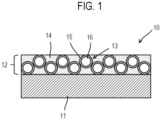
- FIG. 1 is a cross-sectional view schematically showing an example of a recording medium used in the method for producing a recorded matter having a three-dimensional image of the present invention.
- a recording medium 10 includes: a substrate 11; and a foaming layer 12 being provided on the substrate 11 and containing foaming particles 13 which are foamed by heat.
- foaming layer 12 being provided on the substrate 11 and containing foaming particles 13 which are foamed by heat.
- the substrate 11 functions as a support for supporting the foaming layer 12 ( FIG. 1 ).
- the type of the substrate is not particularly limited.
- the substrate includes, for example, common paper made from natural pulp; kenaf paper; plastic film sheets of polypropylene, polyethylene, polyester, and the like; so-called synthetic paper and nonwoven fabric obtained by making synthetic fiber, synthetic pulp, and synthetic resin film into pseudo-paper; and the like.
- the foaming layer 12 is a layer being provided on at least one surface of the substrate 11 and containing the foaming particle 13 and a binder resin 14.
- Each of the foaming particles 13 is a thermally expandable microcapsule including: a capsule-shaped shell layer 15 containing a thermoplastic resin; and a volatile material 16 encapsulated inside the shell layer 15.
- the thermoplastic resin contained in the shell layer 15 is softened and the volatile material 16 encapsulated inside the shell layer 15 is vaporized, so that the volume is expanded.
- the foaming particle 13 is expanded like a balloon.
- thermoplastic resin contained in the shell layer includes, for example, polystyrene, styrene-acrylic acid ester copolymer, polyamide resin, polyacrylic acid ester, polyvinylidene chloride, polyacrylonitrile, polymethyl methacrylate, vinylidene chloride-acrylonitrile, methacrylic acid ester-acrylic acid copolymer, vinylidene chloride-acrylic acid copolymer, vinylidene chloride-acrylic acid ester copolymer, and the like.
- the volatile material includes, for example, low molecular weight hydrocarbons such as ethane, ethylene, propane, propene, n-butane, isobutane, npentane, isopentane, neopentane, n-hexane, heptane, and petroleum ether; chlorofluorocarbons such as CCl 3 F, CCl 2 F 2 , CClF 3 , and CClF 2 -CClF 2 ; tetraalkylsilanes such as tetramethylsilane, trimethylethylsilane, trimethylisopropylsilane, trimethyl-n-propyl silane; and the like.
- low molecular weight hydrocarbons such as ethane, ethylene, propane, propene, n-butane, isobutane, npentane, isopentane, neopentane, n-hexane
- the water-insoluble resin refers to a resin 95% by mass or more of which remains in a case where the resin is immersed in warm water of 80°C for 2 hours.
- the water-insoluble resin is preferably at least one selected from the group consisting of acrylic resins and urethane resins.
- the water-insoluble resin is further preferably at least one selected from the group consisting of acrylic resins that do not have an ester group and urethane resins do not have an ester group.
- the water-insoluble resin is preferably a non-water-absorbable resin.
- the content of the water-insoluble resin in the foaming layer is preferably 10% by mass or more and 95% by mass or less based on the total mass of the foaming layer.
- the foaming layer may contain a water-soluble resin together with a water-insoluble resin as long as the advantageous effect of the present invention can be achieved.
- the glass transition temperature of the binder resin is preferably -10°C or more and 30°C or less. When the glass transition temperature of the binder resin is within the above-described range, it is possible to prevent the binder resin from inhibiting the foaming of the foaming particles.
- the foaming layer may further contain components such as a pigment, an antioxidant, a dye, and a surfactant as long as the foamability is not impaired.
- the drying conditions may be set as appropriate depending on the type of the substrate, the compositions of the coating liquid, and the like. However, the temperature at the time of drying needs to be lower than the foaming start temperature of the used foaming particles.
- the foaming layer in 2 g/m 2 or more or more on one surface of the substrate. It further improves the foamability by providing the foaming layer in 2 g/m 2 or more.
- a recording medium (product) in which a foaming layer containing foaming particles is provided in advance may be used.
- the foam-promoting liquid of the present invention is a foam-promoting liquid used in the aforementioned method for producing a recorded matter.
- the detail of the foam-promoting liquid will be described below.
- the foam-promoting liquid contains a foam-promoting component which lowers the foaming start temperature of the foaming particle.
- the foam-promoting liquid containing the foam-promoting component By applying the foam-promoting liquid containing the foam-promoting component to the foaming layer of the recording medium by a method such as ejection using an inkjet system or application, the thermoplastic resin contained in the shell layers of the foaming particles can be softened. It is surmised that as a result, the foaming start temperature and the maximum foaming temperature of the foaming particles can be shifted to a low temperature side.
- the foam-promoting component may be a component which is capable of softening the thermoplastic resin contained in the shell layers of the foaming particles and which has no hydroxyl group, and may be selected and used as appropriate depending on the type of the thermoplastic resin or the like.
- the foam-promoting component includes, for example, 2-pyrrolidone, dimethyl sulfoxide, N,N-dimethylformamide, N-methyl-2-pyrrolidone, and the like. It is preferable that the boiling point of the compound having no hydroxyl group as the foam-promoting component be higher than the temperature at which the foaming layer is heated.
- the content of the compound having no hydroxyl group as the foam-promoting component is preferably 10% by mass or more and 70% by mass or less based on the total mass of the foam-promoting liquid.
- ) of a difference between the solubility parameter (SP 1 ) of the thermoplastic resin forming the shell layers of the foaming particles (microcapsules) and the solubility parameter (SP 2 ) of the foam-promoting component is preferably 3.5 or less.
- the absolute value of the difference in solubility parameter is within the above-described numerical range, it is possible to further improve the foamability of the region to which the foam-promoting liquid containing the foam-promoting component is applied in the foaming layer.
- ) of the difference between the solubility parameter (HSP 2 ) of the foam-promoting component and the Hansen solubility parameter (HSP 1 ) of the thermoplastic resin forming the shell layer of the foaming particle (microcapsules) be 20 or less.
- the absolute value of the difference in Hansen solubility parameter is within the above-described numerical range, the foamability of the region to which the foam-promoting liquid containing the foam-promoting component is added in the foaming layer can be further improved.
- the solubility parameters (SP values) of the thermoplastic resin and the foam-promoting component forming the shell layer are values that can be calculated.
- the Hansen solubility parameters (HSP values) of the thermoplastic resin and the foam-promoting component forming the shell layer are actual measured values measured and calculated in accordance with the dynamic light scattering.
- the foam-promoting component itself may be used as a foam-promoting liquid.
- the foam-promoting liquid may further contain a component (another component) other than the foam-promoting component.
- foam-promoting liquid further contain a liquid component such as a solvent in order to improve the ejection stability of the foam-promoting liquid.
- a solvent water-soluble organic solvents such as water can be used.
- water it is preferable to use deionized water (ion-exchange water).
- the water-soluble organic solvent includes alcohols, glycols, glycol ethers, and nitrogen-containing compounds.
- the device for producing a recorded matter having a three-dimensional image includes: a foam-promoting liquid applying unit that applies foam-promoting liquid to a recording medium; and a heating unit that heats a foaming layer of a recording medium to which the foam-promoting liquid has been added.
- the recording medium includes: a substrate; and a foaming layer provided on the substrate and containing a binder resin and foaming particles which are foamed by heat.
- the foam-promoting liquid contains water and a foam-promoting component which lowers a foaming start temperature of the foaming particles.
- the arrangement of the foam-promoting liquid applying unit, the ink applying unit, and the heating unit can be adjusted as appropriate.
- the arrangement of the foam-promoting liquid applying unit, the ink applying unit, and the heating unit in the device for producing a recorded matter will be described with reference to the drawing.
- the foam-promoting liquid can be applied onto the foaming layer of the recording medium 21 by ejecting the foam-promoting liquid from the recording head of the inkjet system included in the foam-promoting liquid applying unit 22 arranged at a predetermined position in the direction of transportation of the recording medium 21 (the direction of the arrow A in FIG. 2 ).
- the heating unit 23 is a unit that heats the foaming layer of the recording medium 21 to which the foam-promoting liquid has been added.
- the heating unit 23 may be a heating device that is capable of heating the foaming particles in the foaming layer to a desired temperature.
- the heating unit includes, for example, a dryer, an oven, a heater, and an iron.
- the foaming start temperatures and the maximum foaming temperatures of the foaming particles X, Y, and Z were measured by using a thermo-mechanical analyzer (TMA) (trade name "TMA2940", produced by TA instruments) as follows. In an aluminum container having a diameter of 7 mm and a depth of 1 mm, 25 ⁇ g of the sample was thrown in, and a load of 0.1 N was applied from above. In this state, the sample was heated from 60°C to 200°C at a heating rate of 5°C/min, and displacement in the vertical direction of the measuring terminal was measured. Then, the temperature at which the displacement started was measured as the "foaming start temperature” and the temperature at which the amount of displacement reached the maximum was measured as the "maximum foaming temperature”. Results are shown in Table 1. [Table 1] Foaming start temperature (°C) Maximum foaming temperature (°C) Foaming particles X 110 160 Foaming particles Y 91 138 Foaming particles Z 70 110
- Component A to I shown in Table 2 were prepared. 10 g of each of the component A to I was mixed with 90 g of water to form a liquid as a foam-promoting liquid containing 10 g of each component and 90 g of water (component F was 100% of water). These foam-promoting liquids A' to I' were reacted with 20 g of foaming particles (foaming particles X, Y, and Z) shown in Table 2. Thereafter, the foaming start temperature and maximum foaming temperature of each set of foaming particles reacted with the foam-promoting component were measured by the same method as in the case of foaming particles not reacted with foam-promoting component. Results of measurement are shown in Table 2. Note that meanings of the abbreviations in Table 2 are shown below.
- a polypropylene synthetic paper (trade name "New Yupo FGS110", produced by Yupo Corporation) was prepared.
- 100 parts of an acrylic resin having a glass transition temperature of 0°C and 50 parts of the foaming particle X were added, followed by sufficiently stirring to obtain a coating liquid X.
- the obtained coating liquid X was applied onto the substrate such that the applied amount became 40 g/m 2 , followed by drying in an oven of 80°C for 5 minutes to form a foaming layer, thus obtaining a recording medium X.
- the acrylic resin used for preparing this recording medium X was a water-insoluble and non-water-absorbable resin, and have no ester group.
- a recording medium Y was obtained in the same manner as for the aforementioned recording medium X except the coating liquid Y was obtained by using the foaming particles Y instead of the foaming particles X and the coating liquid Y was used instead of the coating liquid X.
- a coating liquid Z was obtained by using the foaming particles Z instead of the foaming particles X and using polyvinylpyrrolidone, which is a water-absorbable resin, instead of an acrylic resin. Then, the coating liquid Z was applied onto the substrate instead of the coating liquid X, and dried in an oven of 60°C for 5 minutes. Except for these, a recording medium Z was obtained in the same manner as for the aforementioned recording medium X.
- a foam-promoting liquid A was obtained by mixing 30 parts of the component A, 0.5 parts of a nonionic surfactant (trade name "Acetylenol E100", produced by Kawaken Fine Chemicals Co., Ltd.), and 69.5 parts of ion-exchange water, followed by sufficiently stirring, and filtrated with pressure with a filter having a pore size of 1.2 ⁇ m. Then, a foam-promoting liquids B to I were obtained in the same manner as for the aforementioned foam-promoting liquid A except that components B to I were used instead of the component A.
- a nonionic surfactant trade name "Acetylenol E100", produced by Kawaken Fine Chemicals Co., Ltd.
- the foam-promoting liquid A was applied to the foaming layer of the recording medium X such that the recording duty became 100% by using the above-described inkjet recording apparatus. Thereafter, the foaming layer to which the foam-promoting liquid A had been applied was heated to 150°C by using a hot air gun (trade name "HL2010E1", manufactured by SAKAGUCHI E.H VOC CORP.). In this way, a three-dimensional image was formed by foaming the foaming particles X in the foaming layer to which the foam-promoting liquid A had been applied to obtain a recorded matter 1.
- the foam-promoting liquid B was applied onto the foaming layer of the recording medium Y by using Polyspoit. Thereafter, the foaming layer to which the foam-promoting liquid B had been applied was heated to 80°C by using a hot air gun (trade name "HL2010E1", manufactured by SAKAGUCHI E.H VOC CORP.). In this way, a three-dimensional image was formed by foaming the foaming particles Y in the foaming layer to which the foam-promoting liquid B had been applied to obtain a recorded matter 9.
- HL2010E1 manufactured by SAKAGUCHI E.H VOC CORP.
Landscapes
- Engineering & Computer Science (AREA)
- Mechanical Engineering (AREA)
- General Health & Medical Sciences (AREA)
- Textile Engineering (AREA)
- Health & Medical Sciences (AREA)
- Thermal Sciences (AREA)
- Physics & Mathematics (AREA)
- Toxicology (AREA)
- Vascular Medicine (AREA)
- Ink Jet Recording Methods And Recording Media Thereof (AREA)
- Printing Methods (AREA)
- Ink Jet (AREA)
- Thermal Transfer Or Thermal Recording In General (AREA)
- Laminated Bodies (AREA)
- Application Of Or Painting With Fluid Materials (AREA)
Abstract
Description
- The present invention relates to a method for producing a recorded matter having a three-dimensional image, a device for producing a recorded matter having a three-dimensional image, and a foam-promoting liquid.
- Three-dimensional images such as wall papers and Braille have conventionally been formed by overcoating methods using UV inks, physical extrusion methods such as embossing, and printing methods using 3D printers and thermal expansion plastic foams, and the like. Among these, it has been known that thermal expansion plastic foams express functions such as thermal barrier properties, thermal insulation properties, sound insulation properties, sound absorption properties, vibration insulation properties, and reductions in weight depending on the materials of the foams, the states of formed bubbles, and the like.
- In the field of wall papers, a technique has been known that uses an azo compound such as azodicarbonamide (ADCA) as a foaming agent, and forms an uneven structure by foaming a foaming layer containing such a foaming agent and a resin such as polyvinyl chloride. For example, a method has been proposed which includes: recording an image with an ink containing a color material having light absorption properties, and then irradiating the image with light to generate a difference in heating in accordance with the light absorption properties and selectively raise a foaming layer, forming a three-dimensional image (PTL 1).
- In addition, the following method has been proposed (PTL 2). A flat image is recorded on a surface of a foamable sheet and a shaded image (light-absorbing pattern) based on distance image data which expresses a three-dimensional shape is formed on a surface of a substrate layer of the foamable sheet. Then, light is applied from the substrate layer side to generate heat in accordance with the grayscale of the image, thus expanding the foamable sheet in accordance with the distance image data. Moreover, a method has been proposed that includes: attaching a liquid for suppressing, inhibiting, or promoting expansion to a thermal expansion layer containing polyvinyl chloride or an acrylic resin and a chemical foaming agent; and then heating to form an uneven structure (PTL 3). In addition, a method has been proposed that includes: applying or printing a plasticizer for a shell wall resin of foamable capsules on a three-dimensional image forming layer made of a recorded material for forming a three-dimensional image in which the three-dimensional image forming layer containing foamable capsules is provided; and heating and foaming the foamable capsules to form a three-dimensional image (PTL 4).
-
- [PTL 1]
Japanese Patent Application Laid-Open No. H09-207428 - [PTL 2]
Japanese Patent Application Laid-Open No. 2001-150812 - [PTL 3]
Japanese Patent Application Laid-Open No. 2014-514187 - [PTL 4]
Japanese Patent Application Laid-Open No. H10-129116 - However, in the method proposed by PTL 1, it is necessary to apply an ink containing a color material having high light absorption properties such as a black ink to a portion desired to be thermally foamed. For this reason, it is difficult to foam a portion to which an ink containing a color material having low light absorption properties. In addition, in the case of the method proposed by PTL 2, since a light-absorbing pattern is not directly formed in a foaming layer, it is difficult to sufficiently foam the foaming layer. Moreover, in the method proposed by PTL 3, since a chemical foaming agent is used, variations are likely to be generated in a foamed portion, making it difficult to express clear unevenness. In addition, in the method proposed by PTL 4, since there is a case where a three-dimensional image forming layer is peeled off the support when foamable capsules are foamed, further amelioration has been needed.
- Hence, an object of the present invention is to provide a method for producing a recorded matter having a three-dimensional image, capable of easily forming a three-dimensional image in which clear unevenness is expressed and suppressing peeling of the foaming layer from the substrate. In addition, an object of the present invention is to provide a device for producing a recorded matter having a three-dimensional image, capable of easily forming a three-dimensional image in which clear unevenness is expressed and suppressing peeling of the foaming layer off the substrate. Moreover, an object of the present invention is to provide a foam-promoting liquid for use in the above-described method for producing a recorded matter having a three-dimensional image.
- Specifically, the present invention provides a method for producing a recorded matter having a three-dimensional image, including the steps of: applying, to a recording medium including a substrate and a foaming layer being provided on the substrate and containing a binder resin and a foaming particle which is foamed by heat, a foam-promoting liquid containing water and a foam-promoting component which lowers a foaming start temperature of the foaming particle; and foaming the foaming particle to form a three-dimensional image by heating the foaming layer of the recording medium to which the foam-promoting liquid has been applied, wherein the foaming particle includes: a shell layer containing a thermoplastic resin; and a volatile material encapsulated in the shell layer, the binder resin contains a water-insoluble resin, the foam-promoting component contains a compound having no hydroxyl group, and a temperature at which the foaming layer of the recording medium to which the foam-promoting liquid has been applied is heated is equal to or more than the foaming start temperature of the foaming particle reacted with the foam-promoting component and less than a maximum foaming temperature of the foaming particle.
- In addition, the present invention provides a device for producing a recorded matter having a three-dimensional image, including: a foam-promoting liquid applying unit which applies, to a recording medium including a substrate and a foaming layer being provided on the substrate and containing a binder resin and a foaming particle which is foamed by heat, a foam-promoting liquid containing water and foam-promoting component which lowers a foaming start temperature of the foaming particle; and a heating unit which foams the foaming particle to form a three-dimensional image by heating the foaming layer of the recording medium to which the foam-promoting liquid has been applied, wherein the foaming particle includes: a shell layer containing a thermoplastic resin; and a volatile material encapsulated in the shell layer, the binder resin contains a water-insoluble resin, the foam-promoting component contains a compound having no hydroxyl group, and a temperature at which the foaming layer of the recording medium to which the foam-promoting liquid has been applied is heated is equal to or more than the foaming start temperature of the foaming particle reacted with the foam-promoting component and less than a maximum foaming temperature of the foaming particle.
- Moreover, the present invention provides a foam-promoting liquid for use in a method for producing a recorded matter having a three-dimensional image including the steps of: applying, to a recording medium including a substrate and a foaming layer being provided on the substrate and containing a binder resin and a foaming particle which is formed by heat, a foam-promoting liquid containing water and a foam-promoting component which lowers a foaming start temperature of the foaming particle; and foaming the foaming particle to form a three-dimensional image by heating the foaming layer of the recording medium to which the foam-promoting liquid has been applied, wherein the foaming particle includes: a shell layer containing a thermoplastic resin; and a volatile material encapsulated in the shell layer, the binder resin contains a water-insoluble resin, the foam-promoting component contains a compound having no hydroxyl group, and a temperature at which the foaming layer of the recording medium to which the foam-promoting liquid has been applied is heated is equal to or more than the foaming start temperature of the foaming particle reacted with the foam-promoting component and less than a maximum foaming temperature of the foaming particle.
- The present invention can provide a method for producing a recorded matter having a three-dimensional image, capable of easily forming a three-dimensional image in which clear unevenness is expressed and suppressing peeling of the foaming layer off the substrate. In addition, the present invention can provide a device for producing a recorded matter having a three-dimensional image, capable of easily forming a three-dimensional image in which clear unevenness is expressed and suppressing peeling of the foaming layer off the substrate. Moreover, the present invention can provide a foam-promoting liquid for use in the above-described method for producing a recorded matter having a three-dimensional image.
-
- [
FIG. 1 ]
FIG. 1 is a cross-sectional view schematically showing an example of a recording medium used in a method for producing a recorded matter having a three-dimensional image of the present invention. - [
FIG. 2 ]
FIG. 2 is a schematic diagram showing a schematic configuration of a device for producing a recorded matter having a three-dimensional image of the present invention. - Hereinafter, the present invention will be further described in detail by presenting a preferred embodiment. Hereinafter, an aqueous ink for inkjet is referred to simply as an "ink" in some cases. Physical property values are values at ordinary temperature (25°C) unless otherwise noted.
- A method for producing a recorded matter having a three-dimensional image (hereinafter, also referred to simply as a "method for producing a recorded matter") of the present invention includes the steps of: applying a foam-promoting liquid to a recording medium; and foaming foaming particles to form a three-dimensional image. As the recording medium, a recording medium including: a substrate; and a foaming layer being provided on the substrate and containing a binder resin and foaming particles which are foamed by heat is used. In the step of applying a foam-promoting liquid to a recording medium, a foam-promoting liquid containing a foam-promoting component which lowers a foaming start temperature of the foaming particles is applied to the recording medium. In the step of foaming foaming particles to form a three-dimensional image, the foaming layer of the recording medium to which the foam-promoting liquid has been applied is heated to foam the foaming particles, thereby forming a three-dimensional image. In addition, the foaming particles each include: a shell layer containing a thermoplastic resin; and a volatile material encapsulated inside the shell layer. Then, the temperature at which the foaming layer of the recording medium to which the foam-promoting liquid has been applied is heated is equal to or more than a foaming start temperature of the foaming particles reacted with the foam-promoting component and less than a maximum foaming temperature of the foaming particles. Here, the maximum foaming temperature of the foaming particles is a maximum foaming temperature of the foaming particles not reacted with the foam-promoting component.
- In the method for producing a recorded matter of the present invention, the foam-promoting liquid containing the foam-promoting component is applied to the recording medium having the foaming layer containing the foaming particles. The foam-promoting component is a component capable of lowering the foaming start temperature of the foaming particles. That is, among the foaming particle, the foaming start temperature of the foaming particles in the foaming layer of the recording medium to which the foam-promoting liquid has been applied has been lowered. For this reason, after the application of the foam-promoting liquid, when the foaming layer of the recording medium is heated to a temperature equal to or more than the foaming start temperature of the foaming particles reacted with the foam-promoting component and less than the maximum foaming temperature of the foaming particles, it is possible to efficiently foam the foaming particles in the foaming layer to which the foam-promoting liquid has been applied. In this way, a three-dimensional image in which a clear uneven structure has been expressed is formed, so that a target recorded matter can be obtained. In addition, as the foam-promoting component, a compound having no hydroxyl group is used. It is not necessarily clear why this foam-promoting component promotes the foaming at the time of heating the foaming particles. However, the present inventors have surmised that the foam-promoting component promotes the softening of the shell layers of the foaming particles or the binder resin in the foaming layer, and in turn improves the foamability of the foaming particle. In addition, the temperature at which the foaming layer to which the foam-promoting liquid has been applied is heated is preferably equal to or more than the foaming start temperature of the foaming particles reacted with the foam-promoting component and less than the maximum foaming temperature of the foaming particles reacted with the foam-promoting component. This makes it possible to effectively conduct the foaming of the foaming particles reacted with the foam-promoting component by heating, making it possible to form a three-dimensional image in which a clearer uneven structure has been expressed. In addition, the temperature at which the foaming layer to which the foam-promoting liquid has been applied is heated is preferably equal to or more than the foaming start temperature of the foaming particles reacted with the foam-promoting component and less than the foaming start temperature of the foaming particles not reacted with the foam-promoting component. This makes it possible to conduct the foaming of the foaming particle reacted with the foam-promoting component by heating while suppressing the foaming of the foaming particle not reacted with the foam-promoting component by heating, making it possible to form a three-dimensional image in which a clearer uneven structure has been expressed.
- The foam-promoting liquid contains water together with the foam-promoting component. Against this, by using a water-insoluble resin as the binder resin contained in the foaming layer of the recording medium, it is possible to suppress dissolution of the binder resin by water in the foam-promoting liquid. As a result, a decrease in adhesion between the substrate and the foaming layer can be suppressed, and in turn the peeling of the foaming layer off the substrate when the foaming particles are foamed can be suppressed.
- The foaming start temperature and the maximum foaming temperature of the foaming particles reacted with the foam-promoting component can be measured by a method given below. First, the foaming particles are immersed in the foam-promoting liquid containing the foam-promoting component for 10 seconds in order to bring the foaming particles into a state reacted with the foam-promoting component. As a sample, 25 µg of the foaming particles immersed in the foam-promoting liquid is placed in an aluminum container having a diameter of 7 mm and a depth of 1 mm. The aluminum container is mounted on a thermo-mechanical analyzer, and is heated from 60°C to 200°C at a heating rate of 5°C/min in a state where a load of 0.1 N is applied to the foaming particles from above, and an amount of displacement in the vertical direction of the measuring terminal (amount of displacement of the height of the portion occupied by the sample) is measured. Then, the temperature when the displacement started is used as the foaming start temperature of the foaming particles reacted with the foam-promoting component. In addition, the temperature when the amount of displacement reached the maximum is used as the maximum foaming temperature of the foaming particles reacted with the foam-promoting component. In addition, the foaming start temperature and the maximum foaming temperature of the foaming particles not reacted with the foam-promoting component means the following temperatures. That is, these temperatures respectively mean the temperature when the displacement started and the temperature when the amount of displacement reached the maximum, which are measured by the same method as in the above-described case of the foaming particles reacted with the foam-promoting component except that the foaming particles not reacted with the foam-promoting component are used as a sample.
- The method for heating the foaming layer to which the foam-promoting liquid has been applied may be a method using a heating device capable of heating the foaming particles in the foaming layer to a desired temperature.
- Any image may be recorded (printed) by applying an ink containing a dye or a pigment as a color material to the recording medium before or after the foam-promoting liquid is applied to the foaming layer, or before or after the foaming layer to which the foam-promoting liquid has been applied is heated. The printing may be made not only by an inkjet recording method which applies an ink with an inkjet system but also by printing methods such as an electrophotographic system using a toner, latex, UV, and sublimation transfer, for example. Among these, it is preferable to record an image by an inkjet recording method from the viewpoint that it is possible to record a finer image.
-
FIG. 1 is a cross-sectional view schematically showing an example of a recording medium used in the method for producing a recorded matter having a three-dimensional image of the present invention. As shown inFIG. 1 , arecording medium 10 includes: asubstrate 11; and afoaming layer 12 being provided on thesubstrate 11 and containing foamingparticles 13 which are foamed by heat. Hereinafter, the detail of the recording medium used in the method for producing a recorded matter of the present invention will be described. - The
substrate 11 functions as a support for supporting the foaming layer 12 (FIG. 1 ). The type of the substrate is not particularly limited. The substrate includes, for example, common paper made from natural pulp; kenaf paper; plastic film sheets of polypropylene, polyethylene, polyester, and the like; so-called synthetic paper and nonwoven fabric obtained by making synthetic fiber, synthetic pulp, and synthetic resin film into pseudo-paper; and the like. - As shown in
FIG. 1 , thefoaming layer 12 is a layer being provided on at least one surface of thesubstrate 11 and containing the foamingparticle 13 and abinder resin 14. Each of the foamingparticles 13 is a thermally expandable microcapsule including: a capsule-shapedshell layer 15 containing a thermoplastic resin; and avolatile material 16 encapsulated inside theshell layer 15. When heat is applied to this foamingparticle 13, the thermoplastic resin contained in theshell layer 15 is softened and thevolatile material 16 encapsulated inside theshell layer 15 is vaporized, so that the volume is expanded. Hence, the foamingparticle 13 is expanded like a balloon. - The thermoplastic resin contained in the shell layer includes, for example, polystyrene, styrene-acrylic acid ester copolymer, polyamide resin, polyacrylic acid ester, polyvinylidene chloride, polyacrylonitrile, polymethyl methacrylate, vinylidene chloride-acrylonitrile, methacrylic acid ester-acrylic acid copolymer, vinylidene chloride-acrylic acid copolymer, vinylidene chloride-acrylic acid ester copolymer, and the like.
- The volatile material includes, for example, low molecular weight hydrocarbons such as ethane, ethylene, propane, propene, n-butane, isobutane, npentane, isopentane, neopentane, n-hexane, heptane, and petroleum ether; chlorofluorocarbons such as CCl3F, CCl2F2, CClF3, and CClF2-CClF2; tetraalkylsilanes such as tetramethylsilane, trimethylethylsilane, trimethylisopropylsilane, trimethyl-n-propyl silane; and the like. Among these, the volatile material is preferably a hydrocarbon having a molecular weight of 120 or less. In addition, the lower limit of the molecular weight of the volatile material (hydrocarbon) is not particularly limited, but, for example, preferably 50 or more. The content of the foaming particles in the foaming layer is preferably 5% by mass or more and 95% by mass or less based on the total mass of the foaming layer.
- The
foaming layer 12 contains thebinder resin 14 in order to enhance the adhesion with the substrate 11 (FIG. 1 ). When the foaming particles in the foaming layer are foamed by heat, the binder resin plays an important role in suppressing the peeling of the foaming layer from the substrate. As the binder resin, a water-insoluble resin is used. When the binder resin contains a water-insoluble resin, the binder resin becomes unlikely to be dissolved in water in the foam-promoting liquid as well, thus making it possible to suppress a decrease in the adhesion between the substrate and the foaming layer by the foam-promoting liquid. Moreover, even when an aqueous ink containing water is added to the recording medium, it is possible to suppress a decrease in adhesion between the foaming layer and the substrate. Here, the water-insoluble resin refers to a resin 95% by mass or more of which remains in a case where the resin is immersed in warm water of 80°C for 2 hours. The water-insoluble resin is preferably at least one selected from the group consisting of acrylic resins and urethane resins. In addition, the water-insoluble resin is further preferably at least one selected from the group consisting of acrylic resins that do not have an ester group and urethane resins do not have an ester group. Then, the water-insoluble resin is preferably a non-water-absorbable resin. The content of the water-insoluble resin in the foaming layer is preferably 10% by mass or more and 95% by mass or less based on the total mass of the foaming layer. In addition, the foaming layer may contain a water-soluble resin together with a water-insoluble resin as long as the advantageous effect of the present invention can be achieved. In addition, the glass transition temperature of the binder resin is preferably -10°C or more and 30°C or less. When the glass transition temperature of the binder resin is within the above-described range, it is possible to prevent the binder resin from inhibiting the foaming of the foaming particles. - The mass ratio between the foaming particles and the binder resin is preferably such that foaming particle:binder resin=5:95 to 90:10. By setting the mass ratio between the foaming particles and the binder resin within the above-described range, it is possible to improve both the foamability of the foaming particles and the binding property of the binder resin to the substrate. The foaming layer may further contain components such as a pigment, an antioxidant, a dye, and a surfactant as long as the foamability is not impaired.
- In order to produce a recording medium, first a coating liquid for a foaming layer containing foaming particles is applied onto a surface of a substrate to form a coating layer. Subsequently, the coating layer thus formed is dried to form a foaming layer, so that a recording medium can be obtained. To apply the coating liquid for the foaming layer onto the surface of the substrate, a conventionally known air knife coater, die coater, blade coater, gate roll coater, bar coater, rod coater, roll coater, gravure coater, curtain coater, or the like may be used. The method for drying the coating layer includes, for example, a method including blowing hot air, and the like. The drying conditions (temperature, air flow amount, time, and the like) may be set as appropriate depending on the type of the substrate, the compositions of the coating liquid, and the like. However, the temperature at the time of drying needs to be lower than the foaming start temperature of the used foaming particles.
- It is preferable to provide the foaming layer in 2 g/m2 or more or more on one surface of the substrate. It further improves the foamability by providing the foaming layer in 2 g/m2 or more. Note that a recording medium (product) in which a foaming layer containing foaming particles is provided in advance may be used.
- Among the surfaces of the substrate, on a surface opposite to the surface on which the foaming layer is provided, a back coating layer may be provided. The back coating layer may be a layer identical to the foaming layer containing the foaming particles, or may be a layer different from the foaming layer. In addition, an adhesive layer containing an adhesive resin such as an acrylic resin and an ink receiving layer for fixing a color material may be formed.
- The foam-promoting liquid of the present invention is a foam-promoting liquid used in the aforementioned method for producing a recorded matter. The detail of the foam-promoting liquid will be described below.
- The foam-promoting liquid contains a foam-promoting component which lowers the foaming start temperature of the foaming particle. By applying the foam-promoting liquid containing the foam-promoting component to the foaming layer of the recording medium by a method such as ejection using an inkjet system or application, the thermoplastic resin contained in the shell layers of the foaming particles can be softened. It is surmised that as a result, the foaming start temperature and the maximum foaming temperature of the foaming particles can be shifted to a low temperature side.
- The foam-promoting component may be a component which is capable of softening the thermoplastic resin contained in the shell layers of the foaming particles and which has no hydroxyl group, and may be selected and used as appropriate depending on the type of the thermoplastic resin or the like. The foam-promoting component includes, for example, 2-pyrrolidone, dimethyl sulfoxide, N,N-dimethylformamide, N-methyl-2-pyrrolidone, and the like. It is preferable that the boiling point of the compound having no hydroxyl group as the foam-promoting component be higher than the temperature at which the foaming layer is heated. When the boiling point of this compound is higher than the temperature at which the foaming layer is heated, this compound is unlikely to be vaporized even when the foaming layer is heated, thus contributing to the softening of the thermoplastic resin of the shell layers of the foaming particles. The content of the compound having no hydroxyl group as the foam-promoting component is preferably 10% by mass or more and 70% by mass or less based on the total mass of the foam-promoting liquid.
- The absolute value (|SP1-SP2|) of a difference between the solubility parameter (SP1) of the thermoplastic resin forming the shell layers of the foaming particles (microcapsules) and the solubility parameter (SP2) of the foam-promoting component is preferably 3.5 or less. When the absolute value of the difference in solubility parameter is within the above-described numerical range, it is possible to further improve the foamability of the region to which the foam-promoting liquid containing the foam-promoting component is applied in the foaming layer.
- In addition, it is preferable that the absolute value (|HSP1-HSP2|) of the difference between the solubility parameter (HSP2) of the foam-promoting component and the Hansen solubility parameter (HSP1) of the thermoplastic resin forming the shell layer of the foaming particle (microcapsules) be 20 or less. When the absolute value of the difference in Hansen solubility parameter is within the above-described numerical range, the foamability of the region to which the foam-promoting liquid containing the foam-promoting component is added in the foaming layer can be further improved.
- The solubility parameters (SP values) of the thermoplastic resin and the foam-promoting component forming the shell layer are values that can be calculated. In addition, the Hansen solubility parameters (HSP values) of the thermoplastic resin and the foam-promoting component forming the shell layer are actual measured values measured and calculated in accordance with the dynamic light scattering.
- In the case where the foam-promoting component is a liquid at ordinary temperature (25°C), the foam-promoting component itself may be used as a foam-promoting liquid. In addition, the foam-promoting liquid may further contain a component (another component) other than the foam-promoting component. For example, it is preferable that foam-promoting liquid further contain a liquid component such as a solvent in order to improve the ejection stability of the foam-promoting liquid. As the solvent, water-soluble organic solvents such as water can be used. As the water, it is preferable to use deionized water (ion-exchange water). The water-soluble organic solvent includes alcohols, glycols, glycol ethers, and nitrogen-containing compounds.
- As the component other than the liquid component, a water-soluble organic compound which is solid at a temperature of 25°C, such as urea and derivatives thereof, trimethylolpropane, and trimethylolethane can be used. Moreover, the foam-promoting liquid may contain various additives such as a pH adjuster, an antifoam, an anti-rust agent, an antiseptic, a fungicide, an antioxidant, a reduction inhibitor, and a chelating agent, as necessary.
- The device for producing a recorded matter having a three-dimensional image (hereinafter, also referred to simply as a "device for producing a recorded matter") of the present invention includes: a foam-promoting liquid applying unit that applies foam-promoting liquid to a recording medium; and a heating unit that heats a foaming layer of a recording medium to which the foam-promoting liquid has been added. The recording medium includes: a substrate; and a foaming layer provided on the substrate and containing a binder resin and foaming particles which are foamed by heat. The foam-promoting liquid contains water and a foam-promoting component which lowers a foaming start temperature of the foaming particles. The heating unit is a unit that heats the foaming layer of the recording medium to foam foaming particles, thereby forming a three-dimensional image. The foaming particles each include: a shell layer containing a thermoplastic resin; and a volatile material encapsulated in the shell layer. The binder resin in the foaming layer contains a water-insoluble resin, and the foam-promoting component contains a compound having no hydroxyl group. Then, the temperature at which the foaming layer of the recording medium to which the foam-promoting liquid has been applied is heated is equal to or more than a foaming start temperature of the foaming particles reacted with the foam-promoting component and less than a maximum foaming temperature of the foaming particles. The ink, the foam-promoting liquid, and the recording medium used in this device for producing a recorded matter are the same as the ink, the foam-promoting liquid, and the recording medium used in the aforementioned method for producing a recorded matter. The device for producing a recorded matter of the present invention can be favorably used in the aforementioned method for producing a recorded matter.
- The device for producing a recorded matter may also include an ink container which holds an ink; and an ink applying unit for ejecting the ink from an inkjet recording head to record an image on a recording medium. In addition, the device for producing a recorded matter may also include a foam-promoting liquid container which holds the foam-promoting liquid. Furthermore, the device for producing a recorded matter may also include a transporting unit for transporting the recording medium.
- The arrangement of the foam-promoting liquid applying unit, the ink applying unit, and the heating unit can be adjusted as appropriate. Hereinafter, the arrangement of the foam-promoting liquid applying unit, the ink applying unit, and the heating unit in the device for producing a recorded matter will be described with reference to the drawing.
-
FIG. 2 is a schematic diagram showing a schematic configuration of the device for producing a recorded matter having a three-dimensional image of the present invention. - In the production device shown in
FIG. 2 , arecording medium 21 is transported in the direction of the arrow A by the transporting unit for transporting the recording medium. Anink applying unit 24 may be arranged upstream or downstream of a foam-promotingliquid applying unit 22, and may be arranged upstream or downstream of theheating unit 23, in the direction A of the transportation of therecording medium 21.FIG. 2 (a) shows a configuration in which theink applying device 24 is arranged downstream of the foam-promotingliquid applying unit 22 and downstream of theheating unit 23 in the direction A of the transportation of therecording medium 21.FIG. 2 (b) shows a configuration in which theink applying unit 24 is arranged downstream of the foam-promotingliquid applying unit 22 and upstream of theheating unit 23 in the direction A of the transportation of therecording medium 21.FIG. 2 (c) shows a configuration which theink applying unit 24 is arranged upstream of the foam-promotingliquid applying unit 22 and upstream of theheating unit 23 in the direction A of the transportation of therecording medium 21. - The foam-promoting liquid can be applied onto the foaming layer of the
recording medium 21 by ejecting the foam-promoting liquid from the recording head of the inkjet system included in the foam-promotingliquid applying unit 22 arranged at a predetermined position in the direction of transportation of the recording medium 21 (the direction of the arrow A inFIG. 2 ). - The
heating unit 23 is a unit that heats the foaming layer of therecording medium 21 to which the foam-promoting liquid has been added. Theheating unit 23 may be a heating device that is capable of heating the foaming particles in the foaming layer to a desired temperature. The heating unit includes, for example, a dryer, an oven, a heater, and an iron. - The present invention will be described in further detail by giving Examples and Comparative Examples, but the present invention is not limited to Examples described below at all without departing from the gist. The amounts of components described with "part" and "%" are in terms of mass unless otherwise noted.
- Foaming particles X, Y, and Z were prepared. The foaming particles X was trade name "Advancell EMH204", (produced by SEKISUI CHEMICAL CO., LTD., volatile material: isopentane (molecular weight 72.2)). The foaming particles Y was trade name "Expancel 007-40" (produced by Japan Fillite Co., Ltd., volatile material: isobutane (molecular weight 58.1)). And the foaming particle Z was trade name "Matsumoto Microsphere F-30" (produced by Matsumoto Yushi-Seiyaku Co., Ltd., volatile material: isopentane (molecular weight 72.1)). The shell layers of the foaming particles X, Y, and Z are thermoplastic resins. The foaming start temperatures and the maximum foaming temperatures of the foaming particles X, Y, and Z were measured by using a thermo-mechanical analyzer (TMA) (trade name "TMA2940", produced by TA instruments) as follows. In an aluminum container having a diameter of 7 mm and a depth of 1 mm, 25 µg of the sample was thrown in, and a load of 0.1 N was applied from above. In this state, the sample was heated from 60°C to 200°C at a heating rate of 5°C/min, and displacement in the vertical direction of the measuring terminal was measured. Then, the temperature at which the displacement started was measured as the "foaming start temperature" and the temperature at which the amount of displacement reached the maximum was measured as the "maximum foaming temperature". Results are shown in Table 1.
[Table 1] Foaming start temperature (°C) Maximum foaming temperature (°C) Foaming particles X 110 160 Foaming particles Y 91 138 Foaming particles Z 70 110 - Component A to I shown in Table 2 were prepared. 10 g of each of the component A to I was mixed with 90 g of water to form a liquid as a foam-promoting liquid containing 10 g of each component and 90 g of water (component F was 100% of water). These foam-promoting liquids A' to I' were reacted with 20 g of foaming particles (foaming particles X, Y, and Z) shown in Table 2. Thereafter, the foaming start temperature and maximum foaming temperature of each set of foaming particles reacted with the foam-promoting component were measured by the same method as in the case of foaming particles not reacted with foam-promoting component. Results of measurement are shown in Table 2. Note that meanings of the abbreviations in Table 2 are shown below.
- DMSO: dimethyl sulfoxide
- DMF: N,N-dimethylformamide
- NMP: N-methyl-2-pyrrolidone
- iPrOH: isopropanol
- PGME: propylene glycol monomethyl ether
- As a substrate, a polypropylene synthetic paper (trade name "New Yupo FGS110", produced by Yupo Corporation) was prepared. To ion-exchange water, 100 parts of an acrylic resin having a glass transition temperature of 0°C and 50 parts of the foaming particle X were added, followed by sufficiently stirring to obtain a coating liquid X. The obtained coating liquid X was applied onto the substrate such that the applied amount became 40 g/m2, followed by drying in an oven of 80°C for 5 minutes to form a foaming layer, thus obtaining a recording medium X. Note that the acrylic resin used for preparing this recording medium X was a water-insoluble and non-water-absorbable resin, and have no ester group.
- A recording medium Y was obtained in the same manner as for the aforementioned recording medium X except the coating liquid Y was obtained by using the foaming particles Y instead of the foaming particles X and the coating liquid Y was used instead of the coating liquid X.
- A coating liquid Z was obtained by using the foaming particles Z instead of the foaming particles X and using polyvinylpyrrolidone, which is a water-absorbable resin, instead of an acrylic resin. Then, the coating liquid Z was applied onto the substrate instead of the coating liquid X, and dried in an oven of 60°C for 5 minutes. Except for these, a recording medium Z was obtained in the same manner as for the aforementioned recording medium X.
- A recording medium W was obtained in the same manner as for the aforementioned recording medium Z except that a coating liquid Z was obtained by using an acrylate ester having an ester group instead of polyvinylpyrrolidone.
- A foam-promoting liquid A was obtained by mixing 30 parts of the component A, 0.5 parts of a nonionic surfactant (trade name "Acetylenol E100", produced by Kawaken Fine Chemicals Co., Ltd.), and 69.5 parts of ion-exchange water, followed by sufficiently stirring, and filtrated with pressure with a filter having a pore size of 1.2 µm. Then, a foam-promoting liquids B to I were obtained in the same manner as for the aforementioned foam-promoting liquid A except that components B to I were used instead of the component A.
- Cartridges were filled with the foam-promoting liquids A to I, respectively, and were attached to an inkjet recording apparatus (trade name "PIXUS MG3630", manufactured by Canon Inc.). In the present Examples, the recording duty of an image recorded under conditions that two ink droplets of about 11.2 ng each are applied to a unit region of 1/600 inches × 1/600 inches is defined to be 100%.
- The foam-promoting liquid A was applied to the foaming layer of the recording medium X such that the recording duty became 100% by using the above-described inkjet recording apparatus. Thereafter, the foaming layer to which the foam-promoting liquid A had been applied was heated to 150°C by using a hot air gun (trade name "HL2010E1", manufactured by SAKAGUCHI E.H VOC CORP.). In this way, a three-dimensional image was formed by foaming the foaming particles X in the foaming layer to which the foam-promoting liquid A had been applied to obtain a recorded matter 1.
- Recorded matters 2 to 8 and 10 to 28 were obtained in the same manner as for the aforementioned Example 1 except that the conditions shown in Table 3 were employed.
- The foam-promoting liquid B was applied onto the foaming layer of the recording medium Y by using Polyspoit. Thereafter, the foaming layer to which the foam-promoting liquid B had been applied was heated to 80°C by using a hot air gun (trade name "HL2010E1", manufactured by SAKAGUCHI E.H VOC CORP.). In this way, a three-dimensional image was formed by foaming the foaming particles Y in the foaming layer to which the foam-promoting liquid B had been applied to obtain a recorded matter 9.
- The surface of each recorded matter thus produced was visually observed to evaluate the unevenness in accordance with the evaluation criteria given below. Results are shown in Table 3.
- A: It was possible to observe unevenness.
- C: It was not possible to observe unevenness.
- The surface of each recorded matter thus produced was visually observed to check whether or not the foaming layer was peeled off the substrate after heating in accordance with the evaluation criteria given below. Results are shown in Table 3.
- A: Peeling of the foaming layer off the substrate was not observed.
- C: Peeling of the foaming layer off the substrate was observed.
- The present invention is not limited to the above-described embodiments, and various changes and modifications are possible without departing from the spirit and scope of the present invention. Therefore, the following claims are attached in order to publicize the scope of the present invention.
- The present application claims the priority based on the
Japanese Patent Application No. 2020-191592 applied on November 18, 2020 -
- 10: recording medium
- 11: substrate
- 12: foaming layer
- 13: foaming particle
- 14: binder resin
- 15: shell layer
- 16: volatile material
- 21: recording medium
- 22: foam-promoting liquid applying unit
- 23: heating unit
- 24: ink applying unit
| Component | Type | Foaming particles X | Foaming particles Y | Foaming particles Z | ||||||
| Foaming start temperature after reaction of components (°C) | |SP1-SP2| | |HSP1-HSP2| | Foaming start temperature after reaction of components (°C) | |SP1-SP2| | |HSP1-HSP2| | Foaming start temperature after reaction of components (°C) | |SP1-SP2| | |HSP1-HSP2| | ||
| A | 2-pyrrolidone (boiling point 245°C) | 90 | ≤3.5 | ≤20 | 75 | ≤3.5 | ≤20 | - | - | - |
| B | DMSO (boiling point 189°C) | 80 | ≤3.5 | ≤20 | 70 | ≤3.5 | ≤20 | - | - | - |
| C | DMF (boiling point 153°C) | 100 | ≤3.5 | ≤20 | 80 | ≤3.5 | ≤20 | - | - | - |
| D | NMP (boiling point 202°C) | 100 | ≤3.5 | ≤20 | 80 | ≤3.5 | ≤20 | - | - | - |
| E | Water (boiling point 100°C) | 110 | >3.5 | >20 | 91 | >3.5 | >20 | - | - | - |
| F | iPrOH (boiling point 83°C) | 110 | >3.5 | >20 | 91 | >3.5 | >20 | - | - | - |
| G | Hexane (boiling point 69°C) | 110 | >3.5 | >20 | 91 | >3.5 | >20 | - | - | - |
| H | PGME (boiling point 121°C) | - | - | - | 89 | >3.5 | ≤20 | 65 | ≤3.5 | ≤20 |
| I | Glycerin (boiling point 290°C) | - | - | - | point 85 | ≤3.5 | ≤20 | - | - | - |
| Recorded matter | Foam-promoting liquid | Recording medium | Foaming start temperature after reaction of components (°C) | Maximum foaming temperature of the foaming particles (°C) | Heating temperature (°C) | Result of evaluation (unevenness) | Peeling of the foaming layer off the substrate | |
| Example 1 | 1 | A | X | 90 | 160 | 150 | A | A |
| Example 2 | 2 | B | X | 80 | 160 | 150 | A | A |
| Example 3 | 3 | C | X | 100 | 160 | 150 | A | A |
| Example 4 | 4 | D | X | 100 | 160 | 150 | A | A |
| Example 5 | 5 | B | Y | 70 | 138 | 135 | A | A |
| Example 6 | 6 | A | X | 90 | 160 | 100 | A | A |
| Example 7 | 7 | B | X | 80 | 160 | 100 | A | A |
| Example 8 | 8 | B | Y | 70 | 138 | 80 | A | A |
| Example 9 | 9 | B | Y | 70 | 138 | 80 | A | A |
| Comparative Example 1 | 10 | A | X | 90 | 160 | 40 | C | A |
| Comparative Example 2 | 11 | B | X | 80 | 160 | 40 | C | A |
| Comparative Example 3 | 12 | B | Y | 70 | 138 | 40 | C | A |
| Comparative Example 4 | 13 | A | X | 90 | 160 | 200 | C | A |
| Comparative Example 5 | 14 | B | X | 80 | 160 | 200 | C | A |
| Comparative Example 6 | 15 | B | Y | 70 | 138 | 200 | C | A |
| Comparative Example 7 | 16 | E | X | 110 | 160 | 150 | C | A |
| Comparative Example 8 | 17 | F | X | 110 | 160 | 150 | C | A |
| Comparative Example 9 | 18 | G | X | 110 | 160 | 150 | C | A |
| Comparative Example 10 | 19 | G | Y | 91 | 138 | 135 | C | A |
| Comparative Example 11 | 20 | F | X | 110 | 160 | 200 | C | A |
| Comparative Example 12 | 21 | G | X | 110 | 160 | 200 | C | A |
| Comparative Example 13 | 22 | G | Y | 91 | 138 | 200 | C | A |
| Comparative Example 14 | 23 | - | X | - | 160 | 100 | C | A |
| Comparative Example 15 | 24 | - | Y | - | 138 | 80 | C | A |
| Comparative Example 16 | 25 | H | Z | 65 | 110 | 100 | A | C |
| Comparative Example 17 | 26 | H | Y | 89 | 138 | 80 | C | A |
| Comparative Example 18 | 27 | I | Y | 85 | 138 | 80 | C | A |
| Comparative Example 19 | 28 | H | W | 65 | 110 | 120 | A | C |
Claims (13)
- A method for producing a recorded matter having a three-dimensional image, comprising the steps of:applying, to a recording medium including a substrate and a foaming layer being provided on the substrate and containing a binder resin and a foaming particle which is foamed by heat, a foam-promoting liquid containing water and a foam-promoting component which lowers a foaming start temperature of the foaming particle; andfoaming the foaming particle to form a three-dimensional image by heating the foaming layer of the recording medium to which the foam-promoting liquid has been applied, whereinthe foaming particle includes: a shell layer containing a thermoplastic resin; and a volatile material encapsulated in the shell layer,the binder resin contains a water-insoluble resin,the foam-promoting component contains a compound having no hydroxyl group, anda temperature at which the foaming layer of the recording medium to which the foam-promoting liquid has been applied is heated is equal to or more than the foaming start temperature of the foaming particle reacted with the foam-promoting component and less than a maximum foaming temperature of the foaming particle.
- The method for producing a recorded matter having a three-dimensional image according to claim 1, wherein
the volatile material is a hydrocarbon having a molecular weight of 120 or less. - The method for producing a recorded matter having a three-dimensional image according to claim 1 or 2, wherein
a content of the foaming particle in the foaming layer is 5% by mass or more and 95% by mass or less based on a total mass of the foaming layer. - The method for producing a recorded matter having a three-dimensional image according to any one of claims 1 to 3, wherein
the water-insoluble resin is a non-water-absorbable resin. - The method for producing a recorded matter having a three-dimensional image according to any one of claims 1 to 4, wherein
the water-insoluble resin is at least one selected from the group consisting of acrylic resins having no ester group and urethane resins having no ester group. - The method for producing a recorded matter having a three-dimensional image according to any one of claims 1 to 5, wherein
a content of the water-insoluble resin in the foaming layer is 10% by mass or more and 95% by mass or less based on a total mass of the foaming layer. - The method for producing a recorded matter having a three-dimensional image according to any one of claims 1 to 6, wherein
a boiling point of the compound is higher than the temperature at which the foaming layer of the recording medium to which the foam-promoting liquid has been applied is heated. - The method for producing a recorded matter having a three-dimensional image according to any one of claims 1 to 7, wherein
the compound is at least one selected from the group consisting of 2-pyrrolidone, dimethyl sulfoxide, N,N-dimethylformamide, and N-methyl-2-pyrrolidone. - The method for producing a recorded matter having a three-dimensional image according to any one of claims 1 to 8, wherein
a content of the compound in the foam-promoting liquid is 10% by mass or more and 70% by mass or less based on a total mass of the foam-promoting liquid. - The method for producing a recorded matter having a three-dimensional image according to any one of claims 1 to 9, wherein
an absolute value (|SP1-SP2|) of a difference between a solubility parameter (SP1) of the thermoplastic resin and a solubility parameter (SP2) of the foam-promoting component is 3.5 or less. - The method for producing a recorded matter having a three-dimensional image according to any one of claims 1 to 10, wherein
an absolute value (|HSP1- HSP2|) of a difference between a Hansen solubility parameter (HSP1) of the thermoplastic resin and a Hansen solubility parameter (HSP2) of the foam-promoting component is 20 or less. - A device for producing a recorded matter having a three-dimensional image, comprising:a foam-promoting liquid applying unit which applies, to a recording medium including a substrate and a foaming layer being provided on the substrate and containing a binder resin and a foaming particle which is foamed by heat, a foam-promoting liquid containing water and foam-promoting component which lowers a foaming start temperature of the foaming particle; anda heating unit which foams the foaming particle to form a three-dimensional image by heating the foaming layer of the recording medium to which the foam-promoting liquid has been applied, whereinthe foaming particle includes: a shell layer containing a thermoplastic resin; and a volatile material encapsulated in the shell layer,the binder resin contains a water-insoluble resin,the foam-promoting component contains a compound having no hydroxyl group, anda temperature at which the foaming layer of the recording medium to which the foam-promoting liquid has been applied is heated is equal to or more than the foaming start temperature of the foaming particle reacted with the foam-promoting component and less than a maximum foaming temperature of the foaming particle.
- A foam-promoting liquid for use in a method for producing a recorded matter having a three-dimensional image including the steps of:applying, to a recording medium including a substrate and a foaming layer being provided on the substrate and containing a binder resin and a foaming particle which is formed by heat, a foam-promoting liquid containing water and a foam-promoting component which lowers a foaming start temperature of the foaming particle; andfoaming the foaming particle to form a three-dimensional image by heating the foaming layer of the recording medium to which the foam-promoting liquid has been applied, whereinthe foaming particle includes: a shell layer containing a thermoplastic resin; and a volatile material encapsulated in the shell layer,the binder resin contains a water-insoluble resin,the foam-promoting component contains a compound having no hydroxyl group, anda temperature at which the foaming layer of the recording medium to which the foam-promoting liquid has been applied is heated is equal to or more than the foaming start temperature of the foaming particle reacted with the foam-promoting component and less than a maximum foaming temperature of the foaming particle.
Applications Claiming Priority (2)
| Application Number | Priority Date | Filing Date | Title |
|---|---|---|---|
| JP2020191592 | 2020-11-18 | ||
| PCT/JP2021/042301 WO2022107827A1 (en) | 2020-11-18 | 2021-11-17 | Method for producing recorded material having stereoscopic image, device for producing recorded material having stereoscopic image, and foaming promoting solution |
Publications (2)
| Publication Number | Publication Date |
|---|---|
| EP4238754A1 true EP4238754A1 (en) | 2023-09-06 |
| EP4238754A4 EP4238754A4 (en) | 2024-07-24 |
Family
ID=81708992
Family Applications (1)
| Application Number | Title | Priority Date | Filing Date |
|---|---|---|---|
| EP21894700.0A Pending EP4238754A4 (en) | 2020-11-18 | 2021-11-17 | METHOD FOR PRODUCING A PRINTED MATERIAL HAVING A STEREOSCOPIC IMAGE, DEVICE FOR PRODUCING PRINTED MATERIAL HAVING A STEREOSCOPIC IMAGE AND SOLUTION PROMOTING FOAMING |
Country Status (5)
| Country | Link |
|---|---|
| US (2) | US12434415B2 (en) |
| EP (1) | EP4238754A4 (en) |
| JP (2) | JP7652683B2 (en) |
| CN (1) | CN116457194A (en) |
| WO (1) | WO2022107827A1 (en) |
Families Citing this family (3)
| Publication number | Priority date | Publication date | Assignee | Title |
|---|---|---|---|---|
| JP7652683B2 (en) | 2020-11-18 | 2025-03-27 | キヤノン株式会社 | Manufacturing method of a recorded material having a three-dimensional image, manufacturing device of a recorded material having a three-dimensional image, and foaming promoting liquid |
| JP7800215B2 (en) * | 2022-03-03 | 2026-01-16 | 大日本印刷株式会社 | Print manufacturing method |
| US12343758B2 (en) | 2022-03-16 | 2025-07-01 | Canon Kabushiki Kaisha | Recording medium and method for producing recorded matter having three-dimensional image |
Family Cites Families (12)
| Publication number | Priority date | Publication date | Assignee | Title |
|---|---|---|---|---|
| JPH0995040A (en) * | 1995-09-29 | 1997-04-08 | Brother Ind Ltd | 3D image forming sheet |
| JPH09207428A (en) | 1996-02-02 | 1997-08-12 | Canon Inc | Stereoscopic image forming medium and stereoscopic image forming method using the medium |
| JP3474374B2 (en) | 1996-11-05 | 2003-12-08 | 三菱製紙株式会社 | Method for forming stereoscopic image and stereoscopic image forming body |
| JP2001030398A (en) | 1999-07-23 | 2001-02-06 | Dainippon Printing Co Ltd | Cosmetic material and manufacturing method thereof |
| JP2001150812A (en) | 1999-11-25 | 2001-06-05 | Minolta Co Ltd | System and method for foam molding, printed foamed sheet, and foamed molding |
| JP2005088341A (en) | 2003-09-17 | 2005-04-07 | Takeuchi Press Ind Co Ltd | Method for producing metal container printed with foaming ink and metal container |
| BE1019895A3 (en) | 2011-04-01 | 2013-02-05 | Den Steen Consult Trade Bvba Van | METHOD FOR MANUFACTURING WALL COVERING WITH RELIEF IN A CONTINUOUS PROCESS |
| JP2020050719A (en) | 2018-09-26 | 2020-04-02 | 株式会社ミマキエンジニアリング | Ink, solid formed article, and formation method of solid formed article |
| US12090690B2 (en) * | 2019-02-28 | 2024-09-17 | Mimaki Engineering Co., Ltd. | Foamed product, method for manufacturing foamed product |
| JP7275854B2 (en) | 2019-05-23 | 2023-05-18 | 三菱電機株式会社 | remote control device |
| JP7652683B2 (en) | 2020-11-18 | 2025-03-27 | キヤノン株式会社 | Manufacturing method of a recorded material having a three-dimensional image, manufacturing device of a recorded material having a three-dimensional image, and foaming promoting liquid |
| US12172455B2 (en) | 2021-12-08 | 2024-12-24 | Canon Kabushiki Kaisha | Method of producing recorded matter with stereoscopic image |
-
2021
- 2021-11-17 JP JP2021186965A patent/JP7652683B2/en active Active
- 2021-11-17 EP EP21894700.0A patent/EP4238754A4/en active Pending
- 2021-11-17 WO PCT/JP2021/042301 patent/WO2022107827A1/en not_active Ceased
- 2021-11-17 CN CN202180077534.2A patent/CN116457194A/en active Pending
-
2023
- 2023-05-09 US US18/314,239 patent/US12434415B2/en active Active
-
2025
- 2025-03-14 JP JP2025041596A patent/JP2025083526A/en active Pending
- 2025-09-10 US US19/324,566 patent/US20260001260A1/en active Pending
Also Published As
| Publication number | Publication date |
|---|---|
| CN116457194A (en) | 2023-07-18 |
| EP4238754A4 (en) | 2024-07-24 |
| US20230271357A1 (en) | 2023-08-31 |
| JP2025083526A (en) | 2025-05-30 |
| JP7652683B2 (en) | 2025-03-27 |
| US20260001260A1 (en) | 2026-01-01 |
| JP2022080886A (en) | 2022-05-30 |
| WO2022107827A1 (en) | 2022-05-27 |
| US12434415B2 (en) | 2025-10-07 |
Similar Documents
| Publication | Publication Date | Title |
|---|---|---|
| US12434415B2 (en) | Method for producing recorded matter having three-dimensional image, device for producing recorded matter having three-dimensional image, and foam-promoting liquid | |
| JP6475325B2 (en) | Decorative articles and surface-treated articles | |
| US7582335B2 (en) | Foamed material and a method of making a foamed material | |
| EP3335897B1 (en) | Method of forming a surface covering, apparatus for forming a surface covering and a surface covering | |
| JP2010513649A (en) | Water-based inkjet fluid | |
| JP6963741B2 (en) | Inking method and wallpaper manufacturing method | |
| JP2023138415A (en) | Recording medium and method for producing recorded matter having stereoscopic images | |
| JP2024007352A (en) | Method for producing recorded matter having a stereoscopic image, and apparatus for producing recorded matter having a stereoscopic image | |
| EP4245554A1 (en) | Recording medium and method for producing recorded matter having three-dimensional image | |
| US12172455B2 (en) | Method of producing recorded matter with stereoscopic image | |
| JP4962300B2 (en) | Transfer sheet and decorative material | |
| EP4279283A1 (en) | Foaming promotion liquid, manufacturing method for manufacturing recorded product having three-dimensional image, and manufacturing apparatus for manufacturing recorded product having three-dimensional image | |
| EP1567361B1 (en) | Ink-jet recording medium | |
| JP2023169869A (en) | Foaming promotion liquid, method for manufacturing recorded article having three-dimensional image, and apparatus for manufacturing recorded article having three-dimensional image | |
| US20240001702A1 (en) | Method for manufacturing recorded matter having stereoscopic image and manufacturing apparatus of recorded matter having stereoscopic image | |
| JP2023158262A (en) | Recording medium and method for producing recorded matter having stereoscopic images | |
| JP2023158261A (en) | Recording medium and method for producing recorded matter having stereoscopic images | |
| JP2023158263A (en) | Recording medium and method for producing recorded matter having stereoscopic images | |
| JP2025146722A (en) | Recording medium and method for manufacturing a recording having a three-dimensional image | |
| US20250296290A1 (en) | Recording medium, and method for manufacturing recorded matter having stereoscopic image | |
| JP2023085222A (en) | Method for producing recorded matter having stereoscopic image | |
| JP2000001641A (en) | Colored ink for ink jet for polyvinyl alcohol receptor | |
| JP2020138481A (en) | Printing medium, method for manufacturing foamable printed matter, and inkjet printer | |
| US3573957A (en) | Process for preparing porous ink containing transfer medium | |
| JPH1191244A (en) | Three-dimensional image forming recording material and three-dimensional image forming method using the same |
Legal Events
| Date | Code | Title | Description |
|---|---|---|---|
| STAA | Information on the status of an ep patent application or granted ep patent |
Free format text: STATUS: THE INTERNATIONAL PUBLICATION HAS BEEN MADE |
|
| PUAI | Public reference made under article 153(3) epc to a published international application that has entered the european phase |
Free format text: ORIGINAL CODE: 0009012 |
|
| STAA | Information on the status of an ep patent application or granted ep patent |
Free format text: STATUS: REQUEST FOR EXAMINATION WAS MADE |
|
| 17P | Request for examination filed |
Effective date: 20230531 |
|
| AK | Designated contracting states |
Kind code of ref document: A1 Designated state(s): AL AT BE BG CH CY CZ DE DK EE ES FI FR GB GR HR HU IE IS IT LI LT LU LV MC MK MT NL NO PL PT RO RS SE SI SK SM TR |
|
| DAV | Request for validation of the european patent (deleted) | ||
| DAX | Request for extension of the european patent (deleted) | ||
| REG | Reference to a national code |
Ref country code: DE Ref legal event code: R079 Free format text: PREVIOUS MAIN CLASS: B32B0005200000 Ipc: B41M0003060000 |
|
| A4 | Supplementary search report drawn up and despatched |
Effective date: 20240624 |
|
| RIC1 | Information provided on ipc code assigned before grant |
Ipc: B41M 3/18 20060101ALN20240618BHEP Ipc: B41M 3/16 20060101ALN20240618BHEP Ipc: D06N 7/00 20060101ALI20240618BHEP Ipc: B41M 7/00 20060101ALI20240618BHEP Ipc: B41M 3/06 20060101AFI20240618BHEP |