EP4238615A1 - Fire extinguishing body and battery pack - Google Patents
Fire extinguishing body and battery pack Download PDFInfo
- Publication number
- EP4238615A1 EP4238615A1 EP21886276.1A EP21886276A EP4238615A1 EP 4238615 A1 EP4238615 A1 EP 4238615A1 EP 21886276 A EP21886276 A EP 21886276A EP 4238615 A1 EP4238615 A1 EP 4238615A1
- Authority
- EP
- European Patent Office
- Prior art keywords
- fire extinguishing
- layer
- substrate
- extinguishing agent
- damaged
- Prior art date
- Legal status (The legal status is an assumption and is not a legal conclusion. Google has not performed a legal analysis and makes no representation as to the accuracy of the status listed.)
- Pending
Links
Images

Classifications
-
- A—HUMAN NECESSITIES
- A62—LIFE-SAVING; FIRE-FIGHTING
- A62C—FIRE-FIGHTING
- A62C3/00—Fire prevention, containment or extinguishing specially adapted for particular objects or places
- A62C3/16—Fire prevention, containment or extinguishing specially adapted for particular objects or places in electrical installations, e.g. cableways
-
- A—HUMAN NECESSITIES
- A62—LIFE-SAVING; FIRE-FIGHTING
- A62C—FIRE-FIGHTING
- A62C35/00—Permanently-installed equipment
- A62C35/02—Permanently-installed equipment with containers for delivering the extinguishing substance
- A62C35/10—Containers destroyed or opened by flames or heat
-
- B—PERFORMING OPERATIONS; TRANSPORTING
- B32—LAYERED PRODUCTS
- B32B—LAYERED PRODUCTS, i.e. PRODUCTS BUILT-UP OF STRATA OF FLAT OR NON-FLAT, e.g. CELLULAR OR HONEYCOMB, FORM
- B32B13/00—Layered products comprising a a layer of water-setting substance, e.g. concrete, plaster, asbestos cement, or like builders' material
- B32B13/04—Layered products comprising a a layer of water-setting substance, e.g. concrete, plaster, asbestos cement, or like builders' material comprising such water setting substance as the main or only constituent of a layer, which is next to another layer of the same or of a different material
- B32B13/12—Layered products comprising a a layer of water-setting substance, e.g. concrete, plaster, asbestos cement, or like builders' material comprising such water setting substance as the main or only constituent of a layer, which is next to another layer of the same or of a different material of synthetic resin
-
- B—PERFORMING OPERATIONS; TRANSPORTING
- B32—LAYERED PRODUCTS
- B32B—LAYERED PRODUCTS, i.e. PRODUCTS BUILT-UP OF STRATA OF FLAT OR NON-FLAT, e.g. CELLULAR OR HONEYCOMB, FORM
- B32B15/00—Layered products comprising a layer of metal
- B32B15/04—Layered products comprising a layer of metal comprising metal as the main or only constituent of a layer, which is next to another layer of the same or of a different material
-
- B—PERFORMING OPERATIONS; TRANSPORTING
- B32—LAYERED PRODUCTS
- B32B—LAYERED PRODUCTS, i.e. PRODUCTS BUILT-UP OF STRATA OF FLAT OR NON-FLAT, e.g. CELLULAR OR HONEYCOMB, FORM
- B32B15/00—Layered products comprising a layer of metal
- B32B15/04—Layered products comprising a layer of metal comprising metal as the main or only constituent of a layer, which is next to another layer of the same or of a different material
- B32B15/08—Layered products comprising a layer of metal comprising metal as the main or only constituent of a layer, which is next to another layer of the same or of a different material of synthetic resin
-
- B—PERFORMING OPERATIONS; TRANSPORTING
- B32—LAYERED PRODUCTS
- B32B—LAYERED PRODUCTS, i.e. PRODUCTS BUILT-UP OF STRATA OF FLAT OR NON-FLAT, e.g. CELLULAR OR HONEYCOMB, FORM
- B32B15/00—Layered products comprising a layer of metal
- B32B15/04—Layered products comprising a layer of metal comprising metal as the main or only constituent of a layer, which is next to another layer of the same or of a different material
- B32B15/08—Layered products comprising a layer of metal comprising metal as the main or only constituent of a layer, which is next to another layer of the same or of a different material of synthetic resin
- B32B15/082—Layered products comprising a layer of metal comprising metal as the main or only constituent of a layer, which is next to another layer of the same or of a different material of synthetic resin comprising vinyl resins; comprising acrylic resins
-
- B—PERFORMING OPERATIONS; TRANSPORTING
- B32—LAYERED PRODUCTS
- B32B—LAYERED PRODUCTS, i.e. PRODUCTS BUILT-UP OF STRATA OF FLAT OR NON-FLAT, e.g. CELLULAR OR HONEYCOMB, FORM
- B32B15/00—Layered products comprising a layer of metal
- B32B15/04—Layered products comprising a layer of metal comprising metal as the main or only constituent of a layer, which is next to another layer of the same or of a different material
- B32B15/08—Layered products comprising a layer of metal comprising metal as the main or only constituent of a layer, which is next to another layer of the same or of a different material of synthetic resin
- B32B15/085—Layered products comprising a layer of metal comprising metal as the main or only constituent of a layer, which is next to another layer of the same or of a different material of synthetic resin comprising polyolefins
-
- B—PERFORMING OPERATIONS; TRANSPORTING
- B32—LAYERED PRODUCTS
- B32B—LAYERED PRODUCTS, i.e. PRODUCTS BUILT-UP OF STRATA OF FLAT OR NON-FLAT, e.g. CELLULAR OR HONEYCOMB, FORM
- B32B15/00—Layered products comprising a layer of metal
- B32B15/04—Layered products comprising a layer of metal comprising metal as the main or only constituent of a layer, which is next to another layer of the same or of a different material
- B32B15/08—Layered products comprising a layer of metal comprising metal as the main or only constituent of a layer, which is next to another layer of the same or of a different material of synthetic resin
- B32B15/088—Layered products comprising a layer of metal comprising metal as the main or only constituent of a layer, which is next to another layer of the same or of a different material of synthetic resin comprising polyamides
-
- B—PERFORMING OPERATIONS; TRANSPORTING
- B32—LAYERED PRODUCTS
- B32B—LAYERED PRODUCTS, i.e. PRODUCTS BUILT-UP OF STRATA OF FLAT OR NON-FLAT, e.g. CELLULAR OR HONEYCOMB, FORM
- B32B15/00—Layered products comprising a layer of metal
- B32B15/04—Layered products comprising a layer of metal comprising metal as the main or only constituent of a layer, which is next to another layer of the same or of a different material
- B32B15/08—Layered products comprising a layer of metal comprising metal as the main or only constituent of a layer, which is next to another layer of the same or of a different material of synthetic resin
- B32B15/09—Layered products comprising a layer of metal comprising metal as the main or only constituent of a layer, which is next to another layer of the same or of a different material of synthetic resin comprising polyesters
-
- B—PERFORMING OPERATIONS; TRANSPORTING
- B32—LAYERED PRODUCTS
- B32B—LAYERED PRODUCTS, i.e. PRODUCTS BUILT-UP OF STRATA OF FLAT OR NON-FLAT, e.g. CELLULAR OR HONEYCOMB, FORM
- B32B15/00—Layered products comprising a layer of metal
- B32B15/04—Layered products comprising a layer of metal comprising metal as the main or only constituent of a layer, which is next to another layer of the same or of a different material
- B32B15/08—Layered products comprising a layer of metal comprising metal as the main or only constituent of a layer, which is next to another layer of the same or of a different material of synthetic resin
- B32B15/092—Layered products comprising a layer of metal comprising metal as the main or only constituent of a layer, which is next to another layer of the same or of a different material of synthetic resin comprising epoxy resins
-
- B—PERFORMING OPERATIONS; TRANSPORTING
- B32—LAYERED PRODUCTS
- B32B—LAYERED PRODUCTS, i.e. PRODUCTS BUILT-UP OF STRATA OF FLAT OR NON-FLAT, e.g. CELLULAR OR HONEYCOMB, FORM
- B32B15/00—Layered products comprising a layer of metal
- B32B15/18—Layered products comprising a layer of metal comprising iron or steel
-
- B—PERFORMING OPERATIONS; TRANSPORTING
- B32—LAYERED PRODUCTS
- B32B—LAYERED PRODUCTS, i.e. PRODUCTS BUILT-UP OF STRATA OF FLAT OR NON-FLAT, e.g. CELLULAR OR HONEYCOMB, FORM
- B32B17/00—Layered products essentially comprising sheet glass, or glass, slag, or like fibres
- B32B17/06—Layered products essentially comprising sheet glass, or glass, slag, or like fibres comprising glass as the main or only constituent of a layer, next to another layer of a specific material
- B32B17/10—Layered products essentially comprising sheet glass, or glass, slag, or like fibres comprising glass as the main or only constituent of a layer, next to another layer of a specific material of synthetic resin
-
- B—PERFORMING OPERATIONS; TRANSPORTING
- B32—LAYERED PRODUCTS
- B32B—LAYERED PRODUCTS, i.e. PRODUCTS BUILT-UP OF STRATA OF FLAT OR NON-FLAT, e.g. CELLULAR OR HONEYCOMB, FORM
- B32B21/00—Layered products comprising a layer of wood, e.g. wood board, veneer, wood particle board
- B32B21/04—Layered products comprising a layer of wood, e.g. wood board, veneer, wood particle board comprising wood as the main or only constituent of a layer, which is next to another layer of the same or of a different material
- B32B21/08—Layered products comprising a layer of wood, e.g. wood board, veneer, wood particle board comprising wood as the main or only constituent of a layer, which is next to another layer of the same or of a different material of synthetic resin
-
- B—PERFORMING OPERATIONS; TRANSPORTING
- B32—LAYERED PRODUCTS
- B32B—LAYERED PRODUCTS, i.e. PRODUCTS BUILT-UP OF STRATA OF FLAT OR NON-FLAT, e.g. CELLULAR OR HONEYCOMB, FORM
- B32B27/00—Layered products comprising a layer of synthetic resin
- B32B27/06—Layered products comprising a layer of synthetic resin as the main or only constituent of a layer, which is next to another layer of the same or of a different material
-
- B—PERFORMING OPERATIONS; TRANSPORTING
- B32—LAYERED PRODUCTS
- B32B—LAYERED PRODUCTS, i.e. PRODUCTS BUILT-UP OF STRATA OF FLAT OR NON-FLAT, e.g. CELLULAR OR HONEYCOMB, FORM
- B32B27/00—Layered products comprising a layer of synthetic resin
- B32B27/28—Layered products comprising a layer of synthetic resin comprising synthetic resins not wholly covered by any one of the sub-groups B32B27/30 - B32B27/42
- B32B27/281—Layered products comprising a layer of synthetic resin comprising synthetic resins not wholly covered by any one of the sub-groups B32B27/30 - B32B27/42 comprising polyimides
-
- B—PERFORMING OPERATIONS; TRANSPORTING
- B32—LAYERED PRODUCTS
- B32B—LAYERED PRODUCTS, i.e. PRODUCTS BUILT-UP OF STRATA OF FLAT OR NON-FLAT, e.g. CELLULAR OR HONEYCOMB, FORM
- B32B27/00—Layered products comprising a layer of synthetic resin
- B32B27/30—Layered products comprising a layer of synthetic resin comprising vinyl (co)polymers; comprising acrylic (co)polymers
- B32B27/304—Layered products comprising a layer of synthetic resin comprising vinyl (co)polymers; comprising acrylic (co)polymers comprising vinyl halide (co)polymers, e.g. PVC, PVDC, PVF, PVDF
-
- B—PERFORMING OPERATIONS; TRANSPORTING
- B32—LAYERED PRODUCTS
- B32B—LAYERED PRODUCTS, i.e. PRODUCTS BUILT-UP OF STRATA OF FLAT OR NON-FLAT, e.g. CELLULAR OR HONEYCOMB, FORM
- B32B27/00—Layered products comprising a layer of synthetic resin
- B32B27/30—Layered products comprising a layer of synthetic resin comprising vinyl (co)polymers; comprising acrylic (co)polymers
- B32B27/308—Layered products comprising a layer of synthetic resin comprising vinyl (co)polymers; comprising acrylic (co)polymers comprising acrylic (co)polymers
-
- B—PERFORMING OPERATIONS; TRANSPORTING
- B32—LAYERED PRODUCTS
- B32B—LAYERED PRODUCTS, i.e. PRODUCTS BUILT-UP OF STRATA OF FLAT OR NON-FLAT, e.g. CELLULAR OR HONEYCOMB, FORM
- B32B27/00—Layered products comprising a layer of synthetic resin
- B32B27/32—Layered products comprising a layer of synthetic resin comprising polyolefins
-
- B—PERFORMING OPERATIONS; TRANSPORTING
- B32—LAYERED PRODUCTS
- B32B—LAYERED PRODUCTS, i.e. PRODUCTS BUILT-UP OF STRATA OF FLAT OR NON-FLAT, e.g. CELLULAR OR HONEYCOMB, FORM
- B32B27/00—Layered products comprising a layer of synthetic resin
- B32B27/32—Layered products comprising a layer of synthetic resin comprising polyolefins
- B32B27/322—Layered products comprising a layer of synthetic resin comprising polyolefins comprising halogenated polyolefins, e.g. PTFE
-
- B—PERFORMING OPERATIONS; TRANSPORTING
- B32—LAYERED PRODUCTS
- B32B—LAYERED PRODUCTS, i.e. PRODUCTS BUILT-UP OF STRATA OF FLAT OR NON-FLAT, e.g. CELLULAR OR HONEYCOMB, FORM
- B32B27/00—Layered products comprising a layer of synthetic resin
- B32B27/34—Layered products comprising a layer of synthetic resin comprising polyamides
-
- B—PERFORMING OPERATIONS; TRANSPORTING
- B32—LAYERED PRODUCTS
- B32B—LAYERED PRODUCTS, i.e. PRODUCTS BUILT-UP OF STRATA OF FLAT OR NON-FLAT, e.g. CELLULAR OR HONEYCOMB, FORM
- B32B27/00—Layered products comprising a layer of synthetic resin
- B32B27/36—Layered products comprising a layer of synthetic resin comprising polyesters
-
- B—PERFORMING OPERATIONS; TRANSPORTING
- B32—LAYERED PRODUCTS
- B32B—LAYERED PRODUCTS, i.e. PRODUCTS BUILT-UP OF STRATA OF FLAT OR NON-FLAT, e.g. CELLULAR OR HONEYCOMB, FORM
- B32B27/00—Layered products comprising a layer of synthetic resin
- B32B27/38—Layered products comprising a layer of synthetic resin comprising epoxy resins
-
- B—PERFORMING OPERATIONS; TRANSPORTING
- B32—LAYERED PRODUCTS
- B32B—LAYERED PRODUCTS, i.e. PRODUCTS BUILT-UP OF STRATA OF FLAT OR NON-FLAT, e.g. CELLULAR OR HONEYCOMB, FORM
- B32B7/00—Layered products characterised by the relation between layers; Layered products characterised by the relative orientation of features between layers, or by the relative values of a measurable parameter between layers, i.e. products comprising layers having different physical, chemical or physicochemical properties; Layered products characterised by the interconnection of layers
- B32B7/02—Physical, chemical or physicochemical properties
- B32B7/022—Mechanical properties
-
- B—PERFORMING OPERATIONS; TRANSPORTING
- B32—LAYERED PRODUCTS
- B32B—LAYERED PRODUCTS, i.e. PRODUCTS BUILT-UP OF STRATA OF FLAT OR NON-FLAT, e.g. CELLULAR OR HONEYCOMB, FORM
- B32B7/00—Layered products characterised by the relation between layers; Layered products characterised by the relative orientation of features between layers, or by the relative values of a measurable parameter between layers, i.e. products comprising layers having different physical, chemical or physicochemical properties; Layered products characterised by the interconnection of layers
- B32B7/04—Interconnection of layers
- B32B7/12—Interconnection of layers using interposed adhesives or interposed materials with bonding properties
-
- H—ELECTRICITY
- H01—ELECTRIC ELEMENTS
- H01M—PROCESSES OR MEANS, e.g. BATTERIES, FOR THE DIRECT CONVERSION OF CHEMICAL ENERGY INTO ELECTRICAL ENERGY
- H01M10/00—Secondary cells; Manufacture thereof
- H01M10/05—Accumulators with non-aqueous electrolyte
- H01M10/052—Li-accumulators
- H01M10/0525—Rocking-chair batteries, i.e. batteries with lithium insertion or intercalation in both electrodes; Lithium-ion batteries
-
- H—ELECTRICITY
- H01—ELECTRIC ELEMENTS
- H01M—PROCESSES OR MEANS, e.g. BATTERIES, FOR THE DIRECT CONVERSION OF CHEMICAL ENERGY INTO ELECTRICAL ENERGY
- H01M10/00—Secondary cells; Manufacture thereof
- H01M10/60—Heating or cooling; Temperature control
- H01M10/65—Means for temperature control structurally associated with the cells
- H01M10/655—Solid structures for heat exchange or heat conduction
- H01M10/6553—Terminals or leads
-
- H—ELECTRICITY
- H01—ELECTRIC ELEMENTS
- H01M—PROCESSES OR MEANS, e.g. BATTERIES, FOR THE DIRECT CONVERSION OF CHEMICAL ENERGY INTO ELECTRICAL ENERGY
- H01M10/00—Secondary cells; Manufacture thereof
- H01M10/60—Heating or cooling; Temperature control
- H01M10/65—Means for temperature control structurally associated with the cells
- H01M10/659—Means for temperature control structurally associated with the cells by heat storage or buffering, e.g. heat capacity or liquid-solid phase changes or transition
-
- H—ELECTRICITY
- H01—ELECTRIC ELEMENTS
- H01M—PROCESSES OR MEANS, e.g. BATTERIES, FOR THE DIRECT CONVERSION OF CHEMICAL ENERGY INTO ELECTRICAL ENERGY
- H01M50/00—Constructional details or processes of manufacture of the non-active parts of electrochemical cells other than fuel cells, e.g. hybrid cells
- H01M50/20—Mountings; Secondary casings or frames; Racks, modules or packs; Suspension devices; Shock absorbers; Transport or carrying devices; Holders
-
- H—ELECTRICITY
- H01—ELECTRIC ELEMENTS
- H01M—PROCESSES OR MEANS, e.g. BATTERIES, FOR THE DIRECT CONVERSION OF CHEMICAL ENERGY INTO ELECTRICAL ENERGY
- H01M50/00—Constructional details or processes of manufacture of the non-active parts of electrochemical cells other than fuel cells, e.g. hybrid cells
- H01M50/20—Mountings; Secondary casings or frames; Racks, modules or packs; Suspension devices; Shock absorbers; Transport or carrying devices; Holders
- H01M50/204—Racks, modules or packs for multiple batteries or multiple cells
-
- H—ELECTRICITY
- H01—ELECTRIC ELEMENTS
- H01M—PROCESSES OR MEANS, e.g. BATTERIES, FOR THE DIRECT CONVERSION OF CHEMICAL ENERGY INTO ELECTRICAL ENERGY
- H01M50/00—Constructional details or processes of manufacture of the non-active parts of electrochemical cells other than fuel cells, e.g. hybrid cells
- H01M50/20—Mountings; Secondary casings or frames; Racks, modules or packs; Suspension devices; Shock absorbers; Transport or carrying devices; Holders
- H01M50/218—Mountings; Secondary casings or frames; Racks, modules or packs; Suspension devices; Shock absorbers; Transport or carrying devices; Holders characterised by the material
-
- H—ELECTRICITY
- H01—ELECTRIC ELEMENTS
- H01M—PROCESSES OR MEANS, e.g. BATTERIES, FOR THE DIRECT CONVERSION OF CHEMICAL ENERGY INTO ELECTRICAL ENERGY
- H01M50/00—Constructional details or processes of manufacture of the non-active parts of electrochemical cells other than fuel cells, e.g. hybrid cells
- H01M50/20—Mountings; Secondary casings or frames; Racks, modules or packs; Suspension devices; Shock absorbers; Transport or carrying devices; Holders
- H01M50/289—Mountings; Secondary casings or frames; Racks, modules or packs; Suspension devices; Shock absorbers; Transport or carrying devices; Holders characterised by spacing elements or positioning means within frames, racks or packs
- H01M50/291—Mountings; Secondary casings or frames; Racks, modules or packs; Suspension devices; Shock absorbers; Transport or carrying devices; Holders characterised by spacing elements or positioning means within frames, racks or packs characterised by their shape
-
- H—ELECTRICITY
- H01—ELECTRIC ELEMENTS
- H01M—PROCESSES OR MEANS, e.g. BATTERIES, FOR THE DIRECT CONVERSION OF CHEMICAL ENERGY INTO ELECTRICAL ENERGY
- H01M50/00—Constructional details or processes of manufacture of the non-active parts of electrochemical cells other than fuel cells, e.g. hybrid cells
- H01M50/20—Mountings; Secondary casings or frames; Racks, modules or packs; Suspension devices; Shock absorbers; Transport or carrying devices; Holders
- H01M50/289—Mountings; Secondary casings or frames; Racks, modules or packs; Suspension devices; Shock absorbers; Transport or carrying devices; Holders characterised by spacing elements or positioning means within frames, racks or packs
- H01M50/293—Mountings; Secondary casings or frames; Racks, modules or packs; Suspension devices; Shock absorbers; Transport or carrying devices; Holders characterised by spacing elements or positioning means within frames, racks or packs characterised by the material
-
- B—PERFORMING OPERATIONS; TRANSPORTING
- B32—LAYERED PRODUCTS
- B32B—LAYERED PRODUCTS, i.e. PRODUCTS BUILT-UP OF STRATA OF FLAT OR NON-FLAT, e.g. CELLULAR OR HONEYCOMB, FORM
- B32B2250/00—Layers arrangement
- B32B2250/02—2 layers
-
- B—PERFORMING OPERATIONS; TRANSPORTING
- B32—LAYERED PRODUCTS
- B32B—LAYERED PRODUCTS, i.e. PRODUCTS BUILT-UP OF STRATA OF FLAT OR NON-FLAT, e.g. CELLULAR OR HONEYCOMB, FORM
- B32B2255/00—Coating on the layer surface
- B32B2255/10—Coating on the layer surface on synthetic resin layer or on natural or synthetic rubber layer
-
- B—PERFORMING OPERATIONS; TRANSPORTING
- B32—LAYERED PRODUCTS
- B32B—LAYERED PRODUCTS, i.e. PRODUCTS BUILT-UP OF STRATA OF FLAT OR NON-FLAT, e.g. CELLULAR OR HONEYCOMB, FORM
- B32B2255/00—Coating on the layer surface
- B32B2255/20—Inorganic coating
-
- B—PERFORMING OPERATIONS; TRANSPORTING
- B32—LAYERED PRODUCTS
- B32B—LAYERED PRODUCTS, i.e. PRODUCTS BUILT-UP OF STRATA OF FLAT OR NON-FLAT, e.g. CELLULAR OR HONEYCOMB, FORM
- B32B2255/00—Coating on the layer surface
- B32B2255/26—Polymeric coating
-
- B—PERFORMING OPERATIONS; TRANSPORTING
- B32—LAYERED PRODUCTS
- B32B—LAYERED PRODUCTS, i.e. PRODUCTS BUILT-UP OF STRATA OF FLAT OR NON-FLAT, e.g. CELLULAR OR HONEYCOMB, FORM
- B32B2255/00—Coating on the layer surface
- B32B2255/28—Multiple coating on one surface
-
- B—PERFORMING OPERATIONS; TRANSPORTING
- B32—LAYERED PRODUCTS
- B32B—LAYERED PRODUCTS, i.e. PRODUCTS BUILT-UP OF STRATA OF FLAT OR NON-FLAT, e.g. CELLULAR OR HONEYCOMB, FORM
- B32B2307/00—Properties of the layers or laminate
- B32B2307/30—Properties of the layers or laminate having particular thermal properties
- B32B2307/306—Resistant to heat
- B32B2307/3065—Flame resistant or retardant, fire resistant or retardant
-
- B—PERFORMING OPERATIONS; TRANSPORTING
- B32—LAYERED PRODUCTS
- B32B—LAYERED PRODUCTS, i.e. PRODUCTS BUILT-UP OF STRATA OF FLAT OR NON-FLAT, e.g. CELLULAR OR HONEYCOMB, FORM
- B32B2307/00—Properties of the layers or laminate
- B32B2307/40—Properties of the layers or laminate having particular optical properties
- B32B2307/412—Transparent
-
- B—PERFORMING OPERATIONS; TRANSPORTING
- B32—LAYERED PRODUCTS
- B32B—LAYERED PRODUCTS, i.e. PRODUCTS BUILT-UP OF STRATA OF FLAT OR NON-FLAT, e.g. CELLULAR OR HONEYCOMB, FORM
- B32B2307/00—Properties of the layers or laminate
- B32B2307/50—Properties of the layers or laminate having particular mechanical properties
- B32B2307/54—Yield strength; Tensile strength
-
- B—PERFORMING OPERATIONS; TRANSPORTING
- B32—LAYERED PRODUCTS
- B32B—LAYERED PRODUCTS, i.e. PRODUCTS BUILT-UP OF STRATA OF FLAT OR NON-FLAT, e.g. CELLULAR OR HONEYCOMB, FORM
- B32B2307/00—Properties of the layers or laminate
- B32B2307/70—Other properties
- B32B2307/724—Permeability to gases, adsorption
- B32B2307/7242—Non-permeable
- B32B2307/7246—Water vapor barrier
-
- B—PERFORMING OPERATIONS; TRANSPORTING
- B32—LAYERED PRODUCTS
- B32B—LAYERED PRODUCTS, i.e. PRODUCTS BUILT-UP OF STRATA OF FLAT OR NON-FLAT, e.g. CELLULAR OR HONEYCOMB, FORM
- B32B2457/00—Electrical equipment
- B32B2457/10—Batteries
-
- H—ELECTRICITY
- H01—ELECTRIC ELEMENTS
- H01M—PROCESSES OR MEANS, e.g. BATTERIES, FOR THE DIRECT CONVERSION OF CHEMICAL ENERGY INTO ELECTRICAL ENERGY
- H01M2220/00—Batteries for particular applications
- H01M2220/10—Batteries in stationary systems, e.g. emergency power source in plant
-
- Y—GENERAL TAGGING OF NEW TECHNOLOGICAL DEVELOPMENTS; GENERAL TAGGING OF CROSS-SECTIONAL TECHNOLOGIES SPANNING OVER SEVERAL SECTIONS OF THE IPC; TECHNICAL SUBJECTS COVERED BY FORMER USPC CROSS-REFERENCE ART COLLECTIONS [XRACs] AND DIGESTS
- Y02—TECHNOLOGIES OR APPLICATIONS FOR MITIGATION OR ADAPTATION AGAINST CLIMATE CHANGE
- Y02E—REDUCTION OF GREENHOUSE GAS [GHG] EMISSIONS, RELATED TO ENERGY GENERATION, TRANSMISSION OR DISTRIBUTION
- Y02E60/00—Enabling technologies; Technologies with a potential or indirect contribution to GHG emissions mitigation
- Y02E60/10—Energy storage using batteries
Definitions
- the present invention relates to fire extinguishing bodies and battery packs.
- a technique of incorporating a film having a fire extinguishing function into a battery is known (see, for example, PTL 1). According to this technique, a material having a fire extinguishing function is wrapped with a film and provided inside a battery can, so that safety in case of an emergency is secured by the fire extinguishing function being exerted as a result of the film being broken by flames or high-temperature gas being generated as a result abnormality occurring in the battery.
- a typical fire extinguishing agent requires replacement for every one to five years, and a resin film, or the like, that covers the fire extinguishing agent also becomes brittle and prone to breakage within one to five years. If the fire extinguishing agent is incorporated into the battery can or the storage battery by bonding or the like, a problem arises that the fire extinguishing agent that is not to be replaced may be broken upon replacement, and thus, the fire extinguishing agent cannot be easily replaced.
- the present invention has been made in view of the above-described circumstances; an object thereof is to provide a fire extinguishing body that can be easily replaced even after being loaded into a battery pack. Another object of the present invention is to provide a battery pack including such a fire extinguishing body.
- a fire extinguishing body includes a substrate and a fire extinguishing agent-containing layer facing the substrate, the substrate having a Young's modulus of 2 MPa or more.
- the substrate may include a resin layer.
- the resin layer may have a Young's modulus of 2 MPa to 5 GPa.
- the substrate may include at least one of a wood layer, a metal layer, and a glass layer.
- each of the wood layer, the metal layer, and the glass layer may have a Young's modulus of 10 to 700 GPa.
- a battery pack includes a housing, the above fire extinguishing body, and a battery, the above fire extinguishing body and the battery being disposed inside the housing.
- the battery may be a lithium-ion battery.
- the present invention provides a fire extinguishing body that can be easily replaced even after being loaded into a battery pack.
- the present invention also provides a battery pack including such a fire extinguishing body.
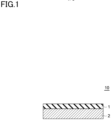
- FIG. 1 is a schematic cross-sectional view of a fire extinguishing body according to an embodiment.
- a fire extinguishing body 10 includes a substrate 1 and a fire extinguishing agent-containing layer 2 in this order.
- the fire extinguishing body can be a laminate including a flat (film-like) substrate and a fire extinguishing agent-containing layer formed on the substrate.
- the thickness of the fire extinguishing body is not necessarily limited because it varies depending on its layer configuration, the thickness thereof can be, for example, 2 to 20 mm in order to make the fire extinguishing body thinner to prevent limitations on a space therefor while maintaining ease in handling.
- the area of a major surface of the fire extinguishing body (surface when the fire extinguishing body is seen from above in a vertical direction) can be, for example, 9 to 620 cm 2 in terms of fire extinguishing performance and ease in handling.
- the substrate can be formed from a material having a Young's modulus of 2 MPa or more. With the substrate having a Young's modulus of 2 MPa or more, it is possible to sufficiently ensure the strength of the fire extinguishing body and make it easy to load the fire extinguishing body into the battery pack and remove the fire extinguishing body therefrom.
- the Young's modulus of the substrate may be more preferably 2.5 MPa or more, and even more preferably 4 MPa or more. While the upper limit on the Young's modulus of the substrate is not particularly limited, the upper limit thereof can be 700 GPa in view of the case where the substrate includes a rigid base plate.
- the substrate can include a resin layer.
- a material of the resin layer include polyolefins (such as LLDPE, PP, COP and CPP), polyesters (such as PET), fluoropolymers (such as PTFE, ETFE, EFEP, PFA, FEP and PCTFE), PVC, PVA, acrylic resins, epoxy resins, polyamides, polyimides, and the like.
- the substrate may include one or more resin layers formed from these materials. By selecting a transparent material, it becomes easy to examine the appearance of the fire extinguishing body and determine its replacement time. In terms of adjustment of water vapor transmission rate, the substrate may be provided with a vapor-deposited layer (an alumina-deposited layer or a silica-deposited layer) having water vapor barrier properties.
- the Young's modulus of the resin layer can be 2 MPa to 5 GPa and may be more preferably 2.5 MPa to 4 GPa. This sufficiently ensures the strength of the fire extinguishing body.
- the Young's modulus of the resin layer can be measured in accordance with ASTM-D-882.
- the thickness of the resin layer can be selected as appropriate according to required strength, an allowed space, and the like, the thickness thereof can be, for example, 0.0045 to 1 mm and may be more preferably 0.012 to 0.1 mm.
- the substrate can include a rigid base plate or, more specifically, a rigid base plate including at least one of a wood layer, a metal layer, and a glass layer (inorganic composition layer).
- a material of the wood layer include Japanese cedar, Japanese cypress, teak, and the like.
- a material of the metal layer include iron, stainless steel, tungsten superalloy, and the like.
- the Young's modulus of the rigid base plate can be 10 to 700 GPa, and may be more preferably 10 to 640 GPa, and even more preferably 13 to 630 GPa. This sufficiently ensures the strength of the fire extinguishing body.
- the Young's modulus of the rigid base plate can be measured in accordance with JIS-Z-2280.
- the thickness of the rigid base plate can be selected as appropriate according to required strength, an allowed space, and the like, the thickness thereof can be, for example, 0.012 to 10 mm and may be more preferably 0.1 to 5 mm.
- the lamination order of these in the fire extinguishing body is not particularly limited.
- the fire extinguishing body can include the fire extinguishing agent-containing layer, the resin layer, and the rigid base plate in this order.
- the fire extinguishing agent-containing layer may be, for example, a layer including a fire extinguishing agent and a binder resin.
- the fire extinguishing agent is not particularly limited, and an agent having at least one of the so-called four elements of fire extinguishing (removal action, cooling action, smothering action, and negative catalysis action) can be used as appropriate according to the form of a target object.
- Examples of the fire extinguishing agent include sand (standard sand), dry ice, water, and the like, in addition to typical fire extinguishing agents (fire-extinguishing powder agents, water-based fire-extinguishing agents, or fire-extinguishing foam agents).
- Examples of versatile fire extinguishing agents include ABC fire extinguishing agents, and examples of fire extinguishing agents for oil and electrical fires include BC fire extinguishing agents.
- a target object is a lithium-ion battery
- a BC fire extinguishing agent, a water-based fire-extinguishing agent, or some other fire extinguishing agent for lithium-ion batteries is used.
- thermoplastic resin examples include polyolefin resins such as polypropylene resins, polyethylene resins, poly(1-)butene resins, and polypentene resins, polystyrene resins, acrylonitrile-butadiene-styrene resins, methyl methacrylate-butadiene-styrene resins, ethylene-vinyl acetate resins, ethylene-propylene resins, polycarbonate resins, polyphenylene ether resins, acrylic resins, polyamide resins, polyvinyl chloride resins, polyvinyl alcohol (PVA), polyvinyl butyral (PVB), and the like.
- PVA polyvinyl alcohol
- PVB polyvinyl butyral
- thermosetting resin examples include rubber such as natural rubber (NR), isoprene rubber (IR), butadiene rubber (BR), 1,2-polybutadiene rubber (1,2-BR), styrene-butadiene rubber (SBR), chloroprene rubber (CR), nitrile rubber (NBR), butyl rubber (IIR), ethylene-propylene rubber (EPR, EPDM), chlorosulfonated polyethylene (CSM), acrylic rubber (ACM, ANM), epichlorohydrin rubber (CO, ECO), polysulfide rubber (T), silicone rubber (Q), fluororubber (FKM, FZ), and urethane rubber (U), polyurethane resins, polyisocyanate resins, polyisocyanurate resins, phenol resins, epoxy resins, and the like.
- the binder resin may include a curing agent component.
- the fire extinguishing agent-containing layer may include one or more other components such as a colorant, an antioxidant, a fire retardant, and an inorganic filler. These components can be selected as appropriate according to the composition of the fire extinguishing agent-containing layer and the type of the binder resin.
- the fire extinguishing agent-containing layer can be formed by applying a slurry including the fire extinguishing agent and binder to the substrate or can be formed by kneading the fire extinguishing agent into the resin.
- the fire extinguishing agent-containing layer may be a layer of the composition including the fire extinguishing agent and binder described above or a resin layer including the fire extinguishing agent.
- the resin into which the fire extinguishing agent is to be kneaded include, for example, polyolefin resins (such as polypropylene and polyethylene), polystyrene resins, acrylic resins, ethylene-vinyl acetate resins, polycarbonate resins, polyamide resins, polyvinyl chloride resins, fluorine-based resins, and the like.
- the content of the fire extinguishing agent in the fire extinguishing agent-containing layer (on the basis of the mass of the fire extinguishing agent-containing layer) can be 70 to 97 mass%, and may be more preferably 80 to 95 mass%, and even more preferably 85 to 92 mass%.
- the content of the fire extinguishing agent therein is 70 mass% or more, excellent fire extinguishing performance can be easily achieved, and when the content of the fire extinguishing agent therein is 97 mass% or less, excellent formability can be easily achieved.
- the content of the one or more other components in the fire extinguishing agent-containing layer (on the basis of the mass of the fire extinguishing agent-containing layer) can be 10 mass% or less.
- the thickness of the fire extinguishing agent-containing layer is set as appropriate according to the location where the fire extinguishing body is to be provided and the amount of the fire extinguishing agent to be blended.
- the thickness of the fire extinguishing agent-containing layer can be, for example, 1 mm or less, and may be more preferably 30 to 1000 ⁇ m, even more preferably 100 to 500 ⁇ m, and yet more preferably 150 to 500 ⁇ m.
- the fire extinguishing body may further include an adhesive layer. This makes it easy to improve the ease in handling of the fire extinguishing body and makes it easy to hold the fire extinguishing agent-containing layer stably on the substrate.
- the adhesive layer may be, for example, provided between the substrate and the fire extinguishing agent-containing layer, and between the resin layer and the rigid base plate in the substrate.
- the adhesive layer can be selected as appropriate according to, for example, the types of the substrate and the fire extinguishing agent.
- the adhesive layer can be formed from, for example, a material such as an adhesive or a pressure-sensitive adhesive.
- the thickness of the adhesive layer may be, for example, 1 to 100 ⁇ m (1 to 30 ⁇ m or 30 to 100 ⁇ m depending on the material used).
- a production method for the fire extinguishing body is not particularly limited, and the fire extinguishing body can be produced by laminating the above-described respective layers as appropriate.
- the manner in which the fire extinguishing agent-containing layer is provided may be determined according to its form.
- the fire extinguishing agent-containing layer can be formed by applying a slurry including the fire extinguishing agent and binder to the substrate.
- the fire extinguishing agent-containing layer can be formed by co-extruding, with the substrate, the resin into which the fire extinguishing agent has been kneaded.
- the fire extinguishing agent-containing layer and the substrate may be separately prepared and bonded to each other by lamination.
- the fire extinguishing body may be obtained by processing the fire extinguishing agent-containing layer on a resin layer that can be easily handled and then bonding the resin layer and the rigid base plate.
- the battery pack includes a housing, and the above-described fire extinguishing body and a battery both disposed inside the housing.
- the battery include lithium-ion batteries, nickel-cadmium batteries, lithium-ion polymer secondary batteries, nickel-metal hydride batteries, and the like.
- the above-described fire extinguishing body can be particularly preferably used with a lithium-ion battery.
- Fig. 2 is a schematic cross-sectional view of a battery pack according to an embodiment.
- the battery pack 100 includes a housing 30, and the above-described fire extinguishing body 10 and a plurality of pouch cells 20 disposed inside the housing 30.
- the fire extinguishing body 10 is provided at a location that can be easily externally accessed, so that it can be easily replaced.
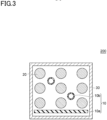
- Fig. 3 is a schematic cross-sectional view of a battery pack according to another embodiment.
- the battery pack 200 includes a housing 30, and above-described fire extinguishing bodies 10 and cylindrical cells 20 disposed inside the housing 30.
- the fire extinguishing bodies 10 include a fire extinguishing body 10a provided at the bottom of the housing 30, and a fire extinguishing body 10b obtained by rolling up the fire extinguishing body 10 into a cylindrical shape and provided in a space between adjacent cylindrical cells.
- these fire extinguishing bodies 10 are provided at locations that can be easily externally accessed, so that they can be easily replaced.
- the one or more fire extinguishing bodies in the battery pack may not necessarily be provided at a location that can be easily externally accessed and are only needed to be provided at a location into which the fire extinguishing body can be loaded and from which the fire extinguishing body can be removed.
- the fire extinguishing body 10 may also be provided between two adjacent pouch cells 20.
- the fire extinguishing body is a laminate including a flat (film-like) substrate and a fire extinguishing agent-containing layer formed on the substrate.
- the fire extinguishing body may have a core-sheath structure including a columnar (cylindrical or prismatic) substrate and a fire extinguishing agent-containing layer formed on the substrate.
- the binder resin was added to the fire extinguishing agent to prepare a coating solution, and the coating solution was applied to the film substrate (resin layer) and dried at 90°C for two minutes.
- a fire extinguishing body including the film substrate and a fire extinguishing agent-containing layer thereon was obtained.
- the thickness of the fire extinguishing agent-containing layer was 200 ⁇ m. The fire extinguishing agent-containing layers were formed in the same manner regardless of the size thereof.
- the Young's modulus of the substrate was measured as follows. In the case where only the fire extinguishing agent-containing layer was included in the layer configuration (comparative example 1), the Young's modulus of the fire extinguishing agent-containing layer was measured in accordance with a method of measuring the resin layer. The Young's modulus of the fire extinguishing agent-containing layer itself was 1 MPa.
- Fire extinguishing bodies were produced in the same manner as Example 1, except that layer configurations were changed as indicated in Table 1.
- Fire extinguishing agent-containing layers having a thickness of 200 ⁇ m were formed on respective film substrates in the similar manner as Example 1. Then, the rigid base plate and each film substrate were bonded to each other with an adhesive tape (thickness: 50 ⁇ m) to obtain fire extinguishing bodies.
- Fire extinguishing bodies were produced in the same manner as Example 4, except that layer configurations were changed as indicated in Table 1.
- Cylindrical fire extinguishing bodies were each obtained by rolling up the fire extinguishing body of Example 3 into a cylindrical shape.
- Fire extinguishing agent-containing layers having a thickness of 200 ⁇ m were formed on respective film substrates in the same manner as Example 7.
- the resulting laminates were each rolled up into a cylindrical shape and wrapped around the rigid base plate processed into a cylindrical shape, to obtain fire extinguishing bodies.
- the binder resin was added to the fire extinguishing agent to prepare coating solutions, and these coating solutions were applied to respective silicone release agent-coated PET films (manufactured by Toyobo Co., Ltd.) and dried at 90°C for two minutes.
- fire extinguishing agent-containing layers were formed on the respective films.
- single-layer fire extinguishing agent-containing layers were obtained.
- the thickness of each fire extinguishing agent-containing layer was 200 ⁇ m.
- Fire extinguishing bodies were produced in the same manner as Example 1, except that a layer configuration was changed as indicated in Table 1.
- a fire extinguishing body of the present invention can be easily replaced even after being loaded into a battery pack.
- a safer battery pack can be provided.
Landscapes
- Chemical & Material Sciences (AREA)
- Electrochemistry (AREA)
- General Chemical & Material Sciences (AREA)
- Chemical Kinetics & Catalysis (AREA)
- Engineering & Computer Science (AREA)
- Public Health (AREA)
- Health & Medical Sciences (AREA)
- Business, Economics & Management (AREA)
- Emergency Management (AREA)
- Manufacturing & Machinery (AREA)
- Materials Engineering (AREA)
- Mechanical Engineering (AREA)
- Structural Engineering (AREA)
- Life Sciences & Earth Sciences (AREA)
- Wood Science & Technology (AREA)
- Battery Mounting, Suspending (AREA)
Abstract
Description
- The present invention relates to fire extinguishing bodies and battery packs.
- A technique of incorporating a film having a fire extinguishing function into a battery is known (see, for example, PTL 1). According to this technique, a material having a fire extinguishing function is wrapped with a film and provided inside a battery can, so that safety in case of an emergency is secured by the fire extinguishing function being exerted as a result of the film being broken by flames or high-temperature gas being generated as a result abnormality occurring in the battery.
- [PTL 1]
JP 2007-227171 A - In battery cans, particularly for in-vehicle lithium-ion battery packs, storage batteries at power plants, or the like, while the housing itself lasts for ten years and more, a typical fire extinguishing agent requires replacement for every one to five years, and a resin film, or the like, that covers the fire extinguishing agent also becomes brittle and prone to breakage within one to five years. If the fire extinguishing agent is incorporated into the battery can or the storage battery by bonding or the like, a problem arises that the fire extinguishing agent that is not to be replaced may be broken upon replacement, and thus, the fire extinguishing agent cannot be easily replaced.
- The present invention has been made in view of the above-described circumstances; an object thereof is to provide a fire extinguishing body that can be easily replaced even after being loaded into a battery pack. Another object of the present invention is to provide a battery pack including such a fire extinguishing body.
- A fire extinguishing body according to an aspect of the present invention includes a substrate and a fire extinguishing agent-containing layer facing the substrate, the substrate having a Young's modulus of 2 MPa or more.
- In another aspect, the substrate may include a resin layer.
- In another aspect, the resin layer may have a Young's modulus of 2 MPa to 5 GPa.
- In another aspect, the substrate may include at least one of a wood layer, a metal layer, and a glass layer.
- In another aspect, each of the wood layer, the metal layer, and the glass layer may have a Young's modulus of 10 to 700 GPa.
- A battery pack according to an aspect of the present invention includes a housing, the above fire extinguishing body, and a battery, the above fire extinguishing body and the battery being disposed inside the housing.
- In another aspect, the battery may be a lithium-ion battery.
- The present invention provides a fire extinguishing body that can be easily replaced even after being loaded into a battery pack. The present invention also provides a battery pack including such a fire extinguishing body.
-
-
Fig. 1 is a schematic cross-sectional view of a fire extinguishing body according to an embodiment. -
Fig. 2 is a schematic cross-sectional view of a battery pack according to an embodiment. -
Fig. 3 is a schematic cross-sectional view of a battery pack according to another embodiment. - Embodiments of the present invention will be described in detail below. However, the present invention is not limited to the following embodiments.
-
Fig. 1 is a schematic cross-sectional view of a fire extinguishing body according to an embodiment. Afire extinguishing body 10 includes asubstrate 1 and a fire extinguishing agent-containinglayer 2 in this order. The fire extinguishing body can be a laminate including a flat (film-like) substrate and a fire extinguishing agent-containing layer formed on the substrate. - While the thickness of the fire extinguishing body is not necessarily limited because it varies depending on its layer configuration, the thickness thereof can be, for example, 2 to 20 mm in order to make the fire extinguishing body thinner to prevent limitations on a space therefor while maintaining ease in handling. Moreover, the area of a major surface of the fire extinguishing body (surface when the fire extinguishing body is seen from above in a vertical direction) can be, for example, 9 to 620 cm2 in terms of fire extinguishing performance and ease in handling.
- The substrate can be formed from a material having a Young's modulus of 2 MPa or more. With the substrate having a Young's modulus of 2 MPa or more, it is possible to sufficiently ensure the strength of the fire extinguishing body and make it easy to load the fire extinguishing body into the battery pack and remove the fire extinguishing body therefrom. In terms of this, the Young's modulus of the substrate may be more preferably 2.5 MPa or more, and even more preferably 4 MPa or more. While the upper limit on the Young's modulus of the substrate is not particularly limited, the upper limit thereof can be 700 GPa in view of the case where the substrate includes a rigid base plate.
- The substrate can include a resin layer. Examples of a material of the resin layer include polyolefins (such as LLDPE, PP, COP and CPP), polyesters (such as PET), fluoropolymers (such as PTFE, ETFE, EFEP, PFA, FEP and PCTFE), PVC, PVA, acrylic resins, epoxy resins, polyamides, polyimides, and the like. The substrate may include one or more resin layers formed from these materials. By selecting a transparent material, it becomes easy to examine the appearance of the fire extinguishing body and determine its replacement time. In terms of adjustment of water vapor transmission rate, the substrate may be provided with a vapor-deposited layer (an alumina-deposited layer or a silica-deposited layer) having water vapor barrier properties.
- The Young's modulus of the resin layer can be 2 MPa to 5 GPa and may be more preferably 2.5 MPa to 4 GPa. This sufficiently ensures the strength of the fire extinguishing body. The Young's modulus of the resin layer can be measured in accordance with ASTM-D-882.
- While the thickness of the resin layer can be selected as appropriate according to required strength, an allowed space, and the like, the thickness thereof can be, for example, 0.0045 to 1 mm and may be more preferably 0.012 to 0.1 mm.
- The substrate can include a rigid base plate or, more specifically, a rigid base plate including at least one of a wood layer, a metal layer, and a glass layer (inorganic composition layer). Examples of a material of the wood layer include Japanese cedar, Japanese cypress, teak, and the like. Examples of a material of the metal layer include iron, stainless steel, tungsten superalloy, and the like.
- The Young's modulus of the rigid base plate can be 10 to 700 GPa, and may be more preferably 10 to 640 GPa, and even more preferably 13 to 630 GPa. This sufficiently ensures the strength of the fire extinguishing body. The Young's modulus of the rigid base plate can be measured in accordance with JIS-Z-2280.
- While the thickness of the rigid base plate can be selected as appropriate according to required strength, an allowed space, and the like, the thickness thereof can be, for example, 0.012 to 10 mm and may be more preferably 0.1 to 5 mm.
- In the case where the substrate includes the resin layer and the rigid base plate, the lamination order of these in the fire extinguishing body is not particularly limited. However, in terms of ease in handling during a manufacturing process, the fire extinguishing body can include the fire extinguishing agent-containing layer, the resin layer, and the rigid base plate in this order.
- The fire extinguishing agent-containing layer may be, for example, a layer including a fire extinguishing agent and a binder resin. The fire extinguishing agent is not particularly limited, and an agent having at least one of the so-called four elements of fire extinguishing (removal action, cooling action, smothering action, and negative catalysis action) can be used as appropriate according to the form of a target object. Examples of the fire extinguishing agent include sand (standard sand), dry ice, water, and the like, in addition to typical fire extinguishing agents (fire-extinguishing powder agents, water-based fire-extinguishing agents, or fire-extinguishing foam agents). Examples of versatile fire extinguishing agents include ABC fire extinguishing agents, and examples of fire extinguishing agents for oil and electrical fires include BC fire extinguishing agents. In the case where a target object is a lithium-ion battery, a BC fire extinguishing agent, a water-based fire-extinguishing agent, or some other fire extinguishing agent for lithium-ion batteries is used.
- As the binder resin, a thermoplastic resin and a thermosetting resin can be used. Examples of the thermoplastic resin include polyolefin resins such as polypropylene resins, polyethylene resins, poly(1-)butene resins, and polypentene resins, polystyrene resins, acrylonitrile-butadiene-styrene resins, methyl methacrylate-butadiene-styrene resins, ethylene-vinyl acetate resins, ethylene-propylene resins, polycarbonate resins, polyphenylene ether resins, acrylic resins, polyamide resins, polyvinyl chloride resins, polyvinyl alcohol (PVA), polyvinyl butyral (PVB), and the like. Examples of the thermosetting resin include rubber such as natural rubber (NR), isoprene rubber (IR), butadiene rubber (BR), 1,2-polybutadiene rubber (1,2-BR), styrene-butadiene rubber (SBR), chloroprene rubber (CR), nitrile rubber (NBR), butyl rubber (IIR), ethylene-propylene rubber (EPR, EPDM), chlorosulfonated polyethylene (CSM), acrylic rubber (ACM, ANM), epichlorohydrin rubber (CO, ECO), polysulfide rubber (T), silicone rubber (Q), fluororubber (FKM, FZ), and urethane rubber (U), polyurethane resins, polyisocyanate resins, polyisocyanurate resins, phenol resins, epoxy resins, and the like. The binder resin may include a curing agent component.
- The fire extinguishing agent-containing layer may include one or more other components such as a colorant, an antioxidant, a fire retardant, and an inorganic filler. These components can be selected as appropriate according to the composition of the fire extinguishing agent-containing layer and the type of the binder resin.
- The fire extinguishing agent-containing layer can be formed by applying a slurry including the fire extinguishing agent and binder to the substrate or can be formed by kneading the fire extinguishing agent into the resin. In other words, the fire extinguishing agent-containing layer may be a layer of the composition including the fire extinguishing agent and binder described above or a resin layer including the fire extinguishing agent. Examples of the resin into which the fire extinguishing agent is to be kneaded include, for example, polyolefin resins (such as polypropylene and polyethylene), polystyrene resins, acrylic resins, ethylene-vinyl acetate resins, polycarbonate resins, polyamide resins, polyvinyl chloride resins, fluorine-based resins, and the like.
- The content of the fire extinguishing agent in the fire extinguishing agent-containing layer (on the basis of the mass of the fire extinguishing agent-containing layer) can be 70 to 97 mass%, and may be more preferably 80 to 95 mass%, and even more preferably 85 to 92 mass%. When the content of the fire extinguishing agent therein is 70 mass% or more, excellent fire extinguishing performance can be easily achieved, and when the content of the fire extinguishing agent therein is 97 mass% or less, excellent formability can be easily achieved. In the case where the fire extinguishing agent-containing layer contains one or more other components, the content of the one or more other components in the fire extinguishing agent-containing layer (on the basis of the mass of the fire extinguishing agent-containing layer) can be 10 mass% or less.
- The thickness of the fire extinguishing agent-containing layer is set as appropriate according to the location where the fire extinguishing body is to be provided and the amount of the fire extinguishing agent to be blended. The thickness of the fire extinguishing agent-containing layer can be, for example, 1 mm or less, and may be more preferably 30 to 1000 µm, even more preferably 100 to 500 µm, and yet more preferably 150 to 500 µm.
- The fire extinguishing body may further include an adhesive layer. This makes it easy to improve the ease in handling of the fire extinguishing body and makes it easy to hold the fire extinguishing agent-containing layer stably on the substrate. The adhesive layer may be, for example, provided between the substrate and the fire extinguishing agent-containing layer, and between the resin layer and the rigid base plate in the substrate.
- The adhesive layer can be selected as appropriate according to, for example, the types of the substrate and the fire extinguishing agent. The adhesive layer can be formed from, for example, a material such as an adhesive or a pressure-sensitive adhesive. The thickness of the adhesive layer may be, for example, 1 to 100 µm (1 to 30 µm or 30 to 100 µm depending on the material used).
- A production method for the fire extinguishing body is not particularly limited, and the fire extinguishing body can be produced by laminating the above-described respective layers as appropriate. The manner in which the fire extinguishing agent-containing layer is provided may be determined according to its form. For example, the fire extinguishing agent-containing layer can be formed by applying a slurry including the fire extinguishing agent and binder to the substrate. Alternatively, the fire extinguishing agent-containing layer can be formed by co-extruding, with the substrate, the resin into which the fire extinguishing agent has been kneaded. The fire extinguishing agent-containing layer and the substrate may be separately prepared and bonded to each other by lamination. Moreover, the fire extinguishing body may be obtained by processing the fire extinguishing agent-containing layer on a resin layer that can be easily handled and then bonding the resin layer and the rigid base plate.
- The battery pack includes a housing, and the above-described fire extinguishing body and a battery both disposed inside the housing. Examples of the battery include lithium-ion batteries, nickel-cadmium batteries, lithium-ion polymer secondary batteries, nickel-metal hydride batteries, and the like. The above-described fire extinguishing body can be particularly preferably used with a lithium-ion battery.
-
Fig. 2 is a schematic cross-sectional view of a battery pack according to an embodiment. InFig. 2 , thebattery pack 100 includes ahousing 30, and the above-describedfire extinguishing body 10 and a plurality ofpouch cells 20 disposed inside thehousing 30. InFig. 2 , thefire extinguishing body 10 is provided at a location that can be easily externally accessed, so that it can be easily replaced. -
Fig. 3 is a schematic cross-sectional view of a battery pack according to another embodiment. InFig. 3 , thebattery pack 200 includes ahousing 30, and above-describedfire extinguishing bodies 10 andcylindrical cells 20 disposed inside thehousing 30. Thefire extinguishing bodies 10 include afire extinguishing body 10a provided at the bottom of thehousing 30, and afire extinguishing body 10b obtained by rolling up thefire extinguishing body 10 into a cylindrical shape and provided in a space between adjacent cylindrical cells. InFig. 3 , thesefire extinguishing bodies 10 are provided at locations that can be easily externally accessed, so that they can be easily replaced. - The one or more fire extinguishing bodies in the battery pack may not necessarily be provided at a location that can be easily externally accessed and are only needed to be provided at a location into which the fire extinguishing body can be loaded and from which the fire extinguishing body can be removed. For example, in the case of the
battery pack 100, thefire extinguishing body 10 may also be provided between twoadjacent pouch cells 20. - The description has been provided of the case where the fire extinguishing body is a laminate including a flat (film-like) substrate and a fire extinguishing agent-containing layer formed on the substrate. However, the fire extinguishing body may have a core-sheath structure including a columnar (cylindrical or prismatic) substrate and a fire extinguishing agent-containing layer formed on the substrate.
- Although the present invention will be described in greater detail using the following examples, the present invention is not limited to these examples.
-
- Film substrate: LLDPE (manufactured by Mitsui Chemicals Tohcello, Inc., thickness: 30 µm, brand: MC-S, used in Example 1)
- Film substrate: LLDPE (manufactured by Mitsui Chemicals Tohcello, Inc., thickness: 12 µm, brand: MCS, used in Comparative Example 2)
- Film substrate: PET (manufactured by Toray Industries, Inc., thickness: 50 µm, brand: Lumirror S10)
- Film substrate: ETFE (manufactured by AGC Inc., thickness: 50 µm, brand: AFLEX)
- Rigid base plate: wood (teak, thickness: 5 mm)
- Rigid base plate: iron (thickness: 5 mm)
- Rigid base plate: SUS430 (thickness: 5 mm)
- Rigid base plate: cemented carbide (manufactured by Nippon Tungsten Co., Ltd., brand: UM-10, thickness: 5 mm)
- Fire extinguishing agent: ABC fire extinguishing agent (manufactured by MORITA MIYATA CORPORATION)
- Binder resin: Epoxy resin and epoxy resin curing agent
- The binder resin was added to the fire extinguishing agent to prepare a coating solution, and the coating solution was applied to the film substrate (resin layer) and dried at 90°C for two minutes. Thus, a fire extinguishing body including the film substrate and a fire extinguishing agent-containing layer thereon was obtained. The thickness of the fire extinguishing agent-containing layer was 200 µm.The fire extinguishing agent-containing layers were formed in the same manner regardless of the size thereof.
- The Young's modulus of the substrate was measured as follows. In the case where only the fire extinguishing agent-containing layer was included in the layer configuration (comparative example 1), the Young's modulus of the fire extinguishing agent-containing layer was measured in accordance with a method of measuring the resin layer. The Young's modulus of the fire extinguishing agent-containing layer itself was 1 MPa.
- Resin layer: measured in accordance with ASTM-D-882
- Rigid base plate (wood, metal): measured in accordance with JIS-Z-2280
- Fire extinguishing bodies were produced in the same manner as Example 1, except that layer configurations were changed as indicated in Table 1.
- Fire extinguishing agent-containing layers having a thickness of 200 µm were formed on respective film substrates in the similar manner as Example 1. Then, the rigid base plate and each film substrate were bonded to each other with an adhesive tape (thickness: 50 µm) to obtain fire extinguishing bodies.
- Fire extinguishing bodies were produced in the same manner as Example 4, except that layer configurations were changed as indicated in Table 1.
- Cylindrical fire extinguishing bodies were each obtained by rolling up the fire extinguishing body of Example 3 into a cylindrical shape.
- Fire extinguishing agent-containing layers having a thickness of 200 µm were formed on respective film substrates in the same manner as Example 7. The resulting laminates were each rolled up into a cylindrical shape and wrapped around the rigid base plate processed into a cylindrical shape, to obtain fire extinguishing bodies.
- The binder resin was added to the fire extinguishing agent to prepare coating solutions, and these coating solutions were applied to respective silicone release agent-coated PET films (manufactured by Toyobo Co., Ltd.) and dried at 90°C for two minutes. Thus, fire extinguishing agent-containing layers were formed on the respective films. By releasing only the fire extinguishing agent-containing layer from each film, single-layer fire extinguishing agent-containing layers were obtained. The thickness of each fire extinguishing agent-containing layer was 200 µm.
- Fire extinguishing bodies were produced in the same manner as Example 1, except that a layer configuration was changed as indicated in Table 1.
- Small battery packs of cylindrical cells (housing size: a cube of 70 mm in length × 70 mm in width × 70 mm in height) were prepared. It was checked whether fire extinguishing bodies produced in the examples were damaged when they were loaded into respective ones of the battery packs and removed therefrom. Results are shown in Table 1. Note that the plate-like fire extinguishing bodies were provided at the bottom of respective ones of the battery packs as with the
fire extinguishing body 10a illustrated inFig. 3 . The cylindrical fire extinguishing bodies were provided in respective spaces between adjacent cells as with thefire extinguishing bodies 10b illustrated inFig. 3 . - Large battery packs of pouch cells (housing size: a cuboid of 210 mm in length × 180 mm in width × 115 mm in height) were prepared. It was checked whether fire extinguishing bodies produced in the examples were damaged when they were loaded into respective ones of the battery packs and removed therefrom. Results are shown in Table 1. Note that the fire extinguishing bodies were provided at the bottom of the respective battery packs as with the
fire extinguishing body 10 illustrated inFig. 2 .[Table 1] Configuration of fire extinguishing body Evaluation result Base material Fire extinguishing agent-containing layer Shape of fire extinguishing body Battery pack Whether or not there is damage Rigid substrate Film base material Upon loading Upon ejection Rigid base plate Young's modulus Film substrate Young's modulus Comp. Ex. 1 - - - - Included Plate Small Damaged Damaged - - - - Included Plate Large Damaged Damaged Comp. Ex. 2 - - LLDPE 1.5 MPa Included Plate Small Not damaged Damaged - - LLDPE 1.5 MPa Included Plate Large Damaged Damaged Ex. 1 - - LLDPE 2.0 MPa Included Plate Small Not damaged Not damaged - - LLDPE 2.0 MPa Included Plate Large Not damaged Not damaged EX. 2 - - PET 4 GPa Included Plate Small Not damaged Not damaged - - PET 4 GPa Included Plate Large Not damaged Not damaged EX. 3 - - ETFE 2.6 GPa Included Plate Small Not damaged Not damaged - - ETFE 2.6 GPa Included Plate Large Not damaged Not damaged EX. 4 Wood 13 GPa PET 4 GPa Included Plate Small Not damaged Not damaged Wood 13 GPa PET 4 GPa Included Plate Large Not damaged Not damaged EX. 5 Iron 205 GPa PET 4 GPa Included Plate Small Not damaged Not damaged Iron 205 GPa PET 4 GPa Included Plate Large Not damaged Not damaged EX. 6 SUS430 200 GPa PET 4 GPa Included Plate Small Not damaged Not damaged SUS430 200 GPa PET 4 GPa Included Plate Large Not damaged Not damaged EX. 7 Cemented carbide alloy 640 GPa PET 4 GPa Included Plate Small Not damaged Not damaged Cemented carbide alloy 640 GPa PET 4 GPa Included Plate Large Not damaged Not damaged EX. 8 - - ETFE 2.6 GPa Included Cylinder Small Not damaged Not damaged - - ETFE 2.6 GPa Included Cylinder Large - - EX. 9 Cemented carbide alloy 640 GPa PET 4 GPa Included Cylinder Small Not damaged Not damaged Cemented carbide alloy 640 GPa PET 4 GPa Included Cylinder Large - - - A fire extinguishing body of the present invention can be easily replaced even after being loaded into a battery pack. Thus, by replacing the fire extinguishing body every fixed number of years to ensure the fire extinguishing performance, a safer battery pack can be provided.
-
- 1
- Substrate
- 2
- Fire extinguishing agent-containing layer
- 10
- Fire extinguishing body
- 20
- Cell
- 30
- Housing
- 100, 200
- Battery pack
Claims (7)
- A fire extinguishing body comprising:a substrate; anda fire extinguishing agent-containing layer facing the substrate,the substrate having a Young's modulus of 2 MPa or more.
- The fire extinguishing body according to claim 1,
wherein the substrate includes a resin layer. - The fire extinguishing body according to claim 2,
wherein the resin layer has a Young's modulus of 2 MPa to 5 GPa. - The fire extinguishing body according to any one of claims 1 to 3,
wherein the substrate includes at least one of a wood layer, a metal layer, and a glass layer. - The fire extinguishing body according to claim 4,
wherein each of the wood layer, the metal layer, and the glass layer has a Young's modulus of 10 to 700 GPa. - A battery pack comprising:a housing;a fire extinguishing body according to any one of claims 1 to 5; anda battery,the fire extinguishing body and the battery being disposed inside the housing.
- The battery pack according to claim 6,
wherein the battery is a lithium-ion battery.
Applications Claiming Priority (2)
| Application Number | Priority Date | Filing Date | Title |
|---|---|---|---|
| JP2020183755 | 2020-11-02 | ||
| PCT/JP2021/039681 WO2022092159A1 (en) | 2020-11-02 | 2021-10-27 | Fire extinguishing body and battery pack |
Publications (2)
| Publication Number | Publication Date |
|---|---|
| EP4238615A1 true EP4238615A1 (en) | 2023-09-06 |
| EP4238615A4 EP4238615A4 (en) | 2024-03-06 |
Family
ID=81381477
Family Applications (1)
| Application Number | Title | Priority Date | Filing Date |
|---|---|---|---|
| EP21886276.1A Pending EP4238615A4 (en) | 2020-11-02 | 2021-10-27 | Fire extinguishing body and battery pack |
Country Status (6)
| Country | Link |
|---|---|
| US (1) | US20240042254A1 (en) |
| EP (1) | EP4238615A4 (en) |
| JP (1) | JP7848691B2 (en) |
| KR (1) | KR20230096078A (en) |
| CN (1) | CN116419781A (en) |
| WO (1) | WO2022092159A1 (en) |
Family Cites Families (11)
| Publication number | Priority date | Publication date | Assignee | Title |
|---|---|---|---|---|
| JPS50132799A (en) * | 1974-04-01 | 1975-10-21 | ||
| JPH0584873A (en) * | 1991-09-27 | 1993-04-06 | Toppan Printing Co Ltd | Self-extinguishing sheet |
| JP5072235B2 (en) * | 2006-02-23 | 2012-11-14 | 三菱重工業株式会社 | Non-aqueous electrolyte secondary battery and power storage device using non-aqueous electrolyte secondary battery |
| JP4959513B2 (en) * | 2007-11-09 | 2012-06-27 | 大和グランド株式会社 | Manufacturing method of fire-extinguishing prints |
| JP5966549B2 (en) * | 2012-04-13 | 2016-08-10 | 凸版印刷株式会社 | Exterior materials for lithium-ion batteries |
| JP2014049226A (en) | 2012-08-30 | 2014-03-17 | Shin Kobe Electric Mach Co Ltd | Secondary battery module |
| JP6738905B2 (en) | 2016-10-18 | 2020-08-12 | 株式会社日立製作所 | Storage battery device for storage battery train and storage battery train |
| JP6700490B2 (en) | 2018-02-20 | 2020-05-27 | 積水化学工業株式会社 | Fireproof laminate and battery |
| KR102773005B1 (en) * | 2018-09-04 | 2025-02-27 | 야마토 프로텍 가부시키가이샤 | fire extinguisher |
| JP7196480B2 (en) * | 2018-09-12 | 2022-12-27 | 大日本印刷株式会社 | Exterior material for power storage device, manufacturing method thereof, and power storage device |
| CN210813650U (en) * | 2019-06-24 | 2020-06-23 | 西安威西特消防科技有限责任公司 | Fire extinguishing patch |
-
2021
- 2021-10-27 KR KR1020237018072A patent/KR20230096078A/en not_active Ceased
- 2021-10-27 JP JP2022559205A patent/JP7848691B2/en active Active
- 2021-10-27 EP EP21886276.1A patent/EP4238615A4/en active Pending
- 2021-10-27 CN CN202180072105.6A patent/CN116419781A/en active Pending
- 2021-10-27 WO PCT/JP2021/039681 patent/WO2022092159A1/en not_active Ceased
-
2023
- 2023-05-01 US US18/141,664 patent/US20240042254A1/en active Pending
Also Published As
| Publication number | Publication date |
|---|---|
| WO2022092159A1 (en) | 2022-05-05 |
| KR20230096078A (en) | 2023-06-29 |
| EP4238615A4 (en) | 2024-03-06 |
| US20240042254A1 (en) | 2024-02-08 |
| JP7848691B2 (en) | 2026-04-21 |
| CN116419781A (en) | 2023-07-11 |
| JPWO2022092159A1 (en) | 2022-05-05 |
Similar Documents
| Publication | Publication Date | Title |
|---|---|---|
| US11139524B2 (en) | Lid for cell tray, lid-attached cell tray, and method for manufacturing battery | |
| KR101739637B1 (en) | Packing material for battery case and battery case | |
| KR102184118B1 (en) | A cell pouch with improved high-temperature stability and secondary battery including the same | |
| EP3951906A1 (en) | Lithium ion battery stack | |
| EP4343932A1 (en) | Pouch film laminate and secondary battery | |
| KR101894449B1 (en) | Cell pouch and method of preparing the same | |
| KR101712990B1 (en) | Flexible cell pouch and secondary battery including the same | |
| KR101874900B1 (en) | Cell pouch and method of preparing the same | |
| US9464430B2 (en) | Vacuum insulation material | |
| KR20200130869A (en) | Molding packaging material and battery case | |
| EP4094808A1 (en) | Fire extinguishing body | |
| EP3756884A1 (en) | Fireproof laminate and battery | |
| CN101252209A (en) | Lithium rechargeable batteries using laminated outer packaging materials | |
| KR101893608B1 (en) | Battery and method for producing the same | |
| KR20140070395A (en) | External body for electrochemical devices | |
| EP4257207A1 (en) | Fire extinguishing body | |
| KR20160070468A (en) | Cell pouch and method of manufacturing the same | |
| KR20190126710A (en) | Outer casing material for electricity storage device, and electricity storage device | |
| EP1857164A1 (en) | Adsorption film and organic el device | |
| US20240042254A1 (en) | Fire extinguishing body and battery pack | |
| EP4309745A1 (en) | Layered product for extinguishing fire, production method for layered product for extinguishing fire, and electronic member | |
| KR20180057926A (en) | Cell pouch with high chemical resistance and moldability | |
| CN117222451A (en) | Fire-extinguishing laminated body, manufacturing method of fire-extinguishing laminated body, and electronic component | |
| EP4556082A1 (en) | Fire extinguishing material and fire extinguishing material package | |
| KR20170075287A (en) | Cell pouch with high chemical resistance and method for manufacturing the same |
Legal Events
| Date | Code | Title | Description |
|---|---|---|---|
| STAA | Information on the status of an ep patent application or granted ep patent |
Free format text: STATUS: THE INTERNATIONAL PUBLICATION HAS BEEN MADE |
|
| PUAI | Public reference made under article 153(3) epc to a published international application that has entered the european phase |
Free format text: ORIGINAL CODE: 0009012 |
|
| STAA | Information on the status of an ep patent application or granted ep patent |
Free format text: STATUS: REQUEST FOR EXAMINATION WAS MADE |
|
| 17P | Request for examination filed |
Effective date: 20230427 |
|
| AK | Designated contracting states |
Kind code of ref document: A1 Designated state(s): AL AT BE BG CH CY CZ DE DK EE ES FI FR GB GR HR HU IE IS IT LI LT LU LV MC MK MT NL NO PL PT RO RS SE SI SK SM TR |
|
| REG | Reference to a national code |
Ref country code: DE Ref legal event code: R079 Free format text: PREVIOUS MAIN CLASS: A62C0003160000 Ipc: B32B0007022000 |
|
| DAV | Request for validation of the european patent (deleted) | ||
| DAX | Request for extension of the european patent (deleted) | ||
| A4 | Supplementary search report drawn up and despatched |
Effective date: 20240201 |
|
| RIC1 | Information provided on ipc code assigned before grant |
Ipc: B32B 27/06 20060101ALI20240126BHEP Ipc: B32B 21/08 20060101ALI20240126BHEP Ipc: B32B 17/10 20060101ALI20240126BHEP Ipc: B32B 15/08 20060101ALI20240126BHEP Ipc: A62C 35/10 20060101ALI20240126BHEP Ipc: B32B 7/022 20190101AFI20240126BHEP |