EP4236623A1 - Hybrid easy to clean coating for microwave appliance - Google Patents
Hybrid easy to clean coating for microwave appliance Download PDFInfo
- Publication number
- EP4236623A1 EP4236623A1 EP23157398.1A EP23157398A EP4236623A1 EP 4236623 A1 EP4236623 A1 EP 4236623A1 EP 23157398 A EP23157398 A EP 23157398A EP 4236623 A1 EP4236623 A1 EP 4236623A1
- Authority
- EP
- European Patent Office
- Prior art keywords
- coating
- easy
- hybrid
- microwave
- heating
- Prior art date
- Legal status (The legal status is an assumption and is not a legal conclusion. Google has not performed a legal analysis and makes no representation as to the accuracy of the status listed.)
- Withdrawn
Links
Images

Classifications
-
- H—ELECTRICITY
- H05—ELECTRIC TECHNIQUES NOT OTHERWISE PROVIDED FOR
- H05B—ELECTRIC HEATING; ELECTRIC LIGHT SOURCES NOT OTHERWISE PROVIDED FOR; CIRCUIT ARRANGEMENTS FOR ELECTRIC LIGHT SOURCES, IN GENERAL
- H05B6/00—Heating by electric, magnetic or electromagnetic fields
- H05B6/64—Heating using microwaves
- H05B6/6402—Aspects relating to the microwave cavity
-
- H—ELECTRICITY
- H05—ELECTRIC TECHNIQUES NOT OTHERWISE PROVIDED FOR
- H05B—ELECTRIC HEATING; ELECTRIC LIGHT SOURCES NOT OTHERWISE PROVIDED FOR; CIRCUIT ARRANGEMENTS FOR ELECTRIC LIGHT SOURCES, IN GENERAL
- H05B6/00—Heating by electric, magnetic or electromagnetic fields
- H05B6/64—Heating using microwaves
- H05B6/6408—Supports or covers specially adapted for use in microwave heating apparatus
-
- H—ELECTRICITY
- H05—ELECTRIC TECHNIQUES NOT OTHERWISE PROVIDED FOR
- H05B—ELECTRIC HEATING; ELECTRIC LIGHT SOURCES NOT OTHERWISE PROVIDED FOR; CIRCUIT ARRANGEMENTS FOR ELECTRIC LIGHT SOURCES, IN GENERAL
- H05B6/00—Heating by electric, magnetic or electromagnetic fields
- H05B6/64—Heating using microwaves
- H05B6/66—Circuits
- H05B6/68—Circuits for monitoring or control
- H05B6/687—Circuits for monitoring or control for cooking
Definitions
- the present application is directed to a cooking appliance, and more particularly an easy to clean coating for heating appliances which use microwave heating.
- Ovens are heating appliances for food preparation having a housing defining a cavity forming a cooking chamber therein.
- Ovens include a heating mechanism for cooking food placed within the cooking chamber, with the heating mechanism being variable across different types of ovens, and two or more types of heating mechanisms may be combined in combination ovens.
- Common types of ovens include electric ovens (which include conduction/conventional and convection ovens), gas ovens, toaster ovens, and microwave ovens.
- the heating mechanisms vary across these ovens, with some including the heating mechanisms within the cooking chamber itself (e.g., conventional ovens), or in the housing (e.g., convection ovens) such that energy or heat is transferred to the cooking chamber or the food.
- the heating mechanism in electric ovens includes electric coils (with circulation via fans in convection ovens) to heat the cooking chamber, in gas ovens includes burning natural gas to heat the cooking chamber, and in microwave ovens includes electromagnetic radiation via strong radio waves from devices such as magnetrons to heat the food itself.
- Food placed within the cooking chamber upon heating may splatter or otherwise adhere to the interior surfaces of the chamber. As such, surfaces that are easy to clean are desirable.
- a heating appliance includes a housing having interior walls with interior surfaces defining a cooking chamber for heating food, a microwave heating source configured to generate microwave radiation for heating the food, and a hybrid easy-to-clean coating on at least a portion of the interior surfaces, the hybrid easy-to-clean coating having a water contact angle of at least 150 degrees thereon.
- the hybrid easy-to-clean coating includes a microwave absorbing component and a super hydrophobic component.
- the super hydrophobic component may be a polymer-aero gel composite.
- the polymer aerogel composite may be a polysilicate aerogel.
- the microwave absorbing component may include carbon nanotubes and a high temperature ferrite material.
- the carbon nanotubes are multi-walled carbon nanotubes.
- the high temperature ferrite is Ni ferrite, Mn ferrite, or combinations thereof.
- the hybrid easy-to-clean coating further includes an antimicrobial component.
- the antimicrobial component may be metallic Zn nanoparticles, metallic GaN nanoparticles, or combinations thereof.
- a heating appliance includes a housing having interior walls with interior surfaces defining a cooking chamber for heating food, the interior walls including a base, side walls, and a ceiling, a microwave heating source configured to generate microwave radiation for heating the food, and a hybrid easy-to-clean coating on at least a portion of one or more of the interior walls.
- the hybrid easy-to-clean coating includes a high temperature ferrite, carbon nanotubes, and polymer aero-gel composite, and has a water contact angle of at least 150 degrees thereon.
- the hybrid easy-to-clean coating may further include a two-system based pre-polymerized polymer binder.
- the high temperature ferrite may be Ni ferrite, Mn ferrite, or combinations thereof.
- the hybrid easy-to-clean coating may include antimicrobial component of metallic Zn nanoparticles, metallic GaN nanoparticles, or combinations thereof.
- the polymer aero-gel composite may be a polysilicate aerogel.
- a hybrid easy-to-clean coating for a microwave appliance includes 5-55wt% of a microwave absorbing two-system based pre-polymerized polymer; 0.3-15wt% of a microwave absorbing material including a high temperature ferrite; and 20-85wt% of a polymer aero-gel composite material.
- the coating may comprise 15-45wt% of the microwave absorbing two-system based pre-polymerized polymer. In one or more embodiments, the coating may comprise 0.5-10wt% of the high temperature ferrite. In at least one embodiment, the coating may comprise 30-75wt% of the polymer aero-gel composite material. According to at least one embodiment, the coating may further comprise 0.01-20%wt of antimicrobial material, and 0.01-2wt% of filler. In one or more embodiments, the polymer aero-gel composite material may be a polysilicate aerogel. In at least one embodiment, the microwave absorbing material further includes carbon nanotubes.
- a heating appliance such as a microwave
- a microwave may include a housing having interior walls with interior surfaces defining a cooking chamber for heating food, a microwave heating source configured to generate microwave radiation for heating the food, and a hybrid easy-to-clean coating on at least a portion of the interior surfaces, the hybrid easy-to-clean coating including a microwave absorbing material and a super hydrophobic material.
- a heating appliance for cooking food such as a microwave oven or a combination oven.
- the heating appliance includes at least a microwave heat source, and has a cooking chamber defined by cavity walls in a housing.
- a hybrid, easy-to-clean coating is provided on one or more cavity walls forming the cooking chamber.
- the hybrid easy-to-clean coating can be applied to inner surfaces of the cavity walls, and be coated on at least a portion of the inner surfaces.
- the hybrid easy-to-clean coating improves cleanability performance (i.e., less adhesion of particles to the inner walls), as well as scratch resistance and anti-staining properties for the cavity liner, while exhibiting a durable bond under normal microwave radiation use due to the improved microwave absorption of the coating.
- the heating appliance 100 includes a housing 110 with interior walls (or liners) 115, including side walls 112, a base 111, and a ceiling 113 which cooperate to define a cooking chamber 120 with a surface 300 for receiving a food item thereon for cooking.
- the interior walls 115 or, collectively side walls 112, base 111, and ceiling 113 may each be formed of a plastic or metal material, or combinations thereof.
- the housing 110 also has an outer surface 116 exposed to the external environment.
- the heating appliance 100 includes a door 114 having an open position for providing access to the cooking chamber 120, and a closed position sealing the cooking chamber 120 from the external environment.
- the cooking chamber 120 is sized based on suitable sizes for kitchen appliances and for receiving food items to be cooked, and may include components for optimizing space and cooking of the food items, such as a turntable (shown as surface 300) or shelving racks (not shown).
- the heating appliance 100 may draw power from an external power source (not shown) such as an electrical plug and outlet connection.
- the heating appliance 100 may be connected to the power supply via any suitable power cable, and may include any other components such as, but not limited to, power inverters, transformers, voltage converters, etc., to supply the requisite power to features of the heating appliance 100.
- the input may be any suitable input based on the appliance 100.
- the voltage input may be 120 V and the maximum power may be 1600 W.
- the heating appliance 100 includes at least one heating mechanism (not shown) for cooking food placed within the cooking chamber 120.
- the heating mechanism is activated by user input at a control panel 118 located on the outer surface 116 (as shown in FIG. 1 ) or the door 114 (not shown).
- the heating mechanism may be included within the housing 110 or within the cooking chamber 120, as dependent on the particular type of heating appliance 100.
- the heating mechanism may be a microwave heat source for heating food via microwave radiation from a suitable microwave generating mechanism, such as, but not limited to, or one or more magnetrons or solid-state devices.
- a suitable microwave generating mechanism such as, but not limited to, or one or more magnetrons or solid-state devices.
- heating appliance 100 this is not intended to be limiting and other types of heating appliances such as combination ovens that include a microwave generating mechanism for microwave heating along with another heating mechanism (e.g., electric coils and/or gas) are also contemplated as the heating appliance 100.
- the heating appliance 100 may be any suitable domestic appliance for cooking food, such as, but not limited to, ovens, microwave ovens, toaster ovens, and the like, such that the features described herein for the heating appliance 100 are suitable for oven or microwave oven applications where microwaves are present within the cooking chamber 120.
- the heating appliance 100 may be any suitable domestic appliance for cooking food, such as, but not limited to, ovens, microwave ovens, toaster ovens, and the like, such that the features described herein for the heating appliance 100 are suitable for oven or microwave oven applications where microwaves are present within the cooking chamber 120.
- the heating appliance 100 is a microwave such that the heating mechanism may be a microwave generating device (not shown), which is disposed in the housing 110 in any suitable manner, e.g., between the side walls 112, the ceiling 113, or the base 111, and the outer surface 116.
- the microwave radiation is generated by the microwave generating device and transmitted via any suitable mechanism, such as a waveguide, a coaxial cable or a strip line which supplies the microwave radiation to one or multiple feeding ports (as dependent on the design of the heating appliance 100) which are open to the cooking chamber 120 to heat food placed therein.
- the heating appliance 100 (or, hereinafter, interchangeable, microwave appliance 100) includes a hybrid easy-to-clean coating 200 on at least a portion of one or more corresponding inner surfaces forming the cooking chamber 120, such as the base 111 (as shown schematically on surface 300 in FIG. 1 ), or on the interior walls 115, such as the side walls 112 or the ceiling 113, or combinations thereof, hereinafter collectively referred to as side walls 112.
- the hybrid easy-to-clean coating 200 offers improved bonding and adhesion to the interior walls 115 while providing a surface with improved cleanability (i.e., food particles are less strongly bonded to the hybrid easy-to-clean surface than to an uncoated or conventionally coated surface), while also exhibiting improved microwave absorbance without compromising the durability and bonding of the coating 200 to the interior walls 115 over the life time of the heating appliance 100.
- the hybrid easy-to-clean coating 200 may be incorporated on at least a portion of one or more of the interior walls 115 (e.g., at least a portion of one or more of side walls 112, ceiling 113, or the base 111).
- the interior walls 115 may be metal walls, and in other embodiments, the interior walls 115 may be plastic walls.
- the hybrid easy-to-clean coating 200 to be applied to at least portions of one or more of the interior walls 115, comprises a microwave absorbing material binder, a microwave absorbing material, and a super hydrophobic easy-to-clean material.
- the hybrid easy-to-clean coating 200 may also include an antimicrobial material, auxiliary ingredients, and/or fillers.
- the auxiliary and/or fillers may be, for example, volume fillers, corrosion inhibitors, particles that provide shielding action against oxidation at high temperatures (i.e., up to 500 degrees C), thickeners, dispersants for aiding in deposition or film formation, and the like, and combinations thereof.
- the microwave absorbing material binder of the hybrid easy-to-clean coating 200 may be any suitable binder, including, for example, but not limited to, a two-system based pre-polymerized polymer.
- the hybrid easy-to-clean coating 200 to be applied includes, in some embodiments, 5 to 55 wt% of the microwave absorbing material binder, in other embodiments, 10 to 50 wt%, and in yet other embodiments, 15 to 45 wt%.
- the hybrid easy-to-clean coating 200 includes, in at least one embodiment, 0.30 to 15 wt% of the microwave absorbing material, in other embodiments, 0.40 to 12.5 wt%, and in yet other embodiments, 0.5 to 10 wt%.
- the microwave absorbing material may be any suitable microwave absorbing material, including, for example, but not limited to, a high temperature ferrite (i.e., a maximum temperature rating for the ferrite is at least 500 degrees C in certain embodiments, and in some other embodiments 350 to 500 degrees C) mixed with carbon nanotubes.
- the carbon nanotubes may be multi-walled carbon nanotubes.
- the high temperature ferrite may be Ni ferrite and/or Mn ferrite.
- the carbon nanotubes may be loaded in any suitable concentration to form the microwave absorbing material for the hybrid easy-to-clean coating 200.
- the carbon nanotubes may have a loading concentration in the coating of 0.001 to 30% by weight, in other embodiments 0.01 to 10% by weight, and in yet further embodiments, 0.10 to 5.0% by weight, as based on the wet loading in the coating for deposition.
- the hybrid easy-to-clean coating 200 in some embodiments has an absorptivity to microwaves of 70 to 100%, in other embodiments, 75 to 97.5%, and in yet other embodiments, 80 to 95%.
- the absorptivity of the coating 200 is based on the measure of a materials' effectiveness in absorbing radiant energy at the 2.45GHz radiation frequency used for microwave appliances.
- the hybrid easy-to-clean coating 200 includes 20 to 85 wt% of the super hydrophobic easy-to-clean material in some embodiments, 25 to 80 wt% of super hydrophobic easy-to-clean material in other embodiments, and 30 to 75 wt% of super hydrophobic easy-to-clean material in yet other embodiments.
- the super hydrophobic easy-to-clean material may be any suitable material, including, for example, but not limited to, a polymer-aerogel composite having a water contact angle of at least about 150°, in some embodiments, and at least 155° in further embodiments, and 155 to 162° in yet further embodiments, and a contact angle hysteresis of less than about 1°.
- the coating formulation form of the polymer-aerogel composite includes a polymer and an ultra high water content catalyzed aerogel, such as, for example, polysilicate aerogel.
- the polymer-aerogel composite may include a three dimensional network of particles having surface functional groups derivatized with a suitable deriving agent and a plurality of pores.
- the particles may be silica particles and the deriving agent may be a silylating agent.
- FIGS. 2A-B images of water droplets on an example super hydrophobic component used in the coating 200 are shown, with droplets 210 formed on the super hydrophobic easy-to-clean material 205 such that the droplets 210 have a water contact angle of at least 150°, with the super hydrophobic easy-to-clean material component shown as a polymer aero-gel composite.
- FIG. 2B a depiction of a water droplet coated with a super-hydrophobic easy-to-clean material 205 is shown floating on dyed water, along with a close up view of the water droplets 210 on the easy-to clean material component 205.
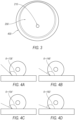
- FIGS. 4A-D shows an illustration of a water droplet 210 on a surface 400, with the hybrid easy-to-clean coating 200 disposed thereon, according to an embodiment.
- the contact angle of the water droplet 210 on a coating 200 is at least 130 degrees in some embodiments, at least 140 degrees in further embodiments, and at least 150 degrees in yet further embodiments.
- the hybrid easy-to-clean coating 200 also optionally includes an antimicrobial material.
- the antimicrobial material may be any suitable active ingredient for hygiene, such as, but not limited to, metallic Zn and GaN. In one or more examples, the metallic Zn and GaN are provided as nanoparticles.
- the antimicrobial material may comprise 0.005 to 25 wt% of the hybrid easy-to-clean coating 200 in at least one embodiment, 0.0075 to 22.5 wt% in other embodiments, and 0.01 to 20 wt% in yet other embodiments.
- the hybrid easy-to-clean coating may include a balance of filler or auxiliary ingredients. The weight percent above may be, in some embodiments, based on the coating composition prior to application and/or curing on the interior walls 115.
- the hybrid easy-to-clean coating 200 has a composition of 15 to 45 wt% of microwave absorbing material binder, 0.5 to 10 wt% of microwave absorbing material, 30 to 75 wt% of super hydrophobic easy-to-clean material, 0.01 to 20% wt of antimicrobial material, and 0.01 to 2 wt% of other auxiliary ingredients.
- the coating 200 may be mixed using a 3D motorized control mixer.
- the coating 200 is then applied to the interior walls 115 by any suitable deposition technique, including but not limited to, rolling, printing spraying, or otherwise applying the coating.
- the coating 200 may then be cured to form the coated liner for the cooking chamber 120.
- the curing may include any suitable curing mechanisms, including, but not limited to, heat, time, UV light, drying, or other curing.
- the coating may be cured in any suitable temperature. In at least one embodiment, the temperature may be between 20 degrees and 500 degrees C, and in other embodiments, the temperature may be between 25 and 400 degrees C.
- the curing may be, for example, for any suitable amount of time.
- the time may be 1 minute to 24 hours or a number of days, and in other embodiments, 10 minutes to 24 hours, as dependent on the heat applied (i.e., in an oven/furnace vs. curing at room temperature).
- the coating 200 is cured such that the bonding between the coating 200 and the interior walls 115 is sufficient to last the life span (i.e., up to at least 5 years in some embodiments, and up to at least 10 years in other embodiments, while undergoing normal use).
- the hybrid easy-to-clean coating 200 on the interior walls 115 may have any suitable thickness and may be deposited on at least a portion of the interior walls 115, and in some embodiments, may have a thickness of 0.25 to 10 mm, in other embodiments 0.5 to 9 mm, and in yet other embodiments 1 to 8 mm.
- the interior walls 115 may include one or more layers of the hybrid easy-to-clean coating 200 thereon. As such, any suitable number of layers of the hybrid easy-to-clean coating 200 may be deposited on the inner surfaces. The layers may deposited by any suitable method, and may be cured independently or collectively on the interior walls 115.
- the hybrid easy-to-clean coating 200 may be incorporated in one or more of the interior walls 115, all the interior walls 115, or in any combination of interior walls 115. Moreover, the hybrid easy-to-clean coating 200 may be incorporated on a portion of the respective interior wall 115. For example, the hybrid easy-to-clean coating 200 may be coated on 30 to 100% of the interior wall 115, in some embodiments, 50 to 95% of the wall 115 in other embodiments, and 75 to 90% of the wall in yet other embodiments.
- the microwave appliance 100 includes a hybrid easy-to-clean coating 200 on the inner surface of the cavity walls 130 that define the cooking chamber 120.
- the hybrid easy-to-clean coating 200 reduces adhesion of food particles to the cavity walls 130 (via the water contact angle), while remaining bonded to the walls 130 in the presence of microwave radiation over the life span of the appliance 100 (via the microwave absorption capabilities).
Landscapes
- Physics & Mathematics (AREA)
- Electromagnetism (AREA)
- Electric Ovens (AREA)
Abstract
Description
- The present application is directed to a cooking appliance, and more particularly an easy to clean coating for heating appliances which use microwave heating.
- Ovens are heating appliances for food preparation having a housing defining a cavity forming a cooking chamber therein. Ovens include a heating mechanism for cooking food placed within the cooking chamber, with the heating mechanism being variable across different types of ovens, and two or more types of heating mechanisms may be combined in combination ovens. Common types of ovens include electric ovens (which include conduction/conventional and convection ovens), gas ovens, toaster ovens, and microwave ovens. The heating mechanisms vary across these ovens, with some including the heating mechanisms within the cooking chamber itself (e.g., conventional ovens), or in the housing (e.g., convection ovens) such that energy or heat is transferred to the cooking chamber or the food. The heating mechanism in electric ovens includes electric coils (with circulation via fans in convection ovens) to heat the cooking chamber, in gas ovens includes burning natural gas to heat the cooking chamber, and in microwave ovens includes electromagnetic radiation via strong radio waves from devices such as magnetrons to heat the food itself.
- Food placed within the cooking chamber upon heating may splatter or otherwise adhere to the interior surfaces of the chamber. As such, surfaces that are easy to clean are desirable.
- According to one or more embodiments, a heating appliance includes a housing having interior walls with interior surfaces defining a cooking chamber for heating food, a microwave heating source configured to generate microwave radiation for heating the food, and a hybrid easy-to-clean coating on at least a portion of the interior surfaces, the hybrid easy-to-clean coating having a water contact angle of at least 150 degrees thereon. The hybrid easy-to-clean coating includes a microwave absorbing component and a super hydrophobic component.
- In one or more embodiments, the super hydrophobic component may be a polymer-aero gel composite. In further embodiments, the polymer aerogel composite may be a polysilicate aerogel. In one or more embodiments, the microwave absorbing component may include carbon nanotubes and a high temperature ferrite material. In at least one further embodiment, the carbon nanotubes are multi-walled carbon nanotubes. In at least another further embodiment, the high temperature ferrite is Ni ferrite, Mn ferrite, or combinations thereof. In at least one embodiment, the hybrid easy-to-clean coating further includes an antimicrobial component. In certain embodiments, the antimicrobial component may be metallic Zn nanoparticles, metallic GaN nanoparticles, or combinations thereof.
- According to one or more embodiments, a heating appliance includes a housing having interior walls with interior surfaces defining a cooking chamber for heating food, the interior walls including a base, side walls, and a ceiling, a microwave heating source configured to generate microwave radiation for heating the food, and a hybrid easy-to-clean coating on at least a portion of one or more of the interior walls. The hybrid easy-to-clean coating includes a high temperature ferrite, carbon nanotubes, and polymer aero-gel composite, and has a water contact angle of at least 150 degrees thereon.
- In at least one embodiment, the hybrid easy-to-clean coating may further include a two-system based pre-polymerized polymer binder. In one or more embodiments, the high temperature ferrite may be Ni ferrite, Mn ferrite, or combinations thereof. In at least one embodiment, the hybrid easy-to-clean coating may include antimicrobial component of metallic Zn nanoparticles, metallic GaN nanoparticles, or combinations thereof. According to one or more embodiments, the polymer aero-gel composite may be a polysilicate aerogel.
- According to one or more embodiments, a hybrid easy-to-clean coating for a microwave appliance includes 5-55wt% of a microwave absorbing two-system based pre-polymerized polymer; 0.3-15wt% of a microwave absorbing material including a high temperature ferrite; and 20-85wt% of a polymer aero-gel composite material.
- In at least one embodiment, the coating may comprise 15-45wt% of the microwave absorbing two-system based pre-polymerized polymer. In one or more embodiments, the coating may comprise 0.5-10wt% of the high temperature ferrite. In at least one embodiment, the coating may comprise 30-75wt% of the polymer aero-gel composite material. According to at least one embodiment, the coating may further comprise 0.01-20%wt of antimicrobial material, and 0.01-2wt% of filler. In one or more embodiments, the polymer aero-gel composite material may be a polysilicate aerogel. In at least one embodiment, the microwave absorbing material further includes carbon nanotubes.
-
-
FIG. 1 is a schematic front view of a heating appliance, according to an embodiment; -
FIGS. 2A-B show images of water drops on an aero-gel powder, according to various embodiments; -
FIG. 3 is a schematic illustration of a water droplet on a coated surface, according to an embodiment; and -
FIGS. 4A-D are schematic enlarged side illustrations of water droplets on coated surfaces depicting the water contact angles, according to various embodiments. - As required, detailed embodiments of the present invention are disclosed herein; however, it is to be understood that the disclosed embodiments are merely exemplary of the invention that may be embodied in various and alternative forms. The figures are not necessarily to scale; some features may be exaggerated or minimized to show details of particular components. Therefore, specific structural and functional details disclosed herein are not to be interpreted as limiting, but merely as a representative basis for teaching one skilled in the art to variously employ the present invention.
- According to one or more embodiments, a heating appliance, such as a microwave, may include a housing having interior walls with interior surfaces defining a cooking chamber for heating food, a microwave heating source configured to generate microwave radiation for heating the food, and a hybrid easy-to-clean coating on at least a portion of the interior surfaces, the hybrid easy-to-clean coating including a microwave absorbing material and a super hydrophobic material.
- During cooking in microwave ovens, food splatter is very likely, resulting in the liner walls that form the microwave inner cavity becoming dirty and messy, with food adhered thereto. Due to greasy oils used in foods, such grease may be difficult to remove and clean from liner walls. Some other ingredients, for example, such as mustard or other food soils, if not cleaned immediately, have the potential to stain or leave spotty and patchy surfaces which decreases the aesthetic appeal of the appliance. Microwave inner cavity hygiene and odor is another issue if the walls are not cleaned immediate after use.
- Conventional solutions to address microwave inner cavity cleaning exist, however the cavity staining, hygiene and odor may remain an issue because the adhering of food particles and soil on the inner cavity liner walls being struck with high frequency (2.45GHz) microwave radiation, which passes through the food particles. Conventional solutions include liners made of certain high impact polymers and steel metals, however the food particles and soil can still adhere to the cavity liner walls. Furthermore, some conventional liner walls have had hydrophobic coatings applied thereon, however due to the high relative moisture in the inner cavity, conventional coatings cannot withstand the average life span (e.g., 5 to 10 years) of a microwave oven. Another issue with conventional coatings is high frequency microwave radiation being absorbed into the coating. The absorbed radiation resulted in limited bonding and adhesion of the coating, which impacts the durability and life span of the liner.
- According to one or more embodiments, a heating appliance for cooking food, such as a microwave oven or a combination oven is provided. The heating appliance includes at least a microwave heat source, and has a cooking chamber defined by cavity walls in a housing. A hybrid, easy-to-clean coating is provided on one or more cavity walls forming the cooking chamber. The hybrid easy-to-clean coating can be applied to inner surfaces of the cavity walls, and be coated on at least a portion of the inner surfaces. The hybrid easy-to-clean coating improves cleanability performance (i.e., less adhesion of particles to the inner walls), as well as scratch resistance and anti-staining properties for the cavity liner, while exhibiting a durable bond under normal microwave radiation use due to the improved microwave absorption of the coating.
- Referring to
FIG. 1 , a perspective view of aheating appliance 100 is shown, according to an embodiment. Theheating appliance 100 is shown and described herein with reference to only the relevant general components, which is not intended to be limiting, as theheating appliance 100 includes other components and features for operation that are not shown or described herein but are expected as being included in theheating appliance 100. Theheating appliance 100 includes ahousing 110 with interior walls (or liners) 115, includingside walls 112, abase 111, and aceiling 113 which cooperate to define acooking chamber 120 with a surface 300 for receiving a food item thereon for cooking. Theinterior walls 115 or, collectivelyside walls 112,base 111, andceiling 113 may each be formed of a plastic or metal material, or combinations thereof. Thehousing 110 also has anouter surface 116 exposed to the external environment. Theheating appliance 100 includes adoor 114 having an open position for providing access to thecooking chamber 120, and a closed position sealing thecooking chamber 120 from the external environment. Thecooking chamber 120 is sized based on suitable sizes for kitchen appliances and for receiving food items to be cooked, and may include components for optimizing space and cooking of the food items, such as a turntable (shown as surface 300) or shelving racks (not shown). Theheating appliance 100 may draw power from an external power source (not shown) such as an electrical plug and outlet connection. Theheating appliance 100 may be connected to the power supply via any suitable power cable, and may include any other components such as, but not limited to, power inverters, transformers, voltage converters, etc., to supply the requisite power to features of theheating appliance 100. The input may be any suitable input based on theappliance 100. For example, the voltage input may be 120 V and the maximum power may be 1600 W. - The
heating appliance 100 includes at least one heating mechanism (not shown) for cooking food placed within thecooking chamber 120. The heating mechanism is activated by user input at acontrol panel 118 located on the outer surface 116 (as shown inFIG. 1 ) or the door 114 (not shown). The heating mechanism may be included within thehousing 110 or within thecooking chamber 120, as dependent on the particular type ofheating appliance 100. The heating mechanism may be a microwave heat source for heating food via microwave radiation from a suitable microwave generating mechanism, such as, but not limited to, or one or more magnetrons or solid-state devices. Although theheating appliance 100 may be referred to asmicrowave oven 100, and a microwave oven is depicted inFIG. 1 , this is not intended to be limiting and other types of heating appliances such as combination ovens that include a microwave generating mechanism for microwave heating along with another heating mechanism (e.g., electric coils and/or gas) are also contemplated as theheating appliance 100. As such, theheating appliance 100 may be any suitable domestic appliance for cooking food, such as, but not limited to, ovens, microwave ovens, toaster ovens, and the like, such that the features described herein for theheating appliance 100 are suitable for oven or microwave oven applications where microwaves are present within thecooking chamber 120. In the embodiment shown inFIG. 1 , theheating appliance 100 is a microwave such that the heating mechanism may be a microwave generating device (not shown), which is disposed in thehousing 110 in any suitable manner, e.g., between theside walls 112, theceiling 113, or thebase 111, and theouter surface 116. The microwave radiation is generated by the microwave generating device and transmitted via any suitable mechanism, such as a waveguide, a coaxial cable or a strip line which supplies the microwave radiation to one or multiple feeding ports (as dependent on the design of the heating appliance 100) which are open to thecooking chamber 120 to heat food placed therein. - According to various embodiments, the heating appliance 100 (or, hereinafter, interchangeable, microwave appliance 100) includes a hybrid easy-to-
clean coating 200 on at least a portion of one or more corresponding inner surfaces forming thecooking chamber 120, such as the base 111 (as shown schematically on surface 300 inFIG. 1 ), or on theinterior walls 115, such as theside walls 112 or theceiling 113, or combinations thereof, hereinafter collectively referred to asside walls 112. The hybrid easy-to-clean coating 200 offers improved bonding and adhesion to theinterior walls 115 while providing a surface with improved cleanability (i.e., food particles are less strongly bonded to the hybrid easy-to-clean surface than to an uncoated or conventionally coated surface), while also exhibiting improved microwave absorbance without compromising the durability and bonding of thecoating 200 to theinterior walls 115 over the life time of theheating appliance 100. Moreover, the hybrid easy-to-clean coating 200 may be incorporated on at least a portion of one or more of the interior walls 115 (e.g., at least a portion of one or more ofside walls 112,ceiling 113, or the base 111). In certain embodiments, theinterior walls 115 may be metal walls, and in other embodiments, theinterior walls 115 may be plastic walls. The various embodiments will be referred to collectively with like reference numerals hereinafter. - In at least one embodiment, the hybrid easy-to-
clean coating 200, to be applied to at least portions of one or more of theinterior walls 115, comprises a microwave absorbing material binder, a microwave absorbing material, and a super hydrophobic easy-to-clean material. The hybrid easy-to-clean coating 200 may also include an antimicrobial material, auxiliary ingredients, and/or fillers. The auxiliary and/or fillers may be, for example, volume fillers, corrosion inhibitors, particles that provide shielding action against oxidation at high temperatures (i.e., up to 500 degrees C), thickeners, dispersants for aiding in deposition or film formation, and the like, and combinations thereof. - The microwave absorbing material binder of the hybrid easy-to-
clean coating 200 may be any suitable binder, including, for example, but not limited to, a two-system based pre-polymerized polymer. The hybrid easy-to-clean coating 200 to be applied includes, in some embodiments, 5 to 55 wt% of the microwave absorbing material binder, in other embodiments, 10 to 50 wt%, and in yet other embodiments, 15 to 45 wt%. - The hybrid easy-to-
clean coating 200 includes, in at least one embodiment, 0.30 to 15 wt% of the microwave absorbing material, in other embodiments, 0.40 to 12.5 wt%, and in yet other embodiments, 0.5 to 10 wt%. The microwave absorbing material may be any suitable microwave absorbing material, including, for example, but not limited to, a high temperature ferrite (i.e., a maximum temperature rating for the ferrite is at least 500 degrees C in certain embodiments, and in some other embodiments 350 to 500 degrees C) mixed with carbon nanotubes. In further examples, the carbon nanotubes may be multi-walled carbon nanotubes. In yet further examples, the high temperature ferrite may be Ni ferrite and/or Mn ferrite. The carbon nanotubes may be loaded in any suitable concentration to form the microwave absorbing material for the hybrid easy-to-clean coating 200. For example, the carbon nanotubes may have a loading concentration in the coating of 0.001 to 30% by weight, in other embodiments 0.01 to 10% by weight, and in yet further embodiments, 0.10 to 5.0% by weight, as based on the wet loading in the coating for deposition. With regard to microwave radiation absorption, the hybrid easy-to-clean coating 200 in some embodiments has an absorptivity to microwaves of 70 to 100%, in other embodiments, 75 to 97.5%, and in yet other embodiments, 80 to 95%. The absorptivity of thecoating 200 is based on the measure of a materials' effectiveness in absorbing radiant energy at the 2.45GHz radiation frequency used for microwave appliances. - Also, the hybrid easy-to-
clean coating 200 includes 20 to 85 wt% of the super hydrophobic easy-to-clean material in some embodiments, 25 to 80 wt% of super hydrophobic easy-to-clean material in other embodiments, and 30 to 75 wt% of super hydrophobic easy-to-clean material in yet other embodiments. The super hydrophobic easy-to-clean material may be any suitable material, including, for example, but not limited to, a polymer-aerogel composite having a water contact angle of at least about 150°, in some embodiments, and at least 155° in further embodiments, and 155 to 162° in yet further embodiments, and a contact angle hysteresis of less than about 1°. In embodiments where the super hydrophobic easy-to-clean material is a polymer-aerogel composite, the coating formulation form of the polymer-aerogel composite includes a polymer and an ultra high water content catalyzed aerogel, such as, for example, polysilicate aerogel. The polymer-aerogel composite may include a three dimensional network of particles having surface functional groups derivatized with a suitable deriving agent and a plurality of pores. In an example, the particles may be silica particles and the deriving agent may be a silylating agent. - As shown in
FIGS. 2A-B , images of water droplets on an example super hydrophobic component used in thecoating 200 are shown, withdroplets 210 formed on the super hydrophobic easy-to-clean material 205 such that thedroplets 210 have a water contact angle of at least 150°, with the super hydrophobic easy-to-clean material component shown as a polymer aero-gel composite. Furthermore, as shown inFIG. 2B , a depiction of a water droplet coated with a super-hydrophobic easy-to-clean material 205 is shown floating on dyed water, along with a close up view of thewater droplets 210 on the easy-to cleanmaterial component 205.FIG. 3 shows an illustration of awater droplet 210 on asurface 400, with the hybrid easy-to-clean coating 200 disposed thereon, according to an embodiment. Thus, the contact angle of thewater droplet 210 on acoating 200, as shown inFIGS. 4A-D , is at least 130 degrees in some embodiments, at least 140 degrees in further embodiments, and at least 150 degrees in yet further embodiments. - The hybrid easy-to-
clean coating 200 also optionally includes an antimicrobial material. The antimicrobial material may be any suitable active ingredient for hygiene, such as, but not limited to, metallic Zn and GaN. In one or more examples, the metallic Zn and GaN are provided as nanoparticles. In embodiments with the antimicrobial material, the antimicrobial material may comprise 0.005 to 25 wt% of the hybrid easy-to-clean coating 200 in at least one embodiment, 0.0075 to 22.5 wt% in other embodiments, and 0.01 to 20 wt% in yet other embodiments. The hybrid easy-to-clean coating may include a balance of filler or auxiliary ingredients. The weight percent above may be, in some embodiments, based on the coating composition prior to application and/or curing on theinterior walls 115. - In an embodiment, the hybrid easy-to-
clean coating 200 has a composition of 15 to 45 wt% of microwave absorbing material binder, 0.5 to 10 wt% of microwave absorbing material, 30 to 75 wt% of super hydrophobic easy-to-clean material, 0.01 to 20% wt of antimicrobial material, and 0.01 to 2 wt% of other auxiliary ingredients. - To prepare the
coating 200, all the raw materials are proportionally mixed together. For example, thecoating 200 may be mixed using a 3D motorized control mixer. Thecoating 200 is then applied to theinterior walls 115 by any suitable deposition technique, including but not limited to, rolling, printing spraying, or otherwise applying the coating. Thecoating 200 may then be cured to form the coated liner for thecooking chamber 120. The curing may include any suitable curing mechanisms, including, but not limited to, heat, time, UV light, drying, or other curing. For example, the coating may be cured in any suitable temperature. In at least one embodiment, the temperature may be between 20 degrees and 500 degrees C, and in other embodiments, the temperature may be between 25 and 400 degrees C. The curing may be, for example, for any suitable amount of time. In some embodiments, the time may be 1 minute to 24 hours or a number of days, and in other embodiments, 10 minutes to 24 hours, as dependent on the heat applied (i.e., in an oven/furnace vs. curing at room temperature). Thecoating 200 is cured such that the bonding between thecoating 200 and theinterior walls 115 is sufficient to last the life span (i.e., up to at least 5 years in some embodiments, and up to at least 10 years in other embodiments, while undergoing normal use). - The hybrid easy-to-
clean coating 200 on theinterior walls 115 may have any suitable thickness and may be deposited on at least a portion of theinterior walls 115, and in some embodiments, may have a thickness of 0.25 to 10 mm, in other embodiments 0.5 to 9 mm, and in yet other embodiments 1 to 8 mm. Furthermore, theinterior walls 115 may include one or more layers of the hybrid easy-to-clean coating 200 thereon. As such, any suitable number of layers of the hybrid easy-to-clean coating 200 may be deposited on the inner surfaces. The layers may deposited by any suitable method, and may be cured independently or collectively on theinterior walls 115. Moreover, the hybrid easy-to-clean coating 200 may be incorporated in one or more of theinterior walls 115, all theinterior walls 115, or in any combination ofinterior walls 115. Moreover, the hybrid easy-to-clean coating 200 may be incorporated on a portion of the respectiveinterior wall 115. For example, the hybrid easy-to-clean coating 200 may be coated on 30 to 100% of theinterior wall 115, in some embodiments, 50 to 95% of thewall 115 in other embodiments, and 75 to 90% of the wall in yet other embodiments. - As such, the
microwave appliance 100 includes a hybrid easy-to-clean coating 200 on the inner surface of the cavity walls 130 that define thecooking chamber 120. The hybrid easy-to-clean coating 200 reduces adhesion of food particles to the cavity walls 130 (via the water contact angle), while remaining bonded to the walls 130 in the presence of microwave radiation over the life span of the appliance 100 (via the microwave absorption capabilities). - Except where otherwise expressly indicated, all numerical quantities in this disclosure are to be understood as modified by the word "about". The term "substantially," "generally," or "about" may be used herein and may modify a value or relative characteristic disclosed or claimed. In such instances, "substantially," "generally," or "about" may signify that the value or relative characteristic it modifies is within ± 0%, 0.1%, 0.5%, 1%, 2%, 3%, 4%, 5% or 10% of the value or relative characteristic (e.g., with respect to transparency as measured by opacity). Practice within the numerical limits stated is generally preferred. Also, unless expressly stated to the contrary, the description of a group or class of materials by suitable or preferred for a given purpose in connection with the disclosure implies that mixtures of any two or more members of the group or class may be equally suitable or preferred.
- As referenced in the figures, the same reference numerals may be used herein to refer to the same parameters and components or their similar modifications and alternatives. For purposes of description herein, the terms "upper, " "lower, " "right, " "left, " "rear, " "front, " "vertical, " "horizontal, " and derivatives thereof shall relate to the present disclosure as oriented in
Figure 1 . However, it is to be understood that the present disclosure may assume various alternative orientations, except where expressly specified to the contrary. It is also to be understood that the specific devices and processes illustrated in the drawings and described in the following specification are simply exemplary embodiments of the inventive concepts defined in the appended claims. Hence, specific dimensions and other physical characteristics relating to the embodiments disclosed herein are not to be considered as limiting, unless the claims expressly state otherwise. The drawings referenced herein are schematic and associated views thereof are not necessarily drawn to scale. - While exemplary embodiments are described above, it is not intended that these embodiments describe all possible forms of the invention. Rather, the words used in the specification are words of description rather than limitation, and it is understood that various changes may be made without departing from the spirit and scope of the invention. Additionally, the features of various implementing embodiments may be combined to form further embodiments of the invention.
Claims (15)
- A heating appliance (100), comprising:a housing (110) having interior walls (115) with interior surfaces (111, 112, 113, 300) defining a cooking chamber (120) for heating food;a microwave heating source configured to generate microwave radiation for heating the food; anda hybrid easy-to-clean coating (200) on at least a portion of the interior surfaces (111, 112, 113, 300), the hybrid easy-to-clean coating (200) including a microwave absorbing component and a super hydrophobic component (205),wherein the hybrid easy-to-clean coating (200) has a water contact angle of at least 150 degrees thereon.
- The heating appliance (100) of claim 1, wherein the super hydrophobic component (205) is a polymer-aero gel composite.
- The heating appliance (100) of claim 2, wherein the polymer aero-gel composite is a polysilicate aerogel.
- The heating appliance (100) of any of claims 1 to 3, wherein the microwave absorbing component includes carbon nanotubes and a high temperature ferrite material.
- The heating appliance (100) of claim 4, wherein the carbon nanotubes are multi-walled carbon nanotubes.
- The heating appliance (100) of claims 4 or 5, wherein the high temperature ferrite is Ni ferrite, Mn ferrite, or combinations thereof.
- The heating appliance (100) of any of the preceding claims, wherein the hybrid easy-to-clean coating (200) further includes a two-system based pre-polymerized polymer binder.
- The heating appliance (100) of any of claims 1 to 7, wherein the hybrid easy-to-clean coating (200) includes antimicrobial component of metallic Zn nanoparticles, metallic GaN nanoparticles, or combinations thereof.
- A hybrid easy-to-clean coating (200) for a microwave oven (100), the coating (200) comprising:5-55wt% of microwave absorbing two-system based pre-polymerized polymer;0.3-15wt% of high temperature ferrite; and20-85wt% of polymer aero-gel composite material (205).
- The coating (200) of claim 9, wherein the coating (200) comprises 15-45wt% of microwave absorbing two-system based pre-polymerized polymer.
- The coating (200) of claims 9 or 10, wherein the coating (200)comprises 0.5-10wt% of high temperature ferrite.
- The coating (200) of any of claims 9 to 11, wherein the coating (200) comprises 30-75wt% of polymer aero-gel composite material (205).
- The coating (200) of any of claims 9 to 12, further comprising 0.01-20%wt of antimicrobial material, and 0.01-2wt% of filler.
- The coating (200) of any of claims 9 to 14, wherein the microwave absorbing material further includes carbon nanotubes.
- The heating appliance (100) of any of claims 1 to 8, wherein the hybrid easy-to-clean coating (200) is according to any of claims 9 to 14.
Applications Claiming Priority (2)
| Application Number | Priority Date | Filing Date | Title |
|---|---|---|---|
| US202263313492P | 2022-02-24 | 2022-02-24 | |
| US18/169,533 US20230269838A1 (en) | 2022-02-24 | 2023-02-15 | Hybrid easy to clean coating for microwave appliance |
Publications (1)
| Publication Number | Publication Date |
|---|---|
| EP4236623A1 true EP4236623A1 (en) | 2023-08-30 |
Family
ID=85283596
Family Applications (1)
| Application Number | Title | Priority Date | Filing Date |
|---|---|---|---|
| EP23157398.1A Withdrawn EP4236623A1 (en) | 2022-02-24 | 2023-02-17 | Hybrid easy to clean coating for microwave appliance |
Country Status (2)
| Country | Link |
|---|---|
| US (1) | US20230269838A1 (en) |
| EP (1) | EP4236623A1 (en) |
Citations (3)
| Publication number | Priority date | Publication date | Assignee | Title |
|---|---|---|---|---|
| US20110049122A1 (en) * | 2009-08-28 | 2011-03-03 | Chae Hyun Baek | Cooking Appliance |
| KR101307759B1 (en) * | 2006-10-10 | 2013-09-11 | 엘지전자 주식회사 | Cooking device & Coating method of the wall for the same |
| US20180172284A1 (en) * | 2016-12-21 | 2018-06-21 | Saint-Gobain Isover | Ovens and insulation products for ovens |
-
2023
- 2023-02-15 US US18/169,533 patent/US20230269838A1/en active Pending
- 2023-02-17 EP EP23157398.1A patent/EP4236623A1/en not_active Withdrawn
Patent Citations (3)
| Publication number | Priority date | Publication date | Assignee | Title |
|---|---|---|---|---|
| KR101307759B1 (en) * | 2006-10-10 | 2013-09-11 | 엘지전자 주식회사 | Cooking device & Coating method of the wall for the same |
| US20110049122A1 (en) * | 2009-08-28 | 2011-03-03 | Chae Hyun Baek | Cooking Appliance |
| US20180172284A1 (en) * | 2016-12-21 | 2018-06-21 | Saint-Gobain Isover | Ovens and insulation products for ovens |
Also Published As
| Publication number | Publication date |
|---|---|
| US20230269838A1 (en) | 2023-08-24 |
Similar Documents
| Publication | Publication Date | Title |
|---|---|---|
| CA2543060C (en) | Speed cooking oven with slotted microwave antenna | |
| EP2548480B1 (en) | Cooking apparatus and heating device using the same | |
| CA2722559C (en) | Improved cleanability of ovens and cooktops | |
| DE68903135T2 (en) | HEAT-GENERATING VESSEL FOR MICROWAVE OVEN. | |
| US20230269838A1 (en) | Hybrid easy to clean coating for microwave appliance | |
| WO2004067802A1 (en) | Black zinc-plated steel sheet | |
| EP3329186B1 (en) | A heatable cavity for a kitchen appliance having a low emissivity coating | |
| KR20180089985A (en) | Glass composition and cooking appliance | |
| JP2001218684A (en) | Member for cooking utensil and cooking utensil | |
| JP2006286729A (en) | Paint composition excellent in electromagnetic wave absorbency and conductivity, and coated metal plate coated therewith | |
| WO2001034702A3 (en) | Polyester ovenware for microwave cooking applications | |
| CN101429351A (en) | Coating material for baking tray of microwave oven and use method thereof | |
| US4031286A (en) | Fluorocarbon polymer coating compositions containing mica particles | |
| CN103836905A (en) | Energy-saving vacuum drying box | |
| US20080190941A1 (en) | Food Service Cabinet With Nanomaterial Coating | |
| US20180168351A1 (en) | Panel for home appliance and home appliance including the same | |
| JP4813077B2 (en) | Heat-resistant non-adhesive painted metal plate | |
| DE10360593B3 (en) | Cooking hob for fitting in kitchen unit work surface has outward-facing lower part surface at least partly roughened/coated so thermal radiation degree of emission of outward-facing side exceeds 0.5 | |
| EP4203613A1 (en) | Tunable nanowires blended rapid heating plate | |
| US20140021199A1 (en) | Handle with a heat sink | |
| EP0550796B1 (en) | Microwave oven using a precoated sheet steel as walls of internal chamber thereof | |
| JPH01234719A (en) | Exoergic container for microwave oven | |
| KR102885104B1 (en) | Cooking utensils with improved far-infrared radiation effect | |
| JPH1180624A (en) | Heat reflecting coating composition and coated product | |
| JP2002267175A (en) | Cooking device |
Legal Events
| Date | Code | Title | Description |
|---|---|---|---|
| PUAI | Public reference made under article 153(3) epc to a published international application that has entered the european phase |
Free format text: ORIGINAL CODE: 0009012 |
|
| STAA | Information on the status of an ep patent application or granted ep patent |
Free format text: STATUS: THE APPLICATION HAS BEEN PUBLISHED |
|
| AK | Designated contracting states |
Kind code of ref document: A1 Designated state(s): AL AT BE BG CH CY CZ DE DK EE ES FI FR GB GR HR HU IE IS IT LI LT LU LV MC ME MK MT NL NO PL PT RO RS SE SI SK SM TR |
|
| STAA | Information on the status of an ep patent application or granted ep patent |
Free format text: STATUS: REQUEST FOR EXAMINATION WAS MADE |
|
| 17P | Request for examination filed |
Effective date: 20240206 |
|
| RBV | Designated contracting states (corrected) |
Designated state(s): AL AT BE BG CH CY CZ DE DK EE ES FI FR GB GR HR HU IE IS IT LI LT LU LV MC ME MK MT NL NO PL PT RO RS SE SI SK SM TR |
|
| GRAP | Despatch of communication of intention to grant a patent |
Free format text: ORIGINAL CODE: EPIDOSNIGR1 |
|
| STAA | Information on the status of an ep patent application or granted ep patent |
Free format text: STATUS: GRANT OF PATENT IS INTENDED |
|
| INTG | Intention to grant announced |
Effective date: 20240625 |
|
| STAA | Information on the status of an ep patent application or granted ep patent |
Free format text: STATUS: THE APPLICATION IS DEEMED TO BE WITHDRAWN |
|
| 18D | Application deemed to be withdrawn |
Effective date: 20241026 |