EP4236309A1 - Coding and decoding methods for point cloud coordinate transformation residual error, and apparatus - Google Patents
Coding and decoding methods for point cloud coordinate transformation residual error, and apparatus Download PDFInfo
- Publication number
- EP4236309A1 EP4236309A1 EP22810442.8A EP22810442A EP4236309A1 EP 4236309 A1 EP4236309 A1 EP 4236309A1 EP 22810442 A EP22810442 A EP 22810442A EP 4236309 A1 EP4236309 A1 EP 4236309A1
- Authority
- EP
- European Patent Office
- Prior art keywords
- coordinate transformation
- transformation residual
- point cloud
- encoding
- azimuth
- Prior art date
- Legal status (The legal status is an assumption and is not a legal conclusion. Google has not performed a legal analysis and makes no representation as to the accuracy of the status listed.)
- Pending
Links
Images


Classifications
-
- H—ELECTRICITY
- H04—ELECTRIC COMMUNICATION TECHNIQUE
- H04N—PICTORIAL COMMUNICATION, e.g. TELEVISION
- H04N13/00—Stereoscopic video systems; Multi-view video systems; Details thereof
- H04N13/10—Processing, recording or transmission of stereoscopic or multi-view image signals
- H04N13/106—Processing image signals
- H04N13/161—Encoding, multiplexing or demultiplexing different image signal components
-
- G—PHYSICS
- G06—COMPUTING OR CALCULATING; COUNTING
- G06T—IMAGE DATA PROCESSING OR GENERATION, IN GENERAL
- G06T9/00—Image coding
- G06T9/001—Model-based coding, e.g. wire frame
-
- H—ELECTRICITY
- H04—ELECTRIC COMMUNICATION TECHNIQUE
- H04N—PICTORIAL COMMUNICATION, e.g. TELEVISION
- H04N19/00—Methods or arrangements for coding, decoding, compressing or decompressing digital video signals
- H04N19/60—Methods or arrangements for coding, decoding, compressing or decompressing digital video signals using transform coding
-
- H—ELECTRICITY
- H04—ELECTRIC COMMUNICATION TECHNIQUE
- H04N—PICTORIAL COMMUNICATION, e.g. TELEVISION
- H04N19/00—Methods or arrangements for coding, decoding, compressing or decompressing digital video signals
- H04N19/10—Methods or arrangements for coding, decoding, compressing or decompressing digital video signals using adaptive coding
- H04N19/102—Methods or arrangements for coding, decoding, compressing or decompressing digital video signals using adaptive coding characterised by the element, parameter or selection affected or controlled by the adaptive coding
- H04N19/13—Adaptive entropy coding, e.g. adaptive variable length coding [AVLC] or context adaptive binary arithmetic coding [CABAC]
-
- H—ELECTRICITY
- H04—ELECTRIC COMMUNICATION TECHNIQUE
- H04N—PICTORIAL COMMUNICATION, e.g. TELEVISION
- H04N19/00—Methods or arrangements for coding, decoding, compressing or decompressing digital video signals
- H04N19/10—Methods or arrangements for coding, decoding, compressing or decompressing digital video signals using adaptive coding
- H04N19/134—Methods or arrangements for coding, decoding, compressing or decompressing digital video signals using adaptive coding characterised by the element, parameter or criterion affecting or controlling the adaptive coding
- H04N19/136—Incoming video signal characteristics or properties
- H04N19/137—Motion inside a coding unit, e.g. average field, frame or block difference
- H04N19/139—Analysis of motion vectors, e.g. their magnitude, direction, variance or reliability
-
- H—ELECTRICITY
- H04—ELECTRIC COMMUNICATION TECHNIQUE
- H04N—PICTORIAL COMMUNICATION, e.g. TELEVISION
- H04N19/00—Methods or arrangements for coding, decoding, compressing or decompressing digital video signals
- H04N19/10—Methods or arrangements for coding, decoding, compressing or decompressing digital video signals using adaptive coding
- H04N19/134—Methods or arrangements for coding, decoding, compressing or decompressing digital video signals using adaptive coding characterised by the element, parameter or criterion affecting or controlling the adaptive coding
- H04N19/146—Data rate or code amount at the encoder output
- H04N19/149—Data rate or code amount at the encoder output by estimating the code amount by means of a model, e.g. mathematical model or statistical model
-
- H—ELECTRICITY
- H04—ELECTRIC COMMUNICATION TECHNIQUE
- H04N—PICTORIAL COMMUNICATION, e.g. TELEVISION
- H04N19/00—Methods or arrangements for coding, decoding, compressing or decompressing digital video signals
- H04N19/50—Methods or arrangements for coding, decoding, compressing or decompressing digital video signals using predictive coding
- H04N19/597—Methods or arrangements for coding, decoding, compressing or decompressing digital video signals using predictive coding specially adapted for multi-view video sequence encoding
-
- H—ELECTRICITY
- H04—ELECTRIC COMMUNICATION TECHNIQUE
- H04N—PICTORIAL COMMUNICATION, e.g. TELEVISION
- H04N19/00—Methods or arrangements for coding, decoding, compressing or decompressing digital video signals
- H04N19/90—Methods or arrangements for coding, decoding, compressing or decompressing digital video signals using coding techniques not provided for in groups H04N19/10-H04N19/85, e.g. fractals
- H04N19/91—Entropy coding, e.g. variable length coding [VLC] or arithmetic coding
Definitions
- the present invention pertains to the field of point cloud encoding/decoding technologies, and particularly relates to a method and an apparatus for encoding/decoding a point cloud coordinate transformation residual.
- three-dimensional point cloud data has been widely used in fields such as virtual reality, augmented reality, self-driving, and environment modeling.
- a large-scale point cloud usually has a large amount of data, which is not conducive to the transmission and storage of the point cloud data. Therefore, the large-scale point cloud needs to be efficiently encoded/decoded.
- an original point cloud usually needs to be transformed from one coordinate system to another coordinate system, and then inversely transformed to obtain new coordinates.
- a residual between the coordinates is referred to as a coordinate transformation residual.
- a point cloud needs to be transformed from original Cartesian coordinates to cylindrical coordinates (including depth information, pitch angle information, and azimuth information), and then the cylindrical coordinates of the point cloud are reversely transformed into the Cartesian coordinates to obtain a coordinate transformation residual of the point cloud, and finally, the coordinate transformation residual of the point cloud is encoded.
- a traversal method is used to traverse three residual components and perform entropy encoding one by one.
- existing coordinate transformation residual encoding uses only information about a coordinate transformation residual component to establish an entropy encoding context model, and a relationship between other information and a coordinate transformation residual is not taken into consideration. Consequently, a context model established through entropy encoding is not accurate and effective enough, and therefore, encoding efficiency is not high.
- a method for encoding a point cloud coordinate transformation residual includes:
- ⁇ x and ⁇ y represent coordinate transformation residual components of a point, r represents depth information of the point, ⁇ represents azimuth information of the point, ⁇ r represents a precision loss of the depth information of the point, and ⁇ ⁇ represents a precision loss of the azimuth information of the point.
- the function expressions between the azimuth information of the point cloud and the coordinate transformation residual may be further approximated as follows: ⁇ x ⁇ ⁇ ⁇ r ⁇ cos ⁇ , and ⁇ y ⁇ ⁇ ⁇ r ⁇ sin ⁇ .
- ⁇ x and ⁇ y represent coordinate transformation residual components of a point, ⁇ represents azimuth information of the point, and ⁇ r represents a precision loss of depth information of the point.
- the establishing a relationship between azimuth information of a point cloud and the coordinate transformation residual further includes: obtaining a specific representation form of an angle value of an azimuth, a function value of an azimuth, or an azimuth symbol based on a function expression or an approximate expression of the azimuth information of the point cloud and the coordinate transformation residual.
- the determining an encoding rule for the coordinate transformation residual based on the relationship between the azimuth information of the point cloud and the coordinate transformation residual includes:
- the setting a corresponding encoding rule for the coordinate transformation residual for each azimuth interval includes: separately assigning a context model for a coordinate transformation residual of each azimuth interval, and performing corresponding initialization for entropy encoding of the coordinate transformation residual.
- the encoding the coordinate transformation residual according to the encoding rule includes:
- Another embodiment of the present invention provides an apparatus for encoding a point cloud coordinate transformation residual, including:
- Still another embodiment of the present invention further provides a method for decoding a point cloud coordinate transformation residual, including:
- Yet another embodiment of the present invention further provides an apparatus for decoding a point cloud coordinate transformation residual, including:
- a relationship between azimuth information of a point cloud and a coordinate transformation residual is established, and an encoding rule is set for the coordinate transformation residual by using the azimuth information of the point cloud.
- FIG. 1 is a schematic flowchart of a method for encoding a point cloud coordinate transformation residual according to an embodiment of the present invention. The method includes the following steps.
- Step 1 Obtain original point cloud data.
- the original point cloud data generally includes a set of three-dimensional spatial points, each spatial point records geometric position information of the spatial point and additional attribute information such as color, reflectivity, and normal.
- geometric position information of a point cloud is expressed based on a Cartesian coordinate system; in other words, coordinates x, y, and z of a point are used for representation.
- the original point cloud data may be obtained by a laser radar through scanning.
- the laser radar is formed by a combination of a plurality of lasers (laser scanners) distributed along two sides of a central axis. Each laser has a fixed pitch angle, and may be considered as a relatively independent collection system.
- the original point cloud data may also be obtained by using common data sets provided by various platforms.
- the obtained geometric position information of the original point cloud data is represented based on the Cartesian coordinate system. It should be noted that representation of the geometric position information of the original point cloud data is not limited to Cartesian coordinates.
- Step 2 Transform coordinates of the original point cloud data to obtain a coordinate transformation residual.
- Cartesian coordinates may be used to represent geometric information of the original point cloud data. Therefore, to facilitate predictive encoding of the geometric information of the point cloud, coordinates of the point cloud need to be transformed, and Cartesian coordinates of the point cloud may be transformed into cylindrical coordinates.
- r represents depth information of a point
- ⁇ represents azimuth information of the point
- i represents an ID of a laser to which the point belongs
- zLaser ( k ) is a vertical offset of a k th laser of the laser radar
- ⁇ ( k ) is a vertical pitch angle of the k th laser
- both zLaser ( k ) and ⁇ ( k ) are prior parameters of the laser radar.
- r q represents an approximate value of the depth information r in current encoding precision
- ⁇ q represents an approximate value of the azimuth information ⁇ in the current encoding precision.
- Step 3 Establish a relationship between azimuth information of a point cloud and the coordinate transformation residual.
- a function expression between the azimuth information of the point cloud and the coordinate transformation residual may be established based on a mathematical relationship.
- a specific representation form of the relationship between the azimuth and the coordinate transformation residual may be obtained based on the function expression or an approximate function expression between the azimuth information of the point cloud and the coordinate transformation residual.
- a specific representation form of an angle value of an azimuth, a function value of an azimuth, or an azimuth symbol may be obtained based on a function expression or an approximate expression of the azimuth information of the point cloud and the coordinate transformation residual.
- a relationship between the azimuth information and the coordinate transformation residual obtained by using the angle value of the azimuth is specifically represented as follows: when ⁇ ⁇ ⁇ 2 , ⁇ x ⁇ 0 ; when ⁇ ⁇ ⁇ ⁇ 2 , ⁇ x ⁇ 0 ; when ⁇ ⁇ 0 , ⁇ y ⁇ 0 ; and when ⁇ ⁇ ⁇ , ⁇ y ⁇ 0 .
- FIG. 2 is a statistical diagram of a relationship between an azimuth ⁇ and a coordinate transformation residual component ⁇ x according to an embodiment of the present invention.
- FIG. 3 is a statistical diagram of a relationship between an azimuth ⁇ and a coordinate transformation residual component ⁇ y according to an embodiment of the present invention. It can be learned from FIG. 2 and FIG. 3 that there is a close relationship between the azimuth information of the point cloud and the coordinate transformation residual, and different azimuths correspond to different coordinate transformation residual distribution. Therefore, a context model may be designed by using the relationship for entropy encoding of the coordinate transformation residual, so that encoding efficiency of the point cloud is further improved.
- Step 4 Determine an encoding rule for the coordinate transformation residual based on the relationship between the azimuth information of the point cloud and the coordinate transformation residual.
- entropy encoding is generally used for encoding point cloud information. Therefore, a corresponding context model needs to be designed to implement entropy encoding.
- the context model is established by using information about a coordinate transformation residual component.
- a corresponding context model may be designed for entropy encoding of the coordinate transformation residual, and may be correspondingly initialized.
- the azimuth is divided into several intervals based on the relationship between the azimuth information of the point cloud and the coordinate transformation residual.
- the azimuth may be divided into a plurality of intervals according to an angle range, for example, the azimuth may be divided into two intervals.
- the two intervals may be separately represented as follows:
- the two intervals may be separately represented as follows:
- T 1 and T 2 are respectively angle thresholds that are set in the interval x1 and the interval y1, and are positive numbers.
- the azimuth may be further divided into several intervals according to a function value (such as cos ⁇ , sin ⁇ , or another function value) or an azimuth symbol.
- a function value such as cos ⁇ , sin ⁇ , or another function value
- a context model may be separately assigned to coordinate transformation residual components in each azimuth interval, and a corresponding initialization operation is performed on the context model corresponding to each azimuth interval.
- a probability of a symbol 0 in a context model corresponding to the interval x1 may be initialized to 0.9
- a probability of a symbol 1 may be initialized to 0.1
- both a probability of a symbol 0 and a probability of a symbol 1 in a context model corresponding to the interval x2 may be initialized to 0.5.
- Step 5 Encode the coordinate transformation residual according to the encoding rule, to obtain data rate information.
- azimuth information of a current point is obtained, and an azimuth interval to which the current point belongs is determined.
- a corresponding context model is selected based on the azimuth interval to perform entropy encoding.
- the azimuth information is related to the component ⁇ x and the component ⁇ y in the coordinate transformation residual. Therefore, in this embodiment, corresponding context models are separately selected based on azimuth intervals to which the two components belong, to perform entropy encoding, and for a component ⁇ z , a conventional entropy encoding method may be used to perform encoding.
- FIG. 4 is a flowchart of entropy encoding of a coordinate transformation residual according to an embodiment of the present invention.
- a current residual component is equal to 0
- a next residual component is encoded, or otherwise, a symbol bit of the residual component is encoded, and whether an absolute value of the residual component is equal to 1 is encoded. If the absolute value is equal to 1, a next residual component is encoded, or otherwise, a part that is of an absolute value of the residual component and that is greater than or equal to 2 is encoded by using exponential Columbus.
- a relationship between azimuth information of a point cloud and a coordinate transformation residual is established, and an encoding rule is set for the coordinate transformation residual by using the azimuth information of the point cloud.
- FIG. 5 is a schematic diagram of a structure of an apparatus for encoding a point cloud coordinate transformation residual according to an embodiment of the present invention.
- the apparatus includes:
- the apparatus provided in this embodiment can implement the method provided in Embodiment 1, and a detailed process is not described herein again.
- FIG. 6 is a schematic flowchart of a method for decoding a point cloud coordinate transformation residual according to an embodiment of the present invention. The method includes the following steps.
- Step 1 Obtain data rate information.
- Step 2 Determine a decoding rule for a coordinate transformation residual based on a relationship between azimuth information of a point cloud and the coordinate transformation residual.
- an azimuth may be divided into several intervals based on the relationship between the azimuth information of the point cloud and the coordinate transformation residual, and a corresponding decoding rule is set for each interval for different coordinate transformation residual components.
- the decoding rule herein corresponds to an encoding rule for a same interval on the encoder.
- the encoder assigns an independent entropy encoding context model to each different interval and performs initialization
- a decoder also assigns a corresponding entropy decoding context model to the corresponding interval and performs same initialization processing.
- Step 3 Decode the data rate information according to the decoding rule, to obtain a reconstructed point cloud coordinate transformation residual.
- an azimuth interval to which the to-be-decoded point belongs may be determined based on reconstructed azimuth information of the point cloud, and a corresponding decoding rule is selected to perform decoding, to obtain a reconstructed coordinate transformation residual.
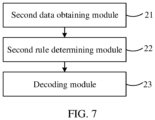
- FIG. 7 is a schematic diagram of a structure of an apparatus for decoding a point cloud coordinate transformation residual according to an embodiment of the present invention.
- the apparatus includes:
- the apparatus provided in this embodiment can implement the decoding method provided in Embodiment 3, and a detailed process is not described herein again.
Landscapes
- Engineering & Computer Science (AREA)
- Multimedia (AREA)
- Signal Processing (AREA)
- Physics & Mathematics (AREA)
- General Physics & Mathematics (AREA)
- Algebra (AREA)
- Mathematical Analysis (AREA)
- Mathematical Optimization (AREA)
- Pure & Applied Mathematics (AREA)
- Theoretical Computer Science (AREA)
- Compression, Expansion, Code Conversion, And Decoders (AREA)
Abstract
Description
- This application claims priority to
Chinese Patent Application No. 202110580212.1, filed with the China National Intellectual Property Administration on May 26, 2021 - The present invention pertains to the field of point cloud encoding/decoding technologies, and particularly relates to a method and an apparatus for encoding/decoding a point cloud coordinate transformation residual.
- With the improvement of a hardware processing capability and the rapid development of computer vision, three-dimensional point cloud data has been widely used in fields such as virtual reality, augmented reality, self-driving, and environment modeling. However, a large-scale point cloud usually has a large amount of data, which is not conducive to the transmission and storage of the point cloud data. Therefore, the large-scale point cloud needs to be efficiently encoded/decoded. In an existing point cloud encoding/decoding technology, to improve encoding efficiency of a point cloud, an original point cloud usually needs to be transformed from one coordinate system to another coordinate system, and then inversely transformed to obtain new coordinates. Due to a precision loss, the coordinates are not entirely consistent with original point cloud coordinates, and a residual between the coordinates is referred to as a coordinate transformation residual. For example, in a point cloud encoding/decoding method based on a prediction tree and a point cloud encoding/decoding method based on a single-chain structure that are provided in the prior art, a point cloud needs to be transformed from original Cartesian coordinates to cylindrical coordinates (including depth information, pitch angle information, and azimuth information), and then the cylindrical coordinates of the point cloud are reversely transformed into the Cartesian coordinates to obtain a coordinate transformation residual of the point cloud, and finally, the coordinate transformation residual of the point cloud is encoded.
- However, when the foregoing two methods are used to encode the coordinate transformation residual of the point cloud, a traversal method is used to traverse three residual components and perform entropy encoding one by one. In other words, existing coordinate transformation residual encoding uses only information about a coordinate transformation residual component to establish an entropy encoding context model, and a relationship between other information and a coordinate transformation residual is not taken into consideration. Consequently, a context model established through entropy encoding is not accurate and effective enough, and therefore, encoding efficiency is not high.
- To resolve the foregoing problem in the prior art, the present invention provides a method and an apparatus for encoding/decoding a point cloud coordinate transformation residual. Technical problems in the present invention are resolved by the following technical solutions:
A method for encoding a point cloud coordinate transformation residual includes: - obtaining original point cloud data;
- transforming coordinates of the original point cloud data to obtain a coordinate transformation residual;
- establishing a relationship between azimuth information of a point cloud and the coordinate transformation residual;
- determining an encoding rule for the coordinate transformation residual based on the relationship between the azimuth information of the point cloud and the coordinate transformation residual; and
- encoding the coordinate transformation residual according to the encoding rule, to obtain data rate information.
- In an embodiment of the present invention, the establishing a relationship between azimuth information of a point cloud and the coordinate transformation residual includes:
establishing function expressions between the azimuth information of the point cloud and the coordinate transformation residual as follows:

- In an embodiment of the present invention, the function expressions between the azimuth information of the point cloud and the coordinate transformation residual may be further approximated as follows:


- In an embodiment of the present invention, the establishing a relationship between azimuth information of a point cloud and the coordinate transformation residual further includes:
obtaining a specific representation form of an angle value of an azimuth, a function value of an azimuth, or an azimuth symbol based on a function expression or an approximate expression of the azimuth information of the point cloud and the coordinate transformation residual. In an embodiment of the present invention, the determining an encoding rule for the coordinate transformation residual based on the relationship between the azimuth information of the point cloud and the coordinate transformation residual includes: - dividing the azimuth into several intervals based on the relationship between the azimuth information of the point cloud and the coordinate transformation residual; and
- setting a corresponding encoding rule for the coordinate transformation residual for each azimuth interval.
- In an embodiment of the present invention, the setting a corresponding encoding rule for the coordinate transformation residual for each azimuth interval includes:
separately assigning a context model for a coordinate transformation residual of each azimuth interval, and performing corresponding initialization for entropy encoding of the coordinate transformation residual. - In an embodiment of the present invention, the encoding the coordinate transformation residual according to the encoding rule includes:
- obtaining azimuth information of a current point, and determining an azimuth interval to which the current point belongs; and
- for different coordinate transformation residual components of the current point, selecting a corresponding context model based on the azimuth interval to perform entropy encoding.
- Another embodiment of the present invention provides an apparatus for encoding a point cloud coordinate transformation residual, including:
- a data obtaining module, configured to obtain original point cloud data;
- a coordinate transformation module, configured to transform coordinates of the original point cloud data to obtain a coordinate transformation residual;
- a calculating module, configured to establish a relationship between azimuth information of a point cloud and the coordinate transformation residual;
- a rule determining module, configured to determine an encoding rule for the coordinate transformation residual based on the relationship between the azimuth information of the point cloud and the coordinate transformation residual; and
- an encoding module, configured to encode the coordinate transformation residual according to the encoding rule, to obtain data rate information.
- Still another embodiment of the present invention further provides a method for decoding a point cloud coordinate transformation residual, including:
- obtaining data rate information;
- determining a decoding rule for a coordinate transformation residual based on a relationship between azimuth information of a point cloud and the coordinate transformation residual; and
- decoding the data rate information according to the decoding rule, to obtain a reconstructed point cloud coordinate transformation residual.
- Yet another embodiment of the present invention further provides an apparatus for decoding a point cloud coordinate transformation residual, including:
- a second data obtaining module, configured to obtain data rate information;
- a second rule determining module, configured to determine a decoding rule for the coordinate transformation residual based on a relationship between azimuth information of a point cloud and the coordinate transformation residual; and
- a decoding module, configured to decode the data rate information according to the decoding rule, to obtain a reconstructed point cloud coordinate transformation residual. Beneficial effects of the present invention are as follows:
- In the present invention, a relationship between azimuth information of a point cloud and a coordinate transformation residual is established, and an encoding rule is set for the coordinate transformation residual by using the azimuth information of the point cloud. Compared with an existing method for establishing a context model of entropy encoding by using only information about the coordinate transformation residual, a more accurate and effective context model is designed for entropy encoding of the coordinate transformation residual by using a relationship between other information and the coordinate transformation residual, so that encoding efficiency of the point cloud is improved.
- The present invention is further described in detail below with reference to the accompanying drawings and embodiments.
-
-
FIG. 1 is a schematic flowchart of a method for encoding a point cloud coordinate transformation residual according to an embodiment of the present invention; -
FIG. 2 is a statistical diagram of a relationship between an azimuth ϕ and a coordinate transformation residual component Δx according to an embodiment of the present invention; -
FIG. 3 is a statistical diagram of a relationship between an azimuth ϕ and a coordinate transformation residual component Δy according to an embodiment of the present invention; -
FIG. 4 is a flowchart of entropy encoding of a coordinate transformation residual according to an embodiment of the present invention; -
FIG. 5 is a schematic diagram of a structure of an apparatus for encoding a point cloud coordinate transformation residual according to an embodiment of the present invention; -
FIG. 6 is a schematic flowchart of a method for decoding a point cloud coordinate transformation residual according to an embodiment of the present invention; and -
FIG. 7 is a schematic diagram of a structure of an apparatus for decoding a point cloud coordinate transformation residual according to an embodiment of the present invention. - The present invention is further described in detail below with reference to specific embodiments, but implementations of the present invention are not limited thereto.
-
FIG. 1 is a schematic flowchart of a method for encoding a point cloud coordinate transformation residual according to an embodiment of the present invention. The method includes the following steps. - Step 1: Obtain original point cloud data.
- Specifically, the original point cloud data generally includes a set of three-dimensional spatial points, each spatial point records geometric position information of the spatial point and additional attribute information such as color, reflectivity, and normal. Generally, geometric position information of a point cloud is expressed based on a Cartesian coordinate system; in other words, coordinates x, y, and z of a point are used for representation. The original point cloud data may be obtained by a laser radar through scanning. The laser radar is formed by a combination of a plurality of lasers (laser scanners) distributed along two sides of a central axis. Each laser has a fixed pitch angle, and may be considered as a relatively independent collection system. In addition, the original point cloud data may also be obtained by using common data sets provided by various platforms.
- In this embodiment, the obtained geometric position information of the original point cloud data is represented based on the Cartesian coordinate system. It should be noted that representation of the geometric position information of the original point cloud data is not limited to Cartesian coordinates.
- Step 2: Transform coordinates of the original point cloud data to obtain a coordinate transformation residual.
- In this embodiment, Cartesian coordinates may be used to represent geometric information of the original point cloud data. Therefore, to facilitate predictive encoding of the geometric information of the point cloud, coordinates of the point cloud need to be transformed, and Cartesian coordinates of the point cloud may be transformed into cylindrical coordinates.
- Specifically, the Cartesian coordinates of the point cloud are set to (x,y,z), and corresponding cylindrical coordinates (r,ϕ,i) are obtained by using the following coordinate transformation formulas:


- Because precision of an encoder is limited, cylindrical coordinates stored in the encoder are coordinates (rq,ϕq,i) for which specific precision is lost, and the cylindrical coordinates (rq ,ϕq ,i) are inversely transformed into Cartesian coordinates (x,y',z') by using the following formulas:


- It can be learned from the foregoing analysis that the cylindrical coordinates (rq,ϕq ,i) obtained after inversely transforming the coordinates (rq,ϕq,i) for which specific precision is lost are not consistent with original Cartesian coordinates (x, y, z) of the point, and a residual between the coordinates (rq,ϕq,i) and the original Cartesian coordinates (x,y,z), that is, a coordinate transformation residual (Δx, Δy, Δz), is:


- Further, the coordinate transformation residual may be written as:


- It can be seen from the foregoing equations that components Δx and Δy in the coordinate transformation residual are closely related to magnitude of an azimuth ϕ.
- Step 3: Establish a relationship between azimuth information of a point cloud and the coordinate transformation residual.
- First, a function expression between the azimuth information of the point cloud and the coordinate transformation residual may be established based on a mathematical relationship.
- Specifically, because (r,ϕ,i) is cylindrical coordinates of the point cloud, and (rq ,ϕq ,i) is cylindrical coordinates for which specific precision is lost, rq = r + Δr and ϕq = ϕq + Δ ϕ, where Δr represents a precision loss of the depth information, Δϕ represents a precision loss of the azimuth information, and both Δr and
Δϕ approach 0. In this case, the function expression between the azimuth information of the point cloud and the coordinate transformation residual can be obtained by substituting rq = r + Δr and ϕq = ϕ + Δϕ into a calculation formula of the coordinate transformation residual.

- Further, because Δϕ → 0, cos(ϕ + Δϕ) → cos(ϕ) and sin(ϕ + Δϕ) → sin(ϕ).
- Therefore, the foregoing function expressions may be approximated as follows:


- Then, a specific representation form of the relationship between the azimuth and the coordinate transformation residual may be obtained based on the function expression or an approximate function expression between the azimuth information of the point cloud and the coordinate transformation residual.
- In this embodiment, a specific representation form of an angle value of an azimuth, a function value of an azimuth, or an azimuth symbol may be obtained based on a function expression or an approximate expression of the azimuth information of the point cloud and the coordinate transformation residual.
- For example, a relationship between the azimuth information and the coordinate transformation residual obtained by using the angle value of the azimuth is specifically represented as follows: when


- Refer to
FIG. 2 andFIG. 3 .FIG. 2 is a statistical diagram of a relationship between an azimuth ϕ and a coordinate transformation residual component Δx according to an embodiment of the present invention.FIG. 3 is a statistical diagram of a relationship between an azimuth ϕ and a coordinate transformation residual component Δy according to an embodiment of the present invention. It can be learned fromFIG. 2 andFIG. 3 that there is a close relationship between the azimuth information of the point cloud and the coordinate transformation residual, and different azimuths correspond to different coordinate transformation residual distribution. Therefore, a context model may be designed by using the relationship for entropy encoding of the coordinate transformation residual, so that encoding efficiency of the point cloud is further improved. - Step 4: Determine an encoding rule for the coordinate transformation residual based on the relationship between the azimuth information of the point cloud and the coordinate transformation residual.
- Currently, entropy encoding is generally used for encoding point cloud information. Therefore, a corresponding context model needs to be designed to implement entropy encoding. In a conventional entropy encoding process for the coordinate transformation residual, the context model is established by using information about a coordinate transformation residual component. In this embodiment, after the relationship between the azimuth information of the point cloud and the coordinate transformation residual is established, a corresponding context model may be designed for entropy encoding of the coordinate transformation residual, and may be correspondingly initialized.
- First, the azimuth is divided into several intervals based on the relationship between the azimuth information of the point cloud and the coordinate transformation residual.
- Specifically, for different coordinate transformation residual components, the azimuth may be divided into a plurality of intervals according to an angle range, for example, the azimuth may be divided into two intervals. For the coordinate transformation residual component Δx , the two intervals may be separately represented as follows:
- Interval x1: -90°-T 1≤ϕ<-90°+T 1 or 90°-T 1≤ϕ<90°+T 1.
- Interval x2: Other angle ranges.
- For the coordinate transformation residual component Δy, the two intervals may be separately represented as follows:
- Interval y1: -180°≤ϕ<-180°+T 2 -T 2 ≤ϕ<T 2, or 180°-T 2≤ϕ<180°.
- Interval y2: Other angle ranges.
- T 1 and T 2 are respectively angle thresholds that are set in the interval x1 and the interval y1, and are positive numbers. Herein, T 1 = 20° and T 2= 20° .
- In another embodiment of the present invention, the azimuth may be further divided into several intervals according to a function value (such as cosϕ, sinϕ, or another function value) or an azimuth symbol.
- Then, a corresponding encoding rule for the coordinate transformation residual is set for each azimuth interval.
- Specifically, because distribution of corresponding coordinate transformation residual components in a same azimuth interval is similar, a context model may be separately assigned to coordinate transformation residual components in each azimuth interval, and a corresponding initialization operation is performed on the context model corresponding to each azimuth interval. For example, for the coordinate transformation residual component Δx , a probability of a
symbol 0 in a context model corresponding to the interval x1 may be initialized to 0.9, a probability of asymbol 1 may be initialized to 0.1, and both a probability of asymbol 0 and a probability of asymbol 1 in a context model corresponding to the interval x2 may be initialized to 0.5. - Step 5: Encode the coordinate transformation residual according to the encoding rule, to obtain data rate information.
- First, azimuth information of a current point is obtained, and an azimuth interval to which the current point belongs is determined.
- Specifically, an azimuth ϕ of a point (x, y, z) may be calculated by using the following formula:

- After the azimuth ϕ of the current point is obtained, for different coordinate transformation residual components, an azimuth interval to which ϕ belongs may be determined based on a value of ϕ. For example, if the azimuth of the current point is ϕ = 75°, for the coordinate transformation residual component Δx of the current point, the azimuth of the point belongs to the interval x1, and for the coordinate transformation residual component Δy, the azimuth of the point belongs to the interval y2.
- Then, for different coordinate transformation residual components of the current point, a corresponding context model is selected based on the azimuth interval to perform entropy encoding. In this embodiment, the azimuth information is related to the component Δx and the component Δy in the coordinate transformation residual. Therefore, in this embodiment, corresponding context models are separately selected based on azimuth intervals to which the two components belong, to perform entropy encoding, and for a component Δz, a conventional entropy encoding method may be used to perform encoding.
- Specifically,
FIG. 4 is a flowchart of entropy encoding of a coordinate transformation residual according to an embodiment of the present invention. As shown inFIG. 4 , for different coordinate transformation residual components, corresponding context models are separately selected for entropy encoding. During entropy encoding, whether a current residual component is equal to 0 is first encoded. If the current residual component is equal to 0, a next residual component is encoded, or otherwise, a symbol bit of the residual component is encoded, and whether an absolute value of the residual component is equal to 1 is encoded. If the absolute value is equal to 1, a next residual component is encoded, or otherwise, a part that is of an absolute value of the residual component and that is greater than or equal to 2 is encoded by using exponential Columbus. - In the present invention, a relationship between azimuth information of a point cloud and a coordinate transformation residual is established, and an encoding rule is set for the coordinate transformation residual by using the azimuth information of the point cloud. Compared with an existing method for establishing a context model of entropy encoding by using only information about the coordinate transformation residual, a more accurate and effective context model is designed for entropy encoding of the coordinate transformation residual by using a relationship between other information and the coordinate transformation residual, so that encoding efficiency of the point cloud is improved.
- Based on
Embodiment 1, this embodiment provides an apparatus for encoding a point cloud coordinate transformation residual. Refer toFIG. 5. FIG. 5 is a schematic diagram of a structure of an apparatus for encoding a point cloud coordinate transformation residual according to an embodiment of the present invention. The apparatus includes: - a first
data obtaining module 11, configured to obtain original point cloud data; - a coordinate
transformation module 12, configured to transform coordinates of the original point cloud data to obtain a coordinate transformation residual; - a calculating
module 13, configured to establish a relationship between azimuth information of a point cloud and the coordinate transformation residual; - a first
rule making module 14, configured to determine an encoding rule for the coordinate transformation residual based on the relationship between the azimuth information of the point cloud and the coordinate transformation residual; and - an
encoding module 15, configured to encode the coordinate transformation residual according to the encoding rule, to obtain data rate information. - The apparatus provided in this embodiment can implement the method provided in
Embodiment 1, and a detailed process is not described herein again. -
FIG. 6 is a schematic flowchart of a method for decoding a point cloud coordinate transformation residual according to an embodiment of the present invention. The method includes the following steps. - Step 1: Obtain data rate information.
- Step 2: Determine a decoding rule for a coordinate transformation residual based on a relationship between azimuth information of a point cloud and the coordinate transformation residual.
- Specifically, same as an encoder, an azimuth may be divided into several intervals based on the relationship between the azimuth information of the point cloud and the coordinate transformation residual, and a corresponding decoding rule is set for each interval for different coordinate transformation residual components.
- It should be noted that the decoding rule herein corresponds to an encoding rule for a same interval on the encoder. For example, if the encoder assigns an independent entropy encoding context model to each different interval and performs initialization, a decoder also assigns a corresponding entropy decoding context model to the corresponding interval and performs same initialization processing.
- Step 3: Decode the data rate information according to the decoding rule, to obtain a reconstructed point cloud coordinate transformation residual.
- Specifically, for different coordinate transformation residual components of a to-be-decoded point, an azimuth interval to which the to-be-decoded point belongs may be determined based on reconstructed azimuth information of the point cloud, and a corresponding decoding rule is selected to perform decoding, to obtain a reconstructed coordinate transformation residual.
- Based on
Embodiment 3, this embodiment provides an apparatus for decoding a point cloud coordinate transformation residual. Refer toFIG. 7. FIG. 7 is a schematic diagram of a structure of an apparatus for decoding a point cloud coordinate transformation residual according to an embodiment of the present invention. The apparatus includes: - a second
data obtaining module 21, configured to obtain data rate information; - a second
rule determining module 22, configured to determine a decoding rule for the coordinate transformation residual based on a relationship between azimuth information of a point cloud and the coordinate transformation residual; and - a
decoding module 23, configured to decode the data rate information according to the decoding rule, to obtain a reconstructed point cloud coordinate transformation residual. - The apparatus provided in this embodiment can implement the decoding method provided in
Embodiment 3, and a detailed process is not described herein again. - The foregoing content is further detailed descriptions of the present invention with reference to specific preferred implementations, and it cannot be assumed that specific implementation of the present invention is limited to these descriptions. For a person of ordinary skill in the art to which the present invention belongs, several simple deductions or substitutions may be made without departing from the inventive concept, which shall be regarded as falling within the protection scope of the present invention.
Claims (10)
- A method for encoding a point cloud coordinate transformation residual, comprising:obtaining original point cloud data;transforming coordinates of the original point cloud data to obtain a coordinate transformation residual;establishing a relationship between azimuth information of a point cloud and the coordinate transformation residual;determining an encoding rule for the coordinate transformation residual based on the relationship between the azimuth information of the point cloud and the coordinate transformation residual; andencoding the coordinate transformation residual according to the encoding rule, to obtain data rate information.
- The method for encoding a point cloud coordinate transformation residual according to claim 1, wherein the establishing a relationship between azimuth information of a point cloud and the coordinate transformation residual comprises:establishing function expressions between the azimuth information of the point cloud and the coordinate transformation residual as follows:

 Δx and Δy represent coordinate transformation residual components of a point, r represents depth information of the point, ϕ represents azimuth information of the point, Δr represents a precision loss of the depth information of the point, and Δϕ represents a precision loss of the azimuth information of the point.
 - The method for encoding a point cloud coordinate transformation residual according to claim 2, wherein the function expressions between the azimuth information of the point cloud and the coordinate transformation residual may be further approximated as follows:


- The method for encoding a point cloud coordinate transformation residual according to claim 3, wherein the establishing a relationship between azimuth information of a point cloud and the coordinate transformation residual further comprises:
obtaining a specific representation form of an angle value of an azimuth, a function value of an azimuth, or an azimuth symbol based on a function expression or an approximate expression of the azimuth information of the point cloud and the coordinate transformation residual. - The method for encoding a point cloud coordinate transformation residual according to claim 1, wherein the determining an encoding rule for the coordinate transformation residual based on the relationship between the azimuth information of the point cloud and the coordinate transformation residual comprises:dividing the azimuth into several intervals based on the relationship between the azimuth information of the point cloud and the coordinate transformation residual; andsetting a corresponding encoding rule for the coordinate transformation residual for each azimuth interval.
- The method for encoding a point cloud coordinate transformation residual according to claim 5, wherein the setting a corresponding encoding rule for the coordinate transformation residual for each azimuth interval comprises:
separately assigning a context model for a coordinate transformation residual of each azimuth interval, and performing corresponding initialization for entropy encoding of the coordinate transformation residual. - The method for encoding a point cloud coordinate transformation residual according to claim 6, wherein the encoding the coordinate transformation residual according to the encoding rule comprises:obtaining azimuth information of a current point, and determining an azimuth interval to which the current point belongs; andfor different coordinate transformation residual components of the current point, selecting a corresponding context model based on the azimuth interval to perform entropy encoding.
- An apparatus for encoding a point cloud coordinate transformation residual, comprising:a first data obtaining module (11), configured to obtain original point cloud data;a coordinate transformation module (12), configured to transform coordinates of the original point cloud data to obtain a coordinate transformation residual;a calculating module (13), configured to establish a relationship between azimuth information of a point cloud and the coordinate transformation residual;a first rule determining module (14), configured to determine an encoding rule for the coordinate transformation residual based on the relationship between the azimuth information of the point cloud and the coordinate transformation residual; andan encoding module (15), configured to encode the coordinate transformation residual according to the encoding rule, to obtain data rate information.
- A method for decoding a point cloud coordinate transformation residual, comprising:obtaining data rate information;determining a decoding rule for a coordinate transformation residual based on a relationship between azimuth information of a point cloud and the coordinate transformation residual; anddecoding the data rate information according to the decoding rule, to obtain a reconstructed point cloud coordinate transformation residual.
- An apparatus for decoding a point cloud coordinate transformation residual, comprising:a second data obtaining module (21), configured to obtain data rate information;a second rule determining module (22), configured to determine a decoding rule for the coordinate transformation residual based on a relationship between azimuth information of a point cloud and the coordinate transformation residual; anda decoding module (23), configured to decode the data rate information according to the decoding rule, to obtain a reconstructed point cloud coordinate transformation residual.
Applications Claiming Priority (2)
| Application Number | Priority Date | Filing Date | Title |
|---|---|---|---|
| CN202110580212.1A CN115412716B (en) | 2021-05-26 | 2021-05-26 | Encoding and decoding method and device for point cloud coordinate transformation residual error |
| PCT/CN2022/093677 WO2022247715A1 (en) | 2021-05-26 | 2022-05-18 | Coding and decoding methods for point cloud coordinate transformation residual error, and apparatus |
Publications (2)
| Publication Number | Publication Date |
|---|---|
| EP4236309A1 true EP4236309A1 (en) | 2023-08-30 |
| EP4236309A4 EP4236309A4 (en) | 2024-03-27 |
Family
ID=84155751
Family Applications (1)
| Application Number | Title | Priority Date | Filing Date |
|---|---|---|---|
| EP22810442.8A Pending EP4236309A4 (en) | 2021-05-26 | 2022-05-18 | ENCODING AND DECODING METHODS FOR RESIDUAL POINT CLOUD COORDINATE TRANSFORMATION ERROR, AND APPARATUS |
Country Status (4)
| Country | Link |
|---|---|
| US (1) | US12445647B2 (en) |
| EP (1) | EP4236309A4 (en) |
| CN (1) | CN115412716B (en) |
| WO (1) | WO2022247715A1 (en) |
Families Citing this family (2)
| Publication number | Priority date | Publication date | Assignee | Title |
|---|---|---|---|---|
| WO2024149258A1 (en) * | 2023-01-09 | 2024-07-18 | Douyin Vision Co., Ltd. | Method, apparatus, and medium for point cloud coding |
| CN120017836B (en) * | 2025-01-21 | 2026-03-24 | 鹏城实验室 | Data encoding methods, decoding methods, devices, storage media, and computer equipment |
Family Cites Families (14)
| Publication number | Priority date | Publication date | Assignee | Title |
|---|---|---|---|---|
| CN108876926B (en) | 2017-05-11 | 2021-08-10 | 京东方科技集团股份有限公司 | Navigation method and system in panoramic scene and AR/VR client equipment |
| US10909726B2 (en) * | 2018-04-10 | 2021-02-02 | Apple Inc. | Point cloud compression |
| CN108632607B (en) * | 2018-05-09 | 2019-06-21 | 北京大学深圳研究生院 | A point cloud attribute compression method based on multi-angle adaptive intra prediction |
| WO2020248187A1 (en) * | 2019-06-13 | 2020-12-17 | 深圳市大疆创新科技有限公司 | Point cloud coding method, point cloud decoding method and related device |
| CN110418135B (en) | 2019-08-05 | 2022-05-27 | 北京大学深圳研究生院 | A method and device for point cloud intra prediction based on neighbor weight optimization |
| EP4002277A4 (en) * | 2019-08-14 | 2023-02-22 | LG Electronics Inc. | Point cloud data transmission device, point cloud data transmission method, point cloud data reception device and point cloud data reception method |
| US12307728B2 (en) | 2019-10-31 | 2025-05-20 | Blackberry Limited | Method and system for azimuthal angular prior and tree representation for cloud compression |
| WO2021084295A1 (en) * | 2019-10-31 | 2021-05-06 | Blackberry Limited | Angular priors for improved prediction in tree-based point cloud coding |
| CN111145090B (en) * | 2019-11-29 | 2023-04-25 | 鹏城实验室 | A point cloud attribute encoding method, decoding method, encoding device and decoding device |
| US12354315B2 (en) | 2020-06-24 | 2025-07-08 | Beijing Xiaomi Mobile Software Co., Ltd. | Method for encoding and decoding a point cloud |
| WO2022050612A1 (en) * | 2020-09-07 | 2022-03-10 | 엘지전자 주식회사 | Point cloud data transmission device, point cloud data transmission method, point cloud data reception device, and point cloud data reception method |
| WO2022060176A1 (en) * | 2020-09-17 | 2022-03-24 | 엘지전자 주식회사 | Point cloud data transmission method, point cloud data transmission device, point cloud data reception method, and point cloud data reception device |
| CN112565734B (en) * | 2020-12-03 | 2022-04-19 | 西安电子科技大学 | Point cloud attribute coding and decoding method and device based on hybrid coding |
| EP4320867A1 (en) * | 2021-04-09 | 2024-02-14 | Beijing Xiaomi Mobile Software Co., Ltd. | Method and apparatus of encoding/decoding point cloud geometry data using azimuthal coding mode |
-
2021
- 2021-05-26 CN CN202110580212.1A patent/CN115412716B/en active Active
-
2022
- 2022-05-18 EP EP22810442.8A patent/EP4236309A4/en active Pending
- 2022-05-18 US US18/265,850 patent/US12445647B2/en active Active
- 2022-05-18 WO PCT/CN2022/093677 patent/WO2022247715A1/en not_active Ceased
Also Published As
| Publication number | Publication date |
|---|---|
| US12445647B2 (en) | 2025-10-14 |
| EP4236309A4 (en) | 2024-03-27 |
| CN115412716A (en) | 2022-11-29 |
| CN115412716B (en) | 2024-06-04 |
| US20250080772A1 (en) | 2025-03-06 |
| WO2022247715A1 (en) | 2022-12-01 |
Similar Documents
| Publication | Publication Date | Title |
|---|---|---|
| EP4280603A1 (en) | Prediction encoding and decoding methods and apparatuses for point cloud azimuth information | |
| US10614592B2 (en) | Three-dimensional posture estimating method and apparatus, device and computer storage medium | |
| US12488505B2 (en) | Point cloud encoding and decoding method and device based on two-dimensional regularization plane projection | |
| US12445647B2 (en) | Method and apparatus for encoding/decoding point cloud coordinate transformation residual | |
| US20240298039A1 (en) | Large-scale point cloud-oriented two-dimensional regularized planar projection and encoding and decoding method | |
| EP4246442A1 (en) | Point cloud data preprocessing method, point cloud geometry coding method and device, and point cloud geometry decoding method and device | |
| US20220189189A1 (en) | Method of training cycle generative networks model, and method of building character library | |
| CN111460071B (en) | High-precision map deflection method, device, equipment and readable storage medium | |
| EP4240017A1 (en) | Point cloud encoding and decoding method and device based on two-dimensional regularization plane projection | |
| KR20190142856A (en) | Data Augmentation based Robust Object Recognition Method and System | |
| EP4240018A1 (en) | Prediction coding and decoding method and apparatus for point cloud attribute information | |
| US20240013444A1 (en) | Point cloud encoding/decoding method and apparatus based on two-dimensional regularized plane projection | |
| Zhou et al. | Twenty questions with random error | |
| CN118365730B (en) | A method, device, equipment and storage medium for textual graph | |
| US12593073B2 (en) | Point cloud encoding and decoding method and device based on two-dimensional regularization plane projection | |
| US20250371887A1 (en) | Point cloud object detection method, computer device, storage medium, and vehicle | |
| US12430707B2 (en) | Method and apparatus for 2D regularized planar projection of point cloud | |
| CN117786707A (en) | Data encryption method, data decryption device, storage medium and electronic equipment | |
| CN117036416B (en) | Target tracking method and device based on deep interactive attention mechanism and readable medium | |
| CN116012231A (en) | Annotation display method, annotation display device, annotation display equipment and program product | |
| CN117610670A (en) | Model training methods, devices, equipment and storage media for quantum state generation | |
| CN121679708A (en) | Observation point position correction method based on marine streamer seismic observation system definition | |
| CN118338019A (en) | Point cloud encoding method, point cloud decoding method, device and communication equipment | |
| Kundu | Concept of linear run and its application to image compression | |
| HK1180778A1 (en) | Overlay human interactive proof system and techniques |
Legal Events
| Date | Code | Title | Description |
|---|---|---|---|
| STAA | Information on the status of an ep patent application or granted ep patent |
Free format text: STATUS: THE INTERNATIONAL PUBLICATION HAS BEEN MADE |
|
| PUAI | Public reference made under article 153(3) epc to a published international application that has entered the european phase |
Free format text: ORIGINAL CODE: 0009012 |
|
| STAA | Information on the status of an ep patent application or granted ep patent |
Free format text: STATUS: REQUEST FOR EXAMINATION WAS MADE |
|
| 17P | Request for examination filed |
Effective date: 20230526 |
|
| AK | Designated contracting states |
Kind code of ref document: A1 Designated state(s): AL AT BE BG CH CY CZ DE DK EE ES FI FR GB GR HR HU IE IS IT LI LT LU LV MC MK MT NL NO PL PT RO RS SE SI SK SM TR |
|
| REG | Reference to a national code |
Ref country code: DE Ref legal event code: R079 Free format text: PREVIOUS MAIN CLASS: H04N0013161000 Ipc: G06T0009000000 |
|
| A4 | Supplementary search report drawn up and despatched |
Effective date: 20240223 |
|
| RIC1 | Information provided on ipc code assigned before grant |
Ipc: H04N 19/91 20140101ALI20240219BHEP Ipc: H04N 19/597 20140101ALI20240219BHEP Ipc: H04N 13/161 20180101ALI20240219BHEP Ipc: G06T 9/00 20060101AFI20240219BHEP |
|
| STAA | Information on the status of an ep patent application or granted ep patent |
Free format text: STATUS: EXAMINATION IS IN PROGRESS |
|
| DAV | Request for validation of the european patent (deleted) | ||
| DAX | Request for extension of the european patent (deleted) | ||
| 17Q | First examination report despatched |
Effective date: 20240822 |