EP4236284A1 - Communication support system - Google Patents
Communication support system Download PDFInfo
- Publication number
- EP4236284A1 EP4236284A1 EP23154405.7A EP23154405A EP4236284A1 EP 4236284 A1 EP4236284 A1 EP 4236284A1 EP 23154405 A EP23154405 A EP 23154405A EP 4236284 A1 EP4236284 A1 EP 4236284A1
- Authority
- EP
- European Patent Office
- Prior art keywords
- area
- output
- filter
- transfer function
- canceling
- Prior art date
- Legal status (The legal status is an assumption and is not a legal conclusion. Google has not performed a legal analysis and makes no representation as to the accuracy of the status listed.)
- Granted
Links
Images


Classifications
-
- G—PHYSICS
- G10—MUSICAL INSTRUMENTS; ACOUSTICS
- G10K—SOUND-PRODUCING DEVICES; METHODS OR DEVICES FOR PROTECTING AGAINST, OR FOR DAMPING, NOISE OR OTHER ACOUSTIC WAVES IN GENERAL; ACOUSTICS NOT OTHERWISE PROVIDED FOR
- G10K11/00—Methods or devices for transmitting, conducting or directing sound in general; Methods or devices for protecting against, or for damping, noise or other acoustic waves in general
- G10K11/16—Methods or devices for protecting against, or for damping, noise or other acoustic waves in general
- G10K11/175—Methods or devices for protecting against, or for damping, noise or other acoustic waves in general using interference effects; Masking sound
- G10K11/178—Methods or devices for protecting against, or for damping, noise or other acoustic waves in general using interference effects; Masking sound by electro-acoustically regenerating the original acoustic waves in anti-phase
- G10K11/1781—Methods or devices for protecting against, or for damping, noise or other acoustic waves in general using interference effects; Masking sound by electro-acoustically regenerating the original acoustic waves in anti-phase characterised by the analysis of input or output signals, e.g. frequency range, modes, transfer functions
- G10K11/17813—Methods or devices for protecting against, or for damping, noise or other acoustic waves in general using interference effects; Masking sound by electro-acoustically regenerating the original acoustic waves in anti-phase characterised by the analysis of input or output signals, e.g. frequency range, modes, transfer functions characterised by the analysis of the acoustic paths, e.g. estimating, calibrating or testing of transfer functions or cross-terms
- G10K11/17817—Methods or devices for protecting against, or for damping, noise or other acoustic waves in general using interference effects; Masking sound by electro-acoustically regenerating the original acoustic waves in anti-phase characterised by the analysis of input or output signals, e.g. frequency range, modes, transfer functions characterised by the analysis of the acoustic paths, e.g. estimating, calibrating or testing of transfer functions or cross-terms between the output signals and the error signals, i.e. secondary path
-
- G—PHYSICS
- G10—MUSICAL INSTRUMENTS; ACOUSTICS
- G10L—SPEECH ANALYSIS TECHNIQUES OR SPEECH SYNTHESIS; SPEECH RECOGNITION; SPEECH OR VOICE PROCESSING TECHNIQUES; SPEECH OR AUDIO CODING OR DECODING
- G10L21/00—Speech or voice signal processing techniques to produce another audible or non-audible signal, e.g. visual or tactile, in order to modify its quality or its intelligibility
- G10L21/02—Speech enhancement, e.g. noise reduction or echo cancellation
- G10L21/0208—Noise filtering
-
- H—ELECTRICITY
- H04—ELECTRIC COMMUNICATION TECHNIQUE
- H04M—TELEPHONIC COMMUNICATION
- H04M9/00—Arrangements for interconnection not involving centralised switching
- H04M9/08—Two-way loud-speaking telephone systems with means for conditioning the signal, e.g. for suppressing echoes for one or both directions of traffic
- H04M9/082—Two-way loud-speaking telephone systems with means for conditioning the signal, e.g. for suppressing echoes for one or both directions of traffic using echo cancellers
-
- B—PERFORMING OPERATIONS; TRANSPORTING
- B60—VEHICLES IN GENERAL
- B60N—SEATS SPECIALLY ADAPTED FOR VEHICLES; VEHICLE PASSENGER ACCOMMODATION NOT OTHERWISE PROVIDED FOR
- B60N2/00—Seats specially adapted for vehicles; Arrangement or mounting of seats in vehicles
- B60N2/005—Arrangement or mounting of seats in vehicles, e.g. dismountable auxiliary seats
-
- B—PERFORMING OPERATIONS; TRANSPORTING
- B60—VEHICLES IN GENERAL
- B60N—SEATS SPECIALLY ADAPTED FOR VEHICLES; VEHICLE PASSENGER ACCOMMODATION NOT OTHERWISE PROVIDED FOR
- B60N2/00—Seats specially adapted for vehicles; Arrangement or mounting of seats in vehicles
- B60N2/90—Details or parts not otherwise provided for
-
- G—PHYSICS
- G10—MUSICAL INSTRUMENTS; ACOUSTICS
- G10K—SOUND-PRODUCING DEVICES; METHODS OR DEVICES FOR PROTECTING AGAINST, OR FOR DAMPING, NOISE OR OTHER ACOUSTIC WAVES IN GENERAL; ACOUSTICS NOT OTHERWISE PROVIDED FOR
- G10K11/00—Methods or devices for transmitting, conducting or directing sound in general; Methods or devices for protecting against, or for damping, noise or other acoustic waves in general
- G10K11/16—Methods or devices for protecting against, or for damping, noise or other acoustic waves in general
- G10K11/175—Methods or devices for protecting against, or for damping, noise or other acoustic waves in general using interference effects; Masking sound
- G10K11/178—Methods or devices for protecting against, or for damping, noise or other acoustic waves in general using interference effects; Masking sound by electro-acoustically regenerating the original acoustic waves in anti-phase
- G10K11/1781—Methods or devices for protecting against, or for damping, noise or other acoustic waves in general using interference effects; Masking sound by electro-acoustically regenerating the original acoustic waves in anti-phase characterised by the analysis of input or output signals, e.g. frequency range, modes, transfer functions
- G10K11/17813—Methods or devices for protecting against, or for damping, noise or other acoustic waves in general using interference effects; Masking sound by electro-acoustically regenerating the original acoustic waves in anti-phase characterised by the analysis of input or output signals, e.g. frequency range, modes, transfer functions characterised by the analysis of the acoustic paths, e.g. estimating, calibrating or testing of transfer functions or cross-terms
-
- G—PHYSICS
- G10—MUSICAL INSTRUMENTS; ACOUSTICS
- G10K—SOUND-PRODUCING DEVICES; METHODS OR DEVICES FOR PROTECTING AGAINST, OR FOR DAMPING, NOISE OR OTHER ACOUSTIC WAVES IN GENERAL; ACOUSTICS NOT OTHERWISE PROVIDED FOR
- G10K11/00—Methods or devices for transmitting, conducting or directing sound in general; Methods or devices for protecting against, or for damping, noise or other acoustic waves in general
- G10K11/16—Methods or devices for protecting against, or for damping, noise or other acoustic waves in general
- G10K11/175—Methods or devices for protecting against, or for damping, noise or other acoustic waves in general using interference effects; Masking sound
- G10K11/178—Methods or devices for protecting against, or for damping, noise or other acoustic waves in general using interference effects; Masking sound by electro-acoustically regenerating the original acoustic waves in anti-phase
- G10K11/1781—Methods or devices for protecting against, or for damping, noise or other acoustic waves in general using interference effects; Masking sound by electro-acoustically regenerating the original acoustic waves in anti-phase characterised by the analysis of input or output signals, e.g. frequency range, modes, transfer functions
- G10K11/17813—Methods or devices for protecting against, or for damping, noise or other acoustic waves in general using interference effects; Masking sound by electro-acoustically regenerating the original acoustic waves in anti-phase characterised by the analysis of input or output signals, e.g. frequency range, modes, transfer functions characterised by the analysis of the acoustic paths, e.g. estimating, calibrating or testing of transfer functions or cross-terms
- G10K11/17815—Methods or devices for protecting against, or for damping, noise or other acoustic waves in general using interference effects; Masking sound by electro-acoustically regenerating the original acoustic waves in anti-phase characterised by the analysis of input or output signals, e.g. frequency range, modes, transfer functions characterised by the analysis of the acoustic paths, e.g. estimating, calibrating or testing of transfer functions or cross-terms between the reference signals and the error signals, i.e. primary path
-
- G—PHYSICS
- G10—MUSICAL INSTRUMENTS; ACOUSTICS
- G10K—SOUND-PRODUCING DEVICES; METHODS OR DEVICES FOR PROTECTING AGAINST, OR FOR DAMPING, NOISE OR OTHER ACOUSTIC WAVES IN GENERAL; ACOUSTICS NOT OTHERWISE PROVIDED FOR
- G10K11/00—Methods or devices for transmitting, conducting or directing sound in general; Methods or devices for protecting against, or for damping, noise or other acoustic waves in general
- G10K11/16—Methods or devices for protecting against, or for damping, noise or other acoustic waves in general
- G10K11/175—Methods or devices for protecting against, or for damping, noise or other acoustic waves in general using interference effects; Masking sound
- G10K11/178—Methods or devices for protecting against, or for damping, noise or other acoustic waves in general using interference effects; Masking sound by electro-acoustically regenerating the original acoustic waves in anti-phase
- G10K11/1781—Methods or devices for protecting against, or for damping, noise or other acoustic waves in general using interference effects; Masking sound by electro-acoustically regenerating the original acoustic waves in anti-phase characterised by the analysis of input or output signals, e.g. frequency range, modes, transfer functions
- G10K11/17821—Methods or devices for protecting against, or for damping, noise or other acoustic waves in general using interference effects; Masking sound by electro-acoustically regenerating the original acoustic waves in anti-phase characterised by the analysis of input or output signals, e.g. frequency range, modes, transfer functions characterised by the analysis of the input signals only
- G10K11/17823—Reference signals, e.g. ambient acoustic environment
-
- G—PHYSICS
- G10—MUSICAL INSTRUMENTS; ACOUSTICS
- G10K—SOUND-PRODUCING DEVICES; METHODS OR DEVICES FOR PROTECTING AGAINST, OR FOR DAMPING, NOISE OR OTHER ACOUSTIC WAVES IN GENERAL; ACOUSTICS NOT OTHERWISE PROVIDED FOR
- G10K11/00—Methods or devices for transmitting, conducting or directing sound in general; Methods or devices for protecting against, or for damping, noise or other acoustic waves in general
- G10K11/16—Methods or devices for protecting against, or for damping, noise or other acoustic waves in general
- G10K11/175—Methods or devices for protecting against, or for damping, noise or other acoustic waves in general using interference effects; Masking sound
- G10K11/178—Methods or devices for protecting against, or for damping, noise or other acoustic waves in general using interference effects; Masking sound by electro-acoustically regenerating the original acoustic waves in anti-phase
- G10K11/1781—Methods or devices for protecting against, or for damping, noise or other acoustic waves in general using interference effects; Masking sound by electro-acoustically regenerating the original acoustic waves in anti-phase characterised by the analysis of input or output signals, e.g. frequency range, modes, transfer functions
- G10K11/17821—Methods or devices for protecting against, or for damping, noise or other acoustic waves in general using interference effects; Masking sound by electro-acoustically regenerating the original acoustic waves in anti-phase characterised by the analysis of input or output signals, e.g. frequency range, modes, transfer functions characterised by the analysis of the input signals only
- G10K11/17825—Error signals
-
- G—PHYSICS
- G10—MUSICAL INSTRUMENTS; ACOUSTICS
- G10K—SOUND-PRODUCING DEVICES; METHODS OR DEVICES FOR PROTECTING AGAINST, OR FOR DAMPING, NOISE OR OTHER ACOUSTIC WAVES IN GENERAL; ACOUSTICS NOT OTHERWISE PROVIDED FOR
- G10K11/00—Methods or devices for transmitting, conducting or directing sound in general; Methods or devices for protecting against, or for damping, noise or other acoustic waves in general
- G10K11/16—Methods or devices for protecting against, or for damping, noise or other acoustic waves in general
- G10K11/175—Methods or devices for protecting against, or for damping, noise or other acoustic waves in general using interference effects; Masking sound
- G10K11/178—Methods or devices for protecting against, or for damping, noise or other acoustic waves in general using interference effects; Masking sound by electro-acoustically regenerating the original acoustic waves in anti-phase
- G10K11/1785—Methods, e.g. algorithms; Devices
- G10K11/17853—Methods, e.g. algorithms; Devices of the filter
- G10K11/17854—Methods, e.g. algorithms; Devices of the filter the filter being an adaptive filter
-
- G—PHYSICS
- G10—MUSICAL INSTRUMENTS; ACOUSTICS
- G10K—SOUND-PRODUCING DEVICES; METHODS OR DEVICES FOR PROTECTING AGAINST, OR FOR DAMPING, NOISE OR OTHER ACOUSTIC WAVES IN GENERAL; ACOUSTICS NOT OTHERWISE PROVIDED FOR
- G10K11/00—Methods or devices for transmitting, conducting or directing sound in general; Methods or devices for protecting against, or for damping, noise or other acoustic waves in general
- G10K11/16—Methods or devices for protecting against, or for damping, noise or other acoustic waves in general
- G10K11/175—Methods or devices for protecting against, or for damping, noise or other acoustic waves in general using interference effects; Masking sound
- G10K11/178—Methods or devices for protecting against, or for damping, noise or other acoustic waves in general using interference effects; Masking sound by electro-acoustically regenerating the original acoustic waves in anti-phase
- G10K11/1787—General system configurations
- G10K11/17879—General system configurations using both a reference signal and an error signal
- G10K11/17881—General system configurations using both a reference signal and an error signal the reference signal being an acoustic signal, e.g. recorded with a microphone
-
- G—PHYSICS
- G10—MUSICAL INSTRUMENTS; ACOUSTICS
- G10K—SOUND-PRODUCING DEVICES; METHODS OR DEVICES FOR PROTECTING AGAINST, OR FOR DAMPING, NOISE OR OTHER ACOUSTIC WAVES IN GENERAL; ACOUSTICS NOT OTHERWISE PROVIDED FOR
- G10K2210/00—Details of active noise control [ANC] covered by G10K11/178 but not provided for in any of its subgroups
- G10K2210/10—Applications
- G10K2210/128—Vehicles
- G10K2210/1282—Automobiles
-
- G—PHYSICS
- G10—MUSICAL INSTRUMENTS; ACOUSTICS
- G10K—SOUND-PRODUCING DEVICES; METHODS OR DEVICES FOR PROTECTING AGAINST, OR FOR DAMPING, NOISE OR OTHER ACOUSTIC WAVES IN GENERAL; ACOUSTICS NOT OTHERWISE PROVIDED FOR
- G10K2210/00—Details of active noise control [ANC] covered by G10K11/178 but not provided for in any of its subgroups
- G10K2210/30—Means
- G10K2210/301—Computational
- G10K2210/3022—Error paths
-
- G—PHYSICS
- G10—MUSICAL INSTRUMENTS; ACOUSTICS
- G10K—SOUND-PRODUCING DEVICES; METHODS OR DEVICES FOR PROTECTING AGAINST, OR FOR DAMPING, NOISE OR OTHER ACOUSTIC WAVES IN GENERAL; ACOUSTICS NOT OTHERWISE PROVIDED FOR
- G10K2210/00—Details of active noise control [ANC] covered by G10K11/178 but not provided for in any of its subgroups
- G10K2210/30—Means
- G10K2210/301—Computational
- G10K2210/3026—Feedback
-
- G—PHYSICS
- G10—MUSICAL INSTRUMENTS; ACOUSTICS
- G10K—SOUND-PRODUCING DEVICES; METHODS OR DEVICES FOR PROTECTING AGAINST, OR FOR DAMPING, NOISE OR OTHER ACOUSTIC WAVES IN GENERAL; ACOUSTICS NOT OTHERWISE PROVIDED FOR
- G10K2210/00—Details of active noise control [ANC] covered by G10K11/178 but not provided for in any of its subgroups
- G10K2210/30—Means
- G10K2210/301—Computational
- G10K2210/3027—Feedforward
-
- G—PHYSICS
- G10—MUSICAL INSTRUMENTS; ACOUSTICS
- G10K—SOUND-PRODUCING DEVICES; METHODS OR DEVICES FOR PROTECTING AGAINST, OR FOR DAMPING, NOISE OR OTHER ACOUSTIC WAVES IN GENERAL; ACOUSTICS NOT OTHERWISE PROVIDED FOR
- G10K2210/00—Details of active noise control [ANC] covered by G10K11/178 but not provided for in any of its subgroups
- G10K2210/30—Means
- G10K2210/301—Computational
- G10K2210/3028—Filtering, e.g. Kalman filters or special analogue or digital filters
-
- G—PHYSICS
- G10—MUSICAL INSTRUMENTS; ACOUSTICS
- G10K—SOUND-PRODUCING DEVICES; METHODS OR DEVICES FOR PROTECTING AGAINST, OR FOR DAMPING, NOISE OR OTHER ACOUSTIC WAVES IN GENERAL; ACOUSTICS NOT OTHERWISE PROVIDED FOR
- G10K2210/00—Details of active noise control [ANC] covered by G10K11/178 but not provided for in any of its subgroups
- G10K2210/30—Means
- G10K2210/301—Computational
- G10K2210/3044—Phase shift, e.g. complex envelope processing
-
- G—PHYSICS
- G10—MUSICAL INSTRUMENTS; ACOUSTICS
- G10K—SOUND-PRODUCING DEVICES; METHODS OR DEVICES FOR PROTECTING AGAINST, OR FOR DAMPING, NOISE OR OTHER ACOUSTIC WAVES IN GENERAL; ACOUSTICS NOT OTHERWISE PROVIDED FOR
- G10K2210/00—Details of active noise control [ANC] covered by G10K11/178 but not provided for in any of its subgroups
- G10K2210/30—Means
- G10K2210/301—Computational
- G10K2210/3046—Multiple acoustic inputs, multiple acoustic outputs
-
- G—PHYSICS
- G10—MUSICAL INSTRUMENTS; ACOUSTICS
- G10K—SOUND-PRODUCING DEVICES; METHODS OR DEVICES FOR PROTECTING AGAINST, OR FOR DAMPING, NOISE OR OTHER ACOUSTIC WAVES IN GENERAL; ACOUSTICS NOT OTHERWISE PROVIDED FOR
- G10K2210/00—Details of active noise control [ANC] covered by G10K11/178 but not provided for in any of its subgroups
- G10K2210/30—Means
- G10K2210/301—Computational
- G10K2210/3055—Transfer function of the acoustic system
-
- G—PHYSICS
- G10—MUSICAL INSTRUMENTS; ACOUSTICS
- G10K—SOUND-PRODUCING DEVICES; METHODS OR DEVICES FOR PROTECTING AGAINST, OR FOR DAMPING, NOISE OR OTHER ACOUSTIC WAVES IN GENERAL; ACOUSTICS NOT OTHERWISE PROVIDED FOR
- G10K2210/00—Details of active noise control [ANC] covered by G10K11/178 but not provided for in any of its subgroups
- G10K2210/50—Miscellaneous
- G10K2210/505—Echo cancellation, e.g. multipath-, ghost- or reverberation-cancellation
-
- G—PHYSICS
- G10—MUSICAL INSTRUMENTS; ACOUSTICS
- G10L—SPEECH ANALYSIS TECHNIQUES OR SPEECH SYNTHESIS; SPEECH RECOGNITION; SPEECH OR VOICE PROCESSING TECHNIQUES; SPEECH OR AUDIO CODING OR DECODING
- G10L21/00—Speech or voice signal processing techniques to produce another audible or non-audible signal, e.g. visual or tactile, in order to modify its quality or its intelligibility
- G10L21/02—Speech enhancement, e.g. noise reduction or echo cancellation
- G10L21/0208—Noise filtering
- G10L2021/02082—Noise filtering the noise being echo, reverberation of the speech
Definitions
- the present disclosure relates to a technique for supporting communication by speech between users in different areas.
- a microphone is used to capture speech voice of a user seated in a first seat of a car, and the speech voice, whose gain is adjusted so that a user in a second seat may hear the speech voice clearly, is synthesized with output sound, such as music output by an audio device, and output from a speaker.
- output sound such as music output by an audio device
- the following echo cancel technique is used. That is, in a system for supporting conversation between a user in a first area and a user in a second area by outputting a user's voice picked up by a microphone 41 in the first area from a speaker 43 in the second area and outputting a user's voice picked up by a microphone 44 in the second area from a speaker 42 in the first area, a cancel sound to cancel echoes is generated using an adaptive filter 45 and the cancel sound is added to an output of the microphone 44 in the second area by an adder 46 so that echoes that have been come around to the microphone 44 in the second area from the speaker 43 in the second area are canceled (refer to JP 2010-16564 A ).
- a coefficient update section 452 updates a filter coefficient of a variable filter 451 that generates cancel sound using the output of the microphone 41 in the first area so that a minimum error is obtained by an adaptive algorithm, such as an LMS algorithm, while it is determined that an output of the adder 46 is an error and an output of the microphone 41 in the first area is a reference signal.
- an adaptive algorithm such as an LMS algorithm
- an active noise control technique of determining sound, such as music, output from a sound source apparatus 51 for the user in the first area using a speaker 52 for the user in the first area as noise for the user in the second area and outputting noise canceling sound for canceling the noise from a speaker 54 in the second area has been used (refer to JP 2010-163054 A ) .
- the active noise control technique uses an error microphone 55 located in the second area and an adaptive filter 53.
- the adaptive filter 53 includes an estimation filter 531 that has a transfer function C ⁇ (z) set therein estimated as a transfer function C(z) from the speaker 54 to the error microphone 55 in the second area and that receives an output of the sound source apparatus 51 as an input, a variable filter 532 that generates a noise canceling sound using the output of the sound source apparatus 51, and the coefficient update section 533.
- the coefficient update section 533 updates a filter coefficient of the variable filter 532 that generates the noise canceling sound in accordance with the Filtered-X LMS algorithm for performing an adaptive algorithm using an output of the error microphone 55 as an error and an output of the estimation filter 531 as a reference signal, so that an error is minimized.
- an object of the present disclosure is to provide a communication support system capable to suppress occurrence of audio feedback by a comparatively simple configuration in a communication support system for supporting communication by speech between users in different areas.
- the invention relates to a communication support system according to the appended claims. Embodiments are disclosed in the dependent claims.
- the signal processing apparatus includes a noise canceling adaptive filter configured to generate a noise canceling sound signal to be applied to the second area speaker, an audio feedback canceling section configured to generate a second area speech sound signal to be added to the sound source output sound signal and to be applied to the first area speaker, and a transfer function update processing section.
- the noise canceling adaptive filter generates the noise canceling sound signal by applying a transfer function X(z) adapted by an adaptive operation using a second area sound signal picked up by the second area microphone, as an error, to the sound source output sound signal to generate the noise canceling sound signal
- the audio feedback canceling section includes a first filter, a second filter that uses an output of the first filter as an input, and an adder that adds the second area sound signal to an output of the second filter and outputs a result of the addition as the second area speech sound signal.
- the first filter receives an output of the adder as an input, and a transfer function equivalent to a transfer function C(z) from the second area speaker to the second area microphone is set to the second filter.
- the transfer function update processing section updates a transfer function of the first filter to a transfer function that is the same as the transfer function X(z) adapted by the adaptive operation performed by the noise canceling adaptive filter.
- a first area microphone installed in the first area set in the communication support system may be provided so that a first area sound signal picked up by the first area microphone is applied to the second area speaker after being added to the noise canceling sound signal.
- the communication support system described above may be configured such that the noise canceling adaptive filter adapts the transfer function X(z) by an adaptive operation in accordance with the Filtered-X LMS algorithm using a signal obtained by applying a transfer function equivalent to the transfer function C(z) to the sound source output sound signal as a reference signal and the second area sound signal as an error.
- a communication support system for supporting communication by speech between a user in a first area and a user in a second area includes a sound source apparatus, a first area speaker that is installed in the first area and that receives a sound source output sound signal corresponding to sound output from the sound source apparatus, a first area microphone installed in the first area, a second area speaker that is installed in the second area and that receives a first area sound signal picked up by the first area microphone, a second area microphone installed in the second area, and a signal processing apparatus.
- the signal processing apparatus includes a noise canceling adaptive filter that generates a noise canceling sound signal to be applied to the second area speaker after being added to the first area sound signal, an echo canceling section, an audio feedback canceling section that generates a second area speech sound signal to be added to the sound source output sound signal and to be applied to the first area speaker, a reference signal generation filter that receives the sound source output sound signal as an input, and a transfer function update processing section.
- the echo canceling section includes an echo canceling adaptive filter that receives the first area sound signal as an input and an echo canceling adder that adds an output of a second area sound signal picked up by the second area microphone to an echo canceling sound signal that is an output of the echo canceling adaptive filter and that outputs a result of the addition, the echo canceling adaptive filter generates the echo canceling sound signal by applying a transfer function Q(z) adapted by an adaptive operation using an output of the echo canceling adder as an error to the first area sound signal.
- the reference signal generation filter shares the transfer function Q(z) of the echo canceling adaptive filter as the transfer function of the reference signal generation filter
- the noise canceling adaptive filter generates the noise canceling sound signal by applying, to the sound source output sound signal, a transfer function X(z) adapted by an adaptive operation in accordance with the Filtered-X LMS algorithm using an output of the echo canceling adder as an error and an output of the reference signal generation filter as a reference signal.
- the audio feedback canceling section includes a first filter, a second filter that uses an output of the first filter as an input, and an audio feedback canceling adder that adds an output of the echo canceling adder to an output of the second filter and outputs a result of the addition as the second area speech sound signal.
- the first filter receives an output of the audio feedback canceling adder as an input. Then the transfer function update processing section updates a transfer function of the first filter to a transfer function the same as the transfer function X(z) adapted by the adaptive operation performed by the noise canceling adaptive filter and updates a transfer function of the second filter to a transfer function the same as the transfer function Q(z) adapted by the adaptive operation performed by the echo canceling adaptive filter.
- the communication support system may be configured such that the echo canceling adaptive filter adapts the transfer function Q(z) by an adaptive operation in accordance with the LMS algorithm using the first area sound signal as a reference signal and an output of the echo canceling adder as an error.
- a seat in the first area and a seat in the second area in a vehicle may be different from each other.
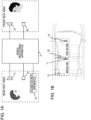
- the adaptive filter for noise cancelation that cancels, in the second area, an output sound of the sound source apparatus output from the first area speaker and a transfer function of the adaptive filter that cancels echoes of a speech voice of the user in the first area that comes around to the second area microphone from the second area speaker are diverted, generation of audio feedback caused by a speech voice of the user in the second area that comes around to the second area microphone from the first area speaker may be suppressed without using a dedicated adaptive filter.
- Fig. 1A is a diagram illustrating a configuration of an in-vehicle system according to the first embodiment.
- the in-vehicle system includes a rear seat speaker 11 which is a speaker for a user in a rear seat area in a car, a rear seat microphone 12 which is a microphone for the user in the rear seat area, a sound source apparatus 13 for the user in the rear seat area, a front seat speaker 21 which is a speaker for a user in a front seat area in the car, a front seat microphone 22 which is a microphone for the user in the front seat area, and a signal processing apparatus 3 to which the above components are connected.
- a rear seat speaker 11 which is a speaker for a user in a rear seat area in a car
- a rear seat microphone 12 which is a microphone for the user in the rear seat area
- a sound source apparatus 13 for the user in the rear seat area
- a front seat speaker 21 which is a speaker for a user in a front seat area in the car
- a front seat microphone 22 which is a microphone for the user in the front seat area
- a signal processing apparatus 3 to which the above components
- the signal processing apparatus 3 outputs voice of the user in the rear seat area picked up by the rear seat microphone 12 in the rear seat area to the front seat speaker 21 in the front seat area, and outputs voice of the user in the front seat area picked up by the front seat microphone 22 in the front seat area to the rear seat speaker 11 in the rear seat area, so as to support communication by conversation between the user in the rear seat area and the user in the front seat area.
- the rear seat area is, for example, an area behind a driver's seat of a car, and the rear seat speaker 11 and the rear seat microphone 12 are located in the rear seat area.
- the front seat area is, for example, a driver's seat area of the car, and the front seat speaker 21 and the front seat microphone 22 are located in the front seat area.
- the rear seat speaker 11 and the front seat microphone 22 are located relatively close to each other, and the signal processing apparatus 3 cancels an output sound of the rear seat speaker 11 that comes around to the front seat microphone 22 to suppress generation of audio feedback caused by the output sound of the rear seat speaker 11 that comes around to the front seat microphone 22.
- the signal processing apparatus 3 outputs an output sound of the sound source apparatus 13 to the rear seat speaker 11 in the rear seat area, and also outputs, from the front seat speaker 21 in the front seat area, a noise canceling sound for canceling the output sound of the sound source apparatus 13 output from the rear seat speaker 11 in a position of the user in the front seat area so as to suppress disturbance of the user in the front seat area by the output sound of the sound source apparatus 13 that by the user in the rear seat area is listening to.
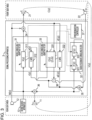
- Fig. 2 is a diagram illustrating a configuration of the signal processing apparatus 3.
- the signal processing apparatus 3 includes a noise canceling adaptive filter 31, an audio feedback canceling filter 32, a first adder 34, a second adder 35, a third adder 36, and a synchronization controller 37.
- An output of the rear seat microphone 12 is transmitted to the first adder 34 and added by the first adder 34 to the noise canceling sound output from the noise canceling adaptive filter 31, and a resultant sound is output from the front seat speaker 21.
- the output of the front seat microphone 22 is transmitted to the third adder 36 after being transmitted to the second adder 35 and added to an output of the audio feedback canceling filter 32 by the second adder 35, and the third adder 36 adds a resultant to an output of the sound source apparatus 13 and outputs a resultant sound to the rear seat speaker 11.
- the noise canceling adaptive filter 31 includes a noise canceling variable filter 311, a noise canceling adaptive algorithm executor 312, and a reference signal generation filter 313.
- the noise canceling variable filter 311 receives an output of the sound source apparatus 13 as an input, and an output of the noise canceling variable filter 311 is supplied to the first adder 34 as a noise canceling sound.
- the reference signal generation filter 313 that has a transfer function C ⁇ (z) set in advance therein that is the same as a transfer function C(z) from the front seat speaker 21 to the front seat microphone 22 applies the transfer function C ⁇ (Z) to the output of the sound source apparatus 13 so as to obtain a reference signal r(z) to be output to the noise canceling adaptive algorithm executor 312.
- the output of the reference signal generation filter 313 is input to the noise canceling adaptive algorithm executor 312 as the reference signal r(z), and in addition, an output of the front seat microphone 22 is also input as an error e(z).
- the noise canceling adaptive algorithm executor 312 performs an adaptive operation of updating a transfer function X(z) of the noise canceling variable filter 311 so as to minimize power of the error e(z) in accordance with the Filtered-X LMS algorithm.
- V(z) denotes a transfer function from the rear seat speaker 11 to the front seat microphone 22
- the audio feedback canceling filter 32 includes a first filter 321 and a second filter 322.
- An output of the front seat microphone 22 is added to an output of the audio feedback canceling filter 32 by the second adder 35, an output of the second adder 35 serves as an input of the audio feedback canceling filter 32, and the output of the second adder 35 serves as an output of the audio feedback canceling filter 32 through the first filter 321 and the second filter 322.
- a transfer function X'(z) set in the first filter 321 is the same as the transfer function X(z) of the noise canceling variable filter 311.
- the transfer function X'(z) of the first filter 321 is set when the synchronization controller 37 updates the transfer function X'(z) of the first filter 321 to a transfer function the same as the transfer function X(z) of the noise canceling variable filter 311 as needed.
- the second filter 322 has a transfer function C ⁇ (z) that is the same as the transfer function C(z) obtained in advance.
- an output of the second adder 35 is denoted by y(z)
- an output of the rear seat speaker 11 is denoted by h(z)
- a speech voice of the user in the front seat area collected by the front seat microphone 22 is denoted by s(z)
- an output sound of the rear seat speaker 11 that comes around to the front seat microphone 22 is denoted by h(z)V(z)
- an output of the front seat microphone 22 obtained when sound does not come around to the front seat microphone 22 from the front seat speaker 21 is denoted by s(z)+h(z)V(z).
- an output of the audio feedback canceling filter 32 is denoted by y(z)X'(z)C ⁇ (z)
- an output y(z) of the second adder 35 is expressed as follows.
- the second embodiment is different from the first embodiment in that a signal processing apparatus 3 has, in addition to the function of the signal processing apparatus 3 according to the first embodiment, a function of canceling echoes of a speech voice in a rear seat area output from the front seat speaker 21 that comes around to the front seat microphone 22, and only a portion of a configuration of the signal processing apparatus 3 is different from the first embodiment.
- Fig. 3 is a diagram illustrating a configuration of the signal processing apparatus 3 according to the second embodiment.
- the signal processing apparatus 3 includes an echo canceling adaptive filter 33 and a subtractor 38 as a configuration for echo cancelation.
- the echo canceling adaptive filter 33 has an echo canceling variable filter 331 and an echo canceling adaptive algorithm executor 332.
- the echo canceling variable filter 331 is a two-channel variable filter with two signal processing systems, and individual channels have the same transfer function set by the echo canceling adaptive algorithm executor 332. In other words, the echo canceling variable filter 331 is equivalent to two variable filters with the same transfer function set by the echo canceling adaptive algorithm executor 332.
- a first channel of the echo canceling variable filter 331 receives an output of a rear seat microphone 12 as an input, and an output of the first channel is supplied to a subtractor 38 as an echo canceling sound. Furthermore, a second channel of the echo canceling variable filter 331 receives an output of a sound source apparatus 13 as an input, and an output of the second channel is supplied to a noise canceling adaptive filter 31.
- the subtractor 38 subtracts, from an output of the rear seat microphone 12, the echo canceling sound output by the first channel of the echo canceling variable filter 331 and outputs a resultant sound.
- An echo canceling adaptive algorithm executor 332 uses an output of the subtractor 38 as an error eE(z) and an output of the rear seat microphone 12 as a reference signal rE(z) to update a transfer function Q(z) of the first channel of the echo canceling variable filter 331 so that the power of the error eE(z) is minimized by using the LMS algorithm or the like. Furthermore, a transfer function Q(z) of the first channel is shared as a transfer function of the second channel, and as the transfer function Q(z) of the first channel is updated, the transfer function of the second channel is also updated so as to be equal to the transfer function Q(z) of the first channel.
- the echo canceling sound output by the first channel of the echo canceling variable filter 331 is used to cancel an echo that is an output sound component of the rear seat microphone 12 included in an output of the front seat microphone 22 by the subtraction performed by the subtractor 38.
- an error eE(z) associated with M(z) output from the subtractor 38 to the echo canceling adaptive algorithm executor 332 is represented as follows.
- eE z M z C z ⁇ M z Q z
- an output of the subtractor 38 is output from the rear seat speaker 11 through a second adder 35 and a third adder 36. Furthermore, the output of the subtractor 38 is also supplied to the noise canceling adaptive filter 31.
- the noise canceling adaptive filter 31 of the second embodiment is configured such that the reference signal generation filter 313 is eliminated from the noise canceling adaptive filter 31 of the first embodiment illustrated in Fig. 2 , and the noise canceling adaptive algorithm executor 312 receives a signal of the second channel of the echo canceling variable filter 331, instead of an output of the reference signal generation filter 313, as a reference signal r(z).
- the noise canceling adaptive filter 31 according to the first embodiment determines an output of the front seat microphone 22 as the error e(z) in the first embodiment
- this is changed in the second embodiment such that the noise canceling adaptive filter 31 according to the second embodiment determines an output of the subtractor 38, that is, voice obtained by canceling echoes of a speech voice of a user in a rear seat area from an output of the front seat microphone 22, as the error e(z) to be input to the noise canceling adaptive algorithm executor 312.
- the speech voice of the user in the rear seat area, which is canceled as an echo by the subtractor 38, is uncorrelated with the output sound of the sound source apparatus 13.
- the output of the front seat microphone 22 is used as an input of the second adder 35 in the first embodiment, this is changed in the second embodiment such that the output of the subtractor 38, that is, voice obtained by canceling echoes of a speech voice of the user in the rear seat area from the output of the front seat microphone 22 is used as the input of the second adder 35.
- the output of the subtractor 38 is added to the output of the audio feedback canceling filter 32 in the second adder 35, and an output of the second adder 35 serves as an input of the audio feedback canceling filter 32.
- the output of the second adder 35 serves as the input of the audio feedback canceling filter 32, and the output of the second adder 35 serves as the input of the audio feedback canceling filter 32.
- the output of the second adder 35 serves as an output of the audio feedback canceling filter 32 through the first filter 321 and the second filter 322.
- the output of the second adder 35 is added to the output of the sound source apparatus 13 by the third adder 36, and a resultant is output to the rear seat speaker 11.
- the synchronization controller 37 appropriately updates a transfer function X'(z) of the first filter 321 by a transfer function the same as a transfer function X(z) of the noise canceling variable filter 311, and updates a transfer function Q'(z) of the second filter 322 by a transfer function the same as a transfer function Q(z) of the echo canceling variable filter 331.
- audio feedback may be canceled, without a dedicated adaptive filter, by diverting a transfer function of an adaptive filter for noise cancelation or echo cancelation.
- a configuration in which echoes that come around to the front seat microphone 22 from the front seat speaker 21 of the signal processing apparatus 3 described above and a symmetrical configuration of the rear seat area and the front seat area may be added to the signal processing apparatus 3 in the second embodiment described above so that voice picked up by the rear seat microphone 12 in the rear seat area is output to the front seat speaker 21 after the echoes that come around to the rear seat microphone 12 from the rear seat speaker 11 is canceled.
- a configuration in which audio feedback caused by sound that comes around to the front seat microphone 22 from the rear seat speaker 11 of the signal processing apparatus 3 is canceled and the symmetrical configuration of the rear seat area and the front seat area described above may be added to the signal processing apparatus 3 so that audio feedback caused by sound that comes around to the rear seat microphone 12 from the front seat speaker 21 is canceled.
Landscapes
- Engineering & Computer Science (AREA)
- Physics & Mathematics (AREA)
- Acoustics & Sound (AREA)
- Multimedia (AREA)
- Aviation & Aerospace Engineering (AREA)
- Transportation (AREA)
- Mechanical Engineering (AREA)
- Signal Processing (AREA)
- Computational Linguistics (AREA)
- Quality & Reliability (AREA)
- Health & Medical Sciences (AREA)
- Audiology, Speech & Language Pathology (AREA)
- Human Computer Interaction (AREA)
- Soundproofing, Sound Blocking, And Sound Damping (AREA)
- Circuit For Audible Band Transducer (AREA)
- Telephone Function (AREA)
- Interconnected Communication Systems, Intercoms, And Interphones (AREA)
Abstract
Description
- The present disclosure relates to a technique for supporting communication by speech between users in different areas.
- As a technique for supporting communication by speech between users in different areas, a microphone is used to capture speech voice of a user seated in a first seat of a car, and the speech voice, whose gain is adjusted so that a user in a second seat may hear the speech voice clearly, is synthesized with output sound, such as music output by an audio device, and output from a speaker. Such a technique is generally used (refer to
JP 2002-51392 A - Furthermore, as a technique for supporting communication by speech in a car, as illustrated in
Fig. 4A , the following echo cancel technique is used. That is, in a system for supporting conversation between a user in a first area and a user in a second area by outputting a user's voice picked up by a microphone 41 in the first area from a speaker 43 in the second area and outputting a user's voice picked up by amicrophone 44 in the second area from aspeaker 42 in the first area, a cancel sound to cancel echoes is generated using an adaptive filter 45 and the cancel sound is added to an output of themicrophone 44 in the second area by anadder 46 so that echoes that have been come around to themicrophone 44 in the second area from the speaker 43 in the second area are canceled (refer toJP 2010-16564 A - In this system, in the adaptive filter 45, a
coefficient update section 452 updates a filter coefficient of avariable filter 451 that generates cancel sound using the output of the microphone 41 in the first area so that a minimum error is obtained by an adaptive algorithm, such as an LMS algorithm, while it is determined that an output of theadder 46 is an error and an output of the microphone 41 in the first area is a reference signal. - Furthermore, as illustrated in
Fig. 4B , an active noise control technique of determining sound, such as music, output from asound source apparatus 51 for the user in the first area using aspeaker 52 for the user in the first area as noise for the user in the second area and outputting noise canceling sound for canceling the noise from aspeaker 54 in the second area has been used (refer toJP 2010-163054 A - The active noise control technique uses an error microphone 55 located in the second area and an
adaptive filter 53. Theadaptive filter 53 includes anestimation filter 531 that has a transfer function C^(z) set therein estimated as a transfer function C(z) from thespeaker 54 to the error microphone 55 in the second area and that receives an output of thesound source apparatus 51 as an input, avariable filter 532 that generates a noise canceling sound using the output of thesound source apparatus 51, and thecoefficient update section 533. With this configuration, thecoefficient update section 533 updates a filter coefficient of thevariable filter 532 that generates the noise canceling sound in accordance with the Filtered-X LMS algorithm for performing an adaptive algorithm using an output of the error microphone 55 as an error and an output of theestimation filter 531 as a reference signal, so that an error is minimized. - In the system for supporting communication by speech in a car by outputting a user's voice picked up by the microphone in the first area from the speaker in the second area and outputting a user's voice picked up by the microphone in the second area from the speaker in the first area, when a location of the microphone in one of the areas and a location of the speaker in the other of the areas that outputs the voice picked up by the microphone in the one of the areas is close to each other, audio feedback may occur since sound output from the speaker in the other area comes around to the microphone in the one of the areas.
- Therefore, it is conceivable to prevent audio feedback by using an adaptive filter to cancel an output sound of the speaker in the other area that comes around to the microphone in the one of the areas.
- However, when the active noise control and the echo cancelation described above are to be performed in this system, an adaptive filter for suppressing audio feedback is required in addition to the adaptive filter for the active noise control and the echo cancelation, which leads to an excessive system size and an excessive processing volume.
- Accordingly, an object of the present disclosure is to provide a communication support system capable to suppress occurrence of audio feedback by a comparatively simple configuration in a communication support system for supporting communication by speech between users in different areas.
- The invention relates to a communication support system according to the appended claims. Embodiments are disclosed in the dependent claims.
- According to an aspect of the present disclosure, a communication support system for supporting communication by speech between a user in a first area and a user in a second area includes a sound source apparatus, a first area speaker that is installed in the first area and that is configured to receive a sound source output sound signal corresponding to sound output from the sound source apparatus, a second area speaker installed in the second area, and a second area microphone installed in the second area, and a signal processing apparatus. The signal processing apparatus includes a noise canceling adaptive filter configured to generate a noise canceling sound signal to be applied to the second area speaker, an audio feedback canceling section configured to generate a second area speech sound signal to be added to the sound source output sound signal and to be applied to the first area speaker, and a transfer function update processing section. Furthermore, the noise canceling adaptive filter generates the noise canceling sound signal by applying a transfer function X(z) adapted by an adaptive operation using a second area sound signal picked up by the second area microphone, as an error, to the sound source output sound signal to generate the noise canceling sound signal, Furthermore, the audio feedback canceling section includes a first filter, a second filter that uses an output of the first filter as an input, and an adder that adds the second area sound signal to an output of the second filter and outputs a result of the addition as the second area speech sound signal. The first filter receives an output of the adder as an input, and a transfer function equivalent to a transfer function C(z) from the second area speaker to the second area microphone is set to the second filter. Then the transfer function update processing section updates a transfer function of the first filter to a transfer function that is the same as the transfer function X(z) adapted by the adaptive operation performed by the noise canceling adaptive filter.
- Here, a first area microphone installed in the first area set in the communication support system may be provided so that a first area sound signal picked up by the first area microphone is applied to the second area speaker after being added to the noise canceling sound signal.
- Moreover, the communication support system described above may be configured such that the noise canceling adaptive filter adapts the transfer function X(z) by an adaptive operation in accordance with the Filtered-X LMS algorithm using a signal obtained by applying a transfer function equivalent to the transfer function C(z) to the sound source output sound signal as a reference signal and the second area sound signal as an error.
- Furthermore, to address the above problem, according to another aspect of the present disclosure, a communication support system for supporting communication by speech between a user in a first area and a user in a second area includes a sound source apparatus, a first area speaker that is installed in the first area and that receives a sound source output sound signal corresponding to sound output from the sound source apparatus, a first area microphone installed in the first area, a second area speaker that is installed in the second area and that receives a first area sound signal picked up by the first area microphone, a second area microphone installed in the second area, and a signal processing apparatus. The signal processing apparatus includes a noise canceling adaptive filter that generates a noise canceling sound signal to be applied to the second area speaker after being added to the first area sound signal, an echo canceling section, an audio feedback canceling section that generates a second area speech sound signal to be added to the sound source output sound signal and to be applied to the first area speaker, a reference signal generation filter that receives the sound source output sound signal as an input, and a transfer function update processing section. In addition, the echo canceling section includes an echo canceling adaptive filter that receives the first area sound signal as an input and an echo canceling adder that adds an output of a second area sound signal picked up by the second area microphone to an echo canceling sound signal that is an output of the echo canceling adaptive filter and that outputs a result of the addition, the echo canceling adaptive filter generates the echo canceling sound signal by applying a transfer function Q(z) adapted by an adaptive operation using an output of the echo canceling adder as an error to the first area sound signal. Furthermore, the reference signal generation filter shares the transfer function Q(z) of the echo canceling adaptive filter as the transfer function of the reference signal generation filter, and the noise canceling adaptive filter generates the noise canceling sound signal by applying, to the sound source output sound signal, a transfer function X(z) adapted by an adaptive operation in accordance with the Filtered-X LMS algorithm using an output of the echo canceling adder as an error and an output of the reference signal generation filter as a reference signal. Moreover, the audio feedback canceling section includes a first filter, a second filter that uses an output of the first filter as an input, and an audio feedback canceling adder that adds an output of the echo canceling adder to an output of the second filter and outputs a result of the addition as the second area speech sound signal. The first filter receives an output of the audio feedback canceling adder as an input. Then the transfer function update processing section updates a transfer function of the first filter to a transfer function the same as the transfer function X(z) adapted by the adaptive operation performed by the noise canceling adaptive filter and updates a transfer function of the second filter to a transfer function the same as the transfer function Q(z) adapted by the adaptive operation performed by the echo canceling adaptive filter.
- Here, the communication support system may be configured such that the echo canceling adaptive filter adapts the transfer function Q(z) by an adaptive operation in accordance with the LMS algorithm using the first area sound signal as a reference signal and an output of the echo canceling adder as an error.
- Furthermore, according to the communication support systems described above, a seat in the first area and a seat in the second area in a vehicle may be different from each other.
- According to the communication support system described herein, since the adaptive filter for noise cancelation that cancels, in the second area, an output sound of the sound source apparatus output from the first area speaker and a transfer function of the adaptive filter that cancels echoes of a speech voice of the user in the first area that comes around to the second area microphone from the second area speaker are diverted, generation of audio feedback caused by a speech voice of the user in the second area that comes around to the second area microphone from the first area speaker may be suppressed without using a dedicated adaptive filter.
-
Figs. 1A and 1B are block diagrams illustrating a configuration of an in-vehicle system according to an embodiment of the present disclosure. -
Fig. 2 is a block diagram illustrating a configuration of a signal processing apparatus according to a first embodiment of the present disclosure. -
Fig. 3 is a block diagram illustrating a configuration of a signal processing apparatus according to a second embodiment of the present disclosure. -
Figs. 4A and 4B are diagrams illustrating a general echo canceling technique and an active noise control technique, respectively. - The following is a description of embodiments of the present disclosure, taking as an example its application to an in-vehicle system that supports communication by speech in a vehicle between front and rear seats of a car.
- First, a first embodiment will be described.
-
Fig. 1A is a diagram illustrating a configuration of an in-vehicle system according to the first embodiment. - As illustrated in the figure, the in-vehicle system includes a
rear seat speaker 11 which is a speaker for a user in a rear seat area in a car, arear seat microphone 12 which is a microphone for the user in the rear seat area, asound source apparatus 13 for the user in the rear seat area, afront seat speaker 21 which is a speaker for a user in a front seat area in the car, afront seat microphone 22 which is a microphone for the user in the front seat area, and asignal processing apparatus 3 to which the above components are connected. - The
signal processing apparatus 3 outputs voice of the user in the rear seat area picked up by therear seat microphone 12 in the rear seat area to thefront seat speaker 21 in the front seat area, and outputs voice of the user in the front seat area picked up by thefront seat microphone 22 in the front seat area to therear seat speaker 11 in the rear seat area, so as to support communication by conversation between the user in the rear seat area and the user in the front seat area. - Here, as illustrated in
Fig. 1B , the rear seat area is, for example, an area behind a driver's seat of a car, and therear seat speaker 11 and therear seat microphone 12 are located in the rear seat area. Furthermore, the front seat area is, for example, a driver's seat area of the car, and thefront seat speaker 21 and thefront seat microphone 22 are located in the front seat area. - Furthermore, as illustrated in the figure, the
rear seat speaker 11 and thefront seat microphone 22 are located relatively close to each other, and thesignal processing apparatus 3 cancels an output sound of therear seat speaker 11 that comes around to thefront seat microphone 22 to suppress generation of audio feedback caused by the output sound of therear seat speaker 11 that comes around to thefront seat microphone 22. - Furthermore, the
signal processing apparatus 3 outputs an output sound of thesound source apparatus 13 to therear seat speaker 11 in the rear seat area, and also outputs, from thefront seat speaker 21 in the front seat area, a noise canceling sound for canceling the output sound of thesound source apparatus 13 output from therear seat speaker 11 in a position of the user in the front seat area so as to suppress disturbance of the user in the front seat area by the output sound of thesound source apparatus 13 that by the user in the rear seat area is listening to. - Next,
Fig. 2 is a diagram illustrating a configuration of thesignal processing apparatus 3. - As illustrated in the figure, the
signal processing apparatus 3 includes a noise cancelingadaptive filter 31, an audiofeedback canceling filter 32, afirst adder 34, asecond adder 35, athird adder 36, and asynchronization controller 37. - An output of the
rear seat microphone 12 is transmitted to thefirst adder 34 and added by thefirst adder 34 to the noise canceling sound output from the noise cancelingadaptive filter 31, and a resultant sound is output from thefront seat speaker 21. - The output of the
front seat microphone 22 is transmitted to thethird adder 36 after being transmitted to thesecond adder 35 and added to an output of the audiofeedback canceling filter 32 by thesecond adder 35, and thethird adder 36 adds a resultant to an output of thesound source apparatus 13 and outputs a resultant sound to therear seat speaker 11. - Here, the noise canceling
adaptive filter 31 includes a noisecanceling variable filter 311, a noise cancelingadaptive algorithm executor 312, and a referencesignal generation filter 313. - The noise
canceling variable filter 311 receives an output of thesound source apparatus 13 as an input, and an output of the noisecanceling variable filter 311 is supplied to thefirst adder 34 as a noise canceling sound. - The reference
signal generation filter 313 that has a transfer function C^(z) set in advance therein that is the same as a transfer function C(z) from thefront seat speaker 21 to thefront seat microphone 22 applies the transfer function C^(Z) to the output of thesound source apparatus 13 so as to obtain a reference signal r(z) to be output to the noise cancelingadaptive algorithm executor 312. - The output of the reference
signal generation filter 313 is input to the noise cancelingadaptive algorithm executor 312 as the reference signal r(z), and in addition, an output of thefront seat microphone 22 is also input as an error e(z). The noise cancelingadaptive algorithm executor 312 performs an adaptive operation of updating a transfer function X(z) of the noisecanceling variable filter 311 so as to minimize power of the error e(z) in accordance with the Filtered-X LMS algorithm. - More specifically, the noise canceling
adaptive algorithm executor 312 updates a transfer function X(n) of the noisecanceling variable filter 311 in accordance with the following equation:
front seat microphone 22 at the time point n, and r(n) denotes a reference signal output from the referencesignal generation filter 313 at the time point n, for example. - Assuming that V(z) denotes a transfer function from the
rear seat speaker 11 to thefront seat microphone 22, when only an output sound of thesound source apparatus 13 is output from therear seat speaker 11 and only an output sound of therear seat speaker 11 is collected by thefront seat microphone 22, e(z)=0 is attained when "X(z)=-V(z)C(z)-1" is satisfied, and therefore, the transfer function X(z) of the noisecanceling variable filter 311 is converged to - V(z)C(z)-1 by the adaptive operation described above. - The audio
feedback canceling filter 32 includes afirst filter 321 and asecond filter 322. - An output of the
front seat microphone 22 is added to an output of the audiofeedback canceling filter 32 by thesecond adder 35, an output of thesecond adder 35 serves as an input of the audiofeedback canceling filter 32, and the output of thesecond adder 35 serves as an output of the audiofeedback canceling filter 32 through thefirst filter 321 and thesecond filter 322. - A transfer function X'(z) set in the
first filter 321 is the same as the transfer function X(z) of the noise cancelingvariable filter 311. - The transfer function X'(z) of the
first filter 321 is set when thesynchronization controller 37 updates the transfer function X'(z) of thefirst filter 321 to a transfer function the same as the transfer function X(z) of the noise cancelingvariable filter 311 as needed. - The
second filter 322 has a transfer function C^(z) that is the same as the transfer function C(z) obtained in advance. - Therefore, assuming that an output of the
second adder 35 is denoted by y(z), an output of therear seat speaker 11 is denoted by h(z), and a speech voice of the user in the front seat area collected by thefront seat microphone 22 is denoted by s(z), an output sound of therear seat speaker 11 that comes around to thefront seat microphone 22 is denoted by h(z)V(z), and therefore, an output of thefront seat microphone 22 obtained when sound does not come around to thefront seat microphone 22 from thefront seat speaker 21 is denoted by s(z)+h(z)V(z). - Furthermore, since an output of the audio
feedback canceling filter 32 is denoted by y(z)X'(z)C^(z), an output y(z) of thesecond adder 35 is expressed as follows.


- Since the above equations are satisfied, the following expression is satisfied.

- Here, when "h(z)=y(z)" is satisfied, "y(z)=s(z)" is attained, and the output sound h(z)V(z) of the
rear seat speaker 11 that comes around to thefront seat microphone 22, which causes audio feedback, is canceled. - When there is no output sound of the
sound source apparatus 13, as expressed by the equation "h(z)=y(z)", a component of the output sound h(z)V(z) of therear seat speaker 11 that comes around to thefront seat microphone 22 is canceled from an output of thefront seat microphone 22 and occurrence of audio feedback is suppressed by operations of the audiofeedback canceling filter 32 and thesecond adder 35. - The first embodiment of the present disclosure has been described hereinabove.
- Next, a second embodiment of the present disclosure will be described.
- The second embodiment is different from the first embodiment in that a
signal processing apparatus 3 has, in addition to the function of thesignal processing apparatus 3 according to the first embodiment, a function of canceling echoes of a speech voice in a rear seat area output from thefront seat speaker 21 that comes around to thefront seat microphone 22, and only a portion of a configuration of thesignal processing apparatus 3 is different from the first embodiment. -
Fig. 3 is a diagram illustrating a configuration of thesignal processing apparatus 3 according to the second embodiment. - Hereinafter, portions of the
signal processing apparatus 3 according to the second embodiment that are different from thesignal processing apparatus 3 according to the first embodiment will be described. - As illustrated in the figure, the
signal processing apparatus 3 according to the second embodiment includes an echo canceling adaptive filter 33 and asubtractor 38 as a configuration for echo cancelation. - The echo canceling adaptive filter 33 has an echo canceling
variable filter 331 and an echo cancelingadaptive algorithm executor 332. The echo cancelingvariable filter 331 is a two-channel variable filter with two signal processing systems, and individual channels have the same transfer function set by the echo cancelingadaptive algorithm executor 332. In other words, the echo cancelingvariable filter 331 is equivalent to two variable filters with the same transfer function set by the echo cancelingadaptive algorithm executor 332. - A first channel of the echo canceling
variable filter 331 receives an output of arear seat microphone 12 as an input, and an output of the first channel is supplied to asubtractor 38 as an echo canceling sound. Furthermore, a second channel of the echo cancelingvariable filter 331 receives an output of asound source apparatus 13 as an input, and an output of the second channel is supplied to a noise cancelingadaptive filter 31. - The
subtractor 38 subtracts, from an output of therear seat microphone 12, the echo canceling sound output by the first channel of the echo cancelingvariable filter 331 and outputs a resultant sound. - An echo canceling
adaptive algorithm executor 332 uses an output of thesubtractor 38 as an error eE(z) and an output of therear seat microphone 12 as a reference signal rE(z) to update a transfer function Q(z) of the first channel of the echo cancelingvariable filter 331 so that the power of the error eE(z) is minimized by using the LMS algorithm or the like. Furthermore, a transfer function Q(z) of the first channel is shared as a transfer function of the second channel, and as the transfer function Q(z) of the first channel is updated, the transfer function of the second channel is also updated so as to be equal to the transfer function Q(z) of the first channel. - Therefore, the echo canceling sound output by the first channel of the echo canceling
variable filter 331 is used to cancel an echo that is an output sound component of therear seat microphone 12 included in an output of thefront seat microphone 22 by the subtraction performed by thesubtractor 38. - Assuming here that an output of the
rear seat microphone 12 is denoted by M(z), an error eE(z) associated with M(z) output from thesubtractor 38 to the echo cancelingadaptive algorithm executor 332 is represented as follows.
- When the transfer functions of the first and second channels of the echo canceling
variable filter 331 are converged by an operation of the echo cancelingadaptive algorithm executor 332 so that "eE(z)=0" is attained, the following expression is obtained.

- Here, an output of the
subtractor 38 is output from therear seat speaker 11 through asecond adder 35 and athird adder 36. Furthermore, the output of thesubtractor 38 is also supplied to the noise cancelingadaptive filter 31. - Next, the noise canceling
adaptive filter 31 of the second embodiment is configured such that the referencesignal generation filter 313 is eliminated from the noise cancelingadaptive filter 31 of the first embodiment illustrated inFig. 2 , and the noise cancelingadaptive algorithm executor 312 receives a signal of the second channel of the echo cancelingvariable filter 331, instead of an output of the referencesignal generation filter 313, as a reference signal r(z). Furthermore, although the noise cancelingadaptive filter 31 according to the first embodiment determines an output of thefront seat microphone 22 as the error e(z) in the first embodiment, this is changed in the second embodiment such that the noise cancelingadaptive filter 31 according to the second embodiment determines an output of thesubtractor 38, that is, voice obtained by canceling echoes of a speech voice of a user in a rear seat area from an output of thefront seat microphone 22, as the error e(z) to be input to the noise cancelingadaptive algorithm executor 312. - As described above, the second channel of the echo canceling
variable filter 331 receives an output of thesound source apparatus 13 as an input and has a transfer function Q(z) that satisfies "Q(z)=C(z)", and therefore, the reference signal r(z) input to the noise cancelingadaptive algorithm executor 312 is the same as that in the first embodiment. The speech voice of the user in the rear seat area, which is canceled as an echo by thesubtractor 38, is uncorrelated with the output sound of thesound source apparatus 13. - Therefore, the transfer function X(z) of the noise canceling
variable filter 311 is represented as "X(z)=-V(z)C(z )-1" as in the first embodiment, and a noise canceling sound that cancels the output sound of thesound source apparatus 13 output from therear seat speaker 11 is generated by the noise cancelingvariable filter 311 in a position of the user in a front seat area and is output from thefront seat speaker 21 in the front seat area via afirst adder 34. - Next, although the output of the
front seat microphone 22 is used as an input of thesecond adder 35 in the first embodiment, this is changed in the second embodiment such that the output of thesubtractor 38, that is, voice obtained by canceling echoes of a speech voice of the user in the rear seat area from the output of thefront seat microphone 22 is used as the input of thesecond adder 35. - In other words, the output of the
subtractor 38 is added to the output of the audiofeedback canceling filter 32 in thesecond adder 35, and an output of thesecond adder 35 serves as an input of the audiofeedback canceling filter 32. The output of thesecond adder 35 serves as the input of the audiofeedback canceling filter 32, and the output of thesecond adder 35 serves as the input of the audiofeedback canceling filter 32. The output of thesecond adder 35 serves as an output of the audiofeedback canceling filter 32 through thefirst filter 321 and thesecond filter 322. The output of thesecond adder 35 is added to the output of thesound source apparatus 13 by thethird adder 36, and a resultant is output to therear seat speaker 11. - Furthermore, according to the second embodiment, the
synchronization controller 37 appropriately updates a transfer function X'(z) of thefirst filter 321 by a transfer function the same as a transfer function X(z) of the noise cancelingvariable filter 311, and updates a transfer function Q'(z) of thesecond filter 322 by a transfer function the same as a transfer function Q(z) of the echo cancelingvariable filter 331. - Here, as described above, the transfer function Q(z) of the echo canceling
variable filter 331 satisfies "Q(z)=C(z)", and a transfer function the same as that in the first embodiment is set in thefirst filter 321 and thesecond filter 322 also in the second embodiment since the transfer function X(z) of the noise cancelingvariable filter 311 satisfies "X(z)=-V(z)C(z )-1", and occurrence of audio feedback is suppressed. - The embodiments of the present disclosure have been described hereinabove.
- As described above, according to the embodiments, audio feedback may be canceled, without a dedicated adaptive filter, by diverting a transfer function of an adaptive filter for noise cancelation or echo cancelation.
- Here, a configuration in which echoes that come around to the
front seat microphone 22 from thefront seat speaker 21 of thesignal processing apparatus 3 described above and a symmetrical configuration of the rear seat area and the front seat area may be added to thesignal processing apparatus 3 in the second embodiment described above so that voice picked up by therear seat microphone 12 in the rear seat area is output to thefront seat speaker 21 after the echoes that come around to therear seat microphone 12 from therear seat speaker 11 is canceled. - Furthermore, in the first and second embodiments described above, a configuration in which a second sound source apparatus for the user in the front seat area is disposed, an output sound of the
sound source apparatus 13 of thesignal processing apparatus 3 described above is output to therear seat speaker 11, and a noise canceling sound for canceling an output sound of thesound source apparatus 13 output from therear seat speaker 11 in a position of the user in the front seat area is output from thefront seat speaker 21 and a symmetrical configuration of the rear seat area and the front seat area may be added to thesignal processing apparatus 3, so that an output sound of the second sound source apparatus is output to thefront seat speaker 21, and noise canceling sound for canceling an output sound of thesound source apparatus 13 output from thefront seat speaker 21 in a position of the user in the rear seat area may be output from therear seat speaker 11. - In addition, in the first and second embodiments described above, a configuration in which audio feedback caused by sound that comes around to the
front seat microphone 22 from therear seat speaker 11 of thesignal processing apparatus 3 is canceled and the symmetrical configuration of the rear seat area and the front seat area described above may be added to thesignal processing apparatus 3 so that audio feedback caused by sound that comes around to therear seat microphone 12 from thefront seat speaker 21 is canceled. - Furthermore, although the above embodiments have been described using the example of application to support communication by speech between the front and rear seats, the above embodiments can be equally applied to support communication by speech between seats for any combination of seats other than the front and rear seats.
- In addition, although the above description is based on the example of application to support communication by speech in a car, each of the foregoing embodiments may be similarly applied even when each area is outside of a car.
- Although the number of areas is set to 2 in the foregoing embodiments, the embodiments may be expanded and implemented for three or more areas.
Claims (6)
- A communication support system for supporting communication by speech between a user in a first area and a user in a second area, the communication support system comprising:a sound source apparatus (13);a first area speaker (11) that is installed in the first area and that is configured to receive a sound source output sound signal corresponding to sound output from the sound source apparatus;a second area speaker (21) installed in the second area;a second area microphone (22) installed in the second area; anda signal processing apparatus (3), whereinthe signal processing apparatus includesa noise canceling adaptive filter (31) configured to generate a noise canceling sound signal to be applied to the second area speaker,an audio feedback canceling section (32) configured to generate a second area speech sound signal to be added to the sound source output sound signal and to be applied to the first area speaker, anda transfer function update processing section,the noise canceling adaptive filter is configured to generate the noise canceling sound signal by applying a transfer function X(z) adapted by an adaptive operation using a second area sound signal picked up by the second area microphone, as an error, to the sound source output sound signal to generate the noise canceling sound signal,the audio feedback canceling section includes a first filter, a second filter that uses an output of the first filter as an input, and an adder that adds the second area sound signal to an output of the second filter and outputs a result of the addition as the second area speech sound signal,the first filter receives an output of the adder as an input,the second filter has a transfer function equivalent to a transfer function C(z) from the second area speaker to the second area microphone, andthe transfer function update processing section is configured to update a transfer function of the first filter to a transfer function that is the same as the transfer function X(z) adapted by the adaptive operation performed by the noise canceling adaptive filter.
- The communication support system according to claim 1, further comprising:a first area microphone (12) installed in the first area, whereina first area sound signal picked up by the first area microphone is applied to the second area speaker after being added to the noise canceling sound signal.
- The communication support system according to claim 1 or 2, wherein
the noise canceling adaptive filter is configured to adapt the transfer function X(z) by an adaptive operation in accordance with the Filtered-X LMS algorithm using a signal obtained by applying a transfer function equivalent to the transfer function C(z) to the sound source output sound signal as a reference signal and the second area sound signal as an error. - A communication support system for supporting communication by speech between a user in a first area and a user in a second area, the communication support system comprising:a sound source apparatus (13);a first area speaker (11) that is installed in the first area and that is configured to receive a sound source output sound signal corresponding to sound output from the sound source apparatus;a first area microphone (12) installed in the first area;a second area speaker (21) that is installed in the second area and that is configured to receive a first area sound signal picked up by the first area microphone;a second area microphone (22) installed in the second area; anda signal processing apparatus (3), whereinthe signal processing apparatus includesa noise canceling adaptive filter (31) configured to generate a noise canceling sound signal to be applied to the second area speaker after being added to the first area sound signal,an echo canceling section (33),an audio feedback canceling section (32) configured to generate a second area speech sound signal to be added to the sound source output sound signal and to be applied to the first area speaker,a reference signal generation filter that is configured to receive the sound source output sound signal as an input, anda transfer function update processing section,the echo canceling section includes
an echo canceling adaptive filter that receives the first area sound signal as an input and an echo canceling adder that adds an output of a second area sound signal picked up by the second area microphone to an echo canceling sound signal that is an output of the echo canceling adaptive filter and that outputs a result of the addition,the echo canceling adaptive filter is configured to generate the echo canceling sound signal by applying a transfer function Q(z) adapted by an adaptive operation using an output of the echo canceling adder as an error to the first area sound signal,the reference signal generation filter shares the transfer function Q(z) of the echo canceling adaptive filter as the transfer function of the reference signal generation filter,the noise canceling adaptive filter is configured to generate the noise canceling sound signal by applying, to the sound source output sound signal, a transfer function X(z) adapted by an adaptive operation in accordance with the Filtered-X LMS algorithm using an output of the echo canceling adder as an error and an output of the reference signal generation filter as a reference signal,the audio feedback canceling section includes a first filter, a second filter that uses an output of the first filter as an input, and an audio feedback canceling adder that adds an output of the echo canceling adder to an output of the second filter and outputs a result of the addition as the second area speech sound signal,the first filter receives an output of the audio feedback canceling adder as an input, andthe transfer function update processing section is configured to update a transfer function of the first filter to a transfer function the same as the transfer function X(z) adapted by the adaptive operation performed by the noise canceling adaptive filter and to update a transfer function of the second filter to a transfer function the same as the transfer function Q(z) adapted by the adaptive operation performed by the echo canceling adaptive filter. - The communication support system according to claim 4, wherein
the echo canceling adaptive filter is configured to adapt the transfer function Q(z) by an adaptive operation in accordance with the LMS algorithm using the first area sound signal as a reference signal and an output of the echo canceling adder as an error. - The communication support system according to claim 1, 2, 3, 4, or 5, wherein
a seat in the first area and a seat in the second area in a vehicle are different from each other.
Applications Claiming Priority (1)
| Application Number | Priority Date | Filing Date | Title |
|---|---|---|---|
| JP2022027557A JP7780978B2 (en) | 2022-02-25 | 2022-02-25 | Communication Support System |
Publications (2)
| Publication Number | Publication Date |
|---|---|
| EP4236284A1 true EP4236284A1 (en) | 2023-08-30 |
| EP4236284B1 EP4236284B1 (en) | 2025-11-19 |
Family
ID=85158766
Family Applications (1)
| Application Number | Title | Priority Date | Filing Date |
|---|---|---|---|
| EP23154405.7A Active EP4236284B1 (en) | 2022-02-25 | 2023-02-01 | Communication support system |
Country Status (4)
| Country | Link |
|---|---|
| US (1) | US12112733B2 (en) |
| EP (1) | EP4236284B1 (en) |
| JP (1) | JP7780978B2 (en) |
| CN (1) | CN116665688A (en) |
Citations (5)
| Publication number | Priority date | Publication date | Assignee | Title |
|---|---|---|---|---|
| JP2002051392A (en) | 2000-08-01 | 2002-02-15 | Alpine Electronics Inc | In-vehicle conversation assisting device |
| US20020071573A1 (en) * | 1997-09-11 | 2002-06-13 | Finn Brian M. | DVE system with customized equalization |
| JP2010016564A (en) | 2008-07-02 | 2010-01-21 | Panasonic Corp | Speech signal processor |
| JP2010163054A (en) | 2009-01-15 | 2010-07-29 | Fujitsu Ten Ltd | Conversation support device and conversation support method |
| US20210006900A1 (en) * | 2018-03-19 | 2021-01-07 | Panasonic Intellectual Property Management Co., Ltd. | Conversation support device |
Family Cites Families (4)
| Publication number | Priority date | Publication date | Assignee | Title |
|---|---|---|---|---|
| US7171003B1 (en) * | 2000-10-19 | 2007-01-30 | Lear Corporation | Robust and reliable acoustic echo and noise cancellation system for cabin communication |
| JP2009100187A (en) * | 2007-10-16 | 2009-05-07 | Fujitsu Ten Ltd | Sound controller |
| US9641934B2 (en) * | 2012-01-10 | 2017-05-02 | Nuance Communications, Inc. | In-car communication system for multiple acoustic zones |
| JP7497233B2 (en) * | 2020-07-03 | 2024-06-10 | アルプスアルパイン株式会社 | In-car communication support system |
-
2022
- 2022-02-25 JP JP2022027557A patent/JP7780978B2/en active Active
-
2023
- 2023-02-01 EP EP23154405.7A patent/EP4236284B1/en active Active
- 2023-02-17 CN CN202310127120.7A patent/CN116665688A/en active Pending
- 2023-02-23 US US18/113,225 patent/US12112733B2/en active Active
Patent Citations (5)
| Publication number | Priority date | Publication date | Assignee | Title |
|---|---|---|---|---|
| US20020071573A1 (en) * | 1997-09-11 | 2002-06-13 | Finn Brian M. | DVE system with customized equalization |
| JP2002051392A (en) | 2000-08-01 | 2002-02-15 | Alpine Electronics Inc | In-vehicle conversation assisting device |
| JP2010016564A (en) | 2008-07-02 | 2010-01-21 | Panasonic Corp | Speech signal processor |
| JP2010163054A (en) | 2009-01-15 | 2010-07-29 | Fujitsu Ten Ltd | Conversation support device and conversation support method |
| US20210006900A1 (en) * | 2018-03-19 | 2021-01-07 | Panasonic Intellectual Property Management Co., Ltd. | Conversation support device |
Also Published As
| Publication number | Publication date |
|---|---|
| US12112733B2 (en) | 2024-10-08 |
| EP4236284B1 (en) | 2025-11-19 |
| JP7780978B2 (en) | 2025-12-05 |
| JP2023124023A (en) | 2023-09-06 |
| US20230274723A1 (en) | 2023-08-31 |
| CN116665688A (en) | 2023-08-29 |
Similar Documents
| Publication | Publication Date | Title |
|---|---|---|
| EP3598431A1 (en) | Active noise control system and on-vehicle audio system | |
| EP3312839B1 (en) | Device for assisting two-way conversation and method for assisting two-way conversation | |
| EP4057276B1 (en) | Active noise control system | |
| EP3951770B1 (en) | Active noise control system | |
| JP2005247181A (en) | In-vehicle hands-free device | |
| EP4236284B1 (en) | Communication support system | |
| EP3933837B1 (en) | In-vehicle communication support system | |
| EP4280208A1 (en) | Active noise control system | |
| EP3933833B1 (en) | In-vehicle communication support system | |
| US11922916B2 (en) | Active noise control system | |
| WO2021158388A1 (en) | Method and apparatus for attenuation of audio howling |
Legal Events
| Date | Code | Title | Description |
|---|---|---|---|
| PUAI | Public reference made under article 153(3) epc to a published international application that has entered the european phase |
Free format text: ORIGINAL CODE: 0009012 |
|
| STAA | Information on the status of an ep patent application or granted ep patent |
Free format text: STATUS: THE APPLICATION HAS BEEN PUBLISHED |
|
| AK | Designated contracting states |
Kind code of ref document: A1 Designated state(s): AL AT BE BG CH CY CZ DE DK EE ES FI FR GB GR HR HU IE IS IT LI LT LU LV MC ME MK MT NL NO PL PT RO RS SE SI SK SM TR |
|
| STAA | Information on the status of an ep patent application or granted ep patent |
Free format text: STATUS: REQUEST FOR EXAMINATION WAS MADE |
|
| 17P | Request for examination filed |
Effective date: 20240226 |
|
| RBV | Designated contracting states (corrected) |
Designated state(s): AL AT BE BG CH CY CZ DE DK EE ES FI FR GB GR HR HU IE IS IT LI LT LU LV MC ME MK MT NL NO PL PT RO RS SE SI SK SM TR |
|
| GRAP | Despatch of communication of intention to grant a patent |
Free format text: ORIGINAL CODE: EPIDOSNIGR1 |
|
| STAA | Information on the status of an ep patent application or granted ep patent |
Free format text: STATUS: GRANT OF PATENT IS INTENDED |
|
| INTG | Intention to grant announced |
Effective date: 20250703 |
|
| GRAS | Grant fee paid |
Free format text: ORIGINAL CODE: EPIDOSNIGR3 |
|
| GRAA | (expected) grant |
Free format text: ORIGINAL CODE: 0009210 |
|
| STAA | Information on the status of an ep patent application or granted ep patent |
Free format text: STATUS: THE PATENT HAS BEEN GRANTED |
|
| AK | Designated contracting states |
Kind code of ref document: B1 Designated state(s): AL AT BE BG CH CY CZ DE DK EE ES FI FR GB GR HR HU IE IS IT LI LT LU LV MC ME MK MT NL NO PL PT RO RS SE SI SK SM TR |
|
| P01 | Opt-out of the competence of the unified patent court (upc) registered |
Free format text: CASE NUMBER: UPC_APP_9851_4236284/2025 Effective date: 20251014 |
|
| REG | Reference to a national code |
Ref country code: CH Ref legal event code: F10 Free format text: ST27 STATUS EVENT CODE: U-0-0-F10-F00 (AS PROVIDED BY THE NATIONAL OFFICE) Effective date: 20251119 Ref country code: GB Ref legal event code: FG4D |
|
| REG | Reference to a national code |
Ref country code: DE Ref legal event code: R096 Ref document number: 602023008626 Country of ref document: DE |
|
| REG | Reference to a national code |
Ref country code: IE Ref legal event code: FG4D |
|
| REG | Reference to a national code |
Ref country code: NL Ref legal event code: MP Effective date: 20251119 |
|
| PG25 | Lapsed in a contracting state [announced via postgrant information from national office to epo] |
Ref country code: ES Free format text: LAPSE BECAUSE OF FAILURE TO SUBMIT A TRANSLATION OF THE DESCRIPTION OR TO PAY THE FEE WITHIN THE PRESCRIBED TIME-LIMIT Effective date: 20251119 |
|
| REG | Reference to a national code |
Ref country code: LT Ref legal event code: MG9D |
|
| PG25 | Lapsed in a contracting state [announced via postgrant information from national office to epo] |
Ref country code: NO Free format text: LAPSE BECAUSE OF FAILURE TO SUBMIT A TRANSLATION OF THE DESCRIPTION OR TO PAY THE FEE WITHIN THE PRESCRIBED TIME-LIMIT Effective date: 20260219 |
|
| PGFP | Annual fee paid to national office [announced via postgrant information from national office to epo] |
Ref country code: DE Payment date: 20260218 Year of fee payment: 4 |
|
| PG25 | Lapsed in a contracting state [announced via postgrant information from national office to epo] |
Ref country code: FI Free format text: LAPSE BECAUSE OF FAILURE TO SUBMIT A TRANSLATION OF THE DESCRIPTION OR TO PAY THE FEE WITHIN THE PRESCRIBED TIME-LIMIT Effective date: 20251119 Ref country code: AT Free format text: LAPSE BECAUSE OF FAILURE TO SUBMIT A TRANSLATION OF THE DESCRIPTION OR TO PAY THE FEE WITHIN THE PRESCRIBED TIME-LIMIT Effective date: 20251119 Ref country code: HR Free format text: LAPSE BECAUSE OF FAILURE TO SUBMIT A TRANSLATION OF THE DESCRIPTION OR TO PAY THE FEE WITHIN THE PRESCRIBED TIME-LIMIT Effective date: 20251119 |
|
| PGFP | Annual fee paid to national office [announced via postgrant information from national office to epo] |
Ref country code: AT Payment date: 20260301 Year of fee payment: 4 |
|
| REG | Reference to a national code |
Ref country code: AT Ref legal event code: MK05 Ref document number: 1859885 Country of ref document: AT Kind code of ref document: T Effective date: 20251119 |
|
| PG25 | Lapsed in a contracting state [announced via postgrant information from national office to epo] |
Ref country code: NL Free format text: LAPSE BECAUSE OF FAILURE TO SUBMIT A TRANSLATION OF THE DESCRIPTION OR TO PAY THE FEE WITHIN THE PRESCRIBED TIME-LIMIT Effective date: 20251119 |
|
| PG25 | Lapsed in a contracting state [announced via postgrant information from national office to epo] |
Ref country code: RS Free format text: LAPSE BECAUSE OF FAILURE TO SUBMIT A TRANSLATION OF THE DESCRIPTION OR TO PAY THE FEE WITHIN THE PRESCRIBED TIME-LIMIT Effective date: 20260219 |
|
| PG25 | Lapsed in a contracting state [announced via postgrant information from national office to epo] |
Ref country code: IS Free format text: LAPSE BECAUSE OF FAILURE TO SUBMIT A TRANSLATION OF THE DESCRIPTION OR TO PAY THE FEE WITHIN THE PRESCRIBED TIME-LIMIT Effective date: 20260319 |
|
| PGFP | Annual fee paid to national office [announced via postgrant information from national office to epo] |
Ref country code: FR Payment date: 20260219 Year of fee payment: 4 |
|
| PG25 | Lapsed in a contracting state [announced via postgrant information from national office to epo] |
Ref country code: PT Free format text: LAPSE BECAUSE OF FAILURE TO SUBMIT A TRANSLATION OF THE DESCRIPTION OR TO PAY THE FEE WITHIN THE PRESCRIBED TIME-LIMIT Effective date: 20260319 |
|
| PG25 | Lapsed in a contracting state [announced via postgrant information from national office to epo] |
Ref country code: PL Free format text: LAPSE BECAUSE OF FAILURE TO SUBMIT A TRANSLATION OF THE DESCRIPTION OR TO PAY THE FEE WITHIN THE PRESCRIBED TIME-LIMIT Effective date: 20251119 |
|
| PG25 | Lapsed in a contracting state [announced via postgrant information from national office to epo] |
Ref country code: LV Free format text: LAPSE BECAUSE OF FAILURE TO SUBMIT A TRANSLATION OF THE DESCRIPTION OR TO PAY THE FEE WITHIN THE PRESCRIBED TIME-LIMIT Effective date: 20251119 |
|
| PG25 | Lapsed in a contracting state [announced via postgrant information from national office to epo] |
Ref country code: BG Free format text: LAPSE BECAUSE OF FAILURE TO SUBMIT A TRANSLATION OF THE DESCRIPTION OR TO PAY THE FEE WITHIN THE PRESCRIBED TIME-LIMIT Effective date: 20251119 |