EP4235830A1 - Organic light-emitting device - Google Patents
Organic light-emitting device Download PDFInfo
- Publication number
- EP4235830A1 EP4235830A1 EP22796151.3A EP22796151A EP4235830A1 EP 4235830 A1 EP4235830 A1 EP 4235830A1 EP 22796151 A EP22796151 A EP 22796151A EP 4235830 A1 EP4235830 A1 EP 4235830A1
- Authority
- EP
- European Patent Office
- Prior art keywords
- compound
- mmol
- added
- organic layer
- stirred
- Prior art date
- Legal status (The legal status is an assumption and is not a legal conclusion. Google has not performed a legal analysis and makes no representation as to the accuracy of the status listed.)
- Pending
Links
Images

Classifications
-
- C—CHEMISTRY; METALLURGY
- C09—DYES; PAINTS; POLISHES; NATURAL RESINS; ADHESIVES; COMPOSITIONS NOT OTHERWISE PROVIDED FOR; APPLICATIONS OF MATERIALS NOT OTHERWISE PROVIDED FOR
- C09K—MATERIALS FOR MISCELLANEOUS APPLICATIONS, NOT PROVIDED FOR ELSEWHERE
- C09K11/00—Luminescent materials, e.g. electroluminescent or chemiluminescent
- C09K11/06—Luminescent materials, e.g. electroluminescent or chemiluminescent containing organic luminescent materials
-
- H—ELECTRICITY
- H10—SEMICONDUCTOR DEVICES; ELECTRIC SOLID-STATE DEVICES NOT OTHERWISE PROVIDED FOR
- H10K—ORGANIC ELECTRIC SOLID-STATE DEVICES
- H10K50/00—Organic light-emitting devices
- H10K50/10—OLEDs or polymer light-emitting diodes [PLED]
- H10K50/11—OLEDs or polymer light-emitting diodes [PLED] characterised by the electroluminescent [EL] layers
-
- H—ELECTRICITY
- H10—SEMICONDUCTOR DEVICES; ELECTRIC SOLID-STATE DEVICES NOT OTHERWISE PROVIDED FOR
- H10K—ORGANIC ELECTRIC SOLID-STATE DEVICES
- H10K85/00—Organic materials used in the body or electrodes of devices covered by this subclass
- H10K85/40—Organosilicon compounds, e.g. TIPS pentacene
-
- H—ELECTRICITY
- H10—SEMICONDUCTOR DEVICES; ELECTRIC SOLID-STATE DEVICES NOT OTHERWISE PROVIDED FOR
- H10K—ORGANIC ELECTRIC SOLID-STATE DEVICES
- H10K85/00—Organic materials used in the body or electrodes of devices covered by this subclass
- H10K85/60—Organic compounds having low molecular weight
- H10K85/615—Polycyclic condensed aromatic hydrocarbons, e.g. anthracene
-
- H—ELECTRICITY
- H10—SEMICONDUCTOR DEVICES; ELECTRIC SOLID-STATE DEVICES NOT OTHERWISE PROVIDED FOR
- H10K—ORGANIC ELECTRIC SOLID-STATE DEVICES
- H10K85/00—Organic materials used in the body or electrodes of devices covered by this subclass
- H10K85/60—Organic compounds having low molecular weight
- H10K85/631—Amine compounds having at least two aryl rest on at least one amine-nitrogen atom, e.g. triphenylamine
-
- H—ELECTRICITY
- H10—SEMICONDUCTOR DEVICES; ELECTRIC SOLID-STATE DEVICES NOT OTHERWISE PROVIDED FOR
- H10K—ORGANIC ELECTRIC SOLID-STATE DEVICES
- H10K85/00—Organic materials used in the body or electrodes of devices covered by this subclass
- H10K85/60—Organic compounds having low molecular weight
- H10K85/631—Amine compounds having at least two aryl rest on at least one amine-nitrogen atom, e.g. triphenylamine
- H10K85/633—Amine compounds having at least two aryl rest on at least one amine-nitrogen atom, e.g. triphenylamine comprising polycyclic condensed aromatic hydrocarbons as substituents on the nitrogen atom
-
- H—ELECTRICITY
- H10—SEMICONDUCTOR DEVICES; ELECTRIC SOLID-STATE DEVICES NOT OTHERWISE PROVIDED FOR
- H10K—ORGANIC ELECTRIC SOLID-STATE DEVICES
- H10K85/00—Organic materials used in the body or electrodes of devices covered by this subclass
- H10K85/60—Organic compounds having low molecular weight
- H10K85/631—Amine compounds having at least two aryl rest on at least one amine-nitrogen atom, e.g. triphenylamine
- H10K85/636—Amine compounds having at least two aryl rest on at least one amine-nitrogen atom, e.g. triphenylamine comprising heteroaromatic hydrocarbons as substituents on the nitrogen atom
-
- H—ELECTRICITY
- H10—SEMICONDUCTOR DEVICES; ELECTRIC SOLID-STATE DEVICES NOT OTHERWISE PROVIDED FOR
- H10K—ORGANIC ELECTRIC SOLID-STATE DEVICES
- H10K85/00—Organic materials used in the body or electrodes of devices covered by this subclass
- H10K85/60—Organic compounds having low molecular weight
- H10K85/649—Aromatic compounds comprising a hetero atom
- H10K85/654—Aromatic compounds comprising a hetero atom comprising only nitrogen as heteroatom
-
- H—ELECTRICITY
- H10—SEMICONDUCTOR DEVICES; ELECTRIC SOLID-STATE DEVICES NOT OTHERWISE PROVIDED FOR
- H10K—ORGANIC ELECTRIC SOLID-STATE DEVICES
- H10K85/00—Organic materials used in the body or electrodes of devices covered by this subclass
- H10K85/60—Organic compounds having low molecular weight
- H10K85/649—Aromatic compounds comprising a hetero atom
- H10K85/657—Polycyclic condensed heteroaromatic hydrocarbons
-
- H—ELECTRICITY
- H10—SEMICONDUCTOR DEVICES; ELECTRIC SOLID-STATE DEVICES NOT OTHERWISE PROVIDED FOR
- H10K—ORGANIC ELECTRIC SOLID-STATE DEVICES
- H10K85/00—Organic materials used in the body or electrodes of devices covered by this subclass
- H10K85/60—Organic compounds having low molecular weight
- H10K85/649—Aromatic compounds comprising a hetero atom
- H10K85/657—Polycyclic condensed heteroaromatic hydrocarbons
- H10K85/6574—Polycyclic condensed heteroaromatic hydrocarbons comprising only oxygen in the heteroaromatic polycondensed ring system, e.g. cumarine dyes
-
- H—ELECTRICITY
- H10—SEMICONDUCTOR DEVICES; ELECTRIC SOLID-STATE DEVICES NOT OTHERWISE PROVIDED FOR
- H10K—ORGANIC ELECTRIC SOLID-STATE DEVICES
- H10K85/00—Organic materials used in the body or electrodes of devices covered by this subclass
- H10K85/60—Organic compounds having low molecular weight
- H10K85/649—Aromatic compounds comprising a hetero atom
- H10K85/657—Polycyclic condensed heteroaromatic hydrocarbons
- H10K85/6576—Polycyclic condensed heteroaromatic hydrocarbons comprising only sulfur in the heteroaromatic polycondensed ring system, e.g. benzothiophene
-
- C—CHEMISTRY; METALLURGY
- C09—DYES; PAINTS; POLISHES; NATURAL RESINS; ADHESIVES; COMPOSITIONS NOT OTHERWISE PROVIDED FOR; APPLICATIONS OF MATERIALS NOT OTHERWISE PROVIDED FOR
- C09K—MATERIALS FOR MISCELLANEOUS APPLICATIONS, NOT PROVIDED FOR ELSEWHERE
- C09K2211/00—Chemical nature of organic luminescent or tenebrescent compounds
- C09K2211/10—Non-macromolecular compounds
- C09K2211/1003—Carbocyclic compounds
- C09K2211/1011—Condensed systems
-
- C—CHEMISTRY; METALLURGY
- C09—DYES; PAINTS; POLISHES; NATURAL RESINS; ADHESIVES; COMPOSITIONS NOT OTHERWISE PROVIDED FOR; APPLICATIONS OF MATERIALS NOT OTHERWISE PROVIDED FOR
- C09K—MATERIALS FOR MISCELLANEOUS APPLICATIONS, NOT PROVIDED FOR ELSEWHERE
- C09K2211/00—Chemical nature of organic luminescent or tenebrescent compounds
- C09K2211/10—Non-macromolecular compounds
- C09K2211/1018—Heterocyclic compounds
- C09K2211/1025—Heterocyclic compounds characterised by ligands
- C09K2211/1059—Heterocyclic compounds characterised by ligands containing three nitrogen atoms as heteroatoms
-
- C—CHEMISTRY; METALLURGY
- C09—DYES; PAINTS; POLISHES; NATURAL RESINS; ADHESIVES; COMPOSITIONS NOT OTHERWISE PROVIDED FOR; APPLICATIONS OF MATERIALS NOT OTHERWISE PROVIDED FOR
- C09K—MATERIALS FOR MISCELLANEOUS APPLICATIONS, NOT PROVIDED FOR ELSEWHERE
- C09K2211/00—Chemical nature of organic luminescent or tenebrescent compounds
- C09K2211/10—Non-macromolecular compounds
- C09K2211/1018—Heterocyclic compounds
- C09K2211/1025—Heterocyclic compounds characterised by ligands
- C09K2211/1088—Heterocyclic compounds characterised by ligands containing oxygen as the only heteroatom
-
- H—ELECTRICITY
- H10—SEMICONDUCTOR DEVICES; ELECTRIC SOLID-STATE DEVICES NOT OTHERWISE PROVIDED FOR
- H10K—ORGANIC ELECTRIC SOLID-STATE DEVICES
- H10K2101/00—Properties of the organic materials covered by group H10K85/00
- H10K2101/90—Multiple hosts in the emissive layer
-
- H—ELECTRICITY
- H10—SEMICONDUCTOR DEVICES; ELECTRIC SOLID-STATE DEVICES NOT OTHERWISE PROVIDED FOR
- H10K—ORGANIC ELECTRIC SOLID-STATE DEVICES
- H10K85/00—Organic materials used in the body or electrodes of devices covered by this subclass
- H10K85/30—Coordination compounds
- H10K85/341—Transition metal complexes, e.g. Ru(II)polypyridine complexes
- H10K85/342—Transition metal complexes, e.g. Ru(II)polypyridine complexes comprising iridium
Definitions
- the present disclosure relates to relates to an organic light emitting device having improved driving voltage, efficiency and lifetime.
- an organic light emitting phenomenon refers to a phenomenon where electric energy is converted into light energy by using an organic material.
- the organic light emitting device using the organic light emitting phenomenon has characteristics such as a wide viewing angle, an excellent contrast, a fast response time, an excellent luminance, driving voltage and response speed, and thus many studies have proceeded.
- the organic light emitting device generally has a structure which comprises an anode, a cathode, and an organic material layer interposed between the anode and the cathode.
- the organic material layer frequently has a multilayered structure that comprises different materials in order to enhance efficiency and stability of the organic light emitting device, and for example, the organic material layer may be formed of a hole injection layer, a hole transport layer, a light emitting layer, an electron transport layer, an electron injection layer and the like.
- the holes are injected from an anode into the organic material layer and the electrons are injected from the cathode into the organic material layer, and when the injected holes and electrons meet each other, an exciton is formed, and light is emitted when the exciton falls to a ground state again.
- Patent Literature 1 Korean Unexamined Patent Publication No. 10-2000-0051826
- the above-mentioned organic light emitting device includes the compound represented by Chemical Formula 1 and the compound represented by Chemical Formula 2 in the light emitting layer, and thus can improve the efficiency, achieve low driving voltage and/or improve lifetime characteristics in the organic light emitting device.
- substituted or unsubstituted means being unsubstituted or substituted with one or more substituents selected from the group consisting of deuterium; a halogen group; a nitrile group; a nitro group; a hydroxy group; a carbonyl group; an ester group; an imide group; an amino group; a phosphine oxide group; an alkoxy group; an aryloxy group; an alkylthioxy group; an arylthioxy group; an alkylsulfoxy group; an arylsulfoxy group; a silyl group; a boron group; an alkyl group; a cycloalkyl group; an alkenyl group; an aryl group; an aralkyl group; an aralkenyl group; an alkylaryl group; an alkylamine group; an aralkylamine group; a heteroarylamine group; an arylamine group;
- a substituent in which two or more substituents are connected may be a biphenyl group.
- a biphenyl group may be an aryl group, or it may be interpreted as a substituent in which two phenyl groups are connected.
- the carbon number of a carbonyl group is not particularly limited, but is preferably 1 to 40.
- the carbonyl group may be a compound having the following structural formulas, but is not limited thereto.
- an ester group may have a structure in which oxygen of the ester group may be substituted by a straight-chain, branched-chain, or cyclic alkyl group having 1 to 25 carbon atoms, or an aryl group having 6 to 25 carbon atoms.
- the ester group may be a compound having the following structural formulas, but is not limited thereto.
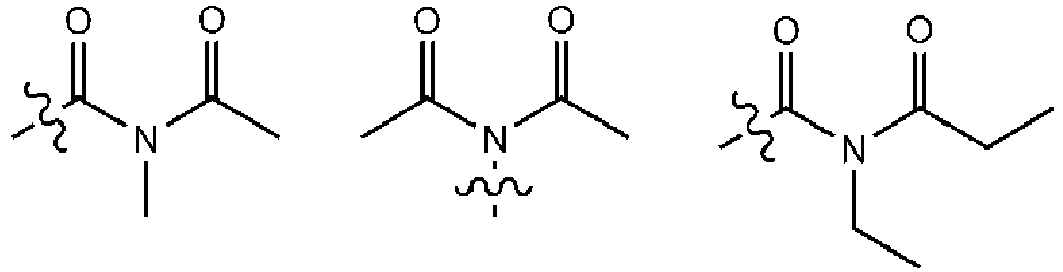
- the carbon number of an imide group is not particularly limited, but is preferably 1 to 25.
- the imide group may be a compound having the following structural formulas, but is not limited thereto.
- a silyl group specifically includes a trimethylsilyl group, a triethylsilyl group, a t-butyldimethylsilyl group, a vinyldimethylsilyl group, a propyldimethylsilyl group, a triphenylsilyl group, a diphenylsilyl group, a phenylsilyl group and the like, but is not limited thereto.
- a boron group specifically includes a trimethylboron group, a triethylboron group, a t-butyldimethylboron group, a triphenylboron group, and a phenylboron group, but is not limited thereto.
- examples of a halogen group include fluorine, chlorine, bromine, or iodine.
- the alkyl group may be straight-chain or branched-chain, and the carbon number thereof is not particularly limited, but is preferably 1 to 40. According to one embodiment, the carbon number of the alkyl group is 1 to 20. According to another embodiment, the carbon number of the alkyl group is 1 to 10. According to another embodiment, the carbon number of the alkyl group is 1 to 6.
- alkyl group examples include methyl, ethyl, propyl, n-propyl, isopropyl, butyl, n-butyl, isobutyl, tert-butyl, sec-butyl, 1-methylbutyl, 1-ethyl-butyl, pentyl, n-pentyl, isopentyl, neopentyl, tert-pentyl, hexyl, n-hexyl, 1-methylpentyl, 2-methylpentyl, 4-methyl-2-pentyl, 3,3-dimethylbutyl, 2-ethylbutyl, heptyl, n-heptyl, 1-methylhexyl, cyclopentylmethyl, cyclohexylmethyl, octyl, n-octyl, tert-octyl, 1-methylheptyl, 2-ethylhexyl, 2-e
- the alkenyl group may be straight-chain or branched-chain, and the carbon number thereof is not particularly limited, but is preferably 2 to 40. According to one embodiment, the carbon number of the alkenyl group is 2 to 20. According to another embodiment, the carbon number of the alkenyl group is 2 to 10. According to still another embodiment, the carbon number of the alkenyl group is 2 to 6.
- Specific examples thereof include vinyl, 1-propenyl, isopropenyl, 1-butenyl, 2-butenyl, 3-butenyl, 1-pentenyl, 2-pentenyl, 3-pentenyl, 3-methyl-1-butenyl, 1,3-butadienyl, allyl, 1-phenylvinyl-1-yl, 2-phenylvinyl-1-yl, 2,2-diphenylvinyl-1-yl, 2-phenyl-2-(naphthyl-1-yl)vinyl-1-yl, 2,2-bis(diphenyl-1-yl)vinyl-1-yl, a stilbenyl group, a styrenyl group, and the like, but are not limited thereto.
- a cycloalkyl group is not particularly limited, but the carbon number thereof is preferably 3 to 60. According to one embodiment, the carbon number of the cycloalkyl group is 3 to 30. According to another embodiment, the carbon number of the cycloalkyl group is 3 to 20. According to still another embodiment, the carbon number of the cycloalkyl group is 3 to 6.
- cyclopropyl examples thereof include cyclopropyl, cyclobutyl, cyclopentyl, 3-methylcyclopentyl, 2,3-dimethylcyclopentyl, cyclohexyl, 3-methylcyclohexyl, 4-methylcyclohexyl, 2,3-dimethylcyclohexyl, 3,4,5-trimethylcyclohexyl, 4-tert-butylcyclohexyl, cycloheptyl, cyclooctyl, and the like, but are not limited thereto.
- an aryl group is not particularly limited, but the carbon number thereof is preferably 6 to 60, and it may be a monocyclic aryl group or a polycyclic aryl group. According to one embodiment, the carbon number of the aryl group is 6 to 30. According to one embodiment, the carbon number of the aryl group is 6 to 20.
- the aryl group may be a phenyl group, a biphenyl group, a terphenyl group or the like as the monocyclic aryl group, but is not limited thereto.
- the polycyclic aryl group includes a naphthyl group, an anthracenyl group, a phenanthrenyl group, a pyrenyl group, a perylenyl group, a chrysenyl group, or the like, but is not limited thereto.
- the fluorenyl group may be substituted, and two substituents may be linked with each other to form a spiro structure.
- the fluorenyl group is substituted, and the like can be formed.
- the structure is not limited thereto.
- a heterocyclic group is a heterocyclic group containing one or more of O, N, Si and S as a heteroatom, and the carbon number thereof is not particularly limited, but is preferably 2 to 60.
- the heterocyclic group include a thiophene group, a furan group, a pyrrole group, an imidazole group, a thiazole group, an oxazol group, an oxadiazol group, a triazol group, a pyridyl group, a bipyridyl group, a pyrimidyl group, a triazine group, an acridyl group, a pyridazine group, a pyrazinyl group, a quinolinyl group, a quinazoline group, a quinoxalinyl group, a phthalazinyl group, a pyridopyrimidinyl group, a pyridopyrazinyl
- the aryl group in the aralkyl group, the aralkenyl group, the alkylaryl group and the arylamine group is the same as the aforementioned examples of the aryl group.
- the alkyl group in the aralkyl group, the alkylaryl group and the alkylamine group is the same as the aforementioned examples of the alkyl group.
- the heteroaryl in the heteroarylamine can be applied to the aforementioned description of the heterocyclic group.
- the alkenyl group in the aralkenyl group is the same as the aforementioned examples of the alkenyl group.
- the aforementioned description of the aryl group may be applied except that the arylene is a divalent group.
- the aforementioned description of the heterocyclic group can be applied except that the heteroarylene is a divalent group.
- the aforementioned description of the aryl group or cycloalkyl group can be applied except that the hydrocarbon ring is not a monovalent group but formed by combining two substituent groups.
- the aforementioned description of the heterocyclic group can be applied, except that the heterocycle is not a monovalent group but formed by combining two substituent groups.
- the compound represented by '[structural formula] Dn ' means a compound in which n hydrogens are substituted with deuterium among compounds having the corresponding 'structural formula'.
- An anode and a cathode used in the present disclosure mean electrodes used in an organic light emitting device.
- anode material generally, a material having a large work function is preferably used so that holes can be smoothly injected into the organic material layer.
- the anode material include metals such as vanadium, chrome, copper, zinc, and gold, or an alloy thereof; metal oxides such as zinc oxides, indium oxides, indium tin oxides (ITO), and indium zinc oxides (IZO); a combination of metals and oxides, such as ZnO:Al or SNO 2 :Sb; conductive polymers such as poly(3-methylthiophene), poly[3,4-(ethylene-1,2-dioxy)thiophene](PEDOT), polypyrrole, and polyaniline, and the like, but are not limited thereto.
- the cathode material generally, a material having a small work function is preferably used so that electrons can be easily injected into the organic material layer.
- the cathode material include metals such as magnesium, calcium, sodium, potassium, titanium, indium, yttrium, lithium, gadolinium, aluminum, silver, tin, and lead, or an alloy thereof; a multilayered structure material such as LiF/Al or LiO 2 /Al, and the like, but are not limited thereto.
- the organic light emitting device may further include a hole injection layer on the anode, if necessary.
- the hole injection layer is a layer for injecting holes from the electrode
- the hole injection material is preferably a compound which has a capability of transporting the holes, thus has a hole injecting effect in the anode and an excellent hole injecting effect to the light emitting layer or the light emitting material, prevents excitons produced in the light emitting layer from moving to an electron injection layer or the electron injection material, and further is excellent in the ability to form a thin film.
- a HOMO (highest occupied molecular orbital) of the hole injection material is between the work function of the anode material and a HOMO of a peripheral organic material layer.
- the hole injection material examples include metal porphyrine, oligothiophene, an arylamine-based organic material, a hexanitrilehexaazatriphenylene-based organic material, a quinacridone-based organic material, a perylene-based organic material, anthraquinone, polyaniline and polythiophene-based conductive compound, and the like, but are not limited thereto.
- the organic light emitting device may include a hole transport layer on the anode (or on the hole injection layer if the hole injection layer exists), if necessary.
- the hole transport layer is a layer that can receive the holes from the anode or the hole injection layer and transport the holes to the light emitting layer
- the hole transport material is suitably a material having large mobility to the holes, which may receive holes from the anode or the hole injection layer and transfer the holes to the light emitting layer.
- arylamine-based organic material examples include an arylamine-based organic material, a conductive polymer, a block copolymer in which a conjugate portion and a non-conjugate portion are present together, and the like, but are not limited thereto.
- the electron blocking layer is a layer provided between the hole transport layer and the light emitting layer in order to prevent the electrons injected in the cathode from being transferred to the hole transport layer without being recombined in the light emitting layer, which may also be referred to as an electron inhibition layer or an electron stopping layer.
- the electron blocking layer is preferably a material having a smaller electron affinity than the electron transport layer.
- the light emitting layer used in the present disclosure is a layer that can emit light in the visible light region by combining holes and electrons transported from the anode and the cathode.
- the light emitting layer includes a host material and a dopant material, and in the present disclosure, the compound represented by Chemical Formula 1 and the compound represented by Chemical Formula 2 are included as a host
- the compound represented by Chemical Formula 1 includes at least one deuterium substituent.
- Ar 1 and Ar 2 may be each independently a substituted or unsubstituted C 6-20 aryl; or a substituted or unsubstituted C 2-20 heteroaryl containing at least one selected from the group consisting of N, O and S.
- Ar 1 and Ar 2 may be each independently phenyl, triphenylsilyl phenyl, biphenylyl, terphenylyl, naphthyl, phenanthrenyl, dibenzofuranyl, or dibenzothiophenyl, and the hydrogens of Ar 1 and Ar 2 may be each independently unsubstituted or substituted with deuterium.
- Ar 1 and Ar 2 may be each independently any one selected from the group consisting of:
- L 1 to L 3 may be each independently a single bond; or a substituted or unsubstituted C 6-20 arylene.
- L 1 to L 3 may be each independently a single bond, phenylene, biphenyldiyl, or naphthalenediyl, and the hydrogens of L 1 to L 3 may be each independently unsubstituted or substituted with deuterium.
- L 1 to L 3 may be each independently a single bond, or any one selected from the group consisting of:
- a represents the number of R 1 , and when a is 2 or more, two or more R 1 s may be the same or different from each other.
- a may be an integer of 1 to 7.
- the compound represented by Chemical Formula 1 can be prepared by a preparation method as shown in the following Reaction Scheme 1 as an example, and other remaining compounds can be prepared in a similar manner.
- Reaction Scheme 1 Ar 1 and Ar 2 , L 1 to L 3 , R 1 and a are as defined in Chemical Formula 2, and Z 1 is halogen, preferably Z 1 is chloro or bromo.
- Reaction Scheme 1 is a Suzuki coupling reaction, which is preferably carried out in the presence of a palladium catalyst and a base, and a reactive group for the Suzuki coupling reaction can be modified as known in the art.
- the above preparation method may be further embodied in Preparation Examples described hereinafter.
- the compound represented by Chemical Formula 2 may be represented by any one of the following Chemical Formula 2-1 and Chemical Formula 2-2: in Chemical Formula 2-1 and Chemical Formula 2-2, R 2 to R 11 , Ars, Ar 4 and L 4 to L 6 are as defined in Chemical Formula 2.
- Ar 3 and Ar 4 are each independently a substituted or unsubstituted C 6-20 aryl; or a substituted or unsubstituted C 2-20 heteroaryl containing at least one selected from the group consisting of N, O and S.
- Ar 3 and Ar 4 may be each independently phenyl, triphenylsilyl phenyl, biphenylyl, terphenylyl, naphthyl, phenyl naphthyl, phenanthrenyl, dibenzofuranyl, dibenzothiophenyl, phenyl carbazolyl, or dimethylfluorenyl, and the hydrogens of Ar 3 and Ar 4 may be each independently unsubstituted or substituted with deuterium.
- Ar 3 and Ar 4 may be each independently any one selected from the group consisting of:
- L 4 is phenylene, biphenyldiyl, or naphthalenediyl, provided that the phenylene, biphenyldiyl and naphthalenediyl may each be unsubstituted or substituted with deuterium or a C 6-60 aryl.
- L 4 may be phenylene, biphenyldiyl, biphenyldiyl substituted with phenyl, or naphthalenediyl, and the hydrogens of L 4 may be each independently unsubstituted or substituted with deuterium.
- L 4 may be any one selected from the group consisting of:
- L 5 and L 6 are each independently a single bond; a substituted or unsubstituted C 6-20 arylene; or a substituted or unsubstituted C 2-20 heteroarylene containing at least one selected from the group consisting of N, O and S.
- L 5 and L 6 may be each independently a single bond, phenylene, biphenyldiyl, naphthalenediyl, or carbazolediyl, and the hydrogens of L 5 and L 6 may be each independently unsubstituted or substituted with deuterium.
- the compound represented by Chemical Formula 2, wherein R 7 is can be prepared by a preparation method as shown in the following Reaction Scheme 2 as an example, and the other remaining compounds cam be prepared in a similar manner.
- R 2 to R 11 , Ar 3 , Ar 4 and L 4 to L 6 are as defined in Chemical Formula 2
- Z 2 is halogen, preferably Z 2 is chloro or bromo.
- Reaction Scheme 2 is a Suzuki coupling reaction, which is preferably carried out in the presence of a palladium catalyst and a base, and a reactive group for the Suzuki coupling reaction can be modified as known in the art.
- the above preparation method may be further embodied in Preparation Examples described hereinafter.
- the weight ratio of the compound represented by Chemical Formula 1 and the compound represented by Chemical Formula 2 is 10:90 to 90:10, more preferably 20:80 to 80:20, 30:70 to 70:30 or 40:60 to 60:40.
- the light emitting layer may further include a dopant in addition to the host.
- the dopant material is not particularly limited as long as it is a material used for the organic light emitting device.
- an aromatic amine derivative, a styrylamine compound, a boron complex, a fluoranthene compound, a metal complex, and the like can be mentioned.
- Specific examples of the aromatic amine derivatives include substituted or unsubstituted fused aromatic ring derivatives having an arylamino group, examples thereof include pyrene, anthracene, chrysene, and periflanthene having the arylamino group, and the like.
- the styrylamine compound is a compound where at least one arylvinyl group is substituted in substituted or unsubstituted arylamine, in which one or two or more substituent groups selected from the group consisting of an aryl group, a silyl group, an alkyl group, a cycloalkyl group, and an arylamino group are substituted or unsubstituted.
- substituent groups selected from the group consisting of an aryl group, a silyl group, an alkyl group, a cycloalkyl group, and an arylamino group are substituted or unsubstituted.
- Specific examples thereof include styrylamine, styryldiamine, styryltriamine, styryltetramine, and the like, but are not limited thereto.
- the metal complex include an iridium complex, a platinum complex, and the like, but are not limited thereto.
- the dopant material may be at least one selected from the group consisting of the following, without being limited thereto:
- the hole blocking layer is a layer provided between the electron transport layer and the light emitting layer in order to prevent the holes injected in the anode from being transferred to the electron transport layer without being recombined in the light emitting layer, which may also be referred to as a hole inhibition layer.
- the hole blocking layer is preferably a material having high ionization energy.
- the organic light emitting device may include an electron transport layer on the light emitting layer, if necessary.
- the electron transport layer is a layer that receives the electrons from the electron injection layer formed on the cathode or the anode and transports the electrons to the light emitting layer, and that suppress the transfer of holes from the light emitting layer
- an electron transport material is suitably a material which may receive electrons well from a cathode and transfer the electrons to a light emitting layer, and has a large mobility for electrons.
- the electron transport material include: an Al complex of 8-hydroxyquinoline; a complex including Alqs; an organic radical compound; a hydroxyflavone-metal complex, and the like, but are not limited thereto.
- the electron transport layer may be used with any desired cathode material, as used according to a conventional technique.
- appropriate examples of the cathode material are a typical material which has a low work function, followed by an aluminum layer or a silver layer.
- Specific examples thereof include cesium, barium, calcium, ytterbium, and samarium, in each case followed by an aluminum layer or a silver layer.
- the organic light emitting device may further include an electron injection layer on the light emitting layer (or on the electron transport layer, if the electron transport layer exists).
- the electron injection layer is a layer which injects electrons from an electrode, and is preferably a compound which has a capability of transporting electrons, has an effect of injecting electrons from a cathode and an excellent effect of injecting electrons into a light emitting layer or a light emitting material, prevents excitons produced from the light emitting layer from moving to a hole injection layer, and is also excellent in the ability to form a thin film.
- the electron injection layer include fluorenone, anthraquinodimethane, diphenoquinone, thiopyran dioxide, oxazole, oxadiazole, triazole, imidazole, perylenetetracarboxylic acid, fluorenylidene methane, anthrone, and the like, and derivatives thereof, a metal complex compound, a nitrogen-containing 5-membered ring derivative, and the like, but are not limited thereto.
- Examples of the metal complex compound include 8-hydroxyquinolinato lithium, bis(8-hydroxyquinolinato)zinc, bis(8-hydroxyquinolinato)copper, bis(8-hydroxyquinolinato)manganese, tris(8-hydroxyquinolinato)aluminum, tris(2-methyl-8-hydroxyquinolinato)aluminum, tris(8-hydroxyquinolinato)gallium, bis(10-hydroxybenzo[h]quinolinato)beryllium, bis(10-hydroxybenzo[h]quinolinato)zinc, bis(2-methyl-8-quinolinato)chlorogallium, bis(2-methyl-8-quinolinato)(o-cresolato)gallium, bis(2-methyl-8-quinolinato)(1-naphtholato)aluminum, bis(2-methyl-8-quinolinato)(2-naphtholato)gallium, and the like, but are not limited thereto.
- the "electron injection and transport layer” is a layer that performs both the roles of the electron injection layer and the electron transport layer, and the materials that perform the roles of each layer may be used alone or in combination, without being limited thereto.
- FIGS. 1 and 2 show an example of an organic light emitting device comprising a substrate 1, an anode 2, a light emitting layer 3, and a cathode 4.
- FIG. 2 shows an example of an organic light emitting device comprising a substrate 1, an anode 2, a hole injection layer 5, a hole transport layer 6, an electron blocking layer 7, a light emitting layer 3, a hole blocking layer 8, an electron injection and transport layer 9, and a cathode 4.
- the organic light emitting device can be manufactured by sequentially stacking the above-described structures.
- the organic light emitting device may be manufactured by depositing a metal, metal oxides having conductivity, or an alloy thereof on the substrate by using a PVD (physical vapor deposition) method such as a sputtering method or an e-beam evaporation method to form the anode, forming the respective layers described above thereon, and then depositing a material that can be used as the cathode thereon.
- PVD physical vapor deposition
- the organic light emitting device may be manufactured by sequentially depositing from the cathode material to the anode material on a substrate in the reverse order of the above-mentioned configuration ( WO 2003/012890 ).
- the light emitting layer may be formed by subjecting hosts and dopants to a vacuum deposition method and a solution coating method.
- the solution coating method means a spin coating, a dip coating, a doctor blading, an inkjet printing, a screen printing, a spray method, a roll coating, or the like, but is not limited thereto.
- the organic light emitting device may be a bottom emission device, a top emission device, or a double-sided light emitting device, and particularly, may be a bottom emission device that requires relatively high luminous efficiency.
- Trifluoromethanesulfonic anhydride 24 g, 85 mmol
- deuterium oxide 8.5 g, 424.9 mmol
- 1-Bromodibenzo[b,d]furan 15 g, 60.7 mmol
- the prepared mixed solution of trifluoromethanesulfonic anhydride and deuterium oxide was slowly added dropwise to the mixed solution of 1-bromodibenzo[b,d]furan and 1,2,4-trichlorobenzene, and the mixture was stirred while heating to 140°C and then keeping that temperature.
- Trifluoromethanesulfonic anhydride(48 g, 170 mmol) and deuterium oxide (17 g, 849.9 mmol) were added at 0°C and stirred for 5 hours to prepare a solution.
- 1-Bromodibenzo[b,d]furan (15 g, 60.7 mmol) was added to 120 ml of 1,2,4-trichlorobenzene, and the mixture was stirred. Then, the prepared mixed solution of trifluoromethanesulfonic anhydride and deuterium oxide was slowly added dropwise to the mixed solution of 1-bromodibenzo[b,d]furan and 1,2,4-trichlorobenzene, and the mixture was stirred while heating to 140°C and then keeping that temperature.
- Trifluoromethanesulfonic anhydride (71.9 g, 255 mmol) and deuterium oxide (25.5 g, 1274.8 mmol) were added at 0°C and stirred for 5 hours to prepare a solution.
- 1-Bromodibenzo[b,d]furan (15 g, 60.7 mmol) was added to 120 ml of 1,2,4-trichlorobenzene, and the mixture was stirred. Then, the prepared mixed solution of trifluoromethanesulfonic anhydride and deuterium oxide was slowly added dropwise to the mixed solution of 1-bromodibenzo[b,d]furan and 1,2,4-trichlorobenzene, and the mixture was stirred while heating to 140°C and then keeping that temperature.
- Trifluoromethanesulfonic anhydride (95.9 g, 340 mmol) and deuterium oxide (34 g, 1699.8 mmol) were added at 0°C and stirred for 5 hours to prepare a solution.
- 1-Bromodibenzo[b,d]furan (15 g, 60.7 mmol) was added to 120 ml of 1,2,4-trichlorobenzene, and the mixture was stirred.
- Trifluoromethanesulfonic anhydride (119.9 g, 424.9 mmol) and deuterium oxide (42.6 g, 2124.7 mmol) were added at 0°C and stirred for 5 hours to prepare a solution.
- 1-Bromodibenzo[b,d]furan (15 g, 60.7 mmol) was added to 120 ml of 1,2,4-trichlorobenzene, and the mixture was stirred. Then, the prepared mixed solution of trifluoromethanesulfonic anhydride and deuterium oxide was slowly added dropwise to the mixed solution of 1-bromodibenzo[b,d]furan and 1,2,4-trichlorobenzene, and the mixture was stirred while heating to 140°C and then keeping that temperature.
- Trifluoromethanesulfonic anhydride (167.8 g, 594.9 mmol) and deuterium oxide (59.6 g, 2974.6 mmol) were added at 0°C and stirred for 5 hours to prepare a solution.
- 1-Bromodibenzo[b,d]furan (15 g, 60.7 mmol) was added to 120 ml of 1,2,4-trichlorobenzene, and the mixture was stirred.
- Trifluoromethanesulfonic anhydride (33.5 g, 118.7 mmol) and deuterium oxide (11.9 g, 593.6 mmol) were added at 0°C and stirred for 5 hours to prepare a solution.
- Compound A (15 g, 59.4 mmol)
- the prepared mixed solution of trifluoromethanesulfonic anhydride and deuterium oxide was slowly added dropwise to the mixed solution of Compound A and 1,2,4-trichlorobenzene, and the mixture was stirred while heating to 140°C and then keeping that temperature.
- Trifluoromethanesulfonic anhydride (67 g, 237.4 mmol) and deuterium oxide (23.8 g, 1187.2 mmol ) were added at 0°C and stirred for 6 hours to prepare a solution.
- Compound A (15 g, 59.4 mmol) was added to 120 ml of 1,2,4-trichlorobenzene, and the mixture was stirred. Then, the prepared mixed solution of trifluoromethanesulfonic anhydride and deuterium oxide was slowly added dropwise to the mixed solution of Compound A and 1,2,4-trichlorobenzene, and the mixture was stirred while heating to 140°C and then keeping that temperature.
- Trifluoromethanesulfonic anhydride (83.7 g, 296.8 mmol) and deuterium oxide (29.7 g, 1484 mmol) were added at 0°C and stirred for 6 hours to prepare a solution.
- Compound A (15 g, 59.4 mmol) was added to 120 ml of 1,2,4-trichlorobenzene, and the mixture was stirred. Then, the prepared mixed solution of trifluoromethanesulfonic anhydride and deuterium oxide was slowly added dropwise to the mixed solution of Compound A and 1,2,4-trichlorobenzene, and the mixture was stirred while heating to 140°C and then keeping that temperature.
- Trifluoromethanesulfonic anhydride 117.2 g, 415.5 mmol
- deuterium oxide 41.6 g, 2077.6 mmol
- Compound A 15 g, 59.4 mmol
- the prepared mixed solution of trifluoromethanesulfonic anhydride and deuterium oxide was slowly added dropwise to the mixed solution of Compound A and 1,2,4-trichlorobenzene, and the mixture was stirred while heating to 140°C and then keeping that temperature.
- Trifluoromethanesulfonic anhydride (150.7 g, 534.2 mmol) and deuterium oxide (53.5 g, 2671.2 mmol) were added at 0°C and stirred for 6 hours to prepare a solution.
- Compound A (15 g, 59.4 mmol) was added to 120 ml of 1,2,4-trichlorobenzene, and the mixture was stirred. Then, the prepared mixed solution of trifluoromethanesulfonic anhydride and deuterium oxide was slowly added dropwise to the mixed solution of Compound A and 1,2,4-trichlorobenzene, and the mixture was stirred while heating to 140°C and then keeping that temperature.
- Trifluoromethanesulfonic anhydride (33.5 g, 118.7 mmol) and deuterium oxide (11.9 g, 593.6 mmol ) were added at 0°C and stirred for 5 hours to prepare a solution.
- Compound B (15 g, 59.4 mmol)
- the prepared mixed solution of trifluoromethanesulfonic anhydride and deuterium oxide was slowly added dropwise to the mixed solution of Compound A and 1,2,4-trichlorobenzene, and the mixture was stirred while heating to 140°C and then keeping that temperature.
- Trifluoromethanesulfonic anhydride (50.2 g, 178.1 mmol) and deuterium oxide (17.8 g, 890.4 mmol) were added at 0°C and stirred for 6 hours to prepare a solution.
- Compound B (15 g, 59.4 mmol)
- the prepared mixed solution of trifluoromethanesulfonic anhydride and deuterium oxide was slowly added dropwise to the mixed solution of Compound A and 1,2,4-trichlorobenzene, and the mixture was stirred while heating to 140°C and then keeping that temperature.
- Trifluoromethanesulfonic anhydride (67 g, 237.4 mmol) and deuterium oxide (23.8 g, 1187.2 mmol) were added at 0°C and stirred for 6 hours to prepare a solution.
- Compound B (15 g, 59.4 mmol) was added to 120 ml of 1,2,4-trichlorobenzene, and the mixture was stirred. Then, the prepared mixed solution of trifluoromethanesulfonic anhydride and deuterium oxide was slowly added dropwise to the mixed solution of Compound B and 1,2,4-trichlorobenzene, and the mixture was stirred while heating to 140°C and then keeping that temperature.
- Trifluoromethanesulfonic anhydride (100.5 g, 356.2 mmol) and deuterium oxide (35.7 g, 1780.8 mmol) were added at 0°C and stirred for 6 hours to prepare a solution.
- Compound B (15 g, 59.4 mmol) was added to 120 ml of 1,2,4-trichlorobenzene, and the mixture was stirred. Then, the prepared mixed solution of trifluoromethanesulfonic anhydride and deuterium oxide was slowly added dropwise to the mixed solution of Compound B and 1,2,4-trichlorobenzene, and the mixture was stirred while heating to 140°C and then keeping that temperature.
- Trifluoromethanesulfonic anhydride 117.2 g, 415.5 mmol
- deuterium oxide 41.6 g, 2077.6 mmol
- Compound B 15 g, 59.4 mmol
- the prepared mixed solution of trifluoromethanesulfonic anhydride and deuterium oxide was slowly added dropwise to the mixed solution of Compound B and 1,2,4-trichlorobenzene, and the mixture was stirred while heating to 140°C and then keeping that temperature.
- Trifluoromethanesulfonic anhydride 134 g, 474.9 mmol
- deuterium oxide 47.6 g, 2374.4 mmol
- Compound B 15 g, 59.4 mmol
- the prepared mixed solution of trifluoromethanesulfonic anhydride and deuterium oxide was slowly added dropwise to the mixed solution of Compound B and 1,2,4-trichlorobenzene, and the mixture was stirred while heating to 140°C and then keeping that temperature.
- a glass substrate on which a thin film of ITO (indium tin oxide) was coated in a thickness of 1000 ⁇ was put into distilled water containing the detergent dissolved therein and washed by the ultrasonic wave.
- the used detergent was a product commercially available from Fisher Co. and the distilled water was one which had been twice filtered by using a filter commercially available from Millipore Co.
- the ITO was washed for 30 minutes, and ultrasonic washing was then repeated twice for 10 minutes by using distilled water. After the washing with distilled water was completed, the substrate was ultrasonically washed with isopropyl alcohol, acetone, and methanol solvent, and dried, after which it was transported to a plasma cleaner. Then, the substrate was cleaned with oxygen plasma for 5 minutes, and then transferred to a vacuum evaporator.
- the following compound HI-1 was formed in a thickness of 1150 ⁇ as a hole injection layer, but the following compound A-1 was p-doped at a concentration of 1.5 wt.%.
- the following compound HT-1 was vacuum deposited on the hole injection layer to form a hole transport layer with a film thickness of 800 ⁇ .
- the following compound EB-1 was vacuum deposited on the hole transport layer to a film thickness of 150 ⁇ to form an electron blocking layer.
- the previously prepared Compound 1-1, Compound 2-2 and Compound Dp-7 were vacuum deposited in a weight ratio of 49:49:2 on the EB-1 deposited film to form a red light emitting layer with a film thickness of 400 ⁇ .
- the following compound HB-1 was vacuum deposited on the light emitting layer to a film thickness of 30 ⁇ to form a hole blocking layer.
- the following compound ET-1 and the following compound LiQ were vacuum deposited in a weight ratio of 2:1 on the hole blocking layer to form an electron injection and transport layer with a film thickness of 300 ⁇ .
- Lithium fluoride (LiF) and aluminum were sequentially deposited to have a thickness of 12 ⁇ and 1,000 ⁇ , respectively, on the electron injection and transport layer, thereby forming a cathode.
- the deposition rates of the organic materials were maintained at 0.4 to 0.7 ⁇ /sec
- the deposition rates of lithium fluoride and the aluminum of the cathode were maintained at 0.3 ⁇ /sec and 2 ⁇ /sec, respectively
- the degree of vacuum during the deposition was maintained at 2 ⁇ 10 -7 to 5 ⁇ 10 -6 torr, thereby manufacturing an organic light emitting device.
- the organic light emitting devices were manufactured in the same manner as in Example 1, except that in the organic light emitting device of Example 1, the compound represented by Chemical Formula 1 and the compound represented by Chemical Formula 2 shown in the following Tables 1 to 5 were co-deposited and used in a weight ratio of 1:1 instead of Compound 1-1 and Compound 2-2 as the first host and the second host.
- the organic light emitting devices were manufactured in the same manner as in Example 1, except that in the organic light emitting device of Example 1, the following Comparative Example Compounds A-1 to A-12 was used instead of Compound 1-1 as the first host and the compound represented by Chemical Formula 2 shown in Tables 6 and 7 below was used instead of Compound 2-2 as the second host, which were co-deposited and used in a weight ratio of 1:1.
- Specific structures of Compounds A-1 to A-12 are as follows.
- the organic light emitting devices were manufactured in the same manner as in Example 1, except that in the organic light emitting device of Example 1, the compound represented by Chemical Formula 1 shown in Tables 8 to 10 below was used instead of Compound 1-1 as the first host, and the following Comparative Example Compounds B-1 to B-14 was used instead of Compound 2-2 as the second host, which were co-deposited and used in a weight ratio of 1:1.
- Specific structures of Compounds B-1 to B-14 are as follows.
- the voltage and efficiency were measured (15 mA/cm 2 ) by applying a current to the organic light emitting devices manufactured in Examples 1 to 190 and Comparative Examples 1 to 172, and the results are shown in Tables 1 to 10 below.
- Lifetime T95 was measured based on 7000 nits, and T95 means the time required for the lifetime to be reduced to 95% of the initial lifetime.
- the reason why the driving voltage is improved and the efficiency and lifetime are increased is that when the compound of Chemical Formula 1 which is the first host of the present disclosure and the Compound of Chemical Formula 2 which is the second host of the present disclosure were used in combination, energy transfer to the red dopant in the red light emitting layer is well made favorable.
Landscapes
- Chemical & Material Sciences (AREA)
- Engineering & Computer Science (AREA)
- Materials Engineering (AREA)
- Physics & Mathematics (AREA)
- Spectroscopy & Molecular Physics (AREA)
- Optics & Photonics (AREA)
- Organic Chemistry (AREA)
- Electroluminescent Light Sources (AREA)
- Led Devices (AREA)
- Control Of Indicators Other Than Cathode Ray Tubes (AREA)
Abstract
Description
- This application claims the benefit of
Korean Patent Application No. 10-2021-0054555 filed on April 27, 2021 Korean Patent Application No. 10-2022-0052253 filed on April 27, 2022 - The present disclosure relates to relates to an organic light emitting device having improved driving voltage, efficiency and lifetime.
- In general, an organic light emitting phenomenon refers to a phenomenon where electric energy is converted into light energy by using an organic material. The organic light emitting device using the organic light emitting phenomenon has characteristics such as a wide viewing angle, an excellent contrast, a fast response time, an excellent luminance, driving voltage and response speed, and thus many studies have proceeded.
- The organic light emitting device generally has a structure which comprises an anode, a cathode, and an organic material layer interposed between the anode and the cathode. The organic material layer frequently has a multilayered structure that comprises different materials in order to enhance efficiency and stability of the organic light emitting device, and for example, the organic material layer may be formed of a hole injection layer, a hole transport layer, a light emitting layer, an electron transport layer, an electron injection layer and the like. In the structure of the organic light emitting device, if a voltage is applied between two electrodes, the holes are injected from an anode into the organic material layer and the electrons are injected from the cathode into the organic material layer, and when the injected holes and electrons meet each other, an exciton is formed, and light is emitted when the exciton falls to a ground state again.
- There is a continuing need for the development of a new material for an organic material used in the organic light emitting device as described above.
- (Patent Literature 1)
Korean Unexamined Patent Publication No. 10-2000-0051826 - It is an object of the present disclosure to provide an organic light emitting device having improved driving voltage, efficiency and lifetime.
- Provided herein is the following organic light emitting device:
- An organic light emitting device including: an anode, a cathode, and a light emitting layer interposed between the anode and the cathode,
- wherein the light emitting layer includes a compound represented by the following Chemical Formula 1 and a compound represented by the following Chemical Formula 2:
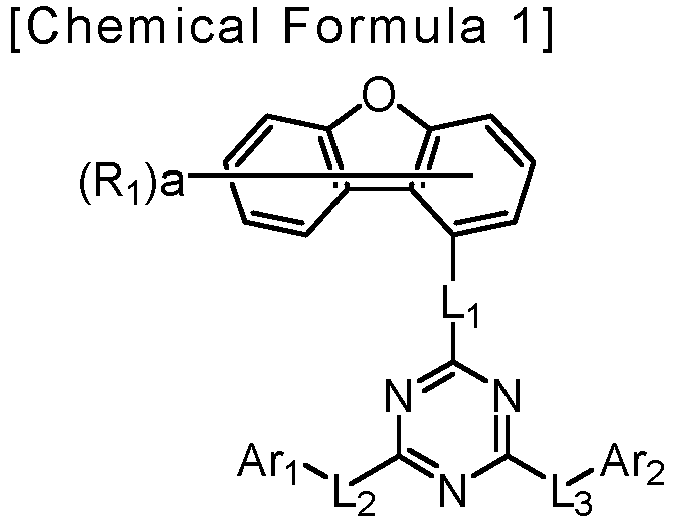
- in the Chemical Formula 1,
- Ar1 and Ar2 are each independently a substituted or unsubstituted C6-60 aryl; or a substituted or unsubstituted C2-60 heteroaryl containing at least one selected from the group consisting of N, O and S.
- L1 to L3 are each independently a single bond; or a substituted or unsubstituted C6-60 arylene,
- R1 is each independently hydrogen or deuterium, and
- a is an integer of 0 to 7,

- in the Chemical Formula 2,
- R2 to R6 and R9 to R11 are each independently hydrogen or deuterium,
- any one of R7 and R8 is

- Ar3 and Ar4 are each independently a substituted or unsubstituted C6-60 aryl; or a substituted or unsubstituted C2-60 heteroaryl containing at least one selected from the group consisting of N, O and S,
- L4 is a substituted or unsubstituted phenylene, a substituted or unsubstituted biphenyldiyl, or a substituted or unsubstituted naphthalenediyl, and
- L5 and L6 are each independently a single bond; a substituted or unsubstituted C6-60 arylene; or a substituted or unsubstituted C2-60 heteroarylene containing at least one selected from the group consisting of N, O and S.
- The above-mentioned organic light emitting device includes the compound represented by Chemical Formula 1 and the compound represented by Chemical Formula 2 in the light emitting layer, and thus can improve the efficiency, achieve low driving voltage and/or improve lifetime characteristics in the organic light emitting device.
-
-
FIG. 1 shows an example of an organic light emitting device comprising asubstrate 1, ananode 2, alight emitting layer 3, and acathode 4. -
FIG. 2 shows an example of an organic light emitting device comprising asubstrate 1, ananode 2, ahole injection layer 5, ahole transport layer 6, anelectron blocking layer 7, alight emitting layer 3, a hole blocking layer 8, an electron injection andtransport layer 9, and acathode 4. - Hereinafter, embodiments of the present disclosure will be described in more detail to facilitate understanding of the invention.
- As used herein, the notationor
 means a bond linked to another substituent group.
- As used herein, the term "substituted or unsubstituted" means being unsubstituted or substituted with one or more substituents selected from the group consisting of deuterium; a halogen group; a nitrile group; a nitro group; a hydroxy group; a carbonyl group; an ester group; an imide group; an amino group; a phosphine oxide group; an alkoxy group; an aryloxy group; an alkylthioxy group; an arylthioxy group; an alkylsulfoxy group; an arylsulfoxy group; a silyl group; a boron group; an alkyl group; a cycloalkyl group; an alkenyl group; an aryl group; an aralkyl group; an aralkenyl group; an alkylaryl group; an alkylamine group; an aralkylamine group; a heteroarylamine group; an arylamine group; an arylphosphine group; and a heterocyclic group containing at least one of N, O and S atoms, or being unsubstituted or substituted with a substituent to which two or more substituents of the above-exemplified substituents are connected. For example, "a substituent in which two or more substituents are connected" may be a biphenyl group. Namely, a biphenyl group may be an aryl group, or it may be interpreted as a substituent in which two phenyl groups are connected.
- In the present disclosure, the carbon number of a carbonyl group is not particularly limited, but is preferably 1 to 40. Specifically, the carbonyl group may be a compound having the following structural formulas, but is not limited thereto.


- In the present disclosure, an ester group may have a structure in which oxygen of the ester group may be substituted by a straight-chain, branched-chain, or cyclic alkyl group having 1 to 25 carbon atoms, or an aryl group having 6 to 25 carbon atoms. Specifically, the ester group may be a compound having the following structural formulas, but is not limited thereto.


- In the present disclosure, the carbon number of an imide group is not particularly limited, but is preferably 1 to 25. Specifically, the imide group may be a compound having the following structural formulas, but is not limited thereto.

- In the present disclosure, a silyl group specifically includes a trimethylsilyl group, a triethylsilyl group, a t-butyldimethylsilyl group, a vinyldimethylsilyl group, a propyldimethylsilyl group, a triphenylsilyl group, a diphenylsilyl group, a phenylsilyl group and the like, but is not limited thereto.
- In the present disclosure, a boron group specifically includes a trimethylboron group, a triethylboron group, a t-butyldimethylboron group, a triphenylboron group, and a phenylboron group, but is not limited thereto.
- In the present disclosure, examples of a halogen group include fluorine, chlorine, bromine, or iodine.
- In the present disclosure, the alkyl group may be straight-chain or branched-chain, and the carbon number thereof is not particularly limited, but is preferably 1 to 40. According to one embodiment, the carbon number of the alkyl group is 1 to 20. According to another embodiment, the carbon number of the alkyl group is 1 to 10. According to another embodiment, the carbon number of the alkyl group is 1 to 6. Specific examples of the alkyl group include methyl, ethyl, propyl, n-propyl, isopropyl, butyl, n-butyl, isobutyl, tert-butyl, sec-butyl, 1-methylbutyl, 1-ethyl-butyl, pentyl, n-pentyl, isopentyl, neopentyl, tert-pentyl, hexyl, n-hexyl, 1-methylpentyl, 2-methylpentyl, 4-methyl-2-pentyl, 3,3-dimethylbutyl, 2-ethylbutyl, heptyl, n-heptyl, 1-methylhexyl, cyclopentylmethyl, cyclohexylmethyl, octyl, n-octyl, tert-octyl, 1-methylheptyl, 2-ethylhexyl, 2-propylpentyl, n-nonyl, 2,2-dimethylheptyl, 1-ethyl-propyl, 1,1-dimethyl-propyl, isohexyl, 2-methylpentyl, 4-methylhexyl, 5-methylhexyl, and the like, but are not limited thereto.
- In the present disclosure, the alkenyl group may be straight-chain or branched-chain, and the carbon number thereof is not particularly limited, but is preferably 2 to 40. According to one embodiment, the carbon number of the alkenyl group is 2 to 20. According to another embodiment, the carbon number of the alkenyl group is 2 to 10. According to still another embodiment, the carbon number of the alkenyl group is 2 to 6. Specific examples thereof include vinyl, 1-propenyl, isopropenyl, 1-butenyl, 2-butenyl, 3-butenyl, 1-pentenyl, 2-pentenyl, 3-pentenyl, 3-methyl-1-butenyl, 1,3-butadienyl, allyl, 1-phenylvinyl-1-yl, 2-phenylvinyl-1-yl, 2,2-diphenylvinyl-1-yl, 2-phenyl-2-(naphthyl-1-yl)vinyl-1-yl, 2,2-bis(diphenyl-1-yl)vinyl-1-yl, a stilbenyl group, a styrenyl group, and the like, but are not limited thereto.
- In the present disclosure, a cycloalkyl group is not particularly limited, but the carbon number thereof is preferably 3 to 60. According to one embodiment, the carbon number of the cycloalkyl group is 3 to 30. According to another embodiment, the carbon number of the cycloalkyl group is 3 to 20. According to still another embodiment, the carbon number of the cycloalkyl group is 3 to 6. Specific examples thereof include cyclopropyl, cyclobutyl, cyclopentyl, 3-methylcyclopentyl, 2,3-dimethylcyclopentyl, cyclohexyl, 3-methylcyclohexyl, 4-methylcyclohexyl, 2,3-dimethylcyclohexyl, 3,4,5-trimethylcyclohexyl, 4-tert-butylcyclohexyl, cycloheptyl, cyclooctyl, and the like, but are not limited thereto.
- In the present disclosure, an aryl group is not particularly limited, but the carbon number thereof is preferably 6 to 60, and it may be a monocyclic aryl group or a polycyclic aryl group. According to one embodiment, the carbon number of the aryl group is 6 to 30. According to one embodiment, the carbon number of the aryl group is 6 to 20. The aryl group may be a phenyl group, a biphenyl group, a terphenyl group or the like as the monocyclic aryl group, but is not limited thereto. The polycyclic aryl group includes a naphthyl group, an anthracenyl group, a phenanthrenyl group, a pyrenyl group, a perylenyl group, a chrysenyl group, or the like, but is not limited thereto.
- In the present disclosure, the fluorenyl group may be substituted, and two substituents may be linked with each other to form a spiro structure. In the case where the fluorenyl group is substituted,

- In the present disclosure, a heterocyclic group is a heterocyclic group containing one or more of O, N, Si and S as a heteroatom, and the carbon number thereof is not particularly limited, but is preferably 2 to 60. Examples of the heterocyclic group include a thiophene group, a furan group, a pyrrole group, an imidazole group, a thiazole group, an oxazol group, an oxadiazol group, a triazol group, a pyridyl group, a bipyridyl group, a pyrimidyl group, a triazine group, an acridyl group, a pyridazine group, a pyrazinyl group, a quinolinyl group, a quinazoline group, a quinoxalinyl group, a phthalazinyl group, a pyridopyrimidinyl group, a pyridopyrazinyl group, a pyrazinopyrazinyl group, an isoquinoline group, an indole group, a carbazole group, a benzoxazole group, a benzoimidazole group, a benzothiazol group, a benzocarbazole group, a benzothiophene group, a dibenzothiophene group, a benzofuranyl group, a phenanthroline group, an isoxazolyl group, a thiadiazolyl group, a phenothiazinyl group, a dibenzofuranyl group, and the like, but are not limited thereto.
- In the present disclosure, the aryl group in the aralkyl group, the aralkenyl group, the alkylaryl group and the arylamine group is the same as the aforementioned examples of the aryl group. In the present disclosure, the alkyl group in the aralkyl group, the alkylaryl group and the alkylamine group is the same as the aforementioned examples of the alkyl group. In the present disclosure, the heteroaryl in the heteroarylamine can be applied to the aforementioned description of the heterocyclic group. In the present disclosure, the alkenyl group in the aralkenyl group is the same as the aforementioned examples of the alkenyl group. In the present disclosure, the aforementioned description of the aryl group may be applied except that the arylene is a divalent group. In the present disclosure, the aforementioned description of the heterocyclic group can be applied except that the heteroarylene is a divalent group. In the present disclosure, the aforementioned description of the aryl group or cycloalkyl group can be applied except that the hydrocarbon ring is not a monovalent group but formed by combining two substituent groups. In the present disclosure, the aforementioned description of the heterocyclic group can be applied, except that the heterocycle is not a monovalent group but formed by combining two substituent groups.
- In the present disclosure, the compound represented by '[structural formula] Dn' means a compound in which n hydrogens are substituted with deuterium among compounds having the corresponding 'structural formula'.
- Hereinafter, the present disclosure will be described in detail for each configuration.
- An anode and a cathode used in the present disclosure mean electrodes used in an organic light emitting device.
- As the anode material, generally, a material having a large work function is preferably used so that holes can be smoothly injected into the organic material layer. Specific examples of the anode material include metals such as vanadium, chrome, copper, zinc, and gold, or an alloy thereof; metal oxides such as zinc oxides, indium oxides, indium tin oxides (ITO), and indium zinc oxides (IZO); a combination of metals and oxides, such as ZnO:Al or SNO2:Sb; conductive polymers such as poly(3-methylthiophene), poly[3,4-(ethylene-1,2-dioxy)thiophene](PEDOT), polypyrrole, and polyaniline, and the like, but are not limited thereto.
- As the cathode material, generally, a material having a small work function is preferably used so that electrons can be easily injected into the organic material layer. Specific examples of the cathode material include metals such as magnesium, calcium, sodium, potassium, titanium, indium, yttrium, lithium, gadolinium, aluminum, silver, tin, and lead, or an alloy thereof; a multilayered structure material such as LiF/Al or LiO2/Al, and the like, but are not limited thereto.
- The organic light emitting device according to the present disclosure may further include a hole injection layer on the anode, if necessary.
- The hole injection layer is a layer for injecting holes from the electrode, and the hole injection material is preferably a compound which has a capability of transporting the holes, thus has a hole injecting effect in the anode and an excellent hole injecting effect to the light emitting layer or the light emitting material, prevents excitons produced in the light emitting layer from moving to an electron injection layer or the electron injection material, and further is excellent in the ability to form a thin film. Further, it is preferable that a HOMO (highest occupied molecular orbital) of the hole injection material is between the work function of the anode material and a HOMO of a peripheral organic material layer.
- Specific examples of the hole injection material include metal porphyrine, oligothiophene, an arylamine-based organic material, a hexanitrilehexaazatriphenylene-based organic material, a quinacridone-based organic material, a perylene-based organic material, anthraquinone, polyaniline and polythiophene-based conductive compound, and the like, but are not limited thereto.
- The organic light emitting device according to the present disclosure may include a hole transport layer on the anode (or on the hole injection layer if the hole injection layer exists), if necessary.
- The hole transport layer is a layer that can receive the holes from the anode or the hole injection layer and transport the holes to the light emitting layer, and the hole transport material is suitably a material having large mobility to the holes, which may receive holes from the anode or the hole injection layer and transfer the holes to the light emitting layer.
- Specific examples thereof include an arylamine-based organic material, a conductive polymer, a block copolymer in which a conjugate portion and a non-conjugate portion are present together, and the like, but are not limited thereto.
- The electron blocking layer is a layer provided between the hole transport layer and the light emitting layer in order to prevent the electrons injected in the cathode from being transferred to the hole transport layer without being recombined in the light emitting layer, which may also be referred to as an electron inhibition layer or an electron stopping layer. The electron blocking layer is preferably a material having a smaller electron affinity than the electron transport layer.
- The light emitting layer used in the present disclosure is a layer that can emit light in the visible light region by combining holes and electrons transported from the anode and the cathode. Generally, the light emitting layer includes a host material and a dopant material, and in the present disclosure, the compound represented by
Chemical Formula 1 and the compound represented byChemical Formula 2 are included as a host - Preferably, the compound represented by
Chemical Formula 1 includes at least one deuterium substituent. - Preferably, Ar1 and Ar2 may be each independently a substituted or unsubstituted C6-20 aryl; or a substituted or unsubstituted C2-20 heteroaryl containing at least one selected from the group consisting of N, O and S.
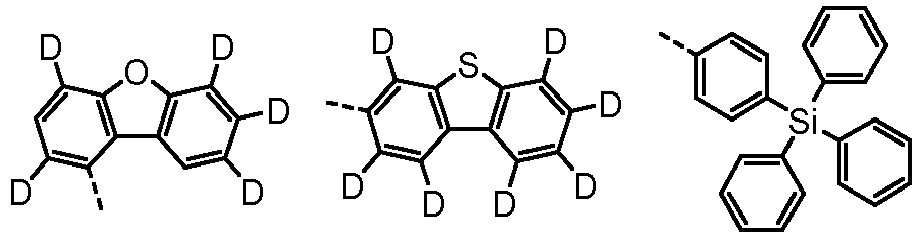
- More preferably, Ar1 and Ar2 may be each independently phenyl, triphenylsilyl phenyl, biphenylyl, terphenylyl, naphthyl, phenanthrenyl, dibenzofuranyl, or dibenzothiophenyl, and the hydrogens of Ar1 and Ar2 may be each independently unsubstituted or substituted with deuterium.
- Most preferably, Ar1 and Ar2 may be each independently any one selected from the group consisting of:


- Preferably, L1 to L3 may be each independently a single bond; or a substituted or unsubstituted C6-20 arylene.
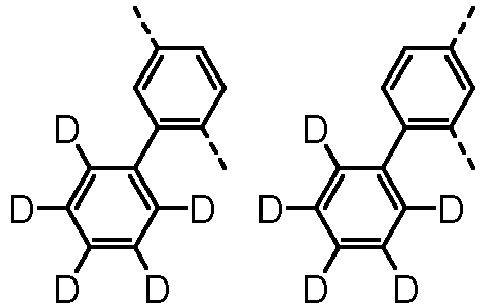
- More preferably, L1 to L3 may be each independently a single bond, phenylene, biphenyldiyl, or naphthalenediyl, and the hydrogens of L1 to L3 may be each independently unsubstituted or substituted with deuterium.
- More preferably, L1 to L3 may be each independently a single bond, or any one selected from the group consisting of:


- In this case, a represents the number of R1, and when a is 2 or more, two or more R1 s may be the same or different from each other.
- Preferably, a may be an integer of 1 to 7.
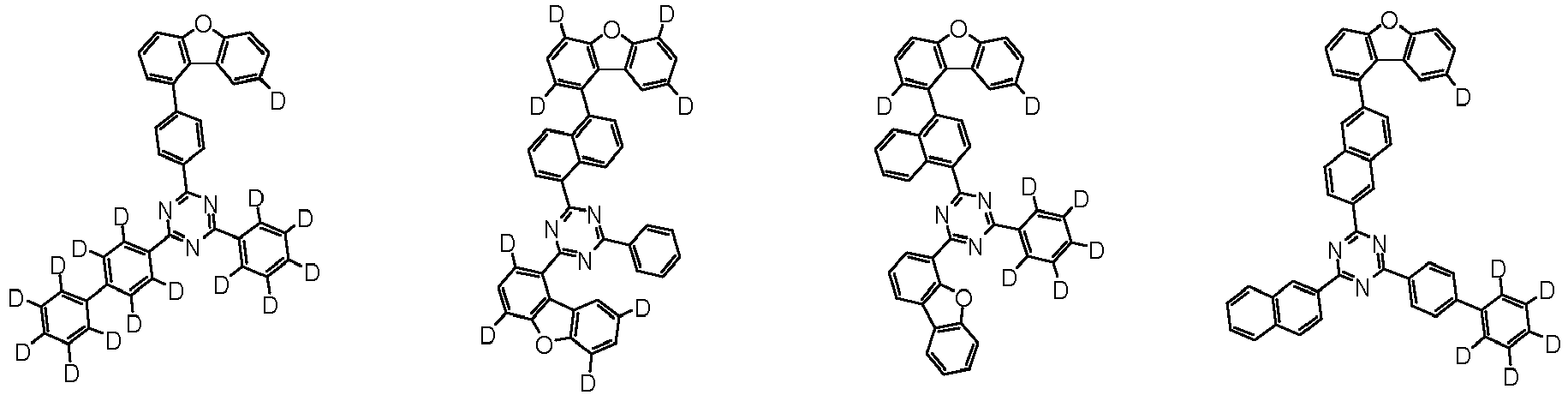
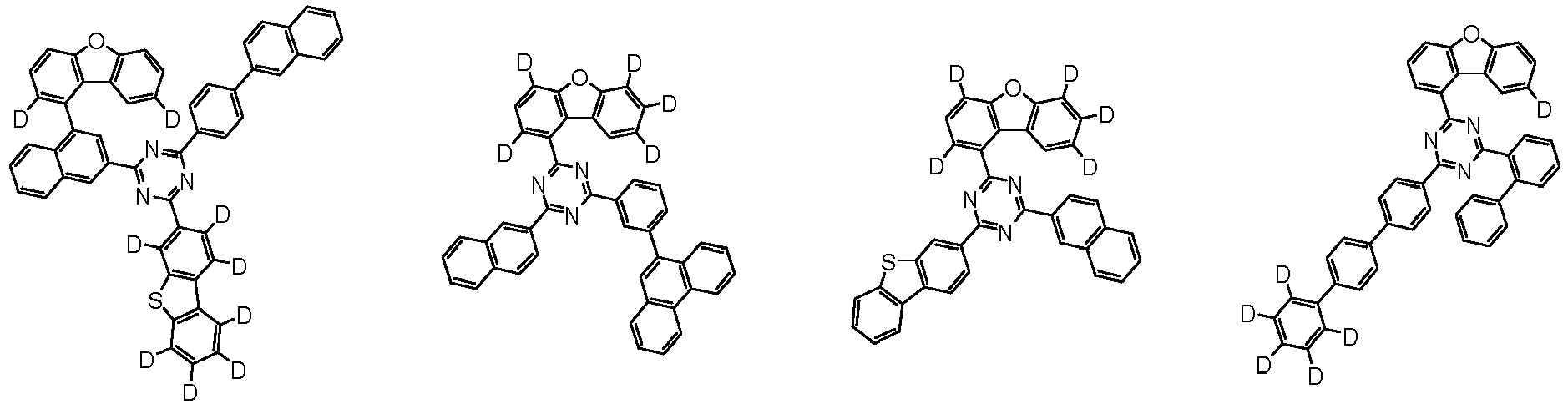
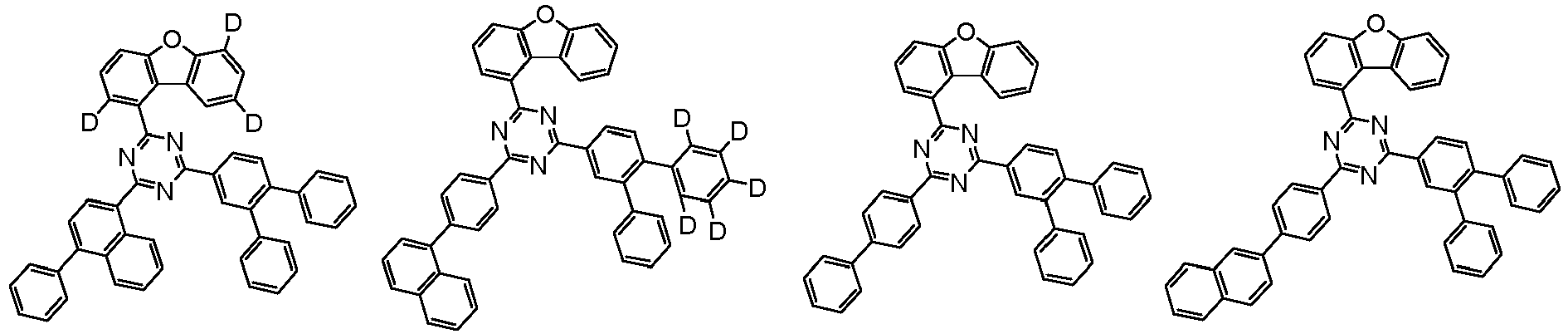
- Representative examples of the compound represented by
Chemical Formula 1 are as follows:


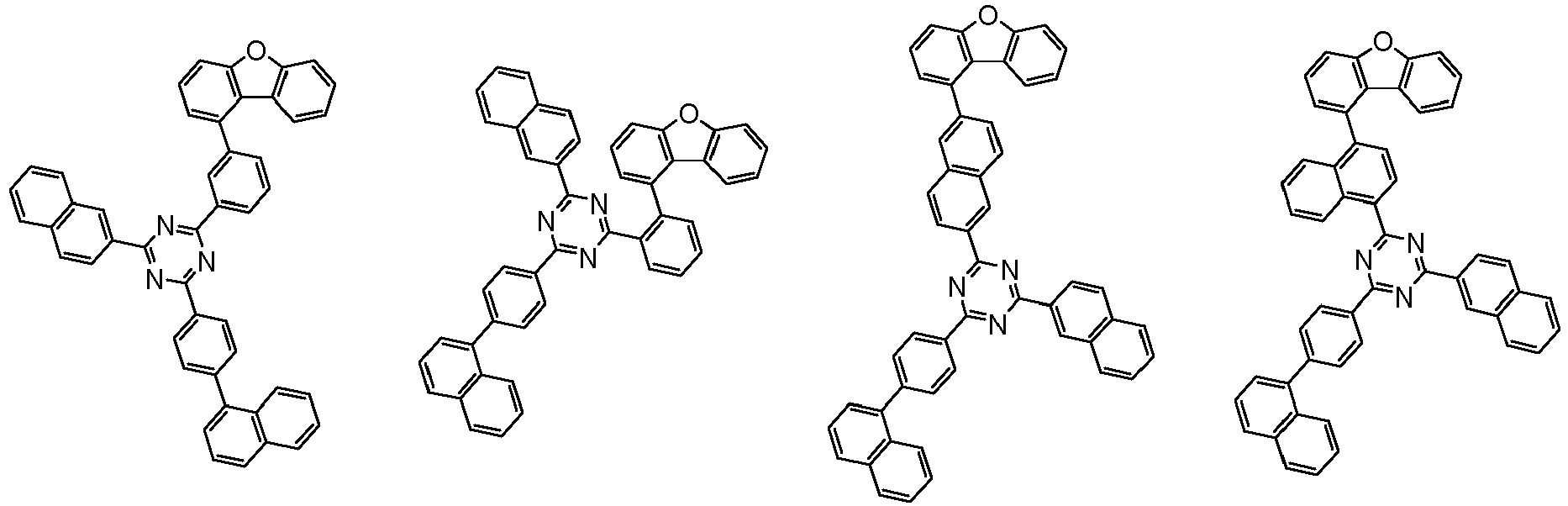
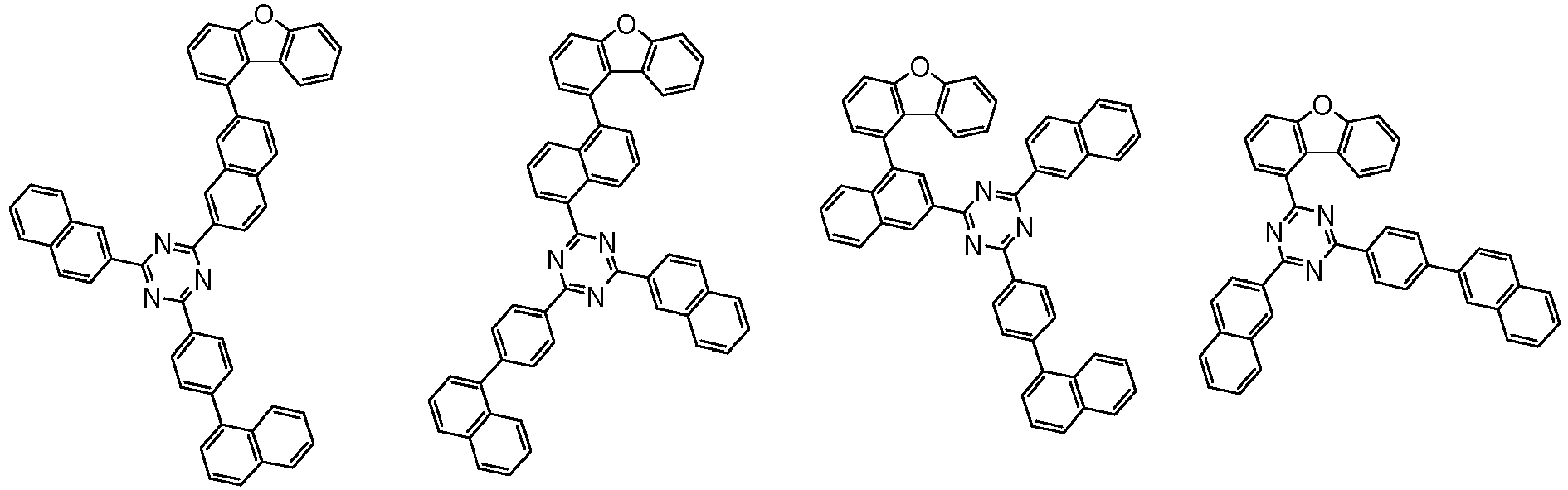


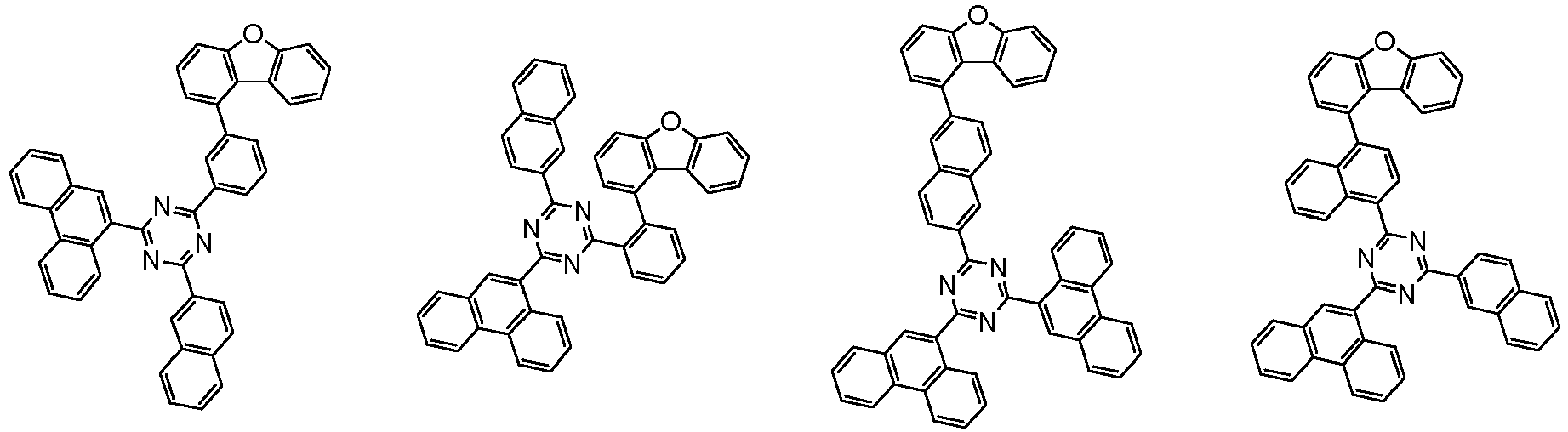


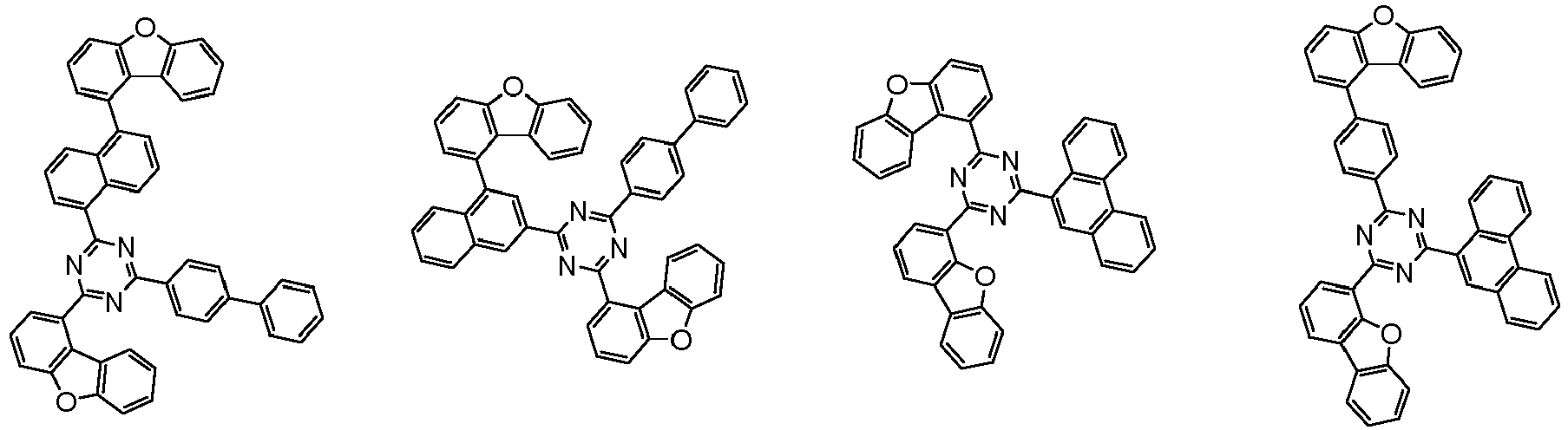


















- The compound represented by
Chemical Formula 1 can be prepared by a preparation method as shown in the followingReaction Scheme 1 as an example, and other remaining compounds can be prepared in a similar manner.
Reaction Scheme 1, Ar1 and Ar2, L1 to L3, R1 and a are as defined inChemical Formula 2, and Z1 is halogen, preferably Z1 is chloro or bromo. -
Reaction Scheme 1 is a Suzuki coupling reaction, which is preferably carried out in the presence of a palladium catalyst and a base, and a reactive group for the Suzuki coupling reaction can be modified as known in the art. The above preparation method may be further embodied in Preparation Examples described hereinafter. - Preferably, the compound represented by
Chemical Formula 2 may be represented by any one of the following Chemical Formula 2-1 and Chemical Formula 2-2:
R2 to R11, Ars, Ar4 and L4 to L6 are as defined inChemical Formula 2. - Preferably, Ar3 and Ar4 are each independently a substituted or unsubstituted C6-20 aryl; or a substituted or unsubstituted C2-20 heteroaryl containing at least one selected from the group consisting of N, O and S.
- More preferably, Ar3 and Ar4 may be each independently phenyl, triphenylsilyl phenyl, biphenylyl, terphenylyl, naphthyl, phenyl naphthyl, phenanthrenyl, dibenzofuranyl, dibenzothiophenyl, phenyl carbazolyl, or dimethylfluorenyl, and the hydrogens of Ar3 and Ar4 may be each independently unsubstituted or substituted with deuterium.
- Preferably, Ar3 and Ar4 may be each independently any one selected from the group consisting of:


- Preferably, L4 is phenylene, biphenyldiyl, or naphthalenediyl, provided that the phenylene, biphenyldiyl and naphthalenediyl may each be unsubstituted or substituted with deuterium or a C6-60 aryl.
- More preferably, L4 may be phenylene, biphenyldiyl, biphenyldiyl substituted with phenyl, or naphthalenediyl, and the hydrogens of L4 may be each independently unsubstituted or substituted with deuterium.
- Preferably, L4 may be any one selected from the group consisting of:


- Preferably, L5 and L6 are each independently a single bond; a substituted or unsubstituted C6-20 arylene; or a substituted or unsubstituted C2-20 heteroarylene containing at least one selected from the group consisting of N, O and S.
- More preferably, L5 and L6 may be each independently a single bond, phenylene, biphenyldiyl, naphthalenediyl, or carbazolediyl, and the hydrogens of L5 and L6 may be each independently unsubstituted or substituted with deuterium.
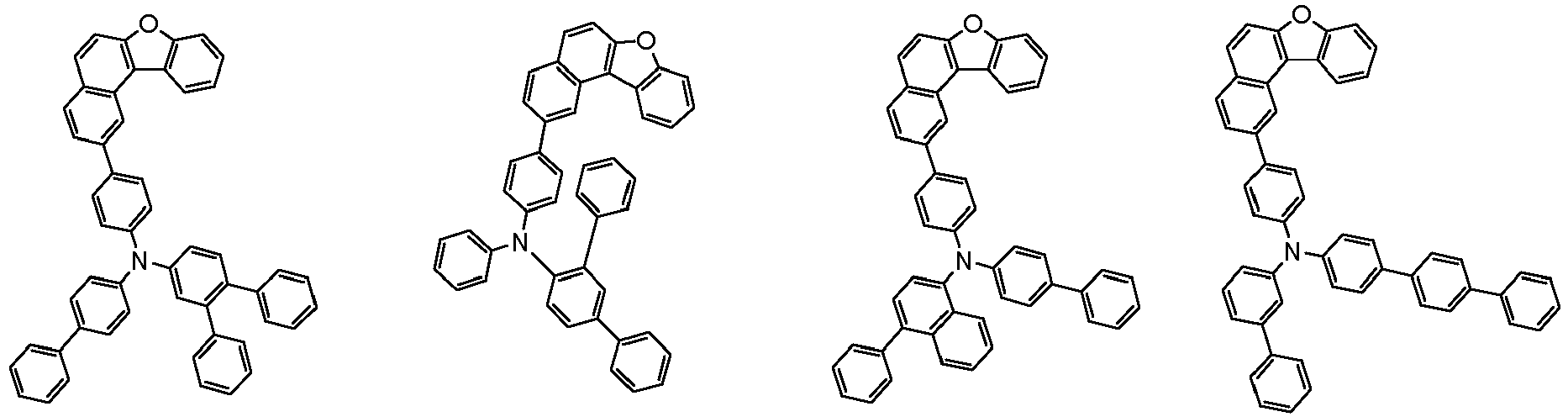
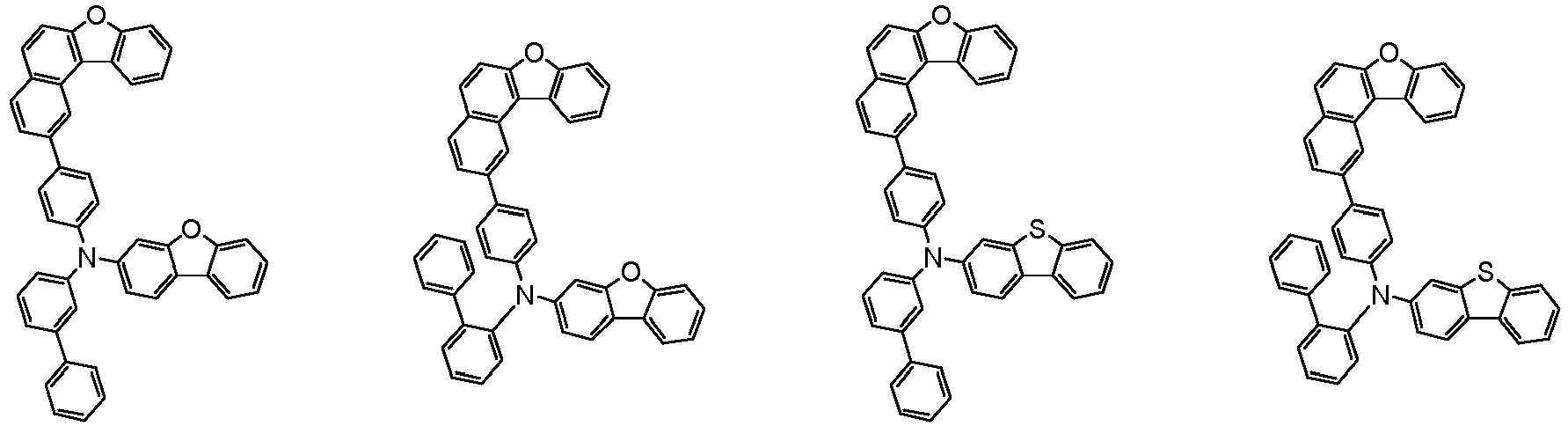
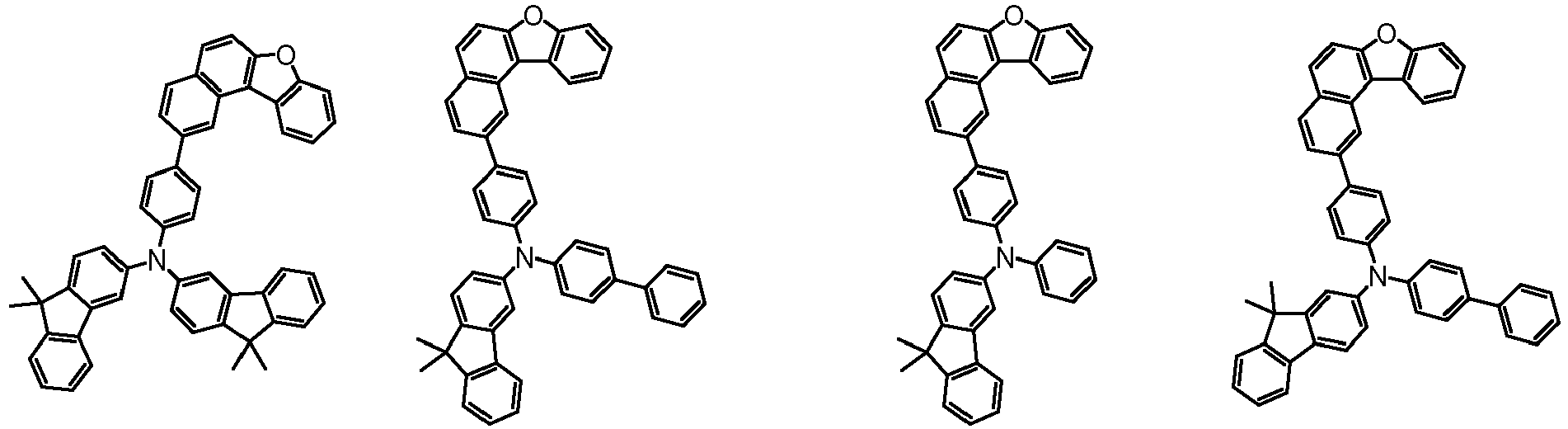
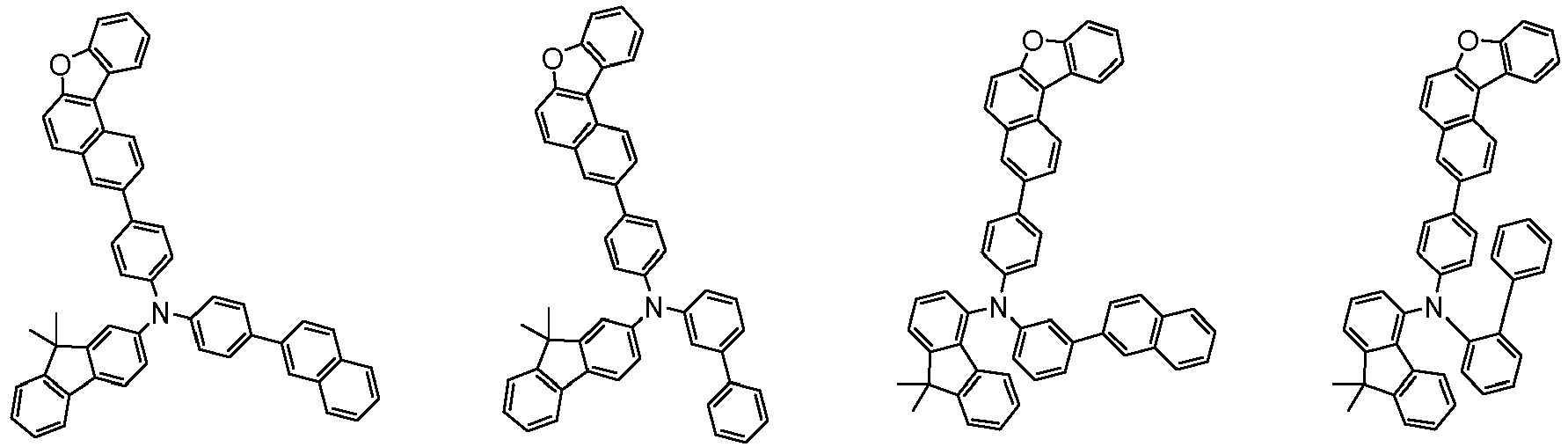
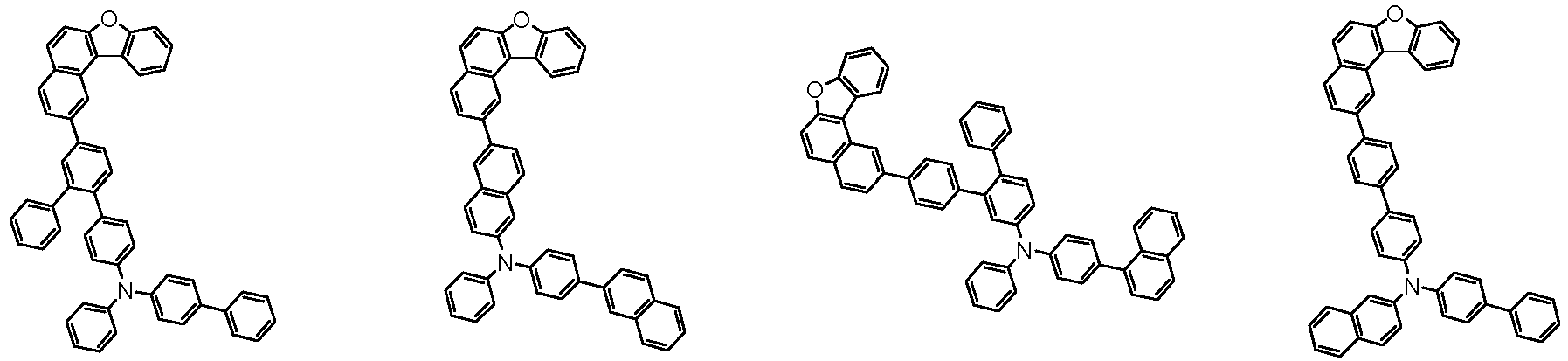
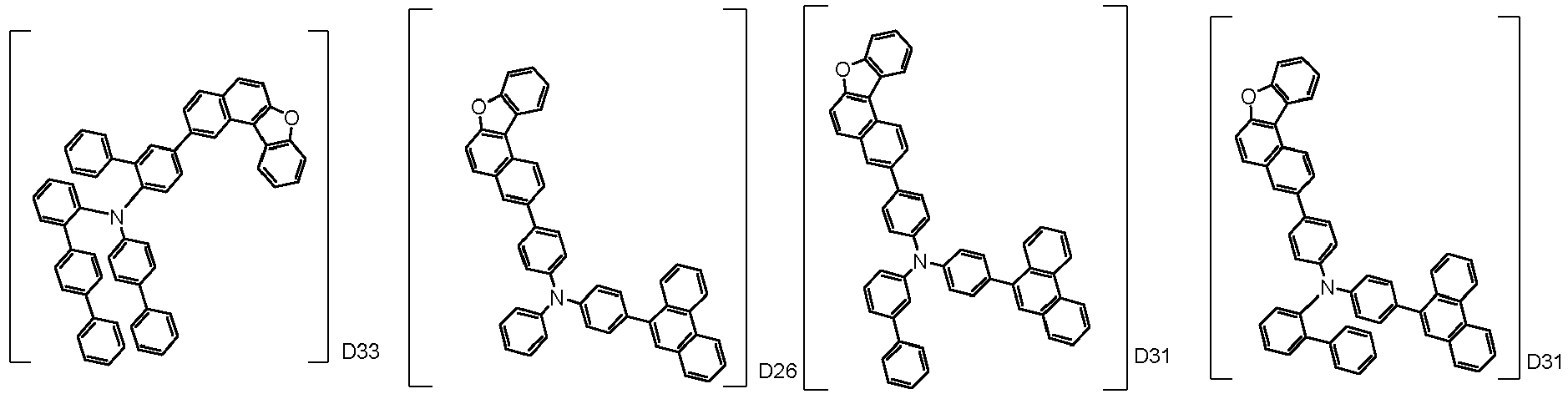
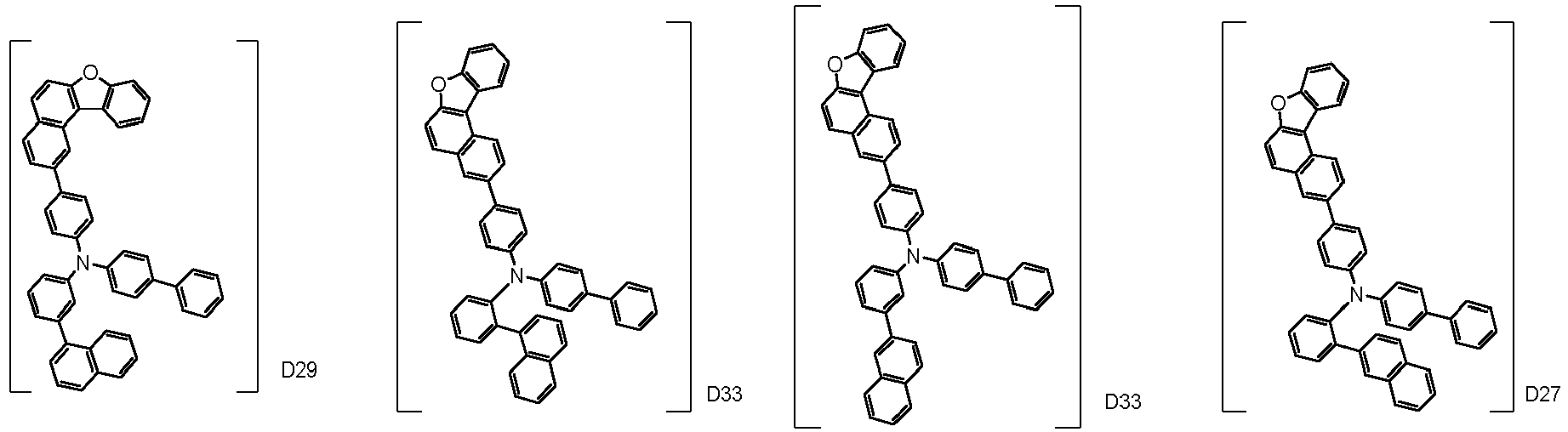
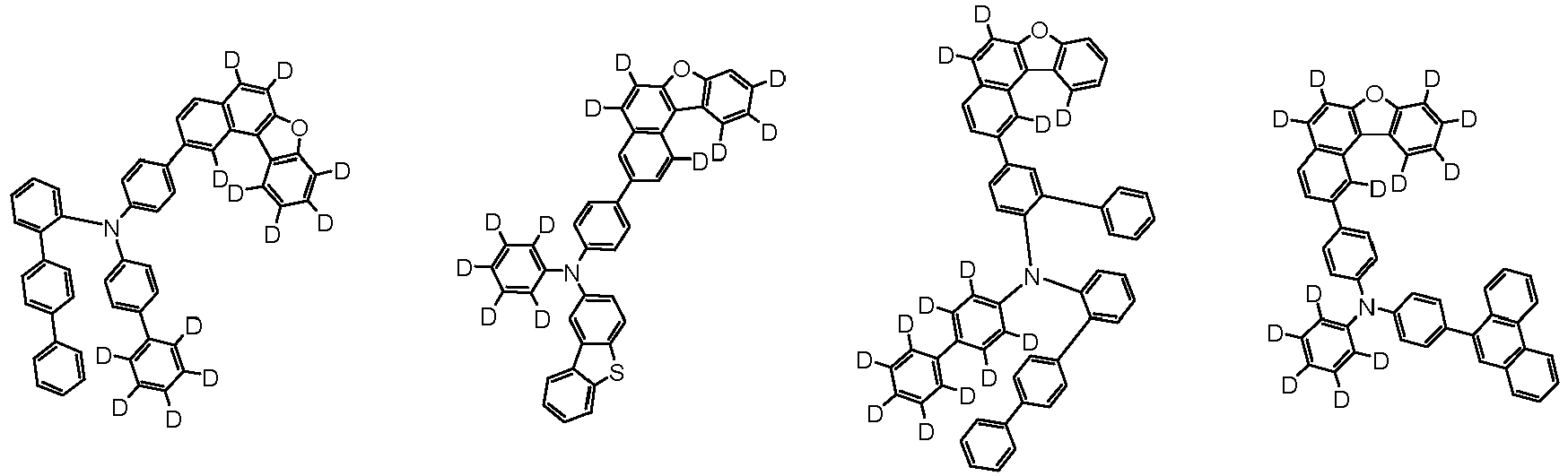
- Representative examples of the compound represented by
Chemical Formula 2 are as follows:











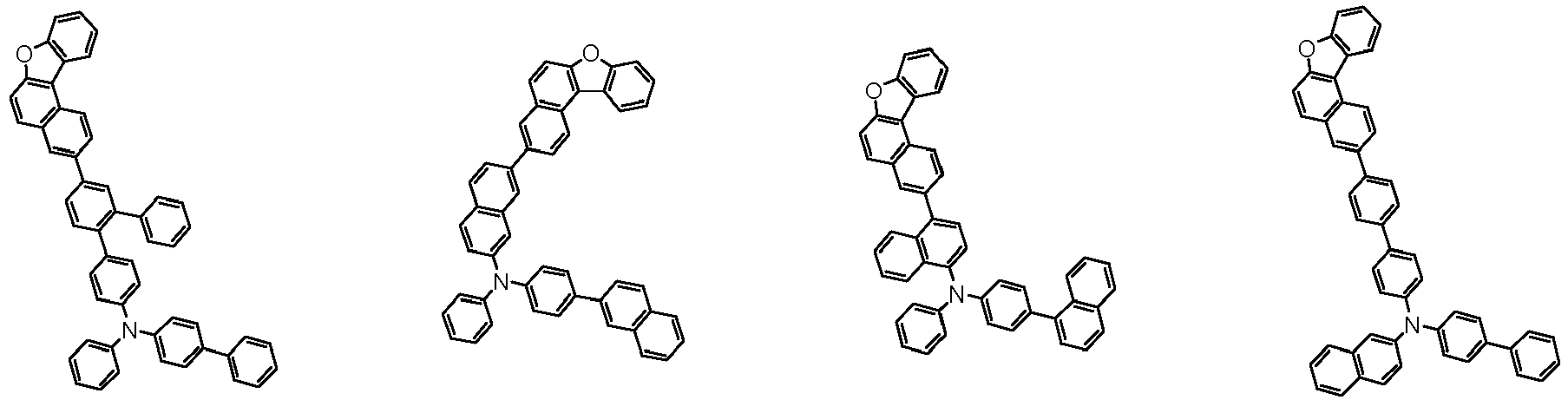


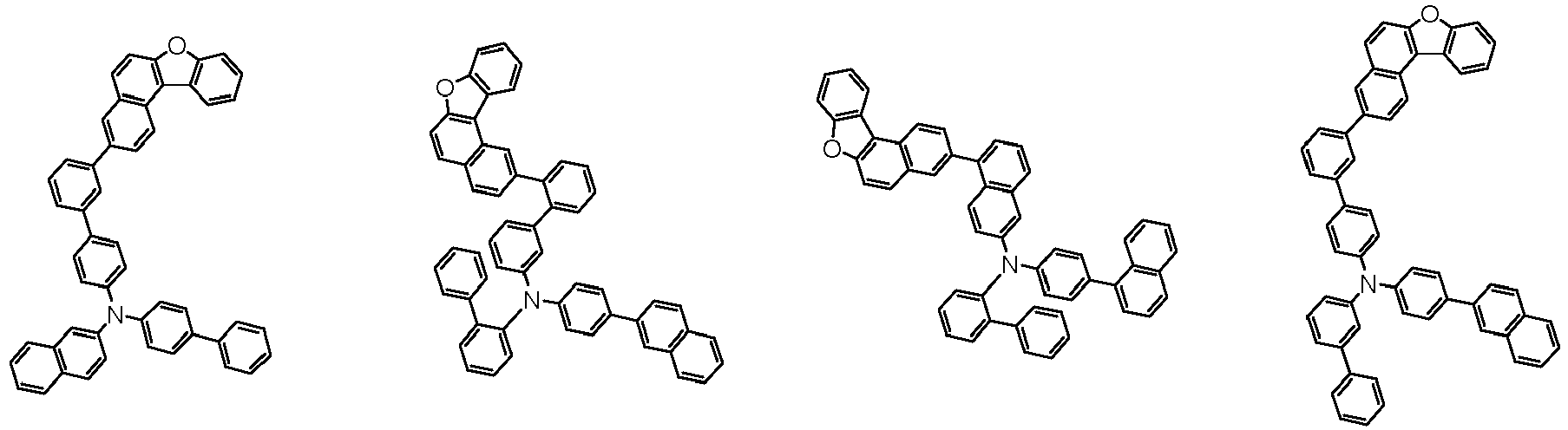


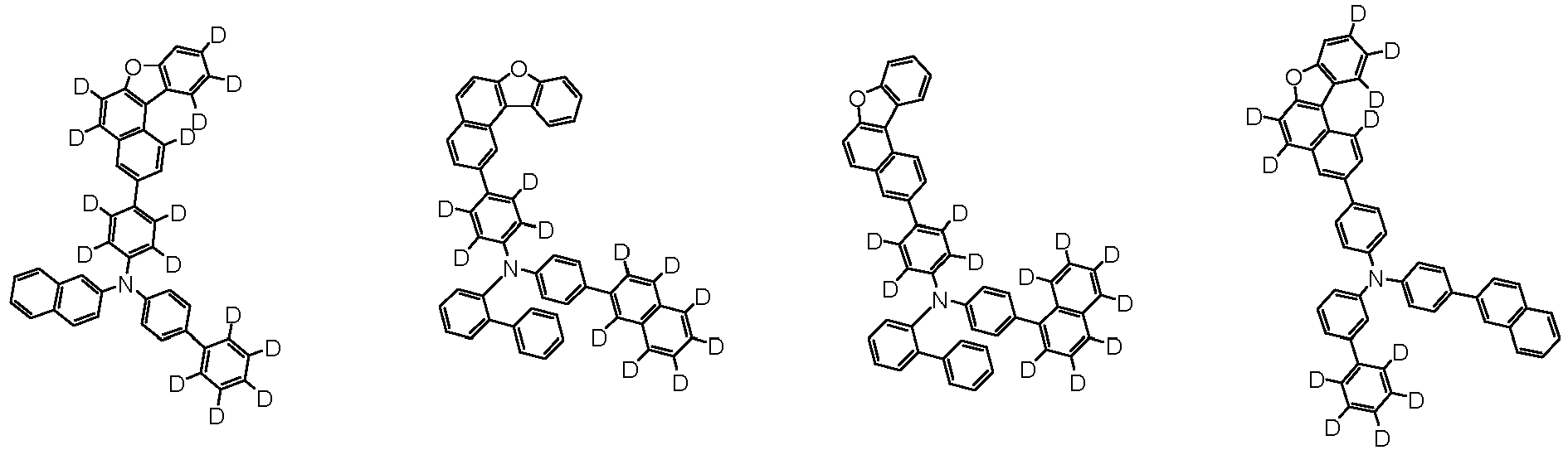


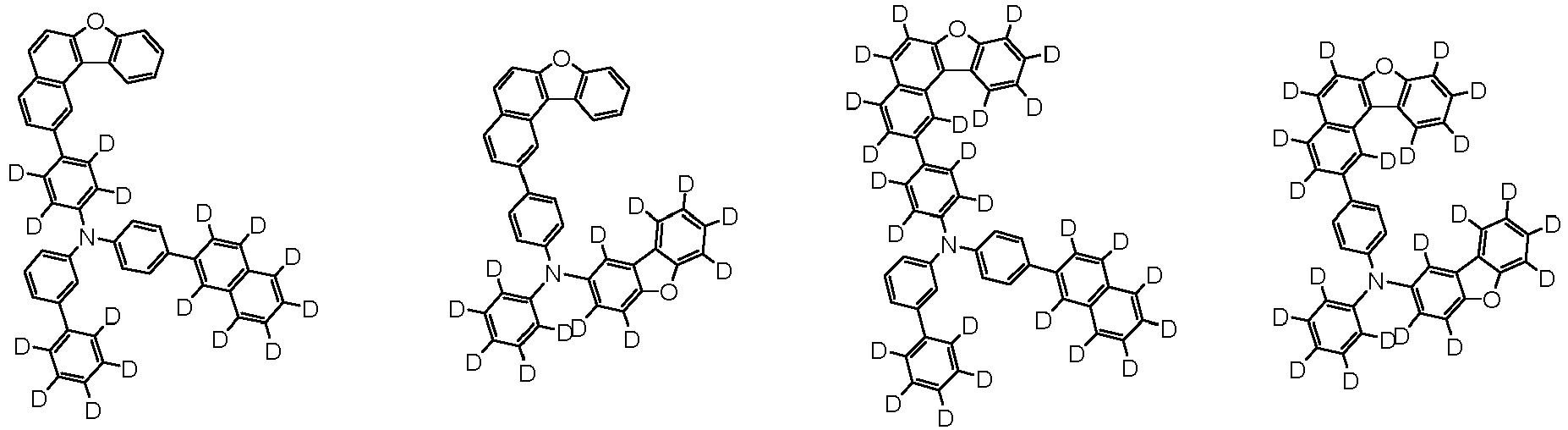








- The compound represented by
Chemical Formula 2, wherein R7 is
Reaction Scheme 2 as an example, and the other remaining compounds cam be prepared in a similar manner.
Reaction Scheme 2, R2 to R11, Ar3, Ar4 and L4 to L6 are as defined inChemical Formula 2, and Z2 is halogen, preferably Z2 is chloro or bromo. -
Reaction Scheme 2 is a Suzuki coupling reaction, which is preferably carried out in the presence of a palladium catalyst and a base, and a reactive group for the Suzuki coupling reaction can be modified as known in the art. The above preparation method may be further embodied in Preparation Examples described hereinafter. - Preferably, in the light emitting layer, the weight ratio of the compound represented by
Chemical Formula 1 and the compound represented byChemical Formula 2 is 10:90 to 90:10, more preferably 20:80 to 80:20, 30:70 to 70:30 or 40:60 to 60:40. - Meanwhile, the light emitting layer may further include a dopant in addition to the host. The dopant material is not particularly limited as long as it is a material used for the organic light emitting device. As an example, an aromatic amine derivative, a styrylamine compound, a boron complex, a fluoranthene compound, a metal complex, and the like can be mentioned. Specific examples of the aromatic amine derivatives include substituted or unsubstituted fused aromatic ring derivatives having an arylamino group, examples thereof include pyrene, anthracene, chrysene, and periflanthene having the arylamino group, and the like. The styrylamine compound is a compound where at least one arylvinyl group is substituted in substituted or unsubstituted arylamine, in which one or two or more substituent groups selected from the group consisting of an aryl group, a silyl group, an alkyl group, a cycloalkyl group, and an arylamino group are substituted or unsubstituted. Specific examples thereof include styrylamine, styryldiamine, styryltriamine, styryltetramine, and the like, but are not limited thereto. Further, examples of the metal complex include an iridium complex, a platinum complex, and the like, but are not limited thereto.
- In one example, the dopant material may be at least one selected from the group consisting of the following, without being limited thereto:


- The hole blocking layer is a layer provided between the electron transport layer and the light emitting layer in order to prevent the holes injected in the anode from being transferred to the electron transport layer without being recombined in the light emitting layer, which may also be referred to as a hole inhibition layer. The hole blocking layer is preferably a material having high ionization energy.
- The organic light emitting device according to the present disclosure may include an electron transport layer on the light emitting layer, if necessary.
- The electron transport layer is a layer that receives the electrons from the electron injection layer formed on the cathode or the anode and transports the electrons to the light emitting layer, and that suppress the transfer of holes from the light emitting layer, and an electron transport material is suitably a material which may receive electrons well from a cathode and transfer the electrons to a light emitting layer, and has a large mobility for electrons.
- Specific examples of the electron transport material include: an Al complex of 8-hydroxyquinoline; a complex including Alqs; an organic radical compound; a hydroxyflavone-metal complex, and the like, but are not limited thereto. The electron transport layer may be used with any desired cathode material, as used according to a conventional technique. In particular, appropriate examples of the cathode material are a typical material which has a low work function, followed by an aluminum layer or a silver layer. Specific examples thereof include cesium, barium, calcium, ytterbium, and samarium, in each case followed by an aluminum layer or a silver layer.
- The organic light emitting device according to the present disclosure may further include an electron injection layer on the light emitting layer (or on the electron transport layer, if the electron transport layer exists).
- The electron injection layer is a layer which injects electrons from an electrode, and is preferably a compound which has a capability of transporting electrons, has an effect of injecting electrons from a cathode and an excellent effect of injecting electrons into a light emitting layer or a light emitting material, prevents excitons produced from the light emitting layer from moving to a hole injection layer, and is also excellent in the ability to form a thin film.
- Specific examples of the electron injection layer include fluorenone, anthraquinodimethane, diphenoquinone, thiopyran dioxide, oxazole, oxadiazole, triazole, imidazole, perylenetetracarboxylic acid, fluorenylidene methane, anthrone, and the like, and derivatives thereof, a metal complex compound, a nitrogen-containing 5-membered ring derivative, and the like, but are not limited thereto.
- Examples of the metal complex compound include 8-hydroxyquinolinato lithium, bis(8-hydroxyquinolinato)zinc, bis(8-hydroxyquinolinato)copper, bis(8-hydroxyquinolinato)manganese, tris(8-hydroxyquinolinato)aluminum, tris(2-methyl-8-hydroxyquinolinato)aluminum, tris(8-hydroxyquinolinato)gallium, bis(10-hydroxybenzo[h]quinolinato)beryllium, bis(10-hydroxybenzo[h]quinolinato)zinc, bis(2-methyl-8-quinolinato)chlorogallium, bis(2-methyl-8-quinolinato)(o-cresolato)gallium, bis(2-methyl-8-quinolinato)(1-naphtholato)aluminum, bis(2-methyl-8-quinolinato)(2-naphtholato)gallium, and the like, but are not limited thereto.
- Meanwhile, in the present disclosure, the "electron injection and transport layer" is a layer that performs both the roles of the electron injection layer and the electron transport layer, and the materials that perform the roles of each layer may be used alone or in combination, without being limited thereto.
- The structure of the organic light emitting device according to the present disclosure is illustrated in
FIGS. 1 and 2. FIG. 1 shows an example of an organic light emitting device comprising asubstrate 1, ananode 2, alight emitting layer 3, and acathode 4.FIG. 2 shows an example of an organic light emitting device comprising asubstrate 1, ananode 2, ahole injection layer 5, ahole transport layer 6, anelectron blocking layer 7, alight emitting layer 3, a hole blocking layer 8, an electron injection andtransport layer 9, and acathode 4. - The organic light emitting device according to the present disclosure can be manufactured by sequentially stacking the above-described structures. In this case, the organic light emitting device may be manufactured by depositing a metal, metal oxides having conductivity, or an alloy thereof on the substrate by using a PVD (physical vapor deposition) method such as a sputtering method or an e-beam evaporation method to form the anode, forming the respective layers described above thereon, and then depositing a material that can be used as the cathode thereon. In addition to such a method, the organic light emitting device may be manufactured by sequentially depositing from the cathode material to the anode material on a substrate in the reverse order of the above-mentioned configuration (
WO 2003/012890 ). Further, the light emitting layer may be formed by subjecting hosts and dopants to a vacuum deposition method and a solution coating method. Herein, the solution coating method means a spin coating, a dip coating, a doctor blading, an inkjet printing, a screen printing, a spray method, a roll coating, or the like, but is not limited thereto. - Meanwhile, the organic light emitting device according to the present disclosure may be a bottom emission device, a top emission device, or a double-sided light emitting device, and particularly, may be a bottom emission device that requires relatively high luminous efficiency.
- Hereinafter, preferred examples are presented to assist in the understanding of the present disclosure. However, the following examples are only provided for a better understanding of the present disclosure, and is not intended to limit the content of the present disclosure.
-

- Compound Trz1 (15 g, 28.8 mmol) and dibenzo[b,d]furan-1-ylboronic acid (6.4 g, 30.3 mmol) were added to 300 ml of THF, and the mixture was stirred and refluxed. Then, potassium carbonate (12 g, 86.5 mmol) was dissolved in 36 ml of water and added thereto, and the mixture was sufficiently stirred and then bis(tri-tert-butylphosphine)palladium(0) (0.1 g, 0.3 mmol) was added. After the reaction for 3 hours, the reaction mixture was cooled to room temperature, and the organic layer and the aqueous layer were separated and then the organic layer was distilled. This was again dissolved in chloroform, washed twice with water, and then the organic layer was separated, anhydrous magnesium sulfate was added thereto, stirred, and then filtered, and the filtrate was distilled under reduced pressure. The concentrated compound was purified by silica gel column chromatography to prepare 12.2 g of Compound 1-1. (Yield: 65%, MS: [M+H]+= 652)
-

- Compound Trz2 (15 g, 30.4 mmol) and dibenzo[b,d]furan-1-ylboronic acid (6.8 g, 31.9 mmol) were added to 300 ml of THF, and the mixture was stirred and refluxed. Then, potassium carbonate (12.6 g, 91.1 mmol) was dissolved in 38 ml of water and added thereto, and the mixture was sufficiently stirred and then bis(tri-tert-butylphosphine)palladium(0) (0.2 g, 0.3 mmol) was added. After the reaction for 5 hours, the reaction mixture was cooled to room temperature, and the organic layer and the aqueous layer were separated and then the organic layer was distilled. This was again dissolved in chloroform, washed twice with water, and then the organic layer was separated, anhydrous magnesium sulfate was added thereto, stirred, and then filtered, and the filtrate was distilled under reduced pressure. The concentrated compound was purified by silica gel column chromatography to prepare 14g of Compound 1-2. (Yield: 74%, MS: [M+H]+= 626)
-

- Compound Trz3 (15 g, 33.8 mmol) and dibenzo[b,d]furan-1-ylboronic acid (7.5 g, 35.5 mmol) were added to 300 ml of THF, and the mixture was stirred and refluxed. Then, potassium carbonate (14 g, 101.4 mmol) was dissolved in 42 ml of water and added thereto, and the mixture was sufficiently stirred and then bis(tri-tert-butylphosphine)palladium(0) (0.2 g, 0.3 mmol ) was added. After the reaction for 5 hours, the reaction mixture was cooled to room temperature, and the organic layer and the aqueous layer were separated and then the organic layer was distilled. This was again dissolved in chloroform, washed twice with water, and then the organic layer was separated, anhydrous magnesium sulfate was added thereto, stirred, and then filtered, and the filtrate was distilled under reduced pressure. The concentrated compound was purified by silica gel column chromatography to prepare 13.4 g of Compound 1-3. (Yield: 69%, MS: [M+H]+= 576)
-

- Compound Trz4 (15 g, 30.4 mmol) and dibenzo[b,d]furan-1-ylboronic acid (6.8 g, 31.9 mmol) were added to 300 ml of THF, and the mixture was stirred and refluxed. Then, potassium carbonate (12.6 g, 91.1 mmol) was dissolved in 38 ml of water and added thereto, and the mixture was sufficiently stirred and then bis(tri-tert-butylphosphine)palladium(0) (0.2 g, 0.3 mmol ) was added. After the reaction for 3 hours, the reaction mixture was cooled to room temperature, and the organic layer and the aqueous layer were separated and then the organic layer was distilled. This was again dissolved in chloroform, washed twice with water, and then the organic layer was separated, anhydrous magnesium sulfate was added thereto, stirred, and then filtered, and the filtrate was distilled under reduced pressure. The concentrated compound was purified by silica gel column chromatography to prepare 13.3g of Compound 1-4. (Yield: 70%, MS: [M+H]+= 626)
-

- Compound Trz5 (15 g, 24.9 mmol) and dibenzo[b,d]furan-1-ylboronic acid (5.5 g, 26.2 mmol) were added to 300 ml of THF, and the mixture was stirred and refluxed. Then, potassium carbonate (10.3 g, 74.7 mmol) was dissolved in 31 ml of water and added thereto, and the mixture was sufficiently stirred and then bis(tri-tert-butylphosphine)palladium(0) (0.1 g, 0.2 mmol) was added. After the reaction for 3 hours, the reaction mixture was cooled to room temperature, and the organic layer and the aqueous layer were separated and then the organic layer was distilled. This was again dissolved in chloroform, washed twice with water, and then the organic layer was separated, anhydrous magnesium sulfate was added thereto, stirred, and then filtered, and the filtrate was distilled under reduced pressure. The concentrated compound was purified by silica gel column chromatography to prepare 12.6 g of Compound 1-5. (Yield: 69%, MS: [M+H]+= 734)
-

- Compound Trz6 (15 g, 30.2 mmol) and dibenzo[b,d]furan-1-ylboronic acid (6.7 g, 31.8 mmol) were added to 300 ml of THF, and the mixture was stirred and refluxed. Then, potassium carbonate (12.5 g, 90.7 mmol) was dissolved in 38 ml of water and added thereto, and the mixture was sufficiently stirred and then bis(tri-tert-butylphosphine)palladium(0) (0.2 g, 0.3 mmol ) was added. After the reaction for 4 hours, the reaction mixture was cooled to room temperature, and the organic layer and the aqueous layer were separated and then the organic layer was distilled. This was again dissolved in chloroform, washed twice with water, and then the organic layer was separated, anhydrous magnesium sulfate was added thereto, stirred, and then filtered, and the filtrate was distilled under reduced pressure. The concentrated compound was purified by silica gel column chromatography to prepare 12.5 g of Compound 1-6. (Yield: 66%, MS: [M+H]+= 629)
-

- Compound Trz7 (15 g, 36.8 mmol) and dibenzo[b,d]furan-1-ylboronic acid (8.2 g, 38.6 mmol) were added to 300 ml of THF, and the mixture was stirred and refluxed. Then, potassium carbonate (15.2 g, 110.3 mmol) was dissolved in 46 ml of water and added thereto, and the mixture was sufficiently stirred and then bis(tri-tert-butylphosphine)palladium(0) (0.2 g, 0.4 mmol ) was added. After the reaction for 5 hours, the reaction mixture was cooled to room temperature, and the organic layer and the aqueous layer were separated and then the organic layer was distilled. This was again dissolved in chloroform, washed twice with water, and then the organic layer was separated, anhydrous magnesium sulfate was added thereto, stirred, and then filtered, and the filtrate was distilled under reduced pressure. The concentrated compound was purified by silica gel column chromatography to prepare 14.9 g of Compound 1-7. (Yield: 75%, MS: [M+H]+= 540)
-

- Compound Trz8 (15 g, 35.9 mmol) and dibenzo[b,d]furan-1-ylboronic acid (8 g, 37.7 mmol) were added to 300 ml of THF, and the mixture was stirred and refluxed. Then, potassium carbonate (14.9 g, 107.7 mmol) was dissolved in 45 ml of water and added thereto, and the mixture was sufficiently stirred and then bis(tri-tert-butylphosphine)palladium(0) (0.2 g, 0.4 mmol) was added. After the reaction for 5 hours, the reaction mixture was cooled to room temperature, and the organic layer and the aqueous layer were separated and then the organic layer was distilled. This was again dissolved in chloroform, washed twice with water, and then the organic layer was separated, anhydrous magnesium sulfate was added thereto, stirred, and then filtered, and the filtrate was distilled under reduced pressure. The concentrated compound was purified by silica gel column chromatography to prepare 13.8g of Compound 1-8. (Yield: 70%, MS: [M+H]+= 550)
-

- Compound Trz9 (15 g, 33.8 mmol) and dibenzo[b,d]furan-1-ylboronic acid (7.5 g, 35.5 mmol) were added to 300 ml of THF, and the mixture was stirred and refluxed. Then, potassium carbonate (14 g, 101.4 mmol) was dissolved in 42 ml of water and added thereto, and the mixture was sufficiently stirred and then bis(tri-tert-butylphosphine)palladium(0) (0.2 g, 0.3 mmol) was added. After the reaction for 5 hours, the reaction mixture was cooled to room temperature, and the organic layer and the aqueous layer were separated and then the organic layer was distilled. This was again dissolved in chloroform, washed twice with water, and then the organic layer was separated, anhydrous magnesium sulfate was added thereto, stirred, and then filtered, and the filtrate was distilled under reduced pressure. The concentrated compound was purified by silica gel column chromatography to prepare 13.6g of Compound1-9. (Yield: 70%, MS: [M+H]+= 576)
-

- Compound Trz10 (15 g, 35.9 mmol) and dibenzo[b,d]furan-1-ylboronic acid (8 g, 37.7 mmol) were added to 300 ml of THF, and the mixture was stirred and refluxed. Then, potassium carbonate (14.9 g, 107.7 mmol) was dissolved in 45 ml of water and added thereto, and the mixture was sufficiently stirred and then bis(tri-tert-butylphosphine)palladium(0) (0.2 g, 0.4 mmol) was added. After the reaction for 3 hours, the reaction mixture was cooled to room temperature, and the organic layer and the aqueous layer were separated and then the organic layer was distilled. This was again dissolved in chloroform, washed twice with water, and then the organic layer was separated, anhydrous magnesium sulfate was added thereto, stirred, and then filtered, and the filtrate was distilled under reduced pressure. The concentrated compound was purified by silica gel column chromatography to prepare 13.8g of Compound1-10. (Yield: 70%, MS: [M+H]+= 550)
-

- Compound Trz11 (15 g, 30.4 mmol) and dibenzo[b,d]furan-1-ylboronic acid (6.8 g, 31.9 mmol) were added to 300 ml of THF, and the mixture was stirred and refluxed. Then, potassium carbonate (12.6 g, 91.1 mmol) was dissolved in 38 ml of water and added thereto, and the mixture was sufficiently stirred and then bis(tri-tert-butylphosphine)palladium(0) (0.2 g, 0.3 mmol) was added. After the reaction for 4 hours, the reaction mixture was cooled to room temperature, and the organic layer and the aqueous layer were separated and then the organic layer was distilled. This was again dissolved in chloroform, washed twice with water, and then the organic layer was separated, anhydrous magnesium sulfate was added thereto, stirred, and then filtered, and the filtrate was distilled under reduced pressure. The concentrated compound was purified by silica gel column chromatography to prepare 13.7g of Compound 1-11. (Yield: 72%, MS: [M+H]+= 626)
-

- Compound Trz12 (15 g, 33.8 mmol) and dibenzo[b,d]furan-1-ylboronic acid (7.5 g, 35.5 mmol) were added to 300 ml of THF, and the mixture was stirred and refluxed. Then, potassium carbonate (14 g, 101.4 mmol) was dissolved in 42 ml of water and added thereto, and the mixture was sufficiently stirred and then bis(tri-tert-butylphosphine)palladium(0) (0.2 g, 0.3 mmol) was added. After the reaction for 5 hours, the reaction mixture was cooled to room temperature, and the organic layer and the aqueous layer were separated and then the organic layer was distilled. This was again dissolved in chloroform, washed twice with water, and then the organic layer was separated, anhydrous magnesium sulfate was added thereto, stirred, and then filtered, and the filtrate was distilled under reduced pressure. The concentrated compound was purified by silica gel column chromatography to prepare 14.2g of Compound 1-12. (Yield: 73%, MS: [M+H]+= 576)
-

- Compound Trz13 (15 g, 33.8 mmol) and dibenzo[b,d]furan-1-ylboronic acid (7.5 g, 35.5 mmol) were added to 300 ml of THF, and the mixture was stirred and refluxed. Then, potassium carbonate (14 g, 101.4 mmol) was dissolved in 42 ml of water and added thereto, and the mixture was sufficiently stirred and then bis(tri-tert-butylphosphine)palladium(0) (0.2 g, 0.3 mmol) was added. After the reaction for 4 hours, the reaction mixture was cooled to room temperature, and the organic layer and the aqueous layer were separated and then the organic layer was distilled. This was again dissolved in chloroform, washed twice with water, and then the organic layer was separated, anhydrous magnesium sulfate was added thereto, stirred, and then filtered, and the filtrate was distilled under reduced pressure. The concentrated compound was purified by silica gel column chromatography to prepare 13.4 g of Compound 1-13. (Yield: 69%, MS: [M+H]+= 576)
-

- Compound Trz14 (15 g, 31.9 mmol) and dibenzo[b,d]furan-1-ylboronic acid (7.1 g, 33.5 mmol) were added to 300 ml of THF, and the mixture was stirred and refluxed. Then, potassium carbonate (13.2 g, 95.8 mmol) was dissolved in 40 ml of water and added thereto, and the mixture was sufficiently stirred and then bis(tri-tert-butylphosphine)palladium(0) (0.2 g, 0.3 mmol ) was added. After the reaction for 5 hours, the reaction mixture was cooled to room temperature, and the organic layer and the aqueous layer were separated and then the organic layer was distilled. This was again dissolved in chloroform, washed twice with water, and then the organic layer was separated, anhydrous magnesium sulfate was added thereto, stirred, and then filtered, and the filtrate was distilled under reduced pressure. The concentrated compound was purified by silica gel column chromatography to prepare 14.2 g of Compound 1-14. (Yield: 74%, MS: [M+H]+= 602)
-

- Compound Trz15 (15 g, 35.4 mmol) and dibenzo[b,d]furan-1-ylboronic acid (7.9 g, 37.2 mmol) were added to 300 ml of THF, and the mixture was stirred and refluxed. Then, potassium carbonate (14.7 g, 106.2 mmol) was dissolved in 44 ml of water and added thereto, and the mixture was sufficiently stirred and then bis(tri-tert-butylphosphine)palladium(0) (0.2 g, 0.4 mmol) was added. After the reaction for 4 hours, the reaction mixture was cooled to room temperature, and the organic layer and the aqueous layer were separated and then the organic layer was distilled. This was again dissolved in chloroform, washed twice with water, and then the organic layer was separated, anhydrous magnesium sulfate was added thereto, stirred, and then filtered, and the filtrate was distilled under reduced pressure. The concentrated compound was purified by silica gel column chromatography to prepare 14.3 g of Compound 1-15. (Yield: 73%, MS: [M+H]+= 556)
-

- Compound Trz16 (15 g, 32.8 mmol) and dibenzo[b,d]furan-1-ylboronic acid (7.3 g, 34.4 mmol) were added to 300 ml of THF, and the mixture was stirred and refluxed. Then, potassium carbonate (13.6 g, 98.3 mmol) was dissolved in 41 ml of water and added thereto, and the mixture was sufficiently stirred and then bis(tri-tert-butylphosphine)palladium(0) (0.2 g, 0.3 mmol ) was added. After the reaction for 3 hours, the reaction mixture was cooled to room temperature, and the organic layer and the aqueous layer were separated and then the organic layer was distilled. This was again dissolved in chloroform, washed twice with water, and then the organic layer was separated, anhydrous magnesium sulfate was added thereto, stirred, and then filtered, and the filtrate was distilled under reduced pressure. The concentrated compound was purified by silica gel column chromatography to prepare 14.3 g of Compound 1-16. (Yield: 74%, MS: [M+H]+= 590)
-

- Compound Trz17 (15 g, 30 mmol) and dibenzo[b,d]furan-1-ylboronic acid (6.7 g, 31.5 mmol) were added to 300 ml of THF, and the mixture was stirred and refluxed. Then, potassium carbonate (12.4 g, 90 mmol) was dissolved in 37 ml of water and added thereto, and the mixture was sufficiently stirred and then bis(tri-tert-butylphosphine)palladium(0) (0.2 g, 0.3 mmol) was added. After the reaction for 3 hours, the reaction mixture was cooled to room temperature, and the organic layer and the aqueous layer were separated and then the organic layer was distilled. This was again dissolved in chloroform, washed twice with water, and then the organic layer was separated, anhydrous magnesium sulfate was added thereto, stirred, and then filtered, and the filtrate was distilled under reduced pressure. The concentrated compound was purified by silica gel column chromatography to prepare 14 g of Compound 1-17. (Yield: 74%, MS: [M+H]+= 632)
-

- Compound Trz17 (15 g, 31.6 mmol) and dibenzo[b,d]furan-1-ylboronic acid (7 g, 33.2 mmol) were added to 300 ml of THF, and the mixture was stirred and refluxed. Then, potassium carbonate (13.1 g, 94.7 mmol) was dissolved in 39 ml of water and added thereto, and the mixture was sufficiently stirred and then bis(tri-tert-butylphosphine)palladium(0) (0.2 g, 0.3 mmol) was added. After the reaction for 3 hours, the reaction mixture was cooled to room temperature, and the organic layer and the aqueous layer were separated and then the organic layer was distilled. This was again dissolved in chloroform, washed twice with water, and then the organic layer was separated, anhydrous magnesium sulfate was added thereto, stirred, and then filtered, and the filtrate was distilled under reduced pressure. The concentrated compound was purified by silica gel column chromatography to prepare 14.2 g of Compound 1-18. (Yield: 74%, MS: [M+H]+= 607)
-

- Compound Trz19 (15 g, 31.9 mmol) and dibenzo[b,d]furan-1-ylboronic acid (7.1 g, 33.5 mmol) were added to 300 ml of THF, and the mixture was stirred and refluxed. Then, potassium carbonate (13.2 g, 95.8 mmol) was dissolved in 40 ml of water and added thereto, and the mixture was sufficiently stirred and then bis(tri-tert-butylphosphine)palladium(0) (0.2 g, 0.3 mmol ) was added. After the reaction for 5 hours, the reaction mixture was cooled to room temperature, and the organic layer and the aqueous layer were separated and then the organic layer was distilled. This was again dissolved in chloroform, washed twice with water, and then the organic layer was separated, anhydrous magnesium sulfate was added thereto, stirred, and then filtered, and the filtrate was distilled under reduced pressure. The concentrated compound was purified by silica gel column chromatography to prepare 12.7 g of Compound 1-19. (Yield: 66%, MS: [M+H]+= 602)
-

- Compound Trz20 (15 g, 34.6 mmol) and dibenzo[b,d]furan-1-ylboronic acid (7.7 g, 36.3 mmol) were added to 300 ml of THF, and the mixture was stirred and refluxed. Then, potassium carbonate (14.3 g, 103.7 mmol) was dissolved in 43 ml of water and added thereto, and the mixture was sufficiently stirred and then bis(tri-tert-butylphosphine)palladium(0) (0.2 g, 0.3 mmol) was added. After the reaction for 3 hours, the reaction mixture was cooled to room temperature, and the organic layer and the aqueous layer were separated and then the organic layer was distilled. This was again dissolved in chloroform, washed twice with water, and then the organic layer was separated, anhydrous magnesium sulfate was added thereto, stirred, and then filtered, and the filtrate was distilled under reduced pressure. The concentrated compound was purified by silica gel column chromatography to prepare 13.9 g of Compound 1-20. (Yield: 71%, MS: [M+H]+= 566)
-

- Compound Trz21 (15 g, 33.3 mmol) and dibenzo[b,d]furan-1-ylboronic acid (7.4 g, 35 mmol) were added to 300 ml of THF, and the mixture was stirred and refluxed. Then, potassium carbonate (13.8 g, 100 mmol) was dissolved in 41 ml of water and added thereto, and the mixture was sufficiently stirred and then bis(tri-tert-butylphosphine)palladium(0) (0.2 g, 0.3 mmol) was added. After the reaction for 4 hours, the reaction mixture was cooled to room temperature, and the organic layer and the aqueous layer were separated and then the organic layer was distilled. This was again dissolved in chloroform, washed twice with water, and then the organic layer was separated, anhydrous magnesium sulfate was added thereto, stirred, and then filtered, and the filtrate was distilled under reduced pressure. The concentrated compound was purified by silica gel column chromatography to prepare 13.9 g of Compound 1-21. (Yield: 72%, MS: [M+H]+= 582)
-

- Compound Trz22 (15 g, 28.8 mmol) and dibenzo[b,d]furan-1-ylboronic acid (6.4 g, 30.3 mmol) were added to 300 ml of THF, and the mixture was stirred and refluxed. Then, potassium carbonate (12 g, 86.5 mmol) was dissolved in 36 ml of water and added thereto, and the mixture was sufficiently stirred and then bis(tri-tert-butylphosphine)palladium(0) (0.1 g, 0.3 mmol) was added. After the reaction for 4 hours, the reaction mixture was cooled to room temperature, and the organic layer and the aqueous layer were separated and then the organic layer was distilled. This was again dissolved in chloroform, washed twice with water, and then the organic layer was separated, anhydrous magnesium sulfate was added thereto, stirred, and then filtered, and the filtrate was distilled under reduced pressure. The concentrated compound was purified by silica gel column chromatography to prepare 13.3 g of Compound 1-22. (Yield: 71%, MS: [M+H]+= 652)
-

- Compound Trz23 (15 g, 28.8 mmol) and dibenzo[b,d]furan-1-ylboronic acid (6.4 g, 30.3 mmol) were added to 300 ml of THF, and the mixture was stirred and refluxed. Then, potassium carbonate (12 g, 86.5 mmol) was dissolved in 36 ml of water and added thereto, and the mixture was sufficiently stirred and then bis(tri-tert-butylphosphine)palladium(0) (0.1 g, 0.3 mmol) was added. After the reaction for 5 hours, the reaction mixture was cooled to room temperature, and the organic layer and the aqueous layer were separated and then the organic layer was distilled. This was again dissolved in chloroform, washed twice with water, and then the organic layer was separated, anhydrous magnesium sulfate was added thereto, stirred, and then filtered, and the filtrate was distilled under reduced pressure. The concentrated compound was purified by silica gel column chromatography to prepare 13.7 g of Compound 1-23. (Yield: 73%, MS: [M+H]+= 652)
-
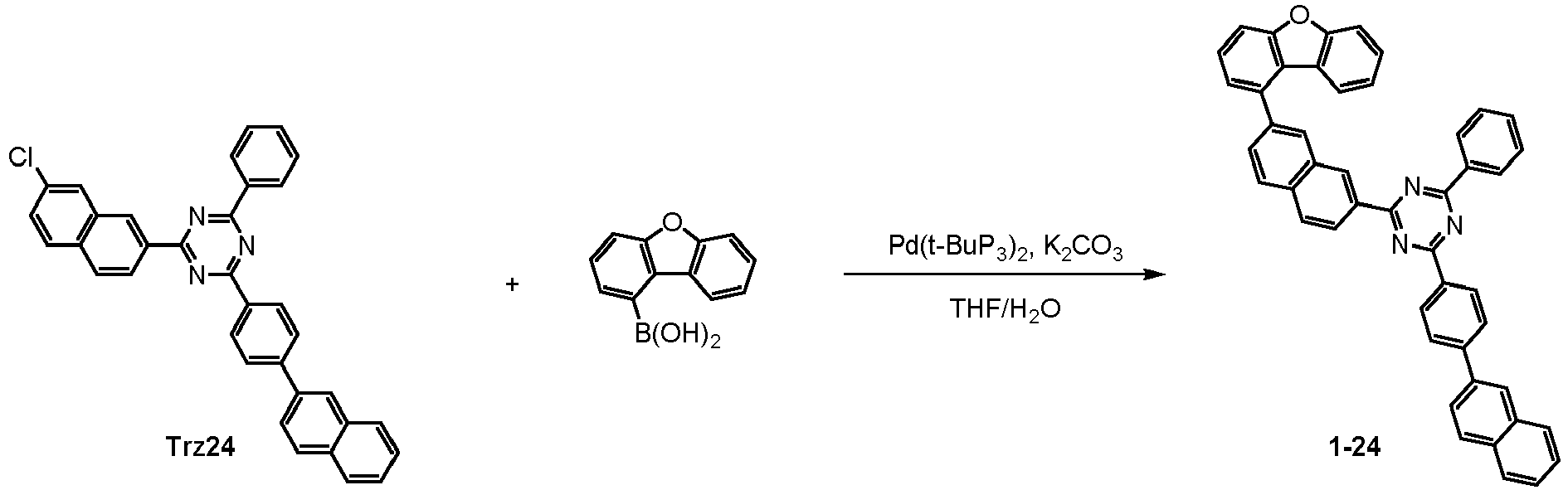
- Compound Trz24 (15 g, 28.8 mmol) and dibenzo[b,d]furan-1-ylboronic acid (6.4 g, 30.3 mmol) were added to 300 ml of THF, and the mixture was stirred and refluxed. Then, potassium carbonate (12 g, 86.5 mmol) was dissolved in 36 ml of water and added thereto, and the mixture was sufficiently stirred and then bis(tri-tert-butylphosphine)palladium(0) (0.1 g, 0.3 mmol) was added. After the reaction for 4 hours, the reaction mixture was cooled to room temperature, and the organic layer and the aqueous layer were separated and then the organic layer was distilled. This was again dissolved in chloroform, washed twice with water, and then the organic layer was separated, anhydrous magnesium sulfate was added thereto, stirred, and then filtered, and the filtrate was distilled under reduced pressure. The concentrated compound was purified by silica gel column chromatography to prepare 12.6 g of Compound 1-24. (Yield: 67%, MS: [M+H]+= 652)
-

- Compound Trz25 (15 g, 30 mmol) and dibenzo[b,d]furan-1-ylboronic acid (6.7 g, 31.5 mmol) were added to 300 ml of THF, and the mixture was stirred and refluxed. Then, potassium carbonate (12.4 g, 90 mmol) was dissolved in 37 ml of water and added thereto, and the mixture was sufficiently stirred and then bis(tri-tert-butylphosphine)palladium(0) (0.2 g, 0.3 mmol) was added. After the reaction for 5 hours, the reaction mixture was cooled to room temperature, and the organic layer and the aqueous layer were separated and then the organic layer was distilled. This was again dissolved in chloroform, washed twice with water, and then the organic layer was separated, anhydrous magnesium sulfate was added thereto, stirred, and then filtered, and the filtrate was distilled under reduced pressure. The concentrated compound was purified by silica gel column chromatography to prepare 14.2 g of Compound 1-25. (Yield: 75%, MS: [M+H]+= 632)
-

- Compound Trz26 (15 g, 27.5 mmol) and dibenzo[b,d]furan-1-ylboronic acid (6.1 g, 28.8 mmol) were added to 300 ml of THF, and the mixture was stirred and refluxed. Then, potassium carbonate (11.4 g, 82.4 mmol) was dissolved in 34 ml of water and added thereto, and the mixture was sufficiently stirred and then bis(tri-tert-butylphosphine)palladium(0) (0.1 g, 0.3 mmol) was added. After the reaction for 3 hours, the reaction mixture was cooled to room temperature, and the organic layer and the aqueous layer were separated and then the organic layer was distilled. This was again dissolved in chloroform, washed twice with water, and then the organic layer was separated, anhydrous magnesium sulfate was added thereto, stirred, and then filtered, and the filtrate was distilled under reduced pressure. The concentrated compound was purified by silica gel column chromatography to prepare 14 g of Compound 1-26. (Yield: 75%, MS: [M+H]+= 678)
-

- Compound Trz27 (15 g, 25 mmol) and dibenzo[b,d]furan-1-ylboronic acid (5.6 g, 26.2 mmol) were added to 300 ml of THF, and the mixture was stirred and refluxed. Then, potassium carbonate (10.4 g, 75 mmol) was dissolved in 31 ml of water and added thereto, and the mixture was sufficiently stirred and then bis(tri-tert-butylphosphine)palladium(0) (0.1 g, 0.2 mmol) was added. After the reaction for 3 hours, the reaction mixture was cooled to room temperature, and the organic layer and the aqueous layer were separated and then the organic layer was distilled. This was again dissolved in chloroform, washed twice with water, and then the organic layer was separated, anhydrous magnesium sulfate was added thereto, stirred, and then filtered, and the filtrate was distilled under reduced pressure. The concentrated compound was purified by silica gel column chromatography to prepare 12.6 g of Compound 1-27. (Yield: 69%, MS: [M+H]+= 732)
-

- Compound Trz28 (15 g, 31 mmol) and dibenzo[b,d]furan-1-ylboronic acid (6.9 g, 32.5 mmol) were added to 300 ml of THF, and the mixture was stirred and refluxed. Then, potassium carbonate (12.9 g, 93 mmol) was dissolved in 39 ml of water and added thereto, and the mixture was sufficiently stirred and then bis(tri-tert-butylphosphine)palladium(0) (0.2 g, 0.3 mmol) was added. After the reaction for 3 hours, the reaction mixture was cooled to room temperature, and the organic layer and the aqueous layer were separated and then the organic layer was distilled. This was again dissolved in chloroform, washed twice with water, and then the organic layer was separated, anhydrous magnesium sulfate was added thereto, stirred, and then filtered, and the filtrate was distilled under reduced pressure. The concentrated compound was purified by silica gel column chromatography to prepare 13 g of Compound 1-28. (Yield: 68%, MS: [M+H]+= 616)
-

- Compound Trz29 (15 g, 31 mmol) and dibenzo[b,d]furan-1-ylboronic acid (6.9 g, 32.5 mmol) were added to 300 ml of THF, and the mixture was stirred and refluxed. Then, potassium carbonate (12.9 g, 93 mmol) was dissolved in 39 ml of water and added thereto, and the mixture was sufficiently stirred and then bis(tri-tert-butylphosphine)palladium(0) (0.2 g, 0.3 mmol) was added. After the reaction for 4 hours, the reaction mixture was cooled to room temperature, and the organic layer and the aqueous layer were separated and then the organic layer was distilled. This was again dissolved in chloroform, washed twice with water, and then the organic layer was separated, anhydrous magnesium sulfate was added thereto, stirred, and then filtered, and the filtrate was distilled under reduced pressure. The concentrated compound was purified by silica gel column chromatography to prepare 13.3 g of Compound 1-29. (Yield: 70%, MS: [M+H]+= 616)
-

- Compound Trz30 (15 g, 28.2 mmol) and dibenzo[b,d]furan-1-ylboronic acid (6.3 g, 29.7 mmol) were added to 300 ml of THF, and the mixture was stirred and refluxed. Then, potassium carbonate (11.7 g, 84.7 mmol) was dissolved in 35 ml of water and added thereto, and the mixture was sufficiently stirred and then bis(tri-tert-butylphosphine)palladium(0) (0.1 g, 0.3 mmol) was added. After the reaction for 3 hours, the reaction mixture was cooled to room temperature, and the organic layer and the aqueous layer were separated and then the organic layer was distilled. This was again dissolved in chloroform, washed twice with water, and then the organic layer was separated, anhydrous magnesium sulfate was added thereto, stirred, and then filtered, and the filtrate was distilled under reduced pressure. The concentrated compound was purified by silica gel column chromatography to prepare 12.9 g of Compound 1-30. (Yield: 69%, MS: [M+H]+= 663)
-

- Compound Trz31 (15 g, 30.7 mmol) and dibenzo[b,d]furan-1-ylboronic acid (6.8 g, 32.2 mmol) were added to 300 ml of THF, and the mixture was stirred and refluxed. Then, potassium carbonate (12.7 g, 92 mmol) was dissolved in 38 ml of water and added thereto, and the mixture was sufficiently stirred and then bis(tri-tert-butylphosphine)palladium(0) (0.2 g, 0.3 mmol) was added. After the reaction for 4 hours, the reaction mixture was cooled to room temperature, and the organic layer and the aqueous layer were separated and then the organic layer was distilled. This was again dissolved in chloroform, washed twice with water, and then the organic layer was separated, anhydrous magnesium sulfate was added thereto, stirred, and then filtered, and the filtrate was distilled under reduced pressure. The concentrated compound was purified by silica gel column chromatography to prepare 14.3 g of Compound 1-31. (Yield: 75%, MS: [M+H]+= 621)
-

- Compound Trz32 (15 g, 34.6 mmol) and dibenzo[b,d]furan-1-ylboronic acid (7.7 g, 36.3 mmol) were added to 300 ml of THF, and the mixture was stirred and refluxed. Then, potassium carbonate (14.3 g, 103.7 mmol) was dissolved in 43 ml of water and added thereto, and the mixture was sufficiently stirred and then bis(tri-tert-butylphosphine)palladium(0) (0.2 g, 0.3 mmol) was added. After the reaction for 4 hours, the reaction mixture was cooled to room temperature, and the organic layer and the aqueous layer were separated and then the organic layer was distilled. This was again dissolved in chloroform, washed twice with water, and then the organic layer was separated, anhydrous magnesium sulfate was added thereto, stirred, and then filtered, and the filtrate was distilled under reduced pressure. The concentrated compound was purified by silica gel column chromatography to prepare 13.9 g of Compound 1-32. (Yield: 71%, MS: [M+H]+= 566)
-

- Trifluoromethanesulfonic anhydride (24 g, 85 mmol) and deuterium oxide (8.5 g, 424.9 mmol) were added at 0°C and stirred for 5 hours to prepare a solution. 1-Bromodibenzo[b,d]furan (15 g, 60.7 mmol) was added to 120 ml of 1,2,4-trichlorobenzene, and the mixture was stirred. Then, the prepared mixed solution of trifluoromethanesulfonic anhydride and deuterium oxide was slowly added dropwise to the mixed solution of 1-bromodibenzo[b,d]furan and 1,2,4-trichlorobenzene, and the mixture was stirred while heating to 140°C and then keeping that temperature. After the reaction for 5 hours, the reaction mixture was cooled to room temperature, and the organic layer and the aqueous layer were separated. Then, the organic layer was neutralized with an aqueous potassium carbonate solution. After washing twice with water, the organic layer was separated, anhydrous magnesium sulfate was added thereto, stirred, then filtered, and the filtrate was distilled under reduced pressure. The concentrated compound was purified by silica gel column chromatography to prepare 5.7 g of compound sub1-1-1. (Yield: 38%, MS: [M+H]+= 248)
- Compound sub1-1-1 (15 g, 60.5 mmol) and bis(pinacolato)diboron (16.9 g, 66.5 mmol) were added to 300ml of 1,4-dioxane, and the mixture was stirred under reflux. Then, potassium acetate (8.9 g, 90.7 mmol) was added thereto, sufficiently stirred, and then bis(dibenzylideneacetone)palladium(0) (1 g, 1.8 mmol) and tricyclohexylphosphine (1 g, 3.6 mmol) were added. After the reaction for 6 hours, the reaction mixture was cooled to room temperature, the organic layer was separated using chloroform and water, and then the organic layer was distilled. This was dissolved again in chloroform, washed twice with water, and the organic layer was then separated. Anhydrous magnesium sulfate was added thereto, stirred, then filtered, and the filtrate was distilled under reduced pressure. The concentrated compound was purified by silica gel column chromatography to give 13.4 g of sub1-1-2. (Yield: 75%, MS: [M+H]+ = 296)
- Compound sub1-2-2 (15 g, 50.8 mmol) and Trz33 (26.4 g, 53.4 mmol) were added to 300 ml of THF, and the mixture was stirred and refluxed. Then, potassium carbonate (21.1 g, 152.5 mmol) was dissolved in 63 ml of water and added thereto, and the mixture was sufficiently stirred and then bis(tri-tert-butylphosphine)palladium(0) (0.3 g, 0.5 mmol) was added. After the reaction for 3 hours, the reaction mixture was cooled to room temperature, and the organic layer and the aqueous layer were separated and then the organic layer was distilled. This was again dissolved in chloroform, washed twice with water, and then the organic layer was separated, anhydrous magnesium sulfate was added thereto, stirred, and then filtered, and the filtrate was distilled under reduced pressure. The concentrated compound was purified by silica gel column chromatography to prepare 21 g of Compound 1-33. (Yield: 66%, MS: [M+H]+= 627)
-

- Compound sub1-2-2 (15 g, 50.8 mmol) and Trz34 (23.4 g, 53.4 mmol) were added to 300 ml of THF, and the mixture was stirred and refluxed. Then, potassium carbonate (21.1 g, 152.5 mmol) was dissolved in 63 ml of water and added thereto, and the mixture was sufficiently stirred and then bis(tri-tert-butylphosphine)palladium(0) (0.3 g, 0.5 mmol ) was added. After the reaction for 3 hours, the reaction mixture was cooled to room temperature, and the organic layer and the aqueous layer were separated and then the organic layer was distilled. This was again dissolved in chloroform, washed twice with water, and then the organic layer was separated, anhydrous magnesium sulfate was added thereto, stirred, and then filtered, and the filtrate was distilled under reduced pressure. The concentrated compound was purified by silica gel column chromatography to prepare 19.4 g of Compound 1-34. (Yield: 67%, MS: [M+H]+= 572)
-

- Trifluoromethanesulfonic anhydride(48 g, 170 mmol) and deuterium oxide (17 g, 849.9 mmol) were added at 0°C and stirred for 5 hours to prepare a solution. 1-Bromodibenzo[b,d]furan (15 g, 60.7 mmol) was added to 120 ml of 1,2,4-trichlorobenzene, and the mixture was stirred. Then, the prepared mixed solution of trifluoromethanesulfonic anhydride and deuterium oxide was slowly added dropwise to the mixed solution of 1-bromodibenzo[b,d]furan and 1,2,4-trichlorobenzene, and the mixture was stirred while heating to 140°C and then keeping that temperature. After the reaction for 8 hours, the reaction mixture was cooled to room temperature, and the organic layer and the aqueous layer were separated. Then, the organic layer was neutralized with an aqueous potassium carbonate solution. After washing twice with water, the organic layer was separated, anhydrous magnesium sulfate was added thereto, stirred, then filtered, and the filtrate was distilled under reduced pressure. The concentrated compound was purified by silica gel column chromatography to prepare 6 g of Compound sub1-2-1. (Yield: 40%, MS: [M+H]+= 249)
- Compound sub1-2-1 (15 g, 60.2 mmol) and bis(pinacolato)diboron (16.8 g, 66.2 mmol) were added to 300ml of 1,4-dioxane under a nitrogen atmosphere, and the mixture was stirred under reflux. Then, potassium acetate (8.9 g, 90.3 mmol) was added thereto, sufficiently stirred, and then bis(dibenzylideneacetone)palladium(0) (1 g, 1.8 mmol) and tricyclohexylphosphine (1 g, 3.6 mmol) were added. After the reaction for 4 hours, the reaction mixture was cooled to room temperature, the organic layer was separated using chloroform and water, and then the organic layer was distilled. This was dissolved again in chloroform, washed twice with water, and the organic layer was then separated. Anhydrous magnesium sulfate was added thereto, stirred, then filtered, and the filtrate was distilled under reduced pressure. The concentrated compound was purified by silica gel column chromatography to give 12.5 g of sub1-2-2. (Yield: 70%, MS: [M+H]+ = 297)
- Compound sub1-2-2 (15 g, 50.6 mmol) and Trz35 (28 g, 53.2 mmol) were added to 300 ml of THF, and the mixture was stirred and refluxed. Then, potassium carbonate (21 g,151.9 mmol) was dissolved in 63 ml of water and added thereto, and the mixture was sufficiently stirred and then bis(tri-tert-butylphosphine)palladium(0) (0.3 g, 0.5 mmol ) was added. After the reaction for 4 hours, the reaction mixture was cooled to room temperature, and the organic layer and the aqueous layer were separated and then the organic layer was distilled. This was again dissolved in chloroform, washed twice with water, and then the organic layer was separated, anhydrous magnesium sulfate was added thereto, stirred, and then filtered, and the filtrate was distilled under reduced pressure. The concentrated compound was purified by silica gel column chromatography to prepare 23.4 g of Compound 1-35. (Yield: 70%, MS: [M+H]+= 660)
-

- Compound sub1-2-2 (15 g, 50.6 mmol) and Trz36 (21.9 g, 53.2 mmol) were added to 300 ml of THF, and the mixture was stirred and refluxed. Then, potassium carbonate (21 g, 151.9 mmol ) was dissolved in 63 ml of water and added thereto, and the mixture was sufficiently stirred and then bis(tri-tert-butylphosphine)palladium(0) (0.3 g, 0.5 mmol ) was added. After the reaction for 4 hours, the reaction mixture was cooled to room temperature, and the organic layer and the aqueous layer were separated and then the organic layer was distilled. This was again dissolved in chloroform, washed twice with water, and then the organic layer was separated, anhydrous magnesium sulfate was added thereto, stirred, and then filtered, and the filtrate was distilled under reduced pressure. The concentrated compound was purified by silica gel column chromatography to prepare 22.5 g of Compound 1-36. (Yield: 68%, MS: [M+H]+= 654)
-

- Compound sub1-2-2 (15 g, 50.6 mmol) and Trz37 (21.9 g, 53.2 mmol) were added to 300 ml of THF, and the mixture was stirred and refluxed. Then, potassium carbonate (21 g, 151.9 mmol) was dissolved in 63 ml of water and added thereto, and the mixture was sufficiently stirred and then bis(tri-tert-butylphosphine)palladium(0) (0.3 g, 0.5 mmol ) was added. After the reaction for 4 hours, the reaction mixture was cooled to room temperature, and the organic layer and the aqueous layer were separated and then the organic layer was distilled. This was again dissolved in chloroform, washed twice with water, and then the organic layer was separated, anhydrous magnesium sulfate was added thereto, stirred, and then filtered, and the filtrate was distilled under reduced pressure. The concentrated compound was purified by silica gel column chromatography to prepare 17.9 g of Compound 1-37. (Yield: 65%, MS: [M+H]+= 546)
-
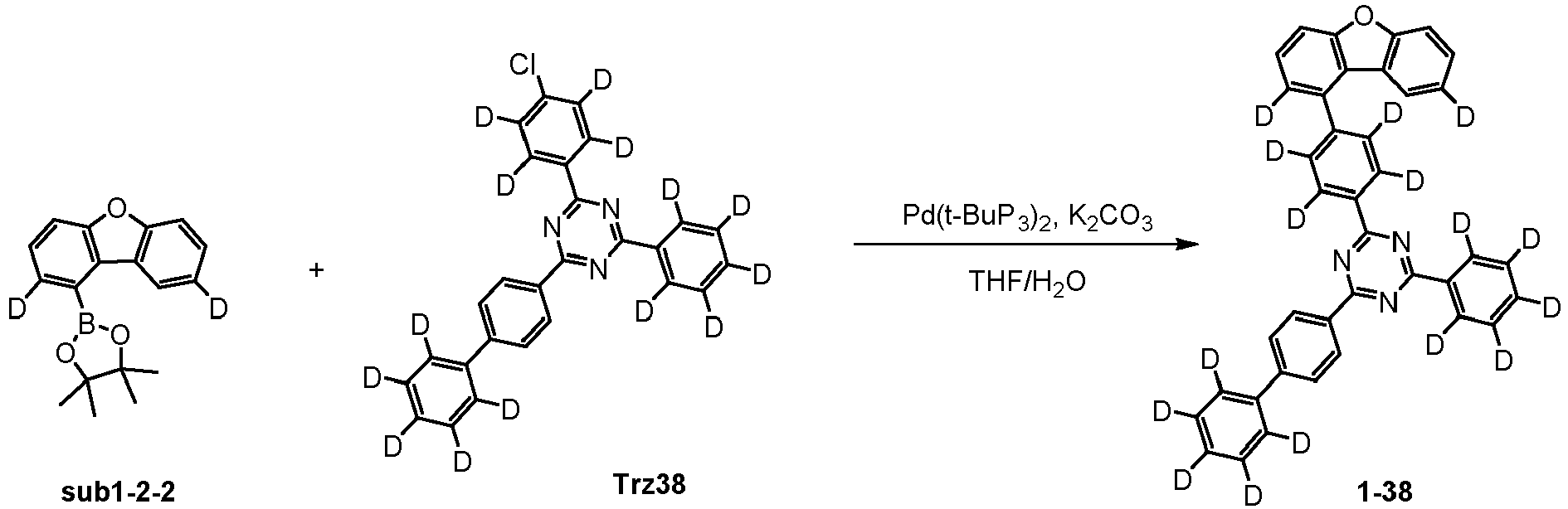
- Compound sub1-2-2 (15 g, 50.6 mmol) and Trz36 (23.1 g, 53.2 mmol) were added to 300 ml of THF, and the mixture was stirred and refluxed. Then, potassium carbonate (21 g, 151.9 mmol) was dissolved in 63 ml of water and added thereto, and the mixture was sufficiently stirred and then bis(tri-tert-butylphosphine)palladium(0) (0.3 g, 0.5 mmol) was added. After the reaction for 3 hours, the reaction mixture was cooled to room temperature, and the organic layer and the aqueous layer were separated and then the organic layer was distilled. This was again dissolved in chloroform, washed twice with water, and then the organic layer was separated, anhydrous magnesium sulfate was added thereto, stirred, and then filtered, and the filtrate was distilled under reduced pressure. The concentrated compound was purified by silica gel column chromatography to prepare 19 g of Compound 1-38. (Yield: 66%, MS: [M+H]+= 568)
-

- Trifluoromethanesulfonic anhydride (71.9 g, 255 mmol) and deuterium oxide (25.5 g, 1274.8 mmol) were added at 0°C and stirred for 5 hours to prepare a solution. 1-Bromodibenzo[b,d]furan (15 g, 60.7 mmol) was added to 120 ml of 1,2,4-trichlorobenzene, and the mixture was stirred. Then, the prepared mixed solution of trifluoromethanesulfonic anhydride and deuterium oxide was slowly added dropwise to the mixed solution of 1-bromodibenzo[b,d]furan and 1,2,4-trichlorobenzene, and the mixture was stirred while heating to 140°C and then keeping that temperature. After the reaction for 14 hours, the reaction mixture was cooled to room temperature, and the organic layer and the aqueous layer were separated. Then, the organic layer was neutralized with an aqueous potassium carbonate solution. After washing twice with water, the organic layer was separated, anhydrous magnesium sulfate was added thereto, stirred, then filtered, and the filtrate was distilled under reduced pressure. The concentrated compound was purified by silica gel column chromatography to prepare 6.3 g of compound sub1-3-1. (Yield: 42%, MS: [M+H]+= 250)
- Compound sub1-3-1 (15 g, 60 mmol) and bis(pinacolato)diboron (16.8 g, 66 mmol) were added to 300ml of 1,4-dioxane, and the mixture was stirred under reflux. Then, potassium acetate (8.8 g, 90 mmol) was added thereto, sufficiently stirred, and then bis(dibenzylideneacetone)palladium(0) (1 g, 1.8 mmol) and tricyclohexylphosphine (1 g, 3.6 mmol) were added. After the reaction for 6 hours, the reaction mixture was cooled to room temperature, the organic layer was separated using chloroform and water, and then the organic layer was distilled. This was dissolved again in chloroform, washed twice with water, and the organic layer was then separated. Anhydrous magnesium sulfate was added thereto, stirred, then filtered, and the filtrate was distilled under reduced pressure. The concentrated compound was purified by silica gel column chromatography to give 11.4 g of sub1-3-2. (Yield: 64%, MS: [M+H]+ = 298)
- Compound sub1-3-2 (15 g, 50.5 mmol) and Trz18 (25.2 g, 53 mmol) were added to 300 ml of THF, and the mixture was stirred and refluxed. Then, potassium carbonate (20.9 g, 151.4 mmol) was dissolved in 63 ml of water and added thereto, and the mixture was sufficiently stirred and then bis(tri-tert-butylphosphine)palladium(0) (0.3 g, 0.5 mmol) was added. After the reaction for 3 hours, the reaction mixture was cooled to room temperature, and the organic layer and the aqueous layer were separated and then the organic layer was distilled. This was again dissolved in chloroform, washed twice with water, and then the organic layer was separated, anhydrous magnesium sulfate was added thereto, stirred, and then filtered, and the filtrate was distilled under reduced pressure. The concentrated compound was purified by silica gel column chromatography to prepare 23.1 g of Compound 1-39. (Yield: 75%, MS: [M+H]+= 610)
-

- Compound sub1-3-2 (15 g, 50.5 mmol) and Trz39 (22.8 g, 53 mmol) were added to 300 ml of THF, and the mixture was stirred and refluxed. Then, potassium carbonate (20.9 g, 151.4 mmol) was dissolved in 63 ml of water and added thereto, and the mixture was sufficiently stirred and then bis(tri-tert-butylphosphine)palladium(0) (0.3 g, 0.5 mmol) was added. After the reaction for 5 hours, the reaction mixture was cooled to room temperature, and the organic layer and the aqueous layer were separated and then the organic layer was distilled. This was again dissolved in chloroform, washed twice with water, and then the organic layer was separated, anhydrous magnesium sulfate was added thereto, stirred, and then filtered, and the filtrate was distilled under reduced pressure. The concentrated compound was purified by silica gel column chromatography to prepare 18.5 g of Compound 1-40. (Yield: 65%, MS: [M+H]+= 565)
-

- Compound sub1-3-2 (15 g, 50.5 mmol) and Trz39 (21.1 g, 53 mmol) were added to 300 ml of THF, and the mixture was stirred and refluxed. Then, potassium carbonate (20.9 g, 151.4 mmol) was dissolved in 63 ml of water and added thereto, and the mixture was sufficiently stirred and then bis(tri-tert-butylphosphine)palladium(0) (0.3 g, 0.5 mmol) was added. After the reaction for 5 hours, the reaction mixture was cooled to room temperature, and the organic layer and the aqueous layer were separated and then the organic layer was distilled. This was again dissolved in chloroform, washed twice with water, and then the organic layer was separated, anhydrous magnesium sulfate was added thereto, stirred, and then filtered, and the filtrate was distilled under reduced pressure. The concentrated compound was purified by silica gel column chromatography to prepare 17.8 g of Compound 1-39. (Yield: 66%, MS: [M+H]+= 534)
-

- Compound sub1-3-2 (15 g, 50.5 mmol) and Trz41 (29.5 g, 53 mmol) were added to 300 ml of THF, and the mixture was stirred and refluxed. Then, potassium carbonate (20.9 g, 151.4 mmol) was dissolved in 63 ml of water and added thereto, and the mixture was sufficiently stirred and then bis(tri-tert-butylphosphine)palladium(0) (0.3 g, 0.5 mmol) was added. After the reaction for 4 hours, the reaction mixture was cooled to room temperature, and the organic layer and the aqueous layer were separated and then the organic layer was distilled. This was again dissolved in chloroform, washed twice with water, and then the organic layer was separated, anhydrous magnesium sulfate was added thereto, stirred, and then filtered, and the filtrate was distilled under reduced pressure. The concentrated compound was purified by silica gel column chromatography to prepare 24.4 g of Compound 1-42. (Yield: 70%, MS: [M+H]+= 691)
-

- Trifluoromethanesulfonic anhydride (95.9 g, 340 mmol) and deuterium oxide (34 g, 1699.8 mmol) were added at 0°C and stirred for 5 hours to prepare a solution. 1-Bromodibenzo[b,d]furan (15 g, 60.7 mmol) was added to 120 ml of 1,2,4-trichlorobenzene, and the mixture was stirred. Then, the prepared mixed solution of trifluoromethanesulfonic anhydride and deuterium oxide was slowly added dropwise to the mixed solution of 1-bromodibenzo[b,d]furan and 1,2,4-trichlorobenzene, and the mixture was stirred while heating to 140°C and then keeping that temperature. After the reaction for 20 hours, the reaction mixture was cooled to room temperature, and the organic layer and the aqueous layer were separated. Then, the organic layer was neutralized with an aqueous potassium carbonate solution. After washing twice with water, the organic layer was separated, anhydrous magnesium sulfate was added thereto, stirred, then filtered, and the filtrate was distilled under reduced pressure. The concentrated compound was purified by silica gel column chromatography to prepare 5.6 g of compound sub1-4-1. (Yield: 37%, MS: [M+H]+= 251)
- Compound sub1-4-1 (15g, 59.7mmol) and bis(pinacolato)diboron (16.7 g, 65.7 mmol) were added to 300ml of 1,4-dioxane under a nitrogen atmosphere, and the mixture was stirred under reflux. Then, potassium acetate (8.8 g, 89.6 mmol) was added thereto, sufficiently stirred, and then bis(dibenzylideneacetone)palladium(0) (1 g, 1.8 mmol) and tricyclohexylphosphine (1 g, 3.6 mmol) were added. After the reaction for 5 hours, the reaction mixture was cooled to room temperature, the organic layer was separated using chloroform and water, and then the organic layer was distilled. This was dissolved again in chloroform, washed twice with water, and the organic layer was then separated. Anhydrous magnesium sulfate was added thereto, stirred, then filtered, and the filtrate was distilled under reduced pressure. The concentrated compound was purified by silica gel column chromatography to give 12.5 g of sub1-4-2. (Yield: 70%, MS: [M+H]+ = 299)
- Compound sub1-4-2 (15 g, 50.3 mmol) and Trz42 (26.1 g, 52.8 mmol) were added to 300 ml of THF, and the mixture was stirred and refluxed. Then, potassium carbonate (20.9 g, 150.9 mmol) was dissolved in 63 ml of water and added thereto, and the mixture was sufficiently stirred and then bis(tri-tert-butylphosphine)palladium(0) (0.3 g, 0.5 mmol) was added. After the reaction for 4 hours, the reaction mixture was cooled to room temperature, and the organic layer and the aqueous layer were separated and then the organic layer was distilled. This was again dissolved in chloroform, washed twice with water, and then the organic layer was separated, anhydrous magnesium sulfate was added thereto, stirred, and then filtered, and the filtrate was distilled under reduced pressure. The concentrated compound was purified by silica gel column chromatography to prepare 21.5 g of Compound 1-43. (Yield: 68%, MS: [M+H]+= 631)
-

- Compound sub1-4-2 (15 g, 50.3 mmol) and Trz43 (24.1 g, 52.8 mmol) were added to 300 ml of THF, and the mixture was stirred and refluxed. Then, potassium carbonate (20.9 g, 150.9 mmol) was dissolved in 63 ml of water and added thereto, and the mixture was sufficiently stirred and then bis(tri-tert-butylphosphine)palladium(0) (0.3 g, 0.5 mmol) was added. After the reaction for 3 hours, the reaction mixture was cooled to room temperature, and the organic layer and the aqueous layer were separated and then the organic layer was distilled. This was again dissolved in chloroform, washed twice with water, and then the organic layer was separated, anhydrous magnesium sulfate was added thereto, stirred, and then filtered, and the filtrate was distilled under reduced pressure. The concentrated compound was purified by silica gel column chromatography to prepare 20.2 g of Compound 1-44. (Yield: 68%, MS: [M+H]+= 592)
-

- Compound sub1-4-2 (15 g, 50.3 mmol) and Trz44 (28.1 g, 52.8 mmol) were added to 300 ml of THF, and the mixture was stirred and refluxed. Then, potassium carbonate (20.9 g, 150.9 mmol) was dissolved in 63 ml of water and added thereto, and the mixture was sufficiently stirred and then bis(tri-tert-butylphosphine)palladium(0) (0.3 g, 0.5 mmol) was added. After the reaction for 3 hours, the reaction mixture was cooled to room temperature, and the organic layer and the aqueous layer were separated and then the organic layer was distilled. This was again dissolved in chloroform, washed twice with water, and then the organic layer was separated, anhydrous magnesium sulfate was added thereto, stirred, and then filtered, and the filtrate was distilled under reduced pressure. The concentrated compound was purified by silica gel column chromatography to prepare 24.2 g of Compound 1-45. (Yield: 72%, MS: [M+H]+= 668)
-

- Trifluoromethanesulfonic anhydride (119.9 g, 424.9 mmol) and deuterium oxide (42.6 g, 2124.7 mmol) were added at 0°C and stirred for 5 hours to prepare a solution. 1-Bromodibenzo[b,d]furan (15 g, 60.7 mmol) was added to 120 ml of 1,2,4-trichlorobenzene, and the mixture was stirred. Then, the prepared mixed solution of trifluoromethanesulfonic anhydride and deuterium oxide was slowly added dropwise to the mixed solution of 1-bromodibenzo[b,d]furan and 1,2,4-trichlorobenzene, and the mixture was stirred while heating to 140°C and then keeping that temperature. After the reaction for 24 hours, the reaction mixture was cooled to room temperature, and the organic layer and the aqueous layer were separated. Then, the organic layer was neutralized with an aqueous potassium carbonate solution. After washing twice with water, the organic layer was separated, anhydrous magnesium sulfate was added thereto, stirred, then filtered, and the filtrate was distilled under reduced pressure. The concentrated compound was purified by silica gel column chromatography to prepare 5.9 g of compound sub1-5-1. (Yield: 39%, MS: [M+H]+= 252)
- Compound sub1-5-1 (15 g, 59.5 mmol) and bis(pinacolato)diboron (16.6 g, 65.4 mmol) were added to 300ml of 1,4-dioxane, and the mixture was stirred under reflux. Then, potassium acetate (8.8 g, 89.2 mmol) was added thereto, sufficiently stirred, and then bis(dibenzylideneacetone)palladium(0) (1 g, 1.8 mmol) and tricyclohexylphosphine (1 g, 3.6 mmol) were added. After the reaction for 4 hours, the reaction mixture was cooled to room temperature, the organic layer was separated using chloroform and water, and then the organic layer was distilled. This was dissolved again in chloroform, washed twice with water, and the organic layer was then separated. Anhydrous magnesium sulfate was added thereto, stirred, then filtered, and the filtrate was distilled under reduced pressure. The concentrated compound was purified by silica gel column chromatography to give 11.2 g of sub1-5-2. (Yield: 63%, MS: [M+H]+ = 300)
- Compound sub1-5-2 (15 g, 50.1 mmol) and Trz45 (23.4 g, 52.6 mmol) were added to 300 ml of THF, and the mixture was stirred and refluxed. Then, potassium carbonate (20.8 g, 150.4 mmol) was dissolved in 62 ml of water and added thereto, and the mixture was sufficiently stirred and then bis(tri-tert-butylphosphine)palladium(0) (0.3 g, 0.5 mmol) was added. After the reaction for 4 hours, the reaction mixture was cooled to room temperature, and the organic layer and the aqueous layer were separated and then the organic layer was distilled. This was again dissolved in chloroform, washed twice with water, and then the organic layer was separated, anhydrous magnesium sulfate was added thereto, stirred, and then filtered, and the filtrate was distilled under reduced pressure. The concentrated compound was purified by silica gel column chromatography to prepare 20.1 g of Compound 1-46. (Yield: 69%, MS: [M+H]+= 581)
-

- Compound sub1-5-2 (15 g, 50.1 mmol) and Compound Trz46 (23.6 g, 52.6 mmol) were added to 300 ml of THF, and the mixture was stirred and refluxed. Then, potassium carbonate (20.8 g, 150.4 mmol) was dissolved in 62 ml of water and added thereto, and the mixture was sufficiently stirred and then bis(tri-tert-butylphosphine)palladium(0) (0.3 g, 0.5 mmol) was added. After the reaction for 5 hours, the reaction mixture was cooled to room temperature, and the organic layer and the aqueous layer were separated and then the organic layer was distilled. This was again dissolved in chloroform, washed twice with water, and then the organic layer was separated, anhydrous magnesium sulfate was added thereto, stirred, and then filtered, and the filtrate was distilled under reduced pressure. The concentrated compound was purified by silica gel column chromatography to prepare 20.2 g of Compound 1-47. (Yield: 69%, MS: [M+H]+= 586)
-

- Compound sub1-5-2 (15 g, 50.1 mmol) and Compound Trz47 (23.6 g, 52.6 mmol) were added to 300 ml of THF, and the mixture was stirred and refluxed. Then, potassium carbonate (20.8 g, 150.4 mmol) was dissolved in 62 ml of water and added thereto, and the mixture was sufficiently stirred and then bis(tri-tert-butylphosphine)palladium(0) (0.3 g, 0.5 mmol) was added. After the reaction for 5 hours, the reaction mixture was cooled to room temperature, and the organic layer and the aqueous layer were separated and then the organic layer was distilled. This was again dissolved in chloroform, washed twice with water, and then the organic layer was separated, anhydrous magnesium sulfate was added thereto, stirred, and then filtered, and the filtrate was distilled under reduced pressure. The concentrated compound was purified by silica gel column chromatography to prepare 21.7 g of Compound 1-48. (Yield: 74%, MS: [M+H]+= 586)
-

- Compound sub1-5-2 (15 g, 50.1 mmol) and Compound Trz48 (27.6 g, 52.6 mmol) were added to 300 ml of THF, and the mixture was stirred and refluxed. Then, potassium carbonate (20.8 g, 150.4 mmol) was dissolved in 62 ml of water and added thereto, and the mixture was sufficiently stirred and then bis(tri-tert-butylphosphine)palladium(0) (0.3 g, 0.5 mmol) was added. After the reaction for 5 hours, the reaction mixture was cooled to room temperature, and the organic layer and the aqueous layer were separated and then the organic layer was distilled. This was again dissolved in chloroform, washed twice with water, and then the organic layer was separated, anhydrous magnesium sulfate was added thereto, stirred, and then filtered, and the filtrate was distilled under reduced pressure. The concentrated compound was purified by silica gel column chromatography to prepare 22.5 g of Compound 1-49. (Yield: 68%, MS: [M+H]+= 662)
-

- Trifluoromethanesulfonic anhydride (167.8 g, 594.9 mmol) and deuterium oxide (59.6 g, 2974.6 mmol) were added at 0°C and stirred for 5 hours to prepare a solution. 1-Bromodibenzo[b,d]furan (15 g, 60.7 mmol) was added to 120 ml of 1,2,4-trichlorobenzene, and the mixture was stirred. Then, the prepared mixed solution of trifluoromethanesulfonic anhydride and deuterium oxide was slowly added dropwise to the mixed solution of 1-bromodibenzo[b,d]furan and 1,2,4-trichlorobenzene, and the mixture was stirred while heating to 140°C and then keeping that temperature. After the reaction for 36 hours, the reaction mixture was cooled to room temperature, and the organic layer and the aqueous layer were separated. Then, the organic layer was neutralized with an aqueous potassium carbonate solution. After washing twice with water, the organic layer was separated, anhydrous magnesium sulfate was added thereto, stirred, then filtered, and the filtrate was distilled under reduced pressure. The concentrated compound was purified by silica gel column chromatography to prepare 6.1 g of Compound sub1-6-1. (Yield: 40%, MS: [M+H]+= 254)
- Compound sub1-6-1 (15 g, 59 mmol) and bis(pinacolato)diboron (16.5 g, 64.9 mmol) were added to 300ml of 1,4-dioxane under a nitrogen atmosphere, and the mixture was stirred under reflux. Then, potassium acetate (8.7 g, 88.5 mmol) was added thereto, sufficiently stirred, and then bis(dibenzylideneacetone)palladium(0) (1 g, 1.8 mmol) and tricyclohexylphosphine (1 g, 3.5 mmol) were added. After the reaction for 4 hours, the reaction mixture was cooled to room temperature, the organic layer was separated using chloroform and water, and then the organic layer was distilled. This was dissolved again in chloroform, washed twice with water, and the organic layer was then separated. Anhydrous magnesium sulfate was added thereto, stirred, then filtered, and the filtrate was distilled under reduced pressure. The concentrated compound was purified by silica gel column chromatography to give 11.6 g of Compound sub1-6-2. (Yield: 65%, MS: [M+H]+ = 302)
- Compound sub1-6-2 (15 g, 49.8 mmol) and Compound Trz49 (22.3 g, 52.3 mmol) were added to 300 ml of THF, and the mixture was stirred and refluxed. Then, potassium carbonate (20.6 g, 149.4 mmol) was dissolved in 62 ml of water and added thereto, and the mixture was sufficiently stirred and then bis(tri-tert-butylphosphine)palladium(0) (0.3 g, 0.5 mmol) was added. After the reaction for 5 hours, the reaction mixture was cooled to room temperature, and the organic layer and the aqueous layer were separated and then the organic layer was distilled. This was again dissolved in chloroform, washed twice with water, and then the organic layer was separated, anhydrous magnesium sulfate was added thereto, stirred, and then filtered, and the filtrate was distilled under reduced pressure. The concentrated compound was purified by silica gel column chromatography to prepare 20.3 g of Compound 1-50. (Yield: 72%, MS: [M+H]+= 566)
-

- Compound sub1-6-2 (15 g, 49.8 mmol) and Compound Trz50 (22.5 g, 52.3 mmol) were added to 300 ml of THF, and the mixture was stirred and refluxed. Then, potassium carbonate (20.6 g, 149.4 mmol) was dissolved in 62 ml of water and added thereto, and the mixture was sufficiently stirred and then bis(tri-tert-butylphosphine)palladium(0) (0.3 g, 0.5 mmol) was added. After the reaction for 3 hours, the reaction mixture was cooled to room temperature, and the organic layer and the aqueous layer were separated and then the organic layer was distilled. This was again dissolved in chloroform, washed twice with water, and then the organic layer was separated, anhydrous magnesium sulfate was added thereto, stirred, and then filtered, and the filtrate was distilled under reduced pressure. The concentrated compound was purified by silica gel column chromatography to prepare 20.4 g of Compound 1-51. (Yield: 72%, MS: [M+H]+= 569)
-

- Compound sub1-6-2 (15 g, 49.8 mmol) and Compound Trz51 (27.9 g, 52.3 mmol) were added to 300 ml of THF, and the mixture was stirred and refluxed. Then, potassium carbonate (20.6 g, 149.4 mmol) was dissolved in 62 ml of water and added thereto, and the mixture was sufficiently stirred and then bis(tri-tert-butylphosphine)palladium(0) (0.3 g, 0.5 mmol) was added. After the reaction for 3 hours, the reaction mixture was cooled to room temperature, and the organic layer and the aqueous layer were separated and then the organic layer was distilled. This was again dissolved in chloroform, washed twice with water, and then the organic layer was separated, anhydrous magnesium sulfate was added thereto, stirred, and then filtered, and the filtrate was distilled under reduced pressure. The concentrated compound was purified by silica gel column chromatography to prepare 24.7 g of Compound 1-52. (Yield: 74%, MS: [M+H]+= 672)
-

- Compound sub1-6-2 (15 g, 49.8 mmol) and Compound Trz52 (24.2 g, 52.3 mmol) were added to 300 ml of THF, and the mixture was stirred and refluxed. Then, potassium carbonate (20.6 g, 149.4 mmol) was dissolved in 62 ml of water and added thereto, and the mixture was sufficiently stirred and then bis(tri-tert-butylphosphine)palladium(0) (0.3 g, 0.5 mmol) was added. After the reaction for 5 hours, the reaction mixture was cooled to room temperature, and the organic layer and the aqueous layer were separated and then the organic layer was distilled. This was again dissolved in chloroform, washed twice with water, and then the organic layer was separated, anhydrous magnesium sulfate was added thereto, stirred, and then filtered, and the filtrate was distilled under reduced pressure. The concentrated compound was purified by silica gel column chromatography to prepare 22.4 g of Compound 1-53. (Yield: 75%, MS: [M+H]+= 601)
-

- Compound sub1-6-2 (15 g, 49.8 mmol) and Compound Trz53 (22.9 g, 52.3 mmol) were added to 300 ml of THF, and the mixture was stirred and refluxed. Then, potassium carbonate (20.6 g, 149.4 mmol) was dissolved in 62 ml of water and added thereto, and the mixture was sufficiently stirred and then bis(tri-tert-butylphosphine)palladium(0) (0.3 g, 0.5 mmol) was added. After the reaction for 3 hours, the reaction mixture was cooled to room temperature, and the organic layer and the aqueous layer were separated and then the organic layer was distilled. This was again dissolved in chloroform, washed twice with water, and then the organic layer was separated, anhydrous magnesium sulfate was added thereto, stirred, and then filtered, and the filtrate was distilled under reduced pressure. The concentrated compound was purified by silica gel column chromatography to prepare 18.7 g of Compound 1-54. (Yield: 65%, MS: [M+H]+= 577)
-

- Compound Trz45 (15 g, 33.8 mmol) and dibenzo[b,d]furan-1-ylboronic acid (7.5 g, 35.5 mmol) were added to 300 ml of THF, and the mixture was stirred and refluxed. Then, potassium carbonate (14 g, 101.4 mmol) was dissolved in 42 ml of water and added thereto, and the mixture was sufficiently stirred and then bis(tri-tert-butylphosphine)palladium(0) (0.2 g, 0.3 mmol) was added. After the reaction for 4 hours, the reaction mixture was cooled to room temperature, and the organic layer and the aqueous layer were separated and then the organic layer was distilled. This was again dissolved in chloroform, washed twice with water, and then the organic layer was separated, anhydrous magnesium sulfate was added thereto, stirred, and then filtered, and the filtrate was distilled under reduced pressure. The concentrated compound was purified by silica gel column chromatography to prepare 12.8 g of Compound 1-55_P1. (Yield: 66%, MS: [M+H]+= 576)
- Compound 1-55_P1(10 g, 17.4 mmol), PtO2(1.2 g, 5.2 mmol), and D2O (87 ml) were added to a shaker tube, and then the tube was sealed and heated at 250°C and 600 psi for 12 hours. After completion of the reaction, chloroform was added, and the reaction solution was transferred to a separatory funnel, and extracted. The extract was dried over MgSO4 and concentrated, and then the sample was purified by silica gel column chromatography to give 4.1 g of Compound 1-55. (Yield: 40%, MS[M+H]+= 598)
-

- Compound 1-3 (10 g, 17.4 mmol), PtO2 (1.2 g, 5.2 mmol), and D2O (87 ml) were added to a shaker tube, and then the tube was sealed and heated at 250°C and 600 psi for 12 hours. After completion of the reaction, chloroform was added, and the reaction solution was transferred to a separatory funnel, and extracted. The extract was dried over MgSO4 and concentrated, and then the sample was purified by silica gel column chromatography to give 4.4 g of Compound 1-56. (Yield: 43%, MS: [M+H]+= 597)
-

- Compound 1-10 (10 g, 18.2 mmol), PtO2 (1.2 g, 5.5 mmol), and D2O (91 ml) were added to a shaker tube, and then the tube was sealed and heated at 250°C and 600 psi for 12 hours. After completion of the reaction, chloroform was added, and the reaction solution was transferred to a separatory funnel, and extracted. The extract was dried over MgSO4 and concentrated, and then the sample was purified by silica gel column chromatography to give 4.1 g of Compound 1-57. (Yield: 40%, MS: [M+H]+= 570)
-

- Compound 1-13 (10 g, 17.4 mmol), PtO2 (1.2 g, 5.2 mmol), and D2O (87 ml) were added to a shaker tube, and then the tube was sealed and heated at 250°C and 600 psi for 12 hours. After completion of the reaction, chloroform was added, and the reaction solution was transferred to a separatory funnel, and extracted. The extract was dried over MgSO4 and concentrated, and then the sample was purified by silica gel column chromatography to give 4.5 g of Compound 1-58. (Yield: 43%, MS: [M+H]+= 598)
-

- Compound Trz54 (15 g, 31.9 mmol) and dibenzo[b,d]furan-1-ylboronic acid (7.1 g, 33.5 mmol) were added to 300 ml of THF, and the mixture was stirred and refluxed. Then, potassium carbonate (13.2 g, 95.8 mmol) was dissolved in 40 ml of water and added thereto, and the mixture was sufficiently stirred and then bis(tri-tert-butylphosphine)palladium(0) (0.2 g, 0.3 mmol ) was added. After the reaction for 3 hours, the reaction mixture was cooled to room temperature, and the organic layer and the aqueous layer were separated and then the organic layer was distilled. This was again dissolved in chloroform, washed twice with water, and then the organic layer was separated, anhydrous magnesium sulfate was added thereto, stirred, and then filtered, and the filtrate was distilled under reduced pressure. The concentrated compound was purified by silica gel column chromatography to prepare 14.2 g of Compound 1-59_P1. (Yield: 74%, MS: [M+H]+= 602)
- Compound 1-59_P1 (10 g, 16.6 mmol), PtO2 (1.1 g, 5 mmol), and D2O (83 ml) were added to a shaker tube, and then the tube was sealed and heated at 250°C and 600 psi for 12 hours. After completion of the reaction, chloroform was added, and the reaction solution was transferred to a separatory funnel, and extracted. The extract was dried over MgSO4 and concentrated, and then the sample was purified by silica gel column chromatography to give 4.5 g of Compound 1-59. (Yield: 43%, MS: [M+H]+= 626)
-

- Compound Trz55 (15 g, 33.8 mmol) and dibenzo[b,d]furan-1-ylboronic acid (7.5 g, 35.5 mmol) were added to 300 ml of THF, and the mixture was stirred and refluxed. Then, potassium carbonate (14 g, 101.4 mmol) was dissolved in 42 ml of water and added thereto, and the mixture was sufficiently stirred and then bis(tri-tert-butylphosphine)palladium(0) (0.2 g, 0.3 mmol ) was added. After the reaction for 3 hours, the reaction mixture was cooled to room temperature, and the organic layer and the aqueous layer were separated and then the organic layer was distilled. This was again dissolved in chloroform, washed twice with water, and then the organic layer was separated, anhydrous magnesium sulfate was added thereto, stirred, and then filtered, and the filtrate was distilled under reduced pressure. The concentrated compound was purified by silica gel column chromatography to prepare 13.2 g of Compound 1-60_P1. (Yield: 68%, MS: [M+H]+= 576)
- Compound 1-60_P1 (10 g, 17.4 mmol), PtO2 (1.2 g, 5.2 mmol), and D2O (87 ml) were added to a shaker tube, and then the tube was sealed and heated at 250°C and 600 psi for 12 hours. After completion of the reaction, chloroform was added, and the reaction solution was transferred to a separatory funnel, and extracted. The extract was dried over MgSO4 and concentrated, and then the sample was purified by silica gel column chromatography to give 5.2 g of Compound 1-60. (Yield: 50%, MS: [M+H]+= 595)
-

- Compound 1-28 (10 g, 16.2 mmol), PtO2 (1.1 g, 4.9 mmol), and D2O (81 ml) were added to a shaker tube, and then the tube was sealed and heated at 250°C and 600 psi for 12 hours. After completion of the reaction, chloroform was added, and the reaction solution was transferred to a separatory funnel, and extracted. The extract was dried over MgSO4 and concentrated, and then the sample was purified by silica gel column chromatography to give 5 g of Compound 1-61. (Yield: 48%, MS: [M+H]+= 638)
-

- 1-Bromo-7-chloronaphthalen-2-ol (15 g, 58.3 mmol) and (2-fluorophenyl)boronic acid (8.6 g, 61.2 mmol) were added to 300 ml of THF, and the mixture was stirred and refluxed. Then, potassium carbonate(24.2 g, 174.8 mmol) was dissolved in water (72 mL), added thereto, stirred sufficiently, and then tetrakis(triphenylphosphine)palladium(0) (0.7 g, 0.6 mmol) was added. After the reaction for 6 hours, the reaction mixture was cooled to room temperature, and the organic layer and the aqueous layer were separated and then the organic layer was distilled. This was again dissolved in chloroform, washed twice with water, and then the organic layer was separated, anhydrous magnesium sulfate was added thereto, stirred, and then filtered, and the filtrate was distilled under reduced pressure. The concentrated compound was purified by silica gel column chromatography to prepare 12.4 g of Compound A_P1. (Yield: 78%, MS: [M+H]+= 273)
- Compound A_P1 (15 g, 55 mmol) and potassium carbonate (22.8 g, 165 mmol) were added to 150 ml of DMAc, and the mixture was stirred and refluxed. After the reaction for 5 hours, the reaction mixture was cooled to room temperature, poured into 300 ml of water, solidified and filtered to obtain a solid. This was again dissolved in chloroform, washed twice with water, the organic layer was separated, anhydrous magnesium sulfate was added, stirred, filtered, and the filtrate was distilled under reduced pressure. The concentrated compound was purified by silica gel column chromatography to prepare 8.5 g of Compound A. (Yield 61%, MS: [M+H]+= 253)
- Compound A (15 g, 59.4 mmol) and Compound amine1 (30.6 g, 62.3 mmol) were added to 300 ml of THF, and the mixture was stirred and refluxed. Then, potassium carbonate (24.6 g, 178.1 mmol) was dissolved in 74 ml of water and added thereto, and the mixture was sufficiently stirred and then bis(tri-tert-butylphosphine)palladium(0) (0.3 g, 0.6 mmol) was added. After the reaction for 5 hours, the reaction mixture was cooled to room temperature, and the organic layer and the aqueous layer were separated and then the organic layer was distilled. This was again dissolved in chloroform, washed twice with water, and then the organic layer was separated, anhydrous magnesium sulfate was added thereto, stirred, and then filtered, and the filtrate was distilled under reduced pressure. The concentrated compound was purified by silica gel column chromatography to prepare 27.6 g of Compound 2-1. (Yield: 70%, MS: [M+H]+= 664)
-

- Compound A (15 g, 59.4 mmol) and Compound amine2 (27.5 g, 62.3 mmol) were added to 300 ml of THF, and the mixture was stirred and refluxed. Then, potassium carbonate (24.6 g, 178.1 mmol) was dissolved in 74 ml of water and added thereto, and the mixture was sufficiently stirred and then bis(tri-tert-butylphosphine)palladium(0) (0.3 g, 0.6 mmol) was added. After the reaction for 3 hours, the reaction mixture was cooled to room temperature, and the organic layer and the aqueous layer were separated and then the organic layer was distilled. This was again dissolved in chloroform, washed twice with water, and then the organic layer was separated, anhydrous magnesium sulfate was added thereto, stirred, and then filtered, and the filtrate was distilled under reduced pressure. The concentrated compound was purified by silica gel column chromatography to prepare 26.2 g of Compound 2-2. (Yield: 72%, MS: [M+H]+= 614)
-
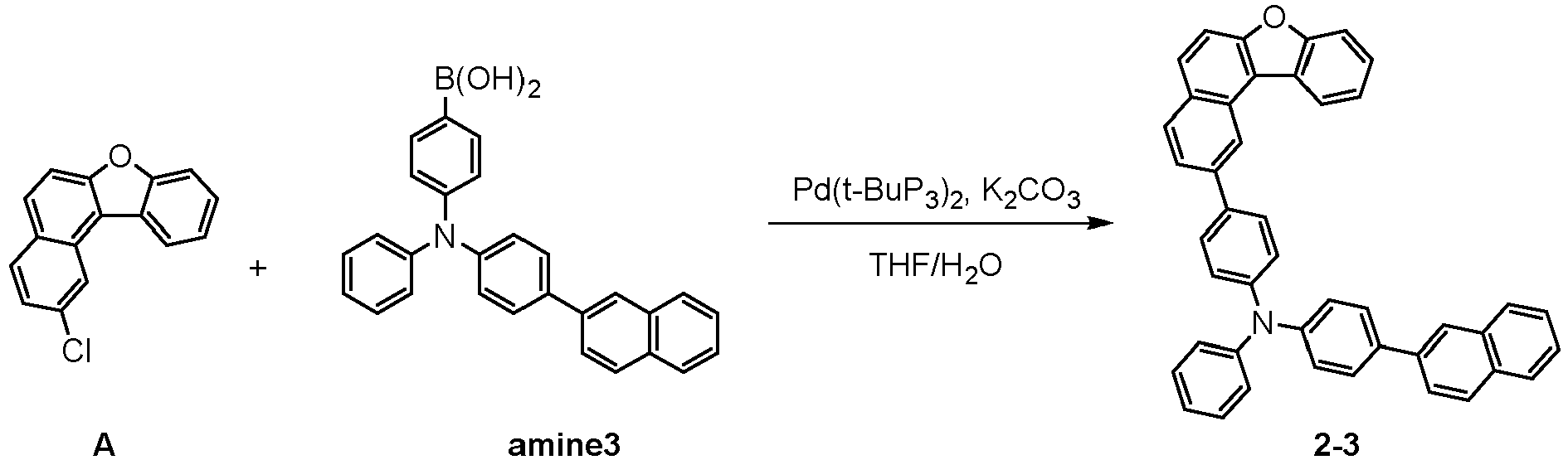
- Compound A (15 g, 59.4 mmol) and Compound amine3 (25.9 g, 62.3 mmol) were added to 300 ml of THF, and the mixture was stirred and refluxed. Then, potassium carbonate (24.6 g, 178.1 mmol) was dissolved in 74 ml of water and added thereto, and the mixture was sufficiently stirred and then bis(tri-tert-butylphosphine)palladium(0) (0.3 g, 0.6 mmol) was added. After the reaction for 5 hours, the reaction mixture was cooled to room temperature, and the organic layer and the aqueous layer were separated and then the organic layer was distilled. This was again dissolved in chloroform, washed twice with water, and then the organic layer was separated, anhydrous magnesium sulfate was added thereto, stirred, and then filtered, and the filtrate was distilled under reduced pressure. The concentrated compound was purified by silica gel column chromatography to prepare 23.4 g of Compound 2-3. (Yield: 67%, MS: [M+H]+= 588)
-

- Compound A (15 g, 59.4 mmol) and Compound amine4 (23.6 g, 62.3 mmol) were added to 300 ml of THF, and the mixture was stirred and refluxed. Then, potassium carbonate (24.6 g, 178.1 mmol) was dissolved in 74 ml of water and added thereto, and the mixture was sufficiently stirred and then bis(tri-tert-butylphosphine)palladium(0) (0.3 g, 0.6 mmol) was added. After the reaction for 5 hours, the reaction mixture was cooled to room temperature, and the organic layer and the aqueous layer were separated and then the organic layer was distilled. This was again dissolved in chloroform, washed twice with water, and then the organic layer was separated, anhydrous magnesium sulfate was added thereto, stirred, and then filtered, and the filtrate was distilled under reduced pressure. The concentrated compound was purified by silica gel column chromatography to prepare 24.2 g of Compound 2-4. (Yield: 74%, MS: [M+H]+= 552)
-

- Compound A (15 g, 59.4 mmol) and Compound amine5 (32.3 g, 62.3 mmol) were added to 300 ml of THF, and the mixture was stirred and refluxed. Then, potassium carbonate (24.6 g, 178.1 mmol) was dissolved in 74 ml of water and added thereto, and the mixture was sufficiently stirred and then bis(tri-tert-butylphosphine)palladium(0) (0.3 g, 0.6 mmol) was added. After the reaction for 3 hours, the reaction mixture was cooled to room temperature, and the organic layer and the aqueous layer were separated and then the organic layer was distilled. This was again dissolved in chloroform, washed twice with water, and then the organic layer was separated, anhydrous magnesium sulfate was added thereto, stirred, and then filtered, and the filtrate was distilled under reduced pressure. The concentrated compound was purified by silica gel column chromatography to prepare 26.6 g of Compound 2-5. (Yield: 65%, MS: [M+H]+= 690)
-

- Compound A (15 g, 59.4 mmol) and Compound amine6 (30.6 g, 62.3 mmol) were added to 300 ml of THF, and the mixture was stirred and refluxed. Then, potassium carbonate (24.6 g, 178.1 mmol) was dissolved in 74 ml of water and added thereto, and the mixture was sufficiently stirred and then bis(tri-tert-butylphosphine)palladium(0) (0.3 g, 0.6 mmol) was added. After the reaction for 3 hours, the reaction mixture was cooled to room temperature, and the organic layer and the aqueous layer were separated and then the organic layer was distilled. This was again dissolved in chloroform, washed twice with water, and then the organic layer was separated, anhydrous magnesium sulfate was added thereto, stirred, and then filtered, and the filtrate was distilled under reduced pressure. The concentrated compound was purified by silica gel column chromatography to prepare 29.1 g of Compound 2-6. (Yield: 74%, MS: [M+H]+= 664)
-
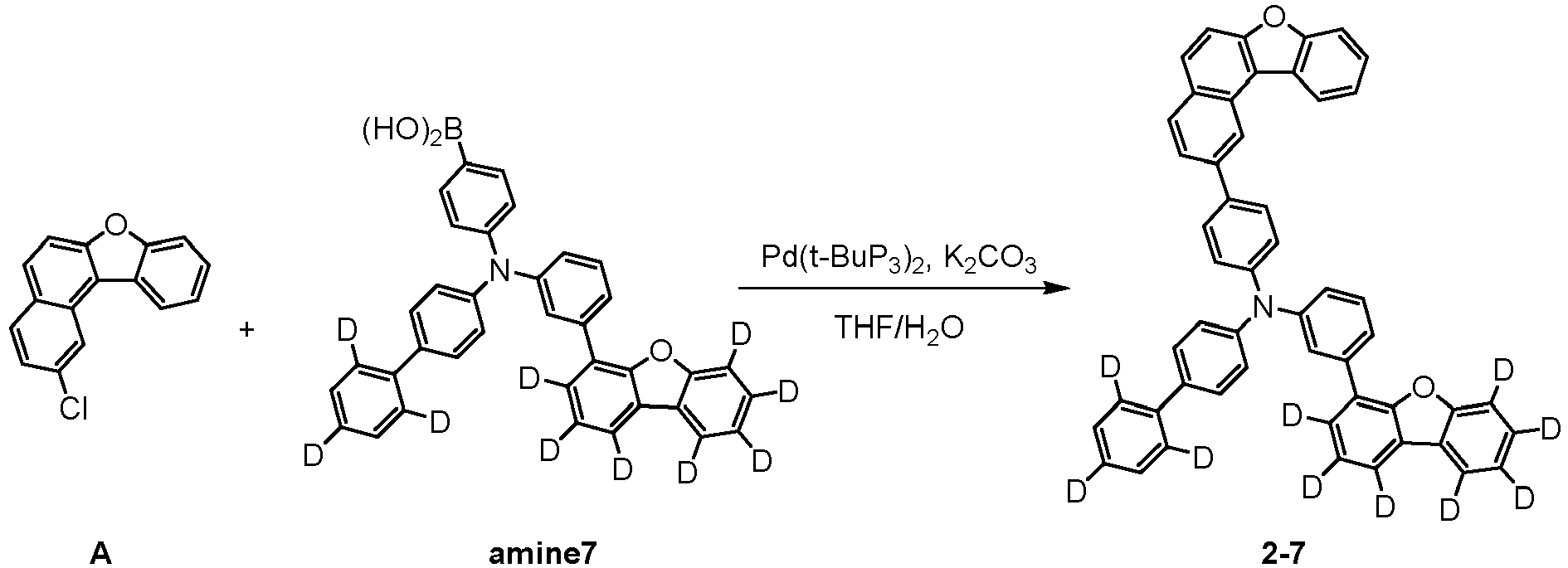
- Compound A (15 g, 59.4 mmol) and Compound amine7 (33.7 g, 62.3 mmol) were added to 300 ml of THF, and the mixture was stirred and refluxed. Then, potassium carbonate (24.6 g, 178.1 mmol) was dissolved in 74 ml of water and added thereto, and the mixture was sufficiently stirred and then bis(tri-tert-butylphosphine)palladium(0) (0.3 g, 0.6 mmol) was added. After the reaction for 5 hours, the reaction mixture was cooled to room temperature, and the organic layer and the aqueous layer were separated and then the organic layer was distilled. This was again dissolved in chloroform, washed twice with water, and then the organic layer was separated, anhydrous magnesium sulfate was added thereto, stirred, and then filtered, and the filtrate was distilled under reduced pressure. The concentrated compound was purified by silica gel column chromatography to prepare 27.9 g of Compound 2-7. (Yield: 66%, MS: [M+H]+= 714)
- 1

- Compound A (15 g, 59.4 mmol) and Compound amine8 (34 g, 62.3 mmol) were added to 300 ml of THF, and the mixture was stirred and refluxed. Then, potassium carbonate (24.6 g, 178.1 mmol) was dissolved in 74 ml of water and added thereto, and the mixture was sufficiently stirred and then bis(tri-tert-butylphosphine)palladium(0) (0.3 g, 0.6 mmol) was added. After the reaction for 3 hours, the reaction mixture was cooled to room temperature, and the organic layer and the aqueous layer were separated and then the organic layer was distilled. This was again dissolved in chloroform, washed twice with water, and then the organic layer was separated, anhydrous magnesium sulfate was added thereto, stirred, and then filtered, and the filtrate was distilled under reduced pressure. The concentrated compound was purified by silica gel column chromatography to prepare 30.7 g of Compound 2-8. (Yield: 72%, MS: [M+H]+= 718)
-

- Trifluoromethanesulfonic anhydride (33.5 g, 118.7 mmol) and deuterium oxide (11.9 g, 593.6 mmol) were added at 0°C and stirred for 5 hours to prepare a solution. Compound A (15 g, 59.4 mmol)) was added to 120 ml of 1,2,4-trichlorobenzene, and the mixture was stirred. Then, the prepared mixed solution of trifluoromethanesulfonic anhydride and deuterium oxide was slowly added dropwise to the mixed solution of Compound A and 1,2,4-trichlorobenzene, and the mixture was stirred while heating to 140°C and then keeping that temperature. After the reaction for 3 hours, the reaction mixture was cooled to room temperature, and the organic layer and the aqueous layer were separated. Then, the organic layer was neutralized with an aqueous potassium carbonate solution. After washing twice with water, the organic layer was separated, anhydrous magnesium sulfate was added thereto, stirred, then filtered, and the filtrate was distilled under reduced pressure. The concentrated compound was purified by silica gel column chromatography to prepare 5.4 g of compound subA-1. (Yield: 36%, MS: [M+H]+= 255)
- Compound subA-1 (15 g, 59.6 mmol) and Compound amine9 (30.7 g, 62.6 mmol) were added to 300 ml of THF, and the mixture was stirred and refluxed. Then, potassium carbonate (24.7 g, 178.8 mmol) was dissolved in 74 ml of water and added thereto, and the mixture was sufficiently stirred and then bis(tri-tert-butylphosphine)palladium(0) (0.3 g, 0.6 mmol) was added. After the reaction for 4 hours, the reaction mixture was cooled to room temperature, and the organic layer and the aqueous layer were separated and then the organic layer was distilled. This was again dissolved in chloroform, washed twice with water, and then the organic layer was separated, anhydrous magnesium sulfate was added thereto, stirred, and then filtered, and the filtrate was distilled under reduced pressure. The concentrated compound was purified by silica gel column chromatography to prepare 28.9 g of Compound 2-9. (Yield: 73%, MS: [M+H]+= 666)
-

- Trifluoromethanesulfonic anhydride (67 g, 237.4 mmol) and deuterium oxide (23.8 g, 1187.2 mmol ) were added at 0°C and stirred for 6 hours to prepare a solution. Compound A (15 g, 59.4 mmol) was added to 120 ml of 1,2,4-trichlorobenzene, and the mixture was stirred. Then, the prepared mixed solution of trifluoromethanesulfonic anhydride and deuterium oxide was slowly added dropwise to the mixed solution of Compound A and 1,2,4-trichlorobenzene, and the mixture was stirred while heating to 140°C and then keeping that temperature. After the reaction for 10 hours, the reaction mixture was cooled to room temperature, and the organic layer and the aqueous layer were separated. Then, the organic layer was neutralized with an aqueous potassium carbonate solution. After washing twice with water, the organic layer was separated, anhydrous magnesium sulfate was added thereto, stirred, then filtered, and the filtrate was distilled under reduced pressure. The concentrated compound was purified by silica gel column chromatography to prepare 6.2 g of compound subA-2. (Yield: 41%, MS: [M+H]+= 258)
- Compound subA-2 (15 g, 58.9 mmol) and Compound amine10 (29 g, 61.8 mmol) were added to 300 ml of THF, and the mixture was stirred and refluxed. Then, potassium carbonate (24.4 g, 176.7 mmol) was dissolved in 73 ml of water and added thereto, and the mixture was sufficiently stirred and then bis(tri-tert-butylphosphine)palladium(0) (0.3 g, 0.6 mmol) was added. After the reaction for 3 hours, the reaction mixture was cooled to room temperature, and the organic layer and the aqueous layer were separated and then the organic layer was distilled. This was again dissolved in chloroform, washed twice with water, and then the organic layer was separated, anhydrous magnesium sulfate was added thereto, stirred, and then filtered, and the filtrate was distilled under reduced pressure. The concentrated compound was purified by silica gel column chromatography to prepare 25.4 g of Compound 2-10. (Yield: 67%, MS: [M+H]+= 645)
-

- Compound subA-2 (15 g, 58.9 mmol) and Compound amine11 (30.9 g, 61.8 mmol) were added to 300 ml of THF, and the mixture was stirred and refluxed. Then, potassium carbonate (24.4 g, 176.7 mmol) was dissolved in 73 ml of water and added thereto, and the mixture was sufficiently stirred and then bis(tri-tert-butylphosphine)palladium(0) (0.3 g, 0.6 mmol) was added. After the reaction for 3 hours, the reaction mixture was cooled to room temperature, and the organic layer and the aqueous layer were separated and then the organic layer was distilled. This was again dissolved in chloroform, washed twice with water, and then the organic layer was separated, anhydrous magnesium sulfate was added thereto, stirred, and then filtered, and the filtrate was distilled under reduced pressure. The concentrated compound was purified by silica gel column chromatography to prepare 26.3 g of Compound 2-11. (Yield: 66%, MS: [M+H]+= 677)
-

- Trifluoromethanesulfonic anhydride (83.7 g, 296.8 mmol) and deuterium oxide (29.7 g, 1484 mmol) were added at 0°C and stirred for 6 hours to prepare a solution. Compound A (15 g, 59.4 mmol) was added to 120 ml of 1,2,4-trichlorobenzene, and the mixture was stirred. Then, the prepared mixed solution of trifluoromethanesulfonic anhydride and deuterium oxide was slowly added dropwise to the mixed solution of Compound A and 1,2,4-trichlorobenzene, and the mixture was stirred while heating to 140°C and then keeping that temperature. After the reaction for 14 hours, the reaction mixture was cooled to room temperature, and the organic layer and the aqueous layer were separated. Then, the organic layer was neutralized with an aqueous potassium carbonate solution. After washing twice with water, the organic layer was separated, anhydrous magnesium sulfate was added thereto, stirred, then filtered, and the filtrate was distilled under reduced pressure. The concentrated compound was purified by silica gel column chromatography to prepare 6.9 g of compound subA-3. (Yield: 45%, MS: [M+H]+= 259)
- Compound subA-3 (15 g, 58 mmol) and Compound amine12 (31.8 g, 60.9 mmol) were added to 300 ml of THF, and the mixture was stirred and refluxed. Then, potassium carbonate (24 g, 173.9 mmol) was dissolved in 72 ml of water and added thereto, and the mixture was sufficiently stirred and then bis(tri-tert-butylphosphine)palladium(0) (0.3 g, 0.6 mmol) was added. After the reaction for 3 hours, the reaction mixture was cooled to room temperature, and the organic layer and the aqueous layer were separated and then the organic layer was distilled. This was again dissolved in chloroform, washed twice with water, and then the organic layer was separated, anhydrous magnesium sulfate was added thereto, stirred, and then filtered, and the filtrate was distilled under reduced pressure. The concentrated compound was purified by silica gel column chromatography to prepare 26.4 g of Compound 2-12. (Yield: 65%, MS: [M+H]+= 701)
-

- Compound subA-3 (15 g, 58 mmol) and Compound amine13 (23.4 g, 60.9 mmol) were added to 300 ml of THF, and the mixture was stirred and refluxed. Then, potassium carbonate (24 g, 173.9 mmol) was dissolved in 72 ml of water and added thereto, and the mixture was sufficiently stirred and then bis(tri-tert-butylphosphine)palladium(0) (0.3 g, 0.6 mmol) was added. After the reaction for 4 hours, the reaction mixture was cooled to room temperature, and the organic layer and the aqueous layer were separated and then the organic layer was distilled. This was again dissolved in chloroform, washed twice with water, and then the organic layer was separated, anhydrous magnesium sulfate was added thereto, stirred, and then filtered, and the filtrate was distilled under reduced pressure. The concentrated compound was purified by silica gel column chromatography to prepare 21.5 g of Compound 2-13. (Yield: 66%, MS: [M+H]+= 563)
-

- Compound subA-3 (15 g, 58 mmol) and Compound amine14 (26 g, 60.9 mmol) were added to 300 ml of THF, and the mixture was stirred and refluxed. Then, potassium carbonate (24 g, 173.9 mmol) was dissolved in 72 ml of water and added thereto, and the mixture was sufficiently stirred and then bis(tri-tert-butylphosphine)palladium(0) (0.3 g, 0.6 mmol) was added. After the reaction for 3 hours, the reaction mixture was cooled to room temperature, and the organic layer and the aqueous layer were separated and then the organic layer was distilled. This was again dissolved in chloroform, washed twice with water, and then the organic layer was separated, anhydrous magnesium sulfate was added thereto, stirred, and then filtered, and the filtrate was distilled under reduced pressure. The concentrated compound was purified by silica gel column chromatography to prepare 25.3 g of Compound 2-14. (Yield: 72%, MS: [M+H]+= 606)
-

- Trifluoromethanesulfonic anhydride (117.2 g, 415.5 mmol) and deuterium oxide (41.6 g, 2077.6 mmol) were added at 0°C and stirred for 6 hours to prepare a solution. Compound A (15 g, 59.4 mmol)) was added to 120 ml of 1,2,4-trichlorobenzene, and the mixture was stirred. Then, the prepared mixed solution of trifluoromethanesulfonic anhydride and deuterium oxide was slowly added dropwise to the mixed solution of Compound A and 1,2,4-trichlorobenzene, and the mixture was stirred while heating to 140°C and then keeping that temperature. After the reaction for 20 hours, the reaction mixture was cooled to room temperature, and the organic layer and the aqueous layer were separated. Then, the organic layer was neutralized with an aqueous potassium carbonate solution. After washing twice with water, the organic layer was separated, anhydrous magnesium sulfate was added thereto, stirred, then filtered, and the filtrate was distilled under reduced pressure. The concentrated compound was purified by silica gel column chromatography to prepare 5.8 g of compound subA-4. (Yield: 38%, MS: [M+H]+= 260)
- Compound subA-4 (15 g, 57.8 mmol) and Compound amine15 (27 g, 60.6 mmol) were added to 300 ml of THF, and the mixture was stirred and refluxed. Then, potassium carbonate (23.9 g, 173.3 mmol) was dissolved in 72 ml of water and added thereto, and the mixture was sufficiently stirred and then bis(tri-tert-butylphosphine)palladium(0) (0.3 g, 0.6 mmol) was added. After the reaction for 4 hours, the reaction mixture was cooled to room temperature, and the organic layer and the aqueous layer were separated and then the organic layer was distilled. This was again dissolved in chloroform, washed twice with water, and then the organic layer was separated, anhydrous magnesium sulfate was added thereto, stirred, and then filtered, and the filtrate was distilled under reduced pressure. The concentrated compound was purified by silica gel column chromatography to prepare 23.8 g of Compound 2-15. (Yield: 66%, MS: [M+H]+= 625)
-

- Compound subA-4 (15 g, 57.8 mmol) and Compound amine16 (32.4 g, 60.6 mmol) were added to 300 ml of THF, and the mixture was stirred and refluxed. Then, potassium carbonate (23.9 g, 173.3 mmol) was dissolved in 72 ml of water and added thereto, and the mixture was sufficiently stirred and then bis(tri-tert-butylphosphine)palladium(0) (0.3 g, 0.6 mmol) was added. After the reaction for 4 hours, the reaction mixture was cooled to room temperature, and the organic layer and the aqueous layer were separated and then the organic layer was distilled. This was again dissolved in chloroform, washed twice with water, and then the organic layer was separated, anhydrous magnesium sulfate was added thereto, stirred, and then filtered, and the filtrate was distilled under reduced pressure. The concentrated compound was purified by silica gel column chromatography to prepare 26.8 g of Compound 2-16. (Yield: 65%, MS: [M+H]+= 714)
-

- Compound subA-4 (15 g, 57.8 mmol) and Compound amine17 (28.7 g, 60.6 mmol) were added to 300 ml of THF, and the mixture was stirred and refluxed. Then, potassium carbonate (23.9 g, 173.3 mmol) was dissolved in 72 ml of water and added thereto, and the mixture was sufficiently stirred and then bis(tri-tert-butylphosphine)palladium(0) (0.3 g, 0.6 mmol) was added. After the reaction for 4 hours, the reaction mixture was cooled to room temperature, and the organic layer and the aqueous layer were separated and then the organic layer was distilled. This was again dissolved in chloroform, washed twice with water, and then the organic layer was separated, anhydrous magnesium sulfate was added thereto, stirred, and then filtered, and the filtrate was distilled under reduced pressure. The concentrated compound was purified by silica gel column chromatography to prepare 24.9 g of Compound 2-17. (Yield: 66%, MS: [M+H]+= 653)
-

- Trifluoromethanesulfonic anhydride (150.7 g, 534.2 mmol) and deuterium oxide (53.5 g, 2671.2 mmol) were added at 0°C and stirred for 6 hours to prepare a solution. Compound A (15 g, 59.4 mmol) was added to 120 ml of 1,2,4-trichlorobenzene, and the mixture was stirred. Then, the prepared mixed solution of trifluoromethanesulfonic anhydride and deuterium oxide was slowly added dropwise to the mixed solution of Compound A and 1,2,4-trichlorobenzene, and the mixture was stirred while heating to 140°C and then keeping that temperature. After the reaction for 28 hours, the reaction mixture was cooled to room temperature, and the organic layer and the aqueous layer were separated. Then, the organic layer was neutralized with an aqueous potassium carbonate solution. After washing twice with water, the organic layer was separated, anhydrous magnesium sulfate was added thereto, stirred, then filtered, and the filtrate was distilled under reduced pressure. The concentrated compound was purified by silica gel column chromatography to prepare 6.5 g of Compound subA-5. (Yield: 42%, MS: [M+H]+= 262)
- Compound subA-5 (15 g, 57.3 mmol) and Compound amine18 (32.9 g, 60.2 mmol) were added to 300 ml of THF, and the mixture was stirred and refluxed. Then, potassium carbonate (23.8 g, 171.9 mmol) was dissolved in 71 ml of water and added thereto, and the mixture was sufficiently stirred and then bis(tri-tert-butylphosphine)palladium(0) (0.3 g, 0.6 mmol) was added. After the reaction for 4 hours, the reaction mixture was cooled to room temperature, and the organic layer and the aqueous layer were separated and then the organic layer was distilled. This was again dissolved in chloroform, washed twice with water, and then the organic layer was separated, anhydrous magnesium sulfate was added thereto, stirred, and then filtered, and the filtrate was distilled under reduced pressure. The concentrated compound was purified by silica gel column chromatography to prepare 31.3 g of Compound 2-18. (Yield: 75%, MS: [M+H]+= 729)
-

- Compound subA-5 (15 g, 57.3 mmol) and Compound amine19 (36.6 g, 60.2 mmol) were added to 300 ml of THF, and the mixture was stirred and refluxed. Then, potassium carbonate (23.8 g, 171.9 mmol) was dissolved in 71 ml of water and added thereto, and the mixture was sufficiently stirred and then bis(tri-tert-butylphosphine)palladium(0) (0.3 g, 0.6 mmol) was added. After the reaction for 4 hours, the reaction mixture was cooled to room temperature, and the organic layer and the aqueous layer were separated and then the organic layer was distilled. This was again dissolved in chloroform, washed twice with water, and then the organic layer was separated, anhydrous magnesium sulfate was added thereto, stirred, and then filtered, and the filtrate was distilled under reduced pressure. The concentrated compound was purified by silica gel column chromatography to prepare 30.3 g of Compound 2-19. (Yield: 67%, MS: [M+H]+= 789)
-

- Compound 2-1 (10 g, 15.1 mmol), PtO2 (1 g, 4.5 mmol) and D2O (75 ml) were added to a shaker tube, and then the tube was sealed and heated at 250°C and 600 psi for 12 hours. After completion of the reaction, chloroform was added, and the reaction solution was transferred to a separatory funnel, and extracted. The extract was dried over MgSO4 and concentrated, and then the sample was purified by silica gel column chromatography to give 3.2 g of Compound 2-20. (Yield: 31%, MS: [M+H]+= 694)
-

- Compound 2-2 (10 g, 16.3 mmol), PtO2(1.1 g, 4.9 mmol), and D2O (81 ml) were added to a shaker tube, and then the tube was sealed and heated at 250°C and 600 psi for 12 hours. After completion of the reaction, chloroform was added, and the reaction solution was transferred to a separatory funnel, and extracted. The extract was dried over MgSO4 and concentrated, and then the sample was purified by silica gel column chromatography to give 4.7 g of Compound 2-21. (Yield: 45%, MS: [M+H]+= 641)
-

- Compound 2-3 (10 g, 17 mmol), PtO2 (1.2 g, 5.1 mmol) and D2O (85 ml) were added to a shaker tube, and then the tube was sealed and heated at 250°C and 600 psi for 12 hours. After completion of the reaction, chloroform was added, and the reaction solution was transferred to a separatory funnel, and extracted. The extract was dried over MgSO4 and concentrated, and then the sample was purified by silica gel column chromatography to give 4.4 g of Compound 2-22. (Yield: 42%, MS: [M+H]+= 615)
-
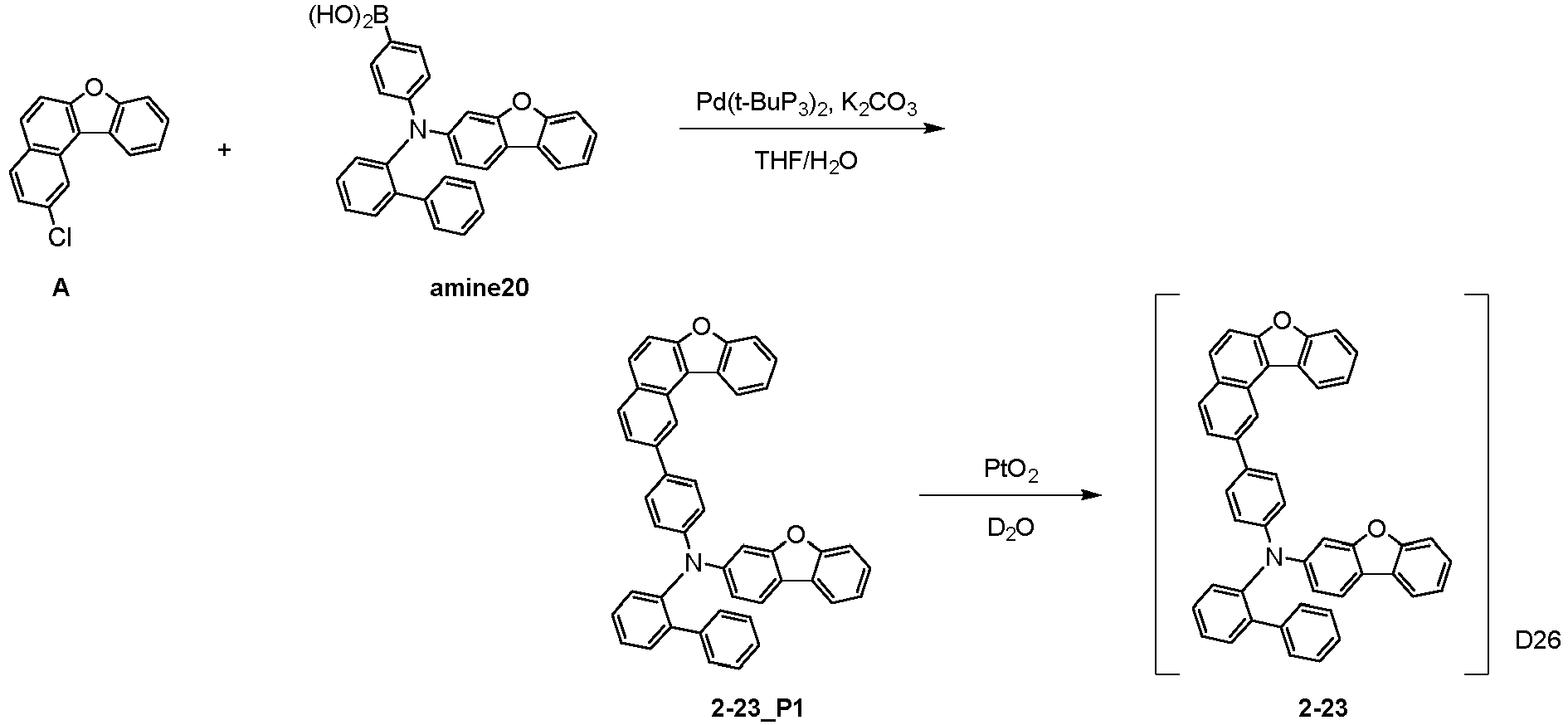
- Compound A (15 g, 59.4 mmol) and Compound amine20 (28.4 g, 62.3 mmol)were added to 300 ml of THF, and the mixture was stirred and refluxed. Then, potassium carbonate (24.6 g, 178.1 mmol) was dissolved in 74 ml of water and added thereto, and the mixture was sufficiently stirred and then bis(tri-tert-butylphosphine)palladium(0) (0.3 g, 0.6 mmol) was added. After the reaction for 5 hours, the reaction mixture was cooled to room temperature, and the organic layer and the aqueous layer were separated and then the organic layer was distilled. This was again dissolved in chloroform, washed twice with water, and then the organic layer was separated, anhydrous magnesium sulfate was added thereto, stirred, and then filtered, and the filtrate was distilled under reduced pressure. The concentrated compound was purified by silica gel column chromatography to prepare 24.6 g of Compound 2-23_P1. (Yield: 66%, MS: [M+H]+= 628)
- Compound 2-23_P1 (10 g, 15.9 mmol), PtO2 (1.1 g, 4.8 mmol) and D2O (80 ml) were added to a shaker tube, and then the tube was sealed and heated at 250°C and 600 psi for 12 hours. After completion of the reaction, chloroform was added, and the reaction solution was transferred to a separatory funnel, and extracted. The extract was dried over MgSO4 and concentrated, and then the sample was purified by silica gel column chromatography to give 4.4 g of Compound 2-23. (Yield: 42%, MS: [M+H]+= 655)
-

- Compound A (15 g, 59.4 mmol)and Compound amine21 (35.4 g,62.3 mmol)were added to 300 ml of THF, and the mixture was stirred and refluxed. Then, potassium carbonate (24.6 g, 178.1 mmol) was dissolved in 74 ml of water and added thereto, and the mixture was sufficiently stirred and then bis(tri-tert-butylphosphine)palladium(0) (0.3 g, 0.6 mmol) was added. After the reaction for 3 hours, the reaction mixture was cooled to room temperature, and the organic layer and the aqueous layer were separated and then the organic layer was distilled. This was again dissolved in chloroform, washed twice with water, and then the organic layer was separated, anhydrous magnesium sulfate was added thereto, stirred, and then filtered, and the filtrate was distilled under reduced pressure. The concentrated compound was purified by silica gel column chromatography to prepare 28.5 g of Compound 2-24_P1. (Yield: 65%, MS: [M+H]+= 740)
- Compound 2-24_P1 (10 g, 13.5 mmol), PtO2 (0.9 g, 4.1 mmol) and D2O (68 ml) were added to a shaker tube, and then the tube was sealed and heated at 250°C and 600 psi for 12 hours. After completion of the reaction, chloroform was added, and the reaction solution was transferred to a separatory funnel, and extracted. The extract was dried over MgSO4 and concentrated, and then the sample was purified by silica gel column chromatography to give 4.4 g of Compound 2-24. (Yield: 42%, MS: [M+H]+= 774)
-

- 1-Bromo-6-chloronaphthalen-2-ol (15 g, 58.3 mmol) and (2-fluorophenyl)boronic acid (8.6 g, 61.2 mmol) were added to 300ml of THF, and the mixture was stirred and refluxed. Then, potassium carbonate (24.2 g, 174.8 mmol) was dissolved in 72ml of water and added thereto, and the mixture was sufficiently stirred and then tetrakis(triphenylphosphine)palladium(0) (0.7 g, 0.6 mmol) was added. After the reaction for 6 hours, the reaction mixture was cooled to room temperature, and the organic layer and the aqueous layer were separated and then the organic layer was distilled. This was again dissolved in chloroform, washed twice with water, and then the organic layer was separated, anhydrous magnesium sulfate was added thereto, stirred, and then filtered, and the filtrate was distilled under reduced pressure. The concentrated compound was purified by silica gel column chromatography to prepare 10.5 g of Compound B_P1. (Yield: 66%, MS: [M+H]+= 273)
- Compound B_P1 (15 g, 55 mmol) and potassium carbonate (22.8 g, 165 mmol) were added to 150 ml of DMAc, and the mixture was stirred and refluxed. After the reaction for 5 hours, the reaction mixture was cooled to room temperature, poured into 300 ml of water, solidified and filtered to obtain a solid. This was again dissolved in chloroform, washed twice with water, the organic layer was separated, anhydrous magnesium sulfate was added, stirred, filtered, and the filtrate was distilled under reduced pressure. The concentrated compound was purified by silica gel column chromatography to prepare 8.5 g of Compound B. (Yield 65%, MS: [M+H]+= 253)
- Compound B (15 g, 59.4 mmol) and Compound amine22 (25.9 g,62.3 mmol) were added to 300 ml of THF, and the mixture was stirred and refluxed. Then, potassium carbonate (24.6 g, 178.1 mmol) was dissolved in 74 ml of water and added thereto, and the mixture was sufficiently stirred and then bis(tri-tert-butylphosphine)palladium(0) (0.3 g, 0.6 mmol) was added. After the reaction for 5 hours, the reaction mixture was cooled to room temperature, and the organic layer and the aqueous layer were separated and then the organic layer was distilled. This was again dissolved in chloroform, washed twice with water, and then the organic layer was separated, anhydrous magnesium sulfate was added thereto, stirred, and then filtered, and the filtrate was distilled under reduced pressure. The concentrated compound was purified by silica gel column chromatography to prepare 23.7 g of Compound 2-25. (Yield: 68%, MS: [M+H]+= 588)
-

- Compound B (15 g, 59.4 mmol) and Compound amine23 (33.1 g, 62.3 mmol)were added to 300 ml of THF, and the mixture was stirred and refluxed. Then, potassium carbonate (24.6 g, 178.1 mmol) was dissolved in 74 ml of water and added thereto, and the mixture was sufficiently stirred and then bis(tri-tert-butylphosphine)palladium(0) (0.3 g, 0.6 mmol) was added. After the reaction for 3 hours, the reaction mixture was cooled to room temperature, and the organic layer and the aqueous layer were separated and then the organic layer was distilled. This was again dissolved in chloroform, washed twice with water, and then the organic layer was separated, anhydrous magnesium sulfate was added thereto, stirred, and then filtered, and the filtrate was distilled under reduced pressure. The concentrated compound was purified by silica gel column chromatography to prepare 27.9 g of Compound 2-26. (Yield: 67%, MS: [M+H]+= 703)
-

- Compound B (15 g, 59.4 mmol) and Compound amine24 (25.9 g, 62.3 mmol) were added to 300 ml of THF, and the mixture was stirred and refluxed. Then, potassium carbonate (24.6 g, 178.1 mmol) was dissolved in 74 ml of water and added thereto, and the mixture was sufficiently stirred and then bis(tri-tert-butylphosphine)palladium(0) (0.3 g, 0.6 mmol) was added. After the reaction for 3 hours, the reaction mixture was cooled to room temperature, and the organic layer and the aqueous layer were separated and then the organic layer was distilled. This was again dissolved in chloroform, washed twice with water, and then the organic layer was separated, anhydrous magnesium sulfate was added thereto, stirred, and then filtered, and the filtrate was distilled under reduced pressure. The concentrated compound was purified by silica gel column chromatography to prepare 25.4 g of Compound 2-27. (Yield: 73%, MS: [M+H]+= 588)
-

- Compound B (15 g, 59.4 mmol) and Compound amine25 (24.6 g, 62.3 mmol) were added to 300 ml of THF, and the mixture was stirred and refluxed. Then, potassium carbonate (24.6 g, 178.1 mmol) was dissolved in 74 ml of water and added thereto, and the mixture was sufficiently stirred and then bis(tri-tert-butylphosphine)palladium(0) (0.3 g, 0.6 mmol) was added. After the reaction for 3 hours, the reaction mixture was cooled to room temperature, and the organic layer and the aqueous layer were separated and then the organic layer was distilled. This was again dissolved in chloroform, washed twice with water, and then the organic layer was separated, anhydrous magnesium sulfate was added thereto, stirred, and then filtered, and the filtrate was distilled under reduced pressure. The concentrated compound was purified by silica gel column chromatography to prepare 22.9 g of Compound 2-28. (Yield: 68%, MS: [M+H]+= 568)
-

- Compound B (15 g, 59.4 mmol) and Compound amine26 (30.6 g, 62.3 mmol) were added to 300 ml of THF, and the mixture was stirred and refluxed. Then, potassium carbonate (24.6 g, 178.1 mmol) was dissolved in 74 ml of water and added thereto, and the mixture was sufficiently stirred and then bis(tri-tert-butylphosphine)palladium(0) (0.3 g, 0.6 mmol) was added. After the reaction for 3 hours, the reaction mixture was cooled to room temperature, and the organic layer and the aqueous layer were separated and then the organic layer was distilled. This was again dissolved in chloroform, washed twice with water, and then the organic layer was separated, anhydrous magnesium sulfate was added thereto, stirred, and then filtered, and the filtrate was distilled under reduced pressure. The concentrated compound was purified by silica gel column chromatography to prepare 26.4 g of Compound 2-29. (Yield: 67%, MS: [M+H]+= 664)
-

- Compound B (15 g, 59.4 mmol) and Compound amine27 (33.7 g, 62.3 mmol)were added to 300 ml of THF, and the mixture was stirred and refluxed. Then, potassium carbonate (24.6 g, 178.1 mmol) was dissolved in 74 ml of water and added thereto, and the mixture was sufficiently stirred and then bis(tri-tert-butylphosphine)palladium(0) (0.3 g, 0.6 mmol) was added. After the reaction for 4 hours, the reaction mixture was cooled to room temperature, and the organic layer and the aqueous layer were separated and then the organic layer was distilled. This was again dissolved in chloroform, washed twice with water, and then the organic layer was separated, anhydrous magnesium sulfate was added thereto, stirred, and then filtered, and the filtrate was distilled under reduced pressure. The concentrated compound was purified by silica gel column chromatography to prepare 29.6 g of Compound 2-30. (Yield: 70%, MS: [M+H]+= 714)
-

- Compound B (15 g, 59.4 mmol) and Compound amine28 (33.1 g, 62.3 mmol) were added to 300 ml of THF, and the mixture was stirred and refluxed. Then, potassium carbonate (24.6 g, 178.1 mmol) was dissolved in 74 ml of water and added thereto, and the mixture was sufficiently stirred and then bis(tri-tert-butylphosphine)palladium(0) (0.3 g, 0.6 mmol) was added. After the reaction for 3 hours, the reaction mixture was cooled to room temperature, and the organic layer and the aqueous layer were separated and then the organic layer was distilled. This was again dissolved in chloroform, washed twice with water, and then the organic layer was separated, anhydrous magnesium sulfate was added thereto, stirred, and then filtered, and the filtrate was distilled under reduced pressure. The concentrated compound was purified by silica gel column chromatography to prepare 27.5 g of Compound 2-31. (Yield: 66%, MS: [M+H]+= 703)
-

- Compound B (15 g, 59.4 mmol) and Compound amine29 (31.3 g, 62.3 mmol) were added to 300 ml of THF, and the mixture was stirred and refluxed. Then, potassium carbonate (24.6 g, 178.1 mmol) was dissolved in 74 ml of water and added thereto, and the mixture was sufficiently stirred and then bis(tri-tert-butylphosphine)palladium(0) (0.3 g, 0.6 mmol) was added. After the reaction for 3 hours, the reaction mixture was cooled to room temperature, and the organic layer and the aqueous layer were separated and then the organic layer was distilled. This was again dissolved in chloroform, washed twice with water, and then the organic layer was separated, anhydrous magnesium sulfate was added thereto, stirred, and then filtered, and the filtrate was distilled under reduced pressure. The concentrated compound was purified by silica gel column chromatography to prepare 26 g of Compound 2-32. (Yield: 65%, MS: [M+H]+= 675)
-

- Trifluoromethanesulfonic anhydride (33.5 g, 118.7 mmol) and deuterium oxide (11.9 g, 593.6 mmol ) were added at 0°C and stirred for 5 hours to prepare a solution. Compound B (15 g, 59.4 mmol)) was added to 120 ml of 1,2,4-trichlorobenzene, and the mixture was stirred. Then, the prepared mixed solution of trifluoromethanesulfonic anhydride and deuterium oxide was slowly added dropwise to the mixed solution of Compound A and 1,2,4-trichlorobenzene, and the mixture was stirred while heating to 140°C and then keeping that temperature. After the reaction for 4 hours, the reaction mixture was cooled to room temperature, and the organic layer and the aqueous layer were separated. Then, the organic layer was neutralized with an aqueous potassium carbonate solution. After washing twice with water, the organic layer was separated, anhydrous magnesium sulfate was added thereto, stirred, then filtered, and the filtrate was distilled under reduced pressure. The concentrated compound was purified by silica gel column chromatography to prepare 6.5 g of compound subB-1. (Yield: 43%, MS: [M+H]+= 255)
- Compound subB-1 (15 g, 58.9 mmol) and Compound amine30 (30.4 g, 61.8 mmol)were added to 300 ml of THF, and the mixture was stirred and refluxed. Then, potassium carbonate (24.4 g, 176.7 mmol) was dissolved in 73 ml of water and added thereto, and the mixture was sufficiently stirred and then bis(tri-tert-butylphosphine)palladium(0) (0.3 g, 0.6 mmol) was added. After the reaction for 4 hours, the reaction mixture was cooled to room temperature, and the organic layer and the aqueous layer were separated and then the organic layer was distilled. This was again dissolved in chloroform, washed twice with water, and then the organic layer was separated, anhydrous magnesium sulfate was added thereto, stirred, and then filtered, and the filtrate was distilled under reduced pressure. The concentrated compound was purified by silica gel column chromatography to prepare 27.8 g of Compound 2-33. (Yield: 71%, MS: [M+H]+= 666)
-

- Compound subB-1 (15 g, 58.9 mmol) and Compound amine31 (35.6 g, 61.8 mmol) were added to 300 ml of THF, and the mixture was stirred and refluxed. Then, potassium carbonate (24.4 g, 176.7 mmol) was dissolved in 73 ml of water and added thereto, and the mixture was sufficiently stirred and then bis(tri-tert-butylphosphine)palladium(0) (0.3 g, 0.6 mmol) was added. After the reaction for 5 hours, the reaction mixture was cooled to room temperature, and the organic layer and the aqueous layer were separated and then the organic layer was distilled. This was again dissolved in chloroform, washed twice with water, and then the organic layer was separated, anhydrous magnesium sulfate was added thereto, stirred, and then filtered, and the filtrate was distilled under reduced pressure. The concentrated compound was purified by silica gel column chromatography to prepare 33.1 g of Compound 2-34. (Yield: 75%, MS: [M+H]+= 750)
-

- Trifluoromethanesulfonic anhydride (50.2 g, 178.1 mmol) and deuterium oxide (17.8 g, 890.4 mmol) were added at 0°C and stirred for 6 hours to prepare a solution. Compound B (15 g, 59.4 mmol)) was added to 120 ml of 1,2,4-trichlorobenzene, and the mixture was stirred. Then, the prepared mixed solution of trifluoromethanesulfonic anhydride and deuterium oxide was slowly added dropwise to the mixed solution of Compound A and 1,2,4-trichlorobenzene, and the mixture was stirred while heating to 140°C and then keeping that temperature. After the reaction for 7 hours, the reaction mixture was cooled to room temperature, and the organic layer and the aqueous layer were separated. Then, the organic layer was neutralized with an aqueous potassium carbonate solution. After washing twice with water, the organic layer was separated, anhydrous magnesium sulfate was added thereto, stirred, then filtered, and the filtrate was distilled under reduced pressure. The concentrated compound was purified by silica gel column chromatography to prepare 6.7 g of compound subB-2. (Yield: 44%, MS: [M+H]+= 256)
- Compound subB-2 (15 g, 58.7 mmol) and Compound amine32 (25.9 g, 61.6 mmol) were added to 300 ml of THF, and the mixture was stirred and refluxed. Then, potassium carbonate (24.3 g, 176 mmol) was dissolved in 73 ml of water and added thereto, and the mixture was sufficiently stirred and then bis(tri-tert-butylphosphine)palladium(0) (0.3 g, 0.6 mmol) was added. After the reaction for 5 hours, the reaction mixture was cooled to room temperature, and the organic layer and the aqueous layer were separated and then the organic layer was distilled. This was again dissolved in chloroform, washed twice with water, and then the organic layer was separated, anhydrous magnesium sulfate was added thereto, stirred, and then filtered, and the filtrate was distilled under reduced pressure. The concentrated compound was purified by silica gel column chromatography to prepare 26.2 g of Compound 2-35. (Yield: 75%, MS: [M+H]+= 596)
-

- Compound subB-2 (15 g, 58.7 mmol) and Compound amine33 (30.6 g, 61.6 mmol) were added to 300 ml of THF, and the mixture was stirred and refluxed. Then, potassium carbonate (24.3 g, 176 mmol) was dissolved in 73 ml of water and added thereto, and the mixture was sufficiently stirred and then bis(tri-tert-butylphosphine)palladium(0) (0.3 g, 0.6 mmol) was added. After the reaction for 5 hours, the reaction mixture was cooled to room temperature, and the organic layer and the aqueous layer were separated and then the organic layer was distilled. This was again dissolved in chloroform, washed twice with water, and then the organic layer was separated, anhydrous magnesium sulfate was added thereto, stirred, and then filtered, and the filtrate was distilled under reduced pressure. The concentrated compound was purified by silica gel column chromatography to prepare 27.6 g of Compound 2-36. (Yield: 70%, MS: [M+H]+= 672)
-

- Trifluoromethanesulfonic anhydride (67 g, 237.4 mmol) and deuterium oxide (23.8 g, 1187.2 mmol) were added at 0°C and stirred for 6 hours to prepare a solution. Compound B (15 g, 59.4 mmol) was added to 120 ml of 1,2,4-trichlorobenzene, and the mixture was stirred. Then, the prepared mixed solution of trifluoromethanesulfonic anhydride and deuterium oxide was slowly added dropwise to the mixed solution of Compound B and 1,2,4-trichlorobenzene, and the mixture was stirred while heating to 140°C and then keeping that temperature. After the reaction for 10 hours, the reaction mixture was cooled to room temperature, and the organic layer and the aqueous layer were separated. Then, the organic layer was neutralized with an aqueous potassium carbonate solution. After washing twice with water, the organic layer was separated, anhydrous magnesium sulfate was added thereto, stirred, then filtered, and the filtrate was distilled under reduced pressure. The concentrated compound was purified by silica gel column chromatography to prepare 5.9 g of compound subB-3. (Yield: 39%, MS: [M+H]+= 258)
- Compound subB-3 (15 g, 58.4 mmol) and Compound amine34 (33.9 g, 61.4 mmol) were added to 300 ml of THF, and the mixture was stirred and refluxed. Then, potassium carbonate (24.2 g, 175.3 mmol) was dissolved in 73 ml of water and added thereto, and the mixture was sufficiently stirred and then bis(tri-tert-butylphosphine)palladium(0) (0.3 g, 0.6 mmol) was added. After the reaction for 4 hours, the reaction mixture was cooled to room temperature, and the organic layer and the aqueous layer were separated and then the organic layer was distilled. This was again dissolved in chloroform, washed twice with water, and then the organic layer was separated, anhydrous magnesium sulfate was added thereto, stirred, and then filtered, and the filtrate was distilled under reduced pressure. The concentrated compound was purified by silica gel column chromatography to prepare 30.6 g of Compound 2-37. (Yield: 72%, MS: [M+H]+= 729)
-

- Trifluoromethanesulfonic anhydride (100.5 g, 356.2 mmol) and deuterium oxide (35.7 g, 1780.8 mmol) were added at 0°C and stirred for 6 hours to prepare a solution. Compound B (15 g, 59.4 mmol) was added to 120 ml of 1,2,4-trichlorobenzene, and the mixture was stirred. Then, the prepared mixed solution of trifluoromethanesulfonic anhydride and deuterium oxide was slowly added dropwise to the mixed solution of Compound B and 1,2,4-trichlorobenzene, and the mixture was stirred while heating to 140°C and then keeping that temperature. After the reaction for 17 hours, the reaction mixture was cooled to room temperature, and the organic layer and the aqueous layer were separated. Then, the organic layer was neutralized with an aqueous potassium carbonate solution. After washing twice with water, the organic layer was separated, anhydrous magnesium sulfate was added thereto, stirred, then filtered, and the filtrate was distilled under reduced pressure. The concentrated compound was purified by silica gel column chromatography to prepare 5.4 g of compound subB-4. (Yield: 35%, MS: [M+H]+= 259)
- Compound subB-4 (15 g, 58 mmol) and Compound amine35 (25.8 g, 60.9 mmol) were added to 300 ml of THF, and the mixture was stirred and refluxed. Then, potassium carbonate (24 g, 173.9 mmol) was dissolved in 72 ml of water and added thereto, and the mixture was sufficiently stirred and then bis(tri-tert-butylphosphine)palladium(0) (0.3 g, 0.6 mmol) was added. After the reaction for 4 hours, the reaction mixture was cooled to room temperature, and the organic layer and the aqueous layer were separated and then the organic layer was distilled. This was again dissolved in chloroform, washed twice with water, and then the organic layer was separated, anhydrous magnesium sulfate was added thereto, stirred, and then filtered, and the filtrate was distilled under reduced pressure. The concentrated compound was purified by silica gel column chromatography to prepare 22.7 g of Compound 2-38. (Yield: 65%, MS: [M+H]+= 603)
-

- Trifluoromethanesulfonic anhydride (117.2 g, 415.5 mmol) and deuterium oxide (41.6 g, 2077.6 mmol) were added at 0°C and stirred for 6 hours to prepare a solution. Compound B (15 g, 59.4 mmol)) was added to 120 ml of 1,2,4-trichlorobenzene, and the mixture was stirred. Then, the prepared mixed solution of trifluoromethanesulfonic anhydride and deuterium oxide was slowly added dropwise to the mixed solution of Compound B and 1,2,4-trichlorobenzene, and the mixture was stirred while heating to 140°C and then keeping that temperature. After the reaction for 21 hours, the reaction mixture was cooled to room temperature, and the organic layer and the aqueous layer were separated. Then, the organic layer was neutralized with an aqueous potassium carbonate solution. After washing twice with water, the organic layer was separated, anhydrous magnesium sulfate was added thereto, stirred, then filtered, and the filtrate was distilled under reduced pressure. The concentrated compound was purified by silica gel column chromatography to prepare 5.7 g of compound subB-5. (Yield: 37%, MS: [M+H]+= 260)
- Compound subB-5 (15 g, 57.8 mmol) and Compound amine36 (22.5 g, 60.6 mmol) were added to 300 ml of THF, and the mixture was stirred and refluxed. Then, potassium carbonate (23.9 g, 173.3 mmol) was dissolved in 72 ml of water and added thereto, and the mixture was sufficiently stirred and then bis(tri-tert-butylphosphine)palladium(0) (0.3 g, 0.6 mmol) was added. After the reaction for 3 hours, the reaction mixture was cooled to room temperature, and the organic layer and the aqueous layer were separated and then the organic layer was distilled. This was again dissolved in chloroform, washed twice with water, and then the organic layer was separated, anhydrous magnesium sulfate was added thereto, stirred, and then filtered, and the filtrate was distilled under reduced pressure. The concentrated compound was purified by silica gel column chromatography to prepare 22.2 g of Compound 2-39. (Yield: 70%, MS: [M+H]+= 550)
-

- Compound subB-5 (15 g, 57.8 mmol) and Compound amine37 (34.4 g, 60.6 mmol) were added to 300 ml of THF, and the mixture was stirred and refluxed. Then, potassium carbonate (23.9 g, 173.3 mmol) was dissolved in 72 ml of water and added thereto, and the mixture was sufficiently stirred and then bis(tri-tert-butylphosphine)palladium(0) (0.3 g, 0.6 mmol) was added. After the reaction for 5 hours, the reaction mixture was cooled to room temperature, and the organic layer and the aqueous layer were separated and then the organic layer was distilled. This was again dissolved in chloroform, washed twice with water, and then the organic layer was separated, anhydrous magnesium sulfate was added thereto, stirred, and then filtered, and the filtrate was distilled under reduced pressure. The concentrated compound was purified by silica gel column chromatography to prepare 30.2 g of Compound 2-40. (Yield: 70%, MS: [M+H]+= 747)
-

- Trifluoromethanesulfonic anhydride (134 g, 474.9 mmol) and deuterium oxide (47.6 g, 2374.4 mmol) were added at 0°C and stirred for 6 hours to prepare a solution. Compound B (15 g, 59.4 mmol)) was added to 120 ml of 1,2,4-trichlorobenzene, and the mixture was stirred. Then, the prepared mixed solution of trifluoromethanesulfonic anhydride and deuterium oxide was slowly added dropwise to the mixed solution of Compound B and 1,2,4-trichlorobenzene, and the mixture was stirred while heating to 140°C and then keeping that temperature. After the reaction for 25 hours, the reaction mixture was cooled to room temperature, and the organic layer and the aqueous layer were separated. Then, the organic layer was neutralized with an aqueous potassium carbonate solution. After washing twice with water, the organic layer was separated, anhydrous magnesium sulfate was added thereto, stirred, then filtered, and the filtrate was distilled under reduced pressure. The concentrated compound was purified by silica gel column chromatography to prepare 6.6g of compound subB-6. (Yield: 43%, MS: [M+H]+= 261)
- Compound subB-6 (15 g, 57.5 mmol) and Compound amine38 (24.1 g, 60.4 mmol) were added to 300 ml of THF, and the mixture was stirred and refluxed. Then, potassium carbonate (23.9 g, 172.6 mmol) was dissolved in 72 ml of water and added thereto, and the mixture was sufficiently stirred and then bis(tri-tert-butylphosphine)palladium(0) (0.3 g, 0.6 mmol) was added. After the reaction for 5 hours, the reaction mixture was cooled to room temperature, and the organic layer and the aqueous layer were separated and then the organic layer was distilled. This was again dissolved in chloroform, washed twice with water, and then the organic layer was separated, anhydrous magnesium sulfate was added thereto, stirred, and then filtered, and the filtrate was distilled under reduced pressure. The concentrated compound was purified by silica gel column chromatography to prepare 22.3 g of Compound 2-41. (Yield: 67%, MS: [M+H]+= 579)
-

- Compound subB-6 (15 g, 57.5 mmol) and Compound amine39 (33.3 g, 60.4 mmol) were added to 300 ml of THF, and the mixture was stirred and refluxed. Then, potassium carbonate (23.9 g, 172.6 mmol) was dissolved in 72 ml of water and added thereto, and the mixture was sufficiently stirred and then bis(tri-tert-butylphosphine)palladium(0) (0.3 g, 0.6 mmol) was added. After the reaction for 3 hours, the reaction mixture was cooled to room temperature, and the organic layer and the aqueous layer were separated and then the organic layer was distilled. This was again dissolved in chloroform, washed twice with water, and then the organic layer was separated, anhydrous magnesium sulfate was added thereto, stirred, and then filtered, and the filtrate was distilled under reduced pressure. The concentrated compound was purified by silica gel column chromatography to prepare 30.3 g of Compound 2-42. (Yield: 72%, MS: [M+H]+= 732)
-

- Compound subB-6 (15 g, 57.5 mmol) and Compound amine40 (30.3 g, 60.4 mmol) were added to 300 ml of THF, and the mixture was stirred and refluxed. Then, potassium carbonate (23.9 g, 172.6 mmol) was dissolved in 72 ml of water and added thereto, and the mixture was sufficiently stirred and then bis(tri-tert-butylphosphine)palladium(0) (0.3 g, 0.6 mmol) was added. After the reaction for 4 hours, the reaction mixture was cooled to room temperature, and the organic layer and the aqueous layer were separated and then the organic layer was distilled. This was again dissolved in chloroform, washed twice with water, and then the organic layer was separated, anhydrous magnesium sulfate was added thereto, stirred, and then filtered, and the filtrate was distilled under reduced pressure. The concentrated compound was purified by silica gel column chromatography to prepare 26.7 g of Compound 2-43. (Yield: 68%, MS: [M+H]+= 684)
-

- Compound B (15 g, 59.4 mmol) and Compound amine41 (35.4 g, 62.3 mmol) were added to 300 ml of THF, and the mixture was stirred and refluxed. Then, potassium carbonate (24.6 g, 178.1 mmol) was dissolved in 74 ml of water and added thereto, and the mixture was sufficiently stirred and then bis(tri-tert-butylphosphine)palladium(0) (0.3 g, 0.6 mmol) was added. After the reaction for 4 hours, the reaction mixture was cooled to room temperature, and the organic layer and the aqueous layer were separated and then the organic layer was distilled. This was again dissolved in chloroform, washed twice with water, and then the organic layer was separated, anhydrous magnesium sulfate was added thereto, stirred, and then filtered, and the filtrate was distilled under reduced pressure. The concentrated compound was purified by silica gel column chromatography to prepare 32.5 g of Compound 2-44_P1. (Yield: 74%, MS: [M+H]+= 740)
- Compound 2-44_P1 (10 g, 13.5 mmol), PtO2 (0.9 g, 4.1 mmol) and D2O (68 ml) were added to a shaker tube, and then the tube was sealed and heated at 250°C and 600 psi for 12 hours. After completion of the reaction, chloroform was added, and the reaction solution was transferred to a separatory funnel, and extracted. The extract was dried over MgSO4 and concentrated, and then the sample was purified by silica gel column chromatography to give 4.6 g of Compound 2-44. (Yield: 44%, MS: [M+H]+= 772)
-

- Compound 2-26 (10 g, 14.2 mmol), PtO2 (1 g, 4.3 mmol) and D2O (71 ml) were added to a shaker tube, and then the tube was sealed and heated at 250°C and 600 psi for 12 hours. After completion of the reaction, chloroform was added, and the reaction solution was transferred to a separatory funnel, and extracted. The extract was dried over MgSO4 and concentrated, and then the sample was purified by silica gel column chromatography to give 3.4 g of Compound 2-45. (Yield: 33%, MS: [M+H]+= 734)
-

- Compound B (15 g, 59.4 mmol) and Compound amine42 (29.3 g, 62.3 mmol) were added to 300 ml of THF, and the mixture was stirred and refluxed. Then, potassium carbonate (24.6 g, 178.1 mmol) was dissolved in 74 ml of water and added thereto, and the mixture was sufficiently stirred and then bis(tri-tert-butylphosphine)palladium(0) (0.3 g, 0.6 mmol) was added. After the reaction for 4 hours, the reaction mixture was cooled to room temperature, and the organic layer and the aqueous layer were separated and then the organic layer was distilled. This was again dissolved in chloroform, washed twice with water, and then the organic layer was separated, anhydrous magnesium sulfate was added thereto, stirred, and then filtered, and the filtrate was distilled under reduced pressure. The concentrated compound was purified by silica gel column chromatography to prepare 27.8 g of Compound 2-46_P1. (Yield: 73%, MS: [M+H]+= 642)
- Compound 2-46_P1 (10 g, 15.6 mmol), PtO2(1.1 g, 4.7 mmol) and D2O (78 ml) were added to a shaker tube, and then the tube was sealed and heated at 250°C and 600 psi for 12 hours. After completion of the reaction, chloroform was added, and the reaction solution was transferred to a separatory funnel, and extracted. The extract was dried over MgSO4 and concentrated, and then the sample was purified by silica gel column chromatography to give 3.2 g of Compound 2-46. (Yield: 31%, MS: [M+H]+= 666)
-

- Compound B (15 g, 59.4 mmol) and Compound amine43 (30 g, 62.3 mmol) were added to 300 ml of THF, and the mixture was stirred and refluxed. Then, potassium carbonate (24.6 g, 178.1 mmol) was dissolved in 74 ml of water and added thereto, and the mixture was sufficiently stirred and then bis(tri-tert-butylphosphine)palladium(0) (0.3 g, 0.6 mmol) was added. After the reaction for 5 hours, the reaction mixture was cooled to room temperature, and the organic layer and the aqueous layer were separated and then the organic layer was distilled. This was again dissolved in chloroform, washed twice with water, and then the organic layer was separated, anhydrous magnesium sulfate was added thereto, stirred, and then filtered, and the filtrate was distilled under reduced pressure. The concentrated compound was purified by silica gel column chromatography to prepare 26.4 g of Compound 2-47_P1. (Yield: 68%, MS: [M+H]+= 654)
- Compound 2-47_P1 (10 g, 15.3 mmol), PtO2 (1 g, 4.6 mmol) and D2O (76 ml) were added to a shaker tube, and then the tube was sealed and heated at 250°C and 600 psi for 12 hours. After completion of the reaction, chloroform was added, and the reaction solution was transferred to a separatory funnel, and extracted. The extract was dried over MgSO4 and concentrated, and then the sample was purified by silica gel column chromatography to give 4.6 g of Compound 2-47. (Yield: 44%, MS: [M+H]+= 684)
- A glass substrate on which a thin film of ITO (indium tin oxide) was coated in a thickness of 1000 Å was put into distilled water containing the detergent dissolved therein and washed by the ultrasonic wave. In this case, the used detergent was a product commercially available from Fisher Co. and the distilled water was one which had been twice filtered by using a filter commercially available from Millipore Co. The ITO was washed for 30 minutes, and ultrasonic washing was then repeated twice for 10 minutes by using distilled water. After the washing with distilled water was completed, the substrate was ultrasonically washed with isopropyl alcohol, acetone, and methanol solvent, and dried, after which it was transported to a plasma cleaner. Then, the substrate was cleaned with oxygen plasma for 5 minutes, and then transferred to a vacuum evaporator.
- On the ITO transparent electrode thus prepared, the following compound HI-1 was formed in a thickness of 1150Å as a hole injection layer, but the following compound A-1 was p-doped at a concentration of 1.5 wt.%. The following compound HT-1 was vacuum deposited on the hole injection layer to form a hole transport layer with a film thickness of 800Å. Then, the following compound EB-1 was vacuum deposited on the hole transport layer to a film thickness of 150 Å to form an electron blocking layer. Then, the previously prepared Compound 1-1, Compound 2-2 and Compound Dp-7 were vacuum deposited in a weight ratio of 49:49:2 on the EB-1 deposited film to form a red light emitting layer with a film thickness of 400 Å. The following compound HB-1 was vacuum deposited on the light emitting layer to a film thickness of 30 Å to form a hole blocking layer. The following compound ET-1 and the following compound LiQ were vacuum deposited in a weight ratio of 2:1 on the hole blocking layer to form an electron injection and transport layer with a film thickness of 300Å. Lithium fluoride (LiF) and aluminum were sequentially deposited to have a thickness of 12Å and 1,000Å, respectively, on the electron injection and transport layer, thereby forming a cathode.


- In the above-mentioned processes, the deposition rates of the organic materials were maintained at 0.4 to 0.7 Å/sec, the deposition rates of lithium fluoride and the aluminum of the cathode were maintained at 0.3 Å/sec and 2 Å/sec, respectively, and the degree of vacuum during the deposition was maintained at 2×10⁻⁷ to 5×10⁻⁶ torr, thereby manufacturing an organic light emitting device.
- The organic light emitting devices were manufactured in the same manner as in Example 1, except that in the organic light emitting device of Example 1, the compound represented by
Chemical Formula 1 and the compound represented byChemical Formula 2 shown in the following Tables 1 to 5 were co-deposited and used in a weight ratio of 1:1 instead of Compound 1-1 and Compound 2-2 as the first host and the second host. - The organic light emitting devices were manufactured in the same manner as in Example 1, except that in the organic light emitting device of Example 1, the following Comparative Example Compounds A-1 to A-12 was used instead of Compound 1-1 as the first host and the compound represented by
Chemical Formula 2 shown in Tables 6 and 7 below was used instead of Compound 2-2 as the second host, which were co-deposited and used in a weight ratio of 1:1. Specific structures of Compounds A-1 to A-12 are as follows.


- The organic light emitting devices were manufactured in the same manner as in Example 1, except that in the organic light emitting device of Example 1, the compound represented by
Chemical Formula 1 shown in Tables 8 to 10 below was used instead of Compound 1-1 as the first host, and the following Comparative Example Compounds B-1 to B-14 was used instead of Compound 2-2 as the second host, which were co-deposited and used in a weight ratio of 1:1. Specific structures of Compounds B-1 to B-14 are as follows.


- The voltage and efficiency were measured (15 mA/cm2) by applying a current to the organic light emitting devices manufactured in Examples 1 to 190 and Comparative Examples 1 to 172, and the results are shown in Tables 1 to 10 below. Lifetime T95 was measured based on 7000 nits, and T95 means the time required for the lifetime to be reduced to 95% of the initial lifetime.
[Table 1] Category First host Second host Driving voltage (V) Efficiency (cd/A) Lifetime T95(hr) Luminescent color Example 1 Compound 1-1 Compound 2-2 3.62 22.57 281 Red Example 2 Compound 2-11 3.57 22.61 286 Red Example 3 Compound 2-21 3.61 22.58 308 Red Example 4 Compound 2-30 3.53 22.61 291 Red Example 5 Compound 2-39 3.63 22.39 276 Red Example 6 Compound 1-2 Compound 2-2 3.56 21.21 216 Red Example 7 Compound 2-10 3.58 21.43 198 Red Example 8 Compound 2-22 3.57 21.45 234 Red Example 9 Compound 2-31 3.61 21.58 218 Red Example 10 Compound 2-40 3.63 21.62 217 Red Example 11 Compound 1-5 Compound 2-3 3.53 21.03 215 Red Example 12 Compound 2-13 3.57 21.87 225 Red Example 13 Compound 2-23 3.64 21.46 214 Red Example 14 Compound 2-32 3.57 22.05 216 Red Example 15 Compound 2-41 3.58 22.09 213 Red Example 16 Compound 1-6 Compound 2-4 3.77 20.62 216 Red Example 17 Compound 2-14 3.71 20.54 208 Red Example 18 Compound 2-25 3.67 20.11 222 Red Example 19 Compound 2-33 3.64 20.80 218 Red Example 20 Compound 2-42 3.62 21.00 217 Red Example 21 Compound 1-7 Compound 2-5 3.72 20.41 215 Red Example 22 Compound 2-13 3.73 20.77 225 Red Example 23 Compound 2-25 3.71 20.23 214 Red Example 24 Compound 2-34 3.79 21.05 216 Red Example 25 Compound 2-43 3.76 20.85 213 Red Example 26 Compound 1-9 Compound 2-3 3.42 23.69 322 Red Example 27 Compound 2-16 3.41 23.05 324 Red Example 28 Compound 2-28 3.49 22.96 296 Red Example 29 Compound 2-36 3.43 22.66 293 Red Example 30 Compound 2-44 3.49 22.88 305 Red Example 31 Compound 1-10 Compound 2-2 3.51 23.10 303 Red Example 32 Compound 2-14 3.46 22.85 301 Red Example 33 Compound 2-27 3.47 22.77 336 Red Example 34 Compound 2-34 3.48 23.00 309 Red Example 35 Compound 2-45 3.48 23.09 317 Red Example 36 Compound 1-12 Compound 2-4 3.51 22.81 290 Red Example 37 Compound 2-16 3.49 22.76 311 Red Example 38 Compound 2-22 3.40 22.85 329 Red Example 39 Compound 2-35 3.49 22.72 307 Red Example 40 Compound 2-42 3.49 22.64 318 Red Example 41 Compound 1-14 Compound 2-9 3.68 20.38 227 Red Example 42 Compound 2-19 3.73 20.46 221 Red Example 43 Compound 2-29 3.70 20.79 221 Red Example 44 Compound 2-39 3.68 21.02 229 Red Example 45 Compound 2-45 3.62 20.87 208 Red [Table 2] Category First host Second host Driving voltage (V) Efficiency (cd/A) Lifetime T95(hr) Luminescent color Example 46 Compound 1-16 Compound 2-10 3.62 20.40 225 Red Example 47 Compound 2-20 3.71 21.05 222 Red Example 48 Compound 2-30 3.72 20.69 227 Red Example 49 Compound 2-40 3.74 20.40 224 Red Example 50 Compound 2-47 3.79 20.32 222 Red Example 51 Compound 1-20 Compound 2-1 3.53 22.37 275 Red Example 52 Compound 2-11 3.54 22.38 307 Red Example 53 Compound 2-21 3.53 22.56 280 Red Example 54 Compound 2-30 3.64 22.65 291 Red Example 55 Compound 2-39 3.63 22.59 274 Red Example 56 Compound 1-21 Compound 2-2 3.58 22.20 272 Red Example 57 Compound 2-12 3.53 22.26 275 Red Example 58 Compound 2-22 3.61 22.04 277 Red Example 59 Compound 2-31 3.64 22.27 284 Red Example 60 Compound 2-40 3.54 22.34 294 Red Example 61 Compound 1-22 Compound 2-3 3.60 22.05 208 Red Example 62 Compound 2-13 3.59 21.54 229 Red Example 63 Compound 2-23 3.53 21.33 218 Red Example 64 Compound 2-32 3.62 21.08 209 Red Example 65 Compound 2-41 3.61 21.91 210 Red Example 66 Compound 1-24 Compound 2-4 3.61 21.23 217 Red Example 67 Compound 2-14 3.64 21.89 214 Red Example 68 Compound 2-24 3.55 21.47 226 Red Example 69 Compound 2-33 3.56 21.62 219 Red Example 70 Compound 2-42 3.56 21.12 230 Red Example 71 Compound 1-26 Compound 2-5 3.77 20.85 225 Red Example 72 Compound 2-15 3.65 20.58 221 Red Example 73 Compound 2-25 3.72 20.43 208 Red Example 74 Compound 2-34 3.67 20.79 228 Red Example 75 Compound 2-43 3.68 20.88 227 Red Example 76 Compound 1-27 Compound 2-6 3.68 20.10 222 Red Example 77 Compound 2-16 3.75 20.95 226 Red Example 78 Compound 2-26 3.66 20.54 210 Red Example 79 Compound 2-36 3.69 20.14 230 Red Example 80 Compound 2-44 3.64 20.26 226 Red Example 81 Compound 1-29 Compound 2-7 3.54 21.20 236 Red Example 82 Compound 2-17 3.52 21.02 242 Red Example 83 Compound 2-27 3.50 21.90 229 Red Example 84 Compound 2-37 3.54 21.84 273 Red Example 85 Compound 2-45 3.53 21.06 252 Red Example 86 Compound 1-30 Compound 2-3 3.50 23.00 318 Red Example 87 Compound 2-18 3.46 22.83 305 Red Example 88 Compound 2-28 3.50 22.62 319 Red Example 89 Compound 2-38 3.40 22.74 315 Red Example 90 Compound 2-42 3.48 22.66 326 Red [Table 3] Category First host Second host Driving voltage (V) Efficiency (cd/A) Lifetime T95(hr) Luminesce nt color Example 91 Compou nd 1-33 Compoun d 2-9 3.44 22.97 318 Red Example 92 Compoun d 2-19 3.40 22.98 335 Red Example 93 Compoun d 2-29 3.48 22.70 312 Red Example 94 Compoun d 2-39 3.47 22.85 316 Red Example 95 Compoun d 2-45 3.51 22.93 330 Red Example 96 Compou nd 1-36 Compoun d 2-10 3.60 22.13 273 Red Example 97 Compoun d 2-20 3.57 22.07 272 Red Example 98 Compoun d 2-30 3.64 22.68 271 Red Example 99 Compoun d 2-40 3.62 22.54 294 Red Example 100 Compoun d 2-47 3.64 22.07 287 Red Example 101 Compou nd 1-37 Compoun d 2-1 3.62 22.72 253 Red Example 102 Compoun d 2-11 3.61 22.70 297 Red Example 103 Compoun d 2-21 3.57 22.68 276 Red Example 104 Compoun d 2-30 3.58 22.61 288 Red Example 105 Compoun d 2-39 3.59 22.13 292 Red Example 106 Compound 1-39 Compound 2-2 3.45 22.62 331 Red Example 107 Compoun d 2-14 3.49 22.70 300 Red Example 108 Compoun d 2-22 3.51 22.77 312 Red Example 109 Compoun d 2-31 3.44 22.75 301 Red Example 110 Compoun d 2-40 3.43 22.82 337 Red Example 111 Compou nd 1-42 Compoun d 2-3 3.57 21.88 209 Red Example 112 Compoun d 2-13 3.60 21.31 228 Red Example 113 Compoun d 2-23 3.55 21.61 222 Red Example 114 Compoun d 2-32 3.56 22.09 208 Red Example 115 Compoun d 2-41 3.61 21.97 208 Red Example 116 Compou nd 1-43 Compoun d 2-4 3.63 22.08 212 Red Example 117 Compoun d 2-14 3.62 21.39 214 Red Example 118 Compoun d 2-24 3.57 21.99 210 Red Example 119 Compoun d 2-33 3.57 21.95 217 Red Example 120 Compoun d 2-42 3.61 21.94 224 Red Example 121 Compou nd 1-44 Compoun d 2-5 3.61 20.59 297 Red Example 122 Compoun d 2-15 3.45 20.43 295 Red Example 123 Compoun d 2-25 3.62 20.18 285 Red Example 124 Compoun d 2-34 3.48 20.64 286 Red Example 125 Compoun d 2-43 3.55 20.38 275 Red Example 126 Compou nd 1-45 Compoun d 2-6 3.53 21.88 235 Red Example 127 Compoun d 2-16 3.55 21.31 237 Red Example 128 Compoun d 2-26 3.53 21.61 235 Red Example 129 Compoun d 2-36 3.56 22.09 272 Red Example 130 Compoun d 2-44 3.56 21.97 244 Red Example 131 Compou nd 1-46 Compoun d 2-2 3.45 22.77 310 Red Example 132 Compoun d 2-14 3.44 23.32 355 Red Example 133 Compoun d 2-27 3.50 23.22 337 Red Example 134 Compoun d 2-37 3.42 23.12 343 Red Example 135 Compoun d 2-45 3.40 23.11 313 Red [Table 4] Category First host Second host Driving voltage (V) Efficiency (cd/A) Lifetime T95(hr) Luminescent color Example 136 Compound 1-47 Compound 2-8 3.49 22.82 323 Red Example 137 Compound 2-18 3.41 23.14 311 Red Example 138 Compound 2-28 3.42 22.94 299 Red Example 139 Compound 2-38 3.47 22.95 306 Red Example 140 Compound 2-42 3.48 22.66 352 Red Example 141 Compound 1-49 Compound 2-9 3.50 22.04 231 Red Example 142 Compound 2-19 3.50 21.18 262 Red Example 143 Compound 2-29 3.49 21.44 240 Red Example 144 Compound 2-39 3.49 21.83 267 Red Example 145 Compound 2-45 3.51 22.05 243 Red Example 146 Compound 1-50 Compound 2-10 3.53 21.34 230 Red Example 147 Compound 2-20 3.50 21.55 252 Red Example 148 Compound 2-30 3.51 21.21 253 Red Example 149 Compound 2-40 3.52 21.83 242 Red Example 150 Compound 2-47 3.52 21.34 246 Red Example 151 Compound 1-51 Compound 2-1 3.58 22.04 212 Red Example 152 Compound 2-11 3.57 22.06 253 Red Example 153 Compound 2-21 3.63 21.44 228 Red Example 154 Compound 2-30 3.64 21.83 230 Red Example 155 Compound 2-39 3.55 22.05 219 Red Example 156 Compound 1-52 Compound 2-2 3.53 21.34 217 Red Example 157 Compound 2-12 3.64 21.55 224 Red Example 158 Compound 2-22 3.59 21.21 217 Red Example 159 Compound 2-31 3.56 21.83 215 Red Example 160 Compound 2-40 3.57 21.34 214 Red Example 161 Compound 1-53 Compound 2-3 3.41 23.67 351 Red Example 162 Compound 2-13 3.44 22.93 291 Red Example 163 Compound 2-23 3.49 23.43 314 Red Example 164 Compound 2-32 3.47 23.60 305 Red Example 165 Compound 2-41 3.45 22.96 312 Red Example 166 Compound 1-55 Compound 2-4 3.49 22.98 336 Red Example 167 Compound 2-14 3.42 23.35 365 Red Example 168 Compound 2-22 3.51 22.80 295 Red Example 169 Compound 2-33 3.50 22.83 300 Red Example 170 Compound 2-42 3.41 22.96 314 Red Example 171 Compound 1-57 Compound 2-4 3.47 22.69 306 Red Example 172 Compound 2-15 3.47 22.79 303 Red Example 173 Compound 2-25 3.43 22.73 329 Red Example 174 Compound 2-34 3.45 22.64 296 Red Example 175 Compound 2-43 3.47 22.74 301 Red Example 176 Compound 1-58 Compound 2-6 3.55 21.90 290 Red Example 177 Compound 2-16 3.59 22.14 287 Red Example 178 Compound 2-26 3.64 22.08 276 Red Example 179 Compound 2-36 3.60 22.07 292 Red Example 180 Compound 2-44 3.62 22.34 289 Red [Table 5] Category First host Second host Driving voltage (V) Efficiency (cd/A) Lifetime T95(hr) Luminescent color Example 181 Compound 1-59 Compound 2-7 3.50 23.07 331 Red Example 182 Compound 2-17 3.44 22.76 296 Red Example 183 Compound 2-23 3.40 22.98 308 Red Example 184 Compound 2-37 3.42 22.80 306 Red Example 185 Compound 2-45 3.46 22.86 304 Red Example 186 Compound 1-61 Compound 2-8 3.53 21.61 215 Red Example 187 Compound 2-18 3.54 21.84 217 Red Example 188 Compound 2-28 3.59 21.80 230 Red Example 189 Compound 2-38 3.55 21.35 219 Red Example 190 Compound 2-42 3.55 21.31 211 Red [Table 6] Category First host Second host Drivin 9 voltag e (V) Efficienc y (cd/A) Lifetim e T95(hr) Luminescen t color Comparativ e Example 1 Compoun d A-1 Compoun d 2-2 3.96 18.36 146 Red Comparativ e Example 2 Compoun d 2-11 3.95 18.15 174 Red Comparativ e Example 3 Compoun d 2-21 3.95 18.37 181 Red Comparativ e Example 4 Compoun d 2-30 3.92 17.83 148 Red Comparativ e Example 5 Compoun d 2-39 3.88 18.18 176 Red Comparativ e Example 6 Compoun d A-2 Compoun d 2-2 3.89 17.39 154 Red Comparativ e Example 7 Compoun d 2-10 3.93 17.73 162 Red Comparativ e Example 8 Compoun d 2-22 3.94 17.74 198 Red Comparativ e Example 9 Compoun d 2-31 3.92 17.66 177 Red Comparativ e Example 10 Compoun d 2-40 3.93 17.93 179 Red Comparativ e Example 11 Compoun d A-3 Compoun d 2-3 4.11 16.20 98 Red Comparativ e Example 12 Compoun d 2-13 4.14 15.92 128 Red Comparativ e Example 13 Compoun d 2-23 4.23 14.82 141 Red Comparativ e Example 14 Compoun d 2-32 4.19 14.62 175 Red Comparativ e Example 15 Compoun d 2-41 4.14 15.44 169 Red Comparativ e Example 16 Compoun d A-4 Compoun d 2-4 4.14 14.57 133 Red Comparativ e Example 17 Compoun d 2-14 4.07 15.79 179 Red Comparativ e Example 18 Compoun d 2-25 4.07 16.34 130 Red Comparativ e Example 19 Compoun d 2-33 4.11 15.45 187 Red Comparativ e Example 20 Compoun d 2-42 4.15 15.86 174 Red Comparativ e Example 21 Compoun d A-5 Compoun d 2-5 3.93 17.93 159 Red Comparativ e Example 22 Compoun d 2-13 3.93 18.02 173 Red Comparativ e Example 23 Compoun d 2-25 3.89 17.40 158 Red Comparativ e Example 24 Compoun d 2-34 3.92 17.87 171 Red Comparativ e Example 25 Compoun d 2-43 3.94 17.54 185 Red Comparativ e Example 26 Compoun d A-6 Compoun d 2-3 3.92 17.80 134 Red Comparativ e Example 27 Compoun d 2-16 3.95 17.84 182 Red Comparativ e Example 28 Compoun d 2-28 3.90 18.03 143 Red Comparativ e Example 29 Compoun d 2-36 3.90 18.16 171 Red Comparativ e Example 30 Compoun d 2-44 3.89 17.86 189 Red [Table 7] Category First host Second host Drivin 9 voltag e (V) Efficienc y (cd/A) Lifetim e T95(hr) Luminescen t color Comparative Example 31 Compoun d A-7 Compoun d 2-2 3.91 17.41 139 Red Comparative Example 32 Compoun d 2-14 3.88 17.46 179 Red Comparative Example 33 Compoun d 2-27 3.94 17.88 140 Red Comparative Example 34 Compoun d 2-34 3.89 17.89 186 Red Comparative Example 35 Compoun d 2-45 3.95 17.44 172 Red Comparative Example 36 Compoun d A-8 Compoun d 2-4 3.91 17.20 141 Red Comparative Example 37 Compoun d 2-16 3.89 16.54 179 Red Comparative Example 38 Compoun d 2-22 3.93 16.63 186 Red Comparative Example 39 Compoun d 2-35 3.88 17.43 172 Red Comparative Example 40 Compoun d 2-42 3.89 17.45 187 Red Comparative Example 41 Compoun d A-9 Compoun d 2-9 3.88 18.08 151 Red Comparative Example 42 Compoun d 2-19 3.88 18.10 175 Red Comparative Example 43 Compoun d 2-29 3.93 17.35 144 Red Comparative Example 44 Compoun d 2-39 3.92 17.37 172 Red Comparative Example 45 Compoun d 2-45 3.89 17.56 188 Red Comparative Example 46 Compoun d A-10 Compoun d 2-10 3.91 17.49 179 Red Comparative Example 47 Compoun d 2-20 3.94 17.51 173 Red Comparative Example 48 Compoun d 2-30 3.92 17.75 147 Red Comparative Example 49 Compoun d 2-40 3.91 17.61 182 Red Comparative Example 50 Compoun d 2-47 3.89 18.01 177 Red Comparative Example 51 Compoun d A-11 Compoun d 2-1 3.95 16.55 127 Red Comparative Example 52 Compoun d 2-11 3.97 16.53 169 Red Comparative Example 53 Compoun d 2-21 3.92 16.47 174 Red Comparative Example 54 Compoun d 2-30 3.88 16.84 121 Red Comparative Example 55 Compoun d 2-39 3.94 16.52 180 Red Comparative Example 56 Compoun d A-12 Compoun d 2-2 4.15 16.06 86 Red Comparative Example 57 Compoun d 2-12 4.19 14.82 147 Red Comparative Example 58 Compoun d 2-22 4.21 14.56 125 Red Comparative Example 59 Compoun d 2-31 4.12 16.26 146 Red Comparative Example 60 Compoun d 2-40 4.22 14.94 155 Red [Table 8] Category First host Second host Drivin g voltag e (V) Efficienc y (cd/A) Lifetim e T95(hr) Luminescen t color Comparativ e Example 61 Compoun d 1-11 Compoun d B-1 3.92 16.50 138 Red Comparativ e Example 62 Compoun d 1-14 3.94 16.57 121 Red Comparativ e Example 63 Compoun d 1-29 3.95 16.80 112 Red Comparativ e Example 64 Compoun d 1-44 3.88 17.44 127 Red Comparativ e Example 65 Compoun d 1-53 3.90 17.45 152 Red Comparativ e Example 66 Compoun d 1-2 3.93 16.37 122 Red Comparativ e Example 67 Compoun d 1-16 3.88 16.40 118 Red Comparativ e Example 68 Compoun d 1-30 3.93 17.26 142 Red Comparativ e Example 69 Compoun d 1-45 Compoun d B-2 4.12 16.10 124 Red Comparativ e Example 70 Compoun d 1-55 4.04 15.86 194 Red Comparativ e Example 71 Compoun d 1-5 4.08 16.20 113 Red Comparativ e Example 72 Compoun d 1-20 4.06 16.35 128 Red Comparativ e Example 73 Compoun d 1-33 4.08 16.06 121 Red Comparativ e Example 74 Compoun d 1-46 4.06 15.85 164 Red Comparativ e Example 75 Compoun d 1-57 4.13 16.28 155 Red Comparativ e Example 76 Compoun d 1-6 4.17 16.10 123 Red Comparativ e Example 77 Compoun d 1-36 Compoun d B-3 3.92 16.50 138 Red Comparativ e Example 78 Compoun d 1-47 3.94 16.57 161 Red Comparativ e Example 79 Compoun d 1-58 3.95 16.80 142 Red Comparativ e Example 80 Compoun d 1-7 3.88 17.44 137 Red Comparativ e Example 81 Compoun d 1-22 3.90 17.45 142 Red Comparativ e Example 82 Compoun d 1-37 3.93 16.37 132 Red Comparativ e Example 83 Compoun d 1-49 3.88 16.40 138 Red Comparativ e Example 84 Compoun d 1-59 3.93 17.26 172 Red Comparativ e Example 85 Compoun d 1-4 Compoun d B-4 4.16 16.10 108 Red Comparativ e Example 86 Compoun d 1-42 4.15 15.30 88 Red Comparativ e Example 87 Compoun d 1-9 4.02 17.39 104 Red Comparativ e Example 88 Compoun d 1-31 4.16 16.35 83 Red Comparativ e Example 89 Compoun d 1-13 4.11 16.06 85 Red Comparativ e Example 90 Compoun d 1-43 4.17 16.08 121 Red Comparativ e Example 91 Compoun d 1-26 4.15 16.28 90 Red Comparativ e Example 92 Compoun d 1-53 4.03 17.40 131 Red Comparativ e Example 93 Compoun d 1-9 Compoun d B-5 3.96 17.37 184 Red Comparativ e Example 94 Compoun d 1-24 3.90 16.98 187 Red Comparativ e Example 95 Compoun d 1-39 3.89 16.97 136 Red Comparativ e Example 96 Compoun d 1-50 3.94 17.41 135 Red Comparativ e Example 97 Compoun d 1-61 3.89 17.41 171 Red Comparativ e Example 98 Compoun d 1-10 3.88 16.41 172 Red Comparativ e Example 99 Compoun d 1-26 3.89 16.55 134 Red Comparativ e Example 100 Compoun d 1-42 3.91 16.48 144 Red [Table 9] Category First host Second host Drivin g voltag e (V) Efficienc y (cd/A) Lifetim e T95(hr) Luminescen t color Comparativ e Example 101 Compoun d 1-51 Compoun d B-6 3.92 17.95 163 Red Comparativ e Example 102 Compoun d 1-12 3.91 18.11 183 Red Comparativ e Example 103 Compoun d 1-27 3.88 17.35 147 Red Comparativ e Example 104 Compoun d 1-43 3.90 17.55 178 Red Comparativ e Example 105 Compoun d 1-52 3.93 18.04 161 Red Comparativ e Example 106 Compoun d 1-1 3.94 17.46 181 Red Comparativ e Example 107 Compoun d 1-14 3.89 17.73 151 Red Comparativ e Example 108 Compoun d 1-29 3.88 17.30 162 Red Comparativ e Example 109 Compoun d 1-1 Compoun d B-7 3.96 17.37 164 Red Comparativ e Example 110 Compoun d 1-14 3.90 16.98 147 Red Comparativ e Example 111 Compoun d 1-29 3.89 16.97 136 Red Comparativ e Example 112 Compoun d 1-44 3.94 17.41 135 Red Comparativ e Example 113 Compoun d 1-53 3.89 17.41 161 Red Comparativ e Example 114 Compoun d 1-2 3.88 16.41 132 Red Comparativ e Example 115 Compoun d 1-16 3.89 16.55 134 Red Comparativ e Example 116 Compoun d 1-30 3.91 16.48 164 Red Comparativ e Example 117 Compoun d 1-45 Compoun d B-8 3.92 17.95 163 Red Comparativ e Example 118 Compoun d 1-55 3.91 18.11 183 Red Comparativ e Example 119 Compoun d 1-5 3.88 17.35 147 Red Comparativ e Example 120 Compoun d 1-20 3.90 17.55 178 Red Comparativ e Example 121 Compoun d 1-33 3.93 18.04 161 Red Comparativ e Example 122 Compoun d 1-46 3.94 17.46 186 Red Comparativ e Example 123 Compoun d 1-57 3.89 17.73 178 Red Comparativ e Example 124 Compoun d 1-6 3.88 17.30 162 Red Comparativ e Example 125 Compoun d 1-36 Compoun d B-9 4.05 15.03 113 Red Comparativ e Example 126 Compoun d 1-47 4.09 16.02 187 Red Comparativ e Example 127 Compoun d 1-58 4.09 16.00 129 Red Comparativ e Example 128 Compoun d 1-7 4.08 15.18 117 Red Comparativ e Example 129 Compoun d 1-22 4.16 15.36 132 Red Comparativ e Example 130 Compoun d 1-37 4.13 15.61 135 Red Comparativ e Example 131 Compoun d 1-49 4.11 14.96 123 Red Comparativ e Example 132 Compoun d 1-59 4.17 14.69 184 Red Comparativ e Example 133 Compoun d 1-4 Compoun d B-10 3.92 18.95 153 Red Comparativ e Example 134 Compoun d 1-42 3.91 18.11 153 Red Comparativ e Example 135 Compoun d 1-9 3.88 19.35 167 Red Comparativ e Example 136 Compoun d 1-31 3.90 17.55 148 Red Comparativ e Example 137 Compoun d 1-13 3.93 18.04 151 Red Comparativ e Example 138 Compoun d 1-43 3.91 18.97 183 Red Comparativ e Example 139 Compoun d 1-26 3.89 17.73 150 Red Comparativ e Example 140 Compoun d 1-53 3.86 19.37 194 Red [Table 10] Category First host Second host Driving voltage (V) Efficiency (cd/A) Lifetime T95(hr) Luminescent color Comparative Example 141 Compound 1-9 Compound B-11 3.96 17.37 184 Red Comparative Example 142 Compound 1-24 3.90 16.98 147 Red Comparative Example 143 Compound 1-39 3.89 16.97 176 Red Comparative Example 144 Compound 1-50 3.94 17.41 135 Red Comparative Example 145 Compound 1-61 3.89 17.41 141 Red Comparative Example 146 Compound 1-10 3.88 16.41 182 Red Comparative Example 147 Compound 1-26 3.89 16.55 137 Red Comparative Example 148 Compound 1-42 3.91 16.48 144 Red Comparative Example 149 Compound 1-1 Compound B-12 3.92 17.95 193 Red Comparative Example 150 Compound 1-14 3.91 18.11 153 Red Comparative Example 151 Compound 1-29 3.88 17.35 147 Red Comparative Example 152 Compound 1-44 3.90 17.55 138 Red Comparative Example 153 Compound 1-53 3.93 18.04 179 Red Comparative Example 154 Compound 1-2 3.94 17.46 171 Red Comparative Example 155 Compound 1-16 3.89 17.73 151 Red Comparative Example 156 Compound 1-30 3.88 17.30 186 Red Comparative Example 157 Compound 1-45 Compound B-13 3.97 17.20 144 Red Comparative Example 158 Compound 1-55 3.89 17.50 188 Red Comparative Example 159 Compound 1-5 3.90 16.55 137 Red Comparative Example 160 Compound 1-20 3.88 16.90 147 Red Comparative Example 161 Compound 1-33 3.95 17.27 143 Red Comparative Example 162 Compound 1-46 3.95 17.43 182 Red Comparative Example 163 Compound 1-57 3.91 16.44 182 Red Comparative Example 164 Compound 1-6 3.90 16.53 148 Red Comparative Example 165 Compound 1-36 Compound B-14 4.13 15.31 134 Red Comparative Example 166 Compound 1-47 4.13 15.40 176 Red Comparative Example 167 Compound 1-58 4.16 15.10 132 Red Comparative Example 168 Compound 1-7 4.10 14.96 120 Red Comparative Example 169 Compound 1-22 4.09 16.13 122 Red Comparative Example 170 Compound 1-37 4.05 16.07 112 Red Comparative Example 171 Compound 1-49 4.15 16.39 128 Red Comparative Example 172 Compound 1-59 4.17 14.91 176 Red - When a current was applied to the organic light emitting devices manufactured in Examples 1 to 190 and Comparative Examples 1 to 172, the results shown in Table 1 Table 10 were obtained.
- When Comparative Example Compounds A-1 to A-12 and the compound represented by
Chemical Formula 2 of the present disclosure were co-deposited together and used as a red light emitting layer as shown in Table 6 and Table 7, the result showed that generally, the driving voltage increased and the efficiency and lifetime decreased as compared with one embodiment of the present disclosure. Even when Comparative Example Compounds B-1 to B-20 and the compound represented byChemical Formula 1 of the present disclosure were co-deposited together and used as a red light emitting layer as shown in Table 8 to Table 10, the result showed that the driving voltage increased and the efficiency and lifetime decreased. - From the above results, it can be inferred that the reason why the driving voltage is improved and the efficiency and lifetime are increased is that when the compound of
Chemical Formula 1 which is the first host of the present disclosure and the Compound ofChemical Formula 2 which is the second host of the present disclosure were used in combination, energy transfer to the red dopant in the red light emitting layer is well made favorable. - Therefore, it can be confirmed that since the combination of the compound represented by
Chemical Formula 1 and the compound represented byChemical Formula 2 of the present disclosure achieves a more stable balance in the light emitting layer than the combination with the comparative example compound, electrons and holes combine to form excitons, which is greatly increased in efficiency and lifetime. From this, it was confirmed that when the compound represented byChemical Formula 1 and the compound represented byChemical Formula 2 of the present disclosure were co-deposited and used as a host for the red light emitting layer, the driving voltage, luminous efficiency, and lifetime characteristics of the organic light emitting device could be improved.<Description of Symbols> 1: substrate 2: anode 3: light emitting layer 4: cathode 5: hole injection layer 6: hole transport layer 7: electron blocking layer 8: hole blocking layer 9: electron injection and transport layer
Claims (9)
- An organic light emitting device comprisingan anode;a cathode; anda light emitting layer interposed between the anode and the cathode,wherein the light emitting layer includes a compound represented by the following Chemical Formula 1 and a compound represented by the following Chemical Formula 2.
 in the Chemical Formula 1,Ar1 and Ar2 are each independently a substituted or unsubstituted C6-60 aryl; or a substituted or unsubstituted C2-60 heteroaryl containing at least one selected from the group consisting of N, O and S.L1 to L3 are each independently a single bond; or a substituted or unsubstituted C6-60 arylene,R1 is each independently hydrogen or deuterium, anda is an integer of 0 to 7,
 in the Chemical Formula 2,R2 to R6 and R9 to R11 are each independently hydrogen or deuterium,any one of R7 and R8 is
 Ar3 and Ar4 are each independently a substituted or unsubstituted C6-60 aryl; or a substituted or unsubstituted C2-60 heteroaryl containing at least one selected from the group consisting of N, O and S,L4 is a substituted or unsubstituted phenylene, a substituted or unsubstituted biphenyldiyl, or a substituted or unsubstituted naphthalenediyl, andL5 and L6 are each independently a single bond; a substituted or unsubstituted C6-60 arylene; or a substituted or unsubstituted C2-60 heteroarylene containing at least one selected from the group consisting of N, O and S.
 - The organic light emitting device according to claim 1, wherein
the compound represented by Chemical Formula 1 comprises at least one deuterium substituent. - The organic light emitting device according to claim 1, whereinAr1 and Ar2 are each independently phenyl, triphenylsilyl phenyl, biphenylyl, terphenylyl, naphthyl, phenanthrenyl, dibenzofuranyl, or dibenzothiophenyl, andthe hydrogens of Ar1 and Ar2 are each independently unsubstituted or substituted with deuterium.
- The organic light emitting device according to claim 1, whereinL1 to L3 are each independently a single bond, phenylene, biphenyldiyl, or naphthalenediyl, andthe hydrogens of L1 to L3 are each independently unsubstituted or substituted with deuterium.
- The organic light emitting device according to claim 1, wherein
the compound represented by Chemical Formula 1 is any one selected from the group consisting of: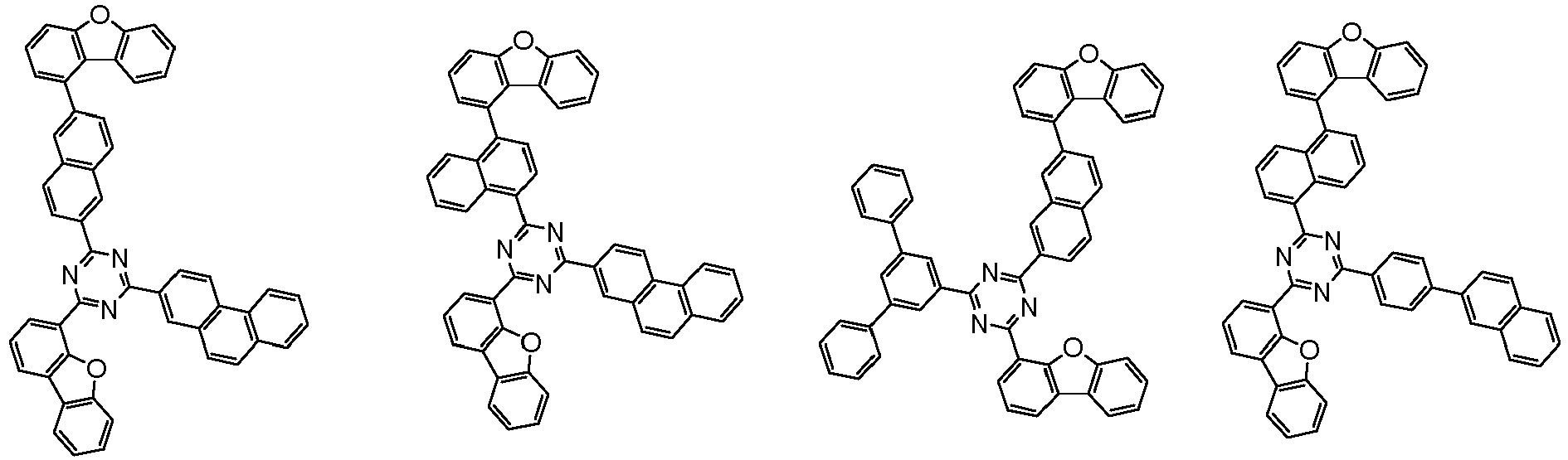


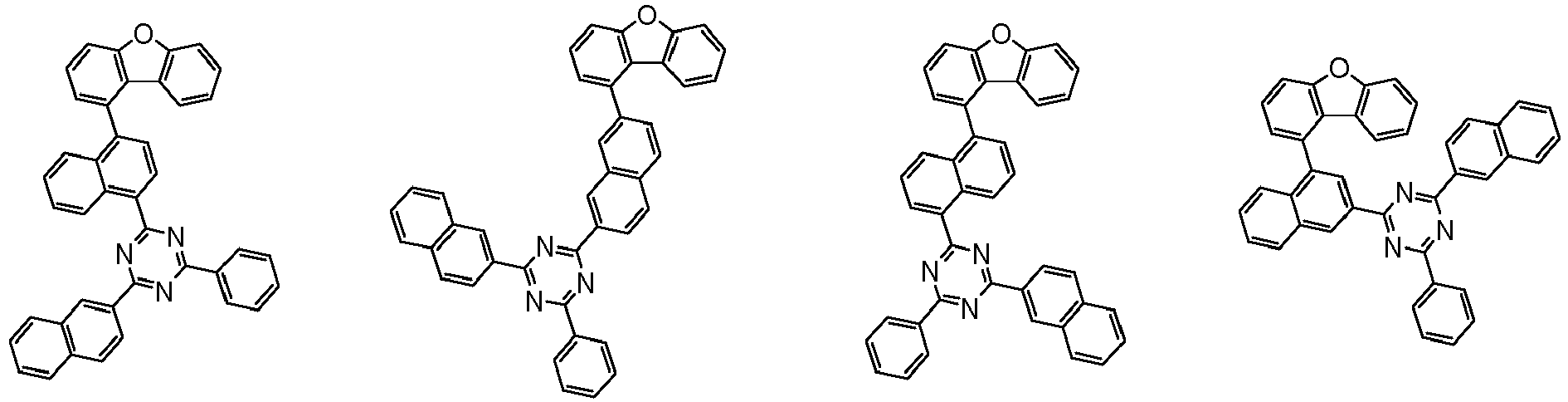


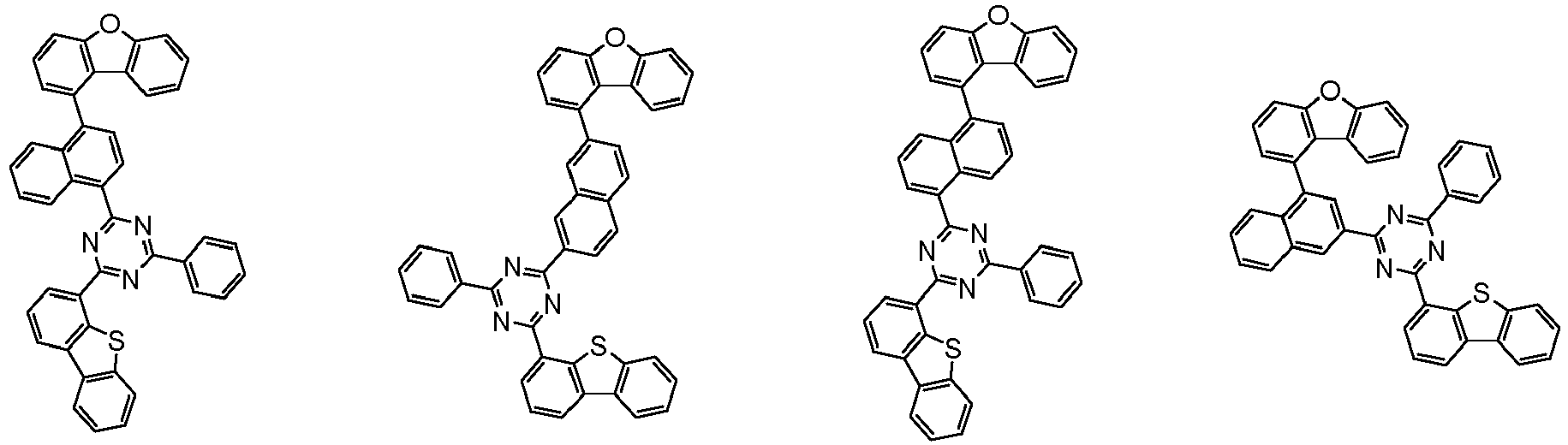


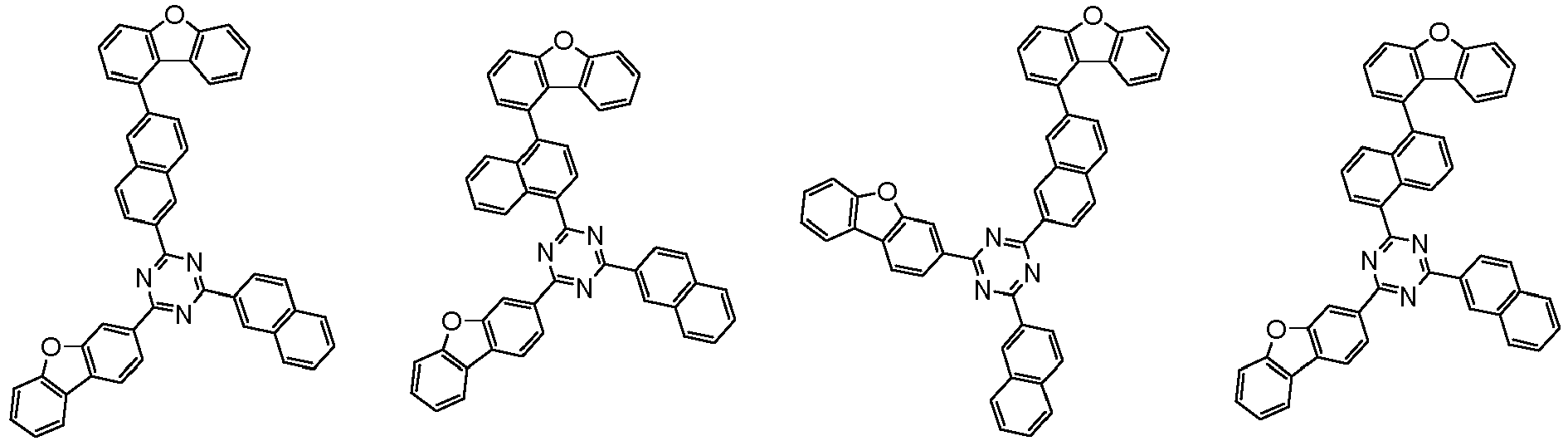


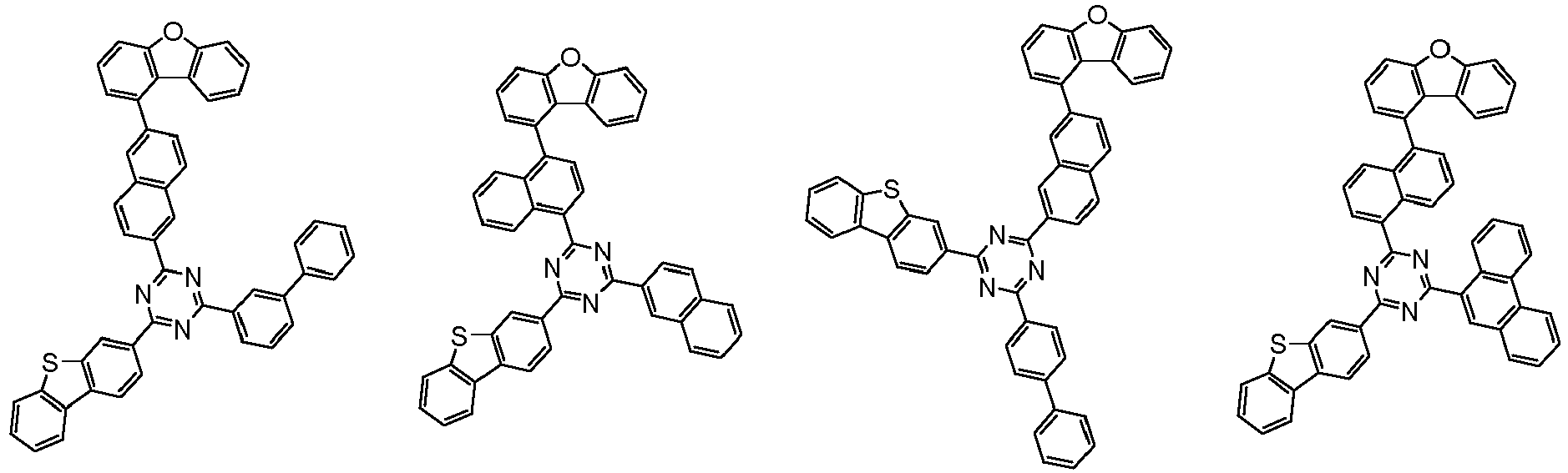


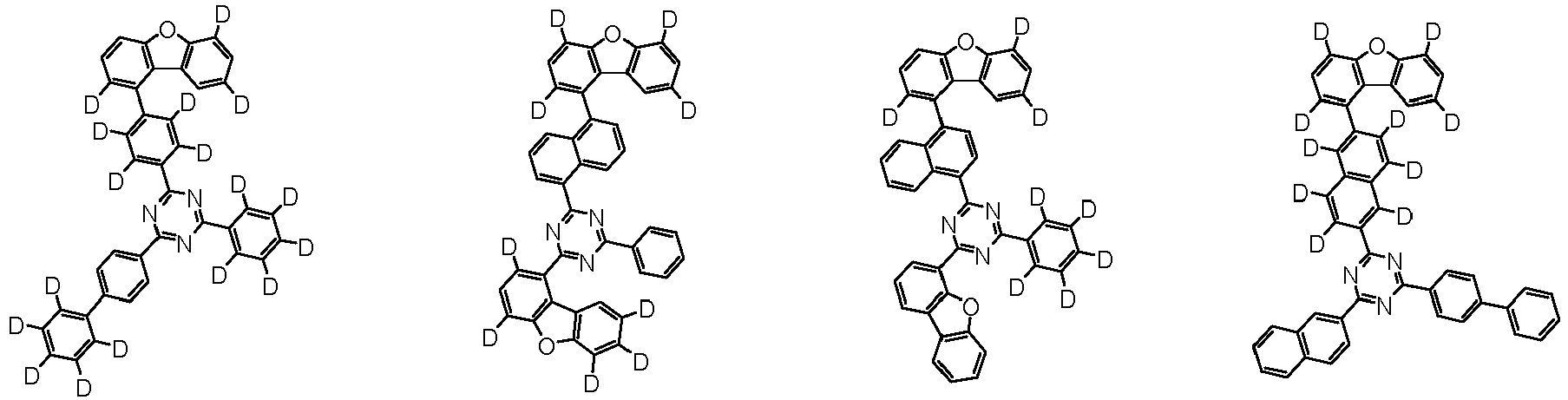


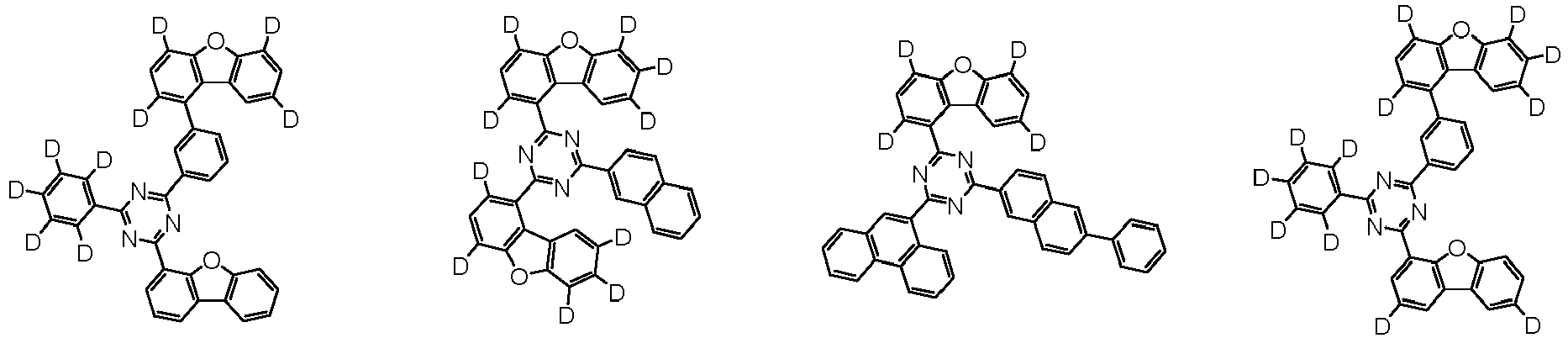


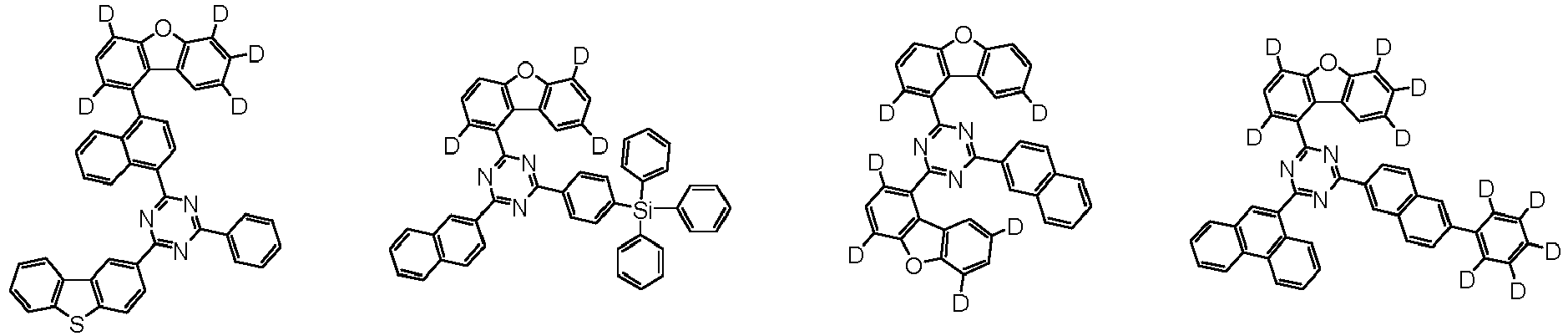


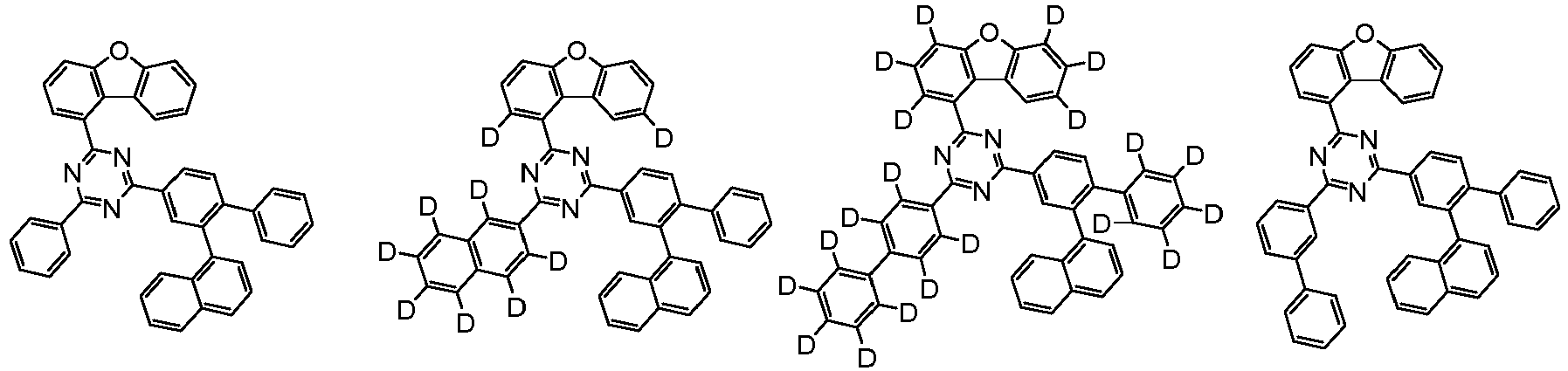








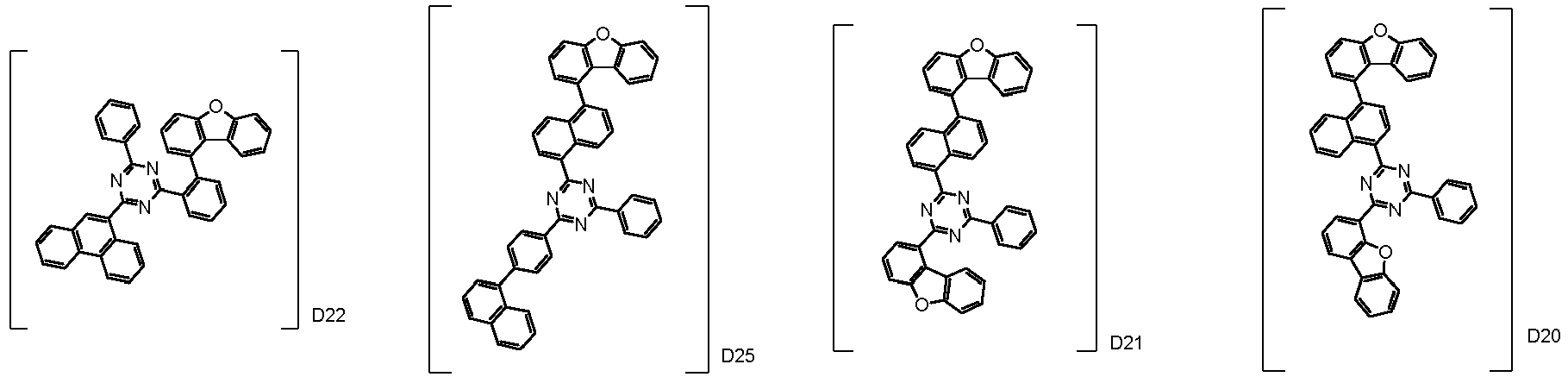


- The organic light emitting device according to claim 1, whereinAr3 and Ar4 are each independently phenyl, triphenylsilyl phenyl, biphenylyl, terphenylyl, naphthyl, phenyl naphthyl, phenanthrenyl, dibenzofuranyl, dibenzothiophenyl, phenyl carbazolyl, or dimethylfluorenyl, andthe hydrogens of the Ar3 and Ar4 are each independently unsubstituted or substituted with deuterium.
- The organic light emitting device according to claim 1, whereinL4 is phenylene, biphenyldiyl, biphenyldiyl substituted with phenyl, or naphthalenediyl, andthe hydrogens of the L4 are each independently unsubstituted or substituted with deuterium.
- The organic light emitting device according to claim 1, whereinL5 and L6 are each independently a single bond, phenylene, biphenyldiyl, naphthalenediyl, or carbazolediyl, andthe hydrogens of the L5 and L6 are each independently unsubstituted or substituted with deuterium.
- The organic light emitting device according to claim 1, wherein
the compound represented by Chemical Formula 2 is any one selected from the group consisting of:
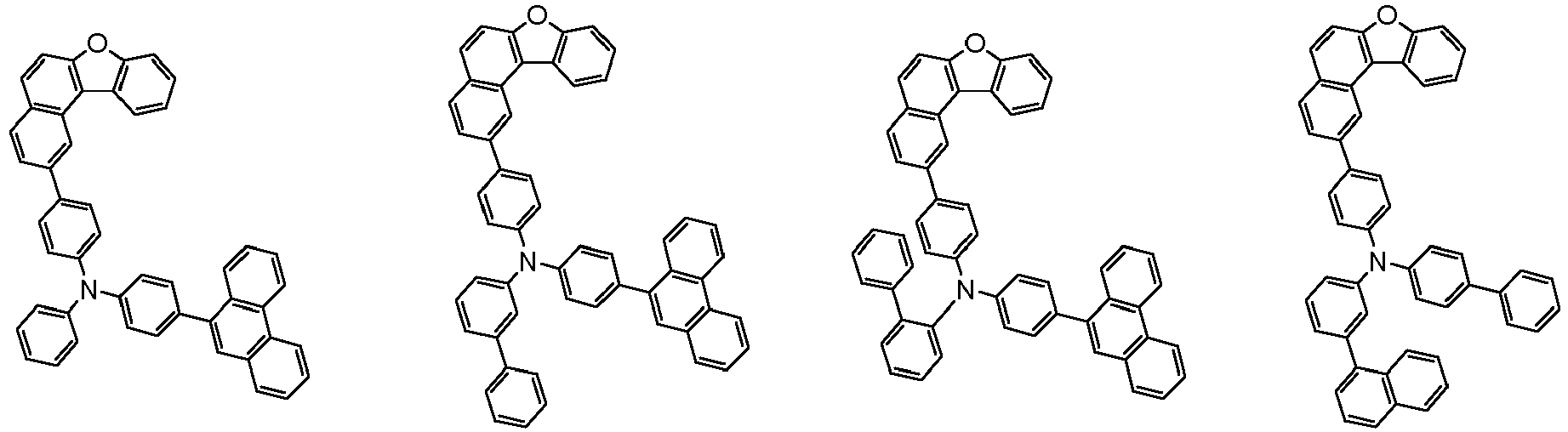


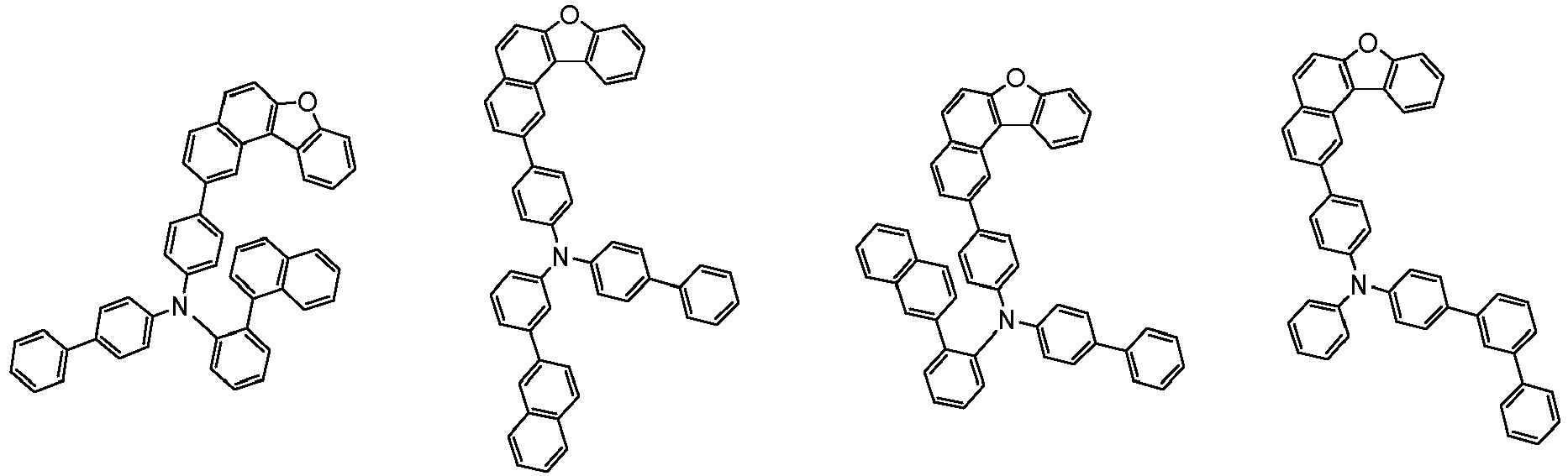


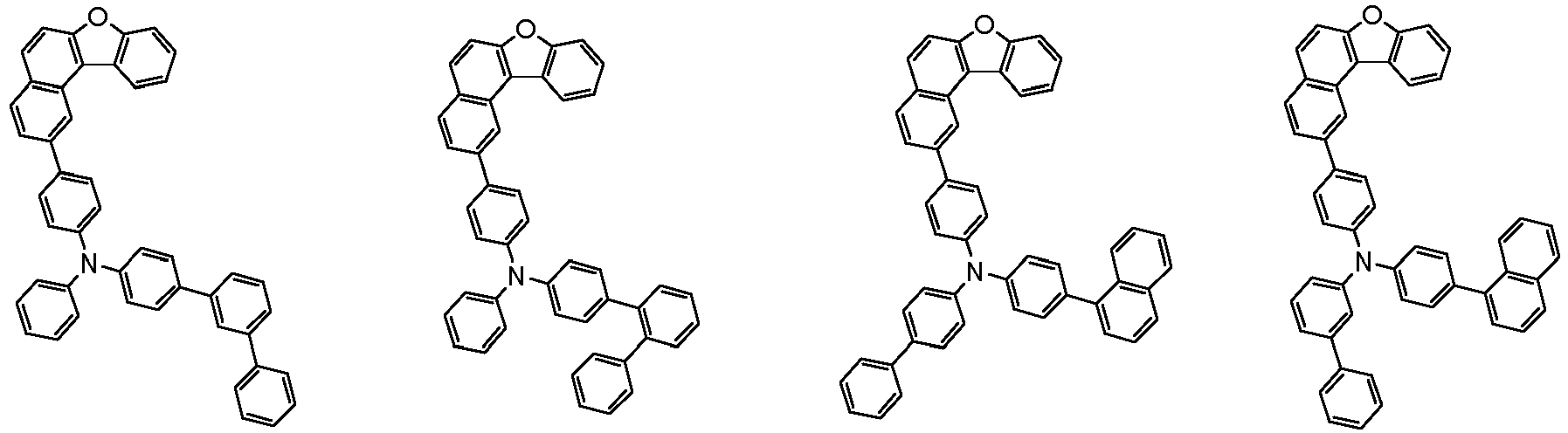


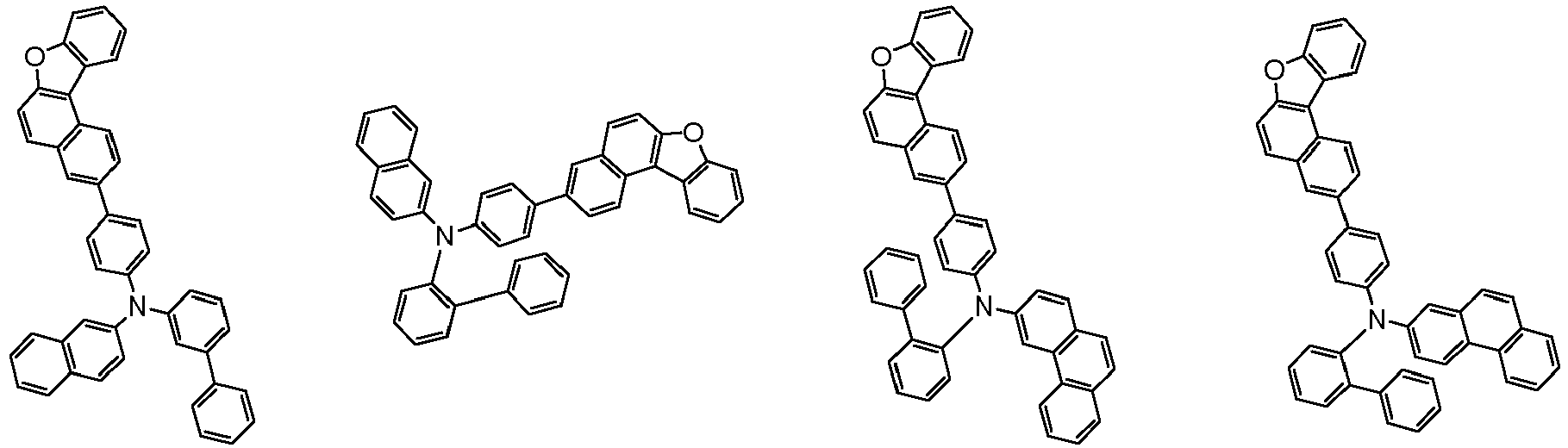


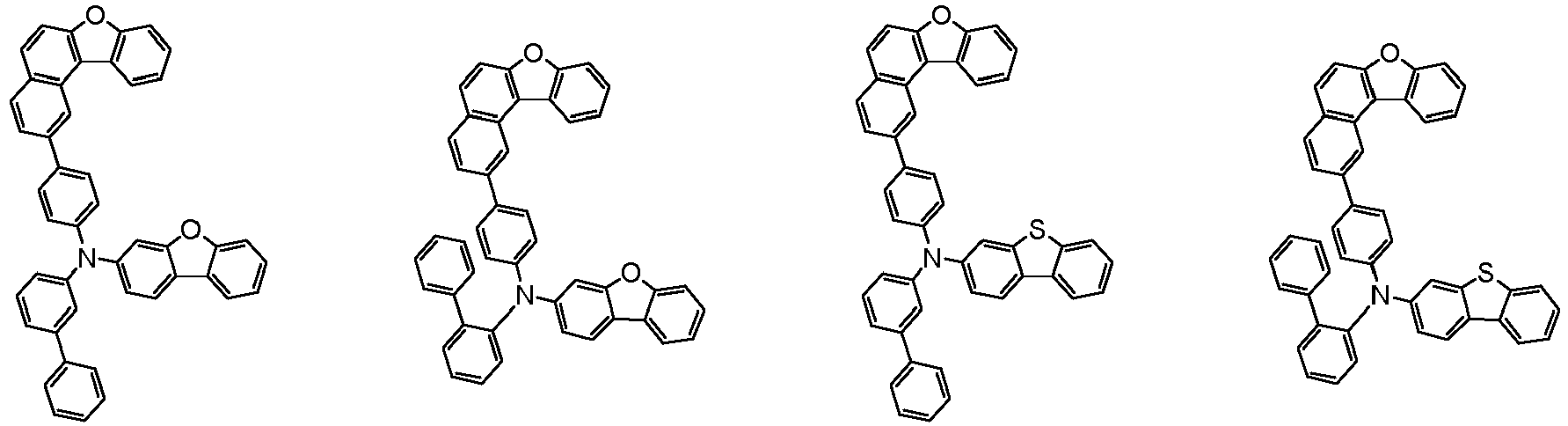


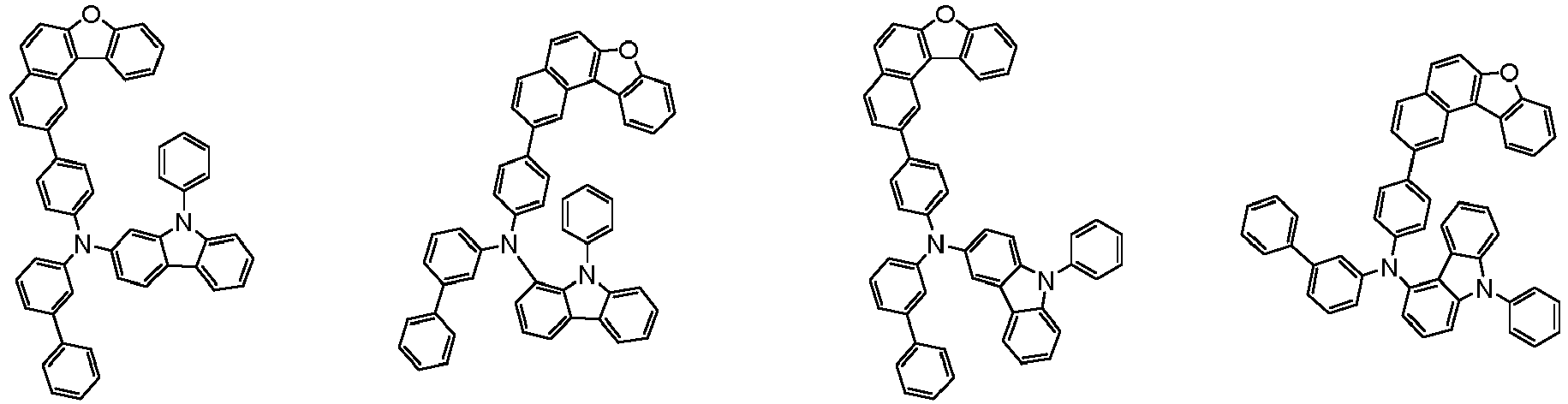


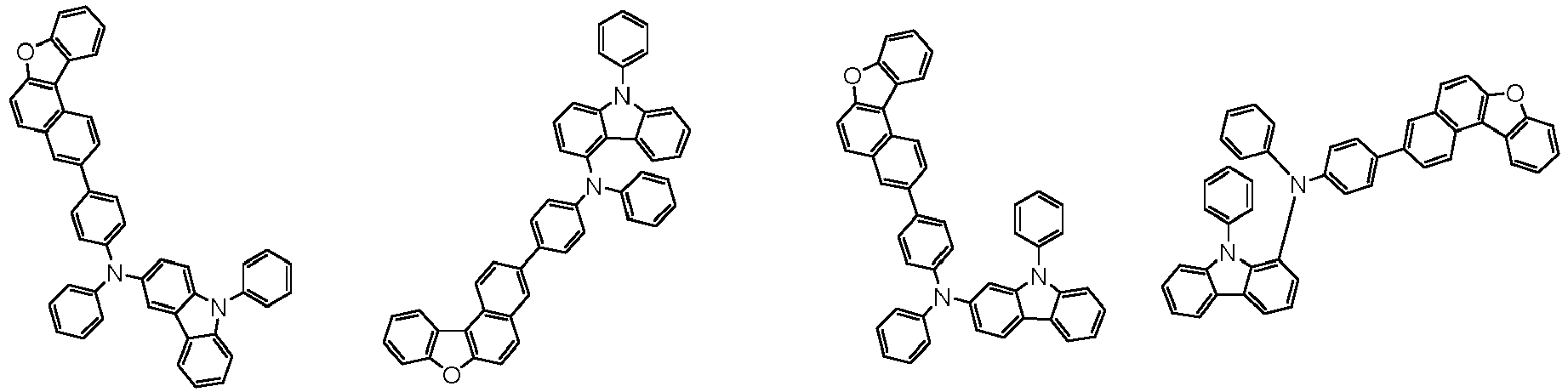


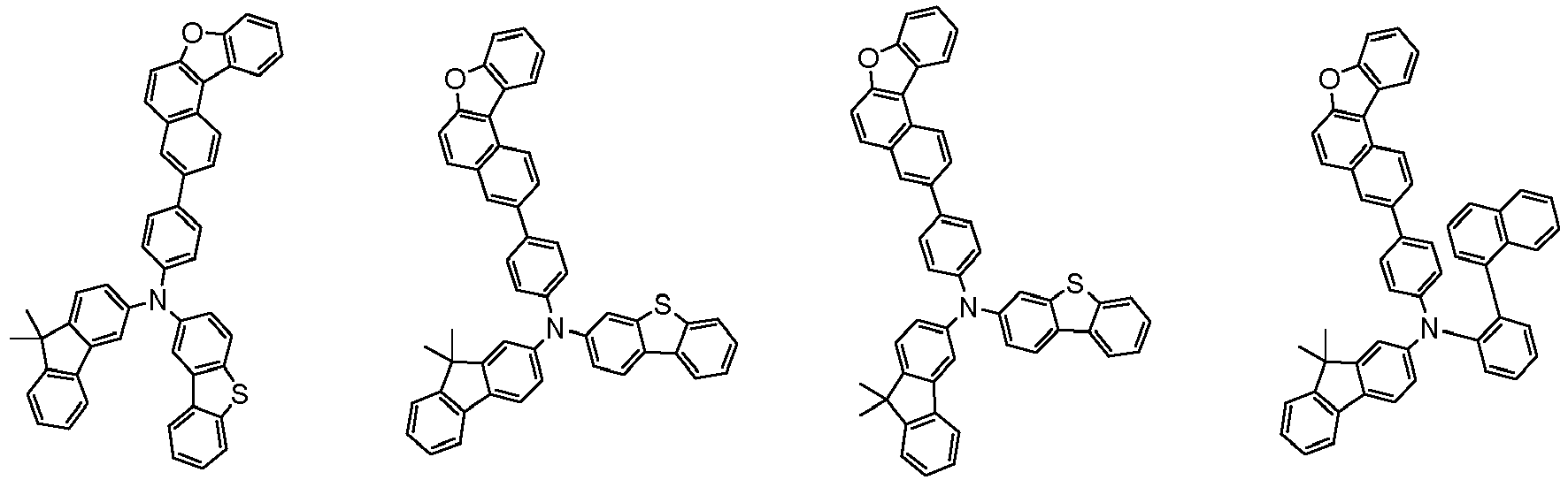


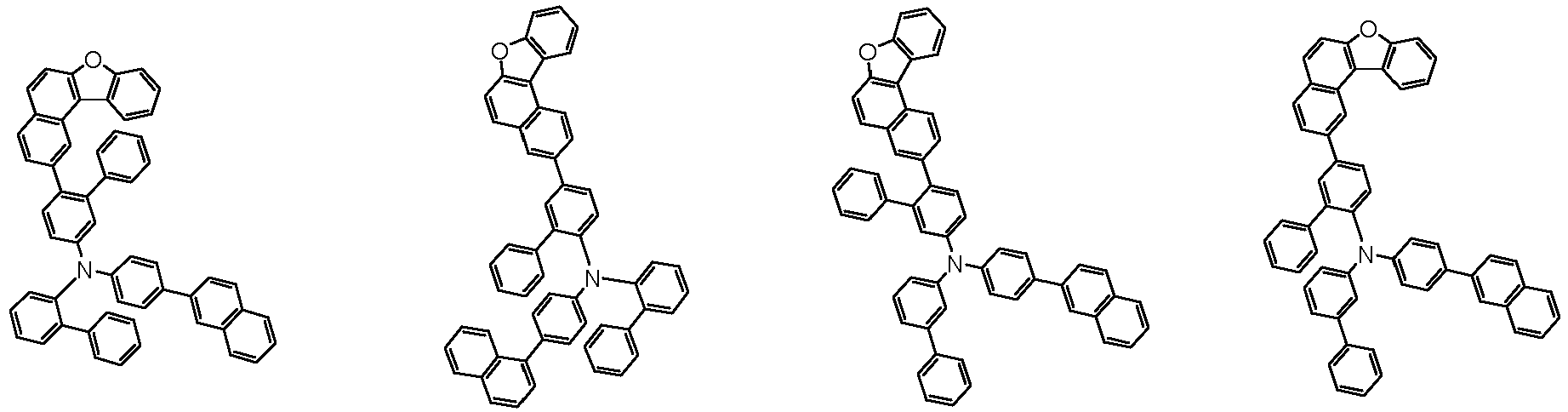


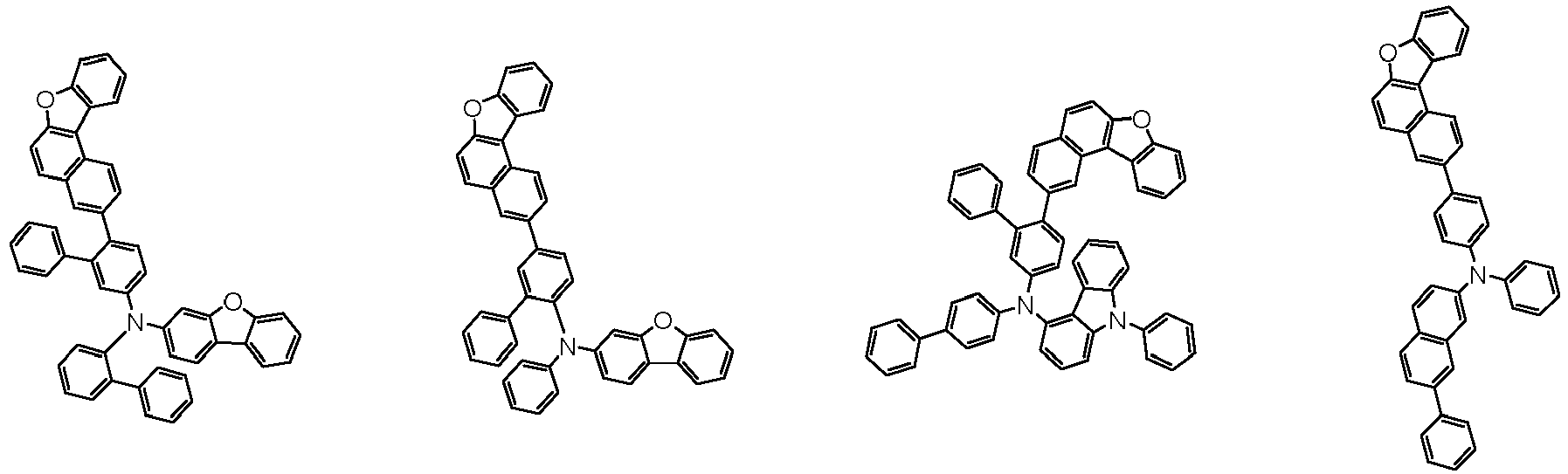
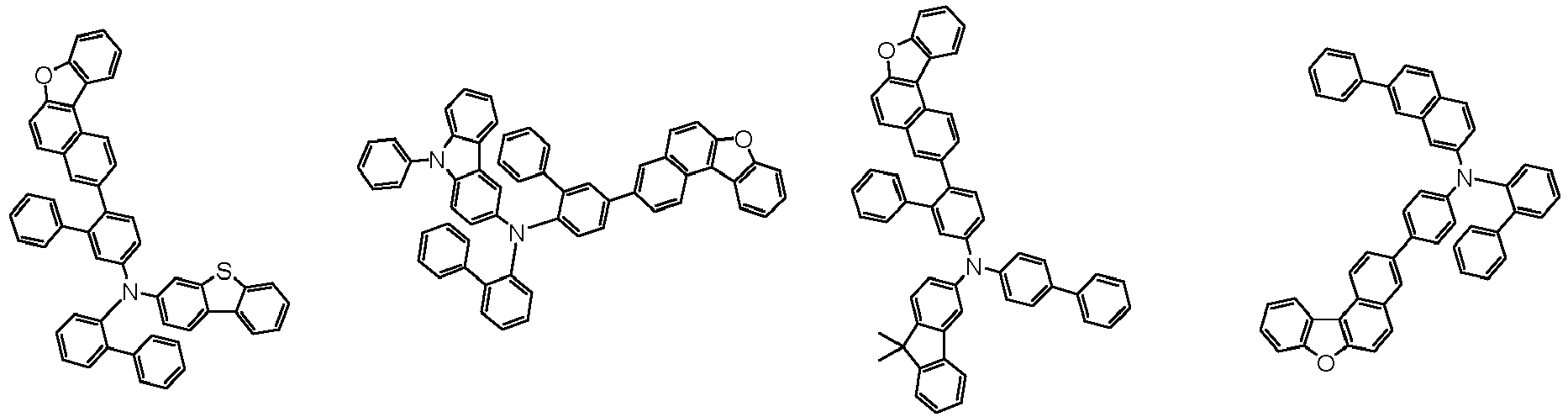


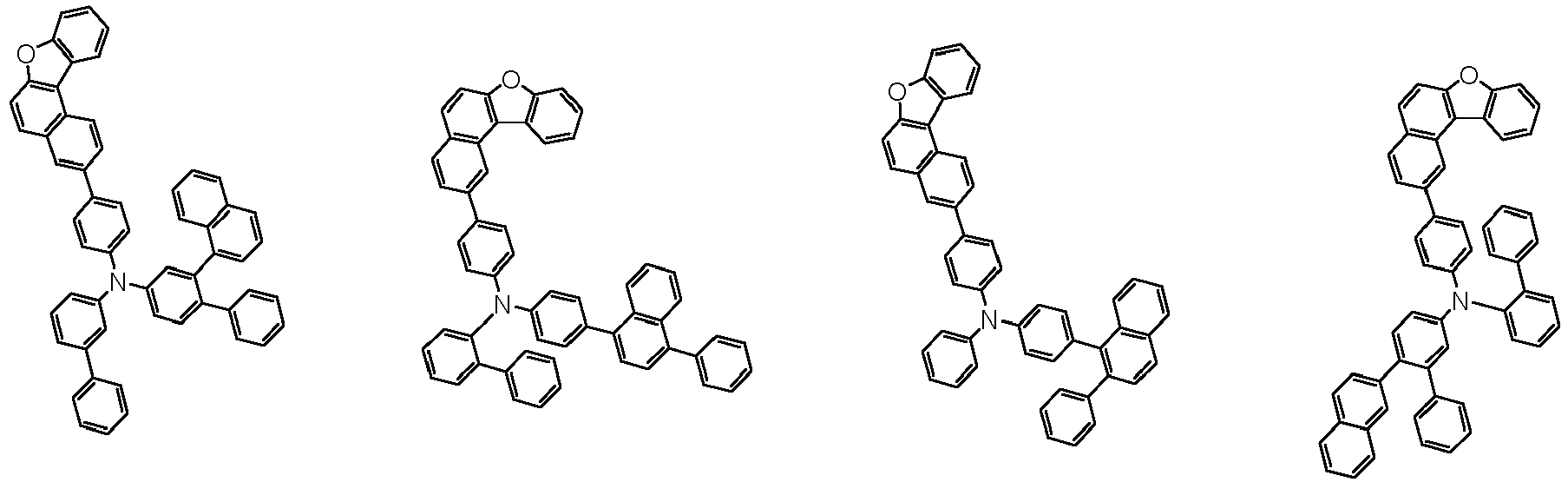


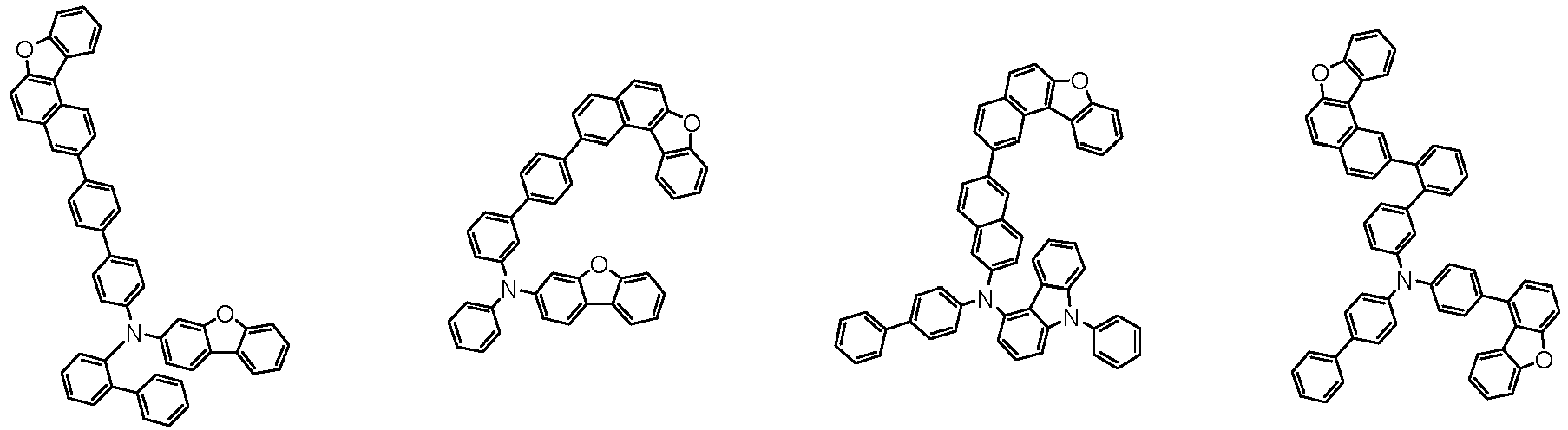


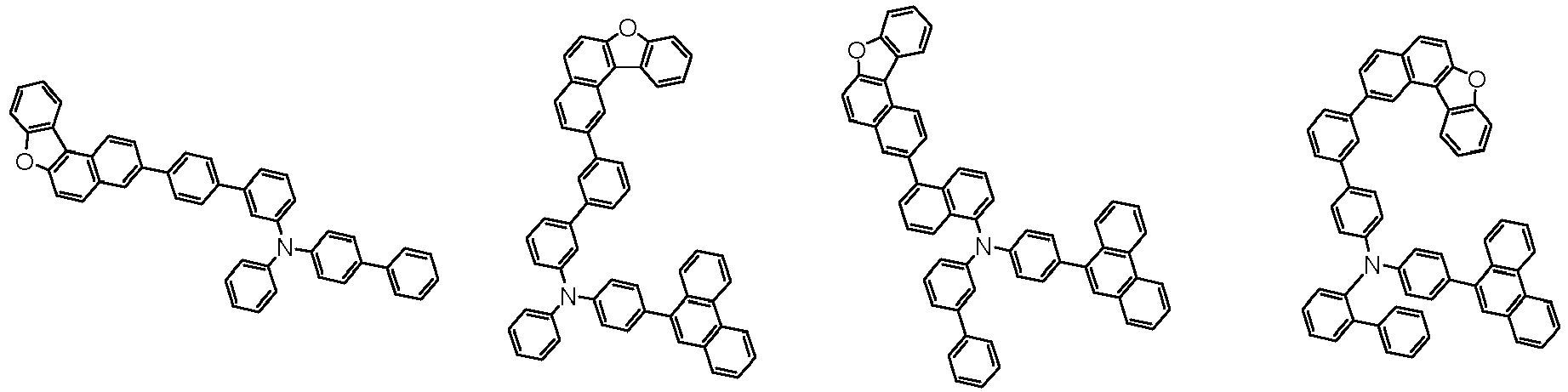

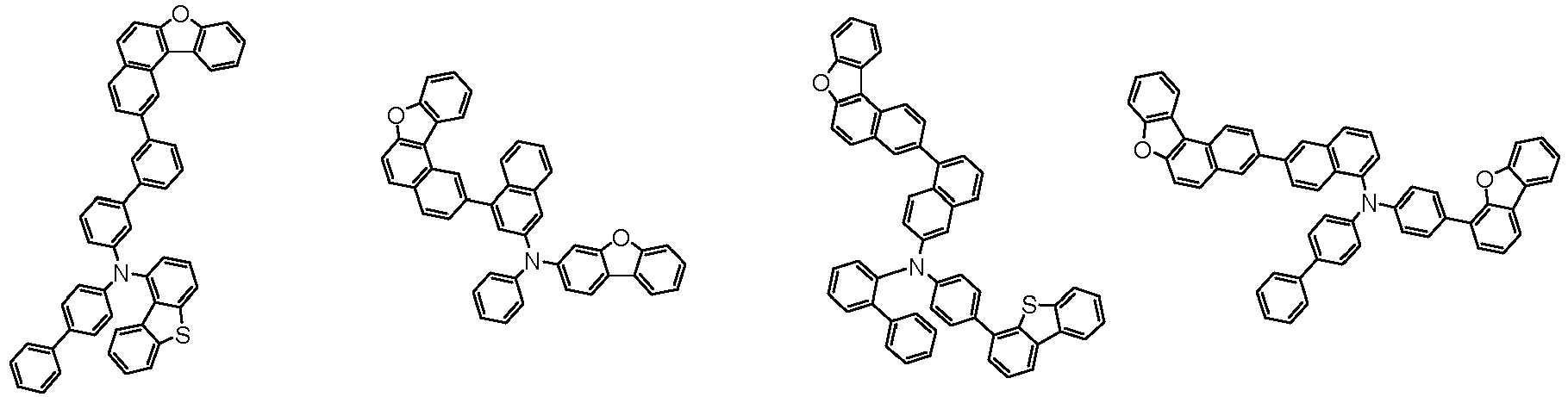


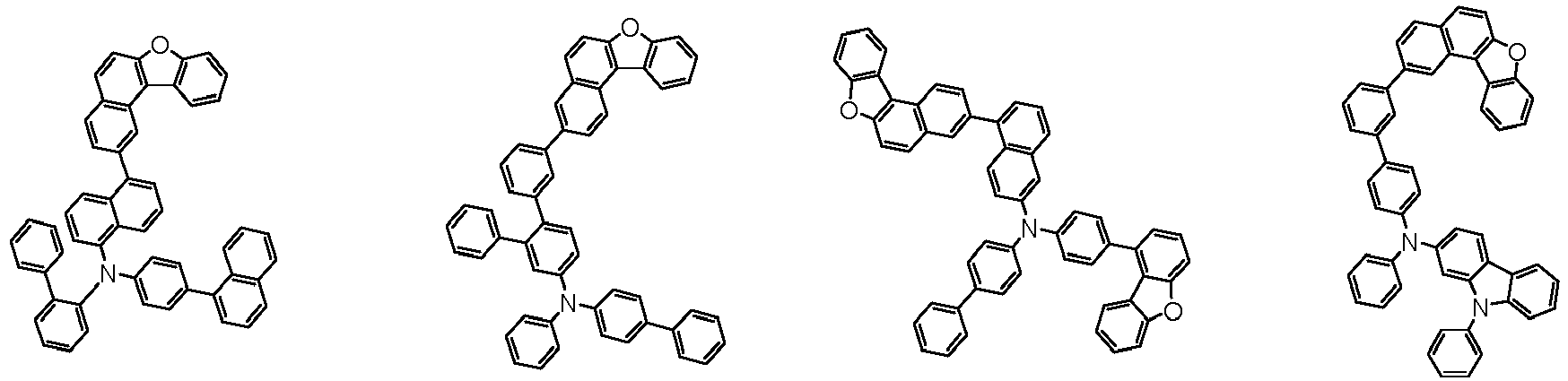


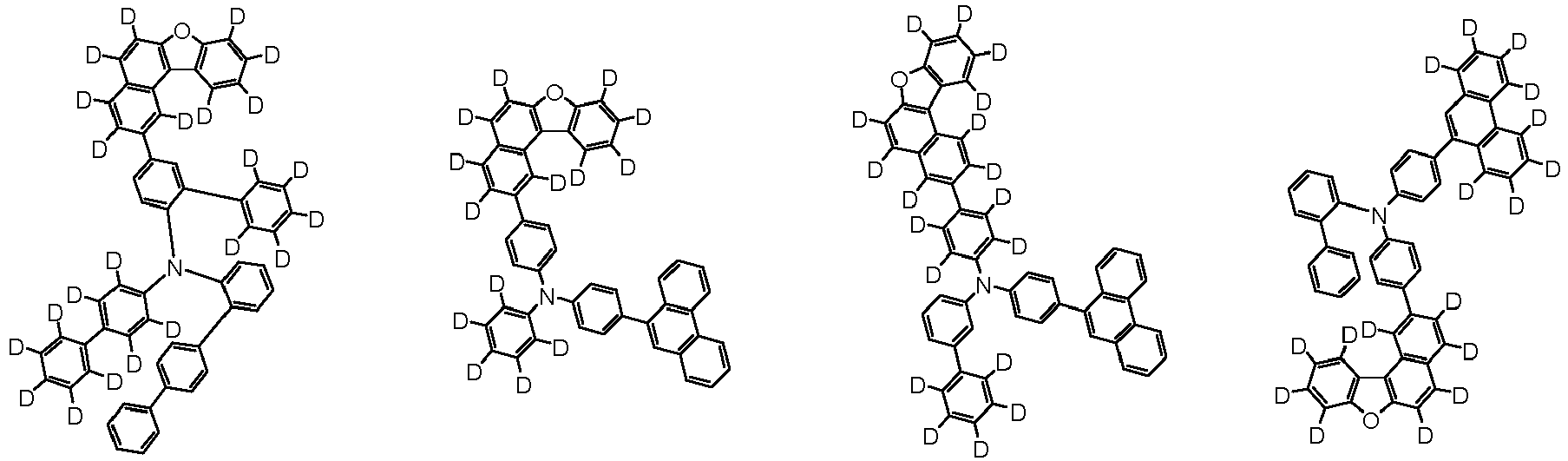


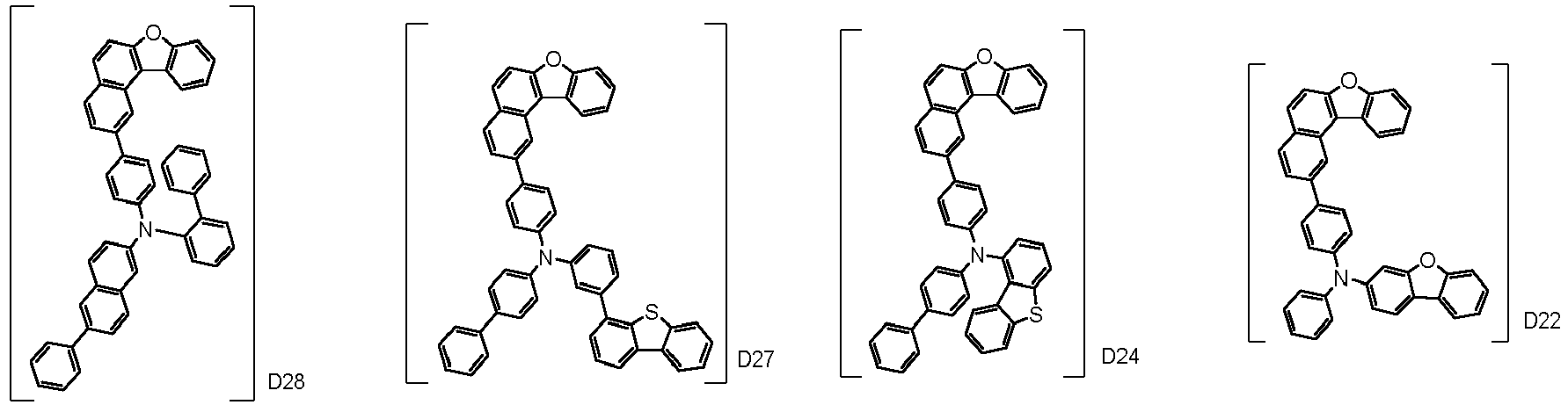


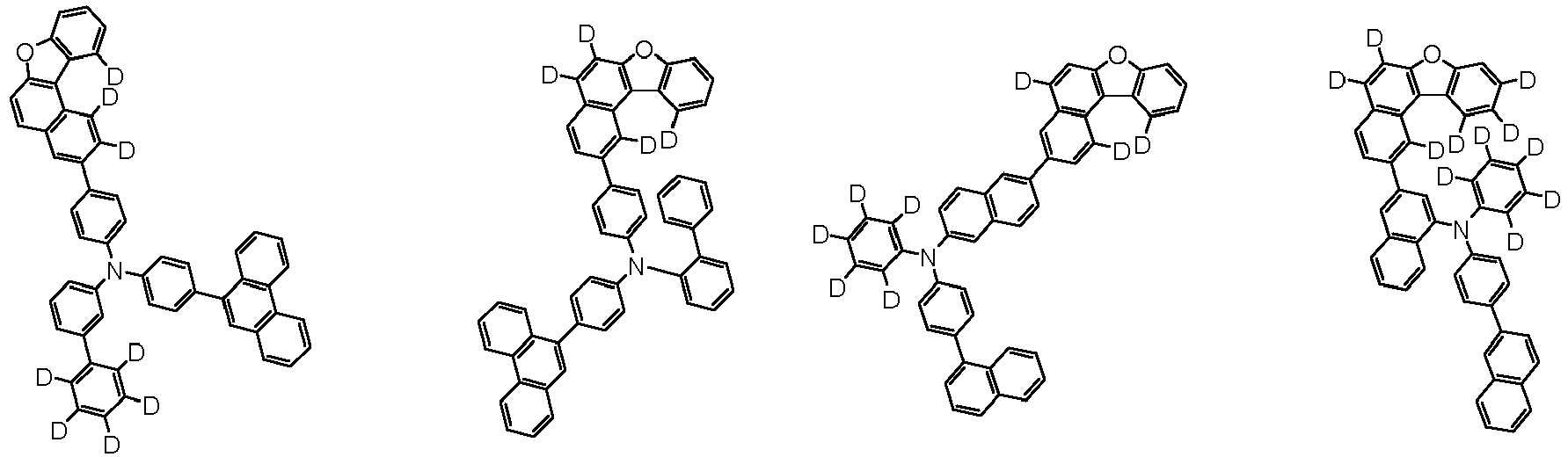


Applications Claiming Priority (2)
| Application Number | Priority Date | Filing Date | Title |
|---|---|---|---|
| KR20210054555 | 2021-04-27 | ||
| PCT/KR2022/006053 WO2022231319A1 (en) | 2021-04-27 | 2022-04-27 | Organic light-emitting device |
Publications (2)
| Publication Number | Publication Date |
|---|---|
| EP4235830A1 true EP4235830A1 (en) | 2023-08-30 |
| EP4235830A4 EP4235830A4 (en) | 2024-08-14 |
Family
ID=84040667
Family Applications (2)
| Application Number | Title | Priority Date | Filing Date |
|---|---|---|---|
| EP22796151.3A Pending EP4235830A4 (en) | 2021-04-27 | 2022-04-27 | Organic light-emitting device |
| EP22796154.7A Pending EP4243102A4 (en) | 2021-04-27 | 2022-04-27 | ORGANIC LIGHT-EMITTING DEVICE |
Family Applications After (1)
| Application Number | Title | Priority Date | Filing Date |
|---|---|---|---|
| EP22796154.7A Pending EP4243102A4 (en) | 2021-04-27 | 2022-04-27 | ORGANIC LIGHT-EMITTING DEVICE |
Country Status (4)
| Country | Link |
|---|---|
| EP (2) | EP4235830A4 (en) |
| KR (2) | KR102623895B1 (en) |
| CN (2) | CN116491244A (en) |
| TW (2) | TWI861493B (en) |
Families Citing this family (9)
| Publication number | Priority date | Publication date | Assignee | Title |
|---|---|---|---|---|
| CN117529478A (en) * | 2022-05-11 | 2024-02-06 | 株式会社Lg化学 | New compounds and organic light-emitting devices containing the same |
| CN117247366A (en) * | 2022-06-07 | 2023-12-19 | 石家庄诚志永华显示材料有限公司 | Organic compound containing naphthobenzofuran structure and organic electroluminescent device containing the same |
| CN120476702A (en) * | 2023-06-08 | 2025-08-12 | 株式会社Lg化学 | organic light-emitting devices |
| KR20250005896A (en) * | 2023-07-03 | 2025-01-10 | 주식회사 엘지화학 | Organic light emitting device |
| CN120827017A (en) * | 2023-07-03 | 2025-10-21 | 株式会社Lg化学 | organic light-emitting devices |
| WO2025013872A1 (en) * | 2023-07-12 | 2025-01-16 | 出光興産株式会社 | Compound, material for organic electroluminescent element, organic electroluminescent element, and electronic device |
| CN117510480B (en) * | 2023-11-01 | 2024-07-23 | 陕西莱特光电材料股份有限公司 | Organic compound, organic electroluminescent device and electronic device |
| KR20250090172A (en) | 2023-12-11 | 2025-06-19 | 듀폰스페셜티머터리얼스코리아 유한회사 | Organic electroluminescent device |
| KR20250135083A (en) | 2024-03-04 | 2025-09-12 | 듀폰스페셜티머터리얼스코리아 유한회사 | Organic electroluminescent device |
Family Cites Families (9)
| Publication number | Priority date | Publication date | Assignee | Title |
|---|---|---|---|---|
| KR100430549B1 (en) | 1999-01-27 | 2004-05-10 | 주식회사 엘지화학 | New organomattalic complex molecule for the fabrication of organic light emitting diodes |
| KR102111829B1 (en) * | 2016-02-17 | 2020-05-15 | 주식회사 엘지화학 | Hetero-cyclic compound and organic light emitting device comprising the same |
| KR101849747B1 (en) * | 2016-07-20 | 2018-05-31 | 주식회사 엘지화학 | Novel hetero-cyclic compound and organic light emitting device comprising the same |
| KR102377225B1 (en) * | 2017-07-13 | 2022-03-22 | 에스에프씨주식회사 | organic light-emitting diode with high efficiency and long lifetime |
| KR102322698B1 (en) * | 2018-06-22 | 2021-11-09 | 엘티소재주식회사 | Heterocyclic compound, organic light emitting device comprising the same, composition for organic layer of organic light emitting device and method for manufacturing organic light emitting device |
| KR102610466B1 (en) * | 2019-02-19 | 2023-12-06 | 주식회사 엘지화학 | Compound and organic light emitting device comprising same |
| KR102729204B1 (en) * | 2019-05-14 | 2024-11-12 | 덕산네오룩스 주식회사 | An organic electronic element comprising compound for organic electronic element and an electronic device thereof |
| KR102729206B1 (en) * | 2019-06-21 | 2024-11-12 | 덕산네오룩스 주식회사 | An organic electronic element comprising compound for organic electronic element and an electronic device thereof |
| CN112430225B (en) * | 2020-10-30 | 2022-05-17 | 陕西莱特光电材料股份有限公司 | Nitrogen-containing compound, electronic component, and electronic device |
-
2022
- 2022-04-27 CN CN202280007358.XA patent/CN116491244A/en active Pending
- 2022-04-27 TW TW111116071A patent/TWI861493B/en active
- 2022-04-27 EP EP22796151.3A patent/EP4235830A4/en active Pending
- 2022-04-27 CN CN202280007379.1A patent/CN116569674A/en active Pending
- 2022-04-27 TW TW111116085A patent/TWI858329B/en active
- 2022-04-27 KR KR1020220052253A patent/KR102623895B1/en active Active
- 2022-04-27 EP EP22796154.7A patent/EP4243102A4/en active Pending
- 2022-04-27 KR KR1020220052257A patent/KR102669564B1/en active Active
Also Published As
| Publication number | Publication date |
|---|---|
| KR20220147537A (en) | 2022-11-03 |
| CN116569674A (en) | 2023-08-08 |
| TW202249275A (en) | 2022-12-16 |
| KR102623895B1 (en) | 2024-01-11 |
| KR102669564B1 (en) | 2024-05-27 |
| TW202302574A (en) | 2023-01-16 |
| KR20220147538A (en) | 2022-11-03 |
| TWI858329B (en) | 2024-10-11 |
| EP4235830A4 (en) | 2024-08-14 |
| EP4243102A4 (en) | 2024-06-12 |
| EP4243102A1 (en) | 2023-09-13 |
| TWI861493B (en) | 2024-11-11 |
| CN116491244A (en) | 2023-07-25 |
Similar Documents
| Publication | Publication Date | Title |
|---|---|---|
| EP3415512B1 (en) | Novel heterocyclic compound and organic light emitting element using same | |
| EP4243102A1 (en) | Organic light-emitting device | |
| EP3972001B1 (en) | Organic light emitting device | |
| KR102753277B1 (en) | Organic light emitting device | |
| EP4235829A1 (en) | Organic light-emitting device | |
| EP3483152A1 (en) | Compound and organic light-emitting device comprising same | |
| EP3730488A1 (en) | Novel heterocyclic compound and organic light emitting device using same | |
| KR102919408B1 (en) | Organic light emitting device | |
| KR20260002408A (en) | Organic light emitting device | |
| KR20230170637A (en) | Organic light emitting device | |
| EP4243100A1 (en) | Organic light-emitting device | |
| EP4258372B1 (en) | Organic light emitting device | |
| EP4289836A1 (en) | Novel compound and organic light-emitting device comprising same | |
| KR102545207B1 (en) | Organic light emitting device | |
| KR102550644B1 (en) | Organic light emitting device | |
| CN114097103A (en) | Organic light emitting device | |
| JP7508742B2 (en) | Organic light-emitting device | |
| EP4335845A1 (en) | Novel compound and organic light emitting device comprising the same | |
| CN116406352B (en) | Compound and organic light-emitting device containing the same | |
| KR20240054192A (en) | Novel compound and organic light emitting device comprising the same | |
| EP4254527A1 (en) | Organic light emitting device | |
| CN113228336A (en) | Organic light emitting device | |
| KR102758601B1 (en) | Organic light emitting device | |
| EP4345099A1 (en) | Novel compound and organic light-emitting device comprising same | |
| KR102645016B1 (en) | Organic light emitting device |
Legal Events
| Date | Code | Title | Description |
|---|---|---|---|
| STAA | Information on the status of an ep patent application or granted ep patent |
Free format text: STATUS: THE INTERNATIONAL PUBLICATION HAS BEEN MADE |
|
| PUAI | Public reference made under article 153(3) epc to a published international application that has entered the european phase |
Free format text: ORIGINAL CODE: 0009012 |
|
| STAA | Information on the status of an ep patent application or granted ep patent |
Free format text: STATUS: REQUEST FOR EXAMINATION WAS MADE |
|
| 17P | Request for examination filed |
Effective date: 20230523 |
|
| AK | Designated contracting states |
Kind code of ref document: A1 Designated state(s): AL AT BE BG CH CY CZ DE DK EE ES FI FR GB GR HR HU IE IS IT LI LT LU LV MC MK MT NL NO PL PT RO RS SE SI SK SM TR |
|
| REG | Reference to a national code |
Ref country code: DE Ref legal event code: R079 Free format text: PREVIOUS MAIN CLASS: H01L0051000000 Ipc: H10K0085600000 |
|
| DAV | Request for validation of the european patent (deleted) | ||
| DAX | Request for extension of the european patent (deleted) | ||
| A4 | Supplementary search report drawn up and despatched |
Effective date: 20240712 |
|
| RIC1 | Information provided on ipc code assigned before grant |
Ipc: H10K 101/00 20230101ALN20240708BHEP Ipc: C09K 11/06 20060101ALI20240708BHEP Ipc: H10K 85/60 20230101AFI20240708BHEP |
|
| STAA | Information on the status of an ep patent application or granted ep patent |
Free format text: STATUS: EXAMINATION IS IN PROGRESS |
|
| 17Q | First examination report despatched |
Effective date: 20250702 |