EP4235206A1 - Apparatus comprising at least one processor - Google Patents
Apparatus comprising at least one processor Download PDFInfo
- Publication number
- EP4235206A1 EP4235206A1 EP23153675.6A EP23153675A EP4235206A1 EP 4235206 A1 EP4235206 A1 EP 4235206A1 EP 23153675 A EP23153675 A EP 23153675A EP 4235206 A1 EP4235206 A1 EP 4235206A1
- Authority
- EP
- European Patent Office
- Prior art keywords
- rdk
- tdk
- receiver
- transmitter
- position estimates
- Prior art date
- Legal status (The legal status is an assumption and is not a legal conclusion. Google has not performed a legal analysis and makes no representation as to the accuracy of the status listed.)
- Granted
Links
Images



Classifications
-
- G—PHYSICS
- G01—MEASURING; TESTING
- G01S—RADIO DIRECTION-FINDING; RADIO NAVIGATION; DETERMINING DISTANCE OR VELOCITY BY USE OF RADIO WAVES; LOCATING OR PRESENCE-DETECTING BY USE OF THE REFLECTION OR RERADIATION OF RADIO WAVES; ANALOGOUS ARRANGEMENTS USING OTHER WAVES
- G01S5/00—Position-fixing by co-ordinating two or more direction or position line determinations; Position-fixing by co-ordinating two or more distance determinations
- G01S5/02—Position-fixing by co-ordinating two or more direction or position line determinations; Position-fixing by co-ordinating two or more distance determinations using radio waves
- G01S5/0205—Details
- G01S5/0244—Accuracy or reliability of position solution or of measurements contributing thereto
-
- H—ELECTRICITY
- H04—ELECTRIC COMMUNICATION TECHNIQUE
- H04W—WIRELESS COMMUNICATION NETWORKS
- H04W64/00—Locating users or terminals or network equipment for network management purposes, e.g. mobility management
-
- G—PHYSICS
- G01—MEASURING; TESTING
- G01S—RADIO DIRECTION-FINDING; RADIO NAVIGATION; DETERMINING DISTANCE OR VELOCITY BY USE OF RADIO WAVES; LOCATING OR PRESENCE-DETECTING BY USE OF THE REFLECTION OR RERADIATION OF RADIO WAVES; ANALOGOUS ARRANGEMENTS USING OTHER WAVES
- G01S5/00—Position-fixing by co-ordinating two or more direction or position line determinations; Position-fixing by co-ordinating two or more distance determinations
- G01S5/02—Position-fixing by co-ordinating two or more direction or position line determinations; Position-fixing by co-ordinating two or more distance determinations using radio waves
- G01S5/06—Position of source determined by co-ordinating a plurality of position lines defined by path-difference measurements
-
- G—PHYSICS
- G01—MEASURING; TESTING
- G01S—RADIO DIRECTION-FINDING; RADIO NAVIGATION; DETERMINING DISTANCE OR VELOCITY BY USE OF RADIO WAVES; LOCATING OR PRESENCE-DETECTING BY USE OF THE REFLECTION OR RERADIATION OF RADIO WAVES; ANALOGOUS ARRANGEMENTS USING OTHER WAVES
- G01S5/00—Position-fixing by co-ordinating two or more direction or position line determinations; Position-fixing by co-ordinating two or more distance determinations
- G01S5/02—Position-fixing by co-ordinating two or more direction or position line determinations; Position-fixing by co-ordinating two or more distance determinations using radio waves
- G01S5/10—Position of receiver fixed by co-ordinating a plurality of position lines defined by path-difference measurements, e.g. omega or decca systems
-
- H—ELECTRICITY
- H04—ELECTRIC COMMUNICATION TECHNIQUE
- H04W—WIRELESS COMMUNICATION NETWORKS
- H04W4/00—Services specially adapted for wireless communication networks; Facilities therefor
- H04W4/02—Services making use of location information
- H04W4/025—Services making use of location information using location based information parameters
-
- G—PHYSICS
- G01—MEASURING; TESTING
- G01S—RADIO DIRECTION-FINDING; RADIO NAVIGATION; DETERMINING DISTANCE OR VELOCITY BY USE OF RADIO WAVES; LOCATING OR PRESENCE-DETECTING BY USE OF THE REFLECTION OR RERADIATION OF RADIO WAVES; ANALOGOUS ARRANGEMENTS USING OTHER WAVES
- G01S5/00—Position-fixing by co-ordinating two or more direction or position line determinations; Position-fixing by co-ordinating two or more distance determinations
- G01S5/02—Position-fixing by co-ordinating two or more direction or position line determinations; Position-fixing by co-ordinating two or more distance determinations using radio waves
- G01S5/0205—Details
- G01S5/021—Calibration, monitoring or correction
Definitions
- Various example embodiments relate to an apparatus comprising at least one processor.
- Location information for example associated with a mobile device such as a mobile terminal device, e.g. user equipment (UE), for a communications system, can be used for applications such as e.g. navigation, asset tracking, industrial automation, healthcare, etc.
- UE user equipment
- TDoA time of arrival
- TDoA time difference of arrival
- Some embodiments relate to an apparatus, comprising at least one processor, and at least one memory storing instructions, the at least one memory and the instructions configured to, with the at least one processor, cause the apparatus at least to determine a set of position estimates for a mobile device, wherein each position estimate of the set of position estimates is associated with a a) specific one of a plurality of K many receiver devices configured to receive a reference signal from the mobile device or b) a specific one of a plurality of K many transmitter devices configured to transmit reference signals to the mobile device, and to determine, based at least on the set of position estimates, a set of residual errors associated with at least some position estimates of the set of position estimates. In some embodiments, this enables to determine a position of the mobile device, and/or to assess a quality of the position estimates.
- an uplink TDoA (“UTDoA”) configuration is e.g. characterized by the position estimates of the set of position estimates being associated with a specific one of a plurality of K many receiver devices configured to receive a reference signal from the mobile device.
- a downlink TDoA (“DTDoA”) configuration is e.g. characterized by the position estimates of the set of position estimates being associated with a specific one of a plurality of K many transmitter devices configured to, for example simultaneously, transmit reference signals, e.g. positioning reference signals, to the mobile device.
- DTDoA downlink TDoA
- the number K of receiver devices is equal to or greater than 2.
- the number K of transmitter devices is equal to or greater than 2.
- both an uplink TDoA and a downlink TDoA configuration may be used.
- the mobile device is a terminal device, for example UE, for a, for example cellular, communications network of e.g. the 5G and/or 6G type.
- At least some of the K many receiver devices are location measurement units, LMUs, which are configured to receive at least one reference signal of the mobile device, e.g. a sounding reference signal (SRS) of a 5G network.
- the receiver devices are not equipped with a transmitter, but rather only a receiver for receiving the reference signal(s), e.g. of a mobile device a position of which is to be determined.
- At least some of the K many receiver devices can be implemented in the form of, comparatively inexpensive, reduced-functionality 5G sniffers, configured to sense or receive, respectively, the reference signal(s) transmitted by a mobile device a position of which is to be determined.
- At least some of the K many transmitter devices are reference signal transmission units, which are configured to transmit at least one reference signal, e.g. a positioning reference signal, e.g. of a 5G network, to the mobile device.
- the transmitter devices are not equipped with a receiver, but rather only a transmitter for transmitting the reference signals to a mobile device a position of which is to be determined.
- At least some of the K many transmitter devices can be implemented in the form of, comparatively inexpensive, reduced-functionality 5G transmitters, e.g. configured to transmit the reference signals, e.g. positioning reference signals (PRS), to a mobile device a position of which is to be determined.
- the reference signals e.g. positioning reference signals (PRS)
- At least some of the K many receiver devices can be tightly synchronized, for example to enable TDoA positioning.
- At least some of the K many transmitter devices can be tightly synchronized, for example to enable TDoA positioning.
- At least some of the K many receiver devices can be configured to transmit received reference signals and/or signals derived from received reference signals to the apparatus according to the embodiments, e.g. for evaluation, e.g. according to the principle of the embodiments.
- signals e.g. positioning signals, received from the plurality of e.g. K many transmitter devices, and/or signals derived from the received (positioning) reference signals may be evaluated, e.g. according to the principle of the embodiments.
- the instructions when executed by the at least one processor, cause the apparatus to determine updated weights for weighting the set of position estimates based on the set of residual errors. In some embodiments, this enables to attain more precise position estimates.
- the instructions when executed by the at least one processor, cause the apparatus to determine an updated set of position estimates based on the updated weights.
- the instructions when executed by the at least one processor, cause the apparatus to determine whether at least one termination criterion is met, and, based on the determination whether the at least one termination criterion is met, to repeat at least one of the preceding steps.
- this enables to provide an iterative procedure which enables to iteratively refine position estimates associated with the mobile device.
- the at least one termination criterion may e.g. comprise a maximum number of iterations.
- the at least one termination criterion may be based on a position mismatch characterizing a difference between a current position estimate and a position estimate of a previous iteration falling below a predetermined threshold.
- the instructions when executed by the at least one processor, cause the apparatus to determine estimated distances associated with the plurality of receiver devices.
- the instructions when executed by the at least one processor, cause the apparatus to determine estimated distances associated with the plurality of transmitter devices.
- a distance estimate associated with the k-th receiver device may be denoted as d ⁇ k .
- a reference receiver device may be defined.
- the instructions when executed by the at least one processor, cause the apparatus to determine initial weights (e.g., one or more initial weights) for weighting the set of position estimates associated with at least one of the plurality of receiver devices.
- the instructions when executed by the at least one processor, cause the apparatus to determine the initial weights based on at least one of: i) a reliability of estimated distances associated with a) the plurality of receiver devices or with b) the plurality of transmitter devices, ii) predetermined initial weight values.
- the reliability of the estimated distances associated with the plurality of receiver devices can e.g. be determined based on knowledge about a received signal strength, RSS, since, in some embodiments, multipath reflections tend to be weaker than a direct (line-of-sight) path.
- measurements e.g. distance estimates, whose signal strengths are low, e.g. fall below a predetermined RSS threshold
- measurements may be downweighted, e.g. weighted with comparatively small weight factors
- measurements e.g. distance estimates, whose signal strengths are high, e.g. exceed the RSS threshold, may receive more emphasis by using larger weight factors.
- unit initial weights may be used for at least some, for example all, receiver devices (or transmitter devices, e.g. in case of a downlink TDoA configuration).
- the instructions when executed by the at least one processor, cause the apparatus to determine K many position estimates x ⁇ 1 ,x ⁇ 2 ,...,x ⁇ K , and to determine a weighted average position estimate x ⁇ WA based on the K many position estimates x ⁇ 1 ,x ⁇ 2 ,...,x ⁇ K , and on at least one of initial weights and updated weights for weighting the set of position estimates.
- another receiver device of the K many receiver devices or transmitter device of the K many transmitter devices may be used as reference receiver device or reference transmitter device.
- a unique reference receiver device or reference transmitter device which may e.g. be the one that is, for example, a-priori considered the most reliable one (e.g., always the one with the lowest distance estimate) before computing x ⁇
- a measure of a reliability of the position estimates of at least some, for example all, receiver device or transmitter device is provided.
- the measure of reliability indicates to which extent the respective estimate can be "trusted”.
- the instructions when executed by the at least one processor, cause the apparatus to determine whether a residual error of a position estimate associated with a k-th receiver device or transmitter device exceeds a threshold, and, if the residual error of the position estimate associated with a k-th receiver device or transmitter device exceeds the threshold, to discard the k-th receiver device or transmitter device.
- discarding the k-th receiver device or transmitter device comprises disregarding signals or measurements provided by the k-th receiver device or transmitter device, e.g. for determining position estimates.
- the residual error as exemplarily characterized by equations 9, 9' represents an averaged deviation between estimated distance differences of K - 1 many receiver devices or transmitter devices and a reference receiver device or a reference transmitter device, and actual distance differences (i.e., w.r.t. a current estimate x ⁇ WA ) of the K - 1 receiver devices or transmitter devices and the reference receiver device or the reference transmitter device.
- the residual error may be interpreted as a measure of how much the measured distance differences agree, e.g. correlate, with a current position estimate x ⁇ WA or - to put it another way - with the distance differences that would result if the mobile device, e.g. UE, were located at a position characterized by x ⁇ WA .
- the proposed approach according to the embodiments enables to avoid the choice of a "bad" reference receiver device, wherein e.g. an outlier measurement, which is e.g. associated with a reference receiver device, may severely affect all distance differences e.g. according to equation 1, which, in some embodiments, may e.g. be used to determine a final, e.g. WLS-based, position estimate.
- a "bad" reference receiver device wherein e.g. an outlier measurement, which is e.g. associated with a reference receiver device, may severely affect all distance differences e.g. according to equation 1, which, in some embodiments, may e.g. be used to determine a final, e.g. WLS-based, position estimate.
- an associated residual error will have a comparatively high value, allowing the detection of receiver devices or transmitter devices with e.g. unreliable measurements, and, in some embodiments, downweighting their contribution, e.g. in equation 8, e.g. according to a magnitude of the residual error they produce.
- a function of the following types may be used: Andrew's sine wave, Huber loss, etc.
- the corresponding weight may be set to zero, e.g. such that the measurement - and thus also the receiver device, in some embodiments - is discarded.
- this is also applicable to exemplary DTDoA configurations, wherein, if the residual error e k associated with a specific transmitter device exceeds a pre-defined maximum value, the corresponding weight may be set to zero, e.g. such that the measurement - and thus also the transmitter device, in some embodiments - is discarded.
- the above-described procedure may be iterated, yielding a robust iteratively reweighted least squares (IRLS) estimator that can e.g. detect and/or reject receiver devices or transmitter device with outlier measurements and/or that can find weights for the remaining receiver devices or transmitter devices or their measurements, respectively, e.g. based on their residual errors.
- IRLS iteratively reweighted least squares
- the difference ⁇ may e.g. be compared to a pre-defined threshold ⁇ , e.g. to check convergence.
- a termination criterion may be set, e.g. to stop the process, preventing further iterations to be made.
- FIG. 1A Some embodiments, see for example Fig. 1A , relate to an apparatus 100, comprising at least one processor 102, and at least one memory 104 storing instructions 106, the at least one memory 104 and the instructions 106 configured to, with the at least one processor 102, cause the apparatus 100 at least to determine 202 ( Fig. 3 ) a set of position estimates SET-POS-EST for a mobile device UE ( Fig. 2A ), wherein each position estimate of the set SET-POS-EST of position estimates is associated with a) a specific one of a plurality of K many receiver devices RD1, RD2, ..., RDk, ..., RDK ( Fig.
- a reference signal RS from the mobile device UE (e.g., in case of exemplary UTDoA configurations as exemplarily depicted by Fig. 2A ) or b) a specific one of a plurality of K many transmitter devices TD1, TD2, ..., TDk, ..., TDK ( Fig. 2B ) configured to transmit reference signals RS' to the mobile device UE (e.g., in case of exemplary DTDoA configurations as exemplarily depicted by Fig. 2B ), and to determine 204 ( Fig. 3 ), based at least on the set SET-POS-EST of position estimates, a set SET-RESID-ERR of residual errors associated with at least some position estimates of the set SET-POS-EST of position estimates.
- this enables to determine a position of the mobile device UE, and/or to assess a quality of the position estimates.
- the mobile device UE, UE' is a terminal device, for example user equipment (UE), for a, for example cellular, communications network of e.g. the 5G and/or 6G type.
- UE user equipment
- At least some of the K many receiver devices RD1, RD2, ..., RDk, ..., RDK are location measurement units, LMU, which are configured to receive at least one reference signal RS of the mobile device, e.g. a sounding reference signal (SRS) of a 5G network.
- the receiver devices RD1, RD2, ..., RDk, ..., RDK are not equipped with a transmitter, but rather only a receiver (not shown) for receiving the reference signal(s) RS, e.g. of a mobile device UE a position of which is to be determined.
- At least some of the K many receiver devices RD1, RD2, ..., RDk, ..., RDK can be implemented in the form of, for example comparatively inexpensive, reduced-functionality 5G sniffers, configured to sense or receive, respectively, the reference signal(s) RS transmitted by a mobile device UE a position of which is to be determined.
- At least some of the K many receiver devices RD1, RD2, ..., RDk, ..., RDK are configured to perform TDoA measurements based on the reference signal RS.
- At least some of the K many receiver devices RD1, RD2, ..., RDk, ..., RDK can be tightly synchronized, for example to enable TDoA positioning.
- At least some of the K many receiver devices RD1, RD2, ..., RDk, ..., RDK can be configured to transmit received reference signals RS and/or signals derived from received reference signals to the apparatus 100 according to the embodiments, e.g. via data connections DC, e.g. for evaluation, e.g. according to the principle of the embodiments.
- the data connections DC may enable sub-nanosecond synchronization among the receiver devices RD1, RD2, ..., RDk, ..., RDK, e.g. by using a synchronization protocol such as, but not limited to, the White Rabbit protocol.
- a location server 10 may be provided, e.g. comprising the apparatus 100, for processing incoming signals from the receiver devices RD1, RD2, ..., RDk, ..., RDK, e.g. to obtain distance estimates.
- the location server 10, or the apparatus 100, respectively, may be configured to perform the method according to the embodiments exemplarily explained below.
- the location server 10 may e.g. be configured to receive received reference signals and/or signals derived from received reference signals from at least some of the K many receiver devices RD1, ..., RDK, e.g. for processing, e.g. according to a method according to the embodiments exemplarily explained below.
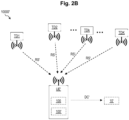
- Fig. 2B e.g. related to an exemplary downlink TDoA configuration
- at least some of the K many transmitter devices TD1, TD2, ..., TDk, ..., TDK are reference signal transmission units, which are configured to transmit at least one reference signal RS', e.g. positioning reference signals, e.g. of a 5G network, to the mobile device UE'.
- the transmitter devices TD1, TD2, ..., TDk, ..., TDK are not equipped with a receiver, but rather only a transmitter for transmitting the reference signals RS' to a mobile device UE' a position of which is to be determined.
- Fig. 2B e.g. related to an exemplary downlink TDOA configuration
- at least some of the K many transmitter devices TD1, TD2, ..., TDk, ..., TDK can be implemented in the form of, comparatively inexpensive, reduced-functionality 5G transmitters, e.g. configured to transmit the reference signals RS', e.g. positioning reference signals (PRS), to a mobile device UE' a position of which is to be determined.
- RS' e.g. positioning reference signals (PRS)
- reference signals e.g. positioning reference signals, RS' received from the plurality of e.g. K many transmitter devices, and/or signals derived from the received (positioning) reference signals RS' may be evaluated, e.g. according to the principle of the embodiments, e.g. by an apparatus 10'.
- the apparatus 10' may be configured to perform the method according to the embodiments. In some embodiments (not shown), the apparatus 10' or its functionality, respectively, may also be integrated in the UE' .
- the UE' of Fig. 2B may also comprise at least one of the apparatus 100, 100' or the respective functionality.
- the instructions 106 when executed by the at least one processor 102, cause the apparatus 100 to determine 206 updated weights W' for weighting the set SET-POS-EST of position estimates based on the set SET-RESID-ERR of residual errors. In some embodiments, this enables to attain more precise position estimates.
- the instructions 106 when executed by the at least one processor 102, cause the apparatus 100 to determine 208 an updated set SET-POS-EST' of position estimates based on the updated weights W'.
- the instructions 106 when executed by the at least one processor 102, cause the apparatus 100 to determine 210 whether at least one termination criterion is met, and, based on the determination 210 whether the at least one termination criterion is met, to repeat at least one of the preceding steps 202, 204, 206, 208.
- this enables to provide an iterative procedure which enables to iteratively refine position estimates associated with the mobile device UE.
- the at least one termination criterion may e.g. comprise a maximum number of iterations.
- the at least one termination criterion may be based on a position mismatch characterizing a difference between a current position estimate and a position estimate of a previous iteration falling below a predetermined threshold.
- the apparatus 100 is configured to perform at least some of the following aspects: Some initial weights W-INIT are determined, see for example block 200 of Fig. 3 .
- a reliability of each receiver device RD1, ..., RDK (or, in case of exemplary DTDoA configurations, a reliability of each transmitter device TD1, ..., TDK, see Fig. 2B ) may be pre-assessed, e.g. based on RSSI (Received Signal Strength Indicator), initial distance estimates, or from previous data.
- RSSI Receiveived Signal Strength Indicator
- a position estimate with that receiver device as reference receiver device is determined. In some embodiments, this produces a set of candidate location estimates X ⁇ , each for example corresponding to a receiver device as reference locator. Note that, in this way, in some embodiments, one can weight less (or even reject) some of the candidate location estimates, e.g. corresponding to the receiver devices experiencing a bad/outlier measurement.
- a position estimate with that transmitter device as reference transmitter device is determined.
- residual errors are determined, which e.g. rely on distance differences between pairs of locators, e.g. receiver devices (or, in case of exemplary DTDoA configurations ( Fig. 2B ), transmitter devices).
- the residual errors are used to determine new, e.g. updated, weights W' (see also block 206 of Fig. 3 ) for each receiver device (or, in case of exemplary DTDoA configurations ( Fig. 2B ), for each transmitter device).
- the position estimate is refined with the new, i.e. updated, weights W', see e.g. block 208 of Fig. 3 .
- a stopping or termination criterion e.g., the difference between the current location estimate and the previous one is below a threshold
- the procedure can be stopped. Otherwise, one could continue, see arrow 212 of Fig. 3 , e.g. by feeding block 202 with the updated weights W'.
- the instructions 106 when executed by the at least one processor 102, cause the apparatus 100 to determine 220 estimated distances EST-DIST associated with the plurality of receiver devices RD1, ..., RDK ( Fig. 2A ), e.g. according to a time difference of arrival, TDoA, technique.
- TDoA time difference of arrival
- a corresponding approach for the plurality of transmitter devices TD1, ..., TDK is also possible.
- 3D three-dimensional
- p k [ x k ,y k ,z k ] T .
- a corresponding approach for the plurality of transmitter devices TD1, ..., TDK is also possible.
- a distance estimate at the k -th receiver device RDk may be denoted as d ⁇ k .
- a corresponding approach for the plurality of transmitter devices TD1, ..., TDK is also possible. In some embodiments, this also applies to the further exemplary embodiments.
- a reference receiver device may be defined.
- the instructions 106 when executed by the at least one processor 102, cause the apparatus 100 to determine 222 initial weights W-INIT (see also the optional block 200 of Fig. 3 ) for weighting the set SET-POS-EST ( Fig. 3 ) of position estimates associated with at least one of the plurality of receiver devices.
- the instructions 106 when executed by the at least one processor 102, cause the apparatus 100 to determine 222 the initial weights W-INIT based on at least one of: a) a reliability of estimated distances associated with the plurality of receiver devices, b) predetermined initial weight values.
- the reliability of the estimated distances associated with the plurality of receiver devices can e.g. be determined based on knowledge about a received signal strength, RSS, since, in some embodiments, multipath reflections tend to be weaker than a direct (line-of-sight) path.
- measurements e.g. distance estimates, whose signal strengths are low, e.g. fall below a predetermined RSS threshold
- measurements may be downweighted, e.g. weighted with comparatively small weight factors
- measurements e.g. distance estimates, whose signal strengths are high, e.g. exceed the RSS threshold, may receive more emphasis by using larger weight factors.
- unit initial weights may be used for at least some, for example all, receiver devices.
- the instructions 106 when executed by the at least one processor 100, cause the apparatus 100 to determine 230 K many position estimates x ⁇ 1 , x ⁇ 2 , ..., x ⁇ K , and to determine 232 a weighted average position estimate x ⁇ WA based on the K many position estimates x ⁇ 1 , x ⁇ 2 ,..., x ⁇ K and on at least one of initial weights W-INIT and updated weights W' for weighting the set SET-POS-EST of position estimates.
- another receiver device of the K many receiver devices may be used as reference receiver device.
- a unique reference receiver device which may e.g. be the one that is, for example, a-priori considered the most reliable one (e.g., always the one with the lowest distance estimate) before computing X
- a measure of a reliability of the position estimates of at least some, for example all, receiver device is provided.
- the measure of reliability indicates to which extent the respective estimate can be "trusted”.
- updated weights W' may be determined, see block 242 of Fig. 6 .
- the instructions 106 when executed by the at least one processor 102, cause the apparatus 100 to determine 250 whether a residual error e k of a position estimate associated with a k-th receiver device RDk exceeds a threshold, and, if the residual error e k of the position estimate associated with the k-th receiver device RDk exceeds the threshold, to discard 252 the k-th receiver device RDk.
- discarding 252 the k-th receiver device RDk comprises disregarding signals or measurements provided by the k-th receiver device RDk, e.g. for determining position estimates.
- the residual error e k as exemplarily characterized by equation 9 represents an averaged deviation between estimated distance differences of K - 1 many receiver devices and a reference receiver device, and actual distance differences (i.e., w.r.t. a current estimate x ⁇ WA ) of the K - 1 receiver devices and the reference receiver device.
- the residual error e k may be interpreted as a measure of how much the measured distance differences agree, e.g. correlate, with a current position estimate x ⁇ WA or - to put it another way - with the distance differences that would result if the mobile device UE were located at a position characterized by x ⁇ WA .
- the proposed approach according to the embodiments enables to avoid the choice of a "bad" reference receiver device, wherein e.g. an outlier measurement, which is e.g. associated with a reference receiver device, may severely affect all distance differences e.g. according to equation 1, which, in some embodiments, may e.g. be used to determine a final, e.g. WLS-based, position estimate.
- a "bad" reference receiver device wherein e.g. an outlier measurement, which is e.g. associated with a reference receiver device, may severely affect all distance differences e.g. according to equation 1, which, in some embodiments, may e.g. be used to determine a final, e.g. WLS-based, position estimate.
- an associated residual error e k will have a comparatively high value, allowing the detection of receiver devices with e.g. unreliable measurements, and, in some embodiments, downweighting their contribution, e.g. in equation 8, e.g. according to a magnitude of the residual error they produce, or, in some embodiments, discarding such receiver devices, see block 252 of Fig. 7 .
- a function of the following types may be used: Andrew's sine wave, Huber loss, etc.
- the corresponding weight may be set to zero, e.g. such that the measurement - and thus also the receiver device, in some embodiments - is discarded.
- the above-described procedure may be iterated, see for example arrow 212 of Fig. 3 , yielding a robust iteratively reweighted least squares (IRLS) estimator that can e.g. detect and/or reject receiver devices with outlier measurements and/or that can find weights for the remaining receiver devices or their measurements, respectively, e.g. based on their residual errors.
- IRLS iteratively reweighted least squares
- the difference ⁇ may e.g. be compared to a pre-defined threshold ⁇ , e.g. to check convergence.
- a termination criterion may be set, e.g. to stop the process, preventing further iterations to be made.
- FIG. 1B relate to an apparatus 100' comprising means 102' for determining 202 ( Fig. 3 ) a set SET-POS-EST of position estimates for a mobile device UE, wherein each position estimate of the set of position estimates is associated with a) a specific one of a plurality of K many receiver devices configured to receive a reference signal from the mobile device or b) a specific one of a plurality of K many transmitter devices configured to transmit reference signals to the mobile device, and for determining 204, based at least on the set of position estimates, a set SET-RESID-ERR of residual errors associated with at least some position estimates of the set of position estimates.
- Fig. 2A relate to a location server 10 for estimating a position of a mobile device UE which is configured to transmit at least one reference signal RS, e.g. a 5G NR SRS, comprising at least one apparatus 100, 100' according to the embodiments.
- RS reference signal
- Fig. 3 relate to a method comprising: determining 202 a set SET-POS-EST of position estimates for a mobile device, wherein each position estimate of the set of position estimates is associated with a) a specific one of a plurality of K many receiver devices configured to receive a reference signal from the mobile device or b) a specific one of a plurality of K many transmitter devices configured to transmit reference signals to the mobile device, and determining 204, based at least on the set of position estimates, a set SET-RESID-ERR of residual errors associated with at least some position estimates of the set of position estimates.
- Fig. 8A and 8B schematically depict exemplary scenarios according to some embodiments.
- the star TP symbolizes a true position of a mobile device, e.g. UE, to be localized
- the reference sign EP symbolizes an estimated position.
- Element a1 symbolizes reference signals RS ( Fig. 2A ) transmitted by the UE, wherein dashed arrow a2 symbolizes a reflected RS.
- Obstacle O may e.g. prevent a direct LOS transmission of the reference signal to at least some receiver devices.
- LMUs also depicted in the present localization scenario are four receiver devices, e.g. LMUs, individually denoted as LMU1, LMU2, LMU3, LMU4 (2-D case for illustrative purposes), where the top right one (LMU1) measures a reflection a2 (only a reflection a2 is available, as the obstacle O blocks a direct LOS path from the true position of the UE to LMU1), producing wrong angular and ToA or TDoA measures.
- LMU1 measures a reflection a2 (only a reflection a2 is available, as the obstacle O blocks a direct LOS path from the true position of the UE to LMU1), producing wrong angular and ToA or TDoA measures.
- Fig. 8A it is assumed, that LMU1 is not rejected, but rather used for determining position estimates, thus offsetting the position estimate EP due to the reflection a2, see the difference between EP and TP in Fig. 8A .
- Fig. 8B LMU1 is rejected (or at least downweighted), based on the principle according to the embodiments, see the cross CR, thus enabling to provide an increased localization performance, as compared to the Fig. 8A scenario.
- Fig. 9 relate to a computer program product comprising instructions PRG which, when the program PRG is executed by a computer (e.g., comprising the processor 102 of Fig. 1A ), cause the computer to carry out the method according to the embodiments.
- a computer e.g., comprising the processor 102 of Fig. 1A
- the principle according to the embodiments provides a novel, for example TDoA-based, location estimation approach that, for example, has the ability to reject outlier measurements (or to reduce an influence of outlier measurements) and/or to weight e.g. the remaining measurements, e.g. according to, i.e. based on, the residual errors they produce.
- the approach may therefore not only be deployed e.g. as a standalone positioning solution, but can, in some embodiments, also be used in a larger framework, e.g. as a "pre-filtering" method that yields locator weights, e.g. for further, e.g. yet more elaborate, e.g. probabilistic, localization algorithms, and, for example, facilitates a convergence of, e.g. such maximum likelihood (ML) techniques, e.g. by providing a proper initial search point, e.g. for gradient optimization.
- ML maximum likelihood
- the following additional advantages for probabilistic positioning are enabled: Good initial search point to facilitate the convergence, e.g. of gradient optimization, Outlier measurement does not contribute to a ML function.
Landscapes
- Engineering & Computer Science (AREA)
- Physics & Mathematics (AREA)
- General Physics & Mathematics (AREA)
- Radar, Positioning & Navigation (AREA)
- Remote Sensing (AREA)
- Computer Networks & Wireless Communication (AREA)
- Signal Processing (AREA)
- Position Fixing By Use Of Radio Waves (AREA)
- Mobile Radio Communication Systems (AREA)
Abstract
Description
- Various example embodiments relate to an apparatus comprising at least one processor.
- Further embodiments relate to a method of operating related to such apparatus.
- Location information, for example associated with a mobile device such as a mobile terminal device, e.g. user equipment (UE), for a communications system, can be used for applications such as e.g. navigation, asset tracking, industrial automation, healthcare, etc.
- Some conventional localization approaches utilize time of arrival (ToA) or time difference of arrival (TDoA) measurements, where TDoA methods offer the advantage that an exact transmit time of a target to be tracked does not have to be known. Some TDoA-based localization techniques can for example be used in current 3rd Generation Partnership Project (3GPP) 4G and 5G positioning standards.
- Various embodiments of the disclosure are set out by the independent claims. The exemplary embodiments and features, if any, described in this specification, that do not fall under the scope of the independent claims, are to be interpreted as examples useful for understanding various exemplary embodiments of the disclosure.
- Some embodiments relate to an apparatus, comprising at least one processor, and at least one memory storing instructions, the at least one memory and the instructions configured to, with the at least one processor, cause the apparatus at least to determine a set of position estimates for a mobile device, wherein each position estimate of the set of position estimates is associated with a a) specific one of a plurality of K many receiver devices configured to receive a reference signal from the mobile device or b) a specific one of a plurality of K many transmitter devices configured to transmit reference signals to the mobile device, and to determine, based at least on the set of position estimates, a set of residual errors associated with at least some position estimates of the set of position estimates. In some embodiments, this enables to determine a position of the mobile device, and/or to assess a quality of the position estimates.
- In some embodiments, an uplink TDoA ("UTDoA") configuration is e.g. characterized by the position estimates of the set of position estimates being associated with a specific one of a plurality of K many receiver devices configured to receive a reference signal from the mobile device.
- In some embodiments, a downlink TDoA ("DTDoA") configuration is e.g. characterized by the position estimates of the set of position estimates being associated with a specific one of a plurality of K many transmitter devices configured to, for example simultaneously, transmit reference signals, e.g. positioning reference signals, to the mobile device.
- Note that, in some embodiments, different values may be chosen for the number K of receiver devices or transmitter devices, e.g. depending on a specific implementation or precision requirements or the like.
- In some embodiments, the number K of receiver devices is equal to or greater than 2.
- In some embodiments, the number K of transmitter devices is equal to or greater than 2.
- In some embodiments, e.g. related to a downlink TDoA configuration, K = K1 many transmitters may be used, whereas, in some other embodiments, e.g. related to a uplink TDoA configuration, K = K2 many transmitters may be used, wherein K1 may be different from K2.
- In some embodiments, both an uplink TDoA and a downlink TDoA configuration may be used.
- While the following description, for the sake of clarity, primarily refers to exemplary UTDoA configurations, the principle according to the embodiments can be applied both to a uplink TDOA configuration and a downlink TDoA configuration.
- In some embodiments, the mobile device is a terminal device, for example UE, for a, for example cellular, communications network of e.g. the 5G and/or 6G type.
- In some embodiments, e.g. related to an exemplary uplink TDoA configuration, at least some of the K many receiver devices are location measurement units, LMUs, which are configured to receive at least one reference signal of the mobile device, e.g. a sounding reference signal (SRS) of a 5G network. In some embodiments, the receiver devices are not equipped with a transmitter, but rather only a receiver for receiving the reference signal(s), e.g. of a mobile device a position of which is to be determined.
- In some embodiments, e.g. related to an exemplary uplink TDOA configuration, at least some of the K many receiver devices can be implemented in the form of, comparatively inexpensive, reduced-functionality 5G sniffers, configured to sense or receive, respectively, the reference signal(s) transmitted by a mobile device a position of which is to be determined.
- In some embodiments, e.g. related to an exemplary downlink TDoA configuration, at least some of the K many transmitter devices are reference signal transmission units, which are configured to transmit at least one reference signal, e.g. a positioning reference signal, e.g. of a 5G network, to the mobile device. In some embodiments, the transmitter devices are not equipped with a receiver, but rather only a transmitter for transmitting the reference signals to a mobile device a position of which is to be determined.
- In some embodiments, e.g. related to an exemplary downlink TDOA configuration, at least some of the K many transmitter devices can be implemented in the form of, comparatively inexpensive, reduced-functionality 5G transmitters, e.g. configured to transmit the reference signals, e.g. positioning reference signals (PRS), to a mobile device a position of which is to be determined.
- In some embodiments, e.g. related to an exemplary UTDoA configuration, at least some of the K many receiver devices can be tightly synchronized, for example to enable TDoA positioning.
- In some embodiments, e.g. related to an exemplary DTDoA configuration, at least some of the K many transmitter devices can be tightly synchronized, for example to enable TDoA positioning.
- In some embodiments, e.g. related to an exemplary UTDoA configuration, at least some of the K many receiver devices can be configured to transmit received reference signals and/or signals derived from received reference signals to the apparatus according to the embodiments, e.g. for evaluation, e.g. according to the principle of the embodiments.
- In some embodiments, e.g. related to an exemplary DTDoA configuration, signals, e.g. positioning signals, received from the plurality of e.g. K many transmitter devices, and/or signals derived from the received (positioning) reference signals may be evaluated, e.g. according to the principle of the embodiments.
- In some embodiments, the instructions, when executed by the at least one processor, cause the apparatus to determine updated weights for weighting the set of position estimates based on the set of residual errors. In some embodiments, this enables to attain more precise position estimates.
- In some embodiments, the instructions, when executed by the at least one processor, cause the apparatus to determine an updated set of position estimates based on the updated weights.
- In some embodiments, the instructions, when executed by the at least one processor, cause the apparatus to determine whether at least one termination criterion is met, and, based on the determination whether the at least one termination criterion is met, to repeat at least one of the preceding steps.
- In some embodiments, this enables to provide an iterative procedure which enables to iteratively refine position estimates associated with the mobile device.
- In some embodiments, the at least one termination criterion may e.g. comprise a maximum number of iterations.
- In some embodiments, the at least one termination criterion may be based on a position mismatch characterizing a difference between a current position estimate and a position estimate of a previous iteration falling below a predetermined threshold.
- In some embodiments, e.g. related to an exemplary UTDoA configuration, the instructions, when executed by the at least one processor, cause the apparatus to determine estimated distances associated with the plurality of receiver devices.
- In some embodiments, e.g. related to an exemplary DTDoA configuration, the instructions, when executed by the at least one processor, cause the apparatus to determine estimated distances associated with the plurality of transmitter devices.
- As mentioned above, the following description, for the sake of clarity, primarily refers to exemplary UTDoA configurations having a plurality of K many receiver devices. However, as also already mentioned above, the principle according to the embodiments can alternatively (or additionally) be applied to exemplary DTDOA configurations having a plurality of K many transmitter devices.
- In some embodiments, e.g. related to exemplary UTDoA configurations, the K many receiver devices may be associated with three-dimensional (3D) positions, which, in some embodiments, may e.g. be characterized by a respective 3 × 1 vector p k = [xk,yk,zk ]T .
- In some embodiments, e.g. related to exemplary DTDoA configurations, the K many transmitter devices may be associated with 3D positions, which, in some embodiments, may e.g. be characterized by a respective 3 × 1 vector p l = [xl ,yl ,zl ]T.
- In some embodiments, e.g. related to exemplary UTDoA configurations, a distance estimate associated with the k-th receiver device may be denoted as d̂k.
- In some embodiments, e.g. related to exemplary UTDoA configurations, a reference receiver device may be defined. As an example, in some embodiments, choosing e.g. a first receiver device as a reference receiver device, the K - 1 distance differences associated with the receiver devices can be characterized by d̂ k,1 = d̂k - d̂ 1 , k = 2,...,K [equation 1].
- In some embodiments, e.g. related to exemplary UTDoA configurations, the instructions, when executed by the at least one processor, cause the apparatus to determine initial weights (e.g., one or more initial weights) for weighting the set of position estimates associated with at least one of the plurality of receiver devices.
- In some embodiments, the instructions, when executed by the at least one processor, cause the apparatus to determine the initial weights based on at least one of: i) a reliability of estimated distances associated with a) the plurality of receiver devices or with b) the plurality of transmitter devices, ii) predetermined initial weight values.
- In some embodiments, the reliability of the estimated distances associated with the plurality of receiver devices can e.g. be determined based on knowledge about a received signal strength, RSS, since, in some embodiments, multipath reflections tend to be weaker than a direct (line-of-sight) path.
- Hence, in some embodiments, measurements, e.g. distance estimates, whose signal strengths are low, e.g. fall below a predetermined RSS threshold, may be downweighted, e.g. weighted with comparatively small weight factors, whereas measurements, e.g. distance estimates, whose signal strengths are high, e.g. exceed the RSS threshold, may receive more emphasis by using larger weight factors.
- In some embodiments, if no RSS information or other information characterizing a reliability of the estimated distances associated with the plurality of receiver devices (or transmitter devices, e.g. in case of a downlink TDoA configuration) (or similar) are available, unit initial weights may be used for at least some, for example all, receiver devices (or transmitter devices, e.g. in case of a downlink TDoA configuration).
- In some embodiments, e.g. related to exemplary UTDoA or DTDoA configurations, the instructions, when executed by the at least one processor, cause the apparatus to determine K many position estimates x̂1,x̂2,...,x̂ K , and to determine a weighted average position estimate x̂ WA based on the K many position estimates x̂1,x̂2,...,x̂ K , and on at least one of initial weights and updated weights for weighting the set of position estimates.
- In some embodiments, e.g. related to exemplary UTDoA or DTDoA configurations, for each position estimate of the K many position estimates x̂1,x̂2, ...,x̂ K , another receiver device of the K many receiver devices or transmitter device of the K many transmitter devices may be used as reference receiver device or reference transmitter device.
- In other words, in some embodiments, e.g. related to exemplary UTDoA or DTDoA configurations, instead of determining a unique reference receiver device or reference transmitter device, which may e.g. be the one that is, for example, a-priori considered the most reliable one (e.g., always the one with the lowest distance estimate) before computing x̂, it is proposed to use every receiver device or transmitter device of the K many receiver devices or transmitter devices as a reference receiver device or as a reference transmitter device once to obtain the K many position estimates x̂ 1,x̂ 2,...,x̂ K , e.g. in the form of a matrix with K distinct position estimates X̂= [x̂ 1,x̂ 2,...,x̂ K ].
- In some embodiments, an estimate of the mobile device's position x = [x,y,z]T may e.g. be obtained by solving an equation system, characterized e.g. by: Aθ = b + n, [equation 2], with


- In some embodiments, a closed-form approximate weighted least squares (WLS) solution of equation 2 can be obtained as

- In some embodiments, the position estimates x̂ can be determined by adding e.g. the first three elements θ̂1:3 of the WLS solution from Eq. (6) to the position p1 of a, for example reference, receiver device:
x̂ = p1 + θ̂1:3, e.g. using the WLS estimator according to equation 6. - In some embodiments, the weighted average position estimate may be obtained as


- In other words, in some embodiments, for determining the weighted average position estimate x̂ WA , multiple individual WLS estimates x̂ k are combined in a weighted fashion.
- In some embodiments, e.g. in order to detect receiver devices or transmitter device with erroneous measurements, a measure of a reliability of the position estimates of at least some, for example all, receiver device or transmitter device is provided. In some embodiments, the measure of reliability indicates to which extent the respective estimate can be "trusted".
- Hence, in some embodiments, e.g. related to exemplary UTDoA configurations, the instructions, when executed by the at least one processor, cause the apparatus to determine a residual error ek of a position estimate associated with a k-th receiver device based on

- Similarly, in some embodiments, e.g. related to exemplary DTDoA configurations, the instructions, when executed by the at least one processor, cause the apparatus to determine a residual error ek of a position estimate associated with a k-th transmitter device based on

- In some embodiments, e.g. related to exemplary UTDoA configurations or DTDoA configurations, the instructions, when executed by the at least one processor, cause the apparatus to determine whether a residual error of a position estimate associated with a k-th receiver device or transmitter device exceeds a threshold, and, if the residual error of the position estimate associated with a k-th receiver device or transmitter device exceeds the threshold, to discard the k-th receiver device or transmitter device.
- In some embodiments, e.g. related to exemplary UTDoA or DTDoA configurations, discarding the k-th receiver device or transmitter device comprises disregarding signals or measurements provided by the k-th receiver device or transmitter device, e.g. for determining position estimates.
- In some embodiments, the residual error as exemplarily characterized by equations 9, 9' represents an averaged deviation between estimated distance differences of K - 1 many receiver devices or transmitter devices and a reference receiver device or a reference transmitter device, and actual distance differences (i.e., w.r.t. a current estimate x̂ WA ) of the K - 1 receiver devices or transmitter devices and the reference receiver device or the reference transmitter device.
- In some embodiments, using this formulation of equations 9 or 9', the residual error may be interpreted as a measure of how much the measured distance differences agree, e.g. correlate, with a current position estimate x̂ WA or - to put it another way - with the distance differences that would result if the mobile device, e.g. UE, were located at a position characterized by x̂ WA.
- In some embodiments, e.g. related to exemplary UTDoA configurations, the proposed approach according to the embodiments enables to avoid the choice of a "bad" reference receiver device, wherein e.g. an outlier measurement, which is e.g. associated with a reference receiver device, may severely affect all distance differences e.g. according to
equation 1, which, in some embodiments, may e.g. be used to determine a final, e.g. WLS-based, position estimate. - In some embodiments, similar observations also apply to exemplary DTDoA configurations, wherein the proposed approach according to the embodiments enables to avoid the choice of a "bad" reference transmitter device.
- Advantageously, in some embodiments, considering a situation with a "bad" reference receiver device or reference transmitter device, an associated residual error will have a comparatively high value, allowing the detection of receiver devices or transmitter devices with e.g. unreliable measurements, and, in some embodiments, downweighting their contribution, e.g. in equation 8, e.g. according to a magnitude of the residual error they produce.
- In some embodiments, e.g. after computing a residual error, e.g. based on equation 9 or equation 9', e.g. for all position estimates, updated weights, which may be used for a next iteration, may be obtained as

- In some embodiments, for the mapping of the magnitude of the residual errors ek to the interval between 0 and 1, a function of the following types may be used: Andrew's sine wave, Huber loss, etc.
- As already mentioned above, in some embodiments, e.g. related to exemplary UTDoA configurations, if the residual error ek exceeds a pre-defined maximum value, the corresponding weight may be set to zero, e.g. such that the measurement - and thus also the receiver device, in some embodiments - is discarded.
- In some embodiments, this is also applicable to exemplary DTDoA configurations, wherein, if the residual error ek associated with a specific transmitter device exceeds a pre-defined maximum value, the corresponding weight may be set to zero, e.g. such that the measurement - and thus also the transmitter device, in some embodiments - is discarded.
- In some embodiments, e.g. related to exemplary UTDoA configurations or exemplary DTDoA configurations, the above-described procedure may be iterated, yielding a robust iteratively reweighted least squares (IRLS) estimator that can e.g. detect and/or reject receiver devices or transmitter device with outlier measurements and/or that can find weights for the remaining receiver devices or transmitter devices or their measurements, respectively, e.g. based on their residual errors.
- In some embodiments, after each iteration, a difference of a current position estimate to a position estimate of the previous iteration may be determined, e.g. computed, based on

- In some embodiments, the difference Δ may e.g. be compared to a pre-defined threshold ε, e.g. to check convergence.
- In some embodiments, based on the comparison of the difference Δ with the pre-defined threshold ε, a termination criterion may be set, e.g. to stop the process, preventing further iterations to be made.
- While the exemplary embodiments explained above primarily refer to exemplary UTDoA configurations, the principle according to the embodiments can similarly be applied to DTDoA configurations.
- Further embodiments relate to an apparatus comprising means for determining a set of position estimates for a mobile device, wherein each position estimate of the set of position estimates is associated with a) a specific one of a plurality of K many receiver devices configured to receive a reference signal from the mobile device or b) a specific one of a plurality of K many transmitter devices configured to transmit reference signals to the mobile device, and for determining, based at least on the set of position estimates, a set of residual errors associated with at least some position estimates of the set of position estimates.
- Further embodiments relate to a location server for estimating a position of a mobile device which is configured to transmit at least one reference signal, comprising at least one apparatus according to the embodiments.
- Further embodiments relate to a system for estimating a position of a mobile device which is configured to transmit at least one reference signal, comprising at least one apparatus according to the embodiments and K, K>=2, many receiver devices and/or K many transmitter devices.
- Further embodiments relate to a method comprising: determining a set of position estimates for a mobile device, wherein each position estimate of the set of position estimates is associated with a) a specific one of a plurality of K many receiver devices configured to receive a reference signal from the mobile device or b) a specific one of a plurality of K many transmitter devices configured to transmit reference signals to the mobile device, and determining, based at least on the set of position estimates, a set of residual errors associated with at least some position estimates of the set of position estimates.
- Further embodiments relate to a computer program product comprising instructions which, when the program is executed by a computer, cause the computer to carry out the method according to the embodiments.
- Further embodiments relate to a data carrier signal carrying and/or characterizing the computer program (product).
-
- Fig. 1A
- schematically depicts a simplified block diagram according to some embodiments,
- Fig. 1B
- schematically depicts a simplified block diagram according to some embodiments,
- Fig. 2A
- schematically depicts a simplified block diagram array according to some embodiments,
- Fig. 2B
- schematically depicts a simplified block diagram array according to some embodiments,
- Fig. 3
- schematically depicts a simplified flow chart according to some embodiments,
- Fig. 4
- schematically depicts a simplified flow chart according to some embodiments,
- Fig. 5
- schematically depicts a simplified flow chart according to some embodiments,
- Fig. 6
- schematically depicts a simplified flow chart according to some embodiments,
- Fig. 7
- schematically depicts a simplified flow chart according to some embodiments,
- Fig. 8A
- schematically depicts a scenario according to some embodiments,
- Fig. 8B
- schematically depicts a scenario according to some embodiments,
- Fig. 9
- schematically depicts a simplified block diagram according to some embodiments.
- Some embodiments, see for example
Fig. 1A , relate to anapparatus 100, comprising at least oneprocessor 102, and at least onememory 104 storinginstructions 106, the at least onememory 104 and theinstructions 106 configured to, with the at least oneprocessor 102, cause theapparatus 100 at least to determine 202 (Fig. 3 ) a set of position estimates SET-POS-EST for a mobile device UE (Fig. 2A ), wherein each position estimate of the set SET-POS-EST of position estimates is associated with a) a specific one of a plurality of K many receiver devices RD1, RD2, ..., RDk, ..., RDK (Fig. 2A ) configured to receive a reference signal RS from the mobile device UE (e.g., in case of exemplary UTDoA configurations as exemplarily depicted byFig. 2A ) or b) a specific one of a plurality of K many transmitter devices TD1, TD2, ..., TDk, ..., TDK (Fig. 2B ) configured to transmit reference signals RS' to the mobile device UE (e.g., in case of exemplary DTDoA configurations as exemplarily depicted byFig. 2B ), and to determine 204 (Fig. 3 ), based at least on the set SET-POS-EST of position estimates, a set SET-RESID-ERR of residual errors associated with at least some position estimates of the set SET-POS-EST of position estimates. - In some embodiments, this enables to determine a position of the mobile device UE, and/or to assess a quality of the position estimates.
- In some embodiments,
Fig. 2A ,2B , the mobile device UE, UE' is a terminal device, for example user equipment (UE), for a, for example cellular, communications network of e.g. the 5G and/or 6G type. - In some embodiments,
Fig. 2A , at least some of the K many receiver devices RD1, RD2, ..., RDk, ..., RDK are location measurement units, LMU, which are configured to receive at least one reference signal RS of the mobile device, e.g. a sounding reference signal (SRS) of a 5G network. In some embodiments, the receiver devices RD1, RD2, ..., RDk, ..., RDK are not equipped with a transmitter, but rather only a receiver (not shown) for receiving the reference signal(s) RS, e.g. of a mobile device UE a position of which is to be determined. - In some embodiments, at least some of the K many receiver devices RD1, RD2, ..., RDk, ..., RDK can be implemented in the form of, for example comparatively inexpensive, reduced-functionality 5G sniffers, configured to sense or receive, respectively, the reference signal(s) RS transmitted by a mobile device UE a position of which is to be determined.
- In some embodiments, at least some of the K many receiver devices RD1, RD2, ..., RDk, ..., RDK are configured to perform TDoA measurements based on the reference signal RS.
- In some embodiments, at least some of the K many receiver devices RD1, RD2, ..., RDk, ..., RDK can be tightly synchronized, for example to enable TDoA positioning.
- In some embodiments, at least some of the K many receiver devices RD1, RD2, ..., RDk, ..., RDK can be configured to transmit received reference signals RS and/or signals derived from received reference signals to the
apparatus 100 according to the embodiments, e.g. via data connections DC, e.g. for evaluation, e.g. according to the principle of the embodiments. - In some embodiments, the data connections DC may enable sub-nanosecond synchronization among the receiver devices RD1, RD2, ..., RDk, ..., RDK, e.g. by using a synchronization protocol such as, but not limited to, the White Rabbit protocol.
- In some embodiments, a
location server 10 may be provided, e.g. comprising theapparatus 100, for processing incoming signals from the receiver devices RD1, RD2, ..., RDk, ..., RDK, e.g. to obtain distance estimates. Thelocation server 10, or theapparatus 100, respectively, may be configured to perform the method according to the embodiments exemplarily explained below. - In other words, in some embodiments, the
location server 10 may e.g. be configured to receive received reference signals and/or signals derived from received reference signals from at least some of the K many receiver devices RD1, ..., RDK, e.g. for processing, e.g. according to a method according to the embodiments exemplarily explained below. - In some embodiments,
Fig. 2B , e.g. related to an exemplary downlink TDoA configuration, at least some of the K many transmitter devices TD1, TD2, ..., TDk, ..., TDK are reference signal transmission units, which are configured to transmit at least one reference signal RS', e.g. positioning reference signals, e.g. of a 5G network, to the mobile device UE'. In some embodiments, the transmitter devices TD1, TD2, ..., TDk, ..., TDK are not equipped with a receiver, but rather only a transmitter for transmitting the reference signals RS' to a mobile device UE' a position of which is to be determined. - In some embodiments,
Fig. 2B , e.g. related to an exemplary downlink TDOA configuration, at least some of the K many transmitter devices TD1, TD2, ..., TDk, ..., TDK can be implemented in the form of, comparatively inexpensive, reduced-functionality 5G transmitters, e.g. configured to transmit the reference signals RS', e.g. positioning reference signals (PRS), to a mobile device UE' a position of which is to be determined. - In some embodiments, e.g. related to the exemplary DTDoA configuration of
Fig. 2B , reference signals, e.g. positioning reference signals, RS' received from the plurality of e.g. K many transmitter devices, and/or signals derived from the received (positioning) reference signals RS' may be evaluated, e.g. according to the principle of the embodiments, e.g. by an apparatus 10'. - In some embodiments, the apparatus 10' may be configured to perform the method according to the embodiments. In some embodiments (not shown), the apparatus 10' or its functionality, respectively, may also be integrated in the UE' .
- In other embodiments, the UE' of
Fig. 2B may also comprise at least one of theapparatus 100, 100' or the respective functionality. - While the following description of some exemplary embodiments, for the sake of clarity, primarily refers to exemplary UTDoA configurations as exemplarily depicted by
Fig. 2A , the principle according to the embodiments can be applied both to uplink TDOA configurations (Fig. 2A ) and downlink TDoA configurations, as e.g. depicted byFig. 2B . - In some embodiments,
Fig. 3 , the instructions 106 (Fig. 1A ), when executed by the at least oneprocessor 102, cause theapparatus 100 to determine 206 updated weights W' for weighting the set SET-POS-EST of position estimates based on the set SET-RESID-ERR of residual errors. In some embodiments, this enables to attain more precise position estimates. - In some embodiments,
Fig. 3 , theinstructions 106, when executed by the at least oneprocessor 102, cause theapparatus 100 to determine 208 an updated set SET-POS-EST' of position estimates based on the updated weights W'. - In some embodiments,
Fig. 3 , theinstructions 106, when executed by the at least oneprocessor 102, cause theapparatus 100 to determine 210 whether at least one termination criterion is met, and, based on thedetermination 210 whether the at least one termination criterion is met, to repeat at least one of the precedingsteps - In some embodiments, this enables to provide an iterative procedure which enables to iteratively refine position estimates associated with the mobile device UE.
- In some embodiments, the at least one termination criterion may e.g. comprise a maximum number of iterations.
- In some embodiments, the at least one termination criterion may be based on a position mismatch characterizing a difference between a current position estimate and a position estimate of a previous iteration falling below a predetermined threshold.
- In some embodiments,
Fig. 1 , theapparatus 100 is configured to perform at least some of the following aspects: Some initial weights W-INIT are determined, see forexample block 200 ofFig. 3 . In some embodiments, a reliability of each receiver device RD1, ..., RDK (or, in case of exemplary DTDoA configurations, a reliability of each transmitter device TD1, ..., TDK, seeFig. 2B ) may be pre-assessed, e.g. based on RSSI (Received Signal Strength Indicator), initial distance estimates, or from previous data. - In some embodiments, for each active receiver device (
Fig. 2A ), a position estimate with that receiver device as reference receiver device is determined. In some embodiments, this produces a set of candidate location estimates X̂, each for example corresponding to a receiver device as reference locator. Note that, in this way, in some embodiments, one can weight less (or even reject) some of the candidate location estimates, e.g. corresponding to the receiver devices experiencing a bad/outlier measurement. - Similarly, in some embodiments, e.g. in case of exemplary DTDoA configurations (
Fig. 2B ), for each active transmitter device, a position estimate with that transmitter device as reference transmitter device is determined. In some embodiments, this produces a set of candidate location estimates X̂, each for example corresponding to a transmitter device as reference locator. Note that, in this way, in some embodiments, one can weight less (or even reject) some of the candidate location estimates, e.g. corresponding to the transmitter devices experiencing a bad/outlier measurement. - In some embodiments, residual errors are determined, which e.g. rely on distance differences between pairs of locators, e.g. receiver devices (or, in case of exemplary DTDoA configurations (
Fig. 2B ), transmitter devices). In some embodiments, the residual errors are used to determine new, e.g. updated, weights W' (see also block 206 ofFig. 3 ) for each receiver device (or, in case of exemplary DTDoA configurations (Fig. 2B ), for each transmitter device). - In some embodiments, the position estimate is refined with the new, i.e. updated, weights W', see e.g. block 208 of
Fig. 3 . - In some embodiments, if a maximum number of iterations is reached or a stopping or termination criterion is met (e.g., the difference between the current location estimate and the previous one is below a threshold), the procedure can be stopped. Otherwise, one could continue, see
arrow 212 ofFig. 3 , e.g. by feedingblock 202 with the updated weights W'. - In some embodiments,
Fig. 4 , the instructions 106 (Fig. 1A ), when executed by the at least oneprocessor 102, cause theapparatus 100 to determine 220 estimated distances EST-DIST associated with the plurality of receiver devices RD1, ..., RDK (Fig. 2A ), e.g. according to a time difference of arrival, TDoA, technique. Similarly, in some embodiments, e.g. in case of exemplary DTDoA configurations (Fig. 2B ), a corresponding approach for the plurality of transmitter devices TD1, ..., TDK is also possible. - In some embodiments,
Fig. 2A , the K many receiver devices RD1, ..., RDK may be associated with three-dimensional (3D) positions, which, in some embodiments, may e.g. be characterized by a respective 3 × 1 vector p k = [xk,yk,zk ]T. Similarly, in some embodiments, e.g. in case of exemplary DTDoA configurations (Fig. 2B ), a corresponding approach for the plurality of transmitter devices TD1, ..., TDK is also possible. - In some embodiments, a distance estimate at the k-th receiver device RDk may be denoted as d̂k.
- Similarly, in some embodiments, e.g. in case of exemplary DTDoA configurations (
Fig. 2B ), a corresponding approach for the plurality of transmitter devices TD1, ..., TDK is also possible. In some embodiments, this also applies to the further exemplary embodiments. - In some embodiments, a reference receiver device may be defined. As an example, in some embodiments, choosing e.g. a first receiver device RD1 as a reference receiver device, the K - 1 distance differences associated with the receiver devices can be characterized by d̂ k,1 = d̂k - d̂ 1 , k = 2,...,K [equation 1].
- In some embodiments,
Fig. 4 , the instructions 106 (Fig. 1A ), when executed by the at least oneprocessor 102, cause theapparatus 100 to determine 222 initial weights W-INIT (see also theoptional block 200 ofFig. 3 ) for weighting the set SET-POS-EST (Fig. 3 ) of position estimates associated with at least one of the plurality of receiver devices. - In some embodiments, the
instructions 106, when executed by the at least oneprocessor 102, cause theapparatus 100 to determine 222 the initial weights W-INIT based on at least one of: a) a reliability of estimated distances associated with the plurality of receiver devices, b) predetermined initial weight values. - In some embodiments, the reliability of the estimated distances associated with the plurality of receiver devices can e.g. be determined based on knowledge about a received signal strength, RSS, since, in some embodiments, multipath reflections tend to be weaker than a direct (line-of-sight) path.
- Hence, in some embodiments, measurements, e.g. distance estimates, whose signal strengths are low, e.g. fall below a predetermined RSS threshold, may be downweighted, e.g. weighted with comparatively small weight factors, whereas measurements, e.g. distance estimates, whose signal strengths are high, e.g. exceed the RSS threshold, may receive more emphasis by using larger weight factors.
- In some embodiments, if no RSS information or other information characterizing a reliability of the estimated distances associated with the plurality of receiver devices (or similar) are available, unit initial weights may be used for at least some, for example all, receiver devices.
- In some embodiments,
Fig. 5 , theinstructions 106, when executed by the at least oneprocessor 100, cause theapparatus 100 to determine 230 K many position estimates x̂ 1,x̂ 2, ...,x̂ K , and to determine 232 a weighted average position estimate x̂ WA based on the K many position estimates x̂ 1,x̂ 2,...,x̂ K and on at least one of initial weights W-INIT and updated weights W' for weighting the set SET-POS-EST of position estimates. - In some embodiments, for each position estimate of the K many position estimates x̂ 1,x̂ 2,...,x̂ K , another receiver device of the K many receiver devices may be used as reference receiver device.
- In other words, in some embodiments, instead of determining a unique reference receiver device, which may e.g. be the one that is, for example, a-priori considered the most reliable one (e.g., always the one with the lowest distance estimate) before computing X, it is proposed to use every receiver device of the K many receiver devices as a reference receiver device once to obtain the K many position estimates x̂ 1,x̂ 2,...,x̂ K , e.g. in the form of a matrix with K distinct position estimates X̂ = [x̂ 1,x̂ 2,...,x̂ K ].
- In some embodiments, an estimate of the mobile device's position x = [x,y,z]T may e.g. be obtained by solving an equation system, e.g. characterized by: Aθ = b + n, [equation 2], with


- In some embodiments, a closed-form approximate weighted least squares (WLS) solution of equation 2 can be obtained as

- In some embodiments, the position estimates x̂ can be determined by adding e.g. the first three elements θ̂1:3 of the WLS solution from Eq. (6) to the position p1 of a, for example reference, receiver device:
x̂ = p1 + θ̂1;3, e.g. using the WLS estimator according to equation 6. - In some embodiments, the weighted average position estimate may be obtained as

Fig. 2A )), wherein, in some embodiments, a normalization such that
- In other words, in some embodiments, for determining 232 (
Fig. 5 ) the weighted average position estimate x̂ WA , multiple individual WLS estimates x̂ k are combined in a weighted fashion. - In some embodiments, e.g. in order to detect receiver devices with erroneous measurements, a measure of a reliability of the position estimates of at least some, for example all, receiver device is provided. In some embodiments, the measure of reliability indicates to which extent the respective estimate can be "trusted".
- Hence, in some embodiments,
Fig. 6 , the instructions 106 (Fig. 1A ), when executed by the at least oneprocessor 102, cause theapparatus 100 to determine 240 a residual error ek of a position estimate associated with a k-th receiver device RDk based on
- In some embodiments, based on the residual error ek , updated weights W' may be determined, see
block 242 ofFig. 6 . - In some embodiments,
Fig. 7 , the instructions 106 (Fig. 1A ), when executed by the at least oneprocessor 102, cause theapparatus 100 to determine 250 whether a residual error ek of a position estimate associated with a k-th receiver device RDk exceeds a threshold, and, if the residual error ek of the position estimate associated with the k-th receiver device RDk exceeds the threshold, to discard 252 the k-th receiver device RDk. - In some embodiments, discarding 252 the k-th receiver device RDk comprises disregarding signals or measurements provided by the k-th receiver device RDk, e.g. for determining position estimates.
- In some embodiments, the residual error ek as exemplarily characterized by equation 9 represents an averaged deviation between estimated distance differences of K - 1 many receiver devices and a reference receiver device, and actual distance differences (i.e., w.r.t. a current estimate x̂ WA ) of the K - 1 receiver devices and the reference receiver device.
- In some embodiments, using the formulation of equation 9, the residual error ek may be interpreted as a measure of how much the measured distance differences agree, e.g. correlate, with a current position estimate x̂ WA or - to put it another way - with the distance differences that would result if the mobile device UE were located at a position characterized by x̂ WA .
- In some embodiments, the proposed approach according to the embodiments enables to avoid the choice of a "bad" reference receiver device, wherein e.g. an outlier measurement, which is e.g. associated with a reference receiver device, may severely affect all distance differences e.g. according to
equation 1, which, in some embodiments, may e.g. be used to determine a final, e.g. WLS-based, position estimate. - Advantageously, in some embodiments, considering a situation with a "bad" reference receiver device, an associated residual error ek will have a comparatively high value, allowing the detection of receiver devices with e.g. unreliable measurements, and, in some embodiments, downweighting their contribution, e.g. in equation 8, e.g. according to a magnitude of the residual error they produce, or, in some embodiments, discarding such receiver devices, see
block 252 ofFig. 7 . - In some embodiments, e.g. after determining, e.g. computing, the residual error ek , e.g. based on equation 9, e.g. for all position estimates, updated weights W', which may be used for a next iteration, see
arrow 212 ofFig. 3 , may be obtained as
- In some embodiments, for the mapping of the magnitude of the residual errors ek to the interval between 0 and 1, a function of the following types may be used: Andrew's sine wave, Huber loss, etc.
- As already mentioned above, in some embodiments, if the residual error ek exceeds a pre-defined maximum value, the corresponding weight may be set to zero, e.g. such that the measurement - and thus also the receiver device, in some embodiments - is discarded.
- In some embodiments, the above-described procedure may be iterated, see for
example arrow 212 ofFig. 3 , yielding a robust iteratively reweighted least squares (IRLS) estimator that can e.g. detect and/or reject receiver devices with outlier measurements and/or that can find weights for the remaining receiver devices or their measurements, respectively, e.g. based on their residual errors. - In some embodiments, e.g. after each m-th, m>=1, iteration, a difference of a current position estimate to position estimate of the previous iteration may be determined, e.g. computed, based on Δ = ∥x̂ WA,i - x̂ WA,i-1 ∥, [equation 11].
- In some embodiments, the difference Δ may e.g. be compared to a pre-defined threshold ε, e.g. to check convergence.
- In some embodiments, based on the comparison of the difference Δ with the pre-defined threshold ε, a termination criterion may be set, e.g. to stop the process, preventing further iterations to be made.
- Further embodiments, see
Fig. 1B , relate to an apparatus 100' comprising means 102' for determining 202 (Fig. 3 ) a set SET-POS-EST of position estimates for a mobile device UE, wherein each position estimate of the set of position estimates is associated with a) a specific one of a plurality of K many receiver devices configured to receive a reference signal from the mobile device or b) a specific one of a plurality of K many transmitter devices configured to transmit reference signals to the mobile device, and for determining 204, based at least on the set of position estimates, a set SET-RESID-ERR of residual errors associated with at least some position estimates of the set of position estimates. - Further embodiments,
Fig. 2A , relate to alocation server 10 for estimating a position of a mobile device UE which is configured to transmit at least one reference signal RS, e.g. a 5G NR SRS, comprising at least oneapparatus 100, 100' according to the embodiments. - Further embodiments relate to a
system 1000, 1000' for estimating a position of a mobile device UE, UE' which is configured to transmit at least one reference signal RS, comprising at least oneapparatus 100, 100', 10' according to the embodiments and A) K, K>=2, many receiver devices RD1, ..., RDK (Fig. 2A ) and/or B) K many transmitter devices TD1, TD2, ..., TDk, ..., TDK (Fig. 2B ). - Further embodiments,
Fig. 3 , relate to a method comprising: determining 202 a set SET-POS-EST of position estimates for a mobile device, wherein each position estimate of the set of position estimates is associated with a) a specific one of a plurality of K many receiver devices configured to receive a reference signal from the mobile device or b) a specific one of a plurality of K many transmitter devices configured to transmit reference signals to the mobile device, and determining 204, based at least on the set of position estimates, a set SET-RESID-ERR of residual errors associated with at least some position estimates of the set of position estimates. -
Fig. 8A and 8B schematically depict exemplary scenarios according to some embodiments. The star TP symbolizes a true position of a mobile device, e.g. UE, to be localized, and the reference sign EP symbolizes an estimated position. Element a1 symbolizes reference signals RS (Fig. 2A ) transmitted by the UE, wherein dashed arrow a2 symbolizes a reflected RS. Obstacle O may e.g. prevent a direct LOS transmission of the reference signal to at least some receiver devices. - Also depicted in the present localization scenario are four receiver devices, e.g. LMUs, individually denoted as LMU1, LMU2, LMU3, LMU4 (2-D case for illustrative purposes), where the top right one (LMU1) measures a reflection a2 (only a reflection a2 is available, as the obstacle O blocks a direct LOS path from the true position of the UE to LMU1), producing wrong angular and ToA or TDoA measures.
- In
Fig. 8A , it is assumed, that LMU1 is not rejected, but rather used for determining position estimates, thus offsetting the position estimate EP due to the reflection a2, see the difference between EP and TP inFig. 8A . By contrast, inFig. 8B , LMU1 is rejected (or at least downweighted), based on the principle according to the embodiments, see the cross CR, thus enabling to provide an increased localization performance, as compared to theFig. 8A scenario. - Further embodiments,
Fig. 9 , relate to a computer program product comprising instructions PRG which, when the program PRG is executed by a computer (e.g., comprising theprocessor 102 ofFig. 1A ), cause the computer to carry out the method according to the embodiments. - Further embodiments relate to a data carrier signal DCS carrying and/or characterizing the computer program PRG.
- The principle according to the embodiments provides a novel, for example TDoA-based, location estimation approach that, for example, has the ability to reject outlier measurements (or to reduce an influence of outlier measurements) and/or to weight e.g. the remaining measurements, e.g. according to, i.e. based on, the residual errors they produce.
- In some embodiments, the approach may therefore not only be deployed e.g. as a standalone positioning solution, but can, in some embodiments, also be used in a larger framework, e.g. as a "pre-filtering" method that yields locator weights, e.g. for further, e.g. yet more elaborate, e.g. probabilistic, localization algorithms, and, for example, facilitates a convergence of, e.g. such maximum likelihood (ML) techniques, e.g. by providing a proper initial search point, e.g. for gradient optimization.
- In the following, a further example, e.g. based on real-world data according to some embodiments, is presented. In some embodiments, an example using real-world data may help understanding the functionality of some exemplary embodiments.
- Exemplarily, a case with K = 6 LMUs and distance estimates d̂ = [19.53 22.06 21.10 17.16 20.94 26.07]m m is considered, where the last measurement "26.07m" is an artificially created outlier (10 m more than actually measured). In some examples, e.g., taking the last LMU as the reference, leads to an inaccurate position estimate due to the outlier. Taking each LMU, according to some embodiments, as the reference once, by contrast, yields the residual errors e = [4.47 3.26 3.26 3.69 3.55 11.30]m. The residual error of 11.3m obtained by taking the outlier LMU as the reference clearly stands out as the highest and can, in some embodiments, be removed, e.g. by properly defining the threshold above which weights are set to 0. After discarding this LMU according to some embodiments, the (remaining) residual errors of the next iteration, e.g. after convergence of the algorithm, are e = [0.33 0.56 0.32 0.93 0.31]m. Notice how the residuals of the remaining LMUs also get smaller, since the outlier measurement was removed and does not impact the TDoA measurements and subsequent iterations anymore. As a consequence, in some embodiments, not only a more accurate position estimate in general can be attained by the principle according to the embodiments, but, in some embodiments, the following additional advantages for probabilistic positioning are enabled: Good initial search point to facilitate the convergence, e.g. of gradient optimization, Outlier measurement does not contribute to a ML function.
Claims (15)
- An apparatus (100), comprising at least one processor (102), and at least one memory (104) storing instructions (106), the at least one memory (104) and the instructions (106) configured to, with the at least one processor (102), cause the apparatus (100) at least to determine (202) a set (SET-POS-EST) of position estimates for a mobile device (UE), wherein each position estimate of the set (SET-POS-EST) of position estimates is associated with a) a specific one of a plurality of K many receiver devices (RD1, RD2, ..., RDk, ..., RDK) configured to receive a reference signal (RS) from the mobile device (UE) or b) a specific one of a plurality of K many transmitter devices (TD1, TD2, ..., TDk, ..., TDK) configured to transmit reference signals (RS') to the mobile device (UE), and to determine (204), based at least on the set (SET-POS-EST) of position estimates, a set (SET-RESID-ERR) of residual errors associated with at least some position estimates of the set (SET-POS-EST) of position estimates, wherein the instructions (106), when executed by the at least one processor (102), cause the apparatus (100) to determine (240) a residual error er of a position estimate associated with a) an r-th receiver device (RDr) or b) an r-th transmitter device (TDr) based on

- The apparatus (100) according to claim 1, wherein the instructions (106), when executed by the at least one processor (102), cause the apparatus (100) to determine (206; 242) updated weights (W') for weighting the set (SET-POS-EST) of position estimates based on the set (SET-RESID-ERR) of residual errors.
- The apparatus (100) according to claim 2, wherein the instructions (106), when executed by the at least one processor (102), cause the apparatus (100) to determine (208) an updated SET (SET-POS-EST') of position estimates based on the updated weights (W').
- The apparatus (100) according to any of the preceding claims, wherein the instructions (106), when executed by the at least one processor (102), cause the apparatus (100) to determine (210) whether at least one termination criterion is met, and, based on the determination (210) whether the at least one termination criterion is met, to repeat (212) at least one of the preceding steps (202, 204, 206, 208).
- The apparatus (100) according to at least one of the preceding claims, wherein the instructions (106), when executed by the at least one processor (102), cause the apparatus (100) to determine (220) estimated distances (EST-DIST) associated with a) the plurality of receiver devices (RD1, RD2, ..., RDk, ..., RDK) or b) the plurality of transmitter devices (TD1, TD2, ..., TDk, ..., TDK).
- The apparatus (100) according to at least one of the preceding claims, wherein the instructions (106), when executed by the at least one processor (102), cause the apparatus (100) to determine (200; 222) initial weights (W-INIT) for weighting the set (SET-POS-EST) of position estimates associated with at least one of a) the plurality of receiver devices (RD1, RD2, ..., RDk, ..., RDK) or b) the plurality of transmitter devices (TD1, TD2, ..., TDk, ..., TDK).
- The apparatus (100) according to claim 6, wherein the instructions (106), when executed by the at least one processor (102), cause the apparatus (100) to determine the initial weights (W-INIT) based on at least one of: i) a reliability of estimated distances (EST-DIST) associated with a) the plurality of receiver devices (RD1, RD2, ..., RDk, ..., RDK) or b) the plurality of transmitter devices (TD1, TD2, ..., TDk, ..., TDK), ii) predetermined initial weight values.
- The apparatus (100) according to at least one of the preceding claims, wherein the instructions (106), when executed by the at least one processor (102), cause the apparatus (100) to determine (230) K many position estimates x̂ 1,x̂ 2,...,x̂ K , and to determine (232) a weighted average position estimate x̂ WA based on the K many position estimates x̂ 1,x̂ 2,...,x̂ K and on at least one of initial weights (W-INIT) and updated weights (W') for weighting the set (SET-POS-EST) of position estimates.
- The apparatus (100) according to at least one of the preceding claims, wherein the instructions (106), when executed by the at least one processor (102), cause the apparatus (100) to determine (250) whether a residual error of a position estimate associated with a) a k-th receiver device (RDk) or b) a k-th transmitter device (TDk) exceeds a threshold, and, if the residual error of the position estimate associated with a) a k-th receiver device (RDk) or b) a k-th transmitter device (TDk) exceeds the threshold, to discard (252) a) the k-th receiver device (RDk) or b) the k-th transmitter device (TDk) .
- Location server (10) for estimating a position of a mobile device (UE) which is configured to transmit at least one reference signal (RS), comprising at least one apparatus (100; 100') according to any of the preceding claims.
- Location server (10) according to claim 10, wherein the location server (10) is configured to receive received reference signals and/or signals derived from received reference signals from at least some of the K many receiver devices (RD1, ..., RDK).
- System (1000; 1000') for estimating a position of a mobile device (UE) which is configured to a) transmit at least one reference signal (RS) and/or to b) receive reference signals (RS'), comprising at least one apparatus (100; 100') according to any of the claims 1 to 10 and A) K, K>=2, many receiver devices (RD1, RD2, ..., RDk, ..., RDK) and/or B) K many transmitter devices (TD1, TD2, ..., TDk, ..., TDK).
- A method comprising: determining (202) a set (SET-POS-EST) of position estimates for a mobile device (UE), wherein each position estimate of the set (SET-POS-EST) of position estimates is associated with a) a specific one of a plurality of K many receiver devices (RD1, RD2, ..., RDK) configured to receive a reference signal (RS) from the mobile device (UE) or b) a specific one of a plurality of K many transmitter devices (TD1, TD2, ..., TDk, ..., TDK) configured to transmit reference signals (RS') to the mobile device (UE), and determining (204), based at least on the set (SET-POS-EST) of position estimates, a set (SET-RESID-ERR) of residual errors associated with at least some position estimates of the set (SET-POS-EST) of position estimates, and determining (240) a residual error er of a position estimate associated with a) an r-th receiver device (RDr) or b) an r-th transmitter device (TDr) based on

- The method according to claim 13, further comprising: determining (206; 242) updated weights (W') for weighting the set (SET-POS-EST) of position estimates based on the set (SET-RESID-ERR) of residual errors.
- A computer program product comprising instructions (PRG; 106) which, when the program (PRG) is executed by a computer, cause the computer to carry out the method according to claim 13.
Applications Claiming Priority (1)
| Application Number | Priority Date | Filing Date | Title |
|---|---|---|---|
| FI20225116 | 2022-02-25 |
Publications (2)
| Publication Number | Publication Date |
|---|---|
| EP4235206A1 true EP4235206A1 (en) | 2023-08-30 |
| EP4235206B1 EP4235206B1 (en) | 2025-01-22 |
Family
ID=85132729
Family Applications (1)
| Application Number | Title | Priority Date | Filing Date |
|---|---|---|---|
| EP23153675.6A Active EP4235206B1 (en) | 2022-02-25 | 2023-01-27 | Apparatus comprising at least one processor |
Country Status (3)
| Country | Link |
|---|---|
| US (1) | US20230273285A1 (en) |
| EP (1) | EP4235206B1 (en) |
| CN (1) | CN116669173A (en) |
Citations (3)
| Publication number | Priority date | Publication date | Assignee | Title |
|---|---|---|---|---|
| WO2017052978A1 (en) * | 2015-09-25 | 2017-03-30 | Qualcomm Incorporated | Method and apparatus for mobile positioning optimization with reporting |
| WO2017121581A1 (en) * | 2016-01-13 | 2017-07-20 | Swiss Timing Ltd | Method for calibrating a local positioning system based on time-difference-of-arrival measurements |
| WO2021207707A2 (en) * | 2020-04-09 | 2021-10-14 | PHY Wireless, LLC | Mobile-based positioning using assistance data provided by onboard micro-bsa |
Family Cites Families (4)
| Publication number | Priority date | Publication date | Assignee | Title |
|---|---|---|---|---|
| US7092726B2 (en) * | 2003-12-29 | 2006-08-15 | Motorola, Inc. | Method and system for determining a location using a plurality of selected initial location estimates |
| EP3173809B1 (en) * | 2015-11-30 | 2023-06-28 | Semtech Corporation | System and method for robust and efficient tdoa based location estimation in the presence of various multipath delay |
| US11885890B2 (en) * | 2020-01-31 | 2024-01-30 | U-Blox Ag | Method and apparatus of single epoch position bound |
| CN117518076B (en) * | 2023-11-07 | 2024-04-19 | 中南大学 | Non-line-of-sight error identification and mitigation method for positioning robot in pipeline |
-
2023
- 2023-01-27 EP EP23153675.6A patent/EP4235206B1/en active Active
- 2023-02-08 US US18/107,328 patent/US20230273285A1/en not_active Abandoned
- 2023-02-10 CN CN202310096980.9A patent/CN116669173A/en active Pending
Patent Citations (3)
| Publication number | Priority date | Publication date | Assignee | Title |
|---|---|---|---|---|
| WO2017052978A1 (en) * | 2015-09-25 | 2017-03-30 | Qualcomm Incorporated | Method and apparatus for mobile positioning optimization with reporting |
| WO2017121581A1 (en) * | 2016-01-13 | 2017-07-20 | Swiss Timing Ltd | Method for calibrating a local positioning system based on time-difference-of-arrival measurements |
| WO2021207707A2 (en) * | 2020-04-09 | 2021-10-14 | PHY Wireless, LLC | Mobile-based positioning using assistance data provided by onboard micro-bsa |
Also Published As
| Publication number | Publication date |
|---|---|
| CN116669173A (en) | 2023-08-29 |
| EP4235206B1 (en) | 2025-01-22 |
| US20230273285A1 (en) | 2023-08-31 |
Similar Documents
| Publication | Publication Date | Title |
|---|---|---|
| EP3523672B1 (en) | User equipment localization in a mobile communication network | |
| US11467248B2 (en) | Position estimation device and communication device | |
| ES2892300T3 (en) | Location of user equipment in a mobile communication network based on delays and path strengths | |
| US10557919B2 (en) | Observed time difference of arrival angle of arrival discriminator | |
| US20110140966A1 (en) | Method of multi-transmitter and multi-path aoa-tdoa location comprising a sub-method for synchronizing and equalizing the receiving stations | |
| US10271163B2 (en) | System and method for robust and efficient TDOA based location estimation in the presence of various multipath delay | |
| US20100323723A1 (en) | Base Station Mapping with Angle-of-Arrival and Timing Advance Measurements | |
| WO2010062819A1 (en) | System and method for multiple range estimation location | |
| EP4412330A1 (en) | Method for sending line-of-sight or non-line-of-sight indication information, method for receiving line-of-sight or non-line-of-sight indication information, and device | |
| RU2624461C1 (en) | Method of determining coordinates of object | |
| US20180329023A1 (en) | System and method for wireless time-of-arrival localization | |
| RU2624457C1 (en) | Method of determining coordinates of object | |
| Henninger et al. | Probabilistic 5G indoor positioning proof of concept with outlier rejection | |
| CN112596026A (en) | Method for positioning elliptical target at unknown transmitter position | |
| CN108226912B (en) | Sparse network-based non-contact object perception positioning method and system | |
| EP4235206B1 (en) | Apparatus comprising at least one processor | |
| Zhang et al. | Single-snapshot SLAM in wireless communication with single-antenna transceivers | |
| Lam et al. | CoWiPS: Cooperative Wireless Positioning to Identify Position Mis-reports in Vehicular Scenarios | |
| US20250212089A1 (en) | Methods and apparatuses relating to wireless communications | |
| EP4425205A1 (en) | Line-of-sight reference signals | |
| US20260023151A1 (en) | Three-dimensional tracking of a transmitter within a volume | |
| Tugulan | Indoor localization with 5G technology: a performance evaluation of uplink positioning methods and non-line of sight (NLOS) detection Localization with 5G Technology: a Performance Evaluation of Uplink Positioning Methods and Non-Line of Sight (NLOS) Detection | |
| US20250038916A1 (en) | User device orientation | |
| Shahbazian et al. | Cooperative Ranging-Based Detection and Localization: Centralized and Distributed Optimization Methods | |
| HK40005592B (en) | User equipment localization in a mobile communication network |
Legal Events
| Date | Code | Title | Description |
|---|---|---|---|
| PUAI | Public reference made under article 153(3) epc to a published international application that has entered the european phase |
Free format text: ORIGINAL CODE: 0009012 |
|
| STAA | Information on the status of an ep patent application or granted ep patent |
Free format text: STATUS: THE APPLICATION HAS BEEN PUBLISHED |
|
| AK | Designated contracting states |
Kind code of ref document: A1 Designated state(s): AL AT BE BG CH CY CZ DE DK EE ES FI FR GB GR HR HU IE IS IT LI LT LU LV MC ME MK MT NL NO PL PT RO RS SE SI SK SM TR |
|
| STAA | Information on the status of an ep patent application or granted ep patent |
Free format text: STATUS: REQUEST FOR EXAMINATION WAS MADE |
|
| 17P | Request for examination filed |
Effective date: 20240229 |
|
| RBV | Designated contracting states (corrected) |
Designated state(s): AL AT BE BG CH CY CZ DE DK EE ES FI FR GB GR HR HU IE IS IT LI LT LU LV MC ME MK MT NL NO PL PT RO RS SE SI SK SM TR |
|
| GRAP | Despatch of communication of intention to grant a patent |
Free format text: ORIGINAL CODE: EPIDOSNIGR1 |
|
| STAA | Information on the status of an ep patent application or granted ep patent |
Free format text: STATUS: GRANT OF PATENT IS INTENDED |
|
| INTG | Intention to grant announced |
Effective date: 20240814 |
|
| GRAS | Grant fee paid |
Free format text: ORIGINAL CODE: EPIDOSNIGR3 |
|
| GRAA | (expected) grant |
Free format text: ORIGINAL CODE: 0009210 |
|
| STAA | Information on the status of an ep patent application or granted ep patent |
Free format text: STATUS: THE PATENT HAS BEEN GRANTED |
|
| AK | Designated contracting states |
Kind code of ref document: B1 Designated state(s): AL AT BE BG CH CY CZ DE DK EE ES FI FR GB GR HR HU IE IS IT LI LT LU LV MC ME MK MT NL NO PL PT RO RS SE SI SK SM TR |
|
| REG | Reference to a national code |
Ref country code: GB Ref legal event code: FG4D |
|
| REG | Reference to a national code |
Ref country code: CH Ref legal event code: EP |
|
| REG | Reference to a national code |
Ref country code: IE Ref legal event code: FG4D |
|
| REG | Reference to a national code |
Ref country code: DE Ref legal event code: R096 Ref document number: 602023001709 Country of ref document: DE |
|
| PGFP | Annual fee paid to national office [announced via postgrant information from national office to epo] |
Ref country code: DE Payment date: 20250128 Year of fee payment: 3 |
|
| PGFP | Annual fee paid to national office [announced via postgrant information from national office to epo] |
Ref country code: AT Payment date: 20250417 Year of fee payment: 3 |
|
| REG | Reference to a national code |
Ref country code: NL Ref legal event code: MP Effective date: 20250122 |
|
| PG25 | Lapsed in a contracting state [announced via postgrant information from national office to epo] |
Ref country code: NL Free format text: LAPSE BECAUSE OF FAILURE TO SUBMIT A TRANSLATION OF THE DESCRIPTION OR TO PAY THE FEE WITHIN THE PRESCRIBED TIME-LIMIT Effective date: 20250122 |
|
| PG25 | Lapsed in a contracting state [announced via postgrant information from national office to epo] |
Ref country code: RS Free format text: LAPSE BECAUSE OF FAILURE TO SUBMIT A TRANSLATION OF THE DESCRIPTION OR TO PAY THE FEE WITHIN THE PRESCRIBED TIME-LIMIT Effective date: 20250422 |
|
| PG25 | Lapsed in a contracting state [announced via postgrant information from national office to epo] |
Ref country code: FI Free format text: LAPSE BECAUSE OF FAILURE TO SUBMIT A TRANSLATION OF THE DESCRIPTION OR TO PAY THE FEE WITHIN THE PRESCRIBED TIME-LIMIT Effective date: 20250122 |
|
| PG25 | Lapsed in a contracting state [announced via postgrant information from national office to epo] |
Ref country code: PL Free format text: LAPSE BECAUSE OF FAILURE TO SUBMIT A TRANSLATION OF THE DESCRIPTION OR TO PAY THE FEE WITHIN THE PRESCRIBED TIME-LIMIT Effective date: 20250122 |
|
| PG25 | Lapsed in a contracting state [announced via postgrant information from national office to epo] |
Ref country code: ES Free format text: LAPSE BECAUSE OF FAILURE TO SUBMIT A TRANSLATION OF THE DESCRIPTION OR TO PAY THE FEE WITHIN THE PRESCRIBED TIME-LIMIT Effective date: 20250122 |
|
| REG | Reference to a national code |
Ref country code: LT Ref legal event code: MG9D |
|
| PG25 | Lapsed in a contracting state [announced via postgrant information from national office to epo] |
Ref country code: NO Free format text: LAPSE BECAUSE OF FAILURE TO SUBMIT A TRANSLATION OF THE DESCRIPTION OR TO PAY THE FEE WITHIN THE PRESCRIBED TIME-LIMIT Effective date: 20250422 Ref country code: IS Free format text: LAPSE BECAUSE OF FAILURE TO SUBMIT A TRANSLATION OF THE DESCRIPTION OR TO PAY THE FEE WITHIN THE PRESCRIBED TIME-LIMIT Effective date: 20250522 |
|
| REG | Reference to a national code |
Ref country code: AT Ref legal event code: MK05 Ref document number: 1761850 Country of ref document: AT Kind code of ref document: T Effective date: 20250122 |
|
| PG25 | Lapsed in a contracting state [announced via postgrant information from national office to epo] |
Ref country code: HR Free format text: LAPSE BECAUSE OF FAILURE TO SUBMIT A TRANSLATION OF THE DESCRIPTION OR TO PAY THE FEE WITHIN THE PRESCRIBED TIME-LIMIT Effective date: 20250122 |
|
| PG25 | Lapsed in a contracting state [announced via postgrant information from national office to epo] |
Ref country code: PT Free format text: LAPSE BECAUSE OF FAILURE TO SUBMIT A TRANSLATION OF THE DESCRIPTION OR TO PAY THE FEE WITHIN THE PRESCRIBED TIME-LIMIT Effective date: 20250522 Ref country code: LV Free format text: LAPSE BECAUSE OF FAILURE TO SUBMIT A TRANSLATION OF THE DESCRIPTION OR TO PAY THE FEE WITHIN THE PRESCRIBED TIME-LIMIT Effective date: 20250122 |
|
| PG25 | Lapsed in a contracting state [announced via postgrant information from national office to epo] |
Ref country code: GR Free format text: LAPSE BECAUSE OF FAILURE TO SUBMIT A TRANSLATION OF THE DESCRIPTION OR TO PAY THE FEE WITHIN THE PRESCRIBED TIME-LIMIT Effective date: 20250423 Ref country code: BG Free format text: LAPSE BECAUSE OF FAILURE TO SUBMIT A TRANSLATION OF THE DESCRIPTION OR TO PAY THE FEE WITHIN THE PRESCRIBED TIME-LIMIT Effective date: 20250122 |
|
| PG25 | Lapsed in a contracting state [announced via postgrant information from national office to epo] |
Ref country code: AT Free format text: LAPSE BECAUSE OF FAILURE TO SUBMIT A TRANSLATION OF THE DESCRIPTION OR TO PAY THE FEE WITHIN THE PRESCRIBED TIME-LIMIT Effective date: 20250122 |
|
| PG25 | Lapsed in a contracting state [announced via postgrant information from national office to epo] |
Ref country code: SE Free format text: LAPSE BECAUSE OF FAILURE TO SUBMIT A TRANSLATION OF THE DESCRIPTION OR TO PAY THE FEE WITHIN THE PRESCRIBED TIME-LIMIT Effective date: 20250122 |
|
| PG25 | Lapsed in a contracting state [announced via postgrant information from national office to epo] |
Ref country code: LU Free format text: LAPSE BECAUSE OF NON-PAYMENT OF DUE FEES Effective date: 20250127 |
|
| PG25 | Lapsed in a contracting state [announced via postgrant information from national office to epo] |
Ref country code: SM Free format text: LAPSE BECAUSE OF FAILURE TO SUBMIT A TRANSLATION OF THE DESCRIPTION OR TO PAY THE FEE WITHIN THE PRESCRIBED TIME-LIMIT Effective date: 20250122 |
|
| PG25 | Lapsed in a contracting state [announced via postgrant information from national office to epo] |
Ref country code: DK Free format text: LAPSE BECAUSE OF FAILURE TO SUBMIT A TRANSLATION OF THE DESCRIPTION OR TO PAY THE FEE WITHIN THE PRESCRIBED TIME-LIMIT Effective date: 20250122 |
|
| PG25 | Lapsed in a contracting state [announced via postgrant information from national office to epo] |
Ref country code: MC Free format text: LAPSE BECAUSE OF FAILURE TO SUBMIT A TRANSLATION OF THE DESCRIPTION OR TO PAY THE FEE WITHIN THE PRESCRIBED TIME-LIMIT Effective date: 20250122 |
|
| PG25 | Lapsed in a contracting state [announced via postgrant information from national office to epo] |
Ref country code: IT Free format text: LAPSE BECAUSE OF FAILURE TO SUBMIT A TRANSLATION OF THE DESCRIPTION OR TO PAY THE FEE WITHIN THE PRESCRIBED TIME-LIMIT Effective date: 20250122 |
|
| PG25 | Lapsed in a contracting state [announced via postgrant information from national office to epo] |
Ref country code: BE Free format text: LAPSE BECAUSE OF NON-PAYMENT OF DUE FEES Effective date: 20250131 |
|
| PG25 | Lapsed in a contracting state [announced via postgrant information from national office to epo] |
Ref country code: EE Free format text: LAPSE BECAUSE OF FAILURE TO SUBMIT A TRANSLATION OF THE DESCRIPTION OR TO PAY THE FEE WITHIN THE PRESCRIBED TIME-LIMIT Effective date: 20250122 Ref country code: CZ Free format text: LAPSE BECAUSE OF FAILURE TO SUBMIT A TRANSLATION OF THE DESCRIPTION OR TO PAY THE FEE WITHIN THE PRESCRIBED TIME-LIMIT Effective date: 20250122 |
|
| REG | Reference to a national code |
Ref country code: BE Ref legal event code: MM Effective date: 20250131 Ref country code: DE Ref legal event code: R097 Ref document number: 602023001709 Country of ref document: DE |
|
| PG25 | Lapsed in a contracting state [announced via postgrant information from national office to epo] |
Ref country code: RO Free format text: LAPSE BECAUSE OF FAILURE TO SUBMIT A TRANSLATION OF THE DESCRIPTION OR TO PAY THE FEE WITHIN THE PRESCRIBED TIME-LIMIT Effective date: 20250122 |
|
| PG25 | Lapsed in a contracting state [announced via postgrant information from national office to epo] |
Ref country code: SK Free format text: LAPSE BECAUSE OF FAILURE TO SUBMIT A TRANSLATION OF THE DESCRIPTION OR TO PAY THE FEE WITHIN THE PRESCRIBED TIME-LIMIT Effective date: 20250122 |
|
| PLBE | No opposition filed within time limit |
Free format text: ORIGINAL CODE: 0009261 |
|
| STAA | Information on the status of an ep patent application or granted ep patent |
Free format text: STATUS: NO OPPOSITION FILED WITHIN TIME LIMIT |
|
| 26N | No opposition filed |
Effective date: 20251023 |
|
| PG25 | Lapsed in a contracting state [announced via postgrant information from national office to epo] |
Ref country code: FR Free format text: LAPSE BECAUSE OF NON-PAYMENT OF DUE FEES Effective date: 20250322 |
|
| PG25 | Lapsed in a contracting state [announced via postgrant information from national office to epo] |
Ref country code: IE Free format text: LAPSE BECAUSE OF NON-PAYMENT OF DUE FEES Effective date: 20250127 |