EP4234899A1 - Apparatus for reducing greenhouse gas emission in ship and ship including same - Google Patents
Apparatus for reducing greenhouse gas emission in ship and ship including same Download PDFInfo
- Publication number
- EP4234899A1 EP4234899A1 EP20960044.4A EP20960044A EP4234899A1 EP 4234899 A1 EP4234899 A1 EP 4234899A1 EP 20960044 A EP20960044 A EP 20960044A EP 4234899 A1 EP4234899 A1 EP 4234899A1
- Authority
- EP
- European Patent Office
- Prior art keywords
- absorbent liquid
- unit
- exhaust gas
- ammonia water
- supplied
- Prior art date
- Legal status (The legal status is an assumption and is not a legal conclusion. Google has not performed a legal analysis and makes no representation as to the accuracy of the status listed.)
- Pending
Links
Images





Classifications
-
- F—MECHANICAL ENGINEERING; LIGHTING; HEATING; WEAPONS; BLASTING
- F01—MACHINES OR ENGINES IN GENERAL; ENGINE PLANTS IN GENERAL; STEAM ENGINES
- F01N—GAS-FLOW SILENCERS OR EXHAUST APPARATUS FOR MACHINES OR ENGINES IN GENERAL; GAS-FLOW SILENCERS OR EXHAUST APPARATUS FOR INTERNAL-COMBUSTION ENGINES
- F01N3/00—Exhaust or silencing apparatus having means for purifying, rendering innocuous, or otherwise treating exhaust
- F01N3/02—Exhaust or silencing apparatus having means for purifying, rendering innocuous, or otherwise treating exhaust for cooling, or for removing solid constituents of, exhaust
- F01N3/04—Exhaust or silencing apparatus having means for purifying, rendering innocuous, or otherwise treating exhaust for cooling, or for removing solid constituents of, exhaust using liquids
-
- F—MECHANICAL ENGINEERING; LIGHTING; HEATING; WEAPONS; BLASTING
- F01—MACHINES OR ENGINES IN GENERAL; ENGINE PLANTS IN GENERAL; STEAM ENGINES
- F01N—GAS-FLOW SILENCERS OR EXHAUST APPARATUS FOR MACHINES OR ENGINES IN GENERAL; GAS-FLOW SILENCERS OR EXHAUST APPARATUS FOR INTERNAL-COMBUSTION ENGINES
- F01N3/00—Exhaust or silencing apparatus having means for purifying, rendering innocuous, or otherwise treating exhaust
- F01N3/08—Exhaust or silencing apparatus having means for purifying, rendering innocuous, or otherwise treating exhaust for rendering innocuous
- F01N3/0807—Exhaust or silencing apparatus having means for purifying, rendering innocuous, or otherwise treating exhaust for rendering innocuous by using absorbents or adsorbents
- F01N3/0828—Exhaust or silencing apparatus having means for purifying, rendering innocuous, or otherwise treating exhaust for rendering innocuous by using absorbents or adsorbents characterised by the absorbed or adsorbed substances
- F01N3/0857—Carbon oxides
-
- B—PERFORMING OPERATIONS; TRANSPORTING
- B01—PHYSICAL OR CHEMICAL PROCESSES OR APPARATUS IN GENERAL
- B01D—SEPARATION
- B01D53/00—Separation of gases or vapours; Recovering vapours of volatile solvents from gases; Chemical or biological purification of waste gases, e.g. engine exhaust gases, smoke, fumes, flue gases, aerosols
- B01D53/34—Chemical or biological purification of waste gases
- B01D53/96—Regeneration, reactivation or recycling of reactants
-
- B—PERFORMING OPERATIONS; TRANSPORTING
- B01—PHYSICAL OR CHEMICAL PROCESSES OR APPARATUS IN GENERAL
- B01D—SEPARATION
- B01D53/00—Separation of gases or vapours; Recovering vapours of volatile solvents from gases; Chemical or biological purification of waste gases, e.g. engine exhaust gases, smoke, fumes, flue gases, aerosols
- B01D53/14—Separation of gases or vapours; Recovering vapours of volatile solvents from gases; Chemical or biological purification of waste gases, e.g. engine exhaust gases, smoke, fumes, flue gases, aerosols by absorption
- B01D53/1406—Multiple stage absorption
-
- B—PERFORMING OPERATIONS; TRANSPORTING
- B01—PHYSICAL OR CHEMICAL PROCESSES OR APPARATUS IN GENERAL
- B01D—SEPARATION
- B01D53/00—Separation of gases or vapours; Recovering vapours of volatile solvents from gases; Chemical or biological purification of waste gases, e.g. engine exhaust gases, smoke, fumes, flue gases, aerosols
- B01D53/14—Separation of gases or vapours; Recovering vapours of volatile solvents from gases; Chemical or biological purification of waste gases, e.g. engine exhaust gases, smoke, fumes, flue gases, aerosols by absorption
- B01D53/1425—Regeneration of liquid absorbents
-
- B—PERFORMING OPERATIONS; TRANSPORTING
- B01—PHYSICAL OR CHEMICAL PROCESSES OR APPARATUS IN GENERAL
- B01D—SEPARATION
- B01D53/00—Separation of gases or vapours; Recovering vapours of volatile solvents from gases; Chemical or biological purification of waste gases, e.g. engine exhaust gases, smoke, fumes, flue gases, aerosols
- B01D53/14—Separation of gases or vapours; Recovering vapours of volatile solvents from gases; Chemical or biological purification of waste gases, e.g. engine exhaust gases, smoke, fumes, flue gases, aerosols by absorption
- B01D53/1431—Pretreatment by other processes
-
- B—PERFORMING OPERATIONS; TRANSPORTING
- B01—PHYSICAL OR CHEMICAL PROCESSES OR APPARATUS IN GENERAL
- B01D—SEPARATION
- B01D53/00—Separation of gases or vapours; Recovering vapours of volatile solvents from gases; Chemical or biological purification of waste gases, e.g. engine exhaust gases, smoke, fumes, flue gases, aerosols
- B01D53/14—Separation of gases or vapours; Recovering vapours of volatile solvents from gases; Chemical or biological purification of waste gases, e.g. engine exhaust gases, smoke, fumes, flue gases, aerosols by absorption
- B01D53/1456—Removing acid components
- B01D53/1475—Removing carbon dioxide
-
- B—PERFORMING OPERATIONS; TRANSPORTING
- B01—PHYSICAL OR CHEMICAL PROCESSES OR APPARATUS IN GENERAL
- B01D—SEPARATION
- B01D53/00—Separation of gases or vapours; Recovering vapours of volatile solvents from gases; Chemical or biological purification of waste gases, e.g. engine exhaust gases, smoke, fumes, flue gases, aerosols
- B01D53/14—Separation of gases or vapours; Recovering vapours of volatile solvents from gases; Chemical or biological purification of waste gases, e.g. engine exhaust gases, smoke, fumes, flue gases, aerosols by absorption
- B01D53/1456—Removing acid components
- B01D53/1481—Removing sulfur dioxide or sulfur trioxide
-
- B—PERFORMING OPERATIONS; TRANSPORTING
- B01—PHYSICAL OR CHEMICAL PROCESSES OR APPARATUS IN GENERAL
- B01D—SEPARATION
- B01D53/00—Separation of gases or vapours; Recovering vapours of volatile solvents from gases; Chemical or biological purification of waste gases, e.g. engine exhaust gases, smoke, fumes, flue gases, aerosols
- B01D53/14—Separation of gases or vapours; Recovering vapours of volatile solvents from gases; Chemical or biological purification of waste gases, e.g. engine exhaust gases, smoke, fumes, flue gases, aerosols by absorption
- B01D53/1493—Selection of liquid materials for use as absorbents
-
- B—PERFORMING OPERATIONS; TRANSPORTING
- B01—PHYSICAL OR CHEMICAL PROCESSES OR APPARATUS IN GENERAL
- B01D—SEPARATION
- B01D53/00—Separation of gases or vapours; Recovering vapours of volatile solvents from gases; Chemical or biological purification of waste gases, e.g. engine exhaust gases, smoke, fumes, flue gases, aerosols
- B01D53/14—Separation of gases or vapours; Recovering vapours of volatile solvents from gases; Chemical or biological purification of waste gases, e.g. engine exhaust gases, smoke, fumes, flue gases, aerosols by absorption
- B01D53/18—Absorbing units; Liquid distributors therefor
-
- B—PERFORMING OPERATIONS; TRANSPORTING
- B01—PHYSICAL OR CHEMICAL PROCESSES OR APPARATUS IN GENERAL
- B01D—SEPARATION
- B01D53/00—Separation of gases or vapours; Recovering vapours of volatile solvents from gases; Chemical or biological purification of waste gases, e.g. engine exhaust gases, smoke, fumes, flue gases, aerosols
- B01D53/34—Chemical or biological purification of waste gases
- B01D53/46—Removing components of defined structure
- B01D53/48—Sulfur compounds
- B01D53/50—Sulfur oxides
- B01D53/507—Sulfur oxides by treating the gases with other liquids
-
- B—PERFORMING OPERATIONS; TRANSPORTING
- B01—PHYSICAL OR CHEMICAL PROCESSES OR APPARATUS IN GENERAL
- B01D—SEPARATION
- B01D53/00—Separation of gases or vapours; Recovering vapours of volatile solvents from gases; Chemical or biological purification of waste gases, e.g. engine exhaust gases, smoke, fumes, flue gases, aerosols
- B01D53/34—Chemical or biological purification of waste gases
- B01D53/46—Removing components of defined structure
- B01D53/62—Carbon oxides
-
- B—PERFORMING OPERATIONS; TRANSPORTING
- B01—PHYSICAL OR CHEMICAL PROCESSES OR APPARATUS IN GENERAL
- B01D—SEPARATION
- B01D53/00—Separation of gases or vapours; Recovering vapours of volatile solvents from gases; Chemical or biological purification of waste gases, e.g. engine exhaust gases, smoke, fumes, flue gases, aerosols
- B01D53/34—Chemical or biological purification of waste gases
- B01D53/92—Chemical or biological purification of waste gases of engine exhaust gases
- B01D53/94—Chemical or biological purification of waste gases of engine exhaust gases by catalytic processes
- B01D53/9404—Removing only nitrogen compounds
- B01D53/9409—Nitrogen oxides
- B01D53/9413—Processes characterised by a specific catalyst
- B01D53/9418—Processes characterised by a specific catalyst for removing nitrogen oxides by selective catalytic reduction [SCR] using a reducing agent in a lean exhaust gas
-
- B—PERFORMING OPERATIONS; TRANSPORTING
- B63—SHIPS OR OTHER WATERBORNE VESSELS; RELATED EQUIPMENT
- B63J—AUXILIARIES ON VESSELS
- B63J4/00—Arrangements of installations for treating ballast water, waste water, sewage, sludge, or refuse, or for preventing environmental pollution not otherwise provided for
-
- F—MECHANICAL ENGINEERING; LIGHTING; HEATING; WEAPONS; BLASTING
- F01—MACHINES OR ENGINES IN GENERAL; ENGINE PLANTS IN GENERAL; STEAM ENGINES
- F01N—GAS-FLOW SILENCERS OR EXHAUST APPARATUS FOR MACHINES OR ENGINES IN GENERAL; GAS-FLOW SILENCERS OR EXHAUST APPARATUS FOR INTERNAL-COMBUSTION ENGINES
- F01N13/00—Exhaust or silencing apparatus characterised by constructional features
- F01N13/004—Exhaust or silencing apparatus characterised by constructional features specially adapted for marine propulsion, i.e. for receiving simultaneously engine exhaust gases and engine cooling water
-
- F—MECHANICAL ENGINEERING; LIGHTING; HEATING; WEAPONS; BLASTING
- F01—MACHINES OR ENGINES IN GENERAL; ENGINE PLANTS IN GENERAL; STEAM ENGINES
- F01N—GAS-FLOW SILENCERS OR EXHAUST APPARATUS FOR MACHINES OR ENGINES IN GENERAL; GAS-FLOW SILENCERS OR EXHAUST APPARATUS FOR INTERNAL-COMBUSTION ENGINES
- F01N3/00—Exhaust or silencing apparatus having means for purifying, rendering innocuous, or otherwise treating exhaust
- F01N3/02—Exhaust or silencing apparatus having means for purifying, rendering innocuous, or otherwise treating exhaust for cooling, or for removing solid constituents of, exhaust
- F01N3/04—Exhaust or silencing apparatus having means for purifying, rendering innocuous, or otherwise treating exhaust for cooling, or for removing solid constituents of, exhaust using liquids
- F01N3/043—Exhaust or silencing apparatus having means for purifying, rendering innocuous, or otherwise treating exhaust for cooling, or for removing solid constituents of, exhaust using liquids without contact between liquid and exhaust gases
-
- F—MECHANICAL ENGINEERING; LIGHTING; HEATING; WEAPONS; BLASTING
- F01—MACHINES OR ENGINES IN GENERAL; ENGINE PLANTS IN GENERAL; STEAM ENGINES
- F01N—GAS-FLOW SILENCERS OR EXHAUST APPARATUS FOR MACHINES OR ENGINES IN GENERAL; GAS-FLOW SILENCERS OR EXHAUST APPARATUS FOR INTERNAL-COMBUSTION ENGINES
- F01N3/00—Exhaust or silencing apparatus having means for purifying, rendering innocuous, or otherwise treating exhaust
- F01N3/08—Exhaust or silencing apparatus having means for purifying, rendering innocuous, or otherwise treating exhaust for rendering innocuous
- F01N3/0807—Exhaust or silencing apparatus having means for purifying, rendering innocuous, or otherwise treating exhaust for rendering innocuous by using absorbents or adsorbents
- F01N3/0828—Exhaust or silencing apparatus having means for purifying, rendering innocuous, or otherwise treating exhaust for rendering innocuous by using absorbents or adsorbents characterised by the absorbed or adsorbed substances
- F01N3/0842—Nitrogen oxides
-
- F—MECHANICAL ENGINEERING; LIGHTING; HEATING; WEAPONS; BLASTING
- F01—MACHINES OR ENGINES IN GENERAL; ENGINE PLANTS IN GENERAL; STEAM ENGINES
- F01N—GAS-FLOW SILENCERS OR EXHAUST APPARATUS FOR MACHINES OR ENGINES IN GENERAL; GAS-FLOW SILENCERS OR EXHAUST APPARATUS FOR INTERNAL-COMBUSTION ENGINES
- F01N3/00—Exhaust or silencing apparatus having means for purifying, rendering innocuous, or otherwise treating exhaust
- F01N3/08—Exhaust or silencing apparatus having means for purifying, rendering innocuous, or otherwise treating exhaust for rendering innocuous
- F01N3/0807—Exhaust or silencing apparatus having means for purifying, rendering innocuous, or otherwise treating exhaust for rendering innocuous by using absorbents or adsorbents
- F01N3/0828—Exhaust or silencing apparatus having means for purifying, rendering innocuous, or otherwise treating exhaust for rendering innocuous by using absorbents or adsorbents characterised by the absorbed or adsorbed substances
- F01N3/085—Sulfur or sulfur oxides
-
- F—MECHANICAL ENGINEERING; LIGHTING; HEATING; WEAPONS; BLASTING
- F01—MACHINES OR ENGINES IN GENERAL; ENGINE PLANTS IN GENERAL; STEAM ENGINES
- F01N—GAS-FLOW SILENCERS OR EXHAUST APPARATUS FOR MACHINES OR ENGINES IN GENERAL; GAS-FLOW SILENCERS OR EXHAUST APPARATUS FOR INTERNAL-COMBUSTION ENGINES
- F01N3/00—Exhaust or silencing apparatus having means for purifying, rendering innocuous, or otherwise treating exhaust
- F01N3/08—Exhaust or silencing apparatus having means for purifying, rendering innocuous, or otherwise treating exhaust for rendering innocuous
- F01N3/10—Exhaust or silencing apparatus having means for purifying, rendering innocuous, or otherwise treating exhaust for rendering innocuous by thermal or catalytic conversion of noxious components of exhaust
- F01N3/18—Exhaust or silencing apparatus having means for purifying, rendering innocuous, or otherwise treating exhaust for rendering innocuous by thermal or catalytic conversion of noxious components of exhaust characterised by methods of operation; Control
- F01N3/20—Exhaust or silencing apparatus having means for purifying, rendering innocuous, or otherwise treating exhaust for rendering innocuous by thermal or catalytic conversion of noxious components of exhaust characterised by methods of operation; Control specially adapted for catalytic conversion
- F01N3/206—Adding periodically or continuously substances to exhaust gases for promoting purification, e.g. catalytic material in liquid form, NOx reducing agents
- F01N3/2066—Selective catalytic reduction [SCR]
-
- F—MECHANICAL ENGINEERING; LIGHTING; HEATING; WEAPONS; BLASTING
- F01—MACHINES OR ENGINES IN GENERAL; ENGINE PLANTS IN GENERAL; STEAM ENGINES
- F01N—GAS-FLOW SILENCERS OR EXHAUST APPARATUS FOR MACHINES OR ENGINES IN GENERAL; GAS-FLOW SILENCERS OR EXHAUST APPARATUS FOR INTERNAL-COMBUSTION ENGINES
- F01N5/00—Exhaust or silencing apparatus combined or associated with devices profiting by exhaust energy
- F01N5/02—Exhaust or silencing apparatus combined or associated with devices profiting by exhaust energy the devices using heat
-
- F—MECHANICAL ENGINEERING; LIGHTING; HEATING; WEAPONS; BLASTING
- F02—COMBUSTION ENGINES; HOT-GAS OR COMBUSTION-PRODUCT ENGINE PLANTS
- F02G—HOT GAS OR COMBUSTION-PRODUCT POSITIVE-DISPLACEMENT ENGINE PLANTS; USE OF WASTE HEAT OF COMBUSTION ENGINES; NOT OTHERWISE PROVIDED FOR
- F02G5/00—Profiting from waste heat of combustion engines, not otherwise provided for
- F02G5/02—Profiting from waste heat of exhaust gases
-
- B—PERFORMING OPERATIONS; TRANSPORTING
- B01—PHYSICAL OR CHEMICAL PROCESSES OR APPARATUS IN GENERAL
- B01D—SEPARATION
- B01D2251/00—Reactants
- B01D2251/20—Reductants
- B01D2251/206—Ammonium compounds
- B01D2251/2062—Ammonia
-
- B—PERFORMING OPERATIONS; TRANSPORTING
- B01—PHYSICAL OR CHEMICAL PROCESSES OR APPARATUS IN GENERAL
- B01D—SEPARATION
- B01D2251/00—Reactants
- B01D2251/20—Reductants
- B01D2251/206—Ammonium compounds
- B01D2251/2067—Urea
-
- B—PERFORMING OPERATIONS; TRANSPORTING
- B01—PHYSICAL OR CHEMICAL PROCESSES OR APPARATUS IN GENERAL
- B01D—SEPARATION
- B01D2252/00—Absorbents, i.e. solvents and liquid materials for gas absorption
- B01D2252/10—Inorganic absorbents
- B01D2252/102—Ammonia
-
- B—PERFORMING OPERATIONS; TRANSPORTING
- B01—PHYSICAL OR CHEMICAL PROCESSES OR APPARATUS IN GENERAL
- B01D—SEPARATION
- B01D2252/00—Absorbents, i.e. solvents and liquid materials for gas absorption
- B01D2252/10—Inorganic absorbents
- B01D2252/103—Water
- B01D2252/1035—Sea water
-
- B—PERFORMING OPERATIONS; TRANSPORTING
- B01—PHYSICAL OR CHEMICAL PROCESSES OR APPARATUS IN GENERAL
- B01D—SEPARATION
- B01D2257/00—Components to be removed
- B01D2257/30—Sulfur compounds
- B01D2257/302—Sulfur oxides
-
- B—PERFORMING OPERATIONS; TRANSPORTING
- B01—PHYSICAL OR CHEMICAL PROCESSES OR APPARATUS IN GENERAL
- B01D—SEPARATION
- B01D2257/00—Components to be removed
- B01D2257/40—Nitrogen compounds
- B01D2257/404—Nitrogen oxides other than dinitrogen oxide
-
- B—PERFORMING OPERATIONS; TRANSPORTING
- B01—PHYSICAL OR CHEMICAL PROCESSES OR APPARATUS IN GENERAL
- B01D—SEPARATION
- B01D2257/00—Components to be removed
- B01D2257/50—Carbon oxides
- B01D2257/504—Carbon dioxide
-
- B—PERFORMING OPERATIONS; TRANSPORTING
- B01—PHYSICAL OR CHEMICAL PROCESSES OR APPARATUS IN GENERAL
- B01D—SEPARATION
- B01D2258/00—Sources of waste gases
- B01D2258/01—Engine exhaust gases
-
- F—MECHANICAL ENGINEERING; LIGHTING; HEATING; WEAPONS; BLASTING
- F01—MACHINES OR ENGINES IN GENERAL; ENGINE PLANTS IN GENERAL; STEAM ENGINES
- F01N—GAS-FLOW SILENCERS OR EXHAUST APPARATUS FOR MACHINES OR ENGINES IN GENERAL; GAS-FLOW SILENCERS OR EXHAUST APPARATUS FOR INTERNAL-COMBUSTION ENGINES
- F01N2240/00—Combination or association of two or more different exhaust treating devices, or of at least one such device with an auxiliary device, not covered by indexing codes F01N2230/00 or F01N2250/00, one of the devices being
- F01N2240/02—Combination or association of two or more different exhaust treating devices, or of at least one such device with an auxiliary device, not covered by indexing codes F01N2230/00 or F01N2250/00, one of the devices being a heat exchanger
-
- F—MECHANICAL ENGINEERING; LIGHTING; HEATING; WEAPONS; BLASTING
- F01—MACHINES OR ENGINES IN GENERAL; ENGINE PLANTS IN GENERAL; STEAM ENGINES
- F01N—GAS-FLOW SILENCERS OR EXHAUST APPARATUS FOR MACHINES OR ENGINES IN GENERAL; GAS-FLOW SILENCERS OR EXHAUST APPARATUS FOR INTERNAL-COMBUSTION ENGINES
- F01N2560/00—Exhaust systems with means for detecting or measuring exhaust gas components or characteristics
- F01N2560/02—Exhaust systems with means for detecting or measuring exhaust gas components or characteristics the means being an exhaust gas sensor
- F01N2560/021—Exhaust systems with means for detecting or measuring exhaust gas components or characteristics the means being an exhaust gas sensor for measuring or detecting ammonia NH3
-
- F—MECHANICAL ENGINEERING; LIGHTING; HEATING; WEAPONS; BLASTING
- F01—MACHINES OR ENGINES IN GENERAL; ENGINE PLANTS IN GENERAL; STEAM ENGINES
- F01N—GAS-FLOW SILENCERS OR EXHAUST APPARATUS FOR MACHINES OR ENGINES IN GENERAL; GAS-FLOW SILENCERS OR EXHAUST APPARATUS FOR INTERNAL-COMBUSTION ENGINES
- F01N2570/00—Exhaust treating apparatus eliminating, absorbing or adsorbing specific elements or compounds
- F01N2570/10—Carbon or carbon oxides
-
- F—MECHANICAL ENGINEERING; LIGHTING; HEATING; WEAPONS; BLASTING
- F01—MACHINES OR ENGINES IN GENERAL; ENGINE PLANTS IN GENERAL; STEAM ENGINES
- F01N—GAS-FLOW SILENCERS OR EXHAUST APPARATUS FOR MACHINES OR ENGINES IN GENERAL; GAS-FLOW SILENCERS OR EXHAUST APPARATUS FOR INTERNAL-COMBUSTION ENGINES
- F01N2570/00—Exhaust treating apparatus eliminating, absorbing or adsorbing specific elements or compounds
- F01N2570/14—Nitrogen oxides
-
- F—MECHANICAL ENGINEERING; LIGHTING; HEATING; WEAPONS; BLASTING
- F01—MACHINES OR ENGINES IN GENERAL; ENGINE PLANTS IN GENERAL; STEAM ENGINES
- F01N—GAS-FLOW SILENCERS OR EXHAUST APPARATUS FOR MACHINES OR ENGINES IN GENERAL; GAS-FLOW SILENCERS OR EXHAUST APPARATUS FOR INTERNAL-COMBUSTION ENGINES
- F01N2590/00—Exhaust or silencing apparatus adapted to particular use, e.g. for military applications, airplanes, submarines
- F01N2590/02—Exhaust or silencing apparatus adapted to particular use, e.g. for military applications, airplanes, submarines for marine vessels or naval applications
-
- F—MECHANICAL ENGINEERING; LIGHTING; HEATING; WEAPONS; BLASTING
- F01—MACHINES OR ENGINES IN GENERAL; ENGINE PLANTS IN GENERAL; STEAM ENGINES
- F01N—GAS-FLOW SILENCERS OR EXHAUST APPARATUS FOR MACHINES OR ENGINES IN GENERAL; GAS-FLOW SILENCERS OR EXHAUST APPARATUS FOR INTERNAL-COMBUSTION ENGINES
- F01N2610/00—Adding substances to exhaust gases
- F01N2610/02—Adding substances to exhaust gases the substance being ammonia or urea
-
- F—MECHANICAL ENGINEERING; LIGHTING; HEATING; WEAPONS; BLASTING
- F01—MACHINES OR ENGINES IN GENERAL; ENGINE PLANTS IN GENERAL; STEAM ENGINES
- F01N—GAS-FLOW SILENCERS OR EXHAUST APPARATUS FOR MACHINES OR ENGINES IN GENERAL; GAS-FLOW SILENCERS OR EXHAUST APPARATUS FOR INTERNAL-COMBUSTION ENGINES
- F01N2610/00—Adding substances to exhaust gases
- F01N2610/14—Arrangements for the supply of substances, e.g. conduits
- F01N2610/1406—Storage means for substances, e.g. tanks or reservoirs
-
- F—MECHANICAL ENGINEERING; LIGHTING; HEATING; WEAPONS; BLASTING
- F01—MACHINES OR ENGINES IN GENERAL; ENGINE PLANTS IN GENERAL; STEAM ENGINES
- F01N—GAS-FLOW SILENCERS OR EXHAUST APPARATUS FOR MACHINES OR ENGINES IN GENERAL; GAS-FLOW SILENCERS OR EXHAUST APPARATUS FOR INTERNAL-COMBUSTION ENGINES
- F01N2610/00—Adding substances to exhaust gases
- F01N2610/14—Arrangements for the supply of substances, e.g. conduits
- F01N2610/1426—Filtration means
-
- F—MECHANICAL ENGINEERING; LIGHTING; HEATING; WEAPONS; BLASTING
- F01—MACHINES OR ENGINES IN GENERAL; ENGINE PLANTS IN GENERAL; STEAM ENGINES
- F01N—GAS-FLOW SILENCERS OR EXHAUST APPARATUS FOR MACHINES OR ENGINES IN GENERAL; GAS-FLOW SILENCERS OR EXHAUST APPARATUS FOR INTERNAL-COMBUSTION ENGINES
- F01N2610/00—Adding substances to exhaust gases
- F01N2610/14—Arrangements for the supply of substances, e.g. conduits
- F01N2610/1433—Pumps
-
- F—MECHANICAL ENGINEERING; LIGHTING; HEATING; WEAPONS; BLASTING
- F01—MACHINES OR ENGINES IN GENERAL; ENGINE PLANTS IN GENERAL; STEAM ENGINES
- F01N—GAS-FLOW SILENCERS OR EXHAUST APPARATUS FOR MACHINES OR ENGINES IN GENERAL; GAS-FLOW SILENCERS OR EXHAUST APPARATUS FOR INTERNAL-COMBUSTION ENGINES
- F01N2610/00—Adding substances to exhaust gases
- F01N2610/14—Arrangements for the supply of substances, e.g. conduits
- F01N2610/1453—Sprayers or atomisers; Arrangement thereof in the exhaust apparatus
-
- F—MECHANICAL ENGINEERING; LIGHTING; HEATING; WEAPONS; BLASTING
- F02—COMBUSTION ENGINES; HOT-GAS OR COMBUSTION-PRODUCT ENGINE PLANTS
- F02B—INTERNAL-COMBUSTION PISTON ENGINES; COMBUSTION ENGINES IN GENERAL
- F02B43/00—Engines characterised by operating on gaseous fuels; Plants including such engines
- F02B43/10—Engines or plants characterised by use of other specific gases, e.g. acetylene, oxyhydrogen
- F02B2043/103—Natural gas, e.g. methane or LNG used as a fuel
-
- Y—GENERAL TAGGING OF NEW TECHNOLOGICAL DEVELOPMENTS; GENERAL TAGGING OF CROSS-SECTIONAL TECHNOLOGIES SPANNING OVER SEVERAL SECTIONS OF THE IPC; TECHNICAL SUBJECTS COVERED BY FORMER USPC CROSS-REFERENCE ART COLLECTIONS [XRACs] AND DIGESTS
- Y02—TECHNOLOGIES OR APPLICATIONS FOR MITIGATION OR ADAPTATION AGAINST CLIMATE CHANGE
- Y02A—TECHNOLOGIES FOR ADAPTATION TO CLIMATE CHANGE
- Y02A50/00—TECHNOLOGIES FOR ADAPTATION TO CLIMATE CHANGE in human health protection, e.g. against extreme weather
- Y02A50/20—Air quality improvement or preservation, e.g. vehicle emission control or emission reduction by using catalytic converters
-
- Y—GENERAL TAGGING OF NEW TECHNOLOGICAL DEVELOPMENTS; GENERAL TAGGING OF CROSS-SECTIONAL TECHNOLOGIES SPANNING OVER SEVERAL SECTIONS OF THE IPC; TECHNICAL SUBJECTS COVERED BY FORMER USPC CROSS-REFERENCE ART COLLECTIONS [XRACs] AND DIGESTS
- Y02—TECHNOLOGIES OR APPLICATIONS FOR MITIGATION OR ADAPTATION AGAINST CLIMATE CHANGE
- Y02C—CAPTURE, STORAGE, SEQUESTRATION OR DISPOSAL OF GREENHOUSE GASES [GHG]
- Y02C20/00—Capture or disposal of greenhouse gases
- Y02C20/40—Capture or disposal of greenhouse gases of CO2
-
- Y—GENERAL TAGGING OF NEW TECHNOLOGICAL DEVELOPMENTS; GENERAL TAGGING OF CROSS-SECTIONAL TECHNOLOGIES SPANNING OVER SEVERAL SECTIONS OF THE IPC; TECHNICAL SUBJECTS COVERED BY FORMER USPC CROSS-REFERENCE ART COLLECTIONS [XRACs] AND DIGESTS
- Y02—TECHNOLOGIES OR APPLICATIONS FOR MITIGATION OR ADAPTATION AGAINST CLIMATE CHANGE
- Y02T—CLIMATE CHANGE MITIGATION TECHNOLOGIES RELATED TO TRANSPORTATION
- Y02T10/00—Road transport of goods or passengers
- Y02T10/10—Internal combustion engine [ICE] based vehicles
- Y02T10/12—Improving ICE efficiencies
-
- Y—GENERAL TAGGING OF NEW TECHNOLOGICAL DEVELOPMENTS; GENERAL TAGGING OF CROSS-SECTIONAL TECHNOLOGIES SPANNING OVER SEVERAL SECTIONS OF THE IPC; TECHNICAL SUBJECTS COVERED BY FORMER USPC CROSS-REFERENCE ART COLLECTIONS [XRACs] AND DIGESTS
- Y02—TECHNOLOGIES OR APPLICATIONS FOR MITIGATION OR ADAPTATION AGAINST CLIMATE CHANGE
- Y02T—CLIMATE CHANGE MITIGATION TECHNOLOGIES RELATED TO TRANSPORTATION
- Y02T10/00—Road transport of goods or passengers
- Y02T10/10—Internal combustion engine [ICE] based vehicles
- Y02T10/30—Use of alternative fuels, e.g. biofuels
Definitions
- the present invention relates to an apparatus for reducing greenhouse gas emission in a vessel and a vessel including the same, in which an absorbent liquid recycling unit is provided in two or more stages so that an unreacted aqueous ammonium salt solution remaining in ammonia water is removed to maintain a concentration of ammonia water at a certain level, thereby increasing a recovery rate of an absorbent liquid and preventing a deterioration in greenhouse gas absorption performance.
- the present invention relates to an apparatus for reducing greenhouse gas emission in a vessel and a vessel including the same, in which exhaust gas is cooled by a heat exchange method, thereby preventing a decrease in a concentration of an absorbent liquid, and an absorbent liquid recycling unit is provided in two or more stages so that an unreacted aqueous ammonium salt solution remaining in ammonia water is removed, thereby increasing a recovery rate of the absorbent liquid and preventing a deterioration in greenhouse gas absorption performance.
- CCS carbon dioxide capture and storage
- carbon dioxide emission is regulated through the IMO's EEDI.
- the IMO is targeting a reduction of 50% or more in emissions by 2050 compared to 2008 and a reduction of 40% in emissions by 2030 compared to 2008. Therefore, technologies that do not emit CO 2 or capture emitted CO 2 are attracting attention.
- CO 2 capture technology For reference, among the carbon dioxide capture and storage (CCS) technologies for directly capturing and storing carbon dioxide, a CO 2 capture technology may be approached in various ways according to CO 2 generation conditions of target processes.
- Current representative technologies are an absorption method, an adsorption method, and a membrane separation method.
- the wet absorption method has high technological maturity in onshore plants and may easily process CO 2 in large quantities. Therefore, the wet absorption method may be said to be the closest capture technology to commercialization of CCS technology.
- As an absorbent agent amines and ammonia are mainly used.
- the need is raised to apply, to vessels, a technology for absorbing CO 2 , which is greenhouse gas among exhaust gases emitted from a vessel engine, with an absorbent liquid, converting CO 2 into materials that do not affect environments, discharging the materials, or converting CO 2 into useful materials and storing the useful materials, and preventing the deterioration in absorption performance due to the change in concentration of absorbent liquid.
- a technology for absorbing CO 2 which is greenhouse gas among exhaust gases emitted from a vessel engine, with an absorbent liquid, converting CO 2 into materials that do not affect environments, discharging the materials, or converting CO 2 into useful materials and storing the useful materials, and preventing the deterioration in absorption performance due to the change in concentration of absorbent liquid.
- the need is raised to apply, to vessels using LNG or low sulphur fuel oil so as to emit a small amount of SOx or prevent SOx emission, a technology for absorbing CO 2 , which is one of exhaust gases emitted from a vessel engine, with an absorbent liquid, converting CO 2 into materials that do not affect environments, discharging the materials, or converting CO 2 into useful materials and storing the useful materials, preventing the decrease in concentration of absorbent liquid due to cooling of exhaust gas by seawater, and preventing the decrease in absorption performance due to concentration change caused by repeated circulation of absorbent liquid.
- CO 2 which is one of exhaust gases emitted from a vessel engine
- An object of the present invention is to provide an apparatus for reducing greenhouse gas emission in a vessel and a vessel including the same, in which an absorbent liquid recycling unit is provided in two or more stages so that an unreacted aqueous ammonium salt solution remaining in ammonia water is removed to maintain a concentration of ammonia water at a certain level, thereby increasing a recovery rate of an absorbent liquid and preventing a deterioration in greenhouse gas absorption performance.
- an object of the present invention is to provide an apparatus for reducing greenhouse gas emission in a vessel and a vessel including the same, in which exhaust gas is cooled by a heat exchange method, thereby preventing a decrease in a concentration of an absorbent liquid, and an absorbent liquid recycling unit is provided in two or more stages so that an unreacted aqueous ammonium salt solution remaining in ammonia water is removed, thereby increasing a recovery rate of the absorbent liquid and preventing a deterioration in greenhouse gas absorption performance.
- the present invention provides an apparatus for reducing greenhouse gas emission in a vessel, the apparatus including: a seawater supply unit that supplies seawater; an absorbent liquid producing unit that produces and supplies a high-concentration CO 2 absorbent liquid; an absorption tower including a CO 2 removing unit that cools exhaust gas discharged from a vessel engine by reacting the exhaust gas with the seawater supplied from the seawater supply unit, and removes CO 2 by reacting the cooled exhaust gas with the absorbent liquid supplied from the absorbent liquid producing unit to convert CO 2 into an aqueous ammonium salt solution; and an absorbent liquid recycling unit including a primary recycling unit that primarily recycles the absorbent liquid by reacting the aqueous ammonium salt solution discharged from the absorption tower with an aqueous divalent metal hydroxide solution, and a secondary recycling unit that secondarily recycles the high-concentration absorbent liquid by additionally reacting the aqueous divalent metal hydroxide solution with an unreacted aqueous ammonium salt solution supplied from
- the absorbent liquid recycling unit may include: a storage tank that stores the aqueous divalent metal hydroxide solution; the primary recycling unit including a mixing tank in which the aqueous divalent metal hydroxide solution and the aqueous ammonium salt solution discharged from the absorption tower are stirred by an agitator to generate NH 3 (g) and carbonate, and a primary filter that suctions a solution and precipitate from the mixing tank and separates the carbonate; and a secondary recycling unit including a primary absorbent liquid storage tank that stores the unreacted aqueous ammonium salt solution or the ammonia water separated by the primary filter and re-reacts the unreacted aqueous ammonium salt solution with the aqueous divalent metal hydroxide solution supplied from the storage tank, a secondary filter that suctions the solution and precipitate from the primary absorbent liquid storage tank to separate carbonate and high-concentration ammonia water, and a secondary absorbent liquid storage tank that stores the high-concentration ammonia water separated by the secondary
- the storage capacity of the primary absorbent liquid storage tank may be at least three times the capacity of the absorbent liquid circulating through the absorption tower and the absorbent liquid recycling unit.
- the primary absorbent liquid storage tank may include: an agitator that stirs and reacts the aqueous divalent metal hydroxide solution and the unreacted aqueous ammonium salt solution or the ammonia water separated by the primary filter; and a pH sensor that measures the degree of reaction by the agitator.
- the aqueous divalent metal hydroxide solution stored in the storage tank may be Ca(OH) 2 or Mg(OH) 2 produced by reacting fresh water with CaO or MgO.
- fresh water or ammonia water separated by the secondary filter may be supplied to the secondary absorbent liquid storage tank, or surplus fresh water additionally generated by the mixing tank relative to a total circulating fresh water may be stored in a fresh water tank and reused when the aqueous divalent metal hydroxide solution is generated in the storage tank.
- the absorption tower may further include a SOx absorbing unit that dissolves and removes SOx while cooling the exhaust gas discharged from the vessel engine by reacting the exhaust gas with the seawater supplied from the seawater supply unit, and the CO 2 removing unit may cool the exhaust gas, from which the SOx has been removed, by reacting the exhaust gas with the seawater supplied from the seawater supply unit and may remove CO 2 by reacting the cooled exhaust gas with the absorbent liquid supplied from the absorbent liquid producing unit to convert CO 2 into the aqueous ammonium salt solution.
- a SOx absorbing unit that dissolves and removes SOx while cooling the exhaust gas discharged from the vessel engine by reacting the exhaust gas with the seawater supplied from the seawater supply unit
- the CO 2 removing unit may cool the exhaust gas, from which the SOx has been removed, by reacting the exhaust gas with the seawater supplied from the seawater supply unit and may remove CO 2 by reacting the cooled exhaust gas with the absorbent liquid supplied from the absorbent liquid producing unit to convert CO 2 into the aqueous am
- the absorption tower may further include a NOx absorbing unit that absorbs and removes NOx from the exhaust gas emitted from the vessel engine, and the CO 2 removing unit may cool the exhaust gas, from which the NOx has been removed, by reacting the exhaust gas with the seawater supplied from the seawater supply unit and may remove CO 2 by reacting the cooled exhaust gas with the absorbent liquid supplied from the absorbent liquid producing unit to convert CO 2 into the aqueous ammonium salt solution.
- a NOx absorbing unit that absorbs and removes NOx from the exhaust gas emitted from the vessel engine
- the CO 2 removing unit may cool the exhaust gas, from which the NOx has been removed, by reacting the exhaust gas with the seawater supplied from the seawater supply unit and may remove CO 2 by reacting the cooled exhaust gas with the absorbent liquid supplied from the absorbent liquid producing unit to convert CO 2 into the aqueous ammonium salt solution.
- a NOx absorbing unit that absorbs and removes NOx from the exhaust gas discharged from the vessel engine
- a SOx absorbing unit that dissolves and removes SOx while cooling the exhaust gas, from which the NOx has been removed, through reaction with the seawater supplied from the seawater supply unit
- the CO 2 removing unit that removes CO 2 by reacting the exhaust gas, from which the SOx has been removed, with the absorbent liquid supplied from the absorbent liquid producing unit to convert CO 2 into the aqueous ammonium salt solution
- NH 3 recycled by the absorbent liquid recycling unit may be returned back to the absorption tower and converted into the absorbent liquid for reuse as the absorbent liquid, and the NOx absorbing unit may receive the NH 3 recycled by the absorbent liquid recycling unit to absorb NOx with the NH 3 , or may absorb NOx using urea water.
- the seawater supply unit may include: a seawater pump that receives seawater from the outside of the vessel through a sea chest and pumps the seawater to the SOx absorbing unit; and a seawater control valve that controls a spray amount of the seawater supplied from the seawater pump to the SOx absorbing unit according to an amount of the exhaust gas.
- the absorbent liquid producing unit may include: a fresh water tank that stores fresh water; a fresh water control valve that supplies the fresh water from the fresh water tank; a NH 3 storage that stores high-pressure NH 3 ; an ammonia water tank that produces and stores high-concentration ammonia water, which is the absorbent liquid, by spraying the NH 3 supplied from the NH 3 storage to the fresh water supplied by the fresh water control valve; a pH sensor that measures a concentration of the ammonia water in the ammonia water tank; and an ammonia water supply pump that supplies the ammonia water from the ammonia water tank to the secondary absorbent liquid storage tank.
- the apparatus may further include an ammonia water circulation pump that circulates the ammonia water from the secondary absorbent liquid storage tank to the absorption tower.
- the SOx absorbing unit may include: a multi-stage seawater spray nozzle that sprays the seawater supplied from the seawater supply unit downward; and a partition wall-shaped exhaust gas inlet pipe that prevents cleaning water from flowing back, or an umbrella-shaped blocking plate that covers the exhaust gas inlet pipe.
- porous upper plates having a passage through which the exhaust gas passes may be respectively formed in multi-stages under the seawater spray nozzle, so that the seawater and the exhaust gas come into contact with each other.
- an absorption apparatus filled with a packing material for allowing the seawater and the exhaust gas to come into contact with each other may be formed under the seawater spray nozzle, so that the seawater dissolves the SOx.
- the CO 2 removing unit may include: an ammonia water spray nozzle that sprays the absorbent liquid supplied from the absorbent liquid recycling unit downward; a packing material that contacts the CO 2 with the ammonia water, which is the absorbent liquid, to convert the CO 2 into NH 4 HCO 3 (aq); a cooling jacket that is formed in multi-stages for each section of an absorption apparatus filled with the packing material and cools heat generated by a CO 2 absorption reaction; a water spray that collects NH 3 discharged to the outside without reacting with CO 2 ; a mist removal plate that is formed in a curved multi-plate shape and returns the ammonia water toward the packing material; a partition wall that is formed so that the ammonia water does not flow back; and an umbrella-shaped blocking plate that covers an exhaust gas inlet hole surrounded by the partition wall.
- an ammonia water spray nozzle that sprays the absorbent liquid supplied from the absorbent liquid recycling unit downward
- a packing material that contacts the CO 2 with the ammonia water, which is the absorb
- the packing material may include multi-stage distilling column packings designed to increase a contact area per unit volume, and a solution redistributor may be formed between the multi-stage distilling column packings.
- the absorption tower may further include an exhaust gas economizer (EGE) that is formed between the NOx absorbing unit and the SOx absorbing unit and performs heat exchange between waste heat of the vessel engine and boiler water.
- EGE exhaust gas economizer
- the apparatus may further include a discharge unit including: a cleaning water tank that stores cleaning water discharged from the absorption tower; a water treatment device including a filtering unit that controls turbidity to satisfy an outboard discharge condition of the cleaning water transferred to the cleaning water tank by a transfer pump, and a neutralizing agent injecting unit that controls pH; and a sludge storage tank that separates and stores solid emissions.
- a discharge unit including: a cleaning water tank that stores cleaning water discharged from the absorption tower; a water treatment device including a filtering unit that controls turbidity to satisfy an outboard discharge condition of the cleaning water transferred to the cleaning water tank by a transfer pump, and a neutralizing agent injecting unit that controls pH; and a sludge storage tank that separates and stores solid emissions.
- the present invention may provide a vessel including the above-described apparatus.
- the present invention provides an apparatus for reducing greenhouse gas emission in a vessel, the apparatus including: an exhaust gas cooling unit that cools exhaust gas discharged from a vessel engine; an absorbent liquid producing unit that produces and supplies a high-concentration CO 2 absorbent liquid; an absorption tower including a CO 2 removing unit that removes CO 2 by reacting the exhaust gas cooled by the exhaust gas cooling unit with the absorbent liquid supplied from the absorbent liquid producing unit to convert CO 2 into an aqueous ammonium salt solution; and an absorbent liquid recycling unit including a primary recycling stage that primarily recycles the absorbent liquid by reacting the aqueous ammonium salt solution discharged from the absorption tower with an aqueous divalent metal hydroxide solution, and a secondary recycling stage that secondarily recycles the high-concentration absorbent liquid by additionally reacting the aqueous divalent metal hydroxide solution with an unreacted aqueous ammonium salt solution supplied from the primary recycling stage and circulates and supplies the recycled absorbent liquid to the ab
- the vessel engine may use liquefied natural gas (LNG) or low sulphur marine gas oil (LSMGO) as fuel.
- LNG liquefied natural gas
- LSMGO low sulphur marine gas oil
- the exhaust gas cooling unit may cool the exhaust gas to a temperature of 27°C to 33°C by circulating fresh water supplied from an onboard cooling system through a heat exchange pipe surrounding an exhaust gas discharge pipe.
- the absorbent liquid recycling unit may include: a storage tank that stores the aqueous divalent metal hydroxide solution; the primary recycling stage including a mixing tank in which the aqueous ammonium salt solution discharged from the absorption tower and the aqueous divalent metal hydroxide solution supplied from the storage tank are stirred by an agitator to generate NH 3 (g) and carbonate, and a primary filter that suctions a solution and precipitate from the mixing tank and separates the carbonate; and the secondary recycling stage including: a primary absorbent liquid storage tank that stores the unreacted aqueous ammonium salt solution or the ammonia water separated by the primary filter and re-reacts the unreacted aqueous ammonium salt solution with the aqueous divalent metal hydroxide solution supplied from the storage tank; a secondary filter that suctions the solution and precipitate from the primary absorbent liquid storage tank to separate carbonate and high-concentration ammonia water; and a secondary absorbent liquid storage tank that stores the high-concentration ammonia
- the storage capacity of the primary absorbent liquid storage tank is at least three times the capacity of the absorbent liquid circulating through the absorption tower and the absorbent liquid recycling unit along an absorbent liquid circulation line.
- the primary absorbent liquid storage tank may include: an agitator that stirs and reacts the aqueous divalent metal hydroxide solution supplied from the storage tank and the unreacted aqueous ammonium salt solution or the ammonia water separated by the primary filter; and a pH sensor that measures the degree of reaction by the agitator.
- the aqueous divalent metal hydroxide solution stored in the storage tank may be Ca(OH) 2 or Mg(OH) 2 produced by reacting fresh water with CaO or MgO.
- fresh water or ammonia water separated by the secondary filter may be supplied to the secondary absorbent liquid storage tank, or surplus fresh water additionally generated by the mixing tank relative to a total circulating fresh water may be stored in a fresh water tank and reused when the aqueous divalent metal hydroxide solution is generated in the storage tank.
- the absorption tower may further include a NOx absorbing unit that absorbs and removes NOx from the exhaust gas emitted from the vessel engine, and the CO 2 removing unit may remove CO 2 by reacting the exhaust gas, from which the NOx has been removed and which is cooled by the exhaust gas cooling unit, with the absorbent liquid supplied from the absorbent liquid producing unit to convert CO 2 into the aqueous ammonium salt solution.
- a NOx absorbing unit that absorbs and removes NOx from the exhaust gas emitted from the vessel engine
- the CO 2 removing unit may remove CO 2 by reacting the exhaust gas, from which the NOx has been removed and which is cooled by the exhaust gas cooling unit, with the absorbent liquid supplied from the absorbent liquid producing unit to convert CO 2 into the aqueous ammonium salt solution.
- the absorbent liquid recycling unit may recycle NH 3 and return the NH 3 back to the absorption tower for reuse as the absorbent liquid
- the NOx absorbing unit may absorb NOx with the NH 3 supplied from the absorbent liquid recycling unit, or may absorb NOx using urea water.
- the absorbent liquid producing unit may include: a fresh water tank that stores fresh water; a fresh water control valve that controls an amount of the fresh water supplied from the fresh water tank; a NH 3 storage that stores high-pressure NH 3 ; an ammonia water tank that produces and stores high-concentration ammonia water, which is the absorbent liquid, by spraying the NH 3 supplied from the NH 3 storage to the fresh water supplied by the fresh water control valve; a pH sensor that measures a concentration of the ammonia water in the ammonia water tank; and an ammonia water supply pump that supplies the ammonia water from the ammonia water tank to the secondary absorbent liquid storage tank.
- the apparatus may further include an ammonia water circulation pump that circulates the ammonia water from the secondary absorbent liquid storage tank to the absorption tower.
- the CO 2 removing unit may include: an ammonia water spray nozzle that sprays the absorbent liquid supplied from the absorbent liquid recycling unit downward; a packing material that contacts the CO 2 with the ammonia water, which is the absorbent liquid, to convert the CO 2 into NH 4 HCO 3 (aq); a cooling jacket that is formed in multi-stages for each section of an absorption apparatus filled with the packing material and cools heat generated by a CO 2 absorption reaction; a water spray that collects NH 3 discharged to the outside without reacting with CO 2 ; a mist removal plate that is formed in a curved multi-plate shape and returns the ammonia water toward the packing material; a partition wall that is formed so that the ammonia water does not leak out; and an umbrella-shaped blocking plate that covers an exhaust gas inlet hole surrounded by the partition wall.
- an ammonia water spray nozzle that sprays the absorbent liquid supplied from the absorbent liquid recycling unit downward
- a packing material that contacts the CO 2 with the ammonia water, which is the absorb
- the packing material may include multi-stage distilling column packings designed to increase a contact area per unit volume, and a solution redistributor is formed between the multi-stage distilling column packings.
- the absorption tower may further include an exhaust gas economizer (EGE) that is formed between the NOx absorbing unit and the exhaust gas cooling unit and performs heat exchange between waste heat of the exhaust gas from the vessel engine and boiler water.
- EGE exhaust gas economizer
- the present invention may provide a vessel including the above-described apparatus.
- an absorbent liquid recycling unit is provided in two or more stages so that an unreacted aqueous ammonium salt solution remaining in ammonia water is removed to maintain a concentration of ammonia water at a certain level, thereby increasing a recovery rate of an absorbent liquid and preventing the deterioration in greenhouse gas absorption performance.
- a pressurization system may be applied to prevent the loss of absorbent liquid due to the natural evaporation of high-concentration absorbent liquid.
- greenhouse gas may be converted into materials that do not affect environments and then separately discharged or may be converted into useful materials and then stored.
- NH 3 may be recycled to minimize consumption of relatively expensive NH 3 .
- a capacity size of a rear end of a filter may be reduced.
- Greenhouse gas may be stored in the form of carbonate that exists in a natural state so that greenhouse gas may be discharged to the sea. Side reactions caused by SOx remaining during NH 3 recycling may be removed, thereby minimizing the loss of NH 3 and preventing impurities from being included when recovering ammonia.
- exhaust gas may be cooled by a heat exchange method, thereby preventing a decrease in a concentration of an absorbent liquid and preventing a deterioration in greenhouse gas absorption performance.
- exhaust gas may be cooled by a heat exchange method, thereby preventing a decrease in a concentration of an absorbent liquid and preventing a deterioration in greenhouse gas absorption performance.
- greenhouse gas may be converted into materials that do not affect environments and then separately discharged or may be converted into useful materials and then stored.
- NH 3 may be recycled to minimize consumption of relatively expensive NH 3 .
- a capacity size of a rear end of a filter may be reduced.
- Greenhouse gas may be stored in the form of carbonate that exists in a natural state so that greenhouse gas may be discharged to the sea. Side reactions caused by SOx remaining during NH 3 recycling may be removed, thereby minimizing the loss of NH 3 and preventing impurities from being included when recovering ammonia.
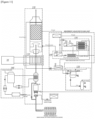
- an apparatus for reducing greenhouse gas emission in a vessel includes: a seawater supply unit 110 that supplies seawater; an absorbent liquid producing unit 120 that produces and supplies a high-concentration CO 2 absorbent liquid; an absorption tower 130 including a CO 2 removing unit 131 that cools exhaust gas discharged from a vessel engine 10 by reacting the exhaust gas with the seawater supplied from the seawater supply unit 110, and removes CO 2 by reacting the cooled exhaust gas with the absorbent liquid supplied from the absorbent liquid producing unit 120 to convert CO 2 into an aqueous ammonium salt solution; and an absorbent liquid recycling unit including a primary recycling unit 140 that primarily recycles the absorbent liquid by reacting the aqueous ammonium salt solution discharged from the absorption tower 130 with an aqueous divalent metal hydroxide solution, and a secondary recycling unit 150 that secondarily recycles the high-concentration absorbent liquid by additionally reacting the aqueous divalent metal hydroxide solution with an unreacted
- the absorption tower may optionally include, in addition to the CO 2 removing unit, a NOx absorbing unit or a SOx absorbing unit, or may include both the NOx absorbing unit and the SOx absorbing unit.
- a SOx absorbing unit capable of simultaneously performing cooling of exhaust gas and absorption and removal by dissolution of SOx may be additionally provided.
- the NOx absorbing unit, the SOx absorbing unit, and the CO 2 removing unit are sequentially stacked on the absorption tower, but the present invention is not limited thereto.
- the NOx absorbing unit and/or the SOx absorbing unit may or may not be included according to the types of vessel engine and fuel.
- a seawater supply unit 110 supplies seawater to an absorption tower 130 so that temperature of exhaust gas is lowered to facilitate absorption of CO 2 by an absorbent liquid.
- the seawater supply unit 110 may include: a seawater pump 111 that suctions seawater from the outside of the vessel through a sea chest (not illustrated) and pumps the seawater to a SOx absorbing unit 132 of the absorption tower 130; and a seawater control valve 112 that controls the spray amount of the seawater supplied to the SOx absorbing unit 132 according to the amount of exhaust gas.
- the seawater pump 111 may separately include a suction pump that suctions the seawater from the outside of the vessel and a seawater transfer pump that pumps and transfers the seawater to the SOx absorbing unit 132.
- seawater when the vessel is berthing or sailing, seawater may be selectively supplied to the seawater pump 111 from a high sea chest that suctions upper seawater or a low sea chest that suctions lower seawater according to the depth of water. That is, when the vessel is berthing, the high sea chest may be used because the upper seawater is cleaner than the lower seawater, and when the vessel is sailing, the low sea chest may be used because the lower seawater is cleaner than the upper seawater.
- the seawater control valve 112 may be a manually operated diaphragm valve or a solenoid type valve that controls the flow rate of seawater, but the present invention is not limited thereto. Any type of valve may be applied as long as the amount of seawater sprayed through a seawater spray nozzle 132a can be controlled according to the amount of exhaust gas.
- the absorbent liquid producing unit 120 reacts fresh water with NH 3 as shown in [Chemical Formula 1] below to produce high-concentration ammonia water (NH 4 OH(aq)), which is a high-concentration CO 2 absorbent liquid, and supplies the high-concentration ammonia water (NH 4 OH(aq)) to the absorption tower 130 through an absorbent liquid storage tank 153.
- [Chemical Formula 1] NH 3 + H 2 O -> NH 4 OH(aq), (exothermic reaction, 1650MJ/ton)
- the absorbent liquid producing unit 120 may include: a fresh water tank (not illustrated) that stores fresh water; a fresh water control valve 121 that supplies the fresh water from the fresh water tank to an ammonia water tank 123; a NH 3 storage 122 that stores high-pressure NH 3 ; an ammonia water tank 123 that produces and stores high-concentration ammonia water by spraying NH 3 supplied from the NH 3 storage 122 to the fresh water supplied by the fresh water control valve 121; a pH sensor 124 that measures a concentration of the ammonia water in the ammonia water tank 123; and an ammonia water supply pump 125 that supplies the high-concentration ammonia water from the ammonia water tank 123 to a secondary absorbent liquid storage tank 153.
- a fresh water tank not illustrated
- a fresh water control valve 121 that supplies the fresh water from the fresh water tank to an ammonia water tank 123
- a NH 3 storage 122 that stores high-pressure NH 3
- an ammonia water tank 123
- the concentration of the ammonia water circulating through the absorption tower 130 and an absorbent liquid recycling unit changes as the operation is repeated. For example, the concentration of the ammonia water is reduced when NH 3 is supplied to the NOx absorbing unit 133 and used to absorb and remove NOx, or when NH 3 passes through the absorption tower 130 and is exhausted together with the exhaust gas.
- the absorbent liquid producing unit 120 supplies the high-concentration ammonia water to an absorbent liquid circulation line (see A in FIG. 1 ) to compensate for the reduced concentration of the ammonia water so that the ammonia water is constantly maintained at a designed concentration.
- compressed air of a constant pressure may be injected into the ammonia water tank 123 so that the pressure in the ammonia water tank 123 is maintained to be high, thereby preventing the evaporation loss of NH 3 .
- 50% concentration of ammonia water may be stored in the ammonia water tank 123 by maintaining the inside of the ammonia water tank 123 at a constant pressure by using compressed air of 7 bar available in the vessel.
- a safety valve 123a for preventing overpressure of the ammonia water tank 123 may be installed.
- the absorption tower 130 includes a CO 2 removing unit 131 that cools exhaust gas discharged from the vessel engine 10 by reacting the exhaust gas with the seawater supplied from the seawater supply unit 110, reacts CO 2 of the cooled exhaust gas with ammonia water, which is the absorbent liquid supplied from the absorbent liquid producing unit 120, and converts CO 2 into an aqueous ammonium salt solution (NH 4 HCO 3 (aq)) to remove CO 2 as shown in [Chemical Formula 2] below.
- the CO 2 removing unit 131 may include: an ammonia water spray nozzle 131a that sprays the ammonia water supplied from the secondary absorbent liquid storage tank 153 downward; a packing material 131b that contacts CO 2 of the exhaust gas with the ammonia water, which is the absorbent liquid, and converts CO 2 into NH 4 HCO 3 (aq); a cooling jacket (not illustrated) that is formed in multi-stages for each section of an absorption apparatus filled with the packing material 131b and cools heat generated by the CO 2 absorption reaction; a water spray 131c that collects NH 3 discharged to the outside without reacting with CO 2 ; a mist removal plate 131d that is formed in a curved multi-plate shape and returns the ammonia water scattered when sprayed by the ammonia water spray nozzle 131a toward the packing material 131b; a partition wall 131e that is formed so that the ammonia water passing through the packing material 131b does not flow back to the SO
- the cooling jacket may cool heat to 30°C to 50°C at which the material transfer is smoothest, so that NH 3 is not evaporated and lost while maintaining a CO 2 absorption rate at a certain level.
- the CO 2 removing unit 131 may be considered in various forms so as to operate within an allowable pressure drop of an exhaust pipe required by an engine specification while increasing a contact area between the exhaust gas and NH 3 .
- the packing material 131b may include multi-stage distilling column packings designed to increase a contact area per unit volume.
- a distilling column packing suitable for an absorption process may be selected considering the contact area per unit area, the pressure drop of gas, and the flooding velocity.
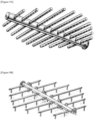
- the ammonia water spray nozzle 131a may be provided in a ladder pipe form FIG. 9A or a spray form FIG. 9B .
- a solution redistributor (not illustrated) may be formed between the distilling column packings so as to prevent channeling when the ammonia water passes downward through the packing material 131b, the exhaust gas passes upward through the packing material 131b, and the ammonia water and the exhaust gas contact each other.
- mist removal plate 131d allows the scattered ammonia water to adhere to the curved multi-plate, so that droplets become large, and drains the ammonia water toward the packing material 131b by the own weight thereof.
- the absorption tower 130 may further include the SOx absorbing unit 132.
- the SOx absorbing unit 132 may dissolve and remove SOx while cooling the exhaust gas discharged from the vessel engine 10 by reacting the exhaust gas with the seawater supplied from the seawater supply unit 110, and the CO 2 removing unit 131 may cool the exhaust gas, from which the SOx is removed, through reaction with the seawater supplied from the seawater supply unit 110, react the cooled exhaust gas with the absorbent liquid supplied from the absorbent liquid producing unit 120 to convert CO 2 into an aqueous ammonium salt solution, and absorb and remove CO 2 .
- the SOx absorbing unit 132 is a section that is in primary contact with seawater.
- the SOx absorbing unit 132 may include: a multi-stage seawater spray nozzle 132a that dissolves SOx by spraying the seawater supplied from the seawater supply unit 110 downward and removes dusts such as soot; and a partition wall-shaped exhaust gas inlet pipe 132b that prevents cleaning water from flowing back, or an umbrella-shaped blocking plate 132c that covers the exhaust gas inlet pipe 132b.
- the SOx absorbing unit 132 may cool the temperature of the exhaust gas to 27°C to 33°C, preferably about 30°C, which is required by the CO 2 removing unit 131, through the seawater spray nozzle 132a or a separate cooling jacket (not illustrated).
- porous upper plates 132d having a passage through which the exhaust gas passes may be respectively formed in multi-stages under the seawater spray nozzle 132a, so that the seawater and the exhaust gas come into smooth contact with each other.
- an absorption apparatus 132e filled with a packing material for allowing the seawater and the exhaust gas to come into contact with each other may be formed under the seawater spray nozzle 132a, so that the seawater dissolves SOx.
- a closed loop system may be applied to add a compound forming alkali ions, for example, a basic chemical of NaOH or MgO, to the seawater supplied to the SOx absorbing unit 132 in order to further increase the solubility of SOx.
- a compound forming alkali ions for example, a basic chemical of NaOH or MgO
- the closed loop system involves additional consumption of basic chemicals, but has an advantage that the amount of circulating seawater is small, and the open loop system that discharges SOx dissolved by spraying only seawater to the outside of the vessel has no additional consumption of basic chemicals and is simple.
- a hybrid system in which the open loop system and the closed loop system are combined may be applied.
- cleaning water drained to a discharge unit 170 after SOx is absorbed by the SOx absorbing unit 132 contains SO 3 - , SO 4 2- , soot, NaSO 3 , Na 2 SO 4 , MgCO 3 , MgSO 4 , and other ionic compounds together.
- the absorption tower 130 may further include a NOx absorbing unit 133 that absorbs and removes NOx from the exhaust gas discharged from the vessel engine 10.
- the absorption tower 130 may cool the exhaust gas, from which the NOx has been removed, through reaction with the seawater supplied from the seawater supply unit 110 and may remove CO 2 by reacting the cooled exhaust gas with the absorbent liquid supplied from the absorbent liquid producing unit 120 to convert CO 2 into an aqueous ammonium salt solution.
- the NOx absorbing unit 133 that absorbs and removes NOx from the exhaust gas discharged from the vessel engine 10
- the SOx absorbing unit 132 that dissolves and removes SOx while cooling the exhaust gas, from which the NOx has been removed, through reaction with the seawater
- the CO 2 removing unit 131 that removes CO 2 by reacting the exhaust gas, from which the SOx has been removed, with the ammonia water supplied from the absorbent liquid producing unit 120 to convert CO 2 into NH 4 HCO 3 (aq) are stacked in the vertical direction to sequentially absorb and remove the NOx, the SOx, and the CO 2 .
- the CO 2 removing unit 131 removes NOx and SOx by reacting the ammonia water with the exhaust gas from which the NOx and the SOx have been removed, side reactions caused by NOx and SOx do not occur during the CO 2 removal process, thereby minimizing the generation of impurities and obtaining NH 4 HCO 3 with less impurities in a subsequent process.
- the absorption tower 130 may include the CO 2 removing unit 131, the SOx absorbing unit 132, the NOx absorbing unit 133, and an exhaust gas economizer (EGE) 134 to be described later, may be modularized and combined with individual modules, and may be integrated in a single tower form, and the absorption tower 130 itself may include a single tower or a group of a plurality of towers.
- EGE exhaust gas economizer
- the NOx absorbing unit 133 is a selective catalyst reactor (SCR). As illustrated in FIG. 5 , the NOx absorbing unit 133 may directly supply NH 3 from a primary recycling unit 140 to a first NH 3 spray nozzle 133b through a blower 133a or a compressor, or when NH 3 is insufficient, may receive urea water of a urea water storage tank 133c from a second NH 3 spray nozzle 133e through a urea water supply pump 133d so as to compensate for the lack of NH 3 .
- SCR selective catalyst reactor
- NH 3 and CO 2 are generated when the urea water is decomposed, it may be preferable that NH 3 is directly supplied to reduce the amount of CO 2 generated.
- the absorption tower 130 may further include an EGE 134 that is formed between the NOx absorbing unit 133 and the SOx absorbing unit 132 and performs heat exchange between waste heat of the vessel engine 10 and boiler water.
- the absorbent liquid recycling unit may recycle NH 3 and return NH 3 back to the absorption tower 130 for reuse as a CO 2 absorbent liquid, may store CO 2 in the form of CaCO 3 (s) or MgCO 3 (s) or discharge CO 2 to the outside of the vessel, or may supply NH 3 to the NOx absorbing unit 133 so as to absorb NOx with NH 3 .
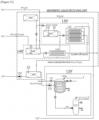
- the absorbent liquid recycling unit may include: a primary recycling unit 140 that primarily recycles the absorbent liquid by reacting the aqueous ammonium salt solution discharged from the absorption tower 130 with an aqueous divalent metal hydroxide solution; and a secondary recycling unit 150 that secondarily recycles the high-concentration absorbent liquid by reacting the aqueous divalent metal hydroxide solution with an unreacted aqueous ammonium salt solution supplied from the primary recycling unit 140 and circulates and supplies the recycled absorbent liquid to the absorption tower 130 for reuse as the absorbent liquid.
- a recovery rate of the absorbent liquid may be increased and maintained at a certain concentration.
- NH 3 is supplied to the NOx absorbing unit 133 and used to absorb and remove NOx. NH 3 is discharged together with exhaust gas through the absorption tower 130, so that the concentration of the ammonia water is lowered. Therefore, it is possible to effectively prevent the deterioration in absorption performance.
- the absorbent liquid recycling unit may include: a storage tank 141 that stores an aqueous divalent metal hydroxide solution; a primary recycling unit 140 including a mixing tank 142 in which the aqueous divalent metal hydroxide solution and the aqueous ammonium salt solution discharged from the absorption tower 130 are stirred by an agitator to generate NH 3 (g) and carbonate as shown in [Chemical Formula 3] below, and a primary filter 143 that suctions a solution and precipitate from the mixing tank 142 and separates the carbonate and ammonia water (or fresh water); and a secondary recycling unit 150 including a primary absorbent liquid storage tank 151 that stores an unreacted aqueous ammonium salt solution remaining without reacting with the ammonia water and the aqueous divalent metal hydroxide separated by the primary filter 143 and re-reacting the unreacted aqueous ammonium salt solution with the aqueous divalent metal hydroxide solution supplied from the storage
- the storage capacity of the primary absorbent liquid storage tank 151 is designed to be at least three times the capacity of the absorbent liquid circulating through the absorption tower 130 and the absorbent liquid recycling unit, and thus has a relatively large capacity compared to the capacity of the circulating absorbent liquid.
- the stay time of the unreacted aqueous ammonium salt solution in the primary absorbent liquid storage tank 151 is increased to sufficiently secure the reaction time. Therefore, the unreacted aqueous ammonium salt solution may be converted into carbonate.
- the unreacted aqueous ammonium salt solution remaining in the ammonia water may be removed to maintain the concentration of the ammonia water at a certain level.
- the aqueous divalent metal hydroxide solution frequently changes while passing through the filter due to the influence of the reaction rate, the evaporation of ammonia, and the like.
- the generation of carbonate is not completed, a considerable amount of the unreacted aqueous ammonium salt solution remains in the ammonia water, resulting in a reduction in the absorption rate. Therefore, by designing a large-capacity primary absorbent liquid storage tank 151, the recovery rate of the ammonia water is increased by allowing reaction for a sufficient time and passing through the secondary filter 152 again.
- the concentration of the ammonia water may be maintained at a certain level at which the ammonia water can function as an effective absorbing liquid.
- ammonia gas generated in the mixing tank 142 may be supplied to the CO 2 removing unit 131 of the absorption tower 130, or may be supplied to the NOx absorbing unit 133.
- the primary absorbent liquid storage tank 151 may include: an agitator 151a that stirs and reacts the aqueous divalent metal hydroxide solution and the unreacted aqueous ammonium salt solution; and a pH sensor 151b that measures the degree of reaction by the agitator 151a.
- the aqueous divalent metal hydroxide solution stored in the storage tank may be Ca(OH) 2 or Mg(OH) 2 produced by reacting fresh water with CaO or MgO.
- the concentration of the ammonia water circulating through the ammonia water circulation line A is low, the amount of (NH 4 ) 2 CO 3 produced in [Chemical Formula 2] decreases, resulting in an increase in the amount of CO 2 emitted.
- the concentration of the ammonia water is high, the amount of carbonate produced increases more than necessary due to excessive CO 2 absorption.
- the concentration of the ammonia water may be designed to be adjusted to 12% by mass, but the present invention is not limited thereto and the concentration of the ammonia water may be changed according to the conditions of use.
- a separate storage tank (not illustrated) that stores carbonate (CaCO 3 (s) or MgCO 3 (s)) separated by the primary filter 143 and the secondary filter 152 in a slurry state or a solid state transferred to a dryer (not illustrated) and solidified may be provided, and carbonate (CaCO 3 (s) or MgCO 3 (s)) may be discharged to the outside of the vessel.
- a membrane filter suitable for precipitate separation by high-pressure fluid transfer may be applied as an example of the primary filter 143 and the secondary filter 152.
- ammonia water circulation pump 154 may be provided as a centrifugal pump-type pump so that a large amount of ammonia water circulates through the ammonia water circulation line A.
- the fresh water or the ammonia water separated by the primary filter 143 and the secondary filter 152 is supplied to the secondary absorbent liquid storage tank 153, or surplus fresh water additionally generated by the mixing tank 142 relative to the total circulating fresh water is stored in a fresh water tank (not illustrated) and reused when the aqueous divalent metal hydroxide solution is generated in the storage tank 141, thereby saving the fresh water.
- the steam generating unit 160 may include: an auxiliary boiler 161 that receives a mixture in the form of saturated water and steam heat-exchanged through the EGE 134, separates the steam by a steam drum (not illustrated), and supplies the separated steam to a steam consumer; a boiler water circulation pump 162 that circulates and supplies boiler water from the auxiliary boiler 161 to the EGE 134; a cascade tank 163 that recovers condensed water condensed and phase-changed after being consumed from the steam consumer; and a supply pump 164 and a control valve 165 that supply boiler water from the cascade tank 163 to the auxiliary boiler 161 while controlling the amount of boiler water.
- the steam generating unit 160 generates and supplies steam required for heating devices in the vessel.
- the auxiliary boiler 161 itself may burn fuel to produce necessary steam.
- the discharge unit 170 may include: a cleaning water tank 171 that stores cleaning water discharged from the absorption tower 130; a water treatment device 173 including a filtering unit that controls turbidity to satisfy the outboard discharge condition of the cleaning water transferred from the cleaning water tank 171 by the transfer pump 172, and a neutralizing agent injecting unit that controls pH; and a sludge storage tank 174 that separates and stores solid emissions such as soot.
- the discharge unit 170 may discharge the cleaning water, which passes through the water treatment device 173 and satisfies the outboard discharge condition, to the outside of the vessel, and may separately store the solid emissions, such as soot, which do not satisfy the outboard discharge conditions, in the sludge storage tank 174.
- NaOH may be used as the neutralizing agent for satisfying the outboard discharge condition.
- a neutralizing agent capable of neutralizing each of the acidic material and the basic material may be selected and used as necessary.
- a vessel including the apparatus for reducing greenhouse gas emission may be provided.
- the absorbent liquid recycling unit may be provided in two or more stages so that the unreacted aqueous ammonium salt solution remaining in the ammonia water is removed to maintain the concentration of the ammonia water at a certain level, thereby increasing the recovery rate of the absorbent liquid.
- the deterioration in greenhouse gas absorption performance may be prevented.
- a pressurization system may be applied to prevent the loss of absorbent liquid due to the natural evaporation of high-concentration absorbent liquid.
- greenhouse gas may be converted into materials that do not affect environments and then separately discharged or may be converted into useful materials and then stored.
- NH 3 may be recycled to minimize consumption of relatively expensive NH 3 .
- a capacity size of a rear end of a filter may be reduced.
- Greenhouse gas may be stored in the form of carbonate that exists in a natural state so that greenhouse gas may be discharged to the sea. Side reactions caused by SOx remaining during NH 3 recycling may be removed, thereby minimizing the loss of NH 3 and preventing impurities from being included when recovering ammonia.
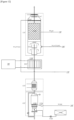
- an apparatus for reducing greenhouse gas emission in a vessel may include: an exhaust gas cooling unit 110' that cools exhaust gas discharged from a vessel engine 10'; an absorbent liquid producing unit 120' that produces a high-concentration CO 2 absorbent liquid and supplies the high-concentration CO 2 absorbent liquid to an absorption tower 130'; the absorption tower 130' including a CO 2 removing unit 131' that removes CO 2 by reacting the exhaust gas cooled by the exhaust gas cooling unit 110' with the absorbent liquid supplied from the absorbent liquid producing unit 120' to convert CO 2 into an aqueous ammonium salt solution; and an absorbent liquid recycling unit including a primary recycling stage 140' that primarily recycles the absorbent liquid by reacting the aqueous ammonium salt solution discharged from the absorption tower 130' with an aqueous divalent metal hydroxide solution, and a secondary recycling stage 150' that secondarily recycles the high-concentration absorbent liquid by additionally reacting the unreacted
- the exhaust gas is cooled by a heat exchange method, thereby preventing the decrease in the concentration of the absorbent liquid, and the absorbent liquid recycling unit is provided in two or more stages so that the unreacted aqueous ammonium salt solution remaining in the ammonia water is removed to increase the recovery rate of the absorbent liquid, thereby preventing the deterioration in greenhouse gas absorption performance.
- the absorption tower may optionally include, in addition to the CO 2 removing unit, a NOx absorbing unit or a SOx absorbing unit, or may include both the NOx absorbing unit and the SOx absorbing unit.
- LNG is used as the fuel of the vessel engine 10'
- SOx is not generated, and thus a separate SOx absorbing unit need not be installed.
- LSMGO is used, a small amount of SOx may be generated, and thus a SOx absorbing unit capable of simultaneously performing cooling of exhaust gas and absorption by dissolution of SOx may be additionally provided.
- the NOx absorbing unit, the exhaust gas cooling unit, and the CO 2 removing unit are sequentially stacked on the absorption tower, but the present invention is not limited thereto.
- the NOx absorbing unit and/or the SOx absorbing unit may or may not be included according to the types of vessel engine and fuel.
- the exhaust gas cooling unit 110' cools exhaust gas discharged from the vessel engine 10' so that temperature of the exhaust gas is lowered to facilitate absorption of CO 2 by a greenhouse gas absorbent liquid.
- the exhaust gas cooling unit 110' may cool the exhaust gas discharged from the vessel engine 10' by a heat exchange method of the fresh water.
- the exhaust gas may be cooled with the fresh water by the heat exchange method to a temperature of 27°C to 33°C, which is required by the CO 2 removing unit 131', by circulating the fresh water provided from an onboard cooling system 20' through a heat exchange pipe 111' surrounding an exhaust gas discharge pipe through which the exhaust gas flows.
- the concentration of the absorbent liquid is lowered due to the addition of the fresh water, resulting in the deterioration in the greenhouse gas absorption performance.
- the exhaust gas is cooled by a heat exchange method without direct contact with the fresh water, thereby preventing the decrease in the concentration of the absorbent liquid and preventing the deterioration in greenhouse gas absorption performance.
- the absorbent liquid producing unit 120' produces a high-concentration CO 2 absorbent liquid and supplies the high-concentration CO 2 absorbent liquid to the absorption tower 130'.
- the absorbent liquid producing unit 120' reacts fresh water with NH 3 as shown in [Chemical Formula 4] below to produce high-concentration ammonia water (NH 4 OH(aq)), which is a high-concentration CO 2 absorbent liquid, and supplies the high-concentration ammonia water (NH 4 OH(aq)) through the absorbent liquid storage tank 153' to the CO 2 removing unit 131' of the absorption tower 130' along the absorbent liquid circulation line (see A' in FIG. 10 ).
- [Chemical Formula 4] NH 3 + H 2 O -> NH 4 OH(aq), (exothermic reaction, 1650MJ/ton)
- the absorbent liquid producing unit 120' may include: a fresh water tank (not illustrated) that stores fresh water; a fresh water control valve 121' that supplies the fresh water from the fresh water tank to an ammonia water tank 123' by controlling a supply amount of the fresh water; a NH 3 storage 122' that stores high-pressure NH 3 ; an ammonia water tank 123' that produces and stores high-concentration ammonia water by spraying NH 3 supplied from the NH 3 storage 122' to the fresh water supplied by the fresh water control valve 121'; a pH sensor 124' that measures and monitors the concentration of the ammonia water in the ammonia water tank 123'; and an ammonia water supply pump 125' that supplies the high-concentration ammonia water from the ammonia water tank 123' to the secondary absorbent liquid storage tank 153'.
- a fresh water tank not illustrated
- a fresh water control valve 121' that supplies the fresh water from the fresh water tank to an ammonia water tank 123' by controlling
- the concentration of the ammonia water circulating through the absorption tower 130' and the absorbent liquid recycling unit along the absorbent liquid circulation line A' changes as the operation is repeated. For example, the concentration of the ammonia water is reduced when NH 3 is supplied to the NOx absorbing unit 132' and used to absorb and remove NOx, or when NH 3 passes through the absorption tower 130' and is exhausted together with the exhaust gas.
- the absorbent liquid producing unit 120' supplies the high-concentration ammonia water to the absorbent liquid circulation line (see A' in FIG. 10 ) to compensate for the reduced concentration of the ammonia water so that the ammonia water is constantly maintained at a concentration designed as a preset absorption performance.
- compressed air of a certain pressure may be injected into the upper portion of the ammonia water in the ammonia water tank 123' so that the pressure in the ammonia water tank 123' is maintained to be high, thereby constantly maintaining the concentration of the ammonia water with NH 3 of a high concentration, for example, 50 %wt.
- NH 3 may be stored in a liquid state at -34°C and 8.5 bar
- 50% concentration of ammonia water may be stored in the ammonia water tank 123' by maintaining the inside of the ammonia water tank 123' at a constant pressure by using compressed air of 7 bar available in the vessel.
- a safety valve 123a' for reducing the pressure by exhausting air to a safety area so as to prevent overpressure of the ammonia water tank 123' may be installed.
- the absorption tower 130' includes a CO 2 removing unit 131' that removes CO 2 by reacting the exhaust gas cooled by the exhaust gas cooling unit 110' with the ammonia water, which is the absorbent liquid initially supplied from the absorbent liquid producing unit 120' and circulating along the absorbent liquid circulation line A', to convert CO 2 into an aqueous ammonium salt solution (NH 4 HCO 3 (aq)) as shown in [Chemical Formula 5] below.
- the CO 2 removing unit 131' may include: an ammonia water spray nozzle 131a' that sprays the ammonia water supplied from the secondary absorbent liquid storage tank 153' downward toward a packing material 131b'; the packing material 131b' that contacts CO 2 of the exhaust gas with the ammonia water, which is the absorbent liquid, to convert CO 2 into NH 4 HCO 3 (aq); a cooling jacket (not illustrated) that is formed in multi-stages for each section of an absorption apparatus filled with the packing material 131b' and cools heat generated by a CO 2 absorption reaction; a water spray 131c' that collects NH 3 discharged to the atmosphere without reacting with CO 2 ; a mist removal plate 131d' that is formed in a curved multi-plate shape and returns the ammonia water scattered when sprayed by the ammonia water spray nozzle 131a' toward the packing material 131b'; a partition wall 131e' that is formed so that the ammonia water spray nozzle 131a'
- the cooling jacket may cool heat to 30°C to 50°C at which the material transfer is smoothest, so that NH 3 is not evaporated and lost while maintaining a CO 2 absorption rate at a certain level.
- the CO 2 removing unit 131' may be considered in various forms so as to operate within an allowable pressure drop of an exhaust pipe required by an engine specification while increasing a contact area between the exhaust gas and NH 3 .
- the packing material 131b' may include multi-stage distilling column packings designed to increase a contact area per unit volume.
- a distilling column packing suitable for an absorption process may be selected considering the contact area per unit area, the pressure drop of gas, and the flooding velocity.
- the ammonia water spray nozzle 131a' may be provided in a ladder pipe form FIG. 16A or a spray form FIG. 16B .
- a solution redistributor (not illustrated) may be formed between the distilling column packings so as to prevent channeling when the ammonia water passes downward through the packing material 131b', the exhaust gas passes upward through the packing material 131b', and the ammonia water and the exhaust gas contact each other.
- mist removal plate 131d' allows the scattered ammonia water to adhere to the curved multi-plate, so that droplets become large, and drains the ammonia water toward the packing material 131b' by the own weight thereof.
- the vessel engine 10' is based on the premise of using LNG or LSMGO as fuel.
- SOx may not be generated, but when the vessel engine 10' uses LSMGO as fuel, SOx may be included in the exhaust gas, and thus the absorption tower 130' may include the SOx absorbing unit.
- the SOx absorbing unit may dissolve and remove SOx while cooling the exhaust gas discharged from the vessel engine 10' through reaction with the seawater
- the CO 2 removing unit 131' may absorb and remove CO 2 by reacting the cooled exhaust gas, from which the SOx is removed, with the absorbent liquid supplied from the absorbent liquid producing unit 120' to convert CO 2 into an aqueous ammonium salt solution.
- the absorption tower 130' may further include a NOx absorbing unit 132' that absorbs and removes NOx from the exhaust gas discharged from the vessel engine 10'.
- the exhaust gas from which the NOx has been removed may be cooled by the exhaust gas cooling unit 110', and CO 2 may be removed by reacting the cooled exhaust gas with the absorbent liquid supplied from the absorbent liquid producing unit 120' to convert CO 2 into an aqueous ammonium salt solution.
- the NOx absorbing unit 132' that absorbs and removes NOx from the exhaust gas discharged from the vessel engine 10'
- the CO 2 removing unit 131' that removes CO 2 by reacting the cooled exhaust gas, from which the NOx has been removed, with the ammonia water supplied from the absorbent liquid producing unit 120' to convert CO 2 into NH 4 HCO 3 (aq) are stacked to sequentially absorb and remove the NOx and the CO 2 from the exhaust gas.
- the CO 2 removing unit 131' reacts the ammonia water with the exhaust gas from which the NOx has been removed by the NOx absorbing unit 132', side reactions caused by NOx do not occur during the CO 2 removal process, thereby minimizing the generation of impurities and obtaining NH 4 HCO 3 (aq) with less impurities in a subsequent process.
- the absorption tower 130' may include the CO 2 removing unit 131', the NOx absorbing unit 132', and an EGE 133' to be described later, may be modularized and combined with individual modules, and may be integrated in a single tower form, and the absorption tower 130' itself may include a single tower or a group of a plurality of towers.
- the NOx absorbing unit 132' is an SCR. As illustrated in FIG. 12 , the NOx absorbing unit 132' may absorb NOx by directly supplying the recycled NH 3 from the primary recycling stage 140' to a NH 3 spray nozzle 132b' through a blower 132a' or a compressor, or when NH 3 supplied to the NH 3 spray nozzle 132b' is insufficient, may receive urea water of a urea water storage tank 132c' from a NH 3 spray nozzle 132e' through a urea water supply pump 132d' so as to compensate for the loss or lack of NH 3 .
- NH 3 and CO 2 are generated when the urea water is decomposed, it may be preferable that NH 3 is directly supplied to reduce the amount of CO 2 generated.
- the absorption tower 130' may further include an EGE 133' that is formed between the NOx absorbing unit 132' and the exhaust gas cooling unit 110' and performs heat exchange between waste heat of the exhaust gas from the vessel engine 10' and boiler water.
- the absorbent liquid recycling unit may recycle NH 3 and return NH 3 back to the absorption tower 130' for reuse as a CO 2 absorbent liquid, may store CO 2 in the form of CaCO 3 (s) or MgCO 3 (s) or discharge CO 2 to the outside of the vessel, or may supply the recycled NH 3 to the NOx absorbing unit 132' so as to absorb NOx.
- the absorbent liquid recycling unit may include: a primary recycling stage 140' that primarily recycles the absorbent liquid by reacting the aqueous ammonium salt solution, which is discharged from the absorption tower 130' after the absorption of CO 2 , with an aqueous divalent metal hydroxide solution; and a secondary recycling stage 150' that secondarily recycles the high-concentration absorbent liquid by additionally reacting the aqueous divalent metal hydroxide solution with an unreacted aqueous ammonium salt solution supplied from the primary recycling stage 140' and circulates and supplies the secondarily recycled absorbent liquid to the absorption tower 130' for reuse as the absorbent liquid.
- a recovery rate of the absorbent liquid may be increased and maintained at a certain concentration, thereby effectively preventing the deterioration in absorption performance.
- the absorbent liquid recycling unit may include: a storage tank 141' that stores an aqueous divalent metal hydroxide solution; a primary recycling stage 140' including a mixing tank 142' in which the aqueous ammonium salt solution discharged from the absorption tower 130' and the aqueous divalent metal hydroxide solution supplied from the storage tank 141' are stirred by an agitator to generate NH 3 (g) and carbonate as shown in [Chemical Formula 6] below, and a primary filter 143' that suctions a solution and precipitate from the mixing tank 142' and separates the carbonate and ammonia water (or fresh water); and a secondary recycling stage 150' including a primary absorbent liquid storage tank 151' that stores an unreacted aqueous ammonium salt solution remaining without reacting with the ammonia water and the aqueous divalent metal hydroxide solution separated by the primary filter 143' and re-reacting the unreacted aqueous ammonium salt
- the storage capacity of the primary absorbent liquid storage tank 151' is designed to be at least three times the capacity of the absorbent liquid circulating through the absorption tower 130' and the absorbent liquid recycling unit along the absorbent liquid circulation line A', and thus has a relatively large capacity compared to the capacity of the circulating absorbent liquid.
- the stay time of the unreacted aqueous ammonium salt solution in the primary absorbent liquid storage tank 151' is increased to sufficiently secure the reaction time. Therefore, the unreacted aqueous ammonium salt solution may be converted into carbonate as much as possible.
- the unreacted aqueous ammonium salt solution remaining in ammonia water is re-reacted in the primary absorbent liquid storage tank 151' to additionally generate ammonia water, thereby maintaining the concentration of the ammonia water at a certain level.
- the aqueous divalent metal hydroxide solution frequently changes while passing through the filter due to the influence of the reaction rate, the evaporation of ammonia, and the like.
- the ammonia water recovery rate is increased by allowing reaction for a sufficient time and passing through the secondary filter 152' again.
- the concentration of the ammonia water may be maintained at a certain level at which the ammonia water can function as an effective absorbing liquid.
- NH 3 (g) generated in the mixing tank 142' may be supplied to the CO 2 removing unit 131' of the absorption tower 130' and used to remove CO 2 , or may be supplied to the NOx absorbing unit 132' and used to remove NOx.
- the primary absorbent liquid storage tank 151' may include: an agitator 151a' that stirs and reacts the aqueous divalent metal hydroxide solution and the unreacted aqueous ammonium salt solution; and a pH sensor 151b' that measures the degree of reaction by the agitator 151a'.
- the aqueous divalent metal hydroxide solution stored in the storage tank 141' may be Ca(OH) 2 or Mg(OH) 2 produced by reacting the fresh water with CaO or MgO.
- the concentration of the ammonia water circulating through the absorbent liquid circulation line A' is low, the amount of (NH 4 ) 2 CO 3 produced in [Chemical Formula 5] decreases, resulting in an increase in the amount of CO 2 emitted.
- the concentration of the ammonia water is high, the amount of carbonate produced increases more than necessary due to excessive CO 2 absorption.
- the concentration of the ammonia water may be designed to be adjusted to 12% by mass, but the present invention is not limited thereto and the concentration of the ammonia water may be changed according to the conditions of use.
- a separate storage tank (not illustrated) that stores carbonate (CaCO 3 (s) or MgCO 3 (s)), which is separated by the primary filter 143' and the secondary filter 152' and can be discharged to the sea, in a slurry state or a solid state transferred to a dryer (not illustrated) and solidified may be provided, and carbonate (CaCO 3 (s) or MgCO 3 (s)) may be discharged to the outside of the vessel without being stored.
- a membrane filter suitable for precipitate separation by high-pressure fluid transfer may be applied as an example of the primary filter 143' and the secondary filter 152'.
- ammonia water circulation pump 154' may be provided as a centrifugal pump-type pump so that a large amount of ammonia water circulates through the absorbent liquid circulation line A'.
- the fresh water or the ammonia water separated by the primary filter 143' and the secondary filter 152' is supplied to the secondary absorbent liquid storage tank 153', or surplus fresh water additionally generated by the mixing tank 142' relative to the total circulating fresh water is stored in a fresh water tank (not illustrated) and reused when the aqueous divalent metal hydroxide solution is generated in the storage tank 141', thereby saving the fresh water.
- the steam generating unit 160' may include: an auxiliary boiler 161' that receives a mixture in the form of saturated water and steam heat-exchanged through the EGE 133', separates the steam by a steam drum (not illustrated), and supplies the separated steam to a steam consumer; a boiler water circulating pump 162' that circulates and supplies boiler water from the auxiliary boiler 161' to the EGE 133'; a cascade tank 163' that recovers condensed water condensed and phase-changed after being consumed from the steam consumer; and a supply pump 164' and a control valve 165' that supply boiler water from the cascade tank 163' to the auxiliary boiler 161' while controlling the amount of boiler water.
- the steam generating unit 160' generates and supplies steam required for heating devices in the vessel.
- the auxiliary boiler 161' itself may burn fuel to produce necessary steam.
- a vessel including the apparatus for reducing greenhouse gas emission may be provided.
- the apparatus for reducing greenhouse gas emission in the vessel has the following effects.
- the exhaust gas may be cooled by a heat exchange method, thereby preventing the decrease in the concentration of the absorbent liquid.
- a pressurization system may be applied to prevent the loss of absorbent liquid due to the natural evaporation of high-concentration absorbent liquid.
- the absorbent liquid recycling unit may be provided in two or more stages so that the unreacted aqueous ammonium salt solution remaining in the ammonia water is removed to maintain the concentration of the ammonia water at a certain level, thereby increasing the recovery rate of the absorbent liquid and preventing the deterioration in greenhouse gas absorption performance.
- greenhouse gas may be converted into materials that do not affect environments and then separately discharged or may be converted into useful materials and then stored.
- NH 3 may be recycled to minimize consumption of relatively expensive NH 3 .
- the capacity size of the rear end of the filter may be reduced.
- Greenhouse gas may be stored in the form of carbonate that exists in a natural state so that greenhouse gas may be discharged to the sea. Side reactions caused by SOx remaining during NH 3 recycling may be removed, thereby minimizing the loss of NH 3 and preventing impurities from being included when recovering ammonia.
Landscapes
- Chemical & Material Sciences (AREA)
- Engineering & Computer Science (AREA)
- Chemical Kinetics & Catalysis (AREA)
- Analytical Chemistry (AREA)
- General Chemical & Material Sciences (AREA)
- Oil, Petroleum & Natural Gas (AREA)
- Combustion & Propulsion (AREA)
- Mechanical Engineering (AREA)
- General Engineering & Computer Science (AREA)
- Health & Medical Sciences (AREA)
- Environmental & Geological Engineering (AREA)
- Biomedical Technology (AREA)
- Toxicology (AREA)
- Ocean & Marine Engineering (AREA)
- General Health & Medical Sciences (AREA)
- Public Health (AREA)
- Life Sciences & Earth Sciences (AREA)
- Sustainable Development (AREA)
- Treating Waste Gases (AREA)
- Gas Separation By Absorption (AREA)
- Exhaust Gas After Treatment (AREA)
Abstract
Description
- The present invention relates to an apparatus for reducing greenhouse gas emission in a vessel and a vessel including the same, in which an absorbent liquid recycling unit is provided in two or more stages so that an unreacted aqueous ammonium salt solution remaining in ammonia water is removed to maintain a concentration of ammonia water at a certain level, thereby increasing a recovery rate of an absorbent liquid and preventing a deterioration in greenhouse gas absorption performance.
- The present invention relates to an apparatus for reducing greenhouse gas emission in a vessel and a vessel including the same, in which exhaust gas is cooled by a heat exchange method, thereby preventing a decrease in a concentration of an absorbent liquid, and an absorbent liquid recycling unit is provided in two or more stages so that an unreacted aqueous ammonium salt solution remaining in ammonia water is removed, thereby increasing a recovery rate of the absorbent liquid and preventing a deterioration in greenhouse gas absorption performance.
- Recently, global warming and related environmental disasters have occurred due to the influence of greenhouse gas emission caused by indiscriminate use of fossil fuels.
- In this regard, a series of technologies related to capture and storage of carbon dioxide, which is the representative greenhouse gas, without carbon dioxide emission are called carbon dioxide capture and storage (CCS) technologies. In recent years, CCS technologies have attracted much attention. Among CCS technologies, chemical absorption is the most commercialized technology in terms of enabling large-scale treatment.
- In addition, carbon dioxide emission is regulated through the IMO's EEDI. The IMO is targeting a reduction of 50% or more in emissions by 2050 compared to 2008 and a reduction of 40% in emissions by 2030 compared to 2008. Therefore, technologies that do not emit CO2 or capture emitted CO2 are attracting attention.
- For reference, among the carbon dioxide capture and storage (CCS) technologies for directly capturing and storing carbon dioxide, a CO2 capture technology may be approached in various ways according to CO2 generation conditions of target processes. Current representative technologies are an absorption method, an adsorption method, and a membrane separation method. Among them, the wet absorption method has high technological maturity in onshore plants and may easily process CO2 in large quantities. Therefore, the wet absorption method may be said to be the closest capture technology to commercialization of CCS technology. As an absorbent agent, amines and ammonia are mainly used.
- On the other hand, the above-described technologies for reducing carbon dioxide emission or capturing generated carbon dioxide are not currently commercialized in vessels, and methods of using hydrogen or ammonia as fuel are currently under development and have not reached the level of commercialization.
- Furthermore, the need is raised to apply, to vessels, a technology for absorbing CO2, which is greenhouse gas among exhaust gases emitted from a vessel engine, with an absorbent liquid, converting CO2 into materials that do not affect environments, discharging the materials, or converting CO2 into useful materials and storing the useful materials, and preventing the deterioration in absorption performance due to the change in concentration of absorbent liquid.
- Furthermore, the need is raised to apply, to vessels using LNG or low sulphur fuel oil so as to emit a small amount of SOx or prevent SOx emission, a technology for absorbing CO2, which is one of exhaust gases emitted from a vessel engine, with an absorbent liquid, converting CO2 into materials that do not affect environments, discharging the materials, or converting CO2 into useful materials and storing the useful materials, preventing the decrease in concentration of absorbent liquid due to cooling of exhaust gas by seawater, and preventing the decrease in absorption performance due to concentration change caused by repeated circulation of absorbent liquid.
- An object of the present invention is to provide an apparatus for reducing greenhouse gas emission in a vessel and a vessel including the same, in which an absorbent liquid recycling unit is provided in two or more stages so that an unreacted aqueous ammonium salt solution remaining in ammonia water is removed to maintain a concentration of ammonia water at a certain level, thereby increasing a recovery rate of an absorbent liquid and preventing a deterioration in greenhouse gas absorption performance.
- Also, an object of the present invention is to provide an apparatus for reducing greenhouse gas emission in a vessel and a vessel including the same, in which exhaust gas is cooled by a heat exchange method, thereby preventing a decrease in a concentration of an absorbent liquid, and an absorbent liquid recycling unit is provided in two or more stages so that an unreacted aqueous ammonium salt solution remaining in ammonia water is removed, thereby increasing a recovery rate of the absorbent liquid and preventing a deterioration in greenhouse gas absorption performance.
- In order to achieve the object described above, the present invention provides an apparatus for reducing greenhouse gas emission in a vessel, the apparatus including: a seawater supply unit that supplies seawater; an absorbent liquid producing unit that produces and supplies a high-concentration CO2 absorbent liquid; an absorption tower including a CO2 removing unit that cools exhaust gas discharged from a vessel engine by reacting the exhaust gas with the seawater supplied from the seawater supply unit, and removes CO2 by reacting the cooled exhaust gas with the absorbent liquid supplied from the absorbent liquid producing unit to convert CO2 into an aqueous ammonium salt solution; and an absorbent liquid recycling unit including a primary recycling unit that primarily recycles the absorbent liquid by reacting the aqueous ammonium salt solution discharged from the absorption tower with an aqueous divalent metal hydroxide solution, and a secondary recycling unit that secondarily recycles the high-concentration absorbent liquid by additionally reacting the aqueous divalent metal hydroxide solution with an unreacted aqueous ammonium salt solution supplied from the primary recycling unit and circulates and supplies the recycled absorbent liquid to the absorption tower for reuse as the absorbent liquid.
- In addition, the absorbent liquid recycling unit may include: a storage tank that stores the aqueous divalent metal hydroxide solution; the primary recycling unit including a mixing tank in which the aqueous divalent metal hydroxide solution and the aqueous ammonium salt solution discharged from the absorption tower are stirred by an agitator to generate NH3(g) and carbonate, and a primary filter that suctions a solution and precipitate from the mixing tank and separates the carbonate; and a secondary recycling unit including a primary absorbent liquid storage tank that stores the unreacted aqueous ammonium salt solution or the ammonia water separated by the primary filter and re-reacts the unreacted aqueous ammonium salt solution with the aqueous divalent metal hydroxide solution supplied from the storage tank, a secondary filter that suctions the solution and precipitate from the primary absorbent liquid storage tank to separate carbonate and high-concentration ammonia water, and a secondary absorbent liquid storage tank that stores the high-concentration ammonia water separated by the secondary filter.
- In addition, the storage capacity of the primary absorbent liquid storage tank may be at least three times the capacity of the absorbent liquid circulating through the absorption tower and the absorbent liquid recycling unit.
- In addition, the primary absorbent liquid storage tank may include: an agitator that stirs and reacts the aqueous divalent metal hydroxide solution and the unreacted aqueous ammonium salt solution or the ammonia water separated by the primary filter; and a pH sensor that measures the degree of reaction by the agitator.
- In addition, the aqueous divalent metal hydroxide solution stored in the storage tank may be Ca(OH)2 or Mg(OH)2 produced by reacting fresh water with CaO or MgO.
- In addition, fresh water or ammonia water separated by the secondary filter may be supplied to the secondary absorbent liquid storage tank, or surplus fresh water additionally generated by the mixing tank relative to a total circulating fresh water may be stored in a fresh water tank and reused when the aqueous divalent metal hydroxide solution is generated in the storage tank.
- In addition, the absorption tower may further include a SOx absorbing unit that dissolves and removes SOx while cooling the exhaust gas discharged from the vessel engine by reacting the exhaust gas with the seawater supplied from the seawater supply unit, and the CO2 removing unit may cool the exhaust gas, from which the SOx has been removed, by reacting the exhaust gas with the seawater supplied from the seawater supply unit and may remove CO2 by reacting the cooled exhaust gas with the absorbent liquid supplied from the absorbent liquid producing unit to convert CO2 into the aqueous ammonium salt solution.
- In addition, the absorption tower may further include a NOx absorbing unit that absorbs and removes NOx from the exhaust gas emitted from the vessel engine, and the CO2 removing unit may cool the exhaust gas, from which the NOx has been removed, by reacting the exhaust gas with the seawater supplied from the seawater supply unit and may remove CO2 by reacting the cooled exhaust gas with the absorbent liquid supplied from the absorbent liquid producing unit to convert CO2 into the aqueous ammonium salt solution.
- In addition, in the absorption tower, a NOx absorbing unit that absorbs and removes NOx from the exhaust gas discharged from the vessel engine, a SOx absorbing unit that dissolves and removes SOx while cooling the exhaust gas, from which the NOx has been removed, through reaction with the seawater supplied from the seawater supply unit, and the CO2 removing unit that removes CO2 by reacting the exhaust gas, from which the SOx has been removed, with the absorbent liquid supplied from the absorbent liquid producing unit to convert CO2 into the aqueous ammonium salt solution may be sequentially stacked.
- In addition, NH3 recycled by the absorbent liquid recycling unit may be returned back to the absorption tower and converted into the absorbent liquid for reuse as the absorbent liquid, and the NOx absorbing unit may receive the NH3 recycled by the absorbent liquid recycling unit to absorb NOx with the NH3, or may absorb NOx using urea water.
- In addition, the seawater supply unit may include: a seawater pump that receives seawater from the outside of the vessel through a sea chest and pumps the seawater to the SOx absorbing unit; and a seawater control valve that controls a spray amount of the seawater supplied from the seawater pump to the SOx absorbing unit according to an amount of the exhaust gas.
- In addition, the absorbent liquid producing unit may include: a fresh water tank that stores fresh water; a fresh water control valve that supplies the fresh water from the fresh water tank; a NH3 storage that stores high-pressure NH3; an ammonia water tank that produces and stores high-concentration ammonia water, which is the absorbent liquid, by spraying the NH3 supplied from the NH3 storage to the fresh water supplied by the fresh water control valve; a pH sensor that measures a concentration of the ammonia water in the ammonia water tank; and an ammonia water supply pump that supplies the ammonia water from the ammonia water tank to the secondary absorbent liquid storage tank.
- In addition, the apparatus may further include an ammonia water circulation pump that circulates the ammonia water from the secondary absorbent liquid storage tank to the absorption tower.
- In addition, the SOx absorbing unit may include: a multi-stage seawater spray nozzle that sprays the seawater supplied from the seawater supply unit downward; and a partition wall-shaped exhaust gas inlet pipe that prevents cleaning water from flowing back, or an umbrella-shaped blocking plate that covers the exhaust gas inlet pipe.
- In addition, porous upper plates having a passage through which the exhaust gas passes may be respectively formed in multi-stages under the seawater spray nozzle, so that the seawater and the exhaust gas come into contact with each other.
- In addition, an absorption apparatus filled with a packing material for allowing the seawater and the exhaust gas to come into contact with each other may be formed under the seawater spray nozzle, so that the seawater dissolves the SOx.
- In addition, the CO2 removing unit may include: an ammonia water spray nozzle that sprays the absorbent liquid supplied from the absorbent liquid recycling unit downward; a packing material that contacts the CO2 with the ammonia water, which is the absorbent liquid, to convert the CO2 into NH4HCO3(aq); a cooling jacket that is formed in multi-stages for each section of an absorption apparatus filled with the packing material and cools heat generated by a CO2 absorption reaction; a water spray that collects NH3 discharged to the outside without reacting with CO2; a mist removal plate that is formed in a curved multi-plate shape and returns the ammonia water toward the packing material; a partition wall that is formed so that the ammonia water does not flow back; and an umbrella-shaped blocking plate that covers an exhaust gas inlet hole surrounded by the partition wall.
- In addition, the packing material may include multi-stage distilling column packings designed to increase a contact area per unit volume, and a solution redistributor may be formed between the multi-stage distilling column packings.
- In addition, the absorption tower may further include an exhaust gas economizer (EGE) that is formed between the NOx absorbing unit and the SOx absorbing unit and performs heat exchange between waste heat of the vessel engine and boiler water.
- In addition, the apparatus may further include a discharge unit including: a cleaning water tank that stores cleaning water discharged from the absorption tower; a water treatment device including a filtering unit that controls turbidity to satisfy an outboard discharge condition of the cleaning water transferred to the cleaning water tank by a transfer pump, and a neutralizing agent injecting unit that controls pH; and a sludge storage tank that separates and stores solid emissions.
- On the other hand, the present invention may provide a vessel including the above-described apparatus.
- In order to achieve another object described above, the present invention provides an apparatus for reducing greenhouse gas emission in a vessel, the apparatus including: an exhaust gas cooling unit that cools exhaust gas discharged from a vessel engine; an absorbent liquid producing unit that produces and supplies a high-concentration CO2 absorbent liquid; an absorption tower including a CO2 removing unit that removes CO2 by reacting the exhaust gas cooled by the exhaust gas cooling unit with the absorbent liquid supplied from the absorbent liquid producing unit to convert CO2 into an aqueous ammonium salt solution; and an absorbent liquid recycling unit including a primary recycling stage that primarily recycles the absorbent liquid by reacting the aqueous ammonium salt solution discharged from the absorption tower with an aqueous divalent metal hydroxide solution, and a secondary recycling stage that secondarily recycles the high-concentration absorbent liquid by additionally reacting the aqueous divalent metal hydroxide solution with an unreacted aqueous ammonium salt solution supplied from the primary recycling stage and circulates and supplies the recycled absorbent liquid to the absorption tower for reuse as the absorbent liquid.
- In addition, the vessel engine may use liquefied natural gas (LNG) or low sulphur marine gas oil (LSMGO) as fuel.
- In addition, the exhaust gas cooling unit may cool the exhaust gas to a temperature of 27°C to 33°C by circulating fresh water supplied from an onboard cooling system through a heat exchange pipe surrounding an exhaust gas discharge pipe.
- In addition, the absorbent liquid recycling unit may include: a storage tank that stores the aqueous divalent metal hydroxide solution; the primary recycling stage including a mixing tank in which the aqueous ammonium salt solution discharged from the absorption tower and the aqueous divalent metal hydroxide solution supplied from the storage tank are stirred by an agitator to generate NH3(g) and carbonate, and a primary filter that suctions a solution and precipitate from the mixing tank and separates the carbonate; and the secondary recycling stage including: a primary absorbent liquid storage tank that stores the unreacted aqueous ammonium salt solution or the ammonia water separated by the primary filter and re-reacts the unreacted aqueous ammonium salt solution with the aqueous divalent metal hydroxide solution supplied from the storage tank; a secondary filter that suctions the solution and precipitate from the primary absorbent liquid storage tank to separate carbonate and high-concentration ammonia water; and a secondary absorbent liquid storage tank that stores the high-concentration ammonia water separated by the secondary filter.
- In addition, the storage capacity of the primary absorbent liquid storage tank is at least three times the capacity of the absorbent liquid circulating through the absorption tower and the absorbent liquid recycling unit along an absorbent liquid circulation line.
- In addition, the primary absorbent liquid storage tank may include: an agitator that stirs and reacts the aqueous divalent metal hydroxide solution supplied from the storage tank and the unreacted aqueous ammonium salt solution or the ammonia water separated by the primary filter; and a pH sensor that measures the degree of reaction by the agitator.
- In addition, the aqueous divalent metal hydroxide solution stored in the storage tank may be Ca(OH)2 or Mg(OH)2 produced by reacting fresh water with CaO or MgO.
- In addition, fresh water or ammonia water separated by the secondary filter may be supplied to the secondary absorbent liquid storage tank, or surplus fresh water additionally generated by the mixing tank relative to a total circulating fresh water may be stored in a fresh water tank and reused when the aqueous divalent metal hydroxide solution is generated in the storage tank.
- In addition, the absorption tower may further include a NOx absorbing unit that absorbs and removes NOx from the exhaust gas emitted from the vessel engine, and the CO2 removing unit may remove CO2 by reacting the exhaust gas, from which the NOx has been removed and which is cooled by the exhaust gas cooling unit, with the absorbent liquid supplied from the absorbent liquid producing unit to convert CO2 into the aqueous ammonium salt solution.
- In addition, the absorbent liquid recycling unit may recycle NH3 and return the NH3 back to the absorption tower for reuse as the absorbent liquid, and the NOx absorbing unit may absorb NOx with the NH3 supplied from the absorbent liquid recycling unit, or may absorb NOx using urea water.
- In addition, the absorbent liquid producing unit may include: a fresh water tank that stores fresh water; a fresh water control valve that controls an amount of the fresh water supplied from the fresh water tank; a NH3 storage that stores high-pressure NH3; an ammonia water tank that produces and stores high-concentration ammonia water, which is the absorbent liquid, by spraying the NH3 supplied from the NH3 storage to the fresh water supplied by the fresh water control valve; a pH sensor that measures a concentration of the ammonia water in the ammonia water tank; and an ammonia water supply pump that supplies the ammonia water from the ammonia water tank to the secondary absorbent liquid storage tank.
- In addition, the apparatus may further include an ammonia water circulation pump that circulates the ammonia water from the secondary absorbent liquid storage tank to the absorption tower.
- In addition, the CO2 removing unit may include: an ammonia water spray nozzle that sprays the absorbent liquid supplied from the absorbent liquid recycling unit downward; a packing material that contacts the CO2 with the ammonia water, which is the absorbent liquid, to convert the CO2 into NH4HCO3(aq); a cooling jacket that is formed in multi-stages for each section of an absorption apparatus filled with the packing material and cools heat generated by a CO2 absorption reaction; a water spray that collects NH3 discharged to the outside without reacting with CO2; a mist removal plate that is formed in a curved multi-plate shape and returns the ammonia water toward the packing material; a partition wall that is formed so that the ammonia water does not leak out; and an umbrella-shaped blocking plate that covers an exhaust gas inlet hole surrounded by the partition wall.
- In addition, the packing material may include multi-stage distilling column packings designed to increase a contact area per unit volume, and a solution redistributor is formed between the multi-stage distilling column packings.
- In addition, the absorption tower may further include an exhaust gas economizer (EGE) that is formed between the NOx absorbing unit and the exhaust gas cooling unit and performs heat exchange between waste heat of the exhaust gas from the vessel engine and boiler water.
- On the other hand, the present invention may provide a vessel including the above-described apparatus.
- According to the present invention, an absorbent liquid recycling unit is provided in two or more stages so that an unreacted aqueous ammonium salt solution remaining in ammonia water is removed to maintain a concentration of ammonia water at a certain level, thereby increasing a recovery rate of an absorbent liquid and preventing the deterioration in greenhouse gas absorption performance.
- In addition, a pressurization system may be applied to prevent the loss of absorbent liquid due to the natural evaporation of high-concentration absorbent liquid.
- Furthermore, in order to satisfy the IMO greenhouse gas emission regulations, greenhouse gas may be converted into materials that do not affect environments and then separately discharged or may be converted into useful materials and then stored. NH3 may be recycled to minimize consumption of relatively expensive NH3. A capacity size of a rear end of a filter may be reduced. Greenhouse gas may be stored in the form of carbonate that exists in a natural state so that greenhouse gas may be discharged to the sea. Side reactions caused by SOx remaining during NH3 recycling may be removed, thereby minimizing the loss of NH3 and preventing impurities from being included when recovering ammonia.
- In addition, according to the present invention, exhaust gas may be cooled by a heat exchange method, thereby preventing a decrease in a concentration of an absorbent liquid and preventing a deterioration in greenhouse gas absorption performance.
- In addition, according to the present invention, exhaust gas may be cooled by a heat exchange method, thereby preventing a decrease in a concentration of an absorbent liquid and preventing a deterioration in greenhouse gas absorption performance.
- Furthermore, in order to satisfy the IMO greenhouse gas emission regulations, greenhouse gas may be converted into materials that do not affect environments and then separately discharged or may be converted into useful materials and then stored. NH3 may be recycled to minimize consumption of relatively expensive NH3. A capacity size of a rear end of a filter may be reduced. Greenhouse gas may be stored in the form of carbonate that exists in a natural state so that greenhouse gas may be discharged to the sea. Side reactions caused by SOx remaining during NH3 recycling may be removed, thereby minimizing the loss of NH3 and preventing impurities from being included when recovering ammonia.
-
-
FIG. 1 is a schematic configuration diagram of an apparatus for reducing greenhouse gas emission in a vessel, according to an embodiment of the present invention. -
FIG. 2 is a circuit diagram of a system implementing the apparatus for reducing greenhouse gas emission in a vessel, illustrated inFIG. 1 . -
FIG. 3 separately illustrates a seawater supply unit of the apparatus for reducing greenhouse gas emission in a vessel, illustrated inFIG. 2 . -
FIG. 4 separately illustrates an absorbent liquid producing unit and an absorbent liquid recycling unit of the apparatus for reducing greenhouse gas emission in a vessel, illustrated inFIG. 2 . -
FIG. 5 separately illustrates an absorption tower of the apparatus for reducing greenhouse gas emission in a vessel, illustrated inFIG. 2 . -
FIG. 6 separately illustrates a SOx absorbing unit of the absorption tower ofFIG. 5 . -
FIG. 7 separately illustrates a steam generating unit and a discharge unit of the apparatus for reducing greenhouse gas emission in a vessel, illustrated inFIG. 2 . -
FIG. 8 illustrates various packing materials applied to the apparatus for reducing greenhouse gas emission in a vessel, illustrated inFIG. 2 . -
FIG. 9 illustrates an ammonia water spray nozzle applied to the apparatus for reducing greenhouse gas emission in a vessel, illustrated inFIG. 2 . -
FIG. 10 is a schematic configuration diagram of an apparatus for reducing greenhouse gas emission in a vessel, according to another embodiment of the present invention. -
FIG. 11 is a circuit diagram of a system implementing the apparatus for reducing greenhouse gas emission in a vessel according to another embodiment, illustrated inFIG. 10 . -
FIG. 12 separately illustrates an exhaust gas cooling unit and an absorption tower of the apparatus for reducing greenhouse gas emission in a vessel according to another embodiment, illustrated inFIG. 11 . -
FIG. 13 separately illustrates an absorbent liquid producing unit and an absorbent liquid recycling unit of the apparatus for reducing greenhouse gas emission in a vessel according to another embodiment, illustrated inFIG. 11 . -
FIG. 14 separately illustrates a steam generating unit of the apparatus for reducing greenhouse gas emission in a vessel according to another embodiment, illustrated inFIG. 11 . -
FIG. 15 illustrates various packing materials applied to the apparatus for reducing greenhouse gas emission in a vessel according to another embodiment, illustrated inFIG. 11 . -
FIG. 16 illustrates an ammonia water spray nozzle applied to the apparatus for reducing greenhouse gas emission in a vessel according to another embodiment, illustrated inFIG. 11 . - Hereinafter, embodiments of the present invention will be described in detail with reference to the accompanying drawings so that the present invention can be easily carried out by those of ordinary skill in the art. The present invention may be embodied in many different forms and is not limited to embodiments of the present invention described herein.
- Referring to
FIG. 1 , an apparatus for reducing greenhouse gas emission in a vessel according to an embodiment of the present invention includes: aseawater supply unit 110 that supplies seawater; an absorbentliquid producing unit 120 that produces and supplies a high-concentration CO2 absorbent liquid; anabsorption tower 130 including a CO2 removing unit 131 that cools exhaust gas discharged from avessel engine 10 by reacting the exhaust gas with the seawater supplied from theseawater supply unit 110, and removes CO2 by reacting the cooled exhaust gas with the absorbent liquid supplied from the absorbentliquid producing unit 120 to convert CO2 into an aqueous ammonium salt solution; and an absorbent liquid recycling unit including aprimary recycling unit 140 that primarily recycles the absorbent liquid by reacting the aqueous ammonium salt solution discharged from theabsorption tower 130 with an aqueous divalent metal hydroxide solution, and asecondary recycling unit 150 that secondarily recycles the high-concentration absorbent liquid by additionally reacting the aqueous divalent metal hydroxide solution with an unreacted aqueous ammonium salt solution supplied from theprimary recycling unit 140 and circulates and supplies the recycled absorbent liquid to theabsorption tower 130 for reuse as the absorbent liquid. A recovery rate of the absorbent liquid is increased and maintained at a certain concentration, thereby preventing a deterioration in absorption performance. - Here, according to the type and specification of the vessel engine (low-pressure engine or high-pressure engine) used in a main engine or power generation engine and the type of fuel supplied to the vessel engine (HFO, MDO, LNG, MGO, LSMGO, ammonia, etc.), the absorption tower may optionally include, in addition to the CO2 removing unit, a NOx absorbing unit or a SOx absorbing unit, or may include both the NOx absorbing unit and the SOx absorbing unit.
- In particular, when low sulphur marine gas oil (LSMGO) is used as the fuel of the vessel engine, a SOx absorbing unit capable of simultaneously performing cooling of exhaust gas and absorption and removal by dissolution of SOx may be additionally provided.
- Hereinafter, an embodiment in which the NOx absorbing unit, the SOx absorbing unit, and the CO2 removing unit are sequentially stacked on the absorption tower will be described, but the present invention is not limited thereto. As described above, the NOx absorbing unit and/or the SOx absorbing unit may or may not be included according to the types of vessel engine and fuel.
- Hereinafter, the apparatus for reducing greenhouse gas emission in the vessel will be described in detail with reference to
FIGS. 1 to 9 . - First, a
seawater supply unit 110 supplies seawater to anabsorption tower 130 so that temperature of exhaust gas is lowered to facilitate absorption of CO2 by an absorbent liquid. - Specifically, as illustrated in
FIGS. 2 and3 , theseawater supply unit 110 may include: aseawater pump 111 that suctions seawater from the outside of the vessel through a sea chest (not illustrated) and pumps the seawater to aSOx absorbing unit 132 of theabsorption tower 130; and aseawater control valve 112 that controls the spray amount of the seawater supplied to theSOx absorbing unit 132 according to the amount of exhaust gas. Here, theseawater pump 111 may separately include a suction pump that suctions the seawater from the outside of the vessel and a seawater transfer pump that pumps and transfers the seawater to theSOx absorbing unit 132. - For reference, when the vessel is berthing or sailing, seawater may be selectively supplied to the
seawater pump 111 from a high sea chest that suctions upper seawater or a low sea chest that suctions lower seawater according to the depth of water. That is, when the vessel is berthing, the high sea chest may be used because the upper seawater is cleaner than the lower seawater, and when the vessel is sailing, the low sea chest may be used because the lower seawater is cleaner than the upper seawater. - Here, the
seawater control valve 112 may be a manually operated diaphragm valve or a solenoid type valve that controls the flow rate of seawater, but the present invention is not limited thereto. Any type of valve may be applied as long as the amount of seawater sprayed through aseawater spray nozzle 132a can be controlled according to the amount of exhaust gas. - Next, the absorbent
liquid producing unit 120 reacts fresh water with NH3 as shown in [Chemical Formula 1] below to produce high-concentration ammonia water (NH4OH(aq)), which is a high-concentration CO2 absorbent liquid, and supplies the high-concentration ammonia water (NH4OH(aq)) to theabsorption tower 130 through an absorbent liquid storage tank 153.
[Chemical Formula 1] NH3 + H2O -> NH4OH(aq), (exothermic reaction, 1650MJ/ton)
- Specifically, as illustrated in
FIGS. 2 and4 , the absorbentliquid producing unit 120 may include: a fresh water tank (not illustrated) that stores fresh water; a freshwater control valve 121 that supplies the fresh water from the fresh water tank to anammonia water tank 123; a NH3 storage 122 that stores high-pressure NH3; anammonia water tank 123 that produces and stores high-concentration ammonia water by spraying NH3 supplied from the NH3 storage 122 to the fresh water supplied by the freshwater control valve 121; apH sensor 124 that measures a concentration of the ammonia water in theammonia water tank 123; and an ammoniawater supply pump 125 that supplies the high-concentration ammonia water from theammonia water tank 123 to a secondary absorbent liquid storage tank 153. - The concentration of the ammonia water circulating through the
absorption tower 130 and an absorbent liquid recycling unit changes as the operation is repeated. For example, the concentration of the ammonia water is reduced when NH3 is supplied to theNOx absorbing unit 133 and used to absorb and remove NOx, or when NH3 passes through theabsorption tower 130 and is exhausted together with the exhaust gas. When the concentration of the ammonia water is reduced, the absorbentliquid producing unit 120 supplies the high-concentration ammonia water to an absorbent liquid circulation line (see A inFIG. 1 ) to compensate for the reduced concentration of the ammonia water so that the ammonia water is constantly maintained at a designed concentration. - On the other hand, since the high-concentration ammonia water has a higher partial pressure of NH3(g) than that of the low-concentration ammonia water at the same temperature, NH3 is relatively more evaporated in an atmospheric pressure state, resulting in an increase in loss. Therefore, in order to store the high-concentration ammonia water, it is necessary to lower temperature in order for increasing the solubility and reducing the vapor pressure of NH3(g) and to operate under a pressurization system.
- That is, in order to prevent a phenomenon that NH3(g) is evaporated and lost to the atmosphere, compressed air of a constant pressure may be injected into the
ammonia water tank 123 so that the pressure in theammonia water tank 123 is maintained to be high, thereby preventing the evaporation loss of NH3. - For example, since NH3 may be stored in a liquid state at -34°C and 8.5 bar, 50% concentration of ammonia water may be stored in the
ammonia water tank 123 by maintaining the inside of theammonia water tank 123 at a constant pressure by using compressed air of 7 bar available in the vessel. - In addition, a
safety valve 123a for preventing overpressure of theammonia water tank 123 may be installed. - Next, the
absorption tower 130 includes a CO2 removing unit 131 that cools exhaust gas discharged from thevessel engine 10 by reacting the exhaust gas with the seawater supplied from theseawater supply unit 110, reacts CO2 of the cooled exhaust gas with ammonia water, which is the absorbent liquid supplied from the absorbentliquid producing unit 120, and converts CO2 into an aqueous ammonium salt solution (NH4HCO3(aq)) to remove CO2 as shown in [Chemical Formula 2] below.
[Chemical Formula 2] 2NH4OH + CO2 -> (NH4)2CO3 + H2O (NH4)2CO3 + CO2 + H2O -> 2NH4HCO3
- Specifically, as illustrated in
FIG. 3 , the CO2 removing unit 131 may include: an ammoniawater spray nozzle 131a that sprays the ammonia water supplied from the secondary absorbent liquid storage tank 153 downward; a packing material 131b that contacts CO2 of the exhaust gas with the ammonia water, which is the absorbent liquid, and converts CO2 into NH4HCO3(aq); a cooling jacket (not illustrated) that is formed in multi-stages for each section of an absorption apparatus filled with the packing material 131b and cools heat generated by the CO2 absorption reaction; awater spray 131c that collects NH3 discharged to the outside without reacting with CO2; amist removal plate 131d that is formed in a curved multi-plate shape and returns the ammonia water scattered when sprayed by the ammoniawater spray nozzle 131a toward the packing material 131b; apartition wall 131e that is formed so that the ammonia water passing through the packing material 131b does not flow back to theSOx absorbing unit 132, and an umbrella-shapedblocking plate 131f that covers an exhaust gas inlet hole surrounded by thepartition wall 131e. - Here, the cooling jacket may cool heat to 30°C to 50°C at which the material transfer is smoothest, so that NH3 is not evaporated and lost while maintaining a CO2 absorption rate at a certain level.
- On the other hand, the CO2 removing unit 131 may be considered in various forms so as to operate within an allowable pressure drop of an exhaust pipe required by an engine specification while increasing a contact area between the exhaust gas and NH3. For example, the packing material 131b may include multi-stage distilling column packings designed to increase a contact area per unit volume. As illustrated in
FIG. 8 , a distilling column packing suitable for an absorption process may be selected considering the contact area per unit area, the pressure drop of gas, and the flooding velocity. As illustrated inFIG. 9 , the ammoniawater spray nozzle 131a may be provided in a ladder pipe formFIG. 9A or a spray formFIG. 9B . - In addition, a solution redistributor (not illustrated) may be formed between the distilling column packings so as to prevent channeling when the ammonia water passes downward through the packing material 131b, the exhaust gas passes upward through the packing material 131b, and the ammonia water and the exhaust gas contact each other.
- In addition, the
mist removal plate 131d allows the scattered ammonia water to adhere to the curved multi-plate, so that droplets become large, and drains the ammonia water toward the packing material 131b by the own weight thereof. - On the other hand, when the
vessel engine 10 uses LNG as fuel, SOx may not be generated, but when thevessel engine 10 uses LSMGO as fuel, theabsorption tower 130 may further include theSOx absorbing unit 132. - That is, the
SOx absorbing unit 132 may dissolve and remove SOx while cooling the exhaust gas discharged from thevessel engine 10 by reacting the exhaust gas with the seawater supplied from theseawater supply unit 110, and the CO2 removing unit 131 may cool the exhaust gas, from which the SOx is removed, through reaction with the seawater supplied from theseawater supply unit 110, react the cooled exhaust gas with the absorbent liquid supplied from the absorbentliquid producing unit 120 to convert CO2 into an aqueous ammonium salt solution, and absorb and remove CO2. - Specifically, the
SOx absorbing unit 132 is a section that is in primary contact with seawater. As illustrated inFIGS. 3 and6 , theSOx absorbing unit 132 may include: a multi-stageseawater spray nozzle 132a that dissolves SOx by spraying the seawater supplied from theseawater supply unit 110 downward and removes dusts such as soot; and a partition wall-shaped exhaustgas inlet pipe 132b that prevents cleaning water from flowing back, or an umbrella-shapedblocking plate 132c that covers the exhaustgas inlet pipe 132b. - On the other hand, the
SOx absorbing unit 132 may cool the temperature of the exhaust gas to 27°C to 33°C, preferably about 30°C, which is required by the CO2 removing unit 131, through theseawater spray nozzle 132a or a separate cooling jacket (not illustrated). As illustrated in FIG. 6A, porousupper plates 132d having a passage through which the exhaust gas passes may be respectively formed in multi-stages under theseawater spray nozzle 132a, so that the seawater and the exhaust gas come into smooth contact with each other. As illustrated inFIG. 6B , anabsorption apparatus 132e filled with a packing material for allowing the seawater and the exhaust gas to come into contact with each other may be formed under theseawater spray nozzle 132a, so that the seawater dissolves SOx. - On the other hand, a closed loop system may be applied to add a compound forming alkali ions, for example, a basic chemical of NaOH or MgO, to the seawater supplied to the
SOx absorbing unit 132 in order to further increase the solubility of SOx. - For reference, the closed loop system involves additional consumption of basic chemicals, but has an advantage that the amount of circulating seawater is small, and the open loop system that discharges SOx dissolved by spraying only seawater to the outside of the vessel has no additional consumption of basic chemicals and is simple. In order to maximize these advantages, a hybrid system in which the open loop system and the closed loop system are combined may be applied.
- In this regard, by removing SOx through the
SOx absorbing unit 132 and then removing CO2 through the CO2 removing unit 131, it is possible to solve the problem that it is difficult to remove CO2 until SOx is completely dissolved because the solubility of SOx is high and thus SOx is first changed to a compound such as NaSOs, thereby improving the solubility of CO2 and the removal efficiency of CO2. - Here, cleaning water drained to a
discharge unit 170 after SOx is absorbed by theSOx absorbing unit 132 contains SO3 -, SO4 2-, soot, NaSO3, Na2SO4, MgCO3, MgSO4, and other ionic compounds together. - On the other hand, as described above, the
absorption tower 130 may further include aNOx absorbing unit 133 that absorbs and removes NOx from the exhaust gas discharged from thevessel engine 10. Theabsorption tower 130 may cool the exhaust gas, from which the NOx has been removed, through reaction with the seawater supplied from theseawater supply unit 110 and may remove CO2 by reacting the cooled exhaust gas with the absorbent liquid supplied from the absorbentliquid producing unit 120 to convert CO2 into an aqueous ammonium salt solution. - That is, in the
absorption tower 130, theNOx absorbing unit 133 that absorbs and removes NOx from the exhaust gas discharged from thevessel engine 10, theSOx absorbing unit 132 that dissolves and removes SOx while cooling the exhaust gas, from which the NOx has been removed, through reaction with the seawater, and the CO2 removing unit 131 that removes CO2 by reacting the exhaust gas, from which the SOx has been removed, with the ammonia water supplied from the absorbentliquid producing unit 120 to convert CO2 into NH4HCO3(aq) are stacked in the vertical direction to sequentially absorb and remove the NOx, the SOx, and the CO2. - Therefore, since the CO2 removing unit 131 removes NOx and SOx by reacting the ammonia water with the exhaust gas from which the NOx and the SOx have been removed, side reactions caused by NOx and SOx do not occur during the CO2 removal process, thereby minimizing the generation of impurities and obtaining NH4HCO3 with less impurities in a subsequent process.
- Here, the
absorption tower 130 may include the CO2 removing unit 131, theSOx absorbing unit 132, theNOx absorbing unit 133, and an exhaust gas economizer (EGE) 134 to be described later, may be modularized and combined with individual modules, and may be integrated in a single tower form, and theabsorption tower 130 itself may include a single tower or a group of a plurality of towers. - Specifically, the
NOx absorbing unit 133 is a selective catalyst reactor (SCR). As illustrated inFIG. 5 , theNOx absorbing unit 133 may directly supply NH3 from aprimary recycling unit 140 to a first NH3 spray nozzle 133b through ablower 133a or a compressor, or when NH3 is insufficient, may receive urea water of a ureawater storage tank 133c from a second NH3 spray nozzle 133e through a ureawater supply pump 133d so as to compensate for the lack of NH3. - On the other hand, since NH3 and CO2 are generated when the urea water is decomposed, it may be preferable that NH3 is directly supplied to reduce the amount of CO2 generated.
- In addition, the
absorption tower 130 may further include anEGE 134 that is formed between theNOx absorbing unit 133 and theSOx absorbing unit 132 and performs heat exchange between waste heat of thevessel engine 10 and boiler water. - Next, the absorbent liquid recycling unit may recycle NH3 and return NH3 back to the
absorption tower 130 for reuse as a CO2 absorbent liquid, may store CO2 in the form of CaCO3(s) or MgCO3(s) or discharge CO2 to the outside of the vessel, or may supply NH3 to theNOx absorbing unit 133 so as to absorb NOx with NH3. - That is, the absorbent liquid recycling unit may include: a
primary recycling unit 140 that primarily recycles the absorbent liquid by reacting the aqueous ammonium salt solution discharged from theabsorption tower 130 with an aqueous divalent metal hydroxide solution; and asecondary recycling unit 150 that secondarily recycles the high-concentration absorbent liquid by reacting the aqueous divalent metal hydroxide solution with an unreacted aqueous ammonium salt solution supplied from theprimary recycling unit 140 and circulates and supplies the recycled absorbent liquid to theabsorption tower 130 for reuse as the absorbent liquid. A recovery rate of the absorbent liquid may be increased and maintained at a certain concentration. As described above, NH3 is supplied to theNOx absorbing unit 133 and used to absorb and remove NOx. NH3 is discharged together with exhaust gas through theabsorption tower 130, so that the concentration of the ammonia water is lowered. Therefore, it is possible to effectively prevent the deterioration in absorption performance. - Specifically, as illustrated in
FIG. 4 , the absorbent liquid recycling unit may include: a storage tank 141 that stores an aqueous divalent metal hydroxide solution; a primary recycling unit 140 including a mixing tank 142 in which the aqueous divalent metal hydroxide solution and the aqueous ammonium salt solution discharged from the absorption tower 130 are stirred by an agitator to generate NH3(g) and carbonate as shown in [Chemical Formula 3] below, and a primary filter 143 that suctions a solution and precipitate from the mixing tank 142 and separates the carbonate and ammonia water (or fresh water); and a secondary recycling unit 150 including a primary absorbent liquid storage tank 151 that stores an unreacted aqueous ammonium salt solution remaining without reacting with the ammonia water and the aqueous divalent metal hydroxide separated by the primary filter 143 and re-reacting the unreacted aqueous ammonium salt solution with the aqueous divalent metal hydroxide solution supplied from the storage tank 141, a secondary filter 152 that suctions the solution and precipitate from the primary absorbent liquid storage tank 151 to separate carbonate and high-concentration ammonia water and is designed corresponding to the capacity of the primary absorbent liquid storage tank 151, a secondary absorbent liquid storage tank 153 that stores the high-concentration ammonia water separated by the secondary filter 152, and an ammonia water circulation pump 154 that pumps and circulates the ammonia water from the secondary absorbent liquid storage tank 153 to the CO2 removing unit 131.
[Chemical Formula 3] NH4HCO3 + Ca(OH)2 <-> CaCO3(s) + 2H2O + NH3(g) NH4HCO3 + Mg(OH)2 <-> MgCO3(s) + 2H2O + NH3(g)
- Here, the storage capacity of the primary absorbent liquid storage tank 151 is designed to be at least three times the capacity of the absorbent liquid circulating through the
absorption tower 130 and the absorbent liquid recycling unit, and thus has a relatively large capacity compared to the capacity of the circulating absorbent liquid. The stay time of the unreacted aqueous ammonium salt solution in the primary absorbent liquid storage tank 151 is increased to sufficiently secure the reaction time. Therefore, the unreacted aqueous ammonium salt solution may be converted into carbonate. - Accordingly, the unreacted aqueous ammonium salt solution remaining in the ammonia water may be removed to maintain the concentration of the ammonia water at a certain level.
- That is, in the
mixing tank 142, the aqueous divalent metal hydroxide solution frequently changes while passing through the filter due to the influence of the reaction rate, the evaporation of ammonia, and the like. When the generation of carbonate is not completed, a considerable amount of the unreacted aqueous ammonium salt solution remains in the ammonia water, resulting in a reduction in the absorption rate. Therefore, by designing a large-capacity primary absorbent liquid storage tank 151, the recovery rate of the ammonia water is increased by allowing reaction for a sufficient time and passing through thesecondary filter 152 again. The concentration of the ammonia water may be maintained at a certain level at which the ammonia water can function as an effective absorbing liquid. - In addition, ammonia gas generated in the
mixing tank 142 may be supplied to the CO2 removing unit 131 of theabsorption tower 130, or may be supplied to theNOx absorbing unit 133. - On the other hand, the primary absorbent liquid storage tank 151 may include: an
agitator 151a that stirs and reacts the aqueous divalent metal hydroxide solution and the unreacted aqueous ammonium salt solution; and apH sensor 151b that measures the degree of reaction by theagitator 151a. - In addition, the aqueous divalent metal hydroxide solution stored in the storage tank may be Ca(OH)2 or Mg(OH)2 produced by reacting fresh water with CaO or MgO.
- For example, when the concentration of the ammonia water circulating through the ammonia water circulation line A is low, the amount of (NH4)2CO3 produced in [Chemical Formula 2] decreases, resulting in an increase in the amount of CO2 emitted. When the concentration of the ammonia water is high, the amount of carbonate produced increases more than necessary due to excessive CO2 absorption. Thus, it is necessary to constantly maintain the concentration of the ammonia water so that the CO2 absorption performance of the
absorption tower 130 is kept. In order to achieve this purpose, the concentration of the ammonia water may be designed to be adjusted to 12% by mass, but the present invention is not limited thereto and the concentration of the ammonia water may be changed according to the conditions of use. - In addition, a separate storage tank (not illustrated) that stores carbonate (CaCO3(s) or MgCO3(s)) separated by the
primary filter 143 and thesecondary filter 152 in a slurry state or a solid state transferred to a dryer (not illustrated) and solidified may be provided, and carbonate (CaCO3(s) or MgCO3(s)) may be discharged to the outside of the vessel. Here, as an example of theprimary filter 143 and thesecondary filter 152, a membrane filter suitable for precipitate separation by high-pressure fluid transfer may be applied. - In addition, the ammonia water circulation pump 154 may be provided as a centrifugal pump-type pump so that a large amount of ammonia water circulates through the ammonia water circulation line A.
- On the other hand, the fresh water or the ammonia water separated by the
primary filter 143 and thesecondary filter 152 is supplied to the secondary absorbent liquid storage tank 153, or surplus fresh water additionally generated by themixing tank 142 relative to the total circulating fresh water is stored in a fresh water tank (not illustrated) and reused when the aqueous divalent metal hydroxide solution is generated in thestorage tank 141, thereby saving the fresh water. - In this manner, since only the relatively inexpensive metal oxide (CaO or MgO) or aqueous divalent metal hydroxide solution (Ca(OH)2 or Mg(OH)2) is added, no additional addition of water is required, there is no decrease in the concentration of ammonia water, the capacity sizes of the
primary filter 143 and thesecondary filter 152 may be reduced, and the NH3 recycling cost may be reduced. That is, in theory, only the metal oxide is consumed and NH3 and fresh water are reused, thereby significantly reducing the CO2 removal cost. - Next, as illustrated in
FIG. 7 , thesteam generating unit 160 may include: anauxiliary boiler 161 that receives a mixture in the form of saturated water and steam heat-exchanged through theEGE 134, separates the steam by a steam drum (not illustrated), and supplies the separated steam to a steam consumer; a boilerwater circulation pump 162 that circulates and supplies boiler water from theauxiliary boiler 161 to theEGE 134; acascade tank 163 that recovers condensed water condensed and phase-changed after being consumed from the steam consumer; and asupply pump 164 and acontrol valve 165 that supply boiler water from thecascade tank 163 to theauxiliary boiler 161 while controlling the amount of boiler water. Thesteam generating unit 160 generates and supplies steam required for heating devices in the vessel. - Here, when the load of the
vessel engine 10 is large, the amount of heat that may be provided from the exhaust gas is large, and thus the amount of steam required in the vessel may be sufficiently produced through theEGE 134; otherwise, theauxiliary boiler 161 itself may burn fuel to produce necessary steam. - Next, as illustrated in
FIG. 7 , thedischarge unit 170 may include: a cleaning water tank 171 that stores cleaning water discharged from theabsorption tower 130; awater treatment device 173 including a filtering unit that controls turbidity to satisfy the outboard discharge condition of the cleaning water transferred from the cleaning water tank 171 by thetransfer pump 172, and a neutralizing agent injecting unit that controls pH; and asludge storage tank 174 that separates and stores solid emissions such as soot. Thedischarge unit 170 may discharge the cleaning water, which passes through thewater treatment device 173 and satisfies the outboard discharge condition, to the outside of the vessel, and may separately store the solid emissions, such as soot, which do not satisfy the outboard discharge conditions, in thesludge storage tank 174. - On the other hand, NaOH may be used as the neutralizing agent for satisfying the outboard discharge condition. However, assuming that the materials discharged from the
absorption tower 130 are acidic and basic, a neutralizing agent capable of neutralizing each of the acidic material and the basic material may be selected and used as necessary. - On the other hand, according to another embodiment of the present invention, a vessel including the apparatus for reducing greenhouse gas emission may be provided.
- Therefore, the apparatus for reducing greenhouse gas emission in the vessel has the following effects. The absorbent liquid recycling unit may be provided in two or more stages so that the unreacted aqueous ammonium salt solution remaining in the ammonia water is removed to maintain the concentration of the ammonia water at a certain level, thereby increasing the recovery rate of the absorbent liquid. The deterioration in greenhouse gas absorption performance may be prevented. A pressurization system may be applied to prevent the loss of absorbent liquid due to the natural evaporation of high-concentration absorbent liquid. In order to satisfy the IMO greenhouse gas emission regulations, greenhouse gas may be converted into materials that do not affect environments and then separately discharged or may be converted into useful materials and then stored. NH3 may be recycled to minimize consumption of relatively expensive NH3. A capacity size of a rear end of a filter may be reduced. Greenhouse gas may be stored in the form of carbonate that exists in a natural state so that greenhouse gas may be discharged to the sea. Side reactions caused by SOx remaining during NH3 recycling may be removed, thereby minimizing the loss of NH3 and preventing impurities from being included when recovering ammonia.
- Referring to
FIG. 10 , an apparatus for reducing greenhouse gas emission in a vessel according to still another embodiment of the present invention may include: an exhaust gas cooling unit 110' that cools exhaust gas discharged from a vessel engine 10'; an absorbent liquid producing unit 120' that produces a high-concentration CO2 absorbent liquid and supplies the high-concentration CO2 absorbent liquid to an absorption tower 130'; the absorption tower 130' including a CO2 removing unit 131' that removes CO2 by reacting the exhaust gas cooled by the exhaust gas cooling unit 110' with the absorbent liquid supplied from the absorbent liquid producing unit 120' to convert CO2 into an aqueous ammonium salt solution; and an absorbent liquid recycling unit including a primary recycling stage 140' that primarily recycles the absorbent liquid by reacting the aqueous ammonium salt solution discharged from the absorption tower 130' with an aqueous divalent metal hydroxide solution, and a secondary recycling stage 150' that secondarily recycles the high-concentration absorbent liquid by additionally reacting the unreacted aqueous ammonium salt solution supplied from the primary recycling stage 140' with an aqueous divalent metal hydroxide solution and circulates and supplies the high-concentration absorbent liquid to the absorption tower 130' for reuse as the absorbent liquid. Therefore, the exhaust gas is cooled by a heat exchange method, thereby preventing the decrease in the concentration of the absorbent liquid, and the absorbent liquid recycling unit is provided in two or more stages so that the unreacted aqueous ammonium salt solution remaining in the ammonia water is removed to increase the recovery rate of the absorbent liquid, thereby preventing the deterioration in greenhouse gas absorption performance. - Here, according to the type and specification of the vessel engine 10' (low-pressure engine or high-pressure engine) used in a main engine or power generation engine and the type of fuel supplied to the vessel engine 10' (HFO, MDO, LNG, MGO, LSMGO, ammonia, etc.), the absorption tower may optionally include, in addition to the CO2 removing unit, a NOx absorbing unit or a SOx absorbing unit, or may include both the NOx absorbing unit and the SOx absorbing unit. In particular, when LNG is used as the fuel of the vessel engine 10', SOx is not generated, and thus a separate SOx absorbing unit need not be installed. However, when LSMGO is used, a small amount of SOx may be generated, and thus a SOx absorbing unit capable of simultaneously performing cooling of exhaust gas and absorption by dissolution of SOx may be additionally provided.
- Hereinafter, an embodiment in which, when LNG or LSMGO is used as the fuel of the vessel engine 10', the NOx absorbing unit, the exhaust gas cooling unit, and the CO2 removing unit are sequentially stacked on the absorption tower will be described, but the present invention is not limited thereto. As described above, the NOx absorbing unit and/or the SOx absorbing unit may or may not be included according to the types of vessel engine and fuel.
- First, the exhaust gas cooling unit 110' cools exhaust gas discharged from the vessel engine 10' so that temperature of the exhaust gas is lowered to facilitate absorption of CO2 by a greenhouse gas absorbent liquid.
- For example, the exhaust gas cooling unit 110' may cool the exhaust gas discharged from the vessel engine 10' by a heat exchange method of the fresh water. Specifically, the exhaust gas may be cooled with the fresh water by the heat exchange method to a temperature of 27°C to 33°C, which is required by the CO2 removing unit 131', by circulating the fresh water provided from an onboard cooling system 20' through a heat exchange pipe 111' surrounding an exhaust gas discharge pipe through which the exhaust gas flows.
- That is, in a water cooling method in which the exhaust gas is directly cooled by the fresh water, the concentration of the absorbent liquid is lowered due to the addition of the fresh water, resulting in the deterioration in the greenhouse gas absorption performance. By improving the water cooling method, the exhaust gas is cooled by a heat exchange method without direct contact with the fresh water, thereby preventing the decrease in the concentration of the absorbent liquid and preventing the deterioration in greenhouse gas absorption performance.
- On the other hand, an example in which the exhaust gas cooling unit 110' performs cooling by the heat exchange method using the fresh water has been described, but various cooling media and cooling methods may be applied.
- Next, the absorbent liquid producing unit 120' produces a high-concentration CO2 absorbent liquid and supplies the high-concentration CO2 absorbent liquid to the absorption tower 130'. The absorbent liquid producing unit 120' reacts fresh water with NH3 as shown in [Chemical Formula 4] below to produce high-concentration ammonia water (NH4OH(aq)), which is a high-concentration CO2 absorbent liquid, and supplies the high-concentration ammonia water (NH4OH(aq)) through the absorbent liquid storage tank 153' to the CO2 removing unit 131' of the absorption tower 130' along the absorbent liquid circulation line (see A' in
FIG. 10 ).
[Chemical Formula 4] NH3 + H2O -> NH4OH(aq), (exothermic reaction, 1650MJ/ton)
- Specifically, as illustrated in
FIGS. 11 and13 , the absorbent liquid producing unit 120' may include: a fresh water tank (not illustrated) that stores fresh water; a fresh water control valve 121' that supplies the fresh water from the fresh water tank to an ammonia water tank 123' by controlling a supply amount of the fresh water; a NH3 storage 122' that stores high-pressure NH3; an ammonia water tank 123' that produces and stores high-concentration ammonia water by spraying NH3 supplied from the NH3 storage 122' to the fresh water supplied by the fresh water control valve 121'; a pH sensor 124' that measures and monitors the concentration of the ammonia water in the ammonia water tank 123'; and an ammonia water supply pump 125' that supplies the high-concentration ammonia water from the ammonia water tank 123' to the secondary absorbent liquid storage tank 153'. - The concentration of the ammonia water circulating through the absorption tower 130' and the absorbent liquid recycling unit along the absorbent liquid circulation line A' changes as the operation is repeated. For example, the concentration of the ammonia water is reduced when NH3 is supplied to the NOx absorbing unit 132' and used to absorb and remove NOx, or when NH3 passes through the absorption tower 130' and is exhausted together with the exhaust gas. When the concentration of the ammonia water is reduced, the absorbent liquid producing unit 120' supplies the high-concentration ammonia water to the absorbent liquid circulation line (see A' in
FIG. 10 ) to compensate for the reduced concentration of the ammonia water so that the ammonia water is constantly maintained at a concentration designed as a preset absorption performance. - On the other hand, since the high-concentration ammonia water has a higher partial pressure of NH3(g) than that of the low-concentration ammonia water at the same temperature, NH3 is relatively more evaporated in an atmospheric pressure state, resulting in an increase in loss. Therefore, in order to store the high-concentration ammonia water without loss, it is necessary to lower temperature in order for increasing the solubility of NH3(g) and reducing the vapor pressure of NH3(g) and to operate under a pressurization system.
- That is, in order to prevent a phenomenon that NH3(g) is evaporated and lost, compressed air of a certain pressure may be injected into the upper portion of the ammonia water in the ammonia water tank 123' so that the pressure in the ammonia water tank 123' is maintained to be high, thereby constantly maintaining the concentration of the ammonia water with NH3 of a high concentration, for example, 50 %wt.
- For example, since NH3 may be stored in a liquid state at -34°C and 8.5 bar, 50% concentration of ammonia water may be stored in the ammonia water tank 123' by maintaining the inside of the ammonia water tank 123' at a constant pressure by using compressed air of 7 bar available in the vessel.
- In addition, a
safety valve 123a' for reducing the pressure by exhausting air to a safety area so as to prevent overpressure of the ammonia water tank 123' may be installed. - Next, the absorption tower 130' includes a CO2 removing unit 131' that removes CO2 by reacting the exhaust gas cooled by the exhaust gas cooling unit 110' with the ammonia water, which is the absorbent liquid initially supplied from the absorbent liquid producing unit 120' and circulating along the absorbent liquid circulation line A', to convert CO2 into an aqueous ammonium salt solution (NH4HCO3(aq)) as shown in [Chemical Formula 5] below.
[Chemical Formula 5] 2NH4OH + CO2 -> (NH4)2CO3 + H2O (NH4)2CO3 + CO2 + H2O -> 2NH4HCO3
- Specifically, as illustrated in
FIG. 12 , the CO2 removing unit 131' may include: an ammoniawater spray nozzle 131a' that sprays the ammonia water supplied from the secondary absorbent liquid storage tank 153' downward toward a packing material 131b'; the packing material 131b' that contacts CO2 of the exhaust gas with the ammonia water, which is the absorbent liquid, to convert CO2 into NH4HCO3(aq); a cooling jacket (not illustrated) that is formed in multi-stages for each section of an absorption apparatus filled with the packing material 131b' and cools heat generated by a CO2 absorption reaction; awater spray 131c' that collects NH3 discharged to the atmosphere without reacting with CO2; amist removal plate 131d' that is formed in a curved multi-plate shape and returns the ammonia water scattered when sprayed by the ammoniawater spray nozzle 131a' toward the packing material 131b'; apartition wall 131e' that is formed so that the ammonia water passing through the packing material 131b' does not leak out and flow back toward the NOx absorbing unit 132'; and an umbrella-shapedblocking plate 131f' that covers an upper end of an exhaust gas inlet hole surrounded by thepartition wall 131e'. - Here, the cooling jacket may cool heat to 30°C to 50°C at which the material transfer is smoothest, so that NH3 is not evaporated and lost while maintaining a CO2 absorption rate at a certain level.
- On the other hand, the CO2 removing unit 131' may be considered in various forms so as to operate within an allowable pressure drop of an exhaust pipe required by an engine specification while increasing a contact area between the exhaust gas and NH3. For example, the packing material 131b' may include multi-stage distilling column packings designed to increase a contact area per unit volume. As illustrated in
FIG. 15 , a distilling column packing suitable for an absorption process may be selected considering the contact area per unit area, the pressure drop of gas, and the flooding velocity. As illustrated inFIG. 16 , the ammoniawater spray nozzle 131a' may be provided in a ladder pipe formFIG. 16A or a spray formFIG. 16B . - In addition, a solution redistributor (not illustrated) may be formed between the distilling column packings so as to prevent channeling when the ammonia water passes downward through the packing material 131b', the exhaust gas passes upward through the packing material 131b', and the ammonia water and the exhaust gas contact each other.
- In addition, the
mist removal plate 131d' allows the scattered ammonia water to adhere to the curved multi-plate, so that droplets become large, and drains the ammonia water toward the packing material 131b' by the own weight thereof. - On the other hand, as described above, the vessel engine 10' is based on the premise of using LNG or LSMGO as fuel. When the vessel engine 10' uses LNG as fuel, SOx may not be generated, but when the vessel engine 10' uses LSMGO as fuel, SOx may be included in the exhaust gas, and thus the absorption tower 130' may include the SOx absorbing unit.
- For example, although not separately illustrated, the SOx absorbing unit may dissolve and remove SOx while cooling the exhaust gas discharged from the vessel engine 10' through reaction with the seawater, and the CO2 removing unit 131' may absorb and remove CO2 by reacting the cooled exhaust gas, from which the SOx is removed, with the absorbent liquid supplied from the absorbent liquid producing unit 120' to convert CO2 into an aqueous ammonium salt solution.
- In addition, as described above, the absorption tower 130' may further include a NOx absorbing unit 132' that absorbs and removes NOx from the exhaust gas discharged from the vessel engine 10'. The exhaust gas from which the NOx has been removed may be cooled by the exhaust gas cooling unit 110', and CO2 may be removed by reacting the cooled exhaust gas with the absorbent liquid supplied from the absorbent liquid producing unit 120' to convert CO2 into an aqueous ammonium salt solution.
- That is, in the absorption tower 130', the NOx absorbing unit 132' that absorbs and removes NOx from the exhaust gas discharged from the vessel engine 10', and the CO2 removing unit 131' that removes CO2 by reacting the cooled exhaust gas, from which the NOx has been removed, with the ammonia water supplied from the absorbent liquid producing unit 120' to convert CO2 into NH4HCO3(aq) are stacked to sequentially absorb and remove the NOx and the CO2 from the exhaust gas.
- Therefore, since the CO2 removing unit 131' reacts the ammonia water with the exhaust gas from which the NOx has been removed by the NOx absorbing unit 132', side reactions caused by NOx do not occur during the CO2 removal process, thereby minimizing the generation of impurities and obtaining NH4HCO3(aq) with less impurities in a subsequent process.
- Here, the absorption tower 130' may include the CO2 removing unit 131', the NOx absorbing unit 132', and an EGE 133' to be described later, may be modularized and combined with individual modules, and may be integrated in a single tower form, and the absorption tower 130' itself may include a single tower or a group of a plurality of towers.
- Specifically, the NOx absorbing unit 132' is an SCR. As illustrated in
FIG. 12 , the NOx absorbing unit 132' may absorb NOx by directly supplying the recycled NH3 from the primary recycling stage 140' to a NH3 spray nozzle 132b' through ablower 132a' or a compressor, or when NH3 supplied to the NH3 spray nozzle 132b' is insufficient, may receive urea water of a ureawater storage tank 132c' from a NH3 spray nozzle 132e' through a ureawater supply pump 132d' so as to compensate for the loss or lack of NH3. - On the other hand, since NH3 and CO2 are generated when the urea water is decomposed, it may be preferable that NH3 is directly supplied to reduce the amount of CO2 generated.
- In addition, the absorption tower 130' may further include an EGE 133' that is formed between the NOx absorbing unit 132' and the exhaust gas cooling unit 110' and performs heat exchange between waste heat of the exhaust gas from the vessel engine 10' and boiler water.
- Next, the absorbent liquid recycling unit may recycle NH3 and return NH3 back to the absorption tower 130' for reuse as a CO2 absorbent liquid, may store CO2 in the form of CaCO3(s) or MgCO3(s) or discharge CO2 to the outside of the vessel, or may supply the recycled NH3 to the NOx absorbing unit 132' so as to absorb NOx.
- That is, the absorbent liquid recycling unit may include: a primary recycling stage 140' that primarily recycles the absorbent liquid by reacting the aqueous ammonium salt solution, which is discharged from the absorption tower 130' after the absorption of CO2, with an aqueous divalent metal hydroxide solution; and a secondary recycling stage 150' that secondarily recycles the high-concentration absorbent liquid by additionally reacting the aqueous divalent metal hydroxide solution with an unreacted aqueous ammonium salt solution supplied from the primary recycling stage 140' and circulates and supplies the secondarily recycled absorbent liquid to the absorption tower 130' for reuse as the absorbent liquid. A recovery rate of the absorbent liquid may be increased and maintained at a certain concentration, thereby effectively preventing the deterioration in absorption performance.
- Specifically, as illustrated in
FIG. 13 , the absorbent liquid recycling unit may include: a storage tank 141' that stores an aqueous divalent metal hydroxide solution; a primary recycling stage 140' including a mixing tank 142' in which the aqueous ammonium salt solution discharged from the absorption tower 130' and the aqueous divalent metal hydroxide solution supplied from the storage tank 141' are stirred by an agitator to generate NH3(g) and carbonate as shown in [Chemical Formula 6] below, and a primary filter 143' that suctions a solution and precipitate from the mixing tank 142' and separates the carbonate and ammonia water (or fresh water); and a secondary recycling stage 150' including a primary absorbent liquid storage tank 151' that stores an unreacted aqueous ammonium salt solution remaining without reacting with the ammonia water and the aqueous divalent metal hydroxide solution separated by the primary filter 143' and re-reacting the unreacted aqueous ammonium salt solution with the aqueous divalent metal hydroxide solution supplied from the storage tank 141', a secondary filter 152' that suctions the solution and precipitate from the primary absorbent liquid storage tank 151' to separate carbonate and high-concentration ammonia water and is designed corresponding to the capacity of the primary absorbent liquid storage tank 151', a secondary absorbent liquid storage tank 153' that stores the high-concentration ammonia water separated by the secondary filter 152', and an ammonia water circulation pump 154' that pumps and circulates the ammonia water from the secondary absorbent liquid storage tank 153' to the CO2 removing unit 131' of the absorption tower 130'.
[Chemical Formula 6] NH4HCO3 + Ca(OH)2 <-> CaCO3(s) + 2H2O + NH3(g) NH4HCO3 + Mg(OH)2 <-> MgCO3(s) + 2H2O + NH3(g)
- Here, the storage capacity of the primary absorbent liquid storage tank 151' is designed to be at least three times the capacity of the absorbent liquid circulating through the absorption tower 130' and the absorbent liquid recycling unit along the absorbent liquid circulation line A', and thus has a relatively large capacity compared to the capacity of the circulating absorbent liquid. The stay time of the unreacted aqueous ammonium salt solution in the primary absorbent liquid storage tank 151' is increased to sufficiently secure the reaction time. Therefore, the unreacted aqueous ammonium salt solution may be converted into carbonate as much as possible.
- Accordingly, the unreacted aqueous ammonium salt solution remaining in ammonia water is re-reacted in the primary absorbent liquid storage tank 151' to additionally generate ammonia water, thereby maintaining the concentration of the ammonia water at a certain level.
- That is, in the mixing tank 142', the aqueous divalent metal hydroxide solution frequently changes while passing through the filter due to the influence of the reaction rate, the evaporation of ammonia, and the like. When the generation of carbonate is not completed, a considerable amount of the unreacted aqueous ammonium salt solution remains in the ammonia water, resulting in the reduction in the CO2 absorption rate. Therefore, by designing a large-capacity primary absorbent liquid storage tank 151', the ammonia water recovery rate is increased by allowing reaction for a sufficient time and passing through the secondary filter 152' again. The concentration of the ammonia water may be maintained at a certain level at which the ammonia water can function as an effective absorbing liquid.
- In addition, NH3(g) generated in the mixing tank 142' may be supplied to the CO2 removing unit 131' of the absorption tower 130' and used to remove CO2, or may be supplied to the NOx absorbing unit 132' and used to remove NOx.
- On the other hand, the primary absorbent liquid storage tank 151' may include: an
agitator 151a' that stirs and reacts the aqueous divalent metal hydroxide solution and the unreacted aqueous ammonium salt solution; and apH sensor 151b' that measures the degree of reaction by theagitator 151a'. - In addition, the aqueous divalent metal hydroxide solution stored in the storage tank 141' may be Ca(OH)2 or Mg(OH)2 produced by reacting the fresh water with CaO or MgO.
- For example, when the concentration of the ammonia water circulating through the absorbent liquid circulation line A' is low, the amount of (NH4)2CO3 produced in [Chemical Formula 5] decreases, resulting in an increase in the amount of CO2 emitted. When the concentration of the ammonia water is high, the amount of carbonate produced increases more than necessary due to excessive CO2 absorption. Thus, it is necessary to constantly maintain the concentration of the ammonia water at an appropriate level so that the CO2 absorption performance of the absorption tower 130' is not deteriorated. In order to achieve this purpose, the concentration of the ammonia water may be designed to be adjusted to 12% by mass, but the present invention is not limited thereto and the concentration of the ammonia water may be changed according to the conditions of use.
- In addition, a separate storage tank (not illustrated) that stores carbonate (CaCO3(s) or MgCO3(s)), which is separated by the primary filter 143' and the secondary filter 152' and can be discharged to the sea, in a slurry state or a solid state transferred to a dryer (not illustrated) and solidified may be provided, and carbonate (CaCO3(s) or MgCO3(s)) may be discharged to the outside of the vessel without being stored. Here, as an example of the primary filter 143' and the secondary filter 152', a membrane filter suitable for precipitate separation by high-pressure fluid transfer may be applied.
- In addition, the ammonia water circulation pump 154' may be provided as a centrifugal pump-type pump so that a large amount of ammonia water circulates through the absorbent liquid circulation line A'.
- On the other hand, the fresh water or the ammonia water separated by the primary filter 143' and the secondary filter 152' is supplied to the secondary absorbent liquid storage tank 153', or surplus fresh water additionally generated by the mixing tank 142' relative to the total circulating fresh water is stored in a fresh water tank (not illustrated) and reused when the aqueous divalent metal hydroxide solution is generated in the storage tank 141', thereby saving the fresh water.
- In this manner, since only the relatively inexpensive metal oxide (CaO or MgO) or aqueous divalent metal hydroxide solution (Ca(OH)2 or Mg(OH)2) is added, no additional addition of water is required, there is no decrease in the concentration of ammonia water, the capacity sizes of the primary filter 143' and the secondary filter 152' may be reduced, and the NH3 recycling cost may be reduced. That is, in theory, only the metal oxide is consumed and NH3 and fresh water are reused, thereby significantly reducing the CO2 removal cost.
- Next, as illustrated in
FIG. 14 , the steam generating unit 160' may include: an auxiliary boiler 161' that receives a mixture in the form of saturated water and steam heat-exchanged through the EGE 133', separates the steam by a steam drum (not illustrated), and supplies the separated steam to a steam consumer; a boiler water circulating pump 162' that circulates and supplies boiler water from the auxiliary boiler 161' to the EGE 133'; a cascade tank 163' that recovers condensed water condensed and phase-changed after being consumed from the steam consumer; and a supply pump 164' and a control valve 165' that supply boiler water from the cascade tank 163' to the auxiliary boiler 161' while controlling the amount of boiler water. The steam generating unit 160' generates and supplies steam required for heating devices in the vessel. - Here, when the load of the vessel engine 10' is large, the amount of heat that may be provided from the exhaust gas is large, and thus the amount of steam required in the vessel may be sufficiently produced through the EGE 133'; otherwise, the auxiliary boiler 161' itself may burn fuel to produce necessary steam.
- On the other hand, according to still another embodiment of the present invention, a vessel including the apparatus for reducing greenhouse gas emission may be provided.
- Therefore, the apparatus for reducing greenhouse gas emission in the vessel has the following effects. The exhaust gas may be cooled by a heat exchange method, thereby preventing the decrease in the concentration of the absorbent liquid. A pressurization system may be applied to prevent the loss of absorbent liquid due to the natural evaporation of high-concentration absorbent liquid. The absorbent liquid recycling unit may be provided in two or more stages so that the unreacted aqueous ammonium salt solution remaining in the ammonia water is removed to maintain the concentration of the ammonia water at a certain level, thereby increasing the recovery rate of the absorbent liquid and preventing the deterioration in greenhouse gas absorption performance. In order to satisfy the IMO greenhouse gas emission regulations, greenhouse gas may be converted into materials that do not affect environments and then separately discharged or may be converted into useful materials and then stored. NH3 may be recycled to minimize consumption of relatively expensive NH3. The capacity size of the rear end of the filter may be reduced. Greenhouse gas may be stored in the form of carbonate that exists in a natural state so that greenhouse gas may be discharged to the sea. Side reactions caused by SOx remaining during NH3 recycling may be removed, thereby minimizing the loss of NH3 and preventing impurities from being included when recovering ammonia.
- The present invention has been described above with reference to the embodiments illustrated in the drawings. However, the present invention is not limited thereto, and various modifications or other embodiments falling within the scope equivalent to the present invention can be made by those of ordinary skill in the art. Therefore, the true scope of protection of the present invention should be determined by the appended claims.
Claims (37)
- An apparatus for reducing greenhouse gas emission in a vessel, the apparatus comprising:a seawater supply unit that supplies seawater;an absorbent liquid producing unit that produces and supplies a high-concentration CO2 absorbent liquid;an absorption tower comprising a CO2 removing unit that cools exhaust gas discharged from a vessel engine by reacting the exhaust gas with the seawater supplied from the seawater supply unit, and removes CO2 by reacting the cooled exhaust gas with the absorbent liquid supplied from the absorbent liquid producing unit to convert CO2 into an aqueous ammonium salt solution; andan absorbent liquid recycling unit comprising a primary recycling unit that primarily recycles the absorbent liquid by reacting the aqueous ammonium salt solution discharged from the absorption tower with an aqueous divalent metal hydroxide solution, and a secondary recycling unit that secondarily recycles the high-concentration absorbent liquid by additionally reacting the aqueous divalent metal hydroxide solution with an unreacted aqueous ammonium salt solution supplied from the primary recycling unit and circulates and supplies the recycled absorbent liquid to the absorption tower for reuse as the absorbent liquid.
- The apparatus according to claim 1, wherein the absorbent liquid recycling unit comprises:a storage tank that stores the aqueous divalent metal hydroxide solution;the primary recycling unit comprising a mixing tank in which the aqueous divalent metal hydroxide solution and the aqueous ammonium salt solution discharged from the absorption tower are stirred by an agitator to generate NH3(g) and carbonate, and a primary filter that suctions a solution and precipitate from the mixing tank and separates the carbonate; anda secondary recycling unit comprising a primary absorbent liquid storage tank that stores the unreacted aqueous ammonium salt solution or the ammonia water separated by the primary filter and re-reacts the unreacted aqueous ammonium salt solution with the aqueous divalent metal hydroxide solution supplied from the storage tank, a secondary filter that suctions the solution and precipitate from the primary absorbent liquid storage tank to separate carbonate and high-concentration ammonia water, and a secondary absorbent liquid storage tank that stores the high-concentration ammonia water separated by the secondary filter.
- The apparatus according to claim 2, wherein the storage capacity of the primary absorbent liquid storage tank is at least three times the capacity of the absorbent liquid circulating through the absorption tower and the absorbent liquid recycling unit.
- The apparatus according to claim 2, wherein the primary absorbent liquid storage tank comprises:
an agitator that stirs and reacts the aqueous divalent metal hydroxide solution and the unreacted aqueous ammonium salt solution or the ammonia water separated by the primary filter; and
a pH sensor that measures the degree of reaction by the agitator. - The apparatus according to claim 2, wherein the aqueous divalent metal hydroxide solution stored in the storage tank is Ca(OH)2 or Mg(OH)2 produced by reacting fresh water with CaO or MgO.
- The apparatus according to claim 2, wherein fresh water or ammonia water separated by the secondary filter is supplied to the secondary absorbent liquid storage tank, or surplus fresh water additionally generated by the mixing tank relative to a total circulating fresh water is stored in a fresh water tank and reused when the aqueous divalent metal hydroxide solution is generated in the storage tank.
- The apparatus according to claim 1, wherein the absorption tower further comprises a SOx absorbing unit that dissolves and removes SOx while cooling the exhaust gas discharged from the vessel engine by reacting the exhaust gas with the seawater supplied from the seawater supply unit, and
the CO2 removing unit cools the exhaust gas, from which the SOx has been removed, by reacting the exhaust gas with the seawater supplied from the seawater supply unit and removes CO2 by reacting the cooled exhaust gas with the absorbent liquid supplied from the absorbent liquid producing unit to convert CO2 into the aqueous ammonium salt solution. - The apparatus according to claim 1, wherein the absorption tower further comprises a NOx absorbing unit that absorbs and removes NOx from the exhaust gas emitted from the vessel engine, and
the CO2 removing unit cools the exhaust gas, from which the NOx has been removed, by reacting the exhaust gas with the seawater supplied from the seawater supply unit and removes CO2 by reacting the cooled exhaust gas with the absorbent liquid supplied from the absorbent liquid producing unit to convert CO2 into the aqueous ammonium salt solution. - The apparatus according to claim 1, wherein, in the absorption tower, a NOx absorbing unit that absorbs and removes NOx from the exhaust gas discharged from the vessel engine, a SOx absorbing unit that dissolves and removes SOx while cooling the exhaust gas, from which the NOx has been removed, through reaction with the seawater supplied from the seawater supply unit, and the CO2 removing unit that removes CO2 by reacting the exhaust gas, from which the SOx has been removed, with the absorbent liquid supplied from the absorbent liquid producing unit to convert CO2 into the aqueous ammonium salt solution are sequentially stacked.
- The apparatus according to claim 8 or 9, wherein NH3 recycled by the absorbent liquid recycling unit is returned back to the absorption tower and converted into the absorbent liquid for reuse as the absorbent liquid, and
the NOx absorbing unit receives the NH3 recycled by the absorbent liquid recycling unit to absorb NOx with the NH3, or absorbs NOx using urea water. - The apparatus according to claim 7 or 9, wherein the seawater supply unit comprises:
a seawater pump that receives seawater from the outside of the vessel through a sea chest and pumps the seawater to the SOx absorbing unit; and
a seawater control valve that controls a spray amount of the seawater supplied from the seawater pump to the SOx absorbing unit according to an amount of the exhaust gas. - The apparatus according to claim 2, wherein the absorbent liquid producing unit comprises:a fresh water tank that stores fresh water;a fresh water control valve that supplies the fresh water from the fresh water tank;a NH3 storage that stores high-pressure NH3;an ammonia water tank that produces and stores high-concentration ammonia water, which is the absorbent liquid, by spraying the NH3 supplied from the NH3 storage to the fresh water supplied by the fresh water control valve;a pH sensor that measures a concentration of the ammonia water in the ammonia water tank; andan ammonia water supply pump that supplies the ammonia water from the ammonia water tank to the secondary absorbent liquid storage tank.
- The apparatus according to claim 12, further comprising an ammonia water circulation pump that circulates the ammonia water from the secondary absorbent liquid storage tank to the absorption tower.
- The apparatus according to claim 7 or 9, wherein the SOx absorbing unit comprises:
a multi-stage seawater spray nozzle that sprays the seawater supplied from the seawater supply unit downward; and
a partition wall-shaped exhaust gas inlet pipe that prevents cleaning water from flowing back, or an umbrella-shaped blocking plate that covers the exhaust gas inlet pipe. - The apparatus according to claim 14, wherein porous upper plates having a passage through which the exhaust gas passes are respectively formed in multi-stages under the seawater spray nozzle, so that the seawater and the exhaust gas come into contact with each other.
- The apparatus according to claim 14, wherein an absorption apparatus filled with a packing material for allowing the seawater and the exhaust gas to come into contact with each other is formed under the seawater spray nozzle, so that the seawater dissolves the SOx.
- The apparatus according to claim 1, wherein the CO2 removing unit comprises:an ammonia water spray nozzle that sprays the absorbent liquid supplied from the absorbent liquid recycling unit downward;a packing material that contacts the CO2 with the ammonia water, which is the absorbent liquid, to convert the CO2 into NH4HCO3(aq);a cooling jacket that is formed in multi-stages for each section of an absorption apparatus filled with the packing material and cools heat generated by a CO2 absorption reaction;a water spray that collects NH3 discharged to the outside without reacting with CO2;a mist removal plate that is formed in a curved multi-plate shape and returns the ammonia water toward the packing material;a partition wall that is formed so that the ammonia water does not flow back; andan umbrella-shaped blocking plate that covers an exhaust gas inlet hole surrounded by the partition wall.
- The apparatus according to claim 17, wherein the packing material includes multi-stage distilling column packings designed to increase a contact area per unit volume, and
a solution redistributor is formed between the multi-stage distilling column packings. - The apparatus according to claim 9, wherein the absorption tower further comprises an exhaust gas economizer (EGE) that is formed between the NOx absorbing unit and the SOx absorbing unit and performs heat exchange between waste heat of the vessel engine and boiler water.
- The apparatus according to claim 1, further comprising a discharge unit comprising:a cleaning water tank that stores cleaning water discharged from the absorption tower;a water treatment device comprising a filtering unit that controls turbidity to satisfy an outboard discharge condition of the cleaning water transferred to the cleaning water tank by a transfer pump, and a neutralizing agent injecting unit that controls pH; anda sludge storage tank that separates and stores solid emissions.
- A vessel comprising the apparatus according to claims 1.
- An apparatus for reducing greenhouse gas emission in a vessel, the apparatus comprising:an exhaust gas cooling unit that cools exhaust gas discharged from a vessel engine;an absorbent liquid producing unit that produces and supplies a high-concentration CO2 absorbent liquid;an absorption tower comprising a CO2 removing unit that removes CO2 by reacting the exhaust gas cooled by the exhaust gas cooling unit with the absorbent liquid supplied from the absorbent liquid producing unit to convert CO2 into an aqueous ammonium salt solution; andan absorbent liquid recycling unit comprising a primary recycling stage that primarily recycles the absorbent liquid by reacting the aqueous ammonium salt solution discharged from the absorption tower with an aqueous divalent metal hydroxide solution, and a secondary recycling stage that secondarily recycles the high-concentration absorbent liquid by additionally reacting the aqueous divalent metal hydroxide solution with an unreacted aqueous ammonium salt solution supplied from the primary recycling stage and circulates and supplies the recycled absorbent liquid to the absorption tower for reuse as the absorbent liquid.
- The apparatus according to claim 22, wherein the vessel engine uses liquefied natural gas (LNG) or low sulphur marine gas oil (LSMGO) as fuel.
- The apparatus according to claim 22, wherein the exhaust gas cooling unit cools the exhaust gas to a temperature of 27°C to 33°C by circulating fresh water supplied from an onboard cooling system through a heat exchange pipe surrounding an exhaust gas discharge pipe.
- The apparatus according to claim 22, wherein the absorbent liquid recycling unit comprises:a storage tank that stores the aqueous divalent metal hydroxide solution;the primary recycling stage comprising a mixing tank in which the aqueous ammonium salt solution discharged from the absorption tower and the aqueous divalent metal hydroxide solution supplied from the storage tank are stirred by an agitator to generate NH3(g) and carbonate, and a primary filter that suctions a solution and precipitate from the mixing tank and separates the carbonate; andthe secondary recycling stage comprising a primary absorbent liquid storage tank that stores the unreacted aqueous ammonium salt solution or the ammonia water separated by the primary filter and re-reacts the unreacted aqueous ammonium salt solution with the aqueous divalent metal hydroxide solution supplied from the storage tank, a secondary filter that suctions the solution and precipitate from the primary absorbent liquid storage tank to separate carbonate and high-concentration ammonia water, and a secondary absorbent liquid storage tank that stores the high-concentration ammonia water separated by the secondary filter.
- The apparatus according to claim 25, wherein the storage capacity of the primary absorbent liquid storage tank is at least three times the capacity of the absorbent liquid circulating through the absorption tower and the absorbent liquid recycling unit along an absorbent liquid circulation line.
- The apparatus according to claim 25, wherein the primary absorbent liquid storage tank comprises:an agitator that stirs and reacts the aqueous divalent metal hydroxide solution supplied from the storage tank and the unreacted aqueous ammonium salt solution or the ammonia water separated by the primary filter; anda pH sensor that measures the degree of reaction by the agitator.
- The apparatus according to claim 25, wherein the aqueous divalent metal hydroxide solution stored in the storage tank is Ca(OH)2 or Mg(OH)2 produced by reacting fresh water with CaO or MgO.
- The apparatus according to claim 25, wherein fresh water or ammonia water separated by the secondary filter is supplied to the secondary absorbent liquid storage tank, or surplus fresh water additionally generated by the mixing tank relative to a total circulating fresh water is stored in a fresh water tank and reused when the aqueous divalent metal hydroxide solution is generated in the storage tank.
- The apparatus according to claim 22, wherein the absorption tower further comprises a NOx absorbing unit that absorbs and removes NOx from the exhaust gas emitted from the vessel engine, and
the CO2 removing unit removes CO2 by reacting the exhaust gas, from which the NOx has been removed and which is cooled by the exhaust gas cooling unit, with the absorbent liquid supplied from the absorbent liquid producing unit to convert CO2 into the aqueous ammonium salt solution. - The apparatus according to claim 30, wherein the absorbent liquid recycling unit recycles NH3 and returns the NH3 back to the absorption tower for reuse as the absorbent liquid, and
the NOx absorbing unit absorbs NOx with the NH3 supplied from the absorbent liquid recycling unit, or absorbs NOx using urea water. - The apparatus according to claim 25, wherein the absorbent liquid producing unit comprises:a fresh water tank that stores fresh water;a fresh water control valve that controls an amount of the fresh water supplied from the fresh water tank;a NH3 storage that stores high-pressure NH3;an ammonia water tank that produces and stores high-concentration ammonia water, which is the absorbent liquid, by spraying the NH3 supplied from the NH3 storage to the fresh water supplied by the fresh water control valve;a pH sensor that measures a concentration of the ammonia water in the ammonia water tank; andan ammonia water supply pump that supplies the ammonia water from the ammonia water tank to the secondary absorbent liquid storage tank.
- The apparatus according to claim 32, further comprising an ammonia water circulation pump that circulates the ammonia water from the secondary absorbent liquid storage tank to the absorption tower.
- The apparatus according to claim 22, wherein the CO2 removing unit comprises:an ammonia water spray nozzle that sprays the absorbent liquid supplied from the absorbent liquid recycling unit downward;a packing material that contacts the CO2 with the ammonia water, which is the absorbent liquid, to convert the CO2 into NH4HCO3(aq);a cooling jacket that is formed in multi-stages for each section of an absorption apparatus filled with the packing material and cools heat generated by a CO2 absorption reaction;a water spray that collects NH3 discharged to the outside without reacting with CO2;a mist removal plate that is formed in a curved multi-plate shape and returns the ammonia water toward the packing material;a partition wall that is formed so that the ammonia water does not leak out; and an umbrella-shaped blocking plate that covers an exhaust gas inlet hole surrounded by the partition wall.
- The apparatus according to claim 34, wherein the packing material includes multi-stage distilling column packings designed to increase a contact area per unit volume, and
a solution redistributor is formed between the multi-stage distilling column packings. - The apparatus according to claim 30, wherein the absorption tower further comprises an exhaust gas economizer (EGE) that is formed between the NOx absorbing unit and the exhaust gas cooling unit and performs heat exchange between waste heat of the exhaust gas from the vessel engine and boiler water.
- A vessel comprising the apparatus according to claims 22.
Applications Claiming Priority (3)
| Application Number | Priority Date | Filing Date | Title |
|---|---|---|---|
| KR1020200139682A KR102232587B1 (en) | 2020-10-26 | 2020-10-26 | Apparatus for reducing greenhouse gas emission in vessel and vessel including the same |
| KR1020200154964A KR102231473B1 (en) | 2020-11-18 | 2020-11-18 | Apparatus for reducing greenhouse gas emission in vessel and vessel including the same |
| PCT/KR2020/018603 WO2022092428A1 (en) | 2020-10-26 | 2020-12-17 | Apparatus for reducing greenhouse gas emission in ship and ship including same |
Publications (2)
| Publication Number | Publication Date |
|---|---|
| EP4234899A1 true EP4234899A1 (en) | 2023-08-30 |
| EP4234899A4 EP4234899A4 (en) | 2025-02-26 |
Family
ID=81382752
Family Applications (1)
| Application Number | Title | Priority Date | Filing Date |
|---|---|---|---|
| EP20960044.4A Pending EP4234899A4 (en) | 2020-10-26 | 2020-12-17 | DEVICE FOR REDUCING GREENHOUSE GAS EMISSIONS IN A SHIP AND SHIP THEREOF |
Country Status (5)
| Country | Link |
|---|---|
| US (1) | US20230372867A1 (en) |
| EP (1) | EP4234899A4 (en) |
| JP (1) | JP7572547B2 (en) |
| CN (1) | CN116529466B (en) |
| WO (1) | WO2022092428A1 (en) |
Cited By (1)
| Publication number | Priority date | Publication date | Assignee | Title |
|---|---|---|---|---|
| WO2025142067A1 (en) * | 2023-12-27 | 2025-07-03 | 株式会社クボタ | Exhaust gas purification system and tractor |
Family Cites Families (16)
| Publication number | Priority date | Publication date | Assignee | Title |
|---|---|---|---|---|
| JPS62170469A (en) * | 1986-01-24 | 1987-07-27 | Mitsubishi Heavy Ind Ltd | Production of gas for hardening steel surface |
| JPH04346821A (en) * | 1991-05-22 | 1992-12-02 | Nkk Corp | Onboard device for removing harmful substances in waste gas on ship |
| JP3814206B2 (en) * | 2002-01-31 | 2006-08-23 | 三菱重工業株式会社 | Waste heat utilization method of carbon dioxide recovery process |
| NO317918B1 (en) * | 2002-02-15 | 2005-01-03 | Sargas As | Process for the preparation of fresh water and purification of carbon dioxide |
| EP2014347A1 (en) * | 2007-07-03 | 2009-01-14 | ALSTOM Technology Ltd | Removal of carbon dioxide from flue gas |
| CN101612512B (en) * | 2008-06-25 | 2011-05-25 | 苏庆泉 | Carbon dioxide separation system and separation method |
| JP2010208435A (en) * | 2009-03-09 | 2010-09-24 | Mitsui Eng & Shipbuild Co Ltd | Resistance reducing apparatus of ship |
| NO332812B1 (en) * | 2009-03-13 | 2013-01-21 | Aker Clean Carbon As | Amine emission control |
| US20130287673A1 (en) * | 2009-12-22 | 2013-10-31 | Xialong WANG | Capture of carbon dioxide |
| KR101379856B1 (en) * | 2013-11-08 | 2014-04-01 | (주)대우건설 | Apparatus and method for capturing carbon dioxide for ship using sea water and alkali solution |
| US10322371B2 (en) * | 2016-03-25 | 2019-06-18 | Blue Planet, Ltd. | Ammonia mediated carbon dioxide (CO2) sequestration methods and systems |
| KR20190000277A (en) * | 2017-06-22 | 2019-01-02 | 현대중공업 주식회사 | Scrubber |
| CN107349759A (en) * | 2017-07-19 | 2017-11-17 | 哈尔滨工程大学 | A kind of ship tail gas combined desulfurization carbonization treatment device |
| KR102162349B1 (en) * | 2018-03-27 | 2020-10-06 | 한국조선해양 주식회사 | Exhaust gas treatment apparatus for ship |
| CN110813027A (en) * | 2018-08-11 | 2020-02-21 | 黄华丽 | Method and device for removing carbon dioxide from gas flow |
| KR102240684B1 (en) * | 2019-01-02 | 2021-04-15 | 한국조선해양 주식회사 | Exhaust gas treatment apparatus and ship having the same |
-
2020
- 2020-12-17 JP JP2023520522A patent/JP7572547B2/en active Active
- 2020-12-17 US US18/031,352 patent/US20230372867A1/en active Pending
- 2020-12-17 WO PCT/KR2020/018603 patent/WO2022092428A1/en not_active Ceased
- 2020-12-17 EP EP20960044.4A patent/EP4234899A4/en active Pending
- 2020-12-17 CN CN202080106395.7A patent/CN116529466B/en active Active
Cited By (1)
| Publication number | Priority date | Publication date | Assignee | Title |
|---|---|---|---|---|
| WO2025142067A1 (en) * | 2023-12-27 | 2025-07-03 | 株式会社クボタ | Exhaust gas purification system and tractor |
Also Published As
| Publication number | Publication date |
|---|---|
| JP7572547B2 (en) | 2024-10-23 |
| CN116529466A (en) | 2023-08-01 |
| WO2022092428A1 (en) | 2022-05-05 |
| US20230372867A1 (en) | 2023-11-23 |
| EP4234899A4 (en) | 2025-02-26 |
| JP2023544055A (en) | 2023-10-19 |
| CN116529466B (en) | 2026-01-23 |
Similar Documents
| Publication | Publication Date | Title |
|---|---|---|
| KR102232553B1 (en) | Apparatus for reducing greenhouse gas emission in vessel and vessel including the same | |
| KR102232540B1 (en) | Apparatus for reducing greenhouse gas emission in vessel and vessel including the same | |
| KR102231475B1 (en) | Apparatus for reducing greenhouse gas emission in vessel and vessel including the same | |
| KR102415706B1 (en) | Apparatus for reducing greenhouse gas emission in vessel and vessel including the same | |
| KR102232587B1 (en) | Apparatus for reducing greenhouse gas emission in vessel and vessel including the same | |
| US12472460B2 (en) | Apparatus for reducing greenhouse gas emission in vessel and vessel including the same | |
| KR102231449B1 (en) | Apparatus for reducing greenhouse gas emission in vessel and vessel including the same | |
| KR102231448B1 (en) | Apparatus for reducing greenhouse gas emission in vessel and vessel including the same | |
| US12123336B2 (en) | Apparatus for reducing greenhouse gas emission in vessel and vessel including the same | |
| KR102231467B1 (en) | Apparatus for reducing greenhouse gas emission in vessel and vessel including the same | |
| KR102441664B1 (en) | A device for reducing greenhouse gas emissions and a vessel equipped with the device | |
| KR102231451B1 (en) | Apparatus for reducing greenhouse gas emission in vessel and vessel including the same | |
| US11852062B2 (en) | Apparatus for reducing greenhouse gas emission in vessel and vessel including the same | |
| EP4234899A1 (en) | Apparatus for reducing greenhouse gas emission in ship and ship including same | |
| KR20220022131A (en) | Apparatus for reducing greenhouse gas emission in vessel and vessel including the same | |
| KR20240078461A (en) | Apparatus for reducing greenhouse gas emission in vessel and vessel including the same | |
| KR102231473B1 (en) | Apparatus for reducing greenhouse gas emission in vessel and vessel including the same | |
| EP4575198A1 (en) | Greenhouse gas emission reducing device for ship and ship or offshore structure comprising same | |
| KR20240076438A (en) | Apparatus for reducing greenhouse gas emission in vessel and vessel including the same | |
| KR20240076428A (en) | Apparatus for reducing greenhouse gas emission in vessel and vessel including the same | |
| KR20240076442A (en) | Apparatus for reducing greenhouse gas emission in vessel and vessel including the same | |
| KR20240025434A (en) | Apparatus for reducing greenhouse gas emission in vessel and vessel or offshore structure including the same | |
| KR20240076423A (en) | Apparatus for reducing greenhouse gas emission in vessel and vessel including the same | |
| KR20240076439A (en) | Apparatus for reducing greenhouse gas emission in vessel and vessel including the same | |
| KR20240076429A (en) | Apparatus for reducing greenhouse gas emission in vessel and vessel including the same |
Legal Events
| Date | Code | Title | Description |
|---|---|---|---|
| STAA | Information on the status of an ep patent application or granted ep patent |
Free format text: STATUS: THE INTERNATIONAL PUBLICATION HAS BEEN MADE |
|
| PUAI | Public reference made under article 153(3) epc to a published international application that has entered the european phase |
Free format text: ORIGINAL CODE: 0009012 |
|
| STAA | Information on the status of an ep patent application or granted ep patent |
Free format text: STATUS: REQUEST FOR EXAMINATION WAS MADE |
|
| 17P | Request for examination filed |
Effective date: 20230328 |
|
| AK | Designated contracting states |
Kind code of ref document: A1 Designated state(s): AL AT BE BG CH CY CZ DE DK EE ES FI FR GB GR HR HU IE IS IT LI LT LU LV MC MK MT NL NO PL PT RO RS SE SI SK SM TR |
|
| RAP3 | Party data changed (applicant data changed or rights of an application transferred) |
Owner name: HANWHA OCEAN CO., LTD. |
|
| DAV | Request for validation of the european patent (deleted) | ||
| DAX | Request for extension of the european patent (deleted) | ||
| RIC1 | Information provided on ipc code assigned before grant |
Ipc: B01D 53/14 20060101ALI20241022BHEP Ipc: F02G 5/02 20060101ALI20241022BHEP Ipc: F01N 5/02 20060101ALI20241022BHEP Ipc: F01N 3/04 20060101AFI20241022BHEP |
|
| A4 | Supplementary search report drawn up and despatched |
Effective date: 20250127 |
|
| RIC1 | Information provided on ipc code assigned before grant |
Ipc: B01D 53/14 20060101ALI20250121BHEP Ipc: F02G 5/02 20060101ALI20250121BHEP Ipc: F01N 5/02 20060101ALI20250121BHEP Ipc: F01N 3/04 20060101AFI20250121BHEP |