EP4234564A1 - Coordination compound and light absorber comprising same - Google Patents
Coordination compound and light absorber comprising same Download PDFInfo
- Publication number
- EP4234564A1 EP4234564A1 EP21883317.6A EP21883317A EP4234564A1 EP 4234564 A1 EP4234564 A1 EP 4234564A1 EP 21883317 A EP21883317 A EP 21883317A EP 4234564 A1 EP4234564 A1 EP 4234564A1
- Authority
- EP
- European Patent Office
- Prior art keywords
- group
- substituted
- unsubstituted
- carbon atoms
- compound
- Prior art date
- Legal status (The legal status is an assumption and is not a legal conclusion. Google has not performed a legal analysis and makes no representation as to the accuracy of the status listed.)
- Pending
Links
Images
Classifications
-
- C—CHEMISTRY; METALLURGY
- C09—DYES; PAINTS; POLISHES; NATURAL RESINS; ADHESIVES; COMPOSITIONS NOT OTHERWISE PROVIDED FOR; APPLICATIONS OF MATERIALS NOT OTHERWISE PROVIDED FOR
- C09K—MATERIALS FOR MISCELLANEOUS APPLICATIONS, NOT PROVIDED FOR ELSEWHERE
- C09K11/00—Luminescent materials, e.g. electroluminescent or chemiluminescent
- C09K11/06—Luminescent materials, e.g. electroluminescent or chemiluminescent containing organic luminescent materials
-
- C—CHEMISTRY; METALLURGY
- C09—DYES; PAINTS; POLISHES; NATURAL RESINS; ADHESIVES; COMPOSITIONS NOT OTHERWISE PROVIDED FOR; APPLICATIONS OF MATERIALS NOT OTHERWISE PROVIDED FOR
- C09J—ADHESIVES; NON-MECHANICAL ASPECTS OF ADHESIVE PROCESSES IN GENERAL; ADHESIVE PROCESSES NOT PROVIDED FOR ELSEWHERE; USE OF MATERIALS AS ADHESIVES
- C09J11/00—Features of adhesives not provided for in group C09J9/00, e.g. additives
- C09J11/02—Non-macromolecular additives
- C09J11/06—Non-macromolecular additives organic
-
- C—CHEMISTRY; METALLURGY
- C07—ORGANIC CHEMISTRY
- C07F—ACYCLIC, CARBOCYCLIC OR HETEROCYCLIC COMPOUNDS CONTAINING ELEMENTS OTHER THAN CARBON, HYDROGEN, HALOGEN, OXYGEN, NITROGEN, SULFUR, SELENIUM OR TELLURIUM
- C07F15/00—Compounds containing elements of Groups 8, 9, 10 or 18 of the Periodic Table
- C07F15/06—Cobalt compounds
-
- C—CHEMISTRY; METALLURGY
- C07—ORGANIC CHEMISTRY
- C07D—HETEROCYCLIC COMPOUNDS
- C07D231/00—Heterocyclic compounds containing 1,2-diazole or hydrogenated 1,2-diazole rings
- C07D231/02—Heterocyclic compounds containing 1,2-diazole or hydrogenated 1,2-diazole rings not condensed with other rings
- C07D231/10—Heterocyclic compounds containing 1,2-diazole or hydrogenated 1,2-diazole rings not condensed with other rings having two or three double bonds between ring members or between ring members and non-ring members
- C07D231/14—Heterocyclic compounds containing 1,2-diazole or hydrogenated 1,2-diazole rings not condensed with other rings having two or three double bonds between ring members or between ring members and non-ring members with hetero atoms or with carbon atoms having three bonds to hetero atoms with at the most one bond to halogen, e.g. ester or nitrile radicals, directly attached to ring carbon atoms
- C07D231/18—One oxygen or sulfur atom
- C07D231/20—One oxygen atom attached in position 3 or 5
- C07D231/22—One oxygen atom attached in position 3 or 5 with aryl radicals attached to ring nitrogen atoms
-
- C—CHEMISTRY; METALLURGY
- C07—ORGANIC CHEMISTRY
- C07D—HETEROCYCLIC COMPOUNDS
- C07D231/00—Heterocyclic compounds containing 1,2-diazole or hydrogenated 1,2-diazole rings
- C07D231/02—Heterocyclic compounds containing 1,2-diazole or hydrogenated 1,2-diazole rings not condensed with other rings
- C07D231/10—Heterocyclic compounds containing 1,2-diazole or hydrogenated 1,2-diazole rings not condensed with other rings having two or three double bonds between ring members or between ring members and non-ring members
- C07D231/14—Heterocyclic compounds containing 1,2-diazole or hydrogenated 1,2-diazole rings not condensed with other rings having two or three double bonds between ring members or between ring members and non-ring members with hetero atoms or with carbon atoms having three bonds to hetero atoms with at the most one bond to halogen, e.g. ester or nitrile radicals, directly attached to ring carbon atoms
- C07D231/18—One oxygen or sulfur atom
- C07D231/20—One oxygen atom attached in position 3 or 5
- C07D231/22—One oxygen atom attached in position 3 or 5 with aryl radicals attached to ring nitrogen atoms
- C07D231/24—One oxygen atom attached in position 3 or 5 with aryl radicals attached to ring nitrogen atoms having sulfone or sulfonic acid radicals in the molecule
-
- C—CHEMISTRY; METALLURGY
- C07—ORGANIC CHEMISTRY
- C07D—HETEROCYCLIC COMPOUNDS
- C07D401/00—Heterocyclic compounds containing two or more hetero rings, having nitrogen atoms as the only ring hetero atoms, at least one ring being a six-membered ring with only one nitrogen atom
- C07D401/02—Heterocyclic compounds containing two or more hetero rings, having nitrogen atoms as the only ring hetero atoms, at least one ring being a six-membered ring with only one nitrogen atom containing two hetero rings
- C07D401/10—Heterocyclic compounds containing two or more hetero rings, having nitrogen atoms as the only ring hetero atoms, at least one ring being a six-membered ring with only one nitrogen atom containing two hetero rings linked by a carbon chain containing aromatic rings
-
- C—CHEMISTRY; METALLURGY
- C07—ORGANIC CHEMISTRY
- C07D—HETEROCYCLIC COMPOUNDS
- C07D401/00—Heterocyclic compounds containing two or more hetero rings, having nitrogen atoms as the only ring hetero atoms, at least one ring being a six-membered ring with only one nitrogen atom
- C07D401/02—Heterocyclic compounds containing two or more hetero rings, having nitrogen atoms as the only ring hetero atoms, at least one ring being a six-membered ring with only one nitrogen atom containing two hetero rings
- C07D401/12—Heterocyclic compounds containing two or more hetero rings, having nitrogen atoms as the only ring hetero atoms, at least one ring being a six-membered ring with only one nitrogen atom containing two hetero rings linked by a chain containing hetero atoms as chain links
-
- C—CHEMISTRY; METALLURGY
- C07—ORGANIC CHEMISTRY
- C07D—HETEROCYCLIC COMPOUNDS
- C07D409/00—Heterocyclic compounds containing two or more hetero rings, at least one ring having sulfur atoms as the only ring hetero atoms
- C07D409/02—Heterocyclic compounds containing two or more hetero rings, at least one ring having sulfur atoms as the only ring hetero atoms containing two hetero rings
- C07D409/12—Heterocyclic compounds containing two or more hetero rings, at least one ring having sulfur atoms as the only ring hetero atoms containing two hetero rings linked by a chain containing hetero atoms as chain links
-
- C—CHEMISTRY; METALLURGY
- C07—ORGANIC CHEMISTRY
- C07D—HETEROCYCLIC COMPOUNDS
- C07D417/00—Heterocyclic compounds containing two or more hetero rings, at least one ring having nitrogen and sulfur atoms as the only ring hetero atoms, not provided for by group C07D415/00
- C07D417/02—Heterocyclic compounds containing two or more hetero rings, at least one ring having nitrogen and sulfur atoms as the only ring hetero atoms, not provided for by group C07D415/00 containing two hetero rings
- C07D417/10—Heterocyclic compounds containing two or more hetero rings, at least one ring having nitrogen and sulfur atoms as the only ring hetero atoms, not provided for by group C07D415/00 containing two hetero rings linked by a carbon chain containing aromatic rings
-
- C—CHEMISTRY; METALLURGY
- C07—ORGANIC CHEMISTRY
- C07D—HETEROCYCLIC COMPOUNDS
- C07D417/00—Heterocyclic compounds containing two or more hetero rings, at least one ring having nitrogen and sulfur atoms as the only ring hetero atoms, not provided for by group C07D415/00
- C07D417/02—Heterocyclic compounds containing two or more hetero rings, at least one ring having nitrogen and sulfur atoms as the only ring hetero atoms, not provided for by group C07D415/00 containing two hetero rings
- C07D417/12—Heterocyclic compounds containing two or more hetero rings, at least one ring having nitrogen and sulfur atoms as the only ring hetero atoms, not provided for by group C07D415/00 containing two hetero rings linked by a chain containing hetero atoms as chain links
-
- C—CHEMISTRY; METALLURGY
- C07—ORGANIC CHEMISTRY
- C07F—ACYCLIC, CARBOCYCLIC OR HETEROCYCLIC COMPOUNDS CONTAINING ELEMENTS OTHER THAN CARBON, HYDROGEN, HALOGEN, OXYGEN, NITROGEN, SULFUR, SELENIUM OR TELLURIUM
- C07F11/00—Compounds containing elements of Groups 6 or 16 of the Periodic Table
- C07F11/005—Compounds containing elements of Groups 6 or 16 of the Periodic Table compounds without a metal-carbon linkage
-
- C—CHEMISTRY; METALLURGY
- C07—ORGANIC CHEMISTRY
- C07F—ACYCLIC, CARBOCYCLIC OR HETEROCYCLIC COMPOUNDS CONTAINING ELEMENTS OTHER THAN CARBON, HYDROGEN, HALOGEN, OXYGEN, NITROGEN, SULFUR, SELENIUM OR TELLURIUM
- C07F15/00—Compounds containing elements of Groups 8, 9, 10 or 18 of the Periodic Table
- C07F15/06—Cobalt compounds
- C07F15/065—Cobalt compounds without a metal-carbon linkage
-
- C—CHEMISTRY; METALLURGY
- C07—ORGANIC CHEMISTRY
- C07F—ACYCLIC, CARBOCYCLIC OR HETEROCYCLIC COMPOUNDS CONTAINING ELEMENTS OTHER THAN CARBON, HYDROGEN, HALOGEN, OXYGEN, NITROGEN, SULFUR, SELENIUM OR TELLURIUM
- C07F9/00—Compounds containing elements of Groups 5 or 15 of the Periodic Table
- C07F9/02—Phosphorus compounds
- C07F9/28—Phosphorus compounds with one or more P—C bonds
- C07F9/54—Quaternary phosphonium compounds
- C07F9/5407—Acyclic saturated phosphonium compounds
-
- C—CHEMISTRY; METALLURGY
- C09—DYES; PAINTS; POLISHES; NATURAL RESINS; ADHESIVES; COMPOSITIONS NOT OTHERWISE PROVIDED FOR; APPLICATIONS OF MATERIALS NOT OTHERWISE PROVIDED FOR
- C09B—ORGANIC DYES OR CLOSELY-RELATED COMPOUNDS FOR PRODUCING DYES, e.g. PIGMENTS; MORDANTS; LAKES
- C09B57/00—Other synthetic dyes of known constitution
- C09B57/10—Metal complexes of organic compounds not being dyes in uncomplexed form
-
- C—CHEMISTRY; METALLURGY
- C09—DYES; PAINTS; POLISHES; NATURAL RESINS; ADHESIVES; COMPOSITIONS NOT OTHERWISE PROVIDED FOR; APPLICATIONS OF MATERIALS NOT OTHERWISE PROVIDED FOR
- C09J—ADHESIVES; NON-MECHANICAL ASPECTS OF ADHESIVE PROCESSES IN GENERAL; ADHESIVE PROCESSES NOT PROVIDED FOR ELSEWHERE; USE OF MATERIALS AS ADHESIVES
- C09J7/00—Adhesives in the form of films or foils
- C09J7/20—Adhesives in the form of films or foils characterised by their carriers
- C09J7/22—Plastics; Metallised plastics
-
- C—CHEMISTRY; METALLURGY
- C09—DYES; PAINTS; POLISHES; NATURAL RESINS; ADHESIVES; COMPOSITIONS NOT OTHERWISE PROVIDED FOR; APPLICATIONS OF MATERIALS NOT OTHERWISE PROVIDED FOR
- C09J—ADHESIVES; NON-MECHANICAL ASPECTS OF ADHESIVE PROCESSES IN GENERAL; ADHESIVE PROCESSES NOT PROVIDED FOR ELSEWHERE; USE OF MATERIALS AS ADHESIVES
- C09J7/00—Adhesives in the form of films or foils
- C09J7/30—Adhesives in the form of films or foils characterised by the adhesive composition
- C09J7/38—Pressure-sensitive adhesives [PSA]
-
- C—CHEMISTRY; METALLURGY
- C09—DYES; PAINTS; POLISHES; NATURAL RESINS; ADHESIVES; COMPOSITIONS NOT OTHERWISE PROVIDED FOR; APPLICATIONS OF MATERIALS NOT OTHERWISE PROVIDED FOR
- C09K—MATERIALS FOR MISCELLANEOUS APPLICATIONS, NOT PROVIDED FOR ELSEWHERE
- C09K3/00—Materials not provided for elsewhere
-
- G—PHYSICS
- G02—OPTICS
- G02B—OPTICAL ELEMENTS, SYSTEMS OR APPARATUS
- G02B1/00—Optical elements characterised by the material of which they are made; Optical coatings for optical elements
- G02B1/04—Optical elements characterised by the material of which they are made; Optical coatings for optical elements made of organic materials, e.g. plastics
-
- G—PHYSICS
- G02—OPTICS
- G02B—OPTICAL ELEMENTS, SYSTEMS OR APPARATUS
- G02B5/00—Optical elements other than lenses
- G02B5/20—Filters
- G02B5/208—Filters for use with infrared or ultraviolet radiation, e.g. for separating visible light from infrared and/or ultraviolet radiation
-
- C—CHEMISTRY; METALLURGY
- C09—DYES; PAINTS; POLISHES; NATURAL RESINS; ADHESIVES; COMPOSITIONS NOT OTHERWISE PROVIDED FOR; APPLICATIONS OF MATERIALS NOT OTHERWISE PROVIDED FOR
- C09J—ADHESIVES; NON-MECHANICAL ASPECTS OF ADHESIVE PROCESSES IN GENERAL; ADHESIVE PROCESSES NOT PROVIDED FOR ELSEWHERE; USE OF MATERIALS AS ADHESIVES
- C09J2203/00—Applications of adhesives in processes or use of adhesives in the form of films or foils
- C09J2203/326—Applications of adhesives in processes or use of adhesives in the form of films or foils for bonding electronic components such as wafers, chips or semiconductors
-
- C—CHEMISTRY; METALLURGY
- C09—DYES; PAINTS; POLISHES; NATURAL RESINS; ADHESIVES; COMPOSITIONS NOT OTHERWISE PROVIDED FOR; APPLICATIONS OF MATERIALS NOT OTHERWISE PROVIDED FOR
- C09J—ADHESIVES; NON-MECHANICAL ASPECTS OF ADHESIVE PROCESSES IN GENERAL; ADHESIVE PROCESSES NOT PROVIDED FOR ELSEWHERE; USE OF MATERIALS AS ADHESIVES
- C09J2301/00—Additional features of adhesives in the form of films or foils
- C09J2301/40—Additional features of adhesives in the form of films or foils characterized by the presence of essential components
- C09J2301/408—Additional features of adhesives in the form of films or foils characterized by the presence of essential components additives as essential feature of the adhesive layer
-
- C—CHEMISTRY; METALLURGY
- C09—DYES; PAINTS; POLISHES; NATURAL RESINS; ADHESIVES; COMPOSITIONS NOT OTHERWISE PROVIDED FOR; APPLICATIONS OF MATERIALS NOT OTHERWISE PROVIDED FOR
- C09K—MATERIALS FOR MISCELLANEOUS APPLICATIONS, NOT PROVIDED FOR ELSEWHERE
- C09K2211/00—Chemical nature of organic luminescent or tenebrescent compounds
- C09K2211/10—Non-macromolecular compounds
- C09K2211/1018—Heterocyclic compounds
- C09K2211/1025—Heterocyclic compounds characterised by ligands
- C09K2211/1029—Heterocyclic compounds characterised by ligands containing one nitrogen atom as the heteroatom
- C09K2211/1033—Heterocyclic compounds characterised by ligands containing one nitrogen atom as the heteroatom with oxygen
-
- C—CHEMISTRY; METALLURGY
- C09—DYES; PAINTS; POLISHES; NATURAL RESINS; ADHESIVES; COMPOSITIONS NOT OTHERWISE PROVIDED FOR; APPLICATIONS OF MATERIALS NOT OTHERWISE PROVIDED FOR
- C09K—MATERIALS FOR MISCELLANEOUS APPLICATIONS, NOT PROVIDED FOR ELSEWHERE
- C09K2211/00—Chemical nature of organic luminescent or tenebrescent compounds
- C09K2211/10—Non-macromolecular compounds
- C09K2211/1018—Heterocyclic compounds
- C09K2211/1025—Heterocyclic compounds characterised by ligands
- C09K2211/1029—Heterocyclic compounds characterised by ligands containing one nitrogen atom as the heteroatom
- C09K2211/104—Heterocyclic compounds characterised by ligands containing one nitrogen atom as the heteroatom with other heteroatoms
-
- C—CHEMISTRY; METALLURGY
- C09—DYES; PAINTS; POLISHES; NATURAL RESINS; ADHESIVES; COMPOSITIONS NOT OTHERWISE PROVIDED FOR; APPLICATIONS OF MATERIALS NOT OTHERWISE PROVIDED FOR
- C09K—MATERIALS FOR MISCELLANEOUS APPLICATIONS, NOT PROVIDED FOR ELSEWHERE
- C09K2211/00—Chemical nature of organic luminescent or tenebrescent compounds
- C09K2211/10—Non-macromolecular compounds
- C09K2211/1018—Heterocyclic compounds
- C09K2211/1025—Heterocyclic compounds characterised by ligands
- C09K2211/1044—Heterocyclic compounds characterised by ligands containing two nitrogen atoms as heteroatoms
-
- C—CHEMISTRY; METALLURGY
- C09—DYES; PAINTS; POLISHES; NATURAL RESINS; ADHESIVES; COMPOSITIONS NOT OTHERWISE PROVIDED FOR; APPLICATIONS OF MATERIALS NOT OTHERWISE PROVIDED FOR
- C09K—MATERIALS FOR MISCELLANEOUS APPLICATIONS, NOT PROVIDED FOR ELSEWHERE
- C09K2211/00—Chemical nature of organic luminescent or tenebrescent compounds
- C09K2211/18—Metal complexes
- C09K2211/187—Metal complexes of the iron group metals, i.e. Fe, Co or Ni
Definitions
- the present disclosure relates to a coordination compound, and a light absorber including the same.
- a display apparatus included in an electronic device normally expresses an image using a combination of light having specific wavelengths of R (red), G (green) and B (blue). At this time, in the case of indoors, visibility of the display apparatus is favorable since there is no external light having high energy.
- an organic light emitting device includes a polarizing plate in the device in order to reduce reflected light caused by the external light.
- the polarizing plate included in the electronic device improves surface reflection, electrode reflection and image emission brightness by controlling the amount of absorbed external light.
- Patent Document 1 Publication of Japanese Patent Application Laid-Open No. 2012-211305
- the present disclosure provides a novel coordination compound.
- the present disclosure provides a light absorber including the coordination compound.
- the present disclosure provides an adhesive film including the light absorber.
- the present disclosure provides an optical film including the light absorber.
- the present disclosure provides an electronic device including the light absorber.
- One embodiment of the present disclosure provides a coordination compound, wherein, in a compound represented by A n- , A is represented by the following Chemical Formula A, and n is 1 or 2.
- A is represented by the following Chemical Formula A, and n is 1 or 2.
- Another embodiment of the present disclosure provides a light absorber including the coordination compound.
- Still another embodiment of the present disclosure provides an adhesive film including the light absorber.
- Still another embodiment of the present disclosure provides an optical film including the light absorber.
- Still another embodiment of the present disclosure provides an electronic device including the light absorber.
- a coordination compound according to one embodiment of the present disclosure is used as a light absorber.
- a coordination compound according to one embodiment of the present disclosure or a light absorber including the same is used in a film to enhance blue luminance transmittance.
- a coordination compound according to one embodiment of the present disclosure or a light absorber including the same improves reflected color.
- a description of a certain member (layer) being placed "on" another member (layer) includes not only a case of the certain member (layer) being in contact with the another member but a case of still another member (layer) being present between the two members (layers).
- the "layer” has a meaning compatible with a ⁇ film' mainly used in the art, and means coating that covers a target area.
- the size of the "layer” is not limited, and each "layer” may have the same or a different size. According to one embodiment, the size of the "layer” may be the same as the whole device, may correspond to the size of a specific functional area, or may be as small as a single subpixel.
- One embodiment of the present disclosure provides a coordination compound, wherein, in a compound represented by A n- , A is represented by the following Chemical Formula A, and n is 1 or 2.
- A is represented by the following Chemical Formula A, and n is 1 or 2.
- An organic light emitting device (OLED) panel generally has high reflectivity due to its characteristic that a reflective electrode is included as an essential constitution.
- One way to reduce reflectivity of an OLED panel is using a light absorber absorbing visible light in an optical film.
- the coordination compound according to the present disclosure absorbs visible light and is used as a light absorber.
- a light absorber including the coordination compound according to the present disclosure is used in a film to achieve an advantage of enhancing blue luminance transmittance or improving reflected color.
- a maximum absorption wavelength that is present in a region of 450 nm or greater may be shortened, and adjusted to have a target maximum absorption wavelength between 380 nm and 450 nm.
- a "complex” is also referred to as a coordination compound or a complex compound, and means a compound formed through a coordination bond of ligand lone pair electrons to a central metal ion having many empty orbitals.
- substitution means a hydrogen atom bonding to a carbon atom of a compound being changed to another substituent
- position of substitution is not limited as long as it is a position at which the hydrogen atom is substituted, that is, a position at which a substituent is capable of substituting, and when two or more substituents substitute, the two or more substituents may be the same as or different from each other.
- substituted or unsubstituted means being substituted with one, two or more substituents selected from the group consisting of deuterium; a halogen group; a nitrile group (-CN); a nitro group (-NO 2 ); a hydroxyl group; -COOH; an imide group; an amide group; an alkylthioxy group; an arylthioxy group; an alkylsulfoxy group; an arylsulfoxy group; an alkenyl group; a silyl group; a boron group; an arylphosphine group; a phosphine oxide group; an alkoxy group; an aryloxy group; -CO 2 R; -COR; -OCOR; -SO 2 R; an alkyl group; a cycloalkyl group; an aryl group; a heterocyclic group; an amine group; a styryl group; and a hetero
- deuterium refers to a stable isotope of hydrogen having a mass approximately twice that of a most common isotope, that is, a mass of approximately 2 atomic mass units.
- examples of the halogen group may include fluorine, chlorine, bromine or iodine.
- the alkyl group may be linear or branched, and although not particularly limited thereto, the number of carbon atoms is preferably from 1 to 30; 1 to 20; 1 to 10; or 1 to 5. Specific examples thereof may include methyl, ethyl, propyl, n-propyl, isopropyl, butyl, n-butyl, isobutyl, t-butyl, sec-butyl, 1-methylbutyl, 1-ethylbutyl, pentyl, n-pentyl, isopentyl, neopentyl, t-pentyl, hexyl, n-hexyl, 1-methylpentyl, 2-methylpentyl, 3,3-dimethylbutyl, 2-ethylbutyl, heptyl, n-heptyl, 1-methylhexyl, cyclopentylmethyl, cyclohexylmethyl, octyl
- the descriptions on the alkyl group provided above are applied to the alkylene group except that the alkylene group is a divalent group.
- the cycloalkyl group is not particularly limited, and although not particularly limited thereto, the number of carbon atoms is preferably from 3 to 60; 3 to 30; or 3 to 20.
- Specific examples of the cycloalkyl group may include a cyclopropyl group, a cyclobutyl group, a cyclopentyl group, a cyclohexyl group, a cycloheptyl group, a cyclooctyl group and the like, but are not limited thereto.
- the descriptions on the cycloalkyl group provided above are applied to the cycloalkylene group except that the cycloalkylene group is a divalent group.
- the aryl group means a monovalent aromatic hydrocarbon or a monovalent group of an aromatic hydrocarbon derivative.
- the aromatic hydrocarbon means a compound including a planar ring in which pi electrons are fully conjugated
- the group derived from aromatic hydrocarbon means a structure in which aromatic hydrocarbon or cyclic aliphatic hydrocarbon is fused to aromatic hydrocarbon.
- the aryl group includes a monovalent group in which two or more aromatic hydrocarbons or aromatic hydrocarbon derivatives are linked to each other.
- the aryl group is not particularly limited, but preferably has 6 to 60; 6 to 50; 6 to 30; 6 to 25; 6 to 20; 6 to 18; 6 to 15; 6 to 13; or 6 to 12 carbon atoms, and may be a monocyclic aryl group or a polycyclic aryl group.
- the monocyclic aryl group is not particularly limited, but preferably has 6 to 60; 6 to 54; 6 to 48; 6 to 42; 6 to 36; 6 to 30; 6 to 24; 6 to 18; or 6 to 12 carbon atoms. Specific examples thereof may include a phenyl group, a biphenyl group, a terphenyl group and the like, but are not limited thereto.
- the polycyclic aryl group is not particularly limited, but preferably has 6 to 60 carbon atoms; 6 to 45 carbon atoms; 6 to 30 carbon atoms; 6 to 25; 6 to 22; 6 to 20; 6 to 18; 6 to 16; 6 to 15; 6 to 14; 6 to 13; 6 to 12; or 6 to 10 carbon atoms.
- Examples thereof may include a naphthyl group, an anthracenyl group, a phenanthrenyl group, a pyrenyl group, a perylenyl group, a triphenylenyl group, a chrysenyl group, a fluorenyl group and the like, but are not limited thereto.
- the heteroaryl group means a monovalent aromatic heteroring.
- the aromatic heteroring means a monovalent group of an aromatic ring or aromatic ring derivative, and means a group including one or more selected from the group consisting of N, O, P, S, Si and Se as a heteroatom.
- the aromatic ring derivative includes all structures in which an aromatic ring or aliphatic ring is fused to an aromatic ring.
- the heteroaryl group includes a monovalent group in which two or more aromatic rings including a heteroatom or aromatic ring derivatives including a heteroatom are linked to each other.
- the heteroaryl group preferably has 2 to 60; 2 to 50; 2 to 30; 2 to 20; 2 to 18; or 2 to 13 carbon atoms.
- heteroaryl group may include a thiophene group, a furanyl group, a pyrrole group, an imidazole group, a thiazole group, an oxazole group, a pyridine group, a pyrimidine group, a triazine group, a triazole group, an acridine group, a pyridazine group, a pyrazine group, a quinoline group, a quinazoline group, a quinoxaline group, an isoquinoline group, an indole group, a carbazole group, a benzoxazole group, a benzimidazole group, a benzothiazole group, a benzocarbazole group, a benzothiophene group, a dibenzothiophene group, a benzofuran group, a phenanthrolinyl group, a dibenzofuran group and the like, but are not limited thereto
- the heteroaryl group may be monocyclic or polycyclic, and may be aromatic, aliphatic or a fused ring of aromatic and aliphatic.
- the heterocyclic group is a monovalent group of an aliphatic ring or an aliphatic ring derivative, and means a group including one or more selected form the group consisting of N, O, P, S, Si and Se as a heteroatom.
- the aliphatic ring is a hydrocarbon ring that is not aromatic or an aliphatic heteroring, and as examples of the hydrocarbon ring, the examples of the cycloalkyl group described above may be included, and as examples of the aliphatic heteroring, morpholine may be included, however, the hydrocarbon ring and the aliphatic heteroring are not limited thereto.
- the descriptions on the aryl group or the heteroaryl group may be applied to the aromatic ring.
- the imide group means a structure of -C(O)NR x C(O)R y .
- R x and R y may be each independently hydrogen, or the substituted or unsubstituted alkyl group, cycloalkyl group, alkenyl group, heterocyclic group, aryl group or heteroaryl group as defined in the present disclosure.
- the number of carbon atoms of the imide group is not particularly limited, but is preferably from 1 to 25.
- the amide group may be represented by -CONRoRp, and as Ro and Rp, the descriptions on the hydrogen; the alkyl group; the cycloalkyl group; the aryl group; or the heteroaryl group provided above are each independently applied.
- the alkylthioxy group may be represented by -SRs1, and the descriptions on the alkyl group provided above may be applied to Rs1.
- the arylthioxy group may be represented by -SRs2, and the descriptions on the aryl group provided above may be applied to Rs2.
- the alkoxy group may be represented by -ORx, and the descriptions on the alkyl group provided above may be applied to Rx.
- the aryloxy group may be represented by -ORy, and the descriptions on the aryl group provided above may be applied to Ry.
- alkylsulfoxy group may be represented by -SORs3, and the descriptions on the alkyl group provided above may be applied to Rs3.
- the arylsulfoxy group may be represented by -SORs4, and the descriptions on the aryl group provided above may be applied to Rs4.
- the alkenyl group refers to linear or branched-type unsaturated hydrocarbon including one or more double bonds.
- the alkenyl group may be linear or branched, and although not particularly limited thereto, the number of carbon atoms is preferably from 2 to 40. According to one embodiment, the number of carbon atoms of the alkenyl group is from 2 to 20. According to another embodiment, the number of carbon atoms of the alkenyl group is from 2 to 10. According to another embodiment, the number of carbon atoms of the alkenyl group is from 2 to 6.
- Specific examples thereof may include vinyl, 1-propenyl, isopropenyl, 1-butenyl, 2-butenyl, 3-butenyl, 1-pentenyl, 2-pentenyl, 3-pentenyl, 3-methyl-1-butenyl, 1,3-butadienyl, allyl, 1-phenylvinyl-1-yl, 2-phenylvinyl-1-yl, 2,2-diphenylvinyl-1-yl, 2-phenyl-2-(naphthyl-1-yl)vinyl-1-yl, 2,2-bis(diphenyl-1-yl)vinyl-1-yl, a stilbenyl group, a styrenyl group and the like, but are not limited thereto.
- the silyl group may be represented by -Si(Ri) 3 , and as Ri, the descriptions on the alkyl group; the alkenyl group; or the aryl group provided above may be applied.
- Examples thereof may include a trimethylsilyl group, a triethylsilyl group, a t-butyldimethylsilyl group, a vinyldimethylsilyl group, a propyldimethylsilyl group, a triphenylsilyl group, a diphenylsilyl group, a phenylsilyl group and the like, but are not limited thereto.
- the boron group may be represented by -B(Rb) 3 , and as Rb, the descriptions on the alkyl group or the aryl group provided above may be applied. Specific examples thereof may include a trimethylboron group, a triethylboron group, a t-butyldimethylboron group, a triphenylboron group, a phenylboron group and the like, but are not limited thereto.
- the arylphosphine group means a structure of -PR a R b R c .
- R a , R b and R c may be each independently hydrogen, or the alkyl group, the cycloalkyl group, the alkenyl group, the heterocyclic group, the aryl group or the heteroaryl group as defined in the present disclosure.
- R a , R b and R c may be each independently hydrogen, or the alkyl group, the cycloalkyl group, the alkenyl group, the heterocyclic group, the aryl group or the heteroaryl group as defined in the present disclosure.
- the amine group means a structure of -N(Rn) 2 .
- Rn may be hydrogen; an alkyl group; a cycloalkyl group; an aryl group; or a heteroaryl group, and as the alkyl group, the cycloalkyl group, the aryl group and the heteroaryl group, the descriptions provided above in the present disclosure may be applied.
- an "adjacent group” may mean a substituent substituting an atom directly linked to an atom substituted by the corresponding substituent, a substituent sterically most closely positioned to the corresponding substituent, or another substituent substituting an atom substituted by the corresponding substituent.
- two substituents substituting ortho positions in a benzene ring, and two substituents substituting the same carbon in an aliphatic ring may be interpreted as groups "adjacent" to each other.
- adjacent substituents bonding to each other to form an aromatic ring may mean adjacent substituents bonding to each other to form the aryl group or the heteroaryl group described above.
- adjacent substituents bonding to each other to form an aliphatic ring may mean 2 adjacent substituents bonding to each other to form the cycloalkyl group or the heterocyclic group described above.
- Rw1 and Rw2 are the same as or different from each other, and each independently a substituted or unsubstituted alkyl group having 1 to 30 carbon atoms; a substituted or unsubstituted alkenyl group having 2 to 30 carbon atoms; a substituted or unsubstituted cycloalkyl group having 3 to 30 carbon atoms; a substituted or unsubstituted aryl group having 6 to 30 carbon atoms; or a substituted or unsubstituted heteroaryl group having 3 to 30 carbon atoms.
- Rw1 and Rw2 are the same as or different from each other, and each independently a substituted or unsubstituted alkyl group having 1 to 20 carbon atoms; a substituted or unsubstituted alkenyl group having 2 to 20 carbon atoms; a substituted or unsubstituted cycloalkyl group having 3 to 20 carbon atoms; a substituted or unsubstituted aryl group having 6 to 20 carbon atoms; or a substituted or unsubstituted heteroaryl group having 3 to 20 carbon atoms.
- Rw1 and Rw2 are the same as or different from each other, and each independently a substituted or unsubstituted alkyl group having 1 to 10 carbon atoms; a substituted or unsubstituted alkenyl group having 2 to 10 carbon atoms; a substituted or unsubstituted cycloalkyl group having 3 to 10 carbon atoms; a substituted or unsubstituted aryl group having 6 to 10 carbon atoms; or a substituted or unsubstituted heteroaryl group having 3 to 10 carbon atoms.
- Rw1 and Rw2 are the same as or different from each other, and each independently a substituted or unsubstituted phenyl group.
- Rw1 and Rw2 are the same as or different from each other, and each independently a phenyl group unsubstituted or substituted with a nitro group, a nitrile group, a sulfonic acid group, -COOH, chlorine, fluorine, a methyl group, a trifluoromethyl group, an ethyl group, an isopropyl group, a tert-butyl group, a methoxy group, an ethoxy group, -OCF 3 , -COOCH 2 CH 3 , -COOCH 3 , a cyclohexyl group, a phenyl group, a phenyl group substituted with an n-propyl group, a pyridine group or a thiazole group.
- Ar1 and Ar2 are the same as or different from each other, and each independently a substituted or unsubstituted arylene group having 6 to 30 carbon atoms; or a substituted or unsubstituted heteroarylene group having 2 to 30 carbon atoms.
- Ar1 and Ar2 are the same as or different from each other, and each independently a substituted or unsubstituted arylene group having 6 to 20 carbon atoms; or a substituted or unsubstituted heteroarylene group having 2 to 20 carbon atoms.
- Ar1 and Ar2 are the same as or different from each other, and each independently a substituted or unsubstituted arylene group having 6 to 10 carbon atoms; or a substituted or unsubstituted heteroarylene group having 2 to 10 carbon atoms.
- Ar1 and Ar2 are the same as or different from each other, and each independently a substituted or unsubstituted phenylene group; or a substituted or unsubstituted divalent pyridine group.
- Ar1 and Ar2 are the same as or different from each other, and each independently a phenylene group substituted with fluorine, chlorine, bromine, a nitro group, a nitrile group, a sulfonic acid group, a methyl group, a trifluoromethyl group, a tert-butyl group, a methoxy group, a cyclohexyl group, a phenyl group, a phenyl group substituted with a methyl group, a phenyl group substituted with a methoxy group, a thiophene group, a pyridine group, -COCH 3 , -COOCH 3 or -SO 2 CH 3 , a phenylene group having adjacent substituents bonding to each other to form a benzene ring; an unsubstituted phenylene group; or an unsubstituted divalent pyridine group.
- M is Co 2+ ; Co 3+ ; Cr 2+ ; or Cr 3+ .
- M is Co 2+ .
- M is Co 3+ .
- M is Cr 2+ .
- M is Cr 3+ .
- X is O.
- Chemical Formula A is represented by the following Chemical Formula A-1.
- Chemical Formula A-1 In Chemical Formula A-1,
- R 1 to R 20 are the same as or different from each other, and each independently hydrogen; deuterium; a nitrile group; a nitro group; a hydroxyl group; -COOH; a halogen group; an imide group; a substituted or unsubstituted alkyl group having 1 to 30 carbon atoms; a substituted or unsubstituted cycloalkyl group having 3 to 30 carbon atoms; a substituted or unsubstituted heterocyclic group having 2 to 30 carbon atoms; a substituted or unsubstituted aryl group having 6 to 30 carbon atoms; a substituted or unsubstituted heteroaryl group having 2 to 30 carbon atoms; a substituted or unsubstituted alkylthioxy group having 1 to 30 carbon atoms; a substituted or unsubstituted arylthioxy group having 6 to 30 carbon atoms; a substituted or unsubstituted alkylthioxy group
- R 1 to R 20 are the same as or different from each other, and each independently hydrogen; deuterium; a nitrile group; a nitro group; a hydroxyl group; -COOH; a halogen group; an imide group; a substituted or unsubstituted alkyl group having 1 to 20 carbon atoms; a substituted or unsubstituted cycloalkyl group having 3 to 20 carbon atoms; a substituted or unsubstituted heterocyclic group having 2 to 20 carbon atoms; a substituted or unsubstituted aryl group having 6 to 20 carbon atoms; a substituted or unsubstituted heteroaryl group having 2 to 20 carbon atoms; a substituted or unsubstituted alkylthioxy group having 1 to 20 carbon atoms; a substituted or unsubstituted arylthioxy group having 6 to 20 carbon atoms; a substituted or unsubstituted alkylthioxy group
- R 1 to R 20 are the same as or different from each other, and each independently hydrogen; deuterium; a nitrile group; a nitro group; a hydroxyl group; -COOH; a halogen group; an imide group; a substituted or unsubstituted alkyl group having 1 to 10 carbon atoms; a substituted or unsubstituted cycloalkyl group having 3 to 10 carbon atoms; a substituted or unsubstituted heterocyclic group having 2 to 10 carbon atoms; a substituted or unsubstituted aryl group having 6 to 10 carbon atoms; a substituted or unsubstituted heteroaryl group having 2 to 10 carbon atoms; a substituted or unsubstituted alkylthioxy group having 1 to 10 carbon atoms; a substituted or unsubstituted arylthioxy group having 6 to 10 carbon atoms; a substituted or unsubstituted alkylthioxy group
- R 1 to R 20 are the same as or different from each other, and each independently hydrogen; deuterium; a nitrile group; a nitro group; a hydroxyl group; -COOH; a halogen group; a substituted or unsubstituted alkyl group; a substituted or unsubstituted cycloalkyl group; a substituted or unsubstituted alkenyl group; a substituted or unsubstituted aryl group; a substituted or unsubstituted heteroaryl group; -OR 100 ; -CO 2 R 101 ; -COR 102 ; or - SO 2 R 106 , or adjacent substituents bond to each other to form a substituted or unsubstituted aromatic ring.
- R 1 to R 20 are the same as or different from each other, and each independently hydrogen; deuterium; a nitrile group; a nitro group; a hydroxyl group; -COOH; a halogen group; a substituted or unsubstituted alkyl group having 1 to 30 carbon atoms; a substituted or unsubstituted cycloalkyl group having 3 to 30 carbon atoms; a substituted or unsubstituted alkenyl group having 2 to 30 carbon atoms; a substituted or unsubstituted aryl group having 6 to 30 carbon atoms; a substituted or unsubstituted heteroaryl group having 2 to 30 carbon atoms; - OR 100 ; -CO 2 R 101 ; -COR 102 ; or -SO 2 R 106 , or adjacent substituents bond to each other to form a substituted or unsubstituted aromatic ring having 6 to 30 carbon atoms.
- R 1 to R 20 are the same as or different from each other, and each independently hydrogen; deuterium; a nitrile group; a nitro group; a hydroxyl group; -COOH; a halogen group; a substituted or unsubstituted alkyl group having 1 to 20 carbon atoms; a substituted or unsubstituted cycloalkyl group having 3 to 20 carbon atoms; a substituted or unsubstituted alkenyl group having 2 to 20 carbon atoms; a substituted or unsubstituted aryl group having 6 to 20 carbon atoms; a substituted or unsubstituted heteroaryl group having 2 to 20 carbon atoms; - OR 100 ; -CO 2 R 101 ; -COR 102 ; or -SO 2 R 106 , or adjacent substituents bond to each other to form a substituted or unsubstituted aromatic ring having 6 to 20 carbon atoms.
- R 1 to R 20 are the same as or different from each other, and each independently hydrogen; deuterium; a nitrile group; a nitro group; a hydroxyl group; -COOH; a halogen group; a substituted or unsubstituted alkyl group having 1 to 10 carbon atoms; a substituted or unsubstituted cycloalkyl group having 3 to 10 carbon atoms; a substituted or unsubstituted alkenyl group having 2 to 10 carbon atoms; a substituted or unsubstituted aryl group having 6 to 10 carbon atoms; a substituted or unsubstituted heteroaryl group having 2 to 10 carbon atoms; - OR 100 ; -CO 2 R 101 ; -COR 102 ; or -SO 2 R 106 , or adjacent substituents bond to each other to form a substituted or unsubstituted aromatic ring having 6 to 10 carbon atoms.
- R 1 to R 20 are the same as or different from each other, and each independently hydrogen; deuterium; a nitrile group; a nitro group; a hydroxyl group; -COOH; chlorine; fluorine; bromine; a substituted or unsubstituted methyl group; a substituted or unsubstituted ethyl group; a substituted or unsubstituted propyl group; a substituted or unsubstituted butyl group; a substituted or unsubstituted cyclohexyl group; a substituted or unsubstituted ethenyl group; a substituted or unsubstituted phenyl group; a substituted or unsubstituted biphenyl group; a substituted or unsubstituted benzoxazole group; a substituted or unsubstituted pyridine group; a substituted or unsubstituted thiophene
- R 1 to R 20 are the same as or different from each other, and each independently hydrogen; deuterium; a nitrile group; a nitro group; a hydroxyl group; -COOH; chlorine; fluorine; bromine; a methyl group; a trifluoromethyl group; an ethyl group; an isopropyl group; a tert-butyl group; a cyclohexyl group; an ethenyl group substituted with a phenyl group substituted with a nitro group, an isopropyl group or a tert-butyl group; a phenyl group substituted with a nitro group, a nitrile group, - COOH, fluorine, a methoxy group, -OCF 3 , -COOCH 2 CH 3 , a methyl group, an n-propyl group, a cyclohexyl group or a pyridine group
- R 1 to R 20 are the same as or different from each other, and each independently hydrogen; chlorine; fluorine; a nitro group; a methyl group; a trifluoromethyl group; an isopropyl group; a tert-butyl group; a phenyl group; -OR 100 ; -CO 2 R 101 ; or -SO 2 R 106 , or adjacent substituents bond to each other to form a benzene ring.
- R 8 and R 9 , R 19 and R 18 , R 9 and R 10 or R 19 and R 20 each bond to each other to form a substituted or unsubstituted benzene ring.
- R 8 and R 9 , R 19 and R 18 , R 9 and R 10 or R 19 and R 20 each bond to each other to form a benzene ring.
- R 100 to R 106 are the same as or different from each other, and each independently a substituted or unsubstituted alkyl group; or a substituted or unsubstituted amine group.
- R 100 to R 106 are the same as or different from each other, and each independently a substituted or unsubstituted alkyl group having 1 to 30 carbon atoms; or a substituted or unsubstituted amine group.
- R 100 to R 106 are the same as or different from each other, and each independently a substituted or unsubstituted alkyl group having 1 to 20 carbon atoms; or a substituted or unsubstituted amine group.
- R 100 to R 106 are the same as or different from each other, and each independently a substituted or unsubstituted alkyl group having 1 to 10 carbon atoms; or a substituted or unsubstituted amine group.
- R 100 to R 106 are the same as or different from each other, and each independently a substituted or unsubstituted methyl group; a substituted or unsubstituted ethyl group; or -NH 2 .
- R 100 to R 106 are the same as or different from each other, and each independently a methyl group; a fluoromethyl group; an ethyl group; or -NH 2 .
- R 100 is a methyl group; a trifluoromethyl group; or an ethyl group.
- R 101 is a methyl group; or an ethyl group.
- R 102 is a methyl group.
- R 106 is a methyl group; or -NH 2 .
- R 1 to R 5 and R 11 to R 15 are the same as or different from each other, and each independently hydrogen; deuterium; a nitrile group; a nitro group; a hydroxyl group; -COOH; a halogen group; an imide group; a substituted or unsubstituted alkyl group; a substituted or unsubstituted cycloalkyl group; a substituted or unsubstituted heterocyclic group; a substituted or unsubstituted aryl group; a substituted or unsubstituted heteroaryl group; a substituted or unsubstituted alkylthioxy group; a substituted or unsubstituted arylthioxy group; a substituted or unsubstituted alkylsulfoxy group; a substituted or unsubstituted arylsulfoxy group; a substituted or unsubstituted alkenyl group; a
- R 1 to R 5 and R 11 to R 15 are the same as or different from each other, and each independently hydrogen; deuterium; a halogen group; a nitrile group; a nitro group; -COOH; a substituted or unsubstituted alkyl group having 1 to 30 carbon atoms; a substituted or unsubstituted cycloalkyl group having 3 to 30 carbon atoms; an aryl group having 6 to 30 carbon atoms unsubstituted or substituted with an alkyl group; a substituted or unsubstituted heteroaryl group having 2 to 30 carbon atoms; -OR 100 ; or -CO 2 R 101 , and R 100 and R 101 are the same as or different from each other and each independently a substituted or unsubstituted alkyl group having 1 to 30 carbon atoms.
- R 1 to R 5 and R 11 to R 15 are the same as or different from each other, and each independently hydrogen; deuterium; a halogen group; a nitrile group; a nitro group; -COOH; a substituted or unsubstituted alkyl group having 1 to 20 carbon atoms; a substituted or unsubstituted cycloalkyl group having 3 to 20 carbon atoms; an aryl group having 6 to 20 carbon atoms unsubstituted or substituted with an alkyl group; a substituted or unsubstituted heteroaryl group having 2 to 20 carbon atoms; -OR 100 ; or -CO 2 R 101 , and R 100 and R 101 are the same as or different from each other and each independently a substituted or unsubstituted alkyl group having 1 to 20 carbon atoms.
- R 1 to R 5 and R 11 to R 15 are the same as or different from each other, and each independently hydrogen; deuterium; a halogen group; a nitrile group; a nitro group; -COOH; a substituted or unsubstituted alkyl group having 1 to 10 carbon atoms; a substituted or unsubstituted cycloalkyl group having 3 to 10 carbon atoms; an aryl group having 6 to 10 carbon atoms unsubstituted or substituted with an alkyl group; a substituted or unsubstituted heteroaryl group having 2 to 10 carbon atoms; -OR 100 ; or -CO 2 R 101 , and R 100 and R 101 are the same as or different from each other and each independently a substituted or unsubstituted alkyl group having 1 to 10 carbon atoms.
- R 1 to R 5 and R 11 to R 15 are the same as or different from each other, and each independently hydrogen; deuterium; a fluoro group; a chloro group; a nitrile group; a nitro group; -COOH; a substituted or unsubstituted methyl group; a substituted or unsubstituted ethyl group; a substituted or unsubstituted propyl group; a substituted or unsubstituted tert-butyl group; a substituted or unsubstituted cyclohexyl group; a substituted or unsubstituted phenyl group; a substituted or unsubstituted pyridine group; a substituted or unsubstituted thiazole group; -OR 100 ; or -CO 2 R 101 , and R 100 and R 101 are the same as or different from each other and each independently a substituted or unsubstituted
- R 1 to R 5 and R 11 to R 15 are the same as or different from each other, and each independently hydrogen; deuterium; a fluoro group; a chloro group; a nitrile group; a nitro group; -COOH; a methyl group unsubstituted or substituted with a halogen group; an ethyl group; a propyl group; a tert-butyl group; a cyclohexyl group; a phenyl group unsubstituted or substituted with an alkyl group; a pyridine group; a thiazole group; -OR 100 ; or -CO 2 R 101 , and R 100 and R 101 are the same as or different from each other and each independently a methyl group unsubstituted or substituted with a halogen group; or an ethyl group.
- R 1 to R 5 and R 11 to R 15 are the same as or different from each other, and each independently hydrogen; deuterium; a fluoro group; a chloro group; a nitrile group; a nitro group; -COOH; a methyl group unsubstituted or substituted with a chloro group; an ethyl group; a propyl group; a tert-butyl group; a cyclohexyl group; a phenyl group unsubstituted or substituted with a propyl group; a pyridine group; a thiazole group; -OR 100 ; or -CO 2 R 101 , and R 100 and R 101 are the same as or different from each other and each independently a methyl group unsubstituted or substituted with a chloro group; or an ethyl group.
- R 1 to R 5 and R 11 to R 15 are the same as or different from each other, and each independently hydrogen; deuterium; a fluoro group; a chloro group; a nitrile group; a nitro group; -COOH; a methyl group unsubstituted or substituted with a chloro group; an ethyl group; an isopropyl group; a tert-butyl group; a cyclohexyl group; a phenyl group unsubstituted or substituted with a propyl group; a pyridine group; a thiazole group; -OCH 3 ; -OCF 3 ; -OC 2 H 5 ; -CO 2 CH 3 ; or -CO 2 C 2 H 5 .
- R 7 to R 10 and R 17 to R 20 are the same as or different from each other, and each independently hydrogen; deuterium; a nitrile group; a nitro group; a hydroxyl group; -COOH; a halogen group; an imide group; a substituted or unsubstituted alkyl group; a substituted or unsubstituted cycloalkyl group; a substituted or unsubstituted heterocyclic group; a substituted or unsubstituted aryl group; a substituted or unsubstituted heteroaryl group; a substituted or unsubstituted alkylthioxy group; a substituted or unsubstituted arylthioxy group; a substituted or unsubstituted alkylsulfoxy group; a substituted or unsubstituted arylsulfoxy group; a substituted or unsubstituted alkenyl group; a
- R 7 to R 10 and R 17 to R 20 are the same as or different from each other, and each independently hydrogen; deuterium; a halogen group; a nitrile group; a nitro group; a substituted or unsubstituted alkyl group having 1 to 30 carbon atoms; a substituted or unsubstituted cycloalkyl group having 3 to 30 carbon atoms; an aryl group having 6 to 30 carbon atoms unsubstituted or substituted with -OR 100 or an alkyl group; a substituted or unsubstituted heteroaryl group having 2 to 30 carbon atoms; -OR 100 ; -CO 2 R 101 ; -COR 102 ; or -SO 2 R 106 , or adjacent substituents bond to each other to form a substituted or unsubstituted aromatic ring, R 100 , R 101 and R 102 are the same as or different from each other and each independently a substituted or unsubstituted alkyl
- R 7 to R 10 and R 17 to R 20 are the same as or different from each other, and each independently hydrogen; deuterium; a halogen group; a nitrile group; a nitro group; a substituted or unsubstituted alkyl group having 1 to 20 carbon atoms; a substituted or unsubstituted cycloalkyl group having 3 to 20 carbon atoms; an aryl group having 6 to 20 carbon atoms unsubstituted or substituted with -OR 100 or an alkyl group; a substituted or unsubstituted heteroaryl group having 2 to 20 carbon atoms; -OR 100 ; -CO 2 R 101 ; -COR 102 ; or -SO 2 R 106 , or adjacent substituents bond to each other to form a substituted or unsubstituted aromatic ring, R 100 , R 101 and R 102 are the same as or different from each other and each independently a substituted or unsubstituted alkyl
- R 7 to R 10 and R 17 to R 20 are the same as or different from each other, and each independently hydrogen; deuterium; a halogen group; a nitrile group; a nitro group; a substituted or unsubstituted alkyl group having 1 to 10 carbon atoms; a substituted or unsubstituted cycloalkyl group having 3 to 10 carbon atoms; an aryl group having 6 to 10 carbon atoms unsubstituted or substituted with -OR 100 or an alkyl group; a substituted or unsubstituted heteroaryl group having 2 to 10 carbon atoms; -OR 100 ; -CO 2 R 101 ; -COR 102 ; or -SO 2 R 106 , or adjacent substituents bond to each other to form a substituted or unsubstituted aromatic ring, R 100 , R 101 and R 102 are the same as or different from each other and each independently a substituted or unsubstituted alkyl
- R 7 to R 10 and R 17 to R 20 are the same as or different from each other, and each independently hydrogen; deuterium; a fluoro group; a chloro group; a bromo group; a nitrile group; a nitro group; a substituted or unsubstituted methyl group; a substituted or unsubstituted propyl group; a substituted or unsubstituted tert-butyl group; a substituted or unsubstituted cyclohexyl group; a substituted or unsubstituted phenyl group; a substituted or unsubstituted thiophene group; a substituted or unsubstituted pyridine group; -OR 100 ; -CO 2 R 101 ; -COR 102 ; or - SO 2 R 106 , or adjacent substituents bond to each other to form a substituted or unsubstituted benzene ring
- R 7 to R 10 and R 17 to R 20 are the same as or different from each other, and each independently hydrogen; deuterium; a fluoro group; a chloro group; a bromo group; a nitrile group; a nitro group; a methyl group unsubstituted or substituted with a fluoro group; an isopropyl group; a tert-butyl group; a cyclohexyl group; a phenyl group unsubstituted or substituted with -OCH 3 or an alkyl group; a thiophene group; a pyridine group; -OCH 3 ; -CO 2 CH 3 ; -CO 2 C 2 H 5 ; -SO 2 CH 3 or -SO 2 NH 2 , or adjacent substituents bond to each other to form a benzene ring.
- R 6 and R 16 are the same as or different from each other, and each independently hydrogen; deuterium; a nitrile group; a nitro group; a hydroxyl group; -COOH; a halogen group; an imide group; a substituted or unsubstituted alkyl group; a substituted or unsubstituted cycloalkyl group; a substituted or unsubstituted heterocyclic group; a substituted or unsubstituted aryl group; a substituted or unsubstituted heteroaryl group; a substituted or unsubstituted alkylthioxy group; a substituted or unsubstituted arylthioxy group; a substituted or unsubstituted alkylsulfoxy group; a substituted or unsubstituted arylsulfoxy group; a substituted or unsubstituted alkenyl group; a substituted or unsubsti
- R 6 and R 16 are the same as or different from each other, and each independently a nitrile group; a substituted or unsubstituted alkyl group; a substituted or unsubstituted alkenyl group; a substituted or unsubstituted aryl group; a substituted or unsubstituted heteroaryl group; -OR 100 ; or -CO 2 R 101 .
- R 6 and R 16 are the same as or different from each other, and each independently a nitrile group; a substituted or unsubstituted alkyl group having 1 to 30 carbon atoms; a substituted or unsubstituted alkenyl group having 2 to 30 carbon atoms; a substituted or unsubstituted aryl group having 6 to 30 carbon atoms; a substituted or unsubstituted heteroaryl group having 2 to 30 carbon atoms; -OR 100 ; or -CO 2 R 101 .
- R 6 and R 16 are the same as or different from each other, and each independently a nitrile group; a substituted or unsubstituted alkyl group having 1 to 20 carbon atoms; a substituted or unsubstituted alkenyl group having 2 to 20 carbon atoms; a substituted or unsubstituted aryl group having 6 to 20 carbon atoms; a substituted or unsubstituted heteroaryl group having 2 to 20 carbon atoms; -OR 100 ; or -CO 2 R 101 .
- R 6 and R 16 are the same as or different from each other, and each independently a nitrile group; a substituted or unsubstituted alkyl group having 1 to 10 carbon atoms; a substituted or unsubstituted alkenyl group having 2 to 10 carbon atoms; a substituted or unsubstituted aryl group having 6 to 10 carbon atoms; a substituted or unsubstituted heteroaryl group having 2 to 10 carbon atoms; -OR 100 ; or -CO 2 R 101 .
- R 6 and R 16 are the same as or different from each other, and each independently a nitrile group; a substituted or unsubstituted methyl group; a substituted or unsubstituted ethyl group; a substituted or unsubstituted propyl group; a substituted or unsubstituted ethenyl group; a substituted or unsubstituted phenyl group; a substituted or unsubstituted pyridine group; a substituted or unsubstituted benzoxazole group; -OR 100 ; or - CO 2 R 101 .
- R 6 and R 16 are the same as or different from each other, and each independently a nitrile group; a methyl group unsubstituted or substituted with a fluoro group; a substituted or unsubstituted ethyl group; a substituted or unsubstituted isopropyl group; a phenyl group unsubstituted or substituted with one or more substituents selected from the group consisting of a halogen group, a nitrile group, a nitro group, -COOH, an alkyl group, - OR 100 and -CO 2 R 101 ; a substituted or unsubstituted benzoxazole group; a substituted or unsubstituted pyridine group; a styryl group unsubstituted or substituted with an alkyl group or a nitro group; -OR 100 ; or -CO 2 R 101 , and R 100 and R 101 are the group consisting of a hal
- R 6 and R 16 are the same as or different from each other, and each independently a nitrile group; a methyl group; an ethyl group; an isopropyl group; an ethenyl group substituted with a phenyl group substituted with a nitro group, an isopropyl group or a tert-butyl group; a phenyl group unsubstituted or substituted with a nitro group, fluorine, a nitrile group; -COOH, a methyl group, a methoxy group, -OCF 3 or -COOCH 2 CH 3 ; a pyridine group; a benzoxazole group; -OR 100 ; or -CO 2 R 101 , and R 100 and R 101 are the same as or different from each other and each independently a substituted or unsubstituted methyl group; or a substituted or unsubstituted ethyl group.
- Chemical Formula A is any one selected from the group consisting of the following materials.
- Me means a methyl group and Et means an ethyl group.
- the coordination compound further includes (B + )m.
- B + is H + ; Na + ; K + ; P + ReRfRgRh; N + RiRjRkRl; S + RmRnRo; or a cationic heteroring, and Re to Ro are the same as or different from each other and each independently hydrogen; a substituted or unsubstituted alkyl group; or a substituted or unsubstituted cycloalkyl group.
- the cationic heteroring is any one selected from the group consisting of the following Structural Formulae B1 to B4.
- Structural Formulae B1 to B4 In Structural Formulae B1 to B4,
- B + is H + ; Na + ; K + ; a phosphonium cation; an ammonium cation; a sulfonium cation; or a cationic heteroring, and m is an integer of 1 or 2.
- B is an alkali metal; NR 4 ; or PR' 4 , and R and R' are the same as or different from each other and each independently hydrogen; a substituted or unsubstituted alkyl group having 1 to 10 carbon atoms; or a substituted or unsubstituted cycloalkyl group having 3 to 10 carbon atoms, or two or more Rs bond to each other to form a substituted or unsubstituted aromatic ring having 2 to 10 carbon atoms or a substituted or unsubstituted aliphatic ring having 2 to 10 carbon atoms.
- B is hydrogen
- B is an alkali metal
- the alkali metal means a chemical element in Group 1 of the periodic table other than hydrogen, and examples thereof may include lithium, sodium, potassium, rubidium, cesium or francium.
- B is Na or K.
- B is NR 4 .
- B is PR' 4 .
- R and R' are the same as or different from each other, and each independently hydrogen; a substituted or unsubstituted alkyl group having 1 to 30 carbon atoms; or a substituted or unsubstituted cycloalkyl group having 3 to 30 carbon atoms, or two or more Rs bond to each other to form a substituted or unsubstituted aromatic heteroring having 6 to 30 carbon atoms or a substituted or unsubstituted aliphatic heteroring having 1 to 30 carbon atoms.
- R and R' are the same as or different from each other, and each independently hydrogen; a substituted or unsubstituted alkyl group having 1 to 20 carbon atoms; or a substituted or unsubstituted cycloalkyl group having 3 to 20 carbon atoms, or two or more Rs bond to each other to form a substituted or unsubstituted aromatic heteroring having 6 to 20 carbon atoms or a substituted or unsubstituted aliphatic heteroring having 1 to 20 carbon atoms.
- R and R' are the same as or different from each other, and each independently hydrogen; a substituted or unsubstituted alkyl group having 1 to 10 carbon atoms; or a substituted or unsubstituted cycloalkyl group having 3 to 10 carbon atoms, or two or more Rs bond to each other to form a substituted or unsubstituted aromatic heteroring having 6 to 12 carbon atoms or a substituted or unsubstituted aliphatic heteroring having 1 to 10 carbon atoms.
- B is NR 4 ; or PR' 4 , and R and R' are the same as or different from each other and each independently hydrogen; a substituted or unsubstituted alkyl group having 1 to 10 carbon atoms; or a substituted or unsubstituted cycloalkyl group having 3 to 10 carbon atoms, or two or more Rs bond to each other to form a substituted or unsubstituted aromatic ring having 2 to 10 carbon atoms or a substituted or unsubstituted aliphatic ring having 2 to 10 carbon atoms.
- B is an alkali metal; NR 4 ; or PR' 4 , and R and R' are the same as or different from each other and each independently hydrogen; a substituted or unsubstituted alkyl group having 1 to 10 carbon atoms; or a substituted or unsubstituted cycloalkyl group having 3 to 10 carbon atoms, or two or more Rs bond to each other to form a substituted or unsubstituted aromatic ring having 2 to 10 carbon atoms or a substituted or unsubstituted aliphatic ring having 2 to 10 carbon atoms.
- R is hydrogen; a substituted or unsubstituted butyl group; a substituted or unsubstituted hexyl group; a substituted or unsubstituted decyl group; a substituted or unsubstituted dodecyl group; or a substituted or unsubstituted cyclohexyl group, or bonds to each other to form a compound represented by the following Chemical Formula N-1; or a compound represented by the following Chemical Formula N-2.
- Rn1 to Rn4 are the same as or different from each other, and each independently hydrogen; or a substituted or unsubstituted alkyl group.
- R is hydrogen; an n-butyl group; an n-hexyl group; a hexyl group substituted with an ethyl group; an n-decyl group; an n-dodecyl group; or a cyclohexyl group, or bonds to each other to form the compound represented by Chemical Formula N-1; or the compound represented by Chemical Formula N-2.
- R is hydrogen; an n-butyl group; an n-hexyl group; or a hexyl group substituted with an ethyl group, or bonds to each other to form the compound represented by Chemical Formula N-1; or the compound represented by Chemical Formula N-2.
- the hexyl group substituted with an ethyl group may be a 2-ethylhexyl group.
- R' is a substituted or unsubstituted butyl group.
- R' is an n-butyl group.
- B is NR 4
- NR 4 is NH 4 ; NHR" 3 ; NH 2 R" 2 ; NR" 4 ; a compound represented by the following Chemical Formula N-1; or a compound represented by the following Chemical Formula N-2
- R" is a substituted or unsubstituted alkyl group having 1 to 20 carbon atoms; or a substituted or unsubstituted cycloalkyl group having 3 to 20 carbon atoms.
- Rn1 to Rn4 are the same as or different from each other, and each independently hydrogen; or a substituted or unsubstituted alkyl group.
- Rn1 to Rn4 are the same as or different from each other, and each independently hydrogen; or a substituted or unsubstituted alkyl group having 1 to 30 carbon atoms.
- Rn1 to Rn4 are the same as or different from each other, and each independently hydrogen; or a substituted or unsubstituted alkyl group having 1 to 20 carbon atoms.
- Rn1 to Rn4 are the same as or different from each other, and each independently hydrogen; or a substituted or unsubstituted alkyl group having 1 to 10 carbon atoms.
- Rn1 to Rn4 are the same as or different from each other, and each independently hydrogen; a substituted or unsubstituted methyl group; a substituted or unsubstituted ethyl group; or a substituted or unsubstituted butyl group.
- Rn1 to Rn4 are the same as or different from each other, and each independently hydrogen; a methyl group; an ethyl group; or an n-butyl group.
- Rn1 is an n-butyl group.
- Rn2 is a methyl group.
- Rn3 and Rn4 are hydrogen; or an ethyl group.
- the compound further including (B + )m is any one selected from the group consisting of the following compounds.
- the coordination compound described above is used as a light absorber.
- Another embodiment of the present disclosure provides a light absorber including the coordination compound described above.
- the light absorber may further include a solvent.
- the solvent materials known to enable formation of a light absorber from the coordination compound described above in the art relating to the present disclosure may be used without particular limit.
- the solvent may be one or more types of compounds selected from the group consisting of esters, ethers, ketones, aromatic hydrocarbons and sulfoxides.
- ester-based solvent may include ethyl acetate, n-butyl acetate, isobutyl acetate, amyl formate, isoamyl acetate, isobutyl acetate, butyl propionate, isopropyl butyrate, ethyl butyrate, butyl butyrate, methyl lactate, ethyl lactate, gamma-butyrolactone, epsilon-caprolactone, delta-valerolactone, alkyl oxyacetate (example: methyl oxyacetate, ethyl oxyacetate, butyl oxyacetate (for example, methyl methoxyacetate, ethyl methoxyacetate, butyl methoxyacetate, methyl ethoxyacetate, ethyl ethoxyacetate or the like)), alkyl 3-oxypropionates (example: methyl 3-oxypropionate, e
- ether-based solvent may include diethylene glycol dimethyl ether, tetrahydrofuran, ethylene glycol monomethyl ether, ethylene glycol monoethyl ether, methyl cellosolve acetate, ethyl cellosolve acetate, diethylene glycol monomethyl ether, diethylene glycol monoethyl ether, diethylene glycol monobutyl ether, propylene glycol monomethyl ether, propylene glycol monomethyl ether acetate, propylene glycol monoethyl ether acetate, propylene glycol monopropyl ether acetate and the like.
- ketone-based solvent examples include methyl ethyl ketone, cyclohexanone, cyclopentanone, 2-heptanone, 3-heptanone, N-methyl-2-pyrrolidone and the like.
- aromatic hydrocarbon-based solvent examples include toluene, xylene, anisole, limonene and the like.
- Examples of the sulfoxide-based solvent may include dimethyl sulfoxide and the like.
- the solvent is exemplified as above, however, the solvent is not limited to the solvents exemplified above, and any solvent capable of dissolving or dispersing the coordination compound represented by Chemical Formula A of present disclosure may be used. In addition, the solvent may be used either alone as one type, or as a mixture of two or more types of solvents.
- the coordination compound represented by Chemical Formula A has an organic metal complex structure, and the light absorber employing the same has an advantage of enhancing blue luminance transmittance or improving reflected color.
- the light absorber may absorb at least a portion of wavelengths selected from among 350 nm to 450 nm and more preferably 380 nm to 450 nm, however, the wavelength is not limited thereto.
- One embodiment of the present disclosure provides an adhesive composition including the coordination compound described above.
- the adhesive composition is the light absorber described above.
- the adhesive composition includes the light absorber described above and other additives.
- One embodiment of the present disclosure provides an adhesive composition including at least one selected from the group consisting of a binder resin, a crosslinking agent, a coupling agent, an antioxidant, an antistatic agent, a light stabilizer and a catalyst.
- the crosslinking agent induces a crosslinking reaction between an alkali-soluble polyimide resin or other additive components to increase heat resistance and chemical resistance of a produced film.
- compounds including a functional group such as an acrylic group or an isocyanate group may be used as the crosslinking agent.
- the crosslinking agent may be, for example, a thermal crosslinking agent, and as such a thermal crosslinking agent, compounds including a thermally reactive functional group such as a methylol group or an epoxy group may be used.
- crosslinking agents generally used in the art such as DML-PC, DML-PEP, DML-OC, DML-OEP, DML-34X, DML-PTBP, DML-PCHP, DML-OCHP, DML-PFP, DML-PSBP, DML-POP, DML-MBOC, DML-MBPC,DML-MTrisPC, DML-BisOC-Z, DML-BisOCHP-Z, DML-BPC, DML-BisOC-P, DMOM-PC, DMOM-PTBP, DMOM-MBPC, TriML-P,TriML-35XL, TML-HQ, TML-BP, TML-pp-BPF, TML-BPE, TML-BPA, TML-BPAF, TML-BPAP, TMOM-BP, TMOM-BPE, TMOM-BPA, TMOM-BPAF, TMOM-BPAP, HML-TPPHBA, HML-TPH
- the coupling agent may be a silane-based coupling agent, but is not limited thereto, and those known in the art may be properly employed.
- the antioxidant may perform a role of preventing a chain reaction that generates radicals during polymer film formation.
- a phenol-based antioxidant or the like may be included as the antioxidant, and 2,2-thiobis(4-methyl-6-t-butylphenol), 2,6-g,t-butylphenol or the like, an antioxidant generally used in the art, may be used, however, the antioxidant is not limited thereto.
- Kinox-80 Hannong Chemicals Inc.
- the antioxidant is not limited thereto.
- the antistatic agent is included in the adhesive composition to perform a role of providing antistatic performance, and known antistatic agents may all be used.
- the antistatic agent may include ionic compounds.
- the ionic compound may include metal salts or organic salts.
- the metal salt ionic compound may include alkali metal cations or alkaline-earth metal cations.
- Examples of the cation may include one, two or more types of a lithium ion (Li + ), a sodium ion (Na + ), a potassium ion (K + ), a rubidium ion (Rb + ), a cesium ion (Cs + ), a beryllium ion (Be 2+ ), a magnesium ion (Mg 2+ ), a calcium ion (Ca 2+ ), a strontium ion (Sr 2+ ) and a barium ion (Ba 2+ ), and for example, one, or more types of a lithium ion, a sodium ion, a potassium ion, a magnesium ion, a calcium ion and a barium ion may be used, or considering ion stability and mobility, a lithium ion may be used.
- Li + lithium ion
- Na + sodium ion
- K + potassium ion
- Rb + rubi
- Examples of the anion included in the metal salt may include PF 6 - , AsF-, NO 2 - , fluoride (F - ), chloride (Cl - ), bromide (Br - ), iodide (I - ), perchlorate (ClO 4 - ), hydroxide (OH - ), carbonate (CO 3 2- ), nitrate (NO 3 - ), trifluoromethanesulfonate (CF 3 SO 3 - ), sulfonate (SO 4 - ), hexafluorophosphate (PF 6 - ), methylbenzenesulfonate (CH 3 (C 6 H 4 )SO 3 - ), p-toluenesulfonate (CH 3 C 6 H 4 SO 3 - ), tetraborate (B 4 O 7 2- ), carboxybenzenesulfonate (COOH(C 6 H 4 )SO 3 - ), trifluorome
- the light stabilizer is a material that does not agglomerate even when the adhesive is left unattended under a high temperature condition, and thereby significantly improves storage stability of the adhesive composition by, without causing a phenomenon of increasing a concentration of the antistatic agent to describe below in the agglomerated cluster, preventing a problem of the bonding site being decomposed by heat and generating radicals, and known light stabilizers may be used.
- hindered amine compounds may be used as the light stabilizer, and specifically, Tinuvin 123 (BASF Corporation) may be used, however, the light stabilizer is not limited thereto.
- the catalyst is a material controlling a rate of the reaction preparing the adhesive composition according to one embodiment of the present disclosure.
- dibutyltin dilaurate (Sigma-Aldrich) may be used as the catalyst, however, the catalyst is not limited thereto.
- the coordination compound represented by Chemical Formula A is included in 0.1 parts by weight to 0.5 parts by weight based on 100 parts by weight of the total weight of the adhesive composition solid content.
- the coordination compound represented by Chemical Formula A is included in 0.2 parts by weight to 0.4 parts by weight based on 100 parts by weight of the total weight of the adhesive composition solid content. More preferably, the coordination compound represented by Chemical Formula A is included in 0.25 parts by weight to 0.35 parts by weight based on 100 parts by weight of the total weight of the adhesive composition solid content.
- the coordination compound represented by Chemical Formula A When the coordination compound represented by Chemical Formula A is included in the above-described content in the adhesive composition, excellent light resistance, heat resistance and moisture resistance are obtained. When the coordination compound represented by Chemical Formula A is included in less than 0.2 parts by weight, a sufficient effect of light resistance may not be expected, and including the coordination compound represented by Chemical Formula A in greater than 0.4 parts by weight may cause a problem of precipitating the dye on the thin film.
- the binder resin is included in 90 parts by weight to 99 parts by weight
- the crosslinking agent is included in 0.05 parts by weight to 0.5 parts by weight
- the coupling agent is included in 0.05 parts by weight to 0.5 parts by weight
- the antioxidant is included in 0.2 parts by weight to 0.8 parts by weight
- the antistatic agent is included in 0.5 parts by weight to 2.5 parts by weight
- the light stabilizer is included in 1 parts by weight to 4 parts by weight
- the catalyst is included in 0.001 parts by weight to 0.02 parts by weight, based on 100 parts by weight of the total weight of the adhesive composition solid content.
- the binder resin is included in 93 parts by weight to 97 parts by weight based on 100 parts by weight of the total weight of the adhesive composition solid content.
- the crosslinking agent is included in 0.3 parts by weight to 0.4 parts by weight based on 100 parts by weight of the total weight of the adhesive composition solid content.
- the coupling agent is included in 0.1 parts by weight to 0.3 parts by weight based on 100 parts by weight of the total weight of the adhesive composition solid content.
- the antioxidant is included in 0.4 parts by weight to 0.6 parts by weight based on 100 parts by weight of the total weight of the adhesive composition solid content.
- the antistatic agent is included in 0.1 parts by weight to 2 parts by weight based on 100 parts by weight of the total weight of the adhesive composition solid content.
- the light stabilizer is included in 1.5 parts by weight to 3.5 parts by weight based on 100 parts by weight of the total weight of the adhesive composition solid content.
- the catalyst is included in 0.008 parts by weight to 0.02 parts by weight based on 100 parts by weight of the total weight of the adhesive composition solid content.
- a film having a uniform thickness may be prepared using the adhesive composition.
- the adhesive composition may further include a solvent.
- the solvent the solvent described above in the light absorber may be used.
- the solvent is not limited to the solvents exemplified above, and any solvent capable of dissolving or dispersing the coordination compound represented by Chemical Formula A of present disclosure may be used.
- the solvent included in the adhesive composition is ethyl acetate or methyl ethyl ketone.
- the solvent may be used either alone as one type, or as a mixture of two or more types of solvents.
- the solvent included in the adhesive composition is a mixed solution of ethyl acetate or methyl ethyl ketone.
- the solvents of the mixed solution may be mixed and used in a ratio of 1:3 to 3:1, however, this is just an example, and the mixing ratio is not limited to the example.
- methyl ethyl ketone may be used as the solvent, however, the solvent is not limited thereto.
- the solvent may be included in 10 parts by weight to 50 parts by weight or 20 parts by weight to 40 parts by weight based on 100 parts by weight of the total weight of the adhesive composition. According to preferred one embodiment of the present disclosure, the solvent may be included in 20 parts by weight to 30 parts by weight based on the total parts by weight of the adhesive composition, however, the content is not limited thereto.
- the solvent is included in the adhesive composition in the above-described range, there is no concern for precipitation of a dye or the like, and performance of the adhesive film including the adhesive composition may be readily identified.
- the adhesive composition may further include a binder resin.
- binder resin known materials commonly used in the art may be used as long as it is a material providing adhesiveness and usable in a film for a display.
- the binder resin may include an acryl-based polymer, an acrylate-based copolymer, a silicone-based polymer, polyester, polyurethane, polyether, an epoxy resin and the like, but are not limited thereto.
- the binder resin may be an acrylate-based resin.
- the acrylate-based resin may be an acrylate-based polymer or an acrylate-based copolymer.
- Examples of the acrylate-based copolymer may include butyl acrylate/hydroxyethyl acrylate, but are not limited thereto.
- AD-701 of LG Chem. may be used as the binder resin, however, the binder resin is not limited thereto.
- the binder resin may be included in 93 parts by weight to 97 parts by weight; or 94 parts by weight to 96 parts by weight based on 100 parts by weight of the total weight of the adhesive composition solid content. According to preferred one embodiment of the present disclosure, the binder resin may be included in 95 parts by weight to 96 parts by weight based on 100 parts by weight of the total weight of the adhesive composition solid content.
- the binder resin When the binder resin is included in the adhesive composition in the above-mentioned range, adhesiveness of the adhesive film including the adhesive composition is maintained, and an adhesive film having a uniform thickness may be prepared from the adhesive composition.
- the 'adhesive composition solid content' means excluding the solvent from the adhesive composition including the coordination compound represented by Chemical Formula A.
- the coordination compound of Chemical Formula A may be used together with other types of dyes.
- dyes commonly used in the art may be used.
- one or more types may be selected from the group consisting of metal-complex-based compounds; azo-based compounds; metal azo-based compounds; quinophthalone-based compounds; isoindoline-based compounds; methine-based compounds; phthalocyanine-based compounds; metal phthalocyanine-based compounds; porphyrin-based compounds; metal porphyrin-based compounds; tetra-azaporphyrin-based compounds; metal tetra-azaporphyrin-based compounds; cyanine-based compounds; xanthene-based compounds; metal dipyrromethane-based compounds; boron dipyrromethane-based compounds; metal dipyrromethane-based compounds; anthra
- One embodiment of the present disclosure provides an adhesive film including the light absorber.
- the adhesive film including the light absorber may include the light absorber as it is.
- the adhesive film including the light absorber may include the light absorber in a state having the solvent removed by drying.
- Another embodiment of the present disclosure provides an adhesive film including the adhesive composition.
- the adhesive film may be used as an optical film used in a display, an electronic device or the like.
- the optical film may be used as a retardation film, an anti-reflection film, an anti-glare film, an ultraviolet absorption film, an infrared absorption film, an optical compensation film, a brightness enhancement film or the like.
- the adhesive film including the adhesive composition may include the adhesive composition as it is.
- the adhesive film including the adhesive composition may include the adhesive composition in a state having the solvent removed by drying.
- the adhesive film including the adhesive composition may include a cured material of the adhesive composition.
- a maximum absorption wavelength of the adhesive film is a wavelength of at least one of 380 nm to 450 nm.
- a maximum absorption wavelength of the adhesive film is a wavelength of at least one of 380 nm to 440 nm.
- the adhesive film has a wavelength of at least one of 380 nm to 450 nm as a maximum absorption wavelength, a decrease in the blue luminance may be minimized by absorbing a longer wavelength region compared to an existing blue light blocking film, and efficiency may be maximized.
- One embodiment of the present disclosure provides an optical film including the light absorber.
- the optical film includes an adhesive film and a binder resin film.
- the adhesive film includes the light absorber.
- the optical film includes an adhesive film and a binder resin film, and the adhesive film includes the light absorber.
- Another embodiment of the present disclosure provides an optical film including the adhesive film and other films.
- Examples of the other films may include a release film, an anti-reflection film, a binder resin film and the like.
- one embodiment of the present disclosure provides an optical film including an adhesive film and a binder resin film.
- the optical film may further include a base as necessary.
- FIG. 2 illustrates an optical film according to one embodiment of the present disclosure in which a base (1); an adhesive film (2); and a binder resin film (3) are consecutively laminated.
- transmittance means transmittance for light.
- a change in the transmittance for light is obtained by, while employing transmittance of an optical film that does not include the coordination compound represented by Chemical Formula A as 100%, measuring transmittance of the optical film including the coordination compound represented by Chemical Formula A, and measuring the changed value.
- the changed value may be calculated by the following calculation formula.
- ⁇ T % ⁇ ( transmittance measured immediately after preparing the optical film ⁇ transmittance remeasured after exposing the optical film to each condition of light resistance , heat resistance and moisture resistance ) / transmittance measured immediately after preparing the optical film ⁇ ⁇ 100
- the adhesive film is used in a display, an electronic device or the like instead of a polarizing plate, which more effectively reduces a change in the transmittance for each wavelength compared to an optical film including a polarizing plate.
- the adhesive film includes an adhesive composition including the coordination compound of Chemical Formula A, which more effectively reduces a change in the transmittance for each wavelength compared to an optical film including other compositions. Accordingly, color tones of the emitted color may be flexibly adjusted.
- the adhesive film including the adhesive composition may have a form in which an adhesive composition is laminated and/or coated on one surface of a base.
- the base may be selected from the group consisting of PET (polyethylene terephthalate), polyester, PC (polycarbonate), PI (polyimide), PEN (polyethylene naphthalate), PEEK (polyether ether ketone), PAR (polyarylate), PCO (polycyclicolefin), polynorbornene, PES (polyethersulphone) and COP (cycloolefin polymer).
- PET polyethylene terephthalate
- polyester polycarbonate
- PI polyimide
- PEN polyethylene naphthalate
- PEEK polyether ether ketone
- PAR polyarylate
- PCO polycyclicolefin
- polynorbornene polynorbornene
- PES polyethersulphone
- COP cycloolefin polymer
- the base is preferably transparent.
- the base being transparent referred herein means that light transmittance of visible light having a wavelength range of 400 nm to 700 nm is 80% or greater.
- the laminated adhesive film may be thin filmed.
- the adhesive film including the adhesive composition has a thickness of 10 ⁇ m to 40 ⁇ m; 15 ⁇ m to 30 ⁇ m; or 20 ⁇ m to 25 ⁇ m. According to preferred one embodiment of the present disclosure, the adhesive film including the adhesive composition has a thickness of 22 ⁇ m to 23 ⁇ m.
- the adhesive film may be prepared by coating the adhesive composition on the base using a bar coater.
- FIG. 1 illustrates a case of the base (1) and the adhesive film (2) according to one embodiment of the present disclosure being consecutively laminated.
- the release film may be included on another surface other than the one surface of the base on which the adhesive composition is laminated and/or coated.
- the release film refers to, as a film for protecting a very thin adhesive film, a transparent layer attached to one surface of the adhesive film, and films having excellent mechanical strength, thermal stability, moisture shielding properties, isotropy and the like may be used.
- acetate-based such as triacetyl cellulose (TAC), polyester-based, polyethersulphone-based, polycarbonate-based, polyamide-based, polyimide-based, polyolefin-based, cycloolefin-based, polyurethane-based and acryl-based resin films, and the like may be used, and commercially available silicone-treated release films may be used.
- TAC triacetyl cellulose
- polyester-based polyethersulphone-based
- polycarbonate-based polyamide-based
- polyimide-based polyolefin-based
- cycloolefin-based polyurethane-based and acryl-based resin films, and the like
- silicone-treated release films may be used.
- the release film is not
- the anti-reflection film performs a role of improving reflected color sense by adjusting the degree of light reflection generated from an external light source.
- the anti-reflection film has a lowest reflection wavelength of 550 nm or less; or 530 nm or less. According to preferred one embodiment of the present disclosure, the anti-reflection film has a lowest reflection wavelength of 500 nm or less.
- a material of the anti-reflection film may be properly selected to satisfy properties of the lowest reflection wavelength.
- the anti-reflection film may include a low refractive index layer.
- the lowest reflection wavelength of the anti-reflection film tends to move to a longer wavelength as a thickness of the low refractive index layer increases, and tends to move to a shorter wavelength as a thickness of the low refractive index layer decreases.
- the lowest reflectivity of the anti-reflection film tends to decrease as a refractive index of a low refractive material decreases.
- the low refractive index layer may include a low refractive material.
- the low refractive material may be a low refractive inorganic particle.
- the low refractive inorganic particle may be a silica-based particle. Examples of the silica-based particle may include hollow silica, mesoporous silica and the like, but are not limited thereto.
- magnesium fluoride (MgF 2 ) may be used as the low refractive inorganic particle.
- the binder resin film may include a TAC (cellulose triacetate) film or the like, but is not limited thereto, and known binder resin films commonly used in the art may be used.
- TAC cellulose triacetate
- the binder resin film has a thickness of 20 ⁇ m to 60 ⁇ m; 30 ⁇ m to 50 ⁇ m; or 35 ⁇ m to 45 ⁇ m.
- the adhesive film may be provided on the base, and the binder resin film may be further provided on a surface opposite to the surface on which the adhesive film and the base are in contact with each other.
- One embodiment of the present disclosure provides an electronic device including the light absorber described above.
- One embodiment of the present disclosure provides an electronic device including the adhesive film.
- the electronic device includes an adhesive film, and the adhesive film includes the light absorber.
- the electronic device may include all of an interlayer insulating film of a semiconductor device, a color filter, a black matrix, an overcoat, a column spacer, a passivation film, a buffer coat film, an insulating film for a multilayer print substrate, a cover coat of a flexible copper clad plate, a buffer coat film, an insulating film solder resist film for a multilayer print substrate, an insulating film of an OLED, a protective film of a thin film transistor of a liquid crystal display apparatus, an electrode protective film of an organic EL device and a semiconductor protective film, an OLED insulating film, an LCD insulating film, a semiconductor insulating film, a display apparatus and the like, but is not limited thereto.
- One embodiment of the present disclosure provides a display apparatus including the light absorber.
- Another embodiment of the present disclosure provides a display apparatus including the adhesive film.
- One embodiment of the present disclosure provides an organic light emitting display apparatus including the light absorber.
- Another embodiment of the present disclosure provides an organic light emitting display apparatus including the adhesive film.
- One embodiment of the present disclosure provides an organic light emitting display apparatus including an adhesive film including the adhesive composition described above; a substrate provided on one surface of the adhesive film; and an organic light emitting layer provided on a surface opposite to the surface in contact with the adhesive film of the substrate.
- the coordination compound represented by Chemical Formula A may be prepared using, for example, a preparation method as the following Reaction Formula 1.
- the preparation method may be more specified in preparation examples to describe below.
- Phosphoryl chloride (1.2 equivalents) was diluted in an excess dimethylformamide (DMF) solvent, and stirred for 30 minutes under nitrogen while maintaining a temperature at 0°C.
- DMF dimethylformamide
- Compound A (1 equivalent) was slowly added thereto, and after raising the reaction temperature to 80°C, the mixture was sufficiently reacted under nitrogen.
- TLC thin layer chromatography
- the reaction temperature was lowered to room temperature, and the result was introduced to prepared ice water and sufficiently stirred. After that, a produced solid compound was secured through vacuum filtration, and extracted using chloroform and water. Anhydrous magnesium sulfate was introduced to the extracted organic layer to remove water, and the result was concentrated and recrystallized with chloroform and ethanol to obtain a product.
- Secured Compound B (1 equivalent) was diluted in a toluene solution together with synthesized or commercially available Compound C (1.2 equivalents), and the mixture was stirred under nitrogen while heating to a temperature of 120°C to proceed a reaction. After the reaction was completed, the temperature was lowered to room temperature, and a formed solid product was vacuum filtered while sufficiently washing with ethanol and hexane to obtain a product. The solvent was sufficiently removed from Secured Compound D through oven drying.
- Comparative Compound P76 (565 mg, yield: 75%) was secured by conducting a reaction in the same manner as in Preparation Example 16 except that A1 (500 mg, 1 equivalent) was used instead of D1-a.
- Comparative Compound P77 (482 mg, yield: 66%) was secured by conducting a reaction in the same manner as in Preparation Example 16 except that A2 (500 mg, 1 equivalent) was used instead of D1-a.
- Comparative Compound P78 (336 mg, yield: 45%) was secured by conducting a reaction in the same manner as in Preparation Example 41 except that A1 was used instead of D1-a.
- Comparative Compound P79 (370 mg, yield: 51%) was secured by conducting a reaction in the same manner as in Preparation Example 41 except that A2 was used instead of D1-a.
- the adhesive composition obtained by mixing these using a shaker (SKC 6100, JEIO Tech.) was coated on a release layer (PET) to a thickness of 22 ⁇ m to 23 ⁇ m using a knife bar coating apparatus (KP-3000, Kipae E&T Co., Ltd.) to prepare an adhesive film.
- the release layer was removed, and the adhesive film and a binder resin film (TAC: cellulose triacetate) were consecutively laminated on glass through lamination to prepare a sample.
- the binder resin film (TAC: cellulose triacetate) was used to prepare the sample using the adhesive film including the adhesive composition including Compound P1, and does not affect measured properties of the adhesive film.
- the adhesive films including the coordination compound according to one embodiment of the present disclosure have excellent wavelength suitability compared to the films that do not include the coordination compound. Specifically, when the adhesive films according to the examples of the present disclosure have a wavelength of at least one of 380 nm to 450 nm as a maximum absorption wavelength ( ⁇ max) unlike the adhesive films according to the comparative examples having a maximum absorption wavelength ( ⁇ max) of greater than 470 nm, a decrease in the blue luminance may be minimized by absorbing a longer wavelength region compared to an existing blue light blocking film, and efficiency may be maximized.
Landscapes
- Chemical & Material Sciences (AREA)
- Organic Chemistry (AREA)
- Physics & Mathematics (AREA)
- Engineering & Computer Science (AREA)
- Materials Engineering (AREA)
- General Physics & Mathematics (AREA)
- Optics & Photonics (AREA)
- Health & Medical Sciences (AREA)
- Toxicology (AREA)
- Life Sciences & Earth Sciences (AREA)
- Biochemistry (AREA)
- General Health & Medical Sciences (AREA)
- Molecular Biology (AREA)
- Optical Filters (AREA)
- Plural Heterocyclic Compounds (AREA)
- Electroluminescent Light Sources (AREA)
- Adhesive Tapes (AREA)
- Adhesives Or Adhesive Processes (AREA)
Abstract
Description
- The present disclosure claims priority to and the benefits of
Korean Patent Application No. 10-2020-0137608, filed with the Korean Intellectual Property Office on October 22, 2020 - The present disclosure relates to a coordination compound, and a light absorber including the same.
- A display apparatus included in an electronic device normally expresses an image using a combination of light having specific wavelengths of R (red), G (green) and B (blue). At this time, in the case of indoors, visibility of the display apparatus is favorable since there is no external light having high energy.
- However, in the case of outdoors, strong light reflection occurs on the apparatus surface, an electrode in the apparatus or the like due to external light having high energy such as sunlight, and the amount of light emitting in the display decreases, which causes problems of significantly reducing contrast ratio and visibility of the display.
- In order to resolve the problems of reducing contrast ratio and visibility of the display caused by the external light reflection, attempts have been made to reduce reflected light by designing to include a region absorbing external light inside the display. For example, an organic light emitting device (OLED) includes a polarizing plate in the device in order to reduce reflected light caused by the external light. The polarizing plate included in the electronic device improves surface reflection, electrode reflection and image emission brightness by controlling the amount of absorbed external light.
- However, using a polarizing plate in an electronic device to control the amount of external light has problems of not flexibly adjusting color tones of the emitted color, increasing material costs, and not flexibly designing a structure of the device.
- (Patent Document 1) Publication of
Japanese Patent Application Laid-Open No. 2012-211305 - The present disclosure provides a novel coordination compound.
- The present disclosure provides a light absorber including the coordination compound.
- The present disclosure provides an adhesive film including the light absorber.
- The present disclosure provides an optical film including the light absorber.
- The present disclosure provides an electronic device including the light absorber.
- One embodiment of the present disclosure provides a coordination compound, wherein, in a compound represented by An-, A is represented by the following Chemical Formula A, and n is 1 or 2.


- M is a Cr ion or a Co ion,
- X is O or O-C=O,
- Rw1 and Rw2 are the same as or different from each other, and each independently a substituted or unsubstituted alkyl group; a substituted or unsubstituted alkenyl group; a substituted or unsubstituted cycloalkyl group; a substituted or unsubstituted aryl group; or a substituted or unsubstituted heteroaryl group,
- Ar1 and Ar2 are the same as or different from each other, and each independently a substituted or unsubstituted arylene group; or a substituted or unsubstituted heteroarylene group,
- R6 and R16 are the same as or different from each other, and each independently hydrogen; deuterium; a nitrile group; a nitro group; a hydroxyl group; -COOH; a halogen group; an imide group; a substituted or unsubstituted alkyl group; a substituted or unsubstituted cycloalkyl group; a substituted or unsubstituted heterocyclic group; a substituted or unsubstituted aryl group; a substituted or unsubstituted heteroaryl group; a substituted or unsubstituted alkylthioxy group; a substituted or unsubstituted arylthioxy group; a substituted or unsubstituted alkylsulfoxy group; a substituted or unsubstituted arylsulfoxy group; a substituted or unsubstituted alkenyl group; a substituted or unsubstituted silyl group; a substituted or unsubstituted boron group; a substituted or unsubstituted arylphosphine group; a substituted or unsubstituted phosphine oxide group; a substituted or unsubstituted styryl group; -OR100; -CO2R101; -COR102; -OCOR103; - CONR104R105; or -SO2R106, and
- R100 to R106 are the same as or different from each other, and each independently hydrogen; a substituted or unsubstituted alkyl group; a substituted or unsubstituted cycloalkyl group; a substituted or unsubstituted aryl group; a substituted or unsubstituted heteroaryl group; or a substituted or unsubstituted amine group.
- Another embodiment of the present disclosure provides a light absorber including the coordination compound.
- Still another embodiment of the present disclosure provides an adhesive film including the light absorber.
- Still another embodiment of the present disclosure provides an optical film including the light absorber.
- Still another embodiment of the present disclosure provides an electronic device including the light absorber.
- A coordination compound according to one embodiment of the present disclosure is used as a light absorber.
- A coordination compound according to one embodiment of the present disclosure or a light absorber including the same is used in a film to enhance blue luminance transmittance.
- A coordination compound according to one embodiment of the present disclosure or a light absorber including the same improves reflected color.
-
-
FIG. 1 illustrates an adhesive film according to one embodiment of the present disclosure. -
FIG. 2 illustrates an optical film according to one embodiment of the present disclosure. -
- 1: Base
- 2: Adhesive Film
- 3: Binder Resin Film
- 10: Optical Film
- Hereinafter, the present disclosure will be described in more detail.
- In the present disclosure, a description of a certain part "including" certain constituents means capable of further including other constituents, and does not exclude other constituents unless particularly stated on the contrary.
- In the present disclosure, a description of a certain member (layer) being placed "on" another member (layer) includes not only a case of the certain member (layer) being in contact with the another member but a case of still another member (layer) being present between the two members (layers).
- In the present disclosure, the "layer" has a meaning compatible with a `film' mainly used in the art, and means coating that covers a target area. The size of the "layer" is not limited, and each "layer" may have the same or a different size. According to one embodiment, the size of the "layer" may be the same as the whole device, may correspond to the size of a specific functional area, or may be as small as a single subpixel.
- Unless defined otherwise in the present disclosure, all technological and scientific terms used in the present disclosure have the same meanings as terms commonly understood by those skilled in the art. Although methods and materials similar or equivalent to those described in the present disclosure may be used in implementing or experimenting embodiments of the present disclosure, suitable methods and materials are described later. All publications, patent applications, patents and other reference documents mentioned in the present disclosure are incorporated by reference in the present disclosure as a whole, and when conflicting, the present disclosure including definitions has priority unless specific passage is mentioned. Furthermore, materials, methods and examples are for illustrative purposes only, and not to limit the present disclosure.
- One embodiment of the present disclosure provides a coordination compound, wherein, in a compound represented by An-, A is represented by the following Chemical Formula A, and n is 1 or 2.


- M is a Cr ion or a Co ion,
- X is O or O-C=O,
- Rw1 and Rw2 are the same as or different from each other, and each independently a substituted or unsubstituted alkyl group; a substituted or unsubstituted alkenyl group; a substituted or unsubstituted cycloalkyl group; a substituted or unsubstituted aryl group; or a substituted or unsubstituted heteroaryl group,
- Ar1 and Ar2 are the same as or different from each other, and each independently a substituted or unsubstituted arylene group; or a substituted or unsubstituted heteroarylene group,
- R6 and R16 are the same as or different from each other, and each independently hydrogen; deuterium; a nitrile group; a nitro group; a hydroxyl group; -COOH; a halogen group; an imide group; a substituted or unsubstituted alkyl group; a substituted or unsubstituted cycloalkyl group; a substituted or unsubstituted heterocyclic group; a substituted or unsubstituted aryl group; a substituted or unsubstituted heteroaryl group; a substituted or unsubstituted alkylthioxy group; a substituted or unsubstituted arylthioxy group; a substituted or unsubstituted alkylsulfoxy group; a substituted or unsubstituted arylsulfoxy group; a substituted or unsubstituted alkenyl group; a substituted or unsubstituted silyl group; a substituted or unsubstituted boron group; a substituted or unsubstituted arylphosphine group; a substituted or unsubstituted phosphine oxide group; a substituted or unsubstituted styryl group; -OR100; -CO2R101; -COR102; -OCOR103; - CONR104R105; or -SO2R106, and
- R100 to R106 are the same as or different from each other, and each independently hydrogen; a substituted or unsubstituted alkyl group; a substituted or unsubstituted cycloalkyl group; a substituted or unsubstituted aryl group; a substituted or unsubstituted heteroaryl group; or a substituted or unsubstituted amine group.
- An organic light emitting device (OLED) panel generally has high reflectivity due to its characteristic that a reflective electrode is included as an essential constitution. One way to reduce reflectivity of an OLED panel is using a light absorber absorbing visible light in an optical film. The coordination compound according to the present disclosure absorbs visible light and is used as a light absorber. In addition, a light absorber including the coordination compound according to the present disclosure is used in a film to achieve an advantage of enhancing blue luminance transmittance or improving reflected color.
- Specifically, when using the coordination compound described above or the light absorber described above according to one embodiment of the present disclosure in an OLED, external light reflection may be efficiently suppressed without using a circular polarizing plate. Not using a circular polarizing plate in an OLED has advantages of saving material costs and properly maintaining flexibility of the OLED.
- In addition, by the structure represented by Chemical Formula A including an imine bond (C=N) instead of an azo bond (N=N), a maximum absorption wavelength that is present in a region of 450 nm or greater may be shortened, and adjusted to have a target maximum absorption wavelength between 380 nm and 450 nm.
- When M of the structure represented by Chemical Formula A bonds to N and O instead of bonding to O or O-C=O of X, and particularly when M is a Co ion, a maximum absorption wavelength is expressed in a short wavelength region of 320 nm to 340 nm, and when M is a Cu ion, a maximum absorption wavelength is expressed between 500 nm to 560 nm with a very wide shape, and an actual effect as a blue-cut dye is insignificant.
- In the present disclosure, a "complex" is also referred to as a coordination compound or a complex compound, and means a compound formed through a coordination bond of ligand lone pair electrons to a central metal ion having many empty orbitals.
- Examples of substituents in the present disclosure are described below, however, the substituents are not limited thereto.
- In the present disclosure, the term "substitution" means a hydrogen atom bonding to a carbon atom of a compound being changed to another substituent, and the position of substitution is not limited as long as it is a position at which the hydrogen atom is substituted, that is, a position at which a substituent is capable of substituting, and when two or more substituents substitute, the two or more substituents may be the same as or different from each other.
- In the present disclosure, the term "substituted or unsubstituted" means being substituted with one, two or more substituents selected from the group consisting of deuterium; a halogen group; a nitrile group (-CN); a nitro group (-NO2); a hydroxyl group; -COOH; an imide group; an amide group; an alkylthioxy group; an arylthioxy group; an alkylsulfoxy group; an arylsulfoxy group; an alkenyl group; a silyl group; a boron group; an arylphosphine group; a phosphine oxide group; an alkoxy group; an aryloxy group; -CO2R; -COR; -OCOR; -SO2R; an alkyl group; a cycloalkyl group; an aryl group; a heterocyclic group; an amine group; a styryl group; and a heteroaryl group, or being substituted with a substituent linking two or more substituents among the substituents illustrated above, or having no substituents. Herein, R is hydrogen; an alkyl group; a cycloalkyl group; an aryl group; or a heteroaryl group.
- Examples of the substituents are described below, however, the substituents are not limited thereto.
- In the present disclosure, "deuterium" refers to a stable isotope of hydrogen having a mass approximately twice that of a most common isotope, that is, a mass of approximately 2 atomic mass units.
- In the present disclosure, examples of the halogen group may include fluorine, chlorine, bromine or iodine.
- In the present disclosure, the alkyl group may be linear or branched, and although not particularly limited thereto, the number of carbon atoms is preferably from 1 to 30; 1 to 20; 1 to 10; or 1 to 5. Specific examples thereof may include methyl, ethyl, propyl, n-propyl, isopropyl, butyl, n-butyl, isobutyl, t-butyl, sec-butyl, 1-methylbutyl, 1-ethylbutyl, pentyl, n-pentyl, isopentyl, neopentyl, t-pentyl, hexyl, n-hexyl, 1-methylpentyl, 2-methylpentyl, 3,3-dimethylbutyl, 2-ethylbutyl, heptyl, n-heptyl, 1-methylhexyl, cyclopentylmethyl, cyclohexylmethyl, octyl, n-octyl, t-octyl, 1-methylheptyl, 2-ethylhexyl, 2-propylpentyl, n-nonyl, 2,2-dimethylheptyl, 1-ethylpropyl, 1,1-dimethylpropyl, isohexyl, 4-methylhexyl, 5-methylhexyl and the like, but are not limited thereto. For reference, in the present disclosure, the propyl group includes an isopropyl group. In addition, in the present disclosure, the butyl group includes a tert-butyl group.
- In the present disclosure, the descriptions on the alkyl group provided above are applied to the alkylene group except that the alkylene group is a divalent group.
- In the present disclosure, the cycloalkyl group is not particularly limited, and although not particularly limited thereto, the number of carbon atoms is preferably from 3 to 60; 3 to 30; or 3 to 20. Specific examples of the cycloalkyl group may include a cyclopropyl group, a cyclobutyl group, a cyclopentyl group, a cyclohexyl group, a cycloheptyl group, a cyclooctyl group and the like, but are not limited thereto.
- In the present disclosure, the descriptions on the cycloalkyl group provided above are applied to the cycloalkylene group except that the cycloalkylene group is a divalent group.
- In the present disclosure, the aryl group means a monovalent aromatic hydrocarbon or a monovalent group of an aromatic hydrocarbon derivative. In the present disclosure, the aromatic hydrocarbon means a compound including a planar ring in which pi electrons are fully conjugated, and the group derived from aromatic hydrocarbon means a structure in which aromatic hydrocarbon or cyclic aliphatic hydrocarbon is fused to aromatic hydrocarbon. In addition, in the present disclosure, the aryl group includes a monovalent group in which two or more aromatic hydrocarbons or aromatic hydrocarbon derivatives are linked to each other. The aryl group is not particularly limited, but preferably has 6 to 60; 6 to 50; 6 to 30; 6 to 25; 6 to 20; 6 to 18; 6 to 15; 6 to 13; or 6 to 12 carbon atoms, and may be a monocyclic aryl group or a polycyclic aryl group.
- The monocyclic aryl group is not particularly limited, but preferably has 6 to 60; 6 to 54; 6 to 48; 6 to 42; 6 to 36; 6 to 30; 6 to 24; 6 to 18; or 6 to 12 carbon atoms. Specific examples thereof may include a phenyl group, a biphenyl group, a terphenyl group and the like, but are not limited thereto.
- The polycyclic aryl group is not particularly limited, but preferably has 6 to 60 carbon atoms; 6 to 45 carbon atoms; 6 to 30 carbon atoms; 6 to 25; 6 to 22; 6 to 20; 6 to 18; 6 to 16; 6 to 15; 6 to 14; 6 to 13; 6 to 12; or 6 to 10 carbon atoms. Examples thereof may include a naphthyl group, an anthracenyl group, a phenanthrenyl group, a pyrenyl group, a perylenyl group, a triphenylenyl group, a chrysenyl group, a fluorenyl group and the like, but are not limited thereto.
- In the present disclosure, the heteroaryl group means a monovalent aromatic heteroring. Herein, the aromatic heteroring means a monovalent group of an aromatic ring or aromatic ring derivative, and means a group including one or more selected from the group consisting of N, O, P, S, Si and Se as a heteroatom. The aromatic ring derivative includes all structures in which an aromatic ring or aliphatic ring is fused to an aromatic ring. In addition, in the present disclosure, the heteroaryl group includes a monovalent group in which two or more aromatic rings including a heteroatom or aromatic ring derivatives including a heteroatom are linked to each other. The heteroaryl group preferably has 2 to 60; 2 to 50; 2 to 30; 2 to 20; 2 to 18; or 2 to 13 carbon atoms. Examples of the heteroaryl group may include a thiophene group, a furanyl group, a pyrrole group, an imidazole group, a thiazole group, an oxazole group, a pyridine group, a pyrimidine group, a triazine group, a triazole group, an acridine group, a pyridazine group, a pyrazine group, a quinoline group, a quinazoline group, a quinoxaline group, an isoquinoline group, an indole group, a carbazole group, a benzoxazole group, a benzimidazole group, a benzothiazole group, a benzocarbazole group, a benzothiophene group, a dibenzothiophene group, a benzofuran group, a phenanthrolinyl group, a dibenzofuran group and the like, but are not limited thereto.
- In the present disclosure, the heteroaryl group may be monocyclic or polycyclic, and may be aromatic, aliphatic or a fused ring of aromatic and aliphatic.
- In the present disclosure, the heterocyclic group is a monovalent group of an aliphatic ring or an aliphatic ring derivative, and means a group including one or more selected form the group consisting of N, O, P, S, Si and Se as a heteroatom.
- In the present disclosure, the aliphatic ring is a hydrocarbon ring that is not aromatic or an aliphatic heteroring, and as examples of the hydrocarbon ring, the examples of the cycloalkyl group described above may be included, and as examples of the aliphatic heteroring, morpholine may be included, however, the hydrocarbon ring and the aliphatic heteroring are not limited thereto.
- In the present disclosure, the descriptions on the aryl group or the heteroaryl group may be applied to the aromatic ring.
- In the present disclosure, the imide group means a structure of -C(O)NRxC(O)Ry. Specifically, Rx and Ry may be each independently hydrogen, or the substituted or unsubstituted alkyl group, cycloalkyl group, alkenyl group, heterocyclic group, aryl group or heteroaryl group as defined in the present disclosure. Specifically, the number of carbon atoms of the imide group is not particularly limited, but is preferably from 1 to 25.
- In the present disclosure, the amide group may be represented by -CONRoRp, and as Ro and Rp, the descriptions on the hydrogen; the alkyl group; the cycloalkyl group; the aryl group; or the heteroaryl group provided above are each independently applied.
- In the present disclosure, the alkylthioxy group may be represented by -SRs1, and the descriptions on the alkyl group provided above may be applied to Rs1.
- In the present disclosure, the arylthioxy group may be represented by -SRs2, and the descriptions on the aryl group provided above may be applied to Rs2.
- In the present disclosure, the alkoxy group may be represented by -ORx, and the descriptions on the alkyl group provided above may be applied to Rx.
- In the present disclosure, the aryloxy group may be represented by -ORy, and the descriptions on the aryl group provided above may be applied to Ry.
- In the present disclosure, the alkylsulfoxy group may be represented by -SORs3, and the descriptions on the alkyl group provided above may be applied to Rs3.
- In the present disclosure, the arylsulfoxy group may be represented by -SORs4, and the descriptions on the aryl group provided above may be applied to Rs4.
- In the present disclosure, the alkenyl group refers to linear or branched-type unsaturated hydrocarbon including one or more double bonds. Specifically, the alkenyl group may be linear or branched, and although not particularly limited thereto, the number of carbon atoms is preferably from 2 to 40. According to one embodiment, the number of carbon atoms of the alkenyl group is from 2 to 20. According to another embodiment, the number of carbon atoms of the alkenyl group is from 2 to 10. According to another embodiment, the number of carbon atoms of the alkenyl group is from 2 to 6. Specific examples thereof may include vinyl, 1-propenyl, isopropenyl, 1-butenyl, 2-butenyl, 3-butenyl, 1-pentenyl, 2-pentenyl, 3-pentenyl, 3-methyl-1-butenyl, 1,3-butadienyl, allyl, 1-phenylvinyl-1-yl, 2-phenylvinyl-1-yl, 2,2-diphenylvinyl-1-yl, 2-phenyl-2-(naphthyl-1-yl)vinyl-1-yl, 2,2-bis(diphenyl-1-yl)vinyl-1-yl, a stilbenyl group, a styrenyl group and the like, but are not limited thereto.
- In the present disclosure, the silyl group may be represented by -Si(Ri)3, and as Ri, the descriptions on the alkyl group; the alkenyl group; or the aryl group provided above may be applied. Examples thereof may include a trimethylsilyl group, a triethylsilyl group, a t-butyldimethylsilyl group, a vinyldimethylsilyl group, a propyldimethylsilyl group, a triphenylsilyl group, a diphenylsilyl group, a phenylsilyl group and the like, but are not limited thereto.
- In the present disclosure, the boron group may be represented by -B(Rb)3, and as Rb, the descriptions on the alkyl group or the aryl group provided above may be applied. Specific examples thereof may include a trimethylboron group, a triethylboron group, a t-butyldimethylboron group, a triphenylboron group, a phenylboron group and the like, but are not limited thereto.
- In the present disclosure, the arylphosphine group means a structure of -PRaRbRc. Ra, Rb and Rc may be each independently hydrogen, or the alkyl group, the cycloalkyl group, the alkenyl group, the heterocyclic group, the aryl group or the heteroaryl group as defined in the present disclosure.
- In the present disclosure, the phosphine oxide group means a structure of -P(=0) RaRbRc. Specifically, Ra, Rb and Rc may be each independently hydrogen, or the alkyl group, the cycloalkyl group, the alkenyl group, the heterocyclic group, the aryl group or the heteroaryl group as defined in the present disclosure.
- In the present disclosure, the amine group means a structure of -N(Rn)2. Rn may be hydrogen; an alkyl group; a cycloalkyl group; an aryl group; or a heteroaryl group, and as the alkyl group, the cycloalkyl group, the aryl group and the heteroaryl group, the descriptions provided above in the present disclosure may be applied.
- In the present disclosure, the styryl group means that any one or more hydrogens of styrene (CHCH=CH2) function as a bonding position.
- In the present disclosure, an "adjacent group" may mean a substituent substituting an atom directly linked to an atom substituted by the corresponding substituent, a substituent sterically most closely positioned to the corresponding substituent, or another substituent substituting an atom substituted by the corresponding substituent. For example, two substituents substituting ortho positions in a benzene ring, and two substituents substituting the same carbon in an aliphatic ring may be interpreted as groups "adjacent" to each other.
- In the present disclosure, "adjacent substituents bonding to each other to form an aromatic ring" may mean adjacent substituents bonding to each other to form the aryl group or the heteroaryl group described above.
- In the present disclosure, "adjacent substituents bonding to each other to form an aliphatic ring" may mean 2 adjacent substituents bonding to each other to form the cycloalkyl group or the heterocyclic group described above.
- In one embodiment of the present disclosure, Rw1 and Rw2 are the same as or different from each other, and each independently a substituted or unsubstituted alkyl group having 1 to 30 carbon atoms; a substituted or unsubstituted alkenyl group having 2 to 30 carbon atoms; a substituted or unsubstituted cycloalkyl group having 3 to 30 carbon atoms; a substituted or unsubstituted aryl group having 6 to 30 carbon atoms; or a substituted or unsubstituted heteroaryl group having 3 to 30 carbon atoms.
- In one embodiment of the present disclosure, Rw1 and Rw2 are the same as or different from each other, and each independently a substituted or unsubstituted alkyl group having 1 to 20 carbon atoms; a substituted or unsubstituted alkenyl group having 2 to 20 carbon atoms; a substituted or unsubstituted cycloalkyl group having 3 to 20 carbon atoms; a substituted or unsubstituted aryl group having 6 to 20 carbon atoms; or a substituted or unsubstituted heteroaryl group having 3 to 20 carbon atoms.
- In one embodiment of the present disclosure, Rw1 and Rw2 are the same as or different from each other, and each independently a substituted or unsubstituted alkyl group having 1 to 10 carbon atoms; a substituted or unsubstituted alkenyl group having 2 to 10 carbon atoms; a substituted or unsubstituted cycloalkyl group having 3 to 10 carbon atoms; a substituted or unsubstituted aryl group having 6 to 10 carbon atoms; or a substituted or unsubstituted heteroaryl group having 3 to 10 carbon atoms.
- In one embodiment of the present disclosure, Rw1 and Rw2 are the same as or different from each other, and each independently a substituted or unsubstituted phenyl group.
- In one embodiment of the present disclosure, Rw1 and Rw2 are the same as or different from each other, and each independently a phenyl group unsubstituted or substituted with a nitro group, a nitrile group, a sulfonic acid group, -COOH, chlorine, fluorine, a methyl group, a trifluoromethyl group, an ethyl group, an isopropyl group, a tert-butyl group, a methoxy group, an ethoxy group, -OCF3, -COOCH2CH3, -COOCH3, a cyclohexyl group, a phenyl group, a phenyl group substituted with an n-propyl group, a pyridine group or a thiazole group.
- In one embodiment of the present disclosure, Ar1 and Ar2 are the same as or different from each other, and each independently a substituted or unsubstituted arylene group having 6 to 30 carbon atoms; or a substituted or unsubstituted heteroarylene group having 2 to 30 carbon atoms.
- In one embodiment of the present disclosure, Ar1 and Ar2 are the same as or different from each other, and each independently a substituted or unsubstituted arylene group having 6 to 20 carbon atoms; or a substituted or unsubstituted heteroarylene group having 2 to 20 carbon atoms.
- In one embodiment of the present disclosure, Ar1 and Ar2 are the same as or different from each other, and each independently a substituted or unsubstituted arylene group having 6 to 10 carbon atoms; or a substituted or unsubstituted heteroarylene group having 2 to 10 carbon atoms.
- In one embodiment of the present disclosure, Ar1 and Ar2 are the same as or different from each other, and each independently a substituted or unsubstituted phenylene group; or a substituted or unsubstituted divalent pyridine group.
- In one embodiment of the present disclosure, Ar1 and Ar2 are the same as or different from each other, and each independently a phenylene group substituted with fluorine, chlorine, bromine, a nitro group, a nitrile group, a sulfonic acid group, a methyl group, a trifluoromethyl group, a tert-butyl group, a methoxy group, a cyclohexyl group, a phenyl group, a phenyl group substituted with a methyl group, a phenyl group substituted with a methoxy group, a thiophene group, a pyridine group, -COCH3, -COOCH3 or -SO2CH3, a phenylene group having adjacent substituents bonding to each other to form a benzene ring; an unsubstituted phenylene group; or an unsubstituted divalent pyridine group.
- In one embodiment of the present disclosure, M is Co2+; Co3+; Cr2+; or Cr3+.
- In one embodiment of the present disclosure, M is Co2+.
- In one embodiment of the present disclosure, M is Co3+.
- In one embodiment of the present disclosure, M is Cr2+.
- In one embodiment of the present disclosure, M is Cr3+.
- In one embodiment of the present disclosure, X is O.
- In one embodiment of the present disclosure, X is O-C=O.
- In one embodiment of the present disclosure, when X is O-C=O, bonding occurs in the order of M-O-(C=O)-Ar1 or M-O-(C=O)-Ar2 based on M in Chemical Formula A.
- According to one embodiment of the present disclosure, Chemical Formula A is represented by the following Chemical Formula A-1.


- M, X, R6 and R16 have the same definitions as in Chemical Formula A,
- R1 to R5 R7 to R15 and R17 to R20 are the same as or different from each other, and each independently hydrogen; deuterium; a nitrile group; a nitro group; a hydroxyl group; - COOH; a halogen group; an imide group; a substituted or unsubstituted alkyl group; a substituted or unsubstituted cycloalkyl group; a substituted or unsubstituted heterocyclic group; a substituted or unsubstituted aryl group; a substituted or unsubstituted heteroaryl group; a substituted or unsubstituted alkylthioxy group; a substituted or unsubstituted arylthioxy group; a substituted or unsubstituted alkylsulfoxy group; a substituted or unsubstituted arylsulfoxy group; a substituted or unsubstituted alkenyl group; a substituted or unsubstituted silyl group; a substituted or unsubstituted boron group; a substituted or unsubstituted arylphosphine group; a substituted or unsubstituted phosphine oxide group; -OR100; - CO2R101; —COR102; -OCOR103; -CONR104R105; or -SO2R106, or adjacent substituents bond to each other to form a substituted or unsubstituted aromatic ring or a substituted or unsubstituted aliphatic ring, and
- R100 to R106 are the same as or different from each other, and each independently hydrogen; a substituted or unsubstituted alkyl group; a substituted or unsubstituted cycloalkyl group; a substituted or unsubstituted aryl group; a substituted or unsubstituted heteroaryl group; or a substituted or unsubstituted amine group.
- In one embodiment of the present disclosure, R1 to R20 are the same as or different from each other, and each independently hydrogen; deuterium; a nitrile group; a nitro group; a hydroxyl group; -COOH; a halogen group; an imide group; a substituted or unsubstituted alkyl group having 1 to 30 carbon atoms; a substituted or unsubstituted cycloalkyl group having 3 to 30 carbon atoms; a substituted or unsubstituted heterocyclic group having 2 to 30 carbon atoms; a substituted or unsubstituted aryl group having 6 to 30 carbon atoms; a substituted or unsubstituted heteroaryl group having 2 to 30 carbon atoms; a substituted or unsubstituted alkylthioxy group having 1 to 30 carbon atoms; a substituted or unsubstituted arylthioxy group having 6 to 30 carbon atoms; a substituted or unsubstituted alkylsulfoxy group having 1 to 30 carbon atoms; a substituted or unsubstituted arylsulfoxy group having 6 to 30 carbon atoms; a substituted or unsubstituted alkenyl group having 2 to 30 carbon atoms; a substituted or unsubstituted silyl group having 1 to 30 carbon atoms; a substituted or unsubstituted boron group having 1 to 30 carbon atoms; a substituted or unsubstituted arylphosphine group having 6 to 30 carbon atoms; a substituted or unsubstituted phosphine oxide group having 1 to 30 carbon atoms; -OR100; - CO2R101; —COR102; -OCOR103; -CONR104R105; or -SO2R106, or adjacent substituents bond to each other to form a substituted or unsubstituted aromatic ring having 6 to 30 carbon atoms or a substituted or unsubstituted aliphatic ring having 2 to 30 carbon atoms, and R100 to R106 are the same as or different from each other and each independently hydrogen; a substituted or unsubstituted alkyl group having 1 to 30 carbon atoms; a substituted or unsubstituted cycloalkyl group having 3 to 30 carbon atoms; a substituted or unsubstituted aryl group having 6 to 30 carbon atoms; a substituted or unsubstituted heteroaryl group having 2 to 30 carbon atoms; or a substituted or unsubstituted amine group.
- In one embodiment of the present disclosure, R1 to R20 are the same as or different from each other, and each independently hydrogen; deuterium; a nitrile group; a nitro group; a hydroxyl group; -COOH; a halogen group; an imide group; a substituted or unsubstituted alkyl group having 1 to 20 carbon atoms; a substituted or unsubstituted cycloalkyl group having 3 to 20 carbon atoms; a substituted or unsubstituted heterocyclic group having 2 to 20 carbon atoms; a substituted or unsubstituted aryl group having 6 to 20 carbon atoms; a substituted or unsubstituted heteroaryl group having 2 to 20 carbon atoms; a substituted or unsubstituted alkylthioxy group having 1 to 20 carbon atoms; a substituted or unsubstituted arylthioxy group having 6 to 20 carbon atoms; a substituted or unsubstituted alkylsulfoxy group having 1 to 20 carbon atoms; a substituted or unsubstituted arylsulfoxy group having 6 to 20 carbon atoms; a substituted or unsubstituted alkenyl group having 2 to 20 carbon atoms; a substituted or unsubstituted silyl group having 1 to 20 carbon atoms; a substituted or unsubstituted boron group having 1 to 20 carbon atoms; a substituted or unsubstituted arylphosphine group having 6 to 20 carbon atoms; a substituted or unsubstituted phosphine oxide group having 1 to 20 carbon atoms; -OR100; - CO2R101; —COR102; -OCOR103; -CONR104R105; or -SO2R106, or adjacent substituents bond to each other to form a substituted or unsubstituted aromatic ring having 6 to 20 carbon atoms or a substituted or unsubstituted aliphatic ring having 2 to 20 carbon atoms, and R100 to R106 are the same as or different from each other and each independently hydrogen; a substituted or unsubstituted alkyl group having 1 to 20 carbon atoms; a substituted or unsubstituted cycloalkyl group having 3 to 20 carbon atoms; a substituted or unsubstituted aryl group having 6 to 20 carbon atoms; a substituted or unsubstituted heteroaryl group having 2 to 20 carbon atoms; or a substituted or unsubstituted amine group.
- In one embodiment of the present disclosure, R1 to R20 are the same as or different from each other, and each independently hydrogen; deuterium; a nitrile group; a nitro group; a hydroxyl group; -COOH; a halogen group; an imide group; a substituted or unsubstituted alkyl group having 1 to 10 carbon atoms; a substituted or unsubstituted cycloalkyl group having 3 to 10 carbon atoms; a substituted or unsubstituted heterocyclic group having 2 to 10 carbon atoms; a substituted or unsubstituted aryl group having 6 to 10 carbon atoms; a substituted or unsubstituted heteroaryl group having 2 to 10 carbon atoms; a substituted or unsubstituted alkylthioxy group having 1 to 10 carbon atoms; a substituted or unsubstituted arylthioxy group having 6 to 10 carbon atoms; a substituted or unsubstituted alkylsulfoxy group having 1 to 10 carbon atoms; a substituted or unsubstituted arylsulfoxy group having 6 to 10 carbon atoms; a substituted or unsubstituted alkenyl group having 2 to 10 carbon atoms; a substituted or unsubstituted silyl group having 1 to 10 carbon atoms; a substituted or unsubstituted boron group having 1 to 10 carbon atoms; a substituted or unsubstituted arylphosphine group having 6 to 10 carbon atoms; a substituted or unsubstituted phosphine oxide group having 1 to 10 carbon atoms; -OR100; - CO2R101; —COR102; -OCOR103; -CONR104R105; or -SO2R106, or adjacent substituents bond to each other to form a substituted or unsubstituted aromatic ring having 6 to 10 carbon atoms or a substituted or unsubstituted aliphatic ring having 2 to 10 carbon atoms, and R100 to R106 are the same as or different from each other and each independently hydrogen; a substituted or unsubstituted alkyl group having 1 to 10 carbon atoms; a substituted or unsubstituted cycloalkyl group having 3 to 10 carbon atoms; a substituted or unsubstituted aryl group having 6 to 10 carbon atoms; a substituted or unsubstituted heteroaryl group having 2 to 10 carbon atoms; or a substituted or unsubstituted amine group.
- In one embodiment of the present disclosure, R1 to R20 are the same as or different from each other, and each independently hydrogen; deuterium; a nitrile group; a nitro group; a hydroxyl group; -COOH; a halogen group; a substituted or unsubstituted alkyl group; a substituted or unsubstituted cycloalkyl group; a substituted or unsubstituted alkenyl group; a substituted or unsubstituted aryl group; a substituted or unsubstituted heteroaryl group; -OR100; -CO2R101; -COR102; or - SO2R106, or adjacent substituents bond to each other to form a substituted or unsubstituted aromatic ring.
- In one embodiment of the present disclosure, R1 to R20 are the same as or different from each other, and each independently hydrogen; deuterium; a nitrile group; a nitro group; a hydroxyl group; -COOH; a halogen group; a substituted or unsubstituted alkyl group having 1 to 30 carbon atoms; a substituted or unsubstituted cycloalkyl group having 3 to 30 carbon atoms; a substituted or unsubstituted alkenyl group having 2 to 30 carbon atoms; a substituted or unsubstituted aryl group having 6 to 30 carbon atoms; a substituted or unsubstituted heteroaryl group having 2 to 30 carbon atoms; - OR100; -CO2R101; -COR102; or -SO2R106, or adjacent substituents bond to each other to form a substituted or unsubstituted aromatic ring having 6 to 30 carbon atoms.
- In one embodiment of the present disclosure, R1 to R20 are the same as or different from each other, and each independently hydrogen; deuterium; a nitrile group; a nitro group; a hydroxyl group; -COOH; a halogen group; a substituted or unsubstituted alkyl group having 1 to 20 carbon atoms; a substituted or unsubstituted cycloalkyl group having 3 to 20 carbon atoms; a substituted or unsubstituted alkenyl group having 2 to 20 carbon atoms; a substituted or unsubstituted aryl group having 6 to 20 carbon atoms; a substituted or unsubstituted heteroaryl group having 2 to 20 carbon atoms; - OR100; -CO2R101; -COR102; or -SO2R106, or adjacent substituents bond to each other to form a substituted or unsubstituted aromatic ring having 6 to 20 carbon atoms.
- In one embodiment of the present disclosure, R1 to R20 are the same as or different from each other, and each independently hydrogen; deuterium; a nitrile group; a nitro group; a hydroxyl group; -COOH; a halogen group; a substituted or unsubstituted alkyl group having 1 to 10 carbon atoms; a substituted or unsubstituted cycloalkyl group having 3 to 10 carbon atoms; a substituted or unsubstituted alkenyl group having 2 to 10 carbon atoms; a substituted or unsubstituted aryl group having 6 to 10 carbon atoms; a substituted or unsubstituted heteroaryl group having 2 to 10 carbon atoms; - OR100; -CO2R101; -COR102; or -SO2R106, or adjacent substituents bond to each other to form a substituted or unsubstituted aromatic ring having 6 to 10 carbon atoms.
- In one embodiment of the present disclosure, R1 to R20 are the same as or different from each other, and each independently hydrogen; deuterium; a nitrile group; a nitro group; a hydroxyl group; -COOH; chlorine; fluorine; bromine; a substituted or unsubstituted methyl group; a substituted or unsubstituted ethyl group; a substituted or unsubstituted propyl group; a substituted or unsubstituted butyl group; a substituted or unsubstituted cyclohexyl group; a substituted or unsubstituted ethenyl group; a substituted or unsubstituted phenyl group; a substituted or unsubstituted biphenyl group; a substituted or unsubstituted benzoxazole group; a substituted or unsubstituted pyridine group; a substituted or unsubstituted thiophene group; a substituted or unsubstituted furan group; a substituted or unsubstituted thiazole group; -OR100; -CO2R101; - COR102; or -SO2R106, or adjacent substituents bond to each other to form a substituted or unsubstituted benzene ring.
- In one embodiment of the present disclosure, R1 to R20 are the same as or different from each other, and each independently hydrogen; deuterium; a nitrile group; a nitro group; a hydroxyl group; -COOH; chlorine; fluorine; bromine; a methyl group; a trifluoromethyl group; an ethyl group; an isopropyl group; a tert-butyl group; a cyclohexyl group; an ethenyl group substituted with a phenyl group substituted with a nitro group, an isopropyl group or a tert-butyl group; a phenyl group substituted with a nitro group, a nitrile group, - COOH, fluorine, a methoxy group, -OCF3, -COOCH2CH3, a methyl group, an n-propyl group, a cyclohexyl group or a pyridine group; a biphenyl group; a benzoxazole group; a pyridine group; a thiophene group; a furan group; a thiazole group; -OR100; - CO2R101; -COR102; or -SO2R106, or adjacent substituents bond to each other to form a benzene ring.
- In one embodiment of the present disclosure, R1 to R20 are the same as or different from each other, and each independently hydrogen; chlorine; fluorine; a nitro group; a methyl group; a trifluoromethyl group; an isopropyl group; a tert-butyl group; a phenyl group; -OR100; -CO2R101; or -SO2R106, or adjacent substituents bond to each other to form a benzene ring.
- In one embodiment of the present disclosure, R8 and R9, R19 and R18, R9 and R10 or R19 and R20 each bond to each other to form a substituted or unsubstituted benzene ring.
- In one embodiment of the present disclosure, R8 and R9, R19 and R18, R9 and R10 or R19 and R20 each bond to each other to form a benzene ring.
- In one embodiment of the present disclosure, R100 to R106 are the same as or different from each other, and each independently a substituted or unsubstituted alkyl group; or a substituted or unsubstituted amine group.
- In one embodiment of the present disclosure, R100 to R106 are the same as or different from each other, and each independently a substituted or unsubstituted alkyl group having 1 to 30 carbon atoms; or a substituted or unsubstituted amine group.
- In one embodiment of the present disclosure, R100 to R106 are the same as or different from each other, and each independently a substituted or unsubstituted alkyl group having 1 to 20 carbon atoms; or a substituted or unsubstituted amine group.
- In one embodiment of the present disclosure, R100 to R106 are the same as or different from each other, and each independently a substituted or unsubstituted alkyl group having 1 to 10 carbon atoms; or a substituted or unsubstituted amine group.
- In one embodiment of the present disclosure, R100 to R106 are the same as or different from each other, and each independently a substituted or unsubstituted methyl group; a substituted or unsubstituted ethyl group; or -NH2.
- In one embodiment of the present disclosure, R100 to R106 are the same as or different from each other, and each independently a methyl group; a fluoromethyl group; an ethyl group; or -NH2.
- In one embodiment of the present disclosure, R100 is a methyl group; a trifluoromethyl group; or an ethyl group.
- In one embodiment of the present disclosure, R101 is a methyl group; or an ethyl group.
- In one embodiment of the present disclosure, R102 is a methyl group.
- In one embodiment of the present disclosure, R106 is a methyl group; or -NH2.
- According to one embodiment of the present disclosure, R1 to R5 and R11 to R15 are the same as or different from each other, and each independently hydrogen; deuterium; a nitrile group; a nitro group; a hydroxyl group; -COOH; a halogen group; an imide group; a substituted or unsubstituted alkyl group; a substituted or unsubstituted cycloalkyl group; a substituted or unsubstituted heterocyclic group; a substituted or unsubstituted aryl group; a substituted or unsubstituted heteroaryl group; a substituted or unsubstituted alkylthioxy group; a substituted or unsubstituted arylthioxy group; a substituted or unsubstituted alkylsulfoxy group; a substituted or unsubstituted arylsulfoxy group; a substituted or unsubstituted alkenyl group; a substituted or unsubstituted silyl group; a substituted or unsubstituted boron group; a substituted or unsubstituted arylphosphine group; a substituted or unsubstituted phosphine oxide group; -OR100; -CO2R101; -COR102; -OCOR103; -CONR104R105; or -SO2R106, or adjacent substituents bond to each other to form a substituted or unsubstituted aromatic ring or a substituted or unsubstituted aliphatic ring, and R100 to R106 are the same as or different from each other and each independently hydrogen; a substituted or unsubstituted alkyl group; a substituted or unsubstituted cycloalkyl group; a substituted or unsubstituted aryl group; a substituted or unsubstituted heteroaryl group; or a substituted or unsubstituted amine group.
- According to one embodiment of the present disclosure, R1 to R5 and R11 to R15 are the same as or different from each other, and each independently hydrogen; deuterium; a halogen group; a nitrile group; a nitro group; -COOH; a substituted or unsubstituted alkyl group having 1 to 30 carbon atoms; a substituted or unsubstituted cycloalkyl group having 3 to 30 carbon atoms; an aryl group having 6 to 30 carbon atoms unsubstituted or substituted with an alkyl group; a substituted or unsubstituted heteroaryl group having 2 to 30 carbon atoms; -OR100; or -CO2R101, and R100 and R101 are the same as or different from each other and each independently a substituted or unsubstituted alkyl group having 1 to 30 carbon atoms.
- According to one embodiment of the present disclosure, R1 to R5 and R11 to R15 are the same as or different from each other, and each independently hydrogen; deuterium; a halogen group; a nitrile group; a nitro group; -COOH; a substituted or unsubstituted alkyl group having 1 to 20 carbon atoms; a substituted or unsubstituted cycloalkyl group having 3 to 20 carbon atoms; an aryl group having 6 to 20 carbon atoms unsubstituted or substituted with an alkyl group; a substituted or unsubstituted heteroaryl group having 2 to 20 carbon atoms; -OR100; or -CO2R101, and R100 and R101 are the same as or different from each other and each independently a substituted or unsubstituted alkyl group having 1 to 20 carbon atoms.
- According to one embodiment of the present disclosure, R1 to R5 and R11 to R15 are the same as or different from each other, and each independently hydrogen; deuterium; a halogen group; a nitrile group; a nitro group; -COOH; a substituted or unsubstituted alkyl group having 1 to 10 carbon atoms; a substituted or unsubstituted cycloalkyl group having 3 to 10 carbon atoms; an aryl group having 6 to 10 carbon atoms unsubstituted or substituted with an alkyl group; a substituted or unsubstituted heteroaryl group having 2 to 10 carbon atoms; -OR100; or -CO2R101, and R100 and R101 are the same as or different from each other and each independently a substituted or unsubstituted alkyl group having 1 to 10 carbon atoms.
- According to one embodiment of the present disclosure, R1 to R5 and R11 to R15 are the same as or different from each other, and each independently hydrogen; deuterium; a fluoro group; a chloro group; a nitrile group; a nitro group; -COOH; a substituted or unsubstituted methyl group; a substituted or unsubstituted ethyl group; a substituted or unsubstituted propyl group; a substituted or unsubstituted tert-butyl group; a substituted or unsubstituted cyclohexyl group; a substituted or unsubstituted phenyl group; a substituted or unsubstituted pyridine group; a substituted or unsubstituted thiazole group; -OR100; or -CO2R101, and R100 and R101 are the same as or different from each other and each independently a substituted or unsubstituted methyl group; or a substituted or unsubstituted ethyl group.
- According to one embodiment of the present disclosure, R1 to R5 and R11 to R15 are the same as or different from each other, and each independently hydrogen; deuterium; a fluoro group; a chloro group; a nitrile group; a nitro group; -COOH; a methyl group unsubstituted or substituted with a halogen group; an ethyl group; a propyl group; a tert-butyl group; a cyclohexyl group; a phenyl group unsubstituted or substituted with an alkyl group; a pyridine group; a thiazole group; -OR100; or -CO2R101, and R100 and R101 are the same as or different from each other and each independently a methyl group unsubstituted or substituted with a halogen group; or an ethyl group.
- According to one embodiment of the present disclosure, R1 to R5 and R11 to R15 are the same as or different from each other, and each independently hydrogen; deuterium; a fluoro group; a chloro group; a nitrile group; a nitro group; -COOH; a methyl group unsubstituted or substituted with a chloro group; an ethyl group; a propyl group; a tert-butyl group; a cyclohexyl group; a phenyl group unsubstituted or substituted with a propyl group; a pyridine group; a thiazole group; -OR100; or -CO2R101, and R100 and R101 are the same as or different from each other and each independently a methyl group unsubstituted or substituted with a chloro group; or an ethyl group.
- According to one embodiment of the present disclosure, R1 to R5 and R11 to R15 are the same as or different from each other, and each independently hydrogen; deuterium; a fluoro group; a chloro group; a nitrile group; a nitro group; -COOH; a methyl group unsubstituted or substituted with a chloro group; an ethyl group; an isopropyl group; a tert-butyl group; a cyclohexyl group; a phenyl group unsubstituted or substituted with a propyl group; a pyridine group; a thiazole group; -OCH3; -OCF3; -OC2H5; -CO2CH3; or -CO2C2H5.
- According to one embodiment of the present disclosure, R7 to R10 and R17 to R20 are the same as or different from each other, and each independently hydrogen; deuterium; a nitrile group; a nitro group; a hydroxyl group; -COOH; a halogen group; an imide group; a substituted or unsubstituted alkyl group; a substituted or unsubstituted cycloalkyl group; a substituted or unsubstituted heterocyclic group; a substituted or unsubstituted aryl group; a substituted or unsubstituted heteroaryl group; a substituted or unsubstituted alkylthioxy group; a substituted or unsubstituted arylthioxy group; a substituted or unsubstituted alkylsulfoxy group; a substituted or unsubstituted arylsulfoxy group; a substituted or unsubstituted alkenyl group; a substituted or unsubstituted silyl group; a substituted or unsubstituted boron group; a substituted or unsubstituted arylphosphine group; a substituted or unsubstituted phosphine oxide group; -OR100; -CO2R101; -COR102; -OCOR103; -CONR104R105; or -SO2R106, or adjacent substituents bond to each other to form a substituted or unsubstituted aromatic ring or a substituted or unsubstituted aliphatic ring, and R100 to R106 are the same as or different from each other and each independently hydrogen; a substituted or unsubstituted alkyl group; a substituted or unsubstituted cycloalkyl group; a substituted or unsubstituted aryl group; a substituted or unsubstituted heteroaryl group; or a substituted or unsubstituted amine group.
- According to one embodiment of the present disclosure, R7 to R10 and R17 to R20 are the same as or different from each other, and each independently hydrogen; deuterium; a halogen group; a nitrile group; a nitro group; a substituted or unsubstituted alkyl group having 1 to 30 carbon atoms; a substituted or unsubstituted cycloalkyl group having 3 to 30 carbon atoms; an aryl group having 6 to 30 carbon atoms unsubstituted or substituted with -OR100 or an alkyl group; a substituted or unsubstituted heteroaryl group having 2 to 30 carbon atoms; -OR100; -CO2R101; -COR102; or -SO2R106, or adjacent substituents bond to each other to form a substituted or unsubstituted aromatic ring, R100, R101 and R102 are the same as or different from each other and each independently a substituted or unsubstituted alkyl group having 1 to 30 carbon atoms, and R106 is a substituted or unsubstituted alkyl group having 1 to 30 carbon atoms; or -NH2.
- According to one embodiment of the present disclosure, R7 to R10 and R17 to R20 are the same as or different from each other, and each independently hydrogen; deuterium; a halogen group; a nitrile group; a nitro group; a substituted or unsubstituted alkyl group having 1 to 20 carbon atoms; a substituted or unsubstituted cycloalkyl group having 3 to 20 carbon atoms; an aryl group having 6 to 20 carbon atoms unsubstituted or substituted with -OR100 or an alkyl group; a substituted or unsubstituted heteroaryl group having 2 to 20 carbon atoms; -OR100; -CO2R101; -COR102; or -SO2R106, or adjacent substituents bond to each other to form a substituted or unsubstituted aromatic ring, R100, R101 and R102 are the same as or different from each other and each independently a substituted or unsubstituted alkyl group having 1 to 20 carbon atoms, and R106 is a substituted or unsubstituted alkyl group having 1 to 20 carbon atoms; or -NH2.
- According to one embodiment of the present disclosure, R7 to R10 and R17 to R20 are the same as or different from each other, and each independently hydrogen; deuterium; a halogen group; a nitrile group; a nitro group; a substituted or unsubstituted alkyl group having 1 to 10 carbon atoms; a substituted or unsubstituted cycloalkyl group having 3 to 10 carbon atoms; an aryl group having 6 to 10 carbon atoms unsubstituted or substituted with -OR100 or an alkyl group; a substituted or unsubstituted heteroaryl group having 2 to 10 carbon atoms; -OR100; -CO2R101; -COR102; or -SO2R106, or adjacent substituents bond to each other to form a substituted or unsubstituted aromatic ring, R100, R101 and R102 are the same as or different from each other and each independently a substituted or unsubstituted alkyl group having 1 to 10 carbon atoms, and R106 is a substituted or unsubstituted alkyl group having 1 to 10 carbon atoms; or -NH2.
- According to one embodiment of the present disclosure, R7 to R10 and R17 to R20 are the same as or different from each other, and each independently hydrogen; deuterium; a fluoro group; a chloro group; a bromo group; a nitrile group; a nitro group; a substituted or unsubstituted methyl group; a substituted or unsubstituted propyl group; a substituted or unsubstituted tert-butyl group; a substituted or unsubstituted cyclohexyl group; a substituted or unsubstituted phenyl group; a substituted or unsubstituted thiophene group; a substituted or unsubstituted pyridine group; -OR100; -CO2R101; -COR102; or - SO2R106, or adjacent substituents bond to each other to form a substituted or unsubstituted benzene ring, R100, R101 and R102 are the same as or different from each other and each independently a substituted or unsubstituted methyl group; or a substituted or unsubstituted ethyl group, and R106 is a substituted or unsubstituted methyl group; or -NH2.
- According to one embodiment of the present disclosure, R7 to R10 and R17 to R20 are the same as or different from each other, and each independently hydrogen; deuterium; a fluoro group; a chloro group; a bromo group; a nitrile group; a nitro group; a methyl group unsubstituted or substituted with a fluoro group; an isopropyl group; a tert-butyl group; a cyclohexyl group; a phenyl group unsubstituted or substituted with -OCH3 or an alkyl group; a thiophene group; a pyridine group; -OCH3; -CO2CH3; -CO2C2H5; -SO2CH3 or -SO2NH2, or adjacent substituents bond to each other to form a benzene ring.
- According to one embodiment of the present disclosure, R6 and R16 are the same as or different from each other, and each independently hydrogen; deuterium; a nitrile group; a nitro group; a hydroxyl group; -COOH; a halogen group; an imide group; a substituted or unsubstituted alkyl group; a substituted or unsubstituted cycloalkyl group; a substituted or unsubstituted heterocyclic group; a substituted or unsubstituted aryl group; a substituted or unsubstituted heteroaryl group; a substituted or unsubstituted alkylthioxy group; a substituted or unsubstituted arylthioxy group; a substituted or unsubstituted alkylsulfoxy group; a substituted or unsubstituted arylsulfoxy group; a substituted or unsubstituted alkenyl group; a substituted or unsubstituted silyl group; a substituted or unsubstituted boron group; a substituted or unsubstituted arylphosphine group; a substituted or unsubstituted phosphine oxide group; a substituted or unsubstituted styryl group; -OR100; -CO2R101; -COR102; -OCOR103; - CONR104R105; or -SO2R106, and R100 to R106 are the same as or different from each other and each independently hydrogen; a substituted or unsubstituted alkyl group; a substituted or unsubstituted cycloalkyl group; a substituted or unsubstituted aryl group; a substituted or unsubstituted heteroaryl group; or a substituted or unsubstituted amine group.
- In one embodiment of the present disclosure, R6 and R16 are the same as or different from each other, and each independently a nitrile group; a substituted or unsubstituted alkyl group; a substituted or unsubstituted alkenyl group; a substituted or unsubstituted aryl group; a substituted or unsubstituted heteroaryl group; -OR100; or -CO2R101.
- In one embodiment of the present disclosure, R6 and R16 are the same as or different from each other, and each independently a nitrile group; a substituted or unsubstituted alkyl group having 1 to 30 carbon atoms; a substituted or unsubstituted alkenyl group having 2 to 30 carbon atoms; a substituted or unsubstituted aryl group having 6 to 30 carbon atoms; a substituted or unsubstituted heteroaryl group having 2 to 30 carbon atoms; -OR100; or -CO2R101.
- In one embodiment of the present disclosure, R6 and R16 are the same as or different from each other, and each independently a nitrile group; a substituted or unsubstituted alkyl group having 1 to 20 carbon atoms; a substituted or unsubstituted alkenyl group having 2 to 20 carbon atoms; a substituted or unsubstituted aryl group having 6 to 20 carbon atoms; a substituted or unsubstituted heteroaryl group having 2 to 20 carbon atoms; -OR100; or -CO2R101.
- In one embodiment of the present disclosure, R6 and R16 are the same as or different from each other, and each independently a nitrile group; a substituted or unsubstituted alkyl group having 1 to 10 carbon atoms; a substituted or unsubstituted alkenyl group having 2 to 10 carbon atoms; a substituted or unsubstituted aryl group having 6 to 10 carbon atoms; a substituted or unsubstituted heteroaryl group having 2 to 10 carbon atoms; -OR100; or -CO2R101.
- In one embodiment of the present disclosure, R6 and R16 are the same as or different from each other, and each independently a nitrile group; a substituted or unsubstituted methyl group; a substituted or unsubstituted ethyl group; a substituted or unsubstituted propyl group; a substituted or unsubstituted ethenyl group; a substituted or unsubstituted phenyl group; a substituted or unsubstituted pyridine group; a substituted or unsubstituted benzoxazole group; -OR100; or - CO2R101 .
- According to one embodiment of the present disclosure, R6 and R16 are the same as or different from each other, and each independently a nitrile group; a methyl group unsubstituted or substituted with a fluoro group; a substituted or unsubstituted ethyl group; a substituted or unsubstituted isopropyl group; a phenyl group unsubstituted or substituted with one or more substituents selected from the group consisting of a halogen group, a nitrile group, a nitro group, -COOH, an alkyl group, - OR100 and -CO2R101; a substituted or unsubstituted benzoxazole group; a substituted or unsubstituted pyridine group; a styryl group unsubstituted or substituted with an alkyl group or a nitro group; -OR100; or -CO2R101, and R100 and R101 are the same as or different from each other and each independently a substituted or unsubstituted methyl group; or a substituted or unsubstituted ethyl group.
- In one embodiment of the present disclosure, R6 and R16 are the same as or different from each other, and each independently a nitrile group; a methyl group; an ethyl group; an isopropyl group; an ethenyl group substituted with a phenyl group substituted with a nitro group, an isopropyl group or a tert-butyl group; a phenyl group unsubstituted or substituted with a nitro group, fluorine, a nitrile group; -COOH, a methyl group, a methoxy group, -OCF3 or -COOCH2CH3; a pyridine group; a benzoxazole group; -OR100; or -CO2R101, and R100 and R101 are the same as or different from each other and each independently a substituted or unsubstituted methyl group; or a substituted or unsubstituted ethyl group.
- In one embodiment of the present disclosure, Chemical Formula A is any one selected from the group consisting of the following materials.


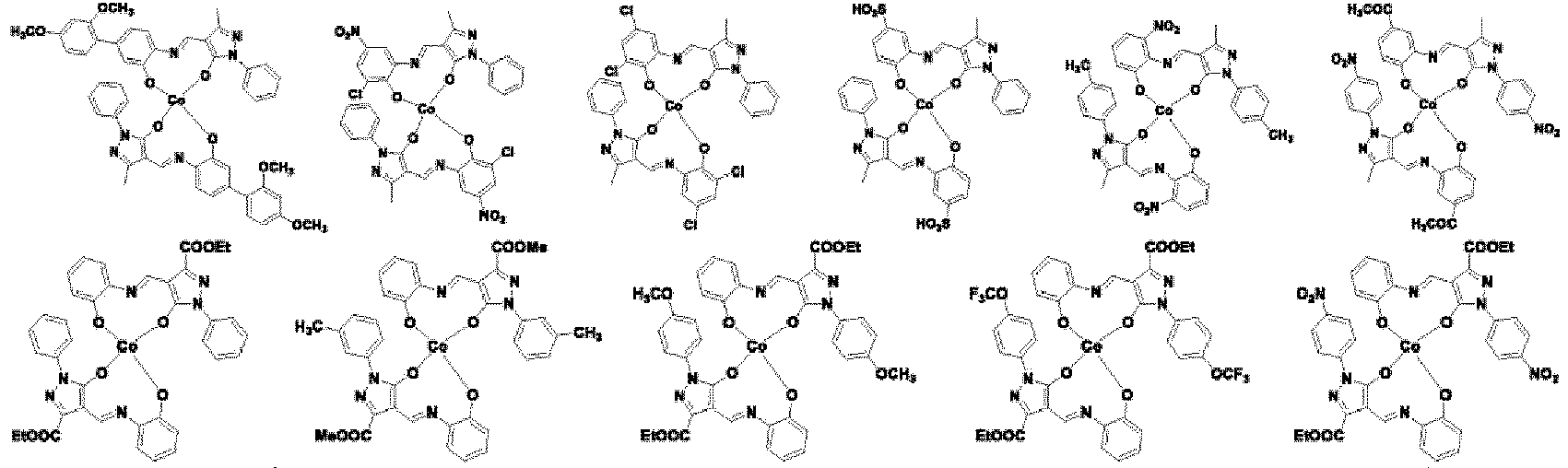


- In the materials, Me means a methyl group and Et means an ethyl group.
- According to one embodiment of the present disclosure, the coordination compound further includes (B+)m.
- According to one embodiment of the present disclosure, B+ is H+; Na+; K+; P+ReRfRgRh; N+RiRjRkRl; S+RmRnRo; or a cationic heteroring, and Re to Ro are the same as or different from each other and each independently hydrogen; a substituted or unsubstituted alkyl group; or a substituted or unsubstituted cycloalkyl group.
- According to one embodiment of the present disclosure, the cationic heteroring is any one selected from the group consisting of the following Structural Formulae B1 to B4.

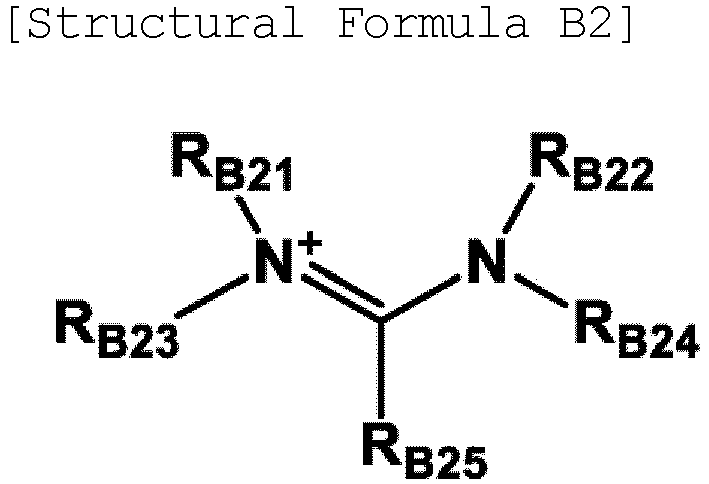


- RB11 and RB12 bond to each other to form a substituted or unsubstituted heteroring having 4 to 30 carbon atoms, and RB13 and RB14 are the same as or different from each other and each independently hydrogen; a hydrocarbon group having 1 to 30 carbon atoms; or a substituent including one, two or more heteroatoms selected from the group consisting of N, O, P, S, Si and Se,
- RB21 and RB22 bond to each other to form a substituted or unsubstituted heteroring having 2 to 30 carbon atoms, and RB23 to RB25 are the same as or different from each other and each independently hydrogen; a hydrocarbon group having 1 to 30 carbon atoms; or a substituent including one, two or more heteroatoms selected from the group consisting of N, O, P, S, Si and Se,
- RB31 and RB32 bond to each other to form a substituted or unsubstituted heteroring having 2 to 30 carbon atoms, and RB33 to RB35 are the same as or different from each other and each independently hydrogen; a hydrocarbon group having 1 to 30 carbon atoms; or a substituent including one, two or more heteroatoms selected from the group consisting of N, O, P, S, Si and Se, and
- RB41 is hydrogen; a hydrocarbon group having 1 to 30 carbon atoms; or a substituent including one, two or more heteroatoms selected from the group consisting of N, O, P, S, Si and Se, RB42 is hydrogen; a hydrocarbon group having 1 to 30 carbon atoms; or a substituent including one, two or more heteroatoms selected from the group consisting of N, O, P, S, Si and Se, and n42 is an integer of 1 to 8.
- According to another embodiment of the present disclosure, B+ is H+; Na+; K+; a phosphonium cation; an ammonium cation; a sulfonium cation; or a cationic heteroring, and m is an integer of 1 or 2.
- In another embodiment of the present disclosure, B is an alkali metal; NR4; or PR'4, and R and R' are the same as or different from each other and each independently hydrogen; a substituted or unsubstituted alkyl group having 1 to 10 carbon atoms; or a substituted or unsubstituted cycloalkyl group having 3 to 10 carbon atoms, or two or more Rs bond to each other to form a substituted or unsubstituted aromatic ring having 2 to 10 carbon atoms or a substituted or unsubstituted aliphatic ring having 2 to 10 carbon atoms.
- In one embodiment of the present disclosure, B is hydrogen.
- In one embodiment of the present disclosure, B is an alkali metal.
- The alkali metal means a chemical element in
Group 1 of the periodic table other than hydrogen, and examples thereof may include lithium, sodium, potassium, rubidium, cesium or francium. - In one embodiment of the present disclosure, B is Na or K.
- In one embodiment of the present disclosure, B is NR4.
- In one embodiment of the present disclosure, B is PR'4.
- In one embodiment of the present disclosure, R and R' are the same as or different from each other, and each independently hydrogen; a substituted or unsubstituted alkyl group having 1 to 30 carbon atoms; or a substituted or unsubstituted cycloalkyl group having 3 to 30 carbon atoms, or two or more Rs bond to each other to form a substituted or unsubstituted aromatic heteroring having 6 to 30 carbon atoms or a substituted or unsubstituted aliphatic heteroring having 1 to 30 carbon atoms.
- In one embodiment of the present disclosure, R and R' are the same as or different from each other, and each independently hydrogen; a substituted or unsubstituted alkyl group having 1 to 20 carbon atoms; or a substituted or unsubstituted cycloalkyl group having 3 to 20 carbon atoms, or two or more Rs bond to each other to form a substituted or unsubstituted aromatic heteroring having 6 to 20 carbon atoms or a substituted or unsubstituted aliphatic heteroring having 1 to 20 carbon atoms.
- In one embodiment of the present disclosure, R and R' are the same as or different from each other, and each independently hydrogen; a substituted or unsubstituted alkyl group having 1 to 10 carbon atoms; or a substituted or unsubstituted cycloalkyl group having 3 to 10 carbon atoms, or two or more Rs bond to each other to form a substituted or unsubstituted aromatic heteroring having 6 to 12 carbon atoms or a substituted or unsubstituted aliphatic heteroring having 1 to 10 carbon atoms.
- In one embodiment of the present disclosure, B is NR4; or PR'4, and R and R' are the same as or different from each other and each independently hydrogen; a substituted or unsubstituted alkyl group having 1 to 10 carbon atoms; or a substituted or unsubstituted cycloalkyl group having 3 to 10 carbon atoms, or two or more Rs bond to each other to form a substituted or unsubstituted aromatic ring having 2 to 10 carbon atoms or a substituted or unsubstituted aliphatic ring having 2 to 10 carbon atoms.
- In one embodiment of the present disclosure, B is an alkali metal; NR4; or PR'4, and R and R' are the same as or different from each other and each independently hydrogen; a substituted or unsubstituted alkyl group having 1 to 10 carbon atoms; or a substituted or unsubstituted cycloalkyl group having 3 to 10 carbon atoms, or two or more Rs bond to each other to form a substituted or unsubstituted aromatic ring having 2 to 10 carbon atoms or a substituted or unsubstituted aliphatic ring having 2 to 10 carbon atoms.
- In one embodiment of the present disclosure, R is hydrogen; a substituted or unsubstituted butyl group; a substituted or unsubstituted hexyl group; a substituted or unsubstituted decyl group; a substituted or unsubstituted dodecyl group; or a substituted or unsubstituted cyclohexyl group, or bonds to each other to form a compound represented by the following Chemical Formula N-1; or a compound represented by the following Chemical Formula N-2.


Rn1 to Rn4 are the same as or different from each other, and each independently hydrogen; or a substituted or unsubstituted alkyl group. - In one embodiment of the present disclosure, R is hydrogen; an n-butyl group; an n-hexyl group; a hexyl group substituted with an ethyl group; an n-decyl group; an n-dodecyl group; or a cyclohexyl group, or bonds to each other to form the compound represented by Chemical Formula N-1; or the compound represented by Chemical Formula N-2.
- In one embodiment of the present disclosure, R is hydrogen; an n-butyl group; an n-hexyl group; or a hexyl group substituted with an ethyl group, or bonds to each other to form the compound represented by Chemical Formula N-1; or the compound represented by Chemical Formula N-2.
- The hexyl group substituted with an ethyl group may be a 2-ethylhexyl group.
- In one embodiment of the present disclosure, R' is a substituted or unsubstituted butyl group.
- In one embodiment of the present disclosure, R' is an n-butyl group.
- In one embodiment of the present disclosure, B is NR4, NR4 is NH4; NHR"3; NH2R"2; NR"4; a compound represented by the following Chemical Formula N-1; or a compound represented by the following Chemical Formula N-2, and R" is a substituted or unsubstituted alkyl group having 1 to 20 carbon atoms; or a substituted or unsubstituted cycloalkyl group having 3 to 20 carbon atoms.


Rn1 to Rn4 are the same as or different from each other, and each independently hydrogen; or a substituted or unsubstituted alkyl group. - In one embodiment of the present disclosure, Rn1 to Rn4 are the same as or different from each other, and each independently hydrogen; or a substituted or unsubstituted alkyl group having 1 to 30 carbon atoms.
- In one embodiment of the present disclosure, Rn1 to Rn4 are the same as or different from each other, and each independently hydrogen; or a substituted or unsubstituted alkyl group having 1 to 20 carbon atoms.
- In one embodiment of the present disclosure, Rn1 to Rn4 are the same as or different from each other, and each independently hydrogen; or a substituted or unsubstituted alkyl group having 1 to 10 carbon atoms.
- In one embodiment of the present disclosure, Rn1 to Rn4 are the same as or different from each other, and each independently hydrogen; a substituted or unsubstituted methyl group; a substituted or unsubstituted ethyl group; or a substituted or unsubstituted butyl group.
- In one embodiment of the present disclosure, Rn1 to Rn4 are the same as or different from each other, and each independently hydrogen; a methyl group; an ethyl group; or an n-butyl group.
- In one embodiment of the present disclosure, Rn1 is an n-butyl group.
- In one embodiment of the present disclosure, Rn2 is a methyl group.
- In one embodiment of the present disclosure, Rn3 and Rn4 are hydrogen; or an ethyl group.
- According to one embodiment of the present disclosure, the compound further including (B+)m is any one selected from the group consisting of the following compounds.


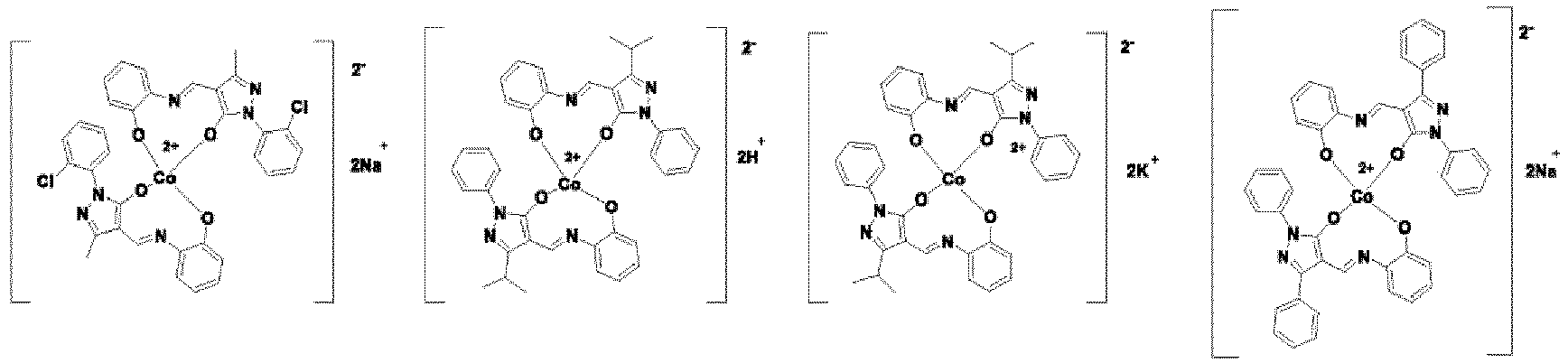





- According to one embodiment of the present disclosure, the coordination compound described above is used as a light absorber.
- Another embodiment of the present disclosure provides a light absorber including the coordination compound described above.
- According to one embodiment of the present disclosure, the light absorber may further include a solvent.
- As the solvent, materials known to enable formation of a light absorber from the coordination compound described above in the art relating to the present disclosure may be used without particular limit. For example, the solvent may be one or more types of compounds selected from the group consisting of esters, ethers, ketones, aromatic hydrocarbons and sulfoxides.
- Examples of the ester-based solvent may include ethyl acetate, n-butyl acetate, isobutyl acetate, amyl formate, isoamyl acetate, isobutyl acetate, butyl propionate, isopropyl butyrate, ethyl butyrate, butyl butyrate, methyl lactate, ethyl lactate, gamma-butyrolactone, epsilon-caprolactone, delta-valerolactone, alkyl oxyacetate (example: methyl oxyacetate, ethyl oxyacetate, butyl oxyacetate (for example, methyl methoxyacetate, ethyl methoxyacetate, butyl methoxyacetate, methyl ethoxyacetate, ethyl ethoxyacetate or the like)), alkyl 3-oxypropionates (example: methyl 3-oxypropionate, ethyl 3-oxypropionate or the like (for example, methyl 3-methoxypropionate, ethyl 3-methoxypropionate, methyl 3-ethoxypropionate, ethyl 3-ethoxypropionate or the like)), alkyl 2-oxypropionates (example: methyl 2-oxypropionate, ethyl 2-oxypropionate, propyl 2-oxypropionate or the like (for example, methyl 2-methoxypropionate, ethyl 2-methoxypropionate, propyl 2-methoxypropionate, methyl 2-ethoxypropionate, ethyl 2-ethoxypropionate)), methyl 2-oxy-2-methylpropionate and ethyl 2-oxy-2-methylpropionate (for example, methyl 2-methoxy-2-methylpropionate, ethyl 2-ethoxy-2-methylpropionate or the like), methyl pyruvate, ethyl pyruvate, propyl pyruvate, methyl acetoacetate, ethyl acetoacetate, methyl 2-oxobutanoate, 2-ethyl 2-oxobutanoate and the like.
- Examples of the ether-based solvent may include diethylene glycol dimethyl ether, tetrahydrofuran, ethylene glycol monomethyl ether, ethylene glycol monoethyl ether, methyl cellosolve acetate, ethyl cellosolve acetate, diethylene glycol monomethyl ether, diethylene glycol monoethyl ether, diethylene glycol monobutyl ether, propylene glycol monomethyl ether, propylene glycol monomethyl ether acetate, propylene glycol monoethyl ether acetate, propylene glycol monopropyl ether acetate and the like.
- Examples of the ketone-based solvent may include methyl ethyl ketone, cyclohexanone, cyclopentanone, 2-heptanone, 3-heptanone, N-methyl-2-pyrrolidone and the like.
- Examples of the aromatic hydrocarbon-based solvent may include toluene, xylene, anisole, limonene and the like.
- Examples of the sulfoxide-based solvent may include dimethyl sulfoxide and the like.
- The solvent is exemplified as above, however, the solvent is not limited to the solvents exemplified above, and any solvent capable of dissolving or dispersing the coordination compound represented by Chemical Formula A of present disclosure may be used. In addition, the solvent may be used either alone as one type, or as a mixture of two or more types of solvents.
- According to one embodiment of the present disclosure, the coordination compound represented by Chemical Formula A has an organic metal complex structure, and the light absorber employing the same has an advantage of enhancing blue luminance transmittance or improving reflected color.
- According to one embodiment of the present disclosure, the light absorber may absorb at least a portion of wavelengths selected from among 350 nm to 450 nm and more preferably 380 nm to 450 nm, however, the wavelength is not limited thereto.
- One embodiment of the present disclosure provides an adhesive composition including the coordination compound described above. As one example, the adhesive composition is the light absorber described above. As another example, the adhesive composition includes the light absorber described above and other additives.
- One embodiment of the present disclosure provides an adhesive composition including at least one selected from the group consisting of a binder resin, a crosslinking agent, a coupling agent, an antioxidant, an antistatic agent, a light stabilizer and a catalyst.
- According to one embodiment of the present disclosure, the crosslinking agent induces a crosslinking reaction between an alkali-soluble polyimide resin or other additive components to increase heat resistance and chemical resistance of a produced film. Herein, compounds including a functional group such as an acrylic group or an isocyanate group may be used as the crosslinking agent. In addition, the crosslinking agent may be, for example, a thermal crosslinking agent, and as such a thermal crosslinking agent, compounds including a thermally reactive functional group such as a methylol group or an epoxy group may be used. As a specific example, crosslinking agents generally used in the art such as DML-PC, DML-PEP, DML-OC, DML-OEP, DML-34X, DML-PTBP, DML-PCHP, DML-OCHP, DML-PFP, DML-PSBP, DML-POP, DML-MBOC, DML-MBPC,DML-MTrisPC, DML-BisOC-Z, DML-BisOCHP-Z, DML-BPC, DML-BisOC-P, DMOM-PC, DMOM-PTBP, DMOM-MBPC, TriML-P,TriML-35XL, TML-HQ, TML-BP, TML-pp-BPF, TML-BPE, TML-BPA, TML-BPAF, TML-BPAP, TMOM-BP, TMOM-BPE, TMOM-BPA, TMOM-BPAF, TMOM-BPAP, HML-TPPHBA, HML-TPHAP, HMOM-TPPHBA, HMOM-TPHAP (hereinbefore, trade names, manufactured by Honshu Chemical Industry Co., Ltd.), "NIKALAC" (registered trademark) MX-290, "NIKALAC" (registered trademark) MX-280, "NIKALAC" (registered trademark) MX-270, "NIKALAC" (registered trademark) MX-279, "NIKALAC" (registered trademark) MW-100LM, "NIKALAC" (registered trademark) MX-750LM (hereinbefore, trade names, manufactured by Sanwa Chemical Co., Ltd.) and T39M (Soken Chemical & Engineering Co., Ltd.) may be used.
- According to one embodiment of the present disclosure, the coupling agent may be a silane-based coupling agent, but is not limited thereto, and those known in the art may be properly employed.
- According to one embodiment of the present disclosure, the antioxidant may perform a role of preventing a chain reaction that generates radicals during polymer film formation. Herein, a phenol-based antioxidant or the like may be included as the antioxidant, and 2,2-thiobis(4-methyl-6-t-butylphenol), 2,6-g,t-butylphenol or the like, an antioxidant generally used in the art, may be used, however, the antioxidant is not limited thereto. According to a preferred embodiment of the present disclosure, Kinox-80 (Hannong Chemicals Inc.) may be used as the antioxidant, however, the antioxidant is not limited thereto.
- According to one embodiment of the present disclosure, the antistatic agent is included in the adhesive composition to perform a role of providing antistatic performance, and known antistatic agents may all be used. Examples of the antistatic agent may include ionic compounds. Examples of the ionic compound may include metal salts or organic salts. Examples of the metal salt ionic compound may include alkali metal cations or alkaline-earth metal cations. Examples of the cation may include one, two or more types of a lithium ion (Li+), a sodium ion (Na+), a potassium ion (K+), a rubidium ion (Rb+), a cesium ion (Cs+), a beryllium ion (Be2+), a magnesium ion (Mg2+), a calcium ion (Ca2+), a strontium ion (Sr2+) and a barium ion (Ba2+), and for example, one, or more types of a lithium ion, a sodium ion, a potassium ion, a magnesium ion, a calcium ion and a barium ion may be used, or considering ion stability and mobility, a lithium ion may be used. Examples of the anion included in the metal salt may include PF6 -, AsF-, NO2 -, fluoride (F-), chloride (Cl-), bromide (Br-), iodide (I-), perchlorate (ClO4 -), hydroxide (OH-), carbonate (CO3 2-), nitrate (NO3 -), trifluoromethanesulfonate (CF3SO3 -), sulfonate (SO4 -), hexafluorophosphate (PF6 -), methylbenzenesulfonate (CH3(C6H4)SO3 -), p-toluenesulfonate (CH3C6H4SO3 -), tetraborate (B4O7 2-), carboxybenzenesulfonate (COOH(C6H4)SO3 -), trifluoromethanesulfonate (CF3SO2 -), benzonate (C6H5COO-), acetate (CH3COO-), trifluoroacetate (CF3COO-), tetrafluoroborate (BF4 -), tetrabenzylborate (B(C6H5)4 -), trispentafluoroethyl trifluorophosphate (P(C2F5)3F3 -) or the like. According to preferred one embodiment of the present disclosure, FC-4400 (3M Corporation) may be used as the antistatic agent, however, the antistatic agent is not limited thereto.
- According to one embodiment of the present disclosure, the light stabilizer is a material that does not agglomerate even when the adhesive is left unattended under a high temperature condition, and thereby significantly improves storage stability of the adhesive composition by, without causing a phenomenon of increasing a concentration of the antistatic agent to describe below in the agglomerated cluster, preventing a problem of the bonding site being decomposed by heat and generating radicals, and known light stabilizers may be used. According to preferred one embodiment of the present disclosure, hindered amine compounds may be used as the light stabilizer, and specifically, Tinuvin 123 (BASF Corporation) may be used, however, the light stabilizer is not limited thereto.
- According to one embodiment of the present disclosure, the catalyst is a material controlling a rate of the reaction preparing the adhesive composition according to one embodiment of the present disclosure. According to one embodiment of the present disclosure, dibutyltin dilaurate (Sigma-Aldrich) may be used as the catalyst, however, the catalyst is not limited thereto.
- In one embodiment of the present disclosure, the coordination compound represented by Chemical Formula A is included in 0.1 parts by weight to 0.5 parts by weight based on 100 parts by weight of the total weight of the adhesive composition solid content.
- Preferably, the coordination compound represented by Chemical Formula A is included in 0.2 parts by weight to 0.4 parts by weight based on 100 parts by weight of the total weight of the adhesive composition solid content. More preferably, the coordination compound represented by Chemical Formula A is included in 0.25 parts by weight to 0.35 parts by weight based on 100 parts by weight of the total weight of the adhesive composition solid content.
- When the coordination compound represented by Chemical Formula A is included in the above-described content in the adhesive composition, excellent light resistance, heat resistance and moisture resistance are obtained. When the coordination compound represented by Chemical Formula A is included in less than 0.2 parts by weight, a sufficient effect of light resistance may not be expected, and including the coordination compound represented by Chemical Formula A in greater than 0.4 parts by weight may cause a problem of precipitating the dye on the thin film.
- In one embodiment of the present disclosure, the binder resin is included in 90 parts by weight to 99 parts by weight, the crosslinking agent is included in 0.05 parts by weight to 0.5 parts by weight, the coupling agent is included in 0.05 parts by weight to 0.5 parts by weight, the antioxidant is included in 0.2 parts by weight to 0.8 parts by weight, the antistatic agent is included in 0.5 parts by weight to 2.5 parts by weight, the light stabilizer is included in 1 parts by weight to 4 parts by weight and the catalyst is included in 0.001 parts by weight to 0.02 parts by weight, based on 100 parts by weight of the total weight of the adhesive composition solid content.
- In one embodiment of the present disclosure, the binder resin is included in 93 parts by weight to 97 parts by weight based on 100 parts by weight of the total weight of the adhesive composition solid content.
- In one embodiment of the present disclosure, the crosslinking agent is included in 0.3 parts by weight to 0.4 parts by weight based on 100 parts by weight of the total weight of the adhesive composition solid content.
- In one embodiment of the present disclosure, the coupling agent is included in 0.1 parts by weight to 0.3 parts by weight based on 100 parts by weight of the total weight of the adhesive composition solid content.
- In one embodiment of the present disclosure, the antioxidant is included in 0.4 parts by weight to 0.6 parts by weight based on 100 parts by weight of the total weight of the adhesive composition solid content.
- In one embodiment of the present disclosure, the antistatic agent is included in 0.1 parts by weight to 2 parts by weight based on 100 parts by weight of the total weight of the adhesive composition solid content.
- In one embodiment of the present disclosure, the light stabilizer is included in 1.5 parts by weight to 3.5 parts by weight based on 100 parts by weight of the total weight of the adhesive composition solid content.
- In one embodiment of the present disclosure, the catalyst is included in 0.008 parts by weight to 0.02 parts by weight based on 100 parts by weight of the total weight of the adhesive composition solid content.
- When the binder resin, the crosslinking agent, the coupling agent, the antioxidant, the antistatic agent, the light stabilizer or the catalyst is included in the above-described content in the adhesive composition, a film having a uniform thickness may be prepared using the adhesive composition.
- According to one embodiment of the present disclosure, the adhesive composition may further include a solvent. As the solvent, the solvent described above in the light absorber may be used.
- The solvent is not limited to the solvents exemplified above, and any solvent capable of dissolving or dispersing the coordination compound represented by Chemical Formula A of present disclosure may be used.
- According to preferred one embodiment of the present disclosure, the solvent included in the adhesive composition is ethyl acetate or methyl ethyl ketone.
- In addition, the solvent may be used either alone as one type, or as a mixture of two or more types of solvents. For example, according to one embodiment of the present disclosure, the solvent included in the adhesive composition is a mixed solution of ethyl acetate or methyl ethyl ketone. Herein, the solvents of the mixed solution may be mixed and used in a ratio of 1:3 to 3:1, however, this is just an example, and the mixing ratio is not limited to the example.
- According to preferred one embodiment of the present disclosure, methyl ethyl ketone (MEK) may be used as the solvent, however, the solvent is not limited thereto.
- According to one embodiment of the present disclosure, the solvent may be included in 10 parts by weight to 50 parts by weight or 20 parts by weight to 40 parts by weight based on 100 parts by weight of the total weight of the adhesive composition. According to preferred one embodiment of the present disclosure, the solvent may be included in 20 parts by weight to 30 parts by weight based on the total parts by weight of the adhesive composition, however, the content is not limited thereto.
- When the solvent is included in the adhesive composition in the above-described range, there is no concern for precipitation of a dye or the like, and performance of the adhesive film including the adhesive composition may be readily identified.
- In one embodiment of the present disclosure, the adhesive composition may further include a binder resin.
- As the binder resin, known materials commonly used in the art may be used as long as it is a material providing adhesiveness and usable in a film for a display. Examples of the binder resin may include an acryl-based polymer, an acrylate-based copolymer, a silicone-based polymer, polyester, polyurethane, polyether, an epoxy resin and the like, but are not limited thereto.
- According to one embodiment of the present disclosure, the binder resin may be an acrylate-based resin. The acrylate-based resin may be an acrylate-based polymer or an acrylate-based copolymer. Examples of the acrylate-based copolymer may include butyl acrylate/hydroxyethyl acrylate, but are not limited thereto.
- According to a preferred embodiment of the present disclosure, AD-701 of LG Chem. may be used as the binder resin, however, the binder resin is not limited thereto.
- According to one embodiment of the present disclosure, the binder resin may be included in 93 parts by weight to 97 parts by weight; or 94 parts by weight to 96 parts by weight based on 100 parts by weight of the total weight of the adhesive composition solid content. According to preferred one embodiment of the present disclosure, the binder resin may be included in 95 parts by weight to 96 parts by weight based on 100 parts by weight of the total weight of the adhesive composition solid content.
- When the binder resin is included in the adhesive composition in the above-mentioned range, adhesiveness of the adhesive film including the adhesive composition is maintained, and an adhesive film having a uniform thickness may be prepared from the adhesive composition.
- In the present disclosure, the 'adhesive composition solid content' means excluding the solvent from the adhesive composition including the coordination compound represented by Chemical Formula A.
- According to another embodiment of the present disclosure, the coordination compound of Chemical Formula A may be used together with other types of dyes. As the dye that may be used together with the coordination compound of Chemical Formula A, dyes commonly used in the art may be used. As a specific example of the dye that may be used together with the coordination compound of Chemical Formula A, one or more types may be selected from the group consisting of metal-complex-based compounds; azo-based compounds; metal azo-based compounds; quinophthalone-based compounds; isoindoline-based compounds; methine-based compounds; phthalocyanine-based compounds; metal phthalocyanine-based compounds; porphyrin-based compounds; metal porphyrin-based compounds; tetra-azaporphyrin-based compounds; metal tetra-azaporphyrin-based compounds; cyanine-based compounds; xanthene-based compounds; metal dipyrromethane-based compounds; boron dipyrromethane-based compounds; metal dipyrromethane-based compounds; anthraquinone-based compounds; diketopyrrolopyrrole-based compounds; triarylmethane-based compounds; and perylene-based compounds. However, the dye is not limited thereto.
- One embodiment of the present disclosure provides an adhesive film including the light absorber.
- According to one embodiment of the present disclosure, the adhesive film including the light absorber may include the light absorber as it is.
- According to another embodiment of the present disclosure, the adhesive film including the light absorber may include the light absorber in a state having the solvent removed by drying.
- Another embodiment of the present disclosure provides an adhesive film including the adhesive composition.
- According to one embodiment of the present disclosure, the adhesive film may be used as an optical film used in a display, an electronic device or the like. The optical film may be used as a retardation film, an anti-reflection film, an anti-glare film, an ultraviolet absorption film, an infrared absorption film, an optical compensation film, a brightness enhancement film or the like.
- According to one embodiment of the present disclosure, the adhesive film including the adhesive composition may include the adhesive composition as it is.
- According to another embodiment of the present disclosure, the adhesive film including the adhesive composition may include the adhesive composition in a state having the solvent removed by drying.
- According to still another embodiment of the present disclosure, the adhesive film including the adhesive composition may include a cured material of the adhesive composition.
- In one embodiment of the present disclosure, a maximum absorption wavelength of the adhesive film is a wavelength of at least one of 380 nm to 450 nm.
- In still another embodiment of the present disclosure, a maximum absorption wavelength of the adhesive film is a wavelength of at least one of 380 nm to 440 nm.
- When the adhesive film has a wavelength of at least one of 380 nm to 450 nm as a maximum absorption wavelength, a decrease in the blue luminance may be minimized by absorbing a longer wavelength region compared to an existing blue light blocking film, and efficiency may be maximized.
- One embodiment of the present disclosure provides an optical film including the light absorber.
- According to one embodiment of the present disclosure, the optical film includes an adhesive film and a binder resin film.
- According to one embodiment of the present disclosure, the adhesive film includes the light absorber.
- According to one embodiment of the present disclosure, the optical film includes an adhesive film and a binder resin film, and the adhesive film includes the light absorber.
- Another embodiment of the present disclosure provides an optical film including the adhesive film and other films.
- Examples of the other films may include a release film, an anti-reflection film, a binder resin film and the like.
- Specifically, one embodiment of the present disclosure provides an optical film including an adhesive film and a binder resin film.
- The optical film may further include a base as necessary.
-
FIG. 2 illustrates an optical film according to one embodiment of the present disclosure in which a base (1); an adhesive film (2); and a binder resin film (3) are consecutively laminated. - In the present disclosure, transmittance means transmittance for light.
- In the present disclosure, a change in the transmittance for light is obtained by, while employing transmittance of an optical film that does not include the coordination compound represented by Chemical Formula A as 100%, measuring transmittance of the optical film including the coordination compound represented by Chemical Formula A, and measuring the changed value.
- Specifically, the changed value may be calculated by the following calculation formula.

- According to one embodiment of the present disclosure, the adhesive film is used in a display, an electronic device or the like instead of a polarizing plate, which more effectively reduces a change in the transmittance for each wavelength compared to an optical film including a polarizing plate. In addition, the adhesive film includes an adhesive composition including the coordination compound of Chemical Formula A, which more effectively reduces a change in the transmittance for each wavelength compared to an optical film including other compositions. Accordingly, color tones of the emitted color may be flexibly adjusted.
- According to one embodiment of the present disclosure, the adhesive film including the adhesive composition may have a form in which an adhesive composition is laminated and/or coated on one surface of a base.
- According to one embodiment of the present disclosure, the base may be selected from the group consisting of PET (polyethylene terephthalate), polyester, PC (polycarbonate), PI (polyimide), PEN (polyethylene naphthalate), PEEK (polyether ether ketone), PAR (polyarylate), PCO (polycyclicolefin), polynorbornene, PES (polyethersulphone) and COP (cycloolefin polymer).
- In addition, the base is preferably transparent. The base being transparent referred herein means that light transmittance of visible light having a wavelength range of 400 nm to 700 nm is 80% or greater. When the base has light transmittance in the above-mentioned range, the laminated adhesive film may be thin filmed.
- According to one embodiment of the present disclosure, the adhesive film including the adhesive composition has a thickness of 10 µm to 40 µm; 15 µm to 30 µm; or 20 µm to 25 µm. According to preferred one embodiment of the present disclosure, the adhesive film including the adhesive composition has a thickness of 22 µm to 23 µm.
- According to one embodiment of the present disclosure, the adhesive film may be prepared by coating the adhesive composition on the base using a bar coater. As a specific example,
FIG. 1 illustrates a case of the base (1) and the adhesive film (2) according to one embodiment of the present disclosure being consecutively laminated. - According to one embodiment of the present disclosure, the release film may be included on another surface other than the one surface of the base on which the adhesive composition is laminated and/or coated.
- As the release film, a hydrophobic film may be used. The release film refers to, as a film for protecting a very thin adhesive film, a transparent layer attached to one surface of the adhesive film, and films having excellent mechanical strength, thermal stability, moisture shielding properties, isotropy and the like may be used. For example, as the release film, acetate-based such as triacetyl cellulose (TAC), polyester-based, polyethersulphone-based, polycarbonate-based, polyamide-based, polyimide-based, polyolefin-based, cycloolefin-based, polyurethane-based and acryl-based resin films, and the like may be used, and commercially available silicone-treated release films may be used. However, the release film is not limited to these examples.
- According to one embodiment of the present disclosure, the anti-reflection film performs a role of improving reflected color sense by adjusting the degree of light reflection generated from an external light source.
- According to one embodiment of the present disclosure, the anti-reflection film has a lowest reflection wavelength of 550 nm or less; or 530 nm or less. According to preferred one embodiment of the present disclosure, the anti-reflection film has a lowest reflection wavelength of 500 nm or less.
- A material of the anti-reflection film may be properly selected to satisfy properties of the lowest reflection wavelength. For example, the anti-reflection film may include a low refractive index layer. For example, the lowest reflection wavelength of the anti-reflection film tends to move to a longer wavelength as a thickness of the low refractive index layer increases, and tends to move to a shorter wavelength as a thickness of the low refractive index layer decreases. For example, the lowest reflectivity of the anti-reflection film tends to decrease as a refractive index of a low refractive material decreases.
- The low refractive index layer may include a low refractive material. In one example, the low refractive material may be a low refractive inorganic particle. In another example, the low refractive inorganic particle may be a silica-based particle. Examples of the silica-based particle may include hollow silica, mesoporous silica and the like, but are not limited thereto. In another example, magnesium fluoride (MgF2) may be used as the low refractive inorganic particle.
- According to one embodiment of the present disclosure, the binder resin film may include a TAC (cellulose triacetate) film or the like, but is not limited thereto, and known binder resin films commonly used in the art may be used.
- The binder resin film has a thickness of 20 µm to 60 µm; 30 µm to 50 µm; or 35 µm to 45 µm.
- In one embodiment of the present disclosure, the adhesive film may be provided on the base, and the binder resin film may be further provided on a surface opposite to the surface on which the adhesive film and the base are in contact with each other.
- One embodiment of the present disclosure provides an electronic device including the light absorber described above.
- One embodiment of the present disclosure provides an electronic device including the adhesive film.
- According to one embodiment of the present disclosure, the electronic device includes an adhesive film, and the adhesive film includes the light absorber.
- The electronic device may include all of an interlayer insulating film of a semiconductor device, a color filter, a black matrix, an overcoat, a column spacer, a passivation film, a buffer coat film, an insulating film for a multilayer print substrate, a cover coat of a flexible copper clad plate, a buffer coat film, an insulating film solder resist film for a multilayer print substrate, an insulating film of an OLED, a protective film of a thin film transistor of a liquid crystal display apparatus, an electrode protective film of an organic EL device and a semiconductor protective film, an OLED insulating film, an LCD insulating film, a semiconductor insulating film, a display apparatus and the like, but is not limited thereto.
- One embodiment of the present disclosure provides a display apparatus including the light absorber.
- Another embodiment of the present disclosure provides a display apparatus including the adhesive film.
- One embodiment of the present disclosure provides an organic light emitting display apparatus including the light absorber.
- Another embodiment of the present disclosure provides an organic light emitting display apparatus including the adhesive film.
- One embodiment of the present disclosure provides an organic light emitting display apparatus including an adhesive film including the adhesive composition described above; a substrate provided on one surface of the adhesive film; and an organic light emitting layer provided on a surface opposite to the surface in contact with the adhesive film of the substrate.
- Hereinafter, the present disclosure will be described in detail with reference to examples in order to specifically describe the present disclosure. However, the examples according to the present disclosure may be modified to various different forms, and the scope of the present disclosure is not to be construed as being limited to the examples described below. Examples of the present disclosure are provided in order to more fully describe the present disclosure to those having average knowledge in the art.
- The coordination compound represented by Chemical Formula A may be prepared using, for example, a preparation method as the following
Reaction Formula 1. The preparation method may be more specified in preparation examples to describe below.
- Phosphoryl chloride (1.2 equivalents) was diluted in an excess dimethylformamide (DMF) solvent, and stirred for 30 minutes under nitrogen while maintaining a temperature at 0°C. When the temperature was sufficiently stabilized, Compound A (1 equivalent) was slowly added thereto, and after raising the reaction temperature to 80°C, the mixture was sufficiently reacted under nitrogen. After identifying the completion of the reaction through thin layer chromatography (TLC), the reaction temperature was lowered to room temperature, and the result was introduced to prepared ice water and sufficiently stirred. After that, a produced solid compound was secured through vacuum filtration, and extracted using chloroform and water. Anhydrous magnesium sulfate was introduced to the extracted organic layer to remove water, and the result was concentrated and recrystallized with chloroform and ethanol to obtain a product.
- Secured Compound B (1 equivalent) was diluted in a toluene solution together with synthesized or commercially available Compound C (1.2 equivalents), and the mixture was stirred under nitrogen while heating to a temperature of 120°C to proceed a reaction. After the reaction was completed, the temperature was lowered to room temperature, and a formed solid product was vacuum filtered while sufficiently washing with ethanol and hexane to obtain a product. The solvent was sufficiently removed from Secured Compound D through oven drying.
-

- Compound D1-a (100 mg, 1 equivalent) synthesized using the method of
Reaction Formula 1 was diluted in ethanol (5 mL), and stirred while heating under nitrogen. After that, cobalt acetate tetrahydrate (42.5 mg, 0.5 equivalents) dissolved in water (5 mL) was added thereto, and sodium hydroxide (10 mg, 2 equivalents) was further introduced thereto to proceed a reaction. After the reaction was finished, the result was concentrated, and extracted using chloroform and water. From the organic layer secured through extraction, water was removed using anhydrous magnesium sulfate, and the result was concentrated through vacuum distillation. The concentrated product was recrystallized using chloroform and ethanol to secure Compound P1 (86 mg, yield: 72%). - HR LC/MS/MS m/z calculated for C34H26CON6Na2O4 (M+) : 687.1143; found: 687.1143
-

- Compound P2 (156 mg, yield: 67%) was secured by conducting a reaction in the same manner as in Preparation Example 1 except that D1-b (200 mg, 1 equivalent) was used instead of D1-a.
- HR LC/MS/MS m/z calculated for C36H30CoN6Na2O4 (M+) : 715.1456; found: 715.1455
-

- Compound P3 (100 mg, yield: 58%) was secured by conducting a reaction in the same manner as in Preparation Example 1 except that D1-c (150 mg, 1 equivalent) was used instead of D1-a.
- HR LC/MS/MS m/z calculated for C36H30CoN6Na2O6 (M+) : 747.1354; found: 747.1354
-

- Compound P4 (122 mg, yield: 71%) was secured by conducting a reaction in the same manner as in Preparation Example 1 except that D1-d (150 mg, 1 equivalent) was used instead of D1-a.
- HR LC/MS/MS m/z calculated for C34H24CONBNa2O8 (M+) : 777.0844; found: 777.0844
-

- Compound P5 (103 mg, yield: 45%) was secured by conducting a reaction in the same manner as in Preparation Example 1 except that D1-e (200 mg, 1 equivalent) was used instead of D1-a.
- HR LC/MS/MS m/z calculated for C34H24Cl2CoN6Na2O4 (M+) : 755.0358; found: 755.0358
-

- Compound P6 (142 mg, yield: 59%) was secured by conducting a reaction in the same manner as in Preparation Example 1 except that D2-a (200 mg, 1 equivalent) was used instead of D1-a, and potassium hydroxide (69.8 mg, 2 equivalents) was used instead of sodium hydroxide.
- HR LC/MS/MS m/z calculated for C38H34CoK2N6O4 (M+) : 775.1248; found: 775.1248
-

- Compound P7 (171 mg, yield: 72%) was secured by conducting a reaction in the same manner as in Preparation Example 1 except that D2-b (200 mg, 1 equivalent) was used instead of D1-a, and potassium hydroxide (69.8 mg, 2 equivalents) was used instead of sodium hydroxide.
- HR LC/MS/MS m/z calculated for C44H30CoK2N6O4 (M+) : 843.8918; found: 843.8918
-

- Compound P8 (146 mg, yield: 62%) was secured by conducting a reaction in the same manner as in Preparation Example 1 except that D2-c (200 mg, 1 equivalent) was used instead of D1-a, and potassium hydroxide (69.8 mg, 2 equivalents) was used instead of sodium hydroxide.
- HR LC/MS/MS m/z calculated for C40H36Cl2CoK2N6O4 (M+): 871.0781; found: 871.0781
-

- Compound P9 (137 mg, yield: 58%) was secured by conducting a reaction in the same manner as in Preparation Example 1 except that D2-d (200 mg, 1 equivalent) was used instead of D1-a, and potassium hydroxide (69.8 mg, 2 equivalents) was used instead of sodium hydroxide.
- HR LC/MS/MS m/z calculated for C46H34CoK2N6O4 (M+) : 871.1248; found: 871.1248
-

- Compound P10 (146 mg, yield: 42%) was secured by conducting a reaction in the same manner as in Preparation Example 1 except that D3-a (300 mg, 1 equivalent) was used instead of D1-a.
- HR LC/MS/MS m/z calculated for C36H30CoN6Na2O6 (M+) : 747.5847; found: 747.5846
-

- Compound P11 (110 mg, yield: 48%) was secured by conducting a reaction in the same manner as in Preparation Example 1 except that D3-b (200 mg, 1 equivalent) was used instead of D1-a.
- HR LC/MS/MS m/z calculated for C36H28Cl2CoN6Na2O6 (M+) : 815.4687; found: 815.4687
-

- Compound P12 (189 mg, yield: 67%) was secured by conducting a reaction in the same manner as in Preparation Example 1 except that D3-c (250 mg, 1 equivalent) was used instead of D1-a.
- HR LC/MS/MS m/z calculated for C38H28CoN8Na2O12 (M+) : 893.09542; found: 893.0954
-

- Compound P13 (117 mg, yield: 52%) was secured by conducting a reaction in the same manner as in Preparation Example 1 except that D3-d (200 mg, 1 equivalent) was used instead of D1-a.
- HR LC/MS/MS m/z calculated for C36H28CoN8Na2O12S2 (M+) : 933.0395; found: 933.0395
-

- Compound P14 (191 mg, yield: 81%) was secured by conducting a reaction in the same manner as in Preparation Example 1 except that D3-e (200 mg, 1 equivalent) was used instead of D1-a, and potassium hydroxide (69.8 mg, 2 equivalents) was used instead of sodium hydroxide.
- HR LC/MS/MS m/z calculated for C38H32CoK2N8O8 (M+) : 865.0949; found: 865.0949
-

- Compound P15 (258 mg, yield: 74%) was secured by conducting a reaction in the same manner as in Preparation Example 1 except that D3-f (300 mg, 1 equivalent) was used instead of D1-a, and potassium hydroxide (69.8 mg, 2 equivalents) was used instead of sodium hydroxide.
- HR LC/MS/MS m/z calculated for C40H34Cl4CoK2N6O4 (M+) : 940.9972; found: 940.9972
-
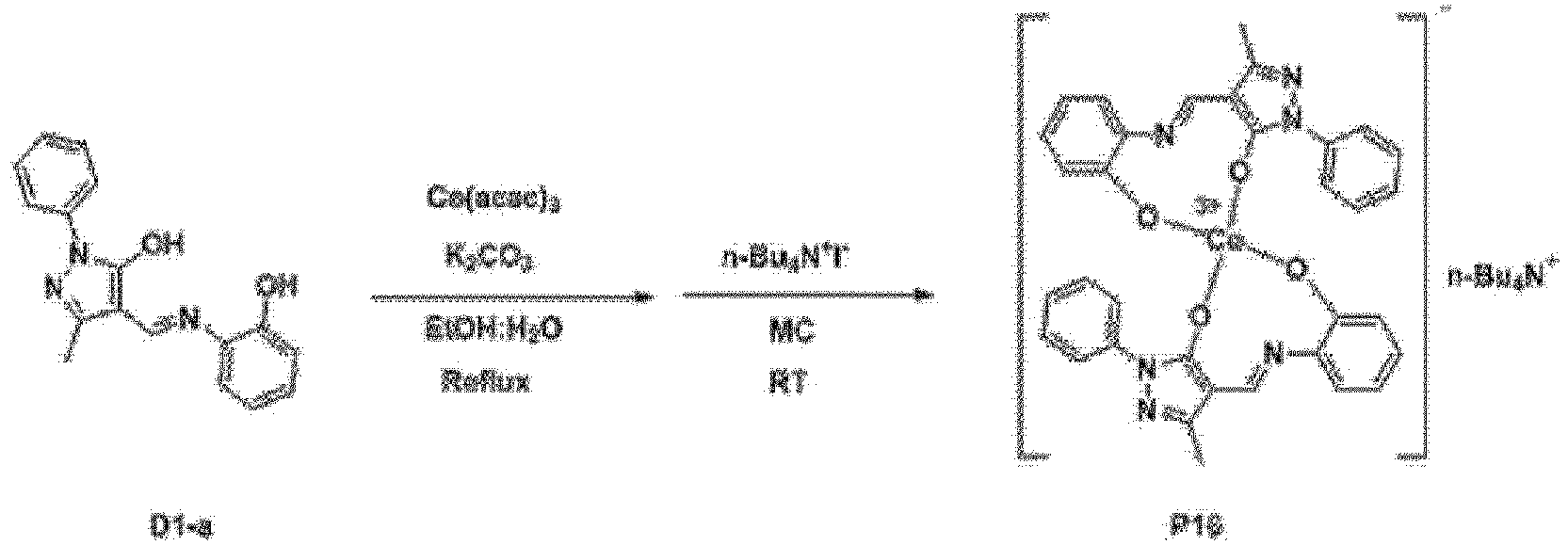
- Compound D1-a (500 mg, 1 equivalent) synthesized using the method of
Reaction Formula 1 was diluted in ethanol (10 mL), and after adding potassium carbonate (471 mg, 2 equivalents) dissolved in water (10 mL) thereto, the mixture was stirred while heating under nitrogen. After that, tris(acetylacetonato)cobalt(III) (0.304 g, 0.5 equivalents) was added thereto, and the reaction proceeded until the reactant D1-a was not visible on thin layer chromatography (TLC). After concentrating the solvent from the completed reaction material, a dichloromethane solvent (20 mL) was added thereto, then tetra-n-butylammonium iodine (0.378 g, 0.6 equivalents) was introduced thereto, and the result was stirred at room temperature. After the reaction was completed, the result was extracted by adding water thereto. From the organic layer secured therethrough, water was removed using anhydrous magnesium sulfate, and the result was concentrated through vacuum distillation. The concentrated product was diluted in ethanol, and then water was added thereto to secure Compound P16 (407 mg, yield: 54%). - HR LC/MS/MS m/z calculated for C50H62CoN7O4 (M+): 883.4195; found: 883.4194
-

- Compound P17 (440 mg, yield: 62%) was secured by conducting a reaction in the same manner as in Preparation Example 16 except that D2-b (500 mg, 1 equivalent) was used instead of D1-a.
- HR LC/MS/MS m/z calculated for C60H66CoN7O4 (M+): 1007.4508; found: 1007.4508
-

- Compound P18 (336 mg, yield: 48%) was secured by conducting a reaction in the same manner as in Preparation Example 16 except that D3-g (500 mg, 1 equivalent) was used instead of D1-a.
- HR LC/MS/MS m/z calculated for C52H66CoN7O8S2 (M+) : 1039.3746; found: 1039.3746
-

- Compound P19 (376 mg, yield: 55%) was secured by conducting a reaction in the same manner as in Preparation Example 16 except that D3-h (500 mg, 1 equivalent) was used instead of D1-a.
- HR LC/MS/MS m/z calculated for C52H64Cl2CoN7O8S2 (M+) : 1107.2967; found: 1107.2967
-
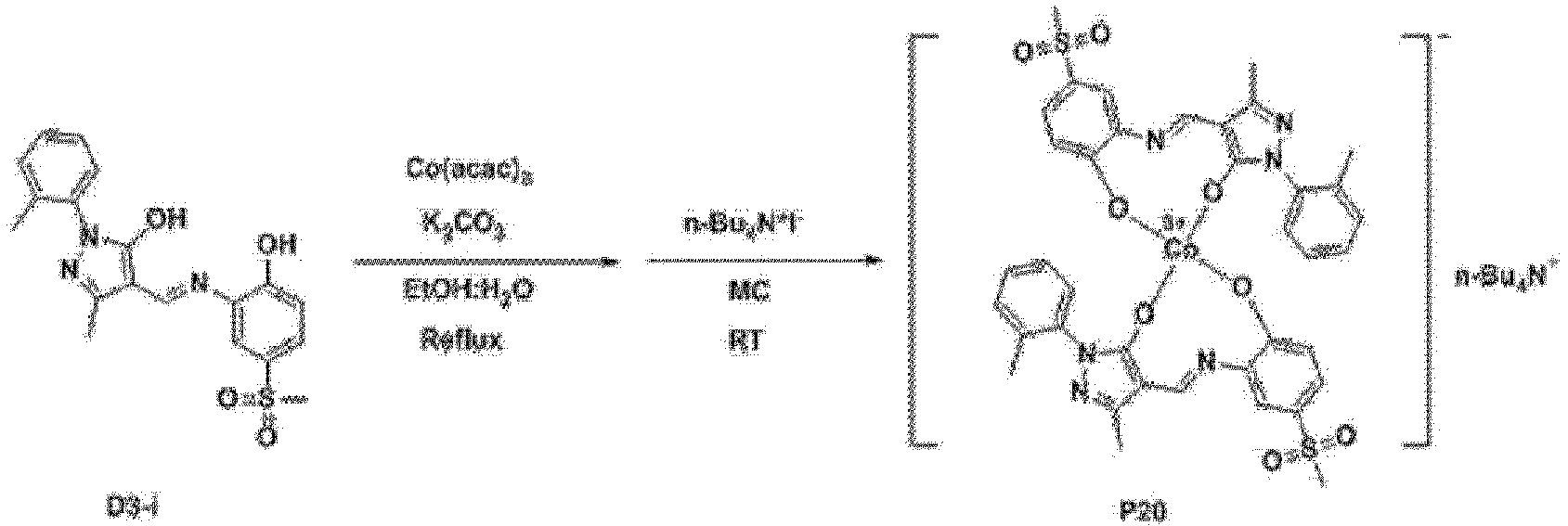
- Compound P20 (270 mg, yield: 39%) was secured by conducting a reaction in the same manner as in Preparation Example 16 except that D3-i (500 mg, 1 equivalent) was used instead of D1-a.
- HR LC/MS/MS m/z calculated for C54H70CoN7O8S2 (M+) : 1067.4059; found: 1067.4058
-

- Compound P21 (331 mg, yield: 46%) was secured by conducting a reaction in the same manner as in Preparation Example 16 except that D3-j (500 mg, 1 equivalent) was used instead of D1-a.
- HR LC/MS/MS m/z calculated for C50H60CoN9O8 (M+): 973.3897; found: 973.3897
-

- Compound P22 (492 mg, yield: 70%) was secured by conducting a reaction in the same manner as in Preparation Example 16 except that D3-e (500 mg, 1 equivalent) was used instead of D1-a.
- HR LC/MS/MS m/z calculated for C54H68CoN9O8 (M+): 1029.4523; found: 1029.4253
-

- Compound P23 (461 mg, yield: 64%) was secured by conducting a reaction in the same manner as in Preparation Example 16 except that D3-k (500 mg, 1 equivalent) was used instead of D1-a.
- HR LC/MS/MS m/z calculated for C50H60CoN9O8 (M+): 973.3897; found: 973.3897
-

- Compound D3-g (400 mg, 1 equivalent) synthesized using the method of
Reaction Formula 1 was dissolved in ethanol (10 mL), and after adding tributylamine (0.31 mL, 2 equivalents) and tris(acetylacetonato)cobalt(III) (0.192 g, 0.5 equivalents) thereto, the mixture was stirred while heating under nitrogen. After the reaction was finished, the result was concentrated, and extracted using chloroform and water. From the organic layer secured through extraction, water was removed using anhydrous magnesium sulfate, and the result was concentrated through vacuum distillation. Compound P24 (302 mg, yield: 57%) was secured from the concentrated product using ethanol and water. - HR LC/MS/MS m/z calculated for C48H58CoN7O8S2 (M+) : 983.3120; found: 983.3121
-
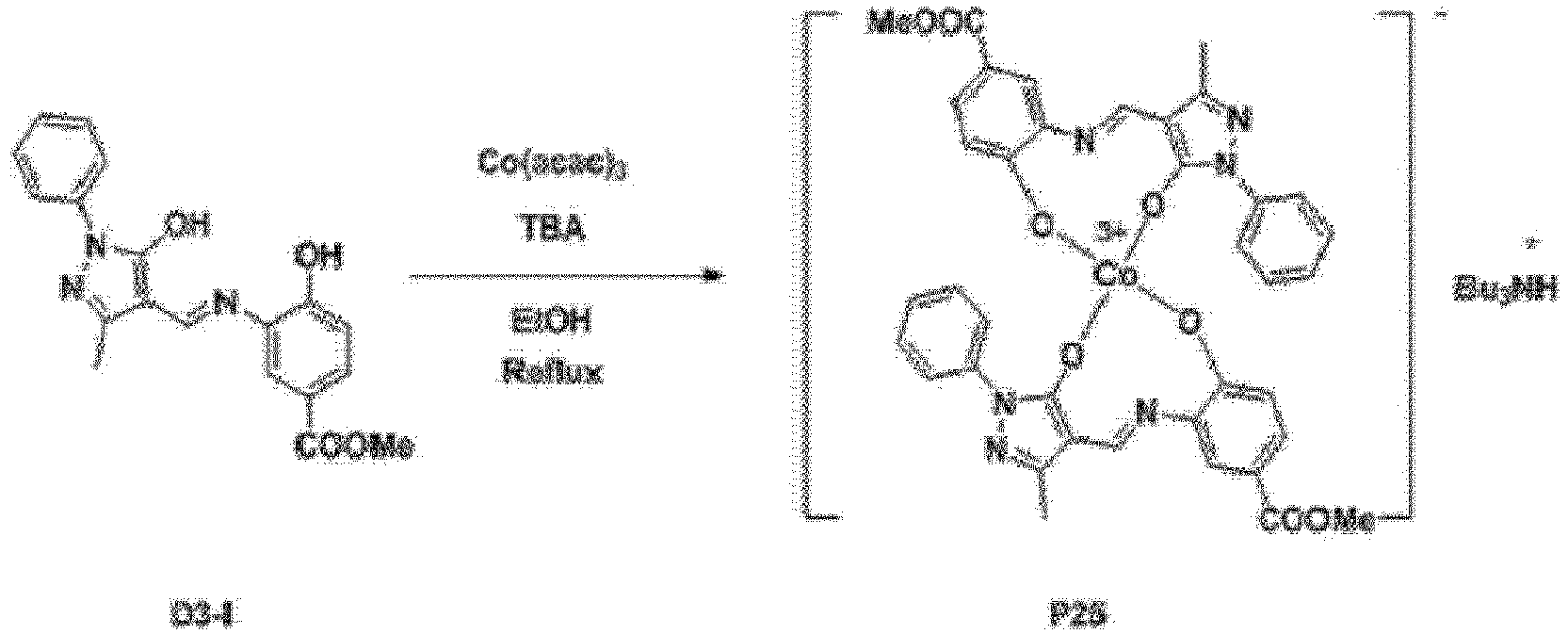
- Compound P25 (457 mg, yield: 68%) was secured by conducting a reaction in the same manner as in Preparation Example 24 except that D3-1 (500 mg, 1 equivalent) was used instead of D3-g.
- HR LC/MS/MS m/z calculated for C50H58CoN7O8 (M+): 943.3680; found: 943.3679
-

- Compound P26 (427 mg, yield: 65%) was secured by conducting a reaction in the same manner as in Preparation Example 24 except that D3-n (500 mg, 1 equivalent) was used instead of D3-g.
- HR LC/MS/MS m/z calculated for C46H50CoN11O12 (M+) : 1007.2972; found: 1007.2972
-

- Compound P27 (269 mg, yield: 48%) was secured by conducting a reaction in the same manner as in Preparation Example 24 except that bis(2-ethylhexyl)amine (0.3 mL, 2 equivalents) was used instead of tributylamine (TBA).
- HR LC/MS/MS m/z calculated for C52H66CoN7O8S2 (M+) : 1038.3746; found: 1038.3746
-

- Compound P28 (371 mg, yield: 56%) was secured by conducting a reaction in the same manner as in Preparation Example 24 except that dihexylamine (0.38 mL, 2 equivalents) was used instead of tributylamine (TBA).
- HR LC/MS/MS m/z calculated for C48H58CoN7O8S2 (M+) : 983.3120; found: 983.3121
-

- Compound P29 (382 mg, yield: 58%) was secured by conducting a reaction in the same manner as in Preparation Example 24 except that dicyclohexylamine (490 mg, 2 equivalents) was used instead of tributylamine (TBA).
- HR LC/MS/MS m/z calculated for C48H54CoN7O8S2 (M+) : 979.2807; found: 979.2807
-

- Compound P30 (420 mg, yield: 65%) was secured by conducting a reaction in the same manner as in Preparation Example 24 except that D3-n (500 mg, 1 equivalent) was used instead of D3-g, and dicyclohexylamine (470 mg, 2 equivalents) was used instead of tributylamine (TBA).
- HR LC/MS/MS m/z calculated for C46H46CoN11O12 (M+) : 1003.2659; found: 1003.2659
-

- Compound P31 (468 mg, yield: 71%) was secured by conducting a reaction in the same manner as in Preparation Example 24 except that D3-o (500 mg, 1 equivalent) was used instead of D3-g, and dicyclohexylamine (487 mg, 2 equivalents) was used instead of tributylamine (TBA).
- HR LC/MS/MS m/z calculated for C46H46Cl2CoN9O8 (M+) : 981.2178; found: 981.2179
-

- Compound P32 (354 mg, yield: 52%) was secured by conducting a reaction in the same manner as in Preparation Example 24 except that D3-p (500 mg, 1 equivalent) was used instead of D3-g, and dicyclohexylamine (553 mg, 2 equivalents) was used instead of tributylamine (TBA).
- HR LC/MS/MS m/z calculated for C46H46Cl2CoN7O4 (M+) : 891.2477; found: 891.2477
-

- Compound P33 (317 mg, yield: 46%) was secured by conducting a reaction in the same manner as in Preparation Example 24 except that D3-q (500 mg, 1 equivalent) was used instead of D3-g, and dicyclohexylamine (583 mg, 2 equivalents) was used instead of tributylamine (TBA).
- HR LC/MS/MS m/z calculated for C46H48CoF2N7O4 (M+) : 859.3068; found: 859.3068
-

- Compound P34 (334 mg, yield: 56%) was secured by conducting a reaction in the same manner as in Preparation Example 24 except that morpholine (235 mg, 2 equivalents) was used instead of tributylamine (TBA), and D3-g (500 mg, 1 equivalent) used in Preparation Example 24 was used.
- HR LC/MS/MS m/z calculated for C40H40CoN7O9S2 (M+) : 885.1661; found: 885.1661
-

- Compound P35 (455 mg, yield: 74%) was secured by conducting a reaction in the same manner as in Preparation Example 24 except that N-ethyl morpholine (310 mg, 2 equivalents) was used instead of tributylamine (TBA), and D3-g (500 mg, 1 equivalent) used in Preparation Example 24 was used.
- HR LC/MS/MS m/z calculated for C42H44CoN7O9S2 (M+) : 913.1974; found: 913.1973
-

- Compound D3-g (400 mg, 1 equivalent) synthesized using the method of
Reaction Formula 1 was dissolved in ethanol (10 mL), and potassium carbonate (372 mg, 2 equivalents) dissolved in water (10 mL) was added thereto. After sufficiently stirring the solution, tris(acetylacetonato)cobalt(III) (0.192 mg, 0.5 equivalents) and 1-butyl-3-methylimidazolium chloride (140 mg, 0.6 equivalents) were added thereto, and the mixture was stirred while heating under nitrogen. After the reaction was finished, the result was concentrated, and extracted using chloroform and water. From the organic layer secured through extraction, water was removed using anhydrous magnesium sulfate, then water was removed using anhydrous magnesium sulfate from the organic layer secured through vacuum distillation, and the result was concentrated through vacuum distillation. Compound P36 (183 mg, yield: 29%) was secured from the concentrated product using ethanol and water. - HR LC/MS/MS m/z calculated for C44H43CoN8O8S2 (M+) : 934.1972; found: 934.1972
-

- Compound P37 (369 mg, yield: 48%) was secured by conducting a reaction in the same manner as in Preparation Example 16 except that n-butylphosphine bromide (0.303 mg, 0.6 equivalents) was used instead of tetra-n-butylammonium iodine.
- HR LC/MS/MS m/z calculated for C50H62CoN6O4P (M+): 900.3902; found: 900.3903
-

- Compound P38 (278 mg, yield: 39%) was secured by conducting a reaction in the same manner as in Preparation Example 37 except that D3-g (500 mg, 1 equivalent) was used instead of D1-a.
- HR LC/MS/MS m/z calculated for C52H66CoN6O8PS2 (M+) : 1056.3453; found: 1056.3453
-

- Compound P39 (391 mg, yield: 54%) was secured by conducting a reaction in the same manner as in Preparation Example 37 except that D3-l (500 mg, 1 equivalent) was used instead of D1-a.
- HR LC/MS/MS m/z calculated for C54H66CoN6O8P (M+) : 1016.4012; found: 1016.4012
-

- Compound P40 (351 mg, yield: 65%) was secured by conducting a reaction in the same manner as in Preparation Example 24 except that D2-d (400 mg, 1 equivalent) was used instead of D3-g, and tributylphosphine (0.438 mg, 2 equivalents) was used instead of tributylamine (TBA).
- HR LC/MS/MS m/z calculated for C58H58CoN6O4P (M+): 996.3902; found: 996.3902
-

- Compound D1-a (500 mg, 1 equivalent) synthesized using the method of
Reaction Formula 1 was diluted in ethanol (10 mL), and after adding potassium carbonate (471 mg, 2 equivalents) dissolved in water (10 mL) thereto, the mixture was stirred while heating under nitrogen. After that, chromium acetate hydroxide (193 mg, 0.5 equivalents) was added thereto, and the reaction proceeded until the reactant D1-a was not visible on thin layer chromatography (TLC). After concentrating the solvent from the completed reaction material, a dichloromethane solvent (20 mL) was added thereto, then tetra-n-butylammonium iodine (378 mg, 0.6 equivalents) was introduced thereto, and the result was stirred at room temperature. After the reaction was completed, the result was extracted by adding water thereto, and from the organic layer secured therethrough, water was removed using anhydrous magnesium sulfate, and the result was concentrated through vacuum distillation. The concentrated product was diluted in ethanol, and then water was added thereto to secure Compound P41 (389 mg, yield: 52%). - HR LC/MS/MS m/z calculated for C50H62CrN7O4 (M+): 876.4268; found: 876.4268
-

- Compound P42 (443 mg, yield: 62%) was secured by conducting a reaction in the same manner as in Preparation Example 41 except that D1-d (500 mg, 1 equivalent) was used instead of D1-a.
- HR LC/MS/MS m/z calculated for C50H60CrN9O8 (M+): 966.3970; found: 966.3971
-

- Compound P43 (398 mg, yield: 54%) was secured by conducting a reaction in the same manner as in Preparation Example 41 except that D1-f (500 mg, 1 equivalent) was used instead of D1-a.
- HR LC/MS/MS m/z calculated for C52H66CrN7O4 (M+): 904.4581; found: 904.4581
-

- Compound P44 (399 mg, yield: 58%) was secured by conducting a reaction in the same manner as in Preparation Example 41 except that D3-i (500 mg, 1 equivalent) was used instead of D1-a.
- HR LC/MS/MS m/z calculated for C54H70CrN7O8S2 (M+) : 1060.4132; found: 1060.4133
-

- Compound D3-g (400 mg, 1 equivalent) synthesized using the method of
Reaction Formula 1 was dissolved in ethanol (10 mL), and tributylamine (499 mg, 2 equivalents) and chromium acetate hydroxide (406 mg, 0.5 equivalents) were added thereto, and the mixture was stirred while heating under nitrogen. After the reaction was finished, the result was concentrated, and extracted using chloroform and water. From the organic layer secured through extraction, water was removed using anhydrous magnesium sulfate, and the result was concentrated through vacuum distillation. Compound P45 (401 mg, yield: 61%) was secured from the concentrated product using ethanol and water. - HR LC/MS/MS m/z calculated for C48H58CrN7O8S2 (M+) : 976.3193; found: 976.3193
-

- Compound P46 (387 mg, yield: 58%) was secured by conducting a reaction in the same manner as in Preparation Example 45 except that D3-1 (500 mg, 1 equivalent) was used instead of D3-g.
- HR LC/MS/MS m/z calculated for C50H58CrN7O8 (M+): 936.3752; found: 936.3751
-

- Compound P47 (360 mg, yield: 55%) was secured by conducting a reaction in the same manner as in Preparation Example 45 except that dicyclohexylamine (488 mg, 2 equivalents) was used instead of tributylamine.
- HR LC/MS/MS m/z calculated for C48H54CrN7O8S2 (M+) : 972.2880; found: 972.2881
-

- Compound P48 (433 mg, yield: 71%) was secured by conducting a reaction in the same manner as in Preparation Example 45 except that N-ethyl morpholine (310 mg, 2 equivalents) was used instead of tributylamine.
- HR LC/MS/MS m/z calculated for C42H44CrN7O9S2 (M+) : 906.2047; found: 906.2047
-

- Compound P49 (488 mg, yield: 64%) was secured by conducting a reaction in the same manner as in Preparation Example 41 except that n-tetrabutylphosphine bromide (471 mg, 0.6 equivalents) was used instead of n-tetrabutylammonium iodine.
- HR LC/MS/MS m/z calculated for C50H62CrN6O4P (M+): 893.3975; found: 893.3975
-

- Compound P50 (406 mg, yield: 55%) was secured by conducting a reaction in the same manner as in Preparation Example 49 except that D1-g (500 mg, 1 equivalent) was used instead of D1-a.
- HR LC/MS/MS m/z calculated for C51H63CrN6O4P (M+): 906.4054; found: 906.4054
-

- Compound P51 (276 mg, yield: 48%) was secured by conducting a reaction in the same manner as in Preparation Example 1 except that D4-a (500 mg, 1 equivalent) was used instead of D1-a.
- HR LC/MS/MS m/z calculated for C38H30CoN6Na2O6 (M+) : 771.1354; found: 771.1354
-

- Compound P52 (296 mg, yield: 52%) was secured by conducting a reaction in the same manner as in Preparation Example 1 except that D4-c (500 mg, 1 equivalent) was used instead of D1-a.
- HR LC/MS/MS m/z calculated for C36H24CoN8Na2O10 (M+) : 833.0743; found: 833.0743
-

- Compound P53 (224 mg, yield: 39%) was secured by conducting a reaction in the same manner as in Preparation Example 1 except that D4-f (500 mg, 1 equivalent) was used instead of D1-a.
- HR LC/MS/MS m/z calculated for C36H24CoF2N6Na2O6 (M+) : 779.0853; found: 779.0853
-

- Compound P54 (339 mg, yield: 62%) was secured by conducting a reaction in the same manner as in Preparation Example 1 except that D4-m (500 mg, 1 equivalent) was used instead of D1-a.
- HR LC/MS/MS m/z calculated for C44H30CoN6Na2O6 (M+) : 843.1354; found: 843.1354
-

- Compound P55 (342 mg, yield: 58%) was secured by conducting a reaction in the same manner as in Preparation Example 1 except that D4-p (500 mg, 1 equivalent) was used instead of D1-a, and potassium hydroxide (151 mg, 2 equivalents) was used instead of sodium hydroxide (NaOH).
- HR LC/MS/MS m/z calculated for C38H28Cl2CoK2N6O6 (M+) : 871.0054; found: 871.0054
-

- Compound P56 (259 mg, yield: 49%) was secured by conducting a reaction in the same manner as in Preparation Example 1 except that D4-t (500 mg, 1 equivalent) was used instead of D1-a, and potassium hydroxide (130 mg, 2 equivalents) was used instead of sodium hydroxide (NaOH).
- HR LC/MS/MS m/z calculated for C36H22Cl4CoK2N6O6 (M+) : 910.8961; found: 910.8960
-
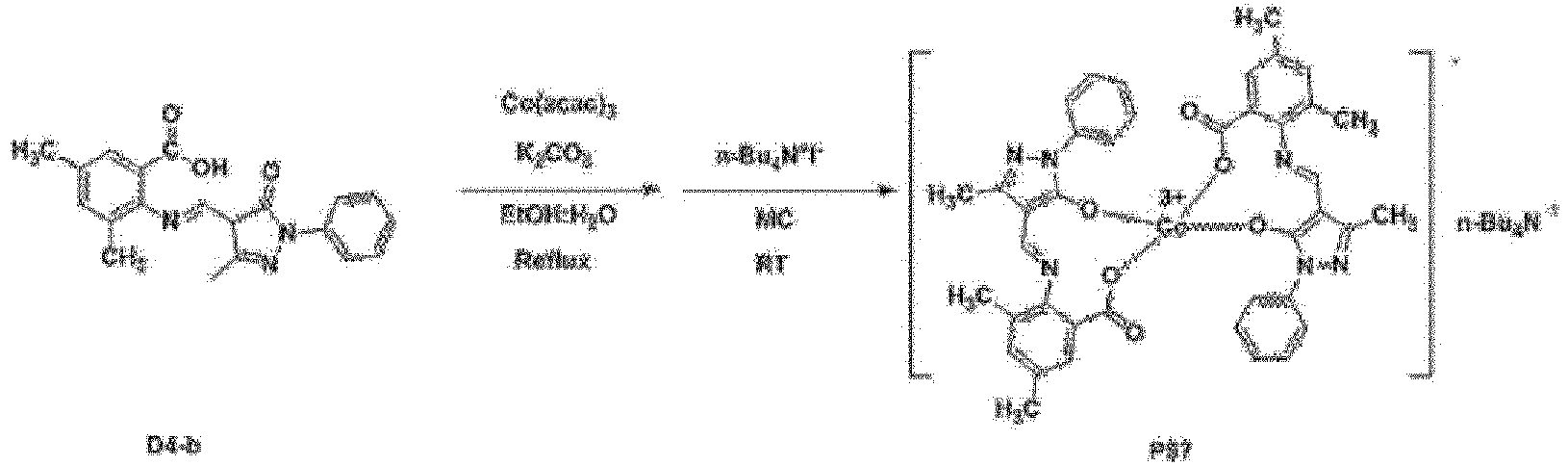
- Compound P57 (385 mg, yield: 54%) was secured by conducting a reaction in the same manner as in Preparation Example 16 except that D4-b (500 mg, 1 equivalent) was used instead of D1-a.
- HR LC/MS/MS m/z calculated for C56H70CoN7O6 (M+): 995.4714; found: 995.4714
-

- Compound P58 (440 mg, yield: 62%) was secured by conducting a reaction in the same manner as in Preparation Example 16 except that D4-g (500 mg, 1 equivalent) was used instead of D1-a.
- HR LC/MS/MS m/z calculated for C52H60Cl2CoN7O6 (M+) : 1007.3309; found: 1007.3308
-

- Compound P59 (359 mg, yield: 52%) was secured by conducting a reaction in the same manner as in Preparation Example 16 except that D4-h (500 mg, 1 equivalent) was used instead of D1-a.
- HR LC/MS/MS m/z calculated for C52H58Cl4CoN7O6 (M+) : 1077.2500; found: 1077.2501
-

- Compound P60 (251 mg, yield: 37%) was secured by conducting a reaction in the same manner as in Preparation Example 16 except that D4-1 (500 mg, 1 equivalent) was used instead of D1-a.
- HR LC/MS/MS m/z calculated for C52H60CoN9O10 (M+) : 1029.3790; found: 1029.3789
-

- Compound P61 (298 mg, yield: 45%) was secured by conducting a reaction in the same manner as in Preparation Example 24 except that D4-e (500 mg, 1 equivalent) was used instead of D3-g.
- HR LC/MS/MS m/z calculated for C50H55Cl2CoN7O6 (M+) : 979.2996; found: 979.2996
-

- Compound P62 (450 mg, yield: 68%) was secured by conducting a reaction in the same manner as in Preparation Example 24 except that D4-j (500 mg, 1 equivalent) was used instead of D3-g.
- HR LC/MS/MS m/z calculated for C56H58CoN7O6 (M+): 983.3775; found: 983.3774
-

- Compound P63 (469 mg, yield: 72%) was secured by conducting a reaction in the same manner as in Preparation Example 24 except that D4-n (500 mg, 1 equivalent) was used instead of D3-g.
- HR LC/MS/MS m/z calculated for C52H60Cl2CoN7O8 (M+) : 1039.3207; found: 1039.3207
-

- Compound P64 (388 mg, yield: 58%) was secured by conducting a reaction in the same manner as in Preparation Example 24 except that D4-d (500 mg, 1 equivalent) was used instead of D3-g, and dicyclohexylamine (516 mg, 2 equivalents) was used instead of tributylamine (TBA).
- HR LC/MS/MS m/z calculated for C50H54CoN7O8 (M+): 939.3360; found: 939.3360
-

- Compound P65 (403 mg, yield: 62%) was secured by conducting a reaction in the same manner as in Preparation Example 24 except that D4-k (500 mg, 1 equivalent) was used instead of D3-g, and dicyclohexylamine (519 mg, 2 equivalents) was used instead of tributylamine (TBA).
- HR LC/MS/MS m/z calculated for C50H54CoN7O6 (M+): 907.3462; found: 907.3462
-

- Compound P66 (268 mg, yield: 44%) was secured by conducting a reaction in the same manner as in Preparation Example 24 except that D4-u (500 mg, 1 equivalent) was used instead of D3-g, and N-ethyl morpholine (292 mg, 2 equivalents) was used instead of tributylamine (TBA).
- HR LC/MS/MS m/z calculated for C46H46CoN9O11 (M+): 959.2600; found: 959.2601
-

- Compound P67 (351 mg, yield: 59%) was secured by conducting a reaction in the same manner as in Preparation Example 24 except that D4-v (500 mg, 1 equivalent) was used instead of D3-g, and N-ethyl morpholine (255 mg, 2 equivalents) was used instead of tributylamine (TBA).
- HR LC/MS/MS m/z calculated for C54H42CoF6N7O7 (M+) : 1073.2376; found: 1073.2376
-

- Compound P68 (502 mg, yield: 72%) was secured by conducting a reaction in the same manner as in Preparation Example 16 except that D4-n (500 mg, 1 equivalent) was used instead of D1-a, and n-tetrabutylphosphine bromide (130 mg, 0.6 equivalents) was used instead of n-tetrabutylammonium iodine.
- HR LC/MS/MS m/z calculated for C56H68Cl2CoN6OBP (M+): 1112.3540; found: 1112.3541
-

- Compound P69 (405 mg, yield: 72%) was secured by conducting a reaction in the same manner as in Preparation Example 16 except that D4-r (500 mg, 1 equivalent) was used instead of D1-a, and n-tetrabutylphosphine bromide (130 mg, 0.6 equivalents) was used instead of n-tetrabutylammonium iodine.
- HR LC/MS/MS m/z calculated for C64H70CoN6O6P (M+) : 1108.4421; found: 1108.4421
-

- Compound P70 (267 mg, yield: 39%) was secured by conducting a reaction in the same manner as in Preparation Example 16 except that D4-w (500 mg, 1 equivalent) was used instead of D1-a, and n-tetrabutylphosphine bromide (122 mg, 0.6 equivalents) was used instead of n-tetrabutylammonium iodine.
- HR LC/MS/MS m/z calculated for C58H72CoN8O12P (M+) : 1162.4334; found: 1162.4334
-

- Compound P71 (322 mg, yield: 45%) was secured by conducting a reaction in the same manner as in Preparation Example 41 except that D4-a (500 mg, 1 equivalent) was used instead of D1-a.
- HR LC/MS/MS m/z calculated for C54H66CrN7O6 (M+): 960.4474; found: 960.4474
-

- Compound P72 (378 mg, yield: 55%) was secured by conducting a reaction in the same manner as in Preparation Example 41 except that D4-i (500 mg, 1 equivalent) was used instead of D1-a.
- HR LC/MS/MS m/z calculated for C54H60CrF6N7O6 (M+) : 1068.3909; found: 1068.3909
-

- Compound P73 (402 mg, yield: 61%) was secured by conducting a reaction in the same manner as in Preparation Example 45 except that D4-o (500 mg, 1 equivalent) was used instead of D3-g.
- HR LC/MS/MS m/z calculated for C50H56CrF2N7O8 (M+) : 972.3558; found: 972.3558
-

- Compound P74 (330 mg, yield: 51%) was secured by conducting a reaction in the same manner as in Preparation Example 45 except that D4-q (500 mg, 1 equivalent) was used instead of D3-g, and dicyclohexylamine (465 mg, 2 equivalents) was used instead of tributylamine.
- HR LC/MS/MS m/z calculated for C66H74Cl4CrN7O6 (M+) : 1129.4807; found: 1129.4807
-

- Compound P75 (261 mg, yield: 38%) was secured by conducting a reaction in the same manner as in Preparation Example 41 except that D4-s (500 mg, 1 equivalent) was used instead of D1-a, and n-tetrabutylphosphine bromide (269 mg, 0.6 equivalents) was used instead of n-tetrabutylammonium iodine.
- HR LC/MS/MS m/z calculated for C66H74CrN6O6P (M+) : 1129.4807; found: 1129.4807
-

- Comparative Compound P76 (565 mg, yield: 75%) was secured by conducting a reaction in the same manner as in Preparation Example 16 except that A1 (500 mg, 1 equivalent) was used instead of D1-a.
- HR LC/MS/MS m/z calculated for C48H46CoN9O4 (M+): 885.4100; found: 885.4100
-

- Comparative Compound P77 (482 mg, yield: 66%) was secured by conducting a reaction in the same manner as in Preparation Example 16 except that A2 (500 mg, 1 equivalent) was used instead of D1-a.
- HR LC/MS/MS m/z calculated for C50H60CoN9O6 (M+): 941.3999; found: 941.3999
-

- Comparative Compound P78 (336 mg, yield: 45%) was secured by conducting a reaction in the same manner as in Preparation Example 41 except that A1 was used instead of D1-a.
- HR LC/MS/MS m/z calculated for C48H60CrN9O4 (M+): 878.4173; found: 878.4173
-

- Comparative Compound P79 (370 mg, yield: 51%) was secured by conducting a reaction in the same manner as in Preparation Example 41 except that A2 was used instead of D1-a.
- HR LC/MS/MS m/z calculated for C50H60CrN9O6 (M+): 934.4072; found: 934.4072
- Based on 100 parts by weight of a solid content excluding a solvent in an adhesive composition, 95.4 parts by weight of an adhesive material (AD-701 solid content, LG Chem.), 0.29 parts by weight of Compound P1, 0.1 parts by weight of an isocyanate-based crosslinking agent (T39M, Soken Chemical & Engineering Co., Ltd.), 0.2 parts by weight of a silane-based coupling agent (T-789J, Soken Chemical & Engineering Co., Ltd.), 0.5 parts by weight of an antioxidant (Kinox-80, Hannong Chemicals Inc.), 1.5 parts by weight of an antistatic agent (FC-4400, 3M Corporation), 2 parts by weight of a hindered amine light stabilizer (Tinuvin 123, BASF Corporation) and 0.001 parts by weight a catalyst (dibutyltin dilaurate, Sigma-Aldrich) were added, and a solvent (methyl ethyl ketone, MEK) was added in 25 parts by weight based on the total parts by weight of the adhesive composition. The adhesive composition obtained by mixing these using a shaker (SKC 6100, JEIO Tech.) was coated on a release layer (PET) to a thickness of 22 µm to 23 µm using a knife bar coating apparatus (KP-3000, Kipae E&T Co., Ltd.) to prepare an adhesive film. After the coating, the release layer was removed, and the adhesive film and a binder resin film (TAC: cellulose triacetate) were consecutively laminated on glass through lamination to prepare a sample. The binder resin film (TAC: cellulose triacetate) was used to prepare the sample using the adhesive film including the adhesive composition including Compound P1, and does not affect measured properties of the adhesive film.
- Maximum absorption wavelengths λmax (nm) of the adhesive composition and the adhesive film were each measured using a UV-vis apparatus (Shimazu UV-3600). In addition, in order to identify wavelength suitability as a light absorber, suitability as a light absorber was identified by subdividing the maximum absorption wavelength range, and the results are described in Table 1.
- [Wavelength Suitability as Light Absorber]
- Maximum absorption wavelength of 380 nm to 420 nm: o
- Maximum absorption wavelength of 421 nm to 450 nm: Δ
- Maximum absorption wavelength of greater than 450 nm: x
- An experiment was conducted under the same condition as in Example 1 except that Compound P5 was used instead of Compound P1, and the results are described in the following Table 1.
- An experiment was conducted under the same condition as in Example 1 except that Compound P6 was used instead of Compound P1, and the results are described in the following Table 1
- An experiment was conducted under the same condition as in Example 1 except that Compound P7 was used instead of Compound P1, and the results are described in the following Table 1.
- An experiment was conducted under the same condition as in Example 1 except that Compound P10 was used instead of Compound P1, and the results are described in the following Table 1.
- An experiment was conducted under the same condition as in Example 1 except that Compound P16 was used instead of Compound P1, and the results are described in the following Table 1.
- An experiment was conducted under the same condition as in Example 1 except that Compound P17 was used instead of Compound P1, and the results are described in the following Table 1.
- An experiment was conducted under the same condition as in Example 1 except that Compound P18 was used instead of Compound P1, and the results are described in the following Table 1.
- An experiment was conducted under the same condition as in Example 1 except that Compound P19 was used instead of Compound P1, and the results are described in the following Table 1.
- An experiment was conducted under the same condition as in Example 1 except that Compound P20 was used instead of Compound P1, and the results are described in the following Table 1.
- An experiment was conducted under the same condition as in Example 1 except that Compound P21 was used instead of Compound P1, and the results are described in the following Table 1.
- An experiment was conducted under the same condition as in Example 1 except that Compound P22 was used instead of Compound P1, and the results are described in the following Table 1.
- An experiment was conducted under the same condition as in Example 1 except that Compound P24 was used instead of Compound P1, and the results are described in the following Table 1.
- An experiment was conducted under the same condition as in Example 1 except that Compound P25 was used instead of Compound P1, and the results are described in the following Table 1.
- An experiment was conducted under the same condition as in Example 1 except that Compound P26 was used instead of Compound P1, and the results are described in the following Table 1.
- An experiment was conducted under the same condition as in Example 1 except that Compound P27 was used instead of Compound P1, and the results are described in the following Table 1.
- An experiment was conducted under the same condition as in Example 1 except that Compound P28 was used instead of Compound P1, and the results are described in the following Table 1.
- An experiment was conducted under the same condition as in Example 1 except that Compound P29 was used instead of Compound P1, and the results are described in the following Table 1.
- An experiment was conducted under the same condition as in Example 1 except that Compound P30 was used instead of Compound P1, and the results are described in the following Table 1.
- An experiment was conducted under the same condition as in Example 1 except that Compound P31 was used instead of Compound P1, and the results are described in the following Table 1.
- An experiment was conducted under the same condition as in Example 1 except that Compound P32 was used instead of Compound P1, and the results are described in the following Table 1.
- An experiment was conducted under the same condition as in Example 1 except that Compound P33 was used instead of Compound P1, and the results are described in the following Table 1.
- An experiment was conducted under the same condition as in Example 1 except that Compound P34 was used instead of Compound P1, and the results are described in the following Table 1.
- An experiment was conducted under the same condition as in Example 1 except that Compound P35 was used instead of Compound P1, and the results are described in the following Table 1.
- An experiment was conducted under the same condition as in Example 1 except that Compound P36 was used instead of Compound P1, and the results are described in the following Table 1.
- An experiment was conducted under the same condition as in Example 1 except that Compound P37 was used instead of Compound P1, and the results are described in the following Table 1.
- An experiment was conducted under the same condition as in Example 1 except that Compound P38 was used instead of Compound P1, and the results are described in the following Table 1.
- An experiment was conducted under the same condition as in Example 1 except that Compound P41 was used instead of Compound P1, and the results are described in the following Table 1.
- An experiment was conducted under the same condition as in Example 1 except that Compound P43 was used instead of Compound P1, and the results are described in the following Table 1.
- An experiment was conducted under the same condition as in Example 1 except that Compound P44 was used instead of Compound P1, and the results are described in the following Table 1.
- An experiment was conducted under the same condition as in Example 1 except that Compound P45 was used instead of Compound P1, and the results are described in the following Table 1.
- An experiment was conducted under the same condition as in Example 1 except that Compound P46 was used instead of Compound P1, and the results are described in the following Table 1.
- An experiment was conducted under the same condition as in Example 1 except that Compound P49 was used instead of Compound P1, and the results are described in the following Table 1.
- An experiment was conducted under the same condition as in Example 1 except that Compound P52 was used instead of Compound P1, and the results are described in the following Table 1.
- An experiment was conducted under the same condition as in Example 1 except that Compound P54 was used instead of Compound P1, and the results are described in the following Table 1.
- An experiment was conducted under the same condition as in Example 1 except that Compound P59 was used instead of Compound P1, and the results are described in the following Table 1.
- An experiment was conducted under the same condition as in Example 1 except that Compound P60 was used instead of Compound P1, and the results are described in the following Table 1.
- An experiment was conducted under the same condition as in Example 1 except that Compound P71 was used instead of Compound P1, and the results are described in the following Table 1.
- An experiment was conducted under the same condition as in Example 1 except that Comparative Compound P76 was used instead of Compound P1, and the results are described in the following Table 1.
- An experiment was conducted under the same condition as in Example 1 except that Comparative Compound P77 was used instead of Compound P1, and the results are described in the following Table 1.
- An experiment was conducted under the same condition as in Example 1 except that Comparative Compound P78 was used instead of Compound P1, and the results are described in the following Table 1.
- An experiment was conducted under the same condition as in Example 1 except that Comparative Compound P79 was used instead of Compound P1, and the results are described in the following Table 1.
[Table 1] Example Preparation Example Solution λmax (nm) Film λmax (nm) Wavelength Suitability Example 1 P1 382 382 ○ Example 2 P5 380 381 ○ Example 3 P6 383 383 ○ Example 4 P7 383 382 ○ Example 5 P10 384 386 ○ Example 6 P16 416 415 ○ Example 7 P17 417 418 ○ Example 8 P18 411 412 ○ Example 9 P19 411 411 ○ Example 10 P20 409 408 ○ Example 11 P21 427 429 △ Example 12 P22 426 427 △ Example 13 P24 408 409 ○ Example 14 P25 429 428 △ Example 15 P26 435 437 △ Example 16 P27 407 410 ○ Example 17 P28 408 409 ○ Example 18 P29 409 409 ○ Example 19 P30 436 438 △ Example 20 P31 421 422 △ Example 21 P32 418 418 ○ Example 22 P33 418 419 ○ Example 23 P34 406 405 ○ Example 24 P35 404 404 ○ Example 25 P36 409 409 ○ Example 26 P37 415 416 ○ Example 27 P38 413 412 ○ Example 28 P41 446 446 △ Example 29 P43 435 436 △ Example 30 P44 428 429 △ Example 31 P45 425 426 △ Example 32 P46 433 432 △ Example 33 P49 447 446 △ Example 34 P52 401 402 ○ Example 35 P54 397 399 ○ Example 36 P59 394 393 ○ Example 37 P60 396 397 ○ Example 38 P71 384 384 ○ Comparative Experimental Example 1 P76 492 495 × Comparative Experimental Example 2 P77 473 471 × Comparative Experimental Example 3 P78 504 504 × Comparative Experimental Example 4 P79 471 472 × - From the experimental results of Table 1, it is identified that the adhesive films including the coordination compound according to one embodiment of the present disclosure have excellent wavelength suitability compared to the films that do not include the coordination compound. Specifically, when the adhesive films according to the examples of the present disclosure have a wavelength of at least one of 380 nm to 450 nm as a maximum absorption wavelength (λmax) unlike the adhesive films according to the comparative examples having a maximum absorption wavelength (λmax) of greater than 470 nm, a decrease in the blue luminance may be minimized by absorbing a longer wavelength region compared to an existing blue light blocking film, and efficiency may be maximized.
Claims (18)
- A coordination compound, wherein, in a compound represented by An-, A is represented by the following Chemical Formula A, and n is 1 or 2:
 M is a Cr ion or a Co ion;X is O or O-C=O;Rw1 and Rw2 are the same as or different from each other, and each independently a substituted or unsubstituted alkyl group; a substituted or unsubstituted alkenyl group; a substituted or unsubstituted cycloalkyl group; a substituted or unsubstituted aryl group; or a substituted or unsubstituted heteroaryl group;Ar1 and Ar2 are the same as or different from each other, and each independently a substituted or unsubstituted arylene group; or a substituted or unsubstituted heteroarylene group;R6 and R16 are the same as or different from each other, and each independently hydrogen; deuterium; a nitrile group; a nitro group; a hydroxyl group; -COOH; a halogen group; an imide group; a substituted or unsubstituted alkyl group; a substituted or unsubstituted cycloalkyl group; a substituted or unsubstituted heterocyclic group; a substituted or unsubstituted aryl group; a substituted or unsubstituted heteroaryl group; a substituted or unsubstituted alkylthioxy group; a substituted or unsubstituted arylthioxy group; a substituted or unsubstituted alkylsulfoxy group; a substituted or unsubstituted arylsulfoxy group; a substituted or unsubstituted alkenyl group; a substituted or unsubstituted silyl group; a substituted or unsubstituted boron group; a substituted or unsubstituted arylphosphine group; a substituted or unsubstituted phosphine oxide group; a substituted or unsubstituted styryl group; -OR100; -CO2R101; -COR102; -OCOR103; - CONR104R105; or -SO2R106; andR100 to R106 are the same as or different from each other, and each independently hydrogen; a substituted or unsubstituted alkyl group; a substituted or unsubstituted cycloalkyl group; a substituted or unsubstituted aryl group; a substituted or unsubstituted heteroaryl group; or a substituted or unsubstituted amine group.
 - The coordination compound of Claim 1, wherein Chemical Formula A is represented by the following Chemical Formula A-1:
 M, X, R6 and R16 have the same definitions as in Chemical Formula A;R1 to R5 R7 to R15 and R17 to R20 are the same as or different from each other, and each independently hydrogen; deuterium; a nitrile group; a nitro group; a hydroxyl group; - COOH; a halogen group; an imide group; a substituted or unsubstituted alkyl group; a substituted or unsubstituted cycloalkyl group; a substituted or unsubstituted heterocyclic group; a substituted or unsubstituted aryl group; a substituted or unsubstituted heteroaryl group; a substituted or unsubstituted alkylthioxy group; a substituted or unsubstituted arylthioxy group; a substituted or unsubstituted alkylsulfoxy group; a substituted or unsubstituted arylsulfoxy group; a substituted or unsubstituted alkenyl group; a substituted or unsubstituted silyl group; a substituted or unsubstituted boron group; a substituted or unsubstituted arylphosphine group; a substituted or unsubstituted phosphine oxide group; -OR100; - CO2R101; -COR102; -OCOR103; -CONR104R105; or -SO2R106, or adjacent substituents bond to each other to form a substituted or unsubstituted aromatic ring or a substituted or unsubstituted aliphatic ring; andR100 to R106 are the same as or different from each other, and each independently hydrogen; a substituted or unsubstituted alkyl group; a substituted or unsubstituted cycloalkyl group; a substituted or unsubstituted aryl group; a substituted or unsubstituted heteroaryl group; or a substituted or unsubstituted amine group.
 - The coordination compound of Claim 2, wherein R1 to R5 and R11 to R15 are the same as or different from each other, and each independently hydrogen; deuterium; a halogen group; a nitrile group; a nitro group; -COOH; a substituted or unsubstituted alkyl group having 1 to 10 carbon atoms; a substituted or unsubstituted cycloalkyl group having 3 to 10 carbon atoms; an aryl group having 6 to 10 carbon atoms unsubstituted or substituted with an alkyl group; a substituted or unsubstituted heteroaryl group having 2 to 10 carbon atoms; -OR100; or -CO2R101; and
R100 and R101 are the same as or different from each other, and each independently a substituted or unsubstituted alkyl group having 1 to 10 carbon atoms. - The coordination compound of Claim 2, wherein R7 to R10 and R17 to R20 are the same as or different from each other, and each independently hydrogen; deuterium; a halogen group; a nitrile group; a nitro group; a substituted or unsubstituted alkyl group having 1 to 10 carbon atoms; a substituted or unsubstituted cycloalkyl group having 3 to 10 carbon atoms; an aryl group having 6 to 10 carbon atoms unsubstituted or substituted with -OR100 or an alkyl group; a substituted or unsubstituted heteroaryl group having 2 to 10 carbon atoms; - OR100; -CO2R101; -COR102; or -SO2R106, or adjacent substituents bond to each other to form a substituted or unsubstituted aromatic ring;R100, R101 and R102 are the same as or different from each other, and each independently a substituted or unsubstituted alkyl group having 1 to 10 carbon atoms; andR106 is a substituted or unsubstituted alkyl group having 1 to 10 carbon atoms; or -NH2.
- The coordination compound of Claim 1, wherein R6 and R16 are the same as or different from each other, and each independently a nitrile group; a methyl group unsubstituted or substituted with a fluoro group; a substituted or unsubstituted ethyl group; a substituted or unsubstituted isopropyl group; a phenyl group unsubstituted or substituted with one or more substituents selected from the group consisting of a halogen group, a nitrile group, a nitro group, -COOH, an alkyl group, - OR100 and -CO2R101; a substituted or unsubstituted benzoxazole group; a substituted or unsubstituted pyridine group; a styryl group unsubstituted or substituted with an alkyl group or a nitro group; -OR100; or -CO2R101; and
R101 and R102 are the same as or different from each other, and each independently a substituted or unsubstituted methyl group; or a substituted or unsubstituted ethyl group. - The coordination compound of Claim 1, wherein M is Co2+; Co3+; Cr2+; or Cr3+.
- The coordination compound of Claim 1, wherein Chemical Formula A is any one selected from the group consisting of the following materials:





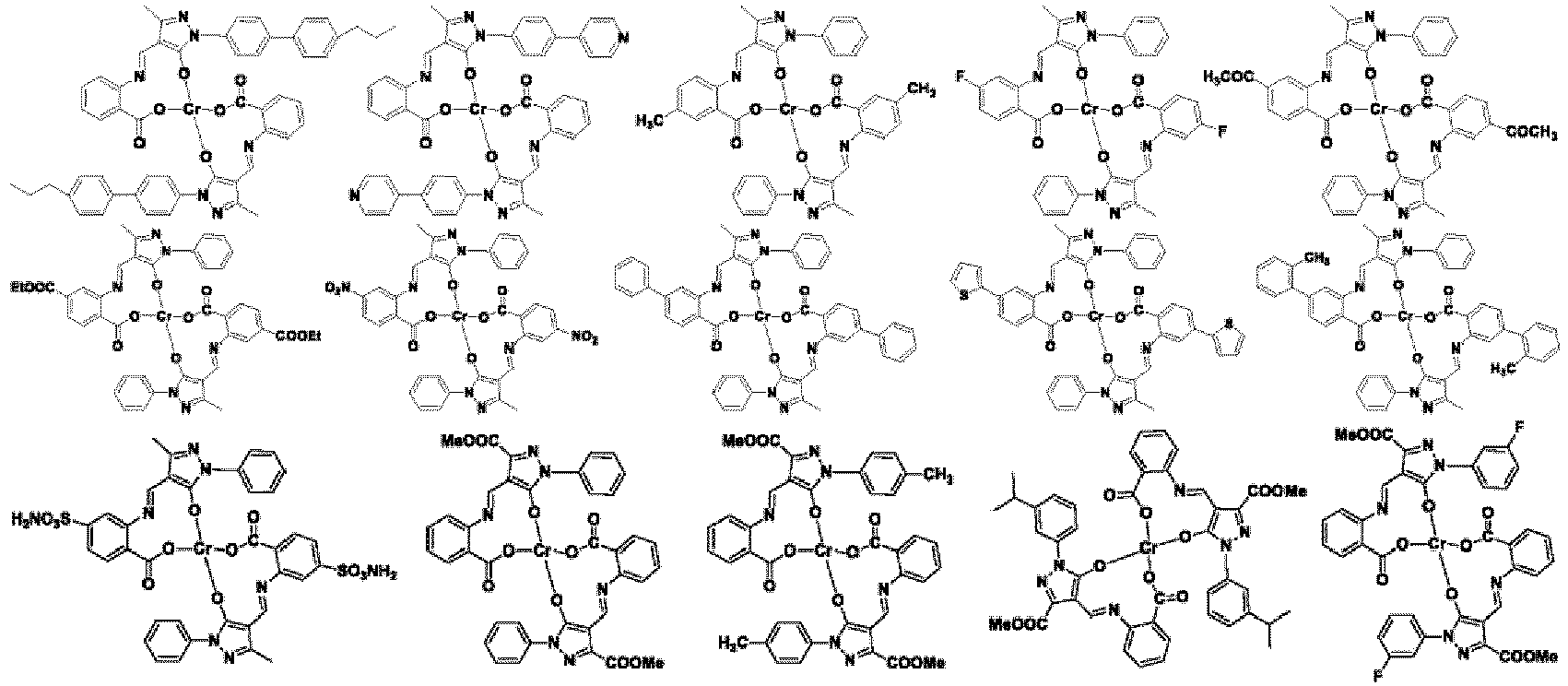




Me means a methyl group, and Et means an ethyl group. - The coordination compound of Claim 1, further comprising (B+)m,
wherein B+ is H+; Na+; K+; a phosphonium cation; an ammonium cation; a sulfonium cation; or a cationic heteroring, and m is an integer of 1 or 2. - The coordination compound of Claim 8, wherein B+ is H+; Na+; K+; P+ReRfRgRh; N+RiRjRkRl; S+RmRnRo; or a cationic heteroring; and
Re to Ro are the same as or different from each other, and each independently hydrogen; a substituted or unsubstituted alkyl group; or a substituted or unsubstituted cycloalkyl group. - The coordination compound of Claim 8, wherein the cationic heteroring is any one selected from the group consisting of the following Structural Formulae B1 to B4:


 RB11 and RB12 bond to each other to form a substituted or unsubstituted heteroring having 4 to 30 carbon atoms, and RB13 and RB14 are the same as or different from each other and each independently hydrogen; a hydrocarbon group having 1 to 30 carbon atoms; or a substituent including one, two or more heteroatoms selected from the group consisting of N, O, P, S, Si and Se;RB21 and RB22 bond to each other to form a substituted or unsubstituted heteroring having 2 to 30 carbon atoms, and RB23 to RB25 are the same as or different from each other and each independently hydrogen; a hydrocarbon group having 1 to 30 carbon atoms; or a substituent including one, two or more heteroatoms selected from the group consisting of N, O, P, S, Si and Se;RB31 and RB32 bond to each other to form a substituted or unsubstituted heteroring having 2 to 30 carbon atoms, and RB33 to RB35 are the same as or different from each other and each independently hydrogen; a hydrocarbon group having 1 to 30 carbon atoms; or a substituent including one, two or more heteroatoms selected from the group consisting of N, O, P, S, Si and Se; andRB41 is hydrogen; a hydrocarbon group having 1 to 30 carbon atoms; or a substituent including one, two or more heteroatoms selected from the group consisting of N, O, P, S, Si and Se, RB42 is hydrogen; a hydrocarbon group having 1 to 30 carbon atoms; or a substituent including one, two or more heteroatoms selected from the group consisting of N, O, P, S, Si and Se, and n42 is an integer of 1 to 8.
 - The coordination compound of Claim 8, wherein the compound further including (B+)m is any one selected from the group consisting of the following compounds:








- A light absorber comprising the coordination compound of any one of Claims 1 to 11.
- The light absorber of Claim 12, which absorbs at least a portion of wavelengths selected from among 350 nm to 450 nm.
- An adhesive film comprising the light absorber of Claim 12.
- An optical film comprising the light absorber of Claim 12.
- The optical film Claim 15, comprising:an adhesive film; anda binder resin film,wherein the adhesive film includes the light absorber.
- An electronic device comprising the light absorber of Claim 12.
- The electronic device of Claim 17, comprising an adhesive film,
wherein the adhesive film includes the light absorber.
Applications Claiming Priority (2)
| Application Number | Priority Date | Filing Date | Title |
|---|---|---|---|
| KR20200137608 | 2020-10-22 | ||
| PCT/KR2021/014871 WO2022086250A1 (en) | 2020-10-22 | 2021-10-22 | Coordination compound and light absorber comprising same |
Publications (2)
| Publication Number | Publication Date |
|---|---|
| EP4234564A1 true EP4234564A1 (en) | 2023-08-30 |
| EP4234564A4 EP4234564A4 (en) | 2024-05-08 |
Family
ID=81290938
Family Applications (1)
| Application Number | Title | Priority Date | Filing Date |
|---|---|---|---|
| EP21883317.6A Pending EP4234564A4 (en) | 2020-10-22 | 2021-10-22 | COORDINATION COMPOUND AND LIGHT ABSORBER COMPRISING SAME |
Country Status (7)
| Country | Link |
|---|---|
| US (1) | US20230383149A1 (en) |
| EP (1) | EP4234564A4 (en) |
| JP (1) | JP7548481B2 (en) |
| KR (1) | KR102660172B1 (en) |
| CN (1) | CN116490586A (en) |
| TW (1) | TWI798886B (en) |
| WO (1) | WO2022086250A1 (en) |
Family Cites Families (6)
| Publication number | Priority date | Publication date | Assignee | Title |
|---|---|---|---|---|
| DE2735286A1 (en) * | 1977-08-05 | 1979-02-22 | Basf Ag | METAL COMPLEX DYES |
| JP5952013B2 (en) * | 2011-03-23 | 2016-07-13 | 三菱樹脂株式会社 | Transparent double-sided pressure-sensitive adhesive sheet for image display device and image display device |
| JP2016160412A (en) * | 2015-03-05 | 2016-09-05 | 日本化薬株式会社 | Azo compound |
| JP2020046612A (en) * | 2018-09-21 | 2020-03-26 | Jsr株式会社 | Array substrate, liquid crystal display element, and method for manufacturing array substrate |
| CN115745970B (en) * | 2018-12-10 | 2024-12-13 | 江苏裕事达新材料科技有限责任公司 | A polycyclic compound, preparation method and membrane |
| KR102316765B1 (en) | 2019-05-31 | 2021-10-22 | 삼성중공업 주식회사 | An apparatus for ajdusting length of bellows pipe |
-
2021
- 2021-10-21 TW TW110139048A patent/TWI798886B/en active
- 2021-10-22 CN CN202180069808.3A patent/CN116490586A/en active Pending
- 2021-10-22 US US18/031,597 patent/US20230383149A1/en active Pending
- 2021-10-22 KR KR1020210141494A patent/KR102660172B1/en active Active
- 2021-10-22 JP JP2023520387A patent/JP7548481B2/en active Active
- 2021-10-22 EP EP21883317.6A patent/EP4234564A4/en active Pending
- 2021-10-22 WO PCT/KR2021/014871 patent/WO2022086250A1/en not_active Ceased
Also Published As
| Publication number | Publication date |
|---|---|
| JP2023544759A (en) | 2023-10-25 |
| KR102660172B1 (en) | 2024-04-24 |
| JP7548481B2 (en) | 2024-09-10 |
| CN116490586A (en) | 2023-07-25 |
| KR20220053502A (en) | 2022-04-29 |
| WO2022086250A1 (en) | 2022-04-28 |
| TWI798886B (en) | 2023-04-11 |
| EP4234564A4 (en) | 2024-05-08 |
| TW202222815A (en) | 2022-06-16 |
| US20230383149A1 (en) | 2023-11-30 |
Similar Documents
| Publication | Publication Date | Title |
|---|---|---|
| EP1806605A1 (en) | Filter and cyanine compound | |
| US20140114077A1 (en) | High transmissional green dye for lcd and synthetic method thereof | |
| US9158048B2 (en) | Diimmonium-based component and near infrared absorption filter using same | |
| KR100845726B1 (en) | Filter for image display device | |
| KR102660172B1 (en) | Coordination compound and light absorbing agent comprising same | |
| KR102859876B1 (en) | Adhesive composition, adhesive film, optical film and electronic device | |
| EP3766886B1 (en) | Compound, color conversion film comprising same, back-light unit, and display device | |
| KR102749886B1 (en) | Adhesive composition and adhesive film comprising same | |
| EP4289913A1 (en) | Pyrazole derivative compound, adhesive composition comprising same, and adhesive film comprising same | |
| EP4644370A1 (en) | Compound, adhesive composition comprising same, adhesive film, and electronic device | |
| KR102686598B1 (en) | Phthalocyanine-based compound having near-infrared absorption properties and near-infrared absorption coating composition comprising the same | |
| KR20220134988A (en) | Coordination compound, adhesive composition comprising same and adhesive film comprising same | |
| CN116802249A (en) | Pyrazole derivative compound, adhesive composition containing the same, and adhesive film containing the adhesive composition | |
| JP2006124593A (en) | Dye for plasma display front panel and plasma display front panel using the same | |
| KR20240145763A (en) | Pigment compound, black pigment composition, coating composition, coating layer, optical device and electronic device using the same | |
| CN120399473A (en) | Organometallic dyes, optical films and display devices | |
| KR20240130442A (en) | Black pigment composition, and coating composition, coating layer, optical device and electronic device using the same | |
| JP2002226827A (en) | Near infrared absorbing compound, near infrared absorbing filter containing the compound and method for removing near infrared ray by using the filter | |
| KR20230064882A (en) | Diimmonium-based compound and near-infrared absorption composition comprising the same | |
| CN112469695A (en) | Compound and method for producing same | |
| JP2007197492A (en) | Immonium compound and use thereof | |
| KR20230016355A (en) | Pyridone based compound, resin composition for near-infrared ray absorption containing the same, and near-infrared ray blocking filter manufactured by using this | |
| KR20120140041A (en) | Near infrared-absorbing diimmonium-based compound of excellent durability, and optical filter comprising the same | |
| JP2016147944A (en) | Azo-type dichroic dye with excellent light absorption characteristics |
Legal Events
| Date | Code | Title | Description |
|---|---|---|---|
| STAA | Information on the status of an ep patent application or granted ep patent |
Free format text: STATUS: THE INTERNATIONAL PUBLICATION HAS BEEN MADE |
|
| PUAI | Public reference made under article 153(3) epc to a published international application that has entered the european phase |
Free format text: ORIGINAL CODE: 0009012 |
|
| STAA | Information on the status of an ep patent application or granted ep patent |
Free format text: STATUS: REQUEST FOR EXAMINATION WAS MADE |
|
| 17P | Request for examination filed |
Effective date: 20230405 |
|
| AK | Designated contracting states |
Kind code of ref document: A1 Designated state(s): AL AT BE BG CH CY CZ DE DK EE ES FI FR GB GR HR HU IE IS IT LI LT LU LV MC MK MT NL NO PL PT RO RS SE SI SK SM TR |
|
| DAV | Request for validation of the european patent (deleted) | ||
| DAX | Request for extension of the european patent (deleted) | ||
| REG | Reference to a national code |
Ref country code: DE Ref legal event code: R079 Free format text: PREVIOUS MAIN CLASS: C07F0015060000 Ipc: C07D0231220000 |
|
| A4 | Supplementary search report drawn up and despatched |
Effective date: 20240408 |
|
| RIC1 | Information provided on ipc code assigned before grant |
Ipc: C07F 9/54 20060101ALI20240402BHEP Ipc: C07C 201/00 20060101ALI20240402BHEP Ipc: C09K 11/06 20060101ALI20240402BHEP Ipc: C07D 417/12 20060101ALI20240402BHEP Ipc: C07D 409/12 20060101ALI20240402BHEP Ipc: C07D 401/10 20060101ALI20240402BHEP Ipc: C07D 231/24 20060101ALI20240402BHEP Ipc: C09K 3/00 20060101ALI20240402BHEP Ipc: C07D 231/22 20060101AFI20240402BHEP |
|
| STAA | Information on the status of an ep patent application or granted ep patent |
Free format text: STATUS: EXAMINATION IS IN PROGRESS |
|
| 17Q | First examination report despatched |
Effective date: 20250331 |