EP4234329B1 - Lighting assembly for a motor vehicle and motor vehicle comprising said assembly - Google Patents
Lighting assembly for a motor vehicle and motor vehicle comprising said assembly Download PDFInfo
- Publication number
- EP4234329B1 EP4234329B1 EP23157486.4A EP23157486A EP4234329B1 EP 4234329 B1 EP4234329 B1 EP 4234329B1 EP 23157486 A EP23157486 A EP 23157486A EP 4234329 B1 EP4234329 B1 EP 4234329B1
- Authority
- EP
- European Patent Office
- Prior art keywords
- operating position
- opaque element
- motor vehicle
- operating
- control unit
- Prior art date
- Legal status (The legal status is an assumption and is not a legal conclusion. Google has not performed a legal analysis and makes no representation as to the accuracy of the status listed.)
- Active
Links
Images



Classifications
-
- B—PERFORMING OPERATIONS; TRANSPORTING
- B60—VEHICLES IN GENERAL
- B60Q—ARRANGEMENT OF SIGNALLING OR LIGHTING DEVICES, THE MOUNTING OR SUPPORTING THEREOF OR CIRCUITS THEREFOR, FOR VEHICLES IN GENERAL
- B60Q1/00—Arrangement of optical signalling or lighting devices, the mounting or supporting thereof or circuits therefor
- B60Q1/02—Arrangement of optical signalling or lighting devices, the mounting or supporting thereof or circuits therefor the devices being primarily intended to illuminate the way ahead or to illuminate other areas of way or environments
- B60Q1/04—Arrangement of optical signalling or lighting devices, the mounting or supporting thereof or circuits therefor the devices being primarily intended to illuminate the way ahead or to illuminate other areas of way or environments the devices being headlights
- B60Q1/05—Arrangement of optical signalling or lighting devices, the mounting or supporting thereof or circuits therefor the devices being primarily intended to illuminate the way ahead or to illuminate other areas of way or environments the devices being headlights retractable
-
- F—MECHANICAL ENGINEERING; LIGHTING; HEATING; WEAPONS; BLASTING
- F21—LIGHTING
- F21S—NON-PORTABLE LIGHTING DEVICES; SYSTEMS THEREOF; VEHICLE LIGHTING DEVICES SPECIALLY ADAPTED FOR VEHICLE EXTERIORS
- F21S41/00—Illuminating devices specially adapted for vehicle exteriors, e.g. headlamps
- F21S41/10—Illuminating devices specially adapted for vehicle exteriors, e.g. headlamps characterised by the light source
- F21S41/19—Attachment of light sources or lamp holders
- F21S41/192—Details of lamp holders, terminals or connectors
-
- F—MECHANICAL ENGINEERING; LIGHTING; HEATING; WEAPONS; BLASTING
- F21—LIGHTING
- F21S—NON-PORTABLE LIGHTING DEVICES; SYSTEMS THEREOF; VEHICLE LIGHTING DEVICES SPECIALLY ADAPTED FOR VEHICLE EXTERIORS
- F21S41/00—Illuminating devices specially adapted for vehicle exteriors, e.g. headlamps
- F21S41/20—Illuminating devices specially adapted for vehicle exteriors, e.g. headlamps characterised by refractors, transparent cover plates, light guides or filters
-
- F—MECHANICAL ENGINEERING; LIGHTING; HEATING; WEAPONS; BLASTING
- F21—LIGHTING
- F21S—NON-PORTABLE LIGHTING DEVICES; SYSTEMS THEREOF; VEHICLE LIGHTING DEVICES SPECIALLY ADAPTED FOR VEHICLE EXTERIORS
- F21S41/00—Illuminating devices specially adapted for vehicle exteriors, e.g. headlamps
- F21S41/40—Illuminating devices specially adapted for vehicle exteriors, e.g. headlamps characterised by screens, non-reflecting members, light-shielding members or fixed shades
-
- F—MECHANICAL ENGINEERING; LIGHTING; HEATING; WEAPONS; BLASTING
- F21—LIGHTING
- F21S—NON-PORTABLE LIGHTING DEVICES; SYSTEMS THEREOF; VEHICLE LIGHTING DEVICES SPECIALLY ADAPTED FOR VEHICLE EXTERIORS
- F21S41/00—Illuminating devices specially adapted for vehicle exteriors, e.g. headlamps
- F21S41/60—Illuminating devices specially adapted for vehicle exteriors, e.g. headlamps characterised by a variable light distribution
- F21S41/68—Illuminating devices specially adapted for vehicle exteriors, e.g. headlamps characterised by a variable light distribution by acting on screens
- F21S41/683—Illuminating devices specially adapted for vehicle exteriors, e.g. headlamps characterised by a variable light distribution by acting on screens by moving screens
-
- B—PERFORMING OPERATIONS; TRANSPORTING
- B60—VEHICLES IN GENERAL
- B60Q—ARRANGEMENT OF SIGNALLING OR LIGHTING DEVICES, THE MOUNTING OR SUPPORTING THEREOF OR CIRCUITS THEREFOR, FOR VEHICLES IN GENERAL
- B60Q1/00—Arrangement of optical signalling or lighting devices, the mounting or supporting thereof or circuits therefor
- B60Q1/02—Arrangement of optical signalling or lighting devices, the mounting or supporting thereof or circuits therefor the devices being primarily intended to illuminate the way ahead or to illuminate other areas of way or environments
- B60Q1/04—Arrangement of optical signalling or lighting devices, the mounting or supporting thereof or circuits therefor the devices being primarily intended to illuminate the way ahead or to illuminate other areas of way or environments the devices being headlights
- B60Q1/14—Arrangement of optical signalling or lighting devices, the mounting or supporting thereof or circuits therefor the devices being primarily intended to illuminate the way ahead or to illuminate other areas of way or environments the devices being headlights having dimming means
- B60Q1/1415—Dimming circuits
- B60Q1/1423—Automatic dimming circuits, i.e. switching between high beam and low beam due to change of ambient light or light level in road traffic
- B60Q1/143—Automatic dimming circuits, i.e. switching between high beam and low beam due to change of ambient light or light level in road traffic combined with another condition, e.g. using vehicle recognition from camera images or activation of wipers
-
- F—MECHANICAL ENGINEERING; LIGHTING; HEATING; WEAPONS; BLASTING
- F21—LIGHTING
- F21W—INDEXING SCHEME ASSOCIATED WITH SUBCLASSES F21K, F21L, F21S and F21V, RELATING TO USES OR APPLICATIONS OF LIGHTING DEVICES OR SYSTEMS
- F21W2102/00—Exterior vehicle lighting devices for illuminating purposes
- F21W2102/10—Arrangement or contour of the emitted light
- F21W2102/13—Arrangement or contour of the emitted light for high-beam region or low-beam region
Definitions
- the present invention relates to a lighting assembly for a motor vehicle and a motor vehicle comprising such a lighting assembly.
- the lighting assembly is preferably a front lighting assembly of a motor vehicle.
- Front lighting assemblies of a motor vehicle are known, which essentially consist of:
- the transparent element comprises, in turn:
- the design of the lighting assembly is constrained, in the known solutions, by the shapes of the first and second surfaces.
- JP-A-S62122841 , FR-A-2082777 , JP-A-S6178044 , JP-US658164101 , JP-B-6998091 and US-A-3445644 describe a lighting assembly according to the preamble of claim 1 and a motor vehicle according to the preamble of claim 9.
- the object of the present invention is to provide a lighting assembly which allows the aforementioned need to be satisfied.
- a motor vehicle comprising a body 2 and a pair of lighting assemblies 3, 4 is indicated by 1.
- the lighting assemblies 3 are preferably arranged in a front portion 8 of the body 2.
- the lighting assembly 3 essentially comprises:
- the surface 5 is configured to transmit a low beam and the surface 6 is configured to transmit a high beam.
- the surface 5 is arranged above the surface 6.
- the motor vehicle 1 further comprises:
- the motor vehicle 1 further comprises a plurality of sensors designed to detect a plurality of operating parameters of the lighting assembly 3.
- the lighting assembly 3 comprises an opaque element 15, which is movable between:
- the opaque element 15 covers the surface 5 when it is arranged in the second operating position.
- the lighting assembly 3 further comprises an operating mechanism 19 in order to move the opaque element 15 between the first and second positions.
- the operating mechanism 19 comprises ( Figures 4 and 7 to 10 ):
- the transmission assembly 22 comprises, in turn ( Figures 7 to 9 ):
- the transmission assembly 22 further comprises ( Figures 4 to 6 ) :
- the shaft 30 has a hexagonal cross-section and extends along an essentially horizontal axis A in use.
- the motor 21 is interposed between the pinions 31 along the axis A and arranged at the midpoint of the shaft 30.
- the racks 35 have respective curved axes B, parallel to each other and orthogonal to the axis A.
- the axes B are adapted so as to match the shape of the front portion 8 adjacent to the lighting assembly 3 and the shape of the surface 5 of said lighting assembly 3.
- connection means 40 comprise, in particular:
- the transmission assembly 22 further comprises a clutch 60 interposed between the motor 21 and the transmission assembly 22 ( Figures 8 and 9 ).
- the clutch 60 is interposed between the respective halves of the shaft 30.
- the clutch 60 is dimensioned to:
- the above-mentioned fourth threshold value is higher than the aerodynamic load normally acting on the opaque element 15 and lower than the load that could injure a person inadvertently in a position along the chord of the opaque element 15 between the first and second operating positions or vice versa.
- the frame 18 comprises, in turn:
- the surfaces 72 are made of PTFE and the opaque element 15 is made of carbon.
- the control unit 20 is programmed to command the motor 21 to maintain the opaque element 15 in the second operating position.
- the control unit 20 is also programmed to command the motor 21 to move the opaque element 15 from the second operating position to the first operating position when the key is inserted in the control panel 16 of the motor vehicle 1 and when at least one of the following conditions occurs:
- control unit 20 is programmed to command the motor 21 to return from the first operating position to the second operating position when the speedometer 11 detects that the speed of the motor vehicle 1 is below a third threshold value, which is lower than the first threshold value, e.g. 80 km/h.
- the control unit 20 is further programmed to generate:
- the control unit 20 is interfaced with an electronic control unit 100 (only schematically illustrated in Figure 10 ) of the motor vehicle 1 so as to:
- the control unit 20 is also programmed to identify:
- the control unit 20 is also programmed to cause the generation of the first signal, if:
- the operation of the lighting assembly 3 is illustrated starting with an initial condition in which the motor vehicle is stationary, for example parked.
- the control unit 20 commands the motor 21 to maintain the opaque element 15 in the second operating position so as to cover the surface 5.
- the opaque element 15 When in the second operating position, the opaque element 15 rests against the surfaces 72 of the main body 70.
- control unit 20 commands the motor 21 to maintain the opaque element 15 in the second operating position.
- the control unit 20 commands the motor 21 to move the opaque element 15 from the second operating position to the first operating position in which it leaves the low-beam surface 5 free, in the event that
- the control unit 20 commands the motor 21 to return the opaque element 15 to the second operating position.
- the clutch 60 uncouples the motor 21 and the transmission assembly 22, when the applied load is greater than the fourth threshold value, so as to prevent injury to persons having happened to insert fingers or other body parts into the area of movement of the opaque element 15.
- the electronic control unit 100 of the motor vehicle 1 causes the activation of the red indicator light 102 visible inside said motor vehicle 1 in the event that the motor 21 fails to move the opaque element 15 from the second operating position to the first operating position.
- the electronic control unit 100 of the motor vehicle 1 causes the activation of the yellow indicator light 101 visible inside said motor vehicle 1 in the event that:
- the operation of the lighting assembly 4 is identical and simultaneous with the lighting assembly 3 and is consequently not described in detail.
- the opaque element 15 is movable between:
- the opaque element 15 is arranged in the second operating position when the motor vehicle 1 is parked.
- the control unit 20 moves the opaque element 15 from the second operating position in which it obstructs the surface 5 to the first operating position in which it leaves the surface 5 free, in the event that
- the speedometer 11 detects that the speed of the motor vehicle 1 has returned below the third threshold value, which is lower than the first threshold value, e.g. 80 km/h, the opaque element 15 returns to the second operating position.
- the clutch 60 uncouples the motor 21 and the transmission assembly 22 when the applied load is greater than the fourth threshold value so as to prevent injury to persons having happened to insert fingers or other body parts into the area of movement of the opaque element 10.
Landscapes
- Engineering & Computer Science (AREA)
- General Engineering & Computer Science (AREA)
- Mechanical Engineering (AREA)
- Lighting Device Outwards From Vehicle And Optical Signal (AREA)
Description
- The present invention relates to a lighting assembly for a motor vehicle and a motor vehicle comprising such a lighting assembly.
- The lighting assembly is preferably a front lighting assembly of a motor vehicle.
- Front lighting assemblies of a motor vehicle are known, which essentially consist of:
- a frame fixed to a body of the motor vehicle;
- a headlight arranged inside the frame; and
- a transparent element arranged so as to close the frame and connected to the frame.
- The transparent element comprises, in turn:
- a first surface adapted to transmit a high beam; and
- a second surface adapted to transmit a low beam.
- The design of the lighting assembly is constrained, in the known solutions, by the shapes of the first and second surfaces.
- There is a need in particular in the case of high-end motor vehicles with a sporty design to overcome these constraints affecting the design of the lighting assembly in particular when the motor vehicle is parked.
- Furthermore, there is a need to overcome these constraints without compromising the operational safety of the motor vehicle when being driven and taking into account the fact that the high beam is normally used in emergency conditions and that the low beam is not normally used during daytime driving.
-
JP-A-S62122841 FR-A-2082777 JP-A-S6178044 JP-US658164101 JP-B-6998091 US-A-3445644 describe a lighting assembly according to the preamble of claim 1 and a motor vehicle according to the preamble of claim 9. - The object of the present invention is to provide a lighting assembly which allows the aforementioned need to be satisfied.
- The above-mentioned object is achieved by the present invention inasmuch as it relates to a lighting assembly as defined by claim 1.
- For a better understanding of the present invention, two preferred embodiments are described in the following as non-limiting examples and with reference to the accompanying drawings, wherein:
-
Figure 1 is a perspective view of a motor vehicle comprising a lighting assembly provided according to the specifications of the present invention; -
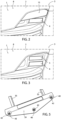
Figures 2 and 3 are perspective views of the lighting assembly ofFigure 1 on a significantly enlarged scale in respective operating configurations; -
Figure 4 is a partially exploded perspective view of first components of the lighting assembly ofFigures 1 to 3 on a still larger scale, with parts removed for clarity; -
Figure 5 is a perspective view of a few details of the first components of the lighting assembly ofFigure 4 ; -
Figure 6 is a section along line VI-VI ofFigure 4 , with parts removed for clarity; -
Figure 7 illustrates further details of the lighting assembly ofFigures 1 to 6 on an enlarged scale; -
Figure 8 illustrates the further details ofFigure 7 on a still larger scale and according to a first viewing angle; -
Figure 9 illustrates the further details ofFigures 7 and 8 in a perspective view and according to a different viewing angle; and -
Figure 10 is a functional diagram of further details of the motor vehicle ofFigure 1 and of the lighting assembly ofFigures 2 to 9 . - With reference to the accompanying figures, a motor vehicle comprising a
body 2 and a pair oflighting assemblies - The
lighting assemblies 3 are preferably arranged in afront portion 8 of thebody 2. - It is noted that expressions such as "top", "bottom", "front", "rear" and the like are used in the following description with reference to conditions of normal forward movement of the motor vehicle 1.
- As the lighting assemblies 3, 4 are identical to each other, only the
lighting assembly 3 is described in the following. - The
lighting assembly 3 essentially comprises: - one or more light sources (not illustrated);
- a plurality of reflective surfaces; and
- a pair of
transparent surfaces - More specifically, the
surface 5 is configured to transmit a low beam and thesurface 6 is configured to transmit a high beam. - In the illustrated case, the
surface 5 is arranged above thesurface 6. - The motor vehicle 1 further comprises:
- a twilight sensor 10 (only schematically illustrated in
Figure 10 ) designed to generate a first signal when the level of brightness of the environment surrounding the motor vehicle 1 is below a first threshold value; - a speedometer 11 (only schematically illustrated in
Figure 10 ) designed to generate a second signal associated with the speed of the motor vehicle 1; - an operating control, which can be operated from inside the motor vehicle 1 in order to generate the low beam;
- a control panel 16 (only schematically illustrated in
Figure 1 ) into which a key can be inserted to control the ignition of the motor vehicle 1; and - a sensor 75 (only schematically illustrated in
Figure 10 ) designed to detect the operating temperature of thelighting assembly - The motor vehicle 1 further comprises a plurality of sensors designed to detect a plurality of operating parameters of the
lighting assembly 3. - Advantageously, the
lighting assembly 3 comprises anopaque element 15, which is movable between: - a first operating position, in which it is far from the
surfaces 5,6 (Figure 3 ); and - a second operating position, in which it obstructs the surface 5 (
Figures 1 and2 ). - In other words, the
opaque element 15 covers thesurface 5 when it is arranged in the second operating position. - The
lighting assembly 3 further comprises anoperating mechanism 19 in order to move theopaque element 15 between the first and second positions. - More specifically, the
operating mechanism 19 comprises (Figures 4 and7 to 10 ): - a
frame 18 fixed to thefront portion 8 of the body 2 (Figure 4 ); - a control unit 20 (only schematically illustrated in
Figure 10 ); - a
motor 21 controlled by thecontrol unit 20; and - a
transmission assembly 22 interposed between themotor 21 and theopaque element 15, and designed to allow the movement of theopaque element 15 relative to theframe 18 as a result of the operation of themotor 21. - The
transmission assembly 22 comprises, in turn (Figures 7 to 9 ): - a
shaft 30, which is operable by themotor 21; - a pair of
pinions 31 arranged onrespective ends 33 of theshaft 30; and - a pair of
racks 35 meshing withrespective pinions 31. - The
transmission assembly 22 further comprises (Figures 4 to 6 ) : - a worm screw (not illustrated) operated by the
motor 21; - a gear (not illustrated) meshing with the worm gear and arranged on the
shaft 30; and - a
mobile support 39, which is integral to theracks 35 and to which theopaque element 15 is fixed by means of releasable connection means 40. - In the illustrated case, the
shaft 30 has a hexagonal cross-section and extends along an essentially horizontal axis A in use. - The
motor 21 is interposed between thepinions 31 along the axis A and arranged at the midpoint of theshaft 30. - The
racks 35 have respective curved axes B, parallel to each other and orthogonal to the axis A. - The axes B are adapted so as to match the shape of the
front portion 8 adjacent to thelighting assembly 3 and the shape of thesurface 5 of saidlighting assembly 3. - The connection means 40 comprise, in particular:
- a plurality of threaded
pins 41, three in the illustrated case, glued to theopaque element 15 on the side of thesupport 39 and protruding in a cantilevered fashion towards saidsupport 39; and - a plurality of
nuts 42, three in the illustrated case, fixed to thesupport 39, protruding in a cantilevered fashion towards thesupport 39 and screwed onto respective pins 41. - The
transmission assembly 22 further comprises a clutch 60 interposed between themotor 21 and the transmission assembly 22 (Figures 8 and9 ). - In the illustrated case, the clutch 60 is interposed between the respective halves of the
shaft 30. - The clutch 60 is dimensioned to:
- keep the
motor 21 and thetransmission assembly 22 operationally connected when the load applied to theopaque element 15 is below a fourth threshold value; and - uncouple the
motor 21 and thetransmission assembly 22 when the applied load exceeds the fourth threshold value. - The above-mentioned fourth threshold value is higher than the aerodynamic load normally acting on the
opaque element 15 and lower than the load that could injure a person inadvertently in a position along the chord of theopaque element 15 between the first and second operating positions or vice versa. - The
frame 18 comprises, in turn: - a
main support body 70 for supporting themotor 21 and thetransmission assembly 22; and - a pair of
side walls 71 arranged on respective sides of themain body 70 and defining respective end surfaces 72 against which theopaque element 15 strikes when it reaches the second operating position. - In the illustrated case, the
surfaces 72 are made of PTFE and theopaque element 15 is made of carbon. - The
control unit 20 is programmed to command themotor 21 to maintain theopaque element 15 in the second operating position. - The
control unit 20 is also programmed to command themotor 21 to move theopaque element 15 from the second operating position to the first operating position when the key is inserted in thecontrol panel 16 of the motor vehicle 1 and when at least one of the following conditions occurs: - the
twilight sensor 10 detects that the level of brightness of the environment surrounding the motor vehicle 1 is below a first threshold value; and/or - the
speedometer 11 detects that the speed of the motor vehicle 1 is above a second threshold value, e.g. 90 km/h; and/or - the user operates the operating control for generating the low beam.
- In particular, the
control unit 20 is programmed to command themotor 21 to return from the first operating position to the second operating position when thespeedometer 11 detects that the speed of the motor vehicle 1 is below a third threshold value, which is lower than the first threshold value, e.g. 80 km/h. - The
control unit 20 is further programmed to generate: - a first error signal when the
motor 21 fails to move theopaque element 15 from the second operating position to the first operating position; and - a second error signal when the
motor 21 fails to move theopaque element 15 from the second operating position to the first operating position. - The
control unit 20 is interfaced with an electronic control unit 100 (only schematically illustrated inFigure 10 ) of the motor vehicle 1 so as to: - cause the activation of a red indicator light 102 (only schematically illustrated in
Figure 10 ) visible inside the motor vehicle 1 in the case where thecontrol unit 20 generates the first signal; - cause the activation of a yellow indicator light 101 (only schematically illustrated in
Figure 10 ) visible inside the motor vehicle 1 in the case where thecontrol unit 20 generates the second signal. - The
control unit 20 is also programmed to identify: - a standard operating condition when all parameters detected by the additional sensors and by the
sensor 75 are within respective ranges; or - a non-standard operating condition, when at least one of the parameters detected by the additional sensors and by the
sensor 75 is outside the respective ranges. - The
control unit 20 is also programmed to cause the generation of the first signal, if: - the
sensor 75 detects a temperature outside the preset range and/or communication with theelectronic control unit 100 of the motor vehicle 1 is interrupted; and/or - the clutch 60 uncouples the
motor 21 and thetransmission assembly 22; and/or - the
control unit 20 detects a non-standard operating condition. - The operation of the
lighting assembly 3 is illustrated starting with an initial condition in which the motor vehicle is stationary, for example parked. In this initial condition, thecontrol unit 20 commands themotor 21 to maintain theopaque element 15 in the second operating position so as to cover thesurface 5. - When in the second operating position, the
opaque element 15 rests against thesurfaces 72 of themain body 70. - As a result of the insertion of the key in the
control panel 16, thecontrol unit 20 commands themotor 21 to maintain theopaque element 15 in the second operating position. - The
control unit 20 commands themotor 21 to move theopaque element 15 from the second operating position to the first operating position in which it leaves the low-beam surface 5 free, in the event that - the
twilight sensor 10 detects that the level of brightness of the environment surrounding the motor vehicle 1 is below the first threshold value; and/or - the
speedometer 11 detects that the speed of the motor vehicle 1 is above the second threshold value, e.g. 90 km/h; and/or - the user operates the operating control for generating the low beam.
- If the
speedometer 11 detects that the speed of the motor vehicle 1 has returned below the third lower threshold value, which is lower than the first threshold value, e.g. 80 km/h, thecontrol unit 20 commands themotor 21 to return theopaque element 15 to the second operating position. - The clutch 60 uncouples the
motor 21 and thetransmission assembly 22, when the applied load is greater than the fourth threshold value, so as to prevent injury to persons having happened to insert fingers or other body parts into the area of movement of theopaque element 15. - The
electronic control unit 100 of the motor vehicle 1 causes the activation of the red indicator light 102 visible inside said motor vehicle 1 in the event that themotor 21 fails to move theopaque element 15 from the second operating position to the first operating position. - The
electronic control unit 100 of the motor vehicle 1 causes the activation of the yellow indicator light 101 visible inside said motor vehicle 1 in the event that: - the
motor 21 fails to move theopaque element 15 from the second operating position to the first operating position; - the
sensor 75 detects a temperature outside the preset range and/or communication with theelectronic control unit 100 of the motor vehicle 1 is interrupted; and/or - the clutch 60 uncouples the
motor 21 and thetransmission assembly 22; and/or - the
control unit 20 detects a non-standard operating condition. - The operation of the
lighting assembly 4 is identical and simultaneous with thelighting assembly 3 and is consequently not described in detail. - The advantages achievable by the invention are evident from an examination of the
lighting assemblies - More specifically, the
opaque element 15 is movable between: - the first operating position, in which it is far from the
surfaces - the second operating position, in which it obstructs the
surface 5. - It is thereby possible to achieve a desired design of the
lighting assembly surface 5 and without compromising the correct, safe operation of the motor vehicle 1. - In particular, the
opaque element 15 is arranged in the second operating position when the motor vehicle 1 is parked. - The
control unit 20 moves theopaque element 15 from the second operating position in which it obstructs thesurface 5 to the first operating position in which it leaves thesurface 5 free, in the event that - the
twilight sensor 10 detects that the level of brightness of the environment surrounding the motor vehicle 1 is below the first threshold value; and/or - the
speedometer 11 detects that the speed of the motor vehicle 1 is above the second threshold value, e.g. 90 km/h; and/or - the user actuates the operating control for generating the low beam.
- It is thus possible to achieve a desired aesthetic impression of the
lighting assembly - If the
speedometer 11 detects that the speed of the motor vehicle 1 has returned below the third threshold value, which is lower than the first threshold value, e.g. 80 km/h, theopaque element 15 returns to the second operating position. - It is thus possible to return the
opaque element 15 to the second operating position as soon as the operating conditions of the motor vehicle 1 permit. - The clutch 60 uncouples the
motor 21 and thetransmission assembly 22 when the applied load is greater than the fourth threshold value so as to prevent injury to persons having happened to insert fingers or other body parts into the area of movement of theopaque element 10. - Finally, it is clear that the
lighting assembly
Claims (15)
- A lighting assembly (3, 4) for a motor vehicle (1) comprising:- a first transparent surface (5), which is configured to transmit, in use, a low beam; and- a second transparent surface (6), which is configured to transmit, in use, a high beam;- an opaque element (15), which is movable between:- a first operating position, in which it is far from said first and second surfaces (5, 6); and- a second operating position, in which it at least partially obstructs one of said first and second surfaces (5, 6);- a frame (18), which can be fixed, in use, to a body (2) of said motor vehicle (1); and- an operating mechanism (19), which is fixed to said frame (18), is operatively connected to said opaque element (15) and can be operated in order to move said opaque element (15) between said first and second operating positions;characterized in that said operating mechanism (19) comprises, in turn:- a motor member (21) fixed to said frame (18);- an output shaft (30), which is operated by said motor member (21) and can rotate around a first axis (A);- at least one rack (35), which is connected to said opaque element (15) and is movable along a second axis (B), which is transverse to said first axis (A), in an integral manner together with said opaque element (15); and- at least one gear (31) meshing with said rack (35) and operatively connected to said output shaft (30);said operating mechanism (19) comprising a friction clutch (60) interposed between said motor member (21) and said output shaft (30) and configured to uncouple said output shaft (30) from said motor member (20), when a load exceeding a first threshold value is applied, in use, to said opaque element (15) during the travel of the opaque element (15) between said second operating position and said first operating position.
- The lighting assembly according to claim 1, characterized in that said opaque element (15) obstructs said first surface (5) when it is arranged, in use, in said second operating position;
said opaque element (15) leaving said second surface (6) free when it is arranged, in use, in said second operating position. - The lighting assembly according to claim 1 or 2, characterized in that said second axis (B) is curved; and/or
characterized in that it comprises a pair of gears (31, 32) arranged on opposite sides of said output shaft (30) and meshing with respective racks (35). - The lighting assembly according to any one of the preceding claims, characterized in that said frame (18) defines a pair of striking surfaces (72), against which said opaque element (15) strikes when it is arranged, in use, in said second position;
said opaque element (15) being spaced apart from said striking surfaces (72), when it is arranged in said first operating position and at least along a first segment of the travel from said first operating position to said second operating position. - The lighting assembly according to any one of the preceding claims, characterized in that it comprises a plate (39), which is integral to said at least one rack (35) and is connected by means of releasable connection means (40) to said opaque element (15).
- A motor vehicle comprising:- a body (2) defining a front portion (8) with reference to a forward moving direction of said motor vehicle (1);- said lighting assembly (3, 4) according to any one of the preceding claims and fixed to said front portion (8);- a control unit (20) programmed to control said motor member (21);- a twilight sensor (10) designed to generate a first signal associated with the level of brightness of the environment surrounding said motor vehicle (1);- a speedometer (11) designed to generate a second signal associated with the speed of said motor vehicle; and- an operating control, which can be operated in order to generate said low beam;said control unit (20) being programmed to place said opaque element (15) in said second operating position;said control unit (20) being further programmed to cause the movement of said opaque element (15) from said second operating position to said first operating position, when at least one of said first and second signals exceeds a respective second threshold value and/or when said operating control is activated.
- The motor vehicle according to claim 6, characterized in that said control unit (20) is programmed to cause the return of said opaque element (15) from said first operating position to said second operating position, when said speedometer (11) generates, in use, a third signal below said second threshold value.
- The motor vehicle according to claim 6 or 7, characterized in that it comprises:- an electronic control unit (100);- a first indicator (102) of an anomalous operation of said operating mechanism (19) associated with an immediate intervention request; and- a second indicator (101) of an anomalous operation of said operating mechanism (19) associated with a non-immediate intervention request;said first indicator (102) being activated, in use, in case said operating mechanism (19) cannot move said opaque element (15) from said second operating position to said first operating position;said second indicator (101) being activated, in use:- in case said operating mechanism (19) cannot move said opaque element (15) from said first operating position to said second operating position; and/or- in case the electronic control unit (100) of said motor vehicle detects, in use, that at least one operating parameter of said lighting assembly (3, 4) is not within a respective predetermined range of standard values; and/or- in case said load exceeding said first threshold value is applied, in use, to said opaque element (15) during the travel of the opaque element (15) between said second operating position and said first operating position.
- A motor vehicle comprising:- a body (2) defining a front portion (8) with reference to a forward moving direction of said motor vehicle (1);- a lighting assembly (3, 4) fixed to said front portion (8) ;- a control unit (20) programmed to control said motor member (21);- a twilight sensor (10) designed to generate a first signal associated with the level of brightness of the environment surrounding said motor vehicle (1);- a speedometer (11) designed to generate a second signal associated with the speed of said motor vehicle; and- an operating control, which can be operated in order to generate said low beam;said lighting assembly (3, 4) comprising:- a first transparent surface (5), which is configured to transmit, in use, a low beam; and- a second transparent surface (6), which is configured to transmit, in use, a high beam;- an opaque element (15), which is movable between:a first operating position, in which it is far from said first and second surfaces (5, 6); anda second operating position, in which it at least partially obstructs one of said first and second surfaces (5, 6);- a frame (18), which can be fixed, in use, to a body (2) of said motor vehicle (1); and- an operating mechanism (19), which is fixed to said frame (18), is operatively connected to said opaque element (15) and can be operated in order to move said opaque element (15) between said first and second operating positions;said control unit (20) being programmed to place said opaque element (15) in said second operating position;characterized in that said operating mechanism (19) comprises, in turn:- a motor member (21) fixed to said frame (18);- an output shaft (30), which is operated by said motor member (21) and can rotate around a first axis (A);- at least one rack (35), which is connected to said opaque element (15) and is movable along a second axis (B), which is transverse to said first axis (A), in an integral manner together with said opaque element (15); and- at least one gear (31) meshing with said rack (35) and operatively connected to said output shaft (30);said control unit (20) being further programmed to cause the movement of said opaque element (15) from said second operating position to said first operating position, when at least one of said first and second signals exceeds a respective second threshold value and/or when said operating control is activated.
- The motor vehicle according to claim 9, characterized in that said control unit (20) is programmed to cause the return of said opaque element (15) from said first operating position to said second operating position, when said speedometer (11) generates, in use, a third signal below said second threshold value.
- The motor vehicle according to claim 9 or 10, characterized in that it comprises:- an electronic control unit (100);- a first indicator (102) of an anomalous operation of said operating mechanism (19) associated with an immediate intervention request; and- a second indicator (101) of an anomalous operation of said operating mechanism (19) associated with a non-immediate intervention request;said first indicator (102) being activated, in use, in case said operating mechanism (19) cannot move said opaque element (15) from said second operating position to said first operating position;said second indicator (101) being activated, in use:- in case said operating mechanism (19) cannot move said opaque element (15) from said first operating position to said second operating position; and/or- in case the electronic control unit (100) of said motor vehicle detects, in use, that at least one operating parameter of said lighting assembly (3, 4) is not within a respective predetermined range of standard values; and/or- in case said load exceeding said first threshold value is applied, in use, to said opaque element (15) during the travel of the opaque element (15) between said second operating position and said first operating position.
- The motor vehicle according to any one of claims 9 to 11, characterized in that said opaque element (15) obstructs said first surface (5) when it is arranged, in use, in said second operating position;
said opaque element (15) leaving said second surface (6) free when it is arranged, in use, in said second operating position. - The motor vehicle according to any one of claims 9 to 12, characterized in that said second axis (B) is curved; and/or
characterized in that it comprises a pair of gears (31, 32) arranged on opposite sides of said output shaft (30) and meshing with respective racks (35). - The motor vehicle according to any one of claims 9 to 13, characterized in that said frame (18) defines a pair of striking surfaces (72), against which said opaque element (15) strikes when it is arranged, in use, in said second position;
said opaque element (15) being spaced apart from said fourth striking surfaces (72), when it is arranged in said first operating position and at least along a first segment of the travel from said first operating position to said second operating position. - The motor vehicle according to any one of claims 9 to 14, characterized in that said lighting assembly (3, 4) comprises a plate (39), which is integral to said at least one rack (35) and is connected by means of releasable connection means (40) to said opaque element (15).
Applications Claiming Priority (1)
| Application Number | Priority Date | Filing Date | Title |
|---|---|---|---|
| IT102022000003425A IT202200003425A1 (en) | 2022-02-24 | 2022-02-24 | LIGHTING ASSEMBLY FOR A MOTOR VEHICLE AND MOTOR VEHICLE INCLUDING SUCH ASSEMBLY |
Publications (2)
| Publication Number | Publication Date |
|---|---|
| EP4234329A1 EP4234329A1 (en) | 2023-08-30 |
| EP4234329B1 true EP4234329B1 (en) | 2024-11-06 |
Family
ID=81648243
Family Applications (1)
| Application Number | Title | Priority Date | Filing Date |
|---|---|---|---|
| EP23157486.4A Active EP4234329B1 (en) | 2022-02-24 | 2023-02-20 | Lighting assembly for a motor vehicle and motor vehicle comprising said assembly |
Country Status (5)
| Country | Link |
|---|---|
| US (1) | US11821601B2 (en) |
| EP (1) | EP4234329B1 (en) |
| JP (1) | JP2023123381A (en) |
| CN (1) | CN116642147A (en) |
| IT (1) | IT202200003425A1 (en) |
Families Citing this family (1)
| Publication number | Priority date | Publication date | Assignee | Title |
|---|---|---|---|---|
| JP1800162S (en) * | 2023-06-20 | 2025-06-03 | car |
Family Cites Families (13)
| Publication number | Priority date | Publication date | Assignee | Title |
|---|---|---|---|---|
| US2700725A (en) * | 1949-12-13 | 1955-01-25 | Gen Motors Corp | Headlamp closure |
| GB1172627A (en) * | 1966-03-11 | 1969-12-03 | Standard Triumph Motor Company | Protective Apparatus for Motor Vehicle Headlamps |
| FR2082777A5 (en) * | 1970-03-26 | 1971-12-10 | Peugeot & Renault | |
| JPS5816410A (en) | 1981-07-21 | 1983-01-31 | 株式会社東芝 | Current supply lead |
| JPS58164101U (en) * | 1982-04-27 | 1983-11-01 | 日産自動車株式会社 | vehicle lamp cover |
| JPS6178044A (en) | 1984-09-25 | 1986-04-21 | Toshiba Corp | Double-tube type lamp |
| JPS6178044U (en) * | 1984-10-30 | 1986-05-24 | ||
| JPS62122841A (en) * | 1985-11-21 | 1987-06-04 | Daihatsu Motor Co Ltd | Head lamp exposing mechanism |
| JPS63125451A (en) * | 1986-11-14 | 1988-05-28 | Honda Motor Co Ltd | Corner pole drive for vehicle |
| US4947295A (en) * | 1989-03-06 | 1990-08-07 | General Motors Corporation | Actuator mechanism for a headlamp cover |
| JPH0698091B2 (en) | 1989-03-16 | 1994-12-07 | 三菱電機株式会社 | rice cooker |
| US7237936B1 (en) * | 2005-05-27 | 2007-07-03 | Gibson David J | Vehicle light assembly and its associated method of manufacture |
| JP6998091B1 (en) * | 2021-02-10 | 2022-02-15 | 和正 宮岸 | Movable headlight cowl |
-
2022
- 2022-02-24 IT IT102022000003425A patent/IT202200003425A1/en unknown
-
2023
- 2023-02-14 JP JP2023020934A patent/JP2023123381A/en active Pending
- 2023-02-17 US US18/170,588 patent/US11821601B2/en active Active
- 2023-02-20 EP EP23157486.4A patent/EP4234329B1/en active Active
- 2023-02-24 CN CN202310175230.0A patent/CN116642147A/en active Pending
Also Published As
| Publication number | Publication date |
|---|---|
| US11821601B2 (en) | 2023-11-21 |
| US20230265982A1 (en) | 2023-08-24 |
| JP2023123381A (en) | 2023-09-05 |
| IT202200003425A1 (en) | 2023-08-24 |
| EP4234329A1 (en) | 2023-08-30 |
| CN116642147A (en) | 2023-08-25 |
Similar Documents
| Publication | Publication Date | Title |
|---|---|---|
| EP2033874B1 (en) | Vehicle steering apparatus | |
| EP4234329B1 (en) | Lighting assembly for a motor vehicle and motor vehicle comprising said assembly | |
| US20090065285A1 (en) | Vehicle steering apparatus | |
| US6938720B2 (en) | Steering input devices for steer-by-wire systems | |
| US4431984A (en) | Signal system for vehicles | |
| US20230119092A1 (en) | Steering column for a motor vehicle | |
| EP1401679A1 (en) | Vehicle mirror | |
| EP0522555A1 (en) | Rear-wheel steering apparatus for wheeled vehicle | |
| AU2021416210A1 (en) | Vehicle steering system, and vehicle having same | |
| US20120069462A1 (en) | Outside Mirror for Vehicle | |
| JPH04138939A (en) | Driving position regulating device for automobile | |
| CN201410920Y (en) | Electronic eye for vehicular chassis safety | |
| EP3470908B1 (en) | Vehicle with overhead vehicle state indication | |
| JPH0567461B2 (en) | ||
| EP3575677B1 (en) | Signalling system for the exterior of a vehicle | |
| KR102684962B1 (en) | Side mirror blind spot removal system | |
| KR100521569B1 (en) | Automatic control system of lamp for automobile | |
| US6309082B1 (en) | Automatic turning head light structure | |
| KR100337815B1 (en) | Vehicle passenger safety warning device | |
| KR200152763Y1 (en) | Head lamp equipment | |
| KR20000007138A (en) | The indicator for window of car to use the hologram | |
| KR200146792Y1 (en) | Cluster colour changing device | |
| KR0138344Y1 (en) | Steering angle display device | |
| KR0143292B1 (en) | Vehicle's auxiliary direction indicator installation structure | |
| KR19980030521U (en) | Rear View Mirror Lift of Automobile |
Legal Events
| Date | Code | Title | Description |
|---|---|---|---|
| PUAI | Public reference made under article 153(3) epc to a published international application that has entered the european phase |
Free format text: ORIGINAL CODE: 0009012 |
|
| STAA | Information on the status of an ep patent application or granted ep patent |
Free format text: STATUS: THE APPLICATION HAS BEEN PUBLISHED |
|
| AK | Designated contracting states |
Kind code of ref document: A1 Designated state(s): AL AT BE BG CH CY CZ DE DK EE ES FI FR GB GR HR HU IE IS IT LI LT LU LV MC ME MK MT NL NO PL PT RO RS SE SI SK SM TR |
|
| STAA | Information on the status of an ep patent application or granted ep patent |
Free format text: STATUS: REQUEST FOR EXAMINATION WAS MADE |
|
| 17P | Request for examination filed |
Effective date: 20240227 |
|
| RBV | Designated contracting states (corrected) |
Designated state(s): AL AT BE BG CH CY CZ DE DK EE ES FI FR GB GR HR HU IE IS IT LI LT LU LV MC ME MK MT NL NO PL PT RO RS SE SI SK SM TR |
|
| RIC1 | Information provided on ipc code assigned before grant |
Ipc: B60Q 1/14 20060101ALI20240424BHEP Ipc: B60Q 1/05 20060101AFI20240424BHEP |
|
| GRAP | Despatch of communication of intention to grant a patent |
Free format text: ORIGINAL CODE: EPIDOSNIGR1 |
|
| STAA | Information on the status of an ep patent application or granted ep patent |
Free format text: STATUS: GRANT OF PATENT IS INTENDED |
|
| INTG | Intention to grant announced |
Effective date: 20240604 |
|
| GRAS | Grant fee paid |
Free format text: ORIGINAL CODE: EPIDOSNIGR3 |
|
| GRAA | (expected) grant |
Free format text: ORIGINAL CODE: 0009210 |
|
| STAA | Information on the status of an ep patent application or granted ep patent |
Free format text: STATUS: THE PATENT HAS BEEN GRANTED |
|
| AK | Designated contracting states |
Kind code of ref document: B1 Designated state(s): AL AT BE BG CH CY CZ DE DK EE ES FI FR GB GR HR HU IE IS IT LI LT LU LV MC ME MK MT NL NO PL PT RO RS SE SI SK SM TR |
|
| REG | Reference to a national code |
Ref country code: GB Ref legal event code: FG4D |
|
| REG | Reference to a national code |
Ref country code: CH Ref legal event code: EP |
|
| REG | Reference to a national code |
Ref country code: DE Ref legal event code: R096 Ref document number: 602023000907 Country of ref document: DE |
|
| REG | Reference to a national code |
Ref country code: IE Ref legal event code: FG4D |
|
| REG | Reference to a national code |
Ref country code: LT Ref legal event code: MG9D |
|
| REG | Reference to a national code |
Ref country code: NL Ref legal event code: MP Effective date: 20241106 |
|
| PG25 | Lapsed in a contracting state [announced via postgrant information from national office to epo] |
Ref country code: HR Free format text: LAPSE BECAUSE OF FAILURE TO SUBMIT A TRANSLATION OF THE DESCRIPTION OR TO PAY THE FEE WITHIN THE PRESCRIBED TIME-LIMIT Effective date: 20241106 Ref country code: IS Free format text: LAPSE BECAUSE OF FAILURE TO SUBMIT A TRANSLATION OF THE DESCRIPTION OR TO PAY THE FEE WITHIN THE PRESCRIBED TIME-LIMIT Effective date: 20250306 Ref country code: PT Free format text: LAPSE BECAUSE OF FAILURE TO SUBMIT A TRANSLATION OF THE DESCRIPTION OR TO PAY THE FEE WITHIN THE PRESCRIBED TIME-LIMIT Effective date: 20250306 |
|
| PG25 | Lapsed in a contracting state [announced via postgrant information from national office to epo] |
Ref country code: FI Free format text: LAPSE BECAUSE OF FAILURE TO SUBMIT A TRANSLATION OF THE DESCRIPTION OR TO PAY THE FEE WITHIN THE PRESCRIBED TIME-LIMIT Effective date: 20241106 Ref country code: NL Free format text: LAPSE BECAUSE OF FAILURE TO SUBMIT A TRANSLATION OF THE DESCRIPTION OR TO PAY THE FEE WITHIN THE PRESCRIBED TIME-LIMIT Effective date: 20241106 |
|
| REG | Reference to a national code |
Ref country code: AT Ref legal event code: MK05 Ref document number: 1739039 Country of ref document: AT Kind code of ref document: T Effective date: 20241106 |
|
| PG25 | Lapsed in a contracting state [announced via postgrant information from national office to epo] |
Ref country code: BG Free format text: LAPSE BECAUSE OF FAILURE TO SUBMIT A TRANSLATION OF THE DESCRIPTION OR TO PAY THE FEE WITHIN THE PRESCRIBED TIME-LIMIT Effective date: 20241106 |
|
| PG25 | Lapsed in a contracting state [announced via postgrant information from national office to epo] |
Ref country code: ES Free format text: LAPSE BECAUSE OF FAILURE TO SUBMIT A TRANSLATION OF THE DESCRIPTION OR TO PAY THE FEE WITHIN THE PRESCRIBED TIME-LIMIT Effective date: 20241106 |
|
| PG25 | Lapsed in a contracting state [announced via postgrant information from national office to epo] |
Ref country code: NO Free format text: LAPSE BECAUSE OF FAILURE TO SUBMIT A TRANSLATION OF THE DESCRIPTION OR TO PAY THE FEE WITHIN THE PRESCRIBED TIME-LIMIT Effective date: 20250206 |
|
| PG25 | Lapsed in a contracting state [announced via postgrant information from national office to epo] |
Ref country code: GR Free format text: LAPSE BECAUSE OF FAILURE TO SUBMIT A TRANSLATION OF THE DESCRIPTION OR TO PAY THE FEE WITHIN THE PRESCRIBED TIME-LIMIT Effective date: 20250207 Ref country code: LV Free format text: LAPSE BECAUSE OF FAILURE TO SUBMIT A TRANSLATION OF THE DESCRIPTION OR TO PAY THE FEE WITHIN THE PRESCRIBED TIME-LIMIT Effective date: 20241106 Ref country code: AT Free format text: LAPSE BECAUSE OF FAILURE TO SUBMIT A TRANSLATION OF THE DESCRIPTION OR TO PAY THE FEE WITHIN THE PRESCRIBED TIME-LIMIT Effective date: 20241106 |
|
| PG25 | Lapsed in a contracting state [announced via postgrant information from national office to epo] |
Ref country code: PL Free format text: LAPSE BECAUSE OF FAILURE TO SUBMIT A TRANSLATION OF THE DESCRIPTION OR TO PAY THE FEE WITHIN THE PRESCRIBED TIME-LIMIT Effective date: 20241106 |
|
| PG25 | Lapsed in a contracting state [announced via postgrant information from national office to epo] |
Ref country code: RS Free format text: LAPSE BECAUSE OF FAILURE TO SUBMIT A TRANSLATION OF THE DESCRIPTION OR TO PAY THE FEE WITHIN THE PRESCRIBED TIME-LIMIT Effective date: 20250206 |
|
| PG25 | Lapsed in a contracting state [announced via postgrant information from national office to epo] |
Ref country code: SM Free format text: LAPSE BECAUSE OF FAILURE TO SUBMIT A TRANSLATION OF THE DESCRIPTION OR TO PAY THE FEE WITHIN THE PRESCRIBED TIME-LIMIT Effective date: 20241106 |
|
| PG25 | Lapsed in a contracting state [announced via postgrant information from national office to epo] |
Ref country code: DK Free format text: LAPSE BECAUSE OF FAILURE TO SUBMIT A TRANSLATION OF THE DESCRIPTION OR TO PAY THE FEE WITHIN THE PRESCRIBED TIME-LIMIT Effective date: 20241106 |
|
| PG25 | Lapsed in a contracting state [announced via postgrant information from national office to epo] |
Ref country code: EE Free format text: LAPSE BECAUSE OF FAILURE TO SUBMIT A TRANSLATION OF THE DESCRIPTION OR TO PAY THE FEE WITHIN THE PRESCRIBED TIME-LIMIT Effective date: 20241106 |
|
| PG25 | Lapsed in a contracting state [announced via postgrant information from national office to epo] |
Ref country code: RO Free format text: LAPSE BECAUSE OF FAILURE TO SUBMIT A TRANSLATION OF THE DESCRIPTION OR TO PAY THE FEE WITHIN THE PRESCRIBED TIME-LIMIT Effective date: 20241106 |
|
| PG25 | Lapsed in a contracting state [announced via postgrant information from national office to epo] |
Ref country code: SK Free format text: LAPSE BECAUSE OF FAILURE TO SUBMIT A TRANSLATION OF THE DESCRIPTION OR TO PAY THE FEE WITHIN THE PRESCRIBED TIME-LIMIT Effective date: 20241106 |
|
| PG25 | Lapsed in a contracting state [announced via postgrant information from national office to epo] |
Ref country code: CZ Free format text: LAPSE BECAUSE OF FAILURE TO SUBMIT A TRANSLATION OF THE DESCRIPTION OR TO PAY THE FEE WITHIN THE PRESCRIBED TIME-LIMIT Effective date: 20241106 |
|
| REG | Reference to a national code |
Ref country code: DE Ref legal event code: R097 Ref document number: 602023000907 Country of ref document: DE |
|
| PG25 | Lapsed in a contracting state [announced via postgrant information from national office to epo] |
Ref country code: SE Free format text: LAPSE BECAUSE OF FAILURE TO SUBMIT A TRANSLATION OF THE DESCRIPTION OR TO PAY THE FEE WITHIN THE PRESCRIBED TIME-LIMIT Effective date: 20241106 |
|
| PLBE | No opposition filed within time limit |
Free format text: ORIGINAL CODE: 0009261 |
|
| STAA | Information on the status of an ep patent application or granted ep patent |
Free format text: STATUS: NO OPPOSITION FILED WITHIN TIME LIMIT |
|
| PG25 | Lapsed in a contracting state [announced via postgrant information from national office to epo] |
Ref country code: MC Free format text: LAPSE BECAUSE OF FAILURE TO SUBMIT A TRANSLATION OF THE DESCRIPTION OR TO PAY THE FEE WITHIN THE PRESCRIBED TIME-LIMIT Effective date: 20241106 |
|
| 26N | No opposition filed |
Effective date: 20250807 |
|
| PG25 | Lapsed in a contracting state [announced via postgrant information from national office to epo] |
Ref country code: LU Free format text: LAPSE BECAUSE OF NON-PAYMENT OF DUE FEES Effective date: 20250220 |
|
| REG | Reference to a national code |
Ref country code: BE Ref legal event code: MM Effective date: 20250228 |
|
| PG25 | Lapsed in a contracting state [announced via postgrant information from national office to epo] |
Ref country code: BE Free format text: LAPSE BECAUSE OF NON-PAYMENT OF DUE FEES Effective date: 20250228 |
|
| PG25 | Lapsed in a contracting state [announced via postgrant information from national office to epo] |
Ref country code: IE Free format text: LAPSE BECAUSE OF NON-PAYMENT OF DUE FEES Effective date: 20250220 |
|
| PGFP | Annual fee paid to national office [announced via postgrant information from national office to epo] |
Ref country code: DE Payment date: 20260220 Year of fee payment: 4 |
|
| PGFP | Annual fee paid to national office [announced via postgrant information from national office to epo] |
Ref country code: IT Payment date: 20260228 Year of fee payment: 4 |
|
| PGFP | Annual fee paid to national office [announced via postgrant information from national office to epo] |
Ref country code: FR Payment date: 20260227 Year of fee payment: 4 |