EP4234082A1 - A method for preparing a nickel-based methanation catalyst on a porous clay heterostructure support with a high specific surface area, and a nickel-based methanation catalyst thus obtained - Google Patents
A method for preparing a nickel-based methanation catalyst on a porous clay heterostructure support with a high specific surface area, and a nickel-based methanation catalyst thus obtained Download PDFInfo
- Publication number
- EP4234082A1 EP4234082A1 EP22158823.9A EP22158823A EP4234082A1 EP 4234082 A1 EP4234082 A1 EP 4234082A1 EP 22158823 A EP22158823 A EP 22158823A EP 4234082 A1 EP4234082 A1 EP 4234082A1
- Authority
- EP
- European Patent Office
- Prior art keywords
- pch
- hsa
- catalyst
- support
- sub
- Prior art date
- Legal status (The legal status is an assumption and is not a legal conclusion. Google has not performed a legal analysis and makes no representation as to the accuracy of the status listed.)
- Withdrawn
Links
Images



Classifications
-
- B—PERFORMING OPERATIONS; TRANSPORTING
- B01—PHYSICAL OR CHEMICAL PROCESSES OR APPARATUS IN GENERAL
- B01J—CHEMICAL OR PHYSICAL PROCESSES, e.g. CATALYSIS OR COLLOID CHEMISTRY; THEIR RELEVANT APPARATUS
- B01J35/00—Catalysts, in general, characterised by their form or physical properties
- B01J35/70—Catalysts, in general, characterised by their form or physical properties characterised by their crystalline properties, e.g. semi-crystalline
- B01J35/77—Compounds characterised by their crystallite size
-
- B—PERFORMING OPERATIONS; TRANSPORTING
- B01—PHYSICAL OR CHEMICAL PROCESSES OR APPARATUS IN GENERAL
- B01J—CHEMICAL OR PHYSICAL PROCESSES, e.g. CATALYSIS OR COLLOID CHEMISTRY; THEIR RELEVANT APPARATUS
- B01J23/00—Catalysts comprising metals or metal oxides or hydroxides, not provided for in group B01J21/00
- B01J23/70—Catalysts comprising metals or metal oxides or hydroxides, not provided for in group B01J21/00 of the iron group metals or copper
- B01J23/74—Iron group metals
- B01J23/755—Nickel
-
- B—PERFORMING OPERATIONS; TRANSPORTING
- B01—PHYSICAL OR CHEMICAL PROCESSES OR APPARATUS IN GENERAL
- B01J—CHEMICAL OR PHYSICAL PROCESSES, e.g. CATALYSIS OR COLLOID CHEMISTRY; THEIR RELEVANT APPARATUS
- B01J21/00—Catalysts comprising the elements, oxides, or hydroxides of magnesium, boron, aluminium, carbon, silicon, titanium, zirconium, or hafnium
- B01J21/16—Clays or other mineral silicates
-
- B—PERFORMING OPERATIONS; TRANSPORTING
- B01—PHYSICAL OR CHEMICAL PROCESSES OR APPARATUS IN GENERAL
- B01J—CHEMICAL OR PHYSICAL PROCESSES, e.g. CATALYSIS OR COLLOID CHEMISTRY; THEIR RELEVANT APPARATUS
- B01J35/00—Catalysts, in general, characterised by their form or physical properties
- B01J35/30—Catalysts, in general, characterised by their form or physical properties characterised by their physical properties
- B01J35/391—Physical properties of the active metal ingredient
- B01J35/393—Metal or metal oxide crystallite size
-
- B—PERFORMING OPERATIONS; TRANSPORTING
- B01—PHYSICAL OR CHEMICAL PROCESSES OR APPARATUS IN GENERAL
- B01J—CHEMICAL OR PHYSICAL PROCESSES, e.g. CATALYSIS OR COLLOID CHEMISTRY; THEIR RELEVANT APPARATUS
- B01J35/00—Catalysts, in general, characterised by their form or physical properties
- B01J35/60—Catalysts, in general, characterised by their form or physical properties characterised by their surface properties or porosity
- B01J35/61—Surface area
- B01J35/618—Surface area more than 1000 m2/g
-
- B—PERFORMING OPERATIONS; TRANSPORTING
- B01—PHYSICAL OR CHEMICAL PROCESSES OR APPARATUS IN GENERAL
- B01J—CHEMICAL OR PHYSICAL PROCESSES, e.g. CATALYSIS OR COLLOID CHEMISTRY; THEIR RELEVANT APPARATUS
- B01J35/00—Catalysts, in general, characterised by their form or physical properties
- B01J35/60—Catalysts, in general, characterised by their form or physical properties characterised by their surface properties or porosity
- B01J35/63—Pore volume
- B01J35/638—Pore volume more than 1.0 ml/g
-
- B—PERFORMING OPERATIONS; TRANSPORTING
- B01—PHYSICAL OR CHEMICAL PROCESSES OR APPARATUS IN GENERAL
- B01J—CHEMICAL OR PHYSICAL PROCESSES, e.g. CATALYSIS OR COLLOID CHEMISTRY; THEIR RELEVANT APPARATUS
- B01J35/00—Catalysts, in general, characterised by their form or physical properties
- B01J35/60—Catalysts, in general, characterised by their form or physical properties characterised by their surface properties or porosity
- B01J35/64—Pore diameter
- B01J35/643—Pore diameter less than 2 nm
-
- B—PERFORMING OPERATIONS; TRANSPORTING
- B01—PHYSICAL OR CHEMICAL PROCESSES OR APPARATUS IN GENERAL
- B01J—CHEMICAL OR PHYSICAL PROCESSES, e.g. CATALYSIS OR COLLOID CHEMISTRY; THEIR RELEVANT APPARATUS
- B01J35/00—Catalysts, in general, characterised by their form or physical properties
- B01J35/60—Catalysts, in general, characterised by their form or physical properties characterised by their surface properties or porosity
- B01J35/64—Pore diameter
- B01J35/647—2-50 nm
-
- B—PERFORMING OPERATIONS; TRANSPORTING
- B01—PHYSICAL OR CHEMICAL PROCESSES OR APPARATUS IN GENERAL
- B01J—CHEMICAL OR PHYSICAL PROCESSES, e.g. CATALYSIS OR COLLOID CHEMISTRY; THEIR RELEVANT APPARATUS
- B01J37/00—Processes, in general, for preparing catalysts; Processes, in general, for activation of catalysts
- B01J37/02—Impregnation, coating or precipitation
- B01J37/0201—Impregnation
- B01J37/0207—Pretreatment of the support
-
- B—PERFORMING OPERATIONS; TRANSPORTING
- B01—PHYSICAL OR CHEMICAL PROCESSES OR APPARATUS IN GENERAL
- B01J—CHEMICAL OR PHYSICAL PROCESSES, e.g. CATALYSIS OR COLLOID CHEMISTRY; THEIR RELEVANT APPARATUS
- B01J37/00—Processes, in general, for preparing catalysts; Processes, in general, for activation of catalysts
- B01J37/08—Heat treatment
- B01J37/082—Decomposition and pyrolysis
- B01J37/088—Decomposition of a metal salt
-
- B—PERFORMING OPERATIONS; TRANSPORTING
- B01—PHYSICAL OR CHEMICAL PROCESSES OR APPARATUS IN GENERAL
- B01J—CHEMICAL OR PHYSICAL PROCESSES, e.g. CATALYSIS OR COLLOID CHEMISTRY; THEIR RELEVANT APPARATUS
- B01J37/00—Processes, in general, for preparing catalysts; Processes, in general, for activation of catalysts
- B01J37/16—Reducing
- B01J37/18—Reducing with gases containing free hydrogen
-
- C—CHEMISTRY; METALLURGY
- C07—ORGANIC CHEMISTRY
- C07C—ACYCLIC OR CARBOCYCLIC COMPOUNDS
- C07C1/00—Preparation of hydrocarbons from one or more compounds, none of them being a hydrocarbon
- C07C1/02—Preparation of hydrocarbons from one or more compounds, none of them being a hydrocarbon from oxides of a carbon
- C07C1/12—Preparation of hydrocarbons from one or more compounds, none of them being a hydrocarbon from oxides of a carbon from carbon dioxide with hydrogen
-
- B—PERFORMING OPERATIONS; TRANSPORTING
- B01—PHYSICAL OR CHEMICAL PROCESSES OR APPARATUS IN GENERAL
- B01J—CHEMICAL OR PHYSICAL PROCESSES, e.g. CATALYSIS OR COLLOID CHEMISTRY; THEIR RELEVANT APPARATUS
- B01J2235/00—Indexing scheme associated with group B01J35/00, related to the analysis techniques used to determine the catalysts form or properties
- B01J2235/15—X-ray diffraction
-
- C—CHEMISTRY; METALLURGY
- C07—ORGANIC CHEMISTRY
- C07C—ACYCLIC OR CARBOCYCLIC COMPOUNDS
- C07C2521/00—Catalysts comprising the elements, oxides or hydroxides of magnesium, boron, aluminium, carbon, silicon, titanium, zirconium or hafnium
- C07C2521/16—Clays or other mineral silicates
-
- C—CHEMISTRY; METALLURGY
- C07—ORGANIC CHEMISTRY
- C07C—ACYCLIC OR CARBOCYCLIC COMPOUNDS
- C07C2523/00—Catalysts comprising metals or metal oxides or hydroxides, not provided for in group C07C2521/00
- C07C2523/70—Catalysts comprising metals or metal oxides or hydroxides, not provided for in group C07C2521/00 of the iron group metals or copper
- C07C2523/74—Iron group metals
- C07C2523/755—Nickel
-
- C—CHEMISTRY; METALLURGY
- C10—PETROLEUM, GAS OR COKE INDUSTRIES; TECHNICAL GASES CONTAINING CARBON MONOXIDE; FUELS; LUBRICANTS; PEAT
- C10L—FUELS NOT OTHERWISE PROVIDED FOR; NATURAL GAS; SYNTHETIC NATURAL GAS OBTAINED BY PROCESSES NOT COVERED BY SUBCLASSES C10G OR C10K; LIQUIFIED PETROLEUM GAS; USE OF ADDITIVES TO FUELS OR FIRES; FIRE-LIGHTERS
- C10L3/00—Gaseous fuels; Natural gas; Synthetic natural gas obtained by processes not covered by subclass C10G, C10K; Liquefied petroleum gas
- C10L3/06—Natural gas; Synthetic natural gas obtained by processes not covered by C10G, C10K3/02 or C10K3/04
- C10L3/08—Production of synthetic natural gas
Definitions
- the present invention relates to a field of catalysts and namely to a method for preparing a Nickel catalyst deposited on a high specific surface area porous clay heterostructure support (PCH-HSA) used for carbon dioxide/carbon monoxide (CO 2 /CO) hydrogenation (Sabatier methanation reaction).
- PCH-HSA high specific surface area porous clay heterostructure support
- the basic idea lies in optimization of production of Ni catalyst support using a two-step synthesis approach, i.e. modification of layered silicate sodium bentonite with quaternary onium ion (Arquad 2HT-75), and synthesis of porous clay heterostructure on the base of modified bentonite using neutral amine and silicate source such as tetraethylorthosilicate (TEOS).
- TEOS tetraethylorthosilicate
- the invention would address catalytic CO 2 /CO and green (or blue) hydrogen utilization to synthetic bio-methane, waste-to-energy (WtE), power-to-X (PtX) and efficient biomass/waste management processes.
- methane is an excellent cheaper fuel with relatively high volumetric and gravimetric chemical energy density, very well developed natural gas grid infrastructure and/or could be used as fuel in transportation sector.
- the properties of synthetic bio-methane produced via catalytic Sabatier reaction are equal to natural gas and thus it could be directly used as a substitute fuel or mixed with natural gas at any proportions from 0 to 100% and injected into the grid.
- transition metals such as Ni, Ru, Rh, Pd and Pt are generally used as catalytic material for methanation in the form of metal nanoparticles (MNP) deposited on various supports (MNP/support).
- MNP metal nanoparticles
- supports MNP/support
- the support plays a key role on the activity and stability of the catalyst.
- catalyst supports are used in methanation reaction:
- Ni based catalysts have been mostly investigated due to high catalytic activity and selectivity towards methane production as well as from the economic point of view as a cheaper material. However, it is important to obtain a more efficient catalyst with a support for the CO 2 /CO hydrogenation.
- Ni/Al 2 O 3 and Ni/CaO,Al 2 O 3 (JM57-4Q) catalysts have CO 2 conversion 70-82%, CH 4 yield 62-65%, selectivity 82-95%, respectively ( Miguel C.V. et al., J. CO2 Util., 2018, 25, 128-136 ).
- Some metals or metal oxides deposited on porous clay heterostructure supports were used for oxidative dehydrogenation of ethane ( Solsona B. et al., Catal. Sci. Technol., Iss., 2016, 6, 3419-3429 ; NiO), reduction of NO with C 3 H 6 ( Kashif M. et al., Vacuum, 2022, 198, 110879 ; Mn), synthetic esters production ( Alves Saboya R. M. et al., Appl. Clay Sci., 2016, 124-125, 69-78 ; WO 3 ), preferential CO oxidation ( Cecilia, J.A. et al., Catal. Today, 2015, 253, 126-136 ; CuO-CeO 2 ), etc.
- nickel catalyst deposited on PCH-HSA has not been used for CO 2 /CO hydrogenation yet.
- the technology described herein allows optimization of the synthesis of a novel Ni catalyst deposited on a porous clay heterostructure support with a high specific surface area formed by chemical methods for maximum CO 2 /CO conversion to synthetic bio-methane.
- the present invention relates to a method for preparing a Ni-based methanation catalyst wherein nickel metal nanoparticles are deposited on the novel support made of porous high specific surface area (S BET ) and pore volumes clay heterostructure formed by chemical method and used for Sabatier reaction producing bio-methane and water.
- New Ni/PCH-HSA catalyst is characterized by CO 2 conversion of 94%, high selectivity of 94%, CH 4 yield of 88.6% and does not require expensive catalytic materials such as Ru, Pt, and Pd.
- none of the above mentioned disadvantages of the catalyst supports was found to be typical to the PCH-HSA support.
- a modified bentonite is prepared.
- the organic compound - Quaternary ammonium salt with high molecular weight and branched structure of molecule - is intercalated into the interlayer of sodium bentonite and expands it from 1.25 nm up to 3.9 nm.
- the last step is catalyst preparation by the 48 hours wetness impregnation of PCH-HSA in the saturated aqueous solution of nickel nitrate hexahydrate and drying at 100 °C for 24 hours.
- the heating at 450 °C of the impregnated PCH-HSA is used in order to complete the decomposition of nickel nitrate and to form NiO.
- the conversion of CO 2 and the yield of bio-methane over Ni/PCH-HSA are tested.
- the Ni/PCH-HSA catalyst Prior to the methanation reaction, the Ni/PCH-HSA catalyst is reduced according to the standard procedure.
- the high surface area of the support promotes good dispersion of the nickel metal nanoparticles (18 nm) over the surface of the PCH-HSA catalyst support.
- Ni/PCH-HSA catalyst is tested at a molar H 2 and CO 2 ratio of 4:1 at 400 °C when the loading of nickel is between 5-30 wt% and the content of the PCH-HSA carrier is between 70-95 wt%.
- the CO 2 conversion increased from 19 up to 94%, selectivity from 18.6 up to 94%, and bio-methane yield from 3.44 up to 88.6%, respectively.
- the invention relates to a method for preparing a Ni-based methanation catalyst wherein nickel metal nanoparticles are deposited on the novel support made of porous high specific surface area (S BET ) and pore volumes clay heterostructure formed by chemical method and used for Sabatier reaction producing synthetic bio-methane and water.
- S BET porous high specific surface area
- the basic idea lies in optimization of production of Ni catalyst support using a two-step synthesis approach, i.e. modification of layered silicate sodium bentonite with quaternary onium ion (Arquad 2HT-75), and synthesis of porous clay heterostructure on the base of modified bentonite using neutral amine and silicate source such as tetraethylorthosilicate (TEOS).
- TEOS tetraethylorthosilicate
- New Ni/PCH-HSA catalyst is characterized by CO 2 conversion of 94%, high selectivity of 94%, CH 4 yield of 88.6% and does not require expensive catalytic materials such as Ru, Pt, and Pd. None of the above mentioned disadvantages of the catalyst supports was found to be typical to the PCH-HSA support.
- a method for preparing the Ni/PCH-HSA catalyst involves the following steps:
Landscapes
- Chemical & Material Sciences (AREA)
- Organic Chemistry (AREA)
- Chemical Kinetics & Catalysis (AREA)
- Engineering & Computer Science (AREA)
- Materials Engineering (AREA)
- Dispersion Chemistry (AREA)
- Physics & Mathematics (AREA)
- Thermal Sciences (AREA)
- General Chemical & Material Sciences (AREA)
- Oil, Petroleum & Natural Gas (AREA)
- Catalysts (AREA)
- Organic Low-Molecular-Weight Compounds And Preparation Thereof (AREA)
Abstract
The invention relates to a method for preparing a Ni-based methanation catalyst deposited on a porous clay heterostructure support with a high specific surface area (PCH-HSA) formed by a chemical method. During the first step of the synthesis, modification of sodium bentonite with quaternary ammonium salt with molecule of branched structure, high molecular weight, and long alkyl chains (C16-C18) is performed. The modifier is intercalated into the interlayer space of silicate (sodium bentonite) and expands the distance between the tetrahedral layers up 3.9 nm. At the second step, long alkyl chain primary neutral amine (C18) together with silicate source (tetraethylorthosilicate) is intercalated to the expanded interlayer of the modified silicate. Hydrolysis and polycondensation reaction of silicate source take place. PCH-HSA precursor is formed which is calcined at 640 °C for 5 hours. After the calcination, the PCH-HSA catalyst support with specific surface area S<sub>BET</sub> (up to 1000-1100 m<sup>2</sup>/g), total pore volume (up to 1.15 cm<sup>3</sup>/g) and 4.09 nm interlayer spacing is formed. Then, a Ni catalyst is prepared by wetness impregnation of PCH-HSA with aqueous solutions of nickel nitrate with good dispersion of Ni nanoparticles (18 nm) on the PCH-HSA support. The Ni/PCH-HSA catalyst is characterized by high CO<sub>2</sub> conversion of 94%, synthetic bio-CH<sub>4</sub> yield of 88.6% and selectivity of 94%, respectively.
Description
- The present invention relates to a field of catalysts and namely to a method for preparing a Nickel catalyst deposited on a high specific surface area porous clay heterostructure support (PCH-HSA) used for carbon dioxide/carbon monoxide (CO2/CO) hydrogenation (Sabatier methanation reaction). The basic idea lies in optimization of production of Ni catalyst support using a two-step synthesis approach, i.e. modification of layered silicate sodium bentonite with quaternary onium ion (Arquad 2HT-75), and synthesis of porous clay heterostructure on the base of modified bentonite using neutral amine and silicate source such as tetraethylorthosilicate (TEOS).
- The invention would address catalytic CO2/CO and green (or blue) hydrogen utilization to synthetic bio-methane, waste-to-energy (WtE), power-to-X (PtX) and efficient biomass/waste management processes. From the energetic and commercial point of view, methane is an excellent cheaper fuel with relatively high volumetric and gravimetric chemical energy density, very well developed natural gas grid infrastructure and/or could be used as fuel in transportation sector. The properties of synthetic bio-methane produced via catalytic Sabatier reaction are equal to natural gas and thus it could be directly used as a substitute fuel or mixed with natural gas at any proportions from 0 to 100% and injected into the grid.
- Usually, transition metals such as Ni, Ru, Rh, Pd and Pt are generally used as catalytic material for methanation in the form of metal nanoparticles (MNP) deposited on various supports (MNP/support). The support plays a key role on the activity and stability of the catalyst.
- Presently, catalyst supports are used in methanation reaction:
- 1. Single component of metals oxides: SiO2, TiO2, ZrO2, CeO2, Al2O3, MgO, MnO, MnO2, Mn2O3, and Mn3O4 with different crystal phases and types.
- 2. Modified oxides: CeO2-Al2O3, CeO2-ZrO2-Al2O3, CaO-Al2O3, and MgO-SiO2.
- 3. Metal-organic frameworks (MOFs): MOF-199, UiO-66, UiO-67.
- 4. Zeolites: USY, MFI and BEA types.
- 5. Mesoporous silica: MCM-41, SBA-15.
- 6. Carbon materials: carbon nanotubes CNT, ordered mesoporous carbon OMC, exfoliated graphitic carbon nitride.
- However, these materials used as supports have some disadvantages:
- relatively small specific surface area and total pore volume;
- interaction between catalyst and support is weak and the catalyst is easily deactivated due to aggregation of its particles under high temperatures and carbon deposition;
- highly expensive;
- unstable pore structure at high temperature;
- necessity to modify the support due to enhanced CO2 adsorption capacity;
- blockage of active sites during methanation reaction.
- Therefore, new and more efficient supports are always sought.
- Ni based catalysts have been mostly investigated due to high catalytic activity and selectivity towards methane production as well as from the economic point of view as a cheaper material. However, it is important to obtain a more efficient catalyst with a support for the CO2/CO hydrogenation. In industry most commonly used commercial Ni/Al2O3 and Ni/CaO,Al2O3 (JM57-4Q) catalysts have CO2 conversion 70-82%, CH4 yield 62-65%, selectivity 82-95%, respectively (Miguel C.V. et al., J. CO2 Util., 2018, 25, 128-136).
- Some metals or metal oxides deposited on porous clay heterostructure supports were used for oxidative dehydrogenation of ethane (Solsona B. et al., Catal. Sci. Technol., Iss., 2016, 6, 3419-3429; NiO), reduction of NO with C3H6 (Kashif M. et al., Vacuum, 2022, 198, 110879; Mn), synthetic esters production (Alves Saboya R. M. et al., Appl. Clay Sci., 2016, 124-125, 69-78; WO3), preferential CO oxidation (Cecilia, J.A. et al., Catal. Today, 2015, 253, 126-136; CuO-CeO2), etc. However, according to available scientific literature and patents screen in databases, nickel catalyst deposited on PCH-HSA has not been used for CO2/CO hydrogenation yet.
- The technology described herein allows optimization of the synthesis of a novel Ni catalyst deposited on a porous clay heterostructure support with a high specific surface area formed by chemical methods for maximum CO2/CO conversion to synthetic bio-methane.
- The present invention relates to a method for preparing a Ni-based methanation catalyst wherein nickel metal nanoparticles are deposited on the novel support made of porous high specific surface area (SBET) and pore volumes clay heterostructure formed by chemical method and used for Sabatier reaction producing bio-methane and water. New Ni/PCH-HSA catalyst is characterized by CO2 conversion of 94%, high selectivity of 94%, CH4 yield of 88.6% and does not require expensive catalytic materials such as Ru, Pt, and Pd. Moreover, none of the above mentioned disadvantages of the catalyst supports was found to be typical to the PCH-HSA support.
- During the first step of the PCH-HSA support synthesis, i.e. the cationic exchange reaction, a modified bentonite is prepared. The organic compound - Quaternary ammonium salt with high molecular weight and branched structure of molecule - is intercalated into the interlayer of sodium bentonite and expands it from 1.25 nm up to 3.9 nm.
- In the second step, neutral amine (octadecylamine) together with silicate source (tetraethylorthosilicate) is intercalated to the expanded interlayer space of modified silicate. Hydrolysis and polycondensation reaction of silicate source take place. Porous clay heterostructure precursor is formed, which is washed with methanol and calcined at 640 °C. After the calcination, the PCH-HSA with SBET up to 1000-1100 m2/g and a total pore volume of 1.15 cm3/g is formed.
- The last step is catalyst preparation by the 48 hours wetness impregnation of PCH-HSA in the saturated aqueous solution of nickel nitrate hexahydrate and drying at 100 °C for 24 hours. The heating at 450 °C of the impregnated PCH-HSA is used in order to complete the decomposition of nickel nitrate and to form NiO. Finally, the conversion of CO2 and the yield of bio-methane over Ni/PCH-HSA are tested. Prior to the methanation reaction, the Ni/PCH-HSA catalyst is reduced according to the standard procedure. The high surface area of the support promotes good dispersion of the nickel metal nanoparticles (18 nm) over the surface of the PCH-HSA catalyst support.
- The Ni/PCH-HSA catalyst is tested at a molar H2 and CO2 ratio of 4:1 at 400 °C when the loading of nickel is between 5-30 wt% and the content of the PCH-HSA carrier is between 70-95 wt%. With the increase of Ni loading from 5 to 30 wt%, the CO2 conversion increased from 19 up to 94%, selectivity from 18.6 up to 94%, and bio-methane yield from 3.44 up to 88.6%, respectively.
- Industrial nickel based catalyst deposited on Al2O3 support with different Ni loading has CO2 conversion of 70-82%, CH4 yield of 62-65%, and selectivity of 82-95%, respectively (Miguel C.V. et al., J. CO2 Util., 2018, 25, 128-136).
- The present invention is described with reference to the accompanying drawings, wherein:
-
FIG. 1 depicts the powder X-ray diffraction patterns that demonstrate the formation of modified sodium bentonite after the cation exchange reaction. The distance between the tetrahedral layers of initial bentonite expands from 1.25 nm up to 3.9 nm after modification. -
FIG. 2 depicts the powder X-ray diffraction patterns which show the formation of the crystalline structure of the PCH with the interlayer space of d = 4.09 nm. -
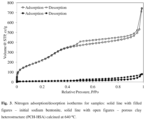
FIG. 3 displays the N2-gas adsorption/desorption isotherms of the initial sodium bentonite and PCH-HSA after the calcination, which is used for the specific surface area measurement and for the calculation of pore size distribution. -
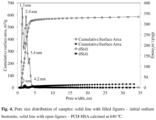
FIG. 4 depicts the pore size distribution of the initial bentonite and calcined PCH-HSA showing the formation of well defined micropore sizes of 1.3 nm and mesopores of 2.4-3.4 nm. -
FIG. 5 depicts the powder X-ray diffraction patterns, which show of crystalline structure of the Ni-PCH-HSA catalyst with the crystallite size of 18 nm. - The invention relates to a method for preparing a Ni-based methanation catalyst wherein nickel metal nanoparticles are deposited on the novel support made of porous high specific surface area (SBET) and pore volumes clay heterostructure formed by chemical method and used for Sabatier reaction producing synthetic bio-methane and water. The basic idea lies in optimization of production of Ni catalyst support using a two-step synthesis approach, i.e. modification of layered silicate sodium bentonite with quaternary onium ion (Arquad 2HT-75), and synthesis of porous clay heterostructure on the base of modified bentonite using neutral amine and silicate source such as tetraethylorthosilicate (TEOS). New Ni/PCH-HSA catalyst is characterized by CO2 conversion of 94%, high selectivity of 94%, CH4 yield of 88.6% and does not require expensive catalytic materials such as Ru, Pt, and Pd. None of the above mentioned disadvantages of the catalyst supports was found to be typical to the PCH-HSA support.
- A method for preparing the Ni/PCH-HSA catalyst involves the following steps:
- 1. Modification of sodium bentonite. 4 wt% dispersion in water sodium bentonite (CEC 105meq/100g) and quaternary ammonium salt (quat's, dihydrogenated tallow dimethylammonium chloride, Arquad 2HT-75) with high molecular weight (M = 576 g/mol), branched molecule structure with long alkyl chains (C16-C18) are heated in closed vessels up to 60 °C. Then both components are mixed and heated for 0.5 hour at 60 °C at speed rate of 60 rpm. The concentration of quat's is 1.5-1.65 the cation exchange capacities (CEC) of bentonite. Modified bentonite (MB) is produced during the cation exchange reaction between sodium bentonite and quaternary ammonium salt. When the concentration of the modifier exceeds the CEC of the layered silicate, the modifier not only intercalates to the interlayer space of bentonite, but also covers and hydrophobizes the surface of plates. This facilitates next ongoing penetration of tetraethylorthosilicate (TEOS) - the source of inorganic oxide - into the interlayer. The reaction product is filtered and washed with water. The XRD analysis of initial and solid intermediate-product (modified bentonite) is presented in
Fig. 1 . The distance between the tetrahedral layers of bentonite (montmorillonite) expands from 1.25 nm up to 3.9 nm. - 2. 15 wt% dispersion of the MB in water is prepared by mixing for 2 hours with the speed rate of 120 rpm under the ambient conditions. Neutral amine (NA) - octadecylamine (C18) - is dissolved in methanol (saturated solution) and slowly poured into the dispersion of bentonite by mixing with the speed rate of 120 rpm for 0.5 hour. Then TEOS is added and the composition is stirred for 3 hours with the speed rate of 180 rpm under the ambient conditions. In order to obtain the high SBET up to 1000-1100 m2/g, the molar ratio of NA and TEOS should be 8.0: 8.13, respectively. Micropores and mesopores are formed because of the use of longer alkyl chain (C18) neutral amine. The basal Bragg spacing of PCH-HSA (air dried) obtained by the XRD is 4.09 nm and is shown in
Fig. 2 . The remaining only one basal reflection of (001, d = 4.09 nm) indicate the partially disruption (delamination) of layered structure of modified clay and the formation of silica network between the clay layers. - 3. N2-gas adsorption/desorption isotherms of the PCH-HSA are recorded in liquid nitrogen at temperature of -196 °C. The specific surface area is determined and calculated by multi-point BET Plot method. According to the isotherms presented in
Fig. 3 , the SBET of 1000-1100 m2/g is calculated. A high steep uptake at very low P/P0 in the PCH-HSA isotherm indicates about the large amount of micropores formation. Micropores and mesopores are formed because of the use of longer alkyl chain (C18) neutral amine. The total pore volume up to 1.15 cm3/g, the micropores size of 1.3 nm and the mesopores size in the range of 2.4 and 3.4 nm are determined. The total pore volume increased from 0.12 cm3/g of the initial bentonite to 1.15 cm3/g of the PCH-HSA, respectively. The considerable increase of the SBET value from 34 m2/g of raw bentonite to 1000 m2/g of PCH-HSA is obtained. The pore size distribution is determined by N2 at -196 °C on carbon slit pore, QSDFT equilibrium model (Quantachrome. ASiQwin) and is presented inFig. 4 . - 4. Porous clay heterostructure support (the calcined PCH-HSA) is used for catalyst preparation by the wetness impregnation of PCH-HSA with aqueous solution of nickel nitrate hexahydrate for 48 hours, drying for 24 hours at 100 °C and calcination at 450 °C with the heating rate of 1 °C/min for 5 hours in order to complete the decomposition of the nickel nitrate and to form NiO. High surface area of the catalyst support is an important factor in the methanation process leading to a higher dispersion of nickel metal nanoparticles (18 nm) on the surface. The X-ray diffraction analysis of the Ni/PCH-HSA is depicted in
Fig.5 . The crystallite size estimation of deposited Ni catalyst was performed using TOPAS-4.1 - the X-ray diffraction profile analysis program. - 5. The hydrogenation of carbon dioxide is carried out using a conventional fixed bed tube reactor. The mixture of H2 and CO2 prepared by taking pure gases from cylinders. The required H2:CO2 (4:1) ratios are adjusted with mass flow controllers. The prepared mixture is fed into the gas heater to be heated to a temperature of approximately 300 °C. The heated gas is then directed to the methanation process reactor. For the pre-heating and simultaneous cooling of the reaction zone, a hot thermal-oil system is used. In the hydrogenation reactor, the Ni/PCH-HSA catalyst is placed between two layers of quartz wool. Prior to the reaction, the catalyst is reduced under hydrogen atmosphere at 627 °C for 2 h. After the reaction, the product gas enters a water-cooled condenser. Additionally, in order to increase the process efficiency, a gas pressure regulator is installed behind the condenser to maintain a constant reaction pressure of 10 bars. Finally, the reaction products are fed to a semi-online gas analysis system, the Agilent Micro GC 490 gas chromatograph. With the increase of Ni loading from 5 to 30 wt%, the CO2 conversion increased from 19 up to 94%, selectivity from 18.6 up to 94%, and methane yield from 3.44 up to 88.6%, respectively.
- Product has the following advantages:
- 1. Quaternary ammonium salt (dihydrogenated tallow dimethylammonium chloride) - modifier of sodium bentonite - has molecule of branched structure, long alkyl chains (C16-C18) and high molecular weight (M = 576 g/mol). Because the modified bentonite obtained high interlayer space (3.9 nm), the intercalation of other reagents to the tetrahedral layers is more accessible.
- 2. The PCH-HSA support of the novel catalyst has high specific surface area SBET (up to 1000-1100 m2/g), total pore volume (up to 1.15 cm3/g), good dispersion of Ni nanoparticles (18 nm). None of the above mentioned disadvantages of the catalyst supports was found to be typical to the PCH-HAS support.
- 3. The Ni/PCH-HSA catalyst is characterized by high CO2 conversion of 94%, synthetic bio-CH4 yield of 88.6% and selectivity of 94%, respectively.
Claims (2)
- A method for preparing a Ni-based methanation catalyst on a porous clay heterostructure support with a high specific surface area (PCH-HSA), characterized by the steps of:a) modifying the layered silicate sodium bentonite with quaternary ammonium salt with high molecular weight and branched, long alkyl chains (C16-C18) molecule structure;b) intercalating the neutral amine together with silicate source into the expanded interlayer space of bentonite, where hydrolysis and polycondensation reactions take place, thus forming the PCH-HSA precursor;c) calcining the PCH-HSA precursor at 640 °C for 5 hours at a heating rate 1 °C/min, thus preparing the PCH-HSA;d) using the PCH-HSA support for catalyst preparation by wetness impregnation of PCH-HSA with aqueous solution of nickel nitrate hexahydrate for 48 hours, drying at 100 °C for 24 hours and heating at 450 °C for 5 hours in order to complete the decomposition of the nickel nitrate and formation of NiO.
- A Ni-based methanation catalyst on a porous clay heterostructure support with a high specific surface area (PCH-HSA), produced according to steps a) to d), having an increased Ni loading from 5 to 30 wt% on the PCH-HSA catalyst support, CO2 conversion of 94%, synthetic bio-CH4 yield of 88.6% and selectivity of 94%, respectively.
Priority Applications (1)
| Application Number | Priority Date | Filing Date | Title |
|---|---|---|---|
| EP22158823.9A EP4234082A1 (en) | 2022-02-25 | 2022-02-25 | A method for preparing a nickel-based methanation catalyst on a porous clay heterostructure support with a high specific surface area, and a nickel-based methanation catalyst thus obtained |
Applications Claiming Priority (1)
| Application Number | Priority Date | Filing Date | Title |
|---|---|---|---|
| EP22158823.9A EP4234082A1 (en) | 2022-02-25 | 2022-02-25 | A method for preparing a nickel-based methanation catalyst on a porous clay heterostructure support with a high specific surface area, and a nickel-based methanation catalyst thus obtained |
Publications (1)
| Publication Number | Publication Date |
|---|---|
| EP4234082A1 true EP4234082A1 (en) | 2023-08-30 |
Family
ID=80819725
Family Applications (1)
| Application Number | Title | Priority Date | Filing Date |
|---|---|---|---|
| EP22158823.9A Withdrawn EP4234082A1 (en) | 2022-02-25 | 2022-02-25 | A method for preparing a nickel-based methanation catalyst on a porous clay heterostructure support with a high specific surface area, and a nickel-based methanation catalyst thus obtained |
Country Status (1)
| Country | Link |
|---|---|
| EP (1) | EP4234082A1 (en) |
Cited By (2)
| Publication number | Priority date | Publication date | Assignee | Title |
|---|---|---|---|---|
| CN119017787A (en) * | 2024-08-08 | 2024-11-26 | 长沙建益新材料有限公司 | A kind of anti-seepage bentonite waterproof blanket and preparation method thereof |
| US12311336B1 (en) * | 2025-02-07 | 2025-05-27 | Imam Mohammad Ibn Saud Islamic University | Nanocomposite for purification of contaminated water |
Citations (2)
| Publication number | Priority date | Publication date | Assignee | Title |
|---|---|---|---|---|
| CN105642287A (en) * | 2014-12-01 | 2016-06-08 | 神华集团有限责任公司 | Methanation catalyst, preparation method thereof and method for preparation of methane by hydrogen and carbon monoxide methanation |
| CN107413346A (en) * | 2017-06-07 | 2017-12-01 | 广西大学 | A kind of preparation method of catalyst for carbon dioxide methanation |
-
2022
- 2022-02-25 EP EP22158823.9A patent/EP4234082A1/en not_active Withdrawn
Patent Citations (2)
| Publication number | Priority date | Publication date | Assignee | Title |
|---|---|---|---|---|
| CN105642287A (en) * | 2014-12-01 | 2016-06-08 | 神华集团有限责任公司 | Methanation catalyst, preparation method thereof and method for preparation of methane by hydrogen and carbon monoxide methanation |
| CN107413346A (en) * | 2017-06-07 | 2017-12-01 | 广西大学 | A kind of preparation method of catalyst for carbon dioxide methanation |
Non-Patent Citations (9)
| Title |
|---|
| ALVES SABOYA R. M. ET AL., APPL. CLAY SCI., vol. 124-125, 2016, pages 69 - 78 |
| CECILIA, J.A. ET AL., CATAL. TODAY, vol. 253, 2015, pages 126 - 136 |
| DATABASE WPI Week 201659, Derwent World Patents Index; AN 2016-380258, XP002807098 * |
| DATABASE WPI Week 201802, Derwent World Patents Index; AN 2017-83617B, XP002807097 * |
| KASHIF M. ET AL., VACUUM, vol. 198, 2022, pages 110879 |
| MIGUEL C.V. ET AL., J. CO UTIL., vol. 25, 2018, pages 128 - 136 |
| REN ZHIMING ET AL: "Nickel nanoparticles highly dispersed in silica pillared clay as an efficient catalyst for chlorobenzene dechlorination", RSC ADVANCES, vol. 5, no. 65, 1 January 2015 (2015-01-01), pages 52658 - 52666, XP055943450, DOI: 10.1039/C5RA05926G * |
| SOLSONA B. ET AL., CATAL. SCI. TECHNOL., ISS., vol. 6, 2016, pages 3419 - 3429 |
| SOLSONA B. ET AL: "Nickel oxide supported on porous clay heterostructures as selective catalysts for the oxidative dehydrogenation of ethane", CATALYSIS SCIENCE & TECHNOLOGY, vol. 6, no. 10, 17 December 2015 (2015-12-17), UK, pages 3419 - 3429, XP055943407, ISSN: 2044-4753, DOI: 10.1039/C5CY01811K * |
Cited By (2)
| Publication number | Priority date | Publication date | Assignee | Title |
|---|---|---|---|---|
| CN119017787A (en) * | 2024-08-08 | 2024-11-26 | 长沙建益新材料有限公司 | A kind of anti-seepage bentonite waterproof blanket and preparation method thereof |
| US12311336B1 (en) * | 2025-02-07 | 2025-05-27 | Imam Mohammad Ibn Saud Islamic University | Nanocomposite for purification of contaminated water |
Similar Documents
| Publication | Publication Date | Title |
|---|---|---|
| Al-Mamoori et al. | Oxidative dehydrogenation of ethane to ethylene in an integrated CO2 capture-utilization process | |
| Ma et al. | Stabilizing Ni on bimodal mesoporous-macroporous alumina with enhanced coke tolerance in dry reforming of methane to syngas | |
| Hu et al. | Catalytic decomposition of ammonia to COx-free hydrogen over Ni/ZSM-5 catalysts: A comparative study of the preparation methods | |
| Newnham et al. | Highly stable and active Ni-mesoporous alumina catalysts for dry reforming of methane | |
| Chen et al. | Hydrogen production from ethanol steam reforming: effect of Ce content on catalytic performance of Co/Sepiolite catalyst | |
| Cui et al. | CO2 methanation over the Ni-based catalysts supported on the hollow ZSM-5 zeolites: Effects of the hollow structure and alkaline treatment | |
| Kim et al. | Catalytic production of hydrogen through aqueous-phase reforming over platinum/ordered mesoporous carbon catalysts | |
| Bukhari et al. | Optimal Ni loading towards efficient CH4 production from H2 and CO2 over Ni supported onto fibrous SBA-15 | |
| Varisli et al. | Hydrogen from ammonia over cobalt incorporated silicate structured catalysts prepared using different cobalt salts | |
| Karam et al. | Mesoporous nickel-alumina catalysts derived from MIL-53 (Al) metal-organic framework: A new promising path for synthesizing CO2 methanation catalysts | |
| JP2014532559A5 (en) | ||
| Bawah et al. | Syngas production from CO2 reforming of methane over Ni supported on hierarchical silicalite-1 fabricated by microwave-assisted hydrothermal synthesis | |
| Wang et al. | Ni-hierarchical Beta zeolite catalysts were applied to ethanol steam reforming: Effect of sol gel method on loading Ni and the role of hierarchical structure | |
| Dai et al. | Catalytic activity of mesoporous Ni/CNT, Ni/SBA-15 and (Cu, Ca, Mg, Mn, Co)–Ni/SBA-15 catalysts for CO2 reforming of CH4 | |
| Hu et al. | Preparation and characterization of Ni/CeO2-SiO2 catalysts and their performance in catalytic partial oxidation of methane to syngas | |
| Yang et al. | Facilely fabricating highly dispersed Ni-based catalysts supported on mesoporous MFI nanosponge for CO2 methanation | |
| Cara et al. | On the design of mesostructured acidic catalysts for the one-pot dimethyl ether production from CO2 | |
| Wang et al. | Guaiacol hydrodeoxygenation over Pd catalyst with mesoporous ZSM-5 support synthesized by solid-state crystallization | |
| KR20120082697A (en) | Co2 reforming catalyst composition | |
| Liu et al. | Facile synthesis and its high catalytic performance of hierarchical ZSM-5 zeolite from economical bulk silicon oxides | |
| US20190001311A1 (en) | Zeolitic 3d scaffolds with tailored surface topography for methanol conversion with light olefins selectivity | |
| US12134085B2 (en) | Steam reforming catalysts for sustainable hydrogen production from biobased materials | |
| Du et al. | An efficient microcapsule catalyst for one-step ethanol synthesis from dimethyl ether and syngas | |
| Haocui et al. | Catalytic steam reforming of JP-10 over Ni/SBA-15 | |
| Kaengsilalai et al. | Potential of Ni supported on KH zeolite catalysts for carbon dioxide reforming of methane |
Legal Events
| Date | Code | Title | Description |
|---|---|---|---|
| PUAI | Public reference made under article 153(3) epc to a published international application that has entered the european phase |
Free format text: ORIGINAL CODE: 0009012 |
|
| STAA | Information on the status of an ep patent application or granted ep patent |
Free format text: STATUS: THE APPLICATION HAS BEEN PUBLISHED |
|
| AK | Designated contracting states |
Kind code of ref document: A1 Designated state(s): AL AT BE BG CH CY CZ DE DK EE ES FI FR GB GR HR HU IE IS IT LI LT LU LV MC MK MT NL NO PL PT RO RS SE SI SK SM TR |
|
| STAA | Information on the status of an ep patent application or granted ep patent |
Free format text: STATUS: THE APPLICATION IS DEEMED TO BE WITHDRAWN |
|
| 18D | Application deemed to be withdrawn |
Effective date: 20240301 |