EP4233916A1 - Complex, and use thereof - Google Patents
Complex, and use thereof Download PDFInfo
- Publication number
- EP4233916A1 EP4233916A1 EP21882664.2A EP21882664A EP4233916A1 EP 4233916 A1 EP4233916 A1 EP 4233916A1 EP 21882664 A EP21882664 A EP 21882664A EP 4233916 A1 EP4233916 A1 EP 4233916A1
- Authority
- EP
- European Patent Office
- Prior art keywords
- group
- compound
- acrolein
- site
- carbon atoms
- Prior art date
- Legal status (The legal status is an assumption and is not a legal conclusion. Google has not performed a legal analysis and makes no representation as to the accuracy of the status listed.)
- Pending
Links
Images


Classifications
-
- A—HUMAN NECESSITIES
- A61—MEDICAL OR VETERINARY SCIENCE; HYGIENE
- A61P—SPECIFIC THERAPEUTIC ACTIVITY OF CHEMICAL COMPOUNDS OR MEDICINAL PREPARATIONS
- A61P35/00—Antineoplastic agents
-
- C—CHEMISTRY; METALLURGY
- C07—ORGANIC CHEMISTRY
- C07D—HETEROCYCLIC COMPOUNDS
- C07D498/00—Heterocyclic compounds containing in the condensed system at least one hetero ring having nitrogen and oxygen atoms as the only ring hetero atoms
- C07D498/02—Heterocyclic compounds containing in the condensed system at least one hetero ring having nitrogen and oxygen atoms as the only ring hetero atoms in which the condensed system contains two hetero rings
- C07D498/08—Bridged systems
-
- A—HUMAN NECESSITIES
- A61—MEDICAL OR VETERINARY SCIENCE; HYGIENE
- A61K—PREPARATIONS FOR MEDICAL, DENTAL OR TOILETRY PURPOSES
- A61K47/00—Medicinal preparations characterised by the non-active ingredients used, e.g. carriers or inert additives; Targeting or modifying agents chemically bound to the active ingredient
- A61K47/50—Medicinal preparations characterised by the non-active ingredients used, e.g. carriers or inert additives; Targeting or modifying agents chemically bound to the active ingredient the non-active ingredient being chemically bound to the active ingredient, e.g. polymer-drug conjugates
- A61K47/51—Medicinal preparations characterised by the non-active ingredients used, e.g. carriers or inert additives; Targeting or modifying agents chemically bound to the active ingredient the non-active ingredient being chemically bound to the active ingredient, e.g. polymer-drug conjugates the non-active ingredient being a modifying agent
- A61K47/54—Medicinal preparations characterised by the non-active ingredients used, e.g. carriers or inert additives; Targeting or modifying agents chemically bound to the active ingredient the non-active ingredient being chemically bound to the active ingredient, e.g. polymer-drug conjugates the non-active ingredient being a modifying agent the modifying agent being an organic compound
Definitions
- the present invention relates to a complex and use thereof.
- the drug delivery system makes it possible to selectively deliver a drug to a specific tissue (target tissue) that needs to be treated, and to reduce side effects by lowering influence on a normal tissue.
- Non-patent Literatures 1 and 2 study has been carried out on a prodrug that exhibits antitumor activity under conditions characteristic to tumor cells such as a hypoxic environment in order to deliver a drug to a target tumor cell. Furthermore, study has been carried out on a prodrug that releases a drug by reacting with a specific compound that serves as a trigger (Non-patent Literatures 3 and 4).
- Non-patent Literatures 1 through 4 are still in the test-tube stage, and in addition, the compounds disclosed in Non-patent Literatures 3 and 4 each require an additional compound as a trigger for drug release.
- Non-patent Literature 5 discloses a novel compound that selectively reacts particularly with acrolein among molecules that are present in a living organism.
- an object of the present invention is to provide, for example, (i) a novel complex that reacts with acrolein to release an active substance and (ii) use thereof.
- the present invention includes aspects described below.
- a complex in accordance with an embodiment of the present invention contains: an acrolein-reactive site having a chemical structure represented by Formula (1); and a leaving site having another chemical structure, the leaving site binding to the acrolein-reactive site via a linker that is cleavable by a reaction between the acrolein-reactive site and acrolein.
- the 1,2,3-triazoline produced by the click reaction (1,3-dipole cycloaddition reaction) between the acrolein-reactive site and acrolein then forms imine through an isomerization reaction. Subsequently, the linker between the acrolein-reactive site and the leaving site is cleaved in association with decarboxylation (leaving of carbon dioxide). This separates a diazo compound derived from the acrolein-reactive site from an active substance derived from the leaving site.
- the above reaction is capable of progressing under a mild condition in a living organism or the like, and exhibits high reaction specificity. Therefore, by administering the present complex into a living organism, endogenous acrolein reacts with the present complex, and consequently an active substance derived from the leaving site can be released into the living organism.
- R1 and R2 each independently represent a hydrogen atom, a halogen atom, or an alkyl group that has 1 to 5 carbon atoms and that may be substituted by at least one halogen atom. Note, however, that at least one of R1 and R2 is the alkyl group having 1 to 5 carbon atoms.
- halogen atom examples include a fluorine atom, a chlorine atom, a bromine atom, and the like. Note that the fluorine atom may be an isotope.
- the alkyl group having 1 to 5 carbon atoms may be either linear or branched.
- the alkyl group has a hydrogen atom that may be substituted or unsubstituted by the at least one halogen atom.
- Examples of the alkyl group that has 1 to 5 carbon atoms and that has an unsubstituted hydrogen atom include a methyl group, an ethyl group, a propyl group, an isopropyl group, an n-butyl group, an isobutyl group, a tert-butyl group, an n-pentyl group, an isopentyl group, a tert-pentyl group, and a sec-pentyl group.
- R1 and R2 may be identical to or different from each other.
- R1 and R2 may each be preferably an alkyl group that has 1 to 5 carbon atoms and that is substituted or unsubstituted by the at least one halogen atom, and may be more preferably alkyl groups that are identical to each other. Note that preferably 1 to 4 carbon atoms, and more preferably 2, 3, or 4 carbon atoms may constitute the alkyl group.
- one of R1 and R2 be the alkyl group that has 1 to 5 carbon atoms and that is substituted or unsubstituted by the at least one halogen atom and that the other one of R1 and R2 be the halogen atom (in particular, a fluorine or isotope).
- halogen atom in particular, a fluorine or isotope.
- preferably 1 to 4 carbon atoms, and more preferably 2, 3, or 4 carbon atoms may constitute the alkyl group.
- R3 and R4 each independently represent a hydrogen atom, a halogen atom, a hydroxy group, a thiol group, an amino group that may have a substituent, an alkoxy group having 1 to 5 carbon atoms, an alkylthio group having 1 to 5 carbon atoms, or an alkyl group having 1 to 5 carbon atoms. Note, however, that a hydrogen atom constituting the alkyl group may be substituted by a substituent selected from a halogen atom, a hydroxy group, and an amino group that may have a substituent.
- Examples of the amino group that may have a substituent include an unsubstituted amino group, an alkylamino group, a (hetero)aryl amino group, and the like.
- 1 to 5 carbon atoms constitute each alkyl group included in the alkylamino group.
- the (hetero)aryl amino group refers to a group in which at least one hydrogen atom constituting the amino group is substituted by an aryl group (i.e., an aryl group or a heteroaryl group) that may have a hetero atom.
- each (hetero)aryl group included in the (hetero)aryl amino group examples include, for example, a (hetero)aryl group in which 3 to 20 (preferably 4 to 12) atoms form a framework of a ring structure.
- examples of the hetero atom included in the heteroaryl group include a sulfur atom, a nitrogen atom, and an oxygen atom.
- alkoxy group having 1 to 5 carbon atoms examples include a methoxy group, an ethoxy group, a propoxy group, an isopropoxy group, and a butoxy group.
- alkylthio group having 1 to 5 carbon atoms examples include a methylthio group, an ethylthio group, a propylthio group, a butylthio group, and a pentylthio group.
- alkyl group that has 1 to 5 carbon atoms and that has an unsubstituted hydrogen atom are similar to that described in R1 and R2.
- preferably 1 to 4 carbon atoms, and more preferably 1 to 3 carbon atoms may constitute the alkyl group.
- at least one of hydrogen atoms constituting the alkyl group may be substituted by a substituent selected from a halogen atom, a hydroxy group, and an amino group that may have a substituent.
- examples of the halogen atom and of the amino group that may have a substituent include examples identical to those mentioned as R3 and R4.
- R3 and R4 may be identical to or different from each other. Note, however, that R3 and R4 may be preferably identical to each other.
- R3 and R4 may be preferably each independently a hydrogen atom, a halogen atom, or an alkyl group that has 1 to 5 carbon atoms and that may be substituted by at least one halogen atom.
- the definition and exemplary description of the alkyl group that has 1 to 5 carbon atoms and that may be substituted by at least one halogen atom are similar to that described in R1 and R2.
- the linker is cleavable by a reaction between the acrolein-reactive site and acrolein. More specifically, the linker has a structure in which a cleavage is facilitated by a 5-membered ring that is produced by a 1,3-dipole cycloaddition reaction between the acrolein-reactive site and acrolein.
- Examples of the linker that is cleavable by a reaction between the acrolein-reactive site and acrolein include a linker having a chemical structure represented by Formula (2).
- two R each independently represent a hydrogen atom, a halogen atom, a hydroxy group, a thiol group, an amino group that may have a substituent, an alkoxy group having 1 to 5 carbon atoms, an alkylthio group having 1 to 5 carbon atoms, or an alkyl group having 1 to 5 carbon atoms.
- a hydrogen atom constituting the alkyl group may be substituted by a substituent selected from a halogen atom, a hydroxy group, and an amino group that may have a substituent.
- alkoxy group having 1 to 5 carbon atoms examples include a methoxy group, an ethoxy group, a propoxy group, an isopropoxy group, and a butoxy group.
- alkylthio group having 1 to 5 carbon atoms examples include a methylthio group, an ethylthio group, a propylthio group, a butylthio group, and a pentylthio group.
- alkyl group that has 1 to 5 carbon atoms and that has an unsubstituted hydrogen atom are similar to that described in R1 and R2.
- preferably 1 to 4 carbon atoms, and more preferably 1 to 3 carbon atoms may constitute the alkyl group.
- at least one of hydrogen atoms constituting the alkyl group may be substituted by a substituent selected from a halogen atom, a hydroxy group, and an amino group that may have a substituent.
- examples of the halogen atom and of the amino group that may have a substituent include examples identical to those mentioned as R3 and R4.
- Two R that bind to a single carbon atom may be identical to or different from each other. Note, however, that two R may be preferably identical to each other.
- Two R may be preferably each independently a hydrogen atom, a halogen atom, or an alkyl group having 1 to 5 carbon atoms (provided that a hydrogen atom constituting the alkyl group may be substituted by a substituent selected from a halogen atom, a hydroxy group, and an amino group that may have a substituent).
- two R may be preferably each independently a hydrogen atom, a halogen atom, or an alkyl group that has 1 to 5 carbon atoms and that may be substituted by at least one halogen atom.
- the definition and exemplary description of the alkyl group that has 1 to 5 carbon atoms and that may be substituted by at least one halogen atom are similar to that described in R1 and R2.
- the linker may be preferably a binding site to a nitrogen atom, a sulfur atom, or an oxygen atom contained in the leaving site (i.e., - N(-)-, -S-, or -O-), or may be more preferably a binding site to a nitrogen atom contained in the leaving site.
- R1, R2, R3, R4, and R are similar to that described in the descriptions of Formula (1) and Formula (2). Furthermore, in Formula (3), is similar to that described in the description of Formula (2).
- Formula (3) Specific examples of the present complex having the chemical structure represented by Formula (3) include a complex (leaving site-ABC) of a leaving site and 4-azide benzyl carbamate (hereinafter simply referred to also as "ABC") represented by Formula (4) below.
- ABC 4-azide benzyl carbamate
- Formula (4) is a binding site to a nitrogen atom contained in the leaving site.
- the chemical structures represented by Formulae (3) and (4) can also be each regarded as a protecting group for the amino group contained in the leaving site, where deprotection can be made by acrolein.
- an azide group of the present complex and the acrolein When the present complex approaches acrolein, an azide group of the present complex and the acrolein generate 1,2,3-triazoline as an intermediate by a 1,3-dipole cycloaddition reaction.
- 1,2,3-triazoline its five-membered ring (triazole ring) opens to generate a diazo compound, and intramolecular electron transfer is initiated. This results in a cleavage between carbonyl carbon contained in the linker and the nitrogen atom contained in the leaving site, and the leaving site is released as an active substance.
- any compound that is intended to be released in a region where acrolein is present can be used.
- examples of such a compound include antitumor compounds and labelled compounds such as a coloring reagent and a marker.
- the leaving site is preferably a compound having a nitrogen atom, a sulfur atom, or an oxygen atom as a binding site to the linker so that the leaving site can be rapidly cleaved from the linker.
- the leaving site may preferably have a hydroxyl group, a carboxy group, a thiol group, or an amino group.
- binding of the leaving site to the linker is in a mode that can be rapidly cleaved by a reaction between the acrolein-reactive site and acrolein.
- the binding between the leaving site and the linker is a carbamate bond, a thiocarbamate bond, an ester bond, or a thioester bond.
- acrolein is more generated in a tumor cell than in a normal cell, and the amount thereof is up to not less than 1,000 times greater than that in an inflammation site in a normal cell ( Tanaka, K. et al. Adv. Sci. 2019, 6, 1801479 ; Tanaka, K. et al. Bioorg. Med. Chem. 2019, 27, 2228 ; Tanaka, K. et al. Adv. Sci. 2020, 1901519 ).
- the present complex containing the antitumor compound as the leaving site can react with acrolein that is present around a tumor cell to release the antitumor compound. Therefore, the present complex can be suitably used as a therapeutic agent for tumors.
- antitumor compound used as the leaving site all compounds including antitumor compounds that are used in clinical practice or clinical test and antitumor compounds that will be developed in the future can be used without limitation, provided that the compounds each have activity of killing a tumor cell in a living organism, like an anticancer drug, a low-molecular target agent, a radionuclide, and the like.
- a molecular weight of the antitumor compound is not particularly limited, and is preferably a low molecular weight enough to reach a tumor cell.
- the molecular weight of the antitumor compound is not more than 15,000 Da, preferably not more than 10,000 Da, and more preferably not more than 500 Da.
- a lower limit of the molecular weight of the antitumor compound is not particularly limited.
- the molecular weight of the antitumor compound is not less than 100 Da, and preferably not less than 300 Da.
- the antitumor compound is preferably in a state in which its antitumor activity (toxicity) is weakened while being bound to the acrolein-reactive site via a linker, as compared to a state of not binding. That is, the antitumor compound is preferably in the form of a prodrug.
- antitumor compound suitably used as the leaving site examples include, but not limited to, mitomycin C, doxorubicin, dacarbazine, crizotinib, endoxifen, and a camptothecin derivative [e.g., an active body part of DS-8201 (trastuzumab deruxtecan) (code name: DXd, chemical name: N[(1-S,9S)-9-ethyl-5-fluoro-2,3,9,10,13,15-hexahydro-9-hydroxy-4-methyl-10,13-dioxo-1H,12H-benzo[de]pyrano[3',4':6,7]indolizino[1,2-b]quinolin-1-yl]-2-hydroxyacetamide, see Drug Delivery System Vol. 34, No. 1 (2019) p.52-58, "Development of novel DNA topoisomerase I inhibitor based ADC technology" by Yuki Abe, Takashi Nakad
- mitomycin C-ABC represented by the following chemical structural formula.
- doxorubicin-ABC represented by the following chemical structural formula.
- Specific examples of the present complex having dacarbazine as the leaving site include dacarbazine-ABC represented by the following chemical structural formula.
- crizotinib-ABC represented by the following chemical structural formula.
- endoxifen-ABC represented by the following chemical structural formula.
- puromycin-ABC represented by the following chemical structural formula.
- Examples of the labelled compound used as the leaving site include, but not limited to, a radioisotope, a fluorescent substance, an enzyme, and the like.
- the labelled compound include: radioisotopes such as 3 H, 14 C, 125 I, and 131 I; fluorescent substances such as green fluorescent protein (GFP), fluorescein isothiocyanate, tetramethylrhodamine isothiocyanate, and Eu 3+ ; methylcoumarin-based compounds; and enzymes such as peroxidase, alkaline phosphatase, ⁇ -D-galactosidase, glucose oxidase, and glucose-6-phosphate dehydrogenase.
- radioisotopes such as 3 H, 14 C, 125 I, and 131 I
- fluorescent substances such as green fluorescent protein (GFP), fluorescein isothiocyanate, tetramethylrhodamine isothiocyanate, and Eu 3+
- methylcoumarin-based compounds include enzymes such as peroxidase, alkaline phosphatase, ⁇ -D-galactosidase, glucose oxidase, and
- the present complex having a labelled compound as the leaving site can react with acrolein that is present around a tumor cell to release the labelled compound. Therefore, for example, the present complex can be used as a diagnostic drug for determining the presence or absence of a tumor, a size of a tumor, and for imaging of a tumor.
- the present complex can be produced by any method that synthesizes a carbamate bond.
- Examples of such a method include a method for causing a reaction between isocyanate and alcohol, a method for causing a reaction between amine and carbonic acid ester, and the like.
- the method for causing a reaction between isocyanate and alcohol is carried out, for example, as follows: in the presence of an appropriate solvent, an amino group of a compound used as the leaving site is caused to react with triphosgene to obtain isocyanate; and then the resulting isocyanate is caused to react with alcohol represented by Formula (5) to produce the present complex in which a carbamate bond is formed.
- the method for causing a reaction between amine and carbonic acid ester is carried out, for example, as follows: in the presence of an appropriate solvent, alcohol represented by Formula (5) is caused to react with chloroformic ester to obtain carbonic acid ester; and then the resulting carbonic acid ester is caused to react with an amino group of a compound used as the leaving site to produce the present complex in which a carbamate bond is formed.
- Non-patent Literature 5 For the method for producing the present complex, it is also possible to refer to the descriptions of Examples and the descriptions of ACS Sens. 2016, 1, 623-632 (Non-patent Literature 5).
- a therapeutic agent for a tumor in accordance with an embodiment of the present invention contains, as an active ingredient, the present complex in which the leaving site is an antitumor compound.
- the present therapeutic agent may contain, in addition to the present complex, a pharmaceutically acceptable carrier to an extent that does not inhibit activity of the present complex.
- a pharmaceutically acceptable carrier examples include water, an electrolyte liquid, a sugar solution, and the like.
- the present therapeutic agent may contain an adjuvant.
- an adjuvant include a buffer, a soothing agent, a stabilizer, a preservative, an antioxidant, a colorant, and the like.
- buffer solutions such as phosphate, acetate, carbonate, and citrate.
- Examples of the soothing agent include propylene glycol, lidocaine hydrochloride, benzyl alcohol, benzalkonium chloride, procaine hydrochloride, and the like.
- stabilizer examples include human serum albumin, polyethylene glycol, and the like.
- preservative examples include benzyl alcohol, phenol, and the like.
- antioxidant examples include sulfite, ascorbate, and the like.
- Suitable examples of the colorant include water-soluble coloring tar dyes (e.g., food dyes such as food red No. 2 and No. 3, food yellow No. 4 and No. 5, and food blue No. 1 and No. 2), insoluble lake dyes (e.g., aluminum salts of the above water-soluble edible tar dyes), natural dyes (e.g., ⁇ -carotene, chlorophyll, bengala), and the like.
- water-soluble coloring tar dyes e.g., food dyes such as food red No. 2 and No. 3, food yellow No. 4 and No. 5, and food blue No. 1 and No. 2
- insoluble lake dyes e.g., aluminum salts of the above water-soluble edible tar dyes
- natural dyes e.g., ⁇ -carotene, chlorophyll, bengala
- the present therapeutic agent may contain additives such as a binder, an excipient, a lubricant, a sweetening agent, a flavoring agent, a preservative, a disintegrant, a suspending agent, a solvent, a solubilizing agent, an isotonizing agent, and an expanding agent.
- additives such as a binder, an excipient, a lubricant, a sweetening agent, a flavoring agent, a preservative, a disintegrant, a suspending agent, a solvent, a solubilizing agent, an isotonizing agent, and an expanding agent.
- binder examples include gelatin, cornstarch, traganth, gum arabic, pregelatinized starch, sucrose, methylcellulose, carboxymethylcellulose, sodium carboxymethylcellulose, crystalline cellulose, white sugar, D-mannitol, trehalose, dextrin, pullulan, hydroxypropylcellulose, hydroxypropylmethylcellulose, polyvinylpyrrolidone, and the like.
- Excipients include lactose, white sugar, D-mannitol, D-sorbitol, starch, pregelatinized starch, dextrin, crystalline cellulose, low-substituted hydroxypropylcellulose, sodium carboxymethylcellulose, gum arabic, pullulan, soft silicic acid anhydride, synthetic aluminum silicate, magnesium aluminometasilicate, xylitol, sorbitol, erythritol, and the like.
- lubricant examples include magnesium stearate, calcium stearate, talc, colloidal silica, polyethylene glycol, and the like.
- sweetening agent examples include saccharin sodium, dipotassium glycyrrhizinate, aspartame, stevia, and the like.
- flavoring agent examples include peppermint, Gaultheria adenothrix oil, cherry, and the like.
- preservative examples include parahydroxybenzoates, chlorobutanol, benzyl alcohol, phenethyl alcohol, dehydroacetic acid, sorbic acid, and the like.
- disintegrant examples include lactose, white sugar, starch, carboxymethylcellulose, carboxymethylcellulose calcium, croscarmellose sodium, carboxymethylstarch sodium, low-substituted hydroxypropylcellulose, soft silicic acid anhydride, calcium carbonate, and the like.
- suspending agent examples include surfactants such as, for example, stearyl triethanolamine, sodium lauryl sulfate, lauryl aminopropionic acid, lecithin, benzalkonium chloride, benzethonium chloride, and glycerol monostearate; hydrophilic polymers such as, for example, polyvinyl alcohol, polyvinylpyrrolidone, sodium carboxymethylcellulose, methylcellulose, hydroxymethylcellulose, hydroxyethylcellulose, and hydroxypropylcellulose; polysorbates; polyoxyethylene hydrogenated castor oil; and the like.
- surfactants such as, for example, stearyl triethanolamine, sodium lauryl sulfate, lauryl aminopropionic acid, lecithin, benzalkonium chloride, benzethonium chloride, and glycerol monostearate
- hydrophilic polymers such as, for example, polyvinyl alcohol, polyvinylpyrrolidone, sodium carboxymethylcellulose,
- Suitable examples of the solvent include injectable water, physiological saline solution, Ringer's solution, alcohol, propylene glycol, polyethylene glycol, sesame oil, corn oil, olive oil, cottonseed oil, and the like.
- solubilizing agent examples include polyethylene glycol, propylene glycol, D-mannitol, trehalose, benzyl benzoate, ethanol, trisaminomethane, cholesterol, triethanolamine, sodium carbonate, sodium citrate, sodium salicylate, sodium acetate, and the like.
- Suitable examples of the isotonizing agent include sodium chloride, glycerine, D-mannitol, D-sorbitol, glucose, xylitol, fructose, and the like.
- the present therapeutic agent can be administered as an oral formulation, an injectable formulation, or a transdermal formulation.
- oral formulation include tablets (including a sublingual tablet and an orally disintegrating agent), capsules (including a soft capsule and a microcapsule), powder, a granule, a troche, a syrup, an emulsion, a suspension, and the like.
- injectable formulation include intradermal injection, subcutaneous injection, intravenous injection, intramuscular injection, intraspinal injection, epidural injection, local injection, and the like.
- examples of the transdermal formulation include a patch, an ointment, and an epipastic. These formulations may be controlled-release formulations such as quick-release formulations or sustained-release formulations (e.g., a sustained-release microcapsule).
- the present therapeutic agent is suitably formulated as an injectable formulation.
- An aseptic composition for the injectable formulation can be formulated in accordance with general formulation practice, such as dissolving or suspending an active substance in a vehicle (aqueous solution for injection; naturally-produced vegetable oil such as sesame oil and palm oil).
- aqueous solution for injection it is possible to use, for example, a physiological saline solution, an isotonic solution containing glucose or another adjuvant (e.g., D-sorbitol, D-mannitol, sodium chloride, or the like).
- the aqueous solution for injection may be used in combination with a suitable solubilizing agent, for example, alcohol (e.g., ethanol), polyalcohol (e.g., propylene glycol, polyethylene glycol), a non-ionic surfactant (e.g., polysorbate 80TM, HCO-50), or the like.
- a suitable solubilizing agent for example, alcohol (e.g., ethanol), polyalcohol (e.g., propylene glycol, polyethylene glycol), a non-ionic surfactant (e.g., polysorbate 80TM, HCO-50), or the like.
- an oil solution for example, a sesame oil, a soybean oil, or the like is used, and the oil solution may be used in combination with a solubilizing agent such as benzyl benzoate or benzyl alcohol.
- the injectable formulation can be enclosed in a container such as an ampule or a vial in a unit dose or in a multiple-dose
- An amount of the present complex contained in the present therapeutic agent differs according to the form of formulation.
- the amount is usually approximately 10% by mass to 25% by mass, preferably not less than approximately 15% by mass, and more preferably not less than approximately 20% by mass, relative to the entire formulation.
- a dose of the present therapeutic agent can be determined appropriately while taking into consideration a type of administration subject, a method of administration, a type of antitumor agent, a type of tumor cell, a site, and the like.
- the amount of the present complex per kilogram of body weight is preferably 2 mg to 5 mg, more preferably not less than 3 mg, and further preferably not less than 4 mg.
- These effective doses can each be administered in a single time or in several times.
- the present therapeutic agent can be applied to any mammalian tumor.
- a type of mammal may be a non-human mammal or a human.
- the non-human mammals include: experimental animals such as rodents (such as a mouse, a rat, a hamster, and a guinea pig) and a rabbit; domestic animals such as a pig, a cattle, a goat, a horse, a sheep, and a mink; pets such as a dog and a cat; a human; primates (excluding humans) such as a monkey, a rhesus monkey, a marmoset, an orangutan, and a chimpanzee; and the like.
- the administration subject of the present therapeutic agent is any of the above subjects that has a tumor.
- a type of tumor include, but not particularly limited to: lung cancer (e.g., lung adenocarcinoma), uterine cancer (e.g., cervical cancer, uterine body cancer), gastric cancer, colon cancer, rectal cancer, pancreatic cancer, liver cancer, gallbladder cancer, bile duct cancer, breast cancer, bladder tumor, osteosarcoma, malignant melanoma, pheochromocytoma, and the like.
- a method for causing a leaving site to leave the present complex or the present therapeutic agent in accordance with an embodiment of the present invention includes a step of causing the present complex or the present therapeutic agent to react with acrolein.
- Acrolein that reacts with the present complex or the present therapeutic agent may be present in vivo or may be present in vitro.
- the present method can be applied to any mammal.
- a type of mammal may be a non-human mammal or a human.
- the non-human mammals include: experimental animals such as rodents (such as a mouse, a rat, a hamster, and a guinea pig) and a rabbit; domestic animals such as a pig, a cattle, a goat, a horse, a sheep, and a mink; pets such as a dog and a cat; a human; primates (excluding humans) such as a monkey, a rhesus monkey, a marmoset, an orangutan, and a chimpanzee; and the like.
- Embodiments of the present invention include, for example, aspects described below.
- the present invention is not limited to the embodiments, but can be altered by a skilled person in the art within the scope of the claims.
- the present invention also encompasses, in its technical scope, any embodiment derived by combining technical means disclosed in differing embodiments.
- MMC-ABC (compound 8) is synthesized in Production Example 4 along a route as shown below.
- coumarin-ABC compound 7 (20 ⁇ M) in DMEM culture media (Dulbeccos's modified eagle's medium) (100 ⁇ L) on a 96-well plate was incubated in the presence or absence of acrolein (20 mM) at room temperature, and fluorescence intensity was measured with use of a spectrofluorometer (SpectraMax iD3, manufactured by Molecular Devices) in a real-time manner for 30 minutes. The results are shown in Fig. 2 (dashed line: in the presence of acrolein, solid line: in the absence of acrolein).
- MCF10A normal human mammary cells
- A549 human lung adenocarcinoma cells
- HeLa S3 human cervical cancer cells
- MCF10A, A549, and HeLa S3 Three cell lines (MCF10A, A549, and HeLa S3) were seeded on a 96-well plate (2 ⁇ 10 4 cells/well) and left to attach for 24 hours at 37°C.
- the cells were then treated with 100 ⁇ L of coumarin-ABC (compound 7) solutions [2 ⁇ M or 20 ⁇ M in the culture medium (1% DMSO)] and incubated at room temperature, and fluorescence intensity was measured with use of a spectrofluorometer (SpectraMax iD3, manufactured by Molecular Devices) in a real-time manner for 30 minutes. Fluorescence intensity was normalized for each cell line by the number of 10,000 cells. Results are shown in Fig. 6 (2 ⁇ M) and Fig. 7 (20 ⁇ M).
- the coumarin-ABC (compound 7) and the glutathione (GSH) did not react with each other, and the state of the coumarin-ABC (compound 7) did not change in the mixture which was left for 12 hours.
- the coumarin-ABC (compound 7) and acrolein rapidly reacted with each other, and release of 7-amino-4-methylcoumarin was detected in the mixture which was left only for 30 minutes.
- MCF10A Three cell lines (MCF10A, A549, and HeLa S3) were seeded on a 96-well plate (2 ⁇ 10 4 cells/well) and left to attach for 24 hours at 37°C. Each of the cells was then used for three different conditions as follows:
- ATP lite 1 step reagent was added to the cells, and the fluorescence intensity was measured using a spectrofluorometer (SpectraMax iD3, manufactured by Molecular Devices). Results are shown in Fig. 10 [MCF10A (normal human mammary cells)] and Fig. 11 [A549 (human lung adenocarcinoma cells) and HeLa S3 (human cervical cancer cells)].
- the MMC-ABC (compound 8), which is a prodrug, released free MMC specifically in cancer cells only when reacted with endogenous acrolein which was overproduced by cancer cells.
- MMC nonspecifically exhibited cytotoxicity toward normal cells and cancer cells.
- mice were anesthetized with 2% isoflurane in oxygen at a 2.5-3.0 L/min flow rate.
- A549 cells were obtained from stock lines kept in liquid nitrogen. These cells were cultured in Dulbeccos's modified eagle's medium (DMEM) (manufactured by FUJIFILM Wako Pure Chemical Corporation) supplemented with 10% fetal bovine serum (FBS) (manufactured by BioWest) and 1% penicillin-streptomycin (manufactured by Gibco). The cells were then incubated at 37°C in a 5% CO 2 humidified atmosphere.
- DMEM Dulbeccos's modified eagle's medium
- FBS fetal bovine serum
- penicillin-streptomycin manufactured by Gibco
- A549 xenograft tumors were established in 6-week-old female nude mice BALB/cAJcl-nu/nu by subcutaneous injection of a suspension of 2.5-6.0 ⁇ 10 6 cells in 100 ⁇ L of cold 50% matrigel in unnourished DMEM into the right and left shoulders, and tumor growth was monitored. The mice were kept in controlled temperature, salinity, and aeration room with sufficient food and water for 12 hours day and 12 hours night. After tumors reached 400-600 mm 3 in size, the A549 tumor bearing mice were used for cancer therapy.
- mice were randomized, divided into five groups, and treated with the prodrugs and controls.
- MMC-phenyl azide (compound 10) is a control compound which was produced in a manner similar to that of the MMC-ABC (compound 8) synthesized in Production Example 4, except that 4-azido-methanol was used instead of (4-azido-3,5-diisopropylphenyl)-methanol (compound S4) as a starting material.
- the administrations were repeated 12 times in consecutive days with the same doses.
- V W 2 ⁇ L/2, where W and L represented the minor length and major length of the tumor, respectively.
- the mice were sacrificed, and the survival rates were calculated using the Kaplan Meier method. Results are shown in Fig. 12 (tumor volume), Fig. 13 (body weight), and Fig. 14 (survival rate).
- the states of the mice were photographed on day 2 of intratumoral administration and on day 4 from completion of administration.
- Fig. 15 show the photographs.
- mice treated with the vehicle or compound 9 had larger tumor sizes.
- mitomycin C and MMC-ABC compounds 8
- administration of those was effective with respect to the tumor growth.
- the mouse treated with the mitomycin C had inflammation on the whole body.
- the mouse treated with the MMC-phenyl azide compound 10
- a slight decrease in tumor size was observed as compared with the mice treated with the vehicle or compound 9.
- an inhibitory effect of the MMC-phenyl azide (compound 10) with respect to the tumor growth was smaller, as compared with the MMC-ABC (compound 8).
- V W 2 ⁇ L/2, where W and L represented the minor length and major length of the tumor, respectively.
- mice after the tumor reached 2,000 mm 3 were sacrificed and transcardially perfused with 0.9% saline and then followed by 4% paraformaldehyde.
- the selected organs liver, kidney, spleen, heart, lung, and tumor
- H&E hematoxylin and eosin
- the mice were sacrificed after 2 hours from the injections of the drugs or prodrugs.
- the tumors, kidneys, and urines of the treated mice were collected, lysed, and extracted with methanol at 4°C overnight. The extracts were filtered, evaporated, and partitioned to obtain the crude extracts of the organs, and then analyzed by HPLC.
- compound S6 was synthesized along the following route of synthesis.
- MCF10A Three cell lines (MCF10A, A549, and HeLa S3) were seeded on a 96-well plate (2 ⁇ 10 4 cells/well) and left to attach for 24 hours at 37°C. Each of the cells was then used for two different conditions as follows:
- DOX-ABC compound 7
- DOX-ABC compound 7
- DOX nonspecifically exhibited cytotoxicity toward normal cells and cancer cells.
- Fig. 17 shows photographs of the mouse on day 26 of intratumoral administration in group 1 (control, compound 9), the mouse on day 11 of intratumoral administration in group 2 (doxorubicin), and the mouse on day 26 of intratumoral administration in group 3 (compound S7).
- Fig. 18 shows a graph indicating change in tumor volume.
- Fig. 19 shows a graph indicating change in survival rate.
- the horizontal axis in Figs. 18 and 19 represents the number of days elapsed from the start of intratumoral administration.
- mice treated with compound 9 had a larger tumor size.
- DOX-ABC compound S7
- administration of those was effective with respect to the tumor growth.
- the survival rate of the mouse treated with doxorubicin suddenly decreased at and after the fourth intratumoral administration.
- the survival rate of the mouse treated with DOX-ABC (compound S7) was 100% even at and after the fourth intratumoral administration.
- Fig. 20 shows a graph indicating change in tumor volume.
- the horizontal axis in Fig. 20 represents the number of days elapsed from the start of intratumoral administration.
- the present invention can be used as a therapeutic agent for a tumor and a diagnostic drug for determining the presence or absence of a tumor, and can be used for, for example, life science research and medical treatment.
Landscapes
- Chemical & Material Sciences (AREA)
- Health & Medical Sciences (AREA)
- Organic Chemistry (AREA)
- Medicinal Chemistry (AREA)
- Public Health (AREA)
- Pharmacology & Pharmacy (AREA)
- Veterinary Medicine (AREA)
- Life Sciences & Earth Sciences (AREA)
- Animal Behavior & Ethology (AREA)
- General Health & Medical Sciences (AREA)
- Engineering & Computer Science (AREA)
- Epidemiology (AREA)
- Bioinformatics & Cheminformatics (AREA)
- Chemical Kinetics & Catalysis (AREA)
- General Chemical & Material Sciences (AREA)
- Nuclear Medicine, Radiotherapy & Molecular Imaging (AREA)
- Pharmaceuticals Containing Other Organic And Inorganic Compounds (AREA)
Abstract
Description
- The present invention relates to a complex and use thereof.
- In cancer targeting therapy, development of a drug delivery system aimed at optimizing treatment by enhancing drug efficacy while inhibiting side effects is underway. The drug delivery system makes it possible to selectively deliver a drug to a specific tissue (target tissue) that needs to be treated, and to reduce side effects by lowering influence on a normal tissue.
- For example, study has been carried out on a prodrug that exhibits antitumor activity under conditions characteristic to tumor cells such as a hypoxic environment in order to deliver a drug to a target tumor cell (Non-patent
Literatures 1 and 2). Furthermore, study has been carried out on a prodrug that releases a drug by reacting with a specific compound that serves as a trigger (Non-patentLiteratures 3 and 4). - However, the compounds disclosed in
Non-patent Literatures 1 through 4 are still in the test-tube stage, and in addition, the compounds disclosed inNon-patent Literatures - Acrolein (CH2=CHCHO) is the smallest-sized unsaturated aldehyde molecule and is a very highly reactive molecule. Acrolein is known to be generated during burning of an organic matter. In addition, for example, in oxidative stress-related diseases such as cancer, Alzheimer's disease, and cerebral infarction, acrolein is considered to be generated in vivo in the form of a lipid metabolite or a polyamine metabolite.
- Furthermore, a recent study has made it clear that acrolein is more toxic than a hydroxy radical, which has been considered as the main cause of oxidative stress. Thus, attention has been paid in recent years particularly to (i) detection of acrolein that is generated in a cell and (ii) elucidation of a relationship between an oxidative stress-related disease and acrolein. For example, Non-patent
Literature 5 discloses a novel compound that selectively reacts particularly with acrolein among molecules that are present in a living organism. -
- [Non-patent Literature 1]
Calder et.al., Tetrahedron, 2020, Volume 78, - [Non-patent Literature 2]
Herrlinger et.al., ChemBioChem, 2020, 21(16), p2329-2347 - [Non-patent Literature 3]
Brakel et.al., Bioconjugate Chem., 2008, 19, 714-718 - [Non-patent Literature 4]
Matikonda et al., Chem. Sci., 2015, 6, 1212-1218 - [Non-patent Literature 5]
ACS Sens. 2016, 1, 623-632. - However, use of a compound that reacts with acrolein in a prodrug or the like has not been substantially studied previously.
- Under the circumstances, an object of the present invention is to provide, for example, (i) a novel complex that reacts with acrolein to release an active substance and (ii) use thereof.
- In order to attain the object, the present invention includes aspects described below.
- A complex containing: an acrolein-reactive site having a chemical structure represented by Formula (1); and a leaving site having another chemical structure, the leaving site binding to the acrolein-reactive site via a linker that is cleavable by a reaction between the acrolein-reactive site and acrolein,

- R1 and R2 each independently represent a hydrogen atom, a halogen atom, or an alkyl group that has 1 to 5 carbon atoms and that may be substituted by at least one halogen atom, provided that at least one of R1 and R2 is the alkyl group having 1 to 5 carbon atoms;
- R3 and R4 each independently represent a hydrogen atom, a halogen atom, a hydroxy group, a thiol group, an amino group that may have a substituent, an alkoxy group having 1 to 5 carbon atoms, an alkylthio group having 1 to 5 carbon atoms, or an alkyl group having 1 to 5 carbon atoms (provided that a hydrogen atom constituting the alkyl group may be substituted by a substituent selected from a halogen atom, a hydroxy group, and an amino group that may have a substituent); and
- is a binding site to the linker.

- According to an aspect of the present invention, it is possible to provide, for example, (i) a novel complex that reacts with acrolein to release an active substance and (ii) use thereof.
-
-
Fig. 1 is a diagram indicating fluorescence spectra obtained by fluorescence measurement of a complex in accordance with an aspect of the present invention (coumarin-ABC) and a control (coumarin). -
Fig. 2 is a diagram indicating results of measurement in a real-time manner on fluorescence intensity of coumarin-ABC in the presence and absence of acrolein. -
Fig. 3 is a diagram indicating results of measurement of fluorescence intensity of coumarin-ABC and coumarin in MCF10A (normal human mammary cells). -
Fig. 4 is a diagram indicating results of measurement of fluorescence intensity of coumarin-ABC and coumarin in A549 (human lung adenocarcinoma cells). -
Fig. 5 is a diagram indicating results of measurement (concentration-dependent) of fluorescence intensity of coumarin-ABC and coumarin in HeLa S3 (human cervical cancer cells). -
Fig. 6 is a diagram indicating results of measurement in a real-time manner on fluorescence intensity of coumarin-ABC (2 µM) in normal cells and cancer cells. -
Fig. 7 is a diagram indicating results of measurement in a real-time manner on fluorescence intensity of coumarin-ABC (20 pM) in normal cells and cancer cells. -
Fig. 8 is a diagram indicating results of HPLC analysis of a mixture of coumarin-ABC and glutathione (GSH). -
Fig. 9 is a diagram indicating results of HPLC analysis of a mixture of coumarin-ABC and acrolein. -
Fig. 10 is a diagram indicating cell viability of MCF10A (normal human mammary cells) in the presence of a complex in accordance with an aspect of the present invention (MMC-ABC) or a control. -
Fig. 11 is a diagram indicating cell viability of A549 (human lung adenocarcinoma cells) and HeLa S3 (human cervical cancer cells) in the presence of MMC-ABC or a control. -
Fig. 12 is a graph indicating change in tumor volume in A549 tumor bearing mice according to intratumoral administration of MMC-ABC or a control. -
Fig. 13 is a graph indicating change in body weight of A549 tumor bearing mice according to intratumoral administration of MMC-ABC or a control. -
Fig. 14 is a graph indicating survival rates of A549 tumor bearing mice according to intratumoral administration of MMC-ABC or a control. -
Fig. 15 shows photographs showing states of mice onday 2 of intratumoral administration of MMC-ABC or a control and onday 4 from completion of administration. -
Fig. 16 is a diagram indicating cell viability of MCF10A, A549, and HeLa S3 in the presence of DOX-ABC and DOX. -
Fig. 17 shows photographs showing states of mice after intratumoral administration of a control (compound 9), DOX, or DOX-ABC. -
Fig. 18 is a graph indicating change in tumor volume in A549 tumor bearing mice according to intratumoral administration of a control (compound 9), DOX, or DOX-ABC. -
Fig. 19 is a graph indicating survival rates of A549 tumor bearing mice according to intratumoral administration of a control (compound 9), DOX, or DOX-ABC. -
Fig. 20 is a graph indicating change in tumor volume in A549 tumor bearing mice according to intratumoral administration of a control (compound 9) or PUR-ABC. - A complex in accordance with an embodiment of the present invention (hereinafter simply referred to also as "present complex") contains: an acrolein-reactive site having a chemical structure represented by Formula (1); and a leaving site having another chemical structure, the leaving site binding to the acrolein-reactive site via a linker that is cleavable by a reaction between the acrolein-reactive site and acrolein.

- The present complex reacts sharply with acrolein in the presence of acrolein (2-propenal, CH2=CHCHO) to cleave the linker and release the leaving site. This is because an azide group (N3 group) in the acrolein-reactive site of the present complex, as a 1,3-dipole, causes a 1,3-dipole cycloaddition reaction (click reaction) with acrolein which is a dipolarophile agent to produce a 5-membered ring (1,2,3-triazoline) which is an intermediate.
- The 1,2,3-triazoline produced by the click reaction (1,3-dipole cycloaddition reaction) between the acrolein-reactive site and acrolein then forms imine through an isomerization reaction. Subsequently, the linker between the acrolein-reactive site and the leaving site is cleaved in association with decarboxylation (leaving of carbon dioxide). This separates a diazo compound derived from the acrolein-reactive site from an active substance derived from the leaving site.

- The above reaction is capable of progressing under a mild condition in a living organism or the like, and exhibits high reaction specificity. Therefore, by administering the present complex into a living organism, endogenous acrolein reacts with the present complex, and consequently an active substance derived from the leaving site can be released into the living organism.
- In Formula (1), R1 and R2 each independently represent a hydrogen atom, a halogen atom, or an alkyl group that has 1 to 5 carbon atoms and that may be substituted by at least one halogen atom. Note, however, that at least one of R1 and R2 is the alkyl group having 1 to 5 carbon atoms.
- Examples of the halogen atom include a fluorine atom, a chlorine atom, a bromine atom, and the like. Note that the fluorine atom may be an isotope.
- The alkyl group having 1 to 5 carbon atoms may be either linear or branched. The alkyl group has a hydrogen atom that may be substituted or unsubstituted by the at least one halogen atom. Examples of the alkyl group that has 1 to 5 carbon atoms and that has an unsubstituted hydrogen atom include a methyl group, an ethyl group, a propyl group, an isopropyl group, an n-butyl group, an isobutyl group, a tert-butyl group, an n-pentyl group, an isopentyl group, a tert-pentyl group, and a sec-pentyl group.
- R1 and R2 may be identical to or different from each other. In order to achieve a higher reactivity with acrolein, R1 and R2 may each be preferably an alkyl group that has 1 to 5 carbon atoms and that is substituted or unsubstituted by the at least one halogen atom, and may be more preferably alkyl groups that are identical to each other. Note that preferably 1 to 4 carbon atoms, and more preferably 2, 3, or 4 carbon atoms may constitute the alkyl group.
- In another aspect, it may be preferable that one of R1 and R2 be the alkyl group that has 1 to 5 carbon atoms and that is substituted or unsubstituted by the at least one halogen atom and that the other one of R1 and R2 be the halogen atom (in particular, a fluorine or isotope). Note that preferably 1 to 4 carbon atoms, and more preferably 2, 3, or 4 carbon atoms may constitute the alkyl group.
- In Formula (1), R3 and R4 each independently represent a hydrogen atom, a halogen atom, a hydroxy group, a thiol group, an amino group that may have a substituent, an alkoxy group having 1 to 5 carbon atoms, an alkylthio group having 1 to 5 carbon atoms, or an alkyl group having 1 to 5 carbon atoms. Note, however, that a hydrogen atom constituting the alkyl group may be substituted by a substituent selected from a halogen atom, a hydroxy group, and an amino group that may have a substituent.
- The definition and exemplary description of the halogen atom are similar to that described in R1 and R2.
- Examples of the amino group that may have a substituent include an unsubstituted amino group, an alkylamino group, a (hetero)aryl amino group, and the like. For example, 1 to 5 carbon atoms constitute each alkyl group included in the alkylamino group. The (hetero)aryl amino group refers to a group in which at least one hydrogen atom constituting the amino group is substituted by an aryl group (i.e., an aryl group or a heteroaryl group) that may have a hetero atom. Examples of each (hetero)aryl group included in the (hetero)aryl amino group include, for example, a (hetero)aryl group in which 3 to 20 (preferably 4 to 12) atoms form a framework of a ring structure. Note that examples of the hetero atom included in the heteroaryl group include a sulfur atom, a nitrogen atom, and an oxygen atom.
- Examples of the alkoxy group having 1 to 5 carbon atoms include a methoxy group, an ethoxy group, a propoxy group, an isopropoxy group, and a butoxy group.
- Examples of the alkylthio group having 1 to 5 carbon atoms include a methylthio group, an ethylthio group, a propylthio group, a butylthio group, and a pentylthio group.
- The definition and exemplary description of the alkyl group that has 1 to 5 carbon atoms and that has an unsubstituted hydrogen atom are similar to that described in R1 and R2. Note that preferably 1 to 4 carbon atoms, and more preferably 1 to 3 carbon atoms may constitute the alkyl group. Note, however, that at least one of hydrogen atoms constituting the alkyl group may be substituted by a substituent selected from a halogen atom, a hydroxy group, and an amino group that may have a substituent. Note here that examples of the halogen atom and of the amino group that may have a substituent include examples identical to those mentioned as R3 and R4.
- R3 and R4 may be identical to or different from each other. Note, however, that R3 and R4 may be preferably identical to each other.
- R3 and R4 may be preferably each independently a hydrogen atom, a halogen atom, or an alkyl group that has 1 to 5 carbon atoms and that may be substituted by at least one halogen atom. The definition and exemplary description of the alkyl group that has 1 to 5 carbon atoms and that may be substituted by at least one halogen atom are similar to that described in R1 and R2.
-
- Exemplary description of combination <1>: In Formula (1), R1, R2, R3, and R4 each independently represent a hydrogen atom, a halogen atom, or an alkyl group that has 1 to 5 carbon atoms and that may be substituted by at least one halogen atom, provided that at least one of R1 and R2 is the alkyl group having 1 to 5 carbon atoms.
- Exemplary description of combination <2>: In Formula (1), R3, and R4 each independently represent a hydrogen atom, a halogen atom, or an alkyl group that has 1 to 5 carbon atoms and that may be substituted by at least one halogen atom, and R1 and R2 are each the alkyl group having 1 to 5 carbon atoms.
- Exemplary description of combination <3>: In Formula (1), R3 and R4 each independently represent a hydrogen atom, a halogen atom, or an alkyl group that has 1 to 5 carbon atoms and that may be substituted by at least one halogen atom, and one of R1 and R2 is the alkyl group having 1 to 5 carbon atoms, and the other one of R1 and R2 is a halogen atom.
- Exemplary description of combination <4>: In Exemplary description of combination <1> or <2> above, R3 and R4 are each independently the hydrogen atom or the halogen atom, and R1 and R2 are each the alkyl group having 1 to 5 carbon atoms.
- Exemplary description of combination <5>: In Exemplary description of combination <3> above, R3 and R4 are each independently the hydrogen atom or the halogen atom.
- In Formula (1),is a binding site to the linker for connecting the leaving site as described above. The linker is cleavable by a reaction between the acrolein-reactive site and acrolein. More specifically, the linker has a structure in which a cleavage is facilitated by a 5-membered ring that is produced by a 1,3-dipole cycloaddition reaction between the acrolein-reactive site and acrolein.
- Examples of the linker that is cleavable by a reaction between the acrolein-reactive site and acrolein include a linker having a chemical structure represented by Formula (2).

- In Formula (2), two R each independently represent a hydrogen atom, a halogen atom, a hydroxy group, a thiol group, an amino group that may have a substituent, an alkoxy group having 1 to 5 carbon atoms, an alkylthio group having 1 to 5 carbon atoms, or an alkyl group having 1 to 5 carbon atoms. Note, however, that a hydrogen atom constituting the alkyl group may be substituted by a substituent selected from a halogen atom, a hydroxy group, and an amino group that may have a substituent.
- The definition and exemplary description of the halogen atom are similar to that described in R1 and R2.
- The definition and exemplary description of the amino group that may have a substituent are similar to that described in R3 and R4.
- Examples of the alkoxy group having 1 to 5 carbon atoms include a methoxy group, an ethoxy group, a propoxy group, an isopropoxy group, and a butoxy group.
- Examples of the alkylthio group having 1 to 5 carbon atoms include a methylthio group, an ethylthio group, a propylthio group, a butylthio group, and a pentylthio group.
- The definition and exemplary description of the alkyl group that has 1 to 5 carbon atoms and that has an unsubstituted hydrogen atom are similar to that described in R1 and R2. Note that preferably 1 to 4 carbon atoms, and more preferably 1 to 3 carbon atoms may constitute the alkyl group. Note, however, that at least one of hydrogen atoms constituting the alkyl group may be substituted by a substituent selected from a halogen atom, a hydroxy group, and an amino group that may have a substituent. Note here that examples of the halogen atom and of the amino group that may have a substituent include examples identical to those mentioned as R3 and R4.
- Two R that bind to a single carbon atom may be identical to or different from each other. Note, however, that two R may be preferably identical to each other.
- Two R may be preferably each independently a hydrogen atom, a halogen atom, or an alkyl group having 1 to 5 carbon atoms (provided that a hydrogen atom constituting the alkyl group may be substituted by a substituent selected from a halogen atom, a hydroxy group, and an amino group that may have a substituent). Alternatively, two R may be preferably each independently a hydrogen atom, a halogen atom, or an alkyl group that has 1 to 5 carbon atoms and that may be substituted by at least one halogen atom. The definition and exemplary description of the alkyl group that has 1 to 5 carbon atoms and that may be substituted by at least one halogen atom are similar to that described in R1 and R2.
- (and)

- In Formula (2),is a binding site to the leaving site. From the viewpoint of rapid cleavage of the linker,may be preferably a binding site to a nitrogen atom, a sulfur atom, or an oxygen atom contained in the leaving site (i.e., - N(-)-, -S-, or -O-), or may be more preferably a binding site to a nitrogen atom contained in the leaving site.
- In Formula (2),is a binding site to the acrolein-reactive site. Therefore, the present complex containing the linker having the chemical structure represented by Formula (2) has a chemical structure represented by Formula (3) below.

- In Formula (3), the definition and exemplary description of R1, R2, R3, R4, and R are similar to that described in the descriptions of Formula (1) and Formula (2). Furthermore, in Formula (3),is similar to that described in the description of Formula (2).
- Specific examples of the present complex having the chemical structure represented by Formula (3) include a complex (leaving site-ABC) of a leaving site and 4-azide benzyl carbamate (hereinafter simply referred to also as "ABC") represented by Formula (4) below.

- In Formula (4),is a binding site to a nitrogen atom contained in the leaving site. Note that, in a case whereis a binding site to a nitrogen atom contained in the leaving site, the chemical structures represented by Formulae (3) and (4) can also be each regarded as a protecting group for the amino group contained in the leaving site, where deprotection can be made by acrolein.
- The following description will discuss a reaction mechanism in which a linker having the chemical structure represented by Formula (2) is cleaved and a leaving site (active substance) is released, with reference to an example in which a linker binds to a nitrogen atom included in the leaving site in the complex in accordance with an aspect of the present invention.
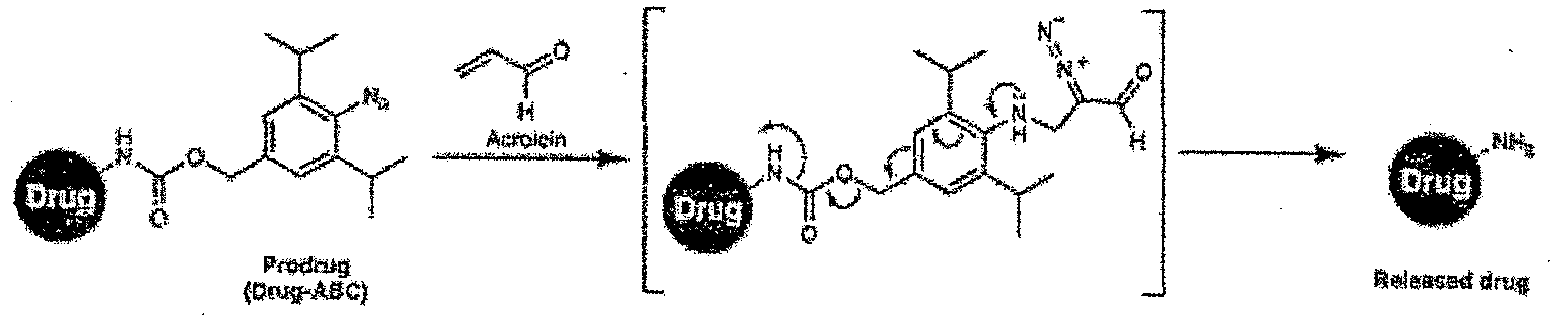
- When the present complex approaches acrolein, an azide group of the present complex and the acrolein generate 1,2,3-triazoline as an intermediate by a 1,3-dipole cycloaddition reaction. In the 1,2,3-triazoline, its five-membered ring (triazole ring) opens to generate a diazo compound, and intramolecular electron transfer is initiated. This results in a cleavage between carbonyl carbon contained in the linker and the nitrogen atom contained in the leaving site, and the leaving site is released as an active substance.
- As the leaving site, any compound that is intended to be released in a region where acrolein is present can be used. Examples of such a compound include antitumor compounds and labelled compounds such as a coloring reagent and a marker.
- The leaving site is preferably a compound having a nitrogen atom, a sulfur atom, or an oxygen atom as a binding site to the linker so that the leaving site can be rapidly cleaved from the linker. Furthermore, in order to facilitate binding to the linker, the leaving site may preferably have a hydroxyl group, a carboxy group, a thiol group, or an amino group.
- Preferably, binding of the leaving site to the linker is in a mode that can be rapidly cleaved by a reaction between the acrolein-reactive site and acrolein. From this viewpoint, it is preferable that the binding between the leaving site and the linker is a carbamate bond, a thiocarbamate bond, an ester bond, or a thioester bond.
- It has been found by the inventors of the present invention that acrolein is more generated in a tumor cell than in a normal cell, and the amount thereof is up to not less than 1,000 times greater than that in an inflammation site in a normal cell (Tanaka, K. et al. Adv. Sci. 2019, 6, 1801479; Tanaka, K. et al. Bioorg. Med. Chem. 2019, 27, 2228; Tanaka, K. et al. Adv. Sci. 2020, 1901519). The present complex containing the antitumor compound as the leaving site can react with acrolein that is present around a tumor cell to release the antitumor compound. Therefore, the present complex can be suitably used as a therapeutic agent for tumors.
- As an antitumor compound used as the leaving site, all compounds including antitumor compounds that are used in clinical practice or clinical test and antitumor compounds that will be developed in the future can be used without limitation, provided that the compounds each have activity of killing a tumor cell in a living organism, like an anticancer drug, a low-molecular target agent, a radionuclide, and the like.
- A molecular weight of the antitumor compound is not particularly limited, and is preferably a low molecular weight enough to reach a tumor cell. For example, the molecular weight of the antitumor compound is not more than 15,000 Da, preferably not more than 10,000 Da, and more preferably not more than 500 Da. A lower limit of the molecular weight of the antitumor compound is not particularly limited. For example, the molecular weight of the antitumor compound is not less than 100 Da, and preferably not less than 300 Da.
- The antitumor compound is preferably in a state in which its antitumor activity (toxicity) is weakened while being bound to the acrolein-reactive site via a linker, as compared to a state of not binding. That is, the antitumor compound is preferably in the form of a prodrug.
- Examples of the antitumor compound suitably used as the leaving site include, but not limited to, mitomycin C, doxorubicin, dacarbazine, crizotinib, endoxifen, and a camptothecin derivative [e.g., an active body part of DS-8201 (trastuzumab deruxtecan) (code name: DXd, chemical name: N[(1-S,9S)-9-ethyl-5-fluoro-2,3,9,10,13,15-hexahydro-9-hydroxy-4-methyl-10,13-dioxo-1H,12H-benzo[de]pyrano[3',4':6,7]indolizino[1,2-b]quinolin-1-yl]-2-hydroxyacetamide, see Drug Delivery System Vol. 34, No. 1 (2019) p.52-58, "Development of novel DNA topoisomerase I inhibitor based ADC technology" by Yuki Abe, Takashi Nakada, and Toshinori Agatsuma)].
- Specific examples of the present complex having mitomycin C as the leaving site include mitomycin C-ABC represented by the following chemical structural formula.

- Specific examples of the present complex having doxorubicin as the leaving site include doxorubicin-ABC represented by the following chemical structural formula.

- Specific examples of the present complex having dacarbazine as the leaving site include dacarbazine-ABC represented by the following chemical structural formula.

- Specific examples of the present complex having crizotinib as the leaving site include crizotinib-ABC represented by the following chemical structural formula.

- Specific examples of the present complex having endoxifen as the leaving site include endoxifen-ABC represented by the following chemical structural formula.

- Specific examples of the present complex having puromycin as the leaving site include puromycin-ABC represented by the following chemical structural formula.

- Examples of the labelled compound used as the leaving site include, but not limited to, a radioisotope, a fluorescent substance, an enzyme, and the like.
- Specific examples of the labelled compound include: radioisotopes such as 3H, 14C, 125I, and 131I; fluorescent substances such as green fluorescent protein (GFP), fluorescein isothiocyanate, tetramethylrhodamine isothiocyanate, and Eu3+; methylcoumarin-based compounds; and enzymes such as peroxidase, alkaline phosphatase, β-D-galactosidase, glucose oxidase, and glucose-6-phosphate dehydrogenase.
- The present complex having a labelled compound as the leaving site can react with acrolein that is present around a tumor cell to release the labelled compound. Therefore, for example, the present complex can be used as a diagnostic drug for determining the presence or absence of a tumor, a size of a tumor, and for imaging of a tumor.
- The following description will discuss a method for producing the present complex with reference to an example of the present complex in which the linker having the chemical structure represented by Formula (2) binds to a nitrogen atom in the leaving site (i.e., a carbamate bond is formed).
- The present complex can be produced by any method that synthesizes a carbamate bond. Examples of such a method include a method for causing a reaction between isocyanate and alcohol, a method for causing a reaction between amine and carbonic acid ester, and the like.
- The method for causing a reaction between isocyanate and alcohol is carried out, for example, as follows: in the presence of an appropriate solvent, an amino group of a compound used as the leaving site is caused to react with triphosgene to obtain isocyanate; and then the resulting isocyanate is caused to react with alcohol represented by Formula (5) to produce the present complex in which a carbamate bond is formed.

- The method for causing a reaction between amine and carbonic acid ester is carried out, for example, as follows: in the presence of an appropriate solvent, alcohol represented by Formula (5) is caused to react with chloroformic ester to obtain carbonic acid ester; and then the resulting carbonic acid ester is caused to react with an amino group of a compound used as the leaving site to produce the present complex in which a carbamate bond is formed.
- For the method for producing the present complex, it is also possible to refer to the descriptions of Examples and the descriptions of ACS Sens. 2016, 1, 623-632 (Non-patent Literature 5).
- A therapeutic agent for a tumor in accordance with an embodiment of the present invention (hereinafter simply referred to also as "present therapeutic agent") contains, as an active ingredient, the present complex in which the leaving site is an antitumor compound.
- The present therapeutic agent may contain, in addition to the present complex, a pharmaceutically acceptable carrier to an extent that does not inhibit activity of the present complex. Examples of such a carrier include water, an electrolyte liquid, a sugar solution, and the like.
- The present therapeutic agent may contain an adjuvant. Examples of such an adjuvant include a buffer, a soothing agent, a stabilizer, a preservative, an antioxidant, a colorant, and the like.
- Examples of the buffer include buffer solutions such as phosphate, acetate, carbonate, and citrate.
- Examples of the soothing agent include propylene glycol, lidocaine hydrochloride, benzyl alcohol, benzalkonium chloride, procaine hydrochloride, and the like.
- Examples of the stabilizer include human serum albumin, polyethylene glycol, and the like.
- Examples of the preservative include benzyl alcohol, phenol, and the like.
- Examples of the antioxidant include sulfite, ascorbate, and the like.
- Suitable examples of the colorant include water-soluble coloring tar dyes (e.g., food dyes such as food red No. 2 and No. 3, food yellow No. 4 and No. 5, and food blue No. 1 and No. 2), insoluble lake dyes (e.g., aluminum salts of the above water-soluble edible tar dyes), natural dyes (e.g., β-carotene, chlorophyll, bengala), and the like.
- The present therapeutic agent may contain additives such as a binder, an excipient, a lubricant, a sweetening agent, a flavoring agent, a preservative, a disintegrant, a suspending agent, a solvent, a solubilizing agent, an isotonizing agent, and an expanding agent.
- Examples of the binder include gelatin, cornstarch, traganth, gum arabic, pregelatinized starch, sucrose, methylcellulose, carboxymethylcellulose, sodium carboxymethylcellulose, crystalline cellulose, white sugar, D-mannitol, trehalose, dextrin, pullulan, hydroxypropylcellulose, hydroxypropylmethylcellulose, polyvinylpyrrolidone, and the like.
- Excipients include lactose, white sugar, D-mannitol, D-sorbitol, starch, pregelatinized starch, dextrin, crystalline cellulose, low-substituted hydroxypropylcellulose, sodium carboxymethylcellulose, gum arabic, pullulan, soft silicic acid anhydride, synthetic aluminum silicate, magnesium aluminometasilicate, xylitol, sorbitol, erythritol, and the like.
- Examples of the lubricant include magnesium stearate, calcium stearate, talc, colloidal silica, polyethylene glycol, and the like.
- Examples of the sweetening agent include saccharin sodium, dipotassium glycyrrhizinate, aspartame, stevia, and the like.
- Examples of the flavoring agent include peppermint, Gaultheria adenothrix oil, cherry, and the like.
- Examples of the preservative include parahydroxybenzoates, chlorobutanol, benzyl alcohol, phenethyl alcohol, dehydroacetic acid, sorbic acid, and the like.
- Examples of the disintegrant include lactose, white sugar, starch, carboxymethylcellulose, carboxymethylcellulose calcium, croscarmellose sodium, carboxymethylstarch sodium, low-substituted hydroxypropylcellulose, soft silicic acid anhydride, calcium carbonate, and the like.
- Examples of the suspending agent include surfactants such as, for example, stearyl triethanolamine, sodium lauryl sulfate, lauryl aminopropionic acid, lecithin, benzalkonium chloride, benzethonium chloride, and glycerol monostearate; hydrophilic polymers such as, for example, polyvinyl alcohol, polyvinylpyrrolidone, sodium carboxymethylcellulose, methylcellulose, hydroxymethylcellulose, hydroxyethylcellulose, and hydroxypropylcellulose; polysorbates; polyoxyethylene hydrogenated castor oil; and the like.
- Suitable examples of the solvent include injectable water, physiological saline solution, Ringer's solution, alcohol, propylene glycol, polyethylene glycol, sesame oil, corn oil, olive oil, cottonseed oil, and the like.
- Suitable examples of the solubilizing agent include polyethylene glycol, propylene glycol, D-mannitol, trehalose, benzyl benzoate, ethanol, trisaminomethane, cholesterol, triethanolamine, sodium carbonate, sodium citrate, sodium salicylate, sodium acetate, and the like.
- Suitable examples of the isotonizing agent include sodium chloride, glycerine, D-mannitol, D-sorbitol, glucose, xylitol, fructose, and the like.
- The present therapeutic agent can be administered as an oral formulation, an injectable formulation, or a transdermal formulation. Examples of the oral formulation include tablets (including a sublingual tablet and an orally disintegrating agent), capsules (including a soft capsule and a microcapsule), powder, a granule, a troche, a syrup, an emulsion, a suspension, and the like. Examples of the injectable formulation include intradermal injection, subcutaneous injection, intravenous injection, intramuscular injection, intraspinal injection, epidural injection, local injection, and the like. Furthermore, examples of the transdermal formulation include a patch, an ointment, and an epipastic. These formulations may be controlled-release formulations such as quick-release formulations or sustained-release formulations (e.g., a sustained-release microcapsule).
- The present therapeutic agent is suitably formulated as an injectable formulation. An aseptic composition for the injectable formulation can be formulated in accordance with general formulation practice, such as dissolving or suspending an active substance in a vehicle (aqueous solution for injection; naturally-produced vegetable oil such as sesame oil and palm oil). As the aqueous solution for injection, it is possible to use, for example, a physiological saline solution, an isotonic solution containing glucose or another adjuvant (e.g., D-sorbitol, D-mannitol, sodium chloride, or the like). The aqueous solution for injection may be used in combination with a suitable solubilizing agent, for example, alcohol (e.g., ethanol), polyalcohol (e.g., propylene glycol, polyethylene glycol), a non-ionic surfactant (e.g., polysorbate 80TM, HCO-50), or the like. As an oil solution, for example, a sesame oil, a soybean oil, or the like is used, and the oil solution may be used in combination with a solubilizing agent such as benzyl benzoate or benzyl alcohol. The injectable formulation can be enclosed in a container such as an ampule or a vial in a unit dose or in a multiple-dose. Furthermore, it is possible that an active ingredient and a pharmaceutically acceptable carrier are lyophilized and stored in a state that only needs to be dissolved or suspended in an appropriate aseptic vehicle immediately before use.
- An amount of the present complex contained in the present therapeutic agent differs according to the form of formulation. The amount is usually approximately 10% by mass to 25% by mass, preferably not less than approximately 15% by mass, and more preferably not less than approximately 20% by mass, relative to the entire formulation.
- A dose of the present therapeutic agent can be determined appropriately while taking into consideration a type of administration subject, a method of administration, a type of antitumor agent, a type of tumor cell, a site, and the like. In a case where the administration is intravenous administration to a human solid cancer, the amount of the present complex per kilogram of body weight is preferably 2 mg to 5 mg, more preferably not less than 3 mg, and further preferably not less than 4 mg. These effective doses can each be administered in a single time or in several times.
- The present therapeutic agent can be applied to any mammalian tumor. A type of mammal may be a non-human mammal or a human. Examples of the non-human mammals include: experimental animals such as rodents (such as a mouse, a rat, a hamster, and a guinea pig) and a rabbit; domestic animals such as a pig, a cattle, a goat, a horse, a sheep, and a mink; pets such as a dog and a cat; a human; primates (excluding humans) such as a monkey, a rhesus monkey, a marmoset, an orangutan, and a chimpanzee; and the like.
- The administration subject of the present therapeutic agent is any of the above subjects that has a tumor. Examples of a type of tumor include, but not particularly limited to: lung cancer (e.g., lung adenocarcinoma), uterine cancer (e.g., cervical cancer, uterine body cancer), gastric cancer, colon cancer, rectal cancer, pancreatic cancer, liver cancer, gallbladder cancer, bile duct cancer, breast cancer, bladder tumor, osteosarcoma, malignant melanoma, pheochromocytoma, and the like.
- A method for causing a leaving site to leave the present complex or the present therapeutic agent (hereinafter simply referred to also as "present method") in accordance with an embodiment of the present invention includes a step of causing the present complex or the present therapeutic agent to react with acrolein.
- Acrolein that reacts with the present complex or the present therapeutic agent may be present in vivo or may be present in vitro.
- In a case of reacting with acrolein that is present in vivo, the present method can be applied to any mammal. A type of mammal may be a non-human mammal or a human. Examples of the non-human mammals include: experimental animals such as rodents (such as a mouse, a rat, a hamster, and a guinea pig) and a rabbit; domestic animals such as a pig, a cattle, a goat, a horse, a sheep, and a mink; pets such as a dog and a cat; a human; primates (excluding humans) such as a monkey, a rhesus monkey, a marmoset, an orangutan, and a chimpanzee; and the like.
- Embodiments of the present invention include, for example, aspects described below.
- <1> A complex containing: an acrolein-reactive site having a chemical structure represented by Formula (1); and a leaving site having another chemical structure, the leaving site binding to the acrolein-reactive site via a linker that is cleavable by a reaction between the acrolein-reactive site and acrolein,

- R1 and R2 each independently represent a hydrogen atom, a halogen atom, or an alkyl group that has 1 to 5 carbon atoms and that may be substituted by at least one halogen atom, provided that at least one of R1 and R2 is the alkyl group having 1 to 5 carbon atoms;
- R3 and R4 each independently represent a hydrogen atom, a halogen atom, a hydroxy group, a thiol group, an amino group that may have a substituent, an alkoxy group having 1 to 5 carbon atoms, an alkylthio group having 1 to 5 carbon atoms, or an alkyl group having 1 to 5 carbon atoms (provided that a hydrogen atom constituting the alkyl group may be substituted by a substituent selected from a halogen atom, a hydroxy group, and an amino group that may have a substituent); and
- is a binding site to the linker.
- <2> The complex described in <1>, in which the linker is a linker having a chemical structure represented by Formula (2):

- two R each independently represent a hydrogen atom, a halogen atom, a hydroxy group, a thiol group, an amino group that may have a substituent, an alkoxy group having 1 to 5 carbon atoms, an alkylthio group having 1 to 5 carbon atoms, or an alkyl group having 1 to 5 carbon atoms (provided that a hydrogen atom constituting the alkyl group may be substituted by a substituent selected from a halogen atom, a hydroxy group, and an amino group that may have a substituent);
- is a binding site to the acrolein-reactive site; and
- is a binding site to the leaving site.
- two R each independently represent a hydrogen atom, a halogen atom, a hydroxy group, a thiol group, an amino group that may have a substituent, an alkoxy group having 1 to 5 carbon atoms, an alkylthio group having 1 to 5 carbon atoms, or an alkyl group having 1 to 5 carbon atoms (provided that a hydrogen atom constituting the alkyl group may be substituted by a substituent selected from a halogen atom, a hydroxy group, and an amino group that may have a substituent);
- <3> The complex described in <2>, in which: in Formula (2) is a binding site to a nitrogen atom, a sulfur atom, or an oxygen atom contained in the leaving site.
- <4> The complex described in <2> or <3>, in which: two R in Formula (2) each independently represent a hydrogen atom, a halogen atom, or an alkyl group having 1 to 5 carbon atoms (provided that a hydrogen atom constituting the alkyl group may have a substituent selected from a halogen atom, a hydroxy group, and an amino group that may have a substituent).
- <5> The complex described in any one of <1> through <4>, in which: R1 and R2 in Formula (1) each independently represent an alkyl group that has 1 to 5 carbon atoms and that may be substituted by at least one halogen atom.
- <6> The complex described in any one of <1> through <5>, in which: the leaving site is an antitumor compound.
- <7> The complex described in any one of <1> through <6>, in which: the leaving site leaves by reacting with acrolein that is present around a tumor cell.
- <8> A therapeutic agent for a tumor, the therapeutic agent containing the complex described in <6> or <7>.
- <9> A method for causing a leaving site to leave, the method including the step of: causing the complex described in any one of <1> through <7> or the therapeutic agent described in <8> to react with acrolein.
- The present invention is not limited to the embodiments, but can be altered by a skilled person in the art within the scope of the claims. The present invention also encompasses, in its technical scope, any embodiment derived by combining technical means disclosed in differing embodiments.
- All chemically available reagents were used without further purification. Preparative separation was carried out by column chromatography on Merck Silica gel 60 (230-400 mesh). 1H and 13C NMR spectra were recorded with use of a JEOL RESONANCE AL400 NMR spectrometer. Unless otherwise mentioned, CDCl3 was used as a solvent. Chemical shifts were represented as δ-values relative to the internal standard TMS. High-resolution mass spectrometry (HRMS) was recorded on micrOTOF-QIII. Fluorescence spectra were measured with use of a spectrofluorometer (SpectraMax iD3, manufactured by Molecular Devices). Azide-containing compounds are presumed to be potentially explosive. Therefore, all manipulations were carefully carried out in a hood.
-
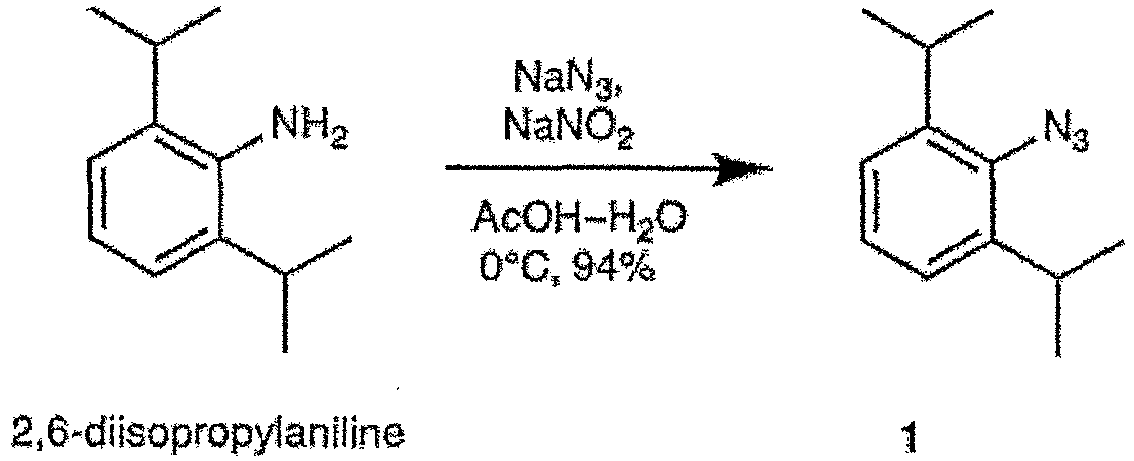
- To a mixture of 2,6-diisopropylaniline (846 mg, 4.77 mmol, 1.0 eq) and sodium azide (791 mg, 11.9 mmol, 2.5 eq) dissolved in acetic acid and distilled water (9:1) (50 mL, [2,6-diisopropylaniline] = 0.1 M) was slowly added sodium nitrite (814 mg, 11.5 mmol, 2.4 eq) at 0°C. After stirring for 30 minutes at 0°C, a saturated aqueous solution of NaHCO3 was added until the mixture became
pH 7. The mixture was extracted with EtOAc. The combined organic phase was washed with brine, dried over Na2SO4, and filtered. The filtrate was concentrated to dryness under reduced pressure. The residue was purified by column chromatography on silica gel (n-hexane only) to obtain intended 2,6-diisopropylphenylazide (compound 1) as a yellow oil (912 mg, 94%). 1H NMR (400 MHz, CDCl3, 25°C) δ 7.25 - 7.07 (m, 3H), 3.36 (hept, J = 7.0 Hz, 2H), 1.26 (d, J = 6.8 Hz, 12H); 13C NMR (100 MHz, CDCl3, 25°C) δ 143.33, 135.54, 127.01, 124.12, 28.91, 23.59. -
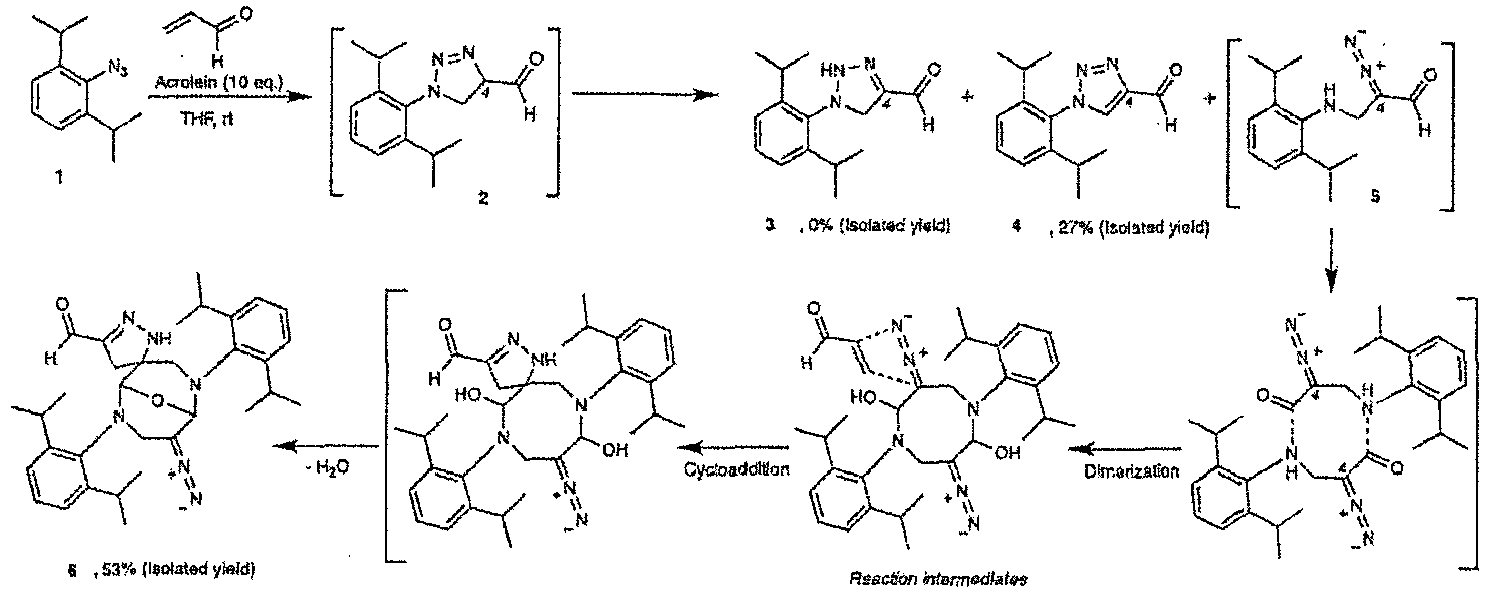
- To a solution of 2,6-diisopropylphenylazide (compound 1) (47.3 mg, 0.23 mmol, 1.0 eq) in THF (stabilizer free, 310 µL, [compound 1] = 0.7 M) was added acrolein (164 µL, 2.33 mmol, 10 eq). After being stirred at room temperature for 24 hours, the reaction mixture was concentrated to dryness under reduced pressure. The resulting crude product was purified by preparative TLC (n-hexane/ethyl acetate = 3:1) to obtain 4-formyl-1,2,3-triazole (compound 4) (Rf value of 0.66, 27%, yellow oil) and heterocycle (compound 6) (Rf value of 0.42, 53%, red oil). 4-formyl-1,2,3-triazole (compound 4): 1H NMR (400 MHz, CDCl3, 25°C) δ 10.29 (s, 1H), 8.19 (s, 1H), 7.54 (t, J = 7.8 Hz, 1H), 7.33 (d, J = 7.8 Hz, 2H), 2.16 (hept, J = 6.9 Hz, 2H), 1.14 (dd, J = 10.4, 6.8 Hz, 12H); 13C NMR (100 MHz, CDCl3, 25°C) δ 185.60, 145.97, 131.65, 128.19, 124.27, 28.63, 24.17, 24.02; ESI-HRMS m/z calculated for C15H19N3NaO ([M+Na]+) 280.1420, found 280.1419. Heterocycle (compound 6): 1H NMR (400 MHz, CDCl3, 25°C) δ 9.38 (s, 1H), 7.38 (t, J = 7.7 Hz, 1H), 7.29 (t, J = 7.7 Hz, 1H), 7.22 (d, J = 7.7 Hz, 2H), 7.15 (dd, J = 7.6, 3.1 Hz, 2H), 5.85 (s, 1H), 5.54 (s, 1H), 4.20 (q, J = 26.3 Hz, 2H), 4.11 (d, J = 11.0 Hz, 1H), 3.31 (d, J = 11.0 Hz, 1H), 3.12 (s, 2H), 2.94 (p, J = 6.9 Hz, 1H), 2.83 (p, J = 7.1 Hz, 3H), 1.23 - 1.18 (m, 24H); 13C NMR (100 MHz, CDCl3, 25°C) δ 189.33, 147.46, 146.89, 143.09, 140.10, 134.52, 129.87, 128.57, 124.37, 124.32, 120.59, 109.18, 92.90, 84.51, 53.37, 51.37, 39.40, 28.76, 28.23, 28.17, 24.78, 24.71, 24.68, 24.48; ESI-HRMS m/z calculated for C33H45N6O2 ([M+H]+) 557.3599, found 557.3597.
- Coumarin-ABC (compound 7) is synthesized in Production Example 3 along a route as shown below.

- The following description will discuss details of each process.
-

- To a solution of 2,6-diisopropylaniline (8.8 g, 44.9 mmol, 1.0 eq) in a saturated aqueous solution of NaHCO3 and Et2O (1:1) (200 mL, [2,6-diisopropylaniline] = 0.2 M) was added iodine (13.7 g, 53.8 mmol, 1.2 eq). After being stirred for 5 hours at room temperature, Na2S2O3·H2O was added, and the mixture was stirred for 15 minutes. The resulting mixture was extracted with Et2O. The combined organic phase was washed with brine, dried over Na2SO4, and filtered. The filtrate was concentrated to dryness under reduced pressure to obtain intended 4-iodo-2,6-diisopropylaniline (compound S1) as red-black oil (13.4 g, 98%). 1H NMR (400 MHz, CDCl3, 25°C) δ 7.27 (s, 2H), 3.70 (bs, 2H, NH2), 2.81 (hept, J = 6.7 Hz, 2H), 1.21 (d, J = 6.8 Hz, 12H); 13C NMR (100 MHz, CDCl3, 25°C) δ 140.27, 135.08, 131.79, 81.12, 27.82, 22.21; ESI-HRMS m/z calculated for C12H19IN ([M+H]+) 304.0557, found 304.0558.
-

- To a mixture of 4-iodo-2,6-diisopropylaniline (compound S1) (6.2 g, 20.5 mmol, 1.0 eq) and Pd(PPh3)4 (0.5 g, 0.41 mmol, 0.02 eq) in EtOH (17 mL, [S1] = 1.2 M) was added Et3N (4.3 mL, 30.7 mmol, 1.5 eq). The resulting solution was stirred under CO pressure (0.5 MPa) at 110°C for 8 hours. The suspension was filtered through Celite and the filtrate was concentrated to dryness under reduced pressure. The residue was purified by column chromatography on silica gel using a gradient of eluents [n-hexane/ethyl acetate (25:1 to 15:1)] to obtain intended ethyl 4-amino-3,5-diisopropylbenzoate (compound S2) as yellow oil (4.4 g, 86%). 1H NMR (400 MHz, CDCl3, 25°C) δ 7.75 (s, 2H), 4.34 (q, J = 7.1 Hz, 2H), 4.16 (bs, 2H, NH2), 2.88 (hept, J = 6.9 Hz, 2H), 1.38 (t, J = 7.2 Hz, 3H), 1.29 (d, J = 6.8 Hz, 12H); 13C NMR (100 MHz, CDCl3, 25°C) δ 167.64, 145.10, 131.37, 125.04, 119.77, 60.30, 27.97, 22.24, 14.55; ESI-HRMS m/z calculated for C15H24NO2 ([M+H]+) 250.1802, found 250.1805.
-

- To a solution of ethyl 4-amino-3,5-diisopropylbenzoate (compound S2) (764 mg, 3.1 mmol, 1.0 eq) in THF (30 mL, [S2] = 0.1 M) at 0°C was slowly added DIBAL-H (9 mL of a 1.0 M solution in toluene, 9.2 mmol, 3.0 eq). The reaction liquid was stirred under nitrogen atmosphere at 0°C for 10 minutes, and then for 1 hour at room temperature. The excess DIBAL-H was quenched carefully with MeOH (20 mL) at 0°C, stirred for 30 minutes, and allowed to warm to room temperature. The resulting mixture was filtered through Celite (washed with MeOH), and the filtrate was concentrated to dryness under reduced pressure. The residue was purified by column chromatography on silica gel using a gradient of eluents [n-hexane/ethyl acetate (15:1 to 7:1)] to obtain intended 4-hydroxymethyl-2,6-diisopropylaniline (compound S3) as an orange oil (627 mg, 99%). 1H NMR (400 MHz, CDCl3, 25°C) δ 7.04 (s, 2H), 4.55 (s, 2H), 3.74 (bs, 2H, NH2), 2. 92 (hept, J = 6.7 Hz, 2H), 1.27 (d, J = 6.8 Hz, 12H); 13C NMR (100 MHz, CDCl3, 25°C) δ 140.06, 132.71, 130.89, 122.46, 66.09, 27.99, 22.44; ESI-HRMS m/z calculated for C13H22NO2 ([M+H]+) 208.1696, found 208.1699.
-

- To a mixture of 4-hydroxymethyl-2,6-diisopropylaniline (compound S3) (763 mg, 3.68 mmol, 1.0 eq) and sodium azide (610 mg, 9.20 mmol, 2.5 eq) dissolved in acetic acid and distilled water (5:2) (35 mL, [S3] = 0.1 M) was slowly added sodium nitrite (628 mg, 8.83 mmol, 2.4 eq) at 0°C. After stirring for 4 hours at 0°C, a saturated aqueous solution of NaHCO3 was added until the mixture became
pH 7. The mixture was extracted with EtOAc. The combined organic phase was washed with brine, dried over Na2SO4, and filtered. The filtrate was concentrated to dryness under reduced pressure. The residue was purified by column chromatography on silica gel using a gradient of eluents [n-hexane/ethyl acetate (30:1 to 15:1)] to obtain intended (4-azido-3,5-diisopropylphenyl)-methanol (compound S4) as a yellow oil (730 mg, 85%). 1H NMR (400 MHz, CDCl3, 25°C) δ 7.13 (s, 2H), 4.64 (s, 2H), 3.36 (p, J = 6.8 Hz, 2H), 1.27 (d, J = 6.7 Hz, 12H); 13C NMR (100 MHz, CDCl3, 25°C) δ 143.51, 139.31, 134.84, 122.79, 65.27, 28.90, 23.52; ESI-HRMS m/z calculated for C13H20N3O ([M+H]+) 234.1601, found 234.1605. -

- To a mixture of 7-amino-4-methylcoumarin (69 mg, 0.39 mmol, 1.0 eq) and DIPEA (250 µL, 1.45 mmol, 3.8 eq) dissolved in toluene (4 mL, [7-amino-4-methylcoumarin] = 0.1 M) at 0°C was slowly added triphosgene (140 mg, 0.46 mmol, dissolved in 4 mL toluene). The reaction mixture was refluxed under nitrogen atmosphere for 4 hours, and then cooled to room temperature. To the reaction mixture, CH2Cl2 (3 mL) was added and stirred for 5 minutes until the solution turned into dark brown, and compound S4 (117 mg, 0.5 mmol, 1.3 eq, in 5 mL CH2Cl2) was added. The reaction mixture was stirred and heated at 55°C for 13 hours, and then cooled to room temperature. The resulting solution was concentrated to dryness under reduced pressure while maintaining the temperature at 30°C. The residue was purified by column chromatography on silica gel (CHCl3/MeOH 25:1) to obtain intended coumarin-ABC (compound 7) as pale yellow solid (141 mg, 84%). 1H NMR (400 MHz, DMSO-d6, 25°C) δ 10.28 (bs, 1H, NH), 7.69 (d, J = 8.7 Hz, 1H), 7.55 (d, J = 2.1 Hz, 1H), 7.41 (dd, J = 8.7, 2.0 Hz, 1H), 7.31 (s, 2H), 6.23 (d, J = 1.4 Hz, 1H), 5.15 (s, 2H), 3.29 (p, J = 6.9 Hz, 2H), 2.38 (d, J = 1.3 Hz, 3H), 1. 22 (d, J = 6.9 Hz, 12H); 13C NMR (100 MHz, DMSO-d6, 25°C) δ 160.17, 153.98, 153.33, 153.27, 142.84, 142.81, 134.90, 134.49, 126.17, 124.60, 114.51, 114.35, 112.03, 104.53, 66.29, 28.39, 23.29, 17.99.; ESI-HRMS m/z calculated for C24H26N4NaO4 ([M+Na]+) 457.1846, found 457.1840.
- MMC-ABC (compound 8) is synthesized in Production Example 4 along a route as shown below.

- The following description will discuss details of each process.
-

- To a mixture of compound S4 (297 mg, 1.27 mmol, 1.0 eq) and 4-nitrophenyl chloroformate (321 mg, 1.53 mmol, 1.2 eq) dissolved in THF (13 mL, [S4] = 0.1 M) at 0°C was added pyridine (206 µL, 2.55 mmol, 2.0 eq). The reaction mixture was stirred under nitrogen atmosphere at room temperature for 24 hours. The THF was removed by a rotary evaporator, and the resulting crude was partitioned with use of EtOAc-H2O. The combined organic phase was washed with brine, dried over Na2SO4, and filtered. The filtrate was concentrated to dryness under reduced pressure. The residue was purified by column chromatography on silica gel (n-hexane/ethyl acetate 25:1) to obtain intended 4-azido-3,5-diisopropylbenzyl-(4-nitrophenyl)-carbonate (compound S5) as a yellow oil (424 mg, 84%). 1H NMR (400 MHz, CDCl3, 25°C) δ 8.27 (d, J = 9.1 Hz, 2H), 7.20 (s, 2H), 5.26 (s, 2H), 3.38 (p, J = 6.9 Hz, 2H), 1.29 (d, J = 6.9 Hz, 12H); 13C NMR (100 MHz, CDCl3, 25°C) δ 155.65, 152.50, 145.52, 143.82, 136.11, 132.62, 125.41, 124.63, 121.86, 71.07, 28.94, 23.53.
-

- To a mixture of compound S5 (307 mg, 0.77 mmol, 1.0 eq), mitomycin C (170 mg, 0.51 mmol, 1.5 eq), and activated powder molecular sieves (MS 4A) dissolve in DMF (8 mL, [S5] = 0.1 M) was added Et3N (130 µL, 0.93 mmol, 1.8 eq). The reaction mixture was stirred under nitrogen atmosphere at room temperature for 16 hours. The resulting mixture was filtered through Celite (washed with EtOAc), and the filtrate was concentrated to dryness under reduced pressure. The resulting crude was partitioned with use of EtOAc·H2O. The combined organic phase was washed with brine, dried over Na2SO4, and filtered. The filtrate was concentrated to dryness under reduced pressure. The residue was purified by column chromatography on silica gel (CHCl3/MeOH 30:1) to obtain intended prodrug MMC-ABC (compound 8) as a purple oil (260 mg, 86%). 1H NMR (400 MHz, CDCl3, 25°C) δ 7.12 (s, 2H), 5.25 (bs, 2H, NH2), 5.04 (s, 2H), 4.89 (dd, J = 10.8, 4. 7 Hz, 1H), 4.73 (bs, 2H, NH2), 4.44 (d, J = 13.3 Hz, 1H), 4.32 (t, J = 11.0 Hz, 1H), 3.70 (dd, J = 11.0, 4.8 Hz, 1H), 3.48 (dd, J = 13.3, 1.9 Hz, 1H), 3.45 (d, J = 4.6 Hz, 1H), 3.37 - 3.27 (m, 3H), 3.19 (s, 3H), 1.76 (s, 3H), 1.25 (dd, J = 6.9, 4.1 Hz, 12H).; 13C NMR (100 MHz, CDCl3, 25°C) δ 178.53, 176.03, 160.82, 156.46, 154.47, 147.15, 143.52, 135.60, 133.83, 124.67, 110.67, 105.58, 105.31, 68.80, 62.29, 49.90, 48.81, 43.52, 42.01, 40.21, 28.93, 23.55, 8.01; ESI-HRMS m/z calculated for C29H36N7O7 ([M+H]+) 594.2671, found 594.2673.
-

- To a mixture of 4-methyl-2,6-diisopropylaniline (0.8 g, 4.18 mmol, 1.0 eq) and sodium azide (0.7 g, 10.5 mmol, 2.5 eq) dissolved in acetic acid and distilled water (5:2) (21 mL, [4-methyl-2,6-diisopropylaniline] = 0.2 M) was slowly added sodium nitrite (0.7 mg, 10.0 mmol, 2.4 eq) at 0°C. After stirring for 3 hours at 0°C, a saturated aqueous solution of NaHCOs was added until the mixture became
pH 7. The mixture was extracted with ethyl acetate. The combined organic phase was washed with brine, dried over Na2SO4, and filtered. The filtrate was concentrated to dryness under reduced pressure. The residue was purified by column chromatography on silica gel (n-hexane only) to obtain intended 2-azido-1,3-diisopropyl-5-methylbenzene (compound 9) as a colorless oil (0.7 g, 75%). 1H NMR (400 MHz, CDCl3, 25°C)δ 6. 92 (s, 2H), 3.32 (hept, J = 7.1 Hz, 2H), 2.31 (s, 3H), 1.25 (d, J = 7.2 Hz, 12H); 13C NMR (100 MHz, CDCl3, 25°C) δ 142.98, 136.42, 124.75, 124.07, 28.88, 23.66, 21.47. - Coumarin-ABC (compound 7) and 7-amino-4-methylcoumarin (control compound) which were synthesized in Production Example 3 were each dissolved in water (0.2% DMSO) by 2 µM, and fluorescence spectra were measured. The results are shown in
Fig. 1 (dashed line:compound 7, solid line: control compound). - As shown in
Fig. 1 , it was confirmed that the coumarin-ABC (compound 7) did not emit fluorescence. - Next, the coumarin-ABC (compound 7) (20 µM) in DMEM culture media (Dulbeccos's modified eagle's medium) (100 µL) on a 96-well plate was incubated in the presence or absence of acrolein (20 mM) at room temperature, and fluorescence intensity was measured with use of a spectrofluorometer (SpectraMax iD3, manufactured by Molecular Devices) in a real-time manner for 30 minutes. The results are shown in
Fig. 2 (dashed line: in the presence of acrolein, solid line: in the absence of acrolein). - As indicated in
Fig. 2 , a rapid increase in fluorescence intensity was observed in the presence of acrolein. This indicates that the coumarin-ABC (compound 7) reacted with acrolein through azide-acrolein click reaction to release 7-amino-4-methylcoumarin. - Three cell lines [MCF10A (normal human mammary cells), A549 (human lung adenocarcinoma cells), and HeLa S3 (human cervical cancer cells)] were seeded on a 96-well plate (2×10⁴ cells/well) and left to attach for 24 hours at 37°C. Each of the cells was then used for three different conditions as follows:
- (Condition 1) The cells were treated with 100 µL of coumarin-ABC (compound 7) solutions [2 µM, 5 µM, 10 µM, 15 µM, 20 µM in the culture medium (1% DMSO)] and incubated for 60 minutes at room temperature.
- (Condition 2) The cells were treated with 1 mM of N-acetyl cysteine (NAc-Cys) in the culture medium, and incubated for 2 hours at 37°C. Next, the cells were treated with 100 µL of coumarin-ABC (compound 7) solutions [2 µM, 5 µM, 10 µM, 15 µM, 20 µM in the culture medium (1% DMSO)] and incubated for 60 minutes at room temperature.
- (Condition 3) The cells were treated with 100 µL of 7-amino-4-methylcoumarin solutions [2 µM, 5 µM, 10 µM, 15 µM, 20 µM in the culture medium (1% DMSO)] and incubated for 60 minutes at room temperature.
- After the incubation, the fluorescence intensity was measured using a spectrofluorometer (SpectraMax iD3, manufactured by Molecular Devices). Fluorescence intensity was normalized for each cell line by the number of 10,000 cells. Results are shown in
Figs. 3 through 5 . - As shown in
Fig. 3 , for the normal cells incubated undercondition 3, release of fluorescence was notably observed depending on the concentration of the compound. Whereas, for the normal cells incubated undercondition 1 andcondition 2, release of fluorescence was hardly observed. Meanwhile, as shown inFigs. 4 and5 , for the cancer cells incubated underconditions condition 2, release of fluorescence was low. These results indicate that cancer cells overproduce acrolein and therefore, in the cancer cells, the coumarin-ABC (compound 7) reacted with endogenous acrolein through azide-acrolein click reaction to release 7-amino-4-methylcoumarin. Meanwhile, the normal cells produce a very small amount of acrolein, and therefore the most part of the coumarin-ABC (compound 7) was present as it was in the normal cells, and release of fluorescence was low. - Three cell lines (MCF10A, A549, and HeLa S3) were seeded on a 96-well plate (2×10⁴ cells/well) and left to attach for 24 hours at 37°C. The cells were then treated with 100 µL of coumarin-ABC (compound 7) solutions [2 µM or 20 µM in the culture medium (1% DMSO)] and incubated at room temperature, and fluorescence intensity was measured with use of a spectrofluorometer (SpectraMax iD3, manufactured by Molecular Devices) in a real-time manner for 30 minutes. Fluorescence intensity was normalized for each cell line by the number of 10,000 cells. Results are shown in
Fig. 6 (2 µM) andFig. 7 (20 µM). - As shown in
Figs. 6 and7 , release of fluorescence was only slightly observed in the normal cells. In contrast, in the cancer cells, release of fluorescence was notably observed depending on the time. These results indicate that cancer cells overproduce acrolein and therefore, in the cancer cells, the coumarin-ABC (compound 7) reacted with endogenous acrolein through azide-acrolein click reaction to release 7-amino-4-methylcoumarin. Meanwhile, the normal cells produce a very small amount of acrolein, and therefore the most part of the coumarin-ABC (compound 7) was present as it was in the normal cells, and release of fluorescence was low. - To a solution of coumarin-ABC (compound 7) (2×10⁻⁵ mmol, 1.0 eq) in DMSO (1 mL, [compound 7] = 20 µM) was added glutathione (GSH) (2×10⁻⁵ mmol, 1.0 eq) or acrolein (2×10⁻⁵ mmol, 1.0 eq). The reaction liquid was stirred and the reaction mixture was subjected to HPLC analysis at different time intervals (30 minutes, 1 hour, 2 hours, 4 hours, and 12 hours). Conditions of reversed-phase HPLC were as follows: Column, Cosmosil 5C18-AR300 (manufactured by Nacalai Tesque, Inc.) 4.6 × 250 mm; Mobile phase A, 0.1% TFA in H2O; Mobile phase B, 0.1% TFA in CH3CN; Gradient elution, 0-4 min at 65% B, 4-14 min at 65-95% B, 14-20 min at 95% B; Flow rate at 1 mL/min; Fluorescence detection at 360/450 nm; Amount per
injection 6 µL. Results are shown inFig. 8 (GSH) andFig. 9 (acrolein). - As shown in
Fig. 8 , the coumarin-ABC (compound 7) and the glutathione (GSH) did not react with each other, and the state of the coumarin-ABC (compound 7) did not change in the mixture which was left for 12 hours. In contrast, as shown inFig. 9 , the coumarin-ABC (compound 7) and acrolein rapidly reacted with each other, and release of 7-amino-4-methylcoumarin was detected in the mixture which was left only for 30 minutes. - Three cell lines (MCF10A, A549, and HeLa S3) were seeded on a 96-well plate (2×10⁴ cells/well) and left to attach for 24 hours at 37°C. Each of the cells was then used for three different conditions as follows:
- (Condition 1) The cells were treated with 100 µL of MMC-ABC (compound 8) solutions [0.05 µM, 0.1 µM, 0.5 µM, 1 µM, 5 µM, 10 µM, 50 µM in the culture medium (1% DMSO)] and incubated for 48 hours at 37°C under 5% of CO2.
- (Condition 2) Incubation was carried out in a manner similar to that of
condition 1 with use of mitomycin C (MMC) solutions. - (Condition 3) The cells were treated with 1 mM of N-acetyl cysteine (NAc-Cys) in the culture medium, and incubated for 2 hours at 37°C. Then, incubation was carried out in a manner similar to that of
condition 1 with use of MMC-ABC (compound 8) solutions. - (Condition 4) Incubation was carried out in a manner similar to that of
condition 1 with use of 2-azido-1,3-diisopropyl-5-methylbenzene (compound 9) solutions. - After the incubation, 100 µL of
ATP lite 1 step reagent was added to the cells, and the fluorescence intensity was measured using a spectrofluorometer (SpectraMax iD3, manufactured by Molecular Devices). Results are shown inFig. 10 [MCF10A (normal human mammary cells)] andFig. 11 [A549 (human lung adenocarcinoma cells) and HeLa S3 (human cervical cancer cells)]. - As shown in
Figs. 10 and11 , the MMC-ABC (compound 8), which is a prodrug, released free MMC specifically in cancer cells only when reacted with endogenous acrolein which was overproduced by cancer cells. In contrast, MMC nonspecifically exhibited cytotoxicity toward normal cells and cancer cells. - The Animal Ethics Committee approved all animal experiments in this Example in advance. For all intratumoral injections and tumor measurements, mice were anesthetized with 2% isoflurane in oxygen at a 2.5-3.0 L/min flow rate.
- A549 cells were obtained from stock lines kept in liquid nitrogen. These cells were cultured in Dulbeccos's modified eagle's medium (DMEM) (manufactured by FUJIFILM Wako Pure Chemical Corporation) supplemented with 10% fetal bovine serum (FBS) (manufactured by BioWest) and 1% penicillin-streptomycin (manufactured by Gibco). The cells were then incubated at 37°C in a 5% CO2 humidified atmosphere.
- A549 xenograft tumors were established in 6-week-old female nude mice BALB/cAJcl-nu/nu by subcutaneous injection of a suspension of 2.5-6.0×10⁶ cells in 100 µL of cold 50% matrigel in unnourished DMEM into the right and left shoulders, and tumor growth was monitored. The mice were kept in controlled temperature, salinity, and aeration room with sufficient food and water for 12 hours day and 12 hours night. After tumors reached 400-600 mm3 in size, the A549 tumor bearing mice were used for cancer therapy.
- The mice were randomized, divided into five groups, and treated with the prodrugs and controls.
Group 1 was intratumorally injected with 10 µL of a vehicle solution (n = 10).Group 2 was injected with 10 µL of 1.1 mg/kg of compound 9 (n = 10).Group 3 was injected with 10 µL of 1.8 mg/kg of mitomycin C (n = 10).Group 4 was injected with 10 µL of 3.1 mg/kg of MMC-ABC (compound 8) (n = 6).Group 5 was injected with 10 µL of 2.8 mg/kg of MMC-phenyl azide (compound 10) (n = 6). - Note that the MMC-phenyl azide (compound 10) is a control compound which was produced in a manner similar to that of the MMC-ABC (compound 8) synthesized in Production Example 4, except that 4-azido-methanol was used instead of (4-azido-3,5-diisopropylphenyl)-methanol (compound S4) as a starting material.
- The administrations were repeated 12 times in consecutive days with the same doses. The tumor volume and body weight of the mice were recorded every day based on an equation: V = W2×L/2, where W and L represented the minor length and major length of the tumor, respectively. When the tumor reached 2,000 mm3, the mice were sacrificed, and the survival rates were calculated using the Kaplan Meier method. Results are shown in
Fig. 12 (tumor volume),Fig. 13 (body weight), andFig. 14 (survival rate). The states of the mice were photographed onday 2 of intratumoral administration and onday 4 from completion of administration.Fig. 15 show the photographs. - As shown in
Figs. 12 through 15 , the mice treated with the vehicle orcompound 9 had larger tumor sizes. In contrast, it was found that, for the mice treated with mitomycin C and MMC-ABC (compound 8), administration of those was effective with respect to the tumor growth. However, although no side effect was observed in the administration of the prodrug MMC-ABC (compound 8), the mouse treated with the mitomycin C had inflammation on the whole body. In the mouse treated with the MMC-phenyl azide (compound 10), a slight decrease in tumor size was observed as compared with the mice treated with the vehicle orcompound 9. However, an inhibitory effect of the MMC-phenyl azide (compound 10) with respect to the tumor growth was smaller, as compared with the MMC-ABC (compound 8). - The mice were randomly assigned to the following groups:
Group 1 was intravenously injected with 100 µL of the vehicle solution (n = 8).Group 2 was injected with 100 µL of 1.2 mg/kg of compound 9 (n = 8).Group 3 was injected with 100 µL of 1.8 mg/kg of mitomycin C (n = 9).Group 4 was injected with 100 µL of 3.2 mg/kg of MMC-ABC (compound 8) (n = 7).Group 5 was injected with 100 µL of 2.8 mg/kg of MMC-phenyl azide (compound 10) (n = 8). Administrations were conducted once in every three days, and 3 times of injections were conducted in total. The tumor volume and body weight of the mice were recorded every day based on an equation: V = W2×L/2, where W and L represented the minor length and major length of the tumor, respectively. When the tumor reached 2,000 mm3, the mice were sacrificed, and the survival rates were calculated using the Kaplan Meier method. - The treated mice after the tumor reached 2,000 mm3 were sacrificed and transcardially perfused with 0.9% saline and then followed by 4% paraformaldehyde. The selected organs (liver, kidney, spleen, heart, lung, and tumor) were then taken out, dipped in 4% paraformaldehyde for overnight and followed by 15% and 30% sucrose treatment for overnight each and kept at -80°C until being used for hematoxylin and eosin (H&E) analysis.
- Groups of A549 tumor bearing mice (in which the tumors had reached 1,000-1,500 mm3) were intratumorally injected with: mitomycin C (3.6 mg/kg, n = 2), MMC-ABC (compound 8) (6.2 mg/kg, n = 2), and MMC-phenyl azide (compound 10) (5.6 mg/kg, n = 2). The mice were sacrificed after 2 hours from the injections of the drugs or prodrugs. The tumors, kidneys, and urines of the treated mice were collected, lysed, and extracted with methanol at 4°C overnight. The extracts were filtered, evaporated, and partitioned to obtain the crude extracts of the organs, and then analyzed by HPLC.
- In order to synthesize compound S6, first, compound S5 was synthesized along the following route of synthesis.

- To a solution of 2,6-diisopropylaniline (2.5 g, 14.1 mmol, 1.0 eq) in a saturated aqueous solution of NaHCO3 and EtaO (1:1) (140 mL, [2,6-diisopropylaniline] = 0.10 M) was added iodine (4.3 g, 16.9 mmol, 1.2 eq). After being stirred for 20 hours at room temperature, Na2S2O3 was added, and the mixture was stirred for another 30 minutes. The resulting mixture was extracted with Et2O. The organic layer was washed with saturated saline, dried using Na2SO4, and filtered. The filtrate was concentrated to dryness under reduced pressure. The residue was purified by silica gel chromatography [n-hexane/EtOAc (9:1 to 7:3)] to obtain intended 4-iodo-2,6-diisopropylaniline (compound S1) as a red-black oil compound (13.5 g, 96%). 1H NMR (400 MHz, CDCl3, 25°C) δ7.27 (s, 2H), 3.70 (bs, 2H, NH2), 2.81 (hept, J =6.7 Hz, 2H), 1.21 (d,J = 6.8 Hz, 12H); 13C NMR (100 MHz, CDCl3, 25°C) δ140.27, 135.08, 131.79, 81.12, 27.82, 22.21; ESI-HRMS m/z calculated for C12H19IN ([M+H]+) 304.0557, found 304.0558.
- To a solution of 4-iodo-2,6-diisopropylaniline which is compound S1 (1.4 g, 4.7 mmol, 1.0 eq) and Pd(PPh3)4 (0.11 g, 0.094 mmol, 0.02 eq) in EtOH (30 mL, [S1] = 0.16 M) was added Et3N (1.6 mL, 12 mmol, 2.5 eq). The resulting solution was stirred under CO pressure (0.5 Mpa) at 110°C for 28 hours. The resulting suspension was filtered through Celite, and the filtrate was concentrated to dryness under reduced pressure. The residue was purified by silica gel column chromatography [n-hexane/EtOAc (hexane only to 9:1)] to obtain intended ethyl 4-amino-3,5-diisopropylbenzoate (compound S2) as a yellow oil compound (0.51 g, 44%). 1H MMR (400 MHz, CDCl3, 25°C) δ 7.75 (s, 2H), 4.34 (q, J = 7.1 Hz, 2H), 4.16 (bs, 2H, NH2), 2.88 (hept, J =6.9 Hz, 2H), 1.38 (t, J = 7.2 Hz, 3H), 1.29 (d, J = 6.8 Hz, 12H); 13C NMR (100 MHz, CDCl3, 25°C) δ167.64, 145.10, 131.37, 125.04, 119.77, 60.30, 27.97, 22.24, 14.55; ESI-HRMS m/z calculated for C15H24NO2 ([M+H]+) 250.1802, found 250.1805.
- A solution of compound S2 (513 mg, 2.1 mmol, 1.0 eq) in THF (30 mL, [S2] = 1.0 M) was cooled down to 0°C, and then DIBAL-H (6.2 mL of a 1 M solution in toluene, 6.2 mmol, 3.0 eq) was added by dripping. The reaction temperature was raised to room temperature, and stirring was carried out for 30 minutes. The reaction temperature was decreased to 0°C, and excessive DIBAL-H was quenched with MeOH. The resulting mixture was filtered through Celite while being washed with MeOH, and the filtrate was concentrated to dryness under reduced pressure. The residue was purified by silica gel column chromatography [n-hexane/EtOAc (9:1 to 7:3)] to obtain intended 4-hydroxymethyl-2,6-diisopropylaniline (compound S3) as an orange oil compound (346 mg, 82%). 1H NMR (400 MHz, CDCl3, 25°C) δ7.04 (s, 2H), 4.55 (s, 2H), 3.74 (bs, 2H, NH2), 2.92 (hept, J = 6.7 Hz, 2H), 1.27 (d, J = 6.8 Hz, 12H); 13C NMR (100 MHz, CDCl3, 25°C) δ 140.06, 132.71, 130.89, 122.46, 66.09, 27.99, 22.44; ESI-HRMS m/z calculated for C13H22NO ([M+H]+) 208.1696, found 208.1699.
- A solution of compound S3 (346 mg, 1.7 mmol, 1.0 eq) in acetic acid and distilled water (2:1) (18 mL, [S3] = 0.94 M) was cooled down to 0°C, and then NaN3 (461 mg, 7.1 mmol, 4.2 eq) was added, and immediately NaNO2 (477 mg, 6.9 mmol, 4.1 eq) was added. After stirring for 2 hours at 0°C, a saturated aqueous solution of NaHCOs was added until the solution became
pH 7. The mixture was extracted with EtOAc. The organic layer was washed with saturated saline, dried with Na2SO4, and then filtered. The filtrate was concentrated to dryness under reduced pressure. The residue was purified by silica gel column chromatography [n-hexane/EtOAc (9:1 to 7:3)] to obtain intended (4-azido-3,5-diisopropylphenyl)-methanol (compound S4) as a yellow oil compound (260 mg, 67%). 1H NMR (400 MHz, CDCl3, 25°C) δ7.13 (s, 2H), 4.64 (s, 2H), 3.36 (p, J = 6.8 Hz, 2H), 1.27 (d J = 6.7 Hz, 12H); 13C NMR (100 MHz, CDCl3, 25°C) δ143.51, 139.31, 134.84, 122.79, 65.27, 28.90, 23.52; ESI-HRMS m/z calculated for C13H20N3O ([M+H]+) 234.1601, found 234.1605. - To a solution of compound S4 (260 mg, 1.1 mmol, 1.0 eq) and 4-nitrophenyl chloroformate (270 mg, 1.3 mmol, 1.2 eq) in THF (12 mL, [S4] = 0.09 M) was added pyridine (181 µL, 2.2 mmol, 2 eq). The reaction mixture was stirred under argon atmosphere at room temperature for 2 hours. The THF solvent was removed with use of a rotary evaporator, and the residue was partitioned with EtOAc-H2O. The organic layer was washed with saturated saline, then dried with Na2SO4, and filtered. The filtrate was evaporated to dryness under reduced pressure. The residue was purified by silica gel column chromatography [n-hexane/EtOAc (n-hexane only to 20:1)] to obtain intended 4-azido-3,5-diisopropylbenzyl-(4-nitrophenyl)-carbonate (compound S5) (426 mg, 96%). 1H NMR (400 MHz, CDCl3, 25°C) δ8.27 (d, J = 9.1 Hz, 2H), 7.20 (s, 2H), 5.26 (s, 2H), 3.38 (p, J = 6.9 Hz), 1.29 (d, J = 6.9, 12H); 13C NMR (100 MHz, CDCl3, 25°C) δ155.65, 152.50, 145.52, 143.82, 136.11, 132.62, 125.41, 124.63, 121.86, 71.07, 28.94, 23.53.
-

- To a solution of compound S5 (13 mg, 0.033 mmol, 1.0 eq) in DMF (500 µL, [S5] = 0.07 M) was added DIPEA (52 µL, 0.33 mmol, 10 eq), and the mixture was well stirred, and then puromycin dihydrochloride (27 mg, 0.05 mmol, 1.5 eq) was added. The reaction mixture was stirred at room temperature for 18 hours. Toluene was added to the reaction mixture, and a volatile substance was removed by a rotary evaporator. The residue was purified by silica gel column chromatography [CHCl3/MeOH (50:1 to 20:1)] to obtain intended PUR-ABC (compound S6) as a yellow oil compound (24 mg, 98%). 1H NMR (400 MHz, CDCl3) δ 8.02 (s, 1H), 7.89 (s, 1H), 7.14 (d, J = 8.1 Hz, 2H), 7.08 (s, 2H), 6.86 (d, J = 8.6 Hz, 2H), 6.50 (d, J = 5.0 Hz, 1H), 5.59 (d, J = 7.8 Hz, 2H), 5.42 (d, J = 5.0 Hz, 1H), 5.07 (d, J = 12.0 Hz, 1H), 4.98 (d, J = 11.9 Hz, 1H), 4.76 (t, J = 5.7 Hz, 1H), 4.43 (d, J = 6.8 Hz, 1H), 4.36 (q, J = 5.8 Hz, 1H), 4.04 (dt, J = 4.3, 2.0 Hz, 1H), 3.88 (d, J = 12.6 Hz, 1H), 3.75 (s, 3H), 3.33 (hept, J = 6.6 Hz, 4H), 3.11 (dd, J = 13.9, 6.3 Hz, 1H), 3.02-2.82 (m, 2H), 2.14-1.99 (m, 3H), 1.69 (s, 1H), 1.24 (d, J = 6.9 Hz, 12H), 0.87 (s, 1H). 13C NMR (101 MHz, CDCl3) δ 172.17, 159.02, 155.09, 151.71, 148.84, 143.73, 137.80, 135.60, 134.54, 130.55, 128.55, 124.22, 121.34, 114.60, 91.17, 85.18, 72.99, 67.51, 62.70, 56.92, 55.60, 51.99, 38.65, 29.11, 28.52, 26.23, 23.72. ESI-MS m/z calculated for C36H47N10O7 ([M+H]+) 731.3624, found 731.3938.
-
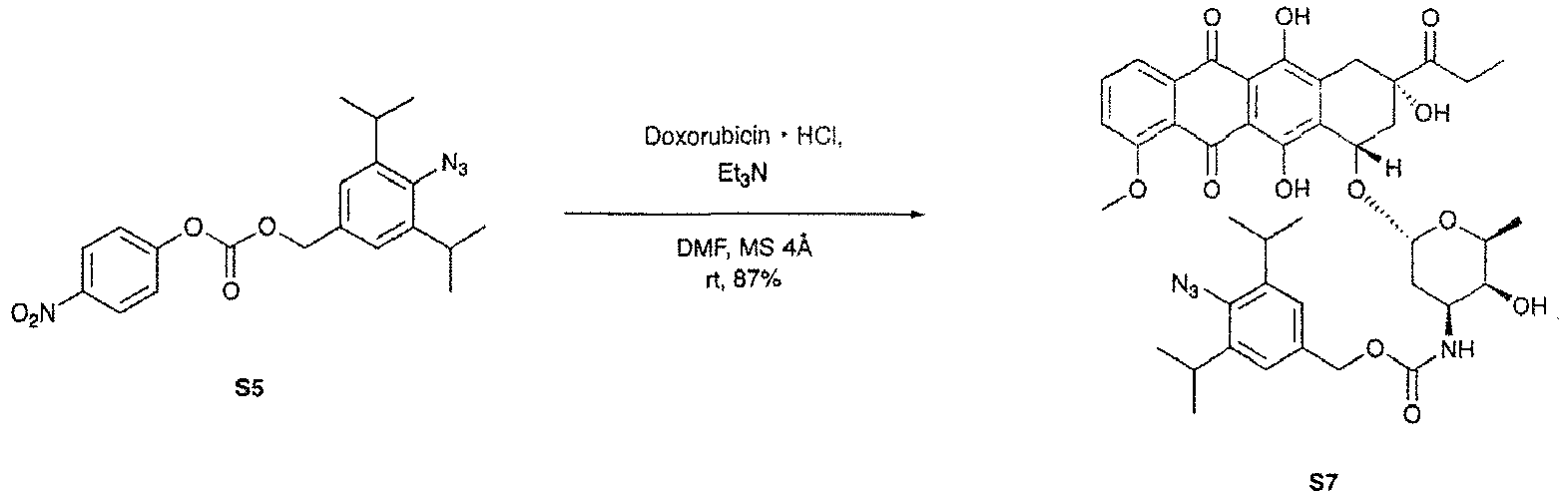
- To a solution of compound S5 (80.2 mg, 0.20 mmol, 1.0 eq), doxorubicin hydrochloride (105 mg, 0.17 mmol, 0.9 eq), and molecular sieves (MS 4A) in DMF (2 mL, [S5] = 0.1 M) was added Et3N (57 µL, 0.40 mmol, 2.0 eq). The reaction mixture was stirred under nitrogen atmosphere for 20 hours. The resulting mixture was filtered through Celite while being washed with EtOAc, and the filtrate was concentrated to dryness under reduced pressure. The residue was partitioned with EtOAc-H2O. The organic layer was washed with saturated saline, dried with Na2SO4, and filtered. The filtrate was concentrated to dryness under reduced pressure. The residue was purified by silica gel column chromatography CHCl3/MeOH (25:1) to obtain intended DOX-ABC (compound S7) as a red solid (120 mg, 87%). 1H NMR (400 MHz, CDCl3, 25°C) δ7.95 (d, J = 7.7 Hz, 1H), 7.74 (t, J = 8.0 Hz, 1H), 7.36 (d, J = 8.7 Hz, 1H), 7.05 (s, 2H), 5.49 (bs, 1H, NH), 5.34-5.18 (m, 2H), 4.97 (s, 2H), 4.76 (d, J = 4.6 Hz, 2H), 4.54 (s, 1H), 4.14 (dd, J =14.7, 7.2 Hz, 1H), 4.05 (s, 3H), 3.93-3.82(m, 1H), 3.68 (d, J = 7.8 Hz, 1H), 3.30 (p, J = 6.9 Hz, 2H), 3.18 (d, J = 18.5 Hz, 1H), 3.12 (t, J =6.0 Hz, 1H), 2.85 (d, J =18.8 Hz, 1H), 2.33 (d, J = 14.6 Hz, 2H), 2.15 (dd, J =14.8, 4.1 Hz, 1H), 1.84 (ddd, J =27.1, 13.1, 4.5 Hz, 2H), 1.30 (d, J =6.5 Hz, 3H), 1.22 (d, J = 6.9 Hz, 12H); 13C NMR (100 MHz, CDCl3, 25°C) δ213.96, 186.91, 186.51, 161.05, 156.22, 155.62, 155.55, 143.42, 135.84, 135.38, 135.25, 134.70, 133.64, 124.01, 120.71, 119.88, 118.57, 111.52, 111.52, 111.36, 100.86, 76.66, 69.81, 69.67, 67.41, 66.85, 65.62, 56.69, 47.15, 35.67, 33.95, 30.26, 28.88, 23.49, 16.92; ESI-HRMS m/z calculated for C41H46N4NaO13 ([M+H]+) 825.2954, found 825.2954.
- Three cell lines (MCF10A, A549, and HeLa S3) were seeded on a 96-well plate (2×10⁴ cells/well) and left to attach for 24 hours at 37°C. Each of the cells was then used for two different conditions as follows:
- (Condition 1) The cells were treated with 100 µL of DOX-ABC (compound 7) solutions [0.05 µM, 0.1 µM, 0.5 µM, 1 uM, 5 µM, 10 µM, 50 µM in the culture medium (1% DMSO)] and incubated for 48 hours at 37°C under 5% of CO2.
- (Condition 2) Incubation was carried out in a manner similar to that of
condition 1 with use of doxorubicin (DOX) solutions. - After the incubation, 100 µL of
ATP lite 1 step reagent was added to the cells, and the fluorescence intensity was measured using a spectrofluorometer (SpectraMax iD3, manufactured by Molecular Devices). Results are shown inFig. 16 . - As shown in
Fig. 16 , the DOX-ABC (compound 7), which is a prodrug, released free DOX specifically in cancer cells only when reacted with endogenous acrolein which was overproduced by cancer cells. In contrast, DOX nonspecifically exhibited cytotoxicity toward normal cells and cancer cells. - A549 tumor bearing mice xenograft models were prepared in a manner similar to that in Example 6. The prepared mice were randomized, divided into three groups, and treated with the prodrugs and controls.
Group 1 was intratumorally injected with 10 µL ofcompound 9 produced in Production Example 5 as a control (n = 10).Group 2 was intratumorally injected with 10 µL of doxorubicin (n = 10).Group 3 was intratumorally injected with 10 µL of compound S7 (n = 10). - Administrations were conducted 4 times in total on
days -
Fig. 17 shows photographs of the mouse onday 26 of intratumoral administration in group 1 (control, compound 9), the mouse onday 11 of intratumoral administration in group 2 (doxorubicin), and the mouse onday 26 of intratumoral administration in group 3 (compound S7). -
Fig. 18 shows a graph indicating change in tumor volume.Fig. 19 shows a graph indicating change in survival rate. The horizontal axis inFigs. 18 and 19 represents the number of days elapsed from the start of intratumoral administration. - As shown in
Figs. 17 through 19 , the mice treated withcompound 9 had a larger tumor size. In contrast, it was found that, for the mice treated with doxorubicin and DOX-ABC (compound S7), administration of those was effective with respect to the tumor growth. However, the survival rate of the mouse treated with doxorubicin suddenly decreased at and after the fourth intratumoral administration. The survival rate of the mouse treated with DOX-ABC (compound S7) was 100% even at and after the fourth intratumoral administration. - A549 tumor bearing mice xenograft models were prepared in a manner similar to that in Example 6. The prepared mice were randomized, divided into two groups, and treated with the prodrugs and controls.
Group 1 was intratumorally injected with 10 µL ofcompound 9 as a control (n = 10).Group 2 was intratumorally injected with 10 µL of compound S6 (n = 10). - Administrations were conducted 4 times in total on
days -
Fig. 20 shows a graph indicating change in tumor volume. The horizontal axis inFig. 20 represents the number of days elapsed from the start of intratumoral administration. - As shown in
Fig. 20 , it was found that, for the mice treated with PUR-ABC (compound S6), the administration was effective with respect to the tumor growth. - The present invention can be used as a therapeutic agent for a tumor and a diagnostic drug for determining the presence or absence of a tumor, and can be used for, for example, life science research and medical treatment.
(
Claims (9)
- A complex comprising:an acrolein-reactive site having a chemical structure represented by Formula (1); anda leaving site having another chemical structure,the leaving site binding to the acrolein-reactive site via a linker that is cleavable by a reaction between the acrolein-reactive site and acrolein,
 R1 and R2 each independently represent a hydrogen atom, a halogen atom, or an alkyl group that has 1 to 5 carbon atoms and that may be substituted by at least one halogen atom, provided that at least one of R1 and R2 is the alkyl group having 1 to 5 carbon atoms;R3 and R4 each independently represent a hydrogen atom, a halogen atom, a hydroxy group, a thiol group, an amino group that may have a substituent, an alkoxy group having 1 to 5 carbon atoms, an alkylthio group having 1 to 5 carbon atoms, or an alkyl group having 1 to 5 carbon atoms (provided that a hydrogen atom constituting the alkyl group may be substituted by a substituent selected from a halogen atom, a hydroxy group, and an amino group that may have a substituent); and* is a binding site to the linker.
 - The complex as set forth in claim 1, wherein the linker is a linker having a chemical structure represented by Formula (2):
 two R each independently represent a hydrogen atom, a halogen atom, a hydroxy group, a thiol group, an amino group that may have a substituent, an alkoxy group having 1 to 5 carbon atoms, an alkylthio group having 1 to 5 carbon atoms, or an alkyl group having 1 to 5 carbon atoms (provided that a hydrogen atom constituting the alkyl group may be substituted by a substituent selected from a halogen atom, a hydroxy group, and an amino group that may have a substituent);is a binding site to the acrolein-reactive site; and
 is a binding site to the leaving site.
- The complex as set forth in claim 2, wherein:
in Formula (2) is a binding site to a nitrogen atom, a sulfur atom, or an oxygen atom contained in the leaving site. - The complex as set forth in claim 2 or 3, wherein:
two R in Formula (2) each independently represent a hydrogen atom, a halogen atom, or an alkyl group having 1 to 5 carbon atoms (provided that a hydrogen atom constituting the alkyl group may have a substituent selected from a halogen atom, a hydroxy group, and an amino group that may have a substituent). - The complex as set forth in any one of claims 1 through 4, wherein:
R1 and R2 in Formula (1) each independently represent an alkyl group that has 1 to 5 carbon atoms and that may be substituted by at least one halogen atom. - The complex as set forth in any one of claims 1 through 5, wherein:
the leaving site is an antitumor compound. - The complex as set forth in any one of claims 1 through 6, wherein:
the leaving site leaves by reacting with acrolein that is present around a tumor cell. - A therapeutic agent for a tumor, said therapeutic agent comprising a complex recited in claim 6 or 7.
- A method for causing a leaving site to leave, said method comprising the step of:
causing a complex recited in any one of claims 1 through 7 or a therapeutic agent recited in claim 8 to react with acrolein.
Applications Claiming Priority (2)
| Application Number | Priority Date | Filing Date | Title |
|---|---|---|---|
| JP2020178209 | 2020-10-23 | ||
| PCT/JP2021/037805 WO2022085523A1 (en) | 2020-10-23 | 2021-10-13 | Complex, and use thereof |
Publications (2)
| Publication Number | Publication Date |
|---|---|
| EP4233916A1 true EP4233916A1 (en) | 2023-08-30 |
| EP4233916A4 EP4233916A4 (en) | 2025-10-15 |
Family
ID=81290385
Family Applications (1)
| Application Number | Title | Priority Date | Filing Date |
|---|---|---|---|
| EP21882664.2A Pending EP4233916A4 (en) | 2020-10-23 | 2021-10-13 | COMPLEX AND USE THEREOF |
Country Status (4)
| Country | Link |
|---|---|
| US (1) | US20240002398A1 (en) |
| EP (1) | EP4233916A4 (en) |
| JP (1) | JP7857022B2 (en) |
| WO (1) | WO2022085523A1 (en) |
Families Citing this family (3)
| Publication number | Priority date | Publication date | Assignee | Title |
|---|---|---|---|---|
| CN115850288B (en) * | 2022-11-25 | 2025-03-21 | 中科帅天医药(深圳)有限公司 | A kind of mitomycin C prodrug and its preparation method and application |
| WO2024247648A1 (en) * | 2023-05-26 | 2024-12-05 | 学校法人兵庫医科大学 | Tumor therapeutic agent, and complex |
| CN119874789A (en) * | 2023-10-25 | 2025-04-25 | 中科帅天医药(深圳)有限公司 | Azido prodrug compound, preparation method and application thereof |
Family Cites Families (1)
| Publication number | Priority date | Publication date | Assignee | Title |
|---|---|---|---|---|
| JP7157438B2 (en) | 2018-07-06 | 2022-10-20 | 国立研究開発法人理化学研究所 | Reactive drug with acrolein, its use and novel compound |
-
2021
- 2021-10-13 EP EP21882664.2A patent/EP4233916A4/en active Pending
- 2021-10-13 WO PCT/JP2021/037805 patent/WO2022085523A1/en not_active Ceased
- 2021-10-13 JP JP2022557022A patent/JP7857022B2/en active Active
- 2021-10-13 US US18/029,947 patent/US20240002398A1/en active Pending
Also Published As
| Publication number | Publication date |
|---|---|
| JP7857022B2 (en) | 2026-05-12 |
| WO2022085523A1 (en) | 2022-04-28 |
| US20240002398A1 (en) | 2024-01-04 |
| EP4233916A4 (en) | 2025-10-15 |
| JPWO2022085523A1 (en) | 2022-04-28 |
Similar Documents
| Publication | Publication Date | Title |
|---|---|---|
| Aboul-Fadl et al. | Synthesis, antitubercular activity and pharmacokinetic studies of some Schiff bases derived from 1-alkylisatin and isonicotinic acid hydrazide (INH) | |
| US20240002398A1 (en) | Complex, and use thereof | |
| EP3950677A1 (en) | Quinolyl-containing compound and pharmaceutical composition, and use thereof | |
| AU2016364624B2 (en) | Carbon monoxide releasing norbornenone compounds | |
| CN109942630B (en) | Natural active molecular coupling compounds based on salaminol and pterostilbene and their uses | |
| EP3252039B1 (en) | Compound containing indoleacetic acid core structure and use thereof | |
| CN108658915B (en) | A class of hydroxamic acid compounds containing coumarin structure, use and preparation method thereof | |
| CN118320117B (en) | Molecular-based drug delivery system for multicellular organ targeting and in situ release | |
| EP3907221A1 (en) | Fluorine-containing substituted benzothiophene compound, and pharmaceutical composition and application thereof | |
| CN114195814A (en) | Hydroxy naphthalenone-phenylboronic acid compound, preparation method and application | |
| WO2017162169A1 (en) | Uridine phosphoramide prodrug, preparation method therefor, and medicinal uses thereof | |
| US9655975B2 (en) | Prodrug using nitroimidazole | |
| CN103183722B (en) | Glyoxalase I inhibitor, preparation method and medical application thereof | |
| US8877734B2 (en) | Seleny-methyluracil compounds, radiosensitizer and pharmaceutical composition using them | |
| CN114478561B (en) | Epalrestat lycorine conjugate and preparation method and application thereof | |
| US10023551B2 (en) | Glutathione-cleavable prodrug and methods of use thereof | |
| EP3560914A1 (en) | Sulfonyl amidine as indoleamine-2,3-dioxygenase inhibitor, and preparation method therefor and use thereof | |
| EP4062942A1 (en) | Disulfide-based prodrug compounds | |
| WO2024247648A1 (en) | Tumor therapeutic agent, and complex | |
| WO2018067551A1 (en) | Texaphyrin and antitumor antibiotic conjugates | |
| ES2378780T3 (en) | Metabolites of wortmanin analogues and methods of use thereof | |
| Huang et al. | Rejuvenating hepatic tumor microenvironment immunity with a phosphatidylserine-targeting small molecule drug conjugate | |
| CN111285900B (en) | Coupling molecule DCZ0847 compound based on pterostilbene and apocynin, preparation method and application thereof | |
| CN115340526B (en) | Phthalimide compounds and pharmaceutical compositions, preparation methods and uses thereof | |
| EP3543228A1 (en) | Compound having anticancer activity, and preparation method and application thereof |
Legal Events
| Date | Code | Title | Description |
|---|---|---|---|
| STAA | Information on the status of an ep patent application or granted ep patent |
Free format text: STATUS: THE INTERNATIONAL PUBLICATION HAS BEEN MADE |
|
| PUAI | Public reference made under article 153(3) epc to a published international application that has entered the european phase |
Free format text: ORIGINAL CODE: 0009012 |
|
| STAA | Information on the status of an ep patent application or granted ep patent |
Free format text: STATUS: REQUEST FOR EXAMINATION WAS MADE |
|
| 17P | Request for examination filed |
Effective date: 20230522 |
|
| AK | Designated contracting states |
Kind code of ref document: A1 Designated state(s): AL AT BE BG CH CY CZ DE DK EE ES FI FR GB GR HR HU IE IS IT LI LT LU LV MC MK MT NL NO PL PT RO RS SE SI SK SM TR |
|
| DAV | Request for validation of the european patent (deleted) | ||
| DAX | Request for extension of the european patent (deleted) | ||
| A4 | Supplementary search report drawn up and despatched |
Effective date: 20250912 |
|
| RIC1 | Information provided on ipc code assigned before grant |
Ipc: A61K 47/54 20170101AFI20250908BHEP Ipc: A61K 31/407 20060101ALI20250908BHEP Ipc: A61K 31/704 20060101ALI20250908BHEP Ipc: A61K 31/7076 20060101ALI20250908BHEP Ipc: A61P 35/00 20060101ALI20250908BHEP |