EP4233051B1 - An apparatus for providing a processed audio signal, a method for providing a processed audio signal, an apparatus for providing neural network parameters and a method for providing neural network parameters - Google Patents
An apparatus for providing a processed audio signal, a method for providing a processed audio signal, an apparatus for providing neural network parameters and a method for providing neural network parameters Download PDFInfo
- Publication number
- EP4233051B1 EP4233051B1 EP21723988.8A EP21723988A EP4233051B1 EP 4233051 B1 EP4233051 B1 EP 4233051B1 EP 21723988 A EP21723988 A EP 21723988A EP 4233051 B1 EP4233051 B1 EP 4233051B1
- Authority
- EP
- European Patent Office
- Prior art keywords
- signal
- audio signal
- training
- neural network
- processing
- Prior art date
- Legal status (The legal status is an assumption and is not a legal conclusion. Google has not performed a legal analysis and makes no representation as to the accuracy of the status listed.)
- Active
Links
Images






Classifications
-
- G—PHYSICS
- G10—MUSICAL INSTRUMENTS; ACOUSTICS
- G10L—SPEECH ANALYSIS TECHNIQUES OR SPEECH SYNTHESIS; SPEECH RECOGNITION; SPEECH OR VOICE PROCESSING TECHNIQUES; SPEECH OR AUDIO CODING OR DECODING
- G10L21/00—Speech or voice signal processing techniques to produce another audible or non-audible signal, e.g. visual or tactile, in order to modify its quality or its intelligibility
- G10L21/02—Speech enhancement, e.g. noise reduction or echo cancellation
- G10L21/0208—Noise filtering
-
- G—PHYSICS
- G10—MUSICAL INSTRUMENTS; ACOUSTICS
- G10L—SPEECH ANALYSIS TECHNIQUES OR SPEECH SYNTHESIS; SPEECH RECOGNITION; SPEECH OR VOICE PROCESSING TECHNIQUES; SPEECH OR AUDIO CODING OR DECODING
- G10L21/00—Speech or voice signal processing techniques to produce another audible or non-audible signal, e.g. visual or tactile, in order to modify its quality or its intelligibility
- G10L21/02—Speech enhancement, e.g. noise reduction or echo cancellation
- G10L21/0208—Noise filtering
- G10L21/0264—Noise filtering characterised by the type of parameter measurement, e.g. correlation techniques, zero crossing techniques or predictive techniques
-
- G—PHYSICS
- G06—COMPUTING OR CALCULATING; COUNTING
- G06N—COMPUTING ARRANGEMENTS BASED ON SPECIFIC COMPUTATIONAL MODELS
- G06N3/00—Computing arrangements based on biological models
- G06N3/02—Neural networks
- G06N3/04—Architecture, e.g. interconnection topology
- G06N3/045—Combinations of networks
-
- G—PHYSICS
- G10—MUSICAL INSTRUMENTS; ACOUSTICS
- G10L—SPEECH ANALYSIS TECHNIQUES OR SPEECH SYNTHESIS; SPEECH RECOGNITION; SPEECH OR VOICE PROCESSING TECHNIQUES; SPEECH OR AUDIO CODING OR DECODING
- G10L25/00—Speech or voice analysis techniques not restricted to a single one of groups G10L15/00 - G10L21/00
- G10L25/27—Speech or voice analysis techniques not restricted to a single one of groups G10L15/00 - G10L21/00 characterised by the analysis technique
- G10L25/30—Speech or voice analysis techniques not restricted to a single one of groups G10L15/00 - G10L21/00 characterised by the analysis technique using neural networks
Definitions
- Embodiments according to the present application are concerned with audio signal processing using neural networks, particularly with audio signal enhancement, particularly with speech enhancement.
- embodiments according to the invention can be applied to provide a direct enhancement of noisy utterances by neural networks.
- VAE-NMF variational auto-encoder with non-negative matrix factorization
- the apparatus is configured to process, e.g.
- This embodiment is based on the finding that processing of audio signals, for example, for speech enhancement purpose, can be performed directly using flow blocks processing, which may, for example, model a generative process. It has been found that the flow block processing allows to process a noise signal, e.g. a noise signal z, e.g. generated by the apparatus, or e.g. stored in the apparatus, in a manner conditioned on the input audio signal, e.g. a noisy audio signal y.
- the noise signal z represents (or comprises) a given (e.g. simple or complex) probability distribution, preferably a Gaussian probability distribution. It has been found that upon processing of the noise signal conditioned on the distorted audio signal, an enhanced clean part of the input audio signal is provided as a result of the processing without introducing this clean part, e.g. without a noisy background, as an input to the apparatus.
- the proposed apparatus provides an effective and easy-to-implement audio signal processing, particularly a direct audio signal processing, e.g. a direct enhancement of speech samples.
- a high performance e.g. an improved speech enhancement, or e.g. an improved quality of the processed audio signal, are provided in the proposed apparatus.
- Performing flow block processing directly in speech domain allows audio signal processing without a need of any predefined features or time-frequency, T-F, transformations. Since both noise signal and input audio signal are of the same dimension, no upsampling layer in a generative process is needed.
- a processing of time domain samples allows for an efficient modification of signal statistics in a sequence of flow blocks that perform an invertible affine processing, and also allows to derive an audio signal from a noise signal in such a sequence of flow blocks. It has been found that a processing of time domain samples in a sequence of flow blocks allows to adapt the signal characteristics in such a manner, that a reconstructed audio signal comprises a good hearing impression.
- a neural network associated with a given flow block, e.g. a given stage of an affine processing, of the one or more flow blocks is configured to determine one or more processing parameters, e.g. a scaling factor, e.g. S, and e.g. a shift value, e.g. T, for the given flow block in dependence on the noise signal, e.g. z, or a signal derived from the noise signal, and in dependence on the input audio signal, e.g. y.
- processing parameters e.g. a scaling factor, e.g. S, and e.g. a shift value, e.g. T
- Determining one or more processing parameters of an affine processing using the neural network allows to control the synthesis of the processed audio signal on the basis of the noise signal in dependence on the input audio signal. Accordingly, the neural network can be trained in such a manner, that the neural network provides appropriate processing parameters for the affine processing on the basis of the input audio signal (and typically also in dependence on a part of the noise signal, or a part of the processed noise signal). Also, it has been recognized that the training of the neural network is possible with reasonable effort using a training structure which comprises an affine processing which is inverse to the affine processing used for the derivation of the processed audio signal.
- the given stage of the affine processing is configured to apply the determined parameters, e.g. a scaling factor, e.g. S, and e.g. a shift value, e.g. T, to a second part, e.g. z 2 , of the flow block input signal, e.g. z, or to a second part of the pre-processed flow block input signal, e.g. z', to obtain an affinely processed signal, z 2 ⁇ .
- the first part, e.g. z 1 of the flow block input signal, e.g. z, or of the pre-processed flow block input signal, e.g.
- the apparatus is configured to apply an invertible convolution, e.g. a 1x1 invertible convolution, to the flow block output signal, e.g. z new , e.g. the stage output signal, of the given flow block, e.g. the given stage of the affine processing, which may, for example, be an input signal for a subsequent stage, or for other subsequent stages following the first stage, to obtain the processed flow block output signal, z' new , e.g. a processed version of the flow block output signal, e.g. a convolved version of the flow block output signal.
- the invertible convolution may help to ensure that different samples are processed by the affine processing in different flow blocks (or processing stages).
- the apparatus is configured to apply a ⁇ -law transformation, e.g. a ⁇ -law function, as the nonlinear compression to the input audio signal, e.g. y.
- a ⁇ -law transformation e.g. a ⁇ -law function
- the apparatus is configured to adapt a processing performed using the one or more flow blocks in dependence on a distorted version of the training audio signal, e.g. y, e.g. the distorted audio signal, e.g. in dependence on a noisy speech signal y, and using a neural network.
- the neural network provides one or more processing parameters for the flow block, e.g. parameters of an affine processing, like a scaling factor and a shift value, on the basis of the distorted version of the training audio signal, and preferably also in dependence on at least a part of the training audio signal, or a processed version thereof.
- the apparatus is configured to determine neural network parameters of the neural network, e.g. using an evaluation of a cost function, e.g.
- the proposed apparatus provides an effective training tool of the neural networks associated with the flow blocks, which provides the parameters of the neural networks to be used in audio signal processing. This results in an improved audio signal processing, particularly in an improved audio signal enhancement, using the neural networks with the determined neural network parameters, which provides a high performance, e.g. an improved speech enhancement, or e.g. an improved quality of the processed audio signal.
- the apparatus 100 is configured to provide a processed, e.g. enhanced, audio signal 160 on the basis on an input audio signal y, 130. Processing is performed, for example, in N flow blocks, e.g. inference flow blocks 110 1...N , associated with neural networks (not shown).
- the flow blocks 110 1...N are configured to process incoming audio signals, e.g. speech signals.
- the input audio signal y and correspondingly its clean part x may optionally be grouped into a vector representation (or into a matrix representation).
- Processing in all subsequent flow blocks of the flow blocks 210 1...N may be performed in two steps, e.g. in two blocks, e.g. in two operations: affine coupling layers and 1x1 invertible convolution. These two steps may for example be the same as described related to the first flow block 210 1 (wherein, for example, different neural net parameters may be used in different flow blocks).
- the affine coupling layer blocks 211 1...N of the flow blocks 210 1...N are associated with (or comprise) corresponding neural networks (not shown), the networks associated with the flow blocks 210 1...N , as indicated above.
- the parameters of the networks are, for example, predetermined during the training of the networks by the apparatuses (or functionalities) described with the reference to Figs. 5-8 .
- the clean part x of the input audio signal y, 230 is not introduced separately into the apparatus 200.
- the apparatus 200 processes the, e.g. generated, noise signal z, 220 based on the input audio signal y, 230 to receive, e.g. generate, e.g. output, an enhanced audio signal, being e.g. an enhancement of the clean part of the input audio signal y, 230.
- apparatus 200 may optionally be supplemented by any of the features, functionalities and details disclosed herein, both individually or taken in combination.
- Fig. 3 shows a schematic representation of a flow block 311, e.g. an inference flow block, in accordance with an embodiment.
- the flow block 311 may be a part of processing, for example, by the apparatus 100 shown in Fig. 1 or by the apparatus 200, shown in Fig. 2 .
- the flow blocks of the apparatus 100, shown in Fig. 1 may have the same structure as flow block 311 shown in Fig. 3 or may comprise the functionality (and/or structure) of the flow block 311 (e.g. together with additional functionalities).
- the affine coupling layer blocks of the flow blocks of the apparatus 200, shown in Fig. 2 may have the same structure as flow block 311 shown in Fig. 3 , or may comprise the functionality (and/or structure) of the flow block 311 (e.g. together with additional functionalities).
- the flow block index i is partly omitted in Fig. 3 and in the following description for simplicity.
- the first part z 1 (i) (which may, for example, comprise a subset of time domain samples of the input signal 340) is introduced into a neural network 380 (also designated as NN(i)), associated with a flow block 311 (having flow block index i).
- the neural network 380 could be, for example, a neural network associated with any of the flow blocks 110 1...N of the apparatus 100 shown in Fig. 1 .
- the neural network 380 could be, for example, a neural network associated with any of the affine coupling layer(s) blocks of the flow blocks 210 1...N of the apparatus 200 shown in Fig. 2 .
- the parameters of the neural network 380 could be, for example, predetermined, e.g. in the training of the network, by the apparatuses described with the reference to Figs. 5-8 .
- the neural network 380 processes the first part z 1 (i) and the input audio signal y, 330 e.g. processes the first part z 1 (i) depending on, e.g. conditioned by, the input audio signal y, 330.
- the neural network 380 determines processing parameters, e.g. a scaling factor, e.g. S, and a shift value, e.g. T, which are output (371) of the neural network 380.
- the determined parameters S, T have, for example, a vector representation.
- s may be equal to S (e.g. if only a single scale factor value is provided by the neural net), or s may be an element of a vector S of scale factor values (e.g. if a vector of scale factor values is provided by the neural net).
- t may be equal to T (e.g. if only a single shift value is provided by the neural net), or t may be an element of a vector T of shift values (e.g. if a vector of scale factor values is provided by the neural net, entries of which are associated with different sample values of z 2 (i)).
- the unprocessed first part z 1 (i) of the signal z and the processed part z 2 ⁇ of the signal z are combined (373) to form signal z new , 350 processed at the flow block 311.
- flow block 311 may optionally be used in any of the embodiments disclosed herein.
- Fig. 4 shows a schematic representation of an apparatus 400 for providing a processed signal in accordance with an embodiment.
- the flow block 311 shown in Fig. 3 could be, for example, used in the apparatus 400 in an embodiment.
- the input audio signal y, 430 may optionally be pre-processed, e.g. compressed, e.g. by a nonlinear compression 490.
- the nonlinear compression step 490 is optionally applied to the input audio signal y, 430.
- the step 490 is optional, as it is shown in Fig. 4 .
- the nonlinear compression step 490 could be applied, for example, to compress the input audio signal y, 430.
- the nonlinear input compression step 490 is as described with the reference to Fig. 9 .
- the nonlinear compression 490 may be represented, for example, by a ⁇ -law compression, or e.g. a ⁇ -law transformation of the input audio signal y, 430.
- a ⁇ -law compression or e.g. a ⁇ -law transformation of the input audio signal y, 430.
- g y sgn y ⁇ ln 1 + ⁇ y ln 1 + ⁇ ;
- the parameter ⁇ may be set, for example, to 255, which is a common values used in a telecommunication.
- the input audio signal y and correspondingly its clean part x may optionally be grouped into a vector representation (or into a matrix representation).
- a noise signal z, 420 is, for example, an input signal to the apparatus 400 or may alternatively be generated by the apparatus 400.
- audio samples of the noise signal z are grouped (e.g. in the grouping block 405) into groups of samples, e.g. into groups of 8 samples, e.g. grouped into a vector representation (or into a matrix representation).
- the grouping step 405 is an optional step, as shown in Fig. 4 .
- An (optionally grouped) noise signal z(i), 440 1 is introduced into a first flow block 410 1 of the apparatus 400 together with the input audio signal y, 430.
- the noise signal z(i) is (e.g. successively or in a step-wise manner) processed (or processed further) in the flow blocks 410 1...N on the basis of, e.g. conditioned by, the input audio signal y, 430.
- the input audio signal y, 430 is introduced, for example, in each flow block of the flow blocks 410 1...N .
- the processing in the first flow block 2410 1 is performed in two steps, e.g. in two blocks, e.g. in two operations: affine coupling layers 411 1 and, optionally, 1x1 invertible convolution 412 1 .
- After processing in the affine coupling layer block 411 1 of the first flow block 410 1 an output signal z new (i 1), 450 1 is outputted.
- the invertible convolution block 412 1 for example, reverses ordering of channels (or of samples) at an output of the affine coupling layer block 411 1 .
- the invertible convolution block 412 may be, for example, be performed using a weight matrix W, e.g. as a random (or pseudo-random but deterministic) rotation matrix or as a random (or pseudo-random but deterministic) permutation matrix.
- the processed audio signal x ⁇ 460 is, for example an output signal of the apparatus 400.
- Processing in all subsequent flow blocks of the flow blocks 410 1...N is, for example, performed in two steps, e.g. in two blocks, e.g. in two operations: affine coupling layers and 1x1 invertible convolution. These two steps are, for example, (e.g. qualitatively) the same as described related to the first flow block 410 1 .
- different neural network coefficients for the neural networks for determining the scaling values and the shift values may be used in different processing stages.
- the invertible convolutions may also be different in different stages (but may also be equal in the different stages).
- the affine coupling layer blocks of the flow blocks 410 1...N are associated with corresponding neural networks (not shown), the neural networks associated with the flow blocks 410 1...N , as indicated.
- a nonlinear expansion step 415 is optionally applied to the processed audio signal x ⁇ 460.
- the step 415 is optional, as it is shown in Fig. 4 .
- the nonlinear expansion step 415 could be applied, for example, to expand the processed audio signal x ⁇ 460 to a regular signal.
- the parameter ⁇ may be set, for example, to 255, which is a common values used in a telecommunication.
- the nonlinear expansion step 415 could be applied, for example, when a nonlinear compression was used as a pre-processing step during training of the neural networks associated with the flow blocks 410 1...N .
- the clean part x of the input audio signal y, 430 is not introduced separately into the apparatus 400.
- the apparatus 400 processes the, e.g. generated, noise signal z, 420 based on the input audio signal y, 430 to receive, e.g. generate, e.g. output, an enhanced audio signal, being e.g. an enhancement of the clean part of the input audio signal y, 430.
- apparatus 400 may optionally be supplemented by any of the features, functionalities and details disclosed herein, both individually or taken in combination.
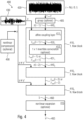
- Fig. 5 shows a schematic representation of an apparatus 500 for providing neural network parameters in accordance with an embodiment.
- the apparatus 500 is configured to provide neural network parameters (e.g. for use by the neural networks 380, NN(i) associated with the flow blocks 110 1...N , 210 1...N , 410 1...N ) on the basis of a training audio signal x, 505, e.g. a clean audio signal, and a distorted version of the training audio signal y, 530, e.g. a distorted audio signal.
- Processing is performed, for example, in N flow blocks, e.g. training flow blocks 510 1...N , associated with neural networks 580 1...N .
- the training flow blocks 510 1...N are, for example, configured to process incoming audio signals, e.g. speech signals.
- the distorted version of the training audio signal y, 530 is introduced into the apparatus 500 to be processed (or generated by the apparatus 500).
- the distorted audio signal y is, for example, a noisy input signal.
- the distorted training audio signal y, 530 may be represented, for example, as time domain audio samples, e.g. noisy time domain speech samples.
- the training audio signal x and correspondingly the distorted version of the training audio signal y may optionally be grouped into a vector representation (or into a matrix representation).
- a training audio signal x, 505 is introduced into a first flow block 510 1 of the apparatus 500 together with the distorted training audio signal y, 530.
- the training audio signal x, 505 is represented, for example, as audio samples, e.g. as time domain samples.
- the audio samples x of the noise signal x may be grouped into groups of samples, e.g. into groups of 8 samples, e.g. grouped into a vector representation (or into a matrix representation).
- Optional preprocessing steps are not shown in Fig. 1 .
- the distorted training audio signal y, 530 is, for example, introduced in each flow block of the flow blocks 510 1...N .
- the training result audio signal z, 520 may optionally be grouped into a vector representation (or into a matrix representation).
- Processing of the training audio signal x in dependence on the distorted training audio signal y, 530 in the flow blocks 510 1...N is performed, e.g. iteratively.
- An estimation (or an evaluation or an assessment) of the training result audio signal z, 520 may be performed, e.g. after each iteration in order to determine or estimate, whether a characteristic, e.g. a distribution (e.g. a distribution of signal values), of the training result audio signal z, 520 approximates a predetermined characteristic, e.g. a Gaussian distribution. If the characteristic of the training result audio signal z, 520 does not approach the predetermined characteristic (e.g. within a desired tolerance), neural network parameters may be varied before a subsequent iteration.
- a characteristic e.g. a distribution (e.g. a distribution of signal values)
- a predetermined characteristic e.g. a Gaussian distribution
- neural network parameters of the neural networks 580 1...N may be determined (e.g. iteratively) such that the training result audio signal which is obtained on the basis of a processing of the training audio signal in a sequence of flow blocks 510 1...N under the control of the neural networks 580 1...N comprises (or approximates) desired statistical characteristic (e.g. a desired distribution of values) within an (e.g. predetermined) allowable tolerance.
- desired statistical characteristic e.g. a desired distribution of values
- the neural network parameters determined by the apparatus 500 may be used, for example, by neural networks associated with the flow blocks of the apparatuses shown in Figs. 1 , 2 and 4 (wherein it should be noted that the flow blocks of the apparatuses of Figs. 1 , 2 and 4 may, for example, be configured to perform affine transformations which are substantially inverse to the affine transformations performed by the flow blocks 510 1...N ).
- apparatus 500 may optionally be supplemented by any of the features, functionalities and details disclosed herein, both individually or taken in combination.
- features, functionalities and details of the apparatus 600 may optionally be introduced into the apparatus 500 shown in Fig. 5 (both individually and in combination), or vice versa.
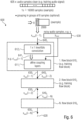
- the apparatus 600 is configured to provide neural network parameters on the basis on a training audio signal x, 605, e.g. a clean audio signal, and a distorted version of the training audio signal y, y input , 630, e.g. a distorted audio signal.
- Processing is performed in N flow blocks, e.g. training flow blocks 610 1...N , associated with neural networks (not shown), for example such neural networks, as the neural networks 580 1...N of Fig. 5 .
- the flow blocks 610 1...N are configured to process incoming audio signals, e.g. speech signals.
- the distorted version of the training audio signal y, 630 is introduced into the apparatus 600 to be processed.
- the distorted audio signal y, 630 is, for example, a noisy input signal.
- the distorted training audio signal y, 630 is represented, for example, as time domain audio samples, e.g. noisy time domain speech samples.
- the training audio signal x and correspondingly the distorted version of the training audio signal y may optionally be grouped into a vector representation (or into a matrix representation).
- the apparatus 600 is configured to provide neural network parameters for the neural networks (not shown) based on a clean-noisy (x-y) pair, which follows the training flow blocks 610 1...N , to be mapped to a distribution, e.g. a Gaussian distribution, of a training result audio signal 620, e.g. a noise signal.
- a clean-noisy (x-y) pair which follows the training flow blocks 610 1...N , to be mapped to a distribution, e.g. a Gaussian distribution, of a training result audio signal 620, e.g. a noise signal.
- a training audio signal x, 605 is introduced into a first flow block 610 1 of the apparatus 600 together with the distorted training audio signal y, 630.
- the training audio signal x, 605 may be represented, for example, as audio samples, e.g. as time domain samples.
- the audio samples x, having e.g. 16000 samples, of the training audio signal x are e.g. grouped into groups of samples, e.g. into 2000 groups of 8 samples, e.g. grouped into a vector representation (or into a matrix representation).
- the distorted training audio signal y, y input , 630 is introduced in each flow block of the flow blocks 610 1...N .
- the invertible convolution block 612 1 for example, reverses ordering of channels at an input of the affine coupling layer block 611 1 .
- the invertible convolution block 612 1 may be, for example, performed using a weight matrix W, e.g. as a random rotation matrix a pseudo-random but deterministic rotation matrix or a permutation matrix.
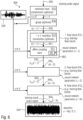
- the apparatus 800 may be, for example, combined with the apparatus 500, shown in Fig. 5 , or for example, with the apparatus 600, shown in Fig. 8 . Also, features, functionalities and details of the apparatus 800 may optionally be introduced into the apparatus 500 or into the apparatus 600 (both individually and in combination), or vice versa.
- a training audio signal x, 805 is introduced into a flow block 810 1 of the apparatus 800 together with the distorted training audio signal y, 830.
- the training audio signal x, 805 is represented, for example, as audio samples, e.g. as time domain samples.
- the affine coupling layer blocks of the flow blocks 810 1...N are associated with corresponding networks (only a neural network 880 1 of the first flow block 810 1 is shown).
- a function f -1 (e.g. composed from partial functions performed by the training flow blocks 510 1...N ) may be performed in the apparatuses 500, 600, 800, and a function f (e.g. composed from partial functions performed by the inference flow blocks 110 1...N ) may be performed in the apparatuses 100, 200, 400.
- a function definition of f may, for example, be derived from the function definition of f -1 , since the partial functions performed by the training flow blocks are invertible.
- a training rules e.g. neural network parameters
- the function definition of f -1 may be determined in the training (e.g. by determining neural network parameters such that a training audio signal x is transformed into a noise like signal z), and the function definition of f may be derived from the function definition of f -1 .
- a sample is taken from p z ( z ) and handed together with a noisy sample as input to the neural network, e.g. sample z follow the inverted flow together with noisy input y.
- time domain sample values of a noise-like signal having a predetermined distribution e.g. a Gaussian distribution
- a noise-like signal having a predetermined distribution e.g. a Gaussian distribution
- a neural net e.g. together with samples of an audio signal y.
- an inverted flow block processing e.g.
- the neural network maps the random sample (or samples) back to the distribution of clean utterances to create an enhanced audio signal, e.g. an enhanced speech signal x ⁇ , with x ⁇ ideally being close to underlying x, e.g. x ⁇ ⁇ x.
- nonlinear input companding e.g. compression and/or expansion
- compression and/or expansion may optionally be used in embodiments according to the present invention.
- a nonlinear input compression, step could be used, for example, as a pre-processing block at any of the apparatuses 500, 600 or 800 shown in Figs. 5 , 6 and 8 correspondingly.
- the non-linear compression, algorithm may be applied to map small amplitudes of audio data samples to a wider interval and larger amplitudes to a smaller interval.
- Fig. 9 demonstrates, at reference numeral 910, one audio signal, e.g. a clean signal x, shown as a function of time, e.g. in a time domain representation.
- the speech signal shows an example of a speech signal, e.g. x, from which neural networks associated with the apparatuses 500, 600 or 800 shown in Figs. 5 , 6 and 8 learn from. Since the neural networks model the probability distribution of time domain audio, e.g. speech, utterances, it is important to inspect the range of values from which the distribution is learned from.
- the audio data is normally, for example, stored as normalized 32-bits flows in a range of [-1, 1]. Time domain audio, e.g. speech, samples approximately follow a Laplacian distribution.
- This audio, e.g. speech, signal is shown together with a histogram of values before (a) and after (b) applying the compression, algorithm, e.g. a nonlinear input compression, e.g. 815.
- the compression is understood, for example, as a sort of histogram equalization or as a histogram spreading for relatively low signal values and/or as a histogram compression for relatively large signal values. For example, as can be seen by a comparison of a first histogram 920 before the application of the compression, algorithm and a second histogram 920 after the application of the compression, algorithm, it can be seen that the histogram gets broader.
- Fig. 9(a) As it is shown in Fig. 9(a), (e.g. at reference numeral 920) most values of an approximate Laplacian distribution lie in a small range around zero. It has been recognized that in clean speech sample (or clean speech signals), e.g. x, data sample (or signal values) with a higher absolute amplitude carry significant information and are usually underrepresented, as can be seen in Fig. 9(a). Applying the compression, algorithm provides that the values of the time domain speech sample are more evenly spread out.
- the distribution of the compressed signal e.g. a pre-processed signal x
- the distribution of clean utterances e.g. unprocessed clean signal x.
- the distorted audio signal y, 1130 is, for example, a noisy input signal.
- the distorted training audio signal y, 1130 may be represented, for example, as time domain audio samples, e.g. noisy time domain speech samples.
- the training audio signal x and correspondingly the distorted version of the training audio signal y may optionally be grouped into a vector representation (or into a matrix representation).
- a training audio signal x, 1105 is introduced into a first flow block 1110 1 of the apparatus 1100 together with the distorted training audio signal y, 1130.
- the training audio signal x, 1105 is represented, for example, as audio samples, e.g. as time domain samples.
- the flow blocks 1110 1...N may be, for example, implemented as the flow blocks 510 1...N , 610 1...N , or 810 1...N of the apparatues 500, 600 or 800, shown in Figs. 5 , 6 , and 8 correspondingly.
- the flow blocks 1110 1...N may, for example, comprise an affine coupling layer block, as, for example, the flow blocks 611 1 , or 711 1 , or 811 1 , as shown in Figs. 6 , 7 and 8 .
- a training result audio signal z, 1120 being e.g. a noise signal (or approximating a noise signal) is provided.
- the noise signal z, 1120 is defined, for example, as e.g. z - N(z; 0; I).
- the clean signal x, 1105 is introduced together with the corresponding distorted, e.g. noisy, audio signal y, 1130 to train neural networks associated with the training flow blocks 1110 1...N and to determine neural network parameters, e.g. edge weights ( ⁇ ), of the neural networks, as a result of the training.
- neural network parameters e.g. edge weights ( ⁇ )
- the apparatus 1200 is configured to provide a processed, e.g. enhanced, audio signal on the basis on an input audio signal y, 1230. Processing is performed in N flow blocks, e.g. inference flow blocks 1210 1...N , associated with neural networks (not shown). The flow blocks 1210 1...N are configured to process incoming audio signals, e.g. speech signals.
- N flow blocks e.g. inference flow blocks 1210 1...N , associated with neural networks (not shown).
- the flow blocks 1210 1...N are configured to process incoming audio signals, e.g. speech signals.
- the input audio signal y, 1230 e.g. new noisy signal y 2 , is introduced into the apparatus 1200 to be processed.
- the input audio signal y is, for example, a noisy input signal, or e.g. a distorted audio signal.
- the input audio signal y, 1230 may be represented, for example, as time domain audio samples, e.g. noisy time domain speech samples.
- the input audio signal y and correspondingly the its clean part x may optionally be grouped into a vector representation (or into a matrix representation).
- audio samples of the noise signal z are optionally grouped (1216) into groups of samples, e.g. into groups of 8 samples, e.g. grouped to vector (or grouped into a matrix). This grouping step may, for example, be optional.
- the flow blocks 1210 1...N represent an inversion of the flow blocks 1110 1...N of the apparatus 1100 (e.g. perform an inverse affine processing and optionally also an inverse convolution processing when compared to the corresponding flow blocks of the apparatus 1100).
- the flow blocks 1210 1...N may be, for example, implemented as the flow blocks 110 1...N , 210 1...N , or 410 1...N of the apparatuses 100, 200 or 400, shown in Figs. 1 , 2 , and 4 correspondingly.
- the flow blocks 1210 1...N may, for example, comprise an affine coupling layer block, as, for example, the flow blocks 211 1 , or 311 1 , or 411 1 , as shown in Figs. 1 , 2 , and 4 .
- Fig. 12 shows a graphic representation of a performance of the apparatuses and methods in accordance with an embodiment.
- Speech enhancement involves the distinction of a target speech signal from an intrusive background.
- GANs generative adversarial networks
- NF normalizing flow
- a conventional model inspired from speech synthesis is adapted in an embodiment to enable direct enhancement of noisy utterances in time domain.
- Experimental evaluation on a publicly available dataset in accordance with an embodiment shows comparable performance to current state-of-the-art GAN-based approaches, while surpassing the chosen baselines using objective evaluation metrics.
- GAN generative adversarial networks
- VAE variational autoencoders
- autoregressive models Especially the usage of GANs, where a generator and a discriminator are trained simultaneously in an adversarial manner, was broadly investigated in the past couple of years. For instance, Pascual et al. [11], proposed a GAN-based end-to-end system, where the generator enhances noisy speech samples directly on a waveform level.
- Fig. 10 shows an overview of the proposed system in accordance with an embodiment.
- the clean-noisy (x-y) pair follows the flow steps (blue-solid lines) to be mapped to a Gaussian distribution, N( z ; 0, I).
- N( z ; 0, I) a Gaussian distribution
- a sample z is drawn from this distribution and follows the inverted flow (red-dashed lines) together with another noisy utterance y to generate the enhanced signal x ⁇ (Best viewed in colors or considering the different hatching of the outlines of the blocks).
- z ⁇ R 1 ⁇ N being sampled from a normal distribution of zero mean and unit variance, i.e., z ⁇ N z ; 0 , I .
- the enhancement step in accordance with an embodiment according to the invention, it can be samples from p z ( z ) and it can be handed together with a noisy sample as input to the network.
- the neural network maps the random sample back to the distribution of clean utterances to create x ⁇ , with x ⁇ ideally being close to the underlying x, e.g. x ⁇ ⁇ x. This process is also illustrated in Figure 10 .
Landscapes
- Engineering & Computer Science (AREA)
- Physics & Mathematics (AREA)
- Health & Medical Sciences (AREA)
- Computational Linguistics (AREA)
- Audiology, Speech & Language Pathology (AREA)
- Signal Processing (AREA)
- Human Computer Interaction (AREA)
- Acoustics & Sound (AREA)
- Multimedia (AREA)
- Evolutionary Computation (AREA)
- Artificial Intelligence (AREA)
- Quality & Reliability (AREA)
- Theoretical Computer Science (AREA)
- Data Mining & Analysis (AREA)
- Mathematical Physics (AREA)
- General Health & Medical Sciences (AREA)
- Molecular Biology (AREA)
- Computing Systems (AREA)
- General Engineering & Computer Science (AREA)
- General Physics & Mathematics (AREA)
- Biophysics (AREA)
- Software Systems (AREA)
- Biomedical Technology (AREA)
- Life Sciences & Earth Sciences (AREA)
- Circuit For Audible Band Transducer (AREA)
- Soundproofing, Sound Blocking, And Sound Damping (AREA)
- Complex Calculations (AREA)
- Stereophonic System (AREA)
Description
- Embodiments according to the invention are related to an apparatus for providing a processed audio signal.
- Further embodiments according to the invention are related to a method for providing a processed audio signal.
- Further embodiments according to the invention are related to an apparatus for providing neural network parameters.
- Further embodiments according to the invention are related to a method for providing neural network parameters.
- Embodiments according to the present application are concerned with audio signal processing using neural networks, particularly with audio signal enhancement, particularly with speech enhancement.
- According to an aspect, embodiments according to the invention can be applied to provide a direct enhancement of noisy utterances by neural networks.
- A multitude of approaches to audio enhancement, particularly to speech enhancement involving the distinction of a target speech signal from an intrusive background is currently known. The goal of speech enhancement is to emphasize a target speech signal from an interfering background to ensure better intelligibility of the spoken content. The speech enhancement is important to a wide range of applications, including, e.g. hearing aids or automatic speech recognition.
- Different generative approaches for speech enhancement have increasingly been used in recent years, such as variational autoencoders, generative adversarial networks (GANs), autoregressive models etc.
- The article "Can We Trust Deep Speech Prior?" of Ying Shi (published in: 2021 IEEE spoken language technology workshop, IEEE, 2021, pages 742-749) describes that recently speech enhancement (SE) based on deep speech prior has attracted much attention such as the variational auto-encoder with non-negative matrix factorization (VAE-NMF) architecture. Compared to conventional approaches that represent clean speech by shallow models such as Gaussians with a low-rank covariance, the new approach employs deep generated models to represent the clean speech, which may provide a better prior. The article describes that despite the clear advantage in theory, deep priors must be used with much caution since the likelihood produced by a deep generative model does not always coincide with the speech quality. The article provides a comprehensive study on this issue and demonstrates that based on deep speech priors, a reasonable SE performance can be achieved but that results might be suboptimal. It is described that this problem is deeply rooted in the disharmony between the flexibility of deep generative models and the nature of the maximum likelihood (ML) training.
- The article "Squeeze Wave: Extremely Lightweight Vocoders for On-Device Speech Synthesis" of Bohan Zhai et al. (published in: Cornell University Library, New York, January 16, 2020) describes that typical text-to-speech pipelines include a vocoder which translates audio representations into an audio wave form. It is described that most existing vocoders are difficult to parallelize since each generated sample is conditioned on previous samples. It is also described that WaveGlow is a flow-based food-forward alternative to these auto-regressive models. The paper presents Squeeze Wave, a family of lightweight vocoders based on WaveGlow that can generate audio of similar quality to WaveGlow with 61x to 2214x fewer MACs.
- The article "Conditional Generative Model for Speech Enhancement" of Zeng-Xi Li et al. (published in: Circuits, Systems and Signal Processing, Cambridge, MS, US, Volume 37, No. 1, March 13, 2018, pages 1005-5022) describes that deep learning-based speech enhancement approaches like deep neural networks (DNN) and long short-term memory (LSTM) have already demonstrated superior results to classical methods. It is also described that these methods do not take full advantage of temporal context information. It is described that while DNN and LSTM consider temporal context in the noisy speech source, it does not do so for the estimated clean speech. It is further described that both DNN and LSTM also have a tendency to over-smooth spectra, which causes the enhanced speech to sound muffled. The paper propose an architecture to address both issues, which is named conditional generative model (CGM). By adopting an adversarial training scheme applied to a generator of deep delated convolutional layers, CGM is designed to model the joint and symmetric conditions of both noisy and estimated clean spectra. The paper evaluates CGM against both DNN and LSTM in terms of perceptual evaluation of speech quality (PESQ) and short-time objective intelligibility (STOI) on TIMIT sentences corrupted by noise in a range of matched and mismatched noise conditions.
- The article "WaveGlow: a Flow-Based Generative Network for Speech Synthesis" of R.Prenger et al. (published at ICASSP 2019, IEEE International Conference on Acoustics, Speech and Signal Processing, IEEE, May 17, 2019, pages 3617-3621) describes the so-called "WaveGlow", a flow-based network capable of generating high quality speech from mel-Spectrograms. It is described that WaveGlow combines insights from Slow and WaveNet in order to provide fast, efficient and high quality synthesis, without the need for auto-regression. It is described that WaveGlow is implemented using only a single network, trained using only a single cross function: maximizing the likelihood of the training data, which makes the training procedure simple and stable.
- In view of the above, there is a desire to create a concept for an audio signal enhancement which provides for an improved tradeoff between computational complexity and an achievable audio quality.
- This object is achieved by the subject matter of the pending independent claims.
- Further advantageous aspects are the subject of the dependent claims.
- An embodiment according to the invention creates an apparatus, as set forth in the appended
independent claim 1, for providing a processed audio signal, e.g. a processed speech signal, e.g. an enhanced audio signal, e.g. an enhanced speech signal, or e.g. an enhanced general audio signal, e.g. x̂, on the basis of an input audio signal, e.g. a speech signal, e.g. a distorted audio signal, e.g. a noisy speech signal y, e.g. a clean signal x extracted from the noisy speech signal y, where, for example, y=x+n, where n is noise, e.g. a noisy background. The apparatus is configured to process, e.g. using an affine scaling, or using a sequence of affine scaling operations, a noise signal, e.g. z, or a signal derived from the noise signal, using one or more flow blocks, e.g. 8 flow blocks, e.g. using a flow block system, e.g. including affine coupling layers, e.g. including invertible convolution, in order to obtain the processed audio signal, e.g. the enhanced audio signal, e.g. x̂. The apparatus is configured to adapt a processing performed using the one or more flow blocks in dependence on the input audio signal, e.g. the distorted audio signal, e.g. in dependence on a noisy speech signal y; e.g. in dependence on noisy time domain speech samples, and using a neural network. The neural network, for example, provides one or more processing parameters for the flow block, e.g. parameters of an affine processing, like a scaling factor and a shift value, on the basis of the distorted audio signal, and preferably also in dependence on at least a part of the noise signal, or a processed version thereof. - This embodiment is based on the finding that processing of audio signals, for example, for speech enhancement purpose, can be performed directly using flow blocks processing, which may, for example, model a generative process. It has been found that the flow block processing allows to process a noise signal, e.g. a noise signal z, e.g. generated by the apparatus, or e.g. stored in the apparatus, in a manner conditioned on the input audio signal, e.g. a noisy audio signal y. The noise signal z represents (or comprises) a given (e.g. simple or complex) probability distribution, preferably a Gaussian probability distribution. It has been found that upon processing of the noise signal conditioned on the distorted audio signal, an enhanced clean part of the input audio signal is provided as a result of the processing without introducing this clean part, e.g. without a noisy background, as an input to the apparatus.
- The proposed apparatus provides an effective and easy-to-implement audio signal processing, particularly a direct audio signal processing, e.g. a direct enhancement of speech samples. At the same time a high performance, e.g. an improved speech enhancement, or e.g. an improved quality of the processed audio signal, are provided in the proposed apparatus.
- To conclude, the concept described herein provides an improved compromise between computational complexity and an achievable audio quality.
- According to an embodiment, the input audio signal is represented by a set of time domain audio samples, e.g. noisy time domain audio, e.g. speech, samples, e.g. time domain speech utterances. For example, the time domain audio samples of the input audio signal, or time domain audio samples derived therefrom, are input into the neural network, wherein, for example, the time domain audio samples of the input audio signal, or the time domain audio samples derived therefrom, are processed in the neural network in the form of a time domain representation, without applying a transformation to transform domain representation, e.g. a spectral domain representation.
- Performing flow block processing directly in speech domain (or time domain) allows audio signal processing without a need of any predefined features or time-frequency, T-F, transformations. Since both noise signal and input audio signal are of the same dimension, no upsampling layer in a generative process is needed. Moreover, it has been recognized that a processing of time domain samples allows for an efficient modification of signal statistics in a sequence of flow blocks that perform an invertible affine processing, and also allows to derive an audio signal from a noise signal in such a sequence of flow blocks. It has been found that a processing of time domain samples in a sequence of flow blocks allows to adapt the signal characteristics in such a manner, that a reconstructed audio signal comprises a good hearing impression. Moreover, it has been recognized that resource-consuming transform operation between different signal representation domains can be avoided by performing the processing in the time domain. Moreover, it has been recognized that performing flow block processing directly in speech domain (or time domain) reduces an amount of parameters of the flow block processing using the neural network. Thus, a less computationally heavy audio signal processing is provided.
- According to an embodiment, a neural network associated with a given flow block, e.g. a given stage of an affine processing, of the one or more flow blocks is configured to determine one or more processing parameters, e.g. a scaling factor, e.g. S, and e.g. a shift value, e.g. T, for the given flow block in dependence on the noise signal, e.g. z, or a signal derived from the noise signal, and in dependence on the input audio signal, e.g. y.
- Determining one or more processing parameters of an affine processing using the neural network, which also receives and processes time domain samples of the input audio signal, allows to control the synthesis of the processed audio signal on the basis of the noise signal in dependence on the input audio signal. Accordingly, the neural network can be trained in such a manner, that the neural network provides appropriate processing parameters for the affine processing on the basis of the input audio signal (and typically also in dependence on a part of the noise signal, or a part of the processed noise signal). Also, it has been recognized that the training of the neural network is possible with reasonable effort using a training structure which comprises an affine processing which is inverse to the affine processing used for the derivation of the processed audio signal.
- According to an embodiment, a neural network associated with a given flow block, e.g. a given stage of an affine processing, is configured to provide one or more parameters, e.g. a scaling factor, e.g. S, and e.g. a shift value, e.g. T, of an affine processing, e.g. in an affine coupling layer, which is applied to the noise signal, or to a processed version of the noise signal, or to a portion of the noise signal, or to a portion of a processed version of the noise signal, e.g. z, during the processing.
- By providing one or more parameters of an affine processing using the neural network, and by applying the affine processing e.g. to the noise signal, or to a processed version of the noise signal, the processing applied to the noise signal is invertible. Accordingly, it can be avoided to feed the complete noise signal through the neural net, which would typically result in a non-invertible operation. However, by controlling an invertible (affine) processing using the neural net, a training of the neural net can be significantly facilitated, which results in a complexity of the processing which can be handled.
- According to an embodiment, a neural network associated with the given flow block, e.g. the given stage of the affine processing, is configured to determine one or more parameters, e.g. a scaling factor, e.g. S, and e.g. a shift value, e.g. T, of the affine processing, in dependence on a first part, e.g. z1, of a flow block input signal, e.g. z, or in dependence on a first part of a pre-processed flow block input signal, e.g. z', and in dependence on the input audio signal, e.g. y. An affine processing associated with the given flow block, e.g. the given stage of the affine processing, is configured to apply the determined parameters, e.g. a scaling factor, e.g. S, and e.g. a shift value, e.g. T, to a second part, e.g. z2, of the flow block input signal, e.g. z, or to a second part of the pre-processed flow block input signal, e.g. z', to obtain an affinely processed signal,

e.g. 
- According to an embodiment, the neural network associated with the given flow block includes a depthwise separable convolution in the affine processing associated with the given flow block. The neural network may, for example, include the depthwise separable convolution instead of any standard convolution conventionally used in the neural networks. Applying the depthwise separable convolution, e.g. instead of any other standard convolution, may reduce an amount of parameters of the flow block processing using the neural network. For example, applying a depthwise separable convolution in the neural network in combination with performing flow block processing directly in speech domain (or time domain) may reduce the number of the neural network parameters, e.g. from 80 millions to 20-50 millions, e.g. 25 millions. Thus, a less computationally heavy audio signal processing is provided.
- According to an embodiment, the apparatus is configured to apply an invertible convolution, e.g. a 1x1 invertible convolution, to the flow block output signal, e.g. znew, e.g. the stage output signal, of the given flow block, e.g. the given stage of the affine processing, which may, for example, be an input signal for a subsequent stage, or for other subsequent stages following the first stage, to obtain the processed flow block output signal, z'new, e.g. a processed version of the flow block output signal, e.g. a convolved version of the flow block output signal. The invertible convolution may help to ensure that different samples are processed by the affine processing in different flow blocks (or processing stages). Also, the invertible convolution may help to ensure that different samples are fed into the neural nets of different (subsequent) flow blocks. Accordingly, a synthesis of the processed audio signal on the basis of the noise signal can be improved by efficiently changing statistical characteristics of a sequence of time domain samples.
- According to an embodiment, the apparatus is configured to apply a nonlinear compression, e.g. a µ-law transformation, to the input audio signal, e.g. y, prior to processing the noise signal, e.g. z, in dependence on the input audio signal, e.g. y. Regarding advantages of this functionality, reference is made to the below discussion of the apparatus for providing neural network parameters, particularly to the discussion of the nonlinear compression algorithm used in the apparatus for providing neural network parameters.
- According to an embodiment, the apparatus is configured to apply a µ-law transformation, e.g. a µ-law function, as the nonlinear compression to the input audio signal, e.g. y. Regarding advantages of this functionality, reference is made to the below discussion of the apparatus for providing neural network parameters, particularly to the discussion of applying the µ-law transformation as the nonlinear compression algorithm used in the apparatus for providing neural network parameters.
- According to an embodiment, the apparatus is configured to apply a transformation according to

- According to an embodiment, the apparatus is configured to apply a nonlinear expansion, e.g. an inverse µ-law transformation, e.g. reverting a µ-law transformation, to the processed, e.g. enhanced, audio signal. This provides an effective post-processing tool, e.g. an effective post-processing technique for density estimation, which increases an enhancement outcome and an improved performance of the audio signal processing. As a result, an enhanced signal with minimized high-frequency additives is provided as an output of the apparatus.
- According to an embodiment, the apparatus is configured to apply an inverse µ-law transformation, e.g. inverse µ-law function; e.g. by reverting µ-law transform, as the nonlinear expansion to the processed, e.g. enhanced, audio signal (x̂). Using an inverse µ-law transformation provides an improved result of a modelling of a generative process from a noisy input signal to an enhanced output signal, thus providing and improved enhancement performance. This provides an effective post-processing tool, e.g. an effective post-processing technique for density estimation, which increases an enhancement outcome and an improved performance of the audio signal processing.
- According to an embodiment, the apparatus is configured to apply a transformation according to

- According to an embodiment, neural network parameters of the neural network for processing the noise signal, or the signal derived from the noise signal, are obtained, e.g. predetermined, e.g. saved in the apparatus, e.g. saved in a remote server, using a processing of a training audio signal or a processed version thereof, in one or more training flow blocks in order to obtain a training result signal, wherein a processing of the training audio signal or of the processed version thereof using the one or more training flow blocks is adapted in dependence on a distorted version of the training audio signal and using the neural network. The neural network parameters of the neural networks are determined, such that a characteristic, e.g. a probability distribution, of the training result audio signal approximates or comprises a predetermined characteristic, e.g. a noise-like characteristic; e.g. a Gaussian distribution. The one or more neural networks used for the provision of the processed audio signal are identical to the one or more neural networks used for the provision of the training result signal; wherein the training flow blocks perform an affine processing that is inverse to an affine processing performed in the provision of the processed audio signal.
- An effective training tool of the neural networks associated with the flow blocks are thus provided, which provides the parameters of the neural networks to be used in the flow block processing in the apparatus. This results at an improved audio signal processing, particularly at an improved signal enhancement in the apparatus. For example, obtaining neural network parameters in such a manner allows for an efficient training. It is possible to use inverse processing approaches (e.g. defined by inverse affine transforms) in the training of the neural network parameters and in the inference (derivation of the processed audio signal), which brings along a high efficiency and a well-predictable signal transformation. Thus, a good hearing impression can be achieved with a feasible complexity.
- According to an embodiment, the apparatus is configured to provide neural network parameters of the neural network for processing the noise signal, or the signal derived from the noise signal, wherein the apparatus is configured to process a training audio signal or a processed version thereof, using the one or more flow blocks in order to obtain a training result signal. The apparatus is configured to adapt a processing of the training audio signal or of the processed version thereof which is performed using the one or more flow blocks in dependence on a distorted version of the training audio signal and using the neural network. The apparatus is configured to determine neural network parameters of the neural networks, e.g. using an evaluation of a cost function, e.g. an optimization function; e.g. using a parameter optimization procedure, such that a characteristic, e.g. a probability distribution, of the training result audio signal approximates or comprises a predetermined characteristic, e.g. a noise-like characteristic; e.g. a Gaussian distribution. Using the parameter optimization procedure may, for example, reduce the number of the neural network parameters, e.g. from 80 millions to 20-50 millions, e.g. to 25 millions. The apparatus is configured to provide neural network parameters for the neural networks associated with the flow blocks used in the processing of the audio signals in the apparatus. The apparatus thus provides an effective training tool for the neural networks associated with the flow blocks without a prerequisite of an external training tools.
- According to an embodiment, the apparatus comprises an apparatus for providing neural network parameters, wherein the apparatus for providing neural network parameters is configured to provide neural network parameters of the neural network for processing the noise signal, or the signal derived from the noise signal. The apparatus for providing neural network parameters is configured to process a training audio signal or a processed version thereof, using one or more training flow blocks in order to obtain a training result signal. The apparatus for providing neural network parameters is configured to adapt a processing of the training audio signal or the processed version thereof which is performed using the one or more flow blocks in dependence on a distorted version of the training audio signal and using the neural network. The apparatus is configured to determine neural network parameters of the neural networks, e.g. using an evaluation of a cost function, e.g. an optimization function; e.g. using a parameter optimization procedure, such that a characteristic, e.g. a probability distribution, of the training result audio signal approximates or comprises a predetermined characteristic, e.g. a noise-like characteristic; e.g. a Gaussian distribution. The apparatus thus comprises an effective training tool for the neural networks associated with the flow blocks without a prerequisite of an external training tools.
- According to an embodiment, the one or more flow blocks are configured to synthesize the processed audio, e.g. speech, signal on the basis of the noise signal under the guidance of the input audio, e.g. speech, signal. Thus the input audio signal may serve as an input quantity of the neural networks and thereby control the synthesis of the processed audio signal on the basis of the noise signal. For example, the neural network may effectively control the affine processing to approximate signal characteristics of the noise signal (or of a processed version thereof) to (statistical) signal characteristics of the input audio signal, wherein noise contributions of the input audio signal are at least partially reduced. Consequently, an improvement of the signal quality of the processed audio signal when compared to the input audio signal may be achieved.
- According to an embodiment, the one or more flow blocks are configured to synthesize the processed audio, e.g. speech, signal on the basis of the noise signal under the guidance of the input audio, e.g. speech, signal using the affine processing of sample values of the noise signal, or of a signal derived from the noise signal. Processing parameters, e.g. a scaling factor, e.g. S, and e.g. a shift value, e.g. T, of the affine processing are determined on the basis of, e.g. time-domain, sample values of the input audio signal using the neural network. It has been found that such a processing brings along a good resulting processed audio signal quality at reasonable processing load.
- According to an embodiment, the apparatus is configured to perform a normalizing flow processing, in order to derive the processed audio signal from the noise signal, e.g. under the guidance of the input audio signal. It has been recognized that normalizing flow processing provides an ability to successfully generate high quality samples of the processed audio signal in an audio enhancement application.
- An embodiment according to the invention creates a method, as set forth in appended independent claim 20, for providing a processed audio signal on the basis of an input audio signal. The method comprises processing a noise signal, or a signal derived from the noise signal, using one or more flow blocks, in order to obtain the processed audio signal. The method comprises adapting the processing performed using the one or more flow blocks in dependence on the input audio signal, e.g. a distorted audio signal, and using a neural network.
- The method according to this embodiment is based on the same considerations as an apparatus for providing a processed audio signal described above. Moreover, this disclosed embodiment may optionally be supplemented by any other features, functionalities and details disclosed herein in connection with the apparatus for providing a processed audio signal, both individually and taken in combination.
- An embodiment according to the invention creates an apparatus, as set forth in appended independent claim 21, for providing neural network parameters, like e.g. edge weights, e.g. θ, of neural networks providing scaling factors, e.g. s, and shift values, e.g. t, on the basis of a portion, e.g. x1, of a clean audio signal, or a processed version thereof, and on the basis of a distorted audio signal, e.g. y, in a training mode, which may correspond to edge weights of neural networks providing scaling factors, e.g. s, and shift values, e.g. t, on the basis of a portion of a noise signal, e.g. z, or a processed version thereof, and on the basis of an input audio signal, e.g. y, in an inference mode, for an audio processing, e.g. speech processing. The apparatus is configured to, e.g. in multiple iterations, process a training audio signal, e.g. a speech signal, e.g. x, or a processed version thereof, using one or more flow blocks, e.g. 8 flow blocks, e.g. using a flow block system, e.g. including affine coupling layers, e.g. including invertible convolution, in order to obtain a training result signal, which should be equal e.g. to a noise signal. The apparatus is configured to adapt a processing performed using the one or more flow blocks in dependence on a distorted version of the training audio signal, e.g. y, e.g. the distorted audio signal, e.g. in dependence on a noisy speech signal y, and using a neural network. The neural network, for example, provides one or more processing parameters for the flow block, e.g. parameters of an affine processing, like a scaling factor and a shift value, on the basis of the distorted version of the training audio signal, and preferably also in dependence on at least a part of the training audio signal, or a processed version thereof. The apparatus is configured to determine neural network parameters of the neural network, e.g. using an evaluation of a cost function, e.g. an optimization function, e.g. using a parameter optimization procedure, e.g. performed by the neural networks, such that a characteristic, e.g. a probability distribution, of the training result signal approximates or comprises a predetermined characteristic, e.g. a noise-like characteristic, e.g. a Gaussian distribution.
- This embodiment is based on the finding that flow blocks processing can be applied in an audio signal processing, particularly to determine neural network parameters of neural networks to be used in the audio signal processing, by learning a mapping from an easy to a more complex probability distribution based on clean speech samples, e.g. x, conditioned on their noisy counterpart, e.g. y, e.g. learning a probability distribution of clean speech. For example, parameters of neural networks associated with a sequence of flow blocks have been found to be well-useable in inference, i.e. when obtaining a processed audio signal on the basis of a noise signal. Also, it has been found that it is easily possible to design inference flow blocks that correspond to the training flow blocks and that can be controlled using neural networks that use the trained neural network parameters.
- The proposed apparatus provides an effective training tool of the neural networks associated with the flow blocks, which provides the parameters of the neural networks to be used in audio signal processing. This results in an improved audio signal processing, particularly in an improved audio signal enhancement, using the neural networks with the determined neural network parameters, which provides a high performance, e.g. an improved speech enhancement, or e.g. an improved quality of the processed audio signal.
- According to an embodiment, the apparatus is configured to evaluate a cost function, e.g. a loss function, in dependence on characteristics of the obtained training result signal, e.g. in dependence on a distribution, e.g. a Gaussian function distribution, of the obtained noise signal and a variance δ2 of the obtained noise signal, and e.g. processing parameters, e.g. scaling factors, e.g. s, of the flow blocks, which may, for example, be dependent on input signals of respective flow blocks. The apparatus is configured to determine neural network parameters to reduce or minimize a cost defined by the cost function. A correlation between a modelled generative process and a generative process represented by modelling is optimized. Moreover, the cost function helps to adjust the neural network parameters in such a manner that the processing in the sequence of flow blocks, which is controlled by the neural networks, transforms the training audio signal into a signal having desired statistical characteristics (e.g. into a noise like signal). A deviation between the desired statistical characteristics and the signal provided by the training flow blocks may be efficiently represented by the cost function. Accordingly, the neural network parameters can be trained or optimized in such a manner, that the processing in the training flow blocks provides a signal, statistical characteristics of which approximate desired (e.g. noise-like) characteristics. In this training, the cost function may be a simple (and efficiently computable) training target function, and may therefore facilitate the adaptation of the neural network parameters. The trained neural network parameters trained in this manner can then be used in an inference processing to synthesize a processed audio signal on the basis of a noise signal.
- According to an embodiment, the training audio signal, e.g. x, and/or the distorted version of the training audio signal, e.g. y, is represented by a set of time domain audio samples, e.g. noisy time domain audio, e.g. speech, samples, e.g. time domain speech utterances. The time domain audio samples of the input audio signal, or time domain audio samples derived therefrom, are, for example, input into the neural network. The time domain audio samples of the training audio signal, or the time domain audio samples derived therefrom, are, for example, processed in the neural network in the form of a time domain representation, without applying a transformation to transform domain representation, e.g. a spectral domain representation. Performing flow block processing directly in speech domain (or time domain) allows audio signal processing without a need of any predefined features or time-frequency, T-F, transformations. Where both the training audio signal and the distorted version of the training audio signal are of the same dimension, no upsampling layer is needed in the processing. Moreover, reference is also made to the above discussed advantages of a time domain processing.
- According to an embodiment, a neural network associated with a given flow block, e.g. a given stage of an affine processing, of the one or more flow blocks is configured to determine one or more processing parameters, e.g. scaling factors, e.g. s, and e.g. shift values, e.g. t, for the given flow block in dependence on the training audio signal, e.g. x, or a signal derived from the training audio signal, and in dependence on the distorted version of the training audio signal, e.g. y. Regarding advantages of this functionality, reference is also made to the above discussion of the apparatus for providing a processed audio signal.
- According to an embodiment, a neural network associated with a given flow block, e.g. a given stage of an affine processing, is configured to provide one or more parameters, e.g. scaling factors, e.g. s, and e.g. shift values, e.g. t, of an affine processing, e.g. in an affine coupling layer, which is applied to the training audio signal, e.g. x, or to a processed version of the training audio signal, or to a portion of the training audio signal, or to a portion of a processed version of the training audio signal during the processing. Regarding advantages of this functionality, reference is also made to the above discussion of the apparatus for providing a processed audio signal.
- According to an embodiment, a neural network associated with the given flow block, e.g. the given stage of the affine processing, is configured to determine one or more parameters, e.g. scaling factors, e.g. s, and e.g. shift values, e.g. t, of the affine processing, in dependence on a first part, e.g. x1, of a flow block input signal, e.g. x, or in dependence on a first part of a pre-processed flow block input signal, e.g. x', and in dependence on the distorted version of the training audio signal, e.g. y. An affine processing associated with the given flow block, e.g. the given stage of the affine processing, is configured to apply the determined parameters to a second part, e.g. x2, of the flow block input signal, x, or to a second part of the pre-processed flow block input signal, x', to obtain an affinely processed signal, e.g.


- According to an embodiment, the neural network associated with the given flow block includes a depthwise separable convolution in the affine processing associated with the given flow block. The neural network may, for example, include the depthwise separable convolution instead of any standard convolution conventionally used in the neural networks. Applying a depthwise separable convolution, e.g. instead of any other standard convolution may reduce an amount of parameters of the flow block processing using the neural network. For example, applying a depthwise separable convolution in the neural network in combination with performing flow block processing directly in speech domain (or time domain) may reduce the number of the neural network parameters, e.g. from 80 millions to 20-50 millions, e.g. 25 millions. Thus, a less computationally heavy audio signal processing is provided.
- According to an embodiment, the apparatus is configured to apply an invertible convolution, e.g. a 1x1 invertible convolution, to the flow block input signal, e.g. x, e.g. the stage input signal, of the given flow block, e.g. of the given stage of the affine processing, which may, for example, be the training audio signal or a signal derived from the training audio signal for a first stage, and which may, for example, be an output signal of a previous stage, for other subsequent stages following the first stage, to obtain the pre-processed flow block input signal, e.g. x', a pre-processed version of the flow block input signal, e.g. a convolved version of the flow block input signal. Regarding advantages of this functionality, reference is made to the above discussion of the apparatus for providing a processed audio signal.
- According to an embodiment, the apparatus is configured to apply a nonlinear input compression, e.g. a nonlinear compression, e.g. a µ-law transformation, to the training audio signal, e.g. x, prior to processing the training audio signal, e.g. x. A nonlinear compression algorithm is applied to map small amplitudes of audio data samples to a wider and larger amplitudes to a smaller interval. This solves a problem of higher absolute amplitudes being underrepresented in clean data samples. This provides an effective pre-processing tool, e.g. an effective pre-processing technique for density estimation, which increases an enhancement outcome and an improved performance of the audio signal processing using the neural networks with the determined neural network parameters. Regarding advantages of this functionality, reference is also made to the above discussion of the apparatus for providing a processed audio signal. The nonlinear input compression may, for example, be inverse to the nonlinear expansion discussed above.
- According to an embodiment, the apparatus is configured to apply a µ-law transformation, e.g. a µ-law function, as the nonlinear input compression to the training audio signal, e.g. x. A distribution of a compressed signal is learned, rather than to learn a distribution of a clean signal. The flow processing using the µ-law transformation is able to capture more fine grain speech parts with less background leaking. An improved enhancement performance is thus provided upon audio signal processing using the neural networks with the determined neural network parameters. Regarding advantages of this functionality, reference is also made to the above discussion of the apparatus for providing a processed audio signal. The µ-law transformation may, for example, be (at least approximately) inverse to the transform discussed above with respect to the apparatus for providing a processed audio signal. This provides an effective pre-processing tool, e.g. an effective pre-processing technique for density estimation, which increases an enhancement outcome and an improved performance of the audio signal processing using the neural networks with the determined neural network parameters.
- According to an embodiment, the apparatus is configured to apply a transformation according to

- According to an embodiment, the apparatus is configured to apply a nonlinear input compression, e.g. a µ-law transformation, to the distorted version of the training audio signal, e.g. y, prior to processing the training audio signal, e.g. x, in dependence on the distorted version of the training audio signal, e.g. y. Regarding advantages of this functionality, reference is made to the above discussion of the nonlinear compression algorithm used to process the training audio signal, e.g. x.
- According to an embodiment, the apparatus is configured to apply a µ-law transformation, e.g. a µ-law function, as the nonlinear input compression to the distorted version of the training audio signal, e.g. y. Regarding advantages of this functionality, reference is made to the above discussion of applying the µ-law transformation as the nonlinear compression algorithm used to process the training audio signal, e.g. x.
- According to an embodiment, the apparatus is configured to apply a transformation according to

- According to an embodiment, the one or more flow blocks are configured to convert the training audio signal into the training result signal, which approximates a noise signal, or which comprises a noise-like characteristic. It has been found that neural networks associated with flow blocks and trained to convert the training audio signal into a noise signal (or at least into a noise-like signal), are well useable for speech enhancement (for example using "inverse" inference flow blocks, performing a functionality that is substantially inverse when compared to the functionality of the training flow blocks).
- According to an embodiment, the one or more flow blocks are adjusted, e.g. by an appropriate determination of the neural network parameters, to convert the training audio signal into the training result signal under the guidance of the distorted version of the training audio signal e.g. a speech signal, using the affine processing of sample values of the training audio signal, or of a signal derived from the training audio signal. The processing parameters, e.g. scaling factors, e.g. s, and e.g. shift values, e.g. t, of the affine processing are determined on the basis of, e.g. time-domain, sample values of the distorted version of the training audio signal using the neural network. It has been found that the neural networks used to adjust the one or more flow blocks (e.g. by providing scaling values and/or shift values) are well useable for an audio enhancement in an inference apparatus (e.g. the apparatus for providing a processed audio signal discussed herein).
- According to an embodiment, the apparatus is configured to perform a normalizing flow processing, in order to derive the training result signal from the training audio signal, e.g. under the guidance of the distorted version of the training audio signal. Normalizing flow processing provides an ability to successfully generate high quality samples of the training result signal. Also, the normalizing flow processing has been found to provide good results for speech enhancement, using neural network parameters obtained by the training.
- An embodiment according to the invention creates a method, as set forth in appended independent claim 38, for providing neural network parameters, like e.g. edge weights, e.g. θ, of neural networks providing scaling factors, e.g. s, and shift values, e.g. t, on the basis of a portion, e.g. x1, of a clean audio signal, or a processed version thereof, and on the basis of a distorted audio signal, e.g. y, in a training mode, which may correspond to edge weights of neural networks providing scaling factors, e.g. s, and shift values, e.g. t, on the basis of a portion of a noise signal, e.g. z, or a processed version thereof, and on the basis of an input audio signal, e.g. y, in an inference mode, for an audio processing, e.g. speech processing. The method comprises processing, e.g. in multiple iterations, a training audio signal, e.g. a speech, signal, e.g. x, or a processed version thereof, using one or more flow blocks, e.g. using a flow block system, e.g. including affine coupling layers, e.g. including invertible convolution, in order to obtain a training result signal, which should be, for example, equal to a noise signal, e.g. z. The method comprises adapting the processing performed using the one or more flow blocks in dependence on a distorted version of the training audio signal, e.g. y, e.g. the distorted audio signal, e.g. a noisy speech signal y, and using a neural network. The neural network, for example, provides one or more processing parameters for the flow block, e.g. parameters of an affine processing, like a scaling factor and a shift value, on the basis of the distorted version of the training audio signal, and preferably also in dependence on at least a part of the training audio signal, or a processed version thereof. The method comprises determining the neural network parameters of the neural network, e.g. using an evaluation of a cost function; e.g. using a parameter optimization procedure, such that a characteristic, e.g. a probability distribution, of the training result signal approximates or comprises a predetermined characteristic, e.g. a noise-like characteristic; e.g. a Gaussian distribution.
- The method according to this embodiment is based on the same considerations as an apparatus for providing neural network parameters described above. Moreover, this disclosed embodiment may optionally be supplemented by any other features, functionalities and details disclosed herein in connection with the apparatus for providing neural network parameters, both individually and taken in combination.
- An embodiment according to the invention creates a computer program, as set forth in appended independent claim 39, having a program code which, when the program is executed by a computer, causes the computer to carry out the method according to any of the embodiments described above.
- The apparatus for providing a processed audio signal, the method for providing a processed audio signal, the apparatus for providing neural network parameters, the method for providing neural network parameters and the computer program for implementing these methods may optionally be supplemented by any of the features, functionalities and details disclosed herein (in the entire document), both individually and taken in combination.
- Preferred embodiments of the present application are set out below on the basis of the figures among which
-
Fig 1 shows a schematic representation of an apparatus for providing a processed signal in accordance with an embodiment; -
Fig 2 shows a schematic representation of an apparatus for providing a processed signal in accordance with an embodiment; -
Fig 3 shows a schematic representation of an inference flow block of an apparatus for providing a processed signal in accordance with an embodiment; -
Fig 4 shows a schematic representation of an apparatus for providing a processed signal in accordance with an embodiment; -
Fig 5 shows a schematic representation of an apparatus for providing neural network parameters in accordance with an embodiment; -
Fig 6 shows a schematic representation of an apparatus for providing neural network parameters in accordance with an embodiment; -
Fig 7 shows a schematic representation of a training flow block of an apparatus for providing neural network parameters in accordance with an embodiment; -
Fig 8 shows a schematic representation of an apparatus for providing neural network parameters in accordance with an embodiment; -
Fig 9 shows an illustration of providing a nonlinear input companding (compression and expansion) in an apparatus for providing a processed signal in accordance with an embodiment or in an apparatus for providing neural network parameters according to an embodiment; -
Fig 10 shows a flow block system for audio signal processing in accordance with an embodiment; -
Fig 11 shows a table illustrating a comparison of the apparatuses and methods in accordance with an embodiment with conventional techniques; -
Fig 12 shows a graphic representation of a performance of the apparatuses and methods in accordance with an embodiment. -
Fig. 1 shows a schematic representation of anapparatus 100 for providing a processed audio signal in accordance with an embodiment. - The
apparatus 100 is configured to provide a processed, e.g. enhanced,audio signal 160 on the basis on an input audio signal y, 130. Processing is performed, for example, in N flow blocks, e.g. inference flow blocks 1101...N, associated with neural networks (not shown). The flow blocks 1101...N are configured to process incoming audio signals, e.g. speech signals. - The input audio signal y, 130 is introduced into the
apparatus 100 to be processed. The input audio signal y is, for example, a noisy input signal, or e.g. a distorted audio signal. The input audio signal y, 130 may, for example, be defined as y = x + n, wherein x is a clean part of the input signal, and n is noisy background. The input audio signal y, 130 may be represented, for example, as time domain audio samples, e.g. noisy time domain speech samples. - The input audio signal y, 130 may optionally be pre-processed, e.g. compressed, e.g. as shown in
Fig. 4 , e.g. by a nonlinear compression, e.g. as the nonlinear compression described with the reference toFig. 9 . - The input audio signal y and correspondingly its clean part x may optionally be grouped into a vector representation (or into a matrix representation).
- A noise signal z, 120 (or a pre-processed version z(i=1)) thereof, is introduced into a first flow block 1101 of the
apparatus 100 together with the input audio signal y, 130. - The noise signal z, 120 is, for example, generated at the
apparatus 100, or, e.g. generated externally and provided to theapparatus 100. The noise signal z, 120 may be stored in theapparatus 100, or may be provided to the apparatus from an external storage, e.g. a remote server. The noise signal z, 120 is defined, for example, as being sampled from a normal distribution of zero mean and unit variance, e.g. z - N(z; 0; I). The noise signal z, 120 is represented, for example, as noise samples, e.g. as time domain noise samples. - The signal z may be pre-processed into the noise signal z(i=1) prior to coming into the
apparatus 100 or within theapparatus 100. - For example, the noise samples z of the noise signal z, or the noise samples of the pre-processed noise signal z(i=1), may optionally be grouped into groups of samples, e.g. into groups of 8 samples, e.g. grouped into a vector representation (or into a matrix representation).
- Optional preprocessing steps are not shown in
Fig. 1 . - The noise signal z(i=1), 1401 (or, alternatively, the noise signal z) is introduced into the first flow block 1101, e.g. an inference flow block, of the
apparatus 100, together with the input audio signal y, 130. The processing of the noise signal z(i=1), 1401 and of the input audio signal y in the first flow block 1101 and in subsequent flow blocks of the flow blocks 1101...N will be described further with the references toFigs. 2 and3 . The input signal z(i) is processed in the flow blocks 1101...N (or, generally, 110i) on the basis of, e.g. conditioned by, the input audio signal y, 130. The input audio signal y, 130 is, for example, introduced in each flow block of the flow blocks 1101...N. - After processing in the first flow block 1101 of the noise signal z(i=1), 1401 an output signal znew(i=1), 1501 is outputted. The signal znew(i=1), 150, is an input signal z(i=2), 1402 for the second flow block 1102 of the
apparatus 100 together with the input audio signal y, 130. An output signal znew(i=2), 1502 of the second flow block 1102 is an input signal z(i=3) of the third block etc. The last N flow block 110N has a signal z(i=N), 140N as an input signal and outputs a signal znew(i=N), 150N, which forms anoutput signal 160 of theapparatus 100. The signal znew(i=N), 150N forms a processed audio signal x̂, 160 e.g. an enhanced audio signal, which represents, for example, an enhanced clean part of the input audio signal y, 130. - The clean part x of the input audio signal y, 130 is not introduced separately into the
apparatus 100. Theapparatus 100 processes the, e.g. generated, noise signal z, 120 based on the input audio signal y, 130 to receive, e.g. generate, e.g. output, an enhanced audio signal, being e.g. an enhancement of the clean part of the input audio signal y, 130. - Generally speaking, it can be said that the apparatus is configured to process a noise signal (e.g. the noise signal z), or a signal derived from the noise signal (e.g. the pre-processed noise signal z(i=1)), using one or more flow blocks 1101 to 110N, in order to obtain the processed (e.g. enhanced)
audio signal 160. Generally speaking, theapparatus 100 is configured to adapt a processing performed using the one or more flow blocks 1101 to 110N in dependence on the input audio signal (e.g. the distorted audio signal y) and using a neural network (which may, for example, provide one or more processing parameters for the flow block, e.g. parameters of an affine processing, like a scaling factor and a shift value, on the basis of the distorted audio signal, and preferably also in dependence on at least a part of the noise signal, or a processed version thereof). - However, it should be noted that the
apparatus 100 may optionally be supplemented by any of the features, functionalities and details disclosed herein, both individually or taken in combination. -
Fig. 2 shows a schematic representation of anapparatus 200 for providing a processed signal in accordance with an embodiment. - In an embodiment, features, functionalities and details of the
apparatus 100 shown inFig. 1 may optionally be introduced into the apparatus 200 (both individually and in combination), or vice versa. - The
apparatus 200 is configured to provide a processed, e.g. enhanced, audio signal x̂, 260 on the basis on an input audio signal y, 230. Processing is performed in N flow blocks, e.g. inference flow blocks 2101...N, associated with neural networks (not shown). The flow blocks 2101...N are configured to process incoming audio signals, e.g. speech signals. - The input audio signal y, 230 is introduced into the
apparatus 200 to be processed. The input audio signal y is, for example, a noisy input signal, or e.g. a distorted audio signal. The input audio signal y, 230 is, for example, defined as y = x + n, wherein x is a clean part of the input signal, and n is noisy background. The input audio signal y, 230 may be represented, for example, as time domain audio samples, e.g. noisy time domain speech samples. - The input audio signal y, 230 may optionally be pre-processed, e.g. compressed, e.g. as shown in
Fig. 4 , e.g. by a nonlinear compression, e.g. as the nonlinear compression described with the reference toFig. 9 . - The input audio signal y and correspondingly its clean part x may optionally be grouped into a vector representation (or into a matrix representation).
- A noise signal z, 220 (or a pre-processed version z(i=1) thereof is introduced into a first flow block 2101 of the
apparatus 200 together with the input audio signal y, 230. The noise signal z, 220 may be, for example, generated at theapparatus 200, or, e.g. generated externally and provided to theapparatus 200. The noise signal z may be stored in theapparatus 200 or provided to the apparatus from an external storage, e.g. a remote server. The noise signal z, 220 may be defined, for example, as being sampled from a normal distribution of zero mean and unit variance, e.g. z - N(z; 0; I). The noise signal z, 220 may be represented, for example, as noise samples, e.g. as time domain noise samples. - The signal z, 220 may be pre-processed prior to its introducing into the
apparatus 200. For example, the noise samples of the noise signal z, 220 may be optionally grouped into groups of samples, e.g. into groups of 8 samples, e.g. grouped into a vector representation (or into a matrix representation). Optional preprocessing steps are not shown inFig. 2 . - The noise signal z(i=1), 2401 is introduced into the
first flow block 2101, e.g. an inference flow block, of theapparatus 200, together with the input audio signal y, 230. The noise signal z(i), 2401 is processed in the flow blocks 1101...N on the basis of, e.g. conditioned by, the input audio signal y, 230. The input audio signal y, 230 is introduced in each flow block of the flow blocks 1101...N. - The processing in the
first flow block 2101 is performed, for example, in two steps, e.g. in two blocks (or using two functional blocks), e.g. in two operations: affine coupling layers 2111 and, optionally, 1x1 invertible convolution 2121. - In the affine coupling layer block 2111, the noise signal z(i=1), 2401 is processed on the basis of, e.g. conditioned by, the input audio signal y, 230, which is introduced into the affine coupling layer block 2111 of the
first flow block 2101. An example of the processing of the noise signal z(i=1), 2401 and of the input audio signal y, 230 in the affine coupling layer block 2111 of thefirst flow block 2101 as well as in affine coupling layer blocks 2111...N of the subsequent flow blocks of the flow blocks 2101...N will be described further with the reference toFig. 3 . After processing in the affine coupling layer block 2111 of the first flow block 2101 an output signal znew(i=1), 2501 is outputted. - In the invertible convolution block 212, samples of the output signal znew(i=1), 250, are mixed to receive a processed flow block output signal z'new(i=1). The invertible convolution block 2121, for example, reverses (or, generally, changes) ordering of channels at an output of the affine coupling layer block 2111. The invertible convolution block 2121 may be, for example, performed using a weight matrix W, e.g. as a random rotation matrix, or e.g. a pseudo-random but deterministic rotation matrix or a permutation matrix. The
first flow block 2101 provides the output signal znew(i=1) or the processed flow block output signal z'new(i=1) as an outputflow block signal 2511, which is, correspondingly, an input signal z(i=2), 2402 for the second flow block 2102 of theapparatus 200 together with the input audio signal y, 230. An output signal znew(i=2), 2502 of thesecond flow block 2102 is an input signal z(i=3) of the third block etc. The lastN flow block 210N has a signal z(i=N), 240N as an input signal and outputs a signal znew(i=N), 250N which forms anoutput signal 260 of theapparatus 200. The signal znew(i=N), 250N forms a processed audio signal x̂, 260 e.g. an enhanced audio signal, which represents, for example, an enhanced clean part of the input audio signal y, 230. - Processing in all subsequent flow blocks of the flow blocks 2101...N may be performed in two steps, e.g. in two blocks, e.g. in two operations: affine coupling layers and 1x1 invertible convolution. These two steps may for example be the same as described related to the first flow block 2101 (wherein, for example, different neural net parameters may be used in different flow blocks).
- The affine coupling layer blocks 2111...N of the flow blocks 2101...N are associated with (or comprise) corresponding neural networks (not shown), the networks associated with the flow blocks 2101...N, as indicated above. The parameters of the networks are, for example, predetermined during the training of the networks by the apparatuses (or functionalities) described with the reference to
Figs. 5-8 . - The clean part x of the input audio signal y, 230 is not introduced separately into the
apparatus 200. Theapparatus 200 processes the, e.g. generated, noise signal z, 220 based on the input audio signal y, 230 to receive, e.g. generate, e.g. output, an enhanced audio signal, being e.g. an enhancement of the clean part of the input audio signal y, 230. - However, it should be noted that the
apparatus 200 may optionally be supplemented by any of the features, functionalities and details disclosed herein, both individually or taken in combination. -
Fig. 3 shows a schematic representation of aflow block 311, e.g. an inference flow block, in accordance with an embodiment. - The
flow block 311 may be a part of processing, for example, by theapparatus 100 shown inFig. 1 or by theapparatus 200, shown inFig. 2 . The flow blocks of theapparatus 100, shown inFig. 1 , may have the same structure asflow block 311 shown inFig. 3 or may comprise the functionality (and/or structure) of the flow block 311 (e.g. together with additional functionalities). The affine coupling layer blocks of the flow blocks of theapparatus 200, shown inFig. 2 , may have the same structure asflow block 311 shown inFig. 3 , or may comprise the functionality (and/or structure) of the flow block 311 (e.g. together with additional functionalities). - The flow block index i is partly omitted in
Fig. 3 and in the following description for simplicity. - An
input signal 340 is introduced into the flow block. Theinput signal 340 may represent a noise signal (or a processed version thereof) z(i), for example as illustrated in an embodiment shown inFig. 1 . For example, theinput signal 340 may be represented in the form of time domain samples. Theinput signal 340 may optionally be grouped into a vector representation (or into a matrix representation). - The
input signal 340 is splitted (370) into two parts z1(i) and z2(i), e.g. randomly or in a pseudo-random but deterministic manner, or in a predetermined manner (e.g. into two subsequent portions). - The first part z1(i) (which may, for example, comprise a subset of time domain samples of the input signal 340) is introduced into a neural network 380 (also designated as NN(i)), associated with a flow block 311 (having flow block index i). The
neural network 380 could be, for example, a neural network associated with any of the flow blocks 1101...N of theapparatus 100 shown inFig. 1 . Theneural network 380 could be, for example, a neural network associated with any of the affine coupling layer(s) blocks of the flow blocks 2101...N of theapparatus 200 shown inFig. 2 . The parameters of theneural network 380 could be, for example, predetermined, e.g. in the training of the network, by the apparatuses described with the reference toFigs. 5-8 . - The first part z1(i) is introduced into a
neural network 380 together with an input audio signal y, 330. The input audio signal y, 330 is, for example, a noisy input signal, or e.g. a distorted audio signal. The input audio signal y, 330 is, for example, defined as y = x + n, wherein x is a clean part of the input audio signal y, 330, and n is a noisy background. - The input audio signal y, 330 may optionally be pre-processed, e.g. compressed, e.g. as shown in
Fig. 4 , e.g. by a nonlinear compression, e.g. as the nonlinear compression described with the reference toFig. 9 . - The input audio signal y and correspondingly its clean part x may optionally be grouped into a vector representation (or into a matrix representation).
- The
neural network 380 processes the first part z1(i) and the input audio signal y, 330 e.g. processes the first part z1(i) depending on, e.g. conditioned by, the input audio signal y, 330. Theneural network 380 determines processing parameters, e.g. a scaling factor, e.g. S, and a shift value, e.g. T, which are output (371) of theneural network 380. The determined parameters S, T have, for example, a vector representation. For example, different scaling values and/shift values may be associated with different samples of the second part z2(i) The second part z2(i) of the noise signal z (which may, for example, comprise a subset of time domain samples of the input signal 340) is processed (372) using the determined parameters S, T. The processed (affinely processed) second partsecond part 

- In this equation, s may be equal to S (e.g. if only a single scale factor value is provided by the neural net), or s may be an element of a vector S of scale factor values (e.g. if a vector of scale factor values is provided by the neural net). Similarly, t may be equal to T (e.g. if only a single shift value is provided by the neural net), or t may be an element of a vector T of shift values (e.g. if a vector of scale factor values is provided by the neural net, entries of which are associated with different sample values of z2(i)).
- For example, the above equation for

- The unprocessed first part z1(i) of the signal z and the processed
part 
flow block 311. This output signal znew is introduced into the next, e.g. consequent or subsequent flow block, e.g. into the second flow block, e.g. into the flow block i plus 1. If i=N, the signal znew, 350 is an output signal, e.g. x, of a corresponding apparatus. - However, it should be noted that the
flow block 311 may optionally be supplemented by any of the features, functionalities and details disclosed herein, both individually or taken in combination. - Also, the
flow block 311 may optionally be used in any of the embodiments disclosed herein. -
Fig. 4 shows a schematic representation of anapparatus 400 for providing a processed signal in accordance with an embodiment. - In an embodiment, features, functionalities and details of the
apparatus 100 shown inFig. 1 or of theapparatus 200 shown inFig. 2 may optionally be introduced into the apparatus 400 (both individually and in combination), or vice versa. - The
flow block 311 shown inFig. 3 , could be, for example, used in theapparatus 400 in an embodiment. - The
apparatus 400 is configured to provide a processed, e.g. enhanced, audio signal on the basis on an input audio signal y, 430. Processing is performed in N flow blocks, e.g. inference flow blocks 4101...N, associated with neural networks (not shown). The flow blocks 4101...N are configured to process incoming audio signals, e.g. speech signals. - The input audio signal y, 430 is introduced into the
apparatus 400 to be processed. The input audio signal y, 430 is, for example, a noisy input signal, or e.g. a distorted audio signal. The input audio signal y is, for example, defined as y = x + n, wherein x is a clean part of the input signal, and n is noisy background. The input audio signal y, 430 may be represented, for example, as time domain audio samples, e.g. noisy time domain speech samples. - The input audio signal y, 430 may optionally be pre-processed, e.g. compressed, e.g. by a
nonlinear compression 490. - The
nonlinear compression step 490 is optionally applied to the input audio signal y, 430. Thestep 490 is optional, as it is shown inFig. 4 . Thenonlinear compression step 490 could be applied, for example, to compress the input audio signal y, 430. In an embodiment, the nonlinearinput compression step 490 is as described with the reference toFig. 9 . - In an embodiment, the
nonlinear compression 490 may be represented, for example, by a µ-law compression, or e.g. a µ-law transformation of the input audio signal y, 430. For example:
- wherein sgn() is a sign function;
- µ is a parameter defining a level of compression.
- The parameter µ may be set, for example, to 255, which is a common values used in a telecommunication.The input audio signal y and correspondingly its clean part x may optionally be grouped into a vector representation (or into a matrix representation).
- A noise signal z, 420 is, for example, an input signal to the
apparatus 400 or may alternatively be generated by theapparatus 400. Prior to introducing the noise signal z, 420 into the first flow block 4101 of theapparatus 400, audio samples of the noise signal z are grouped (e.g. in the grouping block 405) into groups of samples, e.g. into groups of 8 samples, e.g. grouped into a vector representation (or into a matrix representation). Thegrouping step 405 is an optional step, as shown inFig. 4 . - An (optionally grouped) noise signal z(i), 4401 is introduced into a first flow blocks 4101 of the
apparatus 400 together with the input audio signal y, 430 or together with the pre-processed, e.g. compressed, input audio signal y'. The noise signal z, 420 is, for example, generated at the apparatus 400 (or by the apparatus 400), or, e.g. generated externally and provided to theapparatus 400. The noise signal z may be stored in theapparatus 400 or provided to the apparatus from an external storage, e.g. a remote server. The noise signal z, 420 is defined, for example, as being sampled from a normal distribution (or Gaussian distribution) of zero mean and unit variance, e.g. z - N(z; 0; I). The noise signal z, 420 is represented, for example, as noise samples, e.g. as time domain noise samples. - An (optionally grouped) noise signal z(i), 4401 is introduced into a first flow block 4101 of the
apparatus 400 together with the input audio signal y, 430. The noise signal z(i) is (e.g. successively or in a step-wise manner) processed (or processed further) in the flow blocks 4101...N on the basis of, e.g. conditioned by, the input audio signal y, 430. The input audio signal y, 430 is introduced, for example, in each flow block of the flow blocks 4101...N. - The processing in the first flow block 24101 is performed in two steps, e.g. in two blocks, e.g. in two operations: affine coupling layers 4111 and, optionally,
1x1 invertible convolution 4121. - In the affine coupling layer block 4111, the noise signal z(i=1), 440, is processed on the basis of, e.g. conditioned by, the input audio signal y, 430, which is introduced into the affine coupling layer block 4111 of the
first flow block 4101. It should be noted that an affine coupling layer block may, for example, comprise a single affine coupling layer, or a plurality of affine coupling layer. The processing of the noise signal z(i=1), 440, and the input audio signal y, 430 in the affine coupling layer block 4111 of thefirst flow block 4101 as well as in affine coupling layer blocks 4112...N of the subsequent flow blocks 4102...N of the flow blocks 4101...N may be performed as described with the reference toFig. 3 . After processing in the affine coupling layer block 4111 of the first flow block 4101 an output signal znew(i=1), 4501 is outputted. - In the
invertible convolution block 4121, samples of the output signal znew(i=1), 4501 are mixed (e.g. re-ordered, or subjected to an invertible matrix operation, like a rotation matrix) to receive a processed flow block output signal z'new(i=1). Theinvertible convolution block 4121, for example, reverses ordering of channels (or of samples) at an output of the affine coupling layer block 4111. Theinvertible convolution block 412, may be, for example, be performed using a weight matrix W, e.g. as a random (or pseudo-random but deterministic) rotation matrix or as a random (or pseudo-random but deterministic) permutation matrix. - The
first flow block 4101 provides the output signal znew(i=1) or the processed flow block output signal z'new(i=1) as an outputflow block signal 4511, which is, correspondingly, an input signal z(i=2), 4402 for the second flow block 4102 of theapparatus 400 together with the input audio signal y, 430. An output signal znew(i=2) or z'new(i=2), 4502 of thesecond flow block 4102 is an input signal z(i=3) of the third block etc. The lastN flow block 410N has a signal z(i=N), 440N as an input signal and outputs a signal znew(i=N) or z'new(i=N), 450N which forms anoutput signal 460 of theapparatus 400. The signal znew(i=N) or z'new(i=N), 450N forms a processed audio signal x, 460 e.g. an enhanced audio signal, which represents, for example, an enhanced clean part of the input audio signal y, 430. In an embodiment, the processedaudio signal x̂ 460 is, for example an output signal of theapparatus 400. - Processing in all subsequent flow blocks of the flow blocks 4101...N is, for example, performed in two steps, e.g. in two blocks, e.g. in two operations: affine coupling layers and 1x1 invertible convolution. These two steps are, for example, (e.g. qualitatively) the same as described related to the
first flow block 4101. However, different neural network coefficients for the neural networks for determining the scaling values and the shift values may be used in different processing stages. Moreover, the invertible convolutions may also be different in different stages (but may also be equal in the different stages). - The affine coupling layer blocks of the flow blocks 4101...N are associated with corresponding neural networks (not shown), the neural networks associated with the flow blocks 4101...N, as indicated.
- A
nonlinear expansion step 415 is optionally applied to the processedaudio signal x̂ 460. Thestep 415 is optional, as it is shown inFig. 4 . Thenonlinear expansion step 415 could be applied, for example, to expand the processedaudio signal x̂ 460 to a regular signal. In an embodiment, the nonlinear expansion may be represented, for example, by an inverse µ-law transformation of the processedaudio signal x̂ 460. For example:
- wherein sgn() is a sign function;
- µ is a parameter defining a level of expansion.
- The parameter µ may be set, for example, to 255, which is a common values used in a telecommunication. The
nonlinear expansion step 415 could be applied, for example, when a nonlinear compression was used as a pre-processing step during training of the neural networks associated with the flow blocks 4101...N. - It should be noted that the clean part x of the input audio signal y, 430 is not introduced separately into the
apparatus 400. Theapparatus 400 processes the, e.g. generated, noise signal z, 420 based on the input audio signal y, 430 to receive, e.g. generate, e.g. output, an enhanced audio signal, being e.g. an enhancement of the clean part of the input audio signal y, 430. - However, it should be noted that the
apparatus 400 may optionally be supplemented by any of the features, functionalities and details disclosed herein, both individually or taken in combination. -
Fig. 5 shows a schematic representation of anapparatus 500 for providing neural network parameters in accordance with an embodiment. - The
apparatus 500 is configured to provide neural network parameters (e.g. for use by theneural networks 380, NN(i) associated with the flow blocks 1101...N, 2101...N, 4101...N) on the basis of a training audio signal x, 505, e.g. a clean audio signal, and a distorted version of the training audio signal y, 530, e.g. a distorted audio signal. Processing is performed, for example, in N flow blocks, e.g. training flow blocks 5101...N, associated withneural networks 5801...N. The training flow blocks 5101...N are, for example, configured to process incoming audio signals, e.g. speech signals. - The distorted version of the training audio signal y, 530 is introduced into the
apparatus 500 to be processed (or generated by the apparatus 500). The distorted audio signal y is, for example, a noisy input signal. The distorted training audio signal y, 530 is defined, for example, as y = x + n, wherein x is a clean part of the input signal, e.g. a training input signal x, 505, and n is noisy background. The distorted training audio signal y, 530 may be represented, for example, as time domain audio samples, e.g. noisy time domain speech samples. - The training audio signal x and correspondingly the distorted version of the training audio signal y may optionally be grouped into a vector representation (or into a matrix representation).
- The
apparatus 500 is configured to provide neural network parameters for the neural networks 5801...N (which may, for example, correspond to theneural networks 380, NN(i), or which may even be equal to respective ones of the the neural networks 380m NN(i)) based on a clean-noisy (x-y) pair, which follows the training flow blocks 5101...N, to be mapped to a distribution, e.g. a Gaussian distribution, of a trainingresult audio signal 520, e.g. a noise signal. - A training audio signal x, 505 is introduced into a first flow block 5101 of the
apparatus 500 together with the distorted training audio signal y, 530. The training audio signal x, 505 is represented, for example, as audio samples, e.g. as time domain samples. - The training audio signal x may (optionally) be pre-processed into the training audio signal x(i=1) prior to coming into the
apparatus 500. For example, the audio samples x of the noise signal x may be grouped into groups of samples, e.g. into groups of 8 samples, e.g. grouped into a vector representation (or into a matrix representation). Optional preprocessing steps are not shown inFig. 1 . - The training audio signal x(i=1), 5401 is introduced into the
first flow block 5101, e.g. a training flow block, of theapparatus 500, together with the distorted training audio signal y, 530. The processing of the training audio signal x(i=1), 5401 and the distorted training audio signal y, 530 in thefirst flow block 5101 and subsequent flow blocks of the flow blocks 5101...N will be described further with the references toFigs. 6 and7 . The training audio signal x(i=1), 5401 is (e.g. successively or step-wisely) processed (or processed further) in the flow blocks 5101...N on the basis of, e.g. conditioned by, the distorted training audio signal y, 530. The distorted training audio signal y, 530 is, for example, introduced in each flow block of the flow blocks 5101...N. - After processing in the first flow block 5101 of the training audio signal x(i=1), 5401, an output signal xnew(i=1), 5501 is outputted. The signal xnew(i=1), 5501 is an input signal x(i=2), 5402 for the second flow block 5102 of the
apparatus 500 together with the distorted training audio signal y, 530. An output signal xnew(i=2), 5502 of thesecond flow block 5102 is an input signal x(i=3) of the third flow block etc. The lastN flow block 510N has a signal x(i=N), 540N as an input signal and outputs a signal xnew(i=N), 550N, which forms anoutput signal 520 of theapparatus 500 or the training result audio signal z, 520, being e.g. a noise signal (or at least a noise like signal, having statistical characteristics which are similar to a noise signal). The training result audio signal z, 520 may optionally be grouped into a vector representation (or into a matrix representation). - Processing of the training audio signal x in dependence on the distorted training audio signal y, 530 in the flow blocks 5101...N is performed, e.g. iteratively.
- An estimation (or an evaluation or an assessment) of the training result audio signal z, 520 may be performed, e.g. after each iteration in order to determine or estimate, whether a characteristic, e.g. a distribution (e.g. a distribution of signal values), of the training result audio signal z, 520 approximates a predetermined characteristic, e.g. a Gaussian distribution. If the characteristic of the training result audio signal z, 520 does not approach the predetermined characteristic (e.g. within a desired tolerance), neural network parameters may be varied before a subsequent iteration.
- Accordingly, neural network parameters of the
neural networks 5801...N may be determined (e.g. iteratively) such that the training result audio signal which is obtained on the basis of a processing of the training audio signal in a sequence of flow blocks 5101...N under the control of theneural networks 5801...N comprises (or approximates) desired statistical characteristic (e.g. a desired distribution of values) within an (e.g. predetermined) allowable tolerance. - Neural network parameters of the
neural networks 5801...N may be determined e.g. using an evaluation of a cost function, e.g. an optimization function; e.g. using a parameter optimization procedure, such that a characteristic, e.g. a probability distribution, of the training result audio signal approximates or comprises a predetermined characteristic, e.g. a noise-like characteristic; e.g. a Gaussian distribution. - In the
apparatus 500, the clean signal x is introduced together with the corresponding distorted, e.g. noisy, audio signal y to trainneural networks 5801...N associated with the training flow blocks 5101...N. Considering the trainingresult audio signal 520, theapparatus 500 determines (590) neural network parameters, e.g. edge weights (θ), of theneural networks 5801...N, as a result of the training. - The neural network parameters determined by the
apparatus 500 may be used, for example, by neural networks associated with the flow blocks of the apparatuses shown inFigs. 1 ,2 and4 (wherein it should be noted that the flow blocks of the apparatuses ofFigs. 1 ,2 and4 may, for example, be configured to perform affine transformations which are substantially inverse to the affine transformations performed by the flow blocks 5101...N). - However, it should be noted that the
apparatus 500 may optionally be supplemented by any of the features, functionalities and details disclosed herein, both individually or taken in combination. -
Fig. 6 shows a schematic representation of anapparatus 600 for providing neural network parameters in accordance with an embodiment. - In an embodiment, features, functionalities and details of the
apparatus 600 may optionally be introduced into theapparatus 500 shown inFig. 5 (both individually and in combination), or vice versa. - The
apparatus 600 is configured to provide neural network parameters on the basis on a training audio signal x, 605, e.g. a clean audio signal, and a distorted version of the training audio signal y, yinput, 630, e.g. a distorted audio signal. Processing is performed in N flow blocks, e.g. training flow blocks 6101...N, associated with neural networks (not shown), for example such neural networks, as theneural networks 5801...N ofFig. 5 . The flow blocks 6101...N are configured to process incoming audio signals, e.g. speech signals. - The distorted version of the training audio signal y, 630 is introduced into the
apparatus 600 to be processed. The distorted audio signal y, 630 is, for example, a noisy input signal. The distorted training audio signal y, 630 is, for example, defined as y = x + n, wherein x is a clean part of the input signal, e.g. a training input signal x, 605, and n is noisy background. The distorted training audio signal y, 630 is represented, for example, as time domain audio samples, e.g. noisy time domain speech samples. - The training audio signal x and correspondingly the distorted version of the training audio signal y may optionally be grouped into a vector representation (or into a matrix representation).
- The
apparatus 600 is configured to provide neural network parameters for the neural networks (not shown) based on a clean-noisy (x-y) pair, which follows the training flow blocks 6101...N, to be mapped to a distribution, e.g. a Gaussian distribution, of a trainingresult audio signal 620, e.g. a noise signal. - A training audio signal x, 605 is introduced into a first flow block 6101 of the
apparatus 600 together with the distorted training audio signal y, 630. The training audio signal x, 605 may be represented, for example, as audio samples, e.g. as time domain samples. - The training audio signal x is optionally pre-processed into an input audio signal Xinput(i=1), 606 prior to coming into the
apparatus 600 or within theapparatus 600. As shown inFig. 6 , the audio samples x, having e.g. 16000 samples, of the training audio signal x are e.g. grouped into groups of samples, e.g. into 2000 groups of 8 samples, e.g. grouped into a vector representation (or into a matrix representation). - The input audio signal xinput(i=1), 640 is introduced into the
first flow block 6101, e.g. a training flow block, of theapparatus 600, together with the distorted training audio signal y, yinput, 630. The input audio signal xinput (i=1), 640 is (e.g. successively or tep-wisely) processed (or processed further) in the flow blocks 6101...N on the basis of, e.g. conditioned by, the distorted training audio signal y, yinput, 630. The distorted training audio signal y, yinput, 630 is introduced in each flow block of the flow blocks 6101...N. - The processing in the
first flow block 6101 is performed in two steps, e.g. in two blocks, e.g. in two operations:1x1 invertible convolution 612, and affine coupling layers 6111. - In the
invertible convolution block 612, samples of the input audio signal xinput (i=1), 640 are mixed (e.g. re-ordered, or subjected to an invertible matrix operation, like a rotation matrix) prior to introducing into the affine coupling layer block 6111. Theinvertible convolution block 6121, for example, reverses ordering of channels at an input of the affine coupling layer block 6111. Theinvertible convolution block 6121 may be, for example, performed using a weight matrix W, e.g. as a random rotation matrix a pseudo-random but deterministic rotation matrix or a permutation matrix. The input audio signal xinput(i=1), 640 is processed in theinvertible convolution block 612, to output a pre-processed, e.g. a convoluted, input audio signal x'input (i=1), 641. For example, the distorted training audio signal y, yinput, 630 is not introduced into theinvertible convolution block 6121 and serves as an input only to the affine coupling layer block 6111. The invertible convolution block may optionally be absent in an embodiment. - In the affine coupling layer block 6111, the pre-processed input audio signal x'input (i=1), 641 is processed on the basis of, e.g. conditioned by, the distorted training audio signal y, yinput, 630, which is introduced into the affine coupling layer block 6111 of the
first flow block 6101. The processing of the pre-processed input audio signal x'input (i=1), 641 and the distorted training audio signal y, yinput, 630 in the affine coupling layer block 6111 of thefirst flow block 6101 as well as in affine coupling layer blocks of the subsequent flow blocks of the flow blocks 6101...N will be described further with the reference toFig. 7 . - Processing in all subsequent flow blocks of the flow blocks 6101...N is, for example, performed in two steps, e.g. in two blocks, e.g. in two operations: 1x1 invertible convolution and affine coupling layers. These two steps are, for example, (e.g qualitatively) the same as described related to the first flow block 6101 (wherein neural networks of different processing stages or flow blocks may comprise different parameters, and wherein the invertible convolutions may be different in different flow blocks or stages).
- The affine coupling layer blocks of the flow blocks 6101...N are associated with corresponding neural networks (not shown).
- After processing in the affine coupling layer block 6111 of the
first flow block 6101, an output signal xnew(i=1), 6501 is outputted. The signal xnew(i=1), 6501 is an input signal xinput(i=2), 6402 for the second flow block 6102 of theapparatus 600 together with the distorted training audio signal y, yinput, 630. An output signal xnew(i=2), 6502 of thesecond flow block 6102 is an input signal x(i=3) of the third block etc. The lastN flow block 610N has a signal xinput(i=N), 640N as an input signal and outputs a signal xnew(i=N), 650N which forms anoutput signal 620 of theapparatus 600. The signal xnew(i=N), 650N forms a training result audio signal z, 620 e.g. a noise signal. The training result audio signal z, 620 may optionally be grouped into a vector representation (or into a matrix representation). - Processing of the training audio signal x in dependence on the distorted training audio signal y, 630 in the flow blocks 6101...N is performed, e.g. iteratively. An estimation (or an evaluation or an assessment) of the training result audio signal z, 620 may be performed, e.g. after each iteration in order to estimate, whether a characteristic, e.g. a distribution (e.g. a distribution of signal values), of the training result audio signal z, 620 approximates a predetermined characteristic, e.g. a Gaussian distribution (e.g. within a desired tolerance). If the characteristic of the training result signal z, 620 does not approach the predetermined characteristic, neural network parameters may be varied before a subsequent iteration.
- Accordingly, neural network parameters of the neural networks (which may, for example, correspond to the neural networks 5801..N) may be determined (e.g. iteratively) such that the training
result audio signal neural networks 5801...N comprises (or approximates) desired statistical characteristic (e.g. a desired distribution of values) within an (e.g. predetermined) allowable tolerance. - Neural network parameters of the neural networks may be determined e.g. using an evaluation of a cost function, e.g. an optimization function; e.g. using a parameter optimization procedure, such that a characteristic, e.g. a probability distribution, of the training result audio signal approximates or comprises a predetermined characteristic, e.g. a noise-like characteristic; e.g. a Gaussian distribution.
- In the
apparatus 600, the clean signal x is introduced together with the corresponding distorted, e.g. noisy, audio signal y to train neural networks (not shown) associated with the training flow blocks 6101...N. Considering (or evaluating) the trainingresult audio signal 620, theapparatus 600 determines neural network parameters, e.g. edge weights (θ), of the neural networks, as a result of the training. - The neural network parameters determined by the
apparatus 600 may be used, for example, by neural networks associated with the flow blocks of the apparatuses shown inFigs. 1 ,2 and4 , e.g. in an inference processing which follows the training. - However, it should be noted that the
apparatus 600 may optionally be supplemented by any of the features, functionalities and details disclosed herein, both individually or taken in combination. -
Fig. 7 shows a schematic representation of aflow block 711, e.g. a training flow block, in accordance with an embodiment. - The flow block may be a part of processing, for example, by the
apparatus 500 shown inFig. 5 or by theapparatus 600, shown inFig. 5 . The flow blocks of theapparatus 500, shown inFig. 5 , may, for example, have the same structure or functionality asflow block 711 shown inFig. 7 . The affine coupling layer blocks of the flow blocks of theapparatus 600, shown inFig. 6 , may, for example, have the same structure or functionality asflow block 711 shown inFig. 7 . - The
flow block 711 is, for example, an inverse version of the corresponding flow block 311 shown inFig. 3 , or may, for example, perform an affine processing which is (at least substantially) inverse to an affine processing which is performed by theflow block 311. As an example, the addition of the shift value t in thetraining flow block 711 may be inverse to the subtraction of the shift value in theinference flow block 311. Similarly, the multiplication with the scaling value s in thetraining flow block 711 may be inverse to the division by the scaling value s in theinference flow block 311. However, the neural network in thetraining flow block 711 may, for example, be identical to the neural network in the correspondinginference flow block 311. - The flow block index i is partly omitted in
Fig. 7 and in the following description for simplicity. - An
input signal 740 is introduced into theflow block 711. Theinput signal 740 may represent a training audio signal x(i), or e.g. a processed version of the training audio signal output by a preceding flow block, or e.g. a pre-processed, e.g. a convoluted, input audio signal x'input(i=1). - The
input signal 740 is splitted (770) into two parts x1(i) and x2(i), e.g. randomly or in a pseudo-random (but deterministic) manner. - The first part x1(i) is introduced into a
neural network 780, associated with aflow block 711. Theneural network 780 could be, for example, a neural network associated with any (or with a given one) of the flow blocks 5101...N of theapparatus 500 shown inFig. 5 . Theneural network 780 could be, for example, a neural network associated with any (or with a given one) of the affine coupling layer blocks of the flow blocks 6101...N of theapparatus 600 shown inFig. 6 . - The first part x1(i) is introduced into the
neural network 780 together with a distorted training audio signal y, 730. The distorted training audio signal y, 730 is, for example, a noisy signal, or e.g. a distorted audio signal. The distorted training audio signal y, 730 is, for example, defined as y = x + n, wherein x is a clean training audio signal, e.g. theinput signal 740, e.g. a clean part of the distorted training audio signal y, 730, and n is a noisy background. - The training audio signal x and correspondingly the distorted version of the training audio signal y may optionally be grouped into a vector representation (or into a matrix representation).
- The
neural network 780 processes the first part x1(i) of theinput signal 740 and the distorted training audio signal y, 730, e.g. processes the first part x1(i) depending on, e.g. conditioned by, the distorted training audio signal y, 730. Theneural network 780 determines processing parameters, e.g. a scaling factor, e.g. S, and a shift value, e.g. T, which are output (771) of theneural network 780. The determined parameters S, T have, for example, a vector representation. The second part x2(i) of theinput signal 740 is processed (772) using the determined parameters S, T. - The processed second part second part x̂ 2(i) is defined by the equation:

- In this equation, s may be equal to S (e.g. if only a single scale factor value is provided by the neural net), or s may be an element of a vector S of scale factor values (e.g. if a vector of scale factor values is provided by the neural net). Similarly, t may be equal to T (e.g. if only a single shift value is provided by the neural net), or t may be an element of a vector T of shift values (e.g. if a vector of scale factor values is provided by the neural net, entries of which are associated with different sample values of x2(i)).
- For example, the above equation for

- The unprocessed first part x1(i) of the signal x and the processed
part 
flow block 711. This output signal xnew is introduced in the next, e.g. consequent flow block, e.g. in the second flow block, e.g. in the flow block (i plus 1). If i=N, the signal xnew, 750 is an output signal, e.g. z, of a corresponding apparatus. The output signal z may optionally be grouped into a vector representation (or into a matrix representation). - In case the pre-processed noise signal x'(i) is used as the
input signal 740, theinput signal 740 is, for example, pre-mixed in order to avoid processing same x(i) in theflow block 711. For example, the pre-processing (e.g. using an invertible convolution) may have the effect that different samples (of the training audio signal) (e.g. originating from different original sample positions) are affinely processed in different flow blocks (i.e. to avoid that the same subset of samples is affinely processed in each flow block), and that different samples (of the training audio signal) (e.g. originating from different original sample positions) serve as input signals of the neural networks associated with different flow blocks or processing stages (i.e. to avoid that the same subset of samples is input into the neural networks in each flow block). However, it should be noted that theflow block 711 may optionally be supplemented by any of the features, functionalities and details disclosed herein, both individually or taken in combination. -
Fig. 8 shows a schematic representation of anapparatus 800 for providing neural network parameters in accordance with an embodiment. - In an embodiment, the
apparatus 800 may be, for example, combined with theapparatus 500, shown inFig. 5 , or for example, with theapparatus 600, shown inFig. 8 . Also, features, functionalities and details of theapparatus 800 may optionally be introduced into theapparatus 500 or into the apparatus 600 (both individually and in combination), or vice versa. - The
flow block 711 shown inFig. 7 , could be, for example, used in theapparatus 800 in an embodiment. - The
apparatus 800 is configured to provide neural network parameters on the basis on a training audio signal x, 805, e.g. a clean audio signal, and a distorted version of the training audio signal y, 830, e.g. a distorted audio signal. Processing is performed, for example, in N flow blocks, e.g. training flow blocks 8101...N, associated with neural networks (only aneural network 8801 of thefirst flow block 8101 is shown). The flow blocks 8101...N are configured to process incoming audio signals, e.g. speech signals. - The distorted version of the training audio signal y, 830 is introduced into the
apparatus 800 to be processed. The distorted audio signal y, 830 is, for example, a noisy input signal. The distorted training audio signal y, 830 is, for example, defined as y = x + n, wherein x is a clean part of the input signal, e.g. a training audio signal x, 805, and n is a noisy background. The distorted training audio signal y, 830 is represented, for example, as time domain audio samples, e.g. noisy time domain speech samples. - The training audio signal x and correspondingly the distorted version of the training audio signal y may optionally be grouped into a vector representation (or into a matrix representation).
- A training audio signal x, 805 is introduced into a
flow block 8101 of theapparatus 800 together with the distorted training audio signal y, 830. The training audio signal x, 805 is represented, for example, as audio samples, e.g. as time domain samples. - The
apparatus 800 is configured to provide neural network parameters for the neural networks (not shown) based on a clean-noisy (x-y) pair, which follows the training flow blocks 8101...N, to be mapped to a distribution, e.g. a Gaussian distribution, of atraining result signal 820, e.g. a noise signal. - A nonlinear
input compression step 815 is optionally applied to the training audio signal x, 805. Thestep 815 is optional, as it is shown inFig. 8 . The nonlinearinput compression step 815 could be applied, for example, to compress the training audio signal x 805. Rather than to learn distribution of clear utterances, e.g. clear audio signal x, upon training the neural networks associated with the flow blocks 8101...N, the distribution of the compressed signal is learned in case the optional nonlinearinput compression step 815 is present. In an embodiment, the nonlinearinput compression step 815 is as described with the reference toFig. 9 . - In an embodiment, the
nonlinear input compression 815 may be represented, for example, by a µ-law compression, or e.g. a µ-law transformation of the training audio signal x, 805. For example:
- wherein sgn() is a sign function;
- µ is a parameter defining a level of compression.
- The parameter µ may be set, for example, to 255, which is a common values used in a telecommunication. The nonlinear
input compression step 815 could be applied, for example, when there is a desire to make sure, that all values, from which the distribution of the noise signal z is to be learned, are evenly spread out. - Prior to introducing the training audio signal x, 805 into the first flow block 8101 of the
apparatus 800, audio samples of the training audio signal x, 805 or compressed audio samples of the training input signal x' are optionally grouped (816) into groups of samples, e.g. into groups of 8 samples, e.g. grouped into a vector representation (or into a matrix representation). Thegrouping step 816 is an optional step, as shown inFig. 8 . - An (optionally grouped) training audio signal, x(i=1) 840, is introduced into a
flow block 8101 of theapparatus 800 together with the distorted training audio signal y, 830. - A nonlinear
input compression step 815 is optionally applied also to the distorted training audio signal y, 830. Thestep 815 is optional, as it is shown inFig. 8 . The nonlinearinput compression step 815 could be applied, for example, to compress the distorted training audio signal y, 830. In an embodiment, the nonlinearinput compression step 815 is as described with the reference toFig. 9 . - In an embodiment, the
nonlinear input compression 815 may be represented, for example, by a µ-law compression, or e.g. a µ-law transformation of the distorted training audio signal y, 830. For example:
- wherein sgn() is a sign function;
- µ is a parameter defining a level of compression.
- The parameter µ may be set, for example, to 255, which is a common values used in a telecommunication.
- The training audio signal, x(i=1) 8401 is introduced into the
first flow block 8101, e.g. a training flow block, of theapparatus 800, together with the distorted training audio signal y, 830 or together with the pre-processed, e.g. compressed, distorted training audio signal y'. The training audio signal, x(i=1) 840, is processed in the flow blocks 8101...N on the basis of, e.g. conditioned by, the distorted training audio signal y, 830. The distorted training audio signal y, 830 is introduced in each flow block of the flow blocks 8101...N. - The processing in the
first flow block 8101 is performed, for example, in two steps, e.g. in two blocks, e.g. in two operations:1x1 invertible convolution 8121 and affine coupling layers 8111. - In the
invertible convolution block 812, samples of the training audio signal, x(i=1) 840, are mixed (e.g. re-ordered, or subjected to an invertible matrix operation, like a rotation matrix) prior to introducing into the affinecoupling layer block 8111. Theinvertible convolution block 8121, for example, reverses (or changes) ordering of channels at an input of the affinecoupling layer block 8111. Theinvertible convolution block 812, may be, for example, performed using a weight matrix W, e.g. as a random rotation matrix or a peudorandom but deterministic rotation matrix, or a permutation matrix. For example, the training audio signal, x(i=1) 840, is processed in theinvertible convolution block 812, to output a pre-processed, e.g. a convoluted, training audio signal, x'(i=1) 8411. For example, the distorted training audio signal y, 830 is not introduced into theinvertible convolution block 812, and serves as an input only to the affinecoupling layer block 8111. The invertible convolution block may optionally be absent in an embodiment. - In the affine
coupling layer block 8111, the pre-processed training audio signal, x'(i=1) 8411 is processed on the basis of, e.g. conditioned by, the distorted training audio signal y, 830, which is introduced into the affinecoupling layer block 8111 of thefirst flow block 8101. The processing of the pre-processed training audio signal, x'(i=1) 8411 and the distorted training audio signal y, 830 in the affinecoupling layer block 8111 of thefirst flow block 8101 as well as in affine coupling layer blocks of the subsequent flow blocks of the flow blocks 8101...N is described, for example, with the reference toFig. 7 . - Processing in all subsequent flow blocks of the flow blocks 8101...N is performed, for example, in two steps, e.g. in two blocks, e.g. in two operations: 1x1 invertible convolution and affine coupling layers. These two steps are for example, (e.g qualitatively) the same as described related to the first flow block 8101 (wherein neural networks of different processing stages or flow blocks may comprise different parameters, and wherein the invertible convolutions may be different in different flow blocks or stages).
- The affine coupling layer blocks of the flow blocks 8101...N are associated with corresponding networks (only a
neural network 8801 of thefirst flow block 8101 is shown). - After processing in the affine
coupling layer block 8111 of the first flow block 8101 an output signal xnew(i=1), 8501 is outputted. The signal 8new(i=1), 8501 is an input signal x(i=2), 8402 for the second flow block 8102 of theapparatus 800 together with the distorted training audio signal y, 830. An output signal xnew(i=2), 8502 of thesecond flow block 8102 is an input signal x(i=3) of the third block etc. The lastN flow block 810N has a signal x(i=N), 840N as an input signal and outputs a signal xnew(i=N), 850N which forms anoutput signal 820 of theapparatus 800, e.g. a training result audio signal. The signal xnew(i=N), 850N forms a training result audio signal z, 820 e.g. a noise signal. The training result audio signal z, 820 may optionally be grouped into a vector representation (or into a matrix representation). - Processing of the training audio signal x in dependence on the distorted training audio signal y, 830 in the flow blocks 8101...N is performed, e.g. iteratively. An estimation (or an evaluation or an assessment) of the training result signal z, 820 may be performed, e.g. after each iteration in order to estimate, whether a characteristic, e.g. a distribution (e.g. a distribution of signal values), of the training result signal z, 820 approximates a predetermined characteristic, e.g. a Gaussian distribution (e.g. within a desired tolerance). If the characteristic of the training result audio signal z, 820 does not approach the predetermined characteristic, neural network parameters may be varied before a subsequent iteration.
- Accordingly, neural network parameters of the neural networks (which may, for example, correspond to the
neural networks 5801..N, 7801..N) may be determined (e.g. iteratively) such that the trainingresult audio signal neural networks 8801...N comprises (or approximates) desired statistical characteristic (e.g. a desired distribution of values) within an (e.g. predetermined) allowable tolerance. - Neural network parameters of the neural networks may be determined e.g. using an evaluation of a cost function, e.g. an optimization function; e.g. using a parameter optimization procedure, such that a characteristic, e.g. a probability distribution, of the training result audio signal approximates or comprises a predetermined characteristic, e.g. a noise-like characteristic; e.g. a Gaussian distribution.
- In the
apparatus 800, the clean signal x is introduced together with the corresponding distorted, e.g. noisy, audio signal y to train neural networks associated with the training flow blocks 8101...N. Considering (or evaluating) thetraining result signal 820, neural network parameters, e.g. edge weights (θ), of the neural networks, are determined as a result of the training. - The neural network parameters determined by the
apparatus 800 may be used, for example, by neural networks associated with the flow blocks of the apparatuses shown inFigs. 1 ,2 and4 , e.g. in an inference processing which follows the training. - However, it should be noted that the
apparatus 800 may optionally be supplemented by any of the features, functionalities and details disclosed herein, both individually or taken in combination. - In the following, some considerations underlying embodiments according to the present invention will be described. For example, a problem formulation will be provided, normalizing flow fundamentals will be described and a speech enhancement flow will be discussed. The concepts described in the following can be used individually, and also in combination with the embodiments described herein.
- Flow block processing as used in the
apparatuses Figs. 1 ,2 and4 and also flow block processing used in theapparatuses Figs. 5 ,6 and8 can be, for example, described as a transformation of a simple to a more complex probability distribution using an invertible and differentiable mapping, formally expressed as
- where x ∈ RD and z ∈ RD are D dimensional random variables, and
- f is the function mapping z to x.
- (5) represents a differentiable and invertible transformation with a differentiable inverse.
- The invertibility of f ensures, that this step can be reverted to go back from x to z:

- Moreover, if function f is invertible and differentiable it is ensured that the composition of a sequence of 1 to T transformations is also invertible and can be described by a neural network:

- Following this, the log probability density function, e.g. a log-likelihood, log px (x) can be computed, e.g. directly, by a change of variables:

- It should be noted that, for example, a function f -1 (e.g. composed from partial functions performed by the training flow blocks 5101...N) may be performed in the
apparatuses apparatuses - A function definition of f may, for example, be derived from the function definition of f -1, since the partial functions performed by the training flow blocks are invertible. Thus, by determining (in a training) rules (e.g. neural network parameters) defining the function f performed by the
training apparatuses - In the following, some more (optional) details with respect to a speech enhancement flow will be described, which may optionally be used in apparatuses and methods according to embodiments of the present invention (e.g. in the
apparatuses - In case of speech enhancement (or, generally, in case of audio enhancement), a time domain mixture signal y ∈ R 1×N of length N may be composed of a clean speech utterance x ∈ R 1×N and some additive disturbing background n ∈ R 1× N, e.g. a noisy mixture is shown as a summation of clean speech and interfering background, so that

- Further, z ∈ R 1×N is defined as being sampled from a normal distribution of zero mean and unit variance, e.g. as a Gaussian sample, i.e.,

- The flow blocks based model proposed in the
apparatuses Figs. 5 ,6 and8 is defined as a DNN and aims to outline the probability distribution px( x|y) formed by clean speech utterances x conditioned on the noisy mixture y, e.g. learn a probability distribution function of x conditioned on y. Minimizing the negative log-likelihood of the previously defined probability distribution is, for example, seen as a training objective (wherein, for example, the value of the following expression may be minimized by optimization of the neural network parameters):
- In the enhancement step (e.g. in the
apparatuses Figs. 1 ,2 and4 ) a sample is taken from pz( z ) and handed together with a noisy sample as input to the neural network, e.g. sample z follow the inverted flow together with noisy input y. For example, time domain sample values of a noise-like signal having a predetermined distribution, e.g. a Gaussian distribution, may be input into a (first) flow block (and consequently, e.g. in a pre-processed form, into a neural net, e.g. together with samples of an audio signal y). Following the inverted flow, e.g. an inverted flow block processing, e.g. inverted to the processing performed in the training flow blocks, the neural network (e.g. in combination with the affine processing 372) maps the random sample (or samples) back to the distribution of clean utterances to create an enhanced audio signal, e.g. an enhanced speech signal x̂, with x̂ ideally being close to underlying x, e.g. x̂ ≈ x. - These correspondences 7-13 are also correct for the
system 1000 shown inFig. 10 . - In the following, a nonlinear input companding, e.g. compression and/or expansion, will be described, which may optionally be used in embodiments according to the present invention.
-
Fig 9 shows an illustration of a nonlinear input compression, step used in the apparatuses described herein. - A nonlinear input compression, step could be used, for example, as a pre-processing block at any of the
apparatuses Figs. 5 ,6 and8 correspondingly. - The non-linear compression, algorithm may be applied to map small amplitudes of audio data samples to a wider interval and larger amplitudes to a smaller interval.
-
Fig. 9 demonstrates, atreference numeral 910, one audio signal, e.g. a clean signal x, shown as a function of time, e.g. in a time domain representation. The speech signal shows an example of a speech signal, e.g. x, from which neural networks associated with theapparatuses Figs. 5 ,6 and8 learn from. Since the neural networks model the probability distribution of time domain audio, e.g. speech, utterances, it is important to inspect the range of values from which the distribution is learned from. The audio data is normally, for example, stored as normalized 32-bits flows in a range of [-1, 1]. Time domain audio, e.g. speech, samples approximately follow a Laplacian distribution. - This audio, e.g. speech, signal is shown together with a histogram of values before (a) and after (b) applying the compression, algorithm, e.g. a nonlinear input compression, e.g. 815. The compression, is understood, for example, as a sort of histogram equalization or as a histogram spreading for relatively low signal values and/or as a histogram compression for relatively large signal values. For example, as can be seen by a comparison of a
first histogram 920 before the application of the compression, algorithm and asecond histogram 920 after the application of the compression, algorithm, it can be seen that the histogram gets broader. For example, anabscissa 922 ofhistogram 920 shows signal values before compression, and anordinate 924 describes a probability distribution of respective signal values. For example, anabscissa 932 ofhistogram 920 shows signal values after compression, and an ordinate 934 describes a probability distribution of respective signal values. It becomes apparent that the compressed, signal values comprise a broader (more evenly distributed, less peak-like) probability distribution which has been found to be advantageous for the processing in the flow blocks. - As it is shown in Fig. 9(a), (e.g. at reference numeral 920) most values of an approximate Laplacian distribution lie in a small range around zero. It has been recognized that in clean speech sample (or clean speech signals), e.g. x, data sample (or signal values) with a higher absolute amplitude carry significant information and are usually underrepresented, as can be seen in Fig. 9(a). Applying the compression, algorithm provides that the values of the time domain speech sample are more evenly spread out.
- In an embodiment, the nonlinear input compression, may be represented, for example, by a µ-law compression, of the input data without quantization:

- wherein sgn() is a sign function;
- µ is a parameter defining a level of compression.
- The parameter µ may be set, for example, to 255, which is a common value used in a telecommunication.
- With respect to the learning, e.g. training objective, in the flow block processing of the
apparatuses Figs. 5 ,6 and8 , the distribution of the compressed signal, e.g. a pre-processed signal x, is learned, instead of learning the distribution of clean utterances, e.g. unprocessed clean signal x. - The algorithm inverse to this described nonlinear input compression algorithm is, for example, used in the
apparatuses Figs. 1 ,2 and4 as a final processing step, e.g. anonlinear expansion 415 shown inFig. 4 . The enhanced sample x̂ ofFigs. 1 ,2 and4 can be expanded to a regular signal, e.g. by using reverting the µ-law transform, e.g.:
- wherein sgn() is a sign function;
- µ is a parameter defining a level of expansion.
- However, it should be noted that the nonlinear input compression shown in
Fig. 9 may optionally be supplemented by any of the features, functionalities and details disclosed herein, both individually or taken in combination. -
Fig 10 shows a schematic representation of aflow block system 1000 for audio signal processing in accordance with an embodiment. - The
flow block system 1000 represents a combination of anapparatus 1100 for providing neural network parameters and anapparatus 1200 for providing a processed signal (which may also be used individually). Theapparatus 1100 may, for example, be implemented as any of theapparatuses Figs. 5 ,6 and8 . Theapparatus 1200 may, for example, be implemented as any of theapparatuses Figs. 1 ,2 and4 . - In the apparatus 1100 a clean-noisy pair (x-y) follows (or is input into) a flow block processing to be mapped to a Gaussian distribution, N(z;0;l) (or to a distribution which approximates a Gaussian distribution). In inference (apparatus 1200), a sample z (e.g. a block of sample values) is drawn from this distribution (or from a signal having the desired, e.g. Gaussian, distribution of signal value) and follows the inverted flow block processing together with another noisy utterance y to generate the enhanced signal x̂.
- The
apparatus 1100 is configured to provide neural network parameters on the basis on atraining audio signal 1105, e.g. a clean x, e.g. x1, and a distorted version of thetraining audio signal 1130, e.g. a noisy y, e.g. y1=x1+n1. Processing is performed in N flow blocks, e.g. training flow blocks 10101...N, associated with neural networks (not shown). The flow blocks 10101...N are configured to process incoming audio signals, e.g. speech signals. - Prior to introducing the
training audio signal 1105 into thefirst flow block 11101 of theapparatus 1100, audio samples of the training audio signal x are grouped (1116) into groups of samples, e.g. into groups of 8 samples, e.g. grouped to vector. - An optionally grouped training audio signal, x(i=1), e.g. x1(i=1) is introduced into a
first flow block 11101 of theapparatus 1100 together with the distorted training audio signal y, 1130, e.g. y1. - The distorted audio signal y, 1130 is, for example, a noisy input signal. The distorted training audio signal y, 1130 is, for example, defined as y = x + n, wherein x is a clean part of the input signal, e.g. a training input signal x, 1105, and n is noisy background, e.g. y1 = x1 + n1, wherein x1 is a clean part of the input signal, e.g. a training input signal x1, 1105, and n1 is noisy background. The distorted training audio signal y, 1130 may be represented, for example, as time domain audio samples, e.g. noisy time domain speech samples.
- The training audio signal x and correspondingly the distorted version of the training audio signal y may optionally be grouped into a vector representation (or into a matrix representation).
- The
apparatus 1100 is configured to provide neural network parameters for the neural networks (e.g for neural networks 5801...N) based on a clean-noisy (x-y) pair (or based on a plurality of clean-noisy pairs), which follows (or is processed by) the training flow blocks 11101...N, to be mapped to a distribution, e.g. a Gaussian distribution, of a trainingresult audio signal 1120, e.g. a noise signal, e.g. z. The trainingresult audio signal 1120 may optionally be grouped into a vector representation (or into a matrix representation). - A training audio signal x, 1105 is introduced into a
first flow block 11101 of theapparatus 1100 together with the distorted training audio signal y, 1130. The training audio signal x, 1105 is represented, for example, as audio samples, e.g. as time domain samples. - The flow blocks 11101...N may be, for example, implemented as the flow blocks 5101...N, 6101...N, or 8101...N of the
apparatues Figs. 5 ,6 , and8 correspondingly. - The flow blocks 11101...N may, for example, comprise an affine coupling layer block, as, for example, the flow blocks 6111, or 7111, or 8111, as shown in
Figs. 6 ,7 and8 . - As an output of the flow blocks 11101...N, a training result audio signal z, 1120, being e.g. a noise signal (or approximating a noise signal) is provided. The noise signal z, 1120 is defined, for example, as e.g. z - N(z; 0; I).
- In the
apparatus 1100, the clean signal x, 1105 is introduced together with the corresponding distorted, e.g. noisy, audio signal y, 1130 to train neural networks associated with the training flow blocks 11101...N and to determine neural network parameters, e.g. edge weights (θ), of the neural networks, as a result of the training. - The neural network parameters determined by the
apparatus 1100 may be used, for example, further in an inference, provided by theapparatus 1200. - The
apparatus 1200 is configured to provide a processed, e.g. enhanced, audio signal on the basis on an input audio signal y, 1230. Processing is performed in N flow blocks, e.g. inference flow blocks 12101...N, associated with neural networks (not shown). The flow blocks 12101...N are configured to process incoming audio signals, e.g. speech signals. - The input audio signal y, 1230, e.g. new noisy signal y2, is introduced into the
apparatus 1200 to be processed. The input audio signal y is, for example, a noisy input signal, or e.g. a distorted audio signal. The input audio signal y, 1230 is defined as y = x + n, wherein x is a clean part of the input audio signal, and n is noisy background, e.g. y2 = x2 + n2. The input audio signal y, 1230 may be represented, for example, as time domain audio samples, e.g. noisy time domain speech samples. - The input audio signal y and correspondingly the its clean part x may optionally be grouped into a vector representation (or into a matrix representation).
- A noise signal z, 1220 is obtained (e.g. generated) and introduced into a
first flow block 12101 of theapparatus 100 together with the input audio signal y, 1230. The noise signal z, 1220 is defined, for example, as being sampled from a normal distribution of zero mean and unit variance, e.g. z - N(z; 0; I). The noise signal z, 1220 is represented, for example, as noise samples, e.g. as time domain noise samples. - Prior to introducing the
noise signal 1220 into thefirst flow block 1210, of theapparatus 1200, audio samples of the noise signal z are optionally grouped (1216) into groups of samples, e.g. into groups of 8 samples, e.g. grouped to vector (or grouped into a matrix). This grouping step may, for example, be optional. - An optionally grouped noise signal, z(i=1), e.g. x1(i=1) is introduced into a
first flow block 12101 of theapparatus 1200 together with the input audio signal y, 1230, e.g. y2. The flow blocks 12101...N represent an inversion of the flow blocks 11101...N of the apparatus 1100 (e.g. perform an inverse affine processing and optionally also an inverse convolution processing when compared to the corresponding flow blocks of the apparatus 1100). - The flow blocks 12101...N may be, for example, implemented as the flow blocks 1101...N, 2101...N, or 4101...N of the
apparatuses Figs. 1 ,2 , and4 correspondingly. - The flow blocks 12101...N may, for example, comprise an affine coupling layer block, as, for example, the flow blocks 2111, or 3111, or 4111, as shown in
Figs. 1 ,2 , and4 . - As an output of the flow blocks 12101...N a processed, e.g. enhanced, audio signal x̂, 1260, is provided. The enhanced audio signal x̂, 1260 represents, for example, an enhanced clean part of the input audio signal y, 1230.
- The clean part x of the input audio signal y, 1230 is not introduced separately into the
apparatus 1200. Theapparatus 1200 processes the, e.g. generated, noise signal z, 1220 based on the input audio signal y, 1230 to receive, e.g. generate, e.g. output, an enhanced audio signal, being e.g. an enhancement of the clean part of the input audio signal y, 1230. - However, it should be noted that the
system 1000 may optionally be supplemented by any of the features, functionalities and details disclosed herein, both individually or taken in combination. -
Fig. 11 shows a table, Table 1, which illustrates a comparison of the apparatuses and methods in accordance with an embodiment with conventional techniques. - Table 1 shows evaluation results using objective evaluation metrics. SE-Flow represents the proposed flow-based approach in accordance with embodiments, as described above referring to
Figs. 1-3 ,5-7 and10 , and SE-Flow-µ represents the approach including µ-law transformation, for example as a nonlinear companding, e.g. compression, described referring toFig. 9 , e.g. as a nonlinear input compression or a nonlinear expansion, as a pre-processing or post-processing step correspondingly, for example as the one used in the embodiments described above referring toFigs. 8 and4 correspondingly. - As is shown in the table, in between the two proposed flow-based experiments, the model using µ-companding shows better results in all metrics. This demonstrates the effectiveness of this easy preprocessing and post-processing technique, e.g. nonlinear companding, for modeling the distribution of time domain signals.
- An illustration of the enhancement capabilities can also be seen in
Fig. 12 . -
Fig. 12 shows a graphic representation of a performance of the apparatuses and methods in accordance with an embodiment. -
Fig. 12 shows example spectrograms to show the performance of the proposed embodiments. In (a), a noisy speech utterance at 2.5 dB (Signal-to-noise ratio, SNR) is displayed. (b) shows the corresponding clean utterance. In (c) and (d) the results of the proposed flow-based systems, e.g. shown inFig. 10 , in accordance with an embodiment according to the invention are shown. - In the following, further aspects and embodiments according to the invention will be described, which can be used individually or in combination with any other embodiments disclosed herein.
- Moreover, the embodiments disclosed in this section may optionally be supplemented by any other features, functionalities and details disclosed herein, both individually and taken in combination.
- In the following, a concept of a flow-based neural network for time domain speech enhancement will be described.
- In the following, an idea underlying embodiments of the invention will be described.
- In the following, some goals and purposes of the invention will be described which may be reached (at least partly) in some or all of the embodiments, and some aspects of the invention will be briefly summarized.
- Speech enhancement involves the distinction of a target speech signal from an intrusive background. Although conventional generative approaches using variational autoencoders or generative adversarial networks (GANs) have increasingly been used in recent years, normalizing flow (NF) based systems are still scarse, despite their success in related fields. Thus, in the following a NF framework to directly model the enhancement process by density estimation of clean speech utterances conditioned on their noisy counterpart is proposed in according with embodiments. A conventional model inspired from speech synthesis is adapted in an embodiment to enable direct enhancement of noisy utterances in time domain. Experimental evaluation on a publicly available dataset in accordance with an embodiment shows comparable performance to current state-of-the-art GAN-based approaches, while surpassing the chosen baselines using objective evaluation metrics.
- Embodiments according to the invention can be used for speech enhancement. Embodiments according to the invention make use of normalizing flows and/or deep learning and/or generative modeling.
- In the following, a brief introduction will be provided.
- Conventionally, the goal of speech enhancement (SE) is to emphasize a target speech signal from an interfering background to ensure better intelligibility of the spoken content [1]. Due to its importance to a wide range of applications, including, e.g., hearing aids [2] or automatic speech recognition [3], it has been investigated extensively in the past. In doing so, deep neural networks (DNNs) have largely taken over traditional techniques like Wiener filtering [4], spectral subtraction [5], subspace methods [6] or the minimum mean square error (MMSE) [7]. Most commonly, DNNs are conventionally used to estimate time-frequency (T-F) masks which are able to separate speech and background from a mixture signal [8]. Nonetheless, systems based on time domain in-put were proposed in recent years, which have the benefit of avoiding expensive T-F transformations [9, 10, 11]. Lately, there has also been increasing attention in SE research to generative approaches such as generative adversarial networks (GAN) [11, 12, 13], variational autoencoders (VAE) [14] and autoregressive models [10]. Especially the usage of GANs, where a generator and a discriminator are trained simultaneously in an adversarial manner, was broadly investigated in the past couple of years. For instance, Pascual et al. [11], proposed a GAN-based end-to-end system, where the generator enhances noisy speech samples directly on a waveform level. In the following, this approach has been extended multiple times, e.g. by making usage of the Wasserstein distance [15] or by combining multiple genera-tors to increase performance [16]. Others reported impressive SE results working with GANs to estimate clean T-F spectrograms by implementing additional techniques like a mean squared error regularization [12] or optimizing the network directly with respect to a speech specific evaluation metric [13]. While the aforementioned conventional approaches received increasing popularity lately, normalizing flow (NF) based systems are still rare in SE. Just recently, the work of Nugraha et al. [17] proposed a flow based model combined with a VAE to learn a deep latent representation, which can be used as a deep speech prior. Yet, their approach does not model the enhancement process itself and therefore depends on the SE algorithm it is combined with. However, it was shown in areas like computer vision [18] or speech synthesis [19] that NFs have the ability to successfully generate high quality samples in their respective tasks. Consequently, this leads to the assumption, underlying embodiments of the invention, of that enhancement of speech samples can be performed directly using a flow-based system by modeling a generative process.
- The idea of the embodiments according to the invention is that NFs can successfully be applied to SE by a learned mapping from an easy to a more complex probability distribution based on clean speech samples conditioned on their noisy counterpart. Therefore, in embodiments according to the invention a conventional flow-based DNN architecture is modified from speech synthesis to perform SE directly in time domain without the need of any predefined features or T-F transformations. Further in embodiments according to the invention an easy preprocessing technique of the input signal, e.g. using compression, e.g. nonlinear compression, as part of a companding process, is applied to increase the performance of SE models based on density estimation. The experimental evaluation of the proposed methods and apparatuses of embodiments according to the invention confirms these assumptions and shows close to or improved performance in comparison with current state-of-the-art systems, while surpassing the results of other time domain GAN baselines.
-
Fig. 10 shows an overview of the proposed system in accordance with an embodiment. The clean-noisy (x-y) pair follows the flow steps (blue-solid lines) to be mapped to a Gaussian distribution, N(z; 0, I). In inference, a sample z is drawn from this distribution and follows the inverted flow (red-dashed lines) together with another noisy utterance y to generate the enhanced signal x̂ (Best viewed in colors or considering the different hatching of the outlines of the blocks). - In the following, a problem formulation and some explanations regarding aspects of embodiments according to the invention will be provided.
- A normalizing flow can be described as the transformation of a simple to a more complex probability distribution using an invertible and differentiable mapping [20], formally expressed as


- Moreover, if function f is invertible and differentiable it is ensured that the composition of a sequence of 1 to Ttransformations is also invertible.

- Following this, the log probability density function log px (x) can be computed by a change of variables [21]:

- In the case of speech enhancement in accordance with an embodiment according to the invention a time domain mixture signal y ∈ R 1×N of length N composed of a clean speech utterance x ∈ R 1×N and some additive disturbing background n ∈ R 1×N so that

- Further, it is defined z ∈ R 1×N being sampled from a normal distribution of zero mean and unit variance, i.e.,

- The proposed NF model in accordance with an embodiment according to the invention is now defined as a DNN and aims to outline the probability distribution p x ( x|y) formed by clean speech utterances x conditioned on the noisy mixture y. As training objective in accordance with an embodiment according to the invention the negative log-likelihood of the previously defined probability distribution, e.g. of speech samples, can now be simply minimized:

- log px (x|y; θ) is e.g. a probability distribution of speech samples to be defined,

- In the enhancement step, in accordance with an embodiment according to the invention, it can be samples from pz( z ) and it can be handed together with a noisy sample as input to the network. Following the inverted flow the neural network maps the random sample back to the distribution of clean utterances to create x̂, with x̂ ideally being close to the underlying x, e.g. x̂ ≈ x. This process is also illustrated in
Figure 10 . - In practice, e.g. in modelling or in a neural network, where e.g. an overall amount of neural network parameters is e.g. ~ 25 Millions, in accordance with embodiment according to the invention, during training of a neural network, signals x, y are introduced into the neural network to be trained. Output of the neural network comprises z (the processed signal after all flow blocks), log|s| (from each affine coupling layer) and log|det W| (from each 1x1 invertible convolution).
- A loss function to be optimized:


- In accordance with an embodiment according to the invention the Waveglow architecture [19] was modified for speech synthesis to perform speech enhancement. Originally, this model takes speech utterances together with a corresponding Mel-spectrogram as an input for several steps of flow, learning to generate realistic speech samples based on the conditional spectrogram in-put. One flow block consists of a 1x1 invertible convolution [22] ensuring the exchange of information along channel dimension and a so-called affine coupling layer [23], which is used to ensure invertibility and efficient computing of the Jacobian determinant. Therefore, the input signal is split along the channel dimension with one half being fed to a Wavenet-like NN block, e.g. Wavenet-line affine coupling layer, defining the scaling and translation factor for the second half. To create this multi-channel input, multiple audio samples are stacked together in one group to mimic a multi-channel signal. The affine coupling layer is also where the conditional information is included. For further details on this procedure it is referred to [19]. The original Waveglow is computationally heavy (> 87 Mio. parameters), so a few architectural modifications were carried out to make it feasible to train on a single GPU and to enable the enhancement speech. In contrast to Waveglow not Mel-spectrograms were used as conditional input, in accordance with an embodiment according to the invention, but noisy time domain speech samples. Hence, since both signals are of the same dimension, no upsampling layer was needed. Additionally, the standard convolutions in the Wavenet-like blocks were replaced, in accordance with an embodiment according to the invention, by depthwise separable convolutions [24] to reduce the amount of parameters, as it was recommended in [25].
-
Fig. 9 shows an example of the effect of nonlinear input companding, e.g. compression, in accordance with an embodiment according to the invention. At the top a clean speech utterance is shown. (a) shows the histogram (nbins = 100) of the clean utterance. In (b), the effect to the values by the companding, e.g. compression, algorithm can be seen. - Since the network models the probability distribution of time domain speech utterances, it is important to inspect the range of values from which the distribution is learned from. The audio data was stored as normalized 32-bit floats in a range of [-1, 1]. Since time domain speech samples approximately follow a Laplacian distribution [27], it is easy to see that most values lie in a small range around zero (See Figure 9 (a)). However, especially in clean speech utterances, data samples with a higher absolute amplitude carry significant information and are in this case underrepresented. To make sure that the values, e.g. learnable amplitude values, are more evenly spread out, a non-linear companding, e.g. compression, algorithm in accordance with an embodiment according to the invention can be applied to map small amplitudes to a wider and larger amplitudes to a smaller interval. This is demonstrated in
Figure 9 , where one speech sample is displayed together with a histogram of values before and after applying a companding, e.g. compression, algortihm. In this sense, the companding, e.g. compression, can be understood as a sort of histogram equalization. Following this, additional experiments were conducted using µ-law companding, e.g. compression, (ITU-T. Recommendation G. 711) of the input data without quantization, which is formally defined as
- The dataset used in the experiments was published along with the work of Valentini et al. [28] and is a commonly used database for the development of SE algorithms. It includes 30 individual speakers from the Voice Bank corpus [29] separated into a training and a test set with 28 and 2 speakers, respectively. Both sets are balanced according to male and female participants. The training samples were mixed together with eight real noise samples from the DEMAND database [30] and two artificial (babble and speech shaped) samples according to 0, 5, 10 and 15 dB signal-to-noise-ratio (SNR). In the test set, different noise samples were selected and mixed according to SNR values of 2.5, 7.5, 12.5, and 17.5 dB ensuring that the test set only includes unseen conditions. In addition, one male and one female speaker were taken out of the training set to form a validation set for model development.
- The values for batch size ∈ [4, 8, 12], number of flow blocks ∈ [8, 12, 16] and the amount of samples grouped together as input ∈ [8, 12, 24] were selected in a, e.g. small, hyper-parameter search. Each individual model was trained for 150 epochs to select the parameters based on the lowest validation loss. A few initial experiments using a higher batch size were conducted, however it was found that the model was not generalizing well enough. The selected model was trained further until convergence based on an early stopping mechanism of 20 epochs patience. A fine-tuning step followed using a decreased learning rate and the same early stopping criterion.
- As a result of the parameter search the model was built with 16 flow blocks, a group of 12 samples as input and a batch size of 4. The learning rate was set to 3 × 10⁻⁴ in the initial training step using the Adam [31] optimizer and weight normalization [32]. For fine-tuning the learning rate was lowered to 3 × 10⁻⁵. As
training input 1 s long chunks (sampling rate fs = 16 kHz) were randomly extracted from each audio file. The standard deviation of the Gaussian distribution was set to σ = 1.0. Similar to other NF models [33] the effect was experienced that using a lower value for σ in inference leads to higher quality output, which is why it was set to σ = 0.9 in inference. According to the original Waveglow architecture Wavenet-like blocks with 8 layers of dilated convolutions, 512 channels as residual connections and 256 channels in the skip connections were used in the affine coupling layers. In addition, after every 4coupling layers 2 channels were passed to the loss function to form a multi-scale architecture. - in order to compare the approach in accordance with embodiments according to the invention to recent works in the field the following evaluation metrics were used:
- (i) Perceptual evaluation of speech quality (PESO) in the recommended wideband version in ITU-T P.862.2 (from -0.5 to 4.5).
- Three mean opinion score (from 1 to 5) metrics [34]: (ii) pre-diction of the signal distortion (CSIG), (iii) prediction of the background intrusiveness (CBAK) and (iv) prediction of the overall speech quality (COVL).
- The segmental SNR (segSNR) [35] improvement (from 0 to ∞).
- As a baseline to the proposed methods in accordance with embodiments according to the invention two generative time domain approaches were defined, namely the SEGAN [11] and the improved deep SEGAN (DSEGAN) [16] models, since they were evaluated with the same database and metrics. Further, it was compared against two other state-of-the-art GAN based systems, namely the MMSE-GAN [26] and Metric-GAN [13], which are working on T-F masks. It is noted, that there are several discriminative approaches, e.g. [9, 36, 37], reporting a higher performance on this dataset. However, the focus of this work was on generative models, which is why they are not included in the comparison.
- The experimental results are displayed in Table 1 shown in
Fig. 11 . Table 1 shows evaluation results using objective evaluation metrics. SE-Flow represents the proposed flow-based approach and SE-Flow-µ the approach together with µ-law companding, e.g. including compression and expansion, of the input data. The values of all comparing methods are taken from the corresponding papers. - As is shown in the table, in between the two proposed flow-based experiments, the model using µ-companding, e.g. including compression and expansion, shows better results in all metrics. This demonstrates the effectiveness of this easy preprocessing and correspondingly post-processing technique for modeling the distribution of time domain signals. An illustration of the enhancement capabilities can also be seen in
Figure 12 . -
Fig. 12 shows example spectrograms to show the performance of the proposed system. In (a), a noisy speech utterance at 2.5 dB (Signal-to-noise ratio, SNR) is displayed. (b) shows the corresponding clean utterance. In (c) and (d) the results of the proposed flow-based systems in accordance with an embodiment according to the invention are shown. - Comparing the spectrogram of the two proposed systems in accordance with an embodiment according to the invention, it appears that the SE-Flow-µ is able to capture more fine grained speech parts with less background leaking. It is also to be noted, that the breathing sound at the end of the displayed example is not recovered by the models in accordance with an embodiment according to the invention, which emphasizes that the proposed models in accordance with an embodiment according to the invention focus on real speech samples.
- Further, it is visible in the flow-based examples that when speech is active, more noise-like frequency content is present in the higher frequencies compared to the clean signal. This can be explained by the Gaussian sampling which is not completely eliminated during inference.
- In comparison to the SEGAN baseline proposed methods and apparatuses in accordance with embodiments according to the invention show superior performance throughout all metrics by a large margin. It is to be noted, that only for SEGAN the segSNR performance can be seen, because it was not evaluated by the other methods. Looking at DSEGAN it can be seen that the proposed SE-Flow reaches the compared performance in CSIG, while showing slightly lower values in the other metrics. However, the SE-Flow-µ based system or method or apparatus in accordance with an embodiment according to the invention still performs better in all metrics besides COVL. Thus, within the time-domain approaches the proposed flow-based model in accordance with an embodiment according to the invention seems to better model the generative process from a noisy to an enhanced signal. With regards to MMSE-GAN it is observed that the approach has a similar performance with a slight edge towards MMSE-GAN, although no additional regularization technique was implemented here. However, the Metric-GAN shows superior results compared to the pro-posed approaches with regards to all displayed metrics. However, it is important to notice that this model in accordance with an embodiment according to the invention was directly optimized according to the PESO metric, so a good performance in embodiments according to the invention would be expected. Consequently, connecting the training with direct optimization of the evaluation metric might also be an effective way to improve the system or method or apparatus in accordance with embodiments according to the invention.
- In this disclosure a normalizing flow based speech enhancement method in accordance with an embodiment according to the invention was introduced. The model in accordance with an embodiment according to the invention allows for density estimation of clean speech samples given their noisy counterparts and signal enhancement via generative inference. A simple non-linear companding, e.g. compression or expansion, technique in accordance with an embodiment according to the invention was demonstrated to be an effective (optional) preprocessing, or e.g. post-processing, tool to increase the enhancement outcome. The proposed systems and methods and apparatuses in accordance with embodiments according to the invention surpass the performance of other time-domain GAN-based baselines while closing up to state-of-the-art T-F techniques. Furthers explorations of different techniques in the coupling layer, as well as, a combination of time and frequency domain signals could be implemented in accordance with embodiments according to the invention.
- Moreover, it should be noted that the embodiments and procedures may be used as described in this section (and also in the sections "Problem Formulation", "Normalizing Flow Fundamentals", "Speech Enhancement Flow", "Proposed Methods", "Model Architecture", Nonlinear Input Companding", "Experiments", "Data", "Training Strategy", "Model Settings", "Evaluation" and "Experimental Results"), and may optionally be supplemented by any of the features, functionalities and details disclosed herein (in this entire document), both individually and taken in combination.
- However, the features, functionalities and details described in any other chapters can also, optionally, be introduced into the embodiments according to the present invention.
- Also, the embodiments described in the above mentioned chapters can be used individually, and can also be supplemented by any of the features, functionalities and details in another chapter.
- Also, it should be noted that individual aspects described herein can be used individually or in combination. Thus, details can be added to each of said individual aspects without adding details to another one of said aspects.
- In particular, embodiments are also described in the claims. The embodiments described in the claims can optionally be supplemented by any of the features, functionalities and details as described herein, both individually and in combination.
- Moreover, features and functionalities disclosed herein relating to a method can also be used in an apparatus (configured to perform such functionality). Furthermore, any features and functionalities disclosed herein with respect to an apparatus can also be used in a corresponding method. In other words, the methods disclosed herein can be supplemented by any of the features and functionalities described with respect to the apparatuses.
- Also, any of the features and functionalities described herein can be implemented in hardware or in software, or using a combination of hardware and software, as will be described in the section "implementation alternatives".
- To further conclude, embodiments according to the invention create normalizing flow (NF) based systems for use in the speech enhancement field (e.g. builds a speech enhancement framework using normalizing flows directly modeling the enhancement process, which includes e.g. learning probability distribution of clean speech).
- To further conclude, embodiments according to the invention create a concept where a flow-based system is to be applied in speech enhancement, particularly by performing audio signal enhancement directly using a flow-based system and independently of other algorithms to be combined with, without reducing an audio signal enhancement performance and quality of a resulting signal.
- Moreover, embodiments according to the invention provide a trade-off between an effective modeling of a flow-based audio signal processing using neural networks and audio signal enhancement capabilities.
- Although some aspects are described in the context of an apparatus, it is clear that these aspects also represent a description of the corresponding method, where a block or device corresponds to a method step or a feature of a method step. Analogously, aspects described in the context of a method step also represent a description of a corresponding block or item or feature of a corresponding apparatus. Some or all of the method steps may be executed by (or using) a hardware apparatus, like for example, a microprocessor, a programmable computer or an electronic circuit. In some embodiments, one or more of the most important method steps may be executed by such an apparatus.
- Depending on certain implementation requirements, embodiments of the invention can be implemented in hardware or in software. The implementation can be performed using a digital storage medium, for example a floppy disk, a DVD, a Blu-Ray, a CD, a ROM, a PROM, an EPROM, an EEPROM or a FLASH memory, having electronically readable control signals stored thereon, which cooperate (or are capable of cooperating) with a programmable computer system such that the respective method is performed. Therefore, the digital storage medium may be computer readable.
- Some embodiments according to the invention comprise a data carrier having electronically readable control signals, which are capable of cooperating with a programmable computer system, such that one of the methods described herein is performed.
- Generally, embodiments of the present invention can be implemented as a computer program product with a program code, the program code being operative for performing one of the methods when the computer program product runs on a computer. The program code may for example be stored on a machine readable carrier.
- Other embodiments comprise the computer program for performing one of the methods described herein, stored on a machine readable carrier.
- In other words, an embodiment of the inventive method is, therefore, a computer program having a program code for performing one of the methods described herein, when the computer program runs on a computer.
- A further embodiment of the inventive methods is, therefore, a data carrier (or a digital storage medium, or a computer-readable medium) comprising, recorded thereon, the computer program for performing one of the methods described herein. The data carrier, the digital storage medium or the recorded medium are typically tangible and/or non-transitionary.
- A further embodiment of the inventive method is, therefore, a data stream or a sequence of signals representing the computer program for performing one of the methods described herein. The data stream or the sequence of signals may for example be configured to be transferred via a data communication connection, for example via the Internet.
- A further embodiment comprises a processing means, for example a computer, or a programmable logic device, configured to or adapted to perform one of the methods described herein.
- A further embodiment comprises a computer having installed thereon the computer program for performing one of the methods described herein.
- A further embodiment according to the invention comprises an apparatus or a system configured to transfer (for example, electronically or optically) a computer program for performing one of the methods described herein to a receiver. The receiver may, for example, be a computer, a mobile device, a memory device or the like. The apparatus or system may, for example, comprise a file server for transferring the computer program to the receiver.
- In some embodiments, a programmable logic device (for example a field programmable gate array) may be used to perform some or all of the functionalities of the methods described herein. In some embodiments, a field programmable gate array may cooperate with a microprocessor in order to perform one of the methods described herein. Generally, the methods are preferably performed by any hardware apparatus.
- The apparatus described herein may be implemented using a hardware apparatus, or using a computer, or using a combination of a hardware apparatus and a computer.
- The apparatus described herein, or any components of the apparatus described herein, may be implemented at least partially in hardware and/or in software.
- The methods described herein may be performed using a hardware apparatus, or using a computer, or using a combination of a hardware apparatus and a computer.
- The methods described herein, or any components of the apparatus described herein, may be performed at least partially by hardware and/or by software.
- The herein described embodiments are merely illustrative for the principles of the present invention. It is understood that modifications and variations of the arrangements and the details described herein will be apparent to others skilled in the art. It is the intent, therefore, to be limited only by the scope of the impending patent claims and not by the specific details presented by way of description and explanation of the embodiments herein.
-
- [1] P Loizou, Speech Enhancement: Theory and Practice, CRC Press, 2 edition, 2013.
- [2] K. Borisagar, D. Thanki, and B. Sedani, Speech Enhancement Techniques for Digital Hearing Aids, Springer International Publishing, 2018.
- [3] A.H. Moore, P. Peso Parada, and P.A. Naylor, "Speech enhancement for robust automatic speech recognition: Evaluation using a baseline system and instrumental measures," Computer Speech & Language, vol. 46, pp. 574 - 584, 2017.
- [4] J. Lim and A. Oppenheim, "All-pole modeling of degraded speech," IEEE Transactions on Acoustics, Speech, and Signal Processing, vol. 26, no. 3, pp. 197-210, 1978.
- [5] S. Boll, "Suppression of acoustic noise in speech using spectral subtraction," IEEE Transactions on Acoustics, Speech, and Signal Processing, vol. 27, no. 2, pp. 113-120, 1979.
- [6] Y. Ephraim and H.L. Van Trees, "A signal subspace approach for speech enhancement," IEEE Transactions on Speech and Audio Processing, vol. 3, no. 4, pp. 251-266, 1995.
- [7] Y. Ephraim and D. Malah, "Speech enhancement using a minimum mean-square error log-spectral amplitude estimator," IEEE Transactions Acoustics, Speech and Signal Processing, vol. 33, pp. 443 - 445, 05 1985.
- [8] Y. Xu, J. Du, L. Dai, and C. Lee, "A regression approach to speech enhancement based on deep neural networks," IEEE/ACM Transactions on Audio, Speech, and Language Processing, vol. 23, no. 1, pp. 7-19, 2015.
- [9] F. Germain, Q. Chen, and V. Koltun, "Speech denoising with deep feature losses," in Proc. Interspeech Conf, 2019, pp. 2723-2727.
- [10] K. Qian, Y. Zhang, S. Chang, X. Yang, D. Florencio, and M. Hasegawa-Johnson, "Speech enhancement using bayesian wavenet," in Proc. Interspeech Conf., 2017, pp. 2013-2017.
- [11] S. Pascual, A. Bonafonte, and J. Serra', "Segan: Speech enhancement generative adversarial network," in Proc. Inter-speech Conf., 2017, pp. 3642-3646.
- [12] M. H. Soni, N. Shah, and H. A. Patil, "Time-frequency masking-based speech enhancement using generative adversarial network," in Proc. IEEE Intl. Conf. on Acoustics, Speech and Signal Processing (ICASSP), 2018, pp. 5039-5043.
- [13] S.-W. Fu, C.-F. Liao, Y. Tsao, and S.-D. Lin, "Metricgan: Generative adversarial networks based black-box metric scores optimization for speech enhancement," in Proc. Intl. Conf. Ma-chine Learning (ICML), 2019, pp. 2031-2041.
- [14] S. Leglaive, X. Alameda-Pineda, L. Girin, and R. Horaud, "A Recurrent Variational Autoencoder for Speech Enhancement," in Proc. IEEE Intl. Conf. on Acoustics, Speech and Signal Processing (ICASSP), 2020, pp. 371-375.
- [15] N. Adiga, Y. Pantazis, V. Tsiaras, and Y. Stylianou, "Speech enhancement for noise-robust speech synthesis using wasserstein gan," in Proc. Interspeech Conf, 2019, pp. 1821-1825.
- [16] H. Phan, I. V. McLoughlin, L. Pham, O. Y. Chen, P. Koch, M. De Vos, and A. Mertins, "improving gans for speech enhancement," IEEE Signal Processing Letters, vol. 27, pp. 1700-1704, 2020.
- [17] A. A. Nugraha, K. Sekiguchi, and K. Yoshii, "A flow-based deep latent variable model for speech spectrogram modeling and enhancement," IEEE/ACM Transactions on Audio, Speech, and Language Processing, vol. 28, pp. 1104-1117, 2020.
- [18] J. Ho, X. Chen, A. Srinivas, Y. Duan, and P. Abbeel, "Flow++: Improving flow-based generative models with variational dequantization and architecture design," in Proc. of Machine Learning Research, 2019, vol. 97, pp. 2722-2730.
- [19] R. Prenger, R. Valle, and B. Catanzaro, "Waveglow: A Flow-based Generative Network for Speech Synthesis," in Proc. IEEE Intl. Conf. on Acoustics, Speech and Signal Processing (ICASSP), 2019, pp. 3617-3621.
- [20] I. Kobyzev, S. Prince, and M. Brubaker, "Normalizing flows: An introduction and review of current methods," IEEE Trans-actions on Pattern Analysis and Machine Intelligence, pp. 1-1, 2020.
- [21] G. Papamakarios, E.T. Nalisnick, D.J. Rezende, S. Mohamed, and B Lakshminarayanan, "Normalizing flows for probabilistic modeling and inference," in arXiv:1912.02762, 2019.
- [22] D.P. Kingma and P. Dhariwal, "Glow: Generative flow with invertible 1x1 convolutions," in Advances in Neural Information Processing Systems 31, 2018, pp. 10215-10224.
- [23] L Dinh, J. Sohl-Dickstein, and S. Bengio, "Density estimation using real NVP," in 5th Int. Conf. on Learning Representations, ICLR, 2017.
- [24] F. Chollet, "Xception: Deep learning with depthwise separable convolutions," in IEEE Conf, on Computer Vision and Pattern Recognition (CVPR), 2017, pp. 1800-1807.
- [25] B. Zhai, T. Gao, F. Xue, D. Rothchild, B. Wu, J. Gonzalez, and K. Keutzer, "Squeezewave: Extremely lightweight vocoders for on-device speech synthesis," in arXiv:2001.05685, 2020.
- [26] D. Rethage, J. Pons, and X. Serra, "A wavenet for speech de-noising," in Proc. IEEE Intl. Conf. on Acoustics, Speech and Signal Processing (ICASSP), 2018, pp. 5069-5073.
- [27] J. Jensen, I. Batina, R. C Hendriks, and R. Heusdens, "A study of the distribution of time-domain speech samples and discrete fourier coefficients," in Proc. SPS-DARTS, 2005, vol. 1, pp. 155-158.
- [28] C. Valentini Botinhao, X. Wang, S. Takaki, and J. Yamagishi, "Speech enhancement for a noise-robust text-to-speech synthesis system using deep recurrent neural networks," in Proc. In-terspeech Conf, 2016, pp. 352-356.
- [29] C. Veaux, J. Yamagishi, and S. King, "The voice bank corpus: Design, collection and data analysis of a large regional accent speech database," in Int. Conf. Oriental COCOSDA held jointly with the Conf. on Asian Spoken Language Research and Evaluation (O-COCOSDA/CASLRE), 2013, pp. 1-4.
- [30] J. Thiemann, N. Ito, and E. Vincent, "The diverse environments multi-channel acoustic noise database (demand): A database of multichannel environmental noise recordings," Proc. of Meetings on Acoustics, vol. 19, no. 1, pp. 035081, 2013.
- [31] D.P. Kingma and J. Ba, "Adam: A method for stochastic optimization," in 3rd Int. Conf. on Learning Representations, ICLR, 2015.
- [32] T. Salimans and D. P. Kingma, "Weight normalization: A simple reparameterization to accelerate training of deep neural net-works," in Advances in Neural Information Processing Systems 29, 2016, pp. 901-909.
- [33] M. Pariente, A. Deleforge, and E. Vincent, "A statistically principled and computationally efficient approach to speech enhancement using variational autoencoders," in Proc. Interspeech Conf., 2019, pp. 3158-3162.
- [34] Y. Hu and P. Loizou, "Evaluation of objective quality measures for speech enhancement," IEEE Transactions on Audio, Speech, and Language Processing, vol. 16, pp. 229 - 238, 02 2008.
- [35] J. Hansen and B. Pellom, "An effective quality evaluation protocol for speech enhancement algorithms," in ICSLP, 1998.
- [36] R. Giri, U. Isik, and A. A. Krishnaswamy, "Attention wave-u-net for speech enhancement," in Proc. IEEE Workshop on Applications of Signal Processing to Audio and Acoustics, 2019, pp. 249-253.
- [37] Y. Koizumi, K. Yatabe, M. Delcroix, Y. Masuyama, and D. Takeuchi, "Speech enhancement using self-adaptation and multi-head self-attention," in Proc. IEEE Intl. Conf. on Acoustics, Speech and Signal Processing (ICASSP), 2020, pp. 181- 185.
Claims (39)
- An apparatus (100, 200, 400) for providing a processed audio signal (x̂, 160, 260, 460) on the basis of an input audio signal (y, 130, 230, 430),wherein the apparatus (100, 200, 400) is configured to process a noise signal (z, 120, 220, 420), or a signal derived from the noise signal (z, 120, 220, 420), using one or more flow blocks (1101...N, 2101...N, 4101...N) in order to obtain the processed audio signal (x̂, 160, 260, 460),wherein the apparatus (100, 200, 400) is configured to adapt a processing performed using the one or more flow blocks (1101...N, 2101...N, 4101...N) in dependence on the input audio signal (y, 130, 230, 430) and using a neural network.
- The apparatus (100, 200, 400) according to claim 1, wherein the input audio signal (y, 130, 230, 430) is represented by a set of time domain audio samples.
- The apparatus (100, 200, 400) according to any of claims 1 or 2, wherein a neural network associated with a given flow block of the one or more flow blocks (1101...N, 2101...N, 4101...N) is configured to determine one or more processing parameters for the given flow block in dependence on the noise signal (z, 120, 220, 420), or a signal derived from the noise signal (z, 120, 220, 420), and in dependence on the input audio signal (y, 130, 230, 430).
- The apparatus (100, 200, 400) according to any of claims 1 to 3, wherein a neural network associated with a given flow block is configured to provide one or more parameters of an affine processing, which is applied to the noise signal (z, 120, 220, 420), or to a processed version of the noise signal, or to a portion of the noise signal (z, 120, 220, 420), or to a portion of a processed version of the noise signal during the processing.
- The apparatus (100, 200, 400) according to claim 4, wherein a neural network associated with the given flow block is configured to determine one or more parameters of the affine processing, in dependence on a first part (z1) of a flow block input signal (z) and in dependence on the input audio signal (y, 130, 230, 430), andwherein an affine processing associated with the given flow block is configured to apply the determined parameters to a second part (z2) of the flow block input signal (z), to obtain an affinely processed signal (
 wherein the first part (z1) of the flow block input signal (z) and the affinely processed signal (
- The apparatus (100, 200, 400) according to claim 5, wherein the neural network associated with the given flow block includes a depthwise separable convolution in the affine processing associated with the given flow block.
- The apparatus (100, 200, 400) according to any of claims 5 or 6, wherein the apparatus (100, 200, 400) is configured to apply an invertible convolution to the flow block output signal (znew) of the given flow block, to obtain a processed flow block output signal (z'new).
- The apparatus (100, 200, 400) according to any of the previous claims, wherein the apparatus (100, 200, 400) is configured to apply a nonlinear compression (490) to the input audio signal (y, 130, 230, 430) prior to processing the noise signal (z, 120, 220, 420) in dependence on the input audio signal (y, 130, 230, 430).
- The apparatus (100, 200, 400) according to claim 8, wherein the apparatus (100, 200, 400) is configured to apply a µ-law transformation as the nonlinear compression (490) to the input audio signal (y, 130, 230, 430).
- The apparatus (100, 200, 400) according to any of claims 8 or 9, wherein the apparatus (100, 200, 400) is configured to apply a transformation according to
 to the input audio signal (y, 130, 230, 430),wherein sgn() is a sign function;µ is a parameter defining a level of compression.
 - The apparatus (100, 200, 400) according to any of the previous claims, wherein the apparatus (100, 200, 400) is configured to apply a nonlinear expansion (415) to the processed audio signal (x̂, 160, 260, 460).
- The apparatus (100, 200, 400) according to claim 11, wherein the apparatus (100, 200, 400) is configured to apply an inverse µ-law transformation as the nonlinear expansion (415) to the processed audio signal (x, 160, 260, 460).
- The apparatus (100, 200, 400) according to any of claims 11 or 12, wherein the apparatus (100, 200, 400) is configured to apply a transformation according to
 to the processed audio signal (x, 160, 260, 460),wherein sgn() is a sign function;µ is a parameter defining a level of expansion.
 - The apparatus (100, 200, 400) according to any of the previous claims, wherein neural network parameters of the neural network for processing the noise signal (z, 120, 220, 420), or the signal derived from the noise signal, are obtained usinga processing of a training audio signal or a processed version thereof, in one or more training flow blocks in order to obtain a training result signal, wherein a processing of the training audio signal or of the processed version thereof using the one or more training flow blocks is adapted in dependence on a distorted version of the training audio signal and using the neural network, andwherein the neural network parameters of the neural network are determined, such that a characteristic of the training result signal approximates or comprises a predetermined characteristic.
- The apparatus (100, 200, 400) according to any of the previous claims, wherein the apparatus (100, 200, 400) is configured to provide neural network parameters of the neural network for processing the noise signal, or the signal derived from the noise signal,wherein the apparatus (100, 200, 400) is configured to process a training audio signal or a processed version thereof, using the one or more flow blocks in order to obtain a training result signal, andwherein the apparatus (100, 200, 400) is configured to adapt a processing of the training audio signal or of the processed version thereof which is performed using the one or more flow blocks in dependence on a distorted version of the training audio signal and using the neural network, andwherein the apparatus (100, 200, 400) is configured to determine neural network parameters of the neural network, such that a characteristic of the training result signal approximates or comprises a predetermined characteristic.
- The apparatus (100, 200, 400) according to any of the previous claims, wherein the apparatus comprises an apparatus for providing neural network parameters,wherein the apparatus (100, 200, 400) for providing neural network parameters is configured to provide neural network parameters of the neural network for processing the noise signal, or the signal derived from the noise signal,wherein the apparatus (100, 200, 400) for providing neural network parameters is configured to process a training audio signal or a processed version thereof, using one or more training flow blocks in order to obtain a training result signal, andwherein the apparatus (100, 200, 400) for providing neural network parameters is configured to adapt a processing of the training audio signal or the processed version thereof which is performed using the one or more flow blocks in dependence on a distorted version of the training audio signal and using the neural network;wherein the apparatus (100, 200, 400) is configured to determine neural network parameters of the neural network such that a characteristic of the training result signal approximates or comprises a predetermined characteristic.
- The apparatus (100, 200, 400) according to any of the previous claims, wherein the one or more flow blocks (1101...N, 2101...N, 4101...N) are configured to synthesize the processed audio signal (x̂, 160, 260, 460) on the basis of the noise signal (z, 120, 220, 420) under the guidance of the input audio signal (y, 130, 230, 430).
- The apparatus (100, 200, 400) according to any of the previous claims, wherein the one or more flow blocks (1101...N, 2101...N, 4101...N) are configured to synthesize the processed audio signal (x̂, 160, 260, 460) on the basis of the noise signal (z, 120, 220, 420) under the guidance of the input audio signal (y, 130, 230, 430) using the affine processing of sample values of the noise signal (z, 120, 220, 420), or of a signal derived from the noise signal,
wherein processing parameters of the affine processing are determined on the basis of sample values of the input audio signal (y, 130, 230, 430) using the neural network. - The apparatus (100, 200, 400) according to any of the previous claims, wherein the apparatus (100, 200, 400) is configured to perform a normalizing flow processing, in order to derive the processed audio signal from the noise signal (z, 120, 220, 420).
- A method for providing a processed audio signal on the basis of an input audio signal (y, 130, 230, 430),wherein the method comprises processing a noise signal (z, 120, 220, 420), or a signal derived from the noise signal, using one or more flow blocks (1101...N, 2101...N, 4101...N), in order to obtain the processed audio signal (x̂, 160, 260, 460);wherein the method comprises adapting the processing performed using the one or more flow blocks (x̂, 160, 260, 460) in dependence on the input audio signal (y, 130, 230, 430) and using a neural network.
- An apparatus (500, 600, 800) for providing neural network parameters for an audio processing,wherein the apparatus (500, 600, 800) is configured to process a training audio signal (x, 505, 605, 805), or a processed version thereof, using one or more flow blocks (5101...N, 6101...N, 8101...N) in order to obtain a training result signal (z, 520, 620, 820),wherein the apparatus (500, 600, 800) is configured to adapt a processing performed using the one or more flow blocks (5101...N, 6101...N, 8101...N) in dependence on a distorted version of the training audio signal (y, 530, 630, 830) and using a neural network;wherein the apparatus (500, 600, 800) is configured to determine neural network parameters of the neural network, such that a characteristic of the training result signal (z, 520, 620, 820) approximates or comprises a predetermined characteristic.
- The apparatus (500, 600, 800) according to claim 21,wherein the apparatus (500, 600, 800) is configured to evaluate a cost function in dependence on characteristics of the obtained training result signal (z, 520, 620, 820), andwherein the apparatus (500, 600, 800) is configured to determine neural network parameters to reduce or minimize a cost defined by the cost function.
- The apparatus (500, 600, 800) according to any of claims 21 or 22, wherein the training audio signal (x, 505, 605, 805) and/or the distorted version of the training audio signal (y, 530, 630, 830) is represented by a set of time domain audio samples.
- The apparatus (500, 600, 800) according to any of claims 21 to 23, wherein a neural network associated with a given flow block of the one or more flow blocks (5101...N, 6101...N, 8101...N) is configured to determine one or more processing parameters for the given flow block in dependence on the training audio signal (x, 505, 605, 805), or a signal derived from the training audio signal, and in dependence on the distorted version of the training audio signal (y, 530, 630, 830).
- The apparatus (500, 600, 800) according to any of claims 21 to 24, wherein a neural network associated with a given flow block is configured to provide one or more parameters of an affine processing, which is applied to the training audio signal (x, 505, 605, 805), or to a processed version of the training audio signal, or to a portion of the training audio signal (x, 505, 605, 805), or to a portion of a processed version of the training audio signal during the processing.
- The apparatus (500, 600, 800) according to claim 25, wherein a neural network associated with the given flow block is configured to determine one or more parameters of the affine processing, in dependence on a first part (x1) of a flow block input signal (x) or in dependence on a first part of a pre-processed flow block input signal (x') and in dependence on the distorted version of the training audio signal (y, 530, 630, 830), andwherein an affine processing associated with the given flow block is configured to apply the determined parameters to a second part (x2) of the flow block input signal (x) or to a second part of the pre-processed flow block input signal (x'), to obtain an affinely processed signal (
 wherein the first part (x1) of the flow block input signal (x) or of the pre-processed flow block input signal (x') and the affinely processed signal (
- The apparatus (100, 200, 400) according to claim 26, wherein the neural network associated with the given flow block includes a depthwise separable convolution in the affine processing associated with the given flow block.
- The apparatus (500, 600, 800) according to any of claims 26 or 27, wherein the apparatus (500, 600, 800) is configured to apply an invertible convolution to the flow block input signal (x) of the given flow block to obtain the pre-processed flow block input signal (x').
- The apparatus (500, 600, 800) according to any of claims 21 to 28, wherein the apparatus (500, 600, 800) is configured to apply a nonlinear input compression (815) to the training audio signal (x, 505, 605, 805) prior to processing the training audio signal (x, 505, 605, 805).
- The apparatus (500, 600, 800) according to claim 29, wherein the apparatus (500, 600, 800) is configured to apply a µ-law transformation as the nonlinear input compression (815) to the training audio signal (x, 505, 605, 805).
- The apparatus (500, 600, 800) according to any of claims 29 or 30, wherein the apparatus (500, 600, 800) is configured to apply a transformation according to
 to the training audio signal (x, 505, 605, 805),wherein sgn() is a sign function;µ is a parameter defining a level of compression.
 - The apparatus (500, 600, 800) according to any of claims 21 to 31, wherein the apparatus (500, 600, 800) is configured to apply a nonlinear input compression (815) to the distorted version of the training audio signal (y, 530, 630, 830) prior to processing the training audio signal (x, 505, 605, 805) in dependence on the distorted version of the training audio signal (y, 530, 630, 830).
- The apparatus (500, 600, 800) according to claim 32, wherein the apparatus (500, 600, 800) is configured to apply a µ-law transformation as the nonlinear input compression (815) to the distorted version of the training audio signal (y, 530, 630, 830).
- The apparatus (500, 600, 800) according to any of claims 32 or 33, wherein the apparatus (500, 600, 800) is configured to apply a transformation according to
 to the distorted version of the training audio signal (y, 530, 630, 830),wherein sgn() is a sign function;µ is a parameter defining a level of compression.
 - The apparatus (500, 600, 800) according to any of claims 21 to 34, wherein the one or more flow blocks (5101...N, 6101...N, 8101...N) are configured to convert the training audio signal (x, 505, 605, 805) into the training result signal (z, 520, 620, 820).
- The apparatus (500, 600, 800) according to any of claims 21 to 35, wherein the one or more flow blocks (5101...N, 6101...N, 8101...N) are adjusted to convert the training audio signal (x, 505, 605, 805) into the training result signal (z, 520, 620, 820) under the guidance of the distorted version of the training audio signal (y, 530, 630, 830), using the affine processing of sample values of the training audio signal (x, 505, 605, 805), or of a signal derived from the training audio signal (x, 505, 605, 805),
wherein processing parameters of the affine processing are determined on the basis of sample values of the distorted version of the training audio signal (y, 530, 630, 830) using the neural network. - The apparatus (500, 600, 800) according to any of claims 21 to 36, wherein the apparatus (500, 600, 800) is configured to perform a normalizing flow processing, in order to derive the training result signal (z, 520, 620, 820) from the training audio signal (x, 505, 605, 805).
- A method for providing neural network parameters for an audio processing,wherein the method comprises processing a training audio signal (x, 505, 605, 805), or a processed version thereof, using one or more flow blocks (5101...N, 6101...N, 8101...N) in order to obtain a training result signal (z, 520, 620, 820),wherein the method comprises adapting the processing performed using the one or more flow blocks (5101...N, 6101...N, 8101...N) in dependence on a distorted version of the training audio signal (y, 530, 630, 830) and using a neural network,wherein the method comprises determining the neural network parameters of the neural network, such that a characteristic of the training result signal (z, 520, 620, 820) approximates or comprises a predetermined characteristic.
- Computer program having a program code which, when the program is executed by a computer, causes the computer to carry out the method according to any of claims 20 or 38.
Applications Claiming Priority (2)
| Application Number | Priority Date | Filing Date | Title |
|---|---|---|---|
| EP20202890 | 2020-10-20 | ||
| PCT/EP2021/062076 WO2022083900A1 (en) | 2020-10-20 | 2021-05-06 | An apparatus for providing a processed audio signal, a method for providing a processed audio signal, an apparatus for providing neural network parameters and a method for providing neural network parameters |
Publications (3)
| Publication Number | Publication Date |
|---|---|
| EP4233051A1 EP4233051A1 (en) | 2023-08-30 |
| EP4233051C0 EP4233051C0 (en) | 2024-07-10 |
| EP4233051B1 true EP4233051B1 (en) | 2024-07-10 |
Family
ID=75850213
Family Applications (1)
| Application Number | Title | Priority Date | Filing Date |
|---|---|---|---|
| EP21723988.8A Active EP4233051B1 (en) | 2020-10-20 | 2021-05-06 | An apparatus for providing a processed audio signal, a method for providing a processed audio signal, an apparatus for providing neural network parameters and a method for providing neural network parameters |
Country Status (6)
| Country | Link |
|---|---|
| US (1) | US20230260530A1 (en) |
| EP (1) | EP4233051B1 (en) |
| JP (1) | JP7641371B2 (en) |
| KR (1) | KR20230101829A (en) |
| CN (1) | CN116648747A (en) |
| WO (1) | WO2022083900A1 (en) |
Families Citing this family (2)
| Publication number | Priority date | Publication date | Assignee | Title |
|---|---|---|---|---|
| US12482482B2 (en) * | 2023-03-28 | 2025-11-25 | Adobe Inc. | Studio quality audio enhancement |
| CN117711416A (en) * | 2023-12-18 | 2024-03-15 | 平安科技(深圳)有限公司 | Audio generation method, device, equipment and storage medium based on standardized stream |
Family Cites Families (14)
| Publication number | Priority date | Publication date | Assignee | Title |
|---|---|---|---|---|
| JP4233831B2 (en) * | 2002-09-25 | 2009-03-04 | 株式会社エヌ・ティ・ティ・ドコモ | Noise model noise adaptation system, noise adaptation method, and speech recognition noise adaptation program |
| JP5634959B2 (en) * | 2011-08-08 | 2014-12-03 | 日本電信電話株式会社 | Noise / dereverberation apparatus, method and program thereof |
| JP5670298B2 (en) * | 2011-11-30 | 2015-02-18 | 日本電信電話株式会社 | Noise suppression device, method and program |
| JP6243858B2 (en) * | 2015-02-05 | 2017-12-06 | 日本電信電話株式会社 | Speech model learning method, noise suppression method, speech model learning device, noise suppression device, speech model learning program, and noise suppression program |
| JP6567478B2 (en) * | 2016-08-25 | 2019-08-28 | 日本電信電話株式会社 | Sound source enhancement learning device, sound source enhancement device, sound source enhancement learning method, program, signal processing learning device |
| JP6673861B2 (en) * | 2017-03-02 | 2020-03-25 | 日本電信電話株式会社 | Signal processing device, signal processing method and signal processing program |
| JP6588936B2 (en) * | 2017-03-22 | 2019-10-09 | 日本電信電話株式会社 | Noise suppression apparatus, method thereof, and program |
| EP3474280B1 (en) * | 2017-10-19 | 2021-07-07 | Goodix Technology (HK) Company Limited | Signal processor for speech signal enhancement |
| EP3701527B1 (en) * | 2017-10-27 | 2023-08-30 | Fraunhofer-Gesellschaft zur Förderung der angewandten Forschung e.V. | Apparatus, method or computer program for generating a bandwidth-enhanced audio signal using a neural network processor |
| EP3671739A1 (en) * | 2018-12-21 | 2020-06-24 | FRAUNHOFER-GESELLSCHAFT zur Förderung der angewandten Forschung e.V. | Apparatus and method for source separation using an estimation and control of sound quality |
| JP7218601B2 (en) * | 2019-02-12 | 2023-02-07 | 日本電信電話株式会社 | LEARNING DATA ACQUISITION DEVICE, MODEL LEARNING DEVICE, THEIR METHOD, AND PROGRAM |
| JP6587308B1 (en) * | 2019-02-18 | 2019-10-09 | 株式会社テクノスピーチ | Audio processing apparatus and audio processing method |
| CN111081268A (en) * | 2019-12-18 | 2020-04-28 | 浙江大学 | A Phase-Correlated Shared Deep Convolutional Neural Network Speech Enhancement Method |
| JP7293162B2 (en) * | 2020-04-08 | 2023-06-19 | 日本電信電話株式会社 | Signal processing device, signal processing method, signal processing program, learning device, learning method and learning program |
-
2021
- 2021-05-06 CN CN202180085895.1A patent/CN116648747A/en active Pending
- 2021-05-06 KR KR1020237017183A patent/KR20230101829A/en not_active Ceased
- 2021-05-06 EP EP21723988.8A patent/EP4233051B1/en active Active
- 2021-05-06 WO PCT/EP2021/062076 patent/WO2022083900A1/en not_active Ceased
- 2021-05-06 JP JP2023524273A patent/JP7641371B2/en active Active
-
2023
- 2023-04-18 US US18/302,236 patent/US20230260530A1/en active Pending
Also Published As
| Publication number | Publication date |
|---|---|
| JP7641371B2 (en) | 2025-03-06 |
| CN116648747A (en) | 2023-08-25 |
| JP2023547369A (en) | 2023-11-10 |
| WO2022083900A1 (en) | 2022-04-28 |
| KR20230101829A (en) | 2023-07-06 |
| EP4233051C0 (en) | 2024-07-10 |
| EP4233051A1 (en) | 2023-08-30 |
| US20230260530A1 (en) | 2023-08-17 |
Similar Documents
| Publication | Publication Date | Title |
|---|---|---|
| Strauss et al. | A flow-based neural network for time domain speech enhancement | |
| EP4229623B1 (en) | Audio generator and methods for generating an audio signal | |
| Zhang et al. | Birdsoundsdenoising: Deep visual audio denoising for bird sounds | |
| Su et al. | Bandwidth extension is all you need | |
| Koizumi et al. | SpecGrad: Diffusion probabilistic model based neural vocoder with adaptive noise spectral shaping | |
| Pascual et al. | Time-domain speech enhancement using generative adversarial networks | |
| Saito et al. | Unsupervised vocal dereverberation with diffusion-based generative models | |
| Pascual et al. | Towards generalized speech enhancement with generative adversarial networks | |
| Geng et al. | End-to-end speech enhancement based on discrete cosine transform | |
| CN110998723A (en) | Signal processing device using neural network, signal processing method using neural network, and signal processing program | |
| CN115410589A (en) | Attention generation confrontation voice enhancement method based on joint perception loss | |
| US20230260530A1 (en) | Apparatus for providing a processed audio signal, a method for providing a processed audio signal, an apparatus for providing neural network parameters and a method for providing neural network parameters | |
| Zhang et al. | Neural noise embedding for end-to-end speech enhancement with conditional layer normalization | |
| CN108198566A (en) | Information processing method and device, electronic device and storage medium | |
| CN117912482A (en) | A time-domain speech separation method based on multi-task learning of fully convolutional neural networks | |
| Ullah et al. | Advanced transient noise reduction in speech signals via semi-supervised signal fusion | |
| Akter et al. | A TF masking based monaural speech enhancement using U-Net architecture | |
| EP4500525B1 (en) | Apparatuses for providing a processed audio signal, apparatuses for providing neural network parameters, methods and computer program | |
| Jeong et al. | Alternating Approach-Putt Models for Multi-Stage Speech Enhancement | |
| Cornell et al. | A novel adversarial training scheme for deep neural network based speech enhancement | |
| Ni et al. | Multi-channel dictionary learning speech enhancement based on power spectrum | |
| Hou et al. | A two-stage full-band speech enhancement model with effective spectral compression mapping | |
| Wiem et al. | Joint system for speech separation from speaking and non-speaking background, and de-reverberation: Application on real-world recordings | |
| Agrawal | Unsupervised Representation Learning for Robust Speech Recognition | |
| CN116959488A (en) | One-dimensional temporal signal enhancement method based on dual-branch convolution enhanced window attention |
Legal Events
| Date | Code | Title | Description |
|---|---|---|---|
| STAA | Information on the status of an ep patent application or granted ep patent |
Free format text: STATUS: UNKNOWN |
|
| STAA | Information on the status of an ep patent application or granted ep patent |
Free format text: STATUS: THE INTERNATIONAL PUBLICATION HAS BEEN MADE |
|
| PUAI | Public reference made under article 153(3) epc to a published international application that has entered the european phase |
Free format text: ORIGINAL CODE: 0009012 |
|
| STAA | Information on the status of an ep patent application or granted ep patent |
Free format text: STATUS: REQUEST FOR EXAMINATION WAS MADE |
|
| 17P | Request for examination filed |
Effective date: 20230331 |
|
| AK | Designated contracting states |
Kind code of ref document: A1 Designated state(s): AL AT BE BG CH CY CZ DE DK EE ES FI FR GB GR HR HU IE IS IT LI LT LU LV MC MK MT NL NO PL PT RO RS SE SI SK SM TR |
|
| DAV | Request for validation of the european patent (deleted) | ||
| DAX | Request for extension of the european patent (deleted) | ||
| GRAP | Despatch of communication of intention to grant a patent |
Free format text: ORIGINAL CODE: EPIDOSNIGR1 |
|
| STAA | Information on the status of an ep patent application or granted ep patent |
Free format text: STATUS: GRANT OF PATENT IS INTENDED |
|
| INTG | Intention to grant announced |
Effective date: 20240201 |
|
| GRAS | Grant fee paid |
Free format text: ORIGINAL CODE: EPIDOSNIGR3 |
|
| GRAA | (expected) grant |
Free format text: ORIGINAL CODE: 0009210 |
|
| STAA | Information on the status of an ep patent application or granted ep patent |
Free format text: STATUS: THE PATENT HAS BEEN GRANTED |
|
| AK | Designated contracting states |
Kind code of ref document: B1 Designated state(s): AL AT BE BG CH CY CZ DE DK EE ES FI FR GB GR HR HU IE IS IT LI LT LU LV MC MK MT NL NO PL PT RO RS SE SI SK SM TR |
|
| REG | Reference to a national code |
Ref country code: CH Ref legal event code: EP |
|
| REG | Reference to a national code |
Ref country code: DE Ref legal event code: R096 Ref document number: 602021015490 Country of ref document: DE |
|
| U01 | Request for unitary effect filed |
Effective date: 20240809 |
|
| U07 | Unitary effect registered |
Designated state(s): AT BE BG DE DK EE FI FR IT LT LU LV MT NL PT RO SE SI Effective date: 20240902 |
|
| PG25 | Lapsed in a contracting state [announced via postgrant information from national office to epo] |
Ref country code: NO Free format text: LAPSE BECAUSE OF FAILURE TO SUBMIT A TRANSLATION OF THE DESCRIPTION OR TO PAY THE FEE WITHIN THE PRESCRIBED TIME-LIMIT Effective date: 20241010 |
|
| PG25 | Lapsed in a contracting state [announced via postgrant information from national office to epo] |
Ref country code: GR Free format text: LAPSE BECAUSE OF FAILURE TO SUBMIT A TRANSLATION OF THE DESCRIPTION OR TO PAY THE FEE WITHIN THE PRESCRIBED TIME-LIMIT Effective date: 20241011 Ref country code: PL Free format text: LAPSE BECAUSE OF FAILURE TO SUBMIT A TRANSLATION OF THE DESCRIPTION OR TO PAY THE FEE WITHIN THE PRESCRIBED TIME-LIMIT Effective date: 20240710 |
|
| PG25 | Lapsed in a contracting state [announced via postgrant information from national office to epo] |
Ref country code: IS Free format text: LAPSE BECAUSE OF FAILURE TO SUBMIT A TRANSLATION OF THE DESCRIPTION OR TO PAY THE FEE WITHIN THE PRESCRIBED TIME-LIMIT Effective date: 20241110 |
|
| PG25 | Lapsed in a contracting state [announced via postgrant information from national office to epo] |
Ref country code: HR Free format text: LAPSE BECAUSE OF FAILURE TO SUBMIT A TRANSLATION OF THE DESCRIPTION OR TO PAY THE FEE WITHIN THE PRESCRIBED TIME-LIMIT Effective date: 20240710 |
|
| PG25 | Lapsed in a contracting state [announced via postgrant information from national office to epo] |
Ref country code: ES Free format text: LAPSE BECAUSE OF FAILURE TO SUBMIT A TRANSLATION OF THE DESCRIPTION OR TO PAY THE FEE WITHIN THE PRESCRIBED TIME-LIMIT Effective date: 20240710 Ref country code: RS Free format text: LAPSE BECAUSE OF FAILURE TO SUBMIT A TRANSLATION OF THE DESCRIPTION OR TO PAY THE FEE WITHIN THE PRESCRIBED TIME-LIMIT Effective date: 20241010 |
|
| PG25 | Lapsed in a contracting state [announced via postgrant information from national office to epo] |
Ref country code: RS Free format text: LAPSE BECAUSE OF FAILURE TO SUBMIT A TRANSLATION OF THE DESCRIPTION OR TO PAY THE FEE WITHIN THE PRESCRIBED TIME-LIMIT Effective date: 20241010 Ref country code: PL Free format text: LAPSE BECAUSE OF FAILURE TO SUBMIT A TRANSLATION OF THE DESCRIPTION OR TO PAY THE FEE WITHIN THE PRESCRIBED TIME-LIMIT Effective date: 20240710 Ref country code: NO Free format text: LAPSE BECAUSE OF FAILURE TO SUBMIT A TRANSLATION OF THE DESCRIPTION OR TO PAY THE FEE WITHIN THE PRESCRIBED TIME-LIMIT Effective date: 20241010 Ref country code: IS Free format text: LAPSE BECAUSE OF FAILURE TO SUBMIT A TRANSLATION OF THE DESCRIPTION OR TO PAY THE FEE WITHIN THE PRESCRIBED TIME-LIMIT Effective date: 20241110 Ref country code: HR Free format text: LAPSE BECAUSE OF FAILURE TO SUBMIT A TRANSLATION OF THE DESCRIPTION OR TO PAY THE FEE WITHIN THE PRESCRIBED TIME-LIMIT Effective date: 20240710 Ref country code: GR Free format text: LAPSE BECAUSE OF FAILURE TO SUBMIT A TRANSLATION OF THE DESCRIPTION OR TO PAY THE FEE WITHIN THE PRESCRIBED TIME-LIMIT Effective date: 20241011 Ref country code: ES Free format text: LAPSE BECAUSE OF FAILURE TO SUBMIT A TRANSLATION OF THE DESCRIPTION OR TO PAY THE FEE WITHIN THE PRESCRIBED TIME-LIMIT Effective date: 20240710 |
|
| PG25 | Lapsed in a contracting state [announced via postgrant information from national office to epo] |
Ref country code: SM Free format text: LAPSE BECAUSE OF FAILURE TO SUBMIT A TRANSLATION OF THE DESCRIPTION OR TO PAY THE FEE WITHIN THE PRESCRIBED TIME-LIMIT Effective date: 20240710 |
|
| PG25 | Lapsed in a contracting state [announced via postgrant information from national office to epo] |
Ref country code: CZ Free format text: LAPSE BECAUSE OF FAILURE TO SUBMIT A TRANSLATION OF THE DESCRIPTION OR TO PAY THE FEE WITHIN THE PRESCRIBED TIME-LIMIT Effective date: 20240710 |
|
| PG25 | Lapsed in a contracting state [announced via postgrant information from national office to epo] |
Ref country code: SK Free format text: LAPSE BECAUSE OF FAILURE TO SUBMIT A TRANSLATION OF THE DESCRIPTION OR TO PAY THE FEE WITHIN THE PRESCRIBED TIME-LIMIT Effective date: 20240710 |
|
| U20 | Renewal fee for the european patent with unitary effect paid |
Year of fee payment: 5 Effective date: 20250328 |
|
| PLBE | No opposition filed within time limit |
Free format text: ORIGINAL CODE: 0009261 |
|
| STAA | Information on the status of an ep patent application or granted ep patent |
Free format text: STATUS: NO OPPOSITION FILED WITHIN TIME LIMIT |
|
| 26N | No opposition filed |
Effective date: 20250411 |
|
| PGFP | Annual fee paid to national office [announced via postgrant information from national office to epo] |
Ref country code: GB Payment date: 20250524 Year of fee payment: 5 |
|
| REG | Reference to a national code |
Ref country code: CH Ref legal event code: H13 Free format text: ST27 STATUS EVENT CODE: U-0-0-H10-H13 (AS PROVIDED BY THE NATIONAL OFFICE) Effective date: 20251223 |
|
| PG25 | Lapsed in a contracting state [announced via postgrant information from national office to epo] |
Ref country code: CH Free format text: LAPSE BECAUSE OF NON-PAYMENT OF DUE FEES Effective date: 20250531 |
|
| PG25 | Lapsed in a contracting state [announced via postgrant information from national office to epo] |
Ref country code: MC Free format text: LAPSE BECAUSE OF FAILURE TO SUBMIT A TRANSLATION OF THE DESCRIPTION OR TO PAY THE FEE WITHIN THE PRESCRIBED TIME-LIMIT Effective date: 20240710 |
|
| PG25 | Lapsed in a contracting state [announced via postgrant information from national office to epo] |
Ref country code: IE Free format text: LAPSE BECAUSE OF NON-PAYMENT OF DUE FEES Effective date: 20250506 |