EP4232700B1 - Integrated propulsion and warhead system for an artillery round - Google Patents
Integrated propulsion and warhead system for an artillery round Download PDFInfo
- Publication number
- EP4232700B1 EP4232700B1 EP21763427.8A EP21763427A EP4232700B1 EP 4232700 B1 EP4232700 B1 EP 4232700B1 EP 21763427 A EP21763427 A EP 21763427A EP 4232700 B1 EP4232700 B1 EP 4232700B1
- Authority
- EP
- European Patent Office
- Prior art keywords
- propulsion
- annular
- section
- explosive
- warhead
- Prior art date
- Legal status (The legal status is an assumption and is not a legal conclusion. Google has not performed a legal analysis and makes no representation as to the accuracy of the status listed.)
- Active
Links
Images



Classifications
-
- F—MECHANICAL ENGINEERING; LIGHTING; HEATING; WEAPONS; BLASTING
- F02—COMBUSTION ENGINES; HOT-GAS OR COMBUSTION-PRODUCT ENGINE PLANTS
- F02K—JET-PROPULSION PLANTS
- F02K9/00—Rocket-engine plants, i.e. plants carrying both fuel and oxidant therefor; Control thereof
-
- F—MECHANICAL ENGINEERING; LIGHTING; HEATING; WEAPONS; BLASTING
- F42—AMMUNITION; BLASTING
- F42B—EXPLOSIVE CHARGES, e.g. FOR BLASTING, FIREWORKS, AMMUNITION
- F42B10/00—Means for influencing, e.g. improving, the aerodynamic properties of projectiles or missiles; Arrangements on projectiles or missiles for stabilising, steering, range-reducing, range-increasing or fall-retarding
- F42B10/32—Range-reducing or range-increasing arrangements; Fall-retarding means
- F42B10/38—Range-increasing arrangements
- F42B10/40—Range-increasing arrangements with combustion of a slow-burning charge, e.g. fumers, base-bleed projectiles
-
- F—MECHANICAL ENGINEERING; LIGHTING; HEATING; WEAPONS; BLASTING
- F02—COMBUSTION ENGINES; HOT-GAS OR COMBUSTION-PRODUCT ENGINE PLANTS
- F02K—JET-PROPULSION PLANTS
- F02K7/00—Plants in which the working fluid is used in a jet only, i.e. the plants not having a turbine or other engine driving a compressor or a ducted fan; Control thereof
- F02K7/10—Plants in which the working fluid is used in a jet only, i.e. the plants not having a turbine or other engine driving a compressor or a ducted fan; Control thereof characterised by having ram-action compression, i.e. aero-thermo-dynamic-ducts or ram-jet engines
-
- F—MECHANICAL ENGINEERING; LIGHTING; HEATING; WEAPONS; BLASTING
- F02—COMBUSTION ENGINES; HOT-GAS OR COMBUSTION-PRODUCT ENGINE PLANTS
- F02K—JET-PROPULSION PLANTS
- F02K7/00—Plants in which the working fluid is used in a jet only, i.e. the plants not having a turbine or other engine driving a compressor or a ducted fan; Control thereof
- F02K7/10—Plants in which the working fluid is used in a jet only, i.e. the plants not having a turbine or other engine driving a compressor or a ducted fan; Control thereof characterised by having ram-action compression, i.e. aero-thermo-dynamic-ducts or ram-jet engines
- F02K7/14—Plants in which the working fluid is used in a jet only, i.e. the plants not having a turbine or other engine driving a compressor or a ducted fan; Control thereof characterised by having ram-action compression, i.e. aero-thermo-dynamic-ducts or ram-jet engines with external combustion, e.g. scram-jet engines
-
- F—MECHANICAL ENGINEERING; LIGHTING; HEATING; WEAPONS; BLASTING
- F02—COMBUSTION ENGINES; HOT-GAS OR COMBUSTION-PRODUCT ENGINE PLANTS
- F02K—JET-PROPULSION PLANTS
- F02K7/00—Plants in which the working fluid is used in a jet only, i.e. the plants not having a turbine or other engine driving a compressor or a ducted fan; Control thereof
- F02K7/10—Plants in which the working fluid is used in a jet only, i.e. the plants not having a turbine or other engine driving a compressor or a ducted fan; Control thereof characterised by having ram-action compression, i.e. aero-thermo-dynamic-ducts or ram-jet engines
- F02K7/18—Composite ram-jet/rocket engines
-
- F—MECHANICAL ENGINEERING; LIGHTING; HEATING; WEAPONS; BLASTING
- F02—COMBUSTION ENGINES; HOT-GAS OR COMBUSTION-PRODUCT ENGINE PLANTS
- F02K—JET-PROPULSION PLANTS
- F02K9/00—Rocket-engine plants, i.e. plants carrying both fuel and oxidant therefor; Control thereof
- F02K9/08—Rocket-engine plants, i.e. plants carrying both fuel and oxidant therefor; Control thereof using solid propellants
-
- F—MECHANICAL ENGINEERING; LIGHTING; HEATING; WEAPONS; BLASTING
- F42—AMMUNITION; BLASTING
- F42B—EXPLOSIVE CHARGES, e.g. FOR BLASTING, FIREWORKS, AMMUNITION
- F42B10/00—Means for influencing, e.g. improving, the aerodynamic properties of projectiles or missiles; Arrangements on projectiles or missiles for stabilising, steering, range-reducing, range-increasing or fall-retarding
- F42B10/32—Range-reducing or range-increasing arrangements; Fall-retarding means
- F42B10/38—Range-increasing arrangements
-
- F—MECHANICAL ENGINEERING; LIGHTING; HEATING; WEAPONS; BLASTING
- F42—AMMUNITION; BLASTING
- F42B—EXPLOSIVE CHARGES, e.g. FOR BLASTING, FIREWORKS, AMMUNITION
- F42B12/00—Projectiles, missiles or mines characterised by the warhead, the intended effect, or the material
- F42B12/02—Projectiles, missiles or mines characterised by the warhead, the intended effect, or the material characterised by the warhead or the intended effect
-
- F—MECHANICAL ENGINEERING; LIGHTING; HEATING; WEAPONS; BLASTING
- F42—AMMUNITION; BLASTING
- F42B—EXPLOSIVE CHARGES, e.g. FOR BLASTING, FIREWORKS, AMMUNITION
- F42B12/00—Projectiles, missiles or mines characterised by the warhead, the intended effect, or the material
- F42B12/02—Projectiles, missiles or mines characterised by the warhead, the intended effect, or the material characterised by the warhead or the intended effect
- F42B12/20—Projectiles, missiles or mines characterised by the warhead, the intended effect, or the material characterised by the warhead or the intended effect of high-explosive type
- F42B12/207—Projectiles, missiles or mines characterised by the warhead, the intended effect, or the material characterised by the warhead or the intended effect of high-explosive type characterised by the explosive material or the construction of the high explosive warhead, e.g. insensitive ammunition
-
- F—MECHANICAL ENGINEERING; LIGHTING; HEATING; WEAPONS; BLASTING
- F42—AMMUNITION; BLASTING
- F42B—EXPLOSIVE CHARGES, e.g. FOR BLASTING, FIREWORKS, AMMUNITION
- F42B15/00—Self-propelled projectiles or missiles, e.g. rockets; Guided missiles
- F42B15/10—Missiles having a trajectory only in the air
-
- F—MECHANICAL ENGINEERING; LIGHTING; HEATING; WEAPONS; BLASTING
- F42—AMMUNITION; BLASTING
- F42B—EXPLOSIVE CHARGES, e.g. FOR BLASTING, FIREWORKS, AMMUNITION
- F42B33/00—Manufacture of ammunition; Dismantling of ammunition; Apparatus therefor
- F42B33/02—Filling cartridges, missiles, or fuzes; Inserting propellant or explosive charges
-
- F—MECHANICAL ENGINEERING; LIGHTING; HEATING; WEAPONS; BLASTING
- F42—AMMUNITION; BLASTING
- F42B—EXPLOSIVE CHARGES, e.g. FOR BLASTING, FIREWORKS, AMMUNITION
- F42B33/00—Manufacture of ammunition; Dismantling of ammunition; Apparatus therefor
- F42B33/02—Filling cartridges, missiles, or fuzes; Inserting propellant or explosive charges
- F42B33/0207—Processes for loading or filling propulsive or explosive charges in containers
Definitions
- the present invention relates generally to gun-launched projectiles and more particularly to extended-range artillery munitions.
- CH 320 359 A discloses a self-propelled projectile in which the self-propelling charge is housed in a thin casing which is itself engaged in an axial longitudinal cavity formed in the payload which is, therefore, located in the annular space provided between the outer body and said casing, a nozzle being provided at the rear of said body for the ejection of the propulsion gases.
- WO 2010/083517 A1 discloses a guidance and control unit assembly for use with a munitions projectile including a guidance and control unit being roll isolated with respect to the munitions projectile such that roll of the munitions projectile about a projectile longitudinal axis, such roll being imparted to the munitions projectile during the act of launching the munitions projectile, may not be imparted to the guidance and control unit as desired.
- GB 2 165 338 A discloses an integral rocket and ramjet engine comprising in flow series, an intake duct for aerodynamically compressing air, one or more ports through which the compressed air passes from the intake duct, a combustion chamber, and a propelling nozzle; the engine being provided with one or more port covers which in a first position prevent air from en tering the combustion chamber and enable a rocket charge to be burnt in the combustion chamber thereby accelerating the engine to sufficient velocity for ramjet operation, the said one or more covers being movable axially to a second position within the combustion cham ber when the rocket charge is spent to allow compressed air to flow into the combustion chamber and the engine to operate as a ram jet; the said one or more port covers being constructed and arranged to provide a quiet zone within the combustion chamber, said quiet zone being substantially shielded from the main flow of compressed air into the combustion chamber when said one or more covers are in the second position.
- WO 2008/123868 A2 discloses an insensitive combined cycle missile propulsion system including a solid fuel contained within a first section of the missile, and a liquid oxidizer contained within a second section of the missile.
- a first conduit has a first valve communicating the fuel and the oxidizer and a second conduit, spatially removed from the first conduit, has a second valve communicating the fuel and the oxidizer.
- An inlet system for delivering atmospheric oxygen for combustion with the fuel rich gases generated within the missile and a nozzle exhausts combustion products that result from combustion of the fuel, the liquid and solid oxidizers, and air.
- a propulsion system and an explosive are integrated into a propulsion section of an artillery round as an integrated propulsion and warhead system.
- the integrated propulsion and warhead system includes a propulsion system, such as an air-breathing jet engine, and an explosive configured as an annular explosive concentrically arranged around at least a portion of the propulsion system within the propulsion section.
- the integration of both the propulsion system and the explosive within the propulsion section frees up space in an adjacent guidance section of the artillery round while permitting maximum space allocation for the propulsion volume in the propulsion section of the artillery round.
- an integrated propulsion and warhead system for an artillery round comprising: a propulsion system; and an annular explosive concentrically arranged around at least a portion of the propulsion system, wherein the propulsion system includes an air-breathing jet engine.
- the propulsion system includes a solid rocket motor and an annular, air-breathing jet engine concentrically arranged around at least a portion of the solid rocket motor.
- the air-breathing jet engine includes a ramjet.
- the air-breathing jet engine includes a scramjet.
- the annular explosive includes a high-explosive material.
- the integrated propulsion and warhead system further includes an annular insulating member concentrically arranged between the propulsion system and the annular explosive.
- the integrated propulsion and warhead system further includes an annular support member concentrically arranged between the propulsion system and the annular explosive.
- the annular support member is concentrically arranged around the annular insulating member.
- the integrated propulsion and warhead system further includes a housing concentrically arranged around the annular explosive.
- an artillery round comprising: a housing defining a guidance section and a propulsion section, the propulsion section including an integrated propulsion and warhead system according to the first aspect.
- the artillery round includes a nozzle.
- the guidance section is arranged on a fore end of the propulsion section and the nozzle is arranged on an aft end of the propulsion section.
- the housing further defines at least one air inlet for guiding ambient air into the propulsion section.
- the artillery round further includes a fuel isolator disposed between the propulsion section and the guidance section.
- the artillery round further includes an annular insulating member concentrically arranged between the propulsion system and the annular explosive.
- the artillery round further includes an annular support member concentrically arranged around the annular insulating member.
- the artillery round further includes a safe and arm device operatively coupled to the annular explosive in propulsion section and configured to control detonation of the annular explosive.
- the propulsion system includes a solid rocket motor and an annular, air-breathing jet engine concentrically arranged around the solid rocket motor.
- a method of assembling an integrated propulsion and warhead system for an artillery round comprising: forming a housing defining a propulsion section; disposing a propulsion system within the propulsion section, wherein the propulsion system includes an air-breathing jet engine; and arranging an annular explosive concentrically around at least a portion of the propulsion system within the propulsion section.
- an artillery round includes an integrated propulsion and warhead system in a propulsion section of the artillery round.
- the integrated propulsion and warhead system includes a propulsion system and an annular explosive concentrically arranged around at least a portion of the propulsion system within the propulsion section.
- the integration of both the propulsion system and the explosive within the propulsion section frees up space in an adjacent guidance section of the artillery round while permitting maximum space allocation for the propulsion system and the annular explosive in the propulsion section of the artillery round.
- an exemplary embodiment is depicted of an artillery round 10 according to an aspect of the invention.
- the artillery round 10 is configured to be projected or launched from artillery such as, for example, guns, howitzers, mortars and cannons (generally referred to herein as "gun").
- artillery round 10 may be used with other types of artillery, as appropriate.
- the housing 10 defines a guidance section 18 in which various hardware and electronics for controlling the artillery round 10 may be housed.
- hardware and electronics such as seeker hardware, navigation sensors, inertial sensors, and processor electronics may be housed in the guidance section 18 of the artillery round 10.
- the housing 16 also defines a propulsion section 20 in which an integrated propulsion and warhead system 22 is housed.
- the guidance section 18 may be located on the fore end 12 of the propulsion section 20.
- a nozzle 28 may be arranged on the aft end 14 of the propulsion section 20.
- the nozzle 28 may be any suitable type of nozzle for propelling the artillery shell 10.
- the integrated propulsion and warhead system 22 includes a propulsion system 24, and an annular explosive 26 concentrically arranged around at least a portion of the propulsion system 24 in the propulsion section 20.
- the annular explosive 26 may be concentrically arranged around the propulsion system 24 along a portion of or an entire axial length of the propulsion system 24 in the propulsion section 20, and/or even extending past the entire axial length of the propulsion system 24 in the propulsion section 20.
- the term "axial length” refers to a length in the axial (i.e., longitudinal) direction, the axial direction extending between the fore end 12 and the aft end 14 of the artillery round 10.
- the annular explosive 26 may be, for example, a fragmenting and/or explosive material and may be made of, for example, a high-explosive material.
- the high-explosive material may include, for example, RDX or HMX formulations such as PBXN-109, PBXN-110, PBXN-112, PBXN-9.
- the annular explosive 26 may not include a fragmentation sleeve to save on space and weight of the annular explosive 26.
- the housing 16 may be made of a fragmenting material at least in a portion of the housing 16 that is configured to be concentrically arranged around the annular explosive 26 in the propulsion section 20.
- the portion of the housing 16 that is configured to be concentrically arranged around the annular explosive 26 in the propulsion section 20 may have a thickness in the range of 1.27 mm to 50.80 mm (0.05 inches to 2.00 inches), 2.54 mm to 25.40 mm (0.10 inches to 1.00 inches), or 5.08 mm to 17.78 mm (0.20 inches to 0.70 inches).
- the portion of the housing 16 that is configured to be concentrically arranged around the annular explosive 26 has a thickness of 7.11 mm (0.28 inches).
- An optimal thickness of the portion of the housing 16 that is concentrically arranged around the annular explosive 26 will depend on factors such as setback, balloting, and set forward forces imparted on the housing 16 during discharge from the gun, the size of the artillery shell, and desired fragmentation of the housing 16 after detonation of the annular explosive 26.
- the annular explosive 26 may have a thickness in the range of 2.54 mm to 38.10 mm (0.10 inches to 1.50 inches), 5.08 mm to 33.02 mm (0.20 inches to 1.30 inches), or 7.62 mm to 25.40 mm (0.30 inches to 1.00 inches). In an embodiment, the annular explosive 26 has a thickness of 9.14 mm (0.36 inches). An optimal thickness of the annular explosive 26 will depend on factors such as critical diameter for detonation, desired fragmentation performance upon detonation, and vulnerability characteristics of the predetermined target to be engaged.
- the propulsion system 24, concentrically arranged within the annular explosive 26, is primarily responsible for propelling the artillery round 10 after it has been projected or launched from the gun.
- the propulsion system 24 may therefore include a solid rocket motor 32 ( FIG. 2 ).
- the propulsion system 24 includes an air-breathing jet engine 34 ( FIG. 2 ).
- the air-breathing jet engine 34 may include one of, for example, a ramjet and a scramjet.
- Other types of suitable propulsion systems may be applicable to the artillery round 10.
- the housing 16 may be configured to define one or more air inlets 30, for example at a fore end 12 of the artillery round 10 for allowing ambient air to enter the artillery round 10 and reach the propulsion section 20 for combustion of the propulsion system 24.
- Space allocations within the artillery round 10 can be optimized by integrating the explosive member of the artillery round 10 as the annular explosive 26.
- the explosive member may be included as part of the integrated propulsion and warhead system 22 and may be concentrically arranged around the propulsion system 24 in the propulsion section 20.
- allocating space for the explosive member in the guidance section 18 or elsewhere toward the fore end 12 of the artillery round 10, as conventionally done in the development of extended range artillery munition, is not necessary. This preserves space in the guidance section 18 for allocation to various control hardware and electronics, while permitting a maximum length of the propulsion section 20 and, in particular, the propulsion system 24 in the propulsion section 20.
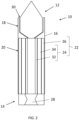
- FIG. 2 depicts an exemplary embodiment of the artillery shell 10 in which the propulsion system 24 includes both the solid rocket motor 32 and the air-breathing jet engine 34.
- the air-breathing jet engine 34 is configured to be an annular air-breathing jet engine 34 and is concentrically arranged around at least a portion of the solid rocket motor 32.
- the air-breathing jet engine 34 may be concentrically arranged around the solid rocket motor 32 along a portion of or the entire axial length of the solid rocket motor 32 in the propulsion section 20, and/or even extending past the entire axial length of the solid rocket motor 32 in the propulsion section 20.
- the annular explosive 26 is concentrically arranged around the propulsion system 24, particularly the air-breathing jet engine 34, in the same way as previously described with respect to the embodiment depicted in FIG. 1 .
- the solid rocket motor 32 may have a thickness in the range of 2.54 mm to 152.4 mm (0.10 inches to 6.00 inches), 5.08 mm to 22.86 mm (0.20 inches to 0.90 inches), 7.62 mm to 20.32 mm (0.30 inches to 0.80 inches), 10.16 mm to 17.78 mm (0.40 inches to 0.70 inches), or 12.70 mm to 15.24 mm (0.50 inches to 0.60 inches).
- the solid rocket motor 32 has a thickness of 12.70 mm (0.50 inches).
- An optimal thickness of the solid rocket motor 32 may depend on factors such as the desired range of the artillery round 10, the minimum temperature at which the round must operate, the gun launch conditions, and the mechanical properties of the rocket propellant.
- the ramjet fuel of the air-breathing jet engine 34 may have a thickness in the range of 0.25 mm to 12.70 mm (0.01 inches to 0.50 inches), 1.27 mm to 10.16 mm (0.05 inches to 0.40 inches), or 2.54 mm to 101.6 mm (0.10 inches to 0.40 inches). In an embodiment, the ramjet fuel of the air-breathing jet engine 34 has a thickness of 4.32 mm (0.17 inches). An optimal thickness of the ramjet fuel of the air-breathing jet engine 34 may depend on factors such as the desired range of the artillery round, the level of thrust that the engine needs to produce to overcome drag and deceleration, the minimum temperature at which the round must operate, the gun launch conditions, and the mechanical properties of the fuel.
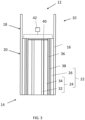
- FIG. 3 depicts a further exemplary embodiment in which additional features are included in the integrated propulsion and warhead system 22 of to any one of the previously described embodiments.
- the integrated propulsion and warhead system 22 may additionally include an annular insulating member 36 concentrically arranged between the propulsion system 24 and the annular explosive 26 for insulating the fuel of the propulsion system 24 and the heat that is produced as it combusts, from the annular explosive 26 so that the annular explosive 26 does not detonate prematurely.
- the annular insulating member 36 may be, for example, EPDM (ethylene propylene diene monomer rubber), DC93-104 or other rocket and ramjet high performance insulator materials.
- the annular insulating member may have a thickness in the range of 2.54 mm to 15.24 mm (0.10 inches to 0.60 inches), 5.08 mm to 12.7 mm (0.20 inches to 0.50 inches), or 7.62 mm to 10.16 mm (0.30 inches to 0.40 inches). In an embodiment, the annular insulating member has a thickness of 3.30 mm (0.13 inches). An optimal thickness of the annular insulating member will depend on factors such as temperature of the propulsion fuel during flight and heat tolerance of the warhead materials. The annular insulating member is designed to be the minimum thickness required to retard heat transfer sufficient for proper operation of the warhead.
- the annular insulating member 36 is configured to be concentrically arranged around the propulsion system 24 along an entire axial length of the propulsion system 24 or even extending past an entire axial length of the propulsion system 24.
- the integrated propulsion and warhead system 22 may additionally include an annular support member 38 concentrically arranged between the propulsion system 24 and the annular explosive 26 for adding additional structural support to the annular explosive 26 and adding an additional structural layer of separation between the propulsion system 24 and the annular explosive 26.
- the annular support member 38 may be aluminum, steel, or other metal or non-metal.
- the annular support member 38 may have a thickness in the range of 1.27 mm to 12.70 mm (0.05 inches to 0.50 inches), 2.54 mm to 10.16 mm (0.10 inches to 0.40 inches), or 5.08 mm to 7.62 mm (0.20 inches to 0.30 inches). In an embodiment, the annular support member 38 has a thickness of 2.54 mm (0.10 inches).
- annular support member 38 may be, for example, concentrically arranged around the annular insulating member 36 and may extend along an entire axial length of the annular insulating member 36 or even extend past an entire axial length of the annular insulating member 36.
- the artillery round 10 may include a fuel isolator 40 disposed between the propulsion section 20 and the guidance section 18 for isolating the components in each chamber from each other.
- the fuel isolator 40 may be, for example, silica phenolic.
- the fuel isolator 40 may have a thickness in the range of 0.25 mm to 12.70 mm (0.01 inches to 0.50 inches), 1.27 mm to 10.16 mm (0.05 inches to 0.40 inches), or 2.54 mm to 7.62 mm (0.10 inches to 0.30 inches). In an embodiment, the fuel isolator 40 has a thickness of 5.08 mm (0.20 inches). An optimal thickness of the fuel isolator will be sized to retard heat loss into the guidance section 18, while withstanding gun launch loads.
- the artillery round 10 may additionally include a safe and arm device 42 in the guidance section 18 operatively coupled to the annular explosive 26 in the propulsion section 20, as depicted by the dotted line FIG. 3 .
- the safe and arm device 42 is configured to control detonation of the annular explosive 26.
- a method 44 is depicted of assembling an integrated propulsion and warhead system (such as the integrated propulsion and warhead system 22 of FIGS. 1-3 ), for an artillery round (such as the artillery round 10 of FIGS. 1-3 ).
- the method 44 includes the step 46 of forming a housing defining a guidance section and a propulsion section (such as the guidance section 18 and the propulsion section 20 in FIGS. 1-3 ).
- the method 44 then includes the step 48 of disposing a propulsion system (such as the propulsion system 24 of FIGS. 1-3 ) within the propulsion section of the housing.
- a step 50 of arranging an annular explosive (such as the annular explosive 26 of FIGS. 1-3 ) concentrically around at least a portion of the propulsion system is then provided.
- the step 48 of disposing and the step 50 of arranging may be performed in any order.
- the step of arranging 50 when performed before the step 48 of disposing, may include arranging the annular explosive within the propulsion section of the housing, and the step 48 of disposing may then include disposing the propulsion system within the annular explosive in the propulsion section such that the propulsion system is arranged concentrically within the annular explosive.
- the method 52 includes the step 54 of discharging the artillery round from an artillery gun at an initial velocity.
- the artillery round includes an integrated propulsion and warhead system (such as the integrated propulsion and warhead system 22 of FIGS. 1-3 ).
- the integrated propulsion and warhead system includes a propulsion system having a solid rocket motor and an annular air-breathing jet engine concentrically arranged around at least a portion of the solid rocket motor (such as the configuration of the propulsion system 24 of FIGS. 2-3 ).
- the integrated propulsion and warhead system also includes an annular explosive concentrically arranged around at least a portion of the propulsion system (such as the annular explosive 26 of FIGS. 1-3 ).
- the method 52 further includes the step 56 of igniting the solid rocket motor to maintain or increase the initial velocity of the artillery round after discharge from the gun and to propel the artillery round until the solid rocket motor is depleted.
- the artillery round When initially discharged from the gun, the artillery round must first travel through thick atmosphere. The solid rocket motor, therefore, is ignited to propel the artillery round through this thick atmosphere. Once the solid rocket motor is depleted, ambient air reaches the air-breathing jet engine to ignite and burn the air-breathing jet engine fuel.
- the method 52 further includes the step 58 of igniting the air-breathing jet engine after depletion of the solid rocket motor to further propel the artillery round until it reaches a predetermined target.
- the artillery round will be in thinner atmosphere, compared to when it was first discharged from the gun. Accordingly, the air-breathing jet engine is ignited to further propel the artillery round through the thinner atmosphere, until it reaches the predetermined target.
- the method 52 then further includes the step 60 of detonating the annular explosive when it reaches the predetermined target.
Landscapes
- Engineering & Computer Science (AREA)
- General Engineering & Computer Science (AREA)
- Chemical & Material Sciences (AREA)
- Combustion & Propulsion (AREA)
- Mechanical Engineering (AREA)
- Physics & Mathematics (AREA)
- Fluid Mechanics (AREA)
- Manufacturing & Machinery (AREA)
- Aviation & Aerospace Engineering (AREA)
- Radar Systems Or Details Thereof (AREA)
Description
- The present invention relates generally to gun-launched projectiles and more particularly to extended-range artillery munitions.
- In the development of extended range artillery munitions, balancing the available space for various guidance and control elements and a conventional cylindrical fragmenting warhead in the guidance section, with the necessary space for an optimal propulsion system in the propulsion section, leads to significant space shortages within the artillery round. The limitations on space shared by the propulsion system, the guidance and control elements, and the warhead make it difficult to use standard space allocations in the artillery round. Prior solutions have included shortening the propulsion section and propulsion system to allocate more space for the cylindrical fragmenting warhead, or otherwise reducing the length of the cylindrical fragmenting warhead in the guidance section to create more space for the guidance and control hardware and electronics. Both of these prior solutions, however, lead to inadequate performance of the propulsion system while limiting warhead size and effectiveness.
- CH 320 359 A discloses a self-propelled projectile in which the self-propelling charge is housed in a thin casing which is itself engaged in an axial longitudinal cavity formed in the payload which is, therefore, located in the annular space provided between the outer body and said casing, a nozzle being provided at the rear of said body for the ejection of the propulsion gases.
-
WO 2010/083517 A1 discloses a guidance and control unit assembly for use with a munitions projectile including a guidance and control unit being roll isolated with respect to the munitions projectile such that roll of the munitions projectile about a projectile longitudinal axis, such roll being imparted to the munitions projectile during the act of launching the munitions projectile, may not be imparted to the guidance and control unit as desired. -
GB 2 165 338 A -
WO 2008/123868 A2 discloses an insensitive combined cycle missile propulsion system including a solid fuel contained within a first section of the missile, and a liquid oxidizer contained within a second section of the missile. A first conduit has a first valve communicating the fuel and the oxidizer and a second conduit, spatially removed from the first conduit, has a second valve communicating the fuel and the oxidizer. An inlet system for delivering atmospheric oxygen for combustion with the fuel rich gases generated within the missile and a nozzle exhausts combustion products that result from combustion of the fuel, the liquid and solid oxidizers, and air. - In a general embodiment, a propulsion system and an explosive are integrated into a propulsion section of an artillery round as an integrated propulsion and warhead system. The integrated propulsion and warhead system includes a propulsion system, such as an air-breathing jet engine, and an explosive configured as an annular explosive concentrically arranged around at least a portion of the propulsion system within the propulsion section. The integration of both the propulsion system and the explosive within the propulsion section frees up space in an adjacent guidance section of the artillery round while permitting maximum space allocation for the propulsion volume in the propulsion section of the artillery round.
- According to a first aspect of the invention, an integrated propulsion and warhead system for an artillery round, the integrated propulsion and warhead system comprising: a propulsion system; and an annular explosive concentrically arranged around at least a portion of the propulsion system, wherein the propulsion system includes an air-breathing jet engine.
- According to another embodiment of any paragraph(s) of this summary, the propulsion system includes a solid rocket motor and an annular, air-breathing jet engine concentrically arranged around at least a portion of the solid rocket motor.
- According to another embodiment of any paragraph(s) of this summary, the air-breathing jet engine includes a ramjet.
- According to another embodiment of any paragraph(s) of this summary, the air-breathing jet engine includes a scramjet.
- According to another embodiment of any paragraph(s) of this summary, the annular explosive includes a high-explosive material.
- According to another embodiment of any paragraph(s) of this summary, the integrated propulsion and warhead system further includes an annular insulating member concentrically arranged between the propulsion system and the annular explosive.
- According to another embodiment of any paragraph(s) of this summary, the integrated propulsion and warhead system further includes an annular support member concentrically arranged between the propulsion system and the annular explosive.
- According to another embodiment of any paragraph(s) of this summary, the annular support member is concentrically arranged around the annular insulating member.
- According to another embodiment of any paragraph(s) of this summary, the integrated propulsion and warhead system further includes a housing concentrically arranged around the annular explosive.
- According to another aspect of the invention, an artillery round comprising: a housing defining a guidance section and a propulsion section, the propulsion section including an integrated propulsion and warhead system according to the first aspect.
- According to an embodiment of any paragraph(s) of this summary, the artillery round includes a nozzle. The guidance section is arranged on a fore end of the propulsion section and the nozzle is arranged on an aft end of the propulsion section.
- According to another embodiment of any paragraph(s) of this summary, the housing further defines at least one air inlet for guiding ambient air into the propulsion section.
- According to another embodiment of any paragraph(s) of this summary, the artillery round further includes a fuel isolator disposed between the propulsion section and the guidance section.
- According to another embodiment of any paragraph(s) of this summary, the artillery round further includes an annular insulating member concentrically arranged between the propulsion system and the annular explosive.
- According to another embodiment of any paragraph(s) of this summary, the artillery round further includes an annular support member concentrically arranged around the annular insulating member.
- According to another embodiment of any paragraph(s) of this summary, the artillery round further includes a safe and arm device operatively coupled to the annular explosive in propulsion section and configured to control detonation of the annular explosive.
- According to another embodiment of any paragraph(s) of this summary, the propulsion system includes a solid rocket motor and an annular, air-breathing jet engine concentrically arranged around the solid rocket motor.
- According to another aspect of the invention, a method of assembling an integrated propulsion and warhead system for an artillery round, the method comprising: forming a housing defining a propulsion section; disposing a propulsion system within the propulsion section, wherein the propulsion system includes an air-breathing jet engine; and arranging an annular explosive concentrically around at least a portion of the propulsion system within the propulsion section.
- The following description and the annexed drawings set forth in detail certain illustrative embodiments of the invention. These embodiments are indicative, however, of but a few of the various ways in which the principles of the invention may be employed. Other objects, advantages, and novel features of the invention will become apparent from the following detailed description of the invention when considered in conjunction with the drawings.
- The annexed drawings show various aspects of the invention.
-
FIG. 1 is a schematic diagram of an artillery round according to an aspect of the invention. -
FIG. 2 is a schematic diagram of another embodiment of the artillery round according to an aspect of the invention. -
FIG. 3 is a schematic diagram of part of another embodiment of the artillery round according to an aspect of the invention. -
FIG. 4 is a flowchart of a method of assembling an artillery round according to an aspect of the invention. -
FIG. 5 is a flowchart of a method of detonating an artillery round according to an aspect of the invention. - According to a general embodiment, an artillery round includes an integrated propulsion and warhead system in a propulsion section of the artillery round. The integrated propulsion and warhead system includes a propulsion system and an annular explosive concentrically arranged around at least a portion of the propulsion system within the propulsion section. The integration of both the propulsion system and the explosive within the propulsion section frees up space in an adjacent guidance section of the artillery round while permitting maximum space allocation for the propulsion system and the annular explosive in the propulsion section of the artillery round.
- Referring now to the figures, and initially to
FIG. 1 , an exemplary embodiment is depicted of anartillery round 10 according to an aspect of the invention. Theartillery round 10 is configured to be projected or launched from artillery such as, for example, guns, howitzers, mortars and cannons (generally referred to herein as "gun"). Theartillery round 10 may be used with other types of artillery, as appropriate. - The
artillery round 10, having afore end 12 and anaft end 14, includes ahousing 16 that defines various chambers and parts of theartillery round 10. For example, thehousing 10 defines aguidance section 18 in which various hardware and electronics for controlling theartillery round 10 may be housed. Specifically, hardware and electronics such as seeker hardware, navigation sensors, inertial sensors, and processor electronics may be housed in theguidance section 18 of theartillery round 10. - The
housing 16 also defines apropulsion section 20 in which an integrated propulsion andwarhead system 22 is housed. Theguidance section 18 may be located on thefore end 12 of thepropulsion section 20. Additionally, anozzle 28 may be arranged on theaft end 14 of thepropulsion section 20. Thenozzle 28 may be any suitable type of nozzle for propelling theartillery shell 10. - The integrated propulsion and
warhead system 22 includes apropulsion system 24, and anannular explosive 26 concentrically arranged around at least a portion of thepropulsion system 24 in thepropulsion section 20. For example, theannular explosive 26 may be concentrically arranged around thepropulsion system 24 along a portion of or an entire axial length of thepropulsion system 24 in thepropulsion section 20, and/or even extending past the entire axial length of thepropulsion system 24 in thepropulsion section 20. As used herein, the term "axial length" refers to a length in the axial (i.e., longitudinal) direction, the axial direction extending between thefore end 12 and theaft end 14 of theartillery round 10. - The
annular explosive 26 may be, for example, a fragmenting and/or explosive material and may be made of, for example, a high-explosive material. The high-explosive material may include, for example, RDX or HMX formulations such as PBXN-109, PBXN-110, PBXN-112, PBXN-9. In an embodiment, the annular explosive 26 may not include a fragmentation sleeve to save on space and weight of theannular explosive 26. In this embodiment, thehousing 16 may be made of a fragmenting material at least in a portion of thehousing 16 that is configured to be concentrically arranged around the annular explosive 26 in thepropulsion section 20. Thehousing 16, therefore, may fragment upon detonation of the annular explosive 26 at a predetermined target. The portion of thehousing 16 that is configured to be concentrically arranged around the annular explosive 26 in thepropulsion section 20 may have a thickness in the range of 1.27 mm to 50.80 mm (0.05 inches to 2.00 inches), 2.54 mm to 25.40 mm (0.10 inches to 1.00 inches), or 5.08 mm to 17.78 mm (0.20 inches to 0.70 inches). In an embodiment, the portion of thehousing 16 that is configured to be concentrically arranged around the annular explosive 26 has a thickness of 7.11 mm (0.28 inches). An optimal thickness of the portion of thehousing 16 that is concentrically arranged around the annular explosive 26 will depend on factors such as setback, balloting, and set forward forces imparted on thehousing 16 during discharge from the gun, the size of the artillery shell, and desired fragmentation of thehousing 16 after detonation of theannular explosive 26. - The annular explosive 26 may have a thickness in the range of 2.54 mm to 38.10 mm (0.10 inches to 1.50 inches), 5.08 mm to 33.02 mm (0.20 inches to 1.30 inches), or 7.62 mm to 25.40 mm (0.30 inches to 1.00 inches). In an embodiment, the annular explosive 26 has a thickness of 9.14 mm (0.36 inches). An optimal thickness of the annular explosive 26 will depend on factors such as critical diameter for detonation, desired fragmentation performance upon detonation, and vulnerability characteristics of the predetermined target to be engaged.
- The
propulsion system 24, concentrically arranged within the annular explosive 26, is primarily responsible for propelling theartillery round 10 after it has been projected or launched from the gun. Thepropulsion system 24 may therefore include a solid rocket motor 32 (FIG. 2 ). Thepropulsion system 24 includes an air-breathing jet engine 34 (FIG. 2 ). The air-breathing jet engine 34 may include one of, for example, a ramjet and a scramjet. Other types of suitable propulsion systems may be applicable to theartillery round 10. Thehousing 16 may be configured to define one ormore air inlets 30, for example at afore end 12 of theartillery round 10 for allowing ambient air to enter theartillery round 10 and reach thepropulsion section 20 for combustion of thepropulsion system 24. - Space allocations within the
artillery round 10 can be optimized by integrating the explosive member of theartillery round 10 as theannular explosive 26. Specifically, the explosive member may be included as part of the integrated propulsion andwarhead system 22 and may be concentrically arranged around thepropulsion system 24 in thepropulsion section 20. In this way, allocating space for the explosive member in theguidance section 18 or elsewhere toward thefore end 12 of theartillery round 10, as conventionally done in the development of extended range artillery munition, is not necessary. This preserves space in theguidance section 18 for allocation to various control hardware and electronics, while permitting a maximum length of thepropulsion section 20 and, in particular, thepropulsion system 24 in thepropulsion section 20. This optimizes the extended range at which thepropulsion system 24 can propel theartillery round 10 after it has been projected or launched from the gun. Additionally, as the annular explosive 26 may extend up to an entire length of thepropulsion section 20, the size and effectiveness of the annular explosive 26 in theartillery round 10 may also be optimized. -
FIG. 2 depicts an exemplary embodiment of theartillery shell 10 in which thepropulsion system 24 includes both thesolid rocket motor 32 and the air-breathing jet engine 34. The air-breathing jet engine 34 is configured to be an annular air-breathing jet engine 34 and is concentrically arranged around at least a portion of thesolid rocket motor 32. For example, the air-breathing jet engine 34 may be concentrically arranged around thesolid rocket motor 32 along a portion of or the entire axial length of thesolid rocket motor 32 in thepropulsion section 20, and/or even extending past the entire axial length of thesolid rocket motor 32 in thepropulsion section 20. In this embodiment, the annular explosive 26 is concentrically arranged around thepropulsion system 24, particularly the air-breathing jet engine 34, in the same way as previously described with respect to the embodiment depicted inFIG. 1 . - The
solid rocket motor 32 may have a thickness in the range of 2.54 mm to 152.4 mm (0.10 inches to 6.00 inches), 5.08 mm to 22.86 mm (0.20 inches to 0.90 inches), 7.62 mm to 20.32 mm (0.30 inches to 0.80 inches), 10.16 mm to 17.78 mm (0.40 inches to 0.70 inches), or 12.70 mm to 15.24 mm (0.50 inches to 0.60 inches). In an embodiment, thesolid rocket motor 32 has a thickness of 12.70 mm (0.50 inches). An optimal thickness of thesolid rocket motor 32 may depend on factors such as the desired range of theartillery round 10, the minimum temperature at which the round must operate, the gun launch conditions, and the mechanical properties of the rocket propellant. - The ramjet fuel of the air-
breathing jet engine 34 may have a thickness in the range of 0.25 mm to 12.70 mm (0.01 inches to 0.50 inches), 1.27 mm to 10.16 mm (0.05 inches to 0.40 inches), or 2.54 mm to 101.6 mm (0.10 inches to 0.40 inches). In an embodiment, the ramjet fuel of the air-breathing jet engine 34 has a thickness of 4.32 mm (0.17 inches). An optimal thickness of the ramjet fuel of the air-breathing jet engine 34 may depend on factors such as the desired range of the artillery round, the level of thrust that the engine needs to produce to overcome drag and deceleration, the minimum temperature at which the round must operate, the gun launch conditions, and the mechanical properties of the fuel. -
FIG. 3 depicts a further exemplary embodiment in which additional features are included in the integrated propulsion andwarhead system 22 of to any one of the previously described embodiments. For example, the integrated propulsion andwarhead system 22 may additionally include an annular insulatingmember 36 concentrically arranged between thepropulsion system 24 and the annular explosive 26 for insulating the fuel of thepropulsion system 24 and the heat that is produced as it combusts, from the annular explosive 26 so that the annular explosive 26 does not detonate prematurely. The annular insulatingmember 36 may be, for example, EPDM (ethylene propylene diene monomer rubber), DC93-104 or other rocket and ramjet high performance insulator materials. The annular insulating member may have a thickness in the range of 2.54 mm to 15.24 mm (0.10 inches to 0.60 inches), 5.08 mm to 12.7 mm (0.20 inches to 0.50 inches), or 7.62 mm to 10.16 mm (0.30 inches to 0.40 inches). In an embodiment, the annular insulating member has a thickness of 3.30 mm (0.13 inches). An optimal thickness of the annular insulating member will depend on factors such as temperature of the propulsion fuel during flight and heat tolerance of the warhead materials. The annular insulating member is designed to be the minimum thickness required to retard heat transfer sufficient for proper operation of the warhead. The annular insulatingmember 36 is configured to be concentrically arranged around thepropulsion system 24 along an entire axial length of thepropulsion system 24 or even extending past an entire axial length of thepropulsion system 24. - The integrated propulsion and
warhead system 22 may additionally include anannular support member 38 concentrically arranged between thepropulsion system 24 and the annular explosive 26 for adding additional structural support to the annular explosive 26 and adding an additional structural layer of separation between thepropulsion system 24 and theannular explosive 26. Theannular support member 38 may be aluminum, steel, or other metal or non-metal. Theannular support member 38 may have a thickness in the range of 1.27 mm to 12.70 mm (0.05 inches to 0.50 inches), 2.54 mm to 10.16 mm (0.10 inches to 0.40 inches), or 5.08 mm to 7.62 mm (0.20 inches to 0.30 inches). In an embodiment, theannular support member 38 has a thickness of 2.54 mm (0.10 inches). An optimal thickness of theannular support member 38 will depend on factors such as forces encountered during gun launch, fragmentation performance considerations, and/or performance trades depending on thicknesses of other concentric components. Theannular support member 38 may be, for example, concentrically arranged around the annular insulatingmember 36 and may extend along an entire axial length of the annular insulatingmember 36 or even extend past an entire axial length of the annular insulatingmember 36. - The
artillery round 10 may include afuel isolator 40 disposed between thepropulsion section 20 and theguidance section 18 for isolating the components in each chamber from each other. Thefuel isolator 40 may be, for example, silica phenolic. Thefuel isolator 40 may have a thickness in the range of 0.25 mm to 12.70 mm (0.01 inches to 0.50 inches), 1.27 mm to 10.16 mm (0.05 inches to 0.40 inches), or 2.54 mm to 7.62 mm (0.10 inches to 0.30 inches). In an embodiment, thefuel isolator 40 has a thickness of 5.08 mm (0.20 inches). An optimal thickness of the fuel isolator will be sized to retard heat loss into theguidance section 18, while withstanding gun launch loads. Theartillery round 10 may additionally include a safe andarm device 42 in theguidance section 18 operatively coupled to the annular explosive 26 in thepropulsion section 20, as depicted by the dotted lineFIG. 3 . The safe andarm device 42 is configured to control detonation of theannular explosive 26. - With reference to
FIG. 4 , amethod 44 is depicted of assembling an integrated propulsion and warhead system (such as the integrated propulsion andwarhead system 22 ofFIGS. 1-3 ), for an artillery round (such as theartillery round 10 ofFIGS. 1-3 ). Themethod 44 includes the step 46 of forming a housing defining a guidance section and a propulsion section (such as theguidance section 18 and thepropulsion section 20 inFIGS. 1-3 ). - The
method 44 then includes the step 48 of disposing a propulsion system (such as thepropulsion system 24 ofFIGS. 1-3 ) within the propulsion section of the housing. Astep 50 of arranging an annular explosive (such as theannular explosive 26 ofFIGS. 1-3 ) concentrically around at least a portion of the propulsion system is then provided. The step 48 of disposing and thestep 50 of arranging may be performed in any order. For example, the step of arranging 50, when performed before the step 48 of disposing, may include arranging the annular explosive within the propulsion section of the housing, and the step 48 of disposing may then include disposing the propulsion system within the annular explosive in the propulsion section such that the propulsion system is arranged concentrically within the annular explosive. - With reference to
FIG. 5 , amethod 52 of detonating an artillery round (such as theartillery round 10 ofFIGS. 1-3 ) is depicted. Themethod 52 includes thestep 54 of discharging the artillery round from an artillery gun at an initial velocity. The artillery round includes an integrated propulsion and warhead system (such as the integrated propulsion andwarhead system 22 ofFIGS. 1-3 ). Specifically, the integrated propulsion and warhead system includes a propulsion system having a solid rocket motor and an annular air-breathing jet engine concentrically arranged around at least a portion of the solid rocket motor (such as the configuration of thepropulsion system 24 ofFIGS. 2-3 ). The integrated propulsion and warhead system also includes an annular explosive concentrically arranged around at least a portion of the propulsion system (such as theannular explosive 26 ofFIGS. 1-3 ). - The
method 52 further includes thestep 56 of igniting the solid rocket motor to maintain or increase the initial velocity of the artillery round after discharge from the gun and to propel the artillery round until the solid rocket motor is depleted. When initially discharged from the gun, the artillery round must first travel through thick atmosphere. The solid rocket motor, therefore, is ignited to propel the artillery round through this thick atmosphere. Once the solid rocket motor is depleted, ambient air reaches the air-breathing jet engine to ignite and burn the air-breathing jet engine fuel. Themethod 52 further includes thestep 58 of igniting the air-breathing jet engine after depletion of the solid rocket motor to further propel the artillery round until it reaches a predetermined target. Typically, by the time the air-breathing jet engine is ignited, the artillery round will be in thinner atmosphere, compared to when it was first discharged from the gun. Accordingly, the air-breathing jet engine is ignited to further propel the artillery round through the thinner atmosphere, until it reaches the predetermined target. Themethod 52 then further includes thestep 60 of detonating the annular explosive when it reaches the predetermined target. - Although the invention has been shown and described with respect to a certain preferred embodiment or embodiments, it is obvious that equivalent alterations and modifications will occur to others skilled in the art upon the reading and understanding of this specification and the annexed drawings. In particular regard to the various functions performed by the above described elements (components, assemblies, devices, compositions, etc.), the terms (including a reference to a "means") used to describe such elements are intended to correspond, unless otherwise indicated, to any element which performs the specified function of the described element (i.e., that is functionally equivalent), even though not structurally equivalent to the disclosed structure which performs the function in the herein illustrated exemplary embodiment or embodiments of the invention. In addition, while a particular feature of the invention may have been described above with respect to only one or more of several illustrated embodiments, such feature may be combined with one or more other features of the other embodiments, as may be desired and advantageous for any given or particular application. The scope of the invention is defined in the appended claims.
Claims (15)
- An integrated propulsion and warhead system (22) for an artillery round (10), the integrated propulsion and warhead system comprising: a propulsion system (24); and an annular explosive (26) concentrically arranged around at least a portion of the propulsion system, wherein the propulsion system includes an air-breathing jet engine (34).
- The integrated propulsion and warhead system according to claim 1, wherein the propulsion system includes: a solid rocket motor (32); and an annular, air-breathing jet engine (34) concentrically arranged around at least a portion of the solid rocket motor.
- The integrated propulsion and warhead system according to any one of claim 1 or claim 2, wherein the air-breathing jet engine includes a ramjet.
- The integrated propulsion and warhead system according to any one of claim 1 or claim 2, wherein the air-breathing jet engine includes a scramjet.
- The integrated propulsion and warhead system according to any one of claim 1 to claim 4, wherein the annular explosive includes a high-explosive material.
- The integrated propulsion and warhead system according to any one of claim 1 to claim 5, further comprising an annular insulating member (36) concentrically arranged between the propulsion system and the annular explosive.
- The integrated propulsion and warhead system according to claim 6, further comprising an annular support member (38) concentrically arranged between the propulsion system and the annular explosive; and
preferably, wherein the annular support member is concentrically arranged around the annular insulating member. - The integrated propulsion and warhead system according to any one of claim 1 to claim 7, further comprising a housing (16) concentrically arranged around the annular explosive.
- An artillery round (10) comprising: a housing (16) defining a guidance section (18) and a propulsion section (20), the propulsion section including an integrated propulsion and warhead system (22) according to claim 1.
- The artillery round according to claim 9, further comprising a nozzle (28), wherein the guidance section is arranged on a fore end of the propulsion section, and the nozzle is arranged on an aft end of the propulsion section.
- The artillery round according to any one of claim 9 and claim 10, wherein the housing further defines at least one air inlet (30) for guiding ambient air into the propulsion section.
- The artillery round according to any one of claim 9 to claim 11, further comprising a fuel isolator (40) disposed between the propulsion section and the guidance section.
- The artillery round according to any one of claim 9 to claim 12, further comprising an annular insulating member (36) concentrically arranged between the propulsion system and the annular explosive; and
preferably, further comprising an annular support member (38) concentrically arranged around the annular insulating member. - The artillery round according to any one of claim 9 to claim 13, further comprising a safe and arm device (42) operatively coupled to the annular explosive in the propulsion section and configured to control detonation of the annular explosive; and/or
wherein the propulsion system includes a solid rocket motor (32) and an annular air-breathing jet engine (34) concentrically arranged around the solid rocket motor. - A method of assembling an integrated propulsion and warhead system (22) for an artillery round (10), the method comprising:forming a housing (16) defining a propulsion section (20);disposing a propulsion system (24) within the propulsion section, wherein the propulsion system includes an air-breathing jet engine (34); andarranging an annular explosive (26) concentrically around at least a portion of the propulsion system within the propulsion section.
Applications Claiming Priority (2)
| Application Number | Priority Date | Filing Date | Title |
|---|---|---|---|
| US17/080,097 US11486682B2 (en) | 2020-10-26 | 2020-10-26 | Integrated propulsion and warhead system for an artillery round |
| PCT/US2021/017417 WO2022093301A1 (en) | 2020-10-26 | 2021-02-10 | Integrated propulsion and warhead system for an artillery round |
Publications (2)
| Publication Number | Publication Date |
|---|---|
| EP4232700A1 EP4232700A1 (en) | 2023-08-30 |
| EP4232700B1 true EP4232700B1 (en) | 2025-06-11 |
Family
ID=77595610
Family Applications (1)
| Application Number | Title | Priority Date | Filing Date |
|---|---|---|---|
| EP21763427.8A Active EP4232700B1 (en) | 2020-10-26 | 2021-02-10 | Integrated propulsion and warhead system for an artillery round |
Country Status (3)
| Country | Link |
|---|---|
| US (1) | US11486682B2 (en) |
| EP (1) | EP4232700B1 (en) |
| WO (1) | WO2022093301A1 (en) |
Families Citing this family (1)
| Publication number | Priority date | Publication date | Assignee | Title |
|---|---|---|---|---|
| GB2638489A (en) * | 2024-02-23 | 2025-08-27 | Mbda Uk Ltd | Missile for a beyond line of sight (BLOS) tar |
Family Cites Families (12)
| Publication number | Priority date | Publication date | Assignee | Title |
|---|---|---|---|---|
| DE147284C (en) * | ||||
| BE534651A (en) | 1954-01-21 | 1900-01-01 | Brandt Soc Nouv Ets | Projectile |
| US4552071A (en) * | 1982-06-15 | 1985-11-12 | United Technologies Corporation | Two-piece despin obturator |
| GB2165338B (en) * | 1984-10-06 | 1988-11-02 | Rolls Royce | Integral rocket and ramjet engine |
| US4729317A (en) * | 1986-12-08 | 1988-03-08 | The United States Of America As Represented By The Secretary Of The Navy | Concentric layer ramjet fuel |
| US5067406A (en) * | 1990-11-05 | 1991-11-26 | The United States Of America As Represented By The Secretary Of The Army | Supersonic, low-drag, solid fuel ramjet tubular projectile |
| US7051659B2 (en) * | 2001-08-13 | 2006-05-30 | Alliant Techsystems Inc. | Projectile structure |
| US8056319B2 (en) * | 2006-11-10 | 2011-11-15 | Aerojet—General Corporation | Combined cycle missile engine system |
| WO2010083517A1 (en) * | 2009-01-16 | 2010-07-22 | Bae Systems Land & Armaments L.P. | Munition and guidance navigation and control unit |
| IL210370A (en) * | 2010-12-30 | 2015-08-31 | Israel Aerospace Ind Ltd | Projectile |
| RU2674407C1 (en) | 2017-10-25 | 2018-12-07 | Федеральное государственное бюджетное учреждение "Главный научно-исследовательский испытательный центр робототехники" Министерства обороны Российской Федерации (ФГБУ "ГНИИЦ РТ" МО РФ) | Direct-flow rocket projectile |
| FR3080912B1 (en) | 2018-05-02 | 2020-04-03 | Nexter Munitions | PROJECTILE POWERED BY STATOREACTOR |
-
2020
- 2020-10-26 US US17/080,097 patent/US11486682B2/en active Active
-
2021
- 2021-02-10 WO PCT/US2021/017417 patent/WO2022093301A1/en not_active Ceased
- 2021-02-10 EP EP21763427.8A patent/EP4232700B1/en active Active
Also Published As
| Publication number | Publication date |
|---|---|
| US20220128341A1 (en) | 2022-04-28 |
| EP4232700A1 (en) | 2023-08-30 |
| WO2022093301A1 (en) | 2022-05-05 |
| US11486682B2 (en) | 2022-11-01 |
Similar Documents
| Publication | Publication Date | Title |
|---|---|---|
| US8931415B2 (en) | Initiation systems for explosive devices, scalable output explosive devices including initiation systems, and related methods | |
| US7947938B2 (en) | Methods and apparatus for projectile guidance | |
| US5886289A (en) | Long range artillery shell | |
| US2724237A (en) | Rocket projectile having discrete flight initiating and sustaining chambers | |
| US8546736B2 (en) | Modular guided projectile | |
| US9823053B1 (en) | Solid-fuel ramjet ammunition | |
| US4712465A (en) | Dual purpose gun barrel for spin stabilized or fin stabilized projectiles and gun launched rockets | |
| EP2203708B1 (en) | Method of varying firing range and effect in target for shell and shell configured for this purpose | |
| US3167016A (en) | Rocket propelled missile | |
| US4213393A (en) | Gun projectile arranged with a base drag reducing system | |
| US3698321A (en) | Rocket assisted projectile | |
| US3491692A (en) | Multi-stage rocket | |
| US4754704A (en) | Propellant charge for the reduction of base eddying | |
| US4964339A (en) | Multiple stage rocket propelled missile system | |
| KR101494393B1 (en) | Dual thrust rocket propulsion machinery | |
| EP4232700B1 (en) | Integrated propulsion and warhead system for an artillery round | |
| KR102269204B1 (en) | Projectile containing ramjet engine | |
| US3903802A (en) | Shell construction sealing washer | |
| US6481198B1 (en) | Multi-stage rocket motor assembly including jettisonable launch motor integrated with flight igniter | |
| US3438303A (en) | System including a tubular launching tube and a rocket provided with an outer auxiliary launching charge | |
| US3540679A (en) | Unified rocket control | |
| KR101609507B1 (en) | Range Extension Form Ramjet Propelled Shell | |
| US3434419A (en) | Rocket assisted projectile with movable piston base plate | |
| US2440305A (en) | Rocket projectile | |
| US11732676B1 (en) | Rocket motor with embedded burnable cutting explosive energetic material |
Legal Events
| Date | Code | Title | Description |
|---|---|---|---|
| STAA | Information on the status of an ep patent application or granted ep patent |
Free format text: STATUS: UNKNOWN |
|
| STAA | Information on the status of an ep patent application or granted ep patent |
Free format text: STATUS: THE INTERNATIONAL PUBLICATION HAS BEEN MADE |
|
| PUAI | Public reference made under article 153(3) epc to a published international application that has entered the european phase |
Free format text: ORIGINAL CODE: 0009012 |
|
| STAA | Information on the status of an ep patent application or granted ep patent |
Free format text: STATUS: REQUEST FOR EXAMINATION WAS MADE |
|
| 17P | Request for examination filed |
Effective date: 20230426 |
|
| AK | Designated contracting states |
Kind code of ref document: A1 Designated state(s): AL AT BE BG CH CY CZ DE DK EE ES FI FR GB GR HR HU IE IS IT LI LT LU LV MC MK MT NL NO PL PT RO RS SE SI SK SM TR |
|
| DAV | Request for validation of the european patent (deleted) | ||
| DAX | Request for extension of the european patent (deleted) | ||
| GRAP | Despatch of communication of intention to grant a patent |
Free format text: ORIGINAL CODE: EPIDOSNIGR1 |
|
| STAA | Information on the status of an ep patent application or granted ep patent |
Free format text: STATUS: GRANT OF PATENT IS INTENDED |
|
| INTG | Intention to grant announced |
Effective date: 20250225 |
|
| GRAS | Grant fee paid |
Free format text: ORIGINAL CODE: EPIDOSNIGR3 |
|
| GRAA | (expected) grant |
Free format text: ORIGINAL CODE: 0009210 |
|
| STAA | Information on the status of an ep patent application or granted ep patent |
Free format text: STATUS: THE PATENT HAS BEEN GRANTED |
|
| AK | Designated contracting states |
Kind code of ref document: B1 Designated state(s): AL AT BE BG CH CY CZ DE DK EE ES FI FR GB GR HR HU IE IS IT LI LT LU LV MC MK MT NL NO PL PT RO RS SE SI SK SM TR |
|
| REG | Reference to a national code |
Ref country code: GB Ref legal event code: FG4D |
|
| REG | Reference to a national code |
Ref country code: CH Ref legal event code: EP |
|
| REG | Reference to a national code |
Ref country code: DE Ref legal event code: R096 Ref document number: 602021032170 Country of ref document: DE |
|
| REG | Reference to a national code |
Ref country code: IE Ref legal event code: FG4D |
|
| PG25 | Lapsed in a contracting state [announced via postgrant information from national office to epo] |
Ref country code: FI Free format text: LAPSE BECAUSE OF FAILURE TO SUBMIT A TRANSLATION OF THE DESCRIPTION OR TO PAY THE FEE WITHIN THE PRESCRIBED TIME-LIMIT Effective date: 20250611 Ref country code: ES Free format text: LAPSE BECAUSE OF FAILURE TO SUBMIT A TRANSLATION OF THE DESCRIPTION OR TO PAY THE FEE WITHIN THE PRESCRIBED TIME-LIMIT Effective date: 20250611 |
|
| REG | Reference to a national code |
Ref country code: LT Ref legal event code: MG9D |
|
| PG25 | Lapsed in a contracting state [announced via postgrant information from national office to epo] |
Ref country code: NO Free format text: LAPSE BECAUSE OF FAILURE TO SUBMIT A TRANSLATION OF THE DESCRIPTION OR TO PAY THE FEE WITHIN THE PRESCRIBED TIME-LIMIT Effective date: 20250911 Ref country code: GR Free format text: LAPSE BECAUSE OF FAILURE TO SUBMIT A TRANSLATION OF THE DESCRIPTION OR TO PAY THE FEE WITHIN THE PRESCRIBED TIME-LIMIT Effective date: 20250912 |
|
| REG | Reference to a national code |
Ref country code: NL Ref legal event code: MP Effective date: 20250611 |
|
| PG25 | Lapsed in a contracting state [announced via postgrant information from national office to epo] |
Ref country code: BG Free format text: LAPSE BECAUSE OF FAILURE TO SUBMIT A TRANSLATION OF THE DESCRIPTION OR TO PAY THE FEE WITHIN THE PRESCRIBED TIME-LIMIT Effective date: 20250611 |
|
| PG25 | Lapsed in a contracting state [announced via postgrant information from national office to epo] |
Ref country code: HR Free format text: LAPSE BECAUSE OF FAILURE TO SUBMIT A TRANSLATION OF THE DESCRIPTION OR TO PAY THE FEE WITHIN THE PRESCRIBED TIME-LIMIT Effective date: 20250611 |
|
| PG25 | Lapsed in a contracting state [announced via postgrant information from national office to epo] |
Ref country code: RS Free format text: LAPSE BECAUSE OF FAILURE TO SUBMIT A TRANSLATION OF THE DESCRIPTION OR TO PAY THE FEE WITHIN THE PRESCRIBED TIME-LIMIT Effective date: 20250911 |
|
| PG25 | Lapsed in a contracting state [announced via postgrant information from national office to epo] |
Ref country code: LV Free format text: LAPSE BECAUSE OF FAILURE TO SUBMIT A TRANSLATION OF THE DESCRIPTION OR TO PAY THE FEE WITHIN THE PRESCRIBED TIME-LIMIT Effective date: 20250611 |
|
| PG25 | Lapsed in a contracting state [announced via postgrant information from national office to epo] |
Ref country code: NL Free format text: LAPSE BECAUSE OF FAILURE TO SUBMIT A TRANSLATION OF THE DESCRIPTION OR TO PAY THE FEE WITHIN THE PRESCRIBED TIME-LIMIT Effective date: 20250611 |
|
| PG25 | Lapsed in a contracting state [announced via postgrant information from national office to epo] |
Ref country code: PT Free format text: LAPSE BECAUSE OF FAILURE TO SUBMIT A TRANSLATION OF THE DESCRIPTION OR TO PAY THE FEE WITHIN THE PRESCRIBED TIME-LIMIT Effective date: 20251013 |
|
| REG | Reference to a national code |
Ref country code: AT Ref legal event code: MK05 Ref document number: 1802440 Country of ref document: AT Kind code of ref document: T Effective date: 20250611 |
|
| PG25 | Lapsed in a contracting state [announced via postgrant information from national office to epo] |
Ref country code: IS Free format text: LAPSE BECAUSE OF FAILURE TO SUBMIT A TRANSLATION OF THE DESCRIPTION OR TO PAY THE FEE WITHIN THE PRESCRIBED TIME-LIMIT Effective date: 20251011 |
|
| PG25 | Lapsed in a contracting state [announced via postgrant information from national office to epo] |
Ref country code: AT Free format text: LAPSE BECAUSE OF FAILURE TO SUBMIT A TRANSLATION OF THE DESCRIPTION OR TO PAY THE FEE WITHIN THE PRESCRIBED TIME-LIMIT Effective date: 20250611 Ref country code: SM Free format text: LAPSE BECAUSE OF FAILURE TO SUBMIT A TRANSLATION OF THE DESCRIPTION OR TO PAY THE FEE WITHIN THE PRESCRIBED TIME-LIMIT Effective date: 20250611 |
|
| PG25 | Lapsed in a contracting state [announced via postgrant information from national office to epo] |
Ref country code: CZ Free format text: LAPSE BECAUSE OF FAILURE TO SUBMIT A TRANSLATION OF THE DESCRIPTION OR TO PAY THE FEE WITHIN THE PRESCRIBED TIME-LIMIT Effective date: 20250611 |
|
| PG25 | Lapsed in a contracting state [announced via postgrant information from national office to epo] |
Ref country code: PL Free format text: LAPSE BECAUSE OF FAILURE TO SUBMIT A TRANSLATION OF THE DESCRIPTION OR TO PAY THE FEE WITHIN THE PRESCRIBED TIME-LIMIT Effective date: 20250611 |
|
| PG25 | Lapsed in a contracting state [announced via postgrant information from national office to epo] |
Ref country code: EE Free format text: LAPSE BECAUSE OF FAILURE TO SUBMIT A TRANSLATION OF THE DESCRIPTION OR TO PAY THE FEE WITHIN THE PRESCRIBED TIME-LIMIT Effective date: 20250611 |
|
| PG25 | Lapsed in a contracting state [announced via postgrant information from national office to epo] |
Ref country code: SK Free format text: LAPSE BECAUSE OF FAILURE TO SUBMIT A TRANSLATION OF THE DESCRIPTION OR TO PAY THE FEE WITHIN THE PRESCRIBED TIME-LIMIT Effective date: 20250611 |
|
| REG | Reference to a national code |
Ref country code: DE Ref legal event code: R097 Ref document number: 602021032170 Country of ref document: DE |
|
| PGFP | Annual fee paid to national office [announced via postgrant information from national office to epo] |
Ref country code: GB Payment date: 20260122 Year of fee payment: 6 |
|
| PG25 | Lapsed in a contracting state [announced via postgrant information from national office to epo] |
Ref country code: DK Free format text: LAPSE BECAUSE OF FAILURE TO SUBMIT A TRANSLATION OF THE DESCRIPTION OR TO PAY THE FEE WITHIN THE PRESCRIBED TIME-LIMIT Effective date: 20250611 |
|
| PGFP | Annual fee paid to national office [announced via postgrant information from national office to epo] |
Ref country code: DE Payment date: 20260121 Year of fee payment: 6 |
|
| PG25 | Lapsed in a contracting state [announced via postgrant information from national office to epo] |
Ref country code: IT Free format text: LAPSE BECAUSE OF FAILURE TO SUBMIT A TRANSLATION OF THE DESCRIPTION OR TO PAY THE FEE WITHIN THE PRESCRIBED TIME-LIMIT Effective date: 20250611 |
|
| PLBE | No opposition filed within time limit |
Free format text: ORIGINAL CODE: 0009261 |
|
| STAA | Information on the status of an ep patent application or granted ep patent |
Free format text: STATUS: NO OPPOSITION FILED WITHIN TIME LIMIT |
|
| PGFP | Annual fee paid to national office [announced via postgrant information from national office to epo] |
Ref country code: FR Payment date: 20260121 Year of fee payment: 6 |
|
| REG | Reference to a national code |
Ref country code: CH Ref legal event code: L10 Free format text: ST27 STATUS EVENT CODE: U-0-0-L10-L00 (AS PROVIDED BY THE NATIONAL OFFICE) Effective date: 20260423 |