EP4231555A1 - Pdcch monitoring method and apparatus, storage medium, terminal, and base station - Google Patents
Pdcch monitoring method and apparatus, storage medium, terminal, and base station Download PDFInfo
- Publication number
- EP4231555A1 EP4231555A1 EP21879478.2A EP21879478A EP4231555A1 EP 4231555 A1 EP4231555 A1 EP 4231555A1 EP 21879478 A EP21879478 A EP 21879478A EP 4231555 A1 EP4231555 A1 EP 4231555A1
- Authority
- EP
- European Patent Office
- Prior art keywords
- pdcch
- cells
- slot
- slots
- monitoring
- Prior art date
- Legal status (The legal status is an assumption and is not a legal conclusion. Google has not performed a legal analysis and makes no representation as to the accuracy of the status listed.)
- Pending
Links
Images

Classifications
-
- H—ELECTRICITY
- H04—ELECTRIC COMMUNICATION TECHNIQUE
- H04W—WIRELESS COMMUNICATION NETWORKS
- H04W72/00—Local resource management
- H04W72/20—Control channels or signalling for resource management
- H04W72/23—Control channels or signalling for resource management in the downlink direction of a wireless link, i.e. towards a terminal
-
- H—ELECTRICITY
- H04—ELECTRIC COMMUNICATION TECHNIQUE
- H04L—TRANSMISSION OF DIGITAL INFORMATION, e.g. TELEGRAPHIC COMMUNICATION
- H04L1/00—Arrangements for detecting or preventing errors in the information received
- H04L1/0001—Systems modifying transmission characteristics according to link quality, e.g. power backoff
- H04L1/0036—Systems modifying transmission characteristics according to link quality, e.g. power backoff arrangements specific to the receiver
- H04L1/0038—Blind format detection
-
- H—ELECTRICITY
- H04—ELECTRIC COMMUNICATION TECHNIQUE
- H04L—TRANSMISSION OF DIGITAL INFORMATION, e.g. TELEGRAPHIC COMMUNICATION
- H04L25/00—Baseband systems
- H04L25/02—Details ; arrangements for supplying electrical power along data transmission lines
- H04L25/0202—Channel estimation
-
- H—ELECTRICITY
- H04—ELECTRIC COMMUNICATION TECHNIQUE
- H04L—TRANSMISSION OF DIGITAL INFORMATION, e.g. TELEGRAPHIC COMMUNICATION
- H04L5/00—Arrangements affording multiple use of the transmission path
- H04L5/003—Arrangements for allocating sub-channels of the transmission path
- H04L5/0053—Allocation of signalling, i.e. of overhead other than pilot signals
-
- H—ELECTRICITY
- H04—ELECTRIC COMMUNICATION TECHNIQUE
- H04L—TRANSMISSION OF DIGITAL INFORMATION, e.g. TELEGRAPHIC COMMUNICATION
- H04L5/00—Arrangements affording multiple use of the transmission path
- H04L5/0091—Signalling for the administration of the divided path, e.g. signalling of configuration information
- H04L5/0094—Indication of how sub-channels of the path are allocated
-
- H—ELECTRICITY
- H04—ELECTRIC COMMUNICATION TECHNIQUE
- H04W—WIRELESS COMMUNICATION NETWORKS
- H04W72/00—Local resource management
- H04W72/04—Wireless resource allocation
- H04W72/044—Wireless resource allocation based on the type of the allocated resource
- H04W72/0446—Resources in time domain, e.g. slots or frames
-
- H—ELECTRICITY
- H04—ELECTRIC COMMUNICATION TECHNIQUE
- H04L—TRANSMISSION OF DIGITAL INFORMATION, e.g. TELEGRAPHIC COMMUNICATION
- H04L5/00—Arrangements affording multiple use of the transmission path
- H04L5/0091—Signalling for the administration of the divided path, e.g. signalling of configuration information
- H04L5/0092—Indication of how the channel is divided
-
- H—ELECTRICITY
- H04—ELECTRIC COMMUNICATION TECHNIQUE
- H04W—WIRELESS COMMUNICATION NETWORKS
- H04W8/00—Network data management
- H04W8/22—Processing or transfer of terminal data, e.g. status or physical capabilities
- H04W8/24—Transfer of terminal data
Definitions
- the present disclosure generally relates to communication technology field, and more particularly, to a Physical Downlink Control Channel (PDCCH) monitoring method and apparatus, a storage medium, a terminal, and a base station.
- PDCCH Physical Downlink Control Channel
- a limit on PDCCH blind detection and a limit on non-overlapped Control Channel Elements are defined.
- a configured number of PDCCH blind detections or configured non-overlapped CCEs exceed the limit, it is called overbooking.
- UE User Equipment
- a slot-level PDCCH blind detection limit and non-overlapped CCE limit are adopted. That is, a base station (gNB) and a terminal (e.g., a LTE) determine whether the limits are met in a slot, and if not, a search space set with a highest index in the slot is dropped.
- gNB base station
- terminal e.g., a LTE
- the LTE is expected to monitor corresponding PDCCH candidates per span, and accordingly a blind detection limit and a non-overlapped CCE limit within span are introduced. That is, the base station (gNB) and the UE determine whether the above limits are met within a span, and if not, all or part of a search space set with a highest index in the span is dropped.
- gNB base station
- Embodiments of the present disclosure provide a PDCCH monitoring method and apparatus, a storage medium, a terminal, and a base station, which are capable of determining a number of slots in a slot group containing multiple slots, and a starting position for PDCCH monitoring in the slot group, so as to meet a requirement of using higher subcarrier space to monitor PDCCHs.
- a PDCCH monitoring method including: reporting UE capability information, wherein the UE capability information includes numbers of slots included in slot groups supported by a UE, and PDCCH subcarrier space of the slot groups with the numbers of slots; receiving slot number indication information, and determining a target number of slots based on the slot number indication information; and determining a starting position for PDCCH monitoring in the slot group with the target number of slots.
- said receiving slot number indication information, and determining a target number of slots based on the slot number indication information includes: receiving configuration information of one or more search spaces, wherein the configuration information includes a monitoring period of each of the one or more search spaces; and determining the target number of slots in the slot group based on a number of slots in a smallest monitoring period of the one or more search spaces.
- the configuration information further includes an index of each of the one or more search spaces, and offset information of a monitoring moment of each of the one or more search spaces within a current monitoring period; said determining a starting position for PDCCH monitoring in the slot group with the target number of slots includes: determining a search space with a smallest monitoring period and a smallest index, and determining the starting position for PDCCH monitoring in the slot group based on the offset information of the monitoring moment of the search space within the current monitoring period.
- said receiving slot number indication information, and determining a target number of slots based on the slot number indication information includes: receiving the target number of slots in the slot group directly.
- said determining a starting position for PDCCH monitoring in the slot group with the target number of slots includes: determining the starting position for PDCCH monitoring in the slot group based on a first slot used for PDCCH monitoring.
- the UE supports carrier aggregation of a plurality of downlink cells, and a number of configured carriers is greater than capability of the UE, and the method further includes: determining numbers of slots in corresponding slot groups of the plurality of downlink cells, and determining PDCCH subcarrier space of the corresponding slot groups of the plurality of downlink cells; based on that the numbers of slots in corresponding slot groups of the plurality of downlink cells are consistent, the PDCCH subcarrier space of the corresponding slot groups of the plurality of downlink cells is consistent, and starting positions of the corresponding slot groups of the plurality of downlink cells are aligned, determining an upper limit of a number of PDCCH blind detection and an upper limit of a number of PDCCH non-overlapped CCEs for the plurality of downlink cells of carrier aggregation based on the number of slots and the PDCCH subcarrier space of the slot groups of the plurality of downlink cells; and based on that the numbers of slots in corresponding slot groups of the plurality of down
- the method further includes: receiving a number of downlink cells for PDCCH monitoring; and in response to the received number exceeding reporting capability of the LTE, reporting the LTE capability information based on a scaled number of the downlink cells.
- the scaled number of the downlink cells is received from a base station, or is determined by the UE based on the reporting capability of the UE.
- the UE capability information includes a number of carriers based on slot, a number of carriers based on slot group, and a number of carriers based on span.
- a PDCCH monitoring method including: receiving UE capability information, wherein the UE capability information includes numbers of slots included in slot groups supported by a UE, and PDCCH subcarrier space of the slot groups with the numbers of slots; and configuring and transmitting slot number indication information, to make the UE determine a target number of slots based on the slot number indication information and determine a starting position for PDCCH monitoring in the slot group with the target number of slots.
- said configuring and transmitting the slot number indication information includes: configuring and transmitting configuration information of one or more search spaces, wherein the configuration information includes a monitoring period of each of the one or more search spaces, to make the UE determine the target number of slots in the slot group based on a number of slots in a smallest monitoring period of the one or more search spaces.
- the configuration information further includes an index of each of the one or more search spaces, and offset information of a monitoring moment of each of the one or more search spaces within a current monitoring period, to make the UE determine a search space with a smallest monitoring period and a smallest index and determine the starting position for PDCCH monitoring in the slot group based on the offset information of the monitoring moment of the search space within the current monitoring period.
- said configuring and transmitting the slot number indication information includes: transmitting the target number of slots in the slot group directly, to make the UE determine the target number of slots in the slot group directly and determine the starting position for PDCCH monitoring in the slot group based on a first slot used for PDCCH monitoring.
- the method further includes: transmitting a number of downlink cells for PDCCH monitoring, to make the UE report the LTE capability information based on a scaled number of the downlink cells in response to the transmitted number exceeding reporting capability of the UE.
- the scaled number of the downlink cells is transmitted by a base station, or is determined by the UE based on the reporting capability of the UE.
- the UE capability information includes a number of carriers based on slot, a number of carriers based on slot group, and a number of carriers based on span.
- a PDCCH monitoring apparatus including: a reporting circuitry configured to report LTE capability information, wherein the UE capability information includes numbers of slots included in slot groups supported by a UE, and PDCCH subcarrier space of the slot groups with the numbers of slots; an indication information receiving circuitry configured to receive slot number indication information, and determine a target number of slots based on the slot number indication information; and a determining circuitry configured to determine a starting position for PDCCH monitoring in the slot group with the target number of slots.
- a PDCCH monitoring apparatus including: a capability information receiving circuitry configured to receive UE capability information, wherein the UE capability information includes numbers of slots included in slot groups supported by a UE, and PDCCH subcarrier space of the slot groups with the numbers of slots; and a transmitting circuitry configured to configure and transmit slot number indication information, to make the LTE determine a target number of slots based on the slot number indication information and determine a starting position for PDCCH monitoring in the slot group with the target number of slots.
- a storage medium having computer instructions stored therein wherein when the computer instructions are executed by a processor, any of the above methods is performed.
- a terminal including the above apparatus or including a memory and a processor is provided, wherein the memory has computer instructions stored therein, and when the processor executes the computer instructions, the above method is performed.
- a base station including the above apparatus or including a memory and a processor
- the memory has computer instructions stored therein, and when the processor executes the computer instructions, the above method is performed.
- Embodiments of the present disclosure may provide following advantages.
- the base station can configure the slot number indication information based on the LTE capability information, so that the LTE can determine, based on the slot number indication information, a PDCCH scheduling and monitoring rule in multiple slots, a target number of slots in a slot group containing multiple slots, and a starting position for PDCCH monitoring in the slot group, so as to meet a requirement of using higher subcarrier space to monitor PDCCHs.
- the UE can take the number of slots in the smallest monitoring period of the search spaces as the target number of slots in the slot group, so as to realize the determination of the target number of slots included in the slot group, thereby meeting the requirement of using higher subcarrier space to monitor a PDCCH.
- the configuration information further includes the index of each search space and the offset information of the monitoring moment of each search space within the current monitoring period, which makes the UE determine the search space with the smallest monitoring period and the smallest index and use the offset information of the monitoring moment of the search space in the current monitoring period as the starting position of the slot group, thereby realizing the determination of the starting position for PDCCH monitoring in the slot group, which further meets the requirement of using higher subcarrier space to monitor the PDCCH.
- the UE directly receives the target number of slots in the slot group from the base station, which enables more direct determination of the target number of slots contained in the slot group by the LTE, thereby meeting the requirement of using higher subcarrier space to monitor the PDCCH.
- the UE determines the first slot used for PDCCH monitoring as the starting position of the slot group, which enables more direct determination of the starting position for PDCCH monitoring in the slot group by the UE, thereby further meeting the requirement of using higher subcarrier space to monitor the PDCCH.
- the PDCCH subcarrier space of the corresponding slot groups of the plurality of downlink cells is consistent, and starting positions of the corresponding slot groups of the plurality of downlink cells are aligned, the upper limit of the number of PDCCH blind detections and the upper limit of the number of PDCCH non-overlapped CCEs for the plurality of downlink cells of carrier aggregation are determined based on the number of slots and the PDCCH subcarrier space of the slot groups of the plurality of downlink cells.
- the PDCCH subcarrier space of the corresponding slot groups of the plurality of downlink cells is consistent, and the starting positions of the corresponding slot groups of the plurality of downlink cells are not aligned, the upper limit of the number of PDCCH blind detection and the upper limit of the number of PDCCH non-overlapped CCEs for the plurality of downlink cells of carrier aggregation are determined based on the number of slots and the PDCCH subcarrier space of the slot group of any one of the plurality of downlink cells. Therefore, a more appropriate number of slots in the slot group and PDCCH subcarrier space may be adopted.
- the UE receives the number of downlink cells for PDCCH monitoring, and in response to the received number exceeding reporting capability of the UE, the UE reports the UE capability information based on a scaled number of the downlink cells, which is beneficial to improve a success rate of reporting.
- a slot-level PDCCH blind detection limit and non-overlapped CCE limit are adopted. That is, a base station (gNB) and a terminal (e.g., a UE) determine whether the limits are met in a slot, and if not, a search space set with a highest index in the slot is dropped.
- gNB base station
- a terminal e.g., a UE
- Table 1 shows a correspondence between a maximum number M P DCCH max , slot , ⁇ of PDCCH candidates monitored in a slot in a serving cell and a subcarrier space ⁇ , wherein ⁇ ⁇ ⁇ 0, 1, 2, 3 ⁇ .
- Table 1 ⁇ The maximum number M P DCCH max , slot , ⁇ of PDCCH candidates monitored in a slot in a serving cell 0 44 1 36 2 22 3 20
- Table 2 shows a correspondence between a maximum number C PDCCH max , slot , ⁇ of non-overlapped CCEs monitored in a slot in a serving cell and a subcarrier space ⁇ .
- Non-overlapped CCEs indicate belonging to different control resource sets, or starting OFDM symbols of PDCCH candidates being different.
- Table 2 ⁇ The maximum number C PDCCH max , slot , ⁇ of non-overlapped CCEs monitored in a slot in a serving cell 0 56 1 56 2 48 3 32
- high-layer signaling indicates that the number N cells cap of downlink cells monitored by the UE is greater than or equal to 4.
- the UE is configured with N cells DL , ⁇ downlink scheduling cells.
- the UE expects to monitor a maximum of M PDCCH max , slot , ⁇ PDCCH candidates (including candidates with different DCI sizes and different DMRS scrambling code sequences) per slot per cell, and a maximum of C P DCCH max , slot , ⁇ non-overlapped CCEs per slot per cell.
- PDCCH capability reported by the UE is 4, that is, PDCCH blind detection and non-overlapped CCE detection capability of a maximum of 4 carriers are supported.
- the UE is configured with 5 cells, which is greater than the capability reported by the LTE, calculation needs to be made according to the above formula.
- Pcell and scell1 where PDCCH can be transmitted, where Pcell has a 15kHz Subcarrier Space (SCS) which can schedule scell2 and scell4 within a local cell or across cells, and scell1 has a 30kHz SCS which can schedule scell5 within a local cell or across cells.
- SCS Subcarrier Space
- limits on PDCCH blind detection and non-overlapped CCEs in each slot are calculated according to SCS of scheduling cells.
- the PDCCH blind detection limit per slot is (4 ⁇ 44 ⁇ 3/5)
- the non-overlapped CCE limit is (4 ⁇ 56 ⁇ 3/5)
- the PDCCH blind detection limit per slot is (4 ⁇ 36 ⁇ 2/5)
- the non-overlapped CCE limit is (4 ⁇ 56 ⁇ 2/5).
- the LTE is expected to monitor corresponding PDCCH candidates per span, and accordingly a blind detection limit and a non-overlapped CCE limit within span are introduced. That is, the gNB and the UE determine whether the above limits are met within a span, and if not, all or part of a search space set with a highest index in the span is dropped.
- span-level PDCCH blind detection limit and non-overlapped CCE limit are as follows.
- Table 3 is a maximum number M P DCCH max , X Y , ⁇ of monitored PDCCH candidates per span pattern (X, Y) and per serving cell selected based on span-level PDCCH monitoring, that is, the PDCCH candidate limit M P DCCH max , X Y , ⁇ per span for the PDCCH span pattern (X, Y) in the serving cell with PDCCH subcarrier space ⁇ .
- Table 3 The maximum number M P DCCH max , X Y , ⁇ of monitored PDCCH candidates per span pattern (X, Y) and per serving cell selected based on span-level PDCCH monitoring ⁇ (2, 2) (4, 3) (7, 3) 0 14 28 44 1 12 24 36
- Table 4 is a maximum number C P DCCH max , X Y , ⁇ of non-overlapped CCEs per span pattern (X,Y) and per serving cell selected based on span-level PDCCH monitoring, that is, the PDCCH non-overlapped CCE limit C P DCCH max , X Y , ⁇ per span for the PDCCH span pattern (X, Y) in the serving cell with PDCCH subcarrier space ⁇ .
- Table 4 The maximum number C P DCCH max , X Y , ⁇ of non-overlapped CCEs per span pattern (X, Y) and per serving cell selected based on span-level PDCCH monitoring ⁇ (2, 2) (4, 3) (7, 3) 0 18 36 56 1 18 36 56
- a span is a group of consecutive symbols of a PDCCH the UE monitors in a slot. Each PDCCH monitoring is merely in one span. If the UE selects a pattern (X, Y) to monitor the PDCCH with span-level PDCCH monitoring, a span between first symbols of two consecutive spans of the PDCCH monitoring is greater than or equal to X, including a case of crossing slots. One span starts at a starting position for PDCCH monitoring and ends at an ending position for PDCCH monitoring, where the span has at most Y symbols.
- Inventors of the present disclosure have found through research that in higher frequency bands, due to usage of higher subcarrier space, a number of PDCCHs and CCEs that the UE can monitor in one slot is very small, and even reliable PDCCH transmission cannot be guaranteed, such as blind detection capability of less than 16 CCEs.
- There is an urgent need for a PDCCH monitoring method that is capable of determining a PDCCH scheduling and monitoring rule in multiple slots, a number of slots in a slot group containing multiple slots, and a starting position for PDCCH monitoring in the slot group, so as to meet a requirement of using higher subcarrier space to monitor PDCCHs.
- the base station can configure the slot number indication information based on the UE capability information, so that the LTE can determine, based on the slot number indication information, a PDCCH scheduling and monitoring rule in multiple slots, a target number of slots in a slot group containing multiple slots, and a starting position for PDCCH monitoring in the slot group, so as to meet a requirement of using higher subcarrier space to monitor PDCCHs.
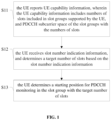
- FIG. 1 is a flow chart of a PDCCH monitoring method according to an embodiment.
- the method may be applied to a terminal such as a UE, and includes S 11 to S 13 .
- the UE reports UE capability information, wherein the UE capability information includes numbers of slots included in slot groups supported by the UE, and PDCCH subcarrier space of the slot groups with the numbers of slots.
- the UE receives slot number indication information, and determines a target number of slots based on the slot number indication information.
- the UE determines a starting position for PDCCH monitoring in the slot group with the target number of slots.
- multi-slot granularity Ms can be defined under each SCS, and a maximum number of blind detections and a number of non-overlapped CCEs the UE expects to monitor under each multi-slot granularity is given, thereby several tables can be determined.
- the granularity Ms may indicate numbers of slots in the slot groups, and each slot group includes one or more slots.
- Table 5 shows a limit M P DCCH max , Ms , ⁇ on PDCCH candidates based on multi-slot Ms in a serving cell with SCS of ⁇ .
- Table 6 shows a limit C P DCCH max , Ms , ⁇ on PDCCH non-overlapped CCEs based on multi-slot Ms in a serving cell with SCS of ⁇ .
- M P DCCH max , Ms , ⁇ is determined to be 26 according to Table 5
- C P DCCH max , Ms , ⁇ is determined to be 32 according to Table 6.
- the LTE may receive the slot number indication information from the base station, and determine the target number of slots based on the slot number indication information.
- the UE may receive the slot number indication information from the base station through Radio Resource Control (RRC) signaling, so that the base station may continue to use existing signaling to configure information for the UE.
- RRC Radio Resource Control
- the slot number indication information may include configuration information of search spaces, and S12 and S 13 are performed according to the configuration information of the search spaces.
- said receiving slot number indication information, and determining a target number of slots based on the slot number indication information includes: receiving configuration information of one or more search spaces, wherein the configuration information includes a monitoring period of each of the one or more search spaces; and determining the target number of slots in the slot group based on a number of slots in a smallest monitoring period of the one or more search spaces.
- the monitoring periods of one or more search spaces are received, and the smallest one among the monitoring periods is determined as the target number of slots in the slot group.
- the configuration information further includes an index of each of the one or more search spaces, and offset information of a monitoring moment of each of the one or more search spaces within a current monitoring period.
- S 13 in FIG. 1 includes: determining a search space with a smallest monitoring period and a smallest index, and determining the starting position for PDCCH monitoring in the slot group based on the offset information of the monitoring moment of the search space within the current monitoring period.
- the starting position for PDCCH monitoring in the slot group may depend on the offset within the monitoring period of the search space with the smallest PDCCH monitoring period and the smallest configuration index.
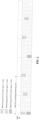
- FIG. 2 is a diagram of an operation scene of determining a starting position of a slot group according to an embodiment.
- the minimum monitoring period of 2 slots serves as a target number of slots in the slot group.
- an offset of a monitoring moment of the search space is 0 within 2 slots, thus, the starting position of the slot group is also 0.
- a conventional PDCCH monitoring method may be used for monitoring, which is not limited in the embodiments of the present disclosure.
- the UE by receiving from the base station the configuration information of one or more search spaces which includes the monitoring period of each search space, the UE can take the number of slots in the smallest monitoring period of the search spaces as the target number of slots in the slot group, so as to realize the determination of the target number of slots included in the slot group, thereby meeting the requirement of using higher subcarrier space to monitor a PDCCH.
- the configuration information further includes the index of each search space and the offset information of the monitoring moment of each search space within the current monitoring period, which makes the UE determine the search space with the smallest monitoring period and the smallest index and use the offset information of the monitoring moment of the search space in the current monitoring period as the starting position of the slot group, thereby realizing the determination of the starting position for PDCCH monitoring in the slot group, which further meets the requirement of using higher subcarrier space to monitor the PDCCH.
- the slot number indication information may include the target number of slots, and S12 and S 13 are performed according to the number of slots.
- said receiving slot number indication information, and determining a target number of slots based on the slot number indication information includes: receiving the target number of slots in the slot group directly.
- the LTE may determine (Ms, ⁇ ) based on the target number of slots in the slot group additionally configured by the base station.
- the target number of slots in the slot group additionally configured by the base station may be transmitted through RRC signaling, so that the base station can continue to use existing signaling to notify the LTE of the target number of slots in the slot group.
- S 13 in FIG. 1 may include: determining the starting position for PDCCH monitoring in the slot group based on a first slot used for PDCCH monitoring.
- the UE directly receives the target number of slots in the slot group from the base station, which enables more direct determination of the target number of slots contained in the slot group by the UE, thereby meeting the requirement of using higher subcarrier space to monitor the PDCCH.
- the UE determines the first slot used for PDCCH monitoring as the starting position of the slot group, which enables more direct determination of the starting position for PDCCH monitoring in the slot group by the UE, thereby further meeting the requirement of using higher subcarrier space to monitor the PDCCH.
- the base station can configure the slot number indication information based on the LTE capability information, so that the LTE can determine, based on the slot number indication information, a PDCCH scheduling and monitoring rule in multiple slots, a target number of slots in a slot group containing multiple slots, and a starting position for PDCCH monitoring in the slot group, so as to meet a requirement of using higher subcarrier space to monitor PDCCHs.
- the terminal can support carrier aggregation of a plurality of downlink cells, and a number of configured carriers is greater than capability of the UE.
- the plurality of downlink cells of carrier aggregation may have a consistent number Ms of slots of the slot group, a consistent PDCCH subcarrier space ⁇ , and aligned starting positions of the slot group.
- the plurality of downlink cells of carrier aggregation may have a consistent number Ms of slots of the slot group, a consistent PDCCH subcarrier space ⁇ , and unaligned starting positions of the slot group.
- the PDCCH monitoring method may determine M P DCCH max , Ms , ⁇ and C P DCCH max , M s , ⁇ in different ways according to the above situations respectively.
- the determination method may be set to be the same as a non-carrier aggregation procedure.
- pre-set data may be used for determination as shown in Table 5 and Table 6.
- the method further includes: determining numbers of slots in corresponding slot groups of the plurality of downlink cells of carrier aggregation, and determining PDCCH subcarrier space of the corresponding slot groups of the plurality of downlink cells; based on that the numbers of slots in corresponding slot groups of the plurality of downlink cells are consistent, the PDCCH subcarrier space of the corresponding slot groups of the plurality of downlink cells is consistent, and starting positions of the corresponding slot groups of the plurality of downlink cells are aligned, determining an upper limit of a number of PDCCH blind detection and an upper limit of a number of PDCCH non-overlapped CCEs for the plurality of downlink cells of carrier aggregation based on the number of slots and the PDCCH subcarrier space of the slot groups of the plurality of downlink cells; and based on that the numbers of slots in corresponding slot groups of the plurality of downlink cells are consistent, the PDCCH subcarrier space of the corresponding slot groups of the plurality of downlink cells
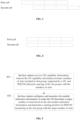
- FIG. 3 is a diagram of an operation scene of determining an upper limit of a number of PDCCH blind detections and an upper limit of a number of PDCCH non-overlapped CCEs for a plurality of downlink cells of carrier aggregation according to an embodiment.
- the numbers Ms of slots in corresponding slot groups of the plurality of downlink cells are consistent, the PDCCH subcarrier space of the corresponding slot groups of the plurality of downlink cells is consistent, and starting positions for PDCCH monitoring of the plurality of downlink cells are consistent.
- the PDCCH subcarrier space of the corresponding slot groups of the plurality of downlink cells is consistent, and starting positions for PDCCH monitoring of the plurality of downlink cells are aligned
- FIG. 4 is a diagram of an operation scene of determining an upper limit of a number of PDCCH blind detections and an upper limit of a number of PDCCH non-overlapped CCEs for a plurality of downlink cells of carrier aggregation according to another embodiment.
- the numbers Ms of slots in corresponding slot groups of the plurality of downlink cells are consistent, the PDCCH subcarrier space of the corresponding slot groups of the plurality of downlink cells is consistent, and starting positions for PDCCH monitoring of the plurality of downlink cells are not aligned.
- the PDCCH subcarrier space of the corresponding slot groups of the plurality of downlink cells is consistent, and starting positions for PDCCH monitoring of the plurality of downlink cells are not aligned
- the PDCCH subcarrier space of the corresponding slot groups of the plurality of downlink cells is consistent, and starting positions of the corresponding slot groups of the plurality of downlink cells are aligned, the upper limit of the number of PDCCH blind detections and the upper limit of the number of PDCCH non-overlapped CCEs for the plurality of downlink cells of carrier aggregation are determined based on the number of slots and the PDCCH subcarrier space of the slot groups of the plurality of downlink cells.
- the PDCCH subcarrier space of the corresponding slot groups of the plurality of downlink cells is consistent, and the starting positions of the corresponding slot groups of the plurality of downlink cells are not aligned, the upper limit of the number of PDCCH blind detection and the upper limit of the number of PDCCH non-overlapped CCEs for the plurality of downlink cells of carrier aggregation are determined based on the number of slots and the PDCCH subcarrier space of the slot group of any one of the plurality of downlink cells. Therefore, a more appropriate number of slots in the slot group and PDCCH subcarrier space may be adopted.
- the UE reports multi-slot PDCCH monitoring capability per band, under a carrier aggregation case, if some cells adopt slot-based PDCCH monitoring, some cells adopt multi-slot PDCCH monitoring, some cells adopt PDCCH monitoring per span, and even different cells use different numbers of multi-slots, for example, 4 slots or 2 slots, it is necessary to determine how to determine the number of PDCCH blind detections and the number of non-overlapped CCEs for different cell combinations in the carrier aggregation case.
- the PDCCH monitoring method may further include: receiving a number of downlink cells for PDCCH monitoring; and in response to the received number exceeding reporting capability of the UE, reporting the UE capability information based on a scaled number of the downlink cells.
- the LTE capability information includes a number of carriers based on slot, a number of carriers based on slot group, and a number of carriers based on span.
- the LTE may be able to report a slot-based number C1 of Carrier Components (CCs), a multi-slot-based (i.e., slot-group-based) number C2 of CCs, and multiple combination values.
- CCs Carrier Components
- C2 multi-slot-based number of CCs
- multiple combination values For example, when reporting the UE capability information, multiple combination values of (C1, C2) are used.
- C1 is the slot-based number of CCs
- C2 is the multi-slot-based number of CCs.
- the scaled number of the downlink cells is received from the base station, or is determined by the UE based on the reporting capability of the UE.
- the number of the downlink cells for PDCCH monitoring may be received through high-layer signaling, so that the base station continues to use existing signaling to configure information for the UE.
- the scaled number of cells may be transmitted by the base station together with the number of the downlink cells for PDCCH monitoring using high-layer signaling, thereby improving appropriateness of scaling of the number of the downlink cells.
- the base station may configure to the UE (D1, D2, D3) and inform the LTE to perform scaling according to (E1, E2, E3).
- D1 and E1 may be slot-based numbers of CCs
- D2 and E2 may be multi-slot-based numbers of CCs
- D3 and E2 may be span-based numbers of CCs.
- the LTE may perform multi-slot-based scaling and dropping according to E2.
- the scaled number of the downlink cells may be determined by the UE according to its own reporting capability, so as to enhance participation of the UE.
- the LTE receives the number of downlink cells for PDCCH monitoring, and in response to the received number exceeding reporting capability of the LTE, the UE reports the LTE capability information based on the scaled number of the downlink cells, which is beneficial to improve a success rate of reporting.
- FIG. 5 is a flow chart of a PDCCH monitoring method according to an embodiment. The method may be applied to a base station, and includes S51 and S52.
- the base station receives UE capability information, wherein the UE capability information includes numbers of slots included in slot groups supported by a UE, and PDCCH subcarrier space of the slot groups with the numbers of slots.
- the base station configures and transmits slot number indication information, to make the UE determine a target number of slots based on the slot number indication information and determine a starting position for PDCCH monitoring in the slot group with the target number of slots.
- said configuring and transmitting the slot number indication information includes: configuring and transmitting configuration information of one or more search spaces, wherein the configuration information includes a monitoring period of each of the one or more search spaces, to make the UE determine the target number of slots in the slot group based on a number of slots in a smallest monitoring period of the one or more search spaces.
- the configuration information further includes an index of each of the one or more search spaces, and offset information of a monitoring moment of each of the one or more search spaces within a current monitoring period, to make the UE determine a search space with a smallest monitoring period and a smallest index and determine the starting position for PDCCH monitoring in the slot group based on the offset information of the monitoring moment of the search space within the current monitoring period.
- said configuring and transmitting the slot number indication information includes: transmitting the target number of slots in the slot group directly, to make the UE determine the target number of slots in the slot group directly and determine the starting position for PDCCH monitoring in the slot group based on a first slot used for PDCCH monitoring.
- the method further includes: transmitting a number of downlink cells for PDCCH monitoring, to make the UE report the UE capability information based on a scaled number of the downlink cells in response to the transmitted number exceeding reporting capability of the UE.
- the scaled number of the downlink cells is transmitted by a base station, or is determined by the UE based on the reporting capability of the UE.
- the base station can configure the slot number indication information based on the LTE capability information, so that the LTE can determine, based on the slot number indication information, a PDCCH scheduling and monitoring rule in multiple slots, a target number of slots in a slot group containing multiple slots, and a starting position for PDCCH monitoring in the slot group, so as to meet a requirement of using higher subcarrier space to monitor PDCCHs.
- FIG. 6 is a structural diagram of a PDCCH monitoring apparatus according to an embodiment.
- the apparatus may be applied to a terminal side, and include a reporting circuitry 61, an indication information receiving circuitry 62 and a determining circuitry 63.
- the reporting circuitry 61 is configured to report UE capability information, wherein the UE capability information includes numbers of slots included in slot groups supported by a UE, and PDCCH subcarrier space of the slot groups with the numbers of slots.
- the indication information receiving circuitry 62 is configured to receive slot number indication information, and determine a target number of slots based on the slot number indication information.
- the determining circuitry 63 is configured to determine a starting position for PDCCH monitoring in the slot group with the target number of slots.
- FIG. 7 is a structural diagram of a PDCCH monitoring apparatus according to an embodiment.
- the apparatus may be applied to a base station side, and include a capability information receiving circuitry 71 and a transmitting circuitry 72.
- the capability information receiving circuitry 71 is configured to receive UE capability information, wherein the UE capability information includes numbers of slots included in slot groups supported by a UE, and PDCCH subcarrier space of the slot groups with the numbers of slots.
- the transmitting circuitry 72 is configured to configure and transmit slot number indication information, to make the LTE determine a target number of slots based on the slot number indication information and determine a starting position for PDCCH monitoring in the slot group with the target number of slots.
- the technical solutions of the present disclosure can be applied to 5G communication systems, 4G and 3G communication systems, and various new communication systems in the future, such as 6G and 7G communication systems.
- a storage medium having computer instructions stored therein is provided, wherein when the computer instructions are executed by a processor, the above method is performed.
- the storage medium may be a computer readable storage medium, and may include a non-volatile or a non-transitory memory, or include an optical disk, a mechanical disk or a solid disk.
- the processor may be a Central Processing Unit (CPU), or other general processors, Digital Signal Processors (DSPs), Application Specific Integrated Circuits (ASICs), Field Programmable Gate Arrays (FPGAs) or other Programmable logic devices, discrete gates or transistor logic devices, discrete hardware components, and the like.
- a general processor may be a microprocessor or the processor may be any conventional processor or the like.
- the memory in the embodiments of the present disclosure may be either volatile memory or nonvolatile memory, or may include both volatile and nonvolatile memories.
- the non-volatile memory may be a Read-Only Memory (ROM), a Programmable ROM (PROM), an Erasable PROM (EPROM), an electrically Erasable EPROM (EEPROM), or a flash memory.
- the volatile memory may be a Random Access Memory (RAM) which functions as an external cache.
- RAM Static Random Access Memory
- DRAM Dynamic Random Access Memory
- SDRAM Synchronous Dynamic Random Access Memory
- DDR SDRAM Double Data Rate Synchronous Dynamic Random Access Memory
- ESDRAM Enhanced SDRAM
- SLDRAM Synchronous connection to DRAM
- DR-RAM Direct Rambus RAM
- a terminal including a memory and a processor
- the memory has computer instructions stored therein, and when the processor executes the computer instructions, the above method is performed.
- the terminal may include but not limited to a mobile phone, a computer or a tablet computer.
- the terminal in the embodiments of the present disclosure may refer to various forms of UE, access terminal, user unit, user station, Mobile Station (MS), remote station, remote terminal, mobile equipment, user terminal, terminal equipment, wireless communication equipment, user agent or user device.
- the terminal equipment may further be a cellular phone, a cordless phone, a Session Initiation Protocol (SIP) phone, a Wireless Local Loop (WLL) station, a Personal Digital Assistant (PDA), a handheld device with a wireless communication function, a computing device or other processing devices connected to a wireless modems, an in-vehicle device, a wearable device, a terminal equipment in the future 5G network, or a terminal equipment in a future evolved Public Land Mobile Network (PLMN), which is not limited in the embodiments of the present disclosure.
- SIP Session Initiation Protocol
- WLL Wireless Local Loop
- PDA Personal Digital Assistant
- a base station including a memory and a processor
- the memory has computer instructions stored therein, and when the processor executes the computer instructions, the above method is performed.
- the Base Station (BS) in the embodiments of the present disclosure may also be referred to as a base station equipment, and is an apparatus deployed in a wireless access network to provide wireless communication functions.
- a base station equipment for example, an equipment that provides a base station function in a 2G network includes a Base Transceiver Station (BTS).
- An equipment that provides the base station function in a 3G network includes a Node B.
- An equipment that provides the base station function in a 4G network includes an evolved Node B (eNB).
- eNB evolved Node B
- an equipment that provides the base station function is an Access Point (AP).
- WLAN Wireless Local Area Network
- AP Access Point
- An equipment that provides the base station function in 5G New Radio (NR) includes a gNB and an ng-eNB, where the gNB and the terminal use NR technology to communicate, and the ng-eNB and the terminal use Evolved Universal Terrestrial Radio Access (E-UTRA) technology to communicate. Both the gNB and the ng-eNB can be connected to a 5G core network.
- the base station also refers to an equipment that provides the base station function in a new communication system in the future.
- the base station controller in the embodiments of the present disclosure is a device for managing base stations, such as a Base Station Controller (BSC) in a 2G network, a Radio Network Controller (RNC) in a 3G network, or a device that controls and manages a base station in a new communication system in the future.
- BSC Base Station Controller
- RNC Radio Network Controller
- the network in the embodiments of the present disclosure refers to a communication network that provides communication services for terminals, including a base station of a radio access network, a base station controller of a radio access network, and a device on a core network side.
Landscapes
- Engineering & Computer Science (AREA)
- Signal Processing (AREA)
- Computer Networks & Wireless Communication (AREA)
- Quality & Reliability (AREA)
- Power Engineering (AREA)
- Mobile Radio Communication Systems (AREA)
Abstract
Description
- This application claims priority to
Chinese Patent Application No. 202011104669.7, filed on October 15, 2020 - The present disclosure generally relates to communication technology field, and more particularly, to a Physical Downlink Control Channel (PDCCH) monitoring method and apparatus, a storage medium, a terminal, and a base station.
- In existing technologies for monitoring a PDCCH, a limit on PDCCH blind detection and a limit on non-overlapped Control Channel Elements (CCEs) are defined. When a configured number of PDCCH blind detections or configured non-overlapped CCEs exceed the limit, it is called overbooking. At this time, a User Equipment (UE) drops a search space set with a highest index, until the limits on PDCCH blind detection and non-overlapped CCEs are met.
- In Release-15 (Rel-15) New Radio (NR) systems, a slot-level PDCCH blind detection limit and non-overlapped CCE limit are adopted. That is, a base station (gNB) and a terminal (e.g., a LTE) determine whether the limits are met in a slot, and if not, a search space set with a highest index in the slot is dropped.
- In Release-16 (Rel-16) NR systems, the LTE is expected to monitor corresponding PDCCH candidates per span, and accordingly a blind detection limit and a non-overlapped CCE limit within span are introduced. That is, the base station (gNB) and the UE determine whether the above limits are met within a span, and if not, all or part of a search space set with a highest index in the span is dropped.
- In higher frequency bands, due to usage of higher subcarrier space, a number of PDCCHs and CCEs that the UE can monitor in one slot is very small, and even reliable PDCCH transmission cannot be guaranteed, such as blind detection capability of less than 16 CCEs.
- There is an urgent need for a PDCCH monitoring method that is capable of determining a PDCCH scheduling and monitoring rule in multiple slots, a number of slots in a slot group containing multiple slots, and a starting position for PDCCH monitoring in the slot group, so as to meet a requirement of using higher subcarrier space to monitor PDCCHs.
- Embodiments of the present disclosure provide a PDCCH monitoring method and apparatus, a storage medium, a terminal, and a base station, which are capable of determining a number of slots in a slot group containing multiple slots, and a starting position for PDCCH monitoring in the slot group, so as to meet a requirement of using higher subcarrier space to monitor PDCCHs.
- In an embodiment of the present disclosure, a PDCCH monitoring method is provided, including: reporting UE capability information, wherein the UE capability information includes numbers of slots included in slot groups supported by a UE, and PDCCH subcarrier space of the slot groups with the numbers of slots; receiving slot number indication information, and determining a target number of slots based on the slot number indication information; and determining a starting position for PDCCH monitoring in the slot group with the target number of slots.
- Optionally, said receiving slot number indication information, and determining a target number of slots based on the slot number indication information includes: receiving configuration information of one or more search spaces, wherein the configuration information includes a monitoring period of each of the one or more search spaces; and determining the target number of slots in the slot group based on a number of slots in a smallest monitoring period of the one or more search spaces.
- Optionally, the configuration information further includes an index of each of the one or more search spaces, and offset information of a monitoring moment of each of the one or more search spaces within a current monitoring period; said determining a starting position for PDCCH monitoring in the slot group with the target number of slots includes: determining a search space with a smallest monitoring period and a smallest index, and determining the starting position for PDCCH monitoring in the slot group based on the offset information of the monitoring moment of the search space within the current monitoring period.
- Optionally, said receiving slot number indication information, and determining a target number of slots based on the slot number indication information includes: receiving the target number of slots in the slot group directly.
- Optionally, said determining a starting position for PDCCH monitoring in the slot group with the target number of slots includes: determining the starting position for PDCCH monitoring in the slot group based on a first slot used for PDCCH monitoring.
- Optionally, the UE supports carrier aggregation of a plurality of downlink cells, and a number of configured carriers is greater than capability of the UE, and the method further includes: determining numbers of slots in corresponding slot groups of the plurality of downlink cells, and determining PDCCH subcarrier space of the corresponding slot groups of the plurality of downlink cells; based on that the numbers of slots in corresponding slot groups of the plurality of downlink cells are consistent, the PDCCH subcarrier space of the corresponding slot groups of the plurality of downlink cells is consistent, and starting positions of the corresponding slot groups of the plurality of downlink cells are aligned, determining an upper limit of a number of PDCCH blind detection and an upper limit of a number of PDCCH non-overlapped CCEs for the plurality of downlink cells of carrier aggregation based on the number of slots and the PDCCH subcarrier space of the slot groups of the plurality of downlink cells; and based on that the numbers of slots in corresponding slot groups of the plurality of downlink cells are consistent, the PDCCH subcarrier space of the corresponding slot groups of the plurality of downlink cells is consistent, and the starting positions of the corresponding slot groups of the plurality of downlink cells are not aligned, determining the upper limit of the number of PDCCH blind detection and the upper limit of the number of PDCCH non-overlapped CCEs for the plurality of downlink cells of carrier aggregation based on the number of slots and the PDCCH subcarrier space of the slot group of any one of the plurality of downlink cells.
- Optionally, said determining an upper limit of a number of PDCCH blind detection and an upper limit of a number of PDCCH non-overlapped CCEs for the plurality of downlink cells of carrier aggregation based on the number of slots and the PDCCH subcarrier space of the slot groups of the plurality of downlink cells includes: determining the upper limit of the number of PDCCH blind detection for the plurality of downlink cells of carrier aggregation based on a following formula:


- Optionally, said determining the upper limit of the number of PDCCH blind detection and the upper limit of the number of PDCCH non-overlapped CCEs for the plurality of downlink cells of carrier aggregation based on the number of slots and the PDCCH subcarrier space of the slot group of any one of the plurality of downlink cells includes: determining the upper limit of the number of PDCCH blind detection for the plurality of downlink cells of carrier aggregation based on a following formula:






- Optionally, the method further includes: receiving a number of downlink cells for PDCCH monitoring; and in response to the received number exceeding reporting capability of the LTE, reporting the LTE capability information based on a scaled number of the downlink cells.
- Optionally, the scaled number of the downlink cells is received from a base station, or is determined by the UE based on the reporting capability of the UE.
- Optionally, the UE capability information includes a number of carriers based on slot, a number of carriers based on slot group, and a number of carriers based on span.
- In an embodiment of the present disclosure, a PDCCH monitoring method is provided, including: receiving UE capability information, wherein the UE capability information includes numbers of slots included in slot groups supported by a UE, and PDCCH subcarrier space of the slot groups with the numbers of slots; and configuring and transmitting slot number indication information, to make the UE determine a target number of slots based on the slot number indication information and determine a starting position for PDCCH monitoring in the slot group with the target number of slots.
- Optionally, said configuring and transmitting the slot number indication information includes: configuring and transmitting configuration information of one or more search spaces, wherein the configuration information includes a monitoring period of each of the one or more search spaces, to make the UE determine the target number of slots in the slot group based on a number of slots in a smallest monitoring period of the one or more search spaces.
- Optionally, the configuration information further includes an index of each of the one or more search spaces, and offset information of a monitoring moment of each of the one or more search spaces within a current monitoring period, to make the UE determine a search space with a smallest monitoring period and a smallest index and determine the starting position for PDCCH monitoring in the slot group based on the offset information of the monitoring moment of the search space within the current monitoring period.
- Optionally, said configuring and transmitting the slot number indication information includes: transmitting the target number of slots in the slot group directly, to make the UE determine the target number of slots in the slot group directly and determine the starting position for PDCCH monitoring in the slot group based on a first slot used for PDCCH monitoring.
- Optionally, the method further includes: transmitting a number of downlink cells for PDCCH monitoring, to make the UE report the LTE capability information based on a scaled number of the downlink cells in response to the transmitted number exceeding reporting capability of the UE.
- Optionally, the scaled number of the downlink cells is transmitted by a base station, or is determined by the UE based on the reporting capability of the UE.
- Optionally, the UE capability information includes a number of carriers based on slot, a number of carriers based on slot group, and a number of carriers based on span.
- In an embodiment of the present disclosure, a PDCCH monitoring apparatus is provided, including: a reporting circuitry configured to report LTE capability information, wherein the UE capability information includes numbers of slots included in slot groups supported by a UE, and PDCCH subcarrier space of the slot groups with the numbers of slots; an indication information receiving circuitry configured to receive slot number indication information, and determine a target number of slots based on the slot number indication information; and a determining circuitry configured to determine a starting position for PDCCH monitoring in the slot group with the target number of slots.
- In an embodiment of the present disclosure, a PDCCH monitoring apparatus is provided, including: a capability information receiving circuitry configured to receive UE capability information, wherein the UE capability information includes numbers of slots included in slot groups supported by a UE, and PDCCH subcarrier space of the slot groups with the numbers of slots; and a transmitting circuitry configured to configure and transmit slot number indication information, to make the LTE determine a target number of slots based on the slot number indication information and determine a starting position for PDCCH monitoring in the slot group with the target number of slots.
- In an embodiment of the present disclosure, a storage medium having computer instructions stored therein is provided, wherein when the computer instructions are executed by a processor, any of the above methods is performed.
- In an embodiment of the present disclosure, a terminal including the above apparatus or including a memory and a processor is provided, wherein the memory has computer instructions stored therein, and when the processor executes the computer instructions, the above method is performed.
- In an embodiment of the present disclosure, a base station including the above apparatus or including a memory and a processor is provided, wherein the memory has computer instructions stored therein, and when the processor executes the computer instructions, the above method is performed.
- Embodiments of the present disclosure may provide following advantages.
- In the embodiments of the present disclosure, by reporting the UE capability information, the base station can configure the slot number indication information based on the LTE capability information, so that the LTE can determine, based on the slot number indication information, a PDCCH scheduling and monitoring rule in multiple slots, a target number of slots in a slot group containing multiple slots, and a starting position for PDCCH monitoring in the slot group, so as to meet a requirement of using higher subcarrier space to monitor PDCCHs.
- Further, by receiving from the base station the configuration information of one or more search spaces which includes the monitoring period of each search space, the UE can take the number of slots in the smallest monitoring period of the search spaces as the target number of slots in the slot group, so as to realize the determination of the target number of slots included in the slot group, thereby meeting the requirement of using higher subcarrier space to monitor a PDCCH.
- Further, the configuration information further includes the index of each search space and the offset information of the monitoring moment of each search space within the current monitoring period, which makes the UE determine the search space with the smallest monitoring period and the smallest index and use the offset information of the monitoring moment of the search space in the current monitoring period as the starting position of the slot group, thereby realizing the determination of the starting position for PDCCH monitoring in the slot group, which further meets the requirement of using higher subcarrier space to monitor the PDCCH.
- Further, the UE directly receives the target number of slots in the slot group from the base station, which enables more direct determination of the target number of slots contained in the slot group by the LTE, thereby meeting the requirement of using higher subcarrier space to monitor the PDCCH.
- Further, the UE determines the first slot used for PDCCH monitoring as the starting position of the slot group, which enables more direct determination of the starting position for PDCCH monitoring in the slot group by the UE, thereby further meeting the requirement of using higher subcarrier space to monitor the PDCCH.
- Further, based on that the numbers of slots in corresponding slot groups of the plurality of downlink cells are consistent, the PDCCH subcarrier space of the corresponding slot groups of the plurality of downlink cells is consistent, and starting positions of the corresponding slot groups of the plurality of downlink cells are aligned, the upper limit of the number of PDCCH blind detections and the upper limit of the number of PDCCH non-overlapped CCEs for the plurality of downlink cells of carrier aggregation are determined based on the number of slots and the PDCCH subcarrier space of the slot groups of the plurality of downlink cells. Based on that the numbers of slots in corresponding slot groups of the plurality of downlink cells are consistent, the PDCCH subcarrier space of the corresponding slot groups of the plurality of downlink cells is consistent, and the starting positions of the corresponding slot groups of the plurality of downlink cells are not aligned, the upper limit of the number of PDCCH blind detection and the upper limit of the number of PDCCH non-overlapped CCEs for the plurality of downlink cells of carrier aggregation are determined based on the number of slots and the PDCCH subcarrier space of the slot group of any one of the plurality of downlink cells. Therefore, a more appropriate number of slots in the slot group and PDCCH subcarrier space may be adopted.
- Further, the UE receives the number of downlink cells for PDCCH monitoring, and in response to the received number exceeding reporting capability of the UE, the UE reports the UE capability information based on a scaled number of the downlink cells, which is beneficial to improve a success rate of reporting.
-
-
FIG. 1 is a flow chart of a PDCCH monitoring method according to an embodiment; -
FIG. 2 is a diagram of an operation scene of determining a starting position of a slot group according to an embodiment; -
FIG. 3 is a diagram of an operation scene of determining an upper limit of a number of PDCCH blind detections and an upper limit of a number of PDCCH non-overlapped CCEs for a plurality of downlink cells of carrier aggregation according to an embodiment; -
FIG. 4 is a diagram of an operation scene of determining an upper limit of a number of PDCCH blind detections and an upper limit of a number of PDCCH non-overlapped CCEs for a plurality of downlink cells of carrier aggregation according to an embodiment; -
FIG. 5 is a flow chart of a PDCCH monitoring method according to an embodiment; -
FIG. 6 is a structural diagram of a PDCCH monitoring apparatus according to an embodiment; and -
FIG. 7 is a structural diagram of a PDCCH monitoring apparatus according to an embodiment. - As described in the background, In Rel-15 NR systems, a slot-level PDCCH blind detection limit and non-overlapped CCE limit are adopted. That is, a base station (gNB) and a terminal (e.g., a UE) determine whether the limits are met in a slot, and if not, a search space set with a highest index in the slot is dropped.
- Table 1 shows a correspondence between a maximum number

Table 1 µ The maximum number 
0 44 1 36 2 22 3 20 - Table 2 shows a correspondence between a maximum number

Table 2 µ The maximum number 
0 56 1 56 2 48 3 32 - If the UE can support carrier aggregation of at most 4 downlink cells, the UE is configured with


- If the UE can support carrier aggregation of more than 4 downlink cells, high-layer signaling indicates that the number


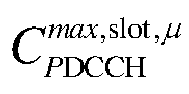
- In an existing application, if PDCCH capability reported by the UE is 4, that is, PDCCH blind detection and non-overlapped CCE detection capability of a maximum of 4 carriers are supported. When the UE is configured with 5 cells, which is greater than the capability reported by the LTE, calculation needs to be made according to the above formula. There are two cells Pcell and scell1 where PDCCH can be transmitted, where Pcell has a 15kHz Subcarrier Space (SCS) which can schedule scell2 and scell4 within a local cell or across cells, and scell1 has a 30kHz SCS which can schedule scell5 within a local cell or across cells. According to the above formula, it can be known that limits on PDCCH blind detection and non-overlapped CCEs in each slot are calculated according to SCS of scheduling cells. According to calculation, for Pcell, scell2 and scell3, the PDCCH blind detection limit per slot is (4×44×3/5), and the non-overlapped CCE limit is (4×56×3/5); and for scell1 and scell5, the PDCCH blind detection limit per slot is (4×36×2/5), and the non-overlapped CCE limit is (4×56×2/5).
- In Rel-16 NR systems, the LTE is expected to monitor corresponding PDCCH candidates per span, and accordingly a blind detection limit and a non-overlapped CCE limit within span are introduced. That is, the gNB and the UE determine whether the above limits are met within a span, and if not, all or part of a search space set with a highest index in the span is dropped.
- Specifically, details of span-level PDCCH blind detection limit and non-overlapped CCE limit are as follows.
- Table 3 is a maximum number


Table 3 The maximum number 
µ (2, 2) (4, 3) (7, 3) 0 14 28 44 1 12 24 36 - Table 4 is a maximum number


Table 4 The maximum number 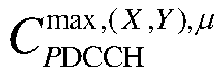
µ (2, 2) (4, 3) (7, 3) 0 18 36 56 1 18 36 56 - When the UE can report supporting subcarriers µ=0 (15kHz) and µ=1 (30kHz), patterns (2, 2), (4, 3) and (7, 3) are selected for span-level PDCCH monitoring.
- A span is a group of consecutive symbols of a PDCCH the UE monitors in a slot. Each PDCCH monitoring is merely in one span. If the UE selects a pattern (X, Y) to monitor the PDCCH with span-level PDCCH monitoring, a span between first symbols of two consecutive spans of the PDCCH monitoring is greater than or equal to X, including a case of crossing slots. One span starts at a starting position for PDCCH monitoring and ends at an ending position for PDCCH monitoring, where the span has at most Y symbols.
- Inventors of the present disclosure have found through research that in higher frequency bands, due to usage of higher subcarrier space, a number of PDCCHs and CCEs that the UE can monitor in one slot is very small, and even reliable PDCCH transmission cannot be guaranteed, such as blind detection capability of less than 16 CCEs. There is an urgent need for a PDCCH monitoring method that is capable of determining a PDCCH scheduling and monitoring rule in multiple slots, a number of slots in a slot group containing multiple slots, and a starting position for PDCCH monitoring in the slot group, so as to meet a requirement of using higher subcarrier space to monitor PDCCHs.
- In the embodiments of the present disclosure, by reporting the UE capability information, the base station can configure the slot number indication information based on the UE capability information, so that the LTE can determine, based on the slot number indication information, a PDCCH scheduling and monitoring rule in multiple slots, a target number of slots in a slot group containing multiple slots, and a starting position for PDCCH monitoring in the slot group, so as to meet a requirement of using higher subcarrier space to monitor PDCCHs.
- In order to clarify the objects, characteristics and advantages of the disclosure, embodiments of present disclosure will be described in detail in conjunction with accompanying drawings.
- Referring to
FIG. 1, FIG. 1 is a flow chart of a PDCCH monitoring method according to an embodiment. The method may be applied to a terminal such as a UE, and includesS 11 to S 13 . - In
S 11, the UE reports UE capability information, wherein the UE capability information includes numbers of slots included in slot groups supported by the UE, and PDCCH subcarrier space of the slot groups with the numbers of slots. - In S12, the UE receives slot number indication information, and determines a target number of slots based on the slot number indication information.
- In S13, the UE determines a starting position for PDCCH monitoring in the slot group with the target number of slots.
- In some embodiments, in S11, several kinds of multi-slot granularity Ms can be defined under each SCS, and a maximum number of blind detections and a number of non-overlapped CCEs the UE expects to monitor under each multi-slot granularity is given, thereby several tables can be determined.
- It could be understood that, in some embodiments, several groups may be provided according to different SCS or different numbers of slots. Carriers with the same parameters belong to a group, and upper limits of BD and CCE in the group are calculated.
- It should be noted that the granularity Ms may indicate numbers of slots in the slot groups, and each slot group includes one or more slots. For example, the UE can support a slot group consisting of 2 slots, a slot group consisting of 4 slots, and a slot group consisting of 8 slots, then the UE capability information may include Ms=2, Ms=4, and Ms=8.
- Table 5 shows a limit

Table 5 The maximum number 
µ Ms=2 Ms=4 Ms=8 5 26 52 76 6 14 28 44 7 12 24 36 - Table 6 shows a limit

Table 6 The maximum number 
µ Ms=2 Ms=4 Ms=8 5 32 48 72 6 18 36 56 7 18 36 56 - In some embodiments, when the UE reports LTE capability information, it may report multiple patterns of (Ms, µ), such as (2, 5). Thus,


- In some embodiments, in
S 12, the LTE may receive the slot number indication information from the base station, and determine the target number of slots based on the slot number indication information. - Further, the UE may receive the slot number indication information from the base station through Radio Resource Control (RRC) signaling, so that the base station may continue to use existing signaling to configure information for the UE.
- In some embodiments, the slot number indication information may include configuration information of search spaces, and S12 and S 13 are performed according to the configuration information of the search spaces.
- Specifically, in S12, said receiving slot number indication information, and determining a target number of slots based on the slot number indication information includes: receiving configuration information of one or more search spaces, wherein the configuration information includes a monitoring period of each of the one or more search spaces; and determining the target number of slots in the slot group based on a number of slots in a smallest monitoring period of the one or more search spaces.
- Specifically, the monitoring periods of one or more search spaces are received, and the smallest one among the monitoring periods is determined as the target number of slots in the slot group.
- For example, the target number of slots in the slot group is m based on the smallest monitoring period of all search spaces of the UE, and a pattern (Ms, µ) = (m, µ) is obtained according to m.
- Further, the configuration information further includes an index of each of the one or more search spaces, and offset information of a monitoring moment of each of the one or more search spaces within a current monitoring period. S 13 in
FIG. 1 includes: determining a search space with a smallest monitoring period and a smallest index, and determining the starting position for PDCCH monitoring in the slot group based on the offset information of the monitoring moment of the search space within the current monitoring period. - Specifically, the starting position for PDCCH monitoring in the slot group may depend on the offset within the monitoring period of the search space with the smallest PDCCH monitoring period and the smallest configuration index.
- Referring to
FIG. 2, FIG. 2 is a diagram of an operation scene of determining a starting position of a slot group according to an embodiment. - As shown in
FIG. 2 , there are three monitoring periods of search spaces, namely 2 slots, 4 slots, and 3 slots. The minimum monitoring period of 2 slots serves as a target number of slots in the slot group. - Further, an offset of a monitoring moment of the search space is 0 within 2 slots, thus, the starting position of the slot group is also 0.
- In subsequent operations, based on that the number of slots in the slot group is 2 and the starting position of the slot group is 0, a conventional PDCCH monitoring method may be used for monitoring, which is not limited in the embodiments of the present disclosure.
- In the embodiments of the present disclosure, by receiving from the base station the configuration information of one or more search spaces which includes the monitoring period of each search space, the UE can take the number of slots in the smallest monitoring period of the search spaces as the target number of slots in the slot group, so as to realize the determination of the target number of slots included in the slot group, thereby meeting the requirement of using higher subcarrier space to monitor a PDCCH.
- Further, the configuration information further includes the index of each search space and the offset information of the monitoring moment of each search space within the current monitoring period, which makes the UE determine the search space with the smallest monitoring period and the smallest index and use the offset information of the monitoring moment of the search space in the current monitoring period as the starting position of the slot group, thereby realizing the determination of the starting position for PDCCH monitoring in the slot group, which further meets the requirement of using higher subcarrier space to monitor the PDCCH.
- In some embodiments, the slot number indication information may include the target number of slots, and S12 and S 13 are performed according to the number of slots.
- Continuing to refer to
FIG. 1 , in some embodiments of S12, said receiving slot number indication information, and determining a target number of slots based on the slot number indication information includes: receiving the target number of slots in the slot group directly. - Specifically, the LTE may determine (Ms, µ) based on the target number of slots in the slot group additionally configured by the base station.
- Further, the target number of slots in the slot group additionally configured by the base station may be transmitted through RRC signaling, so that the base station can continue to use existing signaling to notify the LTE of the target number of slots in the slot group.
- Further, S 13 in
FIG. 1 may include: determining the starting position for PDCCH monitoring in the slot group based on a first slot used for PDCCH monitoring. - For example, the target number of slots in a high-layer configured slot group determines that Ms=4, and the first slot used for PDCCH monitoring in 2 frames is 0, then the starting position of the slot group depends on the first slot in the 2 frames used for PDCCH monitoring, i.e., slot 0.
- In the embodiments of the present disclosure, the UE directly receives the target number of slots in the slot group from the base station, which enables more direct determination of the target number of slots contained in the slot group by the UE, thereby meeting the requirement of using higher subcarrier space to monitor the PDCCH.
- Further, the UE determines the first slot used for PDCCH monitoring as the starting position of the slot group, which enables more direct determination of the starting position for PDCCH monitoring in the slot group by the UE, thereby further meeting the requirement of using higher subcarrier space to monitor the PDCCH.
- In the embodiments of the present disclosure, by reporting the UE capability information, the base station can configure the slot number indication information based on the LTE capability information, so that the LTE can determine, based on the slot number indication information, a PDCCH scheduling and monitoring rule in multiple slots, a target number of slots in a slot group containing multiple slots, and a starting position for PDCCH monitoring in the slot group, so as to meet a requirement of using higher subcarrier space to monitor PDCCHs.
- In some embodiments, the terminal can support carrier aggregation of a plurality of downlink cells, and a number of configured carriers is greater than capability of the UE. The plurality of downlink cells of carrier aggregation may have a consistent number Ms of slots of the slot group, a consistent PDCCH subcarrier space µ, and aligned starting positions of the slot group. Alternatively, the plurality of downlink cells of carrier aggregation may have a consistent number Ms of slots of the slot group, a consistent PDCCH subcarrier space µ, and unaligned starting positions of the slot group. The PDCCH monitoring method may determine


- It should be noted that when the number of configured carriers is less than or equal to the capability of the UE, the determination method may be set to be the same as a non-carrier aggregation procedure. In this case, pre-set data may be used for determination as shown in Table 5 and Table 6.
- In some embodiments, the method further includes: determining numbers of slots in corresponding slot groups of the plurality of downlink cells of carrier aggregation, and determining PDCCH subcarrier space of the corresponding slot groups of the plurality of downlink cells; based on that the numbers of slots in corresponding slot groups of the plurality of downlink cells are consistent, the PDCCH subcarrier space of the corresponding slot groups of the plurality of downlink cells is consistent, and starting positions of the corresponding slot groups of the plurality of downlink cells are aligned, determining an upper limit of a number of PDCCH blind detection and an upper limit of a number of PDCCH non-overlapped CCEs for the plurality of downlink cells of carrier aggregation based on the number of slots and the PDCCH subcarrier space of the slot groups of the plurality of downlink cells; and based on that the numbers of slots in corresponding slot groups of the plurality of downlink cells are consistent, the PDCCH subcarrier space of the corresponding slot groups of the plurality of downlink cells is consistent, and the starting positions of the corresponding slot groups of the plurality of downlink cells are not aligned, determining the upper limit of the number of PDCCH blind detection and the upper limit of the number of PDCCH non-overlapped CCEs for the plurality of downlink cells of carrier aggregation based on the number of slots and the PDCCH subcarrier space of the slot group of any one of the plurality of downlink cells.
- Referring to
FIG. 3, FIG. 3 is a diagram of an operation scene of determining an upper limit of a number of PDCCH blind detections and an upper limit of a number of PDCCH non-overlapped CCEs for a plurality of downlink cells of carrier aggregation according to an embodiment. The numbers Ms of slots in corresponding slot groups of the plurality of downlink cells are consistent, the PDCCH subcarrier space of the corresponding slot groups of the plurality of downlink cells is consistent, and starting positions for PDCCH monitoring of the plurality of downlink cells are consistent. - In some embodiments, based on that the numbers Ms of slots in corresponding slot groups of the plurality of downlink cells of carrier aggregation are consistent, the PDCCH subcarrier space of the corresponding slot groups of the plurality of downlink cells is consistent, and starting positions for PDCCH monitoring of the plurality of downlink cells are aligned, said determining an upper limit of a number of PDCCH blind detection and an upper limit of a number of PDCCH non-overlapped CCEs for the plurality of downlink cells of carrier aggregation based on the number of slots and the PDCCH subcarrier space of the slot groups of the plurality of downlink cells includes: determining the upper limit of the number of PDCCH blind detection for the plurality of downlink cells of carrier aggregation based on a following formula:



- Referring to
FIG. 4, FIG. 4 is a diagram of an operation scene of determining an upper limit of a number of PDCCH blind detections and an upper limit of a number of PDCCH non-overlapped CCEs for a plurality of downlink cells of carrier aggregation according to another embodiment. The numbers Ms of slots in corresponding slot groups of the plurality of downlink cells are consistent, the PDCCH subcarrier space of the corresponding slot groups of the plurality of downlink cells is consistent, and starting positions for PDCCH monitoring of the plurality of downlink cells are not aligned. - In some embodiments, based on that the numbers Ms of slots in corresponding slot groups of the plurality of downlink cells of carrier aggregation are consistent, the PDCCH subcarrier space of the corresponding slot groups of the plurality of downlink cells is consistent, and starting positions for PDCCH monitoring of the plurality of downlink cells are not aligned, said determining the upper limit of the number of PDCCH blind detection and the upper limit of the number of PDCCH non-overlapped CCEs for the plurality of downlink cells of carrier aggregation based on the number of slots and the PDCCH subcarrier space of the slot group of any one of the plurality of downlink cells includes: determining the upper limit of the number of PDCCH blind detection for the plurality of downlink cells of carrier aggregation based on a following formula:


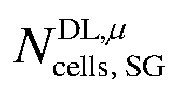

- In the embodiments of the present disclosure, based on that the numbers of slots in corresponding slot groups of the plurality of downlink cells are consistent, the PDCCH subcarrier space of the corresponding slot groups of the plurality of downlink cells is consistent, and starting positions of the corresponding slot groups of the plurality of downlink cells are aligned, the upper limit of the number of PDCCH blind detections and the upper limit of the number of PDCCH non-overlapped CCEs for the plurality of downlink cells of carrier aggregation are determined based on the number of slots and the PDCCH subcarrier space of the slot groups of the plurality of downlink cells. Based on that the numbers of slots in corresponding slot groups of the plurality of downlink cells are consistent, the PDCCH subcarrier space of the corresponding slot groups of the plurality of downlink cells is consistent, and the starting positions of the corresponding slot groups of the plurality of downlink cells are not aligned, the upper limit of the number of PDCCH blind detection and the upper limit of the number of PDCCH non-overlapped CCEs for the plurality of downlink cells of carrier aggregation are determined based on the number of slots and the PDCCH subcarrier space of the slot group of any one of the plurality of downlink cells. Therefore, a more appropriate number of slots in the slot group and PDCCH subcarrier space may be adopted.
- It should be noted that in some embodiments, as the UE reports multi-slot PDCCH monitoring capability per band, under a carrier aggregation case, if some cells adopt slot-based PDCCH monitoring, some cells adopt multi-slot PDCCH monitoring, some cells adopt PDCCH monitoring per span, and even different cells use different numbers of multi-slots, for example, 4 slots or 2 slots, it is necessary to determine how to determine the number of PDCCH blind detections and the number of non-overlapped CCEs for different cell combinations in the carrier aggregation case.
- Further, the PDCCH monitoring method may further include: receiving a number of downlink cells for PDCCH monitoring; and in response to the received number exceeding reporting capability of the UE, reporting the UE capability information based on a scaled number of the downlink cells.
- It should be noted that the LTE capability information includes a number of carriers based on slot, a number of carriers based on slot group, and a number of carriers based on span.
- In some embodiments, within a band, the LTE may be able to report a slot-based number C1 of Carrier Components (CCs), a multi-slot-based (i.e., slot-group-based) number C2 of CCs, and multiple combination values. For example, when reporting the UE capability information, multiple combination values of (C1, C2) are used. C1 is the slot-based number of CCs, and C2 is the multi-slot-based number of CCs.
- Further, the scaled number of the downlink cells is received from the base station, or is determined by the UE based on the reporting capability of the UE.
- Further, the number of the downlink cells for PDCCH monitoring may be received through high-layer signaling, so that the base station continues to use existing signaling to configure information for the UE.
- Specifically, the scaled number of cells may be transmitted by the base station together with the number of the downlink cells for PDCCH monitoring using high-layer signaling, thereby improving appropriateness of scaling of the number of the downlink cells.
- For example, the base station may configure to the UE (D1, D2, D3) and inform the LTE to perform scaling according to (E1, E2, E3).
- D1 and E1 may be slot-based numbers of CCs, D2 and E2 may be multi-slot-based numbers of CCs, and D3 and E2 may be span-based numbers of CCs.
- Further, in a case of calculation overriding/dropping, the LTE may perform multi-slot-based scaling and dropping according to E2.
- For another example, the scaled number of the downlink cells may be determined by the UE according to its own reporting capability, so as to enhance participation of the UE.
- In the embodiments of the present disclosure, the LTE receives the number of downlink cells for PDCCH monitoring, and in response to the received number exceeding reporting capability of the LTE, the UE reports the LTE capability information based on the scaled number of the downlink cells, which is beneficial to improve a success rate of reporting.
- Referring to
FIG. 5, FIG. 5 is a flow chart of a PDCCH monitoring method according to an embodiment. The method may be applied to a base station, and includes S51 and S52. - In S51, the base station receives UE capability information, wherein the UE capability information includes numbers of slots included in slot groups supported by a UE, and PDCCH subcarrier space of the slot groups with the numbers of slots.
- In S52, the base station configures and transmits slot number indication information, to make the UE determine a target number of slots based on the slot number indication information and determine a starting position for PDCCH monitoring in the slot group with the target number of slots.
- In some embodiments, said configuring and transmitting the slot number indication information includes: configuring and transmitting configuration information of one or more search spaces, wherein the configuration information includes a monitoring period of each of the one or more search spaces, to make the UE determine the target number of slots in the slot group based on a number of slots in a smallest monitoring period of the one or more search spaces.
- Further, the configuration information further includes an index of each of the one or more search spaces, and offset information of a monitoring moment of each of the one or more search spaces within a current monitoring period, to make the UE determine a search space with a smallest monitoring period and a smallest index and determine the starting position for PDCCH monitoring in the slot group based on the offset information of the monitoring moment of the search space within the current monitoring period.
- In some embodiments, said configuring and transmitting the slot number indication information includes: transmitting the target number of slots in the slot group directly, to make the UE determine the target number of slots in the slot group directly and determine the starting position for PDCCH monitoring in the slot group based on a first slot used for PDCCH monitoring.
- Further, the method further includes: transmitting a number of downlink cells for PDCCH monitoring, to make the UE report the UE capability information based on a scaled number of the downlink cells in response to the transmitted number exceeding reporting capability of the UE.
- Further, the scaled number of the downlink cells is transmitted by a base station, or is determined by the UE based on the reporting capability of the UE.
- In the embodiments of the present disclosure, by receiving the UE capability information, the base station can configure the slot number indication information based on the LTE capability information, so that the LTE can determine, based on the slot number indication information, a PDCCH scheduling and monitoring rule in multiple slots, a target number of slots in a slot group containing multiple slots, and a starting position for PDCCH monitoring in the slot group, so as to meet a requirement of using higher subcarrier space to monitor PDCCHs.
- More details of S51 and S52 can be referred to related descriptions of steps in
FIG. 1 , and are not repeated here. - Referring to
FIG. 6, FIG. 6 is a structural diagram of a PDCCH monitoring apparatus according to an embodiment. The apparatus may be applied to a terminal side, and include a reportingcircuitry 61, an indicationinformation receiving circuitry 62 and a determiningcircuitry 63. - The reporting
circuitry 61 is configured to report UE capability information, wherein the UE capability information includes numbers of slots included in slot groups supported by a UE, and PDCCH subcarrier space of the slot groups with the numbers of slots. - The indication
information receiving circuitry 62 is configured to receive slot number indication information, and determine a target number of slots based on the slot number indication information. - The determining
circuitry 63 is configured to determine a starting position for PDCCH monitoring in the slot group with the target number of slots. - Principles, specific implementations and advantages of the apparatus can be referred to related descriptions of the method as described in the above context, and are not repeated here.
- Referring to
FIG. 7, FIG. 7 is a structural diagram of a PDCCH monitoring apparatus according to an embodiment. The apparatus may be applied to a base station side, and include a capabilityinformation receiving circuitry 71 and a transmittingcircuitry 72. - The capability
information receiving circuitry 71 is configured to receive UE capability information, wherein the UE capability information includes numbers of slots included in slot groups supported by a UE, and PDCCH subcarrier space of the slot groups with the numbers of slots. - The transmitting
circuitry 72 is configured to configure and transmit slot number indication information, to make the LTE determine a target number of slots based on the slot number indication information and determine a starting position for PDCCH monitoring in the slot group with the target number of slots. - Principles, specific implementations and advantages of the apparatus can be referred to related descriptions of the method as described in the above context, and are not repeated here.
- The technical solutions of the present disclosure can be applied to 5G communication systems, 4G and 3G communication systems, and various new communication systems in the future, such as 6G and 7G communication systems.
- In an embodiment of the present disclosure, a storage medium having computer instructions stored therein is provided, wherein when the computer instructions are executed by a processor, the above method is performed. In some embodiments, the storage medium may be a computer readable storage medium, and may include a non-volatile or a non-transitory memory, or include an optical disk, a mechanical disk or a solid disk.
- In the embodiments of the present disclosure, the processor may be a Central Processing Unit (CPU), or other general processors, Digital Signal Processors (DSPs), Application Specific Integrated Circuits (ASICs), Field Programmable Gate Arrays (FPGAs) or other Programmable logic devices, discrete gates or transistor logic devices, discrete hardware components, and the like. A general processor may be a microprocessor or the processor may be any conventional processor or the like.
- It should also be understood that the memory in the embodiments of the present disclosure may be either volatile memory or nonvolatile memory, or may include both volatile and nonvolatile memories. The non-volatile memory may be a Read-Only Memory (ROM), a Programmable ROM (PROM), an Erasable PROM (EPROM), an electrically Erasable EPROM (EEPROM), or a flash memory. The volatile memory may be a Random Access Memory (RAM) which functions as an external cache. By way of example but not limitation, various forms of RAM are available, such as Static Random Access Memory (SRAM), Dynamic Random Access Memory (DRAM), Synchronous Dynamic Random Access Memory (SDRAM), Double Data Rate Synchronous Dynamic Random Access Memory (DDR SDRAM), Enhanced SDRAM (ESDRAM), Synchronous connection to DRAM (SLDRAM), and Direct Rambus RAM (DR-RAM).
- In an embodiment of the present disclosure, a terminal including a memory and a processor is provided, wherein the memory has computer instructions stored therein, and when the processor executes the computer instructions, the above method is performed. The terminal may include but not limited to a mobile phone, a computer or a tablet computer.
- The terminal in the embodiments of the present disclosure may refer to various forms of UE, access terminal, user unit, user station, Mobile Station (MS), remote station, remote terminal, mobile equipment, user terminal, terminal equipment, wireless communication equipment, user agent or user device. The terminal equipment may further be a cellular phone, a cordless phone, a Session Initiation Protocol (SIP) phone, a Wireless Local Loop (WLL) station, a Personal Digital Assistant (PDA), a handheld device with a wireless communication function, a computing device or other processing devices connected to a wireless modems, an in-vehicle device, a wearable device, a terminal equipment in the future 5G network, or a terminal equipment in a future evolved Public Land Mobile Network (PLMN), which is not limited in the embodiments of the present disclosure.
- In an embodiment of the present disclosure, a base station including a memory and a processor is provided, wherein the memory has computer instructions stored therein, and when the processor executes the computer instructions, the above method is performed.
- The Base Station (BS) in the embodiments of the present disclosure may also be referred to as a base station equipment, and is an apparatus deployed in a wireless access network to provide wireless communication functions. For example, an equipment that provides a base station function in a 2G network includes a Base Transceiver Station (BTS). An equipment that provides the base station function in a 3G network includes a Node B. An equipment that provides the base station function in a 4G network includes an evolved Node B (eNB). In a Wireless Local Area Network (WLAN), an equipment that provides the base station function is an Access Point (AP). An equipment that provides the base station function in 5G New Radio (NR) includes a gNB and an ng-eNB, where the gNB and the terminal use NR technology to communicate, and the ng-eNB and the terminal use Evolved Universal Terrestrial Radio Access (E-UTRA) technology to communicate. Both the gNB and the ng-eNB can be connected to a 5G core network. The base station also refers to an equipment that provides the base station function in a new communication system in the future.
- The base station controller in the embodiments of the present disclosure is a device for managing base stations, such as a Base Station Controller (BSC) in a 2G network, a Radio Network Controller (RNC) in a 3G network, or a device that controls and manages a base station in a new communication system in the future.
- The network in the embodiments of the present disclosure refers to a communication network that provides communication services for terminals, including a base station of a radio access network, a base station controller of a radio access network, and a device on a core network side.
- Although the present disclosure has been disclosed above with reference to preferred embodiments thereof, it should be understood that the disclosure is presented by way of example only, and not limitation. Those skilled in the art can modify and vary the embodiments without departing from the spirit and scope of the present disclosure.
Claims (23)
- A Physical Downlink Control Channel (PDCCH) monitoring method, characterized by comprising:reporting User Equipment (UE) capability information, wherein the UE capability information comprises numbers of slots included in slot groups supported by a UE, and PDCCH subcarrier space of the slot groups with the numbers of slots;receiving slot number indication information, and determining a target number of slots based on the slot number indication information; anddetermining a starting position for PDCCH monitoring in the slot group with the target number of slots.
- The method according to claim 1, characterized in that said receiving slot number indication information, and determining a target number of slots based on the slot number indication information comprises:receiving configuration information of one or more search spaces, wherein the configuration information comprises a monitoring period of each of the one or more search spaces; anddetermining the target number of slots in the slot group based on a number of slots in a smallest monitoring period of the one or more search spaces.
- The method according to claim 2, characterized in that the configuration information further comprises an index of each of the one or more search spaces, and offset information of a monitoring moment of each of the one or more search spaces within a current monitoring period; and
said determining a starting position for PDCCH monitoring in the slot group with the target number of slots comprises:
determining a search space with a smallest monitoring period and a smallest index, and determining the starting position for PDCCH monitoring in the slot group based on the offset information of the monitoring moment of the search space within the current monitoring period. - The method according to claim 1, characterized in that said receiving slot number indication information, and determining a target number of slots based on the slot number indication information comprises:
receiving the target number of slots in the slot group directly. - The method according to claim 4, characterized in that said determining a starting position for PDCCH monitoring in the slot group with the target number of slots comprises:
determining the starting position for PDCCH monitoring in the slot group based on a first slot used for PDCCH monitoring. - The method according to claim 1, characterized in that the UE supports carrier aggregation of a plurality of downlink cells, a number of configured carriers is greater than capability of the UE, and the method further comprises:determining numbers of slots in corresponding slot groups of the plurality of downlink cells, and determining PDCCH subcarrier space of the corresponding slot groups of the plurality of downlink cells;based on that the numbers of slots in corresponding slot groups of the plurality of downlink cells are consistent, the PDCCH subcarrier space of the corresponding slot groups of the plurality of downlink cells is consistent, and starting positions of the corresponding slot groups of the plurality of downlink cells are aligned, determining an upper limit of a number of PDCCH blind detection and an upper limit of a number of PDCCH non-overlapped CCEs for the plurality of downlink cells of carrier aggregation based on the number of slots and the PDCCH subcarrier space of the slot groups of the plurality of downlink cells; andbased on that the numbers of slots in corresponding slot groups of the plurality of downlink cells are consistent, the PDCCH subcarrier space of the corresponding slot groups of the plurality of downlink cells is consistent, and the starting positions of the corresponding slot groups of the plurality of downlink cells are not aligned, determining the upper limit of the number of PDCCH blind detection and the upper limit of the number of PDCCH non-overlapped CCEs for the plurality of downlink cells of carrier aggregation based on the number of slots and the PDCCH subcarrier space of the slot group of any one of the plurality of downlink cells.
- The method according to claim 6, characterized in that said determining an upper limit of a number of PDCCH blind detection and an upper limit of a number of PDCCH non-overlapped CCEs for the plurality of downlink cells of carrier aggregation based on the number of slots and the PDCCH subcarrier space of the slot groups of the plurality of downlink cells comprises:determining the upper limit of the number of PDCCH blind detection for the plurality of downlink cells of carrier aggregation based on a following formula:



 determining the upper limit of the number of PDCCH non-overlapped CCEs based on a following formula:


- The method according to claim 6, characterized in that said determining the upper limit of the number of PDCCH blind detection and the upper limit of the number of PDCCH non-overlapped CCEs for the plurality of downlink cells of carrier aggregation based on the number of slots and the PDCCH subcarrier space of the slot group of any one of the plurality of downlink cells comprises:determining the upper limit of the number of PDCCH blind detection for the plurality of downlink cells of carrier aggregation based on a following formula:


 determining the upper limit of the number of PDCCH non-overlapped CCEs based on a following formula:


- The method according to claim 1, characterized by further comprising:receiving a number of downlink cells for PDCCH monitoring; andin response to the received number exceeding reporting capability of the UE, reporting the UE capability information based on a scaled number of the downlink cells.
- The method according to claim 9, characterized in that the scaled number of the downlink cells is received from a base station, or is determined by the UE based on the reporting capability of the UE.
- The method according to claim 1, characterized in that the UE capability information comprises a number of carriers based on slot, a number of carriers based on slot group, and a number of carriers based on span.
- A Physical Downlink Control Channel (PDCCH) monitoring method, characterized by comprising:receiving User Equipment (UE) capability information, wherein the UE capability information comprises numbers of slots included in slot groups supported by a UE, and PDCCH subcarrier space of the slot groups with the numbers of slots; andconfiguring and transmitting slot number indication information, to make the UE determine a target number of slots based on the slot number indication information and determine a starting position for PDCCH monitoring in the slot group with the target number of slots.
- The method according to claim 12, characterized in that said configuring and transmitting the slot number indication information comprises:
configuring and transmitting configuration information of one or more search spaces, wherein the configuration information comprises a monitoring period of each of the one or more search spaces, to make the UE determine the target number of slots in the slot group based on a number of slots in a smallest monitoring period of the one or more search spaces. - The method according to claim 13, characterized in that the configuration information further comprises an index of each of the one or more search spaces, and offset information of a monitoring moment of each of the one or more search spaces within a current monitoring period, to make the UE determine a search space with a smallest monitoring period and a smallest index and determine the starting position for PDCCH monitoring in the slot group based on the offset information of the monitoring moment of the search space within the current monitoring period.
- The method according to claim 12, characterized in that said configuring and transmitting the slot number indication information comprises:
transmitting the target number of slots in the slot group directly, to make the UE determine the target number of slots in the slot group directly and determine the starting position for PDCCH monitoring in the slot group based on a first slot used for PDCCH monitoring. - The method according to claim 12, characterized by further comprising:
transmitting a number of downlink cells for PDCCH monitoring, to make the UE report the UE capability information based on a scaled number of the downlink cells in response to the transmitted number exceeding reporting capability of the UE. - The method according to claim 16, characterized in that the scaled number of the downlink cells is transmitted by a base station, or is determined by the UE based on the reporting capability of the UE.
- The method according to claim 12, characterized in that the UE capability information comprises a number of carriers based on slot, a number of carriers based on slot group, and a number of carriers based on span.
- A Physical Downlink Control Channel (PDCCH) monitoring apparatus, characterized by comprising:a reporting circuitry configured to report User Equipment (UE) capability information, wherein the UE capability information comprises numbers of slots included in slot groups supported by a UE, and PDCCH subcarrier space of the slot groups with the numbers of slots;an indication information receiving circuitry configured to receive slot number indication information, and determine a target number of slots based on the slot number indication information; anda determining circuitry configured to determine a starting position for PDCCH monitoring in the slot group with the target number of slots.
- A Physical Downlink Control Channel (PDCCH) monitoring apparatus, characterized by comprising:a capability information receiving circuitry configured to receive User Equipment (UE) capability information, wherein the UE capability information comprises numbers of slots included in slot groups supported by a UE, and PDCCH subcarrier space of the slot groups with the numbers of slots; anda transmitting circuitry configured to configure and transmit slot number indication information, to make the UE determine a target number of slots based on the slot number indication information and determine a starting position for PDCCH monitoring in the slot group with the target number of slots.
- A storage medium having computer instructions stored therein, characterized in that when the computer instructions are executed by a processor, the method of any one of claims 1 to 11 or the method of any one of claims 12 to 18 is performed.
- A terminal comprising a memory and a processor, characterized in that the memory has computer instructions stored therein, and when the processor executes the computer instructions, the method of any one of claims 1 to 11 is performed.
- A base station comprising a memory and a processor, characterized in that the memory has computer instructions stored therein, and when the processor executes the computer instructions, the method of any one of claims 12 to 18 is performed.
Applications Claiming Priority (2)
| Application Number | Priority Date | Filing Date | Title |
|---|---|---|---|
| CN202011104669.7A CN114374468B (en) | 2020-10-15 | 2020-10-15 | PDCCH monitoring method and device, storage medium, terminal, and base station |
| PCT/CN2021/123764 WO2022078435A1 (en) | 2020-10-15 | 2021-10-14 | Pdcch monitoring method and apparatus, storage medium, terminal, and base station |
Publications (2)
| Publication Number | Publication Date |
|---|---|
| EP4231555A1 true EP4231555A1 (en) | 2023-08-23 |
| EP4231555A4 EP4231555A4 (en) | 2024-05-01 |
Family
ID=81138883
Family Applications (1)
| Application Number | Title | Priority Date | Filing Date |
|---|---|---|---|
| EP21879478.2A Pending EP4231555A4 (en) | 2020-10-15 | 2021-10-14 | PDCCH MONITORING METHOD AND APPARATUS, STORAGE MEDIUM, TERMINAL AND BASE STATION |
Country Status (4)
| Country | Link |
|---|---|
| US (1) | US12532325B2 (en) |
| EP (1) | EP4231555A4 (en) |
| CN (1) | CN114374468B (en) |
| WO (1) | WO2022078435A1 (en) |
Families Citing this family (3)
| Publication number | Priority date | Publication date | Assignee | Title |
|---|---|---|---|---|
| KR20240087777A (en) * | 2021-10-01 | 2024-06-19 | 애플 인크. | Constructing a search space set for multi-slot PDCCH monitoring |
| CN117441401A (en) * | 2023-09-11 | 2024-01-23 | 北京小米移动软件有限公司 | Information transmission method and device, storage medium |
| CN121968307A (en) * | 2024-10-31 | 2026-05-01 | 华为技术有限公司 | A communication method and related apparatus |
Family Cites Families (5)
| Publication number | Priority date | Publication date | Assignee | Title |
|---|---|---|---|---|
| US11153862B2 (en) * | 2018-03-22 | 2021-10-19 | Apple Inc. | Physical downlink control channel (PDCCH) blind decoding in fifth generation (5G) new radio (NR) systems |
| US10951383B2 (en) | 2018-05-11 | 2021-03-16 | Asustek Computer Inc. | Method and apparatus for determining slot configuration in a wireless communication system |
| WO2020032693A1 (en) * | 2018-08-10 | 2020-02-13 | 엘지전자 주식회사 | Method for monitoring scheduling information in wireless communication system, and device using method |
| US11239939B2 (en) * | 2019-03-22 | 2022-02-01 | Samsung Electronics Co., Ltd. | Scheduling in communication systems with multiple service types |
| KR102618024B1 (en) * | 2020-08-05 | 2023-12-27 | 엘지전자 주식회사 | Time-based group-based transmission and reception method and device in a wireless communication system |
-
2020
- 2020-10-15 CN CN202011104669.7A patent/CN114374468B/en active Active
-
2021
- 2021-10-14 EP EP21879478.2A patent/EP4231555A4/en active Pending
- 2021-10-14 WO PCT/CN2021/123764 patent/WO2022078435A1/en not_active Ceased
- 2021-10-14 US US18/031,987 patent/US12532325B2/en active Active
Also Published As
| Publication number | Publication date |
|---|---|
| CN114374468B (en) | 2024-05-28 |
| US12532325B2 (en) | 2026-01-20 |
| US20230389030A1 (en) | 2023-11-30 |
| EP4231555A4 (en) | 2024-05-01 |
| CN114374468A (en) | 2022-04-19 |
| WO2022078435A1 (en) | 2022-04-21 |
Similar Documents
| Publication | Publication Date | Title |
|---|---|---|
| US12389452B2 (en) | Method and apparatus for sharing channel occupancy time on unlicensed spectrum | |
| EP4133850B1 (en) | Apparatus and method for communicating a pusch including uci | |
| US12513689B2 (en) | Communication method and communication apparatus employing dynamic spectrum resource sharing | |
| US20230085896A1 (en) | Pdcch monitoring for single-dci to multi-cell scheduling | |
| US20210258975A1 (en) | Scheduling in License Assisted Access | |
| US10367632B2 (en) | Control signaling for flexible duplex in wireless communications | |
| KR20180063159A (en) | Method, apparatus and system for channel access in a license-exempt band | |
| US10637600B2 (en) | Method for uplink transmission in unlicensed band, and device using same | |
| US11330616B2 (en) | Scheduling method, data transmission method, and apparatus | |
| US12532325B2 (en) | PDCCH monitoring method and apparatus, storage medium, terminal, and base station | |
| WO2021159331A1 (en) | Methods and apparatus for support of reduced capability devices in wireless communication | |
| EP3387867B1 (en) | Terminal device, infrastructure equipment and methods for resource selection and updating of access class information | |
| US11284402B2 (en) | Resource indication method and apparatus and communication system | |
| US20230276437A1 (en) | Communication method and apparatus | |
| EP4057738A1 (en) | Pdcch monitoring method and apparatus, and storage medium and terminal | |
| EP4572193B1 (en) | System and method for blind detection | |
| US20230047144A1 (en) | Physical downlink control channel monitoring method and apparatus | |
| JP2022530157A (en) | Methods and devices for locating the frequency domain of DC components, storage media, terminals, and base stations. | |
| CN113424618A (en) | Communication method, device and computer readable storage medium | |
| WO2021030967A1 (en) | Method and apparatus for receiving random access response and method and apparatus for sending random access response in two-step random access | |
| US10708929B2 (en) | Device and method of handling scheduling request for logical channel | |
| CN116017487B (en) | Wireless communication method, network device and terminal device | |
| EP4654683A1 (en) | Sidelink positioning reference signal transmission method and apparatus, device, and medium | |
| US20230388088A1 (en) | Method and apparatus for downlink and uplink transmissions over an unlicensed spectrum | |
| CN113950076B (en) | PDCCH monitoring method and device based on multiple TRPs, configuration method and device, storage medium, terminal, and base station |
Legal Events
| Date | Code | Title | Description |
|---|---|---|---|
| STAA | Information on the status of an ep patent application or granted ep patent |
Free format text: STATUS: THE INTERNATIONAL PUBLICATION HAS BEEN MADE |
|
| PUAI | Public reference made under article 153(3) epc to a published international application that has entered the european phase |
Free format text: ORIGINAL CODE: 0009012 |
|
| STAA | Information on the status of an ep patent application or granted ep patent |
Free format text: STATUS: REQUEST FOR EXAMINATION WAS MADE |
|
| 17P | Request for examination filed |
Effective date: 20230512 |
|
| AK | Designated contracting states |
Kind code of ref document: A1 Designated state(s): AL AT BE BG CH CY CZ DE DK EE ES FI FR GB GR HR HU IE IS IT LI LT LU LV MC MK MT NL NO PL PT RO RS SE SI SK SM TR |
|
| DAV | Request for validation of the european patent (deleted) | ||
| DAX | Request for extension of the european patent (deleted) | ||
| A4 | Supplementary search report drawn up and despatched |
Effective date: 20240328 |
|
| RIC1 | Information provided on ipc code assigned before grant |
Ipc: H04L 5/00 20060101ALI20240322BHEP Ipc: H04L 25/02 20060101ALI20240322BHEP Ipc: H04L 1/00 20060101AFI20240322BHEP |