EP4231303A1 - Method and apparatus for polymerization process monitoring and model predictive control - Google Patents

Method and apparatus for polymerization process monitoring and model predictive control Download PDF

Info

Publication number
EP4231303A1
EP4231303A1 EP22158024.4A EP22158024A EP4231303A1 EP 4231303 A1 EP4231303 A1 EP 4231303A1 EP 22158024 A EP22158024 A EP 22158024A EP 4231303 A1 EP4231303 A1 EP 4231303A1
Authority
EP
European Patent Office
Prior art keywords
catalyst
polymerization process
act
modelled
reaction performance
Prior art date
Legal status (The legal status is an assumption and is not a legal conclusion. Google has not performed a legal analysis and makes no representation as to the accuracy of the status listed.)
Pending
Application number
EP22158024.4A
Other languages
German (de)
French (fr)
Inventor
Vasileios TOULOUPIDIS
Christoph Kaufmann
Niclas Carlsson
Staffan Skalen
Current Assignee (The listed assignees may be inaccurate. Google has not performed a legal analysis and makes no representation or warranty as to the accuracy of the list.)
Borealis GmbH
Original Assignee
Borealis GmbH
Priority date (The priority date is an assumption and is not a legal conclusion. Google has not performed a legal analysis and makes no representation as to the accuracy of the date listed.)
Filing date
Publication date
Application filed by Borealis GmbH filed Critical Borealis GmbH
Priority to EP22158024.4A priority Critical patent/EP4231303A1/en
Priority to PCT/EP2023/054348 priority patent/WO2023161243A1/en
Priority to KR1020247031002A priority patent/KR20240152359A/en
Priority to CN202380022536.0A priority patent/CN118715568A/en
Priority to US18/839,571 priority patent/US20250161900A1/en
Priority to JP2024548726A priority patent/JP2025506537A/en
Priority to TW112106489A priority patent/TWI881300B/en
Publication of EP4231303A1 publication Critical patent/EP4231303A1/en
Pending legal-status Critical Current

Links

Images

Classifications

    • GPHYSICS
    • G16INFORMATION AND COMMUNICATION TECHNOLOGY [ICT] SPECIALLY ADAPTED FOR SPECIFIC APPLICATION FIELDS
    • G16CCOMPUTATIONAL CHEMISTRY; CHEMOINFORMATICS; COMPUTATIONAL MATERIALS SCIENCE
    • G16C20/00Chemoinformatics, i.e. ICT specially adapted for the handling of physicochemical or structural data of chemical particles, elements, compounds or mixtures
    • G16C20/10Analysis or design of chemical reactions, syntheses or processes
    • BPERFORMING OPERATIONS; TRANSPORTING
    • B01PHYSICAL OR CHEMICAL PROCESSES OR APPARATUS IN GENERAL
    • B01JCHEMICAL OR PHYSICAL PROCESSES, e.g. CATALYSIS OR COLLOID CHEMISTRY; THEIR RELEVANT APPARATUS
    • B01J19/00Chemical, physical or physico-chemical processes in general; Their relevant apparatus
    • B01J19/0006Controlling or regulating processes
    • B01J19/0033Optimalisation processes, i.e. processes with adaptive control systems
    • BPERFORMING OPERATIONS; TRANSPORTING
    • B01PHYSICAL OR CHEMICAL PROCESSES OR APPARATUS IN GENERAL
    • B01JCHEMICAL OR PHYSICAL PROCESSES, e.g. CATALYSIS OR COLLOID CHEMISTRY; THEIR RELEVANT APPARATUS
    • B01J19/00Chemical, physical or physico-chemical processes in general; Their relevant apparatus
    • B01J19/06Solidifying liquids
    • GPHYSICS
    • G16INFORMATION AND COMMUNICATION TECHNOLOGY [ICT] SPECIALLY ADAPTED FOR SPECIFIC APPLICATION FIELDS
    • G16CCOMPUTATIONAL CHEMISTRY; CHEMOINFORMATICS; COMPUTATIONAL MATERIALS SCIENCE
    • G16C10/00Computational theoretical chemistry, i.e. ICT specially adapted for theoretical aspects of quantum chemistry, molecular mechanics, molecular dynamics or the like
    • GPHYSICS
    • G16INFORMATION AND COMMUNICATION TECHNOLOGY [ICT] SPECIALLY ADAPTED FOR SPECIFIC APPLICATION FIELDS
    • G16CCOMPUTATIONAL CHEMISTRY; CHEMOINFORMATICS; COMPUTATIONAL MATERIALS SCIENCE
    • G16C20/00Chemoinformatics, i.e. ICT specially adapted for the handling of physicochemical or structural data of chemical particles, elements, compounds or mixtures
    • G16C20/30Prediction of properties of chemical compounds, compositions or mixtures
    • BPERFORMING OPERATIONS; TRANSPORTING
    • B01PHYSICAL OR CHEMICAL PROCESSES OR APPARATUS IN GENERAL
    • B01JCHEMICAL OR PHYSICAL PROCESSES, e.g. CATALYSIS OR COLLOID CHEMISTRY; THEIR RELEVANT APPARATUS
    • B01J2219/00Chemical, physical or physico-chemical processes in general; Their relevant apparatus
    • B01J2219/00049Controlling or regulating processes
    • B01J2219/00243Mathematical modelling

Definitions

  • the present invention relates to polymerization process monitoring and model predictive control and in particular to method for polymerization process monitoring and model predictive control.
  • Control methods for the polymerization reactors comprising of a mathematical model for the polymerization process as well as an optimizer for defining the best manipulative option.
  • the model is able to predict polymerization rate and polymer product molecular properties (molecular weight distribution, comonomer content distribution and average comonomer content) based on first principles (e.g., mass balance equations) as well as a number of secondary polymer properties, including polymer density and melt index, based on and a series of correlations.
  • first principles e.g., mass balance equations
  • secondary polymer properties including polymer density and melt index
  • the foregoing and other objects are solved by the subject-matter of the present invention as defined by the independent claims. Further embodiments are defined by the dependent claims.
  • the present invention therefore allows enabling a new quality control concept aiming in better defining the polymer properties, under the scope of both for process monitoring and control.
  • a method is provided, a method for polymerization process monitoring and model predictive control.
  • the method comprises the steps of: providing at least one set of parameters comprising catalyst information, kinetic modelling information, and calculated polymer property information and modelling a reaction performance of a catalyst used for a polymerization process using a reaction network, the reaction network comprising multiple reactions of the catalyst, wherein reactions of the catalyst are modelled by a discrete number of multiple site types of the catalyst, wherein the catalyst is modelled as a sum of contributions of the multiple site types.
  • the present invention advantageously provides as differences compared to prior art, enabling a new quality control concept aiming in better defining the polymer properties, under the scope of both for process monitoring and polymer property oriented model predictive control.
  • the kinetic parameters that are able to describe the reaction performance of the catalyst are fed into the model together with the operating conditions.
  • the model is able to predict the expected reactive concentration values in the reactor(s), the polymerization rate per reactor (and consequently the split) as well as the polymer microstructure per reactor, for instance as molecular weight distribution, MWD, comonomer content, CC.
  • a rheology model provides a second level prediction for the expected complex viscosity at the exit of each reactor (for a range of shear rates). This model prediction is compared at regular intervals (typically every 4-6 hours) with the experimental value of the fast frequency sweep measurement of the corresponding reactor sample as well as with the corresponding desired fast frequency sweep set-point, enabling the control of the selected manipulated variable.
  • the method further comprises the step of predicting, based on the modelled reaction performance, an expected reactive concentration value, a polymerization rate per reactor, or a polymer microstructure per reactor.
  • the step of modelling of the reaction performance of the catalyst further comprises the step of using a rheology model for predicting an expected complex viscosity.
  • the set of parameters further comprises a feed rate used for the polymerization process, a temperature used for the polymerization process, or a pressure used for the polymerization process.
  • the method further comprises the step of modelling at least one value of a molecular property based on the modelled reaction performance.
  • the method further comprises the step of modelling at least one value of a rheological property based on the modelled reaction performance.
  • the modelled reaction performance is used for process monitoring by means of an optimizer, preferably the optimizer is connected to a controller for controlling the polymerization process.
  • the modelled reaction performance is used for process monitoring by means of predicting process and polymer parameters.
  • an optimizer is connected to a controller for controlling the polymerization process.
  • the modelled reaction performance is used in an offline mode.
  • a computer program product comprising computer-readable instructions which, when loaded and executed on processor, performs the method according to any one of the embodiments of the first aspect or the first aspect as such.
  • an apparatus configured for polymerization process monitoring and model predictive control, the apparatus comprising a data memory and a processor.
  • the data memory is configured to provide at least one set of parameters comprising catalyst information, kinetic modelling information, and calculated polymer property information.
  • the processor is configured to model a reaction performance of a catalyst used for a polymerization process using a reaction network, the reaction network comprising multiple reactions of the catalyst, wherein reactions of the catalyst are modelled by a discrete number of multiple site types of the catalyst, wherein the catalyst is modelled as a sum of contributions of the multiple site types.
  • the processor is further configured to predict, based on the modelled reaction performance, an expected reactive concentration value, a polymerization rate per reactor, or a polymer microstructure per reactor.
  • the processor is further configured to model the reaction performance of the catalyst in terms of using a rheology model for predicting an expected complex viscosity.
  • the set of parameters further comprises a feed rate used for the polymerization process, a temperature used for the polymerization process, or a pressure used for the polymerization process.
  • the processor is further configured to model at least one value of a molecular property based on the modelled reaction performance. According to one embodiment of the present invention, the processor is further configured to model at least one value of a rheological property based on the modelled reaction performance.
  • a computer program performing the method of the present invention may be stored on a computer-readable medium.
  • a computer-readable medium may be a floppy disk, a hard disk, a CD, a DVD, an USB (Universal Serial Bus) storage device, a RAM (Random Access Memory), a ROM (Read Only Memory) and an EPROM (Erasable Programmable Read Only Memory).
  • a computer-readable medium may also be a data communication network, for example the Internet, which allows downloading a program code, with a connection via WLAN or 3G/4G or any other wireless data technology.
  • DSP Digital Signal Processor
  • ASIC application specific integrated circuit
  • CPLD CPLD
  • the present invention can be implemented in digital electronic circuitry, or in computer hardware, firmware, software, or in combinations thereof, e.g. in available hardware of conventional mobile devices or in new hardware dedicated for processing the methods described herein.
  • Fig. 1 shows a schematic diagram of a method for polymerization process monitoring and model predictive control.
  • Fig. 1 shows a method for polymerization process monitoring and model predictive control, the method comprising the following steps.
  • modeling S2 a reaction performance of a catalyst used for a polymerization process using a reaction network, the reaction network comprising multiple reactions of the catalyst, wherein reactions of the catalyst are modelled by a discrete number of multiple site types of the catalyst, wherein the catalyst is modelled as a sum of contributions of the multiple site types is performed.
  • Fig. 2 shows a schematic diagram of an apparatus for polymerization process monitoring and model predictive control.
  • An apparatus 100 for polymerization process monitoring and model predictive control comprises a data memory 10, which is configured to provide at least one set of parameters comprising catalyst information, kinetic modelling information, and calculated polymer property information.
  • the apparatus 100 comprises a processor 20, which is configured to model a reaction performance of a catalyst used for a polymerization process using a reaction network, the reaction network comprising multiple reactions of the catalyst, wherein reactions of the catalyst are modelled by a discrete number of multiple site types of the catalyst, wherein the catalyst is modelled as a sum of contributions of the multiple site types.
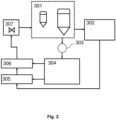
  • Fig. 3 shows a schematic diagram of a model predictive control concept according to an exemplary embodiment of the invention.
  • the kinetic model contains a whole reaction network that is calculated the modelled process 301, the characterization data 302 contains data on MWD, CCD, and rheology. Controlled variables 303 are measured continuously. Online measurements 304 on temperature, pressure or concentrations are provided to the model 305 configured to provide a model predictive control and the controller 306 configured to provide process control.
  • the specific model 305 is setup with kinetic parameters and feed into the controller 306. Feedback to the process is provided with the manipulative variable 307 to the process reactor.
  • the new kinetic model contains kinetic descriptions for a reaction network of fundamental reactions taking place at the catalysts active centers.
  • the kinetics for the whole reaction network is calculated for each site type individually.
  • the macroscopic behavior of the catalyst is the sum of the contributions of the different site types.
  • the reaction network consists of the following elementary reactions:
  • the amount of polymer consisting of monomer 1 formed at site type k per time interval: dP 1 , k dt k 0,1 k ⁇ e ⁇ Ea 0,1 k R ⁇ T ⁇ C 0 k ⁇ M 1 + k p 11 k ⁇ e ⁇ Ea p 11 k R ⁇ T ⁇ C act , 1 k ⁇ M 1 + k p 21 k ⁇ e ⁇ Ea p 21 k R ⁇ T ⁇ C act , 2 k ⁇ M 1 + k p 31 k ⁇ e ⁇ Ea p 31 k R ⁇ T ⁇ C act , 3 k ⁇ M 1 + k a 1 k ⁇ e ⁇ Ea a 1 k R ⁇ T ⁇ C P k ⁇ M 1
  • M 1 , M 2 and M 3 being the molecular weights of monomer 1, monomer 2 and monomer 3.
  • M n,k AMW k ⁇ R Pr op , k R Trans , k
  • i is the chain length of polymer (the X-axis in the distribution).
  • i is the chain length of polymer (the X-axis in the distribution).
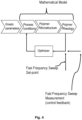
  • Fig. 4 shows a schematic diagram of a detailed kinetics model predictive control concept according to an exemplary embodiment of the invention.
  • the control methodology has been in use over the last 20 years, where feedback information may refer to reactive concentration values, polymer density or melt index value.
  • the control method comprises of a mathematical model for the polymerization process as well as an optimizer for defining the best manipulative option.
  • the model is based on mass balance equations and a series of empirical correlations for the prediction of polymerization rate as well as a number of polymer properties, including polymer density and melt index.
  • the monomer conversion is a function of temperature, pressure, hydrogen content and comonomer content.
  • the correlation is in the form of a product of a correction factor, a pre-exponential factor, terms that describe the influence of the concentration and/or partial pressures of the monomer and other reaction partners, terms that describe the mass of catalyst inside the reactor and the catalysts activity, and an Arrhenius-type term that captures the influence of temperature.
  • the non-linear behaviour of these parameters is fitted in order to match the observed plant data.
  • the present invention therefore leads to a series of benefits:
  • the proposed method for polymerization process monitoring and model predictive control offers a new powerful tool for polymerization reactor operation: the proposed method for polymerization process monitoring and model predictive control is able to predict the polymer microstructural characteristics, including MWD, CC across MWD and CCD based on the kinetic parameters of the catalyst in use and the process conditions (feed rates, temperatures, pressure).
  • the proposed method for polymerization process monitoring and model predictive control is able to predict the complex viscosity (within a range of shear rates) of the produced polymer.
  • the proposed method for polymerization process monitoring and model predictive control is able to provide predicted values of the molecular and rheological properties that can be further used as the basis for second level structure-property correlations to additional polymer properties (e.g. correlations towards crack resistance, stress at yield, etc.).
  • the proposed method for polymerization process monitoring and model predictive control can be used for process monitoring providing important information dynamically to the plant operators in the control room.
  • the proposed method for polymerization process monitoring and model predictive control can be used in an offline mode (not connected to the plant) for engineering studies regarding alternative process conditions or reactor setups (product and process development). Further, the proposed method for polymerization process monitoring and model predictive control can receive control feedback using the fast frequency sweep method closing the loop and enabling model predictive control operation.
  • the proposed method for polymerization process monitoring and model predictive control enables property-oriented control, targeting to the intrinsic polymer microstructural characteristics (currently not feasible).
  • the proposed method for polymerization process monitoring and model predictive control is able to increase the model validity of stabilizing control leading to improved control during transitions.

Landscapes

  • Chemical & Material Sciences (AREA)
  • Engineering & Computer Science (AREA)
  • Computing Systems (AREA)
  • Theoretical Computer Science (AREA)
  • Life Sciences & Earth Sciences (AREA)
  • Bioinformatics & Computational Biology (AREA)
  • Bioinformatics & Cheminformatics (AREA)
  • Chemical Kinetics & Catalysis (AREA)
  • Crystallography & Structural Chemistry (AREA)
  • Organic Chemistry (AREA)
  • Analytical Chemistry (AREA)
  • Automation & Control Theory (AREA)
  • Spectroscopy & Molecular Physics (AREA)
  • General Health & Medical Sciences (AREA)
  • Health & Medical Sciences (AREA)
  • Physics & Mathematics (AREA)
  • Polymerisation Methods In General (AREA)
  • Polyethers (AREA)

Abstract

The present invention is related to a method for polymerization process monitoring and model predictive control, the method comprising the steps of: providing (S1) at least one set of parameters comprising catalyst information, kinetic modelling information, and calculated polymer property information; and modeling (S2) a reaction performance of a catalyst used for a polymerization process using a reaction network, the reaction network comprising multiple reactions of the catalyst, wherein reactions of the catalyst are modelled by a discrete number of multiple site types of the catalyst, wherein the catalyst is modelled as a sum of contributions of the multiple site types.

Description

    FIELD OF THE INVENTION
  • The present invention relates to polymerization process monitoring and model predictive control and in particular to method for polymerization process monitoring and model predictive control.
  • BACKGROUND OF THE INVENTION
  • Control methods for the polymerization reactors are known, comprising of a mathematical model for the polymerization process as well as an optimizer for defining the best manipulative option.
  • The detailed kinetics of the polymer reaction engineering model are for instance described in the following documents:
    The article by Touloupidis V., published 2014, titled "Catalytic Olefin Polymerization Process Modeling: Multi-Scale Approach and Modeling Guidelines for Micro-Scale/Kinetic Modeling", published in Macromol. React. Eng., 8, pp. 508-527, describes multi-scale polymerization process modeling framework, comprising of polymerization kinetics (micro-scale), system thermodynamics (meso-scale), and reactor performance (macro-scale) as well as to present the methodology for developing a mathematical model for catalytic olefin polymerization.
  • The article by Soares J.B.P., published 2014, titled "The Use of Instantaneous Distributions in Polymerization Reaction Engineering", published in Macromol. React. Eng., 8, 235-259, describes how the method of instantaneous distributions can be used to model the microstructures of polymers made under different polymerization conditions.
  • The article by Soares J., Touloupidis V., published 2019, titled "Polymerization Kinetics and the Effect of Reactor Residence Time on Polymer Microstructure", published in "Jeremic D., Prades F. and Albunia A. ed. Multimodal Polymers with Supported Catalysts: Design and Production", Springer International Publishing, describes the polymerization kinetics and the effect of reactor residence time on polymer microstructure.
  • The article by Touloupidis V., Rittenschober G., Paulik C., published 2020, titled "An Integrated PRE Methodology for Capturing the Reaction Performance of Single- and Multi-site Type Catalysts Using Bench-Scale Polymerization Experiments", Macromol. React. Eng., describes systems and methods for capturing the reaction performance of single- and multi-site type catalysts.
  • The model is able to predict polymerization rate and polymer product molecular properties (molecular weight distribution, comonomer content distribution and average comonomer content) based on first principles (e.g., mass balance equations) as well as a number of secondary polymer properties, including polymer density and melt index, based on and a series of correlations.
  • SUMMARY OF THE INVENTION
  • The foregoing and other objects are solved by the subject-matter of the present invention as defined by the independent claims. Further embodiments are defined by the dependent claims. The present invention therefore allows enabling a new quality control concept aiming in better defining the polymer properties, under the scope of both for process monitoring and control.
  • According to a first aspect of the present invention, a method is provided, a method for polymerization process monitoring and model predictive control.
  • The method comprises the steps of: providing at least one set of parameters comprising catalyst information, kinetic modelling information, and calculated polymer property information and modelling a reaction performance of a catalyst used for a polymerization process using a reaction network, the reaction network comprising multiple reactions of the catalyst, wherein reactions of the catalyst are modelled by a discrete number of multiple site types of the catalyst, wherein the catalyst is modelled as a sum of contributions of the multiple site types.
  • In other words, the present invention advantageously provides as differences compared to prior art, enabling a new quality control concept aiming in better defining the polymer properties, under the scope of both for process monitoring and polymer property oriented model predictive control.
  • According to the concept of the present invention, the kinetic parameters that are able to describe the reaction performance of the catalyst are fed into the model together with the operating conditions. The model is able to predict the expected reactive concentration values in the reactor(s), the polymerization rate per reactor (and consequently the split) as well as the polymer microstructure per reactor, for instance as molecular weight distribution, MWD, comonomer content, CC.
  • Furthermore, a rheology model provides a second level prediction for the expected complex viscosity at the exit of each reactor (for a range of shear rates). This model prediction is compared at regular intervals (typically every 4-6 hours) with the experimental value of the fast frequency sweep measurement of the corresponding reactor sample as well as with the corresponding desired fast frequency sweep set-point, enabling the control of the selected manipulated variable.
  • According to one exemplary embodiment of the present invention, the method further comprises the step of predicting, based on the modelled reaction performance, an expected reactive concentration value, a polymerization rate per reactor, or a polymer microstructure per reactor.
  • According to one exemplary embodiment of the present invention, the step of modelling of the reaction performance of the catalyst further comprises the step of using a rheology model for predicting an expected complex viscosity.
  • According to one exemplary embodiment of the present invention, the set of parameters further comprises a feed rate used for the polymerization process, a temperature used for the polymerization process, or a pressure used for the polymerization process.
  • According to one exemplary embodiment of the present invention, the method further comprises the step of modelling at least one value of a molecular property based on the modelled reaction performance.
  • According to one exemplary embodiment of the present invention, the method further comprises the step of modelling at least one value of a rheological property based on the modelled reaction performance.
  • According to one exemplary embodiment of the present invention, the modelled reaction performance is used for process monitoring by means of an optimizer, preferably the optimizer is connected to a controller for controlling the polymerization process.
  • According to one exemplary embodiment of the present invention, the modelled reaction performance is used for process monitoring by means of predicting process and polymer parameters. In addition, an optimizer is connected to a controller for controlling the polymerization process.
  • According to one exemplary embodiment of the present invention, the modelled reaction performance is used in an offline mode.
  • According to a second aspect of the present invention, a computer program product is provided comprising computer-readable instructions which, when loaded and executed on processor, performs the method according to any one of the embodiments of the first aspect or the first aspect as such.
  • According to a third aspect of the present invention, an apparatus is provided, the apparatus configured for polymerization process monitoring and model predictive control, the apparatus comprising a data memory and a processor.
  • The data memory is configured to provide at least one set of parameters comprising catalyst information, kinetic modelling information, and calculated polymer property information.
  • The processor is configured to model a reaction performance of a catalyst used for a polymerization process using a reaction network, the reaction network comprising multiple reactions of the catalyst, wherein reactions of the catalyst are modelled by a discrete number of multiple site types of the catalyst, wherein the catalyst is modelled as a sum of contributions of the multiple site types.
  • According to one embodiment of the present invention, the processor is further configured to predict, based on the modelled reaction performance, an expected reactive concentration value, a polymerization rate per reactor, or a polymer microstructure per reactor.
  • According to one embodiment of the present invention, the processor is further configured to model the reaction performance of the catalyst in terms of using a rheology model for predicting an expected complex viscosity.
  • According to one embodiment of the present invention, the set of parameters further comprises a feed rate used for the polymerization process, a temperature used for the polymerization process, or a pressure used for the polymerization process.
  • According to one embodiment of the present invention, the processor is further configured to model at least one value of a molecular property based on the modelled reaction performance. According to one embodiment of the present invention, the processor is further configured to model at least one value of a rheological property based on the modelled reaction performance.
  • A computer program performing the method of the present invention may be stored on a computer-readable medium. A computer-readable medium may be a floppy disk, a hard disk, a CD, a DVD, an USB (Universal Serial Bus) storage device, a RAM (Random Access Memory), a ROM (Read Only Memory) and an EPROM (Erasable Programmable Read Only Memory).
  • A computer-readable medium may also be a data communication network, for example the Internet, which allows downloading a program code, with a connection via WLAN or 3G/4G or any other wireless data technology.
  • The methods, systems and devices described herein may be implemented as software in a Digital Signal Processor, DSP, in a micro-controller or in any other side-processor or as hardware circuit within an application specific integrated circuit, ASIC, CPLD or FPGA.
  • The present invention can be implemented in digital electronic circuitry, or in computer hardware, firmware, software, or in combinations thereof, e.g. in available hardware of conventional mobile devices or in new hardware dedicated for processing the methods described herein.
  • BRIEF DESCRIPTION OF THE DRAWINGS
  • A more complete appreciation of the invention and the attendant advantages thereof will be more clearly understood by reference to the following schematic drawings, which are not to scale, wherein:
    • Fig. 1 shows a schematic diagram of a method for polymerization process monitoring and model predictive control;
    • Fig. 2 shows a schematic diagram of an apparatus for polymerization process monitoring and model predictive control according to an exemplary embodiment of the invention;
    • Fig. 3 shows a schematic diagram of a model predictive control concept according to an exemplary embodiment of the invention; and
    • Fig. 4 shows a schematic diagram of a detailed kinetics model predictive control concept according to an exemplary embodiment of the invention;
    DETAILED DESCRIPTION OF EMBODIMENTS
  • The illustration in the drawings is schematically and not to scale. In different drawings, similar or identical elements are provided with the same reference numerals.
  • Generally, identical parts, units, entities or steps are provided with the same reference symbols in the figures.
  • Fig. 1 shows a schematic diagram of a method for polymerization process monitoring and model predictive control.
  • In particular, Fig. 1 shows a method for polymerization process monitoring and model predictive control, the method comprising the following steps.
  • As a first step of the method, providing S1 at least one set of parameters comprising catalyst information, kinetic modelling information, and calculated polymer property information is conducted.
  • As a second step of the method, modeling S2 a reaction performance of a catalyst used for a polymerization process using a reaction network, the reaction network comprising multiple reactions of the catalyst, wherein reactions of the catalyst are modelled by a discrete number of multiple site types of the catalyst, wherein the catalyst is modelled as a sum of contributions of the multiple site types is performed.
  • Fig. 2 shows a schematic diagram of an apparatus for polymerization process monitoring and model predictive control.
  • An apparatus 100 for polymerization process monitoring and model predictive control is provided, the apparatus 100 comprises a data memory 10, which is configured to provide at least one set of parameters comprising catalyst information, kinetic modelling information, and calculated polymer property information.
  • Further, the apparatus 100 comprises a processor 20, which is configured to model a reaction performance of a catalyst used for a polymerization process using a reaction network, the reaction network comprising multiple reactions of the catalyst, wherein reactions of the catalyst are modelled by a discrete number of multiple site types of the catalyst, wherein the catalyst is modelled as a sum of contributions of the multiple site types.
  • Fig. 3 shows a schematic diagram of a model predictive control concept according to an exemplary embodiment of the invention.
  • The kinetic model contains a whole reaction network that is calculated the modelled process 301, the characterization data 302 contains data on MWD, CCD, and rheology. Controlled variables 303 are measured continuously. Online measurements 304 on temperature, pressure or concentrations are provided to the model 305 configured to provide a model predictive control and the controller 306 configured to provide process control.
  • The specific model 305 is setup with kinetic parameters and feed into the controller 306. Feedback to the process is provided with the manipulative variable 307 to the process reactor.
  • According to an exemplary embodiment of the invention, in contrast to the currently used models, the new kinetic model contains kinetic descriptions for a reaction network of fundamental reactions taking place at the catalysts active centers.
  • Furthermore it is assumed, that the behavior of a Ziegler-Natta catalyst can be described by a discrete number of different site types, each of them acting as 'single site catalyst'.
  • The kinetics for the whole reaction network is calculated for each site type individually. The macroscopic behavior of the catalyst is the sum of the contributions of the different site types.
  • For the description of the model, the following nomenclature is used:
    C p k
    Figure imgb0001
      Concentration of potential sites of type k
    C 0 k
    Figure imgb0002
      Concentration of activated sites of type k
    C act , i k
    Figure imgb0003
      Concentration of reactive sites of type k, last monomer inserted to polymer chain is of type i
    C D k
    Figure imgb0004
      Concentration of deactivated sites of type k
    A  Concentration of co-catalyst
    M 1  Monomer 1 concentration (Ethylene)
    M 2  Monomer 2 concentration
    M 3  Monomer 3 concentration
    P 1, P 2, P 3  Polymerblock of monomer 1, monomer 2, monomer 3
    H 2  Concentration of hydrogen
  • The reaction network consists of the following elementary reactions:
  • Site Activation:
    • By co-catalyst: C p k + A k aA k C 0 k + B
      Figure imgb0005
    • By Monomer: C p k + M 1 k a 1 k C act , 1 k + P 1
      Figure imgb0006
      C p k + M 2 k a 2 k C act , 2 k + P 2
      Figure imgb0007
      C p k + M 3 k a 3 k C act , 3 k + P 3
      Figure imgb0008
    • Chain Initiation: C 0 k + M 1 k 0,1 k C act , 1 k + P 1
      Figure imgb0009
      C 0 k + M 2 k 0,2 k C act , 2 k + P 2
      Figure imgb0010
      C 0 k + M 3 k 0,3 k C act , 3 k + P 3
      Figure imgb0011
    • Chain Propagation: C act , 1 k + M 1 k p 11 k C act , 1 k + P 1
      Figure imgb0012
      C act , 1 k + M 2 k p 12 k C act , 2 k + P 2
      Figure imgb0013
      C act , 1 k + M 3 k p 13 k C act , 3 k + P 3
      Figure imgb0014
      C act , 2 k + M 1 k p 21 k C act , 1 k + P 1
      Figure imgb0015
      C act , 2 k + M 2 k p 22 k C act , 2 k + P 2
      Figure imgb0016
      C act , 2 k + M 3 k p 23 k C act , 3 k + P 3
      Figure imgb0017
      C act , 3 k + M 1 k p 31 k C act , 1 k + P 1
      Figure imgb0018
      C act , 3 k + M 2 k p 32 k C act , 2 k + P 2
      Figure imgb0019
      C act , 3 k + M 3 k p 33 k C act , 3 k + P 3
      Figure imgb0020
    • Chain Transfer:
    • By hydrogen: C act , 1 k + H 2 k trH 1 k C 0 k
      Figure imgb0021
      C act , 2 k + H 2 k trH 2 k C 0 k
      Figure imgb0022
      C act , 3 k + H 2 k trH 3 k C 0 k
      Figure imgb0023
    • Spontaneous: C act , 1 k k trsp , 1 k C 0 k
      Figure imgb0024
      C act , 2 k k trsp , 2 k C 0 k
      Figure imgb0025
      C act , 3 k k trsp , 3 k C 0 k
      Figure imgb0026
  • Deactivation:
    • By hydrogen: C act , 1 k + H 2 k DH 1 k C D k
      Figure imgb0027
      C act , 2 k + H 2 k DH 2 k C D k
      Figure imgb0028
      C act , 3 k + H 2 k DH 3 k C D k
      Figure imgb0029
      C 0 k + H 2 k DH 0 k C D k
      Figure imgb0030
    • Spontaneous: C act , 1 k k Dsp , 1 k C D k
      Figure imgb0031
      C act , 2 k k Dsp , 2 k C D k
      Figure imgb0032
      C act , 3 k k Dsp , 3 k C D k
      Figure imgb0033
      C 0 k k Dsp , 0 k C D k
      Figure imgb0034
  • All of the above reactions are assumed to be of first order. Having calculated the rates for each of the reactions at each of the site types the following values are accessible, describing the overall conversion of reactants.
  • Total amount of polymer consisting of monomer 1 formed per time interval: dP 1 dt = k = 1 6 k 0,1 k e Ea 0,1 k R T C 0 k M 1 + k = 1 6 k p 11 k e Ea p 11 k R T C act , 1 k M 1 + k = 1 6 k p 21 k e Ea p 21 k R T C act , 2 k M 1 + k = 1 6 k p 31 k e Ea p 31 k R T C act , 3 k M 1 + k = 1 6 k a 1 k e Ea a 1 k R T C P k M 1
    Figure imgb0035
  • Total amount of polymer consisting of monomer 2 formed per time interval: dP 2 dt = k = 1 6 k 0,2 k e Ea 0,2 k R T C 0 k M 2 + k = 1 6 k p 12 k e Ea p 12 k R T C act , 1 k M 2 + k = 1 6 k p 22 k e Ea p 22 k R T C act , 2 k M 2 + k = 1 6 k p 32 k e Ea p 32 k R T C act , 3 k M 2 + k = 1 6 k a 2 k e Ea a 2 k R T C P k M 2
    Figure imgb0036
  • Total amount of polymer consisting of monomer 3 formed per time interval: dP 3 dt = k = 1 6 k 0,3 k e Ea 0,3 k R T C 0 k M 3 + k = 1 6 k p 13 k e Ea p 13 k R T C act , 1 k M 3 + k = 1 6 k a 3 k e Ea a 3 k R T C P k M 3
    Figure imgb0037
  • The amount of cocatalyst reacted per time interval: dA dt = k = 1 6 k aA k e Ea aA k R T C p k A
    Figure imgb0038
  • The amount of hydrogen reacted per time interval: dH 2 dt = k = 1 6 k trH 1 k e Ea trH 1 k R T C act , 1 k H 2 k = 1 6 k trH 2 k e Ea trH 2 k R T C act , 2 k H 2 k = 1 6 k trH 3 k e Ea trH 3 k R T C act , 3 k H 2 k = 1 6 k DH 1 k e Ea DH 1 k R T C act , 1 k H 2 k = 1 6 k DH 2 k e Ea DH 2 k R T C act , 2 k H 2 k = 1 6 k DH 3 k e Ea DH 3 k R T C act , 3 k H 2 k = 1 6 k DH 0 k e Ea DH 0 k R T C 0 k H 2
    Figure imgb0039
  • Per site type the following expressions can be derived:
    The change of potential sites of type k per time interval: dC p k dt = k aA k e Ea aA k R T C p k A k a 1 k e Ea a 1 k R T C p k M 1 k a 2 k e Ea a 2 k R T C p k M 2 k a 3 k e Ea a 3 k R T C p k M 3
    Figure imgb0040
  • The change of activated sites of type k per time interval: dC 0 k dt = k aA k e Ea aA k R T C p k A k 0,1 k e Ea 0,1 k R T C 0 k M 1 k 0,2 k e Ea 0,2 k R T C 0 k M 2 k 0,3 k e Ea 0,3 k R T C 0 k M 3 + k trH 1 k e Ea trH 1 k R T C act , 1 k H 2 + k trH 2 k e Ea trH 2 k R T C act , 2 k H 2 + k trH 3 k e Ea trH 3 k R T C act , 3 k H 2 + k trsp , 1 k e Ea trsp , 1 k R T C act , 1 k + k trsp , 2 k e Ea trsp , 2 k R T C act , 2 k + k trsp , 3 k e Ea trsp , 3 k R T C act , 3 k k DH 0 k e Ea DH 0 k R T C 0 k H 2 k Dsp , 0 k e Ea Dsp , 0 k R T C 0 k
    Figure imgb0041
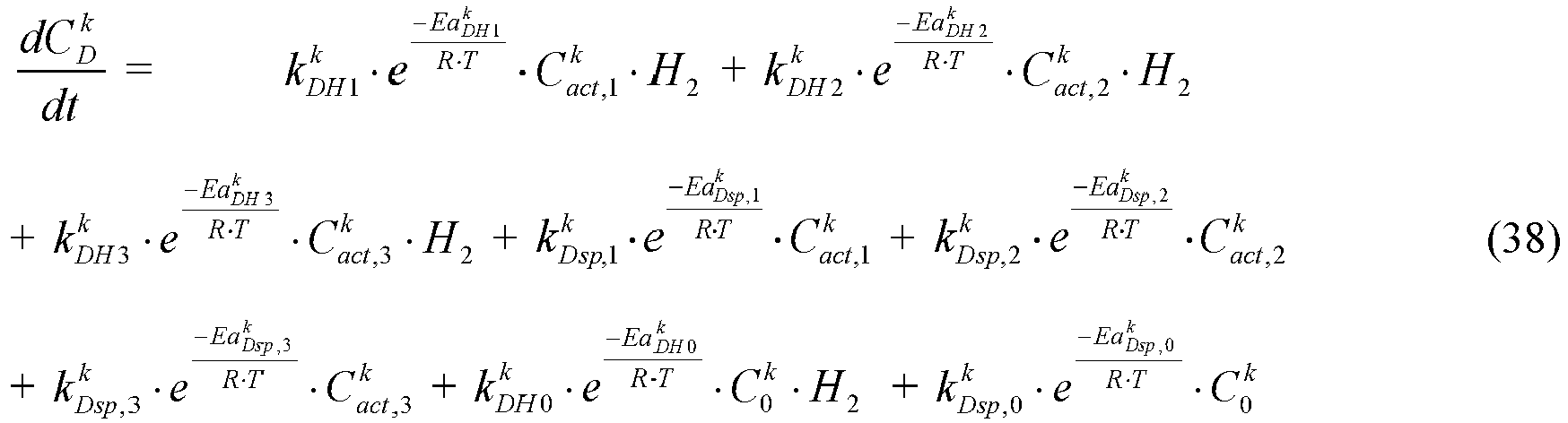
  • The change of deactivated sites of type k per time interval: dC D k dt = k DH 1 k e Ea DH 1 k R T C act , 1 k H 2 + k DH 2 k e Ea DH 2 k R T C act , 2 k H 2 + k DH 3 k e Ea DH 3 k R T C act , 3 k H 2 + k Dsp , 1 k e Ea Dsp , 1 k R T C act , 1 k + k Dsp , 2 k e Ea Dsp , 2 k R T C act , 2 k + k Dsp , 3 k e Ea Dsp , 3 k R T C act , 3 k + k DH 0 k e Ea DH 0 k R T C 0 k H 2 + k Dsp , 0 k e Ea Dsp , 0 k R T C 0 k
    Figure imgb0042
  • The change of reactive sites of type k per time interval: dC act , 1 k dt = k 0,1 k e Ea 0,1 k R T C 0 k M 1 k p 12 k e Ea p 12 k R T C act , 1 k M 2 + k p 21 k e Ea p 21 k R T C act , 2 k M 1 k p 13 k e Ea p 13 k R T C act , 1 k M 3 + k p 31 k e Ea p 31 k R T C act , 3 k M 1 k trH 1 k e Ea trH 1 k R T C act , 1 k H 2 k trsp , 1 k e Ea trsp , 1 k R T C act , 1 k + k DH 1 k e Ea DH 1 k R T C act , 1 k H 2 k Dsp , 1 k e Ea Dsp , 1 k R T C act , 1 k + k a 1 k e Ea a 1 k R T C P k M 1
    Figure imgb0043
  • The change of reactive sites of type k (last inserted monomer = monomer 2) per time interval: dC act , 2 k dt = k 0,2 k e Ea 0,2 k R T C 0 k M 2 + k p 12 k e Ea p 12 k R T C act , 1 k M 2 k p 21 k e Ea p 21 k R T C act , 2 k M 1 k p 23 k e Ea p 23 k R T C act , 2 k M 3 + k p 32 k e Ea p 32 k R T C act , 3 k M 2 k trH 2 k e Ea trH 2 k R T C act , 2 k H 2 k trsp , 2 k e Ea trsp , 2 k R T C act , 2 k k DH 2 k e Ea DH 2 k R T C act , 2 k H 2 k Dsp , 2 k e Ea Dsp , 2 k R T C act , 2 k + k a 2 k e Ea a 2 k R T C P k M 2
    Figure imgb0044
  • The change of reactive sites of type k (last inserted monomer = monomer 3) per time interval: dC act , 3 k dt = k 0,3 k e Ea 0,3 k R T C 0 k M 3 + k p 13 k e Ea p 13 k R T C act , 1 k M 3 k p 31 k e Ea p 31 k R T C act , 3 k M 1 k p 32 k e Ea p 32 k R T C act , 3 k M 2 + k p 23 k e Ea p 23 k R T C act , 2 k M 3 k trH 3 k e Ea trH 3 k R T C act , 3 k H 2 k trsp 3 k e Ea trsp 3 k R T C act , 3 k k DH 3 k e Ea DH 3 k R T C act , 3 k H 2 k Dsp , 3 k e Ea Dsp , 3 k R T C act , 3 k + k a 3 k e Ea a 3 k R T C P k M 3
    Figure imgb0045
  • The amount of polymer consisting of monomer 1 formed at site type k per time interval: dP 1 , k dt = k 0,1 k e Ea 0,1 k R T C 0 k M 1 + k p 11 k e Ea p 11 k R T C act , 1 k M 1 + k p 21 k e Ea p 21 k R T C act , 2 k M 1 + k p 31 k e Ea p 31 k R T C act , 3 k M 1 + k a 1 k e Ea a 1 k R T C P k M 1
    Figure imgb0046
  • The amount of polymer consisting of monomer 2 formed at site type k per time interval: dP 2 , k dt = k 0,2 k e Ea 0,2 k R T C 0 k M 2 + k p 12 k e Ea p 12 k R T C act , 1 k M 2 + k p 22 k e Ea p 22 k R T C act , 2 k M 2 + k p 32 k e Ea p 32 k R T C act , 3 k M 2 + k a 2 k e Ea a 2 k R T C P k M 2
    Figure imgb0047
  • The amount of polymer consisting of monomer 3 formed at site type k per time interval: dP 3 , k dt = k 0,3 k e Ea 0,3 k R T C 0 k M 3 + k p 13 k e Ea p 13 k R T C act , 1 k M 3 + k p 23 k e Ea p 23 k R T C act , 2 k M 3 + k p 33 k e Ea p 33 k R T C act , 3 k M 3 + k a 3 k e Ea a 3 k R T C P k M 3
    Figure imgb0048
  • The sum of propagation rates at site type k: R Pr op , k = dP 1 , k dt + dP 2 , k dt + dP 3 , k dt
    Figure imgb0049
  • The sum of chain transfer (and deactivation) rates at site type k: R Trans , k = k trH 1 k e Ea trH 1 k R T C act , 1 k H 2 + k trH 2 k e Ea trH 2 k R T C act , 2 k H 2 + k trH 3 k e Ea trH 3 k R T C act , 3 k H 2 + k trsp , 1 k e Ea trsp , 1 k R T C act , 1 k + k trsp , 2 k e Ea trsp , 2 k R T C act , 2 k + k trsp , 3 k e Ea trsp , 3 k R T C act , 3 k + k DH 1 k e Ea DH 1 k R T C act , 1 k H 2 + k DH 2 k e Ea DH 2 k R T C act , 2 k H 2 + k DH 3 k e Ea DH 3 k R T C act , 3 k H 2 + k Dsp , 1 k e Ea Dsp , 1 k R T C act , 1 k + k Dsp , 2 k e Ea Dsp , 2 k R T C act , 2 k + k Dsp , 3 k e Ea Dsp , 3 k R T C act , 3 k
    Figure imgb0050
  • The instantaneous comonomer content of monomer 2 at site type k: CC 2 , k = P 2 , k dt P 1 , k dt + P 2 , k dt + P 3 , k dt
    Figure imgb0051
  • The instantaneous comonomer content of monomer 3 at site type k: CC 3 , k = P 3 , k dt P 1 , k dt + P 2 , k dt + P 3 , k dt
    Figure imgb0052
  • Having calculated the instantaneous comonomer contents at site type k, the instantaneous average molecular weight of the polymer formed at site type k can be calculated: AMW K = M 1 1 CC 2 , k CC 3 , k + M 2 CC 2 , k + M 3 CC 3 , k
    Figure imgb0053
  • With M1, M2 and M3 being the molecular weights of monomer 1, monomer 2 and monomer 3.
  • From the instantaneous average molecular weight the instantaneous number average molecular weight (Mn,k ) can be derived, using R Prop,k and RTrans,k . M n , k = AMW k R Pr op , k R Trans , k
    Figure imgb0054
  • Taking into account that the polydispersity index for the single site types is 2 the instantaneous weight average molecular weight for site type k (Mw,k ) is: M w , k = 2 M n , k
    Figure imgb0055
  • The instantaneous molecular weight distribution for site type k is given by the following Schulz-Flory distribution: MWD k i = R Pr op , k AMW k dP 1 dt + dP 2 dt + dP 3 dt 2.3026 i 2 R Trans , k R Pr op , k 2 10 i R Trans , k R Pr op , k
    Figure imgb0056
  • Where i is the chain length of polymer (the X-axis in the distribution).
  • Taking into account that the polydispersity index for the single site types is 2 the instantaneous weight average molecular weight for site type k (Mw,k ) is: M w , k = 2 M n , k
    Figure imgb0057
  • The instantaneous molecular weight distribution for site type k is given by the following Schulz-Flory distribution: MWD k i = R Pr op , k AMW k dP 1 dt + dP 2 dt + dP 3 dt 2.3026 i 2 R Trans , k R Pr op , k 2 10 i R Trans , k R Pr op , k
    Figure imgb0058
  • Where i is the chain length of polymer (the X-axis in the distribution).
  • The total instantaneous MWD of the polymer formed over all site types of the catalyst is the sum of the instantaneous MWDs of the different site types: MWD i = k = 1 6 MWD k i
    Figure imgb0059
  • The instantaneous comonomer content distribution for monomer 2 over all site types k is given by: CCD 2 i = k = 1 6 MWD k i CC 2 , k MWD i
    Figure imgb0060
  • And analogously the comonomer content distribution for monomer 3 over all site types k is given by: CCD 3 i = k = 1 6 MWD k i CC 3 , k MWD i
    Figure imgb0061
  • The rheology method for the prediction of complex viscosity based on the predicted MWD is described in the paper article: Touloupidis V., Wurnitsch C., Albunia A. and Galgali G., 2016, 'Connecting Linear Polymers Molecular Structure to Viscoelastic Properties and Melt Flow Index', Macromol. Theory Simul., 25, pp. 392-402 and in the technical report: Touloupidis V., 2013. BorVisc: Method for predicting polymer rheological properties based on MWD. Case study for LLDPE and HDPE Borealis grades , 2013TR198.
  • Fig. 4 shows a schematic diagram of a detailed kinetics model predictive control concept according to an exemplary embodiment of the invention.
  • Monitoring and Control of Polymerization Process
  • The complexity of the chemical and physical phenomena taking place within a polymerization reactor series, the overlapping effect of the input variables of the system (including flowrates, temperature and pressure) as well as the continuous and dynamic nature of the process require a method for effective monitoring and control (method for manipulating the variables of interest in such a way that the controlled variable(s) value(s) remain within the specified specification range (setpoint) According to the basic feedback control scheme, manipulative actions are based on feeding process output information back to the controller.
  • This control methodology has been in use over the last 20 years, where feedback information may refer to reactive concentration values, polymer density or melt index value. The control method comprises of a mathematical model for the polymerization process as well as an optimizer for defining the best manipulative option. The model is based on mass balance equations and a series of empirical correlations for the prediction of polymerization rate as well as a number of polymer properties, including polymer density and melt index.
  • For example, the monomer conversion is a function of temperature, pressure, hydrogen content and comonomer content. The correlation is in the form of a product of a correction factor, a pre-exponential factor, terms that describe the influence of the concentration and/or partial pressures of the monomer and other reaction partners, terms that describe the mass of catalyst inside the reactor and the catalysts activity, and an Arrhenius-type term that captures the influence of temperature. The non-linear behaviour of these parameters is fitted in order to match the observed plant data.
  • This methodology works well from a control perspective as trend-wise the model is accurate. For example, the current setup offers process conditions / stabilizing control and successful control of polymerization conditions:
    • Production rate
    • H2/Monomer ratio
  • However, since detailed kinetic considerations are not included, the model predictions regarding the polymer microstructure and hence its physical and chemical properties such as molecular weight distribution (MWD), comonomer content (CC) and distribution (CCD) and its subsequent rheological behaviour cannot be achieved.
  • This limitation prevents from reaching property-oriented control capabilities. What is missing is:
    • Product property control
    • Polymer properties monitoring & control (MWD, CC)
    • Rheological properties (complex viscosity, melt index)
  • The present invention therefore leads to a series of benefits:
    1. i. Improved control during transitions
    2. ii. Improved product consistency
    3. iii. Transitions optimization
    4. iv. Reducing the need for test runs
    5. v. Tool for process understanding and trouble-shooting
    6. vi. Deeper knowledge of the polymer structure
    7. vii. Increase in product quality performance
  • The proposed method for polymerization process monitoring and model predictive control offers a new powerful tool for polymerization reactor operation: the proposed method for polymerization process monitoring and model predictive control is able to predict the polymer microstructural characteristics, including MWD, CC across MWD and CCD based on the kinetic parameters of the catalyst in use and the process conditions (feed rates, temperatures, pressure).
  • Further, the proposed method for polymerization process monitoring and model predictive control is able to predict the complex viscosity (within a range of shear rates) of the produced polymer.
  • Further, the proposed method for polymerization process monitoring and model predictive control is able to provide predicted values of the molecular and rheological properties that can be further used as the basis for second level structure-property correlations to additional polymer properties (e.g. correlations towards crack resistance, stress at yield, etc.).
  • Further, the proposed method for polymerization process monitoring and model predictive control can be used for process monitoring providing important information dynamically to the plant operators in the control room.
  • Further, the proposed method for polymerization process monitoring and model predictive control can be used in an offline mode (not connected to the plant) for engineering studies regarding alternative process conditions or reactor setups (product and process development). Further, the proposed method for polymerization process monitoring and model predictive control can receive control feedback using the fast frequency sweep method closing the loop and enabling model predictive control operation.
  • Further, the proposed method for polymerization process monitoring and model predictive control enables property-oriented control, targeting to the intrinsic polymer microstructural characteristics (currently not feasible).
  • Further, the proposed method for polymerization process monitoring and model predictive control is able to increase the model validity of stabilizing control leading to improved control during transitions.
  • The use of the proposed method provides additional degrees of freedom regarding variables we are able to manipulate since now a method to predict their effect to the process exists (e.g., manipulating split or reactor temperature).
  • It has to be noted that embodiments of the invention are described with reference to different subject matters. In particular, some embodiments are described with reference to method type claims whereas other embodiments are described with reference to the device type claims.
  • However, a person skilled in the art will gather from the above and the following description that, unless otherwise notified, in addition to any combination of features belonging to one type of subject matter also any combination between features relating to different subject matters is considered to be disclosed with this application. However, all features can be combined providing synergetic effects that are more than the simple summation of the features.
  • While the invention has been illustrated and described in detail in the drawings and foregoing description, such illustration and description are to be considered illustrative or exemplary and not restrictive; the invention is not limited to the disclosed embodiments. Other variations to the disclosed embodiments can be understood and effected by those skilled in the art and practicing the claimed invention, from a study of the drawings, the disclosure, and the appended claims.
  • In the claims, the word "comprising" does not exclude other elements or steps, and the indefinite article "a" or "an" does not exclude a plurality. A single processor or controller or other unit may fulfil the functions of several items recited in the claims. The mere fact that certain measures are recited in mutually different dependent claims does not indicate that a combination of these measures cannot be used to advantage. Any reference signs in the claims should not be construed as limiting the scope.

Claims (15)

  1. A method for polymerization process monitoring and model predictive control, the method comprising the steps of:
    - providing (S1) at least one set of parameters comprising catalyst information, kinetic modelling information, and calculated polymer property information;
    - modelling (S2) a reaction performance of a catalyst used for a polymerization process using a reaction network, the reaction network comprising multiple reactions of the catalyst, wherein reactions of the catalyst are modelled by a discrete number of multiple site types of the catalyst, wherein the catalyst is modelled as a sum of contributions of the multiple site types.
  2. The method according to claim 1,
    wherein the method further comprises the step of predicting, based on the modelled reaction performance, an expected reactive concentration value, a polymerization rate per reactor, or a polymer microstructure per reactor.
  3. The method according to claim 1 or 2,
    wherein the step of modeling (S2) of the reaction performance of the catalyst further comprises the step of using a rheology model for predicting an expected complex viscosity.
  4. The method according to any one of the preceding claims,
    wherein the set of parameters further comprises a feed rate used for the polymerization process, a temperature used for the polymerization process, or a pressure used for the polymerization process.
  5. The method according to any one of the preceding claims,
    wherein the method further comprises the step of
    modelling (S3) at least one value of a molecular property based on the modelled reaction performance.
  6. The method according to any one of the preceding claims,
    wherein the method further comprises the step of
    modelling (S3) at least one value of a rheological property based on the modelled reaction performance.
  7. The method according to any one of the preceding claims,
    wherein the modelled reaction performance is used for process monitoring by means of an optimizer, preferably the optimizer is connected to a controller for controlling the polymerization process.
  8. The method according to any one of the preceding claims,
    wherein the modelled reaction performance is used in an offline mode.
  9. An apparatus (100) for polymerization process monitoring and model predictive control, the apparatus comprising
    - a data memory (10) which is configured to provide at least one set of parameters comprising catalyst information, kinetic modelling information, and calculated polymer property information; and
    - a processor (20), which is configured to model a reaction performance of a catalyst used for a polymerization process using a reaction network, the reaction network comprising multiple reactions of the catalyst, wherein reactions of the catalyst are modelled by a discrete number of multiple site types of the catalyst, wherein the catalyst is modelled as a sum of contributions of the multiple site types.
  10. The apparatus according to claim 9,
    wherein the processor (20) is further configured to predict, based on the modelled reaction performance, an expected reactive concentration value, a polymerization rate per reactor, or a polymer microstructure per reactor.
  11. The apparatus according to claim 9 or 10,
    wherein the processor (20) is further configured to model the reaction performance of the catalyst in terms of using a rheology model for predicting an expected complex viscosity.
  12. The apparatus according to any one of the preceding claims 9 to 11,
    wherein the set of parameters further comprises a feed rate used for the polymerization process, a temperature used for the polymerization process, or a pressure used for the polymerization process.
  13. The apparatus according to any one of the preceding claims 9 to 12,
    wherein the processor (20) is further configured to model at least one value of a molecular property based on the modelled reaction performance.
  14. The apparatus according to any one of the preceding claims 9 to 13,
    wherein the processor (20) is further configured to model at least one value of a rheological property based on the modelled reaction performance.
  15. A computer-readable medium comprising instructions which, when executed by a computer, cause the computer to carry out the steps of the method of any one of the preceding claims 1 to 8.
EP22158024.4A 2022-02-22 2022-02-22 Method and apparatus for polymerization process monitoring and model predictive control Pending EP4231303A1 (en)

Priority Applications (7)

Application Number Priority Date Filing Date Title
EP22158024.4A EP4231303A1 (en) 2022-02-22 2022-02-22 Method and apparatus for polymerization process monitoring and model predictive control
PCT/EP2023/054348 WO2023161243A1 (en) 2022-02-22 2023-02-22 Method and apparatus for polymerization process monitoring and model predictive control
KR1020247031002A KR20240152359A (en) 2022-02-22 2023-02-22 Method and device for polymerization process monitoring and model predictive control
CN202380022536.0A CN118715568A (en) 2022-02-22 2023-02-22 Method and apparatus for polymerization process monitoring and model predictive control
US18/839,571 US20250161900A1 (en) 2022-02-22 2023-02-22 Method and apparatus for polymerization process monitoring and model predictive control
JP2024548726A JP2025506537A (en) 2022-02-22 2023-02-22 Method and apparatus for polymerization process monitoring and model predictive control
TW112106489A TWI881300B (en) 2022-02-22 2023-02-22 Method and apparatus for polymerization process monitoring and model predictive control

Applications Claiming Priority (1)

Application Number Priority Date Filing Date Title
EP22158024.4A EP4231303A1 (en) 2022-02-22 2022-02-22 Method and apparatus for polymerization process monitoring and model predictive control

Publications (1)

Publication Number Publication Date
EP4231303A1 true EP4231303A1 (en) 2023-08-23

Family

ID=80786975

Family Applications (1)

Application Number Title Priority Date Filing Date
EP22158024.4A Pending EP4231303A1 (en) 2022-02-22 2022-02-22 Method and apparatus for polymerization process monitoring and model predictive control

Country Status (7)

Country Link
US (1) US20250161900A1 (en)
EP (1) EP4231303A1 (en)
JP (1) JP2025506537A (en)
KR (1) KR20240152359A (en)
CN (1) CN118715568A (en)
TW (1) TWI881300B (en)
WO (1) WO2023161243A1 (en)

Families Citing this family (1)

* Cited by examiner, † Cited by third party
Publication number Priority date Publication date Assignee Title
CN119989848B (en) * 2025-04-15 2025-07-11 浙江大学 An adaptive method for adjusting kinetic parameters of polymerization process

Family Cites Families (8)

* Cited by examiner, † Cited by third party
Publication number Priority date Publication date Assignee Title
JP2001072729A (en) * 1999-09-06 2001-03-21 Japan Polychem Corp Method for estimating gel content of propylenic block copolymer and preparation of propylenic block copolymer
BR9906022A (en) * 1999-12-30 2001-09-25 Opp Petroquimica S A Process for the controlled production of polyethylene and its copolymers
US20120109620A1 (en) * 2010-11-01 2012-05-03 Honeywell International Inc. Apparatus and method for model predictive control (mpc) using approximate window-based estimators
JP7092879B2 (en) * 2017-12-29 2022-06-28 エフ.ホフマン-ラ ロシュ アーゲー Prediction of metabolic status of cell culture
CN108763737B (en) * 2018-05-25 2022-05-20 天津大学 A method for establishing a three-dimensional two-phase model of a proton exchange membrane fuel cell full cell
US11992818B2 (en) * 2019-08-27 2024-05-28 New York University Method and apparatus for the rapid discovery and design of polymerizations
CN111724861B (en) * 2020-06-10 2024-04-05 中国寰球工程有限公司 Fitting calculation method for olefin polymerization reaction kinetic parameters
CN112687355A (en) * 2020-12-04 2021-04-20 复旦大学 Machine learning-assisted polymer synthesis inverse analysis method

Non-Patent Citations (9)

* Cited by examiner, † Cited by third party
Title
BJELIC A. ET AL: "Hydrogenation and hydrodeoxygenation of aromatic lignin monomers over Cu/C, Ni/C, Pd/C, Pt/C, Rh/C and Ru/C catalysts: Mechanisms, reaction micro-kinetic modelling and quantitative structure-activity relationships", CHEMICAL ENGENEERING JOURNAL, vol. 359, 1 March 2019 (2019-03-01), AMSTERDAM, NL, pages 305 - 320, XP055882325, ISSN: 1385-8947, DOI: 10.1016/j.cej.2018.11.107 *
RAMANATHAN K. ET AL: "Kinetic Parameters Estimation for Three Way Catalyst Modeling", INDUSTRIAL & ENGINEERING CHEMISTRY RESEARCH, vol. 50, no. 17, 7 September 2011 (2011-09-07), pages 9960 - 9979, XP055957119, ISSN: 0888-5885, DOI: 10.1021/ie200726j *
SOARES J.B.P.: "The Use of Instantaneous Distributions in Polymerization Reaction Engineering", MACROMOL. REACT. ENG, vol. 8, 2014, pages 235 - 259
SOARES J.TOULOUPIDIS V.: "Multimodal Polymers with Supported Catalysts: Design and Production", 2019, SPRINGER INTERNATIONAL PUBLISHING, article "Polymerization Kinetics and the Effect of Reactor Residence Time on Polymer Microstructure"
TOULOUPIDIS V. ET AL: "An Integrated PRE Methodology for Capturing the Reaction Performance of Single- and Multi-site Type Catalysts Using Bench-Scale Polymerization Experiments", MACROMOLECULAR REACTION ENGINEERING, vol. 14, no. 6, 31 August 2020 (2020-08-31), pages 2000028, XP055961188, ISSN: 1862-832X, Retrieved from the Internet <URL:https://onlinelibrary.wiley.com/doi/full-xml/10.1002/mren.202000028> DOI: 10.1002/mren.202000028 *
TOULOUPIDIS V.: "BorVisc: Methodfor predicting polymer rheological properties based on MWD", CASE STUDY FOR LLDPE AND HDPE BOREALIS GRADES, 2013
TOULOUPIDIS V.: "Catalytic Olefin Polymerization Process Modeling: Multi-Scale Approach and Modeling Guidelines for Micro-Scale/Kinetic Modeling", MACROMOL. REACT. ENG., vol. 8, 2014, pages 508 - 527
TOULOUPIDIS V.RITTENSCHOBER G.PAULIK C.: "An Integrated PRE Methodology for Capturing the Reaction Performance of Single- and Multi-site Type Catalysts Using Bench-Scale Polymerization Experiments", MACROMOL. REACT. ENG., 2020
TOULOUPIDIS V.WURNITSCH CALBUNIA A.GALGALI G.: "Connecting Linear Polymers Molecular Structure to Viscoelastic Properties and Melt Flow Index", MACROMOL. THEORY SIMUL., vol. 25, 2016, pages 392 - 402

Also Published As

Publication number Publication date
KR20240152359A (en) 2024-10-21
CN118715568A (en) 2024-09-27
US20250161900A1 (en) 2025-05-22
JP2025506537A (en) 2025-03-11
WO2023161243A1 (en) 2023-08-31
TWI881300B (en) 2025-04-21
TW202401446A (en) 2024-01-01

Similar Documents

Publication Publication Date Title
Kiparissides et al. Dynamic simulation of industrial poly (vinyl chloride) batch suspension polymerization reactors
US5687090A (en) Polymer component characterization method and process simulation apparatus
US6093211A (en) Polymer property distribution functions methodology and simulators
Tian et al. Optimal control of a batch emulsion copolymerisation reactor based on recurrent neural network models
Zapata‐González et al. Efficient numerical integration of stiff differential equations in polymerisation reaction engineering: computational aspects and applications
EP4231303A1 (en) Method and apparatus for polymerization process monitoring and model predictive control
Nogueira et al. Parameter estimation with estimability analysis applied to an industrial scale polymerization process
Advincula et al. Harnessing data and control with AI/ML-driven polymerization and copolymerization
Kim et al. Dynamic simulation of liquid polymerization reactors in Sheripol process for polypropylene
Krallis et al. A comprehensive kinetic model for the free-radical polymerization of vinyl chloride in the presence of monofunctional and bifunctional initiators
Shin et al. Surrogate-model-based optimization of a nonideal polymerization reactor for producing tailored molecular weight distribution
Sbaaei et al. Predictive two-phase modeling and improvement for industrial UnipolⓇ polypropylene process–development and a case study
Iedema et al. Predicting molecular weight and degree of branching distribution of polyethylene for mixed systems with a constrained geometry metallocene catalyst in semibatch and continuous reactors
Muhammad et al. Modeling and nonlinearity studies of low density polyethylene (LDPE) tubular reactor
Soares Mathematical Modeling of the Long‐Chain Branch Structure of Polyolefins Made with Two Metallocene Catalysts: An Algebraic Solution
Yaghini et al. Molecular weight and branching distribution modeling in radical polymerization with transfer to polymer and scission under gel conditions and allowing for multiradicals
Tongtummachat et al. Dynamic Monte Carlo simulation for chain‐shuttling polymerization of olefin block copolymers in continuous stirred‐tank reactor
Brandolin et al. Prediction of molecular weight distributions by probability generating functions. Application to industrial autoclave reactors for high pressure polymerization of ethylene and ethylene‐vinyl acetate
Asteasuain et al. Simultaneous design and control of a semibatch styrene polymerization reactor
Bindlish et al. Parameter estimation for industrial polymerization processes
Ray Modeling and control of polymerization reactors
Habashi et al. Exploring bimodal HDPE synthesis using single-and dual-site metallocene catalysts: a comprehensive review of the Monte Carlo method and AI-based approaches
Goerke et al. Transfer of semibatch processes to continuous processes with side injections—opportunities and limitations
Lima et al. Nonlinear fuzzy identification of batch polymerization processes
Vallerio et al. Model-based optimization of the cooling system of an industrial tubular LDPE reactor

Legal Events

Date Code Title Description
PUAI Public reference made under article 153(3) epc to a published international application that has entered the european phase

Free format text: ORIGINAL CODE: 0009012

STAA Information on the status of an ep patent application or granted ep patent

Free format text: STATUS: THE APPLICATION HAS BEEN PUBLISHED

AK Designated contracting states

Kind code of ref document: A1

Designated state(s): AL AT BE BG CH CY CZ DE DK EE ES FI FR GB GR HR HU IE IS IT LI LT LU LV MC MK MT NL NO PL PT RO RS SE SI SK SM TR

STAA Information on the status of an ep patent application or granted ep patent

Free format text: STATUS: REQUEST FOR EXAMINATION WAS MADE

17P Request for examination filed

Effective date: 20231006

RBV Designated contracting states (corrected)

Designated state(s): AL AT BE BG CH CY CZ DE DK EE ES FI FR GB GR HR HU IE IS IT LI LT LU LV MC MK MT NL NO PL PT RO RS SE SI SK SM TR

RAP3 Party data changed (applicant data changed or rights of an application transferred)

Owner name: BOREALIS GMBH