EP4231276A1 - Hidden decision tree test device, hidden decision tree test system, hidden decision tree test method, and program - Google Patents
Hidden decision tree test device, hidden decision tree test system, hidden decision tree test method, and program Download PDFInfo
- Publication number
- EP4231276A1 EP4231276A1 EP20957740.2A EP20957740A EP4231276A1 EP 4231276 A1 EP4231276 A1 EP 4231276A1 EP 20957740 A EP20957740 A EP 20957740A EP 4231276 A1 EP4231276 A1 EP 4231276A1
- Authority
- EP
- European Patent Office
- Prior art keywords
- frequency
- decision tree
- group
- data
- vector
- Prior art date
- Legal status (The legal status is an assumption and is not a legal conclusion. Google has not performed a legal analysis and makes no representation as to the accuracy of the status listed.)
- Pending
Links
Images


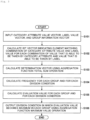
Classifications
-
- G—PHYSICS
- G06—COMPUTING OR CALCULATING; COUNTING
- G06F—ELECTRIC DIGITAL DATA PROCESSING
- G06F7/00—Methods or arrangements for processing data by operating upon the order or content of the data handled
- G06F7/38—Methods or arrangements for performing computations using exclusively denominational number representation, e.g. using binary, ternary, decimal representation
- G06F7/48—Methods or arrangements for performing computations using exclusively denominational number representation, e.g. using binary, ternary, decimal representation using non-contact-making devices, e.g. tube, solid state device; using unspecified devices
- G06F7/52—Multiplying; Dividing
- G06F7/535—Dividing only
-
- G—PHYSICS
- G06—COMPUTING OR CALCULATING; COUNTING
- G06N—COMPUTING ARRANGEMENTS BASED ON SPECIFIC COMPUTATIONAL MODELS
- G06N5/00—Computing arrangements using knowledge-based models
- G06N5/01—Dynamic search techniques; Heuristics; Dynamic trees; Branch-and-bound
-
- G—PHYSICS
- G09—EDUCATION; CRYPTOGRAPHY; DISPLAY; ADVERTISING; SEALS
- G09C—CIPHERING OR DECIPHERING APPARATUS FOR CRYPTOGRAPHIC OR OTHER PURPOSES INVOLVING THE NEED FOR SECRECY
- G09C1/00—Apparatus or methods whereby a given sequence of signs, e.g. an intelligible text, is transformed into an unintelligible sequence of signs by transposing the signs or groups of signs or by replacing them by others according to a predetermined system
-
- H—ELECTRICITY
- H04—ELECTRIC COMMUNICATION TECHNIQUE
- H04L—TRANSMISSION OF DIGITAL INFORMATION, e.g. TELEGRAPHIC COMMUNICATION
- H04L9/00—Cryptographic mechanisms or cryptographic arrangements for secret or secure communications; Network security protocols
- H04L9/08—Key distribution or management, e.g. generation, sharing or updating, of cryptographic keys or passwords
- H04L9/0816—Key establishment, i.e. cryptographic processes or cryptographic protocols whereby a shared secret becomes available to two or more parties, for subsequent use
- H04L9/085—Secret sharing or secret splitting, e.g. threshold schemes
-
- H—ELECTRICITY
- H04—ELECTRIC COMMUNICATION TECHNIQUE
- H04L—TRANSMISSION OF DIGITAL INFORMATION, e.g. TELEGRAPHIC COMMUNICATION
- H04L2209/00—Additional information or applications relating to cryptographic mechanisms or cryptographic arrangements for secret or secure communication H04L9/00
- H04L2209/46—Secure multiparty computation, e.g. millionaire problem
Definitions
- the present invention relates to a secret decision tree test device, a secret decision tree test system, a secret decision tree test method, and a program.
- NPL 1 As a method of obtaining a specific operation result without restoring encrypted numerical values (for example, NPL 1), a method called secret calculation has been known.
- NPL 1 a method called secret calculation has been known.
- NPL 1 by performing encryption in which numerical fragments are distributed to three secret calculation devices, and having three secret calculation devices perform cooperative calculation, results of addition/subtraction, constant addition, multiplication, constant multiplication, a logical operation (negation, logical AND, logical OR, exclusive OR), data format conversion (integers and binary digits), and the like can be obtained in a state of being distributed to the three secret calculation device without restoring numerical values.
- a logical operation nodegation, logical AND, logical OR, exclusive OR
- data format conversion integers and binary digits
- the calculation time may increase.
- ⁇ (mn) evaluations tests are required in order to conceal the number of items of data classified at each node when evaluation values are calculated at all the nodes.
- One embodiment of the present invention was made in view of the above points, and has an object to reduce the calculation time in a case where learning of a decision tree is performed by secret calculation.
- a secret decision tree test device configured to evaluate a division condition at each of a plurality of nodes of a decision tree when learning of the decision tree is performed by secret calculation, the secret decision tree test device, includes: an input unit configured to input a category attribute value vector composed of specific category attribute values of items of data included in a data set for learning of the decision tree, a label value vector composed of label values of the items of the data, and a group information vector indicating grouping of the items of the data into the nodes; a frequency calculation unit configured to calculate, using the category attribute value vector, the label value vector, and the group information vector, a first frequency of data belonging to each group, a second frequency of data for each of the label values in said each group, a third frequency of data belonging to a division group obtained by dividing said each group by a division condition indicating a condition whether the category attribute value is included in a predetermined set, and a fourth frequency of data for each of the label values in the division group; and an evaluation calculation unit
- a secret decision tree test device 10 capable of efficiently performing evaluation (a test) at each node for an attribute taking a category value when learning of a decision tree is performed by secret calculation (that is, when learning of a decision tree is performed without revealing input and output) will be described.
- the secret decision tree test device 10 can reduce the total calculation time by collectively calculating evaluation values of a plurality of division conditions at each node of a decision tree as will be described later.
- a decision tree in which input and output are concealed using secret calculation is also referred to as a secret decision tree.
- a value obtained by concealing a certain value a through encryption, secret sharing, or the like is called a secret value of a, and is denoted as [a].
- [a] refers to a set of fragments of secret sharing which are possessed by each secret calculation device.
- Operations of addition, subtraction, and multiplication take the secret values [a] and [b] of two values a and b as inputs, and calculate the secret values [c 1 ], [c 2 ], and [c 3 ] of calculation results c 1 , c 2 , and c 3 of a + b, a - b, and ab. Execution of the operations of addition, subtraction, and multiplication are denoted, respectively, as follows:
- Add([a], [b]), Sub([a], [b]), and Mul([a], [b]) are abbreviated as [a] + [b], [a] - [b], and [a] ⁇ [b], respectively.
- the Boolean value is 1 when it is true and 0 when it is false.
- This operation can be implemented as follows: d ⁇ c ⁇ a ⁇ b + b
- a decision tree is a directed graph that expresses knowledge about a certain attribute of data by a combination of rules with a tree structure.
- attributes include an attribute called an objective variable and an attribute called an explanatory variable
- the decision tree uses the attribute value of an explanatory variable as an input and predicts and outputs the attribute value of an objective variable.
- the decision tree includes one or more nodes, and each node other than a leaf is set with a division rule (division condition) regarding explanatory variables such as, for example, "age is less than 30 years.”
- the attribute value of an objective variable is set in a leaf (that is, a node at an end of the decision tree).
- the decision tree In response to receiving an attribute value of the explanatory variable, the decision tree first determines a division condition at the node of the root, and then, transitions to one of the child nodes in accordance with the determination result of the division condition. Thereafter, determination of a division condition at each node and transition to the child node are recursively repeated, and an attribute value allocated to the finally reached leaf is output as the prediction value of the objective variable.
- CART, ID3, C4.5, and the like are known as algorithms for learning a decision tree from a set of data composed of explanatory variables and objective variables. Although these algorithms differ in detail, these all learn a decision tree by recursively dividing a data set so as to greedily maximize a certain objective function from the root to the leaves (Steps 1 to 8 to be described later).
- each item of data included in the data set is also referred to as a record.
- the data set may be referred to as "data set for training" or "teaching data set,” and each item of data included in the data set may be referred to as "training learning", "teaching data”, or the like.
- X is a matrix having attribute values of the explanatory variables of each record as elements, and is represented by, for example, a matrix in which the total number of records is the number of rows and the total number of explanatory variables is the number of columns.
- y is a vector having attribute values of the objective variables of each record as elements, and is represented by, for example, a vertical vector in which the attribute value of the objective variable of the n-th record of X is an n-th element.
- a division condition is set at each node other than a leaf of the decision tree, and an attribute value of the objective variable is set at a leaf.
- both the objective variable and the explanatory variable are assumed to take category values
- the objective variable is also referred to as a label
- its value (attribute value) is also referred to as a label value.
- an explanatory variable that takes a category value is also referred to as a category attribute (that is, in a case where it is expressed as a "category attribute", it indicates an explanatory variable that takes a category value)
- its value is also referred to as a category attribute value.
- the decision tree in a case where the objective variable is a numerical value is also called a regression tree.
- Step 1 a node v is created.
- Step 2 when the end condition of division is satisfied, the attribute value of the objective variable is set at the node v, and output as a leaf, and the process ends.
- the attribute value (label value) which is set at the node v is, for example, a value that appears most frequently among the values of the elements included in y.
- the end condition include all the elements included in y having the same value (that is, all the attribute values of the objective variables being the same), the decision tree having reached a height determined in advance, and the like.
- Step 3 when the end condition of division is not satisfied, division conditions r 1 , r 2 , ⁇ that can be applied to the node v are listed.
- Step 4 an evaluation value s i of each division condition r i is calculated by the objective function.
- Step 5 the division condition r* that takes the maximum evaluation value is selected from a set ⁇ r i ⁇ of division conditions, and the division condition r* is set at the node v.
- Step 6 a data set (X, y) is divided into data sets (X 1 , y 1 ), (X 2 , y 2 ) , ⁇ , (X d , y d ) on the basis of the division condition r*.
- d is the number of branches (that is, the number of children held by one node).
- Step 7 Steps 1 to 7 are recursively executed for each (X j , y j ). That is, each (X j , y j ) is regarded as (X, y), and a function, a method, or the like of executing Steps 1 to 7 is called.
- Step 1 when a node v is created in Step 1 executed recursively, a branch is spanned with the node v created in the calling Step 1. Note that the node v created in the calling Step 1 is a parent, and the node v created in the called Step 1 is a child.
- Step 8 when the execution of Steps 1 to 7 for all the data sets (X j , y j ) is ended (that is, the execution of all Steps 1 to 7 called recursively is ended), the set of nodes v (and the division condition r set at each node v) and the set of branches between the nodes are output, and the process ends.
- the set of these nodes v and the set of branches are the decision tree.
- any condition for the attribute value of the explanatory variable can be used as the division condition, in general, a condition such as magnitude comparison or inclusion in a certain set is often used.
- the division condition since the explanatory variable takes a category value, the division condition is belonging to a certain set (for example, X is a set, x is a category attribute value, x ⁇ X, or the like).
- the division condition may be referred to as, for example, a division rule, a classification condition, a classification rule, or the like.
- an index of purity H( ⁇ ) indicating whether the data set is ambiguous has been known.
- indices which are often used include a gini coefficient, entropy, and the like.
- a set of records in which the attribute value (that is, label value) of the objective variable is k is denoted as Q k .
- H Q ⁇ ⁇ k p k log 2 p k
- the quality of each division condition is evaluated by the objective function (that is, the value of the objective function is the evaluation value of the division condition).
- the objective function which are often used include an amount of mutual information, a gain factor, and the like.
- GainRatio() defined by the following formula is called a gain factor.
- the gain factor is used as an objective function.
- the division condition of each node is set by selecting such a division condition that a predetermined objective function is maximized at the node. Since it is necessary to calculate the value of the objective function for each candidate for the division condition, it is important to be able to efficiently calculate the value of the objective function for the given division condition.
- the gain factor defined by Math. 4 needs to be calculated intricately to obtain the frequency of the value of each label (the value of the objective variable) after the division has been performed actually. Consequently, in the present embodiment, a method of calculating a gain factor is reformulated and simplified so that the gain factor can be collectively calculated for a plurality of division conditions by secret calculation.
- the input of f( ⁇ ) is one of the above-described four frequencies (the numbers of records
- f( ⁇ ) can implement ⁇ (n) calculations of f( ⁇ ) with the amount of communication of O(nlogn) by using a secret batch mapping using a correspondence table (look-up table) listing the following correspondence of the magnitude ⁇ (n). 0 n ⁇ x ⁇ x log x
- the result of comparison of two values (a, b) and (c, d) each given as a pair of a numerator and a denominator being non-negative is equal to the result of comparison of ad and bc. Since both the numerator and denominator of GainRatio are non-negative, division is avoided by substituting the above method when comparison of GainRatio (that is, comparison of the evaluation values) is performed. Thereby, it is possible to reduce the calculation time required for the comparison of the evaluation values for selecting the division condition that takes the maximum evaluation value.
- Fig. 1 is a diagram illustrating an example of the functional configuration of the secret decision tree test device 10 according to the present embodiment.
- the secret decision tree test device 10 includes an input unit 101, a vector calculation unit 102, an evaluation value calculation unit 103, an output unit 104, and a storage unit 105.
- the storage unit 105 stores various types of data (that is, various types of concealed data) for learning a secret decision tree.
- these various types of data include a data set given as a data set for learning and a group information vector indicating which node a certain category attribute value is classified (that is, grouped) into.
- the data set is composed of a category attribute value vector having the category attribute value of each record as an element and a label value vector having the label value of each record as an element.
- the input unit 101 inputs a category attribute value vector of a certain category attribute, a label value vector, and a group information vector corresponding to the category attribute as data required for calculating the above evaluation value of Step 4.
- the vector calculation unit 102 calculates a vector for determining the division condition (a determination vector to be described later) using the category attribute value vector and the label value vector.
- the evaluation value calculation unit 103 calculates a frequency for evaluating the division condition for each group and for each division condition, and calculates the evaluation value (GainRatio) of the division condition on the basis of Math. 10.
- the output unit 104 selects a division condition that maximizes the evaluation value in each group, and outputs the selected division condition. Thereby, the division condition to be set at a node corresponding to the group is obtained.
- Fig. 2 is a diagram illustrating an example of the hardware configuration of the secret decision tree test device 10 according to the present embodiment.
- the secret decision tree test device 10 is implemented by a hardware configuration of a general computer or a computer system, and includes an input device 201, a display device 202, an external I/F 203, a communication I/F 204, a processor 205, and a memory device 206. These components of hardware are communicably connected to each other through a bus 207.
- the input device 201 is, for example, a keyboard, a mouse, a touch panel, or the like.
- the display device 202 is, for example, a display or the like. Note that the secret decision tree test device 10 may not have, for example, at least one of the input device 201 and the display device 202.
- the external I/F 203 is an interface with an external device such as a recording medium 203a.
- the secret decision tree test device 10 can execute reading, writing, or the like on the recording medium 203a through the external I/F 203.
- the recording medium 203a may store, for example, one or more programs for implementing the respective functional units (the input unit 101, the vector calculation unit 102, the evaluation value calculation unit 103, and the output unit 104) included in the secret decision tree test device 10.
- examples of the recording medium 203a include a compact disc (CD), a digital versatile disk (DVD), a secure digital (SD) memory card, a universal serial bus (USB) memory card, and the like.
- CD compact disc
- DVD digital versatile disk
- SD secure digital
- USB universal serial bus
- the communication I/F 204 is an interface for connecting the secret decision tree test device 10 to a communication network. Note that one or more programs for implementing the respective functional units included in the secret decision tree test device 10 may be acquired (downloaded) from a predetermined server device or the like through the communication I/F 204.
- Examples of the processor 205 include various arithmetic/logic units such as a central processing unit (CPU) and a graphics processing unit (GPU). Each functional unit included in the secret decision tree test device 10 is implemented by, for example, a process of causing the processor 205 to execute one or more programs stored in the memory device 206 or the like.
- CPU central processing unit
- GPU graphics processing unit
- Examples of the memory device 206 include various storage devices such as a hard disk drive (HDD), a solid state drive (SSD), a random access memory (RAM), a read only memory (ROM), and a flash memory.
- the storage unit 105 included in the secret decision tree test device 10 can be implemented by using, for example, the memory device 206. Note that the storage unit 105 may be implemented by using, for example, a storage device or the like which is connected to the secret decision tree test device 10 through a communication network.
- the secret decision tree test device 10 can implement various processes by having the hardware configuration shown in Fig. 2 .
- the hardware configuration shown in Fig. 2 is an example, and the secret decision tree test device 10 may have another hardware configuration.
- the secret decision tree test device 10 may have a plurality of processors 205, or may have a plurality of memory devices 206.
- Fig. 3 is a flowchart illustrating an example of a flow of the secret decision tree test process according to the present embodiment. Note that a case where a certain category attribute is evaluated (tested) at each node constituting a certain layer of the secret decision tree will be described below. The layer is a set of nodes having the same depth from the root. In addition, it is assumed that a set of values that can be taken by the category attribute is ⁇ 5, 6, 7, 8 ⁇ and a set of values that can be taken by the label is ⁇ 1, 2, 3 ⁇ .
- the input unit 101 inputs the category attribute value vector, the label value vector, and the group information vector (Step S101).
- the group information vector indicates which group each element of the category attribute value vector and the label value vector is classified into, and is a vector in which an element indicating the end of each group is 1 and the other elements are 0 when classified into groups from an element at the head.
- the above [g] indicates that the first to third elements of the category attribute value vector and the label value vector belong to the first group, the fourth element belongs to the second group, the fifth to eighth elements belong to the third group, and the ninth and tenth elements belong to the fourth group.
- each group corresponds to one node, and is a set of elements (category attribute values) classified at the node in the layer one level above (that is, data sets divided by the division condition set at the node in the layer one level above).
- the vector calculation unit 102 calculates a bit vector indicating the position of an element matching a combination of the category attribute value and the label value for each combination of the value that can be taken by the category attribute and the value that can be taken by the label (Step S102) .
- bit vector [f 5, 3 ] 1 , 0 , 0 , 0 , 0 , 0 , 0 , 0 , 0 , 0 T
- Bit vectors [f 6, 1 ] to [f 6 , 3 ], [f 7, 1 ] to [f 7, 3 ], and [f 8, 1 ] to [f 8, 3 ] corresponding to the other combinations are calculated in the same way.
- a bit vector corresponding to a combination of a certain category attribute value and the label value is a vector in which only elements at the position of a combination matching the combination of the category attribute value and the label value among the combinations of elements at the same position in the category attribute value vector and the label value vector are 1 and the other elements are 0.
- the vector calculation unit 102 performs an aggregation function total sum operation in accordance with grouping based on the group information vector [g] for each bit vector, and calculates a determination vector (Step S103).
- the aggregation function total sum operation is an operation of inputting a set of elements in the same group and outputting the total sum of values of the elements.
- the vector calculation unit 102 calculates the total sum of the first to third elements for each bit vector, calculates the total sum of the fourth element in the same way, calculates the total sum of the fifth to eighth elements, and calculates the total sum of the ninth to tenth elements.
- the vector calculation unit 102 creates a determination vector by setting each total sum to be an element at the same position as an element which is a calculation source of the total sum.
- Determination vectors corresponding to the other bit vectors [f 6 , 1 ] to [f 6 , 3 ], [f 7, 1 ] to [f 7, 3 ], and [f 8, 1 ] to [f 8, 3 ] are calculated in the same way.
- the above determination vectors represent the number of times a combination of the category attribute value and the label value corresponding to the bit vector appears in each group.
- the evaluation value calculation unit 103 calculates each frequency for each group and for each division condition (Step S104).
- the evaluation value calculation unit 103 calculates the following four frequencies:
- the first frequency is obtained by calculating the number of elements for each group using the category attribute value vector [c] and the group information vector [g].
- the second frequency is obtained by calculating the number of elements for each group and for each label value using the category attribute value vector [c], the label value vector [y], and the group information vector [g].
- the third frequency is obtained by calculating the number of elements of each set (that is, a set satisfying the division condition ⁇ or a set not satisfying it) divided by the division condition ⁇ when the group is divided by the division condition ⁇ using the category attribute value vector [c] and the group information vector [g].
- the fourth frequency is obtained by calculating the number of elements taking the label value k in each set divided by the division condition ⁇ when the group is divided by the division condition ⁇ using the category attribute value vector [c], the group information vector [g], and the determination vector. This may be calculated by the determination vectors counting the number of times a combination of each element (category attribute value) included in the divided set and the label value k appears in the divided group. Specifically, for example, in a case where the division condition ⁇ is x ⁇ ⁇ 5, 8 ⁇ , the third group of the category attribute value vector [c] is divided into ⁇ 5, 8, 5 ⁇ and ⁇ 7 ⁇ .
- the number of elements taking the label value k in ⁇ 5, 8, 5 ⁇ is obtained by calculating the sum of the number of times a combination of (5, k) appears in the third group and the number of times a combination of (8, k) appears in the third group from the determination vectors [f 5, k ] and [f 8, k ].
- the number of elements taking the label value k in ⁇ 7 ⁇ is obtained by calculating the number of times a combination of (7, k) appears in the third group from the determination vector [f 7, k ].
- the evaluation value calculation unit 103 calculates the evaluation value of the division condition on the basis of Math. 10 for each group and for each division condition, by using each frequency calculated in Step S104 described above (Step S105).
- the output unit 104 selects a division condition that maximizes the evaluation value in each group, and outputs the selected division condition as the division condition to be set at a node corresponding to the group (Step S106).
- a division condition that maximizes the evaluation value in each group for example, an aggregation function maximum value operation may be performed.
- the aggregation function maximum value operation is an operation of inputting elements (evaluation values) in the same group and outputting the maximum value among the values of the elements.
- the secret decision tree test device 10 when learning a secret decision tree from a given data set of secret values, the secret decision tree test device 10 according to the present embodiment can reduce the total calculation time by collectively calculating the evaluation values of a plurality of division conditions at each node for the category attribute value. Specifically, in a case where a data set composed of n items of data is divided by a decision tree having m nodes, evaluations (tests) of ⁇ (mn) are required as a whole with the conventional technique, whereas the secret decision tree test device 10 according to the present embodiment can execute evaluation in O(nlogn) time.
Landscapes
- Engineering & Computer Science (AREA)
- Physics & Mathematics (AREA)
- General Physics & Mathematics (AREA)
- Theoretical Computer Science (AREA)
- Pure & Applied Mathematics (AREA)
- Computational Mathematics (AREA)
- Mathematical Optimization (AREA)
- Mathematical Analysis (AREA)
- Computing Systems (AREA)
- General Engineering & Computer Science (AREA)
- Mathematical Physics (AREA)
- Computational Linguistics (AREA)
- Software Systems (AREA)
- Evolutionary Computation (AREA)
- Data Mining & Analysis (AREA)
- Artificial Intelligence (AREA)
- Computer Security & Cryptography (AREA)
- Computer Networks & Wireless Communication (AREA)
- Signal Processing (AREA)
- Information Retrieval, Db Structures And Fs Structures Therefor (AREA)
- Complex Calculations (AREA)
- Debugging And Monitoring (AREA)
Abstract
Description
- The present invention relates to a secret decision tree test device, a secret decision tree test system, a secret decision tree test method, and a program.
- As a method of obtaining a specific operation result without restoring encrypted numerical values (for example, NPL 1), a method called secret calculation has been known. In the method described in NPL 1, by performing encryption in which numerical fragments are distributed to three secret calculation devices, and having three secret calculation devices perform cooperative calculation, results of addition/subtraction, constant addition, multiplication, constant multiplication, a logical operation (negation, logical AND, logical OR, exclusive OR), data format conversion (integers and binary digits), and the like can be obtained in a state of being distributed to the three secret calculation device without restoring numerical values.
- Meanwhile, when learning a decision tree from a given data set, a method of calculating an evaluation value when the data set is divided at each node by the attribute value of each item of data and adopting division that maximizes the evaluation value has been well known.
- [NPL 1] Koji Chida, Koki Hamada, Dai Ikarashi, Katsumi Takahashi, "Reconsideration of Light-Weight Verifiable Three-Party Secret Function Calculation," In CSS, 2010
- However, in a case where learning of a decision tree is performed by secret calculation, the calculation time may increase. For example, in a case where a data set composed of n items of data is divided by a decision tree having m nodes, Θ (mn) evaluations (tests) are required in order to conceal the number of items of data classified at each node when evaluation values are calculated at all the nodes.
- One embodiment of the present invention was made in view of the above points, and has an object to reduce the calculation time in a case where learning of a decision tree is performed by secret calculation.
- In order to achieve the above object, a secret decision tree test device according to an embodiment configured to evaluate a division condition at each of a plurality of nodes of a decision tree when learning of the decision tree is performed by secret calculation, the secret decision tree test device, includes: an input unit configured to input a category attribute value vector composed of specific category attribute values of items of data included in a data set for learning of the decision tree, a label value vector composed of label values of the items of the data, and a group information vector indicating grouping of the items of the data into the nodes; a frequency calculation unit configured to calculate, using the category attribute value vector, the label value vector, and the group information vector, a first frequency of data belonging to each group, a second frequency of data for each of the label values in said each group, a third frequency of data belonging to a division group obtained by dividing said each group by a division condition indicating a condition whether the category attribute value is included in a predetermined set, and a fourth frequency of data for each of the label values in the division group; and an evaluation calculation unit configured to calculate an evaluation value for evaluating the division condition using the first frequency, the second frequency, the third frequency, and the fourth frequency.
- It is possible to reduce the calculation time in a case where learning of a decision tree is performed by secret calculation.
-
- [
Fig. 1 ]
Fig. 1 is a diagram illustrating an example of a functional configuration of a secret decision tree test device according to a present embodiment. - [
Fig. 2 ]
Fig. 2 is a diagram illustrating an example of a hardware configuration of the secret decision tree test device according to the present embodiment. - [
Fig. 3 ]
Fig. 3 is a flowchart illustrating an example of a flow of a secret decision tree test process according to the present embodiment. - Hereinafter, an embodiment of the present invention will be described. In the present embodiment, a secret decision
tree test device 10 capable of efficiently performing evaluation (a test) at each node for an attribute taking a category value when learning of a decision tree is performed by secret calculation (that is, when learning of a decision tree is performed without revealing input and output) will be described. The secret decisiontree test device 10 according to the present embodiment can reduce the total calculation time by collectively calculating evaluation values of a plurality of division conditions at each node of a decision tree as will be described later. Note that, in the present embodiment, a decision tree in which input and output are concealed using secret calculation is also referred to as a secret decision tree. - First, various notations will be described. Note that notations which are not necessarily used in the present embodiment are also described below.
- A value obtained by concealing a certain value a through encryption, secret sharing, or the like is called a secret value of a, and is denoted as [a]. In a case where a is concealed by secret sharing, [a] refers to a set of fragments of secret sharing which are possessed by each secret calculation device.
- A process of inputting the secret value [a] of a and calculating a value c having a relation of c = a is denoted as follows:
c←Open ([a]) - Operations of addition, subtraction, and multiplication take the secret values [a] and [b] of two values a and b as inputs, and calculate the secret values [c1], [c2], and [c3] of calculation results c1, c2, and c3 of a + b, a - b, and ab. Execution of the operations of addition, subtraction, and multiplication are denoted, respectively, as follows:
- [c1←Add([a], [b])
- [c2]←Sub([a], [b])
- [c3]←Mul([a], [b])
- In a case where there is no concern of misunderstanding, Add([a], [b]), Sub([a], [b]), and Mul([a], [b]) are abbreviated as [a] + [b], [a] - [b], and [a] × [b], respectively.
- Operations of comparison take the secret values [a] and [b] of two values a and b as inputs, and calculate the secret values [c1], [c2], and [c3] of a Boolean value c □ {0, 1} of a = b, a ≤ b, and a < b. The Boolean value is 1 when it is true and 0 when it is false. Execution of the comparison operations of a = b, a ≤ b, and a < b are denoted, respectively, as follows:
- [c1]←EQ([a], [b])
- [c2]←LE([a], [b])
- [c3]←LT([a], [b])
- An operation of selection takes the secret value [c] of a Boolean value c □ {0, 1} and the secret values [a] and [b] of two values a and b as inputs, and calculates the secret value [d] of d satisfying the following formula:

- The execution of this operation is denoted as follows:
[d]←IfElse([c], [a], [b]) - This operation can be implemented as follows:

- A decision tree is a directed graph that expresses knowledge about a certain attribute of data by a combination of rules with a tree structure. In addition, such attributes include an attribute called an objective variable and an attribute called an explanatory variable, and the decision tree uses the attribute value of an explanatory variable as an input and predicts and outputs the attribute value of an objective variable. The decision tree includes one or more nodes, and each node other than a leaf is set with a division rule (division condition) regarding explanatory variables such as, for example, "age is less than 30 years." On the other hand, the attribute value of an objective variable is set in a leaf (that is, a node at an end of the decision tree).
- In response to receiving an attribute value of the explanatory variable, the decision tree first determines a division condition at the node of the root, and then, transitions to one of the child nodes in accordance with the determination result of the division condition. Thereafter, determination of a division condition at each node and transition to the child node are recursively repeated, and an attribute value allocated to the finally reached leaf is output as the prediction value of the objective variable.
- For example, CART, ID3, C4.5, and the like are known as algorithms for learning a decision tree from a set of data composed of explanatory variables and objective variables. Although these algorithms differ in detail, these all learn a decision tree by recursively dividing a data set so as to greedily maximize a certain objective function from the root to the leaves (Steps 1 to 8 to be described later). In addition, an input to the algorithm is a data set Q = (X, y), and an output is a decision tree represented as a directed graph from the root to the leaf. Hereinafter, each item of data included in the data set is also referred to as a record. Note that, for example, the data set may be referred to as "data set for training" or "teaching data set," and each item of data included in the data set may be referred to as "training learning", "teaching data", or the like.
- Here, X is a matrix having attribute values of the explanatory variables of each record as elements, and is represented by, for example, a matrix in which the total number of records is the number of rows and the total number of explanatory variables is the number of columns. In addition, y is a vector having attribute values of the objective variables of each record as elements, and is represented by, for example, a vertical vector in which the attribute value of the objective variable of the n-th record of X is an n-th element.
- Note that, as described above, a division condition is set at each node other than a leaf of the decision tree, and an attribute value of the objective variable is set at a leaf. In addition, both the objective variable and the explanatory variable are assumed to take category values, the objective variable is also referred to as a label, and its value (attribute value) is also referred to as a label value. In addition, hereinafter, an explanatory variable that takes a category value is also referred to as a category attribute (that is, in a case where it is expressed as a "category attribute", it indicates an explanatory variable that takes a category value), and its value is also referred to as a category attribute value. The decision tree in a case where the objective variable is a numerical value is also called a regression tree.
- Step 1: a node v is created.
- Step 2: when the end condition of division is satisfied, the attribute value of the objective variable is set at the node v, and output as a leaf, and the process ends. In this case, the attribute value (label value) which is set at the node v is, for example, a value that appears most frequently among the values of the elements included in y. Note that examples of the end condition include all the elements included in y having the same value (that is, all the attribute values of the objective variables being the same), the decision tree having reached a height determined in advance, and the like.
- Step 3: when the end condition of division is not satisfied, division conditions r1, r2, ··· that can be applied to the node v are listed.
- Step 4: an evaluation value si of each division condition ri is calculated by the objective function.
- Step 5: the division condition r* that takes the maximum evaluation value is selected from a set {ri} of division conditions, and the division condition r* is set at the node v.
- Step 6: a data set (X, y) is divided into data sets (X1, y1), (X2, y2) , ···, (Xd, yd) on the basis of the division condition r*. In other words, this means that records included in the data set (X, y) are classified into the data sets (X1, yd), (X2, y2), ···, (Xd, yd) on the basis of the division condition r*. Note that d is the number of branches (that is, the number of children held by one node).
- Step 7: Steps 1 to 7 are recursively executed for each (Xj, yj). That is, each (Xj, yj) is regarded as (X, y), and a function, a method, or the like of executing Steps 1 to 7 is called. Here, when a node v is created in Step 1 executed recursively, a branch is spanned with the node v created in the calling Step 1. Note that the node v created in the calling Step 1 is a parent, and the node v created in the called Step 1 is a child.
- Step 8: when the execution of Steps 1 to 7 for all the data sets (Xj, yj) is ended (that is, the execution of all Steps 1 to 7 called recursively is ended), the set of nodes v (and the division condition r set at each node v) and the set of branches between the nodes are output, and the process ends. The set of these nodes v and the set of branches are the decision tree.
- Although the number of branches d can be any integer value greater than or equal to 2, in the present embodiment, a binary tree is assumed and d = 2 is set. Note that, although the present embodiment can also be applied to a case where d is greater than or equal to 3, the calculation time becomes longer as the value of d increases.
- Although any condition for the attribute value of the explanatory variable can be used as the division condition, in general, a condition such as magnitude comparison or inclusion in a certain set is often used. In the present embodiment, since the explanatory variable takes a category value, the division condition is belonging to a certain set (for example, X is a set, x is a category attribute value, x □ X, or the like). Note that the division condition may be referred to as, for example, a division rule, a classification condition, a classification rule, or the like.
- As an index for measuring the quality of division (or classification) when a certain data set is divided into a plurality of data sets (in other words, records included in a certain data set is classified into a plurality of data sets), an index of purity H(·) indicating whether the data set is ambiguous has been known. Examples of indices which are often used include a gini coefficient, entropy, and the like.
- In the data set Q, a set of records in which the attribute value (that is, label value) of the objective variable is k is denoted as Qk. In this case, the ratio of records of the label value k at a node that takes the data set Q as input is defined as follows:

- In the present embodiment, the following entropy is used as the index of purity.

- The quality of each division condition is evaluated by the objective function (that is, the value of the objective function is the evaluation value of the division condition). Examples of the objective function which are often used include an amount of mutual information, a gain factor, and the like.
- It is assumed that, denoting a division condition as θ, the data set Q is divided into two data sets Q(θ, 0) and Q(θ, 1), under a certain division condition θ. In this case, GainRatio() defined by the following formula is called a gain factor.
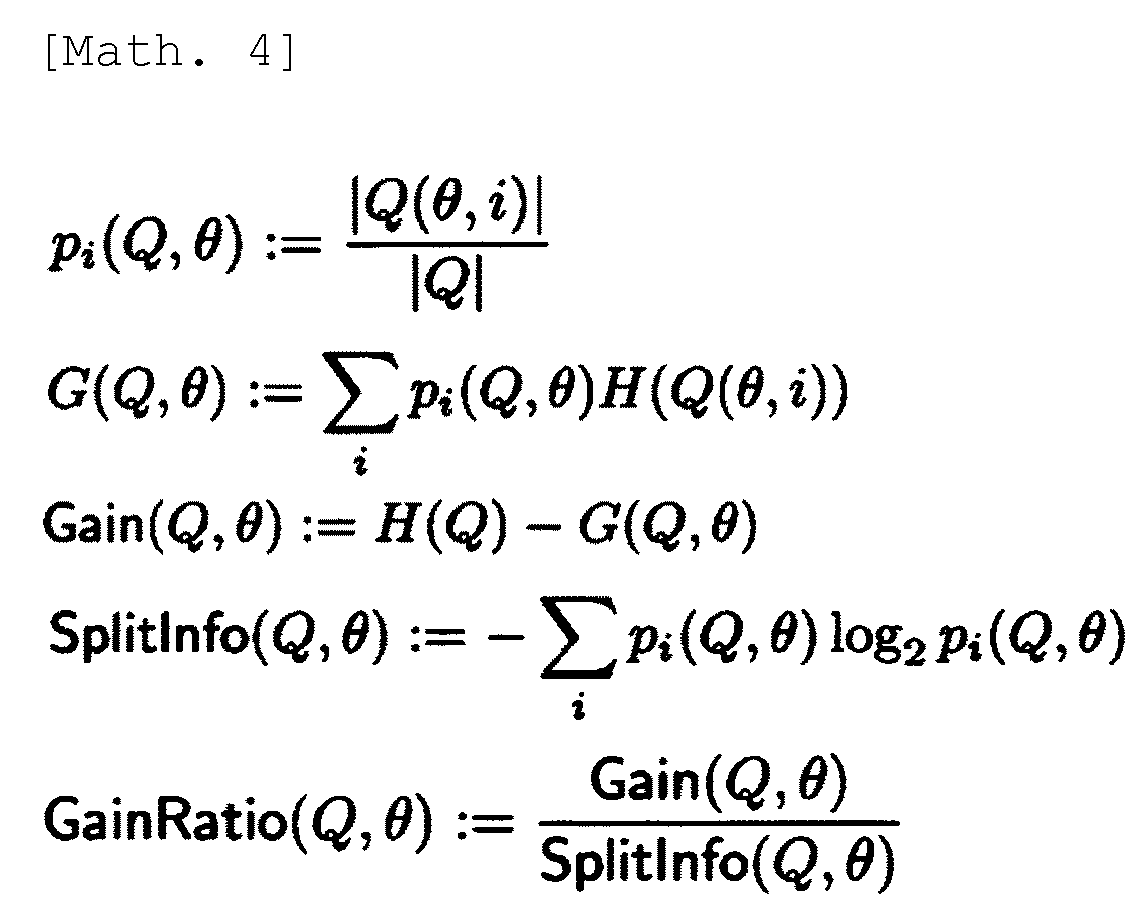
- In the present embodiment, the gain factor is used as an objective function.
- The division condition of each node is set by selecting such a division condition that a predetermined objective function is maximized at the node. Since it is necessary to calculate the value of the objective function for each candidate for the division condition, it is important to be able to efficiently calculate the value of the objective function for the given division condition.
- The gain factor defined by Math. 4 needs to be calculated intricately to obtain the frequency of the value of each label (the value of the objective variable) after the division has been performed actually. Consequently, in the present embodiment, a method of calculating a gain factor is reformulated and simplified so that the gain factor can be collectively calculated for a plurality of division conditions by secret calculation.
- In order to simplify the calculation of the gain factor, attention is focused on many ratios being required for the gain factor. Since a ratio requires division, the calculation cost is increased when the calculation is performed as it is; however, it can be converted into a statistic easy to calculate such as frequency by multiplying by the total number. Based on this observation, in the present embodiment, the functions of SplitInfo+, H+, Gain+, and G+ multiplied by the size of the input data set are used instead of the functions of SplitInfo, H, Gain, and G.
- For simplicity, when using the following formula,

- SplitInfo+ can be reformulated as follows:

- Similarly, H+ can be reformulated as follows:

- Similarly, G+ can be reformulated as follows:

- In addition, similarly, Gain+ can be reformulated as follows:

- All the above functions of SplitInfo+, H+, Gain+, and G+ are composed of frequency such as the number of records included in the data set Q or the number of records satisfying a certain condition in the data set Q, f(·), and addition/subtraction. Since GainRatio is as follows,

- (1) the number of records |Q| of Q;
- (2) the number of records |Qk| of a label value k in Q;
- (3) the number of records |Q(θ, i) | of each item of data set obtained by dividing Q by θ; and
- (4) the number of records |Q(θ, i)k| of the label value k in each item of data set obtained by dividing Q by θ,
- The input of f(·) is one of the above-described four frequencies (the numbers of records |Q|, |Qk|, |Q(θ, i) |, and |Q(θ, i)k|). Therefore, in a case where the number of records of the data set given as data set for learning is n, the input of f(·) is always an integer 0 or greater and n or less. Thus, in a case where concealment is performed by secret sharing, f(·) can implement Θ(n) calculations of f(·) with the amount of communication of O(nlogn) by using a secret batch mapping using a correspondence table (look-up table) listing the following correspondence of the magnitude Θ(n).

- Thereby, in the present embodiment, by calculating each frequency at each node when learning the secret decision tree, it is possible to collectively calculate the evaluation values (GainRatio) of a plurality of division conditions at each node.
- In addition, the result of comparison of two values (a, b) and (c, d) each given as a pair of a numerator and a denominator being non-negative is equal to the result of comparison of ad and bc. Since both the numerator and denominator of GainRatio are non-negative, division is avoided by substituting the above method when comparison of GainRatio (that is, comparison of the evaluation values) is performed. Thereby, it is possible to reduce the calculation time required for the comparison of the evaluation values for selecting the division condition that takes the maximum evaluation value.
- Next, a functional configuration of the secret decision
tree test device 10 according to the present embodiment will be described with reference toFig. 1. Fig. 1 is a diagram illustrating an example of the functional configuration of the secret decisiontree test device 10 according to the present embodiment. - As shown in
Fig. 1 , the secret decisiontree test device 10 according to the present embodiment includes aninput unit 101, avector calculation unit 102, an evaluationvalue calculation unit 103, anoutput unit 104, and astorage unit 105. - The
storage unit 105 stores various types of data (that is, various types of concealed data) for learning a secret decision tree. Here, it is assumed that these various types of data include a data set given as a data set for learning and a group information vector indicating which node a certain category attribute value is classified (that is, grouped) into. In addition, it is assumed that the data set is composed of a category attribute value vector having the category attribute value of each record as an element and a label value vector having the label value of each record as an element. Note that, in a case where there is a category attribute value vector for each explanatory variable, and the explanatory variables are, for example, "sex" and "prefecture of origin", there are a category attribute value vector having the category value of the sex of each record as an element and a category attribute value vector having the category value of the prefecture of origin of each record as an element. - The
input unit 101 inputs a category attribute value vector of a certain category attribute, a label value vector, and a group information vector corresponding to the category attribute as data required for calculating the above evaluation value of Step 4. - The
vector calculation unit 102 calculates a vector for determining the division condition (a determination vector to be described later) using the category attribute value vector and the label value vector. - The evaluation
value calculation unit 103 calculates a frequency for evaluating the division condition for each group and for each division condition, and calculates the evaluation value (GainRatio) of the division condition on the basis of Math. 10. - The
output unit 104 selects a division condition that maximizes the evaluation value in each group, and outputs the selected division condition. Thereby, the division condition to be set at a node corresponding to the group is obtained. - Next, the hardware configuration of the secret decision
tree test device 10 according to the present embodiment will be described with reference toFig. 2. Fig. 2 is a diagram illustrating an example of the hardware configuration of the secret decisiontree test device 10 according to the present embodiment. - As shown in
Fig. 2 , the secret decisiontree test device 10 according to the present embodiment is implemented by a hardware configuration of a general computer or a computer system, and includes aninput device 201, adisplay device 202, an external I/F 203, a communication I/F 204, aprocessor 205, and amemory device 206. These components of hardware are communicably connected to each other through abus 207. - The
input device 201 is, for example, a keyboard, a mouse, a touch panel, or the like. Thedisplay device 202 is, for example, a display or the like. Note that the secret decisiontree test device 10 may not have, for example, at least one of theinput device 201 and thedisplay device 202. - The external I/
F 203 is an interface with an external device such as arecording medium 203a. The secret decisiontree test device 10 can execute reading, writing, or the like on therecording medium 203a through the external I/F 203. Therecording medium 203a may store, for example, one or more programs for implementing the respective functional units (theinput unit 101, thevector calculation unit 102, the evaluationvalue calculation unit 103, and the output unit 104) included in the secret decisiontree test device 10. - Note that examples of the
recording medium 203a include a compact disc (CD), a digital versatile disk (DVD), a secure digital (SD) memory card, a universal serial bus (USB) memory card, and the like. - The communication I/
F 204 is an interface for connecting the secret decisiontree test device 10 to a communication network. Note that one or more programs for implementing the respective functional units included in the secret decisiontree test device 10 may be acquired (downloaded) from a predetermined server device or the like through the communication I/F 204. - Examples of the
processor 205 include various arithmetic/logic units such as a central processing unit (CPU) and a graphics processing unit (GPU). Each functional unit included in the secret decisiontree test device 10 is implemented by, for example, a process of causing theprocessor 205 to execute one or more programs stored in thememory device 206 or the like. - Examples of the
memory device 206 include various storage devices such as a hard disk drive (HDD), a solid state drive (SSD), a random access memory (RAM), a read only memory (ROM), and a flash memory. Thestorage unit 105 included in the secret decisiontree test device 10 can be implemented by using, for example, thememory device 206. Note that thestorage unit 105 may be implemented by using, for example, a storage device or the like which is connected to the secret decisiontree test device 10 through a communication network. - The secret decision
tree test device 10 according to the present embodiment can implement various processes by having the hardware configuration shown inFig. 2 . Note that the hardware configuration shown inFig. 2 is an example, and the secret decisiontree test device 10 may have another hardware configuration. For example, the secret decisiontree test device 10 may have a plurality ofprocessors 205, or may have a plurality ofmemory devices 206. - Next, the secret decision tree test process for calculating the evaluation value in Steps 4 to 5 and selecting the division condition for taking the maximum evaluation value will be described with reference to
Fig. 3. Fig. 3 is a flowchart illustrating an example of a flow of the secret decision tree test process according to the present embodiment. Note that a case where a certain category attribute is evaluated (tested) at each node constituting a certain layer of the secret decision tree will be described below. The layer is a set of nodes having the same depth from the root. In addition, it is assumed that a set of values that can be taken by the category attribute is {5, 6, 7, 8} and a set of values that can be taken by the label is {1, 2, 3}. - First, the
input unit 101 inputs the category attribute value vector, the label value vector, and the group information vector (Step S101). Hereinafter, as an example, the group information vector is assumed to be as follows:
- In addition, the category attribute value vector is assumed to be as follows:

- The label value vector is assumed to be as follows:

- The group information vector indicates which group each element of the category attribute value vector and the label value vector is classified into, and is a vector in which an element indicating the end of each group is 1 and the other elements are 0 when classified into groups from an element at the head. For example, the above [g] indicates that the first to third elements of the category attribute value vector and the label value vector belong to the first group, the fourth element belongs to the second group, the fifth to eighth elements belong to the third group, and the ninth and tenth elements belong to the fourth group.
- Note that each group corresponds to one node, and is a set of elements (category attribute values) classified at the node in the layer one level above (that is, data sets divided by the division condition set at the node in the layer one level above).
- Next, the
vector calculation unit 102 calculates a bit vector indicating the position of an element matching a combination of the category attribute value and the label value for each combination of the value that can be taken by the category attribute and the value that can be taken by the label (Step S102) . - For example, when a bit vector corresponding to a combination of a value "5" that can be taken by the category attribute and a value "1" that can be taken by the label is [f5, 1], this bit vector [f5, 1] is as follows:

- Similarly, for example, when a bit vector corresponding to a combination of the value "5" that can be taken by the category attribute and a value "2" that can be taken by the label is [f5, 2], this bit vector [f5, 2] is as follows:

- Similarly, for example, when a bit vector corresponding to a combination of the value "5" that can be taken by the category attribute and a value "3" that can be taken by the label is [f5, 3], this bit vector [f5, 3] is as follows:

- Bit vectors [f6, 1] to [f6, 3], [f7, 1] to [f7, 3], and [f8, 1] to [f8, 3] corresponding to the other combinations are calculated in the same way.
- That is, a bit vector corresponding to a combination of a certain category attribute value and the label value is a vector in which only elements at the position of a combination matching the combination of the category attribute value and the label value among the combinations of elements at the same position in the category attribute value vector and the label value vector are 1 and the other elements are 0.
- Next, the
vector calculation unit 102 performs an aggregation function total sum operation in accordance with grouping based on the group information vector [g] for each bit vector, and calculates a determination vector (Step S103). Here, the aggregation function total sum operation is an operation of inputting a set of elements in the same group and outputting the total sum of values of the elements. - For example, the
vector calculation unit 102 calculates the total sum of the first to third elements for each bit vector, calculates the total sum of the fourth element in the same way, calculates the total sum of the fifth to eighth elements, and calculates the total sum of the ninth to tenth elements. Thevector calculation unit 102 creates a determination vector by setting each total sum to be an element at the same position as an element which is a calculation source of the total sum. - Thereby, the following determination vector corresponding to the bit vector [f5, 1] is obtained as follows:

- Similarly, the following determination vector corresponding to the bit vector [f5, 2] is obtained as follows:

- Similarly, the following determination vector corresponding to the bit vector [f5, 3] is obtained as follows:

- Determination vectors corresponding to the other bit vectors [f6, 1] to [f6, 3], [f7, 1] to [f7, 3], and [f8, 1] to [f8, 3] are calculated in the same way.
- The above determination vectors represent the number of times a combination of the category attribute value and the label value corresponding to the bit vector appears in each group. For example, the combination of (category attribute value, label value) = (5, 1) indicates that it appears 0 times in the first group, 0 times in the second group, one time in the third group, and 0 times in the fourth group. Similarly, for example, the combination of (category attribute value, label value) = (5, 2) indicates that it appears one time in the first group, 0 times in the second group, one time in the third group, and one time in the fourth group.
- Therefore, from the above determination vectors, it is possible to calculate the frequency of records that take the label value k in the data set satisfying the division condition, among the data sets (sets of category attribute values) divided (grouped) by the division condition expressed by a form of x □ X (where X is a subset of the set of values that can be taken by the category attribute).
- Next, the evaluation
value calculation unit 103 calculates each frequency for each group and for each division condition (Step S104). Here, the evaluationvalue calculation unit 103 calculates the following four frequencies: - the number of elements in each group of the category attribute value vector [c] (that is, |Q| shown in the above (1));
- the number of elements of the label value k in each group of the category attribute value vector [c] (that is, |Qk| shown in the above (2));
- the number of elements in each group obtained by dividing the group of the category attribute value vector [c] by the division condition θ (that is, |Q(θ, i)| shown in the above (3)); and
- the number of elements of the label value k in each group obtained by dividing the group of the category attribute value vector [c] by the division condition θ (that is, |Q(θ, i)k| shown in the above (4)).
- Among these four frequencies, the first frequency is obtained by calculating the number of elements for each group using the category attribute value vector [c] and the group information vector [g]. In addition, the second frequency is obtained by calculating the number of elements for each group and for each label value using the category attribute value vector [c], the label value vector [y], and the group information vector [g]. In addition, the third frequency is obtained by calculating the number of elements of each set (that is, a set satisfying the division condition θ or a set not satisfying it) divided by the division condition θ when the group is divided by the division condition θ using the category attribute value vector [c] and the group information vector [g].
- Meanwhile, the fourth frequency is obtained by calculating the number of elements taking the label value k in each set divided by the division condition θ when the group is divided by the division condition θ using the category attribute value vector [c], the group information vector [g], and the determination vector. This may be calculated by the determination vectors counting the number of times a combination of each element (category attribute value) included in the divided set and the label value k appears in the divided group. Specifically, for example, in a case where the division condition θ is x □ {5, 8}, the third group of the category attribute value vector [c] is divided into {5, 8, 5} and {7}. Therefore, for example, as described above, the number of elements taking the label value k in {5, 8, 5} is obtained by calculating the sum of the number of times a combination of (5, k) appears in the third group and the number of times a combination of (8, k) appears in the third group from the determination vectors [f5, k] and [f8, k]. Similarly, for example, the number of elements taking the label value k in {7} is obtained by calculating the number of times a combination of (7, k) appears in the third group from the determination vector [f7, k].
- Next, the evaluation
value calculation unit 103 calculates the evaluation value of the division condition on the basis of Math. 10 for each group and for each division condition, by using each frequency calculated in Step S104 described above (Step S105). - Then, the
output unit 104 selects a division condition that maximizes the evaluation value in each group, and outputs the selected division condition as the division condition to be set at a node corresponding to the group (Step S106). Note that, when selecting the division condition that maximizes the evaluation value in each group, for example, an aggregation function maximum value operation may be performed. The aggregation function maximum value operation is an operation of inputting elements (evaluation values) in the same group and outputting the maximum value among the values of the elements. - As described above, when learning a secret decision tree from a given data set of secret values, the secret decision
tree test device 10 according to the present embodiment can reduce the total calculation time by collectively calculating the evaluation values of a plurality of division conditions at each node for the category attribute value. Specifically, in a case where a data set composed of n items of data is divided by a decision tree having m nodes, evaluations (tests) of Θ(mn) are required as a whole with the conventional technique, whereas the secret decisiontree test device 10 according to the present embodiment can execute evaluation in O(nlogn) time. - The present invention is not limited to the above-described embodiment specifically disclosed, and various modifications, changes, combinations with known techniques, and the like are possible without departing from the description of the claims.
-
- 10
- Secret decision tree test device
- 101
- Input unit
- 102
- Vector calculation unit
- 103
- Evaluation value calculation unit
- 104
- Output unit
- 105
- Storage unit
- 201
- Input device
- 202
- Display device
- 203
- External I/F
- 203a
- Recording medium
- 204
- Communication I/F
- 205
- Processor
- 206
- Memory device
- 207
- Bus
Claims (6)
- A secret decision tree test device configured to evaluate a division condition at each of a plurality of nodes of a decision tree when learning of the decision tree is performed by secret calculation, the secret decision tree test device comprising:an input unit configured to input a category attribute value vector composed of specific category attribute values of items of data included in a data set for learning of the decision tree, a label value vector composed of label values of the items of the data, and a group information vector indicating grouping of the items of the data into the nodes;a frequency calculation unit configured to calculate, using the category attribute value vector, the label value vector, and the group information vector, a first frequency of data belonging to each group, a second frequency of data for each of the label values in said each group, a third frequency of data belonging to a division group obtained by dividing said each group by a division condition indicating a condition whether the category attribute value is included in a predetermined set, and a fourth frequency of data for each of the label values in the division group; andan evaluation calculation unit configured to calculate an evaluation value for evaluating the division condition using the first frequency, the second frequency, the third frequency, and the fourth frequency.
- The secret decision tree test device according to claim 1, wherein the frequency calculation unit calculates the third frequency and the fourth frequency in each of a plurality of the division conditions for said each group.
- The secret decision tree test device according to claim 1 or 2, further comprising:a bit vector creation unit configured to create, for each combination of a value that can be taken by the category attribute value and a value that can be taken by the label value, a bit vector indicating a position where the combination matches a combination of a category attribute value included in the category attribute value vector and a label value included in the label value vector at the same position; anda determination vector calculation unit configured to calculate, for said each group indicated in the group information vector, a determination vector for determining a number of occurrences of the combination in said each group by performing an aggregation function total sum operation of each element included in the bit vector,wherein the frequency calculation unit calculates the fourth frequency using the determination vector.
- A secret decision tree test system configured to evaluate a division condition at each of a plurality of nodes of a decision tree when learning of the decision tree is performed by secret calculation, the secret decision tree test system comprising:an input unit configured to input a category attribute value vector composed of specific category attribute values of items of data included in a data set for learning of the decision tree, a label value vector composed of label values of the items of the data, and a group information vector indicating grouping of the items of the data into the nodes;a frequency calculation unit configured to calculate, using the category attribute value vector, the label value vector, and the group information vector, a first frequency of data belonging to each group, a second frequency of data for each of the label values in said each group, a third frequency of data belonging to a division group obtained by dividing said each group by a division condition indicating a condition whether the category attribute value is included in a predetermined set, and a fourth frequency of data for each of the label values in the division group; andan evaluation calculation unit configured to calculate an evaluation value for evaluating the division condition using the first frequency, the second frequency, the third frequency, and the fourth frequency.
- A secret decision tree test method of evaluating a division condition at each of a plurality of nodes of a decision tree when learning of the decision tree is performed by secret calculation, the secret decision tree test method comprising:an input procedure of inputting a category attribute value vector composed of specific category attribute values of items of data included in a data set for learning of the decision tree, a label value vector composed of label values of the items of the data, and a group information vector indicating grouping of the items of the data into the nodes;a frequency calculation procedure of calculating, using the category attribute value vector, the label value vector, and the group information vector, a first frequency of data belonging to each group, a second frequency of data for each of the label values in said each group, a third frequency of data belonging to a division group obtained by dividing said each group by a division condition indicating a condition whether the category attribute value is included in a predetermined set, and a fourth frequency of data for each of the label values in the division group; andan evaluation calculation procedure of calculating an evaluation value for evaluating the division condition using the first frequency, the second frequency, the third frequency, and the fourth frequency.
- A program causing a computer to function as the secret decision tree test device according to any one of claims 1 to 3.
Applications Claiming Priority (1)
| Application Number | Priority Date | Filing Date | Title |
|---|---|---|---|
| PCT/JP2020/039127 WO2022079911A1 (en) | 2020-10-16 | 2020-10-16 | Hidden decision tree test device, hidden decision tree test system, hidden decision tree test method, and program |
Publications (2)
| Publication Number | Publication Date |
|---|---|
| EP4231276A1 true EP4231276A1 (en) | 2023-08-23 |
| EP4231276A4 EP4231276A4 (en) | 2024-07-10 |
Family
ID=81209036
Family Applications (1)
| Application Number | Title | Priority Date | Filing Date |
|---|---|---|---|
| EP20957740.2A Pending EP4231276A4 (en) | 2020-10-16 | 2020-10-16 | Hidden decision tree test device, hidden decision tree test system, hidden decision tree test method, and program |
Country Status (6)
| Country | Link |
|---|---|
| US (1) | US20230273771A1 (en) |
| EP (1) | EP4231276A4 (en) |
| JP (1) | JP7505570B2 (en) |
| CN (1) | CN116324828A (en) |
| AU (1) | AU2020472445B2 (en) |
| WO (1) | WO2022079911A1 (en) |
Families Citing this family (3)
| Publication number | Priority date | Publication date | Assignee | Title |
|---|---|---|---|---|
| EP4231274A4 (en) * | 2020-10-16 | 2024-07-10 | Nippon Telegraph And Telephone Corporation | DEVICE FOR TESTING A SECRET DECISION TREE, SYSTEM FOR TESTING A SECRET DECISION TREE, METHOD FOR TESTING A SECRET DECISION TREE AND PROGRAM |
| US20250322032A1 (en) * | 2022-05-24 | 2025-10-16 | Nippon Telegraph And Telephone Corporation | Secure attribute selection system, secure attribute selection apparatus, secure attribute selection method, and program |
| CN119046394A (en) * | 2024-10-29 | 2024-11-29 | 浪潮软件科技有限公司 | Geospatial data hierarchical evaluation method, device and medium based on decision tree |
Family Cites Families (1)
| Publication number | Priority date | Publication date | Assignee | Title |
|---|---|---|---|---|
| AU2019259260B2 (en) * | 2018-04-25 | 2021-07-15 | Ntt, Inc. | Secure aggregate sum system, secure computation apparatus, secure aggregate sum method, and program |
-
2020
- 2020-10-16 US US18/044,823 patent/US20230273771A1/en active Pending
- 2020-10-16 JP JP2022556820A patent/JP7505570B2/en active Active
- 2020-10-16 CN CN202080106086.XA patent/CN116324828A/en active Pending
- 2020-10-16 WO PCT/JP2020/039127 patent/WO2022079911A1/en not_active Ceased
- 2020-10-16 EP EP20957740.2A patent/EP4231276A4/en active Pending
- 2020-10-16 AU AU2020472445A patent/AU2020472445B2/en active Active
Also Published As
| Publication number | Publication date |
|---|---|
| WO2022079911A1 (en) | 2022-04-21 |
| AU2020472445B2 (en) | 2023-11-30 |
| AU2020472445A1 (en) | 2023-05-25 |
| AU2020472445A9 (en) | 2024-10-03 |
| EP4231276A4 (en) | 2024-07-10 |
| JP7505570B2 (en) | 2024-06-25 |
| CN116324828A (en) | 2023-06-23 |
| JPWO2022079911A1 (en) | 2022-04-21 |
| US20230273771A1 (en) | 2023-08-31 |
Similar Documents
| Publication | Publication Date | Title |
|---|---|---|
| Yang et al. | A unified semi-supervised community detection framework using latent space graph regularization | |
| Shamsabadi et al. | Confidential-profitt: Confidential proof of fair training of trees | |
| US20230273771A1 (en) | Secret decision tree test apparatus, secret decision tree test system, secret decision tree test method, and program | |
| d'Ascoli et al. | Boolformer: Symbolic regression of logic functions with transformers | |
| Rydow et al. | Development and evaluation of two approaches of visual sensitivity analysis to support epidemiological modeling | |
| Sichani et al. | Creating high-quality synthetic health data: Framework for model development and validation | |
| EP4231274A1 (en) | Secret decision tree testing device, secret decision tree testing system, secret decision tree testing method, and program | |
| Burgette et al. | Multiple-shrinkage multinomial probit models with applications to simulating geographies in public use data | |
| EP4231273A1 (en) | Secret decision tree learning device, secret decision tree learning system, secret decision tree learning method, and program | |
| US12632370B2 (en) | Secret decision tree test apparatus, secret decision tree test system, secret decision tree test method, and program | |
| Cawi et al. | Designing machine learning workflows with an application to topological data analysis | |
| Tahayori et al. | Median interval approach to model words with interval type-2 fuzzy sets | |
| Park et al. | Sparse kernel k-means clustering | |
| EP4535336A1 (en) | Secret computing device, secret computing method, and program | |
| Elansary | Data wrangling & preparation automation | |
| AU2020472129B2 (en) | Secret grouping device, secret grouping system, secret grouping method, and program | |
| US20250022548A1 (en) | Computer readable storage medium storing a machine learning program, machine learning method, and information processing apparatus | |
| JP2021124946A (en) | Learning device, learning method, and program | |
| Sayadi et al. | Finding Consistent Pairwise Comparisons with Genetic Algorithms | |
| Pierri et al. | Beyond the Cox Model: Applying Machine Learning Techniques with Time-to-Event Data | |
| JP2026078108A (en) | Analysis program, analysis device, and analysis method | |
| Opatha et al. | Impact of censoring proportion on the performance of machine learning and Bayesian survival analysis approaches: Simulated and real data study linked with maternal and child health | |
| Ahmed et al. | Improving Adaptive Penalized Likelihood in Poisson Regression Model | |
| Doroh | Bayesian Hierarchical Modeling of Penalized Cox Model for Survival Prediction |
Legal Events
| Date | Code | Title | Description |
|---|---|---|---|
| STAA | Information on the status of an ep patent application or granted ep patent |
Free format text: STATUS: THE INTERNATIONAL PUBLICATION HAS BEEN MADE |
|
| PUAI | Public reference made under article 153(3) epc to a published international application that has entered the european phase |
Free format text: ORIGINAL CODE: 0009012 |
|
| STAA | Information on the status of an ep patent application or granted ep patent |
Free format text: STATUS: REQUEST FOR EXAMINATION WAS MADE |
|
| 17P | Request for examination filed |
Effective date: 20230310 |
|
| AK | Designated contracting states |
Kind code of ref document: A1 Designated state(s): AL AT BE BG CH CY CZ DE DK EE ES FI FR GB GR HR HU IE IS IT LI LT LU LV MC MK MT NL NO PL PT RO RS SE SI SK SM TR |
|
| DAV | Request for validation of the european patent (deleted) | ||
| DAX | Request for extension of the european patent (deleted) | ||
| REG | Reference to a national code |
Ref country code: DE Ref legal event code: R079 Free format text: PREVIOUS MAIN CLASS: G09C0001000000 Ipc: H04L0009080000 |
|
| A4 | Supplementary search report drawn up and despatched |
Effective date: 20240607 |
|
| RIC1 | Information provided on ipc code assigned before grant |
Ipc: G06N 5/01 20230101ALI20240603BHEP Ipc: G06N 20/00 20190101ALI20240603BHEP Ipc: G09C 1/00 20060101ALI20240603BHEP Ipc: H04L 9/08 20060101AFI20240603BHEP |
|
| RAP3 | Party data changed (applicant data changed or rights of an application transferred) |
Owner name: NTT, INC. |