EP4231208A1 - Machine learning program, machine learning method, and machine learning device - Google Patents
Machine learning program, machine learning method, and machine learning device Download PDFInfo
- Publication number
- EP4231208A1 EP4231208A1 EP20957644.6A EP20957644A EP4231208A1 EP 4231208 A1 EP4231208 A1 EP 4231208A1 EP 20957644 A EP20957644 A EP 20957644A EP 4231208 A1 EP4231208 A1 EP 4231208A1
- Authority
- EP
- European Patent Office
- Prior art keywords
- tensor
- mode
- machine learning
- axis
- elements
- Prior art date
- Legal status (The legal status is an assumption and is not a legal conclusion. Google has not performed a legal analysis and makes no representation as to the accuracy of the status listed.)
- Withdrawn
Links
Images







Classifications
-
- G—PHYSICS
- G06—COMPUTING OR CALCULATING; COUNTING
- G06N—COMPUTING ARRANGEMENTS BASED ON SPECIFIC COMPUTATIONAL MODELS
- G06N20/00—Machine learning
-
- G—PHYSICS
- G06—COMPUTING OR CALCULATING; COUNTING
- G06N—COMPUTING ARRANGEMENTS BASED ON SPECIFIC COMPUTATIONAL MODELS
- G06N3/00—Computing arrangements based on biological models
- G06N3/02—Neural networks
- G06N3/08—Learning methods
- G06N3/09—Supervised learning
-
- G—PHYSICS
- G06—COMPUTING OR CALCULATING; COUNTING
- G06F—ELECTRIC DIGITAL DATA PROCESSING
- G06F17/00—Digital computing or data processing equipment or methods, specially adapted for specific functions
- G06F17/10—Complex mathematical operations
- G06F17/16—Matrix or vector computation, e.g. matrix-matrix or matrix-vector multiplication, matrix factorization
Definitions
- the present invention relates to a machine learning program, a machine learning method, and a machine learning device.
- Tensor data may be used as training data for a system that generates a machine learning model by machine learning and performs prediction, classification, or the like by using the generated machine learning model.
- the tensor data is represented as an n (n is a positive integer) dimensional array, but is also represented by a graph, a table, or the like.
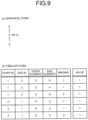
- FIG. 9 is a diagram illustrating an example in which tensor data is represented in graphical form and tabular form.
- FIG. 9 illustrates an example of a chemical formula.
- FIG. 9(a) is an example in which a chemical formula of formaldehyde is represented in graphical form
- FIG. 9(b) is an example in which the chemical formula of the formaldehyde is represented in tabular form.
- the chemical formula is represented by five axes (columns): start ID, end ID, start element, end element, and binding, and by values.
- the start ID is an index of a starting point of a linkage.
- the end ID is an index of an end point of the linkage.
- a method of assigning indices to the starting point and the end point is arbitrary.
- the start element is a type of an element at the starting point.
- the end element is a type of an element at the endpoint.
- the binding is a type of the linkage.
- the tabular form represents only nonzero values of the tensor data as rows. In FIG. 9(b) , only the six values represented by the six rows are 1, and the other values of the tensor data are 0.
- the axis of the tensor is called a mode.
- FIG. 10 is a diagram for explaining tensor decomposition.
- white cubes indicate zero elements and shaded cubes indicate nonzero elements.
- the data tensor is tensor-decomposed to a core tensor and element matrices corresponding to the number of modes.
- the data tensor is third-order and the number of modes is 3, the data tensor is tensor-decomposed to a core tensor and three element matrices.
- the core tensor is calculated by a mode product between the data tensor and the element matrix of each mode.
- FIG. 11 is a diagram for explaining the core tensor calculation by the mode product.
- FIG. 11(a) illustrates the mode product
- FIG. 11(b) illustrates the core tensor calculation.
- the mode product converts the number of elements in a mode from the number of data tensors to the number of elements in the core tensor.
- the number of elements in a vertical mode is converted from 3 to 2.
- all elements in the mode direction after the conversion are nonzero.
- the number of elements in each mode in the core tensor is designated by a user.
- the core tensor is calculated by sequentially calculating the mode product of each mode.
- P i (i is 1 to 3) indicates a mode product corresponding to mode i.
- an intermediate tensor 1 is calculated from the data tensor by a mode product P 1
- an intermediate tensor 2 is calculated from the intermediate tensor 1 by a mode product P 2
- the core tensor is calculated from the intermediate tensor 2 by a mode product P 3 .
- the calculation order of the mode products is arbitrary.
- an n th order tensor is set as X
- the core tensor is set as X ⁇
- an element matrix of the mode i (i is 1 to n) is set as W i , X ⁇ R I 1 ⁇ I 2 ⁇ ⁇ ⁇ I n X ⁇ ⁇ R J 1 ⁇ J 2 ⁇ ⁇ ⁇ J n Wi ⁇ R I i ⁇ J i
- R is the set of real numbers.
- I i is the number of elements of the mode i in X
- J i is the number of elements of the mode i in X ⁇ .
- the modes of X" are rearranged to obtain an intermediate tensor X intm .
- X intm ⁇ R I 1 ⁇ ⁇ ⁇ I k ⁇ 1 ⁇ J k ⁇ I k + 1 ⁇ ⁇ ⁇ I n
- the device performs data placement processing and calculation processing on N-dimensional (N is an integer equal to or greater than 3) tensor data in a loop calculation for a plurality of indices to the tensor data.
- N is an integer equal to or greater than 3
- the device sequences the elements of the tensor data in order from the lowest index of the calculation loop to each index immediately preceding the highest such that the loop direction of each index is forward.
- the device places, on a storage unit, the values of non-empty elements in the tensor data and the index values of the lowest index indicating the position of the tensor data of the elements to an index immediately preceding the highest. Then, the device performs a process of placing the count number of the non-empty elements. In the calculation processing, the device performs a loop calculation on the tensor data placed on the storage unit.
- the information processing device includes a compressed sparse fiber (CSF) design unit, a CSF creation unit, and a CSF compression unit.
- the CSF design unit sets an order of the axes of an M th or higher order tensor (M is a natural number of 3 or more) in order to convert the tensor to CSF-represented data.
- M is a natural number of 3 or more
- the CSF creation unit converts the M th or higher order tensor to CSF-represented data in accordance with the setting by the CSF design unit.
- the CSF compression unit compresses the CSF-represented data by substituting a duplicate structure occurring in the CSF-represented data by a substitute structure representing the duplicate structure, and outputs compressed CSF data which is the compressed CSF-represented data, and substitution rule data which represents a substitution rule.
- the method includes determining, by a graphics processing unit (GPU), optimal partitions for matrix-by-matrix multiplication of two factor matrices having known sizes.
- the determining step includes performing a plurality of matrix-by-matrix multiplication executions offline for each different combination of two-way partitions for a plurality of partition sizes.
- the determining step further includes determining performance values offline on the basis of the execution time for each multiplication execution.
- the determining step further includes recursively repeating the multiplication execution and the determining of the performance values offline until the best performing combination of the two-way partitions no longer improves the performance values, and saving the best performing combinations of the two-way partitions as optimal partitions.
- the method further includes performing online, by the GPU, the matrix-by-matrix multiplication of the two factor matrices by using calls for one of the best performing combinations of the two-way partitions.
- the amount of calculation increases exponentially as the number of modes increases.
- tensor data for chemical formulas have many modes, such as atomic numbers, the number of protons, the number of charges, and the number of neutrons, and thus the amount of calculation for tensor decomposition is large.
- the amount of calculation becomes larger, the amount of memory requested for the calculation becomes larger.
- a machine learning program causes a computer to perform a process that includes identifying a first axis including elements represented by one-hot vectors and a second axis including elements not represented by one-hot vectors, among a plurality of axes included in tensor-form data, when calculating a core tensor from the tensor-form data via a plurality of intermediate tensors, calculating the core tensor from the tensor-form data by a first process of concatenating elements included in a first element matrix corresponding to the first axis to elements included in a first intermediate tensor among the plurality of intermediate tensors and a second process of calculating a mode product between a second intermediate tensor among the plurality of intermediate tensors and a second element matrix corresponding to the second axis, and performing machine learning of a machine learning model with the core tensor as an input.
- the present invention can reduce the amount of calculation for tensor decomposition.
- a machine learning device divides a mode into the topology mode and the label mode.
- the topology mode is a mode of representing data linkage.
- the label mode is a mode of representing attributes.
- FIG. 1 is a diagram illustrating an example of the label mode and the topology mode. As illustrated in FIG. 1 , a start ID and an end ID correspond to the topological mode and a start element, an end element, and a binding correspond to the label mode.
- the label mode is associated with one or more modes of the topology mode, and the value of the label mode is determined by the associated topology mode.
- the start element is associated with the start ID, and the value of the start element is determined by the start ID.
- the start element is C, when the start ID is 2 or 3, the start element is H, and when the start ID is 4, the start element is O.
- the end element is also associated with the end ID, and the value of the end element is determined by the end ID.
- the end ID is 1, the end element is C, when the end ID is 2 or 3, the end element is H, and when the end ID is 4, the end element is O.
- the binding is also associated with the start ID and the end ID, and the value of the binding is determined by the start ID and the end ID. When the start ID is 1 and the end ID is 2 or 3, the binding is 1, and when the start ID is 1 and the end ID is 4, the binding is 2.
- the label mode is represented as a one-hot vector.
- the one-hot vector is a vector in which only one element is 1 and the other elements are 0.
- a mode product When a data tensor includes many label modes, nonzero elements of the data tensor are sparse. On the other hand, an element matrix is dense with nonzero elements.
- FIG. 2 is a diagram for explaining a matrix product between a matrix with sparse nonzero elements and a matrix with dense nonzero elements.
- A denotes a matrix with sparse nonzero elements
- B denotes a matrix with dense nonzero elements
- C denotes a matrix product between A and B.
- black and shaded squares indicate nonzero elements
- white squares indicate zero elements.
- the nonzero elements of rows of A are multiplied with corresponding rows of B to form corresponding rows of C. When there is even one nonzero element in the rows of A, all elements in the corresponding rows of C are nonzero.
- the number of nonzero elements increases exponentially. That is, the number of nonzero elements in an intermediate tensor increases exponentially each time the calculation of the mode product is performed.
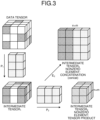
- the machine learning device converts the mode product of the label mode to a concatenation.
- the concatenation indicates adding elements of an element matrix to elements of a data tensor or an intermediate tensor.
- FIG. 3 is a diagram for explaining a difference between a mode product and a concatenation.
- FIG. 3 illustrates a difference between a mode product P 2 and a concatenation E 2 .
- shaded cubes indicate nonzero elements and white cubes indicate zero elements.
- n is a size of nonzero elements with respect to a mode "2" of an intermediate tensor 1
- m is a size of nonzero elements in columns of an element matrix 2 .
- the size of nonzero elements in an intermediate tensor 2 with respect to the mode "2" is n ⁇ m
- the size of the nonzero elements in the intermediate tensor 2 with respect to the mode "2" is n + m. That is, the machine learning device according to the example converts the mode product of the label mode to a concatenation, so that the number of nonzero elements increases linearly.
- a tensor X with sparse nonzero elements is represented as a mixture of a pair (I, V) of an index table I and vectors V of nonzero tensor elements.
- rows of I correspond to coordinates of elements of V, and columns of I correspond to modes of the tensor.
- An i th row of I I i I i 1 ⁇ I i n refers to a sub-tensor unit Vi with dense nonzero elements. In the mixed representation, zero elements are not represented.
- the mode product between X and the element matrix W is performed in the order of index partitioning, tensor outer product, and summation.
- an index row is partitioned as expressed by equation (1) below.
- An output index table I' of the mode product is formed from I ⁇ i .
- the respective values of an output vector V' of the mode product are calculated by summing the outer products of rows of V i and corresponding rows of W, as expressed by Equation (2) below.
- the sum in equation (2) is calculated for i satisfying equation (3) below.
- V j ′ ⁇ i ⁇ nnz I j ′
- the machine learning device produces an input for a neural network by flattening and concatenating the elements of V to allow a core tensor calculated by tensor decomposition to be an input for the neural network. Consequently, the outer product of the mode product and the vector concatenation include the same information, but with a different number of values. Therefore, converting the mode product of the label mode to a concatenation has no effect on training.
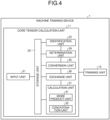
- FIG. 4 is a diagram illustrating the functional configuration of the machine learning device according to the example.
- a machine learning device 1 according to the example includes a core tensor calculation unit 11 and a training unit 12.
- the core tensor calculation unit 11 receives information on a data tensor and the number of elements in each mode of a core tensor, and calculates the core tensor.
- the training unit 12 generates a machine learning model by performing machine learning by using the core tensor calculated by the core tensor calculation unit 11.
- the generated machine learning model is used for classification, prediction, or the like.
- the core tensor calculation unit 11 includes an input unit 21, a storage unit 22, an identification unit 23, a determination unit 24, a conversion unit 25, an exchange unit 26, and a calculation unit 27.
- the input unit 21 receives the information on the data tensor and the number of elements in each mode of the core tensor, and stores the received information in the storage unit 22.
- the storage unit 22 stores the information input by the input unit 21.
- the storage unit 22 also stores information produced by the identification unit 23, the determination unit 24, the conversion unit 25, the exchange unit 26, and the calculation unit 27.
- the identification unit 23 identifies whether each mode of the data tensor is a topology mode or a label mode, and stores the identification result in the storage unit 22. For example, when the values of all modes other than the target mode are fixed, the identification unit 23 identifies a target mode as the label mode in a case where only one value of the target mode is 1 and all the other values are 0 , and identifies the target mode as the topology mode in other cases. Whether each mode of the data tensor is the topology mode or the label mode may be input by the input unit 21 and stored in the storage unit 22. Alternatively, the identification unit 23 may identify whether each mode of the data tensor is the topology mode or the label mode by inquiring of a user.
- the determination unit 24 determines the order of modes of tensor decomposition such that the label mode comes first and the topology mode comes later, and stores the determined order in the storage unit 22. For example, as illustrated in FIG. 5 , when a mode of the start ID is "1", a mode of the end ID is "2", a mode of the start element is "3", a mode of the end element is "4", and a mode of the binding is "5", the determination unit 24 sets P 5 P 4 P 3 P 2 P 1 as a processing order of the tensor decomposition. P 5 P 4 P 3 P 2 P 1 indicates that the tensor decomposition process is performed in the order of P 5 , P 4 , P 3 , P 2 , and P 1 .
- the conversion unit 25 converts the mode product P of the label mode to a concatenation E and stores the conversion result in the storage unit 22.
- a mode "5", a mode "4" and a mode "3" are label modes
- P 5 P 4 P 3 is converted to E 5 E 4 E 3
- the order of the tensor decomposition process is E 5 E 4 E 3 P 2 P 1 .
- the exchange unit 26 exchanges the processing order such that the concatenation E is processed as late as possible, and stores the exchange result in the storage unit 22. However, the exchange unit 26 exchanges the processing order under the constraint that a process of the label mode needs to be performed before a process of the topology mode associated with the label mode.
- E 3 when E 3 is processed as late as possible, E 3 needs to be performed before P 1 because the mode "3" is associated with the mode "1". Consequently, E 3 and P 2 are exchanged and E 5 E 4 E 3 P 2 P 1 becomes E 5 E 4 P 2 E 3 P 1 . Since the mode "5" and the mode "4" are associated with the mode "2", no further exchange occurs.
- the core tensor calculation unit 11 can further reduce the number of nonzero elements in an intermediate tensor.
- the exchange unit 26 identifies the topology mode associated with the label mode by, for example, inquiring of a user.
- the topology mode associated with the label mode may be input by the input unit 21 and stored in the storage unit 22.
- the calculation unit 27 performs tensor decomposition on the basis of the exchange result by the exchange unit 26, and calculates the core tensor. Then, the calculation unit 27 stores information on the calculated core tensor in the storage unit 22.
- the calculation unit 27 includes a mode product unit 31 and a concatenation unit 32.
- the mode product unit 31 calculates a mode product for the topology mode.
- the concatenation unit 32 performs a concatenation calculation for the label mode.
- FIG. 6 is a flowchart illustrating the processing procedure by the core tensor calculation unit 11.
- the core tensor calculation unit 11 identifies whether each mode of the data tensor is a topology mode or a label mode (step S1). Subsequently, the core tensor calculation unit 11 determines the order of tensor decomposition in the order of the label mode and the topology mode (step S2).
- the core tensor calculation unit 11 converts the process of the label mode from P to E (step S3). Subsequently, the core tensor calculation unit 11 exchanges E and P such that E is processed as late as possible under the constraint that the process of the label mode needs to be performed before the process of the topology mode associated with the label mode (step S4). Subsequently, the core tensor calculation unit 11 calculates the core tensor in the order obtained by the exchange (step S5).
- the core tensor calculation unit 11 converts the process of the label mode from P to E, so that the amount of calculation for the tensor decomposition can be reduced.
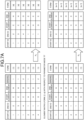
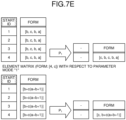
- FIGS. 7A to 7E are diagrams for explaining the effect of the core tensor calculation by the core tensor calculation unit 11.
- the effect of the core tensor calculation is represented by a form in an intermediate tensor of P 5 P 4 P 2 P 3 P 1 and E 5 E 4 P 2 E 3 P 1 .
- the form indicates the number of nonzero elements.
- the number of elements in the mode "5" of the core tensor is set as a
- the number of elements in the mode "4" and the mode “3” is set as b
- the number of elements in the mode "2" and the mode “1” is set as c.
- the form is [a, b, c]
- the number of nonzero elements is a*b*c.
- the core tensor calculation unit 11 can reduce the amount of calculation in the core tensor calculation.
- the identification unit 23 identifies whether each mode of the data tensor is a topology mode or a label mode, and the conversion unit 25 converts the mode product P of the label mode to the concatenation E.
- the mode product unit 31 calculates a mode product for the topology mode
- the concatenation unit 32 performs a concatenation calculation for the label mode. Consequently, the core tensor calculation unit 11 can reduce the amount of calculation for the tensor decomposition.
- the exchange unit 26 exchanges the processing order of the tensor decomposition such that the concatenation E is processed as late as possible, so that the amount of calculation for the tensor decomposition can be further reduced.
- the exchange unit 26 exchanges the processing order under the constraint that the process of the label mode needs to be performed before the process of the topology mode associated with the label mode, so that the amount of calculation for the tensor decomposition can be further reduced.
- the machine learning device 1 is described; however, a machine learning program having the same/similar functions can be achieved by implementing the configuration of the machine learning device 1 by using software.
- a computer that executes the machine learning program is described below.
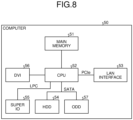
- FIG. 8 is a diagram illustrating a hardware configuration of the computer that executes the machine learning program according to the example.
- a computer 50 includes a main memory 51, a central processing unit (CPU) 52, a local area network (LAN) interface 53, and a hard disk drive (HDD) 54.
- the computer 50 further includes a super input output (IO) 55, a digital visual interface (DVI) 56, and an optical disk drive (ODD) 57.
- IO super input output
- DVI digital visual interface
- ODD optical disk drive
- the main memory 51 is a memory that stores computer programs, results during the execution of the computer programs, and the like.
- the CPU 52 is a central processing unit that reads and executes the computer programs from the main memory 51.
- the CPU 52 includes a chipset with a memory controller.
- the LAN interface 53 is an interface for connecting the computer 50 to other computers via LAN.
- the HDD 54 is a disk device for storing computer programs and data
- the super IO 55 is an interface for connecting input devices such as a mouse and a keyboard.
- the DVI 56 is an interface for connecting a liquid crystal display device
- the ODD 57 is a device that reads and writes DVDs and CD-Rs.
- the LAN interface 53 is connected to the CPU 52 by PCI express (PCIe), and the HDD 54 and the ODD 57 are connected to the CPU 52 by serial advanced technology attachment (SATA).
- the super IO 55 is connected to the CPU 52 by low pin count (LPC).
- the machine learning program to be executed on the computer 50 is stored on CD-R, which is an example of a recording medium readable by the computer 50, and is read from the CD-R by the ODD 57 and installed on the computer 50.
- the machine learning program is stored in databases or the like of other computer systems connected via the LAN interface 53, and is read from these databases and installed in the computer 50.
- the installed machine learning program is stored in the HDD 54, is read into the main memory 51, and is executed by the CPU 52.
Landscapes
- Engineering & Computer Science (AREA)
- Physics & Mathematics (AREA)
- Theoretical Computer Science (AREA)
- Mathematical Physics (AREA)
- General Physics & Mathematics (AREA)
- Software Systems (AREA)
- Data Mining & Analysis (AREA)
- Computing Systems (AREA)
- General Engineering & Computer Science (AREA)
- Artificial Intelligence (AREA)
- Evolutionary Computation (AREA)
- Computational Mathematics (AREA)
- Mathematical Analysis (AREA)
- Pure & Applied Mathematics (AREA)
- Mathematical Optimization (AREA)
- Medical Informatics (AREA)
- Computer Vision & Pattern Recognition (AREA)
- Biophysics (AREA)
- Health & Medical Sciences (AREA)
- Life Sciences & Earth Sciences (AREA)
- Biomedical Technology (AREA)
- Molecular Biology (AREA)
- Algebra (AREA)
- Databases & Information Systems (AREA)
- Computational Linguistics (AREA)
- General Health & Medical Sciences (AREA)
- Complex Calculations (AREA)
Abstract
Description
- The present invention relates to a machine learning program, a machine learning method, and a machine learning device.
- Tensor data may be used as training data for a system that generates a machine learning model by machine learning and performs prediction, classification, or the like by using the generated machine learning model. The tensor data is represented as an n (n is a positive integer) dimensional array, but is also represented by a graph, a table, or the like.
FIG. 9 is a diagram illustrating an example in which tensor data is represented in graphical form and tabular form.FIG. 9 illustrates an example of a chemical formula.FIG. 9(a) is an example in which a chemical formula of formaldehyde is represented in graphical form, andFIG. 9(b) is an example in which the chemical formula of the formaldehyde is represented in tabular form. - In the tabular form, the chemical formula is represented by five axes (columns): start ID, end ID, start element, end element, and binding, and by values. The start ID is an index of a starting point of a linkage. The end ID is an index of an end point of the linkage. A method of assigning indices to the starting point and the end point is arbitrary. The start element is a type of an element at the starting point. The end element is a type of an element at the endpoint. The binding is a type of the linkage. The tabular form represents only nonzero values of the tensor data as rows. In
FIG. 9(b) , only the six values represented by the six rows are 1, and the other values of the tensor data are 0. The axis of the tensor is called a mode. - In machine learning, a data tensor is converted to a core tensor by tensor decomposition, and training is performed using the core tensor.
FIG. 10 is a diagram for explaining tensor decomposition. InFIG. 10 , white cubes indicate zero elements and shaded cubes indicate nonzero elements. As illustrated inFIG. 10 , the data tensor is tensor-decomposed to a core tensor and element matrices corresponding to the number of modes. InFIG. 10 , since the data tensor is third-order and the number of modes is 3, the data tensor is tensor-decomposed to a core tensor and three element matrices. - The core tensor is calculated by a mode product between the data tensor and the element matrix of each mode.
FIG. 11 is a diagram for explaining the core tensor calculation by the mode product.FIG. 11(a) illustrates the mode product andFIG. 11(b) illustrates the core tensor calculation. As illustrated inFIG. 11(a) , the mode product converts the number of elements in a mode from the number of data tensors to the number of elements in the core tensor. In the example inFIG. 11(a) , the number of elements in a vertical mode is converted from 3 to 2. When there is even one nonzero element in the mode direction, all elements in the mode direction after the conversion are nonzero. In the example inFIG. 11(a) , since threeelements 91 in the vertical direction include nonzero, twoelements 92 after the conversion are nonzero. The number of elements in each mode in the core tensor is designated by a user. - As illustrated in
FIG. 11(b) , the core tensor is calculated by sequentially calculating the mode product of each mode. InFIG. 11(b) , Pi(i is 1 to 3) indicates a mode product corresponding to mode i. As illustrated inFIG. 11(b) , an intermediate tensor1 is calculated from the data tensor by a mode product P1, an intermediate tensor2 is calculated from the intermediate tensor1 by a mode product P2, and the core tensor is calculated from the intermediate tensor2 by a mode product P3. The calculation order of the mode products is arbitrary. - When an nth order tensor is set as X, the core tensor is set as X^, and an element matrix of the mode i (i is 1 to n) is set as Wi,


- For a mode product Pk of a mode k,


- As the related art regarding tensors, there is a device that speeds up a process for super-tensor factorization and reduces a memory amount needed at the time of processing. The device performs data placement processing and calculation processing on N-dimensional (N is an integer equal to or greater than 3) tensor data in a loop calculation for a plurality of indices to the tensor data. In the data placement processing, the device sequences the elements of the tensor data in order from the lowest index of the calculation loop to each index immediately preceding the highest such that the loop direction of each index is forward. Then, the device places, on a storage unit, the values of non-empty elements in the tensor data and the index values of the lowest index indicating the position of the tensor data of the elements to an index immediately preceding the highest. Then, the device performs a process of placing the count number of the non-empty elements. In the calculation processing, the device performs a loop calculation on the tensor data placed on the storage unit.
- As the related art regarding tensors, there is an information processing device capable of minimizing tensor data volumes. The information processing device includes a compressed sparse fiber (CSF) design unit, a CSF creation unit, and a CSF compression unit. The CSF design unit sets an order of the axes of an Mth or higher order tensor (M is a natural number of 3 or more) in order to convert the tensor to CSF-represented data. The CSF creation unit converts the Mth or higher order tensor to CSF-represented data in accordance with the setting by the CSF design unit. The CSF compression unit compresses the CSF-represented data by substituting a duplicate structure occurring in the CSF-represented data by a substitute structure representing the duplicate structure, and outputs compressed CSF data which is the compressed CSF-represented data, and substitution rule data which represents a substitution rule.
- As the related art, there is a method of improving matrix multiplication execution times. The method includes determining, by a graphics processing unit (GPU), optimal partitions for matrix-by-matrix multiplication of two factor matrices having known sizes. The determining step includes performing a plurality of matrix-by-matrix multiplication executions offline for each different combination of two-way partitions for a plurality of partition sizes. The determining step further includes determining performance values offline on the basis of the execution time for each multiplication execution. The determining step further includes recursively repeating the multiplication execution and the determining of the performance values offline until the best performing combination of the two-way partitions no longer improves the performance values, and saving the best performing combinations of the two-way partitions as optimal partitions. The method further includes performing online, by the GPU, the matrix-by-matrix multiplication of the two factor matrices by using calls for one of the best performing combinations of the two-way partitions.
- For example, related arts are disclosed in
Japanese Laid-open Patent Publication No. 2016-139391 WO 2020/008513 andU.S. Patent No. 2017/0046307 - In tensor decomposition, the amount of calculation increases exponentially as the number of modes increases. For example, tensor data for chemical formulas have many modes, such as atomic numbers, the number of protons, the number of charges, and the number of neutrons, and thus the amount of calculation for tensor decomposition is large. As the amount of calculation becomes larger, the amount of memory requested for the calculation becomes larger.
- In one aspect, it is an object of the present invention to reduce the amount of calculation for tensor decomposition.
- In one proposal, a machine learning program causes a computer to perform a process that includes identifying a first axis including elements represented by one-hot vectors and a second axis including elements not represented by one-hot vectors, among a plurality of axes included in tensor-form data, when calculating a core tensor from the tensor-form data via a plurality of intermediate tensors, calculating the core tensor from the tensor-form data by a first process of concatenating elements included in a first element matrix corresponding to the first axis to elements included in a first intermediate tensor among the plurality of intermediate tensors and a second process of calculating a mode product between a second intermediate tensor among the plurality of intermediate tensors and a second element matrix corresponding to the second axis, and performing machine learning of a machine learning model with the core tensor as an input.
- In an aspect, the present invention can reduce the amount of calculation for tensor decomposition.
-
-
FIG. 1 is a diagram illustrating an example of a label mode and a topology mode. -
FIG. 2 is a diagram for explaining a matrix product between a matrix with sparse nonzero elements and a matrix with dense nonzero elements. -
FIG. 3 is a diagram for explaining a difference between a mode product and concatenation. -
FIG. 4 is a diagram illustrating a functional configuration of a machine learning device according to an example. -
FIG. 5 is a diagram illustrating five modes. -
FIG. 6 is a flowchart illustrating a processing procedure by a core tensor calculation unit. -
FIG. 7A is a first diagram for explaining the effect of a core tensor calculation by the core tensor calculation unit. -
FIG. 7B is a second diagram for explaining the effect of a core tensor calculation by the core tensor calculation unit. -
FIG. 7C is a third diagram for explaining the effect of a core tensor calculation by the core tensor calculation unit. -
FIG. 7D is a fourth diagram for explaining the effect of a core tensor calculation by the core tensor calculation unit. -
FIG. 7E is a fifth diagram for explaining the effect of a core tensor calculation by the core tensor calculation unit. -
FIG. 8 is a diagram illustrating a hardware configuration of a computer that executes a machine learning program according to an example. -
FIG. 9 is a diagram illustrating an example in which tensor data is represented in graphical form and tabular form. -
FIG. 10 is a diagram for explaining tensor decomposition. -
FIG. 11 is a diagram for explaining a core tensor calculation by a mode product. - Hereinafter, examples of a machine learning program, a machine learning method, and a machine learning device disclosed in the present application are described in detail with reference to the drawings. These examples do not limit the disclosed technology.
- First, a label mode and a topology mode are described. A machine learning device according to an example divides a mode into the topology mode and the label mode. The topology mode is a mode of representing data linkage. The label mode is a mode of representing attributes.
FIG. 1 is a diagram illustrating an example of the label mode and the topology mode. As illustrated inFIG. 1 , a start ID and an end ID correspond to the topological mode and a start element, an end element, and a binding correspond to the label mode. The label mode is associated with one or more modes of the topology mode, and the value of the label mode is determined by the associated topology mode. - For example, the start element is associated with the start ID, and the value of the start element is determined by the start ID. When the start ID is 1, the start element is C, when the start ID is 2 or 3, the start element is H, and when the start ID is 4, the start element is O. The end element is also associated with the end ID, and the value of the end element is determined by the end ID. When the end ID is 1, the end element is C, when the end ID is 2 or 3, the end element is H, and when the end ID is 4, the end element is O. The binding is also associated with the start ID and the end ID, and the value of the binding is determined by the start ID and the end ID. When the start ID is 1 and the end ID is 2 or 3, the binding is 1, and when the start ID is 1 and the end ID is 4, the binding is 2.
- The label mode is represented as a one-hot vector. The one-hot vector is a vector in which only one element is 1 and the other elements are 0.
- Next, the conversion of a mode product to a concatenation by the machine learning device according to the example is described. When a data tensor includes many label modes, nonzero elements of the data tensor are sparse. On the other hand, an element matrix is dense with nonzero elements. The calculation of a mode product is the calculation of a matrix product X"=(Wk)T×X', and when the data tensor includes many label modes, the number of nonzero elements in an intermediate tensor increases exponentially each time the calculation of the mode product is performed because the matrix product is calculated between a matrix with sparse nonzero elements and a matrix with dense nonzero elements.
-
FIG. 2 is a diagram for explaining a matrix product between a matrix with sparse nonzero elements and a matrix with dense nonzero elements. InFIG. 2 , A denotes a matrix with sparse nonzero elements, B denotes a matrix with dense nonzero elements, and C denotes a matrix product between A and B. InFIG. 2 , black and shaded squares indicate nonzero elements and white squares indicate zero elements. As illustrated inFIG. 2 , the nonzero elements of rows of A are multiplied with corresponding rows of B to form corresponding rows of C. When there is even one nonzero element in the rows of A, all elements in the corresponding rows of C are nonzero. In this way, in the matrix product between the matrix with sparse nonzero elements and the matrix with dense nonzero elements, the number of nonzero elements increases exponentially. That is, the number of nonzero elements in an intermediate tensor increases exponentially each time the calculation of the mode product is performed. - Therefore, the machine learning device according to the example converts the mode product of the label mode to a concatenation. The concatenation indicates adding elements of an element matrix to elements of a data tensor or an intermediate tensor.
FIG. 3 is a diagram for explaining a difference between a mode product and a concatenation.FIG. 3 illustrates a difference between a mode product P2 and a concatenation E2. InFIG. 3 , shaded cubes indicate nonzero elements and white cubes indicate zero elements. n is a size of nonzero elements with respect to a mode "2" of an intermediate tensor1, and m is a size of nonzero elements in columns of an element matrix2. - As illustrated in
FIG. 3 , in the case of the mode product P2, the size of nonzero elements in an intermediate tensor2 with respect to the mode "2" is n × m, whereas in the case of the concatenation E2, the size of the nonzero elements in the intermediate tensor2 with respect to the mode "2" is n + m. That is, the machine learning device according to the example converts the mode product of the label mode to a concatenation, so that the number of nonzero elements increases linearly. - A tensor X with sparse nonzero elements is represented as a mixture of a pair (I, V) of an index table I and vectors V of nonzero tensor elements. In a mixed representation, rows of I correspond to coordinates of elements of V, and columns of I correspond to modes of the tensor. An ith row of I

- In the mixed representation, the mode product between X and the element matrix W is performed in the order of index partitioning, tensor outer product, and summation. For example, in the calculation of a mode product for a mode n, an index row is partitioned as expressed by equation (1) below.

- An output index table I' of the mode product is formed from I^i. The respective values of an output vector V' of the mode product are calculated by summing the outer products of rows of Vi and corresponding rows of W, as expressed by Equation (2) below. The sum in equation (2) is calculated for i satisfying equation (3) below.


- In the label mode, the calculation of the sum in equation (2) is eliminated and only the outer product is used. The machine learning device according to the example calculates the output vector of the concatenation by using equation (4) below.

- The machine learning device according to the example produces an input for a neural network by flattening and concatenating the elements of V to allow a core tensor calculated by tensor decomposition to be an input for the neural network. Consequently, the outer product of the mode product and the vector concatenation include the same information, but with a different number of values. Therefore, converting the mode product of the label mode to a concatenation has no effect on training.
- Next, the functional configuration of the machine learning device according to the example is described.
FIG. 4 is a diagram illustrating the functional configuration of the machine learning device according to the example. As illustrated inFIG. 4 , amachine learning device 1 according to the example includes a core tensor calculation unit 11 and a training unit 12. - The core tensor calculation unit 11 receives information on a data tensor and the number of elements in each mode of a core tensor, and calculates the core tensor. The training unit 12 generates a machine learning model by performing machine learning by using the core tensor calculated by the core tensor calculation unit 11. The generated machine learning model is used for classification, prediction, or the like.
- The core tensor calculation unit 11 includes an
input unit 21, astorage unit 22, anidentification unit 23, adetermination unit 24, aconversion unit 25, anexchange unit 26, and acalculation unit 27. - The
input unit 21 receives the information on the data tensor and the number of elements in each mode of the core tensor, and stores the received information in thestorage unit 22. - The
storage unit 22 stores the information input by theinput unit 21. Thestorage unit 22 also stores information produced by theidentification unit 23, thedetermination unit 24, theconversion unit 25, theexchange unit 26, and thecalculation unit 27. - The
identification unit 23 identifies whether each mode of the data tensor is a topology mode or a label mode, and stores the identification result in thestorage unit 22. For example, when the values of all modes other than the target mode are fixed, theidentification unit 23 identifies a target mode as the label mode in a case where only one value of the target mode is 1 and all the other values are 0 , and identifies the target mode as the topology mode in other cases. Whether each mode of the data tensor is the topology mode or the label mode may be input by theinput unit 21 and stored in thestorage unit 22. Alternatively, theidentification unit 23 may identify whether each mode of the data tensor is the topology mode or the label mode by inquiring of a user. - The
determination unit 24 determines the order of modes of tensor decomposition such that the label mode comes first and the topology mode comes later, and stores the determined order in thestorage unit 22. For example, as illustrated inFIG. 5 , when a mode of the start ID is "1", a mode of the end ID is "2", a mode of the start element is "3", a mode of the end element is "4", and a mode of the binding is "5", thedetermination unit 24 sets P5P4P3P2P1 as a processing order of the tensor decomposition. P5P4P3P2P1 indicates that the tensor decomposition process is performed in the order of P5, P4, P3, P2, and P1. - The
conversion unit 25 converts the mode product P of the label mode to a concatenation E and stores the conversion result in thestorage unit 22. In the example illustrated inFIG. 5 , since a mode "5", a mode "4" and a mode "3" are label modes, P5P4P3 is converted to E5E4E3, and the order of the tensor decomposition process is E5E4E3P2P1. - The
exchange unit 26 exchanges the processing order such that the concatenation E is processed as late as possible, and stores the exchange result in thestorage unit 22. However, theexchange unit 26 exchanges the processing order under the constraint that a process of the label mode needs to be performed before a process of the topology mode associated with the label mode. - For example, in E5E4E3P2P1, when E3 is processed as late as possible, E3 needs to be performed before P1 because the mode "3" is associated with the mode "1". Consequently, E3 and P2 are exchanged and E5E4E3P2P1 becomes E5E4P2E3P1. Since the mode "5" and the mode "4" are associated with the mode "2", no further exchange occurs. By processing the concatenation E as late as possible, the core tensor calculation unit 11 can further reduce the number of nonzero elements in an intermediate tensor.
- The
exchange unit 26 identifies the topology mode associated with the label mode by, for example, inquiring of a user. The topology mode associated with the label mode may be input by theinput unit 21 and stored in thestorage unit 22. - The
calculation unit 27 performs tensor decomposition on the basis of the exchange result by theexchange unit 26, and calculates the core tensor. Then, thecalculation unit 27 stores information on the calculated core tensor in thestorage unit 22. Thecalculation unit 27 includes a mode product unit 31 and a concatenation unit 32. The mode product unit 31 calculates a mode product for the topology mode. The concatenation unit 32 performs a concatenation calculation for the label mode. - Next, the processing procedure by the core tensor calculation unit 11 is described.
FIG. 6 is a flowchart illustrating the processing procedure by the core tensor calculation unit 11. As illustrated inFIG. 6 , the core tensor calculation unit 11 identifies whether each mode of the data tensor is a topology mode or a label mode (step S1). Subsequently, the core tensor calculation unit 11 determines the order of tensor decomposition in the order of the label mode and the topology mode (step S2). - Subsequently, the core tensor calculation unit 11 converts the process of the label mode from P to E (step S3). Subsequently, the core tensor calculation unit 11 exchanges E and P such that E is processed as late as possible under the constraint that the process of the label mode needs to be performed before the process of the topology mode associated with the label mode (step S4). Subsequently, the core tensor calculation unit 11 calculates the core tensor in the order obtained by the exchange (step S5).
- In this way, the core tensor calculation unit 11 converts the process of the label mode from P to E, so that the amount of calculation for the tensor decomposition can be reduced.
- Next, the effect of the core tensor calculation by the core tensor calculation unit 11 is described.
FIGS. 7A to 7E are diagrams for explaining the effect of the core tensor calculation by the core tensor calculation unit 11. InFIGS. 7A to 7E , the example illustrated inFIG. 1 is used. The effect of the core tensor calculation is represented by a form in an intermediate tensor of P5P4P2P3P1 and E5E4P2E3P1. The form indicates the number of nonzero elements. The number of elements in the mode "5" of the core tensor is set as a, the number of elements in the mode "4" and the mode "3" is set as b, and the number of elements in the mode "2" and the mode "1" is set as c. When the form is [a, b, c], the number of nonzero elements is a*b*c. - As illustrated in
FIG. 7A , for the first mode "5", since the number of nonzero elements is 1, the form is [1]. Since the form of the element matrix is [2, a], the form is [1 × a]=[a] by P5 in the case of P5P4P2P3P1 and is [1 + a]=[a + 1] by E5 in the case of E5E4P2E3P1. - For the next mode "4", as illustrated in
FIG. 7B , since the form of the element matrix is [3, b], the form is [b, a] by P4 in the case of P5P4P2P3P1 and is [a + b + 1] by E4 in the case of E5E4P2E3P1. - For the next mode "2", as illustrated in
FIG. 7C , since the form of the element matrix is [4, c], the form is [c, b, a] by P2 in the case of P5P4P2P3P1 and is [c, a + b + 1] by P2 in the case of E5E4P2E3P1. - For the next mode "3", as illustrated in
FIG. 7D , since the form of the element matrix is [3, b], the form is [b, c, b, a] by P3 in the case of P5P4P2P3P1 and is [b + c(a + b + 1)] by E3 in the case of E5E4P2E3P1. - For the next mode "1", as illustrated in
FIG. 7E , since the form of the element matrix is [4, c], the form is [c, b, c, b, a] by P1 in the case of P5P4P2P3P1 and is [c, b + c(a + b + 1)] by P1 in the case of E5E4P2E3P1. - In this way, in the core tensor calculation, the number of nonzero elements is c*b*c*b*a in the case of P5P4P2P3P1, and the number of nonzero elements is c*(b + c*(a + b + 1)) in the case of E5E4P2E3P1. Consequently, the core tensor calculation unit 11 can reduce the amount of calculation in the core tensor calculation.
- As described above, in the example, the
identification unit 23 identifies whether each mode of the data tensor is a topology mode or a label mode, and theconversion unit 25 converts the mode product P of the label mode to the concatenation E. In the core tensor calculation, the mode product unit 31 calculates a mode product for the topology mode, and the concatenation unit 32 performs a concatenation calculation for the label mode. Consequently, the core tensor calculation unit 11 can reduce the amount of calculation for the tensor decomposition. - In the example, the
exchange unit 26 exchanges the processing order of the tensor decomposition such that the concatenation E is processed as late as possible, so that the amount of calculation for the tensor decomposition can be further reduced. - In the example, the
exchange unit 26 exchanges the processing order under the constraint that the process of the label mode needs to be performed before the process of the topology mode associated with the label mode, so that the amount of calculation for the tensor decomposition can be further reduced. - In the example, the
machine learning device 1 is described; however, a machine learning program having the same/similar functions can be achieved by implementing the configuration of themachine learning device 1 by using software. A computer that executes the machine learning program is described below. -
FIG. 8 is a diagram illustrating a hardware configuration of the computer that executes the machine learning program according to the example. As illustrated in FIG. 22, acomputer 50 includes amain memory 51, a central processing unit (CPU) 52, a local area network (LAN)interface 53, and a hard disk drive (HDD) 54. Thecomputer 50 further includes a super input output (IO) 55, a digital visual interface (DVI) 56, and an optical disk drive (ODD) 57. - The
main memory 51 is a memory that stores computer programs, results during the execution of the computer programs, and the like. TheCPU 52 is a central processing unit that reads and executes the computer programs from themain memory 51. TheCPU 52 includes a chipset with a memory controller. - The
LAN interface 53 is an interface for connecting thecomputer 50 to other computers via LAN. TheHDD 54 is a disk device for storing computer programs and data, and thesuper IO 55 is an interface for connecting input devices such as a mouse and a keyboard. TheDVI 56 is an interface for connecting a liquid crystal display device, and theODD 57 is a device that reads and writes DVDs and CD-Rs. - The
LAN interface 53 is connected to theCPU 52 by PCI express (PCIe), and theHDD 54 and theODD 57 are connected to theCPU 52 by serial advanced technology attachment (SATA). Thesuper IO 55 is connected to theCPU 52 by low pin count (LPC). - The machine learning program to be executed on the
computer 50 is stored on CD-R, which is an example of a recording medium readable by thecomputer 50, and is read from the CD-R by theODD 57 and installed on thecomputer 50. Alternatively, the machine learning program is stored in databases or the like of other computer systems connected via theLAN interface 53, and is read from these databases and installed in thecomputer 50. The installed machine learning program is stored in theHDD 54, is read into themain memory 51, and is executed by theCPU 52. -
- 1 Machine learning device
- 11 Core tensor calculation unit
- 12 Training unit
- 21 Input unit
- 22 Storage unit
- 23 Identification unit
- 24 Determination unit
- 25 Conversion unit
- 26 Exchange unit
- 27 Calculation unit
- 31 Mode product unit
- 32 Concatenation unit
- 50 Computer
- 51 Main memory
- 52 CPU
- 53 LAN Interface
- 54 HDD
- 55 Super IO
- 56 DVI
- 57 ODD
- 91, 92 Element
Claims (6)
- A machine learning program causing a computer to perform a process comprising:identifying a first axis including elements represented by one-hot vectors and a second axis including elements not represented by one-hot vectors, among a plurality of axes included in tensor-form data;when calculating a core tensor from the tensor-form data via a plurality of intermediate tensors, calculating the core tensor from the tensor-form data by a first process of concatenating elements included in a first element matrix corresponding to the first axis to elements included in a first intermediate tensor among the plurality of intermediate tensors and a second process of calculating a mode product between a second intermediate tensor among the plurality of intermediate tensors and a second element matrix corresponding to the second axis; andperforming machine learning of a machine learning model with the core tensor as an input.
- The machine learning program according to claim 1, whereinthe machine learning program causes the computer to further perform determining an execution order of the first process and the second process, andthe calculating of the core tensor includes calculating the core tensor by performing the first process and the second process in the order determined by the process of determining.
- The machine learning program according to claim 2, wherein the determining includes a process of determining that the first process is performed before the second process when the elements of the first axis depend on the second axis and determining that the first process is performed after the second process when the elements of the first axis do not depend on the second axis.
- The machine learning program according to any one of claims 1, 2, and 3, wherein the identifying includes a process of identifying an axis of a label mode as the first axis and identifying an axis of a topology mode as the second axis.
- A machine learning method executed by a computer that performs a process comprising:identifying a first axis including elements represented by one-hot vectors and a second axis including elements not represented by one-hot vectors, among a plurality of axes included in tensor-form data;when calculating a core tensor from the tensor-form data via a plurality of intermediate tensors, calculating the core tensor from the tensor-form data by a first process of concatenating elements included in a first element matrix corresponding to the first axis to elements included in a first intermediate tensor among the plurality of intermediate tensors and a second process of calculating a mode product between a second intermediate tensor among the plurality of intermediate tensors and a second element matrix corresponding to the second axis; andperforming machine learning of a machine learning model with the core tensor as an input.
- A machine learning device comprising:an identification unit that identifies a first axis including elements represented by one-hot vectors and a second axis including elements not represented by one-hot vectors, among a plurality of axes included in tensor-form data;a calculation unit that, when calculating a core tensor from the tensor-form data via a plurality of intermediate tensors, calculates the core tensor from the tensor-form data by a first process of concatenating elements included in a first element matrix corresponding to the first axis to elements included in a first intermediate tensor among the plurality of intermediate tensors and a second process of calculating a mode product between a second intermediate tensor among the plurality of intermediate tensors and a second element matrix corresponding to the second axis; anda learning unit that performs machine learning of a machine learning model with the core tensor as an input.
Applications Claiming Priority (1)
| Application Number | Priority Date | Filing Date | Title |
|---|---|---|---|
| PCT/JP2020/038681 WO2022079815A1 (en) | 2020-10-13 | 2020-10-13 | Machine learning program, machine learning method, and machine learning device |
Publications (2)
| Publication Number | Publication Date |
|---|---|
| EP4231208A1 true EP4231208A1 (en) | 2023-08-23 |
| EP4231208A4 EP4231208A4 (en) | 2023-11-22 |
Family
ID=81207805
Family Applications (1)
| Application Number | Title | Priority Date | Filing Date |
|---|---|---|---|
| EP20957644.6A Withdrawn EP4231208A4 (en) | 2020-10-13 | 2020-10-13 | MACHINE LEARNING PROGRAM, MACHINE LEARNING METHOD AND MACHINE LEARNING APPARATUS |
Country Status (4)
| Country | Link |
|---|---|
| US (1) | US20230229967A1 (en) |
| EP (1) | EP4231208A4 (en) |
| JP (1) | JP7487790B2 (en) |
| WO (1) | WO2022079815A1 (en) |
Families Citing this family (2)
| Publication number | Priority date | Publication date | Assignee | Title |
|---|---|---|---|---|
| WO2025009140A1 (en) * | 2023-07-05 | 2025-01-09 | 株式会社デンソーアイティーラボラトリ | Calculation device, calculation method, and program |
| KR102878350B1 (en) * | 2024-01-24 | 2025-10-29 | 한국과학기술원 | Lossy compression of tensors using neural tensor-train decomposition |
Family Cites Families (3)
| Publication number | Priority date | Publication date | Assignee | Title |
|---|---|---|---|---|
| JP6058065B2 (en) | 2015-01-23 | 2017-01-11 | 日本電信電話株式会社 | Tensor data calculation device, tensor data calculation method, and program |
| US9836434B2 (en) | 2015-08-11 | 2017-12-05 | International Business Machines Corporation | Runtime of CUBLAS matrix multiplication on GPU |
| JP7074191B2 (en) | 2018-07-03 | 2022-05-24 | 日本電気株式会社 | Information processing equipment, tensor compression method, and program |
-
2020
- 2020-10-13 EP EP20957644.6A patent/EP4231208A4/en not_active Withdrawn
- 2020-10-13 WO PCT/JP2020/038681 patent/WO2022079815A1/en not_active Ceased
- 2020-10-13 JP JP2022556736A patent/JP7487790B2/en active Active
-
2023
- 2023-03-22 US US18/124,630 patent/US20230229967A1/en active Pending
Also Published As
| Publication number | Publication date |
|---|---|
| JP7487790B2 (en) | 2024-05-21 |
| WO2022079815A1 (en) | 2022-04-21 |
| US20230229967A1 (en) | 2023-07-20 |
| JPWO2022079815A1 (en) | 2022-04-21 |
| EP4231208A4 (en) | 2023-11-22 |
Similar Documents
| Publication | Publication Date | Title |
|---|---|---|
| EP3979143A1 (en) | Method of performing splitting in neural network model by means of multi-core processor, and related product | |
| US6882958B2 (en) | System and method for curve fitting using randomized techniques | |
| Egloff et al. | A dynamic look-ahead Monte Carlo algorithm for pricing Bermudan options | |
| US20230229967A1 (en) | Recording medium, machine learning method, and machine learning device | |
| CN111506922B (en) | Method and device for carrying out significance check on private data by multi-party union | |
| EA003796B1 (en) | Method(variants) and system for representing data in a multi-dimensional space | |
| CN110472268B (en) | Method and device for modal recognition of bridge monitoring data | |
| CN109409504A (en) | A kind of data processing method, device, computer and storage medium | |
| CN102326160A (en) | Method and system for clustering data generated from a database | |
| CN112906652B (en) | A method, device, electronic device and storage medium for recognizing face images | |
| CN118070515A (en) | Method, device, equipment and storage medium for rapid inversion of multi-physics fields of power equipment | |
| Huai et al. | Zerobn: Learning compact neural networks for latency-critical edge systems | |
| CN119445379A (en) | A method and system for image self-supervised learning integrating contrastive learning and feature mask modeling | |
| CN113516019A (en) | Hyperspectral image unmixing method and device and electronic equipment | |
| Li et al. | An alternating nonmonotone projected Barzilai–Borwein algorithm of nonnegative factorization of big matrices | |
| CN115331005B (en) | A directional object segmentation method based on deep supervision fusion and feature smoothing | |
| JP7524778B2 (en) | Machine learning program, machine learning method, and machine learning device | |
| CN114186168A (en) | Correlation analysis method and device for intelligent city network resources | |
| JP2020030702A (en) | Learning device, learning method and learning program | |
| EP4485198A1 (en) | Method and system for optimizing data placement in high-performance computers | |
| CN113505838A (en) | Image clustering method and device, electronic equipment and storage medium | |
| CN116992607A (en) | Structural topology optimization method, system and device | |
| CN114266414A (en) | Loan amount prediction method, loan amount prediction device, loan amount prediction electronic device, and loan amount prediction medium | |
| US20260080030A1 (en) | Information Processing Apparatus and Information Processing Method | |
| CN116310476B (en) | Fine granularity image classification method and system based on asymmetric convolution residual error network |
Legal Events
| Date | Code | Title | Description |
|---|---|---|---|
| STAA | Information on the status of an ep patent application or granted ep patent |
Free format text: STATUS: THE INTERNATIONAL PUBLICATION HAS BEEN MADE |
|
| PUAI | Public reference made under article 153(3) epc to a published international application that has entered the european phase |
Free format text: ORIGINAL CODE: 0009012 |
|
| STAA | Information on the status of an ep patent application or granted ep patent |
Free format text: STATUS: REQUEST FOR EXAMINATION WAS MADE |
|
| 17P | Request for examination filed |
Effective date: 20230320 |
|
| AK | Designated contracting states |
Kind code of ref document: A1 Designated state(s): AL AT BE BG CH CY CZ DE DK EE ES FI FR GB GR HR HU IE IS IT LI LT LU LV MC MK MT NL NO PL PT RO RS SE SI SK SM TR |
|
| REG | Reference to a national code |
Ref country code: DE Ref legal event code: R079 Free format text: PREVIOUS MAIN CLASS: G06N0020000000 Ipc: G06F0017160000 |
|
| A4 | Supplementary search report drawn up and despatched |
Effective date: 20231025 |
|
| RIC1 | Information provided on ipc code assigned before grant |
Ipc: G06N 3/09 20230101ALI20231019BHEP Ipc: G06F 17/16 20060101AFI20231019BHEP |
|
| DAV | Request for validation of the european patent (deleted) | ||
| DAX | Request for extension of the european patent (deleted) | ||
| STAA | Information on the status of an ep patent application or granted ep patent |
Free format text: STATUS: EXAMINATION IS IN PROGRESS |
|
| 17Q | First examination report despatched |
Effective date: 20241018 |
|
| STAA | Information on the status of an ep patent application or granted ep patent |
Free format text: STATUS: THE APPLICATION HAS BEEN WITHDRAWN |
|
| 18W | Application withdrawn |
Effective date: 20250416 |