EP4230335A1 - Edm electrode with enriched surface region - Google Patents
Edm electrode with enriched surface region Download PDFInfo
- Publication number
- EP4230335A1 EP4230335A1 EP23153450.4A EP23153450A EP4230335A1 EP 4230335 A1 EP4230335 A1 EP 4230335A1 EP 23153450 A EP23153450 A EP 23153450A EP 4230335 A1 EP4230335 A1 EP 4230335A1
- Authority
- EP
- European Patent Office
- Prior art keywords
- electrode
- chromium
- surface region
- aluminum
- metallic
- Prior art date
- Legal status (The legal status is an assumption and is not a legal conclusion. Google has not performed a legal analysis and makes no representation as to the accuracy of the status listed.)
- Pending
Links
- VYZAMTAEIAYCRO-UHFFFAOYSA-N Chromium Chemical compound [Cr] VYZAMTAEIAYCRO-UHFFFAOYSA-N 0.000 claims abstract description 58
- XAGFODPZIPBFFR-UHFFFAOYSA-N aluminium Chemical compound [Al] XAGFODPZIPBFFR-UHFFFAOYSA-N 0.000 claims abstract description 58
- 229910052782 aluminium Inorganic materials 0.000 claims abstract description 58
- 229910052804 chromium Inorganic materials 0.000 claims abstract description 58
- 239000011651 chromium Substances 0.000 claims abstract description 58
- 238000003754 machining Methods 0.000 claims abstract description 7
- 230000008016 vaporization Effects 0.000 claims abstract description 4
- 238000009834 vaporization Methods 0.000 claims abstract description 3
- 229910045601 alloy Inorganic materials 0.000 claims description 18
- 239000000956 alloy Substances 0.000 claims description 18
- 238000000034 method Methods 0.000 claims description 12
- 239000000463 material Substances 0.000 claims description 9
- RYGMFSIKBFXOCR-UHFFFAOYSA-N Copper Chemical compound [Cu] RYGMFSIKBFXOCR-UHFFFAOYSA-N 0.000 claims description 6
- 229910052802 copper Inorganic materials 0.000 claims description 6
- 239000010949 copper Substances 0.000 claims description 6
- 239000000203 mixture Substances 0.000 claims description 4
- 238000010891 electric arc Methods 0.000 claims description 3
- 238000005260 corrosion Methods 0.000 description 7
- 230000007797 corrosion Effects 0.000 description 7
- 238000009760 electrical discharge machining Methods 0.000 description 7
- 230000003647 oxidation Effects 0.000 description 6
- 238000007254 oxidation reaction Methods 0.000 description 6
- 230000008569 process Effects 0.000 description 6
- 239000012530 fluid Substances 0.000 description 4
- 230000008901 benefit Effects 0.000 description 3
- 239000007787 solid Substances 0.000 description 2
- 229910000601 superalloy Inorganic materials 0.000 description 2
- QXZUUHYBWMWJHK-UHFFFAOYSA-N [Co].[Ni] Chemical compound [Co].[Ni] QXZUUHYBWMWJHK-UHFFFAOYSA-N 0.000 description 1
- 238000005275 alloying Methods 0.000 description 1
- 238000005269 aluminizing Methods 0.000 description 1
- 230000015572 biosynthetic process Effects 0.000 description 1
- 230000015556 catabolic process Effects 0.000 description 1
- 238000004532 chromating Methods 0.000 description 1
- 239000000470 constituent Substances 0.000 description 1
- 238000001816 cooling Methods 0.000 description 1
- 238000007598 dipping method Methods 0.000 description 1
- 238000011010 flushing procedure Methods 0.000 description 1
- 230000007246 mechanism Effects 0.000 description 1
- 238000002844 melting Methods 0.000 description 1
- 230000008018 melting Effects 0.000 description 1
- 229910001092 metal group alloy Inorganic materials 0.000 description 1
- 230000004048 modification Effects 0.000 description 1
- 238000012986 modification Methods 0.000 description 1
- 238000007747 plating Methods 0.000 description 1
- 230000009467 reduction Effects 0.000 description 1
Images

Classifications
-
- B—PERFORMING OPERATIONS; TRANSPORTING
- B23—MACHINE TOOLS; METAL-WORKING NOT OTHERWISE PROVIDED FOR
- B23H—WORKING OF METAL BY THE ACTION OF A HIGH CONCENTRATION OF ELECTRIC CURRENT ON A WORKPIECE USING AN ELECTRODE WHICH TAKES THE PLACE OF A TOOL; SUCH WORKING COMBINED WITH OTHER FORMS OF WORKING OF METAL
- B23H7/00—Processes or apparatus applicable to both electrical discharge machining and electrochemical machining
- B23H7/22—Electrodes specially adapted therefor or their manufacture
- B23H7/24—Electrode material
-
- B—PERFORMING OPERATIONS; TRANSPORTING
- B23—MACHINE TOOLS; METAL-WORKING NOT OTHERWISE PROVIDED FOR
- B23H—WORKING OF METAL BY THE ACTION OF A HIGH CONCENTRATION OF ELECTRIC CURRENT ON A WORKPIECE USING AN ELECTRODE WHICH TAKES THE PLACE OF A TOOL; SUCH WORKING COMBINED WITH OTHER FORMS OF WORKING OF METAL
- B23H1/00—Electrical discharge machining, i.e. removing metal with a series of rapidly recurring electrical discharges between an electrode and a workpiece in the presence of a fluid dielectric
- B23H1/04—Electrodes specially adapted therefor or their manufacture
- B23H1/06—Electrode material
-
- B—PERFORMING OPERATIONS; TRANSPORTING
- B23—MACHINE TOOLS; METAL-WORKING NOT OTHERWISE PROVIDED FOR
- B23H—WORKING OF METAL BY THE ACTION OF A HIGH CONCENTRATION OF ELECTRIC CURRENT ON A WORKPIECE USING AN ELECTRODE WHICH TAKES THE PLACE OF A TOOL; SUCH WORKING COMBINED WITH OTHER FORMS OF WORKING OF METAL
- B23H9/00—Machining specially adapted for treating particular metal objects or for obtaining special effects or results on metal objects
- B23H9/14—Making holes
Definitions
- EDM Electrical discharge machining
- gas turbine engine components such as turbine vanes and blades, utilize EDM to form channels and cooling holes.
- an electrode that includes a metallic electrode body having an exterior surface region that is enriched in at least one of aluminum or chromium.
- the metallic electrode body includes an interior region underlying the surface region, and the surface region has a greater amount of combined aluminum and chromium than the interior region by at least 5% by weight.
- the metallic electrode body includes an interior region underlying the surface region, and the surface region has a greater amount of combined aluminum and chromium than the interior region by at least 10% by weight.
- the metallic electrode body includes an interior region underlying the surface region, and the surface region has a greater amount of combined aluminum and chromium than the interior region by at least 25% by weight.
- the exterior surface region is enriched in aluminum.
- the exterior surface region is enriched in chromium.
- the exterior surface region is enriched in aluminum and chromium.
- metallic electrode body is formed of a copper-based alloy.
- the metallic electrode body includes an interior region underlying the surface region, and the surface region has a greater amount of combined aluminum and chromium than the interior region by at least 5% by weight.
- the exterior surface region is enriched in aluminum.
- the exterior surface region is enriched in chromium.
- the exterior surface region is enriched in aluminum and chromium.
- a method of machining includes providing a metallic workpiece that is formed of an alloy that has a composition that includes at least one of aluminum or chromium, providing an electrode that includes a metallic electrode body that has a surface region that is enriched in at least one of aluminum or chromium, bringing the electrode into proximity of the metallic workpiece, and providing a voltage differential across the metallic workpiece and the electrode.
- the voltage differential causes an electric arc that removes material from the metallic workpiece and vaporizes at least a portion of the surface region of the electrode.
- the at least one of aluminum or chromium that is vaporized from the surface region suppresses vaporization loss of aluminum or chromium from the metallic workpiece.
- the metallic electrode body includes an interior region underlying the surface region, and the surface region has a greater amount of combined aluminum and chromium than the interior region by at least 25% by weight.
- the surface region is enriched in aluminum and chromium
- the metallic electrode body is formed of a copper-based alloy.
- a machine which the Applicant expressly reserves the right to claim independently, that includes a metallic electrode body having a surface region that is enriched in at least one of aluminum or chromium, a fixture for holding a metallic workpiece, an actuator operable to move the electrode relative to the fixture, and a power source operably connected with the electrode and the fixture to provide a voltage differential across the electrode and the metallic workpiece.
- the metallic electrode body includes an interior region underlying the surface region, and the surface region has a greater amount of combined aluminum and chromium than the interior region by at least 25% by weight.
- the surface region is enriched in aluminum and chromium
- the metallic electrode body is formed of a copper-based alloy.
- the present disclosure may include any one or more of the individual features disclosed above and/or below alone or in any combination thereof.
- FIG. 1 schematically illustrates a machine 20 that is operable for electric discharge machining (EDM) of metallic components such as, but not limited to, gas turbine engine components.
- the machine 20 includes an electrode 22, a fixture 24 for holding a metallic workpiece 26, an actuator 28, a power source 30, and a dielectric fluid (not shown).
- the actuator 28 is operable to move the electrode 22 relative to the fixture 24 and workpiece 26.
- the power source 30 is operably connected with the electrode 22 and the fixture 24 to provide a voltage differential across the electrode 22 and the metallic workpiece 26.
- the machine 20 may include additional components related to the operation and control thereof and the description of which is not necessary for the understanding of this disclosure.
- the EDM process involves bringing the electrode 22 into proximity of the metallic workpiece 26 while submerged in the dielectric fluid and then providing a voltage differential across the metallic workpiece 26 and the electrode 22.
- the voltage differential causes a breakdown of the dielectric fluid and a formation of an electric arc that removes material from the metallic workpiece 26 as well as from the electrode 22.
- the electric arcing is cycled to ultimately form a hole or slot, for example.
- the actuator 28 moves the electrode 22 in order to remove additional material.
- Components such as gas turbine engine components are often formed of metallic alloys that contain alloying elements that serve for corrosion protection.
- nickel- and cobalt-based superalloys often contain aluminum and/or chromium that form oxide scales at a rate significantly slower than that of other constituent elements in the alloy.
- the material removal mechanism of the EDM process on such a superalloy may cause localized depletion of aluminum and/or chromium in the machined surface zone of the workpiece. As a result, the machined surface zone may not have the same level of oxidation and/or corrosion resistance as the base alloy.
- the electrode 22 is configured in a way to increase the amount of aluminum and/or chromium present in the machined surface zone of the workpiece after machining.
- FIG. 2 illustrates a sectioned view of the electrode 22.
- the electrode 22 is a cylindrical annulus that circumscribes a flow passage 32.
- the flow passage 32 serves to provide clean dielectric fluid during the EDM process for flushing the vicinity of the workpiece that is being machined.
- the electrode 22 is not limited to the geometry shown and may alternatively have other geometries, several of which are shown and described below.
- the electrode 22 has a metallic electrode body 34 that defines an inner surface 34a that borders the flow passage 32, an outer surface region 34b, and an interior region 34c that underlies the surface region 34b.
- the metallic electrode body 34 is formed of a base alloy.
- the base alloy is a copper-based alloy but is not limited thereto.
- the surface region 34b of the electrode body 34 is enriched in at least one of aluminum or chromium.
- the surface region 34b may have a thickness of up to approximately 0.1 millimeters.
- the term "enriched" used herein means that the surface regions contains, by weight, a higher amount of aluminum and/or chromium than the base alloy in the interior region 34c.
- the surface region 34b has a greater amount of combined aluminum and chromium than the interior region 34c by at least 5%, at least 10%, or at least 25%.
- the base alloy has less than 0.05% of combined aluminum and chromium, and the surface region 34b has at least 10% of combined aluminum and chromium (e.g., all aluminum, all chromium, or a combination of aluminum and chromium).
- the enriched element, aluminum and/or chromium is selected in dependence upon the composition of the alloy of the workpiece and the desired composition along the working surface after machining. For instance, if the alloy of the workpiece requires a minimum weight percent of aluminum for oxidation/corrosion resistance but does not require additional chromium, an electrode 22 with a surface region 34b that is enriched in a majority aluminum would be used. Likewise, if the alloy of the workpiece requires a minimum weight percent of chromium for oxidation/corrosion resistance but does not require additional aluminum, an electrode 22 with a surface region 34b that is enriched in a majority chromium would be used. And if the alloy of the workpiece requires both aluminum and chromium for the required oxidation and corrosion resistance, an electrode 22 with a surface region that is enriched in aluminum and chromium would be used.
- the technique used to enrich the surface region 34b with the aluminum and/or chromium is not particularly limited except that the selected technique should not substantially degrade the performance of the electrode 22, or cause a reduction in quality of the machined feature created on the work part.
- Example enrichment processes may include, but are not limited to, hot dipping, low temperature aluminizing and/or chromating, and plating.
- the vaporized aluminum and/or chromium creates an elevated partial pressure of aluminum and/or chromium in the localized vicinity of the machined surface zone of the workpiece 26.
- the elevated partial pressure serves to suppress depletion of aluminum and/or chromium from the machined surface of the workpiece 26, thereby preserving the original amount of the aluminum and/or chromium in the surface zone. In this manner, the oxidation and corrosion performance of the workpiece at the surface zone is maintained.
- the vaporized aluminum and/or chromium from the surface region 34b may deposit onto the machined surface zone of the workpiece 26, thereby either replenishing lost aluminum and/or chromium or providing additional aluminum and/or chromium for oxidation and corrosion protection.
- the electrode may have other geometries.
- like reference numerals designate like elements where appropriate and reference numerals with the addition of one-hundred or multiples thereof designate modified elements that are understood to incorporate the same features and benefits of the corresponding elements.
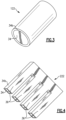
- Figure 3 illustrates an electrode 122 in which the metallic electrode body 34 has a solid cylindrical geometry (with no flow passage 32).
- Figure 4 illustrates another example electrode 222 in which the metallic electrode body 34 has a combed geometry with parallel spaced-apart fingers 36 for forming multiple holes side-by-side.
Landscapes
- Engineering & Computer Science (AREA)
- Mechanical Engineering (AREA)
- Chemical & Material Sciences (AREA)
- Chemical Kinetics & Catalysis (AREA)
- Electrochemistry (AREA)
- Manufacturing & Machinery (AREA)
- Electrical Discharge Machining, Electrochemical Machining, And Combined Machining (AREA)
Abstract
Description
- Electrical discharge machining (EDM) is a process in which material is removed from a workpiece by electric current discharge between an electrode and the workpiece. The electric current discharge removes material from the workpiece by melting and/or vaporizing the material. For instance, gas turbine engine components, such as turbine vanes and blades, utilize EDM to form channels and cooling holes.
- From a first aspect, there is provided an electrode that includes a metallic electrode body having an exterior surface region that is enriched in at least one of aluminum or chromium.
- In an embodiment of the foregoing, the metallic electrode body includes an interior region underlying the surface region, and the surface region has a greater amount of combined aluminum and chromium than the interior region by at least 5% by weight.
- In a further embodiment of any of the foregoing, the metallic electrode body includes an interior region underlying the surface region, and the surface region has a greater amount of combined aluminum and chromium than the interior region by at least 10% by weight.
- In a further embodiment of any of the foregoing, the metallic electrode body includes an interior region underlying the surface region, and the surface region has a greater amount of combined aluminum and chromium than the interior region by at least 25% by weight.
- In a further embodiment of any of the foregoing, the exterior surface region is enriched in aluminum.
- In a further embodiment of any of the foregoing, the exterior surface region is enriched in chromium.
- In a further embodiment of any of the foregoing, the exterior surface region is enriched in aluminum and chromium.
- In a further embodiment of any of the foregoing, metallic electrode body is formed of a copper-based alloy.
- In a further embodiment of any of the foregoing, the metallic electrode body includes an interior region underlying the surface region, and the surface region has a greater amount of combined aluminum and chromium than the interior region by at least 5% by weight.
- In a further embodiment of any of the foregoing, the exterior surface region is enriched in aluminum.
- In a further embodiment of any of the foregoing, the exterior surface region is enriched in chromium.
- In a further embodiment of any of the foregoing, the exterior surface region is enriched in aluminum and chromium.
- There is also provided a method of machining that includes providing a metallic workpiece that is formed of an alloy that has a composition that includes at least one of aluminum or chromium, providing an electrode that includes a metallic electrode body that has a surface region that is enriched in at least one of aluminum or chromium, bringing the electrode into proximity of the metallic workpiece, and providing a voltage differential across the metallic workpiece and the electrode. The voltage differential causes an electric arc that removes material from the metallic workpiece and vaporizes at least a portion of the surface region of the electrode. The at least one of aluminum or chromium that is vaporized from the surface region suppresses vaporization loss of aluminum or chromium from the metallic workpiece.
- In a further embodiment of any of the foregoing, the metallic electrode body includes an interior region underlying the surface region, and the surface region has a greater amount of combined aluminum and chromium than the interior region by at least 25% by weight.
- In a further embodiment of any of the foregoing, the surface region is enriched in aluminum and chromium, and the metallic electrode body is formed of a copper-based alloy.
- There is also provided a machine, which the Applicant expressly reserves the right to claim independently, that includes a metallic electrode body having a surface region that is enriched in at least one of aluminum or chromium, a fixture for holding a metallic workpiece, an actuator operable to move the electrode relative to the fixture, and a power source operably connected with the electrode and the fixture to provide a voltage differential across the electrode and the metallic workpiece.
- In a further embodiment of any of the foregoing, the metallic electrode body includes an interior region underlying the surface region, and the surface region has a greater amount of combined aluminum and chromium than the interior region by at least 25% by weight.
- In a further embodiment of any of the foregoing, the surface region is enriched in aluminum and chromium, and the metallic electrode body is formed of a copper-based alloy.
- The present disclosure may include any one or more of the individual features disclosed above and/or below alone or in any combination thereof.
- The various features and advantages of the present disclosure will become apparent to those skilled in the art from the following detailed description. The drawings that accompany the detailed description can be briefly described as follows.
-
Figure 1 illustrates a machine for electric discharge machining. -
Figure 2 illustrates a sectioned view of an electrode of the machine. -
Figure 3 illustrates an example electrode that is solid. -
Figure 4 illustrates an example electrode that has a combed geometry. -
Figure 1 schematically illustrates amachine 20 that is operable for electric discharge machining (EDM) of metallic components such as, but not limited to, gas turbine engine components. In general, themachine 20 includes anelectrode 22, afixture 24 for holding ametallic workpiece 26, anactuator 28, apower source 30, and a dielectric fluid (not shown). Theactuator 28 is operable to move theelectrode 22 relative to thefixture 24 andworkpiece 26. Thepower source 30 is operably connected with theelectrode 22 and thefixture 24 to provide a voltage differential across theelectrode 22 and themetallic workpiece 26. As will be appreciated by those of ordinary skill in the art, themachine 20 may include additional components related to the operation and control thereof and the description of which is not necessary for the understanding of this disclosure. - The EDM process involves bringing the
electrode 22 into proximity of themetallic workpiece 26 while submerged in the dielectric fluid and then providing a voltage differential across themetallic workpiece 26 and theelectrode 22. The voltage differential causes a breakdown of the dielectric fluid and a formation of an electric arc that removes material from themetallic workpiece 26 as well as from theelectrode 22. The electric arcing is cycled to ultimately form a hole or slot, for example. As material is removed, theactuator 28 moves theelectrode 22 in order to remove additional material. - Components such as gas turbine engine components are often formed of metallic alloys that contain alloying elements that serve for corrosion protection. For instance, nickel- and cobalt-based superalloys often contain aluminum and/or chromium that form oxide scales at a rate significantly slower than that of other constituent elements in the alloy. The material removal mechanism of the EDM process on such a superalloy may cause localized depletion of aluminum and/or chromium in the machined surface zone of the workpiece. As a result, the machined surface zone may not have the same level of oxidation and/or corrosion resistance as the base alloy. As will be discussed below, the
electrode 22 is configured in a way to increase the amount of aluminum and/or chromium present in the machined surface zone of the workpiece after machining. -
Figure 2 illustrates a sectioned view of theelectrode 22. In the example shown, theelectrode 22 is a cylindrical annulus that circumscribes aflow passage 32. Theflow passage 32 serves to provide clean dielectric fluid during the EDM process for flushing the vicinity of the workpiece that is being machined. As will be appreciated, theelectrode 22 is not limited to the geometry shown and may alternatively have other geometries, several of which are shown and described below. - The
electrode 22 has ametallic electrode body 34 that defines aninner surface 34a that borders theflow passage 32, anouter surface region 34b, and aninterior region 34c that underlies thesurface region 34b. Themetallic electrode body 34 is formed of a base alloy. For example, the base alloy is a copper-based alloy but is not limited thereto. Thesurface region 34b of theelectrode body 34 is enriched in at least one of aluminum or chromium. For example, thesurface region 34b may have a thickness of up to approximately 0.1 millimeters. The term "enriched" used herein means that the surface regions contains, by weight, a higher amount of aluminum and/or chromium than the base alloy in theinterior region 34c. For instance, thesurface region 34b has a greater amount of combined aluminum and chromium than theinterior region 34c by at least 5%, at least 10%, or at least 25%. In a further example, the base alloy has less than 0.05% of combined aluminum and chromium, and thesurface region 34b has at least 10% of combined aluminum and chromium (e.g., all aluminum, all chromium, or a combination of aluminum and chromium). - The enriched element, aluminum and/or chromium, is selected in dependence upon the composition of the alloy of the workpiece and the desired composition along the working surface after machining. For instance, if the alloy of the workpiece requires a minimum weight percent of aluminum for oxidation/corrosion resistance but does not require additional chromium, an
electrode 22 with asurface region 34b that is enriched in a majority aluminum would be used. Likewise, if the alloy of the workpiece requires a minimum weight percent of chromium for oxidation/corrosion resistance but does not require additional aluminum, anelectrode 22 with asurface region 34b that is enriched in a majority chromium would be used. And if the alloy of the workpiece requires both aluminum and chromium for the required oxidation and corrosion resistance, anelectrode 22 with a surface region that is enriched in aluminum and chromium would be used. - The technique used to enrich the
surface region 34b with the aluminum and/or chromium is not particularly limited except that the selected technique should not substantially degrade the performance of theelectrode 22, or cause a reduction in quality of the machined feature created on the work part. Example enrichment processes may include, but are not limited to, hot dipping, low temperature aluminizing and/or chromating, and plating. - During the EDM process, the
electrode 22, including the aluminum and/or chromium in the enrichedsurface region 34b, also vaporizes as an electrical arc forms between theelectrode 22 and theworkpiece 26. Without wishing to be bound by a particular theory, it is thought that the vaporized aluminum and/or chromium creates an elevated partial pressure of aluminum and/or chromium in the localized vicinity of the machined surface zone of theworkpiece 26. The elevated partial pressure serves to suppress depletion of aluminum and/or chromium from the machined surface of theworkpiece 26, thereby preserving the original amount of the aluminum and/or chromium in the surface zone. In this manner, the oxidation and corrosion performance of the workpiece at the surface zone is maintained. Additionally or alternatively, the vaporized aluminum and/or chromium from thesurface region 34b may deposit onto the machined surface zone of theworkpiece 26, thereby either replenishing lost aluminum and/or chromium or providing additional aluminum and/or chromium for oxidation and corrosion protection. - As indicated above, the electrode may have other geometries. In this disclosure, like reference numerals designate like elements where appropriate and reference numerals with the addition of one-hundred or multiples thereof designate modified elements that are understood to incorporate the same features and benefits of the corresponding elements. For example,
Figure 3 illustrates anelectrode 122 in which themetallic electrode body 34 has a solid cylindrical geometry (with no flow passage 32).Figure 4 illustrates anotherexample electrode 222 in which themetallic electrode body 34 has a combed geometry with parallel spaced-apart fingers 36 for forming multiple holes side-by-side. - Although a combination of features is shown in the illustrated examples, not all of them need to be combined to realize the benefits of various embodiments of this disclosure. In other words, a system designed according to an embodiment of this disclosure will not necessarily include all of the features shown in any one of the Figures or all of the portions schematically shown in the Figures. Moreover, selected features of one example embodiment may be combined with selected features of other example embodiments.
- The preceding description is exemplary rather than limiting in nature. Variations and modifications to the disclosed examples may become apparent to those skilled in the art that do not necessarily depart from this disclosure. The scope of legal protection given to this disclosure can only be determined by studying the following claims.
Claims (12)
- An electrode (22; 122; 222) comprising:
a metallic electrode body (34) having an exterior surface region (34b) that is enriched in at least one of aluminum or chromium. - The electrode as recited in claim 1, wherein the metallic electrode body (34) includes an interior region (34c) underlying the surface region (34b), and the surface region (34b) has a greater amount of combined aluminum and chromium than the interior region (34c) by at least 5% by weight.
- The electrode as recited in claim 1, wherein the metallic electrode body (34) includes an interior region (34c) underlying the surface region (34b), and the surface region (34b) has a greater amount of combined aluminum and chromium than the interior region (34c) by at least 10% by weight.
- The electrode as recited in claim 1, wherein the metallic electrode body (34) includes an interior region (34c) underlying the surface region (34b), and the surface region (34b) has a greater amount of combined aluminum and chromium than the interior region (34c) by at least 25% by weight.
- The electrode as recited in any preceding claim, wherein the exterior surface region (34b) is enriched in aluminum.
- The electrode as recited in any preceding claim, wherein the exterior surface region (34b) is enriched in chromium.
- The electrode as recited in any preceding claim, wherein the exterior surface region (34b) is enriched in aluminum and chromium.
- The electrode as recited in any preceding claim, wherein metallic electrode body (34) is formed of a copper-based alloy.
- A machine (20) comprising:the electrode (22) of any preceding claim;a fixture (24) for holding a metallic workpiece (26);an actuator (28) operable to move the electrode (22) relative to the fixture (24); anda power source (30) operably connected with the electrode (22) and the fixture (24) to provide a voltage differential across the electrode (22) and the metallic workpiece (26).
- A method of machining comprising:providing a metallic workpiece (26) that is formed of an alloy that has a composition that includes at least one of aluminum or chromium;providing an electrode (22; 122; 222) that includes a metallic electrode body (34) that has a surface region (34b) that is enriched in at least one of aluminum or chromium;bringing the electrode (22; 122; 222) into proximity of the metallic workpiece (26); andproviding a voltage differential across the metallic workpiece (26) and the electrode (22), the voltage differential causing an electric arc that removes material from the metallic workpiece (26) and vaporizes at least a portion of the surface region (34b) of the electrode (22; 122; 222), wherein the at least one of aluminum or chromium that is vaporized from the surface region (34b) suppresses vaporization loss of aluminum or chromium from the metallic workpiece (26).
- The method as recited in claim 10, wherein the metallic electrode body (34) includes an interior region (34c) underlying the surface region (34b), and the surface region (34b) has a greater amount of combined aluminum and chromium than the interior region (34c) by at least 25% by weight.
- The method as recited in claim 10 or 11, the surface region (34b) is enriched in aluminum and chromium, and the metallic electrode body (34) is formed of a copper-based alloy.
Applications Claiming Priority (1)
| Application Number | Priority Date | Filing Date | Title |
|---|---|---|---|
| US202263304129P | 2022-01-28 | 2022-01-28 |
Publications (1)
| Publication Number | Publication Date |
|---|---|
| EP4230335A1 true EP4230335A1 (en) | 2023-08-23 |
Family
ID=85122049
Family Applications (1)
| Application Number | Title | Priority Date | Filing Date |
|---|---|---|---|
| EP23153450.4A Pending EP4230335A1 (en) | 2022-01-28 | 2023-01-26 | Edm electrode with enriched surface region |
Country Status (2)
| Country | Link |
|---|---|
| US (1) | US20230241699A1 (en) |
| EP (1) | EP4230335A1 (en) |
Citations (3)
| Publication number | Priority date | Publication date | Assignee | Title |
|---|---|---|---|---|
| US4806721A (en) * | 1983-07-11 | 1989-02-21 | Mitsubishi Denki Kabushiki Kaisha | Wire electrode for wire-cut electrical discharge machining |
| JPH02198717A (en) * | 1988-09-02 | 1990-08-07 | Kawatetsu Techno Res Corp | Electrode for wire electric discharging |
| US20140091701A1 (en) * | 2012-09-28 | 2014-04-03 | Ishifuku Metal Industry Co., Ltd. | Spark plug for internal combustion engine |
Family Cites Families (4)
| Publication number | Priority date | Publication date | Assignee | Title |
|---|---|---|---|---|
| WO2004113587A1 (en) * | 2003-06-10 | 2004-12-29 | Ishikawajima-Harima Heavy Industries Co., Ltd. | Metal component, turbine component, gas turbine engine, surface processing method, and steam turbine engine |
| MY190044A (en) * | 2016-01-13 | 2022-03-23 | Univ Of Malaya | An electrode wire for use in wire electrical discharge machining |
| US20200061729A1 (en) * | 2016-11-04 | 2020-02-27 | Global Innovative Products, Llc | Edm milling electrode |
| US10793943B2 (en) * | 2018-03-15 | 2020-10-06 | Raytheon Technologies Corporation | Method of producing a gas turbine engine component |
-
2023
- 2023-01-10 US US18/152,482 patent/US20230241699A1/en active Pending
- 2023-01-26 EP EP23153450.4A patent/EP4230335A1/en active Pending
Patent Citations (3)
| Publication number | Priority date | Publication date | Assignee | Title |
|---|---|---|---|---|
| US4806721A (en) * | 1983-07-11 | 1989-02-21 | Mitsubishi Denki Kabushiki Kaisha | Wire electrode for wire-cut electrical discharge machining |
| JPH02198717A (en) * | 1988-09-02 | 1990-08-07 | Kawatetsu Techno Res Corp | Electrode for wire electric discharging |
| US20140091701A1 (en) * | 2012-09-28 | 2014-04-03 | Ishifuku Metal Industry Co., Ltd. | Spark plug for internal combustion engine |
Non-Patent Citations (1)
| Title |
|---|
| BLEYS P ET AL: "Surface and Sub-Surface Quality of Steel after EDM", ADVANCE ENGINEERING MATERIALS, WILEY VCH VERLAG, WEINHEIM, DE, vol. 8, 13 February 2006 (2006-02-13), pages 15 - 25, XP072484903, ISSN: 1438-1656, DOI: 10.1002/ADEM.200500211 * |
Also Published As
| Publication number | Publication date |
|---|---|
| US20230241699A1 (en) | 2023-08-03 |
Similar Documents
| Publication | Publication Date | Title |
|---|---|---|
| CA2302202C (en) | Electrode wire for use in electric discharge machining and process for preparing same | |
| Patil et al. | Some studies into wire electro-discharge machining of alumina particulate-reinforced aluminum matrix composites | |
| Günen et al. | WEDM machining of MoNbTaTiZr refractory high entropy alloy | |
| Kapoor et al. | Recent developments in wire electrodes for high performance WEDM | |
| EP3345718B1 (en) | Structure braze repair of hard-to-weld superalloy components using diffusion alloy insert | |
| Uhlmann et al. | Investigations on vibration-assisted EDM-machining of seal slots in high-temperature resistant materials for turbine components–part II | |
| EP2684981B1 (en) | A coating/repairing process using electrospark with PSP rod | |
| EP2671660B1 (en) | Electrode and electrochemical machining process for forming non-circular holes | |
| EP2853483A2 (en) | Erosion shield, method of fabricating a shield, and method of fabricating an article having a shield | |
| EP2950964B1 (en) | Long-life nozzle for a thermal spray gun and method making and using the same | |
| US6566622B1 (en) | Wire electrode | |
| US20090200274A1 (en) | Electrode Arrangement for Electrical Discharge Machining on an Electrically Non-Conductive Material | |
| Baldin et al. | Machining of Inconel 718 with a defined geometry tool or by electrical discharge machining | |
| CA2739374A1 (en) | Wire electrode for spark-erosion cutting | |
| EP1788196B1 (en) | Methods for repairing gas turbine engine components | |
| Pascu et al. | Laser cladding: From experimental research to industrial applications | |
| US8597491B2 (en) | Procedure for the production and application of a protective layer | |
| US9023188B2 (en) | Component production method | |
| EP4230335A1 (en) | Edm electrode with enriched surface region | |
| US5857888A (en) | Method of manufacturing a plasma torch eletrode | |
| US8900424B2 (en) | Electrode and electrochemical machining process for forming non-circular holes | |
| US20190126369A1 (en) | Method for wire electro-discharge machining a part | |
| US5686001A (en) | Variable polarity arc technology for the repair of coated articles | |
| US9162306B2 (en) | Method and system for reducing oversized holes on turbine components | |
| JP2023184508A (en) | Electrolytic processing methods and systems |
Legal Events
| Date | Code | Title | Description |
|---|---|---|---|
| PUAI | Public reference made under article 153(3) epc to a published international application that has entered the european phase |
Free format text: ORIGINAL CODE: 0009012 |
|
| STAA | Information on the status of an ep patent application or granted ep patent |
Free format text: STATUS: THE APPLICATION HAS BEEN PUBLISHED |
|
| AK | Designated contracting states |
Kind code of ref document: A1 Designated state(s): AL AT BE BG CH CY CZ DE DK EE ES FI FR GB GR HR HU IE IS IT LI LT LU LV MC ME MK MT NL NO PL PT RO RS SE SI SK SM TR |
|
| RAP3 | Party data changed (applicant data changed or rights of an application transferred) |
Owner name: RTX CORPORATION |
|
| STAA | Information on the status of an ep patent application or granted ep patent |
Free format text: STATUS: REQUEST FOR EXAMINATION WAS MADE |
|
| 17P | Request for examination filed |
Effective date: 20240221 |
|
| RBV | Designated contracting states (corrected) |
Designated state(s): AL AT BE BG CH CY CZ DE DK EE ES FI FR GB GR HR HU IE IS IT LI LT LU LV MC ME MK MT NL NO PL PT RO RS SE SI SK SM TR |