EP4230290A1 - Composite oxide containing tungstate nanoclusters, preparation method therefor and use thereof - Google Patents
Composite oxide containing tungstate nanoclusters, preparation method therefor and use thereof Download PDFInfo
- Publication number
- EP4230290A1 EP4230290A1 EP21960357.8A EP21960357A EP4230290A1 EP 4230290 A1 EP4230290 A1 EP 4230290A1 EP 21960357 A EP21960357 A EP 21960357A EP 4230290 A1 EP4230290 A1 EP 4230290A1
- Authority
- EP
- European Patent Office
- Prior art keywords
- catalyst
- ocm
- composite oxide
- tungstate
- tungsten
- Prior art date
- Legal status (The legal status is an assumption and is not a legal conclusion. Google has not performed a legal analysis and makes no representation as to the accuracy of the status listed.)
- Pending
Links
Images




Classifications
-
- C—CHEMISTRY; METALLURGY
- C01—INORGANIC CHEMISTRY
- C01G—COMPOUNDS CONTAINING METALS NOT COVERED BY SUBCLASSES C01D OR C01F
- C01G41/00—Compounds of tungsten
- C01G41/02—Oxides; Hydroxides
-
- B—PERFORMING OPERATIONS; TRANSPORTING
- B01—PHYSICAL OR CHEMICAL PROCESSES OR APPARATUS IN GENERAL
- B01J—CHEMICAL OR PHYSICAL PROCESSES, e.g. CATALYSIS OR COLLOID CHEMISTRY; THEIR RELEVANT APPARATUS
- B01J37/00—Processes, in general, for preparing catalysts; Processes, in general, for activation of catalysts
- B01J37/02—Impregnation, coating or precipitation
- B01J37/03—Precipitation; Co-precipitation
- B01J37/031—Precipitation
-
- B—PERFORMING OPERATIONS; TRANSPORTING
- B01—PHYSICAL OR CHEMICAL PROCESSES OR APPARATUS IN GENERAL
- B01J—CHEMICAL OR PHYSICAL PROCESSES, e.g. CATALYSIS OR COLLOID CHEMISTRY; THEIR RELEVANT APPARATUS
- B01J23/00—Catalysts comprising metals or metal oxides or hydroxides, not provided for in group B01J21/00
- B01J23/002—Mixed oxides other than spinels, e.g. perovskite
-
- B—PERFORMING OPERATIONS; TRANSPORTING
- B01—PHYSICAL OR CHEMICAL PROCESSES OR APPARATUS IN GENERAL
- B01J—CHEMICAL OR PHYSICAL PROCESSES, e.g. CATALYSIS OR COLLOID CHEMISTRY; THEIR RELEVANT APPARATUS
- B01J23/00—Catalysts comprising metals or metal oxides or hydroxides, not provided for in group B01J21/00
- B01J23/16—Catalysts comprising metals or metal oxides or hydroxides, not provided for in group B01J21/00 of arsenic, antimony, bismuth, vanadium, niobium, tantalum, polonium, chromium, molybdenum, tungsten, manganese, technetium or rhenium
- B01J23/24—Chromium, molybdenum or tungsten
- B01J23/30—Tungsten
-
- B—PERFORMING OPERATIONS; TRANSPORTING
- B01—PHYSICAL OR CHEMICAL PROCESSES OR APPARATUS IN GENERAL
- B01J—CHEMICAL OR PHYSICAL PROCESSES, e.g. CATALYSIS OR COLLOID CHEMISTRY; THEIR RELEVANT APPARATUS
- B01J23/00—Catalysts comprising metals or metal oxides or hydroxides, not provided for in group B01J21/00
- B01J23/16—Catalysts comprising metals or metal oxides or hydroxides, not provided for in group B01J21/00 of arsenic, antimony, bismuth, vanadium, niobium, tantalum, polonium, chromium, molybdenum, tungsten, manganese, technetium or rhenium
- B01J23/32—Manganese, technetium or rhenium
- B01J23/34—Manganese
-
- B—PERFORMING OPERATIONS; TRANSPORTING
- B01—PHYSICAL OR CHEMICAL PROCESSES OR APPARATUS IN GENERAL
- B01J—CHEMICAL OR PHYSICAL PROCESSES, e.g. CATALYSIS OR COLLOID CHEMISTRY; THEIR RELEVANT APPARATUS
- B01J23/00—Catalysts comprising metals or metal oxides or hydroxides, not provided for in group B01J21/00
- B01J23/70—Catalysts comprising metals or metal oxides or hydroxides, not provided for in group B01J21/00 of the iron group metals or copper
- B01J23/76—Catalysts comprising metals or metal oxides or hydroxides, not provided for in group B01J21/00 of the iron group metals or copper combined with metals, oxides or hydroxides provided for in groups B01J23/02 - B01J23/36
- B01J23/84—Catalysts comprising metals or metal oxides or hydroxides, not provided for in group B01J21/00 of the iron group metals or copper combined with metals, oxides or hydroxides provided for in groups B01J23/02 - B01J23/36 with arsenic, antimony, bismuth, vanadium, niobium, tantalum, polonium, chromium, molybdenum, tungsten, manganese, technetium or rhenium
- B01J23/85—Chromium, molybdenum or tungsten
- B01J23/888—Tungsten
-
- B—PERFORMING OPERATIONS; TRANSPORTING
- B01—PHYSICAL OR CHEMICAL PROCESSES OR APPARATUS IN GENERAL
- B01J—CHEMICAL OR PHYSICAL PROCESSES, e.g. CATALYSIS OR COLLOID CHEMISTRY; THEIR RELEVANT APPARATUS
- B01J35/00—Catalysts, in general, characterised by their form or physical properties
- B01J35/40—Catalysts, in general, characterised by their form or physical properties characterised by dimensions, e.g. grain size
- B01J35/45—Nanoparticles
-
- B—PERFORMING OPERATIONS; TRANSPORTING
- B01—PHYSICAL OR CHEMICAL PROCESSES OR APPARATUS IN GENERAL
- B01J—CHEMICAL OR PHYSICAL PROCESSES, e.g. CATALYSIS OR COLLOID CHEMISTRY; THEIR RELEVANT APPARATUS
- B01J35/00—Catalysts, in general, characterised by their form or physical properties
- B01J35/60—Catalysts, in general, characterised by their form or physical properties characterised by their surface properties or porosity
- B01J35/61—Surface area
- B01J35/612—Surface area less than 10 m2/g
-
- B—PERFORMING OPERATIONS; TRANSPORTING
- B01—PHYSICAL OR CHEMICAL PROCESSES OR APPARATUS IN GENERAL
- B01J—CHEMICAL OR PHYSICAL PROCESSES, e.g. CATALYSIS OR COLLOID CHEMISTRY; THEIR RELEVANT APPARATUS
- B01J37/00—Processes, in general, for preparing catalysts; Processes, in general, for activation of catalysts
- B01J37/06—Washing
-
- B—PERFORMING OPERATIONS; TRANSPORTING
- B01—PHYSICAL OR CHEMICAL PROCESSES OR APPARATUS IN GENERAL
- B01J—CHEMICAL OR PHYSICAL PROCESSES, e.g. CATALYSIS OR COLLOID CHEMISTRY; THEIR RELEVANT APPARATUS
- B01J37/00—Processes, in general, for preparing catalysts; Processes, in general, for activation of catalysts
- B01J37/08—Heat treatment
-
- C—CHEMISTRY; METALLURGY
- C01—INORGANIC CHEMISTRY
- C01G—COMPOUNDS CONTAINING METALS NOT COVERED BY SUBCLASSES C01D OR C01F
- C01G41/00—Compounds of tungsten
- C01G41/006—Compounds containing tungsten, with or without oxygen or hydrogen, and containing two or more other elements
-
- C—CHEMISTRY; METALLURGY
- C07—ORGANIC CHEMISTRY
- C07C—ACYCLIC OR CARBOCYCLIC COMPOUNDS
- C07C2/00—Preparation of hydrocarbons from hydrocarbons containing a smaller number of carbon atoms
- C07C2/76—Preparation of hydrocarbons from hydrocarbons containing a smaller number of carbon atoms by condensation of hydrocarbons with partial elimination of hydrogen
- C07C2/82—Preparation of hydrocarbons from hydrocarbons containing a smaller number of carbon atoms by condensation of hydrocarbons with partial elimination of hydrogen oxidative coupling
- C07C2/84—Preparation of hydrocarbons from hydrocarbons containing a smaller number of carbon atoms by condensation of hydrocarbons with partial elimination of hydrogen oxidative coupling catalytic
-
- B—PERFORMING OPERATIONS; TRANSPORTING
- B01—PHYSICAL OR CHEMICAL PROCESSES OR APPARATUS IN GENERAL
- B01J—CHEMICAL OR PHYSICAL PROCESSES, e.g. CATALYSIS OR COLLOID CHEMISTRY; THEIR RELEVANT APPARATUS
- B01J2523/00—Constitutive chemical elements of heterogeneous catalysts
-
- C—CHEMISTRY; METALLURGY
- C01—INORGANIC CHEMISTRY
- C01P—INDEXING SCHEME RELATING TO STRUCTURAL AND PHYSICAL ASPECTS OF SOLID INORGANIC COMPOUNDS
- C01P2002/00—Crystal-structural characteristics
- C01P2002/70—Crystal-structural characteristics defined by measured X-ray, neutron or electron diffraction data
- C01P2002/77—Crystal-structural characteristics defined by measured X-ray, neutron or electron diffraction data by unit-cell parameters, atom positions or structure diagrams
-
- C—CHEMISTRY; METALLURGY
- C01—INORGANIC CHEMISTRY
- C01P—INDEXING SCHEME RELATING TO STRUCTURAL AND PHYSICAL ASPECTS OF SOLID INORGANIC COMPOUNDS
- C01P2004/00—Particle morphology
- C01P2004/60—Particles characterised by their size
- C01P2004/64—Nanometer sized, i.e. from 1-100 nanometer
-
- C—CHEMISTRY; METALLURGY
- C01—INORGANIC CHEMISTRY
- C01P—INDEXING SCHEME RELATING TO STRUCTURAL AND PHYSICAL ASPECTS OF SOLID INORGANIC COMPOUNDS
- C01P2006/00—Physical properties of inorganic compounds
- C01P2006/12—Surface area
-
- C—CHEMISTRY; METALLURGY
- C07—ORGANIC CHEMISTRY
- C07C—ACYCLIC OR CARBOCYCLIC COMPOUNDS
- C07C2523/00—Catalysts comprising metals or metal oxides or hydroxides, not provided for in group C07C2521/00
- C07C2523/16—Catalysts comprising metals or metal oxides or hydroxides, not provided for in group C07C2521/00 of arsenic, antimony, bismuth, vanadium, niobium, tantalum, polonium, chromium, molybdenum, tungsten, manganese, technetium or rhenium
- C07C2523/24—Chromium, molybdenum or tungsten
- C07C2523/30—Tungsten
-
- C—CHEMISTRY; METALLURGY
- C07—ORGANIC CHEMISTRY
- C07C—ACYCLIC OR CARBOCYCLIC COMPOUNDS
- C07C2523/00—Catalysts comprising metals or metal oxides or hydroxides, not provided for in group C07C2521/00
- C07C2523/16—Catalysts comprising metals or metal oxides or hydroxides, not provided for in group C07C2521/00 of arsenic, antimony, bismuth, vanadium, niobium, tantalum, polonium, chromium, molybdenum, tungsten, manganese, technetium or rhenium
- C07C2523/32—Manganese, technetium or rhenium
- C07C2523/34—Manganese
-
- Y—GENERAL TAGGING OF NEW TECHNOLOGICAL DEVELOPMENTS; GENERAL TAGGING OF CROSS-SECTIONAL TECHNOLOGIES SPANNING OVER SEVERAL SECTIONS OF THE IPC; TECHNICAL SUBJECTS COVERED BY FORMER USPC CROSS-REFERENCE ART COLLECTIONS [XRACs] AND DIGESTS
- Y02—TECHNOLOGIES OR APPLICATIONS FOR MITIGATION OR ADAPTATION AGAINST CLIMATE CHANGE
- Y02P—CLIMATE CHANGE MITIGATION TECHNOLOGIES IN THE PRODUCTION OR PROCESSING OF GOODS
- Y02P20/00—Technologies relating to chemical industry
- Y02P20/50—Improvements relating to the production of bulk chemicals
- Y02P20/52—Improvements relating to the production of bulk chemicals using catalysts, e.g. selective catalysts
Definitions
- the invention belongs to the field of catalysts, and particularly relates to a composite oxide containing tungstate nanoclusters, and a preparation method and application thereof.
- Nanoclusters are ultra-fine particles of several to thousands of atoms, typically less than 10 nm in diameter ( Journal of Molecular Catalysis A: Chemical 1999, 145, 1-44 ). At this scale, the species undergoes a transition from microscopic atoms/molecules to macroscopic condensed state materials, and thus nanoclusters tend to exhibit many distinct properties. Nanoclusters have been extensively studied in the past decades and their application areas include quantum dots, sensors, biomedicines, catalysis, etc. ( Nanoscale, 2021, 13, 6283 ).
- nanoclusters are metal nanoclusters and oxide nanoclusters. Inorganic salt nanoclusters are rarely studied. Taking the composite oxide containing tungsten oxide nanoclusters as an example, in the prior art (such as Nature Chemistry 2009, 1, 722-728 ; ACS Catal.
- the method for synthesizing the tungsten oxide nanoclusters can be summarized as follows: a tungstencontaining compound (ammonium metatungstate, tungstic acid, etc.) is supported on a carrier (usually an oxide or hydroxide) by an impregnation method or a coprecipitation method, and then the tungstencontaining compound (tungstic acid or tungstate) is decomposed by high-temperature calcination to form tungsten oxide (WO x ).
- a tungstencontaining compound ammonium metatungstate, tungstic acid, etc.
- a carrier usually an oxide or hydroxide
- WO x can exist stably in the form of nanoclusters.
- Composite oxides containing tungsten oxide nanoclusters e.g. WO 3 /ZrO 2 , WO 3 /Al 2 O 3 , WO 3 /SiO 2 ) are often used as solid acid catalysts.
- HCl solution is also added to support tungstate ions on a carrier in the form of alkali-free tungstic acid, which contributes to decomposition to form WO x .
- alkali metal tungstates such as Na 2 WO 4
- W exists as WO 4 configuration ( J. Phys. Chem. C 2008, 112, 6869-6879 ), which is different from WO 6 coordination in WO x .
- the configuration is quite different, and therefore the interaction between the alkali metal tungstate and the oxide support is necessarily different from that of WO x interaction with an oxide support.
- how to controllably synthesize alkali metal tungstate nanoclusters, particularly high concentration alkali metal tungstate nanoclusters, would be challenging.
- the application of alkali metal tungstate nanoclusters is also rarely reported.
- Tungsten manganese catalysts are a class of classical OCM catalysts, which consist of alkali metals, tungsten, manganese and a carrier.
- the catalyst was originally developed in 1992 by the Shuben Li group of Lanzhou Institute of Chemical Physics (Journal of Molecular Catalysis (China) 1992, 6, 427-433 ). It is usually prepared by loading sodium tungstate and manganese salt on silica gel by methods such as impregnation, and then annealing at high temperature. The catalyst has drawn considerable attention due to its good OCM catalytic performance and thermal stability ( ACS Catalysis 2019, 9, 5912-5928 ).
- a typical tungsten manganese catalyst composition is 1.9wt% Mn-5wt% Na 2 WO 4 /SiO 2 , wherein the Mn element accounts for 1.9% of the mass of the catalyst, and Na 2 WO 4 accounts for 5% of the mass of the catalyst.
- the methane conversion is 36.8%
- the C 2 hydrocarbon yield reaches 23.9%.
- the OCM performance of the tungsten-manganese catalyst can be optimized by means of element doping, composition regulation, and reaction condition regulation ( Applied Catalysis A: General 2012, 425, 53-61 ).
- Na mainly induces SiO 2 changing from amorphous phase to cristobalite phase, thereby improving the dispersion of tungsten ( Applied Catalysis A: General 2012, 425, 53-61 ; Applied Catalysis A: General 2002, 225, 271-284 ).
- the most commonly used Na source is Na 2 WO 4 .
- Na 2 WO 4 is Na 2 WO 4 .
- one would not use an alkaline Na salt as a Na source mainly because the use of an alkaline Na salt as a Na source would result in manganese elements existing as Mn 4+ form instead of active Mn 2 O 3 . This would significantly reduce the OCM catalytic activity of the tungsten manganese catalyst ( Ind. Eng. Chem. Res. 2006, 45, 7077 ).
- OCM Oxidative Coupling of Methane
- methyl radical controlled conversion catalyst must satisfy the following requirements: 1) the catalyst has strong capacity of adsorbing methyl free radicals, and can enrich the methyl free radicals in a gas phase to the surface of the catalyst; 2) methyl free radical enriched on the surface of the catalyst can be converted into C 2 products with high selectivity; 3) weak oxidizing power (or difficult to activate oxygen) so that methyl free radicals and C 2 on the surface of the catalyst won't convert into CO and CO 2 .
- the excellent methyl radical coupling catalyst itself must not have significant OCM activity because it has weak oxidizing ability and is difficult to activate methane to generate methyl radicals. Meanwhile, the catalyst has strong adsorption effect on methyl free radicals, so that the methyl free radicals are difficult to desorb into a gas phase.
- there is no prior art to design and optimize catalysts from the point of view of methyl radical controlled surface coupling nor has one physically mixed a promoter with no significant OCM performance in conventional OCM catalysts to promote C 2 selectivity and yield.
- the invention has carried out intensive research to develop a composite oxide containing tungstate nanoclusters, which is used as a cocatalyst for controllably coupling methyl radicals.
- the cocatalyst cannot be used alone as a catalyst to catalyze the OCM reaction and does not have OCM activity remarkably. But when it was physically mixed with the traditional OCM catalysts, the C 2 selectivity and the C 2 yield of the traditional OCM catalyst can be improved by more than 1.2 times ( Figure 4 ).
- the present invention has the following benefits: when the complex oxide containing tungstate nanoclusters was used as a co-catalyst in oxidative coupling of methane, and the cluster enrichment index of the complex oxide reaches the necessary density, the conventional OCM catalyst (e.g., 1.9 wt%Mn-5 wt% Na 2 WO 4 /SiO 2 ) can achieve a C 2 (ethane and ethylene) selectivity over 70%, and a C 2 yield over 30%.
- the conventional OCM catalyst e.g., 1.9 wt%Mn-5 wt% Na 2 WO 4 /SiO 2
- the conventional OCM catalyst e.g., 1.9 wt%Mn-5 wt% Na 2 WO 4 /SiO 2
- C 2 (ethane and ethylene) selectivity over 70%
- a C 2 yield over 30%.
- the C 2 selectivity can reach ⁇ 70%
- the single-pass C 2 yield can reach ⁇ 35%; more preferably, the catalyst composition is capable of achieving C 2 selectivity ⁇ 70% and the single-pass C 2 yield ⁇ 40%; more preferably, the catalyst composition is capable of achieving C 2 selectivity ⁇ 70% and the single-pass C 2 yield ⁇ 45%.
- the valences of the alkali metal A, the tungsten element W, and the promoter element M are all positive valences, and they all achieve charge balance by combining with an oxygen element whose valences are negative valences.
- the compounds formed by the alkali metal A, the tungsten element W and the promoter element M with the oxygen element can be written in the form of oxides.
- Na 2 WO 4 can be written as Na 2 O-WO 3
- ZrW 2 O 8 can be written as ZrO 2 ⁇ 2WO 3 .
- the detection means is as follows: the valences of the alkali metal element A, the tungsten element W, the promoter element M, and the oxygen element may be determined by X-ray photoelectron spectroscopy (XPS), and the crystal structure of the composite oxide may be determined by X-ray powder diffraction (XRD).
- XPS X-ray photoelectron spectroscopy
- XRD X-ray powder diffraction
- Atomic Percentage of an Element Total Atoms Number the element Total Atoms Number alkali A + Total Atoms Number tungsten element W + Total Atoms Number auxiliary element ⁇ 100 %
- the atomic percentage refers to the percentage ratio of all elements in the dried catalyst measured by X-ray fluorescence spectrum analysis, and the allowable test error is ⁇ 10%, preferably ⁇ 5%.
- the general formula of the tungstate nanocluster is A x WO y , wherein, 0 ⁇ x ⁇ 2 and y represents the number of oxygen atoms required to satisfy the charge balance of the formula.
- A Na
- x 2
- A Mg
- the particle size of the tungstate nanoclusters is 10.0 nm or less, preferably 5.0 nm or less, still more preferably 2.0 nm or less, and still more preferably 1.0 nm or less.
- the particle size of the tungstate nanoclusters refers to the average diameter of the nanoclusters; the detection method comprises the following steps: observing the composite oxide under a high-resolution transmission electron microscope, randomly selecting 100 tungstate nanoclusters, counting the diameters of the tungstate nanoclusters, and taking an average value.
- the magnification of the high-resolution transmission electron microscope is 2-30 millions, preferably 5-10 millions.
- C 2 Yield C 2 selectivity ⁇ CH 4 conversion
- the methane conversion, C 2 selectivity and C 2 yield mentioned in the subsequent text are the results of a one-pass OCM reaction in a fix-bed reactor with co-feed of methane and oxygen, if not otherwise stated.
- the invention provides a composite oxide containing tungstate nanoclusters, which comprises an alkali metal element A, a tungsten element W, an auxiliary agent element M and an oxygen element O.
- the alkali metal element A, the tungsten element W and the auxiliary agent element M form a compound with the oxygen element O.
- the alkali metal element A is selected from any one or more of Li, Na, K, Mg, Ca, Sr and Ba.
- the auxiliary agent element M is selected from any one or more of Si, Zr, Ti, Al, La, Ce and Co.
- the tungstate nanocluster is composed of the alkali metal element A, the tungsten element W and the oxygen element O, and the general formula of the tungstate nanocluster is A x WO y , Wherein, 0 ⁇ x ⁇ 2, y represents the number of oxygen atoms required to satisfy the charge balance of the formula.
- the tungstate nanoclusters satisfy an enrichment index, which is defined as follows: In any region of 10 ⁇ 10 nm, the number of the tungstate nanoclusters is ⁇ 3; preferably, the number of the tungstate nanoclusters is ⁇ 5, more preferably ⁇ 10, and more preferably ⁇ 20;
- the present invention also provides a method for preparing a composite oxide containing tungstate nanoclusters, including the steps of:
- the preparation method of the solution system 1 comprises the following steps: dissolving an alkali metal element precursor of a compound raw material containing the element in a proper amount of water, and fully stirring to form a transparent solution to obtain solution system 1, wherein the pH of the transparent solution is more than 7, and more preferably ⁇ 10;
- the present invention also provides a catalyst composition comprising the composite oxide of claim and at least one OCM catalyst having OCM activity;
- the catalyst further comprises an additive; more preferably, the additive is selected from any one or more of heat transfer aggent, mass transfer aggent, forming aggent, wear-resistant enhancing agents, dispersing agents, stabilizing agents and the like.
- the additive is selected from any one or more of heat transfer aggent, mass transfer aggent, forming aggent, wear-resistant enhancing agents, dispersing agents, stabilizing agents and the like.
- the OCM catalyst is Mn/Na 2 WO 4 /SiO 2
- the composite oxide is NaWZr; preferably, the mass ratio of the OCM catalyst to the composite oxide is 4:1-0.5:1; more preferably 2:1-1:1; preferably, the catalyst composition can realize C2 selectivity ⁇ 70% and single-pass C 2 yield ⁇ 35% in the OCM bed reactor cofed with methane and oxygen; more preferably, the catalyst composition can realize C 2 selectivity ⁇ selectivity and single-pass C 2 yield ⁇ 40% in the OCM bed reactor cofed with methane and oxygen; more preferably, the catalyst composition can realize C 2 selectivity ⁇ selectivity and single-pass C 2 yield ⁇ 45% in the OCM bed reactor cofed with methane and oxygen; preferably, in an OCM bed reactor with co-feeding of methane and oxygen, the C 2 selectivity of the catalyst composition Mn/Na 2 WO 4 /SiO 2 -NaWZr can be improved to 1.3 times of Mn/Na 2 WO 4
- the OCM catalyst is La 2 O 3 and the composite oxide NaWZr is the composite oxide of Na, W and Zr, and the mass ratio of the OCM catalyst to the composite oxide is 4:1-1:1; more preferably from 2:1-1:1; preferably, in an OCM bed reactor with co-feeding of methane and oxygen, the C 2 selectivity of the catalyst composition La 2 O 3 -NaWZr can be improved to 1.3 times of La 2 O 3 , the single pass C 2 yield is 1.2 times of La 2 O 3 .
- the OCM catalyst is Sm 2 O 3 and the composite oxide NaWZr is the composite oxide of Na, W and Zr, and the mass ratio of the OCM catalyst to the composite oxide is 4:1-1:1; more preferably from 2:1-1:1;
- the OCM catalyst is La 2 O 3
- the composite oxide is NaWAl which is a composite oxide of Na, W and Al
- the mass ratio of the OCM catalyst to the composite oxide is 4:1-1:1; more preferably from 2:1 to 1:1;
- the OCM catalyst is Li/MgO
- the composite oxide is NaWAl which is a composite oxide of Na, W and Al
- the mass ratio of the OCM catalyst to the composite oxide is 4:1-1:1; more preferably from 2:1 to 1:1
- the catalyst composition Li/MgO-NaWAl is in an OCM bed reactor with co-feeding of methane and oxygen, and the C 2 selectivity of the Li/MgO-NaWAl can be increased to 1.7 times of Li/MgO, and the single-pass C 2 yield is 1.8 times of that of Li/MgO.
- the OCM catalyst is Ca/CeO 2
- the composite oxide is NaWAl which is a composite oxide of Na, W and Al
- the mass ratio of the OCM catalyst to the composite oxide is 4:1-1:1; more preferably from 2:1 to 1:1; preferably, the catalyst composition Ca/CeO 2 -NaWAl in an OCM bed reactor co-feeding with methane and oxygen, the C 2 selectivity of of NaWAl can be improved to 1.3 times of Ca/CeO 2
- the single-pass C 2 yield is 1.6 times of Ca/CeO 2 .
- the invention also provides the use of the catalyst composition in chemical reactions; preferably, the chemical reaction is a radical conversion reaction; more preferably, the chemical reaction is oxidative coupling of methane.
- the oxidative coupling of methane refers to a process that carbon-hydrogen bonds of methane are broken under the action of a catalyst, the separated hydrogen and oxygen react to generate water, and carbon-carbon bonds are formed to prepare C 2+ hydrocarbon.
- the oxidative coupling of methane takes methane and oxygen as raw material gases, and the reaction is carried out on a bed reactor, and the product comprises C 2 hydrocarbons, hydrocarbons and C 3 hydrocarbon;
- the effect of the present invention is that the composite oxide containing tungstate nanoclusters can be used as a cocatalyst with traditional OCM catalyst to make the C 2 selectivity of oxidative coupling of methane reaching more than 70%, and the C 2 yield reaching more than 30%.
- the researchers usually optimize the synthesis of traditional tungsten-manganese OCM catalysts from the viewpoint of improving OCM performance, they have no motivation to use basic sodium salts (Na 2 CO 3 , Na 2 SiO 3 ) or NaOH and other basic solutions (pH>7) to prepare tungsten-manganese catalysts.
- the catalyst containing the sodium tungstate nanoclusters itself does not have OCM activity (when the catalyst is used as an OCM catalyst in a bed reactor with co-feeding of methane and oxygen and has the gas-space-time velocity ⁇ 20000 mL/g/h, the catalyst bed temperature ⁇ 800 °C, and the reaction pressure of 1 atmosphere, the single-pass C 2 yield is not higher than 5%), but the catalyst can be used as a cocatalyst to improve the C 2 selectivity and yield of the traditional OCM catalyst.
- the research of the invention is obviously different from the research of the traditional tungsten-manganese catalyst, and no other literature has reported similar research at present.
- the distance between the OCM catalyst and the composite oxide significantly impacts the catalytic performance of OCM.
- the OCM catalyst exhibits superior performance when the distance between the catalyst and the composite oxide is ⁇ 3mm. Furthermore, the catalytic effect becomes increasingly favorable as the distance decreases.
- CH 4 conversion and product selectivity were calculated based on a carbon atom basis of the inlet and outlet gases.
- the outlet gases were corrected for gas expansion by using N 2 as an internal standard.
- CH 4 Conv . 1 ⁇ nCH 4 outlet nCH 4 outlet + ⁇ x ⁇ n products outlet ⁇ 100 % where x is the number of carbon atom in the products.
- C 2 products include both C 2 H 4 and C 2 H 6 .
- C 2 Sel . 2 ⁇ nC 2 H 4 + 2 ⁇ nC 2 H 6 2 ⁇ nC 2 H 4 + 2 ⁇ nC 2 H 6 + 1 ⁇ nCO + 1 ⁇ nCO 2 + 3 ⁇ nC 3 H 6 + 3 ⁇ nC 3 H 8 ⁇ 100 % CO Sel .
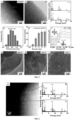
- the high-resolution transmission electron microscope images of the catalyst are shown in figure 5a,5b , and 7 , and the catalyst is obviously rich in nanoclusters.
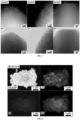
- the white clusters and the dark non-cluster regions in the graph were subjected to element scanning analysis ( figure 5c and 6 ), respectively, and it was found that the white clusters were Na x WO y clusters rich in Na, W and O elements, while the non-cluster regions were mainly ZrO 2 formed from the auxiliary element Zr.
- the average particle size of the Na x WO y nanoclusters in this catalyst was found to be 0.8 nm (as shown in d in figure 5 ). Further counting the number of Na x WO y nanoclusters in the 10 ⁇ 10 nm 2 region, it was found that the number was 21 (e in Figure 5 ).
- EDS Mapping of the catalyst is shown in Fig. 8 , and Na, W and Zr elements are uniformly distributed in the catalyst.
- W L 1 edge XANES spectra of NaWZr shown in Fig. 5f exhibit characteristic pre-edge peaks at ⁇ 12117 eV, which is similar to that of Na 2 WO 4 and different from WO 3 .
- W species in the catalyst feature tetrahedral WO 4 (i.e., tungstate) rather than octahedral WO 6 (i.e., tungsten oxide) structures.
- the Raman spectra of the catalyst was shown in Fig. 9 . Comparing to ZrO 2 , the catalyst exhibits a characteristic peak at 925cm -1 , which could be attributed to Na 2 WO 4 .
- the Zr K-edge XANES spectrum of the catalyst is shown in Fig. 10 .
- the Zr K-edge of NaWZr is significantly blue shifted, indicating that Zr transfers charge to W.
- the existence of strong interaction between Zr and W is the key to achieve the high enrichment index of Na x WO y nanoclusters.
- it can stabilize Na x WO y nanoclusters and allow them to exist in the form of nanoclusters.
- the sintering agglomeration of adjacent Na x WO y nanoclusters is avoided, so that multiple Na x WO y nanoclusters can exist in the region of 10* 10 nm 2 .
- Examples 2-16 were synthesized according to the method described in example 1, with slightly different parameters from example 1, and the specific synthesis parameters and structural parameters are shown in (table 1-1 - 1- 4).
- Example 2 differs from example 1 in that the auxiliary element used in example 2 is Al.
- the high-resolution transmission electron microscopy image of the catalyst is shown in Figure 16 , from which it can be clearly seen that the catalyst is rich in nanoclusters. It was found that the average particle size of Na x WO y nanoclusters in the catalyst was 0.9 nm. Further statistics of the number of Na x WO y nanoclusters in the 10 ⁇ 10 nm 2 region showed that the number was 21.
- nanoclusters have an average particle size of 0.8-0.9 nm, the number of Na x WO y nanoclusters is ⁇ 21 in the 10 ⁇ 10nm 2 region.
- the compound oxide containing tungstate nanoclusters can be obtained if the tungsten source is chloride or sodium tungstate, and the nanoclusters have an average particle size of 0.8-0.9 nm, the number of Na x WO y nanoclusters is ⁇ 21 in the 10 ⁇ 10nm 2 region.
- STEM images of Examples 9-13 are shown in Fig. 11-15 , respectively.
- Examples 9 to 13 differ from example 1 in the molar ratio of W to Zr.
- composite oxides containing tungstate nanoclusters were obtained when the molar ratio of W to Zr was 1:9.2:9,3:9,4:9,5:9, and 0.5:9.
- the molar ratio of W to Zr influences Na x WO y enrichment index of nanoclusters.
- the number of tungstate nanoclusters in the 10 ⁇ 10nm 2 region in Examples 1 and 9-13 are summarized in Figure 5e .
- the high feeding molar ratio of W:Zr is critical for the formation of high-concentration tungstate clusters.
- the solvent of system 2 is methanol, ethanol, propanol, or butanol, the tungstate nanocluster-containing composite oxide can be obtained.
- the nanoclusters have an average particle size of 0.8-0.9 nm, the number of Na x WO y nanoclusters is ⁇ 21 in the 10 ⁇ 10nm 2 region.
- the tungstate nanocluster-containing composite oxide can be obtained.
- the nanoclusters have an average particle size of 0.7-1.1 nm, the number of Na x WO y nanoclusters is ⁇ 3-12 in the 10 ⁇ 10nm 2 region.
- Examples 21 to 29 show that when using the synthetical parameters described in claim, the tungstate nanocluster-containing composite oxide can be obtained.
- the nanoclusters have an average particle size of 0.7-1.4 nm, the number of Na x WO y nanoclusters range from 1 to 18 in the 10 ⁇ 10nm 2 region.
- Examples 30 to 62 present the catalytic results of OCM catalyst , cocatalyst and the catalyst composition.
- Example 30 shows the catalytic performance of a cocatalyst synthesized by the preparation method described in example 1 mixed with classical Mn/Na 2 WO 4 /SiO 2 .
- the catalytic results of the catalysts tested under the above conditions show that the catalyst composition exhibits very high selectivity and yield of C 2 .
- sodium tungstate can also be used as the tungsten source to synthesize tungstate nanocluster-containing composite oxide.
- the mixture with as-synthesized composite oxide significantly improves the OCM performance of Mn/Na 2 WO 4 /SiO 2 .
- WO 3 /ZrO 2 is the comparison example 1.
- the preparation process of WO 3 /ZrO 2 is the same as that of example 1, except that no alkali metal Na was added during the synthesis of comparative example 1.
- the transmission electron microscope result shows that the nanoclusters in the WO 3 /ZrO 2 catalyst were tungsten oxide instead of sodium tungstate.
- Comparative example 1 was tested with Mn/Na 2 WO 4 /SiO 2 in the manner shown in Example 17, with the following results: The C 2 selectivity of Mn/Na 2 WO 4 /SiO 2 was 48.4% and the C 2 yield was 8.1%, while the C 2 selectivity of Mn/Na 2 WO 4 /SiO and WO 3 /ZrO 2 was 46.8% and the C 2 yield was 7.6%. From the above results, it can be seen that the comparative example 1 not only failed to improve the selectivity and yield of Mn/Na 2 WO 4 /SiO 2 , but also inhibited it. It indicates that the real component of the co-catalyst is not the tungsten oxide nanoclusters, but the tungstate nanoclusters. In the synthesis of the cocatalyst, an alkali metal element is indispensable.
- the catalyst was synthesized using the same preparation method as in example 1, with the only difference being that the auxiliary element M was not added in the synthesis of comparative example 2.
- the solution remains clarified, and the corresponding solid catalyst cannot be produced. From this result, it can be seen that the additive element is essential for the synthesis of tungstate nanoclusters.
- the catalyst was synthesized by the same preparation method as example 1, with the only difference being that the tungsten element was not added in synthesizing comparative example 3. In this case, the resulting comparative example 3 does not contain Na x WO y nanoclusters.
- Comparative example 3 was tested with Mn/Na 2 WO 4 /SiO 2 in the manner shown in Example 17 with the following results: The C 2 selectivity of Mn/Na 2 WO 4 /SiO 2 was 48.4% and the C 2 yield was 8.1%, while the C 2 selectivity of Mn/Na 2 WO 4 /SiO 2 with the catalyst composition in comparative example 3 was 45.4% and the C 2 yield was 6.8%. From the above results, it can be seen that the comparative example 3 not only failed to improve the selectivity and yield of Mn/Na 2 WO 4 /SiO 2 , but also inhibited it. It indicates that elemental tungsten is an indispensable active component of the co-catalyst.
- the catalyst was synthesized using the same preparation method as in example 1, with the only difference being the replacement of chloride with molybdenum chloride in the synthesis of Comparative example 4, that is the element W in example 1 was changed to the element Mo.
- Comparative example 4 was tested with Mn/Na 2 WO 4 /SiO 2 in the manner shown in Example 17 with the following results: The C 2 selectivity of Mn/Na 2 WO 4 /SiO 2 was 48.4% and the C 2 yield was 8.1%, while the C 2 selectivity of Mn/Na 2 WO 4 /SiO 2 with the catalyst composition in comparative example 4 was 48.2% and the C 2 yield was 8.0%. From the above results, it can be seen that the comparative example 4 not only failed to improve the selectivity and yield of Mn/Na 2 WO 4 /SiO 2 , but also inhibited it. It indicates that elemental tungsten is an indispensable active component of the co-catalyst.
- the catalyst was synthesized using the same preparation method as in example 1, with the only difference being that in the synthesis of Comparative example 5, all of system 1 was added to system 2 within 1 min.
- the high-resolution electron microscopy images of comparative example 5 are shown in Fig. 17 , where it can be seen that the sodium tungstate in comparative example 5 is mainly in the form of large sodium tungstate particles (>10 nm) rather than nanoclusters, indicating that the dropping of acceleration from system 1 into system 2 has an important effect on the structure of the catalyst.
- the slow addition of system 1 (addition time ⁇ 2 min) to system 2 allows for the slow hydrolytic crosslinking of the tungsten precursor and the auxiliary element precursor by the alkali metal, thus facilitating the formation of tungstate nanoclusters. Too rapid an addition will result in rapid hydrolysis of the auxiliary element precursors, which will not allow the tungstate to be uniformly dispersed in the nanoclusters.
- Comparative example 5 was tested with Mn/Na 2 WO 4 /SiO 2 in the manner shown in Example 17 with the following results: The C 2 selectivity of Mn/Na 2 WO 4 /SiO 2 was 48.4% and the C 2 yield was 8.1%, while the C 2 selectivity of Mn/Na 2 WO 4 /SiO 2 with the catalyst composition in comparative example 5 was 47.5 % and the C 2 yield was 7.6%. From the above results, it can be seen that the comparative example 5 failed to improve the selectivity and yield of Mn/Na 2 WO 4 /SiO 2 . It indicates that the tungstate nanocluster is the active structure of the cocatalyst, and the dropping speed of the system 1 can influence the tungstate structure of the cocatalyst species and further influence the reaction performance of the cocatalyst species.
- the catalyst was synthesized using the same preparation method as in example 1, with the only difference being that the solvent used in the system 2 in the synthesis of comparative example 6 was acetone.
- Comparative example 6 was tested with Mn/Na 2 WO 4 /SiO 2 in the manner shown in Example 17 with the following results: The C 2 selectivity of Mn/Na 2 WO 4 /SiO 2 was 48.4% and the C 2 yield was 8.1%, while the C 2 selectivity of Mn/Na 2 WO 4 /SiO 2 with the catalyst composition in comparative example 6 was 40.3 % and the C 2 yield was 6.3%. From the above results, it can be seen that the comparative example 6 failed to improve the selectivity and yield of Mn/Na 2 WO 4 /SiO 2 . It indicates that a suitable solvent must be used for the cocatalyst synthesis.
- the catalyst was synthesized by the same preparation method as in example 1, the only difference is that in the synthesis of Comparative example 7, step 3) was performed by centrifugal washing instead of drying without treatment (i.e., drying the solvent at 40°C for 12 hours in an oven at 80°C).
- the wt% of tungsten in Proportion 7 was measured by XRF to be less than 0.1%. This indicates that the centrifugal washing step caused the loss of elemental tungsten from the catalyst.
- Comparative example 7 was tested with Mn/Na 2 WO 4 /SiO 2 in the manner shown in Example 17 with the following results: The C 2 selectivity of Mn/Na 2 WO 4 /SiO 2 was 48.4% and the C 2 yield was 8.1%, while the C 2 selectivity of Mn/Na 2 WO 4 /SiO 2 with the catalyst composition in comparative example 7 was 44.2 % and the C 2 yield was 6.9%. From the above results, it can be seen that the comparative example 7 failed to improve the selectivity and yield of Mn/Na 2 WO 4 /SiO 2 . The above results show that the direct drying of the solvent without treatment as described in step 3) is a very important technical feature of the synthesis method.
- the catalyst was synthesized using the same preparation method as in example 1, the only difference being that in the synthesis of comparative example 8, the alkali metal precursor used in system 1 was sodium nitrate instead of NaOH. In this case, the pH of system 1 is neutral.
- Comparative example 8 was tested with Mn/Na 2 WO 4 /SiO 2 in the manner shown in Example 17 with the following results: The C 2 selectivity of Mn/Na 2 WO 4 /SiO 2 was 48.4% and the C 2 yield was 8.1%, while the C 2 selectivity of Mn/Na 2 WO 4 /SiO 2 with the catalyst composition in comparative example 8 was 39.5 % and the C 2 yield was 5.9%. From the above results, it can be seen that the comparative example 8 failed to improve the selectivity and yield of Mn/Na 2 WO 4 /SiO 2 . It indicates that the selection of the alkali metal precursor in the system 1 and the pH value of the system in the synthesis method are very important t technical parameters in the synthesis method.
Landscapes
- Chemical & Material Sciences (AREA)
- Organic Chemistry (AREA)
- Engineering & Computer Science (AREA)
- Materials Engineering (AREA)
- Chemical Kinetics & Catalysis (AREA)
- Inorganic Chemistry (AREA)
- Physics & Mathematics (AREA)
- Thermal Sciences (AREA)
- Catalysts (AREA)
- Inorganic Compounds Of Heavy Metals (AREA)
Abstract
Description
- The invention belongs to the field of catalysts, and particularly relates to a composite oxide containing tungstate nanoclusters, and a preparation method and application thereof.
- Nanoclusters are ultra-fine particles of several to thousands of atoms, typically less than 10 nm in diameter ( Journal of Molecular Catalysis A: Chemical 1999, 145, 1-44). At this scale, the species undergoes a transition from microscopic atoms/molecules to macroscopic condensed state materials, and thus nanoclusters tend to exhibit many distinct properties. Nanoclusters have been extensively studied in the past decades and their application areas include quantum dots, sensors, biomedicines, catalysis, etc. (Nanoscale, 2021, 13, 6283).
- At present, most of studied nanoclusters are metal nanoclusters and oxide nanoclusters. Inorganic salt nanoclusters are rarely studied. Taking the composite oxide containing tungsten oxide nanoclusters as an example, in the prior art (such as Nature Chemistry 2009, 1, 722-728; ACS Catal. 2017, 7, 2181-2198), the method for synthesizing the tungsten oxide nanoclusters can be summarized as follows: a tungstencontaining compound (ammonium metatungstate, tungstic acid, etc.) is supported on a carrier (usually an oxide or hydroxide) by an impregnation method or a coprecipitation method, and then the tungstencontaining compound (tungstic acid or tungstate) is decomposed by high-temperature calcination to form tungsten oxide (WOx). Because the carrier (such as zirconia and alumina) is in contact with WOx with strong interaction (W-O-M bond can be formed, M is non-oxygen element in the carrier, such as Zr, Al, Si and Ti), WOx can exist stably in the form of nanoclusters. Composite oxides containing tungsten oxide nanoclusters (e.g. WO3/ZrO2, WO3/Al2O3, WO3/SiO2) are often used as solid acid catalysts. This is mainly because the surface W6+ of WOx exists in distorted octahedral configuration (WO6), and can form a Bronsted acid site-Hδ+(WO3)n δ-(J. Catal. 2004, 227, 479-491). As alkali metal tungstates (e.g. Na2WO4) cannot be decomposed by high-temperature annealing to form WOx and the presence of alkali metal ions can destroy the acidity of the compound, the processes used in the prior art generally do not use an alkali solution and an alkali tungstate starting material. In the limited synthesis protocols using Na2WO4 as tungsten sources (Topics in Catalysis 1998, 6, 87-99; Advances in Chemical Engineering and Science, 2014, 4, 250-257), HCl solution is also added to support tungstate ions on a carrier in the form of alkali-free tungstic acid, which contributes to decomposition to form WOx. Notably, in alkali metal tungstates, such as Na2WO4 , W exists as WO4 configuration (J. Phys. Chem. C 2008, 112, 6869-6879), which is different from WO6 coordination in WOx. The configuration is quite different, and therefore the interaction between the alkali metal tungstate and the oxide support is necessarily different from that of WOx interaction with an oxide support. In this context, how to controllably synthesize alkali metal tungstate nanoclusters, particularly high concentration alkali metal tungstate nanoclusters, would be challenging. In addition, the application of alkali metal tungstate nanoclusters is also rarely reported.
- Tungsten manganese catalysts are a class of classical OCM catalysts, which consist of alkali metals, tungsten, manganese and a carrier. The catalyst was originally developed in 1992 by the Shuben Li group of Lanzhou Institute of Chemical Physics (Journal of Molecular Catalysis (China) 1992, 6, 427-433). It is usually prepared by loading sodium tungstate and manganese salt on silica gel by methods such as impregnation, and then annealing at high temperature. The catalyst has drawn considerable attention due to its good OCM catalytic performance and thermal stability (ACS Catalysis 2019, 9, 5912-5928). A typical tungsten manganese catalyst composition is 1.9wt% Mn-5wt% Na2WO4/SiO2, wherein the Mn element accounts for 1.9% of the mass of the catalyst, and Na2WO4 accounts for 5% of the mass of the catalyst. Under the experimental conditions of 800 °C, the methane space velocity of 36000mL/g/h, and CH4:O2:N2=3:1:2.6, the methane conversion is 36.8%, and the C2 hydrocarbon yield reaches 23.9%. In addition, the OCM performance of the tungsten-manganese catalyst can be optimized by means of element doping, composition regulation, and reaction condition regulation (Applied Catalysis A: General 2012, 425, 53-61).
- In the preparation of tungsten-manganese catalyst, Na mainly induces SiO2 changing from amorphous phase to cristobalite phase, thereby improving the dispersion of tungsten ( Applied Catalysis A: General 2012, 425, 53-61; Applied Catalysis A: General 2002, 225, 271-284). The most commonly used Na source is Na2WO4. In a few catalyst preparation methods that do not use Na2WO4 as a Na source, one would not use an alkaline Na salt as a Na source, mainly because the use of an alkaline Na salt as a Na source would result in manganese elements existing as Mn4+ form instead of active Mn2O3. This would significantly reduce the OCM catalytic activity of the tungsten manganese catalyst (Ind. Eng. Chem. Res. 2006, 45, 7077).
- The preparation of ethane and ethylene by Oxidative Coupling of Methane (OCM) is one of the key technologies for direct utilization of methane (Energy Conversion and Management, 2019, 198, 111789; Chinese Journal of Catalysis 2021, 42, 1117-1125). Conventional research generally considers that OCM reaction follows a 'heterogeneous-homogeneous' catalytic reaction mechanism: methane is activated on the surface of a catalyst to generate methyl radicals, and then the methyl radicals are subjected to homogeneous coupling in a gas phase to generate products such as ethane and ethylene (J. Am. Chem. Soc. 1987, 109, 7900-7901; J. Mol. Catal. A: Chem. 2017, 426, 326-342). The challenge of this reaction mechanism is that the catalyst only functions in methyl radicals generating, whereas homogeneous coupling of methyl radicals in the gas phase cannot be regulated by catalyst optimization (ACS Catal. 2016, 6, 4340). Thermodynamically, methyl radical and C2 species tend to react with oxygen in the gas phase to form COx, thus the C2 selectivity and yield in conventional OCM catalytic systems were difficult to achieve breakthrough (
Fig. 1 ). Arutyunov et al (J. Mol. Catal. A: Chem. 2017, 426, 326) predicted the upper limit of C2 yield using kinetic simulations of gas phase reactions. They indicate that the yield of C2 species ‴exceed 25% only when the catalyst is able to function in the methyl radical coupling step (Figure 3 ). Over the past few decades, over 1000 catalysts have been developed, involving 68 elements, but the reaction mechanism has not been broken through (ChemCαtChem, 2011, 3, 1935). Typically, the activation of oxygen/methane on the surface of the catalyst is regulated by means of element replacement/doping, auxiliary agent addition, catalyst morphology control, carrier regulation and the like. These methods can optimize the generation of methyl free radicals to improve the OCM reaction performance (Appl. Catal. A 2012, 425), but cannot control the conversion of methyl radicals. Theoretically, if a catalyst capable of controllably coupling methyl radicals can be developed and coupled with a catalyst for activating methane to generate methyl radicals, the limitation of the traditional OCM reaction mechanism is expected to be broken, and the breakthrough of the performance of the OCM is realized. An excellent methyl radical controlled conversion catalyst must satisfy the following requirements: 1) the catalyst has strong capacity of adsorbing methyl free radicals, and can enrich the methyl free radicals in a gas phase to the surface of the catalyst; 2) methyl free radical enriched on the surface of the catalyst can be converted into C2 products with high selectivity; 3) weak oxidizing power (or difficult to activate oxygen) so that methyl free radicals and C2 on the surface of the catalyst won't convert into CO and CO2. As can be seen from the above requirements, the excellent methyl radical coupling catalyst itself must not have significant OCM activity because it has weak oxidizing ability and is difficult to activate methane to generate methyl radicals. Meanwhile, the catalyst has strong adsorption effect on methyl free radicals, so that the methyl free radicals are difficult to desorb into a gas phase. In the prior art, it is generally considered that methyl radicals are too reactive under OCM reaction conditions (high temperature and presence of oxygen), and it is almost impossible to achieve controlled coupling of methyl radicals on the catalyst surface (ACS Catal.2016, 6, 4340). Thus, there is no prior art to design and optimize catalysts from the point of view of methyl radical controlled surface coupling, nor has one physically mixed a promoter with no significant OCM performance in conventional OCM catalysts to promote C2 selectivity and yield. - Summary of the Invention In order to break the limitation of the traditional methane Oxidative Coupling (OCM) reaction mechanism, the invention has carried out intensive research to develop a composite oxide containing tungstate nanoclusters, which is used as a cocatalyst for controllably coupling methyl radicals. The cocatalyst cannot be used alone as a catalyst to catalyze the OCM reaction and does not have OCM activity remarkably. But when it was physically mixed with the traditional OCM catalysts, the C2 selectivity and the C2 yield of the traditional OCM catalyst can be improved by more than 1.2 times (
Figure 4 ). Therefore, the present invention has the following benefits: when the complex oxide containing tungstate nanoclusters was used as a co-catalyst in oxidative coupling of methane, and the cluster enrichment index of the complex oxide reaches the necessary density, the conventional OCM catalyst (e.g., 1.9 wt%Mn-5 wt% Na2WO4/SiO2) can achieve a C2 (ethane and ethylene) selectivity over 70%, and a C2 yield over 30%. - When the tungstate nanocluster-containing composite oxide developed by the invention and the classical OCM catalyst (1.9 wt%Mn-5 wt% Na2WO4/SiO2) were used as a catalyst composition in an OCM fix-bed reactor co-fed with methane and oxygen, the C2 selectivity can reach ≥ 70%, and the single-pass C2 yield can reach ≥35%; more preferably, the catalyst composition is capable of achieving C2 selectivity ≥ 70% and the single-pass C2 yield ≥ 40%; more preferably, the catalyst composition is capable of achieving C2 selectivity ≥ 70% and the single-pass C2 yield ≥ 45%.
- The interpretation of the complex described therein: in the composite oxide, the valences of the alkali metal A, the tungsten element W, and the promoter element M are all positive valences, and they all achieve charge balance by combining with an oxygen element whose valences are negative valences. The compounds formed by the alkali metal A, the tungsten element W and the promoter element M with the oxygen element can be written in the form of oxides. For example, Na2WO4 can be written as Na2O-WO3; ZrW2O8 can be written as ZrO2·2WO3. The detection means is as follows: the valences of the alkali metal element A, the tungsten element W, the promoter element M, and the oxygen element may be determined by X-ray photoelectron spectroscopy (XPS), and the crystal structure of the composite oxide may be determined by X-ray powder diffraction (XRD).
- Wherein the atomic percentages (including a, W, and M) described herein, the atomic percentages not including oxygen, and the atomic percentages of an element in the composite oxide are defined as follows:

- The general formula of the tungstate nanocluster is AxWOy, wherein, 0<x≤2 and y represents the number of oxygen atoms required to satisfy the charge balance of the formula. For example: when A is Na, x is 2, all positive charges are 2 × 1+1 × 6 = 8 (Na is +1, W is +6, O is -2) and all negative charges are 2 × y. According to the charge balance, the positive charges equal to negative charges, so 2 × y is 8, giving y = 4; when A is Mg, x is 1, all positive charges are 1 × 2 + 1 × 6 = 8 and all negative charges are 2 × y. According to charge balance, the positive charges equal to negative charges, so 2 × y is 8, giving y = 4.
- More preferably, the particle size of the tungstate nanoclusters is 10.0 nm or less, preferably 5.0 nm or less, still more preferably 2.0 nm or less, and still more preferably 1.0 nm or less. The particle size of the tungstate nanoclusters refers to the average diameter of the nanoclusters; the detection method comprises the following steps: observing the composite oxide under a high-resolution transmission electron microscope, randomly selecting 100 tungstate nanoclusters, counting the diameters of the tungstate nanoclusters, and taking an average value. The magnification of the high-resolution transmission electron microscope is 2-30 millions, preferably 5-10 millions.
- The single pass C2 selectivity refers to C2 (ethane and ethylene) obtained by a single pass of reactant feed gas through a catalyst bed layer, which is calculated as:

- C2 Yield = C2 selectivity × CH4 conversion, The CH4 conversion refers to the conversion efficiency of methane, and the calculation method is as follows:

- The methane conversion, C2 selectivity and C2 yield mentioned in the subsequent text are the results of a one-pass OCM reaction in a fix-bed reactor with co-feed of methane and oxygen, if not otherwise stated.
- The invention provides a composite oxide containing tungstate nanoclusters, which comprises an alkali metal element A, a tungsten element W, an auxiliary agent element M and an oxygen element O. The alkali metal element A, the tungsten element W and the auxiliary agent element M form a compound with the oxygen element O.
- The alkali metal element A is selected from any one or more of Li, Na, K, Mg, Ca, Sr and Ba.
- The auxiliary agent element M is selected from any one or more of Si, Zr, Ti, Al, La, Ce and Co.
- The atomic percentage of the alkali metal element A is 5 - 67%; the atomic percentage of the tungsten element W is 1 - 60%; the atomic percent of the auxiliary agent element M is 20 - 94%; the content of oxygen element in the composite oxide is the sum of the oxygen atom numbers required by the charge balance of the alkali metal element A and the tungsten element W, M;
the atomic percentage of the certain element is calculated according to the following formula,
- The tungstate nanocluster is composed of the alkali metal element A, the tungsten element W and the oxygen element O, and the general formula of the tungstate nanocluster is AxWOy, Wherein, 0<x≤ 2, y represents the number of oxygen atoms required to satisfy the charge balance of the formula. The tungstate nanoclusters satisfy an enrichment index, which is defined as follows: In any region of 10 × 10 nm, the number of the tungstate nanoclusters is ≥ 3; preferably, the number of the tungstate nanoclusters is ≥ 5, more preferably ≥ 10, and more preferably ≥ 20;
- preferably, the cluster enrichment index detection method comprises: observing the composite oxide under a high-resolution transmission electron microscope, randomly selecting 5 tungstate nanoclusters in an 10 × 10 nm area, and counting the number of tungstate nanoclusters contained in the region, and taking an average value; preferably, the magnification of the high-resolution transmission electron microscope is 2-30 millions, preferably 5-10 millions.
- ; preferably, the particle size of the tungstate nanocluster is ≤ 10.0 nm, preferably ≤ 5.0 nm, more preferably ≤ 2.0nm, and even more preferably ≤ 1.0 nm;
- preferably, the specific surface area of the composite oxide is 0.1 to 10g/m2; more preferably 0.5 to 5g/m2; further preferably 1 to 2 g/m2;
- Preferably, three elements, namely alkali metal element A, tungsten element W and oxygen element O, in the tungstate nanocluster are uniformly distributed, wherein the uniform distribution means that any region in the tungstate nanocluster contains the alkali metal element a, the tungsten element W and the oxygen element O; preferably, the detection method for uniform distribution is as follows: observing the composite oxide under a high-resolution transmission electron microscope, performing component analysis on the tungstate nanoclusters by Energy Dispersive Spectroscopy (EDS), and randomly selecting 10 clusters, wherein any region in each cluster contains an alkali metal element A, a tungsten element W and an oxygen element O; more preferably, the magnification of the high-resolution transmission electron microscope is 20-500 thousands, preferably 50-400 thousands;
- preferably, the atomic percentage of the alkali metal element a in the composite oxide is 10% to 65%, and more preferably 15% to 50%; further preferably 10 to 60% by atom, further preferably 20 to 50% by atom, further preferably 30 to 40% by atom; the atomic percentage of the tungsten element W is 2% - 55%, more preferably 5% -50%, more preferably 10% -40%, more preferably 20% -30%; the atomic percentage of the auxiliary element M is 22-92%, preferably 25-90%, preferably 30-80%, preferably 40-70%, preferably 50-60%;
- preferably, the tungsten element in the tungstate nanocluster exists in the form of a tetracoordinate tungstate, wherein the tetracoordinate means that one tungsten atom has only four oxygen atoms bonded thereto; more preferably, the detection method of the four-coordinate structure is as follows: performing X-ray fine structure spectrum test on the composite oxide, and collecting L1-edge and L3-edge of tungsten element in the X-ray absorption near-edge structure spectroscopy (XANES) and extended X-ray absorption spectroscopy fine structure (EXAFS), by qualitative analysis and data fitting to derive coordination numbers for tungsten atoms;
- preferably, after the composite oxide is calcined in the air at 800 °C for 6 hours, the particle size change value Δ1 of the tungstate nanocluster is ≤ 20%, and more preferably, Δ1 is ≤ 10%; the calculation formula is as follows:

- the cluster enrichment index change value Δ2 of the calcined tungstate nanoclusters is ≤ 20%; more preferably, Δ2 is ≤ 10%; the calculation formula is as follows:

- further, the alkali metal element A is at least Na, the auxiliary element M is at least Zr or Al, the composite oxide containing tungstate nanoclusters are respectively expressed as NaWZr or NaWAl, the tungstate nanoclusters are composed of alkali metal elements Na, tungsten element W and oxygen element O, and the tungstate nanoclusters have a general formula of NaxWOy, 0<x≤ 2, y represents the number of oxygen atoms required to satisfy the charge balance of the formula;
- the atomic percentage of Na in the composite oxide is 5-67%; the atomic percentage of the tungsten element W is 1-60%; the atomic percent of the auxiliary agent element M is 20-94%; preferably, the atomic percentage of Na in the composite oxide is 10% to 65%, and more preferably 15% to 50%; further preferably 10 to 60% by atom, further preferably 20 to 50% by atom, further preferably 30 to 40% by atom; the atomic percentage of the tungsten element W is 2% -55%, more preferably 5% -50%, more preferably 10% -40%, more preferably 20% -30%; the atomic percentage of the auxiliary element Zr or Al is 22-92%, preferably 25-90%, preferably 30-80%, preferably 40-70%, preferably 50-60%;
- in the composite oxide, 0< the molar ratio of Na: W≤5, preferably, 0.1< the molar ratio of Na: W≤4, and more preferably, 0.8≤ the molar ratio of Na: W≤3.5; 1.0≤ the molar ratio of Na: W≤3.0; further preferably, 1.5 ≤ the molar ratio of Na: W ≤ 2.0; further preferably 1.4 ≤ the molar ratio of Na: W≤1.6;
- the molar ratio of W to Zr in the composite oxide is ≥ 0.1; preferably, the molar ratio of W to Zr is 0.2-100; more preferably, 0.23≤ the molar ratio of W: Zr≤10; more preferably, 0.3≤ the molar ratio of W: Zr≤1; further preferably, 0.4≤ the molar ratio of W: Zr≤0.5.
- The present invention also provides a method for preparing a composite oxide containing tungstate nanoclusters, including the steps of:
- 1) respectively preparing a
solution system 1 and asolution system 2, wherein thesolution system 1 and thesolution system 2 are both transparent solutions. The transparent solutions are solutions without obvious suspended matters. The solutions are not layered, and when light penetrates through the solutions, the Tyndall effect is not generated; - 2) adding the
solution system 1 into the stirredsolution system 2 within 2-200 minutes until a turbid liquid appears, and then continuously stirring the turbid liquid for more than 1 hour, preferably more than 2 hours, and more preferably more than 3 hours; preferably, the dropping time is 2 to 200 minutes, preferably 10 to 100 minutes, and more preferably 20 to 60 minutes; preferably, the stirring is rapid, and the stirring speed is 500-1000 rpm; preferably, the stirring time is 10 minutes to 2 hours, and more preferably 30 minutes to 1 hour; - 3) removing the solvent from the product obtained in the step 2) without processing, and drying the obtained solid to obtain a solid product, wherein the non-processing specifically refers to any washing, centrifuging and filtering steps;
- preferably, the solvent is removed by drying the solvent, and preferably, the drying is performed by drying the product obtained in the step 2) in an atmosphere with the temperature of 30-50 °C until the solution is volatilized; preferably, the temperature is 40 °C;
- preferably, the temperature at which the solid is dried is from 60 to 100 °C, more preferably from 80 to 90 °C; preferably, the drying time is 12 hours or more, more preferably 24 hours or more;
- 4) annealing the solid product obtained in the step 3) to obtain a composite oxide containing tungstate nanoclusters, preferably, the annealing temperature is 700-900 °C, more preferably 750-850 °C, and more preferably 800 °C; the annealing time is 3 -8 hours, preferably 4-6 hours; the ramp rate of the annealing is 2-10 °C/min, and more preferably 3-5 °C/min.
- The preparation method of the
solution system 1 comprises the following steps: dissolving an alkali metal element precursor of a compound raw material containing the element in a proper amount of water, and fully stirring to form a transparent solution to obtainsolution system 1, wherein the pH of the transparent solution is more than 7, and more preferably ≥10; - the preparation method of the
solution system 2 is selected from any one of the following methods: a) mixing and rapidly stirring a tungsten element precursor, an auxiliary agent element precursor and a proper amount of water to form a transparent solution, and obtaining a solution system 2-1; b) mixing and rapidly stirring a tungsten element precursor, an auxiliary element precursor and a proper amount of alcohol to form a transparent solution, and obtaining a solution system 2-2; - the proportion of the alkali metal element precursor, the tungsten element precursor and the auxiliary agent element precursor added into the
solution system 1 and thesolution system 2 accords with the following formula:- in the
solution system 1 and thesolution system 2, the atomic percent of a certain element is calculated according to the following formula,
- the atomic percentage of the alkali metal element A is 5-67%; the atomic percentage of the tungsten element W is 1-60%; the atomic percentage of the auxiliary agent element M is 20-94%;
- preferably, the atomic percentage of the alkali metal element A in the composite oxide is 10-65% and more preferably 15-50%; further preferably 10-60%, further preferably 20-50%, further preferably 30-40%; the atomic percentage of the tungsten element W is 2-55%, more preferably 5-50%, more preferably 10-40%, more preferably 20-30%; the atomic percentage of the auxiliary element M is more than 22-92%, preferably 25-90%, preferably 30-80%, preferably 40-70%, preferably 50-60%.
- preferably, the concentration of the alkali metal precursor in the
solution system 1 is1-40 wt%, preferably 10-30 wt%, and more preferably 15-25 wt%; preferably, the concentration of the tungsten element precursor in the solution systems 2-1 and 2-2 is 1-30 wt%, preferably 5-25 wt%, and more preferably 10-20 wt%; preferably, the concentration of the precursor of the auxiliary element in the solution systems 2-1 and 2-2 is 1-50 wt%, preferably 10-40 wt%, and more preferably 20-35 wt%; - preferably, the alkali metal element precursor in the preparation method of the
solution system 1 is selected from any one or more of lithium hydroxide, sodium hydroxide, lithium carbonate, sodium bicarbonate, potassium hydroxide, potassium carbonate, potassium bicarbonate, magnesium acetate, calcium hydroxide, calcium acetate, strontium hydroxide, and barium hydroxide; - preferably, the precursor of the auxiliary element in the preparation method of the solution system 2-1 is selected from any one or more of sodium silicate, zirconyl nitrate, zirconium oxychloride, zirconium di(acetate) oxide, zirconyl citrate, titanium nitrate, aluminum nitrate, lanthanum acetate, lanthanum chloride, cerium nitrate, cerium acetate, cerium chloride, cobalt nitrate, and cobalt acetate; the tungsten element precursor is selected from any one or more of sodium tungstate, cesium tungstate, tungsten ethoxide, ammonium tungsten oxide hydrate, strontium tungstate, magnesium tungstate, barium tungstate, ammonium tungstate pentahydrate, ammonium metatungstate hydrate, calcium tungstate, barium tungstate and strontium tungstate;
- preferably, the precursor of the tungsten element in the preparation method of the solution system 2-2 is selected from one or two of sodium tungstate and tungsten chloride; the precursor of the auxiliary element is selected from one or more of tetraethyl orthosilicate, zirconium nitrate, zirconium n-butoxide, zirconyl nitrate, zirconium oxychloride, zirconium di(acetate) oxide, zirconium citrate, tetrabutyl titanate, aluminum sec-butoxide, aluminum isopropoxide, lanthanum nitrate, aluminum nitrate, cerium nitrate and cobalt nitrate; the alcoholic solvent is selected from one or more of methanol, ethanol, propanol, and butanol.
- Further, the alkali metal element precursor is a sodium element precursor, the auxiliary element precursor is selected from a zirconium element precursor or an aluminum element precursor, the prepared composite oxide containing the tungstate nanocluster is NaWZr or NaWAl, the tungstate nanocluster is composed of an alkali metal element Na, a tungsten element W and an oxygen element O, and the general formula of the tungstate nanocluster is NaxWOy, 0<x ≤2, y represents the number of oxygen atoms required to satisfy the charge balance of the formula;
- preferably, the alkali metal precursor in the preparation method of the
solution system 1 is selected from any one or more of sodium hydroxide, sodium carbonate and sodium bicarbonate; - preferably, the precursor of the auxiliary element in the preparation method of the solution system 2-1 is selected from any one or more of zirconyl nitrate, zirconium oxychloride, zirconium di(acetate) oxide, zirconyl chloride, zirconium citrate and aluminum nitrate; the tungsten element precursor is selected from any one or more of sodium tungstate, cesium tungstate, tungsten ethoxide, ammonium tungsten oxide hydrate, strontium tungstate, magnesium tungstate, barium tungstate, ammonium tungstate pentahydrate, ammonium metatungstate hydrate, calcium tungstate, barium tungstate and strontium tungstate;
- preferably, the precursor of the tungsten element in the solution system 2-2 is selected from any one or two of sodium tungstate and tungsten chloride; the precursor of the auxiliary element is selected from any one or more of zirconium nitrate, zirconium n-butoxide, zirconyl nitrate, zirconium oxychloride, zirconium di(acetate) oxide, zirconium citrate, aluminum sec-butoxide, aluminum isopropoxide and aluminum nitrate; the alcoholic solution is selected from one or more of methanol, ethanol, propanol and butanol;
- preferably, 0< the molar ratio of Na: W≤ molar, preferably, 0.1 of the molar ratio of W methyl alcohol ≤4, more preferably 0.8 of the molar ratio of alcohol ≤ molar ratio; further preferably 1.0 step of the molar ratio of alcohol ≤ molar ratio; more preferably 1.5 of the molar ratio of alcohol≤ molar ratio; further preferably 1.4 step of the molar ratio of alcohol ≤ molar ratio;
- The molar ratio of W:Zr is≥1; preferably, 0.2≤the molar ratio of W:Zr≤ molar ratio; further preferably 0.23≤the molar ratio of W:Zr≤ molar; further preferably 0.3 step preferably the molar ratio of Z≤ molar; further preferably 0.4 step of the molar ratio of Z≤ molar ratio;
- preferably, the precursor of the auxiliary element in the preparation method of the solution system 2-2 is zirconium n-butoxide, and the precursor of the tungsten element is tungsten chloride; more preferably, the molar ratio of W:Zr≥1:9, preferably≥2:9, and more preferably ≥ 3:9; more preferably, the
solution system 1 is NaOH aqueous solution, and the mass percentage of NaOH is 1-60%, preferably 10-50%, more preferably 15-40%; - preferably, the precursor of the auxiliary element in the preparation method of the solution system 2-2 is aluminum isopropoxide, the precursor of the tungsten element is tungsten chloride, and the molar ratio of the tungsten element to the aluminum element is≥1:9, preferably≥2:9, and more preferably≥3:9; more preferably, the
solution system 1 is NaOH aqueous solution, and the mass percentage of NaOH is 1-60%, preferably 10-50%, more preferably 15-40%; - preferably, the precursor of the auxiliary element in the preparation method of the solution system 2-2 is zirconium n-butoxide, the precursor of the tungsten element is sodium tungstate, and the molar ratio of W:Zr≥1:9, preferably≥2:9, and more preferably≥3:9; more preferably, the
solution system 1 is KOH with a mass percentage of 1-60%, preferably 10-50%, and more preferably 15-40%; - preferably, the precursor of the auxiliary element in the preparation method of the solution system 2-2 is aluminum isopropoxide, the precursor of the tungsten element is sodium tungstate, and the molar ratio of W:Al≥1:9, preferably≥2:9, and more preferably≥3:9; more preferably, the
solution system 1 is KOH with a mass percentage of 1-60%, preferably 10-50%, and more preferably 15-40%. - The invention also provides a cocatalyst, which comprises the composite oxide containing tungstate nanoclusters;
- preferably, the catalyst promoter cannot be used alone as a catalyst for Oxidative Coupling of Methane (OCM) reaction; preferably, the cocatalyst does not have significant OCM activity; preferably, the detection method for the unsignificant OCM activity is as follows: in a bed reactor of co-feeding methane and oxygen, when the catalyst is used as a OCM catalyst and the gas-space-time velocity is≥20000mL/g/h, the bed temperature of a catalyst is≤800 °C, and the reaction pressure is 1atm, the single-pass C2 yield is not higher than 5%; preferably, the yield is quantitatively determined by gas chromatography.
- in the
- The present invention also provides a catalyst composition comprising the composite oxide of claim and at least one OCMcatalyst having OCM activity;
- Preferably, the OCMcatalyst having OCM activity means that the catalyst can be used alone for catalyzing OCM reaction; preferably, the meaning of OCM activity is: in a bed reactor of co-feeding methane and oxygen, when the gas-space-time velocity of the catalyst is≥20000mL/g/h, the bed temperature of the catalyst is≤800 °C, and the reaction pressure is 1 atm, the catalyst is used as an OCM catalyst and have a single pass C2 yield≥5%;
- preferably, the OCMcatalyst has significant OCM activity, and the meaning thereof is as follows: in a bed reactor co-fed with methane and oxygen, when the catalyst is used as an OCM catalyst, the gas-space-time velocity is ≥ 20000mL/g/h, the catalyst bed temperature is≤800 °C, and the reaction pressure is1 atm, the catalyst is used as an OCM catalyst and haa a single pass C2 yield≥15%;
- preferably, the mass ratio of the OCMcatalyst to the composite oxide is (0.1-50.0):1.0; more preferably, the mass ratio is (0.5-20.0):1.0; more preferably, the mass ratio is (1.0-10.0):1.0; more preferably, the mass is (2.0-4.0):1.0;
- preferably, the yield is quantitatively determined by gas chromatography;
- preferably, the OCMcatalyst is selected from one or more of tungsten manganese catalyst, rare earth metal oxide, perovskite compound, alkali metal and alkaline earth metal oxide and derivatives of the above catalysts; more preferably tungsten manganese catalyst, lanthanum oxide, samarium oxide, Li/MgO, Ca/CeO2; Preferably, the tungsten manganese catalyst is Mn-Na2WO4/SiO2;
- Preferably, the distance between the the OCMcatalyst and the composite oxide is≤3 mm;
- Preferably, the catalyst composition is prepared by mixing the composite oxide and OCMcatalyst in a physical mixing mode;
- preferably, the OCMcatalyst is a compound containing a second alkali metal element, a tungsten element, a manganese element, an oxygen element, and a fifth component element; more preferably, the fifth component element is selected from any one or more of Al, Si, Ti, Zr, C, and N, even more preferably, the fifth component element is selected from any one or more of Al, Si, and Ti, and more preferably, the fifth component element is selected from Si; more preferably, the second alkali metal is selected from any one or more of Li, Na and K; more preferably, the second alkali metal is selected from Na;
- preferably, the mass percent of the second alkali metal element accounts for the OCMcatalyst is 0.1-2.0 wt%; more preferably, the mass percent of the second alkali metal element for the OCMcatalyst is 0.5-1.5 wt%;
- preferably, the tungsten element accounts for the OCMcatalyst is 0.1-5.0 wt%, preferably, the mass percent of the tungsten element accounts for the OCMcatalyst is 2.0-4.0 wt%;
- preferably, the manganese element accounts for the OCMcatalyst is 0.1-10.0 wt%, preferably, the mass percent of the manganese element accounts for the OCMcatalyst is 1.0-4.0 wt%.
- Preferably, the catalyst further comprises an additive; more preferably, the additive is selected from any one or more of heat transfer aggent, mass transfer aggent, forming aggent, wear-resistant enhancing agents, dispersing agents, stabilizing agents and the like.
- Preferably, the catalyst composition catalyzes the OCM reaction under the same reaction conditions with selectivity and yield higher than those of the OCMcatalyst alone by more than 1.2 times;
- preferably, the catalyst composition is capable of realizing C2 selectivity ≥ selectivity and the single-pass C2 yield ≥ pass yield in an OCM bed reactor with co-feeding of methane and oxygen; more preferably, the catalyst composition is capable of achieving C2 selectivity ≥ selectivity and the single-pass C2 yield ≥ 40% in an OCM bed reactor co-fed with methane and oxygen; more preferably, the catalyst composition is capable of achieving C2 selectivity ≥ selectivity and the single-pass C2 yield ≥ 45% in an OCM bed reactor co-fed with methane and oxygen.
- Further, the OCMcatalyst is Mn/Na2WO4/SiO2, and the composite oxide is NaWZr; preferably, the mass ratio of the OCMcatalyst to the composite oxide is 4:1-0.5:1; more preferably 2:1-1:1; preferably, the catalyst composition can realize C2 selectivity ≥ 70% and single-pass C2 yield ≥ 35% in the OCM bed reactor cofed with methane and oxygen; more preferably, the catalyst composition can realize C2 selectivity≥ selectivity and single-pass C2 yield≥40% in the OCM bed reactor cofed with methane and oxygen; more preferably, the catalyst composition can realize C2 selectivity≥ selectivity and single-pass C2 yield≥45% in the OCM bed reactor cofed with methane and oxygen;
preferably, in an OCM bed reactor with co-feeding of methane and oxygen, the C2 selectivity of the catalyst composition Mn/Na2WO4/SiO2-NaWZr can be improved to 1.3 times of Mn/Na2WO4/SiO2, the single pass C2 yield is 1.2 times of Mn/Na2WO4/SiO2. - Further, the OCMcatalyst is La2O3 and the composite oxide NaWZr is the composite oxide of Na, W and Zr, and the mass ratio of the OCMcatalyst to the composite oxide is 4:1-1:1; more preferably from 2:1-1:1; preferably, in an OCM bed reactor with co-feeding of methane and oxygen, the C2 selectivity of the catalyst composition La2O3-NaWZr can be improved to 1.3 times of La2O3, the single pass C2 yield is 1.2 times of La2O3. Further, the OCMcatalyst is Sm2O3 and the composite oxide NaWZr is the composite oxide of Na, W and Zr, and the mass ratio of the OCMcatalyst to the composite oxide is 4:1-1:1; more preferably from 2:1-1:1;
- preferably, in an OCM bed reactor with co-feeding of methane and oxygen, the C2 selectivity of the catalyst composition Sm2O3-NaWZr can be improved to 2.0 times of Sm2O3, the single pass C2 yield is 1.8 times of Sm2O3. Further, the OCMcatalyst is Li/MgO and the composite oxide NaWZr is the composite oxide of Na, W and Zr, and the mass ratio of the OCMcatalyst to the composite oxide is 4:1-1:1; more preferably from 2:1-1:1;
- preferably, in an OCM bed reactor with co-feeding of methane and oxygen, The C2 selectivity of the catalyst composition Li/MgO-NaWZr can be improved to 2.0 times of Li/MgO. The single pass C2 yield is 1.45 times of Li/MgO. Further, the OCMcatalyst is Ca/CeO2 and the composite oxide NaWZr is the composite oxide of Na, W and Zr, and the mass ratio of the OCMcatalyst to the composite oxide is 4:1-1:1; more preferably from 2:1-1:1;
- preferably, in an OCM bed reactor with co-feeding of methane and oxygen, the C2 selectivity of the catalyst composition Ca/CeO2-NaWZr can be improved to 1.3 times of Ca/CeO2, the single pass C2 yield is 1.5 times of Ca/CeO2. Further, the catalyst composition is Mn-Na2WO4/SiO2-NaWAl and the OCMcatalyst is Mn-Na2WO4/SiO2 and the composite oxide NaWZr is the composite oxide of Na, W and Zr. The mass ratio of the OCMcatalyst to the composite oxide is 4:1-1:1; more preferably from 2:1-1:1; preferably, the catalyst composition Mn-Na2WO4/SiO2-NaWAl can realize C2 selectivity ≥ 70% and single-pass recovery C2 yield ≥ 35% in the OCM bed reactor cofed with methane and oxygen; more preferably, the catalyst composition can realize C2 selectivity≥ selectivity and single-pass C2 yield≥40% in the OCM bed reactor cofed with methane and oxygen; more preferably, the catalyst composition can realize C2 selectivity≥ selectivity and single-pass C2 yield≥45% in the OCM bed reactor cofed with methane and oxygen;
- preferably, the C2 selectivity of Mn-Na2WO4/SiO2-NaWAl can be improved to 1.3 times of Mn-Na2WO4/SiO2, and the single pass C2 yield is 1.2 times of Mn/Na2WO4/SiO2.
- Further, the OCMcatalyst is La2O3, the composite oxide is NaWAl which is a composite oxide of Na, W and Al, and the mass ratio of the OCMcatalyst to the composite oxide is 4:1-1:1; more preferably from 2:1 to 1:1;
- preferably, the catalyst composition La2O3-NaWAl in an OCM bed reactor co-feeding with methane and oxygen, the C2 selectivity of La2O3-NaWAl can be improved to 1.3 times of La2O3, and the single pass C2 yield is 1.2 times of La2O3.
- Further, the OCMcatalyst is Sm2O3, the composite oxide is NaWAl which is a composite oxide of Na, W and Al, and the mass ratio of the OCMcatalyst to the composite oxide is 4:1-1:1; more preferably from 2:1 to 1:1;
- preferably, the catalyst composition Sm2O3-NaWAl in an OCM bed reactor co-feeding with methane and oxygen, the C2 selectivity of Sim2O3-NaWAl can be improved to 1.2 times of Sm2O3, and the single pass C2 yield is 1.5 times of Sm2O3.
- Further, the OCMcatalyst is Li/MgO, the composite oxide is NaWAl which is a composite oxide of Na, W and Al, and the mass ratio of the OCMcatalyst to the composite oxide is 4:1-1:1; more preferably from 2:1 to 1:1;
preferably, the catalyst composition Li/MgO-NaWAl is in an OCM bed reactor with co-feeding of methane and oxygen, and the C2 selectivity of the Li/MgO-NaWAl can be increased to 1.7 times of Li/MgO, and the single-pass C2 yield is 1.8 times of that of Li/MgO. - Further, the OCMcatalyst is Ca/CeO2, the composite oxide is NaWAl which is a composite oxide of Na, W and Al, and the mass ratio of the OCMcatalyst to the composite oxide is 4:1-1:1; more preferably from 2:1 to 1:1;
preferably, the catalyst composition Ca/CeO2-NaWAl in an OCM bed reactor co-feeding with methane and oxygen, the C2 selectivity of of NaWAl can be improved to 1.3 times of Ca/CeO2, and the single-pass C2 yield is 1.6 times of Ca/CeO2. - The invention also provides the use of the catalyst composition in chemical reactions; preferably, the chemical reaction is a radical conversion reaction; more preferably, the chemical reaction is oxidative coupling of methane. The oxidative coupling of methane refers to a process that carbon-hydrogen bonds of methane are broken under the action of a catalyst, the separated hydrogen and oxygen react to generate water, and carbon-carbon bonds are formed to prepare C2+ hydrocarbon.
- Further, the oxidative coupling of methane takes methane and oxygen as raw material gases, and the reaction is carried out on a bed reactor, and the product comprises C2 hydrocarbons, hydrocarbons and C3 hydrocarbon;
- preferably, the feed gas further comprises a diluent gas; more preferably, the diluent gas is selected from at least one of nitrogen, helium, argon;
- the ratio of methane to oxygen is 1.0-20.0, preferably 2.0-6.0, more preferably 2.0-5.0;
- preferably, the pressure of the raw material gas is 0.1-20.0 MPa, preferably 1.0-8.0 MPa, and more preferably 2.0-6.0 MPa;
- preferably, the temperature of the reaction is 600-900 °C, preferably 700-850 °C;
- preferably, the space velocity of the reaction is 500-50000 h-1, preferably 1000-35000 h-1.
- The effect of the present invention is that the composite oxide containing tungstate nanoclusters can be used as a cocatalyst with traditional OCM catalyst to make the C2 selectivity of oxidative coupling of methane reaching more than 70%, and the C2 yield reaching more than 30%. In particular, because the researchers usually optimize the synthesis of traditional tungsten-manganese OCM catalysts from the viewpoint of improving OCM performance, they have no motivation to use basic sodium salts (Na2CO3, Na2SiO3) or NaOH and other basic solutions (pH>7) to prepare tungsten-manganese catalysts. In this context, most of tungsten-manganese catalysts are synthesized by impregnation using Na2WO4 and manganese salts as precursors, and almost no researchers use the alkaline solution of Na to prepare tungsten-manganese catalysts by co-precipitation. In the research of the present inventors, it was unexpectedly found that in the sodium tungstate-containing catalyst prepared by co-precipitation method using an alkaline solution of Na such as NaOH, sodium tungstate exists in the form of nanoclusters, and the sodium tungstate clusters meet the cluster enrichment index (refers to any region of 10 × 10 nm2 comprising the tungstate nanocluster, the number of tungstate nanoclusters ≥ 3). The catalyst containing the sodium tungstate nanoclusters itself does not have OCM activity (when the catalyst is used as an OCM catalyst in a bed reactor with co-feeding of methane and oxygen and has the gas-space-time velocity ≥ 20000 mL/g/h, the catalyst bed temperature ≤ 800 °C, and the reaction pressure of 1 atmosphere, the single-pass C2 yield is not higher than 5%), but the catalyst can be used as a cocatalyst to improve the C2 selectivity and yield of the traditional OCM catalyst. This prompted the present inventors to further study composite oxides containing tungstate nanoclusters of different compositions as promoters, and further completed the present invention. The research of the invention is obviously different from the research of the traditional tungsten-manganese catalyst, and no other literature has reported similar research at present.
-
-
FIG. 1 shows the reaction pathway of OCM along with the corresponding graphical representation of Gibbs free energy. -
FIG. 2 shows a schematic diagram of a co-feed bed reactor for methane and oxygen. -
FIG. 3(a) shows a network diagram of the OCM reaction (reference: Beck, B. et al., Catal. Today 2014, 228, 212).FIG. 3(b) shows the correlation between the yield of C2 products and the rate of methyl radical generation obtained through kinetic simulations (reference: Arutyunov, V. et al., J. Mol. Catal. A: Chem. 2017, 426, 326). -
FIG. 4 shows the experimental results of the NaMnW-NaWZr system, illustrating the outcomes of Example 1. -
FIG. 5 shows structural characterization of NaWZr. In particular, (a, b) representative high-angle annular dark-field (HAADF) and bright-field (BF) scanning transmission electron microscopy (STEM) images of NaWZr are shown. Unless otherwise specified, the molar ratio of tungsten to zirconium is 3:9. (c) EDS point spectra of the region indicated by the red circle in Figure 1(a). The Cu signal originates from the Cu grid. (d) Size distribution of NaxWOy clusters in NaWZr. (e) Coarse statistics of NaxWOy cluster density in NaWZr with different W-Zr ratios. (f) W L3-edge X-ray absorption near-edge structure (XANES) spectra of NaWZr, Na2WO4, and WO3. -
FIG. 6 shows the energy-dispersive X-ray spectroscopy (EDS) analysis of Example 1. -
FIG. 7 shows the high-angle annular dark-field scanning transmission electron microscopy (HAADF-STEM) image of Example 1. Some NaxWOy clusters are highlighted with green rectangular markers. -
FIG. 8 shows the EDS mapping image of Example 1. -
FIG. 9 shows the Raman spectrum ofImplementation 1, compared with commercially available ZrO2. The characteristic Raman band around 925 cm-1 can be attributed to the W-O-Zr bond. -
FIG. 10 shows the Zr K-edge X-ray absorption near-edge structure (XANES) spectrum ofImplementation 1. Compared to ZrO2, the Zr K-edge of NaWZr shows a noticeable blue shift, indicating the charge transfer from Zr to W through the Zr-O-W bond. -
FIG. 11 shows representative bright-field (BF) and high-angle annular dark-field (HAADF) scanning transmission electron microscopy (STEM) images of NaWZr with a W:Zr molar ratio of 1:9. In the images, individual dispersed and aggregated tungsten species are marked with red circles, while NaxWOy clusters are highlighted with green squares. -
FIG. 12 shows representative high-angle annular dark-field scanning transmission electron microscopy (HAADF-STEM) images of NaWZr with a W:Zr molar ratio of 2:9. In the images, individual dispersed and aggregated tungsten species are marked with red circles, while NaxWOy clusters are highlighted with green squares. -
FIG. 13 shows representative bright-field (BF) and high-angle annular dark-field (HAADF) scanning transmission electron microscopy (STEM) images of NaWZr with a W:Zr molar ratio of 4:9. In the images, some NaxWOy clusters are marked with green squares. -
FIG. 14 shows representative bright-field (BF) and high-angle annular dark-field (HAADF) scanning transmission electron microscopy (STEM) images of NaWZr with a W:Zr molar ratio of 5:9. In the images, some NaxWOy clusters are marked with green squares. -
FIG. 15 shows typical bright-field (BF) and high-angle annular dark-field (HAADF) scanning transmission electron microscopy (STEM) images of NaWZr with a W:Zr molar ratio of 0.5:9. In the images, dispersed tungsten species are marked with red circles. -
FIG. 16 shows a typical high-angle annular dark-field scanning transmission electron microscopy (HAADF-STEM) image of the NaWAl catalyst. -
FIG. 17 shows a STEM spectrum of Na2WO4 in the form of large particles. -
FIG. 18 shows the impact of the distance between the OCM catalyst and the composite oxide on the catalytic performance of OCM. - From
FIG. 18 , it can be observed that the distance between the OCM catalyst and the composite oxide significantly impacts the catalytic performance of OCM. The OCM catalyst exhibits superior performance when the distance between the catalyst and the composite oxide is ≤3mm. Furthermore, the catalytic effect becomes increasingly favorable as the distance decreases. - The following description of the embodiments is provided for a better understanding of the invention and should not be taken as limiting the invention.
- Wherein the following examples are described using the relevant methods:
- 1. The Mn/Na2WO4/SiO2 catalysts are commercially available or can be synthesized by wet impregnation methods, as described in the literature (Journal of Molecular Catalysis (China) 1992, 6, 427-433). The specific synthesis steps are as follows: typically, an aqueous manganese (II) nitrate solution (50 wt%) and sodium tungstate hydrate were dissolved in an appropriate amount of deionized water. A commercially available SiO2 carrier with a surface area of ~200 m2/g is added to the above solution with continuous agitation and then dried overnight at 105°C. The ratio of manganese nitrate and sodium tungstate satisfies that the mass percentage of manganese (Mn) element to Mn/Na2WO4/SiO2 catalyst is 2 wt%, and sodium tungstate (Na2WO4) is 5 wt% of Mn/Na2WO4/SiO2 catalyst. Thereafter, the dried solid was calcined at 800 °C for 4 hours to obtain the final catalyst.
- 2. In the following examples, the composition of the samples was measured using an XRF-1800 X-ray fluorescence spectrometer from Shimadzu corporation, Japan; the specific surface area of the sample is determined by N2 absorption and desorption method using an MICROMERICS ASAP2020 (USA), and the measured specific surface area refers to BET specific surface area; High angle annular dark field scanning transmission electron microscopy (HAADF-STEM) images and elemental mapping were acquired ex-situ on a Cs-corrected Titan Chemi-STEM operating at an accelerating voltage of 200 kV. The Raman spectrum of the catalyst was measured at room temperature with visible laser excitation (532 nm) on a Horiba-Jobin-Yvon. In situ X-ray absorption fine structure (XAFS) spectra were measured on beamline 14W at the Shanghai Synchrotron Radiation Facility (SSRF) in China, using a Si(111) double crystal monochromator and an in situ cell (HTC-MSXAS-500, Beijing Scistar Technology Co., Ltd., maximum working temperature: 1000 K).
- 3. The OCM tests were performed in a quartz fix-bed reactor tube with an inner diameter of 8 mm under atmospheric pressure. The catalyst bed was placed on a quartz wool plug in the constant-temperature zone of the furnace. A thermocouple well with an outer diameter of 6 mm was inserted into the quartz reactor to monitor the bed temperature and to further reduce the free space volume. CH4, O2, and N2 in a ratio of 3:1:2.7 were cofed into the reactor through mass flow controllers. The total flow rate was 67 mL min-1. The products were analyzed by an online gas chromatograph equipped with an FID detector and a TCD detector. Molecular sieve 5A column was coupled with Porapak N column to separate CO2, CH4, O2 and N2 while aluminum trioxide capillary column was used to separate hydrocarbon products (CH4, C2H4, C2H6, C3H6 and C3H8). All the carbon-containing products except C3 species were quantified by TCD. The trace C3 species were quantified by FID. In order to eliminate the error associated with the different detection methods, FID signals were calibrated to make sure the quantification of methane, ethane, and ethylene by FID was exactly the same as that quantified by TCD. All the catalysts were calcined in air at 800 °C for 5 h before catalytic test. For testing OCMcatalyst (e.g., Mn/Na2WO4/SiO2, La2O3 etc.) and cocatalyst (e.g., NaWZr) alone, 200 and 100 mg of catalyst was loaded, specifically. When testing the catalyst composition formed by OCMcatalyst and cocatalyst, unless otherwise specified, the dosage of OCMcatalyst is 200 mg, and the dosage of cocatalyst is 100 mg.
- The CH4 conversion and product selectivity were calculated based on a carbon atom basis of the inlet and outlet gases. The outlet gases were corrected for gas expansion by using N2 as an internal standard.

- The products selectivity was calculated on a carbon atom basis of the outlet products (i.e., C2H4, C2H6, CO, CO2, C3H6 and C3H8). C2 products include both C2H4 and C2H6.




- The carbon balance was calculated according to:

- Weighing a certain amount of NaOH and dissolving the NaOH in water to obtain a clear NaOH
aqueous solution 1 with the mass concentration of 23 wt%; 3.453 g of zirconium n-butoxide (80 wt%) and 1.188 g of tungsten hexachloride are weighed and added into 30 mL of ethanol, and the mixture is fully stirred and dissolved to obtain aclear solution 2; adding 2 mL of NaOHaqueous solution 1 into thesolution 2 within 10 minutes under rapid stirring (the stirring speed is 800 rpm) and continuously stirring for 3 hours to obtain a turbid solution. The obtained turbid solution was dried at 40 °C and aged in an 80 °C oven for 12 hours. The obtained solid was calcined at 800 °C in the air for 5 hours to obtain the catalyst. The atomic ratio of W atoms to zirconium atoms in the catalyst was 3:9. - The high-resolution transmission electron microscope images of the catalyst are shown in
figure 5a,5b , and7 , and the catalyst is obviously rich in nanoclusters. The white clusters and the dark non-cluster regions in the graph were subjected to element scanning analysis (figure 5c and 6 ), respectively, and it was found that the white clusters were NaxWOy clusters rich in Na, W and O elements, while the non-cluster regions were mainly ZrO2 formed from the auxiliary element Zr. The average particle size of the NaxWOy nanoclusters in this catalyst was found to be 0.8 nm (as shown in d infigure 5 ). Further counting the number of NaxWOy nanoclusters in the 10∗10 nm2 region, it was found that the number was 21 (e inFigure 5 ). - EDS Mapping of the catalyst is shown in
Fig. 8 , and Na, W and Zr elements are uniformly distributed in the catalyst. - W L1 edge XANES spectra of NaWZr shown in
Fig. 5f exhibit characteristic pre-edge peaks at ~ 12117 eV, which is similar to that of Na2WO4 and different from WO3. These results suggest that W species in the catalyst feature tetrahedral WO4 (i.e., tungstate) rather than octahedral WO6 (i.e., tungsten oxide) structures.The Raman spectra of the catalyst was shown inFig. 9 . Comparing to ZrO2, the catalyst exhibits a characteristic peak at 925cm-1, which could be attributed to Na2WO4. In addition, the Zr K-edge XANES spectrum of the catalyst is shown inFig. 10 . Compared with ZrO2, the Zr K-edge of NaWZr is significantly blue shifted, indicating that Zr transfers charge to W. The existence of strong interaction between Zr and W is the key to achieve the high enrichment index of NaxWOy nanoclusters. On the one hand, it can stabilize NaxWOy nanoclusters and allow them to exist in the form of nanoclusters. On the other hand, the sintering agglomeration of adjacent NaxWOy nanoclusters is avoided, so that multiple NaxWOy nanoclusters can exist in the region of 10* 10 nm2. - Examples 2-16 were synthesized according to the method described in example 1, with slightly different parameters from example 1, and the specific synthesis parameters and structural parameters are shown in (table 1-1 - 1- 4).
- Example 2 differs from example 1 in that the auxiliary element used in example 2 is Al. The high-resolution transmission electron microscopy image of the catalyst is shown in
Figure 16 , from which it can be clearly seen that the catalyst is rich in nanoclusters. It was found that the average particle size of NaxWOy nanoclusters in the catalyst was 0.9 nm. Further statistics of the number of NaxWOy nanoclusters in the 10 × 10 nm2 region showed that the number was 21. - By analyzing the structural parameters (Table 1-1) of examples 1 to 7, it was concluded that when the alkali metal element was Na, K, or Li and the auxiliary element was Zr or Al, composite oxides containing tungstate nanoclusters can be obtained. The nanoclusters have an average particle size of 0.8-0.9 nm, the number of NaxWOy nanoclusters is ~21 in the 10×10nm2 region.
- By analyzing examples 1 and 8, the compound oxide containing tungstate nanoclusters can be obtained if the tungsten source is chloride or sodium tungstate, and the nanoclusters have an average particle size of 0.8-0.9 nm, the number of NaxWOy nanoclusters is ~21 in the 10×10nm2 region.
- STEM images of Examples 9-13 are shown in
Fig. 11-15 , respectively. Examples 9 to 13 differ from example 1 in the molar ratio of W to Zr. As can be seen fromFig. 11 to 15 , composite oxides containing tungstate nanoclusters were obtained when the molar ratio of W to Zr was 1:9.2:9,3:9,4:9,5:9, and 0.5:9. However, the molar ratio of W to Zr influences NaxWOy enrichment index of nanoclusters. The number of tungstate nanoclusters in the 10×10nm2 region in Examples 1 and 9-13 are summarized inFigure 5e . Clearly, the high feeding molar ratio of W:Zr is critical for the formation of high-concentration tungstate clusters. The number of tungstate clusters per 10×10nm2 of ZrO2 matrix increases from 0 (W:Zr = 0.5:9) to ~20 (W:Zr = 3 :9).By analyzing Examples 14 to 16 show that when the solvent ofsystem 2 is methanol, ethanol, propanol, or butanol, the tungstate nanocluster-containing composite oxide can be obtained. The nanoclusters have an average particle size of 0.8-0.9 nm, the number of NaxWOy nanoclusters is ~21 in the 10×10nm2 region. By analyzing Examples 17 to 20 show that when using different types of alkane metals of precursors A, the tungstate nanocluster-containing composite oxide can be obtained. The nanoclusters have an average particle size of 0.7-1.1 nm, the number of NaxWOy nanoclusters is ~3-12 in the 10×10nm2 region. By analyzing Examples 21 to 29 show that when using the synthetical parameters described in claim, the tungstate nanocluster-containing composite oxide can be obtained. The nanoclusters have an average particle size of 0.7-1.4 nm, the number of NaxWOy nanoclusters range from 1 to 18 in the 10×10nm2 region. Examples 30 to 62 present the catalytic results of OCMcatalyst, cocatalyst and the catalyst composition. - All reaction conditions, parameters, and catalytic performance are shown in table 2. Typically, 0.2 g of catalyst (Q) and 0.1 g of cocatalyst (P) were physically mixed and then loaded in the quartz reactor. CH4, O2, and N2 in a certain ratio were cofed into the reactor through mass flow controllers. The reaction was carried out at ambient pressure and the reaction products were detected by on-line gas chromatography (
Fig. 2 ). - Example 30 shows the catalytic performance of a cocatalyst synthesized by the preparation method described in example 1 mixed with classical Mn/Na2WO4/SiO2. The catalytic results of the catalysts tested under the above conditions show that the catalyst composition exhibits very high selectivity and yield of C2.
- By analyzing the catalytic performance of examples 31-46 (Table 2), it can be concluded that the promoters prepared when the alkali metal element is Na, K, Li and the promoter element is Zr or Al are compatible with the classical Mn/Na2WO4/SiO2. The catalyst showed similar catalytic performance to example 17.
- By analyzing the catalytic performance of examples 30 and 37 (Table 2), it can be concluded that sodium tungstate can also be used as the tungsten source to synthesize tungstate nanocluster-containing composite oxide. The mixture with as-synthesized composite oxide significantly improves the OCM performance of Mn/Na2WO4/SiO2.
- By analyzing the catalytic performances of examples 30 and 38-41 (Table 2), it can be concluded that composite oxides with W:Zr molar ratios of 1:9, 2:9, 3:9, 4:9 and 5:9 are all good cocatalysts to improve the OCM performance of classical Mn/Na2WO4/SiO2. The volcano plot of C2 yield versus W:Zr ratio is similar to that of tungstate nanoclusters concentration versus W:Zr ratio, suggesting a high concentration of tungstate sub-nanometer clusters is beneficial for the catalytic performance with a volcano-type trend.
- By analyzing the catalytic performance of example 42 (Table 2) it can be concluded that the NaWZr with a W:Zr ratio of 0.5:9 cannot improve the OCM performance of Mn/Na2WO4/SiO2, likely because the W content thereof is too low to obtain nanoclusters.
- By analyzing the catalytic performance of examples 30 and 43-45 (Table 2) it can be concluded that the co-catalyst prepared when using different alcohol solutions is comparable to the classical Mn/Na2WO4/SiO2. The performance of the mixed catalyst is obviously improved.
- By analyzing the catalytic performance of examples 46-49 (Table 2), it can be concluded that different performance enhancements are exhibited when different classical OCM catalysts are used in combination with the co-catalyst synthesized by the preparation method described in example 1.
- By analyzing the catalytic performance of examples 50-62 (Table 2), it can be concluded that different performance enhancements are exhibited when different classical OCM catalysts are used in combination with the co-catalyst synthesized by the preparation method described in example 17-29.
Table 1-1 Parameters Example1 Example2 Example3 Example4 Example5 Example6 Example7 Example8 Alkali metal species of A Na Na K K Na, K Li Na Na Precursor of A NaOH NaOH KOH KOH NaOH, KOH LiOH NaOH NaOH Atom % in A 40 40 40 40 40 35 40 40 Additive element of M Zr Al Zr Al Zr Zr Zr, Al Zr Precursor of M Zr(n-BuO)4 Al(i-PrO)3 Zr(n-BuO)4 Al(i-PrO)3 Zr(n-BuO)4 Zr(n-BuO)4 Zr(n-BuO)4, Al(i-PrO)3 Zr(n-BuO)4 Atom % inM 45 45 45 45 45 48.8 45 45 Precursor of tungsten WCl6 WCl6 WCl6 WCl6 WCl6 WCl6 WCl6 Na2WO4 Atom % of tungsten 15 15 15 15 15 16.2 15 15 Mole ration of A/tungsten 2.7 2.7 2.7 2.7 2.7 2.2 2.7 2.7 Mole ration of tungsten/M 3: 9 3: 9 3: 9 3: 9 3: 9 3: 9 3: 9 3: 9 Type of alcohol in System 2 ethanol ethanol ethanol ethanol ethanol ethanol ethanol ethanol Dip time (min) 10 10 10 10 10 10 10 10 Number of NaxWOy nanoclusters (per 100 nm2) 21 21 21 21 21 21 21 21 Size of NaxWOy nanoclusters (nm) 0.8 0.9 0.9 0.9 0.9 0.9 0.9 0.9 Specific surface area (m2/g) 0.7 0.8 0.7 0.8 1.0 0.9 0.7 0.5 Table 1-2 Parameters Example 9 Example 10 Example11 Example12 Example 13 Example14 Example15 Example16 Alkali metal species of A Na Na Na Na Na Na Na Na Precursor of A NaOH NaOH NaOH NaOH NaOH NaOH NaOH NaOH Atom % in A 50 45 35 30 53.5 40 40 40 Additive element of M Zr Zr Zr Zr Zr Zr Zr Zr Precursor of M Zr(n-BuO)4 Zr(n-BuO)4 Zr(n-BuO)4 Zr(n-BuO)4 Zr(n-BuO)4 Zr(n-BuO)4 Zr(n-BuO)4 Zr(n-BuO)4 Atom % in M 45 45 45 45 45 45 45 45 Precursor of tungsten WCl6 WCl6 WCl6 WCl6 WCl6 WCl6 WCl6 WCl6 Atom % of tungsten 5 10 20 25 2.5 15 15 15 Mole ration of A/tungsten 10 4.5 1.8 1.2 2.7 2.7 2.7 2.7 Mole ration of tungsten/M 1: 9 2: 9 4: 9 5: 9 0.5: 9 3: 9 3: 9 3: 9 Type of alcohol in System 2 ethanol Ethanol ethanol ethanol ethanol methanol n-propanol n-butanol Dip time (min) 10 10 10 10 10 10 10 10 Number of NaxWOy nanoclusters (per 100 nm2) -3 -11 -22 -22 -21 -21 -21 -21 Size of NaxWOy nanoclusters (nm) 0.7 0.8 1.1 1.1 0.5 0.9 0.8 0.8 Specific surface area (m2/g) 0.6 0.9 1.3 1.5 0.9 0.8 1.0 1.2 Table 1-3 Parameters Example17 Example18 Example19 Example20 Example21 Example22 Example23 Alkali metal species of A Mg Ca Ba Sr Na Na Na Precursor of A Mg(OH)2 Ca(OH)2 Ba(OH)2 Sr(OH)2 NaOH NaHCO3 NaOH, NaNO3 Atom % in A 10 65 18 2 53.5 40 40 Additive element of M Si Ti La, Ce Zr, Co Zr Zr Zr Precursor of M Si(C2H3O2)4 Ti(n-BuO)4 La(NO3)3, Sm(NO3)3 ZrO(NO3)2, Co(OAc)2 Zr(n-BuO)4 Zr(n-BuO)4 Zr(n-BuO)4 Atom % in M 81 262 27 90 45 45 45 Precursor of tungsten WCl6 WCl6 WCl6 WCl6 Sr2WO4, CaWO4 WCl6 NH3WO3, NH3WO3·H2O Atom % of tungsten 9 8.8 55 8 2.5 15 15 Mole ration of A/tungsten 1.1 7.4 0.3 0.25 2.7 2.7 2.7 Mole ration of tungsten/M 1: 9 3: 9 2: 1 1: 11 0.5: 9 3: 9 3: 9 Type of alcohol in System 2ethanol ethanol ethanol ethanol ethanol methanol, n-propanol ethanol. n-propanol Dip time (min) 10 10 10 10 10 10 10 Number of NaxWOy nanoclusters (per 100 nm2) ∼3 ∼12 ∼3 ∼5 ∼3 ∼18 ∼11 Size of NaxWOy nanoclusters (nm) 0.7 0.8 1.1 0.8 1.4 1.2 1.1 Specific surface area (m2/g) 0.9 0.8 1.0 1.2 1.1 0.5 0.9 Table 1-4 Parameters Example18 Example19 Example20 Example21 Example22 Example23 Alkali metal species of A K Li, Ca Ba Na, Sr Na Sr, Ba Precursor of A KHCO3 LiOH, Ca(OH)2 Ba(OH)2 Na2CO3, Sr(OH)2 NaOH Sr(OH)2, Ba(OH)2 Atom % in A 27 40 2 15 20 40 Additive element of M Zr, La Ce La, Zr Zr, Co Zr Zr Precursor of M ZrOCl2, LaCl3 CeAc2, CeCl2 La(NO3)3, ZrO(NO3) ZrO(NO3), Co(OAc)2 Zr(n-BuO)4 citric acid zirconium salt Atom % in M 22 30 92 70 60 45 Precursor of tungsten WCl6 NH4WO3·H2O WCl6 WCl6 Sr2WO4, CaWO4 (NH4)2WO4·5H2O Atom % of tungsten 50 30 6 15 20 15 Mole ration of A/tungsten 1.2 1.3 0.3 1 1 2.7 Mole ration of tungsten/M 1: 23 1: 1 1: 15 1: 4.6 3:9 3: 9 Type of alcohol in System 2 n-propanol ethanol ethanol ethanol methanol, ethanol, n-propanol methanol, n-propanol Dip time (min) 10 10 10 10 10 10 Number of NaxWOy nanoclusters (per 100 nm2) ∼11 ∼17 ∼1 ∼5 ∼15 ∼18 Size of NaxWOy nanoclusters (nm) 1.4 1.2 1.0 0.8 1.4 1.2 Specific surface area (m2/g) 1.5 0.9 1.7 1.2 1.1 0.5 Table 2-1 Parameters Example1 7 Example1 8 Example1 9 Example2 0 Example2 1 Example2 2 Example2 3 Example2 4 Example2 5 Example2 6 Source of catalyst (P) Example 1 Example2 Examples Example4 Examples Example6 Example7 Example8 Example9 Example1 0 Traditional OCM catalyst (Q) Mn/ Na2WO4 /SiO2 Mn/ Na2WO4 /SiO2 Mn/ Na2WO4 /SiO2 Mn/ Na2WO4 /SiO2 Mn/ Na2WO4 /SiO2 Mn/ Na2WO4 /SiO2 Mn/ Na2WO4 /SiO2 Mn/ Na2WO4 /SiO2 Mn/ Na2WO4 /SiO2 Mn/ Na2WO4 /SiO2 Feeding gas (CH4/O2/N 2) 3/1/2.7 3/1/2.7 3/1/2.7 3/1/2.7 3/1/2.7 3/1/2.7 3/1/2.7 3/1/2.7 3/1/2.7 3/1/2.7 Temperatu re (°C) 750 750 750 750 750 750 750 750 750 750 Selectivity of Q (%) 48.4 48.4 48.4 48.4 48.4 48.4 48.4 48.4 48.4 48.4 Yield of Q (%) 8.1 8.1 8.1 8.1 8.1 8.1 8.1 8.1 8.1 8.1 Yield of P (%) 0.5 0.8 0.5 0.5 0.9 0.6 1.0 0.8 0.3 0.5 Selectivity of mixed catalysts (%) 73.9 70.1 67.2 65.2 75.4 63.7 77.2 65.8 77.2 72.4 Yield of mixed catalysts (%) 30.9 30.5 28.5 27.7 31.2 27.5 29.4 23.9 25.3 26.5 Table 2-2 Parameter s Example2 7 Example2 8 Example2 9 Example3 0 Example3 1 Example3 2 Example 33 Example 34 Example 35 Example 36 Source of catalyst (P) Example1 1 Example1 2 Example 1 3 Example1 4 Example1 5 Example1 6 Example 1 Example 1 Example 1 Example 1 Traditiona l OCM catalyst (Q) Mn/Na2W O4 /SiO2 Mn/Na2W O4 /SiO2 Mn/Na2W O4 /SiO2 Mn/Na2W O4 /SiO2 Mn/Na2W O4 /SiO2 Mn/Na2W O4 /SiO2 La2O3 Sm2O3 Li/MgO Ca/CeO2 Feeding gas (CH4/O2/ N2) 3/1/2.7 3/1/2.7 3/1/2.7 3/1/2.7 3/1/2.7 3/1/2.7 3/1/2.7 3/1/2.7 3/1/2.7 3/1/2.7 Temperat ure (°C) 750 750 800 750 750 750 800 800 800 800 Selectivit y of Q (%) 48.4 48.4 60.1 48.4 48.4 48.4 47.2 33.6 45.1 52.6 Yield of Q (%) 8.1 8.1 23.3 8.1 8.1 8.1 16.3 9.0 11.3 8.2 Yield of P (%) 0.6 0.7 1.1 1.1 0.8 0.9 0.5 0.5 0.5 0.5 Selectivit y of mixed catalysts (%) 74.2 65.9 80.1 68.9 70.1 67.7 56.1 60.0 56.5 64.7 Yield of mixed catalysts (%) 29.7 27.8 20.5 24.8 28.5 28.8 20.4 16.1 16.0 12.2 Table 2-3 Parameters Example50 Examples 1 Example52 Example53 Example54 Example55 Example56 Source of catalyst (P) Example 17 Example 18 Example19 Example20 Example21 Example22 Example23 Traditional OCM catalyst (Q) Mn/Na2WO4 /SiO2 Mn/Na2WO4 /SiO2 Mn/Na2WO4 /SiO2 Mn/Na2WO4 /SiO2 Mn/Na2WO4 /SiO2 Mn/Na2WO4 /SiO2 Mn/Na2WO4 /SiO2 Feeding gas (CH4/O2/N2) 3/1/2.7 3/1/2.7 3/1/2.7 3/1/2.7 3/1/2.7 3/1/2.7 3/1/2.7 Temperature (°C) 750 750 750 750 750 750 750 Selectivity of Q (%) 48.4 48.4 48.4 48.4 48.4 48.4 48.4 Yield of Q (%) 8.1 8.1 8.1 8.1 8.1 8.1 8.1 Yield of P (%) 1.1 1.2 2.0 2.1 2.2 1.9 0.3 Selectivity of mixed catalysts (%) 44.2 55.9 50.1 47.9 53.1 63.7 51.1 Yield of mixed catalysts (%) 12.5 14.2 12.8 17.6 19.4 24.2 19.5 Table 2-4 Parameters Example57 Example58 Example59 Example60 Example61 Example62 Source of catalyst (P) Example24 Example25 Example26 Example27 Example28 Example29 Traditional OCM catalyst (Q) Mn/Na2WO4 /SiO2 Mn/Na2WO4 /SiO2 Mn/Na2WO4 /SiO2 Mn/Na2WO4 /SiO2 Mn/Na2WO4 /SiO2 Mn/Na2WO4 /SiO2 Feeding gas (CH4/O2/N2) 3/1/2.7 3/1/2.7 3/1/2.7 3/1/2.7 3/1/2.7 3/1/2.7 Temperature (°C) 750 750 750 750 750 750 Selectivity of Q (%) 48.4 48.4 48.4 48.4 48.4 48.4 Yield of Q (%) 8.1 8.1 8.1 8.1 8.1 8.1 Yield of P (%) 1.1 0.8 0.9 0.9 0.6 1.0 Selectivity of mixed catalysts (%) 45.8 57.5 51.7 49.5 54.7 65.3 Yield of mixed catalysts (%) 13.8 15.5 14.1 18.9 20.7 25.5 - WO3/ZrO2 is the comparison example 1. The preparation process of WO3/ZrO2 is the same as that of example 1, except that no alkali metal Na was added during the synthesis of comparative example 1. The transmission electron microscope result shows that the nanoclusters in the WO3/ZrO2 catalyst were tungsten oxide instead of sodium tungstate.
- Comparative example 1 was tested with Mn/Na2WO4/SiO2 in the manner shown in Example 17, with the following results:
The C2 selectivity of Mn/Na2WO4/SiO2 was 48.4% and the C2 yield was 8.1%, while the C2 selectivity of Mn/Na2WO4/SiO and WO3/ZrO2 was 46.8% and the C2 yield was 7.6%.From the above results, it can be seen that the comparative example 1 not only failed to improve the selectivity and yield of Mn/Na2WO4/SiO2, but also inhibited it. It indicates that the real component of the co-catalyst is not the tungsten oxide nanoclusters, but the tungstate nanoclusters. In the synthesis of the cocatalyst, an alkali metal element is indispensable. - The catalyst was synthesized using the same preparation method as in example 1, with the only difference being that the auxiliary element M was not added in the synthesis of comparative example 2. In this case, after the addition of
system 1 tosystem 2, the solution remains clarified, and the corresponding solid catalyst cannot be produced. From this result, it can be seen that the additive element is essential for the synthesis of tungstate nanoclusters. - The catalyst was synthesized by the same preparation method as example 1, with the only difference being that the tungsten element was not added in synthesizing comparative example 3. In this case, the resulting comparative example 3 does not contain NaxWOy nanoclusters.
- Comparative example 3 was tested with Mn/Na2WO4/SiO2 in the manner shown in Example 17 with the following results:
The C2 selectivity of Mn/Na2WO4/SiO2 was 48.4% and the C2 yield was 8.1%, while the C2 selectivity of Mn/Na2WO4/SiO2 with the catalyst composition in comparative example 3 was 45.4% and the C2 yield was 6.8%. From the above results, it can be seen that the comparative example 3 not only failed to improve the selectivity and yield of Mn/Na2WO4/SiO2, but also inhibited it. It indicates that elemental tungsten is an indispensable active component of the co-catalyst. - The catalyst was synthesized using the same preparation method as in example 1, with the only difference being the replacement of chloride with molybdenum chloride in the synthesis of Comparative example 4, that is the element W in example 1 was changed to the element Mo.
- Comparative example 4 was tested with Mn/Na2WO4/SiO2 in the manner shown in Example 17 with the following results:
The C2 selectivity of Mn/Na2WO4/SiO2 was 48.4% and the C2 yield was 8.1%, while the C2 selectivity of Mn/Na2WO4/SiO2 with the catalyst composition in comparative example 4 was 48.2% and the C2 yield was 8.0%. From the above results, it can be seen that the comparative example 4 not only failed to improve the selectivity and yield of Mn/Na2WO4/SiO2, but also inhibited it. It indicates that elemental tungsten is an indispensable active component of the co-catalyst. - The catalyst was synthesized using the same preparation method as in example 1, with the only difference being that in the synthesis of Comparative example 5, all of
system 1 was added tosystem 2 within 1 min. - The high-resolution electron microscopy images of comparative example 5 are shown in
Fig. 17 , where it can be seen that the sodium tungstate in comparative example 5 is mainly in the form of large sodium tungstate particles (>10 nm) rather than nanoclusters, indicating that the dropping of acceleration fromsystem 1 intosystem 2 has an important effect on the structure of the catalyst. The slow addition of system 1 (addition time ≥ 2 min) tosystem 2 allows for the slow hydrolytic crosslinking of the tungsten precursor and the auxiliary element precursor by the alkali metal, thus facilitating the formation of tungstate nanoclusters. Too rapid an addition will result in rapid hydrolysis of the auxiliary element precursors, which will not allow the tungstate to be uniformly dispersed in the nanoclusters. - Comparative example 5 was tested with Mn/Na2WO4/SiO2 in the manner shown in Example 17 with the following results:
The C2 selectivity of Mn/Na2WO4/SiO2 was 48.4% and the C2 yield was 8.1%, while the C2 selectivity of Mn/Na2WO4/SiO2 with the catalyst composition in comparative example 5 was 47.5 % and the C2 yield was 7.6%. From the above results, it can be seen that the comparative example 5 failed to improve the selectivity and yield of Mn/Na2WO4/SiO2. It indicates that the tungstate nanocluster is the active structure of the cocatalyst, and the dropping speed of thesystem 1 can influence the tungstate structure of the cocatalyst species and further influence the reaction performance of the cocatalyst species. - The catalyst was synthesized using the same preparation method as in example 1, with the only difference being that the solvent used in the
system 2 in the synthesis of comparative example 6 was acetone. - Comparative example 6 was tested with Mn/Na2WO4/SiO2 in the manner shown in Example 17 with the following results:
The C2 selectivity of Mn/Na2WO4/SiO2 was 48.4% and the C2 yield was 8.1%, while the C2 selectivity of Mn/Na2WO4/SiO2 with the catalyst composition in comparative example 6 was 40.3 % and the C2 yield was 6.3%. From the above results, it can be seen that the comparative example 6 failed to improve the selectivity and yield of Mn/Na2WO4/SiO2. It indicates that a suitable solvent must be used for the cocatalyst synthesis. - The catalyst was synthesized by the same preparation method as in example 1, the only difference is that in the synthesis of Comparative example 7, step 3) was performed by centrifugal washing instead of drying without treatment (i.e., drying the solvent at 40°C for 12 hours in an oven at 80°C). The wt% of tungsten in Proportion 7 was measured by XRF to be less than 0.1%. This indicates that the centrifugal washing step caused the loss of elemental tungsten from the catalyst.
- Comparative example 7 was tested with Mn/Na2WO4/SiO2 in the manner shown in Example 17 with the following results:
The C2 selectivity of Mn/Na2WO4/SiO2 was 48.4% and the C2 yield was 8.1%, while the C2 selectivity of Mn/Na2WO4/SiO2 with the catalyst composition in comparative example 7 was 44.2 % and the C2 yield was 6.9%. From the above results, it can be seen that the comparative example 7 failed to improve the selectivity and yield of Mn/Na2WO4/SiO2. The above results show that the direct drying of the solvent without treatment as described in step 3) is a very important technical feature of the synthesis method. - The catalyst was synthesized using the same preparation method as in example 1, the only difference being that in the synthesis of comparative example 8, the alkali metal precursor used in
system 1 was sodium nitrate instead of NaOH. In this case, the pH ofsystem 1 is neutral. - Comparative example 8 was tested with Mn/Na2WO4/SiO2 in the manner shown in Example 17 with the following results:
The C2 selectivity of Mn/Na2WO4/SiO2 was 48.4% and the C2 yield was 8.1%, while the C2 selectivity of Mn/Na2WO4/SiO2 with the catalyst composition in comparative example 8 was 39.5 % and the C2 yield was 5.9%. From the above results, it can be seen that the comparative example 8 failed to improve the selectivity and yield of Mn/Na2WO4/SiO2. It indicates that the selection of the alkali metal precursor in thesystem 1 and the pH value of the system in the synthesis method are very important t technical parameters in the synthesis method.
Claims (19)
- A composite oxide containing tungstate nanoclusters, characterized by comprising an alkali metal element A, a tungsten element W, an auxiliary agent element M, and an oxygen element O; the alkali metal element A, the tungsten element W and the auxiliary agent element M form a compound with the oxygen element O;the alkali metal element A, the tungsten element W and the auxiliary agent element M form a compound with the oxygen element O refers that the composite oxide is capable of being written in the following formulas: aAOx, bWO3, cMOy, where x, y separately refers the number of oxygen atoms required to satisfy the charge balance of the oxide formed by the alkali metal element A and the auxiliary element M, respectively; a, b, and c separately refers the atomic percent of all non-oxygen elements in the composite oxide; 5%≤a≤67%, 1%≤b≤60%, and 20%≤c≤94%;the alkali metal element A is one or more selected from the group consisting of Li, Na, K, Mg, Ca, Sr and Ba;the auxiliary agent element M is one or more selected from the group consisting of Si, Zr, Ti, Al, La, Ce and Co;the atomic percentage of the alkali metal element A is 5-67%; the atomic percentage of the tungsten element W is 1-60%; the atomic percent of the auxiliary agent element M is 20-94%; the content of oxygen element in the composite oxide is the sum of the oxygen atom numbers required by the charge balance of the alkali metal element A and the tungsten element W, M;wherein the atomic percentages of an element in the composite oxide are defined as follows:
 the tungstate nanocluster is composed of the alkali metal element A, the tungsten element W and the oxygen element O, and the general formula of the tungstate nanocluster is AxWOy; wherein, 0<x≤ 2, y represents the number of oxygen atoms required to satisfy the charge balance of the formula; the tungstate nanoclusters satisfy an enrichment index, which is defined as follows: in any region of 10×10 nm2, the number of the tungstate nanoclusters is ≥3; preferably, the number of the tungstate nanoclusters is ≥5, more preferably ≥10, and more preferably ≥20;preferably, the cluster enrichment index detection method comprises: observing the composite oxide under a high-resolution transmission electron microscope, randomly selecting 5 tungstate nanoclusters in a 10×10 nm2 area, and counting the number of tungstate nanoclusters contained in the region, and taking an average value; preferably, the magnification of the high-resolution transmission electron microscope is 20-500 thousand, preferably 50-400 thousand; preferably, the particle size of the tungstate nanocluster is <10.0 nm, preferably ≤5.0 nm, more preferably ≤2.0mn, and even more preferably ≤1.0 nm; preferably, the specific surface area of the composite oxide is 0.1 to 10.0 g/m2; more preferably 0.5 to 5.0 g/m2; further preferably 1.0 to 2.0 g/m2;preferably, three elements, namely alkali metal element A, tungsten element W and oxygen element O, in the tungstate nanocluster are uniformly distributed, wherein the uniform distribution means that any region in the tungstate nanocluster contains the alkali metal element a, the tungsten element W and the oxygen element O; preferably, the detection method for uniform distribution is as follows: observing the composite oxide under a high-resolution transmission electron microscope, performing component analysis on the tungstate nanoclusters by Energy Dispersive Spectroscopy (EDS), and randomly selecting 10 clusters, wherein any region in each cluster contains an alkali metal element A, a tungsten element W and an oxygen element O; more preferably, the magnification of the high-resolution transmission electron microscope is 20-500 thousand, preferably 50-400 thousand;preferably, the atomic percentage of the alkali metal element A in the composite oxide is 10% to 65%, and more preferably 15% to 50%; further preferably 10 to 60% by atom, further preferably 20 to 50% by atom, further preferably 30 to 40% by atom; the atomic percentage of the tungsten element W is 2%-55%, more preferably 5%-50%, more preferably 10%-40%, more preferably 20%-30%; the atomic percentage of the auxiliary element M is 22-92%, preferably 25-90%, preferably 30-80%, preferably 40-70%, preferably 50-60%;preferably, the tungsten element in the tungstate nanocluster exists in the form of a tetracoordinate tungstate, wherein the tetracoordinate means that one tungsten atom has only four oxygen atoms bonded thereto; more preferably, the detection method of the four-coordinate structure is as follows: performing X-ray fine structure spectrum test on the composite oxide, and collecting L1-edge and L3-edge of tungsten element in the X-ray absorption near-edge structure spectroscopy (XANES) and extended X-ray absorption spectroscopy fine structure (EXAFS), by qualitative analysis and data fitting to derive coordination numbers for tungsten atoms;preferably, after the composite oxide is calcined in the air at 800 °C for 6 hours, the particle size change value Δ1 of the tungstate nanocluster is ≤20%, and more preferably, Δ1 is <10%; the calculation formula is as follows:
 the cluster enrichment index change value Δ2 of the calcined tungstate nanoclusters is ≤20%; more preferably, Δ2 is ≤10%; the calculation formula is as follows:
- The composite oxide according to claim 1, characterized in that the alkali metal element A is at least Na, the auxiliary element M is at least Zr or Al, the composite oxide containing tungstate nanoclusters are respectively expressed as NaWZr or NaWAl, the tungstate nanoclusters are composed of alkali metal elements Na, tungsten element W and oxygen element O, and the tungstate nanoclusters have a general formula of NaxWOy, 0<x≤2, y represents the number of oxygen atoms required to satisfy the charge balance of the formula; the atomic percentage of Na in the composite oxide is 5-67%; the atomic percentage of the tungsten element W is 1-60%; the atomic percent of the auxiliary agent element M is 20-94%;preferably, the atomic percentage of Na in the composite oxide is 10% to 65%, and more preferably 15% to 50%; further preferably 10 to 60% by atom, further preferably 20 to 50% by atom, further preferably 30 to 40% by atom; the atomic percentage of the tungsten element W is 2% -55%, more preferably 5% -50%, more preferably 10% -40%, more preferably 20% -30%; the atomic percentage of the auxiliary element Zr or Al is 22-92%, preferably 25-90%, preferably 30-80%, preferably 40-70%, preferably 50-60%;in the composite oxide, 0< the molar ratio of Na: W≤5, preferably, 0.1< the molar ratio of Na: W≤4, and more preferably, 0.8≤ the molar ratio of Na: W≤3.5; 1.0≤ the molar ratio of Na: W≤3.0; further preferably, 1.5 ≤ the molar ratio of Na: W ≤ 2.0; further preferably 1.4 ≤ the molar ratio of Na: W ≤1.6; the molar ratio of W to Zr in the composite oxide is ≥ 0.1; preferably, the molar ratio of W to Zr is 0.2-100; more preferably, 0.23≤ the molar ratio of W: Zr≤10; more preferably, 0.3≤ the molar ratio of W: Zr≤1; further preferably, 0.4≤ the molar ratio of W: Zr≤0.5.
- A method for preparing a composite oxide containing tungstate nanoclusters of claim 1 or 2, characterized by comprising the following steps:1) respectively preparing a solution system 1 and a solution system 2, wherein the solution system 1 and the solution system 2 are both transparent solutions; the transparent solutions are solutions without obvious suspended matters; the solutions are not layered, and when light penetrates through the solutions, the Tyndall effect is not generated;2) adding the solution system 1 into the stirred solution system 2 within 2-200 minutes until a turbid liquid appears, and then continuously stirring the turbid liquid for more than 1 hour, preferably more than 2 hours, and more preferably more than 3 hours; preferably, the dropping time is 2 to 200 minutes, preferably 10 to 100 minutes, and more preferably 20 to 60 minutes; preferably, the stirring is rapid, and the stirring speed is 500-1000 rpm; preferably, the stirring time is 10 minutes to 2 hours, and more preferably 30 minutes to 1 hour;3) removing the solvent from the product obtained in the step 2) without processing, and drying the obtained solid to obtain a solid product, wherein the non-processing specifically refers to any washing, centrifuging and filtering steps;
preferably, the solvent is removed by drying the solvent, and preferably, the drying is performed by drying the product obtained in the step 2) in an atmosphere with the temperature of 30-50 °C until the solution is volatilized; preferably, the temperature is 40 °C;
preferably, the temperature at which the solid is dried is from 60 to 100 °C, more preferably from 80 to 90 °C; preferably, the drying time is 12 hours or more, more preferably 24 hours or more;4) annealing the solid product obtained in the step 3) to obtain a composite oxide containing tungstate nanoclusters, preferably, the annealing temperature is 700-900 °C, more preferably 750-850 °C, and more preferably 800 °C; the annealing time is 3 -8 hours, preferably 4-6 hours; the ramp rate of the annealing is 2-10 °C/min, and more preferably 3-5 °C/min;the preparation method of the solution system 1 comprises the following steps: dissolving an alkali metal element precursor of a compound raw material containing the element in a proper amount of water, and fully stirring to form a transparent solution to obtain solution system 1, wherein the pH of the transparent solution is more than 7, and more preferably ≥10;the preparation method of the solution system 2 is selected from any one of the following methods: a) mixing and rapidly stirring a tungsten element precursor, an auxiliary agent element precursor and a proper amount of water to form a transparent solution, and obtaining a solution system 2-1; b) mixing and rapidly stirring a tungsten element precursor, an auxiliary element precursor and a proper amount of alcohol to form a transparent solution, and obtaining a solution system 2-2;
the proportion of the alkali metal element precursor, the tungsten element precursor and the auxiliary agent element precursor added into the solution system 1 and the solution system 2 accords with the following formula:in the solution system 1 and the solution system 2, the atomic percent of a certain element is calculated according to the following formula, the atomic percentage of the alkali metal element A is 5-67%; the atomic percentage of the tungsten element W is 1-60%; the atomic percentage of the auxiliary agent element M is 20-94%;preferably, the atomic percentage of the alkali metal element A in the composite oxide is 10-65% and more preferably 15-50%; further preferably 10-60%, further preferably 20-50%, further preferably 30-40%; the atomic percentage of the tungsten element W is 2-55%, more preferably 5-50%, more preferably 10-40%, more preferably 20-30%; the atomic percentage of the auxiliary element M is more than 22-92%, preferably 25-90%, preferably 30-80%, preferably 40-70%, preferably 50-60%;preferably, the concentration of the alkali metal precursor in the solution system 1 is 1-40 wt%, preferably 10-30 wt%, and more preferably 15-25 wt%; preferably, the concentration of the tungsten element precursor in the solution systems 2-1 and 2-2 is 1-30 wt%, preferably 5-25 wt%, and more preferably 10-20 wt%; preferably, the concentration of the precursor of the auxiliary element in the solution systems 2-1 and 2-2 is 1-50 wt%, preferably 10-40 wt%, and more preferably 20-35 wt%;preferably, the alkali metal element precursor in the preparation method of the solution system 1 is selected from any one or more of lithium hydroxide, sodium hydroxide, lithium carbonate, sodium bicarbonate, potassium hydroxide, potassium carbonate, potassium bicarbonate, magnesium acetate, calcium hydroxide, calcium acetate, strontium hydroxide, and barium hydroxide;preferably, the precursor of the auxiliary element in the preparation method of the solution system 2-1 is selected from any one or more of sodium silicate, zirconyl nitrate, zirconium oxychloride, zirconium di(acetate) oxide, zirconyl citrate, titanium nitrate, aluminum nitrate, lanthanum acetate, lanthanum chloride, cerium nitrate, cerium acetate, cerium chloride, cobalt nitrate, and cobalt acetate; the tungsten element precursor is selected from any one or more of sodium tungstate, cesium tungstate, tungsten ethoxide, ammonium tungsten oxide hydrate, strontium tungstate, magnesium tungstate, barium tungstate, ammonium tungstate pentahydrate, ammonium metatungstate hydrate, calcium tungstate, barium tungstate and strontium tungstate;preferably, the precursor of the tungsten element in the preparation method of the solution system 2-2 is selected from one or two of sodium tungstate and tungsten chloride; the precursor of the auxiliary element is selected from one or more of tetraethyl orthosilicate, zirconium nitrate, zirconium n-butoxide, zirconyl nitrate, zirconium oxychloride, zirconium di(acetate) oxide, zirconium citrate, tetrabutyl titanate, aluminum sec-butoxide, aluminum isopropoxide, lanthanum nitrate, aluminum nitrate, cerium nitrate and cobalt nitrate; the alcoholic solvent is selected from one or more of methanol, ethanol, propanol, and butanol.
 - The method according to claim 3, characterized in that the alkali metal element precursor is a sodium element precursor, the auxiliary element precursor is selected from a zirconium element precursor or an aluminum element precursor, the prepared composite oxide containing the tungstate nanocluster is NaWZr or NaWAl, the tungstate nanocluster is composed of an alkali metal element Na, a tungsten element W and an oxygen element O, and the general formula of the tungstate nanocluster is NaxWOy, 0<x ≤2, y represents the number of oxygen atoms required to satisfy the charge balance of the formula;preferably, the alkali metal precursor in the preparation method of the solution system 1 is selected from any one or more of sodium hydroxide, sodium carbonate and sodium bicarbonate;preferably, the precursor of the auxiliary element in the preparation method of the solution system 2-1 is selected from any one or more of zirconyl nitrate, zirconium oxychloride, zirconium di(acetate) oxide, zirconyl chloride, zirconium citrate and aluminum nitrate; the tungsten element precursor is selected from any one or more of sodium tungstate, cesium tungstate, tungsten ethoxide, ammonium tungsten oxide hydrate, strontium tungstate, magnesium tungstate, barium tungstate, ammonium tungstate pentahydrate, ammonium metatungstate hydrate, calcium tungstate, barium tungstate and strontium tungstate;preferably, the precursor of the tungsten element in the solution system 2-2 is selected from any one or two of sodium tungstate and tungsten chloride; the precursor of the auxiliary element is selected from any one or more of zirconium nitrate, zirconium n-butoxide, zirconyl nitrate, zirconium oxychloride, zirconium di(acetate) oxide, zirconium citrate, aluminum sec-butoxide, aluminum isopropoxide and aluminum nitrate; the alcoholic solution is selected from one or more of methanol, ethanol, propanol and butanol;preferably, 0< the molar ratio of Na: W≤mol, preferably, 0.1 of the molar ratio of W methyl alcohol ≤4, more preferably 0.8 step, preferably the molar ratio of alcohol≤ molar ratio; further preferably 1.0 step, preferably the molar ratio of alcohol ≤ molar ratio; more preferably 1.5≤the molar ratio of alcohol≤ molar ratio; further preferably 1.4 step, preferably the molar ratio of alcohol ≤ molar ratio;the molar ratio of W:Zr is ≥ molar 1; preferably, 0.2≤the molar ratio of W:Zr≤molar ratio; further preferably 0.23≤the molar ratio of W:Zr≤molar; further preferably 0.3 step, preferably the molar ratio of Z≤ molar; further preferably 0.4 step, preferably the molar ratio of Z≤molar ratio;preferably, the precursor of the auxiliary element in the preparation method of the solution system 2-2 is zirconium n-butoxide, and the precursor of the tungsten element is tungsten chloride; more preferably, the molar ratio of W:Zr≥1:9, preferably≥2:9, and more preferably ≥ 3:9; more preferably, the solution system 1 is NaOH aqueous solution, and the mass percentage of NaOH is 1-60%, preferably 10-50%, more preferably 15-40%;preferably, the precursor of the auxiliary element in the preparation method of the solution system 2-2 is aluminum isopropoxide, the precursor of the tungsten element is tungsten chloride, and the molar ratio of the tungsten element to the aluminum element is≥1:9, preferably≥2:9, and more preferably≥3:9; more preferably, the solution system 1 is NaOH aqueous solution, and the mass percentage of NaOH is 1-60%, preferably 10-50%, more preferably 15-40%;preferably, the precursor of the auxiliary element in the preparation method of the solution system 2-2 is zirconium n-butoxide, the precursor of the tungsten element is sodium tungstate, and the molar ratio of W:Zr≥1:9, preferably≥2:9, and more preferably≥3:9; more preferably, the solution system 1 is KOH with a mass percentage of 1-60%, preferably 10-50%, and more preferably 15-40%;preferably, the precursor of the auxiliary element in the preparation method of the solution system 2-2 is aluminum isopropoxide, the precursor of the tungsten element is sodium tungstate, and the molar ratio of W:Al≥1:9, preferably≥2:9, and more preferably≥3:9; more preferably, the solution system 1 is KOH with a mass percentage of 1-60%, preferably 10-50%, and more preferably 15-40%.
- A cocatalyst, characterized in by comprising the composite oxide containing tungstate nanoclusters of claim 1 or 2;
preferably, the catalyst promoter cannot be used alone as a catalyst for Oxidative Coupling of Methane (OCM) reaction; preferably, the cocatalyst does not have significant OCM activity; preferably, the detection method for the unsignificant OCM activity is as follows: in a bed reactor of co-feeding methane and oxygen, when the catalyst is used as a OCM catalyst and the gas-space-time velocity is≥20000mL/g/h, the bed temperature of a catalyst is≤800 °C, and the reaction pressure is 1atm, the single-pass C2 yield is not higher than 5%; preferably, the yield is quantitatively determined by gas chromatography. - A catalyst composition, characterized by comprising the composite oxide of claim and at least one OCMcatalyst having OCM activity;preferably, the OCMcatalyst having OCM activity means that the catalyst can be used alone for catalyzing OCM reaction; preferably, the meaning of OCM activity is: in a bed reactor of co-feeding methane and oxygen, when the gas-space-time velocity of the catalyst is≥20000mL/g/h, the bed temperature of the catalyst is≤800 °C, and the reaction pressure is 1 atm, the catalyst is used as an OCM catalyst and have a single pass C2 yield≥5%;preferably, the OCMcatalyst has significant OCM activity, and the meaning thereof is as follows:
in a bed reactor co-fed with methane and oxygen, when the catalyst is used as an OCM catalyst, the gas-space-time velocity is ≥ 20000mL/g/h, the catalyst bed temperature is≤800 °C, and the reaction pressure is1 atm, the catalyst is used as an OCM catalyst and haa a single pass C2 yield≥15%;preferably, the mass ratio of the OCMcatalyst to the composite oxide is (0.1-50.0): 1.0; more preferably, the mass ratio is (0.5-20.0): 1.0; more preferably, the mass ratio is (1.0-10.0): 1.0; more preferably, the mass is (2.0-4.0):1.0;preferably, the yield is quantitatively determined by gas chromatography;preferably, the OCMcatalyst is selected from one or more of tungsten manganese catalyst, rare earth metal oxide, perovskite compound, alkali metal and alkaline earth metal oxide and derivatives of the above catalysts; more preferably tungsten manganese catalyst, lanthanum oxide, samarium oxide, Li/MgO, Ca/CeO2; Preferably, the tungsten manganese catalyst is Mn-Na2WO4/SiO2;preferably, the distance between the the OCMcatalyst and the composite oxide is≤3 mm;preferably, the catalyst composition is prepared by mixing the composite oxide and OCMcatalyst in a physical mixing mode;preferably, the OCMcatalyst is a compound containing a second alkali metal element, a tungsten element, a manganese element, an oxygen element, and a fifth component element; more preferably, the fifth component element is selected from any one or more of Al, Si, Ti, Zr, C, and N, even more preferably, the fifth component element is selected from any one or more of Al, Si, and Ti, and more preferably, the fifth component element is selected from Si; more preferably, the second alkali metal is selected from any one or more of Li, Na and K; more preferably, the second alkali metal is selected from Na;preferably, the mass percent of the second alkali metal element accounts for the OCMcatalyst is 0.1-2.0 wt%; more preferably, the mass percent of the second alkali metal element for the OCMcatalyst is 0.5-1.5 wt%;preferably, the tungsten element accounts for the OCMcatalyst is 0.1-5.0 wt%, preferably, the mass percent of the tungsten element accounts for the OCMcatalyst is 2.0-4.0 wt%;preferably, the manganese element accounts for the OCMcatalyst is 0.1-10.0 wt%, preferably, the mass percent of the manganese element accounts for the OCMcatalyst is 1.0-4.0 wt%.preferably, the catalyst further comprises an additive; more preferably, the additive is selected from any one or more of heat transfer agent, mass transfer agent, forming agent, wear-resistant enhancing agents, dispersing agents, stabilizing agents and the like. - The catalyst composition according to claim 6, characterized in that the catalyst composition catalyzes the OCM reaction under the same reaction conditions with selectivity and yield higher than those of the OCMcatalyst alone by more than 1.2 times;
preferably, the catalyst composition is capable of realizing C2 selectivity ≥ selectively and the single-pass C2 yield ≥ pass yield in an OCM bed reactor with co-feeding of methane and oxygen; more preferably, the catalyst composition is capable of achieving C2 selectivity ≥selectivity and the single-pass C2 yield ≥ 40% in an OCM bed reactor co-fed with methane and oxygen; more preferably, the catalyst composition is capable of achieving C2 selectivity ≥ selectivity and the single-pass C2 yield ≥ 45% in an OCM bed reactor co-fed with methane and oxygen. - The catalyst composition according to claim 7, characterized in that the OCMcatalyst is Mn/Na2WO4/SiO2, and the composite oxide is NaWZr; preferably, the mass ratio of the OCMcatalyst to the composite oxide is 4:1-0.5:1; more preferably 2:1-1:1; preferably, the catalyst composition can realize C2 selectivity ≥ 70% and single-pass C2 yield ≥ 35% in the OCM bed reactor cofed with methane and oxygen; more preferably, the catalyst composition can realize C2 selectivity≥ 70% and single-pass C2 yield≥40% in the OCM bed reactor cofed with methane and oxygen; more preferably, the catalyst composition can realize C2 selectivity≥ 70% and single-pass C2 yield≥45% in the OCM bed reactor cofed with methane and oxygen;
preferably, in an OCM bed reactor with co-feeding of methane and oxygen, the C2 selectivity of the catalyst composition Mn/Na2WO4/SiO2-NaWZr can be improved to 1.3 times of Mn/Na2WO4/SiO2, the single pass C2 yield is 1.2 times of Mn/Na2WO4/SiO2. - The catalyst composition according to claim 7, characterized in that the OCMcatalyst is La2O3 and the composite oxide NaWZr is the composite oxide of Na, W and Zr, and the mass ratio of the OCMcatalyst to the composite oxide is 4:1-1:1; more preferably from 2:1-1:1;
preferably, in an OCM bed reactor with co-feeding of methane and oxygen, the C2 selectivity of the catalyst composition La2O3-NaWZr can be improved to 1.3 times of La2O3, the single pass C2 yield is 1.2 times of La2O3. - The catalyst composition according to claim 7, characterized in that the OCMcatalyst is Sm2O3 and the composite oxide NaWZr is the composite oxide of Na, W and Zr, and the mass ratio of the OCMcatalyst to the composite oxide is 4:1-1:1; more preferably from 2:1-1:1;
preferably, in an OCM bed reactor with co-feeding of methane and oxygen, the C2 selectivity of the catalyst composition Sm2O3-NaWZr can be improved to 2.0 times of Sm2O3, the single pass C2 yield is 1.8 times of Sm2O3. - The catalyst composition according to claim 7, characterized in that the OCMcatalyst is Li/MgO and the composite oxide NaWZr is the composite oxide of Na, W and Zr, and the mass ratio of the OCMcatalyst to the composite oxide is 4:1-1:1; more preferably from 2:1-1:1;
preferably, in an OCM bed reactor with co-feeding of methane and oxygen, The C2 selectivity of the catalyst composition Li/MgO-NaWZr can be improved to 2.0 times of Li/MgO. The single pass C2 yield is 1.45 times of Li/MgO. - The catalyst composition according to claim 7, characterized in that the OCMcatalyst is Ca/CeO2 and the composite oxide NaWZr is the composite oxide of Na, W and Zr, and the mass ratio of the OCMcatalyst to the composite oxide is 4:1-1:1; more preferably from 2:1-1:1;
preferably, in an OCM bed reactor with co-feeding of methane and oxygen, the C2 selectivity of the catalyst composition Ca/CeO2-NaWZr can be improved to 1.3 times of Ca/CeO2, the single pass C2 yield is 1.5 times of Ca/CeO2. - The catalyst composition according to claim 7, characterized in that the catalyst composition is Mn-Na2WO4/SiO2-NaWAl and the OCMcatalyst is Mn-Na2WO4/SiO2 and the composite oxide NaWZr is the composite oxide of Na, W and Zr. The mass ratio of the OCMcatalyst to the composite oxide is 4:1-1:1; more preferably from 2:1-1:1;preferably, the catalyst composition Mn-Na2WO4/SiO2-NaWAl can realize C2 selectivity ≥ 70% and single-pass recovery C2 yield ≥ 35% in the OCM bed reactor cofed with methane and oxygen; more preferably, the catalyst composition can realize C2 selectivity≥ 70% and single-pass C2 yield≥40% in the OCM bed reactor cofed with methane and oxygen; more preferably, the catalyst composition can realize C2 selectivity≥ 70% and single-pass C2 yield≥45% in the OCM bed reactor cofed with methane and oxygen;preferably, the C2 selectivity of Mn-Na2WO4/SiO2-NaWAl can be improved to 1.3 times of Mn-Na2WO4/SiO2, and the single pass C2 yield is 1.2 times of Mn/Na2WO4/SiO2.
- The catalyst composition according to claim 7, characterized in that the OCMcatalyst is La2O3, the composite oxide is NaWAl which is a composite oxide of Na, W and Al, and the mass ratio of the OCMcatalyst to the composite oxide is 4:1-1:1; more preferably from 2:1 to 1:1;
preferably, the catalyst composition La2O3-NaWAl in an OCM bed reactor co-feeding with methane and oxygen, the C2 selectivity of La2O3-NaWAl can be improved to 1.3 times of La2O3, and the single pass C2 yield is 1.2 times of La2O3. - The catalyst composition according to claim 7, characterized in that the OCMcatalyst is Sm2O3, the composite oxide is NaWAl which is a composite oxide of Na, W and Al, and the mass ratio of the OCMcatalyst to the composite oxide is 4:1-1:1; more preferably from 2:1 to 1:1;
preferably, the catalyst composition Sm2O3-NaWAl in an OCM bed reactor co-feeding with methane and oxygen, the C2 selectivity of Sm2O3-NaWAl can be improved to 1.2 times of Sm2O3, and the single pass C2 yield is 1.5 times of Sm2O3. - The catalyst composition according to claim 7, characterized in that the OCMcatalyst is Li/MgO, the composite oxide is NaWAl which is a composite oxide of Na, W and Al, and the mass ratio of the OCMcatalyst to the composite oxide is 4:1-1:1; more preferably from 2:1 to 1:1;
preferably, the catalyst composition Li/MgO-NaWAl is in an OCM bed reactor with co-feeding of methane and oxygen, and the C2 selectivity of the Li/MgO-NaWAl can be increased to 1.7 times of Li/MgO, and the single-pass C2 yield is 1.8 times of that of Li/MgO. - The catalyst composition according to claim 7, characterized in that the OCMcatalyst is Ca/CeO2, the composite oxide is NaWAl which is a composite oxide of Na, W and Al, and the mass ratio of the OCMcatalyst to the composite oxide is 4:1-1:1; more preferably from 2:1 to 1:1;
preferably, the catalyst composition Ca/CeO2-NaWAl in an OCM bed reactor co-feeding with methane and oxygen, the C2 selectivity of of NaWAl can be improved to 1.3 times of Ca/CeO2, and the single-pass C2 yield is 1.6 times of Ca/CeO2. - A use of the catalyst composition of claim 5 and the catalyst composition of any one of claims 6-17 in chemical reactions; preferably, the chemical reaction is a radical conversion reaction; more preferably, the chemical reaction is oxidative coupling of methane. The oxidative coupling of methane refers to a process that carbon-hydrogen bonds of methane are broken under the action of a catalyst, the separated hydrogen and oxygen react to generate water, and carbon-carbon bonds are formed to prepare C2+ hydrocarbon.
- The use according to claim 18, characterized in that the oxidative coupling of methane takes methane and oxygen as raw material gases, and the reaction is carried out on a bed reactor, and the product comprises C2 hydrocarbons, hydrocarbons and C3 hydrocarbon;preferably, the feed gas further comprises a diluent gas; more preferably, the diluent gas is selected from at least one of nitrogen, helium, argon;the ratio of methane to oxygen is 1.0-20.0, preferably 2.0-6.0, more preferably 2.0-5.0;preferably, the pressure of the raw material gas is 0.1-20.0 MPa, preferably 1.0-8.0 MPa, and more preferably 2.0-6.0 MPa;preferably, the temperature of the reaction is 600-900 °C, preferably 700-850 °C;preferably, the space velocity of the reaction is 500-50000 h-1, preferably 1000-35000 h-1 ∘
Applications Claiming Priority (2)
| Application Number | Priority Date | Filing Date | Title |
|---|---|---|---|
| CN202011112296 | 2020-10-16 | ||
| PCT/CN2021/124519 WO2023060628A1 (en) | 2020-10-16 | 2021-10-18 | Composite oxide containing tungstate nanoclusters, preparation method therefor and use thereof |
Publications (2)
| Publication Number | Publication Date |
|---|---|
| EP4230290A1 true EP4230290A1 (en) | 2023-08-23 |
| EP4230290A4 EP4230290A4 (en) | 2025-08-27 |
Family
ID=81194822
Family Applications (1)
| Application Number | Title | Priority Date | Filing Date |
|---|---|---|---|
| EP21960357.8A Pending EP4230290A4 (en) | 2020-10-16 | 2021-10-18 | Tungsten-nanocluster-containing composite oxide, production method therefor, and use thereof |
Country Status (4)
| Country | Link |
|---|---|
| US (1) | US20240367996A1 (en) |
| EP (1) | EP4230290A4 (en) |
| CN (1) | CN114377671B (en) |
| WO (1) | WO2023060628A1 (en) |
Families Citing this family (3)
| Publication number | Priority date | Publication date | Assignee | Title |
|---|---|---|---|---|
| WO2023197339A1 (en) * | 2022-04-16 | 2023-10-19 | 浙江大学 | Composite oxide containing tungsten and alkali metal elements, as well as preparation method therefor and use thereof |
| CN119018909A (en) * | 2024-10-29 | 2024-11-26 | 浙江大学 | A method for stabilizing alkali metal oxoate nanoclusters by using molecular sieve confinement effect, and its products and applications |
| CN119746914B (en) * | 2025-01-21 | 2025-11-14 | 辽宁大学 | A method for preparing and applying a heterojunction photocatalyst of g-C3N4 and aluminum-doped SrWO4 |
Family Cites Families (13)
| Publication number | Priority date | Publication date | Assignee | Title |
|---|---|---|---|---|
| FR2841797B1 (en) * | 2002-07-03 | 2005-08-05 | Centre Nat Rech Scient | CATALYSTS BASED ON TUNGSTEN |
| EP1632467A1 (en) * | 2004-09-06 | 2006-03-08 | Research Institute of Petroleum Industry | Improved catalyst for direct conversion of methane to ethane and ethylene |
| CA2684896A1 (en) * | 2007-04-25 | 2008-11-06 | Hrd Corp. | Catalyst and method for converting natural gas to higher carbon compounds |
| EP2095866B1 (en) * | 2008-02-25 | 2014-10-29 | JGC Catalysts and Chemicals Ltd. | Exhaust gas treatment apparatus |
| CN102764659A (en) * | 2011-05-06 | 2012-11-07 | 中国科学院合肥物质科学研究院 | Cobalt-modified bismuth tungstate composite photocatalyst, its preparation method and application thereof |
| EP2540321A1 (en) * | 2011-06-30 | 2013-01-02 | Bayer Intellectual Property GmbH | Bis Tridentate W3O2 Clusters for X-Ray imaging |
| CN104759291B (en) * | 2014-01-02 | 2018-01-26 | 易高环保能源研究院有限公司 | Methane oxidative coupling catalyst and preparation method thereof |
| US20180311658A1 (en) * | 2015-10-27 | 2018-11-01 | Wugeng Liang | Catalysts Prepared from Nanostructures of MnO2 and WO3 for Oxidative Coupling of Methane |
| CN106622372B (en) * | 2016-12-17 | 2018-12-11 | 聊城大学 | A kind of barium silica tungsten oxygen cluster catalyst, preparation method and its usage |
| CN107398282A (en) * | 2017-03-21 | 2017-11-28 | 西南石油大学 | The preparation of nickel aluminium zirconium tungsten hydrotalcite catalyst and its application in hydrodesulfurization |
| CN107473268B (en) * | 2017-08-18 | 2018-12-28 | 河南大学 | A kind of bismuth tungstate nano cluster compound and its preparation method and application |
| WO2019048412A1 (en) * | 2017-09-07 | 2019-03-14 | Shell Internationale Research Maatschappij B.V. | Process for oxidatively converting methane to higher hydrocarbon products |
| CN107597100B (en) * | 2017-10-23 | 2020-03-10 | 郑州轻工业学院 | Preparation method of carbon-point-modified two-dimensional sodium tungstate/tungsten oxide photocatalytic material |
-
2021
- 2021-10-18 CN CN202111211376.3A patent/CN114377671B/en active Active
- 2021-10-18 US US18/032,338 patent/US20240367996A1/en not_active Abandoned
- 2021-10-18 EP EP21960357.8A patent/EP4230290A4/en active Pending
- 2021-10-18 WO PCT/CN2021/124519 patent/WO2023060628A1/en not_active Ceased
Also Published As
| Publication number | Publication date |
|---|---|
| EP4230290A4 (en) | 2025-08-27 |
| WO2023060628A1 (en) | 2023-04-20 |
| CN114377671B (en) | 2025-07-08 |
| CN114377671A (en) | 2022-04-22 |
| US20240367996A1 (en) | 2024-11-07 |
Similar Documents
| Publication | Publication Date | Title |
|---|---|---|
| Chang et al. | Hydrogenation of CO2 to methanol over CuCeTiOx catalysts | |
| Chen et al. | Structure and properties of zirconia-supported molybdenum oxide catalysts for oxidative dehydrogenation of propane | |
| EP3597290A1 (en) | Catalyst for oxidative coupling of methane, preparation method therefor and application thereof | |
| CN103118777B (en) | nanowire catalyst | |
| Han et al. | Highly selective conversion of CO2 to methanol on the CuZnO–ZrO2 solid solution with the assistance of plasma | |
| Małecka et al. | Structure evolution of nanocrystalline CeO2 and CeLnOx mixed oxides (Ln= Pr, Tb, Lu) in O2 and H2 atmosphere and their catalytic activity in soot combustion | |
| US20240367996A1 (en) | Composite Oxide Containing Tungstate Nanoclusters, And Preparation Method And Application Thereof | |
| US7001586B2 (en) | CO-free hydrogen from decomposition of methane | |
| CN111346672A (en) | A method for catalyzing synthesis gas to produce light olefins with high selectivity by doped heteroatom molecular sieve | |
| EP2714265A2 (en) | Catalysts for petrochemical catalysis | |
| Reddy et al. | Physicochemical Characteristics and Catalytic Activity of Alumina-Supported Nanosized Ceria− Terbia Solid Solutions | |
| EP4706819A1 (en) | Catalyst and preparation method therefor and use thereof, and method for reforming reaction of methane and carbon dioxide | |
| Velu et al. | Selective production of hydrogen for fuel cells via oxidative steam reforming of methanol over CuZnAl oxide catalysts: effect of substitution of zirconium and cerium on the catalytic performance | |
| WO2024084512A1 (en) | Supported multimetallic catalyst for tuning and enhancing selectivity in co2 hydrogenation and process of preparation thereof | |
| Shao et al. | Cerium oxide-based catalyst for low-temperature and efficient ammonia decomposition for hydrogen production research | |
| Lin et al. | The evolution of surface species by steam pre-treatment on CrOx/Al2O3 catalysts for propane dehydrogenation | |
| CN112169817B (en) | A kind of perovskite composite oxygen carrier and its application | |
| Byron et al. | Single-Atom Manganese-Based Catalysts for the Oxidative Dehydrogenation of Propane | |
| Liu et al. | Oxygen vacancy modulation in CeO2: synergistic effects of zirconium doping and morphological control for promoting dimethyl carbonate synthesis from CO2 and methanol | |
| Li et al. | Boron-promoted Cu/ZrO2 catalysts for hydrogenation of sec-butyl acetate: Structural evolution and catalytic performance | |
| KR20250075683A (en) | Lanthanum oxycarbonate catalyst and its preparation method and application | |
| US6995115B2 (en) | Catalyst for the generation of CO-free hydrogen from methane | |
| CN120132862A (en) | Ce-doped Cu, Zn-Al layered bimetallic oxide catalyst for reverse water-gas shift and preparation method thereof | |
| WO2023197339A1 (en) | Composite oxide containing tungsten and alkali metal elements, as well as preparation method therefor and use thereof | |
| WO2000016900A1 (en) | Catalysts and process for steam reforming of hydrocarbons |
Legal Events
| Date | Code | Title | Description |
|---|---|---|---|
| STAA | Information on the status of an ep patent application or granted ep patent |
Free format text: STATUS: THE INTERNATIONAL PUBLICATION HAS BEEN MADE |
|
| PUAI | Public reference made under article 153(3) epc to a published international application that has entered the european phase |
Free format text: ORIGINAL CODE: 0009012 |
|
| STAA | Information on the status of an ep patent application or granted ep patent |
Free format text: STATUS: REQUEST FOR EXAMINATION WAS MADE |
|
| 17P | Request for examination filed |
Effective date: 20230516 |
|
| AK | Designated contracting states |
Kind code of ref document: A1 Designated state(s): AL AT BE BG CH CY CZ DE DK EE ES FI FR GB GR HR HU IE IS IT LI LT LU LV MC MK MT NL NO PL PT RO RS SE SI SK SM TR |
|
| DAV | Request for validation of the european patent (deleted) | ||
| DAX | Request for extension of the european patent (deleted) | ||
| A4 | Supplementary search report drawn up and despatched |
Effective date: 20250730 |
|
| RIC1 | Information provided on ipc code assigned before grant |
Ipc: B01J 23/30 20060101AFI20250724BHEP Ipc: B01J 23/34 20060101ALI20250724BHEP Ipc: C07C 2/84 20060101ALI20250724BHEP Ipc: C07C 9/06 20060101ALI20250724BHEP Ipc: C07C 11/04 20060101ALI20250724BHEP |