EP4228178A1 - Communication method and apparatus, computer readable medium, and electronic device - Google Patents
Communication method and apparatus, computer readable medium, and electronic device Download PDFInfo
- Publication number
- EP4228178A1 EP4228178A1 EP21888492.2A EP21888492A EP4228178A1 EP 4228178 A1 EP4228178 A1 EP 4228178A1 EP 21888492 A EP21888492 A EP 21888492A EP 4228178 A1 EP4228178 A1 EP 4228178A1
- Authority
- EP
- European Patent Office
- Prior art keywords
- qos
- flow
- service data
- entity
- interactive service
- Prior art date
- Legal status (The legal status is an assumption and is not a legal conclusion. Google has not performed a legal analysis and makes no representation as to the accuracy of the status listed.)
- Pending
Links
Images




Classifications
-
- H—ELECTRICITY
- H04—ELECTRIC COMMUNICATION TECHNIQUE
- H04W—WIRELESS COMMUNICATION NETWORKS
- H04W28/00—Network traffic management; Network resource management
- H04W28/16—Central resource management; Negotiation of resources or communication parameters, e.g. negotiating bandwidth or QoS [Quality of Service]
- H04W28/24—Negotiating SLA [Service Level Agreement]; Negotiating QoS [Quality of Service]
-
- H—ELECTRICITY
- H04—ELECTRIC COMMUNICATION TECHNIQUE
- H04W—WIRELESS COMMUNICATION NETWORKS
- H04W28/00—Network traffic management; Network resource management
- H04W28/02—Traffic management, e.g. flow control or congestion control
- H04W28/0268—Traffic management, e.g. flow control or congestion control using specific QoS parameters for wireless networks, e.g. QoS class identifier [QCI] or guaranteed bit rate [GBR]
-
- H—ELECTRICITY
- H04—ELECTRIC COMMUNICATION TECHNIQUE
- H04L—TRANSMISSION OF DIGITAL INFORMATION, e.g. TELEGRAPHIC COMMUNICATION
- H04L67/00—Network arrangements or protocols for supporting network services or applications
- H04L67/01—Protocols
- H04L67/131—Protocols for games, networked simulations or virtual reality
-
- H—ELECTRICITY
- H04—ELECTRIC COMMUNICATION TECHNIQUE
- H04L—TRANSMISSION OF DIGITAL INFORMATION, e.g. TELEGRAPHIC COMMUNICATION
- H04L41/00—Arrangements for maintenance, administration or management of data switching networks, e.g. of packet switching networks
- H04L41/08—Configuration management of networks or network elements
- H04L41/0894—Policy-based network configuration management
-
- H—ELECTRICITY
- H04—ELECTRIC COMMUNICATION TECHNIQUE
- H04L—TRANSMISSION OF DIGITAL INFORMATION, e.g. TELEGRAPHIC COMMUNICATION
- H04L47/00—Traffic control in data switching networks
- H04L47/10—Flow control; Congestion control
- H04L47/24—Traffic characterised by specific attributes, e.g. priority or QoS
-
- H—ELECTRICITY
- H04—ELECTRIC COMMUNICATION TECHNIQUE
- H04L—TRANSMISSION OF DIGITAL INFORMATION, e.g. TELEGRAPHIC COMMUNICATION
- H04L67/00—Network arrangements or protocols for supporting network services or applications
- H04L67/2866—Architectures; Arrangements
- H04L67/30—Profiles
-
- H—ELECTRICITY
- H04—ELECTRIC COMMUNICATION TECHNIQUE
- H04L—TRANSMISSION OF DIGITAL INFORMATION, e.g. TELEGRAPHIC COMMUNICATION
- H04L67/00—Network arrangements or protocols for supporting network services or applications
- H04L67/34—Network arrangements or protocols for supporting network services or applications involving the movement of software or configuration parameters
-
- H—ELECTRICITY
- H04—ELECTRIC COMMUNICATION TECHNIQUE
- H04L—TRANSMISSION OF DIGITAL INFORMATION, e.g. TELEGRAPHIC COMMUNICATION
- H04L67/00—Network arrangements or protocols for supporting network services or applications
- H04L67/50—Network services
- H04L67/60—Scheduling or organising the servicing of application requests, e.g. requests for application data transmissions using the analysis and optimisation of the required network resources
-
- H—ELECTRICITY
- H04—ELECTRIC COMMUNICATION TECHNIQUE
- H04L—TRANSMISSION OF DIGITAL INFORMATION, e.g. TELEGRAPHIC COMMUNICATION
- H04L41/00—Arrangements for maintenance, administration or management of data switching networks, e.g. of packet switching networks
- H04L41/08—Configuration management of networks or network elements
- H04L41/0803—Configuration setting
- H04L41/084—Configuration by using pre-existing information, e.g. using templates or copying from other elements
- H04L41/0843—Configuration by using pre-existing information, e.g. using templates or copying from other elements based on generic templates
-
- H—ELECTRICITY
- H04—ELECTRIC COMMUNICATION TECHNIQUE
- H04L—TRANSMISSION OF DIGITAL INFORMATION, e.g. TELEGRAPHIC COMMUNICATION
- H04L47/00—Traffic control in data switching networks
- H04L47/70—Admission control; Resource allocation
- H04L47/80—Actions related to the user profile or the type of traffic
- H04L47/805—QOS or priority aware
-
- H—ELECTRICITY
- H04—ELECTRIC COMMUNICATION TECHNIQUE
- H04W—WIRELESS COMMUNICATION NETWORKS
- H04W72/00—Local resource management
- H04W72/50—Allocation or scheduling criteria for wireless resources
- H04W72/54—Allocation or scheduling criteria for wireless resources based on quality criteria
- H04W72/543—Allocation or scheduling criteria for wireless resources based on quality criteria based on requested quality, e.g. QoS
Definitions
- the present disclosure relates to the field of computer and communication technologies, and in particular, to a communications technology.
- Cloud gaming also referred to as gaming on demand, is an online gaming technology based on the cloud computing technology.
- the cloud gaming technology enables a thin client with a relatively limited graphics processing and data computing capability to run high-quality games.
- a game runs in a cloud server rather than a game terminal of a player.
- the cloud server renders the game scenario into a video and audio stream, and transfers the video and audio stream to the game terminal of the user through the network.
- the game terminal of the player does not require a powerful graphics processing and data computing capability, but requires only a basic streaming media playback capability and an ability to obtain player input instructions and transmit the player input instructions to the cloud server.
- the cloud server needs to periodically transmit video and audio streams to the game terminal.
- VR virtual reality
- AR augmented reality
- MR mixed reality
- XR extended reality
- CR cinematic reality
- Embodiments of the present disclosure provide a method, an apparatus, a computer-readable medium, and an electronic device for communication, which can achieve efficient scheduling of interactive service data flows to some extent, and prevent congestion and freeze during the transfer of interactive service data flows, thereby improving the QoS of interactive services.
- a communication method is provided, which is performed by a policy control function (PCF) entity.
- the communication method includes: receiving a request message transmitted by an application function (AF) entity, the request message including a service characteristic of an interactive service data flow, the service characteristic of the interactive service data flow including periodicity information and flow direction information, the periodicity information being used for indicating a data packet transfer period of the interactive service data flow, and the flow direction information being used for indicating a link direction corresponding to the periodicity information; generating a policy and charging control (PCC) rule according to the request message, the PCC rule including a quality of service (QoS) parameter corresponding to the service characteristic of the interactive service data flow; and transmitting the PCC rule to a session management function (SMF) entity, so that the SMF entity transmits a QoS configuration file to a radio access network (RAN) side based on the PCC rule, the QoS configuration file including a QoS flow for the interactive service data flow.
- AF application function
- RAN radio access network
- a communication method which is performed by an SMF entity.
- the communication method includes: receiving a PCC rule transmitted by a PCF entity, the PCC rule including a QoS parameter corresponding to a service characteristic of an interactive service data flow, the QoS parameter including periodicity information and flow direction information, the periodicity information being used for indicating a data packet transfer period of the interactive service data flow, and the flow direction information being used for indicating a link direction corresponding to the periodicity information; determining, according to the PCC rule, a QoS flow for transferring the interactive service data flow, and generating a QoS configuration file for transferring the QoS flow, the QoS configuration file including the QoS parameter; and transmitting the QoS configuration file to a RAN side, so that the RAN side configures the QoS flow based on the QoS configuration file, and schedules user equipment (UE) to transfer an interactive service data packet corresponding to the QoS flow.
- UE user equipment
- a communication method is provided, which is performed by a RAN device.
- the communication method includes: receiving a QoS configuration file from an SMF entity, the QoS configuration file including a QoS parameter corresponding to a QoS flow for an interactive service data flow, the QoS parameter including periodicity information and flow direction information, the periodicity information being used for indicating a data packet transfer period of the QoS flow, and the flow direction information being used for indicating a link direction corresponding to the periodicity information; and configuring the QoS flow based on the QoS configuration file, and scheduling user equipment (UE) to transfer an interactive service data packet corresponding to the QoS flow.
- UE user equipment
- a communication apparatus includes: a first receiving unit, configured to receive a request message transmitted by an AF entity, the request message including a service characteristic of an interactive service data flow, the service characteristic of the interactive service data flow including periodicity information and flow direction information, the periodicity information being used for indicating a data packet transfer period of the interactive service data flow, and the flow direction information being used for indicating a link direction corresponding to the periodicity information; a first generation unit, configured to generate a PCC rule according to the request message, the PCC rule including a QoS parameter corresponding to the service characteristic of the interactive service data flow; and a first transmitting unit, configured to transmit the PCC rule to an SMF entity, so that the SMF entity transmits a QoS configuration file to a RAN side based on the PCC rule, the QoS configuration file including a QoS flow for the interactive service data flow.
- a communication apparatus includes: a second receiving unit, configured to receive a PCC rule transmitted by a PCF entity, the PCC rule including a QoS parameter corresponding to a service characteristic of an interactive service data flow, the QoS parameter including periodicity information and flow direction information, the periodicity information being used for indicating a data packet transfer period of the interactive service data flow, and the flow direction information being used for indicating a link direction corresponding to the periodicity information; a second generation unit, configured to determine, according to the PCC rule, a QoS flow for transferring the interactive service data flow, and generate a QoS configuration file for transferring the QoS flow, the QoS configuration file including the QoS parameter; and a second transmitting unit, configured to transmit the QoS configuration file to a RAN side, so that the RAN side configures the QoS flow based on the QoS configuration file, and schedules user equipment (UE) to transfer an interactive service data packet
- UE user equipment
- a communication apparatus includes: a third receiving unit, configured to receive a QoS configuration file from an SMF entity, the QoS configuration file including a QoS parameter corresponding to a QoS flow for an interactive service data flow, the QoS parameter including periodicity information and flow direction information, the periodicity information being used for indicating a data packet transfer period of the QoS flow, and the flow direction information being used for indicating a link direction corresponding to the periodicity information; and a processing unit, configured to configure the QoS flow based on the QoS configuration file, and schedule user equipment (UE) to transfer an interactive service data packet corresponding to the QoS flow.
- UE user equipment
- a computer-readable medium storing a computer program, the computer program, when executed by a processor, implementing the communication method according to the foregoing embodiments.
- an electronic device including: one or more processors; and a storage apparatus, configured to store one or more programs, the one or more programs, when executed by the one or more processors, causing the one or more processors to implement the communication method according to the foregoing embodiments.
- a computer program product or a computer program is provided, the computer program product or the computer program including computer instructions, the computer instructions being stored in a computer-readable storage medium.
- a processor of a computer device reads the computer instructions from the computer-readable storage medium, and executes the computer instructions, to cause the computer device to perform the communication method provided in the various optional embodiments described above.
- the AF entity transmits, to the PCF entity, the request message including the service characteristic of the interactive service data flow, the service characteristic including the periodicity information and the flow direction information. Then the PCF entity generates the PCC rule including the QoS parameter based on the request message, and transmits the PCC rule to the SMF entity.
- the SMF entity transmits, to the RAN device, the QoS configuration file including the QoS parameter corresponding to the QoS flow for the interactive service data flow. Then the RAN device configures the QoS flow based on the QoS configuration file, and schedules the UE to transfer the interactive service data packet corresponding to the QoS flow.
- the UE can be scheduled to transfer the interactive service data packet based on the service characteristic of the interactive service data flow, that is, the periodicity information and the flow direction information, so that efficient scheduling can be realized based on the service characteristic of the interactive service data flow, thereby avoiding congestion and freeze during the transfer of the interactive service data flow, and improving the QoS of interactive services.
- the service characteristic of the interactive service data flow that is, the periodicity information and the flow direction information
- plural of mentioned herein means two or more.
- and/or describes an association relationship between associated objects, indicating existence of three relationships. For example, A and/or B indicates the following three cases: Only A exists, both A and B exist, and only B exists.
- the character "/" generally indicates an "or" relationship between the associated objects.
- a cloud server 101 is configured to run a cloud game.
- the cloud server 101 may render a game picture, code an audio signal and the rendered image, and finally transfers the coded data to each game client through the network.
- the game client may be user equipment (UE) with a basic streaming media playback capability, a human-computer interaction capability, a communication capability, and the like, such as a smart phone, a tablet computer, a notebook computer, a desktop computer, or a smart television.
- the game client may be an application program running in a terminal device.
- the game client may decode the coded data transferred by the cloud server 101 to obtain an analog audio and video signal and play the analog audio and video signal.
- FIG. 1 shows only an exemplary system architecture of the cloud game system, which does not limit the specific architecture of the cloud game system.
- the cloud game system may include a back-end server for scheduling and the like.
- the cloud server 101 may be an independent physical server, or may be a server cluster or a distributed system formed by a plurality of physical servers, or may be a cloud server that provides a basic cloud computing service such as a cloud service, a cloud database, cloud computing, a cloud function, cloud storage, a network service, cloud communication, a middleware service, a domain name service, a security service, a content delivery network (CDN), big data, and an artificial intelligence platform.
- the game client and the cloud server 101 may be directly or indirectly connected to each other in a wired or wireless communication manner, which is not limited in the present disclosure.
- service data is usually transferred not continuously but periodically, and a transfer period may vary.
- preventing the periodic transfer of the service data from congestion and freeze is the key to ensuring the quality of service (QoS).
- the embodiments of the present disclosure provide the following solutions (the technical solutions of the embodiments of the present disclosure are described in detail in terms of a policy control function (PCF) entity, a session management function (SMF) entity, and a radio access network (RAN) device).
- PCF policy control function
- SMF session management function
- RAN radio access network
- FIG. 2 is a flowchart of a communication method according to an embodiment of the present disclosure.
- the communication method may be performed by the PCF entity.
- the communication method includes at least steps S210 to S230, which are described in detail as follows.
- Step S210 Receive a request message transmitted by an application function (AF) entity, the request message including a service characteristic of an interactive service data flow, the service characteristic of the interactive service data flow including periodicity information and flow direction information, the periodicity information being used for indicating a data packet transfer period of the interactive service data flow, and the flow direction information being used for indicating a link direction corresponding to the periodicity information.
- AF application function
- the PCF entity may receive the request message directly transmitted by the AF entity. If the AF entity needs to interact with the PCF entity through a network exposure function (NEF) entity, the PCF entity may receive the request message from the AF via the NEF entity.
- NEF network exposure function
- the request message including the service characteristic of the interactive service data flow and transmitted by the AF entity may be a policy authorization creating request (Npcf_PolicyAuthorization_Create Request).
- the policy authorization creating request may include a service characteristic of the interactive service data flow provided by the AF entity for the first time. That is to say, when providing the service characteristic of the interactive service data flow for the first time, the AF entity may carry the service characteristic of the interactive service data flow in the policy authorization creating request and transmit the policy authorization creating request to the PCF entity.
- the request message including the service characteristic of the interactive service data flow and transmitted by the AF entity may be a policy authorization update request (Npcf_PolicyAuthorization_Updata Request).
- the policy authorization update request may include a service characteristic provided by the AF entity and corresponding to a new interactive service data flow or corresponding to an updated service characteristic of the previous interactive service data flow. That is to say, when the AF entity needs to add a new interactive service data flow or update the service characteristic of the previous interactive service data flow, the AF entity may carry the service characteristic corresponding to the newly added interactive service data flow or the updated service characteristic of the interactive service data flow in the policy authorization update request and transmit the policy authorization update request to the PCF entity.
- the periodicity information included in the service characteristic of the interactive service data flow provided by the AF entity to the PCF entity may be a specific periodicity value, or may be frames per second (FPS) information.
- FPS frames per second
- the PCF entity may convert the FPS information to a specific periodicity value, and then transmit the periodicity value to the SMF entity.
- the periodicity value Periodicity 1000/FPS (ms).
- the FPS may be, for example, 23.97, 24, 25, 29.97, 30, 48, 50, 59.97, 60, 72, 100, 119.88, 120, or the like.
- the FPS may be, for example, 20, 40, 80, or the like.
- the PCF entity may alternatively directly transmit the FPS information to the SMF entity without converting the FPS information to a specific periodicity value.
- the SMF entity may convert the FPS information to a specific periodicity value in the manner in the above example.
- the flow direction information included in the service characteristic of the interactive service data flow may indicate that a flow direction is uplink (UL), downlink (DL), or UL+DL.
- Step S220 Generate a policy and charging control (PCC) rule according to the request message, the PCC rule including a QoS parameter corresponding to the service characteristic of the interactive service data flow.
- PCC policy and charging control
- the PCC rule may be applied to binding of a QoS flow, so as to implement transfer of an interactive service data flow through a QoS flow.
- Step S230 Transmit the PCC rule to an SMF entity, so that the SMF entity transmits a QoS configuration file to a RAN side based on the PCC rule, the QoS configuration file including a QoS flow for the interactive service data flow.
- the PCF entity may transmit the PCC rule to the SMF entity by using a session management (SM) policy control update notification request (that is, Npcf_SMPolicyControl_UpdateNotify Request), an SM policy control update response (that is, Npcf_SMPolicyControl_Update Response), or an SM policy control creating response (that is, Npcf_SMPolicyControl_Create Response).
- SM session management
- the PCC rule may be transmitted in different manners.
- the PCF entity transmits the PCC rule to the SMF entity by using the SM policy control update notification request.
- the PCF entity provides the PCC rule to the SMF entity by using the SM policy control creating response.
- a request transmitted by UE causes a change in the service characteristic (for example, the periodicity information) of the interactive service data flow
- the UE is a high-speed network camera that may be configured to transfer video data to the service server
- the UE may transmit an updated service characteristic (for example, updated periodicity information) to the SMF entity by using a non-access stratum (NAS) parameter
- the SMF entity may report the parameter to the PCF entity by using the SM policy control update request (that is, Npcf_SMPolicyControl_Update Request).
- the PCF may return the parameter to the SMF entity by using the SM policy control update response.
- FIG. 2 illustrates the communication method in this embodiment of the present disclosure in terms of the PCF entity.
- the technical solutions in the embodiments of the present disclosure are further described in terms of the SMF entity.
- FIG. 3 is a flowchart of another communication method according to an embodiment of the present disclosure.
- the communication method may be performed by the SMF entity.
- the communication method includes at least step S310 to step S330, which are described in detail as follows.
- S310 Receive a PCC rule transmitted by a PCF entity, the PCC rule including a QoS parameter corresponding to a service characteristic of an interactive service data flow, the QoS parameter including periodicity information and flow direction information, the periodicity information being used for indicating a data packet transfer period of the interactive service data flow, and the flow direction information being used for indicating a link direction corresponding to the periodicity information.
- the SMF entity may receive the PCC rule by receiving the SM policy control update notification request, the SM policy control update response, or the SM policy control creating response transmitted by the PCF entity.
- the flow direction information included in the service characteristic of the interactive service data flow may indicate that a flow direction is UL, DL, or UL+DL.
- S320 Determine, according to the PCC rule, a QoS flow for transferring the interactive service data flow, and generate a QoS configuration file for transferring the QoS flow, the QoS configuration file including the QoS parameter.
- the SMF entity maps the interactive service data flow to the QoS flow (that is, creates a QoS Flow carrying the interactive service data flow) based on the QoS parameter corresponding to the service characteristic of the interactive service data flow and included in the PCC rule, for example, the periodicity information.
- the generated QoS configuration file is applied to the newly created QoS flow.
- S330 Transmit the QoS configuration file to a RAN side, so that the RAN side configures the QoS flow based on the QoS configuration file, and schedules UE to transfer an interactive service data packet corresponding to the QoS flow.
- the SMF entity may generate a communication message transfer request (i.e., Namf_Communication_N1N2MessageTransfer request) including the QoS configuration file, and then transmit the communication message transfer request to an access and mobility management function (AMF) entity. Then the AMF entity carries the QoS configuration file in a protocol data unit (PDU) session resource modification request (PDUSessionResourceModify Request), and transmits the PDU session resource modification request to the RAN side. Moreover, the SMF entity transmits identification information of the QoS flow to the RAN side.
- a communication message transfer request i.e., Namf_Communication_N1N2MessageTransfer request
- AMF access and mobility management function
- the AMF entity carries the QoS configuration file in a protocol data unit (PDU) session resource modification request (PDUSessionResourceModify Request), and transmits the PDU session resource modification request to the RAN side.
- PDU protocol data unit
- FIG. 3 illustrates the communication method in this embodiment of the present disclosure in terms of the SMF entity.
- the technical solutions in the embodiments of the present disclosure are further described in terms of the RAN device.
- FIG. 4 is a flowchart of another communication method according to an embodiment of the present disclosure.
- the communication method may be performed by the RAN device (for example, a base station).
- the communication method includes at least step S410 to step S420, which are described in detail as follows.
- Step S410 Receive a QoS configuration file from an SMF entity, the QoS configuration file including a QoS parameter corresponding to a QoS flow for an interactive service data flow, the QoS parameter including periodicity information and flow direction information, the periodicity information being used for indicating a data packet transfer period of the QoS flow, and the flow direction information being used for indicating a link direction corresponding to the periodicity information.
- the RAN device may receive the QoS configuration file forwarded by the AMF entity from the SMF entity, as described in the above embodiment.
- the flow direction information included in the service characteristic of the interactive service data flow may indicate that a flow direction is UL, DL, or UL+DL.
- Step S420 Configure the QoS flow based on the QoS configuration file, and schedule UE to transfer an interactive service data packet corresponding to the QoS flow.
- the QoS configuration file includes identification information, that is, ID information of the QoS flow.
- the RAN acquires the identification information of the QoS flow and the QoS configuration file, if it is found that the identification information of the QoS flow is new (a message for establishing a PDU session for the first time is a PDU session resource setup (that is, N2 PDUSessionResourceSetup) request, and then a PDU session resource modification (N2 PDUSessionResourceModify) request is used to add (create) a new QoS flow), it indicates creating a new QoS flow. If it is found that the identification information of the QoS flow already exists, it indicates modifying the existing QoS flow. Regardless of whether PDU session resource setup or PDU session resource modification is used, radio resources and scheduling manners required for the QoS flow are reconfigured according to the QoS configuration file.
- the RAN device may perform scheduling in a semi-persistent scheduling (SPS) manner.
- SPS mainly means configuring transfer parameters through high-level signaling, to indicate periodic transfer of an SPS physical downlink shared channel (PDSCH). That is, after resources are applied once, the corresponding resources are allocated to a user within a time period according to the cycle indicated by the high-level signaling. Since the SPS only needs to transmit the physical downlink control channel (PDCCH) once so that subsequently data can be transferred periodically, low signaling overheads is achieved, making the SPS very suitable for periodic small packet transfer during DL ultra-reliable and low latency communication (URLLC).
- PDSCH physical downlink control channel
- the SPS is mainly applied to scheduling of voice service data in VOLTE services. This is because voice services are periodic.
- the SPS is also defined in 5G standards such as TS38.213 and TS38.331, but how to obtain a period is not clearly specified in the standards. Therefore, the embodiments of the present disclosure provide an innovative way of setting the period in the SPS by using the periodicity information provided in the QoS configuration file (the periodicity information is a data packet transfer period of the interactive service data flow).
- the SPS is applicable not only to voice, but also to cloud gaming, VR, AR, MR, XR, and CR to transfer video streams and/or voice streams periodically.
- the scheduling signaling can be significantly reduced for a 5G base station.
- relevant radio resources can be allocated in advance, which avoids a waste of time caused by allocating the radio resources after detection of the arrival of the data. In this way, not only the capacity of the base station is increased, but also the time delay during data transfer is reduced. It can be learned that, in this embodiment of the present disclosure, the scheduling efficiency of the SPS of the 5G base station can be further enhanced by using the periodicity parameter value provided in the QoS configuration file.
- the RAN device may reserve, for the UE according to the periodicity information, a first radio resource corresponding to a QoS flow for receiving a DL interactive service data packet, so as to schedule the UE to receive, through the first radio resource, the DL interactive service data packet transferred by the QoS flow.
- the RAN may further reserve, for the UE according to the periodicity information, a second radio resource for the receipt confirmation message corresponding to a QoS flow for the DL interactive service data packet, so as to schedule the UE to feed back the receipt confirmation message through the second radio resource.
- the RAN device may reserve, for the UE according to the periodicity information, a third radio resource corresponding to a QoS flow for transmitting a UL interactive service data packet, so as to schedule the UE to transmit the UL interactive service data packet through the third radio resource.
- FIG. 5 is a flowchart of interaction between an AF entity and a PCF entity according to an embodiment of the present disclosure. As shown in FIG. 5 , the interaction between the AF entity and the PCF entity may include the following steps.
- Step S501 If the AF entity transmits a request message to the PCF entity through the NEF entity, the AF entity transmits, to the NEF entity, a Nnef_TrafficInfluence_Create/Update/Delete Request for a single UE address.
- the NEF entity receives the request message from the AF entity, the NEF entity ensures necessary authorization control, and maps the information provided by the AF entity to information required by a 5G core network.
- step S501 may be skipped.
- Step S502 If a locally configured PCF address is not available on the AF/NEF entity, the AF/NEF entity uses an Nbsf_Management_Discovery request (a UE identifier) to find a relevant address of the PCF entity. Specifically, the AF/NEF entity finds a binding support function (BSF) entity according to a local configuration or by using an NF repository function (NRF) entity.
- the UE identifier may be an IP address of the UE or a generic public subscription identifier (GPSI) of the UE.
- Step S503 The BSF entity transmits an Nbsf_Management_Discovery response message to the AF/NEF entity, the Nbsf_Management_Discovery response message providing the PCF address to the AF/NEF entity.
- Step S504 If step 1 is performed, the NEF entity transmits an Npcf_PolicyAuthorization_Create/Update/Delete Request to the PCF entity to transfer the request of the AF entity. If the AF entity can directly transmit the request to the PCF entity, the AF entity transmits the Npcf_PolicyAuthorization_Create/Update/Delete Request to the PCF entity.
- the Npcf_Policy Authorization_Create Request transmitted by the AF/NEF entity may include the service characteristic of the interactive service data flow in the embodiments of the present disclosure.
- the Npcf_Policy Authorization_Create Request includes the service characteristic of the interactive service data flow provided by the AF for the first time. That is to say, when providing the service characteristic of the interactive service data flow for the first time, the AF entity carries the service characteristic of the interactive service data flow in the Npcf_Policy Authorization_Create Request and transmits the Npcf_Policy Authorization_Create Request to the PCF entity (directly or through the NEF entity).
- the Npcf_Policy Authorization_Update Request transmitted by the AF/NEF entity may include the service characteristic of the interactive service data flow in the embodiments of the present disclosure.
- the Npcf_Policy Authorization_Update Request includes a service characteristic corresponding to a new interactive service data flow provided by the AF entity or an updated service characteristic of the previous interactive service data flow.
- the AF entity when the AF entity adds a new interactive service data flow or needs to update the service characteristic of the previous interactive service data flow, the AF entity carries the service characteristic corresponding to the newly added interactive service data flow or the updated service characteristic of the interactive service data flow in the Npcf_Policy Authorization_Update Request and transmits the Npcf_Policy Authorization_Update Request to the PCF entity (directly or through the NEF entity).
- the periodicity information included in the service characteristic of the interactive service data flow (newly added or updated) provided by the AF entity may be a specific periodicity value, or may be FPS information. If the periodicity information included in the service characteristic of the interactive service data flow provided by the AF entity is the FPS information, the PCF entity may convert the FPS information to a specific periodicity value, and then transmit the periodicity value to the SMF entity through the PCC rule.
- Step S505 The PCF entity updates the SMF entity by using a corresponding new PCC rule, and the PCF entity starts an SM policy association modification program.
- the SMF entity may properly reconfigure a user plane of the PDU session and a 5G base station corresponding to the PDU session at a proper timing.
- FIG. 6 is a flowchart of interaction between a PCF entity and an SMF entity according to an embodiment of the present disclosure. As shown in FIG. 6 , the interaction between the PCF entity and the SMF entity may include the following steps.
- Step S601 After acquiring the service characteristic of the interactive service data flow through interaction with the other network entities (such as the AF entity), the PCF entity generates a PCC rule based on the service characteristic, the PCC rule including a QoS parameter corresponding to the service characteristic of the interactive service data flow, and then carries the PCC rule in an Npcf_SMPolicyControl_UpdateNotify request and transmits the Npcf_SMPolicyControl_UpdateNotify request to the SMF entity.
- the PCF entity After acquiring the service characteristic of the interactive service data flow through interaction with the other network entities (such as the AF entity), the PCF entity generates a PCC rule based on the service characteristic, the PCC rule including a QoS parameter corresponding to the service characteristic of the interactive service data flow, and then carries the PCC rule in an Npcf_SMPolicyControl_UpdateNotify request and transmits the Npcf_SMPolicyControl_UpdateNotify request to the SMF entity.
- the periodicity information included in the service characteristic of the interactive service data flow acquired by the PCF entity may be a specific periodicity value, or may be FPS information. If the periodicity information included in the service characteristic of the interactive service data flow acquired by the PCF entity is the FPS information, the PCF entity may convert the FPS information to a specific periodicity value, and then transmit the periodicity value to the SMF entity through the PCC rule. For a specific conversion process, reference is made to the above embodiment, and the details are not repeated herein.
- Step S602 After receiving the Npcf_SMPolicyControl_UpdateNotify request, the SMF entity feeds back an Npcf_SMPolicyControl_UpdateNotify response to the PCF entity.
- Npcf_SMPolicyControl_UpdateNotify response For other contents not shown and described in FIG. 6 , reference is made to Section 4.16.5.2 of the 3GPP protocol TS23.502.
- the PCF entity transmits the PCC rule to the SMF entity by using the Npcf_SMPolicyControl_UpdateNotify Request.
- the PCF entity provides the PCC rule to the SMF entity by using the Npcf_SMPolicyControl_Create Response.
- the UE may transmit a request to initiate modification of the service characteristic (for example, the periodicity information) of the interactive service data flow.
- the service characteristic for example, the periodicity information
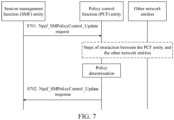
- FIG. 7 A specific process is shown in FIG. 7 , which includes the following steps.
- Step S701 After receiving the updated service characteristic (for example, the updated periodicity information) transmitted by the UE through the NAS parameter, the SMF entity transmits an Npcf_SMPolicyControl_Update Request to the PCF entity.
- the updated service characteristic for example, the updated periodicity information
- Step S702 After receiving the Npcf_SMPolicyControl_Update Request transmitted by the SMF entity, the PCF entity performs necessary interaction with other network entities and performs decision making, and then transmits an Npcf_SMPolicyControl_Update Response to the SMF entity, so as to return the confirmed parameter to the SMF entity.
- Npcf_SMPolicyControl_Update Response For other contents not shown and described in FIG. 7 , reference is made to Section 4.16.5.1 of the 3GPP protocol TS23.502.
- FIG. 8 is a flowchart of interaction between an SMF entity and a RAN device according to an embodiment of the present disclosure. As shown in FIG. 8 , the interaction between the SMF entity and the RAN device may include the following steps.
- Step S801. The SMF entity and the AMF entity perform interactions for Namf_communication message transfer. Specifically, after acquiring the PCC rule, the SMF entity determines a QoS flow for transferring the interactive service data flow, and generates a QoS configuration file for transferring the QoS flow. After generating the QoS configuration file, the SMF entity generates a Namf_communication message transfer request (that is, Namf_Communication_N1N2MessageTransfer request) including the QoS configuration file, and then transmits the Namf_communication message transfer request to the AMF entity, and the AMF entity returns a Namf_communication message transfer response (that is, Namf_Communication_N1N2MessageTransfer response).
- Namf_communication message transfer request that is, Namf_Communication_N1N2MessageTransfer request
- Step S802 The AMF entity transmits N2 information to the RAN device. Specifically, the AMF entity carries the QoS configuration file in a PDU session resource modification request (N2 PDUSessionResourceModify Request), and transmits the PDU session resource modification request to the RAN device.
- N2 PDUSessionResourceModify Request a PDU session resource modification request
- Step S803 The RAN device and the UE perform a radio resource control (RRC) reconfiguration process.
- RRC radio resource control
- the RAN device may schedule the UE through the SPS. Specifically, the RAN device may set the period in the SPS by using the received periodicity information in the QoS configuration file from the SMF entity (the periodicity information is the data packet transfer period of the interactive service data flow). Since the SPS has the characteristic "one allocation for multiple uses", the scheduling signaling can be significantly reduced for a 5G base station. In addition, since the arrival time of the periodic data packets of the interactive service data flow can be learned in advance, relevant radio resources can be allocated in advance, which avoids a waste of time caused by allocating the radio resources after detection of the arrival of the data. In this way, not only the capacity of the base station is increased, but also the time delay during data transfer is reduced. It can be learned that, in this embodiment of the present disclosure, the scheduling efficiency of the SPS of the 5G base station can be further enhanced by using the periodicity parameter value provided in the QoS configuration file.
- Step S804 The RAN device transmits a confirmation message for the N2 information to the AMF entity, that is, the RAN device transmits a PDU session resource modification response (N2 PDUSessionResourceModify Response) to the AMF entity.
- N2 PDUSessionResourceModify Response PDU session resource modification response
- the UE can be scheduled to transfer the interactive service data packet based on the service characteristic of the interactive service data flow, that is, the periodicity information and the flow direction information, so that efficient scheduling can be realized based on the service characteristic of the interactive service data flow, thereby avoiding congestion and freeze during the transfer of the interactive service data flow, and improving the QoS of interactive services.
- the service characteristic of the interactive service data flow that is, the periodicity information and the flow direction information
- FIG. 9 is a block diagram of a communication apparatus according to an embodiment of the present disclosure.
- the communication apparatus may be arranged in the PCF entity.
- a communication apparatus 900 includes a first receiving unit 902, a first generation unit 904, and a first transmitting unit 906.
- the first receiving unit 902 is configured to receive a request message transmitted by an AF entity, the request message including a service characteristic of an interactive service data flow, the service characteristic of the interactive service data flow including periodicity information and flow direction information, the periodicity information being used for indicating a data packet transfer period of the interactive service data flow, and the flow direction information being used for indicating a link direction corresponding to the periodicity information.
- the first generation unit 904 is configured to generate a PCC rule according to the request message, the PCC rule including a QoS parameter corresponding to the service characteristic of the interactive service data flow.
- the first transmitting unit 906 is configured to transmit the PCC rule to an SMF entity, so that the SMF entity transmits a QoS configuration file to a RAN side based on the PCC rule, the QoS configuration file including a QoS flow for the interactive service data flow.
- the first receiving unit 902 is configured to receive the request message directly transmitted by the AF entity; or receive the request message from the AF entity via an NEF entity.
- the request message transmitted by the AF entity is a policy authorization creating request or a policy authorization update request, the policy authorization creating request including the service characteristic of the interactive service data flow provided by the AF entity for the first time; and the policy authorization update request including the service characteristic of the interactive service data flow updated by the AF entity.
- the first transmitting unit 906 is configured to: generate an SM policy control update notification request, the SM policy control update notification request including the PCC rule; and transmit the SM policy control update notification request to the SMF entity; or
- FIG. 10 is a block diagram of a communication apparatus according to an embodiment of the present disclosure.
- the communication apparatus may be arranged in the SMF entity.
- a communication apparatus 1000 includes a second receiving unit 1002, a second generation unit 1004, and a second transmitting unit 1006.
- the second receiving unit 1002 is configured to receive a PCC rule transmitted by a PCF entity, the PCC rule including a QoS parameter corresponding to a service characteristic of an interactive service data flow, the QoS parameter including periodicity information and flow direction information, the periodicity information being used for indicating a data packet transfer period of the interactive service data flow, and the flow direction information being used for indicating a link direction corresponding to the periodicity information.
- the second generation unit 1004 is configured to: determine, according to the PCC rule, a QoS flow for transferring the interactive service data flow, and generate a QoS configuration file for transferring the QoS flow, the QoS configuration file including the QoS parameter.
- the second transmitting unit 1006 is configured to transmit the QoS configuration file to a RAN side, so that the RAN side configures the QoS flow based on the QoS configuration file, and schedules UE to transfer an interactive service data packet corresponding to the QoS flow.
- the second transmitting unit 1006 is configured to: generate a communication message transfer request, the communication message transfer request including the QoS configuration file; and transmit the communication message transfer request to an AMF entity, so that the AMF entity transmits a PDU session resource modification request including the QoS configuration file to the RAN side.
- FIG. 11 is a block diagram of a communication apparatus according to an embodiment of the present disclosure.
- the communication apparatus may be arranged in a RAN device (such as a base station).
- a communication apparatus 1100 includes a third receiving unit 1102 and a processing unit 1104.
- the third receiving unit 1102 is configured to receive a QoS configuration file from an SMF entity, the QoS configuration file including a QoS parameter corresponding to a QoS flow for an interactive service data flow, the QoS parameter including periodicity information and flow direction information, the periodicity information being used for indicating a data packet transfer period of the QoS flow, and the flow direction information being used for indicating a link direction corresponding to the periodicity information.
- the processing unit 1104 is configured to configure the QoS flow based on the QoS configuration file, and schedule UE to transfer an interactive service data packet corresponding to the QoS flow.
- the processing unit 1104 is configured to configure a radio resource corresponding to the QoS flow, wherein in a case that the flow direction information included in the QoS configuration file indicates that the periodicity information corresponds to service data in a DL direction, a first radio resource is reserved for the UE according to the periodicity information, and the UE is scheduled to receive, through the first radio resource, a DL interactive service data packet transferred by the QoS flow.
- the processing unit 1104 is configured to: reserve a second radio resource for the UE according to the periodicity information in a case that the flow direction information included in the QoS configuration file indicates that the periodicity information corresponds to service data in the DL direction and corresponds to a receipt confirmation message in a UL direction, to schedule the UE to feed back a receipt confirmation message for the QoS flow for the interactive service data through the second radio resource.
- the processing unit 1104 is configured to reserve a third radio resource for the UE according to the periodicity information in a case that the flow direction information included in the QoS configuration file indicates that the periodicity information corresponds to service data in a UL direction, to schedule the UE to transmit a UL interactive service data packet through the third radio resource.
- FIG. 12 is a schematic structural diagram of a computer system adapted to implement an electronic device according to an embodiment of the present disclosure.
- the computer system 1200 of the electronic device shown in FIG. 12 is merely an example, and does not constitute any limitation on functions and use ranges of the embodiments of the present disclosure.
- the computer system 1200 includes a central processing unit (CPU) 1201, which can execute various appropriate actions and processing according to a program stored in a read-only memory (ROM) 1202 or a program loaded from a storage part 1208 to a random access memory (RAM) 1203, such as performing the methods described in the foregoing embodiments.
- the RAM 1203 further stores various programs and data required for operating the system.
- the CPU 1201, the ROM 1202, and the RAM 1203 are connected to each other through a bus 1204.
- An input/output (I/O) interface 1205 is also connected to the bus 1204.
- the following members are connected to the I/O interface 1205: an input portion 1206 including a keyboard, a mouse, and the like; an output portion 1207 including, such as, a cathode ray tube (CRT), a liquid crystal display (LCD), and a speaker; a storage part 1208 including a hard disk, or the like; and a communication part 1209 including a network interface card such as a local area network (LAN) card, a modem, or the like.
- the communication part 1209 performs communication processing by using a network such as the Internet.
- a drive 1210 is also connected to the I/O interface 1205 as required.
- a removable medium 1211 such as a disk, an optical disc, a magneto-optical disc, or a semiconductor memory, is installed on the drive 1210 as required, so that a computer program read from the removable medium 1211 is installed in the storage part 1208 as required.
- an embodiment of the present disclosure includes a computer program product.
- the computer program product includes a computer program stored in a computer-readable medium.
- the computer program includes a computer program used for performing a method shown in the flowchart.
- the computer program may be downloaded and installed from a network, and/or installed from the removable medium 1211.
- the various functions defined in the system of the present disclosure are executed.
- the computer-readable medium shown in the embodiments of the present disclosure may be a computer-readable signal medium or a computer-readable storage medium or any combination of two.
- the computer-readable storage medium may be, for example, but is not limited to, an electrical, magnetic, optical, electromagnetic, infrared, or semiconductor system, apparatus, or device, or any combination thereof.
- a more specific example of the computer-readable storage medium may include but is not limited to: an electrical connection having one or more wires, a portable computer magnetic disk, a hard disk, a random access memory (RAM), a read-only memory (ROM), an erasable programmable read-only memory (EPROM), a flash memory, an optical fiber, a compact disk read-only memory (CD-ROM), an optical storage device, a magnetic storage device, or any appropriate combination thereof.
- the computer-readable storage medium may be any tangible medium containing or storing a program, and the program may be used by or used in combination with an instruction execution system, an apparatus, or a device.
- a computer-readable signal medium may include a data signal in a baseband or propagated as a part of a carrier wave, the data signal carrying a computer-readable computer program.
- a data signal propagated in such a way may assume a plurality of forms, including, but not limited to, an electromagnetic signal, an optical signal, or any appropriate combination thereof.
- the computer-readable signal medium may be further any computer-readable medium in addition to a computer-readable storage medium.
- the computer-readable medium may send, propagate, or transmit a program that is used by or used in combination with an instruction execution system, apparatus, or device.
- the computer program included in the computer-readable medium may be transmitted by using any suitable medium, including but not limited to: a wireless medium, a wire, or the like, or any suitable combination thereof.
- Each box in a flowchart or a block diagram may represent a module, a program segment, or a part of code.
- the module, the program segment, or the part of code includes one or more executable instructions used for implementing designated logic functions.
- functions annotated in boxes may alternatively occur in a sequence different from that annotated in an accompanying drawing. For example, actually two boxes shown in succession may be performed basically in parallel, and sometimes the two boxes may be performed in a reverse sequence. This is determined by a related function.
- Each box in a block diagram and/or a flowchart and a combination of boxes in the block diagram and/or the flowchart may be implemented by using a dedicated hardware-based system configured to perform a specified function or operation, or may be implemented by using a combination of dedicated hardware and a computer instruction.
- a related unit described in the embodiments of the present disclosure may be implemented in a software manner, or may be implemented in a hardware manner, and the unit described may also be set in a processor. Names of the units do not constitute a limitation on the units in a specific case.
- the present disclosure further provides a computer readable medium.
- the computer readable medium may be included in the electronic device described in the above embodiments, or may exist alone without being assembled into the electronic device.
- the computer-readable medium carries one or more programs, the one or more programs, when executed by the electronic device, causing the electronic device to implement the method described in the foregoing embodiments.
- the software product may be stored in a non-volatile storage medium (which may be a CD-ROM, a USB flash drive, a removable hard disk, or the like) or on the network, including several instructions for instructing a computing device (which may be a personal computer, a server, a touch terminal, a network device, or the like) to perform the methods according to the embodiments of the present disclosure.
- a non-volatile storage medium which may be a CD-ROM, a USB flash drive, a removable hard disk, or the like
- a computing device which may be a personal computer, a server, a touch terminal, a network device, or the like
Landscapes
- Engineering & Computer Science (AREA)
- Computer Networks & Wireless Communication (AREA)
- Signal Processing (AREA)
- Quality & Reliability (AREA)
- Mobile Radio Communication Systems (AREA)
- Data Exchanges In Wide-Area Networks (AREA)
Abstract
Description
- This application claims priority to
Chinese Patent Application No. 2020112349432, entitled "METHOD, APPARATUS, COMPUTER READABLE MEDIUM, AND ELECTRONIC DEVICE FOR COMMUNICATION" and filed with the China National Intellectual Property Administration on November 8, 2020 - The present disclosure relates to the field of computer and communication technologies, and in particular, to a communications technology.
- Cloud gaming, also referred to as gaming on demand, is an online gaming technology based on the cloud computing technology. The cloud gaming technology enables a thin client with a relatively limited graphics processing and data computing capability to run high-quality games. In a cloud game scenario, a game runs in a cloud server rather than a game terminal of a player. The cloud server renders the game scenario into a video and audio stream, and transfers the video and audio stream to the game terminal of the user through the network. The game terminal of the player does not require a powerful graphics processing and data computing capability, but requires only a basic streaming media playback capability and an ability to obtain player input instructions and transmit the player input instructions to the cloud server.
- In the cloud game scenario, the cloud server needs to periodically transmit video and audio streams to the game terminal. In similar scenarios such as virtual reality (VR), augmented reality (AR), mixed reality (MR), extended reality (XR), or cinematic reality (CR), periodic transfer of media streams is required. How to prevent the periodic transfer of media streams from congestion and freeze is a technical problem to be resolved urgently.
- Embodiments of the present disclosure provide a method, an apparatus, a computer-readable medium, and an electronic device for communication, which can achieve efficient scheduling of interactive service data flows to some extent, and prevent congestion and freeze during the transfer of interactive service data flows, thereby improving the QoS of interactive services.
- According to an aspect of the embodiments of the present disclosure, a communication method is provided, which is performed by a policy control function (PCF) entity. The communication method includes: receiving a request message transmitted by an application function (AF) entity, the request message including a service characteristic of an interactive service data flow, the service characteristic of the interactive service data flow including periodicity information and flow direction information, the periodicity information being used for indicating a data packet transfer period of the interactive service data flow, and the flow direction information being used for indicating a link direction corresponding to the periodicity information; generating a policy and charging control (PCC) rule according to the request message, the PCC rule including a quality of service (QoS) parameter corresponding to the service characteristic of the interactive service data flow; and transmitting the PCC rule to a session management function (SMF) entity, so that the SMF entity transmits a QoS configuration file to a radio access network (RAN) side based on the PCC rule, the QoS configuration file including a QoS flow for the interactive service data flow.
- According to an aspect of the embodiments of the present disclosure, a communication method is provided, which is performed by an SMF entity. The communication method includes: receiving a PCC rule transmitted by a PCF entity, the PCC rule including a QoS parameter corresponding to a service characteristic of an interactive service data flow, the QoS parameter including periodicity information and flow direction information, the periodicity information being used for indicating a data packet transfer period of the interactive service data flow, and the flow direction information being used for indicating a link direction corresponding to the periodicity information; determining, according to the PCC rule, a QoS flow for transferring the interactive service data flow, and generating a QoS configuration file for transferring the QoS flow, the QoS configuration file including the QoS parameter; and transmitting the QoS configuration file to a RAN side, so that the RAN side configures the QoS flow based on the QoS configuration file, and schedules user equipment (UE) to transfer an interactive service data packet corresponding to the QoS flow.
- According to an aspect of the embodiments of the present disclosure, a communication method is provided, which is performed by a RAN device. The communication method includes: receiving a QoS configuration file from an SMF entity, the QoS configuration file including a QoS parameter corresponding to a QoS flow for an interactive service data flow, the QoS parameter including periodicity information and flow direction information, the periodicity information being used for indicating a data packet transfer period of the QoS flow, and the flow direction information being used for indicating a link direction corresponding to the periodicity information; and configuring the QoS flow based on the QoS configuration file, and scheduling user equipment (UE) to transfer an interactive service data packet corresponding to the QoS flow.
- According to an aspect of the embodiments of the present disclosure, a communication apparatus is provided. The communication apparatus includes: a first receiving unit, configured to receive a request message transmitted by an AF entity, the request message including a service characteristic of an interactive service data flow, the service characteristic of the interactive service data flow including periodicity information and flow direction information, the periodicity information being used for indicating a data packet transfer period of the interactive service data flow, and the flow direction information being used for indicating a link direction corresponding to the periodicity information; a first generation unit, configured to generate a PCC rule according to the request message, the PCC rule including a QoS parameter corresponding to the service characteristic of the interactive service data flow; and a first transmitting unit, configured to transmit the PCC rule to an SMF entity, so that the SMF entity transmits a QoS configuration file to a RAN side based on the PCC rule, the QoS configuration file including a QoS flow for the interactive service data flow.
- According to an aspect of the embodiments of the present disclosure, a communication apparatus is provided. The communication apparatus includes: a second receiving unit, configured to receive a PCC rule transmitted by a PCF entity, the PCC rule including a QoS parameter corresponding to a service characteristic of an interactive service data flow, the QoS parameter including periodicity information and flow direction information, the periodicity information being used for indicating a data packet transfer period of the interactive service data flow, and the flow direction information being used for indicating a link direction corresponding to the periodicity information; a second generation unit, configured to determine, according to the PCC rule, a QoS flow for transferring the interactive service data flow, and generate a QoS configuration file for transferring the QoS flow, the QoS configuration file including the QoS parameter; and a second transmitting unit, configured to transmit the QoS configuration file to a RAN side, so that the RAN side configures the QoS flow based on the QoS configuration file, and schedules user equipment (UE) to transfer an interactive service data packet corresponding to the QoS flow.
- According to an aspect of the embodiments of the present disclosure, a communication apparatus is provided. The communication apparatus includes: a third receiving unit, configured to receive a QoS configuration file from an SMF entity, the QoS configuration file including a QoS parameter corresponding to a QoS flow for an interactive service data flow, the QoS parameter including periodicity information and flow direction information, the periodicity information being used for indicating a data packet transfer period of the QoS flow, and the flow direction information being used for indicating a link direction corresponding to the periodicity information; and a processing unit, configured to configure the QoS flow based on the QoS configuration file, and schedule user equipment (UE) to transfer an interactive service data packet corresponding to the QoS flow.
- According to an aspect of the embodiments of the present disclosure, a computer-readable medium is provided, storing a computer program, the computer program, when executed by a processor, implementing the communication method according to the foregoing embodiments.
- According to an aspect of the embodiments of the present disclosure, an electronic device is provided, including: one or more processors; and a storage apparatus, configured to store one or more programs, the one or more programs, when executed by the one or more processors, causing the one or more processors to implement the communication method according to the foregoing embodiments.
- According to an aspect of the embodiments of the present disclosure, a computer program product or a computer program is provided, the computer program product or the computer program including computer instructions, the computer instructions being stored in a computer-readable storage medium. A processor of a computer device reads the computer instructions from the computer-readable storage medium, and executes the computer instructions, to cause the computer device to perform the communication method provided in the various optional embodiments described above.
- In the technical solutions provided in some embodiments of the present disclosure, the AF entity transmits, to the PCF entity, the request message including the service characteristic of the interactive service data flow, the service characteristic including the periodicity information and the flow direction information. Then the PCF entity generates the PCC rule including the QoS parameter based on the request message, and transmits the PCC rule to the SMF entity. The SMF entity transmits, to the RAN device, the QoS configuration file including the QoS parameter corresponding to the QoS flow for the interactive service data flow. Then the RAN device configures the QoS flow based on the QoS configuration file, and schedules the UE to transfer the interactive service data packet corresponding to the QoS flow. According to the technical solutions of the embodiments of the present disclosure, the UE can be scheduled to transfer the interactive service data packet based on the service characteristic of the interactive service data flow, that is, the periodicity information and the flow direction information, so that efficient scheduling can be realized based on the service characteristic of the interactive service data flow, thereby avoiding congestion and freeze during the transfer of the interactive service data flow, and improving the QoS of interactive services.
-
-
FIG. 1 is a schematic diagram of an exemplary system architecture for applying the technical solutions of embodiments of the present disclosure. -
FIG. 2 is a flowchart of a communication method according to an embodiment of the present disclosure. -
FIG. 3 is a flowchart of a communication method according to an embodiment of the present disclosure. -
FIG. 4 is a flowchart of a communication method according to an embodiment of the present disclosure. -
FIG. 5 is a flowchart of interaction between an application function (AF) entity and a policy control function (PCF) entity according to an embodiment of the present disclosure. -
FIG. 6 is a flowchart of interaction between a PCF entity and a session management function (SMF) entity according to an embodiment of the present disclosure. -
FIG. 7 is a flowchart of interaction between a PCF entity and an SMF entity according to an embodiment of the present disclosure. -
FIG. 8 is a flowchart of interaction between an SMF entity and a radio access network (RAN) device according to an embodiment of the present disclosure. -
FIG. 9 is a block diagram of a communication apparatus according to an embodiment of the present disclosure. -
FIG. 10 is a block diagram of a communication apparatus according to an embodiment of the present disclosure. -
FIG. 11 is a block diagram of a communication apparatus according to an embodiment of the present disclosure. -
FIG. 12 is a schematic structural diagram of a computer system adapted to implement an electronic device according to an embodiment of the present disclosure. - The term "plurality of mentioned herein means two or more. The term "and/or" describes an association relationship between associated objects, indicating existence of three relationships. For example, A and/or B indicates the following three cases: Only A exists, both A and B exist, and only B exists. The character "/" generally indicates an "or" relationship between the associated objects.
- As the 5th-Generation (5G) mobile communication technology develops, many services that require a high data rate and a short delay are widely applied. For example, interactive services such as a cloud game service, VR, AR, MR, XR, and CR, which are also referred to as advanced interactive services (AIS), are widely applied.
- Specifically, in a cloud game scenario shown in
FIG. 1 , acloud server 101 is configured to run a cloud game. Thecloud server 101 may render a game picture, code an audio signal and the rendered image, and finally transfers the coded data to each game client through the network. The game client may be user equipment (UE) with a basic streaming media playback capability, a human-computer interaction capability, a communication capability, and the like, such as a smart phone, a tablet computer, a notebook computer, a desktop computer, or a smart television. Alternatively, the game client may be an application program running in a terminal device. Specifically, the game client may decode the coded data transferred by thecloud server 101 to obtain an analog audio and video signal and play the analog audio and video signal. - It is to be understood that
FIG. 1 shows only an exemplary system architecture of the cloud game system, which does not limit the specific architecture of the cloud game system. For example, in other embodiments, the cloud game system may include a back-end server for scheduling and the like. In addition, thecloud server 101 may be an independent physical server, or may be a server cluster or a distributed system formed by a plurality of physical servers, or may be a cloud server that provides a basic cloud computing service such as a cloud service, a cloud database, cloud computing, a cloud function, cloud storage, a network service, cloud communication, a middleware service, a domain name service, a security service, a content delivery network (CDN), big data, and an artificial intelligence platform. The game client and thecloud server 101 may be directly or indirectly connected to each other in a wired or wireless communication manner, which is not limited in the present disclosure. - In the above application scenarios, service data is usually transferred not continuously but periodically, and a transfer period may vary. In this case, preventing the periodic transfer of the service data from congestion and freeze is the key to ensuring the quality of service (QoS).
- Based on the above, the embodiments of the present disclosure provide the following solutions (the technical solutions of the embodiments of the present disclosure are described in detail in terms of a policy control function (PCF) entity, a session management function (SMF) entity, and a radio access network (RAN) device).
-
FIG. 2 is a flowchart of a communication method according to an embodiment of the present disclosure. The communication method may be performed by the PCF entity. Referring toFIG. 2 , the communication method includes at least steps S210 to S230, which are described in detail as follows. - Step S210: Receive a request message transmitted by an application function (AF) entity, the request message including a service characteristic of an interactive service data flow, the service characteristic of the interactive service data flow including periodicity information and flow direction information, the periodicity information being used for indicating a data packet transfer period of the interactive service data flow, and the flow direction information being used for indicating a link direction corresponding to the periodicity information.
- In an embodiment of the present disclosure, if the AF entity can directly interact with the PCF entity, the PCF entity may receive the request message directly transmitted by the AF entity. If the AF entity needs to interact with the PCF entity through a network exposure function (NEF) entity, the PCF entity may receive the request message from the AF via the NEF entity.
- In an embodiment of the present disclosure, the request message including the service characteristic of the interactive service data flow and transmitted by the AF entity may be a policy authorization creating request (Npcf_PolicyAuthorization_Create Request). In this case, the policy authorization creating request may include a service characteristic of the interactive service data flow provided by the AF entity for the first time. That is to say, when providing the service characteristic of the interactive service data flow for the first time, the AF entity may carry the service characteristic of the interactive service data flow in the policy authorization creating request and transmit the policy authorization creating request to the PCF entity.
- In an embodiment of the present disclosure, the request message including the service characteristic of the interactive service data flow and transmitted by the AF entity may be a policy authorization update request (Npcf_PolicyAuthorization_Updata Request). In this case, the policy authorization update request may include a service characteristic provided by the AF entity and corresponding to a new interactive service data flow or corresponding to an updated service characteristic of the previous interactive service data flow. That is to say, when the AF entity needs to add a new interactive service data flow or update the service characteristic of the previous interactive service data flow, the AF entity may carry the service characteristic corresponding to the newly added interactive service data flow or the updated service characteristic of the interactive service data flow in the policy authorization update request and transmit the policy authorization update request to the PCF entity.
- In an embodiment of the present disclosure, the periodicity information included in the service characteristic of the interactive service data flow provided by the AF entity to the PCF entity may be a specific periodicity value, or may be frames per second (FPS) information.
- In an example, if the periodicity information included in the service characteristic of the interactive service data flow provided by the AF entity to the PCF entity is the FPS information, the PCF entity may convert the FPS information to a specific periodicity value, and then transmit the periodicity value to the SMF entity. Specifically, the periodicity value Periodicity=1000/FPS (ms). For an interactive service data flow in a form of a video stream, the FPS may be, for example, 23.97, 24, 25, 29.97, 30, 48, 50, 59.97, 60, 72, 100, 119.88, 120, or the like. For an interactive service data flow in a form of a voice stream, the FPS may be, for example, 20, 40, 80, or the like.
- In an example, if the periodicity information included in the service characteristic of the interactive service data flow provided by the AF entity to the PCF entity is the FPS information, the PCF entity may alternatively directly transmit the FPS information to the SMF entity without converting the FPS information to a specific periodicity value. In this case, the SMF entity may convert the FPS information to a specific periodicity value in the manner in the above example.
- In an embodiment of the present disclosure, the flow direction information included in the service characteristic of the interactive service data flow may indicate that a flow direction is uplink (UL), downlink (DL), or UL+DL.
- Step S220: Generate a policy and charging control (PCC) rule according to the request message, the PCC rule including a QoS parameter corresponding to the service characteristic of the interactive service data flow.
- In an embodiment of the present disclosure, the PCC rule may be applied to binding of a QoS flow, so as to implement transfer of an interactive service data flow through a QoS flow.
- Step S230: Transmit the PCC rule to an SMF entity, so that the SMF entity transmits a QoS configuration file to a RAN side based on the PCC rule, the QoS configuration file including a QoS flow for the interactive service data flow.
- In an embodiment of the present disclosure, the PCF entity may transmit the PCC rule to the SMF entity by using a session management (SM) policy control update notification request (that is, Npcf_SMPolicyControl_UpdateNotify Request), an SM policy control update response (that is, Npcf_SMPolicyControl_Update Response), or an SM policy control creating response (that is, Npcf_SMPolicyControl_Create Response). For different cases, the PCC rule may be transmitted in different manners.
- Specifically, if a request transmitted by the AF entity causes a change in the service characteristic (that is, the periodicity information and the flow direction information) of the interactive service data flow, the PCF entity transmits the PCC rule to the SMF entity by using the SM policy control update notification request. When the AF entity provides the service characteristic of the interactive service data flow to the PCF entity for the first time, the PCF entity provides the PCC rule to the SMF entity by using the SM policy control creating response.
- If a request transmitted by UE causes a change in the service characteristic (for example, the periodicity information) of the interactive service data flow, for example, the UE is a high-speed network camera that may be configured to transfer video data to the service server, the UE may transmit an updated service characteristic (for example, updated periodicity information) to the SMF entity by using a non-access stratum (NAS) parameter, and then the SMF entity may report the parameter to the PCF entity by using the SM policy control update request (that is, Npcf_SMPolicyControl_Update Request). After the PCF entity agrees to the update of the service characteristic, the PCF may return the parameter to the SMF entity by using the SM policy control update response.
-
FIG. 2 illustrates the communication method in this embodiment of the present disclosure in terms of the PCF entity. In the following, the technical solutions in the embodiments of the present disclosure are further described in terms of the SMF entity. -
FIG. 3 is a flowchart of another communication method according to an embodiment of the present disclosure. The communication method may be performed by the SMF entity. Referring toFIG. 3 , the communication method includes at least step S310 to step S330, which are described in detail as follows. - S310: Receive a PCC rule transmitted by a PCF entity, the PCC rule including a QoS parameter corresponding to a service characteristic of an interactive service data flow, the QoS parameter including periodicity information and flow direction information, the periodicity information being used for indicating a data packet transfer period of the interactive service data flow, and the flow direction information being used for indicating a link direction corresponding to the periodicity information.
- In an embodiment of the present disclosure, based on the previous embodiment, the SMF entity may receive the PCC rule by receiving the SM policy control update notification request, the SM policy control update response, or the SM policy control creating response transmitted by the PCF entity.
- In an embodiment of the present disclosure, the periodicity information included in the QoS parameter corresponding to the service characteristic of the interactive service data flow in the PCC rule may be a specific periodicity value, or may be FPS information. If the periodicity information is the FPS information, the SMF entity may convert the FPS information to a specific periodicity value. Specifically, the periodicity value Periodicity=1000/FPS (ms).
- In an embodiment of the present disclosure, the flow direction information included in the service characteristic of the interactive service data flow may indicate that a flow direction is UL, DL, or UL+DL.
- S320: Determine, according to the PCC rule, a QoS flow for transferring the interactive service data flow, and generate a QoS configuration file for transferring the QoS flow, the QoS configuration file including the QoS parameter.
- In an embodiment of the present disclosure, after receiving the PCC rule, the SMF entity maps the interactive service data flow to the QoS flow (that is, creates a QoS Flow carrying the interactive service data flow) based on the QoS parameter corresponding to the service characteristic of the interactive service data flow and included in the PCC rule, for example, the periodicity information. The generated QoS configuration file is applied to the newly created QoS flow.
- S330: Transmit the QoS configuration file to a RAN side, so that the RAN side configures the QoS flow based on the QoS configuration file, and schedules UE to transfer an interactive service data packet corresponding to the QoS flow.
- In an embodiment of the present disclosure, the SMF entity may generate a communication message transfer request (i.e., Namf_Communication_N1N2MessageTransfer request) including the QoS configuration file, and then transmit the communication message transfer request to an access and mobility management function (AMF) entity. Then the AMF entity carries the QoS configuration file in a protocol data unit (PDU) session resource modification request (PDUSessionResourceModify Request), and transmits the PDU session resource modification request to the RAN side. Moreover, the SMF entity transmits identification information of the QoS flow to the RAN side.
-
FIG. 3 illustrates the communication method in this embodiment of the present disclosure in terms of the SMF entity. In the following, the technical solutions in the embodiments of the present disclosure are further described in terms of the RAN device. -
FIG. 4 is a flowchart of another communication method according to an embodiment of the present disclosure. The communication method may be performed by the RAN device (for example, a base station). Referring toFIG. 4 , the communication method includes at least step S410 to step S420, which are described in detail as follows. - Step S410: Receive a QoS configuration file from an SMF entity, the QoS configuration file including a QoS parameter corresponding to a QoS flow for an interactive service data flow, the QoS parameter including periodicity information and flow direction information, the periodicity information being used for indicating a data packet transfer period of the QoS flow, and the flow direction information being used for indicating a link direction corresponding to the periodicity information.
- In an embodiment of the present disclosure, the RAN device may receive the QoS configuration file forwarded by the AMF entity from the SMF entity, as described in the above embodiment. The flow direction information included in the service characteristic of the interactive service data flow may indicate that a flow direction is UL, DL, or UL+DL.
- Step S420: Configure the QoS flow based on the QoS configuration file, and schedule UE to transfer an interactive service data packet corresponding to the QoS flow.
- In an embodiment of the present disclosure, the QoS configuration file includes identification information, that is, ID information of the QoS flow. After the RAN acquires the identification information of the QoS flow and the QoS configuration file, if it is found that the identification information of the QoS flow is new (a message for establishing a PDU session for the first time is a PDU session resource setup (that is, N2 PDUSessionResourceSetup) request, and then a PDU session resource modification (N2 PDUSessionResourceModify) request is used to add (create) a new QoS flow), it indicates creating a new QoS flow. If it is found that the identification information of the QoS flow already exists, it indicates modifying the existing QoS flow. Regardless of whether PDU session resource setup or PDU session resource modification is used, radio resources and scheduling manners required for the QoS flow are reconfigured according to the QoS configuration file.
- The RAN device may perform scheduling in a semi-persistent scheduling (SPS) manner. The SPS mainly means configuring transfer parameters through high-level signaling, to indicate periodic transfer of an SPS physical downlink shared channel (PDSCH). That is, after resources are applied once, the corresponding resources are allocated to a user within a time period according to the cycle indicated by the high-level signaling. Since the SPS only needs to transmit the physical downlink control channel (PDCCH) once so that subsequently data can be transferred periodically, low signaling overheads is achieved, making the SPS very suitable for periodic small packet transfer during DL ultra-reliable and low latency communication (URLLC).
- In 4G, the SPS is mainly applied to scheduling of voice service data in VOLTE services. This is because voice services are periodic. The SPS is also defined in 5G standards such as TS38.213 and TS38.331, but how to obtain a period is not clearly specified in the standards. Therefore, the embodiments of the present disclosure provide an innovative way of setting the period in the SPS by using the periodicity information provided in the QoS configuration file (the periodicity information is a data packet transfer period of the interactive service data flow). In addition, in 5G, the SPS is applicable not only to voice, but also to cloud gaming, VR, AR, MR, XR, and CR to transfer video streams and/or voice streams periodically. Since the SPS has the characteristic "one allocation for multiple uses", the scheduling signaling can be significantly reduced for a 5G base station. In addition, since the arrival of the periodic data packets of the interactive service data flow can be learned in advance, relevant radio resources can be allocated in advance, which avoids a waste of time caused by allocating the radio resources after detection of the arrival of the data. In this way, not only the capacity of the base station is increased, but also the time delay during data transfer is reduced. It can be learned that, in this embodiment of the present disclosure, the scheduling efficiency of the SPS of the 5G base station can be further enhanced by using the periodicity parameter value provided in the QoS configuration file.
- In an embodiment of the present disclosure, if the flow direction information included in the QoS configuration file is used for indicating that the periodicity information corresponds to service data in a DL direction, during scheduling (for example, the scheduling may be the SPS), the RAN device may reserve, for the UE according to the periodicity information, a first radio resource corresponding to a QoS flow for receiving a DL interactive service data packet, so as to schedule the UE to receive, through the first radio resource, the DL interactive service data packet transferred by the QoS flow. Based on the above, if the flow direction information included in the QoS configuration file indicates not only that the periodicity information corresponds to the service data in the DL direction, but also that the periodicity information corresponds to a receipt confirmation message in a UL direction, during scheduling, the RAN may further reserve, for the UE according to the periodicity information, a second radio resource for the receipt confirmation message corresponding to a QoS flow for the DL interactive service data packet, so as to schedule the UE to feed back the receipt confirmation message through the second radio resource.
- In an embodiment of the present disclosure, if the flow direction information included in the QoS configuration file is used for indicating that the periodicity information corresponds to service data in a UL direction, during scheduling (for example, the scheduling may be the SPS), the RAN device may reserve, for the UE according to the periodicity information, a third radio resource corresponding to a QoS flow for transmitting a UL interactive service data packet, so as to schedule the UE to transmit the UL interactive service data packet through the third radio resource.
- The technical solutions of the embodiments of the present disclosure have been described above in terms of the PCF entity, the SMF entity, and the RAN device respectively. In the following, the implementation details of the technical solutions of the embodiments of the present disclosure are described in detail in terms of interaction between the above entities and device with reference to
FIG. 5 to FIG. 8 . -
FIG. 5 is a flowchart of interaction between an AF entity and a PCF entity according to an embodiment of the present disclosure. As shown inFIG. 5 , the interaction between the AF entity and the PCF entity may include the following steps. - Step S501: If the AF entity transmits a request message to the PCF entity through the NEF entity, the AF entity transmits, to the NEF entity, a Nnef_TrafficInfluence_Create/Update/Delete Request for a single UE address. When the NEF entity receives the request message from the AF entity, the NEF entity ensures necessary authorization control, and maps the information provided by the AF entity to information required by a 5G core network.
- If it is determined according to the entity deployment status of the AF that the AF entity can directly transmit the request to the PCF, step S501 may be skipped.
- Step S502: If a locally configured PCF address is not available on the AF/NEF entity, the AF/NEF entity uses an Nbsf_Management_Discovery request (a UE identifier) to find a relevant address of the PCF entity. Specifically, the AF/NEF entity finds a binding support function (BSF) entity according to a local configuration or by using an NF repository function (NRF) entity. The UE identifier may be an IP address of the UE or a generic public subscription identifier (GPSI) of the UE.
- Step S503: The BSF entity transmits an Nbsf_Management_Discovery response message to the AF/NEF entity, the Nbsf_Management_Discovery response message providing the PCF address to the AF/NEF entity.
- Step S504: If step 1 is performed, the NEF entity transmits an Npcf_PolicyAuthorization_Create/Update/Delete Request to the PCF entity to transfer the request of the AF entity. If the AF entity can directly transmit the request to the PCF entity, the AF entity transmits the Npcf_PolicyAuthorization_Create/Update/Delete Request to the PCF entity.
- In an embodiment of the present disclosure, the Npcf_Policy Authorization_Create Request transmitted by the AF/NEF entity may include the service characteristic of the interactive service data flow in the embodiments of the present disclosure. In this case, the Npcf_Policy Authorization_Create Request includes the service characteristic of the interactive service data flow provided by the AF for the first time. That is to say, when providing the service characteristic of the interactive service data flow for the first time, the AF entity carries the service characteristic of the interactive service data flow in the Npcf_Policy Authorization_Create Request and transmits the Npcf_Policy Authorization_Create Request to the PCF entity (directly or through the NEF entity).
- In an embodiment of the present disclosure, the Npcf_Policy Authorization_Update Request transmitted by the AF/NEF entity may include the service characteristic of the interactive service data flow in the embodiments of the present disclosure. In this case, the Npcf_Policy Authorization_Update Request includes a service characteristic corresponding to a new interactive service data flow provided by the AF entity or an updated service characteristic of the previous interactive service data flow. That is to say, when the AF entity adds a new interactive service data flow or needs to update the service characteristic of the previous interactive service data flow, the AF entity carries the service characteristic corresponding to the newly added interactive service data flow or the updated service characteristic of the interactive service data flow in the Npcf_Policy Authorization_Update Request and transmits the Npcf_Policy Authorization_Update Request to the PCF entity (directly or through the NEF entity).
- In an embodiment of the present disclosure, the periodicity information included in the service characteristic of the interactive service data flow (newly added or updated) provided by the AF entity may be a specific periodicity value, or may be FPS information. If the periodicity information included in the service characteristic of the interactive service data flow provided by the AF entity is the FPS information, the PCF entity may convert the FPS information to a specific periodicity value, and then transmit the periodicity value to the SMF entity through the PCC rule.
- Step S505: The PCF entity updates the SMF entity by using a corresponding new PCC rule, and the PCF entity starts an SM policy association modification program. When receiving the PCC rule from the PCF entity, the SMF entity may properly reconfigure a user plane of the PDU session and a 5G base station corresponding to the PDU session at a proper timing. For a specific process, reference is made to Section 4.3.6.4 of the 3GPP protocol TS23.502.
-
FIG. 6 is a flowchart of interaction between a PCF entity and an SMF entity according to an embodiment of the present disclosure. As shown inFIG. 6 , the interaction between the PCF entity and the SMF entity may include the following steps. - Step S601: After acquiring the service characteristic of the interactive service data flow through interaction with the other network entities (such as the AF entity), the PCF entity generates a PCC rule based on the service characteristic, the PCC rule including a QoS parameter corresponding to the service characteristic of the interactive service data flow, and then carries the PCC rule in an Npcf_SMPolicyControl_UpdateNotify request and transmits the Npcf_SMPolicyControl_UpdateNotify request to the SMF entity.
- As described in the previous embodiment, the periodicity information included in the service characteristic of the interactive service data flow acquired by the PCF entity may be a specific periodicity value, or may be FPS information. If the periodicity information included in the service characteristic of the interactive service data flow acquired by the PCF entity is the FPS information, the PCF entity may convert the FPS information to a specific periodicity value, and then transmit the periodicity value to the SMF entity through the PCC rule. For a specific conversion process, reference is made to the above embodiment, and the details are not repeated herein.
- Step S602: After receiving the Npcf_SMPolicyControl_UpdateNotify request, the SMF entity feeds back an Npcf_SMPolicyControl_UpdateNotify response to the PCF entity. For other contents not shown and described in
FIG. 6 , reference is made to Section 4.16.5.2 of the 3GPP protocol TS23.502. - In the interaction process shown in
FIG. 6 , if the request transmitted by the AF entity causes a change in the service characteristic (that is, the periodicity information and the flow direction information) of the interactive service data flow, the PCF entity transmits the PCC rule to the SMF entity by using the Npcf_SMPolicyControl_UpdateNotify Request. When the AF entity provides the service characteristic of the interactive service data flow to the PCF entity for the first time, the PCF entity provides the PCC rule to the SMF entity by using the Npcf_SMPolicyControl_Create Response. - In an embodiment of the present disclosure, the UE may transmit a request to initiate modification of the service characteristic (for example, the periodicity information) of the interactive service data flow. A specific process is shown in
FIG. 7 , which includes the following steps. - Step S701: After receiving the updated service characteristic (for example, the updated periodicity information) transmitted by the UE through the NAS parameter, the SMF entity transmits an Npcf_SMPolicyControl_Update Request to the PCF entity.
- Step S702: After receiving the Npcf_SMPolicyControl_Update Request transmitted by the SMF entity, the PCF entity performs necessary interaction with other network entities and performs decision making, and then transmits an Npcf_SMPolicyControl_Update Response to the SMF entity, so as to return the confirmed parameter to the SMF entity. For other contents not shown and described in
FIG. 7 , reference is made to Section 4.16.5.1 of the 3GPP protocol TS23.502. -
FIG. 8 is a flowchart of interaction between an SMF entity and a RAN device according to an embodiment of the present disclosure. As shown inFIG. 8 , the interaction between the SMF entity and the RAN device may include the following steps. - Step S801. The SMF entity and the AMF entity perform interactions for Namf_communication message transfer. Specifically, after acquiring the PCC rule, the SMF entity determines a QoS flow for transferring the interactive service data flow, and generates a QoS configuration file for transferring the QoS flow. After generating the QoS configuration file, the SMF entity generates a Namf_communication message transfer request (that is, Namf_Communication_N1N2MessageTransfer request) including the QoS configuration file, and then transmits the Namf_communication message transfer request to the AMF entity, and the AMF entity returns a Namf_communication message transfer response (that is, Namf_Communication_N1N2MessageTransfer response).
- Step S802. The AMF entity transmits N2 information to the RAN device. Specifically, the AMF entity carries the QoS configuration file in a PDU session resource modification request (N2 PDUSessionResourceModify Request), and transmits the PDU session resource modification request to the RAN device.
- Step S803. The RAN device and the UE perform a radio resource control (RRC) reconfiguration process.
- In an embodiment of the present disclosure, the RAN device may schedule the UE through the SPS. Specifically, the RAN device may set the period in the SPS by using the received periodicity information in the QoS configuration file from the SMF entity (the periodicity information is the data packet transfer period of the interactive service data flow). Since the SPS has the characteristic "one allocation for multiple uses", the scheduling signaling can be significantly reduced for a 5G base station. In addition, since the arrival time of the periodic data packets of the interactive service data flow can be learned in advance, relevant radio resources can be allocated in advance, which avoids a waste of time caused by allocating the radio resources after detection of the arrival of the data. In this way, not only the capacity of the base station is increased, but also the time delay during data transfer is reduced. It can be learned that, in this embodiment of the present disclosure, the scheduling efficiency of the SPS of the 5G base station can be further enhanced by using the periodicity parameter value provided in the QoS configuration file.
- Step S804: The RAN device transmits a confirmation message for the N2 information to the AMF entity, that is, the RAN device transmits a PDU session resource modification response (N2 PDUSessionResourceModify Response) to the AMF entity. For other contents not shown and described in
FIG. 8 , reference is made to Section 4.3.3.2 of the 3GPP protocol TS23.502. - The interaction between the various entities in the present disclosure has been described above. According to the technical solutions of the embodiments of the present disclosure, the UE can be scheduled to transfer the interactive service data packet based on the service characteristic of the interactive service data flow, that is, the periodicity information and the flow direction information, so that efficient scheduling can be realized based on the service characteristic of the interactive service data flow, thereby avoiding congestion and freeze during the transfer of the interactive service data flow, and improving the QoS of interactive services.
- The following describes the apparatus embodiments of the present disclosure, which may be configured to perform the communication method in the foregoing embodiments of the present disclosure. For details not disclosed in the apparatus embodiments of the present disclosure, reference is made to the embodiments of the foregoing communication method of the present disclosure.
-
FIG. 9 is a block diagram of a communication apparatus according to an embodiment of the present disclosure. The communication apparatus may be arranged in the PCF entity. - Referring to
FIG. 9 , acommunication apparatus 900 according to an embodiment of the present disclosure includes afirst receiving unit 902, afirst generation unit 904, and afirst transmitting unit 906. - The
first receiving unit 902 is configured to receive a request message transmitted by an AF entity, the request message including a service characteristic of an interactive service data flow, the service characteristic of the interactive service data flow including periodicity information and flow direction information, the periodicity information being used for indicating a data packet transfer period of the interactive service data flow, and the flow direction information being used for indicating a link direction corresponding to the periodicity information. Thefirst generation unit 904 is configured to generate a PCC rule according to the request message, the PCC rule including a QoS parameter corresponding to the service characteristic of the interactive service data flow. Thefirst transmitting unit 906 is configured to transmit the PCC rule to an SMF entity, so that the SMF entity transmits a QoS configuration file to a RAN side based on the PCC rule, the QoS configuration file including a QoS flow for the interactive service data flow. - In some embodiments of the present disclosure, based on the above solution, the
first receiving unit 902 is configured to receive the request message directly transmitted by the AF entity; or receive the request message from the AF entity via an NEF entity. - In some embodiments of the present disclosure, based on the above solution, the request message transmitted by the AF entity is a policy authorization creating request or a policy authorization update request, the policy authorization creating request including the service characteristic of the interactive service data flow provided by the AF entity for the first time; and the policy authorization update request including the service characteristic of the interactive service data flow updated by the AF entity.
- In some embodiments of the present disclosure, based on the above solution, the
first transmitting unit 906 is configured to: generate an SM policy control update notification request, the SM policy control update notification request including the PCC rule; and transmit the SM policy control update notification request to the SMF entity; or - generate an SM policy control update response, the SM policy control update response including the PCC rule; and transmit the SM policy control update response to the SMF entity; or
- generate an SM policy control creating response, the SM policy control creating response including the PCC rule; and transmit the SM policy control creating response to the SMF entity.
-
FIG. 10 is a block diagram of a communication apparatus according to an embodiment of the present disclosure. The communication apparatus may be arranged in the SMF entity. - Referring to
FIG. 10 , acommunication apparatus 1000 according to an embodiment of the present disclosure includes asecond receiving unit 1002, asecond generation unit 1004, and asecond transmitting unit 1006. - The
second receiving unit 1002 is configured to receive a PCC rule transmitted by a PCF entity, the PCC rule including a QoS parameter corresponding to a service characteristic of an interactive service data flow, the QoS parameter including periodicity information and flow direction information, the periodicity information being used for indicating a data packet transfer period of the interactive service data flow, and the flow direction information being used for indicating a link direction corresponding to the periodicity information. Thesecond generation unit 1004 is configured to: determine, according to the PCC rule, a QoS flow for transferring the interactive service data flow, and generate a QoS configuration file for transferring the QoS flow, the QoS configuration file including the QoS parameter. Thesecond transmitting unit 1006 is configured to transmit the QoS configuration file to a RAN side, so that the RAN side configures the QoS flow based on the QoS configuration file, and schedules UE to transfer an interactive service data packet corresponding to the QoS flow. - In some embodiments of the present disclosure, based on the above solution, the
second transmitting unit 1006 is configured to: generate a communication message transfer request, the communication message transfer request including the QoS configuration file; and transmit the communication message transfer request to an AMF entity, so that the AMF entity transmits a PDU session resource modification request including the QoS configuration file to the RAN side. -
FIG. 11 is a block diagram of a communication apparatus according to an embodiment of the present disclosure. The communication apparatus may be arranged in a RAN device (such as a base station). - Referring to
FIG. 11 , acommunication apparatus 1100 according to an embodiment of the present disclosure includes athird receiving unit 1102 and aprocessing unit 1104. - The
third receiving unit 1102 is configured to receive a QoS configuration file from an SMF entity, the QoS configuration file including a QoS parameter corresponding to a QoS flow for an interactive service data flow, the QoS parameter including periodicity information and flow direction information, the periodicity information being used for indicating a data packet transfer period of the QoS flow, and the flow direction information being used for indicating a link direction corresponding to the periodicity information. Theprocessing unit 1104 is configured to configure the QoS flow based on the QoS configuration file, and schedule UE to transfer an interactive service data packet corresponding to the QoS flow. - In some embodiments of the present disclosure, based on the above solution, the
processing unit 1104 is configured to configure a radio resource corresponding to the QoS flow, wherein in a case that the flow direction information included in the QoS configuration file indicates that the periodicity information corresponds to service data in a DL direction, a first radio resource is reserved for the UE according to the periodicity information, and the UE is scheduled to receive, through the first radio resource, a DL interactive service data packet transferred by the QoS flow. - In some embodiments of the present disclosure, based on the above solution, the
processing unit 1104 is configured to: reserve a second radio resource for the UE according to the periodicity information in a case that the flow direction information included in the QoS configuration file indicates that the periodicity information corresponds to service data in the DL direction and corresponds to a receipt confirmation message in a UL direction, to schedule the UE to feed back a receipt confirmation message for the QoS flow for the interactive service data through the second radio resource. - In some embodiments of the present disclosure, based on the above solution, the
processing unit 1104 is configured to reserve a third radio resource for the UE according to the periodicity information in a case that the flow direction information included in the QoS configuration file indicates that the periodicity information corresponds to service data in a UL direction, to schedule the UE to transmit a UL interactive service data packet through the third radio resource. -
FIG. 12 is a schematic structural diagram of a computer system adapted to implement an electronic device according to an embodiment of the present disclosure. - The
computer system 1200 of the electronic device shown inFIG. 12 is merely an example, and does not constitute any limitation on functions and use ranges of the embodiments of the present disclosure. - As shown in
FIG. 12 , thecomputer system 1200 includes a central processing unit (CPU) 1201, which can execute various appropriate actions and processing according to a program stored in a read-only memory (ROM) 1202 or a program loaded from astorage part 1208 to a random access memory (RAM) 1203, such as performing the methods described in the foregoing embodiments. TheRAM 1203 further stores various programs and data required for operating the system. TheCPU 1201, theROM 1202, and theRAM 1203 are connected to each other through abus 1204. An input/output (I/O)interface 1205 is also connected to thebus 1204. - The following members are connected to the I/O interface 1205: an
input portion 1206 including a keyboard, a mouse, and the like; anoutput portion 1207 including, such as, a cathode ray tube (CRT), a liquid crystal display (LCD), and a speaker; astorage part 1208 including a hard disk, or the like; and acommunication part 1209 including a network interface card such as a local area network (LAN) card, a modem, or the like. Thecommunication part 1209 performs communication processing by using a network such as the Internet. Adrive 1210 is also connected to the I/O interface 1205 as required. A removable medium 1211, such as a disk, an optical disc, a magneto-optical disc, or a semiconductor memory, is installed on thedrive 1210 as required, so that a computer program read from the removable medium 1211 is installed in thestorage part 1208 as required. - Particularly, according to an embodiment of the present application, the processes described above by referring to the flowcharts may be implemented as computer software programs. For example, an embodiment of the present disclosure includes a computer program product. The computer program product includes a computer program stored in a computer-readable medium. The computer program includes a computer program used for performing a method shown in the flowchart. In such an embodiment, by using the
communication part 1209, the computer program may be downloaded and installed from a network, and/or installed from theremovable medium 1211. When the computer program is executed by theCPU 1201, the various functions defined in the system of the present disclosure are executed. - The computer-readable medium shown in the embodiments of the present disclosure may be a computer-readable signal medium or a computer-readable storage medium or any combination of two. The computer-readable storage medium may be, for example, but is not limited to, an electrical, magnetic, optical, electromagnetic, infrared, or semiconductor system, apparatus, or device, or any combination thereof. A more specific example of the computer-readable storage medium may include but is not limited to: an electrical connection having one or more wires, a portable computer magnetic disk, a hard disk, a random access memory (RAM), a read-only memory (ROM), an erasable programmable read-only memory (EPROM), a flash memory, an optical fiber, a compact disk read-only memory (CD-ROM), an optical storage device, a magnetic storage device, or any appropriate combination thereof. In the present disclosure, the computer-readable storage medium may be any tangible medium containing or storing a program, and the program may be used by or used in combination with an instruction execution system, an apparatus, or a device. In the present disclosure, a computer-readable signal medium may include a data signal in a baseband or propagated as a part of a carrier wave, the data signal carrying a computer-readable computer program. A data signal propagated in such a way may assume a plurality of forms, including, but not limited to, an electromagnetic signal, an optical signal, or any appropriate combination thereof. The computer-readable signal medium may be further any computer-readable medium in addition to a computer-readable storage medium. The computer-readable medium may send, propagate, or transmit a program that is used by or used in combination with an instruction execution system, apparatus, or device. The computer program included in the computer-readable medium may be transmitted by using any suitable medium, including but not limited to: a wireless medium, a wire, or the like, or any suitable combination thereof.
- The flowcharts and block diagrams in the accompanying drawings illustrate possible system architectures, functions, and operations that may be implemented by a system, a method, and a computer program product according to various embodiments of the present disclosure. Each box in a flowchart or a block diagram may represent a module, a program segment, or a part of code. The module, the program segment, or the part of code includes one or more executable instructions used for implementing designated logic functions. In some implementations used as substitutes, functions annotated in boxes may alternatively occur in a sequence different from that annotated in an accompanying drawing. For example, actually two boxes shown in succession may be performed basically in parallel, and sometimes the two boxes may be performed in a reverse sequence. This is determined by a related function. Each box in a block diagram and/or a flowchart and a combination of boxes in the block diagram and/or the flowchart may be implemented by using a dedicated hardware-based system configured to perform a specified function or operation, or may be implemented by using a combination of dedicated hardware and a computer instruction.
- A related unit described in the embodiments of the present disclosure may be implemented in a software manner, or may be implemented in a hardware manner, and the unit described may also be set in a processor. Names of the units do not constitute a limitation on the units in a specific case.
- In another aspect, the present disclosure further provides a computer readable medium. The computer readable medium may be included in the electronic device described in the above embodiments, or may exist alone without being assembled into the electronic device. The computer-readable medium carries one or more programs, the one or more programs, when executed by the electronic device, causing the electronic device to implement the method described in the foregoing embodiments.
- Although a plurality of modules or units of a device configured to perform actions are discussed in the foregoing detailed description, such division is not mandatory. Actually, according to the implementations of the present disclosure, the features and functions of two or more modules or units described above may be specifically implemented in one module or unit. Conversely, features and functions of one module or unit described above may be further divided into a plurality of modules or units for implementation.
- Through the descriptions of the foregoing implementations, a person skilled in the art easily understands that the exemplary implementations described herein may be implemented through software, or may be implemented through software located in combination with necessary hardware. Therefore, the technical solutions of the embodiments of the present disclosure may be implemented in a form of a software product. The software product may be stored in a non-volatile storage medium (which may be a CD-ROM, a USB flash drive, a removable hard disk, or the like) or on the network, including several instructions for instructing a computing device (which may be a personal computer, a server, a touch terminal, a network device, or the like) to perform the methods according to the embodiments of the present disclosure.
Claims (16)
- A communication method, performed by a policy control function (PCF) entity, the communication method comprising:receiving a request message transmitted by an application function (AF) entity, the request message comprising a service characteristic of an interactive service data flow, the service characteristic of the interactive service data flow comprising periodicity information and flow direction information, the periodicity information being used for indicating a data packet transfer period of the interactive service data flow, and the flow direction information being used for indicating a link direction corresponding to the periodicity information;generating a policy and charging control (PCC) rule according to the request message, the PCC rule comprising a quality of service (QoS) parameter corresponding to the service characteristic of the interactive service data flow; andtransmitting the PCC rule to a session management function (SMF) entity, wherein the SMF entity transmits a QoS configuration file to a radio access network (RAN) side based on the PCC rule, the QoS configuration file comprising a QoS flow for the interactive service data flow.
- The communication method according to claim 1, wherein the receiving a request message transmitted by an AF entity comprises:receiving the request message directly transmitted by the AF entity; orreceiving the request message from the AF entity via a network exposure function (NEF) entity.
- The communication method according to claim 2, wherein the request message transmitted by the AF entity is one of a policy authorization creating request and a policy authorization update request,the policy authorization creating request comprising the service characteristic of the interactive service data flow provided by the AF entity for the first time; andthe policy authorization update request comprising the service characteristic of the interactive service data flow updated by the AF entity.
- The communication method according to claim 1, wherein the transmitting the PCC rule to an SMF entity comprises:generating a session management (SM) policy control update notification request, the SM policy control update notification request comprising the PCC rule; and transmitting the SM policy control update notification request to the SMF entity; orgenerating a session management (SM) policy control update response, the SM policy control update response comprising the PCC rule; and transmitting the SM policy control update response to the SMF entity; orgenerating an SM policy control creating response, the SM policy control creating response comprising the PCC rule; and transmitting the SM policy control creating response to the SMF entity.
- A communication method, performed by a session management function (SMF) entity, the communication method comprising:receiving a policy and charging control (PCC) rule transmitted by a policy control function (PCF) entity, the PCC rule comprising a quality of service (QoS) parameter corresponding to a service characteristic of an interactive service data flow, the QoS parameter comprising periodicity information and flow direction information, the periodicity information being used for indicating a data packet transfer period of the interactive service data flow, and the flow direction information being used for indicating a link direction corresponding to the periodicity information;determining, according to the PCC rule, a QoS flow for transferring the interactive service data flow, and generating a QoS configuration file for transferring the QoS flow, the QoS configuration file comprising the QoS parameter; andtransmitting the QoS configuration file to a radio access network (RAN) side, wherein the RAN side configures the QoS flow based on the QoS configuration file, and schedules user equipment (UE) to transfer an interactive service data packet corresponding to the QoS flow.
- The communication method according to claim 5, wherein the transmitting the QoS configuration file to a RAN side comprises:generating a communication message transfer request, the communication message transfer request comprising the QoS configuration file; andtransmitting the communication message transfer request to an access and mobility management function (AMF) entity, so that the AMF entity transmits a protocol data unit (PDU) session resource modification request comprising the QoS configuration file to the RAN side.
- A communication method, performed by a radio access network (RAN) device, the method comprising:receiving a quality of service (QoS) configuration file from a session management function (SMF) entity, the QoS configuration file comprising a QoS parameter corresponding to a QoS flow for an interactive service data flow, the QoS parameter comprising periodicity information and flow direction information, the periodicity information being used for indicating a data packet transfer period of the QoS flow, and the flow direction information being used for indicating a link direction corresponding to the periodicity information; andconfiguring the QoS flow based on the QoS configuration file, and scheduling user equipment (UE) to transfer an interactive service data packet corresponding to the QoS flow.
- The communication method according to claim 7, wherein the configuring the QoS flow based on the QoS configuration file, and scheduling the UE to transfer the interactive service data packet corresponding to the QoS flow comprises:
configuring a radio resource corresponding to the QoS flow, wherein in a case that the flow direction information comprised in the QoS configuration file indicates that the periodicity information corresponds to service data in a downlink (DL) direction, a first radio resource is reserved for the UE according to the periodicity information, and the UE is scheduled to receive, through the first radio resource, a DL interactive service data packet transferred by the QoS flow. - The communication method according to claim 8, further comprising:
reserving a second radio resource for the UE according to the periodicity information in a case that the flow direction information comprised in the QoS configuration file indicates that the periodicity information corresponds to service data in the DL direction and corresponds to a receipt confirmation message in an uplink (UL) direction, to schedule the UE to feed back a receipt confirmation message for the QoS flow for the interactive service data through the second radio resource. - The communication method according to claim 7, wherein the configuring the QoS flow based on the QoS configuration file, and scheduling the UE to transfer the interactive service data packet corresponding to the QoS flow comprises:
reserving a third radio resource for the UE according to the periodicity information in a case that the flow direction information comprised in the QoS configuration file indicates that the periodicity information corresponds to service data in a UL direction, to schedule the UE to transmit a UL interactive service data packet through the third radio resource. - A communication apparatus, comprising:a first receiving unit, configured to receive a request message transmitted by an application function (AF) entity, the request message comprising a service characteristic of an interactive service data flow, the service characteristic of the interactive service data flow comprising periodicity information and flow direction information, the periodicity information being used for indicating a data packet transfer period of the interactive service data flow, and the flow direction information being used for indicating a link direction corresponding to the periodicity information;a first generation unit, configured to generate a policy and charging control (PCC) rule according to the request message, the PCC rule comprising a quality of service (QoS) parameter corresponding to the service characteristic of the interactive service data flow; anda first transmitting unit, configured to transmit the PCC rule to a session management function (SMF) entity, wherein the SMF entity transmits a QoS configuration file to a radio access network (RAN) side based on the PCC rule, the QoS configuration file comprising a QoS flow for the interactive service data flow.
- A communication apparatus, comprising:a second receiving unit, configured to receive a policy and charging control (PCC) rule transmitted by a policy control function (PCF) entity, the PCC rule comprising a quality of service (QoS) parameter corresponding to a service characteristic of an interactive service data flow, the QoS parameter comprising periodicity information and flow direction information, the periodicity information being used for indicating a data packet transfer period of the interactive service data flow, and the flow direction information being used for indicating a link direction corresponding to the periodicity information;a second generation unit, configured to determine, according to the PCC rule, a QoS flow for transferring the interactive service data flow, and generate a QoS configuration file for transferring the QoS flow, the QoS configuration file comprising the QoS parameter; anda second transmitting unit, configured to transmit the QoS configuration file to a radio access network (RAN) side, wherein the RAN side configures the QoS flow based on the QoS configuration file, and schedules user equipment (UE) to transfer an interactive service data packet corresponding to the QoS flow.
- A communication apparatus, comprising:a third receiving unit, configured to receive a quality of service (QoS) configuration file from a session management function (SMF) entity, the QoS configuration file comprising a QoS parameter corresponding to a QoS flow for an interactive service data flow, the QoS parameter comprising periodicity information and flow direction information, the periodicity information being used for indicating a data packet transfer period of the QoS flow, and the flow direction information being used for indicating a link direction corresponding to the periodicity information; anda processing unit, configured to configure the QoS flow based on the QoS configuration file, and schedule user equipment (UE) to transfer an interactive service data packet corresponding to the QoS flow.
- A computer-readable medium, storing a computer program, the computer program, when executed by a processor, implementing the communication method according to any one of claims 1 to 4, or the communication method according to any one of claims 5 and 6, or the communication method according to any one of claims 7 to 10.
- An electronic device, comprising:one or more processors; anda storage apparatus, configured to store one or more programs, the one or more programs, when executed by the one or more processors, causing the one or more processors to implement the communication method according to any one of claims 1 to 4, or the communication method according to any one of claims 5 and 6, or the communication method according to any one of claims 7 to 10.
- A computer program product, comprising instructions, the instructions, when run on a computer, causing the computer to implement the communication method according to any one of claims 1 to 4, or the communication method according to any one of claims 5 and 6, or the communication method according to any one of claims 7 to 10.
Applications Claiming Priority (2)
| Application Number | Priority Date | Filing Date | Title |
|---|---|---|---|
| CN202011234943.2A CN112437122B (en) | 2020-11-08 | 2020-11-08 | Communication method, communication device, computer readable medium and electronic equipment |
| PCT/CN2021/127343 WO2022095795A1 (en) | 2020-11-08 | 2021-10-29 | Communication method and apparatus, computer readable medium, and electronic device |
Publications (2)
| Publication Number | Publication Date |
|---|---|
| EP4228178A1 true EP4228178A1 (en) | 2023-08-16 |
| EP4228178A4 EP4228178A4 (en) | 2024-04-17 |
Family
ID=74700721
Family Applications (1)
| Application Number | Title | Priority Date | Filing Date |
|---|---|---|---|
| EP21888492.2A Pending EP4228178A4 (en) | 2020-11-08 | 2021-10-29 | COMMUNICATIONS METHOD AND APPARATUS, COMPUTER-READABLE MEDIUM AND ELECTRONIC DEVICE |
Country Status (6)
| Country | Link |
|---|---|
| US (1) | US12470984B2 (en) |
| EP (1) | EP4228178A4 (en) |
| JP (1) | JP2023548093A (en) |
| KR (1) | KR20230098845A (en) |
| CN (1) | CN112437122B (en) |
| WO (1) | WO2022095795A1 (en) |
Families Citing this family (32)
| Publication number | Priority date | Publication date | Assignee | Title |
|---|---|---|---|---|
| CN112437122B (en) | 2020-11-08 | 2023-05-05 | 腾讯科技(深圳)有限公司 | Communication method, communication device, computer readable medium and electronic equipment |
| CN115037697B (en) * | 2021-03-04 | 2023-07-21 | 中国移动通信集团四川有限公司 | Service access request processing method, device, system, and readable storage medium |
| US20240179570A1 (en) * | 2021-04-02 | 2024-05-30 | Beijing Xiaomi Mobile Software Co., Ltd. | Service flow processing method |
| US12425925B2 (en) | 2021-05-05 | 2025-09-23 | Nokia Solutions And Networks Oy | Time sensitive communication quality of service alternatives |
| CN113038394B (en) * | 2021-05-20 | 2021-10-19 | 中兴通讯股份有限公司 | Session binding relationship processing method, apparatus, electronic device and readable medium |
| KR20240015637A (en) * | 2021-06-04 | 2024-02-05 | 퀄컴 인코포레이티드 | Configuration for asymmetric QOS (QUALITY OF SERVICE) flows |
| CN115515192B (en) * | 2021-06-23 | 2025-09-12 | 华为技术有限公司 | Session management method and device |
| CN113490155B (en) * | 2021-07-01 | 2023-04-07 | 腾讯科技(深圳)有限公司 | Communication method, device, medium and electronic equipment for multicast broadcast service |
| CN116170099A (en) * | 2021-11-25 | 2023-05-26 | 维沃移动通信有限公司 | Data transmission method, terminal and network side equipment |
| CN118140465A (en) * | 2021-12-20 | 2024-06-04 | Oppo广东移动通信有限公司 | A communication method, device, network element, communication equipment and computer storage medium |
| GB2629094A (en) * | 2021-12-29 | 2024-10-16 | Lenovo Beijing Ltd | User plane processing for extended reality and media service |
| CN116567587A (en) * | 2022-01-28 | 2023-08-08 | 华为技术有限公司 | Communication method and communication device |
| CN116567734A (en) * | 2022-01-29 | 2023-08-08 | 维沃移动通信有限公司 | QoS control method and communication equipment |
| CN117062100A (en) * | 2022-05-06 | 2023-11-14 | 腾讯科技(深圳)有限公司 | Data packet transmission method and related equipment |
| WO2023212964A1 (en) * | 2022-05-06 | 2023-11-09 | 北京小米移动软件有限公司 | Bidirectional delay state information processing method and apparatus, and readable storage medium |
| CN117413607A (en) * | 2022-05-13 | 2024-01-16 | 北京小米移动软件有限公司 | Extended reality media business processing method and device, communication equipment and storage medium |
| CN115086966A (en) * | 2022-06-17 | 2022-09-20 | 华为技术有限公司 | Communication method and device |
| CN117354781A (en) * | 2022-06-28 | 2024-01-05 | 腾讯科技(深圳)有限公司 | Business data packet processing methods, devices, media and electronic equipment |
| US20240056869A1 (en) * | 2022-08-09 | 2024-02-15 | Samsung Electronics Co., Ltd. | Method and apparatus for service using tethering in wireless communication system |
| CN118104292A (en) * | 2022-09-26 | 2024-05-28 | 北京小米移动软件有限公司 | A control method and device thereof |
| CN117835175A (en) * | 2022-10-03 | 2024-04-05 | 华为技术有限公司 | A communication method and device |
| CN115915026B (en) * | 2022-10-20 | 2025-05-23 | 山东浪潮科学研究院有限公司 | Quality service communication method, system, electronic equipment and storage medium |
| KR20240063563A (en) * | 2022-11-03 | 2024-05-10 | 삼성전자주식회사 | Method and appratus for transmitting iniformation based on traffic characteristic change in a wireless communication system |
| CN118633319A (en) * | 2023-01-09 | 2024-09-10 | 北京小米移动软件有限公司 | Information processing method and device, communication equipment and storage medium |
| CN118679726A (en) * | 2023-01-16 | 2024-09-20 | 北京小米移动软件有限公司 | Method and device for managing multi-mode service data flow |
| WO2024229859A1 (en) * | 2023-05-11 | 2024-11-14 | 北京小米移动软件有限公司 | Information indication method and apparatus, communication device and storage medium |
| CN119545429A (en) * | 2023-08-29 | 2025-02-28 | 中国电信股份有限公司技术创新中心 | Industrial Internet business configuration method, device, equipment and network system |
| CN119697693A (en) * | 2023-09-25 | 2025-03-25 | 中国电信股份有限公司技术创新中心 | Data stream transmission method, device, communication equipment, medium and program product |
| CN117796027A (en) * | 2023-11-02 | 2024-03-29 | 北京小米移动软件有限公司 | Communication instruction method, first network element, second network element, core network equipment |
| CN119967438A (en) * | 2023-11-08 | 2025-05-09 | 华为技术有限公司 | Communication method and communication device |
| CN120456131A (en) * | 2024-02-08 | 2025-08-08 | 腾讯科技(深圳)有限公司 | Communication method, device, computer-readable medium, and electronic device |
| CN121080030A (en) * | 2024-04-05 | 2025-12-05 | 北京小米移动软件有限公司 | Communication method and device, communication equipment, communication system and storage medium |
Family Cites Families (15)
| Publication number | Priority date | Publication date | Assignee | Title |
|---|---|---|---|---|
| KR101915469B1 (en) * | 2016-11-29 | 2018-11-06 | 에스케이텔레콤 주식회사 | Method for providing of streamming service and apparatus for the same |
| CN110035018B (en) * | 2018-01-12 | 2021-08-13 | 华为技术有限公司 | Method, network element and system for determining network quality of service flow |
| CN110505653B (en) * | 2018-05-17 | 2021-01-22 | 电信科学技术研究院有限公司 | Method, equipment and computer storage medium for controlling service quality |
| CN110519807B (en) * | 2018-05-21 | 2021-06-29 | 华为技术有限公司 | A communication method and device |
| US11172397B2 (en) * | 2018-10-15 | 2021-11-09 | Qualcomm Incorporated | Timing information for multiple periodic traffic streams sharing a same quality of service |
| WO2020034464A1 (en) * | 2018-11-14 | 2020-02-20 | Zte Corporation | Methods, apparatus and systems for satisfying a time control requirement in a wireless communication |
| EP3903539B1 (en) * | 2018-12-28 | 2024-12-18 | Ofinno, LLC | Restricted services and policy control for always-on pdu sessions |
| CN111436077B (en) * | 2019-01-14 | 2023-05-12 | 大唐移动通信设备有限公司 | Service establishment method, entity, device and medium |
| WO2020163635A1 (en) * | 2019-02-06 | 2020-08-13 | Apple Inc. | Enabling interactive service for cloud rendering gaming in 5g systems |
| US11430358B2 (en) * | 2019-03-27 | 2022-08-30 | Huawei Technologies Co., Ltd. | Frequency adjustment method and apparatus applied to terminal, and electronic device |
| US11115115B2 (en) * | 2019-06-14 | 2021-09-07 | Ofinno, Llc | Non-access stratum connection handling |
| CN110809295B (en) * | 2019-11-13 | 2023-03-21 | 腾讯科技(深圳)有限公司 | Data transmission method and related device |
| EP3972379B1 (en) * | 2020-09-21 | 2023-02-08 | ASUSTek Computer Inc. | Method and apparatus for supporting ue-to-network relay communication in a wireless communication system |
| CN112437122B (en) * | 2020-11-08 | 2023-05-05 | 腾讯科技(深圳)有限公司 | Communication method, communication device, computer readable medium and electronic equipment |
| US12425925B2 (en) * | 2021-05-05 | 2025-09-23 | Nokia Solutions And Networks Oy | Time sensitive communication quality of service alternatives |
-
2020
- 2020-11-08 CN CN202011234943.2A patent/CN112437122B/en active Active
-
2021
- 2021-10-29 EP EP21888492.2A patent/EP4228178A4/en active Pending
- 2021-10-29 KR KR1020237018753A patent/KR20230098845A/en active Pending
- 2021-10-29 JP JP2023525597A patent/JP2023548093A/en active Pending
- 2021-10-29 WO PCT/CN2021/127343 patent/WO2022095795A1/en not_active Ceased
-
2022
- 2022-11-10 US US17/984,730 patent/US12470984B2/en active Active
Also Published As
| Publication number | Publication date |
|---|---|
| WO2022095795A1 (en) | 2022-05-12 |
| CN112437122A (en) | 2021-03-02 |
| KR20230098845A (en) | 2023-07-04 |
| US20230062526A1 (en) | 2023-03-02 |
| US12470984B2 (en) | 2025-11-11 |
| CN112437122B (en) | 2023-05-05 |
| EP4228178A4 (en) | 2024-04-17 |
| JP2023548093A (en) | 2023-11-15 |
Similar Documents
| Publication | Publication Date | Title |
|---|---|---|
| US12470984B2 (en) | Method, apparatus, computer readable medium, and electronic device for communication | |
| EP4027664B1 (en) | Method and apparatus for providing network auxiliary information, electronic device, and computer-readable storage medium | |
| JP7174857B2 (en) | COMMUNICATION METHOD, APPARATUS, ELECTRONIC DEVICE AND COMPUTER PROGRAM | |
| CN111586601B (en) | Network auxiliary information providing method and related equipment | |
| EP4262248A1 (en) | Communication method and apparatus for multicast and broadcast service, medium, and electronic device | |
| US12278860B2 (en) | Methods and systems for distributing rendering across devices in a customer premise | |
| CN111586600B (en) | Network auxiliary information providing method and related equipment | |
| US12469197B2 (en) | Methods and systems for partitioning media content across different network slices in a network | |
| EP4503815A1 (en) | Data transmission method and apparatus, storage medium, electronic device, and product | |
| HK40041031A (en) | Communication method and apparatus, computer readable medium, and electronic device | |
| HK40041031B (en) | Communication method and apparatus, computer readable medium, and electronic device | |
| CN116419341A (en) | Network switching processing method, device, computer-readable medium, and electronic device | |
| US20230354142A1 (en) | Network handover processing method, network handover processing apparatus, computer-readable medium, and electronic device | |
| EP4507265A1 (en) | Data transmission method and apparatus, computer readable medium, and electronic device | |
| CN121771752A (en) | Methods, apparatus, computer-readable media and devices for processing business data streams | |
| WO2025123700A1 (en) | Communication method and apparatus, computer-readable medium, and electronic device | |
| HK40027912B (en) | Method for providing network auxiliary information and related apparatus | |
| HK40027912A (en) | Method for providing network auxiliary information and related apparatus | |
| HK40027910B (en) | Method for providing network auxiliary information and related apparatus | |
| HK40011425B (en) | Method, apparatus, computer readable medium, and electronic equipment for communication | |
| HK40011425A (en) | Method, apparatus, computer readable medium, and electronic equipment for communication | |
| HK40027910A (en) | Method for providing network auxiliary information and related apparatus |
Legal Events
| Date | Code | Title | Description |
|---|---|---|---|
| STAA | Information on the status of an ep patent application or granted ep patent |
Free format text: STATUS: THE INTERNATIONAL PUBLICATION HAS BEEN MADE |
|
| PUAI | Public reference made under article 153(3) epc to a published international application that has entered the european phase |
Free format text: ORIGINAL CODE: 0009012 |
|
| STAA | Information on the status of an ep patent application or granted ep patent |
Free format text: STATUS: REQUEST FOR EXAMINATION WAS MADE |
|
| 17P | Request for examination filed |
Effective date: 20230508 |
|
| AK | Designated contracting states |
Kind code of ref document: A1 Designated state(s): AL AT BE BG CH CY CZ DE DK EE ES FI FR GB GR HR HU IE IS IT LI LT LU LV MC MK MT NL NO PL PT RO RS SE SI SK SM TR |
|
| DAV | Request for validation of the european patent (deleted) | ||
| DAX | Request for extension of the european patent (deleted) | ||
| REG | Reference to a national code |
Ref country code: DE Ref legal event code: R079 Free format text: PREVIOUS MAIN CLASS: H04L0001000000 Ipc: H04W0028020000 |
|
| A4 | Supplementary search report drawn up and despatched |
Effective date: 20240318 |
|
| RIC1 | Information provided on ipc code assigned before grant |
Ipc: H04L 67/133 20220101ALN20240312BHEP Ipc: H04L 9/40 20220101ALI20240312BHEP Ipc: H04L 1/00 20060101ALI20240312BHEP Ipc: H04L 47/80 20220101ALI20240312BHEP Ipc: H04W 28/24 20090101ALI20240312BHEP Ipc: H04W 28/02 20090101AFI20240312BHEP |
|
| STAA | Information on the status of an ep patent application or granted ep patent |
Free format text: STATUS: EXAMINATION IS IN PROGRESS |
|
| 17Q | First examination report despatched |
Effective date: 20260311 |