EP4227419A1 - Method for saccharifying cellulose - Google Patents
Method for saccharifying cellulose Download PDFInfo
- Publication number
- EP4227419A1 EP4227419A1 EP23155899.0A EP23155899A EP4227419A1 EP 4227419 A1 EP4227419 A1 EP 4227419A1 EP 23155899 A EP23155899 A EP 23155899A EP 4227419 A1 EP4227419 A1 EP 4227419A1
- Authority
- EP
- European Patent Office
- Prior art keywords
- adsorption sheet
- reaction solution
- raw material
- saccharification
- cellulose
- Prior art date
- Legal status (The legal status is an assumption and is not a legal conclusion. Google has not performed a legal analysis and makes no representation as to the accuracy of the status listed.)
- Pending
Links
- 239000001913 cellulose Substances 0.000 title claims abstract description 63
- 229920002678 cellulose Polymers 0.000 title claims abstract description 63
- 238000000034 method Methods 0.000 title claims abstract description 37
- 238000001179 sorption measurement Methods 0.000 claims abstract description 83
- 238000006243 chemical reaction Methods 0.000 claims abstract description 66
- 239000002994 raw material Substances 0.000 claims abstract description 58
- 239000007788 liquid Substances 0.000 claims abstract description 38
- 238000003756 stirring Methods 0.000 claims abstract description 38
- 108090000790 Enzymes Proteins 0.000 claims abstract description 35
- 102000004190 Enzymes Human genes 0.000 claims abstract description 35
- 150000001720 carbohydrates Chemical class 0.000 claims abstract description 34
- 238000004519 manufacturing process Methods 0.000 claims abstract description 12
- 239000000243 solution Substances 0.000 description 59
- 229940088598 enzyme Drugs 0.000 description 31
- 239000012535 impurity Substances 0.000 description 16
- 238000006911 enzymatic reaction Methods 0.000 description 14
- QTBSBXVTEAMEQO-UHFFFAOYSA-N Acetic acid Chemical compound CC(O)=O QTBSBXVTEAMEQO-UHFFFAOYSA-N 0.000 description 12
- 229920005610 lignin Polymers 0.000 description 12
- 239000000463 material Substances 0.000 description 12
- 238000005406 washing Methods 0.000 description 8
- XLYOFNOQVPJJNP-UHFFFAOYSA-N water Substances O XLYOFNOQVPJJNP-UHFFFAOYSA-N 0.000 description 8
- 230000000694 effects Effects 0.000 description 7
- HEMHJVSKTPXQMS-UHFFFAOYSA-M Sodium hydroxide Chemical compound [OH-].[Na+] HEMHJVSKTPXQMS-UHFFFAOYSA-M 0.000 description 6
- 238000011084 recovery Methods 0.000 description 5
- OKTJSMMVPCPJKN-UHFFFAOYSA-N Carbon Chemical compound [C] OKTJSMMVPCPJKN-UHFFFAOYSA-N 0.000 description 4
- QAOWNCQODCNURD-UHFFFAOYSA-N Sulfuric acid Chemical compound OS(O)(=O)=O QAOWNCQODCNURD-UHFFFAOYSA-N 0.000 description 4
- 239000004094 surface-active agent Substances 0.000 description 4
- WQZGKKKJIJFFOK-GASJEMHNSA-N Glucose Natural products OC[C@H]1OC(O)[C@H](O)[C@@H](O)[C@@H]1O WQZGKKKJIJFFOK-GASJEMHNSA-N 0.000 description 3
- 239000003513 alkali Substances 0.000 description 3
- KRKNYBCHXYNGOX-UHFFFAOYSA-N citric acid Chemical compound OC(=O)CC(O)(C(O)=O)CC(O)=O KRKNYBCHXYNGOX-UHFFFAOYSA-N 0.000 description 3
- 238000002474 experimental method Methods 0.000 description 3
- 239000008103 glucose Substances 0.000 description 3
- 238000010438 heat treatment Methods 0.000 description 3
- -1 polyethylene Polymers 0.000 description 3
- MHAJPDPJQMAIIY-UHFFFAOYSA-N Hydrogen peroxide Chemical compound OO MHAJPDPJQMAIIY-UHFFFAOYSA-N 0.000 description 2
- NBIIXXVUZAFLBC-UHFFFAOYSA-N Phosphoric acid Chemical compound OP(O)(O)=O NBIIXXVUZAFLBC-UHFFFAOYSA-N 0.000 description 2
- PPBRXRYQALVLMV-UHFFFAOYSA-N Styrene Chemical compound C=CC1=CC=CC=C1 PPBRXRYQALVLMV-UHFFFAOYSA-N 0.000 description 2
- 108010047754 beta-Glucosidase Proteins 0.000 description 2
- 102000006995 beta-Glucosidase Human genes 0.000 description 2
- 229910052799 carbon Inorganic materials 0.000 description 2
- 239000002131 composite material Substances 0.000 description 2
- 238000001816 cooling Methods 0.000 description 2
- 230000007613 environmental effect Effects 0.000 description 2
- 238000000227 grinding Methods 0.000 description 2
- 230000005764 inhibitory process Effects 0.000 description 2
- 239000003002 pH adjusting agent Substances 0.000 description 2
- 239000011347 resin Substances 0.000 description 2
- 229920005989 resin Polymers 0.000 description 2
- 229920002379 silicone rubber Polymers 0.000 description 2
- 239000004945 silicone rubber Substances 0.000 description 2
- 230000001954 sterilising effect Effects 0.000 description 2
- 238000004659 sterilization and disinfection Methods 0.000 description 2
- 239000002699 waste material Substances 0.000 description 2
- 239000002023 wood Substances 0.000 description 2
- 241000894006 Bacteria Species 0.000 description 1
- 239000002028 Biomass Substances 0.000 description 1
- 229920000049 Carbon (fiber) Polymers 0.000 description 1
- 108010059892 Cellulase Proteins 0.000 description 1
- 108010008885 Cellulose 1,4-beta-Cellobiosidase Proteins 0.000 description 1
- 101710141626 Cellulose 1,4-beta-cellobiosidase (reducing end) CelS Proteins 0.000 description 1
- 241000196324 Embryophyta Species 0.000 description 1
- 101710121765 Endo-1,4-beta-xylanase Proteins 0.000 description 1
- 229920002488 Hemicellulose Polymers 0.000 description 1
- 244000043261 Hevea brasiliensis Species 0.000 description 1
- 239000005062 Polybutadiene Substances 0.000 description 1
- 239000004698 Polyethylene Substances 0.000 description 1
- 239000004743 Polypropylene Substances 0.000 description 1
- VMHLLURERBWHNL-UHFFFAOYSA-M Sodium acetate Chemical compound [Na+].CC([O-])=O VMHLLURERBWHNL-UHFFFAOYSA-M 0.000 description 1
- 239000013504 Triton X-100 Substances 0.000 description 1
- 229920004890 Triton X-100 Polymers 0.000 description 1
- 238000002835 absorbance Methods 0.000 description 1
- 238000011481 absorbance measurement Methods 0.000 description 1
- 239000002253 acid Substances 0.000 description 1
- 239000000853 adhesive Substances 0.000 description 1
- 230000001070 adhesive effect Effects 0.000 description 1
- 229910000147 aluminium phosphate Inorganic materials 0.000 description 1
- 239000002518 antifoaming agent Substances 0.000 description 1
- 239000011230 binding agent Substances 0.000 description 1
- 239000007853 buffer solution Substances 0.000 description 1
- 238000011088 calibration curve Methods 0.000 description 1
- 239000004917 carbon fiber Substances 0.000 description 1
- 239000003153 chemical reaction reagent Substances 0.000 description 1
- 239000003086 colorant Substances 0.000 description 1
- 238000005260 corrosion Methods 0.000 description 1
- 230000007797 corrosion Effects 0.000 description 1
- 230000003247 decreasing effect Effects 0.000 description 1
- 239000006185 dispersion Substances 0.000 description 1
- 239000012153 distilled water Substances 0.000 description 1
- 238000005516 engineering process Methods 0.000 description 1
- 230000002708 enhancing effect Effects 0.000 description 1
- 239000000945 filler Substances 0.000 description 1
- 229910010272 inorganic material Inorganic materials 0.000 description 1
- 239000011147 inorganic material Substances 0.000 description 1
- 238000005342 ion exchange Methods 0.000 description 1
- 238000005259 measurement Methods 0.000 description 1
- 229910052751 metal Inorganic materials 0.000 description 1
- 239000002184 metal Substances 0.000 description 1
- 244000005700 microbiome Species 0.000 description 1
- 150000007522 mineralic acids Chemical class 0.000 description 1
- 238000002156 mixing Methods 0.000 description 1
- 239000000203 mixture Substances 0.000 description 1
- 229920003052 natural elastomer Polymers 0.000 description 1
- 229920001194 natural rubber Polymers 0.000 description 1
- 239000004745 nonwoven fabric Substances 0.000 description 1
- 150000007524 organic acids Chemical class 0.000 description 1
- 235000005985 organic acids Nutrition 0.000 description 1
- 230000035699 permeability Effects 0.000 description 1
- 239000000049 pigment Substances 0.000 description 1
- 229920002857 polybutadiene Polymers 0.000 description 1
- 229920000728 polyester Polymers 0.000 description 1
- 229920000573 polyethylene Polymers 0.000 description 1
- 229920001155 polypropylene Polymers 0.000 description 1
- 229920001343 polytetrafluoroethylene Polymers 0.000 description 1
- 239000004810 polytetrafluoroethylene Substances 0.000 description 1
- 229920002635 polyurethane Polymers 0.000 description 1
- 239000004814 polyurethane Substances 0.000 description 1
- 239000000843 powder Substances 0.000 description 1
- 239000002244 precipitate Substances 0.000 description 1
- 238000002203 pretreatment Methods 0.000 description 1
- 239000000047 product Substances 0.000 description 1
- 239000003507 refrigerant Substances 0.000 description 1
- 238000001223 reverse osmosis Methods 0.000 description 1
- 150000003839 salts Chemical class 0.000 description 1
- 239000010802 sludge Substances 0.000 description 1
- 239000001632 sodium acetate Substances 0.000 description 1
- 235000017281 sodium acetate Nutrition 0.000 description 1
- 239000007974 sodium acetate buffer Substances 0.000 description 1
- 159000000000 sodium salts Chemical class 0.000 description 1
- 229920003048 styrene butadiene rubber Polymers 0.000 description 1
- 239000000126 substance Substances 0.000 description 1
- 229910021642 ultra pure water Inorganic materials 0.000 description 1
- 239000012498 ultrapure water Substances 0.000 description 1
- 239000002759 woven fabric Substances 0.000 description 1
Images
Classifications
-
- C—CHEMISTRY; METALLURGY
- C12—BIOCHEMISTRY; BEER; SPIRITS; WINE; VINEGAR; MICROBIOLOGY; ENZYMOLOGY; MUTATION OR GENETIC ENGINEERING
- C12P—FERMENTATION OR ENZYME-USING PROCESSES TO SYNTHESISE A DESIRED CHEMICAL COMPOUND OR COMPOSITION OR TO SEPARATE OPTICAL ISOMERS FROM A RACEMIC MIXTURE
- C12P19/00—Preparation of compounds containing saccharide radicals
- C12P19/14—Preparation of compounds containing saccharide radicals produced by the action of a carbohydrase (EC 3.2.x), e.g. by alpha-amylase, e.g. by cellulase, hemicellulase
-
- C—CHEMISTRY; METALLURGY
- C12—BIOCHEMISTRY; BEER; SPIRITS; WINE; VINEGAR; MICROBIOLOGY; ENZYMOLOGY; MUTATION OR GENETIC ENGINEERING
- C12M—APPARATUS FOR ENZYMOLOGY OR MICROBIOLOGY; APPARATUS FOR CULTURING MICROORGANISMS FOR PRODUCING BIOMASS, FOR GROWING CELLS OR FOR OBTAINING FERMENTATION OR METABOLIC PRODUCTS, i.e. BIOREACTORS OR FERMENTERS
- C12M23/00—Constructional details, e.g. recesses, hinges
- C12M23/56—Floating elements
-
- C—CHEMISTRY; METALLURGY
- C12—BIOCHEMISTRY; BEER; SPIRITS; WINE; VINEGAR; MICROBIOLOGY; ENZYMOLOGY; MUTATION OR GENETIC ENGINEERING
- C12M—APPARATUS FOR ENZYMOLOGY OR MICROBIOLOGY; APPARATUS FOR CULTURING MICROORGANISMS FOR PRODUCING BIOMASS, FOR GROWING CELLS OR FOR OBTAINING FERMENTATION OR METABOLIC PRODUCTS, i.e. BIOREACTORS OR FERMENTERS
- C12M29/00—Means for introduction, extraction or recirculation of materials, e.g. pumps
- C12M29/04—Filters; Permeable or porous membranes or plates, e.g. dialysis
-
- C—CHEMISTRY; METALLURGY
- C12—BIOCHEMISTRY; BEER; SPIRITS; WINE; VINEGAR; MICROBIOLOGY; ENZYMOLOGY; MUTATION OR GENETIC ENGINEERING
- C12P—FERMENTATION OR ENZYME-USING PROCESSES TO SYNTHESISE A DESIRED CHEMICAL COMPOUND OR COMPOSITION OR TO SEPARATE OPTICAL ISOMERS FROM A RACEMIC MIXTURE
- C12P19/00—Preparation of compounds containing saccharide radicals
- C12P19/02—Monosaccharides
-
- C—CHEMISTRY; METALLURGY
- C12—BIOCHEMISTRY; BEER; SPIRITS; WINE; VINEGAR; MICROBIOLOGY; ENZYMOLOGY; MUTATION OR GENETIC ENGINEERING
- C12P—FERMENTATION OR ENZYME-USING PROCESSES TO SYNTHESISE A DESIRED CHEMICAL COMPOUND OR COMPOSITION OR TO SEPARATE OPTICAL ISOMERS FROM A RACEMIC MIXTURE
- C12P19/00—Preparation of compounds containing saccharide radicals
- C12P19/16—Preparation of compounds containing saccharide radicals produced by the action of an alpha-1, 6-glucosidase, e.g. amylose, debranched amylopectin
-
- C—CHEMISTRY; METALLURGY
- C13—SUGAR INDUSTRY
- C13K—SACCHARIDES OBTAINED FROM NATURAL SOURCES OR BY HYDROLYSIS OF NATURALLY OCCURRING DISACCHARIDES, OLIGOSACCHARIDES OR POLYSACCHARIDES
- C13K1/00—Glucose; Glucose-containing syrups
- C13K1/02—Glucose; Glucose-containing syrups obtained by saccharification of cellulosic materials
-
- C—CHEMISTRY; METALLURGY
- C13—SUGAR INDUSTRY
- C13K—SACCHARIDES OBTAINED FROM NATURAL SOURCES OR BY HYDROLYSIS OF NATURALLY OCCURRING DISACCHARIDES, OLIGOSACCHARIDES OR POLYSACCHARIDES
- C13K1/00—Glucose; Glucose-containing syrups
- C13K1/02—Glucose; Glucose-containing syrups obtained by saccharification of cellulosic materials
- C13K1/04—Purifying
-
- C—CHEMISTRY; METALLURGY
- C12—BIOCHEMISTRY; BEER; SPIRITS; WINE; VINEGAR; MICROBIOLOGY; ENZYMOLOGY; MUTATION OR GENETIC ENGINEERING
- C12P—FERMENTATION OR ENZYME-USING PROCESSES TO SYNTHESISE A DESIRED CHEMICAL COMPOUND OR COMPOSITION OR TO SEPARATE OPTICAL ISOMERS FROM A RACEMIC MIXTURE
- C12P2201/00—Pretreatment of cellulosic or lignocellulosic material for subsequent enzymatic treatment or hydrolysis
-
- Y—GENERAL TAGGING OF NEW TECHNOLOGICAL DEVELOPMENTS; GENERAL TAGGING OF CROSS-SECTIONAL TECHNOLOGIES SPANNING OVER SEVERAL SECTIONS OF THE IPC; TECHNICAL SUBJECTS COVERED BY FORMER USPC CROSS-REFERENCE ART COLLECTIONS [XRACs] AND DIGESTS
- Y02—TECHNOLOGIES OR APPLICATIONS FOR MITIGATION OR ADAPTATION AGAINST CLIMATE CHANGE
- Y02E—REDUCTION OF GREENHOUSE GAS [GHG] EMISSIONS, RELATED TO ENERGY GENERATION, TRANSMISSION OR DISTRIBUTION
- Y02E50/00—Technologies for the production of fuel of non-fossil origin
- Y02E50/10—Biofuels, e.g. bio-diesel
Definitions
- the present disclosure relates to a method for saccharifying cellulose.
- JP-T-2014-507148 discloses a method for producing a saccharide by saccharification using paper as a raw material.
- the technique described in JP-T-2014-507148 discloses a method for producing a saccharide using used paper as a cellulose raw material through pre-treatment and saccharification with an enzyme.
- a saccharification reaction solution containing an enzyme, and a raw material are added into a saccharification reaction tank, and enzyme reaction is allowed to proceed by stirring.
- the paper when paper is used as a cellulose raw material, the paper contains not only cellulose but also pitch (adhesive material), and when the paper is used paper, the paper contains components insoluble in the saccharification reaction solution, such as an ink oil component.
- a method for saccharifying cellulose includes introducing a cellulose-containing raw material and a reaction solution into a saccharification tank, introducing an enzyme into the reaction solution in the saccharification tank, disposing an adsorption sheet on the liquid surface of the reaction solution, and decomposing the cellulose with the enzyme by stirring the reaction solution to produce a saccharide, the adsorption sheet adsorbing oil components released from the raw material to the liquid surface of the reaction solution during the production of the saccharide.
- a method for saccharifying cellulose includes introducing a cellulose-containing raw material and a reaction solution into a saccharification tank, introducing an enzyme into the reaction solution in the saccharification tank, disposing an adsorption sheet on the liquid surface of the reaction solution, and producing a saccharide in the reaction solution by stirring the reaction solution.
- the cellulose-containing raw material and the reaction solution are introduced into the saccharification tank.
- the saccharification tank is not particularly limited as long as the raw material and the reaction solution can be introduced, and the contents can be stirred.
- the scale of the saccharification tank is not limited, and it may be a laboratory scale such as a beaker, a flask, or the like, or may be a pilot plant scale or a commercial plant scale.
- the saccharification tank may include a container and a lid body.
- the saccharification tank may properly include an inlet for the raw material and the reaction solution, an outlet for products, a mechanism for internal stirring, a window for internal observation, a heater for heating/cooling, and other piping such as refrigerant piping, a jacket, and the like.
- the saccharification tank may include a liquid level meter, a thermometer, and the like and may include openings for installing them.
- stirring mechanism examples include a magnetic stirrer, a stir bar, a motor for stirring, a shaft, a stirring blade, and the like, and the stirring mechanism can be properly selected according to the scale and the stirring efficiency of contents.
- the raw material introduced into the saccharification tank contains cellulose.
- the raw material may contain a component other than cellulose.
- the component other than cellulose include wood-derived components, such as lignin and hemicellulose, processed-wood components, such as a filler, a pigment, a resin component, clays, a binder, a toner, oil, moisture, and the like.
- the raw material may be paper, pulp, or the like. When paper is used as the raw material, the raw material can be easily procured. Also, paper may contain printed used paper. Examples of the printed used paper include copy paper, newspaper, a magazine, and the like. The use of printed used paper is preferred because wastes can be decreased due to saving of environmental resources and underground resources or the like.
- the raw material may be introduced in a crushed state into the saccharification tank.
- Crushing may be performed by, for example, cutting with a shredder or the like, or grinding with a dry defibering machine or the like. Further, crushing may be performed by, for example, wet disaggregation.
- the components other than cellulose contained in the raw material are easily released from the cellulose and the cellulose easily comes into contact with the reaction solution, and thus the efficiency of saccharification can be improved.
- the raw material is more preferably used in a sterilized state.
- a sterilization method include heating, ultraviolet irradiation, and the like. This makes it difficult that the glucose or the like produced by saccharification reaction is consumed by microorganisms or the like derived from the raw material, and thus the yield of saccharide may be increased.
- the reaction solution contains water as a main component. Besides the water, the reaction solution may contain, for example, a material useful for enzyme reaction, a pH adjuster, a surfactant, etc.
- the water is preferably pure water or ultrapure water from which ionic impurities are moved as much as possible, such as ion exchange water, ultrafiltered water, reverse osmosis water, distilled water, or the like. Also, water sterilized by ultraviolet irradiation, hydrogen peroxide addition, or the like is preferably used because when the reaction solution is stored for a long period time, the occurrence of mold or bacteria can be suppressed during enzyme reaction or after enzyme reaction.
- Examples of the pH adjuster include organic acids such as acetic acid, citric acid, phosphoric acid, and the like; inorganic acids, organic alkali, inorganic alkali, and salts thereof such as sodium salt, one or more of which are selected, a material which constitutes a buffer solution, and the like.
- the surfactant can be used without being particularly limited as long as it does not inhibit the enzyme reaction.
- examples of the surfactant include Triton X-100 (manufactured by Nacalai Tesque, Inc), Antifoam SE-15 (manufactured by Sigma Aldrich Japan G. K.), Adekanol LG-126 (manufactured by ADEKA Corporation), DK Ester F-10 (manufactured by DKS Co., Ltd.), KM-72 (manufactured by Shin-Etsu Chemical Co., Ltd.), and the like.
- saccharification reaction When the saccharification raw material such as dry used paper is mixed with the saccharification reaction solution, saccharification reaction may be inhibited by adhesion of air bubbles to the surface of the saccharification raw material. However, inhibition of the saccharification reaction may be suppressed by adding the surfactant.
- a method for introducing the raw material and the reaction solution into the saccharification tank is not particularly limited. With respect to the order of introduction into the saccharification tank, either the raw material or the reaction solution may be first introduced or both may be simultaneously introduced.
- An enzyme is introduced into the reaction solution at least before saccharification reaction.
- Any enzyme can be used as long as it has the function of decomposing cellulose into a saccharide by cutting a ⁇ -1,4-glucosidic linkage.
- a cellulose-decomposing enzyme include endoglucanase, cellobiohydrolase, cellobiase ( ⁇ -glucosidase), and the like.
- cellulose-decomposing enzyme examples include cellulase SS (manufactured by Nagase Chemtex Corporation), Accellerase Duet (manufactured by GENENCOR Inc.), Cellic Ctec 2 (manufactured by Novozymes Ltd.), Cellic Ctec 3 (manufactured by Novozymes Ltd.), Meicelase (manufactured by Meiji Seika Pharma Co., Ltd.), and the like. These enzymes may be used in combination of plural types.
- the enzyme may contain xylanase for enhancing the efficiency of saccharification by simultaneously decomposing xylane present on the surface of cellulose.
- the enzyme may be introduced as a solution or a dispersion liquid into the reaction solution or introduced as a powder.
- the enzyme may be introduced after the raw material and the reaction solution are introduced into the saccharification tank or may be mixed in advance with the reaction solution or the raw material and then introduced together with the reaction solution and the raw material.
- the adsorption sheet is disposed on the liquid surface in the saccharification tank in which at least the raw material and the reaction solution have been introduced.
- the adsorption sheet may be fixed to the saccharification tank or may be moved in the saccharification tank by stirring described later. Also, the adsorption sheet may be disposed on the liquid surface by the buoyancy of the reaction solution in the saccharification tank or disposed on the liquid surface by using a structural material or the like. 3.
- the adsorption sheet adsorbs impurities such as oil components, including lignin, pitch, and the like, in the raw material.
- the adsorption sheet may adsorb impurities such as not only oil components, including lignin, pitch, and the like, in the raw material, but also oil components released from the raw material by enzyme reaction.
- the adsorption sheet can physically adsorb and collect the impurities such as oil components and the like.
- the adsorption sheet need not cover the entire liquid surface in the saccharification tank and may be disposed on at least a portion of the liquid surface. In addition, the number of adsorption sheets disposed on the liquid surface may be one or plural.
- the material of the adsorption sheet is not particularly limited as long as it does not deteriorate during the enzyme reaction and has affinity for oil components. That is, the material of the adsorption sheet may be one which hardly causes corrosion at pH close to optimum pH for the enzyme used in enzyme reaction and which can adsorb or absorb the oil components on the surface or inside. Examples of such a material include materials which are hardly corroded at pH close to optimum pH for the enzyme, such as a metal, carbon, an inorganic material, resins, and a composite material thereof.
- More specific examples thereof include styrene, polyethylene, polypropylene, polytetrafluoroethylene, polyurethane, polyester, polybutadiene, styrene-butadiene rubber, silicone rubber, natural rubber, carbon fibers, activated carbon, and the like, and a composite material of a plurality of these materials. Structure of adsorption sheet
- the adsorption sheet adsorbs the oil components and preferably has a larger surface area because the efficiency of adsorption is increased with increases in the surface area.
- the adsorption sheet preferably has a structure having a large specific surface area, for example, a network structure, a woven fabric structure, a non-woven fabric structure, a sponge structure, a porous structure, or the like.
- the mesh size of network may be, for example, 0.1 mm or more and 10 mm or less, preferably 0.5 mm or more and 5 mm or less, and more preferably 1 mm or more and 3 mm or less.
- an enzyme solution can be introduced or added to the reaction solution through meshes.
- the overall shape of the adsorption sheet is not particularly limited.
- the thickness of the adsorption sheet is, for example, 10 ⁇ m or more and 5 cm or less, preferably 100 ⁇ m or more and 3 cm or less, and more preferably 1 mm or more and 1 cm or less.
- the thickness of the adsorption sheet can be set to such a degree that the shape or stiffness can be maintained according to the material and structure of the adsorption sheet. This can facilitate the handling of the adsorption sheet.
- the shape in a plan view of the adsorption sheet is not particularly limited.
- the adsorption sheet may have a hole in a plan view or have a shape having a notch or cut.
- the shape in a plan view of the adsorption sheet can be properly designed according to conditions such as the shape of the saccharification tank, the supply and addition of the raw material and the enzyme, the configuration of the stirring mechanism, handling of the adsorption sheet, washing of the saccharification tank, etc.
- the adsorption sheet When the saccharification tank has a cylindrical shape and the liquid surface in the saccharification tank has a circular shape in a plan view, the adsorption sheet preferably has an annular shape in a plan view. Therefore, through the central hole of the annulus of the adsorption sheet, the shaft of the stirring blade can be passed, and an additional component can be introduced into the saccharification tank, and thus the saccharification efficiency can be further enhanced.
- the adsorption sheet is more preferably disposed near the inner wall of the saccharification tank.
- the adsorption sheet can be disposed near the inner wall of the saccharification tank where impurities such as oil components, including lignin, pitch, and the like, in the raw material are easily gathered by stirring. This can more increase the efficiency of collection of impurities by the adsorption sheet.
- the cellulose is decomposed with the enzyme by stirring the reaction solution to produce a cellulose-derived saccharide.
- the production is performed for a time of 2 hours or more and within 1 week depending on the ability of the enzyme and the overall scale. Typically, the production is performed for a time of 10 hours or more and within 5 days and more preferably 1 day or more and within 4 days.
- Stirring is performed by the proper stirring mechanism described above.
- the rotational speed or the like of the motor can be property set according to the scale and configuration of the saccharification tank, the shape of the stir bar or stirring blade, etc.
- the pH of the reaction solution is adjusted according to pH optimum for the enzyme introduced.
- the pH of the liquid in the saccharification tank is 4.5 or more and 6 or less and preferably 5.0 or more and 5.7 or less.
- the pH is more preferably adjusted before the enzyme is introduced in the saccharification tank.
- the pH can be adjusted by adding sodium acetate, acetic acid, sulfuric acid, an aqueous sodium hydroxide solution or the like to the reaction solution.
- the pH may be adjusted during stirring. For example, when the pH becomes higher than the predetermined pH during stirring, the pH can be adjusted by adding acetic acid, sulfuric acid, or the like, while when the pH becomes lower than the predetermined pH, the pH can be adjusted by adding an aqueous sodium hydroxide solution or the like.
- an acid, an alkali, or the like for adjusting the pH can be easily added to the liquid through the hole.
- the temperature of the liquid in the saccharification tank is preferably adjusted to a temperature optimum for the enzyme used.
- the temperature of the liquid in the saccharification tank is 47°C or more and 52°C or less, preferably 48°C or more and 51°C or less, and more preferably 49°C or more and 50°C or less.
- the temperature of the liquid in the saccharification tank is adjusted by using a suitable heating device, a cooling device, a control device, or the like.
- the saccharification method according to the exemplary embodiment may include pretreatment, recovery, washing, etc. other than the above.
- the saccharification method may include pretreatment.
- pretreatment include sterilization of the raw material and the reaction solution, grinding of the raw material, classification of the raw material, and the like.
- the saccharification method may include recovering the liquid in the saccharification tank after the saccharide is produced.
- the recovery may be performed through piping or the like.
- the recovered liquid containing the saccharide may be filtered.
- the used adsorption sheet may be recovered at the time of recovery.
- the saccharification method may include washing the saccharification tank after the saccharide is produced.
- the washing of the saccharification tank may include, before and/after recovery, removing the precipitates remaining in the saccharification tank, washing the oil components remaining in the saccharification tank, washing the stirring mechanism, and the like.
- the saccharification method enables the adsorption sheet to collect impurities such as oil components, including lignin, pitch, and the like, in the raw material, and thus the enzyme reaction is hardly inhibited, and the inside of the saccharification tank can be easily maintained clean. Therefore, cellulose can be efficiency saccharified, and thus a saccharide can be efficiency produced. Also, the inside of the saccharification tank is cleaner, and thus the saccharification tank after use can be easily washed. 7. Experimental example, etc.
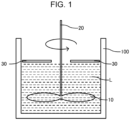
- FIG. 1 is a schematic drawing showing the outlines of saccharification treatment according to an example.
- FIG. 1 shows a state of producing a cellulose-derived saccharide.
- a liquid L prepared by mixing a reaction solution, a raw material, and an enzyme is introduced into a saccharification tank 100, and an adsorption sheet 30 is disposed on the surface of the liquid L.
- the liquid L (the raw material, the reaction solution, the enzyme, etc.) is stirred by rotation of a stirring shaft 20 and a stirring blade 10 using a motor not shown.
- Stirring causes the cellulose to be saccharified by enzyme reaction in the liquid L. Also, stirring causes the adsorption sheet 30 to collect impurities such as oil components, including lignin, pitch, and the like, brought from the raw material. Further, impurities such as oil components, including lignin, pitch, and the like, released from cellulose with proceeding of the enzyme reaction are adsorbed by the adsorption sheet 30. 7. 2. Example of shape of adsorption sheet
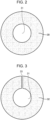
- FIG. 2 is a schematic plan view of the adsorption sheet 30 according to the example.
- the adsorption sheet 30 has, in a plan view, an annular shape having a circular outer shape and a hole 31 at a central portion.
- the outer shape in a plan view is not limited to a circle and can be freely set according to the shape of the inner wall of the saccharification tank 100 or the like.
- the hole 31 in a plan view is not limited to being formed at the central portion, and the hole 31 has any desired shape. Further, a plurality of holes 31 may be formed.
- the adsorption sheet 30 has the hole 31, and thus each of the main components can be supplied to the liquid L through the hole 31. Also, the hole 31 enables a stirring operation to be performed so as to avoid interference between the stirring shaft 20 and the adsorption sheet 30.
- FIG. 3 is a schematic plan view of an adsorption sheet 32 according to a modified example.
- the adsorption sheet 32 has, in a plan view, an annular shape having a circular outer shape, a hole 31 formed at a central portion, and a cut 33 formed to connect the outer periphery and the hole 31.
- the outer shape and the hole 31 are the same as in the adsorption sheet 30 described above.
- the cut 33 is formed as in the adsorption sheet 32, the adsorption sheet 32 can be easily disposed on the liquid surface of the liquid L even after the stirring shaft 20 is installed at the predetermined position.
- the inventors have obtained knowledge that impurities easily float near the inner wall during stirring. Therefore, as shown in FIG. 1 to FIG. 3 , the adsorption sheet 30 or 32 is disposed near the inner wall of the saccharification tank 100, and thus impurities such as oil components, including lignin, pitch, and the like, are easily collected.
- adsorption sheet The effect of the adsorption sheet on the efficiency of saccharification of cellulose was verified by experiment.
- Two sets were prepared by adding 50 g of used paper, 1 L of a sodium acetate buffer solution, and enzyme Cellic Ctec 2 (manufactured by Novozymes Inc.) to a 2 L beaker, and pH was adjusted to 5.2 by adding acetic acid.
- a magnetic stirrer stir bar and an adsorption sheet material: silicone rubber, thickness: 5 mm, shape: the shape cut out to match with the inner wall of the beaker
- only a magnetic stirrer sir bar was placed.
- the mixture was adjusted to a temperature of 49°C and reacted by stirring for 2 days.
- the exemplary embodiment and the modified example are only examples and are not limited to these.
- the exemplary embodiment and modified examples can be properly combined.
- the present disclosure includes substantially the same configuration as that described in the embodiments, for example, a configuration having the same function, method, and results, or a configuration having the same object and effect.
- the present disclosure also includes a configuration in which a portion not essential in the configuration described in the embodiment is replaced.
- the present disclosure includes a configuration which can exhibit the same operational effect or achieve the same object as in the configuration described in the embodiment.
- the present disclosure includes a configuration in which a known technology is added to the configuration described in the embodiment.
- a method for saccharifying cellulose includes introducing a cellulose-containing raw material and a reaction solution into a saccharification tank, introducing an enzyme into the reaction solution in the saccharification tank, disposing an adsorption sheet on the liquid surface of the reaction solution, and decomposing the cellulose with the enzyme by stirring the reaction solution to produce a saccharide, the adsorption sheet adsorbing an oil component released from the raw material to the liquid surface of the reaction solution during the production of the saccharide.
- the method for saccharifying cellulose enables the adsorption sheet to collect impurities such as oil components, including lignin, pitch, and the like, in the raw material, and thus enzyme reaction is hardly inhibited, and the inside of the saccharification tank can be easily maintained clean. Therefore, cellulose can be efficiently saccharified, and thus a saccharide can be efficiently produced. Also, the inside of the saccharification tank is cleaner, and thus the saccharification tank after use can be easily washed.
- the raw material may be paper.
- the raw material can be easily procured.
- the paper may contain printed used paper.
- the method for saccharifying cellulose can efficiently produce a saccharide from used paper treated as a waste, and thus can preferably cope with saving of environmental resources, underground resources, or the like.
- the printed used paper contains oil components, such as ink and the like, adhered thereto, but the oil components can be preferably removed by the adsorption sheet.
- the effect of improving the saccharification efficiency can be more remarkably obtained, and the effect of facilitating washing of the saccharification tank can also be more remarkably obtained.
- the raw material may be introduced in a crushed state into the saccharification tank.
- the adsorption sheet may have a network structure.
- the adsorption sheet easily collects oil components as impurities, such as lignin, pitch, and the like, in the raw material, and thus the saccharification efficiency can be further enhanced.
- the adsorption sheet may have an annular shape in a plan view.
- the shaft of a stirring blade can be passed through the central hole of the annular of the adsorption sheet, and an additional component can be added to the saccharification tank through the central hole, thereby enabling to further enhance the saccharification efficiency.
- the adsorption sheet may be disposed near the inner wall of the saccharification tank.
- the adsorption sheet is disposed near the inner wall of the saccharification tank, where impurities such as oil components, including lignin, pitch, and the like, in the raw material are easily collected, and thus the impurities can be more efficiently collected by the adsorption sheet.
Landscapes
- Chemical & Material Sciences (AREA)
- Organic Chemistry (AREA)
- Life Sciences & Earth Sciences (AREA)
- Engineering & Computer Science (AREA)
- Wood Science & Technology (AREA)
- Zoology (AREA)
- Health & Medical Sciences (AREA)
- General Health & Medical Sciences (AREA)
- Biochemistry (AREA)
- Bioinformatics & Cheminformatics (AREA)
- Genetics & Genomics (AREA)
- Microbiology (AREA)
- General Engineering & Computer Science (AREA)
- Biotechnology (AREA)
- General Chemical & Material Sciences (AREA)
- Chemical Kinetics & Catalysis (AREA)
- Emergency Medicine (AREA)
- Biomedical Technology (AREA)
- Sustainable Development (AREA)
- Molecular Biology (AREA)
- Clinical Laboratory Science (AREA)
- Preparation Of Compounds By Using Micro-Organisms (AREA)
- Apparatus Associated With Microorganisms And Enzymes (AREA)
Abstract
Description
- The present application is based on, and claims priority from
JP Application Serial Number 2022-019356, filed February 10, 2022 - The present disclosure relates to a method for saccharifying cellulose.
- From the viewpoint of so-called carbon minus, effective utilization of biomass, application thereof to bioethanol, etc., attention is paid to production of glucose by saccharification of cellulose. For example,
JP-T-2014-507148 JP-T-2014-507148 - In order to saccharify cellulose, there is a method for saccharifying cellulose, in which a saccharification reaction solution, containing an enzyme, and a raw material are added into a saccharification reaction tank, and enzyme reaction is allowed to proceed by stirring. However, when paper is used as a cellulose raw material, the paper contains not only cellulose but also pitch (adhesive material), and when the paper is used paper, the paper contains components insoluble in the saccharification reaction solution, such as an ink oil component. These components are not saccharified, and thus not only may inhibit saccharification reaction due to the adhesion to cellulose and inhibition of the enzyme reaction, but also may remain in the reaction solution and thus remain as an unnecessary component, such as sludge or the like, on the inner wall of the saccharification tank.
- Therefore, there is required a method for saccharifying cellulose, in which the enzyme reaction is hardly inhibited by impurities such as oil components, including lignin, pitch, and the like, in the raw material, and the inside of the saccharification tank is easily maintained clean.
- According to an aspect of the present disclosure, a method for saccharifying cellulose includes introducing a cellulose-containing raw material and a reaction solution into a saccharification tank, introducing an enzyme into the reaction solution in the saccharification tank, disposing an adsorption sheet on the liquid surface of the reaction solution, and decomposing the cellulose with the enzyme by stirring the reaction solution to produce a saccharide, the adsorption sheet adsorbing oil components released from the raw material to the liquid surface of the reaction solution during the production of the saccharide.
-
-
FIG. 1 is a schematic view showing the outlines of saccharification treatment according to an example. -
FIG. 2 is a schematic plan view of an adsorption sheet according to an example. -
FIG. 3 is a schematic plan view of an adsorption sheet according to a modified example. - An exemplary embodiment of the present disclosure is described below. In the description of the exemplary embodiment below, an example of the present disclosure is described. The present disclosure is not limited to the exemplary embodiment below and includes various modified embodiments carried out within a range which does not change the gist of the present disclosure. In addition, all configurations described below are not necessarily configurations essential for the present disclosure.
- A method for saccharifying cellulose according to an exemplary embodiment of the present disclosure includes introducing a cellulose-containing raw material and a reaction solution into a saccharification tank, introducing an enzyme into the reaction solution in the saccharification tank, disposing an adsorption sheet on the liquid surface of the reaction solution, and producing a saccharide in the reaction solution by stirring the reaction solution.
- The cellulose-containing raw material and the reaction solution are introduced into the saccharification tank.
- The saccharification tank is not particularly limited as long as the raw material and the reaction solution can be introduced, and the contents can be stirred. Also, the scale of the saccharification tank is not limited, and it may be a laboratory scale such as a beaker, a flask, or the like, or may be a pilot plant scale or a commercial plant scale.
- The saccharification tank may include a container and a lid body. The saccharification tank may properly include an inlet for the raw material and the reaction solution, an outlet for products, a mechanism for internal stirring, a window for internal observation, a heater for heating/cooling, and other piping such as refrigerant piping, a jacket, and the like. Further, the saccharification tank may include a liquid level meter, a thermometer, and the like and may include openings for installing them.
- Examples of the stirring mechanism include a magnetic stirrer, a stir bar, a motor for stirring, a shaft, a stirring blade, and the like, and the stirring mechanism can be properly selected according to the scale and the stirring efficiency of contents.
- The raw material introduced into the saccharification tank contains cellulose. The raw material may contain a component other than cellulose. Examples of the component other than cellulose include wood-derived components, such as lignin and hemicellulose, processed-wood components, such as a filler, a pigment, a resin component, clays, a binder, a toner, oil, moisture, and the like.
- The raw material may be paper, pulp, or the like. When paper is used as the raw material, the raw material can be easily procured. Also, paper may contain printed used paper. Examples of the printed used paper include copy paper, newspaper, a magazine, and the like. The use of printed used paper is preferred because wastes can be decreased due to saving of environmental resources and underground resources or the like.
- The raw material may be introduced in a crushed state into the saccharification tank. Crushing may be performed by, for example, cutting with a shredder or the like, or grinding with a dry defibering machine or the like. Further, crushing may be performed by, for example, wet disaggregation. When the raw material is in a crushed state, the components other than cellulose contained in the raw material are easily released from the cellulose and the cellulose easily comes into contact with the reaction solution, and thus the efficiency of saccharification can be improved.
- The raw material is more preferably used in a sterilized state. Examples of a sterilization method include heating, ultraviolet irradiation, and the like. This makes it difficult that the glucose or the like produced by saccharification reaction is consumed by microorganisms or the like derived from the raw material, and thus the yield of saccharide may be increased.
- The reaction solution contains water as a main component. Besides the water, the reaction solution may contain, for example, a material useful for enzyme reaction, a pH adjuster, a surfactant, etc.
- The water is preferably pure water or ultrapure water from which ionic impurities are moved as much as possible, such as ion exchange water, ultrafiltered water, reverse osmosis water, distilled water, or the like. Also, water sterilized by ultraviolet irradiation, hydrogen peroxide addition, or the like is preferably used because when the reaction solution is stored for a long period time, the occurrence of mold or bacteria can be suppressed during enzyme reaction or after enzyme reaction.
- Examples of the pH adjuster include organic acids such as acetic acid, citric acid, phosphoric acid, and the like; inorganic acids, organic alkali, inorganic alkali, and salts thereof such as sodium salt, one or more of which are selected, a material which constitutes a buffer solution, and the like.
- The surfactant can be used without being particularly limited as long as it does not inhibit the enzyme reaction. Examples of the surfactant include Triton X-100 (manufactured by Nacalai Tesque, Inc), Antifoam SE-15 (manufactured by Sigma Aldrich Japan G. K.), Adekanol LG-126 (manufactured by ADEKA Corporation), DK Ester F-10 (manufactured by DKS Co., Ltd.), KM-72 (manufactured by Shin-Etsu Chemical Co., Ltd.), and the like. When the saccharification raw material such as dry used paper is mixed with the saccharification reaction solution, saccharification reaction may be inhibited by adhesion of air bubbles to the surface of the saccharification raw material. However, inhibition of the saccharification reaction may be suppressed by adding the surfactant.
- Also, a method for introducing the raw material and the reaction solution into the saccharification tank is not particularly limited. With respect to the order of introduction into the saccharification tank, either the raw material or the reaction solution may be first introduced or both may be simultaneously introduced.
- An enzyme is introduced into the reaction solution at least before saccharification reaction.
- Any enzyme can be used as long as it has the function of decomposing cellulose into a saccharide by cutting a β-1,4-glucosidic linkage. Examples of a cellulose-decomposing enzyme include endoglucanase, cellobiohydrolase, cellobiase (β-glucosidase), and the like. More specific examples of the cellulose-decomposing enzyme include cellulase SS (manufactured by Nagase Chemtex Corporation), Accellerase Duet (manufactured by GENENCOR Inc.), Cellic Ctec 2 (manufactured by Novozymes Ltd.), Cellic Ctec 3 (manufactured by Novozymes Ltd.), Meicelase (manufactured by Meiji Seika Pharma Co., Ltd.), and the like. These enzymes may be used in combination of plural types. The enzyme may contain xylanase for enhancing the efficiency of saccharification by simultaneously decomposing xylane present on the surface of cellulose.
- The enzyme may be introduced as a solution or a dispersion liquid into the reaction solution or introduced as a powder. The enzyme may be introduced after the raw material and the reaction solution are introduced into the saccharification tank or may be mixed in advance with the reaction solution or the raw material and then introduced together with the reaction solution and the raw material.
- The adsorption sheet is disposed on the liquid surface in the saccharification tank in which at least the raw material and the reaction solution have been introduced. The adsorption sheet may be fixed to the saccharification tank or may be moved in the saccharification tank by stirring described later. Also, the adsorption sheet may be disposed on the liquid surface by the buoyancy of the reaction solution in the saccharification tank or disposed on the liquid surface by using a structural material or the like. 3. 1. Adsorption sheet
- The adsorption sheet adsorbs impurities such as oil components, including lignin, pitch, and the like, in the raw material. The adsorption sheet may adsorb impurities such as not only oil components, including lignin, pitch, and the like, in the raw material, but also oil components released from the raw material by enzyme reaction. The adsorption sheet can physically adsorb and collect the impurities such as oil components and the like. The adsorption sheet need not cover the entire liquid surface in the saccharification tank and may be disposed on at least a portion of the liquid surface. In addition, the number of adsorption sheets disposed on the liquid surface may be one or plural.
- The material of the adsorption sheet is not particularly limited as long as it does not deteriorate during the enzyme reaction and has affinity for oil components. That is, the material of the adsorption sheet may be one which hardly causes corrosion at pH close to optimum pH for the enzyme used in enzyme reaction and which can adsorb or absorb the oil components on the surface or inside. Examples of such a material include materials which are hardly corroded at pH close to optimum pH for the enzyme, such as a metal, carbon, an inorganic material, resins, and a composite material thereof. More specific examples thereof include styrene, polyethylene, polypropylene, polytetrafluoroethylene, polyurethane, polyester, polybutadiene, styrene-butadiene rubber, silicone rubber, natural rubber, carbon fibers, activated carbon, and the like, and a composite material of a plurality of these materials. Structure of adsorption sheet
- The adsorption sheet adsorbs the oil components and preferably has a larger surface area because the efficiency of adsorption is increased with increases in the surface area. From the viewpoint of this, the adsorption sheet preferably has a structure having a large specific surface area, for example, a network structure, a woven fabric structure, a non-woven fabric structure, a sponge structure, a porous structure, or the like. When the adsorption sheet has a network structure, the mesh size of network may be, for example, 0.1 mm or more and 10 mm or less, preferably 0.5 mm or more and 5 mm or less, and more preferably 1 mm or more and 3 mm or less. This enables to obtain the liquid permeability of the adsorption sheet while improving adsorption efficiency. Thus, for example, even when the entire portion of the liquid surface is covered with the adsorption sheet, for example, an enzyme solution can be introduced or added to the reaction solution through meshes.
- Also, the overall shape of the adsorption sheet is not particularly limited. The thickness of the adsorption sheet is, for example, 10 µm or more and 5 cm or less, preferably 100 µm or more and 3 cm or less, and more preferably 1 mm or more and 1 cm or less. The thickness of the adsorption sheet can be set to such a degree that the shape or stiffness can be maintained according to the material and structure of the adsorption sheet. This can facilitate the handling of the adsorption sheet.
- The shape in a plan view of the adsorption sheet is not particularly limited. The adsorption sheet may have a hole in a plan view or have a shape having a notch or cut. The shape in a plan view of the adsorption sheet can be properly designed according to conditions such as the shape of the saccharification tank, the supply and addition of the raw material and the enzyme, the configuration of the stirring mechanism, handling of the adsorption sheet, washing of the saccharification tank, etc.
- When the saccharification tank has a cylindrical shape and the liquid surface in the saccharification tank has a circular shape in a plan view, the adsorption sheet preferably has an annular shape in a plan view. Therefore, through the central hole of the annulus of the adsorption sheet, the shaft of the stirring blade can be passed, and an additional component can be introduced into the saccharification tank, and thus the saccharification efficiency can be further enhanced.
- The adsorption sheet is more preferably disposed near the inner wall of the saccharification tank. Thus, the adsorption sheet can be disposed near the inner wall of the saccharification tank where impurities such as oil components, including lignin, pitch, and the like, in the raw material are easily gathered by stirring. This can more increase the efficiency of collection of impurities by the adsorption sheet.
- The cellulose is decomposed with the enzyme by stirring the reaction solution to produce a cellulose-derived saccharide. The production is performed for a time of 2 hours or more and within 1 week depending on the ability of the enzyme and the overall scale. Typically, the production is performed for a time of 10 hours or more and within 5 days and more preferably 1 day or more and within 4 days.
- Stirring is performed by the proper stirring mechanism described above. During stirring, the rotational speed or the like of the motor can be property set according to the scale and configuration of the saccharification tank, the shape of the stir bar or stirring blade, etc.
- The pH of the reaction solution is adjusted according to pH optimum for the enzyme introduced. For example, when the enzyme used is Cellic Ctec 2 (manufactured by Novozymes Ltd.), the pH of the liquid in the saccharification tank is 4.5 or more and 6 or less and preferably 5.0 or more and 5.7 or less. The pH is more preferably adjusted before the enzyme is introduced in the saccharification tank.
- The pH can be adjusted by adding sodium acetate, acetic acid, sulfuric acid, an aqueous sodium hydroxide solution or the like to the reaction solution. Also, in a configuration in which the pH of the reaction solution can be monitored, the pH may be adjusted during stirring. For example, when the pH becomes higher than the predetermined pH during stirring, the pH can be adjusted by adding acetic acid, sulfuric acid, or the like, while when the pH becomes lower than the predetermined pH, the pH can be adjusted by adding an aqueous sodium hydroxide solution or the like.
- In addition, when the adsorption sheet has a hole, an acid, an alkali, or the like for adjusting the pH can be easily added to the liquid through the hole.
- In producing a saccharide, the temperature of the liquid in the saccharification tank is preferably adjusted to a temperature optimum for the enzyme used. For example, when the enzyme used is Cellic Ctec 2 (manufactured by Novozymes Ltd.), the temperature of the liquid in the saccharification tank is 47°C or more and 52°C or less, preferably 48°C or more and 51°C or less, and more preferably 49°C or more and 50°C or less.
- The temperature of the liquid in the saccharification tank is adjusted by using a suitable heating device, a cooling device, a control device, or the like.
- The saccharification method according to the exemplary embodiment may include pretreatment, recovery, washing, etc. other than the above.
- The saccharification method may include pretreatment. Examples of the pretreatment include sterilization of the raw material and the reaction solution, grinding of the raw material, classification of the raw material, and the like.
- The saccharification method may include recovering the liquid in the saccharification tank after the saccharide is produced. The recovery may be performed through piping or the like. The recovered liquid containing the saccharide may be filtered. Also, the used adsorption sheet may be recovered at the time of recovery.
- The saccharification method may include washing the saccharification tank after the saccharide is produced. The washing of the saccharification tank may include, before and/after recovery, removing the precipitates remaining in the saccharification tank, washing the oil components remaining in the saccharification tank, washing the stirring mechanism, and the like.
- The saccharification method according to the exemplary embodiment enables the adsorption sheet to collect impurities such as oil components, including lignin, pitch, and the like, in the raw material, and thus the enzyme reaction is hardly inhibited, and the inside of the saccharification tank can be easily maintained clean. Therefore, cellulose can be efficiency saccharified, and thus a saccharide can be efficiency produced. Also, the inside of the saccharification tank is cleaner, and thus the saccharification tank after use can be easily washed. 7. Experimental example, etc.
- The present disclosure is described in further detail below by an experimental example etc., but the present disclosure is not limited to these examples.
-
FIG. 1 is a schematic drawing showing the outlines of saccharification treatment according to an example.FIG. 1 shows a state of producing a cellulose-derived saccharide. A liquid L prepared by mixing a reaction solution, a raw material, and an enzyme is introduced into asaccharification tank 100, and anadsorption sheet 30 is disposed on the surface of the liquid L. The liquid L (the raw material, the reaction solution, the enzyme, etc.) is stirred by rotation of a stirringshaft 20 and astirring blade 10 using a motor not shown. - Stirring causes the cellulose to be saccharified by enzyme reaction in the liquid L. Also, stirring causes the
adsorption sheet 30 to collect impurities such as oil components, including lignin, pitch, and the like, brought from the raw material. Further, impurities such as oil components, including lignin, pitch, and the like, released from cellulose with proceeding of the enzyme reaction are adsorbed by theadsorption sheet 30. 7. 2. Example of shape of adsorption sheet -
FIG. 2 is a schematic plan view of theadsorption sheet 30 according to the example. As shown in the drawing, theadsorption sheet 30 has, in a plan view, an annular shape having a circular outer shape and ahole 31 at a central portion. Although not shown in the drawing, the outer shape in a plan view is not limited to a circle and can be freely set according to the shape of the inner wall of thesaccharification tank 100 or the like. Further, thehole 31 in a plan view is not limited to being formed at the central portion, and thehole 31 has any desired shape. Further, a plurality ofholes 31 may be formed. Theadsorption sheet 30 has thehole 31, and thus each of the main components can be supplied to the liquid L through thehole 31. Also, thehole 31 enables a stirring operation to be performed so as to avoid interference between the stirringshaft 20 and theadsorption sheet 30. -
FIG. 3 is a schematic plan view of anadsorption sheet 32 according to a modified example. As shown in the drawing, theadsorption sheet 32 has, in a plan view, an annular shape having a circular outer shape, ahole 31 formed at a central portion, and acut 33 formed to connect the outer periphery and thehole 31. In theadsorption sheet 32, the outer shape and thehole 31 are the same as in theadsorption sheet 30 described above. When thecut 33 is formed as in theadsorption sheet 32, theadsorption sheet 32 can be easily disposed on the liquid surface of the liquid L even after the stirringshaft 20 is installed at the predetermined position. - The inventors have obtained knowledge that impurities easily float near the inner wall during stirring. Therefore, as shown in
FIG. 1 to FIG. 3 , theadsorption sheet saccharification tank 100, and thus impurities such as oil components, including lignin, pitch, and the like, are easily collected. - The effect of the adsorption sheet on the efficiency of saccharification of cellulose was verified by experiment. Two sets were prepared by adding 50 g of used paper, 1 L of a sodium acetate buffer solution, and enzyme Cellic Ctec 2 (manufactured by Novozymes Inc.) to a 2 L beaker, and pH was adjusted to 5.2 by adding acetic acid. In one of the sets, a magnetic stirrer stir bar and an adsorption sheet (material: silicone rubber, thickness: 5 mm, shape: the shape cut out to match with the inner wall of the beaker) were placed. In the other set, only a magnetic stirrer sir bar was placed. In each of the two sets, the mixture was adjusted to a temperature of 49°C and reacted by stirring for 2 days.
- Each of the liquids obtained after reaction was collected, and a difference in saccharide concentration due to the presence of the adsorption sheet was compared. The experimental method is as follows.
- 1. A plurality of reference saccharide solutions at known saccharide concentrations are prepared.
- 2. Then, 3 mL of a saccharide solution concentration measurement reagent (trade name "Glucose CII-Test Wako", manufactured by Fujifilm Wako Pure Chemical Corporation) is pipetted and stirred in each of the reference saccharide solutions prepared in (1) and 0.02 mL of a saccharification reaction solution diluted so that the saccharide solution concentration is 50 mg/dL or more and 500 mg/dL or less.
- (3) Each of the liquids prepared in (2) is allowed to stand at 37°C for 5 minutes.
- (4) The wavelength of each of the liquid colors is measured by absorbance measurement.
- (5) A calibration curve for absorbance obtained at a wavelength of 505 nm is formed using the reference, and the saccharide solution concentration of the saccharification reaction solution is calculated.
- As a result of the experiment, when the adsorption sheet was disposed, a saccharide concentration of 30 g/L was obtained, and the saccharide production rate (saccharification rate) was 60% relative to the total amount of cellulose. While when the adsorption sheet was not disposed, a saccharide concentration of 23 g/L was obtained, and the saccharide production rate (saccharification rate) was 45% relative to the total amount of cellulose. Thus, the significant effect of improving the saccharification rate by 15% was confirmed when the adsorption sheet was disposed.
- The exemplary embodiment and the modified example are only examples and are not limited to these. For example, the exemplary embodiment and modified examples can be properly combined.
- The present disclosure includes substantially the same configuration as that described in the embodiments, for example, a configuration having the same function, method, and results, or a configuration having the same object and effect. The present disclosure also includes a configuration in which a portion not essential in the configuration described in the embodiment is replaced. Further, the present disclosure includes a configuration which can exhibit the same operational effect or achieve the same object as in the configuration described in the embodiment. Further, the present disclosure includes a configuration in which a known technology is added to the configuration described in the embodiment.
- The contents below are derived from the exemplary embodiment and the modified example.
- A method for saccharifying cellulose includes introducing a cellulose-containing raw material and a reaction solution into a saccharification tank, introducing an enzyme into the reaction solution in the saccharification tank, disposing an adsorption sheet on the liquid surface of the reaction solution, and decomposing the cellulose with the enzyme by stirring the reaction solution to produce a saccharide, the adsorption sheet adsorbing an oil component released from the raw material to the liquid surface of the reaction solution during the production of the saccharide.
- The method for saccharifying cellulose enables the adsorption sheet to collect impurities such as oil components, including lignin, pitch, and the like, in the raw material, and thus enzyme reaction is hardly inhibited, and the inside of the saccharification tank can be easily maintained clean. Therefore, cellulose can be efficiently saccharified, and thus a saccharide can be efficiently produced. Also, the inside of the saccharification tank is cleaner, and thus the saccharification tank after use can be easily washed.
- In the method for saccharifying cellulose described above, the raw material may be paper.
- In the method for saccharifying cellulose, the raw material can be easily procured.
- In the method for saccharifying cellulose described above, the paper may contain printed used paper.
- The method for saccharifying cellulose can efficiently produce a saccharide from used paper treated as a waste, and thus can preferably cope with saving of environmental resources, underground resources, or the like. Further, the printed used paper contains oil components, such as ink and the like, adhered thereto, but the oil components can be preferably removed by the adsorption sheet. Thus, the effect of improving the saccharification efficiency can be more remarkably obtained, and the effect of facilitating washing of the saccharification tank can also be more remarkably obtained.
- In the method for saccharifying cellulose described above, the raw material may be introduced in a crushed state into the saccharification tank.
- In the method for saccharifying cellulose, unnecessary components contained in the raw material can be easily released, and cellulose can be easily brought into contact with the reaction solution, thereby enabling to more improve the saccharification efficiency
- In the method for saccharifying cellulose described above, the adsorption sheet may have a network structure.
- In the method for saccharifying cellulose, the adsorption sheet easily collects oil components as impurities, such as lignin, pitch, and the like, in the raw material, and thus the saccharification efficiency can be further enhanced.
- In the method for saccharifying cellulose described above, the adsorption sheet may have an annular shape in a plan view.
- In the method for saccharifying cellulose, the shaft of a stirring blade can be passed through the central hole of the annular of the adsorption sheet, and an additional component can be added to the saccharification tank through the central hole, thereby enabling to further enhance the saccharification efficiency.
- In the method for saccharifying cellulose described above, the adsorption sheet may be disposed near the inner wall of the saccharification tank.
- In the method for saccharifying cellulose, the adsorption sheet is disposed near the inner wall of the saccharification tank, where impurities such as oil components, including lignin, pitch, and the like, in the raw material are easily collected, and thus the impurities can be more efficiently collected by the adsorption sheet.
Claims (7)
- A method for saccharifying cellulose comprising:introducing a cellulose-containing raw material and a reaction solution into a saccharification tank;introducing an enzyme into the reaction solution in the saccharification tank;disposing an adsorption sheet on the liquid surface of the reaction solution; anddecomposing the cellulose with the enzyme by stirring the reaction solution to produce a saccharide,wherein the adsorption sheet adsorbs an oil component released from the raw material to the liquid surface of the reaction solution during the production of the saccharide.
- The method for saccharifying cellulose according to claim 1, wherein the raw material is paper.
- The method for saccharifying cellulose according to claim 2, wherein the paper contains printed used paper.
- The method for saccharifying cellulose according to claim 1, wherein the raw material is introduced in a crushed state into the saccharification tank.
- The method for saccharifying cellulose according to claim 1, wherein the adsorption sheet has a network structure.
- The method for saccharifying cellulose according to claim 1, wherein the adsorption sheet has an annular shape in a plan view.
- The method for saccharifying cellulose according to claim 1, wherein the adsorption sheet is disposed near the inner wall of the saccharification tank.
Applications Claiming Priority (1)
| Application Number | Priority Date | Filing Date | Title |
|---|---|---|---|
| JP2022019356A JP2023116943A (en) | 2022-02-10 | 2022-02-10 | Cellulose saccharification method |
Publications (1)
| Publication Number | Publication Date |
|---|---|
| EP4227419A1 true EP4227419A1 (en) | 2023-08-16 |
Family
ID=85221776
Family Applications (1)
| Application Number | Title | Priority Date | Filing Date |
|---|---|---|---|
| EP23155899.0A Pending EP4227419A1 (en) | 2022-02-10 | 2023-02-09 | Method for saccharifying cellulose |
Country Status (4)
| Country | Link |
|---|---|
| US (1) | US20230250457A1 (en) |
| EP (1) | EP4227419A1 (en) |
| JP (1) | JP2023116943A (en) |
| CN (1) | CN116574773A (en) |
Citations (4)
| Publication number | Priority date | Publication date | Assignee | Title |
|---|---|---|---|---|
| JP2014507148A (en) | 2011-02-14 | 2014-03-27 | ザイレコ,インコーポレイテッド | Paper feedstock processing |
| US20150368441A1 (en) * | 2014-06-24 | 2015-12-24 | Api Intellectual Property Holdings, Llc | Oleophilic and hydrophobic nanocellulose materials |
| US20200156039A1 (en) * | 2013-03-08 | 2020-05-21 | Xyleco, Inc. | Upgrading process streams |
| JP2022019356A (en) | 2020-07-17 | 2022-01-27 | 株式会社Nsd先端技術研究所 | Hand-washing evaluation system and method therefor |
Family Cites Families (7)
| Publication number | Priority date | Publication date | Assignee | Title |
|---|---|---|---|---|
| US4013505A (en) * | 1972-03-09 | 1977-03-22 | Vyzkumny Ustav Papieru A Celulosy | Method of deinking printed wastepapers |
| US4102783A (en) * | 1975-12-08 | 1978-07-25 | Daicel Ltd. | Adsorbent process for oily materials |
| US5254250A (en) * | 1991-05-30 | 1993-10-19 | Membrex, Inc. | Rotary filtration device and filter pack therefor |
| US5597728A (en) * | 1993-07-23 | 1997-01-28 | Wyatt; Caryl H. | Methods for biodegradation separation of natural fibers to release particulate contamination |
| JP2006218761A (en) * | 2005-02-10 | 2006-08-24 | Marusan Seishi Kk | Oil absorbent mat |
| JP5778897B2 (en) * | 2010-06-24 | 2015-09-16 | 株式会社テックコーポレーション | Manufacturing method of toilet paper using waste paper pulp made from printed waste paper |
| DE102012204203B4 (en) * | 2011-03-16 | 2014-03-20 | Technische Universität Dresden | Process for recycling waste paper |
-
2022
- 2022-02-10 JP JP2022019356A patent/JP2023116943A/en active Pending
-
2023
- 2023-02-07 CN CN202310125308.8A patent/CN116574773A/en active Pending
- 2023-02-08 US US18/165,985 patent/US20230250457A1/en not_active Abandoned
- 2023-02-09 EP EP23155899.0A patent/EP4227419A1/en active Pending
Patent Citations (5)
| Publication number | Priority date | Publication date | Assignee | Title |
|---|---|---|---|---|
| JP2014507148A (en) | 2011-02-14 | 2014-03-27 | ザイレコ,インコーポレイテッド | Paper feedstock processing |
| US20180291409A1 (en) * | 2011-02-14 | 2018-10-11 | Xyleco, Inc. | Processing paper feedstocks |
| US20200156039A1 (en) * | 2013-03-08 | 2020-05-21 | Xyleco, Inc. | Upgrading process streams |
| US20150368441A1 (en) * | 2014-06-24 | 2015-12-24 | Api Intellectual Property Holdings, Llc | Oleophilic and hydrophobic nanocellulose materials |
| JP2022019356A (en) | 2020-07-17 | 2022-01-27 | 株式会社Nsd先端技術研究所 | Hand-washing evaluation system and method therefor |
Also Published As
| Publication number | Publication date |
|---|---|
| CN116574773A (en) | 2023-08-11 |
| US20230250457A1 (en) | 2023-08-10 |
| JP2023116943A (en) | 2023-08-23 |
Similar Documents
| Publication | Publication Date | Title |
|---|---|---|
| CA2809519C (en) | Method for enzymatic saccharification treatment of lignocellulose-containing biomass, and method for producing ethanol from lignocellulose-containing biomass | |
| Niju et al. | Delignification of sugarcane bagasse using pretreatment strategies for bioethanol production | |
| Chang et al. | Membrane applications for microbial energy conversion: a review | |
| Ohlson et al. | Enzymatic hydrolysis of sodium‐hydroxide‐pretreated sallow in an ultrafiltration membrane reactor | |
| CN101155925A (en) | Process for processing biomass to obtain ethanol | |
| Kim et al. | Evaluation of bio-hydrogen production using rice straw hydrolysate extracted by acid and alkali hydrolysis | |
| CA2796533C (en) | Process for the direct production of fermentation products from biomasses in a biofilm reactor | |
| Ling et al. | Corncob mild alkaline pretreatment for high 2, 3-butanediol production by spent liquor recycle process | |
| CN116590350A (en) | Method for producing hydrogen by dark fermentation of straw biomass | |
| M’Arimi et al. | Progress in applications of advanced oxidation processes for promotion of biohydrogen production by fermentation processes | |
| US20230250457A1 (en) | Method for saccharifying cellulose | |
| US20150184212A1 (en) | Advanced Methods for Sugar Production from Lignocellulosic Biomass and Fermenting Sugars to Microbial Lipids | |
| Luo et al. | Frontier review of key reduction technologies and resource utilization of waste during the seaweed gel production process | |
| CN103361392A (en) | Method for preparing fermentable sugar by degrading wood fiber used as raw material | |
| BR112019010355B1 (en) | ENZYME COMPOSITION | |
| KR101261560B1 (en) | Device for preparing fermentable sugar and method of preparing fermentable sugar using the same | |
| JP2024161754A (en) | Method for recovering saccharification enzymes | |
| Maheswari et al. | Enzymatic hydrolysis of structurally upgraded lignocellulosic biomass with the aid of humic acid: a case study in a membrane integrated bioreactor | |
| US20230383325A1 (en) | Method of saccharifying cellulose | |
| Chang et al. | Membrane technologies for sustainable and eco-friendly microbial energy production | |
| JP2024161979A (en) | Method for recovering saccharification enzymes | |
| Sivakumar et al. | Enhancement of methane potential in fractionated biogas stream through composite-hybrid biochemical pathway processes: a review | |
| Sharma et al. | Cost effective production of cellulase and xylanase enzymes by Myceliophthora thermophila SH1 using lignocellulosic forest waste and bioconversion of alkaline hydrogen peroxide pretreated P. deltoides wood to bioethanol under SHF | |
| WO2013050806A1 (en) | Rapid and low cost enzymatic full conversion of lignocellulosic biomass | |
| EP4227418A1 (en) | Cellulose saccharification method |
Legal Events
| Date | Code | Title | Description |
|---|---|---|---|
| PUAI | Public reference made under article 153(3) epc to a published international application that has entered the european phase |
Free format text: ORIGINAL CODE: 0009012 |
|
| STAA | Information on the status of an ep patent application or granted ep patent |
Free format text: STATUS: THE APPLICATION HAS BEEN PUBLISHED |
|
| AK | Designated contracting states |
Kind code of ref document: A1 Designated state(s): AL AT BE BG CH CY CZ DE DK EE ES FI FR GB GR HR HU IE IS IT LI LT LU LV MC ME MK MT NL NO PL PT RO RS SE SI SK SM TR |
|
| STAA | Information on the status of an ep patent application or granted ep patent |
Free format text: STATUS: REQUEST FOR EXAMINATION WAS MADE |
|
| 17P | Request for examination filed |
Effective date: 20231214 |
|
| RBV | Designated contracting states (corrected) |
Designated state(s): AL AT BE BG CH CY CZ DE DK EE ES FI FR GB GR HR HU IE IS IT LI LT LU LV MC ME MK MT NL NO PL PT RO RS SE SI SK SM TR |