EP4226474B1 - Photovoltaic system - Google Patents
Photovoltaic system Download PDFInfo
- Publication number
- EP4226474B1 EP4226474B1 EP21786141.8A EP21786141A EP4226474B1 EP 4226474 B1 EP4226474 B1 EP 4226474B1 EP 21786141 A EP21786141 A EP 21786141A EP 4226474 B1 EP4226474 B1 EP 4226474B1
- Authority
- EP
- European Patent Office
- Prior art keywords
- photovoltaic system
- emergency
- unit
- controller
- power
- Prior art date
- Legal status (The legal status is an assumption and is not a legal conclusion. Google has not performed a legal analysis and makes no representation as to the accuracy of the status listed.)
- Active
Links
Images

Classifications
-
- H—ELECTRICITY
- H02—GENERATION; CONVERSION OR DISTRIBUTION OF ELECTRIC POWER
- H02J—ELECTRIC POWER NETWORKS; CIRCUIT ARRANGEMENTS OR SYSTEMS FOR SUPPLYING OR DISTRIBUTING ELECTRIC POWER; SYSTEMS FOR STORING ELECTRIC ENERGY
- H02J13/00—Circuit arrangements for providing remote monitoring or remote control of equipment in a power distribution network
- H02J13/13—Circuit arrangements for providing remote monitoring or remote control of equipment in a power distribution network characterised by the transmission of data to equipment in the power network
- H02J13/1311—Circuit arrangements for providing remote monitoring or remote control of equipment in a power distribution network characterised by the transmission of data to equipment in the power network using the power network as support for the transmission
-
- H—ELECTRICITY
- H02—GENERATION; CONVERSION OR DISTRIBUTION OF ELECTRIC POWER
- H02J—ELECTRIC POWER NETWORKS; CIRCUIT ARRANGEMENTS OR SYSTEMS FOR SUPPLYING OR DISTRIBUTING ELECTRIC POWER; SYSTEMS FOR STORING ELECTRIC ENERGY
- H02J3/00—Circuit arrangements for AC mains or AC distribution networks
- H02J3/001—Arrangements for handling faults or abnormalities, e.g. emergencies or contingencies
-
- H—ELECTRICITY
- H02—GENERATION; CONVERSION OR DISTRIBUTION OF ELECTRIC POWER
- H02J—ELECTRIC POWER NETWORKS; CIRCUIT ARRANGEMENTS OR SYSTEMS FOR SUPPLYING OR DISTRIBUTING ELECTRIC POWER; SYSTEMS FOR STORING ELECTRIC ENERGY
- H02J3/00—Circuit arrangements for AC mains or AC distribution networks
- H02J3/007—Arrangements for selectively connecting one or more loads to one or more power sources or power lines
- H02J3/0073—Arrangements for selectively connecting one or more loads to one or more power sources or power lines by providing alternative feeding paths when the main path fails
-
- H—ELECTRICITY
- H02—GENERATION; CONVERSION OR DISTRIBUTION OF ELECTRIC POWER
- H02J—ELECTRIC POWER NETWORKS; CIRCUIT ARRANGEMENTS OR SYSTEMS FOR SUPPLYING OR DISTRIBUTING ELECTRIC POWER; SYSTEMS FOR STORING ELECTRIC ENERGY
- H02J3/00—Circuit arrangements for AC mains or AC distribution networks
- H02J3/38—Arrangements for feeding a single network from two or more generators or sources in parallel; Arrangements for feeding already energised networks from additional generators or sources in parallel
-
- H—ELECTRICITY
- H02—GENERATION; CONVERSION OR DISTRIBUTION OF ELECTRIC POWER
- H02J—ELECTRIC POWER NETWORKS; CIRCUIT ARRANGEMENTS OR SYSTEMS FOR SUPPLYING OR DISTRIBUTING ELECTRIC POWER; SYSTEMS FOR STORING ELECTRIC ENERGY
- H02J2101/00—Supply or distribution of decentralised, dispersed or local electric power generation
- H02J2101/20—Dispersed power generation using renewable energy sources
- H02J2101/22—Solar energy
- H02J2101/24—Photovoltaics
-
- Y—GENERAL TAGGING OF NEW TECHNOLOGICAL DEVELOPMENTS; GENERAL TAGGING OF CROSS-SECTIONAL TECHNOLOGIES SPANNING OVER SEVERAL SECTIONS OF THE IPC; TECHNICAL SUBJECTS COVERED BY FORMER USPC CROSS-REFERENCE ART COLLECTIONS [XRACs] AND DIGESTS
- Y02—TECHNOLOGIES OR APPLICATIONS FOR MITIGATION OR ADAPTATION AGAINST CLIMATE CHANGE
- Y02E—REDUCTION OF GREENHOUSE GAS [GHG] EMISSIONS, RELATED TO ENERGY GENERATION, TRANSMISSION OR DISTRIBUTION
- Y02E10/00—Energy generation through renewable energy sources
- Y02E10/50—Photovoltaic [PV] energy
- Y02E10/56—Power conversion systems, e.g. maximum power point trackers
-
- Y—GENERAL TAGGING OF NEW TECHNOLOGICAL DEVELOPMENTS; GENERAL TAGGING OF CROSS-SECTIONAL TECHNOLOGIES SPANNING OVER SEVERAL SECTIONS OF THE IPC; TECHNICAL SUBJECTS COVERED BY FORMER USPC CROSS-REFERENCE ART COLLECTIONS [XRACs] AND DIGESTS
- Y02—TECHNOLOGIES OR APPLICATIONS FOR MITIGATION OR ADAPTATION AGAINST CLIMATE CHANGE
- Y02E—REDUCTION OF GREENHOUSE GAS [GHG] EMISSIONS, RELATED TO ENERGY GENERATION, TRANSMISSION OR DISTRIBUTION
- Y02E40/00—Technologies for an efficient electrical power generation, transmission or distribution
- Y02E40/70—Smart grids as climate change mitigation technology in the energy generation sector
-
- Y—GENERAL TAGGING OF NEW TECHNOLOGICAL DEVELOPMENTS; GENERAL TAGGING OF CROSS-SECTIONAL TECHNOLOGIES SPANNING OVER SEVERAL SECTIONS OF THE IPC; TECHNICAL SUBJECTS COVERED BY FORMER USPC CROSS-REFERENCE ART COLLECTIONS [XRACs] AND DIGESTS
- Y02—TECHNOLOGIES OR APPLICATIONS FOR MITIGATION OR ADAPTATION AGAINST CLIMATE CHANGE
- Y02E—REDUCTION OF GREENHOUSE GAS [GHG] EMISSIONS, RELATED TO ENERGY GENERATION, TRANSMISSION OR DISTRIBUTION
- Y02E60/00—Enabling technologies; Technologies with a potential or indirect contribution to GHG emissions mitigation
-
- Y—GENERAL TAGGING OF NEW TECHNOLOGICAL DEVELOPMENTS; GENERAL TAGGING OF CROSS-SECTIONAL TECHNOLOGIES SPANNING OVER SEVERAL SECTIONS OF THE IPC; TECHNICAL SUBJECTS COVERED BY FORMER USPC CROSS-REFERENCE ART COLLECTIONS [XRACs] AND DIGESTS
- Y04—INFORMATION OR COMMUNICATION TECHNOLOGIES HAVING AN IMPACT ON OTHER TECHNOLOGY AREAS
- Y04S—SYSTEMS INTEGRATING TECHNOLOGIES RELATED TO POWER NETWORK OPERATION, COMMUNICATION OR INFORMATION TECHNOLOGIES FOR IMPROVING THE ELECTRICAL POWER GENERATION, TRANSMISSION, DISTRIBUTION, MANAGEMENT OR USAGE, i.e. SMART GRIDS
- Y04S10/00—Systems supporting electrical power generation, transmission or distribution
- Y04S10/12—Monitoring or controlling equipment for energy generation units, e.g. distributed energy generation [DER] or load-side generation
- Y04S10/123—Monitoring or controlling equipment for energy generation units, e.g. distributed energy generation [DER] or load-side generation the energy generation units being or involving renewable energy sources
-
- Y—GENERAL TAGGING OF NEW TECHNOLOGICAL DEVELOPMENTS; GENERAL TAGGING OF CROSS-SECTIONAL TECHNOLOGIES SPANNING OVER SEVERAL SECTIONS OF THE IPC; TECHNICAL SUBJECTS COVERED BY FORMER USPC CROSS-REFERENCE ART COLLECTIONS [XRACs] AND DIGESTS
- Y04—INFORMATION OR COMMUNICATION TECHNOLOGIES HAVING AN IMPACT ON OTHER TECHNOLOGY AREAS
- Y04S—SYSTEMS INTEGRATING TECHNOLOGIES RELATED TO POWER NETWORK OPERATION, COMMUNICATION OR INFORMATION TECHNOLOGIES FOR IMPROVING THE ELECTRICAL POWER GENERATION, TRANSMISSION, DISTRIBUTION, MANAGEMENT OR USAGE, i.e. SMART GRIDS
- Y04S40/00—Systems for electrical power generation, transmission, distribution or end-user application management characterised by the use of communication or information technologies, or communication or information technology specific aspects supporting them
- Y04S40/12—Systems for electrical power generation, transmission, distribution or end-user application management characterised by the use of communication or information technologies, or communication or information technology specific aspects supporting them characterised by data transport means between the monitoring, controlling or managing units and monitored, controlled or operated electrical equipment
- Y04S40/121—Systems for electrical power generation, transmission, distribution or end-user application management characterised by the use of communication or information technologies, or communication or information technology specific aspects supporting them characterised by data transport means between the monitoring, controlling or managing units and monitored, controlled or operated electrical equipment using the power network as support for the transmission
Definitions
- the invention relates to a photovoltaic system and in particular to a photovoltaic system for facilitating power management during an emergency situation using powerline communication.
- a photovoltaic system comprises photovoltaic modules which generate direct current (DC) power from solar radiation due to photovoltaic effect.
- the photovoltaic system comprises an inverter unit which transforms the DC power received from the photovoltaic modules into an alternating current (AC) power.
- the inverter may directly supply the AC power to the power supply grid (PSG).
- the AC power generated by the inverter unit also can either be used to provide a power supply for electrical loads locally or can also be fed into the PSG to be used elsewhere.
- the photovoltaic system comprises an electric meter device to measure an amount of energy that passes through it to a public PSG.
- a communication is necessary between the inverter unit and the PSG to inform a controller of the inverter unit of the photovoltaic system about the occurred power failure of the PSG.
- This communication is performed via a dedicated communication cable where the necessary notification is transmitted from the electric meter device of the photovoltaic system connected to the PSG to the inverter unit.
- a conventional photovoltaic system comprises separate dedicated cables which act a communication line and a power line between the PSG and the inverter.
- the dedicated communication line is used to exchange information between the inverter and the PSG about switching between a normal operating mode and a full backup emergency mode. During the normal operating mode, the PSG supplies electrical power to the load network.
- the inverter supplies electrical power to the load network.
- the document CN 110 661 295 A discloses a photovoltaic system comprising an electric energy meter and an inverter.
- the inverter has an inverter main body and a grid-connected protection device.
- the grid-connected protection device is connected between the inverter main body and a power utilization network and it is configured such that when a risk is detected the inverter main body is disconnected from the power utilization network and stopped.
- the invention provides according to a first aspect a photovoltaic system, comprising an inverter unit adapted to convert an electrical direct current (DC) power generated by photovoltaic modules into an electrical alternating current (AC) power, the inverter unit having a controller; a smart meter for supplying the alternating current (AC) power to a power supply grid; and an emergency unit connected to an inverter via AC lines and to the smart meter via an emergency switch.
- the emergency unit has a controller adapted to: open the emergency switch to automatically disconnect the photovoltaic system from the power supply grid if a power supply grid failure is detected, and notify a current switching state of the emergency switch by means of power line communication (PLC) communication via the AC lines to the controller of the inverter unit.
- PLC power line communication
- the emergency switch In a normal operation mode of the photovoltaic system, the emergency switch is in a closed state, whereas in an emergency operation mode of the photovoltaic system, the emergency switch is in an open state to disconnect the photovoltaic system from the power supply grid.
- the controller of the inverter unit is adapted to start the emergency operation mode in response to an open switching state notification received from the controller of the emergency unit.
- a notification of the switching state of the emergency switch is performed by powerline communication PLC via the local AC lines of the photovoltaic system.
- a further advantage of the photovoltaic system according to the first aspect of the present invention resides in that the communication can be performed via the already existing AC lines so that no dedicated additional communication lines are required that have to be provided within the local photovoltaic system.
- the failure of the power supply grid is detected by the controller of the emergency unit and/or by the controller of the inverter unit on the basis of smart meter data provided by the smart meter of the photovoltaic system via PLC communication.
- the smart meter data can be transmitted via PLC communication from the emergency unit to the inverter unit of the photovoltaic system.
- a load network of the photovoltaic system is connected to the AC lines of the photovoltaic system.
- the electrical loads of the load network are supplied with AC power by the power supply grid via the closed emergency switch.
- the electrical loads of the load network are supplied with AC power by the inverter unit of the photovoltaic system.
- the emergency unit comprises a PLC transceiver adapted to communicate with a PLC transceiver of the inverter unit via the AC lines of the photovoltaic system.
- the inverter unit is connected to a storage unit of the photovoltaic system.
- the controller and the PLC transceiver of the inverter unit are supplied with electrical DC power by the photovoltaic modules and/or by the storage unit of the photovoltaic system.
- the emergency unit comprises a buffer storage unit adapted to supply the controller and the PLC transceiver of the emergency unit with electrical DC power in the emergency operation mode of the photovoltaic system.
- the controller of the emergency unit is adapted to close the emergency switch to automatically reconnect the photovoltaic system to the power supply grid.
- the controller of the inverter unit is adapted to inform the controller of the emergency unit to continue to keep the emergency switch in the open state for a predefined time.
- the controller of the emergency unit is adapted to switch the emergency switch to the closed state at the end of the predefined time.
- the controller of the inverter unit is adapted to stop the emergency operation mode in response to a closed switching state notification of the emergency switch received from the emergency unit.
- the emergency unit and the inverter unit comprise local network addresses used to establish a bidirectional PLC communication between the emergency unit and the inverter unit via the AC lines of the photovoltaic system.
- the communication between the inverter unit and the emergency unit is maintained because the entities can communicate with each other using predefined local network addresses without requiring a router-based IP address assignment.
- the smart meter is integrated in the emergency unit.
- the smart meter is connected via a data cable to a data interface of the emergency unit.
- the controller of the emergency unit and/or the controller of the inverter unit are adapted to perform an energy management of the electrical AC power consumed by the loads of the load network, the DC power generated by the photovoltaic modules and the DC power stored in the storage unit of the photovoltaic system.
- the smart meter data provided by the smart meter comprises a voltage, an electrical current and/or a frequency for all current phases L of the power supply grid.
- the invention further provides according to a second aspect an emergency unit comprising the features of claim 15.
- the invention provides according to the second aspect an emergency unit for a photovoltaic system according to the first aspect of the present invention wherein the emergency unit comprises:
- a photovoltaic system 1 in the illustrated embodiment comprises an inverter unit 2 adapted to convert an electrical direct current, DC, power generated by photovoltaic modules 3 into an electrical alternating current, AC, power.
- the inverter unit 2 can in a possible embodiment also be connected to a local energy storage unit 4 of the photovoltaic system 1 which is adapted to store electrical energy.
- the inverter unit 2 is connected to an emergency unit 6 and at least one load network 9 via local AC lines 5 of the photovoltaic system 1.
- the emergency unit 6 is further connected to an emergency switch 7 via, for example, AC cables.
- the emergency switch 7 is integrated with the emergency unit 6 as a single unit.
- the emergency switch 7 and the emergency unit 6 are two separate units connected via, for example, a control cable such as YM-J.
- the emergency switch 7, the emergency unit 6 and the smart meter 8 are integrated as a single unit.
- the emergency switch 7 is connected to a smart meter 8.
- the smart meter 8 is connected to the PSG 11.
- the inverter unit 2 supplies the AC power to a power supply grid PSG 11 via the emergency unit 6, the emergency switch 7 and the smart meter 8, as shown in the block diagram of Fig. 1 .
- the smart meter 8 is an electrical meter which can be provided to measure parameters of the PSG 11 and to provide a controller of the inverter unit 2 with smart meter data, smd.
- the smd is a voltage value, a current value, frequency details, energy details associated with the PSG 11, etc.
- the smart meter 8 is a measurement device to measure electrical parameters of the PSG 11 and/or electrical power flowing to/from the PSG 11.
- the emergency unit 6 comprises a controller 6A which is adapted to open the emergency switch 7 to automatically disconnect the photovoltaic system 1 from the PSG 11 if a power supply grid failure is detected.
- the controller 6A is further adapted to notify a current switching state of the emergency switch 7 by means of powerline communication PLC via the AC lines 5 to a controller of the inverter unit 2.
- the controller of the inverter unit 2 is not explicitly shown in Fig. 1 .
- a failure of the PSG 11 is detected by the controller 6A of the emergency unit 6 and/or by the controller of the inverter unit 2 on the basis of smart meter data smd provided by the smart meter 8 of the photovoltaic system 1.
- the smart meter data smd can be transmitted via a powerline communication PLC from the controller 6A of the emergency unit 6 via the PLC Transceiver Unit 6B (as shown in Fig. 2 ) to the controller of the inverter unit 2.
- the load network 9 of the photovoltaic system 1 is connected to the AC lines 5 of the photovoltaic system 1.
- the electrical loads of the load network 9 are connected to AC power by the external PSG 11 via the closed emergency switch 7.
- the loads of the load network 9 are supplied with AC power by either the photovoltaic modules 3 or the PSG 11.
- the emergency switch 7 is in an open state.
- the PSG 11 is disconnected and this causes the switch 7 to move from a closed state to an open state.
- the electrical loads of the load network 9 are supplied with AC power by the inverter unit 2 of the photovoltaic system 1.
- the emergency unit 6 comprises in a preferred embodiment, a PLC transceiver adapted to communicate bi-directionally with a PLC transceiver of the inverter unit 2 via the local AC lines 5 of the photovoltaic system 1.
- the controller and the PLC transceiver of the inverter unit 2 are both supplied with electrical power by the photovoltaic modules 3 and/or by the local storage unit 4 of the photovoltaic system 1.
- the emergency unit 6 can also comprise a buffer storage unit which is adapted to supply the controller 6A and the PLC transceiver of the emergency unit 6 with electrical power during the emergency operation mode of the photovoltaic system 1.
- the controller 6A of the emergency unit 6 is adapted to close automatically the emergency switch 7 to reconnect the photovoltaic system 1 to the external power supply grid PSG 11.
- the emergency unit 6 can control the emergency switch 7 by a control signal CTRL 1 as shown in Fig. 1 .
- the controller 6A of the emergency unit 6 can switch the emergency switch 7 on or off depending on the operation mode of the photovoltaic system 1.
- the dashed lines in Fig. 1 shows the signal paths in the system 1.
- the controller of the inverter unit 2 is adapted to start the emergency operation mode in response to an open switching state notification received from the controller 6A of the emergency unit 6.
- the open switching state notification indicates that the emergency switch 7 is in an emergency switch state.
- the open switching state notification can be communicated by means of PLC communication via the AC lines 5.
- the controller of the inverter unit 2 can stop the emergency operation mode in response to a closed switching state notification received from the controller 6A of the emergency unit 6.
- both the emergency unit 6 and the inverter unit 2 comprise assigned local network addresses used to establish the bidirectional PLC communication between the emergency unit 6 and the inverter unit 2 via the AC lines 5 of the photovoltaic system 1.
- the smart meter 8 and the emergency unit 6 form separate entities of the photovoltaic system 1.
- the smart meter 8 can also be integrated in the emergency unit 6.
- the smart meter 8 can be connected via a data cable or a local area network LAN to a data interface of the emergency unit 6 to supply smart meter data smd.
- the smart meter data smd provided by the smart meter 8 can comprise in a possible implementation, data relating to a voltage U, an electrical current I and/or a frequency f for all current phases L of the power supply grid PSG 11.
- the smart meter calculates an active power, a reactive power, an apparent power, a power factor, a phase shift, etc., from the measured data.
- the controller 6A of the emergency unit 6 and/or the controller of the inverter unit 2 are adapted to perform an energy management of the electrical AC power consumed by the loads of the load network 9, the DC power generated by the photovoltaic modules 3 and the DC power stored in the storage unit 4 of the photovoltaic system 1.
- the controller of the inverter unit 2 can also control a further switch 10 provided within the AC lines 5 of the photovoltaic system 1.
- the switch 7 can be a 3-terminal switch or a 4 terminal switch. In case the switch 7 is a 3-terminal switch, then switch 10 is not a necessary part of the system 1.
- the switch 10 is integrated with the inverter unit 2 as a single unit.
- the switch 10 acts as a connection between earth (P) and neutral wire (N).
- P earth
- N neutral wire
- the inverter unit 2 controls the switch 10 via the control signal CTRL 2.
- the controller of the inverter unit 2 is in communication with the controller 6A of the emergency unit 6 by means of PLC communication.
- the emergency unit 6 can be either integrated into the smart meter 8 or can form a standalone device connected to the smart meter 8, e.g. by means of a data cable.
- the smart meter 8 can generate status data indicating a current state of the power supply grid PSG 11 and can provide corresponding smart meter data smd to the controller 6A of the emergency unit 6.
- the smart meter 8 can acquire a grid-on status of the power supply grid PSG 11 and can transmit this status to the controller 6A of the emergency unit 6.
- the emergency unit 6 can transmit the received grid-on status as well as additional smart meter data smd to the controller of the inverter unit 2.
- the controller of the inverter unit 2 can inform the controller 6A of the emergency unit 6 to keep the emergency switch 7 in a closed switching state. Accordingly, the controller 6A of the emergency unit 6 then controls in the normal operation mode the emergency switch 7 such that it is in a closed switching state.
- the controller 6A of the emergency unit 6 can inform the controller of the inverter unit 2 about the grid-on status of the power supply grid PSG 11 via the AC power lines 5 of the photovoltaic system 1. Accordingly, in the normal operation mode, the power supply grid PSG 11 supplies electrical power via the closed emergency switch 7 to the load network 9 of the photovoltaic system 1. In an embodiment, in the normal operation mode, the PSG 11 receives electrical power from the photovoltaic modules 3.
- the smart meter 8 stops transmitting the grid-on status to the controller 6A of the emergency unit 6.
- the controller 6A of the emergency unit 6 switches the emergency switch 7 into an open switch state.
- the controller 6A of the emergency unit 6 transmits the grid-off status to the controller of the inverter unit 2.
- the controller of the inverter unit 2 informs the controller 6A of the emergency unit 6 to retain the emergency switch 7 in the open switch state.
- the emergency switch 7 is now locked in the open switching state by the controller 6A of the emergency unit 6.
- the controller of the inverter unit 2 controls the inverter unit 2 to start supplying an AC power supply to the local load network 9 of the photovoltaic system 1.
- the smart meter 8 can receive in a possible embodiment a grid-on status from the power supply grid PSG 11.
- the smart meter 8 can transmit the power supply grid-on status to the controller 6A of the emergency unit 6.
- the controller 6A of the emergency unit 6 then transmits the grid-on status as well as additional smart meter data smd to the controller of the inverter unit 2.
- the controller of the inverter unit 2 in turn informs the controller 6A of the emergency unit 6 to continue to keep the emergency switch 7 in the open state for a predefined time.
- the controller 6A of the emergency unit 6 continues to keep the emergency switch 7 in the open state for the indicated predefined time.
- This time can be defined by the controller of the inverter unit 2.
- the controller 6A of the emergency unit 6 can continue the check for the grid-on status signal from the smart meter 8 and further in a possible implementation, the grid values can also be considered by the controller of the inverter unit 2.
- the controller 6A of the emergency unit 6 switches the emergency switch 7 to the closed state.
- the power supply grid PSG 11 now supplies AC power via the closed emergency switch 7 to the local load network 9 again.
- the inverter unit 2 stops supplying AC power to the load network 9.
- the block diagram of Fig. 2 illustrates a possible embodiment of the emergency unit 6 according to the second aspect of the present invention.
- the emergency unit 6 comprises in the illustrated embodiment a controller 6A and a PLC transceiver 6B.
- the controller 6A is adapted to control an emergency switch 7 of the photovoltaic system 1 to connect the photovoltaic system 1 in a normal operation mode with the power supply grid PSG 11 and to disconnect the photovoltaic system 1 in an emergency operation mode from the power supply grid PSG 11.
- the PLC transceiver 6B is adapted to establish a PLC communication with the controller of the inverter unit 2 of the photovoltaic system 1 via AC lines 5 of the photovoltaic system 1.
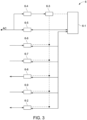
- Fig. 3 illustrates a further possible exemplary implementation of an emergency unit 6 according to the second aspect of the present invention.
- the emergency unit 6 can comprise different interfaces.
- the emergency unit 6 comprises a system-on-chip (SoC) primary controller 6-1 which may communicate with a secondary microcontroller 6-2 for higher loads.
- the emergency unit 6 comprises a buffer storage unit 6-3 adapted to supply the controllers 6-1, 6-2 and other entities of the emergency unit 6 with electrical power (dashed lines) in an emergency operation mode of the photovoltaic system 1.
- SoC system-on-chip
- the emergency unit 6 comprises an interface to the AC power lines 5 to receive AC power which may be converted by a power supply transformation entity 6-4 to provide DC power for recharging the local buffer storage unit 6-3. Further, the PLC transceiver 6-5 can be connected to the AC lines 5 as illustrated in Fig. 3 . In a possible implementation, the emergency unit 6 further comprises an interface to the smart meter 8. In the illustrated embodiment, the emergency unit 6 comprises a data interface for a local area network 6-6 and for an RS485 data cable 6-7. Further possible interfaces can be CAN, RS232, EE-Bus, Modbus, KNX Bus, TCP/IP, Modbus TCP, etc.
- the emergency unit 6 further comprises an interface with the emergency switch 7.
- the emergency unit 6 comprises a solid state relay SSR 6-8 to output a switch-on/switch-off control signal CTRL 1 for switching the emergency switch 7 between an on-switching state and an off-switching state.
- the emergency unit 6 can comprise in a possible implementation a feedback interface 6-9 receiving a feedback about the switching state of the emergency switch 7.
- the secondary controller 6-2 can be connected to external entities or devices such as a heat pump or external relays (GPIOs).
- the primary controller 6-1 which may be formed by a system-on-chip can comprise a local data memory.
- the primary controller 6-1 and the secondary controller 6-2 of the emergency unit 6 are both integrated in a control unit of the emergency unit 6.
- the communication between the controllers by means of PLC can comprise different levels of priority.
- a higher communication priority level includes the communication between the inverter unit 2 and the emergency unit 6 providing the emergency operation mode functionality of the photovoltaic system 1.
- communication between the emergency unit 6 and the smart meter 8, in particular the transmission of the smart meter data smd can comprise a high priority.
- the buffer battery 6-3 may comprise a high priority PLC communication in a backup mode. Communication concerning energy management via the I/O or RS485 has in a possible implementation a lower priority.
- the AC lines 5 illustrated in Fig. 1 comprise one or more power supply lines L.
- the AC lines 5 comprise three power supply lines for the different phases L1, L2, L3 as well as a P- and N-conductor.
Landscapes
- Engineering & Computer Science (AREA)
- Power Engineering (AREA)
- Supply And Distribution Of Alternating Current (AREA)
- Photovoltaic Devices (AREA)
- Ship Loading And Unloading (AREA)
- Cultivation Of Seaweed (AREA)
Description
- The invention relates to a photovoltaic system and in particular to a photovoltaic system for facilitating power management during an emergency situation using powerline communication.
- A photovoltaic system comprises photovoltaic modules which generate direct current (DC) power from solar radiation due to photovoltaic effect. The photovoltaic system comprises an inverter unit which transforms the DC power received from the photovoltaic modules into an alternating current (AC) power. The inverter may directly supply the AC power to the power supply grid (PSG). The AC power generated by the inverter unit also can either be used to provide a power supply for electrical loads locally or can also be fed into the PSG to be used elsewhere. Further, the photovoltaic system comprises an electric meter device to measure an amount of energy that passes through it to a public PSG.
- In case of a power failure of the PSG, a communication is necessary between the inverter unit and the PSG to inform a controller of the inverter unit of the photovoltaic system about the occurred power failure of the PSG. This communication is performed via a dedicated communication cable where the necessary notification is transmitted from the electric meter device of the photovoltaic system connected to the PSG to the inverter unit. A conventional photovoltaic system comprises separate dedicated cables which act a communication line and a power line between the PSG and the inverter. In case of a failure of the PSG, the dedicated communication line is used to exchange information between the inverter and the PSG about switching between a normal operating mode and a full backup emergency mode. During the normal operating mode, the PSG supplies electrical power to the load network. During the full backup emergency mode, the inverter supplies electrical power to the load network. For instance, the document
CN 110 661 295 A discloses a photovoltaic system comprising an electric energy meter and an inverter. The inverter has an inverter main body and a grid-connected protection device. The grid-connected protection device is connected between the inverter main body and a power utilization network and it is configured such that when a risk is detected the inverter main body is disconnected from the power utilization network and stopped. - Accordingly, it is an object of the present invention to provide a photovoltaic system where communication of information between PSG and the inverter takes place over the power line without installing additional wires or cables dedicated to the communication line such that a simplified solution for switching between the normal operating mode and the full backup emergency mode is provided. Omission of dedicated communication line between the PSG and the inverter for cost effective and reliable real-time solution for switching between the normal operating mode and the full backup emergency mode is thus provided.
- This object is achieved according to a first aspect of the present invention by a photovoltaic system comprising the features of
claim 1. - The invention provides according to a first aspect a photovoltaic system, comprising an inverter unit adapted to convert an electrical direct current (DC) power generated by photovoltaic modules into an electrical alternating current (AC) power, the inverter unit having a controller; a smart meter for supplying the alternating current (AC) power to a power supply grid; and an emergency unit connected to an inverter via AC lines and to the smart meter via an emergency switch. The emergency unit has a controller adapted to: open the emergency switch to automatically disconnect the photovoltaic system from the power supply grid if a power supply grid failure is detected, and notify a current switching state of the emergency switch by means of power line communication (PLC) communication via the AC lines to the controller of the inverter unit. In a normal operation mode of the photovoltaic system, the emergency switch is in a closed state, whereas in an emergency operation mode of the photovoltaic system, the emergency switch is in an open state to disconnect the photovoltaic system from the power supply grid. The controller of the inverter unit is adapted to start the emergency operation mode in response to an open switching state notification received from the controller of the emergency unit.
- Accordingly, in the photovoltaic system according to the present invention, a notification of the switching state of the emergency switch is performed by powerline communication PLC via the local AC lines of the photovoltaic system.
- A further advantage of the photovoltaic system according to the first aspect of the present invention resides in that the communication can be performed via the already existing AC lines so that no dedicated additional communication lines are required that have to be provided within the local photovoltaic system.
- This makes the photovoltaic system even more robust and reduces the cabling efforts when setting up the photovoltaic system.
- In a possible embodiment of the photovoltaic system according to the first aspect of the present invention, the failure of the power supply grid is detected by the controller of the emergency unit and/or by the controller of the inverter unit on the basis of smart meter data provided by the smart meter of the photovoltaic system via PLC communication. The smart meter data can be transmitted via PLC communication from the emergency unit to the inverter unit of the photovoltaic system.
- In a further possible embodiment of the photovoltaic system according to the first aspect of the present invention, a load network of the photovoltaic system is connected to the AC lines of the photovoltaic system.
- In a possible embodiment of the photovoltaic system according to the first aspect of the present invention, in a normal operation mode of the photovoltaic system, the electrical loads of the load network are supplied with AC power by the power supply grid via the closed emergency switch.
- In a further possible embodiment of the photovoltaic system according to the first aspect of the present invention, in an emergency operation mode of the photovoltaic system being disconnected from the power supply grid by the open emergency switch, the electrical loads of the load network are supplied with AC power by the inverter unit of the photovoltaic system.
- In a further possible embodiment of the photovoltaic system according to the first aspect of the present invention, the emergency unit comprises a PLC transceiver adapted to communicate with a PLC transceiver of the inverter unit via the AC lines of the photovoltaic system.
- In a further possible embodiment of the photovoltaic system according to the first aspect of the present invention, the inverter unit is connected to a storage unit of the photovoltaic system.
- In a further possible embodiment of the photovoltaic system according to the first aspect of the present invention, in the emergency operation mode of the photovoltaic system, the controller and the PLC transceiver of the inverter unit are supplied with electrical DC power by the photovoltaic modules and/or by the storage unit of the photovoltaic system.
- In a still further possible embodiment of the photovoltaic system according to the first aspect of the present invention, the emergency unit comprises a buffer storage unit adapted to supply the controller and the PLC transceiver of the emergency unit with electrical DC power in the emergency operation mode of the photovoltaic system.
- In a still further possible embodiment of the photovoltaic system according to the first aspect of the present invention, if the smart meter data indicate an end of the power supply grid failure, the controller of the emergency unit is adapted to close the emergency switch to automatically reconnect the photovoltaic system to the power supply grid.
- In a still further possible embodiment of the photovoltaic system according to the first aspect of the present invention, if the smart meter data (smd) indicate an end of the power supply grid failure, the controller of the inverter unit is adapted to inform the controller of the emergency unit to continue to keep the emergency switch in the open state for a predefined time. The controller of the emergency unit is adapted to switch the emergency switch to the closed state at the end of the predefined time.
- In a still further possible embodiment of the photovoltaic system according to the first aspect of the present invention, the controller of the inverter unit is adapted to stop the emergency operation mode in response to a closed switching state notification of the emergency switch received from the emergency unit.
- In a still further possible embodiment of the photovoltaic system according to the first aspect of the present invention, the emergency unit and the inverter unit comprise local network addresses used to establish a bidirectional PLC communication between the emergency unit and the inverter unit via the AC lines of the photovoltaic system.
- Accordingly, even in an emergency state, the communication between the inverter unit and the emergency unit is maintained because the entities can communicate with each other using predefined local network addresses without requiring a router-based IP address assignment.
- In a further possible embodiment of the photovoltaic system according to the first aspect of the present invention, the smart meter is integrated in the emergency unit.
- In a further possible alternative embodiment of the photovoltaic system according to the first aspect of the present invention, the smart meter is connected via a data cable to a data interface of the emergency unit.
- In a still further possible embodiment of the photovoltaic system according to the first aspect of the present invention, the controller of the emergency unit and/or the controller of the inverter unit are adapted to perform an energy management of the electrical AC power consumed by the loads of the load network, the DC power generated by the photovoltaic modules and the DC power stored in the storage unit of the photovoltaic system.
- In a further possible embodiment of the photovoltaic system according to the first aspect of the present invention, the smart meter data provided by the smart meter comprises a voltage, an electrical current and/or a frequency for all current phases L of the power supply grid.
- The invention further provides according to a second aspect an emergency unit comprising the features of claim 15.
- The invention provides according to the second aspect an emergency unit for a photovoltaic system according to the first aspect of the present invention wherein the emergency unit comprises:
- a controller adapted to control an emergency switch to connect the photovoltaic system in a normal operation mode with the power supply grid and to disconnect the photovoltaic system in an emergency operation mode from the power supply grid and comprising
- a PLC transceiver adapted to establish a PLC communication with a controller of an inverter unit of the photovoltaic system via AC lines of the photovoltaic system.
- In the following, possible embodiments of the different aspects of the present invention are described in more detail with reference to the enclosed figures.
- Fig. 1
- shows a block diagram of a possible exemplary embodiment of a photovoltaic system according to a first aspect of the present invention;
- Fig. 2
- shows a block diagram of a possible exemplary embodiment of an emergency unit of the photovoltaic system according to a further second aspect of the present invention;
- Fig. 3
- shows a diagram for illustrating a possible exemplary embodiment of an emergency unit of the photovoltaic system according to the second aspect of the present invention.
- As can be seen from the block diagram in
Fig. 1 , aphotovoltaic system 1 according to a first aspect of the present invention in the illustrated embodiment comprises aninverter unit 2 adapted to convert an electrical direct current, DC, power generated byphotovoltaic modules 3 into an electrical alternating current, AC, power. Theinverter unit 2 can in a possible embodiment also be connected to a localenergy storage unit 4 of thephotovoltaic system 1 which is adapted to store electrical energy. Theinverter unit 2 is connected to anemergency unit 6 and at least oneload network 9 vialocal AC lines 5 of thephotovoltaic system 1. Theemergency unit 6 is further connected to anemergency switch 7 via, for example, AC cables. In an embodiment, theemergency switch 7 is integrated with theemergency unit 6 as a single unit. In another embodiment, theemergency switch 7 and theemergency unit 6 are two separate units connected via, for example, a control cable such as YM-J. In another embodiment, theemergency switch 7, theemergency unit 6 and thesmart meter 8 are integrated as a single unit. - Further, as shown in the block diagram in
Fig. 1 , theemergency switch 7 is connected to asmart meter 8. Thesmart meter 8 is connected to the PSG 11. - Thus, the
inverter unit 2 supplies the AC power to a powersupply grid PSG 11 via theemergency unit 6, theemergency switch 7 and thesmart meter 8, as shown in the block diagram ofFig. 1 . - The
smart meter 8 is an electrical meter which can be provided to measure parameters of thePSG 11 and to provide a controller of theinverter unit 2 with smart meter data, smd. For example, the smd is a voltage value, a current value, frequency details, energy details associated with thePSG 11, etc. In an example, thesmart meter 8 is a measurement device to measure electrical parameters of thePSG 11 and/or electrical power flowing to/from thePSG 11. - As shown in
Fig. 2 , theemergency unit 6 comprises acontroller 6A which is adapted to open theemergency switch 7 to automatically disconnect thephotovoltaic system 1 from thePSG 11 if a power supply grid failure is detected. Thecontroller 6A is further adapted to notify a current switching state of theemergency switch 7 by means of powerline communication PLC via theAC lines 5 to a controller of theinverter unit 2. The controller of theinverter unit 2 is not explicitly shown inFig. 1 . - A failure of the
PSG 11 is detected by thecontroller 6A of theemergency unit 6 and/or by the controller of theinverter unit 2 on the basis of smart meter data smd provided by thesmart meter 8 of thephotovoltaic system 1. In a possible implementation, the smart meter data smd can be transmitted via a powerline communication PLC from thecontroller 6A of theemergency unit 6 via thePLC Transceiver Unit 6B (as shown inFig. 2 ) to the controller of theinverter unit 2. Theload network 9 of thephotovoltaic system 1 is connected to theAC lines 5 of thephotovoltaic system 1. - In a normal operation mode of the
photovoltaic system 1, the electrical loads of theload network 9 are connected to AC power by theexternal PSG 11 via theclosed emergency switch 7. The loads of theload network 9 are supplied with AC power by either thephotovoltaic modules 3 or thePSG 11. In contrast, in an emergency operation mode of thephotovoltaic system 1, theemergency switch 7 is in an open state. ThePSG 11 is disconnected and this causes theswitch 7 to move from a closed state to an open state. Being disconnected from theexternal PSG 11 by the switched-off and thusopen emergency switch 7, the electrical loads of theload network 9 are supplied with AC power by theinverter unit 2 of thephotovoltaic system 1. - The
emergency unit 6 comprises in a preferred embodiment, a PLC transceiver adapted to communicate bi-directionally with a PLC transceiver of theinverter unit 2 via thelocal AC lines 5 of thephotovoltaic system 1. - In the emergency operation mode of the
photovoltaic system 1, the controller and the PLC transceiver of theinverter unit 2 are both supplied with electrical power by thephotovoltaic modules 3 and/or by thelocal storage unit 4 of thephotovoltaic system 1. Further, theemergency unit 6 can also comprise a buffer storage unit which is adapted to supply thecontroller 6A and the PLC transceiver of theemergency unit 6 with electrical power during the emergency operation mode of thephotovoltaic system 1. - If the smart meter data smd provided by the
smart meter 8 indicate an end of the power supply grid failure, thecontroller 6A of theemergency unit 6 is adapted to close automatically theemergency switch 7 to reconnect thephotovoltaic system 1 to the external powersupply grid PSG 11. Theemergency unit 6 can control theemergency switch 7 by acontrol signal CTRL 1 as shown inFig. 1 . Thecontroller 6A of theemergency unit 6 can switch theemergency switch 7 on or off depending on the operation mode of thephotovoltaic system 1. The dashed lines inFig. 1 shows the signal paths in thesystem 1. - The controller of the
inverter unit 2 is adapted to start the emergency operation mode in response to an open switching state notification received from thecontroller 6A of theemergency unit 6. The open switching state notification indicates that theemergency switch 7 is in an emergency switch state. The open switching state notification can be communicated by means of PLC communication via the AC lines 5. The controller of theinverter unit 2 can stop the emergency operation mode in response to a closed switching state notification received from thecontroller 6A of theemergency unit 6. - In a preferred embodiment, both the
emergency unit 6 and theinverter unit 2 comprise assigned local network addresses used to establish the bidirectional PLC communication between theemergency unit 6 and theinverter unit 2 via theAC lines 5 of thephotovoltaic system 1. In the illustrated embodiment ofFig. 1 , thesmart meter 8 and theemergency unit 6 form separate entities of thephotovoltaic system 1. In an alternative embodiment, thesmart meter 8 can also be integrated in theemergency unit 6. In the illustrated embodiment ofFig. 1 , thesmart meter 8 can be connected via a data cable or a local area network LAN to a data interface of theemergency unit 6 to supply smart meter data smd. The smart meter data smd provided by thesmart meter 8 can comprise in a possible implementation, data relating to a voltage U, an electrical current I and/or a frequency f for all current phases L of the powersupply grid PSG 11. For example, the smart meter calculates an active power, a reactive power, an apparent power, a power factor, a phase shift, etc., from the measured data. - In a possible embodiment of the
photovoltaic system 1 according to the first aspect of the present invention, thecontroller 6A of theemergency unit 6 and/or the controller of theinverter unit 2 are adapted to perform an energy management of the electrical AC power consumed by the loads of theload network 9, the DC power generated by thephotovoltaic modules 3 and the DC power stored in thestorage unit 4 of thephotovoltaic system 1. - In the illustrated embodiment of
Fig. 1 , the controller of theinverter unit 2 can also control afurther switch 10 provided within theAC lines 5 of thephotovoltaic system 1. For instance, depending on the country and the effective norms, theswitch 7 can be a 3-terminal switch or a 4 terminal switch. In case theswitch 7 is a 3-terminal switch, then switch 10 is not a necessary part of thesystem 1. In an embodiment, theswitch 10 is integrated with theinverter unit 2 as a single unit. - In case the
switch 7 is a 4-terminal switch, and there is a disconnection of a 4 terminal switch from thePSG 11, then theswitch 10 acts as a connection between earth (P) and neutral wire (N). This connection between the neutral wire and the earth is necessary for any residual current monitoring unit (RCMU) to operate again. The connection between neutral wire and earth will thus be close to the source of power, which in case of an emergency operation is theinverter unit 2. Theinverter unit 2, thus, controls theswitch 10 via thecontrol signal CTRL 2. - In the
photovoltaic system 1 as illustrated in the embodiment ofFig. 1 , the controller of theinverter unit 2 is in communication with thecontroller 6A of theemergency unit 6 by means of PLC communication. Theemergency unit 6 can be either integrated into thesmart meter 8 or can form a standalone device connected to thesmart meter 8, e.g. by means of a data cable. Thesmart meter 8 can generate status data indicating a current state of the powersupply grid PSG 11 and can provide corresponding smart meter data smd to thecontroller 6A of theemergency unit 6. - In a normal operation mode, for example, the
smart meter 8 can acquire a grid-on status of the powersupply grid PSG 11 and can transmit this status to thecontroller 6A of theemergency unit 6. Theemergency unit 6 can transmit the received grid-on status as well as additional smart meter data smd to the controller of theinverter unit 2. The controller of theinverter unit 2 can inform thecontroller 6A of theemergency unit 6 to keep theemergency switch 7 in a closed switching state. Accordingly, thecontroller 6A of theemergency unit 6 then controls in the normal operation mode theemergency switch 7 such that it is in a closed switching state. Thecontroller 6A of theemergency unit 6 can inform the controller of theinverter unit 2 about the grid-on status of the powersupply grid PSG 11 via theAC power lines 5 of thephotovoltaic system 1. Accordingly, in the normal operation mode, the powersupply grid PSG 11 supplies electrical power via theclosed emergency switch 7 to theload network 9 of thephotovoltaic system 1. In an embodiment, in the normal operation mode, thePSG 11 receives electrical power from thephotovoltaic modules 3. - In contrast, if the power
supply grid PSG 11 is off, thesmart meter 8 stops transmitting the grid-on status to thecontroller 6A of theemergency unit 6. As a consequence, thecontroller 6A of theemergency unit 6 switches theemergency switch 7 into an open switch state. Further, thecontroller 6A of theemergency unit 6 transmits the grid-off status to the controller of theinverter unit 2. The controller of theinverter unit 2 informs thecontroller 6A of theemergency unit 6 to retain theemergency switch 7 in the open switch state. Theemergency switch 7 is now locked in the open switching state by thecontroller 6A of theemergency unit 6. The controller of theinverter unit 2 controls theinverter unit 2 to start supplying an AC power supply to thelocal load network 9 of thephotovoltaic system 1. - Further, if the power
supply grid PSG 11 is on again, that is, if there is no longer a power supply grid failure, thesmart meter 8 can receive in a possible embodiment a grid-on status from the powersupply grid PSG 11. Thesmart meter 8 can transmit the power supply grid-on status to thecontroller 6A of theemergency unit 6. Thecontroller 6A of theemergency unit 6 then transmits the grid-on status as well as additional smart meter data smd to the controller of theinverter unit 2. - The controller of the
inverter unit 2 in turn informs thecontroller 6A of theemergency unit 6 to continue to keep theemergency switch 7 in the open state for a predefined time. Thecontroller 6A of theemergency unit 6 continues to keep theemergency switch 7 in the open state for the indicated predefined time. This time can be defined by the controller of theinverter unit 2. In a possible embodiment, thecontroller 6A of theemergency unit 6 can continue the check for the grid-on status signal from thesmart meter 8 and further in a possible implementation, the grid values can also be considered by the controller of theinverter unit 2. At the end of the predefined time, thecontroller 6A of theemergency unit 6 switches theemergency switch 7 to the closed state. The powersupply grid PSG 11 now supplies AC power via theclosed emergency switch 7 to thelocal load network 9 again. Theinverter unit 2 stops supplying AC power to theload network 9. - The block diagram of
Fig. 2 illustrates a possible embodiment of theemergency unit 6 according to the second aspect of the present invention. Theemergency unit 6 comprises in the illustrated embodiment acontroller 6A and aPLC transceiver 6B. Thecontroller 6A is adapted to control anemergency switch 7 of thephotovoltaic system 1 to connect thephotovoltaic system 1 in a normal operation mode with the powersupply grid PSG 11 and to disconnect thephotovoltaic system 1 in an emergency operation mode from the powersupply grid PSG 11. ThePLC transceiver 6B is adapted to establish a PLC communication with the controller of theinverter unit 2 of thephotovoltaic system 1 viaAC lines 5 of thephotovoltaic system 1. -
Fig. 3 illustrates a further possible exemplary implementation of anemergency unit 6 according to the second aspect of the present invention. As can be seen from the diagram ofFig. 3 , theemergency unit 6 can comprise different interfaces. In the illustrated embodiment, theemergency unit 6 comprises a system-on-chip (SoC) primary controller 6-1 which may communicate with a secondary microcontroller 6-2 for higher loads. In the illustrated embodiment, theemergency unit 6 comprises a buffer storage unit 6-3 adapted to supply the controllers 6-1, 6-2 and other entities of theemergency unit 6 with electrical power (dashed lines) in an emergency operation mode of thephotovoltaic system 1. Theemergency unit 6 comprises an interface to theAC power lines 5 to receive AC power which may be converted by a power supply transformation entity 6-4 to provide DC power for recharging the local buffer storage unit 6-3. Further, the PLC transceiver 6-5 can be connected to theAC lines 5 as illustrated inFig. 3 . In a possible implementation, theemergency unit 6 further comprises an interface to thesmart meter 8. In the illustrated embodiment, theemergency unit 6 comprises a data interface for a local area network 6-6 and for an RS485 data cable 6-7. Further possible interfaces can be CAN, RS232, EE-Bus, Modbus, KNX Bus, TCP/IP, Modbus TCP, etc. However, it is to be noted that the possible interfaces are not limited to the explicitly described interfaces and can be modified based on the application and usage of thephotovoltaic system 1. Theemergency unit 6 further comprises an interface with theemergency switch 7. In the illustrated embodiment, theemergency unit 6 comprises a solid state relay SSR 6-8 to output a switch-on/switch-offcontrol signal CTRL 1 for switching theemergency switch 7 between an on-switching state and an off-switching state. Further, theemergency unit 6 can comprise in a possible implementation a feedback interface 6-9 receiving a feedback about the switching state of theemergency switch 7. - The secondary controller 6-2 can be connected to external entities or devices such as a heat pump or external relays (GPIOs). The primary controller 6-1 which may be formed by a system-on-chip can comprise a local data memory. In a possible implementation, the primary controller 6-1 and the secondary controller 6-2 of the
emergency unit 6 are both integrated in a control unit of theemergency unit 6. - In a possible implementation of the
photovoltaic system 1 and of theemergency unit 6 according to the present invention, the communication between the controllers by means of PLC can comprise different levels of priority. A higher communication priority level includes the communication between theinverter unit 2 and theemergency unit 6 providing the emergency operation mode functionality of thephotovoltaic system 1. Further, communication between theemergency unit 6 and thesmart meter 8, in particular the transmission of the smart meter data smd, can comprise a high priority. The buffer battery 6-3 may comprise a high priority PLC communication in a backup mode. Communication concerning energy management via the I/O or RS485 has in a possible implementation a lower priority. - The AC lines 5 illustrated in
Fig. 1 comprise one or more power supply lines L. In a preferred embodiment, theAC lines 5 comprise three power supply lines for the different phases L1, L2, L3 as well as a P- and N-conductor.
Claims (15)
- A photovoltaic system (1), comprising:- an inverter unit (2) adapted to convert an electrical direct current (DC) power generated by photovoltaic modules (3) into an electrical alternating current (AC) power, the inverter unit (2) having a controller;- a smart meter (8) for supplying the alternating current (AC) power to a power supply grid (11); and- an emergency unit (6) connected to an inverter via AC lines (5) and to the smart meter (8) via an emergency switch (7), the emergency unit (6) having a controller (6A) adapted to:open the emergency switch (7) to automatically disconnect the photovoltaic system (1) from the power supply grid (11) if a power supply grid failure is detected, andnotify a current switching state of the emergency switch (7) by means of power line communication (PLC) communication via the AC lines (5) to the controller of the inverter unit (2),wherein in a normal operation mode of the photovoltaic system (1), the emergency switch (7) is in a closed state,wherein in an emergency operation mode of the photovoltaic system (1), the emergency switch (7) is in an open state to disconnect the photovoltaic system (1) from the power supply grid (11), andwherein the controller of the inverter unit (2) is adapted to start the emergency operation mode in response to an open switching state notification received from the controller (6A) of the emergency unit (6).
- The photovoltaic system according to claim 1 wherein a failure of the power supply grid (11) is detected by the controller (6A) of the emergency unit (6) and/or by the controller of the inverter unit (2) on the basis of smart meter data (smd) provided by the smart meter (8) of the photovoltaic system (1) via PLC communication.
- The photovoltaic system according to claim 1 or 2 wherein a load network (9) of the photovoltaic system (1) is connected to the AC lines (5) of the photovoltaic system (1),wherein in a normal operation mode of the photovoltaic system (1), the electrical loads of the load network (9) are supplied with AC power by the power supply grid (11) via the closed emergency switch (7),wherein in an emergency operation mode of the photovoltaic system (1) being disconnected from the power supply grid (11) by the open emergency switch (7), the electrical loads of the load network (9) are supplied with AC power by the inverter unit (2) of the photovoltaic system (1) .
- The photovoltaic system of claim 1 wherein the emergency unit (6) comprises a PLC transceiver adapted to communicate with a PLC transceiver of the inverter unit (2) via the AC lines (5) of the photovoltaic system (1).
- The photovoltaic system according to any of the preceding claims wherein the inverter unit (2) is connected to a storage unit (4) of the photovoltaic system (1).
- The photovoltaic system according to any of the preceding claims wherein in the emergency operation mode of the photovoltaic system (1), the controller (6A) and the PLC transceiver of the inverter unit (2) are supplied with electrical DC power by the photovoltaic modules (3) and/or by the storage unit (4) of the photovoltaic system (1) .
- The photovoltaic system according to any of the preceding claims wherein the emergency unit (6) comprises a buffer storage unit adapted to supply the controller (6A) and the PLC transceiver of the emergency unit (6) with electrical DC power in the emergency operation mode of the photovoltaic system (1).
- The photovoltaic system according to any of claims 2 to 6 wherein, if the smart meter data (smd) indicate an end of the power supply grid failure, the controller (6A) of the emergency unit (6) is adapted to close the emergency switch (7) to automatically reconnect the photovoltaic system (1) to the power supply grid (11).
- The photovoltaic system according to claim 8 wherein, if the smart meter data (smd) indicate an end of the power supply grid failure, the controller of the inverter unit (2) is adapted to inform the controller (6A) of the emergency unit (6) to continue to keep the emergency switch (7) in the open state for a predefined time, and wherein the controller (6A) of the emergency unit (6) is adapted to switch the emergency switch (7) to the closed state at the end of the predefined time.
- The photovoltaic system according to any of the preceding claims wherein the controller of the inverter unit (2) is adapted to stop the emergency operation mode in response to a closed switching state notification of the emergency switch (7) received from the emergency unit (6).
- The photovoltaic system according to any of the preceding claims wherein the emergency unit (6) and the inverter unit (2) comprise local network addresses used to establish a bidirectional PLC communication between the emergency unit (6) and the inverter unit (2) via the AC lines (5) of the photovoltaic system (1).
- The photovoltaic system according to any of the preceding claims wherein the smart meter (8) is integrated in the emergency unit (6) or is connected via a data cable to a data interface of the emergency unit (6).
- The photovoltaic system according to any of the preceding claims wherein the controller (6A) of the emergency unit (6) and/or the controller of the inverter unit (2) are adapted to perform an energy management of the electrical AC power consumed by the loads of the load network (9), the DC power generated by the photovoltaic modules (3) and the DC power stored in the storage unit (4) of the photovoltaic system (1).
- The photovoltaic system according to any of claims 2 to 13 wherein the smart meter data (smd) provided by the smart meter (8) comprises a voltage, an electrical current and/or a frequency for all current phases, L, of the power supply grid (11).
- An emergency unit for a photovoltaic system (1) according to any of the preceding claims, said emergency unit (6) comprising:- a controller (6A) adapted to control an emergency switch (7) to connect the photovoltaic system (1) in a normal operation mode with the power supply grid (11) and to disconnect the photovoltaic system (1) in an emergency operation mode from the power supply grid (11); and- a PLC transceiver (6B) adapted to establish a PLC communication with a controller of an inverter unit (2) of the photovoltaic system (1) via AC lines (5) of the photovoltaic system (1).
Applications Claiming Priority (2)
| Application Number | Priority Date | Filing Date | Title |
|---|---|---|---|
| EP20200133.5A EP3979450A1 (en) | 2020-10-05 | 2020-10-05 | Photovoltaic system |
| PCT/EP2021/076656 WO2022073804A1 (en) | 2020-10-05 | 2021-09-28 | Photovoltaic system |
Publications (3)
| Publication Number | Publication Date |
|---|---|
| EP4226474A1 EP4226474A1 (en) | 2023-08-16 |
| EP4226474C0 EP4226474C0 (en) | 2024-11-06 |
| EP4226474B1 true EP4226474B1 (en) | 2024-11-06 |
Family
ID=72752374
Family Applications (2)
| Application Number | Title | Priority Date | Filing Date |
|---|---|---|---|
| EP20200133.5A Withdrawn EP3979450A1 (en) | 2020-10-05 | 2020-10-05 | Photovoltaic system |
| EP21786141.8A Active EP4226474B1 (en) | 2020-10-05 | 2021-09-28 | Photovoltaic system |
Family Applications Before (1)
| Application Number | Title | Priority Date | Filing Date |
|---|---|---|---|
| EP20200133.5A Withdrawn EP3979450A1 (en) | 2020-10-05 | 2020-10-05 | Photovoltaic system |
Country Status (9)
| Country | Link |
|---|---|
| US (1) | US12463460B2 (en) |
| EP (2) | EP3979450A1 (en) |
| CN (1) | CN116325409A (en) |
| AU (1) | AU2021358305B2 (en) |
| ES (1) | ES2994681T3 (en) |
| HU (1) | HUE069589T2 (en) |
| IL (1) | IL301931A (en) |
| PL (1) | PL4226474T3 (en) |
| WO (1) | WO2022073804A1 (en) |
Family Cites Families (7)
| Publication number | Priority date | Publication date | Assignee | Title |
|---|---|---|---|---|
| WO2015111410A1 (en) * | 2014-01-22 | 2015-07-30 | 京セラ株式会社 | Power control system and method for controlling power control system |
| CN203689677U (en) * | 2014-02-14 | 2014-07-02 | 瑞斯康微电子(深圳)有限公司 | Photovoltaic inverter power line carrier communication system |
| US10348094B2 (en) * | 2015-01-28 | 2019-07-09 | Abb Schweiz Ag | Energy panel arrangement shutdown |
| US10965153B2 (en) * | 2016-02-05 | 2021-03-30 | Duke Energy Corporation | Methods of microgrid communications and connection transitions |
| WO2017199645A1 (en) * | 2016-05-18 | 2017-11-23 | 株式会社村田製作所 | Power supply device, power supply method, and power storage device |
| CN109638795B (en) * | 2019-01-16 | 2020-07-24 | 科华恒盛股份有限公司 | Emergency stop control method and device for string type photovoltaic inverter system |
| CN110661295B (en) * | 2019-10-15 | 2022-07-15 | 阳光新能源开发股份有限公司 | Inverter and photovoltaic power generation system |
-
2020
- 2020-10-05 EP EP20200133.5A patent/EP3979450A1/en not_active Withdrawn
-
2021
- 2021-09-28 PL PL21786141.8T patent/PL4226474T3/en unknown
- 2021-09-28 US US18/246,615 patent/US12463460B2/en active Active
- 2021-09-28 ES ES21786141T patent/ES2994681T3/en active Active
- 2021-09-28 EP EP21786141.8A patent/EP4226474B1/en active Active
- 2021-09-28 WO PCT/EP2021/076656 patent/WO2022073804A1/en not_active Ceased
- 2021-09-28 AU AU2021358305A patent/AU2021358305B2/en active Active
- 2021-09-28 IL IL301931A patent/IL301931A/en unknown
- 2021-09-28 HU HUE21786141A patent/HUE069589T2/en unknown
- 2021-09-28 CN CN202180068349.7A patent/CN116325409A/en active Pending
Also Published As
| Publication number | Publication date |
|---|---|
| HUE069589T2 (en) | 2025-03-28 |
| EP4226474C0 (en) | 2024-11-06 |
| CN116325409A (en) | 2023-06-23 |
| PL4226474T3 (en) | 2025-03-17 |
| US12463460B2 (en) | 2025-11-04 |
| WO2022073804A1 (en) | 2022-04-14 |
| ES2994681T3 (en) | 2025-01-29 |
| AU2021358305B2 (en) | 2023-12-14 |
| US20250183710A1 (en) | 2025-06-05 |
| EP3979450A1 (en) | 2022-04-06 |
| IL301931A (en) | 2023-06-01 |
| AU2021358305A1 (en) | 2023-03-23 |
| EP4226474A1 (en) | 2023-08-16 |
Similar Documents
| Publication | Publication Date | Title |
|---|---|---|
| US12431702B2 (en) | Integrated electrical management system and architecture | |
| EP2702656B1 (en) | Power demand management on a low voltage network with a plurality of intelligent sockets | |
| AU2012212484A1 (en) | Energy interface system | |
| US12395009B2 (en) | Convertible energy control system | |
| EP4066342A1 (en) | Methods and apparatus for grid connectivity control | |
| EP4226474B1 (en) | Photovoltaic system | |
| AU2021301379B2 (en) | Method and apparatus for balancing loads on split-phase islanded systems | |
| US20250125627A1 (en) | Energy management systems | |
| CN210806749U (en) | Grid-connected and grid-disconnected switching circuit for energy storage system | |
| CN114435180B (en) | Energy supply system, method for operating an energy supply system and vehicle | |
| TWI622248B (en) | Power Distribution Unit Capable of Automatically Switching Power Source | |
| JP2018064430A (en) | Charge / discharge device and power control device | |
| CN215267684U (en) | Storage battery core accommodating and discharging device | |
| WO2025014631A1 (en) | Low voltage bypass for extreme low ac voltage ride through | |
| WO2023129422A1 (en) | Microinverter for use with storage system | |
| WO2025259416A1 (en) | Meter collars configured for use with energy management systems | |
| AU2024355341A1 (en) | Bi-directional vehicle charging apparatus and method | |
| WO2025073851A2 (en) | Bi-directional vehicle charging apparatus and method | |
| KR20230090900A (en) | I/O components system used in power conversion devices | |
| CN121586979A (en) | Energy storage system and method of operating the same |
Legal Events
| Date | Code | Title | Description |
|---|---|---|---|
| STAA | Information on the status of an ep patent application or granted ep patent |
Free format text: STATUS: UNKNOWN |
|
| STAA | Information on the status of an ep patent application or granted ep patent |
Free format text: STATUS: THE INTERNATIONAL PUBLICATION HAS BEEN MADE |
|
| PUAI | Public reference made under article 153(3) epc to a published international application that has entered the european phase |
Free format text: ORIGINAL CODE: 0009012 |
|
| STAA | Information on the status of an ep patent application or granted ep patent |
Free format text: STATUS: REQUEST FOR EXAMINATION WAS MADE |
|
| 17P | Request for examination filed |
Effective date: 20230505 |
|
| AK | Designated contracting states |
Kind code of ref document: A1 Designated state(s): AL AT BE BG CH CY CZ DE DK EE ES FI FR GB GR HR HU IE IS IT LI LT LU LV MC MK MT NL NO PL PT RO RS SE SI SK SM TR |
|
| DAV | Request for validation of the european patent (deleted) | ||
| DAX | Request for extension of the european patent (deleted) | ||
| GRAP | Despatch of communication of intention to grant a patent |
Free format text: ORIGINAL CODE: EPIDOSNIGR1 |
|
| STAA | Information on the status of an ep patent application or granted ep patent |
Free format text: STATUS: GRANT OF PATENT IS INTENDED |
|
| INTG | Intention to grant announced |
Effective date: 20240619 |
|
| GRAS | Grant fee paid |
Free format text: ORIGINAL CODE: EPIDOSNIGR3 |
|
| GRAA | (expected) grant |
Free format text: ORIGINAL CODE: 0009210 |
|
| STAA | Information on the status of an ep patent application or granted ep patent |
Free format text: STATUS: THE PATENT HAS BEEN GRANTED |
|
| AK | Designated contracting states |
Kind code of ref document: B1 Designated state(s): AL AT BE BG CH CY CZ DE DK EE ES FI FR GB GR HR HU IE IS IT LI LT LU LV MC MK MT NL NO PL PT RO RS SE SI SK SM TR |
|
| REG | Reference to a national code |
Ref country code: GB Ref legal event code: FG4D |
|
| REG | Reference to a national code |
Ref country code: CH Ref legal event code: EP |
|
| REG | Reference to a national code |
Ref country code: DE Ref legal event code: R096 Ref document number: 602021021515 Country of ref document: DE |
|
| REG | Reference to a national code |
Ref country code: IE Ref legal event code: FG4D |
|
| U01 | Request for unitary effect filed |
Effective date: 20241111 |
|
| U07 | Unitary effect registered |
Designated state(s): AT BE BG DE DK EE FI FR IT LT LU LV MT NL PT RO SE SI Effective date: 20241119 |
|
| REG | Reference to a national code |
Ref country code: ES Ref legal event code: FG2A Ref document number: 2994681 Country of ref document: ES Kind code of ref document: T3 Effective date: 20250129 |
|
| REG | Reference to a national code |
Ref country code: HU Ref legal event code: AG4A Ref document number: E069589 Country of ref document: HU |
|
| PG25 | Lapsed in a contracting state [announced via postgrant information from national office to epo] |
Ref country code: HR Free format text: LAPSE BECAUSE OF FAILURE TO SUBMIT A TRANSLATION OF THE DESCRIPTION OR TO PAY THE FEE WITHIN THE PRESCRIBED TIME-LIMIT Effective date: 20241106 Ref country code: IS Free format text: LAPSE BECAUSE OF FAILURE TO SUBMIT A TRANSLATION OF THE DESCRIPTION OR TO PAY THE FEE WITHIN THE PRESCRIBED TIME-LIMIT Effective date: 20250306 |
|
| PG25 | Lapsed in a contracting state [announced via postgrant information from national office to epo] |
Ref country code: NO Free format text: LAPSE BECAUSE OF FAILURE TO SUBMIT A TRANSLATION OF THE DESCRIPTION OR TO PAY THE FEE WITHIN THE PRESCRIBED TIME-LIMIT Effective date: 20250206 |
|
| PG25 | Lapsed in a contracting state [announced via postgrant information from national office to epo] |
Ref country code: GR Free format text: LAPSE BECAUSE OF FAILURE TO SUBMIT A TRANSLATION OF THE DESCRIPTION OR TO PAY THE FEE WITHIN THE PRESCRIBED TIME-LIMIT Effective date: 20250207 |
|
| PG25 | Lapsed in a contracting state [announced via postgrant information from national office to epo] |
Ref country code: RS Free format text: LAPSE BECAUSE OF FAILURE TO SUBMIT A TRANSLATION OF THE DESCRIPTION OR TO PAY THE FEE WITHIN THE PRESCRIBED TIME-LIMIT Effective date: 20250206 |
|
| PG25 | Lapsed in a contracting state [announced via postgrant information from national office to epo] |
Ref country code: SM Free format text: LAPSE BECAUSE OF FAILURE TO SUBMIT A TRANSLATION OF THE DESCRIPTION OR TO PAY THE FEE WITHIN THE PRESCRIBED TIME-LIMIT Effective date: 20241106 |
|
| PG25 | Lapsed in a contracting state [announced via postgrant information from national office to epo] |
Ref country code: SK Free format text: LAPSE BECAUSE OF FAILURE TO SUBMIT A TRANSLATION OF THE DESCRIPTION OR TO PAY THE FEE WITHIN THE PRESCRIBED TIME-LIMIT Effective date: 20241106 |
|
| PG25 | Lapsed in a contracting state [announced via postgrant information from national office to epo] |
Ref country code: CZ Free format text: LAPSE BECAUSE OF FAILURE TO SUBMIT A TRANSLATION OF THE DESCRIPTION OR TO PAY THE FEE WITHIN THE PRESCRIBED TIME-LIMIT Effective date: 20241106 |
|
| PLBE | No opposition filed within time limit |
Free format text: ORIGINAL CODE: 0009261 |
|
| STAA | Information on the status of an ep patent application or granted ep patent |
Free format text: STATUS: NO OPPOSITION FILED WITHIN TIME LIMIT |
|
| 26N | No opposition filed |
Effective date: 20250807 |
|
| PGFP | Annual fee paid to national office [announced via postgrant information from national office to epo] |
Ref country code: HU Payment date: 20250926 Year of fee payment: 5 |
|
| U20 | Renewal fee for the european patent with unitary effect paid |
Year of fee payment: 5 Effective date: 20250925 |
|
| PGFP | Annual fee paid to national office [announced via postgrant information from national office to epo] |
Ref country code: PL Payment date: 20250922 Year of fee payment: 5 |
|
| PGFP | Annual fee paid to national office [announced via postgrant information from national office to epo] |
Ref country code: ES Payment date: 20251008 Year of fee payment: 5 |