EP4225596B1 - Device for adjusting the attitude of a motor vehicle, and automotive shock absorber provided with such device - Google Patents
Device for adjusting the attitude of a motor vehicle, and automotive shock absorber provided with such device Download PDFInfo
- Publication number
- EP4225596B1 EP4225596B1 EP21798775.9A EP21798775A EP4225596B1 EP 4225596 B1 EP4225596 B1 EP 4225596B1 EP 21798775 A EP21798775 A EP 21798775A EP 4225596 B1 EP4225596 B1 EP 4225596B1
- Authority
- EP
- European Patent Office
- Prior art keywords
- chamber
- primary cylinder
- shock absorber
- axially
- bumper
- Prior art date
- Legal status (The legal status is an assumption and is not a legal conclusion. Google has not performed a legal analysis and makes no representation as to the accuracy of the status listed.)
- Active
Links
Images


Classifications
-
- B—PERFORMING OPERATIONS; TRANSPORTING
- B60—VEHICLES IN GENERAL
- B60G—VEHICLE SUSPENSION ARRANGEMENTS
- B60G7/00—Pivoted suspension arms; Accessories thereof
- B60G7/04—Buffer means for limiting movement of arms
-
- B—PERFORMING OPERATIONS; TRANSPORTING
- B60—VEHICLES IN GENERAL
- B60G—VEHICLE SUSPENSION ARRANGEMENTS
- B60G15/00—Resilient suspensions characterised by arrangement, location or type of combined spring and vibration damper, e.g. telescopic type
- B60G15/02—Resilient suspensions characterised by arrangement, location or type of combined spring and vibration damper, e.g. telescopic type having mechanical spring
- B60G15/06—Resilient suspensions characterised by arrangement, location or type of combined spring and vibration damper, e.g. telescopic type having mechanical spring and fluid damper
- B60G15/062—Resilient suspensions characterised by arrangement, location or type of combined spring and vibration damper, e.g. telescopic type having mechanical spring and fluid damper the spring being arranged around the damper
-
- B—PERFORMING OPERATIONS; TRANSPORTING
- B60—VEHICLES IN GENERAL
- B60G—VEHICLE SUSPENSION ARRANGEMENTS
- B60G17/00—Resilient suspensions having means for adjusting the spring or vibration-damper characteristics, for regulating the distance between a supporting surface and a sprung part of vehicle or for locking suspension during use to meet varying vehicular or surface conditions, e.g. due to speed or load
- B60G17/02—Spring characteristics, e.g. mechanical springs and mechanical adjusting means
- B60G17/027—Mechanical springs regulated by fluid means
- B60G17/0272—Mechanical springs regulated by fluid means the mechanical spring being a coil spring
-
- F—MECHANICAL ENGINEERING; LIGHTING; HEATING; WEAPONS; BLASTING
- F16—ENGINEERING ELEMENTS AND UNITS; GENERAL MEASURES FOR PRODUCING AND MAINTAINING EFFECTIVE FUNCTIONING OF MACHINES OR INSTALLATIONS; THERMAL INSULATION IN GENERAL
- F16F—SPRINGS; SHOCK-ABSORBERS; MEANS FOR DAMPING VIBRATION
- F16F9/00—Springs, vibration-dampers, shock-absorbers, or similarly-constructed movement-dampers using a fluid or the equivalent as damping medium
- F16F9/32—Details
- F16F9/56—Means for adjusting the length of, or for locking, the spring or damper, e.g. at the end of the stroke
-
- F—MECHANICAL ENGINEERING; LIGHTING; HEATING; WEAPONS; BLASTING
- F16—ENGINEERING ELEMENTS AND UNITS; GENERAL MEASURES FOR PRODUCING AND MAINTAINING EFFECTIVE FUNCTIONING OF MACHINES OR INSTALLATIONS; THERMAL INSULATION IN GENERAL
- F16F—SPRINGS; SHOCK-ABSORBERS; MEANS FOR DAMPING VIBRATION
- F16F9/00—Springs, vibration-dampers, shock-absorbers, or similarly-constructed movement-dampers using a fluid or the equivalent as damping medium
- F16F9/32—Details
- F16F9/58—Stroke limiting stops, e.g. arranged on the piston rod outside the cylinder
-
- B—PERFORMING OPERATIONS; TRANSPORTING
- B60—VEHICLES IN GENERAL
- B60G—VEHICLE SUSPENSION ARRANGEMENTS
- B60G2202/00—Indexing codes relating to the type of spring, damper or actuator
- B60G2202/30—Spring/Damper and/or actuator Units
- B60G2202/31—Spring/Damper and/or actuator Units with the spring arranged around the damper, e.g. MacPherson strut
- B60G2202/312—The spring being a wound spring
-
- B—PERFORMING OPERATIONS; TRANSPORTING
- B60—VEHICLES IN GENERAL
- B60G—VEHICLE SUSPENSION ARRANGEMENTS
- B60G2202/00—Indexing codes relating to the type of spring, damper or actuator
- B60G2202/40—Type of actuator
- B60G2202/41—Fluid actuator
- B60G2202/413—Hydraulic actuator
-
- B—PERFORMING OPERATIONS; TRANSPORTING
- B60—VEHICLES IN GENERAL
- B60G—VEHICLE SUSPENSION ARRANGEMENTS
- B60G2204/00—Indexing codes related to suspensions per se or to auxiliary parts
- B60G2204/40—Auxiliary suspension parts; Adjustment of suspensions
- B60G2204/45—Stops limiting travel
- B60G2204/4502—Stops limiting travel using resilient buffer
- B60G2204/45021—Stops limiting travel using resilient buffer for limiting upper mount movement of a McPherson strut
Definitions
- This invention is generally in the field of automotive components; in particular, the invention relates to an automotive shock absorber having an attitude adjustment device.
- document JP S62 27809 U discloses a device according to the preamble of claim 1
- documents US 2007/200311 A1 , DE 10 2004 019991 A1 , EP 2 476 930 A1 , KR 2004 0006903 A , DE 10 2011 053854 A1 , JP S64 48307 U , JP 2008 044571 A and US 2008/179148 A1 describe further devices of the state of the art.
- Systems for adjusting the attitude of a motor vehicle comprising an actuator capable of varying the vertical travel of the vehicle's shock absorber.
- An object of this invention is to provide a device which allows, on the one hand, to adjust the distance between the spring plate (connected to the unsprung mass, for example to a structure integral with the wheel hub, or to the cylindrical tube of an automotive shock absorber) and the sprung mass of the vehicle (so as to vary the height of the sprung mass above the ground under static conditions); and on the other hand, to adjust the distance between a resilient bumper and the unsprung mass of the vehicle, so as to reduce or increase the vertical travel of the sprung mass with respect to the unsprung mass (for example, by forming a limit stop for the cylindrical tube of the shock absorber in the compression phase of the shock absorber).
- a further object of this invention is to provide a device for the adjustment of the attitude of a vehicle and coordinated adjustment of the bumper clearance, which at the same time has a simplified architecture and a smaller size (particularly in the radial sense).
- an attitude adjustment device for a motor vehicle comprises a cylindrical body which defines a chamber in which two actuators are slidably housed in the form of a cylinder within which a piston slides, said cylinder being connected to a bumper (adapted to form a limit stop in compression of the sprung mass of the vehicle with respect to the unsprung mass), and said piston being connectable to the sprung mass of the vehicle.
- the actuators are configured to be driven in axial movement by the inlet of a pressurized fluid into the chamber that houses them.
- the two actuators are lowered with respect to the reference plane, shortening both the compression stroke of the shock absorber and the ground clearance of the sprung mass.
- the setup is optimized for higher performance conditions (for example, for using the vehicle on a track).
- a device 9 for adjusting the attitude of a motor vehicle comprises a cylindrical body 10, which includes a radially projecting first flange 12, said flange 12 being adapted to form an upper bearing of a main spring of an automotive suspension (e.g., the spring of a shock absorber).
- a main spring of an automotive suspension e.g., the spring of a shock absorber
- the cylindrical body 10 defines a first, axially lower chamber 14a and a second, axially upper chamber 14b (with respect to the orientation that the device 9 assumes under conditions of use), said second chamber 14b being hermetically sealed above by a lid 16 and is configured to be placed in fluid connection with the exterior of the cylindrical body 10 via a through hole 18 in the cylindrical body 10.
- the first and second chambers 14a, 14b are fluidically decoupled by a septum 20, axially interposed between said first and second chamber 14a, 14b.
- a bumper 22 is also provided, which is slidably received in the first chamber 14a of the cylindrical body 10 and is adapted to form a limit stop for the oscillation of the sprung mass of the vehicle when the latter approaches the unsprung mass of the vehicle.
- the device 9 further comprises a primary actuator 24, which in turn includes a primary cylinder 26, slidably housed in the second chamber 14b of the cylindrical body 10, said primary cylinder 26 being axially movable from a first position (proximal to the septum 20), to a second position (proximal to the lid 16), in response to the inlet or withdrawal of fluid into/from the second chamber 14b.
- a primary actuator 24 which in turn includes a primary cylinder 26, slidably housed in the second chamber 14b of the cylindrical body 10, said primary cylinder 26 being axially movable from a first position (proximal to the septum 20), to a second position (proximal to the lid 16), in response to the inlet or withdrawal of fluid into/from the second chamber 14b.
- the primary cylinder 26 defines within itself a third chamber 27, in fluid connection with said second chamber 14b.
- the primary actuator 24 further comprises a primary rod 28, passing axially through the septum 20 and connected at its opposite ends to the primary cylinder 26 and the bumper 22, respectively.
- the primary rod 28 is adapted to cause the bumper 22 to slide in the first chamber 14a in the same direction as the sliding of the primary cylinder 26 in the second chamber 14b.
- the device 9 further comprises a secondary actuator 30, which includes an auxiliary piston 32 slidably received in the third chamber 27 of the primary cylinder 26, said auxiliary piston 32 being configured to move axially with respect to the primary cylinder 26 in response to the inlet or withdrawal of fluid into/from the third chamber 27.
- a secondary actuator 30 which includes an auxiliary piston 32 slidably received in the third chamber 27 of the primary cylinder 26, said auxiliary piston 32 being configured to move axially with respect to the primary cylinder 26 in response to the inlet or withdrawal of fluid into/from the third chamber 27.
- the secondary actuator 30 also comprises a secondary rod 34, axially passing through the lid 16 and connected at a first end to the auxiliary piston 32, the opposite end of the secondary rod 34 being adapted to be connected to the sprung mass of the motor vehicle.
- the inlet of a pressurized fluid into the second chamber 14b causes the axial sliding of the primary cylinder 26 from the position proximal to the septum 20 to the position proximal to the lid 16 and the simultaneous withdrawal of the bumper 22 toward the septum 20 (whereby, when the device 9 Is mounted to the vehicle, the clearance between the bumper 22 and the unsprung mass of the vehicle increases).
- the fluid entering the third chamber 27 causes the auxiliary piston 32 to slide within the primary cylinder 26, moving the cylindrical body 10 away from the connection point of the secondary rod 34 and increasing the height from the ground of the sprung mass of the vehicle.
- the cylindrical body 10 comprises a radially projecting shoulder 15 within the second chamber 14b.
- a side wall 26a of the primary cylinder 26 comprises a radially projecting portion adapted to abut against said shoulder 15 when the primary cylinder 26 is in a position proximal to the septum 20, whereby contact between said septum and said primary cylinder 26 is at least partially avoided.
- the lid 16 may have a first portion against which the primary cylinder 26 abuts when said primary cylinder is in an axially upper end-of-travel position, and a second portion, axially more protruding within the second chamber 14b with respect to said first portion, against which second portion the auxiliary piston 32 abuts when said auxiliary piston is in an axially upper end-of-travel position.
- a first portion against which the primary cylinder 26 abuts when said primary cylinder is in an axially upper end-of-travel position and a second portion, axially more protruding within the second chamber 14b with respect to said first portion, against which second portion the auxiliary piston 32 abuts when said auxiliary piston is in an axially upper end-of-travel position.
- the lid 16 it is also possible for the lid 16 to be configured in the opposite manner, i.e., whereby the primary cylinder 26 abuts against the lid 16 before the auxiliary piston 32 (e.g., by providing for a central portion of the lid 16, corresponding to the projection of the auxiliary piston 32, to protrude outwardly from said lid 16).
- the primary cylinder 26 comprises a base 26b, which faces the septum 20 and in which there is at least one through hole 26c, adapted to place the second chamber 14b and the third chamber 27 in fluid connection.
- the primary cylinder 26 comprises a relief 26d, radially projecting within the third chamber 27, said relief 26d being adapted to form a limit stop of the auxiliary piston 32 in the sliding of said piston within the primary cylinder 26.
- the auxiliary piston 32 will therefore be slidable, with respect to the primary cylinder 26, from a first position, proximal to the base 26b of the primary cylinder 26, to a second position, proximal to the relief 26d (against which it may abut).
- the device 9 is configured to form the upper abutment of a spring interposed between the sprung mass and the unsprung mass of a vehicle, in the absence of damping devices coaxial to the spring.
- the spring will be able to rest below on a structure integral with the wheel hub, and the device 9 will be connected to a frame associated with the sprung mass of the vehicle.
- the device 9 is incorporated into a conventional automotive shock absorber.
- Said shock absorber comprises a device 9 for adjusting the attitude of a motor vehicle, according to any of the embodiments described above, said device 9 being connectable to a sprung mass of the motor vehicle via the secondary rod 34.
- the shock absorber further comprises a cylindrical tube 36, adapted to be connected to the unsprung mass of the motor vehicle, in the cylindrical tube 36 of which a shock absorber piston is slidable, adapted to interact with a fluid contained within said cylindrical tube 36 to dampen the vertical oscillatory motion of said sprung mass, and a shock absorber stem 38, slidingly received by said cylindrical tube 36 and movable integral with said shock absorber piston, said shock absorber stem 38 having an end projecting above from said cylindrical tube 36, the end of which is integral with the buffer 22.
- a spring 40 is also provided, having one end that engages the first flange 12 of the cylindrical body 10, and the opposite end that engages a second flange 37 radially projecting from the cylindrical tube 36, said second flange 37 being movable integrally with said cylindrical tube 36.
- the shock absorber it is possible on the one hand to adjust the overall length of the shock absorber (by moving the cylindrical body 10 closer to or away from the constraint point of the secondary rod 34 by operating the primary actuator 30 and by increasing or decreasing the height of the vehicle from the ground), and on the other hand to adjust the distance of the bumper, i.e., the distance of the bumper 22 from the cylindrical tube 36, so as to decrease or increase the maximum travel of the tube with respect to the bumper during compression of the shock absorber.
- This last feature allows in particular for the behavior of the suspension to be made stiffer as needed, reducing the maximum oscillation in the compression phase (in the case of the shock absorber, limiting the vertical excursion).
- Fig. 3 shows an initial configuration of the device, illustrated in an initial setup, wherein driving comfort is prioritized.
- the two actuators 24, 30 are in their respective absolute upper end-of-travel positions (i.e., they both abut against the lid 16).
- the bumper 22 is maximally retracted toward the septum 20, and the cylindrical body 10 is maximally spaced from a connection point S of the device 9 with the sprung mass of the vehicle. That is, fixed in a horizontal reference plane passing through the radial flange 12, the axial end of the bumper 22 (facing the unsprung mass) will be at a distance a 1 from said reference plane, the connection point S will be at a distance b 1 from said reference plane, and the overall length of the shock absorber will be c 1 (measured from the connection point S of the shock absorber to the sprung mass of the vehicle to a connection point U of the shock absorber to the unsprung mass).
- Fig. 4 shows a second configuration of the device, illustrated in a second attitude, wherein vehicle handling and responsiveness is prioritized.
- the two actuators 24, 30 are in their respective absolute lower end-of-travel positions (i.e., the primary cylinder 26 is in the position proximal to the septum 20, and the auxiliary piston 32 is in the position proximal to the base 26b of the primary cylinder 26).
- the bumper 22 is maximally extended axially with respect to the septum 20, and the cylindrical body 10 is maximally close to the connection point S of the device 9 with the sprung mass of the vehicle. That is, with respect to said horizontal reference plane passing through the radial flange 12, the axial end of the bumper 22 (facing the unsprung mass) will in this configuration be at a distance a 2 >a 1 from said reference plane, the connection point S to the sprung mass will be at a distance b 2 ⁇ b 1 from said reference plane, and the overall length of the shock absorber will be c 2 ⁇ c 1 (measured from the connection point S of the shock absorber to the sprung mass of the vehicle to the connection point U of the shock absorber to the unsprung mass).
Landscapes
- Engineering & Computer Science (AREA)
- Mechanical Engineering (AREA)
- General Engineering & Computer Science (AREA)
- Vehicle Body Suspensions (AREA)
- Fluid-Damping Devices (AREA)
- Lock And Its Accessories (AREA)
Description
- This invention is generally in the field of automotive components; in particular, the invention relates to an automotive shock absorber having an attitude adjustment device.
- While document
JP S62 27809 U US 2007/200311 A1 ,DE 10 2004 019991 A1EP 2 476 930 A1 ,KR 2004 0006903 A DE 10 2011 053854 A1JP S64 48307 U JP 2008 044571 A US 2008/179148 A1 describe further devices of the state of the art. - Systems for adjusting the attitude of a motor vehicle are known, comprising an actuator capable of varying the vertical travel of the vehicle's shock absorber.
- An object of this invention is to provide a device which allows, on the one hand, to adjust the distance between the spring plate (connected to the unsprung mass, for example to a structure integral with the wheel hub, or to the cylindrical tube of an automotive shock absorber) and the sprung mass of the vehicle (so as to vary the height of the sprung mass above the ground under static conditions); and on the other hand, to adjust the distance between a resilient bumper and the unsprung mass of the vehicle, so as to reduce or increase the vertical travel of the sprung mass with respect to the unsprung mass (for example, by forming a limit stop for the cylindrical tube of the shock absorber in the compression phase of the shock absorber).
- A further object of this invention is to provide a device for the adjustment of the attitude of a vehicle and coordinated adjustment of the bumper clearance, which at the same time has a simplified architecture and a smaller size (particularly in the radial sense).
- In order to achieve this result, an attitude adjustment device for a motor vehicle according to the invention comprises a cylindrical body which defines a chamber in which two actuators are slidably housed in the form of a cylinder within which a piston slides, said cylinder being connected to a bumper (adapted to form a limit stop in compression of the sprung mass of the vehicle with respect to the unsprung mass), and said piston being connectable to the sprung mass of the vehicle.
- The actuators are configured to be driven in axial movement by the inlet of a pressurized fluid into the chamber that houses them.
- Having fixed a horizontal reference plane, passing through a radial flange adapted to form an upper abutment of a main spring of the vehicle suspension, the pressure of the fluid simultaneously raises, with respect to said reference plane, both the first actuator (moving the bumper away from the unsprung mass or cylindrical tube of the shock absorber, and thus increasing the compression stroke thereof) and the second actuator (increasing the distance of the cylindrical body of the device from the connection point with the sprung mass of the vehicle, and thus the distance from the ground of said sprung mass). With this configuration, an optimal attitude for normal road conditions is obtained.
- Conversely, by removing the fluid from the chamber, the two actuators are lowered with respect to the reference plane, shortening both the compression stroke of the shock absorber and the ground clearance of the sprung mass. With this configuration, the setup is optimized for higher performance conditions (for example, for using the vehicle on a track).
- With an adjustment device according to this invention, it therefore becomes possible to adapt the configuration of the suspension of a vehicle to different road conditions, prioritizing from time to time the handling of the vehicle or the driving comfort, by means of a single device with a compact layout.
- The aforementioned and other objects and advantages are achieved, according to one aspect of the invention, by a device for adjusting the attitude of a motor vehicle and the coordinated adjustment of the bumper clearance, and an automotive shock absorber equipped with such a device, having the features defined in the appended claims.
- Functional and structural features of some preferred embodiments of a device for adjusting the attitude of a motor vehicle to adjust the bumper clearance in a coordinated way and an automotive shock absorber equipped with said device according to the invention will now be described.
- Reference is made to the appended drawings, wherein:
-
Fig. 1 and 2 are longitudinal sectional views of a device adapted to adjust the attitude of a motor vehicle and to adjust the bumper clearance in a coordinated way shown in two operating configurations, respectively a first attitude, optimized for normal road use, and a second attitude, optimized for track use, according to one embodiment of the invention; -
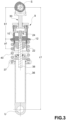
Fig. 3 is a longitudinal sectional view of a shock absorber incorporating the adjustment device in the configuration ofFig. 1 , according to an embodiment of the invention; and -
Fig. 4 is a longitudinal sectional view of the shock absorber ofFig. 3 , with the device shown in the configuration inFig. 2 . - Before describing a plurality of embodiments of the invention in detail, it should be clarified that the invention is not limited in its application to the construction details and configuration of the components presented in the following description or illustrated in the drawings.
- The invention may assume other embodiments and be implemented or constructed in practice in different ways. It should also be understood that the phraseology and terminology have a descriptive purpose and should not be construed as limiting.
- Referring by way of example to the figures, a
device 9 for adjusting the attitude of a motor vehicle comprises acylindrical body 10, which includes a radially projectingfirst flange 12, saidflange 12 being adapted to form an upper bearing of a main spring of an automotive suspension (e.g., the spring of a shock absorber). - The
cylindrical body 10 defines a first, axiallylower chamber 14a and a second, axiallyupper chamber 14b (with respect to the orientation that thedevice 9 assumes under conditions of use), saidsecond chamber 14b being hermetically sealed above by alid 16 and is configured to be placed in fluid connection with the exterior of thecylindrical body 10 via a throughhole 18 in thecylindrical body 10. - The first and
second chambers septum 20, axially interposed between said first andsecond chamber - A
bumper 22 is also provided, which is slidably received in thefirst chamber 14a of thecylindrical body 10 and is adapted to form a limit stop for the oscillation of the sprung mass of the vehicle when the latter approaches the unsprung mass of the vehicle. - The
device 9 further comprises aprimary actuator 24, which in turn includes aprimary cylinder 26, slidably housed in thesecond chamber 14b of thecylindrical body 10, saidprimary cylinder 26 being axially movable from a first position (proximal to the septum 20), to a second position (proximal to the lid 16), in response to the inlet or withdrawal of fluid into/from thesecond chamber 14b. - The
primary cylinder 26 defines within itself athird chamber 27, in fluid connection with saidsecond chamber 14b. Theprimary actuator 24 further comprises aprimary rod 28, passing axially through theseptum 20 and connected at its opposite ends to theprimary cylinder 26 and thebumper 22, respectively. - The
primary rod 28 is adapted to cause thebumper 22 to slide in thefirst chamber 14a in the same direction as the sliding of theprimary cylinder 26 in thesecond chamber 14b. - The
device 9 further comprises asecondary actuator 30, which includes anauxiliary piston 32 slidably received in thethird chamber 27 of theprimary cylinder 26, saidauxiliary piston 32 being configured to move axially with respect to theprimary cylinder 26 in response to the inlet or withdrawal of fluid into/from thethird chamber 27. - The
secondary actuator 30 also comprises asecondary rod 34, axially passing through thelid 16 and connected at a first end to theauxiliary piston 32, the opposite end of thesecondary rod 34 being adapted to be connected to the sprung mass of the motor vehicle. - Due to this configuration, the inlet of a pressurized fluid into the
second chamber 14b causes the axial sliding of theprimary cylinder 26 from the position proximal to theseptum 20 to the position proximal to thelid 16 and the simultaneous withdrawal of thebumper 22 toward the septum 20 (whereby, when thedevice 9 Is mounted to the vehicle, the clearance between thebumper 22 and the unsprung mass of the vehicle increases). - At the same time, the fluid entering the
third chamber 27 causes theauxiliary piston 32 to slide within theprimary cylinder 26, moving thecylindrical body 10 away from the connection point of thesecondary rod 34 and increasing the height from the ground of the sprung mass of the vehicle. - According to a preferred embodiment, the
cylindrical body 10 comprises a radially projectingshoulder 15 within thesecond chamber 14b. According to this embodiment, aside wall 26a of theprimary cylinder 26 comprises a radially projecting portion adapted to abut against saidshoulder 15 when theprimary cylinder 26 is in a position proximal to theseptum 20, whereby contact between said septum and saidprimary cylinder 26 is at least partially avoided. - Expediently, the
lid 16 may have a first portion against which theprimary cylinder 26 abuts when said primary cylinder is in an axially upper end-of-travel position, and a second portion, axially more protruding within thesecond chamber 14b with respect to said first portion, against which second portion theauxiliary piston 32 abuts when said auxiliary piston is in an axially upper end-of-travel position. In this way, it is possible to geometrically disjoin the axial strokes of theprimary cylinder 26 and theauxiliary piston 32, as the latter would abut against thelid 16 before theprimary cylinder 26. According to an alternative not shown, it is also possible for thelid 16 to be configured in the opposite manner, i.e., whereby theprimary cylinder 26 abuts against thelid 16 before the auxiliary piston 32 (e.g., by providing for a central portion of thelid 16, corresponding to the projection of theauxiliary piston 32, to protrude outwardly from said lid 16). - According to a preferred embodiment, the
primary cylinder 26 comprises abase 26b, which faces theseptum 20 and in which there is at least one throughhole 26c, adapted to place thesecond chamber 14b and thethird chamber 27 in fluid connection. - Expediently, the
primary cylinder 26 comprises arelief 26d, radially projecting within thethird chamber 27, saidrelief 26d being adapted to form a limit stop of theauxiliary piston 32 in the sliding of said piston within theprimary cylinder 26. In this configuration, theauxiliary piston 32 will therefore be slidable, with respect to theprimary cylinder 26, from a first position, proximal to thebase 26b of theprimary cylinder 26, to a second position, proximal to therelief 26d (against which it may abut). - According to one embodiment (not shown), the
device 9 is configured to form the upper abutment of a spring interposed between the sprung mass and the unsprung mass of a vehicle, in the absence of damping devices coaxial to the spring. In this case, the spring will be able to rest below on a structure integral with the wheel hub, and thedevice 9 will be connected to a frame associated with the sprung mass of the vehicle. - According to an alternative embodiment, shown by way of example in
Fig. 2 and3 , thedevice 9 is incorporated into a conventional automotive shock absorber. - Said shock absorber comprises a
device 9 for adjusting the attitude of a motor vehicle, according to any of the embodiments described above, saiddevice 9 being connectable to a sprung mass of the motor vehicle via thesecondary rod 34. - The shock absorber further comprises a
cylindrical tube 36, adapted to be connected to the unsprung mass of the motor vehicle, in thecylindrical tube 36 of which a shock absorber piston is slidable, adapted to interact with a fluid contained within saidcylindrical tube 36 to dampen the vertical oscillatory motion of said sprung mass, and ashock absorber stem 38, slidingly received by saidcylindrical tube 36 and movable integral with said shock absorber piston, saidshock absorber stem 38 having an end projecting above from saidcylindrical tube 36, the end of which is integral with thebuffer 22. - A
spring 40 is also provided, having one end that engages thefirst flange 12 of thecylindrical body 10, and the opposite end that engages asecond flange 37 radially projecting from thecylindrical tube 36, saidsecond flange 37 being movable integrally with saidcylindrical tube 36. - In this configuration, it is possible on the one hand to adjust the overall length of the shock absorber (by moving the
cylindrical body 10 closer to or away from the constraint point of thesecondary rod 34 by operating theprimary actuator 30 and by increasing or decreasing the height of the vehicle from the ground), and on the other hand to adjust the distance of the bumper, i.e., the distance of thebumper 22 from thecylindrical tube 36, so as to decrease or increase the maximum travel of the tube with respect to the bumper during compression of the shock absorber. This last feature allows in particular for the behavior of the suspension to be made stiffer as needed, reducing the maximum oscillation in the compression phase (in the case of the shock absorber, limiting the vertical excursion). - As a brief illustration of the operating principle of the device, an example of adjustment is described below, referring in particular to the embodiment shown in
Fig. 3 and4 . It is intended, however, that the following may easily be applied, with the necessary modifications, even in the case wherein no shock absorber coaxial to the main spring of the suspension is provided, said spring being connected to an element rigidly attached to a wheel hub. - More specifically,
Fig. 3 shows an initial configuration of the device, illustrated in an initial setup, wherein driving comfort is prioritized. In said configuration, the twoactuators - In this way, the
bumper 22 is maximally retracted toward theseptum 20, and thecylindrical body 10 is maximally spaced from a connection point S of thedevice 9 with the sprung mass of the vehicle. That is, fixed in a horizontal reference plane passing through theradial flange 12, the axial end of the bumper 22 (facing the unsprung mass) will be at a distance a1 from said reference plane, the connection point S will be at a distance b1 from said reference plane, and the overall length of the shock absorber will be c1 (measured from the connection point S of the shock absorber to the sprung mass of the vehicle to a connection point U of the shock absorber to the unsprung mass). -
Fig. 4 , on the other hand, shows a second configuration of the device, illustrated in a second attitude, wherein vehicle handling and responsiveness is prioritized. In such a configuration, the twoactuators primary cylinder 26 is in the position proximal to theseptum 20, and theauxiliary piston 32 is in the position proximal to thebase 26b of the primary cylinder 26). - In this way, the
bumper 22 is maximally extended axially with respect to theseptum 20, and thecylindrical body 10 is maximally close to the connection point S of thedevice 9 with the sprung mass of the vehicle. That is, with respect to said horizontal reference plane passing through theradial flange 12, the axial end of the bumper 22 (facing the unsprung mass) will in this configuration be at a distance a2>a1 from said reference plane, the connection point S to the sprung mass will be at a distance b2<b1 from said reference plane, and the overall length of the shock absorber will be c2<c1 (measured from the connection point S of the shock absorber to the sprung mass of the vehicle to the connection point U of the shock absorber to the unsprung mass). - Further, throughout this description and in the claims, terms and expressions indicating positions and orientations, such as "longitudinal," "transverse," "vertical" or "horizontal," are to refer to the longitudinal axis z of the
cylindrical body 10. - Various aspects and embodiments of a device for the adjustment of the attitude of a motor vehicle and the coordinated adjustment of the bumper clearance according to the invention have been described. It is understood that each embodiment may be combined with any other embodiment.
- Furthermore, the invention is not limited to the described embodiments, but may be varied within the scope defined by the appended claims.
Claims (6)
- A device (9) for the adjustment of the attitude of a motor vehicle and coordinated adjustment of the bumper clearance, the device comprising:- a cylindrical body (10), which includes a first radially projecting flange (12), the flange (12) being adapted to form an upper abutment of a main spring of an automotive suspension, the cylindrical body (10) defining a first chamber (14a), axially lower, and a second chamber (14b), axially upper, the second chamber (14b) is hermetically sealed above by a lid (16) and is configured to be placed in fluid connection with the outside of the cylindrical body (10) by means of a through hole (18) in the cylindrical body (10), the first and second chambers (14a, 14b) being fluidically decoupled by a septum (20), axially interposed between the first and second chambers (14a, 14b);- a bumper (22), slidably received in the first chamber (14a) of the cylindrical body (10) and adapted to form a limit stop for the oscillation of the sprung mass of the vehicle when the latter approaches the unsprung mass of the vehicle; characterised in that the device comprises- a primary actuator (24), comprising:- a primary cylinder (26), slidably received in the second chamber (14b) of the cylindrical body (10), the primary cylinder (26) being axially movable in response to the inlet or withdrawal of fluid into/from the second chamber (14b), and identifies at the inside thereof a third chamber (27), in fluid connection with the second chamber (14b); and- a primary rod (28), axially passing through the septum (20) and connected at its opposite ends respectively to the primary cylinder (26) and to the bumper (22), the primary rod (28) being adapted to cause the bumper (22) to slide in the first chamber (14a) in the same direction as the sliding of the primary cylinder (26) in the second chamber (14b);the device (9) further comprising a secondary actuator (30), which includes:- an auxiliary piston (32), slidably received in the third chamber (27) of the primary cylinder (26), the auxiliary piston (32) being configured to move axially with respect to the primary cylinder (26) in response to the inlet or withdrawal of fluid into/from the third chamber (27); and- a secondary rod (34), axially passing through the lid (16) and connected at a first end to the auxiliary piston (32), the opposite end of the secondary rod (34) being adapted to be connected to the sprung mass of the motor vehicle.
- A device according to claim 1, wherein the cylindrical body (10) comprises a shoulder (15) projecting radially inside the second chamber (14b), and wherein a side wall (26a) of the primary cylinder (26) comprises a radially protruding portion adapted to abut against the shoulder (15) when the primary cylinder (26) is in a position proximal to the septum (20), in such a way that a contact between the septum and the primary cylinder (26) is avoided.
- A device according to claim 1 or 2, wherein the lid (16) has a first portion against which the primary cylinder (26) abuts when the cylinder is in an axially upper end-of-travel position, and a second portion, axially more protruding inside the second chamber (14b) with respect to the first portion, against the second portion of which the auxiliary piston (32) abuts when the piston is in an axially upper end-of-travel position.
- A device according to any one of the preceding claims, wherein the primary cylinder (26) comprises a base (26b), which faces the septum (20) and in which there is at least one through hole (26c), adapted to connect the second chamber (14b) and the third chamber (27) in fluid connection.
- A device according to any one of the preceding claims, wherein the primary cylinder (26) comprises a relief (26d), protruding radially inside the third chamber (27), the relief (26d) being adapted to form a limit stop of the auxiliary piston (32) in the sliding of the piston inside the primary cylinder (26).
- An automotive shock absorber, comprising:- a device (9) for the adjustment of the attitude of a motor vehicle and coordinated adjustment of the bumper clearance, according to any one of the preceding claims, connectable to a sprung mass of the motor vehicle by means of the secondary rod (34);- a cylindrical tube (36), adapted to be connected to the unsprung mass of the motor vehicle, in which cylindrical tube (36) a shock absorber piston is slidable and adapted to interact with a fluid contained inside the cylindrical tube (36) to dampen the vertical oscillatory motion of the sprung mass, the bumper (22) being adapted to form an upper abutment of the vertical stroke of the cylindrical tube during the compression phase of the automotive shock absorber;- a shock absorber stem (38), slidably received by the cylindrical tube (36) and movable integrally with the shock absorber piston, the shock absorber stem (38) having an end protruding above from the cylindrical tube (36), the end being integral with the bumper (22); and- a spring (40), having one end which engages the first flange (12) of the cylindrical body (10), and the opposite end which engages a second flange (37) projecting radially from the cylindrical tube (36), the second flange (37) being movable integrally with the cylindrical tube (36).
Applications Claiming Priority (2)
| Application Number | Priority Date | Filing Date | Title |
|---|---|---|---|
| IT102020000023614A IT202000023614A1 (en) | 2020-10-07 | 2020-10-07 | A DEVICE FOR ADJUSTING THE TRIM OF A MOTOR VEHICLE, AND AN AUTOMOTIVE SHOCK ABSORBER EQUIPPED WITH SUCH A DEVICE |
| PCT/IB2021/059157 WO2022074578A1 (en) | 2020-10-07 | 2021-10-06 | Device for adjusting the attitude of a motor vehicle, and automotive shock absorber provided with such device |
Publications (2)
| Publication Number | Publication Date |
|---|---|
| EP4225596A1 EP4225596A1 (en) | 2023-08-16 |
| EP4225596B1 true EP4225596B1 (en) | 2024-08-21 |
Family
ID=74068363
Family Applications (1)
| Application Number | Title | Priority Date | Filing Date |
|---|---|---|---|
| EP21798775.9A Active EP4225596B1 (en) | 2020-10-07 | 2021-10-06 | Device for adjusting the attitude of a motor vehicle, and automotive shock absorber provided with such device |
Country Status (4)
| Country | Link |
|---|---|
| EP (1) | EP4225596B1 (en) |
| CN (1) | CN116348317B (en) |
| IT (1) | IT202000023614A1 (en) |
| WO (1) | WO2022074578A1 (en) |
Families Citing this family (3)
| Publication number | Priority date | Publication date | Assignee | Title |
|---|---|---|---|---|
| US11840120B2 (en) | 2020-02-27 | 2023-12-12 | Fox Factory, Inc. | IFP shock with automatically adjustable ride height |
| US12496867B2 (en) | 2020-02-27 | 2025-12-16 | Fox Factory, Inc. | Hydraulically-adjustable preload and/or cross-over |
| US11718137B2 (en) | 2020-02-27 | 2023-08-08 | Fox Factory, Inc. | Shock assembly with automatically adjustable ride height |
Family Cites Families (19)
| Publication number | Priority date | Publication date | Assignee | Title |
|---|---|---|---|---|
| JPS6227809U (en) * | 1985-08-03 | 1987-02-20 | ||
| JPH0694252B2 (en) * | 1986-11-12 | 1994-11-24 | いすゞ自動車株式会社 | Suspension Kneeling Device |
| JPH0623444Y2 (en) * | 1987-09-22 | 1994-06-22 | 株式会社ショーワ | Automotive rubber shock absorber rubber moving mechanism |
| US5538276A (en) * | 1995-05-23 | 1996-07-23 | Tullis; Jay K. | Tunable air spring |
| KR20040006903A (en) * | 2002-07-16 | 2004-01-24 | 현대모비스 주식회사 | Suspension for vehicles |
| DE102004019991B4 (en) * | 2004-04-23 | 2015-09-24 | Volkswagen Ag | Arm |
| EP1879759A2 (en) * | 2005-05-04 | 2008-01-23 | Kelsey-Hayes Company | Vehicle roll control system with self-centering actuator |
| DE102006008608B4 (en) * | 2006-02-24 | 2009-07-02 | Zf Friedrichshafen Ag | Arm |
| JP2008044571A (en) * | 2006-08-21 | 2008-02-28 | Mitsubishi Motors Corp | Vehicle suspension system |
| US8317172B2 (en) * | 2007-01-25 | 2012-11-27 | GM Global Technology Operations LLC | Multistage jounce bumper |
| EP2119580A1 (en) * | 2008-05-15 | 2009-11-18 | Paioli S.p.A. | Shock absorber for vehicles, particularly for motorcycle-like vehicles and the like |
| DE102011008618A1 (en) * | 2011-01-14 | 2012-07-19 | Audi Ag | Spring damper system, in particular for a suspension of motor vehicles |
| DE102011053854B4 (en) * | 2011-09-22 | 2020-07-09 | Dr. Ing. H.C. F. Porsche Aktiengesellschaft | Lifting device for a motor vehicle |
| DE102013215360B4 (en) * | 2012-09-10 | 2015-09-10 | Ford Global Technologies, Llc | Height adjustment device for vehicles with air spring and vibration damper |
| CN105555559A (en) * | 2013-09-17 | 2016-05-04 | 悬挂系统股份有限公司 | Suspension strut for a motor vehicle with a height-adjustment device |
| IT201600117315A1 (en) * | 2016-11-21 | 2018-05-21 | Sistemi Sospensioni Spa | Suspension for vehicle wheel with active control system to regulate in a controlled way the overall stiffness of the suspension. |
| DE102017212882A1 (en) * | 2017-07-26 | 2019-01-31 | Bayerische Motoren Werke Aktiengesellschaft | Suspension Spring Damper System of a Vehicle Wheel |
| US11365782B2 (en) * | 2017-12-07 | 2022-06-21 | Marelli Suspension Systems Italy S.P.A. | Rotary damper, particularly for vehicle suspension |
| DE102018119086B4 (en) * | 2018-08-06 | 2023-06-15 | Thyssenkrupp Ag | strut and vehicle |
-
2020
- 2020-10-07 IT IT102020000023614A patent/IT202000023614A1/en unknown
-
2021
- 2021-10-06 EP EP21798775.9A patent/EP4225596B1/en active Active
- 2021-10-06 CN CN202180069015.1A patent/CN116348317B/en active Active
- 2021-10-06 WO PCT/IB2021/059157 patent/WO2022074578A1/en not_active Ceased
Also Published As
| Publication number | Publication date |
|---|---|
| CN116348317B (en) | 2025-08-29 |
| EP4225596A1 (en) | 2023-08-16 |
| WO2022074578A1 (en) | 2022-04-14 |
| CN116348317A (en) | 2023-06-27 |
| IT202000023614A1 (en) | 2022-04-07 |
Similar Documents
| Publication | Publication Date | Title |
|---|---|---|
| EP4225596B1 (en) | Device for adjusting the attitude of a motor vehicle, and automotive shock absorber provided with such device | |
| CN113840990B (en) | Hydraulic compression stop with offset piston | |
| US8967344B2 (en) | Valve structure of shock absorber | |
| EP3092420B1 (en) | Multi-stage shock absorber | |
| EP0658703B1 (en) | Vibration damping device | |
| US4828237A (en) | Reduced length MacPherson strut | |
| US9611915B2 (en) | Valve structure of shock absorber | |
| US8037982B2 (en) | Hydraulic shock absorber for vehicle | |
| EP2926025A1 (en) | Hydraulic suspension damper with position dependent damping assembly | |
| WO2014155809A1 (en) | Pressure damping device | |
| US4397452A (en) | Hydro-mechanical stop for a shock absorber | |
| WO2021011332A1 (en) | Damper with hydraulic end stop | |
| EP3967899A1 (en) | A telescopic damper assembly | |
| US7021435B2 (en) | Monotube strut with rebound cut-off feature | |
| US20210070130A1 (en) | Shock absorber for vehicle | |
| US11472248B2 (en) | Suspension strut and vehicle | |
| US20230018887A1 (en) | Telescopic passive damper | |
| EP1277985A2 (en) | Hydraulic rebound cut-off for monotube damper | |
| CN116669971B (en) | Device for adjusting a damper clearance in a vehicle suspension and vehicle suspension comprising such a device | |
| EP3851703A1 (en) | Shock absorber assembly | |
| WO2017144476A1 (en) | Suspension assembly for a vehicle | |
| US6588555B2 (en) | Piston-cylinder unit with at least one bypass groove in the cylinder | |
| US6357734B1 (en) | Suspension damper with vehicle spring preload | |
| JPH02109713A (en) | suspension device | |
| EP4170195B1 (en) | Telescopic passive damper |
Legal Events
| Date | Code | Title | Description |
|---|---|---|---|
| STAA | Information on the status of an ep patent application or granted ep patent |
Free format text: STATUS: UNKNOWN |
|
| STAA | Information on the status of an ep patent application or granted ep patent |
Free format text: STATUS: THE INTERNATIONAL PUBLICATION HAS BEEN MADE |
|
| PUAI | Public reference made under article 153(3) epc to a published international application that has entered the european phase |
Free format text: ORIGINAL CODE: 0009012 |
|
| STAA | Information on the status of an ep patent application or granted ep patent |
Free format text: STATUS: REQUEST FOR EXAMINATION WAS MADE |
|
| 17P | Request for examination filed |
Effective date: 20230502 |
|
| AK | Designated contracting states |
Kind code of ref document: A1 Designated state(s): AL AT BE BG CH CY CZ DE DK EE ES FI FR GB GR HR HU IE IS IT LI LT LU LV MC MK MT NL NO PL PT RO RS SE SI SK SM TR |
|
| DAV | Request for validation of the european patent (deleted) | ||
| DAX | Request for extension of the european patent (deleted) | ||
| GRAP | Despatch of communication of intention to grant a patent |
Free format text: ORIGINAL CODE: EPIDOSNIGR1 |
|
| STAA | Information on the status of an ep patent application or granted ep patent |
Free format text: STATUS: GRANT OF PATENT IS INTENDED |
|
| INTG | Intention to grant announced |
Effective date: 20240318 |
|
| GRAS | Grant fee paid |
Free format text: ORIGINAL CODE: EPIDOSNIGR3 |
|
| GRAA | (expected) grant |
Free format text: ORIGINAL CODE: 0009210 |
|
| STAA | Information on the status of an ep patent application or granted ep patent |
Free format text: STATUS: THE PATENT HAS BEEN GRANTED |
|
| AK | Designated contracting states |
Kind code of ref document: B1 Designated state(s): AL AT BE BG CH CY CZ DE DK EE ES FI FR GB GR HR HU IE IS IT LI LT LU LV MC MK MT NL NO PL PT RO RS SE SI SK SM TR |
|
| REG | Reference to a national code |
Ref country code: GB Ref legal event code: FG4D |
|
| REG | Reference to a national code |
Ref country code: CH Ref legal event code: EP |
|
| REG | Reference to a national code |
Ref country code: IE Ref legal event code: FG4D |
|
| REG | Reference to a national code |
Ref country code: DE Ref legal event code: R096 Ref document number: 602021017651 Country of ref document: DE |
|
| REG | Reference to a national code |
Ref country code: LT Ref legal event code: MG9D |
|
| REG | Reference to a national code |
Ref country code: NL Ref legal event code: MP Effective date: 20240821 |
|
| PG25 | Lapsed in a contracting state [announced via postgrant information from national office to epo] |
Ref country code: NO Free format text: LAPSE BECAUSE OF FAILURE TO SUBMIT A TRANSLATION OF THE DESCRIPTION OR TO PAY THE FEE WITHIN THE PRESCRIBED TIME-LIMIT Effective date: 20241121 |
|
| REG | Reference to a national code |
Ref country code: AT Ref legal event code: MK05 Ref document number: 1715200 Country of ref document: AT Kind code of ref document: T Effective date: 20240821 |
|
| PG25 | Lapsed in a contracting state [announced via postgrant information from national office to epo] |
Ref country code: PT Free format text: LAPSE BECAUSE OF FAILURE TO SUBMIT A TRANSLATION OF THE DESCRIPTION OR TO PAY THE FEE WITHIN THE PRESCRIBED TIME-LIMIT Effective date: 20241223 Ref country code: FI Free format text: LAPSE BECAUSE OF FAILURE TO SUBMIT A TRANSLATION OF THE DESCRIPTION OR TO PAY THE FEE WITHIN THE PRESCRIBED TIME-LIMIT Effective date: 20240821 Ref country code: PL Free format text: LAPSE BECAUSE OF FAILURE TO SUBMIT A TRANSLATION OF THE DESCRIPTION OR TO PAY THE FEE WITHIN THE PRESCRIBED TIME-LIMIT Effective date: 20240821 Ref country code: GR Free format text: LAPSE BECAUSE OF FAILURE TO SUBMIT A TRANSLATION OF THE DESCRIPTION OR TO PAY THE FEE WITHIN THE PRESCRIBED TIME-LIMIT Effective date: 20241122 Ref country code: NL Free format text: LAPSE BECAUSE OF FAILURE TO SUBMIT A TRANSLATION OF THE DESCRIPTION OR TO PAY THE FEE WITHIN THE PRESCRIBED TIME-LIMIT Effective date: 20240821 |
|
| PG25 | Lapsed in a contracting state [announced via postgrant information from national office to epo] |
Ref country code: BG Free format text: LAPSE BECAUSE OF FAILURE TO SUBMIT A TRANSLATION OF THE DESCRIPTION OR TO PAY THE FEE WITHIN THE PRESCRIBED TIME-LIMIT Effective date: 20240821 |
|
| PG25 | Lapsed in a contracting state [announced via postgrant information from national office to epo] |
Ref country code: LV Free format text: LAPSE BECAUSE OF FAILURE TO SUBMIT A TRANSLATION OF THE DESCRIPTION OR TO PAY THE FEE WITHIN THE PRESCRIBED TIME-LIMIT Effective date: 20240821 |
|
| PG25 | Lapsed in a contracting state [announced via postgrant information from national office to epo] |
Ref country code: IS Free format text: LAPSE BECAUSE OF FAILURE TO SUBMIT A TRANSLATION OF THE DESCRIPTION OR TO PAY THE FEE WITHIN THE PRESCRIBED TIME-LIMIT Effective date: 20241221 Ref country code: AT Free format text: LAPSE BECAUSE OF FAILURE TO SUBMIT A TRANSLATION OF THE DESCRIPTION OR TO PAY THE FEE WITHIN THE PRESCRIBED TIME-LIMIT Effective date: 20240821 |
|
| PG25 | Lapsed in a contracting state [announced via postgrant information from national office to epo] |
Ref country code: HR Free format text: LAPSE BECAUSE OF FAILURE TO SUBMIT A TRANSLATION OF THE DESCRIPTION OR TO PAY THE FEE WITHIN THE PRESCRIBED TIME-LIMIT Effective date: 20240821 |
|
| PG25 | Lapsed in a contracting state [announced via postgrant information from national office to epo] |
Ref country code: RS Free format text: LAPSE BECAUSE OF FAILURE TO SUBMIT A TRANSLATION OF THE DESCRIPTION OR TO PAY THE FEE WITHIN THE PRESCRIBED TIME-LIMIT Effective date: 20241121 Ref country code: ES Free format text: LAPSE BECAUSE OF FAILURE TO SUBMIT A TRANSLATION OF THE DESCRIPTION OR TO PAY THE FEE WITHIN THE PRESCRIBED TIME-LIMIT Effective date: 20240821 |
|
| PG25 | Lapsed in a contracting state [announced via postgrant information from national office to epo] |
Ref country code: RS Free format text: LAPSE BECAUSE OF FAILURE TO SUBMIT A TRANSLATION OF THE DESCRIPTION OR TO PAY THE FEE WITHIN THE PRESCRIBED TIME-LIMIT Effective date: 20241121 Ref country code: PT Free format text: LAPSE BECAUSE OF FAILURE TO SUBMIT A TRANSLATION OF THE DESCRIPTION OR TO PAY THE FEE WITHIN THE PRESCRIBED TIME-LIMIT Effective date: 20241223 Ref country code: PL Free format text: LAPSE BECAUSE OF FAILURE TO SUBMIT A TRANSLATION OF THE DESCRIPTION OR TO PAY THE FEE WITHIN THE PRESCRIBED TIME-LIMIT Effective date: 20240821 Ref country code: NO Free format text: LAPSE BECAUSE OF FAILURE TO SUBMIT A TRANSLATION OF THE DESCRIPTION OR TO PAY THE FEE WITHIN THE PRESCRIBED TIME-LIMIT Effective date: 20241121 Ref country code: NL Free format text: LAPSE BECAUSE OF FAILURE TO SUBMIT A TRANSLATION OF THE DESCRIPTION OR TO PAY THE FEE WITHIN THE PRESCRIBED TIME-LIMIT Effective date: 20240821 Ref country code: LV Free format text: LAPSE BECAUSE OF FAILURE TO SUBMIT A TRANSLATION OF THE DESCRIPTION OR TO PAY THE FEE WITHIN THE PRESCRIBED TIME-LIMIT Effective date: 20240821 Ref country code: IS Free format text: LAPSE BECAUSE OF FAILURE TO SUBMIT A TRANSLATION OF THE DESCRIPTION OR TO PAY THE FEE WITHIN THE PRESCRIBED TIME-LIMIT Effective date: 20241221 Ref country code: HR Free format text: LAPSE BECAUSE OF FAILURE TO SUBMIT A TRANSLATION OF THE DESCRIPTION OR TO PAY THE FEE WITHIN THE PRESCRIBED TIME-LIMIT Effective date: 20240821 Ref country code: GR Free format text: LAPSE BECAUSE OF FAILURE TO SUBMIT A TRANSLATION OF THE DESCRIPTION OR TO PAY THE FEE WITHIN THE PRESCRIBED TIME-LIMIT Effective date: 20241122 Ref country code: FI Free format text: LAPSE BECAUSE OF FAILURE TO SUBMIT A TRANSLATION OF THE DESCRIPTION OR TO PAY THE FEE WITHIN THE PRESCRIBED TIME-LIMIT Effective date: 20240821 Ref country code: ES Free format text: LAPSE BECAUSE OF FAILURE TO SUBMIT A TRANSLATION OF THE DESCRIPTION OR TO PAY THE FEE WITHIN THE PRESCRIBED TIME-LIMIT Effective date: 20240821 Ref country code: BG Free format text: LAPSE BECAUSE OF FAILURE TO SUBMIT A TRANSLATION OF THE DESCRIPTION OR TO PAY THE FEE WITHIN THE PRESCRIBED TIME-LIMIT Effective date: 20240821 Ref country code: AT Free format text: LAPSE BECAUSE OF FAILURE TO SUBMIT A TRANSLATION OF THE DESCRIPTION OR TO PAY THE FEE WITHIN THE PRESCRIBED TIME-LIMIT Effective date: 20240821 |
|
| PG25 | Lapsed in a contracting state [announced via postgrant information from national office to epo] |
Ref country code: DK Free format text: LAPSE BECAUSE OF FAILURE TO SUBMIT A TRANSLATION OF THE DESCRIPTION OR TO PAY THE FEE WITHIN THE PRESCRIBED TIME-LIMIT Effective date: 20240821 Ref country code: SM Free format text: LAPSE BECAUSE OF FAILURE TO SUBMIT A TRANSLATION OF THE DESCRIPTION OR TO PAY THE FEE WITHIN THE PRESCRIBED TIME-LIMIT Effective date: 20240821 Ref country code: RO Free format text: LAPSE BECAUSE OF FAILURE TO SUBMIT A TRANSLATION OF THE DESCRIPTION OR TO PAY THE FEE WITHIN THE PRESCRIBED TIME-LIMIT Effective date: 20240821 |
|
| PG25 | Lapsed in a contracting state [announced via postgrant information from national office to epo] |
Ref country code: EE Free format text: LAPSE BECAUSE OF FAILURE TO SUBMIT A TRANSLATION OF THE DESCRIPTION OR TO PAY THE FEE WITHIN THE PRESCRIBED TIME-LIMIT Effective date: 20240821 |
|
| PG25 | Lapsed in a contracting state [announced via postgrant information from national office to epo] |
Ref country code: CZ Free format text: LAPSE BECAUSE OF FAILURE TO SUBMIT A TRANSLATION OF THE DESCRIPTION OR TO PAY THE FEE WITHIN THE PRESCRIBED TIME-LIMIT Effective date: 20240821 |
|
| PG25 | Lapsed in a contracting state [announced via postgrant information from national office to epo] |
Ref country code: SK Free format text: LAPSE BECAUSE OF FAILURE TO SUBMIT A TRANSLATION OF THE DESCRIPTION OR TO PAY THE FEE WITHIN THE PRESCRIBED TIME-LIMIT Effective date: 20240821 |
|
| REG | Reference to a national code |
Ref country code: DE Ref legal event code: R097 Ref document number: 602021017651 Country of ref document: DE |
|
| REG | Reference to a national code |
Ref country code: CH Ref legal event code: PL |
|
| PLBE | No opposition filed within time limit |
Free format text: ORIGINAL CODE: 0009261 |
|
| STAA | Information on the status of an ep patent application or granted ep patent |
Free format text: STATUS: NO OPPOSITION FILED WITHIN TIME LIMIT |
|
| PG25 | Lapsed in a contracting state [announced via postgrant information from national office to epo] |
Ref country code: MC Free format text: LAPSE BECAUSE OF FAILURE TO SUBMIT A TRANSLATION OF THE DESCRIPTION OR TO PAY THE FEE WITHIN THE PRESCRIBED TIME-LIMIT Effective date: 20240821 |
|
| PG25 | Lapsed in a contracting state [announced via postgrant information from national office to epo] |
Ref country code: BE Free format text: LAPSE BECAUSE OF NON-PAYMENT OF DUE FEES Effective date: 20241031 Ref country code: LU Free format text: LAPSE BECAUSE OF NON-PAYMENT OF DUE FEES Effective date: 20241006 |
|
| PG25 | Lapsed in a contracting state [announced via postgrant information from national office to epo] |
Ref country code: CH Free format text: LAPSE BECAUSE OF NON-PAYMENT OF DUE FEES Effective date: 20241031 |
|
| 26N | No opposition filed |
Effective date: 20250522 |
|
| REG | Reference to a national code |
Ref country code: BE Ref legal event code: MM Effective date: 20241031 |
|
| PG25 | Lapsed in a contracting state [announced via postgrant information from national office to epo] |
Ref country code: SE Free format text: LAPSE BECAUSE OF FAILURE TO SUBMIT A TRANSLATION OF THE DESCRIPTION OR TO PAY THE FEE WITHIN THE PRESCRIBED TIME-LIMIT Effective date: 20240821 |
|
| PGFP | Annual fee paid to national office [announced via postgrant information from national office to epo] |
Ref country code: IT Payment date: 20250923 Year of fee payment: 5 |
|
| PGFP | Annual fee paid to national office [announced via postgrant information from national office to epo] |
Ref country code: FR Payment date: 20250924 Year of fee payment: 5 |
|
| PG25 | Lapsed in a contracting state [announced via postgrant information from national office to epo] |
Ref country code: IE Free format text: LAPSE BECAUSE OF NON-PAYMENT OF DUE FEES Effective date: 20241006 |
|
| PGFP | Annual fee paid to national office [announced via postgrant information from national office to epo] |
Ref country code: DE Payment date: 20250923 Year of fee payment: 5 |
|
| PG25 | Lapsed in a contracting state [announced via postgrant information from national office to epo] |
Ref country code: CY Free format text: LAPSE BECAUSE OF FAILURE TO SUBMIT A TRANSLATION OF THE DESCRIPTION OR TO PAY THE FEE WITHIN THE PRESCRIBED TIME-LIMIT; INVALID AB INITIO Effective date: 20211006 |
|
| PG25 | Lapsed in a contracting state [announced via postgrant information from national office to epo] |
Ref country code: HU Free format text: LAPSE BECAUSE OF FAILURE TO SUBMIT A TRANSLATION OF THE DESCRIPTION OR TO PAY THE FEE WITHIN THE PRESCRIBED TIME-LIMIT; INVALID AB INITIO Effective date: 20211006 |