EP4225550B1 - Seat for vehicle - Google Patents
Seat for vehicle Download PDFInfo
- Publication number
- EP4225550B1 EP4225550B1 EP21791462.1A EP21791462A EP4225550B1 EP 4225550 B1 EP4225550 B1 EP 4225550B1 EP 21791462 A EP21791462 A EP 21791462A EP 4225550 B1 EP4225550 B1 EP 4225550B1
- Authority
- EP
- European Patent Office
- Prior art keywords
- viscoelastic foam
- foam
- measured
- seat according
- viscoelastic
- Prior art date
- Legal status (The legal status is an assumption and is not a legal conclusion. Google has not performed a legal analysis and makes no representation as to the accuracy of the status listed.)
- Active
Links
Images

Classifications
-
- B—PERFORMING OPERATIONS; TRANSPORTING
- B60—VEHICLES IN GENERAL
- B60N—SEATS SPECIALLY ADAPTED FOR VEHICLES; VEHICLE PASSENGER ACCOMMODATION NOT OTHERWISE PROVIDED FOR
- B60N2/00—Seats specially adapted for vehicles; Arrangement or mounting of seats in vehicles
- B60N2/70—Upholstery springs ; Upholstery
- B60N2/7017—Upholstery springs ; Upholstery characterised by the manufacturing process; manufacturing upholstery or upholstery springs not otherwise provided for
-
- B—PERFORMING OPERATIONS; TRANSPORTING
- B29—WORKING OF PLASTICS; WORKING OF SUBSTANCES IN A PLASTIC STATE IN GENERAL
- B29C—SHAPING OR JOINING OF PLASTICS; SHAPING OF MATERIAL IN A PLASTIC STATE, NOT OTHERWISE PROVIDED FOR; AFTER-TREATMENT OF THE SHAPED PRODUCTS, e.g. REPAIRING
- B29C44/00—Shaping by internal pressure generated in the material, e.g. swelling or foaming ; Producing porous or cellular expanded plastics articles
- B29C44/02—Shaping by internal pressure generated in the material, e.g. swelling or foaming ; Producing porous or cellular expanded plastics articles for articles of definite length, i.e. discrete articles
- B29C44/04—Shaping by internal pressure generated in the material, e.g. swelling or foaming ; Producing porous or cellular expanded plastics articles for articles of definite length, i.e. discrete articles consisting of at least two parts of chemically or physically different materials, e.g. having different densities
- B29C44/0461—Shaping by internal pressure generated in the material, e.g. swelling or foaming ; Producing porous or cellular expanded plastics articles for articles of definite length, i.e. discrete articles consisting of at least two parts of chemically or physically different materials, e.g. having different densities by having different chemical compositions in different places, e.g. having different concentrations of foaming agent, feeding one composition after the other
-
- B—PERFORMING OPERATIONS; TRANSPORTING
- B29—WORKING OF PLASTICS; WORKING OF SUBSTANCES IN A PLASTIC STATE IN GENERAL
- B29K—INDEXING SCHEME ASSOCIATED WITH SUBCLASSES B29B, B29C OR B29D, RELATING TO MOULDING MATERIALS OR TO MATERIALS FOR MOULDS, REINFORCEMENTS, FILLERS OR PREFORMED PARTS, e.g. INSERTS
- B29K2075/00—Use of PU, i.e. polyureas or polyurethanes or derivatives thereof, as moulding material
-
- B—PERFORMING OPERATIONS; TRANSPORTING
- B29—WORKING OF PLASTICS; WORKING OF SUBSTANCES IN A PLASTIC STATE IN GENERAL
- B29L—INDEXING SCHEME ASSOCIATED WITH SUBCLASS B29C, RELATING TO PARTICULAR ARTICLES
- B29L2031/00—Other particular articles
- B29L2031/58—Upholstery or cushions, e.g. vehicle upholstery or interior padding
-
- B—PERFORMING OPERATIONS; TRANSPORTING
- B29—WORKING OF PLASTICS; WORKING OF SUBSTANCES IN A PLASTIC STATE IN GENERAL
- B29L—INDEXING SCHEME ASSOCIATED WITH SUBCLASS B29C, RELATING TO PARTICULAR ARTICLES
- B29L2031/00—Other particular articles
- B29L2031/771—Seats
Definitions
- the present invention relates to a seat for a vehicle and a method for the production of the same of the type specified in the preamble of the independent claims.
- shape memory foams such as polyurethane, due to the same structure that guarantees their mechanical properties, retain a lot of heat due to the poor breathability of the structure, thus making them uncomfortable for a user.
- shape memory foams show a strong variability of some important mechanical properties with the temperature, compromising the comfort and safety of the user as the temperature of use varies.
- the technical task underlying the present invention is to devise a seat for a vehicle and a method for production of the same capable of substantially obviating at least part of the aforementioned drawbacks.
- Another important object of the invention is to provide a seat which allows high breathability of the materials that compose it.
- Another object of the present invention is to provide a seat whose materials have stable mechanical characteristics in a defined temperature range.
- the measurements, values, shapes and geometric references (such as perpendicularity and parallelism), when associated with words like "about” or other similar terms such as “approximately” or “substantially”, are to be considered as except for measurement errors or inaccuracies due to production and/or manufacturing errors, and, above all, except for a slight divergence from the value, measurements, shape, or geometric reference with which it is associated.
- these terms if associated with a value, preferably indicate a divergence of not more than 10% of the value.
- treatment refers to the action and/or processes of a computer or similar electronic calculation device that manipulates and/or transforms data represented as physical, such as electronic quantities of registers of a computer system and/or memories in, other data similarly represented as physical quantities within computer systems, registers or other storage, transmission or information displaying devices.
- It comprises two components 2, comprising a backrest 2a and a cushion 2b or seating.
- Each of said components comprises an external portion 3, or rather a portion close to the external surface 4a with which the user comes into contact.
- the external portion 3 therefore determines a large part of the sensation of support that the user sitting on the seat 1 has.
- the external portion 3, preferably, does not comprise the external surface 4a, which is instead part of a suitable covering layer 4, but is more preferably immediately below the same covering layer 4.
- At least one of said components 2, and more preferably the backrest 2a comprises an external portion 3 comprising viscoelastic foam of the pneumatic type.
- Foam is here intended as a solid material, having the characteristic of acquiring, once produced, an amorphous macro-structure cross-linked to cells containing air.
- the viscoelastic pneumatic foam known per se, also known as "shape memory - memory foam” or “slow-memory” or “slow-recovery foam” or “low resilience foam", is a material that recovers deformations in time relatively long (for example one or more seconds).
- the viscoelastic foam is a flexible thermosetting polyurethane foam made with reagents comprising at least one polyol and a compound comprising isocyanate functional groups.
- the reagents for the preparation of said viscoelastic foam comprise polyoxyethylene and polyoxypropylene.
- the reagents for the preparation of said viscoelastic foam comprise polyoxyethylene and/or polyoxypropylene polyols with functionality ranging from 2 to 6, or also polyesters and/or hybrids and/or mixtures of said substances.
- the reagents for the preparation of said viscoelastic foam comprise polyoxyethylene and/or polyoxypropylene polyols and at least one compound comprising isocyanate functional groups.
- the viscoelastic foam is a flexible thermosetting polyurethane foam polymer obtained starting from a mixture of polyols, polyethers and/or polyesters and at least one isocyanate compound with a percentage by weight of NCO components comprised between 25% and 48%.
- both the specific formulations specified above are viscoelastic foams having the chemical and compositional characteristics described up to now, therefore identifiable as flexible thermosetting polyurethane viscoelastic foams according to the present invention.
- formulation 1 as a viscoelastic foam while formulation 2 and formulation 3 as a viscoelastic foam with elastic behaviour.
- the thickness of the viscoelastic foam in the tested size is 50 mm.
- the compression load deflection data is measured after 10 seconds of applying the deformation by measuring the value of the reaction force.
- the compression load deflection value of said viscoelastic foam measured at 65% of deformation induced by a state of compressive stresses, is between 0.5 kPa and 5 kPa, when measured in a temperature range between - 10 ° C and + 40 ° C.
- the % rebound value on said viscoelastic foam is between 0% and 20% measured at 23°C. Moreover, preferably said value measured in a temperature range between -10 °C and 40 °C varies by less than 11 percentage points. Again, preferably, the% rebound value on said viscoelastic foam, measured in a temperature range between -10 °C and 40 °C, varies in a range between 5% and 16%.
- the% rebound value on said viscoelastic foam with elastic behaviour is comprised between 20% and 70% measured at 23 °C. Moreover, preferably said value measured in a temperature range between -10 °C and 40 °C varies by less than 13 percentage points. Again, preferably, the% rebound value on said viscoelastic foam with elastic behaviour, measured in a temperature range between -10 ° C and 40 ° C, varies in a range between 30% and 43%.
- the% resilience of said viscoelastic foam is between 5% and 40% measured at 23 °C. Moreover, preferably said value, measured in a temperature range between -10 °C and 40 °C varies less than 10 percentage points. Preferably again, the% resilience on said viscoelastic foam, measured in a temperature range between -10 °C and 40 °C, varies in a range between 7% and 17%.
- the% resilience of said viscoelastic foam with elastic behaviour is between 40% and 80% measured at 23 °C. Furthermore, preferably, the% resilience on said viscoelastic foam with elastic behaviour, measured in a temperature range between -10 °C and 40 °C varies less than 7 percentage points. Preferably, moreover, the% resilience on said viscoelastic foam with elastic behaviour, measured in a temperature range between -10 °C and 40 °C, varies in a range between 52% and 59%.
- the breathability of said viscoelastic foam is lower than 100 (1 dm 2 )/min.
- Said breathability is calculated on a sample with a thickness of 20 mm in the tested direction, according to ISO 9237 - 200 Pa.
- the density of said viscoelastic foam varies in a range between 25 g/dm 3 and 90 g/dm 3 .
- the density of said viscoelastic foam with elastic behaviour varies in a range comprised between 18 g/dm 3 and 40 g/dm 3 .
- the component 2 of the seat 1 also comprises an elastic portion 5, or rather with characteristics of rapid elastic return following mechanical deformations.
- Said elastic portion 5 is preferably composed of an HR (High Resilience) polymer or in general of a polymeric material suitable for the purpose.
- the external portion 3, preferably made with one of the viscoelastic foams previously described in this document, is preferably made with the method described below.
- the method not part of the claimed invention, preferably comprises a co-moulding phase.
- Co-moulding is a moulding process in which portions in different materials are made in the same mould in successive stages, so that the finished product, made by joining said portions, at the moment of extraction from the mould includes the two said portions already mutually bound and does not require further connection phases.
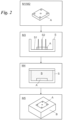
- the method preferably comprises a production phase M1 of a foam A, as shown in Fig.2 .
- the production phase of said foam A can take place with a plurality of production technologies, such as for example moulding and even more.
- the foam A is a foam chosen between a viscoelastic foam and an elastic foam.
- a viscoelastic foam will be identified as a foam having time-dependent stress-deformation characteristics, such as a "memory foam” foam or in general a foam that recovers deformations in a relatively long time (for example one or more seconds).
- elastic foam we mean a foam that recovers almost instantaneously the deformations induced by a state of applied stress.
- Preferred examples of viscoelastic foams according to the present invention are those of the formulations 1 and 2 previously described, and therefore preferably viscoelastic foams and viscoelastic foams with elastic behaviour.
- Examples of elastic foams are HR polymers or in general polymeric materials suitable for the purpose.
- the method comprises a drilling phase M2 said foam A.
- the at least one barrier element D is an impermeable barrier element.
- the at least one barrier element D is a perforated barrier element.
- the method comprises a connection phase M3 of said foam A on a surface S1 of a mould S.
- said mould S is shaped with columns S2.
- connection phase 3 of said foam A on said surface S1 said columns S2 are placed in correspondence with holes obtained by the perforation 2 of said foam A.
- the method comprises a casting phase M4 of a further foam B in said mould S.
- said foam B is a foam chosen from a viscoelastic foam and an elastic foam.
- said foam A is a viscoelastic foam and said foam B is an elastic foam.
- said foam A is an elastic foam and said foam B is a viscoelastic foam.
- the method comprises an extraction phase M5 for said padding I from said mould S.
- the seat 1 can also be produced by gluing and assembling or sewing the various portions of the seat 1 described.
- the present invention relates to a seat 1 of a vehicle preferably produced according to the method described here.
- the formulation and production of the viscoelastic foam described here allows to obtain a contact surface between the user and the seat that is highly breathable thanks to the characteristics of the foam itself and/or its perforation during the production phase.
- the characteristics of high hygroscopicity of the viscoelastic foam allow the absorption of high levels of humidity and/or liquids, making the area in contact with a user dry and comfortable.
- the formulation of the viscoelastic foam allows to maintain mechanical characteristics, such as for example compression load deflection and resilience, constant in a wide range of temperatures without affecting the breathability of the viscoelastic foam; in this way the comfort and safety of the user are not compromised when the environmental and/or conditioning conditions of the vehicle vary.
- co-moulding allows the production of components for seats with the desired characteristics without having to resort to polluting glues and which also require further cutting and coupling steps to arrive at the finished product.
- Co-moulding allows to produce finished seat paddings when they are extracted from the mould, resulting in advantages in terms of processing time and therefore economic.
Landscapes
- Engineering & Computer Science (AREA)
- Manufacturing & Machinery (AREA)
- Aviation & Aerospace Engineering (AREA)
- Transportation (AREA)
- Mechanical Engineering (AREA)
- Polyurethanes Or Polyureas (AREA)
- Mattresses And Other Support Structures For Chairs And Beds (AREA)
- Casting Or Compression Moulding Of Plastics Or The Like (AREA)
Description
- The present invention relates to a seat for a vehicle and a method for the production of the same of the type specified in the preamble of the independent claims.
- Similar seats are described in patent applications
US2015/307647A1 ,US 2017/327 620A1 ,EP2185617A1 ,WO03/046041A1 FR2841507A1 FR2841508A1 US2016/ 318428A1 . - Vehicle seats are currently known, and materials used in the production of the backrest or headrest padding are also known, said materials are suitable for providing the same seat with certain physical-mechanical characteristics in order to ensure comfort and safety during the use of the vehicle.
- Among the characteristics mainly sought after by a seat are the breathability to air, connected with the ability of the padding to dispose of the heat caused by a user.
- In the known art several materials are usually used to achieve these technical characteristics, said materials coupled for example by gluing.
- For these purposes, for example, the use of natural or synthetic polymeric materials such as latexes, foams and shape memory foams are known in order to obtain seats with desirable characteristics.
- The known technique described comprises some important drawbacks.
- In particular, shape memory foams such as polyurethane, due to the same structure that guarantees their mechanical properties, retain a lot of heat due to the poor breathability of the structure, thus making them uncomfortable for a user.
- Also, especially the shape memory foams, show a strong variability of some important mechanical properties with the temperature, compromising the comfort and safety of the user as the temperature of use varies.
- In addition, with regard to the production method of seats composed of several materials, the use of glues for the union of different components has a serious
environmental impact and the gluing worsens the air permeability characteristics of the seat. - In this situation, the technical task underlying the present invention is to devise a seat for a vehicle and a method for production of the same capable of substantially obviating at least part of the aforementioned drawbacks.
- Another important object of the invention is to provide a seat which allows high breathability of the materials that compose it.
- Another object of the present invention is to provide a seat whose materials have stable mechanical characteristics in a defined temperature range.
- Within the scope of said technical task, it is an important object of the invention to obtain a method which allows to use a single moulding phase to obtain the seat according to the present invention.
- Finally, within the scope of said technical task, it is an important object of the invention to obtain a method that does not provide for gluing the components that make up the padding of said seat.
- The technical task and the specified aims are achieved by a seat for vehicle and a method for the production of the same as claimed in the annexed
claim 1. - Preferred technical solutions are highlighted in the dependent claims.
- The characteristics and advantages of the invention are clarified below by the detailed description of preferred embodiments of the invention, with reference to the accompanying drawings, in which:
-
Fig. 1 shows an exemplary embodiment of the seat of a vehicle according to the present invention; -
Fig. 2 shows a block diagram schematizing a method not according to the present invention; and -
Fig. 3 shows a further alternative phase of a method not according to the present invention. - In the present document, the measurements, values, shapes and geometric references (such as perpendicularity and parallelism), when associated with words like "about" or other similar terms such as "approximately" or "substantially", are to be considered as except for measurement errors or inaccuracies due to production and/or manufacturing errors, and, above all, except for a slight divergence from the value, measurements, shape, or geometric reference with which it is associated. For instance, these terms, if associated with a value, preferably indicate a divergence of not more than 10% of the value.
- Moreover, when used, terms such as "first", "second", "higher", "lower", "main" and "secondary" do not necessarily identify an order, a priority of relationship or a relative position, but can simply be used to clearly distinguish between their different components.
- Unless otherwise specified, as results in the following discussions, terms such as "treatment", "computing", "determination", "calculation", or similar, refer to the action and/or processes of a computer or similar electronic calculation device that manipulates and/or transforms data represented as physical, such as electronic quantities of registers of a computer system and/or memories in, other data similarly represented as physical quantities within computer systems, registers or other storage, transmission or information displaying devices.
- The measurements and data reported in this text are to be considered, unless otherwise indicated, as performed in the International Standard Atmosphere ICAO (ISO 2533:1975). With reference to the Figures, the seat for vehicle according to the invention is globally indicated with the
number 1. - It comprises two
components 2, comprising a backrest 2a and a cushion 2b or seating. - Each of said components comprises an external portion 3, or rather a portion close to the
external surface 4a with which the user comes into contact. The external portion 3 therefore determines a large part of the sensation of support that the user sitting on theseat 1 has. The external portion 3, preferably, does not comprise theexternal surface 4a, which is instead part of asuitable covering layer 4, but is more preferably immediately below the same coveringlayer 4. - Preferably, at least one of said
components 2, and more preferably the backrest 2a, comprises an external portion 3 comprising viscoelastic foam of the pneumatic type. Foam is here intended as a solid material, having the characteristic of acquiring, once produced, an amorphous macro-structure cross-linked to cells containing air. The viscoelastic pneumatic foam, known per se, also known as "shape memory - memory foam" or "slow-memory" or "slow-recovery foam" or "low resilience foam", is a material that recovers deformations in time relatively long (for example one or more seconds). - It is pneumatic because, as is known, its characteristics of viscoelasticity, or shape memory, are mainly conferred by the structure characterized by cells which in the compression phase expel the contained air through micro-holes and, in the viscoelastic return phase, they recall the air very slowly precisely because of the small size of said holes.
- With reference to the materials used in the production of said outer portion 3 according to the present invention, the preferred formulations for viscoelastic foams will be described.
- The viscoelastic foam is a flexible thermosetting polyurethane foam made with reagents comprising at least one polyol and a compound comprising isocyanate functional groups.
- Preferably, according to the present invention, the reagents for the preparation of said viscoelastic foam comprise polyoxyethylene and polyoxypropylene.
- Specifically, preferably, the reagents for the preparation of said viscoelastic foam comprise polyoxyethylene and/or polyoxypropylene polyols with functionality ranging from 2 to 6, or also polyesters and/or hybrids and/or mixtures of said substances.
- Again, preferably, the reagents for the preparation of said viscoelastic foam comprise polyoxyethylene and/or polyoxypropylene polyols and at least one compound comprising isocyanate functional groups.
- Preferentially furthermore, the viscoelastic foam is a flexible thermosetting polyurethane foam polymer obtained starting from a mixture of polyols, polyethers and/or polyesters and at least one isocyanate compound with a percentage by weight of NCO components comprised between 25% and 48%.
- Examples of preferred formulations for the realization of said viscoelastic foam are shown in the table below:
Component (commercial example) Formula tion 1Formula tion 2Formula tion 3 FORMULATED POLYOL Polyoxyethylene-polyoxypropylene polyol having a nominal hydroxyl functionality of 3 and an OH number in a range from 35 to 39 mg KOH/g 80 75 Polyoxypropylene polyol having a nominal hydroxyl functionality of 3 and an OH number in a range from 54 to 57 mg KOH/g 20 Polyoxyethylene-polyoxypropylene polyol having a nominal hydroxyl functionality of 3 and an OH number in a range from 45 to 51 mg KOH/g 25 Polyester polyol having an OH number in a range from 50 to 60 mg KOH/g 79 Polyether polyol having a nominal hydroxyl functionality of 3 and OH number in a range from 54 to 58 mg KOH/g 21 Additives 0.9 Amine based catalyst 0.85 0.26 0.5 Metal based catalyst 0.09 0.1 Surface-active substance (surfactant) such as emulsifier and foam stabilizer 2.85 1.2 2.1 Water 2.6 3.85 3.8 ISOCYANATE Mixture of 4,4'-, 2,4'-, 2,2'-diphenylmethane diisocyanate, oligomeric diphenylmethane diisocyanate and/or polyphenylpolymethylene 45.841 polyisocyanate having an NCO content of 32 to 33 wt % Mixture of 2,4- and 2,6-tolylene diisocyanate having an NCO content of approx. 48 wt % 43.53 42.966 - As can be seen, both the specific formulations specified above are viscoelastic foams having the chemical and compositional characteristics described up to now, therefore identifiable as flexible thermosetting polyurethane viscoelastic foams according to the present invention.
- Specifically, and in the following of this document, reference will be made to
formulation 1 as a viscoelastic foam whileformulation 2 and formulation 3 as a viscoelastic foam with elastic behaviour. - Furthermore, tests carried out on the variation of certain physical-mechanical properties as the temperature of the viscoelastic foam specimens obtained with the formulations described here will be presented.
- The thickness of the viscoelastic foam in the tested size is 50 mm.
- In the tests described here, the test temperatures indicated are obtained by placing the specimen in a climatic chamber for 12 hours before the test at room temperature.
- The compression load deflection tests were carried out with a dynamometer equipped with a circular measuring plate with a diameter of 202 mm and with a compression and release speed of 100 mm/min.
- The compression load deflection data is measured after 10 seconds of applying the deformation by measuring the value of the reaction force.
- Finally, the reference value will mean the value of the specific property and/or characteristic measured with the specimen at a temperature of 23 °C.
- The variation in compression load deflection of said viscoelastic foam, calculated in a deformation cycle from 0% to 65% induced by a state of compressive stresses, does not exceed 0.7 kPa, more preferably 0.5 kPa, when measured in a temperature range between -10 °C and + 40 °C.
- Still, preferably, the compression load deflection variation of said viscoelastic foam, calculated in a deformation cycle from 0% to 65% induced by a state of compressive stresses, does not exceed 30% of the reference value, when measured in a range of temperature between -10 ° C and + 40 ° C.
- In addition, preferably, the compression load deflection value of said viscoelastic foam, measured at 65% of deformation induced by a state of compressive stresses, is between 0.5 kPa and 5 kPa, when measured in a temperature range between - 10 ° C and + 40 ° C.
- Furthermore, the data relating to the "ball rebound resilience test" are presented, using a method for determining the elastic yield of continuous sheets of flexible polyurethane foam, for example carried out according to the UNI 6357-68 standard; said elastic yield will be expressed here as the% rebound value on said specimen and as% resilience value.
- The test in question was carried out entirely in a climatic chamber.
- In fact, preferably, the % rebound value on said viscoelastic foam is between 0% and 20% measured at 23°C. Moreover, preferably said value measured in a temperature range between -10 °C and 40 °C varies by less than 11 percentage points. Again, preferably, the% rebound value on said viscoelastic foam, measured in a temperature range between -10 °C and 40 °C, varies in a range between 5% and 16%.
- In addition, preferably, the% rebound value on said viscoelastic foam with elastic behaviour is comprised between 20% and 70% measured at 23 °C. Moreover, preferably said value measured in a temperature range between -10 °C and 40 °C varies by less than 13 percentage points. Again, preferably, the% rebound value on said viscoelastic foam with elastic behaviour, measured in a temperature range between -10 ° C and 40 ° C, varies in a range between 30% and 43%.
- Preferably again, the% resilience of said viscoelastic foam is between 5% and 40% measured at 23 °C. Moreover, preferably said value, measured in a temperature range between -10 °C and 40 °C varies less than 10 percentage points. Preferably again, the% resilience on said viscoelastic foam, measured in a temperature range between -10 °C and 40 °C, varies in a range between 7% and 17%.
- Preferably again, the% resilience of said viscoelastic foam with elastic behaviour is between 40% and 80% measured at 23 °C. Furthermore, preferably, the% resilience on said viscoelastic foam with elastic behaviour, measured in a temperature range between -10 °C and 40 °C varies less than 7 percentage points. Preferably, moreover, the% resilience on said viscoelastic foam with elastic behaviour, measured in a temperature range between -10 °C and 40 °C, varies in a range between 52% and 59%.
- Again, preferably, according to the present invention, the breathability of said viscoelastic foam is lower than 100 (1 dm2)/min.
- Preferably, according to the present invention, the breathability of said viscoelastic foam with elastic behaviour is higher than 100 (I dm2)/min.
- Said breathability is calculated on a sample with a thickness of 20 mm in the tested direction, according to ISO 9237 - 200 Pa.
- Finally, preferably, the density of said viscoelastic foam varies in a range between 25 g/dm3 and 90 g/dm3.
- In addition, preferably, the density of said viscoelastic foam with elastic behaviour varies in a range comprised between 18 g/dm3 and 40 g/dm3.
- The preferred embodiments of the viscoelastic foam have therefore been described in order to obtain the viscoelastic foam of said external portion 3 according to the present invention.
- More preferably, the
component 2 of theseat 1 also comprises an elastic portion 5, or rather with characteristics of rapid elastic return following mechanical deformations. - Said elastic portion 5 is preferably composed of an HR (High Resilience) polymer or in general of a polymeric material suitable for the purpose.
- The external portion 3, preferably made with one of the viscoelastic foams previously described in this document, is preferably made with the method described below.
- In a first example, the method, not part of the claimed invention, preferably comprises a co-moulding phase.
- Co-moulding is a moulding process in which portions in different materials are made in the same mould in successive stages, so that the finished product, made by joining said portions, at the moment of extraction from the mould includes the two said portions already mutually bound and does not require further connection phases.
- The method preferably comprises a production phase M1 of a foam A, as shown in
Fig.2 . - The production phase of said foam A can take place with a plurality of production technologies, such as for example moulding and even more.
- Preferably, the foam A is a foam chosen between a viscoelastic foam and an elastic foam.
- In this text, a viscoelastic foam will be identified as a foam having time-dependent stress-deformation characteristics, such as a "memory foam" foam or in general a foam that recovers deformations in a relatively long time (for example one or more seconds). By elastic foam, on the other hand, we mean a foam that recovers almost instantaneously the deformations induced by a state of applied stress. Preferred examples of viscoelastic foams according to the present invention are those of the
formulations - In addition, preferably the method comprises a drilling phase M2 said foam A.
- Preferably, the
drilling phase 2 provides for obtaining through holes along at least one dimension of the foam A produced. The drilling can be carried out during moulding with moulds of suitable shapes or after the production of foam A with further processing. The section of the holes is of arbitrary shape. - In a preferred embodiment, it said method further comprises a step of positioning M11, depicted in
Fig.3 , of at least one barrier element D inside said mould S. - Said barrier element D can be positioned both perpendicularly and horizontally with respect to said surface S1 of said mould.
- Again, preferably the at least one barrier element D is an impermeable barrier element.
- Finally, alternatively or in combination with a waterproof barrier element D, the at least one barrier element D is a perforated barrier element.
- Again, preferably the method comprises a connection phase M3 of said foam A on a surface S1 of a mould S.
- Preferably said mould S is shaped with columns S2.
- Even more preferably said surface S1 is shaped with columns S2.
- In the connection phase 3 of said foam A on said surface S1, said columns S2 are placed in correspondence with holes obtained by the
perforation 2 of said foam A. Again, preferably the method comprises a casting phase M4 of a further foam B in said mould S. - Preferably according to the present method said foam B is a foam chosen from a viscoelastic foam and an elastic foam.
- In a preferred embodiment of the method said foam A is a viscoelastic foam and said foam B is an elastic foam.
- Again, in an alternative embodiment to the one described above, said foam A is an elastic foam and said foam B is a viscoelastic foam.
- Still preferably, the method comprises an extraction phase M5 for said padding I from said mould S.
- The
seat 1 can also be produced by gluing and assembling or sewing the various portions of theseat 1 described. - The present invention relates to a
seat 1 of a vehicle preferably produced according to the method described here. - The operation and the advantages of the method of manufacturing a vehicle seat are as follows.
- Advantageously, the formulation and production of the viscoelastic foam described here allows to obtain a contact surface between the user and the seat that is highly breathable thanks to the characteristics of the foam itself and/or its perforation during the production phase.
- Furthermore, the characteristics of high hygroscopicity of the viscoelastic foam allow the absorption of high levels of humidity and/or liquids, making the area in contact with a user dry and comfortable.
- Furthermore, advantageously, the formulation of the viscoelastic foam allows to maintain mechanical characteristics, such as for example compression load deflection and resilience, constant in a wide range of temperatures without affecting the breathability of the viscoelastic foam; in this way the comfort and safety of the user are not compromised when the environmental and/or conditioning conditions of the vehicle vary.
- Advantageously, moreover, co-moulding allows the production of components for seats with the desired characteristics without having to resort to polluting glues and which also require further cutting and coupling steps to arrive at the finished product.
- Co-moulding allows to produce finished seat paddings when they are extracted from the mould, resulting in advantages in terms of processing time and therefore economic.
- The invention is susceptible of variants falling within the scope of the inventive concept defined by the claims.
Claims (8)
- Seat (1) for vehicle, comprising at least one component (2) comprising at least an external part (3) facing towards a user, wherein said external portion (3) comprises a viscoelastic foam, and said viscoelastic foam is a flexible thermosetting polyurethane foam made with reagents comprising at least one polyol and a compound comprising isocyanate functional groups and
characterized in that the variation of compression load deflection of said viscoelastic foam, measured after 10 seconds of applying the deformation by measuring the value of the reaction force with a dynamometer equipped with a circular measuring plate with a diameter of 202 mm and with a compression and release speed of 100 mm/min and calculated in a cycle of deformations from 0% to 65% induced by a state of compressive stresses, does not exceed 0,7 kPa, when measured in a temperature range between -10 °C and + 40 °C. - Seat according to claim 1, wherein the reagents for the preparation of the said viscoelastic foam comprise polyoxyethylene and/or polyoxypropylene polyols having a functionality comprised between 2 and 6.
- Seat according to any of the preceding claims, wherein the reagents for the preparation of the said viscoelastic foam comprise polyols, polyethers and or polyesters and at least one isocyanate compound having a percentage by weight of NCO components comprised between 25% and 48%.
- Seat according to any of the preceding claims, wherein the compression load deflection of the said viscoelastic foam, measured at 65% of deformation induced by a state of compressive stresses, is between 0.5 kPa and 5kPa, when measured in a temperature range between -10 °C and +40 °C.
- Seat according to any of the preceding claims, wherein the rebound value % on said viscoelastic foam, is comprised between 0% and 20% measured at 23°C.
- Seat according to any of the preceding claims, wherein the resilience value % of said viscoelastic foam is comprised between 5% and 40% measured at 23 ° C.
- Seat according to any of the preceding claims, wherein said viscoelastic foam is of pneumatic type.
- Seat according to any of the preceding claims, wherein the density of said viscoelastic foam varies in a range of between 25 g/dm3 and 90 g/dm3.
Priority Applications (1)
| Application Number | Priority Date | Filing Date | Title |
|---|---|---|---|
| MA61855A MA61855B1 (en) | 2020-10-06 | 2021-09-27 | VEHICLE SEAT |
Applications Claiming Priority (2)
| Application Number | Priority Date | Filing Date | Title |
|---|---|---|---|
| IT202000023542 | 2020-10-06 | ||
| PCT/IB2021/058770 WO2022074500A1 (en) | 2020-10-06 | 2021-09-27 | Seat for vehicle and method for making the same |
Publications (2)
| Publication Number | Publication Date |
|---|---|
| EP4225550A1 EP4225550A1 (en) | 2023-08-16 |
| EP4225550B1 true EP4225550B1 (en) | 2025-02-26 |
Family
ID=73793742
Family Applications (1)
| Application Number | Title | Priority Date | Filing Date |
|---|---|---|---|
| EP21791462.1A Active EP4225550B1 (en) | 2020-10-06 | 2021-09-27 | Seat for vehicle |
Country Status (4)
| Country | Link |
|---|---|
| EP (1) | EP4225550B1 (en) |
| ES (1) | ES3026740T3 (en) |
| MA (1) | MA61855B1 (en) |
| WO (1) | WO2022074500A1 (en) |
Family Cites Families (9)
| Publication number | Priority date | Publication date | Assignee | Title |
|---|---|---|---|---|
| US6391935B1 (en) | 2000-01-31 | 2002-05-21 | Bayer Antwerp, N.V. | Viscoelastic polyurethane foams |
| MXPA04005140A (en) * | 2001-11-29 | 2004-08-11 | Huntsman Int Llc | Viscoelastic polyurethanes. |
| FR2841508B1 (en) * | 2002-06-26 | 2005-01-14 | Cera | GARMENT COMPONENT WITH VISCOELASTIC INSERT |
| FR2841507A1 (en) * | 2002-06-26 | 2004-01-02 | Cera | Decorative component for an automobile interior, and especially the seating, is produced by inserting a body into the mold and the remaining mold space is taken by an injected foam to give a combined molding |
| CN101842404B (en) * | 2007-08-27 | 2014-06-18 | 陶氏环球技术有限责任公司 | Catalysts for natural oil-based flexible polyurethane foams with bismuth compounds |
| EP2922886B1 (en) * | 2012-11-23 | 2017-10-04 | Covestro Deutschland AG | Process for the preparation of flexible polyurethane foams with great convenience and low hysteresis losses |
| DE102014209846A1 (en) * | 2013-12-20 | 2015-06-25 | Johnson Controls Gmbh | Foam part for a vehicle seat and vehicle seat |
| WO2016091897A1 (en) * | 2014-12-10 | 2016-06-16 | Covestro Deutschland Ag | Method for producing viscoelastic polyurethane foams |
| US12458150B2 (en) | 2019-07-19 | 2025-11-04 | Evonik Operations Gmbh | Shaped PU foam articles |
-
2021
- 2021-09-27 ES ES21791462T patent/ES3026740T3/en active Active
- 2021-09-27 MA MA61855A patent/MA61855B1/en unknown
- 2021-09-27 WO PCT/IB2021/058770 patent/WO2022074500A1/en not_active Ceased
- 2021-09-27 EP EP21791462.1A patent/EP4225550B1/en active Active
Also Published As
| Publication number | Publication date |
|---|---|
| WO2022074500A1 (en) | 2022-04-14 |
| EP4225550A1 (en) | 2023-08-16 |
| MA61855B1 (en) | 2025-05-30 |
| ES3026740T3 (en) | 2025-06-12 |
Similar Documents
| Publication | Publication Date | Title |
|---|---|---|
| US8209804B2 (en) | Customizable mattress topper system | |
| KR102092425B1 (en) | Polyurethane foam composition, and method for producing soft polyurethane foam | |
| US6747068B2 (en) | Hydrophobic polyurethane foam | |
| EP2599810A1 (en) | Washable visco-elastic soft polyurethane foams | |
| JP6600134B2 (en) | Cushion pad | |
| CA2529725A1 (en) | Viscoelastic polyurethane foam | |
| US20230182436A1 (en) | Composite Foam Article | |
| US20250297051A1 (en) | Sustainable resilient plank | |
| EP4225550B1 (en) | Seat for vehicle | |
| US20060106124A1 (en) | Viscoelastic rebond polyurethane foam structure | |
| JP2007500612A (en) | Foam laminate product and manufacturing method thereof | |
| KR20250005187A (en) | Viscoelastic polyurethane foam coated with polyurethane gel | |
| CN103131161B (en) | Water-based emulsified EVA memory foam and preparation method of product thereof | |
| JP2006296461A (en) | Multi-layer flexible polyurethane foam for mattress, method for producing the same and mattress | |
| EP3277740B1 (en) | Semi-flexible foam formulations | |
| EP4448610A1 (en) | Thermoplastic open-cell flexible polyurethane foam | |
| JP4805644B2 (en) | Polyol composition for flexible polyurethane foam, flexible polyurethane foam and method for producing the same | |
| CA3165552C (en) | Sustainable resilient plank | |
| JP6534428B2 (en) | Cushion material | |
| JP7742235B2 (en) | Polyisocyanurate Foam | |
| JP5368667B2 (en) | Open-cell flexible polyurethane foam and method for producing the same | |
| JP2008007710A (en) | High density flexible polyurethane foam and method for producing the same | |
| JP2006263053A (en) | Comforters and soft polyurethane foam small blocks for comforters | |
| JP2006262987A (en) | Soft polyurethane foam sheets and comforters for comforters | |
| JP4916765B2 (en) | Polyol composition for open cell flexible polyurethane foam and method for producing open cell flexible polyurethane foam |
Legal Events
| Date | Code | Title | Description |
|---|---|---|---|
| STAA | Information on the status of an ep patent application or granted ep patent |
Free format text: STATUS: UNKNOWN |
|
| STAA | Information on the status of an ep patent application or granted ep patent |
Free format text: STATUS: THE INTERNATIONAL PUBLICATION HAS BEEN MADE |
|
| PUAI | Public reference made under article 153(3) epc to a published international application that has entered the european phase |
Free format text: ORIGINAL CODE: 0009012 |
|
| STAA | Information on the status of an ep patent application or granted ep patent |
Free format text: STATUS: REQUEST FOR EXAMINATION WAS MADE |
|
| 17P | Request for examination filed |
Effective date: 20230322 |
|
| AK | Designated contracting states |
Kind code of ref document: A1 Designated state(s): AL AT BE BG CH CY CZ DE DK EE ES FI FR GB GR HR HU IE IS IT LI LT LU LV MC MK MT NL NO PL PT RO RS SE SI SK SM TR |
|
| DAX | Request for extension of the european patent (deleted) | ||
| RAV | Requested validation state of the european patent: fee paid |
Extension state: MA Effective date: 20230322 |
|
| GRAP | Despatch of communication of intention to grant a patent |
Free format text: ORIGINAL CODE: EPIDOSNIGR1 |
|
| STAA | Information on the status of an ep patent application or granted ep patent |
Free format text: STATUS: GRANT OF PATENT IS INTENDED |
|
| RIC1 | Information provided on ipc code assigned before grant |
Ipc: B29L 31/00 20060101ALN20240411BHEP Ipc: B29L 31/58 20060101ALN20240411BHEP Ipc: B29K 75/00 20060101ALN20240411BHEP Ipc: B60N 2/70 20060101ALI20240411BHEP Ipc: B29C 44/04 20060101AFI20240411BHEP |
|
| INTG | Intention to grant announced |
Effective date: 20240514 |
|
| TPAC | Observations filed by third parties |
Free format text: ORIGINAL CODE: EPIDOSNTIPA |
|
| GRAJ | Information related to disapproval of communication of intention to grant by the applicant or resumption of examination proceedings by the epo deleted |
Free format text: ORIGINAL CODE: EPIDOSDIGR1 |
|
| STAA | Information on the status of an ep patent application or granted ep patent |
Free format text: STATUS: REQUEST FOR EXAMINATION WAS MADE |
|
| GRAP | Despatch of communication of intention to grant a patent |
Free format text: ORIGINAL CODE: EPIDOSNIGR1 |
|
| STAA | Information on the status of an ep patent application or granted ep patent |
Free format text: STATUS: GRANT OF PATENT IS INTENDED |
|
| INTC | Intention to grant announced (deleted) | ||
| RIC1 | Information provided on ipc code assigned before grant |
Ipc: B29L 31/00 20060101ALN20240903BHEP Ipc: B29L 31/58 20060101ALN20240903BHEP Ipc: B29K 75/00 20060101ALN20240903BHEP Ipc: B60N 2/70 20060101ALI20240903BHEP Ipc: B29C 44/04 20060101AFI20240903BHEP |
|
| INTG | Intention to grant announced |
Effective date: 20240923 |
|
| GRAS | Grant fee paid |
Free format text: ORIGINAL CODE: EPIDOSNIGR3 |
|
| GRAA | (expected) grant |
Free format text: ORIGINAL CODE: 0009210 |
|
| STAA | Information on the status of an ep patent application or granted ep patent |
Free format text: STATUS: THE PATENT HAS BEEN GRANTED |
|
| AK | Designated contracting states |
Kind code of ref document: B1 Designated state(s): AL AT BE BG CH CY CZ DE DK EE ES FI FR GB GR HR HU IE IS IT LI LT LU LV MC MK MT NL NO PL PT RO RS SE SI SK SM TR |
|
| REG | Reference to a national code |
Ref country code: GB Ref legal event code: FG4D |
|
| REG | Reference to a national code |
Ref country code: CH Ref legal event code: EP |
|
| REG | Reference to a national code |
Ref country code: DE Ref legal event code: R096 Ref document number: 602021026852 Country of ref document: DE |
|
| REG | Reference to a national code |
Ref country code: IE Ref legal event code: FG4D |
|
| REG | Reference to a national code |
Ref country code: MA Ref legal event code: VAGR Ref document number: 61855 Country of ref document: MA Kind code of ref document: B1 |
|
| REG | Reference to a national code |
Ref country code: ES Ref legal event code: FG2A Ref document number: 3026740 Country of ref document: ES Kind code of ref document: T3 Effective date: 20250612 |
|
| REG | Reference to a national code |
Ref country code: NL Ref legal event code: MP Effective date: 20250226 |
|
| PG25 | Lapsed in a contracting state [announced via postgrant information from national office to epo] |
Ref country code: RS Free format text: LAPSE BECAUSE OF FAILURE TO SUBMIT A TRANSLATION OF THE DESCRIPTION OR TO PAY THE FEE WITHIN THE PRESCRIBED TIME-LIMIT Effective date: 20250526 |
|
| PG25 | Lapsed in a contracting state [announced via postgrant information from national office to epo] |
Ref country code: FI Free format text: LAPSE BECAUSE OF FAILURE TO SUBMIT A TRANSLATION OF THE DESCRIPTION OR TO PAY THE FEE WITHIN THE PRESCRIBED TIME-LIMIT Effective date: 20250226 |
|
| PG25 | Lapsed in a contracting state [announced via postgrant information from national office to epo] |
Ref country code: PL Free format text: LAPSE BECAUSE OF FAILURE TO SUBMIT A TRANSLATION OF THE DESCRIPTION OR TO PAY THE FEE WITHIN THE PRESCRIBED TIME-LIMIT Effective date: 20250226 |
|
| REG | Reference to a national code |
Ref country code: LT Ref legal event code: MG9D |
|
| PG25 | Lapsed in a contracting state [announced via postgrant information from national office to epo] |
Ref country code: IS Free format text: LAPSE BECAUSE OF FAILURE TO SUBMIT A TRANSLATION OF THE DESCRIPTION OR TO PAY THE FEE WITHIN THE PRESCRIBED TIME-LIMIT Effective date: 20250626 Ref country code: NO Free format text: LAPSE BECAUSE OF FAILURE TO SUBMIT A TRANSLATION OF THE DESCRIPTION OR TO PAY THE FEE WITHIN THE PRESCRIBED TIME-LIMIT Effective date: 20250526 |
|
| PG25 | Lapsed in a contracting state [announced via postgrant information from national office to epo] |
Ref country code: NL Free format text: LAPSE BECAUSE OF FAILURE TO SUBMIT A TRANSLATION OF THE DESCRIPTION OR TO PAY THE FEE WITHIN THE PRESCRIBED TIME-LIMIT Effective date: 20250226 |
|
| PG25 | Lapsed in a contracting state [announced via postgrant information from national office to epo] |
Ref country code: HR Free format text: LAPSE BECAUSE OF FAILURE TO SUBMIT A TRANSLATION OF THE DESCRIPTION OR TO PAY THE FEE WITHIN THE PRESCRIBED TIME-LIMIT Effective date: 20250226 |
|
| PG25 | Lapsed in a contracting state [announced via postgrant information from national office to epo] |
Ref country code: PT Free format text: LAPSE BECAUSE OF FAILURE TO SUBMIT A TRANSLATION OF THE DESCRIPTION OR TO PAY THE FEE WITHIN THE PRESCRIBED TIME-LIMIT Effective date: 20250626 Ref country code: LV Free format text: LAPSE BECAUSE OF FAILURE TO SUBMIT A TRANSLATION OF THE DESCRIPTION OR TO PAY THE FEE WITHIN THE PRESCRIBED TIME-LIMIT Effective date: 20250226 |
|
| PG25 | Lapsed in a contracting state [announced via postgrant information from national office to epo] |
Ref country code: BG Free format text: LAPSE BECAUSE OF FAILURE TO SUBMIT A TRANSLATION OF THE DESCRIPTION OR TO PAY THE FEE WITHIN THE PRESCRIBED TIME-LIMIT Effective date: 20250226 Ref country code: GR Free format text: LAPSE BECAUSE OF FAILURE TO SUBMIT A TRANSLATION OF THE DESCRIPTION OR TO PAY THE FEE WITHIN THE PRESCRIBED TIME-LIMIT Effective date: 20250527 |
|
| REG | Reference to a national code |
Ref country code: AT Ref legal event code: MK05 Ref document number: 1770223 Country of ref document: AT Kind code of ref document: T Effective date: 20250226 |
|
| PG25 | Lapsed in a contracting state [announced via postgrant information from national office to epo] |
Ref country code: SE Free format text: LAPSE BECAUSE OF FAILURE TO SUBMIT A TRANSLATION OF THE DESCRIPTION OR TO PAY THE FEE WITHIN THE PRESCRIBED TIME-LIMIT Effective date: 20250226 |
|
| PG25 | Lapsed in a contracting state [announced via postgrant information from national office to epo] |
Ref country code: SM Free format text: LAPSE BECAUSE OF FAILURE TO SUBMIT A TRANSLATION OF THE DESCRIPTION OR TO PAY THE FEE WITHIN THE PRESCRIBED TIME-LIMIT Effective date: 20250226 |
|
| PG25 | Lapsed in a contracting state [announced via postgrant information from national office to epo] |
Ref country code: DK Free format text: LAPSE BECAUSE OF FAILURE TO SUBMIT A TRANSLATION OF THE DESCRIPTION OR TO PAY THE FEE WITHIN THE PRESCRIBED TIME-LIMIT Effective date: 20250226 |
|
| PGFP | Annual fee paid to national office [announced via postgrant information from national office to epo] |
Ref country code: DE Payment date: 20250919 Year of fee payment: 5 |
|
| PGFP | Annual fee paid to national office [announced via postgrant information from national office to epo] |
Ref country code: IT Payment date: 20250910 Year of fee payment: 5 |
|
| PG25 | Lapsed in a contracting state [announced via postgrant information from national office to epo] |
Ref country code: AT Free format text: LAPSE BECAUSE OF FAILURE TO SUBMIT A TRANSLATION OF THE DESCRIPTION OR TO PAY THE FEE WITHIN THE PRESCRIBED TIME-LIMIT Effective date: 20250226 |
|
| PGFP | Annual fee paid to national office [announced via postgrant information from national office to epo] |
Ref country code: FR Payment date: 20250925 Year of fee payment: 5 |
|
| PG25 | Lapsed in a contracting state [announced via postgrant information from national office to epo] |
Ref country code: EE Free format text: LAPSE BECAUSE OF FAILURE TO SUBMIT A TRANSLATION OF THE DESCRIPTION OR TO PAY THE FEE WITHIN THE PRESCRIBED TIME-LIMIT Effective date: 20250226 Ref country code: CZ Free format text: LAPSE BECAUSE OF FAILURE TO SUBMIT A TRANSLATION OF THE DESCRIPTION OR TO PAY THE FEE WITHIN THE PRESCRIBED TIME-LIMIT Effective date: 20250226 |
|
| PG25 | Lapsed in a contracting state [announced via postgrant information from national office to epo] |
Ref country code: RO Free format text: LAPSE BECAUSE OF FAILURE TO SUBMIT A TRANSLATION OF THE DESCRIPTION OR TO PAY THE FEE WITHIN THE PRESCRIBED TIME-LIMIT Effective date: 20250226 |
|
| PG25 | Lapsed in a contracting state [announced via postgrant information from national office to epo] |
Ref country code: SK Free format text: LAPSE BECAUSE OF FAILURE TO SUBMIT A TRANSLATION OF THE DESCRIPTION OR TO PAY THE FEE WITHIN THE PRESCRIBED TIME-LIMIT Effective date: 20250226 |
|
| VSFP | Annual fee paid to validation state [announced via postgrant information from national office to epo] |
Ref country code: MA Payment date: 20250926 Year of fee payment: 5 |
|
| REG | Reference to a national code |
Ref country code: DE Ref legal event code: R097 Ref document number: 602021026852 Country of ref document: DE |
|
| PLBE | No opposition filed within time limit |
Free format text: ORIGINAL CODE: 0009261 |
|
| STAA | Information on the status of an ep patent application or granted ep patent |
Free format text: STATUS: NO OPPOSITION FILED WITHIN TIME LIMIT |
|
| PGFP | Annual fee paid to national office [announced via postgrant information from national office to epo] |
Ref country code: ES Payment date: 20251020 Year of fee payment: 5 |
|
| 26N | No opposition filed |
Effective date: 20251127 |