EP4224587A1 - Electrochemical device and electronic device comprising same - Google Patents
Electrochemical device and electronic device comprising same Download PDFInfo
- Publication number
- EP4224587A1 EP4224587A1 EP20961881.8A EP20961881A EP4224587A1 EP 4224587 A1 EP4224587 A1 EP 4224587A1 EP 20961881 A EP20961881 A EP 20961881A EP 4224587 A1 EP4224587 A1 EP 4224587A1
- Authority
- EP
- European Patent Office
- Prior art keywords
- propionate
- electrolyte
- electrochemical apparatus
- polymer layer
- lithium
- Prior art date
- Legal status (The legal status is an assumption and is not a legal conclusion. Google has not performed a legal analysis and makes no representation as to the accuracy of the status listed.)
- Pending
Links
Images
Classifications
-
- H—ELECTRICITY
- H01—ELECTRIC ELEMENTS
- H01M—PROCESSES OR MEANS, e.g. BATTERIES, FOR THE DIRECT CONVERSION OF CHEMICAL ENERGY INTO ELECTRICAL ENERGY
- H01M4/00—Electrodes
- H01M4/02—Electrodes composed of, or comprising, active material
- H01M4/04—Processes of manufacture in general
- H01M4/0402—Methods of deposition of the material
- H01M4/0404—Methods of deposition of the material by coating on electrode collectors
-
- H—ELECTRICITY
- H01—ELECTRIC ELEMENTS
- H01M—PROCESSES OR MEANS, e.g. BATTERIES, FOR THE DIRECT CONVERSION OF CHEMICAL ENERGY INTO ELECTRICAL ENERGY
- H01M10/00—Secondary cells; Manufacture thereof
- H01M10/05—Accumulators with non-aqueous electrolyte
- H01M10/056—Accumulators with non-aqueous electrolyte characterised by the materials used as electrolytes, e.g. mixed inorganic/organic electrolytes
- H01M10/0564—Accumulators with non-aqueous electrolyte characterised by the materials used as electrolytes, e.g. mixed inorganic/organic electrolytes the electrolyte being constituted of organic materials only
- H01M10/0566—Liquid materials
- H01M10/0569—Liquid materials characterised by the solvents
-
- H—ELECTRICITY
- H01—ELECTRIC ELEMENTS
- H01M—PROCESSES OR MEANS, e.g. BATTERIES, FOR THE DIRECT CONVERSION OF CHEMICAL ENERGY INTO ELECTRICAL ENERGY
- H01M50/00—Constructional details or processes of manufacture of the non-active parts of electrochemical cells other than fuel cells, e.g. hybrid cells
- H01M50/50—Current conducting connections for cells or batteries
- H01M50/531—Electrode connections inside a battery casing
-
- H—ELECTRICITY
- H01—ELECTRIC ELEMENTS
- H01M—PROCESSES OR MEANS, e.g. BATTERIES, FOR THE DIRECT CONVERSION OF CHEMICAL ENERGY INTO ELECTRICAL ENERGY
- H01M10/00—Secondary cells; Manufacture thereof
- H01M10/05—Accumulators with non-aqueous electrolyte
- H01M10/052—Li-accumulators
-
- H—ELECTRICITY
- H01—ELECTRIC ELEMENTS
- H01M—PROCESSES OR MEANS, e.g. BATTERIES, FOR THE DIRECT CONVERSION OF CHEMICAL ENERGY INTO ELECTRICAL ENERGY
- H01M10/00—Secondary cells; Manufacture thereof
- H01M10/05—Accumulators with non-aqueous electrolyte
- H01M10/052—Li-accumulators
- H01M10/0525—Rocking-chair batteries, i.e. batteries with lithium insertion or intercalation in both electrodes; Lithium-ion batteries
-
- H—ELECTRICITY
- H01—ELECTRIC ELEMENTS
- H01M—PROCESSES OR MEANS, e.g. BATTERIES, FOR THE DIRECT CONVERSION OF CHEMICAL ENERGY INTO ELECTRICAL ENERGY
- H01M10/00—Secondary cells; Manufacture thereof
- H01M10/05—Accumulators with non-aqueous electrolyte
- H01M10/056—Accumulators with non-aqueous electrolyte characterised by the materials used as electrolytes, e.g. mixed inorganic/organic electrolytes
- H01M10/0564—Accumulators with non-aqueous electrolyte characterised by the materials used as electrolytes, e.g. mixed inorganic/organic electrolytes the electrolyte being constituted of organic materials only
- H01M10/0566—Liquid materials
- H01M10/0567—Liquid materials characterised by the additives
-
- H—ELECTRICITY
- H01—ELECTRIC ELEMENTS
- H01M—PROCESSES OR MEANS, e.g. BATTERIES, FOR THE DIRECT CONVERSION OF CHEMICAL ENERGY INTO ELECTRICAL ENERGY
- H01M10/00—Secondary cells; Manufacture thereof
- H01M10/05—Accumulators with non-aqueous electrolyte
- H01M10/058—Construction or manufacture
-
- H—ELECTRICITY
- H01—ELECTRIC ELEMENTS
- H01M—PROCESSES OR MEANS, e.g. BATTERIES, FOR THE DIRECT CONVERSION OF CHEMICAL ENERGY INTO ELECTRICAL ENERGY
- H01M50/00—Constructional details or processes of manufacture of the non-active parts of electrochemical cells other than fuel cells, e.g. hybrid cells
- H01M50/10—Primary casings; Jackets or wrappings
- H01M50/102—Primary casings; Jackets or wrappings characterised by their shape or physical structure
- H01M50/105—Pouches or flexible bags
-
- H—ELECTRICITY
- H01—ELECTRIC ELEMENTS
- H01M—PROCESSES OR MEANS, e.g. BATTERIES, FOR THE DIRECT CONVERSION OF CHEMICAL ENERGY INTO ELECTRICAL ENERGY
- H01M50/00—Constructional details or processes of manufacture of the non-active parts of electrochemical cells other than fuel cells, e.g. hybrid cells
- H01M50/10—Primary casings; Jackets or wrappings
- H01M50/172—Arrangements of electric connectors penetrating the casing
- H01M50/174—Arrangements of electric connectors penetrating the casing adapted for the shape of the cells
- H01M50/178—Arrangements of electric connectors penetrating the casing adapted for the shape of the cells for pouch or flexible bag cells
-
- H—ELECTRICITY
- H01—ELECTRIC ELEMENTS
- H01M—PROCESSES OR MEANS, e.g. BATTERIES, FOR THE DIRECT CONVERSION OF CHEMICAL ENERGY INTO ELECTRICAL ENERGY
- H01M50/00—Constructional details or processes of manufacture of the non-active parts of electrochemical cells other than fuel cells, e.g. hybrid cells
- H01M50/50—Current conducting connections for cells or batteries
- H01M50/531—Electrode connections inside a battery casing
- H01M50/534—Electrode connections inside a battery casing characterised by the material of the leads or tabs
-
- H—ELECTRICITY
- H01—ELECTRIC ELEMENTS
- H01M—PROCESSES OR MEANS, e.g. BATTERIES, FOR THE DIRECT CONVERSION OF CHEMICAL ENERGY INTO ELECTRICAL ENERGY
- H01M2300/00—Electrolytes
- H01M2300/0017—Non-aqueous electrolytes
- H01M2300/0025—Organic electrolyte
- H01M2300/0028—Organic electrolyte characterised by the solvent
- H01M2300/0037—Mixture of solvents
-
- H—ELECTRICITY
- H01—ELECTRIC ELEMENTS
- H01M—PROCESSES OR MEANS, e.g. BATTERIES, FOR THE DIRECT CONVERSION OF CHEMICAL ENERGY INTO ELECTRICAL ENERGY
- H01M2300/00—Electrolytes
- H01M2300/0017—Non-aqueous electrolytes
- H01M2300/0048—Molten electrolytes used at high temperature
- H01M2300/0051—Carbonates
-
- Y—GENERAL TAGGING OF NEW TECHNOLOGICAL DEVELOPMENTS; GENERAL TAGGING OF CROSS-SECTIONAL TECHNOLOGIES SPANNING OVER SEVERAL SECTIONS OF THE IPC; TECHNICAL SUBJECTS COVERED BY FORMER USPC CROSS-REFERENCE ART COLLECTIONS [XRACs] AND DIGESTS
- Y02—TECHNOLOGIES OR APPLICATIONS FOR MITIGATION OR ADAPTATION AGAINST CLIMATE CHANGE
- Y02E—REDUCTION OF GREENHOUSE GAS [GHG] EMISSIONS, RELATED TO ENERGY GENERATION, TRANSMISSION OR DISTRIBUTION
- Y02E60/00—Enabling technologies; Technologies with a potential or indirect contribution to GHG emissions mitigation
- Y02E60/10—Energy storage using batteries
Definitions
- This application relates to the field of energy storage, specifically to an electrochemical apparatus and an electronic apparatus containing the same, and in particular to a lithium-ion battery.
- An embodiment of this application provides an electrochemical apparatus in an attempt to resolve at least one problem in the related field to at least some extent.
- An embodiment of this application further provides an electronic apparatus containing the electrochemical apparatus.
- this application provides an electrochemical apparatus, where the electrochemical apparatus includes an electrode and an electrolyte.
- the electrode includes a current collector, an active material layer disposed on at least one surface of the current collector, a tab disposed on the current collector, and a tab protection layer disposed on the tab.
- the tab protection layer includes a first polymer layer, the first polymer layer has a melting point of T A °C, and 110 ⁇ T A ⁇ 136.5.
- the electrolyte includes ethylene carbonate and propylene carbonate, where based on a weight of the electrolyte, a sum of weight percentages of the ethylene carbonate and the propylene carbonate is Y%, and Y is 20-80; and Y and T A satisfy 0.147 ⁇ Y/T A ⁇ 0.7.
- the tab protection layer further includes a second polymer layer, the second polymer layer has a melting point of T B °C, T B ⁇ 160, and T A and T B satisfy 0 ⁇ T B -T A ⁇ 50.
- the first polymer layer includes at least one of maleic anhydride-grafted modified polypropylene, acidified polyolefin resin, or polyethylene.
- the second polymer layer includes at least one of polypropylene or polypropylene modified resin.
- the electrolyte further includes propionate, and based on a weight of the electrolyte, a weight percentage of the propionate is 10%-60%.
- the propionate includes at least one of methyl propionate, ethyl propionate, propyl propionate, buty propionate, amyl propionate, fluorinated methyl propionate, fluorinated ethyl propionate, fluorinated propyl propionate, fluorinated butyl propionate, or fluorinated pentyl prorionate, where fluorinated means that at least one hydrogen atom is substituted by a fluorine atom.
- the electrolyte further includes a trimethylacetate compound.
- a structural formula of the trimethylacetate compound is as follows: where R is C 1 -C 10 alkyl, C 2 -C 10 alkenyl, C 1 -C 10 halogenated alkyl, C 2 -C 10 halogenated alkenyl, halogen, aryl, or amide.
- the trimethylacetate compound includes at least one of methyl trimethylacetate or trimethylethyl acetate.
- the electrolyte further includes at least one of a dinitrile compound or a trinitrile compound, where the dinitrile compound includes at least one of the following compounds:
- this application provides an electronic apparatus, containing the electrochemical apparatus according to embodiments of this application.
- the electrochemical apparatus provided in this application has improved hotbox performance and high-temperature storage performance.
- a list of items connected by the terms “one of”, “one piece of”, “one kind of” or other similar terms may mean any one of the listed items.
- the phrase “one of A and B” means only A or only B.
- the phrase “one of A, B, and C” means only A, only B, or only C.
- the item A may contain a single element or a plurality of elements.
- the item B may contain a single element or a plurality of elements.
- the item C may contain a single element or a plurality of elements.
- an item list connected by the terms “at least one of”, “at least one piece of”, “at least one kind of” or other similar terms may mean any combination of the listed items.
- the phrase “at least one of A and B” means only A; only B; or A and B.
- the phrase “at least one of A, B, and C” means only A; only B; only C; A and B (exclusive of C); A and C (exclusive of B); B and C (exclusive of A); or all of A, B, and C.
- the item A may contain a single element or a plurality of elements.
- the item B may contain a single element or a plurality of elements.
- the item C may contain a single element or a plurality of elements.
- alkyl is intended to be a straight-chain saturated hydrocarbon structure having 1 to 20 carbon atoms.
- the term “alkyl” is also intended to be a branched or cyclic hydrocarbon structure having 3 to 20 carbon atoms.
- the alkyl may be an alkyl having 1 to 20 carbon atoms, an alkyl having 1 to 10 carbon atoms, an alkyl having 1 to 5 carbon atoms, an alkyl having 5 to 20 carbon atoms, an alkyl having 5 to 15 carbon atoms, or an alkyl having 5 to 10 carbon atoms.
- References to an alkyl with a specific carbon number are intended to cover all geometric isomers with the specific carbon number.
- butyl is meant to include n-butyl, sec-butyl, isobutyl, tert-butyl, and cyclobutyl; and "propyl” includes n-propyl, isopropyl, and cyclopropyl.
- alkyl examples include, but are not limited to, methyl, ethyl, n-propyl, isopropyl, cyclopropyl, n-butyl, isobutyl, sec-butyl, tert-butyl, cyclobutyl, n-pentyl, isopentyl, neopentyl, cyclopentyl, methylcyclopentyl, ethylcyclopentyl, n-hexyl, isohexyl, cyclohexyl, n-heptyl, octyl, cyclopropyl, cyclobutyl, and norbornyl.
- the alkyl may be arbitrarily substituted.
- alkenyl refers to a straight-chain or branched monovalent unsaturated hydrocarbon group having at least one and usually 1, 2, or 3 carbon-carbon double bonds. Unless otherwise defined, the alkenyl generally contains 2 to 20 carbon atoms.
- the alkenyl may be an alkenyl having 2 to 20 carbon atoms, an alkenyl having 6 to 20 carbon atoms, an alkenyl having 2 to 12 carbon atoms, or an alkenyl having 2 to 6 carbon atoms.
- alkenyls include, for example, vinyl, n-propenyl, isopropenyl, n-but-2-enyl, but-3-enyl, and n-hex-3-enyl.
- the alkenyl may be arbitrarily substituted.
- aryl covers both monocyclic and polycyclic systems.
- a polycyclic ring may have two or more rings in which two carbons are shared by two adjacent rings (the rings are "fused"), where at least one of the rings is aromatic, and other rings, for example, may be cycloalkyl, cycloalkenyl, aryl, heterocyclyl and/or heteroaryl.
- the aryl may be C 6 to C 50 aryls, C 6 to C 40 aryls, C 6 to C 30 aryls, C 6 to C 20 aryls, or C 6 to C 10 aryls.
- aryls include, for example, phenyl, methylphenyl, propylphenyl, isopropylphenyl, benzyl, naphth-1-yl, and naphth-2-yl.
- the aryl may be arbitrarily substituted.
- halogenated alkyl refers to an alkyl that has at least one hydrogen atom being substituted by a halogen atom.
- halogenated alkenyl refers to an alkenyl that has at least one hydrogen atom being substituted by a halogen atom.
- halogen covers F, Cl, Br, and I.
- a substituent can be independently selected from a group including the following: halogen, alkyl, alkenyl, and aryl.
- the content of each component is obtained based on the weight of the electrolyte.
- substitute or “substituted” refers to being substituted by one or more (for example, 2 or 3) substituents.
- fluorinated refers to being substituted by one or more (for example, 2 or 3) Fs.
- this application provides an electrochemical apparatus, where the electrochemical apparatus includes an electrode and an electrolyte.
- the electrode includes a current collector, an active material layer disposed on at least one surface of the current collector, a tab disposed on the current collector, and a tab protection layer disposed on the tab, where the tab protection layer includes a first polymer layer, the first polymer layer has a melting point of T A °C, and 110 ⁇ T A ⁇ 136.5
- the electrolyte includes ethylene carbonate and propylene carbonate, where based on a weight of the electrolyte, a sum of weight percentages of the ethylene carbonate and the propylene carbonate is Y%, and Y is 20-80; and Y and T A satisfy 0.147 ⁇ Y/T A ⁇ 0.7. Y/T A within this range increases thermal stability of an electrochemical system of the electrochemical apparatus, thereby improving hotbox performance and significantly improving high-temperature storage performance of lithium-ion batteries.
- T A is 110, 115, 120, 125, 130, 135, 136, or 136.5, or in a range of any two of these values. T A within such ranges can significantly improve safety performance of the electrochemical device.
- Y is 20, 25, 30, 35, 40, 45, 50, 55, 60, 70, or 80, or in a range of any two of these values.
- a value of Y/T A is 0.1, 0.2, 0.3, 0.4, 0.5, 0.6, 0.65, or 0.7, or in a range of any two of these values.
- the tab protection layer further includes a second polymer layer, the second polymer layer has a melting point of T B °C, T B ⁇ 160, and T A and T B satisfy 0 ⁇ T B -T A ⁇ 60. T B -T A within this range allows the electrochemical device to have better safety performance.
- T B is 138, 140, 145, 150, 155, or 160, or in a range of any two of these values.
- a value of T B -T A is 0.1, 0.5, 1, 3, 5, 10, 20, 30, 40, or 50, or in a range of any two of these values.
- the first polymer layer includes at least one of maleic anhydride-grafted modified polypropylene, acidified polyolefin resin, or polyethylene.
- the first polymer layer includes at least one of QE840 and QFF551 of Mitsui Chemicals, Dupont Nucrel 0910, Dupont Elvax, Samsung E093A, or Mitsubishi Chemical P546.
- the second polymer layer includes at least one of polypropylene resins.
- the second polymer layer includes at least one of Samsung CF330, TPC FS5611, or Exxon Mobil 6102FL.
- the tab protection layer is a single-layer, double-layer, or three-layer structure.
- the tab protection layer consists of one first polymer layer. In some embodiments, the tab protection layer consists of one first polymer layer and one second polymer layer. In some embodiments, the tab protection layer consists of two first polymer layers and one second polymer layer disposed between the two first polymer layers.
- the electrolyte further includes propionate, and based on a weight of the electrolyte, a weight percentage of the propionate is 10%-60%. In some embodiments, based on a weight of the electrolyte, a weight percentage of the propionate is 10%, 20%, 30%, 40%, 50%, or 60%, or in a range of any two of these values.
- the propionate includes at least one of methyl propionate, ethyl propionate, propyl propionate, buty propionate, amyl propionate, fluorinated methyl propionate, fluorinated ethyl propionate, fluorinated propyl propionate, fluorinated butyl propionate, or fluorinated pentyl prorionate, where fluorinated means that at least one hydrogen atom is substituted by a fluorine atom.
- the electrolyte further includes a trimethylacetate compound.
- a structural formula of the trimethylacetate compound is as follows: where R is C 1 -C 10 alkyl, C 2 -C 10 alkenyl, C 1 -C 10 halogenated alkyl, C 2 -C 10 halogenated alkenyl, halogen, aryl, or amide.
- R is C 1 -C 6 alkyl, C 2 -C 6 alkenyl, C 1 -C 6 halogenated alkyl, C 2 -C 6 halogenated alkenyl, halogen, aryl, or amide.
- the trimethylacetate compound includes at least one of methyl trimethylacetate or trimethylethyl acetate.
- the electrolyte further includes at least one of a dinitrile compound or a trinitrile compound, where the dinitrile compound includes at least one of the following compounds:
- a percentage of the dinitrile compound is 1%-5%. In some embodiments, based on a weight of the electrolyte, a percentage of the dinitrile compound is 1%, 2%, 3%, 3.5%, 4.0%, or 5.0%, or in a range of any two of these values.
- a percentage of the trinitrile compound is 1%-5%. In some embodiments, based on a weight of the electrolyte, a percentage of the trinitrile compound is 1%, 2%, 3%, 3.5%, 4.0%, 5.0%, or 6.0%, or in a range of any two of these values.
- the electrolyte includes a trinitrile compound and an ethylene glycol bis(propionitrile) ether. Based a weight of the electrolyte, a weight percentage of the trinitrile compound is a%, a percentage of the ethylene glycol bis(propionitrile) ether is b%, and 1.0 ⁇ a+b ⁇ 6.0. In some embodiments, a+b is 1.0, 2.0, 3.0, 3.5, 4.0, 4.5, 5.0, 5.5, or 6.0, or in a range of any two of these values.
- a/b is 2.0, 3.0, 3.3, 4.0, 5.5, 7.0, 8.5, 9.5, 12.0, 14.5, 16.5, 18.5, or 20.0, or in a range of any two of these values.
- the electrolyte further includes fluoroethylene carbonate and 1,3-propanesultone. Based on a weight of the electrolyte, a weight percentage of the fluoroethylene carbonate is c%, a weight percentage of the 1,3-propanesultone is d%, and 6.0 ⁇ c+d ⁇ 15.0. In some embodiments, c+d is 6.0, 7.0, 8.0, 8.5, 9.0, 9.5, 10.0, 11.0, 11.5, 12.0, 13.0, 14.0, or 15.0, or in a range of any two of these values.
- c/d is 1.2, 2.0, 3.0, 3.3, 4.0, 5.5, 7.0, 8.5, 9.5, 12.0, 14.5, 16.5, 18.5, or 20.0, or in a range of any two of these values.
- the electrolyte may further include allyl cyanide.
- the electrochemical apparatus includes any apparatus in which electrochemical reactions occur.
- the electrode includes a negative electrode having a negative active substance capable of occluding and releasing metal ions, and a positive electrode having a positive electrode active substance capable of occluding and releasing metal ions.
- the electrochemical apparatus further includes a separator disposed between a positive electrode and a negative electrode.
- the electrochemical apparatus is a lithium secondary battery.
- the lithium secondary battery includes, but is not limited to: a lithium metal secondary battery, a lithium-ion secondary battery, a lithium polymer secondary battery, a lithium-ion polymer secondary battery, or an all-solid-state lithium secondary battery.
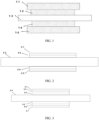
- FIG. 1 shows a package structure of a tab and a packaging bag according to one embodiment of this application.
- a packaging bag 1-1 is bonded with a metal belt 1-3 through a tab protection layer 1-2
- a packaging bag 1-5 is bonded with the metal belt 1-3 through a tab protection layer 1-4, where the tab protection layer 1-2 and the tab protection layer 1-4 are both a single-layer structure, in other words, consisting of one first polymer layer.
- FIG. 2 shows a structure of a tab protection layer according to one embodiment of this application.
- the tab protection layer is a double-layer structure, where a tab protection layer disposed above a metal belt 2-3 consists of a first polymer layer 2-1 and a second polymer layer 2-2, and a tab protection layer disposed below the metal belt 2-3 consists of a first polymer layer 2-5 and a second polymer layer 2-4.
- FIG. 3 shows a structure of a tab protection layer according to another embodiment of this application.
- the tab protection layer is a three-layer structure.
- a tab protection layer disposed above a metal belt 3-4 consists of first polymer layers 3-1 and 3-3 and a second polymer layer 3-2 disposed therebetween.
- a tab protection layer disposed below the metal belt 3-4 consists of first polymer layers 3-5 and 3-6 and a second polymer layer 3-6 disposed therebetween.
- a main function of a tab protection layer is to bond to a tab of a lithium-ion battery, allowing the tab to be hot sealed with a polypropylene layer on an inner side of a packaging bag of a polymer battery.
- a commonly used tab protection layer has a melting point of above 140°C.
- a tab protection layer having a lower melting point is used to achieve a purpose of dissipating battery heat earlier and improving thermal safety of the battery.
- the material, composition, and manufacturing method of the negative electrode used in the electrochemical apparatus of this application may include any technology disclosed in the prior art.
- the negative electrode is a negative electrode described in the US patent application US9812739B , which is incorporated in this application by reference in its entirety.
- the negative electrode includes a current collector and a negative electrode active material layer disposed on the current collector.
- the negative electrode active material layer includes a negative electrode active material.
- the negative electrode active material includes, but is not limited to: a lithium metal, a structured lithium metal, natural graphite, artificial graphite, mesocarbon microbeads (MCMB), hard carbon, soft carbon, silicon, a silicon-carbon composite, a silicon-oxide material, a Li-Sn alloy, a Li-Sn-O alloy, Sn, SnO, SnO 2 , spinel structure lithiated TiO 2 -Li 4 Ti 5 O 12 , and a Li-Al alloy, or any combination thereof.
- MCMB mesocarbon microbeads
- the negative electrode active material layer includes a binder.
- the binder includes, but is not limited to: polyvinyl alcohol, hydroxypropyl cellulose, diacetyl cellulose, polyvinyl chloride, carboxylated polyvinyl chloride, polyvinyl fluoride, a polymer containing ethylene oxide, polyvinylpyrrolidone, polyurethane, polytetrafluoroethylene, poly(1,1-difluoroethylene), polyethylene, polypropylene, styrene-butadiene rubber, acrylic styrene-butadiene rubber, epoxy resin, or nylon.
- the negative electrode active material layer includes a conductive material.
- the conductive material includes, but is not limited to: natural graphite, artificial graphite, carbon black, acetylene black, Ketjen black, carbon fiber, metal powder, metal fiber, copper, nickel, aluminum, silver or polyphenylene derivatives.
- the current collector includes, but is not limited to: a copper foil, a nickel foil, a stainless steel foil, a titanium foil, foamed nickel, foamed copper, or a polymer substrate coated with conductive metal.
- the negative electrode may be obtained by using the following method: mixing the active material, the conductive material and the binder in a solvent to prepare an active material composition, and applying the active material composition on the current collector.
- the solvent may include, but is not limited to: deionized water and N-methylpyrrolidone.
- the negative electrode in an all-solid-state secondary battery is a lithium metal foil.
- a material, a structure, and a preparation method known in the art may be used to prepare a material for a positive electrode used in the electrochemical apparatus in this application.
- the positive electrode in this application may be prepared by the technology described in the US patent application US9812739B , which is incorporated in this application by reference in its entirety.
- the positive electrode includes a current collector and a positive electrode active material layer disposed on the current collector.
- the positive electrode active material includes at least one lithiated intercalation compound that reversibly intercalates and deintercalates lithium ions.
- the positive electrode active material includes a composite oxide.
- the composite oxide contains at least one element selected from cobalt, manganese, and nickel.
- the positive electrode active material is selected from lithium cobalt oxide (LiCoO 2 ), lithium-nickel-cobalt-manganese (NCM) ternary material, lithium iron phosphate (LiFePO 4 ), lithium manganate (LiMn 2 O 4 ), or any combination thereof.
- the positive electrode active material may have a coating layer on its surface, or may be mixed with another compound having a coating layer.
- the coating layer may include at least one compound of a coating element selected from oxides of the coating element, hydroxides of the coating element, hydroxyl oxides of the coating element, oxycarbonates of the coating element, and hydroxy carbonates of the coating element.
- the compound used for the coating may be amorphous or crystalline.
- the coating element contained in the coating layer may include Mg, Al, Co, K, Na, Ca, Si, Ti, V, Sn, Ge, Ga, B, As, Zr, and F, or any combination thereof.
- the coating can be applied by using any method as long as the method does not adversely affect performance of the positive electrode active material.
- the method may include any coating method known in the art, for example, spraying and dipping.
- the positive electrode active material layer further includes a binder, and optionally includes a conductive material.
- the binder enhances binding between particles of the positive electrode active material, and binding between the positive electrode active material and the current collector.
- the binder includes, but is not limited to: polyvinyl alcohol, hydroxypropyl cellulose, diacetyl cellulose, polyvinyl chloride, carboxylated polyvinyl chloride, polyvinyl fluoride, a polymer containing ethylene oxide, polyvinylpyrrolidone, polyurethane, polytetrafluoroethylene, poly(1,1-difluoroethylene), polyethylene, polypropylene, styrene-butadiene rubber, acrylic styrene-butadiene rubber, epoxy resin, or nylon.
- the conductive material includes, but is not limited to: carbon-based materials, metal-based materials, conductive polymer, and a mixture thereof.
- the carbon-based material is selected from natural graphite, artificial graphite, carbon black, acetylene black, Ketjen black, carbon fiber, or any combination thereof.
- the metal-based material is selected from metal powder, metal fiber, copper, nickel, aluminum, or silver.
- the conductive polymer is a polyphenylene derivative.
- the current collector may be, but is not limited to, aluminum.
- the positive electrode can be prepared by using a preparation method known in the art.
- the positive electrode may be obtained by using the following method: mixing the active material, the conductive material, and the binder in a solvent to prepare an active material composition, and applying the active material composition on the current collector.
- the solvent may include, but is not limited to, N-methylpyrrolidone and the like.
- the positive electrode is made by forming, on the current collector, a positive electrode material using a positive electrode active material layer including lithium transition metal-based compound powder and a binder.
- the positive electrode active material layer can usually be made by the following operations: dry mixing the positive electrode active material and the binder (a conductive material, a thickener, or the like as required) to form a sheet, pressing the obtained sheet to the positive electrode current collector, or dissolving or dispersing these materials in a liquid medium to form a slurry, which is applied on the positive electrode current collector as a coating and dried.
- the material of the positive active substance layer includes any material known in the art.
- the electrochemical apparatus according to this application has a separator provided between a positive electrode and a negative electrode to prevent short circuits.
- the separator used in the electrochemical apparatus according to this application is not particularly limited to any material or shape, and may be based on any technology disclosed in the prior art.
- the separator includes a polymer or an inorganic substance formed by a material stable to the electrolyte of this application.
- the separator may include a substrate layer and a surface treatment layer.
- the substrate layer is a non-woven fabric, a membrane, or a composite membrane having a porous structure, and a material of the substrate layer is selected from at least one of polyethylene, polypropylene, polyethylene terephthalate, or polyimide.
- a polypropylene porous membrane, a polyethylene porous membrane, a polypropylene non-woven fabric, a polyethylene non-woven fabric, or a polypropylene-polyethylene-polypropylene porous composite membrane may be selected.
- the surface treatment layer is provided on at least one surface of the substrate layer, and the surface treatment layer may be a polymer layer or an inorganic layer, or may be a layer formed by a mixed polymer and an inorganic substance.
- the inorganic layer includes inorganic particles and a binder.
- the inorganic particles are selected from one or more of aluminum oxide, silicon oxide, magnesium oxide, titanium oxide, hafnium oxide, tin oxide, ceria oxide, nickel oxide, zinc oxide, calcium oxide, zirconium oxide, yttrium oxide, silicon carbide, boehmite, aluminum hydroxide, magnesium hydroxide, calcium hydroxide, and barium sulfate.
- the binder is selected from one or more of polyvinylidene fluoride, a vinylidene fluoride-hexafluoropropylene copolymer, polyamide, polyacrylonitrile, polyacrylate, polyacrylic acid, polyacrylate, polyvinylpyrrolidone, polyvinyl ether, polymethyl methacrylate, polytetrafluoroethylene, and polyhexafluoropropylene.
- the polymer layer includes a polymer, and a material of the polymer includes at least one of polyamide, polyacrylonitrile, acrylate polymer, polyacrylic acid, polyacrylate, polyvinylpyrrolidone, polyvinyl ether, polyvinylidene fluoride, or poly(vinylidene fluoride-hexafluoropropylene).
- the electrolytic salt used in the electrolyte of the embodiments of this application may be an electrolytic salt known in the art.
- the electrolytic salt includes, but is not limited to: inorganic lithium salts, such as LiClO 4 , LiAsF 6 , LiPF 6 , LiBF 4 , LiSbF 6 , LiSO 3 F, and LiN(FSO 2 ) 2 ; fluorine-containing organic lithium salts, such as LiCF 3 SO 3 , LiN(FSO 2 )(CF 3 SO 2 ), LiN(CF 3 SO 2 ) 2 , LiN(C 2 F 5 SO 2 ) 2 , cyclic 1,3-hexafluoropropane disulfonimide lithium, cyclic 1,2-tetrafluoroethane disulfonimide lithium, LiN(CF 3 SO 2 )(C 4 F 9 SO 2 ), LiC(CF 3 SO 2 ) 3 , LiPF 4 (CF 3 ) 2 , LiPF 4 (C 2 F 5
- the electrolytic salt includes a combination of LiPF 6 and LiBF 4 .
- the electrolytic salt includes a combination of inorganic lithium salts such as LiPF 6 or LiBF 4 and fluorine-containing organic lithium salts such as LiCF 3 SO 3 , LiN(CF 3 SO 2 ) 2 , or LiN(C 2 F 5 SO 2 ) 2 .
- a concentration of the electrolytic salt falls within a range of 0.8-3 mol/L, for example, a range of 0.8-2.5 mol/L, a range of 0.8-2 mol/L, a range of 1-2 mol/L, a range of 0.5-1.5 mol/L, a range of 0.8-1.3 mol/L, and a range of 0.5-1.2 mol/L, for another example, the concentration of the electrolytic salt is 1 mol/L, 1.15 mol/L, 1.2 mol/L, 1.5 mol/L, 2 mol/L, or 2.5 mol/L.
- the electronic apparatus in this application may be any apparatus using the electrochemical apparatus according to embodiments of this application.
- the electronic apparatus includes, but is not limited to: notebook computers, pen-input computers, mobile computers, e-book players, portable phones, portable fax machines, portable copiers, portable printers, head-mounted stereo headsets, video recorders, liquid crystal display televisions, portable cleaners, portable CD players, mini discs, transceivers, electronic notebooks, calculators, memory cards, portable recorders, radios, backup power supplies, motors, automobiles, motorcycles, assisted bicycles, bicycles, lighting apparatuses, toys, game machines, clocks, electric tools, flashlights, cameras, large household storage batteries, lithium-ion capacitors, or the like.
- ethylene carbonate (EC), propylene carbonate (PC), and another organic solvent were mixed in a given proportion.
- the another organic solvent was selected from at least one of diethyl carbonate (DEC), ethyl propionate (EP), or propyl propionate (PP).
- DEC diethyl carbonate
- EP ethyl propionate
- PP propyl propionate
- a positive electrode active material lithium cobalt oxide (LiCoO 2 ), a conductive agent carbon nanotubes (CNT), and a binder polyvinylidene fluoride were mixed at a weight ratio of 95:2:3.
- NMP N-methylpyrrolidone
- the aluminum foil was dried at 85°C, followed by cold pressing, cutting, and slitting, and dried under vacuum at 85°C for 4 hours, to obtain a positive electrode.
- a negative electrode active substance graphite, a binder styrene-butadiene rubber (SBR), and a thickener sodium carboxymethyl cellulose (CMC) at a weight ratio of 95:2:3 were fully stirred and mixed in an appropriate amount of deionized water solvent, to form a uniform negative electrode slurry; and the slurry was applied onto a negative electrode current collector Cu foil, followed by drying and cold pressing, to obtain a negative electrode.
- a polyethylene (PE) film was used as a separator.
- a tab protection layer and a metal belt were fitted together by flat-plate heating or high frequency heating to prepare a tab including a tab protection layer, then the resulting tab was fastened to a positive electrode and a negative electrode by welding.
- a positive electrode, a separator, and a negative electrode were stacked in order, so that the separator was located between the positive electrode and the negative electrode for isolation, followed by winding and being placed in an outer packaging foil; and the electrolyte prepared was injected into a dried battery, and after processes such as vacuum packaging, standing, formation, and shaping, the preparation of the lithium-ion battery is completed.
- lithium-ion batteries were charged to 4.45 V at a constant current of 0.7C, then charged to 0.05C at a constant voltage of 4.45 V.
- the batteries were placed in a high temperature box, heated to 135°C at a temperature rise rate of 5 ⁇ 2°C/min, and kept for 1 hour (hr), and changes of battery voltage, battery temperature, and hotbox temperature were recorded. Batteries that did not catch fire or explode passed the test. Each group of 10 batteries was tested, and the number of batteries that passed the test was recorded.
- lithium-ion batteries were left standing for 30 minutes, constant-current charged to 4.45 V at 0.5C rate, then charged to 0.05C at a constant voltage of 4.45 V, and left standing for 5 minutes, and thicknesses of the lithium-ion batteries were measured and recorded as h0. Then, the lithium-ion batteries were placed in an 85°C thermostat and stored for 24 days, and thicknesses of the lithium-ion batteries were measured and recorded as h1.
- lithium-ion batteries were charged to 4.45 V at a constant current of 0.7C, then charged to 0.05C at a constant voltage of 4.45 V. Then, the lithium-ion batteries were left standing for 4 hours at different temperatures (25°C, 0°C, -10°C), discharged to 3.0 V at 0.2C, and left standing for 5 minutes after the end of each discharge, and discharge capacities of the lithium-ion batteries were recorded. By taking the discharge capacity at 25°C as reference, discharge capacity ratios of the lithium-ion battery at different temperatures were obtained.
- Discharge capacity ratio (%) of lithium-ion battery at different temperature discharge capacity at different temperature (0°C or -10°C)/discharge capacity at 25°C ⁇ 100%
- Example S2-1 to S2-3 the tab protection layer is of a double-layer structure, including one first polymer layer and one second polymer layer.
- the tab protection layer in Example S3-1 is of a three-layer structure.
- a second polymer layer is provided between two first polymer layers.
- a melting point value T A of all foregoing first polymer layers is 125°C.
- the foregoing first polymer layers are selected from BYNEL 4104 (125°C), and the second polymer layers are selected from Samsung CF330 block copolymer polypropylene.
- Table 4 shows compositions and performance test results of lithium-ion batteries in related examples.
- Example S4-1, Example S4-2, and Example S1-2 are similar in preparation of lithium-ion batteries except that compositions of electrolytes are different, with details shown in Table 4.
- Table 5 shows compositions and performance test results of lithium-ion batteries in related examples. Examples S5-1 to S5-3 and Example S1-2 are similar in preparation processes of lithium-ion batteries except that compositions of electrolytes are different, with details shown in Table 5.
- Table 6 shows compositions and performance test results of lithium-ion batteries in related examples. Examples S6-1 to S6-16 and Example S1-2 are similar in preparation processes of lithium-ion batteries except that compositions of electrolytes are different, with details shown in Table 6.
- Table 7 shows compositions and performance test results of lithium-ion batteries in related examples. Examples S7-1 to S7-11 and Example S1-2 are similar in preparation processes of lithium-ion batteries except that compositions of electrolytes are different, with details shown in Table 7.
- references to “some embodiments”, “some of the embodiments”, “an embodiment”, “another example”, “examples”, “specific examples”, or “some examples” in this specification mean the inclusion of specific features, structures, materials, or characteristics described in at least one embodiment or example of this application in this embodiment or example. Therefore, descriptions in various places throughout this specification, such as “in some embodiments”, “in the embodiments”, “in an embodiment”, “in another example”, “in an example”, “in a specific example”, or “examples” do not necessarily refer to the same embodiment or example in this application.
- a specific feature, structure, material, or characteristic herein may be combined in any appropriate manner in one or more embodiments or examples.
Landscapes
- Chemical & Material Sciences (AREA)
- Electrochemistry (AREA)
- General Chemical & Material Sciences (AREA)
- Chemical Kinetics & Catalysis (AREA)
- Engineering & Computer Science (AREA)
- Manufacturing & Machinery (AREA)
- Physics & Mathematics (AREA)
- Condensed Matter Physics & Semiconductors (AREA)
- General Physics & Mathematics (AREA)
- Inorganic Chemistry (AREA)
- Materials Engineering (AREA)
- Secondary Cells (AREA)
- Sealing Battery Cases Or Jackets (AREA)
- Electric Double-Layer Capacitors Or The Like (AREA)
Abstract
Description
- This application relates to the field of energy storage, specifically to an electrochemical apparatus and an electronic apparatus containing the same, and in particular to a lithium-ion battery.
- With the popularization and application of smart products, demands for mobile phones, notebook computers, cameras, and other electronic products have been growing year by year. As working power sources of electronic products, electrochemical apparatuses, for example, lithium-ion batteries, are gradually replacing traditional Ni-Cd and MH-Ni batteries due to such characteristics as high energy density, zero memory effect, and high working voltage. However, with the development of electronic products towards thinness and portability, requirements for lithium-ion batteries are constantly increasing. Development of safe lithium-ion batteries with good cycling stability, low impedance, and less self-discharge is one of the main demands of the market.
- An embodiment of this application provides an electrochemical apparatus in an attempt to resolve at least one problem in the related field to at least some extent. An embodiment of this application further provides an electronic apparatus containing the electrochemical apparatus.
- In one embodiment, this application provides an electrochemical apparatus, where the electrochemical apparatus includes an electrode and an electrolyte.
- In an embodiment, the electrode includes a current collector, an active material layer disposed on at least one surface of the current collector, a tab disposed on the current collector, and a tab protection layer disposed on the tab. The tab protection layer includes a first polymer layer, the first polymer layer has a melting point of TA°C, and 110 ≤ TA ≤ 136.5.
- In an embodiment, the electrolyte includes ethylene carbonate and propylene carbonate, where based on a weight of the electrolyte, a sum of weight percentages of the ethylene carbonate and the propylene carbonate is Y%, and Y is 20-80; and Y and TA satisfy 0.147 < Y/TA < 0.7.
- In some embodiments, the tab protection layer further includes a second polymer layer, the second polymer layer has a melting point of TB°C, TB ≤ 160, and TA and TB satisfy 0 < TB-TA ≤ 50.
- In some embodiments, the first polymer layer includes at least one of maleic anhydride-grafted modified polypropylene, acidified polyolefin resin, or polyethylene.
- In some embodiments, the second polymer layer includes at least one of polypropylene or polypropylene modified resin.
- In some embodiments, the electrolyte further includes propionate, and based on a weight of the electrolyte, a weight percentage of the propionate is 10%-60%.
- In some embodiments, the propionate includes at least one of methyl propionate, ethyl propionate, propyl propionate, buty propionate, amyl propionate, fluorinated methyl propionate, fluorinated ethyl propionate, fluorinated propyl propionate, fluorinated butyl propionate, or fluorinated pentyl prorionate, where fluorinated means that at least one hydrogen atom is substituted by a fluorine atom.
- In some embodiments, the electrolyte further includes a trimethylacetate compound.
- In some embodiments, a structural formula of the trimethylacetate compound is as follows:

- In some embodiments, the trimethylacetate compound includes at least one of methyl trimethylacetate or trimethylethyl acetate.
- In some embodiments, the electrolyte further includes at least one of a dinitrile compound or a trinitrile compound,
where the dinitrile compound includes at least one of the following compounds: - butanedinitrile, glutaronitrile, adiponitrile, 1,5-dicyanopentane, 1,6-dicyanohexane, 1,7-dicyanoheptane, 1,8-dicyanooctane, 1,9-dicyanononane, 1,10-dicyanodecane, 1,12-dicyanododecane, tetramethylbut, 2-methylglutaronitrile, 2,4-dimethylglutaronitrile, 2,2,4,4-tetramethylglutaronitrile, or ethylene glycol bis(propionitrile) ether; and
- the trinitrile compound includes at least one of the following compounds:
1,3,5-pentanetricarbonitrile, 1,2,3-propanetricarbonitrile, 1,2,6-hexanetricarbonitrile, 1,3,6-hexanetricarbonitrile, 1,2,3-tris(2-cyanoethoxy)propane, 1,2,4-tris(2-cyanoethoxy)butane, or 1,2,5-tris(cyanoethoxy)pentane. - In another embodiment, this application provides an electronic apparatus, containing the electrochemical apparatus according to embodiments of this application.
- The electrochemical apparatus provided in this application has improved hotbox performance and high-temperature storage performance.
- Additional aspects and advantages of the embodiments of this application are partly described and presented in subsequent descriptions, or explained by implementation of the embodiments of this application.
- To describe embodiments of this application, the following briefly describes the accompanying drawings required for describing the embodiments of this application or the prior art. Apparently, the accompanying drawings described below are merely some embodiments of this application. A person skilled in the art may still derive drawings for other embodiments from structures shown in these accompanying drawings without creative efforts.
-
FIG. 1 shows a package structure of a tab and a packaging bag according to one embodiment of this application. -
FIG. 2 shows a structure of a tab protection layer according to one embodiment of this application. -
FIG. 3 shows a structure of a tab protection layer according to another embodiment of this application. -
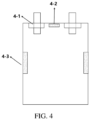
FIG. 4 shows a battery structure and a location of a tab protection layer according to one embodiment of this application. - Embodiments of this application are described in detail below. The embodiments of this application should not be construed as limitations on the application.
- In addition, quantities, ratios, and other values are sometimes presented in the format of ranges in this specification. It should be understood that such range formats are used for convenience and simplicity and should be flexibly understood as including not only values clearly designated as falling within the range but also all individual values or sub-ranges covered by the range as if each value and sub-range are clearly designated.
- In specific embodiments and claims, a list of items connected by the terms "one of", "one piece of", "one kind of" or other similar terms may mean any one of the listed items. For example, if items A and B are listed, the phrase "one of A and B" means only A or only B. In another example, if items A, B, and C are listed, the phrase "one of A, B, and C" means only A, only B, or only C. The item A may contain a single element or a plurality of elements. The item B may contain a single element or a plurality of elements. The item C may contain a single element or a plurality of elements.
- In the specific embodiments and claims, an item list connected by the terms "at least one of", "at least one piece of", "at least one kind of" or other similar terms may mean any combination of the listed items. For example, if items A and B are listed, the phrase "at least one of A and B" means only A; only B; or A and B. In another example, if items A, B, and C are listed, the phrase "at least one of A, B, and C" means only A; only B; only C; A and B (exclusive of C); A and C (exclusive of B); B and C (exclusive of A); or all of A, B, and C. The item A may contain a single element or a plurality of elements. The item B may contain a single element or a plurality of elements. The item C may contain a single element or a plurality of elements.
- As used herein, the term "alkyl" is intended to be a straight-chain saturated hydrocarbon structure having 1 to 20 carbon atoms. The term "alkyl" is also intended to be a branched or cyclic hydrocarbon structure having 3 to 20 carbon atoms. For example, the alkyl may be an alkyl having 1 to 20 carbon atoms, an alkyl having 1 to 10 carbon atoms, an alkyl having 1 to 5 carbon atoms, an alkyl having 5 to 20 carbon atoms, an alkyl having 5 to 15 carbon atoms, or an alkyl having 5 to 10 carbon atoms. References to an alkyl with a specific carbon number are intended to cover all geometric isomers with the specific carbon number. Therefore, for example, "butyl" is meant to include n-butyl, sec-butyl, isobutyl, tert-butyl, and cyclobutyl; and "propyl" includes n-propyl, isopropyl, and cyclopropyl. Examples of the alkyl include, but are not limited to, methyl, ethyl, n-propyl, isopropyl, cyclopropyl, n-butyl, isobutyl, sec-butyl, tert-butyl, cyclobutyl, n-pentyl, isopentyl, neopentyl, cyclopentyl, methylcyclopentyl, ethylcyclopentyl, n-hexyl, isohexyl, cyclohexyl, n-heptyl, octyl, cyclopropyl, cyclobutyl, and norbornyl. In addition, the alkyl may be arbitrarily substituted.
- As used herein, the term "alkenyl" refers to a straight-chain or branched monovalent unsaturated hydrocarbon group having at least one and usually 1, 2, or 3 carbon-carbon double bonds. Unless otherwise defined, the alkenyl generally contains 2 to 20 carbon atoms. For example, the alkenyl may be an alkenyl having 2 to 20 carbon atoms, an alkenyl having 6 to 20 carbon atoms, an alkenyl having 2 to 12 carbon atoms, or an alkenyl having 2 to 6 carbon atoms. Representative alkenyls include, for example, vinyl, n-propenyl, isopropenyl, n-but-2-enyl, but-3-enyl, and n-hex-3-enyl. In addition, the alkenyl may be arbitrarily substituted.
- The term "aryl" covers both monocyclic and polycyclic systems. A polycyclic ring may have two or more rings in which two carbons are shared by two adjacent rings (the rings are "fused"), where at least one of the rings is aromatic, and other rings, for example, may be cycloalkyl, cycloalkenyl, aryl, heterocyclyl and/or heteroaryl. For example, the aryl may be C6 to C50 aryls, C6 to C40 aryls, C6 to C30 aryls, C6 to C20 aryls, or C6 to C10 aryls. Representative aryls include, for example, phenyl, methylphenyl, propylphenyl, isopropylphenyl, benzyl, naphth-1-yl, and naphth-2-yl. In addition, the aryl may be arbitrarily substituted.
- As used herein, the term "halogenated alkyl" refers to an alkyl that has at least one hydrogen atom being substituted by a halogen atom. The term "halogenated alkenyl" refers to an alkenyl that has at least one hydrogen atom being substituted by a halogen atom.
- As used herein, the term "halogen" covers F, Cl, Br, and I.
- In the case of substitution, a substituent can be independently selected from a group including the following: halogen, alkyl, alkenyl, and aryl.
- As used herein, the content of each component is obtained based on the weight of the electrolyte.
- As used herein, the term "substitute" or "substituted" refers to being substituted by one or more (for example, 2 or 3) substituents. As used herein, "fluorinated" refers to being substituted by one or more (for example, 2 or 3) Fs.
- In some embodiments, this application provides an electrochemical apparatus, where the electrochemical apparatus includes an electrode and an electrolyte.
- In some embodiments, the electrode includes a current collector, an active material layer disposed on at least one surface of the current collector, a tab disposed on the current collector, and a tab protection layer disposed on the tab, where the tab protection layer includes a first polymer layer, the first polymer layer has a melting point of TA°C, and 110 ≤ TA ≤ 136.5
- In some embodiments, the electrolyte includes ethylene carbonate and propylene carbonate, where based on a weight of the electrolyte, a sum of weight percentages of the ethylene carbonate and the propylene carbonate is Y%, and Y is 20-80; and Y and TA satisfy 0.147 < Y/TA < 0.7. Y/TA within this range increases thermal stability of an electrochemical system of the electrochemical apparatus, thereby improving hotbox performance and significantly improving high-temperature storage performance of lithium-ion batteries.
- In some embodiments, TA is 110, 115, 120, 125, 130, 135, 136, or 136.5, or in a range of any two of these values. TA within such ranges can significantly improve safety performance of the electrochemical device.
- In some embodiments, Y is 20, 25, 30, 35, 40, 45, 50, 55, 60, 70, or 80, or in a range of any two of these values.
- In some embodiments, a value of Y/TA is 0.1, 0.2, 0.3, 0.4, 0.5, 0.6, 0.65, or 0.7, or in a range of any two of these values.
- In some embodiments, the tab protection layer further includes a second polymer layer, the second polymer layer has a melting point of TB°C, TB ≤ 160, and TA and TB satisfy 0 < TB-TA ≤ 60. TB-TA within this range allows the electrochemical device to have better safety performance.
- In some embodiments, TB is 138, 140, 145, 150, 155, or 160, or in a range of any two of these values.
- In some embodiments, a value of TB-TA is 0.1, 0.5, 1, 3, 5, 10, 20, 30, 40, or 50, or in a range of any two of these values.
- In some embodiments, the first polymer layer includes at least one of maleic anhydride-grafted modified polypropylene, acidified polyolefin resin, or polyethylene.
- In some embodiments, the first polymer layer includes at least one of QE840 and QFF551 of Mitsui Chemicals, Dupont Nucrel 0910, Dupont Elvax, Samsung E093A, or Mitsubishi Chemical P546.
- In some embodiments, the second polymer layer includes at least one of polypropylene resins.
- In some embodiments, the second polymer layer includes at least one of Samsung CF330, TPC FS5611, or Exxon Mobil 6102FL.
- In some embodiments, the tab protection layer is a single-layer, double-layer, or three-layer structure.
- In some embodiments, the tab protection layer consists of one first polymer layer. In some embodiments, the tab protection layer consists of one first polymer layer and one second polymer layer. In some embodiments, the tab protection layer consists of two first polymer layers and one second polymer layer disposed between the two first polymer layers.
- In some embodiments, the electrolyte further includes propionate, and based on a weight of the electrolyte, a weight percentage of the propionate is 10%-60%. In some embodiments, based on a weight of the electrolyte, a weight percentage of the propionate is 10%, 20%, 30%, 40%, 50%, or 60%, or in a range of any two of these values.
- In some embodiments, the propionate includes at least one of methyl propionate, ethyl propionate, propyl propionate, buty propionate, amyl propionate, fluorinated methyl propionate, fluorinated ethyl propionate, fluorinated propyl propionate, fluorinated butyl propionate, or fluorinated pentyl prorionate, where fluorinated means that at least one hydrogen atom is substituted by a fluorine atom.
- In some embodiments, the electrolyte further includes a trimethylacetate compound.
- In some embodiments, a structural formula of the trimethylacetate compound is as follows:

- In some embodiments, R is C1-C6 alkyl, C2-C6 alkenyl, C1-C6 halogenated alkyl, C2-C6 halogenated alkenyl, halogen, aryl, or amide.
- In some embodiments, the trimethylacetate compound includes at least one of methyl trimethylacetate or trimethylethyl acetate.
- In some embodiments, the electrolyte further includes at least one of a dinitrile compound or a trinitrile compound,
where the dinitrile compound includes at least one of the following compounds: - butanedinitrile, glutaronitrile, adiponitrile, 1,5-dicyanopentane, 1,6-dicyanohexane, 1,7-dicyanoheptane, 1,8-dicyanooctane, 1,9-dicyanononane, 1,10-dicyanodecane, 1,12-dicyanododecane, tetramethylbut, 2-methylglutaronitrile, 2,4-dimethylglutaronitrile, 2,2,4,4-tetramethylglutaronitrile, or ethylene glycol bis(propionitrile) ether; and
- the trinitrile compound includes at least one of the following compounds:
1,3,5-pentanetricarbonitrile, 1,2,3-propanetricarbonitrile, 1,2,6-hexanetricarbonitrile, 1,3,6-hexanetricarbonitrile, 1,2,3-tris(2-cyanoethoxy)propane, 1,2,4-tris(2-cyanoethoxy)butane, or 1,2,5-tris(cyanoethoxy)pentane. - In some embodiments, based on a weight of the electrolyte, a percentage of the dinitrile compound is 1%-5%. In some embodiments, based on a weight of the electrolyte, a percentage of the dinitrile compound is 1%, 2%, 3%, 3.5%, 4.0%, or 5.0%, or in a range of any two of these values.
- In some embodiments, based on a weight of the electrolyte, a percentage of the trinitrile compound is 1%-5%. In some embodiments, based on a weight of the electrolyte, a percentage of the trinitrile compound is 1%, 2%, 3%, 3.5%, 4.0%, 5.0%, or 6.0%, or in a range of any two of these values.
- In some embodiments, the electrolyte includes a trinitrile compound and an ethylene glycol bis(propionitrile) ether. Based a weight of the electrolyte, a weight percentage of the trinitrile compound is a%, a percentage of the ethylene glycol bis(propionitrile) ether is b%, and 1.0 ≤ a+b ≤ 6.0. In some embodiments, a+b is 1.0, 2.0, 3.0, 3.5, 4.0, 4.5, 5.0, 5.5, or 6.0, or in a range of any two of these values.
- In some embodiments, 1.2 ≤ a/b ≤ 20. In some embodiments, a/b is 2.0, 3.0, 3.3, 4.0, 5.5, 7.0, 8.5, 9.5, 12.0, 14.5, 16.5, 18.5, or 20.0, or in a range of any two of these values.
- In some embodiments, the electrolyte further includes fluoroethylene carbonate and 1,3-propanesultone. Based on a weight of the electrolyte, a weight percentage of the fluoroethylene carbonate is c%, a weight percentage of the 1,3-propanesultone is d%, and 6.0 ≤ c+d ≤ 15.0. In some embodiments, c+d is 6.0, 7.0, 8.0, 8.5, 9.0, 9.5, 10.0, 11.0, 11.5, 12.0, 13.0, 14.0, or 15.0, or in a range of any two of these values.
- In some embodiments, 1.2 ≤ c/d ≤ 20. In some embodiments, c/d is 1.2, 2.0, 3.0, 3.3, 4.0, 5.5, 7.0, 8.5, 9.5, 12.0, 14.5, 16.5, 18.5, or 20.0, or in a range of any two of these values.
- In some embodiments, the electrolyte may further include allyl cyanide.
- In some embodiments, the electrochemical apparatus includes any apparatus in which electrochemical reactions occur.
- In some embodiments, the electrode includes a negative electrode having a negative active substance capable of occluding and releasing metal ions, and a positive electrode having a positive electrode active substance capable of occluding and releasing metal ions.
- In some embodiments, the electrochemical apparatus further includes a separator disposed between a positive electrode and a negative electrode.
- In some embodiments, the electrochemical apparatus is a lithium secondary battery.
- In some embodiments, the lithium secondary battery includes, but is not limited to: a lithium metal secondary battery, a lithium-ion secondary battery, a lithium polymer secondary battery, a lithium-ion polymer secondary battery, or an all-solid-state lithium secondary battery.
-
FIG. 1 shows a package structure of a tab and a packaging bag according to one embodiment of this application. A packaging bag 1-1 is bonded with a metal belt 1-3 through a tab protection layer 1-2, and a packaging bag 1-5 is bonded with the metal belt 1-3 through a tab protection layer 1-4, where the tab protection layer 1-2 and the tab protection layer 1-4 are both a single-layer structure, in other words, consisting of one first polymer layer. -
FIG. 2 shows a structure of a tab protection layer according to one embodiment of this application. The tab protection layer is a double-layer structure, where a tab protection layer disposed above a metal belt 2-3 consists of a first polymer layer 2-1 and a second polymer layer 2-2, and a tab protection layer disposed below the metal belt 2-3 consists of a first polymer layer 2-5 and a second polymer layer 2-4. -
FIG. 3 shows a structure of a tab protection layer according to another embodiment of this application. The tab protection layer is a three-layer structure. A tab protection layer disposed above a metal belt 3-4 consists of first polymer layers 3-1 and 3-3 and a second polymer layer 3-2 disposed therebetween. A tab protection layer disposed below the metal belt 3-4 consists of first polymer layers 3-5 and 3-6 and a second polymer layer 3-6 disposed therebetween. - A main function of a tab protection layer is to bond to a tab of a lithium-ion battery, allowing the tab to be hot sealed with a polypropylene layer on an inner side of a packaging bag of a polymer battery. At present, generally, a commonly used tab protection layer has a melting point of above 140°C. In the present invention, a tab protection layer having a lower melting point is used to achieve a purpose of dissipating battery heat earlier and improving thermal safety of the battery.
- The material, composition, and manufacturing method of the negative electrode used in the electrochemical apparatus of this application may include any technology disclosed in the prior art. In some embodiments, the negative electrode is a negative electrode described in the US patent application
US9812739B - In some embodiments, the negative electrode includes a current collector and a negative electrode active material layer disposed on the current collector. In some embodiments, the negative electrode active material layer includes a negative electrode active material. In some embodiments, the negative electrode active material includes, but is not limited to: a lithium metal, a structured lithium metal, natural graphite, artificial graphite, mesocarbon microbeads (MCMB), hard carbon, soft carbon, silicon, a silicon-carbon composite, a silicon-oxide material, a Li-Sn alloy, a Li-Sn-O alloy, Sn, SnO, SnO2, spinel structure lithiated TiO2-Li4Ti5O12, and a Li-Al alloy, or any combination thereof.
- In some embodiments, the negative electrode active material layer includes a binder. In some embodiments, the binder includes, but is not limited to: polyvinyl alcohol, hydroxypropyl cellulose, diacetyl cellulose, polyvinyl chloride, carboxylated polyvinyl chloride, polyvinyl fluoride, a polymer containing ethylene oxide, polyvinylpyrrolidone, polyurethane, polytetrafluoroethylene, poly(1,1-difluoroethylene), polyethylene, polypropylene, styrene-butadiene rubber, acrylic styrene-butadiene rubber, epoxy resin, or nylon.
- In some embodiments, the negative electrode active material layer includes a conductive material. In some embodiments, the conductive material includes, but is not limited to: natural graphite, artificial graphite, carbon black, acetylene black, Ketjen black, carbon fiber, metal powder, metal fiber, copper, nickel, aluminum, silver or polyphenylene derivatives.
- In some embodiments, the current collector includes, but is not limited to: a copper foil, a nickel foil, a stainless steel foil, a titanium foil, foamed nickel, foamed copper, or a polymer substrate coated with conductive metal.
- In some embodiments, the negative electrode may be obtained by using the following method: mixing the active material, the conductive material and the binder in a solvent to prepare an active material composition, and applying the active material composition on the current collector.
- In some embodiments, the solvent may include, but is not limited to: deionized water and N-methylpyrrolidone.
- In some embodiments, the negative electrode in an all-solid-state secondary battery is a lithium metal foil.
- A material, a structure, and a preparation method known in the art may be used to prepare a material for a positive electrode used in the electrochemical apparatus in this application. In some embodiments, the positive electrode in this application may be prepared by the technology described in the US patent application
US9812739B - In some embodiments, the positive electrode includes a current collector and a positive electrode active material layer disposed on the current collector. The positive electrode active material includes at least one lithiated intercalation compound that reversibly intercalates and deintercalates lithium ions. In some embodiments, the positive electrode active material includes a composite oxide. In some embodiments, the composite oxide contains at least one element selected from cobalt, manganese, and nickel.
- In some embodiments, the positive electrode active material is selected from lithium cobalt oxide (LiCoO2), lithium-nickel-cobalt-manganese (NCM) ternary material, lithium iron phosphate (LiFePO4), lithium manganate (LiMn2O4), or any combination thereof.
- In some embodiments, the positive electrode active material may have a coating layer on its surface, or may be mixed with another compound having a coating layer. The coating layer may include at least one compound of a coating element selected from oxides of the coating element, hydroxides of the coating element, hydroxyl oxides of the coating element, oxycarbonates of the coating element, and hydroxy carbonates of the coating element. The compound used for the coating may be amorphous or crystalline.
- In some embodiments, the coating element contained in the coating layer may include Mg, Al, Co, K, Na, Ca, Si, Ti, V, Sn, Ge, Ga, B, As, Zr, and F, or any combination thereof. The coating can be applied by using any method as long as the method does not adversely affect performance of the positive electrode active material. For example, the method may include any coating method known in the art, for example, spraying and dipping.
- The positive electrode active material layer further includes a binder, and optionally includes a conductive material. The binder enhances binding between particles of the positive electrode active material, and binding between the positive electrode active material and the current collector.
- In some embodiments, the binder includes, but is not limited to: polyvinyl alcohol, hydroxypropyl cellulose, diacetyl cellulose, polyvinyl chloride, carboxylated polyvinyl chloride, polyvinyl fluoride, a polymer containing ethylene oxide, polyvinylpyrrolidone, polyurethane, polytetrafluoroethylene, poly(1,1-difluoroethylene), polyethylene, polypropylene, styrene-butadiene rubber, acrylic styrene-butadiene rubber, epoxy resin, or nylon.
- In some embodiments, the conductive material includes, but is not limited to: carbon-based materials, metal-based materials, conductive polymer, and a mixture thereof. In some embodiments, the carbon-based material is selected from natural graphite, artificial graphite, carbon black, acetylene black, Ketjen black, carbon fiber, or any combination thereof. In some embodiments, the metal-based material is selected from metal powder, metal fiber, copper, nickel, aluminum, or silver. In some embodiments, the conductive polymer is a polyphenylene derivative.
- In some embodiments, the current collector may be, but is not limited to, aluminum.
- The positive electrode can be prepared by using a preparation method known in the art. For example, the positive electrode may be obtained by using the following method: mixing the active material, the conductive material, and the binder in a solvent to prepare an active material composition, and applying the active material composition on the current collector. In some embodiments, the solvent may include, but is not limited to, N-methylpyrrolidone and the like.
- In some embodiments, the positive electrode is made by forming, on the current collector, a positive electrode material using a positive electrode active material layer including lithium transition metal-based compound powder and a binder.
- In some embodiments, the positive electrode active material layer can usually be made by the following operations: dry mixing the positive electrode active material and the binder (a conductive material, a thickener, or the like as required) to form a sheet, pressing the obtained sheet to the positive electrode current collector, or dissolving or dispersing these materials in a liquid medium to form a slurry, which is applied on the positive electrode current collector as a coating and dried. In some embodiments, the material of the positive active substance layer includes any material known in the art.
- In some embodiments, the electrochemical apparatus according to this application has a separator provided between a positive electrode and a negative electrode to prevent short circuits. The separator used in the electrochemical apparatus according to this application is not particularly limited to any material or shape, and may be based on any technology disclosed in the prior art. In some embodiments, the separator includes a polymer or an inorganic substance formed by a material stable to the electrolyte of this application.
- For example, the separator may include a substrate layer and a surface treatment layer. The substrate layer is a non-woven fabric, a membrane, or a composite membrane having a porous structure, and a material of the substrate layer is selected from at least one of polyethylene, polypropylene, polyethylene terephthalate, or polyimide. Specifically, a polypropylene porous membrane, a polyethylene porous membrane, a polypropylene non-woven fabric, a polyethylene non-woven fabric, or a polypropylene-polyethylene-polypropylene porous composite membrane may be selected.
- The surface treatment layer is provided on at least one surface of the substrate layer, and the surface treatment layer may be a polymer layer or an inorganic layer, or may be a layer formed by a mixed polymer and an inorganic substance.
- The inorganic layer includes inorganic particles and a binder. The inorganic particles are selected from one or more of aluminum oxide, silicon oxide, magnesium oxide, titanium oxide, hafnium oxide, tin oxide, ceria oxide, nickel oxide, zinc oxide, calcium oxide, zirconium oxide, yttrium oxide, silicon carbide, boehmite, aluminum hydroxide, magnesium hydroxide, calcium hydroxide, and barium sulfate. The binder is selected from one or more of polyvinylidene fluoride, a vinylidene fluoride-hexafluoropropylene copolymer, polyamide, polyacrylonitrile, polyacrylate, polyacrylic acid, polyacrylate, polyvinylpyrrolidone, polyvinyl ether, polymethyl methacrylate, polytetrafluoroethylene, and polyhexafluoropropylene. The polymer layer includes a polymer, and a material of the polymer includes at least one of polyamide, polyacrylonitrile, acrylate polymer, polyacrylic acid, polyacrylate, polyvinylpyrrolidone, polyvinyl ether, polyvinylidene fluoride, or poly(vinylidene fluoride-hexafluoropropylene).
- The electrolytic salt used in the electrolyte of the embodiments of this application may be an electrolytic salt known in the art. The electrolytic salt includes, but is not limited to: inorganic lithium salts, such as LiClO4, LiAsF6, LiPF6, LiBF4, LiSbF6, LiSO3F, and LiN(FSO2)2; fluorine-containing organic lithium salts, such as LiCF3SO3, LiN(FSO2)(CF3SO2), LiN(CF3SO2)2, LiN(C2F5SO2)2, cyclic 1,3-hexafluoropropane disulfonimide lithium, cyclic 1,2-tetrafluoroethane disulfonimide lithium, LiN(CF3SO2)(C4F9SO2), LiC(CF3SO2)3, LiPF4(CF3)2, LiPF4(C2F5)2, LiPF4(CF3SO2)2, LiPF4(C2F5SO2)2, LiBF2(CF3)2, LiBF2(C2F5)2, LiBF2(C2F2SO2)2, and LiBF2(C2F5SO2)2; and lithium salts containing dicarboxylic acid complex, such as bis(oxalato) lithium borate, difluorooxalato lithium borate, tris(oxalato) lithium phosphate, difluorobis (oxalato) lithium phosphate, and tetrafluoro(oxalato) lithium phosphatee. In addition, one of the foregoing electrolytic salts may be used alone, or two or more thereof may be used. For example, in some embodiments, the electrolytic salt includes a combination of LiPF6 and LiBF4. In some embodiments, the electrolytic salt includes a combination of inorganic lithium salts such as LiPF6 or LiBF4 and fluorine-containing organic lithium salts such as LiCF3SO3, LiN(CF3SO2)2, or LiN(C2F5SO2)2. In some embodiments, a concentration of the electrolytic salt falls within a range of 0.8-3 mol/L, for example, a range of 0.8-2.5 mol/L, a range of 0.8-2 mol/L, a range of 1-2 mol/L, a range of 0.5-1.5 mol/L, a range of 0.8-1.3 mol/L, and a range of 0.5-1.2 mol/L, for another example, the concentration of the electrolytic salt is 1 mol/L, 1.15 mol/L, 1.2 mol/L, 1.5 mol/L, 2 mol/L, or 2.5 mol/L.
- The electronic apparatus in this application may be any apparatus using the electrochemical apparatus according to embodiments of this application.
- In some embodiments, the electronic apparatus includes, but is not limited to: notebook computers, pen-input computers, mobile computers, e-book players, portable phones, portable fax machines, portable copiers, portable printers, head-mounted stereo headsets, video recorders, liquid crystal display televisions, portable cleaners, portable CD players, mini discs, transceivers, electronic notebooks, calculators, memory cards, portable recorders, radios, backup power supplies, motors, automobiles, motorcycles, assisted bicycles, bicycles, lighting apparatuses, toys, game machines, clocks, electric tools, flashlights, cameras, large household storage batteries, lithium-ion capacitors, or the like.
- The following uses a lithium-ion battery as an example and describes preparation of a lithium-ion battery with reference to specific examples. A person skilled in the art understands that the preparation method described in this application is only an example, and that all other suitable preparation methods fall within the scope of this application.
- The following describes performance evaluation performed based on examples and comparative examples of the lithium-ion battery in this application.
- In an argon atmosphere glove box with a water percentage < 10ppm, ethylene carbonate (EC), propylene carbonate (PC), and another organic solvent were mixed in a given proportion. The another organic solvent was selected from at least one of diethyl carbonate (DEC), ethyl propionate (EP), or propyl propionate (PP). Then LiPF6 was added and stirred well to obtain a base electrolyte, where a concentration of LiPF6 is 1.15 mol/L. Substances with different percentages, as shown in the tables below, were added into the base electrolyte, to obtain electrolytes in different examples and comparative examples. The percentages of substances in the electrolyte described in this application were calculated based on weights of the electrolytes.
- Percentages of EC and PC are shown in Table 1, with DEC as the another organic solvent.
- A positive electrode active material lithium cobalt oxide (LiCoO2), a conductive agent carbon nanotubes (CNT), and a binder polyvinylidene fluoride were mixed at a weight ratio of 95:2:3. N-methylpyrrolidone (NMP) was added. Then the mixture was stirred well under the action of a vacuum mixer to obtain a positive electrode slurry which was then applied uniformly on a positive electrode current collector aluminum foil. The aluminum foil was dried at 85°C, followed by cold pressing, cutting, and slitting, and dried under vacuum at 85°C for 4 hours, to obtain a positive electrode.
- A negative electrode active substance graphite, a binder styrene-butadiene rubber (SBR), and a thickener sodium carboxymethyl cellulose (CMC) at a weight ratio of 95:2:3 were fully stirred and mixed in an appropriate amount of deionized water solvent, to form a uniform negative electrode slurry; and the slurry was applied onto a negative electrode current collector Cu foil, followed by drying and cold pressing, to obtain a negative electrode.
- A polyethylene (PE) film was used as a separator.
- A tab protection layer and a metal belt were fitted together by flat-plate heating or high frequency heating to prepare a tab including a tab protection layer, then the resulting tab was fastened to a positive electrode and a negative electrode by welding. A positive electrode, a separator, and a negative electrode were stacked in order, so that the separator was located between the positive electrode and the negative electrode for isolation, followed by winding and being placed in an outer packaging foil; and the electrolyte prepared was injected into a dried battery, and after processes such as vacuum packaging, standing, formation, and shaping, the preparation of the lithium-ion battery is completed.
- At 25°C, lithium-ion batteries were charged to 4.45 V at a constant current of 0.7C, then charged to 0.05C at a constant voltage of 4.45 V. The batteries were placed in a high temperature box, heated to 135°C at a temperature rise rate of 5±2°C/min, and kept for 1 hour (hr), and changes of battery voltage, battery temperature, and hotbox temperature were recorded. Batteries that did not catch fire or explode passed the test. Each group of 10 batteries was tested, and the number of batteries that passed the test was recorded.
- At 25°C, lithium-ion batteries were left standing for 30 minutes, constant-current charged to 4.45 V at 0.5C rate, then charged to 0.05C at a constant voltage of 4.45 V, and left standing for 5 minutes, and thicknesses of the lithium-ion batteries were measured and recorded as h0. Then, the lithium-ion batteries were placed in an 85°C thermostat and stored for 24 days, and thicknesses of the lithium-ion batteries were measured and recorded as h1. A thickness swelling rate of the lithium-ion battery was calculated by the following equation: thickness swelling rate (%) = (h1-h0)/h0 × 100%.
- At 25°C, lithium-ion batteries were charged to 4.45 V at a constant current of 0.7C, then charged to 0.05C at a constant voltage of 4.45 V. Then, the lithium-ion batteries were left standing for 4 hours at different temperatures (25°C, 0°C, -10°C), discharged to 3.0 V at 0.2C, and left standing for 5 minutes after the end of each discharge, and discharge capacities of the lithium-ion batteries were recorded. By taking the discharge capacity at 25°C as reference, discharge capacity ratios of the lithium-ion battery at different temperatures were obtained.
- Discharge capacity ratio (%) of lithium-ion battery at different temperature = discharge capacity at different temperature (0°C or -10°C)/discharge capacity at 25°C × 100%
- At 25°C, lithium-ion batteries were left standing for 30 minutes, constant-current charged to 4.45 V at 0.5C rate, then charged to 0.05C at a constant voltage of 4.45 V, left standing for 5 minutes, and then store at 85°C for 24 days. Thicknesses of the batteries were tested, and a thickness swelling rate of the battery was calculated by the following equation:

- A. Table 1 shows compositions and performance test results of lithium-ion batteries in related examples. In Comparative Examples D1-1 and D1-2, the used tab protection layer consists of a second polymer layer having a melting point of TB. The second polymer layer is selected from Samsung CF330 block copolymer polypropylene. In Comparative Examples D1-3 to D1-5 and Examples S1-1 to S1-7, the used tab protection layer consists of one first polymer layer having a melting point of TA. The first polymer layer is selected from BYNEL 50E632 (melting point of 136.5°C), BYNEL 50E631 (melting point of 136°C), BYNEL 40E529 (melting point of 135°C), BYNEL50E662 (melting point of 130°C), BYNEL 4104 (melting point of 125°C), BYNEL4208 (melting point of 110°C), and Nucrel 0910 (melting point of 100°C).

- It can be seen from the test results of Table 1 that lithium-ion batteries in Comparative Example D1-1 and Comparative Example D1-2 can only pass hotbox tests at 130°C, with very low pass rates of hotbox tests at 132°C and 135°C. This is because in Comparative Example D1-1 and Comparative Example D1-2, the tab protection layer has high melting points, gases cannot be flushed out of the air bag in a timely manner during an abuse test such as hotbox test, generated heat gradually accumulates inside the battery, which is very easy to cause the battery to catch fire and even explode. Either an adjustment on a total percentage of EC+PC or an adjustment on a melting point of a polymer layer may have an obvious improvement effect on hotbox test results. However, when a percentage of EC+PC is low, even the adjustment on the melting point does not achieve a good effect; and when a percentage of EC+PC is high, the adjustment on the melting point has a good effect on hotbox test results, but with bad electrical performance. Therefore, the two adjustments must be reasonable to achieve a good effect.
- It can be seen from the test results of Examples S 1-1 to S 1-11 that, when the tab protection layer prepared from the second polymer layer is replaced with the tab protection layer prepared from the first polymer layer, and a melting point value TA of the first polymer layer and a percentage Y of EC+PC satisfy 0.147 < Y/TA < 0.7, the pass rate of hotbox test for the lithium-ion batteries increases significantly. When the first polymer layer is used as the tab protection layer, gases inside the battery can be flushed out of the air bag in advance, allowing heat to dissipate in a timely manner. Therefore, hotbox test results are significantly improved. In addition, increased thermal stability of an entire electrochemical system improves hotbox performance and significantly improves high-temperature storage performance of the lithium-ion battery.
- B. Table 2 and Table 3 show compositions and performance test results of lithium-ion batteries in related examples. In Example S2-1 to S2-3, the tab protection layer is of a double-layer structure, including one first polymer layer and one second polymer layer. The tab protection layer in Example S3-1 is of a three-layer structure. In other words, a second polymer layer is provided between two first polymer layers. A melting point value TA of all foregoing first polymer layers is 125°C. The foregoing first polymer layers are selected from BYNEL 4104 (125°C), and the second polymer layers are selected from Samsung CF330 block copolymer polypropylene.


- It can be seen from the test results of Table 2 and Table 3 that when the tab protection layer prepared from the second polymer layer in Comparative Example D1-2 is replaced with the tab protection layer having a double-layer structure or the tab protection layer having a three-layer structure, hotbox test performance of the lithium-ion battery can also be improved. This is because that, either in a double-layer structure or a three-layer structure, heat can be dissipated from the battery in a timely manner at a relatively low temperature to avoid thermal runaway of the battery, provided that such structure includes a low melting point layer.
- C. Table 4 shows compositions and performance test results of lithium-ion batteries in related examples. Example S4-1, Example S4-2, and Example S1-2 are similar in preparation of lithium-ion batteries except that compositions of electrolytes are different, with details shown in Table 4.

- It can be seen from the test results of Table 4 that in a case that the melting point value TA of the first polymer layer and the percentage Y of EC+PC satisfy 0.147 < Y/TA < 0.7, addition of a given amount of at least one of propyl propionate or ethyl propionate in the electrolyte can further improve low-temperature performance of the lithium-ion battery.
- D. Table 5 shows compositions and performance test results of lithium-ion batteries in related examples. Examples S5-1 to S5-3 and Example S1-2 are similar in preparation processes of lithium-ion batteries except that compositions of electrolytes are different, with details shown in Table 5.

- It can be seen from the test results of Table 5 that in a case that the melting point value TA of the first polymer layer and the percentage Y of EC+PC satisfy 0.147 < Y/TA < 0.7, addition of a given amount of trimethylethyl acetate in the electrolyte can further improve hotbox performance of the lithium-ion battery.
- E. Table 6 shows compositions and performance test results of lithium-ion batteries in related examples. Examples S6-1 to S6-16 and Example S1-2 are similar in preparation processes of lithium-ion batteries except that compositions of electrolytes are different, with details shown in Table 6.


- It can be seen from the test results of Table 6 that in a case that the melting point value TA of the first polymer layer and the percentage Y of EC+PC satisfy 0.147 < Y/TA < 0.7, addition of given amounts of dinitrile compounds and trinitrile compounds in the electrolyte can further improve hotbox performance of the lithium-ion battery.
- F. Table 7 shows compositions and performance test results of lithium-ion batteries in related examples. Examples S7-1 to S7-11 and Example S1-2 are similar in preparation processes of lithium-ion batteries except that compositions of electrolytes are different, with details shown in Table 7.

- It can be seen from the test results of Table 7 that in a case that the melting point value TA of the first polymer layer and the percentage Y of EC+PC satisfy 0.147 < Y/TA < 0.7, addition of a given amount of fluoroethylene carbonate in the electrolyte degrades hotbox performance of lithium-ion batteries to some extent, but addition of 1,3-propanesultone in the electrolytes has no obvious effect on the hotbox performance of lithium-ion batteries. However, coexistence of fluoroethylene carbonate and 1,3-propanesultone can further improve hotbox performance of the lithium-ion batteries, which is supposed to be associated with joint film formation thereof. when fluoroethylene carbonate and 1,3-propanesultone coexist, addition of a dionitrile compound and a trinitrile compound can achieve an optimum effect.
- References to "some embodiments", "some of the embodiments", "an embodiment", "another example", "examples", "specific examples", or "some examples" in this specification mean the inclusion of specific features, structures, materials, or characteristics described in at least one embodiment or example of this application in this embodiment or example. Therefore, descriptions in various places throughout this specification, such as "in some embodiments", "in the embodiments", "in an embodiment", "in another example", "in an example", "in a specific example", or "examples" do not necessarily refer to the same embodiment or example in this application. In addition, a specific feature, structure, material, or characteristic herein may be combined in any appropriate manner in one or more embodiments or examples.
- Although illustrative embodiments have been demonstrated and described, a person skilled in the art should understand that the foregoing embodiments are not to be construed as limiting this application, and that the embodiments may be changed, replaced, and modified without departing from the spirit, principle, and scope of this application.
Claims (11)
- An electrochemical apparatus, comprising:An electrode, wherein the electrode comprises a current collector, an active material layer disposed on at least one surface of the current collector, a tab disposed on the current collector, and a tab protection layer disposed on the tab, wherein the tab protection layer comprises a first polymer layer, the first polymer layer has a melting point of TA°C, and 110 ≤ TA ≤ 136.5; andan electrolyte, wherein the electrolyte comprises ethylene carbonate and propylene carbonate;wherein based on a weight of the electrolyte, a sum of weight percentages of the ethylene carbonate and the propylene carbonate is Y%, and Y is 20-80; andY and TA satisfy 0.147 < Y/TA < 0.7.
- The electrochemical apparatus according to claim 1, wherein the tab protection layer further comprises a second polymer layer, the second polymer layer has a melting point of TB°C, TB ≤ 160, and TA and TB satisfy 0 < TB-TA ≤ 50.
- The electrochemical apparatus according to claim 1, wherein the first polymer layer comprises at least one of maleic anhydride-grafted modified polypropylene, acidified polyolefin resin, or polyethylene.
- The electrochemical apparatus according to claim 2, wherein the second polymer layer comprises polypropylene resin.
- The electrochemical apparatus according to claim 1, wherein the electrolyte further comprises propionate, and based on a weight of the electrolyte, a weight percentage of the propionate is 10%-60%.
- The electrochemical apparatus according to claim 5, wherein the propionate comprises at least one of methyl propionate, ethyl propionate, propyl propionate, buty propionate, amyl propionate, fluorinated methyl propionate, fluorinated ethyl propionate, fluorinated propyl propionate, fluorinated butyl propionate, or fluorinated pentyl prorionate, wherein fluorinated means that at least one hydrogen atom is substituted by a fluorine atom.
- The electrochemical apparatus according to claim 1, wherein the electrolyte further comprises a trimethylacetate compound.
- The electrochemical apparatus according to claim 7, wherein a structural formula of the trimethylacetate compound is as follows:

- The electrochemical apparatus according to claim 7, wherein the trimethylacetate compound comprises at least one of methyl trimethylacetate or trimethylethyl acetate.
- The electrochemical apparatus according to claim 1, wherein the electrolyte further comprises at least one of a dinitrile compound or a trinitrile compound,
wherein the dinitrile compound comprises at least one of the following compounds:butanedinitrile, glutaronitrile, adiponitrile, 1,5-dicyanopentane, 1,6-dicyanohexane, 1,7-dicyanoheptane, 1,8-dicyanooctane, 1,9-dicyanononane, 1,10-dicyanodecane, 1,12-dicyanododecane, tetramethylbut, 2-methylglutaronitrile, 2,4-dimethylglutaronitrile, 2,2,4,4-tetramethylglutaronitrile, or ethylene glycol bis(propionitrile) ether; andthe trinitrile compound comprises at least one of the following compounds:
1,3,5-pentanetricarbonitrile, 1,2,3-propanetricarbonitrile, 1,2,6-hexanetricarbonitrile, 1,3,6-hexanetricarbonitrile, 1,2,3-tris(2-cyanoethoxy)propane, 1,2,4-tris(2-cyanoethoxy)butane, or 1,2,5-tris(cyanoethoxy)pentane. - An electronic apparatus, wherein the electronic apparatus comprises the electrochemical apparatus according to any one of claims 1 to 10.
Applications Claiming Priority (1)
| Application Number | Priority Date | Filing Date | Title |
|---|---|---|---|
| PCT/CN2020/129757 WO2022104590A1 (en) | 2020-11-18 | 2020-11-18 | Electrochemical device and electronic device comprising same |
Publications (2)
| Publication Number | Publication Date |
|---|---|
| EP4224587A1 true EP4224587A1 (en) | 2023-08-09 |
| EP4224587A4 EP4224587A4 (en) | 2024-08-21 |
Family
ID=78538005
Family Applications (1)
| Application Number | Title | Priority Date | Filing Date |
|---|---|---|---|
| EP20961881.8A Pending EP4224587A4 (en) | 2020-11-18 | 2020-11-18 | ELECTROCHEMICAL DEVICE AND ELECTRONIC DEVICE COMPRISING SAME |
Country Status (5)
| Country | Link |
|---|---|
| US (1) | US20230246156A1 (en) |
| EP (1) | EP4224587A4 (en) |
| JP (2) | JP7832200B2 (en) |
| CN (2) | CN117374525A (en) |
| WO (1) | WO2022104590A1 (en) |
Families Citing this family (1)
| Publication number | Priority date | Publication date | Assignee | Title |
|---|---|---|---|---|
| CN119481380B (en) * | 2025-01-13 | 2025-04-22 | 蜂巢能源科技股份有限公司 | Negative electrode, preparation method of negative electrode and battery |
Family Cites Families (18)
| Publication number | Priority date | Publication date | Assignee | Title |
|---|---|---|---|---|
| JP4580499B2 (en) * | 2000-04-19 | 2010-11-10 | 大日本印刷株式会社 | Lithium-ion battery tab sealing method |
| JP5235373B2 (en) * | 2007-09-28 | 2013-07-10 | 三洋電機株式会社 | Nonaqueous electrolyte secondary battery |
| CN111142363B (en) * | 2013-07-16 | 2022-01-25 | 株式会社半导体能源研究所 | Electronic device |
| CN104810554A (en) * | 2014-07-15 | 2015-07-29 | 万向A一二三系统有限公司 | Low temperature electrolyte for lithium-ion power battery and preparation method thereof |
| CN104766995B (en) | 2015-03-31 | 2017-03-15 | 宁德时代新能源科技股份有限公司 | Electrolyte additive and application thereof in lithium ion battery |
| CN104810544A (en) * | 2015-04-20 | 2015-07-29 | 北京科技大学 | Rechargeable aluminum ion battery and preparation method thereof |
| CN106784998B (en) * | 2017-01-22 | 2024-10-15 | 宁德新能源科技有限公司 | Secondary battery and heating device |
| CN108039445A (en) * | 2017-10-27 | 2018-05-15 | 深圳市沃特玛电池有限公司 | A kind of lug of lithium battery |
| CN108595488B (en) * | 2018-03-15 | 2021-02-23 | 北京雷石天地电子技术有限公司 | Data migration method and apparatus |
| CN108598488B (en) * | 2018-06-08 | 2020-12-01 | 东莞市杉杉电池材料有限公司 | A high energy density lithium ion battery and its electrolyte |
| CN109301326B (en) * | 2018-09-21 | 2020-11-27 | 宁德新能源科技有限公司 | An electrolyte and electrochemical device |
| CN111740160B (en) * | 2018-09-21 | 2022-04-15 | 宁德新能源科技有限公司 | Electrolyte and electrochemical device comprising the same |
| CN210926140U (en) * | 2019-11-25 | 2020-07-03 | 惠州锂威新能源科技有限公司 | High-safety lithium ion battery |
| CN111129592B (en) * | 2019-12-25 | 2021-09-21 | 宁德新能源科技有限公司 | Electrochemical device and electronic device comprising same |
| CN111446409A (en) * | 2020-05-20 | 2020-07-24 | 天津市捷威动力工业有限公司 | Preparation method of long-durability lithium ion battery polymer tab |
| CN111740147B (en) * | 2020-06-29 | 2022-08-09 | 宁德新能源科技有限公司 | Electrolyte and electrochemical device comprising the same |
| CN111883839B (en) * | 2020-08-03 | 2021-12-14 | 远景动力技术(江苏)有限公司 | High-voltage electrolytes and lithium-ion batteries based thereon |
| CN111900479A (en) * | 2020-08-21 | 2020-11-06 | 珠海冠宇电池股份有限公司 | Lithium ion battery with excellent high-temperature performance |
-
2020
- 2020-11-18 CN CN202311463358.3A patent/CN117374525A/en active Pending
- 2020-11-18 JP JP2023530313A patent/JP7832200B2/en active Active
- 2020-11-18 EP EP20961881.8A patent/EP4224587A4/en active Pending
- 2020-11-18 CN CN202080020239.9A patent/CN113678315A/en active Pending
- 2020-11-18 WO PCT/CN2020/129757 patent/WO2022104590A1/en not_active Ceased
-
2023
- 2023-03-31 US US18/193,995 patent/US20230246156A1/en active Pending
-
2025
- 2025-09-11 JP JP2025151300A patent/JP2025178283A/en active Pending
Also Published As
| Publication number | Publication date |
|---|---|
| CN117374525A (en) | 2024-01-09 |
| WO2022104590A1 (en) | 2022-05-27 |
| EP4224587A4 (en) | 2024-08-21 |
| JP2025178283A (en) | 2025-12-05 |
| JP2023550440A (en) | 2023-12-01 |
| CN113678315A (en) | 2021-11-19 |
| JP7832200B2 (en) | 2026-03-17 |
| US20230246156A1 (en) | 2023-08-03 |
Similar Documents
| Publication | Publication Date | Title |
|---|---|---|
| CN109786824B (en) | Electrolyte and electrochemical device using the same | |
| CN111628219A (en) | Electrolyte and electrochemical device and electronic device containing electrolyte | |
| CN102195083A (en) | Lithium secondary battery, electrolytic solution for lithium secondary battery, electric power tool, electrical vehicle, and electric power storage system | |
| EP4693589A1 (en) | Secondary battery and electrical apparatus | |
| US20260121049A1 (en) | Electrode assembly, electrochemical apparatus, and electric apparatus | |
| EP3907804A1 (en) | Electrochemical device and electronic device comprising same | |
| CN110854432A (en) | Electrolyte and electrochemical devices and electronic devices using the same | |
| CN102386443A (en) | Electrolytic solution for secondary battery, secondary battery, electric power tool, electrical vehicle, and electric power storage system | |
| CN109830749B (en) | Electrolyte and electrochemical device | |
| CN116918126A (en) | Electrolytes, secondary batteries and electrical devices | |
| US20200185715A1 (en) | Cathode material and electrochemical device comprising the same | |
| US20250309365A1 (en) | Electrochemical apparatus and electronic apparatus | |
| US20220223915A1 (en) | Electrolyte, electrochemical device including same, and electronic device | |
| EP4228037A1 (en) | Electrochemical device and electronic device | |
| JP2024539299A (en) | Electrochemical device and electronic device including same | |
| CN114221034A (en) | Electrochemical device and electronic device comprising same | |
| WO2022089280A1 (en) | Electrochemical device and electronic device comprising same | |
| EP4535484A1 (en) | Electrochemical device and electronic device comprising same | |
| JP2025178283A (en) | Electrochemical device and electronic device including the same | |
| US20250158130A1 (en) | Electrochemical apparatus and electronic apparatus containing same | |
| WO2025067531A1 (en) | Electrolyte and electrochemical device using same, and electronic device | |
| WO2024255698A1 (en) | Secondary battery and device | |
| CN111971845A (en) | Electrolyte and electrochemical device | |
| CN116053461B (en) | Electrochemical device and electronic device including same | |
| US12176491B2 (en) | Electrolyte and electrochemical apparatus using same |
Legal Events
| Date | Code | Title | Description |
|---|---|---|---|
| STAA | Information on the status of an ep patent application or granted ep patent |
Free format text: STATUS: THE INTERNATIONAL PUBLICATION HAS BEEN MADE |
|
| PUAI | Public reference made under article 153(3) epc to a published international application that has entered the european phase |
Free format text: ORIGINAL CODE: 0009012 |
|
| STAA | Information on the status of an ep patent application or granted ep patent |
Free format text: STATUS: REQUEST FOR EXAMINATION WAS MADE |
|
| 17P | Request for examination filed |
Effective date: 20230502 |
|
| AK | Designated contracting states |
Kind code of ref document: A1 Designated state(s): AL AT BE BG CH CY CZ DE DK EE ES FI FR GB GR HR HU IE IS IT LI LT LU LV MC MK MT NL NO PL PT RO RS SE SI SK SM TR |
|
| DAV | Request for validation of the european patent (deleted) | ||
| DAX | Request for extension of the european patent (deleted) | ||
| A4 | Supplementary search report drawn up and despatched |
Effective date: 20240723 |
|
| RIC1 | Information provided on ipc code assigned before grant |
Ipc: H01M 50/534 20210101ALI20240717BHEP Ipc: H01M 10/0569 20100101ALI20240717BHEP Ipc: H01M 10/0567 20100101ALI20240717BHEP Ipc: H01M 10/0525 20100101AFI20240717BHEP |
|
| STAA | Information on the status of an ep patent application or granted ep patent |
Free format text: STATUS: EXAMINATION IS IN PROGRESS |
|
| 17Q | First examination report despatched |
Effective date: 20250311 |