EP4224094A1 - Absorptive heat pump - Google Patents
Absorptive heat pump Download PDFInfo
- Publication number
- EP4224094A1 EP4224094A1 EP21875703.7A EP21875703A EP4224094A1 EP 4224094 A1 EP4224094 A1 EP 4224094A1 EP 21875703 A EP21875703 A EP 21875703A EP 4224094 A1 EP4224094 A1 EP 4224094A1
- Authority
- EP
- European Patent Office
- Prior art keywords
- refrigerant
- group
- heat pump
- adsorbent
- metal
- Prior art date
- Legal status (The legal status is an assumption and is not a legal conclusion. Google has not performed a legal analysis and makes no representation as to the accuracy of the status listed.)
- Granted
Links
Images


Classifications
-
- F—MECHANICAL ENGINEERING; LIGHTING; HEATING; WEAPONS; BLASTING
- F25—REFRIGERATION OR COOLING; COMBINED HEATING AND REFRIGERATION SYSTEMS; HEAT PUMP SYSTEMS; MANUFACTURE OR STORAGE OF ICE; LIQUEFACTION SOLIDIFICATION OF GASES
- F25B—REFRIGERATION MACHINES, PLANTS OR SYSTEMS; COMBINED HEATING AND REFRIGERATION SYSTEMS; HEAT PUMP SYSTEMS
- F25B30/00—Heat pumps
- F25B30/04—Heat pumps of the sorption type
-
- B—PERFORMING OPERATIONS; TRANSPORTING
- B01—PHYSICAL OR CHEMICAL PROCESSES OR APPARATUS IN GENERAL
- B01J—CHEMICAL OR PHYSICAL PROCESSES, e.g. CATALYSIS OR COLLOID CHEMISTRY; THEIR RELEVANT APPARATUS
- B01J20/00—Solid sorbent compositions or filter aid compositions; Sorbents for chromatography; Processes for preparing, regenerating or reactivating thereof
- B01J20/22—Solid sorbent compositions or filter aid compositions; Sorbents for chromatography; Processes for preparing, regenerating or reactivating thereof comprising organic material
- B01J20/223—Solid sorbent compositions or filter aid compositions; Sorbents for chromatography; Processes for preparing, regenerating or reactivating thereof comprising organic material containing metals, e.g. organo-metallic compounds, coordination complexes
- B01J20/226—Coordination polymers, e.g. metal-organic frameworks [MOF], zeolitic imidazolate frameworks [ZIF]
-
- B—PERFORMING OPERATIONS; TRANSPORTING
- B01—PHYSICAL OR CHEMICAL PROCESSES OR APPARATUS IN GENERAL
- B01J—CHEMICAL OR PHYSICAL PROCESSES, e.g. CATALYSIS OR COLLOID CHEMISTRY; THEIR RELEVANT APPARATUS
- B01J20/00—Solid sorbent compositions or filter aid compositions; Sorbents for chromatography; Processes for preparing, regenerating or reactivating thereof
- B01J20/30—Processes for preparing, regenerating, or reactivating
- B01J20/34—Regenerating or reactivating
- B01J20/3433—Regenerating or reactivating of sorbents or filter aids other than those covered by B01J20/3408 - B01J20/3425
-
- B—PERFORMING OPERATIONS; TRANSPORTING
- B01—PHYSICAL OR CHEMICAL PROCESSES OR APPARATUS IN GENERAL
- B01J—CHEMICAL OR PHYSICAL PROCESSES, e.g. CATALYSIS OR COLLOID CHEMISTRY; THEIR RELEVANT APPARATUS
- B01J20/00—Solid sorbent compositions or filter aid compositions; Sorbents for chromatography; Processes for preparing, regenerating or reactivating thereof
- B01J20/30—Processes for preparing, regenerating, or reactivating
- B01J20/34—Regenerating or reactivating
- B01J20/3483—Regenerating or reactivating by thermal treatment not covered by groups B01J20/3441 - B01J20/3475, e.g. by heating or cooling
-
- C—CHEMISTRY; METALLURGY
- C09—DYES; PAINTS; POLISHES; NATURAL RESINS; ADHESIVES; COMPOSITIONS NOT OTHERWISE PROVIDED FOR; APPLICATIONS OF MATERIALS NOT OTHERWISE PROVIDED FOR
- C09K—MATERIALS FOR MISCELLANEOUS APPLICATIONS, NOT PROVIDED FOR ELSEWHERE
- C09K5/00—Heat-transfer, heat-exchange or heat-storage materials, e.g. refrigerants; Materials for the production of heat or cold by chemical reactions other than by combustion
- C09K5/02—Materials undergoing a change of physical state when used
- C09K5/04—Materials undergoing a change of physical state when used the change of state being from liquid to vapour or vice versa
- C09K5/047—Materials undergoing a change of physical state when used the change of state being from liquid to vapour or vice versa for absorption-type refrigeration systems
-
- B—PERFORMING OPERATIONS; TRANSPORTING
- B01—PHYSICAL OR CHEMICAL PROCESSES OR APPARATUS IN GENERAL
- B01J—CHEMICAL OR PHYSICAL PROCESSES, e.g. CATALYSIS OR COLLOID CHEMISTRY; THEIR RELEVANT APPARATUS
- B01J2220/00—Aspects relating to sorbent materials
- B01J2220/50—Aspects relating to the use of sorbent or filter aid materials
-
- F—MECHANICAL ENGINEERING; LIGHTING; HEATING; WEAPONS; BLASTING
- F25—REFRIGERATION OR COOLING; COMBINED HEATING AND REFRIGERATION SYSTEMS; HEAT PUMP SYSTEMS; MANUFACTURE OR STORAGE OF ICE; LIQUEFACTION SOLIDIFICATION OF GASES
- F25B—REFRIGERATION MACHINES, PLANTS OR SYSTEMS; COMBINED HEATING AND REFRIGERATION SYSTEMS; HEAT PUMP SYSTEMS
- F25B17/00—Sorption machines, plants or systems, operating intermittently, e.g. absorption or adsorption type
- F25B17/08—Sorption machines, plants or systems, operating intermittently, e.g. absorption or adsorption type the absorbent or adsorbent being a solid, e.g. salt
Definitions
- the present disclosure relates to an adsorption heat pump.
- NPL 1 an adsorption heat pump that uses carbon dioxide as refrigerant and uses spherical activated carbon as an adsorbent is known.
- a process for producing spherical activated carbon is complex; therefore, an adsorbent that has an effective adsorption amount larger than or equal to that of spherical activated carbon and that is easily produced is desired.
- An adsorption heat pump uses, as refrigerant, carbon dioxide and uses, as an adsorbent, a metal-organic framework including a metal ion and one or a plurality of organic ligands.
- the adsorption heat pump according to the first aspect uses an adsorbent that has a high effective adsorption amount and that is easily produced.
- An adsorption heat pump according to a second aspect is the adsorption heat pump according to the first aspect, in which the metal-organic framework is MOF-200.
- the adsorption heat pump according to the second aspect uses an adsorbent that has a high effective adsorption amount and that is easily produced.
- An adsorption heat pump according to a third aspect is the adsorption heat pump according to the first aspect or the second aspect, in which a refrigeration cycle is performed such that a temperature and a pressure of the refrigerant at a time of high pressure are lower than critical points.
- the adsorption heat pump according to the third aspect uses an adsorbent that has a high effective adsorption amount and that is easily produced.
- An adsorption heat pump according to a fourth aspect is the adsorption heat pump according to the first aspect or the second aspect, in which a refrigeration cycle is performed such that one of a temperature and a pressure of the refrigerant at a time of high pressure is lower than a critical point.
- the adsorption heat pump according to the fourth aspect uses an adsorbent that has a high effective adsorption amount and that is easily produced.
- the adsorption heat pump 100 is a device that uses the transfer of latent heat generated when refrigerant adsorbs to an adsorbent and when refrigerant desorbs from an adsorbent to generate cooling energy from a heat source at a relatively low temperature of 60°C to 90°C.
- the adsorption heat pump 100 mainly includes an evaporator 11, a condenser 12, a first adsorber 13, and a second adsorber 14.
- the evaporator 11 and the first adsorber 13 are connected by a first flow path 21.
- the evaporator 11 and the second adsorber 14 are connected by a second flow path 22.
- the condenser 12 and the first adsorber 13 are connected by a third flow path 23.
- the condenser 12 and the second adsorber 14 are connected by a fourth flow path 24.
- the evaporator 11 and the condenser 12 are connected by a fifth flow path 25.
- the first flow path 21 to the fourth flow path 24 are provided with a first valve 31 to a fourth valve 34 for opening and closing the flow paths, respectively.
- the evaporator 11 evaporates liquid refrigerant to generate gas refrigerant.
- the condenser 12 condenses gas refrigerant to generate liquid refrigerant.
- the first adsorber 13 and the second adsorber 14 have an adsorbent 15 for adsorbing and desorbing refrigerant.
- the adsorbent 15 is a substance whose adsorption amount of refrigerant changes depending on the pressure and the temperature.
- the refrigerant is carbon dioxide
- the adsorbent 15 is MOF-200, which is a metal-organic framework (MOF).
- the mass of the adsorbent 15 in the first adsorber 13 is equal to the mass of the adsorbent 15 of the second adsorber 14.
- the evaporator 11 is a heat exchanger for extracting cooling energy.
- a first pipe 41 is arranged inside the evaporator 11.
- the first pipe 41 is a pipe through which a heat transfer medium flows, the heat transfer medium being a medium for transferring, to the outside, cooling energy generated when liquid refrigerant evaporates inside the evaporator 11.
- the heat transfer medium flowing inside the first pipe 41 is, for example, water.
- gas refrigerant is adsorbed by the adsorbent 15 in the first adsorber 13, and gas refrigerant thereby flows from the evaporator 11 into the first adsorber 13 through the first flow path 21.
- Fig. 1 gas refrigerant is adsorbed by the adsorbent 15 in the first adsorber 13, and gas refrigerant thereby flows from the evaporator 11 into the first adsorber 13 through the first flow path 21.
- Fig. 1 gas refrigerant is adsorbed by the adsorbent 15 in the first adsorber 13, and gas
- gas refrigerant is adsorbed by the adsorbent 15 in the second adsorber 14, and gas refrigerant thereby flows from the evaporator 11 into the second adsorber 14 through the second flow path 22.
- gas refrigerant flows from the evaporator 11; therefore, evaporation of liquid refrigerant is accelerated in the evaporator 11.
- the cooling energy generated when liquid refrigerant evaporates, is transferred to the outside by the heat transfer medium flowing inside the first pipe 41 and used for, for example, cooling.
- the condenser 12 is a heat exchanger for condensing gas refrigerant by cooling.
- a second pipe 42 is arranged inside the condenser 12.
- the second pipe 42 is a pipe through which a medium for condensing gas refrigerant inside the condenser 12 flows, the medium being a heat transfer medium at a temperature lower than the condensation temperature of the refrigerant or a heat transfer medium at a temperature lower than the temperature of the refrigerant when the refrigerant is in a supercritical state.
- the heat transfer medium flowing inside the second pipe 42 is, for example, water.
- gas refrigerant desorbs in the second adsorber 14, and the gas refrigerant flows from the second adsorber 14 into the condenser 12 through the fourth flow path 24.
- gas refrigerant desorbs in the first adsorber 13, and the gas refrigerant flows from the first adsorber 13 into the condenser 12 through the third flow path 23.
- Liquid refrigerant generated by condensation of the gas refrigerant in the condenser 12 is supplied to the evaporator 11 through the fifth flow path 25.
- a third pipe 43 and a fourth pipe 44 are arranged inside the first adsorber 13 and the second adsorber 14, respectively.
- the adsorbent 15 is disposed around each of the third pipe 43 and the fourth pipe 44.
- the third pipe 43 is a pipe through which a heat transfer medium flows, the heat transfer medium being a medium for controlling the temperature of the adsorbent 15 in the first adsorber 13;
- the fourth pipe 44 is a pipe through which a heat transfer medium flows, the heat transfer medium being a medium for controlling the temperature of the adsorbent 15 in the second adsorber 14.
- the heat transfer media flowing inside the third pipe 43 and the fourth pipe 44 are, for example, water.
- a medium at a temperature at which adsorption of the refrigerant occurs dominantly is caused to flow through the third pipe 43.
- a medium at a temperature at which desorption of the refrigerant occurs dominantly is caused to flow through the fourth pipe 44.
- cold water for cooling the adsorbent 15 in the first adsorber 13 flows through the third pipe 43, and hot water for heating the adsorbent 15 in the second adsorber 14, flows through the fourth pipe 44.
- a medium at a temperature at which adsorption of the refrigerant occurs dominantly is caused to flow through the fourth pipe 44.
- a medium at a temperature at which desorption of the refrigerant occurs dominantly is caused to flow through the third pipe 43.
- cold water for cooling the adsorbent 15 in the second adsorber 14 flows through the fourth pipe 44, and hot water for heating the adsorbent 15 in the first adsorber 13, flows through the third pipe 43.
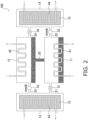
- the adsorption heat pump 100 switches the open-closed states of the first valve 31 to the fourth valve 34 to repeat the adsorption processes and the desorption processes, and thus can continuously generate cooling energy from heating energy. Specifically, the adsorption heat pump 100 alternately switches a first open-closed state illustrated in Fig. 1 and a second open-closed state illustrated in Fig. 2 . In the first open-closed state, the first valve 31 and the fourth valve 34 are in the open state, and the second valve 32 and the third valve 33 are in the closed state. In the second open-closed state, the first valve 31 and the fourth valve 34 are in the closed state, and the second valve 32 and the third valve 33 are in the open state.
- the first adsorber 13 is connected to the evaporator 11, and the second adsorber 14 is connected to the condenser 12.
- the adsorbent 15 is cooled by causing cold water or the like to flow through the third pipe 43.
- the adsorbent 15 is heated by causing hot water or the like to flow through the fourth pipe 44.
- the refrigerant supplied from the evaporator 11 adsorbs to the adsorbent 15 in the first adsorber 13, and the refrigerant desorbs from the adsorbent 15 in the second adsorber 14 and is supplied to the condenser 12.
- the second adsorber 14 is connected to the evaporator 11, and the first adsorber 13 is connected to the condenser 12.
- the adsorbent 15 is cooled by causing cold water or the like to flow through the fourth pipe 44.
- the adsorbent 15 is heated by causing hot water or the like to flow through the third pipe 43.
- the refrigerant supplied from the evaporator 11 adsorbs to the adsorbent 15 in the second adsorber 14, and the refrigerant desorbs from the adsorbent 15 in the first adsorber 13 and is supplied to the condenser 12.
- the adsorption heat pump 100 alternately switches the first open-closed state and the second open-closed state, and the adsorption process and the desorption process are thereby alternately performed in each of the first adsorber 13 and the second adsorber 14. Accordingly, the adsorption heat pump 100 can continuously perform adsorption and desorption of the refrigerant and thus can continuously generate cooling energy.
- the adsorbent 15 disposed inside the first adsorber 13 and the second adsorber 14 is MOF-200, which is one of metal-organic frameworks (MOF).
- Metal-organic frameworks are crystalline compounds in which coordinate bonds between a metal and an organic substance are continuously formed. Metal-organic frameworks are generated by combining a metal ion or an organometallic salt and a crosslinkable organic ligand that binds the metal ion or the organometallic salt. Metal-organic frameworks may include a plurality of types of organic ligands.
- Metal-organic frameworks are porous coordination polymers having a large number of voids (pores) therein. Metal-organic frameworks are used as, for example, porous materials having a function of selective storage and separation of molecules and ions. In this embodiment, a metal-organic framework is used as the adsorbent 15 for adsorbing and desorbing carbon dioxide serving as refrigerant.
- metal-organic frameworks are called by various abbreviated names such as MOF-180 and MOF-200. As the surface area (specific surface area) per unit mass of a metal-organic framework increases, the numerical value included in the abbreviated name tends to increase.
- MOF-200 has a three-dimensional network structure in which an organometallic salt Zn 4 O(CO 2 ) 6 is coordinated by an organic ligand 4,4',4"-[benzene-1,3,5-triyl-tris(benzene-4,1-diyl)]tribenzoate (BBC).
- the organometallic salt Zn 4 O(CO 2 ) 6 has an octahedral structure.
- the organic ligand BBC has a triangular shape as represented by the following chemical structural formula.
- the three-dimensional network structure of MOF-200 is represented by "qom" in the reticular chemistry structure resource (RCSR) database.
- the qom structure is suitable for decreasing dead volume and increasing gas storage capacity per unit volume.
- MOF-177 which is one of metal-organic frameworks, has the qom structure, which is the same as the structure of MOF-200.
- the organic ligand is 4,4',4"-benzene-1,3,5-triyl-tribenzoate (BTB).
- BTB 4,4',4"-benzene-1,3,5-triyl-tribenzoate
- the metal-organic framework can be synthesized by various methods.
- a solution method which is the simplest synthesis method, is a method for generating a metal-organic framework by mixing a metal and an organic ligand in a solution at ordinary temperature and ordinary pressure.
- the size of crystals generated can be controlled by adjusting the mixing speed.
- a solution of a metal is a solution of the organometallic salt Zn 4 O(CO 2 ) 6 .
- the metal-organic framework may be synthesized by any method selected from known methods such as a diffusion method, a hydrothermal method, a microwave method, an ultrasonic wave method, and a solid-phase synthesis method besides the solution method.
- the performance of the metal-organic framework serving as the adsorbent 15 is measured in terms of effective adsorption amount.
- the "effective adsorption amount” refers to a mass of refrigerant (carbon dioxide) that can be adsorbed and desorbed by a unit mass (1 g) of a metal-organic framework (MOF-200) in one adsorption cycle.
- the first adsorber 13 and the second adsorber 14 perform the adsorption process once and the desorption process once.
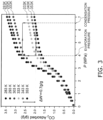
- Fig. 3 is a graph of adsorption isotherm of MOF-200.
- Fig. 3 shows the relation between the pressure (MPa) and the absolute adsorption amount (g/g) of refrigerant (carbon dioxide) at six temperatures.
- the "absolute adsorption amount” refers to a mass of refrigerant adsorbed by a unit mass (1 g) of a metal-organic framework.
- the absolute adsorption amount can be measured with, for example, a magnetic suspension balance adsorption amount measuring device.
- the adsorption isotherm shows different tendencies depending on the temperature.
- adsorption cycle is shown by a rectangle.
- the refrigerant is adsorbed to the adsorbent 15 (the adsorbent 15 in the first adsorber 13 in Fig. 1 ) at the evaporation pressure, and the refrigerant is desorbed from the adsorbent 15 (the adsorbent 15 in the second adsorber 14 in Fig. 1 ) at the condensation pressure.
- ⁇ W shown in Fig. 3 represents the amount of refrigerant newly adsorbed by the adsorbent 15 during one adsorption cycle and corresponds to the effective adsorption amount. As shown in Fig.
- the effective adsorption amount of the refrigerant is 0.7 g/g.
- the adsorption heat pump 100 can adsorb and desorb carbon dioxide in a mass determined by multiplying a dry mass of the adsorbent 15 in the first adsorber 13 or the second adsorber 14 by 0.7 in one adsorption cycle.
- a capacity Q c of the adsorption heat pump 100 is represented by the following formula.
- Q c M ⁇ L ⁇ ⁇ W (In the formula, M represents the dry mass of the adsorbent 15, L represents the evaporation latent heat of the refrigerant, and ⁇ W represents the effective adsorption amount of the adsorbent 15.)
- Metal-organic frameworks are easily generated and enable the production of compounds having various chemical and physical properties depending on the combination of the metal and the organic ligand thereof.
- MOF-200 has a higher effective adsorption amount of carbon dioxide than other metal-organic frameworks and other porous materials.
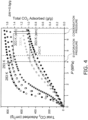
- Fig. 4 shows a graph of adsorption isotherm of MOF-177.
- the metal-organic framework MOF-177 has an effective adsorption amount of 0.5 g/g.
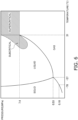
- Fig. 5 shows a graph of adsorption isotherm of MOF-74 (Mg), which is one of metal-organic frameworks.
- MOF-74 Mg
- the metal-organic framework MOF-74 (Mg) has an effective adsorption amount of 0.1 g/g.
- the spherical activated carbon disclosed in NPL 1 has an effective adsorption amount of 0.55 g/g.
- the metal-organic framework MOF-200 has good performance as an adsorbent compared with MOF-177, MOF-74 (Mg), and the spherical activated carbon.
- an adsorption heat pump 100 that uses activated carbon as an adsorbent is known.
- the metal-organic framework used as the adsorbent 15 in the adsorption heat pump 100 of this embodiment is generated easily and at low cost compared with activated carbon.
- the process for producing activated carbon includes a step of crushing a raw material such as coal into granules and performing molding, a step of subsequently subjecting the resulting molded material to dry distillation at a high temperature of 700°C to 800°C for a long time to carbonize the molded material, and an activation step of subsequently causing a reaction with water vapor at a high temperature of 900°C to 1,000°C to form pores.
- the process for producing a metal-organic framework includes only mixing solutions of a metal and an organic ligand at ordinary temperature and ordinary pressure, as described above.
- the process for producing activated carbon requires an activation step using an alkali solution, resulting in high cost, whereas the process for producing a metal-organic framework does not require any special step.
- the adsorption heat pump 100 that uses a metal-organic framework as the adsorbent 15 is good in terms of production cost.
- metal-organic frameworks can be generated by various combinations of metals and organic ligands.
- MOF-200 is particularly good in terms of effective adsorption amount of carbon dioxide. With an increase in the effective adsorption amount of substance used as the adsorbent 15, the amount of adsorbent 15 used can be reduced, and the cost can be reduced. Accordingly, the adsorption heat pump 100 that uses the metal-organic framework MOF-200 as the adsorbent 15 is preferred in view of efficiency of the refrigerating capacity and the cost compared with the case where another metal-organic framework such as MOF-177 is used.
- the configuration of the adsorption heat pump 100 is not limited to those illustrated in Figs. 1 and 2 .
- the adsorption heat pump 100 may be provided with dampers that are opened and closed by the atmospheric pressure instead of the first valve 31 to the fourth valve 34 installed in the first flow path 21 to the fourth flow path 24, respectively.
- dampers that are opened by the pressure of the refrigerant evaporated in the evaporator 11 are installed instead of the first valve 31 and the second valve 32.
- a damper that is opened by the pressure of the refrigerant desorbed from the adsorbent 15 in the first adsorber 13 is installed instead of the third valve 33.
- Adamper that is opened by the pressure of the refrigerant desorbed from the adsorbent 15 in the second adsorber 14 is installed instead of the fourth valve 34.
- the adsorption heat pump 100 causes a medium for cooling the adsorbent 15 to flow through the third pipe 43 in the first adsorber 13 and causes a medium for heating the adsorbent 15 to flow through the fourth pipe 44 in the second adsorber 14.
- the adsorption heat pump 100 causes a medium for heating the adsorbent 15 to flow through the third pipe 43 in the first adsorber 13, and causes a medium for cooling the adsorbent 15 to flow through the fourth pipe 44 in the second adsorber 14.
- the adsorption heat pump 100 needs to have a cooling circuit through which a medium for cooling the adsorbent 15 is caused to circulate and a heating circuit through which a medium for heating the adsorbent 15 is caused to circulate.
- the adsorption heat pump 100 may have a mechanism capable of switching between the cooling circuit and the heating circuit in accordance with the open-closed state.
- the adsorption heat pump 100 preferably performs a refrigeration cycle such that, during the rated operation, the temperature and the pressure of the refrigerant at a time of high pressure are lower than critical points.
- the "refrigerant at a time of high pressure” refers to the refrigerant in a state of the condensation pressure in the adsorption cycle and is specifically the refrigerant within the condenser 12.
- Fig. 6 is a phase diagram of carbon dioxide, which is the refrigerant used in the adsorption heat pump 100.
- the critical point of the temperature is about 31°C
- the critical point of the pressure is about 7.4 MPa.
- the adsorption heat pump 100 preferably controls the pressure and the temperature of the refrigerant at the time of high pressure such that both the temperature and the pressure are lower than the critical points.
- the adsorption heat pump 100 may perform a refrigeration cycle such that, during the rated operation, one of the temperature and the pressure of the refrigerant at the time of high pressure is lower than the critical point.
- the adsorption heat pump 100 may control the pressure and the temperature of the refrigerant such that the refrigerant at the time of high pressure is in a subcritical state.
- the "subcritical state” refers to a state where one of the temperature and the pressure is lower than the critical point. As shown in Fig. 6 , the subcritical state is usually a state where the temperature is lower than the critical point and the pressure is close to the critical point. In the subcritical state, the pressure may be higher than or equal to the critical point.
- the metal-organic framework MOF-200 has an effective adsorption amount of 0.7 g/g.
- the effective adsorption amount of the metal-organic framework MOF-200 is affected by various parameters such as the degrees of uniformity of the size of pores and the specific surface area of MOF-200. Therefore, the effective adsorption amount of the metal-organic framework MOF-200 may be within a predetermined range.
- the effective adsorption amount of the metal-organic framework MOF-200 may be within a range of 0.65 g/g to 0.75 g/g.
- the evaporation pressure and the condensation pressure of the adsorption cycle shown in Fig. 3 may also be within predetermined ranges.
- the evaporation pressure may be within a range of 3.5 MPa to 4.5 MPa
- the condensation pressure may be within a range of 6.0 MPa to 7.0 MPa.
- the metal-organic framework used in the embodiment is MOF-200.
- the metal-organic framework is not limited to MOF-200 as long as the effective adsorption amount is within a predetermined range.
- the predetermined range of the effective adsorption amount is, for example, 0.65 g/g to 0.75 g/g.
- the metal-organic framework used in the adsorption heat pump 100 may be, for example, a metal-organic framework having at least one organic ligand represented by the following formula.
- the adsorption heat pump 100 has the first valve 31 to the fourth valve 34.
- the timings of opening and closing the first valve 31 to the fourth valve 34 may be appropriately set in accordance with, for example, the evaporation pressure and the condensation pressure of the adsorption cycle, and the amounts of refrigerant in the evaporator 11 and the condenser 12.
- the adsorption heat pump 100 includes the evaporator 11 and the condenser 12.
- the evaporator 11 and the condenser 12 are preferably, for example, cross-fin tube type heat exchangers.
- the adsorption heat pump 100 uses, for example, carbon dioxide as the refrigerant. Therefore, the temperature of the heat transfer medium flowing inside the first pipe 41 of the evaporator 11 becomes below the freezing point. Accordingly, the adsorption heat pump 100 can be used as, for example, a refrigerating machine.
- NPL 1 Takahiko MIYAZAKI, "Development of solar heat-driven refrigerating machine with carbon dioxide as refrigerant", Public interest incorporated foundation, Yashima Environment Technology Foundation, 2015 Research Result Report
Landscapes
- Chemical & Material Sciences (AREA)
- Engineering & Computer Science (AREA)
- Organic Chemistry (AREA)
- Chemical Kinetics & Catalysis (AREA)
- Physics & Mathematics (AREA)
- Thermal Sciences (AREA)
- Analytical Chemistry (AREA)
- Mechanical Engineering (AREA)
- General Engineering & Computer Science (AREA)
- Inorganic Chemistry (AREA)
- Materials Engineering (AREA)
- Combustion & Propulsion (AREA)
- Sorption Type Refrigeration Machines (AREA)
- Carbon And Carbon Compounds (AREA)
- Solid-Sorbent Or Filter-Aiding Compositions (AREA)
Abstract
Description
- The present disclosure relates to an adsorption heat pump.
- Hitherto, as disclosed in
NPL 1, an adsorption heat pump that uses carbon dioxide as refrigerant and uses spherical activated carbon as an adsorbent is known. - A process for producing spherical activated carbon is complex; therefore, an adsorbent that has an effective adsorption amount larger than or equal to that of spherical activated carbon and that is easily produced is desired.
- An adsorption heat pump according to a first aspect uses, as refrigerant, carbon dioxide and uses, as an adsorbent, a metal-organic framework including a metal ion and one or a plurality of organic ligands. At least one of the organic ligands is represented by


- R16 to R18 may be present or absent, and if present, R16 to R18 are selected from
- an alkyl group or cycloalkyl group containing 1 to 20 carbon atoms,
- an aryl group containing 1 to 5 phenyl rings,
- an alkyl amine, aryl amine, diazo, or alkyl amide containing an alkyl group or cycloalkyl group containing 1 to 20 carbon atoms or an aryl group containing 1 to 5 phenyl rings, and
- -C≡C-).
- The adsorption heat pump according to the first aspect uses an adsorbent that has a high effective adsorption amount and that is easily produced.
- An adsorption heat pump according to a second aspect is the adsorption heat pump according to the first aspect, in which the metal-organic framework is MOF-200.
- The adsorption heat pump according to the second aspect uses an adsorbent that has a high effective adsorption amount and that is easily produced.
- An adsorption heat pump according to a third aspect is the adsorption heat pump according to the first aspect or the second aspect, in which a refrigeration cycle is performed such that a temperature and a pressure of the refrigerant at a time of high pressure are lower than critical points.
- The adsorption heat pump according to the third aspect uses an adsorbent that has a high effective adsorption amount and that is easily produced.
- An adsorption heat pump according to a fourth aspect is the adsorption heat pump according to the first aspect or the second aspect, in which a refrigeration cycle is performed such that one of a temperature and a pressure of the refrigerant at a time of high pressure is lower than a critical point.
- The adsorption heat pump according to the fourth aspect uses an adsorbent that has a high effective adsorption amount and that is easily produced.
-
-
Fig. 1 is a schematic configuration view of anadsorption heat pump 100 in a first open-closed state. -
Fig. 2 is a schematic configuration view of theadsorption heat pump 100 in a second open-closed state. -
Fig. 3 is a graph of adsorption isotherm of MOF-200. -
Fig. 4 is a graph of adsorption isotherm of MOF-177 used as a comparative example. -
Fig. 5 is a graph of adsorption isotherm of MOF-74 (Mg) used as a comparative example. -
Fig. 6 is a phase diagram of carbon dioxide. - An
adsorption heat pump 100 according to an embodiment of the present disclosure will be described with reference to the drawings. - The
adsorption heat pump 100 is a device that uses the transfer of latent heat generated when refrigerant adsorbs to an adsorbent and when refrigerant desorbs from an adsorbent to generate cooling energy from a heat source at a relatively low temperature of 60°C to 90°C. - As illustrated in
Figs. 1 and2 , theadsorption heat pump 100 mainly includes anevaporator 11, acondenser 12, afirst adsorber 13, and asecond adsorber 14. Theevaporator 11 and thefirst adsorber 13 are connected by afirst flow path 21. Theevaporator 11 and thesecond adsorber 14 are connected by asecond flow path 22. Thecondenser 12 and thefirst adsorber 13 are connected by athird flow path 23. Thecondenser 12 and thesecond adsorber 14 are connected by afourth flow path 24. Theevaporator 11 and thecondenser 12 are connected by afifth flow path 25. Thefirst flow path 21 to thefourth flow path 24 are provided with afirst valve 31 to afourth valve 34 for opening and closing the flow paths, respectively. - The
evaporator 11 evaporates liquid refrigerant to generate gas refrigerant. Thecondenser 12 condenses gas refrigerant to generate liquid refrigerant. Thefirst adsorber 13 and thesecond adsorber 14 have an adsorbent 15 for adsorbing and desorbing refrigerant. The adsorbent 15 is a substance whose adsorption amount of refrigerant changes depending on the pressure and the temperature. In this embodiment, the refrigerant is carbon dioxide, and theadsorbent 15 is MOF-200, which is a metal-organic framework (MOF). The mass of theadsorbent 15 in thefirst adsorber 13 is equal to the mass of the adsorbent 15 of thesecond adsorber 14. - The
evaporator 11 is a heat exchanger for extracting cooling energy. Afirst pipe 41 is arranged inside theevaporator 11. Thefirst pipe 41 is a pipe through which a heat transfer medium flows, the heat transfer medium being a medium for transferring, to the outside, cooling energy generated when liquid refrigerant evaporates inside theevaporator 11. The heat transfer medium flowing inside thefirst pipe 41 is, for example, water. InFig. 1 , gas refrigerant is adsorbed by theadsorbent 15 in thefirst adsorber 13, and gas refrigerant thereby flows from theevaporator 11 into thefirst adsorber 13 through thefirst flow path 21. InFig. 2 , gas refrigerant is adsorbed by theadsorbent 15 in thesecond adsorber 14, and gas refrigerant thereby flows from theevaporator 11 into thesecond adsorber 14 through thesecond flow path 22. When the refrigerant is adsorbed in thefirst adsorber 13 and thesecond adsorber 14, gas refrigerant flows from theevaporator 11; therefore, evaporation of liquid refrigerant is accelerated in theevaporator 11. The cooling energy generated when liquid refrigerant evaporates, is transferred to the outside by the heat transfer medium flowing inside thefirst pipe 41 and used for, for example, cooling. - The
condenser 12 is a heat exchanger for condensing gas refrigerant by cooling. Asecond pipe 42 is arranged inside thecondenser 12. Thesecond pipe 42 is a pipe through which a medium for condensing gas refrigerant inside thecondenser 12 flows, the medium being a heat transfer medium at a temperature lower than the condensation temperature of the refrigerant or a heat transfer medium at a temperature lower than the temperature of the refrigerant when the refrigerant is in a supercritical state. The heat transfer medium flowing inside thesecond pipe 42 is, for example, water. InFig. 1 , gas refrigerant desorbs in thesecond adsorber 14, and the gas refrigerant flows from the second adsorber 14 into thecondenser 12 through thefourth flow path 24. InFig. 2 , gas refrigerant desorbs in thefirst adsorber 13, and the gas refrigerant flows from the first adsorber 13 into thecondenser 12 through thethird flow path 23. Liquid refrigerant generated by condensation of the gas refrigerant in thecondenser 12 is supplied to theevaporator 11 through thefifth flow path 25. - A
third pipe 43 and afourth pipe 44 are arranged inside thefirst adsorber 13 and the second adsorber 14, respectively. Theadsorbent 15 is disposed around each of thethird pipe 43 and thefourth pipe 44. Thethird pipe 43 is a pipe through which a heat transfer medium flows, the heat transfer medium being a medium for controlling the temperature of theadsorbent 15 in thefirst adsorber 13; thefourth pipe 44 is a pipe through which a heat transfer medium flows, the heat transfer medium being a medium for controlling the temperature of theadsorbent 15 in the second adsorber 14. The heat transfer media flowing inside thethird pipe 43 and thefourth pipe 44 are, for example, water. By controlling the temperatures of the media flowing through thethird pipe 43 and thefourth pipe 44, the temperatures of theadsorbents 15 are controlled such that adsorption or desorption of the refrigerant is performed in thefirst adsorber 13 and thesecond adsorber 14. - As illustrated in
Fig. 1 , in an adsorption process of causing the refrigerant to adsorb to the adsorbent 15 in thefirst adsorber 13, a medium at a temperature at which adsorption of the refrigerant occurs dominantly, is caused to flow through thethird pipe 43. As illustrated inFig. 1 , in a desorption process of causing the refrigerant to desorb from the adsorbent 15 in thesecond adsorber 14, a medium at a temperature at which desorption of the refrigerant occurs dominantly, is caused to flow through thefourth pipe 44. For example, inFig. 1 , cold water for cooling the adsorbent 15 in thefirst adsorber 13, flows through thethird pipe 43, and hot water for heating the adsorbent 15 in thesecond adsorber 14, flows through thefourth pipe 44. - As illustrated in
Fig. 2 , in an adsorption process of causing the refrigerant to adsorb to the adsorbent 15 in thesecond adsorber 14, a medium at a temperature at which adsorption of the refrigerant occurs dominantly, is caused to flow through thefourth pipe 44. As illustrated inFig. 2 , in a desorption process of causing the refrigerant to desorb from the adsorbent 15 in thefirst adsorber 13, a medium at a temperature at which desorption of the refrigerant occurs dominantly, is caused to flow through thethird pipe 43. For example, inFig. 2 , cold water for cooling the adsorbent 15 in thesecond adsorber 14, flows through thefourth pipe 44, and hot water for heating the adsorbent 15 in thefirst adsorber 13, flows through thethird pipe 43. - The
adsorption heat pump 100 switches the open-closed states of thefirst valve 31 to thefourth valve 34 to repeat the adsorption processes and the desorption processes, and thus can continuously generate cooling energy from heating energy. Specifically, theadsorption heat pump 100 alternately switches a first open-closed state illustrated inFig. 1 and a second open-closed state illustrated inFig. 2 . In the first open-closed state, thefirst valve 31 and thefourth valve 34 are in the open state, and thesecond valve 32 and thethird valve 33 are in the closed state. In the second open-closed state, thefirst valve 31 and thefourth valve 34 are in the closed state, and thesecond valve 32 and thethird valve 33 are in the open state. - In the first open-closed state, the
first adsorber 13 is connected to theevaporator 11, and thesecond adsorber 14 is connected to thecondenser 12. In thefirst adsorber 13, the adsorbent 15 is cooled by causing cold water or the like to flow through thethird pipe 43. In thesecond adsorber 14, the adsorbent 15 is heated by causing hot water or the like to flow through thefourth pipe 44. Thus, the refrigerant supplied from theevaporator 11 adsorbs to the adsorbent 15 in thefirst adsorber 13, and the refrigerant desorbs from the adsorbent 15 in thesecond adsorber 14 and is supplied to thecondenser 12. - In the second open-closed state, the
second adsorber 14 is connected to theevaporator 11, and thefirst adsorber 13 is connected to thecondenser 12. In thesecond adsorber 14, the adsorbent 15 is cooled by causing cold water or the like to flow through thefourth pipe 44. In thefirst adsorber 13, the adsorbent 15 is heated by causing hot water or the like to flow through thethird pipe 43. Thus, the refrigerant supplied from theevaporator 11 adsorbs to the adsorbent 15 in thesecond adsorber 14, and the refrigerant desorbs from the adsorbent 15 in thefirst adsorber 13 and is supplied to thecondenser 12. - The
adsorption heat pump 100 alternately switches the first open-closed state and the second open-closed state, and the adsorption process and the desorption process are thereby alternately performed in each of thefirst adsorber 13 and thesecond adsorber 14. Accordingly, theadsorption heat pump 100 can continuously perform adsorption and desorption of the refrigerant and thus can continuously generate cooling energy. - The adsorbent 15 disposed inside the
first adsorber 13 and thesecond adsorber 14 is MOF-200, which is one of metal-organic frameworks (MOF). Metal-organic frameworks are crystalline compounds in which coordinate bonds between a metal and an organic substance are continuously formed. Metal-organic frameworks are generated by combining a metal ion or an organometallic salt and a crosslinkable organic ligand that binds the metal ion or the organometallic salt. Metal-organic frameworks may include a plurality of types of organic ligands. - Metal-organic frameworks are porous coordination polymers having a large number of voids (pores) therein. Metal-organic frameworks are used as, for example, porous materials having a function of selective storage and separation of molecules and ions. In this embodiment, a metal-organic framework is used as the adsorbent 15 for adsorbing and desorbing carbon dioxide serving as refrigerant.
- Some of such metal-organic frameworks are called by various abbreviated names such as MOF-180 and MOF-200. As the surface area (specific surface area) per unit mass of a metal-organic framework increases, the numerical value included in the abbreviated name tends to increase.
- A reference literature related to the metal-organic framework MOF-200 is, for example, Furukawa et al., "Ultrahigh Porosity in Metal-Organic Frameworks" (Science, 2010, 329, 424-428). As described in this reference literature, MOF-200 has a three-dimensional network structure in which an organometallic salt Zn4O(CO2)6 is coordinated by an
organic ligand 
- The three-dimensional network structure of MOF-200 is represented by "qom" in the reticular chemistry structure resource (RCSR) database. The qom structure is suitable for decreasing dead volume and increasing gas storage capacity per unit volume.
- MOF-177, which is one of metal-organic frameworks, has the qom structure, which is the same as the structure of MOF-200. In the case of MOF-177, the organic ligand is 4,4',4"-benzene-1,3,5-triyl-tribenzoate (BTB). The organic ligand BTB is represented by the following chemical structural formula.

- Basic physical properties of MOF-200 are as follows.
- ·Porosity: 90%
- ·Crystal density: 0.22 g/cm3
- ·Specific surface area measured by BET method: 4,530 m2/g
- ·Specific surface area measured by Langmuir method: 10,400 m2/g
- ·Geometric surface area: 6,400 m2/g
- ·Volume of voids: 3.59 cm3/g
- The metal-organic framework can be synthesized by various methods. A solution method, which is the simplest synthesis method, is a method for generating a metal-organic framework by mixing a metal and an organic ligand in a solution at ordinary temperature and ordinary pressure. In the solution method, the size of crystals generated can be controlled by adjusting the mixing speed. In the case of MOF-200, a solution of a metal is a solution of the organometallic salt Zn4O(CO2)6. In this embodiment, the metal-organic framework may be synthesized by any method selected from known methods such as a diffusion method, a hydrothermal method, a microwave method, an ultrasonic wave method, and a solid-phase synthesis method besides the solution method.
- The performance of the metal-organic framework serving as the adsorbent 15 is measured in terms of effective adsorption amount. In the case of the
adsorption heat pump 100, the "effective adsorption amount" refers to a mass of refrigerant (carbon dioxide) that can be adsorbed and desorbed by a unit mass (1 g) of a metal-organic framework (MOF-200) in one adsorption cycle. In one adsorption cycle, thefirst adsorber 13 and thesecond adsorber 14 perform the adsorption process once and the desorption process once. -
Fig. 3 is a graph of adsorption isotherm of MOF-200.Fig. 3 shows the relation between the pressure (MPa) and the absolute adsorption amount (g/g) of refrigerant (carbon dioxide) at six temperatures. The "absolute adsorption amount" refers to a mass of refrigerant adsorbed by a unit mass (1 g) of a metal-organic framework. The absolute adsorption amount can be measured with, for example, a magnetic suspension balance adsorption amount measuring device. As shown inFig. 3 , the adsorption isotherm shows different tendencies depending on the temperature. - In
Fig. 3 , an adsorption cycle is shown by a rectangle. In the adsorption cycle, the refrigerant is adsorbed to the adsorbent 15 (the adsorbent 15 in thefirst adsorber 13 inFig. 1 ) at the evaporation pressure, and the refrigerant is desorbed from the adsorbent 15 (the adsorbent 15 in thesecond adsorber 14 inFig. 1 ) at the condensation pressure. ΔW shown inFig. 3 represents the amount of refrigerant newly adsorbed by the adsorbent 15 during one adsorption cycle and corresponds to the effective adsorption amount. As shown inFig. 3 , in the case of using MOF-200, the effective adsorption amount of the refrigerant is 0.7 g/g. In other words, theadsorption heat pump 100 can adsorb and desorb carbon dioxide in a mass determined by multiplying a dry mass of the adsorbent 15 in thefirst adsorber 13 or thesecond adsorber 14 by 0.7 in one adsorption cycle. - A capacity Qc of the
adsorption heat pump 100 is represented by the following formula.
- As represented by the above formula, the higher the effective adsorption amount of refrigerant, the higher the capacity Qc of the
adsorption heat pump 100. Therefore, an adsorbent 15 having a high effective adsorption amount is desired. Metal-organic frameworks are easily generated and enable the production of compounds having various chemical and physical properties depending on the combination of the metal and the organic ligand thereof. Among metal-organic frameworks, MOF-200 has a higher effective adsorption amount of carbon dioxide than other metal-organic frameworks and other porous materials. - As a comparative example,
Fig. 4 shows a graph of adsorption isotherm of MOF-177. As shown inFig. 4 , the metal-organic framework MOF-177 has an effective adsorption amount of 0.5 g/g. - As another comparative example,
Fig. 5 shows a graph of adsorption isotherm of MOF-74 (Mg), which is one of metal-organic frameworks. As shown inFig. 5 , the metal-organic framework MOF-74 (Mg) has an effective adsorption amount of 0.1 g/g. - The spherical activated carbon disclosed in
NPL 1 has an effective adsorption amount of 0.55 g/g. Thus, the metal-organic framework MOF-200 has good performance as an adsorbent compared with MOF-177, MOF-74 (Mg), and the spherical activated carbon. - Hitherto, as disclosed in
NPL 1, anadsorption heat pump 100 that uses activated carbon as an adsorbent is known. However, the metal-organic framework used as the adsorbent 15 in theadsorption heat pump 100 of this embodiment is generated easily and at low cost compared with activated carbon. - In general, the process for producing activated carbon includes a step of crushing a raw material such as coal into granules and performing molding, a step of subsequently subjecting the resulting molded material to dry distillation at a high temperature of 700°C to 800°C for a long time to carbonize the molded material, and an activation step of subsequently causing a reaction with water vapor at a high temperature of 900°C to 1,000°C to form pores. In contrast, the process for producing a metal-organic framework includes only mixing solutions of a metal and an organic ligand at ordinary temperature and ordinary pressure, as described above. Furthermore, in the case where the size of pores and the specific surface area are made uniform, the process for producing activated carbon requires an activation step using an alkali solution, resulting in high cost, whereas the process for producing a metal-organic framework does not require any special step. Thus, the
adsorption heat pump 100 that uses a metal-organic framework as the adsorbent 15 is good in terms of production cost. - In addition, various types of metal-organic frameworks can be generated by various combinations of metals and organic ligands. Among metal-organic frameworks, MOF-200 is particularly good in terms of effective adsorption amount of carbon dioxide. With an increase in the effective adsorption amount of substance used as the adsorbent 15, the amount of
adsorbent 15 used can be reduced, and the cost can be reduced. Accordingly, theadsorption heat pump 100 that uses the metal-organic framework MOF-200 as the adsorbent 15 is preferred in view of efficiency of the refrigerating capacity and the cost compared with the case where another metal-organic framework such as MOF-177 is used. - Modifications of the above embodiment will be described below. Some or all of the contents of each modification may be combined with the contents of another modification as long as they do not contradict each other.
- The configuration of the
adsorption heat pump 100 is not limited to those illustrated inFigs. 1 and2 . For example, theadsorption heat pump 100 may be provided with dampers that are opened and closed by the atmospheric pressure instead of thefirst valve 31 to thefourth valve 34 installed in thefirst flow path 21 to thefourth flow path 24, respectively. - In this modification, for example, dampers that are opened by the pressure of the refrigerant evaporated in the
evaporator 11 are installed instead of thefirst valve 31 and thesecond valve 32. A damper that is opened by the pressure of the refrigerant desorbed from the adsorbent 15 in thefirst adsorber 13 is installed instead of thethird valve 33. Adamper that is opened by the pressure of the refrigerant desorbed from the adsorbent 15 in thesecond adsorber 14 is installed instead of thefourth valve 34. - In the first open-closed state, the
adsorption heat pump 100 causes a medium for cooling the adsorbent 15 to flow through thethird pipe 43 in thefirst adsorber 13 and causes a medium for heating the adsorbent 15 to flow through thefourth pipe 44 in thesecond adsorber 14. In the second open-closed state, theadsorption heat pump 100 causes a medium for heating the adsorbent 15 to flow through thethird pipe 43 in thefirst adsorber 13, and causes a medium for cooling the adsorbent 15 to flow through thefourth pipe 44 in thesecond adsorber 14. - The
adsorption heat pump 100 needs to have a cooling circuit through which a medium for cooling the adsorbent 15 is caused to circulate and a heating circuit through which a medium for heating the adsorbent 15 is caused to circulate. Theadsorption heat pump 100 may have a mechanism capable of switching between the cooling circuit and the heating circuit in accordance with the open-closed state. - The
adsorption heat pump 100 preferably performs a refrigeration cycle such that, during the rated operation, the temperature and the pressure of the refrigerant at a time of high pressure are lower than critical points. The "refrigerant at a time of high pressure" refers to the refrigerant in a state of the condensation pressure in the adsorption cycle and is specifically the refrigerant within thecondenser 12. -
Fig. 6 is a phase diagram of carbon dioxide, which is the refrigerant used in theadsorption heat pump 100. In the case of carbon dioxide, the critical point of the temperature is about 31°C, and the critical point of the pressure is about 7.4 MPa. When both the temperature and the pressure are higher than or equal to the critical points, carbon dioxide is in a supercritical state in which gas and liquid cannot coexist. Accordingly, theadsorption heat pump 100 preferably controls the pressure and the temperature of the refrigerant at the time of high pressure such that both the temperature and the pressure are lower than the critical points. - The
adsorption heat pump 100 may perform a refrigeration cycle such that, during the rated operation, one of the temperature and the pressure of the refrigerant at the time of high pressure is lower than the critical point. In this modification, theadsorption heat pump 100 may control the pressure and the temperature of the refrigerant such that the refrigerant at the time of high pressure is in a subcritical state. The "subcritical state" refers to a state where one of the temperature and the pressure is lower than the critical point. As shown inFig. 6 , the subcritical state is usually a state where the temperature is lower than the critical point and the pressure is close to the critical point. In the subcritical state, the pressure may be higher than or equal to the critical point. - As shown in
Fig. 3 , the metal-organic framework MOF-200 has an effective adsorption amount of 0.7 g/g. However, the effective adsorption amount of the metal-organic framework MOF-200 is affected by various parameters such as the degrees of uniformity of the size of pores and the specific surface area of MOF-200. Therefore, the effective adsorption amount of the metal-organic framework MOF-200 may be within a predetermined range. For example, the effective adsorption amount of the metal-organic framework MOF-200 may be within a range of 0.65 g/g to 0.75 g/g. - The evaporation pressure and the condensation pressure of the adsorption cycle shown in
Fig. 3 may also be within predetermined ranges. For example, inFig. 3 , the evaporation pressure may be within a range of 3.5 MPa to 4.5 MPa, and the condensation pressure may be within a range of 6.0 MPa to 7.0 MPa. - The metal-organic framework used in the embodiment is MOF-200. However, the metal-organic framework is not limited to MOF-200 as long as the effective adsorption amount is within a predetermined range. The predetermined range of the effective adsorption amount is, for example, 0.65 g/g to 0.75 g/g.
- Specifically, the metal-organic framework used in the
adsorption heat pump 100 may be, for example, a metal-organic framework having at least one organic ligand represented by the following formula.


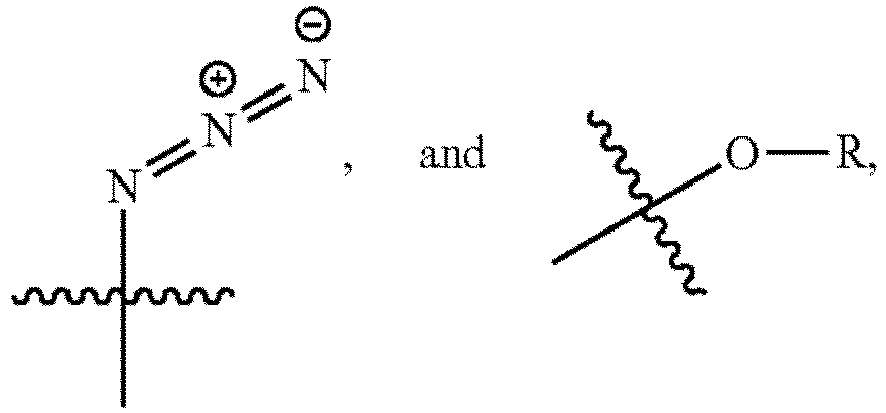
- R16 to R18 may be present or absent, and if present, R16 to R18 are selected from
- an alkyl group or cycloalkyl group containing 1 to 20 carbon atoms,
- an aryl group containing 1 to 5 phenyl rings,
- an alkyl amine, aryl amine, diazo, or alkyl amide containing an alkyl group or cycloalkyl group containing 1 to 20 carbon atoms or an aryl group containing 1 to 5 phenyl rings, and
- -C≡C-.)
- The
adsorption heat pump 100 has thefirst valve 31 to thefourth valve 34. The timings of opening and closing thefirst valve 31 to thefourth valve 34 may be appropriately set in accordance with, for example, the evaporation pressure and the condensation pressure of the adsorption cycle, and the amounts of refrigerant in theevaporator 11 and thecondenser 12. - The
adsorption heat pump 100 includes theevaporator 11 and thecondenser 12. When carbon dioxide is used as the refrigerant, theevaporator 11 and thecondenser 12 are preferably, for example, cross-fin tube type heat exchangers. - The
adsorption heat pump 100 uses, for example, carbon dioxide as the refrigerant. Therefore, the temperature of the heat transfer medium flowing inside thefirst pipe 41 of theevaporator 11 becomes below the freezing point. Accordingly, theadsorption heat pump 100 can be used as, for example, a refrigerating machine. - An embodiment of the present disclosure has been described above. It is to be understood that the forms and the details can be changed in various ways without departing from the spirit and scope of the present disclosure described in the claims.
-
- 15: adsorbent
- 100: adsorption heat pump
- NPL 1: Takahiko MIYAZAKI, "Development of solar heat-driven refrigerating machine with carbon dioxide as refrigerant", Public interest incorporated foundation, Yashima Environment Technology Foundation, 2015 Research Result Report
Claims (4)
- An adsorption heat pump (100) that uses carbon dioxide as refrigerant,wherein a metal-organic framework including a metal ion and one or a plurality of organic ligands is used as an adsorbent (15), andat least one of the organic ligands is represented by


 R16 to R18 may be present or absent, and if present, R16 to R18 are selected froman alkyl group or cycloalkyl group containing 1 to 20 carbon atoms,an aryl group containing 1 to 5 phenyl rings,an alkyl amine, aryl amine, diazo, or alkyl amide containing an alkyl group or cycloalkyl group containing 1 to 20 carbon atoms or an aryl group containing 1 to 5 phenyl rings, and-C≡C-).
 - The adsorption heat pump according to Claim 1,
wherein the metal-organic framework is MOF-200. - The adsorption heat pump according to Claim 1 or 2,
wherein a refrigeration cycle is performed such that a temperature and a pressure of the refrigerant at a time of high pressure are lower than critical points. - The adsorption heat pump according to Claim 1 or 2,
wherein a refrigeration cycle is performed such that one of a temperature and a pressure of the refrigerant at a time of high pressure is lower than a critical point.
Applications Claiming Priority (2)
| Application Number | Priority Date | Filing Date | Title |
|---|---|---|---|
| JP2020165351A JP2022057217A (en) | 2020-09-30 | 2020-09-30 | Absorptive heat pump |
| PCT/JP2021/035896 WO2022071405A1 (en) | 2020-09-30 | 2021-09-29 | Absorptive heat pump |
Publications (3)
| Publication Number | Publication Date |
|---|---|
| EP4224094A1 true EP4224094A1 (en) | 2023-08-09 |
| EP4224094A4 EP4224094A4 (en) | 2024-03-27 |
| EP4224094B1 EP4224094B1 (en) | 2025-04-09 |
Family
ID=80949232
Family Applications (1)
| Application Number | Title | Priority Date | Filing Date |
|---|---|---|---|
| EP21875703.7A Active EP4224094B1 (en) | 2020-09-30 | 2021-09-29 | Absorptive heat pump |
Country Status (5)
| Country | Link |
|---|---|
| US (1) | US12529500B2 (en) |
| EP (1) | EP4224094B1 (en) |
| JP (2) | JP2022057217A (en) |
| CN (1) | CN116235010A (en) |
| WO (1) | WO2022071405A1 (en) |
Families Citing this family (1)
| Publication number | Priority date | Publication date | Assignee | Title |
|---|---|---|---|---|
| WO2026006733A1 (en) * | 2024-06-28 | 2026-01-02 | Carbon Capture, Inc. | Cascading heat pump-driven temperature vacuum swing adsorption for direct air capture of carbon dioxide |
Family Cites Families (13)
| Publication number | Priority date | Publication date | Assignee | Title |
|---|---|---|---|---|
| GB1583491A (en) * | 1977-06-01 | 1981-01-28 | Cjb Developments Ltd | Adsorption heat pump |
| US7799120B2 (en) * | 2005-09-26 | 2010-09-21 | The Regents Of The University Of Michigan | Metal-organic frameworks with exceptionally high capacity for storage of carbon dioxide at room-temperature |
| EP2467388A4 (en) * | 2009-09-25 | 2014-12-17 | Univ California | OPEN METALLOORGANIC FRAMES WITH A SPECIAL SURFACE AREA AND HIGH GAS STORAGE CAPACITY |
| US10994258B2 (en) * | 2012-04-26 | 2021-05-04 | Lawrence Livermore National Security, Llc | Adsorption cooling system using metal organic frameworks |
| WO2014028574A2 (en) | 2012-08-15 | 2014-02-20 | Arkema Inc. | Adsorption systems using metal-organic frameworks |
| MY209466A (en) | 2013-08-05 | 2025-07-10 | Numat Tech Inc | Metal organic frameworks for electronic gas storage |
| KR102322537B1 (en) * | 2014-07-03 | 2021-11-05 | 커먼웰쓰 사이언티픽 앤 인더스트리알 리서치 오거니제이션 | Host-guest metal organic framework systems |
| CN107107028B (en) * | 2014-12-04 | 2021-06-25 | 纽麦特科技公司 | Porous polymers for reducing and purifying electron gases and removing mercury from hydrocarbon streams |
| US10201803B2 (en) * | 2015-06-09 | 2019-02-12 | The Regents Of The University Of California | Polymer-metal organic framework materials and methods of using the same |
| JP6571491B2 (en) | 2015-10-28 | 2019-09-04 | 株式会社神戸製鋼所 | heat pump |
| US11318409B2 (en) * | 2016-06-13 | 2022-05-03 | Battelle Memorial Institute | Ultramicro to mesopore frameworks for selective separation and storage of noble gases |
| JP2018146162A (en) * | 2017-03-03 | 2018-09-20 | 株式会社豊田中央研究所 | Heat storage system |
| CN209484741U (en) * | 2019-01-11 | 2019-10-11 | 湖南科技大学 | A dehumidification and drying device based on MOF-801 material |
-
2020
- 2020-09-30 JP JP2020165351A patent/JP2022057217A/en active Pending
-
2021
- 2021-09-29 CN CN202180066552.0A patent/CN116235010A/en active Pending
- 2021-09-29 EP EP21875703.7A patent/EP4224094B1/en active Active
- 2021-09-29 WO PCT/JP2021/035896 patent/WO2022071405A1/en not_active Ceased
- 2021-09-29 US US18/029,166 patent/US12529500B2/en active Active
-
2023
- 2023-01-18 JP JP2023005577A patent/JP2023061932A/en not_active Withdrawn
Also Published As
| Publication number | Publication date |
|---|---|
| CN116235010A (en) | 2023-06-06 |
| JP2023061932A (en) | 2023-05-02 |
| US20230375235A1 (en) | 2023-11-23 |
| EP4224094B1 (en) | 2025-04-09 |
| US12529500B2 (en) | 2026-01-20 |
| EP4224094A4 (en) | 2024-03-27 |
| WO2022071405A1 (en) | 2022-04-07 |
| JP2022057217A (en) | 2022-04-11 |
Similar Documents
| Publication | Publication Date | Title |
|---|---|---|
| Han et al. | Adsorption characteristics of methyl-functional ligand MOF-801 and water systems: Adsorption chiller modelling and performances | |
| Xiang et al. | Adsorptive separation of C2H6/C2H4 on metal-organic frameworks (MOFs) with pillared-layer structures | |
| Matemb Ma Ntep et al. | When polymorphism in metal–organic frameworks enables water sorption profile tunability for enhancing heat allocation and water harvesting performance | |
| Waitschat et al. | Synthesis of M-UiO-66 (M= Zr, Ce or Hf) employing 2, 5-pyridinedicarboxylic acid as a linker: defect chemistry, framework hydrophilisation and sorption properties | |
| Teo et al. | Experimental study of isotherms and kinetics for adsorption of water on Aluminium Fumarate | |
| Rezk et al. | Investigation of Ethanol/metal organic frameworks for low temperature adsorption cooling applications | |
| Teo et al. | Post synthetic modification of MIL-101 (Cr) for S-shaped isotherms and fast kinetics with water adsorption | |
| Aristov et al. | A new methodology of studying the dynamics of water sorption/desorption under real operating conditions of adsorption heat pumps: Experiment | |
| Jeremias et al. | Programming MOFs for water sorption: amino-functionalized MIL-125 and UiO-66 for heat transformation and heat storage applications | |
| Elsayed et al. | Adsorption cooling system employing novel MIL-101 (Cr)/CaCl2 composites: numerical study | |
| Han et al. | Water adsorption studies on synthesized alkali-ions doped Al-fumarate MOFs and Al-fumarate+ zeolite composites for higher water uptakes and faster kinetics | |
| Zhang et al. | Highly selective sorption of CO 2 and N 2 O and strong gas-framework interactions in a nickel (ii) organic material | |
| Jiang et al. | Experimental study on working pairs for two-stage chemisorption freezing cycle | |
| Gao et al. | Solution to the sorption hysteresis by novel compact composite multi-salt sorbents | |
| Steinert et al. | Metal‐Organic Frameworks as Sorption Materials for Heat Transformation Processes | |
| Chen et al. | Improving CH4 uptake and CH4/N2 separation in pillar‐layered metal–organic frameworks using a regulating strategy of interlayer channels | |
| Attan et al. | The role of activated carbon fiber in adsorption cooling cycles | |
| Wang et al. | Design and performance prediction of a novel double heat pipes type adsorption chiller for fishing boats | |
| EP4224094B1 (en) | Absorptive heat pump | |
| CN109967039B (en) | Preparation method and application of composite material with efficient CO2 separation function | |
| Xia et al. | Improved adsorption cooling performance of MIL-101 (Cr)/GO composites by tuning the water adsorption rate | |
| Han et al. | Synthesis and characterization of various MOFs and MOFs-zeolite composites: Water adsorption and rapid cooling production | |
| Yang et al. | Regulation on C 2 H 2/CO 2 adsorption and separation by molecular rotors in metal–organic frameworks | |
| Ma et al. | Study on adsorption refrigeration performance of MIL-101-isobutane working pair | |
| Lou et al. | Experimental investigation on hydrophilic functionalized CaCl2@ UIO-66 composites for water adsorption and heat storage |
Legal Events
| Date | Code | Title | Description |
|---|---|---|---|
| STAA | Information on the status of an ep patent application or granted ep patent |
Free format text: STATUS: THE INTERNATIONAL PUBLICATION HAS BEEN MADE |
|
| PUAI | Public reference made under article 153(3) epc to a published international application that has entered the european phase |
Free format text: ORIGINAL CODE: 0009012 |
|
| STAA | Information on the status of an ep patent application or granted ep patent |
Free format text: STATUS: REQUEST FOR EXAMINATION WAS MADE |
|
| 17P | Request for examination filed |
Effective date: 20230419 |
|
| AK | Designated contracting states |
Kind code of ref document: A1 Designated state(s): AL AT BE BG CH CY CZ DE DK EE ES FI FR GB GR HR HU IE IS IT LI LT LU LV MC MK MT NL NO PL PT RO RS SE SI SK SM TR |
|
| DAV | Request for validation of the european patent (deleted) | ||
| DAX | Request for extension of the european patent (deleted) | ||
| A4 | Supplementary search report drawn up and despatched |
Effective date: 20240226 |
|
| RIC1 | Information provided on ipc code assigned before grant |
Ipc: F25B 30/04 20060101ALI20240220BHEP Ipc: B01J 20/34 20060101ALI20240220BHEP Ipc: B01J 20/22 20060101ALI20240220BHEP Ipc: C09K 5/04 20060101ALI20240220BHEP Ipc: F25B 17/12 20060101ALI20240220BHEP Ipc: F25B 17/08 20060101AFI20240220BHEP |
|
| GRAP | Despatch of communication of intention to grant a patent |
Free format text: ORIGINAL CODE: EPIDOSNIGR1 |
|
| STAA | Information on the status of an ep patent application or granted ep patent |
Free format text: STATUS: GRANT OF PATENT IS INTENDED |
|
| RIC1 | Information provided on ipc code assigned before grant |
Ipc: F25B 30/04 20060101ALI20241017BHEP Ipc: B01J 20/34 20060101ALI20241017BHEP Ipc: B01J 20/22 20060101ALI20241017BHEP Ipc: C09K 5/04 20060101ALI20241017BHEP Ipc: F25B 17/12 20060101ALI20241017BHEP Ipc: F25B 17/08 20060101AFI20241017BHEP |
|
| INTG | Intention to grant announced |
Effective date: 20241106 |
|
| GRAS | Grant fee paid |
Free format text: ORIGINAL CODE: EPIDOSNIGR3 |
|
| GRAA | (expected) grant |
Free format text: ORIGINAL CODE: 0009210 |
|
| STAA | Information on the status of an ep patent application or granted ep patent |
Free format text: STATUS: THE PATENT HAS BEEN GRANTED |
|
| RAP3 | Party data changed (applicant data changed or rights of an application transferred) |
Owner name: ATOMIS INC. Owner name: DAIKIN INDUSTRIES, LTD. |
|
| P01 | Opt-out of the competence of the unified patent court (upc) registered |
Free format text: CASE NUMBER: APP_9352/2025 Effective date: 20250225 |
|
| AK | Designated contracting states |
Kind code of ref document: B1 Designated state(s): AL AT BE BG CH CY CZ DE DK EE ES FI FR GB GR HR HU IE IS IT LI LT LU LV MC MK MT NL NO PL PT RO RS SE SI SK SM TR |
|
| REG | Reference to a national code |
Ref country code: GB Ref legal event code: FG4D |
|
| REG | Reference to a national code |
Ref country code: CH Ref legal event code: EP |
|
| REG | Reference to a national code |
Ref country code: DE Ref legal event code: R096 Ref document number: 602021029060 Country of ref document: DE |
|
| REG | Reference to a national code |
Ref country code: IE Ref legal event code: FG4D |
|
| REG | Reference to a national code |
Ref country code: NL Ref legal event code: MP Effective date: 20250409 |
|
| PG25 | Lapsed in a contracting state [announced via postgrant information from national office to epo] |
Ref country code: NL Free format text: LAPSE BECAUSE OF FAILURE TO SUBMIT A TRANSLATION OF THE DESCRIPTION OR TO PAY THE FEE WITHIN THE PRESCRIBED TIME-LIMIT Effective date: 20250409 |
|
| REG | Reference to a national code |
Ref country code: AT Ref legal event code: MK05 Ref document number: 1783830 Country of ref document: AT Kind code of ref document: T Effective date: 20250409 |
|
| PG25 | Lapsed in a contracting state [announced via postgrant information from national office to epo] |
Ref country code: FI Free format text: LAPSE BECAUSE OF FAILURE TO SUBMIT A TRANSLATION OF THE DESCRIPTION OR TO PAY THE FEE WITHIN THE PRESCRIBED TIME-LIMIT Effective date: 20250409 Ref country code: ES Free format text: LAPSE BECAUSE OF FAILURE TO SUBMIT A TRANSLATION OF THE DESCRIPTION OR TO PAY THE FEE WITHIN THE PRESCRIBED TIME-LIMIT Effective date: 20250409 Ref country code: PT Free format text: LAPSE BECAUSE OF FAILURE TO SUBMIT A TRANSLATION OF THE DESCRIPTION OR TO PAY THE FEE WITHIN THE PRESCRIBED TIME-LIMIT Effective date: 20250811 |
|
| PGFP | Annual fee paid to national office [announced via postgrant information from national office to epo] |
Ref country code: DE Payment date: 20250919 Year of fee payment: 5 |
|
| REG | Reference to a national code |
Ref country code: LT Ref legal event code: MG9D |
|
| PG25 | Lapsed in a contracting state [announced via postgrant information from national office to epo] |
Ref country code: NO Free format text: LAPSE BECAUSE OF FAILURE TO SUBMIT A TRANSLATION OF THE DESCRIPTION OR TO PAY THE FEE WITHIN THE PRESCRIBED TIME-LIMIT Effective date: 20250709 Ref country code: GR Free format text: LAPSE BECAUSE OF FAILURE TO SUBMIT A TRANSLATION OF THE DESCRIPTION OR TO PAY THE FEE WITHIN THE PRESCRIBED TIME-LIMIT Effective date: 20250710 |
|
| PG25 | Lapsed in a contracting state [announced via postgrant information from national office to epo] |
Ref country code: PL Free format text: LAPSE BECAUSE OF FAILURE TO SUBMIT A TRANSLATION OF THE DESCRIPTION OR TO PAY THE FEE WITHIN THE PRESCRIBED TIME-LIMIT Effective date: 20250409 |
|
| PG25 | Lapsed in a contracting state [announced via postgrant information from national office to epo] |
Ref country code: BG Free format text: LAPSE BECAUSE OF FAILURE TO SUBMIT A TRANSLATION OF THE DESCRIPTION OR TO PAY THE FEE WITHIN THE PRESCRIBED TIME-LIMIT Effective date: 20250409 |
|
| PGFP | Annual fee paid to national office [announced via postgrant information from national office to epo] |
Ref country code: GB Payment date: 20250919 Year of fee payment: 5 |
|
| PG25 | Lapsed in a contracting state [announced via postgrant information from national office to epo] |
Ref country code: HR Free format text: LAPSE BECAUSE OF FAILURE TO SUBMIT A TRANSLATION OF THE DESCRIPTION OR TO PAY THE FEE WITHIN THE PRESCRIBED TIME-LIMIT Effective date: 20250409 |
|
| PG25 | Lapsed in a contracting state [announced via postgrant information from national office to epo] |
Ref country code: AT Free format text: LAPSE BECAUSE OF FAILURE TO SUBMIT A TRANSLATION OF THE DESCRIPTION OR TO PAY THE FEE WITHIN THE PRESCRIBED TIME-LIMIT Effective date: 20250409 |
|
| PGFP | Annual fee paid to national office [announced via postgrant information from national office to epo] |
Ref country code: FR Payment date: 20250922 Year of fee payment: 5 |
|
| PG25 | Lapsed in a contracting state [announced via postgrant information from national office to epo] |
Ref country code: RS Free format text: LAPSE BECAUSE OF FAILURE TO SUBMIT A TRANSLATION OF THE DESCRIPTION OR TO PAY THE FEE WITHIN THE PRESCRIBED TIME-LIMIT Effective date: 20250709 |
|
| PG25 | Lapsed in a contracting state [announced via postgrant information from national office to epo] |
Ref country code: IS Free format text: LAPSE BECAUSE OF FAILURE TO SUBMIT A TRANSLATION OF THE DESCRIPTION OR TO PAY THE FEE WITHIN THE PRESCRIBED TIME-LIMIT Effective date: 20250809 |
|
| PG25 | Lapsed in a contracting state [announced via postgrant information from national office to epo] |
Ref country code: LV Free format text: LAPSE BECAUSE OF FAILURE TO SUBMIT A TRANSLATION OF THE DESCRIPTION OR TO PAY THE FEE WITHIN THE PRESCRIBED TIME-LIMIT Effective date: 20250409 |
|
| REG | Reference to a national code |
Ref country code: DE Ref legal event code: R097 Ref document number: 602021029060 Country of ref document: DE |
|
| PG25 | Lapsed in a contracting state [announced via postgrant information from national office to epo] |
Ref country code: DK Free format text: LAPSE BECAUSE OF FAILURE TO SUBMIT A TRANSLATION OF THE DESCRIPTION OR TO PAY THE FEE WITHIN THE PRESCRIBED TIME-LIMIT Effective date: 20250409 Ref country code: SM Free format text: LAPSE BECAUSE OF FAILURE TO SUBMIT A TRANSLATION OF THE DESCRIPTION OR TO PAY THE FEE WITHIN THE PRESCRIBED TIME-LIMIT Effective date: 20250409 |
|
| PG25 | Lapsed in a contracting state [announced via postgrant information from national office to epo] |
Ref country code: CZ Free format text: LAPSE BECAUSE OF FAILURE TO SUBMIT A TRANSLATION OF THE DESCRIPTION OR TO PAY THE FEE WITHIN THE PRESCRIBED TIME-LIMIT Effective date: 20250409 |
|
| PG25 | Lapsed in a contracting state [announced via postgrant information from national office to epo] |
Ref country code: EE Free format text: LAPSE BECAUSE OF FAILURE TO SUBMIT A TRANSLATION OF THE DESCRIPTION OR TO PAY THE FEE WITHIN THE PRESCRIBED TIME-LIMIT Effective date: 20250409 |
|
| PG25 | Lapsed in a contracting state [announced via postgrant information from national office to epo] |
Ref country code: SK Free format text: LAPSE BECAUSE OF FAILURE TO SUBMIT A TRANSLATION OF THE DESCRIPTION OR TO PAY THE FEE WITHIN THE PRESCRIBED TIME-LIMIT Effective date: 20250409 |
|
| PG25 | Lapsed in a contracting state [announced via postgrant information from national office to epo] |
Ref country code: IT Free format text: LAPSE BECAUSE OF FAILURE TO SUBMIT A TRANSLATION OF THE DESCRIPTION OR TO PAY THE FEE WITHIN THE PRESCRIBED TIME-LIMIT Effective date: 20250409 |
|
| PLBE | No opposition filed within time limit |
Free format text: ORIGINAL CODE: 0009261 |
|
| STAA | Information on the status of an ep patent application or granted ep patent |
Free format text: STATUS: NO OPPOSITION FILED WITHIN TIME LIMIT |
|
| REG | Reference to a national code |
Ref country code: CH Ref legal event code: L10 Free format text: ST27 STATUS EVENT CODE: U-0-0-L10-L00 (AS PROVIDED BY THE NATIONAL OFFICE) Effective date: 20260218 |
|
| PG25 | Lapsed in a contracting state [announced via postgrant information from national office to epo] |
Ref country code: RO Free format text: LAPSE BECAUSE OF FAILURE TO SUBMIT A TRANSLATION OF THE DESCRIPTION OR TO PAY THE FEE WITHIN THE PRESCRIBED TIME-LIMIT Effective date: 20250409 |
|
| 26N | No opposition filed |
Effective date: 20260112 |
|
| REG | Reference to a national code |
Ref country code: CH Ref legal event code: H13 Free format text: ST27 STATUS EVENT CODE: U-0-0-H10-H13 (AS PROVIDED BY THE NATIONAL OFFICE) Effective date: 20260504 |