EP4223922A1 - Polymer fiber screen surface modifications for cation exchange membranes - Google Patents
Polymer fiber screen surface modifications for cation exchange membranes Download PDFInfo
- Publication number
- EP4223922A1 EP4223922A1 EP23151777.2A EP23151777A EP4223922A1 EP 4223922 A1 EP4223922 A1 EP 4223922A1 EP 23151777 A EP23151777 A EP 23151777A EP 4223922 A1 EP4223922 A1 EP 4223922A1
- Authority
- EP
- European Patent Office
- Prior art keywords
- screen
- peek
- fibers
- sulfonated
- barrier material
- Prior art date
- Legal status (The legal status is an assumption and is not a legal conclusion. Google has not performed a legal analysis and makes no representation as to the accuracy of the status listed.)
- Pending
Links
Images



Classifications
-
- C—CHEMISTRY; METALLURGY
- C08—ORGANIC MACROMOLECULAR COMPOUNDS; THEIR PREPARATION OR CHEMICAL WORKING-UP; COMPOSITIONS BASED THEREON
- C08G—MACROMOLECULAR COMPOUNDS OBTAINED OTHERWISE THAN BY REACTIONS ONLY INVOLVING UNSATURATED CARBON-TO-CARBON BONDS
- C08G65/00—Macromolecular compounds obtained by reactions forming an ether link in the main chain of the macromolecule
- C08G65/34—Macromolecular compounds obtained by reactions forming an ether link in the main chain of the macromolecule from hydroxy compounds or their metallic derivatives
- C08G65/48—Polymers modified by chemical after-treatment
-
- C—CHEMISTRY; METALLURGY
- C08—ORGANIC MACROMOLECULAR COMPOUNDS; THEIR PREPARATION OR CHEMICAL WORKING-UP; COMPOSITIONS BASED THEREON
- C08L—COMPOSITIONS OF MACROMOLECULAR COMPOUNDS
- C08L71/00—Compositions of polyethers obtained by reactions forming an ether link in the main chain; Compositions of derivatives of such polymers
- C08L71/08—Polyethers derived from hydroxy compounds or from their metallic derivatives
- C08L71/10—Polyethers derived from hydroxy compounds or from their metallic derivatives from phenols
-
- B—PERFORMING OPERATIONS; TRANSPORTING
- B01—PHYSICAL OR CHEMICAL PROCESSES OR APPARATUS IN GENERAL
- B01D—SEPARATION
- B01D71/00—Semi-permeable membranes for separation processes or apparatus characterised by the material; Manufacturing processes specially adapted therefor
- B01D71/06—Organic material
- B01D71/52—Polyethers
-
- D—TEXTILES; PAPER
- D06—TREATMENT OF TEXTILES OR THE LIKE; LAUNDERING; FLEXIBLE MATERIALS NOT OTHERWISE PROVIDED FOR
- D06M—TREATMENT, NOT PROVIDED FOR ELSEWHERE IN CLASS D06, OF FIBRES, THREADS, YARNS, FABRICS, FEATHERS OR FIBROUS GOODS MADE FROM SUCH MATERIALS
- D06M11/00—Treating fibres, threads, yarns, fabrics or fibrous goods made from such materials, with inorganic substances or complexes thereof; Such treatment combined with mechanical treatment, e.g. mercerising
- D06M11/51—Treating fibres, threads, yarns, fabrics or fibrous goods made from such materials, with inorganic substances or complexes thereof; Such treatment combined with mechanical treatment, e.g. mercerising with sulfur, selenium, tellurium, polonium or compounds thereof
- D06M11/55—Treating fibres, threads, yarns, fabrics or fibrous goods made from such materials, with inorganic substances or complexes thereof; Such treatment combined with mechanical treatment, e.g. mercerising with sulfur, selenium, tellurium, polonium or compounds thereof with sulfur trioxide; with sulfuric acid or thiosulfuric acid or their salts
-
- B—PERFORMING OPERATIONS; TRANSPORTING
- B01—PHYSICAL OR CHEMICAL PROCESSES OR APPARATUS IN GENERAL
- B01D—SEPARATION
- B01D67/00—Processes specially adapted for manufacturing semi-permeable membranes for separation processes or apparatus
- B01D67/0081—After-treatment of organic or inorganic membranes
- B01D67/0093—Chemical modification
-
- B—PERFORMING OPERATIONS; TRANSPORTING
- B01—PHYSICAL OR CHEMICAL PROCESSES OR APPARATUS IN GENERAL
- B01D—SEPARATION
- B01D69/00—Semi-permeable membranes for separation processes or apparatus characterised by their form, structure or properties; Manufacturing processes specially adapted therefor
- B01D69/02—Semi-permeable membranes for separation processes or apparatus characterised by their form, structure or properties; Manufacturing processes specially adapted therefor characterised by their properties
-
- B—PERFORMING OPERATIONS; TRANSPORTING
- B01—PHYSICAL OR CHEMICAL PROCESSES OR APPARATUS IN GENERAL
- B01D—SEPARATION
- B01D71/00—Semi-permeable membranes for separation processes or apparatus characterised by the material; Manufacturing processes specially adapted therefor
- B01D71/06—Organic material
- B01D71/52—Polyethers
- B01D71/522—Aromatic polyethers
- B01D71/5222—Polyetherketone, polyetheretherketone, or polyaryletherketone
-
- B—PERFORMING OPERATIONS; TRANSPORTING
- B01—PHYSICAL OR CHEMICAL PROCESSES OR APPARATUS IN GENERAL
- B01D—SEPARATION
- B01D71/00—Semi-permeable membranes for separation processes or apparatus characterised by the material; Manufacturing processes specially adapted therefor
- B01D71/06—Organic material
- B01D71/76—Macromolecular material not specifically provided for in a single one of groups B01D71/08 - B01D71/74
- B01D71/82—Macromolecular material not specifically provided for in a single one of groups B01D71/08 - B01D71/74 characterised by the presence of specified groups, e.g. introduced by chemical after-treatment
-
- B—PERFORMING OPERATIONS; TRANSPORTING
- B01—PHYSICAL OR CHEMICAL PROCESSES OR APPARATUS IN GENERAL
- B01J—CHEMICAL OR PHYSICAL PROCESSES, e.g. CATALYSIS OR COLLOID CHEMISTRY; THEIR RELEVANT APPARATUS
- B01J39/00—Cation exchange; Use of material as cation exchangers; Treatment of material for improving the cation exchange properties
- B01J39/08—Use of material as cation exchangers; Treatment of material for improving the cation exchange properties
- B01J39/16—Organic material
- B01J39/18—Macromolecular compounds
- B01J39/19—Macromolecular compounds obtained otherwise than by reactions only involving unsaturated carbon-to-carbon bonds
-
- C—CHEMISTRY; METALLURGY
- C25—ELECTROLYTIC OR ELECTROPHORETIC PROCESSES; APPARATUS THEREFOR
- C25B—ELECTROLYTIC OR ELECTROPHORETIC PROCESSES FOR THE PRODUCTION OF COMPOUNDS OR NON-METALS; APPARATUS THEREFOR
- C25B13/00—Diaphragms; Spacing elements
- C25B13/04—Diaphragms; Spacing elements characterised by the material
- C25B13/08—Diaphragms; Spacing elements characterised by the material based on organic materials
-
- C—CHEMISTRY; METALLURGY
- C25—ELECTROLYTIC OR ELECTROPHORETIC PROCESSES; APPARATUS THEREFOR
- C25B—ELECTROLYTIC OR ELECTROPHORETIC PROCESSES FOR THE PRODUCTION OF COMPOUNDS OR NON-METALS; APPARATUS THEREFOR
- C25B3/00—Electrolytic production of organic compounds
- C25B3/20—Processes
- C25B3/25—Reduction
- C25B3/26—Reduction of carbon dioxide
-
- D—TEXTILES; PAPER
- D06—TREATMENT OF TEXTILES OR THE LIKE; LAUNDERING; FLEXIBLE MATERIALS NOT OTHERWISE PROVIDED FOR
- D06M—TREATMENT, NOT PROVIDED FOR ELSEWHERE IN CLASS D06, OF FIBRES, THREADS, YARNS, FABRICS, FEATHERS OR FIBROUS GOODS MADE FROM SUCH MATERIALS
- D06M11/00—Treating fibres, threads, yarns, fabrics or fibrous goods made from such materials, with inorganic substances or complexes thereof; Such treatment combined with mechanical treatment, e.g. mercerising
- D06M11/51—Treating fibres, threads, yarns, fabrics or fibrous goods made from such materials, with inorganic substances or complexes thereof; Such treatment combined with mechanical treatment, e.g. mercerising with sulfur, selenium, tellurium, polonium or compounds thereof
- D06M11/52—Treating fibres, threads, yarns, fabrics or fibrous goods made from such materials, with inorganic substances or complexes thereof; Such treatment combined with mechanical treatment, e.g. mercerising with sulfur, selenium, tellurium, polonium or compounds thereof with selenium, tellurium, polonium or their compounds; with sulfur, dithionites or compounds containing sulfur and halogens, with or without oxygen; by sulfohalogenation with chlorosulfonic acid; by sulfohalogenation with a mixture of sulfur dioxide and free halogens
-
- D—TEXTILES; PAPER
- D06—TREATMENT OF TEXTILES OR THE LIKE; LAUNDERING; FLEXIBLE MATERIALS NOT OTHERWISE PROVIDED FOR
- D06M—TREATMENT, NOT PROVIDED FOR ELSEWHERE IN CLASS D06, OF FIBRES, THREADS, YARNS, FABRICS, FEATHERS OR FIBROUS GOODS MADE FROM SUCH MATERIALS
- D06M11/00—Treating fibres, threads, yarns, fabrics or fibrous goods made from such materials, with inorganic substances or complexes thereof; Such treatment combined with mechanical treatment, e.g. mercerising
- D06M11/51—Treating fibres, threads, yarns, fabrics or fibrous goods made from such materials, with inorganic substances or complexes thereof; Such treatment combined with mechanical treatment, e.g. mercerising with sulfur, selenium, tellurium, polonium or compounds thereof
- D06M11/54—Treating fibres, threads, yarns, fabrics or fibrous goods made from such materials, with inorganic substances or complexes thereof; Such treatment combined with mechanical treatment, e.g. mercerising with sulfur, selenium, tellurium, polonium or compounds thereof with sulfur dioxide; with sulfurous acid or its salts
-
- D—TEXTILES; PAPER
- D06—TREATMENT OF TEXTILES OR THE LIKE; LAUNDERING; FLEXIBLE MATERIALS NOT OTHERWISE PROVIDED FOR
- D06M—TREATMENT, NOT PROVIDED FOR ELSEWHERE IN CLASS D06, OF FIBRES, THREADS, YARNS, FABRICS, FEATHERS OR FIBROUS GOODS MADE FROM SUCH MATERIALS
- D06M13/00—Treating fibres, threads, yarns, fabrics or fibrous goods made from such materials, with non-macromolecular organic compounds; Such treatment combined with mechanical treatment
- D06M13/244—Treating fibres, threads, yarns, fabrics or fibrous goods made from such materials, with non-macromolecular organic compounds; Such treatment combined with mechanical treatment with compounds containing sulfur or phosphorus
- D06M13/248—Treating fibres, threads, yarns, fabrics or fibrous goods made from such materials, with non-macromolecular organic compounds; Such treatment combined with mechanical treatment with compounds containing sulfur or phosphorus with compounds containing sulfur
- D06M13/256—Sulfonated compounds esters thereof, e.g. sultones
-
- B—PERFORMING OPERATIONS; TRANSPORTING
- B01—PHYSICAL OR CHEMICAL PROCESSES OR APPARATUS IN GENERAL
- B01D—SEPARATION
- B01D2325/00—Details relating to properties of membranes
- B01D2325/36—Hydrophilic membranes
-
- B—PERFORMING OPERATIONS; TRANSPORTING
- B01—PHYSICAL OR CHEMICAL PROCESSES OR APPARATUS IN GENERAL
- B01D—SEPARATION
- B01D2325/00—Details relating to properties of membranes
- B01D2325/38—Hydrophobic membranes
-
- B—PERFORMING OPERATIONS; TRANSPORTING
- B01—PHYSICAL OR CHEMICAL PROCESSES OR APPARATUS IN GENERAL
- B01D—SEPARATION
- B01D2325/00—Details relating to properties of membranes
- B01D2325/42—Ion-exchange membranes
-
- D—TEXTILES; PAPER
- D06—TREATMENT OF TEXTILES OR THE LIKE; LAUNDERING; FLEXIBLE MATERIALS NOT OTHERWISE PROVIDED FOR
- D06M—TREATMENT, NOT PROVIDED FOR ELSEWHERE IN CLASS D06, OF FIBRES, THREADS, YARNS, FABRICS, FEATHERS OR FIBROUS GOODS MADE FROM SUCH MATERIALS
- D06M2101/00—Chemical constitution of the fibres, threads, yarns, fabrics or fibrous goods made from such materials, to be treated
- D06M2101/16—Synthetic fibres, other than mineral fibres
- D06M2101/18—Synthetic fibres consisting of macromolecular compounds obtained by reactions only involving carbon-to-carbon unsaturated bonds
- D06M2101/24—Polymers or copolymers of alkenylalcohols or esters thereof; Polymers or copolymers of alkenylethers, acetals or ketones
Definitions
- the present disclosure relates generally to membrane electrode assemblies and relates more particularly to polymer fiber screens for gas diffusion electrodes used in various conversion systems.
- GSGs greenhouse gases
- CCU CO 2 capture and utilization
- CO 2 can be electrochemically converted into various products such as carbon monoxide (CO), methane (CH 4 ), ethylene (C 2 H 4 ), formic acid (HCOOH), methanol (CH 3 OH) and ethanol (C 2 H 5 OH), etc.
- a sulfonated polymer fiber screen and a method for fabricating the sulfonated polymer fiber screen.
- One disclosed feature of the embodiments is a composition comprising a plurality of sulfonated polymer fibers.
- Another disclosed feature of the embodiments is an article comprising a screen comprising a plurality of sulfonated polymer fibers.
- Another disclosed feature of the embodiments is a method to fabricate a sulfonated polymer fiber screen.
- the method comprises contacting a plurality of unsulfonated polymer fibers with an acid comprising a sulfur containing group to sulfonate the plurality of unsulfonated polymer fibers in a sulfonation reaction and stopping the sulfonation reaction.
- the present disclosure broadly discloses a sulfonated poly(ether ether ketone) screen surface for cation exchange membranes and a method for producing the same.
- Cation exchange membranes can be used for electro-catalytic conversion of CO 2 into value-added chemicals and synthetic fuels.
- cation exchange membranes can be used for other applications as well, such as fuel cells, sewage disposal, sea water desalination, electrodialysis, chemical catalysis, gas separation, and the like.
- PEEK poly(ether ether ketone)
- PEEK is a high performance engineering thermoplastic that is known for its superb mechanical properties, good solvent resistance, and high thermo-oxidative stability.
- PEEK by itself though is highly hydrophobic and causes water droplets to have a very large contact angle. As a result, PEEK screens can be inefficient for passing water throughout the screen for cation exchange membranes.
- Nafion an ionomer material
- Nafion is considered to be a high cost material that is not environmentally friendly.
- the present disclosure provides a sulfonated PEEK (SPEEK) screen that performs as well as Nafion, but is much cheaper to produce and is more environmentally friendly than Nafion.
- SPEEK sulfonated PEEK
- the SPEEK screen can be fabricated from modification of the PEEK screen in a sulfuric acid bath.
- the SPEEK screens of the present disclosure provides a well-defined nano-phase separation within its domain due to a hydrophobic backbone from the aromatic rings and hydrophilic regions due to the sulfonic acid groups distributed along its backbone.
- the hydrophilic regions of the SPEEK screen can greatly reduce the contact angle of water droplets to the SPEEK screen, thereby allowing water to spread across the SPEEK surface.
- the SPEEK screens formed by the acid treatment of the PEEK materials make the polymeric chain ionic and enable the transport of cations through the sulfonate groups (-SO 3 - ).
- a SPEEK screen can function as a membrane capable of transferring protons from the anode of a fuel cell to the cathode along with acting as a barrier to the passage of electrons and other cross-leaks (e.g., gas) between the electrodes.
- the SPEEK screens can be formed in-situ by applying an acid bath to PEEK screens.
- the PEEK screens can be dropped in an acid bath for several seconds to sulfonate the PEEK into the SPEEK screens.
- the ion exchange capacity of the SPEEK screens can be tuned based on an average diameter of the PEEK fibers used to make the PEEK screens, a porosity of the PEEK screens measured by a percentage of open area or average area of each opening in the PEEK screens, and/or a time in the acid bath.
- the present disclosure provides a low cost solution to modify PEEK screens to possess hydrophilic properties for use in a cation exchange membrane.
- FIG. 1 illustrates an example cation exchange assembly 100 that includes the SPEEK screen of the present disclosure.
- the cation exchange assembly 100 may be part of a flow cell electro-catalytic converter that is used to convert a compound into different desirable compounds.
- One example conversion that can be performed by the cation exchange assembly 100 is the conversion of carbon dioxide (CO 2 ) into carbon monoxide (CO) and hydrogen gas (H 2 ).
- CO 2 carbon dioxide
- H 2 hydrogen gas
- the cation exchange assembly 100 may be used for electro-catalytic conversion of other types of compounds within the context of flow cell electro-catalytic converters.
- the cation exchange assembly 100 may be used in other applications such as fuel cells, sewage disposal applications, sea water desalination applications, electrodialysis, chemical catalysis, gas separation, and the like.
- the cation exchange assembly 100 includes a first end plate 102, a cathode flow field 104, a cathode gas diffusion electrode (GDE) 106, a first gasket 108, an anion membrane 110, a second gasket 112, a center flow compartment 114, a third gasket 116, a cation membrane 118, a fourth gasket 120, an anode GDE 122, an anode flow field 124, and a second end plate 126.
- GDE cathode gas diffusion electrode
- an anolyte may be fed through the anode flow field 124.
- the anolyte may flow through the anode GDE 122, the cation exchange membrane 118 and towards the center flow compartment 114.
- the SPEEK screen can be used to fabricate the cation membrane 118.
- a catholyte may flow from the cathode flow field 104 through the cathode GDE 106 and through the anion membrane 110 towards the center flow compartment 114.
- the converted compounds and byproducts may be fed out through the center flow compartment 114.
- the center flow compartment 114 may include a reference voltage.
- a cell potential may be applied to the cation exchange assembly 100 via the reference voltage to perform the electro-catalytic conversion.
- the cation membrane 118 may enable the transport of cations.
- the cation membrane 118 may act as a barrier to block cations while allowing anions to pass from the anode flow field 124 towards the center flow compartment 114.
- the SPEEK screen of the present disclosure may enable transport of the cations through the sulfonate groups (-SO 3 - ) in the SPEEK screen.
- PEEK material may be a relatively inexpensive material that provides superb mechanical properties, good solvent resistance, and high thermo-oxidative stability.
- PEEK materials are superhydrophobic. As a result, liquids may bead up on the PEEK material with a high contact angle, causing poor interaction through a screen fabricated with PEEK materials.
- the SPEEK screen can provide a hydrophilic material that reduces the contact angle of the liquid and allows the liquid to spread across the SPEEK screen, thereby increasing the interaction of the liquid passing through the SPEEK screen.
- FIG. 8 illustrates an illustration of the difference between superhydrophobic surfaces and hydrophilic surfaces.
- a hydrophobic surface may cause liquid to form a dome shaped bead of liquid 806 with a surface 802 with a contact angle of approximately 90 degrees.
- a superhydrophobic surface may cause liquid to form a full bead or sphere of liquid 804 with the surface 802 with a contact angle of greater than 90 degrees or approximately 150 degrees.
- a hydrophilic surface may cause liquid to spread across the surface 802 to form a relatively flat liquid surface 808 with a contact angle of less than 90 degrees or approximately 30 degrees.
- a PEEK screen 310 may have a superhydrophobic surface that forms a full bead 804 when liquid contacts the PEEK screen 310.
- the SPEEK screen can have a hydrophilic surface that forms a relatively flat liquid surface 808.
- the SPEEK screen allows the liquid to spread across the screen and interact with more surface area of the SPEEK screen, allowing the sulfonate groups of the SPEEK screen to block more of the cations and allow anions to pass through.
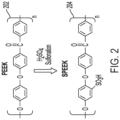
- FIG. 2 illustrates an example of how the PEEK material 310 can be modified in-situ to form the SPEEK screen 316.
- FIG. 2 illustrates a structural formula of PEEK 202.
- the PEEK 202 can be sulfonated in sulfuric acid (H 2 SO 4 ) to form SPEEK 204, as shown in the structural formula of the SPEEK 204.
- the aromatic backbone of the PEEK 202 can be chemically modified through an electrophilic substitution by the sulfonation with the sulfuric acid.
- the introduction of charged groups via the sulfuric acid may make the polymeric chains ionic to enhance the hydrophilicity of the PEEK material 310.
- PAEK fibers can also be used.
- the PAEK fibers may have similar dimensions and properties to the PEEK fibers to be processed for sulfonated PAEK screens.
- the unsulfonated polymer selective barrier material may be presented as a sheet or roll.
- the unsulfonated polymer selective barrier material may then be cut to size or adapted for a particular usage to form a screen of the unsulfonated polymer selective barrier.
- FIG. 3 illustrates an example process flow 300 of forming the SPEEK screens 316 in-situ.
- the PEEK material 310 may be provided in a mesh screen form.
- the mesh screen form may include intertwined or woven fibers of the PEEK material 310.
- the PEEK material 310 may be coupled to a support structure 312.
- the support structure may include two plates with an opening that can be secured together against the perimeter of the PEEK material 310.
- the PEEK material 310 may be dipped in the acid bath for an amount of time sufficient to sulfonate the PEEK screen into the SPEEK screen 316 and maintain a mesh structure of the PEEK screen. For example, if the PEEK material 310 is placed in the acid bath for too long, the structural integrity of the mesh pattern may be lost.
- the PEEK material 310 may simply disintegrate in the acid bath 314.
- the amount of time may be less than 5 seconds or between 2-5 seconds.
- the amount of time may vary on several different parameters, as discussed in further details below. For example, the amount of time may be longer when using a less concentrated acid.
- the PEEK material 310 may be dipped in the acid bath for up to 10 seconds when using a sulfuric acid bath having a lower concentration of 80% sulfuric acid.
- the PEEK screen is removed from the acid bath 314 and the SPEEK screen 316 is formed.
- the SPEEK screen 316 may be quenched in cold water and rinsed in deionized water.
- the SPEEK screen 316 may be removed from the support structure 312 and deployed as part of the cation membrane 118 in the cation exchange assembly 100, described above.
- the amount of time that the PEEK material 310 is dipped in the acid bath 314 may be a function of several different parameters that include an average diameter of the fibers of the PEEK material 310 and porosity of the PEEK material 310.
- FIG. 4 illustrates an example fiber 402 of the PEEK material 310. A diameter of the fiber 402 may be measured as shown by a line 404.
- FIG. 5 illustrates an example of how the porosity of the PEEK material 310 may be calculated.
- the porosity of the PEEK material 310 may be measured as a percentage of open area of the PEEK material 310 relative to the entire area of the PEEK material 310.
- the entire area of the PEEK material 310 may be measured by a product of the width 504 and a length 506 of the PEEK material 310.
- the PEEK material 310 may be provided in a mesh screen form, as noted above.
- the mesh screen may be comprised of a plurality of openings 502.
- Each opening 502 may have an open area measured by a product of a width 510 and a length 508 of the opening 502. The area of each opening 502 may be summed up to calculate the open area.
- the open area divided by the entire area of the PEEK material may provide the percentage of opening in the PEEK material 310, or the porosity.
- the amount of time may be a function of the diameter 404 of each fiber 402, a porosity of the PEEK material 310, and a concentration of the acid bath.
- the weaker the concentration of acid in the acid bath the longer the amount of time may be.
- FIGs. 6 and 7 illustrate how the diameter and porosity can be related to one another.
- FIG. 6 illustrates an example mesh screen 600 with openings 502 formed by fibers with a diameter 602.
- the diameter of the fiber could be increased or decreased to change a size or area of the openings 502.
- the size of the openings 502 may be kept the same even if the diameter of the fiber is increased.
- an example mesh screen 700 may have fibers with a diameter 702 that is larger than the diameter 602 of the mesh screen 600.
- the fibers in the mesh screen 700 may be woven further apart such that the area of the openings 502 in the mesh screen 700 is the same as the area of the openings 502 in the mesh screen 600.
- the amount of time the PEEK material 310 is placed in the acid bath 314 may be a function of a diameter 404 of each fiber 402 and a porosity of the PEEK material 310.
- the amount of time may be between 2 to 5 seconds as noted above.
- the amount of time may apply to a PEEK material 310 that has fibers with an average diameter of between 0.0015 and 0.0050 inches. In an example, the average diameter may be approximately 0.0028 inches.
- FIGs. 9A-9B illustrate example scanning electron microscope (SEM) images of the PEEK material 310 before and after sulfonation in the acid bath 314.
- Images 902, 904, and 906 illustrate views with increased magnification (image 902 with least amount of magnification and image 906 with the most amount of magnification) of the PEEK material 310 before being sulfonated.
- the fibers of the PEEK material 310 have a well-defined structure and shape.
- Images 908, 910 and 912 illustrate views of the SPEEK screen formed after the PEEK material 310 is sulfonated.
- the images 908, 910, and 912 correspond to the same magnification as the before images 902, 904, and 906, respectively.
- the sulfonation of the PEEK material 310 shows a significant change in the surface morphology of the fibers.
- the sulfonation of the PEEK material 310 creates an almost porous structure in the fibers with increased roughness.
- the fibers also show signs of dissolution with strands of fibril artifacts within.
- placing the PEEK material 310 in the acid bath for too long a period of time may cause disintegration of the PEEK material 310 or a collapse of the mesh structure.
- the performance of the SPEEK screen 316 was measured based on ion exchange capacity (IEC).
- IEC provides information on the density of ionizable functional groups present in the membrane matrix.
- IEC measures the number of counter ions exchangeable in the SPEEK screen 316.
- IEC can be measured for the SPEEK screen 316 and may be determined by titrimetric analysis.
- the SPEEK screen 316 was protonated after being washed for 24 hours in 1 molar (M) hydrochloric acid (HCl). The SPEEK screen 316 was then immersed into 0.1M sodium chloride (NaCl) solution for 24 hours at ambient temperature. The protons are released into solution and titrated by a standardized 0.05M sodium hydroxide (NaOH) solution.
- M 1 molar
- HCl hydrochloric acid
- NaCl sodium chloride
- NaOH sodium hydroxide
- the IEC of a membrane may dictate the hydrophilicity, and therefore, the amount of water in the membrane.
- the proton conductivity increases with increased IEC due to sulfonation (as seen by the SPEEK screen 316 of the present disclosure) since water attaches to the sulfonic acid groups and allows water penetration through the membrane via water channels, also encouraging the passage of protons.
- the IEC for the SPEEK screen 316 was found to be between 0.10 to 0.20 meq/g, as shown in Table 1.
- Table 1 illustrates a comparison of the IEC values of different PEEK materials 310 compared to the SPEEK screen 316 formed from the PEEK materials.
- PEEK screen S1 used the example with 0.0015 inch diameter fibers with 56% porosity
- PEEK screen S2 used the example with 0.0028 inch diameter fibers with 22% porosity.
- SPEEK S1 was the sulfonated version of screen S1
- SPEEK S2 was the sulfonated version of screen S2.
- TABLE 1 IEC DATA IEC (meq/g) Average Std. De. PEEK S1 0.0000 PEEK S2 0.0045 0.0022 0.0032 SPEEK S1 0.1485 SPEEK S2 0.1676 0.1581 0.0135
- the sulfonated SPEEK screen 316 of the present disclosure provides excellent IEC values that can be used as the cation membrane 118 in the cation exchange assembly 100 described above, as compared to the PEEK materials 310.
- the SPEEK screen 316 with the larger diameter fibers and lower porosity provided better IEC values.
- FIG. 10 illustrates a flowchart of an example in-situ method 1000 for fabricating a sulfonated polymer screen of the present disclosure.
- one or more blocks of the method 1000 may be performed by various tools or machines under the control of a central controller or processor or in combination with manually performed steps to prepare the sulfonated polymer screen described herein.
- the method 1000 begins.
- the method 1000 contacts an unsulfonated polymer selective barrier material with an acid comprising a sulfur containing group to sulfonate the unsulfonated polymer selective barrier material in a sulfonation reaction.
- the sulfonation reaction may create a sulfonated polymer screen.
- the unsulfonated polymer selective barrier material may comprise fibers of polyether ether ketone (PEEK) or polyaryl ether ketone (PAEK).
- the PEEK acid bath may be a sulfuric acid bath.
- the sulfuric acid bath may have a concentration of greater than 95% sulfuric acid.
- the acid may include any type of acid that includes a sulfur containing group such as sulfuric acid, sulfonic acid (e.g., methane sulfonic acid, ethane sulfonic acid, and the like), sulfurous acid, chlorosulfonic acid, trimethylsilylsulfonyl chloride, or any other type of acid that includes sulfur.
- the method 1000 stops the sulfonation reaction.
- the sulfonation reaction may be stopped by quenching the reaction.
- the sulfonated polymer screen may be quenched in cold water immediately after being removed from the acid bath to stop the sulfonation reaction and maintain the structural integrity of the mesh pattern.
- the quenching may also include a neutralization step to neutralize any remaining acid on the sulfonated polymer screen to stop the sulfonation reaction.
- the sulfonated polymer screen can be further rinsed in deionized water.
- the sulfonated polymer screen can be protonated in 1M HCl for 24 hours.
- the sulfonated polymer screen can then be deployed as part of a cation membrane for a cation exchange assembly.
- the method 1000 ends.
- Embodiments of the present disclosure include the following: in-situ sulfonation reaction of an unsulfonated polymer selective barrier material sized or adapted for a particular usage (e.g., screen, membrane, etc.) to result in a sulfonated polymer selective barrier material, and not in-situ sulfonation reaction of an unsulfonated polymer selective barrier material (that may be larger in size than needed for a particular usage) to result in a sulfonated polymer selective barrier material.
- the selective barrier material can be in the form of, for example, a sheet, roll, etc.
Landscapes
- Chemical & Material Sciences (AREA)
- Chemical Kinetics & Catalysis (AREA)
- Organic Chemistry (AREA)
- Engineering & Computer Science (AREA)
- Textile Engineering (AREA)
- Polymers & Plastics (AREA)
- Health & Medical Sciences (AREA)
- Medicinal Chemistry (AREA)
- Electrochemistry (AREA)
- Materials Engineering (AREA)
- Metallurgy (AREA)
- General Chemical & Material Sciences (AREA)
- Inorganic Chemistry (AREA)
- Manufacturing & Machinery (AREA)
- Manufacture Of Macromolecular Shaped Articles (AREA)
- Separation Using Semi-Permeable Membranes (AREA)
- Nonwoven Fabrics (AREA)
- Electrolytic Production Of Non-Metals, Compounds, Apparatuses Therefor (AREA)
Abstract
Description
- The present disclosure relates generally to membrane electrode assemblies and relates more particularly to polymer fiber screens for gas diffusion electrodes used in various conversion systems.
- The emission of greenhouse gases (GHGs) like CO2 is causing depletion of the earth's ozone layer and the global temperature increase, leading to adverse effects on human health, agriculture, and water resources. To mitigate global climate change, worldwide interest has been focused onto the field of CO2 capture and utilization (CCU), where electro-catalytic conversion of CO2 into value-added chemicals and synthetic fuels is one of the attractive approaches. With appropriate electro-catalysts and reaction conditions including overpotential, reaction temperature, and electrolyte, etc., CO2 can be electrochemically converted into various products such as carbon monoxide (CO), methane (CH4), ethylene (C2H4), formic acid (HCOOH), methanol (CH3OH) and ethanol (C2H5OH), etc.
- At the current stage, electrochemical conversion of CO2 into CO is one of the most promising reactions, due to its high technological and economic feasibility. In this reaction, syngas (CO and H2) can be generated in an energy-efficient way and then used as feedstocks to produce synthetic hydrocarbons via Fischer-Tropsch synthesis process.
- According to aspects illustrated herein, there is provided a sulfonated polymer fiber screen and a method for fabricating the sulfonated polymer fiber screen. One disclosed feature of the embodiments is a composition comprising a plurality of sulfonated polymer fibers. Another disclosed feature of the embodiments is an article comprising a screen comprising a plurality of sulfonated polymer fibers.
- Another disclosed feature of the embodiments is a method to fabricate a sulfonated polymer fiber screen. The method comprises contacting a plurality of unsulfonated polymer fibers with an acid comprising a sulfur containing group to sulfonate the plurality of unsulfonated polymer fibers in a sulfonation reaction and stopping the sulfonation reaction.
- The teaching of the present disclosure can be readily understood by considering the following detailed description in conjunction with the accompanying drawings, in which:
-
FIG. 1 illustrates an exploded block diagram of an example cation exchange assembly with a SPEEK screen of the present disclosure; -
FIG. 2 illustrates example chemical structural formulas of the sulfonation of PEEK to SPEEK of the present disclosure; -
FIG. 3 illustrates an example process flow of the sulfonation of PEEK to SPEEK of the present disclosure; -
FIG. 4 illustrates an example of fiber of the PEEK screen and an illustration of a diameter dimension of the present disclosure; -
FIG. 5 illustrates an example PEEK screen and an illustration to define average porosity; -
FIG. 6 illustrates an example PEEK screen with fibers having a first diameter and a first sized opening of the present disclosure; -
FIG. 7 illustrates an example PEEK screen with fibers having a second diameter and the first sized opening of the present disclosure; -
FIG. 8 illustrates example contact angles of water droplets to a PEEK screen and a SPEEK screen of the present disclosure; -
FIGs. 9A-9B illustrates example SEM images of various PEEK screens before and after sulfonation of the present disclosure; and -
FIG. 10 illustrates an example flowchart of a method for fabricating the sulfonated polymer screens of the present disclosure. - To facilitate understanding, identical reference numerals have been used, where possible, to designate identical elements that are common to the figures.
- The present disclosure broadly discloses a sulfonated poly(ether ether ketone) screen surface for cation exchange membranes and a method for producing the same. Cation exchange membranes can be used for electro-catalytic conversion of CO2 into value-added chemicals and synthetic fuels. However, cation exchange membranes can be used for other applications as well, such as fuel cells, sewage disposal, sea water desalination, electrodialysis, chemical catalysis, gas separation, and the like.
- Current cation exchange membranes can be fabricated from poly(ether ether ketone) (PEEK). PEEK is a high performance engineering thermoplastic that is known for its superb mechanical properties, good solvent resistance, and high thermo-oxidative stability. PEEK by itself though is highly hydrophobic and causes water droplets to have a very large contact angle. As a result, PEEK screens can be inefficient for passing water throughout the screen for cation exchange membranes.
- One solution is to use an ionomer material called Nafion. However, Nafion is considered to be a high cost material that is not environmentally friendly.
- The present disclosure provides a sulfonated PEEK (SPEEK) screen that performs as well as Nafion, but is much cheaper to produce and is more environmentally friendly than Nafion. The SPEEK screen can be fabricated from modification of the PEEK screen in a sulfuric acid bath. The SPEEK screens of the present disclosure provides a well-defined nano-phase separation within its domain due to a hydrophobic backbone from the aromatic rings and hydrophilic regions due to the sulfonic acid groups distributed along its backbone. The hydrophilic regions of the SPEEK screen can greatly reduce the contact angle of water droplets to the SPEEK screen, thereby allowing water to spread across the SPEEK surface.
- The SPEEK screens formed by the acid treatment of the PEEK materials make the polymeric chain ionic and enable the transport of cations through the sulfonate groups (-SO3 -). A SPEEK screen can function as a membrane capable of transferring protons from the anode of a fuel cell to the cathode along with acting as a barrier to the passage of electrons and other cross-leaks (e.g., gas) between the electrodes.
- The SPEEK screens can be formed in-situ by applying an acid bath to PEEK screens. The PEEK screens can be dropped in an acid bath for several seconds to sulfonate the PEEK into the SPEEK screens. The ion exchange capacity of the SPEEK screens can be tuned based on an average diameter of the PEEK fibers used to make the PEEK screens, a porosity of the PEEK screens measured by a percentage of open area or average area of each opening in the PEEK screens, and/or a time in the acid bath. Thus, the present disclosure provides a low cost solution to modify PEEK screens to possess hydrophilic properties for use in a cation exchange membrane.
-
FIG. 1 illustrates an examplecation exchange assembly 100 that includes the SPEEK screen of the present disclosure. Thecation exchange assembly 100 may be part of a flow cell electro-catalytic converter that is used to convert a compound into different desirable compounds. - One example conversion that can be performed by the
cation exchange assembly 100 is the conversion of carbon dioxide (CO2) into carbon monoxide (CO) and hydrogen gas (H2). However, it should be noted that thecation exchange assembly 100 may be used for electro-catalytic conversion of other types of compounds within the context of flow cell electro-catalytic converters. In addition, thecation exchange assembly 100 may be used in other applications such as fuel cells, sewage disposal applications, sea water desalination applications, electrodialysis, chemical catalysis, gas separation, and the like. - In one embodiment, the
cation exchange assembly 100 includes afirst end plate 102, acathode flow field 104, a cathode gas diffusion electrode (GDE) 106, afirst gasket 108, ananion membrane 110, asecond gasket 112, acenter flow compartment 114, athird gasket 116, acation membrane 118, afourth gasket 120, ananode GDE 122, ananode flow field 124, and asecond end plate 126. In one embodiment, an anolyte may be fed through theanode flow field 124. The anolyte may flow through theanode GDE 122, thecation exchange membrane 118 and towards thecenter flow compartment 114. In one embodiment, the SPEEK screen can be used to fabricate thecation membrane 118. - In one embodiment, a catholyte may flow from the
cathode flow field 104 through thecathode GDE 106 and through theanion membrane 110 towards thecenter flow compartment 114. The converted compounds and byproducts may be fed out through thecenter flow compartment 114. - In instances where the
cation exchange assembly 100 is an electro-catalytic conversion, thecenter flow compartment 114 may include a reference voltage. For example a cell potential may be applied to thecation exchange assembly 100 via the reference voltage to perform the electro-catalytic conversion. - In one embodiment, the
cation membrane 118 may enable the transport of cations. Thecation membrane 118 may act as a barrier to block cations while allowing anions to pass from theanode flow field 124 towards thecenter flow compartment 114. - In one embodiment, the SPEEK screen of the present disclosure may enable transport of the cations through the sulfonate groups (-SO3 -) in the SPEEK screen. As noted above, PEEK material may be a relatively inexpensive material that provides superb mechanical properties, good solvent resistance, and high thermo-oxidative stability. However, PEEK materials are superhydrophobic. As a result, liquids may bead up on the PEEK material with a high contact angle, causing poor interaction through a screen fabricated with PEEK materials. In contrast, when the PEEK materials are modified in-situ in an acid bath, the SPEEK screen can provide a hydrophilic material that reduces the contact angle of the liquid and allows the liquid to spread across the SPEEK screen, thereby increasing the interaction of the liquid passing through the SPEEK screen.
-
FIG. 8 illustrates an illustration of the difference between superhydrophobic surfaces and hydrophilic surfaces. For example, a hydrophobic surface may cause liquid to form a dome shaped bead ofliquid 806 with asurface 802 with a contact angle of approximately 90 degrees. A superhydrophobic surface may cause liquid to form a full bead or sphere ofliquid 804 with thesurface 802 with a contact angle of greater than 90 degrees or approximately 150 degrees. A hydrophilic surface may cause liquid to spread across thesurface 802 to form a relatively flatliquid surface 808 with a contact angle of less than 90 degrees or approximately 30 degrees. - As shown in
FIG. 8 , aPEEK screen 310 may have a superhydrophobic surface that forms afull bead 804 when liquid contacts thePEEK screen 310. However, when thePEEK screen 310 is modified, as described herein, to form a SPEEK screen, the SPEEK screen can have a hydrophilic surface that forms a relatively flatliquid surface 808. In other words, the SPEEK screen allows the liquid to spread across the screen and interact with more surface area of the SPEEK screen, allowing the sulfonate groups of the SPEEK screen to block more of the cations and allow anions to pass through. -
FIG. 2 illustrates an example of how thePEEK material 310 can be modified in-situ to form theSPEEK screen 316. For example,FIG. 2 illustrates a structural formula ofPEEK 202. ThePEEK 202 can be sulfonated in sulfuric acid (H2SO4) to formSPEEK 204, as shown in the structural formula of theSPEEK 204. As shown inFIG. 2 , the aromatic backbone of thePEEK 202 can be chemically modified through an electrophilic substitution by the sulfonation with the sulfuric acid. The introduction of charged groups via the sulfuric acid may make the polymeric chains ionic to enhance the hydrophilicity of thePEEK material 310. - Although the examples described herein relate to
PEEK materials 310, it should be noted that other types of polymers or any type of unsulfonated polymer selective barrier material can also be used to form sulfonated polymer screens similar to the SPEEK screens described herein. For example, polyaryl ether ketone (PAEK) fibers can also be used. The PAEK fibers may have similar dimensions and properties to the PEEK fibers to be processed for sulfonated PAEK screens. - In one embodiment, the unsulfonated polymer selective barrier material may be presented as a sheet or roll. The unsulfonated polymer selective barrier material may then be cut to size or adapted for a particular usage to form a screen of the unsulfonated polymer selective barrier.
-
FIG. 3 illustrates an example process flow 300 of forming the SPEEK screens 316 in-situ. In an example, atblock 302, thePEEK material 310 may be provided in a mesh screen form. For example, the mesh screen form may include intertwined or woven fibers of thePEEK material 310. - The
PEEK material 310 may be coupled to asupport structure 312. The support structure may include two plates with an opening that can be secured together against the perimeter of thePEEK material 310. - At
block 304, thePEEK material 310 may be dipped into anacid bath 314. Theacid bath 314 may be an acid bath containing a sulfur containing group. For example, the acid bath may include sulfuric acid, sulfonic acid (e.g., methane sulfonic acid, ethane sulfonic acid, and the like), sulfurous acid, chlorosulfonic acid, trimethylsilylsulfonyl chloride, or any other type of acid that includes sulfur. In one embodiment, the acid bath may be a sulfuric acid bath having a concentration of over 80% sulfuric acid. In one embodiment, the sulfuric acid bath may have a concentration greater than 90% of sulfuric acid. In one embodiment, the sulfuric acid bath may have a concentration of greater than 95% of sulfuric acid. - The
PEEK material 310 may be dipped in the acid bath for an amount of time sufficient to sulfonate the PEEK screen into theSPEEK screen 316 and maintain a mesh structure of the PEEK screen. For example, if thePEEK material 310 is placed in the acid bath for too long, the structural integrity of the mesh pattern may be lost. ThePEEK material 310 may simply disintegrate in theacid bath 314. In an example, the amount of time may be less than 5 seconds or between 2-5 seconds. - The amount of time may vary on several different parameters, as discussed in further details below. For example, the amount of time may be longer when using a less concentrated acid. For example, the
PEEK material 310 may be dipped in the acid bath for up to 10 seconds when using a sulfuric acid bath having a lower concentration of 80% sulfuric acid. - At
block 306, the PEEK screen is removed from theacid bath 314 and theSPEEK screen 316 is formed. TheSPEEK screen 316 may be quenched in cold water and rinsed in deionized water. TheSPEEK screen 316 may be removed from thesupport structure 312 and deployed as part of thecation membrane 118 in thecation exchange assembly 100, described above. - Referring back to the
block 304, the amount of time that thePEEK material 310 is dipped in theacid bath 314 may be a function of several different parameters that include an average diameter of the fibers of thePEEK material 310 and porosity of thePEEK material 310.FIG. 4 illustrates anexample fiber 402 of thePEEK material 310. A diameter of thefiber 402 may be measured as shown by aline 404. -
FIG. 5 illustrates an example of how the porosity of thePEEK material 310 may be calculated. The porosity of thePEEK material 310 may be measured as a percentage of open area of thePEEK material 310 relative to the entire area of thePEEK material 310. For example, the entire area of thePEEK material 310 may be measured by a product of thewidth 504 and alength 506 of thePEEK material 310. - The
PEEK material 310 may be provided in a mesh screen form, as noted above. The mesh screen may be comprised of a plurality ofopenings 502. Eachopening 502 may have an open area measured by a product of awidth 510 and alength 508 of theopening 502. The area of eachopening 502 may be summed up to calculate the open area. The open area divided by the entire area of the PEEK material may provide the percentage of opening in thePEEK material 310, or the porosity. - In an example, the amount of time may be a function of the
diameter 404 of eachfiber 402, a porosity of thePEEK material 310, and a concentration of the acid bath. The larger thediameter 404, the longer the amount of time may be. The larger the porosity of thePEEK material 310, the shorter the amount of time may be. Conversely, the weaker the concentration of acid in the acid bath, the longer the amount of time may be. -
FIGs. 6 and 7 illustrate how the diameter and porosity can be related to one another. For example,FIG. 6 illustrates anexample mesh screen 600 withopenings 502 formed by fibers with adiameter 602. In an example, the diameter of the fiber could be increased or decreased to change a size or area of theopenings 502. - However, as shown in
FIG. 7 , the size of theopenings 502 may be kept the same even if the diameter of the fiber is increased. For example, anexample mesh screen 700 may have fibers with adiameter 702 that is larger than thediameter 602 of themesh screen 600. However, the fibers in themesh screen 700 may be woven further apart such that the area of theopenings 502 in themesh screen 700 is the same as the area of theopenings 502 in themesh screen 600. Thus, the amount of time thePEEK material 310 is placed in theacid bath 314 may be a function of adiameter 404 of eachfiber 402 and a porosity of thePEEK material 310. - In an example, the amount of time may be between 2 to 5 seconds as noted above. The amount of time may apply to a
PEEK material 310 that has fibers with an average diameter of between 0.0015 and 0.0050 inches. In an example, the average diameter may be approximately 0.0028 inches. - In an example, the porosity of the
PEEK material 310 may be between 20 percent and 60 percent. In an example, the porosity may be approximately 22 percent. In examples, it was found that aPEEK material 310 with fibers having a diameter of approximately 0.0028 inches and a porosity of 22% was more resilient to theacid bath 314 than aPEEK material 310 with fibers having a diameter of approximately 0.0015 inches and a porosity of 56%. -
FIGs. 9A-9B illustrate example scanning electron microscope (SEM) images of thePEEK material 310 before and after sulfonation in theacid bath 314.Images image 902 with least amount of magnification andimage 906 with the most amount of magnification) of thePEEK material 310 before being sulfonated. As can be seen in theimages PEEK material 310 have a well-defined structure and shape. -
Images PEEK material 310 is sulfonated. Theimages images - As can be seen in the
images PEEK material 310 shows a significant change in the surface morphology of the fibers. The sulfonation of thePEEK material 310 creates an almost porous structure in the fibers with increased roughness. The fibers also show signs of dissolution with strands of fibril artifacts within. Thus, placing thePEEK material 310 in the acid bath for too long a period of time may cause disintegration of thePEEK material 310 or a collapse of the mesh structure. - The performance of the
SPEEK screen 316 was measured based on ion exchange capacity (IEC). IEC provides information on the density of ionizable functional groups present in the membrane matrix. IEC measures the number of counter ions exchangeable in theSPEEK screen 316. IEC can be measured for theSPEEK screen 316 and may be determined by titrimetric analysis. - In an example, the
SPEEK screen 316 was protonated after being washed for 24 hours in 1 molar (M) hydrochloric acid (HCl). TheSPEEK screen 316 was then immersed into 0.1M sodium chloride (NaCl) solution for 24 hours at ambient temperature. The protons are released into solution and titrated by a standardized 0.05M sodium hydroxide (NaOH) solution. The IEC of theSPEEK screen 316 is calculated using the Equation (1) below:
dry SPEEK screen 316 in its protonic form. IEC is defined as the milliequivalents of H+ per weight of dry polymer or membrane (e.g., the SPEEK screen 316). The units of IEC can be abbreviated as milliequivalents per gram or meq/g. - The IEC of a membrane may dictate the hydrophilicity, and therefore, the amount of water in the membrane. The proton conductivity increases with increased IEC due to sulfonation (as seen by the
SPEEK screen 316 of the present disclosure) since water attaches to the sulfonic acid groups and allows water penetration through the membrane via water channels, also encouraging the passage of protons. - The IEC for the
SPEEK screen 316 was found to be between 0.10 to 0.20 meq/g, as shown in Table 1. Table 1, below, illustrates a comparison of the IEC values ofdifferent PEEK materials 310 compared to theSPEEK screen 316 formed from the PEEK materials. PEEK screen S1 used the example with 0.0015 inch diameter fibers with 56% porosity, and PEEK screen S2 used the example with 0.0028 inch diameter fibers with 22% porosity. SPEEK S1 was the sulfonated version of screen S1, and SPEEK S2 was the sulfonated version of screen S2.TABLE 1: IEC DATA IEC (meq/g) Average Std. De. PEEK S1 0.0000 PEEK S2 0.0045 0.0022 0.0032 SPEEK S1 0.1485 SPEEK S2 0.1676 0.1581 0.0135 - Thus, it can be seen that the sulfonated
SPEEK screen 316 of the present disclosure provides excellent IEC values that can be used as thecation membrane 118 in thecation exchange assembly 100 described above, as compared to thePEEK materials 310. In addition, it can be seen that theSPEEK screen 316 with the larger diameter fibers and lower porosity provided better IEC values. -
FIG. 10 illustrates a flowchart of an example in-situ method 1000 for fabricating a sulfonated polymer screen of the present disclosure. In one embodiment, one or more blocks of themethod 1000 may be performed by various tools or machines under the control of a central controller or processor or in combination with manually performed steps to prepare the sulfonated polymer screen described herein. - At
block 1002, themethod 1000 begins. Atblock 1004, themethod 1000 contacts an unsulfonated polymer selective barrier material with an acid comprising a sulfur containing group to sulfonate the unsulfonated polymer selective barrier material in a sulfonation reaction. The sulfonation reaction may create a sulfonated polymer screen. The unsulfonated polymer selective barrier material may comprise fibers of polyether ether ketone (PEEK) or polyaryl ether ketone (PAEK). - For example, the unsulfonated polymer selective barrier material may be provided in a mesh or screen structure that is formed by intertwined or woven fibers. The mesh of unsulfonated polymer selective barrier material can be cut to size for a cation exchange membrane and secured in the support structure. The mesh of unsulfonated polymer selective barrier material may then be coupled to a support structure to be contacted with the acid.
- The unsulfonated polymer selective barrier material may have a particular average diameter and porosity or open area percentage. In an example, the fibers may have an average diameter between 0.0015 inches and 0.0050 inches. In an example, the polymer screen may have a porosity of between 20 percent to 60 percent.
- In one embodiment, the unsulfonated polymer selective barrier material may be contacted with an acid by dipping the unsulfonated polymer selective barrier material into an acid bath. As noted above, an example of the unsulfonated polymer fibers may be a PEEK screen. The PEEK screen may be dipped into the acid bath for an amount of time sufficient to sulfonate the PEEK screen in-situ into the sulfonated PEEK (SPEEK) screen and to maintain a mesh structure of the PEEK screen. For example, the amount of time may be between 2 to 5 seconds, or less than 5 seconds for PEEK screens with fibers having an average diameter between 0.0015 inches and 0.0050 inches and a porosity between 20 percent to 60 percent.
- In one embodiment, the PEEK acid bath may be a sulfuric acid bath. The sulfuric acid bath may have a concentration of greater than 95% sulfuric acid. However, as noted above, the acid may include any type of acid that includes a sulfur containing group such as sulfuric acid, sulfonic acid (e.g., methane sulfonic acid, ethane sulfonic acid, and the like), sulfurous acid, chlorosulfonic acid, trimethylsilylsulfonyl chloride, or any other type of acid that includes sulfur.
- At
block 1006, themethod 1000 stops the sulfonation reaction. For example the sulfonation reaction may be stopped by quenching the reaction. For example, the sulfonated polymer screen may be quenched in cold water immediately after being removed from the acid bath to stop the sulfonation reaction and maintain the structural integrity of the mesh pattern. The quenching may also include a neutralization step to neutralize any remaining acid on the sulfonated polymer screen to stop the sulfonation reaction. - The sulfonated polymer screen can be further rinsed in deionized water. In one embodiment, the sulfonated polymer screen can be protonated in 1M HCl for 24 hours. The sulfonated polymer screen can then be deployed as part of a cation membrane for a cation exchange assembly. At
block 1008, themethod 1000 ends. - The terms "membrane," and "screen" ("mesh" & "screen" have the same meaning) indicate that the selective barrier material has been sized or adapted for a particular usage.
- Embodiments of the present disclosure include the following: in-situ sulfonation reaction of an unsulfonated polymer selective barrier material sized or adapted for a particular usage (e.g., screen, membrane, etc.) to result in a sulfonated polymer selective barrier material, and not in-situ sulfonation reaction of an unsulfonated polymer selective barrier material (that may be larger in size than needed for a particular usage) to result in a sulfonated polymer selective barrier material. Before being sized or adapted for a particular usage, the selective barrier material can be in the form of, for example, a sheet, roll, etc.
- It will be appreciated that variants of the above-disclosed and other features and functions, or alternatives thereof, may be combined into many other different systems or applications. Various presently unforeseen or unanticipated alternatives, modifications, variations, or improvements therein may be subsequently made by those skilled in the art which are also intended to be encompassed by the following claims.
Claims (20)
- A composition, comprising:
a plurality of sulfonated polymer fibers. - The composition of claim 1, wherein the plurality of sulfonated polymer fibers comprises sulfonated polyether ether ketone (PEEK) fibers.
- The composition of claim 2, wherein the PEEK fibers have an average diameter of between 0.0015 inches and 0.0050 inches.
- The composition of claim 2, wherein the PEEK fibers are arranged in a screen.
- The composition of claim 4, wherein the screen comprises an open area of between 20 percent to 60 percent.
- The composition of claim 5, wherein the screen comprises an open area of approximately 22 percent.
- The composition of claim 1, wherein the plurality of sulfonated polymer fibers comprises sulfonated polyaryl ether ketone (PAEK) fibers.
- An article, comprising:
a sulfonated polymer selective barrier material. - The article of claim 8, wherein the sulfonated polymer selective barrier material comprises sulfonated polyether ether ketone (PEEK) fibers.
- The article of claim 8, wherein the sulfonated polymer selective barrier material comprises sulfonated polyaryl ether ketone (PAEK) fibers.
- The article of claim 8, wherein the sulfonated polymer selective barrier material has an ion exchange capacity of between about 0.10 to about 0.20 milliequivalents per gram (meq/g).
- A method, comprising:contacting an unsulfonated polymer selective barrier material with an acid comprising a sulfur containing group to sulfonate the unsulfonated polymer selective barrier material in a sulfonation reaction; andstopping the sulfonation reaction.
- The method of claim 12, wherein the unsulfonated polymer selective barrier material is arranged as a screen or a membrane and contacted with the acid in-situ.
- The method of claim 13, wherein the screen or the membrane comprises an open area of between about 20 percent to about 60 percent.
- The method of claim 14, wherein the screen or the membrane comprises an open area of approximately 22 percent.
- The method of claim 12, wherein the unsulfonated polymer selective barrier material comprises polyether ether ketone (PEEK) fibers or polyaryl ether ketone (PAEK) fibers having an average diameter of between 0.0015 inches and 0.0050 inches.
- The method of claim 16, wherein the PEEK fibers or PAEK fibers have an average diameter of 0.0028 inches.
- The method of claim 12, wherein the acid comprises sulfuric acid.
- The method of claim 18, wherein the sulfuric acid comprises greater than 80 percent concentration of sulfuric acid.
- The method of claim 12, wherein the unsulfonated polymer selective barrier material is contacted with the acid for between 2 to 5 seconds.
Applications Claiming Priority (1)
| Application Number | Priority Date | Filing Date | Title |
|---|---|---|---|
| US17/650,073 US12617894B2 (en) | 2022-02-04 | 2022-02-04 | Polymer fiber screen surface modifications for cation exchange membranes |
Publications (1)
| Publication Number | Publication Date |
|---|---|
| EP4223922A1 true EP4223922A1 (en) | 2023-08-09 |
Family
ID=84981104
Family Applications (1)
| Application Number | Title | Priority Date | Filing Date |
|---|---|---|---|
| EP23151777.2A Pending EP4223922A1 (en) | 2022-02-04 | 2023-01-16 | Polymer fiber screen surface modifications for cation exchange membranes |
Country Status (6)
| Country | Link |
|---|---|
| US (1) | US12617894B2 (en) |
| EP (1) | EP4223922A1 (en) |
| JP (1) | JP2023114444A (en) |
| KR (1) | KR20230118507A (en) |
| CN (1) | CN116550170A (en) |
| CA (1) | CA3187919A1 (en) |
Cited By (1)
| Publication number | Priority date | Publication date | Assignee | Title |
|---|---|---|---|---|
| EP4588965A1 (en) * | 2024-01-22 | 2025-07-23 | Rohr, Inc. | Sulfonated treatment for a thermoplastic part |
Citations (4)
| Publication number | Priority date | Publication date | Assignee | Title |
|---|---|---|---|---|
| CN110656492A (en) * | 2019-10-15 | 2020-01-07 | 吉林大学 | A kind of high-performance oil-water separation material based on polyetheretherketone, preparation method and application thereof |
| JP2020117097A (en) * | 2019-01-24 | 2020-08-06 | 株式会社ダイセル | Aircraft member and its manufacturing method |
| JP2020118231A (en) * | 2019-01-24 | 2020-08-06 | 株式会社ダイセル | Heat insulator and manufacturing method thereof |
| CN114006019A (en) * | 2021-11-01 | 2022-02-01 | 北京化工大学 | A method for constructing composite proton exchange membrane with high sulfonation degree polyetheretherketone fiber |
Family Cites Families (12)
| Publication number | Priority date | Publication date | Assignee | Title |
|---|---|---|---|---|
| US4904426A (en) * | 1988-03-31 | 1990-02-27 | The Dow Chemical Company | Process for the production of fibers from poly(etheretherketone)-type polymers |
| US4992485A (en) * | 1988-10-11 | 1991-02-12 | The Dow Chemical Company | Microporous peek membranes and the preparation thereof |
| DE10309135A1 (en) * | 2003-02-28 | 2004-09-09 | Basf Ag | Process for the preparation of a polymer system capable of proton exchange based on polyaryl ether ketones |
| JP5564755B2 (en) * | 2007-06-26 | 2014-08-06 | 日産自動車株式会社 | Electrolyte membrane and membrane electrode assembly using the same |
| KR100928718B1 (en) | 2007-10-09 | 2009-11-27 | 성균관대학교산학협력단 | Process for producing PEEK electrolyte membrane with uniform sulfuric acid group by organic solvent drying method |
| KR20100107010A (en) * | 2008-01-29 | 2010-10-04 | 가부시키가이샤 도쿠야마 | Diaphragm for fuel cell and process for producing the same |
| TW201024333A (en) | 2008-12-26 | 2010-07-01 | Ind Tech Res Inst | Sulfonated polyether ether ketone ketone, film utilizing the same, and method for manufacturing the same |
| US20140008585A1 (en) | 2012-07-08 | 2014-01-09 | Xerox Corporation | Sulfonated poly(ether ether ketone) intermediate transfer members |
| CN102898777B (en) | 2012-08-29 | 2014-10-22 | 中国科学院宁波材料技术与工程研究所 | Sulfonated-polyether-ether-ketone-based composite ion-exchange membrane and preparation method thereof |
| CN104209023B (en) | 2014-08-27 | 2016-08-17 | 天津大学 | Sulfonated polyether-ether-ketone-sulfonation silicon dioxide microsphere hybridized film and preparation and application |
| CN106496617A (en) | 2016-11-11 | 2017-03-15 | 广东电网有限责任公司电力科学研究院 | A kind of crosslinked polyethers ether ketone high temperature proton-conductive films and preparation method thereof |
| CN108503877B (en) | 2018-04-13 | 2020-12-11 | 中国科学院上海硅酸盐研究所 | A kind of method for surface modification of PEEK |
-
2022
- 2022-02-04 US US17/650,073 patent/US12617894B2/en active Active
-
2023
- 2023-01-16 EP EP23151777.2A patent/EP4223922A1/en active Pending
- 2023-01-18 CN CN202310060530.4A patent/CN116550170A/en active Pending
- 2023-01-27 CA CA3187919A patent/CA3187919A1/en active Pending
- 2023-01-27 JP JP2023010583A patent/JP2023114444A/en active Pending
- 2023-01-31 KR KR1020230012420A patent/KR20230118507A/en active Pending
Patent Citations (4)
| Publication number | Priority date | Publication date | Assignee | Title |
|---|---|---|---|---|
| JP2020117097A (en) * | 2019-01-24 | 2020-08-06 | 株式会社ダイセル | Aircraft member and its manufacturing method |
| JP2020118231A (en) * | 2019-01-24 | 2020-08-06 | 株式会社ダイセル | Heat insulator and manufacturing method thereof |
| CN110656492A (en) * | 2019-10-15 | 2020-01-07 | 吉林大学 | A kind of high-performance oil-water separation material based on polyetheretherketone, preparation method and application thereof |
| CN114006019A (en) * | 2021-11-01 | 2022-02-01 | 北京化工大学 | A method for constructing composite proton exchange membrane with high sulfonation degree polyetheretherketone fiber |
Non-Patent Citations (2)
| Title |
|---|
| AESHALA L M ET AL: "Effect of solid polymer electrolyte on electrochemical reduction of CO", SEPARATION AND PURIFICATION TECHNOLOGY, vol. 94, 4 January 2012 (2012-01-04), pages 131 - 137, XP028509857, ISSN: 1383-5866, [retrieved on 20120104], DOI: 10.1016/J.SEPPUR.2011.12.030 * |
| CHAKRABARTY T ET AL: "Nano-fibrous sulfonated poly(ether ether ketone) membrane for selective electro-transport of ions", SEPARATION AND PURIFICATION TECHNOLOGY, ELSEVIER SCIENCE, AMSTERDAM, NL, vol. 75, no. 2, 13 October 2010 (2010-10-13), pages 174 - 182, XP027322841, ISSN: 1383-5866, [retrieved on 20100814] * |
Cited By (1)
| Publication number | Priority date | Publication date | Assignee | Title |
|---|---|---|---|---|
| EP4588965A1 (en) * | 2024-01-22 | 2025-07-23 | Rohr, Inc. | Sulfonated treatment for a thermoplastic part |
Also Published As
| Publication number | Publication date |
|---|---|
| CN116550170A (en) | 2023-08-08 |
| US12617894B2 (en) | 2026-05-05 |
| JP2023114444A (en) | 2023-08-17 |
| US20230250231A1 (en) | 2023-08-10 |
| KR20230118507A (en) | 2023-08-11 |
| CA3187919A1 (en) | 2023-08-04 |
Similar Documents
| Publication | Publication Date | Title |
|---|---|---|
| JP7194368B2 (en) | Reactors with advanced structures for electrochemical reactions of CO2, CO and other chemical compounds | |
| Chen et al. | High-performance bipolar membrane development for improved water dissociation | |
| Oener et al. | Thin cation-exchange layers enable high-current-density bipolar membrane electrolyzers via improved water transport | |
| Mardle et al. | Opportunities of ionomer development for anion-exchange membrane water electrolysis: focus review | |
| Volk et al. | Recent progress in understanding the catalyst layer in anion exchange membrane electrolyzers–durability, utilization, and integration | |
| Tufa et al. | Bipolar membrane and interface materials for electrochemical energy systems | |
| Muhyuddin et al. | Anion-exchange-membrane electrolysis with alkali-free water feed | |
| Hong et al. | Recent development and challenges of bipolar membranes for high performance water electrolysis | |
| JP3897059B2 (en) | Liquid composition, process for producing the same, and process for producing membrane electrode assembly for polymer electrolyte fuel cell | |
| US6613215B2 (en) | Method for electrolysis of water using a polytetrafluoroethylene supported membrane in electrolysis cells | |
| JP3915846B2 (en) | Electrolyte membrane for polymer electrolyte fuel cell, production method thereof, and membrane electrode assembly for polymer electrolyte fuel cell | |
| Hohenadel et al. | Electrochemical characterization of hydrocarbon bipolar membranes with varying junction morphology | |
| Powers et al. | Freestanding bipolar membranes with an electrospun junction for high current density water splitting | |
| Giron Rodriguez et al. | Influence of headgroups in ethylene-tetrafluoroethylene-based radiation-grafted anion exchange membranes for CO2 electrolysis | |
| JP6468475B2 (en) | Membrane electrode assembly for polymer electrolyte fuel cell and polymer electrolyte fuel cell | |
| Slade et al. | Alkaline membrane fuel cells | |
| Su et al. | Peptide-modified electrode surfaces for promoting anion exchange ionomer microphase separation and ionic conductivity | |
| US12617894B2 (en) | Polymer fiber screen surface modifications for cation exchange membranes | |
| Hong et al. | Degradation of a Bipolar Membrane in a Hybrid Acid/Alkali Electrolyzer Studied by X-ray Computed Tomography | |
| Manolova et al. | Development and testing of an anion exchange membrane electrolyser | |
| Hammi et al. | Production of green hydrogen employing proton exchange membrane water electrolyzer: Characterization of electrolyte membrane. A critical review | |
| EP2810715A1 (en) | Method for producing fluorinated ion exchange resin solution | |
| Zeng et al. | Enhanced Electrochemical Performance and Membrane Stability of a Hybrid Alkali-Acid Urea Electrolyzer | |
| Zeng et al. | Alkaline anion exchange membranes for fuel cells-a patent review | |
| DE102013215135A1 (en) | PPS electrodes reinforcing material / tear reducer |
Legal Events
| Date | Code | Title | Description |
|---|---|---|---|
| PUAI | Public reference made under article 153(3) epc to a published international application that has entered the european phase |
Free format text: ORIGINAL CODE: 0009012 |
|
| STAA | Information on the status of an ep patent application or granted ep patent |
Free format text: STATUS: THE APPLICATION HAS BEEN PUBLISHED |
|
| AK | Designated contracting states |
Kind code of ref document: A1 Designated state(s): AL AT BE BG CH CY CZ DE DK EE ES FI FR GB GR HR HU IE IS IT LI LT LU LV MC ME MK MT NL NO PL PT RO RS SE SI SK SM TR |
|
| STAA | Information on the status of an ep patent application or granted ep patent |
Free format text: STATUS: REQUEST FOR EXAMINATION WAS MADE |
|
| 17P | Request for examination filed |
Effective date: 20240209 |
|
| RBV | Designated contracting states (corrected) |
Designated state(s): AL AT BE BG CH CY CZ DE DK EE ES FI FR GB GR HR HU IE IS IT LI LT LU LV MC ME MK MT NL NO PL PT RO RS SE SI SK SM TR |