EP4221260A1 - Diaphragm and sound generating apparatus - Google Patents
Diaphragm and sound generating apparatus Download PDFInfo
- Publication number
- EP4221260A1 EP4221260A1 EP21871189.3A EP21871189A EP4221260A1 EP 4221260 A1 EP4221260 A1 EP 4221260A1 EP 21871189 A EP21871189 A EP 21871189A EP 4221260 A1 EP4221260 A1 EP 4221260A1
- Authority
- EP
- European Patent Office
- Prior art keywords
- diaphragm
- rubber
- rubber compound
- nitrile rubber
- diaphragm according
- Prior art date
- Legal status (The legal status is an assumption and is not a legal conclusion. Google has not performed a legal analysis and makes no representation as to the accuracy of the status listed.)
- Granted
Links
Images

Classifications
-
- C—CHEMISTRY; METALLURGY
- C08—ORGANIC MACROMOLECULAR COMPOUNDS; THEIR PREPARATION OR CHEMICAL WORKING-UP; COMPOSITIONS BASED THEREON
- C08J—WORKING-UP; GENERAL PROCESSES OF COMPOUNDING; AFTER-TREATMENT NOT COVERED BY SUBCLASSES C08B, C08C, C08F, C08G or C08H
- C08J5/00—Manufacture of articles or shaped materials containing macromolecular substances
- C08J5/18—Manufacture of films or sheets
-
- C—CHEMISTRY; METALLURGY
- C08—ORGANIC MACROMOLECULAR COMPOUNDS; THEIR PREPARATION OR CHEMICAL WORKING-UP; COMPOSITIONS BASED THEREON
- C08K—Use of inorganic or non-macromolecular organic substances as compounding ingredients
- C08K3/00—Use of inorganic substances as compounding ingredients
- C08K3/02—Elements
- C08K3/04—Carbon
-
- C—CHEMISTRY; METALLURGY
- C08—ORGANIC MACROMOLECULAR COMPOUNDS; THEIR PREPARATION OR CHEMICAL WORKING-UP; COMPOSITIONS BASED THEREON
- C08L—COMPOSITIONS OF MACROMOLECULAR COMPOUNDS
- C08L53/00—Compositions of block copolymers containing at least one sequence of a polymer obtained by reactions only involving carbon-to-carbon unsaturated bonds; Compositions of derivatives of such polymers
-
- H—ELECTRICITY
- H04—ELECTRIC COMMUNICATION TECHNIQUE
- H04R—LOUDSPEAKERS, MICROPHONES, GRAMOPHONE PICK-UPS OR LIKE ACOUSTIC ELECTROMECHANICAL TRANSDUCERS; ELECTRIC HEARING AIDS; PUBLIC ADDRESS SYSTEMS
- H04R7/00—Diaphragms for electromechanical transducers; Cones
- H04R7/02—Diaphragms for electromechanical transducers; Cones characterised by the construction
-
- H—ELECTRICITY
- H04—ELECTRIC COMMUNICATION TECHNIQUE
- H04R—LOUDSPEAKERS, MICROPHONES, GRAMOPHONE PICK-UPS OR LIKE ACOUSTIC ELECTROMECHANICAL TRANSDUCERS; ELECTRIC HEARING AIDS; PUBLIC ADDRESS SYSTEMS
- H04R9/00—Transducers of moving-coil, moving-strip, or moving-wire type
- H04R9/02—Details
-
- H—ELECTRICITY
- H04—ELECTRIC COMMUNICATION TECHNIQUE
- H04R—LOUDSPEAKERS, MICROPHONES, GRAMOPHONE PICK-UPS OR LIKE ACOUSTIC ELECTROMECHANICAL TRANSDUCERS; ELECTRIC HEARING AIDS; PUBLIC ADDRESS SYSTEMS
- H04R9/00—Transducers of moving-coil, moving-strip, or moving-wire type
- H04R9/02—Details
- H04R9/025—Magnetic circuit
-
- H—ELECTRICITY
- H04—ELECTRIC COMMUNICATION TECHNIQUE
- H04R—LOUDSPEAKERS, MICROPHONES, GRAMOPHONE PICK-UPS OR LIKE ACOUSTIC ELECTROMECHANICAL TRANSDUCERS; ELECTRIC HEARING AIDS; PUBLIC ADDRESS SYSTEMS
- H04R9/00—Transducers of moving-coil, moving-strip, or moving-wire type
- H04R9/06—Loudspeakers
-
- C—CHEMISTRY; METALLURGY
- C08—ORGANIC MACROMOLECULAR COMPOUNDS; THEIR PREPARATION OR CHEMICAL WORKING-UP; COMPOSITIONS BASED THEREON
- C08J—WORKING-UP; GENERAL PROCESSES OF COMPOUNDING; AFTER-TREATMENT NOT COVERED BY SUBCLASSES C08B, C08C, C08F, C08G or C08H
- C08J2309/00—Characterised by the use of homopolymers or copolymers of conjugated diene hydrocarbons
- C08J2309/02—Copolymers with acrylonitrile
-
- C—CHEMISTRY; METALLURGY
- C08—ORGANIC MACROMOLECULAR COMPOUNDS; THEIR PREPARATION OR CHEMICAL WORKING-UP; COMPOSITIONS BASED THEREON
- C08J—WORKING-UP; GENERAL PROCESSES OF COMPOUNDING; AFTER-TREATMENT NOT COVERED BY SUBCLASSES C08B, C08C, C08F, C08G or C08H
- C08J2309/00—Characterised by the use of homopolymers or copolymers of conjugated diene hydrocarbons
- C08J2309/02—Copolymers with acrylonitrile
- C08J2309/04—Latex
-
- C—CHEMISTRY; METALLURGY
- C08—ORGANIC MACROMOLECULAR COMPOUNDS; THEIR PREPARATION OR CHEMICAL WORKING-UP; COMPOSITIONS BASED THEREON
- C08J—WORKING-UP; GENERAL PROCESSES OF COMPOUNDING; AFTER-TREATMENT NOT COVERED BY SUBCLASSES C08B, C08C, C08F, C08G or C08H
- C08J2353/00—Characterised by the use of block copolymers containing at least one sequence of a polymer obtained by reactions only involving carbon-to-carbon unsaturated bonds; Derivatives of such polymers
-
- C—CHEMISTRY; METALLURGY
- C08—ORGANIC MACROMOLECULAR COMPOUNDS; THEIR PREPARATION OR CHEMICAL WORKING-UP; COMPOSITIONS BASED THEREON
- C08J—WORKING-UP; GENERAL PROCESSES OF COMPOUNDING; AFTER-TREATMENT NOT COVERED BY SUBCLASSES C08B, C08C, C08F, C08G or C08H
- C08J2453/00—Characterised by the use of block copolymers containing at least one sequence of a polymer obtained by reactions only involving carbon-to-carbon unsaturated bonds; Derivatives of such polymers
-
- C—CHEMISTRY; METALLURGY
- C08—ORGANIC MACROMOLECULAR COMPOUNDS; THEIR PREPARATION OR CHEMICAL WORKING-UP; COMPOSITIONS BASED THEREON
- C08K—Use of inorganic or non-macromolecular organic substances as compounding ingredients
- C08K2201/00—Specific properties of additives
- C08K2201/002—Physical properties
- C08K2201/005—Additives being defined by their particle size in general
-
- H—ELECTRICITY
- H04—ELECTRIC COMMUNICATION TECHNIQUE
- H04R—LOUDSPEAKERS, MICROPHONES, GRAMOPHONE PICK-UPS OR LIKE ACOUSTIC ELECTROMECHANICAL TRANSDUCERS; ELECTRIC HEARING AIDS; PUBLIC ADDRESS SYSTEMS
- H04R2231/00—Details of apparatus or processes specially adapted for the manufacture of transducers or diaphragms therefor covered by H04R31/00, not provided for in its subgroups
- H04R2231/001—Moulding aspects of diaphragm or surround
-
- H—ELECTRICITY
- H04—ELECTRIC COMMUNICATION TECHNIQUE
- H04R—LOUDSPEAKERS, MICROPHONES, GRAMOPHONE PICK-UPS OR LIKE ACOUSTIC ELECTROMECHANICAL TRANSDUCERS; ELECTRIC HEARING AIDS; PUBLIC ADDRESS SYSTEMS
- H04R2307/00—Details of diaphragms or cones for electromechanical transducers, their suspension or their manufacture covered by H04R7/00 or H04R31/003, not provided for in any of its subgroups
- H04R2307/025—Diaphragms comprising polymeric materials
-
- H—ELECTRICITY
- H04—ELECTRIC COMMUNICATION TECHNIQUE
- H04R—LOUDSPEAKERS, MICROPHONES, GRAMOPHONE PICK-UPS OR LIKE ACOUSTIC ELECTROMECHANICAL TRANSDUCERS; ELECTRIC HEARING AIDS; PUBLIC ADDRESS SYSTEMS
- H04R31/00—Apparatus or processes specially adapted for the manufacture of transducers or diaphragms therefor
- H04R31/003—Apparatus or processes specially adapted for the manufacture of transducers or diaphragms therefor for diaphragms or their outer suspension
-
- H—ELECTRICITY
- H04—ELECTRIC COMMUNICATION TECHNIQUE
- H04R—LOUDSPEAKERS, MICROPHONES, GRAMOPHONE PICK-UPS OR LIKE ACOUSTIC ELECTROMECHANICAL TRANSDUCERS; ELECTRIC HEARING AIDS; PUBLIC ADDRESS SYSTEMS
- H04R7/00—Diaphragms for electromechanical transducers; Cones
- H04R7/02—Diaphragms for electromechanical transducers; Cones characterised by the construction
- H04R7/04—Plane diaphragms
- H04R7/06—Plane diaphragms comprising a plurality of sections or layers
Definitions
- the present invention relates to a technical field of sound generating apparatus, in particular, a diaphragm and a sound generating apparatus.
- loudspeakers diaphragm mostly use a composite structure of high modulus plastic film (such as PEEK, PAR, PEI, PI, etc.), flexible thermoplastic polyurethane elastomer (TPU), and damping rubber film (such as acrylic rubber, silicone rubber, etc.).
- high modulus plastic film such as PEEK, PAR, PEI, PI, etc.
- damping rubber film such as acrylic rubber, silicone rubber, etc.
- the main object according to the present invention is to provide a diaphragm and a sound generating apparatus, it aims to improve the comprehensive performance of the diaphragm, so as to have excellent mechanical strength, cold resistance, resilience and high damping performance.
- the diaphragm provided in the present invention comprises at least one elastomer layer, and the elastomer layer is made of a rubber compound.
- the rubber compound comprises nitrile rubber and hydrogenated nitrile rubber, and both the nitrile rubber and the hydrogenated nitrile rubber contain acrylonitrile blocks. In terms of mass percentage, the range of the content of acrylonitrile blocks is 20% to 80%.
- the mass ratio of the nitrile rubber and the hydrogenated nitrile rubber is no less than 1.
- the rubber compound further comprises filler. In terms of mass percentage, the content of the filler in the rubber compound is 5% to 60%.
- the filler has a particle size in the range of 10nm to 10 ⁇ m; and/or, the filler is at least one selected from the group consisting of carbon black, white carbon black, calcium carbonate, barium sulfate, montmorillonite, and mica.
- the rubber compound further comprises a vulcanizing agent.
- a vulcanizing agent in terms of mass percentage, the content of the vulcanizing agent in the rubber compound is 0.5% to 5%.
- the vulcanizing agent comprises a main cross-linking agent and a co-cross-linking agent.
- the vulcanizing system of the main cross-linking agent is at least one of sulfur vulcanizing systems and peroxide vulcanizing systems, and the co-cross-linking agent is at least one of triallyl isocyanurate and polymaleimide.
- the diaphragm has a tensile strength in the range of 4MPa to 25MPa.
- the diaphragm has a tear strength in the range of 15N/mm to 100N/mm. In an embodiment, the diaphragm has an operating temperature in the range of -80°C to 180°C.
- the damping factor of the diaphragm is greater than 0.15.
- the diaphragm has a density in the range of 0.9g/cm 3 to 1.2g/cm 3 .
- the diaphragm is a single layer, which is made of the rubber compound.
- the diaphragm is a composite layer, and at least one of the composite layer is made of the rubber compound.
- the present invention also provides a sound generating apparatus which comprises a magnetic circuit system and a vibration system.
- the vibration system comprises the diaphragm, and the diaphragm comprises at least one elastomer layer.
- the elastomer layer is made of a rubber compound, and the rubber compound comprises nitrile rubber and hydrogenated nitrile rubber. Both the nitrile rubber and the hydrogenated nitrile rubber contain acrylonitrile blocks, and in terms of mass percentage, the range of the content of the acrylonitrile blocks is 20% to 80%.
- the diaphragm according to the technical solution of the present invention adopts at least one elastomer layer, the elastomer layer is made of a rubber compound, and the rubber compound comprises nitrile rubber and hydrogenated nitrile rubber. Therefore, the diaphragm may exhibit a better comprehensive performance, and has excellent mechanical strength, cold resistance, resilience and high damping performance.
- the diaphragm can be used normally under extreme conditions of high and low temperatures, a phenomenon of film rupture is not easy to occur, and the service life of the diaphragm is longer than the conventional diaphragm material, and the diaphragm has better reliability.
- the sound generating apparatus applying the diaphragm can be applied in extremely harsh circumstance, while maintaining good acoustic performance.
- the content of the acrylonitrile blocks is reasonably adjusted so that the mass content of the acrylonitrile blocks ranges from 20% to 80%, and such prepared diaphragm has excellent cold resistance, mechanical strength and resilience at the same time.
- the present invention provides a diaphragm which is applied to a sound generating apparatus, such as loudspeakers.
- the diaphragm comprises at least one elastomer layer, and the elastomer layer is made of a rubber compound.
- the rubber compound comprises nitrile rubber and hydrogenated nitrile rubber. Both the nitrile rubber and the hydrogenated nitrile rubber contain acrylonitrile blocks, and in terms of mass percentage, the content of the acrylonitrile blocks ranges from 20% to 80%.
- Nitrile rubber is polymerized from acrylonitrile and butadiene, its molecular formula comprises acrylonitrile blocks and butadiene blocks.
- the butadiene blocks provide flexibility in the material substrate, so that the nitrile rubber has good low temperature resistance properties.
- the nitrile group of the acrylonitrile blocks is a strong polar group, which has high electronegativity, and it can form hydrogen bonds with atoms in the vulcanizing agent, so that the activity of the molecular chain is limited.
- the greater the content of the acrylonitrile the more such alternating structural units, therefore, the glass transition temperature and tensile strength of nitrile rubber increases with the increase of the content of acrylonitrile blocks.
- Hydrogenated nitrile rubber is a highly saturated special elastomer obtained by hydrogenation of nitrile rubber, which has excellent thermo-oxidative aging resistance properties.
- the molecular structure of hydrogenated nitrile rubber also comprises acrylonitrile blocks.
- the nitrile group is a strong polar group having high electronegativity, and as the content of acrylonitrile blocks increases, the polarity of the nitrile group is enhanced, the chain flexibility is reduced, and the inter-chain interaction force is increased.
- a prepared diaphragm with poor cold resistance is easy to become stiff and brittle in an extreme circumstance of low temperatures, and the risk of diaphragm rupture increases. Therefore, the content of acrylonitrile blocks should be controlled properly, so that the prepared diaphragm has excellent glass transition temperature, tensile strength, density and resilience.
- Table 1 shows the effect of the content of acrylonitrile blocks on the diaphragm performance. It can be seen from Table 1, as the content of acrylonitrile blocks increases, the glass transition temperature increases and the tensile strength increases. The density is also increased relatively, while resilience decreases gradually. In particularly, when the content of acrylonitrile blocks is more than 80%, the resilience decreases sharply. In order to ensure it has excellent glass transition temperature, tensile strength, density and resilience, in terms of mass percentage, the content of acrylonitrile blocks ranges from 20% to 80%. For example, the range of the content of acrylonitrile blocks is 20%, 30%, 40%, 50%, 60%, 70%, or 80%. Table 1.
- the diaphragm uses at least one elastomer layer, and the elastomer layer is made of a rubber compound.
- the rubber compound comprises nitrile rubber and hydrogenated nitrile rubber. Therefore, the diaphragm may exhibit a better comprehensive performance having excellent mechanical strength, cold resistance, resilience and high damping performance.
- the diaphragm is useable under extreme circumstance of high and low temperatures, the phenomenon of film rupture is not easy to occur, the service life of the diaphragm is longer than the conventional diaphragm material, and the diaphragm has better reliability.
- the sound generating apparatus applying such diaphragm can be applied in extremely harsh circumstance, while maintaining good acoustic performance.
- the content of acrylonitrile blocks therein is reasonably adjusted, so that the mass content of acrylonitrile blocks ranges from 20% to 80%.
- Such prepared diaphragm has excellent cold resistance properties, mechanical strength and resilience at the same time.
- the mass ratio of nitrile rubber and hydrogenated nitrile rubber is not less than 1, so that the cost of the rubber compound may be reduced to a certain extent, thereby reducing the production cost of the diaphragm.
- the rubber compound further comprises filler.
- the content of the filler in the rubber compound is 5% to 60%.
- the filler is inorganic filler with hydrogen, carboxyl group, lactone group, radical group, quinonyl group, and the like that can subject to substitution, reduction, oxidation and other reactions on the surface of the filler.
- the internal friction between molecular chains of the rubber compound and the steric hindrance increase, the internal loss increases, resulting in the improvement of the damping performance of the material.
- Carbon black is an amorphous structure in which particles form aggregates by physical and chemical bounding with each other.
- the primary structure of carbon black is consist of aggregates, and there is Van der Waals or hydrogen bonds between the aggregates, so it is able to aggregate into a spatial network structure, that is, the secondary structure of carbon black.
- the surface of carbon black has hydrogen, carboxyl group, lactone group, radical group, quinonly group, and the like, which can subject to substitution, reduction, oxidation and other reactions.
- the content of the filler fortifier added needs to be reasonably controlled, such that the damping is appropriate, the diaphragm polarization is suppressed, the sound quality is good and the distortion is low, the mechanical properties are superior, and the acoustic performance and reliability conditions are satisfied.
- the content of filler fortifier in rubber compound ranges from 5% to 60%, for example, the content of filler fortifier in rubber compound is 5%, 10%, 20%, 25%, 35%, 45%, 55%, or 60%.
- Table 2 shows the effect of the amount of the carbon black added on the mechanical properties of the material. It can be seen from the table, when the parts of carbon black is 0.5%, both the mechanical strength and elongation at break are small, it is because the amount of carbon black is small and its dispersion in the substrate is not uniform, therefore, it is difficult to play a reinforcement effect. As the parts of carbon black added increases, the reinforcement is enhanced, the mechanical strength of the nitrile rubber and the hydrogenated nitrile rubber increases, while the elongation rate at break gradually decreases; when the parts of carbon black is 90 parts, the elongation at break sharply decreases, and there is a risk of film rupture in long-term use when prepared a diaphragm. Table 2.
- the hysteresis of the carbon black filled-rubber is much greater than a pure rubber.
- the greater the amount of the carbon black filled the greater the hysteresis, and the hysteresis of the rubber is proportional to the square of the amount filled.
- the damping of the loudspeakers diaphragm is increased, the ability of vibration system that can suppress the polarization phenomenon during the vibration process is strong, and the vibration consistency is good.
- the commonly used engineering plastic film layer has low damping, and its damping factor is generally less than 0.01, and the damping is small.
- the hysteresis of the rubber is greater than the optimal added amount in the rubber, and the reinforcement effect is reduced, and high damping performance will make the heat generation of material increase, and this phenomenon is particularly significant under high frequency.
- the rubber compound added with filler according to the present invention is in a high elastic state, the molecular chain is easy to move, the inter-molecular friction is large, and damping performance is good.
- the damping factor at room temperature is greater than 0.15, the damping performance is excellent, so that the diaphragm may have a lower impedance.
- the damping performance of the loudspeakers diaphragm is increased, the ability of the vibration system that can suppress the polarization phenomenon during the vibration process is strong, and the vibration consistency is good.
- the particle size of the filler is in the range of 10nm to 10 ⁇ m.
- the specific surface area of the carbon black of such particle size is optimal, and the specific surface area of carbon black refers to the sum of the surface area of carbon black particles per unit mass.
- the surface area of carbon black includes the outer surface area (smooth surface area) and the inner surface area (void inner surface area), and the total surface area of carbon black is the sum of the outer surface and the inner surface.
- the specific surface area of carbon black is inversely proportional to the particle size, i.e., the specific surface area of carbon black with small particle size is large, and the specific surface area of carbon black with large particle size is small.
- the reinforcement of the rubber by carbon black is through the combination of the aggregates surface of carbon black with rubber molecular chains.
- the combination of carbon black surface and rubber molecular chains is limited in two ways: one is the micro-pores of carbon black aggregates, where the rubber molecular chains may not enter these pores; and the other is the rough surface of carbon black aggregates, where the rubber molecular chains may not be in contact with the concave surface of rough surface.
- carbon black must be combined with the rubber molecular chain to play the reinforcement role, and such combination dependents on the surface of carbon black to complete, so the reinforcement also depends on the degree of combination and the size of the surface.
- the increase of the specific surface area has a great impact on the processability of the non-vulcanizing rubber, making the filling capacity decreases, the mixing time is increases, dispersion capacity is decreases, roll-off is increases, viscosity is increases, and the smoothness of press-out is enhance, while scorch time, press-out shrinkage and press-out rate are decreased.
- the particle size is large, the specific surface area is small, the surface activity and surface energy are decreased, and the reinforcement of the rubber is not enough.
- the carbon black with high surface activity has a large reinforcement effect due to the carbon black with high surface activity has more active sites on its surface, and the number of the network structures formed by reaction with rubber molecules in the process of rubber mixing and vulcanization is large. Such network structures formed with carbon black and rubber imparts strength to the vulcanized rubber.
- the carbon black particles within this particle size range satisfy the processability of the non-vulcanized rubber, and has good dispersion ability and good roll-off performance, and its surface area is larger, so that the carbon black particles are promote to be closely combined with rubber, and the reinforcement is enhanced.
- Table 3 shows the effect of different sizes of fillers on the tear strength, 100% tensile modulus and product resonance frequency F0 of rubber compound under the same amount of addition. From Table 3, it can be seen that the smaller the filler size, the higher the reinforcement, the higher the tear strength and 100% tensile modulus, and the higher the corresponding product resonance frequency F0.
- the filler when selecting the filler as the fortifier, the filler may be selected from at least one of the group consisting of carbon black, silica, calcium carbonate, barium sulfate, montmorillonite, and mica.
- the rubber compound further comprises vulcanizing agent, and in terms of mass percentage, the content of vulcanizing agent in the rubber compound is 0.5% to 5%.
- the comprehensive performance of the rubber compound is better when adding such amount of vulcanizing agent, and it has better processability, mechanical properties, oil resistance and thermo-aging resistance.
- Table 4 Effect of the content of the vulcanizing agent on the glass transition temperature and elongation at break of the material Content of the Vulcanizing Agent (wt%) 0.1 0.5 1 5 15 Glass transition temperature (°C) -35.8 -32.5 -28.2 -25.1 -15.8 Elongation at break (%) 387 378 319 267 168
- Table 5 shows the vulcanization data for different content of vulcanizing agents Content of the Vulcanizing Agent (wt%) TS2/s T90/s 0.1 29.75 203.90 0.5 22.91 94.60 1 18.36 48.97 5 16.56 29.12 15 10.11 20.36
- TS2/s characterizes the burning time
- T90/s characterizes the time required for the rubber to be vulcanized by 90%.
- Table 4 shows the effect of the amount of the vulcanizing agent used on the glass transition temperature and elongation at break of the material
- Table 5 shows the vulcanization date of different content of vulcanizing agent. It can be seen that when the content of the vulcanizing agent is small, the effective cross-linking density of the material is low, the mechanical strength of the material is poor, and in the preparation of the diaphragm, it is easy to be deformation in the process of long-term use, and the vulcanization rate of the material is slow, thus the production efficiency is seriously limited, resulting an increase in production cost.
- the scorching time of the rubber is shortened, the vulcanization rate increases, the cross-link density of the material increases, and the tensile stress at a given elongation, hardness, resilience of the vulcanized rubber as well as the fatigue cracking resistance under a given load condition are enhanced, the elongation at break decreases, the permanent deformation and dynamic heat generation are reduced, the molecular chain motion is restricted and the glass transition temperature is increased.
- the cross-linking density is too high, the non-uniformity of the cross-linking bond distribution may be aggravated, resulting in uneven stress distribution.
- the vulcanization agent comprises the main cross-linking agent and co-cross-linking agent
- the main cross-linking agent has a vulcanizing system of at least one of sulfur vulcanizing systems and peroxide vulcanizing systems
- the co-cross-linking agent is at least one of triallyl isocyanurate and polymaleimide.
- the main cross-linking agent is used to make the molecules of rubber compound to produce free radicals
- the co-cross-linking agent is used to cause a free radical polymerization with the free radicals in rubber compound.
- the main cross-linking agent may be one or two mixtures of the sulfur vulcanizing systems and the peroxide vulcanizing systems.
- the peroxide vulcanizing systems may be one or two selected from the group consisting of diisopropyl benzene peroxide (DCP) or 2,5-dimethyl-2,5 (di-tert-butyl peroxy) hexane, and the co-cross-linking agent may be one or two selected from the group consisting of triallyl isocyanurate (TAIC), polymaleimide (PAPI).
- DCP diisopropyl benzene peroxide
- PAPI polymaleimide
- the density of the diaphragm according to the present invention is related to the content of the filler fortifier. Generally, the more the content of the filler fortifier, the greater its density. When the density of the rubber compound in the elastomer layer is low, the content of the filler is low, the mechanical performance of the prepared diaphragm is poor, and reliability problems such as collapse, film rupture and the like are easy to occur. When the density is large, the quality of the prepared diaphragm is much better than conventional diaphragms in the same thickness, but it results in a low Fr medium-frequency performance. Therefore, a suitable elastomer density should be selected, so that the prepared diaphragm has both excellent mechanical properties and medium-frequency properties.
- the diaphragm of the present invention has a density ranging from 0.9g/cm 3 to 1.20g/cm 3 .
- the diaphragm of the present invention has a tensile strength ranging from 4 MPa to 25 MPa, and the diaphragm has a tear strength ranging from 15 N/mm to 100 N/mm.
- the diaphragm of the present invention is not easy to have reliability problems such as film rupture during the application to the use of a sound generating apparatus.
- the diaphragm of the present invention may be used normally under extreme circumstances of high and low temperatures, the operating temperature of the diaphragm is in the range of -80°C to 180°C, while having the strength, resilience and damping properties required for the vibration of the diaphragm.
- the diaphragm of an embodiment of the present invention and a conventional diaphragm are placed at 100°C and stored for 96h, and the resonance frequency F0 of the diaphragm is tested, the results are shown in Fig. 1 and Fig. 2 .
- the resonant frequency F0 remains stable compared to the conventional diaphragm.
- the resonant frequency F0 of the conventional diaphragm is slightly reduced after being stored at high temperature, which is caused by plastic deformation and easy-aging of the conventional diaphragm after high temperature. This also indicates that the performance consistency of the diaphragm of the present invention may be maintained after high temperature.
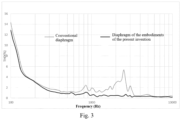
- both the diaphragm according to the present invention and the conventional diaphragm are placed at 100°C and stored for 96h, after being applied to a loudspeakers, the total harmonic distortion (THD) of the loudspeakers is tested respectively, and the test results are shown in Fig. 3 .
- THD total harmonic distortion
- the diaphragm is a single layer film, and the single layer film is made of a rubber compound.
- the diaphragm is a single layer film structure, that is, an elastomer layer which is made of a rubber compound as mentioned before.
- the diaphragm is a composite layer, and at least one layer of the composite layer is made of rubber compound.
- the composite diaphragm may comprises two layers, three layers, four layers or five layers, and one of the layers is an elastomer layer made of rubber compound, and the other composite layers may be thermoplastic elastomer layer and/or engineering plastics layer.
- the thermoplastic elastomer in the thermoplastic elastomer layer is at least one selected from the group consisting of thermoplastic polyester elastomer, thermoplastic polyurethane elastomer, thermoplastic polyamide elastomer, and silicone elastomer.
- the engineering plastics layer is at least one selected from the group consisting of polyether ether ketone, polyaryl ester, polyetherimide, polyimide, polyphenylene sulfide, polyethylene naphthalate, polyethylene terephthalate and polybutylene terephthalate.
- the present invention also provides a sound generating apparatus, the sound generating apparatus comprises a magnetic circuit system and a vibration system.
- the vibration system comprises a diaphragm, and the specific structure of the diaphragm may refer to the embodiment described above. Since the sound generating apparatus adopts all the technical solutions of the foregoing embodiments, it has at least all the beneficial effects brought by the technical solutions of the foregoing embodiments, and will not be described here.
- the diaphragm of the present invention may be a folded ring diaphragm or a flat diaphragm.
- the diaphragm is disposed on the main body of the sound generating apparatus, and the diaphragm is configured to be able to vibrate by driven, thereby generating sound by the vibration.
- the main body of the sound generating apparatus may be configured with coils, magnetic circuit system and other components to drive the diaphragm to vibrate by electromagnetic induction.
- the sound generating apparatus provided by the present invention has good sound generating effect and good durability.
Landscapes
- Engineering & Computer Science (AREA)
- Chemical & Material Sciences (AREA)
- Physics & Mathematics (AREA)
- Acoustics & Sound (AREA)
- Signal Processing (AREA)
- Manufacturing & Machinery (AREA)
- Medicinal Chemistry (AREA)
- Health & Medical Sciences (AREA)
- Chemical Kinetics & Catalysis (AREA)
- Polymers & Plastics (AREA)
- Organic Chemistry (AREA)
- Multimedia (AREA)
- Materials Engineering (AREA)
- Compositions Of Macromolecular Compounds (AREA)
- Diaphragms For Electromechanical Transducers (AREA)
Abstract
Description
- The present invention relates to a technical field of sound generating apparatus, in particular, a diaphragm and a sound generating apparatus.
- In related technology, loudspeakers diaphragm mostly use a composite structure of high modulus plastic film (such as PEEK, PAR, PEI, PI, etc.), flexible thermoplastic polyurethane elastomer (TPU), and damping rubber film (such as acrylic rubber, silicone rubber, etc.). However, the comprehensive performance of the above-described diaphragm is poor, for example, the high modulus plastic film layer is difficult to withstand large mechanical vibration in high frequency circumstance, thereby a phenomenon of film rupture occurs; the thermoplastic resin has poor heat and cold resistance, plastic deformation occurs at high temperature, and it is brittle at low temperature.
- The main object according to the present invention is to provide a diaphragm and a sound generating apparatus, it aims to improve the comprehensive performance of the diaphragm, so as to have excellent mechanical strength, cold resistance, resilience and high damping performance.
- To achieve the above object, the diaphragm provided in the present invention comprises at least one elastomer layer, and the elastomer layer is made of a rubber compound. The rubber compound comprises nitrile rubber and hydrogenated nitrile rubber, and both the nitrile rubber and the hydrogenated nitrile rubber contain acrylonitrile blocks. In terms of mass percentage, the range of the content of acrylonitrile blocks is 20% to 80%.
- In an embodiment, the mass ratio of the nitrile rubber and the hydrogenated nitrile rubber is no less than 1. In an embodiment, the rubber compound further comprises filler. In terms of mass percentage, the content of the filler in the rubber compound is 5% to 60%.
- In an embodiment, the filler has a particle size in the range of 10nm to 10µm; and/or, the filler is at least one selected from the group consisting of carbon black, white carbon black, calcium carbonate, barium sulfate, montmorillonite, and mica.
- In an embodiment, the rubber compound further comprises a vulcanizing agent. In terms of mass percentage, the content of the vulcanizing agent in the rubber compound is 0.5% to 5%.
- In an embodiment, the vulcanizing agent comprises a main cross-linking agent and a co-cross-linking agent. The vulcanizing system of the main cross-linking agent is at least one of sulfur vulcanizing systems and peroxide vulcanizing systems, and the co-cross-linking agent is at least one of triallyl isocyanurate and polymaleimide.
- In an embodiment, the diaphragm has a tensile strength in the range of 4MPa to 25MPa.
- In an embodiment, the diaphragm has a tear strength in the range of 15N/mm to 100N/mm. In an embodiment, the diaphragm has an operating temperature in the range of -80°C to 180°C.
- In an embodiment, the damping factor of the diaphragm is greater than 0.15.
- In an embodiment, the diaphragm has a density in the range of 0.9g/cm3 to 1.2g/cm3.
- In an embodiment, the diaphragm is a single layer, which is made of the rubber compound. Alternatively, the diaphragm is a composite layer, and at least one of the composite layer is made of the rubber compound.
- The present invention also provides a sound generating apparatus which comprises a magnetic circuit system and a vibration system. The vibration system comprises the diaphragm, and the diaphragm comprises at least one elastomer layer. The elastomer layer is made of a rubber compound, and the rubber compound comprises nitrile rubber and hydrogenated nitrile rubber. Both the nitrile rubber and the hydrogenated nitrile rubber contain acrylonitrile blocks, and in terms of mass percentage, the range of the content of the acrylonitrile blocks is 20% to 80%.
- The diaphragm according to the technical solution of the present invention adopts at least one elastomer layer, the elastomer layer is made of a rubber compound, and the rubber compound comprises nitrile rubber and hydrogenated nitrile rubber. Therefore, the diaphragm may exhibit a better comprehensive performance, and has excellent mechanical strength, cold resistance, resilience and high damping performance. In addition, the diaphragm can be used normally under extreme conditions of high and low temperatures, a phenomenon of film rupture is not easy to occur, and the service life of the diaphragm is longer than the conventional diaphragm material, and the diaphragm has better reliability. The sound generating apparatus applying the diaphragm can be applied in extremely harsh circumstance, while maintaining good acoustic performance. Moreover, the content of the acrylonitrile blocks is reasonably adjusted so that the mass content of the acrylonitrile blocks ranges from 20% to 80%, and such prepared diaphragm has excellent cold resistance, mechanical strength and resilience at the same time.
- In order to describe the embodiment of the present invention or the technical solution in the prior art more clearly, a brief description of the drawings required to be used in the description of the embodiment or the prior art will be illustrated below. It is apparently that the drawings in the following description are only some embodiments of the present invention, and other drawings can be obtained according to the structure shown in these drawings for those skilled in the art without any creative work.
-
Fig. 1 is a schematic diagram of the comparison curve of resonance frequency F0 of the diaphragm according to the embodiment of present invention before and after high temperatures; -
Fig. 2 is a schematic diagram of the comparison curve of resonant frequency F0 of a conventional diaphragm before and after high temperatures; -
Fig. 3 is a total harmonic distortion test curve of the loudspeaker diaphragm according to an embodiment of the present invention and a conventional diaphragm. - The realization of the object, functional features and advantages of the present invention will be further described with reference to the attached drawings in combined with embodiments.
- In addition, the technical solution among each of the embodiments may be combined with each other, as long as on the basis that they may be realized by those skilled in the art. When the combination of the technical solution is contradictory or impossible to achieve, it should be considered to be non-existent, and it is not fall in the scope of the present invention.
- The present invention provides a diaphragm which is applied to a sound generating apparatus, such as loudspeakers.
- In an embodiment of the present invention, the diaphragm comprises at least one elastomer layer, and the elastomer layer is made of a rubber compound. The rubber compound comprises nitrile rubber and hydrogenated nitrile rubber. Both the nitrile rubber and the hydrogenated nitrile rubber contain acrylonitrile blocks, and in terms of mass percentage, the content of the acrylonitrile blocks ranges from 20% to 80%.
- Nitrile rubber is polymerized from acrylonitrile and butadiene, its molecular formula comprises acrylonitrile blocks and butadiene blocks. The butadiene blocks provide flexibility in the material substrate, so that the nitrile rubber has good low temperature resistance properties. While the nitrile group of the acrylonitrile blocks is a strong polar group, which has high electronegativity, and it can form hydrogen bonds with atoms in the vulcanizing agent, so that the activity of the molecular chain is limited. In addition, the greater the content of the acrylonitrile, the more such alternating structural units, therefore, the glass transition temperature and tensile strength of nitrile rubber increases with the increase of the content of acrylonitrile blocks.
- Hydrogenated nitrile rubber is a highly saturated special elastomer obtained by hydrogenation of nitrile rubber, which has excellent thermo-oxidative aging resistance properties. The molecular structure of hydrogenated nitrile rubber also comprises acrylonitrile blocks.
- It is understand that, the nitrile group is a strong polar group having high electronegativity, and as the content of acrylonitrile blocks increases, the polarity of the nitrile group is enhanced, the chain flexibility is reduced, and the inter-chain interaction force is increased. The higher the glass transition temperature is, the content of double bond within the molecular chain decreases, the degree of saturation increases, oil resistance and gas tightness are improved, the relative density is increased, the speed of vulcanization is increased, and the tensile strength is increased, while the processability and cold resistance are decreased, and the resilience is decreased. A prepared diaphragm with poor cold resistance is easy to become stiff and brittle in an extreme circumstance of low temperatures, and the risk of diaphragm rupture increases. Therefore, the content of acrylonitrile blocks should be controlled properly, so that the prepared diaphragm has excellent glass transition temperature, tensile strength, density and resilience.
- Referring to Table 1, Table 1 shows the effect of the content of acrylonitrile blocks on the diaphragm performance. It can be seen from Table 1, as the content of acrylonitrile blocks increases, the glass transition temperature increases and the tensile strength increases. The density is also increased relatively, while resilience decreases gradually. In particularly, when the content of acrylonitrile blocks is more than 80%, the resilience decreases sharply. In order to ensure it has excellent glass transition temperature, tensile strength, density and resilience, in terms of mass percentage, the content of acrylonitrile blocks ranges from 20% to 80%. For example, the range of the content of acrylonitrile blocks is 20%, 30%, 40%, 50%, 60%, 70%, or 80%.
Table 1. Effect of the content of the acrylonitrile blocks on diaphragm performance The content of Acrylonitrile Blocks (wt%) 5 20 50 80 85 Glass Transition Temperature (°C) -35.1 -31.1 -23.5 -17.1 -15.6 Tensile Strength (MPa) 22.5 28.3 32.9 35 40.4 Density (g/cm3) 0.91 0.96 1.11 1.19 1.35 Resilience (%) 88 85 81 78 62 - Therefore, it is understand that the diaphragm uses at least one elastomer layer, and the elastomer layer is made of a rubber compound. The rubber compound comprises nitrile rubber and hydrogenated nitrile rubber. Therefore, the diaphragm may exhibit a better comprehensive performance having excellent mechanical strength, cold resistance, resilience and high damping performance. In addition, the diaphragm is useable under extreme circumstance of high and low temperatures, the phenomenon of film rupture is not easy to occur, the service life of the diaphragm is longer than the conventional diaphragm material, and the diaphragm has better reliability. The sound generating apparatus applying such diaphragm can be applied in extremely harsh circumstance, while maintaining good acoustic performance. The content of acrylonitrile blocks therein is reasonably adjusted, so that the mass content of acrylonitrile blocks ranges from 20% to 80%. Such prepared diaphragm has excellent cold resistance properties, mechanical strength and resilience at the same time.
- Due to the high price of hydrogenated nitrile rubber in the preparation of the rubber compound, in an optional embodiment, the mass ratio of nitrile rubber and hydrogenated nitrile rubber is not less than 1, so that the cost of the rubber compound may be reduced to a certain extent, thereby reducing the production cost of the diaphragm.
- Further, the rubber compound further comprises filler. In terms of mass percentage, the content of the filler in the rubber compound is 5% to 60%.
- Generally, the filler is inorganic filler with hydrogen, carboxyl group, lactone group, radical group, quinonyl group, and the like that can subject to substitution, reduction, oxidation and other reactions on the surface of the filler. After mixing the filler into the rubber compound, the internal friction between molecular chains of the rubber compound and the steric hindrance increase, the internal loss increases, resulting in the improvement of the damping performance of the material.
- Take carbon black as an example. Carbon black is an amorphous structure in which particles form aggregates by physical and chemical bounding with each other. The primary structure of carbon black is consist of aggregates, and there is Van der Waals or hydrogen bonds between the aggregates, so it is able to aggregate into a spatial network structure, that is, the secondary structure of carbon black. The surface of carbon black has hydrogen, carboxyl group, lactone group, radical group, quinonly group, and the like, which can subject to substitution, reduction, oxidation and other reactions. When carbon black is added into the rubber compound, since the strong interaction between the surface of carbon black and the interface of the rubber compound, when the material is stressed, the molecular chain is easier to slide on the surface of carbon black, while it is not easy to detach from carbon black. The rubber compound and carbon black form a strong bond that can slide, and the mechanical strength increases.
- It should be noted that when a filler fortifier is added, the content of the filler fortifier added needs to be reasonably controlled, such that the damping is appropriate, the diaphragm polarization is suppressed, the sound quality is good and the distortion is low, the mechanical properties are superior, and the acoustic performance and reliability conditions are satisfied. Optionally, in terms of mass percentage, the content of filler fortifier in rubber compound ranges from 5% to 60%, for example, the content of filler fortifier in rubber compound is 5%, 10%, 20%, 25%, 35%, 45%, 55%, or 60%.
- Referring to Table 2, Table 2 shows the effect of the amount of the carbon black added on the mechanical properties of the material. It can be seen from the table, when the parts of carbon black is 0.5%, both the mechanical strength and elongation at break are small, it is because the amount of carbon black is small and its dispersion in the substrate is not uniform, therefore, it is difficult to play a reinforcement effect. As the parts of carbon black added increases, the reinforcement is enhanced, the mechanical strength of the nitrile rubber and the hydrogenated nitrile rubber increases, while the elongation rate at break gradually decreases; when the parts of carbon black is 90 parts, the elongation at break sharply decreases, and there is a risk of film rupture in long-term use when prepared a diaphragm.
Table 2. Effect of the amount of carbon black added on the mechanical properties of material Amount of Carbon Black (wt%) 0.5 5 10 60 90 Elongation at break (%) 220 441 505 340 152 Tensile Strength (MPa) 5.1 15.2 19.6 25.9 35.7 Damping factor 0.15 0.19 0.21 0.33 0.36 - It should be noted that the hysteresis of the carbon black filled-rubber is much greater than a pure rubber. In fact the greater the amount of the carbon black filled, the greater the hysteresis, and the hysteresis of the rubber is proportional to the square of the amount filled. The damping of the loudspeakers diaphragm is increased, the ability of vibration system that can suppress the polarization phenomenon during the vibration process is strong, and the vibration consistency is good. The commonly used engineering plastic film layer has low damping, and its damping factor is generally less than 0.01, and the damping is small. In the case of an excessive amount of the carbon black filled, the hysteresis of the rubber is greater than the optimal added amount in the rubber, and the reinforcement effect is reduced, and high damping performance will make the heat generation of material increase, and this phenomenon is particularly significant under high frequency.
- The rubber compound added with filler according to the present invention is in a high elastic state, the molecular chain is easy to move, the inter-molecular friction is large, and damping performance is good. The damping factor at room temperature is greater than 0.15, the damping performance is excellent, so that the diaphragm may have a lower impedance. The damping performance of the loudspeakers diaphragm is increased, the ability of the vibration system that can suppress the polarization phenomenon during the vibration process is strong, and the vibration consistency is good.
- When choosing carbon black as filler fortifier, a suitable filler particle size should be selected, so that surface activity is good, surface energy is high, and thus reinforcement performance is better. Optionally, the particle size of the filler is in the range of 10nm to 10µm. The specific surface area of the carbon black of such particle size is optimal, and the specific surface area of carbon black refers to the sum of the surface area of carbon black particles per unit mass. The surface area of carbon black includes the outer surface area (smooth surface area) and the inner surface area (void inner surface area), and the total surface area of carbon black is the sum of the outer surface and the inner surface. The specific surface area of carbon black is inversely proportional to the particle size, i.e., the specific surface area of carbon black with small particle size is large, and the specific surface area of carbon black with large particle size is small.
- It is understand that, the reinforcement of the rubber by carbon black is through the combination of the aggregates surface of carbon black with rubber molecular chains. The combination of carbon black surface and rubber molecular chains is limited in two ways: one is the micro-pores of carbon black aggregates, where the rubber molecular chains may not enter these pores; and the other is the rough surface of carbon black aggregates, where the rubber molecular chains may not be in contact with the concave surface of rough surface. As a fortifier, carbon black must be combined with the rubber molecular chain to play the reinforcement role, and such combination dependents on the surface of carbon black to complete, so the reinforcement also depends on the degree of combination and the size of the surface. The smaller the carbon black particles, the larger the surface per mass of carbon black, and the greater of the reinforcement on the rubber. However, the increase of the specific surface area has a great impact on the processability of the non-vulcanizing rubber, making the filling capacity decreases, the mixing time is increases, dispersion capacity is decreases, roll-off is increases, viscosity is increases, and the smoothness of press-out is enhance, while scorch time, press-out shrinkage and press-out rate are decreased. The particle size is large, the specific surface area is small, the surface activity and surface energy are decreased, and the reinforcement of the rubber is not enough.
- The smaller the carbon particles , the smaller the size of micro-crystals, and the more edges, lattice defects and unsaturated charges of micro-crystals, that is, the more surface active sites and high-energy parts, the higher the surface energy. The carbon black with high surface activity has a large reinforcement effect due to the carbon black with high surface activity has more active sites on its surface, and the number of the network structures formed by reaction with rubber molecules in the process of rubber mixing and vulcanization is large. Such network structures formed with carbon black and rubber imparts strength to the vulcanized rubber.
- However, if the surface activity of carbon black is too high, the amount of bonded rubber generated during mixing is larger, so that the Mooney viscosity of the rubber increases, the die swell when press out and semi-finished product shrinkage increase, and the press-out rate decreases. If the particle size is too small, since the inter-particle cohesion is large, it is easy to agglomerate, resulting in dispersion difficulties when mixing, and the plasticity decreases and press-out performance deterioration.
Table 3. The relationship between carbon black particle size and the specific surface area, tear strength, 100% tensile modulus and product F0. Carbon Black Particle Size/ nm 1 10 4000 10000 12000 Specific Surface Area/(m2/g) 3500 2980 1500 1300 800 Tear Strength/ (N/mm) 85 60 50 35 10 100% Tensile modulus/(MPa) 1.71 1.62 1.19 1.1 0.8 Resonant Frequency F0 730 680 590 580 550 - The carbon black particles within this particle size range satisfy the processability of the non-vulcanized rubber, and has good dispersion ability and good roll-off performance, and its surface area is larger, so that the carbon black particles are promote to be closely combined with rubber, and the reinforcement is enhanced. Referring to Table 3, Table 3 shows the effect of different sizes of fillers on the tear strength, 100% tensile modulus and product resonance frequency F0 of rubber compound under the same amount of addition. From Table 3, it can be seen that the smaller the filler size, the higher the reinforcement, the higher the tear strength and 100% tensile modulus, and the higher the corresponding product resonance frequency F0. The larger the filler size, the worse the reinforcement, the lower the tear strength and 100% tensile modulus, and the lower the corresponding product resonance frequency F0 is low. Though the resonance frequency F0 is low, the tear strength is poor, and the film is easy to rupture in the process of high power vibration.
- It should be noted that when selecting the filler as the fortifier, the filler may be selected from at least one of the group consisting of carbon black, silica, calcium carbonate, barium sulfate, montmorillonite, and mica.
- Moreover, the rubber compound further comprises vulcanizing agent, and in terms of mass percentage, the content of vulcanizing agent in the rubber compound is 0.5% to 5%.
- The comprehensive performance of the rubber compound is better when adding such amount of vulcanizing agent, and it has better processability, mechanical properties, oil resistance and thermo-aging resistance.
Table 4. Effect of the content of the vulcanizing agent on the glass transition temperature and elongation at break of the material Content of the Vulcanizing Agent (wt%) 0.1 0.5 1 5 15 Glass transition temperature (°C) -35.8 -32.5 -28.2 -25.1 -15.8 Elongation at break (%) 387 378 319 267 168 Table 5 shows the vulcanization data for different content of vulcanizing agents Content of the Vulcanizing Agent (wt%) TS2/s T90/s 0.1 29.75 203.90 0.5 22.91 94.60 1 18.36 48.97 5 16.56 29.12 15 10.11 20.36 - Wherein, TS2/s characterizes the burning time, T90/s characterizes the time required for the rubber to be vulcanized by 90%.
- Referring to Table 4 and Table 5, Table 4 shows the effect of the amount of the vulcanizing agent used on the glass transition temperature and elongation at break of the material, Table 5 shows the vulcanization date of different content of vulcanizing agent. It can be seen that when the content of the vulcanizing agent is small, the effective cross-linking density of the material is low, the mechanical strength of the material is poor, and in the preparation of the diaphragm, it is easy to be deformation in the process of long-term use, and the vulcanization rate of the material is slow, thus the production efficiency is seriously limited, resulting an increase in production cost. With the increase of the amount of the vulcanizing agent, the scorching time of the rubber is shortened, the vulcanization rate increases, the cross-link density of the material increases, and the tensile stress at a given elongation, hardness, resilience of the vulcanized rubber as well as the fatigue cracking resistance under a given load condition are enhanced, the elongation at break decreases, the permanent deformation and dynamic heat generation are reduced, the molecular chain motion is restricted and the glass transition temperature is increased. However, if the cross-linking density is too high, the non-uniformity of the cross-linking bond distribution may be aggravated, resulting in uneven stress distribution.
- Optionally, the vulcanization agent comprises the main cross-linking agent and co-cross-linking agent, the main cross-linking agent has a vulcanizing system of at least one of sulfur vulcanizing systems and peroxide vulcanizing systems, and the co-cross-linking agent is at least one of triallyl isocyanurate and polymaleimide.
- Here, the main cross-linking agent is used to make the molecules of rubber compound to produce free radicals, and the co-cross-linking agent is used to cause a free radical polymerization with the free radicals in rubber compound. The main cross-linking agent may be one or two mixtures of the sulfur vulcanizing systems and the peroxide vulcanizing systems. Wherein, the peroxide vulcanizing systems may be one or two selected from the group consisting of diisopropyl benzene peroxide (DCP) or 2,5-dimethyl-2,5 (di-tert-butyl peroxy) hexane, and the co-cross-linking agent may be one or two selected from the group consisting of triallyl isocyanurate (TAIC), polymaleimide (PAPI).
- The density of the diaphragm according to the present invention is related to the content of the filler fortifier. Generally, the more the content of the filler fortifier, the greater its density. When the density of the rubber compound in the elastomer layer is low, the content of the filler is low, the mechanical performance of the prepared diaphragm is poor, and reliability problems such as collapse, film rupture and the like are easy to occur. When the density is large, the quality of the prepared diaphragm is much better than conventional diaphragms in the same thickness, but it results in a low Fr medium-frequency performance. Therefore, a suitable elastomer density should be selected, so that the prepared diaphragm has both excellent mechanical properties and medium-frequency properties. Optionally, the diaphragm of the present invention has a density ranging from 0.9g/cm3 to 1.20g/cm3.
- The diaphragm of the present invention has a tensile strength ranging from 4 MPa to 25 MPa, and the diaphragm has a tear strength ranging from 15 N/mm to 100 N/mm.
- The diaphragm of the present invention is not easy to have reliability problems such as film rupture during the application to the use of a sound generating apparatus.
- The diaphragm of the present invention may be used normally under extreme circumstances of high and low temperatures, the operating temperature of the diaphragm is in the range of -80°C to 180°C, while having the strength, resilience and damping properties required for the vibration of the diaphragm.
- The diaphragm of an embodiment of the present invention and a conventional diaphragm are placed at 100°C and stored for 96h, and the resonance frequency F0 of the diaphragm is tested, the results are shown in
Fig. 1 and Fig. 2 . As can be seen from the comparison betweenFig. 1 and Fig. 2 , after the loudspeakers diaphragm of the embodiment of the present invention being stored at 100°C for 96h, the resonant frequency F0 remains stable compared to the conventional diaphragm. The resonant frequency F0 of the conventional diaphragm is slightly reduced after being stored at high temperature, which is caused by plastic deformation and easy-aging of the conventional diaphragm after high temperature. This also indicates that the performance consistency of the diaphragm of the present invention may be maintained after high temperature. - While, both the diaphragm according to the present invention and the conventional diaphragm are placed at 100°C and stored for 96h, after being applied to a loudspeakers, the total harmonic distortion (THD) of the loudspeakers is tested respectively, and the test results are shown in
Fig. 3 . It can be seen fromFig. 3 that the loudspeakers diaphragm according to the embodiment of the present invention has a lower THD (total harmonic distortion) than the conventional diaphragm after being stored at 100°C for 96h, and has no sharp peaks, etc. This indicates that the loudspeakers diaphragm according to the embodiment of the present invention has excellent resilience even after a high temperature storage, the diaphragm has less swing vibration during vibration, and has better sound quality and listening stability. - In an embodiment of the present invention, the diaphragm is a single layer film, and the single layer film is made of a rubber compound. In this embodiment, the diaphragm is a single layer film structure, that is, an elastomer layer which is made of a rubber compound as mentioned before.
- In an embodiment of the present invention, the diaphragm is a composite layer, and at least one layer of the composite layer is made of rubber compound.
- The composite diaphragm may comprises two layers, three layers, four layers or five layers, and one of the layers is an elastomer layer made of rubber compound, and the other composite layers may be thermoplastic elastomer layer and/or engineering plastics layer. Wherein, the thermoplastic elastomer in the thermoplastic elastomer layer is at least one selected from the group consisting of thermoplastic polyester elastomer, thermoplastic polyurethane elastomer, thermoplastic polyamide elastomer, and silicone elastomer. The engineering plastics layer is at least one selected from the group consisting of polyether ether ketone, polyaryl ester, polyetherimide, polyimide, polyphenylene sulfide, polyethylene naphthalate, polyethylene terephthalate and polybutylene terephthalate.
- The present invention also provides a sound generating apparatus, the sound generating apparatus comprises a magnetic circuit system and a vibration system. The vibration system comprises a diaphragm, and the specific structure of the diaphragm may refer to the embodiment described above. Since the sound generating apparatus adopts all the technical solutions of the foregoing embodiments, it has at least all the beneficial effects brought by the technical solutions of the foregoing embodiments, and will not be described here.
- The diaphragm of the present invention may be a folded ring diaphragm or a flat diaphragm. The diaphragm is disposed on the main body of the sound generating apparatus, and the diaphragm is configured to be able to vibrate by driven, thereby generating sound by the vibration. The main body of the sound generating apparatus may be configured with coils, magnetic circuit system and other components to drive the diaphragm to vibrate by electromagnetic induction. The sound generating apparatus provided by the present invention has good sound generating effect and good durability.
- The above is only preferred embodiments of the present invention, and is not therefore limiting the scope of the present invention. Any equivalent structural transformation made by using the contents of the present specification or direct/indirect application in other related technical fields under the inventive concept of the present invention is included in the scope of protection of the present invention.
Claims (13)
- A diaphragm comprising at least one elastomer layer, the elastomer layer is made of a rubber compound, the rubber compound comprises nitrile rubber and hydrogenated nitrile rubber, both the nitrile rubber and the hydrogenated nitrile rubber contain acrylonitrile blocks, and in terms of mass percentage, the range of the content of the acrylonitrile blocks is 20% to 80%.
- The diaphragm according to claim 1, wherein a mass ratio of the nitrile rubber and the hydrogenated nitrile rubber is no less than 1.
- The diaphragm according to claim 1, wherein the rubber compound further comprises filler, and in terms of mass percentage, the content of the filler in the rubber compound is 5% to 60%.
- The diaphragm according to claim 3, wherein the filler has a particle size in the range of 10nm to 10µm; and/or,
the filler is at least one selected from the group consisting of carbon black, white carbon black, calcium carbonate, barium sulfate, montmorillonite, and mica. - The diaphragm according to claim 1, wherein the rubber compound further comprises a vulcanizing agent, and in terms of mass percentage, the content of the vulcanizing agent in the rubber compound is 0.5% to 5%.
- The diaphragm according to claim 5, wherein the vulcanizing agent comprises a main cross-linking agent and a co-cross-linking agent, the main cross-linking agent has a vulcanizing system of at least one of sulfur vulcanizing systems and peroxide vulcanizing systems, and the co-cross-linking agent is at least one of triallyl isocyanurate and polymaleimide.
- The diaphragm according to any one of claims 1 to 6, wherein the diaphragm has a tensile strength in the range of 4MPa to 25MPa.
- The diaphragm according to any one of claims 1 to 6, wherein the diaphragm has a tear strength in the range of 15N/mm to 100N/mm.
- The diaphragm according to any one of claims 1 to 6, wherein the diaphragm has an operating temperature in the range of -80°C to 180°C.
- The diaphragm according to any one of claims 1 to 6, wherein the diaphragm has a damping factor of greater than 0.15.
- The diaphragm according to any one of claims 1 to 6, wherein the diaphragm has a density in the range of 0.9g/cm3 to 1.2g/cm3.
- The diaphragm according to any one of claims 1 to 6, wherein the diaphragm is a single layer, and the single layer is made of the rubber compound;
alternatively, the diaphragm is a composite layer, and at least one of the composite layer is made of the rubber compound. - A sound generating apparatus, wherein the sound generating apparatus comprises a magnetic circuit system and a vibration system, and the vibration system comprises the diaphragm according to any one of claims 1 to 12.
Applications Claiming Priority (2)
| Application Number | Priority Date | Filing Date | Title |
|---|---|---|---|
| CN202011010803.7A CN111866698B (en) | 2020-09-23 | 2020-09-23 | Vibrating diaphragm and sound generating device |
| PCT/CN2021/114480 WO2022062816A1 (en) | 2020-09-23 | 2021-08-25 | Diaphragm and sound generating apparatus |
Publications (4)
| Publication Number | Publication Date |
|---|---|
| EP4221260A1 true EP4221260A1 (en) | 2023-08-02 |
| EP4221260A4 EP4221260A4 (en) | 2024-10-23 |
| EP4221260B1 EP4221260B1 (en) | 2025-12-31 |
| EP4221260C0 EP4221260C0 (en) | 2025-12-31 |
Family
ID=72967659
Family Applications (1)
| Application Number | Title | Priority Date | Filing Date |
|---|---|---|---|
| EP21871189.3A Active EP4221260B1 (en) | 2020-09-23 | 2021-08-25 | MEMBRAN AND SOUND GENERATION DEVICE |
Country Status (6)
| Country | Link |
|---|---|
| US (1) | US20230345178A1 (en) |
| EP (1) | EP4221260B1 (en) |
| JP (1) | JP7574426B2 (en) |
| KR (1) | KR102794054B1 (en) |
| CN (1) | CN111866698B (en) |
| WO (1) | WO2022062816A1 (en) |
Families Citing this family (14)
| Publication number | Priority date | Publication date | Assignee | Title |
|---|---|---|---|---|
| CN111866698B (en) * | 2020-09-23 | 2021-08-27 | 歌尔股份有限公司 | Vibrating diaphragm and sound generating device |
| CN114827870B (en) * | 2021-01-29 | 2023-07-14 | 歌尔股份有限公司 | Vibrating diaphragm and sound producing device |
| CN114933804A (en) * | 2022-05-25 | 2022-08-23 | 歌尔股份有限公司 | Vibrating diaphragm of sound production device, preparation method of vibrating diaphragm and sound production device |
| CN116017245A (en) * | 2023-01-29 | 2023-04-25 | 歌尔股份有限公司 | Diaphragm for sound generating device, sound generating device and electronic equipment |
| CN116208904B (en) * | 2023-03-07 | 2026-01-23 | 歌尔股份有限公司 | Vibrating diaphragm and sound generating device |
| CN116320957B (en) * | 2023-03-07 | 2025-10-17 | 歌尔股份有限公司 | Vibrating diaphragm and sound generating device |
| CN116208903B (en) * | 2023-03-07 | 2026-01-23 | 歌尔股份有限公司 | Vibrating diaphragm and sound generating device |
| CN116754469B (en) * | 2023-07-13 | 2026-04-14 | 中国人民解放军火箭军工程大学 | Method and system for representing damping performance of rubber material |
| WO2025065594A1 (en) * | 2023-09-28 | 2025-04-03 | 瑞声科技(南京)有限公司 | Rubber diaphragm and preparation method therefor, and sound-making device |
| CN118514400A (en) * | 2024-01-17 | 2024-08-20 | 四川大学 | A micro-nano laminated damping material and preparation method thereof |
| CN117584568B (en) * | 2024-01-17 | 2024-04-16 | 四川盈乐威科技有限公司 | Light vibration-damping alternate lamination damping material and preparation method thereof |
| CN120574443A (en) * | 2025-08-05 | 2025-09-02 | 歌尔股份有限公司 | Diaphragm for sound-generating device, sound-generating device, and electronic device |
| CN120574442A (en) * | 2025-08-05 | 2025-09-02 | 歌尔股份有限公司 | Diaphragm for sound-generating device, sound-generating device, and electronic device |
| CN121379056A (en) * | 2025-12-24 | 2026-01-23 | 潍坊同有新材料科技有限公司 | Cross-linked enhanced TPEE film and preparation method thereof |
Family Cites Families (14)
| Publication number | Priority date | Publication date | Assignee | Title |
|---|---|---|---|---|
| US5221714A (en) * | 1991-04-04 | 1993-06-22 | The Goodyear Tire & Rubber Company | Blend of rubber latices containing a hydrogenated rubber latex |
| JP2982483B2 (en) * | 1992-03-27 | 1999-11-22 | 日本ゼオン株式会社 | Rubber composition and method for producing the same |
| JPH08256397A (en) * | 1995-03-17 | 1996-10-01 | Hokushin Ind Inc | Speaker edge |
| US7483545B2 (en) * | 2004-07-07 | 2009-01-27 | Tadashi Nagaoka | Acoustic diaphragm |
| JP5432821B2 (en) * | 2009-09-16 | 2014-03-05 | 藤倉ゴム工業株式会社 | Diaphragm rubber composition and diaphragm using the same |
| US9708474B2 (en) * | 2011-12-07 | 2017-07-18 | Eastman Chemical Company | Cellulose esters in pneumatic tires |
| US10465031B2 (en) * | 2015-11-06 | 2019-11-05 | Hydril USA Distribution LLC | Short-chain fluorocarbon-grafted elastomer blowout preventer packers and seals for enhanced H2S resistance |
| CN105348591A (en) * | 2015-11-20 | 2016-02-24 | 洛阳超拓实业有限公司 | Rubber diaphragm used on pneumatic diaphragm pump |
| CN106957466B (en) * | 2016-12-12 | 2019-05-31 | 瑞声科技(新加坡)有限公司 | Vibrating diaphragm and preparation method thereof for electroacoustics system |
| CN106817658A (en) * | 2017-01-12 | 2017-06-09 | 瑞声科技(沭阳)有限公司 | Vibrating diaphragm and microphone device |
| CN110267167B (en) * | 2019-06-14 | 2021-08-31 | 歌尔股份有限公司 | Sound generating device's vibrating diaphragm and sound generating device |
| CN110708638B (en) * | 2019-10-31 | 2020-11-24 | 歌尔股份有限公司 | Vibrating diaphragm for miniature sound generating device and miniature sound generating device |
| CN111935625B (en) * | 2020-09-23 | 2021-01-22 | 歌尔股份有限公司 | Composite diaphragm of sound production device, preparation method of composite diaphragm and sound production device |
| CN111866698B (en) * | 2020-09-23 | 2021-08-27 | 歌尔股份有限公司 | Vibrating diaphragm and sound generating device |
-
2020
- 2020-09-23 CN CN202011010803.7A patent/CN111866698B/en active Active
-
2021
- 2021-08-25 US US18/027,998 patent/US20230345178A1/en active Pending
- 2021-08-25 EP EP21871189.3A patent/EP4221260B1/en active Active
- 2021-08-25 JP JP2023518789A patent/JP7574426B2/en active Active
- 2021-08-25 KR KR1020237011517A patent/KR102794054B1/en active Active
- 2021-08-25 WO PCT/CN2021/114480 patent/WO2022062816A1/en not_active Ceased
Also Published As
| Publication number | Publication date |
|---|---|
| JP7574426B2 (en) | 2024-10-28 |
| JP2023542697A (en) | 2023-10-11 |
| KR20230062611A (en) | 2023-05-09 |
| EP4221260B1 (en) | 2025-12-31 |
| WO2022062816A9 (en) | 2022-09-22 |
| CN111866698B (en) | 2021-08-27 |
| KR102794054B1 (en) | 2025-04-11 |
| US20230345178A1 (en) | 2023-10-26 |
| WO2022062816A1 (en) | 2022-03-31 |
| CN111866698A (en) | 2020-10-30 |
| EP4221260C0 (en) | 2025-12-31 |
| EP4221260A4 (en) | 2024-10-23 |
Similar Documents
| Publication | Publication Date | Title |
|---|---|---|
| EP4221260B1 (en) | MEMBRAN AND SOUND GENERATION DEVICE | |
| KR102697558B1 (en) | Diaphragm and micro-acoustic generator for micro-acoustic generator | |
| KR102714425B1 (en) | Vibrating plate and sound generating device of sound generating device | |
| CN111866669B (en) | A vibrating film and a micro sounding device for a micro sounding device | |
| KR102666673B1 (en) | Diaphragm for sound generating device and sound generating device | |
| KR102636232B1 (en) | Vibrating plate and sound generating device of sound generating device | |
| KR102659014B1 (en) | miniature sound generator | |
| CN111866671B (en) | Vibrating diaphragm for miniature sound generating device and miniature sound generating device | |
| CN111866699B (en) | Sound generating device's vibrating diaphragm and sound generating device | |
| EP3985067A1 (en) | Diaphragm for sound generating device and sound generating device | |
| CN111849110B (en) | Vibrating diaphragm for miniature sound generating device and miniature sound generating device | |
| CN111923525A (en) | Diaphragm and sound-generating device | |
| CN111849109B (en) | Vibrating diaphragm for miniature sound generating device and miniature sound generating device | |
| CN111866670A (en) | Vibrating diaphragm for miniature sound generating device and miniature sound generating device | |
| EP3962103A1 (en) | Diaphragm for miniature sound production device, and miniature sound production device | |
| CN110708639B (en) | Vibrating diaphragm for miniature sound generating device and miniature sound generating device | |
| CN116074704B (en) | Diaphragm of sound-generating device and sound-generating device |
Legal Events
| Date | Code | Title | Description |
|---|---|---|---|
| STAA | Information on the status of an ep patent application or granted ep patent |
Free format text: STATUS: THE INTERNATIONAL PUBLICATION HAS BEEN MADE |
|
| PUAI | Public reference made under article 153(3) epc to a published international application that has entered the european phase |
Free format text: ORIGINAL CODE: 0009012 |
|
| STAA | Information on the status of an ep patent application or granted ep patent |
Free format text: STATUS: REQUEST FOR EXAMINATION WAS MADE |
|
| 17P | Request for examination filed |
Effective date: 20230410 |
|
| AK | Designated contracting states |
Kind code of ref document: A1 Designated state(s): AL AT BE BG CH CY CZ DE DK EE ES FI FR GB GR HR HU IE IS IT LI LT LU LV MC MK MT NL NO PL PT RO RS SE SI SK SM TR |
|
| DAV | Request for validation of the european patent (deleted) | ||
| DAX | Request for extension of the european patent (deleted) | ||
| A4 | Supplementary search report drawn up and despatched |
Effective date: 20240919 |
|
| RIC1 | Information provided on ipc code assigned before grant |
Ipc: C08L 53/00 20060101ALI20240913BHEP Ipc: H04R 9/02 20060101ALI20240913BHEP Ipc: H04R 9/06 20060101ALI20240913BHEP Ipc: H04R 7/02 20060101ALI20240913BHEP Ipc: H04R 31/00 20060101AFI20240913BHEP |
|
| GRAP | Despatch of communication of intention to grant a patent |
Free format text: ORIGINAL CODE: EPIDOSNIGR1 |
|
| STAA | Information on the status of an ep patent application or granted ep patent |
Free format text: STATUS: GRANT OF PATENT IS INTENDED |
|
| INTG | Intention to grant announced |
Effective date: 20250806 |
|
| GRAS | Grant fee paid |
Free format text: ORIGINAL CODE: EPIDOSNIGR3 |
|
| GRAA | (expected) grant |
Free format text: ORIGINAL CODE: 0009210 |
|
| STAA | Information on the status of an ep patent application or granted ep patent |
Free format text: STATUS: THE PATENT HAS BEEN GRANTED |
|
| AK | Designated contracting states |
Kind code of ref document: B1 Designated state(s): AL AT BE BG CH CY CZ DE DK EE ES FI FR GB GR HR HU IE IS IT LI LT LU LV MC MK MT NL NO PL PT RO RS SE SI SK SM TR |
|
| REG | Reference to a national code |
Ref country code: CH Ref legal event code: F10 Free format text: ST27 STATUS EVENT CODE: U-0-0-F10-F00 (AS PROVIDED BY THE NATIONAL OFFICE) Effective date: 20251231 Ref country code: GB Ref legal event code: FG4D |
|
| REG | Reference to a national code |
Ref country code: DE Ref legal event code: R096 Ref document number: 602021045692 Country of ref document: DE |
|
| REG | Reference to a national code |
Ref country code: IE Ref legal event code: FG4D |
|
| U01 | Request for unitary effect filed |
Effective date: 20260113 |
|
| U07 | Unitary effect registered |
Designated state(s): AT BE BG DE DK EE FI FR IT LT LU LV MT NL PT RO SE SI Effective date: 20260119 |
|
| PG25 | Lapsed in a contracting state [announced via postgrant information from national office to epo] |
Ref country code: NO Free format text: LAPSE BECAUSE OF FAILURE TO SUBMIT A TRANSLATION OF THE DESCRIPTION OR TO PAY THE FEE WITHIN THE PRESCRIBED TIME-LIMIT Effective date: 20260331 |
|
| PG25 | Lapsed in a contracting state [announced via postgrant information from national office to epo] |
Ref country code: HR Free format text: LAPSE BECAUSE OF FAILURE TO SUBMIT A TRANSLATION OF THE DESCRIPTION OR TO PAY THE FEE WITHIN THE PRESCRIBED TIME-LIMIT Effective date: 20251231 |
|
| PG25 | Lapsed in a contracting state [announced via postgrant information from national office to epo] |
Ref country code: RS Free format text: LAPSE BECAUSE OF FAILURE TO SUBMIT A TRANSLATION OF THE DESCRIPTION OR TO PAY THE FEE WITHIN THE PRESCRIBED TIME-LIMIT Effective date: 20260331 |